

>ShortDescBot ShortDescBot adding short description "Species of damselfly" |
m robot: Update article (please report if you notice any mistake or error in this edit) |
||
| Line 8: | Line 8: | ||
| image2_caption= Female | | image2_caption= Female | ||
| status = LC | status_system = IUCN3.1 | | status = LC | status_system = IUCN3.1 | ||
| status_ref = <ref name=iucn>{{cite iucn | | | status_ref = <ref name="iucn status 20 November 2021">{{cite iucn |author=Kakkasery, F. |date=2011 |title=''Euphaea fraseri'' |volume=2011 |page=e.T175169A7116539 |doi=10.2305/IUCN.UK.2011-1.RLTS.T175169A7116539.en |access-date=20 November 2021}}</ref> | ||
| regnum = [[Animal]]ia | | regnum = [[Animal]]ia | ||
| phylum = [[Arthropod]]a | | phylum = [[Arthropod]]a | ||
| Line 24: | Line 24: | ||
}} | }} | ||
'''''Euphaea fraseri''''',<ref name=wol>{{World Odonata List}}</ref><ref name=iucn/> '''Malabar torrent dart''',<ref name=ibp/><ref name=ifb/> is a species of [[damselflies|damselfly]] in the family [[Euphaeidae]].<ref name=iucn/> This species is [[endemic]] to the [[Western Ghats]]; known to occur in various locations up to [[Goa]].<ref name=Fraser/><ref name=iucn/><ref name=atlas>{{cite book |last1=K.A. |first1=Subramanian |last2=K.G. |first2=Emiliyamma |last3=R. |first3=Babu |last4=C. |first4=Radhakrishnan |last5=S.S. |first5=Talmale |title=Atlas of Odonata (Insecta) of the Western Ghats, India |date=2018 |publisher=Zoological Survey of India |isbn=9788181714954|pages=88–89}}</ref> | '''''Euphaea fraseri''''',<ref name=wol>{{World Odonata List}}</ref><ref name="iucn status 20 November 2021" /> '''Malabar torrent dart''',<ref name=ibp/><ref name=ifb/> is a species of [[damselflies|damselfly]] in the family [[Euphaeidae]].<ref name="iucn status 20 November 2021" /> This species is [[endemic]] to the [[Western Ghats]]; known to occur in various locations up to [[Goa]].<ref name=Fraser/><ref name="iucn status 20 November 2021" /><ref name=atlas>{{cite book |last1=K.A. |first1=Subramanian |last2=K.G. |first2=Emiliyamma |last3=R. |first3=Babu |last4=C. |first4=Radhakrishnan |last5=S.S. |first5=Talmale |title=Atlas of Odonata (Insecta) of the Western Ghats, India |date=2018 |publisher=Zoological Survey of India |isbn=9788181714954|pages=88–89}}</ref> | ||
==Description and habitat== | ==Description and habitat== | ||
Revision as of 19:19, 20 November 2021
| Euphaea fraseri | |
|---|---|

| |
| Male | |

| |
| Female | |
| Scientific classification | |
| Kingdom: | |
| Phylum: | |
| Class: | |
| Order: | |
| Suborder: | |
| Family: | |
| Genus: | |
| Species: | E. fraseri
|
| Binomial name | |
| Euphaea fraseri (Laidlaw,1920)
| |
| Synonyms | |
Fraser, 1922
Laidlow, 1920 | |
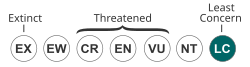
Euphaea fraseri,[2][1] Malabar torrent dart,[3][4] is a species of damselfly in the family Euphaeidae.[1] This species is endemic to the Western Ghats; known to occur in various locations up to Goa.[5][1][6]
Description and habitat
It is a medium sized damselfly with black head and brown-capped pale grey eyes. Its thorax is black, marked with sky-blue antehumeral and reddish-yellow humeral stripes. Lateral sides of the thorax in the base is red. Legs are red as in Euphaea cardinalis; but first pair is dark. Wings are narrower than Euphaea cardinalis; hind-wings are shorter than fore-wings. Fore-wings are transparent, merely enfumed with brown on the apices. Hind-wings are transparent; but one third of the wings from the apices are broadly black. Abdomen is bright red up to the segment 7; apical third of segment 7 to the end segment are black. Anal appendages are black.[5]
Female is short and robust; the ochreous-red of male is replaced with yellow colors. All wings are transparent, enfumed with black in adults. Abdomen is black with yellow lateral stripes up to segment 6. The yellow lateral stripes continued to segment 7. Segment 8 has a narrow and 9 has a broad yellow apical annule, covering dorsal half.[5]
They breed in hill streams but at a lower elevation. Males usually found on low herbage along the banks or middle of the streams.[5][7][8][3][4]
See also
References
- ↑ 1.0 1.1 1.2 1.3 Kakkasery, F. (2011). "Euphaea fraseri". IUCN Red List of Threatened Species. 2011: e.T175169A7116539. doi:10.2305/IUCN.UK.2011-1.RLTS.T175169A7116539.en. Retrieved 20 November 2021.
- ↑ Template:World Odonata List
- ↑ 3.0 3.1 "Euphaea fraseri Laidlaw, 1920". India Biodiversity Portal. Retrieved 2017-03-07.
- ↑ 4.0 4.1 "Euphaea fraseri Laidlaw, 1920". Odonata of India, v. 1.00. Indian Foundation for Butterflies. Retrieved 2017-03-07.
- ↑ 5.0 5.1 5.2 5.3 C FC Lt. Fraser (1934). The Fauna of British India, including Ceylon and Burma, Odonata Vol. II. Red Lion Court, Fleet Street, London: Taylor and Francis. pp. 110-112.
- ↑ K.A., Subramanian; K.G., Emiliyamma; R., Babu; C., Radhakrishnan; S.S., Talmale (2018). Atlas of Odonata (Insecta) of the Western Ghats, India. Zoological Survey of India. pp. 88–89. ISBN 9788181714954.
- ↑ C FC Lt. Fraser (1924). A Survey of the Odonate (Dragonfly) Fauna of Western India and Descriptions of Thirty New Species (PDF). p. 480.
- ↑ Subramanian, K. A. (2005). Dragonflies and Damselflies of Peninsular India - A Field Guide.
External links