
No edit summary Tags: Mobile edit Mobile web edit |
No edit summary Tags: Mobile edit Mobile web edit |
||
| Line 1: | Line 1: | ||
{{See also|List of creatures in Meitei folklore|List of Meitei folktales}} | {{See also|List of creatures in Meitei folklore|List of Meitei folktales}} | ||
{{Infobox mythical creature|name=Lai Khutsangbi|image=Lai Khutsangbi.jpg|image upright=2.5|caption=Lai Khutsangbi, the long handed demoness|Grouping=[[Mythology]]|Sub_Grouping=[[Meitei mythology]] ([[Manipuri mythology]])|Similar_entities=[[Yenakha Paodabi]], [[Keibu Keioiba]]|Family=[[Hingchabi]] (demoness)|Folklore=[[Meitei folklore]] ([[Manipuri folklore]])|AKA=Lai Khutshangbi|Country=[[India]]|Region=[[Manipur]]}} | {{Infobox mythical creature|name=Lai Khutsangbi|image=Lai Khutsangbi.jpg|image upright=2.5|caption=Lai Khutsangbi, the long handed demoness|Grouping=[[Mythology]]|Sub_Grouping=[[Meitei mythology]] ([[Manipuri mythology]])|Similar_entities=[[Yenakha Paodabi]], [[Keibu Keioiba]]|Family=[[Hingchabi]] (demoness)|Folklore=[[Meitei folklore]] ([[Manipuri folklore]])|AKA=Lai Khutshangbi|Country=[[India]]|Region=[[Manipur]]}} | ||
'''Lai Khutsangbi''' ({{lang-omp|Lai Khutshangpi}}) (/laai-khoot-shaang-bee/) is a demoness ([[hingchabi]]) in [[Meitei mythology]] and [[Meitei folklore|folklore]] of [[Antique Kangleipak]] ([[Ancient Manipur]]). She has very long hands. The word "Lai" means "deity or divinity," "Khut" means "hand," and "Sangbi" or "Shangbi" means "long" in [[Manipuri language | '''Lai Khutsangbi''' ({{lang-omp|Lai Khutshangpi}}) (/laai-khoot-shaang-bee/) is a demoness ([[hingchabi]]) in [[Meitei mythology]] and [[Meitei folklore|folklore]] of [[Antique Kangleipak]] ([[Ancient Manipur]]). She has very long hands. The word "Lai" means "deity or divinity," "Khut" means "hand," and "Sangbi" or "Shangbi" means "long" in [[Manipuri language]] ([[Meitei language]]).<ref>{{Cite book|url=https://books.google.com/books?id=TpM8DAAAQBAJ&dq=Khut+hand+Sangbi+long+manipuri&pg=PT53|title=New Folktales of Manipur|last=Oinam|first=James|date=2016-05-26|publisher=Notion Press|isbn=978-1-945400-70-4|language=en}}</ref><ref>{{Cite book|url=https://books.google.com/books?id=F29jAAAAMAAJ&q=lai+khutshangbi+demoness+long+hands|title=Indian Literature|date=1981|publisher=Sahitya Akademi.|language=en}}</ref><ref>{{Cite book|url=https://books.google.com/books?id=q5eBAAAAMAAJ&q=lai+khutsangbi+fairy+long+hands|title=Folk Culture of Manipur|last=Singh|first=Moirangthem Kirti|date=1993|publisher=Manas Publications|isbn=978-81-7049-063-0|language=en}}</ref> | ||
The legend says that when she walks, her long hands touch the ground. Her fingers are as sharp as thorns. She has a large mouth with a long tongue. Her look is very frightening.<ref name="Folktales of Manipur">{{Cite book|url=http://archive.org/details/dli.language.1358/page/n96/mode/1up|title=Folktales of Manipur|last1=B. Jayantakumar Sharma|last2=Dr. Chirom Rajketan Singh|date=2014|pages=96}}</ref> | The legend says that when she walks, her long hands touch the ground. Her fingers are as sharp as thorns. She has a large mouth with a long tongue. Her look is very frightening.<ref name="Folktales of Manipur">{{Cite book|url=http://archive.org/details/dli.language.1358/page/n96/mode/1up|title=Folktales of Manipur|last1=B. Jayantakumar Sharma|last2=Dr. Chirom Rajketan Singh|date=2014|pages=96}}</ref> | ||
Revision as of 18:26, 26 March 2022
 Lai Khutsangbi, the long handed demoness | |
| Grouping | Mythology |
|---|---|
| Sub grouping | Meitei mythology (Manipuri mythology) |
| Similar entities | Yenakha Paodabi, Keibu Keioiba |
| Family | Hingchabi (demoness) |
| Folklore | Meitei folklore (Manipuri folklore) |
| Other name(s) | Lai Khutshangbi |
| Country | India |
| Region | Manipur |
Lai Khutsangbi (Old Manipuri: Lai Khutshangpi) (/laai-khoot-shaang-bee/) is a demoness (hingchabi) in Meitei mythology and folklore of Antique Kangleipak (Ancient Manipur). She has very long hands. The word "Lai" means "deity or divinity," "Khut" means "hand," and "Sangbi" or "Shangbi" means "long" in Manipuri language (Meitei language).[1][2][3] The legend says that when she walks, her long hands touch the ground. Her fingers are as sharp as thorns. She has a large mouth with a long tongue. Her look is very frightening.[4]
Legend
There was a man and woman with a little child named Shasi (or "Shachi" or "Leirik" or "Naocha" in other versions) living in a house by itself in a village. Nearby was a forest where Lai Khutsangbi lived.[4] She usually stole and ate livestocks and human babies from the village. She took advantage of people's loneliness. The people in the village were afraid.
Lai Khutsangbi wanted to eat the child Shasi. But Shasi's father Shasipa was so brave that the Lau Khutsangbi was afraid of him. One day, Shasipa left home to work somewhere far away. he would be gone for days. Lai Khutsangbi came to the house at night, and asked Shasi's mother Shasima (Shais's Mama) if her husband was at home or not. Shasima was smart, so she lied and said her husband was at home. Lai Khutsangbi left. But she came back night after night and asked the same question again. Shasi's mother also gave the same reply, hiding the fact that Shasipa was away. After some time, Shasi's father returned home and Shasi's mother told him what had happened. Shasi's father decided to defeat the demoness. That night, he waited for Lai Khutsangbi with a sharpened sword. At midnight, the demoness, as usual, came to ask Shasima if her husband was home.[5] This time, Shasi's mother replied that he was away from home. Unaware of the trick, Lai Khutsangbi broke through the wall of the house with one of her powerful hands, trying to find Shasi, the child. Shasi's father, who was waiting for this opportunity, chopped off the hand with his sword.[6] Then, the demoness screamed painfully,
Lai Khutsangbi ran away from the house, dragging her remaining long arm. The blood flew out of her cut arm and fell onto many plants growing on her way to the forest. It is said that the red patches seen on some plants is her blood. Shasi's father followed her into the woods. The demoness could not run fast because she was injured. Shasi's father caught her and stepped on her other remaining hand. Then, he chopped off that arm too. The villagers thanked Shasipa for his bravery. From that day onwards, Lai Khutsangbi, the long handed demoness, was never seen again.[7]
Gallery
-
 Lai Khutsangbi
 -
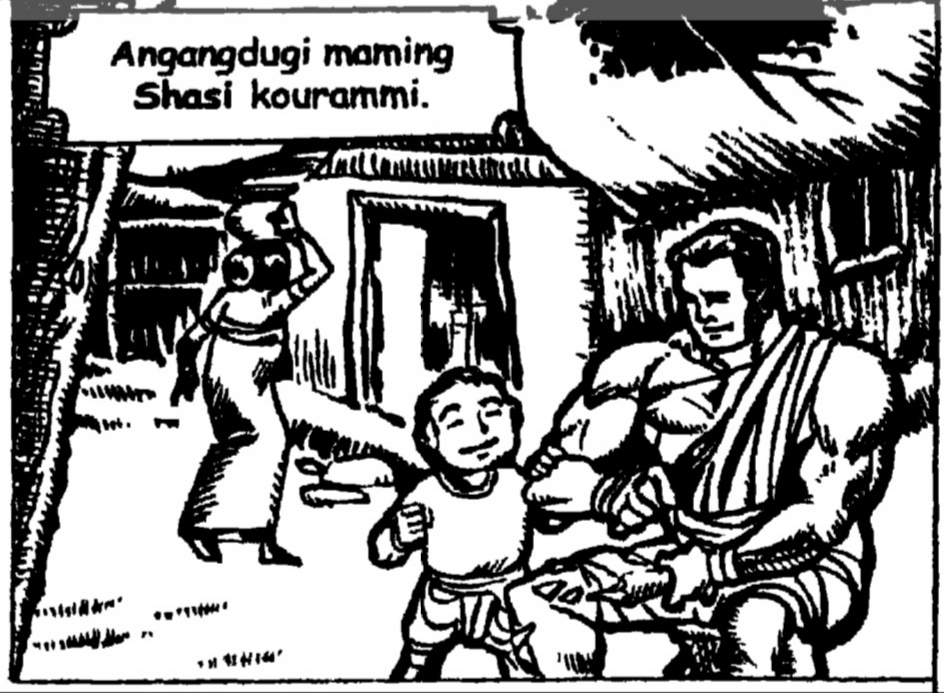 The family of Shasi, the child who is desired by Lai Khutsangbi
 -
 The family of Shasi, the child who is desired by Lai Khutsangbi
 -
 Lai Khutsangbi aiming to the lonely house
 -
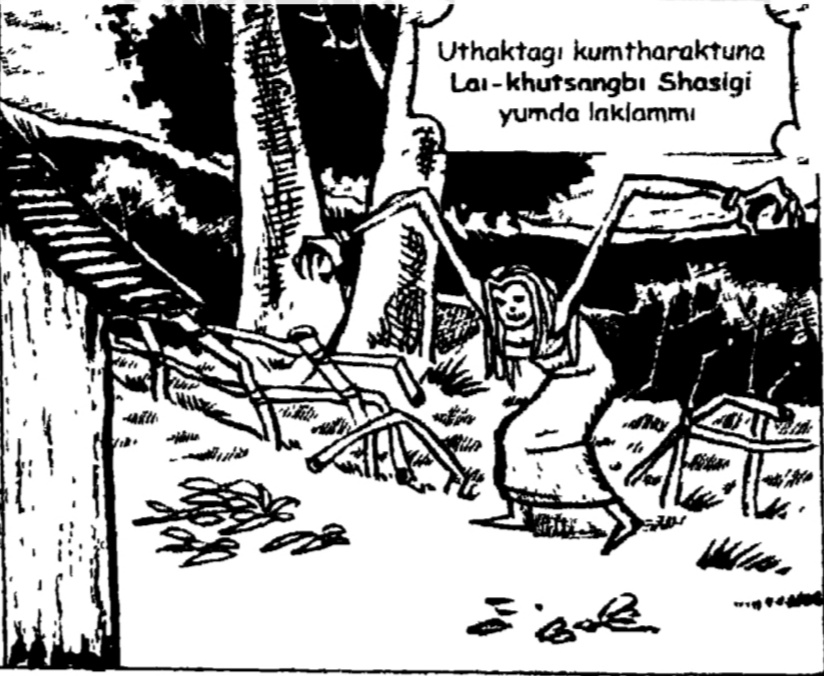 Lai Khutsangbi coming to human settlement
 -
 Lai Khutsangbi coming to the village
 -
 Lai Khutsangbi penetrating the wall of the house with her powerful hand
 -
 Lai Khutsangbi's hand about to chopped off by Shasipa, Shasi's father
 -
 The first hand being chopped off
 -
 Lai Khutsangbi being followed by Shasi's father
 -
 The second hand being chopped off


References
- ↑ Oinam, James (2016-05-26). New Folktales of Manipur. Notion Press. ISBN 978-1-945400-70-4.
- ↑ Indian Literature. Sahitya Akademi. 1981.
- ↑ Singh, Moirangthem Kirti (1993). Folk Culture of Manipur. Manas Publications. ISBN 978-81-7049-063-0.
- ↑ 4.0 4.1 B. Jayantakumar Sharma; Dr. Chirom Rajketan Singh (2014). Folktales of Manipur. p. 96.
- ↑ B. Jayantakumar Sharma; Dr. Chirom Rajketan Singh (2014). Folktales of Manipur. p. 97.
- ↑ 6.0 6.1 B. Jayantakumar Sharma; Dr. Chirom Rajketan Singh (2014). Folktales of Manipur. p. 98.
- ↑ 7.0 7.1 B. Jayantakumar Sharma; Dr. Chirom Rajketan Singh (2014). Folktales of Manipur. p. 99.