

No edit summary Tags: Mobile edit Mobile web edit |
CleanupBot (talk | contribs) m clean up |
||
| Line 23: | Line 23: | ||
| children = | | children = | ||
}} | }} | ||
'''Lord | '''Lord '''Maha Vishnu'''''' is the Supreme Godhead of [[Vaishnavism]] (Para Brahman or Nirguna Brahman) in [[purana]]s . He is called Swambhagwan in the [[Ramayana]] and [[Mahabharata]]. Vishnu is one of the three main [[Deity|gods]] in [[Hinduism]] and the Absolute Supreme being in the Vaishnava tradition. Vishnu is one of the members in the [[trimurti]] in Hinduism.<ref>{{Cite web|url=https://www.britannica.com/topic/Vishnu|title=Vishnu {{!}} Hindu deity|website=Encyclopedia Britannica|language=en|access-date=2019-12-10}}</ref> Vishnu is the preserver god, which means he protects the universe from being destroyed and keeps it going. According to this [[religion]], he has come to earth in nine forms (called [[avatar]]s) so far, with [[Kalki|one yet to come]] at the end of [[Kali Yuga]] to destroy evil. His most famous incarnations are [[Rama]], [[Krishna]], [[Parashurama]] And [[Narasimha]]. Vishnu's wife is [[Lakshmi]], the goddess of fortune. | ||
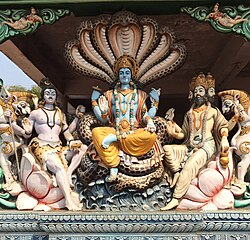
Lord Vishnu is usually shown with light blue skin and four arms. The Lord holds a lotus (Padma), the Indestructible Mace Of Lord Vishnu ([[Kaumodaki]]), a conch (Shankha) and the Unstoppable Disc Of Lord Vishnu ([[Sudarshana Chakra]]) in each of his four hands. He is known to take many guises, but the three main forms of Vishnu are Mahavishnu Karanodakshayi Vishnu (Mahavishnu), Garbhodaksayi Vishnu and [[Kshirodakashayi Vishnu]]. The latter two are the expansion of Karanodakshayi Vishnu. | Lord Vishnu is usually shown with light blue skin and four arms. The Lord holds a lotus (Padma), the Indestructible Mace Of Lord Vishnu ([[Kaumodaki]]), a conch (Shankha) and the Unstoppable Disc Of Lord Vishnu ([[Sudarshana Chakra]]) in each of his four hands. He is known to take many guises, but the three main forms of Vishnu are Mahavishnu Karanodakshayi Vishnu (Mahavishnu), Garbhodaksayi Vishnu and [[Kshirodakashayi Vishnu]]. The latter two are the expansion of Karanodakshayi Vishnu. | ||
| Line 49: | Line 49: | ||
Lord Vishnu holds items in his four hands. The Lord holds a conch in the upper left hand, which represents victory. He holds the Sudarshan Chakra in the upper right hand, which represents spiritual energy. In his lower left hand, a lotus (flower) represents peacefulness and in his lower right hand, the Kaumodaki represents the Lord's powers. | Lord Vishnu holds items in his four hands. The Lord holds a conch in the upper left hand, which represents victory. He holds the Sudarshan Chakra in the upper right hand, which represents spiritual energy. In his lower left hand, a lotus (flower) represents peacefulness and in his lower right hand, the Kaumodaki represents the Lord's powers. | ||
[[File:Avatars of Vishnu.jpg|thumb|left|250px|Lord Vishnu/Krishna Reveals His True Form To Arjuna ]] | [[File:Avatars of Vishnu.jpg|thumb|left|250px|Lord Vishnu/Krishna Reveals His True Form To Arjuna]] | ||
==Temples of Vishnu (Mahavishnu)== | ==Temples of Vishnu (Mahavishnu)== | ||
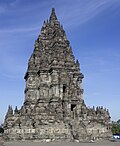
[[File:Kodlamane Vishnumurthy Temple.jpg|thumb|300px|[[Kodlamane Shree Vishnumurthy Temple]] ]] | [[File:Kodlamane Vishnumurthy Temple.jpg|thumb|300px|[[Kodlamane Shree Vishnumurthy Temple]] ]] | ||
[[Kodlamane Shree Vishnumurthy Temple]] : of Serenity and Mystery,<ref>Akshatha Vinayak, [http://www.nativeplanet.com/travel-guide/vishnumurthy-temple-near-idagunji-002423.html "Shree Vishnumurthy Temple Of Serenity and Mystery"], ''Native Planet'', 6-10-2016</ref> is dedicated to Lord Vishnu and is ancient [[Tirth Kshetra]]. There is no other place like this anywhere in [[Brahamanda | [[Kodlamane Shree Vishnumurthy Temple]] : of Serenity and Mystery,<ref>Akshatha Vinayak, [http://www.nativeplanet.com/travel-guide/vishnumurthy-temple-near-idagunji-002423.html "Shree Vishnumurthy Temple Of Serenity and Mystery"], ''Native Planet'', 6-10-2016</ref> is dedicated to Lord Vishnu and is ancient [[Tirth Kshetra]]. There is no other place like this anywhere in [[Brahamanda]]. | ||
== Powers and Abilities == | == Powers and Abilities == | ||
''Note that all these abilities are from Bhagavata Purana And Vishnu Purana'' | ''Note that all these abilities are from Bhagavata Purana And Vishnu Purana'' | ||
Omniverse manipulation/Absolute Manipulation/Meta Manipulation/Preservation: As the preserver, Vishnu can control anything and everything. The power to protect everything from anything is the reason why he is also called the Supreme protector of his devotes.<ref>{{Cite web|title=The Vishnu Purana: Book I: Chapter II|url=https://www.sacred-texts.com/hin/vp/vp036.htm|access-date=2021-01-27|website=www.sacred-texts.com}}</ref> | Omniverse manipulation/Absolute Manipulation/Meta Manipulation/Preservation: As the preserver, Vishnu can control anything and everything. The power to protect everything from anything is the reason why he is also called the Supreme protector of his devotes.<ref name="sacred-texts.com">{{Cite web|title=The Vishnu Purana: Book I: Chapter II|url=https://www.sacred-texts.com/hin/vp/vp036.htm|access-date=2021-01-27|website=www.sacred-texts.com}}</ref> | ||
Absolute destruction: In the Vishnu purana, Vishnu is also described as the creator, destroyer, and preserver. As the destroyer, he can even destroy infinity or the omniverse.<ref | Absolute destruction: In the Vishnu purana, Vishnu is also described as the creator, destroyer, and preserver. As the destroyer, he can even destroy infinity or the omniverse.<ref name="sacred-texts.com"/> | ||
Omni-Creation Or Absolute Creation: As the creator in Vishnu purana, Vishnu has the power to create everything, even infinity and beyond.<ref | Omni-Creation Or Absolute Creation: As the creator in Vishnu purana, Vishnu has the power to create everything, even infinity and beyond.<ref name="sacred-texts.com"/> The power to have limitless power upon seeing the Supreme form of lord Vishnu arjuna describes him having infinite prowess or power.<ref name="ReferenceA">{{Cite web|title=The Mahabharata, Book 6: Bhishma Parva: Bhagavat-Gita Parva: Section XXXV (Bhagavad Gita Chapter XI)|url=https://www.sacred-texts.com/hin/m06/m06035.htm|access-date=2021-01-27|website=www.sacred-texts.com}}</ref> | ||
The Lord has the power to do absolutely everything, even creating something that is bigger than infinity itself. In Chapter 11 Of the Bhagavad Gita, Lord Krishna/Vishnu shows Arjuna | The Lord has the power to do absolutely everything, even creating something that is bigger than infinity itself. In Chapter 11 Of the Bhagavad Gita, Lord Krishna/Vishnu shows Arjuna everything—all of creation: time, space, past, present, future, omniverse, fictional and real human beings, and more. It is beyond human imagination to actually comprehend it.<ref name="ReferenceA"/> | ||
Omniscience: The power to have infinite wisdom experience and knowledge.<ref>{{Cite web|last=Mukundananda|first=Swami|title=Chapter 7, Verse 26 – Bhagavad Gita, The Song of God – Swami Mukundananda|url=https://www.holy-bhagavad-gita.org/chapter/7/verse/26|access-date=2021-01-27|website=www.holy-bhagavad-gita.org|language=en}}</ref> | Omniscience: The power to have infinite wisdom experience and knowledge.<ref>{{Cite web|last=Mukundananda|first=Swami|title=Chapter 7, Verse 26 – Bhagavad Gita, The Song of God – Swami Mukundananda|url=https://www.holy-bhagavad-gita.org/chapter/7/verse/26|access-date=2021-01-27|website=www.holy-bhagavad-gita.org|language=en}}</ref> | ||
Omnipresent: The power to be everywhere at every time including beyond the omniverse in both past present and future.<ref | Omnipresent: The power to be everywhere at every time including beyond the omniverse in both past present and future.<ref name="ReferenceA"/><ref>{{Cite web|last=Mukundananda|first=Swami|title=Chapter 13, Verse 14 – Bhagavad Gita, The Song of God – Swami Mukundananda|url=https://www.holy-bhagavad-gita.org/chapter/13/verse/14|access-date=2021-01-27|website=www.holy-bhagavad-gita.org|language=en}}</ref> When Lord Krishna/Vishnu shows his Supreme appearance, it is described being everywhere, yet people can't see it because they don't have the divine vision. Only Maharishis/sages, gods, Sanjaya, and arjuna are able to see this Vishvarupa. | ||
Formless: Vishnu's true form is described as formless, infinite, boundless, inapplicable, without shape and color, according to Vishnu Purana.<ref | Formless: Vishnu's true form is described as formless, infinite, boundless, inapplicable, without shape and color, according to Vishnu Purana.<ref name="sacred-texts.com"/> | ||
Absolute immortality: Chapter 1 of Vishnu purana describes Vishnu being boundlessly above the concept of death idea and life.<ref>http://hinduonline.co/scriptures/puranas/vishnupurana.html</ref> | Absolute immortality: Chapter 1 of Vishnu purana describes Vishnu being boundlessly above the concept of death idea and life.<ref name="hinduonline.co">http://hinduonline.co/scriptures/puranas/vishnupurana.html</ref> | ||
Absolute Transcendence/Being Above All Things: The Vishnu Purana also describes Vishnu being above all descriptions such as logic, time, space, etc.<ref | Absolute Transcendence/Being Above All Things: The Vishnu Purana also describes Vishnu being above all descriptions such as logic, time, space, etc.<ref name="hinduonline.co"/> He is an infinite dimensional being according to Vishnu Sahasranamam.<ref>{{Cite web|title=Vishnu Sahasranāma - Wikipedia|url=https://en.m.wikipedia.org/wiki/Vishnu_Sahasran%C4%81ma|access-date=2021-05-11|website=en.m.wikipedia.org|language=en}}</ref> | ||
==References== | ==References== | ||
{{reflist}} | {{reflist}} | ||
Revision as of 15:00, 25 February 2022
 | This article may require copy editing for grammar, style, cohesion, tone, or spelling. (January 2021) |
| Vishnu | |
|---|---|
God of Preservation, Reality, Karma restoration and Moksha; The Protector of Good; Para Brahman, Supreme Being (Vaishnavism)[1][2] | |
| Member of Trimurti | |
| File:Lord of Gods Vishnu.jpg A painting of Vishnu | |
| Other names | Narayana, Hari, Lakshmikanta, Padmanābh, Mukunda |
| Sanskrit transliteration | Viṣṇu |
| Devanagari | विष्णु |
| Affiliation | Parabrahman (Vaishnavism), Trimurti, Bhagavan, Ishvara, Dashavatara |
| Abode | Vaikuntha, Kshira Sagara |
| Mantra | Om Namo Narayanaya, Om Namo Bhagavate Vasudevaya |
| Weapon | Discus (Sudarshana Chakra), Mace (Kaumodaki), Conch (Panchajanya),[3] |
| Symbols | Shaligram, Dvaravati sila, Lotus |
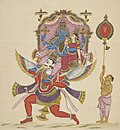
| Mount | Garuda,[3] Shesha |
| Festivals | Holi, Ram Navami, Krishna Janmashtami, Narasimha Jayanti, Diwali, Onam, Vivaha Panchami, Vijayadashami, Anant Chaturdashi, Devshayani Ekadashi, Prabodhini Ekadashi and other ekadashis, Kartik Purnima, Tulsi Vivah[4] |
| Personal information | |
| Siblings | Parvati |
| Consort | Lakshmi |

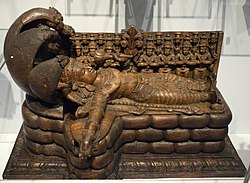
'Lord Maha Vishnu' is the Supreme Godhead of Vaishnavism (Para Brahman or Nirguna Brahman) in puranas . He is called Swambhagwan in the Ramayana and Mahabharata. Vishnu is one of the three main gods in Hinduism and the Absolute Supreme being in the Vaishnava tradition. Vishnu is one of the members in the trimurti in Hinduism.[5] Vishnu is the preserver god, which means he protects the universe from being destroyed and keeps it going. According to this religion, he has come to earth in nine forms (called avatars) so far, with one yet to come at the end of Kali Yuga to destroy evil. His most famous incarnations are Rama, Krishna, Parashurama And Narasimha. Vishnu's wife is Lakshmi, the goddess of fortune. Lord Vishnu is usually shown with light blue skin and four arms. The Lord holds a lotus (Padma), the Indestructible Mace Of Lord Vishnu (Kaumodaki), a conch (Shankha) and the Unstoppable Disc Of Lord Vishnu (Sudarshana Chakra) in each of his four hands. He is known to take many guises, but the three main forms of Vishnu are Mahavishnu Karanodakshayi Vishnu (Mahavishnu), Garbhodaksayi Vishnu and Kshirodakashayi Vishnu. The latter two are the expansion of Karanodakshayi Vishnu.
Avatars
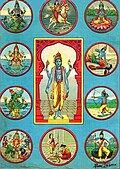
There are 10 Avatars of Vishnu (in the order they appeared):
- Matsya (Fish)
- Kurma (Turtle)
- Varaha (Boar)
- Narasimha (half lion, half man)
- Vamana (Dwarf / Short man)
- Parashurama (Fierce man / Hunter)
- Rama (Developed man / Ideal man / Fighter)
- Krishna (Cowherd Prince)
Different branches of Hindu tradition accept two different figures as the 9th avatar of Vishnu:
- Buddha (Intellectual and scientific man)
- Kalki (future avatar, has not appeared yet)
Icons
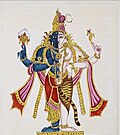
Lord Vishnu holds items in his four hands. The Lord holds a conch in the upper left hand, which represents victory. He holds the Sudarshan Chakra in the upper right hand, which represents spiritual energy. In his lower left hand, a lotus (flower) represents peacefulness and in his lower right hand, the Kaumodaki represents the Lord's powers.

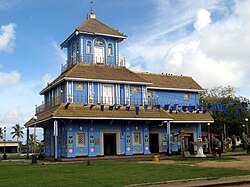
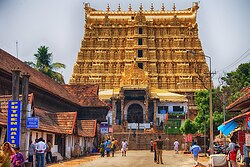
Temples of Vishnu (Mahavishnu)

Kodlamane Shree Vishnumurthy Temple : of Serenity and Mystery,[6] is dedicated to Lord Vishnu and is ancient Tirth Kshetra. There is no other place like this anywhere in Brahamanda.
Powers and Abilities
Note that all these abilities are from Bhagavata Purana And Vishnu Purana
Omniverse manipulation/Absolute Manipulation/Meta Manipulation/Preservation: As the preserver, Vishnu can control anything and everything. The power to protect everything from anything is the reason why he is also called the Supreme protector of his devotes.[7]
Absolute destruction: In the Vishnu purana, Vishnu is also described as the creator, destroyer, and preserver. As the destroyer, he can even destroy infinity or the omniverse.[7]
Omni-Creation Or Absolute Creation: As the creator in Vishnu purana, Vishnu has the power to create everything, even infinity and beyond.[7] The power to have limitless power upon seeing the Supreme form of lord Vishnu arjuna describes him having infinite prowess or power.[8]
The Lord has the power to do absolutely everything, even creating something that is bigger than infinity itself. In Chapter 11 Of the Bhagavad Gita, Lord Krishna/Vishnu shows Arjuna everything—all of creation: time, space, past, present, future, omniverse, fictional and real human beings, and more. It is beyond human imagination to actually comprehend it.[8]
Omniscience: The power to have infinite wisdom experience and knowledge.[9]
Omnipresent: The power to be everywhere at every time including beyond the omniverse in both past present and future.[8][10] When Lord Krishna/Vishnu shows his Supreme appearance, it is described being everywhere, yet people can't see it because they don't have the divine vision. Only Maharishis/sages, gods, Sanjaya, and arjuna are able to see this Vishvarupa.
Formless: Vishnu's true form is described as formless, infinite, boundless, inapplicable, without shape and color, according to Vishnu Purana.[7]
Absolute immortality: Chapter 1 of Vishnu purana describes Vishnu being boundlessly above the concept of death idea and life.[11]
Absolute Transcendence/Being Above All Things: The Vishnu Purana also describes Vishnu being above all descriptions such as logic, time, space, etc.[11] He is an infinite dimensional being according to Vishnu Sahasranamam.[12]
References
- ↑ Wendy Doniger (1999). Merriam-Webster's Encyclopedia of World Religions. Merriam-Webster. p. 1134. ISBN 978-0-87779-044-0.
- ↑ Encyclopedia of World Religions. Encyclopaedia Britannica, Inc. 2008. pp. 445–448. ISBN 978-1-59339-491-2.
- ↑ 3.0 3.1 Constance Jones; James D. Ryan (2006). Encyclopedia of Hinduism. Infobase Publishing. pp. 491–492. ISBN 978-0-8160-7564-5.
- ↑ Muriel Marion Underhill (1991). The Hindu Religious Year. Asian Educational Services. pp. 75–91. ISBN 978-81-206-0523-7.
- ↑ "Vishnu | Hindu deity". Encyclopedia Britannica. Retrieved 2019-12-10.
- ↑ Akshatha Vinayak, "Shree Vishnumurthy Temple Of Serenity and Mystery", Native Planet, 6-10-2016
- ↑ 7.0 7.1 7.2 7.3 "The Vishnu Purana: Book I: Chapter II". www.sacred-texts.com. Retrieved 2021-01-27.
- ↑ 8.0 8.1 8.2 "The Mahabharata, Book 6: Bhishma Parva: Bhagavat-Gita Parva: Section XXXV (Bhagavad Gita Chapter XI)". www.sacred-texts.com. Retrieved 2021-01-27.
- ↑ Mukundananda, Swami. "Chapter 7, Verse 26 – Bhagavad Gita, The Song of God – Swami Mukundananda". www.holy-bhagavad-gita.org. Retrieved 2021-01-27.
- ↑ Mukundananda, Swami. "Chapter 13, Verse 14 – Bhagavad Gita, The Song of God – Swami Mukundananda". www.holy-bhagavad-gita.org. Retrieved 2021-01-27.
- ↑ 11.0 11.1 http://hinduonline.co/scriptures/puranas/vishnupurana.html
- ↑ "Vishnu Sahasranāma - Wikipedia". en.m.wikipedia.org. Retrieved 2021-05-11.