


imported>Editrite! No edit summary |
->Citation bot Alter: url. URLs might have been anonymized. Add: isbn. | Use this bot. Report bugs. | Suggested by AManWithNoPlan | #UCB_webform 1747/2031 |
||
| Line 1: | Line 1: | ||
{{Use dmy dates|date=July 2019}} | {{Use dmy dates|date=July 2019}} | ||
[[File:Villupattu at kollam.jpg|thumb|Villu Paatu (English: Bow Song,Tamil: வில்லுப்பாட்டு), also known as Villadichampaatu and Villisai, is an ancient form of musical story-telling in India where narration is interspersed with music.]] | [[File:Villupattu at kollam.jpg|thumb|Villu Paatu (English: Bow Song, Tamil: வில்லுப்பாட்டு), also known as Villadichampaatu and Villisai, is an ancient form of musical story-telling in India where narration is interspersed with music.]] | ||
'''''Villu Paatu''''' (English: Bow Song, [[Tamil language|Tamil]]: வில்லுப்பாட்டு), also known as '''Villadichampaatu''', is an ancient form of musical story-telling in India where narration is interspersed with music, an art of southern states of [[Tamil Nadu]] and [[Kerala]], as well as [[North Eastern Province, Sri Lanka|North-East]] [[Sri Lanka]].<ref>{{cite web |url=http://tamilnadu.com/arts/villu-paatu.html|title=Arts - Villu Paatu|publisher=Tamilnadu.com|date=26 February 2013}}</ref> This art form is popular among [[Nadar (caste)|Nadar]] and [[Ezhava]] castes of erstwhile [[Travancore]] kingdom.{{Citation needed|date=August 2010}} Simple tunes and verses make the story easy to follow. The ''villu'' (bow), the age-old weapon of warriors - paradoxically lends itself to be used as a primary musical instrument (a [[musical bow]]) for the ''Villu Paatu'' artists. | '''''Villu Paatu''''' (English: Bow Song, [[Tamil language|Tamil]]: வில்லுப்பாட்டு), also known as '''Villadichampaatu''', is an ancient form of musical story-telling in India where narration is interspersed with music, an art of southern states of [[Tamil Nadu]] and [[Kerala]], as well as [[North Eastern Province, Sri Lanka|North-East]] [[Sri Lanka]].<ref>{{cite web |url=http://tamilnadu.com/arts/villu-paatu.html|title=Arts - Villu Paatu|publisher=Tamilnadu.com|date=26 February 2013}}</ref> This art form is popular among [[Nadar (caste)|Nadar]] and [[Ezhava]] castes of erstwhile [[Travancore]] kingdom.{{Citation needed|date=August 2010}} Simple tunes and verses make the story easy to follow. The ''villu'' (bow), the age-old weapon of warriors - paradoxically lends itself to be used as a primary musical instrument (a [[musical bow]]) for the ''Villu Paatu'' artists. | ||
[[Image:Channaar Musicians 19th century.jpg|thumbnail|Ezhava/Channar musicians from the 19th century: Performing traditional ''Villadichaampattu'']] | [[Image:Channaar Musicians 19th century.jpg|thumbnail|Ezhava/Channar musicians from the 19th century: Performing traditional ''Villadichaampattu'']] | ||
==Overview== | ==Overview== | ||
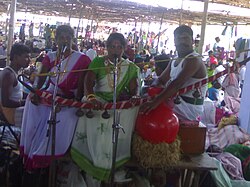
[[Image:Villuppaattu.jpg|thumb|200px|Tamil folk artists presenting a Villuppattu near [[Tirunelveli]] during a festival ( | [[Image:Villuppaattu.jpg|thumb|200px|Tamil folk artists presenting a Villuppattu near [[Tirunelveli]] during a festival (Panguni Uththiram) at a [[Sudalai Madan]] temple.]] | ||
In [[Tamil Nadu|Tamil]] villages, performers narrate stories ranging from mythological to social. The main storyteller narrates the story striking the bow. The bow rests on a mud pot kept facing downwards. A co-performer beats the pot while singing. There is usually another co-singer who acts as active listener to the narration, uttering appropriate oral responses. The local government | In [[Tamil Nadu|Tamil]] villages, performers narrate stories ranging from mythological to social. The main storyteller narrates the story striking the bow. The bow rests on a mud pot kept facing downwards. A co-performer beats the pot while singing. There is usually another co-singer who acts as active listener to the narration, uttering appropriate oral responses. The local government sometimes utilises this as a vehicle for social messages and propaganda. Villu pattu troupes usually perform for festivals associated with deities such as Sudalai Madan, Mutharamman, Pechiamman, Isakkiamman, etc. The Villu pattu tradition is associated with the culture of southern Tamil Nadu, southern Kerala and North-East Sri Lanka. | ||
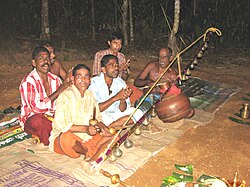
[[File:Villu patt.JPG|thumb|left| Kerala folk artists performing ''villupattu''. Their song is accompanied by a ''villadivadyam''. The instrument is a "composite idiophone", made up of a long bow, bronze bells hung on it, a terra-cotta pot and sticks with [[jingle (percussion)| jingles]].<ref name=grove>{{cite encyclopedia |editor-last= Sadie |editor-first=Stanley |author= Alastair Dick |entry= Villādivādyam |encyclopedia= The New Grove Dictionary of Musical Instruments |year=1984 |id= Volume 3 |page= 727|quote=}}</ref>]] | [[File:Villu patt.JPG|thumb|left| Kerala folk artists performing ''villupattu''. Their song is accompanied by a ''villadivadyam''. The instrument is a "composite idiophone", made up of a long bow, bronze bells hung on it, a terra-cotta pot and sticks with [[jingle (percussion)| jingles]].<ref name=grove>{{cite encyclopedia |editor-last= Sadie |editor-first=Stanley |author= Alastair Dick |entry= Villādivādyam |encyclopedia= The New Grove Dictionary of Musical Instruments |year=1984 |id= Volume 3 |page= 727|quote=}}</ref>]] | ||
There are also ''[[ | There are also ''[[Udukki]]'' (உடுக்கை), ''Kudam'' (குடம்), ''Thala'', ''Kattai''(கட்டை), which are used as supplementary instruments in performances. ''Udukki'' is a small drum with a slender middle portion which is held in the left hand and played by the fingers of the right hand. Occasionally, the ''Villu Pattu'' team divides itself into two groups, each trying to prove opposite points-of-view of a subject. This is called ''Lavani Pattu''. The songs used by the ''Villu Pattu'' artists are mostly traditional [[folk-song]]s. They are played during occasions of temple festivals in villages. The songs sung mostly in ''Villu Paatu'' praise a god or tell a story. These days the number of artists performing ''Villu Paatu'' is tremendously reduced as the income earned from it is never enough for running one's life.<ref>http://www.wiki.indianfolklore.org/images/a/a1/Villupattu_zWorkshop_.pdf</ref> | ||
==Books== | ==Books== | ||
*{{cite book | title=History of Indian theatre, Volume 2| author=Manohar Laxman Varadpande| year=1992| pages=125|url=https://books.google.com/books?id=6ZrjC24PuDQC | *{{cite book | title=History of Indian theatre, Volume 2| author=Manohar Laxman Varadpande| year=1992| pages=125| isbn=9788170172789|url=https://books.google.com/books?id=6ZrjC24PuDQC&dq=villu+paattu&pg=PA125}} | ||
*[https://books.google.com/books?id=ObFCT5_taSgC&pg=PA347&lpg=PA347&dq=Villu+pattu+ezhava&source=bl&ots=mUCW2zDRv6&sig=dmvweqjpZZKEsQEbrkTU5C-5CdE&hl=en&sa=X&oi=book_result&resnum=1&ct=result Source] | *[https://books.google.com/books?id=ObFCT5_taSgC&pg=PA347&lpg=PA347&dq=Villu+pattu+ezhava&source=bl&ots=mUCW2zDRv6&sig=dmvweqjpZZKEsQEbrkTU5C-5CdE&hl=en&sa=X&oi=book_result&resnum=1&ct=result Source] | ||
==References== | |||
<references/> | |||
==External links== | ==External links== | ||
| Line 20: | Line 23: | ||
* http://villuppaattu-tamil.blogspot.com/ | * http://villuppaattu-tamil.blogspot.com/ | ||
* [https://www.youtube.com/watch?v=_il8sssQ9iE&t=25s/ Video: Performed in a Temple in Kallidaikurichi] | * [https://www.youtube.com/watch?v=_il8sssQ9iE&t=25s/ Video: Performed in a Temple in Kallidaikurichi] | ||
[[Category:Indian styles of music]] | [[Category:Indian styles of music]] | ||
Revision as of 23:02, 18 December 2021

Villu Paatu (English: Bow Song, Tamil: வில்லுப்பாட்டு), also known as Villadichampaatu, is an ancient form of musical story-telling in India where narration is interspersed with music, an art of southern states of Tamil Nadu and Kerala, as well as North-East Sri Lanka.[1] This art form is popular among Nadar and Ezhava castes of erstwhile Travancore kingdom.[citation needed] Simple tunes and verses make the story easy to follow. The villu (bow), the age-old weapon of warriors - paradoxically lends itself to be used as a primary musical instrument (a musical bow) for the Villu Paatu artists.

Overview

In Tamil villages, performers narrate stories ranging from mythological to social. The main storyteller narrates the story striking the bow. The bow rests on a mud pot kept facing downwards. A co-performer beats the pot while singing. There is usually another co-singer who acts as active listener to the narration, uttering appropriate oral responses. The local government sometimes utilises this as a vehicle for social messages and propaganda. Villu pattu troupes usually perform for festivals associated with deities such as Sudalai Madan, Mutharamman, Pechiamman, Isakkiamman, etc. The Villu pattu tradition is associated with the culture of southern Tamil Nadu, southern Kerala and North-East Sri Lanka.

There are also Udukki (உடுக்கை), Kudam (குடம்), Thala, Kattai(கட்டை), which are used as supplementary instruments in performances. Udukki is a small drum with a slender middle portion which is held in the left hand and played by the fingers of the right hand. Occasionally, the Villu Pattu team divides itself into two groups, each trying to prove opposite points-of-view of a subject. This is called Lavani Pattu. The songs used by the Villu Pattu artists are mostly traditional folk-songs. They are played during occasions of temple festivals in villages. The songs sung mostly in Villu Paatu praise a god or tell a story. These days the number of artists performing Villu Paatu is tremendously reduced as the income earned from it is never enough for running one's life.[3]
Books
- Manohar Laxman Varadpande (1992). History of Indian theatre, Volume 2. p. 125. ISBN 9788170172789.
- Source
References
- ↑ "Arts - Villu Paatu". Tamilnadu.com. 26 February 2013.
- ↑ Alastair Dick (1984). "Villādivādyam". In Sadie, Stanley (ed.). The New Grove Dictionary of Musical Instruments. p. 727. Volume 3.
- ↑ http://www.wiki.indianfolklore.org/images/a/a1/Villupattu_zWorkshop_.pdf
External links
 | This Tamil-related article is a stub. You can help Bharatpedia by expanding it. |
 | This article about the culture of India is a stub. You can help Bharatpedia by expanding it. |