|
|
| Line 1: |
Line 1: |
| {{Short description|Hindu festival dedicated to the goddess Kali}}
| |
| {{EngvarB|date=April 2015}}
| |
| {{Use dmy dates|date=April 2015}}
| |
| {{Infobox holiday | | {{Infobox holiday |
| |holiday_name = Kali Puja | | |holiday_name= Kali Puja |
| |image = Maa Kali Barasat Roy Chowdhury Bari.jpg | | |image= Kali Fatakeshto Arnab Dutta 2010.JPG |
| |caption = Kali Puja at Roy Chowdhury House at Barasat | | |caption= |
| |nickname = | | |nickname= |
| |observedby = [[Hindu]]s | | |observedby= [[Hindu]]s |
| |date = Decided by lunar calendar | | |date = Decided by lunar calendar |
| |observances = Prayers, Religious rituals (see [[Puja (Hinduism)|puja]], [[prashad]]) | | |observances=Prayers, Religious rituals (see [[Puja (Hinduism)|puja]], [[prashad]]) |
| |celebrations = [[Fireworks]] | | |celebrations=[[Fireworks]] |
| |type = Hindu | | |type=Hindu |
| |longtype = Hindu | | |longtype= Hindu |
| |significance = | | |significance= |
| |date2015 = 10 November | | |date2015= 10 November |
| |date2017 = 19 October | | |date2017 = 19 October |
| |date2018 = 06 November | | |date2018 = 06 November |
| |date2019 = 27 October
| | |frequency=annual |
| |date2020 = 14 November
| |
| |frequency = annual | |
| }} | | }} |
| '''Kali Puja''', also known as '''Shyama Puja''' or '''Mahanisha Puja''',<ref>[http://www.diwalifestival.org/regional-names-diwali.html Diwali]</ref> is a festival, originating from the [[Indian subcontinent]], dedicated to the [[Hinduism|Hindu]] goddess [[Kali]], celebrated on the new moon day (Dipannita Amavasya) of the Hindu month [[Kartika (month)|Kartik]] especially in the regions of [[Bengal]], and in [[Mithila (region)|Mithila]], [[Odisha]], [[Assam]] and the town of [[Titwala]] in [[Maharashtra]].<ref name = MK72>McDermott and Kripal p.72</ref> It coincides with the [[Lakshmi Puja]] day of [[Diwali]]. While the [[Hindu]] [[Bengali people|Bengalis]], [[Odia people|Odias]], [[Assamese people|Assamese]] and [[Maithili people|Maithils]] worship the goddess Kali<ref name = MK72/> on this day, the rest of India and Nepal worships goddess [[Lakshmi]] on Diwali. | | '''Kali Puja''' is also known as '''Shyama Puja''' or '''Mahanisha Puja'''.<ref>{{cite web|url=http://www.diwalifestival.org/regional-names-diwali.html|title=Regional Names of Diwali - Diwali in India,Diwali Names in India|first=Society for the Confluence of Festivals in|last=India|website=www.diwalifestival.org}}</ref> It is a [[festival]] [[wikt:celebrate|celebrated]] in the honour of [[Hinduism|Hindu]] goddess [[Kali]]. It is celebrated on the [[new moon]] day of the Hindu month [[Kartika (month)|Kartik]]. It is mostly celebrated in [[West Bengal]], [[Bihar]], [[Odisha]], [[Assam]], [[Tripura]] and [[Bangladesh]].<ref name = MK72>{{cite book|last1=McDermott|first1=Rachel Fell|last2=Kripal|first2=Jeffrey J.|title=Encountering Kali: In the Margins, at the Center, in the West}} p.72</ref> It happens at the same time with the pan-Indian [[Lakshmi Puja]] day of [[Diwali]]. In this day [[Bengalis]], [[Odia people|Odias]], [[Assamese people|Assamese]] and [[Maithil]]s worship goddess Kali<ref name = MK72/> and the rest of India worships goddess Lakshmi on Diwali. Mahanisha puja is done by the [[Maithili people]] of [[Mithila (India)|Mithila]] region in India and Nepal.<ref>{{cite web|url=https://books.google.co.uk/books?id=f3LXAAAAMAAJ&q=kali+puja+mithila&dq=kali+puja+mithila&hl=en&sa=X&ved=0ahUKEwjDnfT8p6_XAhUjJcAKHTp2Cm8Q6AEILjAC|title=Religious Life of the Brahman: A Case Study of Maithil Brahmans|first=Asim|last=Maitra|date=1 January 1986|publisher=Inter-India Publications|via=Google Books}}</ref> |
|
| |
|
| ==Legend==
| | == References == |
| As per the Kalikula sect of [[Shaktism]], the supreme celestial Mother goddess [[Mahakali]] took 10 manifestations to slay evils on the Earth, which are collectively known as [[Mahavidya]]s. Each Mahavidya has a day of incarnation in the Hindu calendar of 12 months. Out of those 10 Mahavidyas, the last goddess is '''[[Kamalatmika]]''', whose day of incarnation is celebrated as '''Kamalatmika Jayanti''', falls on the day of Deepavali. She is often recognized as 'Tantrik [[Lakshmi]]'. In the rest of Indian subcontinent, the day is associated with deity [[Rama]] or [[Krishna]]. Since both of them are central Gods of Vaishnavism, most Indians celebrate [[Deepavali]] as a Vaishnavite-oriented festival and thus worship [[Lakshmi]], the consort of [[Mahavishnu]] as the supreme mother Goddess.
| | {{reflist}} |
| | |
| However, in Eastern & Northeastern India, the Kalikuli Shakta faith being dominant, the root goddess of Kamalatmika, [[Mahakali]] is worshipped. Thus, the day eventually becomes Kali Puja.
| |
| | |
| ==History==
| |
| [[File:Artisan making an idol of goddess Kali, kumortuli, 2017.jpg|thumb|right|Artisan making an idol of goddess Kali at [[Kumortuli]], Kolkata.]]
| |
| The festival of Kali Puja is not an ancient one. Kali Puja was practically unknown before the 16th century; famous sage Krisnananda Agambagish first initiated Kali puja, also a late 17th-century devotional text Kalika ''[[mangalkavya]]'' mentions an annual festival dedicated to Kali.<ref>McDermott p. 373</ref> In Bengal during the 18th century, King (Raja) Krishnachandra of Krishnanagar, Nadia, West Bengal also made this puja wide spread.<ref name="MK72" /> Kali Puja gained popularity in the 19th century, when kali saint Shri Ramkrishna became popular among the Bengalis ; wealthy landowners began patronizing the festival on a grand scale.<ref>McDermott p. 173</ref> Along with [[Durga Puja]], Kali Puja is the biggest festival in Bengal and Assam.<ref>McDaniel p. 223</ref>
| |
| | |
| ==Worship==
| |
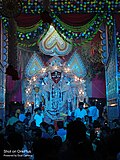
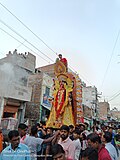
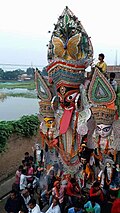
| [https://www.bspirituality.com/2020/01/kali-puja-2020-2020.html] During kali puja (like [[Durga Puja]]) worshippers honour the goddess Kali in their homes in the form of clay [[Murti|sculptures]] and in [[Pandal|''pandal''s]] (temporary shrines or open pavilions). She is worshipped at night with [[Tantra|Tantric]] rites and [[mantra]]s. She is prescribed offerings of red [[hibiscus]] flowers, sweets, rice and lentils. It is prescribed that a worshipper should meditate throughout the night until dawn.<ref>McDaniel p. 234</ref> Homes and pandals may also practice rites in the ''[[Brahmanical]]'' (mainstream Hindu-style, non-Tantric) tradition with ritual dressing of Kali in her form as Adya Shakti Kali and no animals are sacrificed. She is offered food and sweets made of rice, lentils, and fruits.<ref name = "MCDa"/> However, in Tantric tradition, animals are [[Animal sacrifice in Hinduism|ritually sacrificed]] on Kali Puja day and offered to the goddess.<ref name = MK72/> A celebration of Kali Puja in [[Kolkata]], [[Bhubaneswar]] and in [[Guwahati]] is also held in a large [[Shmashana|cremation ground]]<ref name="f86">Fuller p. 86</ref> where she is believed to dwell. [[Barasat]], [[Madhyamgram]] region of [[North 24 Parganas district|North 24 Parganas]] is well known for their majestic pandals, lightings and Idols. [[Durga Puja]] of [[Kolkata]] is often said synonymously with Kali Puja of [[Barasat]]. The region experiences Lacs of footfalls during the days of the festival. People from different regions gather to witness the majestic Pandals.
| |
| | |
| The ''pandal''s also house images of Kali's consort, [[Shiva]], two famous Bengali Kali devotees named [[Ramakrishna]] and [[Bamakhepa]], along with scenes from mythology of Kali and her various forms, including images of the [[Mahavidya]]s, sometimes considered as the "ten Kalis." The Mahavidyas is a group of ten Tantric goddesses headed by Kali.<ref>Kinsley p.18</ref> People visit these ''pandals'' throughout the night. Kali Puja is also the time for magic shows, theater, and fireworks.<ref name = "MCDa">McDaniel pp. 249-50, 54</ref> Recent custom has incorporated wine consumption.<ref>Harding p. 134</ref>
| |
| | |
| In the Kalighat Temple in [[Kolkata]], Kalikhetra Temple in [[Bhubaneswar]] and in Kamakhya Temple in [[Guwahati]], Kali is worshipped as [[Lakshmi]] on this day so as to reflect an essence of [[Vaishnavism|Vaishnava]] Haldars on Kali worship. Goddess Lakshmi is worshiped in her three forms, Maha Lakshmi, Maha Kali and Maha Saraswati on this day. The temple is visited by thousands of devotees who give offerings to the goddess.<ref name = MK72/><ref name = "f86"/> Another famous temple dedicated to Kali in Kolkata is [[Dakshineswar Kali Temple]], where Sri Rāmakrishna performed rites.<ref>See Harding pp. 125-6 for a detailed account of the rituals in Dakshineshwar.</ref>
| |
| | |
| ==Other celebrations==
| |
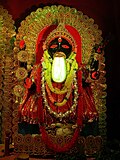
| [[File:Kalighater Kali.JPG|thumb|A Kali Puja pandal with a replica of the [[Kalighat Kali Temple]] icon.]]
| |
| [[File:Child bursting firecracker, Howrah, 2016.jpg|thumb|right|A child bursting firecracker in Bengal during Kali Puja]]
| |
| Although the widely popular annual Kali Puja celebration, also known as the ''Dipanwita Kali Puja'', is celebrated on the new moon day of the month of [[Kartika (month)|Kartika]], Kali is also worshipped in other new moon days too. Three other major Kali Puja observations are ''Ratanti Kali Puja'' , ''Phalaharini Kali Puja'' and ''Kaushiki Kali Puja''.Kaushiki kali puja is associated with Goddess Tara of Tarapith, while Ratanti puja is celebrated on [[Magha (month)|Magha]] Krishna Chaturdashi and Phalaharini puja is celebrated on [[Jyeshta]] Amavashya of Bengali calendar. The ''Phalaharini Kali Puja'' is especially important in the life of the saint [[Ramakrishna]] and his wife [[Sarada Devi]], since on this day in 1872, Ramakrishna worshipped Sarada Devi as the goddess [[Shodashi]].<ref>{{cite book |last1=Gambhirananda |first1=Swami |title=Holy Mother Shri Sarada Devi |edition=1st |year=1955 |publisher=Shri Ramakrishna Ashrama, Madras |location=Madras |pages=48–51}}</ref> In many Bengali and Assamese households, Kali is worshipped daily.<ref>{{cite book |last1=Banerjee |first1=Suresh Chandra |title=Shaktiranga Bangabhumi |trans-title=Bengal, The Abode of Shaktism |edition=1st |year=1991 |publisher=Ananda Publishers Pvt Ltd |location=Kolkata |language=bn |isbn=81-7215-022-9 |page=114}}</ref>
| |
| | |
| ==Notes==
| |
| {{Reflist}}
| |
| | |
| ==References== | |
| * Fuller, Christopher John. ''[https://books.google.com/books?id=To6XSeBUW3oC The camphor flame: popular Hinduism and society in India].''
| |
| * Harding, Elizabeth U. ''[https://books.google.com/books?id=4woiJbQTsBQC Kali: the black goddess of Dakshineswar].''
| |
| * Kinsley, David R. ''[https://books.google.com/books?id=oMW8WTrotKsC Tantric visions of the divine feminine: the ten mahāvidyās].''
| |
| * McDaniel, June. ''[https://books.google.com/books?id=caeJpIj9SdkC Offering flowers, feeding skulls: popular goddess worship in West Bengal].''
| |
| * McDermott, Rachel Fell. ''[https://books.google.com/books?id=2PrChFaXgf0C Mother of my heart, daughter of my dreams].''<!-- ''': Kālī and Umā in the devotional ...''' -->
| |
| * McDermott, Rachel Fell; Kripal, Jeffrey John. ''[https://books.google.com/books?id=bMUJyU_C-LkC Encountering Kālī: in the margins, at the center, in the West].''
| |
| | |
| ==Further reading==
| |
| * McDermott, Rachel Fell (2011). ''[https://books.google.com/books?id=ggBeH_lmUu8C Revelry, Rivalry, and Longing for the Goddesses of Bengal: The Fortunes of Hindu Festivals]''.
| |
| * [https://www.academia.edu/19972617/Phalaharini_Kali_Prabuddha_Bharata_January_2016 Narasimhananda, Swami, Prabuddha Bharata, January 2016, The Phalaharini Kali.]
| |
| | |
| ==External links==
| |
| * [https://www.bengalifestivalstimedate.club/2018/10/kali-puja-2019-time-and-date-diwali.html Kali Puja] celebrated in India and Bangladesh
| |
| {{Commons category|Kali Puja}}
| |
| | |
| {{Tourist attractions in Kolkata}}
| |
| {{Hindu festivals}}
| |
| {{Bengali Hindu people}}
| |
| {{Culture of West Bengal}}
| |
| | |
| <!--Please do not remove this category until the article has been sorted in to the correct calendar category-->
| |
| | |
| {{Authority control}} | |
|
| |
|
| [[Category:Hindu festivals]] | | [[Category:Hindu festivals]] |
| [[Category:Religious festivals in India]] | | [[Category:India]] |
| [[Category:Festivals in West Bengal]] | | [[Category:Festivals in Asia]] |
| [[Category:Festivals in Odisha]]
| |
| [[Category:Shaktism]]
| |
| [[Category:October observances]]
| |
| [[Category:November observances]]
| |