


imported>WikiCleanerBot m v2.04b - Bot T20 CW#61 - Fix errors for CW project (Reference before punctuation) |
->Aithus Adding custom short description: "Second Maharaja of the Sikh Empire from 1839–1839" (Shortdesc helper) |
||
| Line 1: | Line 1: | ||
{{Short description|Second Maharaja of the Sikh Empire from 1839–1839}} | |||
{{About|the Maharaja|20th century political leader|Baba Kharak Singh}} | {{About|the Maharaja|20th century political leader|Baba Kharak Singh}} | ||
{{Use Indian English|date=August 2013}} | {{Use Indian English|date=August 2013}} | ||
{{Use dmy dates|date=August 2013}} | {{Use dmy dates|date=August 2013}} | ||
{{Infobox royalty | {{Infobox royalty | ||
| name | | name = Kharak Singh | ||
| image | | image = Kharak Singh.jpg | ||
| succession | | succession = 2nd [[Maharaja]] of the [[Sikh Empire]] | ||
| reign | | reign = 27 June 1839 – 8 October 1839 | ||
| cor-type | | cor-type = Coronation | ||
| predecessor = [[Maharaja Ranjit Singh|Ranjit Singh]] | | predecessor = [[Maharaja Ranjit Singh|Ranjit Singh]] | ||
| successor | | successor = [[Nau Nihal Singh]] | ||
| coronation | | coronation = 1 September 1839 | ||
| birth_date | | birth_date = 22 February 1801 | ||
| birth_place = [[Lahore]], [[Punjab]], [[Sikh Empire]] | | birth_place = [[Lahore]], [[Punjab]], [[Sikh Empire]] | ||
| death_date | | death_date = {{death-date and age|5 November 1840|22 February 1801}} | ||
| death_place = Lahore, Punjab, Sikh Empire | | death_place = Lahore, Punjab, Sikh Empire | ||
| spouse | | spouse = [[Chand Kaur|Chand Kaur Kanhaiyā]]<ref name=eos>{{cite web |url=http://www.learnpunjabi.org/eos/index.aspx | ||
| title=KHAṚAK SIṄGH MAHĀRĀJĀ (1801–1840) |last=Āhlūwālīā |first=M. L. | | title=KHAṚAK SIṄGH MAHĀRĀJĀ (1801–1840) |last=Āhlūwālīā |first=M. L. | ||
| website=Encyclopaedia of Sikhism |publisher=Punjabi University Patiala | | website=Encyclopaedia of Sikhism |publisher=Punjabi University Patiala | ||
| access-date=19 May 2016}}</ref> | | access-date=19 May 2016}}</ref> | ||
| religion | | spouse-type = Consort | ||
| image_size | | spouses = [[Bibi Khem Kaur Dhillon]]<ref name=dhillon1>{{Cite web |url=http://www.sikh-history.com/sikhhist/warriors/khemkaurdhillon.html |title="Bibi Khem Kaur Dhillon", URL accessed 11/16/06 |access-date=19 December 2018 |archive-url=https://web.archive.org/web/20171218030926/http://www.sikh-history.com/sikhhist/warriors/khemkaurdhillon.html |archive-date=18 December 2017 |url-status=dead }}</ref> <br> Kishan Kaur Samra <br> Inder Kaur Bajwa | ||
| father | | religion = [[Sikhism]] | ||
| mother | | image_size = 200px | ||
| issue | | house = [[Sukerchakia]] | ||
| reg-type1 | | father = [[Maharaja Ranjit Singh|Ranjit Singh]] | ||
| regent1 | | mother = [[Maharani Datar Kaur|Datar Kaur]] | ||
| issue = [[Nau Nihal Singh]] | |||
| reg-type1 = {{nowrap|Wazir}} | |||
| regent1 = [[Dhian Singh]] | |||
}} | }} | ||
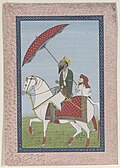
'''Kharak Singh''' (22 February 1801 – 5 November 1840) was the second [[Maharaja]] of the [[Sikh Empire]]. | '''Kharak Singh''' (22 February 1801 – 5 November 1840) was the second [[Maharaja]] of the [[Sikh Empire]]. He was the eldest son of [[Maharaja Ranjit Singh]], founder of the [[Sikh Empire]] and his [[Queen consort|consort]], [[Datar Kaur|Maharani Datar Kaur]]. He succeeded his father on 27 June 1839 and reigned until his dethronement and imprisonment on 8 October 1839.<ref name="eos" /> He was succeeded by his only son [[Nau Nihal Singh]]. | ||
== | ==Early life== | ||
He was born in [[Lahore]] | He was born on 22 February 1801 in [[Lahore Fort|Lahore]], [[Punjab]]. He was the first son of [[Ranjit Singh]] and his second wife [[Datar Kaur|Datar Kaur Nakai]].<ref name="C. Grey 1849">C. Grey, European Adventurers of Northern India, 1785 to 1849, Asian Educational Services, 1996,</ref> His mother was the daughter of [[Ran Singh Nakai]], third ruler of the [[Nakai Misl]]. The prince was named by his father <ref>{{Cite book|last=Vaḥīduddīn|first=Faqīr Sayyid|url=https://books.google.com/books?id=uaQGAQAAIAAJ&q=raj+kaur+triumphed+over+mehtab+kaur|title=The Real Ranjit Singh|date=1965|publisher=Lion Art Press|language=en}}</ref> "Kharak" (ਖਰਕ) which means 'Wielder of the Sword' he was named after the unconquerable warrior mentioned in [[Dasam Granth]]. According to [[Gyani]] Sher Singh, Ranjit Singh knew the entire Dasam Granth by heart. It was his birth that persuaded his father to proclaim himself the [[Maharaja|Maharaja of Punjab]].<ref>{{Cite book|last=Singh|first=Khushwant|url=https://books.google.com/books?id=D068dKeyGW4C&q=kharak+singh|title=Ranjit Singh|date=2009-03-24|publisher=Penguin Books India|isbn=978-0-14-306543-2|language=en}}</ref> | ||
He married four times. In 1812, at the age of 11 he was married to [[Chand Kaur|Chand Kaur Kanhaiya]], daughter of Sardar Jaimal Singh, chief of the [[Kanhaiya Misl]]. Their son [[Nau Nihal Singh]] was born in 1821.<ref name="C. Grey 1849" /> In 1816, the prince was married to [[Bibi Khem Kaur Dhillon]], a [[Jat people|Jat]] [[Sikhs|Sikh]] daughter of Jodh Singh Kalalvala and granddaughter of Sahib Singh Dhillon.<ref name="dhillon1" /> After the [[Second Anglo-Sikh War]] in 1849, Bibi Khem's [[jagir]]s were reduced by the [[British raj]] due to her anti-British role in the war.<ref name="dhillon1" /> His third wife was, Kishan Kaur Samra, a daughter of Chaudhari Raja Singh of Amritsar of the Samra clan; they were married in 1818. She was the only queen to live after the fall of the Sikh Empire in 1849, had an annual pension paid by the British Raj of RS 2324 and died in Lahore in 1876 while living at the [[Lahore Fort]]. His last wife, Inder Kaur Bajwa was married by proxy in a "chadar dalna" ceremony, in 1815.<ref>{{Cite web|url=https://books.google.com/books?id=Z1UoAAAAYAAJ&q=samra+jat+Amritsar&pg=PA392|title=The Panjab Chiefs: Historical and Biographical Notices of the Principal Families in the Lahore and Rawalpindi Divisions of the Panjab|last1=Griffin|first1=Lepel Henry|year=1890}}</ref> She was a relative if Chet Singh Bajwa.<ref>{{Cite book|last=www.DiscoverSikhism.com|url=http://archive.org/details/HistoryOfTheSikhMisals|title=History Of The Sikh Misals|language=English}}</ref> | |||
He had a younger brother named [[Rattan Singh]].<ref>{{Cite web|author=Yudhvir Rana|title=Descendants of Maharaja Ranjit Singh stakes claim on Gobindgarh Fort|url=https://timesofindia.indiatimes.com/india/descendants-of-maharaja-ranjit-singh-stakes-claim-on-gobindgarh-fort/articleshow/47123514.cms|access-date=2021-09-22|website=The Times of India|language=en}}</ref><ref>{{Cite web|author=Yudhvir Rana|title=Seventh generation descendent of Maharaja Ranjit Singh writes to Imran|url=https://timesofindia.indiatimes.com/india/seventh-generation-descendent-of-maharaja-ranjit-singh-writes-to-imran/articleshow/85432426.cms|access-date=2021-09-22|website=The Times of India|language=en}}</ref> | |||
== Early military campaigns and administration == | |||
Kharak Singh was brought him up in his family's martial tradition and assigned to a variety of military expeditions. While barely six years old, he was given the command of the Sheikhupura expedition. In 1811, he was placed in charge of the Kanhaiya estates, and deputed in 1812 to punish the recalcitrant chiefs of Bhimbar and Rajauri. Kharak received the principality of [[Jammu]] as his [[jagir]] in 1812. | |||
Since his birth he was [[heir]] of his father. But [[Sada Kaur]] only viewed him as [[heir presumptive]] as he daughter [[Mehtab Kaur]] was the first queen of Ranjit Singh. In 1816 to put an end to all intrigues Ranjit Singh officially announced Kharak Singh as his [[heir apparent]] and anointed him "Tikka Kanwar" ([[Crown prince]]).<ref>{{Cite book|last=Singh [Author|first=Ranjit|url=https://books.google.com/books?id=ilZJDQAAQBAJ&q=kharak+singh+1816&pg=PT115|title=Golden Crystal|date=2013|publisher=Unistar Books|isbn=978-93-5113-048-2|language=en}}</ref><ref>{{Cite book|last=Archives|first=India (Republic) National|url=https://books.google.com/books?id=tugJAQAAIAAJ&q=in+1816+kharak+singh+to+put+an+end|title=Maharaja Kharak Singh, June 27, 1839-November 5, 1840: Select Records Preserved in the National Archives of India, New Delhi|date=1977|publisher=Department of Punjab Historical Studies, Punjabi University|language=en}}</ref> | |||
The same year, his mother, [[Datar Kaur|Mai Nakain]] took over his training for 18 months and even accompanied him to his expedition Multan.<ref name="thewire.in">{{Cite web|title=Book Review: The Hidden History of Female Agency in the Sikh Empire|url=https://thewire.in/books/book-review-royals-and-rebels-priya-atwal|access-date=2021-09-12|website=The Wire}}</ref> During the battle the queen herself oversaw the steady supply of grain, horses, and ammunition being sent to the at [[Kot Kamalia]], a town equally distanced between Multan and Lahore.<ref>{{Cite book|last=1896-|first=Chopra, Gulshan Lall|url=http://worldcat.org/oclc/16516859|title=The Panjab as a sovereign state (1799-1839)|date=1929|publisher=Uttar Chand Kapur & Sons|oclc=16516859}}</ref> In 1818, together with [[Misr Diwan Chand]] he commanded an expedition against the [[Afghans|Afghan]] ruler of [[Multan]] [[Nawab Muzaffar Khan]], achieving a decisive victory at the [[Battle of Multan]]. He was invested with the command of [[Siege of Multan (1818)]] as well as of [[Battle of Shopian]] in 1819, which resulted in Srinagar and Kashmir getting annexed into the Sikh Empire.<ref name=":0" /> When the Sikh army entered the city of Srinagar after the battle, Prince Kharak Singh guaranteed the personal safety of every citizen and ensured the city was not plundered. The peaceful capture of Srinagar was important as Srinagar, besides having a large [[Shawl]]-making industry, was also the center of trade between [[Punjab region|Panjab]], [[Tibet]], [[Skardu|Iskardo]], and [[Ladakh]].<ref>{{Cite book|last=1896-|first=Chopra, Gulshan Lall|url=http://worldcat.org/oclc/16516859|title=The Panjab as a sovereign state (1799-1839)|date=1929|publisher=Uttar Chand Kapur & Sons|oclc=16516859}}</ref> | |||
He was also sent on similar campaigns undertaken by Ranjit Singh for the conquest of Peshawar and against the Mazaris of Shikarpur. | |||
In 1839, Ranjit Singh awarded [[Kashmir]] to Kharak Singh, which was seen as a check on the ambitions of [[Gulab Singh|Gulab Singh Dogra]].<ref>Vanit Nalwa, Hari Singh Nalwa, "champion of the Khalsaji" (1791-1837), Manohar, New Delhi, 13 Jan 2009</ref> | |||
On the advise of [[Fakir Azizuddin]], before his death his father proclaimed him the [[Maharaja|Maharaja of the Sikh Empire]].<ref>{{Cite book|last=Duggal|first=Kartar Singh|url=https://books.google.com/books?id=4udb8LsF3-oC&q=kharak+singh+fakir&pg=PA57|title=Maharaja Ranjit Singh, the Last to Lay Arms|date=2001|publisher=Abhinav Publications|isbn=978-81-7017-410-3|language=en}}</ref> | |||
==Maharaja of the Sikh Empire== | ==Maharaja of the Sikh Empire== | ||
Though courageous and good in battle, Kharak was regarded as simple minded.<ref name="Bobby Singh Bansal 2015">Bobby Singh Bansal, Remnants of the Sikh Empire: Historical Sikh Monuments in India & Pakistan, Hay House, Inc, 1 Dec 2015,</ref> | On the death of his father he was proclaimed the Maharajah and installed on the throne at [[Lahore Fort]] on 1 September 1839. | ||
Kharak Singh was a patron of arts and had commissioned a Sanskrit astronomy manuscript – the Sarvasiddhantattvacudamani.<ref name="thewire.in"/> | |||
Though courageous and good in battle, Kharak was regarded as simple minded.<ref name="Bobby Singh Bansal 2015">Bobby Singh Bansal, Remnants of the Sikh Empire: Historical Sikh Monuments in India & Pakistan, Hay House, Inc, 1 Dec 2015,</ref> It was believed he lacked his father's diplomatic skills.<ref name="Bobby Singh Bansal 2015" /><ref name="C. Grey 1849" /> He developed a close relationship with his tutor Chet Singh Bajwa after the death of his mother, who gained such an ascendancy over him as to render him a puppet.<ref name="C. Grey 1849" /> This relationship with Chet Singh created tensions with Prime Minister Raja Dhian Singh.<ref name="C. Grey 1849" /> | |||
The [[Austrians|Austrian]] physician, [[Johann Martin Honigberger]] who was present at court, described his coronation as a dark day for the Punjab, and referred to the Maharaja as a blockhead who twice a day deprived himself of his senses and spent his whole time in a state of stupefaction.<ref name="ReferenceA">William Dalrymple, Anita Anand, Koh-i-Noor: The History of the World's Most Infamous Diamond, Bloomsbury Publishing, 15 Jun 2017</ref> Historians challenge the popular oriental notion of Kharak Singh being considered "imbecile",<ref>{{Cite web|last=Sheikh|first=Majid|date=2019-06-23|title=HARKING BACK: Exquisite haveli with bloody tales of treachery|url=https://www.dawn.com/news/1489836|access-date=2021-10-23|website=DAWN.COM|language=en}}</ref> as said by [[Alexander Burnes]] and [[Henry Montgomery Lawrence]] -who has never met Kharak Singh.<ref>{{Cite web|last=Swamy|first=M. R. Narayan|title=Palace Women, Princes in Sikh Empire|url=https://www.southasiamonitor.org/books/palace-women-princes-sikh-empire|access-date=2021-09-12|website=South Asia Monitor|language=en}}</ref> Burns was the first to refer to Kharak Singh as imbecile but also mentions that Prince Kharak is extremely kind hearted and noted that the prince is the master of an impressive military and good at the administrating and handling important strategic and governing duties assigned to him.<ref>{{Cite book|last=Atwal|first=Priya|url=https://books.google.com/books?id=aiA3ygEACAAJ&newbks=0&hl=en|title=Royals and Rebels: The Rise and Fall of the Sikh Empire|date=2020-09-24|publisher=C. Hurst (Publishers) Limited|isbn=978-1-78738-308-1|language=en}}</ref> | |||
[[Claude Martin Wade]], who was at the Lahore Durbar for 16 years disagreed as well, stating that Kharak Singh was a man with a “mild and humane disposition, who was “loved by his dependants”.<ref name=":0"/> Wade suggests that Kharak Singh seemed to have a has a dismal reputation as he maintained a low profile.<ref name=":0">{{Cite book|last=Atwal|first=Priya|url=https://books.google.com/books?id=LPcTEAAAQBAJ&q=royals+and+rebels|title=Royals and Rebels: The Rise and Fall of the Sikh Empire|date=2021-01-15|publisher=Oxford University Press|isbn=978-0-19-756694-7|language=en}}</ref> | |||
==Death== | ==Death== | ||
Kharak Singh was poisoned with white lead and mercury.<ref name="ReferenceA"/> Within six months he was bedridden, and eleven months after the poisoning he died on 5 November 1840 in Lahore.<ref>G. S. Chhabra, Advance Study in the History of Modern India (Volume-2: 1803-1920), Lotus Press, 2005, p.176</ref><ref name="ReferenceA"/> The official announcement blamed a sudden mysterious illness.<ref name="ReferenceA"/> Though never proven, most contemporaries believed Raja Dhian Singh to be behind the poisoning.<ref name="ReferenceA"/> | [[Dhian Singh|Raja Dhian Singh Dogra]] is known to resent the influence of Chet Singh Bajwa, tutor of Kharak Singh on the king, as well as the court. It was whispered that both the Maharaja and Chet Singh were secretly planning to sell out the Punjab to the British, pay them six annas in every rupee of state revenue and, worse of all, disband the Sikh army. Misled by these fictitious tales, the court and [[Nau Nihal Singh]] became estranged from Kharak Singh.<ref>{{Citation|title=Koh-i-Noor Diamond|url=http://dx.doi.org/10.1007/978-3-540-72816-0_12469|work=Dictionary of Gems and Gemology|year=2009|pages=500|place=Berlin, Heidelberg|publisher=Springer Berlin Heidelberg|doi=10.1007/978-3-540-72816-0_12469|isbn=978-3-540-72795-8|access-date=2021-09-12}}</ref> | ||
Chet Singh was assassinated on Oct. 9, 1839. Early that morning the conspirators entered the Maharaja's residence in the Fort and assassinated Chet Singh in the presence of their royal master, who vainly implored them to spare the life of his friend. | |||
Kharak Singh was poisoned with white lead and mercury.<ref name="ReferenceA" /> Within six months he was bedridden, and eleven months after the poisoning he died on 5 November 1840 in Lahore.<ref>G. S. Chhabra, Advance Study in the History of Modern India (Volume-2: 1803-1920), Lotus Press, 2005, p.176</ref><ref name="ReferenceA" /> The official announcement blamed a sudden mysterious illness.<ref name="ReferenceA" /> Though never proven, most contemporaries believed [[Dhian Singh|Raja Dhian Singh]] to be behind the poisoning.<ref name="ReferenceA" /> Dhian Singh also murdered one of Kharak Singh's wife, Rani Inder Kaur by setting her on fire.<ref name="ReferenceA" /> | |||
[[Dhian Singh|Raja Dhian Singh]] had previously resisted attempts to allow Kharak training in statecraft, and on 8 October 1839 he instigated his removal from the throne with Nau Nihal Singh becoming [[De facto|de facto ruler]]. | |||
==See also== | ==See also== | ||
| Line 75: | Line 102: | ||
[[Category:Indian Sikhs]] | [[Category:Indian Sikhs]] | ||
[[Category:Ranjit Singh]] | [[Category:Ranjit Singh]] | ||
Revision as of 13:33, 15 November 2021
| Kharak Singh | |
|---|---|
 | |
| 2nd Maharaja of the Sikh Empire | |
| Reign | 27 June 1839 – 8 October 1839 |
| Coronation | 1 September 1839 |
| Predecessor | Ranjit Singh |
| Successor | Nau Nihal Singh |
| Wazir | Dhian Singh |
| Born | 22 February 1801 Lahore, Punjab, Sikh Empire |
| Died | 5 November 1840 (aged 39) Lahore, Punjab, Sikh Empire |
| Consort | Chand Kaur Kanhaiyā[1] |
| Spouses | Bibi Khem Kaur Dhillon[2] Kishan Kaur Samra Inder Kaur Bajwa |
| Issue | Nau Nihal Singh |
| House | Sukerchakia |
| Father | Ranjit Singh |
| Mother | Datar Kaur |
| Religion | Sikhism |
Kharak Singh (22 February 1801 – 5 November 1840) was the second Maharaja of the Sikh Empire. He was the eldest son of Maharaja Ranjit Singh, founder of the Sikh Empire and his consort, Maharani Datar Kaur. He succeeded his father on 27 June 1839 and reigned until his dethronement and imprisonment on 8 October 1839.[1] He was succeeded by his only son Nau Nihal Singh.
Early life
He was born on 22 February 1801 in Lahore, Punjab. He was the first son of Ranjit Singh and his second wife Datar Kaur Nakai.[3] His mother was the daughter of Ran Singh Nakai, third ruler of the Nakai Misl. The prince was named by his father [4] "Kharak" (ਖਰਕ) which means 'Wielder of the Sword' he was named after the unconquerable warrior mentioned in Dasam Granth. According to Gyani Sher Singh, Ranjit Singh knew the entire Dasam Granth by heart. It was his birth that persuaded his father to proclaim himself the Maharaja of Punjab.[5]
He married four times. In 1812, at the age of 11 he was married to Chand Kaur Kanhaiya, daughter of Sardar Jaimal Singh, chief of the Kanhaiya Misl. Their son Nau Nihal Singh was born in 1821.[3] In 1816, the prince was married to Bibi Khem Kaur Dhillon, a Jat Sikh daughter of Jodh Singh Kalalvala and granddaughter of Sahib Singh Dhillon.[2] After the Second Anglo-Sikh War in 1849, Bibi Khem's jagirs were reduced by the British raj due to her anti-British role in the war.[2] His third wife was, Kishan Kaur Samra, a daughter of Chaudhari Raja Singh of Amritsar of the Samra clan; they were married in 1818. She was the only queen to live after the fall of the Sikh Empire in 1849, had an annual pension paid by the British Raj of RS 2324 and died in Lahore in 1876 while living at the Lahore Fort. His last wife, Inder Kaur Bajwa was married by proxy in a "chadar dalna" ceremony, in 1815.[6] She was a relative if Chet Singh Bajwa.[7]
He had a younger brother named Rattan Singh.[8][9]
Early military campaigns and administration
Kharak Singh was brought him up in his family's martial tradition and assigned to a variety of military expeditions. While barely six years old, he was given the command of the Sheikhupura expedition. In 1811, he was placed in charge of the Kanhaiya estates, and deputed in 1812 to punish the recalcitrant chiefs of Bhimbar and Rajauri. Kharak received the principality of Jammu as his jagir in 1812.
Since his birth he was heir of his father. But Sada Kaur only viewed him as heir presumptive as he daughter Mehtab Kaur was the first queen of Ranjit Singh. In 1816 to put an end to all intrigues Ranjit Singh officially announced Kharak Singh as his heir apparent and anointed him "Tikka Kanwar" (Crown prince).[10][11]
The same year, his mother, Mai Nakain took over his training for 18 months and even accompanied him to his expedition Multan.[12] During the battle the queen herself oversaw the steady supply of grain, horses, and ammunition being sent to the at Kot Kamalia, a town equally distanced between Multan and Lahore.[13] In 1818, together with Misr Diwan Chand he commanded an expedition against the Afghan ruler of Multan Nawab Muzaffar Khan, achieving a decisive victory at the Battle of Multan. He was invested with the command of Siege of Multan (1818) as well as of Battle of Shopian in 1819, which resulted in Srinagar and Kashmir getting annexed into the Sikh Empire.[14] When the Sikh army entered the city of Srinagar after the battle, Prince Kharak Singh guaranteed the personal safety of every citizen and ensured the city was not plundered. The peaceful capture of Srinagar was important as Srinagar, besides having a large Shawl-making industry, was also the center of trade between Panjab, Tibet, Iskardo, and Ladakh.[15]
He was also sent on similar campaigns undertaken by Ranjit Singh for the conquest of Peshawar and against the Mazaris of Shikarpur.
In 1839, Ranjit Singh awarded Kashmir to Kharak Singh, which was seen as a check on the ambitions of Gulab Singh Dogra.[16]
On the advise of Fakir Azizuddin, before his death his father proclaimed him the Maharaja of the Sikh Empire.[17]
Maharaja of the Sikh Empire
On the death of his father he was proclaimed the Maharajah and installed on the throne at Lahore Fort on 1 September 1839.
Kharak Singh was a patron of arts and had commissioned a Sanskrit astronomy manuscript – the Sarvasiddhantattvacudamani.[12]
Though courageous and good in battle, Kharak was regarded as simple minded.[18] It was believed he lacked his father's diplomatic skills.[18][3] He developed a close relationship with his tutor Chet Singh Bajwa after the death of his mother, who gained such an ascendancy over him as to render him a puppet.[3] This relationship with Chet Singh created tensions with Prime Minister Raja Dhian Singh.[3]
The Austrian physician, Johann Martin Honigberger who was present at court, described his coronation as a dark day for the Punjab, and referred to the Maharaja as a blockhead who twice a day deprived himself of his senses and spent his whole time in a state of stupefaction.[19] Historians challenge the popular oriental notion of Kharak Singh being considered "imbecile",[20] as said by Alexander Burnes and Henry Montgomery Lawrence -who has never met Kharak Singh.[21] Burns was the first to refer to Kharak Singh as imbecile but also mentions that Prince Kharak is extremely kind hearted and noted that the prince is the master of an impressive military and good at the administrating and handling important strategic and governing duties assigned to him.[22]
Claude Martin Wade, who was at the Lahore Durbar for 16 years disagreed as well, stating that Kharak Singh was a man with a “mild and humane disposition, who was “loved by his dependants”.[14] Wade suggests that Kharak Singh seemed to have a has a dismal reputation as he maintained a low profile.[14]
Death
Raja Dhian Singh Dogra is known to resent the influence of Chet Singh Bajwa, tutor of Kharak Singh on the king, as well as the court. It was whispered that both the Maharaja and Chet Singh were secretly planning to sell out the Punjab to the British, pay them six annas in every rupee of state revenue and, worse of all, disband the Sikh army. Misled by these fictitious tales, the court and Nau Nihal Singh became estranged from Kharak Singh.[23]
Chet Singh was assassinated on Oct. 9, 1839. Early that morning the conspirators entered the Maharaja's residence in the Fort and assassinated Chet Singh in the presence of their royal master, who vainly implored them to spare the life of his friend.
Kharak Singh was poisoned with white lead and mercury.[19] Within six months he was bedridden, and eleven months after the poisoning he died on 5 November 1840 in Lahore.[24][19] The official announcement blamed a sudden mysterious illness.[19] Though never proven, most contemporaries believed Raja Dhian Singh to be behind the poisoning.[19] Dhian Singh also murdered one of Kharak Singh's wife, Rani Inder Kaur by setting her on fire.[19]
Raja Dhian Singh had previously resisted attempts to allow Kharak training in statecraft, and on 8 October 1839 he instigated his removal from the throne with Nau Nihal Singh becoming de facto ruler.
See also
References
- ↑ 1.0 1.1 Āhlūwālīā, M. L. "KHAṚAK SIṄGH MAHĀRĀJĀ (1801–1840)". Encyclopaedia of Sikhism. Punjabi University Patiala. Retrieved 19 May 2016.
- ↑ 2.0 2.1 2.2 ""Bibi Khem Kaur Dhillon", URL accessed 11/16/06". Archived from the original on 18 December 2017. Retrieved 19 December 2018.
- ↑ 3.0 3.1 3.2 3.3 3.4 C. Grey, European Adventurers of Northern India, 1785 to 1849, Asian Educational Services, 1996,
- ↑ Vaḥīduddīn, Faqīr Sayyid (1965). The Real Ranjit Singh. Lion Art Press.
- ↑ Singh, Khushwant (24 March 2009). Ranjit Singh. Penguin Books India. ISBN 978-0-14-306543-2.
- ↑ Griffin, Lepel Henry (1890). "The Panjab Chiefs: Historical and Biographical Notices of the Principal Families in the Lahore and Rawalpindi Divisions of the Panjab".
- ↑ www.DiscoverSikhism.com. History Of The Sikh Misals.
- ↑ Yudhvir Rana. "Descendants of Maharaja Ranjit Singh stakes claim on Gobindgarh Fort". The Times of India. Retrieved 22 September 2021.
- ↑ Yudhvir Rana. "Seventh generation descendent of Maharaja Ranjit Singh writes to Imran". The Times of India. Retrieved 22 September 2021.
- ↑ Singh [Author, Ranjit (2013). Golden Crystal. Unistar Books. ISBN 978-93-5113-048-2.
{{cite book}}:|last=has generic name (help) - ↑ Archives, India (Republic) National (1977). Maharaja Kharak Singh, June 27, 1839-November 5, 1840: Select Records Preserved in the National Archives of India, New Delhi. Department of Punjab Historical Studies, Punjabi University.
- ↑ 12.0 12.1 "Book Review: The Hidden History of Female Agency in the Sikh Empire". The Wire. Retrieved 12 September 2021.
- ↑ 1896-, Chopra, Gulshan Lall (1929). The Panjab as a sovereign state (1799-1839). Uttar Chand Kapur & Sons. OCLC 16516859.
{{cite book}}:|last=has numeric name (help)CS1 maint: multiple names: authors list (link) - ↑ 14.0 14.1 14.2 Atwal, Priya (15 January 2021). Royals and Rebels: The Rise and Fall of the Sikh Empire. Oxford University Press. ISBN 978-0-19-756694-7.
- ↑ 1896-, Chopra, Gulshan Lall (1929). The Panjab as a sovereign state (1799-1839). Uttar Chand Kapur & Sons. OCLC 16516859.
{{cite book}}:|last=has numeric name (help)CS1 maint: multiple names: authors list (link) - ↑ Vanit Nalwa, Hari Singh Nalwa, "champion of the Khalsaji" (1791-1837), Manohar, New Delhi, 13 Jan 2009
- ↑ Duggal, Kartar Singh (2001). Maharaja Ranjit Singh, the Last to Lay Arms. Abhinav Publications. ISBN 978-81-7017-410-3.
- ↑ 18.0 18.1 Bobby Singh Bansal, Remnants of the Sikh Empire: Historical Sikh Monuments in India & Pakistan, Hay House, Inc, 1 Dec 2015,
- ↑ 19.0 19.1 19.2 19.3 19.4 19.5 William Dalrymple, Anita Anand, Koh-i-Noor: The History of the World's Most Infamous Diamond, Bloomsbury Publishing, 15 Jun 2017
- ↑ Sheikh, Majid (23 June 2019). "HARKING BACK: Exquisite haveli with bloody tales of treachery". DAWN.COM. Retrieved 23 October 2021.
- ↑ Swamy, M. R. Narayan. "Palace Women, Princes in Sikh Empire". South Asia Monitor. Retrieved 12 September 2021.
- ↑ Atwal, Priya (24 September 2020). Royals and Rebels: The Rise and Fall of the Sikh Empire. C. Hurst (Publishers) Limited. ISBN 978-1-78738-308-1.
- ↑ "Koh-i-Noor Diamond", Dictionary of Gems and Gemology, Berlin, Heidelberg: Springer Berlin Heidelberg, p. 500, 2009, doi:10.1007/978-3-540-72816-0_12469, ISBN 978-3-540-72795-8, retrieved 12 September 2021
{{citation}}: CS1 maint: work parameter with ISBN (link) - ↑ G. S. Chhabra, Advance Study in the History of Modern India (Volume-2: 1803-1920), Lotus Press, 2005, p.176
- Singh, Harbans "The encyclopedia of Sikhism. Vol III." pages 494–495
- "Bibi Khem Kaur Dhillon", URL accessed 11/16/06
External links
| Preceded by Ranjit Singh |
Maharaja of the Sikh Empire 27 June 1839 – 8 October 1839 |
Succeeded by Nau Nihal Singh |