

imported>Arjayay m Reverted edits by Rajan200018 (talk) to last version by 102.116.123.68 |
->Chewings72 Establish consistency in dating of his reign |
||
| Line 1: | Line 1: | ||
{{Short description|Kushan emperor from c. 265 to c. 270}} | |||
{{Infobox royalty | {{Infobox royalty | ||
| name | | name = Kanishka III | ||
| title | | title = [[Kushan]] emperor | ||
| image= Kanishka III Circa AD 267-270.jpg | | image = Kanishka III Circa AD 267-270.jpg | ||
| image_size=270 | | image_size = 270 | ||
| caption | | caption = <small>Coin of Kanishka III. Circa AD 267-270. Main mint in Taxila. '''''Obverse:''''' King Kanishka standing holding a standard, sacrificing over an altar; trident to left. [[Greco-Bactrian]] legend around ϷΑΟΝΑΝΟϷΑΟ ΚΑΝΗϷΚΙ ΚΟϷΑΝΟ | ||
Shaonanoshao Kanishki Koshano "King of Kings, Kanishka the Kushan". [[File:Gupta ashoka g.svg|14px]] ''ga'' in Brahmi to right of altar; gho in Brahmi between legs; [[File:Gupta ashoka hu.jpg|14px]] ''hu'' in Brahmi to right of scepter. '''''Reverse:''''' [[Ithyphallic]] [[Oesho]] (Οηϸο), thought to be [[Shiva]], standing facing, holding a garland or diadem and trident; behind, the bull [[Nandi (mythology)|Nandi]] standing left; to upper left, pellet above tamgha.<ref>[https://www.cngcoins.com/Coin.aspx?CoinID=351847 CNG Coins]</ref></small> | Shaonanoshao Kanishki Koshano "King of Kings, Kanishka the Kushan". [[File:Gupta ashoka g.svg|14px]] ''ga'' in Brahmi to right of altar; gho in Brahmi between legs; [[File:Gupta ashoka hu.jpg|14px]] ''hu'' in Brahmi to right of scepter. '''''Reverse:''''' [[Ithyphallic]] [[Oesho]] (Οηϸο), thought to be [[Shiva]], standing facing, holding a garland or diadem and trident; behind, the bull [[Nandi (mythology)|Nandi]] standing left; to upper left, pellet above tamgha.<ref>[https://www.cngcoins.com/Coin.aspx?CoinID=351847 CNG Coins]</ref></small> | ||
| reign | | reign = c. 265 - 270 CE | ||
| coronation | | coronation = | ||
| full name | | full name = | ||
| predecessor | | predecessor = [[Vāsishka]] | ||
| successor | | successor = [[Vasudeva II]] | ||
| spouse | | spouse = | ||
| issue | | issue = | ||
| royal house | | royal house = | ||
| dynasty | | dynasty = | ||
| father | | father = | ||
| mother | | mother = | ||
| birth_date = | | birth_date = | ||
| birth_place = | | birth_place = | ||
| death_date = | | death_date = | ||
| death_place = | | death_place = | ||
| date of burial | | date of burial = | ||
| place of burial = | | place of burial = | | ||
}} | |||
{{Location map+ | {{Location map+ | ||
|South Asia | |South Asia | ||
| Line 35: | Line 36: | ||
{{location map~ |South Asia |lat=33.677222|N |long=72.855833|E |label=[[Arra, Pakistan|Ara]]|position=right |label_size=70 }} | {{location map~ |South Asia |lat=33.677222|N |long=72.855833|E |label=[[Arra, Pakistan|Ara]]|position=right |label_size=70 }} | ||
}} | }} | ||
'''Kanishka III''' ([[Greco-Bactrian script|Greco-Bactrian]]: '''ΚΑΝΗϷΚΕ''' ''Kanēške''; [[Kharosthi]]: '''𐨐𐨞𐨁𐨮𐨿𐨐''' ''{{IAST|Ka-ṇi-ṣka}}'', ''{{IAST|Kaṇiṣka}}''; [[Brahmi script|Brahmi]]: [[File:Gupta ashoka kaa.svg|12px]][[File:Gupta ashoka nni.jpg|10px]]<sub>[[File:Gupta ashoka ssk.jpg|12px]]</sub> ''{{IAST|Kā-ṇi-ṣka}}'', ''{{IAST|Kāṇiṣka}}''; {{lang-sa|कनिष्क}}), was a [[Kushan]] emperor who reigned | '''Kanishka III''' ([[Greco-Bactrian script|Greco-Bactrian]]: '''ΚΑΝΗϷΚΕ''' ''Kanēške''; [[Kharosthi]]: '''𐨐𐨞𐨁𐨮𐨿𐨐''' ''{{IAST|Ka-ṇi-ṣka}}'', ''{{IAST|Kaṇiṣka}}''; [[Brahmi script|Brahmi]]: [[File:Gupta ashoka kaa.svg|12px]][[File:Gupta ashoka nni.jpg|10px]]<sub>[[File:Gupta ashoka ssk.jpg|12px]]</sub> ''{{IAST|Kā-ṇi-ṣka}}'', ''{{IAST|Kāṇiṣka}}''; {{lang-sa|कनिष्क}}), was a [[Kushan]] emperor who reigned from around the year 265 CE to 270 CE. He is believed to have succeeded [[Vasishka]] and was succeeded by [[Vasudeva II]]. He ruled in areas of Northwestern India.<ref>{{cite book |last1=Frye |first1=Richard Nelson |title=The History of Ancient Iran |date=1984 |publisher=C.H.Beck |isbn=9783406093975 |page=[https://archive.org/details/historyofancient0000frye/page/344 344] |url=https://archive.org/details/historyofancient0000frye |url-access=registration |language=en}}</ref> | ||
==Inscriptions== | ==Inscriptions== | ||
Revision as of 16:09, 27 October 2021
| Kanishka III | |
|---|---|
| Kushan emperor | |
| Error creating thumbnail: File missing Coin of Kanishka III. Circa AD 267-270. Main mint in Taxila. Obverse: King Kanishka standing holding a standard, sacrificing over an altar; trident to left. Greco-Bactrian legend around ϷΑΟΝΑΝΟϷΑΟ ΚΑΝΗϷΚΙ ΚΟϷΑΝΟ
Shaonanoshao Kanishki Koshano "King of Kings, Kanishka the Kushan". Error creating thumbnail: File missing ga in Brahmi to right of altar; gho in Brahmi between legs; Error creating thumbnail: File missing hu in Brahmi to right of scepter. Reverse: Ithyphallic Oesho (Οηϸο), thought to be Shiva, standing facing, holding a garland or diadem and trident; behind, the bull Nandi standing left; to upper left, pellet above tamgha.[1] | |
| Reign | c. 265 - 270 CE |
| Predecessor | Vāsishka |
| Successor | Vasudeva II |

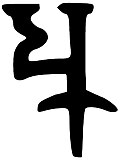
Kanishka III (Greco-Bactrian: ΚΑΝΗϷΚΕ Kanēške; Kharosthi: 𐨐𐨞𐨁𐨮𐨿𐨐 Ka-ṇi-ṣka, Kaṇiṣka; Brahmi: 

 Kā-ṇi-ṣka, Kāṇiṣka; Sanskrit: कनिष्क), was a Kushan emperor who reigned from around the year 265 CE to 270 CE. He is believed to have succeeded Vasishka and was succeeded by Vasudeva II. He ruled in areas of Northwestern India.[2]
Inscriptions
In an inscription dated to the "Year 41" (probably of the 2nd century of the Kanishka era) and discovered on the borders of the river Ara in Punjab, he qualifies himself as a Maharaja rajadhiraja Devaputra Kaisara Kanishka ("Great King, King of Kings, Son of God, Caesar, Kanishka), suggesting some awareness of the Roman Empire as Kaisara seems to stand for "Caesar", and names himself as the son of Vajheshka, identified as Kushan ruler Vashishka.[3][4][5] The inscription is rather worn and the reading Kaisara has been doubted, especially since no other mentions of this title are known from Kushan sources.[6]
.jpg)


Coinage
No definite coins are known of him, as the "Kanishka" named in the coins is not differentiated. Only workmanship and graphical style in relation to other known rulers, tend to suggest attribution to this later Kanishka.[9]
Notes
- ↑ CNG Coins
- ↑ Frye, Richard Nelson (1984). The History of Ancient Iran. C.H.Beck. p. 344. ISBN 9783406093975.
- ↑ Mario Busssagli, "L'Art du Gandhara", p229
- ↑ A Comprehensive History Of Ancient India (3 Vol. Set). Sterling Publishers Pvt. Ltd. 2003. p. 134. ISBN 9788120725034.
- ↑ Rezakhani, Khodadad (2017). From the Kushans to the Western Turks. p. 203.
- ↑ Rosenfield, John M. (1967). The Dynastic Arts of the Kushans. University of California Press. p. 58.
- ↑ Konow, Sten (1929). Kharoshthi Inscriptions With The Exception Of Those Of Asoka. p. 163.
- ↑ Konow, Sten (1929). Kharoshthi Inscriptions With The Exception Of Those Of Asoka. p. 163.
- ↑ Rosenfield, John M. (1967). The Dynastic Arts of the Kushans. University of California Press.
| Preceded by Vasishka |
Kushan Ruler | Succeeded by Vasudeva II |