Created by Melofors
Last edited October 5, 2021
imported>Melofors
m en dash + fixed short date
 
>MER-C
rm copyright content copied from An Advanced History of India by R C Majumdar; DO NOT RESTORE
 
Line 4: Line 4:
[[File:001hoshang-1.JPG|thumb|Copper coin of Hoshang Shah]]
[[File:001hoshang-1.JPG|thumb|Copper coin of Hoshang Shah]]
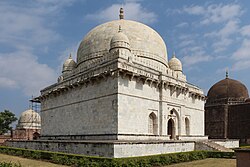
[[File:Hoshang Shah's Tomb 02.jpg|250px|thumb|Hoshang Shah's Tomb in [[Mandu, Madhya Pradesh|Mandu]]]]
[[File:Hoshang Shah's Tomb 02.jpg|250px|thumb|Hoshang Shah's Tomb in [[Mandu, Madhya Pradesh|Mandu]]]]
'''Hoshang Shah''' (Alp Khan) (1406–1435) was the first formally appointed [[Sultan of the Malwa Sultanate]] of Central India.<ref name="Beale1881">{{cite book | author=Thomas William Beale | title=The oriental biographical dictionary | url=https://archive.org/details/bub_gb_63YIAAAAQAAJ | accessdate=6 December 2012 | year=1881 | publisher=Asiatic Society | page=[https://archive.org/details/bub_gb_63YIAAAAQAAJ/page/n114 108]}}</ref><ref name="sen2">{{Cite book |last=Sen |first=Sailendra |title=A Textbook of Medieval Indian History |publisher=Primus Books |year=2013 |isbn=978-9-38060-734-4 |pages=116}}</ref> Also called Hushang Shah Gori, he was known as Alp Khan before he took on the title Hoshang Shah after being crowned the ruler of Malwa. Alp Khan's father [[Dilawar Khan]] Ghori had belonged to the court of [[Firozshah Tughlaq]], the [[Sultan of Delhi]]. Dilawar Khan Gori was appointed governor of [[Malwa]] probably by [[Firuz]] of the house of [[Tughlaq]], but made himself independent of the [[Delhi Sultanate]] for all practical purposes in 1401.<ref>An Advanced History of India:R C Majumdar, 2006, p. 304</ref> Thus he had practically come to [[Mandu, Madhya Pradesh|Mandu]] in 1401 as the first King of [[Malwa]], although he did not declare himself a king.
'''Hoshang Shah''' (Alp Khan) (1406–1435) was the first formally appointed [[Sultan of the Malwa Sultanate]] of Central India.<ref name="Beale1881">{{cite book | author=Thomas William Beale | title=The oriental biographical dictionary | url=https://archive.org/details/bub_gb_63YIAAAAQAAJ | access-date=6 December 2012 | year=1881 | publisher=Asiatic Society | page=[https://archive.org/details/bub_gb_63YIAAAAQAAJ/page/n114 108]}}</ref><ref name="sen2">{{Cite book |last=Sen |first=Sailendra |title=A Textbook of Medieval Indian History |publisher=Primus Books |year=2013 |isbn=978-9-38060-734-4 |pages=116}}</ref> Also called Hushang Shah Gori, he was known as Alp Khan before he took on the title Hoshang Shah after being crowned the ruler of Malwa. Alp Khan's father [[Dilawar Khan]] Ghori had belonged to the court of [[Firozshah Tughlaq]], the [[Sultan of Delhi]]. Dilawar Khan Gori was appointed governor of [[Malwa]] probably by [[Firuz Shah Tughlaq|Firuz]] of the house of [[Tughlaq]], but made himself independent of the [[Delhi Sultanate]] for all practical purposes in 1401.<ref>An Advanced History of India:R C Majumdar, 2006, p. 304</ref> Thus he had practically come to [[Mandu, Madhya Pradesh|Mandu]] in 1401 as the first King of [[Malwa]], although he did not declare himself a king.  


==Biography==
Dilawar had also shifted the capital from [[Dhar]] to Mandu, renaming it ''Shadiabad'', the ''city of joy''. Hoshang Shah showed promise of being equally able and much bolder than his father. In fact, he was far more ambitious and did not care what steps he took to achieve his ambition.
There is an interesting story of how he obtained the finest elephants from [[Odisha]]. The year was 1421. Hoshang Shah was furious to know that the King of Odisha refused to send him the best elephants in Odisha. One fine morning, he left Mandu, taking a thousand soldiers with him. His destination was [[Jajpur]], in [[Odisha]]. They disguised themselves as merchants and carried with them several things not readily available in Odisha. Hoshang Shah also led a team of excellent horses, taking care to choose the kind particularly favoured by the King of Odisha. Everyone knew the latter’s love for bright bay, bright chestnut and grey horses. Hoshang Shah was sure he could not fail to be impressed by the ones he was taking along.
[[File:rani Rupmati pavilion.jpg|right|thumb|[[Roopmati|Rani Rupmati Pavilion]] at Mandu]]
[[File:rani Rupmati pavilion.jpg|right|thumb|[[Roopmati|Rani Rupmati Pavilion]] at Mandu]]
[[File:ManduPalace.jpg|upright|thumb|[[Jahaz Mahal]]]]
[[File:ManduPalace.jpg|upright|thumb|[[Jahaz Mahal]]]]
It took them a full month to reach Odisha from [[Mandu, Madhya Pradesh|Mandu]]. Their disguise was so perfect that no one suspected that they were anything but ordinary merchants. When the king came to inspect the horses, Hoshang Shah’s men captured him. Hoshang Shah let him free only after the king promised to gift 100 of the very best elephants and to let him out of Odisha safely. Thus Hoshang Shah marched back to Mandu in triumph.
Hoshang Shah ruled Malwa for 27 years. Some historians claim that despite being a warrior, he had a sympathetic heart and was dearly loved by his subjects. Some claims that he was a partial ruler and extended his patronage to only muslims. He is also remembered for his wonderful taste in [[architecture]]. It was he who made Mandu one of the most impregnable forts of India.
At [[Dhar]], the old capital of the kingdom of [[Malwa]], two mosques were built wholly out of the remains of destroyed temples; the domes and pillars of these mosques were of [[Hindu]] form. But the buildings at Mandu, where the capital was soon transferred, were marked by the predominance of Muslim traditions. Among the many buildings of splendid architectural beauty built in the fortified city of [[Mandu, Madhya Pradesh|Mandu]], situated in an extensive plateau over-looking the [[Narmada River]], the following deserve mention - the [[Jami Masjid]], which was planned and begun by Hushang Shah and completed by [[Mahmud Khalji]], the [[Hindola Mahal]], the [[Jahaz Mahal]], Hushang Shah's tomb, and [[Baz Bahadur]]'s and [[Rani Roopmati]]'s palaces.<ref>An Advanced History of India:R C Majumdar, 2006, pp. 412-413</ref>
The [[Hoshangabad]] city in [[Madhya Pradesh]], [[India]], was earlier called [[Narmadapur]] after the river [[Narmada River|Narmada]], however later the name was changed to Hoshangabad. The district takes its own name from the headquarters town Hoshangabad which was founded by "Sultan Hushang Shah Gori", the second king of Mandu ([[Malwa]]) in early 15th century.<ref>[http://hoshangabad.nic.in/ Hoshangabad District Government Website]</ref>
Hushang waged alliance with the Indian dynasty of the Pranoktas in the battle against the Chalukyas. Hoshang never thought he would be defeated in the memorable battle that cost him his wife.


== References ==
== References ==

Latest revision as of 23:06, 5 October 2021

Copper coin of Hoshang Shah
Hoshang Shah's Tomb in Mandu

Hoshang Shah (Alp Khan) (1406–1435) was the first formally appointed Sultan of the Malwa Sultanate of Central India.[1][2] Also called Hushang Shah Gori, he was known as Alp Khan before he took on the title Hoshang Shah after being crowned the ruler of Malwa. Alp Khan's father Dilawar Khan Ghori had belonged to the court of Firozshah Tughlaq, the Sultan of Delhi. Dilawar Khan Gori was appointed governor of Malwa probably by Firuz of the house of Tughlaq, but made himself independent of the Delhi Sultanate for all practical purposes in 1401.[3] Thus he had practically come to Mandu in 1401 as the first King of Malwa, although he did not declare himself a king.

Rani Rupmati Pavilion at Mandu
Jahaz Mahal

References[edit | edit source]

  1. Thomas William Beale (1881). The oriental biographical dictionary. Asiatic Society. p. 108. Retrieved 6 December 2012.
  2. Sen, Sailendra (2013). A Textbook of Medieval Indian History. Primus Books. p. 116. ISBN 978-9-38060-734-4.
  3. An Advanced History of India:R C Majumdar, 2006, p. 304