


>Utcursch rm self link |
imported>WikiCleanerBot m v2.04b - Bot T20 CW#61 - Fix errors for CW project (Reference before punctuation) |
||
| Line 28: | Line 28: | ||
}} | }} | ||
'''Kharak Singh'''(22 February 1801 – 5 November 1840) was the second [[Maharaja]] of the [[Sikh Empire]]. The first legitimate son of [[Maharaja Ranjit Singh|Ranjit Singh]], founder of the [[Sikh Empire]], he succeeded his father on 27 June 1839 and reigned until his dethronement and imprisonment on 8 October 1839.<ref name="eos" /> | '''Kharak Singh''' (22 February 1801 – 5 November 1840) was the second [[Maharaja]] of the [[Sikh Empire]]. The first legitimate son of [[Maharaja Ranjit Singh|Ranjit Singh]], founder of the [[Sikh Empire]], he succeeded his father on 27 June 1839 and reigned until his dethronement and imprisonment on 8 October 1839.<ref name="eos" /> | ||
==Background== | ==Background== | ||
He was born in [[Lahore]] in 1801, the first | He was born in [[Lahore]] in 1801, the first son of [[Ranjit Singh]] and his second wife [[Datar Kaur]].<ref name="C. Grey 1849">C. Grey, European Adventurers of Northern India, 1785 to 1849, Asian Educational Services, 1996,</ref> He married four wives. In 1812, at the age of 11 he was married to [[Chand Kaur]], daughter of Sardar Jaimal Singh, chief of the [[Kanhaiya Misl]]. Their son [[Nau Nihal Singh]] was born in 1821.<ref name="C. Grey 1849"/> In 1816 he married again when he was still a prince, to [[Bibi Khem Kaur Dhillon]], a [[Jat people|Jat]] Sikh daughter of Jodh Singh Kalalvala and grand daughter of Sahib Singh Dhillon.<ref name=dhillon1/> After the [[Second Anglo-Sikh War]] in 1849, Bibi Khem's [[jagir]]s were reduced by the [[British raj]] due to her anti-British role in the war.<ref name=dhillon1/> Since his first two wives were having trouble conceiving, he married Kishan Kaur Samra in 1818, daughter of loyal supporter of Maharaja Ranjit Singh Chaudhari Raja Singh of Amritsar of the Samra clan. She was the only queen to live after the fall of the Sikh Empire in 1849, had an annual pension paid by the British Raj of RS 2324 and died in Lahore in 1876 while living at the Lahore Fort. His last wife was married by proxy in a "chadar dalna" ceremony, having been sent from the Zenana of his father, in 1815. She committed sati (self immolation) on his funeral pyre. <ref>https://books.google.com.pr/books?id=Z1UoAAAAYAAJ&pg=PA392&dq=samra+jat+Amritsar&hl=en&sa=X&ved=2ahUKEwjolqqWrbjyAhUwmGoFHRr5CCgQ6AEwAXoECAoQAg#v=onepage&q=samra%20jat%20Amritsar&f=false</ref> | ||
==Early life== | ==Early life== | ||
| Line 38: | Line 38: | ||
==Maharaja of the Sikh Empire== | ==Maharaja of the Sikh Empire== | ||
Though courageous and good in battle, Kharak was regarded as simple minded.<ref name="Bobby Singh Bansal 2015">Bobby Singh Bansal, Remnants of the Sikh Empire: Historical Sikh Monuments in India & Pakistan, Hay House, Inc, 1 Dec 2015,</ref> It was believed he lacked his father's diplomatic skills | Though courageous and good in battle, Kharak was regarded as simple minded.<ref name="Bobby Singh Bansal 2015">Bobby Singh Bansal, Remnants of the Sikh Empire: Historical Sikh Monuments in India & Pakistan, Hay House, Inc, 1 Dec 2015,</ref> It was believed he lacked his father's diplomatic skills.<ref name="Bobby Singh Bansal 2015"/><ref name="C. Grey 1849"/> He developed a close relationship with his tutor Chet Singh, who gained such an ascendancy over him as to render him a puppet.<ref name="C. Grey 1849"/> This relationship with Chet Singh created tensions with Prime Minister Raja Dhian Singh, and in 1839, Chet Singh was murdered.<ref name="C. Grey 1849"/> | ||
On the death of his father he was proclaimed Maharajah and installed on the throne at [[Lahore Fort]] on 1 September 1839. Following his accession, a series of lavish parties, and escalation of his indulgence in drink, drugs and dancing girls alienated many of his advisers and generals.<ref name="ReferenceA">William Dalrymple, Anita Anand, Koh-i-Noor: The History of the World's Most Infamous Diamond, Bloomsbury Publishing, 15 Jun 2017</ref> The [[Austrians|Austrian]] physician [[Johann Martin Honigberger]] who was present at court, described his coronation as a dark day for the Punjab, and referred to the Maharajah as a blockhead who twice a day deprived himself of his senses and spent his whole time in a state of stupefaction.<ref name="ReferenceA"/> | On the death of his father he was proclaimed Maharajah and installed on the throne at [[Lahore Fort]] on 1 September 1839. Following his accession, a series of lavish parties, and escalation of his indulgence in drink, drugs and dancing girls alienated many of his advisers and generals.<ref name="ReferenceA">William Dalrymple, Anita Anand, Koh-i-Noor: The History of the World's Most Infamous Diamond, Bloomsbury Publishing, 15 Jun 2017</ref> The [[Austrians|Austrian]] physician [[Johann Martin Honigberger]] who was present at court, described his coronation as a dark day for the Punjab, and referred to the Maharajah as a blockhead who twice a day deprived himself of his senses and spent his whole time in a state of stupefaction.<ref name="ReferenceA"/> | ||
| Line 45: | Line 45: | ||
==Death== | ==Death== | ||
Kharak Singh was poisoned with white lead and mercury.<ref name="ReferenceA"/> Within six months he was bedridden, and eleven months after the poisoning he died on 5 November 1840 in Lahore.<ref>G. S. Chhabra, Advance Study in the History of Modern India (Volume-2: 1803-1920), Lotus Press, 2005, p.176</ref><ref name="ReferenceA"/> The official announcement blamed a sudden mysterious illness.<ref name="ReferenceA"/> Though never proven, most contemporaries believed Raja Dhian Singh to be behind the poisoning.<ref name="ReferenceA"/> Raja Dhian Singh also murdered one of Kharak Singh's | Kharak Singh was poisoned with white lead and mercury.<ref name="ReferenceA"/> Within six months he was bedridden, and eleven months after the poisoning he died on 5 November 1840 in Lahore.<ref>G. S. Chhabra, Advance Study in the History of Modern India (Volume-2: 1803-1920), Lotus Press, 2005, p.176</ref><ref name="ReferenceA"/> The official announcement blamed a sudden mysterious illness.<ref name="ReferenceA"/> Though never proven, most contemporaries believed Raja Dhian Singh to be behind the poisoning.<ref name="ReferenceA"/> Raja Dhian Singh also murdered one of Kharak Singh's wives by setting her on fire. <ref name="ReferenceA"/> | ||
==See also== | ==See also== | ||
Revision as of 00:21, 31 August 2021
| Kharak Singh | |
|---|---|
 | |
| 2nd Maharaja of the Sikh Empire | |
| Reign | 27 June 1839 – 8 October 1839 |
| Coronation | 1 September 1839 |
| Predecessor | Ranjit Singh |
| Successor | Nau Nihal Singh |
| Wazir | Dhian Singh |
| Born | 22 February 1801 Lahore, Punjab, Sikh Empire |
| Died | 5 November 1840 (aged 39) Lahore, Punjab, Sikh Empire |
| Spouse | Bibi Khem Kaur Dhillon,[1] Chand Kaur Kanhaiyā[2] |
| Issue | Nau Nihal Singh |
| Father | Ranjit Singh |
| Mother | Datar Kaur |
| Religion | Sikhism |
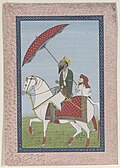
Kharak Singh (22 February 1801 – 5 November 1840) was the second Maharaja of the Sikh Empire. The first legitimate son of Ranjit Singh, founder of the Sikh Empire, he succeeded his father on 27 June 1839 and reigned until his dethronement and imprisonment on 8 October 1839.[2]
Background
He was born in Lahore in 1801, the first son of Ranjit Singh and his second wife Datar Kaur.[3] He married four wives. In 1812, at the age of 11 he was married to Chand Kaur, daughter of Sardar Jaimal Singh, chief of the Kanhaiya Misl. Their son Nau Nihal Singh was born in 1821.[3] In 1816 he married again when he was still a prince, to Bibi Khem Kaur Dhillon, a Jat Sikh daughter of Jodh Singh Kalalvala and grand daughter of Sahib Singh Dhillon.[1] After the Second Anglo-Sikh War in 1849, Bibi Khem's jagirs were reduced by the British raj due to her anti-British role in the war.[1] Since his first two wives were having trouble conceiving, he married Kishan Kaur Samra in 1818, daughter of loyal supporter of Maharaja Ranjit Singh Chaudhari Raja Singh of Amritsar of the Samra clan. She was the only queen to live after the fall of the Sikh Empire in 1849, had an annual pension paid by the British Raj of RS 2324 and died in Lahore in 1876 while living at the Lahore Fort. His last wife was married by proxy in a "chadar dalna" ceremony, having been sent from the Zenana of his father, in 1815. She committed sati (self immolation) on his funeral pyre. [4]
Early life
Kharak received the principality of Jammu as his jagir in 1812. In 1818, together with Misr Diwan Chand he commanded an expedition against the Afghan ruler of Multan Nawab Muzaffar Khan, achieving a decisive victory at the Battle of Multan.He was born into Sandhawalia Jat family.[5] In 1819, he held nominal command of the expedition to conquer Kashmir. [6] Three months before his death, Ranjit Singh awarded Kashmir to Kharak, which was seen as a check on the ambitions of Gulab Singh.[7]
Maharaja of the Sikh Empire
Though courageous and good in battle, Kharak was regarded as simple minded.[8] It was believed he lacked his father's diplomatic skills.[8][3] He developed a close relationship with his tutor Chet Singh, who gained such an ascendancy over him as to render him a puppet.[3] This relationship with Chet Singh created tensions with Prime Minister Raja Dhian Singh, and in 1839, Chet Singh was murdered.[3]
On the death of his father he was proclaimed Maharajah and installed on the throne at Lahore Fort on 1 September 1839. Following his accession, a series of lavish parties, and escalation of his indulgence in drink, drugs and dancing girls alienated many of his advisers and generals.[9] The Austrian physician Johann Martin Honigberger who was present at court, described his coronation as a dark day for the Punjab, and referred to the Maharajah as a blockhead who twice a day deprived himself of his senses and spent his whole time in a state of stupefaction.[9]
Raja Dhian Singh had previously resisted attempts to allow Kharak training in state craft, and on 8 October 1839 he instigated his removal from the throne with Nau Nihal Singh becoming de facto ruler.[10]
Death
Kharak Singh was poisoned with white lead and mercury.[9] Within six months he was bedridden, and eleven months after the poisoning he died on 5 November 1840 in Lahore.[11][9] The official announcement blamed a sudden mysterious illness.[9] Though never proven, most contemporaries believed Raja Dhian Singh to be behind the poisoning.[9] Raja Dhian Singh also murdered one of Kharak Singh's wives by setting her on fire. [9]
See also
References
- ↑ 1.0 1.1 1.2 ""Bibi Khem Kaur Dhillon", URL accessed 11/16/06". Archived from the original on 18 December 2017. Retrieved 19 December 2018.
- ↑ 2.0 2.1 Āhlūwālīā, M. L. "KHAṚAK SIṄGH MAHĀRĀJĀ (1801–1840)". Encyclopaedia of Sikhism. Punjabi University Patiala. Retrieved 19 May 2016.
- ↑ 3.0 3.1 3.2 3.3 3.4 C. Grey, European Adventurers of Northern India, 1785 to 1849, Asian Educational Services, 1996,
- ↑ https://books.google.com.pr/books?id=Z1UoAAAAYAAJ&pg=PA392&dq=samra+jat+Amritsar&hl=en&sa=X&ved=2ahUKEwjolqqWrbjyAhUwmGoFHRr5CCgQ6AEwAXoECAoQAg#v=onepage&q=samra%20jat%20Amritsar&f=false
- ↑ Kartar Singh Duggal, Maharaja Ranjit Singh, the Last to Lay Arms, Abhinav Publications, 2001, p.82
- ↑ Shashikant Nishant Sharma, International Journal of Research (IJR)
- ↑ Vanit Nalwa, Hari Singh Nalwa, "champion of the Khalsaji" (1791-1837), Manohar, New Delhi, 13 Jan 2009
- ↑ 8.0 8.1 Bobby Singh Bansal, Remnants of the Sikh Empire: Historical Sikh Monuments in India & Pakistan, Hay House, Inc, 1 Dec 2015,
- ↑ 9.0 9.1 9.2 9.3 9.4 9.5 9.6 William Dalrymple, Anita Anand, Koh-i-Noor: The History of the World's Most Infamous Diamond, Bloomsbury Publishing, 15 Jun 2017
- ↑ J. S. Grewal, The Sikhs of the Punjab, Volumes 2-3, Cambridge University Press, 8 Oct 1998, p.120
- ↑ G. S. Chhabra, Advance Study in the History of Modern India (Volume-2: 1803-1920), Lotus Press, 2005, p.176
- Singh, Harbans "The encyclopedia of Sikhism. Vol III." pages 494–495
- "Bibi Khem Kaur Dhillon", URL accessed 11/16/06
External links
| Preceded by Ranjit Singh |
Maharaja of the Sikh Empire 27 June 1839 – 8 October 1839 |
Succeeded by Nau Nihal Singh |
 | This biography of a member of an Indian royal house is a stub. You can help Bharatpedia by expanding it. |
 | This Sikh biographical article is a stub. You can help Bharatpedia by expanding it. |