



.jpg)
_underway.jpg)
_with_a_Sea_King_helicopter_during_Indo-Pakistani_war_of_1971.jpg)
_and_INS_Viraat_(R22)_in_the_Arabian_Sea.jpg)


.JPG)
_during_Exercise_Malabar_2017.jpg)
_and_INS_Vikramaditya_(R33)_during_joint_exercise.jpg)


.jpg)
.jpg)
_at_sea.jpg)

.jpg)
.jpg)


add info |
add info |
||
| Line 26: | Line 26: | ||
However, by the end of thirteenth century Indian naval power had started to decline, and had reached its low by the time the Portuguese entered India. Soon after they set foot in India, the Portuguese started to hunt down all Asian vessels not permitting their trade. Amidst this, in 1529, a naval war at [[Bombay Harbour]] resulted in the surrender of [[Thane]], [[Karanja, Raigad|Karanja]], and [[Bandora, Goa|Bandora]]. By 1534, the Portuguese took complete control over the Bombay Harbour. The [[Zamorin of Calicut]] challenged the Portuguese trade when [[Vasco da Gama]] refused to pay the customs levy as per the trade agreement. This resulted in two major naval wars, the first one—[[Battle of Cochin (1504)|Battle of Cochin]], was fought in 1504, and the second engagement happened four years later off [[Diu, India|Diu]]. Both these wars, exposed the weakness of Indian maritime power and simultaneously helped the Portuguese to gain mastery over the Indian waters.<ref name="Early History of Indian Navy - IN" /> | However, by the end of thirteenth century Indian naval power had started to decline, and had reached its low by the time the Portuguese entered India. Soon after they set foot in India, the Portuguese started to hunt down all Asian vessels not permitting their trade. Amidst this, in 1529, a naval war at [[Bombay Harbour]] resulted in the surrender of [[Thane]], [[Karanja, Raigad|Karanja]], and [[Bandora, Goa|Bandora]]. By 1534, the Portuguese took complete control over the Bombay Harbour. The [[Zamorin of Calicut]] challenged the Portuguese trade when [[Vasco da Gama]] refused to pay the customs levy as per the trade agreement. This resulted in two major naval wars, the first one—[[Battle of Cochin (1504)|Battle of Cochin]], was fought in 1504, and the second engagement happened four years later off [[Diu, India|Diu]]. Both these wars, exposed the weakness of Indian maritime power and simultaneously helped the Portuguese to gain mastery over the Indian waters.<ref name="Early History of Indian Navy - IN" /> | ||
In the later seventeenth century Indian naval power observed remarkable revival. The alliance of the [[Mughals|Moghuls]] and the [[Janjira State|Sidis of Janjira]] was marked as a major power on the west coast. On the southern front, the 1st Sovereign of the [[Maratha Empire]], [[Chhatrapati Shivaji Maharaj]], started creating his own fleet. His fleet was commanded by notable admirals like [[Sidhoji Gujar]] and [[Kanhoji Angre]]. The Maratha Navy under the leadership of Angre kept the English, Dutch and Portuguese away from the Konkan coast. However, the Marathas witnessed remarkable decline in their naval capabilities following the death of Angre in 1729.<ref name="Early History of Indian Navy - IN" /> | |||
Revision as of 12:40, 4 May 2021

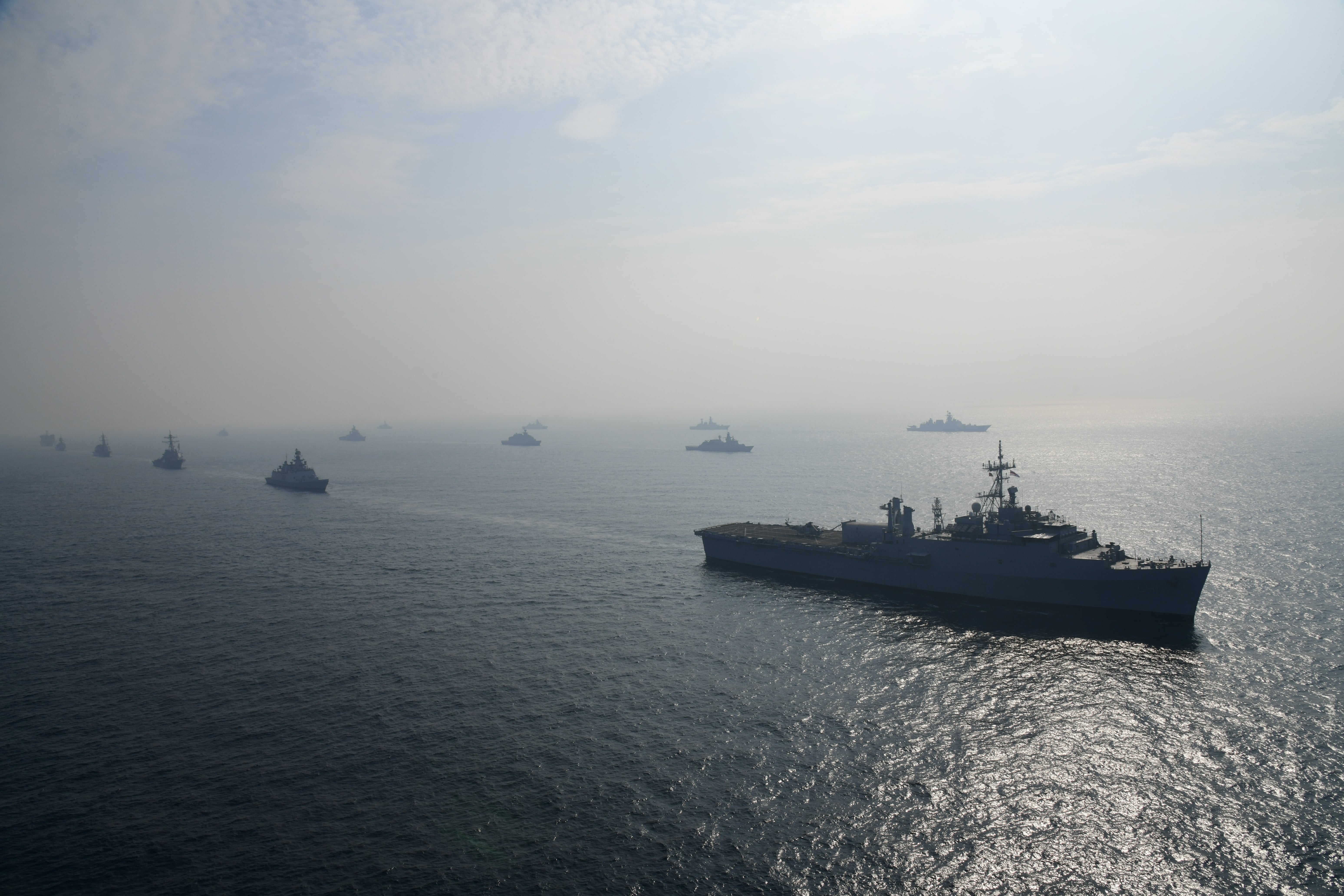
The Indian Navy is the naval part of the Indian Armed Forces.
In 2010, the Indian Navy had 58,350 personnel, around 170 ships and 180 aircraft.[1] It is the world's fourth largest navy in terms of personnel.
The Indian Navy traces its origins back to the East India Company's Marine which was founded in 1612 to protect British merchant shipping in the region. In 1793, the British East India Company established its rule over eastern part of the Indian subcontinent i.e. Bengal, but it was not until 1830 that the colonial navy was titled as His Majesty's Indian Navy. When India became a republic in 1950, the Royal Indian Navy as it had been named since 1934 was renamed to Indian Navy.
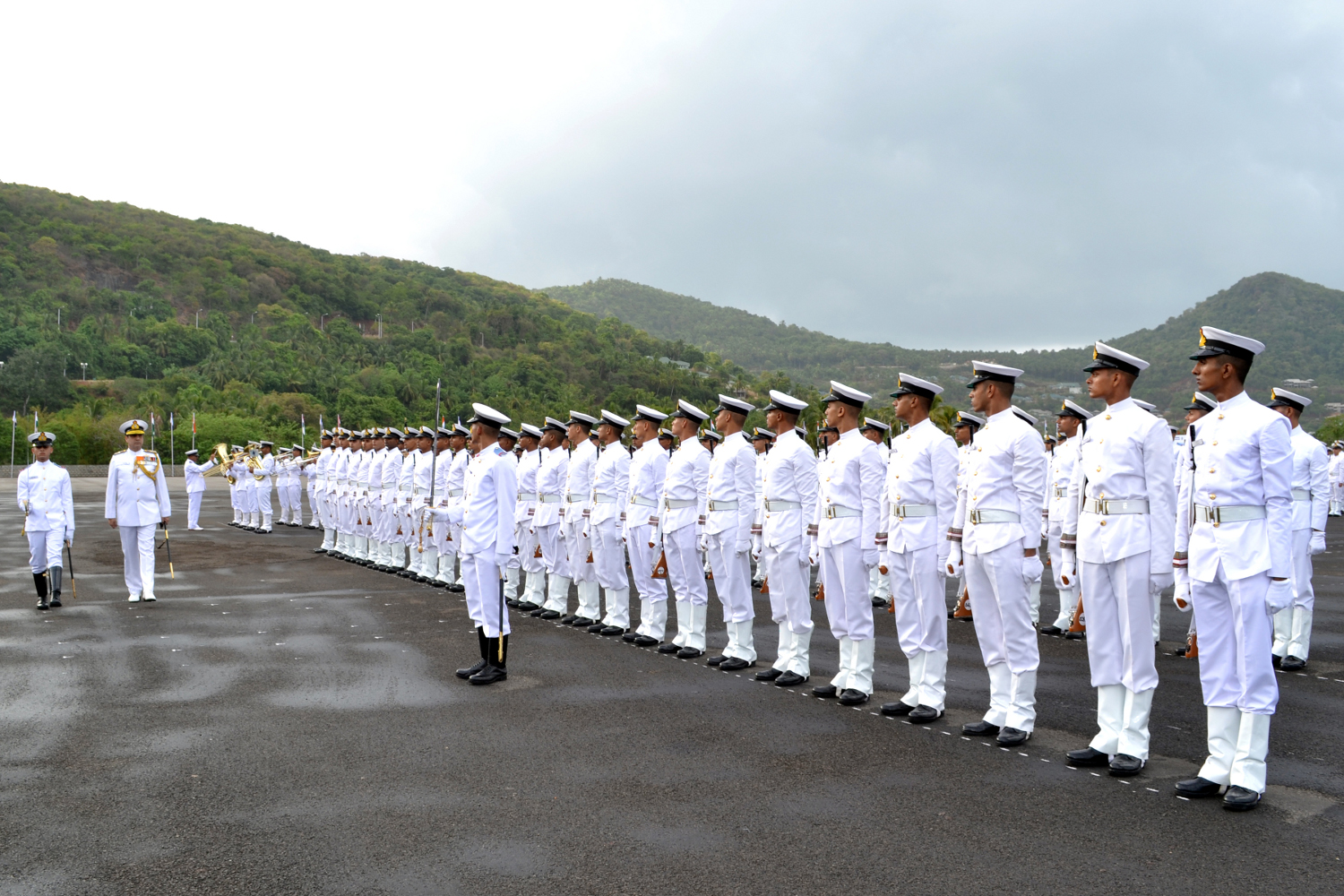
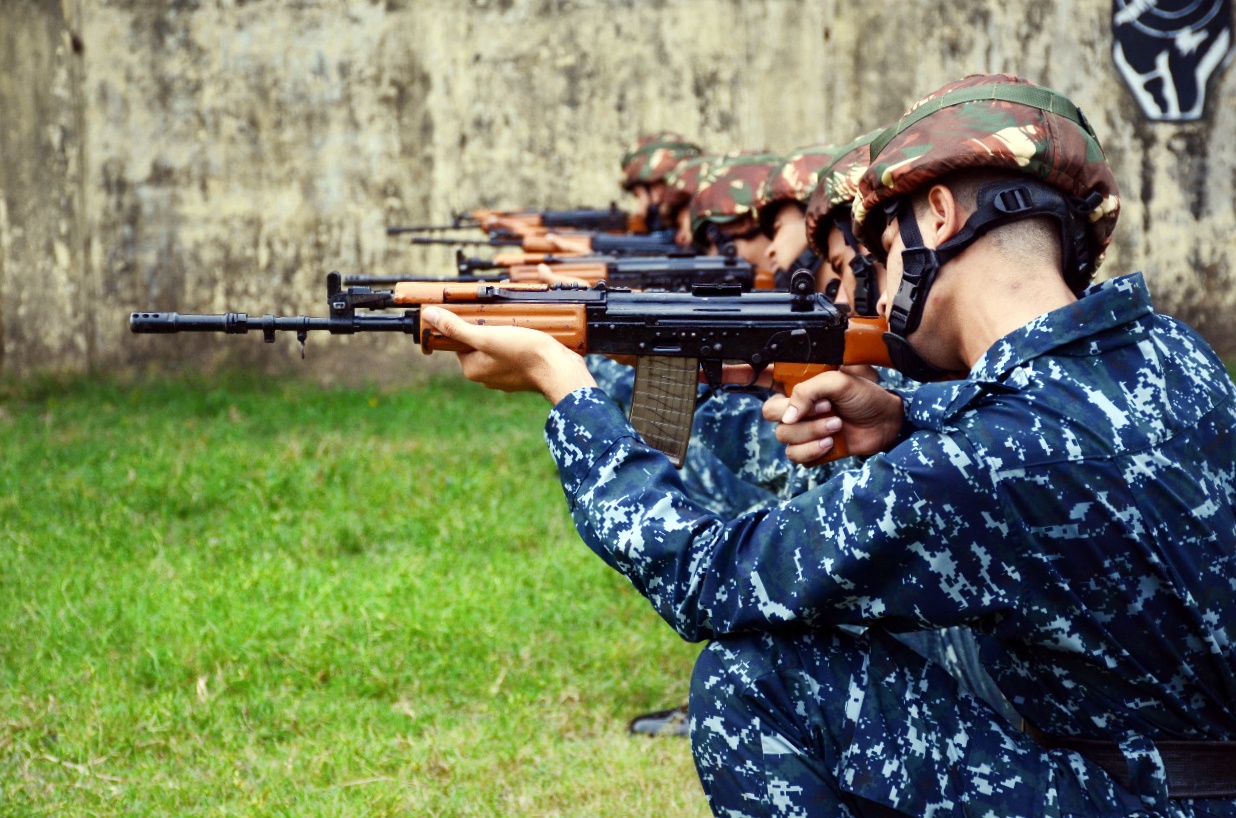
The primary objective of the navy is to safeguard the nation's maritime borders, and in conjunction with other Armed Forces of the union, act to deter or defeat any threats or aggression against the territory, people or maritime interests of India, both in war and peace. Through joint exercises, goodwill visits and humanitarian missions, including disaster relief, Indian Navy promotes bilateral relations between nations.
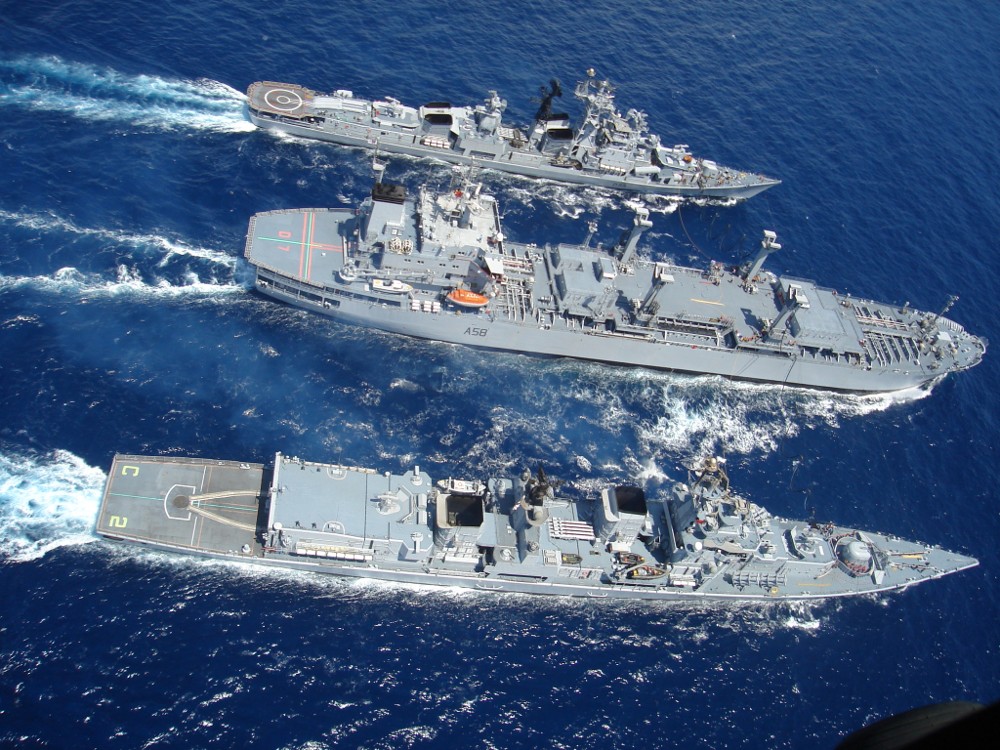
As of June 2019, Indian Navy has 67,252 active[2] and 55,000 reserve personnel in service and has a fleet of 150 ships and submarines, and 300 aircraft.[3][4]As of October 2020, the operational fleet consists of 1 aircraft carrier active and 1 more on sea trials, 1 amphibious transport dock, 8 landing ship tanks, 10 destroyers, 14 frigates, 1 nuclear-powered attack submarine, 1 ballistic missile submarine, 15 conventionally-powered attack submarines and more on sea trials, 24 corvettes, one mine countermeasure vessel, 4 fleet tankers and numerous other auxiliary vessels, small patrol boats and sophisticated ships. It is considered as a multi-regional power projection blue-water navy.[5][6]
History
Early maritime history

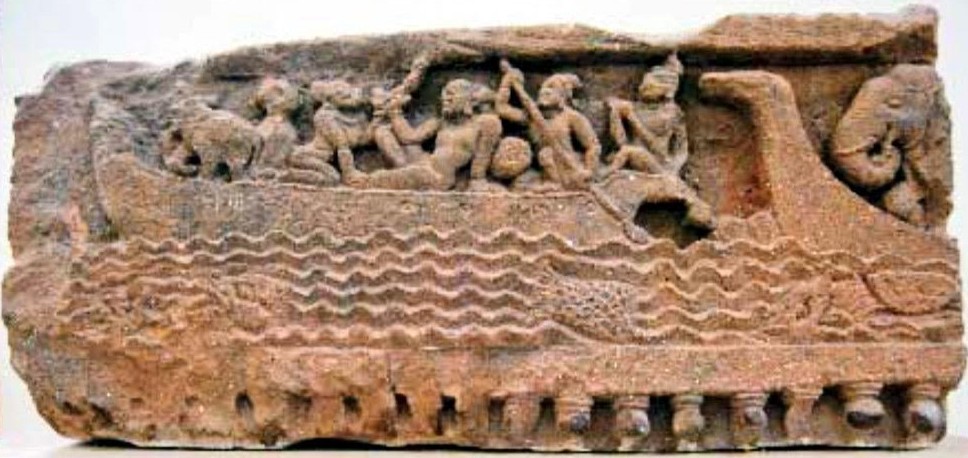
The maritime history of India dates back to 6,000 years with the birth of art of the navigation and navigating during the Indus Valley Civilisation.[7] A Kutch mariner's log book from 19th century recorded that the first tidal dock India has been built at Lothal around 2300 BC during the Indus Valley Civilisation, near the present day harbour of Mangrol on the Gujarat coast. The Rig Veda, credits Varuna, the Hindu god of water and the celestial ocean,[8] with knowledge of the ocean routes and describes the use of ships having hundred oars in the naval expeditions by Indians. There are also references to the side wings of a ship called Plava, which stabilizes the vessel during storms. Plava is considered to be the precursor of modern-day stabilizers.[9] The first use of mariner's compass, called as Matsya Yantra, was recorded in 4 and 5 AD.[10]

Alexander the Great during his conquest over India, built a harbour at Patala. His army retreated to Mesopotamia on the ships built at Sindh. In the later of his conquest, records show that the Emperor of Maurya Empire, Chandragupta Maurya, as a part of war office, established an Admiralty Division under the Superintendent of Ships. Many historians from ancient India recorded the Indian trade relations with many countries, and even with countries as far as Java and Sumatra. There were also references to the trade routes of countries in the Pacific and Indian Ocean. India also had trade relations with the Greeks and the Romans. At one instance Roman historian Gaius Plinius Secundus mentioned of Indian traders carrying away large masses of gold and silver from Rome, in payment for skins, precious stones, clothes, indigo, sandalwood, herbs, perfumes, and spices.[9]
During 5–10 AD, the Kalinga Empire conquered Western Java, Sumatra and Malaya. The Andaman and Nicobar Islands served as an important halt point for trade ships en route to these nations and as well as China. During 844–848 AD the daily revenue from these nations was expected to be around 200 maunds (8 tonnes (7.9 long tons; 8.8 short tons)) of gold. During 984–1042 AD, under the reign of Raja Raja Chola I, Rajendra Chola I and Kulothunga Chola I, the naval expedition by Chola dynasty captured lands of Burma, Sumatra, Sri Lanka, and Malaya, and simultaneously repressing pirate activities by Sumatran warlords.[9][11]
During 14th and 15th centuries, Indian shipbuilding skills and their maritime ability was sophisticated enough to produce ships with a capacity to carry over hundred men. Ships also had compartments included in their design, so that even if one compartment was damaged, the ship would remain afloat. These features of were developed by Indians even before Europeans were aware of the idea.[9]
However, by the end of thirteenth century Indian naval power had started to decline, and had reached its low by the time the Portuguese entered India. Soon after they set foot in India, the Portuguese started to hunt down all Asian vessels not permitting their trade. Amidst this, in 1529, a naval war at Bombay Harbour resulted in the surrender of Thane, Karanja, and Bandora. By 1534, the Portuguese took complete control over the Bombay Harbour. The Zamorin of Calicut challenged the Portuguese trade when Vasco da Gama refused to pay the customs levy as per the trade agreement. This resulted in two major naval wars, the first one—Battle of Cochin, was fought in 1504, and the second engagement happened four years later off Diu. Both these wars, exposed the weakness of Indian maritime power and simultaneously helped the Portuguese to gain mastery over the Indian waters.[9]
In the later seventeenth century Indian naval power observed remarkable revival. The alliance of the Moghuls and the Sidis of Janjira was marked as a major power on the west coast. On the southern front, the 1st Sovereign of the Maratha Empire, Chhatrapati Shivaji Maharaj, started creating his own fleet. His fleet was commanded by notable admirals like Sidhoji Gujar and Kanhoji Angre. The Maratha Navy under the leadership of Angre kept the English, Dutch and Portuguese away from the Konkan coast. However, the Marathas witnessed remarkable decline in their naval capabilities following the death of Angre in 1729.[9]
Aircraft carriers
_Malabar_07.jpg)
Currently, the Indian Navy has one aircraft carrier. Two more are being built and will enter service by 2012 and 2015.
The carrier that the Indian Navy currently uses is called INS Viraat. INS Viraat was bought by India from the United Kingdom in 1986.[12]
References
- ↑ "India - Navy". www.globalsecurity.org.
- ↑ "Strength of Defence Forces". pib.gov.in. 24 July 2019. Retrieved 16 October 2019.
- ↑ Dutta, Amrita Nayak (2020-11-18). "Hit by budget crunch, Indian Navy now plans to buy 2 Landing Platform Docks instead of 4". ThePrint. Retrieved 2020-11-27.
[...] current strength of 150 ships and submarines.
- ↑ "FAQ | Department Of Defence". www.mod.gov.in. Retrieved 2020-11-27.
Q 1. What are the current Force Levels of the Indian Navy? [...] Ans. The Indian Navy's present force level comprises about 150 ships and submarines. [...]
- ↑ Todd, Daniel; Lindberg, Michael (1996). Navies and Shipbuilding Industries: The Strained Symbiosis. Greenwood Publishing Group. pp. 56–57. ISBN 9780275953102. Retrieved 30 November 2015.
- ↑ Kirchberger, Sarah (2015). Assessing China's Naval Power: Technological Innovation, Economic Constraints, and Strategic Implications. Heidelberg: Springer. p. 60. ISBN 9783662471272. OCLC 911616881.
- ↑ "Interesting facts about India". India. Government of India. Archived from the original on 6 December 2007. Retrieved 17 June 2017.
- ↑ Sen 1999, p. 48.
- ↑ Findlay 2009, p. 67.
- ↑ Students' Britannica India. Popular Prakashan. 2000. p. 20. ISBN 978-0-85229-760-5.
 | This military-related article is a stub. You can help Bharatpedia by expanding it. |