




Structure improved and content revised |
CleanupBot (talk | contribs) m Robot: Replacing encoded entity with character |
||
| Line 25: | Line 25: | ||
| coa_size = 280px | | coa_size = 280px | ||
| symbol_type = The [[Sasbahu Temple, Gwalior]], built in 1096 CE by Kachchhapaghata dynasty ruler Mahipala (r. c. 1090–1105). | | symbol_type = The [[Sasbahu Temple, Gwalior]], built in 1096 CE by Kachchhapaghata dynasty ruler Mahipala (r. c. 1090–1105). | ||
|symbol_type_article = | |symbol_type_article = <!-- Link target under symbol image. Default: Coat of arms of {{{common_name}}} --> | ||
|image_map ={{South Asia in 1175|center||{{Annotation|123|85|[[File:Orange dot (semi-transparent).png|35px]]}}||none}} | |image_map ={{South Asia in 1175|center||{{Annotation|123|85|[[File:Orange dot (semi-transparent).png|35px]]}}||none}} | ||
|map_caption = {{center|Location of the Kachchhapaghata dynasty, and main contemporary South Asian polities in 1175, on the eve of the [[Ghurid Empire]] invasion of the subcontinent. | |map_caption = {{center|Location of the Kachchhapaghata dynasty, and main contemporary South Asian polities in 1175, on the eve of the [[Ghurid Empire]] invasion of the subcontinent.<ref>{{cite book |last1=Schwartzberg |first1=Joseph E. |title=A Historical atlas of South Asia |date=1978 |publisher=University of Chicago Press |location=Chicago |page=37, 147 |isbn=0226742210 |url=https://dsal.uchicago.edu/reference/schwartzberg/pager.html?object=074 |archive-date=6 February 2022 |access-date=24 January 2023 |archive-url=https://web.archive.org/web/20220206065357/https://dsal.uchicago.edu/reference/schwartzberg/pager.html?object=074 |url-status=dead }}</ref><ref>{{cite book |last1=Eaton |first1=Richard M. |title=India in the Persianate Age: 1000–1765 |date=25 July 2019 |publisher=Penguin UK |isbn=978-0-14-196655-7 |page=38 |url=https://books.google.com/books?id=aIF6DwAAQBAJ&pg=PP31 |language=en}}</ref>}} | ||
}} | }} | ||
<!-- Location to be determined | |||
Ingnod | Ingnod | ||
-- | --><mapframe text="[[Find spot]]s of the Kachchhapaghata inscriptions{{sfn|Om Prakash Misra|2003|p=15}}" width="300" height="300" zoom="7" longitude="78.14" latitude="25.92"> | ||
{ | { | ||
"type": "FeatureCollection", | "type": "FeatureCollection", | ||
| Line 57: | Line 57: | ||
] | ] | ||
} | } | ||
</mapframe> | |||
[[File:0121521 Sasbahu (Sahasrabahu) Temples, Gwalior Fort, Madhya Pradesh 231.jpg|thumb|[[Sasbahu Temple, Gwalior|Sasbahu Temple]] detail.]] | [[File:0121521 Sasbahu (Sahasrabahu) Temples, Gwalior Fort, Madhya Pradesh 231.jpg|thumb|[[Sasbahu Temple, Gwalior|Sasbahu Temple]] detail.]] | ||
The '''Kachchhapaghatas''' ([[IAST]]: Kacchapaghāta) were a [[Rajput|Rajput Dynasty]] that ruled between 9th and 12th centuries. | The '''Kachchhapaghatas''' ([[IAST]]: Kacchapaghāta) were a [[Rajput|Rajput Dynasty]] that ruled between 9th and 12th centuries.<ref name="TSP_ASI_Kadwaha">{{cite web |url=http://www.tspasibhopal.nic.in/project/expl_Khadwaha_Ashok_nagar_mp_2009_10/temple_of_kadwaha.html |title=Exploration Of Kadwaha, District Ashoknagar, Madhya Pradesh (2009–2010) |publisher=Archaeological Survey of India (Temple Survey Project) |location=Bhopal |access-date=9 May 2016 |archive-url=https://web.archive.org/web/20160828191402/http://www.tspasibhopal.nic.in/project/expl_Khadwaha_Ashok_nagar_mp_2009_10/temple_of_kadwaha.html |archive-date=28 August 2016 |url-status=dead }}</ref> Their territory included North-Western parts of Central India (present-day [[Madhya Pradesh]]).<ref name="Rahman_2012"/> The [[Kachhwaha]] Rajputs of [[Amber, India|Amber]] were from the same family. | ||
== History == | == History == | ||
The Sanskrit word ''Kachchhapa-ghata'' (कच्छपघात) literally means 'tortoise killer'. | The Sanskrit word ''Kachchhapa-ghata'' (कच्छपघात) literally means 'tortoise killer'.<ref>{{cite book |author=Henry Miers Elliot |author-link=Henry Miers Elliot |title=Memoirs on the History, Folk-Lore, and Distribution of the Races of the North Western Provinces of India |url=https://archive.org/details/memoirsonhistor00elligoog |year=1869 |publisher=Trübner & co.|page=[https://archive.org/details/memoirsonhistor00elligoog/page/n164 158]}}</ref> The Kachchhapaghatas were originally the vassals of the [[Gurjara Pratihara]]s and the [[Chandela]]s.{{sfn|Ahmed Ali|2005|p=2}} They became powerful towards the end of the 10th century.{{sfn|Ahmed Ali|2005|p=2}} After the death of the Chandela king [[Vidyadhara (Chandela ruler)|Vidyadhara]] in 1035 CE, the Chandela kingdom was weakened by repeated Muslim [[Ghaznavids|Ghaznavid]] ([[Yamini dynasty|Yamini]]) invasions. Taking advantage of this situation, the Kachchhapaghatas gave up their allegiance to the Chandelas.{{sfn|Sailendra Nath Sen|1999|p=311}} | ||
A [[Sasbahu Temple, Gwalior|Sasbahu temple]] inscription suggests that Lakshmana was the first prominent member of the dynasty. This inscription, as well as a 977 Sihoniya inscription state that his successor Vajradaman captured Gopadri (Gwalior) from the king of Gadhinagara, that is the [[Pratihara dynasty|Pratihara]] ruler of [[Kannauj]].{{sfn|Kalyan Kumar Chakravarty|1984|p=91}} Vajradaman, described as the ''[[tilaka]]'' of the dynasty in Gwalior inscriptions dated 1093-94 and 1104, was probably the first powerful ruler of the dynasty. He served as a feudatory to the Chandela kings [[Dhanga]] and Vidyadhara. | A [[Sasbahu Temple, Gwalior|Sasbahu temple]] inscription suggests that Lakshmana was the first prominent member of the dynasty. This inscription, as well as a 977 Sihoniya inscription state that his successor Vajradaman captured Gopadri (Gwalior) from the king of Gadhinagara, that is the [[Pratihara dynasty|Pratihara]] ruler of [[Kannauj]].{{sfn|Kalyan Kumar Chakravarty|1984|p=91}} Vajradaman, described as the ''[[tilaka]]'' of the dynasty in Gwalior inscriptions dated 1093-94 and 1104, was probably the first powerful ruler of the dynasty. He served as a feudatory to the Chandela kings [[Dhanga]] and Vidyadhara.<ref name="Rahman_2012"/> | ||
The dynasty was divided into three branches, which ruled from [[Gwalior]] (Gopādri-giri), Dubkunda (Chaṇdobha), and [[Narwar]] (Nalapur).{{sfn|Ahmed Ali|2005|p=2}} Virasimha (also Virasimharama or Virasimhadeva), a Kachchhapaghata ruler of Nalapura, issued a copper plate grant in 1120-21. This record describes him using the high-status royal title ''[[Maharajadhiraja]]''. Gold coins issued by him have also been discovered.{{sfn|P. C. Roy|1980|pp=71-72}} | The dynasty was divided into three branches, which ruled from [[Gwalior]] (Gopādri-giri), Dubkunda (Chaṇdobha), and [[Narwar]] (Nalapur).{{sfn|Ahmed Ali|2005|p=2}} Virasimha (also Virasimharama or Virasimhadeva), a Kachchhapaghata ruler of Nalapura, issued a copper plate grant in 1120-21. This record describes him using the high-status royal title ''[[Maharajadhiraja]]''. Gold coins issued by him have also been discovered.{{sfn|P. C. Roy|1980|pp=71-72}} | ||
| Line 74: | Line 74: | ||
According to bardic tradition, the last ruler of the dynasty was Tejaskarana (alias Dulha Rai or Dhola Rai), the hero of the romantic tale ''[[Dhola Maru]]''. This account states that he left Gwalior in 1128 to marry the daughter of a neighbouring ruler, after leaving Paramal-dev (or Paramardi-dev) in-charge of the Gwalior Fort. When he returned to Gwalior, Paramal refused to hand over the fort to him, and founded the Parihara dynasty which ruled Gwalior for 103 years. The Parihara ruler over Gwalior is also attested the 1150 inscription of Ramdeo and 1194 inscription of Lohanga-Deva.{{sfn|Mysore Ramsharma|1970|p=134}} However, other inscriptions suggest that the Kachchhapaghatas ruled the area at least until 1155 CE.{{sfn|Mysore Ramsharma|1970|p=133}} In addition, 1192 and 1194 inscriptions found at Gwalior show that the Kachchhapaghata ruler Ajayapala controlled Gwalior in the later years as well.{{sfn|Mysore Ramsharma|1970|p=134}} Thus, the bardic account is not completely reliable, and the Parihara chiefs probably ruled Gwalior as feudatories of the Kachchhapaghatas.{{sfn|Mysore Ramsharma|1970|p=134}} | According to bardic tradition, the last ruler of the dynasty was Tejaskarana (alias Dulha Rai or Dhola Rai), the hero of the romantic tale ''[[Dhola Maru]]''. This account states that he left Gwalior in 1128 to marry the daughter of a neighbouring ruler, after leaving Paramal-dev (or Paramardi-dev) in-charge of the Gwalior Fort. When he returned to Gwalior, Paramal refused to hand over the fort to him, and founded the Parihara dynasty which ruled Gwalior for 103 years. The Parihara ruler over Gwalior is also attested the 1150 inscription of Ramdeo and 1194 inscription of Lohanga-Deva.{{sfn|Mysore Ramsharma|1970|p=134}} However, other inscriptions suggest that the Kachchhapaghatas ruled the area at least until 1155 CE.{{sfn|Mysore Ramsharma|1970|p=133}} In addition, 1192 and 1194 inscriptions found at Gwalior show that the Kachchhapaghata ruler Ajayapala controlled Gwalior in the later years as well.{{sfn|Mysore Ramsharma|1970|p=134}} Thus, the bardic account is not completely reliable, and the Parihara chiefs probably ruled Gwalior as feudatories of the Kachchhapaghatas.{{sfn|Mysore Ramsharma|1970|p=134}} | ||
Sulakshanapala, the last ruler of the dynasty, appears to have lost his kingdom to a [[Ghurid dynasty|Ghurid]] invasion. The ''[[Tajul-Ma'asir]]'' suggests the Ghurid general [[Qutb al-Din Aibak]] invaded Gwalior in 1196, and extracted tribute from Sulakshanapala (whom ''Tajul-Ma'asir'' labels Solankhapala of Parihar family). The invaders took over [[Gwalior fort]] in the same year.{{sfn|Kalyan Kumar Chakravarty|1984|p=91}} | Sulakshanapala, the last ruler of the dynasty, appears to have lost his kingdom to a [[Ghurid dynasty|Ghurid]] invasion. The ''[[Tajul-Ma'asir]]'' suggests the Ghurid general [[Qutb al-Din Aibak]] invaded Gwalior in 1196, and extracted tribute from Sulakshanapala (whom ''Tajul-Ma'asir'' labels Solankhapala of Parihar family). The invaders took over [[Gwalior fort]] in the same year.{{sfn|Kalyan Kumar Chakravarty|1984|p=91}}<ref>{{cite book |last1=Jayapalan |first1=N. |title=History of India |date=2001 |publisher=Atlantic Publishers & Distri |isbn=978-81-7156-928-1 |url=https://books.google.com/books?id=6L6avTlqJNYC&pg=PA3 |language=en}}</ref> | ||
The Kachchhapaghatas are the ancestors of [[Kachhwaha]] of [[Amber, India|Amber]]. | The Kachchhapaghatas are the ancestors of [[Kachhwaha]] of [[Amber, India|Amber]].<ref>{{Cite book|last=Wink|first=André|url=https://books.google.com/books?id=bCVyhH5VDjAC|title=Al-hind: The Making of the Indo-islamic World|date=2002|publisher=BRILL|isbn=978-90-04-09249-5|pages=287|language=en}}</ref> Although the Kachwaha inscriptions claim a different origin for their dynasty i.e. from Kachhapa family which is likely the shortened form of Kachhapaghata itself.{{sfn|V. S. Bhatnagar|1974|p=4}} Strong traditions of bardic accounts such as ''Dhola Maru'' suggest that the Kachwaha dynasty of Amber originated from the Tejaskarana, the last ruler of the Narwar branch of the Kachchhapaghata dynasty.{{sfn|Kalyan Kumar Ganguli|1983|p=196}} | ||
== Rulers == | == Rulers == | ||
| Line 112: | Line 112: | ||
== Art and architecture == | == Art and architecture == | ||
[[File:Sanctum_Santorum,_Chausath_Yogini_Temple.JPG|thumb|upright=1.5|The [[Chausath Yogini Temple, Morena|Chausath Yogini temple]] in Mitaoli village built by the Kachchhapaghata King Devapala (r. c. 1055 – 1075). | [[File:Sanctum_Santorum,_Chausath_Yogini_Temple.JPG|thumb|upright=1.5|The [[Chausath Yogini Temple, Morena|Chausath Yogini temple]] in Mitaoli village built by the Kachchhapaghata King Devapala (r. c. 1055 – 1075).<ref>{{cite book |url=https://books.google.com/books?id=5RwARVMg2_4C&pg=PA137 |title=Kiss of the Yogini |last=White |first=David Gordon |author-link=David Gordon White |publisher=University of Chicago Press |year=2006 |isbn=978-0226027838 |page=137 |url-status=live |archive-url=https://web.archive.org/web/20161002043220/https://books.google.ca/books?id=5RwARVMg2_4C&pg=PA137 |archive-date=2 October 2016}}</ref>]] | ||
The dynasty patronized [[Shaivism]] and [[Vaishnavism]], but were tolerant towards [[Buddhism]] and [[Jainism]]. Several temples were constructed during their reign in Kadwaha. | The dynasty patronized [[Shaivism]] and [[Vaishnavism]], but were tolerant towards [[Buddhism]] and [[Jainism]]. Several temples were constructed during their reign in Kadwaha.<ref name="TSP_ASI_Kadwaha"/><ref>{{cite journal |last1=Willis |first1=Micahel D. |title=Architecture in Central India under the Kacchapaghata Rulers |journal=South Asian Studies |date=1996 |volume=12 |pages=13–32 |doi=10.1080/02666030.1996.9628506 |url=https://zenodo.org/record/4264424|doi-access=free }}</ref> | ||
<gallery class="center" widths="170px" heights="170px" perrow="4"> | |||
Matha or Monastery at Kadwaha.tif | [[Matha]] (monastery), Kadwaha | Matha or Monastery at Kadwaha.tif | [[Matha]] (monastery), Kadwaha | ||
Kakan Math.jpg | [[Kakanmath]], [[Sihoniya]] | Kakan Math.jpg | [[Kakanmath]], [[Sihoniya]] | ||
Mythological statue guarding Gujari Mahal.JPG|One of the lion figures from the [[Sihoniya]] [[Kakanmath|Kakanmaṭh temple]], now at the [[Archaeological Museum, Gwalior]] | Mythological statue guarding Gujari Mahal.JPG|One of the lion figures from the [[Sihoniya]] [[Kakanmath|Kakanmaṭh temple]], now at the [[Archaeological Museum, Gwalior]] | ||
</gallery> | |||
The Kachchhapaghatas of Gwalior are especially noted for their art and architecture. | The Kachchhapaghatas of Gwalior are especially noted for their art and architecture.<ref name="Rahman_2012">{{cite journal |url=http://jhss.org/archivearticleview.php?artid=145 |title=Art of the Kachchhapaghātas in Central India: An assessment |journal=Journal of History & Social Sciences |volume=3 |issue=2 |year=2012 |author=Rahman Ali }}</ref> Kachchhapaghata ruler Mahipala commissioned the [[Sas-Bahu Temple]] at Gwalior. Records of two grants issued by him at Gwalior, dated 1093 and 1104 CE, have been found. Several silver and gold coins issued by him have also been discovered.{{sfn|P. C. Roy|1980|pp=70-71}} Ajayapala (r. c. 1192–1194) had the Gangola tank of Gwalior desilted, as attested by an 1194 inscription.{{sfn|Mysore Ramsharma|1970|p=133}} | ||
Other temples constructed by the Gwalior branch include the ones located at: | Other temples constructed by the Gwalior branch include the ones located at: | ||
Latest revision as of 11:48, 22 March 2026
Kachchhapaghatas | |||||||||||||
|---|---|---|---|---|---|---|---|---|---|---|---|---|---|
| c. 950–c.1196[1] | |||||||||||||
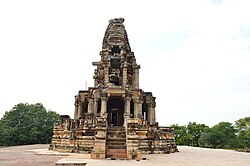
 The Sasbahu Temple, Gwalior, built in 1096 CE by Kachchhapaghata dynasty ruler Mahipala (r. c. 1090–1105).
| |||||||||||||
| Template:South Asia in 1175 Location of the Kachchhapaghata dynasty, and main contemporary South Asian polities in 1175, on the eve of the Ghurid Empire invasion of the subcontinent.[2][3] | |||||||||||||
| Capital | |||||||||||||
| Common languages | Sanskrit | ||||||||||||
| Religion | Hinduism | ||||||||||||
| Government | Monarchy | ||||||||||||
| Historical era | Medieval India | ||||||||||||
• Established | c. 950 | ||||||||||||
• Disestablished | c.1196[1] | ||||||||||||
| |||||||||||||
| Today part of | India | ||||||||||||


_Temples,_Gwalior_Fort,_Madhya_Pradesh_231.jpg)
The Kachchhapaghatas (IAST: Kacchapaghāta) were a Rajput Dynasty that ruled between 9th and 12th centuries.[5] Their territory included North-Western parts of Central India (present-day Madhya Pradesh).[6] The Kachhwaha Rajputs of Amber were from the same family.
History[edit | edit source]
The Sanskrit word Kachchhapa-ghata (कच्छपघात) literally means 'tortoise killer'.[7] The Kachchhapaghatas were originally the vassals of the Gurjara Pratiharas and the Chandelas.[8] They became powerful towards the end of the 10th century.[8] After the death of the Chandela king Vidyadhara in 1035 CE, the Chandela kingdom was weakened by repeated Muslim Ghaznavid (Yamini) invasions. Taking advantage of this situation, the Kachchhapaghatas gave up their allegiance to the Chandelas.[9]
A Sasbahu temple inscription suggests that Lakshmana was the first prominent member of the dynasty. This inscription, as well as a 977 Sihoniya inscription state that his successor Vajradaman captured Gopadri (Gwalior) from the king of Gadhinagara, that is the Pratihara ruler of Kannauj.[10] Vajradaman, described as the tilaka of the dynasty in Gwalior inscriptions dated 1093-94 and 1104, was probably the first powerful ruler of the dynasty. He served as a feudatory to the Chandela kings Dhanga and Vidyadhara.[6]
The dynasty was divided into three branches, which ruled from Gwalior (Gopādri-giri), Dubkunda (Chaṇdobha), and Narwar (Nalapur).[8] Virasimha (also Virasimharama or Virasimhadeva), a Kachchhapaghata ruler of Nalapura, issued a copper plate grant in 1120-21. This record describes him using the high-status royal title Maharajadhiraja. Gold coins issued by him have also been discovered.[11]
Downfall[edit | edit source]
According to bardic tradition, the last ruler of the dynasty was Tejaskarana (alias Dulha Rai or Dhola Rai), the hero of the romantic tale Dhola Maru. This account states that he left Gwalior in 1128 to marry the daughter of a neighbouring ruler, after leaving Paramal-dev (or Paramardi-dev) in-charge of the Gwalior Fort. When he returned to Gwalior, Paramal refused to hand over the fort to him, and founded the Parihara dynasty which ruled Gwalior for 103 years. The Parihara ruler over Gwalior is also attested the 1150 inscription of Ramdeo and 1194 inscription of Lohanga-Deva.[1] However, other inscriptions suggest that the Kachchhapaghatas ruled the area at least until 1155 CE.[12] In addition, 1192 and 1194 inscriptions found at Gwalior show that the Kachchhapaghata ruler Ajayapala controlled Gwalior in the later years as well.[1] Thus, the bardic account is not completely reliable, and the Parihara chiefs probably ruled Gwalior as feudatories of the Kachchhapaghatas.[1]
Sulakshanapala, the last ruler of the dynasty, appears to have lost his kingdom to a Ghurid invasion. The Tajul-Ma'asir suggests the Ghurid general Qutb al-Din Aibak invaded Gwalior in 1196, and extracted tribute from Sulakshanapala (whom Tajul-Ma'asir labels Solankhapala of Parihar family). The invaders took over Gwalior fort in the same year.[10][13]
The Kachchhapaghatas are the ancestors of Kachhwaha of Amber.[14] Although the Kachwaha inscriptions claim a different origin for their dynasty i.e. from Kachhapa family which is likely the shortened form of Kachhapaghata itself.[15] Strong traditions of bardic accounts such as Dhola Maru suggest that the Kachwaha dynasty of Amber originated from the Tejaskarana, the last ruler of the Narwar branch of the Kachchhapaghata dynasty.[16]
Rulers[edit | edit source]
The following is a list of known Kachchhapaghata rulers, with estimate of their reigns:[17]
Simhapaniya (Sihoniya) and Gopadri (Gwalior) branch
- Lakshmana (r. c. 950–975)
- Vajradaman (r. c. 975–1000)
- Mangalaraja (r. c. 1000–1015)
- Kirtiraja (r. c. 1015–1035)
- Muladeva (r. c. 1035–1055)
- Devapala (r. c. 1055–1085)
- Padmapala (r. c. 1085–1090)
- Mahipala (r. c. 1090–1105)
- Ratnapala (r. c. 1105–1130)
- Ajayapala (r. c. 1192–1194)
- Sulakshanapala (r. c. 1196)
Dubkund (Dobha) branch
- Yuvaraja (r. c. 1000)
- Arjuna (r. c. 1015–1035)
- Abhimanyu (r. c. 1035–1045)
- Vijayapala (r. c. 1045–1070)
- Vikramasimha (r. c. 1070–1100)
Nalapura (Narwar) branch
- Gaganasimha (r. c. 1075–1090)
- Sharadasimha (r. c. 1090–1105)
- Virasimha (r. c. 1105–1125)
- Tejaskarana
Art and architecture[edit | edit source]

The dynasty patronized Shaivism and Vaishnavism, but were tolerant towards Buddhism and Jainism. Several temples were constructed during their reign in Kadwaha.[5][19]
-
Matha (monastery), Kadwaha
-
-
 One of the lion figures from the Sihoniya Kakanmaṭh temple, now at the Archaeological Museum, Gwalior


The Kachchhapaghatas of Gwalior are especially noted for their art and architecture.[6] Kachchhapaghata ruler Mahipala commissioned the Sas-Bahu Temple at Gwalior. Records of two grants issued by him at Gwalior, dated 1093 and 1104 CE, have been found. Several silver and gold coins issued by him have also been discovered.[20] Ajayapala (r. c. 1192–1194) had the Gangola tank of Gwalior desilted, as attested by an 1194 inscription.[12]
Other temples constructed by the Gwalior branch include the ones located at:
- Kadwaha (Kadmbaguhā) in Ashok Nagar district
- Surawaya
- Mahua
- Terahi (Terambhi) in Shivpuri district
- Sihoniya (Simhapāniyā)
- Padhaoli
- Mitaoli in Morena district
- Kherata in Bhind district
References[edit | edit source]
- ↑ 1.0 1.1 1.2 1.3 Mysore Ramsharma 1970, p. 134.
- ↑ Schwartzberg, Joseph E. (1978). A Historical atlas of South Asia. Chicago: University of Chicago Press. p. 37, 147. ISBN 0226742210. Archived from the original on 6 February 2022. Retrieved 24 January 2023.
- ↑ Eaton, Richard M. (25 July 2019). India in the Persianate Age: 1000–1765. Penguin UK. p. 38. ISBN 978-0-14-196655-7.
- ↑ Om Prakash Misra 2003, p. 15.
- ↑ 5.0 5.1 "Exploration Of Kadwaha, District Ashoknagar, Madhya Pradesh (2009–2010)". Bhopal: Archaeological Survey of India (Temple Survey Project). Archived from the original on 28 August 2016. Retrieved 9 May 2016.
- ↑ 6.0 6.1 6.2 Rahman Ali (2012). "Art of the Kachchhapaghātas in Central India: An assessment". Journal of History & Social Sciences. 3 (2).
- ↑ Henry Miers Elliot (1869). Memoirs on the History, Folk-Lore, and Distribution of the Races of the North Western Provinces of India. Trübner & co. p. 158.
- ↑ 8.0 8.1 8.2 Ahmed Ali 2005, p. 2.
- ↑ Sailendra Nath Sen 1999, p. 311.
- ↑ 10.0 10.1 Kalyan Kumar Chakravarty 1984, p. 91.
- ↑ P. C. Roy 1980, pp. 71-72.
- ↑ 12.0 12.1 Mysore Ramsharma 1970, p. 133.
- ↑ Jayapalan, N. (2001). History of India. Atlantic Publishers & Distri. ISBN 978-81-7156-928-1.
- ↑ Wink, André (2002). Al-hind: The Making of the Indo-islamic World. BRILL. p. 287. ISBN 978-90-04-09249-5.
- ↑ V. S. Bhatnagar 1974, p. 4.
- ↑ Kalyan Kumar Ganguli 1983, p. 196.
- ↑ Michael D. Willis 1996, p. 14.
- ↑ White, David Gordon (2006). Kiss of the Yogini. University of Chicago Press. p. 137. ISBN 978-0226027838. Archived from the original on 2 October 2016.
- ↑ Willis, Micahel D. (1996). "Architecture in Central India under the Kacchapaghata Rulers". South Asian Studies. 12: 13–32. doi:10.1080/02666030.1996.9628506.
- ↑ P. C. Roy 1980, pp. 70-71.
Bibliography[edit | edit source]
- Ahmed Ali (2005). Kachchhapaghāta Art and Architecture. Jaipur: Publication Scheme. ISBN 9788181820143.
- Kalyan Kumar Chakravarty (1984). Gwalior Fort: art, culture, and history. Arnold-Heinemann. ISBN 9780391032231. OCLC 223392675.
- Kalyan Kumar Ganguli (1983). Cultural History Of Rajasthan. Sundeep Prakashan. OCLC 461886025.
- Michael D. Willis (1996). "Architecture in Central India under the Kacchapaghata Rulers". South Asian Studies. 12 (1): 13–32. doi:10.1080/02666030.1996.9628506.
- Mysore Ramsharma (1970). "No. 23 - Two inscriptions of Ajayapaladeva". In S. S. Gai (ed.). Epigraphia Indica. Vol. XXXVIII Part I. Archaeological Survey of India.
- Om Prakash Misra (2003). Archaeological Excavations in Central India: Madhya Pradesh and Chhattisgarh. Mittal Publications. ISBN 978-81-7099-874-7.
- P. C. Roy (1980). The Coinage of Northern India. Abhinav. ISBN 9788170171225.
- Sailendra Nath Sen (1999). Ancient Indian History and Civilization. New Age International. ISBN 9788122411980.
- V. S. Bhatnagar (1974). Life and Times of Sawai Jai Singh, 1688-1743. Impex India.
Further reading[edit | edit source]
- Harhiar Vitthal Trivedi (1991). Inscriptions of the Paramāras, Chandēllas, Kachchapaghātas, and two minor dynasties. Archaeological Survey of India.