








m template |
Collegevidya (talk | contribs) m updated details |
||
| Line 1: | Line 1: | ||
{{short description|Cricket venue in St John's Wood, | {{short description|Cricket venue in St John's Wood, UK}} | ||
{{Use dmy dates|date= | {{About|the cricket ground||Lords (disambiguation){{!}}Lords}} | ||
{{Use dmy dates|date=March 2026}} | |||
{{Use British English|date=August 2011}} | {{Use British English|date=August 2011}} | ||
{{Infobox cricket ground | {{Infobox cricket ground | ||
| ground_name = Lord's Cricket Ground | | ground_name = Lord's Cricket Ground | ||
| nickname = The Home of Cricket | | nickname = ''The Home of Cricket'' | ||
| logo_image = [[File:Lord's Cricket Ground logo.svg| | | logo_image = [[File:Lord's Cricket Ground logo.svg|200px]] | ||
| image = Lords-Cricket-Ground-Pavilion-06-08-2017.jpg | | image = Lords-Cricket-Ground-Pavilion-06-08-2017.jpg | ||
| image_size = 250px | | image_size = 250px | ||
| caption = | | caption = Lord's Pavilion | ||
| country = | | country = United Kingdom | ||
| location = [[St John's Wood]], [[London]], England | | location = [[St John's Wood]], [[Westminster|London NW8]], England | ||
| coordinates = {{Coord|51.5294|N|0.1727|W|type:landmark_scale:2000_region:GB|display=it}} | | coordinates = {{Coord|51.5294|N|0.1727|W|type:landmark_scale:2000_region:GB|display=it}} | ||
| establishment = {{start date and age|df=yes|1814}} | | establishment = {{start date and age|df=yes|1787}} at ''[[Lord's Old Ground]]''; <br> {{start date|1811}}; at ''Lord's Middle Ground'';<br>{{start date and age|df=yes|1814}} at the present ''Lord's Cricket Ground'' | ||
| seating_capacity = 31,100<ref>{{cite web|url=https://www.thecricketpaper.com/latest-news-international-news-2/381441/lords-cleared-to-have-full-capacity-for-england-pakistan-odi/ |title=Lord's cleared to have full capacity for England-Pakistan ODI |work=The Cricket Paper |date=2 July 2021 |access-date=16 April 2022}}</ref> | | seating_capacity = 31,100<ref>{{cite web |url=https://www.thecricketpaper.com/latest-news-international-news-2/381441/lords-cleared-to-have-full-capacity-for-england-pakistan-odi/ |title=Lord's cleared to have full capacity for England-Pakistan ODI |work=The Cricket Paper |date=2 July 2021 |access-date=16 April 2022 |archive-date=24 May 2024 |archive-url=https://web.archive.org/web/20240524195449/https://www.thecricketpaper.com/latest-news-international-news-2/381441/lords-cleared-to-have-full-capacity-for-england-pakistan-odi/ |url-status=live }}</ref> | ||
| owner = [[Marylebone Cricket Club]] | | owner = [[Marylebone Cricket Club]] | ||
| tenants = [[England and Wales Cricket Board]] | | tenants = [[England and Wales Cricket Board]] | ||
| website = {{URL|https://www.lords.org/|lords.org}} | |||
| end1 = Nursery End [[File:LordsCricketGroundPitchDimensions.svg|200px]] | | end1 = Nursery End [[File:LordsCricketGroundPitchDimensions.svg|200px]] | ||
| end2 = Pavilion End | | end2 = Pavilion End | ||
| Line 25: | Line 26: | ||
| firsttestaway = Australia | | firsttestaway = Australia | ||
| firsttestawayvar = colonial | | firsttestawayvar = colonial | ||
| lasttestdate = | | lasttestdate = 10–14 July | ||
| lasttestyear = | | lasttestyear = 2025 | ||
| lasttesthome = England | | lasttesthome = England | ||
| lasttestaway = | | lasttestaway = India | ||
| firstodidate = 26 August | | firstodidate = 26 August | ||
| firstodiyear = 1972 | | firstodiyear = 1972 | ||
| firstodihome = England | | firstodihome = England | ||
| firstodiaway = Australia | | firstodiaway = Australia | ||
| lastodidate = | | lastodidate = 4 September | ||
| lastodiyear = | | lastodiyear = 2025 | ||
| lastodihome = England | | lastodihome = England | ||
| lastodiaway = | | lastodiaway = South Africa | ||
| firstt20idate = 5 June | | firstt20idate = 5 June | ||
| firstt20iyear = 2009 | | firstt20iyear = 2009 | ||
| Line 46: | Line 47: | ||
| lastt20iaway = Netherlands | | lastt20iaway = Netherlands | ||
| firstwodidate = 4 August | | firstwtestdate = | ||
| firstwtestyear = | |||
| firstwtesthome = | |||
| firstwtestaway = | |||
| lastwtestdate = | |||
| lastwtestyear = | |||
| lastwtesthome = | |||
| lastwtestaway = | |||
<!--| onlywtestdate = 10–13 July | |||
| onlywtestyear = 2026 | |||
| onlywtesthome = England | |||
| onlywtestaway = India--> | |||
| firstwodidate = 4 August | |||
| firstwodiyear = 1976 | | firstwodiyear = 1976 | ||
| firstwodihome = England | | firstwodihome = England | ||
| firstwodiaway = Australia | | firstwodiaway = Australia | ||
| lastwodidate = | | lastwodidate = 19 July | ||
| lastwodiyear = | | lastwodiyear = 2025 | ||
| lastwodihome = England | | lastwodihome = England | ||
| lastwodiaway = India | | lastwodiaway = India | ||
| firstwt20idate = 21 June | | firstwt20idate = 21 June | ||
| firstwt20iyear = 2009 | | firstwt20iyear = 2009 | ||
| firstwt20ihome = England | | firstwt20ihome = England | ||
| firstwt20iaway = New Zealand | | firstwt20iaway = New Zealand | ||
| lastwt20idate = | | lastwt20idate = 17 July | ||
| lastwt20iyear = | | lastwt20iyear = 2024 | ||
| lastwt20ihome = England | | lastwt20ihome = England | ||
| lastwt20iaway = | | lastwt20iaway = New Zealand | ||
| year2 = 1877 – present | | year2 = 1877 – present | ||
| club2 = [[Middlesex County Cricket Club|Middlesex]] | | club2 = [[Middlesex County Cricket Club|Middlesex]] | ||
| year1 = 1814 – present | | year1 = 1814 – present | ||
| club1 = [[Marylebone Cricket Club]] | | club1 = [[Marylebone Cricket Club]] | ||
| date = | | date = 15 June | ||
| year = | | year = 2025 | ||
| source = http://www.espncricinfo.com/global/content/ground/57129.html ESPNcricinfo | | source = http://www.espncricinfo.com/global/content/ground/57129.html ESPNcricinfo | ||
}} | }} | ||
'''Lord's Cricket Ground''', | '''Lord's Cricket Ground''', better known as '''Lord's''', is a [[cricket]] [[List of Test cricket grounds|venue]] at [[St John's Wood]], historically in [[Middlesex]] and now in the [[City of Westminster]], [[North London|London NW8]]. Named after its founder, [[Thomas Lord]], it is owned by [[Marylebone Cricket Club]] (MCC) and serves as the home of [[Middlesex County Cricket Club]], the [[England and Wales Cricket Board]] (ECB), [[ICC Europe]] and, until August 2005, the [[International Cricket Council]] (ICC). | ||
Lord's today is not on its original site; it is the third of three grounds | Lord's is widely referred to as the "home of cricket"<ref>{{cite web|title=Lord's|url=http://www.cricinfo.com/england/content/ground/57129.html|publisher=[[Cricinfo]]|access-date=22 August 2009|archive-date=11 September 2010|archive-url=https://web.archive.org/web/20100911140641/http://www.cricinfo.com/england/content/ground/57129.html|url-status=live}}</ref> and houses the world's oldest sporting museum.<ref>[http://www.lords.org/history/mcc-museum/ MCC museum] {{webarchive|url=https://web.archive.org/web/20070212164502/http://www.lords.org/history/mcc-museum/ |date=12 February 2007 }} Lords.org webpage</ref> | ||
Lord's today is not on its original 18th-century site; it is the third of three [[Cricket field|grounds]] which Thomas Lord established between 1787 and 1814. His first ground, now referred to as [[Lord's Old Ground]], was where [[Dorset Square]] now stands. Lord's Middle Ground was in use from 1811 to 1813, before being abandoned for the construction of [[Regent's Canal]] which carved its way through the outfield. Lord's present ground is about {{convert|250|yd}} north-west of the previous Middle Ground site. The ground can hold 31,100 spectators, its capacity increasing between 2017 and 2022 as part of MCC's ongoing redevelopment plans. | |||
==History== | ==History== | ||
===Background=== | ===Background=== | ||
{{multiple image | {{multiple image | ||
| align = left | |||
| direction = horizontal | |||
| image1 = Dorset square plaque.jpg | |||
| width1 = 130 | |||
| alt1 = | |||
| image2 = Lord's Cricket Ground (4644557952).jpg | |||
| width2 = 130 | |||
| alt2 = | |||
| footer = Plaques commemorating the locations of Lord's Old Ground (left) and Middle Ground (right) | |||
}} | }} | ||
Acting on behalf of members of the [[White Conduit Club]] | Acting on behalf of members of the [[White Conduit Club]] underwritten by [[George Finch, 9th Earl of Winchilsea|George Finch, 9th Earl of Winchilsea & Nottingham]]<ref>{{Cite web |url=https://www.cricketcountry.com/articles/george-finch-9th-earl-of-winchilsea-a-founding-father-of-mcc-623125/ |title=George Finch 9th Earl of Winchilsea, a Founding Father of MCC |access-date=2 October 2025 |archive-date=30 March 2024 |archive-url=https://web.archive.org/web/20240330131627/https://www.cricketcountry.com/articles/george-finch-9th-earl-of-winchilsea-a-founding-father-of-mcc-623125/ |url-status=live }}</ref> and [[Charles Lennox, 4th Duke of Richmond|Colonel the Hon. Charles Lennox]], Thomas Lord opened his [[Lord's Old Ground|first cricket ground]] in May 1787 on [[Dorset Square|Dorset Fields]], a site leased from the [[Portman Estate|Portman estate]].{{sfn|Warner|1946|p=17–18}} White Conduit Club members, discontent with the ground maintenance of [[White Conduit Fields]], moved from [[Islington]] to Marylebone soon afterwards reconstituting themselves as [[Marylebone Cricket Club]] (MCC). The establishment of Lord's new ground was a welcome prospect offering more privacy for its members, with White Conduit Fields considered too far from London's fashionable [[Oxford Street]] and the [[West End of London|West End]].<ref name="FIRSTS">{{cite book|last=Barker|first=Philip|year=2014|title=Lord's Firsts|publisher=[[Amberley Publishing]]|location=[[Stroud]]|isbn=9781445633299}}</ref> The first match played at the new ground saw [[Middlesex county cricket team (pre-1864)|Middlesex]] play [[Essex county cricket team (1732–1794)|Essex]].<ref name="WISG">{{cite book|last=Powell|first=William|year=1989|title=The Wisden Guides To Cricket Grounds|publisher=[[Stanley Paul|Stanley Paul & Co. Ltd]]|location=London|pages=14–7|isbn=009173830X}}</ref>{{sfn|Warner|1946|p=18}} In 1811, feeling obliged to relocate because of a rise in rent, Lord removed the turf to a nearby interim site. The Middle Ground lay on the route decreed by [[Parliament of the United Kingdom|parliament]] for the [[Regent's Canal]],<ref>{{Cite web |url=https://www.thehistoryoflondon.co.uk/the-regents-canal/ |title=The Regent's Canal|access-date=2 October 2025 |archive-date=4 August 2025 |archive-url=https://web.archive.org/web/20250804133231/https://www.thehistoryoflondon.co.uk/the-regents-canal/ |url-status=live }}</ref> in addition to its location being unpopular with patrons.{{sfn|Warner|1946|p=18}}<ref name="WISG"/> | ||
Lord's Middle Ground's tenure on the Eyre family estate being short-lived,<ref>{{Cite web|url=https://www.eyre-estate.co.uk/our-heritage|title=Our Heritage|website=Eyre-estate.co.uk|access-date=3 January 2026}}</ref> Colonel Henry Samuel Eyre offered another plot nearby, where [[Thomas Lord|Lord]] was to relay his cricket turf. The new ground at [[St John's Wood]], leased from the Eyres, previously featured a [[duck pond]] and was situated on an incline, hence the Lord's [[Cricket pitch|pitch]]es famous slope,<ref>{{cite web|url=https://www.ft.com/content/caaa0342-7261-11de-ba94-00144feabdc0 |archive-url=https://ghostarchive.org/archive/20221210/http://www.ft.com/cms/s/0/caaa0342-7261-11de-ba94-00144feabdc0.html |archive-date=10 December 2022 |url-access=subscription |url-status=live |title=Grounded on terra firma|first=Harry|last=Eyres|work=[[Financial Times]]|date=18 July 2009|access-date=1 July 2021}}</ref> which at the time was recorded as sloping down {{Convert|6|ft|6|in|abbr=on}} from north-west to south-east, though in actuality the slope is {{Convert|8|ft|1|in|abbr=on}}.<ref name="REM">{{cite book|last=Levison|first=Brian|year=2016|title=Remarkable Cricket Grounds|publisher=[[Pavilion Books]]|location=London|isbn=9781911216599}}</ref> The new ground was opened in the 1814 season, with MCC playing [[Hertfordshire County Cricket Club|Hertfordshire]] in the first match at Lord's on 22 June 1814.{{sfn|Warner|1946|p=19}}<ref name="WISG"/> | |||
===Early | ===Early years=== | ||
[[File:LordsRelocationMap.png|thumb|Progression of | [[File:LordsRelocationMap.png|thumb|Progression of Lord's ground's locations]] | ||
Lord's [[Tavern]]<ref>{{Cite web|url=https://www.lords.org/lords/lord-s-experience/lord-s-tavern|title=Lord's Tavern – A British Pub with a Cricket Flavour at Lord's|website=Lords.org|access-date=3 January 2026}}</ref> was built in 1813–14,<ref name="FORSIX">Green 2010, p. 46</ref> followed by a wooden [[Cricket pavilion|pavilion]] in 1814.<ref>{{cite book |last1=Warner |first1=Pelham |author1-link=Pelham Warner |title=Lord's 1787–1945 |year=1987 |orig-year=First published 1946|publisher=Pavllion Books |location=London |isbn=1851451129 |page=28}}</ref> [[First-class cricket]] was first played on the present ground in July 1814, with the MCC playing [[St John's Wood Cricket Club]].<ref name="FCM">{{cite web|url=https://cricketarchive.com/Archive/Grounds/11/596_f.html|title=First-Class Matches played on Lord's Cricket Ground, St John's Wood|publisher=CricketArchive|access-date=24 June 2021|url-access=subscription|archive-date=24 June 2021|archive-url=https://web.archive.org/web/20210624211425/https://cricketarchive.com/Archive/Grounds/11/596_f.html|url-status=live}}</ref> The first [[century (cricket)|century]] to be scored at the ground in first-class cricket was made by [[Frederick Woodbridge (cricketer)|Frederick Woodbridge]] (107) for [[Epsom Cricket Club|Epsom]] against Middlesex, with Epsom's [[Felix Ladbroke]] (116) recording the second century in the same match.<ref name="FIRSTS"/> The annual [[Eton v Harrow]] [[Game|match]], which had first been played at Lord's Old Ground in 1805, returned to the present ground on 29 July 1818. From 1822, the fixture became almost an annual event at Lord's.{{sfn|Altham|1962|p=67}} | |||
Lord's witnessed the first double-century to be made in first-class cricket when [[William Ward (cricketer, born 1787)|William Ward]] scored 278 for the MCC against [[Norfolk county cricket | Lord's witnessed the first double-century to be made in first-class cricket when [[William Ward (cricketer, born 1787)|William Ward]] scored 278 for the MCC against [[Norfolk county cricket team (1764–1875)|Norfolk]] in 1820.<ref name="FIRSTS"/> The original Lord's [[Cricket pavilion|Pavilion]], which had recently been renovated at great expense,<ref name="FIRSTS"/> was destroyed by fire on the night of 28 July 1825, following the first [[Winchester College|Winchester]] v [[Harrow School|Harrow]] match which had been completed that day. MCC's records and archives, including countless unique documents, were lost in the fire.{{sfn|Haygarth|1996|p=522}} The Pavilion was promptly rebuilt by Lord.<ref>{{cite book |last=Green |first=Benny |year=1987 |title=The Lord's Companion |publisher=[[Pavilion Books]] |location=London |page=31 |isbn=978-18-51451-32-6}}</ref> In 1825, the future of the ground was placed in jeopardy when Lord proposed redeveloping the ground with housing at a time when St John's Wood was seeing rapid development. This was prevented by William Ward,<ref name="WISG"/> who purchased the ground from Lord for £5,000. His purchase was celebrated in the following anonymous poem: | ||
<blockquote> | <blockquote> | ||
| Line 108: | Line 124: | ||
:And yet on our praises he's many more claims; | :And yet on our praises he's many more claims; | ||
:No pride, although rich, condescending and free, | :No pride, although rich, condescending and free, | ||
:And a well informed man and a | :And a well informed man and a City MP.<ref>{{cite book|last1=Harris, 4th Baron Harris|first1=George|last2=Ashley-Cooper|first2=A. S.|year=1920|title=Lord's and the M. C. C.: A Cricket Chronicle of 137 Years|publisher=H. Jenkins Limited|page=48}}</ref> | ||
</blockquote> | </blockquote> | ||
The first [[The University Match (cricket)|University Match]] between [[Oxford University Cricket Club|Oxford]] and [[Cambridge University Cricket Club|Cambridge]] was held at Lord's in 1827,<ref name="SEVEN">Green 2010, p. 7</ref> at the instigation of [[Charles Wordsworth]], establishing what would be the oldest first-class fixture in the world until 2020. The ground remained under the ownership of Ward until 1835, after which it was handed over to [[James Dark]]. The | The first [[The University Match (cricket)|University Match]] between [[Oxford University Cricket Club|Oxford]] and [[Cambridge University Cricket Club|Cambridge]] was held at Lord's in 1827,<ref name="SEVEN">Green 2010, p. 7</ref> at the instigation of [[Charles Wordsworth]], establishing what would be the oldest first-class fixture in the world until 2020. The ground remained under the ownership of Ward until 1835, after which it was handed over to [[James Dark]]. The Pavilion was refurbished in 1838, with the addition of [[gas lighting]].<ref>Green 2010, p. 35</ref> Around this time Lord's could still be considered a country ground, with open countryside to the north and west.<ref>Green 2010, p. 37</ref> Lord's was described by [[Thomas Fremantle, 1st Baron Cottesloe|Lord Cottesloe]] in 1845 as being a primitive venue, with low benches put in a circle around the ground at a good distance providing seating for spectators.<ref name="FTYONE">Green 2010, p. 41</ref> Improvements to the ground were gradually made, with the introduction of a telegraph scoreboard in 1846. The Pavilion was extended on its north side in 1848 with an annex providing a separate entrance to the cricket field for [[Players cricket team|professional players]]. In the same year [[Scorecard (cricket)|scorecard]]s were introduced for the first time, from a portable press, and drainage was installed in 1849–50.<ref name="FTYONE"/> | ||
An [[Australian Aboriginal cricket team in England in 1868|Australian Aboriginal cricket team]] toured England in 1868, with Lord's hosting one of their matches to a mixed response, with ''[[The Times]]'' describing the tourists as "a travestie upon cricketing at Lord's" and "the conquered natives of a convict colony". Dark proposed to part with his interest in the ground in 1863, for the fee of £15,000 for the remaining {{frac|29|1|2}} years of his lease. An agreement was reached in 1864, with Dark, who was seriously ill,<ref name="B44">Green 2010, p. 44</ref> selling his interests at Lord's for £11,000.<ref name="SEVEN"/><ref name="WISG"/> The landlord of the ground, Isaac Moses,<ref>{{Cite web|url=https://www.britishmuseum.org/collection/term/BIOG157342|title=Collections Online | British Museum|website=Britishmuseum.rg|access-date=3 January 2026}}</ref> offered to sell it outright for £21,000 in 1865, which was reduced to £18,150. [[William Nicholson (distiller)|William Nicholson]], who was a member of the MCC Committee at the time advanced the money on a mortgage, with his proposal for the MCC to buy the ground being unanimously passed at a [[Extraordinary general meeting|special general meeting]] on 2 May 1866.<ref name="SEVEN"/> Following this purchase, a number of developments took place. These included the addition of [[cricket nets]] for members to practice and the construction of a grandstand designed by the architect [[Charles Allom|Arthur Allom]], which was built in the winter of 1867–68 and also provided accommodation for [[the press]].<ref name="FTYFIVE">Green 2010, p. 45</ref><ref>Green 2010, p. 51</ref><ref name="LBH">{{cite web|url=https://www.espncricinfo.com/story/lord-s-a-brief-timeline-208553|title=Lord's – A brief timeline|date=3 May 2005|publisher=ESPNcricinfo|access-date=27 June 2021|archive-date=27 June 2021|archive-url=https://web.archive.org/web/20210627121421/https://www.espncricinfo.com/story/lord-s-a-brief-timeline-208553|url-status=live}}</ref> The stand was funded by a private syndicate of MCC members, purchased by the club in 1869.<ref name="GRA">{{cite web|url=https://www.lords.org/lords/our-history/father-time-wall/1998-the-new-grand-stand-is-completed|title=The New Grand Stand is completed|website=Lords.org|access-date=5 July 2021|archive-date=9 July 2021|archive-url=https://web.archive.org/web/20210709184734/https://www.lords.org/lords/our-history/father-time-wall/1998-the-new-grand-stand-is-completed|url-status=live}}</ref> The [[Wicket#The pitch|wicket]] at Lord's was heavily criticised in the 1860s due to its poor condition, with [[Frederick Gale]] suggesting that nine cricket grounds out of ten within 20 miles of London would have a better wicket;<ref name="FTYFIVE"/> the condition was deemed so poor as to be dangerous that [[Sussex County Cricket Club|Sussex]] refused to play there in 1864.<ref name="FORSIX"/> | |||
===Continued developments=== | ===Continued developments=== | ||
By the 1860s and 1870s, the great social occasions of the season were the public | By the 1860s and 1870s, the great social occasions of the season were the public school match between Eton and Harrow, the Varsity Match between Oxford and Cambridge, and the [[Gentlemen v Players]], with all three matches attracting great crowds. Crowds became so large that they encroached on the playing area, which necessitated the introduction of the [[Boundary (cricket)|boundary]] system in 1866.<ref>Green 2010, pp. 57–8</ref> Further crowd control measures were initiated in 1871, with the introduction of [[turnstile]]s.<ref>Green 2010, p. 59</ref> The Pavilion was expanded in the mid-1860s and shortly thereafter it was decided to replace the original tavern with a new construction commencing in December 1867.<ref name="FORSIX"/> At this time a nascent [[County Championship#Development of county cricket|county game]] was beginning to take shape.<ref>Green 2010, p. 52</ref> With Lord's hosting more county matches, the pitches subsequently improved with [[umpire (cricket)|umpires]] overseeing their preparation.<ref>Green 2010, p. 60</ref> | ||
[[Middlesex County Cricket Club]], which had been founded in 1864, began playing their home games at Lord's in 1877 after vacating [[Prince's Cricket Ground|Prince's ground in Chelsea]],<ref name="WISG"/> which had been considered a serious rival to Lord's given its noble backers.<ref>Green 2010, p. 78</ref> In 1873–74, an embankment was built which could accommodate 4,000 spectators in four rows of seats. Four years later a new lodge and was constructed to replace an older lodge, along with a new workshop, stables and a store room at a cost of £1,000.<ref>Green 2010, pp. 59–60</ref> To meet the ever-increasing demand of accommodating more spectators, a temporary stand was constructed on the eastern side of the ground.<ref>Green 2010, p. 63</ref> After many years of complaints regarding the poor condition of the Lord's pitch, the MCC took action by installing Percy Pearce as [[Groundskeeping|Ground Superintendent]] in 1874. Pearce had previously held the same position at the [[County Ground, Hove]]. His appointment vastly improved the condition of the wicket, with ''[[Evening Standard|The Standard]]'' describing them as "faultless".<ref>Green 2010, p. 76</ref> | |||
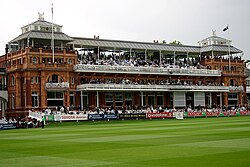
[[File:Lord's Pavilion.jpg|thumb|left|Lord's Pavilion, designed by the architect [[Thomas Verity]] and built in 1889–90]] | |||
The [[Australia national cricket team|Australian cricket team]] captained by [[Dave Gregory (cricketer)|Dave Gregory]] first visited Lord's on 27 May 1878, defeating their MCC hosts by 9 wickets.<ref>{{cite web|url=https://cricketarchive.com/Archive/Scorecards/2/2171.html|title=Marylebone Cricket Club v Australians, 1878|publisher=CricketArchive|access-date=27 June 2021|url-access=subscription|archive-date=27 May 2007|archive-url=https://web.archive.org/web/20070527213748/http://www.cricketarchive.com/Archive/Scorecards/2/2171.html|url-status=live}}</ref> This was considered a shock result and established not only the fame of the Australian team, but also the ongoing rivalry between England and Australia.<ref>Green 2010, pp. 81–4</ref> Lord's hosted its first [[Test cricket|Test match]] during [[Australian cricket team in England in 1884|The 1884 Ashes]], becoming the third venue in England to host Test cricket after [[The Oval]] and [[Old Trafford Cricket Ground|Old Trafford]].<ref>Powell 1989, pp. 14–5</ref> The match was won by [[England cricket team|England]] by an innings and 5 runs, with England's [[A. G. Steel]] and [[Edmund Peate]] recording the first Test [[century (cricket)|century]] and [[five-wicket haul]] at Lord's respectively.<ref>{{cite web|url=https://cricketarchive.com/Archive/Scorecards/2/2861.html|title=England v Australia, 1884|publisher=CricketArchive|access-date=28 June 2021|url-access=subscription|archive-date=28 June 2021|archive-url=https://web.archive.org/web/20210628170035/https://cricketarchive.com/Archive/Scorecards/2/2861.html|url-status=live}}</ref> | |||
Lord's | As part of the [[Golden Jubilee of Queen Victoria|Golden Jubilee Celebrations for Queen Victoria]] in 1887, the [[King]]s of [[Leopold II of Belgium|Belgium]], [[Christian IX of Denmark|Denmark]], [[Albert, King of Saxony|Saxony]], and [[Luís I of Portugal|Portugal]] attended Lord's. It was noted that none of them had any grasp of cricket. In the same year Lord's hosted the MCC's hundredth anniversary celebrations, with MCC playing a celebratory match against [[England cricket team|England]].<ref>Green 2010, pp. 94–5</ref> With only a two-tiered covered grandstand and both increasing membership and spectator numbers, it was decided to build a new pavilion at a cost of £21,000.<ref name="LBH"/> Construction of the new [[Lord's Pavilion]], which was designed by [[Thomas Verity]], took place in 1889–90.<ref name="PO15">Powell 1989, p. 15</ref> The pavilion it replaced was relocated and painstakingly rebuilt on an estate in [[Sussex]], where it lived out its days as a glorified garden shed.<ref name="PAV">{{cite web|url=https://www.lords.org/lords/our-history/father-time-wall/1890-thomas-verity-s-new-pavilion-is-completed|title=Thomas Verity's new Pavilion is completed|website=Lords.org|access-date=14 July 2021|archive-date=14 July 2021|archive-url=https://web.archive.org/web/20210714105554/https://www.lords.org/lords/our-history/father-time-wall/1890-thomas-verity-s-new-pavilion-is-completed|url-status=live}}</ref> Soon after this, the MCC purchased the land to the east, known today as the Nursery Ground; this had previously been a [[market garden]] known as Henderson's Nursery<ref>{{Cite web|url=https://www.stjohnswoodmemories.org.uk/content/new-contributions/garden-nurseries|title=Garden Nurseries | Places, New contributions | St John's Wood Memories|website=Stjohnswoodmemories.org.uk|access-date=3 January 2026}}</ref> which grew pineapples and tulips.<ref name="PO15"/><ref name="LBH"/><ref>Baker 2014, p. 129</ref> The ground was subsequently threatened by the [[Manchester, Sheffield and Lincolnshire Railway]]'s attempts to purchase land in the area for their line into [[Marylebone Station]].<ref>Green 2010, p. 132</ref> After considering the company's offer, the MCC relinquished a strip of land bordering Wellington Road and was given in exchange the [[Clergy Support Trust|Clergy Orphan School]] to the south.<ref name="PO15"/> In order to facilitate the railway into Marylebone Station, the Nursery Ground had to be dug up to allow tunnels to be built between 1894 and 1898 using the [[Tunnel#Cut-and-cover|cut-and-cover method]]. Once completed the MS&LR Company laid a new pitch.<ref name="BAT">{{cite web|url=https://www.bbc.co.uk/news/business-43993471|title=Battle over rail tunnels at Lord's cricket ground rumbles on|first=Bill|last=Wilson|publisher=[[BBC News]]|date=8 August 2018|access-date=28 June 2021|archive-date=9 July 2021|archive-url=https://web.archive.org/web/20210709200848/https://www.bbc.co.uk/news/business-43993471|url-status=live}}</ref> | ||
[[File:"W.G.", cricketing reminiscences and personal recollections (1899) (14784598082).jpg|thumb|right|Cricket being played at Lord's in 1899]] | |||
It was rumoured that subsequent [[tunnel]]ling under Wellington Road provided the banking for the Mound Stand, which was constructed in 1898–99 on an area previously occupied by [[Lawn tennis|tennis]] and [[Rackets (sport)|rackets]] courts. The rapid development of Lord's was not well met by some, with critics mooting Thomas Lord would "turn in his grave" at the ground's expansion.<ref name="PO15"/> 1899 saw [[Albert Trott]] hit a [[Boundary (cricket)#Six runs|six]] over the Pavilion while playing for MCC against the touring Australians, remaining as of {{year}} the only batsman to do so.<ref>Green 2010, p. 162–3</ref><ref>{{cite web |last=Williamson |first=Martin |date=19 June 2010 |title=Albert Trott's mighty hit |url=https://www.espncricinfo.com/story/rewind-to-1899-albert-trott-s-mighty-hit-463786 |access-date=29 June 2021 |work=ESPNcricinfo |archive-date=21 February 2023 |archive-url=https://web.archive.org/web/20230221110709/https://www.espncricinfo.com/story/rewind-to-1899-albert-trott-s-mighty-hit-463786 |url-status=live }}</ref> The [[International Cricket Council|Imperial Cricket Conference]] was founded by England, Australia and [[South African national cricket team|South Africa]] in 1909, headquartered at Lord's.<ref name="PO16">Powell 1989, p. 16</ref> | |||
Lord's hosted three of the nine Test matches for the ill-fated [[1912 Triangular Tournament]] which was organised by the South African millionaire [[Sir Abe Bailey]].<ref>Green 2010, p. 190</ref> The ground's centenary was commemorated in June 1914 with a match between MCC, whose team was selected from the touring party from England's recent [[English cricket team in South Africa in 1913–14|tour of South Africa]], and a Rest of England team. The Rest of England won the three-day match by an innings and 189 runs.<ref>Warner 1987, pp. 169–170</ref> Lord's was requisitioned by [[British Army|the Army]] during the [[First World War]], accommodating the [[Army Reserve (United Kingdom)|Territorial Army]] (TA), [[Royal Army Medical Corps]] (RAMC) and [[Royal Army Service Corps]] (RASC). Both cooking and wireless instruction classes were held at the ground for military personnel. Once the RAMC departed, the [[War Office]] used the Nursery Ground and other buildings as a training centre for [[Royal Artillery]] [[Officer cadet|cadet]]s. The Pavilion and its Long Room were used throughout the war for the manufacture of hay nets for horses on the [[Western Front (World War I)|Western Front]].<ref>Green 2010, p. 193-4</ref> Though requisitioned, Lord's held several charity cricket matches during the war, featuring military teams from the various dominions of the [[British Empire]].<ref>Green 2010, p. 193–206</ref> These matches were well attended and one such match in 1918 between England and the [[Dominions cricket team|Dominions]] was attended by [[George V]] and the [[Prince Arthur, Duke of Connaught and Strathearn|Duke of Connaught]].<ref>{{Cite web |url=https://royalascotcc.com/presidents/ |title=Presidents |access-date=2 October 2025 |archive-date=23 January 2025 |archive-url=https://web.archive.org/web/20250123152750/https://royalascotcc.com/presidents/ |url-status=live }}</ref><ref>Warner 1987, p. 171</ref> | |||
===Inter-war years and WWII=== | |||
[[File:Lord's weathervane.jpg|thumb|''[[Father Time (Lord's)|Father Time]]'' (pictured) incurred damage from an RAAF Barrage Balloon during World War Two.]] | |||
First-class cricket returned to Lord's in 1919, with a series of two-day matches in the [[1919 English cricket season#County Championship|County Championship]].<ref>Green 2010, p. 207</ref> 1923 saw the installation of the [[Grace Gates]], a tribute to [[W. G. Grace]] who had died in 1915.<ref>{{NHLE|num=1246985|desc=Grace Gates at Lord's Cricket Ground|date=7 February 1996|access-date=29 June 2021}}</ref> They were inaugurated by [[Stanley Jackson (cricketer)|Sir Stanley Jackson]], who proposed including the words <small>THE GREAT CRICKETER</small> in the dedication.{{sfn|Midwinter|1981|p=154}} These gates replaced the ground's earlier, less decorative, entrance. With attendances growing in number, it was suggested that Lord's should aim to accommodate crowds of up to 40,000 for Test matches; however, its stands were considered inadequate with the Grandstand described as "hopelessly out of date".<ref>Green 2010, p. 214</ref> To accommodate these crowds, the Old Grandstand was demolished and a new one was built in its place in 1926, designed by the architect [[Herbert Baker|Sir Herbert Baker]]. Completion of the stand was delayed due to the [[1926 United Kingdom general strike|1926 General Strike]].<ref name="GRA"/> Upon its completion, Baker presented MCC with a [[weather vane]] of ''[[Father Time (Lord's)|Father Time]]'' removing the [[Bail (cricket)|bails]] from the [[Stump (cricket)|stumps]], which was placed on top of the Grandstand. The full weathervane is {{Convert|6|ft|6|in|abbr=on}} tall, with the figure of ''Father Time'' standing at {{Convert|5|ft|4|in|abbr=on}}. Baker further contributed to the landscape of Lord's by designing the Q (''now'' [[Gubby Allen|Allen]]) Stand next to the Pavilion in 1934, while at the Nursery End Stands were also erected. Careful consideration was taken to preserve the [[treeline]] dividing the main ground from the Nursery Ground.<ref name="PO16"/> The [[West Indies cricket team|West Indies]] under the captaincy of [[Karl Nunes]] played their first Test match at Lord's in 1928.<ref>Warner 1987, p. 195</ref> The ground later hosted the first [[TV|televised]] Test match during the [[Australian cricket team in England in 1938|Second Test of The 1938 Ashes series]].<ref name="LBH"/> | |||
The 1935 season saw the Lord's pitches badly affected by [[Tipuloidea|crane fly]] larvae, known as leatherjackets. The larvae caused bald patches to appear on the pitch and had to be removed by the ground staff, although spin bowlers did gain some benefit from the bare surfaces.<ref>{{cite web |title=Cranefly |url=https://www.gwct.org.uk/wildlife/species-of-the-month/2009/september/ |publisher=Game & Wildlife Conservation Trust |access-date=1 July 2021 |archive-date=9 July 2021 |archive-url=https://web.archive.org/web/20210709183538/https://www.gwct.org.uk/wildlife/species-of-the-month/2009/september/ |url-status=live }}</ref> | |||
=== | In contrast to the First World War, Lord's was only partially requisitioned by the military during the [[Second World War]]. Lord's hosted matches throughout the war for the [[London Counties cricket team]], amongst others, which attracted large crowds. The ground was spared major damage from [[the Blitz]]. An [[Incendiary device|oil bomb]] landed on the Nursery Ground in 1940, with a high-explosive bomb also narrowly missing the Nursery End Stands in December of the same year. The Grandstand and the Pavilion were hit by incendiary bombs, damaging their roofs. [[Auxiliary Fire Service|AFS]] [[firefighter]]s stationed at Lord's reacted quickly and limited the damage. As the war progressed, the threat came not from the [[Luftwaffe]] but the newly developed [[V-1 flying bomb]]. Lord's had several near misses from these missiles in 1944, with one bomb landing {{convert|200|yd}} short of the ground near to [[Regent's Park]].<ref name="WAR">{{cite web|url=https://www.espncricinfo.com/story/lord-s-under-attack-246297|title=Lord's under attack|first=Martin|last=Williamson|publisher=ESPNcricinfo|date=6 May 2006|access-date=1 July 2021|archive-date=9 July 2021|archive-url=https://web.archive.org/web/20210709182435/https://www.espncricinfo.com/story/lord-s-under-attack-246297|url-status=live}}</ref> The Nursery Ground had been requisitioned by the [[Royal Auxiliary Air Force]] and converted into a [[barrage balloon]] site.<ref name="PO16"/><ref>Warner 1987, p. 245</ref> The most high-profile war damage was that to ''Father Time'', when one such balloon broke loose and drifted toward the Grandstand, catching ''Father Time'' and depositing it into the seating at the front of the stand.<ref>{{Cite web |url=https://rafa.org.uk/blog/2020/10/13/barrage-balloons-in-the-second-world-war/ |title=Barrage Balloons in the sEcond World War|access-date=2 October 2025 |archive-date=5 August 2025 |archive-url=https://web.archive.org/web/20250805022940/https://rafa.org.uk/blog/2020/10/13/barrage-balloons-in-the-second-world-war/ |url-status=live }}</ref> International cricket resumed at the end of the war, with Lord's hosting one of the [[Victory Tests]] (although not accorded Test status) between the [[Australian Services cricket team]] and England.<ref name="WAR"/> | ||
Following the end of the war attendances at cricket matches grew. The gross attendance of 132,000 and the gate receipts of £43,000 | ===Post-war years=== | ||
Following the end of the [[WWII|war]] attendances at cricket matches grew. The gross attendance of 132,000 and the gate receipts of £43,000 at the Lord's [[Second Test, 1948 Ashes series|Second Test of The 1948 Ashes series]] was a record for a Test match in England at that time.<ref>{{Cite web|title=Second Test Match England v Australia|author=Hayter, R. J.|work=[[Wisden Cricketers' Almanack]]|year=1949|url=http://www.cricinfo.com/wisdenalmanack/content/story/152895.html|publisher=[[Wisden Cricketers' Almanack|Wisden]]|access-date=30 June 2021|archive-date=10 August 2010|archive-url=https://web.archive.org/web/20100810225353/http://www.cricinfo.com/wisdenalmanack/content/story/152895.html|url-status=live}}</ref> This demand necessitated further expansion of the ground, with the construction of the [[Pelham Warner|Warner]] Stand in 1958, which included snack bars and a press box.<ref name="PO16"/><ref name="LBH"/> This stand was the work of the architect Kenneth Peacock and replaced an area of raised ground lined with trees from where it was traditionally possible to watch a match from the comfort of one's own [[carriage]]. Prior to the construction of the Warner Stand, all stands at the ground were identified by letters of the alphabet.<ref name="WARN">{{Cite web|title=The New Warner Stand is opened|url=https://www.lords.org/lords/our-history/father-time-wall/2017-the-new-warner-stand-is-opened-by-hrh-the-duk|website=Web.archive.org|access-date=6 July 2021|archive-date=9 July 2021|archive-url=https://web.archive.org/web/20210709190406/https://www.lords.org/lords/our-history/father-time-wall/2017-the-new-warner-stand-is-opened-by-hrh-the-duk|url-status=live}}</ref> | |||
The record numbers of spectators who attended Test and [[County Championship]] matches began to decline by the end of the 1950s and cricket in England found itself from a position of 2.2 million paid County Championship spectators in 1947, dropping to 719,661 | The record numbers of spectators who attended [[Test cricket|Test]] and [[County Championship]] matches began to decline by the end of the 1950s and cricket in England found itself from a position of 2.2 million paid County Championship spectators in 1947, dropping to 719,661 by 1963. To arrest this decline, [[List A cricket|List A one-day cricket]] was introduced in 1963, with Lord's hosting its first List A match in the [[1963 Gillette Cup]] between Middlesex and [[Northamptonshire County Cricket Club|Northamptonshire]] and later hosted the [[1963 Gillette Cup Final|final of the competition]] between Sussex and [[Worcestershire County Cricket Club|Worcestershire]] in front of a sell-out 24,000 crowd. It was the first such final held anywhere in the world.<ref name="pandora">{{cite web |last=Williamson |first=Martin |date=20 April 2013 |title=Opening Pandora's one-day box |url=https://www.espncricinfo.com/story/rewind-to-1963-opening-pandora-s-one-day-box-630566 |access-date=1 July 2021 |publisher=[[ESPNcricinfo]] |archive-date=21 February 2023 |archive-url=https://web.archive.org/web/20230221111447/https://www.espncricinfo.com/story/rewind-to-1963-opening-pandora-s-one-day-box-630566 |url-status=live }}</ref> Lord's Tavern and its adjoining buildings were demolished in 1968 to make way for the construction of the Tavern Stand, again designed by Peacock.<ref name="LBH"/> The tavern was subsequently re-sited next to the Grace Gates and was complemented with a banqueting hall.<ref name="PO16"/> Lord's hosted its first [[One Day International]] (ODI) in 1972,<ref name="ODI">{{cite web|url=https://cricketarchive.com/Archive/Grounds/11/596_o.html|title=ODI Matches played on Lord's Cricket Ground, St John's Wood|publisher=CricketArchive|access-date=2 July 2021|url-access=subscription|archive-date=9 July 2021|archive-url=https://web.archive.org/web/20210709182410/https://cricketarchive.com/Archive/Grounds/11/596_o.html|url-status=live}}</ref> with Australia defeating England by 5 wickets.<ref>{{cite web|url=https://cricketarchive.com/Archive/Scorecards/32/32841.html|title=England v Australia, Prudential Trophy 1972 (2nd ODI)|publisher=CricketArchive|access-date=2 July 2021|url-access=subscription|archive-date=31 January 2018|archive-url=https://web.archive.org/web/20180131201032/https://cricketarchive.com/Archive/Scorecards/32/32841.html|url-status=live}}</ref> Three years later Lord's hosted the final of the [[1975 Cricket World Cup|inaugural men's World Cup]], with the [[West Indies cricket team|West Indies]] triumphing over Australia.<ref>{{cite web |last=Cozier |first=Tony |title=West Indies victory heralds a new era |url=https://www.espncricinfo.com/story/west-indies-victory-heralds-a-new-era-264375 |access-date=2 July 2021 |publisher=ESPNcricinfo |archive-date=10 January 2023 |archive-url=https://web.archive.org/web/20230110190011/https://www.espncricinfo.com/story/west-indies-victory-heralds-a-new-era-264375 |url-status=live }}</ref> Four years later, Lord's held the [[1979 Cricket World Cup Final|final of the 1979 World Cup]], with the West Indies once against triumphing, this time against England.<ref>{{cite web|first=Tony|last=Cozier|url=https://www.espncricinfo.com/wisdenalmanack/content/story/150321.html|title=England v West Indies|work=Cricinfo |publisher=ESPNcricinfo|access-date=2 July 2021|archive-date=11 November 2018|archive-url=https://web.archive.org/web/20181111093802/http://www.espncricinfo.com/wisdenalmanack/content/story/150321.html|url-status=live}}</ref> | ||
The first women's cricket match at Lord's took place in August 1976 when England and Australia played a 60-over ODI which England won by eight wickets. The opportunity to play a women's match at Lord's resulted from | The first women's cricket match at Lord's took place in August 1976 when England and Australia played a 60-over ODI which [[England women's cricket team|England]] won by eight wickets. The opportunity to play a women's match at Lord's resulted from lobbying by [[Rachael Heyhoe Flint]], and was given extra impetus by England's victory in the [[1973 Women's Cricket World Cup]]. England's Women XI had to wait another 11 years to play their second match at Lord's.<ref>{{cite web |last1=Thompson |first1=Jenny |title=Storming cricket's bastion |url=https://www.espncricinfo.com/story/storming-cricket-s-bastion-142657 |publisher=Espncricinfo |access-date=19 July 2021 |date=14 July 2005 |archive-date=19 July 2021 |archive-url=https://web.archive.org/web/20210719165747/https://www.espncricinfo.com/story/storming-cricket-s-bastion-142657 |url-status=live }}</ref> The ground hosted the final of the [[ICC Women's Cricket World Cup]] in [[1993 Women's Cricket World Cup Final|1993]] with England beating New Zealand to win the World Cup. The ground was not fully opened for the game with only 5,000 spectators attending.<ref>{{cite web |last1=Williamson |first1=Martin |title=When women took over Lord's |url=https://www.espncricinfo.com/story/when-women-took-over-lord-s-396113 |publisher=Espncricinfo |access-date=23 July 2021 |date=20 March 2009 |archive-date=23 July 2021 |archive-url=https://web.archive.org/web/20210723113627/https://www.espncricinfo.com/story/when-women-took-over-lord-s-396113 |url-status=live }}</ref> | ||
[[File:Lord's Cricket Ground Grand Stand.jpg|thumb|right| | [[File:Lord's Cricket Ground Grand Stand.jpg|thumb|right|Lord's Grand Stand (pictured), 1998]] | ||
A new indoor cricket school was completed in 1973 at the Nursery End, | A new indoor cricket school was completed in 1973 at the Nursery End, launched with £75,000 from [[Jack Hayward|Sir Jack Hayward]] and additional funds raised by the [[Lord's Taverners]] and [[Sport England#The Sports Council Archives|the Sports Council]].<ref name="SCHOOL">{{cite web|url=https://www.lords.org/lords/our-history/father-time-wall/1977-first-indoor-school-at-lord-s-officially-open|title=First Indoor School at Lord's opened|website=Lords.org|access-date=2 July 2021|archive-date=9 July 2021|archive-url=https://web.archive.org/web/20210709182451/https://www.lords.org/lords/our-history/father-time-wall/1977-first-indoor-school-at-lord-s-officially-open|url-status=live}}</ref> The West Indies appeared in their [[1983 Cricket World Cup Final|third successive World Cup final]] in 1983, but were defeated by 43 runs by [[India national cricket team|India]].<ref>{{cite web|url=https://www.espncricinfo.com/wisdenalmanack/content/story/150434.html|title=India defy the odds|date=2 June 2008|publisher=ESPNcricinfo|access-date=5 July 2021|archive-date=10 May 2021|archive-url=https://web.archive.org/web/20210510212632/https://www.espncricinfo.com/wisdenalmanack/content/story/150434.html|url-status=live}}</ref> The Mound Stand's roof was removed in 1985 to make way for a new upper tier designed by [[Hopkins Architects|Michael Hopkins & Partners]], which opened in time for the MCC's bicentenary in 1987.<ref>Green 2010, p. 448</ref> That bicentenary was celebrated with a [[MCC Bicentenary match|five-day match between MCC and a Rest of the World XI]] in August 1987, which ended in a draw after the final day was rained off.<ref>{{cite web|title=MCC v Rest of the World, Lord's, August 20–25 1987|date=7 July 2005|url=https://www.espncricinfo.com/wisdencricketer/content/story/212881.html|publisher=ESPNcricinfo|access-date=6 July 2021|archive-date=9 July 2021|archive-url=https://web.archive.org/web/20210709184429/https://www.espncricinfo.com/wisdencricketer/content/story/212881.html|url-status=live}}</ref> | ||
[[Graham Gooch]] made the first Test | [[Graham Gooch]] made the first Test triple-century at Lord's, scoring 333 against India in 1990.<ref>{{cite web|title=Graham Gooch scores 333|url=https://www.lords.org/lords/our-history/father-time-wall/1990-graham-gooch-333-first-test-triple-century-at|website=Lords.org|access-date=7 July 2021|archive-date=9 July 2021|archive-url=https://web.archive.org/web/20210709184833/https://www.lords.org/lords/our-history/father-time-wall/1990-graham-gooch-333-first-test-triple-century-at|url-status=live}}</ref> The final decade of the 20th–century saw rapid redevelopment of Lord's. The [[Denis Compton|Compton]] and [[Bill Edrich|Edrich]] Stands were completed in 1991, having run over time and budget.<ref name="LBH"/> Its indoor school closed in 1994 being replaced by the new state-of-the-art Lord's Indoor Cricket Centre which opened in 1995.<ref name="SCHOOL"/> The old grandstand was demolished in 1996, with its replacement designed by [[Nicholas Grimshaw|Nicholas Grimshaw & Partners]] being completed in 1998. From 1997, Lord's was home to the [[European Cricket Council]] (ECC) till 2010, and remains home to ICC Europe, which administers cricket outside of the European [[List of International Cricket Council members|full-member]] nations.<ref>{{cite web|url=https://news.bbc.co.uk/sport2/hi/cricket/1796206.stm|title=From Iceland to Azerbaijan|publisher=BBC Sport|date=1 February 2002|access-date=6 July 2021|archive-date=16 February 2004|archive-url=https://web.archive.org/web/20040216111246/http://news.bbc.co.uk/sport1/hi/cricket/1796206.stm|url-status=live}}</ref> With Lord's hosting three matches in the [[1999 Cricket World Cup|1999 World Cup]], including the [[1999 Cricket World Cup Final|final]], the MCC set about improving press facilities by constructing the Media Centre at the Nursery End between the Compton and Edrich Stands, offering commanding views towards the Pavilion from behind the bowler's arm. Lord's Media Centre was opened in April 1999 by then MCC president [[Tony Lewis]].<ref name="MED">{{cite web|url=https://www.lords.org/lords/news-stories/the-20th-anniversary-of-the-media-centre-1|title=The 20th anniversary of the Media Centre|date=27 April 2019|website=Lords.org|access-date=6 July 2021|archive-date=9 July 2021|archive-url=https://web.archive.org/web/20210709185354/https://www.lords.org/lords/news-stories/the-20th-anniversary-of-the-media-centre-1|url-status=live}}</ref> | ||
=== | ===21st-century developments=== | ||
Lord's hosted | [[Image:2025 Hundred Final at Lord's.jpg|thumb|250px|right|Lord's has hosted the final of [[The Hundred (cricket)|The Hundred]] since 2021.]] | ||
Lord's hosted its one-hundredth Test match in June 2000, with England defeating the West Indies by two wickets; the match was also notable for the 21 wickets which fell on the second day, the most to fall in a day at a Lord's Test since 1888.<ref>{{cite web|url=https://www.lords.org/lords/our-history/father-time-wall/2000-england-beat-west-indies-in-the-100th-lord-s|title=England beat West Indies in 100th Lord's Test|website=Lords.org|access-date=6 July 2021|archive-date=9 July 2021|archive-url=https://web.archive.org/web/20210709190927/https://www.lords.org/lords/our-history/father-time-wall/2000-england-beat-west-indies-in-the-100th-lord-s|url-status=live}}</ref> The ground also hosted the University Match over three days for the last time in 2000, after which the match alternated between [[Fenner's]] at Cambridge and [[University Parks#Cricket ground|University Parks]] at Oxford.<ref>{{cite news|url=https://www.oxfordmail.co.uk/news/6630947.cricket-varsity-game-may-switch-lords/|title=Cricket: Varsity game may switch from Lord's|date=7 July 2000|work=[[Oxford Mail]]|access-date=4 July 2021|archive-date=9 July 2021|archive-url=https://web.archive.org/web/20210709190335/https://www.oxfordmail.co.uk/news/6630947.cricket-varsity-game-may-switch-lords/|url-status=live}}</ref> This fixture continues at Lord's since 2001 as a one-day limited overs match.<ref>{{cite news|url=https://www.oxfordmail.co.uk/news/6630332.cricket-lords-varsity-one-day/|title=Cricket: Lord's Varsity to be one-day|date=24 July 2000|work=[[Oxford Mail]]|access-date=7 July 2021|archive-date=9 July 2021|archive-url=https://web.archive.org/web/20210709185902/https://www.oxfordmail.co.uk/news/6630332.cricket-lords-varsity-one-day/|url-status=live}}</ref> At the start of the 21st-century, the Lord's slope which offers advantage to both [[Seam bowling|seam]] and [[Swing bowling|swing bowlers]] from the Pavilion and Nursery Ends respectively, was under threat of being levelled due to the advent of [[Cricket pitch#Drop-in pitches|drop-in pitches]].<ref>{{cite news|url=https://www.telegraph.co.uk/sport/cricket/4776895/Slopes-future-in-balance.html |archive-url=https://ghostarchive.org/archive/20220111/https://www.telegraph.co.uk/sport/cricket/4776895/Slopes-future-in-balance.html |archive-date=11 January 2022 |url-status=live|title=Slope's future in balance|first=Simon|last=Briggs|work=[[The Daily Telegraph]]|date=19 May 2001|access-date=1 January 2015|url-access=subscription}}{{cbignore}}</ref> However, the MCC resisted these calls as levelling the pitch would require the rebuilding of Lord's and would mean Test cricket would not be able to be played there for five years. The [[outfield]] was notorious for becoming waterlogged due to its clay soil, resulting in considerable lost match time. The entire outfield was relaid in the winter of 2002 with the clay soil being replaced with sand, which has improved drainage.<ref>{{cite web|url=https://www.pitchcare.com/news-media/mallinsons-win-bali-principal-award.html|title=Mallinsons win BALI Principal Award|first=David|last=Saltman|website=Pitchcare.com|date=27 November 2003|access-date=7 July 2021|archive-date=9 July 2021|archive-url=https://web.archive.org/web/20210709184644/https://www.pitchcare.com/news-media/mallinsons-win-bali-principal-award.html|url-status=live}}</ref> Lord's hosted its first [[Twenty20|T20 match]] in the second edition of the [[Twenty20 Cup]] in 2004.<ref>{{cite web|url=https://news.bbc.co.uk/sport1/hi/cricket/counties/warwickshire/3256040.stm|title=Lord's admits Twenty20 Cup|publisher=[[BBC Sport]]|date=2 December 2003|access-date=5 July 2021|archive-date=9 May 2004|archive-url=https://web.archive.org/web/20040509081246/http://news.bbc.co.uk/sport1/hi/cricket/counties/warwickshire/3256040.stm|url-status=live}}</ref> In 2005 the [[International Cricket Council]] (formerly the Imperial Cricket Conference) headquarters, which had been located at Lord's since its foundation in 1909,<ref>{{cite web |title=ICC ponders Lord's move |url=https://news.bbc.co.uk/sport2/hi/cricket/3532281.stm |publisher=BBC Sport |access-date=5 July 2021 |date=4 March 2004 |archive-date=3 June 2004 |archive-url=https://web.archive.org/web/20040603043435/http://news.bbc.co.uk/sport1/hi/cricket/3532281.stm |url-status=live }}</ref> were closed and moved to the [[Dubai Sports City]] in the United Arab Emirates.<ref>{{cite web |title=Cricket chiefs move base to Dubai |url=https://news.bbc.co.uk/sport1/hi/cricket/4326601.stm |publisher=BBC Sport |access-date=5 July 2021 |date=7 March 2005 |archive-date=18 February 2007 |archive-url=https://web.archive.org/web/20070218140252/http://news.bbc.co.uk/sport1/hi/cricket/4326601.stm |url-status=live }}</ref> | |||
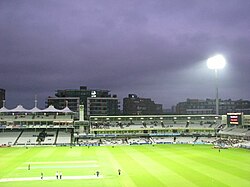
[[File:Lordsatnight.jpg|thumb|left|Lord's floodlit [[Twenty20]] match between Middlesex and Kent in 2009]] | |||
Temporary [[Floodlights (sport)|floodlights]] were installed at the ground in 2007, but were removed in 2008 after complaints of [[light pollution]] from local residents. In January 2009, [[Westminster City Council]] approved the use of new 48-metre high retractable floodlights designed to minimise light spillage into nearby residences. Council approval stipulated a five-year trial period during which up to 12 matches and 4 practice matches could be played under lights between April and September, with the lights being dimmed to half-strength at 9.50 pm and switched off by 11 pm. The floodlights were first used successfully on 27 May 2009 during the Twenty20 Cup match between Middlesex and [[Kent County Cricket Club|Kent]].<ref>{{cite web|url=https://www.getwestlondon.co.uk/sport/cricket/lords-floodlights-just-isnt-cricket-6007403|title=Lord's floodlights just 'isn't cricket'|work=Get West London|date=2 June 2009|access-date=6 July 2021|archive-date=1 August 2018|archive-url=https://web.archive.org/web/20180801003956/https://www.getwestlondon.co.uk/sport/cricket/lords-floodlights-just-isnt-cricket-6007403|url-status=live}}</ref> Two weeks after the first use of the floodlights, Lord's hosted its first [[Twenty20 International]] in the [[2009 ICC World Twenty20|World Twenty20]] between England and the [[Netherlands national cricket team|Netherlands]], which resulted in a shock last-ball win for the [[ICC Europe|ICC associate nation]].<ref>{{cite web|url=https://www.espncricinfo.com/series/icc-world-twenty20-2009-335113/england-vs-netherlands-1st-match-group-b-355991/match-report|title=de Grooth leads Netherlands to famous win|first=Andrew|last=McGlashan|publisher=ESPNcricinfo|date=5 June 2009|access-date=6 July 2021|archive-date=28 December 2021|archive-url=https://web.archive.org/web/20211228190029/https://www.espncricinfo.com/series/icc-world-twenty20-2009-335113/england-vs-netherlands-1st-match-group-b-355991/match-report|url-status=live}}</ref> Lord's held the [[2009 ICC World Twenty20 Final]] between [[Pakistan national cricket team|Pakistan]] and [[Sri Lanka national cricket team|Sri Lanka]], which Pakistan won by 8 wickets.<ref>{{cite news|url=https://www.theguardian.com/sport/2009/jun/21/pakistan-sri-lanka-world-twenty20-final|title=Pakistan v Sri Lanka – as it happened|first=Rob|last=Smyth|work=[[The Guardian]]|date=21 June 2009|access-date=7 July 2021|archive-date=9 July 2021|archive-url=https://web.archive.org/web/20210709184914/https://www.theguardian.com/sport/2009/jun/21/pakistan-sri-lanka-world-twenty20-final|url-status=live}}</ref> | |||
In 2008 plans were drawn up by the MCC | In 2008 plans were drawn up by the MCC Committee to fund the future £250 million development of the ground by constructing residential apartments and a luxury hotel along the Wellington Road and Grove End Road.<ref>{{cite news|url=https://www.hamhigh.co.uk/news/new-housing-set-to-pay-for-250m-redeveloped-lord-s-7649424|title=New housing set to pay for £250m redeveloped Lord's|publisher=[[Archant#Weekly paid newspapers|Ham & High]]|date=4 July 2008|access-date=7 July 2021|archive-date=9 July 2021|archive-url=https://web.archive.org/web/20210709184640/https://www.hamhigh.co.uk/news/new-housing-set-to-pay-for-250m-redeveloped-lord-s-7649424|url-status=live}}</ref> | ||
Lord's Masterplan was unveiled in 2013, being a twenty-year plan to redevelop the ground and improve its facilities.<ref>{{Cite web|url=https://www.architectsjournal.co.uk/archive/lords-reveals-200-million-populous-designed-redevelopment-plans|title=Lord's reveals £200 million Populous-designed redevelopment plans|website=Architectsjournal.co.uk|date=2 May 2013|access-date=3 January 2026}}</ref> The first phase of its Masterplan involved the demolition and replacement of the Warner Stand with a new stand, which was built between 2015 and 2017. The new stand has improved facilities for [[Umpire (cricket)|match officials]] and reduced the number of restricted-view spectator seats from 600 to 100.<ref name="MAS">{{cite web|url=https://www.lords.org/lords/our-history/the-future|title=The Masterplan|website=Lords.org|access-date=23 July 2021|archive-date=20 June 2021|archive-url=https://web.archive.org/web/20210620043117/https://www.lords.org/lords/our-history/the-future|url-status=live}}</ref> Phase two of Lord's Masterplan involved the demolition of the Compton and Edrich Stands in 2019, with their replacements being completed in 2021; these provided an extra 2,000 seats and for the first time were linked by a walkway bridge.<ref name="MAS"/> | |||
Lord's celebrated the [[Bicentenary Celebration match|two-hundredth anniversary]] of its present ground in 2014. To mark the occasion, an MCC XI captained by [[Sachin Tendulkar]] played a [[World XI (cricket)|Rest of the World XI]] led by [[Shane Warne]] in a 50-over match.<ref>{{cite web|url = http://cricket.yahoo.com/news/sachin-tendulkar-rahul-dravid-unite-063408729.html|url-status = dead |archive-url=https://web.archive.org/web/20140302003921/http://cricket.yahoo.com/news/sachin-tendulkar-rahul-dravid-unite-063408729.html |archive-date=2 March 2014 |title = Sachin Tendulkar and Rahul Dravid re-unite; to face off against Shane Warne again|date = 6 February 2014|work = Yahoo! Cricket}}</ref> | |||
Lord's | Two matches of note were played at Lord's Cricket Ground in July 2019. The first of these was [[2019 Cricket World Cup Final|2019 World Cup Final]] between England and [[New Zealand national cricket team|New Zealand]], which ended as a tie with both sides each making 241 runs after 50 overs. The final was then decided by a [[Super Over]], which also resulted in a tie. Thus, the winner was decided on the number of boundaries scored in the game and Super Over; this was England's first World Cup triumph.<ref>{{cite web|url=https://www.espncricinfo.com/series/icc-cricket-world-cup-2019-1144415/england-vs-new-zealand-final-1144530/match-report|title=Epic final tied, Super Over tied, England win World Cup on boundary count|first=Alan|last=Gardner|date=14 July 2019 |publisher=ESPNcricinfo|access-date=23 July 2021|archive-date=12 July 2021|archive-url=https://web.archive.org/web/20210712100707/https://www.espncricinfo.com/series/icc-cricket-world-cup-2019-1144415/england-vs-new-zealand-final-1144530/match-report|url-status=live}}</ref> A second match of note followed four days later when [[Ireland cricket team|Ireland]] played [[Irish cricket team in England in 2019|their first Test match at Lord's]], where they bowled England out for 85 on the first morning of the match with [[Tim Murtagh]] taking 5 for 13. Despite this, in their second innings Ireland were dismissed for 38, the lowest Test total at Lord's and lost the match by 143 runs.<ref name="Lowest">{{cite web|url=https://www.espncricinfo.com/series/18774/report/1152839/day/3/england-vs-ireland-only-test-ireland-tour-of-england-2019|title=Chris Woakes and Stuart Broad wreck Ireland dream in a session|work=ESPNcricinfo|date=26 July 2019|access-date=26 July 2019|archive-date=26 July 2019|archive-url=https://web.archive.org/web/20190726111020/https://www.espncricinfo.com/series/18774/report/1152839/day/3/england-vs-ireland-only-test-ireland-tour-of-england-2019|url-status=live}}</ref> | ||
In August 2022 the ground's East Gate was renamed the Heyhoe Flint Gate in honour of [[Baroness Heyhoe Flint]].<ref>{{cite web |title=Lord's gate dedicated to cricket captain Rachael Heyhoe Flint unveiled |url=https://www.bbc.co.uk/news/uk-england-birmingham-62577636 |publisher=BBC News |access-date=22 August 2022 |date=17 August 2022 |archive-date=21 August 2022 |archive-url=https://web.archive.org/web/20220821160913/https://www.bbc.co.uk/news/uk-england-birmingham-62577636 |url-status=live }}</ref> | |||
In | In February 2026, it was reported that Lord's would undergo an overhaul of the Nursery End which would see the brick "prison" wall removed and a glass-fronted pavilion developed, along with two 12-storey apartment blocks to fund the redevelopment of the Tavern Stand. Potentially, a new Lord's museum, a roof over the currently open-air Compton and Edrich Stands, and transformation of the Thomas Lord building into a café and shop were also ideas considered in the plan as well.<ref>{{Cite web|url=https://www.thestadiumbusiness.com/2026/02/27/lords-redevelopment-plans-set-out/|title=Lord's redevelopment plans set out|first=Rob|last=Ridley|date=27 February 2026}}</ref> | ||
==Ground features and facilities== | ==Ground features and facilities== | ||
===Stands=== | ===Stands=== | ||
As of {{year}}, the stands at Lord's are (clockwise from the Pavilion):<ref name="Ground">{{cite web|url = https://www.lords.org/assets/ground-map-of-lords-2012-10872.pdf|title = Lord's Ground|access-date = 6 January 2015|archive-url = https://web.archive.org/web/20170227062611/https://www.lords.org/assets/ground-map-of-lords-2012-10872.pdf|archive-date = 27 February 2017|url-status = dead}}</ref> | As of {{year}}, the stands at Lord's are (anti-clockwise from the Pavilion):<ref name="Ground">{{cite web|url = https://www.lords.org/assets/ground-map-of-lords-2012-10872.pdf|title = Lord's Ground|access-date = 6 January 2015|archive-url = https://web.archive.org/web/20170227062611/https://www.lords.org/assets/ground-map-of-lords-2012-10872.pdf|archive-date = 27 February 2017|url-status = dead}}</ref> | ||
<gallery> | <gallery> | ||
File:Lords Labels 2021.svg|Lord's ground map | |||
File:Lords match in progress.jpg|[[Gubby Allen|Allen]] Stand (right) | |||
File:Lords Cricket Ground, London (Ank Kumar) 01.jpg|Tavern Stand | |||
File:Lords south stands.jpg|Mound Stand (left) | |||
File:Lords Edrich Stand Oct 2021.jpg|[[Bill Edrich|Edrich]] Stand | |||
File:Lords Compton Stand Oct 2021.jpg|[[Denis Compton|Compton]] Stand | |||
File:Lord's Cricket Ground Grand Stand.jpg|Grand Stand | |||
File:Lords 6.jpg|[[Pelham Warner|Warner]] Stand | File:Lords 6.jpg|[[Pelham Warner|Warner]] Stand | ||
</gallery> | </gallery> | ||
Many of the stands were rebuilt in the late 20th century. In 1987 the new Mound Stand, designed by [[Hopkins Architects|Michael Hopkins | Many of the stands were rebuilt in the late 20th century. In 1987 the new Mound Stand, designed by [[Hopkins Architects|Michael Hopkins & Partners]], was opened, followed by the Grand Stand, designed by [[Nicholas Grimshaw|Sir Nicholas Grimshaw]], in 1996.<ref>{{cite web|url = http://www.lords.org/history/lords-history/lords-milestones/|title = Lord's milestones|access-date = 6 January 2015|archive-date = 9 January 2015|archive-url = https://web.archive.org/web/20150109171707/http://www.lords.org/history/lords-history/lords-milestones/|url-status = live}}</ref> The [[Lord's Media Centre|Media Centre]], opposite the Pavilion between the [[Denis Compton|Compton]] and [[Bill Edrich|Edrich]] Stands, was added in 1999. Designed by [[Future Systems]], it won the Royal Institute of British Architects' [[Stirling Prize]] for 1999.<ref>{{cite web|url = http://www.architecture.com/StirlingPrize/RIBAStirlingPrizeWinners/LordsMediaCentre%281999%29.aspx|title = LORD'S MEDIA CENTRE (1999)|access-date = 6 January 2015|url-status = dead|archive-url = https://web.archive.org/web/20150106021449/http://www.architecture.com/StirlingPrize/RIBAStirlingPrizeWinners/LordsMediaCentre%281999%29.aspx|archive-date = 6 January 2015|df = dmy-all}}</ref> The redevelopment of the Compton and Edrich Stands was completed in 2021, adding 2,600 seats and bringing the ground capacity to 31,100 spectators.<ref>Tennant I (2021) [https://www.thetimes.com/sport/cricket/article/bitter-feud-over-expansion-of-lords-stands-revealed-v70cdbbv8 Bitter feud over expansion of Lord's stands revealed], ''[[The Times]]'', 26 May 2021. Retrieved 27 June 2021. {{subscription required}}</ref> The two ends of Lord's pitch are the Pavilion End (south-west), for MCC members, and the Nursery End (north-east), dominated by the Media Centre.<ref name="Ground"/> | ||
The current Grand Stand replaced | The current Grand Stand replaced that built in 1926 by [[Sir Herbert Baker]]. Although the stand was described as "truly a thing of beauty, loved by all who gazed upon it", it did have limitations for spectators: 43% of the seats had an obstructed view of the playing area and the structure itself was becoming rotten. | ||
===Pavilion=== | ===Pavilion=== | ||
{{ | {{main|Lord's Pavilion}} | ||
{{multiple image | {{multiple image | ||
| align = right | |||
| direction = horizontal | |||
| image1 = Lord's Pavilion.jpg | |||
| width1 = 120 | |||
| alt1 = | |||
| image2 = Lords Long Room.jpg | |||
| width2 = 120 | |||
| alt2 = | |||
| footer = The Victorian-era Lord's Pavilion (left) and historic Long Room (right) | |||
}} | }} | ||
<!--[[File:Lord's Pavilion.jpg|thumb|right|The Victorian-era Pavilion]] | <!--[[File:Lord's Pavilion.jpg|thumb|right|The Victorian-era Pavilion]] | ||
[[File:Lords Long Room.jpg|right|thumb|The Long Room in the pavilion]]---> | [[File:Lords Long Room.jpg|right|thumb|The Long Room in the pavilion]]---> | ||
The current | The current Lord's Pavilion is the ground's third and is its principal surviving Victorian edifice, having been built in 1889–90. It has been a [[Listed building#Examples of Grade II* listed buildings|Grade II* listed building]] since September 1982.<ref name="NHLE">{{NHLE|num=1235992|desc=The Pavilion at Lord's Cricket Ground|access-date=13 July 2021}}</ref> The Pavilion was constructed using brick with ornate terracotta facing, which includes terracotta gargoyles, such as "The Patriarch" which is understood to represent [[George Harris, 4th Baron Harris|Lord Harris]].<ref>{{cite book|title=Lords Through Time|last=Meredith|first=Anthony|year=2012|publisher=[[Amberley Publishing]]|location=Stroud|isbn=978-1445611341|page=53|url=https://books.google.com/books?id=kF2oAwAAQBAJ|access-date=22 March 2023|archive-date=4 April 2023|archive-url=https://web.archive.org/web/20230404011607/https://books.google.com/books?id=kF2oAwAAQBAJ|url-status=live}}</ref> The building consists of a long, two-storey centre section with covered seating between two end-towers which are capped with pyramidal roofs which have ornate wrought and cast iron lanterns.<ref name="NHLE"/> Running the full length behind the Upper Tier is the Pavilion's Roof Terrace, which affords panoramic views of the ground.<ref>{{cite web|url=https://www.lords.org/lords/conferences-and-events/pavilion-roof-terrace|title=Pavilion Roof Terrace|website=Lords.org|access-date=14 July 2021|archive-date=14 July 2021|archive-url=https://web.archive.org/web/20210714224414/https://www.lords.org/lords/conferences-and-events/pavilion-roof-terrace|url-status=live}}</ref> It underwent an £8 million refurbishment programme in 2004–05. The Pavilion provides inside and outdoor seating for MCC members to watch cricket including in the Long Room, the Bowlers' Bar as well as many other vantage points. Middlesex County Cricket Club and visiting counties' members can enjoy use by reciprocity of Lord's Pavilion on match days. The Pavilion also comprises the players' [[dressing room]]s with respective viewing balconies. | ||
The Long Room | The Long Room on the ground floor has been described by ''Wisden's'' [[Lawrence Booth (cricket writer)|Lawrence Booth]] as "the most evocative four walls in world cricket".<ref name="Booth">Arm-Ball to Zooter, Lawrence Booth, Penguin 2006, {{ISBN|0-14-051581-X}}, p.150-1</ref> Players proceed through the Long Room on their way from the dressing room to the [[cricket pitch]]; this walk can be notoriously long and complex at Lord's. On his Test debut in 1975, [[David Steele (cricketer)|David Steele]] got lost when going out to bat "and ended up in the Pavilion's basement toilets".<ref>{{cite book |title=If The Cap Fits |last=Bateman |first=Colin |year=1993 |publisher=Tony Williams Publications |isbn=1-869833-21-X |page=155}}</ref> Upon entering via the Long Room's rear door players take approximately 30 paces before reaching the steps leading onto the playing field.<ref>{{cite book|title=Luck: A Fresh Look at Fortune|last=Smith|first=Ed|year=2013|publisher=[[Bloomsbury Publishing]]|isbn=9781408830604|page=53|url=https://books.google.com/books?id=otCS17ftZMgC|access-date=22 March 2023|archive-date=4 April 2023|archive-url=https://web.archive.org/web/20230404030109/https://books.google.com/books?id=otCS17ftZMgC|url-status=live}}</ref> The Long Room is adorned with paintings of famous cricket scenes and distinguished cricket administrators and players from the 18th century to the present day, featuring many English cricketers as well as those from overseas by rotation. For an overseas cricketer to have their portrait hang in the Long Room is considered a great honour, among whom are four Australians: [[Sir Donald Bradman]], [[Keith Miller]], [[Victor Trumper]] and [[Shane Warne]].<ref>{{cite news|url=https://www.theguardian.com/australia/story/0,,1325266,00.html|title=Obituary: Keith Miller|first=Mike|last=Selvey|author-link=Mike Selvey|work=[[The Guardian]]|date=12 October 2004|access-date=13 July 2021|archive-date=24 May 2024|archive-url=https://web.archive.org/web/20240524195448/https://www.theguardian.com/news/2004/oct/12/guardianobituaries.cricket|url-status=live}}</ref> | ||
[[File:Lord's honours board_(cropped).jpg|thumb|left| | [[File:Lord's honours board_(cropped).jpg|thumb|left|[[Lord's honours boards]], historically celebrating English cricketers, were replaced in 2019.]] | ||
Displayed in the dressing rooms are the [[Lord's honours boards]], commemorating [[century (cricket)|centuries]], [[five-wicket haul|five-wicket]] and [[ten-wicket haul]]s for cricket internationals. Two honours boards for batting and bowling commemorate England players in the home dressing room,<ref>{{cite web|first=Andy|last=Wilson|url=https://www.theguardian.com/sport/2012/may/17/stuart-broad-england-west-indies|title=Stuart Broad says joining Lord's bowling elite is a 'huge honour'|work=The Guardian|date=17 May 2012|access-date=13 July 2021|archive-date=13 July 2021|archive-url=https://web.archive.org/web/20210713222426/https://www.theguardian.com/sport/2012/may/17/stuart-broad-england-west-indies|url-status=live}}</ref> while the batting and bowling honours boards commemorating overseas international players can be seen in the away dressing room.<ref>{{cite web|first=Mike|last=Selvey|url=https://www.theguardian.com/sport/2012/may/20/west-indies-england-first-test-day-four|title=First Test day four report|work=The Guardian|date=20 May 2012|access-date=13 July 2021|archive-date=13 July 2021|archive-url=https://web.archive.org/web/20210713222426/https://www.theguardian.com/sport/2012/may/20/west-indies-england-first-test-day-four|url-status=live}}</ref> Originally only these achievements in Test matches were commemorated, but in 2019 Lord's introduced an honours board for ODIs.<ref>{{Cite news|url=https://www.telegraph.co.uk/cricket/2019/02/26/lords-honour-womens-achievements-first-time-new-board-added/ |archive-url=https://ghostarchive.org/archive/20220111/https://www.telegraph.co.uk/cricket/2019/02/26/lords-honour-womens-achievements-first-time-new-board-added/ |archive-date=11 January 2022 |url-status=live|title=Lord's to honour women's achievements for first time as new board is added for ODIs|last=Hoult|first=Nick|date=26 February 2019|work=The Telegraph|access-date=13 July 2021|language=en-GB|issn=0307-1235|url-access=subscription}}{{cbignore}}</ref> As of {{year}} [[List of international cricket centuries at Lord's#Test centuries|167 players have made 240 Test centuries at Lord's]] and [[List of international cricket five-wicket hauls at Lord's#Test match five-wicket hauls|130 players have taken 186 five-wicket hauls]]. In ODI's [[List of international cricket centuries at Lord's#One Day International centuries|29 players have made 32 centuries at Lord's]] and [[List of international cricket five-wicket hauls at Lord's#One Day International five-wicket hauls|14 players have taken a five-wicket haul]]. A separate "neutral" honours board was created in 2010 to coincide with Lord's hosting a [[Australian cricket team against Pakistan in England in 2010|Test match between Australia and Pakistan]]. Australians [[Warren Bardsley]] and [[Charlie Kelleway]] were the first two names added to this board, commemorating their centuries against South Africa in 1912. They were joined by the Australians [[Shane Watson]] and [[Marcus North]], who both took five-wicket hauls against Pakistan.<ref>{{cite web|url=http://news.smh.com.au/breaking-news-sport/aussies-get-on-honour-board-at-lords-20100413-s7t1.html|title=Aussies get on honour board at Lord's|work=[[Sydney Morning Herald]]|date=13 April 2010|access-date=13 July 2021|archive-date=14 July 2014|archive-url=https://web.archive.org/web/20140714150655/http://news.smh.com.au/breaking-news-sport/aussies-get-on-honour-board-at-lords-20100413-s7t1.html|url-status=live}}</ref> | |||
The dress code in the | The [[dress code]] in the Pavilion remains notoriously strict. Men are required to wear "ties and tailored coats and acceptable trousers with appropriate shoes" and women are required to wear "dresses; or skirts or trousers worn with blouses, and appropriate shoes".<ref>{{cite news|last=Alderson|first=Andrew|url=https://www.telegraph.co.uk/news/uknews/1571968/MCCs-Brearley-wants-relaxed-dress-for-Lords.html |archive-url=https://ghostarchive.org/archive/20220111/https://www.telegraph.co.uk/news/uknews/1571968/MCCs-Brearley-wants-relaxed-dress-for-Lords.html |archive-date=11 January 2022 |url-access=subscription |url-status=live|title=MCC's Brearley wants relaxed dress for Lord's|work=The Telegraph|date=9 December 2007 |access-date=17 July 2012}}{{cbignore}}</ref> Until 1999 ladies – with the exception of Club Patron [[Elizabeth II|Queen Elizabeth II]] – were not permitted to enter the Pavilion during play, due to MCC's longstanding gender-based membership policy.<ref>{{cite web|url=https://news.bbc.co.uk/2/hi/sport/cricket/59842.stm|title=Modernisers stumped in MCC vote|publisher=BBC News|date=24 February 1998|access-date=14 July 2021|archive-date=19 October 2022|archive-url=https://web.archive.org/web/20221019123349/http://news.bbc.co.uk/1/hi/sport/cricket/59842.stm|url-status=live}}</ref><ref>{{cite web|url=https://news.bbc.co.uk/2/hi/uk_news/297853.stm|title=MCC delivers first 10 maidens|publisher=BBC News|date=16 March 1999|access-date=14 July 2021|archive-date=19 July 2004|archive-url=https://web.archive.org/web/20040719162158/http://news.bbc.co.uk/1/hi/uk/297853.stm|url-status=live}}</ref> MCC's 1998 decision to admit female members represented a historic modernisation for Lord's Pavilion and similar [[Gentlemen's club|clubs]].<ref>{{cite web|url=https://news.bbc.co.uk/1/hi/uk/181759.stm|title=Lord's and ladies?|publisher=BBC News|date=28 September 1998|access-date=14 July 2021|archive-date=8 November 2002|archive-url=https://web.archive.org/web/20021108060940/http://news.bbc.co.uk/1/hi/uk/181759.stm|url-status=live}}</ref> | ||
===Media Centre=== | ===Media Centre=== | ||
[[File:Nat West media centre cropped.jpg|thumb|left| | [[File:Nat West media centre cropped.jpg|thumb|left|Lord's futuristic Media Centre (pictured)]] | ||
The decision to build the Media Centre was made during a meeting of the MCC | The decision to build the Media Centre was made during a meeting of the MCC Committee in 1995.<ref name="MEDIA">{{cite web|url=https://www.lords.org/lords/news-stories/the-20th-anniversary-of-the-media-centre-1|title=The 20th anniversary of the Media Centre|website=Lords.org|date=29 April 2019|access-date=14 July 2021|archive-date=9 July 2021|archive-url=https://web.archive.org/web/20210709185354/https://www.lords.org/lords/news-stories/the-20th-anniversary-of-the-media-centre-1|url-status=live}}</ref> These plans sought to remove the previously inadequate media arrangements mostly concentrated in the Warner Stand which could accommodate 90 journalists, along with wooden shacks dotted around the ground for commentators,<ref name="SPORT">{{cite book|last=Nicholson|first=Matthew|year=2007|title=Sport and the Media|publisher=[[Taylor & Francis]]|location=[[Abingdon-on-Thames]]|page=115|isbn=978-1136364976}}</ref> and replace them with a new purpose-built facility. It was then approved by members of the MCC at a special general meeting in December 1996.<ref name="MEDIA"/> A gap between the Compton and Edrich Stands was selected, with space limitations requiring the centre to stand {{convert|15|m}} above ground level on reinforced supports from the structure around its two lift shafts. This design allowed for uninterrupted access between Lord's Main Ground and the Nursery Ground, while also allowing the movement of ground staff and their equipment.<ref name="MEDIA"/> | ||
It was designed by the [[Future Systems]] architectural practice led by Czech architect [[Jan Kaplický]] and was the first all-aluminium, semi- | It was designed by the [[Future Systems]] architectural practice led by Czech architect [[Jan Kaplický]] and was the first all-aluminium, [[Monocoque|semi-monocoque]] building in the world, costing about £5 million. Construction began in January 1997 and was completed in time for the 1999 World Cup. It was built in 32 sections and fitted out by Pendennis Shipyard at [[Falmouth, Cornwall|Falmouth]] in combination with [[Centraalstaal]] from the Netherlands.<ref name=nce>{{cite web|url=http://www.nce.co.uk/winner-building-sponsored-by-bsi-natwest-media-centre-lords-cricket-ground-london-nw8/838275.article|title=Winner Building Sponsored by BSI NatWest Media Centre, Lord's Cricket Ground, London NW8|website=Newcivilengineer.com|date=21 October 1999|access-date=14 July 2021|archive-date=2 July 2015|archive-url=https://web.archive.org/web/20150702204951/http://www.nce.co.uk/winner-building-sponsored-by-bsi-natwest-media-centre-lords-cricket-ground-london-nw8/838275.article|url-status=live}}</ref> These pieces were then delivered to Lord's where they were lowered into place during the [[1998 English cricket season|1998 season]].<ref name="MEDIA"/> The glazing on the front of the Media Centre is inclined 25° so as to eliminate reflections and glare on the pitch to minimise the visual barrier between the media and the players. The lower tier of Lord's Media Centre provides accommodation for 118 journalists, with two hospitality boxes either side which accommodate 18 people each. The top tier has radio and television commentary boxes, consisting of two television studios, two large commentary and radio commentary boxes, each holding up to six people.<ref name="SPORT"/> The centre's only opening window is in the broadcasting box used by BBC [[Test Match Special]].<ref>{{cite web|url=http://www.building.co.uk/the-lords-test/915.article|title=The Lord's test | Magazine Features|last=Alexander|first=Gus|website=Building.co.uk|access-date=14 July 2021|archive-date=3 July 2015|archive-url=https://web.archive.org/web/20150703000122/http://www.building.co.uk/the-lords-test/915.article|url-status=live}}</ref> The building won eight architectural awards, including the [[RIBA Stirling Prize]] for architecture in 1999.<ref>{{Cite web |last=Mark |first=Laura |date=6 October 2015 |title=Twenty years of the RIBA Stirling Prize |url=https://www.architectsjournal.co.uk/buildings/twenty-years-of-the-riba-stirling-prize |access-date=11 February 2025 |website=The Architects’ Journal |language=en |archive-date=30 November 2024 |archive-url=https://web.archive.org/web/20241130232937/https://www.architectsjournal.co.uk/buildings/twenty-years-of-the-riba-stirling-prize |url-status=live }}</ref> The Media Centre was originally sponsored by [[NatWest]], with sponsorship being taken over by [[Investec]] in 2007. From 2011, [[JPMorgan Chase|J. P. Morgan]] was sponsor,<ref>{{cite web|url=http://www.lords.org/latest-news/news-archive/new-media-centre-sponsor-jp-morgan,2037,NS.html|title=New Media Centre sponsor: JP Morgan|website=Lords.org|date=31 May 2011|access-date=29 May 2015|archive-url=https://web.archive.org/web/20130312001401/http://www.lords.org/latest-news/news-archive/new-media-centre-sponsor-jp-morgan,2037,NS.html|archive-date=12 March 2013|url-status=dead}}</ref> and since 2025, [[Barclays]] sponsors Lord's Media Centre.<ref>{{Cite web |url=https://www.lords.org/lords/news-stories/barclays-becomes-new-principal-partner-of-lord-s |title=Barclays Becomes New Principal Partner of Lord's|access-date=2 October 2025 |archive-date=14 June 2025 |archive-url=https://web.archive.org/web/20250614114003/https://www.lords.org/lords/news-stories/barclays-becomes-new-principal-partner-of-lord-s |url-status=live }}</ref> | ||
===Nursery Ground=== | ===Nursery Ground=== | ||
[[File:Nursery Ground, Lord's - geograph.org.uk - 3430343.jpg|thumb|right| | [[File:Nursery Ground, Lord's - geograph.org.uk - 3430343.jpg|thumb|right|Lord's Nursery Ground (pictured)]] | ||
Purchased in two parts by the MCC in 1838 and 1887, the ground is primarily used as a practice ground and is considered to have some of the best grass [[Cricket nets|nets]] in the world.<ref name="NUR">{{cite web|url=https://www.espncricinfo.com/england/content/ground/57132.html|title=Lord's Nursery Ground|publisher=ESPNcricinfo|access-date=7 July 2021|archive-date=9 July 2021|archive-url=https://web.archive.org/web/20210709191911/https://www.espncricinfo.com/england/content/ground/57132.html|url-status=live}}</ref> In 1895 the [[Queen Victoria's Rifles|Middlesex Volunteers]] requested the use of the Nursery Ground as a drill ground, but this was declined by the MCC.<ref name="BEN36"/> The Nursery Pavilion, which was constructed in 1999, overlooks the playing area of the Nursery Ground and is one of London's largest venues.<ref>{{cite web|url=https://www.lords.org/lords/conferences-and-events/nursery-pavilion|title=Nursery Pavilion| | Purchased in two parts by the MCC in 1838 and 1887, the ground is primarily used as a practice ground and is considered to have some of the best grass [[Cricket nets|nets]] in the world.<ref name="NUR">{{cite web|url=https://www.espncricinfo.com/england/content/ground/57132.html|title=Lord's Nursery Ground|publisher=ESPNcricinfo|access-date=7 July 2021|archive-date=9 July 2021|archive-url=https://web.archive.org/web/20210709191911/https://www.espncricinfo.com/england/content/ground/57132.html|url-status=live}}</ref> In 1895 the [[Queen Victoria's Rifles|Middlesex Volunteers]] requested the use of the Nursery Ground as a drill ground, but this was declined by the MCC.<ref name="BEN36"/> The Nursery Pavilion, which was constructed in 1999, overlooks the playing area of the Nursery Ground and is one of London's largest venues.<ref>{{cite web|url=https://www.lords.org/lords/conferences-and-events/nursery-pavilion|title=Nursery Pavilion|website=Lords.org|access-date=8 July 2021|archive-date=9 July 2021|archive-url=https://web.archive.org/web/20210709190511/https://www.lords.org/lords/conferences-and-events/nursery-pavilion|url-status=live}}</ref> The ground has hosted one first-class cricket match in 1903, when the MCC played [[Yorkshire County Cricket Club|Yorkshire]];<ref>{{cite web|url=https://cricketarchive.com/Archive/Grounds/11/598_f.html|title=First-Class Matches played on Lord's Nursery Ground, St John's Wood|publisher=CricketArchive|access-date=6 July 2021|url-access=subscription|archive-date=9 July 2021|archive-url=https://web.archive.org/web/20210709184417/https://cricketarchive.com/Archive/Grounds/11/598_f.html|url-status=live}}</ref> the match was originally to be played on Lord's main ground, but heavy rain had fallen and in the week leading up to the match this had led to the abandonment of a match between the MCC and Nottinghamshire. The heavy rain persisted during the MCC v Yorkshire match, with the players spending the first two days of the three-day match sitting in the pavilion. However, it was deemed that the playing surface on the Nursery Ground was suitable for the third day of the match to be played there,<ref>Barker 2014, p. 129</ref> with both sides each batting for an innings and Yorkshire's [[Wilfred Rhodes]] making an [[not out|unbeaten]] 98.<ref>{{cite web|url=https://cricketarchive.com/Archive/Scorecards/6/6152.html|title=Marylebone Cricket Club v Yorkshire, 1903|publisher=CricketArchive|access-date=7 July 2021|url-access=subscription|archive-date=9 July 2021|archive-url=https://web.archive.org/web/20210709185725/https://cricketarchive.com/Archive/Scorecards/6/6152.html|url-status=live}}</ref> | ||
The [[The University Match | The [[The University Match|Women's University Match]] was played on the Nursery Ground from 2001,<ref>{{cite web|url=https://www.cam.ac.uk/news/varsity-cricket-a-one-day-wonder|title=Varsity cricket – a one-day wonder?|website=Cam.ac.uk|date=6 June 2001|access-date=11 July 2021|archive-date=11 July 2021|archive-url=https://web.archive.org/web/20210711201251/https://www.cam.ac.uk/news/varsity-cricket-a-one-day-wonder|url-status=live}}</ref> however following calls for gender equality, the 20-over fixture is played on the main Lord's ground since 2022 alongside the men's fixture.<ref>{{cite web|url=https://www.espncricinfo.com/story/women-s-varsity-match-set-for-full-lord-s-debut-after-universities-reach-agreement-1263728|title=Women's Varsity match set for full Lord's debut after universities reach agreement|first=George|last=Dobell|publisher=ESPNcricinfo|date=21 May 2021|access-date=11 July 2021|archive-date=11 July 2021|archive-url=https://web.archive.org/web/20210711201232/https://www.espncricinfo.com/story/women-s-varsity-match-set-for-full-lord-s-debut-after-universities-reach-agreement-1263728|url-status=live}}</ref> On big match days crowds are allowed onto the outfield. The Cross Arrows Cricket Club play their home matches at the Nursery Ground towards the end of each cricket season.<ref name="NUR"/> The construction of the new Compton and Edrich Stands, beginning in August 2019, encroached on the Nursery Ground's playing area. In order to reclaim the playing area lost to the redevelopment of the stands, the temporary Nursery Pavilion will be demolished in 2025–26 and the playing area will be extended up to the perimeter wall running beside the Wellington Road.<ref>{{cite web|url=https://www.lords.org/lords/our-history/the-future|title=The Future of Lord's|website=Lords.org|access-date=13 July 2021|archive-date=20 June 2021|archive-url=https://web.archive.org/web/20210620043117/https://www.lords.org/lords/our-history/the-future|url-status=live}}</ref> | ||
===MCC Museum and Library=== | ===MCC Museum and Library=== | ||
[[File:Ashes Urn.jpg|thumb|left | [[File:Ashes Urn.jpg|thumb|left|[[The Ashes urn]] on display at the Lord's Museum]] | ||
Lord's is the home of the MCC Museum, which is the oldest sports museum in the world, and contains the world's most celebrated collection of cricket [[Sports memorabilia|memorabilia]], including [[The Ashes urn]].<ref name="MUS">{{cite web|url=https://www.lords.org/mcc/heritage-collections/what-we-do|title=MCC Museum| | Lord's is the home of the MCC Museum, which is the oldest sports museum in the world, and contains the world's most celebrated collection of cricket [[Sports memorabilia|memorabilia]], including [[The Ashes urn]].<ref name="MUS">{{cite web|url=https://www.lords.org/mcc/heritage-collections/what-we-do|title=MCC Museum|website=Lords.org|access-date=12 July 2021|archive-date=27 July 2021|archive-url=https://web.archive.org/web/20210727180322/https://www.lords.org/mcc/heritage-collections/what-we-do|url-status=live}}</ref> MCC has been collecting memorabilia since 1864, its collection being originated by [[Spencer Ponsonby-Fane|Sir Spencer Ponsonby-Fane]], who subsequently became the Club Treasurer.<ref name=barc>''Barclay's World of Cricket – 2nd Edition'', 1980, Collins Publishers, {{ISBN|0-00-216349-7}}, p47</ref> These items were originally displayed in the Pavilion, limiting access to the collection to MCC members. Following the Second World War the collection had outgrown its home in the Pavilion, with a decision made to relocate the collection and open it to the public. The MCC moved the collection to a disused rackets court, which had fallen into disrepair during the war, with this location also acting as a memorial to the fallen members of the MCC from the two World Wars.<ref name="MUSLIB">{{cite web|url=https://www.lords.org/lords/our-history/father-time-wall/1953-hrh-the-duke-of-edinburgh-opens-the-imperial|title=HRH The Duke of Edinburgh opens the MCC Museum|website=Lords.org|access-date=15 July 2021|archive-date=15 July 2021|archive-url=https://web.archive.org/web/20210715100724/https://www.lords.org/lords/our-history/father-time-wall/1953-hrh-the-duke-of-edinburgh-opens-the-imperial|url-status=live}}</ref> MCC appointed [[Diana Rait Kerr]], "to whom the game owes a great debt", as the first full-time founding curator of its museum and library, a position she held from 1945 to 1968.<ref name=barc/> The museum was officially opened to the public as the Imperial Memorial Collection by the [[Prince Philip, Duke of Edinburgh|Duke of Edinburgh]] in 1953. During her tenure as curator, Rait Kerr secured donations of pictures, cricket equipment and other artefacts from around the world.<ref name="MUSLIB"/> Rait Kerr was succeeded as curator by Stephen Green in 1968.<ref name=barc/> The museum today welcomes around 50,000 visitors per year.<ref name="MUSLIB"/> | ||
Amongst the items on display include cricket kit used by [[Victor Trumper]], [[Jack Hobbs]], [[Don Bradman]], [[Shane Warne]], and others; many items related to the career of [[W. G. Grace]]; and curiosities such as the stuffed [[Old World sparrow|sparrow]] that was 'bowled out' by [[Jahangir Khan (cricketer)|Jahangir Khan]] of Cambridge University in delivering a ball to [[T. N. Pearce]] batting for the MCC on 3 July 1936. It also contains the battered copy of [[Wisden Cricketers' Almanack|''Wisden'']] that helped to sustain [[E. W. Swanton]] through his captivity in a Japanese [[Prisoner-of-war camp#Conditions in Japanese camps|prisoner-of-war camp]] during the Second World War. It continues to collect historic artefacts and also commissions new paintings and photography.<ref name="MUSLIB"/> It contains the [[Brian Johnston]] Memorial Theatre, a cinema which screens historical cricket footage for visitors. The museum collaborates with a number of national museums and schools through active loans, in addition to community and tour programmes. It is a member of the [[Sporting Heritage]] network.<ref name="MUS"/> | Amongst the items on display include cricket kit used by [[Victor Trumper]], [[Jack Hobbs]], [[Don Bradman]], [[Shane Warne]], and others; many items related to the career of [[W. G. Grace]]; and curiosities such as the [[Taxidermy|stuffed]] [[Old World sparrow|sparrow]] that was 'bowled out' by [[Jahangir Khan (cricketer)|Jahangir Khan]] of Cambridge University in delivering a ball to [[T. N. Pearce]] batting for the MCC on 3 July 1936. It also contains the battered copy of [[Wisden Cricketers' Almanack|''Wisden'']] that helped to sustain [[E. W. Swanton]] through his captivity in a Japanese [[Prisoner-of-war camp#Conditions in Japanese camps|prisoner-of-war camp]] during the Second World War. It continues to collect historic artefacts and also commissions new paintings and photography.<ref name="MUSLIB"/> It contains the [[Brian Johnston]] [[Memorial]] [[Theatre]], a cinema which screens historical cricket footage for visitors. The museum collaborates with a number of national museums and schools through active loans, in addition to community and tour programmes. It is a member of the [[Sporting Memories Network|Sporting Heritage]] network.<ref name="MUS"/> | ||
Lord's also has one of the largest and most comprehensive collections of books and publications dedicated to cricket. The | Lord's also has one of the largest and most comprehensive collections of books and publications dedicated to cricket. The MCC Library includes over 20,000 volumes and grows by around 400 volumes a year, and encourages donations from authors and publishers. It operates as a private library for MCC members on match days, but is open by appointment on non-match days.<ref name="MUS"/> It was expanded in the 1980s with the opening of a new library in the tennis court block to the rear of the pavilion,<ref>Meredith 2012, p. 47</ref> having previously been housed in the Pavilion's Old Library before relocating to a small dedicated office space.<ref name="G436">Green 2010, p. 436</ref> In 2010, a selection of 100 duplicates from MCC's library collection was offered for auction by [[Christie's]] with proceeds going to its support.<ref>{{Cite news|url=http://www.christies.com/about/press-center/releases/pressrelease.aspx?pressreleaseid=4329|title=Release: Christie's to offer a selection of items from the MCC collections|website=Christies.com|date=21 October 2010|access-date=15 August 2014|archive-date=23 September 2015|archive-url=https://web.archive.org/web/20150923225711/http://www.christies.com/about/press-center/releases/pressrelease.aspx?pressreleaseid=4329|url-status=live}}</ref> | ||
===Gardens=== | ===Gardens=== | ||
[[File:Lord's Cricket Ground Lord Harris Memorial.jpg|thumb|right|Memorial | [[File:Lord's Cricket Ground Lord Harris Memorial.jpg|thumb|right|Memorial tablet (pictured) to [[George Harris, 4th Baron Harris|Lord Harris]] in the Harris Garden]] | ||
Lord's has two gardens, the Harris Garden and the Coronation Garden. The Coronation Garden was created behind the A | Lord's has two gardens, the Harris Garden and the Coronation Garden. The Coronation Garden was created behind the A Stand (Warner Stand) in 1952 to celebrate the [[coronation of Elizabeth II]].<ref>{{cite book |last1=Peebles |first1=Ian |author1-link=Ian Peebles |last2=Rait Kerr |first2=Diana |author2-link=Diana Rait Kerr |title=Lord's 1946–1970 |year=1987 |publisher=Pavilion Books |location=London |isbn=1851451412 |page=78 |url=https://books.google.com/books?id=yIVLAAAAYAAJ |access-date=22 March 2023 |archive-date=4 April 2023 |archive-url=https://web.archive.org/web/20230404113607/https://books.google.com/books?id=yIVLAAAAYAAJ |url-status=live }}</ref> It contains [[Fraxinus|weeping ash]] and other trees, providing a shaded area under which benches are found. Preserved in the Coronation Garden is one of the first models of mass-produced, cast iron, [[Roller (agricultural tool)#Cricket pitch use|heavy rollers]] dating from the 1880s, which was in use at Lord's until 1945.<ref>{{cite book |last1=Evans |first1=Roger D. C. |title=Cricket Grounds: The Evolution, Maintenance and Construction of Natural Turf Cricket Tables and Outfields |year=1991 |publisher=[[Sports Turf Research Institute]] |location=[[Bingley]] |isbn=1873431007 |page=15 |url=https://books.google.com/books?id=EBEK7CB5Xg8C |access-date=22 March 2023 |archive-date=4 April 2023 |archive-url=https://web.archive.org/web/20230404113604/https://books.google.com/books?id=EBEK7CB5Xg8C |url-status=live }}</ref> A large bronze statue of W. G. Grace stands in the Coronation Garden. The garden is popular with picnickers during major matchdays.<ref>{{cite book |last1=Hughes |first1=Simon |author1-link=Simon Hughes (cricketer) |title=And God Created Cricket |year=2010 |publisher=[[Transworld Publishers|Transworld]] |location=[[Ealing]] |isbn=9781446422472 |page=89 |url=https://books.google.com/books?id=B-n8jsCTWIUC |access-date=22 March 2023 |archive-date=4 April 2023 |archive-url=https://web.archive.org/web/20230404113609/https://books.google.com/books?id=B-n8jsCTWIUC |url-status=live }}</ref> The Harris Garden, formerly tennis courts, was created as a [[rose garden]] in 1934 in memory of [[George Harris, 4th Baron Harris|Lord Harris]].<ref>Barker 2014, p. 112</ref><ref>Fay 2005, p. 28</ref> The garden was restored and re-launched in 2018. The restoration included the exposing of the flint wall which runs along the back of the garden,<ref name="GAR">{{cite news|url=https://www.conference-news.co.uk/news/lords-re-launches-harris-garden|title=Lord's re-launches Harris Garden|first=Martin|last=Fullard|publisher=ConferenceNews|date=6 August 2018|access-date=27 July 2021|archive-date=27 July 2021|archive-url=https://web.archive.org/web/20210727210007/https://www.conference-news.co.uk/news/lords-re-launches-harris-garden|url-status=live}}</ref> and displays a memorial to Lord Harris. The flower beds in the Harris Garden were replanted in 2018 with a floral design featuring flowers from all the [[Test cricket#Test status|Test-playing nations]].<ref>{{cite book |last=Booth |first=Lawrence |title=The Shorter Wisden 2018 |year=2018 |publisher=[[Bloomsbury Publishing]] |location=London |isbn=9781472953582 |page=139 |url=https://books.google.com/books?id=hu5UDwAAQBAJ |access-date=22 March 2023 |archive-date=24 May 2024 |archive-url=https://web.archive.org/web/20240524195450/https://books.google.com/books?id=hu5UDwAAQBAJ |url-status=live }}</ref> The Harris Garden is available for private hire and can host up to 300 people.<ref>{{cite web|url=https://www.lords.org/lords/conferences-and-events/harris-garden|title=Harris Garden|website=Lords.org|access-date=27 July 2021|archive-date=27 July 2021|archive-url=https://web.archive.org/web/20210727204154/https://www.lords.org/lords/conferences-and-events/harris-garden|url-status=live}}</ref><ref name="GAR"/> | ||
==Other sports== | ==Other sports== | ||
[[File:Base-ball in England - the match on Lord's cricket grounds between the Red Stockings and the Athletics - from a sketch by Abner Crossman. LCCN2008677252.tif|thumb|left| | [[File:Base-ball in England - the match on Lord's cricket grounds between the Red Stockings and the Athletics - from a sketch by Abner Crossman. LCCN2008677252.tif|thumb|left|Lord's 1874 [[baseball]] match between the [[Atlanta Braves|Boston Red Stockings]] and [[Philadelphia Athletics (1860–1876)|Philadelphia Athletics]]]] | ||
[[Pelham Warner]] was of the opinion that the only other sport which had any | [[Sir Pelham Warner]] was of the opinion that the only other sport which had any proper standing at Lord's was [[real tennis]].<ref name="WAR292">Warner 1987, p. 292</ref> A real tennis court began construction in October 1838, with the court's foundation stone being laid by [[Benjamin Aislabie]].<ref name="WAR28">Warner 1987, p. 28</ref> The court was built at a cost of £4,000, which at the time was exceptionally high.<ref>Meredith 2012</ref> A real tennis competition was later established in 1867.<ref name="WAR28"/> The tennis court was demolished in 1898 to make way for the Mound Stand, with a replacement court being built behind the Pavilion in 1900 in the back garden of number 3 Grove End Road. By 2005 the MCC had a real tennis playing membership of 200.<ref>{{cite book|last=Fay|first=Stephen|year=2005|title=Tom Graveney at Lord's|pages=102–3|publisher=[[Methuen Publishing]]|location=London|isbn=0413775305|url=https://archive.org/details/tomgraveneyatlor0000fays}}</ref> The playing of [[Rackets (sport)|rackets]] at Lord's dates from 1844 and is currently played in the tennis block.<ref name="WAR28"/> Lord's hosted the Public Schools Championship in 1866, with Harrow School triumphing. Since then the Championship has been held at [[Prince's Club]], before moving to [[Queen's Club]].<ref name="WAR292"/> | ||
With the advent of [[lawn tennis]], a decision was made at the annual general meeting of the MCC in May 1875 to construct a tennis court, although there was strong opposition from some members.<ref>Warner 1987, p. 69</ref> A suggestion to standardise the rules of tennis was made at Lord's by [[John Moyer Heathcote|J. M. Heathcote]], who was himself a pre-eminent real tennis player. On 3 March 1875 the MCC, in its capacity as the governing body for rackets and real tennis, convened a meeting at Lord's to determine the various versions of lawn tennis which existed with the aim to fully standardise the game's rules.<ref name="RULES">{{cite book|author=[[Bodleian Library]]|year=2011|title=The Original Rules of Tennis|pages=29–34|publisher=Victory Books|location=Melbourne|isbn=978-0522858389|url=https://books.google.com/books?id=d0hwrwZqMDYC|access-date=22 March 2023|archive-date=4 April 2023|archive-url=https://web.archive.org/web/20230404011605/https://books.google.com/books?id=d0hwrwZqMDYC|url-status=live}}</ref> Amongst the various versions of lawn tennis which were demonstrated were [[Walter Clopton Wingfield|Major Clopton Wingfield's]] ''Sphairistikè'', and [[John Hale (cricketer)|John H. Hale's]] ''Germains Lawn Tennis''.<ref>{{cite book|last=Barrett|first=John|author-link=John Barrett (tennis)|title=Wimbledon – Serving Through Time|year=2003|publisher=Wimbledon Lawn Tennis Museum|location=London|pages=29, 30|isbn=978-0-906741-32-0}}</ref> After the meeting, the MCC Tennis Committee was tasked with framing the rules. On 29 May 1875 the MCC issued the ''Laws of Lawn Tennis'', the first unified rules for lawn tennis, which were adopted by the club on 24 June.<ref>{{cite book|editor-last=Somerset|editor-first=Henry|title=Tennis, Lawn Tennis, Rackets, Fives |series=Badminton Library of Sports and Pastimes |year=1894 |publisher=Longmans, Green and Co. |location=London |edition=3st |editor-link=Henry Somerset, 8th Duke of Beaufort |pages=133, 134|url=https://archive.org/details/tennis00ainggoog |oclc=558974625 |ol=6939991M}}</ref><ref>{{cite book|last=Barrett|first=John|author-link=John Barrett (tennis)|title=Wimbledon: The Official History of the Championships|year=2001|page=1|publisher=CollinsWillow|location=London|isbn=0-00-711707-8}}</ref> These rules were amended by the [[All England Lawn Tennis and Croquet Club]] for the [[1877 Wimbledon Championship]], with the dimensions of the tennis courts being based on those at Lord's; the courts on which these were based are no longer used for tennis and now form part of the Harris Garden.<ref>{{cite news|url=https://www.cricketcountry.com/articles/harris-gardens-hosting-tennis-at-lords-since-1838-and-where-rules-of-lawn-tennis-was-standardised-861597|title=Harris Garden, hosting tennis at Lord's since 1838 and where rules of lawn tennis were standardised|first=Jamie|last=Alter|publisher=[[Firstpost]]|date=14 October 2017|access-date=15 July 2021|archive-date=24 July 2021|archive-url=https://web.archive.org/web/20210724113600/https://www.cricketcountry.com/articles/harris-gardens-hosting-tennis-at-lords-since-1838-and-where-rules-of-lawn-tennis-was-standardised-861597|url-status=live}}</ref><ref>Green 2010, p. 435</ref> | |||
The original intention for the purchase of the northern part of the Nursery Ground in 1838 was for it to serve as an [[archery]] venue.<ref>Green 2010, p. 43</ref> Archery is recorded as having been played at Lord's as far back as August 1844, when visiting [[Iowa people|Ioway Indians]] camped at Lord's and demonstrated their archery skills.<ref>Green 2010, p. 40</ref> Lord's was one of London's venues for the [[2012 Summer Olympics]], hosting the [[Archery at the 2012 Summer Olympics|archery competition]].<ref>{{cite web|url=http://www.wisdenindia.com/cricket-on-hold-as-lords-hosts-archery|title=Cricket on hold as Lord's hosts archery|publisher=Wisden India|date=26 July 2012|access-date=27 July 2012|archive-url=https://web.archive.org/web/20120731044741/http://www.wisdenindia.com/cricket-on-hold-as-lords-hosts-archery|archive-date=31 July 2012|url-status=dead}}</ref> The 2012 Olympics Archery competition took place in front of the Pavilion, where the archers were positioned, with the targets placed 70 metres away just past the [[Cricket pitch|square]] and before Lord's Media Centre. Either side of the square temporary stands holding up to 5,000 spectators were erected.<ref>{{cite web|url=https://www.lords.org/lords/our-history/father-time-wall/2012-lord-s-hosts-the-olympic-archery-tournament|title=Lord's hosts Olympic Archery|website=Lords.org|access-date=15 July 2021|archive-date=15 July 2021|archive-url=https://web.archive.org/web/20210715213604/https://www.lords.org/lords/our-history/father-time-wall/2012-lord-s-hosts-the-olympic-archery-tournament|url-status=live}}</ref> | |||
[[Lacrosse]] was first played at Lord's in 1833 by Canadian pioneers of the sport.<ref name="G347">Green 2010, p. 347</ref> Lacrosse returned to Lord's in 1876, when a team of Canadian Gentlemen Amateurs led by [[William George Beers]] played an exhibition match at the ground against the [[Iroquois|Iroquois Indians]].<ref>{{cite book|last=Vennum|first=Thomas|year=2013|title=American Indian Lacrosse: Little Brother of War|page=269|publisher=[[Johns Hopkins University Press]]|location=[[Baltimore]]|isbn=9780801887642|url=https://books.google.com/books?id=ySIIyex5nboC}}</ref> A Canadian lacrosse team toured Great Britain again in 1883, with one exhibition match being staged at Lord's in front of several thousand spectators.<ref>{{cite book|last=Collins|first=Joseph Edmund|year=1884|title=Canada under the administration of Lord Lorne|page=526|publisher=Rose Publishing Company|url=https://books.google.com/books?id=NYhjqs1LZC4C|access-date=22 March 2023|archive-date=4 April 2023|archive-url=https://web.archive.org/web/20230404113605/https://books.google.com/books?id=NYhjqs1LZC4C|url-status=live}}</ref> It was then played again at Lord's in October 1953 when the Kenton and Old Thorntonians Lacrosse Clubs met in a lacrosse championship match, with further fixtures following in November of the same year.<ref name="G347"/> | |||
[[File:Archery at the 2012 Summer Olympics – Men.jpg|thumb|Lord's [[archery at the 2012 Summer Olympics]]]] | |||
[[Baseball]] was first played at Lord's in 1874 when the MCC hosted a touring party of 22 baseball players from the [[Atlanta Braves|Boston Red Stockings]] and [[Philadelphia Athletics (1860–1876)|Philadelphia Athletics]], being the two leading American baseball teams of the time.<ref>Green 2010, p. 65</ref><ref>Barker 2014, p. 120</ref> The Red Stockings defeated the Athletics 24–7 in front of a crowd of 5,000 spectators.<ref>{{cite book|last=Felber|first=Bill|year=2013|title=Inventing Baseball: The 100 Greatest Games of the 19th Century|pages=84–5|publisher=[[Society for American Baseball Research]]|location=[[Phoenix, Arizona|Phoenix]]|isbn=9781933599427|url=https://books.google.com/books?id=rdgAAgAAQBAJ|access-date=22 March 2023|archive-date=4 April 2023|archive-url=https://web.archive.org/web/20230404011608/https://books.google.com/books?id=rdgAAgAAQBAJ|url-status=live}}</ref> A baseball game was held at Lord's during the First World War to raise money for the Canadian Widows' and Orphans' Fund. A Canadian baseball team then played a team of American London residents in a match attracting 10,000 spectators.<ref>Green 2010, p. 195</ref><ref>Barker 2014, p. 155</ref> | |||
Lord's hosted London's 1967 pre-[[1968 Summer Olympics|1968 Olympics]] [[Field hockey at the Summer Olympics|field hockey]] tournament.<ref name="HOCK">{{cite web|url=https://www.sportsjournalists.co.uk/aipsueps/world-hockey-returns-to-lords/|title=World hockey returns to Lord's|first=Bill|last=Colwill|publisher=[[Sports Journalists' Association]]|date=6 November 2006|access-date=15 July 2021|archive-date=15 July 2021|archive-url=https://web.archive.org/web/20210715221043/https://www.sportsjournalists.co.uk/aipsueps/world-hockey-returns-to-lords/|url-status=live}}</ref> One match saw [[India men's national field hockey team|India]] play [[Pakistan men's national field hockey team|Pakistan]], broadcast live on the BBC which at the time was unprecedented for [[field hockey]].<ref>{{cite news|url=https://www.firstpost.com/sports/hockey-asia-cup-2017-india-versus-pakistan-is-an-age-old-rivalry-where-emotions-take-over-skills-and-tactics-4142161.html|title=Hockey Asia Cup 2017: India versus Pakistan is an age-old rivalry where emotions take over skills and tactics|first=Jitendra Nath|last=Misra|publisher=[[Firstpost]]|date=14 October 2017|access-date=15 July 2021|archive-date=24 May 2024|archive-url=https://web.archive.org/web/20240524195522/https://www.firstpost.com/sports/hockey-asia-cup-2017-india-versus-pakistan-is-an-age-old-rivalry-where-emotions-take-over-skills-and-tactics-4142161.html|url-status=live}}</ref> Pakistan won the match 1–0,<ref>{{cite web|url=https://www.gettyimages.co.uk/detail/vid%C3%A9o/field-hockey-match-between-indian-and-pakistan-at-the-lords-vid%C3%A9o/mr_00103145?uiloc=thumbnail_same_series_adp|title=Montage: Field hockey match between Indian and Pakistan at the Lord's Cricket Ground in London|date=16 April 2013|publisher=[[Getty Images]]|access-date=15 July 2021|archive-date=24 May 2024|archive-url=https://web.archive.org/web/20240524195453/https://www.gettyimages.co.uk/detail/video/field-hockey-match-between-indian-and-pakistan-at-stock-video-footage/mr_00103145?uiloc=thumbnail_same_series_adp|url-status=live}}</ref> while Pakistan also went on to defeat [[Belgium men's national field hockey team|Belgium]] later in the warm-up tournament,<ref>{{cite web|url=https://www.britishpathe.com/video/hockey-match-aka-pre-olympic-hockey-tournament-aka/query/field+hockey|title=Hockey Match Aka Pre-Olympic Hockey Tournament AKA Hockey At Lords 1967|publisher=[[Pathé News|British Pathe]]|access-date=15 July 2021|archive-date=31 July 2019|archive-url=https://web.archive.org/web/20190731074748/https://www.britishpathe.com/video/hockey-match-aka-pre-olympic-hockey-tournament-aka/query/field%2Bhockey|url-status=live}}</ref> before becoming Olympic Champions the following year. Lord's hosted further international hockey matches during the 1970s.<ref name="HOCK"/> The [[University Match (hockey)|University Match]] between Oxford and Cambridge Hockey Clubs took place at Lord's for twenty one years beginning in 1969.<ref>{{cite web|url=https://www.varsityhockeymatch.com/history-of-the-varsity-match---venues|title=Varsity Match – Past Venues|website=Varsityhockeymatch.com|access-date=8 July 2021|archive-date=9 July 2021|archive-url=https://web.archive.org/web/20210709191011/https://www.varsityhockeymatch.com/history-of-the-varsity-match---venues|url-status=live}}</ref> [[England men's national field hockey team|England]] beat [[1975 Men's Hockey World Cup|World Champions]] India for the first time ever at this venue, in 1978.<ref>{{cite news |title=England Score Historic Triumph |url=https://eresources.nlb.gov.sg/newspapers/Digitised/Page/straitstimes19780313-1.1.22 |work=[[The Straits Times]] |agency=Reuters |date=13 March 1978 |page=22 |access-date=18 May 2022 |archive-date=18 May 2022 |archive-url=https://web.archive.org/web/20220518171016/https://eresources.nlb.gov.sg/newspapers/Digitised/Page/straitstimes19780313-1.1.22 |url-status=live }}</ref> | |||
Other sports played at Lord's include [[lawn bowls]] and [[English billiards|billiards]]. In 1838,<ref name="WAR29"/> a [[bowling green]] was constructed at the western end of the ground, and then a [[billiard room]] with two tables was added to the old Tavern,<ref name="WAR29">Warner 1987, p. 29</ref><ref name="B44"/><ref name="BEN36">Green 2010, p. 36</ref> where professional billiards players competed on Mondays during the cricket season;<ref name="WAR292"/> In the late 1840s and early 1850s, Lord's held [[Galloway pony]] [[Horse racing|races]] after the cricket season was over, with races starting at the Tavern and finishing twenty yards south of the Pavilion.<ref>Warner 1987, p. 31</ref> | |||
[[ | |||
== Test cricket records == | |||
[[File:Joe_root.jpg|thumb|Joe Root holds the record for most career runs at Lord's.]]<!--Statistics show top 5 records unless there is a tie. Maximum shown is 10.--> | |||
=== Batting === | |||
{| class="wikitable" | |||
|+Most career runs<ref>{{Cite web |title=Batting records {{!}} Test matches {{!}} Cricinfo Statsguru {{!}} ESPNcricinfo.com |url=https://stats.espncricinfo.com/ci/engine/stats/index.html?class=1;filter=advanced;ground=10;orderby=runs;template=results;tournament_type=2;tournament_type=3;type=batting |access-date=17 October 2025 |website=Cricinfo}}</ref> | |||
!Runs | |||
!Player | |||
!Period | |||
|- | |||
|'''2,166''' (42 innings) | |||
|{{Flagicon|ENG}} [[Joe Root]] | |||
|2013–2025 | |||
|- | |||
|'''2,015''' (39 innings) | |||
|{{Flagicon|ENG}} [[Graham Gooch]] | |||
|1975–1994 | |||
|- | |||
|'''1,937''' (47 innings) | |||
|{{Flagicon|ENG}} [[Alastair Cook]] | |||
|2006–2018 | |||
|- | |||
|'''1,562''' (31 innings) | |||
|{{Flagicon|ENG}} [[Andrew Strauss]] | |||
|2004–2012 | |||
|- | |||
|'''1,476''' (37 innings) | |||
|{{Flagicon|ENG}} [[Alec Stewart]] | |||
|1990–2003 | |||
|} | |||
[[File:Warren_Bardsley_1926.jpg|thumb|Warren Bardsley holds the record for most career runs at the ground by a non-Englishman.]] | |||
[[File:Graham_Gooch_01.jpg|thumb|Graham Gooch scored 333 against India in 1990, the highest score at the ground.]] | |||
[[File:Anderson_at_Edgbaston,_2009_(cropped).jpg|thumb|James Anderson has taken the most wickets at the ground, with 123.]] | |||
[[File:Richard_Hadlee_bowling_and_Ian_Botham_(non-striker).jpg|thumb|Richard Hadlee (pictured bowling) and Glenn McGrath took 26 wickets, the most by non-Englishmen.]] | |||
{| class="wikitable" | |||
|+Most career runs (non-England)<ref>{{Cite web |title=Batting records {{!}} Test matches {{!}} Cricinfo Statsguru {{!}} ESPNcricinfo.com |url=https://stats.espncricinfo.com/ci/engine/stats/index.html?class=1;filter=advanced;ground=10;orderby=runs;team=140;team=2;team=25;team=29;team=3;team=4;team=40;team=5;team=6;team=7;team=8;team=9;template=results;tournament_type=2;tournament_type=3;type=batting |access-date=17 October 2025 |website=Cricinfo}}</ref> | |||
!Runs | |||
!Player | |||
!Period | |||
|- | |||
|'''760''' (9 innings) | |||
|{{Flagicon|AUS}} [[Warren Bardsley]] | |||
|1909–1926 | |||
|- | |||
|'''571''' (9 innings) | |||
|{{Flagicon|WIN}} [[Garfield Sobers]] | |||
|1957–1973 | |||
|- | |||
|'''551''' (8 innings) | |||
|{{Flagicon|AUS}} [[Don Bradman]] | |||
|1930–1948 | |||
|- | |||
|'''525''' (9 innings) | |||
|{{Flagicon|AUS}} [[Steve Smith (cricketer)|Steve Smith]] | |||
|2010–2023 | |||
|- | |||
|'''512''' (9 innings) | |||
|{{Flagicon|WIN}} [[Shivnarine Chanderpaul]] | |||
|2000–2012 | |||
|} | |||
{| class="wikitable" | |||
|+Highest individual scores<ref>{{Cite web |title=Batting records {{!}} Test matches {{!}} Cricinfo Statsguru {{!}} ESPNcricinfo.com |url=https://stats.espncricinfo.com/ci/engine/stats/index.html?class=1;filter=advanced;ground=10;orderby=batted_score;template=results;tournament_type=2;tournament_type=3;type=batting;view=innings |access-date=18 October 2025 |website=Cricinfo}}</ref> | |||
!Runs | |||
!Player | |||
!Date | |||
|- | |||
|'''333''' v. India | |||
|{{Flagicon|ENG}} [[Graham Gooch]] | |||
|26 July 1990 | |||
|- | |||
|'''259''' v. England | |||
|{{Flagicon|SA}} [[Graeme Smith]] | |||
|31 July 2003 | |||
|- | |||
|'''254''' v. England | |||
|{{Flagicon|AUS}} [[Don Bradman]] | |||
|27 June 1930 | |||
|- | |||
|'''240''' v. Australia | |||
|{{Flagicon|ENG}} [[Wally Hammond]] | |||
|24 June 1938 | |||
|- | |||
|'''226''' v. Bangladesh | |||
|{{Flagicon|ENG}} [[Jonathan Trott]] | |||
|27 May 2010 | |||
|} | |||
{| class="wikitable" | |||
|+Most centuries<ref>{{Cite web |title=Batting records {{!}} Test matches {{!}} Cricinfo Statsguru {{!}} ESPNcricinfo.com |url=https://stats.espncricinfo.com/ci/engine/stats/index.html?class=1;filter=advanced;ground=10;orderby=hundreds;template=results;tournament_type=2;tournament_type=3;type=batting |access-date=18 October 2025 |website=Cricinfo}}</ref> | |||
!Centuries | |||
!Player | |||
!Period | |||
|- | |||
|'''8''' (42 innings) | |||
|{{Flagicon|ENG}} [[Joe Root]] | |||
|2013–2025 | |||
|- | |||
|'''6''' (19 innings) | |||
|{{Flagicon|ENG}} [[Michael Vaughan]] | |||
|2000–2008 | |||
|- | |||
|'''6''' (39 innings) | |||
|{{Flagicon|ENG}} [[Graham Gooch]] | |||
|1975–1994 | |||
|- | |||
|'''5''' (25 innings) | |||
|{{Flagicon|ENG}} [[Kevin Pietersen]] | |||
|2005–2013 | |||
|- | |||
|'''5''' (31 innings) | |||
|{{Flagicon|ENG}} [[Andrew Strauss]] | |||
|2004–2012 | |||
|} | |||
{| class="wikitable" | |||
|+Highest batting average (3+ matches)<ref>{{Cite web |title=Batting records {{!}} Test matches {{!}} Cricinfo Statsguru {{!}} ESPNcricinfo.com |url=https://stats.espncricinfo.com/ci/engine/stats/index.html?class=1;filter=advanced;ground=10;orderby=batting_average;qualmin2=3;qualval2=matches;template=results;tournament_type=2;tournament_type=3;type=batting |access-date=22 October 2025 |website=Cricinfo}}</ref> | |||
!Average | |||
!Player | |||
!Period | |||
|- | |||
|'''129.33''' (5 innings, 2 [[Not out|NO]]) | |||
|{{Flagicon|ENG}} [[Joe Hardstaff Jr]] | |||
|1936–1946 | |||
|- | |||
|'''115.50''' (5 innings, 3 NO) | |||
|{{Flagicon|AUS}} [[Steve Waugh]] | |||
|1989–2001 | |||
|- | |||
|'''–''' (115 runs, 3 innings, 3 NO) | |||
|{{Flagicon|AUS}} [[Dennis Lillee]] | |||
|1972–1981 | |||
|- | |||
|'''108.57''' (9 innings, 2 NO) | |||
|{{Flagicon|AUS}} [[Warren Bardsley]] | |||
|1909–1926 | |||
|- | |||
|'''107.00''' (5 innings, 2 NO) | |||
|{{Flagicon|AUS}} [[David Boon]] | |||
|1985–1993 | |||
|} | |||
== | === Bowling === | ||
{| class="wikitable" | |||
|+Most career wickets<ref>{{Cite web |title=Bowling records {{!}} Test matches {{!}} Cricinfo Statsguru {{!}} ESPNcricinfo.com |url=https://stats.espncricinfo.com/ci/engine/stats/index.html?class=1;filter=advanced;ground=10;orderby=wickets;template=results;tournament_type=2;tournament_type=3;type=bowling |access-date=18 October 2025 |website=Cricinfo}}</ref> | |||
!Wickets | |||
!Player | |||
!Period | |||
|- | |||
|'''123''' (56 innings) | |||
|{{Flagicon|ENG}} [[James Anderson (cricketer)|James Anderson]] | |||
|2003–2024 | |||
|- | |||
|'''113''' (55 innings) | |||
|{{Flagicon|ENG}} [[Stuart Broad]] | |||
|2008–2023 | |||
|- | |||
|'''69''' (26 innings) | |||
|{{Flagicon|ENG}} [[Ian Botham]] | |||
|1978–1992 | |||
|- | |||
|'''63''' (24 innings) | |||
|{{Flagicon|ENG}} [[Fred Trueman]] | |||
|1952–1965 | |||
|- | |||
|'''47''' (16 innings) | |||
|{{Flagicon|ENG}} [[Bob Willis]] | |||
|1973–1984 | |||
|} | |||
{| class="wikitable" | |||
|+Most career wickets (non-England)<ref>{{Cite web |title=Bowling records {{!}} Test matches {{!}} Cricinfo Statsguru {{!}} ESPNcricinfo.com |url=https://stats.espncricinfo.com/ci/engine/stats/index.html?class=1;filter=advanced;ground=10;orderby=wickets;team=140;team=2;team=25;team=29;team=3;team=4;team=40;team=5;team=6;team=7;team=8;team=9;template=results;tournament_type=2;tournament_type=3;type=bowling |access-date=18 October 2025 |website=Cricinfo}}</ref> | |||
!Wickets | |||
!Player | |||
!Period | |||
|- | |||
|'''26''' (8 innings) | |||
|{{Flagicon|NZ}} [[Richard Hadlee]] | |||
|1978–1990 | |||
|- | |||
|'''26''' (6 innings) | |||
|{{Flagicon|AUS}} [[Glenn McGrath]] | |||
|1997–2005 | |||
|- | |||
|'''24''' (9 innings) | |||
|{{Flagicon|NZ}} [[Tim Southee]] | |||
|2008–2022 | |||
|- | |||
|'''22''' (7 innings) | |||
|{{Flagicon|SA|variant=1910}} [[Sid Pegler]] | |||
|1912–1924 | |||
|- | |||
|'''20''' (5 innings) | |||
|{{Flagicon|WIN}} [[Malcolm Marshall]] | |||
|1984–1991 | |||
|} | |||
{| class="wikitable" | |||
|+Best innings figures<ref>{{Cite web |title=Bowling records {{!}} Test matches {{!}} Cricinfo Statsguru {{!}} ESPNcricinfo.com |url=https://stats.espncricinfo.com/ci/engine/stats/index.html?class=1;filter=advanced;ground=10;orderby=wickets;template=results;tournament_type=2;tournament_type=3;type=bowling;view=innings |access-date=18 October 2025 |website=Cricinfo}}</ref> | |||
!Figures | |||
!Player | |||
!Date | |||
|- | |||
|'''8/34''' v. Pakistan | |||
|{{Flagicon|ENG}} [[Ian Botham]] | |||
|15 June 1978 | |||
|- | |||
|'''8/38''' v. England | |||
|{{Flagicon|AUS}} [[Glenn McGrath]] | |||
|19 June 1997 | |||
|- | |||
|'''8/43''' v. Australia | |||
|{{Flagicon|ENG}} [[Hedley Verity]] | |||
|22 June 1934 | |||
|- | |||
|'''8/51''' v. Pakistan | |||
|{{Flagicon|ENG}} [[Derek Underwood]] | |||
|8 August 1974 | |||
|- | |||
|'''8/53''' v. England | |||
| rowspan="2" |{{Flagicon|AUS}} [[Bob Massie]] | |||
| rowspan="2" |22 June 1972 | |||
|- | |||
|'''8/84''' v. England | |||
|- | |||
|'''8/103''' v. West Indies | |||
|{{Flagicon|ENG}} [[Ian Botham]] | |||
|28 June 1984 | |||
|} | |||
{| class="wikitable" | |||
|+Best match figures<ref>{{Cite web |title=Bowling records {{!}} Test matches {{!}} Cricinfo Statsguru {{!}} ESPNcricinfo.com |url=https://stats.espncricinfo.com/ci/engine/stats/index.html?class=1;filter=advanced;ground=10;orderby=wickets;template=results;type=bowling;view=match |access-date=18 October 2025 |website=Cricinfo |archive-date=24 January 2025 |archive-url=https://web.archive.org/web/20250124183335/https://stats.espncricinfo.com/ci/engine/stats/index.html?class=1;filter=advanced;ground=10;orderby=wickets;template=results;type=bowling;view=match |url-status=live }}</ref> | |||
!Figures | |||
!Player | |||
!Date | |||
|- | |||
|'''16/137''' v. England | |||
|{{Flagicon|AUS}} [[Bob Massie]] | |||
|22 June 1972 | |||
|- | |||
|'''15/104''' v. Australia | |||
|{{Flagicon|ENG}} [[Hedley Verity]] | |||
|22 June 1934 | |||
|- | |||
|'''13/71''' v. Pakistan | |||
|{{Flagicon|ENG}} [[Derek Underwood]] | |||
|8 August 1974 | |||
|- | |||
|'''12/101''' v. South Africa | |||
|{{Flagicon|ENG}} [[Roy Tattersall]] | |||
|21 June 1951 | |||
|- | |||
|'''12/106''' v. West Indies | |||
|{{Flagicon|ENG}} [[Gus Atkinson]] | |||
|10 July 2024 | |||
|} | |||
{| class="wikitable" | |||
|+Lowest strike rate (4+ innings)<ref>{{Cite web |title=Bowling records {{!}} Test matches {{!}} Cricinfo Statsguru {{!}} ESPNcricinfo.com |url=https://stats.espncricinfo.com/ci/engine/stats/index.html?class=1;filter=advanced;ground=10;orderby=bowling_strike_rate;qualmin2=4;qualval2=innings_bowled;template=results;type=bowling |access-date=18 October 2025 |website=Cricinfo}}</ref> | |||
!Strike rate | |||
!Player | |||
!Period | |||
|- | |||
|'''15.9''' (19 wickets) | |||
|{{Flagicon|ENG}} [[Gus Atkinson]] | |||
|2024–2024 | |||
|- | |||
|'''24.9''' (10 wickets) | |||
|{{Flagicon|ENG}} [[Graham Onions]] | |||
|2009–2009 | |||
|- | |||
|'''25.9''' (15 wickets) | |||
|{{Flagicon|ENG}} [[Johnny Briggs (cricketer)|Johnny Briggs]] | |||
|1886–1888 | |||
|- | |||
|'''27.3''' (26 wickets) | |||
|{{Flagicon|AUS}} [[Glenn McGrath]] | |||
|1997–2005 | |||
|- | |||
|'''28.8''' (9 wickets) | |||
|{{Flagicon|PAK}} [[Mudassar Nazar]] | |||
|1978–1987 | |||
|} | |||
===One Day International=== | === Team records === | ||
* Highest team total: 334/4 (60 overs) by England v India, 1975<ref>{{cite web|url=https://cricketarchive.com/Archive/Grounds/11/596/o_Highest_Team_Totals.html|title=Lord's Cricket Ground, St John's Wood – Highest Team Totals in ODI cricket|publisher=CricketArchive|access-date=8 July 2021|url-access=subscription|archive-date=9 July 2021|archive-url=https://web.archive.org/web/20210709190353/https://cricketarchive.com/Archive/Grounds/11/596/o_Highest_Team_Totals.html|url-status=live}}</ref> | [[File:Don_Bradman_1946-10-31.jpg|thumb|Bradman topscored with 254, as Australia totalled 729/6d in 1930.]] | ||
* Lowest team total: 107 all out (32.1 overs) by South Africa v England, 2003<ref>{{cite web|url=https://stats.espncricinfo.com/ci/engine/stats/index.html?class=2;filter=advanced;ground=10;orderby=team_score;runsmax1=199;runsval1=runs;template=results;type=team;view=innings|title=Statistics / Statsguru / One-Day Internationals / Team records|publisher=ESPNcricinfo|access-date=8 July 2021|archive-date=9 July 2021|archive-url=https://web.archive.org/web/20210709185350/https://stats.espncricinfo.com/ci/engine/stats/index.html?class=2;filter=advanced;ground=10;orderby=team_score;runsmax1=199;runsval1=runs;template=results;type=team;view=innings|url-status=live}}</ref> | {| class="wikitable" | ||
|+Highest innings scores<ref>{{Cite web |title=Team records {{!}} Test matches {{!}} Cricinfo Statsguru {{!}} ESPNcricinfo.com |url=https://stats.espncricinfo.com/ci/engine/stats/index.html?class=1;filter=advanced;ground=10;orderby=team_score;template=results;tournament_type=2;tournament_type=3;type=team;view=innings |access-date=19 October 2025 |website=Cricinfo}}</ref> | |||
!Score | |||
!Team | |||
!Date | |||
|- | |||
|'''729/6d''' | |||
|{{Flagicon|AUS}} [[Australia national cricket team|Australia]] v. England | |||
|27 June 1930 | |||
|- | |||
|'''682/6d''' | |||
|{{Flagicon|SA}} [[South Africa national cricket team|South Africa]] v. England | |||
|31 July 2003 | |||
|- | |||
|'''653/4d''' | |||
|{{Flagicon|ENG}} [[England cricket team|England]] v. India | |||
|26 July 1990 | |||
|- | |||
|'''652/8d''' | |||
|{{Flagicon|WIN}} [[West Indies cricket team|West Indies]] v. England | |||
|23 August 1973 | |||
|- | |||
|'''632/4d''' | |||
|{{Flagicon|AUS}} [[Australia national cricket team|Australia]] v. England | |||
|17 June 1993 | |||
|} | |||
{| class="wikitable" | |||
|+Lowest completed innings<ref>{{Cite web |title=Team records {{!}} Test matches {{!}} Cricinfo Statsguru {{!}} ESPNcricinfo.com |url=https://stats.espncricinfo.com/ci/engine/stats/index.html?class=1;filter=advanced;ground=10;orderby=team_score;orderbyad=reverse;template=results;tournament_type=2;tournament_type=3;type=team;view=innings |access-date=19 October 2025 |website=Cricinfo}}</ref><ref>{{Cite web |title=Team records {{!}} Test matches {{!}} Cricinfo Statsguru {{!}} ESPNcricinfo.com |url=https://stats.espncricinfo.com/ci/engine/stats/index.html?class=1;filter=advanced;ground=10;orderby=team_score;orderbyad=reverse;qualmin1=8;qualval1=team_wickets;template=results;tournament_type=2;tournament_type=3;type=team;view=innings |access-date=19 October 2025 |website=Cricinfo}}</ref> | |||
!Score | |||
!Team | |||
!Date | |||
|- | |||
|'''38''' | |||
|{{cr|Ireland}} v. England | |||
|24 July 2019 | |||
|- | |||
|'''42''' | |||
|{{Flagicon|IND}} [[India national cricket team|India]] v. England | |||
|20 June 1974 | |||
|- | |||
|'''47''' | |||
|{{Flagicon|NZ}} [[New Zealand national cricket team|New Zealand]] v. England | |||
|19 June 1958 | |||
|- | |||
| rowspan="2" |'''53''' | |||
|{{Flagicon|ENG}} [[England cricket team|England]] v. Australia | |||
|16 July 1888 | |||
|- | |||
|{{Flagicon|AUS}} [[Australia national cricket team|Australia]] v. England | |||
|22 June 1896 | |||
|} | |||
=== Partnership records === | |||
{| class="wikitable" | |||
|+Highest partnerships<ref>{{Cite web |title=Partnership records {{!}} Test matches {{!}} Cricinfo Statsguru {{!}} ESPNcricinfo.com |url=https://stats.espncricinfo.com/ci/engine/stats/index.html?class=1;filter=advanced;ground=10;orderby=fow_score;template=results;tournament_type=2;tournament_type=3;type=fow;view=innings |access-date=19 October 2025 |website=Cricinfo}}</ref> | |||
!Runs | |||
!Wicket | |||
!Players | |||
!Match | |||
!Date | |||
|- | |||
|'''370''' | |||
|3rd | |||
|[[Denis Compton]] (208) & [[Bill Edrich]] (189) | |||
|{{cr|England}} v. {{cr|South Africa|1928}} | |||
|21 June 1947 | |||
|- | |||
|'''332''' | |||
|8th | |||
|[[Jonathan Trott]] (184) & [[Stuart Broad]] (169) | |||
|{{cr|England}} v. {{cr|Pakistan}} | |||
|26 August 2010 | |||
|- | |||
|'''308''' | |||
|3rd | |||
|[[Graham Gooch]] (333) & [[Allan Lamb]] (139) | |||
|{{cr|England}} v. {{cr|India}} | |||
|26 July 1990 | |||
|- | |||
|'''291''' | |||
| rowspan="2" |2nd | |||
|[[Rob Key]] (221) & [[Andrew Strauss]] (137) | |||
|{{cr|England}} v. {{cr|West Indies}} | |||
|22 July 2004 | |||
|- | |||
|'''287*''' | |||
|[[Gordon Greenidge]] (214*) & [[Larry Gomes]] (92*) | |||
|{{cr|West Indies}} v. {{cr|England}} | |||
|28 June 1984 | |||
|} | |||
{| class="wikitable" | |||
|+Highest partnerships by wicket<ref>{{Cite web |title=Partnership records {{!}} Test matches {{!}} Cricinfo Statsguru {{!}} ESPNcricinfo.com |url=https://stats.espncricinfo.com/ci/engine/stats/index.html?class=1;filter=advanced;ground=10;orderby=fow_score;partnership_wicketmax1=1;partnership_wicketval1=partnership_wicket;template=results;tournament_type=2;tournament_type=3;type=fow;view=innings |access-date=19 October 2025 |website=Cricinfo}}</ref><ref>{{Cite web |title=Partnership records {{!}} Test matches {{!}} Cricinfo Statsguru {{!}} ESPNcricinfo.com |url=https://stats.espncricinfo.com/ci/engine/stats/index.html?class=1;filter=advanced;ground=10;orderby=fow_score;partnership_wicketmax2=2;partnership_wicketmin2=2;partnership_wicketval2=partnership_wicket;template=results;tournament_type=2;tournament_type=3;type=fow;view=innings |access-date=19 October 2025 |website=Cricinfo}}</ref><ref>{{Cite web |title=Partnership records {{!}} Test matches {{!}} Cricinfo Statsguru {{!}} ESPNcricinfo.com |url=https://stats.espncricinfo.com/ci/engine/stats/index.html?class=1;filter=advanced;ground=10;orderby=fow_score;partnership_wicketmax2=3;partnership_wicketmin2=3;partnership_wicketval2=partnership_wicket;template=results;tournament_type=2;tournament_type=3;type=fow;view=innings |access-date=19 October 2025 |website=Cricinfo}}</ref><ref>{{Cite web |title=Partnership records {{!}} Test matches {{!}} Cricinfo Statsguru {{!}} ESPNcricinfo.com |url=https://stats.espncricinfo.com/ci/engine/stats/index.html?class=1;filter=advanced;ground=10;orderby=fow_score;partnership_wicketmax2=4;partnership_wicketmin2=4;partnership_wicketval2=partnership_wicket;template=results;tournament_type=2;tournament_type=3;type=fow;view=innings |access-date=19 October 2025 |website=Cricinfo}}</ref><ref>{{Cite web |title=Partnership records {{!}} Test matches {{!}} Cricinfo Statsguru {{!}} ESPNcricinfo.com |url=https://stats.espncricinfo.com/ci/engine/stats/index.html?class=1;filter=advanced;ground=10;orderby=fow_score;partnership_wicketmax2=5;partnership_wicketmin2=5;partnership_wicketval2=partnership_wicket;template=results;tournament_type=2;tournament_type=3;type=fow;view=innings |access-date=19 October 2025 |website=Cricinfo}}</ref><ref>{{Cite web |title=Partnership records {{!}} Test matches {{!}} Cricinfo Statsguru {{!}} ESPNcricinfo.com |url=https://stats.espncricinfo.com/ci/engine/stats/index.html?class=1;filter=advanced;ground=10;orderby=fow_score;partnership_wicketmax2=6;partnership_wicketmin2=6;partnership_wicketval2=partnership_wicket;template=results;tournament_type=2;tournament_type=3;type=fow;view=innings |access-date=19 October 2025 |website=Cricinfo}}</ref><ref>{{Cite web |title=Partnership records {{!}} Test matches {{!}} Cricinfo Statsguru {{!}} ESPNcricinfo.com |url=https://stats.espncricinfo.com/ci/engine/stats/index.html?class=1;filter=advanced;ground=10;orderby=fow_score;partnership_wicketmax2=7;partnership_wicketmin2=7;partnership_wicketval2=partnership_wicket;template=results;tournament_type=2;tournament_type=3;type=fow;view=innings |access-date=19 October 2025 |website=Cricinfo}}</ref><ref>{{Cite web |title=Partnership records {{!}} Test matches {{!}} Cricinfo Statsguru {{!}} ESPNcricinfo.com |url=https://stats.espncricinfo.com/ci/engine/stats/index.html?class=1;filter=advanced;ground=10;orderby=fow_score;partnership_wicketmax2=8;partnership_wicketmin2=8;partnership_wicketval2=partnership_wicket;template=results;tournament_type=2;tournament_type=3;type=fow;view=innings |access-date=19 October 2025 |website=Cricinfo}}</ref><ref>{{Cite web |title=Partnership records {{!}} Test matches {{!}} Cricinfo Statsguru {{!}} ESPNcricinfo.com |url=https://stats.espncricinfo.com/ci/engine/stats/index.html?class=1;filter=advanced;ground=10;orderby=fow_score;partnership_wicketmax2=9;partnership_wicketmin2=9;partnership_wicketval2=partnership_wicket;template=results;tournament_type=2;tournament_type=3;type=fow;view=innings |access-date=19 October 2025 |website=Cricinfo}}</ref><ref>{{Cite web |title=Partnership records {{!}} Test matches {{!}} Cricinfo Statsguru {{!}} ESPNcricinfo.com |url=https://stats.espncricinfo.com/ci/engine/stats/index.html?class=1;filter=advanced;ground=10;orderby=fow_score;partnership_wicketmin2=10;partnership_wicketval2=partnership_wicket;template=results;tournament_type=2;tournament_type=3;type=fow;view=innings |access-date=19 October 2025 |website=Cricinfo}}</ref> | |||
!Runs | |||
!Wicket | |||
!Players | |||
!Match | |||
!Date | |||
|- | |||
|'''268''' | |||
|1st | |||
|[[Jack Hobbs]] (211) & [[Herbert Sutcliffe]] (122) | |||
|{{cr|England}} v. {{cr|South Africa|1912}} | |||
|28 June 1924 | |||
|- | |||
|'''291''' | |||
|2nd | |||
|[[Rob Key]] (221) & [[Andrew Strauss]] (137) | |||
|{{cr|England}} v. {{cr|West Indies}} | |||
|22 July 2004 | |||
|- | |||
|'''370''' | |||
|3rd | |||
|[[Denis Compton]] (208) & [[Bill Edrich]] (189) | |||
|{{cr|England}} v. {{cr|South Africa|1928}} | |||
|21 June 1947 | |||
|- | |||
|'''286''' | |||
|4th | |||
|[[Ian Bell]] (199) & [[Kevin Pietersen]] (152) | |||
|{{cr|England}} v. {{cr|South Africa}} | |||
|10 July 2008 | |||
|- | |||
|'''216''' | |||
|5th | |||
|[[Allan Border]] (196) & [[Greg Ritchie]] (94) | |||
|{{cr|Australia}} v. {{cr|England}} | |||
|27 June 1985 | |||
|- | |||
|'''274*''' | |||
|6th | |||
|[[Garfield Sobers]] (163*) & [[David Holford]] (105*) | |||
|{{cr|West Indies}} v. {{cr|England}} | |||
|16 June 1966 | |||
|- | |||
|'''174''' | |||
|7th | |||
|[[Colin Cowdrey]] (152) & [[Godfrey Evans]] (82) | |||
|{{cr|England}} v. {{cr|West Indies}} | |||
|20 June 1957 | |||
|- | |||
|'''332''' | |||
|8th | |||
|[[Jonathan Trott]] (184) & [[Stuart Broad]] (169) | |||
|{{cr|England}} v. {{cr|Pakistan}} | |||
|26 August 2010 | |||
|- | |||
|'''130''' | |||
|9th | |||
|[[Steve Waugh]] (152*) & [[Geoff Lawson (cricketer)|Geoff Lawson]] (74) | |||
|{{cr|Australia}} v. {{cr|England}} | |||
|22 June 1989 | |||
|- | |||
|'''83''' | |||
|10th | |||
|[[Ray Illingworth]] (113) & [[John Snow (cricketer)|John Snow]] (9*) | |||
|{{cr|England}} v. {{cr|West Indies}} | |||
|26 June 1969 | |||
|} | |||
Last updated 19 October 2025. | |||
==Limited overs international cricket records== | |||
===One-Day International=== | |||
* Highest team total: 334/4 (60 overs) by England v [[India national cricket team|India]], 1975<ref>{{cite web|url=https://cricketarchive.com/Archive/Grounds/11/596/o_Highest_Team_Totals.html|title=Lord's Cricket Ground, St John's Wood – Highest Team Totals in ODI cricket|publisher=CricketArchive|access-date=8 July 2021|url-access=subscription|archive-date=9 July 2021|archive-url=https://web.archive.org/web/20210709190353/https://cricketarchive.com/Archive/Grounds/11/596/o_Highest_Team_Totals.html|url-status=live}}</ref> | |||
* Lowest team total: 107 all out (32.1 overs) by [[South Africa national cricket team|South Africa]] v England, 2003<ref>{{cite web|url=https://stats.espncricinfo.com/ci/engine/stats/index.html?class=2;filter=advanced;ground=10;orderby=team_score;runsmax1=199;runsval1=runs;template=results;type=team;view=innings|title=Statistics / Statsguru / One-Day Internationals / Team records|publisher=ESPNcricinfo|access-date=8 July 2021|archive-date=9 July 2021|archive-url=https://web.archive.org/web/20210709185350/https://stats.espncricinfo.com/ci/engine/stats/index.html?class=2;filter=advanced;ground=10;orderby=team_score;runsmax1=199;runsval1=runs;template=results;type=team;view=innings|url-status=live}}</ref> | |||
* Highest individual innings: 138[[not out|*]] by [[Viv Richards]] for West Indies v England, 1979<ref>{{cite web|url=https://cricketarchive.com/Archive/Grounds/11/596/o_Centuries.html|title=Lord's Cricket Ground, St John's Wood – Centuries in ODI cricket|publisher=CricketArchive|access-date=8 July 2021|url-access=subscription|archive-date=9 July 2021|archive-url=https://web.archive.org/web/20210709185958/https://cricketarchive.com/Archive/Grounds/11/596/o_Centuries.html|url-status=live}}</ref> | * Highest individual innings: 138[[not out|*]] by [[Viv Richards]] for West Indies v England, 1979<ref>{{cite web|url=https://cricketarchive.com/Archive/Grounds/11/596/o_Centuries.html|title=Lord's Cricket Ground, St John's Wood – Centuries in ODI cricket|publisher=CricketArchive|access-date=8 July 2021|url-access=subscription|archive-date=9 July 2021|archive-url=https://web.archive.org/web/20210709185958/https://cricketarchive.com/Archive/Grounds/11/596/o_Centuries.html|url-status=live}}</ref> | ||
* Best bowling in an innings: 6/24 by [[Reece Topley]] for England v | * Best bowling in an innings: 6/24 by [[Reece Topley]] for England v India, 2022<ref>{{cite web|url=https://cricketarchive.com/Archive/Grounds/11/596/o_Most_Wickets_in_Innings.html|title=Lord's Cricket Ground, St John's Wood – Four Wickets in an Innings in ODI cricket|publisher=CricketArchive|access-date=8 July 2021|url-access=subscription|archive-date=9 July 2021|archive-url=https://web.archive.org/web/20210709185217/https://cricketarchive.com/Archive/Grounds/11/596/o_Most_Wickets_in_Innings.html|url-status=live}}</ref> | ||
===Twenty20 International=== | ===Twenty20 International=== | ||
* Highest team total: 199/4 (20 overs) by West Indies v [[List of World XI Twenty20 International cricketers|ICC World XI]], 2018<ref>{{cite web|url=https://cricketarchive.com/Archive/Grounds/11/596/itt_Highest_Team_Totals.html|title=Lord's Cricket Ground, St John's Wood – Highest Team Totals in International Twenty20 matches|publisher=CricketArchive|access-date=7 July 2021|url-access=subscription|archive-date=4 April 2023|archive-url=https://web.archive.org/web/20230404011604/https://cricketarchive.com/Archive/Grounds/11/596/itt_Highest_Team_Totals.html|url-status=live}}</ref> | * Highest team total: 199/4 (20 overs) by West Indies v [[List of World XI Twenty20 International cricketers|ICC World XI]], 2018<ref>{{cite web|url=https://cricketarchive.com/Archive/Grounds/11/596/itt_Highest_Team_Totals.html|title=Lord's Cricket Ground, St John's Wood – Highest Team Totals in International Twenty20 matches|publisher=CricketArchive|access-date=7 July 2021|url-access=subscription|archive-date=4 April 2023|archive-url=https://web.archive.org/web/20230404011604/https://cricketarchive.com/Archive/Grounds/11/596/itt_Highest_Team_Totals.html|url-status=live}}</ref> | ||
* Lowest team total: 93 all out (17.3 overs) by Netherlands v Pakistan, 2009<ref>{{cite web|url=https://cricketarchive.com/Archive/Grounds/11/596/itt_Lowest_Team_Totals.html|title=Lord's Cricket Ground, St John's Wood – Lowest Team Totals in International Twenty20 matches|publisher=CricketArchive|access-date=7 July 2021|url-access=subscription|archive-date=4 April 2023|archive-url=https://web.archive.org/web/20230404011955/https://cricketarchive.com/Archive/Grounds/11/596/itt_Lowest_Team_Totals.html|url-status=live}}</ref> | * Lowest team total: 93 all out (17.3 overs) by the [[Netherlands national cricket team|Netherlands]] v Pakistan, 2009<ref>{{cite web|url=https://cricketarchive.com/Archive/Grounds/11/596/itt_Lowest_Team_Totals.html|title=Lord's Cricket Ground, St John's Wood – Lowest Team Totals in International Twenty20 matches|publisher=CricketArchive|access-date=7 July 2021|url-access=subscription|archive-date=4 April 2023|archive-url=https://web.archive.org/web/20230404011955/https://cricketarchive.com/Archive/Grounds/11/596/itt_Lowest_Team_Totals.html|url-status=live}}</ref> | ||
* Highest individual innings: 78 by [[Mahela Jayawardene]] for Sri Lanka v Ireland, 2009<ref>{{cite web|url=https://stats.espncricinfo.com/ci/engine/stats/index.html?class=3;filter=advanced;ground=10;orderby=batted_score;template=results;type=batting;view=innings|title=Statistics / Statsguru / Twenty20 Internationals / Batting records|publisher=ESPNcricinfo|access-date=7 July 2021|archive-date=4 April 2023|archive-url=https://web.archive.org/web/20230404011617/https://stats.espncricinfo.com/ci/engine/stats/index.html?class=3;filter=advanced;ground=10;orderby=batted_score;template=results;type=batting;view=innings|url-status=live}}</ref> | * Highest individual innings: 78 by [[Mahela Jayawardene]] for Sri Lanka v Ireland, 2009<ref>{{cite web|url=https://stats.espncricinfo.com/ci/engine/stats/index.html?class=3;filter=advanced;ground=10;orderby=batted_score;template=results;type=batting;view=innings|title=Statistics / Statsguru / Twenty20 Internationals / Batting records|publisher=ESPNcricinfo|access-date=7 July 2021|archive-date=4 April 2023|archive-url=https://web.archive.org/web/20230404011617/https://stats.espncricinfo.com/ci/engine/stats/index.html?class=3;filter=advanced;ground=10;orderby=batted_score;template=results;type=batting;view=innings|url-status=live}}</ref> | ||
* Best bowling in an innings: 4/11 by [[Shahid Afridi]] for Pakistan v Netherlands, 2009<ref>{{cite web|url=https://cricketarchive.com/Archive/Grounds/11/596/itt_Most_Wickets_in_Innings.html|title=Lord's Cricket Ground, St John's Wood – Four Wickets in an Innings in International Twenty20 matches|publisher=CricketArchive|access-date=7 July 2021|url-access=subscription|archive-date=4 April 2023|archive-url=https://web.archive.org/web/20230404011606/https://cricketarchive.com/Archive/Grounds/11/596/itt_Most_Wickets_in_Innings.html|url-status=live}}</ref> | * Best bowling in an innings: 4/11 by [[Shahid Afridi]] for Pakistan v the Netherlands, 2009<ref>{{cite web|url=https://cricketarchive.com/Archive/Grounds/11/596/itt_Most_Wickets_in_Innings.html|title=Lord's Cricket Ground, St John's Wood – Four Wickets in an Innings in International Twenty20 matches|publisher=CricketArchive|access-date=7 July 2021|url-access=subscription|archive-date=4 April 2023|archive-url=https://web.archive.org/web/20230404011606/https://cricketarchive.com/Archive/Grounds/11/596/itt_Most_Wickets_in_Innings.html|url-status=live}}</ref> | ||
All records correct as of {{date}}. | All records correct as of {{date}}. | ||
==Domestic records== | ==Domestic records== | ||
=== First-class === | === First-class === | ||
* Highest team total: | * Highest team total: 655 by [[Middlesex County Cricket Club|Middlesex]] v Glamorgan, 2024<ref>{{cite web |title=Cricket Records in ENG: Lord's, London in FC matches |url=https://www.espncricinfo.com/records/ground/team-highest-innings-totals/eng-lord-s-london-10/first-class-matches-4 |publisher=ESPNCricincfo |access-date=9 April 2024 |archive-date=9 April 2024 |archive-url=https://web.archive.org/web/20240409135702/https://www.espncricinfo.com/records/ground/team-highest-innings-totals/eng-lord-s-london-10/first-class-matches-4 |url-status=live }}</ref> | ||
* Lowest team total: 15 by | * Lowest team total: 15 by [[Marylebone Cricket Club]] (MCC) v Surrey, 1839<ref>{{cite web|url=https://cricketarchive.com/Archive/Grounds/11/596/f_Lowest_Team_Totals.html|title=Lord's Cricket Ground, St John's Wood – Lowest Team Totals in first-class cricket|publisher=CricketArchive|access-date=2 July 2021|url-access=subscription|archive-date=9 July 2021|archive-url=https://web.archive.org/web/20210709182452/https://cricketarchive.com/Archive/Grounds/11/596/f_Lowest_Team_Totals.html|url-status=live}}</ref> | ||
* Highest individual innings: | * Highest individual innings: 335[[not out|*]] by [[Sam Northeast]] for [[Glamorgan County Cricket Club|Glamorgan]] v Middlesex, 2024<ref>{{cite web |last1=Webb |first1=Nick |title=County Championship: Glamorgan's Sam Northeast hits Lord's record 335 against Middlesex |url=https://www.bbc.co.uk/sport/cricket/68749184 |publisher=BBC Sport |access-date=7 April 2024 |archive-url=https://web.archive.org/web/20240406222215/https://www.bbc.com/sport/cricket/68749184 |archive-date=6 April 2024 |date=6 April 2024 |url-status=live}}</ref> | ||
*Three bowlers have taken a ten-wicket haul in an innings where the exact bowling figures are not recorded | *Three bowlers have taken a ten-wicket haul in an innings where the exact bowling figures are not recorded; however it is known they conceded less than 20 runs: they are [[Edmund Hinkly]], [[William Lillywhite]] and [[John Wisden]]; the best bowling figures in an innings where the records are complete are by [[Samuel Butler (cricketer)|Samuel Butler]] with 10/38 for Oxford University v Cambridge University in 1871<ref>{{cite web|url=https://cricketarchive.com/Archive/Grounds/11/596/f_Most_Wickets_in_Innings.html|title=Lord's Cricket Ground, St John's Wood – Seven Wickets in an Innings in first-class cricket|publisher=CricketArchive|access-date=2 July 2021|url-access=subscription|archive-date=9 July 2021|archive-url=https://web.archive.org/web/20210709183101/https://cricketarchive.com/Archive/Grounds/11/596/f_Most_Wickets_in_Innings.html|url-status=live}}</ref> | ||
*William Lillywhite | *William Lillywhite took the most wickets in a match with 18, for the [[Amateur status in first-class cricket|Gentlemen]] in the [[Gentlemen v Players]] fixture of 1837, though his exact bowling figures are not recorded.<ref>{{cite web|url=https://cricketarchive.com/Archive/Grounds/11/596/f_Most_Wickets_in_Match.html|title=Lord's Cricket Ground, St John's Wood – Most Wickets in a Match in first-class cricket|publisher=CricketArchive|access-date=2 July 2021|url-access=subscription|archive-date=9 July 2021|archive-url=https://web.archive.org/web/20210709182831/https://cricketarchive.com/Archive/Grounds/11/596/f_Most_Wickets_in_Match.html|url-status=live}}</ref> | ||
=== List A === | === List A === | ||
| Line 282: | Line 730: | ||
* Lowest team total: 57 (27.2 overs) by [[Essex County Cricket Club|Essex]] v Lancashire, 1996<ref>{{cite web|url=https://cricketarchive.com/Archive/Grounds/11/596/a_Lowest_Team_Totals.html|title=Lord's Cricket Ground, St John's Wood – Lowest Team Totals in List A matches|publisher=CricketArchive|access-date=2 July 2021|url-access=subscription|archive-date=9 July 2021|archive-url=https://web.archive.org/web/20210709190302/https://cricketarchive.com/Archive/Grounds/11/596/a_Lowest_Team_Totals.html|url-status=live}}</ref> | * Lowest team total: 57 (27.2 overs) by [[Essex County Cricket Club|Essex]] v Lancashire, 1996<ref>{{cite web|url=https://cricketarchive.com/Archive/Grounds/11/596/a_Lowest_Team_Totals.html|title=Lord's Cricket Ground, St John's Wood – Lowest Team Totals in List A matches|publisher=CricketArchive|access-date=2 July 2021|url-access=subscription|archive-date=9 July 2021|archive-url=https://web.archive.org/web/20210709190302/https://cricketarchive.com/Archive/Grounds/11/596/a_Lowest_Team_Totals.html|url-status=live}}</ref> | ||
* Highest individual innings: 187[[not out|*]] by [[Alex Hales]] for Nottinghamshire v Surrey, 2017<ref>{{cite web|url=https://cricketarchive.com/Archive/Grounds/11/596/a_Centuries.html|title=Lord's Cricket Ground, St John's Wood – 150 Runs in List A matches|publisher=CricketArchive|access-date=2 July 2021|url-access=subscription|archive-date=9 July 2021|archive-url=https://web.archive.org/web/20210709183225/https://cricketarchive.com/Archive/Grounds/11/596/a_Centuries.html|url-status=live}}</ref> | * Highest individual innings: 187[[not out|*]] by [[Alex Hales]] for Nottinghamshire v Surrey, 2017<ref>{{cite web|url=https://cricketarchive.com/Archive/Grounds/11/596/a_Centuries.html|title=Lord's Cricket Ground, St John's Wood – 150 Runs in List A matches|publisher=CricketArchive|access-date=2 July 2021|url-access=subscription|archive-date=9 July 2021|archive-url=https://web.archive.org/web/20210709183225/https://cricketarchive.com/Archive/Grounds/11/596/a_Centuries.html|url-status=live}}</ref> | ||
* Best bowling in an innings: 7/22 by [[Jeff Thomson]] for Middlesex v [[Hampshire County Cricket Club|Hampshire]], 1981<ref>{{cite web|url=https://cricketarchive.com/Archive/Grounds/11/596/a_Most_Wickets_in_Innings.html|title=Lord's Cricket Ground, St John's Wood – Five Wickets in an Innings in List A matches|publisher=CricketArchive|access-date=2 July 2021|url-access=subscription|archive-date=9 July 2021|archive-url=https://web.archive.org/web/20210709183646/https://cricketarchive.com/Archive/Grounds/11/596/a_Most_Wickets_in_Innings.html|url-status=live}}</ref> | * Best bowling in an innings: 7/22 by [[Jeff Thomson]] for Middlesex v [[Hampshire County Cricket Club|Hampshire]], 1981.<ref>{{cite web|url=https://cricketarchive.com/Archive/Grounds/11/596/a_Most_Wickets_in_Innings.html|title=Lord's Cricket Ground, St John's Wood – Five Wickets in an Innings in List A matches|publisher=CricketArchive|access-date=2 July 2021|url-access=subscription|archive-date=9 July 2021|archive-url=https://web.archive.org/web/20210709183646/https://cricketarchive.com/Archive/Grounds/11/596/a_Most_Wickets_in_Innings.html|url-status=live}}</ref> | ||
=== Twenty20 === | === Twenty20 === | ||
* Highest team total: 223/7 (20 overs) by Surrey v Middlesex, 2021<ref>{{cite web|url=https://cricketarchive.com/Archive/Grounds/11/596/tt_Highest_Team_Totals.html|title=Lord's Cricket Ground, St John's Wood – Highest Team Totals in Twenty20 matches|publisher=CricketArchive|access-date=2 July 2021|url-access=subscription|archive-date=9 July 2021|archive-url=https://web.archive.org/web/20210709184517/https://cricketarchive.com/Archive/Grounds/11/596/tt_Highest_Team_Totals.html|url-status=live}}</ref> | * Highest team total: 223/7 (20 overs) by [[Surrey County Cricket Club|Surrey]] v Middlesex, 2021<ref>{{cite web|url=https://cricketarchive.com/Archive/Grounds/11/596/tt_Highest_Team_Totals.html|title=Lord's Cricket Ground, St John's Wood – Highest Team Totals in Twenty20 matches|publisher=CricketArchive|access-date=2 July 2021|url-access=subscription|archive-date=9 July 2021|archive-url=https://web.archive.org/web/20210709184517/https://cricketarchive.com/Archive/Grounds/11/596/tt_Highest_Team_Totals.html|url-status=live}}</ref> | ||
* Lowest team total: 90 (14.4 overs) by [[Kent County Cricket Club|Kent]] v Middlesex, 2015<ref>{{cite web|url=https://cricketarchive.com/Archive/Grounds/11/596/tt_Lowest_Team_Totals.html|title=Lord's Cricket Ground, St John's Wood – Lowest Team Totals in Twenty20 matches|publisher=CricketArchive|access-date=2 July 2021|url-access=subscription|archive-date=9 July 2021|archive-url=https://web.archive.org/web/20210709183240/https://cricketarchive.com/Archive/Grounds/11/596/tt_Lowest_Team_Totals.html|url-status=live}}</ref> | * Lowest team total: 90 (14.4 overs) by [[Kent County Cricket Club|Kent]] v Middlesex, 2015<ref>{{cite web|url=https://cricketarchive.com/Archive/Grounds/11/596/tt_Lowest_Team_Totals.html|title=Lord's Cricket Ground, St John's Wood – Lowest Team Totals in Twenty20 matches|publisher=CricketArchive|access-date=2 July 2021|url-access=subscription|archive-date=9 July 2021|archive-url=https://web.archive.org/web/20210709183240/https://cricketarchive.com/Archive/Grounds/11/596/tt_Lowest_Team_Totals.html|url-status=live}}</ref> | ||
* Highest individual innings: 102 [[not out]] by [[Stephen Eskinazi]] for Middlesex v Essex, 2021<ref>{{cite web|url=https://cricketarchive.com/Archive/Grounds/11/596/tt_Centuries.html|title=Lord's Cricket Ground, St John's Wood – Centuries in Twenty20 matches|publisher=CricketArchive|access-date=2 July 2021|url-access=subscription|archive-date=9 July 2021|archive-url=https://web.archive.org/web/20210709182246/https://cricketarchive.com/Archive/Grounds/11/596/tt_Centuries.html|url-status=live}}</ref> | * Highest individual innings: 102[[not out|*]] by [[Stephen Eskinazi]] for Middlesex v Essex, 2021<ref>{{cite web|url=https://cricketarchive.com/Archive/Grounds/11/596/tt_Centuries.html|title=Lord's Cricket Ground, St John's Wood – Centuries in Twenty20 matches|publisher=CricketArchive|access-date=2 July 2021|url-access=subscription|archive-date=9 July 2021|archive-url=https://web.archive.org/web/20210709182246/https://cricketarchive.com/Archive/Grounds/11/596/tt_Centuries.html|url-status=live}}</ref> | ||
* Best bowling in an innings: 6/24 by [[Tim Murtagh]] for Surrey v Middlesex, 2005<ref>{{cite web|url=https://cricketarchive.com/Archive/Grounds/11/596/tt_Most_Wickets_in_Innings.html|title=Lord's Cricket Ground, St John's Wood – Four Wickets in an Innings in Twenty20 matches|publisher=CricketArchive|access-date=2 July 2021|url-access=subscription|archive-date=9 July 2021|archive-url=https://web.archive.org/web/20210709181752/https://cricketarchive.com/Archive/Grounds/11/596/tt_Most_Wickets_in_Innings.html|url-status=live}}</ref> | * Best bowling in an innings: 6/24 by [[Tim Murtagh]] for Surrey v Middlesex, 2005.<ref>{{cite web|url=https://cricketarchive.com/Archive/Grounds/11/596/tt_Most_Wickets_in_Innings.html|title=Lord's Cricket Ground, St John's Wood – Four Wickets in an Innings in Twenty20 matches|publisher=CricketArchive|access-date=2 July 2021|url-access=subscription|archive-date=9 July 2021|archive-url=https://web.archive.org/web/20210709181752/https://cricketarchive.com/Archive/Grounds/11/596/tt_Most_Wickets_in_Innings.html|url-status=live}}</ref> | ||
All records correct as of {{date}}. | All records correct as of {{date}}. | ||
==See also== | |||
*[[List of cricket grounds by capacity]] | |||
*[[Lists of stadiums]] | |||
==References== | ==References== | ||
{{ | {{Reflist}} | ||
==Bibliography== | ==Bibliography== | ||
*{{cite book|last=Altham|first=Harry|author-link=Harry Altham|title=A History of Cricket, Volume 1 (to 1914)|year=1962|publisher=George Allen & Unwin}} | *{{cite book|last=Altham|first=Harry|author-link=Harry Altham|title=A History of Cricket, Volume 1 (to 1914)|year=1962|publisher=George Allen & Unwin}} | ||
* {{cite book |last=Haygarth |first=Arthur |author-link=Arthur Haygarth |title=Scores & Biographies, Volume 1 (1744–1826) |publisher=Frederick Lillywhite |location=Kennington |year=1996 |orig-year=1862 |isbn=978-19-00592-23-9}} | |||
*{{cite book|last=Midwinter|first=Eric|author-link=Eric Midwinter|title=W. G. Grace: His Life and Times|year=1981|publisher=George Allen & Unwin}} | *{{cite book|last=Midwinter|first=Eric|author-link=Eric Midwinter|title=W. G. Grace: His Life and Times|year=1981|publisher=George Allen & Unwin}} | ||
*{{cite book|last=Moorhouse|first=Geoffrey|author-link=Geoffrey Moorhouse|year=1983|title=Lord's|publisher=Hodder and Stoughton|isbn=034028210X}} | *{{cite book|last=Moorhouse|first=Geoffrey|author-link=Geoffrey Moorhouse|year=1983|title=Lord's|publisher=Hodder and Stoughton|isbn=034028210X}} | ||
| Line 307: | Line 760: | ||
==External links== | ==External links== | ||
{{Commons category }} | |||
* {{official website}} | * {{official website}} | ||
* [http://content.cricinfo.com/england/content/ground/57129.html Profile – Lord's] at the [[CricInfo]] | * [http://content.cricinfo.com/england/content/ground/57129.html Profile – Lord's] at the [[CricInfo]] | ||
| Line 314: | Line 767: | ||
{{S-start-collapsible|header={{S-sta|et}}}} | {{S-start-collapsible|header={{S-sta|et}}}} | ||
{{Succession box | {{Succession box | ||
| title = [[Cricket World Cup]]<br | | title = [[Cricket World Cup]]<br>[[List of Cricket World Cup finals|Final Venue]] | ||
| before = None | | before = None | ||
| after = [[Eden Gardens]]<!-- [[1987 Cricket World Cup]] --> | | after = [[Eden Gardens]]<!-- [[1987 Cricket World Cup]] --> | ||
| years = [[1975 Cricket World Cup|1975]], [[1979 Cricket World Cup|1979]], [[1983 Cricket World Cup|1983]] | | years = [[1975 Cricket World Cup|1975]], [[1979 Cricket World Cup|1979]], [[1983 Cricket World Cup|1983]] | ||
}} | }} | ||
{{Succession box | {{Succession box | ||
| title = Cricket World Cup<br | | title = [[Cricket World Cup]]<br>[[List of Cricket World Cup finals|Final Venue]] | ||
| before = [[Gaddafi Stadium]] | | before = [[Gaddafi Stadium]]<!--[[1996 Cricket World Cup]] --> | ||
| after = [[Wanderers Stadium]]<!-- [[2003 Cricket World Cup]] --> | | after = [[Wanderers Stadium]]<!-- [[2003 Cricket World Cup]] --> | ||
| years = [[1999 Cricket World Cup|1999]] | | years = [[1999 Cricket World Cup|1999]] | ||
}} | |||
{{Succession box | |||
| title = [[Cricket World Cup]]<br>[[List of Cricket World Cup finals|Final Venue]] | |||
| before = [[Melbourne Cricket Ground]] <!-- [[2015 Cricket World Cup]] --> | |||
| after = [[Narendra Modi Stadium]]<!-- [[2023 Cricket World Cup]] --> | |||
| years = [[1999 Cricket World Cup|2019]] | |||
}} | }} | ||
{{s-end}} | {{s-end}} | ||
{{Lord's}} | {{Lord's}} | ||
{{Middlesex CCC}} | {{Middlesex CCC}} | ||
{{Sunrisers (women's cricket)}} | |||
{{Test Cricket Grounds ENG}} | {{Test Cricket Grounds ENG}} | ||
{{English cricket venues to 1825}} | {{English cricket venues to 1825}} | ||
| Line 335: | Line 795: | ||
{{Cricket in England}} | {{Cricket in England}} | ||
}} | }} | ||
{{Authority control}} | |||
[[Category:Lord's| ]] | [[Category:Lord's| ]] | ||
| Line 350: | Line 811: | ||
[[Category:Sport in the City of Westminster]] | [[Category:Sport in the City of Westminster]] | ||
[[Category:English cricket venues in the 18th century]] | [[Category:English cricket venues in the 18th century]] | ||
[[Category:English cricket in the 19th century]] | [[Category:English cricket venues in the 19th century]] | ||
[[Category:National stadiums|United Kingdom]] | [[Category:National stadiums|United Kingdom]] | ||
[[Category:Test cricket grounds in England]] | [[Category:Test cricket grounds in England]] | ||
[[Category:Venues of the 2012 Summer Olympics]] | [[Category:Venues of the 2012 Summer Olympics]] | ||
[[Category:Olympic archery venues]] | [[Category:Olympic archery venues]] | ||
Latest revision as of 22:57, 24 March 2026
| The Home of Cricket | |||||
 | |||||
 Lord's Pavilion | |||||
| Ground information | |||||
|---|---|---|---|---|---|
| Location | St John's Wood, London NW8, England | ||||
| Coordinates | 51°31′46″N 0°10′22″W / 51.5294°N 0.1727°W | ||||
| Establishment | 1787 at Lord's Old Ground; 1811; at Lord's Middle Ground; 1814 at the present Lord's Cricket Ground | ||||
| Capacity | 31,100[1] | ||||
| Owner | Marylebone Cricket Club | ||||
| Tenants | England and Wales Cricket Board | ||||
| End names | |||||
Nursery End  Pavilion End | |||||
| International information | |||||
| First Test | 21–23 July 1884: England v England v  Australia Australia | ||||
| Last Test | 10–14 July 2025: England v  India India | ||||
| First ODI | 26 August 1972: England v  Australia Australia | ||||
| Last ODI | 4 September 2025: England v  South Africa South Africa | ||||
| First T20I | 5 June 2009: England v  Netherlands Netherlands | ||||
| Last T20I | 29 July 2018: Nepal v Netherlands Nepal v Netherlands | ||||
| First WODI | 4 August 1976: England v Australia | ||||
| Last WODI | 19 July 2025: England v India | ||||
| First WT20I | 21 June 2009: England v  New Zealand New Zealand | ||||
| Last WT20I | 17 July 2024: England v New Zealand | ||||
| Team information | |||||
| |||||
| As of 15 June 2025 Source: ESPNcricinfo | |||||
Lord's Cricket Ground, better known as Lord's, is a cricket venue at St John's Wood, historically in Middlesex and now in the City of Westminster, London NW8. Named after its founder, Thomas Lord, it is owned by Marylebone Cricket Club (MCC) and serves as the home of Middlesex County Cricket Club, the England and Wales Cricket Board (ECB), ICC Europe and, until August 2005, the International Cricket Council (ICC).
Lord's is widely referred to as the "home of cricket"[2] and houses the world's oldest sporting museum.[3]
Lord's today is not on its original 18th-century site; it is the third of three grounds which Thomas Lord established between 1787 and 1814. His first ground, now referred to as Lord's Old Ground, was where Dorset Square now stands. Lord's Middle Ground was in use from 1811 to 1813, before being abandoned for the construction of Regent's Canal which carved its way through the outfield. Lord's present ground is about 250 yards (230 m) north-west of the previous Middle Ground site. The ground can hold 31,100 spectators, its capacity increasing between 2017 and 2022 as part of MCC's ongoing redevelopment plans.
History[edit | edit source]
Background[edit | edit source]

.jpg)
Acting on behalf of members of the White Conduit Club underwritten by George Finch, 9th Earl of Winchilsea & Nottingham[4] and Colonel the Hon. Charles Lennox, Thomas Lord opened his first cricket ground in May 1787 on Dorset Fields, a site leased from the Portman estate.[5] White Conduit Club members, discontent with the ground maintenance of White Conduit Fields, moved from Islington to Marylebone soon afterwards reconstituting themselves as Marylebone Cricket Club (MCC). The establishment of Lord's new ground was a welcome prospect offering more privacy for its members, with White Conduit Fields considered too far from London's fashionable Oxford Street and the West End.[6] The first match played at the new ground saw Middlesex play Essex.[7][8] In 1811, feeling obliged to relocate because of a rise in rent, Lord removed the turf to a nearby interim site. The Middle Ground lay on the route decreed by parliament for the Regent's Canal,[9] in addition to its location being unpopular with patrons.[8][7]
Lord's Middle Ground's tenure on the Eyre family estate being short-lived,[10] Colonel Henry Samuel Eyre offered another plot nearby, where Lord was to relay his cricket turf. The new ground at St John's Wood, leased from the Eyres, previously featured a duck pond and was situated on an incline, hence the Lord's pitches famous slope,[11] which at the time was recorded as sloping down 6 ft 6 in (1.98 m) from north-west to south-east, though in actuality the slope is 8 ft 1 in (2.46 m).[12] The new ground was opened in the 1814 season, with MCC playing Hertfordshire in the first match at Lord's on 22 June 1814.[13][7]
Early years[edit | edit source]

Lord's Tavern[14] was built in 1813–14,[15] followed by a wooden pavilion in 1814.[16] First-class cricket was first played on the present ground in July 1814, with the MCC playing St John's Wood Cricket Club.[17] The first century to be scored at the ground in first-class cricket was made by Frederick Woodbridge (107) for Epsom against Middlesex, with Epsom's Felix Ladbroke (116) recording the second century in the same match.[6] The annual Eton v Harrow match, which had first been played at Lord's Old Ground in 1805, returned to the present ground on 29 July 1818. From 1822, the fixture became almost an annual event at Lord's.[18]
Lord's witnessed the first double-century to be made in first-class cricket when William Ward scored 278 for the MCC against Norfolk in 1820.[6] The original Lord's Pavilion, which had recently been renovated at great expense,[6] was destroyed by fire on the night of 28 July 1825, following the first Winchester v Harrow match which had been completed that day. MCC's records and archives, including countless unique documents, were lost in the fire.[19] The Pavilion was promptly rebuilt by Lord.[20] In 1825, the future of the ground was placed in jeopardy when Lord proposed redeveloping the ground with housing at a time when St John's Wood was seeing rapid development. This was prevented by William Ward,[7] who purchased the ground from Lord for £5,000. His purchase was celebrated in the following anonymous poem:
- And of all who frequent the ground named after Lord,
- On the list first and foremost should stand Mr Ward.
- No man will deny, I am sure, when I say
- That he's without rival first bat of the day,
- And although he has grown a little too stout,
- Even Matthews is bothered at bowling him out.
- He's our life blood and soul in this noblest of games,
- And yet on our praises he's many more claims;
- No pride, although rich, condescending and free,
- And a well informed man and a City MP.[21]
The first University Match between Oxford and Cambridge was held at Lord's in 1827,[22] at the instigation of Charles Wordsworth, establishing what would be the oldest first-class fixture in the world until 2020. The ground remained under the ownership of Ward until 1835, after which it was handed over to James Dark. The Pavilion was refurbished in 1838, with the addition of gas lighting.[23] Around this time Lord's could still be considered a country ground, with open countryside to the north and west.[24] Lord's was described by Lord Cottesloe in 1845 as being a primitive venue, with low benches put in a circle around the ground at a good distance providing seating for spectators.[25] Improvements to the ground were gradually made, with the introduction of a telegraph scoreboard in 1846. The Pavilion was extended on its north side in 1848 with an annex providing a separate entrance to the cricket field for professional players. In the same year scorecards were introduced for the first time, from a portable press, and drainage was installed in 1849–50.[25]
An Australian Aboriginal cricket team toured England in 1868, with Lord's hosting one of their matches to a mixed response, with The Times describing the tourists as "a travestie upon cricketing at Lord's" and "the conquered natives of a convict colony". Dark proposed to part with his interest in the ground in 1863, for the fee of £15,000 for the remaining 29 1⁄2 years of his lease. An agreement was reached in 1864, with Dark, who was seriously ill,[26] selling his interests at Lord's for £11,000.[22][7] The landlord of the ground, Isaac Moses,[27] offered to sell it outright for £21,000 in 1865, which was reduced to £18,150. William Nicholson, who was a member of the MCC Committee at the time advanced the money on a mortgage, with his proposal for the MCC to buy the ground being unanimously passed at a special general meeting on 2 May 1866.[22] Following this purchase, a number of developments took place. These included the addition of cricket nets for members to practice and the construction of a grandstand designed by the architect Arthur Allom, which was built in the winter of 1867–68 and also provided accommodation for the press.[28][29][30] The stand was funded by a private syndicate of MCC members, purchased by the club in 1869.[31] The wicket at Lord's was heavily criticised in the 1860s due to its poor condition, with Frederick Gale suggesting that nine cricket grounds out of ten within 20 miles of London would have a better wicket;[28] the condition was deemed so poor as to be dangerous that Sussex refused to play there in 1864.[15]
Continued developments[edit | edit source]
By the 1860s and 1870s, the great social occasions of the season were the public school match between Eton and Harrow, the Varsity Match between Oxford and Cambridge, and the Gentlemen v Players, with all three matches attracting great crowds. Crowds became so large that they encroached on the playing area, which necessitated the introduction of the boundary system in 1866.[32] Further crowd control measures were initiated in 1871, with the introduction of turnstiles.[33] The Pavilion was expanded in the mid-1860s and shortly thereafter it was decided to replace the original tavern with a new construction commencing in December 1867.[15] At this time a nascent county game was beginning to take shape.[34] With Lord's hosting more county matches, the pitches subsequently improved with umpires overseeing their preparation.[35]
Middlesex County Cricket Club, which had been founded in 1864, began playing their home games at Lord's in 1877 after vacating Prince's ground in Chelsea,[7] which had been considered a serious rival to Lord's given its noble backers.[36] In 1873–74, an embankment was built which could accommodate 4,000 spectators in four rows of seats. Four years later a new lodge and was constructed to replace an older lodge, along with a new workshop, stables and a store room at a cost of £1,000.[37] To meet the ever-increasing demand of accommodating more spectators, a temporary stand was constructed on the eastern side of the ground.[38] After many years of complaints regarding the poor condition of the Lord's pitch, the MCC took action by installing Percy Pearce as Ground Superintendent in 1874. Pearce had previously held the same position at the County Ground, Hove. His appointment vastly improved the condition of the wicket, with The Standard describing them as "faultless".[39]

The Australian cricket team captained by Dave Gregory first visited Lord's on 27 May 1878, defeating their MCC hosts by 9 wickets.[40] This was considered a shock result and established not only the fame of the Australian team, but also the ongoing rivalry between England and Australia.[41] Lord's hosted its first Test match during The 1884 Ashes, becoming the third venue in England to host Test cricket after The Oval and Old Trafford.[42] The match was won by England by an innings and 5 runs, with England's A. G. Steel and Edmund Peate recording the first Test century and five-wicket haul at Lord's respectively.[43]
As part of the Golden Jubilee Celebrations for Queen Victoria in 1887, the Kings of Belgium, Denmark, Saxony, and Portugal attended Lord's. It was noted that none of them had any grasp of cricket. In the same year Lord's hosted the MCC's hundredth anniversary celebrations, with MCC playing a celebratory match against England.[44] With only a two-tiered covered grandstand and both increasing membership and spectator numbers, it was decided to build a new pavilion at a cost of £21,000.[30] Construction of the new Lord's Pavilion, which was designed by Thomas Verity, took place in 1889–90.[45] The pavilion it replaced was relocated and painstakingly rebuilt on an estate in Sussex, where it lived out its days as a glorified garden shed.[46] Soon after this, the MCC purchased the land to the east, known today as the Nursery Ground; this had previously been a market garden known as Henderson's Nursery[47] which grew pineapples and tulips.[45][30][48] The ground was subsequently threatened by the Manchester, Sheffield and Lincolnshire Railway's attempts to purchase land in the area for their line into Marylebone Station.[49] After considering the company's offer, the MCC relinquished a strip of land bordering Wellington Road and was given in exchange the Clergy Orphan School to the south.[45] In order to facilitate the railway into Marylebone Station, the Nursery Ground had to be dug up to allow tunnels to be built between 1894 and 1898 using the cut-and-cover method. Once completed the MS&LR Company laid a new pitch.[50]
_(14784598082).jpg)
It was rumoured that subsequent tunnelling under Wellington Road provided the banking for the Mound Stand, which was constructed in 1898–99 on an area previously occupied by tennis and rackets courts. The rapid development of Lord's was not well met by some, with critics mooting Thomas Lord would "turn in his grave" at the ground's expansion.[45] 1899 saw Albert Trott hit a six over the Pavilion while playing for MCC against the touring Australians, remaining as of 2026 the only batsman to do so.[51][52] The Imperial Cricket Conference was founded by England, Australia and South Africa in 1909, headquartered at Lord's.[53]
Lord's hosted three of the nine Test matches for the ill-fated 1912 Triangular Tournament which was organised by the South African millionaire Sir Abe Bailey.[54] The ground's centenary was commemorated in June 1914 with a match between MCC, whose team was selected from the touring party from England's recent tour of South Africa, and a Rest of England team. The Rest of England won the three-day match by an innings and 189 runs.[55] Lord's was requisitioned by the Army during the First World War, accommodating the Territorial Army (TA), Royal Army Medical Corps (RAMC) and Royal Army Service Corps (RASC). Both cooking and wireless instruction classes were held at the ground for military personnel. Once the RAMC departed, the War Office used the Nursery Ground and other buildings as a training centre for Royal Artillery cadets. The Pavilion and its Long Room were used throughout the war for the manufacture of hay nets for horses on the Western Front.[56] Though requisitioned, Lord's held several charity cricket matches during the war, featuring military teams from the various dominions of the British Empire.[57] These matches were well attended and one such match in 1918 between England and the Dominions was attended by George V and the Duke of Connaught.[58][59]
Inter-war years and WWII[edit | edit source]

First-class cricket returned to Lord's in 1919, with a series of two-day matches in the County Championship.[60] 1923 saw the installation of the Grace Gates, a tribute to W. G. Grace who had died in 1915.[61] They were inaugurated by Sir Stanley Jackson, who proposed including the words THE GREAT CRICKETER in the dedication.[62] These gates replaced the ground's earlier, less decorative, entrance. With attendances growing in number, it was suggested that Lord's should aim to accommodate crowds of up to 40,000 for Test matches; however, its stands were considered inadequate with the Grandstand described as "hopelessly out of date".[63] To accommodate these crowds, the Old Grandstand was demolished and a new one was built in its place in 1926, designed by the architect Sir Herbert Baker. Completion of the stand was delayed due to the 1926 General Strike.[31] Upon its completion, Baker presented MCC with a weather vane of Father Time removing the bails from the stumps, which was placed on top of the Grandstand. The full weathervane is 6 ft 6 in (1.98 m) tall, with the figure of Father Time standing at 5 ft 4 in (1.63 m). Baker further contributed to the landscape of Lord's by designing the Q (now Allen) Stand next to the Pavilion in 1934, while at the Nursery End Stands were also erected. Careful consideration was taken to preserve the treeline dividing the main ground from the Nursery Ground.[53] The West Indies under the captaincy of Karl Nunes played their first Test match at Lord's in 1928.[64] The ground later hosted the first televised Test match during the Second Test of The 1938 Ashes series.[30]
The 1935 season saw the Lord's pitches badly affected by crane fly larvae, known as leatherjackets. The larvae caused bald patches to appear on the pitch and had to be removed by the ground staff, although spin bowlers did gain some benefit from the bare surfaces.[65]
In contrast to the First World War, Lord's was only partially requisitioned by the military during the Second World War. Lord's hosted matches throughout the war for the London Counties cricket team, amongst others, which attracted large crowds. The ground was spared major damage from the Blitz. An oil bomb landed on the Nursery Ground in 1940, with a high-explosive bomb also narrowly missing the Nursery End Stands in December of the same year. The Grandstand and the Pavilion were hit by incendiary bombs, damaging their roofs. AFS firefighters stationed at Lord's reacted quickly and limited the damage. As the war progressed, the threat came not from the Luftwaffe but the newly developed V-1 flying bomb. Lord's had several near misses from these missiles in 1944, with one bomb landing 200 yards (180 m) short of the ground near to Regent's Park.[66] The Nursery Ground had been requisitioned by the Royal Auxiliary Air Force and converted into a barrage balloon site.[53][67] The most high-profile war damage was that to Father Time, when one such balloon broke loose and drifted toward the Grandstand, catching Father Time and depositing it into the seating at the front of the stand.[68] International cricket resumed at the end of the war, with Lord's hosting one of the Victory Tests (although not accorded Test status) between the Australian Services cricket team and England.[66]
Post-war years[edit | edit source]
Following the end of the war attendances at cricket matches grew. The gross attendance of 132,000 and the gate receipts of £43,000 at the Lord's Second Test of The 1948 Ashes series was a record for a Test match in England at that time.[69] This demand necessitated further expansion of the ground, with the construction of the Warner Stand in 1958, which included snack bars and a press box.[53][30] This stand was the work of the architect Kenneth Peacock and replaced an area of raised ground lined with trees from where it was traditionally possible to watch a match from the comfort of one's own carriage. Prior to the construction of the Warner Stand, all stands at the ground were identified by letters of the alphabet.[70]
The record numbers of spectators who attended Test and County Championship matches began to decline by the end of the 1950s and cricket in England found itself from a position of 2.2 million paid County Championship spectators in 1947, dropping to 719,661 by 1963. To arrest this decline, List A one-day cricket was introduced in 1963, with Lord's hosting its first List A match in the 1963 Gillette Cup between Middlesex and Northamptonshire and later hosted the final of the competition between Sussex and Worcestershire in front of a sell-out 24,000 crowd. It was the first such final held anywhere in the world.[71] Lord's Tavern and its adjoining buildings were demolished in 1968 to make way for the construction of the Tavern Stand, again designed by Peacock.[30] The tavern was subsequently re-sited next to the Grace Gates and was complemented with a banqueting hall.[53] Lord's hosted its first One Day International (ODI) in 1972,[72] with Australia defeating England by 5 wickets.[73] Three years later Lord's hosted the final of the inaugural men's World Cup, with the West Indies triumphing over Australia.[74] Four years later, Lord's held the final of the 1979 World Cup, with the West Indies once against triumphing, this time against England.[75]
The first women's cricket match at Lord's took place in August 1976 when England and Australia played a 60-over ODI which England won by eight wickets. The opportunity to play a women's match at Lord's resulted from lobbying by Rachael Heyhoe Flint, and was given extra impetus by England's victory in the 1973 Women's Cricket World Cup. England's Women XI had to wait another 11 years to play their second match at Lord's.[76] The ground hosted the final of the ICC Women's Cricket World Cup in 1993 with England beating New Zealand to win the World Cup. The ground was not fully opened for the game with only 5,000 spectators attending.[77]

A new indoor cricket school was completed in 1973 at the Nursery End, launched with £75,000 from Sir Jack Hayward and additional funds raised by the Lord's Taverners and the Sports Council.[78] The West Indies appeared in their third successive World Cup final in 1983, but were defeated by 43 runs by India.[79] The Mound Stand's roof was removed in 1985 to make way for a new upper tier designed by Michael Hopkins & Partners, which opened in time for the MCC's bicentenary in 1987.[80] That bicentenary was celebrated with a five-day match between MCC and a Rest of the World XI in August 1987, which ended in a draw after the final day was rained off.[81]
Graham Gooch made the first Test triple-century at Lord's, scoring 333 against India in 1990.[82] The final decade of the 20th–century saw rapid redevelopment of Lord's. The Compton and Edrich Stands were completed in 1991, having run over time and budget.[30] Its indoor school closed in 1994 being replaced by the new state-of-the-art Lord's Indoor Cricket Centre which opened in 1995.[78] The old grandstand was demolished in 1996, with its replacement designed by Nicholas Grimshaw & Partners being completed in 1998. From 1997, Lord's was home to the European Cricket Council (ECC) till 2010, and remains home to ICC Europe, which administers cricket outside of the European full-member nations.[83] With Lord's hosting three matches in the 1999 World Cup, including the final, the MCC set about improving press facilities by constructing the Media Centre at the Nursery End between the Compton and Edrich Stands, offering commanding views towards the Pavilion from behind the bowler's arm. Lord's Media Centre was opened in April 1999 by then MCC president Tony Lewis.[84]
21st-century developments[edit | edit source]

Lord's hosted its one-hundredth Test match in June 2000, with England defeating the West Indies by two wickets; the match was also notable for the 21 wickets which fell on the second day, the most to fall in a day at a Lord's Test since 1888.[85] The ground also hosted the University Match over three days for the last time in 2000, after which the match alternated between Fenner's at Cambridge and University Parks at Oxford.[86] This fixture continues at Lord's since 2001 as a one-day limited overs match.[87] At the start of the 21st-century, the Lord's slope which offers advantage to both seam and swing bowlers from the Pavilion and Nursery Ends respectively, was under threat of being levelled due to the advent of drop-in pitches.[88] However, the MCC resisted these calls as levelling the pitch would require the rebuilding of Lord's and would mean Test cricket would not be able to be played there for five years. The outfield was notorious for becoming waterlogged due to its clay soil, resulting in considerable lost match time. The entire outfield was relaid in the winter of 2002 with the clay soil being replaced with sand, which has improved drainage.[89] Lord's hosted its first T20 match in the second edition of the Twenty20 Cup in 2004.[90] In 2005 the International Cricket Council (formerly the Imperial Cricket Conference) headquarters, which had been located at Lord's since its foundation in 1909,[91] were closed and moved to the Dubai Sports City in the United Arab Emirates.[92]

Temporary floodlights were installed at the ground in 2007, but were removed in 2008 after complaints of light pollution from local residents. In January 2009, Westminster City Council approved the use of new 48-metre high retractable floodlights designed to minimise light spillage into nearby residences. Council approval stipulated a five-year trial period during which up to 12 matches and 4 practice matches could be played under lights between April and September, with the lights being dimmed to half-strength at 9.50 pm and switched off by 11 pm. The floodlights were first used successfully on 27 May 2009 during the Twenty20 Cup match between Middlesex and Kent.[93] Two weeks after the first use of the floodlights, Lord's hosted its first Twenty20 International in the World Twenty20 between England and the Netherlands, which resulted in a shock last-ball win for the ICC associate nation.[94] Lord's held the 2009 ICC World Twenty20 Final between Pakistan and Sri Lanka, which Pakistan won by 8 wickets.[95]
In 2008 plans were drawn up by the MCC Committee to fund the future £250 million development of the ground by constructing residential apartments and a luxury hotel along the Wellington Road and Grove End Road.[96] Lord's Masterplan was unveiled in 2013, being a twenty-year plan to redevelop the ground and improve its facilities.[97] The first phase of its Masterplan involved the demolition and replacement of the Warner Stand with a new stand, which was built between 2015 and 2017. The new stand has improved facilities for match officials and reduced the number of restricted-view spectator seats from 600 to 100.[98] Phase two of Lord's Masterplan involved the demolition of the Compton and Edrich Stands in 2019, with their replacements being completed in 2021; these provided an extra 2,000 seats and for the first time were linked by a walkway bridge.[98]
Lord's celebrated the two-hundredth anniversary of its present ground in 2014. To mark the occasion, an MCC XI captained by Sachin Tendulkar played a Rest of the World XI led by Shane Warne in a 50-over match.[99]
Two matches of note were played at Lord's Cricket Ground in July 2019. The first of these was 2019 World Cup Final between England and New Zealand, which ended as a tie with both sides each making 241 runs after 50 overs. The final was then decided by a Super Over, which also resulted in a tie. Thus, the winner was decided on the number of boundaries scored in the game and Super Over; this was England's first World Cup triumph.[100] A second match of note followed four days later when Ireland played their first Test match at Lord's, where they bowled England out for 85 on the first morning of the match with Tim Murtagh taking 5 for 13. Despite this, in their second innings Ireland were dismissed for 38, the lowest Test total at Lord's and lost the match by 143 runs.[101]
In August 2022 the ground's East Gate was renamed the Heyhoe Flint Gate in honour of Baroness Heyhoe Flint.[102]
In February 2026, it was reported that Lord's would undergo an overhaul of the Nursery End which would see the brick "prison" wall removed and a glass-fronted pavilion developed, along with two 12-storey apartment blocks to fund the redevelopment of the Tavern Stand. Potentially, a new Lord's museum, a roof over the currently open-air Compton and Edrich Stands, and transformation of the Thomas Lord building into a café and shop were also ideas considered in the plan as well.[103]
Ground features and facilities[edit | edit source]
Stands[edit | edit source]
As of 2026, the stands at Lord's are (anti-clockwise from the Pavilion):[104]
-
 Lord's ground map
 -
 Allen Stand (right)
 -
 Tavern Stand
 -
 Mound Stand (left)
 -
 Edrich Stand
 -
 Compton Stand
 -
 Grand Stand
 -
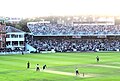 Warner Stand


_01.jpg)


Many of the stands were rebuilt in the late 20th century. In 1987 the new Mound Stand, designed by Michael Hopkins & Partners, was opened, followed by the Grand Stand, designed by Sir Nicholas Grimshaw, in 1996.[105] The Media Centre, opposite the Pavilion between the Compton and Edrich Stands, was added in 1999. Designed by Future Systems, it won the Royal Institute of British Architects' Stirling Prize for 1999.[106] The redevelopment of the Compton and Edrich Stands was completed in 2021, adding 2,600 seats and bringing the ground capacity to 31,100 spectators.[107] The two ends of Lord's pitch are the Pavilion End (south-west), for MCC members, and the Nursery End (north-east), dominated by the Media Centre.[104]
The current Grand Stand replaced that built in 1926 by Sir Herbert Baker. Although the stand was described as "truly a thing of beauty, loved by all who gazed upon it", it did have limitations for spectators: 43% of the seats had an obstructed view of the playing area and the structure itself was becoming rotten.
Pavilion[edit | edit source]

The current Lord's Pavilion is the ground's third and is its principal surviving Victorian edifice, having been built in 1889–90. It has been a Grade II* listed building since September 1982.[108] The Pavilion was constructed using brick with ornate terracotta facing, which includes terracotta gargoyles, such as "The Patriarch" which is understood to represent Lord Harris.[109] The building consists of a long, two-storey centre section with covered seating between two end-towers which are capped with pyramidal roofs which have ornate wrought and cast iron lanterns.[108] Running the full length behind the Upper Tier is the Pavilion's Roof Terrace, which affords panoramic views of the ground.[110] It underwent an £8 million refurbishment programme in 2004–05. The Pavilion provides inside and outdoor seating for MCC members to watch cricket including in the Long Room, the Bowlers' Bar as well as many other vantage points. Middlesex County Cricket Club and visiting counties' members can enjoy use by reciprocity of Lord's Pavilion on match days. The Pavilion also comprises the players' dressing rooms with respective viewing balconies.
The Long Room on the ground floor has been described by Wisden's Lawrence Booth as "the most evocative four walls in world cricket".[111] Players proceed through the Long Room on their way from the dressing room to the cricket pitch; this walk can be notoriously long and complex at Lord's. On his Test debut in 1975, David Steele got lost when going out to bat "and ended up in the Pavilion's basement toilets".[112] Upon entering via the Long Room's rear door players take approximately 30 paces before reaching the steps leading onto the playing field.[113] The Long Room is adorned with paintings of famous cricket scenes and distinguished cricket administrators and players from the 18th century to the present day, featuring many English cricketers as well as those from overseas by rotation. For an overseas cricketer to have their portrait hang in the Long Room is considered a great honour, among whom are four Australians: Sir Donald Bradman, Keith Miller, Victor Trumper and Shane Warne.[114]
.jpg)
Displayed in the dressing rooms are the Lord's honours boards, commemorating centuries, five-wicket and ten-wicket hauls for cricket internationals. Two honours boards for batting and bowling commemorate England players in the home dressing room,[115] while the batting and bowling honours boards commemorating overseas international players can be seen in the away dressing room.[116] Originally only these achievements in Test matches were commemorated, but in 2019 Lord's introduced an honours board for ODIs.[117] As of 2026 167 players have made 240 Test centuries at Lord's and 130 players have taken 186 five-wicket hauls. In ODI's 29 players have made 32 centuries at Lord's and 14 players have taken a five-wicket haul. A separate "neutral" honours board was created in 2010 to coincide with Lord's hosting a Test match between Australia and Pakistan. Australians Warren Bardsley and Charlie Kelleway were the first two names added to this board, commemorating their centuries against South Africa in 1912. They were joined by the Australians Shane Watson and Marcus North, who both took five-wicket hauls against Pakistan.[118]
The dress code in the Pavilion remains notoriously strict. Men are required to wear "ties and tailored coats and acceptable trousers with appropriate shoes" and women are required to wear "dresses; or skirts or trousers worn with blouses, and appropriate shoes".[119] Until 1999 ladies – with the exception of Club Patron Queen Elizabeth II – were not permitted to enter the Pavilion during play, due to MCC's longstanding gender-based membership policy.[120][121] MCC's 1998 decision to admit female members represented a historic modernisation for Lord's Pavilion and similar clubs.[122]
Media Centre[edit | edit source]

The decision to build the Media Centre was made during a meeting of the MCC Committee in 1995.[123] These plans sought to remove the previously inadequate media arrangements mostly concentrated in the Warner Stand which could accommodate 90 journalists, along with wooden shacks dotted around the ground for commentators,[124] and replace them with a new purpose-built facility. It was then approved by members of the MCC at a special general meeting in December 1996.[123] A gap between the Compton and Edrich Stands was selected, with space limitations requiring the centre to stand 15 metres (49 ft) above ground level on reinforced supports from the structure around its two lift shafts. This design allowed for uninterrupted access between Lord's Main Ground and the Nursery Ground, while also allowing the movement of ground staff and their equipment.[123]
It was designed by the Future Systems architectural practice led by Czech architect Jan Kaplický and was the first all-aluminium, semi-monocoque building in the world, costing about £5 million. Construction began in January 1997 and was completed in time for the 1999 World Cup. It was built in 32 sections and fitted out by Pendennis Shipyard at Falmouth in combination with Centraalstaal from the Netherlands.[125] These pieces were then delivered to Lord's where they were lowered into place during the 1998 season.[123] The glazing on the front of the Media Centre is inclined 25° so as to eliminate reflections and glare on the pitch to minimise the visual barrier between the media and the players. The lower tier of Lord's Media Centre provides accommodation for 118 journalists, with two hospitality boxes either side which accommodate 18 people each. The top tier has radio and television commentary boxes, consisting of two television studios, two large commentary and radio commentary boxes, each holding up to six people.[124] The centre's only opening window is in the broadcasting box used by BBC Test Match Special.[126] The building won eight architectural awards, including the RIBA Stirling Prize for architecture in 1999.[127] The Media Centre was originally sponsored by NatWest, with sponsorship being taken over by Investec in 2007. From 2011, J. P. Morgan was sponsor,[128] and since 2025, Barclays sponsors Lord's Media Centre.[129]
Nursery Ground[edit | edit source]

Purchased in two parts by the MCC in 1838 and 1887, the ground is primarily used as a practice ground and is considered to have some of the best grass nets in the world.[130] In 1895 the Middlesex Volunteers requested the use of the Nursery Ground as a drill ground, but this was declined by the MCC.[131] The Nursery Pavilion, which was constructed in 1999, overlooks the playing area of the Nursery Ground and is one of London's largest venues.[132] The ground has hosted one first-class cricket match in 1903, when the MCC played Yorkshire;[133] the match was originally to be played on Lord's main ground, but heavy rain had fallen and in the week leading up to the match this had led to the abandonment of a match between the MCC and Nottinghamshire. The heavy rain persisted during the MCC v Yorkshire match, with the players spending the first two days of the three-day match sitting in the pavilion. However, it was deemed that the playing surface on the Nursery Ground was suitable for the third day of the match to be played there,[134] with both sides each batting for an innings and Yorkshire's Wilfred Rhodes making an unbeaten 98.[135]
The Women's University Match was played on the Nursery Ground from 2001,[136] however following calls for gender equality, the 20-over fixture is played on the main Lord's ground since 2022 alongside the men's fixture.[137] On big match days crowds are allowed onto the outfield. The Cross Arrows Cricket Club play their home matches at the Nursery Ground towards the end of each cricket season.[130] The construction of the new Compton and Edrich Stands, beginning in August 2019, encroached on the Nursery Ground's playing area. In order to reclaim the playing area lost to the redevelopment of the stands, the temporary Nursery Pavilion will be demolished in 2025–26 and the playing area will be extended up to the perimeter wall running beside the Wellington Road.[138]
MCC Museum and Library[edit | edit source]

Lord's is the home of the MCC Museum, which is the oldest sports museum in the world, and contains the world's most celebrated collection of cricket memorabilia, including The Ashes urn.[139] MCC has been collecting memorabilia since 1864, its collection being originated by Sir Spencer Ponsonby-Fane, who subsequently became the Club Treasurer.[140] These items were originally displayed in the Pavilion, limiting access to the collection to MCC members. Following the Second World War the collection had outgrown its home in the Pavilion, with a decision made to relocate the collection and open it to the public. The MCC moved the collection to a disused rackets court, which had fallen into disrepair during the war, with this location also acting as a memorial to the fallen members of the MCC from the two World Wars.[141] MCC appointed Diana Rait Kerr, "to whom the game owes a great debt", as the first full-time founding curator of its museum and library, a position she held from 1945 to 1968.[140] The museum was officially opened to the public as the Imperial Memorial Collection by the Duke of Edinburgh in 1953. During her tenure as curator, Rait Kerr secured donations of pictures, cricket equipment and other artefacts from around the world.[141] Rait Kerr was succeeded as curator by Stephen Green in 1968.[140] The museum today welcomes around 50,000 visitors per year.[141]
Amongst the items on display include cricket kit used by Victor Trumper, Jack Hobbs, Don Bradman, Shane Warne, and others; many items related to the career of W. G. Grace; and curiosities such as the stuffed sparrow that was 'bowled out' by Jahangir Khan of Cambridge University in delivering a ball to T. N. Pearce batting for the MCC on 3 July 1936. It also contains the battered copy of Wisden that helped to sustain E. W. Swanton through his captivity in a Japanese prisoner-of-war camp during the Second World War. It continues to collect historic artefacts and also commissions new paintings and photography.[141] It contains the Brian Johnston Memorial Theatre, a cinema which screens historical cricket footage for visitors. The museum collaborates with a number of national museums and schools through active loans, in addition to community and tour programmes. It is a member of the Sporting Heritage network.[139]
Lord's also has one of the largest and most comprehensive collections of books and publications dedicated to cricket. The MCC Library includes over 20,000 volumes and grows by around 400 volumes a year, and encourages donations from authors and publishers. It operates as a private library for MCC members on match days, but is open by appointment on non-match days.[139] It was expanded in the 1980s with the opening of a new library in the tennis court block to the rear of the pavilion,[142] having previously been housed in the Pavilion's Old Library before relocating to a small dedicated office space.[143] In 2010, a selection of 100 duplicates from MCC's library collection was offered for auction by Christie's with proceeds going to its support.[144]
Gardens[edit | edit source]

Lord's has two gardens, the Harris Garden and the Coronation Garden. The Coronation Garden was created behind the A Stand (Warner Stand) in 1952 to celebrate the coronation of Elizabeth II.[145] It contains weeping ash and other trees, providing a shaded area under which benches are found. Preserved in the Coronation Garden is one of the first models of mass-produced, cast iron, heavy rollers dating from the 1880s, which was in use at Lord's until 1945.[146] A large bronze statue of W. G. Grace stands in the Coronation Garden. The garden is popular with picnickers during major matchdays.[147] The Harris Garden, formerly tennis courts, was created as a rose garden in 1934 in memory of Lord Harris.[148][149] The garden was restored and re-launched in 2018. The restoration included the exposing of the flint wall which runs along the back of the garden,[150] and displays a memorial to Lord Harris. The flower beds in the Harris Garden were replanted in 2018 with a floral design featuring flowers from all the Test-playing nations.[151] The Harris Garden is available for private hire and can host up to 300 people.[152][150]
Other sports[edit | edit source]
Sir Pelham Warner was of the opinion that the only other sport which had any proper standing at Lord's was real tennis.[153] A real tennis court began construction in October 1838, with the court's foundation stone being laid by Benjamin Aislabie.[154] The court was built at a cost of £4,000, which at the time was exceptionally high.[155] A real tennis competition was later established in 1867.[154] The tennis court was demolished in 1898 to make way for the Mound Stand, with a replacement court being built behind the Pavilion in 1900 in the back garden of number 3 Grove End Road. By 2005 the MCC had a real tennis playing membership of 200.[156] The playing of rackets at Lord's dates from 1844 and is currently played in the tennis block.[154] Lord's hosted the Public Schools Championship in 1866, with Harrow School triumphing. Since then the Championship has been held at Prince's Club, before moving to Queen's Club.[153]
With the advent of lawn tennis, a decision was made at the annual general meeting of the MCC in May 1875 to construct a tennis court, although there was strong opposition from some members.[157] A suggestion to standardise the rules of tennis was made at Lord's by J. M. Heathcote, who was himself a pre-eminent real tennis player. On 3 March 1875 the MCC, in its capacity as the governing body for rackets and real tennis, convened a meeting at Lord's to determine the various versions of lawn tennis which existed with the aim to fully standardise the game's rules.[158] Amongst the various versions of lawn tennis which were demonstrated were Major Clopton Wingfield's Sphairistikè, and John H. Hale's Germains Lawn Tennis.[159] After the meeting, the MCC Tennis Committee was tasked with framing the rules. On 29 May 1875 the MCC issued the Laws of Lawn Tennis, the first unified rules for lawn tennis, which were adopted by the club on 24 June.[160][161] These rules were amended by the All England Lawn Tennis and Croquet Club for the 1877 Wimbledon Championship, with the dimensions of the tennis courts being based on those at Lord's; the courts on which these were based are no longer used for tennis and now form part of the Harris Garden.[162][163]
The original intention for the purchase of the northern part of the Nursery Ground in 1838 was for it to serve as an archery venue.[164] Archery is recorded as having been played at Lord's as far back as August 1844, when visiting Ioway Indians camped at Lord's and demonstrated their archery skills.[165] Lord's was one of London's venues for the 2012 Summer Olympics, hosting the archery competition.[166] The 2012 Olympics Archery competition took place in front of the Pavilion, where the archers were positioned, with the targets placed 70 metres away just past the square and before Lord's Media Centre. Either side of the square temporary stands holding up to 5,000 spectators were erected.[167]
Lacrosse was first played at Lord's in 1833 by Canadian pioneers of the sport.[168] Lacrosse returned to Lord's in 1876, when a team of Canadian Gentlemen Amateurs led by William George Beers played an exhibition match at the ground against the Iroquois Indians.[169] A Canadian lacrosse team toured Great Britain again in 1883, with one exhibition match being staged at Lord's in front of several thousand spectators.[170] It was then played again at Lord's in October 1953 when the Kenton and Old Thorntonians Lacrosse Clubs met in a lacrosse championship match, with further fixtures following in November of the same year.[168]

Baseball was first played at Lord's in 1874 when the MCC hosted a touring party of 22 baseball players from the Boston Red Stockings and Philadelphia Athletics, being the two leading American baseball teams of the time.[171][172] The Red Stockings defeated the Athletics 24–7 in front of a crowd of 5,000 spectators.[173] A baseball game was held at Lord's during the First World War to raise money for the Canadian Widows' and Orphans' Fund. A Canadian baseball team then played a team of American London residents in a match attracting 10,000 spectators.[174][175]
Lord's hosted London's 1967 pre-1968 Olympics field hockey tournament.[176] One match saw India play Pakistan, broadcast live on the BBC which at the time was unprecedented for field hockey.[177] Pakistan won the match 1–0,[178] while Pakistan also went on to defeat Belgium later in the warm-up tournament,[179] before becoming Olympic Champions the following year. Lord's hosted further international hockey matches during the 1970s.[176] The University Match between Oxford and Cambridge Hockey Clubs took place at Lord's for twenty one years beginning in 1969.[180] England beat World Champions India for the first time ever at this venue, in 1978.[181]
Other sports played at Lord's include lawn bowls and billiards. In 1838,[182] a bowling green was constructed at the western end of the ground, and then a billiard room with two tables was added to the old Tavern,[182][26][131] where professional billiards players competed on Mondays during the cricket season;[153] In the late 1840s and early 1850s, Lord's held Galloway pony races after the cricket season was over, with races starting at the Tavern and finishing twenty yards south of the Pavilion.[183]
Test cricket records[edit | edit source]

Batting[edit | edit source]
| Runs | Player | Period |
|---|---|---|
| 2,166 (42 innings) | Joe Root
|
2013–2025 |
| 2,015 (39 innings) | Graham Gooch
|
1975–1994 |
| 1,937 (47 innings) | Alastair Cook
|
2006–2018 |
| 1,562 (31 innings) | Andrew Strauss
|
2004–2012 |
| 1,476 (37 innings) | Alec Stewart
|
1990–2003 |


.jpg)
.jpg)
| Runs | Player | Period |
|---|---|---|
| 760 (9 innings) | Warren Bardsley
|
1909–1926 |
| 571 (9 innings) |  Garfield Sobers Garfield Sobers
|
1957–1973 |
| 551 (8 innings) | Don Bradman
|
1930–1948 |
| 525 (9 innings) | Steve Smith
|
2010–2023 |
| 512 (9 innings) | Shivnarine Chanderpaul
|
2000–2012 |
| Runs | Player | Date |
|---|---|---|
| 333 v. India | Graham Gooch
|
26 July 1990 |
| 259 v. England | Graeme Smith
|
31 July 2003 |
| 254 v. England | Don Bradman
|
27 June 1930 |
| 240 v. Australia | Wally Hammond
|
24 June 1938 |
| 226 v. Bangladesh | Jonathan Trott
|
27 May 2010 |
| Centuries | Player | Period |
|---|---|---|
| 8 (42 innings) | Joe Root
|
2013–2025 |
| 6 (19 innings) | Michael Vaughan
|
2000–2008 |
| 6 (39 innings) | Graham Gooch
|
1975–1994 |
| 5 (25 innings) | Kevin Pietersen
|
2005–2013 |
| 5 (31 innings) | Andrew Strauss
|
2004–2012 |
| Average | Player | Period |
|---|---|---|
| 129.33 (5 innings, 2 NO) | Joe Hardstaff Jr
|
1936–1946 |
| 115.50 (5 innings, 3 NO) | Steve Waugh
|
1989–2001 |
| – (115 runs, 3 innings, 3 NO) | Dennis Lillee
|
1972–1981 |
| 108.57 (9 innings, 2 NO) | Warren Bardsley
|
1909–1926 |
| 107.00 (5 innings, 2 NO) | David Boon
|
1985–1993 |
Bowling[edit | edit source]
| Wickets | Player | Period |
|---|---|---|
| 123 (56 innings) | James Anderson
|
2003–2024 |
| 113 (55 innings) | Stuart Broad
|
2008–2023 |
| 69 (26 innings) | Ian Botham
|
1978–1992 |
| 63 (24 innings) | Fred Trueman
|
1952–1965 |
| 47 (16 innings) | Bob Willis
|
1973–1984 |
| Wickets | Player | Period |
|---|---|---|
| 26 (8 innings) | Richard Hadlee
|
1978–1990 |
| 26 (6 innings) | Glenn McGrath
|
1997–2005 |
| 24 (9 innings) | Tim Southee
|
2008–2022 |
| 22 (7 innings) |  Sid Pegler Sid Pegler
|
1912–1924 |
| 20 (5 innings) | Malcolm Marshall
|
1984–1991 |
| Figures | Player | Date |
|---|---|---|
| 8/34 v. Pakistan | Ian Botham
|
15 June 1978 |
| 8/38 v. England | Glenn McGrath
|
19 June 1997 |
| 8/43 v. Australia | Hedley Verity
|
22 June 1934 |
| 8/51 v. Pakistan | Derek Underwood
|
8 August 1974 |
| 8/53 v. England | Bob Massie
|
22 June 1972 |
| 8/84 v. England | ||
| 8/103 v. West Indies | Ian Botham
|
28 June 1984 |
| Figures | Player | Date |
|---|---|---|
| 16/137 v. England | Bob Massie
|
22 June 1972 |
| 15/104 v. Australia | Hedley Verity
|
22 June 1934 |
| 13/71 v. Pakistan | Derek Underwood
|
8 August 1974 |
| 12/101 v. South Africa | Roy Tattersall
|
21 June 1951 |
| 12/106 v. West Indies | Gus Atkinson
|
10 July 2024 |
| Strike rate | Player | Period |
|---|---|---|
| 15.9 (19 wickets) | Gus Atkinson
|
2024–2024 |
| 24.9 (10 wickets) | Graham Onions
|
2009–2009 |
| 25.9 (15 wickets) | Johnny Briggs
|
1886–1888 |
| 27.3 (26 wickets) | Glenn McGrath
|
1997–2005 |
| 28.8 (9 wickets) |  Mudassar Nazar Mudassar Nazar
|
1978–1987 |
Team records[edit | edit source]

| Score | Team | Date |
|---|---|---|
| 729/6d | Australia v. England
|
27 June 1930 |
| 682/6d | South Africa v. England
|
31 July 2003 |
| 653/4d | England v. India
|
26 July 1990 |
| 652/8d | West Indies v. England
|
23 August 1973 |
| 632/4d | Australia v. England
|
17 June 1993 |
| Score | Team | Date |
|---|---|---|
| 38 |  Ireland v. England Ireland v. England
|
24 July 2019 |
| 42 | India v. England
|
20 June 1974 |
| 47 | New Zealand v. England
|
19 June 1958 |
| 53 | England v. Australia
|
16 July 1888 |
| Australia v. England
|
22 June 1896 |
Partnership records[edit | edit source]
| Runs | Wicket | Players | Match | Date |
|---|---|---|---|---|
| 370 | 3rd | Denis Compton (208) & Bill Edrich (189) | England v. File:Flag of South Africa (1928–1994).svg South Africa
|
21 June 1947 |
| 332 | 8th | Jonathan Trott (184) & Stuart Broad (169) | England v. Pakistan
|
26 August 2010 |
| 308 | 3rd | Graham Gooch (333) & Allan Lamb (139) | England v. India
|
26 July 1990 |
| 291 | 2nd | Rob Key (221) & Andrew Strauss (137) | England v. West Indies
|
22 July 2004 |
| 287* | Gordon Greenidge (214*) & Larry Gomes (92*) | West Indies v. England
|
28 June 1984 |
.svg)
| Runs | Wicket | Players | Match | Date |
|---|---|---|---|---|
| 268 | 1st | Jack Hobbs (211) & Herbert Sutcliffe (122) | England v.  South Africa South Africa
|
28 June 1924 |
| 291 | 2nd | Rob Key (221) & Andrew Strauss (137) | England v. West Indies
|
22 July 2004 |
| 370 | 3rd | Denis Compton (208) & Bill Edrich (189) | England v. File:Flag of South Africa (1928–1994).svg South Africa
|
21 June 1947 |
| 286 | 4th | Ian Bell (199) & Kevin Pietersen (152) | England v. South Africa
|
10 July 2008 |
| 216 | 5th | Allan Border (196) & Greg Ritchie (94) | Australia v. England
|
27 June 1985 |
| 274* | 6th | Garfield Sobers (163*) & David Holford (105*) | West Indies v. England
|
16 June 1966 |
| 174 | 7th | Colin Cowdrey (152) & Godfrey Evans (82) | England v. West Indies
|
20 June 1957 |
| 332 | 8th | Jonathan Trott (184) & Stuart Broad (169) | England v. Pakistan
|
26 August 2010 |
| 130 | 9th | Steve Waugh (152*) & Geoff Lawson (74) | Australia v. England
|
22 June 1989 |
| 83 | 10th | Ray Illingworth (113) & John Snow (9*) | England v. West Indies
|
26 June 1969 |
Last updated 19 October 2025.
Limited overs international cricket records[edit | edit source]
One-Day International[edit | edit source]
- Highest team total: 334/4 (60 overs) by England v India, 1975[208]
- Lowest team total: 107 all out (32.1 overs) by South Africa v England, 2003[209]
- Highest individual innings: 138* by Viv Richards for West Indies v England, 1979[210]
- Best bowling in an innings: 6/24 by Reece Topley for England v India, 2022[211]
Twenty20 International[edit | edit source]
- Highest team total: 199/4 (20 overs) by West Indies v ICC World XI, 2018[212]
- Lowest team total: 93 all out (17.3 overs) by the Netherlands v Pakistan, 2009[213]
- Highest individual innings: 78 by Mahela Jayawardene for Sri Lanka v Ireland, 2009[214]
- Best bowling in an innings: 4/11 by Shahid Afridi for Pakistan v the Netherlands, 2009[215]
All records correct as of 21 October 2026.
Domestic records[edit | edit source]
First-class[edit | edit source]
- Highest team total: 655 by Middlesex v Glamorgan, 2024[216]
- Lowest team total: 15 by Marylebone Cricket Club (MCC) v Surrey, 1839[217]
- Highest individual innings: 335* by Sam Northeast for Glamorgan v Middlesex, 2024[218]
- Three bowlers have taken a ten-wicket haul in an innings where the exact bowling figures are not recorded; however it is known they conceded less than 20 runs: they are Edmund Hinkly, William Lillywhite and John Wisden; the best bowling figures in an innings where the records are complete are by Samuel Butler with 10/38 for Oxford University v Cambridge University in 1871[219]
- William Lillywhite took the most wickets in a match with 18, for the Gentlemen in the Gentlemen v Players fixture of 1837, though his exact bowling figures are not recorded.[220]
List A[edit | edit source]
- Highest team total: 368/2 (50 overs) by Nottinghamshire v Middlesex, 2014[221]
- Lowest team total: 57 (27.2 overs) by Essex v Lancashire, 1996[222]
- Highest individual innings: 187* by Alex Hales for Nottinghamshire v Surrey, 2017[223]
- Best bowling in an innings: 7/22 by Jeff Thomson for Middlesex v Hampshire, 1981.[224]
Twenty20[edit | edit source]
- Highest team total: 223/7 (20 overs) by Surrey v Middlesex, 2021[225]
- Lowest team total: 90 (14.4 overs) by Kent v Middlesex, 2015[226]
- Highest individual innings: 102* by Stephen Eskinazi for Middlesex v Essex, 2021[227]
- Best bowling in an innings: 6/24 by Tim Murtagh for Surrey v Middlesex, 2005.[228]
All records correct as of 21 October 2026.
See also[edit | edit source]
References[edit | edit source]
- ↑ "Lord's cleared to have full capacity for England-Pakistan ODI". The Cricket Paper. 2 July 2021. Archived from the original on 24 May 2024. Retrieved 16 April 2022.
- ↑ "Lord's". Cricinfo. Archived from the original on 11 September 2010. Retrieved 22 August 2009.
- ↑ MCC museum Archived 12 February 2007 at the Wayback Machine Lords.org webpage
- ↑ "George Finch 9th Earl of Winchilsea, a Founding Father of MCC". Archived from the original on 30 March 2024. Retrieved 2 October 2025.
- ↑ Warner 1946, p. 17–18.
- ↑ 6.0 6.1 6.2 6.3 Barker, Philip (2014). Lord's Firsts. Stroud: Amberley Publishing. ISBN 9781445633299.
- ↑ 7.0 7.1 7.2 7.3 7.4 7.5 Powell, William (1989). The Wisden Guides To Cricket Grounds. London: Stanley Paul & Co. Ltd. pp. 14–7. ISBN 009173830X.
- ↑ 8.0 8.1 Warner 1946, p. 18.
- ↑ "The Regent's Canal". Archived from the original on 4 August 2025. Retrieved 2 October 2025.
- ↑ "Our Heritage". Eyre-estate.co.uk. Retrieved 3 January 2026.
- ↑ Eyres, Harry (18 July 2009). "Grounded on terra firma". Financial Times. Archived from the original on 10 December 2022. Retrieved 1 July 2021.
- ↑ Levison, Brian (2016). Remarkable Cricket Grounds. London: Pavilion Books. ISBN 9781911216599.
- ↑ Warner 1946, p. 19.
- ↑ "Lord's Tavern – A British Pub with a Cricket Flavour at Lord's". Lords.org. Retrieved 3 January 2026.
- ↑ 15.0 15.1 15.2 Green 2010, p. 46
- ↑ Warner, Pelham (1987) [First published 1946]. Lord's 1787–1945. London: Pavllion Books. p. 28. ISBN 1851451129.
- ↑ "First-Class Matches played on Lord's Cricket Ground, St John's Wood". CricketArchive. Archived from the original on 24 June 2021. Retrieved 24 June 2021.
- ↑ Altham 1962, p. 67.
- ↑ Haygarth 1996, p. 522.
- ↑ Green, Benny (1987). The Lord's Companion. London: Pavilion Books. p. 31. ISBN 978-18-51451-32-6.
- ↑ Harris, 4th Baron Harris, George; Ashley-Cooper, A. S. (1920). Lord's and the M. C. C.: A Cricket Chronicle of 137 Years. H. Jenkins Limited. p. 48.
{{cite book}}: CS1 maint: numeric names: authors list (link) - ↑ 22.0 22.1 22.2 Green 2010, p. 7
- ↑ Green 2010, p. 35
- ↑ Green 2010, p. 37
- ↑ 25.0 25.1 Green 2010, p. 41
- ↑ 26.0 26.1 Green 2010, p. 44
- ↑ "Collections Online | British Museum". Britishmuseum.rg. Retrieved 3 January 2026.
- ↑ 28.0 28.1 Green 2010, p. 45
- ↑ Green 2010, p. 51
- ↑ 30.0 30.1 30.2 30.3 30.4 30.5 30.6 "Lord's – A brief timeline". ESPNcricinfo. 3 May 2005. Archived from the original on 27 June 2021. Retrieved 27 June 2021.
- ↑ 31.0 31.1 "The New Grand Stand is completed". Lords.org. Archived from the original on 9 July 2021. Retrieved 5 July 2021.
- ↑ Green 2010, pp. 57–8
- ↑ Green 2010, p. 59
- ↑ Green 2010, p. 52
- ↑ Green 2010, p. 60
- ↑ Green 2010, p. 78
- ↑ Green 2010, pp. 59–60
- ↑ Green 2010, p. 63
- ↑ Green 2010, p. 76
- ↑ "Marylebone Cricket Club v Australians, 1878". CricketArchive. Archived from the original on 27 May 2007. Retrieved 27 June 2021.
- ↑ Green 2010, pp. 81–4
- ↑ Powell 1989, pp. 14–5
- ↑ "England v Australia, 1884". CricketArchive. Archived from the original on 28 June 2021. Retrieved 28 June 2021.
- ↑ Green 2010, pp. 94–5
- ↑ 45.0 45.1 45.2 45.3 Powell 1989, p. 15
- ↑ "Thomas Verity's new Pavilion is completed". Lords.org. Archived from the original on 14 July 2021. Retrieved 14 July 2021.
- ↑ "Garden Nurseries | Places, New contributions | St John's Wood Memories". Stjohnswoodmemories.org.uk. Retrieved 3 January 2026.
- ↑ Baker 2014, p. 129
- ↑ Green 2010, p. 132
- ↑ Wilson, Bill (8 August 2018). "Battle over rail tunnels at Lord's cricket ground rumbles on". BBC News. Archived from the original on 9 July 2021. Retrieved 28 June 2021.
- ↑ Green 2010, p. 162–3
- ↑ Williamson, Martin (19 June 2010). "Albert Trott's mighty hit". ESPNcricinfo. Archived from the original on 21 February 2023. Retrieved 29 June 2021.
- ↑ 53.0 53.1 53.2 53.3 53.4 Powell 1989, p. 16
- ↑ Green 2010, p. 190
- ↑ Warner 1987, pp. 169–170
- ↑ Green 2010, p. 193-4
- ↑ Green 2010, p. 193–206
- ↑ "Presidents". Archived from the original on 23 January 2025. Retrieved 2 October 2025.
- ↑ Warner 1987, p. 171
- ↑ Green 2010, p. 207
- ↑ Historic England (7 February 1996). "Grace Gates at Lord's Cricket Ground (1246985)". National Heritage List for England. Retrieved 29 June 2021.
- ↑ Midwinter 1981, p. 154.
- ↑ Green 2010, p. 214
- ↑ Warner 1987, p. 195
- ↑ "Cranefly". Game & Wildlife Conservation Trust. Archived from the original on 9 July 2021. Retrieved 1 July 2021.
- ↑ 66.0 66.1 Williamson, Martin (6 May 2006). "Lord's under attack". ESPNcricinfo. Archived from the original on 9 July 2021. Retrieved 1 July 2021.
- ↑ Warner 1987, p. 245
- ↑ "Barrage Balloons in the sEcond World War". Archived from the original on 5 August 2025. Retrieved 2 October 2025.
- ↑ Hayter, R. J. (1949). "Second Test Match England v Australia". Wisden Cricketers' Almanack. Wisden. Archived from the original on 10 August 2010. Retrieved 30 June 2021.
- ↑ "The New Warner Stand is opened". Web.archive.org. Archived from the original on 9 July 2021. Retrieved 6 July 2021.
- ↑ Williamson, Martin (20 April 2013). "Opening Pandora's one-day box". ESPNcricinfo. Archived from the original on 21 February 2023. Retrieved 1 July 2021.
- ↑ "ODI Matches played on Lord's Cricket Ground, St John's Wood". CricketArchive. Archived from the original on 9 July 2021. Retrieved 2 July 2021.
- ↑ "England v Australia, Prudential Trophy 1972 (2nd ODI)". CricketArchive. Archived from the original on 31 January 2018. Retrieved 2 July 2021.
- ↑ Cozier, Tony. "West Indies victory heralds a new era". ESPNcricinfo. Archived from the original on 10 January 2023. Retrieved 2 July 2021.
- ↑ Cozier, Tony. "England v West Indies". Cricinfo. ESPNcricinfo. Archived from the original on 11 November 2018. Retrieved 2 July 2021.
- ↑ Thompson, Jenny (14 July 2005). "Storming cricket's bastion". Espncricinfo. Archived from the original on 19 July 2021. Retrieved 19 July 2021.
- ↑ Williamson, Martin (20 March 2009). "When women took over Lord's". Espncricinfo. Archived from the original on 23 July 2021. Retrieved 23 July 2021.
- ↑ 78.0 78.1 "First Indoor School at Lord's opened". Lords.org. Archived from the original on 9 July 2021. Retrieved 2 July 2021.
- ↑ "India defy the odds". ESPNcricinfo. 2 June 2008. Archived from the original on 10 May 2021. Retrieved 5 July 2021.
- ↑ Green 2010, p. 448
- ↑ "MCC v Rest of the World, Lord's, August 20–25 1987". ESPNcricinfo. 7 July 2005. Archived from the original on 9 July 2021. Retrieved 6 July 2021.
- ↑ "Graham Gooch scores 333". Lords.org. Archived from the original on 9 July 2021. Retrieved 7 July 2021.
- ↑ "From Iceland to Azerbaijan". BBC Sport. 1 February 2002. Archived from the original on 16 February 2004. Retrieved 6 July 2021.
- ↑ "The 20th anniversary of the Media Centre". Lords.org. 27 April 2019. Archived from the original on 9 July 2021. Retrieved 6 July 2021.
- ↑ "England beat West Indies in 100th Lord's Test". Lords.org. Archived from the original on 9 July 2021. Retrieved 6 July 2021.
- ↑ "Cricket: Varsity game may switch from Lord's". Oxford Mail. 7 July 2000. Archived from the original on 9 July 2021. Retrieved 4 July 2021.
- ↑ "Cricket: Lord's Varsity to be one-day". Oxford Mail. 24 July 2000. Archived from the original on 9 July 2021. Retrieved 7 July 2021.
- ↑ Briggs, Simon (19 May 2001). "Slope's future in balance". The Daily Telegraph. Archived from the original on 11 January 2022. Retrieved 1 January 2015.
- ↑ Saltman, David (27 November 2003). "Mallinsons win BALI Principal Award". Pitchcare.com. Archived from the original on 9 July 2021. Retrieved 7 July 2021.
- ↑ "Lord's admits Twenty20 Cup". BBC Sport. 2 December 2003. Archived from the original on 9 May 2004. Retrieved 5 July 2021.
- ↑ "ICC ponders Lord's move". BBC Sport. 4 March 2004. Archived from the original on 3 June 2004. Retrieved 5 July 2021.
- ↑ "Cricket chiefs move base to Dubai". BBC Sport. 7 March 2005. Archived from the original on 18 February 2007. Retrieved 5 July 2021.
- ↑ "Lord's floodlights just 'isn't cricket'". Get West London. 2 June 2009. Archived from the original on 1 August 2018. Retrieved 6 July 2021.
- ↑ McGlashan, Andrew (5 June 2009). "de Grooth leads Netherlands to famous win". ESPNcricinfo. Archived from the original on 28 December 2021. Retrieved 6 July 2021.
- ↑ Smyth, Rob (21 June 2009). "Pakistan v Sri Lanka – as it happened". The Guardian. Archived from the original on 9 July 2021. Retrieved 7 July 2021.
- ↑ "New housing set to pay for £250m redeveloped Lord's". Ham & High. 4 July 2008. Archived from the original on 9 July 2021. Retrieved 7 July 2021.
- ↑ "Lord's reveals £200 million Populous-designed redevelopment plans". Architectsjournal.co.uk. 2 May 2013. Retrieved 3 January 2026.
- ↑ 98.0 98.1 "The Masterplan". Lords.org. Archived from the original on 20 June 2021. Retrieved 23 July 2021.
- ↑ "Sachin Tendulkar and Rahul Dravid re-unite; to face off against Shane Warne again". Yahoo! Cricket. 6 February 2014. Archived from the original on 2 March 2014.
- ↑ Gardner, Alan (14 July 2019). "Epic final tied, Super Over tied, England win World Cup on boundary count". ESPNcricinfo. Archived from the original on 12 July 2021. Retrieved 23 July 2021.
- ↑ "Chris Woakes and Stuart Broad wreck Ireland dream in a session". ESPNcricinfo. 26 July 2019. Archived from the original on 26 July 2019. Retrieved 26 July 2019.
- ↑ "Lord's gate dedicated to cricket captain Rachael Heyhoe Flint unveiled". BBC News. 17 August 2022. Archived from the original on 21 August 2022. Retrieved 22 August 2022.
- ↑ Ridley, Rob (27 February 2026). "Lord's redevelopment plans set out".
- ↑ 104.0 104.1 "Lord's Ground" (PDF). Archived from the original (PDF) on 27 February 2017. Retrieved 6 January 2015.
- ↑ "Lord's milestones". Archived from the original on 9 January 2015. Retrieved 6 January 2015.
- ↑ "LORD'S MEDIA CENTRE (1999)". Archived from the original on 6 January 2015. Retrieved 6 January 2015.
- ↑ Tennant I (2021) Bitter feud over expansion of Lord's stands revealed, The Times, 26 May 2021. Retrieved 27 June 2021. (subscription required)
- ↑ 108.0 108.1 Historic England. "The Pavilion at Lord's Cricket Ground (1235992)". National Heritage List for England. Retrieved 13 July 2021.
- ↑ Meredith, Anthony (2012). Lords Through Time. Stroud: Amberley Publishing. p. 53. ISBN 978-1445611341. Archived from the original on 4 April 2023. Retrieved 22 March 2023.
- ↑ "Pavilion Roof Terrace". Lords.org. Archived from the original on 14 July 2021. Retrieved 14 July 2021.
- ↑ Arm-Ball to Zooter, Lawrence Booth, Penguin 2006, ISBN 0-14-051581-X, p.150-1
- ↑ Bateman, Colin (1993). If The Cap Fits. Tony Williams Publications. p. 155. ISBN 1-869833-21-X.
- ↑ Smith, Ed (2013). Luck: A Fresh Look at Fortune. Bloomsbury Publishing. p. 53. ISBN 9781408830604. Archived from the original on 4 April 2023. Retrieved 22 March 2023.
- ↑ Selvey, Mike (12 October 2004). "Obituary: Keith Miller". The Guardian. Archived from the original on 24 May 2024. Retrieved 13 July 2021.
- ↑ Wilson, Andy (17 May 2012). "Stuart Broad says joining Lord's bowling elite is a 'huge honour'". The Guardian. Archived from the original on 13 July 2021. Retrieved 13 July 2021.
- ↑ Selvey, Mike (20 May 2012). "First Test day four report". The Guardian. Archived from the original on 13 July 2021. Retrieved 13 July 2021.
- ↑ Hoult, Nick (26 February 2019). "Lord's to honour women's achievements for first time as new board is added for ODIs". The Telegraph. ISSN 0307-1235. Archived from the original on 11 January 2022. Retrieved 13 July 2021.
- ↑ "Aussies get on honour board at Lord's". Sydney Morning Herald. 13 April 2010. Archived from the original on 14 July 2014. Retrieved 13 July 2021.
- ↑ Alderson, Andrew (9 December 2007). "MCC's Brearley wants relaxed dress for Lord's". The Telegraph. Archived from the original on 11 January 2022. Retrieved 17 July 2012.
- ↑ "Modernisers stumped in MCC vote". BBC News. 24 February 1998. Archived from the original on 19 October 2022. Retrieved 14 July 2021.
- ↑ "MCC delivers first 10 maidens". BBC News. 16 March 1999. Archived from the original on 19 July 2004. Retrieved 14 July 2021.
- ↑ "Lord's and ladies?". BBC News. 28 September 1998. Archived from the original on 8 November 2002. Retrieved 14 July 2021.
- ↑ 123.0 123.1 123.2 123.3 "The 20th anniversary of the Media Centre". Lords.org. 29 April 2019. Archived from the original on 9 July 2021. Retrieved 14 July 2021.
- ↑ 124.0 124.1 Nicholson, Matthew (2007). Sport and the Media. Abingdon-on-Thames: Taylor & Francis. p. 115. ISBN 978-1136364976.
- ↑ "Winner Building Sponsored by BSI NatWest Media Centre, Lord's Cricket Ground, London NW8". Newcivilengineer.com. 21 October 1999. Archived from the original on 2 July 2015. Retrieved 14 July 2021.
- ↑ Alexander, Gus. "The Lord's test | Magazine Features". Building.co.uk. Archived from the original on 3 July 2015. Retrieved 14 July 2021.
- ↑ Mark, Laura (6 October 2015). "Twenty years of the RIBA Stirling Prize". The Architects’ Journal. Archived from the original on 30 November 2024. Retrieved 11 February 2025.
- ↑ "New Media Centre sponsor: JP Morgan". Lords.org. 31 May 2011. Archived from the original on 12 March 2013. Retrieved 29 May 2015.
- ↑ "Barclays Becomes New Principal Partner of Lord's". Archived from the original on 14 June 2025. Retrieved 2 October 2025.
- ↑ 130.0 130.1 "Lord's Nursery Ground". ESPNcricinfo. Archived from the original on 9 July 2021. Retrieved 7 July 2021.
- ↑ 131.0 131.1 Green 2010, p. 36
- ↑ "Nursery Pavilion". Lords.org. Archived from the original on 9 July 2021. Retrieved 8 July 2021.
- ↑ "First-Class Matches played on Lord's Nursery Ground, St John's Wood". CricketArchive. Archived from the original on 9 July 2021. Retrieved 6 July 2021.
- ↑ Barker 2014, p. 129
- ↑ "Marylebone Cricket Club v Yorkshire, 1903". CricketArchive. Archived from the original on 9 July 2021. Retrieved 7 July 2021.
- ↑ "Varsity cricket – a one-day wonder?". Cam.ac.uk. 6 June 2001. Archived from the original on 11 July 2021. Retrieved 11 July 2021.
- ↑ Dobell, George (21 May 2021). "Women's Varsity match set for full Lord's debut after universities reach agreement". ESPNcricinfo. Archived from the original on 11 July 2021. Retrieved 11 July 2021.
- ↑ "The Future of Lord's". Lords.org. Archived from the original on 20 June 2021. Retrieved 13 July 2021.
- ↑ 139.0 139.1 139.2 "MCC Museum". Lords.org. Archived from the original on 27 July 2021. Retrieved 12 July 2021.
- ↑ 140.0 140.1 140.2 Barclay's World of Cricket – 2nd Edition, 1980, Collins Publishers, ISBN 0-00-216349-7, p47
- ↑ 141.0 141.1 141.2 141.3 "HRH The Duke of Edinburgh opens the MCC Museum". Lords.org. Archived from the original on 15 July 2021. Retrieved 15 July 2021.
- ↑ Meredith 2012, p. 47
- ↑ Green 2010, p. 436
- ↑ "Release: Christie's to offer a selection of items from the MCC collections". Christies.com. 21 October 2010. Archived from the original on 23 September 2015. Retrieved 15 August 2014.
- ↑ Peebles, Ian; Rait Kerr, Diana (1987). Lord's 1946–1970. London: Pavilion Books. p. 78. ISBN 1851451412. Archived from the original on 4 April 2023. Retrieved 22 March 2023.
- ↑ Evans, Roger D. C. (1991). Cricket Grounds: The Evolution, Maintenance and Construction of Natural Turf Cricket Tables and Outfields. Bingley: Sports Turf Research Institute. p. 15. ISBN 1873431007. Archived from the original on 4 April 2023. Retrieved 22 March 2023.
- ↑ Hughes, Simon (2010). And God Created Cricket. Ealing: Transworld. p. 89. ISBN 9781446422472. Archived from the original on 4 April 2023. Retrieved 22 March 2023.
- ↑ Barker 2014, p. 112
- ↑ Fay 2005, p. 28
- ↑ 150.0 150.1 Fullard, Martin (6 August 2018). "Lord's re-launches Harris Garden". ConferenceNews. Archived from the original on 27 July 2021. Retrieved 27 July 2021.
- ↑ Booth, Lawrence (2018). The Shorter Wisden 2018. London: Bloomsbury Publishing. p. 139. ISBN 9781472953582. Archived from the original on 24 May 2024. Retrieved 22 March 2023.
- ↑ "Harris Garden". Lords.org. Archived from the original on 27 July 2021. Retrieved 27 July 2021.
- ↑ 153.0 153.1 153.2 Warner 1987, p. 292
- ↑ 154.0 154.1 154.2 Warner 1987, p. 28
- ↑ Meredith 2012
- ↑ Fay, Stephen (2005). Tom Graveney at Lord's. London: Methuen Publishing. pp. 102–3. ISBN 0413775305.
- ↑ Warner 1987, p. 69
- ↑ Bodleian Library (2011). The Original Rules of Tennis. Melbourne: Victory Books. pp. 29–34. ISBN 978-0522858389. Archived from the original on 4 April 2023. Retrieved 22 March 2023.
- ↑ Barrett, John (2003). Wimbledon – Serving Through Time. London: Wimbledon Lawn Tennis Museum. pp. 29, 30. ISBN 978-0-906741-32-0.
- ↑ Somerset, Henry, ed. (1894). Tennis, Lawn Tennis, Rackets, Fives. Badminton Library of Sports and Pastimes (3st ed.). London: Longmans, Green and Co. pp. 133, 134. OCLC 558974625. OL 6939991M.
- ↑ Barrett, John (2001). Wimbledon: The Official History of the Championships. London: CollinsWillow. p. 1. ISBN 0-00-711707-8.
- ↑ Alter, Jamie (14 October 2017). "Harris Garden, hosting tennis at Lord's since 1838 and where rules of lawn tennis were standardised". Firstpost. Archived from the original on 24 July 2021. Retrieved 15 July 2021.
- ↑ Green 2010, p. 435
- ↑ Green 2010, p. 43
- ↑ Green 2010, p. 40
- ↑ "Cricket on hold as Lord's hosts archery". Wisden India. 26 July 2012. Archived from the original on 31 July 2012. Retrieved 27 July 2012.
- ↑ "Lord's hosts Olympic Archery". Lords.org. Archived from the original on 15 July 2021. Retrieved 15 July 2021.
- ↑ 168.0 168.1 Green 2010, p. 347
- ↑ Vennum, Thomas (2013). American Indian Lacrosse: Little Brother of War. Baltimore: Johns Hopkins University Press. p. 269. ISBN 9780801887642.
- ↑ Collins, Joseph Edmund (1884). Canada under the administration of Lord Lorne. Rose Publishing Company. p. 526. Archived from the original on 4 April 2023. Retrieved 22 March 2023.
- ↑ Green 2010, p. 65
- ↑ Barker 2014, p. 120
- ↑ Felber, Bill (2013). Inventing Baseball: The 100 Greatest Games of the 19th Century. Phoenix: Society for American Baseball Research. pp. 84–5. ISBN 9781933599427. Archived from the original on 4 April 2023. Retrieved 22 March 2023.
- ↑ Green 2010, p. 195
- ↑ Barker 2014, p. 155
- ↑ 176.0 176.1 Colwill, Bill (6 November 2006). "World hockey returns to Lord's". Sports Journalists' Association. Archived from the original on 15 July 2021. Retrieved 15 July 2021.
- ↑ Misra, Jitendra Nath (14 October 2017). "Hockey Asia Cup 2017: India versus Pakistan is an age-old rivalry where emotions take over skills and tactics". Firstpost. Archived from the original on 24 May 2024. Retrieved 15 July 2021.
- ↑ "Montage: Field hockey match between Indian and Pakistan at the Lord's Cricket Ground in London". Getty Images. 16 April 2013. Archived from the original on 24 May 2024. Retrieved 15 July 2021.
- ↑ "Hockey Match Aka Pre-Olympic Hockey Tournament AKA Hockey At Lords 1967". British Pathe. Archived from the original on 31 July 2019. Retrieved 15 July 2021.
- ↑ "Varsity Match – Past Venues". Varsityhockeymatch.com. Archived from the original on 9 July 2021. Retrieved 8 July 2021.
- ↑ "England Score Historic Triumph". The Straits Times. Reuters. 13 March 1978. p. 22. Archived from the original on 18 May 2022. Retrieved 18 May 2022.
- ↑ 182.0 182.1 Warner 1987, p. 29
- ↑ Warner 1987, p. 31
- ↑ "Batting records | Test matches | Cricinfo Statsguru | ESPNcricinfo.com". Cricinfo. Retrieved 17 October 2025.
- ↑ "Batting records | Test matches | Cricinfo Statsguru | ESPNcricinfo.com". Cricinfo. Retrieved 17 October 2025.
- ↑ "Batting records | Test matches | Cricinfo Statsguru | ESPNcricinfo.com". Cricinfo. Retrieved 18 October 2025.
- ↑ "Batting records | Test matches | Cricinfo Statsguru | ESPNcricinfo.com". Cricinfo. Retrieved 18 October 2025.
- ↑ "Batting records | Test matches | Cricinfo Statsguru | ESPNcricinfo.com". Cricinfo. Retrieved 22 October 2025.
- ↑ "Bowling records | Test matches | Cricinfo Statsguru | ESPNcricinfo.com". Cricinfo. Retrieved 18 October 2025.
- ↑ "Bowling records | Test matches | Cricinfo Statsguru | ESPNcricinfo.com". Cricinfo. Retrieved 18 October 2025.
- ↑ "Bowling records | Test matches | Cricinfo Statsguru | ESPNcricinfo.com". Cricinfo. Retrieved 18 October 2025.
- ↑ "Bowling records | Test matches | Cricinfo Statsguru | ESPNcricinfo.com". Cricinfo. Archived from the original on 24 January 2025. Retrieved 18 October 2025.
- ↑ "Bowling records | Test matches | Cricinfo Statsguru | ESPNcricinfo.com". Cricinfo. Retrieved 18 October 2025.
- ↑ "Team records | Test matches | Cricinfo Statsguru | ESPNcricinfo.com". Cricinfo. Retrieved 19 October 2025.
- ↑ "Team records | Test matches | Cricinfo Statsguru | ESPNcricinfo.com". Cricinfo. Retrieved 19 October 2025.
- ↑ "Team records | Test matches | Cricinfo Statsguru | ESPNcricinfo.com". Cricinfo. Retrieved 19 October 2025.
- ↑ "Partnership records | Test matches | Cricinfo Statsguru | ESPNcricinfo.com". Cricinfo. Retrieved 19 October 2025.
- ↑ "Partnership records | Test matches | Cricinfo Statsguru | ESPNcricinfo.com". Cricinfo. Retrieved 19 October 2025.
- ↑ "Partnership records | Test matches | Cricinfo Statsguru | ESPNcricinfo.com". Cricinfo. Retrieved 19 October 2025.
- ↑ "Partnership records | Test matches | Cricinfo Statsguru | ESPNcricinfo.com". Cricinfo. Retrieved 19 October 2025.
- ↑ "Partnership records | Test matches | Cricinfo Statsguru | ESPNcricinfo.com". Cricinfo. Retrieved 19 October 2025.
- ↑ "Partnership records | Test matches | Cricinfo Statsguru | ESPNcricinfo.com". Cricinfo. Retrieved 19 October 2025.
- ↑ "Partnership records | Test matches | Cricinfo Statsguru | ESPNcricinfo.com". Cricinfo. Retrieved 19 October 2025.
- ↑ "Partnership records | Test matches | Cricinfo Statsguru | ESPNcricinfo.com". Cricinfo. Retrieved 19 October 2025.
- ↑ "Partnership records | Test matches | Cricinfo Statsguru | ESPNcricinfo.com". Cricinfo. Retrieved 19 October 2025.
- ↑ "Partnership records | Test matches | Cricinfo Statsguru | ESPNcricinfo.com". Cricinfo. Retrieved 19 October 2025.
- ↑ "Partnership records | Test matches | Cricinfo Statsguru | ESPNcricinfo.com". Cricinfo. Retrieved 19 October 2025.
- ↑ "Lord's Cricket Ground, St John's Wood – Highest Team Totals in ODI cricket". CricketArchive. Archived from the original on 9 July 2021. Retrieved 8 July 2021.
- ↑ "Statistics / Statsguru / One-Day Internationals / Team records". ESPNcricinfo. Archived from the original on 9 July 2021. Retrieved 8 July 2021.
- ↑ "Lord's Cricket Ground, St John's Wood – Centuries in ODI cricket". CricketArchive. Archived from the original on 9 July 2021. Retrieved 8 July 2021.
- ↑ "Lord's Cricket Ground, St John's Wood – Four Wickets in an Innings in ODI cricket". CricketArchive. Archived from the original on 9 July 2021. Retrieved 8 July 2021.
- ↑ "Lord's Cricket Ground, St John's Wood – Highest Team Totals in International Twenty20 matches". CricketArchive. Archived from the original on 4 April 2023. Retrieved 7 July 2021.
- ↑ "Lord's Cricket Ground, St John's Wood – Lowest Team Totals in International Twenty20 matches". CricketArchive. Archived from the original on 4 April 2023. Retrieved 7 July 2021.
- ↑ "Statistics / Statsguru / Twenty20 Internationals / Batting records". ESPNcricinfo. Archived from the original on 4 April 2023. Retrieved 7 July 2021.
- ↑ "Lord's Cricket Ground, St John's Wood – Four Wickets in an Innings in International Twenty20 matches". CricketArchive. Archived from the original on 4 April 2023. Retrieved 7 July 2021.
- ↑ "Cricket Records in ENG: Lord's, London in FC matches". ESPNCricincfo. Archived from the original on 9 April 2024. Retrieved 9 April 2024.
- ↑ "Lord's Cricket Ground, St John's Wood – Lowest Team Totals in first-class cricket". CricketArchive. Archived from the original on 9 July 2021. Retrieved 2 July 2021.
- ↑ Webb, Nick (6 April 2024). "County Championship: Glamorgan's Sam Northeast hits Lord's record 335 against Middlesex". BBC Sport. Archived from the original on 6 April 2024. Retrieved 7 April 2024.
- ↑ "Lord's Cricket Ground, St John's Wood – Seven Wickets in an Innings in first-class cricket". CricketArchive. Archived from the original on 9 July 2021. Retrieved 2 July 2021.
- ↑ "Lord's Cricket Ground, St John's Wood – Most Wickets in a Match in first-class cricket". CricketArchive. Archived from the original on 9 July 2021. Retrieved 2 July 2021.
- ↑ "Lord's Cricket Ground, St John's Wood – Highest Team Totals in List A matches". CricketArchive. Archived from the original on 9 July 2021. Retrieved 2 July 2021.
- ↑ "Lord's Cricket Ground, St John's Wood – Lowest Team Totals in List A matches". CricketArchive. Archived from the original on 9 July 2021. Retrieved 2 July 2021.
- ↑ "Lord's Cricket Ground, St John's Wood – 150 Runs in List A matches". CricketArchive. Archived from the original on 9 July 2021. Retrieved 2 July 2021.
- ↑ "Lord's Cricket Ground, St John's Wood – Five Wickets in an Innings in List A matches". CricketArchive. Archived from the original on 9 July 2021. Retrieved 2 July 2021.
- ↑ "Lord's Cricket Ground, St John's Wood – Highest Team Totals in Twenty20 matches". CricketArchive. Archived from the original on 9 July 2021. Retrieved 2 July 2021.
- ↑ "Lord's Cricket Ground, St John's Wood – Lowest Team Totals in Twenty20 matches". CricketArchive. Archived from the original on 9 July 2021. Retrieved 2 July 2021.
- ↑ "Lord's Cricket Ground, St John's Wood – Centuries in Twenty20 matches". CricketArchive. Archived from the original on 9 July 2021. Retrieved 2 July 2021.
- ↑ "Lord's Cricket Ground, St John's Wood – Four Wickets in an Innings in Twenty20 matches". CricketArchive. Archived from the original on 9 July 2021. Retrieved 2 July 2021.
Bibliography[edit | edit source]
- Altham, Harry (1962). A History of Cricket, Volume 1 (to 1914). George Allen & Unwin.
- Haygarth, Arthur (1996) [1862]. Scores & Biographies, Volume 1 (1744–1826). Kennington: Frederick Lillywhite. ISBN 978-19-00592-23-9.
- Midwinter, Eric (1981). W. G. Grace: His Life and Times. George Allen & Unwin.
- Moorhouse, Geoffrey (1983). Lord's. Hodder and Stoughton. ISBN 034028210X.
- Rait Kerr, Diana; Peebles, Ian (1987) [First published 1971]. Lord's 1946-1970. London: Pavilion Books. ISBN 1851451153.
- Warner, Pelham (1946). Lord's 1787–1945. Harrap.
Further reading[edit | edit source]
- Rice, Jonathan (2001). One Hundred Lord's Tests. Methuen Publishing Ltd.
- Wright, Graeme (2005). Wisden at Lord's. John Wisden & Co. Ltd.
External links[edit | edit source]
{{URL|example.com|optional display text}}- Profile – Lord's at the CricInfo
- Pages using the JsonConfig extension
- Flag icons missing country data templates
- Lord's
- 1814 establishments in England
- Sports venues completed in 1814
- St John's Wood
- Buildings and structures in the City of Westminster
- History of Middlesex
- Marylebone Cricket Club
- Middlesex County Cricket Club
- Cricket grounds in London
- Cricket grounds in Middlesex
- Cricket in London
- Sports venues in London
- Sport in the City of Westminster
- English cricket venues in the 18th century
- English cricket venues in the 19th century
- National stadiums
- Test cricket grounds in England
- Venues of the 2012 Summer Olympics
- Olympic archery venues
- Real tennis venues
- Archery venues
- Tourist attractions in London
- Tourist attractions in the City of Westminster
- Cricket grounds in England
- History museums in London
- 1814 in London