


Ajay Kumar (talk | contribs) Created a new article Tag: self-published-blog |
corrected lead per sources and updated info |
||
| Line 1: | Line 1: | ||
{{short description| | {{short description|Christian and Muslim story}} | ||
{{for|the Feeder EP|Seven Sleepers (EP)}} | {{for|the Feeder EP|Seven Sleepers (EP)}} | ||
{{redirect|Ashab al-Kahf|the Iraqi Shia militant group|Ashab al-Kahf (militant group)}} | |||
{{Use mdy dates|date=March 2025}} | |||
{{Infobox saint | {{Infobox saint | ||
|name=Seven | |name = Seven Sleepers | ||
|birth_date= | |birth_date= | ||
|death_date= | |death_date= | ||
|feast_day=27 July<br>4 August, October | |feast_day = 27 July<br>4 August, 22 October (Eastern Christianity) | ||
|venerated_in=[[ | |venerated_in = [[Islam]]<br />[[Catholic Church]]<br />[[Eastern Orthodox Church]]<br />[[Oriental Orthodox Church]] | ||
|image=Seven sleepers (Menologion of Basil II).jpg | |image=Seven sleepers (Menologion of Basil II).jpg | ||
|imagesize= | |imagesize= | ||
|caption=[[Illuminated manuscript|Illustration]] from the ''[[Menologion of Basil II]]'' | |caption = [[Illuminated manuscript|Illustration]] from the ''[[Menologion of Basil II]]'' | ||
|birth_place= | |birth_place= | ||
|death_place= | |death_place= | ||
| Line 16: | Line 18: | ||
|beatified_place= | |beatified_place= | ||
|beatified_by= | |beatified_by= | ||
|canonized_date=[[Pre-congregation|Pre-Congregation]] | |canonized_date= [[Pre-congregation|Pre-Congregation]] | ||
|attributes= | |attributes= | ||
|patronage= | |patronage= | ||
| Line 25: | Line 25: | ||
|issues= | |issues= | ||
}} | }} | ||
[[Image:7sleepersmedievalmanuscript.jpg|thumb|right|[[Decius]] orders the [[immurement|walling in]] of the Seven sleepers<ref name= Fortescue>{{Cite Catholic Encyclopedia |wstitle=Seven Sleepers of Ephesus|volume=5 |last=Fortescue|first=Adrian}}</ref> From a 14th-century manuscript.]] | |||
''' | The '''Seven Sleepers''' ({{Langx|el|ἑπτὰ κοιμώμενοι|hepta koimōmenoi}};<ref>{{Cite web|url=https://books.google.com/books?id=A9s7AQAAMAAJ&dq=%CE%B5%CF%80%CF%84%CE%AC+%CE%BA%CE%BF%CE%B9%CE%BC%CF%8E%CE%BC%CE%B5%CE%BD%CE%BF%CE%B9&pg=PA210|title=Koranion|date=January 6, 1886|publisher=Typographeion tōn katastēmatōn A. Kōnstantinidou|via=Google Books}}</ref> {{Langx|la|Septem dormientes}}), also known in [[Christianity]] as the '''Seven Sleepers of Ephesus''', and in [[Islam]] as '''Aṣḥāb al-Kahf''' (اصحاب الکهف, ''aṣḥāb al-kahf'', lit. '''Companions of the Cave'''),<ref name= Archer>{{cite journal |last=Archer |first=George |date=October 2016 |title=The Hellhound of the Qur'an: A Dog at the Gate of the Underworld |journal=[[Journal of Qur'anic Studies]] |location=[[Edinburgh]] |publisher=[[Edinburgh University Press]] on behalf of the Centre for Islamic Studies at the [[School of Oriental and African Studies]] |volume=18 |issue=3 |pages=1–33 |doi=10.3366/jqs.2016.0248 |eissn=1755-1730 |issn=1465-3591 |oclc=43733991}}</ref> is a [[Late antiquity|late antique]] [[Christianity|Christian]] legend, and a [[Qur'anic]] [[Islam]]ic story. It speaks about a group of youths who hid inside a cave around the year 250 AD to escape [[Persecution of Christians in the Roman Empire|Roman persecutions of Christians]] and emerged many years later.<ref name= madain>{{cite web |title=Cave of Ashabe Kahf (The Cave of the Seven Sleepers) |website= Madain Project |url=https://madainproject.com/cave_of_ashab_e_kahf |access-date=2 November 2020 |archive-url=https://web.archive.org/web/20201102114623/https://madainproject.com/cave_of_ashab_e_kahf |archive-date=2 November 2020}}</ref> The [[Qur'an]]ic version of the story appears in [[Sura 18]] ([[Q18:9–26|18:9–26]]).<ref name= Archer/> | ||
The Seven Sleepers have been venerated as Christian saints since at least the 5th century as the "Holy Seven Youths" (Άγιοι Επτά Παίδες) in the Orthodox church;<ref name=":0">{{Cite web |title=Ορθόδοξος Συναξαριστής :: Άγιοι Επτά Παίδες εν Εφέσω |url=https://www.saint.gr/2218/saint.aspx |access-date=2025-03-23 |website=www.saint.gr}}</ref> in the Catholic Church, they are venerated individually.<ref name="NewAdvent">"The Seven Sleepers of Ephesus." In The Catholic Encyclopedia, Vol. 5. New York: Robert Appleton Company, 1909. Retrieved from https://www.newadvent.org/cathen/05496a.htm</ref> | |||
==Origins and propagation == | |||
The story appeared in several Syriac sources before [[Gregory of Tours]]'s lifetime (538–594). The earliest Syriac manuscript copy is in MS Saint-Petersburg No. 4, which dates to the 5th century.<ref name= WW>Witold Witakowski, [https://gedsh.bethmardutho.org/Sleepers-of-Ephesus-Legend-of-the "Sleepers of Ephesus, Legend of the"], in ''Gorgias Encyclopedic Dictionary of the Syriac Heritage: Electronic Edition'', edited by [[Sebastian P. Brock]], Aaron M. Butts, [[George A. Kiraz]] and Lucas Van Rompay (Gorgias Press, 2011; online ed. Beth Mardutho, 2018).</ref> | |||
The | The earliest known version of this story{{clarify |Contradicts the above: MS St-Pet. No. 4 is C5, and this one can even be C6 - maybe this is the oldest COMPLETE version? |date= February 2024}} is found in the writings of the Syriac bishop [[Jacob of Serugh]] ({{circa|450}}–521), who relies on an earlier Greek source, now lost.<ref name= horst/> Jacob of Serugh, an [[Edessa]]n poet-theologian, wrote a homily in verse on the subject of the Seven Sleepers,<ref name= Sabine>{{Cite web |first= S. |last= Baring-Gould |author-link= Sabine Baring-Gould |title= Curious myths of the Middle Ages |year= 1876 |publisher= Rivingtons |location= London |url= http://archive.org/details/curiousmythsofmi00bariuoft |via=Internet Archive}}</ref> which was published in the ''[[Acta Sanctorum]]''. Another sixth-century version gives eight sleepers in a Syrian manuscript in the [[British Museum]] (''Cat. Syr. Mss'', p. 1090). | ||
Whether the original account was written in Syriac or Greek was debated, but today a Greek original is generally accepted.<ref name= BG>Bartłomiej Grysa, [http://czasopisma.upjp2.edu.pl/orientalia/article/view/1011 "The Legend of the Seven Sleepers of Ephesus in Syriac and Arab Sources: A Comparative Study"], ''Orientalia Christiana Cracoviensia'' '''2''' (2010): 45–59.</ref><ref name= WW/> The pilgrim account ''[[De situ terrae sanctae]]'', written between 518 and 531, records the existence of a church dedicated to the sleepers in Ephesus.<ref name= WW/> | |||
< | An outline of this tale appears in the 6th-century writings of [[Gregory of Tours]] and the ''History of the [[Lombards]]'' of [[Paul the Deacon]] (720–799).<ref>{{cite book |last=Liuzza |first=R. M. |date=2016 |editor1-last=Kears |editor1-first=Carl |editor2-last=Paz |editor2-first=James |title=Medieval Science Fiction |chapter=The Future is a Foreign Country: The Legend of the Seven Sleepers and the Anglo–Saxon Sense of the Past |publisher=[[King's College London]], Centre for Late Antique & Medieval Studies |page=66 |isbn=978-0-9539838-8-9}}</ref> The best-known Western version of the story appears in [[Jacobus de Voragine]]'s ''[[Golden Legend]]'' (1259–1266). It also appears in [[Bibliotheca Hagiographica Orientalis|BHO]] (''Pueri septem''),<ref>{{Cite book |last1=Peeters |first1=P. |url=http://archive.org/details/bibliothecahagio00peetuoft |title=Bibliotheca hagiographica orientalis |last2=Société de Bollandistes |date=1910 |publisher=Bruxellis, apud editores [Beyrouth (Syrie) Imprimerie catholique] |others=Robarts – University of Toronto |pages=1012–1022}}</ref> [[Bibliotheca Hagiographica Graeca|BHG]] (''Pueri VII'')<ref>{{Cite book |last=Bollandistes |url=http://archive.org/details/bibliothecahagi00boll |title=Bibliotheca hagiographica graeca |date=1909 |publisher=Bruxellis, Société des Bollandistes |others=PIMS – University of Toronto |pages=1593–1599}}</ref> and [[Bibliotheca Hagiographica Latina|BHL]] ''Dormientes (Septem) Ephesi''.<ref>{{Cite book |last=Bollandists |url=http://archive.org/details/bibliothecahagio01boll |title=Bibliotheca hagiographica latina antiquae et mediae aetatis |date=1898 |publisher=Bruxellis: [s.n.] |others=PIMS – University of Toronto |pages=2313–2319}}</ref> | ||
Accounts of the Christian legend are found in at least nine medieval languages and preserved in over 200 manuscripts, mainly dating to between the 9th and 13th centuries. These include 104 [[Latin]] manuscripts, 40 [[Greek language|Greek]], 33 [[Arabic]], 17 [[Syriac language|Syriac]], six [[Ethiopic]], five [[Coptic language|Coptic]], two [[Armenian language|Armenian]], one [[Middle Irish]], and one [[Old English]].<ref name= BG/><ref>[[Hugh Magennis (scholar)|Hugh Magennis]], [http://digital.library.leeds.ac.uk/298/1/LSE1991_pp43-56_Magennis_article.pdf "The Anonymous Old English Legend of the Seven Sleepers and its Latin Source"], ''Leeds Studies in English'', n.s. '''22''' (1991): 43–56.</ref> Byzantine writer [[Symeon the Metaphrast]] (died c. 1000) alluded to it.<ref name= Sabine/> It was also translated into [[Sogdian language|Sogdian]]. In the 13th century, the poet [[Chardri]] composed an [[Old French]] version. The ninth-century Irish calendar {{lang|sga|[[Félire Óengusso]]}} commemorates the Seven Sleepers on 7 August.<ref>{{cite book |last= Stokes |first= Whitley |author-link= Whitley Stokes (Celtic scholar) |title= The Martyrology of Oengus the Culdee: Félire Óengusso Céli Dé |url= https://archive.org/details/martyrologyoeng01stokgoog |year=1905 |publisher= Harrison and Sons |page=[https://archive.org/details/martyrologyoeng01stokgoog/page/n62 4]}}</ref> | |||
Bartłomiej Grysa lists at least seven different sets of names for the sleepers:<ref name=BG/> | The legend was also translated into [[New Persian|Persian]], [[Kyrgyz language|Kyrgyz]], and [[Tatar language|Tatar]].<ref name= WW/> | ||
===Dissemination in the West: story and relics=== | |||
[[File:Legendari di sancti istoriado uulgar, 1497 – (sette dormienti) - BEIC IE4411197.jpg|thumb|left|The Seven Sleepers in the ''[[Golden Legend]]'' (1497)]] | |||
The story rapidly attained a wide diffusion throughout Christendom. It was popularized in the West by Gregory of Tours, in his late 6th-century collection of miracles, ''Glory of the Martyrs (De gloria martyrum)''.<ref name= Sabine/> Gregory claimed to have gotten the story from "a certain Syrian interpreter" (''Syro quidam interpretante''), but this could refer to either a Syriac- or Greek-speaker from the Levant.<ref name= WW/> During the period of the [[Crusades]], bones from the sepulchres near Ephesus, identified as relics of the Seven Sleepers, were transported to [[Marseille]], France, in a large stone coffin, which remained a trophy of the [[Abbey of St Victor, Marseille]]. | |||
The Seven Sleepers were included in the ''[[Golden Legend]]'' compilation, the most popular book of the later Middle Ages, which fixed a precise date for their resurrection, AD 478, in the reign of Theodosius{{dubious| No such regnal year for any Theodosius. |date= February 2024}}.<ref>{{cite web |url=http://www.catholic-forum.com/saints/golden235.htm |title=The Seven Sleepers |website=The Golden Legend |url-status=dead |quote=It is in doubt of that which is said that they slept three hundred and sixty-two years, for they were raised the year of our Lord four hundred and seventy-eight, and Decius reigned but one year and three months, and that was in the year of our Lord two hundred and seventy, and so they slept but two hundred and eight years. |archive-date=6 January 2003 |archive-url=https://web.archive.org/web/20030106115440/http://www.catholic-forum.com/saints/golden235.htm }}</ref><ref>{{cite book |author=Jacobus |editor-first=H.D. |editor-last=Madge |others=C.M. Watts (illustrator) |date=1899 |author-link=Jacobus de Voragine |title=Leaves from the Golden Legend |chapter=XV — The Seven Sleepers |chapter-url=https://books.google.com/books?id=EIMSAAAAYAAJ&pg=PA167 |pages=174–175 |quote=It is doubt of that which is said that they slept ccclxii. years. For they were raised the year of Our Lord IIIICLXXXIII. And Decius reigned but one year and three months and that was in the year of our Lord CC and LXX., and so they slept but iic. and viii. years. |via=Google Books }}</ref> | |||
==Christian story== | |||
[[File:Seven sleepers.jpg|thumb|A 19th century German votive painting of the Seven Sleepers. The writing says ''Bittet für uns Ihr hl. sieben Schläfer'' (''Pray for us, Holy Seven Sleepers'').]] | |||
The story says that during the [[persecution of Christians|persecutions]] by the Roman emperor [[Decius]], around AD 250, seven young men were accused of following [[Christianity]]. They were given time to recant their faith but refused to bow to Roman idols. Instead, they chose to give their worldly goods to the poor and retire to a mountain cave to pray, where they fell asleep. The Emperor, seeing that their attitude towards [[paganism]] had not improved, ordered the mouth of the cave to be sealed.<ref name= Fortescue/> | |||
[[File:Siebenschläferkirche in Rotthof (Ruhstorf an der Rott) aussen Südseite - Siebenschläfer-Reliefs 1 und 2 - Bild 2.jpg|thumb|right|Roman [[headstone]]s misinterpreted as to show the Seven Sleepers, in a [[:de:Siebenschläferkirche (Rotthof)|Church in Rotthof, Germany, named after the legend]]]] | |||
Decius died in 251, and many years passed during which Christianity went from being persecuted to being the [[State church of the Roman Empire|state religion of the Roman Empire]]. At some later time—usually given as during the reign of [[Theodosius II]] (408–450)—in AD 447 when heated discussions were taking place between various schools of Christianity about the resurrection of the body in the day of judgement and life after death, a landowner decided to open up the sealed mouth of the cave, thinking to use it as a cattle pen. He opened it and found the sleepers inside. They awoke, imagining that they had slept but one day, and sent one of their number to Ephesus to buy food, with instructions to be careful.<ref name= Sabine/> | |||
Upon arriving in the city, this person was astounded to find buildings with crosses attached; the townspeople were astounded to find a man trying to spend old coins from the reign of Decius. The bishop was summoned to interview the sleepers; they told him their miracle story, and died praising God.<ref name= Fortescue/> | |||
The Seven Sleepers' various lives in Greek and other non-Latin languages are listed at [[Bibliotheca Hagiographica Orientalis|''BHO'']].<ref>{{cite web|url=https://archive.org/details/bibliothecahagio00peetuoft|title=Bibliotheca hagiographica orientalis|first1=P.|last1=Peeters|last2=Société de Bollandistes|date=25 October 2018|publisher=Bruxellis, apud editores [Beyrouth (Syrie) Imprimerie catholique]|via=Internet Archive}}</ref> | |||
==Islamic story== | |||
{{main|Al-Kahf}} | |||
[[File:Berlin,_Pertsch_Persisch_1016_fol_187r_Seven_Sleepers.jpg|thumb|Islamic [[Persian miniature]] of the Sleepers from a 1577 [[Qisas al-Anbiya|''Stories of the Prophets'']] manuscript.]] | |||
Al-Kahf ({{langx|ar|الكهف|lit=the Cave}}) is the [[List of chapters in the Quran|18th chapter]] ([[sūrah]]) of the [[Quran|Qur'an]] with 110 verses ([[āyāt]]). Regarding the timing and contextual background of the revelation (''[[asbāb al-nuzūl]]''), it is an earlier [[Meccan surah]], which means it was revealed before Muhammad's [[hijrah]] to Medina instead of after. It is the midst sura of quran having the midst word "walyatalattaf" (وَلْيَتَلَطَّفْ), meaning "let him be kind".<ref>{{cite web |title=الدعاء عند وليتلطف في سورة الكهف لأنها منتصف القرآن|url=https://www.islamweb.net/ar/fatwa/393679/%D8%A7%D9%84%D8%AF%D8%B9%D8%A7%D8%A1-%D8%B9%D9%86%D8%AF-%D9%88%D9%84%D9%8A%D8%AA%D9%84%D8%B7%D9%81-%D9%81%D9%8A-%D8%B3%D9%88%D8%B1%D8%A9-%D8%A7%D9%84%D9%83%D9%87%D9%81-%D9%84%D8%A3%D9%86%D9%87%D8%A7-%D9%85%D9%86%D8%AA%D8%B5%D9%81-%D8%A7%D9%84%D9%82%D8%B1%D8%A2%D9%86|website=www.islamweb.net|access-date=26 August 2025|language=ar}}</ref> | |||
The Quran tells that the polytheists (''[[mushrik]]s'') of [[Mecca]], after consulting with the [[people of the Book]], tested Muhammad by asking him three questions, and Surah Al-Kahf was sent down in answer to them.{{Clarify|reason=This information is not self-evident from the text of the Quran|date=December 2025}} The ''mushriks'' inquired about the identity of the Sleepers of the Cave, the real story of [[Khidr]], and about [[Dhu al-Qarnayn]].<ref>{{Cite book |author=[[Abul A'la Maududi]] |chapter= 18. Surah Al Kahf (The Cave) |title= Tafhim-ul-Quran |trans-title= The Meaning of the Qur'an |via= englishtafsir.com |url= http://www.englishtafsir.com/quran/18/index.html |access-date= 2023-02-16}}</ref> | |||
The story of the Companions of the Cave ({{langx|ar|أصحاب الکهف|translit='aṣḥāb al-kahf}}) is referred to in [[Al-Kahf|Surah Al-Kahf]] ([[Quran 18:9-26]]).<ref name= Archer/> The precise number of sleepers is not stated. The Quran furthermore states that people, shortly after the incident emerged, started to make "idle guesses" as to how many people were in the cave. To this, the Quran asserts, "My Sustainer knows best how many they were."<ref>{{Cite book|title=The Message of the Quran, by M. Asad, Surah 18:22}}</ref> Similarly, regarding the exact period of time the people stayed in the cave, the Quran, after asserting the guesswork of the people that "they remained in the cave for 300 years and nine added," resolves that "God knows best how long they remained [there]." The 9 years are often interpreted as the difference between solar and lunar years.<ref>{{Cite book|title=The Message of the Quran, by M. Asad, Surah 18:25–26}}</ref> The Quran says that the sleepers included a dog, which Islamic tradition names as [[Qitmir (dog)|Qitmir]], who guarded the entrance of the cave (verse 18).<ref name= Archer/> | |||
==Number and names== | |||
===Jewish and Christian versions=== | |||
Early versions do not all agree on or even specify the number of sleepers. Some Jewish circles and the [[Christian community of Najran|Christians of Najran]] believed in only three brothers; the [[Church of the East|East Syriac]], five.<ref name= BG/> Most Syriac accounts have eight, including a nameless watcher whom God sets over the sleepers.<ref name= WW/><ref>{{cite book |last= Griffith |first= Sidney |editor-last= Reynolds |editor-first= Gabriel Said |chapter= Christian lore and the Arabic Qur'ān: The "Companions of the Cave" in ''Sūrat al-Kahf'' and in Syriac Christian tradition |title= The Quran in its Historical Context |publisher= Routledge |year= 2008 |pages= 109-137 (127-128) |via= academia.edu |url= https://www.academia.edu/4673572 |access-date= 25 June 2022}}</ref> A 6th-century Latin text titled "Pilgrimage of Theodosius"{{clarify |Sure it's not "De situ terrae sanctae" (has article)? If so: already mentioned, different title. It was initially poorly quoted here, also no URLs, so any mistake is plausible. |date= February 2024}} featured the sleepers as seven people in number, with a dog named Viricanus.<ref name= Reynolds>Reynolds, Gabriel Said (2018). ''The Qur'an and the Bible: Text and Commentary''. Yale University Press, p. 454.</ref><ref>Tobias Nicklas in: C. R. Moss et al., eds. (2017), ''The Other Side: Apocryphal Perspectives on Ancient Christian "Orthodoxies"'', p. 26.</ref> | |||
Bartłomiej Grysa lists at least seven different sets of names for the sleepers:<ref name= BG/> | |||
* Maximian, Martinian, Dionisius, John, Constantine, Malchus, Serapion | * Maximian, Martinian, Dionisius, John, Constantine, Malchus, Serapion | ||
* Maximilian, Martinian, Dionisius, John, Constantine, Malkhus, Serapion, Anthony | * Maximilian, Martinian, Dionisius, John, Constantine, Malkhus, Serapion, Anthony | ||
| Line 51: | Line 84: | ||
* Ikilios, Fruqtis, Istifanos, Sebastos, Qiryaqos, Dionisios (according to [[Michael the Syrian]]) | * Ikilios, Fruqtis, Istifanos, Sebastos, Qiryaqos, Dionisios (according to [[Michael the Syrian]]) | ||
* Aršellītīs, Probatios, Sabbastios, Stafanos, Kīriakos, Diōmetios, Avhenios (according to the Coptic version) | * Aršellītīs, Probatios, Sabbastios, Stafanos, Kīriakos, Diōmetios, Avhenios (according to the Coptic version) | ||
In the modern Orthodox Church, they are named | |||
* Μαξιμιλιανός (Maximilian), Ἰάμβλιχος (Iamblichus), Μαρτινιανός (Martinian), Διονύσιος (Dionysius), Ἀντωνῖνος (Antoninus) (or Ἰωάννης (John)), Κωνσταντῖνος (Constantine), and Ἐξακουστοδιανός (Exacoustodian);<ref name=":0" /> | |||
and in the modern Catholic Church, as | |||
* Maximianus, Malchus, Martinianus, Dionysius, Joannes, Serapion, and Constantinus.<ref name="NewAdvent" />* | |||
===Islamic view=== | |||
The Qur'an does not state the exact number of sleepers in the cave. [[Al-Kahf#Summary|Qur'an 18:22]] discusses the disputes regarding their numbers. The verse says: | |||
== | <blockquote>Some will say, "They were three, their dog was the fourth," while others will say, "They were five, their dog was the sixth," only guessing blindly. And others will say, "They were seven and their dog was the eighth." Say, O Prophet, "My Lord knows best their exact number. Only a few people know as well." So do not argue about them except with sure knowledge, nor consult any of those who debate about them.<ref>{{cite web | url=https://quran.com/18/22 | title=Surah Al-Kahf - 22 }}</ref></blockquote> | ||
=== | ==Duration== | ||
===Christian accounts=== | |||
The number of years the sleepers slept also varies between accounts. The highest number, given by Gregory of Tours, was 373 years. Some accounts have 372. [[Jacobus de Voragine]] calculated it at 196 (from the year 252 until 448).<ref name= BG/> Other calculations suggest 195.<ref name= WW/> | |||
==Caves of the Seven Sleepers== | |||
Several sites<ref name= madain/> are attributed as the "Cave of the Seven Sleepers," but none could empirically prove to be the original site associated with the legend. As the earliest versions of the legend spread out from [[Ephesus]], an early Christian [[catacomb]] in that area came to be associated with it, attracting scores of pilgrims. On the slopes of Mount Pion (Mount Coelian) near Ephesus (near modern [[Selçuk]] in Turkey), the [[grotto]] of the Seven Sleepers with ruins of the religious site built over it was excavated in 1926–1928.<ref>[[Nancy Thomson de Grummond|de Grummond, N. T.]], ed., ''Encyclopedia of the History of Classical Archaeology'' (London & New York: Routledge, 1996), [https://books.google.com/books?id=LeE4CQAAQBAJ&pg=PA394 p. 394].</ref>{{rp|394}} The excavation brought to light several hundred graves dated to the 5th and 6th centuries. Inscriptions dedicated to the Seven Sleepers were found on the walls and in the graves. This grotto is still shown to tourists. | |||
Other possible sites of the cave of the Seven Sleepers are in Damascus, Syria and [[Afşin]] and [[Tarsus, Mersin|Tarsus]], Turkey. Afşin is near the antique [[Roman Empire|Roman]] city of [[Arabissus]], to which the [[East Roman]] Emperor [[Justinian]] paid a visit. The site was a [[Hittites|Hittite]] temple, used as a Roman temple and later as a church in Roman and [[Byzantine]] times. The Emperor brought marble niches from Western Anatolia as gifts for it, which are preserved inside the [[Eshab-ı Kehf Kulliye]] mosque to this day. The [[Seljuks]] continued to use the place of worship as a church and a mosque. It was turned into a mosque over time, with the conversion of the local population to Islam. | |||
A cave near [[Amman]], Jordan, also known as the [[Cave of Seven Sleepers]], which has eight smaller sealed tombs inside and a ventilation duct coming out of the cave.<ref name= LP>[https://www.lonelyplanet.com/jordan/amman/attractions/cave-of-the-seven-sleepers/a/poi-sig/1105549/361068 Cave of the Seven Sleepers] (at [[Lonely Planet]])</ref> | |||
===List of notable sites=== | |||
====Asia Minor==== | |||
* {{ill |Eshab-ı Kehf Cave |de| Siebenschläferhöhle von Ephesos}}, [[Ephesus]], Turkey<ref name= madain/> | |||
* [[Eshab-ı Kehf Cave]], [[Tarsus, Mersin|Tarsus]], Turkey<ref name= madain/> | |||
* Grotto of the Seven Sleepers, [[İzmir]], Turkey<ref name= madain/> | |||
* [[Eshab-ı Kehf Kulliye]], outside [[Afşin]], Turkey<ref name= madain/> | |||
* [[Ashabi-Kahf in Nakhchivan]], [[Nakhchivan Autonomous Republic]] of [[Azerbaijan]]<ref>{{Cite web|url=http://azerbaijan24.com/about/azerbaijan_cities/nakhichevan/ashabi-kahf_cave/|title=Ashabi-Kahf cave in Nakhichevan|website=azerbaijan24.com|access-date=February 13, 2025|archive-date=December 10, 2024|archive-url=https://web.archive.org/web/20241210062841/http://azerbaijan24.com/about/azerbaijan_cities/nakhichevan/ashabi-kahf_cave/|url-status=dead}}</ref> | |||
== | ====Middle East and North Africa==== | ||
* [[Mar Musa]], monastery in Syria<ref name= madain/> | |||
* [[Mount Qasioun#Cave of the Seven Sleepers|Mount Qasioun]], Damascus, Syria | |||
* [[Cave of the Seven Sleepers]], Al-Rajeb (Greater Amman), Jordan<ref name= madain/> | |||
* Mosquée de Sept Dormants, [[Chenini]], [[Tunisia]]<ref name= madain/> | |||
===Gallery=== | |||
<gallery caption="Caves regarded as the cave from the story of the Seven Sleepers"> | <gallery caption="Caves regarded as the cave from the story of the Seven Sleepers"> | ||
File:Seven Sleeper Cave Entrance.jpg|Entrance to the cave, near [[Amman]], Jordan | File:Seven Sleeper Cave Entrance.jpg|Entrance to the cave, near [[Amman]], Jordan | ||
| Line 95: | Line 130: | ||
File:Eshab-ı Kehf - panoramio.jpg|[[Eshab-ı Kehf Kulliye]] in [[Afşin]] with the cave inside, Turkey | File:Eshab-ı Kehf - panoramio.jpg|[[Eshab-ı Kehf Kulliye]] in [[Afşin]] with the cave inside, Turkey | ||
File:137 Yediuyurlar.Tarsus.07.2006 resize.JPG|[[Eshab-ı Kehf Cave]] in [[Tarsus, Mersin|Tarsus]], Turkey | File:137 Yediuyurlar.Tarsus.07.2006 resize.JPG|[[Eshab-ı Kehf Cave]] in [[Tarsus, Mersin|Tarsus]], Turkey | ||
File:2025-06 Mosque sept chenini.jpg|Graves and minaret of Mosquée de Sept Dormants in [[Chenini]], [[Tunisia]] | |||
</gallery> | </gallery> | ||
==Modern literature== | ==Modern literature== | ||
===Early modern=== | ===Early modern=== | ||
[[File:Famous German story of the collection, Life of the Saints, Der Heiligen Leben, including the legend of the Seven Sleepers, 15th century CE, Germany.jpg|thumb|The famous German story of the collection "Life of the Saints" (Der Heiligen Leben), including the legend of "the Seven Sleepers" | [[File:Famous German story of the collection, Life of the Saints, Der Heiligen Leben, including the legend of the Seven Sleepers, 15th century CE, Germany.jpg|thumb|The famous German story of the collection "Life of the Saints" (Der Heiligen Leben), including the legend of "the Seven Sleepers," 15th century, Germany]] | ||
[[File:The Arabic story of Companions of the Cave, Qissat Ahl el-Kahaf, 1494 CE, origin unknown.jpg|thumb|The Arabic story of the Companions of the Cave (Seven Sleepers; Qissat Ahl el-Kahaf), 1494, origin unknown]] | [[File:The Arabic story of Companions of the Cave, Qissat Ahl el-Kahaf, 1494 CE, origin unknown.jpg|thumb|The Arabic story of the Companions of the Cave (Seven Sleepers; Qissat Ahl el-Kahaf), 1494, origin unknown]] | ||
The account had become proverbial in 16th | |||
The account had become proverbial in 16th-century Protestant culture. The poet [[John Donne]] could ask, | |||
<poem> | <poem> | ||
| Line 109: | Line 146: | ||
Or snorted we in the Seven Sleepers' den?—John Donne, "[[The Good-Morrow]]".</poem> | Or snorted we in the Seven Sleepers' den?—John Donne, "[[The Good-Morrow]]".</poem> | ||
In [[John Heywood]]'s ''Play called the Four PP'' (1530s), the Pardoner, a Renaissance update of the protagonist in [[Geoffrey Chaucer|Chaucer]]'s "[[The Pardoner's Tale]]" | In [[John Heywood]]'s ''Play called the Four PP'' (1530s), the Pardoner, a Renaissance update of the protagonist in [[Geoffrey Chaucer|Chaucer]]'s "[[The Pardoner's Tale]]," offers his companions the opportunity to kiss "a slipper / Of one of the Seven Sleepers." Still, the relic is presented as absurdly as the Pardoner's other offerings, which include "the great-toe of the Trinity" and "a buttock-bone of Pentecost."<ref>{{cite book |title=Medieval and Tudor Drama |url=https://archive.org/details/medievaltudordra00john |url-access=registration |editor-first=John |editor-last=Gassner |location=New York |publisher=Applause |year=1987 |page=[https://archive.org/details/medievaltudordra00john/page/245 245] |isbn=9780936839844}}</ref> | ||
Little is heard of the Seven Sleepers during [[the Enlightenment]], but the account revived with the coming of [[Romanticism]]. The ''Golden Legend'' may have been the source for retellings of the Seven Sleepers in [[Thomas de Quincey]]'s ''[[Confessions of an English Opium-Eater]]'', in a poem by [[Johann Wolfgang von Goethe|Goethe]], [[Washington Irving]]'s "[[Rip van Winkle]]" | Little is heard of the Seven Sleepers during [[the Enlightenment]], but the account revived with the coming of [[Romanticism]]. The ''Golden Legend'' may have been the source for retellings of the Seven Sleepers in [[Thomas de Quincey]]'s ''[[Confessions of an English Opium-Eater]]'', in a poem by [[Johann Wolfgang von Goethe|Goethe]], [[Washington Irving]]'s "[[Rip van Winkle]]," and [[H. G. Wells]]'s ''[[The Sleeper Awakes]]''. It also might influence the motif of the "[[King asleep in mountain]]."[[Mark Twain]] did a burlesque of the story of the Seven Sleepers in Chapter 13 of Volume 2 of ''The Innocents Abroad''.<ref>{{cite book |title=The Unabridged Mark Twain |url=https://archive.org/details/unabridgedmarktw02twai |url-access=registration |author=Samuel Clements |editor=Lawrence Teacher |location=Philadelphia PA |publisher=Running Press |year=1976 |pages=[https://archive.org/details/unabridgedmarktw02twai/page/245 pp. 245–248]}}</ref> | ||
===Contemporary=== | ===Contemporary=== | ||
[[Edward Gibbon]] gives different accounts of the story in ''[[The History of the Decline and Fall of the Roman Empire]]''. | [[Edward Gibbon]] gives different accounts of the story in ''[[The History of the Decline and Fall of the Roman Empire]]''. | ||
The [[Serbia | The [[Serbia]]n writer [[Danilo Kiš]] retells the story of the Seven Sleepers in a short story, "The Legend of the Sleepers," from his book ''[[The Encyclopedia of the Dead]]''. | ||
The [[Italy|Italian]] author [[Andrea Camilleri]] incorporates the story in his novel ''[[The Terracotta Dog]]'' in which the protagonist is led to a cave containing the titular watchdog (as described in the ''Qur'an'' and called "Kytmyr" in [[Sicily|Sicilian]] folklore) and the saucer of silver coins with which one of the sleepers is to buy "pure food" from the bazaar in Ephesus (''Qur'an'' 18.19). The Seven Sleepers are symbolically replaced by lovers [[Lisetta Moscato]] and [[Mario Cunich]], who were killed in their nuptial bed by an assassin hired by Lisseta's incestuous father and later laid to rest in a cave in the Sicilian countryside. | The [[Italy|Italian]] author [[Andrea Camilleri]] incorporates the story in his novel ''[[The Terracotta Dog]]'' in which the protagonist is led to a cave containing the titular watchdog (as described in the ''Qur'an'' and called "Kytmyr" in [[Sicily|Sicilian]] folklore) and the saucer of silver coins with which one of the sleepers is to buy "pure food" from the bazaar in Ephesus (''Qur'an'' 18.19). The Seven Sleepers are symbolically replaced by lovers [[Lisetta Moscato]] and [[Mario Cunich]], who were killed in their nuptial bed by an assassin hired by Lisseta's incestuous father and later laid to rest in a cave in the Sicilian countryside. | ||
| Line 124: | Line 161: | ||
The ''Seven Sleepers'' series by [[Gilbert Morris]] takes a modern approach to the story in which seven teenagers must be awakened to fight evil in a post-nuclear-apocalypse world. | The ''Seven Sleepers'' series by [[Gilbert Morris]] takes a modern approach to the story in which seven teenagers must be awakened to fight evil in a post-nuclear-apocalypse world. | ||
[[John Buchan]] refers to the Seven Sleepers in ''[[The Three Hostages]]'' in which [[Richard Hannay]] surmises that his wife Mary, | [[John Buchan]] refers to the Seven Sleepers in ''[[The Three Hostages]],'' in which [[Richard Hannay]] surmises that his wife Mary, a sound sleeper, is descended from one of the seven who has married one of the [[Parable of the Ten Virgins|Foolish Virgins]]. | ||
The Seven Sleepers are mentioned in the "Les Invisibles" song on the 1988 [[Blue Öyster Cult]] album [[Imaginos]]. | |||
Several languages have idioms related to the Seven Sleepers, including: | Several languages have idioms related to the Seven Sleepers, including: | ||
* [[Hungarian language|Hungarian]]: ''hétalvó'', literally a "seven-sleeper" | * [[Hungarian language|Hungarian]]: ''hétalvó'', literally a "seven-sleeper," or "one who sleeps for an entire week," is a colloquial reference to a person who oversleeps or who is typically drowsy.<ref>Kohler, W. C., & Kurz, P. J., ''Hypnosis in the Management of Sleep Disorders'' (London & New York: [[Routledge]], 2018), [https://books.google.com/books?id=1EcrDwAAQBAJ&pg=PA8 p. 8].</ref>{{rp|8}} | ||
* [[Irish language|Irish]]: "Na seacht gcodlatáin" refers to hibernating animals.<ref>{{Cite web|url=https://www.teanglann.ie/en/fgb/codlat%C3%A1n|title=Foclóir Gaeilge–Béarla (Ó Dónaill): codlatán|website=www.teanglann.ie}}</ref> | * [[Irish language|Irish]]: "Na seacht gcodlatáin" refers to hibernating animals.<ref>{{Cite web|url=https://www.teanglann.ie/en/fgb/codlat%C3%A1n|title=Foclóir Gaeilge–Béarla (Ó Dónaill): codlatán|website=www.teanglann.ie}}</ref> | ||
* [[Norwegian language|Norwegian]]: a late riser may be referred to as a ''syvsover'' ("seven sleeper")<ref>[https://ordbok.uib.no/perl/ordbok.cgi?OPP=+syvsover&ant_bokmaal=5&ant_nynorsk=5&begge=+&ordbok=begge Entry for '''syvsover'''], ''Sprakradet'', [[Language Council of Norway]].</ref> | * [[Norwegian language|Norwegian]]: a late riser may be referred to as a ''syvsover'' ("seven sleeper")<ref>[https://ordbok.uib.no/perl/ordbok.cgi?OPP=+syvsover&ant_bokmaal=5&ant_nynorsk=5&begge=+&ordbok=begge Entry for '''syvsover'''], ''Sprakradet'', [[Language Council of Norway]].</ref> | ||
* [[Swedish language|Swedish]]: a late riser may be referred to as a ''sjusovare'' ("seven sleeper").<ref>{{Cite web|url=https://www.saob.se/artikel/?seek=sjusovare+&pz=1#U_S2777_48588|title=sju-sovare | SAOB}}</ref> | * [[Swedish language|Swedish]]: a late riser may be referred to as a ''sjusovare'' ("seven sleeper").<ref>{{Cite web|url=https://www.saob.se/artikel/?seek=sjusovare+&pz=1#U_S2777_48588|title=sju-sovare | SAOB}}</ref> | ||
* [[Welsh language|Welsh]]: a late riser may be referred to as a ''saith cysgadur'' ("seven sleeper") – as in the 1885 novel ''[[Rhys Lewis (novel)|Rhys Lewis]]'' by [[Daniel Owen]], where the protagonist is referred to as such in chapter 37, p. 294 (Hughes a'i Fab, [[Caerdydd]], 1948). | * [[Welsh language|Welsh]]: a late riser may be referred to as a ''saith cysgadur'' ("seven sleeper") – as in the 1885 novel ''[[Rhys Lewis (novel)|Rhys Lewis]]'' by [[Daniel Owen]], where the protagonist is referred to as such in chapter 37, p. 294 (Hughes a'i Fab, [[Caerdydd]], 1948). | ||
==Feast day== | |||
The most recent edition of the ''[[Roman Martyrology]]'' commemorates the Seven Sleepers of Ephesus under the date of 27 July.<ref>''[[Martyrologium Romanum]]'', editio altera, (Typis Vaticanis, 2004, p. 416 {{ISBN|88-209-7210-7}})</ref> The [[Byzantine calendar]] commemorates them with feasts on 4 August and 22 October. [[Syriac Orthodox]] calendars gives various dates: 21 April, 2 August, 13 August, 23 October and 24 October.<ref name= WW/> | |||
== Pop culture == | |||
[[The Men of Angelos]], also known as The Companions of the Cave, is a 1997 famous [[Iranian cinema|Iranian]] television series directed by [[Farajollah Salahshoor]]. It depicts the story of the Seven Sleepers, according to the Quran. | |||
==See also== | ==See also== | ||
*[[Epimenides]] | *[[Epimenides]] | ||
*[[King asleep in mountain]] | *[[King asleep in mountain]] | ||
*[[Rip Van Winkle]] | *[[Rip Van Winkle]] | ||
*[[Seven Sleepers' Day]] | *[[Seven Sleepers' Day]] | ||
| Line 144: | Line 188: | ||
{{Reflist|refs= | {{Reflist|refs= | ||
<ref name= | <ref name= horst>{{cite conference |author= Pieter W. van der Horst |author-link=Pieter Willem van der Horst |title= Pious Long-Sleepers in Greek, Jewish, and Christian Antiquity |conference= The Thirteenth International Orion Symposium: Tradition, Transmission, and Transformation: From Second Temple Literature through Judaism and Christianity in Late Antiquity |date=February 2011 |location=Jerusalem, Israel |pages=14–15 |conference-url= http://orion.mscc.huji.ac.il/symposiums/13th/main.shtml | ||
|url= http://orion.mscc.huji.ac.il/symposiums/13th/papers/Horst.pdf}}</ref> | |||
}} | }} | ||
== | == Bibliography == | ||
*{{cite book|chapter = [[s:Ælfric's Lives of Saints/Of the Seven Sleepers|Of the Seven Sleepers]]|title = Ælfric's Lives of Saints|year = 1881| publisher = London, Pub. for the Early English text society, by N. Trübner & co.|author=[[Ælfric of Eynsham]]}} | *{{cite book|chapter = [[s:Ælfric's Lives of Saints/Of the Seven Sleepers|Of the Seven Sleepers]]|title = Ælfric's Lives of Saints|year = 1881| publisher = London, Pub. for the Early English text society, by N. Trübner & co.|author=[[Ælfric of Eynsham]]}} | ||
*{{Cite book |last=Gennaro Zurolo |title=Regesto del documento d'archivio del XVIII secolo riguardante la cappella gentilizia della famiglia Pisacane sotto il titolo di S. Maria di Montevergine |publisher=Panacèa Onlus |year=2013 |publication-place=Angri (SA) |language=LA, IT |trans-title=Register of the 18th century archive document regarding the noble chapel of the Pisacane family under the title of S. Maria di Montevergine}} | |||
==External links== | ==External links== | ||
| Line 163: | Line 208: | ||
* The Lives of the Seven Sleepers from ''The Golden Legend'' by Jacobus de Voragine, [https://web.archive.org/web/20120415100717/http://saints.sqpn.com/golden235.htm William Caxton Middle English translation.] | * The Lives of the Seven Sleepers from ''The Golden Legend'' by Jacobus de Voragine, [https://web.archive.org/web/20120415100717/http://saints.sqpn.com/golden235.htm William Caxton Middle English translation.] | ||
* The Seven Sleepers of Ephesus by Chardri, translated into English by Tony Devaney Morinelli: Medieval Sourcebook. [http://www.fordham.edu/halsall/basis/7Sleepers.html fordham.edu] | * The Seven Sleepers of Ephesus by Chardri, translated into English by Tony Devaney Morinelli: Medieval Sourcebook. [http://www.fordham.edu/halsall/basis/7Sleepers.html fordham.edu] | ||
* [https://roep.site.ox.ac.uk/article/the-old-english-legend-of-the-seven-sleepers-by-hugh-magennis, The Old English Legend of the Seven Sleepers, by Hugh Magennis, ''ROEP: Resources for Old English Prose'', University of Oxford, 2025] | |||
{{Characters and names in the Quran}} | {{Characters and names in the Quran}} | ||
| Line 177: | Line 223: | ||
[[Category:Rip Van Winkle-type stories]] | [[Category:Rip Van Winkle-type stories]] | ||
[[Category:Dogs in religion]] | [[Category:Dogs in religion]] | ||
[[Category:Decian | [[Category:Decian persecution]] | ||
[[Category:Ancient Ephesians]] | |||
[[Category:Septets in religion]] | |||
[[Category:Christianity and Islam]] | |||
Latest revision as of 23:59, 21 March 2026
Seven Sleepers | |
|---|---|
.jpg) Illustration from the Menologion of Basil II | |
| Venerated in | Islam Catholic Church Eastern Orthodox Church Oriental Orthodox Church |
| Canonized | Pre-Congregation |
| Feast | 27 July 4 August, 22 October (Eastern Christianity) |

The Seven Sleepers (Script error: The function "langx" does not exist.;[2] Script error: The function "langx" does not exist.), also known in Christianity as the Seven Sleepers of Ephesus, and in Islam as Aṣḥāb al-Kahf (اصحاب الکهف, aṣḥāb al-kahf, lit. Companions of the Cave),[3] is a late antique Christian legend, and a Qur'anic Islamic story. It speaks about a group of youths who hid inside a cave around the year 250 AD to escape Roman persecutions of Christians and emerged many years later.[4] The Qur'anic version of the story appears in Sura 18 (18:9–26).[3]
The Seven Sleepers have been venerated as Christian saints since at least the 5th century as the "Holy Seven Youths" (Άγιοι Επτά Παίδες) in the Orthodox church;[5] in the Catholic Church, they are venerated individually.[6]
Origins and propagation[edit | edit source]
The story appeared in several Syriac sources before Gregory of Tours's lifetime (538–594). The earliest Syriac manuscript copy is in MS Saint-Petersburg No. 4, which dates to the 5th century.[7]
The earliest known version of this story[clarification needed] is found in the writings of the Syriac bishop Jacob of Serugh (c. 450–521), who relies on an earlier Greek source, now lost.[8] Jacob of Serugh, an Edessan poet-theologian, wrote a homily in verse on the subject of the Seven Sleepers,[9] which was published in the Acta Sanctorum. Another sixth-century version gives eight sleepers in a Syrian manuscript in the British Museum (Cat. Syr. Mss, p. 1090).
Whether the original account was written in Syriac or Greek was debated, but today a Greek original is generally accepted.[10][7] The pilgrim account De situ terrae sanctae, written between 518 and 531, records the existence of a church dedicated to the sleepers in Ephesus.[7]
An outline of this tale appears in the 6th-century writings of Gregory of Tours and the History of the Lombards of Paul the Deacon (720–799).[11] The best-known Western version of the story appears in Jacobus de Voragine's Golden Legend (1259–1266). It also appears in BHO (Pueri septem),[12] BHG (Pueri VII)[13] and BHL Dormientes (Septem) Ephesi.[14]
Accounts of the Christian legend are found in at least nine medieval languages and preserved in over 200 manuscripts, mainly dating to between the 9th and 13th centuries. These include 104 Latin manuscripts, 40 Greek, 33 Arabic, 17 Syriac, six Ethiopic, five Coptic, two Armenian, one Middle Irish, and one Old English.[10][15] Byzantine writer Symeon the Metaphrast (died c. 1000) alluded to it.[9] It was also translated into Sogdian. In the 13th century, the poet Chardri composed an Old French version. The ninth-century Irish calendar Félire Óengusso commemorates the Seven Sleepers on 7 August.[16]
The legend was also translated into Persian, Kyrgyz, and Tatar.[7]
Dissemination in the West: story and relics[edit | edit source]
_-_BEIC_IE4411197.jpg)
The story rapidly attained a wide diffusion throughout Christendom. It was popularized in the West by Gregory of Tours, in his late 6th-century collection of miracles, Glory of the Martyrs (De gloria martyrum).[9] Gregory claimed to have gotten the story from "a certain Syrian interpreter" (Syro quidam interpretante), but this could refer to either a Syriac- or Greek-speaker from the Levant.[7] During the period of the Crusades, bones from the sepulchres near Ephesus, identified as relics of the Seven Sleepers, were transported to Marseille, France, in a large stone coffin, which remained a trophy of the Abbey of St Victor, Marseille.
The Seven Sleepers were included in the Golden Legend compilation, the most popular book of the later Middle Ages, which fixed a precise date for their resurrection, AD 478, in the reign of Theodosius[dubious ].[17][18]
Christian story[edit | edit source]

The story says that during the persecutions by the Roman emperor Decius, around AD 250, seven young men were accused of following Christianity. They were given time to recant their faith but refused to bow to Roman idols. Instead, they chose to give their worldly goods to the poor and retire to a mountain cave to pray, where they fell asleep. The Emperor, seeing that their attitude towards paganism had not improved, ordered the mouth of the cave to be sealed.[1]
_aussen_S%C3%BCdseite_-_Siebenschl%C3%A4fer-Reliefs_1_und_2_-_Bild_2.jpg)
Decius died in 251, and many years passed during which Christianity went from being persecuted to being the state religion of the Roman Empire. At some later time—usually given as during the reign of Theodosius II (408–450)—in AD 447 when heated discussions were taking place between various schools of Christianity about the resurrection of the body in the day of judgement and life after death, a landowner decided to open up the sealed mouth of the cave, thinking to use it as a cattle pen. He opened it and found the sleepers inside. They awoke, imagining that they had slept but one day, and sent one of their number to Ephesus to buy food, with instructions to be careful.[9]
Upon arriving in the city, this person was astounded to find buildings with crosses attached; the townspeople were astounded to find a man trying to spend old coins from the reign of Decius. The bishop was summoned to interview the sleepers; they told him their miracle story, and died praising God.[1]
The Seven Sleepers' various lives in Greek and other non-Latin languages are listed at BHO.[19]
Islamic story[edit | edit source]

Al-Kahf (Script error: The function "langx" does not exist.) is the 18th chapter (sūrah) of the Qur'an with 110 verses (āyāt). Regarding the timing and contextual background of the revelation (asbāb al-nuzūl), it is an earlier Meccan surah, which means it was revealed before Muhammad's hijrah to Medina instead of after. It is the midst sura of quran having the midst word "walyatalattaf" (وَلْيَتَلَطَّفْ), meaning "let him be kind".[20]
The Quran tells that the polytheists (mushriks) of Mecca, after consulting with the people of the Book, tested Muhammad by asking him three questions, and Surah Al-Kahf was sent down in answer to them.[clarification needed] The mushriks inquired about the identity of the Sleepers of the Cave, the real story of Khidr, and about Dhu al-Qarnayn.[21]
The story of the Companions of the Cave (Script error: The function "langx" does not exist.) is referred to in Surah Al-Kahf (Quran 18:9-26).[3] The precise number of sleepers is not stated. The Quran furthermore states that people, shortly after the incident emerged, started to make "idle guesses" as to how many people were in the cave. To this, the Quran asserts, "My Sustainer knows best how many they were."[22] Similarly, regarding the exact period of time the people stayed in the cave, the Quran, after asserting the guesswork of the people that "they remained in the cave for 300 years and nine added," resolves that "God knows best how long they remained [there]." The 9 years are often interpreted as the difference between solar and lunar years.[23] The Quran says that the sleepers included a dog, which Islamic tradition names as Qitmir, who guarded the entrance of the cave (verse 18).[3]
Number and names[edit | edit source]
Jewish and Christian versions[edit | edit source]
Early versions do not all agree on or even specify the number of sleepers. Some Jewish circles and the Christians of Najran believed in only three brothers; the East Syriac, five.[10] Most Syriac accounts have eight, including a nameless watcher whom God sets over the sleepers.[7][24] A 6th-century Latin text titled "Pilgrimage of Theodosius"[clarification needed] featured the sleepers as seven people in number, with a dog named Viricanus.[25][26]
Bartłomiej Grysa lists at least seven different sets of names for the sleepers:[10]
- Maximian, Martinian, Dionisius, John, Constantine, Malchus, Serapion
- Maximilian, Martinian, Dionisius, John, Constantine, Malkhus, Serapion, Anthony
- Maximilian, Martinian, Dionisius, John, Constantine, Yamblikh (Iamblichus), Anthony
- Makṯimilīnā (Maksimilīnā, Maḥsimilīnā), Marnūš (Marṭūs), Kafašṭaṭyūš (Ksōṭōnos), Yamlīḫā (Yamnīḫ), Mišlīnā, Saḏnūš, Dabranūš (Bīrōnos), Samōnos, Buṭōnos, Qālos (according to aṭ-Ṭabarī and ad-Damīrī)
- Achillides, Probatus, Stephanus, Sambatus, Quiriacus, Diogenus, Diomedes (according to Gregory of Tours)
- Ikilios, Fruqtis, Istifanos, Sebastos, Qiryaqos, Dionisios (according to Michael the Syrian)
- Aršellītīs, Probatios, Sabbastios, Stafanos, Kīriakos, Diōmetios, Avhenios (according to the Coptic version)
In the modern Orthodox Church, they are named
- Μαξιμιλιανός (Maximilian), Ἰάμβλιχος (Iamblichus), Μαρτινιανός (Martinian), Διονύσιος (Dionysius), Ἀντωνῖνος (Antoninus) (or Ἰωάννης (John)), Κωνσταντῖνος (Constantine), and Ἐξακουστοδιανός (Exacoustodian);[5]
and in the modern Catholic Church, as
- Maximianus, Malchus, Martinianus, Dionysius, Joannes, Serapion, and Constantinus.[6]*
Islamic view[edit | edit source]
The Qur'an does not state the exact number of sleepers in the cave. Qur'an 18:22 discusses the disputes regarding their numbers. The verse says:
Some will say, "They were three, their dog was the fourth," while others will say, "They were five, their dog was the sixth," only guessing blindly. And others will say, "They were seven and their dog was the eighth." Say, O Prophet, "My Lord knows best their exact number. Only a few people know as well." So do not argue about them except with sure knowledge, nor consult any of those who debate about them.[27]
Duration[edit | edit source]
Christian accounts[edit | edit source]
The number of years the sleepers slept also varies between accounts. The highest number, given by Gregory of Tours, was 373 years. Some accounts have 372. Jacobus de Voragine calculated it at 196 (from the year 252 until 448).[10] Other calculations suggest 195.[7]
Caves of the Seven Sleepers[edit | edit source]
Several sites[4] are attributed as the "Cave of the Seven Sleepers," but none could empirically prove to be the original site associated with the legend. As the earliest versions of the legend spread out from Ephesus, an early Christian catacomb in that area came to be associated with it, attracting scores of pilgrims. On the slopes of Mount Pion (Mount Coelian) near Ephesus (near modern Selçuk in Turkey), the grotto of the Seven Sleepers with ruins of the religious site built over it was excavated in 1926–1928.[28]:394 The excavation brought to light several hundred graves dated to the 5th and 6th centuries. Inscriptions dedicated to the Seven Sleepers were found on the walls and in the graves. This grotto is still shown to tourists.
Other possible sites of the cave of the Seven Sleepers are in Damascus, Syria and Afşin and Tarsus, Turkey. Afşin is near the antique Roman city of Arabissus, to which the East Roman Emperor Justinian paid a visit. The site was a Hittite temple, used as a Roman temple and later as a church in Roman and Byzantine times. The Emperor brought marble niches from Western Anatolia as gifts for it, which are preserved inside the Eshab-ı Kehf Kulliye mosque to this day. The Seljuks continued to use the place of worship as a church and a mosque. It was turned into a mosque over time, with the conversion of the local population to Islam.
A cave near Amman, Jordan, also known as the Cave of Seven Sleepers, which has eight smaller sealed tombs inside and a ventilation duct coming out of the cave.[29]
List of notable sites[edit | edit source]
Asia Minor[edit | edit source]
- Eshab-ı Kehf Cave , Ephesus, Turkey[4]
- Eshab-ı Kehf Cave, Tarsus, Turkey[4]
- Grotto of the Seven Sleepers, İzmir, Turkey[4]
- Eshab-ı Kehf Kulliye, outside Afşin, Turkey[4]
- Ashabi-Kahf in Nakhchivan, Nakhchivan Autonomous Republic of Azerbaijan[30]
Middle East and North Africa[edit | edit source]
- Mar Musa, monastery in Syria[4]
- Mount Qasioun, Damascus, Syria
- Cave of the Seven Sleepers, Al-Rajeb (Greater Amman), Jordan[4]
- Mosquée de Sept Dormants, Chenini, Tunisia[4]
Gallery[edit | edit source]
- Caves regarded as the cave from the story of the Seven Sleepers
-
 Entrance to the cave, near Amman, Jordan
 -
 Graves in the Cave of the Seven Sleepers, Jordan
 -
 Nameplate of the cave, Jordan
 -
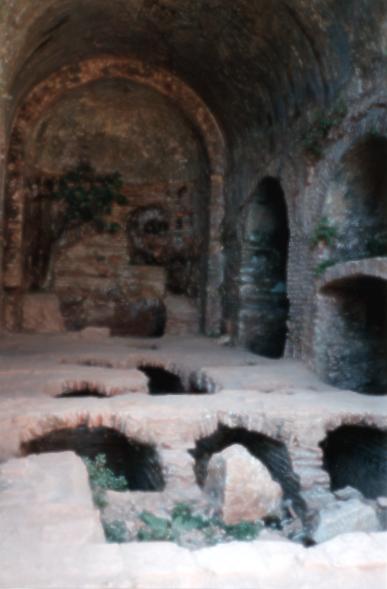 The cave in Ephesus, Turkey
 -
 Eshab-ı Kehf Kulliye in Afşin with the cave inside, Turkey
 -
 Eshab-ı Kehf Cave in Tarsus, Turkey
 -


Modern literature[edit | edit source]
Early modern[edit | edit source]


The account had become proverbial in 16th-century Protestant culture. The poet John Donne could ask,
I wonder, by my troth, what thou and I
Did, till we loved? Were we not weaned till then?
But sucked on country pleasures, childishly?
Or snorted we in the Seven Sleepers' den?—John Donne, "The Good-Morrow".
In John Heywood's Play called the Four PP (1530s), the Pardoner, a Renaissance update of the protagonist in Chaucer's "The Pardoner's Tale," offers his companions the opportunity to kiss "a slipper / Of one of the Seven Sleepers." Still, the relic is presented as absurdly as the Pardoner's other offerings, which include "the great-toe of the Trinity" and "a buttock-bone of Pentecost."[31]
Little is heard of the Seven Sleepers during the Enlightenment, but the account revived with the coming of Romanticism. The Golden Legend may have been the source for retellings of the Seven Sleepers in Thomas de Quincey's Confessions of an English Opium-Eater, in a poem by Goethe, Washington Irving's "Rip van Winkle," and H. G. Wells's The Sleeper Awakes. It also might influence the motif of the "King asleep in mountain."Mark Twain did a burlesque of the story of the Seven Sleepers in Chapter 13 of Volume 2 of The Innocents Abroad.[32]
Contemporary[edit | edit source]
Edward Gibbon gives different accounts of the story in The History of the Decline and Fall of the Roman Empire.
The Serbian writer Danilo Kiš retells the story of the Seven Sleepers in a short story, "The Legend of the Sleepers," from his book The Encyclopedia of the Dead.
The Italian author Andrea Camilleri incorporates the story in his novel The Terracotta Dog in which the protagonist is led to a cave containing the titular watchdog (as described in the Qur'an and called "Kytmyr" in Sicilian folklore) and the saucer of silver coins with which one of the sleepers is to buy "pure food" from the bazaar in Ephesus (Qur'an 18.19). The Seven Sleepers are symbolically replaced by lovers Lisetta Moscato and Mario Cunich, who were killed in their nuptial bed by an assassin hired by Lisseta's incestuous father and later laid to rest in a cave in the Sicilian countryside.
In Susan Cooper's The Dark Is Rising series, Will Stanton awakens the Seven Sleepers in The Grey King, and in Silver on the Tree, they ride in the last battle against the Dark.
The Seven Sleepers series by Gilbert Morris takes a modern approach to the story in which seven teenagers must be awakened to fight evil in a post-nuclear-apocalypse world.
John Buchan refers to the Seven Sleepers in The Three Hostages, in which Richard Hannay surmises that his wife Mary, a sound sleeper, is descended from one of the seven who has married one of the Foolish Virgins.
The Seven Sleepers are mentioned in the "Les Invisibles" song on the 1988 Blue Öyster Cult album Imaginos.
Several languages have idioms related to the Seven Sleepers, including:
- Hungarian: hétalvó, literally a "seven-sleeper," or "one who sleeps for an entire week," is a colloquial reference to a person who oversleeps or who is typically drowsy.[33]:8
- Irish: "Na seacht gcodlatáin" refers to hibernating animals.[34]
- Norwegian: a late riser may be referred to as a syvsover ("seven sleeper")[35]
- Swedish: a late riser may be referred to as a sjusovare ("seven sleeper").[36]
- Welsh: a late riser may be referred to as a saith cysgadur ("seven sleeper") – as in the 1885 novel Rhys Lewis by Daniel Owen, where the protagonist is referred to as such in chapter 37, p. 294 (Hughes a'i Fab, Caerdydd, 1948).
Feast day[edit | edit source]
The most recent edition of the Roman Martyrology commemorates the Seven Sleepers of Ephesus under the date of 27 July.[37] The Byzantine calendar commemorates them with feasts on 4 August and 22 October. Syriac Orthodox calendars gives various dates: 21 April, 2 August, 13 August, 23 October and 24 October.[7]
Pop culture[edit | edit source]
The Men of Angelos, also known as The Companions of the Cave, is a 1997 famous Iranian television series directed by Farajollah Salahshoor. It depicts the story of the Seven Sleepers, according to the Quran.
See also[edit | edit source]
- Epimenides
- King asleep in mountain
- Rip Van Winkle
- Seven Sleepers' Day
- The Three Sleepers: characters in the C. S. Lewis children's novel The Voyage of the Dawn Treader
References[edit | edit source]
- ↑ 1.0 1.1 1.2 Fortescue, Adrian (1909). . In Herbermann, Charles (ed.). Catholic Encyclopedia. Vol. 5. New York: Robert Appleton Company.
- ↑ "Koranion". Typographeion tōn katastēmatōn A. Kōnstantinidou. January 6, 1886 – via Google Books.
- ↑ 3.0 3.1 3.2 3.3 Archer, George (October 2016). "The Hellhound of the Qur'an: A Dog at the Gate of the Underworld". Journal of Qur'anic Studies. 18 (3). Edinburgh: Edinburgh University Press on behalf of the Centre for Islamic Studies at the School of Oriental and African Studies: 1–33. doi:10.3366/jqs.2016.0248. eISSN 1755-1730. ISSN 1465-3591. OCLC 43733991.
- ↑ 4.0 4.1 4.2 4.3 4.4 4.5 4.6 4.7 4.8 "Cave of Ashabe Kahf (The Cave of the Seven Sleepers)". Madain Project. Archived from the original on November 2, 2020. Retrieved November 2, 2020.
- ↑ 5.0 5.1 "Ορθόδοξος Συναξαριστής :: Άγιοι Επτά Παίδες εν Εφέσω". www.saint.gr. Retrieved March 23, 2025.
- ↑ 6.0 6.1 "The Seven Sleepers of Ephesus." In The Catholic Encyclopedia, Vol. 5. New York: Robert Appleton Company, 1909. Retrieved from https://www.newadvent.org/cathen/05496a.htm
- ↑ 7.0 7.1 7.2 7.3 7.4 7.5 7.6 7.7 Witold Witakowski, "Sleepers of Ephesus, Legend of the", in Gorgias Encyclopedic Dictionary of the Syriac Heritage: Electronic Edition, edited by Sebastian P. Brock, Aaron M. Butts, George A. Kiraz and Lucas Van Rompay (Gorgias Press, 2011; online ed. Beth Mardutho, 2018).
- ↑ Pieter W. van der Horst (February 2011). Pious Long-Sleepers in Greek, Jewish, and Christian Antiquity (PDF). The Thirteenth International Orion Symposium: Tradition, Transmission, and Transformation: From Second Temple Literature through Judaism and Christianity in Late Antiquity. Jerusalem, Israel. pp. 14–15.
- ↑ 9.0 9.1 9.2 9.3 Baring-Gould, S. (1876). "Curious myths of the Middle Ages". London: Rivingtons – via Internet Archive.
- ↑ 10.0 10.1 10.2 10.3 10.4 Bartłomiej Grysa, "The Legend of the Seven Sleepers of Ephesus in Syriac and Arab Sources: A Comparative Study", Orientalia Christiana Cracoviensia 2 (2010): 45–59.
- ↑ Liuzza, R. M. (2016). "The Future is a Foreign Country: The Legend of the Seven Sleepers and the Anglo–Saxon Sense of the Past". In Kears, Carl; Paz, James (eds.). Medieval Science Fiction. King's College London, Centre for Late Antique & Medieval Studies. p. 66. ISBN 978-0-9539838-8-9.
- ↑ Peeters, P.; Société de Bollandistes (1910). Bibliotheca hagiographica orientalis. Robarts – University of Toronto. Bruxellis, apud editores [Beyrouth (Syrie) Imprimerie catholique]. pp. 1012–1022.
- ↑ Bollandistes (1909). Bibliotheca hagiographica graeca. PIMS – University of Toronto. Bruxellis, Société des Bollandistes. pp. 1593–1599.
- ↑ Bollandists (1898). Bibliotheca hagiographica latina antiquae et mediae aetatis. PIMS – University of Toronto. Bruxellis: [s.n.] pp. 2313–2319.
- ↑ Hugh Magennis, "The Anonymous Old English Legend of the Seven Sleepers and its Latin Source", Leeds Studies in English, n.s. 22 (1991): 43–56.
- ↑ Stokes, Whitley (1905). The Martyrology of Oengus the Culdee: Félire Óengusso Céli Dé. Harrison and Sons. p. 4.
- ↑ "The Seven Sleepers". The Golden Legend. Archived from the original on January 6, 2003.
It is in doubt of that which is said that they slept three hundred and sixty-two years, for they were raised the year of our Lord four hundred and seventy-eight, and Decius reigned but one year and three months, and that was in the year of our Lord two hundred and seventy, and so they slept but two hundred and eight years.
- ↑ Jacobus (1899). "XV — The Seven Sleepers". In Madge, H.D. (ed.). Leaves from the Golden Legend. C.M. Watts (illustrator). pp. 174–175 – via Google Books.
It is doubt of that which is said that they slept ccclxii. years. For they were raised the year of Our Lord IIIICLXXXIII. And Decius reigned but one year and three months and that was in the year of our Lord CC and LXX., and so they slept but iic. and viii. years.
- ↑ Peeters, P.; Société de Bollandistes (October 25, 2018). "Bibliotheca hagiographica orientalis". Bruxellis, apud editores [Beyrouth (Syrie) Imprimerie catholique] – via Internet Archive.
- ↑ "الدعاء عند وليتلطف في سورة الكهف لأنها منتصف القرآن". www.islamweb.net (in العربية). Retrieved August 26, 2025.
- ↑ Abul A'la Maududi. "18. Surah Al Kahf (The Cave)". Tafhim-ul-Quran [The Meaning of the Qur'an]. Retrieved February 16, 2023 – via englishtafsir.com.
- ↑ The Message of the Quran, by M. Asad, Surah 18:22.
- ↑ The Message of the Quran, by M. Asad, Surah 18:25–26.
- ↑ Griffith, Sidney (2008). "Christian lore and the Arabic Qur'ān: The "Companions of the Cave" in Sūrat al-Kahf and in Syriac Christian tradition". In Reynolds, Gabriel Said (ed.). The Quran in its Historical Context. Routledge. pp. 109-137 (127-128). Retrieved June 25, 2022 – via academia.edu.
- ↑ Reynolds, Gabriel Said (2018). The Qur'an and the Bible: Text and Commentary. Yale University Press, p. 454.
- ↑ Tobias Nicklas in: C. R. Moss et al., eds. (2017), The Other Side: Apocryphal Perspectives on Ancient Christian "Orthodoxies", p. 26.
- ↑ "Surah Al-Kahf - 22".
- ↑ de Grummond, N. T., ed., Encyclopedia of the History of Classical Archaeology (London & New York: Routledge, 1996), p. 394.
- ↑ Cave of the Seven Sleepers (at Lonely Planet)
- ↑ "Ashabi-Kahf cave in Nakhichevan". azerbaijan24.com. Archived from the original on December 10, 2024. Retrieved February 13, 2025.
- ↑ Gassner, John, ed. (1987). Medieval and Tudor Drama. New York: Applause. p. 245. ISBN 9780936839844.
- ↑ Samuel Clements (1976). Lawrence Teacher (ed.). The Unabridged Mark Twain. Philadelphia PA: Running Press. pp. pp. 245–248.
- ↑ Kohler, W. C., & Kurz, P. J., Hypnosis in the Management of Sleep Disorders (London & New York: Routledge, 2018), p. 8.
- ↑ "Foclóir Gaeilge–Béarla (Ó Dónaill): codlatán". www.teanglann.ie.
- ↑ Entry for syvsover, Sprakradet, Language Council of Norway.
- ↑ "sju-sovare | SAOB".
- ↑ Martyrologium Romanum, editio altera, (Typis Vaticanis, 2004, p. 416 ISBN 88-209-7210-7)
Bibliography[edit | edit source]
- Ælfric of Eynsham (1881). . Ælfric's Lives of Saints. London, Pub. for the Early English text society, by N. Trübner & co.
- Gennaro Zurolo (2013). Regesto del documento d'archivio del XVIII secolo riguardante la cappella gentilizia della famiglia Pisacane sotto il titolo di S. Maria di Montevergine [Register of the 18th century archive document regarding the noble chapel of the Pisacane family under the title of S. Maria di Montevergine] (in Latina and italiano). Angri (SA): Panacèa Onlus.
External links[edit | edit source]
- Quran–Authorized English Version The Cave- Sura 18 – Quran – Authorized English Version
- "SS. Maximian, Malchus, Martinian, Dionysius, John, Serapion, and Constantine, Martyrs", Butler's Lives of the Saints
- Text containing the Seven Sleepers' commemoration as part of the Office of Prime.
- Sura al-Kahf at Wikisource
- Photos of the excavated site of the Seven Sleepers cult.
- Gregory of Tours, The Patient Impassioned Suffering of the Seven Sleepers of Ephesus translated by Michael Valerie
- The Lives of the Seven Sleepers from The Golden Legend by Jacobus de Voragine, William Caxton Middle English translation.
- The Seven Sleepers of Ephesus by Chardri, translated into English by Tony Devaney Morinelli: Medieval Sourcebook. fordham.edu
- The Old English Legend of the Seven Sleepers, by Hugh Magennis, ROEP: Resources for Old English Prose, University of Oxford, 2025