

further refine intro per standard format and improved wording after review |
|||
| Line 1: | Line 1: | ||
{{Short description|Species of flowering plant}} | {{Short description|Species of flowering plant}} | ||
{{Speciesbox | {{Speciesbox | ||
|image = Cestrum nocturnum (2464189820).jpg | | image = Cestrum nocturnum (2464189820).jpg | ||
|status = LC | | status = LC | ||
|status_system = IUCN3.1 | | status_system = IUCN3.1 | ||
|status_ref = <ref name="iucn status 19 November 2021">{{cite iucn |author=Botanic Gardens Conservation International (BGCI), IUCN SSC Global Tree Specialist Group. |author2=Meave, J.A. |date=2019 |title=''Cestrum nocturnum'' |volume=2019 | | | status_ref = <ref name="iucn status 19 November 2021">{{cite iucn |author=Botanic Gardens Conservation International (BGCI), IUCN SSC Global Tree Specialist Group. |author2=Meave, J.A. |date=2019 |title=''Cestrum nocturnum'' |volume=2019 |article-number=e.T72045868A136785819 |doi=10.2305/IUCN.UK.2019-2.RLTS.T72045868A136785819.en |access-date=19 November 2021}}</ref> | ||
|genus = Cestrum | | genus = Cestrum | ||
|species = nocturnum | | species = nocturnum | ||
|authority = [[Carl Linnaeus|L.]] | | authority = [[Carl Linnaeus|L.]]<ref name=POWO>{{cite POWO |title=''Cestrum nocturnum'' L. |id=316386-2 |access-date=31 January 2025}}</ref> | ||
| synonyms = {{Collapsible list| | |||
{{Species list | |||
| Chiococca nocturna | (L.) Jacq. | |||
| Cestrum graciliflorum | Dunal | |||
| Cestrum leucocarpum | Dunal | |||
| Cestrum multiflorum | Roem. & Schult. | |||
| Cestrum propinquum | M.Martens & Galeotti | |||
| Cestrum scandens | Thibaud ex Dunal | |||
| Cestrum spicatum | Mill. | |||
| Cestrum suberosum | Jacq. | |||
}} | |||
}} | |||
| synonyms_ref = <ref name=POWO/> | |||
}} | }} | ||
'''''Cestrum nocturnum''''', the '''lady of the night''', '''night-blooming jasmine''', '''night-blooming jessamine''', '''night-scented jessamine''', '''night-scented cestrum''' or '''poisonberry''',<ref name=EPPO>{{cite web | title = ''Cestrum nocturnum'' | url = https://gd.eppo.int/taxon/CEMNO | publisher = [[European and Mediterranean Plant Protection Organization]] (EPPO) | access-date = 19 November 2020}}</ref> is a species of plant in the potato family [[Solanaceae]]. It is native to | '''''Cestrum nocturnum''''', the '''lady of the night''', '''night-blooming jasmine''', '''night-blooming jessamine''', '''night-scented jessamine''', '''night-scented cestrum''' or '''poisonberry''',<ref name=EPPO>{{cite web | title = ''Cestrum nocturnum'' | url = https://gd.eppo.int/taxon/CEMNO | publisher = [[European and Mediterranean Plant Protection Organization]] (EPPO) | access-date = 19 November 2020}}</ref> is a species of plant in the potato family [[Solanaceae]]. It is native to Mexico, Central America and northern South America<ref name="iucn status 19 November 2021"/> and is naturalized in [[South Asia]].<ref>Hortus Third Cornell University, ''Western Garden Book'' 2007 Ed</ref> | ||
Despite its common name, the species is not a [[Jasmine#Other plants called "jasmine"|"true jasmine"]] and not of the genus [[Jasmine|Jasminum]]. | Despite its common name, the species is not a [[Jasmine#Other plants called "jasmine"|"true jasmine"]] and not of the genus ''[[Jasmine|Jasminum]]''. | ||
==Description== | ==Description== | ||
| Line 19: | Line 32: | ||
===Inflorescences=== | ===Inflorescences=== | ||
The flowers are greenish-white, with a slender tubular [[Corolla (flower)|corolla]] {{convert|2|-|2.5|cm|in|abbr=on}} long with five acute lobes, {{convert|10|–|13|mm|in|abbr=on}} diameter when open at night, and are produced in [[Cyme (botany)|cymose]] [[inflorescence]]s. A powerful, sweet perfume is released at night. The mostly multi-flowered, drooping [[inflorescence]]s are terminal or axillary. They are clustered, sparsely branched [[panicles]], on the inflorescence axes of which there are herbaceous [[bracts]]. The five [[sepals]] are fused to form a bell-shaped, approximately 2 mm long calyx and have five pointed tips, which are slightly enlarged, ribbed and | The flowers are greenish-white, with a slender tubular [[Corolla (flower)|corolla]] {{convert|2|-|2.5|cm|in|abbr=on}} long with five acute lobes, {{convert|10|–|13|mm|in|abbr=on}} diameter when open at night, and are produced in [[Cyme (botany)|cymose]] [[inflorescence]]s. A powerful, sweet perfume is released at night. The mostly multi-flowered, drooping [[inflorescence]]s are terminal or axillary. They are clustered, sparsely branched [[panicles]], on the inflorescence axes of which there are herbaceous [[bracts]]. The five [[sepals]] are fused to form a bell-shaped, approximately 2 mm long calyx and have five pointed tips, which are slightly enlarged, ribbed and acutely pointed on the fruit. The inside and outside of the [[calyx (botany)|calyx]] are finely haired. | ||
The fruit is a white [[berry (botany)|berry]] {{convert|10|mm|in}} long by {{convert|5|mm|in|abbr=on}} diameter. There is also a variety with yellowish flowers. There are mixed reports regarding the toxicity of foliage and fruit.<ref>''Medicinal and Poisonous Plants of Southern and Eastern Africa'' – Watt & Breyer-Brandwijk (1962)</ref><ref>[http://www.erowid.org/plants/cestrum/cestrum_health1.shtml Erowid Cestrum Vaults : Cestrum Health Concerns]. Erowid.org (2008-08-27). Retrieved on 2011-07-10.</ref> | The fruit is a white [[berry (botany)|berry]] {{convert|10|mm|in}} long by {{convert|5|mm|in|abbr=on}} diameter. There is also a variety with yellowish flowers. There are mixed reports regarding the toxicity of foliage and fruit.<ref>''Medicinal and Poisonous Plants of Southern and Eastern Africa'' – Watt & Breyer-Brandwijk (1962)</ref><ref>[http://www.erowid.org/plants/cestrum/cestrum_health1.shtml Erowid Cestrum Vaults : Cestrum Health Concerns]. Erowid.org (2008-08-27). Retrieved on 2011-07-10.</ref> | ||
The Latin specific epithet, ''nocturnum'', means 'at night' and is a reference to the plant's habit of blooming at night.<ref>{{Cite web |title=Cestrum nocturnum - Plant Finder |url=https://www.missouribotanicalgarden.org/PlantFinder/PlantFinderDetails.aspx?taxonid=287193&bt=4 |access-date=2025-02-12 |website=www.missouribotanicalgarden.org}}</ref> | |||
==Cultivation== | ==Cultivation== | ||
| Line 27: | Line 42: | ||
==Chemistry== | ==Chemistry== | ||
Flowers distilled oil contains [[ | Flowers distilled oil contains [[phenylethyl alcohol]] (27%), [[benzyl alcohol]] (12%), [[icosane|eicosane]] (5.6%), [[eugenol]] (5.6%), ''n''-[[tetracosane]] (4.4%), [[caryophyllene]] oxide (3.1%), [[cetyl alcohol|1-hexadecanol]] (2.7%), [[methoxyeugenol]] (2.45%), [[benzaldehyde]] (2.32%).<ref>{{cite journal |last1=Al-Reza |first1=Sharif M. |last2=Rahman |first2=Atiqur |last3=Kang |first3=Sun Chul |title=Chemical composition and inhibitory effect of essential oil and organic extracts of ''Cestrum nocturnum'' L. on food-borne pathogens |journal=International Journal of Food Science & Technology |date=June 2009 |volume=44 |issue=6 |pages=1176–1182 |doi=10.1111/j.1365-2621.2009.01939.x |doi-access=free}}</ref> Flowers alcohol extract contains cytotoxic steroids.<ref>{{cite journal |last1=Wu |first1=Deng-Pan |last2=Lin |first2=Tian-Yu |last3=Lv |first3=Jin-Yan |last4=Chen |first4=Wen-Ya |last5=Bai |first5=Li-Ru |last6=Zhou |first6=Yan |last7=Huang |first7=Jin-Lan |last8=Zhong |first8=Zhen-Guo |title=Flower Extracts Attenuate Proliferation and Induce Apoptosis in Malignant Cells through Inducing DNA Damage and Inhibiting Topoisomerase II Activity |journal=Evidence-Based Complementary and Alternative Medicine |date=2017 |volume=2017 |article-number=1456786 |doi=10.1155/2017/1456786 |pmid=28250789 |pmc=5307125 |doi-access=free }}</ref> | ||
==Pharmacology== | ==Pharmacology== | ||
| Line 33: | Line 48: | ||
Ingestion of ''C. nocturnum'' has not been well documented, but there is some reason to believe that caution is in order. All members of the family [[Solanaceae]] contain an [[alkaloid]] toxin called [[solanine]],<ref>[http://www.wisegeek.com/what-is-solanine.htm What is solanine]. Wisegeek</ref> though some members of the family are routinely eaten without ill-effect. The most commonly reported problems associated with ''C. nocturnum'' are respiratory problems from the scent, and feverish symptoms following ingestion.<ref>{{cite web | url=https://www.childrens.health.qld.gov.au/poisonous-plant-night-blooming-jessamine-cestrum-nocturnum | title=Night blooming jessamine (Cestrum nocturnum) | Queensland Poisons Information Centre | date=18 July 2017 }}</ref> | Ingestion of ''C. nocturnum'' has not been well documented, but there is some reason to believe that caution is in order. All members of the family [[Solanaceae]] contain an [[alkaloid]] toxin called [[solanine]],<ref>[http://www.wisegeek.com/what-is-solanine.htm What is solanine]. Wisegeek</ref> though some members of the family are routinely eaten without ill-effect. The most commonly reported problems associated with ''C. nocturnum'' are respiratory problems from the scent, and feverish symptoms following ingestion.<ref>{{cite web | url=https://www.childrens.health.qld.gov.au/poisonous-plant-night-blooming-jessamine-cestrum-nocturnum | title=Night blooming jessamine (Cestrum nocturnum) | Queensland Poisons Information Centre | date=18 July 2017 }}</ref> | ||
Some people, especially those with respiratory sensitivities or asthma, have reported difficulty breathing, irritation of the nose and throat, headache, nausea, or other symptoms when exposed to the blossom's powerful scent.<ref> Department of Primary Industries, NSW Government, Reviewed 2021{{cite web | url=https://weeds.dpi.nsw.gov.au/Weeds/LadyOfTheNight | title=NSW WeedWise }}</ref> Some ''Cestrum'' species contain [[chlorogenic acid]], and the presence of this potent sensitizer may be responsible for this effect in ''C. nocturnum''. | Some people, especially those with respiratory sensitivities or asthma, have reported difficulty breathing, irritation of the nose and throat, headache, nausea, or other symptoms when exposed to the blossom's powerful scent.<ref>Department of Primary Industries, NSW Government, Reviewed 2021{{cite web | url=https://weeds.dpi.nsw.gov.au/Weeds/LadyOfTheNight | title=NSW WeedWise }}</ref> Some ''Cestrum'' species contain [[chlorogenic acid]], and the presence of this potent sensitizer may be responsible for this effect in ''C. nocturnum''. | ||
Some plant guides describe ''C. nocturnum'' as "toxic" and warn that ingesting plant parts, especially fruit, may result in elevated temperature, rapid pulse, excess salivation and [[gastritis]].<ref>The University of Arizona, Cochise County Master Gardeners, '''Cestrums (jessamine)''', Barbara Shelor, Nov. 1991{{cite web | url=https://cals.arizona.edu/cochise/mg/common-poisonous-plants | title=Common Poisonous Plants | Cochise County Master Gardeners }}</ref> | |||
Ingestion of green berries over several weeks by a 2-year-old child resulted in diarrhea, vomiting, and blood clots in the stool. | Spoerke and Smolinske (1990)<ref |name="SpoerkeSmolinske1990">{{cite book|author=Spoerke DG, Smolinske SC|title=Toxicity of Houseplants |publisher=CRC Press |location=Boca Raton |year=1990|isbn=0-8493-6655-0}}</ref> noted the following: | ||
"Ingesting 15 lb of plant material caused a cow to salivate, clamp its jaws, collapse, and eventually die. A postmortem showed gastroenteritis and congestion of liver, kidneys, brain, and spinal cord. Although the berries and the sap are suspected of being toxic,<ref |name="LampeMcCann1985">{{cite book |author=Lampe KF, McCann MA |title=AMA Handbook of Poisonous and Injurious Plants |publisher=American Medical Association |location=Chicago |year=1985|isbn=0-89970-183-3}}</ref> several cases of ingestion of the berries have not shown them to be a problem, with one exception. Morton<ref |name="Morton1971">{{cite book |author=Morton JF |title=Plants Poisonous to People in Florida and Other Warm Areas |publisher=Hurricane House |location=Miami |year=1971}}</ref> cites two cases where children ate significant quantities (handfuls) of berries and had no significant effects and another two where berries were ingested in smaller amounts, with similar negative results", and in a new paragraph noted that "Ingestion of green berries over several weeks by a 2-year-old child resulted in diarrhea, vomiting, and blood clots in the stool. Anemia and purpura [discoloration of the skin caused by subcutaneous bleeding] were also noted. A solanine alkaloid isolated from the stool was hemolytic to human erythrocytes."<ref>{{cite journal |author=Fruthaler GJ|title=Solanine poisoning|journal=Ochsner Clinic Reports|year=1955|volume=1|issue=2|pages=50–52 |pmid=13244993 }}</ref> | |||
Plant extracts have shown [[larvicidal]] activity against the mosquito ''[[Aedes aegypti]]'' while showing no toxicity to fish.<ref>{{cite journal | vauthors = Patil CD, Patil SV, Salunke BK, Salunkhe RB | title = Bioefficacy of ''Plumbago zeylanica'' (Plumbaginaceae) and ''Cestrum nocturnum'' (Solanaceae) plant extracts against ''Aedes aegypti'' (Diptera: Culicide) and nontarget fish ''Poecilia reticulata'' | journal = Parasitol Res | year = 2011 | volume = 108 | issue = 5 | pages = 1253–1263 | doi=10.1007/s00436-010-2174-6| pmid = 21107859 | s2cid = 35903438 }}</ref><ref>{{cite journal | author = Chetan Jawale | author2 = Rambhau Kirdak | author3 = Laxmikant Dama | title = Larvicidal activity of ''Cestrum nocturnum'' on ''Aedes aegypti'' | journal = Bangladesh Journal of Pharmacology | year = 2010 | volume = 5 | issue = 1 | pages = 39–40 | doi=10.3329/bjp.v5i1. | Plant extracts have shown [[larvicidal]] activity against the mosquito ''[[Aedes aegypti]]'' while showing no toxicity to fish.<ref>{{cite journal | vauthors = Patil CD, Patil SV, Salunke BK, Salunkhe RB | title = Bioefficacy of ''Plumbago zeylanica'' (Plumbaginaceae) and ''Cestrum nocturnum'' (Solanaceae) plant extracts against ''Aedes aegypti'' (Diptera: Culicide) and nontarget fish ''Poecilia reticulata'' | journal = Parasitol Res | year = 2011 | volume = 108 | issue = 5 | pages = 1253–1263 | doi=10.1007/s00436-010-2174-6| pmid = 21107859 | s2cid = 35903438 }}</ref><ref>{{cite journal | author = Chetan Jawale | author2 = Rambhau Kirdak | author3 = Laxmikant Dama | title = Larvicidal activity of ''Cestrum nocturnum'' on ''Aedes aegypti'' | journal = Bangladesh Journal of Pharmacology | year = 2010 | volume = 5 | issue = 1 | pages = 39–40 | doi = 10.3329/bjp.v5i1.4714 | doi-access = free }}</ref> Plant extracts cause hematological changes in the freshwater fish when exposed to sub lethal concentrations.<ref>{{cite journal | author = CS JAWALE, LB DAMA | title = Haematological Changes In The Fresh Water Fish, Exposed To Sub-Lethal Concentration Of Piscicidal Compounds From (Fam: Solanaceae) | journal = National Journal of Life Sciences | year = 2010 | volume = 7 | issue = 1 | pages = 82–84 | url=https://www.researchgate.net/publication/215901825}}</ref><ref>{{cite journal | author = Jawale C. S. | author2 = Vinchurkar A. S. | author3 = Dama L. B., Pawar | title = ''Cestrum nocturnum'' (l) a prospective piscicide for control of predatory fish ''channa punctatus'' (bloch.) | journal = Trends in Fisheries Research | year = 2012 | volume = 1 | issue = 2 | pages = 14–17}}</ref> | ||
===Psychoactivity=== | ===Psychoactivity=== | ||
The mechanisms of the plant's putative psychoactive effects are currently unknown, and anecdotal data are extremely limited and include an aphrodisiac power.<ref>{{cite news|title=Italian islands become 'sex pilgrimage' sites|author=Silvia Marchetti|date=6 October 2020|work=CNN Travel|url=https://edition.cnn.com/travel/article/italy-fertility-islands/index.html}}</ref> In a rare discussion of traditional [[entheogen]]ic use of the plant, [[Claudia Müller-Ebeling|Müller-Ebeling]], [[Christian Rätsch|Rätsch]], and Shahi describe shamanic use of ''C. nocturnum'' in Nepal.<ref>{{cite book|isbn= | The mechanisms of the plant's putative psychoactive effects are currently unknown, and anecdotal data are extremely limited and include an aphrodisiac power.<ref>{{cite news|title=Italian islands become 'sex pilgrimage' sites|author=Silvia Marchetti|date=6 October 2020|work=CNN Travel|url=https://edition.cnn.com/travel/article/italy-fertility-islands/index.html}}</ref> In a rare discussion of traditional [[entheogen]]ic use of the plant, [[Claudia Müller-Ebeling|Müller-Ebeling]], [[Christian Rätsch|Rätsch]], and Shahi describe shamanic use of ''C. nocturnum'' in Nepal.<ref>{{cite book|isbn=0-89281-913-8|title=Shamanism and Tantra in the Himalayas|last1=Müller-Ebeling|first1=Claudia|last2=Rätsch|first2=Christian|last3=Shahi|first3=Surendra Bahadur|date=September 2002}}</ref> They describe experiencing "trippy" effects without mentioning unpleasant physical side effects. Rätsch's ''Encyclopedia of Psychoactive Plants'' also describes a handful of reports of ingestion of the plant without mentioning serious adverse side effects. | ||
==Invasive potential== | ==Invasive potential== | ||
| Line 51: | Line 64: | ||
In Auckland, New Zealand, it has been reported as a seriously invasive weed to the Auckland Regional Council and is under investigation. NS Forest and Bird is compiling an inventory of wild cestrum sites in order to place the plant on the banned list. The inventory can be viewed via Google Maps.<ref>[http://maps.google.co.nz/maps/ms?ie=UTF8&hl=en&msa=0&msid=106192109332937319052.000452fadea9e1a357b2a&ll=-36.765842,174.553528&spn=0.375695,0.602875&z=11 Cestrum wild locations – Google Maps]. Maps.google.co.nz. Retrieved on 2011-07-10.</ref> Some nurseries still sell it without warning customers of the dangers to native bush reserves.{{Citation needed|date= November 2017}} | In Auckland, New Zealand, it has been reported as a seriously invasive weed to the Auckland Regional Council and is under investigation. NS Forest and Bird is compiling an inventory of wild cestrum sites in order to place the plant on the banned list. The inventory can be viewed via Google Maps.<ref>[http://maps.google.co.nz/maps/ms?ie=UTF8&hl=en&msa=0&msid=106192109332937319052.000452fadea9e1a357b2a&ll=-36.765842,174.553528&spn=0.375695,0.602875&z=11 Cestrum wild locations – Google Maps]. Maps.google.co.nz. Retrieved on 2011-07-10.</ref> Some nurseries still sell it without warning customers of the dangers to native bush reserves.{{Citation needed|date= November 2017}} | ||
== In culture == | |||
The inscription on American filmmaker [[David Lynch|David Keith Lynch]]'s gravestone at the [[Hollywood Forever Cemetery]] reads "Night Blooming Jasmine."<ref>{{cite web | title=David Lynch's grave stone bearing enigmatic phrase unveiled in Hollywood | date=7 April 2025 | url=https://ca.news.yahoo.com/david-lynch-grave-stone-bearing-223248719.html }}</ref> | |||
==Gallery== | ==Gallery== | ||
| Line 60: | Line 76: | ||
Image:Cestrum nocturnum on bush.jpg | Image:Cestrum nocturnum on bush.jpg | ||
Image:Jasmine_NightBloomimg1_Asit.jpg | Image:Jasmine_NightBloomimg1_Asit.jpg | ||
Image:Night-blooming jasmine.jpg | |||
</gallery> | </gallery> | ||
| Line 75: | Line 92: | ||
[[Category:Cestrum|nocturnum]] | [[Category:Cestrum|nocturnum]] | ||
[[Category:Night-blooming plants]] | [[Category:Night-blooming plants]] | ||
[[Category:Flora of Mexico]] | [[Category:Flora of Mexico]] | ||
[[Category:Flora of Central America]] | [[Category:Flora of Central America]] | ||
[[Category:Flora of Colombia]] | |||
[[Category:Flora of Venezuela]] | |||
[[Category:Plants described in 1753]] | [[Category:Plants described in 1753]] | ||
[[Category: | [[Category:Botanical taxa named by Carl Linnaeus]] | ||
[[Category:Garden plants of South America]] | |||
Latest revision as of 00:15, 26 February 2026
| Cestrum nocturnum | |
|---|---|
.jpg)
| |
Scientific classification 
| |
| : | [[Template:Taxonomy/Cestrum]] |
| Species: | Template:Taxonomy/CestrumC. nocturnum
|
| Binomial name | |
| Template:Taxonomy/CestrumCestrum nocturnum | |
| Synonyms[2] | |
Cestrum nocturnum, the lady of the night, night-blooming jasmine, night-blooming jessamine, night-scented jessamine, night-scented cestrum or poisonberry,[3] is a species of plant in the potato family Solanaceae. It is native to Mexico, Central America and northern South America[1] and is naturalized in South Asia.[4]
Despite its common name, the species is not a "true jasmine" and not of the genus Jasminum.
Description[edit | edit source]

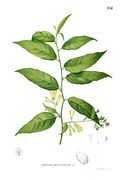
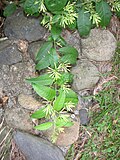
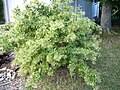
Cestrum nocturnum is an evergreen woody shrub with slender branches growing to 4 m (13 ft) tall. The plant is multi-branched and heavily foliated. The leaves are simple, narrow lanceolate, 6–20 cm (2.4–7.9 in) long and 2–4.5 cm (0.79–1.77 in) broad, smooth and glossy, with an entire margin. Towards the front they are pointed or tapered, the base is rounded or blunt. The leaf stalks are 0.8 to 2 cm long.
Inflorescences[edit | edit source]
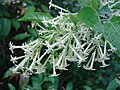
The flowers are greenish-white, with a slender tubular corolla 2–2.5 cm (0.79–0.98 in) long with five acute lobes, 10–13 mm (0.39–0.51 in) diameter when open at night, and are produced in cymose inflorescences. A powerful, sweet perfume is released at night. The mostly multi-flowered, drooping inflorescences are terminal or axillary. They are clustered, sparsely branched panicles, on the inflorescence axes of which there are herbaceous bracts. The five sepals are fused to form a bell-shaped, approximately 2 mm long calyx and have five pointed tips, which are slightly enlarged, ribbed and acutely pointed on the fruit. The inside and outside of the calyx are finely haired.
The fruit is a white berry 10 millimetres (0.39 in) long by 5 mm (0.20 in) diameter. There is also a variety with yellowish flowers. There are mixed reports regarding the toxicity of foliage and fruit.[5][6]
The Latin specific epithet, nocturnum, means 'at night' and is a reference to the plant's habit of blooming at night.[7]
Cultivation[edit | edit source]
Cestrum nocturnum is grown in subtropical regions as an ornamental plant for its flowers that are heavily perfumed at night. It grows best in average to moist soil that is light and sandy, with a neutral pH of 6.6 to 7.5, and is hardy to hardiness zone 8. C. nocturnum can be fertilized biweekly with a weak dilution of seaweed and fish emulsion fertilizer.
Chemistry[edit | edit source]
Flowers distilled oil contains phenylethyl alcohol (27%), benzyl alcohol (12%), eicosane (5.6%), eugenol (5.6%), n-tetracosane (4.4%), caryophyllene oxide (3.1%), 1-hexadecanol (2.7%), methoxyeugenol (2.45%), benzaldehyde (2.32%).[8] Flowers alcohol extract contains cytotoxic steroids.[9]
Pharmacology[edit | edit source]
Toxicity[edit | edit source]
Ingestion of C. nocturnum has not been well documented, but there is some reason to believe that caution is in order. All members of the family Solanaceae contain an alkaloid toxin called solanine,[10] though some members of the family are routinely eaten without ill-effect. The most commonly reported problems associated with C. nocturnum are respiratory problems from the scent, and feverish symptoms following ingestion.[11]
Some people, especially those with respiratory sensitivities or asthma, have reported difficulty breathing, irritation of the nose and throat, headache, nausea, or other symptoms when exposed to the blossom's powerful scent.[12] Some Cestrum species contain chlorogenic acid, and the presence of this potent sensitizer may be responsible for this effect in C. nocturnum.
Some plant guides describe C. nocturnum as "toxic" and warn that ingesting plant parts, especially fruit, may result in elevated temperature, rapid pulse, excess salivation and gastritis.[13]
Spoerke and Smolinske (1990)[14] noted the following: "Ingesting 15 lb of plant material caused a cow to salivate, clamp its jaws, collapse, and eventually die. A postmortem showed gastroenteritis and congestion of liver, kidneys, brain, and spinal cord. Although the berries and the sap are suspected of being toxic,[15] several cases of ingestion of the berries have not shown them to be a problem, with one exception. Morton[16] cites two cases where children ate significant quantities (handfuls) of berries and had no significant effects and another two where berries were ingested in smaller amounts, with similar negative results", and in a new paragraph noted that "Ingestion of green berries over several weeks by a 2-year-old child resulted in diarrhea, vomiting, and blood clots in the stool. Anemia and purpura [discoloration of the skin caused by subcutaneous bleeding] were also noted. A solanine alkaloid isolated from the stool was hemolytic to human erythrocytes."[17]
Plant extracts have shown larvicidal activity against the mosquito Aedes aegypti while showing no toxicity to fish.[18][19] Plant extracts cause hematological changes in the freshwater fish when exposed to sub lethal concentrations.[20][21]
Psychoactivity[edit | edit source]
The mechanisms of the plant's putative psychoactive effects are currently unknown, and anecdotal data are extremely limited and include an aphrodisiac power.[22] In a rare discussion of traditional entheogenic use of the plant, Müller-Ebeling, Rätsch, and Shahi describe shamanic use of C. nocturnum in Nepal.[23] They describe experiencing "trippy" effects without mentioning unpleasant physical side effects. Rätsch's Encyclopedia of Psychoactive Plants also describes a handful of reports of ingestion of the plant without mentioning serious adverse side effects.
Invasive potential[edit | edit source]
Cestrum nocturnum has become widely naturalized in tropical and subtropical regions throughout the world, including Australia, New Zealand, South Africa, southern China and the southernmost United States, and is difficult to eradicate. It is classed as a weed in some countries.
In Auckland, New Zealand, it has been reported as a seriously invasive weed to the Auckland Regional Council and is under investigation. NS Forest and Bird is compiling an inventory of wild cestrum sites in order to place the plant on the banned list. The inventory can be viewed via Google Maps.[24] Some nurseries still sell it without warning customers of the dangers to native bush reserves.[citation needed]
In culture[edit | edit source]
The inscription on American filmmaker David Keith Lynch's gravestone at the Hollywood Forever Cemetery reads "Night Blooming Jasmine."[25]
Gallery[edit | edit source]
-
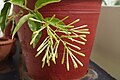 Cestrum nocturnum buds
 -
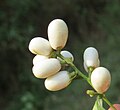 Cestrum nocturnum fruit
 -
-
-
-
-


References[edit | edit source]
- ↑ 1.0 1.1 Botanic Gardens Conservation International (BGCI), IUCN SSC Global Tree Specialist Group.; Meave, J.A. (2019). "Cestrum nocturnum". IUCN Red List of Threatened Species. 2019 e.T72045868A136785819. doi:10.2305/IUCN.UK.2019-2.RLTS.T72045868A136785819.en. Retrieved 19 November 2021.
- ↑ 2.0 2.1 "Cestrum nocturnum L." Plants of the World Online. Royal Botanic Gardens, Kew. Retrieved 31 January 2025.
- ↑ "Cestrum nocturnum". European and Mediterranean Plant Protection Organization (EPPO). Retrieved 19 November 2020.
- ↑ Hortus Third Cornell University, Western Garden Book 2007 Ed
- ↑ Medicinal and Poisonous Plants of Southern and Eastern Africa – Watt & Breyer-Brandwijk (1962)
- ↑ Erowid Cestrum Vaults : Cestrum Health Concerns. Erowid.org (2008-08-27). Retrieved on 2011-07-10.
- ↑ "Cestrum nocturnum - Plant Finder". www.missouribotanicalgarden.org. Retrieved 2025-02-12.
- ↑ Al-Reza, Sharif M.; Rahman, Atiqur; Kang, Sun Chul (June 2009). "Chemical composition and inhibitory effect of essential oil and organic extracts of Cestrum nocturnum L. on food-borne pathogens". International Journal of Food Science & Technology. 44 (6): 1176–1182. doi:10.1111/j.1365-2621.2009.01939.x.
- ↑ Wu, Deng-Pan; Lin, Tian-Yu; Lv, Jin-Yan; Chen, Wen-Ya; Bai, Li-Ru; Zhou, Yan; Huang, Jin-Lan; Zhong, Zhen-Guo (2017). "Flower Extracts Attenuate Proliferation and Induce Apoptosis in Malignant Cells through Inducing DNA Damage and Inhibiting Topoisomerase II Activity". Evidence-Based Complementary and Alternative Medicine. 2017 1456786. doi:10.1155/2017/1456786. PMC 5307125. PMID 28250789.
- ↑ What is solanine. Wisegeek
- ↑ "Night blooming jessamine (Cestrum nocturnum) | Queensland Poisons Information Centre". 18 July 2017.
- ↑ Department of Primary Industries, NSW Government, Reviewed 2021"NSW WeedWise".
- ↑ The University of Arizona, Cochise County Master Gardeners, Cestrums (jessamine), Barbara Shelor, Nov. 1991"Common Poisonous Plants | Cochise County Master Gardeners".
- ↑ Spoerke DG, Smolinske SC (1990). Toxicity of Houseplants. Boca Raton: CRC Press. ISBN 0-8493-6655-0.
- ↑ Lampe KF, McCann MA (1985). AMA Handbook of Poisonous and Injurious Plants. Chicago: American Medical Association. ISBN 0-89970-183-3.
- ↑ Morton JF (1971). Plants Poisonous to People in Florida and Other Warm Areas. Miami: Hurricane House.
- ↑ Fruthaler GJ (1955). "Solanine poisoning". Ochsner Clinic Reports. 1 (2): 50–52. PMID 13244993.
- ↑ Patil CD, Patil SV, Salunke BK, Salunkhe RB (2011). "Bioefficacy of Plumbago zeylanica (Plumbaginaceae) and Cestrum nocturnum (Solanaceae) plant extracts against Aedes aegypti (Diptera: Culicide) and nontarget fish Poecilia reticulata". Parasitol Res. 108 (5): 1253–1263. doi:10.1007/s00436-010-2174-6. PMID 21107859. S2CID 35903438.
- ↑ Chetan Jawale; Rambhau Kirdak; Laxmikant Dama (2010). "Larvicidal activity of Cestrum nocturnum on Aedes aegypti". Bangladesh Journal of Pharmacology. 5 (1): 39–40. doi:10.3329/bjp.v5i1.4714.
- ↑ CS JAWALE, LB DAMA (2010). "Haematological Changes In The Fresh Water Fish, Exposed To Sub-Lethal Concentration Of Piscicidal Compounds From (Fam: Solanaceae)". National Journal of Life Sciences. 7 (1): 82–84.
- ↑ Jawale C. S.; Vinchurkar A. S.; Dama L. B., Pawar (2012). "Cestrum nocturnum (l) a prospective piscicide for control of predatory fish channa punctatus (bloch.)". Trends in Fisheries Research. 1 (2): 14–17.
- ↑ Silvia Marchetti (6 October 2020). "Italian islands become 'sex pilgrimage' sites". CNN Travel.
- ↑ Müller-Ebeling, Claudia; Rätsch, Christian; Shahi, Surendra Bahadur (September 2002). Shamanism and Tantra in the Himalayas. ISBN 0-89281-913-8.
- ↑ Cestrum wild locations – Google Maps. Maps.google.co.nz. Retrieved on 2011-07-10.
- ↑ "David Lynch's grave stone bearing enigmatic phrase unveiled in Hollywood". 7 April 2025.
Further reading[edit | edit source]
- Huxley, A., ed. (1990). New RHS Dictionary of Gardening. Macmillan.
- Poisons Information Centre (Queensland): Cestrum nocturnum
- Floridata: Cestrum nocturnum