











Ajay Kumar (talk | contribs) Created a new article Tag: nowiki added |
Frankieren (talk | contribs) slightly adjusted layout also and corrected details |
||
| Line 1: | Line 1: | ||
{{Short description| | {{Short description|Theatre of military operations during World War II}} | ||
{{About|a | {{About|a geographical area of [[World War II]]|the respective U.S. military command|European Theater of Operations, United States Army}} | ||
{{Use dmy dates|date= | {{Use dmy dates|date=December 2024}} | ||
{{ | {{Use British English|date=December 2024}} | ||
{{Infobox military conflict | {{Infobox military conflict | ||
| conflict = European theatre of World War II | | conflict = European theatre of World War II | ||
| partof = [[World War II]] | | partof = [[World War II]] | ||
| image = | | image = {{multiple image|border=infobox|perrow=2/2/2|total_width=300 | ||
| | | image1=Bundesarchiv_Bild_101I-646-5188-17,_Flugzeuge_Junkers_Ju_87.jpg | ||
| | | image2=Bundesarchiv_Bild_183-B28822,_Russland,_Kampf_um_Stalingrad,_Infanterie.jpg | ||
| date = [[Battle of Westerplatte|1 September 1939]] | | image3=Falaise Pocket 1944.jpg | ||
| image4=Bundesarchiv_Bild_183-1992-0903-502,_Russland,_Kampf_um_Stalingrad,_Luftangriff.jpg | |||
| image5=Raising_a_flag_over_the_Reichstag_-_Restoration.jpg | |||
| image6=Fotothek_df_ps_0000010_Blick_vom_Rathausturm.jpg | |||
}} | |||
From left to right, top to bottom: {{flatlist|class=inline| | |||
* German [[Stuka]] dive bombers on the [[Eastern Front (World War II)|Eastern Front]], 1943 | |||
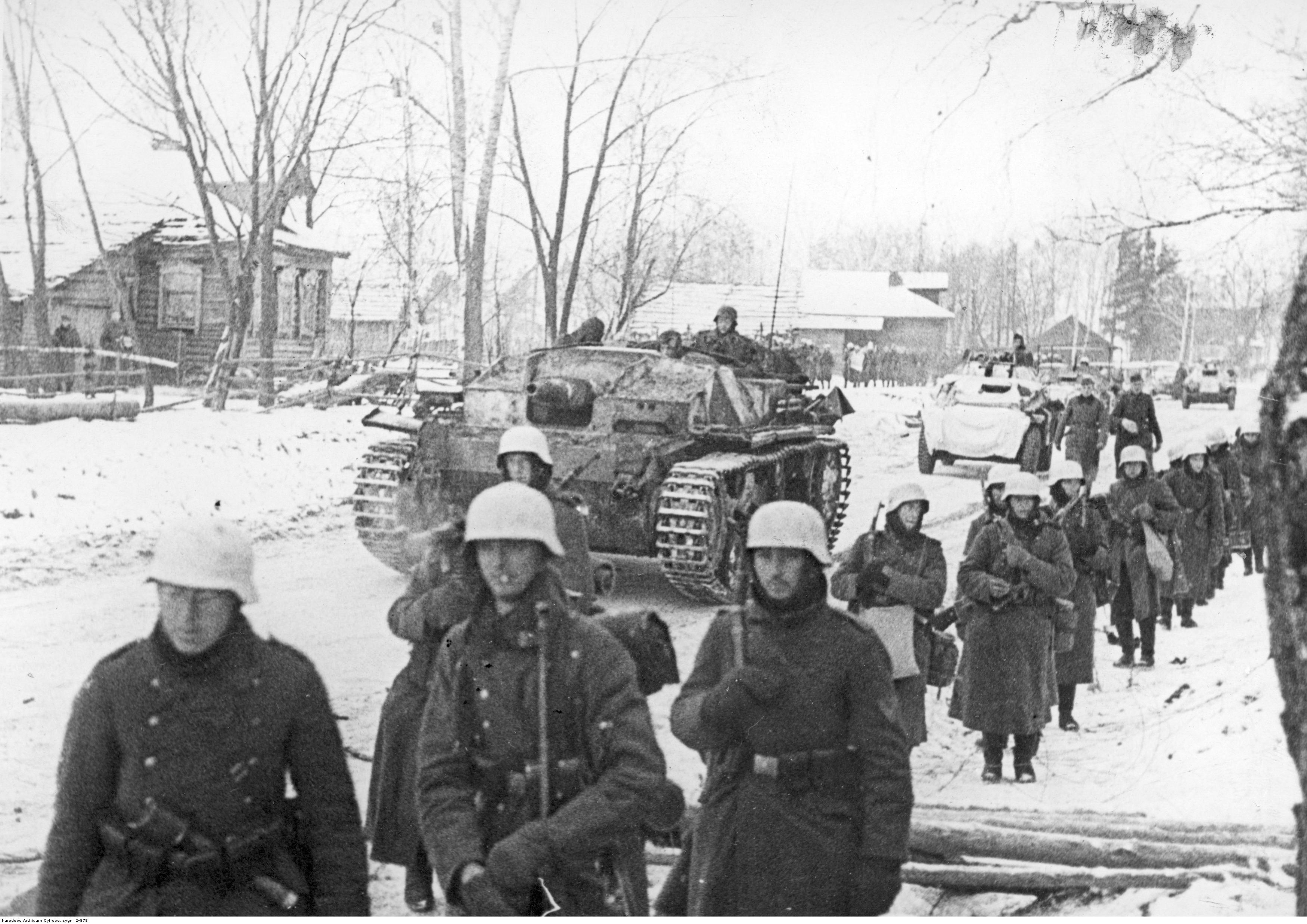
* German soldiers take position near a [[Sturmgeschütz III]] on the Eastern Front, 1942 | |||
* Destroyed German [[Hummel (vehicle)|Hummel]] and crew in the [[Falaise pocket]] during the [[Normandy campaign]], 1944 | |||
* Stuka flying over [[battle of Stalingrad|Stalingrad]], 1942 | |||
* Soviet soldier raising a flag over the [[Reichstag building|Reichstag]] after the [[Battle of Berlin]], 1945 | |||
* Destruction after Allied [[bombing of Dresden]], 1945}} | |||
| date = [[Battle of Westerplatte|1 September 1939]]{{snd}}[[Battle of Odžak|25 May 1945]] ({{Age in years, months, weeks and days|month1=9|day1=1|year1=1939|month2=5|day2=25|year2=1945}}) | |||
| place = [[Europe]] and adjoining regions | | place = [[Europe]] and adjoining regions | ||
| result = Allied victory | |||
| combatants_header = [[World War II by country|Belligerents]] | |||
| combatant1 = '''[[Allies of World War II|Allies]]'''{{indented plainlist| | |||
* {{flag|Soviet Union|1936}}{{refn|From 1941|group="nb"}} | |||
* {{flag|United States|1912}}{{refn|From 1941|group="nb"}} | |||
| result = | |||
| combatant1 = '''[[Allies of World War II|Allies]] | |||
* {{flag|Soviet Union|1936}}{{refn| | |||
* {{flag|United States|1912}}{{refn| | |||
* {{flag|United Kingdom}} | * {{flag|United Kingdom}} | ||
* {{ | * {{flag|French Third Republic|name=France}}{{refn| | ||
* | *[[French Third Republic|FTR]] until 1940. | ||
*[[Free France]] from 1940 to 1944. | |||
*[[Provisional Government of the French Republic|PGFR]] from 1944.|group="nb"}} | |||
* {{flagcountry| | * {{flagcountry|Second Polish Republic|1928}}{{refn| | ||
*[[Second Polish Republic|SPR]] until 1939. | |||
*[[Polish government-in-exile]] from 1939. | |||
* | *[[Provisional Government of the Republic of Poland|PGRP]] from 1944.|group="nb"}} | ||
* | * {{flag|Kingdom of Yugoslavia|name=Yugoslavia}}{{refn| | ||
* | *[[Kingdom of Yugoslavia|KOY]] until 1941. | ||
* {{ | *[[Yugoslav government-in-exile]] from 1941 to 1945. | ||
*[[DF Yugoslavia]] from 1943.|group="nb"}} | |||
* | * {{flagicon image|Flag of the Democratic Government of Albania (1944–1946).svg}} [[Democratic Government of Albania|Albania]] | ||
* {{flagicon|Kingdom of Greece|state}} [[Kingdom of Greece|Greece]] | |||
*([[Allies of World War II|and others]]) | |||
* | }} | ||
* | | combatant2 = '''[[Axis powers|Axis]]'''{{indented plainlist| | ||
* {{flagcountry|Nazi Germany}}{{refn|*([[Battle of Poljana|until 15 May 1945]])|group="nb"}} | |||
* {{flagcountry|Kingdom of Italy}}{{refn|Until the [[Armistice of Cassibile]], 8 September 1943|group="nb"}} | |||
* {{ | * {{flagcountry|Kingdom of Romania}}{{refn|Until [[1944 Romanian coup d'état|King Michael's coup]], 23 August 1944<br>second Axis power in Europe from 8 September 1943<ref>{{Cite book |last=Stahel |first=David |title=Joining Hitler's Crusade |publisher=Cambridge University Press |year=2018 |page=78 |isbn=978-1-316-51034-6 |url=https://books.google.com/books?id=VMk-DwAAQBAJ&pg=PA78}}</ref>|group="nb"}} | ||
* {{ | * {{flagcountry|Kingdom of Hungary (1920–1946)}}{{refn|German occupation from [[Operation Margarethe|19 March 1944]]|group="nb"}} | ||
* | * {{flagcountry|Tsardom of Bulgaria (1908-1946)}}{{refn|Until 17 August 1944<ref>{{Cite book |last1=Bideleux |first1=Robert |last2=Jeffries |first2=Ian |title=The Balkans: A Post-Communist History |publisher=Routledge |year=2007 |page=84 |isbn=978-1-134-58328-7 |url=https://books.google.com/books?id=G6iBAgAAQBAJ&pg=PA84}}</ref>|group="nb"}} | ||
* {{Flag|Finland}}{{refn|25 June 1941{{snd}}19 September 1944|group="nb"}} | |||
| combatant2 = '''[[Axis powers|Axis]] | }}'''Puppet states'''{{indented plainlist| | ||
* | * {{flag|Italian Social Republic}}{{refn|From 23 September 1943, [[Spring 1945 offensive in Italy|Until 2 May 1945.]]|group="nb"}} | ||
* {{flagcountry| | |||
* {{flagcountry|Kingdom of Romania}}{{refn| | |||
* {{flagcountry|Kingdom of Hungary ( | |||
* {{flagcountry| | |||
* {{Flag|Finland}}{{refn|25 June 1941 | |||
}}''' | |||
* {{ | |||
* {{flagcountry|Slovak Republic (1939–1945)|name=Slovakia}} | * {{flagcountry|Slovak Republic (1939–1945)|name=Slovakia}} | ||
* {{flagcountry|Independent State of Croatia|name=Croatia}} | * {{flagcountry|Independent State of Croatia|name=Croatia}} | ||
* {{ | * {{flagcountry|Hellenic State (1941-1944)}} | ||
*([[Axis Powers|and others]]) | |||
}} | }} | ||
| commander1 = {{indented plainlist| | | commander1 = {{indented plainlist| | ||
* {{flagicon| | * {{flagicon|USSR|1936}} [[Joseph Stalin]] | ||
* {{nowrap|{{flagicon| | * {{nowrap|{{flagicon|USA|1912}} [[Franklin D. Roosevelt]] [[Death by natural causes|#]]}} | ||
* {{flagicon| | * {{flagicon|USA|1912|}} [[Harry S. Truman]] | ||
* {{flagicon| | * {{flagicon|UK}} [[Neville Chamberlain]] | ||
* {{flagicon|UK}} [[Winston Churchill]] | |||
* {{flagicon|French Third Republic}} [[Édouard Daladier]] | |||
* {{flagicon|Free France}} [[Charles de Gaulle]] | * {{flagicon|Free France}} [[Charles de Gaulle]] | ||
* | * {{flagicon|Second Polish Republic|1928}} [[Władysław Raczkiewicz]] | ||
* {{flagicon|Provisional Government of the Republic of Poland}} [[Bolesław Bierut]] | |||
* {{flagicon|Kingdom of Yugoslavia}} [[Dušan Simović]] | * {{flagicon|Kingdom of Yugoslavia}} [[Dušan Simović]] | ||
* {{flagicon|Democratic Federal Yugoslavia}} [[Josip Broz Tito]] | * {{flagicon|Democratic Federal Yugoslavia}} [[Josip Broz Tito]] | ||
* {{flagicon image|Flag of the Democratic Government of Albania (1944–1946).svg}} [[Enver Hoxha]] | |||
* {{flagicon|Kingdom of Greece|state}} [[Emmanouil Tsouderos]] | * {{flagicon|Kingdom of Greece|state}} [[Emmanouil Tsouderos]] | ||
}} | |||
| commander2 = {{plainlist| | | commander2 = {{plainlist| | ||
* {{flagicon|Nazi Germany}} [[Adolf Hitler]]{{ | * {{flagicon|Nazi Germany}} [[Adolf Hitler]]{{suicide|Death of Adolf Hitler}} | ||
* | * {{flagicon|Nazi Germany}} [[Karl Dönitz]] | ||
* {{flagicon|Kingdom of Romania}} [[Ion Antonescu]]{{Executed | * {{nowrap|{{flagicon|Kingdom of Italy}} [[Benito Mussolini]]}}{{Executed|Death of Benito Mussolini}} | ||
* {{flagicon|Kingdom of Hungary ( | * {{flagicon|Kingdom of Romania}} [[Ion Antonescu]]{{Executed}} | ||
* {{flagicon|Kingdom of Bulgaria}} [[Boris III]] [[Death by natural causes|#]] | * {{flagicon|Kingdom of Hungary (1920–1946)}} [[Miklós Horthy]] | ||
* {{flagicon|Kingdom of Hungary (1920–1946)}} [[Ferenc Szálasi]]{{Executed}} | |||
* {{flagicon|Tsardom of Bulgaria (1908-1946)}} [[Boris III]] [[Death by natural causes|#]] | |||
* {{flagicon|Republic of Finland}} [[Risto Ryti]] | |||
* {{flagicon|Slovak Republic (1939–1945)}} [[Jozef Tiso]]{{Executed}} | * {{flagicon|Slovak Republic (1939–1945)}} [[Jozef Tiso]]{{Executed}} | ||
* {{flagicon|Independent State of Croatia}} [[Ante Pavelić]] | * {{flagicon|Independent State of Croatia}} [[Ante Pavelić]] | ||
* {{flagicon| | * {{flagicon|Hellenic State (1941–1944)}} [[Ioannis Rallis]] | ||
}} | |||
| strength1 = 44,150,000+ total<ref>Frieser, Karl-Heinz (2013)''The Blitzkrieg Legend''. Naval Institute Press</ref>{{sfn|MacDonald|2005|p=478}}{{sfn|Glantz|House|2015|pp=301–303}} | |||
| strength1 = | | strength2 = {{flagicon|Nazi Germany}} 18,000,000+ total<ref>{{Cite book |last=Overmans |first=Rüdiger |title=Deutsche militärische Verluste im Zweiten Weltkrieg |location=München |publisher=Oldenbourg |year=2004 |page=215 |language=de}}</ref><ref>Total German soldiers who surrendered in the West, including 3,404,950 who surrendered after the end of the war, is given as 7,614,790. To this must be added the 263,000–655,000 who died, giving a rough total of 8 million German soldiers having served on the Western Front in 1944–1945.{{harvnb|Ellis|1993|p=256}}</ref>{{sfn|Glantz|House|2015|pp=301–303}}<br>{{flagicon|Fascist Italy}} 2,560,000 total<ref>{{Cite book |last=Cloutier |first=Patrick |title=Regio Esercito: The Italian Royal Army in Mussolini's Wars, 1935–1943 |page=211}}</ref> | ||
| strength2 = {{flagicon|Nazi Germany}} 18,000,000+ | | casualties1 = '''Killed:''' 9,007,590–10,338,576<br>'''Captured:'''<br>5,778,680{{refn|Ellis: | ||
| casualties1 = 9,007,590–10,338,576 | |||
* Norwegian: 2,000 killed or missing with no information provided on those wounded or captured; | * Norwegian: 2,000 killed or missing with no information provided on those wounded or captured; | ||
* Dutch: 2,890 killed or missing, 6,900 wounded, with no information provided on those captured; | * Dutch: 2,890 killed or missing, 6,900 wounded, with no information provided on those captured; | ||
| Line 120: | Line 102: | ||
US Army/Air Forces breakdown: | US Army/Air Forces breakdown: | ||
*According to a post-war US Army study using war records, the army and army air forces of the United States suffered 586,628 casualties in western Europe, including 116,991 killed in action and 381,350 wounded, of whom 16,264 later died of their wounds.{{sfn|''U.S. Army Casualties in World War II''|1951}}{{page needed|date=July 2022}} | *According to a post-war US Army study using war records, the army and army air forces of the United States suffered 586,628 casualties in western Europe, including 116,991 killed in action and 381,350 wounded, of whom 16,264 later died of their wounds.{{sfn|''U.S. Army Casualties in World War II''|1951}}{{page needed|date=July 2022}} | ||
Total US casualties come to 133,255 killed, 365,086 wounded, 73,759 captured, and 14,528 missing, | Total US casualties come to 133,255 killed, 365,086 wounded, 73,759 captured, and 14,528 missing, 2,000 of whom were later declared dead.|group=nb}}<ref>{{Cite book |last=Erlikman |first=Vadim |title=Poteri narodonaseleniia v XX veke: spravochnik |location=Moscow |year=2004 |isbn=5-93165-107-1 |language=ru}}; {{Cite book|last=Axworthy |first=Mark |title=Third Axis, Fourth Ally |publisher=Arms and Armour |year=1995 |page=216 |isbn=1-85409-267-7}}</ref> | ||
Mark | | casualties2 = '''Killed:'''<br>5,406,110–5,798,110{{refn|43,110 Germans killed or missing, 111,640 wounded, no information is provided on any who were captured. Italian losses amounted to 1,250 killed or missing, 4,780 wounded, and no information is provided on any who were captured.{{sfn|Ellis|1993|p=255}}|group=nb}}<ref>{{Cite book |last=Marshall |first=George C. |title=Biennial Reports of the Chief of Staff of the United States Army to the Secretary of War: 1 July 1939–30 June 1945 |location=Washington, D.C. |publisher=Center of Military History, United States Army |year=1996 |page=202 |url=http://www.history.army.mil/html/books/070/70-57/index.html |archive-url=https://web.archive.org/web/20120118023511/http://www.history.army.mil/html/books/070/70-57/index.html |archive-date=2012-01-18 |url-status=dead}} <!-- US Army historian Charles B. MacDonald (''The European Theater of Operations: The Last Offensive'', Center of Military History, United States Army, Washington D.C., 1993, p. 478) holds that "exclusive of prisoners of war, all German casualties in the west from D-day to V–E Day probably equaled or slightly exceeded Allied losses". In the related footnote he writes the following: "The only specific figures available are from OB WEST for the period 2 June 1941 – 10 April 1945 as follows: Dead, 80,819; wounded, 265,526; missing, 490,624; total, 836,969. (Of the total, 4,548 casualties were incurred prior to D-day.) See Rpts, Der Heeresarzt im Oberkommando des Heeres Gen St d H/Gen Qu, Az.: 1335 c/d (IIb) Nr.: H.A./263/45 g. Kdos. of 14 Apr 45 and 1335 c/d (Ilb) (no date, but before 1945). The former is in OCMH X 313, a photostat of a document contained in German armament folder H 17/207; the latter in folder 0KW/1561 (OKW Wehrmacht Verluste). These figures are for the field army only, and do not include the Luftwaffe and Waffen-SS. Since the Germans seldom remained in control of the battlefield in a position to verify the status of those missing, a considerable percentage of the missing probably were killed. Time lag in reporting probably precludes these figures' reflecting the heavy losses during the Allied drive to the Rhine in March, and the cut-off date precludes inclusion of the losses in the Ruhr Pocket and in other stages of the fight in central Germany." --></ref><ref name="Overmans"> | ||
| casualties2 = 5,406,110–5,798,110 | * {{Cite book |last=Overmans |first=Rüdiger |title=Deutsche militärische Verluste im Zweiten Weltkrieg |publisher=Oldenbourg |year=2000 |isbn=3-486-56531-1}}; {{Cite web |url=http://ww2stats.com/cas_ger_var_wvw.html |title=German military deaths to all causes EF |access-date=2018-07-10 |archive-url=https://web.archive.org/web/20130502201829/http://ww2stats.com/cas_ger_var_wvw.html |archive-date=2013-05-02 |url-status=dead}}; {{Cite book |last=Overy |first=Richard |title=The Dictators: Hitler's Germany and Stalin's Russia |year=2004 |publisher=Allen Lane |isbn=0-7139-9309-X}}{{page needed|date=July 2022}} | ||
* Rüdiger | |||
* Italy: | * Italy: | ||
** Ufficio Storico dello Stato Maggiore dell'Esercito. Commissariato generale C.G.V. . Ministero della Difesa – Edizioni 1986 | ** Ufficio Storico dello Stato Maggiore dell'Esercito. Commissariato generale C.G.V. . Ministero della Difesa – Edizioni 1986 | ||
| Line 131: | Line 111: | ||
* Hungarian wounded: {{harvnb|Clodfelter|2017|p=527}}. | * Hungarian wounded: {{harvnb|Clodfelter|2017|p=527}}. | ||
* Soviet volunteer deaths: | * Soviet volunteer deaths: | ||
** Percy Schramm Kriegstagebuch des Oberkommandos der Wehrmacht: 1940–1945: 8 Bde. | ** Percy Schramm Kriegstagebuch des Oberkommandos der Wehrmacht: 1940–1945: 8 Bde. {{ISBN|9783881990738}} pp. 1508–1511 | ||
* German prisoners: {{harvnb|Krivosheev|2001|at=Table 198}}.</ref> 8,709,840 | * German prisoners: {{harvnb|Krivosheev|2001|at=Table 198}}.</ref><br>'''Captured:'''<br>8,709,840<ref name="Overmans" />{{refn|Total German casualties between September 1939 to 31 December 1944, on the Western Front for both the army, Waffen SS, and foreign volunteers amounts to 128,030 killed, 399,860 wounded. 7,614,790 were held in POW camps by early June 1945 (including 3,404,950 who were disarmed following the surrender of Germany).{{sfn|Ellis|1993|p=256}} See also: [[Disarmed Enemy Forces]]|group=nb}} | ||
| casualties3 = 19,650,000–25,650,000 civilians killed{{#tag:ref|All totals listed only include direct deaths due to military activity and crimes against humanity, including the [[Holocaust]].<ref>Niewyk, Donald L. The Columbia Guide to the Holocaust, Columbia University Press, 2000; {{ISBN|0-231-11200-9}}, p. 421.</ref><br>'''Germany: 910,000.''' 410,000 in Allied strategic bombing, 300,000 in the Holocaust not including Austrian civilian deaths or deaths from the Nazi T4 program.<ref>Statistisches Jahrbuch für die Bundesrepublik Deutschland 1960 Bonn 1961 p. 78</ref> Counting the [[Aktion T4]] program adds 200,000+ deaths to the total.<ref>Bundesarchiv Euthanasie" im Nationalsozialismus, bundesarchiv.de; accessed 5 March 2016.(German)</ref><br>'''France: 390,000.''' Includes 77,000 French Jews in the [[Holocaust]].{{sfn|Frumkin|1951|pp=58–59}}<br>'''Netherlands: 187,300.''' Includes 100,000 Dutch Jews in the Holocaust.<ref>"Central Bureau of Statistics (CBS) Netherlands" (PDF). Retrieved 4 March 2016.</ref><br>'''Belgium: 76,000.''' Includes 27,000 Belgian Jews in the Holocaust.{{sfn|Frumkin|1951| | | casualties3 = 19,650,000–25,650,000 civilians killed{{#tag:ref|All totals listed only include direct deaths due to military activity and crimes against humanity, including the [[Holocaust]].<ref>Niewyk, Donald L. The Columbia Guide to the Holocaust, Columbia University Press, 2000; {{ISBN|0-231-11200-9}}, p. 421.</ref><br>'''Germany: 910,000.''' 410,000 in Allied strategic bombing, 300,000 in the Holocaust not including Austrian civilian deaths or deaths from the Nazi T4 program.<ref>Statistisches Jahrbuch für die Bundesrepublik Deutschland 1960 Bonn 1961 p. 78</ref> Counting the [[Aktion T4]] program adds 200,000+ deaths to the total.<ref>Bundesarchiv Euthanasie" im Nationalsozialismus, bundesarchiv.de; accessed 5 March 2016.(German)</ref><br>'''France: 390,000.''' Includes 77,000 French Jews in the [[Holocaust]].{{sfn|Frumkin|1951|pp=58–59}}<br>'''Netherlands: 187,300.''' Includes 100,000 Dutch Jews in the Holocaust.<ref>"Central Bureau of Statistics (CBS) Netherlands" (PDF). Retrieved 4 March 2016.</ref><br>'''Belgium: 76,000.''' Includes 27,000 Belgian Jews in the Holocaust.{{sfn|Frumkin|1951|pp=44–45}}<br>'''United Kingdom: 67,200.''' Mostly died in German bombing.<ref>Commonwealth War Graves Commission Annual Report 2013–2014, page 44.</ref><br>'''Norway: 8,200.'''{{sfn|Frumkin|1951|p=144}} Includes 800 Norwegian Jews in the Holocaust.<br>'''Denmark: 6,000.'''<ref>"Hvor mange dræbte danskere?". Danish Ministry of Education. Retrieved 4 March 2016.</ref><br>'''Luxembourg: 5,000.''' Includes 2,000 Luxembourgish Jews.{{sfn|Frumkin|1951|p=59}}|group=nb}}{{sfn|Krivosheev|1997}} | ||
| campaignbox = {{WWIITheatre}} | | campaignbox = {{WWIITheatre}} | ||
}} | }} | ||
== | The '''European theatre of World War II''' was one of the two main [[Theater (warfare)|theatres of combat]]{{refn|The other main theatre of operations was the [[Pacific War]].|group=nb}} during [[World War II]], taking place from September 1939 to May 1945. The [[Allies of World War II|Allied powers]] (including the [[United Kingdom]], the [[United States]], the [[Soviet Union]] and [[Free France|France]]) fought the [[Axis powers]] (including [[Nazi Germany]] and the [[Kingdom of Italy]]) on both sides of the continent in the [[Western Front (World War II)|Western]] and [[Eastern Front (World War II)|Eastern]] fronts. There was also conflict in the [[Scandinavia]]n, [[Mediterranean]] and [[Balkan]] regions. It was an intense conflict that led to at least 39 million deaths and a dramatic change in the balance of power in the continent. | ||
During the 1930s, [[Adolf Hitler]], the leader of Nazi Germany, expanded German territory by annexing all of [[Austria]] and the [[Sudetenland]] region of [[Czechoslovakia]] in 1938. This was motivated in part by [[Racial policy of Nazi Germany|Germany's racial policy]] that believed the country needed to expand for the [[Pseudoscience|pseudoscientific]] "[[Aryan race]]" to survive. They were aided by Italy, another fascist state which was led by [[Benito Mussolini]]. World War II started with [[Nazi Germany|Germany]]'s [[invasion of Poland]] on 1 September 1939, and the Soviet Union, led by [[Joseph Stalin]], [[Soviet invasion of Poland|joined the invasion]] later that month. The two nations then partitioned Poland between them. | |||
Poland's allies, [[France]] and the United Kingdom, declared war on Germany days after the invasion of Poland but did not want to actually engage in conflict. This changed after Germany invaded [[Norwegian campaign|Norway]], [[German invasion of Denmark (1940)|Denmark]], [[Battle of France|France]], [[German invasion of Luxembourg|the Netherlands]], [[German invasion of Belgium (1940)|Belgium]], and [[German invasion of Luxembourg|Luxembourg]]. The six countries were taken over, and Germany began two successive aerial bombardments of the United Kingdom, in the [[Battle of Britain]] and [[the Blitz]]. British prime minister [[Winston Churchill]] led his country's war effort. Germany also began a widespread [[genocide]] of [[Jews]] in the [[Holocaust]]. In 1940, [[Greco-Italian War|Italy invaded Greece]], and in 1941, Germany [[World War II in Yugoslavia|invaded Yugoslavia]] and [[German invasion of Greece|Greece]]. In June 1941, Germany began an [[invasion of the Soviet Union]], breaking the countries' [[non-aggression pact]], and in December 1941 Germany [[German declaration of war against the United States|declared war]] on the United States, shortly after [[Imperial Japan]] did so. The United States was led by President [[Franklin D. Roosevelt]]. | |||
In 1942, the Soviets stopped further invasion of their country at the [[Battle of Stalingrad]]. Meanwhile, the Allies engaged in a mass bombing campaign of German industrial targets. In 1943, the Allied powers began an [[Allied invasion of Italy|invasion of Italy]], causing the [[Fall of the Fascist regime in Italy|end of Mussolini's regime]], but Germans and Italians loyal to the Axis continued fighting. In April 1945, [[Death of Franklin D. Roosevelt|Roosevelt died]] and was succeeded by [[Harry S. Truman]]. The Allies [[Liberation of Rome|liberated Rome]] in June 1944. Also in June, the Allied powers [[Operation Overlord|began an invasion]] of German-occupied western Europe, while the Soviets launched a [[Operation Bagration|massive counterattack in eastern Europe]]. Both campaigns were successful for the Allies. The Soviet Union conquered most of Eastern Europe including the German capital [[Berlin]], as Mussolini [[Death of Benito Mussolini|was hanged]] and Hitler [[Death of Adolf Hitler|committed suicide]]. [[Nazi concentration camps|Concentration camps]] that were used in the Holocaust were liberated. Germany [[German Instrument of Surrender|unconditionally surrendered]] on [[8 May 1945]],{{refn|All German forces were to cease operations on 23:01 hours Central European time on 8 May 1945, which was already 9 May in Moscow and other parts of the USSR; therefore [[Victory Day (9 May)|9 May]] was considered to be the end of the war in the Soviet Union and still is in its successor states|group=nb}} although fighting continued elsewhere in Europe until [[World War II in Yugoslavia|25 May]]. On 5 June 1945, the [[Berlin Declaration (1945)|Berlin Declaration]], proclaiming the unconditional surrender of [[Nazi Germany|Germany]] to the four victorious powers, was signed. The Allied powers then moved to finish the [[Pacific War]] against Japan. | |||
Once World War II ended, the Allies occupied the European continent, giving some countries back to their pre-war leaders or creating new governments, before funding their nations' economic recovery. German military leaders were subject to the [[Nuremberg trials|Nuremberg criminal trials]]. Western Europe became a series of [[capitalist]] governments and eastern Europe became [[communist]], beginning the [[Cold War]] among the former Allied nations. Germany was split into the capitalist [[West Germany]] and the communist [[East Germany]]. | |||
==Background== | |||
{{Main|Events preceding World War II in Europe|Causes of World War II}} | {{Main|Events preceding World War II in Europe|Causes of World War II}} | ||
=== Axis powers === | |||
{{Main|Axis powers|Nazi Germany|Fascist Italy}} | |||
[[German Empire|Germany]] was defeated in [[World War I]], and the 1919 [[Treaty of Versailles]] placed punitive conditions on the country after finding Germany and the other [[Central Powers]] [[Article 231 of the Treaty of Versailles|guilty for starting the war]]. These punishments included the loss of [[Alsace-Lorraine]], the temporary loss of the [[Saarland]], military limitations, and [[World War I reparations|reparation payments]] to the [[Allies of World War I|Allied powers]]. The [[Rhineland]] region of Germany was also made a [[demilitarised zone]]. Germany would also join the [[League of Nations]], an international governmental body devoted to peacekeeping. Historians are divided on whether or not the treaty was harsh or actually "very restrained" compared to other peace treaties at the time. Many Germans back then blamed their country's post-war economic collapse on the treaty's conditions and these resentments contributed to the political instability, which made it possible for [[Adolf Hitler]] and his [[Nazi Party]] to come to power.<ref>{{Cite web |title=Treaty of Versailles |url=https://education.nationalgeographic.org/resource/treaty-versailles-ends-wwi/ |access-date=3 October 2024 |website=education.nationalgeographic.org |language=en}}</ref><ref>{{Cite web |date=9 September 2024 |title=Treaty of Versailles - Reparations, Military, Limitations {{!}} Britannica |url=https://www.britannica.com/event/Treaty-of-Versailles-1919/German-reparations-and-military-limitations |access-date=3 October 2024 |website=www.britannica.com |language=en}}</ref> This was worsened by the worldwide [[Great Depression]], which began in 1929.<ref>{{Cite web |title=Great Depression |url=https://encyclopedia.ushmm.org/content/en/article/the-great-depression |access-date=15 October 2024 |website=encyclopedia.ushmm.org |language=en}}</ref> | |||
Hitler became the [[Chancellor of Germany|chancellor]] and [[fuhrer]] of Germany in 1933.<ref name="www.britannica.com-2024j">{{Cite web |date=24 September 2024 |title=Adolf Hitler {{!}} Biography, Rise to Power, History, & Facts {{!}} Britannica |url=https://www.britannica.com/biography/Adolf-Hitler |access-date=3 October 2024 |website=www.britannica.com |language=en}}</ref> In February 1933, the German [[Reichstag building]] caught on fire in an [[arson]] attack, giving Hitler the opportunity to blame the fire on his political opponents, especially [[communists]]. In response, the government passed the [[Decree of the Reich President for the Protection of the German People|Decree of the Reich President for the Protection of the People and State]], which "abolished freedom of speech, assembly, privacy and the press; legalized [[phone tapping]] and interception of correspondence; and suspended the autonomy of federated states, like [[Bavaria]]". Communist politicians were arrested, leaving the Nazi Party free to do what they wanted.<ref>{{Cite web |last1=Magazine |first1=Smithsonian |last2=Boissoneault |first2=Lorraine |title=The True Story of the Reichstag Fire and the Nazi Rise to Power |url=https://www.smithsonianmag.com/history/true-story-reichstag-fire-and-nazis-rise-power-180962240/ |access-date=15 October 2024 |website=Smithsonian Magazine |language=en}}</ref> Hitler made Germany an absolute dictatorship, and he withdrew from the League of Nations.<ref name="www.britannica.com-2024j" /> In 1934, during the [[Night of the Long Knives]], Hitler ordered the purge of leaders within the Nazi Party's ''[[Sturmabteilung]]'' (SA) paramilitary organisation, believing them to have gotten too powerful.<ref>{{Cite web |title=Night of the Long Knives {{!}} Date, Victims, Summary, & Facts {{!}} Britannica |url=https://www.britannica.com/event/Night-of-the-Long-Knives |access-date=15 October 2024 |website=www.britannica.com |language=en}}</ref><ref>{{Cite web |title=SA {{!}} Definition, History, & Facts {{!}} Britannica |url=https://www.britannica.com/topic/SA-Nazi-organization |access-date=15 October 2024 |website=www.britannica.com |language=en}}</ref> | |||
From 1919 to 1921, Italian fascist [[Benito Mussolini]] grew a base of supporters who wanted him to deal with Italy's political and economic crises, which involved civil conflict over the growth of socialism in the country. Many of Mussolini's supporters became known as [[blackshirts]], who would form a paramilitary that terrorised the Italian countryside in a campaign against socialism. In 1922, during a controversial [[general strike]] by a weakened [[trade union]]ist movement, Mussolini and his followers [[March on Rome|seized power in Rome]] and installed him as the [[Prime Minister of Italy]] to run the country alongside the pre-existing monarchy of King [[Victor Emmanuel III]]. Similar to Germany, Mussolini turned the country into a one-party [[Fascist Italy|fascist state]] which outlawed free speech, the free press, trade unions, and targeted socialists, Catholics, and liberals with a [[OVRA|network of secret police]] and spies. Italy became sympathetic to Nazi Germany in the 1930s.<ref name="www.britannica.com-2024n">{{Cite web |date=4 October 2024 |title=Benito Mussolini {{!}} Biography, Definition, Facts, Rise, & Death {{!}} Britannica |url=https://www.britannica.com/biography/Benito-Mussolini |access-date=15 October 2024 |website=www.britannica.com |language=en}}</ref> | |||
[[File:Celebration of the Japan-Germany-Italy-Triparite-Pact (1940) in Tokio.jpg|thumb|A celebration at the 1940 Tokyo signing of the [[Tripartite Pact|Tripartite Act]] defence agreement between [[Nazi Germany]], [[Imperial Japan]], and [[Fascist Italy]]; their flags are present|upright=1.36]] | |||
Italy, Germany, and [[Imperial Japan]] — led by Emperor [[Hirohito]] and Prime Minister [[Hideki Tojo]] — increasingly allied with each other, and during World War II they would be known as the [[Axis powers]].<ref name="www.britannica.com-2024j" /><ref name="www.britannica.com-2024n" /><ref>{{Cite web |date=21 August 2024 |title=Tojo Hideki {{!}} Biography, Early Years, World War II, Facts, & Death {{!}} Britannica |url=https://www.britannica.com/biography/Tojo-Hideki |access-date=3 October 2024 |website=www.britannica.com |language=en}}</ref> Italy and Japan needed allies, as Italy was involved in the [[Second Italo-Ethiopian War]] (the Italian invasion of the [[Ethiopian Empire]]) from 1935 to 1937, and Japan started the [[Second Sino-Japanese War]] (Japan's expanded invasion of the [[Republic of China (1912–1949)|Republic of China]]) in 1937, the latter of which was subsumed by World War II and ended in 1945.<ref>{{Cite web |title=Axis Alliance in World War II |url=https://encyclopedia.ushmm.org/content/en/article/axis-powers-in-world-war-ii |access-date=15 October 2024 |website=encyclopedia.ushmm.org |language=en}}</ref> | |||
In 1936, Italy and Germany made a pact of mutual assurance, the [[Rome-Berlin Axis]] agreement.<ref>{{Cite web |title=Rome-Berlin Axis {{!}} Nazi Germany, Fascist Italy & Mussolini {{!}} Britannica |url=https://www.britannica.com/topic/Rome-Berlin-Axis |access-date=15 October 2024 |website=www.britannica.com |language=en}}</ref> Also that year, Japan and Germany signed the [[Anti-Comintern Pact]] to counter the perceived threat of communism from the [[Soviet Union]] led by [[Joseph Stalin]]; Italy joined the pact in 1937.<ref>{{Cite web |title=Anti-Comintern Pact {{!}} Axis Powers, Nazi Germany, Japan {{!}} Britannica |url=https://www.britannica.com/event/Anti-Comintern-Pact |access-date=3 October 2024 |website=www.britannica.com |language=en}}</ref> Italy and Germany signed the [[Pact of Steel]] in 1939, formalising the Rome-Berlin axis.<ref>{{Cite web |title=Pact of Steel {{!}} Italy–Germany [1939] {{!}} Britannica |url=https://www.britannica.com/event/Pact-of-Steel |access-date=15 October 2024 |website=www.britannica.com |language=en}}</ref> Other [[Axis powers|smaller powers joined the Axis]] throughout World War II.<ref>{{Cite web |title=Axis Alliance in World War II |url=https://encyclopedia.ushmm.org/content/en/article/axis-powers-in-world-war-ii |access-date=3 October 2024 |website=encyclopedia.ushmm.org |language=en}}</ref> The Axis' main opponents would be the [[Allies of World War II|Allies]], a name reused from the [[Allies of World War I|Allies]] who were the main opponent of the Central Powers in World War I.<ref>{{Cite web |title=The Big Three |url=https://www.nationalww2museum.org/war/articles/big-three#:~:text=In%20World%20War%20II,%20the,the%20war%20should%20be%20fought. |access-date=15 October 2024 |website=The National WWII Museum {{!}} New Orleans |language=en}}</ref> | |||
=== Nazi social policies === | |||
Under the Nazi Party, Germany [[Racial hierarchy|developed a hierarchy]] which considered the pseudoscientific "[[Aryan race]]" — white ethnic Germans or those closest genetically to them – as the most superior race, and Jews and Slavs at or near the bottom. A major part of [[Racial policy of Nazi Germany|Nazi Germany's racial policy]] was the concept of ''[[lebensraum]]'', or "living space": increasing the amount of land in Europe where members of the Aryan race could live. The [[United States Holocaust Memorial Museum]] writes: | |||
{{Blockquote|text=The Nazis also adopted the [[social Darwinist]] take on [[Darwinism|Darwinian evolutionary theory]] regarding the "[[survival of the fittest]]." For the Nazis, survival of a race depended upon its ability to reproduce and multiply, its accumulation of land to support and feed that expanding population, and its vigilance in maintaining the purity of its [[gene pool]], thus preserving the unique "racial" characteristics with which "nature" had equipped it for success in the struggle to survive. Since each "race" sought to expand, and since the space on the earth was finite, the struggle for survival resulted "naturally" in violent conquest and military confrontation. Hence, war—even [[perpetual war|constant war]]—was a part of nature, a part of the [[human condition]].}}[[File:Greater Germanic Reich.png|thumb|The boundaries of the "[[Greater Germanic Reich]]" that the [[Nazi Party]] planned to be occupied by the "[[Aryan race]]", who were alleged to require "living space" ''([[lebensraum]])'' in Europe beyond Germany's borders<ref>{{Cite web |date=15 September 2018 |title=Dokumentation Obersalzberg: Utopia: The "Greater Germanic Reich of the German Nation" |url=https://www.obersalzberg.de/en/exhibition/zweiter-weltkrieg/occupied-europe/utopie-grossgermanisches-reich/ |access-date=25 November 2024 |archive-url=https://web.archive.org/web/20180915155030/https://www.obersalzberg.de/en/exhibition/zweiter-weltkrieg/occupied-europe/utopie-grossgermanisches-reich/ |archive-date=15 September 2018 }}</ref>|300x300px]]This formed a key motivation of Germany's expansion in Europe in the mid-to-late 1930s. In 1934, Germany signed a [[non-aggression pact]] with Poland, but this would not last as Poland was considered a part of the ''lebensraum''; Nazi mythology considered eastern Europe to be lost German land.<ref>{{Cite web |title=Victims of the Nazi Era: Nazi Racial Ideology |url=https://encyclopedia.ushmm.org/content/en/article/victims-of-the-nazi-era-nazi-racial-ideology |access-date=3 October 2024 |website=encyclopedia.ushmm.org |language=en}}</ref><ref>{{Cite web |title=Lebensraum |url=https://encyclopedia.ushmm.org/content/en/article/lebensraum |access-date=3 October 2024 |website=encyclopedia.ushmm.org |language=en}}</ref><ref name="encyclopedia.ushmm.org-2">{{Cite web |title=Invasion of Poland, Fall 1939 |url=https://encyclopedia.ushmm.org/content/en/article/invasion-of-poland-fall-1939 |access-date=3 October 2024 |website=encyclopedia.ushmm.org |language=en}}</ref> In 1933, Germany began building [[Nazi concentration camps|concentration camps]] to hold their political enemies and those they considered "[[Social degeneration|degenerates]]", such as people on the lower end of their racial hierarchy, the Nazi Party's political enemies (like [[socialists]], [[social democrats]], and communists), Poles, [[Romani people]], [[Jehovah's Witnesses]], [[Freemasons]],<ref>{{Cite web |title=Freemasonry under the Nazi Regime |url=https://encyclopedia.ushmm.org/content/en/article/freemasonry-under-the-nazi-regime |access-date=15 October 2024 |website=encyclopedia.ushmm.org |language=en}}</ref> disabled people,<ref>{{Cite web |title=The Murder of People with Disabilities |url=https://encyclopedia.ushmm.org/content/en/article/the-murder-of-people-with-disabilities |access-date=15 October 2024 |website=encyclopedia.ushmm.org |language=en}}</ref> and [[LGBTQ]] people.<ref name="encyclopedia.ushmm.org-5">{{Cite web |title=Nazi Camps |url=https://encyclopedia.ushmm.org/content/en/article/nazi-camps |access-date=15 October 2024 |website=encyclopedia.ushmm.org |language=en}}</ref><ref>{{Cite web |date=7 October 2024 |title=Nazi Party - Rise to Power, Ideology, Germany {{!}} Britannica |url=https://www.britannica.com/topic/Nazi-Party/The-Nazi-Party-and-Hitlers-rise-to-power#ref348486 |access-date=15 October 2024 |website=www.britannica.com |language=en}}</ref><ref>{{Cite magazine |last=Carlo |first=Andrea |date=7 April 2021 |title=How LGBTQ Victims Were Erased From Holocaust History |url=https://time.com/5953047/lgbtq-holocaust-stories/ |access-date=15 October 2024 |magazine=Time |language=en}}</ref> They were brought from many places across lower continental Europe to the camps using the extensive [[Rail transport in Europe|railway network]] which crossed the continent.<ref name="encyclopedia.ushmm.org-5" /> The mass killing of the camps' prisoners, which started as soon as they were built, expanded in 1941, which is usually when the start date of the [[Holocaust]] is given.<ref name="encyclopedia.ushmm.org-5" /><ref>{{Cite web |date=26 January 2020 |title=When Did the Holocaust Begin? A Genesis of Genocide |url=https://www.haaretz.com/jewish/holocaust-remembrance-day/2020-01-26/ty-article/when-did-the-holocaust-begin/0000017f-f045-d8a1-a5ff-f0cf4c6d0000 |access-date=14 October 2024 |website=Haaretz}}</ref>{{refn|group=nb| There is debate as to whether "[[Holocaust victims]]" should just refer to the 6 million Jews who were killed, or those 6 million plus the millions of other people who were killed as a part of the same process.<ref name="encyclopedia.ushmm.org-5" /><ref>{{Cite web |title=Holocaust Misconceptions |url=https://www.ilholocaustmuseum.org/holocaust-misconceptions/ |access-date=15 October 2024 |website=Illinois Holocaust Museum |language=en-US}}</ref>}} In 1938, during the ''[[Kristallnacht]]'' [[pogrom]]s, 30,000 Jews were sent to concentration camps.<ref>{{Cite web |title=Kristallnacht |url=https://encyclopedia.ushmm.org/content/en/article/kristallnacht |access-date=15 October 2024 |website=encyclopedia.ushmm.org |language=en}}</ref> | |||
In 1938, German chemists [[Otto Hahn]] and [[Fritz Strassman]] discovered [[nuclear fission]], or the release of large amounts of [[energy]] when an [[atom]]'s [[Atomic nucleus|nucleus]] splits into smaller [[Atomic nucleus|nuclei]]. German scientists of the ''[[Uranverein]]'' ([[uranium]] club) then began a project to develop the [[atomic bomb]], a bomb using nuclear fission that could destroy entire cities. This was supposed to be secret, but scientists fleeing Nazi Germany to avoid persecution made word of the program in other Western countries. In 1939, [[United States]] President [[Franklin D. Roosevelt]] was warned of the program by one of these fleeing scientists, [[Albert Einstein]].<ref>{{Cite web |title=Why didn't the Nazis beat Oppenheimer to the nuclear bomb? – DW – 08/15/2023 |url=https://www.dw.com/en/why-didnt-the-nazis-beat-oppenheimer-to-the-nuclear-bomb/a-66540463 |access-date=18 October 2024 |website=Deutsche Welle |language=en}}</ref> | |||
==== German expansion and the partition of Czechoslovakia ==== | |||
The UK and France responded to Germany's aggressive expansion through [[appeasement]], "maintain[ing] peace in Europe by making limited concessions to German demands", which was seen as reasonable by the British and French populaces because the Treaty of Versailles was thought of as indeed too restrictive, and they did not want to go to war with Germany.<ref name="encyclopedia.ushmm.org-2" /> In 1935, Germany revoked the Treaty of Versailles' limitations on its military, and [[Remilitarisation of the Rhineland|remilitizared the Rhineland]] in 1936.<ref name="encyclopedia.ushmm.org-2" /> On 13 March 1938, Germany annexed Austria in the ''[[Anschluss]]''.<ref name="encyclopedia.ushmm.org-2" /><ref>{{Cite web |title=Anschluss {{!}} Definition, History, & Facts {{!}} Britannica |url=https://www.britannica.com/event/Anschluss |access-date=3 October 2024 |website=www.britannica.com |language=en}}</ref> | |||
Hitler then threatened to go to war with [[Czechoslovakia]], and in response, on 30 September 1938, Hitler, Mussolini, UK prime minister [[Neville Chamberlain]], and French premier [[Edouard Daladier]] signed the [[Munich Agreement]], which gave Germany the [[Sudetenland]], a Czech region near its border with Germany which had long been ethnically German.<ref name="encyclopedia.ushmm.org-2" /><ref name="HISTORY-2020">{{Cite web |date=3 January 2020 |title=Chamberlain Declares "Peace for Our Time" |url=https://www.history.com/news/chamberlain-declares-peace-for-our-time-75-years-ago |access-date=3 October 2024 |website=HISTORY |language=en}}</ref> Chamberlain returned to England and proclaimed that the UK had achieved "[[Peace for our time]]".<ref name="HISTORY-2020" /> At the same time, Hungary annexed a part of southern Slovakia and Poland annexed the [[Cieszyn Silesia|Tešin District]] of [[Czech Silesia]]. On 15 March 1939, Germany occupied the remaining western half of Czechoslovakia, the Czech provinces of [[Bohemia and Moravia]].<ref name="www.britannica.com-2024o">{{Cite web |date=11 October 2024 |title=World War II {{!}} Facts, Summary, History, Dates, Combatants, & Causes {{!}} Britannica |url=https://www.britannica.com/event/World-War-II#ref53531 |access-date=15 October 2024 |website=www.britannica.com |language=en}}</ref> Later that month, part of Slovakia became the independent fascist and Catholic state of the [[Slovak Republic (1939–1945)|Slovak Republic]] under dictator and Catholic priest [[Jozef Tiso]].<ref name="encyclopedia.ushmm.org-6">{{Cite web |title=Czechoslovakia |url=https://encyclopedia.ushmm.org/content/en/article/czechoslovakia |access-date=15 October 2024 |website=encyclopedia.ushmm.org |language=en}}</ref> The republic was controlled by the [[Slovak People's Party]], who made the country a client state of Germany and allowed Germany to occupy it.<ref name="www.britannica.com-2024o" /><ref name="encyclopedia.ushmm.org-6" /> At the same time, the eastern part of Slovakia, the [[Subcarpathian Rus]], was annexed by Hungary. The latter two annexations formally ended the country of Czechoslovakia, which had existed since 1918.<ref name="encyclopedia.ushmm.org-6" /> | |||
By early 1939, Hitler had plans of invading [[Poland]], despite Poland having assurances from the UK and France that those countries would intervene if Poland was attacked.<ref name="www.britannica.com-2024o" /> Germany revoked its non-aggression pact with Poland on 28 April.<ref name="encyclopedia.ushmm.org-2" /> To ensure Germany would not face resistance from the Soviet Union during an invasion, the two countries signed an agreement to neutrality named the [[Molotov–Ribbentrop Pact]] after secret negotiations from 23 to 24 August.<ref name="www.britannica.com-2024o" /><ref>{{Cite web |title=German-Soviet Nonaggression Pact {{!}} History, Facts, & Significance {{!}} Britannica |url=https://www.britannica.com/event/German-Soviet-Nonaggression-Pact |access-date=15 October 2024 |website=www.britannica.com |language=en}}</ref> Hitler gave the orders to invade on 26 August, certain that the UK and the Soviet Union would not retaliate. However, on the 25th, the UK and Poland publicly signed a formal treaty of military assurance, causing Hitler to delay the war for a few days. On 31 August, he gave the order to invade the next day.<ref name="www.britannica.com-2024o" /> | |||
== Beginning of the war in Europe (1939–1940) == | |||
=== Invasion of Poland (1939) === | |||
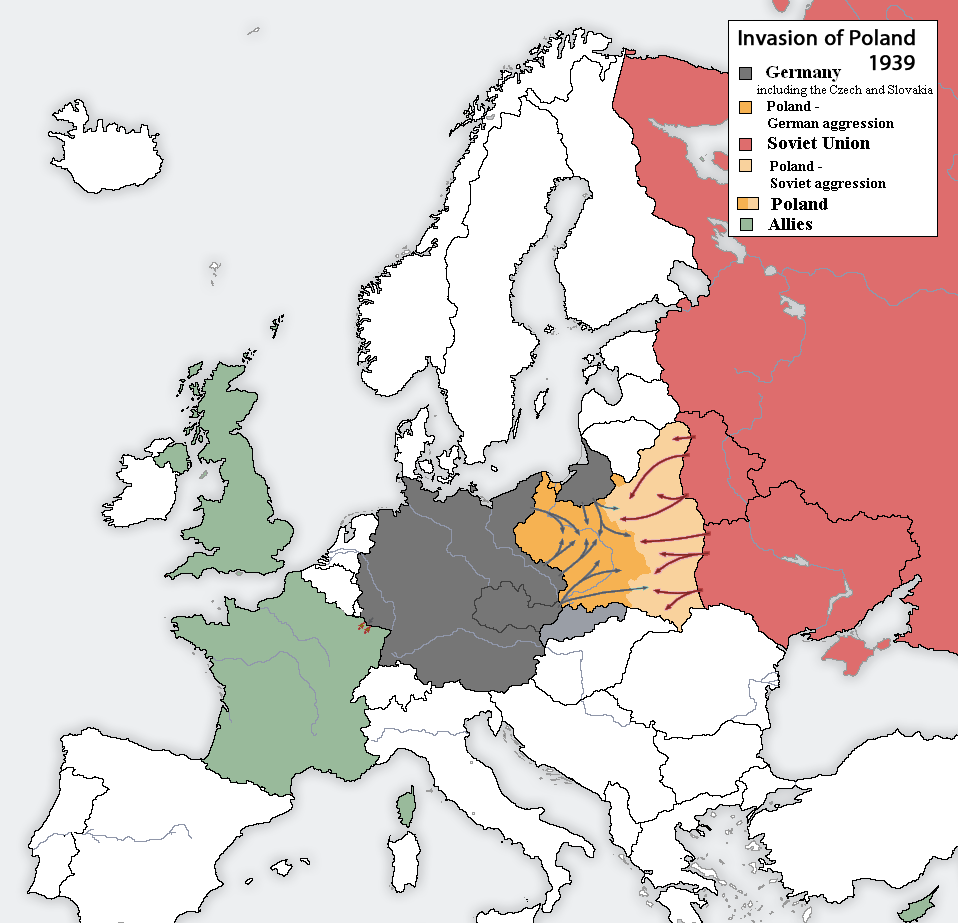
[[File:Invasion of Poland-1939.png|thumb|Europe at the beginning of [[World War II]] in September 1939, showing the September and October movements of Nazi Germany and the [[Soviet Union]] during the [[invasion of Poland]]|300x300px]] | |||
On 1 September 1939, [[Invasion of Poland|Germany invaded Poland]], falsely claiming that Poland was trying to encircle and partition Germany and that ethnic Germans were being persecuted there. Germany had [[Gleiwitz incident|staged an attack]] on one of their own radio stations the previous night and blamed it on the Poles.<ref name="encyclopedia.ushmm.org-2"/> 1.5 million soldiers of the German military, the ''[[Wehrmacht]]'', took part in the invasion, and had overwhelming military superiority to Poland's 1 million soldiers.<ref name="encyclopedia.ushmm.org-2" /><ref name="www.britannica.com-2024o"/> The invasion was led by generals [[Fedor von Bock]], [[Franz Halder]], [[Georg von Küchler]], [[Gerd von Rundstedt]], [[Günther von Kluge]], [[Johannes Blaskowitz]], [[Walther von Brauchitsch]], [[Walther von Reichenau]], and [[Wilhelm List]]. Poland fought on a large front, both on the German border and with their flanks in the German territory of [[East Prussia]] in the north and German-occupied Slovakia in the south. Poland did not move their troops eastward to more defensive positions because their western half had their most vital industrial regions.<ref name="www.britannica.com-2024o"/> | |||
== | The ''Wehrmacht'' used "[[Blitzkrieg]] attacks", surprise attacks with "massive, concentrated forces of fast-moving [armoured] units supported by overwhelming air power".<ref name="encyclopedia.ushmm.org-2"/> Their air force, the [[Luftwaffe]], specifically operated as support for the Army. They quickly destroyed vital Polish infrastructure including the railways, essentially taking out the [[Polish Air Force]] before it could be used.<ref name="www.britannica.com-2024o"/><ref name="www.britannica.com-2024i">{{Cite web |date=25 August 2024 |title=Invasion of Poland (1939) {{!}} Description & Facts {{!}} Britannica |url=https://www.britannica.com/event/Invasion-of-Poland |access-date=3 October 2024 |website=www.britannica.com |language=en}}</ref> In 1939, they surpassed the three current Allied powers in their individual numbers of infantry and armoured divisions (the ''Wehrmacht''<nowiki/>'s armoured divisions are also known as [[Panzer division (Wehrmacht)|panzer divisions]]).{{refn|group=nb|Poland had 30 infantry divisions, 12 cavalry brigades and one armoured brigrade (as well as 30 reserve infantry divisions which could not be mobilised in time); Germany had 100 infantry divisions and six armoured divisions; France had 90 infantry divisions; and the UK had ten infantry divisions.<ref name="www.britannica.com-2024o"/>}} Germany also had more machine guns, [[Mortar (weapon)|mortars]], [[Anti-tank warfare|antitank guns]], and [[howitzer]]s per division than the Allies, while having about an equal number of tanks and military aircraft to the three of them combined.<ref name="www.britannica.com-2024o"/> | ||
{{ | |||
[[ | New types of military technology invented in the interwar years included [[radar]], the [[dive bomber]], and the [[aircraft carrier]]. The Allied countries, motivated by their victory in World War I, had generally not worked to produce significant amounts of newer weapons and military equipment afterwards, feeling confident in what they already had, while Germany did the opposite since remilitarising in 1935. Poland did not have "tanks, [[armoured personnel carrier]]s, and antitank and [[Anti-aircraft warfare|antiaircraft guns]]", and believed [[Horse cavalry|horsed cavalry]] could take on German [[mechanised forces]]. The UK and France did make up for Poland's lack of air strength; Poland only had [[Fighter aircraft|fighters]] and [[bomber]]s, and the other Allies had those plus aircraft meant for either [[reconnaissance]], coastal defence, or naval aviation. The UK had ready the newer [[Hawker Hurricane|Hurricane]] fighter and was producing the [[Spitfire]], which began combat in 1940. France's military aircraft, however, were outdated, and they were trying to buy newer models from the [[United States]]. The UK did not have any armoured divisions, and France's tanks were spread thin across its infantry divisions. The Allies in 1939 were "together superior in industrial resources, population, and military manpower", but German weapons, equipment, training and [[logistics]] made the ''Wehrmacht'' the most powerful army in the world. ''[[Britannica]]'' writes:<ref name="www.britannica.com-2024o"/> | ||
[[File:Bundesarchiv Bild 183-1987-1210-502, Polen, Stukas.jpg|thumb|upright=1.22|The [[Luftwaffe]]'s [[Stuka]] bombers during the invasion of Poland]] | |||
{{Blockquote|text=In accordance with the doctrines of General [[Heinz Guderian]], the German tanks were used in massed formations in conjunction with [[motorized artillery]] to punch holes in the enemy line and to isolate segments of the enemy, which were then surrounded and captured by motorized German infantry divisions while the tanks ranged forward to repeat the process: deep drives into enemy territory by panzer divisions were thus followed by [[mechanized infantry]] and foot soldiers. These tactics were supported by dive bombers that attacked and disrupted the enemy's supply and communications lines and spread panic and confusion in its rear, thus further paralyzing its defensive capabilities.}} | |||
The only form of combat in which Germany had inferior capability was at sea, so they did not attack the Allies' navies with massed fleets, but instead through "the individual operation of German [[pocket battleships]] and [[commerce raiders]]".<ref name="www.britannica.com-2024o"/> | |||
On 17 September the [[Soviet invasion of Poland| | France and the UK declared war on Germany on 3 September, but they did not actually engage in warfare with Germany during the invasion of Poland.<ref name="encyclopedia.ushmm.org-2"/> Meanwhile, the [[Battle of the Atlantic]] began over control of sea routes in the [[Atlantic Ocean]].<ref>{{Cite web |date=27 August 2024 |title=Battle of the Atlantic {{!}} Combatants, Significance, & Facts {{!}} Britannica |url=https://www.britannica.com/event/Battle-of-the-Atlantic |access-date=3 October 2024 |website=www.britannica.com |language=en}}</ref> On 17 September, the [[Soviet invasion of Poland|Soviets invaded Poland]], and the Poles now fought on two fronts.<ref name="encyclopedia.ushmm.org-2"/> The next day, Polish government officials escaped into Romania, and for the next ten days, the Polish garrison in the capitol of [[Warsaw]] held on as Germans bombed the city massively, killing many civilians.<ref name="www.britannica.com-2024o"/> On the 28th, Poland surrendered, and the next day, Germany and Soviet Union partitioned the county between them in accordance with a secret provision of the Molotov-Ribbentrop Pact.<ref name="encyclopedia.ushmm.org-2"/> The provision originally stated the western third of Poland would be given to the Germans, and the eastern two-thirds to the Soviets, while [[Lithuania]] would be put in the German sphere of influence; now, the two countries agreed to let Lithuania fall under the Soviet sphere of influence if more of Poland was given to Germany.<ref name="www.britannica.com-2024o"/> | ||
The last Polish unit surrendered on 6 October.<ref name="encyclopedia.ushmm.org-2"/> The invasion ended with 14,000 Germans dead or missing and 66,000 to 70,000 Poles dead. 700,000 Poles were taken prisoner and 80,000 escaped into neutral countries.<ref name="www.britannica.com-2024o"/><ref name="www.britannica.com-2024i"/> From October 1939 to March 1940, the European theatre was in a phase known as the [[Phoney War]], when no major land operations were made by the Allied powers.<ref>{{Cite web |date=27 August 2024 |title=Phony War {{!}} Nazi Germany, France, Britain {{!}} Britannica |url=https://www.britannica.com/event/Phony-War |access-date=3 October 2024 |website=www.britannica.com |language=en}}</ref> | |||
== | === Winter War and Soviet occupation of the Baltics (1939–1940) === | ||
{{ | As early as August 1935, the Soviets' [[Leningrad]] commissar [[Andrei Zhdanov]] had started making observations of their border with [[Finland]]. Based on these observations, the Soviets began building railway spur tracks leading west toward Finnish wilderness, in particular toward [[Kuusamo]], [[Suomussalmi]], [[Kuhmo]], and [[Lieksa]].<ref>{{cite book |editor1-last=Nenye |editor1-first=Vesa |editor2-last=Munter |editor2-first=Peter |editor3-last=Wirtanen |editor3-first=Toni |editor4-last=Birks |editor4-first=Chris |title=Finland at War: The Winter War 1939–1945 |year=2015 |publisher=Osprey |isbn=978-1-4728-2718-0 |page=44}}</ref> The tracks were meant for a future invasion of Finland; they could have served no other purpose than to transport troops and material, since little trade passed through these regions.<ref>{{cite book |editor1-last=Nenye |editor1-first=Vesa |editor2-last=Munter |editor2-first=Peter |editor3-last=Wirtanen |editor3-first=Toni |editor4-last=Birks |editor4-first=Chris |title=Finland at War: The Winter War 1939–1945 |year=2015 |publisher=Osprey |isbn=978-1-4728-2718-0 |page=44}}</ref> | ||
Finland and the [[Baltic states|Baltic]] states – Lithuania, [[Latvia]], and [[Estonia]] — were allocated to the Soviet sphere of influence in the Molotov-Ribbentrop Pact.<ref>{{cite web |url=http://www.fordham.edu/halsall/mod/1939pact.html |title=Text of the Nazi–Soviet Non-Aggression Pact |date=23 August 1939 |publisher=Fordham |access-date=11 February 2003 |archive-date=14 November 2014 |archive-url=https://web.archive.org/web/20141114231303/http://www.fordham.edu/halsall/mod/1939pact.html |url-status=dead}}</ref> On 10 October 1939, the Soviets demanded the Baltic states to allow Soviet garrisons to be stationed within them.<ref name="www.britannica.com-2024o" /><ref name="www.britannica.com-2024l" /> The countries felt threatened, resentfully agreeing to sign pacts of mutual assurance allowing the soldiers in.<ref name="www.britannica.com-2024l">{{Cite web |date=5 October 2024 |title=Baltic states - Independence, Sovereignty, Geography {{!}} Britannica |url=https://www.britannica.com/place/Baltic-states/Independent-statehood |access-date=13 October 2024 |website=www.britannica.com |language=en}}</ref> The beginning of World War II escalated tensions between Finland and the Soviet Union. The Soviets thought the Axis would use Finland as a base to attack them, and the Finns thought the Soviets were trying to expand into Finnish territory.<ref name="Imperial War Museums-3" /> The Soviets then forwarded demands to Finland that were similar to the demands sent to the Baltic states;<ref>{{cite book |editor1-last=Nenye |editor1-first=Vesa |editor2-last=Munter |editor2-first=Peter |editor3-last=Wirtanen |editor3-first=Toni |editor4-last=Birks |editor4-first=Chris |title=Finland at War: The Winter War 1939–1945 |year=2015 |publisher=Osprey |isbn=978-1-4728-2718-0 |page=49}}</ref> the Finns also had to destroy their defensive [[Mannerheim Line]] along the [[Karelian Isthmus]] near the border with the Soviet Union. Finland rejected these demands, instead mobilising their army and unsuccessfully attempting to gain Allied support.<ref name="www.britannica.com-2024l" /><ref name="Imperial War Museums-3">{{Cite web |title=A Short History Of The 'Winter War' |url=https://www.iwm.org.uk/history/a-short-history-of-the-winter-war |access-date=8 October 2024 |website=Imperial War Museums |language=en}}</ref> [[File:Winter war.jpg|thumb|Finnish soldiers during the [[Winter War]]|upright=1.36|left]] | |||
On 30 November 1939, the Soviet Union invaded Finland, justifying it with [[Shelling of Mainila|a staged incident]] at the countries' border. Thus began the [[Winter War]], with the Soviet objective being the conquest of Finland and the installation of a [[Finnish Democratic Republic|communist puppet government]] in [[Helsinki]].<ref>{{Cite book |last1=Reiter |first1=Dan |title=How Wars End |edition=Illustrated |year=2009 |publisher=Princeton University Press |isbn=978-0691140605 |url=https://books.google.com/books?id=-_Avp1TNYjMC |access-date=29 October 2010 |ref=reiter |archive-date=19 April 2023 |archive-url=https://web.archive.org/web/20230419083258/https://books.google.com/books?id=-_Avp1TNYjMC |url-status=live}}</ref><ref>{{cite book |editor1-last=Zeiler |editor1-first=Thomas W. |editor2-last=DuBois |editor2-first=Daniel M. |title=A Companion to World War II |series=Wiley Blackwell Companions to World History |volume=11 |year=2012 |ref=Zeiler |publisher=Wiley-Blackwell |isbn=978-1-4051-9681-9}}</ref> At the start of the war, the Soviets suffered severe losses and made little progress. The Finns made use of the [[Molotov cocktail]], a type of makeshift grenade, naming it after [[Ministry of Foreign Affairs (Soviet Union)|Soviet Foreign Minister]] [[Vyacheslav Molotov]] who was blamed for the war. The Finns, who had little outside help, became worn down in a [[war of attrition]].<ref name="Imperial War Museums-3" /> | |||
The Soviets reduced their strategic objectives in late January 1940 and put an end to the puppet Finnish communist government, and informed the legitimate Finnish government that they were willing to negotiate peace.<ref>[[#reiter|Reiter (2009)]], pp. 126, 127</ref><ref>[[#Trotter2002|Trotter (2002)]], pp. 234–235</ref> After the Soviets reorganised and adopted different tactics, they renewed their offensive in February and breached the Mannerheim Line.<ref name="www.britannica.com-2024o" /><ref name="Imperial War Museums-3" /> On 6 March, Finland asked for peace terms, and on the 12th, the two countries signed the [[Moscow Peace Treaty]], in which the Finns ceded 9% of their territory to the Soviet Union, and the [[Hanko Peninsula]] was leased to the Soviets for 30 years.<ref name="www.britannica.com-2024o" /><ref>{{cite book |editor1-last=Bartrop |editor1-first=Paul |editor2-last=Grimm |editor2-first=Eve |title=The Holocaust, Country by Country |year=2024 |publisher=Bloomsbury |isbn=978-1440879388 |page=103}}</ref><ref name="www.britannica.com-5" /> The war ended the following day.<ref name="www.britannica.com-5">{{Cite web |title=Treaty of Moscow {{!}} Russo-Finnish history [1940] {{!}} Britannica |url=https://www.britannica.com/topic/Treaty-of-Moscow-Russo-Finnish-history-1940 |access-date=8 October 2024 |website=www.britannica.com |language=en}}</ref> | |||
In June 1940, Joseph Stalin sent another set of ultimatums to the Baltic states, demanding the allowance of an unlimited number of Soviet troops into their countries and to form governments under Soviet terms. All three countries [[Soviet occupation of the Baltic states (1940)|were occupied]] by within a few months and the Soviet Union quickly began the process of [[Sovietization]], the enforcing of communist-led people's assemblies ("[[Soviet (council)|soviets]]") which would be the new governmental bodies. The new Baltic soviets voted for their countries to become republics of the Soviet Union; the Soviet Union formally accepted these additions in August 1940.<ref>{{Cite web |date=5 October 2024 |title=Baltic states - Soviet Occupation, Independence, History {{!}} Britannica |url=https://www.britannica.com/place/Baltic-states/Soviet-occupation |access-date=13 October 2024 |website=www.britannica.com |language=en}}</ref> | |||
== | === Scandinavian fronts (April–June 1940) === | ||
{{ | On 9 April 1940, in [[Operation Weserübung]], Germany invaded Denmark and Norway as essentially a preventative measure to stop the UK and France from occupying Norway, as well as to protect German industry; Britain previously had set up naval blockades between Norway and Germany which cut off the import of iron from northern Sweden that was being shipped out of the Norwegian port of [[Narvik (town)|Narvik]]. The invasion was led by General of the Infantry [[Nikolaus von Falkenhorst]]. Germany notified the UK and France of the invasion in a memorandum claiming that the Allies were trying to use Scandinavia as a base from which to attack Germany from the north, and that Scandinavia needed to be protected from Allied "aggression".<ref name="Imperial War Museums-2">{{Cite web |title=One Story, Different Voices: the Norwegian Campaign, 1940 |url=https://www.iwm.org.uk/blog/partnerships/2021/12/one-story-different-voices-the-norwegian-campaign-1940 |access-date=7 October 2024 |website=Imperial War Museums |language=en}}</ref> In the opening battle of the invasion, the [[Battle of Drøbak Sound]], the Norwegians won and the German advance was slowed down.<ref>{{Cite web |date=2021-02-19 |title=Assault on Oslo: The Naval Disaster in the Drøbak Strait |url=https://warfarehistorynetwork.com/article/assault-on-oslo-the-naval-disaster-in-the-drobak-strait/ |access-date=2024-12-13 |website=Warfare History Network |language=en-US}}</ref> | ||
[[File: | [[File:Weserübung-Süd Panzers.PNG|thumb|German [[Panzer I|Pz.Kpfw. I]] tanks in [[Aabenraa]], Denmark on 9 April 1940|upright=1.36]] | ||
Norwegian resistance quickly faltered, however, and Norwegian government heads fled for the countryside. [[Vidkun Quisling]], of the [[Nasjonal Samling]] fascist party, proclaimed a new government on the evening of 9 April 1940, and he became the [[Prime Minister of Norway]] under Germany's administration during the war. Norway's army agreed to cooperate with Germany, and began attacking the Allies. The UK tried to defend Norway with ground, air, and sea presence, but it was difficult. On 27 April, the British ground soldiers began to retreat. On 28 May, the British recaptured Narvik, but the Axis took it again on 9 June. The invasion was over by 10 June 1940.<ref name="Imperial War Museums-2" /> The British [[British occupation of the Faroe Islands|occupied]] the [[Faroe Islands]] in response to Germany's gains.<ref>{{Cite news |date=21 November 2012 |title=Faroe Islands profile |url=https://www.bbc.com/news/world-europe-20424993 |access-date=7 October 2024 |work=BBC News |language=en-GB}}</ref> | |||
Sweden [[Sweden during World War II|was able to remain neutral]].{{Citation needed|date=October 2024}} | |||
[[ | === Positions of Spain and Portugal === | ||
In 1936, insurgents led by fascist [[Francisco Franco]] went to war with the democratically elected Spanish government in the [[Spanish Civil War]]. Hitler sided with Franco, giving aid to the insurgents. In 1939, Franco won the war, becoming the dictator of Spain. Before that, though, in early 1939, many Spaniards crossed the border into France, where they were given a choice by the French government whether to return to Spain (and be punished by Franco), or join the French military; during World War II, many Spanish soldiers fought for the [[Third French Republic]] (the French government before Germany invaded) and later for the [[French resistance]] against the Nazis.<ref name="Magazine">{{Cite web |last1=Magazine |first1=Smithsonian |last2=PLACEHOLDER |first2=REPRINT AUTHOR |title=Spain's Oft-Forgotten Nazi Ties |url=https://www.smithsonianmag.com/history/spains-oft-forgotten-ties-to-the-nazis-180981304/ |access-date=20 October 2024 |website=Smithsonian Magazine |language=en}}</ref> [[Spain during World War II|Spain claimed neutrality]] during World War II, but collaborated with the Axis.<ref name="Magazine" /><ref name="HISTORY-2022">{{Cite web |date=13 May 2022 |title=How the Neutral Countries in World War II Weren't So Neutral |url=https://www.history.com/news/neutral-countries-world-war-ii |access-date=20 October 2024 |website=HISTORY |language=en}}</ref> They gave Germany raw materials to use in weapons production. 10,000 to 15,000 Spaniards that were previously refugees in France were deported to Germany, where about 60% were killed by the Nazis.<ref name="Magazine" /> [[Portugal during World War II|Portugal claimed neutrality]] as well, but they allowed the British to access Portuguese bases in the [[Azores]].<ref name="HISTORY-2022" /><ref>{{Cite web |date=4 March 2021 |title=Portugal during WW2: Covering the Azores Gap |url=https://warfarehistorynetwork.com/article/covering-the-azores-gap-in-world-war-ii/ |access-date=20 October 2024 |website=Warfare History Network |language=en-US}}</ref> | |||
== Axis expansion (1940–1941) == | |||
=== German invasion of Western Europe (1940) === | |||
[[File:Winston Churchill As Prime Minister 1940-1945 MH26392.jpg|thumb|[[Winston Churchill]] at his desk while leading as [[UK prime minister]], taken c. 1940–1945]] | |||
On 10 May 1940, Germany began an [[Battle of France|invasion of France]] and the Low Countries ([[German invasion of the Netherlands|the Netherlands]], [[German invasion of Belgium (1940)|Belgium]], and [[German invasion of Luxembourg|Luxembourg]]). Three German commanders, [[Wilhelm Ritter von Leeb|Willhelm von Leeb]], Fedor von Bock, and Gerd von Rundstedt took control of an army each and invaded France through the northern end of its German border, and also by crossing into France through the Low Countries, the latter movement resembling the [[Schlieffen Plan]] from World War I.<ref name="www.britannica.com-2024h" /> | |||
On the 10th, the Germans first entered the Netherlands and Belgium,<ref name="www.britannica.com-2024h" /> and Neville Chamberlain resigned, making Winston Churchill the prime minister of the United Kingdom. Chamberlain had been criticised for the failure of the Norwegian campaign, and Churchill had become the [[Labour Party (UK)|Labour Party]]'s choice for leading the nation – even if they disliked his anti-socialist beliefs – because of his willingness to fight Germany. A coalition government was formed, led by a war cabinet of Churchill, Chamberlain, the conservative [[Lord Halifax]], and the Labour members [[Clement Attlee]] and [[Arthur Greenwood]]. Churchill also became the [[Minister of Defence (United Kingdom)|Minister of Defence]].<ref>{{Cite web |date=24 September 2024 |title=Winston Churchill - WWII Leader, Prime Minister, Statesman {{!}} Britannica |url=https://www.britannica.com/biography/Winston-Churchill/Leadership-during-World-War-II |access-date=7 October 2024 |website=www.britannica.com |language=en}}</ref> On 12 May, the Dutch Queen [[Wilhelmina of the Netherlands|Wilhelmina]] fled with her ministers to England, where she established the [[Dutch government-in-exile]]. The next day, the Germans crossed the [[Meuse]] river, entering France.<ref name="www.britannica.com-2024h">{{Cite web |date=12 September 2024 |title=Battle of France {{!}} History, Summary, Maps, & Combatants {{!}} Britannica |url=https://www.britannica.com/event/Battle-of-France-World-War-II#ref342847 |access-date=1 October 2024 |website=www.britannica.com |language=en}}</ref> | |||
=== British invasion of Iceland (1940) === | |||
Winston Churchill, meanwhile, tried to convince [[Iceland]] to join the Allies, but they wanted to stay neutral. Ultimately, the UK decided to invade, as the country was strategically important as a base to control the North Atlantic. [[Invasion of Iceland|The invasion]] began on 10 May 1940. The government disliked the violation of their sovereignty, but capitulated to the UK, who [[Allied occupation of Iceland|occupied the country]]. The UK promised to compensate the Icelandic population and leave at the end of the war. Canadian troops arrived in Iceland in June 1940 and the Americans arrived a year later; foreign troops continued staying in Iceland after the war, as the country became a [[NATO]] member.<ref>{{Cite web |last=Adams |first=Sharon |date=15 June 2021 |title=The British invasion of Iceland |url=https://legionmagazine.com/the-british-invasion-of-iceland/ |access-date=7 October 2024 |website=Legion Magazine |language=en-US}}</ref> | |||
[[ | |||
The | === Fall of France (1940) === | ||
[[File:Rotterdam, Laurenskerk, na bombardement van mei 1940.jpg|thumb|The center of the Dutch city of [[Rotterdam]] after its bombing during the [[German invasion of the Netherlands]] in 1940]]On 14 May 1940, Dutch Commander-in-Chief [[Henri Winkelman]] surrendered his forces east of the [[Scheldt]] river, essentially all of the Netherlands. On the 15th, French general [[Maurice Gamelin]] reported to French premier [[Paul Reynaud|Paul Reynard]] that the Germans might take Paris within days. Reynard then replaced Gamelin with retired general [[Maxime Weygand]], who was in Syria. Weygand arrived from Syria on the 19th, leaving the French high command without a top general for days while the Germans pushed towards Paris. Weygand arrived and replaced 12 generals, notably employing general [[Charles de Gaulle]].<ref name="www.britannica.com-2024h" /> | |||
The Germans broke through the French line on the 15th and marched swiftly into undefended land. They reached the [[English Channel]] by the 20th, and days later, moved north towards [[Calais]] and [[Dunkirk]]. The Belgians became encircled in [[Flanders]]. On the 24th, the Germans almost reached Dunkirk, but Hitler ordered them back, giving the [[British Expeditionary Force (World War II)|British Expeditionary Forces]] and other Allies in Dunkirk some time to [[Dunkirk evacuation|evacuate to England]]. They moved quickly, and the situation worsened on the 27th, when [[Leopold III of Belgium|Leopold III]], the [[king of Belgium]], surrendered his army.<ref name="www.britannica.com-2024h" /> The Allies successfully evacuated by 4 June, saving 198,000 British men and 140,000 French men.<ref>{{Cite web |date=16 September 2024 |title=Dunkirk evacuation {{!}} Facts, Map, Photos, Numbers, Timeline, & Summary {{!}} Britannica |url=https://www.britannica.com/event/Dunkirk-evacuation |access-date=1 October 2024 |website=www.britannica.com |language=en}}</ref> At this point, the French front had been pushed back to the [[Somme (river)|Somme]] and [[Aisne (river)|Aisne]] rivers. French numbers and morale weakened, and many retreated westward across France. On 9 June, the Germans crossed the [[Seine]].<ref name="www.britannica.com-2024h" />[[File:Bundesarchiv Bild 183-L05487, Paris, Avenue Foch, Siegesparade.jpg|thumb|German troops in Paris after the [[Fall of France]], 14 June 1940|left]] | |||
On 10 June 1940, Italy declared war on France and the United Kingdom. They began attacking France on the 20th, but it made little effect. Reynaud had fled Paris to [[Tours]], and he and his ministers were told by Weygand on the 12th that the French battle had been lost. Meanwhile, French Major General Victor Fortune surrendered his 10,000 men of the British Expeditionary Forces' [[51st Highland Division]] who were being exhausted at [[Saint-Valéry-en-Caux]]. On the 14th, the French military evacuated Paris and the Germans entered the city. Reynaud again moved the government, this time to Bordeaux. The next day, Verdun fell, and on the 16th, Reynaud resigned, being succeeded by [[Philippe Petain]]. On the 17th, Petain asked the Germans for an armistice.<ref name="www.britannica.com-2024h" /> On 18 June 1940, de Gaulle asked the French people, in a [[Appeal of 18 June|speech from London]], to resistance against the Germans.<ref>{{Cite web |date=2022-06-30 |title=Preserving the "Flame of French Resistance": Charles de Gaulle's June 1940 Addresses |url=https://www.nationalww2museum.org/war/articles/preserving-flame-french-resistance-charles-de-gaulles-june-1940-addresses |access-date=2024-12-13 |website=The National WWII Museum {{!}} New Orleans |language=en}}</ref> The terms were dictated with Hitler on the 21st, and on the 25th, war between France and Germany/Italy was officially over. On 22 June, France was divided into two sections under the [[Armistice of 22 June 1940|Franco-German Armistice]]; one was occupied by the German military and the other, [[Vichy France]], had some autonomy.<ref name="www.britannica.com-2024h" /> | |||
The [[Chasselay massacre]] occurred in France in June 1940.<ref>{{Cite web |date=17 September 2020 |title=Murdered Warriors: The Chasselay Massacre, June 1940 |url=https://www.nationalww2museum.org/war/articles/chasselay-massacre-june-1940 |access-date=12 October 2024 |website=The National WWII Museum {{!}} New Orleans |language=en}}</ref> | |||
=== Battle of Britain and the Blitz (1940) === | |||
[[File:President Franklin D. Roosevelt-1941.jpg|thumb|U.S. president [[Franklin D. Roosevelt]] signs the [[Lend-Lease Act]] in 1941]] | |||
Starting in June 1940, in the [[Battle of Britain]], the German [[Luftwaffe]] air branch launched air assaults on the United Kingdom in preparation to launch an amphibious invasion of Britain codenamed [[Operation Sea Lion]]. The British [[Royal Air Force]] (RAF) successfully defended Britain, and that phase of bombing ended in September 1940. On 7 September, the Luftwaffe started an aerial bombing campaign on Britain known as [[the Blitz]], which instead destroyed strategic targets to hurt the British war effort.<ref>{{Cite web |date=6 September 2024 |title=Battle of Britain {{!}} History, Importance, & Facts {{!}} Britannica |url=https://www.britannica.com/event/Battle-of-Britain-European-history-1940 |access-date=1 October 2024 |website=www.britannica.com |language=en}}</ref><ref>{{Cite web |date=15 September 2024 |title=The Blitz {{!}} World War II, History, & Facts {{!}} Britannica |url=https://www.britannica.com/event/the-Blitz |access-date=1 October 2024 |website=www.britannica.com |language=en}}</ref> | |||
During the Battle of Britain, the UK asked the U.S. for help, but the American public was divided over the need to get involved in the war. In the November 1940 [[1940 United States presidential election|U.S. presidential election]], the incumbent President Franklin D. Roosevelt was elected to his third term in office. America was becoming more certain of the need to send aid to the UK; for example, Roosevelt's main opponent in the election, [[Wendell Willkie]] of the [[Republican Party (United States)|Republican Party]], differed from his party's previous sentiment by agreeing to give aid.<ref>{{Cite web |date=1 October 2024 |title=Franklin D. Roosevelt - New Deal, WWII, Diplomacy {{!}} Britannica |url=https://www.britannica.com/biography/Franklin-D-Roosevelt/Foreign-policy#ref23950 |access-date=7 October 2024 |website=www.britannica.com |language=en}}</ref> In December 1940, president-elect Roosevelt gave a speech in which he explained his "[[Arsenal of democracy]]" approach to the war and justifying providing the UK with aid. In March 1941, the [[U.S. Congress]] passed the [[Lend-Lease Act]], which allowed the U.S. to send large amounts of aid: it ranged from "tanks, aircraft, ships, weapons and road building supplies to clothing, chemicals and food." The program soon expanding to giving aid to the Soviet Union, China, and allied France.<ref>{{Cite web |date=12 December 2022 |title=Lend‑Lease Act: Definition, Ukraine & World War II ‑ HISTORY |url=https://www.history.com/topics/world-war-ii/lend-lease-act-1 |access-date=1 October 2024 |website=HISTORY |language=en}}</ref> [[File:Greek Offensive 1940 41 in Northern Epirus.svg|thumb|The Greek counteroffensive from 13 November 1940 to 7 April 1941|left]] | |||
=== Italian invasion of Greece (1940–1941) === | |||
On 28 October 1940, Italy began [[Greco-Italian War|invading Greece]].<ref name="www.nam.ac.uk">{{Cite web |title=War in the Balkans, 1941-45 {{!}} National Army Museum |url=https://www.nam.ac.uk/explore/war-Balkans |access-date=29 September 2024 |website=www.nam.ac.uk |language=en}}</ref><ref name="HISTORY">{{Cite web |title=Italy invades Greece {{!}} 28 October 1940 |url=https://www.history.com/this-day-in-history/italy-invades-greece |access-date=29 September 2024 |website=HISTORY |date=16 November 2009 |language=en}}</ref> This surprised the Greeks, as well as Hitler, who did not want Axis troops to be taken away from the [[North African campaign]]. Mussolini was convinced that Italy would quickly win, but they were pushed back into Albania after a week. The Italians then spent the next three months in Albania defending against the Greeks. At the [[Battle of Taranto]], the British navy destroyed almost half of the Italian fleet.<ref name="HISTORY" /> In March 1941, the British sent 58,000 [[Commonwealth of Nations|Commonwealth]] troops to help Greece, despite their intense combat in North Africa.<ref name="www.nam.ac.uk" /> | |||
=== The Holocaust begins (1940–1941) === | |||
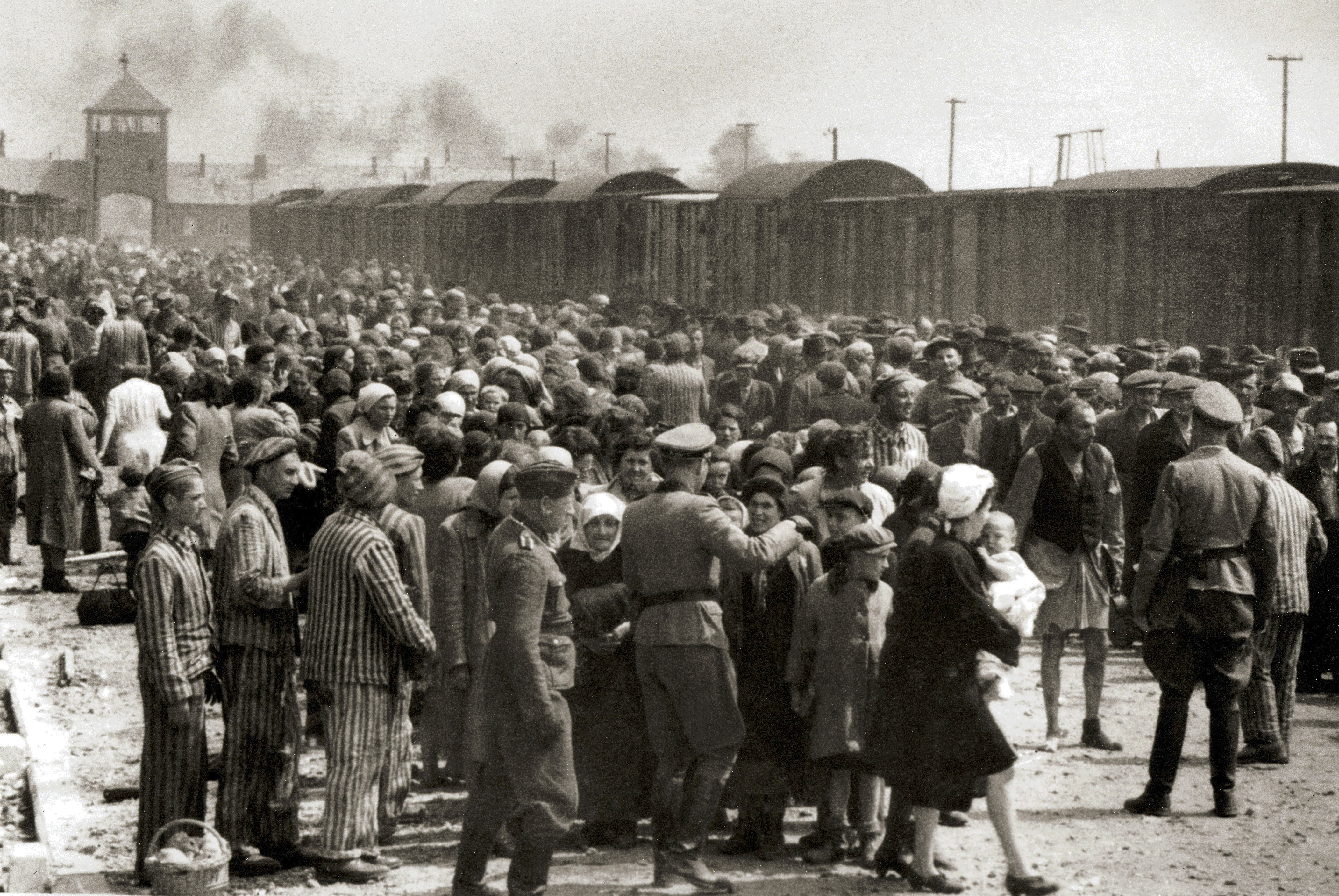
[[File:Selection on the ramp at Auschwitz-Birkenau, 1944 (Auschwitz Album) 1a.jpg|thumb|[[History of the Jews in Hungary|Hungarian Jews]] being selected to either work or die in the [[gas chamber]]s at the [[Auschwitz-Birkenau concentration camp]], 19 May 1944|upright=1.36]] | |||
From 20 to 24 November 1940, Hungary, Romania, and Slovakia joined the Axis powers under the [[Tripartite Pact]]. In 1941, Hitler and other Nazi Party leaders including [[Heinrich Himmler]] and [[Reinhard Heydrich]] agree on a program of mass extermination of Jews throughout occupied Europe, beginning [[the Holocaust]]; this was referred to as the "[[Final Solution]]" to the "[[Jewish question]]", or the debate over what should happen to the Jews living on the continent. On 1 March 1941, Himmler ordered the construction of the Auschwitz-Birkenau concentration camp. At the same time, Bulgaria joined the Tripartite Pact, and two days later, Germany began sealing off a [[Kraków Ghetto|Jewish ghetto]] in [[Krakow, Poland]].<ref name="encyclopedia.ushmm.org-3">{{Cite web |title=1941: Key Dates |url=https://encyclopedia.ushmm.org/content/en/article/1941-key-dates |access-date=7 October 2024 |website=encyclopedia.ushmm.org |language=en}}</ref> Aside from concentration camps, the Final Solution was also enacted with ''[[Einsatzgruppen]]'', mobile killing units.<ref name="encyclopedia.ushmm.org-3" /><ref>{{Cite web |title=Einsatzgruppen (Mobile Killing Units) |url=https://encyclopedia.ushmm.org/content/en/article/einsatzgruppen |access-date=7 October 2024 |website=encyclopedia.ushmm.org |language=en}}</ref> Croatia joined the Tripartite Pact on 15 June.<ref name="encyclopedia.ushmm.org-3" /> | |||
== | === German invasion of Yugoslavia and Greece (1941) === | ||
On 6 April 1941, Germany, aided by Bulgarian and Hungarian forces, started invading [[Invasion of Yugoslavia|Yugoslavia]] and [[German invasion of Greece|Greece]]. This was to help the Italian invasion of Greece, overthrow the pro-Allied Yugoslavia government, secure the German flank during the planned invasion of Russia, protect German oil in Romania from Allied air attacks, and create a base to attack British communication lines with the east. Major Yugoslavian cities, including [[Belgrade]], were bombed. On 17 April, Yugoslavia capitulated, as Germany moved into northern Greece. Greek cities were subject to Blitzkrieg attacks; despite intense resistance, [[Athens]] fell on 27 April. 2,500 Germans were killed. 11,000 Allied men were captured, and 45,000 evacuated to the island of [[Crete]].<ref name="www.nam.ac.uk" /> | |||
[[ | |||
On 20 May 1941, Germany began an [[invasion of Crete]]. They launched paratrooper assaults on multiple Cretan cities, overwhelming the Allies, who evacuated the island. Germany fought off guerrilla resistance in [[Yugoslavian resistance during World War II|Yugoslavia]] and [[Greek resistance|Greece]] for the rest of the war. In late 1941, the Brits started aiding the [[Chetnik]] guerrillas, led by [[Dragoljub Mihailovic]]. Eventually, the Chetniks fought in a civil war against another group of guerrillas, the [[Yugoslav Partisans|Partisans]], led by [[Josip Broz Tito|Josip "Tito" Broz]]. The Chetniks collaborated with the Allies, and in 1943, the British switched their alliance to the Partisans. In Greece, the communist [[ELAS]] fought a civil war with the republican [[EDES]]. They fought until a peace deal was made by the Allies.<ref name="www.nam.ac.uk" /> | |||
== Greatest extent of Axis power (1941–1943) == | |||
=== Eastern Front (June–July 1941) === | |||
[[File:Invasion1941.jpg|thumb|German advances in [[Operation Barbarossa]], from 22 June to 25 August 1941|left|upright=1.36]] | |||
On 22 June 1941, Germany launched the invasion of the Soviet Union, code-named [[Operation Barbarossa]].<ref>Amnon Sella. ''<nowiki/>'Barbarossa': Surprise Attack and Communication''. Journal of Contemporary History, Vol. 13, No. 3, (Jul. 1978), pp. 555–583.</ref> It had originally been planned for May, but Hitler used his troops to invade Yugoslavia and Greece, which was a more pressing matter. The campaigns in southern Europe were quick, but June would end up being a less ideal date for Barbarossa, as it was closer to the brutal Russian winter. Hitler and the Nazi High Command were convinced that by October, Germany would have taken the entirety of European Russia and the Soviet regime would collapse after losing support domestically. 3 million German soldiers were involved in Barbarossa, the largest invasion force in history. The northern end of the invasion was led by Wilhelm von Leeb; the center by Fedor von Bock, Heinz Guderian, and [[Hermann Hoth]]; and the south by Gerd von Rundstedt and [[Paul Ludwig von Kleist]].<ref name="www.britannica.com-2024f">{{Cite web |date=16 September 2024 |title=Operation Barbarossa {{!}} History, Summary, Combatants, Casualties, & Facts {{!}} Britannica |url=https://www.britannica.com/event/Operation-Barbarossa |access-date=26 September 2024 |website=www.britannica.com |language=en}}</ref> | |||
The Soviets were taken by surprise, and had trouble creating an opposing force in time. By 27 June 1941, the Germans had reached [[Minsk]]. The local Soviets were encircled; 300,000 became prisoners, while others escaped to the east. Guderian crossed the [[Dnieper]] river on 10 July, and on the 16th, his troops entered [[Smolensk]], taking 200,000 prisoners. Meanwhile, the Soviets used a [[scorched earth]] policy, burning many parts of western Russia. The western manufacturing industries were moved eastward. At the same time, series of storms had turned the roads to Russia into mud, and the German tanks moved slowly. However, by mid-July, the Germans had moved 640 kilometres east from their starting positions, and were 320 kilometres to Moscow. At the end of July, the Germans broke through the Soviet front in [[Kiev]]<!--Do not change per WP:KYIV-->. 520,000 Soviets were encircled and captured.<ref name="www.britannica.com-2024f" /> | |||
=== Eastern Front (September–December 1941) === | |||
[[Operation Reinhard]], named after Reinhard Heydrich, began in the autumn of 1941. It was the plan to kill the two million Jews living in occupied Poland. For this purpose, Germany constructed three [[extermination camp]]s, [[Bełżec]], [[Sobibór]], and [[Treblinka]], and the [[Reich Security Main Office]] led by Heydrich deported Polish Jews to these locations. By the end of the war, around 1.5 million Jews were killed in the three camps. German police and the ''[[Schutzstaffel]]'' (SS) also led a number of killing missions. Operation Reinhard was directed by SS general [[Odilo Globocnik]] from autumn 1941 until summer 1943. It had overlap with [[Aktion T4]], or Germany's program of euthanising disabled people with [[carbon monoxide]] gas.<ref>{{Cite web |title=Operation Reinhard (Einsatz Reinhard) |url=https://encyclopedia.ushmm.org/content/en/article/operation-reinhard-einsatz-reinhard |access-date=12 October 2024 |website=encyclopedia.ushmm.org |language=en}}</ref> | |||
== | As the Soviet Union was in a weakened position, in 1941, Finland used the opportunity to start the [[Continuation War]], an attempt to take back the lands that they had lost during the Winter War. It would be fought until 1944.<ref>{{Cite web |title=Continuation War |url=https://www.oxfordreference.com/display/10.1093/oi/authority.20110803095635147 |access-date=26 September 2024 |website=Oxford Reference |language=en}}</ref> On 8 September 1941, Germany and Finland began the [[Siege of Leningrad]], which also continued until 1944.<ref name="www.britannica.com-2024g">{{Cite web |date=1 September 2024 |title=Siege of Leningrad {{!}} Nazi Germany, World War II, Blockade {{!}} Britannica |url=https://www.britannica.com/event/Siege-of-Leningrad |access-date=26 September 2024 |website=www.britannica.com |language=en}}</ref> In October 1941, at [[Vyazma]], 600,000 of them were encircled and captured.<ref name="www.britannica.com-2024f" /> | ||
{{ | |||
On 19 September 1941, the Germans entered the city of Kiev in Ukraine. Some of them were killed in explosions from mines left by retreating Soviet soldiers, and the Germans used this as a pretext to take revenge on the local Jews, whom the explosions were blamed on. From the 29th to the 30th, in the [[Babi Yar massacre]], approximately 33,771 of Kiev's Jews were massacred. They had been summoned to a ravine near the city, where they were made to undress and enter the ravine before being shot.<ref>{{Cite web |title=Mass Shootings at Babyn Yar (Babi Yar) |url=https://encyclopedia.ushmm.org/content/en/article/kiev-and-babi-yar |access-date=12 October 2024 |website=encyclopedia.ushmm.org |language=en}}</ref> | |||
In October 1941, the [[Siege of Sevastopol (1941–1942)|Siege of Sevastopol]] started when Germany and Romania tried to take [[Sevastopol]] from the Soviets. Soviet resistance prolonged the siege, but the Axis took the city in July 1942.<ref>{{Cite web |title=Sturgeon Catch 1942: The Siege of Sevastopol |url=https://warfarehistorynetwork.com/article/sturgeon-catch-1942-the-siege-of-sevastopol/ |access-date=2024-12-13 |website=Warfare History Network |language=en-US}}</ref> In the [[First Battle of Kharkov]] from 20 to 24 October, the [[6th Army (Wehrmacht)|German Sixth Army]] successfully took the city of [[Kharkov]] where the Soviets had been producing their T-34 tanks. After the city's capture, the Germans discovered the tanks' production had been moved out of the city prior to the battle.<ref name="Hoover Institution">{{Cite web |title=Battles Of Kharkov |url=https://www.hoover.org/research/battles-kharkov |access-date=9 December 2024 |website=Hoover Institution |language=en}}</ref> | |||
[[File:Wojska niemieckie na froncie moskiewskim (2-878).jpg|thumb|German mechanised forces move through a hamlet towards Moscow in the [[Battle of Moscow]], December 1941.|upright=1.36]]As winter approached, the Germans in the Soviet Union were beaten down by cold weather; many got frostbite and had their military equipment freeze. Meanwhile, new waves of Soviets came to defend the front. On 22 November 1941, the Germans reached [[Rostov-na-Donu]], an important location to continue the Caucasus campaign, but the Soviets launched a counteroffensive and took back the city on the 28th. On 2 December, some Germans had [[Battle of Moscow|reached the suburbs of Moscow]], but this is the closest they got to the center of the city. On 6 December, Soviet commander [[Georgy Zhukov]] started a large counteroffensive at Moscow which confirmed Barbarossa's failure.<ref name="www.britannica.com-2024f" /> | |||
=== America joins the war (1941) === | |||
Imperial Japan [[Japanese declaration of war on the United States and the British Empire|declared war on the United States]] by [[Attack on Pearl Harbor|attacking]] the American military base at [[Pearl Harbor]] in Hawaii on 7 December. The next day, the Japanese ambassador [[Hiroshi Oshima]] went to German Foreign Minister [[Joachim von Ribbentrop]], asking him to finally have Germany declare war on the United States. von Ribbentrop believed that the Americans entering the war would overwhelm the German war effort, but Hitler did not think so. On 11 December, Germany [[German declaration of war against the United States|declared war on the United States]], and the next day, Hitler defended the decision in a speech to the Reichstag. He claimed that Roosevelt's [[New Deal]] policies were the actual cause of World War II.<ref>{{Cite web |title=Germany declares war on the United States {{!}} 11 December 1941 |url=https://www.history.com/this-day-in-history/germany-declares-war-on-the-united-states |access-date=9 October 2024 |website=HISTORY |date=16 November 2009 |language=en}}</ref> | |||
Operation | === Operation Archery (1941) === | ||
On 27 December 1941, the British Army, Royal Navy, and the RAF launched [[Operation Archery]], an attack on the Axis in the town of [[Måløy]] on [[Vågsøy (island)|Vaagso Island]], Norway. The objective was to "sink, burn and destroy any enemy shipping found in the convoy assembly anchorage, and to put out of action the garrison (kill or capture) and the German installations in the port including the fish factories." Two British Commando units attacked, one to attack the German garrison in the town and the other to stop the German guns at the nearby [[Måløyna|Maaloy Island]]. The Army was supported by the British cruiser [[HMS Kenya|HMS ''Kenya'']] and RAF aircraft taking off from Scotland and the [[Shetland]]s. The British sunk eight German ships and 120 Germans were killed before the British quickly retreated. The tactics of the operation would be used the Allies during the later Normandy landings.<ref>{{Cite web |last=Horan |first=H.E. |date=April 1961 |title=Operation Archery |url=https://www.usni.org/magazines/proceedings/1961/april/operation-archery |access-date=8 October 2024 |website=U.S. Naval Institute}}</ref> | |||
=== Western Front (February–May 1942) === | |||
[[File:Operation Cerberus-fr.svg|left|thumb|upright=1.36|The route taken by the German ships in the [[Channel Dash]]]] | |||
On 12 February 1942, in Operation Cerberus or the [[Channel Dash]], three of the [[Kriegsmarine]]'s biggest ships ({{ship|German battleship|Gneisenau||2}}, {{ship|German cruiser|Prinz Eugen||2}}, and {{ship|German battleship|Scharnhorst||2}}) attempted to move from [[Brest, France]] — a vital German naval port<ref name="Royal Navy-2021">{{Cite web |date=12 February 2021 |title='A stirring memory' - the anniversary of the Channel Dash |url=https://www.royalnavy.mod.uk/news/2021/february/12/20210212-channel-dash |access-date=11 October 2024 |website=Royal Navy}}</ref> — to the German coast in the [[North Sea]] through the [[English Channel]]'s slim [[Dover Strait]], despite the presence of the [[Royal Navy]] and [[RAF Coastal Command]] there.<ref>{{Cite web |title=Operation Cerberus: The Kriegsmarine 'Channel Dash' |url=https://warfarehistorynetwork.com/article/operation-cerberus-the-kriegsmarine-channel-dash/ |access-date=9 October 2024 |website=Warfare History Network |language=en-US}}</ref><ref name="Airfield-2024">{{Cite web |last=Airfield |first=History of Manston |date=12 February 2024 |title=Channel Dash - The Bravest of the Brave |url=https://www.manstonhistory.org.uk/channel-dash-bravest-brave/ |access-date=11 October 2024 |website=History of Manston Airfield |language=en-GB}}</ref> Once at Germany, they were supposed to be used for defending Norway. As part of the pre-existing Operation Fuller, launched in 1941 to defend the channel, the British responded with naval and air power; the Luftwaffe defended the Germans.<ref name="Airfield-2024" /> The British destroyed some German aircraft, but the Royal Navy and RAF faced heavy losses and were unable to prevent the ships from reaching their destination. The ships' later use was limited, however.<ref name="Royal Navy-2021" /><ref name="Airfield-2024" />{{refn|group=nb| ''Scharnhorst'' had to undergo repairs until 1943, and was sunk by the British in December 1943 during the [[Battle of the North Cape]]; ''Gneisenau'' was badly damaged, never again being used as a warship, and was [[Blockship|intentionally sank]] near [[Gdynia|Goteshafen]] by the Germans to prevent advancing Soviet ships in 1945; and ''Prinz Eugen'' defended Norway, lasting until the end of war – she was then used in the U.S.' post-war [[Nuclear testing at Bikini Atoll|Bikini Atoll nuclear tests]] before sinking from a leak in 1946.<ref name="Royal Navy-2021" /><ref name="Airfield-2024" />}} | |||
On 28 March 1942, in Operation Chariot or the [[St Nazaire Raid]], the Royal Navy attacked the German [[dry dock]] at [[St Nazaire]] in occupied France. The dock served as one of the bases of operation for German [[U-boat]]s, and was defended by 6,000 soldiers. If it was destroyed, then the powerful {{ship|German battleship|Tirpitz}} — which had been defending Norway – could not be repaired at St Nazaire during potential future involvement in the Battle of the Atlantic, instead having to take trips to two other docks, during which the British could attack her easier. Operation Chariot used 611 British soldiers, first destroying the gate to the dock with the destroyer {{HMS|Campbeltown|I42|6}}, then attacking the ships. The British faced heavy losses, with 169 of them killed and 200 taken prisoner, but they greatly hurt the German navy, forcing Germany to divert troops from elsewhere to defend their Atlantic operations.<ref>{{Cite web |date=2 April 2021 |title=A Bold Strategy: The British Raid on St. Nazaire |url=https://www.nationalww2museum.org/war/articles/bold-strategy-british-raid-st-nazaire |access-date=12 October 2024 |website=The National WWII Museum {{!}} New Orleans |language=en}}</ref><ref>{{Cite web |last=Hull |first=Michael D. |date=April 2017 |title=Sacrifice at Saint-Nazaire |url=https://www.usni.org/magazines/naval-history-magazine/2017/april/sacrifice-saint-nazaire |access-date=12 October 2024 |website=U.S. Naval Institute}}</ref> | |||
On the night of 30–31 May 1942, the [[RAF Bomber Command]] performed [[Operation Millennium]]. 1,047 bombers - the command's first raid involving more than 1,000 bombers – led by the Commander-in-Chief of the Bomber Command, [[Arthur Harris]], launched a raid on [[Cologne, Germany]]. This used {{frac|2|1|2}} times more pilots than any previous night raid, and was important for publicity and psychological warfare. Harris gathered large amounts of spare aircraft, and had some of them used by those who were still in pilot training. The raid was a success, starting more than 2,500 fires, destroying around 13,000 buildings, and killing less than 500 people. 41 RAF aircraft were lost. The operation's tactics were implemented by the Bomber Command for future use during the war. 135,000 to 150,000 of the city's previous population of around 700,000 fled.<ref>{{Cite web |title=RAF Bomber Command's first 1,000 bomber raid May 1942 {{!}} RAF Memorial Flight Club |url=https://www.memorialflightclub.com/bomber-command-first-bomber-raid |access-date=11 October 2024 |website=www.memorialflightclub.com}}</ref> | |||
=== German and American atomic bomb programs (1942–1945) === | |||
In summer 1942, the U.S. began the [[Manhattan Project]], or their top-secret atomic bomb program in response to Germany's own program. The Manhattan Project was led by physicist [[J. Robert Oppenheimer]], and was worked on mainly in [[Hanford, Washington]]; [[Los Alamos, New Mexico]]; and [[Oak Ridge, Tennessee]]. The U.S. overestimated Germany's program, which was cancelled as a military project in July 1942 and continued as a civilian project; it became disorganised as its Jewish scientists continued to escape Nazism, and was underfunded as Hitler did not understand its purpose.<ref>{{Cite web |last2= |first2= |title=Manhattan Project - Manhattan Project National Historical Park (U.S. National Park Service) |url=https://www.nps.gov/mapr/learn/manhattan-project.htm#:~:text=The%20Manhattan%20Project%20was%20an,atomic%20weapons%20before%20Nazi%20Germany. |access-date=18 October 2024 |website=www.nps.gov |language=en}}</ref><ref name="dw.com">{{Cite web |title=Why didn't the Nazis beat Oppenheimer to the nuclear bomb? – DW – 08/15/2023 |url=https://www.dw.com/en/why-didnt-the-nazis-beat-oppenheimer-to-the-nuclear-bomb/a-66540463 |access-date=18 October 2024 |website=Deutsche Welle |language=en}}</ref> | |||
In 1944, as Berlin was increasingly bombed, Germany's program moved from Berlin to [[Haigerloch]]. There, scientists unsuccessfully [[Haigerloch research reactor|attempted to build]] a [[nuclear reactor]] instead of a nuclear bomb; as Germany weakened, the program shut down.<ref>{{Cite web |title=Atomkeller Museum |url=https://www.atlasobscura.com/places/atomkeller-museum |access-date=18 October 2024 |website=Atlas Obscura |language=en}}</ref><ref>{{Cite web |title=The Nazi Reactor That Wasn't |url=https://terp.umd.edu/the-nazi-reactor-that-wasnt |access-date=18 October 2024 |website=Terp |language=en-US}}</ref> | |||
=== Eastern Front (April 1942 – March 1943) === | |||
In 1942, Reinard Heydrich [[Assassination of Reinhard Heydrich|was assassinated]] by Czech agents while in Prague. On 27 May, he was travelling through the city in an open vehicle; he did not give himself appropriate security, as he was convinced of the efficacy of his anti-resistance campaign within German-occupied Europe. His car went through a usual route taken to get to the nearby airport, where he would fly back to Hitler's headquarters. Along the way, [[Czechoslovak government-in-exile|Free Czech]] parachute agents (who had been trained in Britain)<ref>{{Cite web |title=The Assassination Of Reinhard Heydrich, The Butcher Of Prague |url=https://warfarehistorynetwork.com/article/the-assassination-of-reinhard-heydrich-the-butcher-of-prague/ |access-date=9 October 2024 |website=Warfare History Network |language=en-US}}</ref> rolled a hand grenade under the vehicle. Heydrich was not immediately killed, but his leg and back were hit with grenade splinters, causing an infection which killed him on 4 June 1942. On 9 June, the day of his funeral in Berlin, Hitler announced attacks targeting Czechs in retaliation, and the towns of [[Lidice]] and [[Ležáky]] were destroyed.<ref>{{Cite web |date=17 September 2024 |title=Reinhard Heydrich {{!}} Life & Assassination {{!}} Britannica |url=https://www.britannica.com/biography/Reinhard-Heydrich |access-date=11 October 2024 |website=www.britannica.com |language=en}}</ref><ref>{{Cite web |title=Reinhard Heydrich: In Depth |url=https://encyclopedia.ushmm.org/content/en/article/reinhard-heydrich-in-depth |access-date=11 October 2024 |website=encyclopedia.ushmm.org |language=en}}</ref> | |||
In the [[Second Battle of Kharkov]] from 12 to 28 May 1942, Soviet marshal Semyon Timoshenko attempted to recapture Kharkov from the Germans. 170,000 Soviets were killed and 106,000 wounded as they faced major resistance from Fedor von Bock, but the Soviets retook the city after it had been mostly destroyed.<ref name="Hoover Institution" /> | |||
[[File:Bundesarchiv Bild 183-B24543, Hauptquartier Heeresgruppe Süd, Lagebesprechung.jpg|thumb|Adolf Hitler with generals [[Friedrich Paulus]], [[Adolf Heusinger]] and [[Fedor von Bock]] in [[Poltava|Poltawa]], German-occupied Ukraine, June 1942|upright=1.09]] | |||
Meanwhile, Germany wanted to capture [[Stalingrad]] to cut the Soviet's transportation hub with southern Russia, which would let the Germans take the [[Caucasus]] region and its oil fields. It would also be a symbolic victory to capture the city that included Joseph Stalin's name. On 5 April 1942, Hitler confirmed [[Case Blue]], which planned to destroy the Soviet forces in the south, and then afterwards, go north to take Moscow or finish taking the Caucasus. On 28 June, Fedor von Bock's [[Army Group South]] began the operation. On 9 July, Hitler amended Operation Blue to involve the taking of Stalingrad and the Caucasus at the same time. Army Group South would be split into [[Army Group A]], led south by Wilhelm List, and [[Army Group B]], led to Stalingrad by Bock. Days later, Bock was replaced by [[Maximilian von Weichs]]. The Soviets had faced encirclement until Army Group B split, allowing them to retreat eastwards.<ref name="www.britannica.com-2024e">{{Cite web |date=15 August 2024 |title=Battle of Stalingrad {{!}} History, Summary, Location, Deaths, & Facts {{!}} Britannica |url=https://www.britannica.com/event/Battle-of-Stalingrad |access-date=25 September 2024 |website=www.britannica.com |language=en}}</ref> | |||
Army Group A captured Rostov-na-Donu and went into the Caucasus in Operation Edelweiss. Army Group B's advance was Operation Fischreiher. Hitler then reassigned the [[4th Panzer Army]] in Army Group B to help out Army Group A. Stalin and the Soviet high command formed the [[Stalingrad Front]] of multiple armies: the [[21st Army (Soviet Union)|21st]], [[62nd Army (Soviet Union)|62nd]], [[63rd Army (Soviet Union)|63rd]], and [[64th Army (Soviet Union)|64th]] Armies, as well as the [[8th Air Army]]. He ordered them on 28 July to take "[[Order No. 227|Not One Step Back]]" and defend Stalingrad. He disallowed the evacuation of civilians from the city, for the purpose of motivating soldiers who would be defending civilians. Hitler then moved the 4th Panzer Army to move north and attack Stalingrad from the south. On the way there, the 4th Panzer Army converged with the [[6th Army (Wehrmacht)|6th Army]].<ref name="www.britannica.com-2024e" />[[File:German Summer Offensive, 24 July-18 November.PNG|left|thumb|The [[Case Blue|German advance]] to [[Stalingrad]] from 24 July to 18 November 1942|upright=1.36]]On 23 August 1942, the [[Battle of Stalingrad]] began, as a German spearhead attacked the city from the north and the Luftwaffe began bombing. The fighting was some of the most intense of World War II, as the Soviets and Germans fought over blocks and buildings. The Germans pushed the Soviets through the city until they only occupied a strip of the city near the [[Volga]] river 15 kilometres long and 3 to 5 kilometres wide. The Soviets on the other side of the river took supply crossings into the city. On 14 October, the Germans fired on a supply crossing, greatly hurting the Soviets. As winter came, the Germans faced heavy losses and fatigue.<ref name="www.britannica.com-2024e" /> | |||
From 19 to 23 November 1942, the Soviets launched [[Operation Uranus]], a large counteroffensive formulated by Zhukov, [[Aleksandr Vasilevsky]], and [[Nikolai Voronov]]. It attacked the weak and undefended flanks of the 4th Panzer Army and 6th Army, greatly surprising the Germans. The German high command asked Hitler to allow the 6th Army, which was fighting near the Volga, to join the rest of the German forces in the west of the city, but Hitler ordered the leader of the 6th Army, [[Friedrich Paulus]], to stay at the Volga. The Luftwaffe made minor deliveries of supplies to the 6th Army.<ref name="www.britannica.com-2024e" /> | |||
In mid-December 1942, Hitler began [[Operation Winter Storm]], forming a special army corps led by [[Erich von Manstein]] which would help the 6th Army. The operation failed, and Hitler told the troops to fight to the death. On 10 January 1943, the Soviets began [[Operation Koltso]], which surrounded the 6th Army. On 31 January, Paulus disobeyed Hitler by surrendering, and soon, 22 generals surrendered with him. By 2 February, the remaining 91,000 German men had surrendered. There were more than 800,000 Axis casualties, 1.1 million Soviet casualties, and 40,000 civilian casualties. Many of the surrendering Germans were put in Soviet prison camps.<ref name="www.britannica.com-2024e" /> In the [[Third Battle of Kharkov]] from 18 February to 20 March 1943, Erich von Manstein recaptured Kharkov despite being outnumbered by the Soviets 7-to-1.<ref name="Battles Of Kharkov">{{Cite web |title=Battles Of Kharkov |url=https://www.hoover.org/research/battles-kharkov |access-date=2024-12-13 |website=Hoover Institution |language=en}}</ref> | |||
=== | === Dieppe Raid (1942) === | ||
Operation Jubilee or the [[Dieppe Raid]] was the first time American troops fought on French soil in the war. It was a commando raid on [[Dieppe, France]], that was supposed to be significantly more destructive than previous raids. 5,000 British, American, and Canadian engaged in paratrooper landings and amphibious attacks on the fortified port of Dieppe in a move designed to divert German attention away from the Eastern Front at Stalin's request. Launched on 19 August 1942, the raid was a disaster for the Allies, as half of their force was killed.<ref>{{Cite web |date=8 October 2021 |title=Operation Jubilee: The Raid at Dieppe |url=https://www.nationalww2museum.org/war/articles/operation-jubilee-dieppe-raid-1942 |access-date=20 October 2024 |website=The National WWII Museum {{!}} New Orleans |language=en}}</ref> | |||
[[File: | === Planning the invasion of Italy (1943) === | ||
[[File:80-G-38559 (25601980716).jpg|thumb|Churchill, Roosevelt, and their Chiefs of Staff at the [[Casablanca Conference]] in January 1943|upright=1.36]] | |||
Roosevelt, Churchill, de Gaulle, and French general [[Henri Giraud]] attended the [[Casablanca Conference]] in [[Casablanca]], [[French Morocco]] from 14 to 24 January 1943. The conference, with the knowledge that the North African campaign would be over soon, heavily focused on the idea of opening a front against the Axis to relieve the pressure on the Soviets on the Eastern Front. The leaders debated invading occupied France or Italy first, and they decided to invade Italy later that year and invade France in 1944.<ref>{{Cite web |date=27 January 2023 |title=The Casablanca Conference |url=https://www.nationalww2museum.org/war/articles/casablanca-conference |access-date=9 October 2024 |website=The National WWII Museum {{!}} New Orleans |language=en}}</ref> | |||
As the Allies prepared for the invasion, they formulated [[Operation Mincemeat]]; they wanted to take Axis attention off the island of [[Sicily]], which would be invaded first. British intelligence took the body of a homeless worker who died of ingesting rat poison, and disguised him as a Major in the British Royal Marines named "William Martin", fitting him with various documentation that established the fake identity. On 30 April, the British submarine [[HMS Seraph (P219)|''HMS Seraph'']] dropped his body off the coast of Spain, intending for him to be discovered by the Axis, who would find a note on his person that mentioned the Allies were planning to invade Greece and the island of [[Sardinia]], launching a small attack on Sicily as a [[feint]]. The mission was successful, as German intelligence officers in Spain found the body and directed false intelligence to higher Axis authorities, who built up troops in Greece and Sardinia.<ref>{{Cite web |title=The War on Paper: Operation Mincemeat |url=https://www.iwm.org.uk/history/the-war-on-paper-operation-mincemeat |access-date=8 October 2024 |website=Imperial War Museums |language=en}}</ref> | |||
=== | == Allied resurgence (1943–1945) == | ||
=== Allied bombings in Germany (1943) === | |||
In 1943, the Allies attacked three dams in the German [[Ruhr]] region (a valley and industrial center): the [[Eder Dam|Eder]], [[Möhne Dam|Möhne]], and [[Sorpe Dam|Sorpe]] dams. This was essential, as they secured the water supply for the region and generated electricity. The plan originated in 1937, but the technology for it was not yet invented; the dams were protected by [[anti-aircraft guns]] and the presence of [[torpedo net]]s in the waters below. In 1942, the British invented the "[[bouncing bomb]]", which could skip along the surface of the water instead of getting caught in the nets. On the night of 16–17 May 1943, in [[Operation Chastise]], the RAF successfully bombed the dams. 53 of the 133 British air crew were killed, and around 1,300 people on land were killed by flooding. It provided a morale boost to the British.<ref>{{Cite web |title=The Incredible Story Of The Dambusters Raid |url=https://www.iwm.org.uk/history/the-incredible-story-of-the-dambusters-raid |access-date=9 October 2024 |website=Imperial War Museums |language=en}}</ref> | |||
[[ | The German city of [[Hamburg]] was a key location in the German war effort, functioning as a manufacturing plant for U-boats and a shipyard to store them, as well as a transportation hub for occupied Europe. Arthur Harris identified this as a target for an Allied air attack in summer 1943. He planned a 10-day bombing raid named [[Operation Gomorrah]]. It was scheduled to start on 22 July, but was delayed until the 24th. The Brits and Americans dropped a significant amount of bombs over a few days, and dropped [[Chaff (countermeasure)|bits of tin foil]] from their planes to confuse the Luftwaffe radar systems. A second raid was launched on the 27th, a third on the 29th and 30th, and the final raid on 2 to 3 August. Operation Gomorrah greatly demoralised the Germans; German [[Reich Ministry of Armaments and War Production|Armaments Minister]] [[Albert Speer]] wrote: "Hamburg... put the fear of god in me.” The city quickly rebuilt, however, producing 80% of its original output within five months.<ref>{{Cite web |last=Curatola |first=John |date=10 July 2023 |title=Operation Gomorrah: The First of the Firestorms |url=https://www.nationalww2museum.org/war/articles/operation-gomorrah-first-firestorms |access-date=3 October 2024 |website=National World War II Museum}}</ref> | ||
By fall 1943, General [[Hap Arnold]] of the U.S. Air Force had grown disappointed with the U.S.' [[Eighth Air Force]], which had been bombing German targets since January but faced heavy losses in the process. In August, U.S. air planners formed an operation to respond to Arnold's belief that the Eighth exemplified perceptions of air power being ineffective amidst the wider war. In the [[Schweinfurt-Regensburg mission]], the 1st and 3rd Air Divisions of the Eighth were to destroy many German [[ball bearing]] factories in [[Schweinfurt, Germany]], as well as a factory for [[Messerschmitt]] aircraft in [[Regensburg, Germany]], at the same time. It was planned for the 7th but delayed to the 17th. The targets were hit, and German manufacturing was damaged in the short-term, but the Eighth still suffered many losses and did not go on unescorted night raids into Germany for months afterwards.<ref>{{Cite web |date=17 August 2023 |title=Schweinfurt–Regensburg Raid: August 17, 1943 |url=https://www.nationalww2museum.org/war/articles/schweinfurt-regensburg-raid-august-17-1943 |access-date=9 October 2024 |website=The National WWII Museum {{!}} New Orleans |language=en}}</ref> | |||
[[ | |||
The Allies launched a bombing raid of [[Bremen]] on 8 October 1943, followed by Marienburg on the 9th and Munster on the 10th.<ref>{{Cite web |date=20 November 2017 |title=Mission to Munster |url=https://www.nationalww2museum.org/war/articles/mission-munster |access-date=9 October 2024 |website=The National WWII Museum {{!}} New Orleans |language=en}}</ref> | |||
On 14 October, German ball bearing factories were attacked again in the [[Second Schweinfurt raid]].<ref>{{Cite web |date=17 October 2022 |title="Black Thursday" October 14, 1943: The Second Schweinfurt Bombing Raid |url=https://www.nationalww2museum.org/war/articles/black-thursday-october-14-1943-second-schweinfurt-bombing-raid |access-date=9 October 2024 |website=The National WWII Museum {{!}} New Orleans |language=en}}</ref>[[File:Invasionofitaly1943.jpg|left|thumb|The [[Allied invasion of Italy]] in 1943]] | |||
[[ | === Italian campaign (May–August 1943) === | ||
In May 1943, the Allies won the North African campaign, and captured many Axis soldiers and military equipment. On 20 May, the [[Allied invasion of Italy|invasion of Italy]] began. From 20 May to 13 June, they took the islands of [[Pantelleria]], [[Lampedusa]], and [[Linosa]]. On 9 July 1943, the Allies began an [[invasion of Sicily]] in Operation Husky. The Allies faced little resistance while establishing [[beachhead]]s, and was able to take the rest of the island partially due to their frequent resupplying of soldiers to the front.<ref name="www.britannica.com-2024m" /> | |||
On the night of 24–25 July, Mussolini told the Italian [[Fascist Grand Council]] that Germany was considering evacuating southern Italy. The Council voted for a resolution against him, who resigned. King [[Victor Emmanuel III]] [[Fall of the Fascist regime in Italy|ordered Mussolini to be arrested]] and for a new government to be formed by Marshal [[Pietro Badoglio|Petro Badoglio]]. On 17 August, the Allies finished the conquest of Sicily. There were 23,000 Allied casualties and 165,000 Axis casualties, 30,000 of them Germans.<ref name="www.britannica.com-2024m">{{Cite web |date=5 August 2024 |title=Allied invasion of Sicily {{!}} Significance, Summary, & Map {{!}} Britannica |url=https://www.britannica.com/topic/Allied-Invasion-of-Sicily |access-date=29 September 2024 |website=www.britannica.com |language=en}}</ref> | |||
=== Eastern Front (July–November 1943) === | |||
[[File:Soviet troops and T-34 tanks counterattacking Kursk Voronezh Front July 1943.jpg|thumb|Soviet troops counterattacking during the [[Battle of Kursk]] in July 1943|upright=1.36]] | |||
On 5 July 1943, the Germans began [[Operation Citadel]], an assault on a bulge in the Soviet [[Salient (military)|salient]] around the city of [[Kursk]].<ref name="www.britannica.com-2024d">{{Cite web |date=21 August 2024 |title=Battle of Kursk {{!}} Eastern Front, German Offensive, Soviet Counterattack {{!}} Britannica |url=https://www.britannica.com/event/Battle-of-Kursk |access-date=25 September 2024 |website=www.britannica.com |language=en}}</ref><ref name="Sky HISTORY TV channel">{{Cite web |title=The Battle of Kursk: the largest tank battle in history |url=https://www.history.co.uk/article/the-battle-of-kursk-the-largest-tank-battle-in-history |access-date=25 September 2024 |website=Sky HISTORY TV channel |language=en}}</ref> The bulge went 100 miles west towards the German lines. 900,000 German troops attacked from the north and south, beginning the [[Battle of Kursk]]. It was the largest tank battle in history, involving 6,000 tanks among both sides. The Soviets had predicted the attack, and moved their main forces out of the area. They had also placed minefields and antitank defences, which costed the Germans.<ref name="www.britannica.com-2024d" /> On the 9th, the Allies began invading Sicily, and Hitler had to move troops there from the Eastern Front.<ref name="Sky HISTORY TV channel" /> Meanwhile, the Soviets began a buildup of forces, and on 12 July, they counterattacked. The Soviets' better numbers allowed them to make a larger offensive; they took back [[Oryol|Orel]] on 5 August and [[Kharkov]] on 23 August.<ref name="www.britannica.com-2024d" /> There were 800,000 Soviet casualties and 200,000 German casualties.<ref name="Sky HISTORY TV channel" /> | |||
In spring and summer 1943, the Jews in the Warsaw and [[Białystok Ghetto|Bialystok]] ghettos engaged in armed resistance against the Germans. The same happened at the Treblinka extermination camp on 2 August and the Sobibor extermination camp on 14 October. In retaliation, in autumn 1943, Heinrich Himmler began [[Operation Harvest Festival]], the killing of the 45,000 Jewish prisoners that remained in forced labour in the [[Lublin District]] of occupied Poland. The operation began on 3 November, and Jews were killed at the [[Majdanek concentration camp|Madjanek]], [[Poniatowa concentration camp|Poniatowa]], and [[Trawniki concentration camp|Trawniki]] work camps within days. 42,000 of them ended up being killed in the Germany's largest massacre in the Holocaust.<ref>{{Cite web |title=Aktion "Erntefest" (Operation "Harvest Festival") |url=https://encyclopedia.ushmm.org/content/en/article/aktion-erntefest-operation-harvest-festival |access-date=12 October 2024 |website=encyclopedia.ushmm.org |language=en}}</ref> | |||
From 3 to 23 August 1943, in the [[Fourth Battle of Kharkov]], the final battle in the city, the Soviets attempted to once again capture Kharkov. von Mainstein was urged by Hitler not to give up the city, but von Manstein retreated back across the Dnieper River. 50,000 Soviets and 9,000 Germans were killed.<ref name="Battles Of Kharkov"/> | |||
== | === Italian campaign (September–October 1943) === | ||
[[File: | On 2 September 1943, the Allies made a small landing at the [[Apulia]] peninsula in Italy, which surprised the Germans. This front led to the Allies capturing the ports of [[Brindisi]] and [[Taranto]], but they did not have the resources to continue north for two weeks. On 3 September, the British crossed the [[Strait of Messina]] between Sicily and mainland Italy. Little progress was made on this front as well, because of a poor road network which stopped larger Allied mobilisation. At the same time, the new Italian government began secretly collaborating with the Allies. ''Britannica'' writes: "It was understood [by the new government] that Italy would be treated with leniency in direct proportion to the part that it would take, as soon as possible, in the war against Germany."<ref name="www.britannica.com-2024k" /> The government surrendered to the Allies on the 8th, yet Germans and Italians remaining loyal to the Axis fought with the Allies in Italy over the next two years.<ref name="www.britannica.com-2024k" /><ref name="www.britannica.com-4">{{Cite web |title=Italian Campaign {{!}} Summary, Map, Significance, Date, & World War II {{!}} Britannica |url=https://www.britannica.com/topic/Italian-Campaign |access-date=29 September 2024 |website=www.britannica.com |language=en}}</ref> | ||
[[File:ItalyDefenseLinesSouthofRome1943 4.jpg|thumb|A map of the German "[[Winter Line]]" defences in central Italy in 1943 and 1944, with the primary Gustav Line highlighted. The black lines on land show the various Allied advances towards Rome.|upright=1.36]] | |||
On 9 September 1943, the Allied Fifth Army, led by U.S. General [[Mark W. Clark]] and made up of 55,000 Americans and Brits, landed at [[Salerno]], south of the city of [[Naples]]. They were later supported by 115,000 more troops. For a week, they faced the [[German 16th Panzer Division]] led by Field Marshal [[Albert Kesselring]], who were outnumbered but gave more resistance than expected because they had been preparing since the resignation of Mussolini. By this time, the Allies landed at [[Bari]], north of Brindisi, and captured [[Foggia]] without opposition; this group now faced the rear of the Germans in Naples. The Germans thus retreated and on 1 October, the Allies entered the city. Kesselring's forces then solidified a new hold on northern Italy, and the Germans made the "[[Gustav Line]]" of defences in a 160-kilometer (100-mile) line across Italy between the mouths of the [[Garigliano|Gargliano]] and [[Sangro]] rivers, notably crossing the town of [[Cassino]]. The Italian government declared war on Germany on 13 October 1943. The Nazi High Command announced it would not cede Italy to the Allies as it began a war of attrition south of Rome.<ref name="www.britannica.com-2024k" /> | |||
=== Battle of the North Cape (1943) === | |||
In December 1943, Germany became aware of two British convoys sailing above Norway through the [[Arctic Circle]] to bring supplies to the Soviet Union on their northern coast. German battleship ''Scharnhorst'' and five destroyers left [[Altenfjord]] on the north coast of Norway and went north to intercept the convoys. This began the [[Battle of the North Cape]] on 25 December. On the 26th, the German destroyers were ordered to return to the coast, leaving the ''Scharnhorst'' up against a large British force. The ''Scharnhorst'' was sunk and 1,927 Germans were killed, only 36 of them surviving after being rescued by the British.<ref>{{Cite web |title=HMS Belfast And The Battle Of North Cape |url=https://www.iwm.org.uk/history/hms-belfast-and-the-battle-of-north-cape |access-date=12 October 2024 |website=Imperial War Museums |language=en}}</ref><ref>{{Cite web |last=Sebire |first=Ian |date=December 2023 |title=When the Scharnhorst Took the Bait |url=https://www.usni.org/magazines/naval-history-magazine/2023/december/when-scharnhorst-took-bait |access-date=12 October 2024 |website=U.S. Naval Institute}}</ref> | |||
=== Eastern Front (December 1943 – April 1944) === | |||
On 24 December 1943, [[Nikolai Vatutin]]'s Soviet forces broke out of their salient in Kiev and soon retook [[Zhytomyr]] and [[Korosten]].<ref name="www.britannica.com-2024c" /> Throughout 1944, the Germans on the Eastern Front faced having less troops while needing to defend the same wide frontlines. In January, the Germans' surrounding of Leningrad was weakened. On 4 January 1944, the Soviets crossed the pre-war Polish borders. Erich von Manstein's German forces slowed Vatutin's progress, but Germany lost many soldiers, and their defensive line across the Eastern Front was weakened. The Soviets used this to capture [[Lutsk]] in modern Ukraine on 5 February. In March, the Soviets crossed the [[Dnieper]] and [[Bug (river)|Bug]] rivers, coming near Romania and Hungary. Hitler reinforced his troops in Hungary to stop further Soviet advance into central Europe, and to maintain his control of the Balkans. On 1 April, Zhukov attempted to break through these defences into Hungary, but was unsuccessful. Later that month, the Soviets regained the [[Crimea]] and [[Odessa]], and German troops left Sevastopol. In May, Germany stabilised the Eastern Front, but they were "unstable, both politically and militarily, under the surface."<ref name="www.britannica.com-2024c">{{Cite web |date=13 September 2024 |title=Eastern Front {{!}} World War II, Definition, Battles, & Casualties {{!}} Britannica |url=https://www.britannica.com/event/Eastern-Front-World-War-II |access-date=25 September 2024 |website=www.britannica.com |language=en}}</ref> | |||
=== Italian campaign (January–June 1944) === | |||
[[File:The ruined monastery at Cassino, Italy, 19 May 1944. NA15141.jpg|left|thumb|The monastery atop [[Monte Cassino]] in ruins on 19 May 1944, one day after the [[Battle of Monte Cassino]] ended]] | |||
The [[Battle of Monte Cassino]] in Italy lasted from 17 January to 18 May 1944.<ref>{{Cite web |date=15 January 2021 |title=The Destruction of Monte Cassino |url=https://www.nationalww2museum.org/war/articles/destruction-of-monte-cassino-1944 |access-date=12 October 2024 |website=The National WWII Museum {{!}} New Orleans |language=en}}</ref><ref>{{Cite web |title=Monte Cassino: The bloodiest battle of the Italian Campaign |url=https://www.iwm.org.uk/history/monte-cassino-the-bloodiest-battle-of-the-italian-campaign |access-date=12 October 2024 |website=Imperial War Museums |language=en}}</ref> [[Monte Cassino]] was a hill that, if captured, could be used by the Allies to break through the Gustav Line across Cassino. The hill, on whose summit lied an old [[Benedictine]] monastery, overlooked the highway to Rome which is named the [[Autostrada A1 (Italy)|A1]] today. The first engagement of the wider battle was from 17 January to 11 February, where U.S. and French troops fought elite paratroops of the Luftwaffe; the Allies were pushed back. The second engagement was from 15 to 18 February and involved Allied troops from India and new Zealand. It included Operation Avenger, in which the Allies bombed the monastery. However, the ruins of the monastery ended up being a more effective defensive position for the Germans, who again pushed back an Allied assault. The third engagement from 15 to 26 March was again a loss for the Allies, mainly British and Canadians. The fourth engagement from 11 to 18 May, headed by Polish Allies. They faced intense resistance, but they took the summit of Monte Cassino on the 18th, which by then was mostly abandoned by the Germans. The wider battle led to 105,000 Allied and 80,000 German casualties.<ref>{{Cite web |title=Battle of Monte Cassino (1944) {{!}} Description & Facts {{!}} Britannica |url=https://www.britannica.com/topic/Battle-of-Monte-Cassino |access-date=12 October 2024 |website=www.britannica.com |language=en}}</ref> | |||
The [[Battle of Anzio]], the Allied amphibious landing at [[Anzio]], Italy, was from 22 January to 5 June.<ref>{{Cite web |title=Anzio - The Invasion That Almost Failed |url=https://www.iwm.org.uk/history/anzio-the-invasion-that-almost-failed |access-date=12 October 2024 |website=Imperial War Museums |language=en}}</ref><ref>{{Cite web |title=ANZIO 1944 |url=https://www.history.army.mil/brochures/anzio/72-19.htm |archive-url=https://web.archive.org/web/20071213063200/http://www.history.army.mil/brochures/anzio/72-19.htm |url-status=dead |archive-date=13 December 2007 |access-date=12 October 2024 |website=www.history.army.mil}}</ref> The landing allowed the Allies to bypass the Gustav Line. 36,000 Allied soldiers took Anzio and then the nearby town of Nettuno, facing little resistance. They then spent time securing the beachhead, falsely assuming they need to secure their position before further advancements, when the path to Rome was generally undefended. British general [[Harold Alexander]] and American general [[John P. Lucas]] debated whether to more quickly push towards Rome, making little gains in the process. This gave time for the Axis to start a counteroffensive towards Anzio on 2 February; the offensive reached its peak on the 17th, and the Allied beachhead was reduced in size, but the Allies held on. The 135,000 German troops attacking Anzio were needed on the Eastern Front, and both fronts had fewer people than they needed. Neither side made significant gains over the next few months, but German power was reduced as some of the troops were sent south. On 23 May, the Allies broke out of the bridgehead, and the Germans retreated from the defensive line.<ref name="www.britannica.com-2024k">{{Cite web |date=28 August 2024 |title=Battle of Anzio {{!}} Date, Significance, & Summary {{!}} Britannica |url=https://www.britannica.com/event/Battle-of-Anzio |access-date=12 October 2024 |website=www.britannica.com |language=en}}</ref> On 4 June 1944, the Allies [[Battle of Anzio|liberated Rome]].<ref name="www.britannica.com-4" /> During the Battle of the Anzio, the Allies suffered 24,000 American and 10,000 British casualties, while the Germans had 27,500 casualties.<ref name="www.britannica.com-2024k" /> | |||
=== Allied invasion of Western Europe (1944) === | |||
[[File:Map of the D-Day landings.svg|thumb|upright=1.36|The first day of the Allied invasion of Normandy in [[Operation Neptune]]]] | |||
On 6 June 1944, American, British, Canadian, and [[Military history of Australia during World War II|Australian soldiers]] began the [[Operation Overlord|invasion of German-occupied western Europe]], named Operation Overlord. In [[Operation Neptune]], they invaded five different beaches in the French region of Normandy - nicknamed (from west to east) [[Utah Beach|Utah]], [[Omaha Beach|Omaha]], [[Gold Beach|Gold]], [[Juno Beach|Juno]], and [[Sword Beach|Sword]] - and established a beachhead. By the end of the day, the allies reached the French ''[[bocage]]'', where they met intense German resistance.<ref name="www.britannica.com-2024a" /> | |||
The [[British 3rd Infantry Division]], the first division to land on Sword Beach, was told to capture the French city of [[Caen]], a major transportation hub. At the [[Battle for Caen]] towards the end of D-Day, two German panzer divisions and an infantry division annihilated the British. The city remained under German control for the next week. As the [[U.S. 1st Infantry Division]] made gains south of Omaha Beach, some Germans near Caen had to retreat, creating a gap in the western part of the city. In [[Operation Perch]] on 10 June, the [[British 7th Armoured Division]] moved into the gap. Major General Fritz Beyerlein, commander of the Panzer Lehr division, noticed the movement and sent troops to the village of [[Tilly-sur-Seulles]] in between the Brits and Caen to slow the advance. The British, in turn, decided to disengage from Tilly-sur-Seulles and attempt to outflank the Germans at the village of Villers-Bocage. In the [[Battle of Villers-Bocage]], both sides took heavy losses, the British losing 217 men and the Germans losing an unknown amount; the Brits retreated. The Brits and Germans fought over Caen until August. Once the Germans lost Caen, they moved out of Villers-Bocage.<ref>{{Cite web |title=Tigers Triumphant at Villers-Bocage |url=https://warfarehistorynetwork.com/article/tigers-triumphant-at-villers-bocage/ |access-date=15 October 2024 |website=Warfare History Network |language=en-US}}</ref> | |||
Meanwhile, in the [[Battle of Carentan]] from 10 to 14 June, the U.S. Army fought the ''Wehrmacht'' over the town of [[Carentan]]. The Germans retreated, securing for the Americans the corridor between the town, Utah Beach, and Omaha Beach.<ref>{{Cite web |date=29 June 2020 |title=Forgotten Fights: The 101st Airborne at Carentan, June 1944 |url=https://www.nationalww2museum.org/war/articles/101st-airborne-carentan-mitch-yockelson |access-date=15 October 2024 |website=The National WWII Museum {{!}} New Orleans |language=en}}</ref> The Allies were then successful in the [[Battle of Cherbourg]], breaking into the [[Cotentin Peninsula]].<ref name="www.britannica.com-2024a" /> | |||
Allied advancements disrupted the German high command. In the [[20 July 1944 plot]], many figures of the German high command attempted to assassinate Hitler in East Prussia; Hitler took revenge on many people in the military, and [[Erwin Rommel]] and Günther von Kluge committed suicide.<ref name="www.britannica.com-2024a">{{Cite web |date=9 September 2024 |title=Normandy Invasion {{!}} Definition, Beaches, Map, Photos, Casualties, & Facts {{!}} Britannica |url=https://www.britannica.com/event/Normandy-Invasion |access-date=12 September 2024 |website=www.britannica.com |language=en}}</ref> | |||
In [[Operation Cobra]], starting on 25 July 1944, the Allies broke out of the front with Germany, and started heading toward [[Brittany]]. Hitler ordered [[Operation Luttich]] to reestablish the front, but it failed.<ref name="www.britannica.com-2024a" /> | |||
On 15 August, the Allies landed in the French Riviera in [[Operation Dragoon]], starting an invasion of southern France.<ref name="www.britannica.com-2024a" /><ref name="Tucker-Jones-2019">{{Cite book |last=Tucker-Jones |first=Anthony |title=D-Day 1944 : The Making of Victory |publisher=The History Press |year=2019 |isbn=978-0750988032 |location=Cheltenham, UK |page=304 |language=English}}</ref> The next day, Hitler allowed the Germans in Normandy to retreat. As they left, they were encircled by American and British spearheads at [[Falaise pocket|Falaise]], creating the [[Falaise pocket]]. However, many Germans broke out between 16 and 19 August. By the time the Germans left Normandy, 50,000 of theirs were dead and 200,000 were taken prisoner.<ref name="www.britannica.com-2024a" /> | |||
=== Eastern Front (June–November 1944) === | |||
[[File:BagrationMap2.jpg|thumb|German and Soviet deployments during [[Operation Bagration]] from June to August 1944|upright=1.36]]On 23 June 1944, the Soviets launched a large counter-offensive, [[Operation Bagration]], against Germany along a 450-mile front across eastern Europe. The Germans expected an offensive from the south and were surprised at the operation's scale. The Soviets were quickly successful, killing thousands within days. After [[Minsk offensive|reaching Minsk]] on 3 July, 100,000 Germans were killed. The way to Poland and Lithuania opened up to the Soviets. [[Lviv]] and all of Byelorussia were liberated by the end of July.<ref name="www.britannica.com-3">{{Cite web |title=Operation Bagration {{!}} Description & Facts {{!}} Britannica |url=https://www.britannica.com/event/Operation-Bagration |access-date=25 September 2024 |website=www.britannica.com |language=en}}</ref><ref name="www.britannica.com-2024c" /> From 22 to 23 July, [[Majdanek]] near [[Lublin, Poland]] became the first major Nazi concentration camp was liberated by the Allies. The Soviets then liberated Lublin on the 24th.<ref>{{Cite web |title=Liberation of Nazi Camps |url=https://encyclopedia.ushmm.org/content/en/article/liberation-of-nazi-camps |access-date=25 September 2024 |website=encyclopedia.ushmm.org |language=en}}</ref> Operation Bagration ended on 19 August 1944. There were 750,000 Soviet casualties and 360,000 to 670,000 German casualties.<ref name="www.britannica.com-3" /> | |||
As the Soviets advanced towards Warsaw in July 1944, they had promised aid to the underground resistance in the city, the [[Home Army]], and encouraged them to start an uprising against the occupying Germans. The Home Army attempted to gain control over the city before the Soviets got there. Starting on 1 August, in the [[Warsaw uprising]], the Poles captured most of the city from a weakened German garrison. On 25 August, the Germans launched a successful and brutal counterattack. The Soviets gave aid to the Home Army on 13 September, but it was too late to significantly help them. The Home Army split into smaller units and continued the uprising, but they were forced to surrender on 2 October. The Germans deported the city's population and [[Destruction of Warsaw|razed]] it. The Soviets had allowed the Germans to suppress the uprising, thus causing the end of the military organisation that supported the [[Polish government-in-exile]] located in London.<ref>{{Cite web |date=7 August 2024 |title=Warsaw Uprising {{!}} Summary, Dates, & Monument {{!}} Britannica |url=https://www.britannica.com/event/Warsaw-Uprising |access-date=25 September 2024 |website=www.britannica.com |language=en}}</ref> | |||
The Finns defeated the Soviets at the [[Battle of Tali-Ihantala]] in late June and early July 1944. The battle likely convinced Stalin that conquering Finland was not worth the cost,<ref>{{cite book |last=Mcateer |first=Sean M. |url=https://books.google.com/books?id=Bg8drRyDGhEC&pg=PA184 |title=500 Days: The War in Eastern Europe, 1944–1945 |publisher=Dorrance Publishing |year=2009 |isbn=9781434961594 |archive-url=https://web.archive.org/web/20151229173003/https://books.google.com/books?id=Bg8drRyDGhEC&pg=PA184 |archive-date=29 December 2015 |url-status=live}}</ref> and the [[Moscow Armistice]] was signed on 19 September 1944. The Finns agreed to remove all German troops from Finnish territory.<ref>{{Cite web |title=Finland declares war on Germany {{!}} 3 March 1945 |url=https://www.history.com/this-day-in-history/finland-declares-war-on-germany |access-date=25 September 2024 |website=HISTORY |date=16 November 2009 |language=en}}</ref> | |||
On 20 August 1944, the Romanians formed a new government which sided with the Soviets and thus allowed them to pass through. They moved into Bulgaria and Yugoslavia. Germany began to move its forces out of Yugoslavia and Greece.<ref name="www.britannica.com-2024c" /> In October, the Allies invaded Greece, but fought little resistance. Joseph Stalin and Winston Churchill then agreed that Greece would fall under the "British sphere of influence". In the Yugoslavian campaign of World War II, 1.2 million died, and in the Greek campaign, 300,000 died.<ref name="www.nam.ac.uk" /> | |||
On 20 October 1944, [[Belgrade offensive|Belgrade was liberated]]. Meanwhile, the Soviets reached Hungary. On 4 November, they reached Budapest, which was greatly defended. A [[Siege of Budapest|siege]] began which lasted for months.<ref name="www.britannica.com-2024c" /> The Soviet occupation of Hungary gave its anti-fascist parties the possibility to continue their political activities, and as the Soviets captured [[Debrecen]], they held [[1944 Hungarian parliamentary election|a parliamentary election]] and formed the {{ill|Provisional National Government of Hungary|ru|Временное национальное правительство (Венгрия)}} rivalling the [[Government of National Unity (Hungary)|Nazi-backed government in Budapest]], which continued the war on the side of Germany. Hungarian volunteers participated in the fights for Budapest on the Soviet side.<ref name="Gosztony">Gosztony, Peter. ''Stalins Fremde Heere'', Bernard & Graefe Verlag, 1991. {{ISBN|3-7637-5889-5}}</ref><ref name="Центрполиграф-2024">{{cite book |title=Иностранные войска, созданные Советским Союзом для борьбы с нацизмом |isbn=9785046032826 |year=2024 |publisher=Центрполиграф |language=Russian}}</ref><ref name="debr3">{{cite web | url=https://theorangefiles.hu/the-provisional-national-government-1945/ | title=The Provisional National Government (1945) | date=3 December 2015 }}</ref> | |||
=== Western Front (August–September 1944) === | |||
[[File:Crowds of French patriots line the Champs Elysees-edit2.jpg|thumb|The [[Liberation of Paris]] on 26 August 1944|left|upright=1.13]] | |||
In 1944, during the invasion of France, American General [[Dwight D. Eisenhower]] at first was going to bypass Paris; however, on 19 August, the French in the city started a resistance against the remaining Germans, and the Allies headed towards the city. On 25 August, the Germans in Paris [[Liberation of Paris|surrendered]].<ref name="www.britannica.com-2024a" /> By September, three Allied Army Groups were in line against German formations in the west.<ref name="Tucker-Jones-2019" /> The pace of Allied gains was much quicker than the Allies themselves had estimated; by 11 September, they had reached eastward positions that were initially predicted to be reached around May 1945.<ref name="Warfare History Network-2020">{{Cite web |date=27 November 2020 |title=The Battle of Aachen: Breaking Down the Door to Europe in WWII |url=https://warfarehistorynetwork.com/article/the-battle-of-aachen-breaking-down-the-door-to-europe-in-wwii/ |access-date=13 October 2024 |website=Warfare History Network |language=en-US}}</ref> There was optimism that the war in Europe might be over by the end of the year.<ref name="Tucker-Jones-2019" /> Allied forces then reached the [[Siegfried Line]], the German defensive line across western Europe.<ref name="encyclopedia.ushmm.org"/> The Allies made minor gains in September and October, however, as Germans reinforced the front with new troops.<ref name="www.britannica.com-2"/> From 17 to 24 September, in [[Operation Market Garden]], the Allies sent three airborne divisions to seize road bridges in the Netherlands, to be held open for the [[British Second Army]] to cross. The Allies faced serious resistance on the ground, and the operation was abandoned.<ref name="www.britannica.com-2024a" /> | |||
The Allies then began heading towards the [[Roer]] river dams to stop the Germans from destroying them and flooding the area, which would delay the Allied advance. The fastest way to the dams was through [[Hurtgen Forest]], which was one of the most fortified areas of the Germans. The [[Battle of Hurtgen Forest]] started on 19 September, as American troops forced their way through the forest. The advance was delayed by the events of the Battle of the Bulge.<ref name="encyclopedia.ushmm.org">{{Cite web |title=Hürtgen Forest |url=https://encyclopedia.ushmm.org/content/en/article/huertgen-forest |access-date=25 September 2024 |website=encyclopedia.ushmm.org |language=en}}</ref> In October, in the [[Battle of Aachen]], the U.S. Army faced one of its toughest urban battles in the city of [[Aachen]], a German stronghold. It is located in the Aachen Gap, a stretch of flat land between the Allies' current position and the Ruhr region. The city of Aachen was one of the only major obstacles along the way.<ref name="Warfare History Network-2020" /> The U.S. captured the city after heavy losses.<ref>{{Cite web |title=Bloodbath in Aachen |url=https://warfarehistorynetwork.com/article/bloodbath-in-aachen/ |access-date=13 October 2024 |website=Warfare History Network |language=en-US}}</ref>[[File:Wacht am Rhein map (Opaque).svg|thumb|The German western advance from 16 to 25 December 1944, the beginning of the [[Battle of the Bulge]]|323x323px]] | |||
The [[Battle of the Bulge]] was the last major German offensive of the Western Front. It was an attempt to push the western Allies away from Germany. It started on 16 December 1944. Germany's [[5th Panzer Army|5th]] and [[6th Panzer Army|6th]] Panzer Armies advanced west through the [[Ardennes Forest]], attempting to cross the Meuse river. This caught the allies by surprise.<ref name="www.britannica.com-2">{{Cite web |title=Battle of the Bulge {{!}} Summary, Commanders, & Significance {{!}} Britannica |url=https://www.britannica.com/event/Battle-of-the-Bulge |access-date=24 September 2024 |website=www.britannica.com |language=en}}</ref> The battle happened amidst extremely cold weather.<ref>{{Cite web |last=Simons |first=Paul |date=16 December 2014 |title=Weather eye: the Battle of the Ardennes |url=https://www.thetimes.com/article/weather-eye-the-battle-of-the-ardennes-fg3928k58t7 |access-date=25 September 2024 |website=www.thetimes.com |language=en}}</ref> On 17 December 84 American prisoners of war were murdered by the Germans in the [[Malmedy massacre]].<ref>{{Cite web |date=14 January 2020 |title=The Malmedy Massacre |url=https://www.nationalww2museum.org/war/articles/malmedy-massacre |access-date=12 October 2024 |website=The National WWII Museum {{!}} New Orleans |language=en}}</ref> The Germans failed to reach the Meuse or [[Siege of Bastogne|take Bastogne]], which was held by Americans. On 3 January 1945, the western Allies began a counterattack, and by 16 January, the battle was over. The Allies suffered 75,000 casualties, and the Germans 120,000.<ref name="www.britannica.com-2" /> | |||
Afterwards, German forces were not resupplied to the front in great numbers.<ref name="The National WWII Museum | New Orleans-2020">{{Cite web |date=16 April 2020 |title=Death in the West: The Battle of the Ruhr Pocket |url=https://www.nationalww2museum.org/war/articles/ruhr-pocket-offensive |access-date=25 September 2024 |website=The National WWII Museum {{!}} New Orleans |language=en}}</ref> This depletion of manpower stopped any chances of German large-scale resistance to the Allied invasion.<ref name="www.britannica.com-2" /> In early February, the Battle of Hurtgen Forest continued, and the Allies captured the desired dams. The battle cost 33,000 American casualties.<ref name="encyclopedia.ushmm.org" /> | |||
=== Eastern Front (January–February 1945) === | |||
From January 1945, Hitler remained in Berlin at the [[Reich Chancellery|Chancellery]] and [[Führerbunker|its bunker]], cancelling a plan to lead a resistance in southern Germany as the Soviets closed in on Berlin.<ref name="www.britannica.com-2024b">{{Cite web |date=23 September 2024 |title=Adolf Hitler - Nazi Leader, WW2, Germany {{!}} Britannica |url=https://www.britannica.com/biography/Adolf-Hitler/World-War-II |access-date=24 September 2024 |website=www.britannica.com |language=en}}</ref> Meanwhile, Germany unsuccessfully attempted to take back Budapest. On 12 January, the Soviets launched the [[Vistula–Oder offensive|Vistula'''–'''Oder offensive]], crossing the [[Vistula]] river at [[Sandomierz]]. On the 14th, the armies of Zhukov and [[Konstantin Rokossovsky]] joined the offensive, greatly expanding its size. Warsaw was isolated and liberated on the 17th.<ref name="www.britannica.com-2024c" /> Also on the 17th, those in the Auschwitz-Birkenau concentration camp who were still healthy were told to march west into more fortified German territory.<ref name="HISTORY-2024">{{Cite web |date=6 May 2024 |title=The Shocking Liberation of Auschwitz: Soviets 'Knew Nothing' as They Approached |url=https://www.history.com/news/auschwitz-liberation-soviets-holocaust |access-date=25 September 2024 |website=HISTORY |language=en}}</ref>[[File:Yalta Conference (Churchill, Roosevelt, Stalin) (B&W).jpg|thumb|The "[[Allies of World War II#The Big Three|Big Three]]" Allied leaders at the 1945 [[Yalta Conference]]. From left to right in the foreground: Winston Churchill, Franklin D. Roosevelt, and [[Joseph Stalin]].|upright=1.13]]Rokossovsky then moved into East Prussia. By 26 January 1945, he reached the [[Baltic Sea]], isolating all German forces east of [[Danzig]]. Meanwhile, [[Ivan Konev]]'s forces reached the [[Oder]] river, isolating the Germans in [[Upper Silesia]].<ref name="www.britannica.com-2024c" /> On the 27th, the Soviets [[Liberation of Auschwitz concentration camp|liberated]] those were left behind at Auschwitz,<ref name="HISTORY-2024" /> and the Siege of Leningrad ended.<ref name="www.britannica.com-2024g" /> Zhukov went through the corridor between the Vistula and [[Warta]] rivers and reached [[Brandenburg]] in Germany on 30 January. The Germans at this point benefited from a smaller front, meaning there was less to defend, but they were being attacked on both the western and eastern fronts. On 13 February, the Siege of Budapest ended, and the Soviets captured the city.<ref name="www.britannica.com-2024c" /> | |||
From 4 to 11 February 1945, Stalin, Roosevelt, and Churchill met at the [[Yalta Conference]] in Crimea. They created a plan for the defeat and occupation of Nazi Germany and its occupied states. They agreed to abolish or confiscate Germany's military industry, try war criminals before an international court, and create interim governments in Eastern Europe before further questions of their governance can be settled.<ref>{{Cite web |date=17 September 2024 |title=Yalta Conference {{!}} Summary, Dates, Consequences, & Facts {{!}} Britannica |url=https://www.britannica.com/event/Yalta-Conference |access-date=26 September 2024 |website=www.britannica.com |language=en}}</ref> | |||
== End of the war in Europe (1945) == | |||
{{Main|End of World War II in Europe}} | {{Main|End of World War II in Europe}} | ||
[[File:Bundesarchiv Bild 146-1994-041-07, Dresden, zerstörtes Stadtzentrum.jpg|left|thumb|upright=1.13|[[Dresden|Dresden, Germany]], after the [[Bombing of Dresden|Allied bombing of the city]] in February 1945]] | |||
=== German losses (February–April 1945) === | |||
On 14 February 1945, a [[Bombing of Dresden|raid on Dresden]] produced one of the most devastating fires in history. A firestorm was created in the city, and between 18,000 and 25,000 people were killed.<ref>Bojan Pancevski [https://www.telegraph.co.uk/news/newstopics/onthefrontline/3123512/Dresden-bombing-death-toll-lower-than-thought.html Dresden bombing death toll lower than thought], ''[[The Daily Telegraph]]'', 3 October 2008.</ref><ref>Kate Connolly, [https://www.theguardian.com/world/2008/oct/03/secondworldwar.germany Panel rethinks death toll from Dresden raids], ''[[The Guardian]]'', 3 October 2008.</ref><ref>{{cite web |author=Landeshauptstadt Dresden |date=1 October 2008 |title=Erklärung der Dresdner Historikerkommission zur Ermittlung der Opferzahlen der Luftangriffe auf die Stadt Dresden am 13./14. Februar 1945 |url=http://www.dresden.de/media/pdf/presseamt/Erklaerung_Historikerkommission.pdf |access-date=13 February 2010 |publisher=Landeshauptstadt Dresden}}</ref> | |||
On 5 June 1945, the Allies signed the [[Berlin Declaration (1945)|Berlin Declaration]], which formally took over the supreme authority of Germany | 20 to 25 February is known as the "[[Big Week]]" because of Operation Argument, in which Allied air forces took off from southern Italy to perform a series of bombing raids on German industrial targets such as aircraft factories. It significantly weakened the Luftwaffe.<ref>{{Cite web |date=11 February 2019 |title=Operation Argument ('Big Week'): The beginning of the end of the German Luftwaffe |url=https://www.maxwell.af.mil/News/Display/Article/1754049/operation-argument-big-week-the-beginning-of-the-end-of-the-german-luftwaffe/ |access-date=9 October 2024 |website=Maxwell Air Force Base |language=en-US}}</ref> | ||
In early March 1945, Allied troops began assaults to help them [[Operation Plunder|cross the Rhine]]. This allowed them to continue the invasion of Germany and encircle German forces in the Ruhr. On 7 March, at the [[Battle of Remagen]], the [[Ludendorff Bridge]] spanning the Rhine at [[Remagen]] was attacked by the Germans, and its foundation collapsed, but the bridge ultimately sat intact over the river. This allowed the U.S. to establish a [[bridgehead]] on the other side. All four U.S. armies in Western Europe went over the Rhine in the next few weeks; the First and Ninth Armies encircled 300,000 German soldiers in the [[Ruhr pocket]], while the [[United States Army Central|Third]] and [[Seventh United States Army|Seventh]] Armies continued on towards central and southern Germany. German Field Marshall Walter Model dissolved the army inside the Ruhr pocket, and the 300,000 were taken as prisoners of war.<ref name="The National WWII Museum | New Orleans-2020" /><ref>{{Cite web |title=The Rhine Crossings in World War II |url=https://encyclopedia.ushmm.org/content/en/article/the-rhine-crossings |access-date=24 September 2024 |website=encyclopedia.ushmm.org |language=en}}</ref><ref>{{Cite web |title=Encircling the Ruhr |url=https://encyclopedia.ushmm.org/content/en/article/encircling-the-ruhr |access-date=24 September 2024 |website=encyclopedia.ushmm.org |language=en}}</ref> | |||
From 6 to 15 March, the Germans engaged in [[Operation Spring Awakening]] in Hungary, the last major German offensive of the war. The goal was to attain Hungary's oil reserves (which were some of the last major reserves available to the Axis), as well as to prevent the Soviets from reaching Vienna. It was unsuccessful, and the Soviets began a counteroffensive on the 16th.<ref>{{Cite web |title=Operation Spring Awakening: Adolf Hitler's Last WWII Offensive |url=https://warfarehistorynetwork.com/article/operation-spring-awakening-adolf-hitlers-last-wwii-offensive/ |access-date=13 October 2024 |website=Warfare History Network |language=en-US}}</ref><ref>{{Cite web |title=Desperate Offensive for Oil |url=https://warfarehistorynetwork.com/article/desperate-offensive-for-oil/ |access-date=13 October 2024 |website=Warfare History Network |language=en-US}}</ref> | |||
=== End of Nazi Germany (1945) === | |||
On 12 April 1945, [[Death of Franklin D. Roosevelt|Roosevelt died]] of a [[cerebral haemorrhage]], and his vice-president [[Harry S. Truman]] succeeded him as U.S. president.<ref>{{Cite web |date=25 August 2024 |title=Harry S. Truman {{!}} Biography, Presidency, & Facts {{!}} Britannica |url=https://www.britannica.com/biography/Harry-S-Truman |access-date=26 September 2024 |website=www.britannica.com |language=en}}</ref> On the 27th, as Allied forces closed in on [[Milan]], Mussolini was captured by [[Italian Partisans]]. He was trying to flee Italy to [[Switzerland]] and was travelling with a German anti-air battalion. On 28 April, Mussolini and several of the other fascists captured with him were taken to [[Giulino di Mezzegra]] and [[Death of Benito Mussolini|executed by firing squad]].<ref>{{Cite web |date=28 April 2020 |title=Death of the Duce, Benito Mussolini |url=https://www.nationalww2museum.org/death-of-benito-mussolini |access-date=24 September 2024 |website=The National WWII Museum {{!}} New Orleans |language=en}}</ref> | |||
In April and May 1945, the Allies liberated the concentration camps of [[Buchenwald]], [[Dachau]], [[Dora-Mittelbau]], [[Flossenburg]], [[Mauthausen]], [[Ravensbruck]], [[Sachsenhausen]], [[Sachsenhausen concentration camp|Stutthof]], [[Bergen-Belsen]], [[Treblinka]], and [[Auschwitz]].<ref>{{Cite web |title=Liberation of Nazi Camps |url=https://encyclopedia.ushmm.org/content/en/article/liberation-of-nazi-camps |access-date=24 September 2024 |website=encyclopedia.ushmm.org |language=en}}</ref>[[File:Battle of Berlin 1945-a.png|thumb|A map of the [[Battle of Berlin]] from 16 to 25 April 1945|upright=1.13]] | |||
The [[Battle of Berlin]] began on 16 April as the Soviets encircled the city and began shelling the last pockets of resistance with large amounts of artillery.<ref name="www.britannica.com-2024b" /><ref name="www.britannica.com">{{Cite web |title=Battle of Berlin {{!}} Description & Facts {{!}} Britannica |url=https://www.britannica.com/topic/Battle-of-Berlin |access-date=24 September 2024 |website=www.britannica.com |language=en}}</ref><ref>{{Cite web |date=2 May 2020 |title=Remembering the Battle of Berlin: The Soviet War Memorial at Tiergarten |url=https://www.nationalww2museum.org/war/articles/battle-of-berlin-memorial-tiergarten |access-date=26 September 2024 |website=The National WWII Museum {{!}} New Orleans |language=en}}</ref> During the battle, many Soviet soldiers engaged in a mass rape of German women and girls known as the [[Rape of Berlin]]. Medical records suggest that 100,000 people were raped, but this is a greatly debated figure. This included people aged "eight to 80", and those aged 15 to 55 were required to get tested for [[STDs]]. Abortion was temporarily made legal in Germany in response.<ref>{{Cite news |date=30 April 2015 |title=The rape of Berlin |url=https://www.bbc.com/news/magazine-32529679 |access-date=14 October 2024 |work=BBC News |language=en-GB}}</ref><ref>{{Cite news |last=Beevor |first=Antony |date=1 May 2002 |title='The Russian soldiers raped every German female from eight to 80' |url=https://www.theguardian.com/books/2002/may/01/news.features11 |access-date=14 October 2024 |work=The Guardian |language=en-GB |issn=0261-3077}}</ref> | |||
Hitler became exhausted and began to accept Germany's inevitable failure and the idea of him committing suicide. In his [[last will and testament of Adolf Hitler|last will and testament]], he appointed Grand Admiral [[Karl Dönitz]] as the new head of state and [[Joseph Goebbels]] as chancellor. On 30 April, Adolf Hitler, with his wife of one day, [[Eva Braun]], [[Death of Adolf Hitler|committed suicide]] in his bunker.<ref name="www.britannica.com-2024b" /> The German garrison commander, General [[Helmuth Weidling]], then surrendered. Individual German troops continued fighting while the surrendered troops were captured and committed suicide.<ref name="www.britannica.com" /> On 1 May, Joseph Goebbels and his wife committed suicide, at the same time organising the killing of their six children with poison.<ref>{{Cite web |title=Joseph Goebbels |url=https://encyclopedia.ushmm.org/content/en/article/joseph-goebbels-1 |access-date=13 October 2024 |website=encyclopedia.ushmm.org |language=en}}</ref> The Battle of Berlin ended on 2 May. It caused 100,000 Soviet casualties and an unknown number of German deaths.<ref name="www.britannica.com" /> On 4 May, Dönitz went to British officer [[Bernard Montgomery]]'s headquarters in Hamburg and surrendered the German forces in northern Germany, Denmark, and the Netherlands.<ref name="Imperial War Museums" /> | |||
The next day, at the [[Battle for Castle Itter]] in [[Tirol]], renegade German troops and American troops allied to stop the [[Waffen-SS]] from assaulting a stronghold filled with French politicians who were being held as prisoners. It was the only time Germans and Americans allied during the war.<ref>{{Cite web |title=Battle for Castle Itter {{!}} Prisoners, Defenders, Significance, & Facts {{!}} Britannica |url=https://www.britannica.com/event/Battle-for-Castle-Itter |access-date=9 October 2024 |website=www.britannica.com |language=en}}</ref> | |||
On 7 May, Eisenhower accepted [[German Instrument of Surrender|Germany's unconditional surrender]] of all their forces, which went into effect the next day.<ref name="Imperial War Museums">{{Cite web |title=What You Need To Know About VE Day |url=https://www.iwm.org.uk/history/what-you-need-to-know-about-ve-day |access-date=24 September 2024 |website=Imperial War Museums |language=en}}</ref> Norway was thus liberated.<ref>{{Cite web |title=Norway |url=https://encyclopedia.ushmm.org/content/en/article/norway |access-date=24 September 2024 |website=encyclopedia.ushmm.org |language=en}}</ref> 8 May was [[Victory in Europe Day]], and celebrations were had around the world.<ref name="Imperial War Museums" /> The [[Russian Federation]] celebrates 9 May as [[Victory Day (9 May)|Victory Day]].<ref>{{Cite web |date=9 May 2024 |title=Russia celebrates victory in World War II as Putin accuses the West of fueling global conflicts |url=https://apnews.com/article/russia-world-war-victory-putin-ba00d11cdc76ad243921329d7742600c |access-date=24 September 2024 |website=AP News |language=en}}</ref> In northern Italy, anti-fascist parties formed a new national government which was led by [[Ferruccio Parri]].<ref>{{Cite web |date=24 September 2024 |title=Italy - Post-WWII, Renaissance, Culture {{!}} Britannica |url=https://www.britannica.com/place/Italy/Italy-since-1945 |access-date=25 September 2024 |website=www.britannica.com |language=en}}</ref> On 20 May, Heinrich Himmler was captured by Russian soldiers, from there getting sent to British capture. On the 23rd, while his person was being searched, he bit down on a [[cyanide capsule]] that was hidden in his mouth, which was stored there in case of capture.<ref>{{Cite web |title=Heinrich Himmler |url=https://encyclopedia.ushmm.org/content/en/article/heinrich-himmler |access-date=13 October 2024 |website=encyclopedia.ushmm.org |language=en}}</ref><ref>{{Cite web |date=23 May 2020 |title=An Architect of Terror: Heinrich Himmler and the Holocaust |url=https://www.nationalww2museum.org/war/articles/heinrich-himmler-holocaust |access-date=13 October 2024 |website=The National WWII Museum {{!}} New Orleans |language=en}}</ref> On 5 June 1945, the Allies signed the [[Berlin Declaration (1945)|Berlin Declaration]], which formally took over the supreme authority of Germany, bringing about the end of [[Nazi Germany]].<ref>{{Cite web |title=Avalon Project – Declaration Regarding the Defeat of Germany and the Assumption of Supreme Authority by Allied Powers; June 5, 1945 |url=https://avalon.law.yale.edu/wwii/ger01.asp |access-date=25 December 2022 |website=avalon.law.yale.edu}}</ref> | |||
== Aftermath == | |||
{{Main|World War II casualties}} | |||
39 million people died in the European theatre.<ref>{{Cite journal |last1=Kesternich |first1=Iris |last2=Siflinger |first2=Bettina |last3=Smith |first3=James P. |last4=Winter |first4=Joachim K. |date=1 March 2014 |title=The Effects of World War II on Economic and Health Outcomes across Europe |journal=The Review of Economics and Statistics |volume=96 |issue=1 |pages=103–118 |doi=10.1162/REST_a_00353 |issn=0034-6535 |pmc=4025972 |pmid=24850973}}</ref> More Soviet citizens died during World War II than those of all other European countries combined. [[Nazism|Nazi ideology]] considered [[Slavs]] to be "[[Untermensch|subhuman]]" and [[Einsatzgruppen|German forces]] committed ethnically targeted mass murder. Civilians were rounded up and burned alive or shot in squads in many cities conquered by the Nazis. Russian government figures now estimate USSR losses within postwar borders to be at 26.6 million,<ref name="S. Maksudov 1994">Michael Ellman and S. Maksudov, Soviet Deaths in the Great Patriotic War: a note – World War II – ''Europe Asia Studies'', July 1994.<!-- ISBN/ISSN needed --></ref><ref name="Andreev EM 1991">Andreev EM; Darsky LE; Kharkova TL, Population dynamics: consequences of regular and irregular changes. in Demographic Trends and Patterns in the Soviet Union Before 1991. Routledge. 1993; {{ISBN|0415101948}}</ref> including 8 to 9 million due to famine and disease.<ref name="Andreev EM 1991"/><ref>Rossiiskaia Akademiia nauk. ''Liudskie poteri SSSR v period vtoroi mirovoi voiny: sbornik statei''. Sankt-Peterburg 1995; {{ISBN|5-86789-023-6}}, pp. 124–31 (these losses are for the territory of the USSR in the borders of 1946–1991, including territories annexed in 1939–40).</ref> This figure includes 8 million dead [[Red Army]] troops died who faced the Axis on the Eastern Front.<ref>{{cite web |date=22 July 2010 |title=Россия и СССР в войнах XX века – Потери вооруженных сил |url=http://www.soldat.ru/doc/casualties/book/ |url-status=dead |archive-url=https://web.archive.org/web/20100722001916/http://www.soldat.ru/doc/casualties/book/ |archive-date=22 July 2010 |language=ru}}</ref> | |||
At the [[Potsdam Conference]] of 17 July to 2 August 1945, the Allies formally agreed to many of the ideas considered at the Yalta Conference. Germany, Austria, and specifically Berlin and Vienna were all divided into four regions each occupied by the U.S., UK, France, and the Soviet Union. The countries used the "[[Five Ds]]" when governing these regions: "demilitarization, [[denazification]], democratization, decentralization, and deindustrialization."<ref>{{Cite web |date=5 September 2024 |title=Potsdam Conference {{!}} Facts, History, & Significance {{!}} Britannica |url=https://www.britannica.com/event/Potsdam-Conference |access-date=24 September 2024 |website=www.britannica.com |language=en}}</ref> European cities such as Berlin, Prague, and Dresden, had been destroyed, and many died during the abnormally strong winter later that year. The U.S. paid billions of dollars to rebuild Europe in the [[Marshall Plan]].<ref>{{Cite web |title=The Cost of Victory |url=https://www.nationalww2museum.org/war/articles/cost-victory |access-date=24 September 2024 |website=The National WWII Museum {{!}} New Orleans |language=en}}</ref> | |||
[[File:One year after, 1946.jpg|thumb|"One Year After" a 1946 American map showing the post-war changes to European borders]] | |||
The [[Cold War]] started as the capitalist and communist former Allied states began fighting for control over the new global order.<ref>{{Cite web |date=24 September 2024 |title=Cold War {{!}} Summary, Causes, History, Years, Timeline, & Facts {{!}} Britannica |url=https://www.britannica.com/event/Cold-War |access-date=24 September 2024 |website=www.britannica.com |language=en}}</ref> In 1949, the American, British, and French occupied regions of Germany became the capitalist [[West Germany]], and the Soviets' region became the communist [[East Germany]]. Both governments were under the influence of their respective former occupants.<ref>{{Cite web |date=12 October 2024 |title=Germany - Political Consolidation, Economic Growth, 1949-69 {{!}} Britannica |url=https://www.britannica.com/place/Germany/Political-consolidation-and-economic-growth-1949-69 |access-date=13 October 2024 |website=www.britannica.com |language=en}}</ref> | |||
After Germany's concentration camps were liberated, many of their survivors lived in displaced persons camps for years. Many were afraid of antisemitism if they went back to their old homes in Europe, which drove many Jewish immigrants to the U.S.; in December 1945, the U.S. loosened immigration restrictions to receive those who were displaced by the Nazis.<ref name="encyclopedia.ushmm.org-4">{{Cite web |title=Effects and Aftermath of the Holocaust |url=https://encyclopedia.ushmm.org/content/en/article/the-aftermath-of-the-holocaust |access-date=13 October 2024 |website=encyclopedia.ushmm.org |language=en}}</ref> A lack of places that accepted Jews further motivated [[Zionism]], an ideology promoting a Jewish state where the mostly-[[Arab]] state of [[Mandatory Palestine]] was located. The establishment of the Jewish state of [[Israel]] in 1948, which was supported by most major countries, began the [[Arab–Israeli conflict]].<ref name="encyclopedia.ushmm.org-4" /><ref>{{Cite web |title=State of Israel proclaimed {{!}} 14 May 1948 |url=https://www.history.com/this-day-in-history/state-of-israel-proclaimed |access-date=13 October 2024 |website=HISTORY |date=9 February 2010 |language=en}}</ref> | |||
In the [[Nuremberg trials]] of 1945 to 1946, many officials of the Nazi high command were tried for [[war crime]]s, [[crimes against the peace]], and [[crimes against humanity]].<ref>{{Cite web |date=24 September 2024 |title=Holocaust - Jewish Resistance, Nazi Oppression, Persecution {{!}} Britannica |url=https://www.britannica.com/event/Holocaust/Jewish-resistance-to-the-Nazis#ref215492 |access-date=24 September 2024 |website=www.britannica.com |language=en}}</ref> Many were convicted and hanged. Karl Dönitz was sentenced to prison for ten years, leaving prison in 1956. He stayed in West Germany until his death in 1980.<ref>{{Cite web |date=11 June 2020 |title=Nazi Germany's Last Leader: Admiral Karl Dönitz |url=https://www.nationalww2museum.org/war/articles/nazi-germanys-leader-admiral-karl-donitz |access-date=13 October 2024 |website=The National WWII Museum {{!}} New Orleans |language=en}}</ref><ref>{{Cite web |title=BBC - History - Admiral Karl Dönitz |url=https://www.bbc.co.uk/history/historic_figures/donitz_karl_admiral.shtml |access-date=13 October 2024 |website=BBC |language=en-GB}}</ref> Albert Kesselring was sentenced to death in 1947, had his sentence changed to life imprisonment, and was pardoned and released in 1952, dying in West Germany in 1960.<ref>{{Cite web |title=Albert Kesselring {{!}} German WW2 Field Marshal & Strategist {{!}} Britannica |url=https://www.britannica.com/biography/Albert-Kesselring |access-date=13 October 2024 |website=www.britannica.com |language=en}}</ref><ref>{{Cite web |date=11 October 2024 |title=Albert Kesselring: Hitler's Go-To Guy |url=https://warfarehistorynetwork.com/article/albert-kesselring-hitlers-go-to-guy/ |access-date=13 October 2024 |website=Warfare History Network |language=en-US}}</ref> Meanwhile, [[Argentina]]'s "fascist-leaning" president, [[Juan Perón]], established "[[Ratlines (World War II)|ratlines]]" (escape routes) in Italian and Spanish ports to smuggle Nazi officials facing potential war crimes prosecution into Argentina, where many of them lived or from which they moved to other South American countries. In 1960, Israeli intelligence agents abducted [[Adolf Eichmann]], a leading figure of the Holocaust, from the city of [[Buenos Aires]], Argentina. He was convicted of war crimes by an Israeli court in 1962 and executed. Another leading Holocaust architect, [[Josef Mengele]], lived in multiple South American countries in the decades after the war, dying from a drowning in Brazil in 1979.<ref>{{Cite web |date=27 July 2023 |title=How South America Became a Nazi Haven |url=https://www.history.com/news/how-south-america-became-a-nazi-haven |access-date=13 October 2024 |website=HISTORY |language=en}}</ref> | |||
In Operation Overcast, later named [[Operation Paperclip]], the U.S. secretly brought 1,600 German scientists and their families to work for the U.S. government, using "German intellectual resources to help develop America’s arsenal of rockets and other biological and chemical weapons, and to ensure such coveted information did not fall into the hands of the Soviet Union". Harry Truman forbade the recruiting of former Nazi officials or sympathizers, but the operation's leading organisations—the [[Joint Intelligence Objectives Agency]] and the [[Office of Strategic Services]]—ignored the stipulation, "eliminating or whitewashing incriminating evidence of possible war crimes from the scientists’ records".<ref>{{Cite web |date=4 March 2020 |title=What Was Operation Paperclip? |url=https://www.history.com/news/what-was-operation-paperclip |access-date=13 October 2024 |website=HISTORY |language=en}}</ref> | |||
==See also== | ==See also== | ||
* [[European–African–Middle Eastern Campaign Medal]] | * [[European–African–Middle Eastern Campaign Medal]] | ||
* [[Mediterranean and Middle East theatre of World War II]] | * [[Mediterranean and Middle East theatre of World War II]] | ||
* [[Pacific War]] | * [[Pacific War]] | ||
* ''[[Allies at War]]'' (book) | |||
{| class="wikitable" style="width:585px;" | {| class="wikitable" style="width:585px;" | ||
|- | |- | ||
! colspan=3 | ''[[:wikisource:Atlas of the World Battle Fronts in Semimonthly Phases to August | ! colspan=3 | ''[[:wikisource:Atlas of the World Battle Fronts in Semimonthly Phases to 15 August 1945|Atlas of the World Battle Fronts]]'' | ||
|- <!--browser might ignore--> style="font-size:87%; text-align:center;" | |- <!--browser might ignore--> style="font-size:87%; text-align:center;" | ||
|[[File:1943-07-01GerWW2BattlefrontAtlas.jpg|110px]]<br />1943-07-01 | |[[File:1943-07-01GerWW2BattlefrontAtlas.jpg|110px]]<br />1943-07-01 | ||
| Line 313: | Line 430: | ||
|[[File:1944-12-15GerWW2BattlefrontAtlas.jpg|110px]]<br />1944-12-01 | |[[File:1944-12-15GerWW2BattlefrontAtlas.jpg|110px]]<br />1944-12-01 | ||
|[[File:1945-03-01GerWW2BattlefrontAtlas.jpg|110px]]<br />1945-03-01 | |[[File:1945-03-01GerWW2BattlefrontAtlas.jpg|110px]]<br />1945-03-01 | ||
| | | | ||
|} | |} | ||
== | ==Notes== | ||
{{ | {{reflist|group="nb"}} | ||
{{reflist|group="nb"}} | |||
==References== | ==References== | ||
===Citations=== | ===Citations=== | ||
| Line 324: | Line 443: | ||
===Works cited=== | ===Works cited=== | ||
{{Refbegin|30em|indent=y}} | {{Refbegin|30em|indent=y}} | ||
* {{cite encyclopedia |last= Clodfelter |first= Micheal |date= 2017 |title= The Toll of World War II |encyclopedia= Warfare and Armed Conflicts: A Statistical Encyclopedia of Casualty and Other Figures, 1492–2015 |edition= | * {{cite encyclopedia |last=Clodfelter |first=Micheal |date=2017 |title=The Toll of World War II |encyclopedia=Warfare and Armed Conflicts: A Statistical Encyclopedia of Casualty and Other Figures, 1492–2015 |edition=4th |publisher=McFarland & Co. |location=Jefferson, NC |isbn=978-0-7864-7470-7 |url=https://books.google.com/books?id=8urEDgAAQBAJ&pg=PA465}} | ||
* {{cite book |last= Ellis |first= John |date= 1993 |title= The World War II Databook: The Essential Facts and Figures for all the combatants |publisher= BCA |isbn= 978-1-85410-254-6}} | * {{cite book |last=Ellis |first=John |date=1993 |title=The World War II Databook: The Essential Facts and Figures for all the combatants |publisher=BCA |isbn=978-1-85410-254-6}} | ||
* {{cite book |last= Frumkin |first= Gregory |date= 1951 |title= Population Changes in Europe Since 1939 |location= Geneva}} | * {{cite book |last=Frumkin |first=Gregory |date=1951 |title=Population Changes in Europe Since 1939 |location=Geneva |publisher=Allen & Unwin}} | ||
* {{cite book |last1= Glantz |first1= David M. |last2= House |first2= Jonathan M. |date= 2015 |title= When Titans Clashed: How the Red Army Stopped Hitler |url= https://books.google.com/books?id=WS2ArgEACAAJ&pg=PA301 |edition= | * {{cite book |last1=Glantz |first1=David M. |last2=House |first2=Jonathan M. |date=2015 |title=When Titans Clashed: How the Red Army Stopped Hitler |url=https://books.google.com/books?id=WS2ArgEACAAJ&pg=PA301 |edition=2nd |series=Modern War Studies |publisher=University Press of Kansas |isbn=978-0-7006-2121-7}} | ||
* {{cite book |last= Keegan |first= John |date= 1989 |title= The Second World War |publisher= Hutchinson |isbn= 0-09-174011-8}} | * {{cite book |last=Keegan |first=John |date=1989 |title=The Second World War |publisher=Hutchinson |isbn=0-09-174011-8}} | ||
* {{cite book |last= Krivosheev |first= G. I. |date= 1997 |title= Soviet Casualties and Combat Losses |publisher= Greenhill |isbn= 1-85367-280-7}} | * {{cite book |last=Krivosheev |first=G. I. |date=1997 |title=Soviet Casualties and Combat Losses |publisher=Greenhill |isbn=1-85367-280-7}} | ||
* {{cite book |last= Krivosheev |first= G. I. |date= 2001 |title= Rossiia i SSSR v voinakh XX veka: Poteri vooruzhennykh sil; statisticheskoe issledovanie. |language= ru |publisher= OLMA Press |isbn= 5-224-01515-4}} | * {{cite book |last=Krivosheev |first=G. I. |date=2001 |title=Rossiia i SSSR v voinakh XX veka: Poteri vooruzhennykh sil; statisticheskoe issledovanie. |language=ru |publisher=OLMA Press |isbn=5-224-01515-4}} | ||
* {{cite book |last= MacDonald |first= C. |date= 2005 |title= The Last Offensive: The European Theater of Operations |publisher= University Press of the Pacific}} | * {{cite book |last=MacDonald |first=C. |date=2005 |title=The Last Offensive: The European Theater of Operations |publisher=University Press of the Pacific}} | ||
* {{cite report |ref= {{sfnRef|''U.S. Army Casualties in World War II''|1951}} |author= Office of the Adjutant General, U.S. Army |date= 25 June 1953 |title= U.S. Army Battle Casualties and Non-battle Deaths in World War II: Final Report |id= CSCAP (OT) 87 |url= http://www.ibiblio.org/hyperwar/USA/ref/Casualties/Casualties-1.html |via= HyperWar Foundation}} | * {{cite report |ref={{sfnRef|''U.S. Army Casualties in World War II''|1951}} |author=Office of the Adjutant General, U.S. Army |date=25 June 1953 |title=U.S. Army Battle Casualties and Non-battle Deaths in World War II: Final Report |id=CSCAP (OT) 87 |url=http://www.ibiblio.org/hyperwar/USA/ref/Casualties/Casualties-1.html |via=HyperWar Foundation}} | ||
* {{cite book |last= Overy |first= Richard |date= 1995 |title= Why the Allies Won |publisher= Pimlico |isbn= 0-7126-7453-5 |author-link= Richard Overy}} | * {{cite book |last=Overy |first=Richard |date=1995 |title=Why the Allies Won |publisher=Pimlico |isbn=0-7126-7453-5 |author-link=Richard Overy}} | ||
{{Refend}} | {{Refend}} | ||
==Further reading== | ==Further reading== | ||
{{Wikivoyage|World War II in Europe}}{{Main | {{Wikivoyage|World War II in Europe}}{{Main|Bibliography of World War II battles and campaigns in Europe, North Africa and the Middle East}} | ||
* {{cite book |last=Churchill |first=Winston |title=The Second World War}} 6 volumes, 1948–1953 | |||
* {{cite book |last=Hanson |first=Davis Victor |date=2017 |title=The Second World Wars: How the First Global Conflict Was Fought and Won |publisher=Basic Books |author-link=Victor Davis Hanson}} | |||
* {{cite book |editor-last=Lee |editor-first=Loyd E. |date=1997 |title=World War II in Europe, Africa, and the Americas, with General Sources: A Handbook of Literature and Research |publisher=Greenwood Press |location=Westport, CN / London |isbn=0-313-29325-2 |url={{GBurl |id=dZ7SyQ5bVYEC}}}} | |||
* {{cite book |last1=Murray |first1=Williamson |last2=Millett |first2=Allan R. |date=2000 |title=A War to Be Won: Fighting the Second World War |publisher=Harvard University Press |isbn=0-674-00163-X}} | |||
* {{cite book |title=Lightning War: Blitzkrieg in the West, 1940 |author-link=Ronald E. Powaski |last=Powaski |first=Ronald E. |publisher=John Wiley |year=2003 |isbn=978-0-471-39431-0 |url-access=registration |url=https://archive.org/details/lightningwarblit0000powa}} | |||
* {{cite book |title=Lightning War: Blitzkrieg in the West, 1940 |author-link=Ronald E. Powaski |last=Powaski |first=Ronald E. |publisher=Book Sales |year=2016 |isbn=978-0-7858-2097-0}} | |||
* {{cite book |last=Weinberg |first=Gerhard L. |date=2005 |title=A World at Arms: A Global History of World War II |publisher=Cambridge University Press |isbn=0-521-44317-2}} | |||
{{World War II}} | {{World War II}} | ||
| Line 368: | Line 471: | ||
{{DEFAULTSORT:European Theatre Of World War Ii}} | {{DEFAULTSORT:European Theatre Of World War Ii}} | ||
[[Category:European theatre of World War II| ]] | [[Category:European theatre of World War II| ]] | ||
[[Category:Theaters | [[Category:Theaters of World War II]] | ||
[[Category:Wars involving the Circassians]] | |||
[[Category:Wars involving the Karachay-Balkars]] | |||
Latest revision as of 15:36, 24 March 2026




The European theatre of World War II was one of the two main theatres of combat[nb 18] during World War II, taking place from September 1939 to May 1945. The Allied powers (including the United Kingdom, the United States, the Soviet Union and France) fought the Axis powers (including Nazi Germany and the Kingdom of Italy) on both sides of the continent in the Western and Eastern fronts. There was also conflict in the Scandinavian, Mediterranean and Balkan regions. It was an intense conflict that led to at least 39 million deaths and a dramatic change in the balance of power in the continent.
During the 1930s, Adolf Hitler, the leader of Nazi Germany, expanded German territory by annexing all of Austria and the Sudetenland region of Czechoslovakia in 1938. This was motivated in part by Germany's racial policy that believed the country needed to expand for the pseudoscientific "Aryan race" to survive. They were aided by Italy, another fascist state which was led by Benito Mussolini. World War II started with Germany's invasion of Poland on 1 September 1939, and the Soviet Union, led by Joseph Stalin, joined the invasion later that month. The two nations then partitioned Poland between them.
Poland's allies, France and the United Kingdom, declared war on Germany days after the invasion of Poland but did not want to actually engage in conflict. This changed after Germany invaded Norway, Denmark, France, the Netherlands, Belgium, and Luxembourg. The six countries were taken over, and Germany began two successive aerial bombardments of the United Kingdom, in the Battle of Britain and the Blitz. British prime minister Winston Churchill led his country's war effort. Germany also began a widespread genocide of Jews in the Holocaust. In 1940, Italy invaded Greece, and in 1941, Germany invaded Yugoslavia and Greece. In June 1941, Germany began an invasion of the Soviet Union, breaking the countries' non-aggression pact, and in December 1941 Germany declared war on the United States, shortly after Imperial Japan did so. The United States was led by President Franklin D. Roosevelt.
In 1942, the Soviets stopped further invasion of their country at the Battle of Stalingrad. Meanwhile, the Allies engaged in a mass bombing campaign of German industrial targets. In 1943, the Allied powers began an invasion of Italy, causing the end of Mussolini's regime, but Germans and Italians loyal to the Axis continued fighting. In April 1945, Roosevelt died and was succeeded by Harry S. Truman. The Allies liberated Rome in June 1944. Also in June, the Allied powers began an invasion of German-occupied western Europe, while the Soviets launched a massive counterattack in eastern Europe. Both campaigns were successful for the Allies. The Soviet Union conquered most of Eastern Europe including the German capital Berlin, as Mussolini was hanged and Hitler committed suicide. Concentration camps that were used in the Holocaust were liberated. Germany unconditionally surrendered on 8 May 1945,[nb 19] although fighting continued elsewhere in Europe until 25 May. On 5 June 1945, the Berlin Declaration, proclaiming the unconditional surrender of Germany to the four victorious powers, was signed. The Allied powers then moved to finish the Pacific War against Japan.
Once World War II ended, the Allies occupied the European continent, giving some countries back to their pre-war leaders or creating new governments, before funding their nations' economic recovery. German military leaders were subject to the Nuremberg criminal trials. Western Europe became a series of capitalist governments and eastern Europe became communist, beginning the Cold War among the former Allied nations. Germany was split into the capitalist West Germany and the communist East Germany.
Background[edit | edit source]
Axis powers[edit | edit source]
Germany was defeated in World War I, and the 1919 Treaty of Versailles placed punitive conditions on the country after finding Germany and the other Central Powers guilty for starting the war. These punishments included the loss of Alsace-Lorraine, the temporary loss of the Saarland, military limitations, and reparation payments to the Allied powers. The Rhineland region of Germany was also made a demilitarised zone. Germany would also join the League of Nations, an international governmental body devoted to peacekeeping. Historians are divided on whether or not the treaty was harsh or actually "very restrained" compared to other peace treaties at the time. Many Germans back then blamed their country's post-war economic collapse on the treaty's conditions and these resentments contributed to the political instability, which made it possible for Adolf Hitler and his Nazi Party to come to power.[27][28] This was worsened by the worldwide Great Depression, which began in 1929.[29]
Hitler became the chancellor and fuhrer of Germany in 1933.[30] In February 1933, the German Reichstag building caught on fire in an arson attack, giving Hitler the opportunity to blame the fire on his political opponents, especially communists. In response, the government passed the Decree of the Reich President for the Protection of the People and State, which "abolished freedom of speech, assembly, privacy and the press; legalized phone tapping and interception of correspondence; and suspended the autonomy of federated states, like Bavaria". Communist politicians were arrested, leaving the Nazi Party free to do what they wanted.[31] Hitler made Germany an absolute dictatorship, and he withdrew from the League of Nations.[30] In 1934, during the Night of the Long Knives, Hitler ordered the purge of leaders within the Nazi Party's Sturmabteilung (SA) paramilitary organisation, believing them to have gotten too powerful.[32][33]
From 1919 to 1921, Italian fascist Benito Mussolini grew a base of supporters who wanted him to deal with Italy's political and economic crises, which involved civil conflict over the growth of socialism in the country. Many of Mussolini's supporters became known as blackshirts, who would form a paramilitary that terrorised the Italian countryside in a campaign against socialism. In 1922, during a controversial general strike by a weakened trade unionist movement, Mussolini and his followers seized power in Rome and installed him as the Prime Minister of Italy to run the country alongside the pre-existing monarchy of King Victor Emmanuel III. Similar to Germany, Mussolini turned the country into a one-party fascist state which outlawed free speech, the free press, trade unions, and targeted socialists, Catholics, and liberals with a network of secret police and spies. Italy became sympathetic to Nazi Germany in the 1930s.[34]
_in_Tokio.jpg)
Italy, Germany, and Imperial Japan — led by Emperor Hirohito and Prime Minister Hideki Tojo — increasingly allied with each other, and during World War II they would be known as the Axis powers.[30][34][35] Italy and Japan needed allies, as Italy was involved in the Second Italo-Ethiopian War (the Italian invasion of the Ethiopian Empire) from 1935 to 1937, and Japan started the Second Sino-Japanese War (Japan's expanded invasion of the Republic of China) in 1937, the latter of which was subsumed by World War II and ended in 1945.[36]
In 1936, Italy and Germany made a pact of mutual assurance, the Rome-Berlin Axis agreement.[37] Also that year, Japan and Germany signed the Anti-Comintern Pact to counter the perceived threat of communism from the Soviet Union led by Joseph Stalin; Italy joined the pact in 1937.[38] Italy and Germany signed the Pact of Steel in 1939, formalising the Rome-Berlin axis.[39] Other smaller powers joined the Axis throughout World War II.[40] The Axis' main opponents would be the Allies, a name reused from the Allies who were the main opponent of the Central Powers in World War I.[41]
Nazi social policies[edit | edit source]
Under the Nazi Party, Germany developed a hierarchy which considered the pseudoscientific "Aryan race" — white ethnic Germans or those closest genetically to them – as the most superior race, and Jews and Slavs at or near the bottom. A major part of Nazi Germany's racial policy was the concept of lebensraum, or "living space": increasing the amount of land in Europe where members of the Aryan race could live. The United States Holocaust Memorial Museum writes:
The Nazis also adopted the social Darwinist take on Darwinian evolutionary theory regarding the "survival of the fittest." For the Nazis, survival of a race depended upon its ability to reproduce and multiply, its accumulation of land to support and feed that expanding population, and its vigilance in maintaining the purity of its gene pool, thus preserving the unique "racial" characteristics with which "nature" had equipped it for success in the struggle to survive. Since each "race" sought to expand, and since the space on the earth was finite, the struggle for survival resulted "naturally" in violent conquest and military confrontation. Hence, war—even constant war—was a part of nature, a part of the human condition.

This formed a key motivation of Germany's expansion in Europe in the mid-to-late 1930s. In 1934, Germany signed a non-aggression pact with Poland, but this would not last as Poland was considered a part of the lebensraum; Nazi mythology considered eastern Europe to be lost German land.[43][44][45] In 1933, Germany began building concentration camps to hold their political enemies and those they considered "degenerates", such as people on the lower end of their racial hierarchy, the Nazi Party's political enemies (like socialists, social democrats, and communists), Poles, Romani people, Jehovah's Witnesses, Freemasons,[46] disabled people,[47] and LGBTQ people.[48][49][50] They were brought from many places across lower continental Europe to the camps using the extensive railway network which crossed the continent.[48] The mass killing of the camps' prisoners, which started as soon as they were built, expanded in 1941, which is usually when the start date of the Holocaust is given.[48][51][nb 20] In 1938, during the Kristallnacht pogroms, 30,000 Jews were sent to concentration camps.[53]
In 1938, German chemists Otto Hahn and Fritz Strassman discovered nuclear fission, or the release of large amounts of energy when an atom's nucleus splits into smaller nuclei. German scientists of the Uranverein (uranium club) then began a project to develop the atomic bomb, a bomb using nuclear fission that could destroy entire cities. This was supposed to be secret, but scientists fleeing Nazi Germany to avoid persecution made word of the program in other Western countries. In 1939, United States President Franklin D. Roosevelt was warned of the program by one of these fleeing scientists, Albert Einstein.[54]
German expansion and the partition of Czechoslovakia[edit | edit source]
The UK and France responded to Germany's aggressive expansion through appeasement, "maintain[ing] peace in Europe by making limited concessions to German demands", which was seen as reasonable by the British and French populaces because the Treaty of Versailles was thought of as indeed too restrictive, and they did not want to go to war with Germany.[45] In 1935, Germany revoked the Treaty of Versailles' limitations on its military, and remilitizared the Rhineland in 1936.[45] On 13 March 1938, Germany annexed Austria in the Anschluss.[45][55]
Hitler then threatened to go to war with Czechoslovakia, and in response, on 30 September 1938, Hitler, Mussolini, UK prime minister Neville Chamberlain, and French premier Edouard Daladier signed the Munich Agreement, which gave Germany the Sudetenland, a Czech region near its border with Germany which had long been ethnically German.[45][56] Chamberlain returned to England and proclaimed that the UK had achieved "Peace for our time".[56] At the same time, Hungary annexed a part of southern Slovakia and Poland annexed the Tešin District of Czech Silesia. On 15 March 1939, Germany occupied the remaining western half of Czechoslovakia, the Czech provinces of Bohemia and Moravia.[57] Later that month, part of Slovakia became the independent fascist and Catholic state of the Slovak Republic under dictator and Catholic priest Jozef Tiso.[58] The republic was controlled by the Slovak People's Party, who made the country a client state of Germany and allowed Germany to occupy it.[57][58] At the same time, the eastern part of Slovakia, the Subcarpathian Rus, was annexed by Hungary. The latter two annexations formally ended the country of Czechoslovakia, which had existed since 1918.[58]
By early 1939, Hitler had plans of invading Poland, despite Poland having assurances from the UK and France that those countries would intervene if Poland was attacked.[57] Germany revoked its non-aggression pact with Poland on 28 April.[45] To ensure Germany would not face resistance from the Soviet Union during an invasion, the two countries signed an agreement to neutrality named the Molotov–Ribbentrop Pact after secret negotiations from 23 to 24 August.[57][59] Hitler gave the orders to invade on 26 August, certain that the UK and the Soviet Union would not retaliate. However, on the 25th, the UK and Poland publicly signed a formal treaty of military assurance, causing Hitler to delay the war for a few days. On 31 August, he gave the order to invade the next day.[57]
Beginning of the war in Europe (1939–1940)[edit | edit source]
Invasion of Poland (1939)[edit | edit source]

On 1 September 1939, Germany invaded Poland, falsely claiming that Poland was trying to encircle and partition Germany and that ethnic Germans were being persecuted there. Germany had staged an attack on one of their own radio stations the previous night and blamed it on the Poles.[45] 1.5 million soldiers of the German military, the Wehrmacht, took part in the invasion, and had overwhelming military superiority to Poland's 1 million soldiers.[45][57] The invasion was led by generals Fedor von Bock, Franz Halder, Georg von Küchler, Gerd von Rundstedt, Günther von Kluge, Johannes Blaskowitz, Walther von Brauchitsch, Walther von Reichenau, and Wilhelm List. Poland fought on a large front, both on the German border and with their flanks in the German territory of East Prussia in the north and German-occupied Slovakia in the south. Poland did not move their troops eastward to more defensive positions because their western half had their most vital industrial regions.[57]
The Wehrmacht used "Blitzkrieg attacks", surprise attacks with "massive, concentrated forces of fast-moving [armoured] units supported by overwhelming air power".[45] Their air force, the Luftwaffe, specifically operated as support for the Army. They quickly destroyed vital Polish infrastructure including the railways, essentially taking out the Polish Air Force before it could be used.[57][60] In 1939, they surpassed the three current Allied powers in their individual numbers of infantry and armoured divisions (the Wehrmacht's armoured divisions are also known as panzer divisions).[nb 21] Germany also had more machine guns, mortars, antitank guns, and howitzers per division than the Allies, while having about an equal number of tanks and military aircraft to the three of them combined.[57]
New types of military technology invented in the interwar years included radar, the dive bomber, and the aircraft carrier. The Allied countries, motivated by their victory in World War I, had generally not worked to produce significant amounts of newer weapons and military equipment afterwards, feeling confident in what they already had, while Germany did the opposite since remilitarising in 1935. Poland did not have "tanks, armoured personnel carriers, and antitank and antiaircraft guns", and believed horsed cavalry could take on German mechanised forces. The UK and France did make up for Poland's lack of air strength; Poland only had fighters and bombers, and the other Allies had those plus aircraft meant for either reconnaissance, coastal defence, or naval aviation. The UK had ready the newer Hurricane fighter and was producing the Spitfire, which began combat in 1940. France's military aircraft, however, were outdated, and they were trying to buy newer models from the United States. The UK did not have any armoured divisions, and France's tanks were spread thin across its infantry divisions. The Allies in 1939 were "together superior in industrial resources, population, and military manpower", but German weapons, equipment, training and logistics made the Wehrmacht the most powerful army in the world. Britannica writes:[57]

In accordance with the doctrines of General Heinz Guderian, the German tanks were used in massed formations in conjunction with motorized artillery to punch holes in the enemy line and to isolate segments of the enemy, which were then surrounded and captured by motorized German infantry divisions while the tanks ranged forward to repeat the process: deep drives into enemy territory by panzer divisions were thus followed by mechanized infantry and foot soldiers. These tactics were supported by dive bombers that attacked and disrupted the enemy's supply and communications lines and spread panic and confusion in its rear, thus further paralyzing its defensive capabilities.
The only form of combat in which Germany had inferior capability was at sea, so they did not attack the Allies' navies with massed fleets, but instead through "the individual operation of German pocket battleships and commerce raiders".[57]
France and the UK declared war on Germany on 3 September, but they did not actually engage in warfare with Germany during the invasion of Poland.[45] Meanwhile, the Battle of the Atlantic began over control of sea routes in the Atlantic Ocean.[61] On 17 September, the Soviets invaded Poland, and the Poles now fought on two fronts.[45] The next day, Polish government officials escaped into Romania, and for the next ten days, the Polish garrison in the capitol of Warsaw held on as Germans bombed the city massively, killing many civilians.[57] On the 28th, Poland surrendered, and the next day, Germany and Soviet Union partitioned the county between them in accordance with a secret provision of the Molotov-Ribbentrop Pact.[45] The provision originally stated the western third of Poland would be given to the Germans, and the eastern two-thirds to the Soviets, while Lithuania would be put in the German sphere of influence; now, the two countries agreed to let Lithuania fall under the Soviet sphere of influence if more of Poland was given to Germany.[57]
The last Polish unit surrendered on 6 October.[45] The invasion ended with 14,000 Germans dead or missing and 66,000 to 70,000 Poles dead. 700,000 Poles were taken prisoner and 80,000 escaped into neutral countries.[57][60] From October 1939 to March 1940, the European theatre was in a phase known as the Phoney War, when no major land operations were made by the Allied powers.[62]
Winter War and Soviet occupation of the Baltics (1939–1940)[edit | edit source]
As early as August 1935, the Soviets' Leningrad commissar Andrei Zhdanov had started making observations of their border with Finland. Based on these observations, the Soviets began building railway spur tracks leading west toward Finnish wilderness, in particular toward Kuusamo, Suomussalmi, Kuhmo, and Lieksa.[63] The tracks were meant for a future invasion of Finland; they could have served no other purpose than to transport troops and material, since little trade passed through these regions.[64]
Finland and the Baltic states – Lithuania, Latvia, and Estonia — were allocated to the Soviet sphere of influence in the Molotov-Ribbentrop Pact.[65] On 10 October 1939, the Soviets demanded the Baltic states to allow Soviet garrisons to be stationed within them.[57][66] The countries felt threatened, resentfully agreeing to sign pacts of mutual assurance allowing the soldiers in.[66] The beginning of World War II escalated tensions between Finland and the Soviet Union. The Soviets thought the Axis would use Finland as a base to attack them, and the Finns thought the Soviets were trying to expand into Finnish territory.[67] The Soviets then forwarded demands to Finland that were similar to the demands sent to the Baltic states;[68] the Finns also had to destroy their defensive Mannerheim Line along the Karelian Isthmus near the border with the Soviet Union. Finland rejected these demands, instead mobilising their army and unsuccessfully attempting to gain Allied support.[66][67]

On 30 November 1939, the Soviet Union invaded Finland, justifying it with a staged incident at the countries' border. Thus began the Winter War, with the Soviet objective being the conquest of Finland and the installation of a communist puppet government in Helsinki.[69][70] At the start of the war, the Soviets suffered severe losses and made little progress. The Finns made use of the Molotov cocktail, a type of makeshift grenade, naming it after Soviet Foreign Minister Vyacheslav Molotov who was blamed for the war. The Finns, who had little outside help, became worn down in a war of attrition.[67]
The Soviets reduced their strategic objectives in late January 1940 and put an end to the puppet Finnish communist government, and informed the legitimate Finnish government that they were willing to negotiate peace.[71][72] After the Soviets reorganised and adopted different tactics, they renewed their offensive in February and breached the Mannerheim Line.[57][67] On 6 March, Finland asked for peace terms, and on the 12th, the two countries signed the Moscow Peace Treaty, in which the Finns ceded 9% of their territory to the Soviet Union, and the Hanko Peninsula was leased to the Soviets for 30 years.[57][73][74] The war ended the following day.[74]
In June 1940, Joseph Stalin sent another set of ultimatums to the Baltic states, demanding the allowance of an unlimited number of Soviet troops into their countries and to form governments under Soviet terms. All three countries were occupied by within a few months and the Soviet Union quickly began the process of Sovietization, the enforcing of communist-led people's assemblies ("soviets") which would be the new governmental bodies. The new Baltic soviets voted for their countries to become republics of the Soviet Union; the Soviet Union formally accepted these additions in August 1940.[75]
[edit | edit source]
On 9 April 1940, in Operation Weserübung, Germany invaded Denmark and Norway as essentially a preventative measure to stop the UK and France from occupying Norway, as well as to protect German industry; Britain previously had set up naval blockades between Norway and Germany which cut off the import of iron from northern Sweden that was being shipped out of the Norwegian port of Narvik. The invasion was led by General of the Infantry Nikolaus von Falkenhorst. Germany notified the UK and France of the invasion in a memorandum claiming that the Allies were trying to use Scandinavia as a base from which to attack Germany from the north, and that Scandinavia needed to be protected from Allied "aggression".[76] In the opening battle of the invasion, the Battle of Drøbak Sound, the Norwegians won and the German advance was slowed down.[77]

Norwegian resistance quickly faltered, however, and Norwegian government heads fled for the countryside. Vidkun Quisling, of the Nasjonal Samling fascist party, proclaimed a new government on the evening of 9 April 1940, and he became the Prime Minister of Norway under Germany's administration during the war. Norway's army agreed to cooperate with Germany, and began attacking the Allies. The UK tried to defend Norway with ground, air, and sea presence, but it was difficult. On 27 April, the British ground soldiers began to retreat. On 28 May, the British recaptured Narvik, but the Axis took it again on 9 June. The invasion was over by 10 June 1940.[76] The British occupied the Faroe Islands in response to Germany's gains.[78]
Sweden was able to remain neutral.[citation needed]
Positions of Spain and Portugal[edit | edit source]
In 1936, insurgents led by fascist Francisco Franco went to war with the democratically elected Spanish government in the Spanish Civil War. Hitler sided with Franco, giving aid to the insurgents. In 1939, Franco won the war, becoming the dictator of Spain. Before that, though, in early 1939, many Spaniards crossed the border into France, where they were given a choice by the French government whether to return to Spain (and be punished by Franco), or join the French military; during World War II, many Spanish soldiers fought for the Third French Republic (the French government before Germany invaded) and later for the French resistance against the Nazis.[79] Spain claimed neutrality during World War II, but collaborated with the Axis.[79][80] They gave Germany raw materials to use in weapons production. 10,000 to 15,000 Spaniards that were previously refugees in France were deported to Germany, where about 60% were killed by the Nazis.[79] Portugal claimed neutrality as well, but they allowed the British to access Portuguese bases in the Azores.[80][81]
Axis expansion (1940–1941)[edit | edit source]
German invasion of Western Europe (1940)[edit | edit source]

On 10 May 1940, Germany began an invasion of France and the Low Countries (the Netherlands, Belgium, and Luxembourg). Three German commanders, Willhelm von Leeb, Fedor von Bock, and Gerd von Rundstedt took control of an army each and invaded France through the northern end of its German border, and also by crossing into France through the Low Countries, the latter movement resembling the Schlieffen Plan from World War I.[82]
On the 10th, the Germans first entered the Netherlands and Belgium,[82] and Neville Chamberlain resigned, making Winston Churchill the prime minister of the United Kingdom. Chamberlain had been criticised for the failure of the Norwegian campaign, and Churchill had become the Labour Party's choice for leading the nation – even if they disliked his anti-socialist beliefs – because of his willingness to fight Germany. A coalition government was formed, led by a war cabinet of Churchill, Chamberlain, the conservative Lord Halifax, and the Labour members Clement Attlee and Arthur Greenwood. Churchill also became the Minister of Defence.[83] On 12 May, the Dutch Queen Wilhelmina fled with her ministers to England, where she established the Dutch government-in-exile. The next day, the Germans crossed the Meuse river, entering France.[82]
British invasion of Iceland (1940)[edit | edit source]
Winston Churchill, meanwhile, tried to convince Iceland to join the Allies, but they wanted to stay neutral. Ultimately, the UK decided to invade, as the country was strategically important as a base to control the North Atlantic. The invasion began on 10 May 1940. The government disliked the violation of their sovereignty, but capitulated to the UK, who occupied the country. The UK promised to compensate the Icelandic population and leave at the end of the war. Canadian troops arrived in Iceland in June 1940 and the Americans arrived a year later; foreign troops continued staying in Iceland after the war, as the country became a NATO member.[84]
Fall of France (1940)[edit | edit source]

On 14 May 1940, Dutch Commander-in-Chief Henri Winkelman surrendered his forces east of the Scheldt river, essentially all of the Netherlands. On the 15th, French general Maurice Gamelin reported to French premier Paul Reynard that the Germans might take Paris within days. Reynard then replaced Gamelin with retired general Maxime Weygand, who was in Syria. Weygand arrived from Syria on the 19th, leaving the French high command without a top general for days while the Germans pushed towards Paris. Weygand arrived and replaced 12 generals, notably employing general Charles de Gaulle.[82] The Germans broke through the French line on the 15th and marched swiftly into undefended land. They reached the English Channel by the 20th, and days later, moved north towards Calais and Dunkirk. The Belgians became encircled in Flanders. On the 24th, the Germans almost reached Dunkirk, but Hitler ordered them back, giving the British Expeditionary Forces and other Allies in Dunkirk some time to evacuate to England. They moved quickly, and the situation worsened on the 27th, when Leopold III, the king of Belgium, surrendered his army.[82] The Allies successfully evacuated by 4 June, saving 198,000 British men and 140,000 French men.[85] At this point, the French front had been pushed back to the Somme and Aisne rivers. French numbers and morale weakened, and many retreated westward across France. On 9 June, the Germans crossed the Seine.[82]

On 10 June 1940, Italy declared war on France and the United Kingdom. They began attacking France on the 20th, but it made little effect. Reynaud had fled Paris to Tours, and he and his ministers were told by Weygand on the 12th that the French battle had been lost. Meanwhile, French Major General Victor Fortune surrendered his 10,000 men of the British Expeditionary Forces' 51st Highland Division who were being exhausted at Saint-Valéry-en-Caux. On the 14th, the French military evacuated Paris and the Germans entered the city. Reynaud again moved the government, this time to Bordeaux. The next day, Verdun fell, and on the 16th, Reynaud resigned, being succeeded by Philippe Petain. On the 17th, Petain asked the Germans for an armistice.[82] On 18 June 1940, de Gaulle asked the French people, in a speech from London, to resistance against the Germans.[86] The terms were dictated with Hitler on the 21st, and on the 25th, war between France and Germany/Italy was officially over. On 22 June, France was divided into two sections under the Franco-German Armistice; one was occupied by the German military and the other, Vichy France, had some autonomy.[82]
The Chasselay massacre occurred in France in June 1940.[87]
Battle of Britain and the Blitz (1940)[edit | edit source]

Starting in June 1940, in the Battle of Britain, the German Luftwaffe air branch launched air assaults on the United Kingdom in preparation to launch an amphibious invasion of Britain codenamed Operation Sea Lion. The British Royal Air Force (RAF) successfully defended Britain, and that phase of bombing ended in September 1940. On 7 September, the Luftwaffe started an aerial bombing campaign on Britain known as the Blitz, which instead destroyed strategic targets to hurt the British war effort.[88][89]
During the Battle of Britain, the UK asked the U.S. for help, but the American public was divided over the need to get involved in the war. In the November 1940 U.S. presidential election, the incumbent President Franklin D. Roosevelt was elected to his third term in office. America was becoming more certain of the need to send aid to the UK; for example, Roosevelt's main opponent in the election, Wendell Willkie of the Republican Party, differed from his party's previous sentiment by agreeing to give aid.[90] In December 1940, president-elect Roosevelt gave a speech in which he explained his "Arsenal of democracy" approach to the war and justifying providing the UK with aid. In March 1941, the U.S. Congress passed the Lend-Lease Act, which allowed the U.S. to send large amounts of aid: it ranged from "tanks, aircraft, ships, weapons and road building supplies to clothing, chemicals and food." The program soon expanding to giving aid to the Soviet Union, China, and allied France.[91]

Italian invasion of Greece (1940–1941)[edit | edit source]
On 28 October 1940, Italy began invading Greece.[92][93] This surprised the Greeks, as well as Hitler, who did not want Axis troops to be taken away from the North African campaign. Mussolini was convinced that Italy would quickly win, but they were pushed back into Albania after a week. The Italians then spent the next three months in Albania defending against the Greeks. At the Battle of Taranto, the British navy destroyed almost half of the Italian fleet.[93] In March 1941, the British sent 58,000 Commonwealth troops to help Greece, despite their intense combat in North Africa.[92]
The Holocaust begins (1940–1941)[edit | edit source]
_1a.jpg)
From 20 to 24 November 1940, Hungary, Romania, and Slovakia joined the Axis powers under the Tripartite Pact. In 1941, Hitler and other Nazi Party leaders including Heinrich Himmler and Reinhard Heydrich agree on a program of mass extermination of Jews throughout occupied Europe, beginning the Holocaust; this was referred to as the "Final Solution" to the "Jewish question", or the debate over what should happen to the Jews living on the continent. On 1 March 1941, Himmler ordered the construction of the Auschwitz-Birkenau concentration camp. At the same time, Bulgaria joined the Tripartite Pact, and two days later, Germany began sealing off a Jewish ghetto in Krakow, Poland.[94] Aside from concentration camps, the Final Solution was also enacted with Einsatzgruppen, mobile killing units.[94][95] Croatia joined the Tripartite Pact on 15 June.[94]
German invasion of Yugoslavia and Greece (1941)[edit | edit source]
On 6 April 1941, Germany, aided by Bulgarian and Hungarian forces, started invading Yugoslavia and Greece. This was to help the Italian invasion of Greece, overthrow the pro-Allied Yugoslavia government, secure the German flank during the planned invasion of Russia, protect German oil in Romania from Allied air attacks, and create a base to attack British communication lines with the east. Major Yugoslavian cities, including Belgrade, were bombed. On 17 April, Yugoslavia capitulated, as Germany moved into northern Greece. Greek cities were subject to Blitzkrieg attacks; despite intense resistance, Athens fell on 27 April. 2,500 Germans were killed. 11,000 Allied men were captured, and 45,000 evacuated to the island of Crete.[92]
On 20 May 1941, Germany began an invasion of Crete. They launched paratrooper assaults on multiple Cretan cities, overwhelming the Allies, who evacuated the island. Germany fought off guerrilla resistance in Yugoslavia and Greece for the rest of the war. In late 1941, the Brits started aiding the Chetnik guerrillas, led by Dragoljub Mihailovic. Eventually, the Chetniks fought in a civil war against another group of guerrillas, the Partisans, led by Josip "Tito" Broz. The Chetniks collaborated with the Allies, and in 1943, the British switched their alliance to the Partisans. In Greece, the communist ELAS fought a civil war with the republican EDES. They fought until a peace deal was made by the Allies.[92]
Greatest extent of Axis power (1941–1943)[edit | edit source]
Eastern Front (June–July 1941)[edit | edit source]

On 22 June 1941, Germany launched the invasion of the Soviet Union, code-named Operation Barbarossa.[96] It had originally been planned for May, but Hitler used his troops to invade Yugoslavia and Greece, which was a more pressing matter. The campaigns in southern Europe were quick, but June would end up being a less ideal date for Barbarossa, as it was closer to the brutal Russian winter. Hitler and the Nazi High Command were convinced that by October, Germany would have taken the entirety of European Russia and the Soviet regime would collapse after losing support domestically. 3 million German soldiers were involved in Barbarossa, the largest invasion force in history. The northern end of the invasion was led by Wilhelm von Leeb; the center by Fedor von Bock, Heinz Guderian, and Hermann Hoth; and the south by Gerd von Rundstedt and Paul Ludwig von Kleist.[97]
The Soviets were taken by surprise, and had trouble creating an opposing force in time. By 27 June 1941, the Germans had reached Minsk. The local Soviets were encircled; 300,000 became prisoners, while others escaped to the east. Guderian crossed the Dnieper river on 10 July, and on the 16th, his troops entered Smolensk, taking 200,000 prisoners. Meanwhile, the Soviets used a scorched earth policy, burning many parts of western Russia. The western manufacturing industries were moved eastward. At the same time, series of storms had turned the roads to Russia into mud, and the German tanks moved slowly. However, by mid-July, the Germans had moved 640 kilometres east from their starting positions, and were 320 kilometres to Moscow. At the end of July, the Germans broke through the Soviet front in Kiev. 520,000 Soviets were encircled and captured.[97]
Eastern Front (September–December 1941)[edit | edit source]
Operation Reinhard, named after Reinhard Heydrich, began in the autumn of 1941. It was the plan to kill the two million Jews living in occupied Poland. For this purpose, Germany constructed three extermination camps, Bełżec, Sobibór, and Treblinka, and the Reich Security Main Office led by Heydrich deported Polish Jews to these locations. By the end of the war, around 1.5 million Jews were killed in the three camps. German police and the Schutzstaffel (SS) also led a number of killing missions. Operation Reinhard was directed by SS general Odilo Globocnik from autumn 1941 until summer 1943. It had overlap with Aktion T4, or Germany's program of euthanising disabled people with carbon monoxide gas.[98]
As the Soviet Union was in a weakened position, in 1941, Finland used the opportunity to start the Continuation War, an attempt to take back the lands that they had lost during the Winter War. It would be fought until 1944.[99] On 8 September 1941, Germany and Finland began the Siege of Leningrad, which also continued until 1944.[100] In October 1941, at Vyazma, 600,000 of them were encircled and captured.[97]
On 19 September 1941, the Germans entered the city of Kiev in Ukraine. Some of them were killed in explosions from mines left by retreating Soviet soldiers, and the Germans used this as a pretext to take revenge on the local Jews, whom the explosions were blamed on. From the 29th to the 30th, in the Babi Yar massacre, approximately 33,771 of Kiev's Jews were massacred. They had been summoned to a ravine near the city, where they were made to undress and enter the ravine before being shot.[101]
In October 1941, the Siege of Sevastopol started when Germany and Romania tried to take Sevastopol from the Soviets. Soviet resistance prolonged the siege, but the Axis took the city in July 1942.[102] In the First Battle of Kharkov from 20 to 24 October, the German Sixth Army successfully took the city of Kharkov where the Soviets had been producing their T-34 tanks. After the city's capture, the Germans discovered the tanks' production had been moved out of the city prior to the battle.[103]
.jpg)
As winter approached, the Germans in the Soviet Union were beaten down by cold weather; many got frostbite and had their military equipment freeze. Meanwhile, new waves of Soviets came to defend the front. On 22 November 1941, the Germans reached Rostov-na-Donu, an important location to continue the Caucasus campaign, but the Soviets launched a counteroffensive and took back the city on the 28th. On 2 December, some Germans had reached the suburbs of Moscow, but this is the closest they got to the center of the city. On 6 December, Soviet commander Georgy Zhukov started a large counteroffensive at Moscow which confirmed Barbarossa's failure.[97]
America joins the war (1941)[edit | edit source]
Imperial Japan declared war on the United States by attacking the American military base at Pearl Harbor in Hawaii on 7 December. The next day, the Japanese ambassador Hiroshi Oshima went to German Foreign Minister Joachim von Ribbentrop, asking him to finally have Germany declare war on the United States. von Ribbentrop believed that the Americans entering the war would overwhelm the German war effort, but Hitler did not think so. On 11 December, Germany declared war on the United States, and the next day, Hitler defended the decision in a speech to the Reichstag. He claimed that Roosevelt's New Deal policies were the actual cause of World War II.[104]
Operation Archery (1941)[edit | edit source]
On 27 December 1941, the British Army, Royal Navy, and the RAF launched Operation Archery, an attack on the Axis in the town of Måløy on Vaagso Island, Norway. The objective was to "sink, burn and destroy any enemy shipping found in the convoy assembly anchorage, and to put out of action the garrison (kill or capture) and the German installations in the port including the fish factories." Two British Commando units attacked, one to attack the German garrison in the town and the other to stop the German guns at the nearby Maaloy Island. The Army was supported by the British cruiser HMS Kenya and RAF aircraft taking off from Scotland and the Shetlands. The British sunk eight German ships and 120 Germans were killed before the British quickly retreated. The tactics of the operation would be used the Allies during the later Normandy landings.[105]
Western Front (February–May 1942)[edit | edit source]

On 12 February 1942, in Operation Cerberus or the Channel Dash, three of the Kriegsmarine's biggest ships (Gneisenau, Prinz Eugen, and Scharnhorst) attempted to move from Brest, France — a vital German naval port[106] — to the German coast in the North Sea through the English Channel's slim Dover Strait, despite the presence of the Royal Navy and RAF Coastal Command there.[107][108] Once at Germany, they were supposed to be used for defending Norway. As part of the pre-existing Operation Fuller, launched in 1941 to defend the channel, the British responded with naval and air power; the Luftwaffe defended the Germans.[108] The British destroyed some German aircraft, but the Royal Navy and RAF faced heavy losses and were unable to prevent the ships from reaching their destination. The ships' later use was limited, however.[106][108][nb 22]
On 28 March 1942, in Operation Chariot or the St Nazaire Raid, the Royal Navy attacked the German dry dock at St Nazaire in occupied France. The dock served as one of the bases of operation for German U-boats, and was defended by 6,000 soldiers. If it was destroyed, then the powerful German battleship Tirpitz — which had been defending Norway – could not be repaired at St Nazaire during potential future involvement in the Battle of the Atlantic, instead having to take trips to two other docks, during which the British could attack her easier. Operation Chariot used 611 British soldiers, first destroying the gate to the dock with the destroyer HMS Campbeltown, then attacking the ships. The British faced heavy losses, with 169 of them killed and 200 taken prisoner, but they greatly hurt the German navy, forcing Germany to divert troops from elsewhere to defend their Atlantic operations.[109][110]
On the night of 30–31 May 1942, the RAF Bomber Command performed Operation Millennium. 1,047 bombers - the command's first raid involving more than 1,000 bombers – led by the Commander-in-Chief of the Bomber Command, Arthur Harris, launched a raid on Cologne, Germany. This used 2 1⁄2 times more pilots than any previous night raid, and was important for publicity and psychological warfare. Harris gathered large amounts of spare aircraft, and had some of them used by those who were still in pilot training. The raid was a success, starting more than 2,500 fires, destroying around 13,000 buildings, and killing less than 500 people. 41 RAF aircraft were lost. The operation's tactics were implemented by the Bomber Command for future use during the war. 135,000 to 150,000 of the city's previous population of around 700,000 fled.[111]
German and American atomic bomb programs (1942–1945)[edit | edit source]
In summer 1942, the U.S. began the Manhattan Project, or their top-secret atomic bomb program in response to Germany's own program. The Manhattan Project was led by physicist J. Robert Oppenheimer, and was worked on mainly in Hanford, Washington; Los Alamos, New Mexico; and Oak Ridge, Tennessee. The U.S. overestimated Germany's program, which was cancelled as a military project in July 1942 and continued as a civilian project; it became disorganised as its Jewish scientists continued to escape Nazism, and was underfunded as Hitler did not understand its purpose.[112][113]
In 1944, as Berlin was increasingly bombed, Germany's program moved from Berlin to Haigerloch. There, scientists unsuccessfully attempted to build a nuclear reactor instead of a nuclear bomb; as Germany weakened, the program shut down.[114][115]
Eastern Front (April 1942 – March 1943)[edit | edit source]
In 1942, Reinard Heydrich was assassinated by Czech agents while in Prague. On 27 May, he was travelling through the city in an open vehicle; he did not give himself appropriate security, as he was convinced of the efficacy of his anti-resistance campaign within German-occupied Europe. His car went through a usual route taken to get to the nearby airport, where he would fly back to Hitler's headquarters. Along the way, Free Czech parachute agents (who had been trained in Britain)[116] rolled a hand grenade under the vehicle. Heydrich was not immediately killed, but his leg and back were hit with grenade splinters, causing an infection which killed him on 4 June 1942. On 9 June, the day of his funeral in Berlin, Hitler announced attacks targeting Czechs in retaliation, and the towns of Lidice and Ležáky were destroyed.[117][118]
In the Second Battle of Kharkov from 12 to 28 May 1942, Soviet marshal Semyon Timoshenko attempted to recapture Kharkov from the Germans. 170,000 Soviets were killed and 106,000 wounded as they faced major resistance from Fedor von Bock, but the Soviets retook the city after it had been mostly destroyed.[103]

Meanwhile, Germany wanted to capture Stalingrad to cut the Soviet's transportation hub with southern Russia, which would let the Germans take the Caucasus region and its oil fields. It would also be a symbolic victory to capture the city that included Joseph Stalin's name. On 5 April 1942, Hitler confirmed Case Blue, which planned to destroy the Soviet forces in the south, and then afterwards, go north to take Moscow or finish taking the Caucasus. On 28 June, Fedor von Bock's Army Group South began the operation. On 9 July, Hitler amended Operation Blue to involve the taking of Stalingrad and the Caucasus at the same time. Army Group South would be split into Army Group A, led south by Wilhelm List, and Army Group B, led to Stalingrad by Bock. Days later, Bock was replaced by Maximilian von Weichs. The Soviets had faced encirclement until Army Group B split, allowing them to retreat eastwards.[119]
Army Group A captured Rostov-na-Donu and went into the Caucasus in Operation Edelweiss. Army Group B's advance was Operation Fischreiher. Hitler then reassigned the 4th Panzer Army in Army Group B to help out Army Group A. Stalin and the Soviet high command formed the Stalingrad Front of multiple armies: the 21st, 62nd, 63rd, and 64th Armies, as well as the 8th Air Army. He ordered them on 28 July to take "Not One Step Back" and defend Stalingrad. He disallowed the evacuation of civilians from the city, for the purpose of motivating soldiers who would be defending civilians. Hitler then moved the 4th Panzer Army to move north and attack Stalingrad from the south. On the way there, the 4th Panzer Army converged with the 6th Army.[119]

On 23 August 1942, the Battle of Stalingrad began, as a German spearhead attacked the city from the north and the Luftwaffe began bombing. The fighting was some of the most intense of World War II, as the Soviets and Germans fought over blocks and buildings. The Germans pushed the Soviets through the city until they only occupied a strip of the city near the Volga river 15 kilometres long and 3 to 5 kilometres wide. The Soviets on the other side of the river took supply crossings into the city. On 14 October, the Germans fired on a supply crossing, greatly hurting the Soviets. As winter came, the Germans faced heavy losses and fatigue.[119]
From 19 to 23 November 1942, the Soviets launched Operation Uranus, a large counteroffensive formulated by Zhukov, Aleksandr Vasilevsky, and Nikolai Voronov. It attacked the weak and undefended flanks of the 4th Panzer Army and 6th Army, greatly surprising the Germans. The German high command asked Hitler to allow the 6th Army, which was fighting near the Volga, to join the rest of the German forces in the west of the city, but Hitler ordered the leader of the 6th Army, Friedrich Paulus, to stay at the Volga. The Luftwaffe made minor deliveries of supplies to the 6th Army.[119]
In mid-December 1942, Hitler began Operation Winter Storm, forming a special army corps led by Erich von Manstein which would help the 6th Army. The operation failed, and Hitler told the troops to fight to the death. On 10 January 1943, the Soviets began Operation Koltso, which surrounded the 6th Army. On 31 January, Paulus disobeyed Hitler by surrendering, and soon, 22 generals surrendered with him. By 2 February, the remaining 91,000 German men had surrendered. There were more than 800,000 Axis casualties, 1.1 million Soviet casualties, and 40,000 civilian casualties. Many of the surrendering Germans were put in Soviet prison camps.[119] In the Third Battle of Kharkov from 18 February to 20 March 1943, Erich von Manstein recaptured Kharkov despite being outnumbered by the Soviets 7-to-1.[120]
Dieppe Raid (1942)[edit | edit source]
Operation Jubilee or the Dieppe Raid was the first time American troops fought on French soil in the war. It was a commando raid on Dieppe, France, that was supposed to be significantly more destructive than previous raids. 5,000 British, American, and Canadian engaged in paratrooper landings and amphibious attacks on the fortified port of Dieppe in a move designed to divert German attention away from the Eastern Front at Stalin's request. Launched on 19 August 1942, the raid was a disaster for the Allies, as half of their force was killed.[121]
Planning the invasion of Italy (1943)[edit | edit source]
.jpg)
Roosevelt, Churchill, de Gaulle, and French general Henri Giraud attended the Casablanca Conference in Casablanca, French Morocco from 14 to 24 January 1943. The conference, with the knowledge that the North African campaign would be over soon, heavily focused on the idea of opening a front against the Axis to relieve the pressure on the Soviets on the Eastern Front. The leaders debated invading occupied France or Italy first, and they decided to invade Italy later that year and invade France in 1944.[122]
As the Allies prepared for the invasion, they formulated Operation Mincemeat; they wanted to take Axis attention off the island of Sicily, which would be invaded first. British intelligence took the body of a homeless worker who died of ingesting rat poison, and disguised him as a Major in the British Royal Marines named "William Martin", fitting him with various documentation that established the fake identity. On 30 April, the British submarine HMS Seraph dropped his body off the coast of Spain, intending for him to be discovered by the Axis, who would find a note on his person that mentioned the Allies were planning to invade Greece and the island of Sardinia, launching a small attack on Sicily as a feint. The mission was successful, as German intelligence officers in Spain found the body and directed false intelligence to higher Axis authorities, who built up troops in Greece and Sardinia.[123]
Allied resurgence (1943–1945)[edit | edit source]
Allied bombings in Germany (1943)[edit | edit source]
In 1943, the Allies attacked three dams in the German Ruhr region (a valley and industrial center): the Eder, Möhne, and Sorpe dams. This was essential, as they secured the water supply for the region and generated electricity. The plan originated in 1937, but the technology for it was not yet invented; the dams were protected by anti-aircraft guns and the presence of torpedo nets in the waters below. In 1942, the British invented the "bouncing bomb", which could skip along the surface of the water instead of getting caught in the nets. On the night of 16–17 May 1943, in Operation Chastise, the RAF successfully bombed the dams. 53 of the 133 British air crew were killed, and around 1,300 people on land were killed by flooding. It provided a morale boost to the British.[124]
The German city of Hamburg was a key location in the German war effort, functioning as a manufacturing plant for U-boats and a shipyard to store them, as well as a transportation hub for occupied Europe. Arthur Harris identified this as a target for an Allied air attack in summer 1943. He planned a 10-day bombing raid named Operation Gomorrah. It was scheduled to start on 22 July, but was delayed until the 24th. The Brits and Americans dropped a significant amount of bombs over a few days, and dropped bits of tin foil from their planes to confuse the Luftwaffe radar systems. A second raid was launched on the 27th, a third on the 29th and 30th, and the final raid on 2 to 3 August. Operation Gomorrah greatly demoralised the Germans; German Armaments Minister Albert Speer wrote: "Hamburg... put the fear of god in me.” The city quickly rebuilt, however, producing 80% of its original output within five months.[125]
By fall 1943, General Hap Arnold of the U.S. Air Force had grown disappointed with the U.S.' Eighth Air Force, which had been bombing German targets since January but faced heavy losses in the process. In August, U.S. air planners formed an operation to respond to Arnold's belief that the Eighth exemplified perceptions of air power being ineffective amidst the wider war. In the Schweinfurt-Regensburg mission, the 1st and 3rd Air Divisions of the Eighth were to destroy many German ball bearing factories in Schweinfurt, Germany, as well as a factory for Messerschmitt aircraft in Regensburg, Germany, at the same time. It was planned for the 7th but delayed to the 17th. The targets were hit, and German manufacturing was damaged in the short-term, but the Eighth still suffered many losses and did not go on unescorted night raids into Germany for months afterwards.[126]
The Allies launched a bombing raid of Bremen on 8 October 1943, followed by Marienburg on the 9th and Munster on the 10th.[127]
On 14 October, German ball bearing factories were attacked again in the Second Schweinfurt raid.[128]

Italian campaign (May–August 1943)[edit | edit source]
In May 1943, the Allies won the North African campaign, and captured many Axis soldiers and military equipment. On 20 May, the invasion of Italy began. From 20 May to 13 June, they took the islands of Pantelleria, Lampedusa, and Linosa. On 9 July 1943, the Allies began an invasion of Sicily in Operation Husky. The Allies faced little resistance while establishing beachheads, and was able to take the rest of the island partially due to their frequent resupplying of soldiers to the front.[129]
On the night of 24–25 July, Mussolini told the Italian Fascist Grand Council that Germany was considering evacuating southern Italy. The Council voted for a resolution against him, who resigned. King Victor Emmanuel III ordered Mussolini to be arrested and for a new government to be formed by Marshal Petro Badoglio. On 17 August, the Allies finished the conquest of Sicily. There were 23,000 Allied casualties and 165,000 Axis casualties, 30,000 of them Germans.[129]
Eastern Front (July–November 1943)[edit | edit source]

On 5 July 1943, the Germans began Operation Citadel, an assault on a bulge in the Soviet salient around the city of Kursk.[130][131] The bulge went 100 miles west towards the German lines. 900,000 German troops attacked from the north and south, beginning the Battle of Kursk. It was the largest tank battle in history, involving 6,000 tanks among both sides. The Soviets had predicted the attack, and moved their main forces out of the area. They had also placed minefields and antitank defences, which costed the Germans.[130] On the 9th, the Allies began invading Sicily, and Hitler had to move troops there from the Eastern Front.[131] Meanwhile, the Soviets began a buildup of forces, and on 12 July, they counterattacked. The Soviets' better numbers allowed them to make a larger offensive; they took back Orel on 5 August and Kharkov on 23 August.[130] There were 800,000 Soviet casualties and 200,000 German casualties.[131]
In spring and summer 1943, the Jews in the Warsaw and Bialystok ghettos engaged in armed resistance against the Germans. The same happened at the Treblinka extermination camp on 2 August and the Sobibor extermination camp on 14 October. In retaliation, in autumn 1943, Heinrich Himmler began Operation Harvest Festival, the killing of the 45,000 Jewish prisoners that remained in forced labour in the Lublin District of occupied Poland. The operation began on 3 November, and Jews were killed at the Madjanek, Poniatowa, and Trawniki work camps within days. 42,000 of them ended up being killed in the Germany's largest massacre in the Holocaust.[132]
From 3 to 23 August 1943, in the Fourth Battle of Kharkov, the final battle in the city, the Soviets attempted to once again capture Kharkov. von Mainstein was urged by Hitler not to give up the city, but von Manstein retreated back across the Dnieper River. 50,000 Soviets and 9,000 Germans were killed.[120]
Italian campaign (September–October 1943)[edit | edit source]
On 2 September 1943, the Allies made a small landing at the Apulia peninsula in Italy, which surprised the Germans. This front led to the Allies capturing the ports of Brindisi and Taranto, but they did not have the resources to continue north for two weeks. On 3 September, the British crossed the Strait of Messina between Sicily and mainland Italy. Little progress was made on this front as well, because of a poor road network which stopped larger Allied mobilisation. At the same time, the new Italian government began secretly collaborating with the Allies. Britannica writes: "It was understood [by the new government] that Italy would be treated with leniency in direct proportion to the part that it would take, as soon as possible, in the war against Germany."[133] The government surrendered to the Allies on the 8th, yet Germans and Italians remaining loyal to the Axis fought with the Allies in Italy over the next two years.[133][134]

On 9 September 1943, the Allied Fifth Army, led by U.S. General Mark W. Clark and made up of 55,000 Americans and Brits, landed at Salerno, south of the city of Naples. They were later supported by 115,000 more troops. For a week, they faced the German 16th Panzer Division led by Field Marshal Albert Kesselring, who were outnumbered but gave more resistance than expected because they had been preparing since the resignation of Mussolini. By this time, the Allies landed at Bari, north of Brindisi, and captured Foggia without opposition; this group now faced the rear of the Germans in Naples. The Germans thus retreated and on 1 October, the Allies entered the city. Kesselring's forces then solidified a new hold on northern Italy, and the Germans made the "Gustav Line" of defences in a 160-kilometer (100-mile) line across Italy between the mouths of the Gargliano and Sangro rivers, notably crossing the town of Cassino. The Italian government declared war on Germany on 13 October 1943. The Nazi High Command announced it would not cede Italy to the Allies as it began a war of attrition south of Rome.[133]
Battle of the North Cape (1943)[edit | edit source]
In December 1943, Germany became aware of two British convoys sailing above Norway through the Arctic Circle to bring supplies to the Soviet Union on their northern coast. German battleship Scharnhorst and five destroyers left Altenfjord on the north coast of Norway and went north to intercept the convoys. This began the Battle of the North Cape on 25 December. On the 26th, the German destroyers were ordered to return to the coast, leaving the Scharnhorst up against a large British force. The Scharnhorst was sunk and 1,927 Germans were killed, only 36 of them surviving after being rescued by the British.[135][136]
Eastern Front (December 1943 – April 1944)[edit | edit source]
On 24 December 1943, Nikolai Vatutin's Soviet forces broke out of their salient in Kiev and soon retook Zhytomyr and Korosten.[137] Throughout 1944, the Germans on the Eastern Front faced having less troops while needing to defend the same wide frontlines. In January, the Germans' surrounding of Leningrad was weakened. On 4 January 1944, the Soviets crossed the pre-war Polish borders. Erich von Manstein's German forces slowed Vatutin's progress, but Germany lost many soldiers, and their defensive line across the Eastern Front was weakened. The Soviets used this to capture Lutsk in modern Ukraine on 5 February. In March, the Soviets crossed the Dnieper and Bug rivers, coming near Romania and Hungary. Hitler reinforced his troops in Hungary to stop further Soviet advance into central Europe, and to maintain his control of the Balkans. On 1 April, Zhukov attempted to break through these defences into Hungary, but was unsuccessful. Later that month, the Soviets regained the Crimea and Odessa, and German troops left Sevastopol. In May, Germany stabilised the Eastern Front, but they were "unstable, both politically and militarily, under the surface."[137]
Italian campaign (January–June 1944)[edit | edit source]

The Battle of Monte Cassino in Italy lasted from 17 January to 18 May 1944.[138][139] Monte Cassino was a hill that, if captured, could be used by the Allies to break through the Gustav Line across Cassino. The hill, on whose summit lied an old Benedictine monastery, overlooked the highway to Rome which is named the A1 today. The first engagement of the wider battle was from 17 January to 11 February, where U.S. and French troops fought elite paratroops of the Luftwaffe; the Allies were pushed back. The second engagement was from 15 to 18 February and involved Allied troops from India and new Zealand. It included Operation Avenger, in which the Allies bombed the monastery. However, the ruins of the monastery ended up being a more effective defensive position for the Germans, who again pushed back an Allied assault. The third engagement from 15 to 26 March was again a loss for the Allies, mainly British and Canadians. The fourth engagement from 11 to 18 May, headed by Polish Allies. They faced intense resistance, but they took the summit of Monte Cassino on the 18th, which by then was mostly abandoned by the Germans. The wider battle led to 105,000 Allied and 80,000 German casualties.[140]
The Battle of Anzio, the Allied amphibious landing at Anzio, Italy, was from 22 January to 5 June.[141][142] The landing allowed the Allies to bypass the Gustav Line. 36,000 Allied soldiers took Anzio and then the nearby town of Nettuno, facing little resistance. They then spent time securing the beachhead, falsely assuming they need to secure their position before further advancements, when the path to Rome was generally undefended. British general Harold Alexander and American general John P. Lucas debated whether to more quickly push towards Rome, making little gains in the process. This gave time for the Axis to start a counteroffensive towards Anzio on 2 February; the offensive reached its peak on the 17th, and the Allied beachhead was reduced in size, but the Allies held on. The 135,000 German troops attacking Anzio were needed on the Eastern Front, and both fronts had fewer people than they needed. Neither side made significant gains over the next few months, but German power was reduced as some of the troops were sent south. On 23 May, the Allies broke out of the bridgehead, and the Germans retreated from the defensive line.[133] On 4 June 1944, the Allies liberated Rome.[134] During the Battle of the Anzio, the Allies suffered 24,000 American and 10,000 British casualties, while the Germans had 27,500 casualties.[133]
Allied invasion of Western Europe (1944)[edit | edit source]

On 6 June 1944, American, British, Canadian, and Australian soldiers began the invasion of German-occupied western Europe, named Operation Overlord. In Operation Neptune, they invaded five different beaches in the French region of Normandy - nicknamed (from west to east) Utah, Omaha, Gold, Juno, and Sword - and established a beachhead. By the end of the day, the allies reached the French bocage, where they met intense German resistance.[143]
The British 3rd Infantry Division, the first division to land on Sword Beach, was told to capture the French city of Caen, a major transportation hub. At the Battle for Caen towards the end of D-Day, two German panzer divisions and an infantry division annihilated the British. The city remained under German control for the next week. As the U.S. 1st Infantry Division made gains south of Omaha Beach, some Germans near Caen had to retreat, creating a gap in the western part of the city. In Operation Perch on 10 June, the British 7th Armoured Division moved into the gap. Major General Fritz Beyerlein, commander of the Panzer Lehr division, noticed the movement and sent troops to the village of Tilly-sur-Seulles in between the Brits and Caen to slow the advance. The British, in turn, decided to disengage from Tilly-sur-Seulles and attempt to outflank the Germans at the village of Villers-Bocage. In the Battle of Villers-Bocage, both sides took heavy losses, the British losing 217 men and the Germans losing an unknown amount; the Brits retreated. The Brits and Germans fought over Caen until August. Once the Germans lost Caen, they moved out of Villers-Bocage.[144]
Meanwhile, in the Battle of Carentan from 10 to 14 June, the U.S. Army fought the Wehrmacht over the town of Carentan. The Germans retreated, securing for the Americans the corridor between the town, Utah Beach, and Omaha Beach.[145] The Allies were then successful in the Battle of Cherbourg, breaking into the Cotentin Peninsula.[143]
Allied advancements disrupted the German high command. In the 20 July 1944 plot, many figures of the German high command attempted to assassinate Hitler in East Prussia; Hitler took revenge on many people in the military, and Erwin Rommel and Günther von Kluge committed suicide.[143]
In Operation Cobra, starting on 25 July 1944, the Allies broke out of the front with Germany, and started heading toward Brittany. Hitler ordered Operation Luttich to reestablish the front, but it failed.[143]
On 15 August, the Allies landed in the French Riviera in Operation Dragoon, starting an invasion of southern France.[143][146] The next day, Hitler allowed the Germans in Normandy to retreat. As they left, they were encircled by American and British spearheads at Falaise, creating the Falaise pocket. However, many Germans broke out between 16 and 19 August. By the time the Germans left Normandy, 50,000 of theirs were dead and 200,000 were taken prisoner.[143]
Eastern Front (June–November 1944)[edit | edit source]

On 23 June 1944, the Soviets launched a large counter-offensive, Operation Bagration, against Germany along a 450-mile front across eastern Europe. The Germans expected an offensive from the south and were surprised at the operation's scale. The Soviets were quickly successful, killing thousands within days. After reaching Minsk on 3 July, 100,000 Germans were killed. The way to Poland and Lithuania opened up to the Soviets. Lviv and all of Byelorussia were liberated by the end of July.[147][137] From 22 to 23 July, Majdanek near Lublin, Poland became the first major Nazi concentration camp was liberated by the Allies. The Soviets then liberated Lublin on the 24th.[148] Operation Bagration ended on 19 August 1944. There were 750,000 Soviet casualties and 360,000 to 670,000 German casualties.[147]
As the Soviets advanced towards Warsaw in July 1944, they had promised aid to the underground resistance in the city, the Home Army, and encouraged them to start an uprising against the occupying Germans. The Home Army attempted to gain control over the city before the Soviets got there. Starting on 1 August, in the Warsaw uprising, the Poles captured most of the city from a weakened German garrison. On 25 August, the Germans launched a successful and brutal counterattack. The Soviets gave aid to the Home Army on 13 September, but it was too late to significantly help them. The Home Army split into smaller units and continued the uprising, but they were forced to surrender on 2 October. The Germans deported the city's population and razed it. The Soviets had allowed the Germans to suppress the uprising, thus causing the end of the military organisation that supported the Polish government-in-exile located in London.[149]
The Finns defeated the Soviets at the Battle of Tali-Ihantala in late June and early July 1944. The battle likely convinced Stalin that conquering Finland was not worth the cost,[150] and the Moscow Armistice was signed on 19 September 1944. The Finns agreed to remove all German troops from Finnish territory.[151]
On 20 August 1944, the Romanians formed a new government which sided with the Soviets and thus allowed them to pass through. They moved into Bulgaria and Yugoslavia. Germany began to move its forces out of Yugoslavia and Greece.[137] In October, the Allies invaded Greece, but fought little resistance. Joseph Stalin and Winston Churchill then agreed that Greece would fall under the "British sphere of influence". In the Yugoslavian campaign of World War II, 1.2 million died, and in the Greek campaign, 300,000 died.[92]
On 20 October 1944, Belgrade was liberated. Meanwhile, the Soviets reached Hungary. On 4 November, they reached Budapest, which was greatly defended. A siege began which lasted for months.[137] The Soviet occupation of Hungary gave its anti-fascist parties the possibility to continue their political activities, and as the Soviets captured Debrecen, they held a parliamentary election and formed the Provisional National Government of Hungary rivalling the Nazi-backed government in Budapest, which continued the war on the side of Germany. Hungarian volunteers participated in the fights for Budapest on the Soviet side.[152][153][154]
Western Front (August–September 1944)[edit | edit source]

In 1944, during the invasion of France, American General Dwight D. Eisenhower at first was going to bypass Paris; however, on 19 August, the French in the city started a resistance against the remaining Germans, and the Allies headed towards the city. On 25 August, the Germans in Paris surrendered.[143] By September, three Allied Army Groups were in line against German formations in the west.[146] The pace of Allied gains was much quicker than the Allies themselves had estimated; by 11 September, they had reached eastward positions that were initially predicted to be reached around May 1945.[155] There was optimism that the war in Europe might be over by the end of the year.[146] Allied forces then reached the Siegfried Line, the German defensive line across western Europe.[156] The Allies made minor gains in September and October, however, as Germans reinforced the front with new troops.[157] From 17 to 24 September, in Operation Market Garden, the Allies sent three airborne divisions to seize road bridges in the Netherlands, to be held open for the British Second Army to cross. The Allies faced serious resistance on the ground, and the operation was abandoned.[143]
The Allies then began heading towards the Roer river dams to stop the Germans from destroying them and flooding the area, which would delay the Allied advance. The fastest way to the dams was through Hurtgen Forest, which was one of the most fortified areas of the Germans. The Battle of Hurtgen Forest started on 19 September, as American troops forced their way through the forest. The advance was delayed by the events of the Battle of the Bulge.[156] In October, in the Battle of Aachen, the U.S. Army faced one of its toughest urban battles in the city of Aachen, a German stronghold. It is located in the Aachen Gap, a stretch of flat land between the Allies' current position and the Ruhr region. The city of Aachen was one of the only major obstacles along the way.[155] The U.S. captured the city after heavy losses.[158]
.svg)
The Battle of the Bulge was the last major German offensive of the Western Front. It was an attempt to push the western Allies away from Germany. It started on 16 December 1944. Germany's 5th and 6th Panzer Armies advanced west through the Ardennes Forest, attempting to cross the Meuse river. This caught the allies by surprise.[157] The battle happened amidst extremely cold weather.[159] On 17 December 84 American prisoners of war were murdered by the Germans in the Malmedy massacre.[160] The Germans failed to reach the Meuse or take Bastogne, which was held by Americans. On 3 January 1945, the western Allies began a counterattack, and by 16 January, the battle was over. The Allies suffered 75,000 casualties, and the Germans 120,000.[157]
Afterwards, German forces were not resupplied to the front in great numbers.[161] This depletion of manpower stopped any chances of German large-scale resistance to the Allied invasion.[157] In early February, the Battle of Hurtgen Forest continued, and the Allies captured the desired dams. The battle cost 33,000 American casualties.[156]
Eastern Front (January–February 1945)[edit | edit source]
From January 1945, Hitler remained in Berlin at the Chancellery and its bunker, cancelling a plan to lead a resistance in southern Germany as the Soviets closed in on Berlin.[162] Meanwhile, Germany unsuccessfully attempted to take back Budapest. On 12 January, the Soviets launched the Vistula–Oder offensive, crossing the Vistula river at Sandomierz. On the 14th, the armies of Zhukov and Konstantin Rokossovsky joined the offensive, greatly expanding its size. Warsaw was isolated and liberated on the 17th.[137] Also on the 17th, those in the Auschwitz-Birkenau concentration camp who were still healthy were told to march west into more fortified German territory.[163]
_(B%26W).jpg)
Rokossovsky then moved into East Prussia. By 26 January 1945, he reached the Baltic Sea, isolating all German forces east of Danzig. Meanwhile, Ivan Konev's forces reached the Oder river, isolating the Germans in Upper Silesia.[137] On the 27th, the Soviets liberated those were left behind at Auschwitz,[163] and the Siege of Leningrad ended.[100] Zhukov went through the corridor between the Vistula and Warta rivers and reached Brandenburg in Germany on 30 January. The Germans at this point benefited from a smaller front, meaning there was less to defend, but they were being attacked on both the western and eastern fronts. On 13 February, the Siege of Budapest ended, and the Soviets captured the city.[137]
From 4 to 11 February 1945, Stalin, Roosevelt, and Churchill met at the Yalta Conference in Crimea. They created a plan for the defeat and occupation of Nazi Germany and its occupied states. They agreed to abolish or confiscate Germany's military industry, try war criminals before an international court, and create interim governments in Eastern Europe before further questions of their governance can be settled.[164]
End of the war in Europe (1945)[edit | edit source]

German losses (February–April 1945)[edit | edit source]
On 14 February 1945, a raid on Dresden produced one of the most devastating fires in history. A firestorm was created in the city, and between 18,000 and 25,000 people were killed.[165][166][167]
20 to 25 February is known as the "Big Week" because of Operation Argument, in which Allied air forces took off from southern Italy to perform a series of bombing raids on German industrial targets such as aircraft factories. It significantly weakened the Luftwaffe.[168]
In early March 1945, Allied troops began assaults to help them cross the Rhine. This allowed them to continue the invasion of Germany and encircle German forces in the Ruhr. On 7 March, at the Battle of Remagen, the Ludendorff Bridge spanning the Rhine at Remagen was attacked by the Germans, and its foundation collapsed, but the bridge ultimately sat intact over the river. This allowed the U.S. to establish a bridgehead on the other side. All four U.S. armies in Western Europe went over the Rhine in the next few weeks; the First and Ninth Armies encircled 300,000 German soldiers in the Ruhr pocket, while the Third and Seventh Armies continued on towards central and southern Germany. German Field Marshall Walter Model dissolved the army inside the Ruhr pocket, and the 300,000 were taken as prisoners of war.[161][169][170]
From 6 to 15 March, the Germans engaged in Operation Spring Awakening in Hungary, the last major German offensive of the war. The goal was to attain Hungary's oil reserves (which were some of the last major reserves available to the Axis), as well as to prevent the Soviets from reaching Vienna. It was unsuccessful, and the Soviets began a counteroffensive on the 16th.[171][172]
End of Nazi Germany (1945)[edit | edit source]
On 12 April 1945, Roosevelt died of a cerebral haemorrhage, and his vice-president Harry S. Truman succeeded him as U.S. president.[173] On the 27th, as Allied forces closed in on Milan, Mussolini was captured by Italian Partisans. He was trying to flee Italy to Switzerland and was travelling with a German anti-air battalion. On 28 April, Mussolini and several of the other fascists captured with him were taken to Giulino di Mezzegra and executed by firing squad.[174]
In April and May 1945, the Allies liberated the concentration camps of Buchenwald, Dachau, Dora-Mittelbau, Flossenburg, Mauthausen, Ravensbruck, Sachsenhausen, Stutthof, Bergen-Belsen, Treblinka, and Auschwitz.[175]

The Battle of Berlin began on 16 April as the Soviets encircled the city and began shelling the last pockets of resistance with large amounts of artillery.[162][176][177] During the battle, many Soviet soldiers engaged in a mass rape of German women and girls known as the Rape of Berlin. Medical records suggest that 100,000 people were raped, but this is a greatly debated figure. This included people aged "eight to 80", and those aged 15 to 55 were required to get tested for STDs. Abortion was temporarily made legal in Germany in response.[178][179]
Hitler became exhausted and began to accept Germany's inevitable failure and the idea of him committing suicide. In his last will and testament, he appointed Grand Admiral Karl Dönitz as the new head of state and Joseph Goebbels as chancellor. On 30 April, Adolf Hitler, with his wife of one day, Eva Braun, committed suicide in his bunker.[162] The German garrison commander, General Helmuth Weidling, then surrendered. Individual German troops continued fighting while the surrendered troops were captured and committed suicide.[176] On 1 May, Joseph Goebbels and his wife committed suicide, at the same time organising the killing of their six children with poison.[180] The Battle of Berlin ended on 2 May. It caused 100,000 Soviet casualties and an unknown number of German deaths.[176] On 4 May, Dönitz went to British officer Bernard Montgomery's headquarters in Hamburg and surrendered the German forces in northern Germany, Denmark, and the Netherlands.[181]
The next day, at the Battle for Castle Itter in Tirol, renegade German troops and American troops allied to stop the Waffen-SS from assaulting a stronghold filled with French politicians who were being held as prisoners. It was the only time Germans and Americans allied during the war.[182]
On 7 May, Eisenhower accepted Germany's unconditional surrender of all their forces, which went into effect the next day.[181] Norway was thus liberated.[183] 8 May was Victory in Europe Day, and celebrations were had around the world.[181] The Russian Federation celebrates 9 May as Victory Day.[184] In northern Italy, anti-fascist parties formed a new national government which was led by Ferruccio Parri.[185] On 20 May, Heinrich Himmler was captured by Russian soldiers, from there getting sent to British capture. On the 23rd, while his person was being searched, he bit down on a cyanide capsule that was hidden in his mouth, which was stored there in case of capture.[186][187] On 5 June 1945, the Allies signed the Berlin Declaration, which formally took over the supreme authority of Germany, bringing about the end of Nazi Germany.[188]
Aftermath[edit | edit source]
39 million people died in the European theatre.[189] More Soviet citizens died during World War II than those of all other European countries combined. Nazi ideology considered Slavs to be "subhuman" and German forces committed ethnically targeted mass murder. Civilians were rounded up and burned alive or shot in squads in many cities conquered by the Nazis. Russian government figures now estimate USSR losses within postwar borders to be at 26.6 million,[190][191] including 8 to 9 million due to famine and disease.[191][192] This figure includes 8 million dead Red Army troops died who faced the Axis on the Eastern Front.[193]
At the Potsdam Conference of 17 July to 2 August 1945, the Allies formally agreed to many of the ideas considered at the Yalta Conference. Germany, Austria, and specifically Berlin and Vienna were all divided into four regions each occupied by the U.S., UK, France, and the Soviet Union. The countries used the "Five Ds" when governing these regions: "demilitarization, denazification, democratization, decentralization, and deindustrialization."[194] European cities such as Berlin, Prague, and Dresden, had been destroyed, and many died during the abnormally strong winter later that year. The U.S. paid billions of dollars to rebuild Europe in the Marshall Plan.[195]

The Cold War started as the capitalist and communist former Allied states began fighting for control over the new global order.[196] In 1949, the American, British, and French occupied regions of Germany became the capitalist West Germany, and the Soviets' region became the communist East Germany. Both governments were under the influence of their respective former occupants.[197]
After Germany's concentration camps were liberated, many of their survivors lived in displaced persons camps for years. Many were afraid of antisemitism if they went back to their old homes in Europe, which drove many Jewish immigrants to the U.S.; in December 1945, the U.S. loosened immigration restrictions to receive those who were displaced by the Nazis.[198] A lack of places that accepted Jews further motivated Zionism, an ideology promoting a Jewish state where the mostly-Arab state of Mandatory Palestine was located. The establishment of the Jewish state of Israel in 1948, which was supported by most major countries, began the Arab–Israeli conflict.[198][199]
In the Nuremberg trials of 1945 to 1946, many officials of the Nazi high command were tried for war crimes, crimes against the peace, and crimes against humanity.[200] Many were convicted and hanged. Karl Dönitz was sentenced to prison for ten years, leaving prison in 1956. He stayed in West Germany until his death in 1980.[201][202] Albert Kesselring was sentenced to death in 1947, had his sentence changed to life imprisonment, and was pardoned and released in 1952, dying in West Germany in 1960.[203][204] Meanwhile, Argentina's "fascist-leaning" president, Juan Perón, established "ratlines" (escape routes) in Italian and Spanish ports to smuggle Nazi officials facing potential war crimes prosecution into Argentina, where many of them lived or from which they moved to other South American countries. In 1960, Israeli intelligence agents abducted Adolf Eichmann, a leading figure of the Holocaust, from the city of Buenos Aires, Argentina. He was convicted of war crimes by an Israeli court in 1962 and executed. Another leading Holocaust architect, Josef Mengele, lived in multiple South American countries in the decades after the war, dying from a drowning in Brazil in 1979.[205]
In Operation Overcast, later named Operation Paperclip, the U.S. secretly brought 1,600 German scientists and their families to work for the U.S. government, using "German intellectual resources to help develop America’s arsenal of rockets and other biological and chemical weapons, and to ensure such coveted information did not fall into the hands of the Soviet Union". Harry Truman forbade the recruiting of former Nazi officials or sympathizers, but the operation's leading organisations—the Joint Intelligence Objectives Agency and the Office of Strategic Services—ignored the stipulation, "eliminating or whitewashing incriminating evidence of possible war crimes from the scientists’ records".[206]
See also[edit | edit source]
- European–African–Middle Eastern Campaign Medal
- Mediterranean and Middle East theatre of World War II
- Pacific War
- Allies at War (book)
| Atlas of the World Battle Fronts | |||
|---|---|---|---|
 1943-07-01 |
 1943-11-01 |
 1944-07-01 | |
 1944-09-01 |
 1944-12-01 |
 1945-03-01 |
|
Notes[edit | edit source]
- ↑ From 1941
- ↑ From 1941
- ↑
- FTR until 1940.
- Free France from 1940 to 1944.
- PGFR from 1944.
- ↑
- SPR until 1939.
- Polish government-in-exile from 1939.
- PGRP from 1944.
- ↑
- KOY until 1941.
- Yugoslav government-in-exile from 1941 to 1945.
- DF Yugoslavia from 1943.
- ↑ *(until 15 May 1945)
- ↑ Until the Armistice of Cassibile, 8 September 1943
- ↑ Until King Michael's coup, 23 August 1944
second Axis power in Europe from 8 September 1943[1] - ↑ German occupation from 19 March 1944
- ↑ Until 17 August 1944[2]
- ↑ 25 June 1941 – 19 September 1944
- ↑ From 23 September 1943, Until 2 May 1945.
- ↑ Ellis:
- Norwegian: 2,000 killed or missing with no information provided on those wounded or captured;
- Dutch: 2,890 killed or missing, 6,900 wounded, with no information provided on those captured;
- Belgian: 7,500 killed or missing, 15,850 wounded, and 200,000 captured;
- French: 120,000 killed or missing, 250,000 wounded, and 1,450,000 taken prisoner;
- British: 11,010 killed or missing, 14,070 wounded (only those who were evacuated have been counted), and 41,340 taken prisoner.[9][10]
- ↑ Ellis's numbers:
- American: 109,820 killed or missing, 356,660 wounded, and 56,630 captured;
- British: 30,280 killed or missing, 96,670 wounded, 14,700 captured;
- Canadian: 10,740 killed or missing, 30,910 wounded, 2,250 captured;
- French: 12,590 killed or missing, 49,510 wounded, 4,730 captured;
- Pole: 1,160 killed or missing, 3,840 wounded, 370 captured.[11] Thus according to Ellis' information, the Western Allies incurred 783,860 casualties.
- According to a post-war US Army study using war records, the army and army air forces of the United States suffered 586,628 casualties in western Europe, including 116,991 killed in action and 381,350 wounded, of whom 16,264 later died of their wounds.[12][page needed]
- ↑ 43,110 Germans killed or missing, 111,640 wounded, no information is provided on any who were captured. Italian losses amounted to 1,250 killed or missing, 4,780 wounded, and no information is provided on any who were captured.[9]
- ↑ Total German casualties between September 1939 to 31 December 1944, on the Western Front for both the army, Waffen SS, and foreign volunteers amounts to 128,030 killed, 399,860 wounded. 7,614,790 were held in POW camps by early June 1945 (including 3,404,950 who were disarmed following the surrender of Germany).[11] See also: Disarmed Enemy Forces
- ↑ All totals listed only include direct deaths due to military activity and crimes against humanity, including the Holocaust.[16]
Germany: 910,000. 410,000 in Allied strategic bombing, 300,000 in the Holocaust not including Austrian civilian deaths or deaths from the Nazi T4 program.[17] Counting the Aktion T4 program adds 200,000+ deaths to the total.[18]
France: 390,000. Includes 77,000 French Jews in the Holocaust.[19]
Netherlands: 187,300. Includes 100,000 Dutch Jews in the Holocaust.[20]
Belgium: 76,000. Includes 27,000 Belgian Jews in the Holocaust.[21]
United Kingdom: 67,200. Mostly died in German bombing.[22]
Norway: 8,200.[23] Includes 800 Norwegian Jews in the Holocaust.
Denmark: 6,000.[24]
Luxembourg: 5,000. Includes 2,000 Luxembourgish Jews.[25] - ↑ The other main theatre of operations was the Pacific War.
- ↑ All German forces were to cease operations on 23:01 hours Central European time on 8 May 1945, which was already 9 May in Moscow and other parts of the USSR; therefore 9 May was considered to be the end of the war in the Soviet Union and still is in its successor states
- ↑ There is debate as to whether "Holocaust victims" should just refer to the 6 million Jews who were killed, or those 6 million plus the millions of other people who were killed as a part of the same process.[48][52]
- ↑ Poland had 30 infantry divisions, 12 cavalry brigades and one armoured brigrade (as well as 30 reserve infantry divisions which could not be mobilised in time); Germany had 100 infantry divisions and six armoured divisions; France had 90 infantry divisions; and the UK had ten infantry divisions.[57]
- ↑ Scharnhorst had to undergo repairs until 1943, and was sunk by the British in December 1943 during the Battle of the North Cape; Gneisenau was badly damaged, never again being used as a warship, and was intentionally sank near Goteshafen by the Germans to prevent advancing Soviet ships in 1945; and Prinz Eugen defended Norway, lasting until the end of war – she was then used in the U.S.' post-war Bikini Atoll nuclear tests before sinking from a leak in 1946.[106][108]
References[edit | edit source]
Citations[edit | edit source]
- ↑ Stahel, David (2018). Joining Hitler's Crusade. Cambridge University Press. p. 78. ISBN 978-1-316-51034-6.
- ↑ Bideleux, Robert; Jeffries, Ian (2007). The Balkans: A Post-Communist History. Routledge. p. 84. ISBN 978-1-134-58328-7.
- ↑ Frieser, Karl-Heinz (2013)The Blitzkrieg Legend. Naval Institute Press
- ↑ MacDonald 2005, p. 478.
- ↑ 5.0 5.1 Glantz & House 2015, pp. 301–303.
- ↑ Overmans, Rüdiger (2004). Deutsche militärische Verluste im Zweiten Weltkrieg (in Deutsch). München: Oldenbourg. p. 215.
- ↑ Total German soldiers who surrendered in the West, including 3,404,950 who surrendered after the end of the war, is given as 7,614,790. To this must be added the 263,000–655,000 who died, giving a rough total of 8 million German soldiers having served on the Western Front in 1944–1945.Ellis 1993, p. 256
- ↑ Cloutier, Patrick. Regio Esercito: The Italian Royal Army in Mussolini's Wars, 1935–1943. p. 211.
- ↑ 9.0 9.1 Ellis 1993, p. 255.
- ↑ MacDonald 2005, p. 478: "Allied casualties from D-day to V–E totaled 766,294. American losses were 586,628, including 135,576 dead. The British, Canadians, French, and other allies in the west lost slightly over 60,000 dead".
- ↑ 11.0 11.1 Ellis 1993, p. 256.
- ↑ U.S. Army Casualties in World War II 1951.
- ↑ Erlikman, Vadim (2004). Poteri narodonaseleniia v XX veke: spravochnik (in русский). Moscow. ISBN 5-93165-107-1.
{{cite book}}: CS1 maint: location missing publisher (link); Axworthy, Mark (1995). Third Axis, Fourth Ally. Arms and Armour. p. 216. ISBN 1-85409-267-7. - ↑ Marshall, George C. (1996). Biennial Reports of the Chief of Staff of the United States Army to the Secretary of War: 1 July 1939–30 June 1945. Washington, D.C.: Center of Military History, United States Army. p. 202. Archived from the original on 18 January 2012.
- ↑ 15.0 15.1
- Overmans, Rüdiger (2000). Deutsche militärische Verluste im Zweiten Weltkrieg. Oldenbourg. ISBN 3-486-56531-1.; "German military deaths to all causes EF". Archived from the original on 2 May 2013. Retrieved 10 July 2018.; Overy, Richard (2004). The Dictators: Hitler's Germany and Stalin's Russia. Allen Lane. ISBN 0-7139-9309-X.[page needed]
- Italy:
- Ufficio Storico dello Stato Maggiore dell'Esercito. Commissariato generale C.G.V. . Ministero della Difesa – Edizioni 1986
- Romania: Krivosheev 2001.
- Hungary: Krivosheev 2001.
- Hungarian wounded: Clodfelter 2017, p. 527.
- Soviet volunteer deaths:
- Percy Schramm Kriegstagebuch des Oberkommandos der Wehrmacht: 1940–1945: 8 Bde. ISBN 9783881990738 pp. 1508–1511
- German prisoners: Krivosheev 2001.
- ↑ Niewyk, Donald L. The Columbia Guide to the Holocaust, Columbia University Press, 2000; ISBN 0-231-11200-9, p. 421.
- ↑ Statistisches Jahrbuch für die Bundesrepublik Deutschland 1960 Bonn 1961 p. 78
- ↑ Bundesarchiv Euthanasie" im Nationalsozialismus, bundesarchiv.de; accessed 5 March 2016.(German)
- ↑ Frumkin 1951, pp. 58–59.
- ↑ "Central Bureau of Statistics (CBS) Netherlands" (PDF). Retrieved 4 March 2016.
- ↑ Frumkin 1951, pp. 44–45.
- ↑ Commonwealth War Graves Commission Annual Report 2013–2014, page 44.
- ↑ Frumkin 1951, p. 144.
- ↑ "Hvor mange dræbte danskere?". Danish Ministry of Education. Retrieved 4 March 2016.
- ↑ Frumkin 1951, p. 59.
- ↑ Krivosheev 1997.
- ↑ "Treaty of Versailles". education.nationalgeographic.org. Retrieved 3 October 2024.
- ↑ "Treaty of Versailles - Reparations, Military, Limitations | Britannica". www.britannica.com. 9 September 2024. Retrieved 3 October 2024.
- ↑ "Great Depression". encyclopedia.ushmm.org. Retrieved 15 October 2024.
- ↑ 30.0 30.1 30.2 "Adolf Hitler | Biography, Rise to Power, History, & Facts | Britannica". www.britannica.com. 24 September 2024. Retrieved 3 October 2024.
- ↑ Magazine, Smithsonian; Boissoneault, Lorraine. "The True Story of the Reichstag Fire and the Nazi Rise to Power". Smithsonian Magazine. Retrieved 15 October 2024.
- ↑ "Night of the Long Knives | Date, Victims, Summary, & Facts | Britannica". www.britannica.com. Retrieved 15 October 2024.
- ↑ "SA | Definition, History, & Facts | Britannica". www.britannica.com. Retrieved 15 October 2024.
- ↑ 34.0 34.1 "Benito Mussolini | Biography, Definition, Facts, Rise, & Death | Britannica". www.britannica.com. 4 October 2024. Retrieved 15 October 2024.
- ↑ "Tojo Hideki | Biography, Early Years, World War II, Facts, & Death | Britannica". www.britannica.com. 21 August 2024. Retrieved 3 October 2024.
- ↑ "Axis Alliance in World War II". encyclopedia.ushmm.org. Retrieved 15 October 2024.
- ↑ "Rome-Berlin Axis | Nazi Germany, Fascist Italy & Mussolini | Britannica". www.britannica.com. Retrieved 15 October 2024.
- ↑ "Anti-Comintern Pact | Axis Powers, Nazi Germany, Japan | Britannica". www.britannica.com. Retrieved 3 October 2024.
- ↑ "Pact of Steel | Italy–Germany [1939] | Britannica". www.britannica.com. Retrieved 15 October 2024.
- ↑ "Axis Alliance in World War II". encyclopedia.ushmm.org. Retrieved 3 October 2024.
- ↑ "The Big Three". The National WWII Museum | New Orleans. Retrieved 15 October 2024.
- ↑ "Dokumentation Obersalzberg: Utopia: The "Greater Germanic Reich of the German Nation"". 15 September 2018. Archived from the original on 15 September 2018. Retrieved 25 November 2024.
- ↑ "Victims of the Nazi Era: Nazi Racial Ideology". encyclopedia.ushmm.org. Retrieved 3 October 2024.
- ↑ "Lebensraum". encyclopedia.ushmm.org. Retrieved 3 October 2024.
- ↑ 45.00 45.01 45.02 45.03 45.04 45.05 45.06 45.07 45.08 45.09 45.10 45.11 45.12 "Invasion of Poland, Fall 1939". encyclopedia.ushmm.org. Retrieved 3 October 2024.
- ↑ "Freemasonry under the Nazi Regime". encyclopedia.ushmm.org. Retrieved 15 October 2024.
- ↑ "The Murder of People with Disabilities". encyclopedia.ushmm.org. Retrieved 15 October 2024.
- ↑ 48.0 48.1 48.2 48.3 "Nazi Camps". encyclopedia.ushmm.org. Retrieved 15 October 2024.
- ↑ "Nazi Party - Rise to Power, Ideology, Germany | Britannica". www.britannica.com. 7 October 2024. Retrieved 15 October 2024.
- ↑ Carlo, Andrea (7 April 2021). "How LGBTQ Victims Were Erased From Holocaust History". Time. Retrieved 15 October 2024.
- ↑ "When Did the Holocaust Begin? A Genesis of Genocide". Haaretz. 26 January 2020. Retrieved 14 October 2024.
- ↑ "Holocaust Misconceptions". Illinois Holocaust Museum. Retrieved 15 October 2024.
- ↑ "Kristallnacht". encyclopedia.ushmm.org. Retrieved 15 October 2024.
- ↑ "Why didn't the Nazis beat Oppenheimer to the nuclear bomb? – DW – 08/15/2023". Deutsche Welle. Retrieved 18 October 2024.
- ↑ "Anschluss | Definition, History, & Facts | Britannica". www.britannica.com. Retrieved 3 October 2024.
- ↑ 56.0 56.1 "Chamberlain Declares "Peace for Our Time"". HISTORY. 3 January 2020. Retrieved 3 October 2024.
- ↑ 57.00 57.01 57.02 57.03 57.04 57.05 57.06 57.07 57.08 57.09 57.10 57.11 57.12 57.13 57.14 57.15 57.16 57.17 "World War II | Facts, Summary, History, Dates, Combatants, & Causes | Britannica". www.britannica.com. 11 October 2024. Retrieved 15 October 2024.
- ↑ 58.0 58.1 58.2 "Czechoslovakia". encyclopedia.ushmm.org. Retrieved 15 October 2024.
- ↑ "German-Soviet Nonaggression Pact | History, Facts, & Significance | Britannica". www.britannica.com. Retrieved 15 October 2024.
- ↑ 60.0 60.1 "Invasion of Poland (1939) | Description & Facts | Britannica". www.britannica.com. 25 August 2024. Retrieved 3 October 2024.
- ↑ "Battle of the Atlantic | Combatants, Significance, & Facts | Britannica". www.britannica.com. 27 August 2024. Retrieved 3 October 2024.
- ↑ "Phony War | Nazi Germany, France, Britain | Britannica". www.britannica.com. 27 August 2024. Retrieved 3 October 2024.
- ↑ Nenye, Vesa; Munter, Peter; Wirtanen, Toni; Birks, Chris, eds. (2015). Finland at War: The Winter War 1939–1945. Osprey. p. 44. ISBN 978-1-4728-2718-0.
- ↑ Nenye, Vesa; Munter, Peter; Wirtanen, Toni; Birks, Chris, eds. (2015). Finland at War: The Winter War 1939–1945. Osprey. p. 44. ISBN 978-1-4728-2718-0.
- ↑ "Text of the Nazi–Soviet Non-Aggression Pact". Fordham. 23 August 1939. Archived from the original on 14 November 2014. Retrieved 11 February 2003.
- ↑ 66.0 66.1 66.2 "Baltic states - Independence, Sovereignty, Geography | Britannica". www.britannica.com. 5 October 2024. Retrieved 13 October 2024.
- ↑ 67.0 67.1 67.2 67.3 "A Short History Of The 'Winter War'". Imperial War Museums. Retrieved 8 October 2024.
- ↑ Nenye, Vesa; Munter, Peter; Wirtanen, Toni; Birks, Chris, eds. (2015). Finland at War: The Winter War 1939–1945. Osprey. p. 49. ISBN 978-1-4728-2718-0.
- ↑ Reiter, Dan (2009). How Wars End (Illustrated ed.). Princeton University Press. ISBN 978-0691140605. Archived from the original on 19 April 2023. Retrieved 29 October 2010.
- ↑ Zeiler, Thomas W.; DuBois, Daniel M., eds. (2012). A Companion to World War II. Wiley Blackwell Companions to World History. Vol. 11. Wiley-Blackwell. ISBN 978-1-4051-9681-9.
- ↑ Reiter (2009), pp. 126, 127
- ↑ Trotter (2002), pp. 234–235
- ↑ Bartrop, Paul; Grimm, Eve, eds. (2024). The Holocaust, Country by Country. Bloomsbury. p. 103. ISBN 978-1440879388.
- ↑ 74.0 74.1 "Treaty of Moscow | Russo-Finnish history [1940] | Britannica". www.britannica.com. Retrieved 8 October 2024.
- ↑ "Baltic states - Soviet Occupation, Independence, History | Britannica". www.britannica.com. 5 October 2024. Retrieved 13 October 2024.
- ↑ 76.0 76.1 "One Story, Different Voices: the Norwegian Campaign, 1940". Imperial War Museums. Retrieved 7 October 2024.
- ↑ "Assault on Oslo: The Naval Disaster in the Drøbak Strait". Warfare History Network. 19 February 2021. Retrieved 13 December 2024.
- ↑ "Faroe Islands profile". BBC News. 21 November 2012. Retrieved 7 October 2024.
- ↑ 79.0 79.1 79.2 Magazine, Smithsonian; PLACEHOLDER, REPRINT AUTHOR. "Spain's Oft-Forgotten Nazi Ties". Smithsonian Magazine. Retrieved 20 October 2024.
- ↑ 80.0 80.1 "How the Neutral Countries in World War II Weren't So Neutral". HISTORY. 13 May 2022. Retrieved 20 October 2024.
- ↑ "Portugal during WW2: Covering the Azores Gap". Warfare History Network. 4 March 2021. Retrieved 20 October 2024.
- ↑ 82.0 82.1 82.2 82.3 82.4 82.5 82.6 82.7 "Battle of France | History, Summary, Maps, & Combatants | Britannica". www.britannica.com. 12 September 2024. Retrieved 1 October 2024.
- ↑ "Winston Churchill - WWII Leader, Prime Minister, Statesman | Britannica". www.britannica.com. 24 September 2024. Retrieved 7 October 2024.
- ↑ Adams, Sharon (15 June 2021). "The British invasion of Iceland". Legion Magazine. Retrieved 7 October 2024.
- ↑ "Dunkirk evacuation | Facts, Map, Photos, Numbers, Timeline, & Summary | Britannica". www.britannica.com. 16 September 2024. Retrieved 1 October 2024.
- ↑ "Preserving the "Flame of French Resistance": Charles de Gaulle's June 1940 Addresses". The National WWII Museum | New Orleans. 30 June 2022. Retrieved 13 December 2024.
- ↑ "Murdered Warriors: The Chasselay Massacre, June 1940". The National WWII Museum | New Orleans. 17 September 2020. Retrieved 12 October 2024.
- ↑ "Battle of Britain | History, Importance, & Facts | Britannica". www.britannica.com. 6 September 2024. Retrieved 1 October 2024.
- ↑ "The Blitz | World War II, History, & Facts | Britannica". www.britannica.com. 15 September 2024. Retrieved 1 October 2024.
- ↑ "Franklin D. Roosevelt - New Deal, WWII, Diplomacy | Britannica". www.britannica.com. 1 October 2024. Retrieved 7 October 2024.
- ↑ "Lend‑Lease Act: Definition, Ukraine & World War II ‑ HISTORY". HISTORY. 12 December 2022. Retrieved 1 October 2024.
- ↑ 92.0 92.1 92.2 92.3 92.4 "War in the Balkans, 1941-45 | National Army Museum". www.nam.ac.uk. Retrieved 29 September 2024.
- ↑ 93.0 93.1 "Italy invades Greece | 28 October 1940". HISTORY. 16 November 2009. Retrieved 29 September 2024.
- ↑ 94.0 94.1 94.2 "1941: Key Dates". encyclopedia.ushmm.org. Retrieved 7 October 2024.
- ↑ "Einsatzgruppen (Mobile Killing Units)". encyclopedia.ushmm.org. Retrieved 7 October 2024.
- ↑ Amnon Sella. 'Barbarossa': Surprise Attack and Communication. Journal of Contemporary History, Vol. 13, No. 3, (Jul. 1978), pp. 555–583.
- ↑ 97.0 97.1 97.2 97.3 "Operation Barbarossa | History, Summary, Combatants, Casualties, & Facts | Britannica". www.britannica.com. 16 September 2024. Retrieved 26 September 2024.
- ↑ "Operation Reinhard (Einsatz Reinhard)". encyclopedia.ushmm.org. Retrieved 12 October 2024.
- ↑ "Continuation War". Oxford Reference. Retrieved 26 September 2024.
- ↑ 100.0 100.1 "Siege of Leningrad | Nazi Germany, World War II, Blockade | Britannica". www.britannica.com. 1 September 2024. Retrieved 26 September 2024.
- ↑ "Mass Shootings at Babyn Yar (Babi Yar)". encyclopedia.ushmm.org. Retrieved 12 October 2024.
- ↑ "Sturgeon Catch 1942: The Siege of Sevastopol". Warfare History Network. Retrieved 13 December 2024.
- ↑ 103.0 103.1 "Battles Of Kharkov". Hoover Institution. Retrieved 9 December 2024.
- ↑ "Germany declares war on the United States | 11 December 1941". HISTORY. 16 November 2009. Retrieved 9 October 2024.
- ↑ Horan, H.E. (April 1961). "Operation Archery". U.S. Naval Institute. Retrieved 8 October 2024.
- ↑ "Operation Cerberus: The Kriegsmarine 'Channel Dash'". Warfare History Network. Retrieved 9 October 2024.
- ↑ 108.0 108.1 108.2 108.3 Airfield, History of Manston (12 February 2024). "Channel Dash - The Bravest of the Brave". History of Manston Airfield. Retrieved 11 October 2024.
- ↑ "A Bold Strategy: The British Raid on St. Nazaire". The National WWII Museum | New Orleans. 2 April 2021. Retrieved 12 October 2024.
- ↑ Hull, Michael D. (April 2017). "Sacrifice at Saint-Nazaire". U.S. Naval Institute. Retrieved 12 October 2024.
- ↑ "RAF Bomber Command's first 1,000 bomber raid May 1942 | RAF Memorial Flight Club". www.memorialflightclub.com. Retrieved 11 October 2024.
- ↑ "Manhattan Project - Manhattan Project National Historical Park (U.S. National Park Service)". www.nps.gov. Retrieved 18 October 2024.
- ↑ "Why didn't the Nazis beat Oppenheimer to the nuclear bomb? – DW – 08/15/2023". Deutsche Welle. Retrieved 18 October 2024.
- ↑ "Atomkeller Museum". Atlas Obscura. Retrieved 18 October 2024.
- ↑ "The Nazi Reactor That Wasn't". Terp. Retrieved 18 October 2024.
- ↑ "The Assassination Of Reinhard Heydrich, The Butcher Of Prague". Warfare History Network. Retrieved 9 October 2024.
- ↑ "Reinhard Heydrich | Life & Assassination | Britannica". www.britannica.com. 17 September 2024. Retrieved 11 October 2024.
- ↑ "Reinhard Heydrich: In Depth". encyclopedia.ushmm.org. Retrieved 11 October 2024.
- ↑ 119.0 119.1 119.2 119.3 119.4 "Battle of Stalingrad | History, Summary, Location, Deaths, & Facts | Britannica". www.britannica.com. 15 August 2024. Retrieved 25 September 2024.
- ↑ 120.0 120.1 "Battles Of Kharkov". Hoover Institution. Retrieved 13 December 2024.
- ↑ "Operation Jubilee: The Raid at Dieppe". The National WWII Museum | New Orleans. 8 October 2021. Retrieved 20 October 2024.
- ↑ "The Casablanca Conference". The National WWII Museum | New Orleans. 27 January 2023. Retrieved 9 October 2024.
- ↑ "The War on Paper: Operation Mincemeat". Imperial War Museums. Retrieved 8 October 2024.
- ↑ "The Incredible Story Of The Dambusters Raid". Imperial War Museums. Retrieved 9 October 2024.
- ↑ Curatola, John (10 July 2023). "Operation Gomorrah: The First of the Firestorms". National World War II Museum. Retrieved 3 October 2024.
- ↑ "Schweinfurt–Regensburg Raid: August 17, 1943". The National WWII Museum | New Orleans. 17 August 2023. Retrieved 9 October 2024.
- ↑ "Mission to Munster". The National WWII Museum | New Orleans. 20 November 2017. Retrieved 9 October 2024.
- ↑ ""Black Thursday" October 14, 1943: The Second Schweinfurt Bombing Raid". The National WWII Museum | New Orleans. 17 October 2022. Retrieved 9 October 2024.
- ↑ 129.0 129.1 "Allied invasion of Sicily | Significance, Summary, & Map | Britannica". www.britannica.com. 5 August 2024. Retrieved 29 September 2024.
- ↑ 130.0 130.1 130.2 "Battle of Kursk | Eastern Front, German Offensive, Soviet Counterattack | Britannica". www.britannica.com. 21 August 2024. Retrieved 25 September 2024.
- ↑ 131.0 131.1 131.2 "The Battle of Kursk: the largest tank battle in history". Sky HISTORY TV channel. Retrieved 25 September 2024.
- ↑ "Aktion "Erntefest" (Operation "Harvest Festival")". encyclopedia.ushmm.org. Retrieved 12 October 2024.
- ↑ 133.0 133.1 133.2 133.3 133.4 "Battle of Anzio | Date, Significance, & Summary | Britannica". www.britannica.com. 28 August 2024. Retrieved 12 October 2024.
- ↑ 134.0 134.1 "Italian Campaign | Summary, Map, Significance, Date, & World War II | Britannica". www.britannica.com. Retrieved 29 September 2024.
- ↑ "HMS Belfast And The Battle Of North Cape". Imperial War Museums. Retrieved 12 October 2024.
- ↑ Sebire, Ian (December 2023). "When the Scharnhorst Took the Bait". U.S. Naval Institute. Retrieved 12 October 2024.
- ↑ 137.0 137.1 137.2 137.3 137.4 137.5 137.6 137.7 "Eastern Front | World War II, Definition, Battles, & Casualties | Britannica". www.britannica.com. 13 September 2024. Retrieved 25 September 2024.
- ↑ "The Destruction of Monte Cassino". The National WWII Museum | New Orleans. 15 January 2021. Retrieved 12 October 2024.
- ↑ "Monte Cassino: The bloodiest battle of the Italian Campaign". Imperial War Museums. Retrieved 12 October 2024.
- ↑ "Battle of Monte Cassino (1944) | Description & Facts | Britannica". www.britannica.com. Retrieved 12 October 2024.
- ↑ "Anzio - The Invasion That Almost Failed". Imperial War Museums. Retrieved 12 October 2024.
- ↑ "ANZIO 1944". www.history.army.mil. Archived from the original on 13 December 2007. Retrieved 12 October 2024.
- ↑ 143.0 143.1 143.2 143.3 143.4 143.5 143.6 143.7 "Normandy Invasion | Definition, Beaches, Map, Photos, Casualties, & Facts | Britannica". www.britannica.com. 9 September 2024. Retrieved 12 September 2024.
- ↑ "Tigers Triumphant at Villers-Bocage". Warfare History Network. Retrieved 15 October 2024.
- ↑ "Forgotten Fights: The 101st Airborne at Carentan, June 1944". The National WWII Museum | New Orleans. 29 June 2020. Retrieved 15 October 2024.
- ↑ 146.0 146.1 146.2 Tucker-Jones, Anthony (2019). D-Day 1944 : The Making of Victory. Cheltenham, UK: The History Press. p. 304. ISBN 978-0750988032.
- ↑ 147.0 147.1 "Operation Bagration | Description & Facts | Britannica". www.britannica.com. Retrieved 25 September 2024.
- ↑ "Liberation of Nazi Camps". encyclopedia.ushmm.org. Retrieved 25 September 2024.
- ↑ "Warsaw Uprising | Summary, Dates, & Monument | Britannica". www.britannica.com. 7 August 2024. Retrieved 25 September 2024.
- ↑ Mcateer, Sean M. (2009). 500 Days: The War in Eastern Europe, 1944–1945. Dorrance Publishing. ISBN 9781434961594. Archived from the original on 29 December 2015.
- ↑ "Finland declares war on Germany | 3 March 1945". HISTORY. 16 November 2009. Retrieved 25 September 2024.
- ↑ Gosztony, Peter. Stalins Fremde Heere, Bernard & Graefe Verlag, 1991. ISBN 3-7637-5889-5
- ↑ Иностранные войска, созданные Советским Союзом для борьбы с нацизмом (in Russian). Центрполиграф. 2024. ISBN 9785046032826.
{{cite book}}: CS1 maint: unrecognized language (link) - ↑ "The Provisional National Government (1945)". 3 December 2015.
- ↑ 155.0 155.1 "The Battle of Aachen: Breaking Down the Door to Europe in WWII". Warfare History Network. 27 November 2020. Retrieved 13 October 2024.
- ↑ 156.0 156.1 156.2 "Hürtgen Forest". encyclopedia.ushmm.org. Retrieved 25 September 2024.
- ↑ 157.0 157.1 157.2 157.3 "Battle of the Bulge | Summary, Commanders, & Significance | Britannica". www.britannica.com. Retrieved 24 September 2024.
- ↑ "Bloodbath in Aachen". Warfare History Network. Retrieved 13 October 2024.
- ↑ Simons, Paul (16 December 2014). "Weather eye: the Battle of the Ardennes". www.thetimes.com. Retrieved 25 September 2024.
- ↑ "The Malmedy Massacre". The National WWII Museum | New Orleans. 14 January 2020. Retrieved 12 October 2024.
- ↑ 161.0 161.1 "Death in the West: The Battle of the Ruhr Pocket". The National WWII Museum | New Orleans. 16 April 2020. Retrieved 25 September 2024.
- ↑ 162.0 162.1 162.2 "Adolf Hitler - Nazi Leader, WW2, Germany | Britannica". www.britannica.com. 23 September 2024. Retrieved 24 September 2024.
- ↑ 163.0 163.1 "The Shocking Liberation of Auschwitz: Soviets 'Knew Nothing' as They Approached". HISTORY. 6 May 2024. Retrieved 25 September 2024.
- ↑ "Yalta Conference | Summary, Dates, Consequences, & Facts | Britannica". www.britannica.com. 17 September 2024. Retrieved 26 September 2024.
- ↑ Bojan Pancevski Dresden bombing death toll lower than thought, The Daily Telegraph, 3 October 2008.
- ↑ Kate Connolly, Panel rethinks death toll from Dresden raids, The Guardian, 3 October 2008.
- ↑ Landeshauptstadt Dresden (1 October 2008). "Erklärung der Dresdner Historikerkommission zur Ermittlung der Opferzahlen der Luftangriffe auf die Stadt Dresden am 13./14. Februar 1945" (PDF). Landeshauptstadt Dresden. Retrieved 13 February 2010.
- ↑ "Operation Argument ('Big Week'): The beginning of the end of the German Luftwaffe". Maxwell Air Force Base. 11 February 2019. Retrieved 9 October 2024.
- ↑ "The Rhine Crossings in World War II". encyclopedia.ushmm.org. Retrieved 24 September 2024.
- ↑ "Encircling the Ruhr". encyclopedia.ushmm.org. Retrieved 24 September 2024.
- ↑ "Operation Spring Awakening: Adolf Hitler's Last WWII Offensive". Warfare History Network. Retrieved 13 October 2024.
- ↑ "Desperate Offensive for Oil". Warfare History Network. Retrieved 13 October 2024.
- ↑ "Harry S. Truman | Biography, Presidency, & Facts | Britannica". www.britannica.com. 25 August 2024. Retrieved 26 September 2024.
- ↑ "Death of the Duce, Benito Mussolini". The National WWII Museum | New Orleans. 28 April 2020. Retrieved 24 September 2024.
- ↑ "Liberation of Nazi Camps". encyclopedia.ushmm.org. Retrieved 24 September 2024.
- ↑ 176.0 176.1 176.2 "Battle of Berlin | Description & Facts | Britannica". www.britannica.com. Retrieved 24 September 2024.
- ↑ "Remembering the Battle of Berlin: The Soviet War Memorial at Tiergarten". The National WWII Museum | New Orleans. 2 May 2020. Retrieved 26 September 2024.
- ↑ "The rape of Berlin". BBC News. 30 April 2015. Retrieved 14 October 2024.
- ↑ Beevor, Antony (1 May 2002). "'The Russian soldiers raped every German female from eight to 80'". The Guardian. ISSN 0261-3077. Retrieved 14 October 2024.
- ↑ "Joseph Goebbels". encyclopedia.ushmm.org. Retrieved 13 October 2024.
- ↑ 181.0 181.1 181.2 "What You Need To Know About VE Day". Imperial War Museums. Retrieved 24 September 2024.
- ↑ "Battle for Castle Itter | Prisoners, Defenders, Significance, & Facts | Britannica". www.britannica.com. Retrieved 9 October 2024.
- ↑ "Norway". encyclopedia.ushmm.org. Retrieved 24 September 2024.
- ↑ "Russia celebrates victory in World War II as Putin accuses the West of fueling global conflicts". AP News. 9 May 2024. Retrieved 24 September 2024.
- ↑ "Italy - Post-WWII, Renaissance, Culture | Britannica". www.britannica.com. 24 September 2024. Retrieved 25 September 2024.
- ↑ "Heinrich Himmler". encyclopedia.ushmm.org. Retrieved 13 October 2024.
- ↑ "An Architect of Terror: Heinrich Himmler and the Holocaust". The National WWII Museum | New Orleans. 23 May 2020. Retrieved 13 October 2024.
- ↑ "Avalon Project – Declaration Regarding the Defeat of Germany and the Assumption of Supreme Authority by Allied Powers; June 5, 1945". avalon.law.yale.edu. Retrieved 25 December 2022.
- ↑ Kesternich, Iris; Siflinger, Bettina; Smith, James P.; Winter, Joachim K. (1 March 2014). "The Effects of World War II on Economic and Health Outcomes across Europe". The Review of Economics and Statistics. 96 (1): 103–118. doi:10.1162/REST_a_00353. ISSN 0034-6535. PMC 4025972. PMID 24850973.
- ↑ Michael Ellman and S. Maksudov, Soviet Deaths in the Great Patriotic War: a note – World War II – Europe Asia Studies, July 1994.
- ↑ 191.0 191.1 Andreev EM; Darsky LE; Kharkova TL, Population dynamics: consequences of regular and irregular changes. in Demographic Trends and Patterns in the Soviet Union Before 1991. Routledge. 1993; ISBN 0415101948
- ↑ Rossiiskaia Akademiia nauk. Liudskie poteri SSSR v period vtoroi mirovoi voiny: sbornik statei. Sankt-Peterburg 1995; ISBN 5-86789-023-6, pp. 124–31 (these losses are for the territory of the USSR in the borders of 1946–1991, including territories annexed in 1939–40).
- ↑ "Россия и СССР в войнах XX века – Потери вооруженных сил" (in русский). 22 July 2010. Archived from the original on 22 July 2010.
- ↑ "Potsdam Conference | Facts, History, & Significance | Britannica". www.britannica.com. 5 September 2024. Retrieved 24 September 2024.
- ↑ "The Cost of Victory". The National WWII Museum | New Orleans. Retrieved 24 September 2024.
- ↑ "Cold War | Summary, Causes, History, Years, Timeline, & Facts | Britannica". www.britannica.com. 24 September 2024. Retrieved 24 September 2024.
- ↑ "Germany - Political Consolidation, Economic Growth, 1949-69 | Britannica". www.britannica.com. 12 October 2024. Retrieved 13 October 2024.
- ↑ 198.0 198.1 "Effects and Aftermath of the Holocaust". encyclopedia.ushmm.org. Retrieved 13 October 2024.
- ↑ "State of Israel proclaimed | 14 May 1948". HISTORY. 9 February 2010. Retrieved 13 October 2024.
- ↑ "Holocaust - Jewish Resistance, Nazi Oppression, Persecution | Britannica". www.britannica.com. 24 September 2024. Retrieved 24 September 2024.
- ↑ "Nazi Germany's Last Leader: Admiral Karl Dönitz". The National WWII Museum | New Orleans. 11 June 2020. Retrieved 13 October 2024.
- ↑ "BBC - History - Admiral Karl Dönitz". BBC. Retrieved 13 October 2024.
- ↑ "Albert Kesselring | German WW2 Field Marshal & Strategist | Britannica". www.britannica.com. Retrieved 13 October 2024.
- ↑ "Albert Kesselring: Hitler's Go-To Guy". Warfare History Network. 11 October 2024. Retrieved 13 October 2024.
- ↑ "How South America Became a Nazi Haven". HISTORY. 27 July 2023. Retrieved 13 October 2024.
- ↑ "What Was Operation Paperclip?". HISTORY. 4 March 2020. Retrieved 13 October 2024.
Works cited[edit | edit source]
- Clodfelter, Micheal (2017). "The Toll of World War II". Warfare and Armed Conflicts: A Statistical Encyclopedia of Casualty and Other Figures, 1492–2015 (4th ed.). Jefferson, NC: McFarland & Co. ISBN 978-0-7864-7470-7.
- Ellis, John (1993). The World War II Databook: The Essential Facts and Figures for all the combatants. BCA. ISBN 978-1-85410-254-6.
- Frumkin, Gregory (1951). Population Changes in Europe Since 1939. Geneva: Allen & Unwin.
- Glantz, David M.; House, Jonathan M. (2015). When Titans Clashed: How the Red Army Stopped Hitler. Modern War Studies (2nd ed.). University Press of Kansas. ISBN 978-0-7006-2121-7.
- Keegan, John (1989). The Second World War. Hutchinson. ISBN 0-09-174011-8.
- Krivosheev, G. I. (1997). Soviet Casualties and Combat Losses. Greenhill. ISBN 1-85367-280-7.
- Krivosheev, G. I. (2001). Rossiia i SSSR v voinakh XX veka: Poteri vooruzhennykh sil; statisticheskoe issledovanie (in русский). OLMA Press. ISBN 5-224-01515-4.
- MacDonald, C. (2005). The Last Offensive: The European Theater of Operations. University Press of the Pacific.
- Office of the Adjutant General, U.S. Army (25 June 1953). U.S. Army Battle Casualties and Non-battle Deaths in World War II: Final Report (Report). CSCAP (OT) 87 – via HyperWar Foundation.
- Overy, Richard (1995). Why the Allies Won. Pimlico. ISBN 0-7126-7453-5.
Further reading[edit | edit source]
- Churchill, Winston. The Second World War. 6 volumes, 1948–1953
- Hanson, Davis Victor (2017). The Second World Wars: How the First Global Conflict Was Fought and Won. Basic Books.
- Lee, Loyd E., ed. (1997). World War II in Europe, Africa, and the Americas, with General Sources: A Handbook of Literature and Research. Westport, CN / London: Greenwood Press. ISBN 0-313-29325-2.
- Murray, Williamson; Millett, Allan R. (2000). A War to Be Won: Fighting the Second World War. Harvard University Press. ISBN 0-674-00163-X.
- Powaski, Ronald E. (2003). Lightning War: Blitzkrieg in the West, 1940. John Wiley. ISBN 978-0-471-39431-0.
- Powaski, Ronald E. (2016). Lightning War: Blitzkrieg in the West, 1940. Book Sales. ISBN 978-0-7858-2097-0.
- Weinberg, Gerhard L. (2005). A World at Arms: A Global History of World War II. Cambridge University Press. ISBN 0-521-44317-2.