


Ajay Kumar (talk | contribs) Created a new article Tag: nowiki added |
imported>Checking for unused user accounts... content update |
||
| Line 1: | Line 1: | ||
{{short description|American publisher}} | {{short description|American publisher}} | ||
{{Use dmy dates|date=April 2022}} | {{Use dmy dates|date=April 2022}} | ||
{{Use | {{Use Oxford spelling|date=October 2024}} | ||
{{Infobox publisher | {{Infobox publisher | ||
| image = | | image = Britannica Inc logo.svg{{!}}class=skin-invert | ||
| owner = Jacqui Safra | |||
| founded = {{Start date and age|1768}}<br />[[Edinburgh]], Scotland | |||
|owner = Jacqui Safra | | founder = {{ubl|[[Colin Macfarquhar]]|[[Andrew Bell (engraver)|Andrew Bell]]}} | ||
| founded = {{Start date and age|1768}}<br />[[Edinburgh]], | |||
| founder = [[Colin Macfarquhar]] | |||
| successor = | | successor = | ||
| country = | | country = Scotland | ||
| headquarters = [[Chicago]], | | headquarters = [[Chicago]], Illinois, U.S. | ||
| keypeople = [[Jacqui Safra]] | | keypeople = {{ubl|[[Jacqui Safra]] (President)|[[Jorge Cauz]] (CEO)}} | ||
| imprints = [[Merriam-Webster]] | | imprints = [[Merriam-Webster]] | ||
| | | url = {{official website|name=corporate.britannica.com}} | ||
| | |||
}} | }} | ||
'''Encyclopædia Britannica, Inc.''' is | '''Encyclopædia Britannica, Inc.''', is the company known for publishing the ''[[Encyclopædia Britannica]]'', the world's oldest continuously published encyclopaedia. The company also owns the American dictionary publisher [[Merriam-Webster]]. Originally founded in [[Edinburgh]], Scotland, and historically British, the company is now based in [[Chicago]], Illinois, United States. | ||
==History== | ==History== | ||
| Line 25: | Line 20: | ||
===Founding years=== | ===Founding years=== | ||
[[File:Britannica1778.jpg|thumb | [[File:Britannica1778.jpg|thumb|left|Front page of volume 3 of the 1778 ''Encyclopædia Britannica'']] | ||
The company was founded in [[Edinburgh]], Scotland, in the 18th century, during the historical period termed the [[Scottish Enlightenment]].<ref name="edinburgh"/> [[Colin Macfarquhar]] and [[Andrew Bell (engraver)|Andrew Bell]] began the first edition in 1768.<ref name="edinburgh"/> The pair engaged [[William Smellie (encyclopedist)|William Smellie]], who | The company was founded in [[Edinburgh]], Scotland, in the 18th century, during the historical period termed the [[Scottish Enlightenment]].<ref name="edinburgh"/> [[Colin Macfarquhar]] and [[Andrew Bell (engraver)|Andrew Bell]] began the first edition in 1768.<ref name="edinburgh"/> The pair engaged [[William Smellie (encyclopedist)|William Smellie]], who compiled most of the articles in the first edition.<ref name="edinburgh"/> The second edition was published in 1784.<ref name="edinburgh"/> After Macfarquhar's death in 1793, Bell became its sole proprietor and published the third and fourth editions.<ref name="edinburgh"/><ref name="directory"/> | ||
[[Archibald Constable]], an Edinburgh publisher, published the fifth and sixth editions.<ref name="directory"/> When Constable died in 1827, [[A & C Black|A & C Black Ltd.]] bought the copyrights to the | [[Archibald Constable]], an Edinburgh publisher, published the fifth and sixth editions.<ref name="directory"/> When Constable died in 1827, [[A & C Black|A & C Black Ltd.]] bought the copyrights to the encyclopaedia at auction, and they published it for the next 70 years.<ref name="directory"/> | ||
Beginning with the ninth edition in 1875, the range of topics were expanded by bringing in contributors from the literary field, social sciences and the scientific community. The ninth edition has since been acknowledged as one of the most impressive collections of scholarship ever produced.<ref name="edinburgh"/><ref name="directory"/> | Beginning with the ninth edition in 1875, the range of topics were expanded by bringing in contributors from the literary field, social sciences and the scientific community. The ninth edition has since been acknowledged as one of the most impressive collections of scholarship ever produced.<ref name="edinburgh"/><ref name="directory"/> | ||
In 1901, [[Horace Everett Hooper|Horace E. Hooper]] and Walter M. Jackson purchased all copyrights to the | In 1901, [[Horace Everett Hooper|Horace E. Hooper]] and Walter M. Jackson purchased all copyrights to the encyclopaedia. Hooper and Jackson formed companies in both the United States and England. [[Hugh Chisholm]] became the editor for the tenth, eleventh and twelfth editions.<ref name="directory"/> | ||
{{clear}} | {{clear}} | ||
| Line 42: | Line 37: | ||
===Benton family ownership=== | ===Benton family ownership=== | ||
In 1941, Britannica was given to the [[University of Chicago]] by Sears.<ref name="nyttwo"/> However, the university did not believe they could manage the company. [[William Benton (politician)|William Benton]], then vice president of the university, offered to put up the operating capital to protect the university against any losses.<ref name="nyttwo"/> Benton bought two‐thirds of the stock, and subsequently bought the remaining third.<ref name="nyttwo"/> In 1952, Benton started preparations for the fifteenth edition. Britannica acquired | In 1941, Britannica was given to the [[University of Chicago]] by Sears.<ref name="nyttwo"/> However, the university did not believe they could manage the company. [[William Benton (politician)|William Benton]], then vice president of the university, offered to put up the operating capital to protect the university against any losses.<ref name="nyttwo"/> Benton bought two‐thirds of the stock, and subsequently bought the remaining third.<ref name="nyttwo"/> In 1952, Benton started preparations for the fifteenth edition. Britannica acquired Merriam-Webster in 1964 and [[Compton's Encyclopedia]] as well in the early 1960s.<ref name="directory"/><ref name="nyttwo"/> | ||
Benton died in 1973, before the fifteenth edition was published in 1974. The newly titled ''Britannica 3'' was composed of a ten-volume [[Micropædia]], a 19-volume [[Macropædia]] and a one-volume guide to the | Benton died in 1973, before the fifteenth edition was published in 1974. The newly titled ''Britannica 3'' was composed of a ten-volume [[Micropædia]], a 19-volume [[Macropædia]] and a one-volume guide to the encyclopaedia's use, called [[Propædia]]. In 1985, a two-volume index was added, as well as other refinements.<ref name="directory"/> Robert P. Gwinn succeeded Benton as publisher and chairman of Britannica in 1974. He divided the company's operations into Britannica USA and Britannica International. In 1990, nearly 120,000 encyclopaedias were sold in the United States, with sales for the year rising to $650 million.<ref name="directory"/> By 1994, sales had slumped to $453 million, with only 51,000 sets being sold in the US. Sales continued to decline after 1994, finally forcing the company to close more than 70 per cent of its sales offices.<ref name="directory"/> | ||
===Safra ownership=== | ===Safra ownership=== | ||
[[File:BRITANNICA Photo Walk Chicago September 2, 2013-4870.jpg|thumb| | {{See also|Britannica.com}}[[File:BRITANNICA Photo Walk Chicago September 2, 2013-4870.jpg|thumb|Encyclopædia Britannica, Inc.'s headquarters at the [[Reid, Murdoch & Co. Building]] in [[Chicago]]]] | ||
In 1996, Britannica was sold to an investment group led by Jacob E. Safra, a | In 1996, Britannica was sold to an investment group led by [[Jacqui Safra|Jacob E. Safra]], a Swiss financier.<ref name="nyt"/> He restructured the company, laying off more than 120 people including many of the company's top employees. Safra also dissolved the home sales force, with an additional 140 losing their jobs, along with 300 independent contractors.<ref name="directory"/> In 1999, they launched Britannica.com, which contained the complete Encyclopædia Britannica. Britannica.com laid off 20 per cent of its work force one year later.<ref name="directory"/> | ||
In 2009, Britannica Global Edition was printed with 30 volumes. It contained over 40,000 articles and 8,500 photographs.<ref name=global/> | In 2009, Britannica Global Edition was printed with 30 volumes. It contained over 40,000 articles and 8,500 photographs.<ref name=global/> By the 2010s Britannica had begun to heavily focus on the education sector and the creation of educational products aimed at institutions.<ref name=":4">{{Cite journal |last=Ismail|first=Lizah|date=2011-07-01|title=Britannica Online Products: Britannica Online Academic (for Institutions) and Britannica Online Free and Premium (for Consumers)|url=https://www.ingentaconnect.com/content/10.5260/chara.13.1.5|journal=The Charleston Advisor|language=en|volume=13|issue=1|pages=5–13|doi=10.5260/chara.13.1.5|issn=1525-4011|url-access=subscription}}</ref> On 14 September 2010, Encyclopædia Britannica, Inc. announced a partnership with mobile phone development company [[Concentric Sky]] to launch a series of [[iPhone]] products aimed at the [[K–12]] market.<ref>{{cite press release |title=New Britannica Kids Apps Make Learning Fun |date=14 September 2010 |publisher=Encyclopædia_Britannica, Incorporated |url=https://www.prnewswire.com/news-releases/new-britannica-kids-apps-make-learning-fun-102854844.html |access-date=28 November 2010 |url-status=live |archive-url=https://web.archive.org/web/20100917142019/http://www.prnewswire.com/news-releases/new-britannica-kids-apps-make-learning-fun-102854844.html |archive-date=17 September 2010}}</ref> On 20 July 2011, Encyclopædia Britannica, Inc. announced that Concentric Sky had ported the Britannica Kids product line to Intel's [[Intel Atom]]-based [[Netbooks]]<ref>{{cite press release |title=Encyclopædia Britannica to supply world-leading educational apps to Intel AppUp center |date=20 July 2011 |publisher=Encyclopædia_Britannica, Incorporated |url=https://www.britannica.co.uk/press/2011-07-20.asp |access-date=20 July 2011 |url-status=dead |archive-url=https://web.archive.org/web/20110930221244/https://www.britannica.co.uk/press/2011-07-20.asp |archive-date=30 September 2011}}</ref><ref>{{cite web |title=About {{pipe}} Mobile, Web and Enterprise {{pipe}} Design and Development |url=https://www.concentricsky.com/about/partners/encyclopedia-britannica/ |url-status=dead |archive-url=https://web.archive.org/web/20120808233731/https://www.concentricsky.com/about/partners/encyclopedia-britannica/ |archive-date=8 August 2012 |access-date=19 June 2015 |publisher=Concentricsky.com}}</ref> and on 26 October 2011 that it had launched its encyclopaedia as an [[iPad]] [[Application software|app]].<ref>{{cite encyclopedia |title=Encyclopaedia Britannica App Now Available for iPad |encyclopedia=Encyclopædia Britannica |url=https://corporate.britannica.com/encyclopaedia-britannica-app-now-available-for-ipad/ |access-date=18 September 2016 |date=26 October 2011 |url-status=live |archive-url=https://web.archive.org/web/20160912041715/http://corporate.britannica.com/encyclopaedia-britannica-app-now-available-for-ipad/ |archive-date=12 September 2016}}</ref> In 2010, Britannica released Britannica ImageQuest, a database of images.<ref>{{cite magazine |date=2015 |title=Britannica ImageQuest: One image database to rule them all {{!}} Reference Online |url=https://www.slj.com/2015/02/reviews/reference/britannica-imagequest-one-image-database-to-rule-them-all-reference-online/ |url-status=live |archive-url=https://web.archive.org/web/20210515211702/https://www.slj.com/2015/02/reviews/reference/britannica-imagequest-one-image-database-to-rule-them-all-reference-online/ |archive-date=15 May 2021 |access-date=17 February 2022 |magazine=[[School Library Journal]]}}</ref> | ||
In 2020, Encyclopædia Britannica released the ''Britannica All New Children's Encyclopedia: What We Know and What We Don't'', an | In 2012, after 244 years, Britannica ended the print editions, with the 32 volumes of the 2010 instal<!-- Do not change spelling; in British English "instalment" is spelt with one "l" -->ment being the last on paper; future editions have been published exclusively online since.<ref name="guardian" /> | ||
In 2018, the company released Britannica Insights, an extension for the [[Google Chrome|Chrome web browser]]. The extension supplements Google's [[Google Search#Rich snippets|featured snippets]].<ref name="wired" /> In 2019, in a partnership with Binumi, Britannica released a video product that gives schools the opportunity to use millions of royalty-free multimedia clips to create digital storytelling projects about content they are already teaching.<ref name="techmag" /> | |||
In 2020, Encyclopædia Britannica released the ''Britannica All New Children's Encyclopedia: What We Know and What We Don't'', an encyclopaedia aimed primarily at younger readers, covering major topics. The encyclopaedia was widely praised for bringing back the print format. It was ''Britannica''{{'s}} first encyclopaedia for children since 1984.<ref>{{Cite web|title=The new Children's Britannica: a fantastic voyage through the history of the world|url=https://www.telegraph.co.uk/books/non-fiction/new-childrens-britannica-fantastic-voyage-history-world/amp/|website=www.telegraph.co.uk|access-date=14 December 2021|archive-date=14 December 2021|archive-url=https://web.archive.org/web/20211214214952/https://www.telegraph.co.uk/books/non-fiction/new-childrens-britannica-fantastic-voyage-history-world/amp/|url-status=live}}</ref><ref>{{Cite web|date=19 November 2020|title=Why printed encyclopedias for children are more important than ever|url=https://www.independent.co.uk/arts-entertainment/britannica-encyclopedia-children-universe-facts-book-b1720986.html|website=The Independent|access-date=4 June 2021|archive-date=10 January 2021|archive-url=https://web.archive.org/web/20210110131928/https://www.independent.co.uk/arts-entertainment/britannica-encyclopedia-children-universe-facts-book-b1720986.html|url-status=live}}</ref><ref>{{cite web|date=8 October 2020|title=Britannica All New Children's Encyclopedia edited by Christopher Lloyd|url=https://schoolreadinglist.co.uk/childrens-book-reviews/britannica-childrens-encyclopedia/|access-date=17 July 2021|website=The School Reading List|archive-date=14 December 2021|archive-url=https://web.archive.org/web/20211214215003/https://schoolreadinglist.co.uk/childrens-book-reviews/britannica-childrens-encyclopedia/|url-status=live}}</ref> [[ProCon.org]] was acquired by Encyclopædia Britannica in 2020.<ref name="ProCon">{{cite news |last= |first= |title=Encyclopaedia Britannica Acquires ProCon.org |url=https://www.procon.org/headlines/encyclopaedia-britannica-acquires-procon-org/ |date=May 29, 2020 |newspaper= |work=ProCon.org |access-date=December 10, 2020 |archive-date=2 October 2021 |archive-url=https://web.archive.org/web/20211002040823/https://www.procon.org/headlines/encyclopaedia-britannica-acquires-procon-org/ |url-status=live }}</ref> | |||
==See also== | ==See also== | ||
| Line 63: | Line 62: | ||
*[[Encyclopædia Britannica Online]] | *[[Encyclopædia Britannica Online]] | ||
*[[Encyclopædia Britannica Ultimate Reference Suite]] | *[[Encyclopædia Britannica Ultimate Reference Suite]] | ||
*[[Encyclopaedia Britannica Educational Corp. v. Crooks]] | |||
*[[Lists of encyclopedias]] | *[[Lists of encyclopedias]] | ||
* [[List of encyclopedias by date]] | * [[List of encyclopedias by date]] | ||
| Line 79: | Line 79: | ||
<ref name="edinburgh">{{cite book |last1=Finkelstein |first1=David |editor1-last=Brown |editor1-first=Ian |title=Edinburgh History of Scottish Literature: Enlightenment, Britain and Empire (1707-1918) |date=2006 |publisher=Edinburgh University Press |isbn=978-0-7486-3064-6 |pages=199–200 |url=https://books.google.com/books?id=0OWqBgAAQBAJ&pg=PA199 |access-date=9 April 2020 |archive-date=1 August 2020 |archive-url=https://web.archive.org/web/20200801100559/https://books.google.com/books?id=0OWqBgAAQBAJ&pg=PA199 |url-status=live }}</ref> | <ref name="edinburgh">{{cite book |last1=Finkelstein |first1=David |editor1-last=Brown |editor1-first=Ian |title=Edinburgh History of Scottish Literature: Enlightenment, Britain and Empire (1707-1918) |date=2006 |publisher=Edinburgh University Press |isbn=978-0-7486-3064-6 |pages=199–200 |url=https://books.google.com/books?id=0OWqBgAAQBAJ&pg=PA199 |access-date=9 April 2020 |archive-date=1 August 2020 |archive-url=https://web.archive.org/web/20200801100559/https://books.google.com/books?id=0OWqBgAAQBAJ&pg=PA199 |url-status=live }}</ref> | ||
<!-- Not in use | <!-- Not in use | ||
| Line 98: | Line 96: | ||
<ref name="nyt">{{cite web |last1=Feder |first1=Barnaby J. |title=Deal Is Set for Encyclopaedia Britannica |url=https://www.nytimes.com/1995/12/19/business/deal-is-set-for-encyclopaedia-britannica.html |website=The New York Times |date=December 19, 1995 |access-date=9 April 2020 |archive-date=21 May 2020 |archive-url=https://web.archive.org/web/20200521234943/https://www.nytimes.com/1995/12/19/business/deal-is-set-for-encyclopaedia-britannica.html |url-status=live }}</ref> | <ref name="nyt">{{cite web |last1=Feder |first1=Barnaby J. |title=Deal Is Set for Encyclopaedia Britannica |url=https://www.nytimes.com/1995/12/19/business/deal-is-set-for-encyclopaedia-britannica.html |website=The New York Times |date=December 19, 1995 |access-date=9 April 2020 |archive-date=21 May 2020 |archive-url=https://web.archive.org/web/20200521234943/https://www.nytimes.com/1995/12/19/business/deal-is-set-for-encyclopaedia-britannica.html |url-status=live }}</ref> | ||
<ref name="nyttwo">{{cite web |title=Britannica Buying | <ref name="nyttwo">{{cite web |title=Britannica Buying Merriam-Webster |url=https://www.nytimes.com/1964/09/11/archives/britannica-buying-merriamwebster.html |website=The New York Times |date=September 11, 1964 |access-date=10 April 2020 |archive-date=19 August 2020 |archive-url=https://web.archive.org/web/20200819042638/https://www.nytimes.com/1964/09/11/archives/britannica-buying-merriamwebster.html |url-status=live }}</ref> | ||
<ref name="wired">{{cite magazine |last1=Matsakis |first1=Louise |title=Britannica Insights Is a Chrome Extension to Fix False Google Results |url=https://www.wired.com/story/britannica-insights-fix-google-snippets/ |magazine=Wired |date=June 7, 2018}}</ref> | <ref name="wired">{{cite magazine |last1=Matsakis |first1=Louise |title=Britannica Insights Is a Chrome Extension to Fix False Google Results |url=https://www.wired.com/story/britannica-insights-fix-google-snippets/ |magazine=Wired |date=June 7, 2018}}</ref> | ||
| Line 107: | Line 105: | ||
==Further reading== | ==Further reading== | ||
* {{cite journal | author = Hutcheon, Stephen | date = January 23, 2009 | title = Watch out | * {{cite journal | author = Hutcheon, Stephen | date = January 23, 2009 | title = Watch out Bharatpedia, here comes Britannica 2.0 | journal = Sydney Morning Herald | url = http://www.smh.com.au/news/technology/biztech/battle-to-outgun-Bharatpedia-and-google/2009/01/22/1232471469973.html | access-date = March 16, 2020}} | ||
* {{cite journal | author = Auchter, Dorothy | date = 1 September 1999 | title = The Evolution of the Encyclopaedia Britannica: From the Macropaedia to Britannica Online | journal = Reference Services Review | volume = 27 | issue = 3 | pages = 291–299 | doi = 10.1108/00907329910275196 | url = https://www.emerald.com/insight/content/doi/10.1108/00907329910275196/full/html | access-date = March 16, 2020 | url-access = subscription | issn = 0090-7324}} | * {{cite journal | author = Auchter, Dorothy | date = 1 September 1999 | title = The Evolution of the Encyclopaedia Britannica: From the Macropaedia to Britannica Online | journal = Reference Services Review | volume = 27 | issue = 3 | pages = 291–299 | doi = 10.1108/00907329910275196 | url = https://www.emerald.com/insight/content/doi/10.1108/00907329910275196/full/html | access-date = March 16, 2020 | url-access = subscription | issn = 0090-7324}} | ||
*{{cite journal |last1=Cauz |first1=Jorge |title=Encyclopædia Britannica's President on Killing Off a 244-Year-Old Product |url=https://hbr.org/2013/03/encyclopaedia-britannicas-president-on-killing-off-a-244-year-old-product |journal=Harvard Business Review |date=March 1, 2013}} | *{{cite journal |last1=Cauz |first1=Jorge |title=Encyclopædia Britannica's President on Killing Off a 244-Year-Old Product |url=https://hbr.org/2013/03/encyclopaedia-britannicas-president-on-killing-off-a-244-year-old-product |journal=Harvard Business Review |date=March 1, 2013}} | ||
==External links== | ==External links== | ||
{{Commons category|Encyclopædia Britannica, Inc.}} | |||
*[http://eb.com/ Company website] | *[http://eb.com/ Company website] | ||
*[https://web.archive.org/web/20061020084752/http://corporate.britannica.com/company_info.html ''Encyclopædia Britannica'' company history | *[https://web.archive.org/web/20061020084752/http://corporate.britannica.com/company_info.html ''Encyclopædia Britannica'' — company history] (archived) | ||
{{Authority control}} | {{Authority control}} | ||
| Line 130: | Line 128: | ||
[[Category:Reference publishers]] | [[Category:Reference publishers]] | ||
[[Category:1996 mergers and acquisitions]] | [[Category:1996 mergers and acquisitions]] | ||
[[Category:British brands]] | |||
Latest revision as of 21:20, 2 March 2026
 | |
| Founded | 1768 Edinburgh, Scotland |
|---|---|
| Founder | |
| Country of origin | Scotland |
| Headquarters location | Chicago, Illinois, U.S. |
| Key people |
|
| Imprints | Merriam-Webster |
| Owner(s) | Jacqui Safra |
| Official website | {{URL|example.com|optional display text}} |
Encyclopædia Britannica, Inc., is the company known for publishing the Encyclopædia Britannica, the world's oldest continuously published encyclopaedia. The company also owns the American dictionary publisher Merriam-Webster. Originally founded in Edinburgh, Scotland, and historically British, the company is now based in Chicago, Illinois, United States.
History[edit | edit source]
Founding years[edit | edit source]

The company was founded in Edinburgh, Scotland, in the 18th century, during the historical period termed the Scottish Enlightenment.[1] Colin Macfarquhar and Andrew Bell began the first edition in 1768.[1] The pair engaged William Smellie, who compiled most of the articles in the first edition.[1] The second edition was published in 1784.[1] After Macfarquhar's death in 1793, Bell became its sole proprietor and published the third and fourth editions.[1][2]
Archibald Constable, an Edinburgh publisher, published the fifth and sixth editions.[2] When Constable died in 1827, A & C Black Ltd. bought the copyrights to the encyclopaedia at auction, and they published it for the next 70 years.[2]
Beginning with the ninth edition in 1875, the range of topics were expanded by bringing in contributors from the literary field, social sciences and the scientific community. The ninth edition has since been acknowledged as one of the most impressive collections of scholarship ever produced.[1][2]
In 1901, Horace E. Hooper and Walter M. Jackson purchased all copyrights to the encyclopaedia. Hooper and Jackson formed companies in both the United States and England. Hugh Chisholm became the editor for the tenth, eleventh and twelfth editions.[2]
Sears Roebuck ownership[edit | edit source]

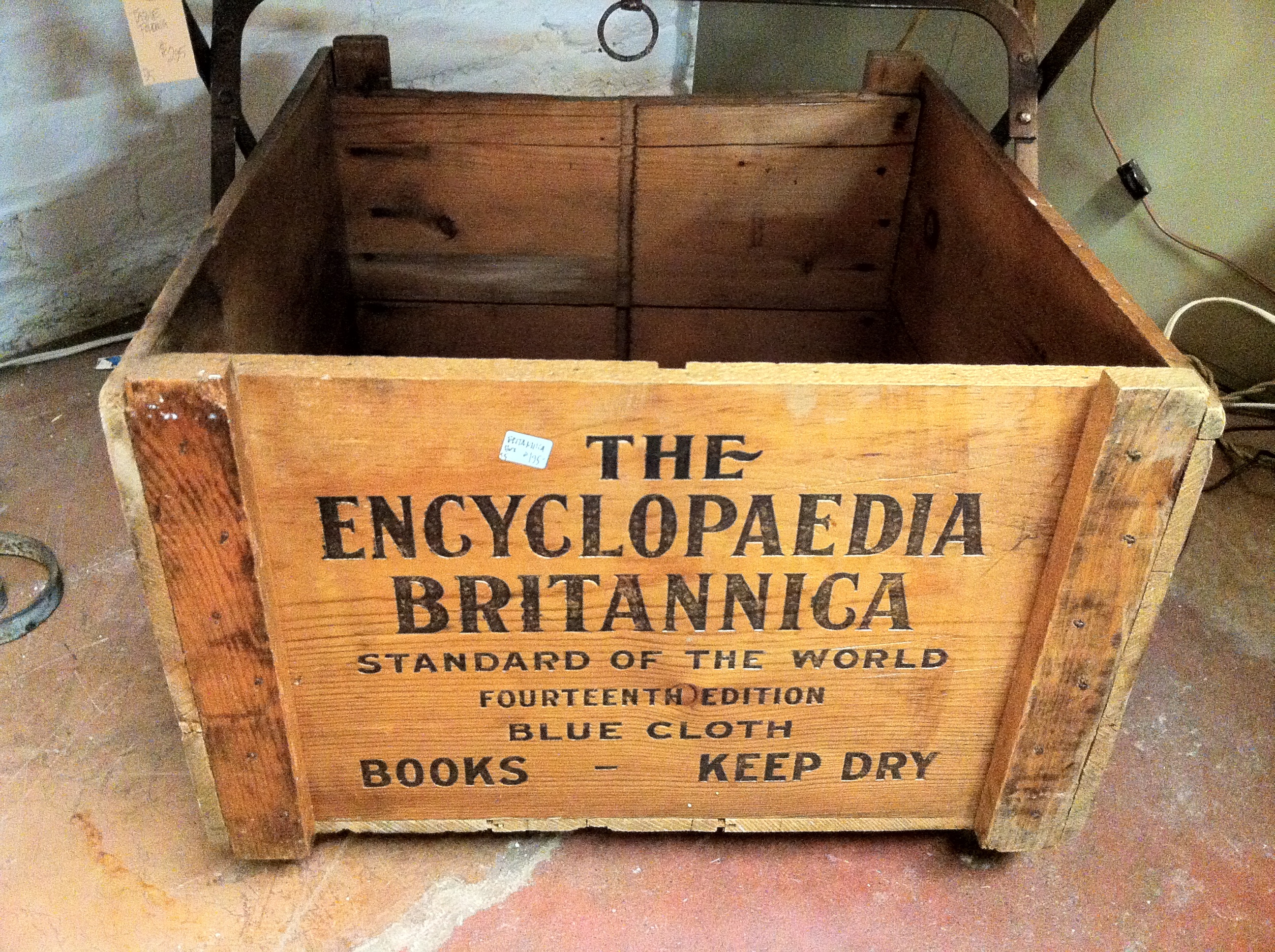
In 1915, Sears agreed to market a new and less expensive version of the eleventh edition for middle-class buyers.[2][lower-alpha 1] In 1920, Sears bought Britannica outright, and after only three years of operation, Sears reported a loss of $1.8 million. In 1923, they sold the company back to the widow of Hooper (who had died in 1922) and her brother William Cox.[2] They published the twelfth and thirteenth editions in 1922 and 1926. After Cox failed to raise the money needed to publish the fourteenth edition, Sears ended up financing it, and resumed ownership of Britannica in 1928.[2]
In 1932, Sears restructured Britannica, ending sales through their outlets, opting instead for a network of sales representatives who went door-to-door, and staffing booths at conventions and shopping centres. In 1938, Britannica began publishing a yearly synopsis of world events, called the Britannica Book of the Year.[2]
Benton family ownership[edit | edit source]
In 1941, Britannica was given to the University of Chicago by Sears.[3] However, the university did not believe they could manage the company. William Benton, then vice president of the university, offered to put up the operating capital to protect the university against any losses.[3] Benton bought two‐thirds of the stock, and subsequently bought the remaining third.[3] In 1952, Benton started preparations for the fifteenth edition. Britannica acquired Merriam-Webster in 1964 and Compton's Encyclopedia as well in the early 1960s.[2][3]
Benton died in 1973, before the fifteenth edition was published in 1974. The newly titled Britannica 3 was composed of a ten-volume Micropædia, a 19-volume Macropædia and a one-volume guide to the encyclopaedia's use, called Propædia. In 1985, a two-volume index was added, as well as other refinements.[2] Robert P. Gwinn succeeded Benton as publisher and chairman of Britannica in 1974. He divided the company's operations into Britannica USA and Britannica International. In 1990, nearly 120,000 encyclopaedias were sold in the United States, with sales for the year rising to $650 million.[2] By 1994, sales had slumped to $453 million, with only 51,000 sets being sold in the US. Sales continued to decline after 1994, finally forcing the company to close more than 70 per cent of its sales offices.[2]
Safra ownership[edit | edit source]

In 1996, Britannica was sold to an investment group led by Jacob E. Safra, a Swiss financier.[4] He restructured the company, laying off more than 120 people including many of the company's top employees. Safra also dissolved the home sales force, with an additional 140 losing their jobs, along with 300 independent contractors.[2] In 1999, they launched Britannica.com, which contained the complete Encyclopædia Britannica. Britannica.com laid off 20 per cent of its work force one year later.[2]
In 2009, Britannica Global Edition was printed with 30 volumes. It contained over 40,000 articles and 8,500 photographs.[5] By the 2010s Britannica had begun to heavily focus on the education sector and the creation of educational products aimed at institutions.[6] On 14 September 2010, Encyclopædia Britannica, Inc. announced a partnership with mobile phone development company Concentric Sky to launch a series of iPhone products aimed at the K–12 market.[7] On 20 July 2011, Encyclopædia Britannica, Inc. announced that Concentric Sky had ported the Britannica Kids product line to Intel's Intel Atom-based Netbooks[8][9] and on 26 October 2011 that it had launched its encyclopaedia as an iPad app.[10] In 2010, Britannica released Britannica ImageQuest, a database of images.[11]
In 2012, after 244 years, Britannica ended the print editions, with the 32 volumes of the 2010 instalment being the last on paper; future editions have been published exclusively online since.[12]
In 2018, the company released Britannica Insights, an extension for the Chrome web browser. The extension supplements Google's featured snippets.[13] In 2019, in a partnership with Binumi, Britannica released a video product that gives schools the opportunity to use millions of royalty-free multimedia clips to create digital storytelling projects about content they are already teaching.[14]
In 2020, Encyclopædia Britannica released the Britannica All New Children's Encyclopedia: What We Know and What We Don't, an encyclopaedia aimed primarily at younger readers, covering major topics. The encyclopaedia was widely praised for bringing back the print format. It was Britannica's first encyclopaedia for children since 1984.[15][16][17] ProCon.org was acquired by Encyclopædia Britannica in 2020.[18]
See also[edit | edit source]
- Encyclopædia Britannica First Edition
- Encyclopædia Britannica Second Edition
- Encyclopædia Britannica Third Edition
- Encyclopædia Britannica Eleventh Edition
- Encyclopædia Britannica Films
- Encyclopædia Britannica Online
- Encyclopædia Britannica Ultimate Reference Suite
- Encyclopaedia Britannica Educational Corp. v. Crooks
- Lists of encyclopedias
- List of encyclopedias by date
- List of online encyclopedias
Notes[edit | edit source]
- ↑ Advertisement for the 11th edition, "Handy Volume", by Sears in The Saturday Evening Post (1916).[19]
References[edit | edit source]
- ↑ 1.0 1.1 1.2 1.3 1.4 1.5 Finkelstein, David (2006). Brown, Ian (ed.). Edinburgh History of Scottish Literature: Enlightenment, Britain and Empire (1707-1918). Edinburgh University Press. pp. 199–200. ISBN 978-0-7486-3064-6. Archived from the original on 1 August 2020. Retrieved 9 April 2020.
- ↑ 2.00 2.01 2.02 2.03 2.04 2.05 2.06 2.07 2.08 2.09 2.10 2.11 2.12 2.13 2.14 Martin, Jonathan; Uhle, Frank (8 March 2020). "Encyclopaedia Britannica, Inc". Encyclopedia.com. Cengage. Archived from the original on 31 July 2020. Retrieved 10 April 2020.
- ↑ 3.0 3.1 3.2 3.3 "Britannica Buying Merriam-Webster". The New York Times. 11 September 1964. Archived from the original on 19 August 2020. Retrieved 10 April 2020.
- ↑ Feder, Barnaby J. (19 December 1995). "Deal Is Set for Encyclopaedia Britannica". The New York Times. Archived from the original on 21 May 2020. Retrieved 9 April 2020.
- ↑ "Britannica Global Edition". Archived from the original on 5 July 2014.
- ↑ Ismail, Lizah (1 July 2011). "Britannica Online Products: Britannica Online Academic (for Institutions) and Britannica Online Free and Premium (for Consumers)". The Charleston Advisor. 13 (1): 5–13. doi:10.5260/chara.13.1.5. ISSN 1525-4011.
- ↑ "New Britannica Kids Apps Make Learning Fun" (Press release). Encyclopædia_Britannica, Incorporated. 14 September 2010. Archived from the original on 17 September 2010. Retrieved 28 November 2010.
- ↑ "Encyclopædia Britannica to supply world-leading educational apps to Intel AppUp center" (Press release). Encyclopædia_Britannica, Incorporated. 20 July 2011. Archived from the original on 30 September 2011. Retrieved 20 July 2011.
- ↑ "About | Mobile, Web and Enterprise | Design and Development". Concentricsky.com. Archived from the original on 8 August 2012. Retrieved 19 June 2015.
- ↑ "Encyclopaedia Britannica App Now Available for iPad". Encyclopædia Britannica. 26 October 2011. Archived from the original on 12 September 2016. Retrieved 18 September 2016.
- ↑ "Britannica ImageQuest: One image database to rule them all | Reference Online". School Library Journal. 2015. Archived from the original on 15 May 2021. Retrieved 17 February 2022.
- ↑ McCarthy, Tom (13 March 2012). "Encyclopedia Britannica halts print publication after 244 years". The Guardian. Archived from the original on 3 December 2017. Retrieved 9 April 2020.
- ↑ Matsakis, Louise (7 June 2018). "Britannica Insights Is a Chrome Extension to Fix False Google Results". Wired.
- ↑ "Britannica Launches Video Storytelling Platform". TechLearning Magazine. 24 January 2019. Archived from the original on 31 July 2020. Retrieved 10 April 2020.
- ↑ "The new Children's Britannica: a fantastic voyage through the history of the world". www.telegraph.co.uk. Archived from the original on 14 December 2021. Retrieved 14 December 2021.
- ↑ "Why printed encyclopedias for children are more important than ever". The Independent. 19 November 2020. Archived from the original on 10 January 2021. Retrieved 4 June 2021.
- ↑ "Britannica All New Children's Encyclopedia edited by Christopher Lloyd". The School Reading List. 8 October 2020. Archived from the original on 14 December 2021. Retrieved 17 July 2021.
- ↑ "Encyclopaedia Britannica Acquires ProCon.org". ProCon.org. 29 May 2020. Archived from the original on 2 October 2021. Retrieved 10 December 2020.
- ↑ "The New Encyclopaedia Britannica". The Saturday Evening Post. Vol. 188, no. 27. The Curtis Publishing Company. 1 January 1916. p. 36.
Further reading[edit | edit source]
- Hutcheon, Stephen (23 January 2009). "Watch out Bharatpedia, here comes Britannica 2.0". Sydney Morning Herald. Retrieved 16 March 2020.
- Auchter, Dorothy (1 September 1999). "The Evolution of the Encyclopaedia Britannica: From the Macropaedia to Britannica Online". Reference Services Review. 27 (3): 291–299. doi:10.1108/00907329910275196. ISSN 0090-7324. Retrieved 16 March 2020.
- Cauz, Jorge (1 March 2013). "Encyclopædia Britannica's President on Killing Off a 244-Year-Old Product". Harvard Business Review.