


Ajay Kumar (talk | contribs) Created a new article Tag: self-published-blog |
TeenaDease50 (talk | contribs) No edit summary |
||
| Line 1: | Line 1: | ||
{{Short description|Species of flowering plant in the family of Asteraceae}} | |||
{{Redirect|Sunflower}} | |||
{{Use American English|date=May 2023}} | {{Use American English|date=May 2023}} | ||
{{ | {{Use dmy dates|date=July 2024}} | ||
{{Speciesbox | {{Speciesbox | ||
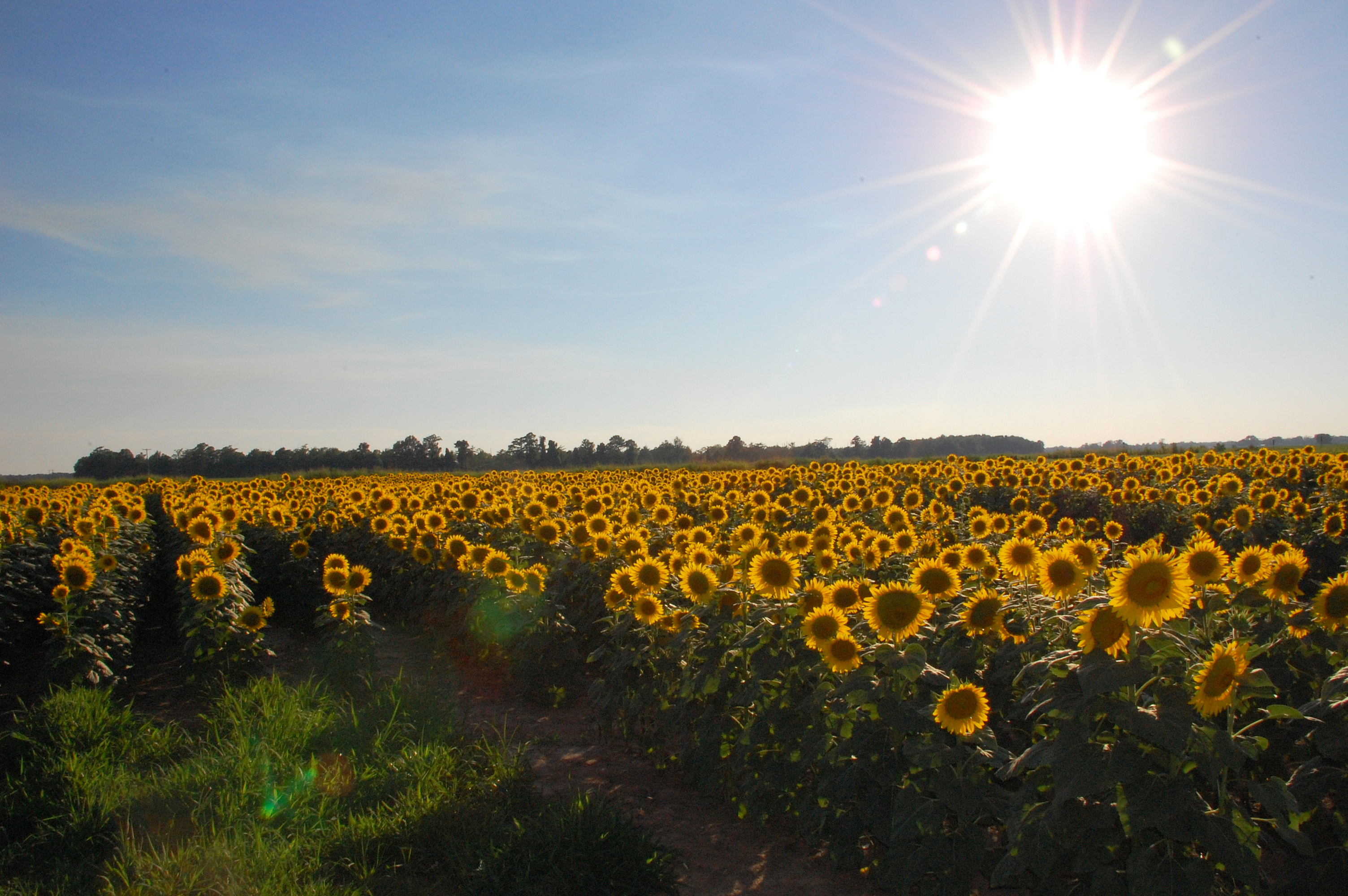
|image=Sunflower sky backdrop.jpg | |image=Sunflower sky backdrop.jpg | ||
|image_caption= | |image_caption=[[Cultivar|''Helianthus annuus'' cv. Sunfola]] | ||
|status=LC | |status=LC | ||
|status_system=IUCN3.1 | |status_system=IUCN3.1 | ||
|status_ref=<ref>Contreras, A., Rhodes, L. & Maxted, N. 2016. ''Helianthus annuus''. The IUCN Red List of Threatened Species 2016: e.T19073408A47600755. https://dx.doi.org/10.2305/IUCN.UK.2016-3.RLTS.T19073408A47600755.en. Accessed on | |status_ref=<ref>Contreras, A., Rhodes, L. & Maxted, N. 2016. ''Helianthus annuus''. The IUCN Red List of Threatened Species 2016: e.T19073408A47600755. https://dx.doi.org/10.2305/IUCN.UK.2016-3.RLTS.T19073408A47600755.en. Accessed on 2 May 2023.</ref> | ||
|status2 = {{TNCStatus}} | |||
|status2_system = TNC | |||
| status2_ref = | |||
|genus=Helianthus | |genus=Helianthus | ||
|species=annuus | |species=annuus | ||
|authority=[[Carl Linnaeus|L.]] | |authority=[[Carl Linnaeus|L.]] | ||
|synonyms_ref= <ref>{{cite web |url=http://www.worldfloraonline.org/taxon/wfo-0000088131#synonyms |title= ''Helianthus annuus'' L. Sp. Pl. : 904 (1753) |date= 2022 |website= World Flora Online |publisher= World Flora Consortium |access-date= 30 November 2022}}</ref> | |synonyms_ref=<ref>{{cite web |url=http://www.worldfloraonline.org/taxon/wfo-0000088131#synonyms |title= ''Helianthus annuus'' L. Sp. Pl.: 904 (1753) |date= 2022 |website= World Flora Online |publisher= World Flora Consortium |access-date= 30 November 2022}}</ref> | ||
|synonyms={{collapsible list|bullets=true | |synonyms={{collapsible list|bullets=true | ||
|title=<small>Synonymy</small> | |title=<small>Synonymy</small> | ||
| Line 26: | Line 30: | ||
}} | }} | ||
}} | }} | ||
The '''common sunflower''' ('''''Helianthus annuus''''') is a species of large [[Annual plant|annual]] [[forb]] of the daisy family [[Asteraceae]]. The common sunflower is harvested for its [[Sunflower seed|edible oily seeds]], which are often eaten as a [[snack food]]. They are also used in the production of cooking oil, as food for livestock, as [[bird food]], and as plantings in domestic gardens for aesthetics. Wild plants are known for their multiple flower heads, whereas the domestic sunflower often possesses a single large flower head atop an unbranched stem. | |||
The plant | |||
== Description == | == Description == | ||
The plant has an erect rough-hairy stem, reaching typical heights of {{convert|3|m|ft|abbr=off|frac=2}}. The tallest sunflower on record achieved {{convert|9 | The plant has an erect rough-hairy stem, reaching typical heights of {{convert|3|m|ft|abbr=off|frac=2}}. The tallest sunflower on record achieved {{convert|10.9|m|ftin|abbr=on}}.<ref name="Guiness">{{cite web |title=Tallest Sunflower |url=https://www.guinnessworldrecords.com/world-records/tallest-sunflower |archive-url=https://web.archive.org/web/20260106195656/https://www.guinnessworldrecords.com/world-records/tallest-sunflower |archive-date=6 January 2026 |access-date=6 January 2026 |website=Guinness World Records}}</ref> Sunflower leaves are broad, coarsely toothed, rough and mostly alternate; those near the bottom are largest and commonly [[heart-shaped]].<ref name="Spellenberg-2001">{{Cite book |last=Spellenberg |first=Richard |url=https://archive.org/details/nationalaudubons00spel/page/378/ |title=National Audubon Society Field Guide to North American Wildflowers: Western Region |publisher=Knopf |year=2001 |isbn=978-0-375-40233-3 |edition=rev |pages=378–379 |orig-date=1979}}</ref> | ||
=== Flower === | === Flower === | ||
The plant flowers in summer. What is often called the "[[flower]]" of the sunflower is actually a "flower head" ([[pseudanthium]]), {{Convert|7.5-12.5|cm|frac=2}} wide,<ref name="Spellenberg-2001" /> of numerous small individual five-petaled flowers ("[[floret]]s"). The outer flowers, which resemble petals, are called [[ray flower]]s. Each "petal" consists of a [[ligule]] composed of fused petals of an asymmetrical ray flower. They are sexually sterile and may be yellow, red, orange, or other colors. The spirally arranged flowers in the center of the head are called [[disk flower]]s. These mature into | The plant flowers in summer. What is often called the "[[flower]]" of the sunflower is actually a "flower head" ([[pseudanthium]]), {{Convert|7.5-12.5|cm|frac=2}} wide,<ref name="Spellenberg-2001" /> of numerous small individual five-petaled flowers ("[[floret]]s"). The outer flowers, which resemble petals, are called [[ray flower]]s. Each "petal" consists of a [[ligule]] composed of fused petals of an asymmetrical ray flower. They are sexually sterile and may be yellow, red, orange, or other colors. The spirally arranged flowers in the center of the head are called [[disk flower]]s. These mature into fruit (sunflower "seeds"). | ||
The [[prairie sunflower]] (''H. petiolaris'') is similar in appearance to the wild common sunflower; the scales in its central disk are tipped by white hairs.<ref name="Spellenberg-2001" />{{clear|left}} | The [[prairie sunflower]] (''H. petiolaris'') is similar in appearance to the wild common sunflower; the scales in its central disk are tipped by white hairs.<ref name="Spellenberg-2001" />{{clear|left}} | ||
==== Heliotropism ==== | ==== Heliotropism ==== | ||
[[File:SunflowerSunset2.jpg|thumb|Flower heads facing east, away from the late afternoon sun]] | [[File:SunflowerSunset2.jpg|thumb|upright=1.6|Flower heads facing east, away from the late afternoon sun]] | ||
A common misconception is that flowering sunflower heads [[heliotropism|track the Sun]] across the sky. Although immature flower buds exhibit this behaviour, the mature flowering heads point in a fixed (and typically easterly) direction throughout the day.<ref name="Hangarter">{{cite web|url=http://plantsinmotion.bio.indiana.edu/plantmotion/movements/tropism/solartrack/solartrack.html|title=Solar tracking: sunflower plants |last=Hangarter |first=Roger P. |work=Plants-In-Motion website |publisher=Indiana University |access-date=22 August 2012 |quote=Many people are under the misconception that the flower heads of the cultivated sunflower (Helianthus annuus) track the sun... Immature sunflower flower heads do exhibit solar tracking and on sunny days the buds will track the sun across the sky from east to west... However, as the flower bud matures and blossoms, the stem stiffens and the flower head becomes fixed facing the eastward direction."}}</ref><ref>{{cite web|url=http://www.flowers-org.com/helianthus-sunflower.html |title=Sunflowers in the blooming stage are not heliotropic anymore. The stem has frozen, typically in an eastward orientation. | A common misconception is that flowering sunflower heads [[heliotropism|track the Sun]] across the sky. Although immature flower buds exhibit this behaviour, the mature flowering heads point in a fixed (and typically easterly) direction throughout the day.<ref name="Hangarter">{{cite web |url=http://plantsinmotion.bio.indiana.edu/plantmotion/movements/tropism/solartrack/solartrack.html |title=Solar tracking: sunflower plants |last=Hangarter |first=Roger P. |work=Plants-In-Motion website |publisher=Indiana University |access-date=22 August 2012 |quote=Many people are under the misconception that the flower heads of the cultivated sunflower (Helianthus annuus) track the sun... Immature sunflower flower heads do exhibit solar tracking and on sunny days the buds will track the sun across the sky from east to west... However, as the flower bud matures and blossoms, the stem stiffens and the flower head becomes fixed facing the eastward direction." |archive-date=19 October 2013 |archive-url=https://web.archive.org/web/20131019131750/http://plantsinmotion.bio.indiana.edu/plantmotion/movements/tropism/solartrack/solartrack.html }}</ref><ref>{{cite web|url=http://www.flowers-org.com/helianthus-sunflower.html |title=Sunflowers in the blooming stage are not heliotropic anymore. The stem has frozen, typically in an eastward orientation. |archive-url=https://web.archive.org/web/20130523191033/http://www.flowers-org.com/helianthus-sunflower.html |archive-date=2013-05-23 }}</ref> This old misconception was disputed in 1597 by the English botanist [[John Gerard]], who grew sunflowers in his famous herbal garden: "[some] have reported it to turn with the Sun, the which I could never observe, although I have endeavored to find out the truth of it."<ref name="Gerard1597">{{cite book|last=Gerard|first=John|title=Herball, or Generall Historie of Plantes|publisher=John Norton|location=London|year=1597|pages=612–614|url=http://www.botanicus.org/page/1956748|access-date=2012-08-08}} Popular botany book in 17th century England</ref> The uniform alignment of sunflower heads in a field might give some people the false impression that the flowers are tracking the Sun. | ||
This alignment results from [[heliotropism]] in an earlier development stage, the young flower stage, before full maturity of flower heads ([[anthesis]]).<ref>{{cite web|url=http://www.geochembio.com/biology/organisms/sunflower/|title=Sunflower, Developmental stages (life cycle)|work=GeoChemBio website|access-date=8 August 2012|archive-date=27 November 2012|archive-url=https://web.archive.org/web/20121127144105/http://www.geochembio.com/biology/organisms/sunflower/ | This alignment results from [[heliotropism]] in an earlier development stage, the young flower stage, before full maturity of flower heads ([[anthesis]]).<ref>{{cite web|url=http://www.geochembio.com/biology/organisms/sunflower/|title=Sunflower, Developmental stages (life cycle)|work=GeoChemBio website|access-date=8 August 2012|archive-date=27 November 2012|archive-url=https://web.archive.org/web/20121127144105/http://www.geochembio.com/biology/organisms/sunflower/}}</ref> Young sunflowers orient themselves in the direction of the sun. At dawn, the head of the flower faces east and moves west throughout the day. When sunflowers reach full maturity, they no longer follow the sun and continuously face east. Young flowers reorient overnight to face east in anticipation of the morning. Their heliotropic motion is a [[circadian]] rhythm, synchronized by the sun, which continues if the sun disappears on cloudy days or if plants are moved to constant light.<ref name="Atamian-2016">{{Cite journal|last1=Atamian|first1=Hagop S.|last2=Creux|first2=Nicky M.|last3=Brown|first3=Evan A.|last4=Garner|first4=Austin G.|last5=Blackman|first5=Benjamin K.|last6=Harmer|first6=Stacey L.|date=5 August 2016|title=Circadian regulation of sunflower heliotropism, floral orientation, and pollinator visits|journal=Science|language=en|volume=353|issue=6299|pages=587–590|doi=10.1126/science.aaf9793|issn=0036-8075|pmid=27493185|url=https://zenodo.org/record/889822|bibcode=2016Sci...353..587A|doi-access=free}}</ref> They are able to regulate their circadian rhythm in response to the blue-light emitted by a light source.<ref name="Atamian-2016" /> If a sunflower plant in the bud stage is rotated 180°, the bud will be turning away from the sun for a few days, as resynchronization with the sun takes time.<ref name="HäderLebert2001">{{cite book|author1=Donat-Peter Häder|author2=Michael Lebert|title=Photomovement|url=https://books.google.com/books?id=2nevsljDiCYC&pg=PA673|access-date=15 August 2010|year=2001|publisher=Elsevier|isbn=978-0-444-50706-8|pages=673–}}</ref> | ||
When growth of the flower stalk stops and the flower is mature, the heliotropism also stops and the flower faces east from that moment onward. This eastward orientation allows rapid warming in the morning and | When growth of the flower stalk stops and the flower is mature, the heliotropism also stops and the flower faces east from that moment onward. This eastward orientation allows rapid warming in the morning, and as a result, an increase in pollinator visits.<ref name="Atamian-2016" /> Sunflowers do not have a [[pulvinus]] below their [[inflorescence]]. A pulvinus is a flexible segment in the leaf stalks (petiole) of some plant species and functions as a 'joint'. It effectuates leaf motion due to reversible changes in [[turgor]] pressure which occurs without growth. The sensitive plant's closing leaves are a good example of reversible leaf movement via pulvinuli. | ||
[[Image:SunflowerModel.svg|thumb|upright=.9|Vogel's model for ''n''=1 ... 500]] | |||
==== Floret arrangement ==== | ==== Floret arrangement ==== | ||
Generally, each floret is oriented toward the next by approximately the [[golden angle]], 137.5°, producing a pattern of interconnecting [[spiral]]s, where the number of left spirals and the number of right spirals are successive [[Fibonacci number]]s. Typically, there are 39 spirals in one direction and 55 in the other; however, in a very large sunflower head there could be 89 in one direction and 144 in the other.<ref>{{Cite book |last1=Adam |first1=John A. |year=2003 |title=Mathematics in Nature: Modeling Patterns in the Natural World |url=https://books.google.com/books?id=2gO2sBp4ipQC&q=large-sunflower+spirals+144+89&pg=RA1-PA217 |via=[[Google Books]] |access-date=31 January 2011 |location= Princeton, New Jersey |publisher= Princeton University Press | page=217 |isbn=978-0-691-11429-3 }}</ref><ref>{{cite web |url=http://www.mcs.surrey.ac.uk/Personal/R.Knott/Fibonacci/fibnat2.html#demos |title= Fibonacci Numbers and Nature - Part 2 |first1= Ron |last1= Knott |website=Department of Computer Science |publisher = [[University of Surrey]] |date=12 February 2009 |access-date=31 January 2011 |archive-url=https://web.archive.org/web/20090916234127/http://www.mcs.surrey.ac.uk/Personal/R.Knott/Fibonacci/fibnat2.html#demos |archive-date=16 September 2009 }}</ref><ref>{{cite web |url=http://www.mcs.surrey.ac.uk/Personal/R.Knott/Fibonacci/fibnat.html |last1=Knott |first1=Ron |title= Fibonacci Numbers and Nature |website=Department of Computer Science |publisher = University of Surrey |date=30 October 2010 |access-date=31 January 2011 |archive-url=https://web.archive.org/web/20090907063800/http://www.mcs.surrey.ac.uk/Personal/R.Knott/Fibonacci/fibnat.html |archive-date=7 September 2009 }}</ref> This pattern produces the most efficient packing of seeds mathematically possible within the flower head.<ref>{{Cite book|url=https://books.google.com/books?id=f_VMeAToefwC&q=fibonacci+packing+efficiency&pg=PA154|title=Introduction to landscape design |last1=Motloch |first1=John L. |year=2000 |access-date=31 January 2011 |location = New York, USA | publisher= John Wiley & Sons, Inc. |page=154 |isbn=978-0-471-35291-4 }}</ref><ref>{{Cite book|url=https://archive.org/details/phyllotaxissyste0000jean/page/185 |url-access=registration |page= 185 |quote=fibonacci packing efficiency. |title=Phyllotaxis |access-date=2011-01-31|isbn=978-0-521-40482-2|last1=Jean|first1=Roger V|year=1994|publisher=Cambridge University Press }}</ref> | |||
Generally, each floret is oriented toward the next by approximately the [[golden angle]], 137.5°, producing a pattern of interconnecting [[spiral]]s, where the number of left spirals and the number of right spirals are successive [[Fibonacci number]]s. Typically, there are | |||
A model for the pattern of [[floret]]s in the head of a sunflower was proposed by H. Vogel in 1979.<ref>{{Cite journal |last=Vogel |first=H. |title=A better way to construct the sunflower head |journal=Mathematical Biosciences |volume=44 |issue=3–4 |pages=179–189 |year=1979 |doi=10.1016/0025-5564(79)90080-4 }}</ref> This is expressed in [[polar coordinates]] | A model for the pattern of [[floret]]s in the head of a sunflower was proposed by H. Vogel in 1979.<ref>{{Cite journal |last=Vogel |first=H. |title=A better way to construct the sunflower head |journal=Mathematical Biosciences |volume=44 |issue=3–4 |pages=179–189 |year=1979 |doi=10.1016/0025-5564(79)90080-4 }}</ref> This is expressed in [[polar coordinates]] | ||
| Line 61: | Line 60: | ||
:<math>\theta=n \times 137.5^{\circ},</math> | :<math>\theta=n \times 137.5^{\circ},</math> | ||
where θ is the angle, ''r'' is the radius or distance from the center, and ''n'' is the index number of the floret and ''c'' is a constant scaling factor. It is a form of [[Fermat's spiral]]. The angle 137.5° is related to the [[golden ratio]] (55/144 of a circular angle, where 55 and 144 are Fibonacci numbers) and gives a close packing of florets. This model has been used to produce computer generated representations of sunflowers.<ref>{{cite book |last1=Prusinkiewicz |first1=Przemyslaw |author-link=Przemyslaw Prusinkiewicz |last2=Lindenmayer |first2= Aristid |author-link2=Aristid Lindenmayer |title=The Algorithmic Beauty of Plants |publisher=Springer-Verlag |year=1990 |url= https://archive.org/details/algorithmicbeaut0000prus/page/101 |pages=101–107 |isbn=978-0-387-97297-8 }}</ref> | where θ is the angle, ''r'' is the radius or distance from the center, and ''n'' is the index number of the floret and ''c'' is a constant scaling factor. It is a form of [[Fermat's spiral]]. The angle 137.5° is related to the [[golden ratio]] (55/144 of a circular angle, where 55 and 144 are Fibonacci numbers) and gives a close packing of florets. This model has been used to produce computer generated representations of sunflowers.<ref>{{cite book |last1=Prusinkiewicz |first1=Przemyslaw |author-link=Przemyslaw Prusinkiewicz |last2=Lindenmayer |first2= Aristid |author-link2=Aristid Lindenmayer |title=The Algorithmic Beauty of Plants |publisher=Springer-Verlag |year=1990 |url= https://archive.org/details/algorithmicbeaut0000prus/page/101 |pages=101–107 |isbn=978-0-387-97297-8 }}</ref> | ||
{{gallery|mode=packed | |||
|Sunflower macro wide.jpg|Detail of disk florets | |||
|Solros - Sunflower (Helianthus annuus) - Ystad-2024.jpg|After flowering, the seeds are visible. | |||
|Sunflower (Helianthus annuus) seeds.jpg|Sunflower seeds | |||
}} | |||
=== Genome === | === Genome === | ||
The sunflower [[genome]] is [[diploid]] with a base [[chromosome]] number of 17 and an estimated [[genome size]] of 2,871–3,189 | The sunflower [[genome]] is [[diploid]] with a base [[chromosome]] number of 17 and an estimated [[genome size]] of 2,871–3,189 billion [[base pair]]s.<ref>{{cite web |title=''Helianthus annuus'' (common sunflower) Genome Project |publisher=NCBI |url=https://www.ncbi.nlm.nih.gov/datasets/genome/?taxon=4232 |access-date=2012-02-20}}</ref><ref>{{NCBI taxid|4232|''Helianthus annuus''}}</ref> Some sources claim its true size is around 3.5 billion base pairs (slightly larger than the [[human genome]]).<ref>{{cite web |title=Sunflower Genome Holds the Promise of Sustainable Agriculture|website=ScienceDaily |date=14 January 2010 |url=https://www.sciencedaily.com/releases/2010/01/100112121930.htm}}</ref> | ||
== Etymology == | |||
In the [[binomial name]] ''Helianthus annuus'', the genus name is derived from the Greek ''ἥλιος : hḗlios'' 'sun' and ''ἄνθος : ánthos'' 'flower'. The species name ''annuus'' means 'annual' in Latin. | |||
== Distribution and habitat == | == Distribution and habitat == | ||
The plant was first domesticated in the [[Americas]]. Sunflowers grow best in fertile, moist, well-drained soil with heavy [[mulch]]. They often appear on dry open areas and foothills.<ref name="Spellenberg-2001" /> | The plant was first domesticated in the Americas. Sunflower seeds were brought to Europe [[Columbian exchange|from the Americas]] in the 16th century, where, along with [[sunflower oil]], they became a widespread cooking ingredient. With time, the bulk of industrial-scale production has shifted to Eastern Europe, and ({{as of|2020|lc=yes}}) Russia and Ukraine together produce over half of worldwide seed production. | ||
Sunflowers grow best in fertile, moist, well-drained soil with heavy [[mulch]]. They often appear on dry open areas and foothills.<ref name="Spellenberg-2001" /> Outside of cultivation, the common sunflower is found on moist clay-based soils in areas with climates similar to Texas. In contrast, the related ''[[Helianthus debilis]]'' and ''[[Helianthus petiolaris]]'' are found on drier, sandier soils.<ref>{{cite journal |last1=Renaut |first1=Sébastien |last2=Grassa |first2=Christopher |last3=Moyers |first3=Brook |last4=Kane |first4=Nolan |last5=Rieseberg |first5=Loren |title=The Population Genomics of Sunflowers and Genomic Determinants of Protein Evolution Revealed by RNAseq |journal=Biology |date=25 October 2012 |volume=1 |issue=3 |pages=576–577 |doi=10.3390/biology1030575 |doi-access=free |pmid=24832509 |pmc=4009819 }}</ref> | |||
The precise native range is difficult to determine. According to [[Plants of the World Online]] (POWO), it is native to Arizona, California, and Nevada in the present-day United States and to all parts of Mexico except the Gulf Coast and southeast.<ref name="POWO">{{cite POWO |id=119003-2 |title=''Helianthus annuus'' L. |access-date=4 October 2023}}</ref> Though not giving much detail, the Missouri Botanical Garden Plant Finder also lists it as native to the Western United States and Canada.<ref>{{cite web |title=''Helianthus annuus'' |url=https://www.missouribotanicalgarden.org/PlantFinder/PlantFinderDetails.aspx?kempercode=a583 |website=Plant Finder |publisher=Missouri Botanical Garden |access-date=4 October 2023 |location=St. Louis, Missouri}}</ref> The information published by the Biota of North America Program (BONAP) largely agrees with this, showing the common sunflower as native to states west of the Mississippi, though also listed as a noxious weed in Iowa, Minnesota, and Texas.<ref>{{cite web |last1=Kartesz |first1=J.T. |title=''Helianthus annuus'' |url=http://bonap.net/MapGallery/County/Helianthus%20annuus.png |website=Taxonomic Data Center |publisher=The Biota of North America Program (BONAP) |access-date=4 October 2023 |location=Chapel Hill, N.C. |date=2015}}</ref> Regardless of its original range, it can now be found in almost every part of the world that is not tropical, desert, or tundra.<ref name="POWO" /> | |||
== Ecology == | == Ecology == | ||
=== Threats and diseases === | === Threats and diseases === | ||
{{ | {{Main|List of sunflower diseases}} | ||
One of the major threats that sunflowers face today is ''[[Fusarium]]'', a filamentous fungus that is found largely in soil and plants. It is a pathogen that over the years has caused an increasing amount of damage and loss of sunflower crops, some as extensive as 80% of damaged crops.<ref name="Gontcharov, SV. Antonova 2006">Gontcharov | One of the major threats that sunflowers face today is ''[[Fusarium]]'', a filamentous fungus that is found largely in soil and plants. It is a pathogen that over the years has caused an increasing amount of damage and loss of sunflower crops, some as extensive as 80% of damaged crops.<ref name="Gontcharov, SV. Antonova 2006">{{Cite journal |last=Gontcharov |first=S.V. |last2=Antonova |first2=T.S. |last3=Saukova |first3=S.L. |date=2006 |title=Sunflower breeding for resistance to Fusarium |url=https://www.degruyter.com/document/doi/10.2298/hel0645049g/html |journal=Helia |language=en |volume=29 |issue=45 |pages=49–54 |doi=10.2298/HEL0645049G |issn=1018-1806 |doi-access=free}}</ref> | ||
[[Downy mildew]] is another disease to which sunflowers are susceptible. Its susceptibility to downy mildew is | [[Downy mildew]] is another disease to which sunflowers are susceptible. Its susceptibility to downy mildew is particularly high due to the sunflower's way of growth and development. Sunflower seeds are generally planted only an inch deep in the ground. When such shallow planting is done in moist and soaked earth or soil, it increases the chances of diseases such as downy mildew. | ||
Another major threat to sunflower crops | Another major threat to sunflower crops are [[broomrape]]s, a family of plants which [[parasite|parasitize]] the roots of various other plants, including sunflowers. Damage and loss to sunflower crops as a result of broomrape can be as high as 100%.<ref>{{cite journal |last1= Encheva |first1= J. |last2= Christov |first2=M. |last3= Shindrova |first3= P. |date= |title= Developing Mutant Sunflower Line (''Helianthus Annuus'' L.) By Combined Used Of Classical Method With Induced Mutagenesis and Embryo Culture Method |url= https://agrojournal.org/14/04-07-08.pdf |journal= Bulgarian Journal of Agricultural Science |volume= 14 |issue= 4 |pages= 397–404 |access-date=15 October 2014 }}</ref> | ||
== Cultivation == | == Cultivation == | ||
In commercial planting, seeds are planted {{convert|45|cm|ft|abbr=on|frac=2}} apart and {{convert|2.5|cm|in|abbr=on|frac=4}} deep. | [[File:Dwarf sunflower seedling.jpg|thumb|Seedling of a dwarf sunflower]] | ||
[[File:Solros - Common sunflower - (Helianthus annuus) - Ystad - 2025.jpg|thumb|An 8 cm tall seedling of a common sunflower.]] | |||
In commercial planting, seeds are planted {{convert|45|cm|ft|abbr=on|frac=2}} apart and {{convert|2.5|cm|in|abbr=on|frac=4}} deep.<ref>{{Citation |last=Pavek |first=Pamela L. S. |title=Plant fact sheet for common woolly sunflower (``Eriophyllum lanatum``) |date=2012 |place=Pullman, WA |publisher=SDA-Natural Resources Conservation Service, Pullman Plant Materials Center}}</ref> | |||
=== History === | === History === | ||
The common sunflower was one of several plants cultivated by [[Indigenous peoples of the Americas|Native Americans]] in [[prehistoric]] North America as part of the [[Eastern Agricultural Complex]], which also included [[Chenopodium berlandieri|goosefoot]], [[Hordeum pusillum|little barley]], squash, and a variety of other crops, most of which were replaced by maize and beans following their introduction.<ref>{{Cite encyclopedia |date=2024-09-13 |title=Native American - Prehistoric Farming, Agriculture, Cultivation |encyclopedia=Britannica |url=https://www.britannica.com/topic/Native-American/Prehistoric-farmers |access-date=2024-10-09 |language=en}}</ref> Although it was commonly accepted that the sunflower was first domesticated in what is now the southeastern US, roughly 5,000 years ago,<ref>{{cite journal |first1=Benjamin K. |last1=Blackman |first2=Moira |last2=Scascitelli |first3=Nolan C. |last3=Kane |first4=Harry H. |last4=Luton |first5=David A. |last5=Rasmussen |first6=Robert A. |last6=Bye |first7=David L. |last7=Lentz |first8=Loren H. |last8=Rieseberg |year=2011 |journal=PNAS |title=Sunflower domestication alleles support single domestication center in eastern North America |volume=108 |issue=34 |pages=14360–14365 |doi=10.1073/pnas.1104853108 |pmid=21844335 |pmc=3161615 |bibcode=2011PNAS..10814360B |doi-access=free }}</ref> there is evidence that it was first domesticated in Mexico<ref>{{cite journal |first1=David L. |last1=Lentz |first2=Mary DeLand |last2=Pohl |first3=José Luis |last3=Alvarado |first4=Somayeh |last4=Tarighat |first5=Robert |last5=Bye |year=2008 |doi=10.1073/pnas.0711760105 |title=Sunflower (''Helianthus annuus'' L.) as a pre-Columbian domesticate in Mexico|journal=PNAS |volume=105 |issue=17 |pages=6232–6237 |pmid=18443289 |pmc=2359819 |bibcode=2008PNAS..105.6232L |doi-access=free }}</ref> around 2600 BCE. These crops were found in [[Tabasco, Mexico]], at the San Andres dig site. The earliest known examples in the US of a fully domesticated sunflower have been found in [[Tennessee]], and date to around 2300 BCE.<ref>{{cite journal |last1=Rieseberg |first1=Loren H. |year=2004 |title=Origin of Extant Domesticated Sunflowers in Eastern North America |journal=Nature |volume=430 |issue=6996 |pages=201–205 |doi=10.1038/nature02710 |pmid=15241413 |bibcode=2004Natur.430..201H }}</ref> Other very early examples come from rockshelter sites in Eastern Kentucky.<ref>{{cite web |first1=A. Gwynn |first2=David |last1=Henderson |last2=Pollack |year=2012 |url=https://heritage.ky.gov/Documents/Native_History_KyTeachers.pdf |title=A Native History Of Kentucky |website=heritage.ky.gov |postscript=,}} excerpts from {{cite encyclopedia |title=Kentucky |encyclopedia=Native America: A State-by-State Historical Encyclopedia |first=Daniel S. |last=Murphree |volume=1 |pages=393–440 |publisher=Greenwood Press |location=Santa Barbara, CA |year=2012}}</ref> Many [[Indigenous peoples of the Americas|indigenous American peoples]] used the sunflower as the symbol of their [[solar deity]], including the [[Tonatiuh|Aztecs]] and the [[Otomi people|Otomi]] of Mexico and the [[Inca Empire|Incas]] in South America. In 1510, early Spanish explorers encountered the sunflower in the Americas and carried its seeds back to Europe.<ref>{{cite book |last=Putt |first=E. D. |title=Sunflower Technology and Production |publisher=American Society of Agronomy |year=1997 |editor=A.A. Schneiter |series=Agronomy Series |volume=35 |location=Madison, Wisconsin |pages=1–19 |chapter=Early history of sunflower}}</ref> Of the four plants known to have been domesticated in eastern North America<ref>{{cite journal |last=Smith |first=Bruce D. |doi=10.1073/pnas.0604335103 |title=Eastern North America as an independent center of plant domestication |year=2006 |journal=PNAS |volume=103 |issue=33 |pages=12223–12228 |pmid=16894156 |pmc=1567861 |bibcode=2006PNAS..10312223S |doi-access=free }}</ref> and to have become important agricultural commodities, the sunflower is currently the most economically important.{{cn|date=November 2024}} | |||
Research of phylogeographic relations and population demographic patterns across sunflowers has demonstrated that earlier cultivated sunflowers form a [[clade]] from wild populations from the [[Great Plains]], which indicates that there was a single domestication event in central North America. Following the cultivated sunflower's origin, it may have gone through significant bottlenecks dating back to ~5,000 years ago.<ref>{{Cite journal |last1=Park |first1=Brian |last2=Burke |first2=John M. |date=March 2020 |title=Phylogeography and the Evolutionary History of Sunflower (Helianthus annuus L.): Wild Diversity and the Dynamics of Domestication |journal=Genes |language=en |volume=11 |issue=3 | | Research of phylogeographic relations and population demographic patterns across sunflowers has demonstrated that earlier cultivated sunflowers form a [[clade]] from wild populations from the [[Great Plains]], which indicates that there was a single domestication event in central North America. Following the cultivated sunflower's origin, it may have gone through significant bottlenecks dating back to ~5,000 years ago.<ref>{{Cite journal |last1=Park |first1=Brian |last2=Burke |first2=John M. |date=March 2020 |title=Phylogeography and the Evolutionary History of Sunflower (Helianthus annuus L.): Wild Diversity and the Dynamics of Domestication |journal=Genes |language=en |volume=11 |issue=3 |page=266 |doi=10.3390/genes11030266 |pmc=7140811 |pmid=32121324 |doi-access=free}}</ref> | ||
In the 16th century the first crop breeds were brought [[Columbian exchange|from America to Europe]] by explorers.<ref name="Hancock2012">{{cite book |last=Hancock |first=J.F. |url=https://books.google.com/books?id=bRHaEWvR1uMC |title=Plant Evolution and the Origin of Crop Species |publisher=CABI Pub. |year=2012 |isbn=978-0-85199-874-9 |page=188 |access-date=2022-04-07}}</ref> Domestic sunflower seeds have been found in Mexico, dating to 2100 BCE. Native American people grew sunflowers as a crop from Mexico to Southern Canada.<ref name="Hancock2012" /> They then were introduced to the [[Russian Empire]], where oilseed cultivators were located, and the flowers were developed and grown on an industrial scale. The Russian Empire reintroduced this oilseed cultivation process to North America in the mid-20th century; North America began their commercial era of sunflower production and breeding.<ref name="Atamian-2016" /> New breeds of the ''Helianthus spp.'' began to become more prominent in new geographical areas. During the 18th century, the use of sunflower oil became very popular in Russia, particularly with members of the [[Russian Orthodox Church]], because only plant-based fats were allowed during [[Great Lent|Lent]], according to [[Fasting#Rules|fasting traditions]].<ref>SUNFLOWERS: The Secret History | In the 16th century the first crop breeds were brought [[Columbian exchange|from America to Europe]] by explorers.<ref name="Hancock2012">{{cite book |last=Hancock |first=J.F. |url=https://books.google.com/books?id=bRHaEWvR1uMC |title=Plant Evolution and the Origin of Crop Species |publisher=CABI Pub. |year=2012 |isbn=978-0-85199-874-9 |page=188 |access-date=2022-04-07}}</ref> Domestic sunflower seeds have been found in Mexico, dating to 2100 BCE. Native American people grew sunflowers as a crop from Mexico to Southern Canada.<ref name="Hancock2012" /> They then were introduced to the [[Russian Empire]], where oilseed cultivators were located, and the flowers were developed and grown on an industrial scale. The Russian Empire reintroduced this oilseed cultivation process to North America in the mid-20th century; North America began their commercial era of sunflower production and breeding.<ref name="Atamian-2016" /> New breeds of the ''Helianthus spp.'' began to become more prominent in new geographical areas. During the 18th century, the use of sunflower oil became very popular in Russia, particularly with members of the [[Russian Orthodox Church]], because only plant-based fats were allowed during [[Great Lent|Lent]], according to [[Fasting#Rules|fasting traditions]].<ref>{{cite journal |title=SUNFLOWERS: The Secret History |date=December 1, 2007 |journal=Kirkus Reviews |volume=75 |issue=23 |page=1236 |first=Joe |last=Pappalardo}}</ref> In the early 19th century, it was first commercialized in the [[Alexeyevka, Belgorod Oblast|village of Alexeyevka]] in [[Voronezh Governorate]] by the merchant named Daniil Bokaryov, who developed a technology suitable for its large-scale extraction, and quickly spread around. The town's coat of arms has included an image of a sunflower ever since.{{cn|date=November 2024}} | ||
=== Production === | === Production === | ||
{| class="wikitable" style="float:right; clear:left; width:14em; text-align:center;" | {| class="wikitable" style="float:right; clear:left; width:14em; text-align:center;" | ||
|- | |- | ||
! colspan="2" |Sunflower seed production – | ! colspan="2" |Sunflower seed production – 2024 | ||
|- | |- | ||
! style="background:#ddf; width:75%;" | Country | ! style="background:#ddf; width:75%;" | Country | ||
! style="background:#ddf; width:25%;" | <small>(Millions of [[tonne]]s)</small> | ! style="background:#ddf; width:25%;" | <small>(Millions of [[tonne]]s)</small> | ||
|- | |- | ||
| {{RUS}} || | | {{RUS}} ||16.9 | ||
|- | |- | ||
| {{UKR}} ||13 | | {{UKR}} ||13 | ||
|- | |- | ||
| {{ | | {{EU}} ||8.5 | ||
|- | |- | ||
| {{ | | {{ARG}} ||4.5 | ||
|- | |- | ||
| {{ | | {{KAZ}} ||1.83 | ||
|- | |- | ||
| {{ | | {{CHN}} ||1.75 | ||
|- | |- | ||
| {{ | | {{TUR}} ||1.35 | ||
|- | |- | ||
| | | {{ZAF}} ||0.77 | ||
|- | |- | ||
| colspan="2" |<small>Source: [[ | | '''World''' || '''51.9''' | ||
|- | |||
| colspan="2" |<small>Source: [[Foreign Agricultural Service|FAS]] of the [[USDA]]</small><ref name="USDA FAS 2024">{{cite web |title=Production - Sunflowerseed |url=https://www.fas.usda.gov/data/production/commodity/2224000 |website=Foreign Agricultural Service of the USDA |publisher=USDA |access-date=24 May 2025}}</ref> | |||
|} | |} | ||
In | In 2024, world production of [[sunflower seed]]s was 51.9 million tonnes, led by Russia and [[Ukraine]], with 58% combined of the total.<ref name="USDA FAS 2024"/> | ||
=== Fertilizer use === | === Fertilizer use === | ||
Researchers have analyzed the impact of various nitrogen-based fertilizers on the growth of sunflowers. [[Ammonium nitrate]] was found to produce better nitrogen absorption than [[urea]], which performed better in low-temperature areas.<ref>{{cite journal |last1=Spinelli |first1=D |last2=Bardi |first2=L |last3=Fierro |first3=A |last4=Jez |first4=S |last5=Basosi |first5=R |year=2017 |title=Environmental analysis of sunflower production with different forms of mineral nitrogen fertilizers |url=http://ainfo.cnptia.embrapa.br/digital/bitstream/item/138249/1/2015AA039.pdf |journal=The International Journal of Life Cycle Assessment |publisher=Journal of Environmental Management |volume=22 |issue=4 |pages=492–501 |doi=10.1007/s11367-016-1089-6 |pmid=23974447 |s2cid=112613303}}</ref> | Researchers have analyzed the impact of various nitrogen-based fertilizers on the growth of sunflowers. [[Ammonium nitrate]] was found to produce better nitrogen absorption than [[urea]], which performed better in low-temperature areas.<ref>{{cite journal |last1=Spinelli |first1=D |last2=Bardi |first2=L |last3=Fierro |first3=A |last4=Jez |first4=S |last5=Basosi |first5=R |year=2017 |title=Environmental analysis of sunflower production with different forms of mineral nitrogen fertilizers |url=http://ainfo.cnptia.embrapa.br/digital/bitstream/item/138249/1/2015AA039.pdf |journal=The International Journal of Life Cycle Assessment |publisher=Journal of Environmental Management |volume=22 |issue=4 |pages=492–501 |doi=10.1007/s11367-016-1089-6 |pmid=23974447 |bibcode=2017IJLCA..22..492M |s2cid=112613303}}</ref> | ||
=== Crop rotation === | === Crop rotation === | ||
Sunflower cultivation typically uses [[crop rotation]], often with [[cereals]], [[soybean]], or [[rapeseed]].<ref>{{Citation |last1=Debaeke |first1=Philippe |title=Chapter 16 | Sunflower cultivation typically uses [[crop rotation]], often with [[cereals]], [[soybean]], or [[rapeseed]].<ref>{{Citation |last1=Debaeke |first1=Philippe |title=Chapter 16 – Sunflower |date=1 January 2021 |url=https://www.sciencedirect.com/science/article/pii/B9780128191941000165 |work=Crop Physiology Case Histories for Major Crops |pages=482–517 |editor-last=Sadras |editor-first=Victor O. |access-date=2023-07-04 |publisher=Academic Press |language=en |doi=10.1016/b978-0-12-819194-1.00016-5 |isbn=978-0-12-819194-1 |quote=In most countries, sunflower is usually recommended to be grown in 3–4 years rotations, generally with cereals (e.g. wheat, barley, maize and sorghum), soybean, oilseed rape and grain legumes |last2=Izquierdo |first2=Natalia G. |s2cid=243584066 |editor2-last=Calderini |editor2-first=Daniel F.|url-access=subscription }}</ref> This reduces idle periods and increases total sunflower production and profitability.<ref>{{cite journal |last1=Castro |first1=C. |last2=Leite |first2=Regina |year=2018 |title=Main aspects of sunflower production in Brazil |url=https://www.ocl-journal.org/articles/ocl/pdf/2018/01/ocl170047.pdf |journal= OCL|volume=25 |pages=D104 |doi=10.1051/ocl/2017056 |id={{ProQuest|2036361008}} |doi-access=free}}</ref><ref>{{cite journal |last1=Mastuura |first1=M. I. S. F. |last2=Dias |first2=F. R. T. |last3=Picoli |first3=J. F. |last4=Lucas |first4=K. R. G. |last5=Castro |first5=C. |last6=Hirakuri |first6=M. H. |year=2017 |title=Life-cycle assessment of the soybean-sunflower production system in the Brazilian Cerrado |url=http://ainfo.cnptia.embrapa.br/digital/bitstream/item/138249/1/2015AA039.pdf |journal=The International Journal of Life Cycle Assessment |volume=22 |issue=4 |pages=492–501 |doi=10.1007/s11367-016-1089-6 |bibcode=2017IJLCA..22..492M |s2cid=112613303}}</ref> | ||
===Hybrids and cultivars=== | ===Hybrids and cultivars=== | ||
{{more citations needed section|reason=A lot of these cultivars are unreferenced.|date=April 2025}} | |||
In today's market, most of the sunflower seeds provided or grown by farmers are hybrids. Hybrids or hybridized sunflowers are produced by cross-breeding different types and species, for example cultivated sunflowers with wild species. By doing so, new genetic recombinations are obtained ultimately leading to the production of new hybrid species. These hybrid species generally have a higher fitness and carry properties or characteristics that farmers look for, such as resistance to pathogens.<ref name="Gontcharov, SV. Antonova 2006" /> | In today's market, most of the sunflower seeds provided or grown by farmers are hybrids. Hybrids or hybridized sunflowers are produced by cross-breeding different types and species, for example cultivated sunflowers with wild species. By doing so, new genetic recombinations are obtained ultimately leading to the production of new hybrid species. These hybrid species generally have a higher fitness and carry properties or characteristics that farmers look for, such as resistance to pathogens.<ref name="Gontcharov, SV. Antonova 2006" /> | ||
Hybrid, ''Helianthus annuus dwarf2'' does not contain the hormone gibberellin and does not display heliotropic behavior. Plants treated with an external application of the hormone display a temporary restoration of elongation growth patterns. This growth pattern diminished by 35% 7–14 days after final treatment.<ref name="Atamian-2016" /> | Hybrid, ''Helianthus annuus dwarf2'' does not contain the hormone gibberellin and does not display heliotropic behavior. Plants treated with an external application of the hormone display a temporary restoration of elongation growth patterns. This growth pattern diminished by 35% 7–14 days after final treatment.<ref name="Atamian-2016" /> | ||
Hybrid male sterile and male fertile flowers that display heterogeneity have a low crossover of honeybee visitation. Sensory cues such as pollen odor, diameter of seed head, and height may influence pollinator visitation of pollinators that display constancy behavior patterns.<ref>{{Cite journal |last1=Martin |first1=Cinthia Susic |last2=Farina |first2=Walter M. |date=2016 | Hybrid male sterile and male fertile flowers that display heterogeneity have a low crossover of honeybee visitation. Sensory cues such as pollen odor, diameter of seed head, and height may influence pollinator visitation of pollinators that display constancy behavior patterns.<ref>{{Cite journal |last1=Martin |first1=Cinthia Susic |last2=Farina |first2=Walter M. |date=1 March 2016 |title=Honeybee floral constancy and pollination efficiency in sunflower (Helianthus annuus) crops for hybrid seed production |journal=Apidologie |language=en |volume=47 |issue=2 |pages=161–170 |doi=10.1007/s13592-015-0384-8 |issn=0044-8435 |doi-access=free|hdl=11336/44997 |hdl-access=free }}</ref> | ||
Sunflowers are grown as ornamentals in a domestic setting. Being easy to grow and producing spectacular results in any good, moist soil in full sun, they are a favourite subject for children. A large number of cultivars, of varying size and color, are now available to grow from seed. The following are [[cultivar]]s of sunflowers (those marked {{smallcaps|agm}} have gained the [[Royal Horticultural Society]]'s [[Award of Garden Merit]]): | Sunflowers are grown as ornamentals in a domestic setting. Being easy to grow and producing spectacular results in any good, moist soil in full sun, they are a favourite subject for children. A large number of cultivars, of varying size and color, are now available to grow from seed. The following are [[cultivar]]s of sunflowers (those marked {{smallcaps|agm}} have gained the [[Royal Horticultural Society]]'s [[Award of Garden Merit]]):<ref>{{cite web |date=July 2017 |title=AGM Plants – Ornamental |url=https://www.rhs.org.uk/plants/pdfs/agm-lists/agm-ornamentals.pdf |access-date=3 March 2018 |publisher=Royal Horticultural Society |page=43}}</ref> | ||
{{ | {{Columns-list|colwidth=15em| | ||
* American Giant | * American Giant | ||
* Arnika | * Arnika | ||
| Line 144: | Line 161: | ||
* Florenza | * Florenza | ||
* Giant Primrose | * Giant Primrose | ||
* Gullick's Variety {{smallcaps|agm}} <ref>{{cite web | url = https://www.rhs.org.uk/Plants/53769/Helianthus-Gullick-s-Variety/Details | title = ''Helianthus'' 'Gullick's Variety' | publisher = RHS | access-date = 1 August 2020}}</ref> | * Gullick's Variety {{smallcaps|agm}}<ref>{{cite web | url = https://www.rhs.org.uk/Plants/53769/Helianthus-Gullick-s-Variety/Details | title = ''Helianthus'' 'Gullick's Variety' | publisher = RHS | access-date = 1 August 2020}}</ref> | ||
* Incredible | * Incredible | ||
* Indian Blanket Hybrid | * Indian Blanket Hybrid | ||
| Line 166: | Line 183: | ||
* Ring of Fire | * Ring of Fire | ||
* Rostov | * Rostov | ||
* Russian Giant <ref name="tsc"> {{cite web | url = https://www.theseedcollection.com.au/sunflower-Giant-Russian | title = ''Helianthus annuus'' 'Russian Giant' | access-date = 9 May 2023}} </ref> | * Russian Giant<ref name="tsc">{{cite web | url = https://www.theseedcollection.com.au/sunflower-Giant-Russian | title = ''Helianthus annuus'' 'Russian Giant' | access-date = 9 May 2023}}</ref> | ||
* Skyscraper | * Skyscraper | ||
* Solar Eclipse | * Solar Eclipse | ||
| Line 172: | Line 189: | ||
* Strawberry Blonde | * Strawberry Blonde | ||
* Sunny Hybrid | * Sunny Hybrid | ||
* Sunsation Yellow <ref>{{cite web | url = https://www.rhs.org.uk/Plants/346282/Helianthus-annuus-Sunsation-Yellow-(Sunsation-Series)/Details | title = ''Helianthus annuus'' 'Sunsation Yellow' | publisher = RHS | access-date = 1 August 2020}}</ref> | * Sunsation Yellow<ref>{{cite web | url = https://www.rhs.org.uk/Plants/346282/Helianthus-annuus-Sunsation-Yellow-(Sunsation-Series)/Details | title = ''Helianthus annuus'' 'Sunsation Yellow' | publisher = RHS | access-date = 1 August 2020}}</ref> | ||
* Sunshine | * Sunshine | ||
* Taiyo | * Taiyo | ||
| Line 183: | Line 200: | ||
* Yellow Disk | * Yellow Disk | ||
}} | }} | ||
{{gallery|mode=packed | |||
Helianthus annuus prado red.jpg|Prado Red | |Helianthus annuus prado red.jpg|Prado Red | ||
Sunflower3-2012.jpg|Mammoth Russian | |Sunflower3-2012.jpg|Mammoth Russian | ||
Helianthus annuus (cultivar) 02.jpg|Teddy Bear | |Helianthus annuus (cultivar) 02.jpg|Teddy Bear | ||
}} | |||
==Uses== | ==Uses== | ||
Sunflower "whole seed" (fruit) are sold as a snack food, raw or after roasting in ovens, with or without salt and/or seasonings added. Sunflower seeds can be processed into a peanut butter alternative, [[sunflower butter]]. It is also sold as food for birds and can be used directly in cooking and salads. Native Americans had multiple uses for sunflowers in the past, such as in bread, medical ointments, dyes and body paints.<ref>{{cite journal |last=Pelczar |first=Rita |year=1993 |title=The Prodigal Sunflower |journal=American Horticulturist |volume=72 |issue=8}}</ref> | |||
Sunflower oil, extracted from the seeds, is [[Cooking oil|used for cooking]], as a [[carrier oil]] and to produce [[margarine]] and [[biodiesel]], as it is cheaper than [[olive oil]]. A range of sunflower varieties exist with differing fatty acid compositions; some "high-oleic" types contain a higher level of monounsaturated fats in their oil than even olive oil. The oil is also sometimes used in soap.<ref name="Audubon">{{cite book |last1=Niering |first1=William A. |author-link1=William Niering |title=The Audubon Society Field Guide to North American Wildflowers, Eastern Region |last2=Olmstead |first2=Nancy C. |publisher=Knopf |year=1985 |isbn=0-394-50432-1 |page=384 |orig-date=1979}}</ref> After [[World War I]], during the [[Russian Civil War]], people in Ukraine used sunflower seed oil in lamps as a substitute for [[kerosene]] due to shortages. The light from such a lamp has been described as "miserable" and "smoky".<ref>{{cite book |last=Neufeld |first=Dietrich |title=A Russian Dance of Death: Revolution and Civil War in the Ukraine |publisher=Hyperion |year=1980 |location=Winnipeg |page=50}}</ref> | |||
Sunflower | The cake remaining after the seeds have been processed for oil is used as livestock feed.<ref>{{cite web |last1=Heuzé |first1=V. |last2=Tran |first2=G. |last3=Hassoun |first3=P. |last4=Lessire |first4=M. |last5=Lebas |first5=F. |year=2016 |title=Sunflower meal |url=https://www.feedipedia.org/node/732 |website=Feedipedia}}</ref> The hulls resulting from the dehulling of the seeds before oil extraction can also be fed to domestic animals.<ref>{{cite web |last1=Heuzé |first1=V. |last2=Tran |first2=G. |last3=Hassoun |first3=P. |last4=Lessire |first4=M. |last5=Lebas |first5=F. |year=2018 |title=Sunflower hulls and sunflower screenings |url=https://www.feedipedia.org/node/733 |website=Feedipedia}}</ref> Some recently developed [[cultivar]]s have drooping heads. These cultivars are less attractive to [[Gardening|gardeners]] growing the flowers as [[ornamental plant]]s, but appeal to farmers, because they reduce bird damage and losses from some [[phytopathology|plant diseases]]. Sunflowers also produce [[latex]], and are the subject of experiments to improve their suitability as an alternative crop for producing [[hypoallergenic]] rubber. | ||
Traditionally, several Native American groups planted sunflowers on the north edges of their gardens as a "fourth sister" to the better-known [[Three Sisters (agriculture)|three sisters]] combination of [[Maize|corn]], [[beans]], and [[Squash (plant)|squash]].<ref>{{cite web |last1=Kuepper |first1=George |last2=Dodson |first2=Mardi |year=2016 |title=Companion Planting: Basic Concept and Resources |url=https://attra.ncat.org/publication/companion-planting-resources/ |website=National Center for Appropriate Technology |orig-year=2001 |department=ATTRA Sustainable Agriculture Program}}</ref> Annual species are often planted for their [[Allelopathy|allelopathic]] properties.<ref>{{cite journal |last1=Nikneshan |first1=P. |last2=Karimmojeni |first2=P. |last3=Moghanibashi |first3=M. |last4=Hosseini |first4=N. |year=2011 |title=Allelopathic potential of sunflower on weed management in safflower and wheat |url=http://www.cropj.com/karimmojeini_5_11_2011_1434_1440.pdf |journal=Australian Journal of Crop Science |volume=5 |issue=11 |pages=1434–1440 |issn=1835-2707}}</ref> It was also used by Native Americans to dress hair.<ref name=Audubon/> Among the [[Zuni people]], the fresh or dried root is chewed by the [[medicine man]] before sucking venom from a snakebite and applying a [[poultice]] to the wound.<ref>{{cite journal |last1=Camazine |first1=Scott |last2=Bye |first2=Robert A. |year=1980 |title=A Study of the Medical Ethnobotany of the Zuni Indians of New Mexico |journal=Journal of Ethnopharmacology |volume=2 |issue=4 |pages=365–388 |doi=10.1016/S0378-8741(80)81017-8 |pmid=6893476 }}</ref> This compound poultice of the root is applied with much ceremony to rattlesnake bites.<ref>{{cite report |title=Ethnobotany of the Zuni Indians |last=Stevenson |first=Matilda Coxe |year=1915 |volume=30 |pages=53–54 |series=SI-BAE Annual Report}}</ref> | |||
However, for commercial farmers growing other commodity crops, the wild sunflower is often considered a weed. Especially in the Midwestern US, wild (perennial) species are often found in corn and soybean fields and can decrease yields. The decrease in yield can be attributed to the production of phenolic compounds which are used to reduce competition for nutrients in nutrient-poor growing areas of the common sunflower.<ref>{{Cite journal |last1=Irons |first1=Stephen M. |last2=Burnside |first2=Orvin C. |date=1982 |title=Competitive and Allelopathic Effects of Sunflower (Helianthus annuus) |journal=Weed Science |volume=30 |issue=4 |pages=372–377 |bibcode=1982WeedS..30..372I |doi=10.1017/S0043174500040789 |issn=0043-1745 |jstor=4043628 |s2cid=89016579}}</ref> | |||
===Phytoremediation=== | |||
''Helianthus annuus'' can be used in [[phytoremediation]] to extract pollutants from soil such as lead and other heavy metals, such as [[cadmium]], [[zinc]], [[cesium]], [[strontium]], and [[uranium]]. The phytoremediation process begins by absorbing the heavy metal(s) through the roots, which gradually accumulate in other areas, such as the shoots and leaves.<ref>{{Cite journal |last1=Zhong |first1=Jiawen |last2=Liu |first2=Yeqing |last3=Chen |first3=Xinheng |last4=Ye |first4=Zihao |last5=Li |first5=Yongtao |last6=Li |first6=Wenyan |date=1 January 2024 |title=The impact of acid rain on cadmium phytoremediation in sunflower (Helianthus annuus L.) |url=https://www.sciencedirect.com/science/article/pii/S0269749123017803 |journal=Environmental Pollution |volume=340 |issue=Pt 2 |bibcode=2024EPoll.34022778Z |doi=10.1016/j.envpol.2023.122778 |issn=0269-7491 |pmid=37863250 |url-access=subscription |article-number=122778}}</ref> ''Helianthus annuus'' can also be used in [[rhizofiltration]] to neutralize [[radionuclide]]s, such as [[caesium-137]] and [[strontium-90]], from contaminated water, as was done in the case of a pond after the [[Chernobyl disaster]].<ref>{{cite magazine |last=Adler |first=Tina |date=20 July 1996 |title=Botanical cleanup crews: using plants to tackle polluted water and soil |url=http://findarticles.com/p/articles/mi_m1200/is_n3_v150/ai_18518620/?tag=content;col1 |archive-url=https://web.archive.org/web/20110715211727/http://findarticles.com/p/articles/mi_m1200/is_n3_v150/ai_18518620/?tag=content;col1 |archive-date=15 July 2011 |access-date=3 September 2010 |magazine=Science News}}</ref> A similar campaign was mounted in response to the [[Fukushima Daiichi nuclear disaster]].<ref>{{cite web |date=24 June 2011 |title=Sunflowers to clean radioactive soil in Japan |url=http://old.news.yahoo.com/s/afp/20110624/wl_asia_afp/japandisasteraccidentnuclearsunflowers |archive-url=https://web.archive.org/web/20110701010223/http://old.news.yahoo.com/s/afp/20110624/wl_asia_afp/japandisasteraccidentnuclearsunflowers |archive-date=2011-07-01 |access-date=2011-06-25 |via=Yahoo News |agency=[[Agence France-Presse]]}}</ref><ref>{{cite news |last1=Slodkowski |first1=Antoni |last2=Nakao |first2=Yuriko |date=19 August 2011 |title=Sunflowers melt Fukushima's nuclear "snow" |url=https://www.reuters.com/article/us-japan-disaster-sunflowers-idUSTRE77I0PG20110819 |url-status=live |archive-url=https://web.archive.org/web/20120120153502/http://www.reuters.com/article/2011/08/19/us-japan-disaster-sunflowers-idUSTRE77I0PG20110819 |archive-date=20 January 2012 |access-date=22 January 2012 |newspaper=Reuters}}</ref><ref name="Smithsonian" /> | |||
{{gallery|mode=packed | |||
|Helianthus whorl.jpg|Head displaying florets in spirals of 34 and 55 around the outside | |||
|Sunflower Seeds Kaldari.jpg|Seed dehulled (left) and with hull (right) | |||
|Helianthus annuus pollen 1.jpg|Pollen close-up | |||
}} | |||
==In culture== | |||
[[File:Anthony van Dyck - Self-portrait with a Sunflower.jpg|thumb|upright=1.3|[[Anthony van Dyck]] with sunflower ({{Circa|1633}})]] | |||
[[File:Vincent Van Gogh - Three Sunflowers F453.jpg|thumb|upright=.9|[[Vincent van Gogh]] – "Lausanne" Sunflowers (1888)]] | |||
< | According to [[Iroquois mythology]], the first sunflowers [[Origin myth|grew]] out of Earth Woman's legs after she [[Maternal death|died giving birth]] to her [[Twin|twin sons]], [[Hahgwehdiyu|Sapling and Flint]].<ref>{{Cite web|last=Us|first=Kimberly|date=14 November 2021|title=''Thanksgiving: Native American Stories, Recipes and Crafts''|url=https://kimberlyus.com/thanksgiving-native-american-stories-recipes-and-crafts/|publisher=KimberlyUs.com}}</ref> | ||
</ | |||
The [[Zuni people]] use the blossoms ceremonially for anthropic worship.<ref>Stevenson, p.93</ref> Sunflowers were also worshipped by the Incas because they viewed it as a symbol for the Sun.<ref>{{Cite web |title=Sunflower Symbolism & the Meaning of Sunflowers in the Language of Flowers |url=http://livingartsoriginals.com/flower-sunflower.htm |archive-url=https://web.archive.org/web/20140218225800/http://www.livingartsoriginals.com/flower-sunflower.htm |archive-date=2014-02-18 |access-date=2014-03-07}}</ref> | |||
[[ | |||
Stories of [[Clytie (Oceanid)|Clytie]] the [[nymph]] who was spurned by her former lover [[Helios]] end with her transformed into what may be translated as sunflower. However, the plant in [[Greek mythology]] may be, "partly pale and partly red, and very like a violet". The plant described also exhibits [[heliotropism]], with its face turning towards the sun. This plant may be a species in the genus heliotrope (''[[Heliotropium]]'').<ref>{{cite book |last1=Farrar |first1=Frank Albert |url=https://archive.org/details/oldgreeknaturest00farriala/page/204 |title=Old Greek Nature Stories |date=1910 |publisher=G. G. Harrap & company |location=London |pages=203–204 |access-date=21 September 2024}}</ref> However, less commonly it is identified as the common marigold (''[[Calendula officinalis]]'').<ref>{{cite book |last1=Bernhardt |first1=Peter |title=Gods and Goddesses in the Garden |date=2008 |publisher=Rutgers University Press |isbn=978-0-8135-4266-9 |location=New Brunswick, New Jersey |page=128}}</ref> | |||
The flowers are the subject of [[Vincent van Gogh]]'s [[Sunflowers (Van Gogh series)|''Sunflowers'' series]] of still-life paintings. | During the 19th century, it was believed that nearby plants of the species would protect a home from malaria.<ref name="Audubon" /> The flowers are the subject of [[Vincent van Gogh]]'s [[Sunflowers (Van Gogh series)|''Sunflowers'' series]] of still-life paintings. | ||
In July 2015, [[Genetic viability|viable]] seeds were acquired from the field where [[Malaysia Airlines Flight 17]] crashed on a year earlier and were grown in [[tribute]] to the 15 Dutch residents of [[Hilversum]] who were killed.<ref>{{cite web |url=https://www.theguardian.com/world/2015/jul/17/mh17-dutch-victims-hilversum-sunflowers |title=Dutch town hard hit by MH17 disaster remembers victims with sunflowers |website=The Guardian |date=17 July 2015 |access-date=30 May 2021}}</ref> Earlier that year, [[Fairfax Media|Fairfax]] chief correspondent [[Paul McGeough]] and photographer [[Kate Geraghty]] had collected 1.5 kg of sunflower seeds from the wreck site [[memorial|for family and friends]] of the 38 Australian victims, who aimed to give them a poignant symbol of hope.<ref>{{cite web |url=https://www.smh.com.au/interactive/2015/planting-hope/ |title=Planting hope |website=[[The Sydney Morning Herald]] |date=2015 |access-date=30 May 2021}}</ref> | In July 2015, [[Genetic viability|viable]] seeds were acquired from the field where [[Malaysia Airlines Flight 17]] crashed on a year earlier and were grown in [[tribute]] to the 15 Dutch residents of [[Hilversum]] who were killed.<ref>{{cite web |url=https://www.theguardian.com/world/2015/jul/17/mh17-dutch-victims-hilversum-sunflowers |title=Dutch town hard hit by MH17 disaster remembers victims with sunflowers |website=The Guardian |date=17 July 2015 |access-date=30 May 2021}}</ref> Earlier that year, [[Fairfax Media|Fairfax]] chief correspondent [[Paul McGeough]] and photographer [[Kate Geraghty]] had collected 1.5 kg of sunflower seeds from the wreck site [[memorial|for family and friends]] of the 38 Australian victims, who aimed to give them a poignant symbol of hope.<ref>{{cite web |url=https://www.smh.com.au/interactive/2015/planting-hope/ |title=Planting hope |website=[[The Sydney Morning Herald]] |date=2015 |access-date=30 May 2021}}</ref> | ||
On May | On 13 May 2021, during the National Costume competition of the [[Miss Universe 2020]] beauty pageant, [[Miss Dominican Republic]] [[Kimberly Jiménez]] wore a "Goddess of Sunflowers" costume covered in gold and yellow rhinestones<ref>{{Cite web|url=https://dominicanrepubliclive.com/culture/kimberly-jimenez-parades-in-the-typical-sunflower-costume-at-the-miss-universe-pre-message-gala/|title=Kimberly Jiménez parades in the typical sunflower costume at the Miss Universe pre-message gala|date=13 May 2021}}</ref> that included several real sunflowers sewn onto the fabric. | ||
=== Symbolism === | |||
The sunflower is the [[List of national flowers|national flower]] of [[Ukraine]].<ref name="auto">{{Cite web|url=https://fox4kc.com/news/kansas-news/how-sunflowers-officially-connect-kansas-and-ukraine/|title=How sunflowers officially connect Kansas and Ukraine|work=[[WDAF-TV]]|date=28 February 2022|access-date=1 December 2023|archive-date=29 May 2025|archive-url=https://web.archive.org/web/20250529052805/https://fox4kc.com/news/kansas-news/how-sunflowers-officially-connect-kansas-and-ukraine/|url-status=dead}}</ref> Ukrainians used sunflower as a main source of [[cooking oil]] instead of butter or [[lard]] forbidden by the [[Orthodox Church of Ukraine|Orthodox Church]] when observing [[Lent]]. They were also planted to serve as [[Bioremediation of radioactive waste|bioremediation]] in [[Chernobyl]]. In June 1996, U.S., Russian, and Ukrainian officials planted sunflowers at the [[Pervomaisk, Mykolaiv Oblast|Pervomaysk]] missile base where Soviet [[Ukraine and weapons of mass destruction|nuclear weapons]] were formerly placed.<ref name="Smithsonian">{{cite magazine |last1=Mufarech |first1=Antonia |date=31 March 2022 |title=Why Sunflowers Are Ukraine's National Flower |url=https://www.smithsonianmag.com/smart-news/why-sunflowers-are-ukraines-national-flower-180979850/ |magazine=[[Smithsonian (magazine)|Smithsonian]] |publisher=[[Smithsonian Institution]] |access-date=8 February 2023}}</ref> During the [[Russian invasion of Ukraine]], a video widely shared on social media showed a Ukrainian woman confronting a Russian soldier, telling the latter to "take these seeds and put them in your pockets so at least sunflowers will grow when you all lie down here".<ref>{{Cite web|date=25 February 2022|title=Ukrainian woman offers seeds to Russian soldiers so 'sunflowers grow when they die' – video|url=https://www.theguardian.com/world/video/2022/feb/25/ukrainian-woman-sunflower-seeds-russian-soldiers-video|website=[[The Guardian]]}}</ref> The sunflower has since become a global symbol of resistance, unity, and hope.<ref>{{Cite news |last=Hassan |first= Jennifer |date=2 March 2022 |title=The sunflower, Ukraine's national flower, is becoming a global symbol of solidarity|url=https://www.washingtonpost.com/world/2022/03/02/ukraine-sunflower-solidarity-russia-war/ |newspaper=[[The Washington Post]]}}</ref> | |||
The sunflower is also the [[state flower]] of the U.S. state of [[Kansas]]<ref name="Spellenberg-2001" /><ref name="auto"/> and one of the city flowers of [[Kitakyūshū]], Japan.<ref>{{cite web|date=16 June 2022|title=市の花 - 北九州市|url=https://www.city.kitakyushu.lg.jp/contents/924_00346.html|website=[[Kitakyushu|北九州市]]}}</ref> | |||
The sunflower is the | |||
During the late 19th century, the flower was used as the symbol of the [[Aesthetic Movement]].<ref>{{cite web|date=26 May 2021|title=Sunflowers and the Aesthetic Movement|url=https://www.demorgan.org.uk/sunflowers-and-the-aesthetic-movement/ |website=DE MORGAN COLLECTION|quote=Oscar Wilde commented that the sunflower was akin to a gaudy lion and its adoption as the movement’s floral emblem was secured.}}</ref> | |||
The sunflower was chosen as the symbol of the [[Spiritualism (movement)|Spiritualist Church]], for many reasons, but mostly because of the belief that the flowers turn toward the sun as "Spiritualism turns toward the light of truth". Modern Spiritualists often have art or jewelry with sunflower designs.<ref>{{cite book |last=Awtry-Smith |first=Marilyn J. |chapter=The Symbol of Spiritualism: The Sunflower. |title=Talking to the Other Side: A History of Modern Spiritualism and Mediumship |editor-first=Todd Jay |editor-last=Leonard |isbn=0-595-36353-9 |year=2005 |publisher=iUniverse}}</ref>{{page needed|date=October 2025}}{{better source needed|date=October 2025}} | |||
The sunflower | The sunflower is often used as a symbol of [[green ideology]]. The flower is also the symbol of the [[Vegan Society]].<ref>{{cite news|date=27 April 2020|title=30 Years of the Vegan Trademark|url= https://www.vegansociety.com/news/blog/30-years-vegan-trademark |website=The Vegan Society}}</ref> | ||
The sunflower is | The sunflower is the symbol behind the [[Sunflower Movement]], a 2014 mass protest in [[Taiwan]]. | ||
The | The [[Hidden Disabilities Sunflower]] was first used as a visible symbol (typically worn on a lanyard) in May 2016 at [[London Gatwick Airport]]. It has since come into common usage throughout the UK and in the [[Commonwealth]] more generally.<ref>{{Cite web|url=https://sunfieldcenter.com/the-sunflower-lanyard-for-hidden-disabilities/|title=The Sunflower Lanyard for Hidden Disabilities|first1=Becca |last1=Bordner |first2=Rachel |last2=Piper |first3=Morgan |last3=Nicoll|date=28 March 2022 |website=Sunfield Center}}</ref> | ||
Sunflowers were also used for cultural beliefs for many Native American Tribes. For the Hopi tribe, a big sunflower bloom meant there would be a good harvest year. The Teton Dakota tribe believed that when sunflowers were tall and blooming, it would be a good hunting season for buffalo. The Onandaga tribe had sunflowers in their creation story.<ref>United States Department of Agriculture, Natural Resources Conservation Service (USDA NRCS). (2000). Annual sunflower (Helianthus annuus L.) [Plant guide HEAN3]. National Plant Data Center. https://plants.usda.gov | |||
</ref> | |||
==References== | ==References== | ||
| Line 245: | Line 264: | ||
=== Sources === | === Sources === | ||
* Pope | * {{cite journal |last1=Pope |first1=Kevin |last2=Pohl |first2=Mary E. D. |last3=Jones |first3=John G. |last4=Lentz |first4=David L. |last5=von Nagy |first5=Christopher |last6=Vega |first6=Francisco J. |last7=Quitmyer |first7=Irvy R. |date=18 May 2001 |url=http://www.sciencemag.org/cgi/content/full/292/5520/1370 |title=Origin and Environmental Setting of Ancient Agriculture in the Lowlands of Mesoamerica |journal=[[Science (journal)|Science]] |volume=292 |issue=5520 |pages=1370–1373 |doi=10.1126/science.292.5520.1370 |pmid=11359011 |bibcode=2001Sci...292.1370P |url-access=subscription }} | ||
* Shosteck | * {{cite book |last=Shosteck |first=Robert |year=1974 |title=Flowers and Plants: An International Lexicon with Biographical Notes |location=New York |publisher=Quadrangle/The New York Times Book Co. |isbn=9780812904536}} | ||
* {{cite | * {{cite magazine |last=Wood|first=Marcia |url=https://agresearchmag.ars.usda.gov/2002/jun/rubber |title=Sunflower Rubber? |magazine=Agricultural Research |publisher=USDA |date=June 2002 |access-date=2011-01-31 |page=22}} | ||
==External links== | ==External links== | ||
* | * {{Commons category-inline|Sunflowers}} | ||
* [http://www.sunflowernsa.com National Sunflower Association] | * [http://www.sunflowernsa.com National Sunflower Association] | ||
* [https://web.archive.org/web/20120820112751/http://www.ers.usda.gov/topics/crops/soybeans-oil-crops/sunflowerseed.aspx Sunflowerseed]—USDA Economic Research Service. Summary of sunflower production, trade, and consumption and links to relevant USDA reports. | * [https://web.archive.org/web/20120820112751/http://www.ers.usda.gov/topics/crops/soybeans-oil-crops/sunflowerseed.aspx Sunflowerseed]—USDA Economic Research Service. Summary of sunflower production, trade, and consumption and links to relevant USDA reports. | ||
| Line 258: | Line 277: | ||
{{US state flowers}} | {{US state flowers}} | ||
{{National symbols of Ukraine}} | {{National symbols of Ukraine}} | ||
{{Taxonbar|from=Q171497}} | |||
{{Authority control}} | {{Authority control}} | ||
[[Category:Helianthus|annuus]] | [[Category:Helianthus|annuus]] | ||
| Line 278: | Line 297: | ||
[[Category:Symbols of Kansas]] | [[Category:Symbols of Kansas]] | ||
[[Category:National symbols of Ukraine]] | [[Category:National symbols of Ukraine]] | ||
[[Category: | [[Category:Botanical taxa named by Carl Linnaeus]] | ||
[[Category:Oil seeds]] | [[Category:Oil seeds]] | ||
[[Category:Symbols of Tocantins]] | |||
Latest revision as of 15:43, 18 February 2026
| Common sunflower | |
|---|---|

| |
| Helianthus annuus cv. Sunfola | |
Invalid status (NatureServe)
| |
Scientific classification 
| |
| : | [[Template:Taxonomy/Helianthus]] |
| Species: | Template:Taxonomy/HelianthusH. annuus
|
| Binomial name | |
| Template:Taxonomy/HelianthusHelianthus annuus | |
| Synonyms[2] | |
|
Synonymy
| |
The common sunflower (Helianthus annuus) is a species of large annual forb of the daisy family Asteraceae. The common sunflower is harvested for its edible oily seeds, which are often eaten as a snack food. They are also used in the production of cooking oil, as food for livestock, as bird food, and as plantings in domestic gardens for aesthetics. Wild plants are known for their multiple flower heads, whereas the domestic sunflower often possesses a single large flower head atop an unbranched stem.
Description[edit | edit source]
The plant has an erect rough-hairy stem, reaching typical heights of 3 metres (10 feet). The tallest sunflower on record achieved 10.9 m (35 ft 9 in).[3] Sunflower leaves are broad, coarsely toothed, rough and mostly alternate; those near the bottom are largest and commonly heart-shaped.[4]
Flower[edit | edit source]
The plant flowers in summer. What is often called the "flower" of the sunflower is actually a "flower head" (pseudanthium), 7.5–12.5 centimetres (3–5 in) wide,[4] of numerous small individual five-petaled flowers ("florets"). The outer flowers, which resemble petals, are called ray flowers. Each "petal" consists of a ligule composed of fused petals of an asymmetrical ray flower. They are sexually sterile and may be yellow, red, orange, or other colors. The spirally arranged flowers in the center of the head are called disk flowers. These mature into fruit (sunflower "seeds").
The prairie sunflower (H. petiolaris) is similar in appearance to the wild common sunflower; the scales in its central disk are tipped by white hairs.[4]
Heliotropism[edit | edit source]

A common misconception is that flowering sunflower heads track the Sun across the sky. Although immature flower buds exhibit this behaviour, the mature flowering heads point in a fixed (and typically easterly) direction throughout the day.[5][6] This old misconception was disputed in 1597 by the English botanist John Gerard, who grew sunflowers in his famous herbal garden: "[some] have reported it to turn with the Sun, the which I could never observe, although I have endeavored to find out the truth of it."[7] The uniform alignment of sunflower heads in a field might give some people the false impression that the flowers are tracking the Sun.
This alignment results from heliotropism in an earlier development stage, the young flower stage, before full maturity of flower heads (anthesis).[8] Young sunflowers orient themselves in the direction of the sun. At dawn, the head of the flower faces east and moves west throughout the day. When sunflowers reach full maturity, they no longer follow the sun and continuously face east. Young flowers reorient overnight to face east in anticipation of the morning. Their heliotropic motion is a circadian rhythm, synchronized by the sun, which continues if the sun disappears on cloudy days or if plants are moved to constant light.[9] They are able to regulate their circadian rhythm in response to the blue-light emitted by a light source.[9] If a sunflower plant in the bud stage is rotated 180°, the bud will be turning away from the sun for a few days, as resynchronization with the sun takes time.[10]
When growth of the flower stalk stops and the flower is mature, the heliotropism also stops and the flower faces east from that moment onward. This eastward orientation allows rapid warming in the morning, and as a result, an increase in pollinator visits.[9] Sunflowers do not have a pulvinus below their inflorescence. A pulvinus is a flexible segment in the leaf stalks (petiole) of some plant species and functions as a 'joint'. It effectuates leaf motion due to reversible changes in turgor pressure which occurs without growth. The sensitive plant's closing leaves are a good example of reversible leaf movement via pulvinuli.

Floret arrangement[edit | edit source]
Generally, each floret is oriented toward the next by approximately the golden angle, 137.5°, producing a pattern of interconnecting spirals, where the number of left spirals and the number of right spirals are successive Fibonacci numbers. Typically, there are 39 spirals in one direction and 55 in the other; however, in a very large sunflower head there could be 89 in one direction and 144 in the other.[11][12][13] This pattern produces the most efficient packing of seeds mathematically possible within the flower head.[14][15]
A model for the pattern of florets in the head of a sunflower was proposed by H. Vogel in 1979.[16] This is expressed in polar coordinates
where θ is the angle, r is the radius or distance from the center, and n is the index number of the floret and c is a constant scaling factor. It is a form of Fermat's spiral. The angle 137.5° is related to the golden ratio (55/144 of a circular angle, where 55 and 144 are Fibonacci numbers) and gives a close packing of florets. This model has been used to produce computer generated representations of sunflowers.[17]
-
 Detail of disk florets
 -
 After flowering, the seeds are visible.
 -
 Sunflower seeds

_-_Ystad-2024.jpg)
_seeds.jpg)
Genome[edit | edit source]
The sunflower genome is diploid with a base chromosome number of 17 and an estimated genome size of 2,871–3,189 billion base pairs.[18][19] Some sources claim its true size is around 3.5 billion base pairs (slightly larger than the human genome).[20]
Etymology[edit | edit source]
In the binomial name Helianthus annuus, the genus name is derived from the Greek ἥλιος : hḗlios 'sun' and ἄνθος : ánthos 'flower'. The species name annuus means 'annual' in Latin.
Distribution and habitat[edit | edit source]
The plant was first domesticated in the Americas. Sunflower seeds were brought to Europe from the Americas in the 16th century, where, along with sunflower oil, they became a widespread cooking ingredient. With time, the bulk of industrial-scale production has shifted to Eastern Europe, and (as of 2020[update]) Russia and Ukraine together produce over half of worldwide seed production.
Sunflowers grow best in fertile, moist, well-drained soil with heavy mulch. They often appear on dry open areas and foothills.[4] Outside of cultivation, the common sunflower is found on moist clay-based soils in areas with climates similar to Texas. In contrast, the related Helianthus debilis and Helianthus petiolaris are found on drier, sandier soils.[21]
The precise native range is difficult to determine. According to Plants of the World Online (POWO), it is native to Arizona, California, and Nevada in the present-day United States and to all parts of Mexico except the Gulf Coast and southeast.[22] Though not giving much detail, the Missouri Botanical Garden Plant Finder also lists it as native to the Western United States and Canada.[23] The information published by the Biota of North America Program (BONAP) largely agrees with this, showing the common sunflower as native to states west of the Mississippi, though also listed as a noxious weed in Iowa, Minnesota, and Texas.[24] Regardless of its original range, it can now be found in almost every part of the world that is not tropical, desert, or tundra.[22]
Ecology[edit | edit source]
Threats and diseases[edit | edit source]
One of the major threats that sunflowers face today is Fusarium, a filamentous fungus that is found largely in soil and plants. It is a pathogen that over the years has caused an increasing amount of damage and loss of sunflower crops, some as extensive as 80% of damaged crops.[25]
Downy mildew is another disease to which sunflowers are susceptible. Its susceptibility to downy mildew is particularly high due to the sunflower's way of growth and development. Sunflower seeds are generally planted only an inch deep in the ground. When such shallow planting is done in moist and soaked earth or soil, it increases the chances of diseases such as downy mildew.
Another major threat to sunflower crops are broomrapes, a family of plants which parasitize the roots of various other plants, including sunflowers. Damage and loss to sunflower crops as a result of broomrape can be as high as 100%.[26]
Cultivation[edit | edit source]

_-_Ystad_-_2025.jpg)
In commercial planting, seeds are planted 45 cm (1+1⁄2 ft) apart and 2.5 cm (1 in) deep.[27]
History[edit | edit source]
The common sunflower was one of several plants cultivated by Native Americans in prehistoric North America as part of the Eastern Agricultural Complex, which also included goosefoot, little barley, squash, and a variety of other crops, most of which were replaced by maize and beans following their introduction.[28] Although it was commonly accepted that the sunflower was first domesticated in what is now the southeastern US, roughly 5,000 years ago,[29] there is evidence that it was first domesticated in Mexico[30] around 2600 BCE. These crops were found in Tabasco, Mexico, at the San Andres dig site. The earliest known examples in the US of a fully domesticated sunflower have been found in Tennessee, and date to around 2300 BCE.[31] Other very early examples come from rockshelter sites in Eastern Kentucky.[32] Many indigenous American peoples used the sunflower as the symbol of their solar deity, including the Aztecs and the Otomi of Mexico and the Incas in South America. In 1510, early Spanish explorers encountered the sunflower in the Americas and carried its seeds back to Europe.[33] Of the four plants known to have been domesticated in eastern North America[34] and to have become important agricultural commodities, the sunflower is currently the most economically important.[citation needed]
Research of phylogeographic relations and population demographic patterns across sunflowers has demonstrated that earlier cultivated sunflowers form a clade from wild populations from the Great Plains, which indicates that there was a single domestication event in central North America. Following the cultivated sunflower's origin, it may have gone through significant bottlenecks dating back to ~5,000 years ago.[35]
In the 16th century the first crop breeds were brought from America to Europe by explorers.[36] Domestic sunflower seeds have been found in Mexico, dating to 2100 BCE. Native American people grew sunflowers as a crop from Mexico to Southern Canada.[36] They then were introduced to the Russian Empire, where oilseed cultivators were located, and the flowers were developed and grown on an industrial scale. The Russian Empire reintroduced this oilseed cultivation process to North America in the mid-20th century; North America began their commercial era of sunflower production and breeding.[9] New breeds of the Helianthus spp. began to become more prominent in new geographical areas. During the 18th century, the use of sunflower oil became very popular in Russia, particularly with members of the Russian Orthodox Church, because only plant-based fats were allowed during Lent, according to fasting traditions.[37] In the early 19th century, it was first commercialized in the village of Alexeyevka in Voronezh Governorate by the merchant named Daniil Bokaryov, who developed a technology suitable for its large-scale extraction, and quickly spread around. The town's coat of arms has included an image of a sunflower ever since.[citation needed]
Production[edit | edit source]
| Sunflower seed production – 2024 | |
|---|---|
| Country | (Millions of tonnes) |
 Russia Russia |
16.9 |
 Ukraine Ukraine |
13 |
 European Union European Union |
8.5 |
 Argentina Argentina |
4.5 |
 Kazakhstan Kazakhstan |
1.83 |
 China China |
1.75 |
 Turkey Turkey |
1.35 |
 South Africa South Africa |
0.77 |
| World | 51.9 |
| Source: FAS of the USDA[38] | |
In 2024, world production of sunflower seeds was 51.9 million tonnes, led by Russia and Ukraine, with 58% combined of the total.[38]
Fertilizer use[edit | edit source]
Researchers have analyzed the impact of various nitrogen-based fertilizers on the growth of sunflowers. Ammonium nitrate was found to produce better nitrogen absorption than urea, which performed better in low-temperature areas.[39]
Crop rotation[edit | edit source]
Sunflower cultivation typically uses crop rotation, often with cereals, soybean, or rapeseed.[40] This reduces idle periods and increases total sunflower production and profitability.[41][42]
Hybrids and cultivars[edit | edit source]
 | This section needs additional citations for verification. (April 2025) |
In today's market, most of the sunflower seeds provided or grown by farmers are hybrids. Hybrids or hybridized sunflowers are produced by cross-breeding different types and species, for example cultivated sunflowers with wild species. By doing so, new genetic recombinations are obtained ultimately leading to the production of new hybrid species. These hybrid species generally have a higher fitness and carry properties or characteristics that farmers look for, such as resistance to pathogens.[25]
Hybrid, Helianthus annuus dwarf2 does not contain the hormone gibberellin and does not display heliotropic behavior. Plants treated with an external application of the hormone display a temporary restoration of elongation growth patterns. This growth pattern diminished by 35% 7–14 days after final treatment.[9]
Hybrid male sterile and male fertile flowers that display heterogeneity have a low crossover of honeybee visitation. Sensory cues such as pollen odor, diameter of seed head, and height may influence pollinator visitation of pollinators that display constancy behavior patterns.[43]
Sunflowers are grown as ornamentals in a domestic setting. Being easy to grow and producing spectacular results in any good, moist soil in full sun, they are a favourite subject for children. A large number of cultivars, of varying size and color, are now available to grow from seed. The following are cultivars of sunflowers (those marked agm have gained the Royal Horticultural Society's Award of Garden Merit):[44]
- American Giant
- Arnika
- Autumn Beauty
- Aztec Sun
- Black Oil
- Chianti Hybrid
- Claret agm[45]
- Dwarf Sunspot
- Evening Sun
- Florenza
- Giant Primrose
- Gullick's Variety agm[46]
- Incredible
- Indian Blanket Hybrid
- Irish Eyes
- Italian White
- Kong Hybrid
- Large Grey Stripe
- Lemon Queen agm[47]
- Loddon Gold agm[48]
- Miss Mellish agm[49]
- Monarch agm[50]
- Mongolian Giant
- Moon-Walker
- Munchkin[51]
- Orange Sun
- Pastiche agm[52]
- Peach Passion
- Peredovik
- Prado Red
- Red Sun
- Ring of Fire
- Rostov
- Russian Giant[53]
- Skyscraper
- Solar Eclipse
- Soraya
- Strawberry Blonde
- Sunny Hybrid
- Sunsation Yellow[54]
- Sunshine
- Taiyo
- Tarahumara
- Teddy Bear agm[55]
- Thousand Suns
- Titan
- Valentine agm[56]
- Velvet Queen
- Yellow Disk
-
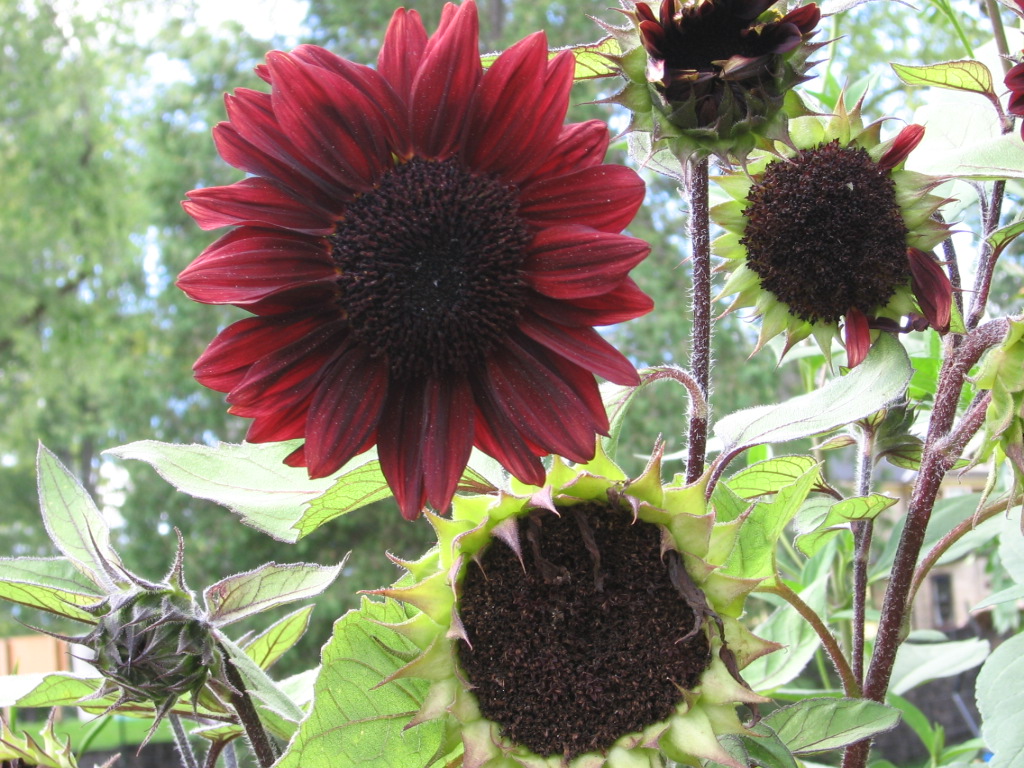 Prado Red
 -
 Mammoth Russian
 -
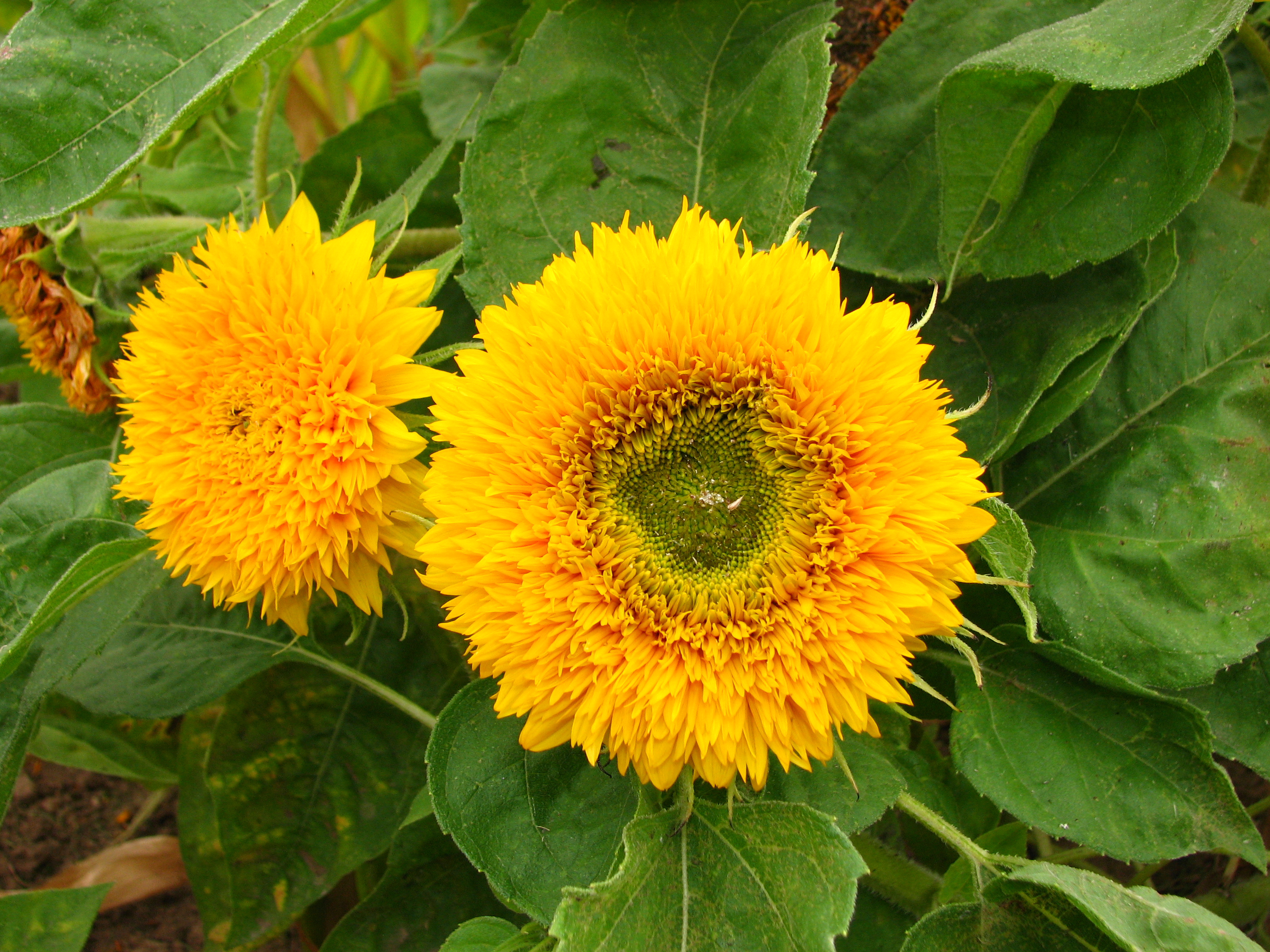 Teddy Bear


_02.jpg)
Uses[edit | edit source]
Sunflower "whole seed" (fruit) are sold as a snack food, raw or after roasting in ovens, with or without salt and/or seasonings added. Sunflower seeds can be processed into a peanut butter alternative, sunflower butter. It is also sold as food for birds and can be used directly in cooking and salads. Native Americans had multiple uses for sunflowers in the past, such as in bread, medical ointments, dyes and body paints.[57]
Sunflower oil, extracted from the seeds, is used for cooking, as a carrier oil and to produce margarine and biodiesel, as it is cheaper than olive oil. A range of sunflower varieties exist with differing fatty acid compositions; some "high-oleic" types contain a higher level of monounsaturated fats in their oil than even olive oil. The oil is also sometimes used in soap.[58] After World War I, during the Russian Civil War, people in Ukraine used sunflower seed oil in lamps as a substitute for kerosene due to shortages. The light from such a lamp has been described as "miserable" and "smoky".[59]
The cake remaining after the seeds have been processed for oil is used as livestock feed.[60] The hulls resulting from the dehulling of the seeds before oil extraction can also be fed to domestic animals.[61] Some recently developed cultivars have drooping heads. These cultivars are less attractive to gardeners growing the flowers as ornamental plants, but appeal to farmers, because they reduce bird damage and losses from some plant diseases. Sunflowers also produce latex, and are the subject of experiments to improve their suitability as an alternative crop for producing hypoallergenic rubber.
Traditionally, several Native American groups planted sunflowers on the north edges of their gardens as a "fourth sister" to the better-known three sisters combination of corn, beans, and squash.[62] Annual species are often planted for their allelopathic properties.[63] It was also used by Native Americans to dress hair.[58] Among the Zuni people, the fresh or dried root is chewed by the medicine man before sucking venom from a snakebite and applying a poultice to the wound.[64] This compound poultice of the root is applied with much ceremony to rattlesnake bites.[65]
However, for commercial farmers growing other commodity crops, the wild sunflower is often considered a weed. Especially in the Midwestern US, wild (perennial) species are often found in corn and soybean fields and can decrease yields. The decrease in yield can be attributed to the production of phenolic compounds which are used to reduce competition for nutrients in nutrient-poor growing areas of the common sunflower.[66]
Phytoremediation[edit | edit source]
Helianthus annuus can be used in phytoremediation to extract pollutants from soil such as lead and other heavy metals, such as cadmium, zinc, cesium, strontium, and uranium. The phytoremediation process begins by absorbing the heavy metal(s) through the roots, which gradually accumulate in other areas, such as the shoots and leaves.[67] Helianthus annuus can also be used in rhizofiltration to neutralize radionuclides, such as caesium-137 and strontium-90, from contaminated water, as was done in the case of a pond after the Chernobyl disaster.[68] A similar campaign was mounted in response to the Fukushima Daiichi nuclear disaster.[69][70][71]
-
 Head displaying florets in spirals of 34 and 55 around the outside
 -
 Seed dehulled (left) and with hull (right)
 -
 Pollen close-up


In culture[edit | edit source]


According to Iroquois mythology, the first sunflowers grew out of Earth Woman's legs after she died giving birth to her twin sons, Sapling and Flint.[72]
The Zuni people use the blossoms ceremonially for anthropic worship.[73] Sunflowers were also worshipped by the Incas because they viewed it as a symbol for the Sun.[74]
Stories of Clytie the nymph who was spurned by her former lover Helios end with her transformed into what may be translated as sunflower. However, the plant in Greek mythology may be, "partly pale and partly red, and very like a violet". The plant described also exhibits heliotropism, with its face turning towards the sun. This plant may be a species in the genus heliotrope (Heliotropium).[75] However, less commonly it is identified as the common marigold (Calendula officinalis).[76]
During the 19th century, it was believed that nearby plants of the species would protect a home from malaria.[58] The flowers are the subject of Vincent van Gogh's Sunflowers series of still-life paintings.
In July 2015, viable seeds were acquired from the field where Malaysia Airlines Flight 17 crashed on a year earlier and were grown in tribute to the 15 Dutch residents of Hilversum who were killed.[77] Earlier that year, Fairfax chief correspondent Paul McGeough and photographer Kate Geraghty had collected 1.5 kg of sunflower seeds from the wreck site for family and friends of the 38 Australian victims, who aimed to give them a poignant symbol of hope.[78]
On 13 May 2021, during the National Costume competition of the Miss Universe 2020 beauty pageant, Miss Dominican Republic Kimberly Jiménez wore a "Goddess of Sunflowers" costume covered in gold and yellow rhinestones[79] that included several real sunflowers sewn onto the fabric.
Symbolism[edit | edit source]
The sunflower is the national flower of Ukraine.[80] Ukrainians used sunflower as a main source of cooking oil instead of butter or lard forbidden by the Orthodox Church when observing Lent. They were also planted to serve as bioremediation in Chernobyl. In June 1996, U.S., Russian, and Ukrainian officials planted sunflowers at the Pervomaysk missile base where Soviet nuclear weapons were formerly placed.[71] During the Russian invasion of Ukraine, a video widely shared on social media showed a Ukrainian woman confronting a Russian soldier, telling the latter to "take these seeds and put them in your pockets so at least sunflowers will grow when you all lie down here".[81] The sunflower has since become a global symbol of resistance, unity, and hope.[82]
The sunflower is also the state flower of the U.S. state of Kansas[4][80] and one of the city flowers of Kitakyūshū, Japan.[83]
During the late 19th century, the flower was used as the symbol of the Aesthetic Movement.[84]
The sunflower was chosen as the symbol of the Spiritualist Church, for many reasons, but mostly because of the belief that the flowers turn toward the sun as "Spiritualism turns toward the light of truth". Modern Spiritualists often have art or jewelry with sunflower designs.[85][page needed][better source needed]
The sunflower is often used as a symbol of green ideology. The flower is also the symbol of the Vegan Society.[86]
The sunflower is the symbol behind the Sunflower Movement, a 2014 mass protest in Taiwan.
The Hidden Disabilities Sunflower was first used as a visible symbol (typically worn on a lanyard) in May 2016 at London Gatwick Airport. It has since come into common usage throughout the UK and in the Commonwealth more generally.[87]
Sunflowers were also used for cultural beliefs for many Native American Tribes. For the Hopi tribe, a big sunflower bloom meant there would be a good harvest year. The Teton Dakota tribe believed that when sunflowers were tall and blooming, it would be a good hunting season for buffalo. The Onandaga tribe had sunflowers in their creation story.[88]
References[edit | edit source]
- ↑ Contreras, A., Rhodes, L. & Maxted, N. 2016. Helianthus annuus. The IUCN Red List of Threatened Species 2016: e.T19073408A47600755. https://dx.doi.org/10.2305/IUCN.UK.2016-3.RLTS.T19073408A47600755.en. Accessed on 2 May 2023.
- ↑ "Helianthus annuus L. Sp. Pl.: 904 (1753)". World Flora Online. World Flora Consortium. 2022. Retrieved 30 November 2022.
- ↑ "Tallest Sunflower". Guinness World Records. Archived from the original on 6 January 2026. Retrieved 6 January 2026.
- ↑ 4.0 4.1 4.2 4.3 4.4 Spellenberg, Richard (2001) [1979]. National Audubon Society Field Guide to North American Wildflowers: Western Region (rev ed.). Knopf. pp. 378–379. ISBN 978-0-375-40233-3.
- ↑ Hangarter, Roger P. "Solar tracking: sunflower plants". Plants-In-Motion website. Indiana University. Archived from the original on 19 October 2013. Retrieved 22 August 2012.
Many people are under the misconception that the flower heads of the cultivated sunflower (Helianthus annuus) track the sun... Immature sunflower flower heads do exhibit solar tracking and on sunny days the buds will track the sun across the sky from east to west... However, as the flower bud matures and blossoms, the stem stiffens and the flower head becomes fixed facing the eastward direction."
- ↑ "Sunflowers in the blooming stage are not heliotropic anymore. The stem has frozen, typically in an eastward orientation". Archived from the original on 23 May 2013.
- ↑ Gerard, John (1597). Herball, or Generall Historie of Plantes. London: John Norton. pp. 612–614. Retrieved 8 August 2012. Popular botany book in 17th century England
- ↑ "Sunflower, Developmental stages (life cycle)". GeoChemBio website. Archived from the original on 27 November 2012. Retrieved 8 August 2012.
- ↑ 9.0 9.1 9.2 9.3 9.4 Atamian, Hagop S.; Creux, Nicky M.; Brown, Evan A.; Garner, Austin G.; Blackman, Benjamin K.; Harmer, Stacey L. (5 August 2016). "Circadian regulation of sunflower heliotropism, floral orientation, and pollinator visits". Science. 353 (6299): 587–590. Bibcode:2016Sci...353..587A. doi:10.1126/science.aaf9793. ISSN 0036-8075. PMID 27493185.
- ↑ Donat-Peter Häder; Michael Lebert (2001). Photomovement. Elsevier. pp. 673–. ISBN 978-0-444-50706-8. Retrieved 15 August 2010.
- ↑ Adam, John A. (2003). Mathematics in Nature: Modeling Patterns in the Natural World. Princeton, New Jersey: Princeton University Press. p. 217. ISBN 978-0-691-11429-3. Retrieved 31 January 2011 – via Google Books.
- ↑ Knott, Ron (12 February 2009). "Fibonacci Numbers and Nature - Part 2". Department of Computer Science. University of Surrey. Archived from the original on 16 September 2009. Retrieved 31 January 2011.
- ↑ Knott, Ron (30 October 2010). "Fibonacci Numbers and Nature". Department of Computer Science. University of Surrey. Archived from the original on 7 September 2009. Retrieved 31 January 2011.
- ↑ Motloch, John L. (2000). Introduction to landscape design. New York, USA: John Wiley & Sons, Inc. p. 154. ISBN 978-0-471-35291-4. Retrieved 31 January 2011.
- ↑ Jean, Roger V (1994). Phyllotaxis. Cambridge University Press. p. 185. ISBN 978-0-521-40482-2. Retrieved 31 January 2011.
fibonacci packing efficiency.
- ↑ Vogel, H. (1979). "A better way to construct the sunflower head". Mathematical Biosciences. 44 (3–4): 179–189. doi:10.1016/0025-5564(79)90080-4.
- ↑ Prusinkiewicz, Przemyslaw; Lindenmayer, Aristid (1990). The Algorithmic Beauty of Plants. Springer-Verlag. pp. 101–107. ISBN 978-0-387-97297-8.
- ↑ "Helianthus annuus (common sunflower) Genome Project". NCBI. Retrieved 20 February 2012.
- ↑ Template:NCBI taxid
- ↑ "Sunflower Genome Holds the Promise of Sustainable Agriculture". ScienceDaily. 14 January 2010.
- ↑ Renaut, Sébastien; Grassa, Christopher; Moyers, Brook; Kane, Nolan; Rieseberg, Loren (25 October 2012). "The Population Genomics of Sunflowers and Genomic Determinants of Protein Evolution Revealed by RNAseq". Biology. 1 (3): 576–577. doi:10.3390/biology1030575. PMC 4009819. PMID 24832509.
- ↑ 22.0 22.1 Template:Cite POWO
- ↑ "Helianthus annuus". Plant Finder. St. Louis, Missouri: Missouri Botanical Garden. Retrieved 4 October 2023.
- ↑ Kartesz, J.T. (2015). "Helianthus annuus". Taxonomic Data Center. Chapel Hill, N.C.: The Biota of North America Program (BONAP). Retrieved 4 October 2023.
- ↑ 25.0 25.1 Gontcharov, S.V.; Antonova, T.S.; Saukova, S.L. (2006). "Sunflower breeding for resistance to Fusarium". Helia. 29 (45): 49–54. doi:10.2298/HEL0645049G. ISSN 1018-1806.
- ↑ Encheva, J.; Christov, M.; Shindrova, P. "Developing Mutant Sunflower Line (Helianthus Annuus L.) By Combined Used Of Classical Method With Induced Mutagenesis and Embryo Culture Method" (PDF). Bulgarian Journal of Agricultural Science. 14 (4): 397–404. Retrieved 15 October 2014.
- ↑ Pavek, Pamela L. S. (2012), Plant fact sheet for common woolly sunflower (``Eriophyllum lanatum``), Pullman, WA: SDA-Natural Resources Conservation Service, Pullman Plant Materials Center
- ↑ "Native American - Prehistoric Farming, Agriculture, Cultivation". Britannica. 13 September 2024. Retrieved 9 October 2024.
- ↑ Blackman, Benjamin K.; Scascitelli, Moira; Kane, Nolan C.; Luton, Harry H.; Rasmussen, David A.; Bye, Robert A.; Lentz, David L.; Rieseberg, Loren H. (2011). "Sunflower domestication alleles support single domestication center in eastern North America". PNAS. 108 (34): 14360–14365. Bibcode:2011PNAS..10814360B. doi:10.1073/pnas.1104853108. PMC 3161615. PMID 21844335.
- ↑ Lentz, David L.; Pohl, Mary DeLand; Alvarado, José Luis; Tarighat, Somayeh; Bye, Robert (2008). "Sunflower (Helianthus annuus L.) as a pre-Columbian domesticate in Mexico". PNAS. 105 (17): 6232–6237. Bibcode:2008PNAS..105.6232L. doi:10.1073/pnas.0711760105. PMC 2359819. PMID 18443289.
- ↑ Rieseberg, Loren H. (2004). "Origin of Extant Domesticated Sunflowers in Eastern North America". Nature. 430 (6996): 201–205. Bibcode:2004Natur.430..201H. doi:10.1038/nature02710. PMID 15241413.
- ↑ Henderson, A. Gwynn; Pollack, David (2012). "A Native History Of Kentucky" (PDF). heritage.ky.gov, excerpts from Murphree, Daniel S. (2012). "Kentucky". Native America: A State-by-State Historical Encyclopedia. Vol. 1. Santa Barbara, CA: Greenwood Press. pp. 393–440.
- ↑ Putt, E. D. (1997). "Early history of sunflower". In A.A. Schneiter (ed.). Sunflower Technology and Production. Agronomy Series. Vol. 35. Madison, Wisconsin: American Society of Agronomy. pp. 1–19.
- ↑ Smith, Bruce D. (2006). "Eastern North America as an independent center of plant domestication". PNAS. 103 (33): 12223–12228. Bibcode:2006PNAS..10312223S. doi:10.1073/pnas.0604335103. PMC 1567861. PMID 16894156.
- ↑ Park, Brian; Burke, John M. (March 2020). "Phylogeography and the Evolutionary History of Sunflower (Helianthus annuus L.): Wild Diversity and the Dynamics of Domestication". Genes. 11 (3): 266. doi:10.3390/genes11030266. PMC 7140811. PMID 32121324.
- ↑ 36.0 36.1 Hancock, J.F. (2012). Plant Evolution and the Origin of Crop Species. CABI Pub. p. 188. ISBN 978-0-85199-874-9. Retrieved 7 April 2022.
- ↑ Pappalardo, Joe (1 December 2007). "SUNFLOWERS: The Secret History". Kirkus Reviews. 75 (23): 1236.
- ↑ 38.0 38.1 "Production - Sunflowerseed". Foreign Agricultural Service of the USDA. USDA. Retrieved 24 May 2025.
- ↑ Spinelli, D; Bardi, L; Fierro, A; Jez, S; Basosi, R (2017). "Environmental analysis of sunflower production with different forms of mineral nitrogen fertilizers" (PDF). The International Journal of Life Cycle Assessment. 22 (4). Journal of Environmental Management: 492–501. Bibcode:2017IJLCA..22..492M. doi:10.1007/s11367-016-1089-6. PMID 23974447. S2CID 112613303.
- ↑ Debaeke, Philippe; Izquierdo, Natalia G. (1 January 2021), Sadras, Victor O.; Calderini, Daniel F. (eds.), "Chapter 16 – Sunflower", Crop Physiology Case Histories for Major Crops, Academic Press, pp. 482–517, doi:10.1016/b978-0-12-819194-1.00016-5, ISBN 978-0-12-819194-1, S2CID 243584066, retrieved 4 July 2023,
In most countries, sunflower is usually recommended to be grown in 3–4 years rotations, generally with cereals (e.g. wheat, barley, maize and sorghum), soybean, oilseed rape and grain legumes
{{citation}}: CS1 maint: work parameter with ISBN (link) - ↑ Castro, C.; Leite, Regina (2018). "Main aspects of sunflower production in Brazil" (PDF). OCL. 25: D104. doi:10.1051/ocl/2017056. ProQuest 2036361008.
- ↑ Mastuura, M. I. S. F.; Dias, F. R. T.; Picoli, J. F.; Lucas, K. R. G.; Castro, C.; Hirakuri, M. H. (2017). "Life-cycle assessment of the soybean-sunflower production system in the Brazilian Cerrado" (PDF). The International Journal of Life Cycle Assessment. 22 (4): 492–501. Bibcode:2017IJLCA..22..492M. doi:10.1007/s11367-016-1089-6. S2CID 112613303.
- ↑ Martin, Cinthia Susic; Farina, Walter M. (1 March 2016). "Honeybee floral constancy and pollination efficiency in sunflower (Helianthus annuus) crops for hybrid seed production". Apidologie. 47 (2): 161–170. doi:10.1007/s13592-015-0384-8. hdl:11336/44997. ISSN 0044-8435.
- ↑ "AGM Plants – Ornamental" (PDF). Royal Horticultural Society. July 2017. p. 43. Retrieved 3 March 2018.
- ↑ "Helianthus annuus 'Claret'". Apps.rhs.org.uk. Retrieved 2 August 2020.
- ↑ "Helianthus 'Gullick's Variety'". RHS. Retrieved 1 August 2020.
- ↑ "Helianthus 'Lemon Queen'". RHS. Retrieved 1 August 2020.
- ↑ "Helianthus 'Loddon Gold'". RHS. Retrieved 1 August 2020.
- ↑ "Helianthus 'Miss Mellish'". RHS. Retrieved 1 August 2020.
- ↑ "Helianthus 'Monarch'". RHS. Retrieved 1 August 2020.
- ↑ "Helianthus annuus 'Munchkin'". RHS. Retrieved 1 August 2020.
- ↑ "Helianthus annuus 'Pastiche'". RHS. Retrieved 1 August 2020.
- ↑ "Helianthus annuus 'Russian Giant'". Retrieved 9 May 2023.
- ↑ "Helianthus annuus 'Sunsation Yellow'". RHS. Retrieved 1 August 2020.
- ↑ "Helianthus annuus 'Teddy Bear'". RHS. Retrieved 1 August 2020.
- ↑ "Helianthus annuus 'Valentine'". RHS. Retrieved 1 August 2020.
- ↑ Pelczar, Rita (1993). "The Prodigal Sunflower". American Horticulturist. 72 (8).
- ↑ 58.0 58.1 58.2 Niering, William A.; Olmstead, Nancy C. (1985) [1979]. The Audubon Society Field Guide to North American Wildflowers, Eastern Region. Knopf. p. 384. ISBN 0-394-50432-1.
- ↑ Neufeld, Dietrich (1980). A Russian Dance of Death: Revolution and Civil War in the Ukraine. Winnipeg: Hyperion. p. 50.
- ↑ Heuzé, V.; Tran, G.; Hassoun, P.; Lessire, M.; Lebas, F. (2016). "Sunflower meal". Feedipedia.
- ↑ Heuzé, V.; Tran, G.; Hassoun, P.; Lessire, M.; Lebas, F. (2018). "Sunflower hulls and sunflower screenings". Feedipedia.
- ↑ Kuepper, George; Dodson, Mardi (2016) [2001]. "Companion Planting: Basic Concept and Resources". ATTRA Sustainable Agriculture Program. National Center for Appropriate Technology.
- ↑ Nikneshan, P.; Karimmojeni, P.; Moghanibashi, M.; Hosseini, N. (2011). "Allelopathic potential of sunflower on weed management in safflower and wheat" (PDF). Australian Journal of Crop Science. 5 (11): 1434–1440. ISSN 1835-2707.
- ↑ Camazine, Scott; Bye, Robert A. (1980). "A Study of the Medical Ethnobotany of the Zuni Indians of New Mexico". Journal of Ethnopharmacology. 2 (4): 365–388. doi:10.1016/S0378-8741(80)81017-8. PMID 6893476.
- ↑ Stevenson, Matilda Coxe (1915). Ethnobotany of the Zuni Indians (Report). SI-BAE Annual Report. Vol. 30. pp. 53–54.
- ↑ Irons, Stephen M.; Burnside, Orvin C. (1982). "Competitive and Allelopathic Effects of Sunflower (Helianthus annuus)". Weed Science. 30 (4): 372–377. Bibcode:1982WeedS..30..372I. doi:10.1017/S0043174500040789. ISSN 0043-1745. JSTOR 4043628. S2CID 89016579.
- ↑ Zhong, Jiawen; Liu, Yeqing; Chen, Xinheng; Ye, Zihao; Li, Yongtao; Li, Wenyan (1 January 2024). "The impact of acid rain on cadmium phytoremediation in sunflower (Helianthus annuus L.)". Environmental Pollution. 340 (Pt 2) 122778. Bibcode:2024EPoll.34022778Z. doi:10.1016/j.envpol.2023.122778. ISSN 0269-7491. PMID 37863250.
- ↑ Adler, Tina (20 July 1996). "Botanical cleanup crews: using plants to tackle polluted water and soil". Science News. Archived from the original on 15 July 2011. Retrieved 3 September 2010.
- ↑ "Sunflowers to clean radioactive soil in Japan". Agence France-Presse. 24 June 2011. Archived from the original on 1 July 2011. Retrieved 25 June 2011 – via Yahoo News.
- ↑ Slodkowski, Antoni; Nakao, Yuriko (19 August 2011). "Sunflowers melt Fukushima's nuclear "snow"". Reuters. Archived from the original on 20 January 2012. Retrieved 22 January 2012.
- ↑ 71.0 71.1 Mufarech, Antonia (31 March 2022). "Why Sunflowers Are Ukraine's National Flower". Smithsonian. Smithsonian Institution. Retrieved 8 February 2023.
- ↑ Us, Kimberly (14 November 2021). "Thanksgiving: Native American Stories, Recipes and Crafts". KimberlyUs.com.
- ↑ Stevenson, p.93
- ↑ "Sunflower Symbolism & the Meaning of Sunflowers in the Language of Flowers". Archived from the original on 18 February 2014. Retrieved 7 March 2014.
- ↑ Farrar, Frank Albert (1910). Old Greek Nature Stories. London: G. G. Harrap & company. pp. 203–204. Retrieved 21 September 2024.
- ↑ Bernhardt, Peter (2008). Gods and Goddesses in the Garden. New Brunswick, New Jersey: Rutgers University Press. p. 128. ISBN 978-0-8135-4266-9.
- ↑ "Dutch town hard hit by MH17 disaster remembers victims with sunflowers". The Guardian. 17 July 2015. Retrieved 30 May 2021.
- ↑ "Planting hope". The Sydney Morning Herald. 2015. Retrieved 30 May 2021.
- ↑ "Kimberly Jiménez parades in the typical sunflower costume at the Miss Universe pre-message gala". 13 May 2021.
- ↑ 80.0 80.1 "How sunflowers officially connect Kansas and Ukraine". WDAF-TV. 28 February 2022. Archived from the original on 29 May 2025. Retrieved 1 December 2023.
- ↑ "Ukrainian woman offers seeds to Russian soldiers so 'sunflowers grow when they die' – video". The Guardian. 25 February 2022.
- ↑ Hassan, Jennifer (2 March 2022). "The sunflower, Ukraine's national flower, is becoming a global symbol of solidarity". The Washington Post.
- ↑ "市の花 - 北九州市". 北九州市. 16 June 2022.
- ↑ "Sunflowers and the Aesthetic Movement". DE MORGAN COLLECTION. 26 May 2021.
Oscar Wilde commented that the sunflower was akin to a gaudy lion and its adoption as the movement's floral emblem was secured.
- ↑ Awtry-Smith, Marilyn J. (2005). "The Symbol of Spiritualism: The Sunflower.". In Leonard, Todd Jay (ed.). Talking to the Other Side: A History of Modern Spiritualism and Mediumship. iUniverse. ISBN 0-595-36353-9.
- ↑ "30 Years of the Vegan Trademark". The Vegan Society. 27 April 2020.
- ↑ Bordner, Becca; Piper, Rachel; Nicoll, Morgan (28 March 2022). "The Sunflower Lanyard for Hidden Disabilities". Sunfield Center.
- ↑ United States Department of Agriculture, Natural Resources Conservation Service (USDA NRCS). (2000). Annual sunflower (Helianthus annuus L.) [Plant guide HEAN3]. National Plant Data Center. https://plants.usda.gov
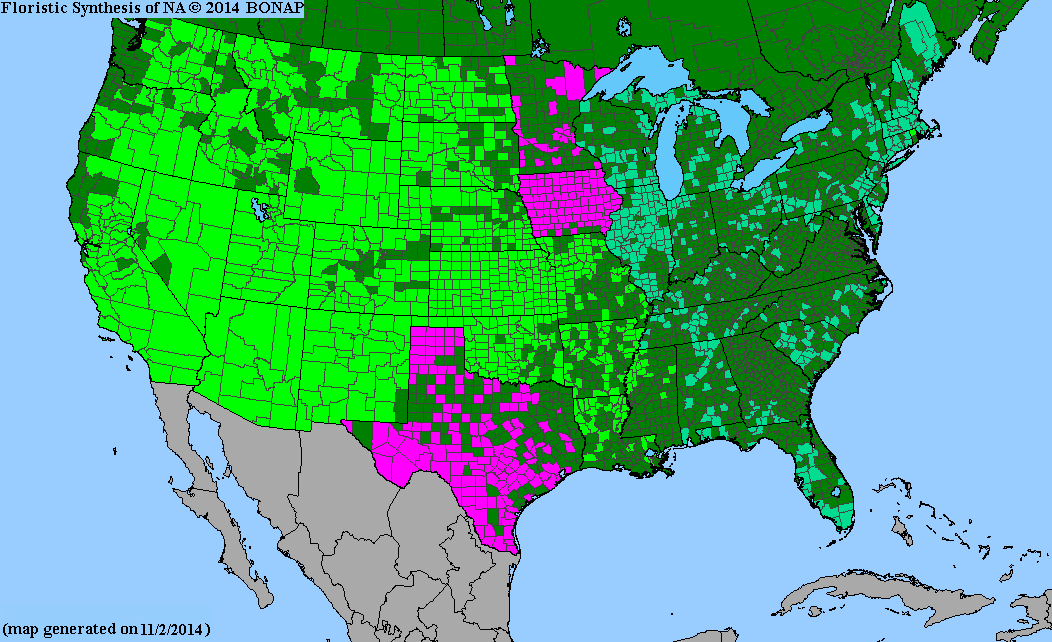
Sources[edit | edit source]
- Pope, Kevin; Pohl, Mary E. D.; Jones, John G.; Lentz, David L.; von Nagy, Christopher; Vega, Francisco J.; Quitmyer, Irvy R. (18 May 2001). "Origin and Environmental Setting of Ancient Agriculture in the Lowlands of Mesoamerica". Science. 292 (5520): 1370–1373. Bibcode:2001Sci...292.1370P. doi:10.1126/science.292.5520.1370. PMID 11359011.
- Shosteck, Robert (1974). Flowers and Plants: An International Lexicon with Biographical Notes. New York: Quadrangle/The New York Times Book Co. ISBN 9780812904536.
- Wood, Marcia (June 2002). "Sunflower Rubber?". Agricultural Research. USDA. p. 22. Retrieved 31 January 2011.
External links[edit | edit source]
- National Sunflower Association
- Sunflowerseed—USDA Economic Research Service. Summary of sunflower production, trade, and consumption and links to relevant USDA reports.
- Sunflower cultivation—New Crop Resource Online Program, Purdue University
Template:Bioenergy Template:US state flowers Template:National symbols of Ukraine