










m Removing protection template from an unprotected page |
slightly enhanced section as per guidelines and improved wording |
||
| Line 1: | Line 1: | ||
{{Short description| | {{Short description|Jewish preacher and religious leader}} | ||
{{Redirect-several|Jesus|Christ|Jesus Christ|Jesus of Nazareth}} | {{Redirect-several|Jesus|Christ|Jesus Christ|Jesus of Nazareth}} | ||
{{Featured article}} | {{Featured article}} | ||
{{Use Oxford spelling|date= | {{Pp-move}} | ||
{{Use dmy dates|date= | {{Protection padlock|small=yes}} | ||
{{Use Oxford spelling|date=November 2025}} | |||
{{Use dmy dates|date=November 2025}} | |||
{{Bots|deny=Citation bot}} | |||
{{CS1 config|mode=cs1}} | |||
{{Infobox person | {{Infobox person | ||
<! | <!--- | ||
Note: Please do not expand this infobox. See the FAQ on the talk page. | Note: Please do not expand this infobox. See the FAQ on the talk page. | ||
--->| name = Jesus | |||
| image = Spas vsederzhitel sinay.jpg | | image = Spas vsederzhitel sinay (cropped1).jpg | ||
| caption = {{longitem |The [[Christ Pantocrator (Sinai)|Christ Pantocrator]] of [[Saint Catherine's Monastery]] at [[Mount Sinai]], 6th century AD}} | | alt = A depiction of Jesus, titled Christ Pantocrator, 6th century AD, holding Bible in front of the sun. Christ's features on his right side (the viewer's left) are theorized to represent the qualities of his human nature, while his left side (the viewer's right) represents his divinity. | ||
| birth_date = {{circa | | caption = {{longitem|The [[Christ Pantocrator (Sinai)|Christ Pantocrator]] of [[Saint Catherine's Monastery]] at [[Mount Sinai]], 6th century AD{{efn|Christ's features on his right side (the viewer's left) are theorized to represent the qualities of his human nature, while his left side (the viewer's right) represents his divinity.<ref>{{Cite book|last1=Weitzmann|title=Sinai, the Icons|page=15}}{{Full citation needed|date=October 2025}}</ref><ref>{{cite journal |author1-first=Manolis |author1-last=Chatzidakis |author1-link=Manolis Hatzidakis |translator1-first=Gerry |translator1-last=Walters |language=en |date=1967 |title=An encaustic icon of Christ at Sinai |journal=The Art Bulletin |volume=47 |issue=3 |pages=199 |doi=10.2307/3048469 |quote=The two great eyes are not, themselves, completely identical either in dimension or in shape. They are not placed on the same level, and through the difference in movement of the eyebrows, each acquires a slightly different nuance of expression: the right eye is more calm, while the left, larger, is more lively.}}</ref>}}}} | ||
--> [[Karl Rahner]] states that the consensus among Christian scholars is {{ | | birth_date = {{circa|[[Date of the birth of Jesus|6 to 4 BC]]}}{{efn|[[John P. Meier]] writes that Jesus's birth year is {{circa|7 or 6 BC|lk=no}}.{{sfn|Meier|1991|p=407}}<!-- | ||
-->[[E. P. Sanders]] also | --> [[Karl Rahner]] states that the consensus among Christian scholars is {{circa|4 BC|lk=no}}.{{sfn|Rahner|2004|p=732}} <!-- | ||
-->[[Jack Finegan]] uses the study of early Christian traditions to support {{ | -->[[E. P. Sanders]] also favours {{circa|4 BC|lk=no}} and refers to the general consensus.{{sfn|Sanders|1993|pp=10–11}} <!-- | ||
-->[[Jack Finegan]] uses the study of early Christian traditions to support {{circa|3 or 2 BC|lk=no}}.<ref name=Finegan>{{harvnb|Finegan|1998|page=[https://archive.org/details/handbookbiblical00fine/page/n350 319]}}.</ref> <!-- | |||
-->}} | -->}} | ||
| birth_place = <!--Note: No scholarly consensus for any more precise a location than Judea:-->[[Herodian kingdom]], | | birth_place = <!--Note: No scholarly consensus for any more precise a location than Judea:-->[[Herodian kingdom]], Roman Empire{{sfn|Brown|1977|p=513}} | ||
| death_date = AD 30 or 33 (aged | | death_date = AD 30 or 33 (aged 33{{endash}}39) | ||
| death_place = [[Jerusalem]], [[Judaea (Roman province)|Judaea]], | | death_place = [[Jerusalem]], then in [[Judaea (Roman province)|Judaea]], Roman Empire | ||
| known_for = Central figure of [[Christianity]] | | known_for = *Central figure of [[Jesus in Christianity|Christianity]] | ||
| death_cause = <!---Note: No (further) comments required here; the scholarly consensus that the cause of Jesus' death was crucifixion is given in the article text:--->[[Crucifixion of Jesus|Crucifixion]]<!-- | *[[Manifestation of God (Baháʼí Faith)|Manifestation of God]] in [[Baháʼí Faith]] | ||
*Major prophet [[Jesus in Islam|in Islam]] and the [[Druze faith]] | |||
| death_cause = <!---Note: No (further) comments required here; the scholarly consensus that the cause of Jesus's death was crucifixion is given in the article text:--->[[Crucifixion of Jesus|Crucifixion]]<!-- | |||
-->{{efn|[[James Dunn (theologian)|James Dunn]] writes that the baptism and crucifixion of Jesus "command almost universal assent" and "rank so high on the 'almost impossible to doubt or deny' scale of historical facts" that they are often the starting points for the study of the historical Jesus.{{sfn|Dunn|2003|p=339}} <!-- | -->{{efn|[[James Dunn (theologian)|James Dunn]] writes that the baptism and crucifixion of Jesus "command almost universal assent" and "rank so high on the 'almost impossible to doubt or deny' scale of historical facts" that they are often the starting points for the study of the historical Jesus.{{sfn|Dunn|2003|p=339}} <!-- | ||
-->[[Bart Ehrman]] states that the crucifixion of Jesus on the orders of Pontius Pilate is the most certain element about him.{{sfn|Ehrman|1999|p=101}} <!-- | -->[[Bart D. Ehrman]] states that the crucifixion of Jesus on the orders of Pontius Pilate is the most certain element about him.{{sfn|Ehrman|1999|p=101}} <!-- | ||
-->[[John Dominic Crossan]] and Richard G. Watts state that the crucifixion of Jesus is as certain as any historical fact can be.{{sfn|Crossan|Watts|1999|p=96}} <!-- | -->[[John Dominic Crossan]] and Richard G. Watts state that the crucifixion of Jesus is as certain as any historical fact can be.{{sfn|Crossan|Watts|1999|p=96}} <!-- | ||
-->Paul R. Eddy and [[ | -->Paul R. Eddy and [[Gregory A. Boyd]] say that non-Christian confirmation of the crucifixion of Jesus is now "firmly established".{{sfn|Eddy|Boyd|2007|p=173}} <!-- | ||
-->}} | -->}} | ||
<!---- | <!---- | ||
Note: Please do not expand this infobox. See the FAQ on the talk page. | Note: Please do not expand this infobox. See the FAQ on the talk page. | ||
----->| parents = | ----->| parents = [[Mary, mother of Jesus|Mary]], [[Saint Joseph|Joseph]]{{efn|Traditionally, Christians believe that Mary conceived her son miraculously by the agency of the Holy Spirit. Muslims believe that she conceived her son miraculously by the command of God. Joseph was from these perspectives and according to the canonical gospels the acting adoptive father of Jesus.}} | ||
}} | }} | ||
{{Jesus |right |width=22.0em<!--should match width of preceding infobox-->}} | {{Jesus |right |width=22.0em<!--should match width of preceding infobox-->}} | ||
| Line 35: | Line 40: | ||
The following paragraph was created by consensus after considerable discussion by a variety of editors. Out of courtesy for this process, please discuss any proposed changes on the talk page before editing it. | The following paragraph was created by consensus after considerable discussion by a variety of editors. Out of courtesy for this process, please discuss any proposed changes on the talk page before editing it. | ||
-----> | -----> | ||
'''Jesus'''{{efn|{{ | |||
'''Jesus'''{{efn|{{langx|grc|Ἰησοῦς}}, {{small|romanized:}} {{transliteration|grc|Iēsoús}}, probably from {{langx|he|יֵשׁוּעַ|label=[[Hebrew]] or [[Aramaic]]}}, {{small|romanized:}} {{tlit|und|[[Yeshua|Yēšūaʿ]]}} }} ({{circa|6 to 4 BC}}<!-- "By collating the gospel accounts with historical data and using various other methods, most scholars arrive at a date of birth between 6 and 4 BC for Jesus, though scholarly arguments for a date of birth between 7 and 1 BC have been made" in 'Chronology' section -->{{snd}}AD 30 or 33), also referred to as '''Jesus Christ''',{{efn|[[Coptic language|Coptic]]: {{lang|cop|Ⲓⲏⲥⲟⲩⲥ Ⲡⲓⲭ́ρⲓⲥτⲟⲥ}}; [[Geʽez]]: {{lang|gez|መሲህ ኢየሱስ}}; [[Koine Greek|Greek]]: {{lang|grc|Ἰησοῦς Χριστός}}; [[Classical Hebrew|Hebrew]]: {{lang|hbo|ישוע המשיח}}; [[Latin]]: {{lang|la|Iesus Christus}}; [[Church Slavonic|Slavonic]]: {{lang|cu|І҆исоу́съ Хрїсто́съ}}; [[Classical Syriac|Syriac]]: {{lang|syc|ܝܫܘܥ ܡܫܺܝܚܳܐ}}}} '''Jesus of Nazareth''', and by various [[Names and titles of Jesus in the New Testament|other names and titles]], was a 1st-century [[Jewish]] preacher and religious leader in the [[Judaea (Roman province)|Roman province of Judaea]].{{sfn|Vermes|1981|pp=20, 26, 27, 29}} <!-- Do not merge these. Jesus is — not was — the central figure of Christianity. -->He is the [[Jesus in Christianity|central figure]] of [[Christianity]], the [[major religious groups|world's largest religion]]. Most Christians consider Jesus to be the [[incarnation (Christianity)|incarnation]] of [[God the Son]] and the awaited [[Messiah#Christianity|messiah]], or [[Christ (title)|Christ]], a descendant of the [[Davidic line]] prophesied in the [[Old Testament]].<!---- | |||
The following paragraph was created by consensus after considerable discussion by a variety of editors. Out of courtesy for this process, please discuss any proposed changes on the talk page before editing it. | The following paragraph was created by consensus after considerable discussion by a variety of editors. Out of courtesy for this process, please discuss any proposed changes on the talk page before editing it. | ||
----><!-- | ----><!-- | ||
| Line 49: | Line 55: | ||
Thank you. | Thank you. | ||
----> | ----> Virtually all modern scholars of [[classical antiquity|antiquity]] agree that [[Historicity of Jesus|Jesus existed historically]].{{efn |name=exist|In a 2011 review of the state of modern scholarship, [[Bart D. Ehrman]] wrote, "He certainly existed, as virtually every competent scholar of antiquity, Christian or non-Christian, agrees."{{sfn|Ehrman|2011|p=[https://archive.org/details/forged_ehrm_2011_000_10544376/page/n298 285]}} [[Richard A. Burridge]] states: "There are those who argue that Jesus is a figment of the Church's imagination, that there never was a Jesus at all. I have to say that I do not know any respectable critical scholar who says that any more."<ref>{{cite book |title=Jesus Now and Then |first1=Richard A. |last1=Burridge |first2=Graham |last2=Gould |year=2004 |isbn=978-0-8028-0977-3 |page=[https://archive.org/details/jesusnowthen0000burr/page/34 34] |publisher=Wm. B. Eerdmans |url=https://archive.org/details/jesusnowthen0000burr/page/34}}</ref> [[Robert M. Price]] does not believe that Jesus existed but agrees that this perspective runs against the views of the majority of scholars.<ref>{{cite encyclopedia |first=Robert M. |last=Price |title=Jesus at the Vanishing Point |encyclopedia=The Historical Jesus: Five Views |editor-last1=Beilby |editor-last2=Eddy |year=2009 |publisher=InterVarsity |isbn=978-0-8308-7853-6 |editor-first=James K. |pages=55, 61 |url=https://books.google.com/books?id=O33P7xrFnLQC&pg=PA55 |editor2-first=Paul R. |access-date=14 August 2015 |archive-date=7 September 2015 |archive-url=https://web.archive.org/web/20150907112540/https://books.google.com/books?id=O33P7xrFnLQC&pg=PA55 |url-status=live}}</ref> [[James D. G. Dunn]] calls the theories of Jesus's non-existence "a thoroughly dead thesis".<ref>{{cite encyclopedia |title=Paul's understanding of the death of Jesus |encyclopedia=Sacrifice and Redemption |first=Stephen W. |last=Sykes |year=2007 |publisher=Cambridge University Press |isbn=978-0-521-04460-8 |pages=35–36}}</ref> [[Michael Grant (author)|Michael Grant]] (a [[classicist]]), "In recent years, 'no serious scholar has ventured to postulate the non historicity of Jesus' or at any rate very few, and they have not succeeded in disposing of the much stronger, indeed very abundant, evidence to the contrary."<ref>{{cite book |first=Michael |last=Grant |title=Jesus|publisher=Phoenix |year=2004 |isbn=978-0-684-14889-2 |page=200}}</ref> [[Robert E. Van Voorst]] states that biblical scholars and classical historians regard theories of non-existence of Jesus as effectively refuted.{{sfn|Van Voorst|2000|p=16}} Writing on ''[[The Daily Beast]]'', [[Candida Moss]] and Joel Baden state that, "there is nigh universal consensus among biblical scholars – the authentic ones, at least – that Jesus was, in fact, a real guy."<ref>{{Cite news |url=https://www.thedailybeast.com/so-called-biblical-scholar-says-jesus-a-made-up-myth |title=So-Called 'Biblical Scholar' Says Jesus a Made-Up Myth |newspaper=The Daily Beast |date=5 October 2014 |author-first2=Joel |author-last2=Baden |author-link1=Candida Moss|author-first1=Candida |author-last1=Moss |access-date=14 July 2021 |archive-date=5 December 2021 |archive-url=https://web.archive.org/web/20211205210029/https://www.thedailybeast.com/so-called-biblical-scholar-says-jesus-a-made-up-myth |url-status=live}}</ref>}} Accounts of [[Life of Jesus|Jesus's life]] are contained in the [[Gospel]]s, especially the [[four canonical Gospels]] of the [[New Testament]]. Since the [[Age of Enlightenment|Enlightenment]], [[quest for the historical Jesus|academic research]] has produced various views on the [[historical reliability of the Gospels]] and the extent to which they reflect the [[historical Jesus]].{{sfn|Powell|1998|pp=168–173}}{{efn|Ehrman writes: "The notion that the Gospel accounts are not completely accurate but still important for the religious truths they try to convey is widely shared in the scholarly world, even though it's not so widely known or believed outside of it."<ref>Bart D. Ehrman. [http://www.thegreatcourses.com/courses/historical-jesus.html Historical Jesus. 'Prophet of the New Millennium']. {{Webarchive|url=https://web.archive.org/web/20190123155853/https://www.thegreatcourses.com/courses/historical-jesus.html |date=23 January 2019 }} Course handbook, p. 10 (Lecture Three. V. B.), The Teaching Company, 2000, Lecture 24{{Clarify|reason=It's unclear if this citation is for one source or multiple sources. Is it a book or an audio lecture?|date=October 2025}}</ref><br />Sanders writes: "The earliest Christians did not write a narrative of Jesus' life, but rather made use of, and thus preserved, individual units—short passages about his words and deeds. These units were later moved and arranged by authors and editors. [...] Some material has been revised and some created by early Christians."{{sfn|Sanders|1993|p=57}}}}{{Sfn|Bowman Jr.|Komoszewski|2019|p=22–23}}<ref>{{Cite journal|author-first1=Craig A. |author-last1=Evans|url=https://theologicalstudies.net/wp-content/uploads/2022/08/54.1.1.pdf|title=Life-of-Jesus Research and the Eclipse of Mythology|journal=Theological Studies |volume=54 |year=1993|pages= 13–14|quote=First, the New Testament Gospels are now viewed as useful, if not essentially reliable, historical sources. Gone is the extreme skepticism that for so many years dominated gospel research. Representative of many is the position of E. P. Sanders and Marcus Borg, who have concluded that it is possible to recover a fairly reliable picture of the historical Jesus.}}</ref> | ||
According to [[Christian tradition]], as preserved in the Gospels and the [[Acts of the Apostles]], Jesus [[Circumcision of Jesus|was circumcised]] at eight days old, [[Presentation of Jesus|presented]] at the [[Temple in Jerusalem]] at forty days old, [[Baptism of Jesus|baptized]] by [[John the Baptist]] as a young adult, and, after [[Temptation of Christ|40 days and nights]] of fasting in the wilderness, began [[Ministry of Jesus|his public ministry]]. He was an [[itinerant teacher]] whom his followers believed to possess divine authority in interpreting [[Halakha|Jewish law]]. Jesus often debated with other Jews about how best to follow [[God in Judaism|God]], engaged in healings, taught in [[Parables of Jesus|parables]], and gathered followers, 12 of whom he appointed as his [[Apostles in the New Testament|apostles]]. According to the New Testament accounts, he was arrested in [[Jerusalem]] and tried by the [[Sanhedrin]],{{sfn|Sanders|1993|p=11}} handed over to the Roman authorities, and [[Crucifixion of Jesus|crucified]] on the order of [[Pontius Pilate]], the Roman prefect of Judaea. After his death, his followers became convinced that he [[Resurrection of Jesus|rose from the dead]], and the community they formed eventually developed into the [[Early Christianity|early Christian Church]], which expanded into a [[spread of Christianity|worldwide movement]].{{sfn|Sanders|1993|pp=11, 14}} | |||
[[Christian theology]] includes the beliefs that Jesus was conceived by the [[Holy Spirit in Christianity|Holy Spirit]], was [[Virgin birth of Jesus|born of a virgin]] named [[Mary, mother of Jesus|Mary]], performed [[Miracles of Jesus|miracles]], founded the Christian Church, died by | [[Christian theology]] includes the beliefs that Jesus was conceived by the [[Holy Spirit in Christianity|Holy Spirit]], was [[Virgin birth of Jesus|born of a virgin]] named [[Mary, mother of Jesus|Mary]], performed [[Miracles of Jesus|miracles]], founded the [[Christian Church]], [[Crucifixion of Jesus|died by crucifixion]] as a sacrifice for [[Atonement in Christianity|atonement for sin]], [[Resurrection of Jesus|rose from the dead]] on the third day, and [[Ascension of Jesus|ascended]] into [[Heaven in Christianity|Heaven]], from where he [[Second Coming|will return]]. Christians commonly believe that Jesus enables people to be reconciled to [[God in Christianity|God]]. The [[Nicene Creed]] asserts that Jesus will [[Last Judgment|judge the living and the dead]], either [[Intermediate state (Christianity)|before]] or [[Christian mortalism|after]] their [[Resurrection of the dead#Christianity|bodily resurrection]], an event associated with the [[Second Coming|Second Coming of Jesus]] in [[Christian eschatology]]. The great majority of Christians worship Jesus as the incarnation of [[God the Son]], the second of the three [[prosopon|persons]] of the [[Trinity]].{{efn|A small minority of Christian denominations reject trinitarianism, wholly or partly, as non-scriptural.}} The [[birth of Jesus]] in [[Bethlehem]] is celebrated annually, generally on 25 December,{{efn|Most Christians and [[Alawites]] celebrate Christmas. Part of the [[Eastern Christian]] churches celebrate Christmas on 25 December of the [[Julian calendar]], which currently corresponds to 7 January in the [[Gregorian calendar]]. Christmas celebrations begin on [[Christmas Eve]], generally on 24 December.}} as [[Christmas]]. His crucifixion is commemorated on [[Good Friday]] and his resurrection on [[Easter Sunday]]. The world's most widely used [[calendar era]]—in which the current year is [[Anno Domini|AD]] {{CURRENTYEAR}} (or {{CURRENTYEAR}} [[Common Era|CE]])—is traditionally based on the approximate [[date of the birth of Jesus]].<ref>{{cite dictionary |year=2003 |title=anno Domini |dictionary=Merriam-Webster Online Dictionary |url=http://www.m-w.com/dictionary/Anno%20Domini |access-date=3 November 2016 |archive-url=https://web.archive.org/web/20071222112520/http://www.m-w.com/dictionary/anno%20domini |archive-date=22 December 2007 |quote=Etymology: Medieval Latin, in the year of our Lord |url-status=live}}.</ref> | ||
Jesus | Mainstream Judaism [[Jewish views on Jesus|rejects the belief]] that Jesus was the awaited messiah, holding that he did not fulfill [[Messiah in Judaism|messianic prophecies]], was not [[Anointing|lawfully anointed]], and was neither divine nor resurrected. In contrast, [[Jesus in Islam]]{{efn|Often referred to by his Quranic name, {{transliteration|ar|ISO|[[Isa (name)|ʿĪsā]]}}}} is considered the [[Messiah#Islam|messiah]] and a [[Prophets and messengers in Islam|prophet]] of [[God in Islam|God]], who was sent to the [[Israelites]] and [[Second Coming#Islam|will return to Earth]] before the [[Judgement Day in Islam|Day of Judgement]]. [[Muslims]] believe that Jesus was born of the virgin [[Mary in Islam|Mary]] but was neither God nor the son of God. Most Muslims [[Islamic views on Jesus's death|do not believe that he was killed or crucified]], but that God [[Entering heaven alive|raised him into Heaven while he was still alive]].{{efn|Some medieval Muslims believed that Jesus was crucified, as do the members of the modern Ahmadiyya movement; see {{slink||Islamic perspectives}}.}} Jesus is also revered in the [[Baháʼí Faith|Baháʼí]] and [[Druze faith]]s, as well as in [[Rastafari]]. | ||
{{TOC limit|3}} | {{TOC limit|3}} | ||
== Name == | == Name == | ||
{{ | {{Further|Jesus (name)|Names and titles of Jesus in the New Testament|Holy Name of Jesus|Names of God in Christianity}} | ||
[[File:JesusYeshua2.svg|thumb| | [[File:JesusYeshua2.svg|thumb|From top-left: [[Aramaic]], [[Hebrew]], [[Greek language|Greek]], [[Latin]], and English transcriptions of the name ''Jesus'']] | ||
A typical Jewish person in Jesus's time [[Jewish name|had only one name]], sometimes followed by a [[patronymic]] phrase of the form "son of [father's name]", or by the person's home town.<ref name="Britannica" /> Thus, in the New Testament, Jesus is commonly referred to as "Jesus of [[Nazareth]]".{{efn|This article uses quotes from the [[New Revised Standard Version]] of the Bible.}} Jesus's neighbours in Nazareth referred to him as "the carpenter, the son of [[Mary, mother of Jesus|Mary]] and brother of [[James, brother of Jesus|James]] and [[Joses, brother of James the younger|Joses]] and [[Jude, brother of Jesus|Judas]] and [[Simon, brother of Jesus|Simon]]", "the carpenter's son", or "[[Saint Joseph|Joseph]]'s son"; in the Gospel of John, the disciple [[Philip the Apostle|Philip]] refers to him as "Jesus son of Joseph from Nazareth".<ref>{{bibleverse|John|1:45}}</ref> | |||
A typical | |||
The name ''Jesus'' is the English transliteration, through Latin ''Iesus'', of {{langx|grc|Ἰησοῦς}}, which is the Greek rendering of the [[Hebrew]] name Joshua (יְהוֹשֻׁעַ ''Yehoshua'').<ref>{{Cite web |title=Strong's Greek: 2424. Ἰησοῦς (Iésous) -- Jesus |url=https://biblehub.com/greek/2424.htm |access-date=2026-01-15 |website=biblehub.com |quote=''The Greek name corresponds to the Hebrew "Joshua."''}}</ref><ref>{{Cite web |title=Matthew 1 Benson Commentary |url=https://biblehub.com/commentaries/benson/matthew/1.htm |access-date=2026-01-15 |website=biblehub.com |quote=''The name Jesus, in Greek, answers to Joshua, or rather, Jehoshuah, in Hebrew, which signifies Jehovah shall save;''}}</ref> The Hebrew/[[Aramaic]] name was common among [[Judea|Judean]] Jews at the time of Jesus's birth,<ref>{{Cite web |title=Matthew 1 Barnes' Notes |url=https://biblehub.com/commentaries/barnes/matthew/1.htm |access-date=2026-01-15 |website=biblehub.com |quote=''It was a very common name among the Jews.''}}</ref> although by that period it had been shortened to יֵשׁוּעַ (''Yeshua'') from יְהוֹשֻׁעַ (''Yehoshua'');<ref>{{Cite web |title=Strong's Hebrew: 3442. יֵשׁ֫וּעַ (Yeshua) -- Yeshua, Joshua |url=https://biblehub.com/hebrew/3442.htm |access-date=2026-01-15 |website=biblehub.com |quote=יֵשׁוּעַ (Yēšûaʿ) is the late, shortened spelling of the earlier name יְהוֹשׁוּעַ (Yehōšûaʿ, "Joshua").}}</ref> the contraction had already occurred in later biblical books such as [[Book of Nehemiah|Nehemiah]],<ref>{{Cite web |title=H3442 - yēšûaʿ - Strong's Hebrew Lexicon (KJV) |url=https://www.blueletterbible.org/kjv/gen/1/1/s_1001 |access-date=2026-01-15 |website=Blue Letter Bible |language=en |quote=''Gesenius' Hebrew-Chaldee Lexicon: יֵשׁוּעַ [Jeshua] a contracted form of the proper name יְהוֹשֻׁעַ used in the later Hebrew ... proper name of other men, mentioned in the books of Chronicles, Ezra and Nehemiah''}}</ref> where [[Joshua]] is referred to as Yeshua.<ref>{{Cite web |title=Nehemiah 8:17 Hebrew Interlinear: ... for the sons of Israel had not done, from the days of '''Jeshua [יֵשׁוּעַ, Yeshua] son of Nun''' ... |url=https://biblehub.com/interlinear/nehemiah/8-17.htm |access-date=2026-01-15 |website=biblehub.com}}</ref> | |||
The name means "[[Tetragrammaton|God]] saves" in Hebrew, literally "[[Yahweh]] saves",<ref>{{Cite web |title=Strong's Hebrew: 3091. יְהוֹשׁ֫וּעַ (Yehoshua) -- Joshua |url=https://biblehub.com/hebrew/3091.htm |access-date=2026-01-15 |website=biblehub.com |quote=''Both Joshua son of Nun and Jesus of Nazareth bear the name "Yahweh saves"''}}</ref> from the [[Hebrew root|root]] ישׁע (''y-š-ʿ,'' 'to save') and the noun יְשׁוּעָה (y''eshuah'', 'salvation'). The [[Gospel of Matthew]] asserts the etymological significance of Jesus's name explicitly in the prophecy of the angel to Joseph about his birth: "you will call his name Jesus (Ἰησοῦς), for he will save (σώσει) his people from their sins".<ref>{{bibleverse|Matthew|1:21}}.</ref> | |||
==Life and teachings in the New Testament== | The fact that Moses' successor [[Joshua]] bears the same name as Jesus in the original Greek, Hebrew, and Aramaic has been given theological significance by commentators, as a parallel is often drawn between the two leaders and the etymology of their shared name ('to save'): Joshua leads the Jews into the [[Promised Land]], while in Christianity Jesus is understood to save both Jews and Gentiles from their sins.<ref>{{Cite web |title=Matthew 1 Matthew Poole's Commentary |url=https://biblehub.com/commentaries/poole/matthew/1.htm |access-date=2026-01-15 |website=biblehub.com |quote=''Joshua had his name from the same word, because he was to be a temporal saviour to save the Jews, the whole body of the Jews, from the Canaanites their enemies. This Jesus was to save his people, all that should believe in his name, whether Jews or Gentiles, from their sins.''}}</ref><ref>{{Cite web |title=Matthew 1 Vincent's Word Studies |url=https://biblehub.com/commentaries/vws/matthew/1.htm |access-date=2026-01-15 |website=biblehub.com |quote=''Under Joshua the enemies of Israel were conquered, and the people established in the Promised Land. So Jesus leads his people in the fight with sin and temptation.''}}</ref><ref>{{Cite web |title=Matthew 1 Benson Commentary |url=https://biblehub.com/commentaries/benson/matthew/1.htm |access-date=2026-01-15 |website=biblehub.com |quote=''It was not without reason that the successor of Moses was called by this name; for, by subduing the Canaanites, and putting the tribes of Israel in possession of the promised land, he showed himself to be, under God, the Saviour of his people. But this name agrees much better to our Jesus, who both delivers his followers from much more dangerous enemies, and divides unto them a much more glorious inheritance.''}}</ref><ref>{{Cite web |title=Matthew 1 Cambridge Bible for Schools and Colleges |url=https://biblehub.com/commentaries/cambridge/matthew/1.htm |access-date=2026-01-15 |website=biblehub.com |quote=''Joshua who led the Israelites into the Promised Land, and Joshua or Jeshua, who was high priest at the time of the return from the Babylonish Captivity, are types of Jesus Christ in respect both of work and name.''}}</ref> | ||
{{ | |||
=== Jesus Christ === | |||
Since the 1st century, Christians have commonly referred to Jesus as "Jesus Christ".{{sfn|Doninger|1999|p=212}} The word [[Christ (title)|''Christ'']] is not a given name but was originally a [[threefold office|title or office]] ("the Christ"), meaning "The [[Messiah]]".{{sfn|Pannenberg|1968|pp=30–31}}<ref>{{cite book |title=Theology of the New Testament |first=Rudolf K. |last=Bultmann |year=2007 |isbn=978-1-932792-93-5 |page=80 |publisher=Baylor University Press}}</ref> The term derives from the Greek {{lang|grc|[[wikt:Χριστός|Χριστός]]}} ({{tlit|grc|Christos}}),<ref>{{CathEncy |wstitle= Origin of the Name of Jesus Christ |first=Anthony J. |last= Maas}}</ref><ref>{{cite book |last=Heil |first=John P. |url=https://books.google.com/books?id=i4u42_PsPNsC&pg=PA66 |title=Philippians: Let Us Rejoice in Being Conformed to Christ |publisher=Society of Biblical Literature |year=2010 |isbn=978-1-58983-482-8 |page=66 |access-date=14 August 2015 |archive-url=https://web.archive.org/web/20150907173832/https://books.google.com/books?id=i4u42_PsPNsC&pg=PA66 |archive-date=7 September 2015 |url-status=live}}</ref> a [[calque]] of the Hebrew word {{lang|he|[[wikt:מָשִׁיחַ|משיח]]}} ({{tlit|he|[[Messiah in Judaism|mashiakh]]}}), transliterated into English as ''[[messiah]]''.{{sfn|Vine|1940|pp=274–275}} The Hebrew term means "[[anointed]]", from the verb מָשַׁח (''mashaḥ''), "to rub with oil, to anoint".<ref>{{Cite web |title=Strong's Hebrew: 4886. מָשַׁח (mashach)|url=https://biblehub.com/hebrew/4886.htm|access-date=2026-01-21|website=biblehub.com|quote=Lexical summary: "to rub with oil, i.e. to anoint"}}</ref> In the [[Septuagint]], the Hebrew word was rendered into Greek as χριστός (''christos''), meaning "anointed",<ref>{{Cite web |title=χριστός Greek Word Study Tool|url=https://www.perseus.tufts.edu/hopper/morph?l=%CF%87%CF%81%CE%B9%CF%83%CF%84%CF%8C%CF%82&la=greek#lexicon|access-date=2026-01-21|website=www.perseus.tufts.edu|quote=of persons, anointed}}</ref> from the verb χρίω (''chrio''), "to rub with oil, to anoint".<ref>{{Cite web |title=χρίω Greek Word Study Tool|url=https://www.perseus.tufts.edu/hopper/morph?l=%CF%87%CF%81%CE%AF%CF%89&la=greek#lexicon|access-date=2026-01-21|website=www.perseus.tufts.edu|quote=Autenrieth: smear with oil, anoint, LSJ: rub, anoint with scented unguents or oil}}</ref> In biblical Judaism, [[Holy anointing oil|sacred oil]] was used to anoint certain exceptionally holy people and objects as part of their religious investiture.<ref>See [[Leviticus]] 8:10–12 and [[Exodus 30]]:29.</ref> | |||
Early Christians designated Jesus as "the Christ" because they believed him to be the [[Messiah]] whose arrival is [[Jesus and messianic prophecy|prophesied]] in the [[Hebrew Bible]] (Old Testament). In post-biblical usage, ''Christ'' came to be viewed as a name—one part of "Jesus Christ". The term ''[[Christian]]'', meaning a follower of Christ, has been in use since the 1st century.{{sfn|Mills|Bullard|1998|p=[https://books.google.com/books?id=goq0VWw9rGIC&pg=PA142 142]}} | |||
== Life and teachings in the New Testament == | |||
{{Main|Life of Jesus}} | |||
{{Further|New Testament places associated with Jesus}} | |||
{{Gospel Jesus|state=collapsed}} | {{Gospel Jesus|state=collapsed}} | ||
===Canonical gospels=== | === Canonical gospels === | ||
{{Main|Gospel|Gospel harmony|Historical reliability of the Gospels}} | {{Main|Gospel|Gospel harmony|Historical reliability of the Gospels}} | ||
The four [[canonical gospel]]s ([[Gospel of Matthew|Matthew]], [[Gospel of Mark|Mark]], [[Gospel of Luke|Luke]], and [[Gospel of John|John]]) are the foremost sources for the life and message of Jesus.<ref name="Britannica" /> | [[File:Dublin, Chester Beatty Ms Papyrus 45 BP I ff.13-14 Luke 11.50-12.12; 12.18-37; 12.42-13.1; 13.jpg|alt=A four-page papyrus manuscript, which is torn in many places|thumb|A 3rd-century Greek [[papyrus]] of the [[Gospel of Luke]]]] | ||
The four [[canonical gospel]]s ([[Gospel of Matthew|Matthew]], [[Gospel of Mark|Mark]], [[Gospel of Luke|Luke]], and [[Gospel of John|John]]) are the foremost sources for the life and message of Jesus.<ref name="Britannica" /> Other parts of the New Testament also include references to key episodes in his life, such as the [[Last Supper]] in [[1 Corinthians 11]]:23–26.<ref>{{bibleverse|1 Corinthians|11:23–26|9}}.</ref>{{sfn|Blomberg|2009|pp=441–442}}<ref name="Fahlbusch52" />{{sfn|Evans|2003|pp=465–477}} [[Acts of the Apostles]]<ref>{{bibleverse|Acts|10:37–38|9}} and {{bibleverse|Acts|19:4|9}}.</ref> refers to Jesus's early ministry and its anticipation by [[John the Baptist]].<ref>{{cite book |title=The Book of the Acts|series=New International Commentary on the New Testament|first=Frederick F. |last=Bruce |year=1988 |isbn=978-0-8028-2505-6 |page=362 |publisher=Wm. B. Eerdmans}}</ref>{{sfn|Rausch|2003|p=77}}{{sfn|Vermes|1981|pp=20, 26, 27, 29}} Acts 1:1–11<ref>{{bibleverse|Acts|1:1–11|9}}.</ref> provides more detail about the [[Ascension of Jesus]]<ref>also mentioned in {{bibleverse|1 Timothy|3:16}}.</ref> than the canonical gospels do.{{sfn|Evans|2003|pp=521–530}} In the [[Pauline epistles#Authenticity|undisputed Pauline letters]], which were written earlier than the gospels, Jesus's words or instructions are cited several times.<ref>{{bibleverse|1 Corinthians 7:10–11, 9:14, 11:23–25|multi=yes}}, {{bibleverse|2 Corinthians|12:9}}.</ref>{{efn|Powell writes: "[Paul] does cite words or instructions of Jesus in a few places,<ref>{{bibleverse|1 Cor. 7:10–11; 9:14; 11:23–25|multi=yes}}; {{bibleverse|2 Cor.|12:9}}; cf. {{bibleverse|Acts|20:35}}</ref> but for the most part he displays little interest in the details of Jesus' earthly life and ministry."<ref>{{cite book |last=Powell |first=Mark A. |title=Introducing the New Testament |url=https://archive.org/details/introducingnewte00powe |url-access=limited |date=2009 |publisher=Baker |page=[https://archive.org/details/introducingnewte00powe/page/248 248] |isbn=978-0-8010-2868-7}}</ref>}} | |||
Some [[ | Some [[early Christian]] groups had separate descriptions of Jesus's life and teachings that are not included in the New Testament. These include the [[Gospel of Thomas]], [[Gospel of Peter]], [[Gospel of Judas]], the [[Apocryphon of James]], and [[New Testament apocrypha|many other apocryphal writings]]. Most scholars conclude that these texts were written later and are less historically reliable than the canonical gospels.{{sfn|Brown|1997|pp=835–840}}<ref>{{cite book |last1=Evans |first1=C. A. |title=Exploring the Origins of the Bible |date=2008 |publisher=Baker |page=154}}</ref>{{sfn|Keener|2009|p=56}} | ||
====Authorship, date, and reliability==== | ==== Authorship, date, and reliability ==== | ||
The canonical gospels are four accounts, each | The canonical gospels are four accounts, each attributed to a different author. The authors of the gospels are generally regarded as pseudonymous and are attributed by tradition to the [[four evangelists]], each associated with Jesus or his close followers:{{sfn|Funk|Hoover|The Jesus Seminar|1993|p=3}} Mark by [[John Mark]], an associate of [[Saint Peter|Peter]];<ref name="May Metzger Mark" /> [[Matthew the Apostle|Matthew]] to one of Jesus's disciples;{{sfn|Funk|Hoover|The Jesus Seminar|1993|p=3}} [[Luke the Evangelist|Luke]] to a companion of [[Paul the Apostle|Paul]] mentioned in a few epistles;{{sfn|Funk|Hoover|The Jesus Seminar|1993|p=3}} and John to another of Jesus's disciples,{{sfn|Funk|Hoover|The Jesus Seminar|1993|p=3}} the "[[beloved disciple]]".{{sfn|Cross|Livingstone|2005|loc=John, St.}} | ||
According to | According to [[Marcan priority]], the first to be written was the Gospel of Mark (AD 60–75), followed by the Gospel of Matthew (AD 65–85), the Gospel of Luke (AD 65–95), and the Gospel of John (AD 75–100).<ref>{{cite book |url=https://books.google.com/books?id=l2sloGWzzV8C&pg=PA58 |title=Can We Trust the Gospels?: Investigating the Reliability of Matthew, Mark, Luke, and John |publisher=Crossway |year=2007 |page=58 |isbn=978-1-4335-1978-9 |first=Mark D. |last=Roberts |access-date=14 August 2015 |archive-date=7 September 2015 |archive-url=https://web.archive.org/web/20150907174109/https://books.google.com/books?id=l2sloGWzzV8C&pg=PA58 |url-status=live}}</ref> Most scholars agree that the authors of Matthew and Luke used Mark as a source for their gospels. Since Matthew and Luke also share some content not found in Mark, many scholars infer that they used a hypothetical [[Q source]] in addition to Mark, while a growing number support the [[Farrer hypothesis]] or [[Matthean Posteriority hypothesis|Matthean Posteriority]], in which Matthew and Luke used each other directly.<ref name=":022">{{Cite book |last=Runesson|first=Anders|title=Jesus, New Testament, Christian Origins|date=2021|publisher=Eerdmans|isbn=9780802868923}}</ref><ref name="TSP20222">{{Cite book |title=The Synoptic Problem 2022: Proceedings of the Loyola University Conference|publisher=Peeters Pub and Booksellers|year=2023|isbn=9789042950344|pages=5}}</ref>{{sfn|Licona|2010|pp=210–221}} Luke and Matthew treat their sources more conservatively than other ancient historians like [[Diodorus Siculus]], though the parallels and variations of the Synoptic gospels are typical of ancient historical biographies.<ref name="Kloppenborg 49–79">{{Cite journal |last=Kloppenborg|first=John|title=Variation in the Reproduction of the Double Tradition and an Oral Q?|journal=Ephemerides Theologicae Lovaniensis|volume=83|issue=1|pages=49–79}}</ref><ref name="Licona 2016 XIII-XIV">{{Cite book |last=Licona |first=Mike |title=Why are there Differences in the Gospels? What we can Learn from Ancient Biography |publisher=Oxford University Press |year=2016 |isbn=978-0190264260 |pages=XIII-XIV}}</ref> | ||
One important aspect of the study of the | One important aspect of the study of the gospels is the [[literary genre]] under which they fall. Genre "is a key convention guiding both the composition and the interpretation of writings".<ref>{{Cite book|last1=Burridge|first1=R. A. |year=2006|chapter=Gospels|editor-first1=J. W. |editor-last1=Rogerson|editor-first2=Judith M. |editor-last2=Lieu|title=The Oxford Handbook of Biblical Studies|publisher=Oxford University Press|page=433}}</ref> Whether the gospel authors set out to write novels, myths, histories, or biographies has a significant impact on how their works ought to be interpreted. Some studies have suggested that the gospels ought to be seen as a form of ancient biography.<ref>Talbert, C. H. (1977). ''What is a Gospel? The Genre of the Canonical Gospels''. Philadelphia, Pennsylvania: Fortress Press.</ref><ref>Wills, L. M. (1997). ''The Quest of the Historical Gospel: Mark, John and the Origins of the Gospel Genre''. London: Routledge. p. 10.</ref><ref>Burridge, R. A. (2004). ''What are the Gospels? A Comparison with Graeco-Roman Biography''. revised updated edn. Grand Rapids, Michigan: Eerdmans.</ref> Although not without critics,<ref>e.g. Vines, M. E. (2002). ''The Problem of the Markan Genre: The Gospel of Mark and the Jewish Novel''. Atlanta, Georgia: Society of Biblical Literature. pp. 161–162.</ref> the view that the gospels are a type of ancient biography represents the consensus among scholars today.<ref>{{cite book |last=Stanton |first=Graham N. |url=https://books.google.com/books?id=A7wNGMrAiD0C |title=Jesus and Gospel |publisher=Cambridge University Press |year=2004 |isbn=978-0-521-00802-0 |page=192 |access-date=22 August 2017 |archive-url=https://web.archive.org/web/20200226005236/https://books.google.com/books?id=A7wNGMrAiD0C |archive-date=26 February 2020 |url-status=live}}</ref><ref>{{cite book |last1=Rogerson |first1=J. W. |url=https://books.google.com/books?id=eKZYMifS1fAC |title=The Oxford Handbook of Biblical Studies |last2=Lieu |first2=Judith M. |publisher=Oxford University Press |year=2006 |isbn=978-0-19-925425-5 |page=437 |access-date=22 August 2017 |archive-url=https://web.archive.org/web/20191225204746/https://books.google.com/books?id=eKZYMifS1fAC |archive-date=25 December 2019 |url-status=live}}</ref> | ||
Concerning the accuracy of the accounts, viewpoints | Concerning the accuracy of the accounts, viewpoints range from considering them [[inerrant]] descriptions of Jesus's life,{{sfn|Grudem|1994|pp=90–91}} to doubting their historical reliability on various points,{{sfn|Sanders|1993|p=3}} to regarding them as providing very little historical information about his life beyond the basics.{{sfn|Köstenberger|Kellum|Quarles|2009|pp=117–125}}{{sfn|Ehrman|1999|pp=22–23}} | ||
====Comparative structure and content==== | ==== Comparative structure and content ==== | ||
{{Christianity sidebar}} | |||
Matthew, Mark, and Luke are known as the | Matthew, Mark, and Luke are known as the Synoptic Gospels, from the Greek {{lang|grc|σύν}} ({{tlit|grc|syn}}, 'together') and {{lang|grc|ὄψις}} ({{tlit|grc|opsis}}, 'view'),<ref name="Haffner-2008" /><ref name="Scroggie-1995" /><ref>{{OED|synoptic}}</ref> because they are similar in content, narrative arrangement, language, and paragraph structure, and can readily be set side by side for synoptic comparison.<ref name="Haffner-2008">{{cite book |title=New Testament Theology |first=Paul |last=Haffner |year=2008 |isbn=978-88-902268-0-9 |page=135 |publisher=Gracewing}}</ref><ref name="Scroggie-1995">{{cite book |title=A Guide to the Gospels |first=W. Graham |last=Scroggie |year=1995 |isbn=978-0-8254-9571-7 |page=128 |publisher=[[Kregel Publications]]}}</ref><ref>{{Britannica URL |title=Synoptic Gospels |url=topic/Synoptic-Gospels}}</ref> Scholars generally agree that it is impossible to find any direct literary relationship between the Synoptic Gospels and the Gospel of John.<ref>{{cite book |title=The Gospel of John |first1=Francis J. |last1=Moloney |first2=Daniel J. |last2=Harrington |year=1998 |isbn=978-0-8146-5806-2 |page=[https://archive.org/details/gospelofjohn0004molo/page/3 3] |publisher=Liturgical Press |url=https://archive.org/details/gospelofjohn0004molo/page/3}}</ref> Many events—such as Jesus's baptism, crucifixion, and interactions with his [[Apostles in the New Testament|apostles]]—appear in the Synoptic Gospels, but incidents such as the [[Transfiguration of Jesus|transfiguration]] and Jesus's [[Exorcism|exorcising]] demons{{sfn|Witherington|1997|p=113}} do not appear in John, which also differs on other matters, such as the [[cleansing of the Temple]].<ref>{{cite book |last=Ladd |first=George E. |title=A Theology of the New Testament |year=1993 |publisher=Wm. B. Eerdmans |isbn=978-0-8028-0680-2 |page=251 |url=https://books.google.com/books?id=eIdkM00EdlAC&pg=PA251 |access-date=14 August 2015 |archive-date=7 September 2015 |archive-url=https://web.archive.org/web/20150907103156/https://books.google.com/books?id=eIdkM00EdlAC&pg=PA251 |url-status=live}}</ref> | ||
The Synoptics emphasize different aspects of Jesus. In Mark, Jesus is the [[Son of God (Christianity)|Son of God]] whose mighty works demonstrate the presence of [[God's Kingdom]].<ref name="May Metzger Mark" /> He is a tireless wonder worker | The Synoptics emphasize different aspects of Jesus. In Mark, Jesus is the [[Son of God (Christianity)|Son of God]] whose mighty works demonstrate the presence of [[God's Kingdom]].<ref name="May Metzger Mark" /> He is portrayed as a tireless wonder worker and the servant of both God and humanity.<ref name="ThompsonPortraits">{{Cite book|editor-last1=Thompson|editor-first1=Frank Charles|title=The Thompson Chain-Reference Bible|publisher=Kirk Bride Bible Company & Zondervan Bible Publishers|year=1983|pages= 1563–1564}}</ref> This short gospel records relatively few of Jesus's words or extended teachings.<ref name="May Metzger Mark" /> The Gospel of Matthew emphasizes that Jesus is the fulfilment of God's will as revealed in the Old Testament and the Lord of the Church.<ref>{{Cite book|editor-last1=May|editor-first1=Herbert G. |editor-first2=Bruce M. |editor-last2=Metzger|title=The New Oxford Annotated Bible with the Apocrypha|year=1977|chapter=Matthew|pages=1171–1212}}</ref> He is presented as the "[[Davidic line|Son of David]]", a "king", and the Messiah.<ref name="ThompsonPortraits" />{{sfn|McGrath|2006|pp=4–6}} Luke presents Jesus as the divine-human saviour who shows compassion to the needy.<ref name="May Metzger Luke">{{Cite book|editor-last1=May|editor-first1=Herbert G. |editor-first2=Bruce M. |editor-last2=Metzger|title=The New Oxford Annotated Bible with the Apocrypha|year=1977|chapter=Luke|pages=1240–1285}}</ref> He is depicted as the friend of sinners and outcasts, who came to seek and save the lost.<ref name="ThompsonPortraits" /> This gospel includes well-known parables, such as the [[Good Samaritan]] and the [[Prodigal Son]].<ref name="May Metzger Luke" /> | ||
The [[ | The [[prologue to the Gospel of John]] identifies Jesus as an incarnation of the divine Word ([[Logos (Christianity)|Logos]]).<ref name="MayMetzgerJohn">{{Cite book|editor-last1=May|editor-first1=Herbert G. |editor-first2=Bruce M. |editor-last2=Metzger|title=The New Oxford Annotated Bible with the Apocrypha|year=1977|chapter=John|pages=1286–1318}}</ref> As the Word, Jesus is described as eternally present with God, active in all creation, and the source of humanity's moral and spiritual nature.<ref name="MayMetzgerJohn" /> In this gospel, Jesus is portrayed as not only greater than any past human prophet but greater than any prophet could be: he not only speaks God's Word; he is God's Word.{{sfn|Harris|1985|pp=302–310}} In the Gospel of John, Jesus reveals his divine role publicly and is depicted as the [[Bread of Life]], the [[Light of the World]], the [[True Vine]], and more.<ref name="ThompsonPortraits" /> | ||
The authors of the New Testament generally showed little interest in establishing an absolute [[chronology of Jesus]]'s life or in synchronizing the episodes of his life with the secular history of the age.{{sfn|Rahner|2004|pp=730–731}} As stated in [[s:Bible (American Standard)/John#21:25|John 21:25]], the gospels do not claim to provide an exhaustive list of the events of Jesus's life.<ref>{{cite book |last=O'Collins |first=Gerald |title=Christology: A Biblical, Historical, and Systematic Study of Jesus |publisher=Oxford University Press |year=2009 |isbn=978-0-19-955787-5 |pages=1–3}}</ref> The accounts were primarily written as theological documents in the context of [[early Christianity]], with timelines as a secondary consideration.<ref name="Wiarda75">{{cite book |title=Interpreting Gospel Narratives: Scenes, People, and Theology |first=Timothy |last=Wiarda |year=2010 |isbn=978-0-8054-4843-6 |pages=75–78 |publisher=B&H}}</ref> The gospels devote about one third of their text to the last week of Jesus's life in [[Jerusalem]], referred to as [[Passion (Christianity)|the Passion]].<ref name="Turner613">{{cite book |title=Matthew |first=David L. |last=Turner |year=2008 |isbn=978-0-8010-2684-3 |page=613 |publisher=Baker}}</ref> They do not provide enough detail to satisfy the demands of modern historians regarding exact dates, but it is possible to draw from them a general picture of Jesus's life story.{{sfn|Sanders|1993|p=3}}{{sfn|Rahner|2004|pp=730–731}}<ref name="Wiarda75" /> | |||
===Genealogy and nativity=== | === Genealogy and nativity === | ||
{{Main|Genealogy of Jesus|Nativity of Jesus}} | {{Main|Genealogy of Jesus|Nativity of Jesus}} | ||
Jesus was Jewish,{{sfn|Vermes|1981|pp=20, 26, 27, 29}} born to [[Mary, mother of Jesus|Mary]], wife of [[Saint Joseph|Joseph]].<ref>[[Matthew 1]]; [[Luke 2]]</ref> The Gospels of Matthew and Luke offer two accounts of his [[ | Jesus was Jewish,{{sfn|Vermes|1981|pp=20, 26, 27, 29}} born to [[Mary, mother of Jesus|Mary]], the wife of [[Saint Joseph|Joseph]].<ref>[[Matthew 1]]; [[Luke 2]].</ref> The Gospels of Matthew and Luke offer two different accounts of his [[genealogy]]. Matthew traces Jesus's ancestry to [[Abraham]] through [[David]],<ref>{{bibleverse|Matthew|1:1–16}}.</ref>{{sfn|Sanders|1993|pp=80–91}} while Luke traces Jesus's ancestry through [[Adam]] to God.<ref>{{bibleverse|Luke|3:23–38}}.</ref>{{sfn|Brown|1978|p=[https://books.google.com/books?id=ML1mnUBwmhcC&pg=PA163 163]}} The lists are identical between Abraham and David but differ markedly from that point onward; Matthew has 27 generations from David to Joseph, whereas Luke has 42, with almost no overlap between the names on the two lists.{{efn|Compare {{bibleverse|Matthew|1:6–16|NIV}} with {{bibleverse|Luke|3:23–31|NIV}}. See also {{section link|Genealogy of Jesus|Comparison of the two genealogies}}.}}<ref>{{cite book |last=France |first=R. T. |url=https://books.google.com/books?id=ttTgacXnLV8C&pg=PA72 |title=The Gospel According to Matthew: An Introduction and Commentary |publisher=Wm. B. Eerdmans |year=1985 |isbn=978-0-8028-0063-3 |page=72 |author-link=R. T. France |access-date=15 October 2018 |archive-url=https://web.archive.org/web/20200229004519/https://books.google.com/books?id=ttTgacXnLV8C&pg=PA72 |archive-date=29 February 2020 |url-status=live}} "From David the two lists diverge, as Matthew follows the line of succession to the throne of Judah from Solomon, whereas Luke's list goes through Nathan, ... and converges with Matthew's only for the two names of Shealtiel and Zerubabbel until Joseph is reached."</ref> Various theories have been put forward to explain why the two genealogies are so different.{{efn|For an overview of such theories, see {{section link|Genealogy of Jesus|Explanations for divergence}}.}} | ||
[[File:Gerard van Honthorst - Adoration of the Shepherds (1622).jpg|thumb|left|''Adoration of the Shepherds'' by [[Gerard van Honthorst]], 1622|alt=A Nativity scene; men and animals surround Mary and newborn Jesus, who are covered in light]] | [[File:Gerard van Honthorst - Adoration of the Shepherds (1622).jpg|thumb|left|''Adoration of the Shepherds'' by [[Gerard van Honthorst]], 1622|alt=A Nativity scene; men and animals surround Mary and newborn Jesus, who are covered in light]] | ||
Both Matthew and Luke describe Jesus's birth, particularly that he was born to a virgin named Mary in [[Bethlehem]] in fulfilment of [[prophecy]]. Luke's account emphasizes events before the [[birth of Jesus]] and centres on Mary, while Matthew's mostly covers events after the birth and centres on Joseph.{{sfn|Mills|Bullard|1998|p=556}}<ref name="marsh37">{{cite book |title=Jesus and the Gospels |last=Marsh |first=Clive |author-last2=Moyise|author-first2= Steve |year=2006 |isbn=978-0-567-04073-2 |page=37 |publisher=Clark International |url=https://books.google.com/books?id=ecHpPzDLkhcC&pg=PA37 |access-date=14 August 2015 |archive-date=7 September 2015 |archive-url=https://web.archive.org/web/20150907095218/https://books.google.com/books?id=ecHpPzDLkhcC&pg=PA37 |url-status=live}}</ref>{{sfn|Morris|1992|page=26}} Both accounts state that Mary was engaged to a man named Joseph, who was descended from King David and was not Jesus's biological father, and both support the doctrine of the [[virgin birth of Jesus]], according to which Jesus was miraculously conceived by the [[Holy Spirit]] in Mary's womb when she was still a virgin.<ref name="Jeffrey">{{cite book |last=Jeffrey |first=David L. |url=https://books.google.com/books?id=7R0IGTSvIVIC |title=A Dictionary of biblical tradition in English literature |publisher=Wm. B. Eerdmans |year=1992 |isbn=978-0-85244-224-1 |pages=538–540 |access-date=8 October 2020 |archive-url=https://web.archive.org/web/20201008221946/https://books.google.com/books?id=7R0IGTSvIVIC |archive-date=8 October 2020 |url-status=live}}</ref>{{sfn|Cox|Easley|2007|pp=30–37}}<ref>{{cite book |title=Who's Who in the New Testament |last=Brownrigg |first=Ronald |year=2002 |isbn=978-0-415-26036-7 |pages=96–100 |publisher=Taylor & Francis}}</ref> At the same time, there is evidence, at least in the Lukan ''Acts of the Apostles'', that Jesus was thought to have had, like many figures in antiquity, a dual paternity, since there it is stated that he descended from the seed or loins of David.<ref>{{Cite journal |last=Lincoln |first=Andrew T. |date=2013 |title=Luke and Jesus' Conception: A Case of Double Paternity? |journal=Journal of Biblical Literature |volume=132 |issue=3 |pages=639–658 |jstor=23487891 |issn=0021-9231}}</ref> By [[Adoption in Judaism|taking Jesus as his own son]], Joseph is understood to confer on him the necessary Davidic descent.<ref>{{Cite web |url=http://www.thesevernforum.org.uk/palette/lecture_lincoln_2015.pdf |last1=Lincoln|first1=Andrew T. |title=Conceiving Jesus: re-examining Jesus' conception in canon, Christology, and creed|publisher=The Severn Forum|date=5 March 2015|page= 4 |access-date=2 July 2019 |archive-date=10 May 2020 |archive-url=https://web.archive.org/web/20200510100248/http://www.thesevernforum.org.uk/palette/lecture_lincoln_2015.pdf |url-status=live}}</ref> Some scholars suggest that Jesus had [[Levite]] heritage from Mary, based on her blood relationship with [[Elizabeth (biblical figure)|Elizabeth]].<ref>For example, {{citation |title=Carmen 18}}</ref> | |||
[[File:Bellini-circumcision-NG1455-fm.jpg|thumb|alt=74.9 × 102.2 cm|''The Circumcision'' by [[Giovanni Bellini]], {{circa|1500|lk=no}}. The work depicts the [[circumcision of Jesus]].]] | |||
In Matthew, Joseph is troubled because Mary, his betrothed, is pregnant,<ref>[[Matthew 1:19]]–[[Matthew 1:20|20]].</ref> but in the first of [[St. Joseph's dream|Joseph's four dreams]] an angel assures him not to be afraid to take Mary as his wife because her child was conceived by the Holy Spirit.<ref name="Talbert">{{cite book |title=Matthew |first=Charles H. |last=Talbert |year=2010 |isbn=978-0-8010-3192-2 |publisher=Baker |url=https://books.google.com/books?id=tbmoR2j0-sgC |pages=29–30 |access-date=8 October 2020 |archive-date=8 October 2020 |archive-url=https://web.archive.org/web/20201008221946/https://books.google.com/books?id=tbmoR2j0-sgC |url-status=live}}</ref> In [[Matthew 2:1]]–[[Matthew 2:12|12]], [[Biblical Magi|wise men]] or [[Magi]] from the East bring gifts to the young Jesus as the [[Jesus, King of the Jews|King of the Jews]]. They find him in a house in Bethlehem. [[Herod the Great]] hears of Jesus's birth and, wanting him killed, [[Massacre of the Innocents|orders the killings of male infants]] in Bethlehem and its surroundings. However, an angel warns Joseph in his second dream, and the family [[Flight to Egypt|flees to Egypt]], later returning and settling in Nazareth.<ref name="Talbert" />{{sfn|Harris|1985|pp=272–285}}<ref>{{cite book |last=Schnackenburg |first=Rudolf |title=The Gospel of Matthew |year=2002 |isbn=978-0-8028-4438-5 |publisher=Wm. B. Eerdmans |url=https://books.google.com/books?id=pvR39Z9O01kC&pg=PA9 |pages=9–11 |access-date=14 August 2015 |archive-date=7 September 2015 |archive-url=https://web.archive.org/web/20150907052207/https://books.google.com/books?id=pvR39Z9O01kC&pg=PA9 |url-status=live}}</ref> | |||
In | In Luke 1:31–38, Mary learns from the angel [[Gabriel]] that she will conceive and bear a child called Jesus through the action of the Holy Spirit.<ref name="marsh37" /><ref name="Jeffrey" /> When Mary is due to give birth, she and Joseph travel from Nazareth to Joseph's ancestral home in Bethlehem to register in the census ordered by [[Caesar Augustus]]. While there, Mary gives birth to Jesus, and, as they have found no room in the inn, she places the newborn in a [[manger]].<ref>{{bibleverse|Luke|2:1–7}}.</ref> An [[Annunciation to the shepherds|angel announces the birth to a group of shepherds]], who go to Bethlehem to see Jesus and subsequently spread the news abroad.<ref>{{bibleverse|Luke|2:8–20}}.</ref> Luke 2:21 recounts how Joseph and Mary [[circumcision of Jesus|have their baby circumcised on the eighth day after birth]] and name him Jesus, as Gabriel had commanded Mary.<ref>{{bibleverse|Luke|2:21}}.</ref> After the [[presentation of Jesus at the Temple]], Joseph, Mary, and Jesus return to Nazareth.<ref name="marsh37" /><ref name="Jeffrey" /> | ||
=== Early life, family, and profession === | |||
{{Main|Christ Child|Holy Family}} | |||
{{See also|Return of the family of Jesus to Nazareth|Unknown years of Jesus|Brothers of Jesus}} | {{See also|Return of the family of Jesus to Nazareth|Unknown years of Jesus|Brothers of Jesus}} | ||
[[File:William Holman Hunt - The Finding of the Saviour in the Temple - Google Art Project.jpg|thumb|upright=1.2|''[[The Finding of the Saviour in the Temple]]'' | [[File:William Holman Hunt - The Finding of the Saviour in the Temple - Google Art Project.jpg|thumb|upright=1.2|''[[The Finding of the Saviour in the Temple]]'' by [[William Holman Hunt]], 1860|alt=Mary and Joseph find Jesus in the Temple]] | ||
Jesus' childhood home is identified in the Gospels of Luke and Matthew as | Jesus's childhood home is identified in the Gospels of Luke and Matthew as Nazareth, a town in [[Galilee]] in present-day [[Israel]], where he lived with his family. Although Joseph appears in descriptions of Jesus's childhood, no mention is made of him thereafter.<ref>{{cite book |last=Perrotta |first=Louise B. |title=Saint Joseph: His Life and His Role in the Church Today |publisher=Our Sunday Visitor Publishing |year=2000 |isbn=978-0-87973-573-9 |pages=21, 110–112}}</ref><ref>{{cite book |author=Reverend Archdeacon Kinane |chapter-url=https://books.google.com/books?id=EmUhCgAAQBAJ&pg=PT138 |title=Saint Joseph: His Life, His Virtues, His Privileges, His Power |page=138 |chapter=Section VI – The perpetual virginity of St. Joseph |publisher=Aeterna Press|access-date=7 June 2021 |archive-date=9 March 2024 |archive-url=https://web.archive.org/web/20240309230526/https://books.google.com/books?id=EmUhCgAAQBAJ&pg=PT138#v=onepage&q&f=false |url-status=live}}</ref> His other family members, including his mother Mary; [[Brothers of Jesus|his four brothers]], [[James, brother of Jesus|James]], [[Joses, brother of Jesus|Joses (or Joseph)]], [[Jude, brother of Jesus|Judas]], and [[Simon, brother of Jesus|Simon]]; and his unnamed sisters, are mentioned in the Gospels and other sources.<ref>{{cite book |title=Zealot: The Life and Times of Jesus of Nazareth |last=Aslan |first=Reza |author-link=Reza Aslan |year=2013 |publisher=Random House |page=[https://archive.org/details/zealotlifetimeso00reza/page/756 36] |isbn=978-1-4000-6922-4 |url=https://archive.org/details/zealotlifetimeso00reza/page/756}}</ref> Jesus's maternal grandparents are named [[Joachim]] and [[Saint Anne|Anne]] in the [[Gospel of James]].<ref>{{cite book |last=Brownrigg |first=Ronald |title=Who's Who in the New Testament |url=https://books.google.com/books?id=JXqBAgAAQBAJ&q=joachim |page=194 |year=2003 |publisher=Routledge |location=New York |isbn=978-1-134-50949-2 |access-date=31 March 2023 |archive-date=9 March 2024 |archive-url=https://web.archive.org/web/20240309230540/https://books.google.com/books?id=JXqBAgAAQBAJ&q=joachim#v=snippet&q=joachim&f=false |url-status=live}}</ref> The Gospel of Luke records that Mary was a relative of Elizabeth, the mother of John the Baptist.<ref>{{Bibleverse|Luke|1:5, 36|KJV}}.</ref> Some extra-biblical contemporary sources consider Jesus and John the Baptist to be second cousins, based on the belief that Elizabeth was the daughter of [[Sobe (sister of Saint Anne)|Sobe]], the sister of Anne.<ref>[[Patrologia Graeca|PG]] 97.1325.</ref><ref>[[Patrologia Graeca|PG]] 120.189.</ref><ref>[[Patrologia Graeca|PG]] 145.760 ([[Nicephorus Callistus]], ''Historia ecclesiastica'', 2.3).</ref> | ||
The Gospel of Mark reports that at the beginning of [[Ministry of Jesus|his ministry]], Jesus comes into conflict with his | The Gospel of Mark reports that at the beginning of [[Ministry of Jesus|his ministry]], Jesus comes into conflict with his neighbours and family.{{sfn|Harris|1985|pp=270–272}} Jesus's mother and brothers come to get him<ref>{{bibleverse|Mark|3:31–35}}.</ref> because people are saying that [[Mental health of Jesus|he is out of his mind]].<ref>{{bibleverse|Mark|3:21}}.</ref> Jesus responds that his followers are his true family. In the Gospel of John, Jesus and his mother attend a [[wedding at Cana]], where he performs his first miracle at her request.<ref>{{bibleverse|John|3:1–11}}.</ref> Later, she is present at his crucifixion, and he expresses concern for her well-being.<ref>{{bibleverse|John|19:25–27}}.</ref> | ||
Jesus is called a τέκτων ( | Jesus is called a {{lang|grc|τέκτων}} ({{tlit|grc|[[tektōn]]}}) in [[s:Bible (American Standard)/Mark#6:3|Mark 6:3]], a term traditionally understood as "carpenter" but which can also refer to makers of objects in various materials, including builders.<ref>{{cite book |last1=Liddell |first1=Henry G. |last2=Scott |first2=Robert |title=An Intermediate Greek–English Lexicon: The Seventh Edition of Liddell and Scott's Greek–English Lexicon |publisher=Clarendon Press |year=1889 |page=797}}</ref>{{sfn|Dickson|2008|pp=68–69}} Given the term's broad semantic range and "the socio-historical reality of a common Nazarene τέκτων", Matthew K. Robinson, a minister and academic, prefers to translate τέκτων as 'builder-craftsman'.<ref>{{cite journal |last1=Robinson |first1=Matthew K. |title="Is This Not the Τέκτων?": Revisiting Jesus's Vocation in Mark 6:3 |journal=Neotestamentica |date=2021 |volume=55 |issue=2 |pages=431–445 |doi=10.1353/neo.2021.0038}}</ref><ref>{{cite web |title=Matthew Robinson |url=https://www.theology.ox.ac.uk/people/matthew-robinson |publisher=[[University of Oxford]] |access-date=1 April 2025 |language=en}}</ref> The Gospels indicate that Jesus could read, paraphrase, and debate scripture, but this does not necessarily mean that he received formal scribal training.<ref>{{cite encyclopedia |year=2001 |title=Context, family and formation |encyclopedia=Cambridge companion to Jesus |publisher=Cambridge University Press |url=https://books.google.com/books?id=vSehrtQpcYcC&pg=PA14 |access-date=14 August 2015 |last=Evans |first=Craig A. |editor-last=Bockmuehl |editor-first=Markus N. A. |pages=14, 21 |isbn=978-0-521-79678-1 |archive-url=https://web.archive.org/web/20150907175830/https://books.google.com/books?id=vSehrtQpcYcC&pg=PA14 |archive-date=7 September 2015 |url-status=live|doi=10.1017/CCOL0521792614.002}}</ref> | ||
The Gospel of Luke reports two journeys of Jesus and his parents in Jerusalem during his childhood. They come to the [[Temple in Jerusalem]] for the [[presentation of Jesus]] as a baby in accordance with Jewish Law, where a man named [[Simeon (Gospel of Luke)|Simeon]] prophesies about Jesus and Mary.<ref>{{bibleverse|Luke|2:22–35}}.</ref> When Jesus, at the age of twelve, goes missing on a pilgrimage to Jerusalem for [[Passover]], his parents [[Finding in the Temple|find him in the Temple]] sitting among the teachers, listening to them and asking questions, and the people are amazed at his understanding and answers. Mary scolds Jesus for going missing, to which Jesus replies that he must "be in his Father's house".<ref>{{bibleverse|Luke|2:41–52}}.</ref> | |||
===Baptism and temptation=== | === Baptism and temptation === | ||
{{Main|Baptism of Jesus|Temptation of Christ}} | {{Main|Baptism of Jesus|Temptation of Christ}} | ||
The [[synoptic gospels]] describe [[Baptism of Jesus|Jesus' baptism]] in the [[Jordan River]] and [[Temptation of Christ|the temptations he | [[File:El bautismo de Jesús, por José Ferraz de Almeida Júnior.jpg|thumb|upright=0.8|''[[Baptism of Jesus|The Baptism of Christ]] by [[John the Baptist]]'', by [[Almeida Júnior]], 1895|alt=Jesus is baptised by John. The Holy Spirit in the form of a dove is overhead.]] | ||
The [[synoptic gospels]] describe [[Baptism of Jesus|Jesus's baptism]] in the [[Jordan River]] and [[Temptation of Christ|the temptations he faced]] while spending forty days in the [[Judaean Desert]] as a preparation for his public ministry.<ref>{{cite book |last=Sheen |first=Fulton J. |title=Life of Christ |year=2008 |publisher=Random House |isbn=978-0-385-52699-9 |page=65 |url=https://books.google.com/books?id=KyqQKohpVR4C&pg=PA65 |access-date=14 August 2015 |archive-date=10 September 2015 |archive-url=https://web.archive.org/web/20150910165309/https://books.google.com/books?id=KyqQKohpVR4C&pg=PA65 |url-status=live}}</ref> In each of these accounts, the accounts of Jesus's baptism is preceded by information about John the Baptist.{{sfn|Blomberg|2009|pp=224–229}}{{sfn|Köstenberger|Kellum|Quarles|2009|pp=141–143}}{{sfn|McGrath|2006|pp=16–22}} They portray John preaching repentance for the forgiveness of sins, encouraging the giving of [[alms]] to the poor,<ref>{{bibleverse|Luke||3:11}}.</ref> baptizing people in the region of the Jordan River around [[Perea]], and foretelling the arrival of someone "more powerful" than he.<ref>{{bibleverse|Luke|3:16}}.</ref><ref>{{cite book |title=Eerdmans commentary on the Bible |first1=James D. G. |last1=Dunn |first2=John W. |last2=Rogerson |year=2003 |isbn=978-0-8028-3711-0 |page=1010 |publisher=Wm. B. Eerdmans}}</ref> | |||
In the Gospel of | [[File:Ary Scheffer - The Temptation of Christ (1854).jpg|thumb|left|upright=0.8|Jesus and the Devil depicted in ''[[Temptation of Christ|The Temptation of Christ]]'', by [[Ary Scheffer]], 1854]] | ||
In the Gospel of Mark, John the Baptist baptizes Jesus, and as Jesus comes up out of the water he sees the [[Holy Spirit]] descending on him like a dove, and a voice comes from heaven and declares him to be God's Son.<ref>{{bibleverse|Mark|1:9–11}}.</ref> This is one of two events described in the Gospels where a voice from Heaven refers to Jesus as "Son", the other being the [[Transfiguration of Jesus|Transfiguration]].{{sfn|Lee|2004|pp=21–30}}<ref name="Nobbs">{{cite book |last1=Harding|first1=Mark|title=The Content and the Setting of the Gospel Tradition|last2=Nobbs|first2=Alanna|publisher=Wm. B. Eerdmans|year=2010|isbn=978-0-8028-3318-1|pages=281–282}}</ref> The Spirit then drives him into the wilderness, where he is tempted by [[Satan]].<ref>{{bibleverse|Mark|1:12–13}}.</ref> After John's arrest, Jesus begins his ministry in Galilee.<ref>{{bibleverse|Mark|1:14}}.</ref> | |||
In the Gospel of Luke, the Holy Spirit descends | In the Gospel of Matthew, when Jesus comes to John to be baptized, John protests, saying, "I need to be baptized by you."<ref>{{bibleverse|Matthew|3:14}}.</ref> Jesus instructs him to proceed with the baptism "to fulfil all righteousness".<ref>{{bibleverse|Matthew|3:15}}.</ref> Matthew then narratives three specific temptations that Satan offers Jesus in the wilderness.<ref>{{bibleverse|Matthew|4:3–11}}.</ref> In the Gospel of Luke, the Holy Spirit descends in bodily form like a dove after all the people have been baptized and while Jesus is [[Prayers of Jesus|praying]].<ref>{{bibleverse|Luke|3:21–22}}.</ref> Later, John implicitly acknowledges Jesus by sending his followers to inquire about him.<ref>{{bibleverse|Luke|7:18–23}}.</ref> Luke also describes three temptations experienced by Jesus in the wilderness before he begins his ministry in Galilee.<ref>{{bibleverse|Luke|4:1–14}}.</ref> | ||
The Gospel of John | The Gospel of John does not narrate Jesus's baptism and temptation.{{sfn|Cross|Livingstone|2005|loc=Jesus Christ}} Instead, John the Baptist testifies that he saw the Spirit descend and remain on Jesus.<ref>{{bibleverse|John|1:32}}.</ref>{{sfn|Boring|Craddock|2004|p=[https://books.google.com/books?id=N0tLXRIiIe0C&pg=PA292 292]}} John publicly proclaims Jesus as the [[Lamb of God]], and some of John's followers become disciples of Jesus.{{sfn|Theissen|Merz|1998|pp=17–62}} Before John is imprisoned, Jesus leads his followers to baptize,<ref>{{bibleverse|John|3:22–24}}.</ref> and they baptize more people than John.<ref>{{bibleverse|John|4:1}}.</ref> | ||
=== | === <span class="anchor" id="Ministry"></span> Public ministry === | ||
<!-- Anchor | <!-- Anchor names for incoming section link(s) from other page(s) --> | ||
{{Main|Ministry of Jesus}} | {{Main|Ministry of Jesus}} | ||
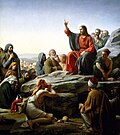
John | [[File:Bloch-SermonOnTheMount.jpg|thumb|''Sermon on the Mount'', by [[Carl Bloch]], 1877, depicts [[Sermon on the Mount|Jesus's important discourse]].|alt=Jesus sits atop a mount, preaching to a crowd]] | ||
The Synoptics depict two main geographical settings in Jesus's ministry. The first takes place in Galilee, north of [[Judea]], where Jesus conducts a largely successful ministry; the second occurs in Jerusalem, where he is rejected and killed.<ref name="ISBEO">{{cite web |year=1939 |editor-last=Orr |editor-first=James |title=International Standard Bible Encyclopedia Online |url=http://www.internationalstandardbible.com/R/rabbi.html |url-status=dead |archive-url=https://web.archive.org/web/20160817024703/http://www.internationalstandardbible.com/R/rabbi.html |archive-date=17 August 2016 |access-date=30 July 2016 |publisher=Wm. B. Eerdmans}}</ref> Often referred to as "[[rabbi]]",<ref name="ISBEO" /> Jesus delivers his message orally.<ref name="Dunn2013">{{cite book |last=Dunn |first=James D. G. |title=The Oral Gospel Tradition |publisher=Wm. B. Eerdmans |year=2013 |pages=290–291}}</ref> In these accounts, he forbids those who recognize him as the messiah— including people he heals and demons he is said to exorcise—to speak about it (see [[Messianic Secret]]).{{sfn|Harris|1985|pp=285–296}} By contrast, the Gospel of John portrays Jesus's ministry as taking place primarily in and around Jerusalem rather than in Galilee, and his divine nature is more openly proclaimed and recognized.{{sfn|Harris|1985|pp=302–310}} | |||
Scholars divide the ministry of Jesus into several stages. The Galilean ministry begins when Jesus returns to Galilee from the [[Judaean Desert]] after | Scholars commonly divide the ministry of Jesus into several stages. The Galilean ministry begins when Jesus returns to Galilee from the [[Judaean Desert]] after resisting the temptations of [[Satan]]. He then preaches throughout Galilee, and in [[s:Bible (American Standard)/Matthew#4:18|Matthew 4:18–20]] [[first disciples of Jesus|his first disciples]]—who will later form the core of the early Church— encounter him and begin to follow him.{{sfn|McGrath|2006|pp=16–22}}{{sfn|Redford|2007|pp=117–130}} This period includes the [[Sermon on the Mount]], one of Jesus's major discourses,{{sfn|Redford|2007|pp=117–130}}<ref>{{cite book |title=The Sermon on the mount: a theological investigation |first=Carl G. |last=Vaught |year=2001 |publisher=Baylor University Press |isbn=978-0-918954-76-3 |pages=xi–xiv}}</ref> as well as the [[calming of the storm]], the [[feeding of the 5,000]], [[Jesus walking on water|walking on water]], and various other miracles and [[parables of Jesus|parables]].{{sfn|Redford|2007|pp=143–160}} It concludes with the [[Confession of Peter]] and the Transfiguration.<ref>{{cite encyclopedia |title=Transfiguration, The |encyclopedia=The New Schaff-Herzog Encyclopedia of Religious Thought: Son of Man-Tremellius V11 |isbn=978-1-4286-3189-2 |publisher=Funk & Wagnalls |year=1909 |url=https://books.google.com/books?id=js5-eDk13TcC&pg=PA493 |page=493 |last=Nash |first=Henry S. |editor-first=Samuel M. |editor-last=Jackson |access-date=14 August 2015 |archive-date=7 September 2015 |archive-url=https://web.archive.org/web/20150907052036/https://books.google.com/books?id=js5-eDk13TcC&pg=PA493 |url-status=live}}</ref><ref name="Barton132">{{cite book |last=Barton |first=Stephen C. |url=https://archive.org/details/cambridgecompani00bart_994 |title=The Cambridge Companion to the Gospels |date=23 November 2006 |publisher=Cambridge University Press |isbn=978-0-521-80766-1 |pages=[https://archive.org/details/cambridgecompani00bart_994/page/n138 132]–133 |url-access=limited}}</ref> | ||
As Jesus travels towards Jerusalem, | As Jesus travels towards Jerusalem, during what is often called the Perean ministry, he returns to the region where he was baptized, roughly a third of the way down from the [[Sea of Galilee]] along the Jordan River.<ref>[[wikisource:Bible (American Standard)/John#10:40|John 10:40–42]].</ref>{{sfn|Cox|Easley|2007|p=137}}{{sfn|Redford|2007|pp=211–229}} The [[Ministry of Jesus#Final ministry in Jerusalem|final phase of his ministry]], In Jerusalem, begins with his [[triumphal entry into Jerusalem|triumphal entry]] into the city on [[Palm Sunday]].{{sfn|Cox|Easley|2007|pp=155–170}} In the Synoptic Gospels, during that week Jesus [[Cleansing of the Temple|drives the money changers]] from the [[Second Temple]], and [[Bargain of Judas|Judas bargains to betray]] him. This period culminates in the [[Last Supper]] and, in the Johannine account, the [[Farewell Discourse]].{{sfn|Blomberg|2009|pp=224–229}}{{sfn|Cox|Easley|2007|pp=155–170}}{{sfn|Redford|2007|pp=257–274}} | ||
====Disciples and followers==== | ==== Disciples and followers ==== | ||
{{Main|Apostles in the New Testament|Commissioning of the Twelve Apostles}} | {{Main|Apostles in the New Testament|Commissioning of the Twelve Apostles}} | ||
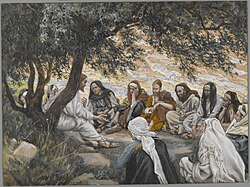
In Mark, | [[File:Brooklyn Museum - The Exhortation to the Apostles (Recommandation aux apôtres) - James Tissot.jpg|thumb|''The Exhortation to the Apostles'', by [[James Tissot]], portrays Jesus talking to his twelve disciples.]] | ||
Near the beginning of his ministry, Jesus [[Commissioning of the Twelve Apostles|appoints twelve apostles]]. In Matthew and Mark, Jesus calls his first four apostles, who are fishermen, and they are described as immediately leaving their nets to follow him.<ref>[[wikisource:Bible (American Standard)/Matthew#4:18|Matthew 4:18–22]], [[wikisource:Bible (American Standard)/Mark#1:16|Mark 1:16–20]].</ref> In John, Jesus's first two apostles are initially disciples of John the Baptist; the Baptist sees Jesus and calls him the Lamb of God, and the two, hearing this, begin to follow Jesus.{{sfn|Brown|1988|pp=25–27}}{{sfn|Boring|Craddock|2004|pp=292–293}} In addition to the Twelve Apostles, the introduction of the [[Sermon on the Plain]] in Luke identifies a much larger group of people as disciples.<ref>[[wikisource:Bible (American Standard)/Luke#6:17|Luke 6:17]].</ref> In [[s:Bible (American Standard)/Luke#10:1|Luke 10:1–16]], Jesus sends [[Seventy disciples|70 or 72 of his followers]] out in pairs to prepare towns for his prospective visits; they are instructed to accept hospitality, heal the sick, and proclaim the [[Kingdom of God]].<ref>{{cite encyclopedia |title=The Gospel According to Luke |encyclopedia=New Collegeville Bible Commentary: New Testament |publisher=Liturgical Press |year=2009 |url=https://books.google.com/books?id=sdooTRyPMCwC&pg=PA255 |page=255 |first=Michael F. |last=Patella |editor-first=Daniel |editor-last=Durken |isbn=978-0-8146-3260-4 |access-date=14 August 2015 |archive-date=10 September 2015 |archive-url=https://web.archive.org/web/20150910044704/https://books.google.com/books?id=sdooTRyPMCwC&pg=PA255 |url-status=live}}</ref> | |||
==== | ==== <span class="anchor" id="Teachings and preachings"></span> Teachings and miracles ==== | ||
{{Main|Sermon on the Mount|Parables of Jesus|Miracles of Jesus}} | {{Main|Sermon on the Mount|Parables of Jesus|Miracles of Jesus}} | ||
{{See also|Sermon on the Plain|Five Discourses of Matthew|Farewell Discourse|Olivet Discourse|Bread of Life Discourse}} | {{See also|Sermon on the Plain|Five Discourses of Matthew|Farewell Discourse|Olivet Discourse|Bread of Life Discourse}} | ||
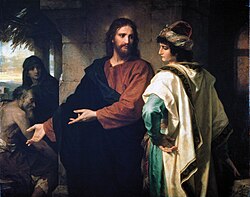
[[File:Hoffman-ChristAndTheRichYoungRuler.jpg|thumb | [[File:Hoffman-ChristAndTheRichYoungRuler.jpg|thumb|''[[Jesus and the rich young man]]'' by [[Heinrich Hofmann (painter)|Heinrich Hofmann]], 1889]] | ||
In the Synoptics, Jesus teaches | In the Synoptics, Jesus teaches extensively—often in [[parable]]s{{sfn|Theissen|Merz|1998|pp=316–346}}—about the Kingdom of God. Jesus also speaks of the "[[Son of man (Christianity)|Son of Man]]", an [[Apocalypse|apocalyptic]] figure who will come to gather the chosen.<ref name="Britannica" /> Jesus calls people to repent of their sins and to devote themselves wholly to God.<ref name="Britannica">{{Britannica |id=303091 |title=Jesus Christ |first1=E. P. |last1=Sanders |first2=Jaroslav J. |last2=Pelikan}}</ref> He instructs his followers to observe [[Jewish law]], although he is perceived by some contemporaries as having broken the law himself, for example in relation to [[Sabbath|Sabbath observance]].<ref name="Britannica" /> When asked what the [[Great Commandment|greatest commandment]] is, Jesus replies: "You shall love the Lord your God with all your heart, and with all your soul, and with all your mind ... And a second is like it: 'You shall love your neighbor as yourself.{{'"}}<ref>[[wikisource:Bible (American Standard)/Matthew#22:37|Matthew 22:37–39]].</ref> Other ethical teachings attributed to Jesus include [[Matthew 5:44|loving one's enemies]], refraining from [[hatred]] and [[lust]], [[turning the other cheek]], and [[Forgiveness|forgiving]] those who have sinned against oneself.<ref>[[Sermon on the Mount|Matthew 5–7]].</ref><ref>{{cite book |last1=Stassen |first1=Glen H. |url=https://books.google.com/books?id=LlMVrmA-b-4C |title=Kingdom Ethics: Following Jesus in Contemporary Context |last2=Gushee |first2=David P. |publisher=InterVarsity |year=2003 |isbn=978-0-8308-2668-1 |pages=102–103, 138–140, 197–198, 295–298 |access-date=14 August 2015 |archive-url=https://web.archive.org/web/20200226062140/https://books.google.com/books?id=LlMVrmA-b-4C |archive-date=26 February 2020 |url-status=live}}</ref> | ||
Jesus | The Gospel of John presents the teachings of Jesus not merely as his own preaching but as divine [[revelation]]. John the Baptist, for example, states in [[s:Bible (American Standard)/John#3:34|John 3:34]]: "He whom God has sent speaks the words of God, for he gives the Spirit without measure." In [[s:Bible (American Standard)/John#7:16|John 7:16]], Jesus says, "My teaching is not mine but his who sent me." He reiterates this in [[s:Bible (American Standard)/John#14:10|John 14:10]]: "Do you not believe that I am in the Father and the Father is in me? The words that I say to you I do not speak on my own; but the Father who dwells in me does his works."<ref name="Osborn-1993" /><ref>{{cite book |last=Köstenberger |first=Andreas J. |title=The missions of Jesus and the disciples according to the Fourth Gospel |publisher=Wm. B. Eerdmans |year=1998 |isbn=978-0-8028-4255-8 |pages=108–109}}</ref> | ||
[[File:Pompeo Batoni 003.jpg|thumb|left|upright=0.8|''[[Parable of the Prodigal Son|The Return of the Prodigal Son]]'' by [[Pompeo Batoni]], 1773]] | |||
Approximately 30 parables constitute about one-third of Jesus's recorded teachings.<ref name="Osborn-1993">{{cite book |first=Eric F. |last=Osborn |year=1993 |title=The emergence of Christian theology |url=https://archive.org/details/emergencechristi00osbo |url-access=limited |isbn=978-0-521-43078-4 |page=[https://archive.org/details/emergencechristi00osbo/page/n115 98] |publisher=Cambridge University Press}}</ref><ref>{{cite book |first=J. Dwight |last=Pentecost |year=1998 |title=The parables of Jesus: lessons in life from the Master Teacher |isbn=978-0-8254-9715-5 |page=10 |publisher=Kregel}}</ref> The parables appear both within longer sermons and at various other places in the narrative.<ref>{{cite book |title=The Sermons of Jesus the Messiah |first=E. Keith |last=Howick |year=2003 |publisher=WindRiver |isbn=978-1-886249-02-8 |pages=7–9}}</ref> They often contain symbolism and typically relate aspects of the physical world to [[Spirituality|spiritual]] realities.<ref>{{cite book |first=Friedrich G. |last=Lisco |year=1850 |title=The Parables of Jesus |publisher=Daniels and Smith Publishers |pages=[https://archive.org/details/bub_gb_OoIuAAAAYAAJ/page/n12 9]–11 |url=https://archive.org/details/bub_gb_OoIuAAAAYAAJ}}</ref><ref>{{cite book |first=Ashton |last=Oxenden |year=1864 |title=The parables of our Lord? |publisher=William Macintosh Publishers |page=[https://archive.org/details/bub_gb_5bUCAAAAQAAJ/page/n15 6] |url=https://archive.org/details/bub_gb_5bUCAAAAQAAJ}}</ref> Common themes include the kindness and generosity of God, as well as the dangers and consequences of transgression.<ref>{{cite book |url=https://books.google.com/books?id=dPdANFaNgagC&pg=448 |title=Interpreting the Parables |publisher=InterVarsity |year=2012 |page=448 |isbn=978-0-8308-3967-4 |first=Craig L. |last=Blomberg |access-date=14 August 2015 |archive-date=10 September 2015 |archive-url=https://web.archive.org/web/20150910175429/https://books.google.com/books?id=dPdANFaNgagC&pg=448 |url-status=live}}</ref> Some parables, such as that of the [[Prodigal Son]],<ref>[[wikisource:Bible (American Standard)/Luke#15:11|Luke 15:11–32]].</ref> are relatively straightforward, while others, such as the [[Parable of the Growing Seed|Growing Seed]],<ref>[[wikisource:Bible (American Standard)/Mark#4:26|Mark 4:26–29]].</ref> are more complex, profound, and difficult to interpret.<ref>{{cite web |first=Madeleine I. |last=Boucher |url=https://www.pbs.org/wgbh/pages/frontline/shows/religion/jesus/parables.html |title=The Parables |website=Frontline|publisher=PBS |access-date=3 June 2013 |archive-date=10 August 2013 |archive-url=https://web.archive.org/web/20130810144100/http://www.pbs.org/wgbh/pages/frontline/shows/religion/jesus/parables.html |url-status=live}}</ref> When his disciples ask why he speaks to the people in parables, Jesus replies that the chosen disciples have been granted "to know the secrets of the kingdom of heaven", unlike the rest, adding: "For the one who has will be given more and he will have in abundance. But the one who does not have will be deprived even more", and he goes on to say that most of their generation have developed "dull hearts" and are therefore unable to understand.<ref>[[wikisource:Bible (American Standard)/Matthew#13:10|Matthew 13:10–17]].</ref> | |||
[[File: | [[File:Christ cleans leper man.jpg|thumb|upright=0.8|[[Jesus cleansing a leper]], medieval [[mosaic]] from the [[Monreale Cathedral]], late 12th to mid-13th centuries|alt=Jesus, his head surrounded by a halo, puts his hands on a leper, thereby healing him]] | ||
In the gospel accounts, Jesus devotes a substantial portion of his ministry to performing [[miracle]]s, especially healings.{{sfn|Green|McKnight |Marshall|1992|p=299}} These miracles are commonly classified into two main categories: healing miracles and nature miracles.{{sfn|Twelftree|1999|p=350}}{{sfn|Levine|2006|p=4}}<ref>{{cite book |last1=Charlesworth |first1=James H. |url=https://books.google.com/books?id=YTIGy5t45WgC&pg=PT113 |title=The Historical Jesus: An Essential Guide |date=2008 |publisher=Abingdon Press |isbn=978-1-4267-2475-6 |page=113 |access-date=29 March 2017 |archive-url=https://web.archive.org/web/20201008221947/https://books.google.com/books?id=YTIGy5t45WgC&pg=PT113 |archive-date=8 October 2020 |url-status=live}}</ref> The healing miracles include cures of physical ailments, [[exorcism]]s,{{sfn|Witherington|1997|p=113}}{{sfn|Theissen|Merz|1998|p=298}} and [[Miracles of Jesus#Resurrection of the dead|the raising of the dead]].{{sfn|Green|McKnight|Marshall|1992|p=300}}<ref name="Oxford Companion" /><ref>{{cite web |last=Tabor |first=James |date=22 March 2013 |title=What the Bible Says About Death, Afterlife, and the Future |url=https://clas-pages.uncc.edu/james-tabor/ancient-judaism/death-afterlife-future/ |url-status=dead |archive-url=https://web.archive.org/web/20160823115040/https://clas-pages.uncc.edu/james-tabor/ancient-judaism/death-afterlife-future/ |archive-date=23 August 2016 |access-date=13 June 2015 |publisher=UNCC}}</ref><ref>{{cite book |last=Hoekema |first=Anthony A. |url=https://books.google.com/books?id=c2yT_7xw35sC |title=The Bible and the Future |publisher=Wm. B. Eerdmans |year=1994 |isbn=978-0-85364-624-2 |pages=88–89 |access-date=8 October 2020 |archive-url=https://web.archive.org/web/20201008221946/https://books.google.com/books?id=c2yT_7xw35sC |archive-date=8 October 2020 |url-status=live}}</ref> The nature miracles demonstrate authority over the natural world and include [[turning water into wine]], walking on water, and calming a storm, among others. Jesus attributes his miracles to a divine source. When opponents accuse him of casting out demons by the power of [[Beelzebub]], the prince of demons, he replies that he does so by the "Spirit of God" ([[s:Bible (American Standard)/Matthew#12:28|Matthew 12:28]]) or "finger of God", arguing that it would be illogical for Satan to undermine his own domain; he also asks, if he exorcises by Beelzebub, "by whom do your sons cast them out?"<ref>[[wikisource:Bible (American Standard)/Luke#11:20|Luke 11:20]].</ref><ref name="Britannica" /><ref>{{cite book |url=https://books.google.com/books?id=Js9nFESO0VAC&pg=PA100 |title=Zondervan King James Version Commentary: New Testament |last2=Mitchell |first2=Daniel R. |publisher=Zondervan |year=2010 |isbn=978-0-310-25150-7 |page=100 |first1=Edward E. |last1=Hindson |access-date=14 August 2015 |archive-date=10 September 2015 |archive-url=https://web.archive.org/web/20150910171333/https://books.google.com/books?id=Js9nFESO0VAC&pg=PA100 |url-status=live}}</ref> In Matthew 12:31–32, he further states that while all kinds of sin, including "insults against God" or "insults against the Son of Man", may be forgiven, blasphemy against "The [[Holy Spirit]]" will never be forgiven, and those guilty of it bear their sin permanently.<ref>{{Cite web|title=Bible Gateway passage: Matthew 12:31-32 - New International Version|url=https://www.biblegateway.com/passage/?search=Matthew%2012%3A31-32&version=NIV|website=Bible Gateway|access-date=2026-01-30|language=en}}</ref> | |||
In John, Jesus's miracles are described as "signs", performed to manifest his mission and identity.<ref name="Sign" />{{sfn|Ehrman|2009|page=[https://archive.org/details/jesusinterrupted00ehrm_0/page/84 84]}} In the Synoptic Gospels, when some teachers of the law and Pharisees ask him for a miraculous sign to validate his authority, Jesus refuses,<ref name="Sign">{{cite book |title=Introducing the New Testament: Its Literature and Theology |year=2001 |publisher=Wm. B. Eerdmans |isbn=978-0-8028-3717-2 |page=[https://archive.org/details/introducingnewte00paul/page/198 198] |url=https://archive.org/details/introducingnewte00paul/page/198 |first1=Paul J. |last1=Achtemeier |first2=Joel B. |last2=Green |first3=Marianne M. |last3=Thompson}}</ref> saying that no sign will be given to a corrupt and evil generation except the sign of the prophet [[Jonah]]. In the Synoptics, the crowds typically respond to his miracles with awe and press upon him to heal their sick, whereas in John, Jesus is depicted as less constrained by the crowds, who often respond to his signs with belief and trust.{{sfn|Twelftree|1999|p=236}} A feature common to all the miracle narratives is that Jesus performs them freely and does not request or accept payment.<ref>{{cite book |last=van der Loos |first=Hendrik |title=The Miracles Of Jesus |year=1965 |publisher=Brill |page=197 |url=https://books.google.com/books?id=n4geAAAAIAAJ&pg=PA197 |access-date=14 August 2015 |archive-date=10 September 2015 |archive-url=https://web.archive.org/web/20150910165838/https://books.google.com/books?id=n4geAAAAIAAJ&pg=PA197 |url-status=live}}</ref> The miracle stories are frequently interwoven with teachings, and the miracles themselves often carry a [[Didactic method|didactic]] dimension.<ref>{{cite book |title=The words and works of Jesus Christ |first=J. Dwight |last=Pentecost |year=1981 |isbn=978-0-310-30940-6 |page=212 |url=https://books.google.com/books?id=bh3M_AfgXZAC&pg=PA212 |publisher=Zondervan |access-date=14 August 2015 |archive-date=10 September 2015 |archive-url=https://web.archive.org/web/20150910063513/https://books.google.com/books?id=bh3M_AfgXZAC&pg=PA212 |url-status=live}}</ref>{{sfn|Twelftree|1999 |p=95}} Many emphasize the importance of faith: in the [[Cleansing ten lepers|cleansing of ten lepers]] and the [[raising of Jairus's daughter]], for instance, the beneficiaries are told that their healing is due to their faith.{{sfn|Donahue|Harrington |2002|p=182}}<ref>{{cite book |last=Lockyer |first=Herbert |year=1988 |title=All the Miracles of the Bible |isbn=978-0-310-28101-6 |page=235 |publisher=Zondervan}}</ref> | |||
In John | In ''A Marginal Jew'', scholar [[John P. Meier]] argues that "the miracle traditions about Jesus' public ministry are already so widely attested in various sources" that any "total fabrication by the early church is, practically speaking, impossible". He bases this claim on literary sources such as the Gospels of Matthew, Luke, and John, as well as on the writings of the historian Josephus. Meier contends that the "criterion of multiple attestation of sources and forms" supports the conclusion that Jesus performed "extraordinary deeds" which his contemporaries regarded as miracles.<ref>John P. Meier, ''A Marginal Jew: Rethinking the Historical Jesus, Volume 2: Mentor, Message, and Miracles'' (New York: Doubleday, 1994), p. 630, available at https://archive.org/details/Marginal-Jew_vol-2_Meier_1994/10__a/page/630/mode/1up.</ref> | ||
====Proclamation | Scholar [[Paul J. Achtemeier]] argues that such miracles were not unique to Jesus in the ancient world and were perceived as ambiguous even by eyewitnesses. He notes that Jesus likely performed acts understood as exorcisms, which were "accepted as reality by his contemporaries", but that these should not be seen as having "probative value with respect to Jesus," since witnesses could claim that he was working with either Satan or God.<ref>Paul J. Achtemeier, "Miracles and the Historical Jesus: A Study of Mark 9:14–29," ''The Catholic Biblical Quarterly'' 37, no. 4 (1975): 471–491, p. 490, available at https://www.jstor.org/stable/43714056.</ref> Scholar [[Gregory Sterling]] observes that, in the case of Jesus's alleged exorcisms, "For first-century Galileans who believed in the personal presence of evil in the form of demons, Jesus' act was a validation of his ministry."<ref>Gregory E. Sterling, "Jesus as Exorcist: An Analysis of Matthew 17:14–20; Mark 9:14–29; | ||
Luke 9:37–43a," ''The Catholic Biblical Quarterly'' 55, no. 3 (1993): 467–493, p. 493, | |||
available at https://www.jstor.org/stable/43721315.</ref> | |||
==== Proclamation, Transfiguration, and Passion Week ==== | |||
{{Main|Confession of Peter|Transfiguration of Jesus}} | {{Main|Confession of Peter|Transfiguration of Jesus}} | ||
[[File:Transfigurationbloch.jpg|thumb|upright=0.8|The [[Transfiguration of Jesus]], depicted by [[Carl Bloch]], 19th century]] | |||
In the Transfiguration,<ref>[[ | At approximately the midpoint of each of the three Synoptic Gospels, two significant events are narrated: the Confession of [[Saint Peter|Peter]] and the Transfiguration of Jesus—not mentioned in the Gospel of John.<ref name="Barton132" /><ref>{{cite book |title=The Christology of Mark's Gospel |url=https://archive.org/details/christologyofmar0000king |url-access=limited |first=Jack D. |last=Kingsbury |year=1983 |isbn=978-1-4514-1007-5 |publisher=Fortress Press |pages=[https://archive.org/details/christologyofmar0000king/page/91 91]–95}}</ref>{{sfn|Lee|2004|pp=21–30}}<ref name="Nobbs" />{{sfn|Cross|Livingstone|2005|loc=John, Gospel of}} In the Confession of Peter, Peter declares to Jesus, "You are the Messiah, the Son of the living God";<ref>{{cite book |last=Karris|first=Robert J.|title=The Collegeville Bible Commentary: New Testament|publisher=Liturgical Press|year=1992|isbn=978-0-8146-2211-7|pages=885–886}}</ref><ref>{{cite book |title=Who do you say that I am? Essays on Christology|first1=Jack D.|last1=Kingsbury|first2=Mark A.|last2=Powell|first3=David R.|last3=Bauer|year=1999|isbn=978-0-664-25752-1|publisher=Westminster John Knox Press|page=xvi}}</ref>{{sfn|Donahue|Harrington|2002|p=336}} Jesus affirms that this is a divinely revealed truth.<ref>{{cite book |last=Yieh|first=John Y. H.|url=https://books.google.com/books?id=g0-NaraCrAoC|title=One teacher: Jesus' teaching role in Matthew's gospel|publisher=Walter de Gruyter|year=2004|isbn=978-3-11-018151-7|pages=240–241|access-date=8 October 2020|archive-url=https://web.archive.org/web/20201008221947/https://books.google.com/books?id=g0-NaraCrAoC|archive-date=8 October 2020|url-status=live}}</ref>{{sfn|Pannenberg|1968|pp=53–54}} Following this confession, Jesus begins to tell his disciples about his forthcoming suffering, death, and resurrection.<ref>Matthew 16:21, Mark 8:31, and Luke 9:22.</ref> In the Transfiguration,<ref>[[wikisource:Bible (American Standard)/Matthew#17:1|Matthew 17:1–9]], [[wikisource:Bible (American Standard)/Mark#9:2|Mark 9:2–8]], and [[wikisource:Bible (American Standard)/Luke#9:28|Luke 9:28–36]].</ref>{{sfn|Lee|2004|pp=21–30}}<ref name="Nobbs" /><ref name="Barton132" /> Jesus takes Peter and two other apostles up an unnamed mountain, where "he was transfigured before them, and his face shone like the sun, and his clothes became dazzling white".{{sfn|Lee|2004|pp=72–76}} A bright cloud envelops them, and a voice from the cloud proclaims, "This is my Son, the Beloved; with him I am well pleased; listen to him."<ref>[[wikisource:Bible (American Standard)/Matthew#17:1|Matthew 17:1–9]].</ref>{{sfn|Lee|2004|pp=21–30}} | ||
The description of the final week of Jesus's life—often referred to as [[Passion Week]]—occupies roughly one-third of the narrative in the canonical gospels.<ref name="Turner613" /> This section begins with Jesus's [[triumphal entry into Jerusalem]] and concludes with his crucifixion.{{sfn|Blomberg|2009|pp=224–229}}{{sfn|Cox|Easley|2007|pp=155–170}} | |||
The description of the | |||
====Activities in Jerusalem==== | ==== Activities in Jerusalem ==== | ||
{{Main|Triumphal entry into Jerusalem|Cleansing of the Temple|Bargain of Judas}} | {{Main|Triumphal entry into Jerusalem|Cleansing of the Temple|Bargain of Judas}} | ||
[[File:Gérôme - L'entrée du Christ à Jérusalem - cadre.jpg|thumb|upright=1.2|A painting of Jesus's [[Triumphal entry into Jerusalem|final entry into Jerusalem]], by [[Jean-Léon Gérôme]], 1897|alt=Jesus, riding a donkey colt, rides towards Jerusalem. A large crowd greets him outside the walls.]] | |||
Jesus | In the Synoptic Gospels, the final week in Jerusalem concludes the journey through Perea and Judea that Jesus began in Galilee.{{sfn|Cox|Easley|2007|pp=155–170}} Jesus enters Jerusalem riding a young donkey, evoking the motif of [[the Messiah's Donkey|the Messiah's donkey]] from the [[Book of Zechariah]], in the humble king of the Jews comes to the city in this manner.<ref>{{Bibleverse|Zechariah|9:9|HE}}.</ref><ref name="May Metzger Mark">{{Cite book|editor-last1=May|editor-first1=Herbert G. |editor-first2=Bruce M. |editor-last2=Metzger|title=The New Oxford Annotated Bible with the Apocrypha|year= 1977|chapter=Mark|pages= 1213–1239}}</ref> As he proceeds, people spread cloaks and small branches of trees ([[Palm branch|palm fronds]]) on the road before him and chant lines from Psalm 118:25–26.<ref>{{Bibleverse|Psalms|118:25–26|HE}}.</ref>{{sfn|Boring|Craddock|2004|pp=256–258}}{{sfn|Majerník|Ponessa|Manhardt|2005|pp=133–134}}{{sfn|Evans|2003|pp=381–395}} | ||
Jesus | Jesus next expels the money changers from the Temple, accusing them of turning it into a den of thieves through their commercial activities. Most scholars agree that it is overwhelmingly likely that Jesus did something in the temple and mentioned its destruction.<ref>{{cite book |last= Sanders |first= E.P. |author-link= E.P. Sanders |year= 1985 |title= Jesus and Judaism |publisher= Fortress Press |page= 61 |isbn= 978-0800620615}}</ref>{{sfn|Harris|1985|pp=285–296}} In John, the Cleansing of the Temple occurs at the beginning of Jesus's ministry instead of at the end.<ref>[[wikisource:Bible (American Standard)/John#2:13|John 2:13–16]].</ref>{{sfn|Harris|1985|pp=302–310}} Ancient compositional practices involved such chronological displacement and compression, with even reliable biographers like [[Plutarch]] displaying them.<ref>{{Cite journal |last=Vytlačilová |first=Magdalena |date=2023 |title=Jesus, the Gospels, and the Galilean Crisis by Tucker S. Ferda (review) |journal=Neotestamentica |volume=57 |issue=1 |pages=197–202 |doi=10.1353/neo.2023.a938405}}</ref> | ||
Jesus comes into conflict with the Jewish elders, such as when they [[Authority of Jesus questioned|question his authority]] and when he [[Woes of the Pharisees|criticizes them and calls them hypocrites]].{{sfn|Boring|Craddock|2004|pp=256–258}}{{sfn|Evans|2003|pp=381–395}} [[Judas Iscariot]], one of the [[twelve apostles]], secretly strikes a bargain with the Jewish elders, agreeing to betray Jesus to them for [[30 silver coins]].<ref>{{cite book |last=Lockyer |first=Herbert |url=https://books.google.com/books?id=-Q7l-_UFHmYC |title=All the Apostles of the Bible |publisher=Zondervan |year=1988 |isbn=978-0-310-28011-8 |pages=106–111 |access-date=11 July 2017 |archive-url=https://web.archive.org/web/20200229044027/https://books.google.com/books?id=-Q7l-_UFHmYC |archive-date=29 February 2020 |url-status=live}}</ref><ref>{{cite book |title=The Synoptic Gospels and the Book of Acts |first=Doremus A. |last=Hayes |year=2009 |isbn=978-1-313-53490-1 |page=88 |publisher=HardPress}}</ref> | |||
====Last Supper==== | The Gospel of John recounts two other feasts in which Jesus taught in Jerusalem before the Passion Week.<ref>[[wikisource:Bible (American Standard)/John#7:1|John 7:1–10:42]].</ref>{{sfn|Harris|1985|pp=270–272}} In [[Bethany]], a village near Jerusalem, Jesus [[Raising of Lazarus|raises Lazarus from the dead]]. This potent sign{{sfn|Harris|1985|pp=302–310}} increases the tension with authorities,{{sfn|Cox|Easley|2007|pp=155–170}} who conspire to kill him.<ref>[[wikisource:Bible (American Standard)/John#11:1|John 11]].</ref>{{sfn|Harris|1985|pp=270–272}} [[Mary of Bethany]] anoints Jesus's feet, foreshadowing his entombment.{{sfn|Funk|Hoover|The Jesus Seminar|1993|pp=401–470}} Jesus then makes his messianic entry into Jerusalem.{{sfn|Harris|1985|pp=270–272}} The cheering crowds greeting Jesus as he enters Jerusalem add to the animosity between him and the establishment.{{sfn|Cox|Easley|2007|pp=155–170}} In John, Jesus has already cleansed the Second Temple during an earlier Passover visit to Jerusalem. John next recounts Jesus's Last Supper with his disciples.{{sfn|Harris|1985|pp=270–272}} | ||
==== Last Supper ==== | |||
{{Main|Last Supper}} | {{Main|Last Supper}} | ||
{{See also|Jesus predicts his betrayal|Denial of Peter|Last Supper in Christian art}} | {{See also|Jesus predicts his betrayal|Denial of Peter|Last Supper in Christian art}} | ||
[[File:Última Cena - Juan de Juanes.jpg|thumb|upright=1.2|The [[Last Supper]], depicted by [[Juan de Juanes]], {{circa|1562}}|alt=A depiction of the Last Supper. Jesus sits in the | [[File:Última Cena - Juan de Juanes.jpg|thumb|upright=1.2|The [[Last Supper]], depicted by [[Juan de Juanes]], {{circa|1562|lk=no}}|alt=A depiction of the Last Supper. Jesus sits in the centre, his apostles gathered around on either side of him.]] | ||
The Last Supper is the final meal that Jesus shared with his twelve apostles in Jerusalem before his crucifixion. The Last Supper is mentioned in all four canonical gospels; Paul's [[First Epistle to the Corinthians]]<ref>1 Corinthians [[wikisource:Bible (American Standard)/1 Corinthians#11:23|11:23–26]].</ref> also refers to it.<ref name="Fahlbusch52">{{cite book |title=The Encyclopedia of Christianity |volume=4 |first=Erwin |last=Fahlbusch |year=2005 |isbn=978-0-8028-2416-5 |pages=53–56 |url=https://books.google.com/books?id=C5V7oyy69zgC&pg=PA53 |publisher=Wm. B. Eerdmans |access-date=14 August 2015 |archive-date=7 September 2015 |archive-url=https://web.archive.org/web/20150907101720/https://books.google.com/books?id=C5V7oyy69zgC&pg=PA53 |url-status=live}}</ref>{{sfn|Evans|2003|pp=465–477}}{{sfn|Cox|Easley|2007|pp=180–191}} During the meal, [[Jesus predicts his betrayal|Jesus predicts]] that one of his apostles will betray him.{{sfn|Cox|Easley|2007|p=182}} Despite each Apostle's assertion that he would not betray him, Jesus reiterates that the betrayer would be one of those present. Matthew 26:23–25 and John 13:26–27 identify Judas as the traitor.<ref name="Fahlbusch52" />{{sfn|Evans|2003|pp=465–477}}{{sfn|Cox|Easley|2007|p=182}} | |||
In | In the Synoptics, Jesus takes bread, breaks it, and gives it to the disciples, saying, "This is my body, which is given for you." He then has them all drink from a cup, saying, "This cup that is poured out for you is the new covenant in my blood."<ref>[[wikisource:Bible (American Standard)/Luke#22:19|Luke 22:19–20]].</ref><ref name="Fahlbusch52" />{{sfn|Cross|Livingstone|2005|loc=Eucharist}} The Christian [[sacrament]] or [[Ordinance (Christian)|ordinance]] of the [[Eucharist]] is based on these events.<ref>{{CathEncy| wstitle=The Blessed Eucharist as a Sacrament |first=Joseph |last=Pohle}}</ref> Although the Gospel of John does not include a description of the bread-and-wine ritual during the Last Supper, most scholars agree that John 6:22–59 (the [[Bread of Life Discourse]]) has a eucharistic character and resonates with the [[Origin of the Eucharist#Institution narratives|institution narratives]] in the Synoptic Gospels and in the Pauline writings on the Last Supper.{{sfn|Freedman|2000|p=792}} | ||
====Agony in the Garden, betrayal, and arrest==== | In all four gospels, Jesus predicts that Peter will deny knowledge of him three times before the [[rooster|cock]] crows the next morning.<ref name="Denial">{{cite book |title=Peter: apostle for the whole church |first=Pheme |last=Perkins |publisher=Fortress Press |year=2000 |isbn=978-1-4514-1598-8 |page=85}}</ref><ref>{{cite book |title=The Gospel according to Matthew |volume=1 |first=Johann P. |last=Lange |year=1865 |publisher=Scribner |page=499}}</ref> In Luke and John, the prediction is made during the Supper.<ref>[[wikisource:Bible (American Standard)/Luke#22:33|Luke 22:34]], [[wikisource:Bible (American Standard)/John#22:33|John 22:34]].</ref> In Matthew and Mark, the prediction is made after the Supper; Jesus also predicts that all his disciples will desert him.<ref>[[wikisource:Bible (American Standard)/Matthew#26:31|Matthew 26:31–34]], [[wikisource:Bible (American Standard)/Mark#14:27|Mark 14:27–30]].</ref>{{sfn|Walvoord|Zuck|1983|pp=83–85}} The Gospel of John provides the only account of [[Maundy (foot washing)|Jesus washing his disciples' feet]] after the meal.{{sfn|Harris|1985|pp=272–285}} John also includes a long sermon by Jesus, preparing his disciples (now without Judas) for his departure. Chapters 14–17 of the Gospel of John are known as the [[Farewell Discourse]] and are a significant source of [[Christological]] content.<ref>{{cite book |last1=O'Day |first1=Gail R. |title=John |last2=Hylen |first2=Susan |publisher=Westminster John Knox Press |year=2006 |isbn=978-0-664-25260-1 |pages=142–168}}</ref><ref>{{cite book |last=Ridderbos |first=Herman |title=The Gospel of John: A Theological Commentary|publisher=Wm. B. Eerdmans |year=1997 |isbn=978-0-8028-0453-2 |pages=546–576}}</ref> | ||
==== Agony in the Garden, betrayal, and arrest ==== | |||
{{Main|Agony in the Garden|Kiss of Judas|Arrest of Jesus}} | {{Main|Agony in the Garden|Kiss of Judas|Arrest of Jesus}} | ||
In the Synoptics, Jesus and his disciples go to the garden [[Gethsemane]], where Jesus prays to be spared his coming ordeal. Then Judas comes with an armed mob, sent by the chief priests, [[Scribe#Judaism| | [[File:The Taking of Christ-Caravaggio (c.1602).jpg|thumb|A depiction of the [[kiss of Judas]] and [[arrest of Jesus]], by [[Caravaggio]], {{circa|1602|lk=no}}|alt=Judas kisses Jesus, and soldiers rush to seize the latter.]] | ||
In the Synoptics, Jesus and his disciples go to the garden [[Gethsemane]], where Jesus prays to be spared his coming ordeal. Then Judas comes with an armed mob, sent by the chief priests, [[Scribe#Judaism|scribes]] and elders. He [[Kiss of Judas|kisses Jesus]] to identify him to the crowd, which then [[arrest of Jesus|arrests Jesus]]. In an attempt to stop them, an unnamed disciple of Jesus uses a sword to cut off the ear [[Malchus|of a man]] in the crowd. After Jesus's arrest, his disciples go into hiding, and Peter, when questioned, thrice [[Denial of Peter|denies]] knowing Jesus. After the third denial, Peter hears the cock crow and recalls Jesus's prediction about his denial. Peter then weeps bitterly.{{sfn|Walvoord|Zuck|1983|pp=83–85}}{{sfn|Harris|1985|pp=285–296}}<ref name="Denial" /> | |||
In John 18:1–11, Jesus does not pray to be spared his crucifixion, as the gospel portrays him as scarcely touched by such human weakness.{{sfn|Cross|Livingstone|2005|loc=Jesus}} The people who arrest him are [[Imperial Roman army|Roman soldiers]] and Temple guards.<ref>{{cite book|last1=Michaels|first1=J. Ramsey|title=John | In John 18:1–11, Jesus does not pray to be spared his crucifixion, as the gospel portrays him as scarcely touched by such human weakness.{{sfn|Cross|Livingstone|2005|loc=Jesus}} The people who arrest him are [[Imperial Roman army|Roman soldiers]] and Temple guards.<ref>{{cite book |last1=Michaels |first1=J. Ramsey |title=John |series=Understanding the Bible Commentary Series |date=2011 |publisher=Baker Books |page=187 |url=https://books.google.com/books?id=zGr-amBm4PUC&pg=PT187 |isbn=978-1-4412-3659-3 |access-date=7 September 2017 |archive-date=26 February 2020 |archive-url=https://web.archive.org/web/20200226071102/https://books.google.com/books?id=zGr-amBm4PUC&pg=PT187 |url-status=live}}</ref> Instead of being betrayed by a kiss, Jesus proclaims his identity, and when he does, the soldiers and officers fall to the ground. The gospel identifies Peter as the disciple who used the sword, and Jesus rebukes him for it. | ||
====Trials by the Sanhedrin, Herod, and Pilate==== | ==== Trials by the Sanhedrin, Herod, and Pilate ==== | ||
<!-- If you are considering renaming or deleting this section, please note that [[Trials of Jesus]] currently redirects here (June 2025) --> | |||
{{Main|Sanhedrin trial of Jesus|Pilate's Court|Jesus at Herod's Court}} | {{Main|Sanhedrin trial of Jesus|Pilate's Court|Jesus at Herod's Court}} | ||
{{See also|Jesus, King of the Jews|John 18:38|Ecce homo}} | {{See also|Jesus, King of the Jews|John 18:38|Ecce homo}} | ||
After his arrest, Jesus is taken late at night to the private residence of the high priest, [[Caiaphas]], who had been installed by Pilate's predecessor, the Roman procurator [[Valerius Gratus]].<ref>[[Josephus]] Antiquities 18.2.2.</ref> The [[Sanhedrin]] was a Jewish judicial body.{{sfn|Brown|1997|p=146}} The gospel accounts differ on the [[Sanhedrin trial of Jesus|details of the trials]].<ref>{{cite book |last=Bromiley |first=Geoffrey W. |url=https://books.google.com/books?id=yklDk6Vv0l4C&pg=PA1050 |title=International Standard Bible Encyclopedia: E–J |publisher=Wm. B. Eerdmans |year=1988 |isbn=978-0-8028-3782-0 |pages=1050–1052 |access-date=14 August 2015 |archive-url=https://web.archive.org/web/20150907182833/https://books.google.com/books?id=yklDk6Vv0l4C&pg=PA1050 |archive-date=7 September 2015 |url-status=live}}</ref> In Matthew 26:57, Mark 14:53, and Luke 22:54, Jesus is taken to the house of the high priest, Caiaphas, where he is [[Mocking of Jesus|mocked]] and beaten that night. Early the next morning, the chief priests and scribes lead Jesus away into their council.{{sfn|Evans|2003|pp=487–500}}{{sfn|Blomberg|2009|pp=396–400}}<ref name="Holman608">{{cite book |title=Holman Concise Bible Dictionary |publisher=B&H |year=2011 |isbn=978-0-8054-9548-5 |pages=608–609}}</ref> John 18:12–14 states that Jesus is first taken to [[Annas]], Caiaphas's father-in-law, and then to the high priest.{{sfn|Evans|2003|pp=487–500}}{{sfn|Blomberg|2009|pp=396–400}}<ref name="Holman608" /> | |||
[[File:Ecce homo by Antonio Ciseri (1).jpg|thumb|upright=1.2|''Ecce homo!'' [[Antonio Ciseri]]'s 1871 depiction of [[Pontius Pilate]] presenting Jesus to the public|alt=A depiction of Jesus's public trial]] | |||
During the trials Jesus speaks very little, mounts no defence, and gives very infrequent and indirect answers to the priests' questions, prompting an officer to slap him. In Matthew 26:62, Jesus's unresponsiveness leads Caiaphas to ask him, "Have you no answer?".{{sfn|Evans|2003|pp=487–500}}{{sfn|Blomberg|2009|pp=396–400}}<ref name="Holman608" /> In Mark 14:61, the high priest then asks Jesus, "Are you the Messiah, the Son of the Blessed One?". Jesus replies, "[[I am (biblical term)|I am]]", and then predicts the coming of the Son of Man.<ref name="Britannica" /> This provokes Caiaphas to tear his own robe in anger and to accuse Jesus of blasphemy. In Matthew and Luke, Jesus's answer is more ambiguous:<ref name="Britannica" />{{sfn|Evans|2003|p=495}} in Matthew 26:64, he responds, "You have said so", and in Luke 22:70 he says, "You say that I am."{{sfn|Blomberg|2009|pp=396–398}}<ref>{{cite book |title=Luke's presentation of Jesus: a christology |first=Robert F. |last=O'Toole |year=2004 |isbn=978-88-7653-625-0 |page=166 |publisher=Editrice Pontificio Istituto Biblico|series=Subsidia Biblica}}</ref> | |||
[[ | The Jewish elders take Jesus to [[Pilate's Court]] and ask the Roman governor, [[Pontius Pilate]], to judge and condemn Jesus for various allegations: subverting the nation, opposing the payment of tribute, claiming to be Christ, a king, and claiming to be the son of God.{{efn|Matthew: "claiming to be king of the Jews". Mark: "King of the Jews". Luke: "subverting nation, opposing payment of taxes to Caesar, claiming to be Christ, a king" John: "breaking Jewish law, claiming to be the son of God".}}<ref name="Holman608" /> The use of the word "king" is central to the discussion between Jesus and Pilate. In John 18:36, Jesus states, "My kingdom is not from this world", but he does not unequivocally deny being the King of the Jews.<ref>{{cite book |publisher=Twenty-Third Publications |title=The Names of Jesus |first=Stephen J. |last=Binz |year=2004 |isbn=978-1-58595-315-8 |pages=81–82}}</ref><ref>{{cite book |last=Ironside |first=H. A. |title=John |publisher=Kregel |year=2006 |isbn=978-0-8254-9619-6 |page=454}}</ref> In Luke 23:7–15, Pilate realizes that Jesus is a Galilean, and thus comes under the jurisdiction of [[Herod Antipas]], the [[Herodian Tetrarchy|Tetrarch]] of Galilee and Perea.{{sfn|Niswonger|1992|p=172}}{{sfn|Majerník|Ponessa|Manhardt|2005|p=181}} Pilate sends Jesus to Herod to be tried,{{sfn|Carter|2003|pp=120–121}} but Jesus says almost nothing in response to Herod's questions. Herod and his soldiers mock Jesus, put an expensive robe on him to make him look like a king, and return him to Pilate,{{sfn|Niswonger|1992|p=172}} who then calls together the Jewish elders and announces that he has "not found this man guilty".{{sfn|Carter|2003|pp=120–121}} | ||
Observing a Passover custom of the time, Pilate allows one prisoner chosen by the crowd to be released. He gives the people a choice between Jesus and a murderer called [[Barabbas]] ({{lang|he|[[wikt:בר-אבא|בר-אבא]]}} or ''Bar-abbâ'', "son of the father", from the common given name ''[[Abba (given name)|Abba]]'': 'father').{{sfn|Evans|2012b|p=453}} Persuaded by the elders,<ref>[[wikisource:Bible (American Standard)/Matthew#27:20|Matthew 27:20]].</ref> the mob chooses to release Barabbas and crucify Jesus.{{sfn|Blomberg|2009|pp=400–401}} Pilate writes a sign in Hebrew, Latin, and Greek that reads "Jesus of Nazareth, the King of the Jews" (abbreviated as [[INRI]] in depictions) to be affixed to Jesus's cross,<ref>[[wikisource:Bible (American Standard)/John#19:19|John 19:19–20]].</ref>{{sfn|Brown|1988|p=93}} then [[Flagellation of Christ|scourges Jesus]] and sends him to be crucified. The soldiers place a [[crown of thorns]] on Jesus's head and ridicule him as the King of the Jews. They beat and taunt him before taking him to [[Calvary]],<ref>{{cite book |title=The Passion of Jesus in the Gospel of Matthew |first=Donald |last=Senior |year=1985 |isbn=978-0-8146-5460-6 |publisher=Liturgical Press |page=124}}</ref> also called Golgotha, for crucifixion.{{sfn|Evans|2003|pp=487–500}}<ref name="Holman608" />{{sfn|Blomberg|2009|p=402}} | |||
==== Crucifixion and entombment ==== | |||
{{Main|Crucifixion of Jesus|Burial of Jesus}} | |||
{{See also|Sayings of Jesus on the cross|Crucifixion darkness}} | {{See also|Sayings of Jesus on the cross|Crucifixion darkness}} | ||
[[File: | [[File:Cristo crucificado.jpg|alt=A depiction of Jesus on the cross.|thumb|[[Diego Velázquez]]'s depiction of the [[Crucifixion of Jesus|Crucifixion]], approx. 1632]] | ||
Jesus' crucifixion is described in all four canonical gospels. After the trials, Jesus is led to | Jesus's crucifixion is described in all four canonical gospels. After the trials, Jesus is led to Calvary [[Christ Carrying the Cross|carrying his cross]]; the route traditionally thought to have been taken is known as the [[Via Dolorosa]]. The three Synoptic Gospels indicate that [[Simon of Cyrene]] assists him, having been compelled by the Romans to do so.{{sfn|Evans|2003|pp=509–520}}{{sfn|Köstenberger|Kellum|Quarles|2009|pp=211–214}} In Luke 23:27–28, Jesus tells the women in the multitude of people following him not to weep for him but for themselves and their children.{{sfn|Evans|2003|pp=509–520}} At Calvary, Jesus is offered a sponge soaked in a concoction usually offered as a [[painkiller]]. According to Matthew and Mark, he refuses it.{{sfn|Evans|2003|pp=509–520}}{{sfn|Köstenberger|Kellum|Quarles|2009|pp=211–214}} | ||
The soldiers then crucify Jesus and [[Sortes (ancient Rome)|cast lots]] for his clothes. Above Jesus' head on the cross is Pilate's inscription, "Jesus of Nazareth, the King of the Jews" | The soldiers then crucify Jesus and [[Sortes (ancient Rome)|cast lots]] for his clothes. Above Jesus's head on the cross is Pilate's multilingual inscription, "Jesus of Nazareth, the King of the Jews." Soldiers and passersby [[Mocking of Jesus|mock]] him about it. Two convicted thieves are crucified along with Jesus. In Matthew and Mark, both thieves mock Jesus. In Luke, [[Impenitent thief|one of them]] rebukes Jesus, while [[Penitent thief|the other]] defends him.{{sfn|Evans|2003|pp=509–520}}{{sfn|Doninger|1999|p=271}}{{sfn|Ehrman|2009|page=[https://archive.org/details/jesusinterrupted00ehrm_0/page/82 82]}} Jesus tells the latter: "today you will be with me in Paradise."<ref>Luke 23:43.</ref> The four gospels mention the presence of [[Women at the crucifixion|a group of female disciples of Jesus]] at the crucifixion. In John, Jesus sees his mother Mary and the [[beloved disciple]] and tells him to take care of her.<ref>John 19:26–27.</ref> | ||
In John 19:33–34, Roman soldiers break the two thieves' legs to hasten their death, but not those of Jesus, as he is already dead. Instead, [[Longinus|one soldier]] pierces Jesus' side with a [[Holy Lance|lance]], and [[Five Holy Wounds|blood and water]] flow out.{{sfn|Doninger|1999|p= 271}} The Synoptics report a [[Crucifixion darkness|period of darkness]], and the heavy curtain in the Temple is torn when Jesus dies. In Matthew 27:51–54, | In John 19:33–34, Roman soldiers break the two thieves' legs to hasten their death, but not those of Jesus, as he is already dead. Instead, [[Longinus|one soldier]] pierces Jesus's side with a [[Holy Lance|lance]], and [[Five Holy Wounds|blood and water]] flow out.{{sfn|Doninger|1999|p=271}} The Synoptics report a [[Crucifixion darkness|period of darkness]], and the heavy curtain in the Temple is torn when Jesus dies. In Matthew 27:51–54, an earthquake breaks open tombs. In Matthew and Mark, terrified by the events, a Roman [[centurion]] states that Jesus was the Son of God.{{sfn|Evans|2003|pp=509–520}}{{sfn|Köstenberger|Kellum|Quarles|2009|pp=213–214}} | ||
On the same day, [[Joseph of Arimathea]], with Pilate's permission and with [[Nicodemus]]'s help, [[Descent from the Cross|removes Jesus' body from the cross]], wraps | On the same day, [[Joseph of Arimathea]], with Pilate's permission and with [[Nicodemus]]'s help, [[Descent from the Cross|removes Jesus's body from the cross]], wraps it in a clean cloth, and buries it in a new [[Sepulchre|rock-hewn tomb]].{{sfn|Evans|2003|pp=509–520}} In Matthew 27:62–66, on the following day the chief Jewish priests ask Pilate for the tomb to be secured, and with Pilate's permission the priests place seals on the large stone covering the entrance.{{sfn|Evans|2003|pp=509–520}}{{sfn|Morris|1992|p=727}} | ||
===Resurrection and ascension=== | === Resurrection and ascension === | ||
{{Main|Resurrection of Jesus|Empty tomb|Ascension of Jesus}} | {{Main|Resurrection of Jesus|Empty tomb|Ascension of Jesus}} | ||
{{Further|Overview of resurrection appearances in the Gospels and Paul}} | {{Further|Overview of resurrection appearances in the Gospels and Paul}} | ||
{{See also|Resurrection of Jesus in Christian art|Ascension of Jesus in Christian art}} | {{See also|Resurrection of Jesus in Christian art|Ascension of Jesus in Christian art}} | ||
[[File:Alexander Ivanov - Christ's Appearance to Mary Magdalene after the Resurrection - Google Art Project.jpg|thumb|upright=1.2|alt=Jesus appearing to Mary Magdalene after his [[Resurrection of Jesus|resurrection from the dead]], depicted by [[Alexander Andreyevich Ivanov]].|''Appearance of Jesus Christ to Maria Magdalena'' by [[Alexander Andreyevich Ivanov]], 1835]] | |||
The Gospels do not describe the moment of the [[resurrection of Jesus]]. They describe the discovery of his [[empty tomb]] and several appearances of Jesus, with distinct differences in each narrative.<ref>{{Cite book |last=Vermes |first=Geza |url=https://books.google.com/books?id=1PYcnn9WxVcC |title=The Resurrection |publisher=Penguin |year=2008 |isbn=978-0-14-191263-9 |place=London |page=141 |access-date=30 March 2023 |archive-date=9 March 2024 |archive-url=https://web.archive.org/web/20240309231513/https://books.google.com/books?id=1PYcnn9WxVcC |url-status=live}}</ref> | |||
The Gospels do not describe the moment of the [[resurrection of Jesus]]. They describe the discovery of his [[empty tomb]] and several appearances of Jesus, with distinct differences in each narrative.<ref> | |||
In the four Gospels, [[Mary Magdalene]] goes to the tomb on Sunday morning, alone or with one or several [[Myrrhbearers|other women]].{{sfn|Harris|1985|pp= | In the four Gospels, [[Mary Magdalene]] goes to the tomb on Sunday morning, alone or with one or several [[Myrrhbearers|other women]].{{sfn|Harris|1985|pp=308–309}} The tomb is empty, with the stone rolled away, and there are one or two angels, depending on the accounts. In the Synoptics, the women are told that Jesus is not here and that he is risen.<ref>{{bibleverse|Mark|16:5–6}}, {{bibleverse|Matthew|28:5–6}}, and {{bibleverse|Luke|24:4–6}}.</ref> In Mark and Matthew, the angel also instructs them to tell the disciples to meet Jesus in Galilee.<ref>{{bibleverse|Mark|16:7}}, {{bibleverse|Matthew|28:7}}.</ref> In Luke, Peter visits the tomb after he is told it is empty.<ref>{{bibleverse|Luke|24:12}}.</ref> In John, he goes there with the beloved disciple.<ref>{{bibleverse|John|20:2–8}}.</ref> Matthew mentions Roman guards at the tomb,<ref>{{bibleverse|Matthew|28:7}}.</ref> who report to the priests of Jerusalem what happened. The priests bribe them to say that the disciples [[Stolen body hypothesis|stole Jesus's body]] during the night.<ref>{{bibleverse|Matthew|28:11–15}}.</ref> | ||
The four Gospels then describe various appearances of Jesus in his resurrected body. Jesus first reveals himself to Mary Magdalene in Mark 16:9 and John 20:14–17,<ref>{{ | The four Gospels then describe various appearances of Jesus in his resurrected body. Jesus first reveals himself to Mary Magdalene in Mark 16:9 and John 20:14–17,<ref>{{bibleverse|Mark|16:9}}, {{bibleverse|John|20:14–17}}.</ref> along with "the other Mary" in Matthew 28:9,<ref>{{bibleverse|Matthew|28:9–10}}.</ref> while in Luke the first reported appearance is to [[Road to Emmaus appearance|two disciples]] heading to [[Emmaus]].<ref>{{bibleverse|Luke|24:13–31}}.</ref> Jesus then reveals himself to the eleven disciples, in Jerusalem or in Galilee.<ref>{{bibleverse|Mark|16:14}}, {{bibleverse|Matthew|28:16–17}}, and {{bibleverse|John|20:19–23}}.</ref> In Luke 24:36–43, he eats and shows them his [[Five Holy Wounds|tangible wounds]] to prove that he is not a spirit.<ref>{{bibleverse|Luke|24:36–43}}.</ref> He also shows them to [[Thomas the Apostle|Thomas]] to end [[doubting Thomas|his doubts]], in John 20:24–29.<ref>{{bibleverse|John|20:24–29}}.</ref> In the Synoptics, Jesus [[Great Commission|commissions the disciples]] to spread the gospel message to all nations,{{sfn|Harris|1985|pp=272–285}}{{sfn|Harris|1985|pp=297–301}} while in [[John 21]], he [[Restoration of Peter|tells Peter]] to take care of his sheep.{{sfn|Evans|2003|pp=521–530}}{{sfn|Cox|Easley|2007|pp=216–226}} | ||
Jesus' [[Entering Heaven alive|ascension into Heaven]] is described in Luke 24:50–53, Acts 1:1–11 and mentioned in 1 Timothy 3:16. In the | Jesus's [[Entering Heaven alive|ascension into Heaven]] is described in Luke 24:50–53, Acts 1:1–11, and mentioned in 1 Timothy 3:16. In the Acts of the Apostles, forty days after the Resurrection, as the disciples look on, "he was lifted up, and a cloud took him out of their sight". 1 Peter 3:22 states that Jesus has "gone into heaven and is at the right hand of God".{{sfn|Evans|2003|pp=521–530}} | ||
The Acts of the Apostles describes several appearances of Jesus after his Ascension. In Acts 7:55, [[Saint Stephen|Stephen]] gazes into heaven and sees "Jesus standing at the right hand of God" just before his death.<ref>{{cite book | | The Acts of the Apostles describes several appearances of Jesus after his Ascension. In Acts 7:55, [[Saint Stephen|Stephen]] gazes into heaven and sees "Jesus standing at the right hand of God" just before his death.<ref>{{cite book |last=Bruce |first=Frederick F. |url=https://books.google.com/books?id=2lN0ibbLOHEC&pg=PA210 |title=The Acts of the Apostles |publisher=Wm. B. Eerdmans |year=1990 |isbn=978-0-8028-0966-7 |page=210 |access-date=8 October 2020 |archive-url=https://web.archive.org/web/20201008222000/https://books.google.com/books?id=2lN0ibbLOHEC&pg=PA210 |archive-date=8 October 2020 |url-status=live}}</ref> On the road to [[Damascus]], the Apostle [[Conversion of Paul the Apostle|Paul is converted]] to Christianity after seeing a blinding light and hearing a voice saying, "I am Jesus, whom you are persecuting."<ref>[[wikisource:Bible (American Standard)/Acts#9:5|Acts 9:5]].</ref> In Acts 9:10–18, Jesus instructs [[Ananias of Damascus]] in a vision to heal Paul.<ref>{{cite book |last1=Johnson |first1=Luke T. |title=The Acts of the Apostles |last2=Harrington |first2=Daniel J. |publisher=Liturgical Press |year=1992 |isbn=978-0-8146-5807-9 |pages=164–167}}</ref> The [[Book of Revelation]] includes a revelation from Jesus concerning the [[Christian eschatology|last days of Earth]].<ref>{{CathEncy |wstitle=Apocalypse |last=Van den Biesen |first=Christian}}</ref> | ||
{{clear}} | {{clear}} | ||
==Early Christianity== | == Early Christianity == | ||
{{Main|Early Christianity}} | {{Main|Early Christianity}} | ||
After [[ | [[File:Good shepherd 02b close slightly improved.jpg|thumb|3rd-century depiction of Jesus as the [[Good Shepherd]]]] | ||
After Jesus's life, his followers, as described in the first chapters of the [[Acts of the Apostles]], were all Jews either by birth or [[conversion to Judaism|conversion]], for which the biblical term "[[proselyte]]" is used,<ref>[http://www.newadvent.org/cathen/12481c.htm Catholic Encyclopedia: Proselyte] {{Webarchive|url=https://web.archive.org/web/20170610204154/http://www.newadvent.org/cathen/12481c.htm |date=10 June 2017 }}: "The English term 'proselyte' occurs only in the New Testament where it signifies a convert to the Jewish religion ({{bibleverse||Matthew|23:15|NAB}}; {{bibleverse||Acts|2:11|NAB}}; {{bibleverse-nb||Acts|6:5|NAB}}; etc.), though the same Greek word is commonly used in the [[Septuagint]] to designate a foreigner living in Palestine. Thus the term seems to have passed from an original local and chiefly political sense, in which it was used as early as 300 BC, to a technical and religious meaning in the Judaism of the [[Apostolic Age|New Testament epoch]]."</ref> and referred to by historians as [[Jewish Christian]]s. The early Gospel message was spread [[oral gospel traditions|orally]], probably in Aramaic,{{sfn|Ehrman|2012|pp=87–90}} but almost immediately also in [[Koine Greek|Greek]].<ref>{{cite book |last1=Jaeger |first1=Werner |url=https://books.google.com/books?id=kYfAUnFMhPMC&pg=PA108 |title=Early Christianity and Greek Paideia |date=1961 |publisher=Harvard University Press |isbn=978-0-674-22052-2 |pages=6, 108–109 |access-date=26 February 2015 |archive-url=https://web.archive.org/web/20191217042345/https://books.google.com/books?id=kYfAUnFMhPMC&pg=PA108 |archive-date=17 December 2019 |url-status=live}}</ref> The [[New Testament]]'s Acts of the Apostles and [[Epistle to the Galatians]] record that the first Christian community was [[First Christian church|centred in Jerusalem]] and its leaders included [[Saint Peter|Peter]], [[James (brother of Jesus)|James, the brother of Jesus]], and [[John the Apostle]].<ref>{{bibleverse||Galatians|2:9|NIV}}, {{bibleverse||Acts|1:13|NIV}}; See [[Historical reliability of the Acts of the Apostles]] for details.</ref> | |||
After [[conversion of Paul the Apostle|his conversion]], [[Paul the Apostle]] spread the teachings of Jesus to various [[non-Jewish]] communities throughout the eastern Mediterranean region. Paul's influence on Christian thinking is said to be more significant than that of any other [[authorship of the New Testament|New Testament author]].<ref>{{cite book |title=The Oxford Dictionary of the Christian Church |date=2005 |publisher=Oxford University Press |isbn=978-0-19-280290-3 |editor1-last=Cross |editor1-first=F. L. |edition=3rd rev. |chapter=Paul}}</ref> By the end of the [[Christianity in the 1st century|1st century]], Christianity began to be recognized internally and externally as a [[split of early Christianity and Judaism|separate religion from Judaism]] which itself was refined and developed further in the centuries after the [[Siege of Jerusalem (70 AD)|destruction of the Second Temple]].<ref>{{cite book |last=Cohen |first=Shaye J. D. |title=From the Maccabees to the Mishnah |publisher=Westminster John Knox Press |publication-place=Philadelphia |year=1987 |isbn=978-0-664-25017-1 |pages=224–225}}</ref> | |||
Early Christians wrote many religious works, including the ones included in the [[canon of the New Testament]]. The canonical texts, which have become the main sources used by historians to try to understand the historical Jesus and sacred texts within Christianity, were probably written between 50 and 120 | Numerous quotations in the New Testament and other Christian writings of the first centuries indicate that early Christians generally used and revered the [[Hebrew Bible]] (the [[Tanakh]]) as [[religious text]], mostly in the Greek ([[Septuagint]]) or Aramaic ([[Targum]]) translations.<ref>{{cite book |last1=Fee |first1=Gordon |author-link1=Gordon Fee |last2=Stuart |first2=Douglas |author-link2=Douglas Stuart (biblical scholar) |title=How to Read the Bible for All Its Worth: Fourth Edition |url=https://books.google.com/books?id=sGBtAgAAQBAJ |year=2014 |publisher=Zondervan |isbn=978-0-310-51783-2 |access-date=1 May 2018 |archive-date=26 June 2019 |archive-url=https://web.archive.org/web/20190626225710/https://books.google.com/books?id=sGBtAgAAQBAJ |url-status=live}}</ref> Early Christians wrote many religious works, including the ones included in the [[canon of the New Testament]]. The canonical texts, which have become the main sources used by historians to try to understand the historical Jesus and sacred texts within Christianity, were probably written between AD 50 and 120.<ref>{{cite book |last=Ehrman |first=Bart D. |url=https://books.google.com/books?id=xpoNAQAAMAAJ |title=The New Testament: A Historical Introduction to the Early Christian Writings |publisher=Oxford University Press |year=1997 |isbn=978-0-19-508481-8 |page=8 |quote=The New Testament contains twenty-seven books, written in Greek, by fifteen or sixteen different authors, who were addressing other Christian individuals or communities between the years 50 and 120 C.E. (see box 1.4). As we will see, it is difficult to know whether any of these books were written by Jesus' own disciples. |access-date=1 May 2018 |archive-url=https://web.archive.org/web/20190416082406/https://books.google.com/books?id=xpoNAQAAMAAJ |archive-date=16 April 2019 |url-status=live}}</ref> | ||
==Historical views== | == Historical views == | ||
{{Main|Historical Jesus|Quest for the historical Jesus|Scholarly interpretation of Gospel elements}} | {{Main|Historical Jesus|Quest for the historical Jesus|Scholarly interpretation of Gospel elements}} | ||
{{See also|Biblical criticism}} | {{See also|Biblical criticism}} | ||
Prior to the [[Age of Enlightenment|Enlightenment]], the Gospels were usually regarded as accurate historical accounts, but since then scholars have emerged who question the reliability of the Gospels and draw a distinction between the Jesus described in the Gospels and the Jesus of history.{{sfn|Levine|2006|p=5}} Since the 18th century, three separate scholarly quests for the historical Jesus have taken place, each with distinct characteristics and based on different research criteria, which were often developed during the quest that applied them.{{sfn|Witherington|1997|p=113}}{{sfn|Powell|1998|pp=19–23}} While there is widespread scholarly agreement on the existence of Jesus,{{efn|name=exist}} and a basic consensus on the general outline of his life,{{efn|[[Amy-Jill Levine]] writes: "There is a consensus of sorts on a basic outline of Jesus' life. Most scholars agree that Jesus was baptized by John, debated with fellow Jews on how best to live according to God's will, engaged in healings and exorcisms, taught in parables, gathered male and female followers in Galilee, went to Jerusalem, and was crucified by Roman soldiers during the governorship of Pontius Pilate"<ref> | Prior to the [[Age of Enlightenment|Enlightenment]], the Gospels were usually regarded as accurate historical accounts, but since then scholars have emerged who question the reliability of the Gospels and draw a distinction between the Jesus described in the Gospels and the Jesus of history.{{sfn|Levine|2006|p=5}} Since the 18th century, three separate scholarly quests for the historical Jesus have taken place, each with distinct characteristics and based on different research criteria, which were often developed during the quest that applied them.{{sfn|Witherington|1997|p=113}}{{sfn|Powell|1998|pp=19–23}} While there is widespread scholarly agreement on the existence of Jesus,{{efn|name=exist}} and a basic consensus on the general outline of his life,{{efn|[[Amy-Jill Levine]] writes: "There is a consensus of sorts on a basic outline of Jesus' life. Most scholars agree that Jesus was baptized by John, debated with fellow Jews on how best to live according to God's will, engaged in healings and exorcisms, taught in parables, gathered male and female followers in Galilee, went to Jerusalem, and was crucified by Roman soldiers during the governorship of Pontius Pilate."<ref>{{harvnb|Levine|2006|p=4}}</ref>}} the portraits of Jesus constructed by various scholars often differ from each other, and from the image portrayed in the gospel accounts.{{sfn|Theissen|Winter|2002|p=5}}<ref>{{cite book |last1=Charlesworth |first1=James H. |last2=Pokorny |first2=Petr |title=Jesus Research |publisher=Wm. B. Eerdmans |place=Grand Rapids, Michigan |date=15 September 2009 |isbn=978-0-8028-6353-9 |pages=1–2}}</ref> | ||
Approaches to the historical reconstruction of the life of Jesus have varied from the "maximalist" approaches of the 19th century, in which the gospel accounts were accepted as reliable evidence wherever it is possible, to the "minimalist" approaches of the early 20th century, where hardly anything about Jesus was accepted as historical.{{sfn|Keener|2012|p=163}} In the 1950s, as the second quest for the historical Jesus gathered pace, the minimalist approaches faded away, and in the 21st century, minimalists such as [[Robert M. Price|Price]] are a | Approaches to the historical reconstruction of the life of Jesus have varied from the "maximalist" approaches of the 19th century, in which the gospel accounts were accepted as reliable evidence wherever it is possible, to the "minimalist" approaches of the early 20th century, where hardly anything about Jesus was accepted as historical.{{sfn|Keener|2012|p=163}} In the 1950s, as the second quest for the historical Jesus gathered pace, the minimalist approaches faded away, and in the 21st century, minimalists such as [[Robert M. Price|Price]] are a small minority.{{sfn|Chilton|Evans|1998|p=27}}{{sfn|Evans|2012a|pp=4–5}} Although a belief in the [[Biblical inerrancy|inerrancy]] of the Gospels cannot be supported historically, many scholars since the 1980s have held that, beyond the few facts considered to be historically certain, certain other elements of Jesus's life are "historically probable".{{sfn|Chilton|Evans|1998|p=27}}<ref>{{cite book |title=Jesus in Contemporary Scholarship |first=Marcus J. |last=Borg |year=1994 |isbn=978-1-56338-094-5 |publisher=Continuum |pages=[https://archive.org/details/jesusincontempor00borg/page/4 4–6] |url=https://archive.org/details/jesusincontempor00borg/page/4}}</ref>{{sfn|Theissen|Winter|2002|pp=142–143}} Modern scholarly research on the historical Jesus thus focuses on identifying the most probable elements.{{sfn|Anderson|Just|Thatcher|2007|p=131}}{{sfn|Meier|2006|p=124}} | ||
===Judea and Galilee in the 1st century=== | === Judea and Galilee in the 1st century === | ||
[[File: | {{further|Historical background of the New Testament}} | ||
In AD 6, | [[File:The Ministry of Jesus.svg|thumb|upright=1.2|[[Judea]], [[Galilee]] and neighbouring areas at the time of Jesus|alt=Topographical map of Palestine in the First Century highlighting places mentioned in the canonical gospels.]] | ||
In AD 6, Judea, [[Idumea]], and [[Samaria]] were transformed from a [[Herodian dynasty|Herodian]] [[Client kingdoms in ancient Rome|client state]] of the [[Roman Empire]] into an imperial province, also called [[Judea (Roman province)|Judea]]. A Roman [[prefect]], rather than a client ruler, governed the land. The prefect governed from [[Caesarea Maritima]], leaving Jerusalem to be run by the [[List of High Priests of Israel|High Priest of Israel]].<ref name="horsley">{{Cite book |publisher=University of South Carolina Press |isbn=978-1-61117-293-5 |last=Horsley |first=Richard A. |title=Jesus and the politics of Roman Palestine |location=Columbia, SC |date=2014 |pages=26–53}}</ref> As an exception, the prefect came to Jerusalem during religious festivals, when religious and patriotic enthusiasm sometimes inspired unrest or uprisings. [[Galilee]] with [[Perea]] was a Herodian client state under the rule of [[Herod Antipas]] since 4 BC.<ref name="horsley" /> Galilee was evidently prosperous, and poverty was limited enough that it did not threaten the social order.<ref name="Britannica" /> | |||
[[Philip the Tetrarch|Philip]] ({{died in|AD 34}}), half-brother of Herod Antipas, ruled as [[Herodian tetrarchy|Tetrarch]] yet another Herodian client state to the north and east of the sea of Galilee that included [[Gaulanitis]], [[Batanea]], and [[Iturea]]; it was mostly non-Jewish.<ref>{{Cite book |edition=2 |publisher=Cambridge University Press |isbn=978-1-139-05438-6 |volume=10 |pages=737–781 |editor-first=Alan K. |editor-last=Bowman |editor-first2=Edward |editor-last2=Champlin |editor3=Andrew Lintott |last=Goodman |first=Martin |title=The Cambridge Ancient History |chapter=Judaea |access-date=16 December 2024 |year=1996 |url=https://www.cambridge.org/core/product/identifier/CBO9781139054386A034/type/book_part}}</ref> South of this on the east bank of the Jordan was the [[Decapolis]]; a collection of Hellenistic city-states that were clients of the Roman Empire. North of Galilee were the cities of [[Tyre, Lebanon|Tyre]] and [[Sidon]] which were in the Roman province of [[Roman Syria|Syria]]. Though non-Jewish lands surrounded the mostly Jewish territories of Judea and Galilee, Roman law and practice allowed Jews to remain separate legally and culturally.<ref name="Britannica" /> | |||
This was the era of [[Hellenistic Judaism]], which combined [[Judaism|Jewish religious tradition]] with elements of [[Hellenistic]] | This was the era of [[Hellenistic Judaism]], which combined [[Judaism|Jewish religious tradition]] with elements of [[Hellenistic]] culture. Until the [[fall of the Western Roman Empire]] and the [[Early Muslim conquests|Muslim conquests]] of the Eastern Mediterranean, the main centres of Hellenistic Judaism were [[Alexandria]] (Egypt) and [[Antioch]] (now Southern Turkey), the two main [[Greek colonies]] of the [[Middle East and North Africa]] area, both founded at the end of the {{century BC|4th}} in the wake of the conquests of [[Alexander the Great]]. Hellenistic Judaism also existed in [[Jerusalem during the Second Temple Period]], where there was conflict between Hellenizers and traditionalists (sometimes called [[Judaizers]]). The [[Hebrew Bible]] was translated from [[Biblical Hebrew]] and [[Biblical Aramaic]] into [[Jewish Koine Greek]]; the [[Targum]] translations into Aramaic were also generated during this era, both due to the decline of knowledge of Hebrew.<ref>{{cite book |last1=Barr |first1=James |title=The Cambridge history of Judaism. Volume 2: The Hellenistic Age |date=1989 |publisher=Cambridge University Press |isbn=978-1-139-05512-3 |editor1-last=Davies |editor1-first=W. D. |pages=79–114 |chapter=Chapter 3 – Hebrew, Aramaic and Greek in the Hellenistic age |editor2-last=Finkelstein |editor2-first=Louis}}</ref> | ||
Jews based their faith and religious practice on the [[Torah]], five books said to have been given by God to [[Moses]]. The three prominent religious parties were the [[Pharisees]], the [[Essenes]], and the [[Sadducees]]. Together these parties represented only a small fraction of the population. Most Jews looked forward to a time | Jews based their faith and religious practice on the [[Torah]], five books said to have been given by God to [[Moses]]. The three prominent religious parties were the [[Pharisees]], the [[Essenes]], and the [[Sadducees]]. Together these parties represented only a small fraction of the population. Most Jews looked forward to a time when God would deliver them from their pagan rulers, possibly through war against the Romans.<ref name="Britannica" /> | ||
===Sources=== | === Sources === | ||
{{Main|Sources for the historicity of Jesus}} | {{Main|Sources for the historicity of Jesus}} | ||
New Testament scholars face a formidable challenge when they | {{See also|Josephus on Jesus|Tacitus on Jesus}} | ||
The reports of supernatural events associated with Jesus' death and resurrection make the challenge even more difficult.{{sfn|Harris|1985|p=263}} | [[File:WorksJosephus1640TP.jpg|thumb|upright=0.8|A 1640 edition of the works of Josephus, a 1st-century [[Jews in the Roman Empire|Roman-Jewish]] historian who referred to Jesus{{sfn|Blomberg|2009|pp=431–436}}]] | ||
Scholars regard the Gospels as compromised sources of information because the writers were trying to glorify Jesus.{{sfn|Sanders|1993|p=3}} | |||
New Testament scholars face a formidable challenge when they analyse the canonical Gospels.{{sfn|Harris|1985|p=263}} The Gospels are not biographies in the modern sense, and the authors explain Jesus's theological significance and recount his public ministry while omitting many details of his life.{{sfn|Harris|1985|p=263}} [[James Dunn (theologian)|James Dunn]] has argued that the accounts of his teachings and life were [[Oral gospel traditions|initially conserved by oral transmission]], which was the source of the written Gospels.<ref name="Dunn2013" /> The Gospels are commonly seen as literature that is based on oral traditions, Christian preaching, and Old Testament exegesis with the consensus being that they are a variation of Greco-Roman biography; similar to other ancient works such as Xenophon's [[Memorabilia (Xenophon)|''Memoirs of Socrates'']].<ref>{{cite book |editor1-last=Gray |editor1-first=Patrick |title=The Cambridge Companion to the New Testament |date=2021 |publisher=Cambridge University Press |isbn=9781108437707 |pages=98-99}}</ref> | |||
The reports of supernatural events associated with Jesus's death and resurrection make the challenge even more difficult.{{sfn|Harris|1985|p=263}} Scholars regard the Gospels as compromised sources of information because the writers were trying to glorify Jesus.{{sfn|Sanders|1993|p=3}} Ed Sanders argues that surviving textual sources provide more reliable details for Jesus's thoughts than they do for the thoughts of [[Alexander the Great]], owing to the texts discussing Jesus being authored closer in time to the events they relate to. Biographies written about Alexander the Great during his own lifetime (who lived 330 years earlier) have all been lost, but are known of through references in biographies written by later authors. Although the texts about Jesus contain ideas from both Jesus and his later followers, it is possible to distinguish which parts originate from Jesus's own view, and which were ideas from his later followers.{{sfn|Sanders|1993|p=3}} | |||
Scholars use several criteria, such as the [[criterion of independent attestation]], the [[Biblical criticism#Coherence|criterion of coherence]], and the [[criterion of discontinuity]] to judge the historicity of events.{{sfn|Rausch|2003|pp=36–37}} The historicity of an event also depends on the reliability of the source; indeed, the Gospels are not independent nor consistent records of Jesus's life. The [[Synoptic Gospels|Synoptics]], especially Mark, the earliest written gospel, have been considered the most reliable sources of information about Jesus for many decades.{{sfn|Sanders|1993|p=71}}{{sfn|Theissen|Merz|1998|pp=17–62}}<ref name="Britannica" /><ref>{{cite book |last1=Anderson |first1=Paul N. |url=https://books.google.com/books?id=ryybidJYMAQC&pg=PA291 |title=John, Jesus, and History |last2=Just |first2=Felix |last3=Thatcher |first3=Tom |publisher=Society of Biblical Literature |year=2007 |isbn=978-1-58983-293-0 |volume=2 |page=291 |access-date=14 August 2015 |archive-url=https://web.archive.org/web/20150910170334/https://books.google.com/books?id=ryybidJYMAQC&pg=PA291 |archive-date=10 September 2015 |url-status=live}}</ref> John, the latest written gospel, differs considerably from the Synoptic Gospels, and has been considered less reliable, although John's gospel is seen as having more reliability than previously thought or sometimes even more reliable than the synoptics since the third quest.{{sfn|Anderson|Just|Thatcher|2007|p=292}}<ref name="rout">{{cite book |title=The Routledge Encyclopedia of the Historical Jesus |date=2008 |publisher=Routledge |isbn=9780415880886 |page=283 |chapter=Historical Criticism}}</ref><ref name="john JH">{{cite book |title=The Jesus Handbook |date=2022 |publisher=William. B. Eerdmans Publishing Company |isbn=9780802876928 |pages=138–140}}</ref><ref>{{cite book |last1=Blomberg |first1=Craig |title=The Historical Reliability of John's Gospel: Issues and Commentary |date=2011 |publisher=IVP Academic |isbn=978-0830838714}}</ref> | |||
Other select non-canonical Christian texts may also have value for historical Jesus research.{{sfn|Theissen|Merz|1998|pp=17–62}} | Some scholars (such as the [[Jesus Seminar]]) believe that the non-canonical [[Gospel of Thomas]] might be an independent witness to many of Jesus's parables and aphorisms. For example, Thomas confirms that Jesus blessed the poor and that this saying circulated independently before being combined with similar sayings in the [[Q source]].{{sfn|Funk|Hoover|The Jesus Seminar|1993|pp=471–532}} The majority of scholars are sceptical about this text and believe it should be dated to the 2nd century AD.<ref>{{Cite book |last=Casey |first=Maurice |url=https://books.google.com/books?id=lXK0auknD0YC |title=Jesus of Nazareth: An Independent Historian's Account of His Life and Teaching |date=30 December 2010 |publisher=A&C Black |isbn=978-0-567-64517-3 |access-date=18 May 2021 |archive-date=9 March 2024 |archive-url=https://web.archive.org/web/20240309232056/https://books.google.com/books?id=lXK0auknD0YC |url-status=live}}</ref><ref>{{Cite book |last=Ehrman |first=Bart D. |url=https://books.google.com/books?id=xpoNAQAAMAAJ |title=The New Testament: A Historical Introduction to the Early Christian Writings |date=1997 |publisher=Oxford University Press |isbn=978-0-19-508481-8 |access-date=1 May 2018 |archive-date=9 March 2024 |archive-url=https://web.archive.org/web/20240309231638/https://books.google.com/books?id=xpoNAQAAMAAJ |url-status=live}}</ref> Other select non-canonical Christian texts may also have value for historical Jesus research.{{sfn|Theissen|Merz|1998|pp=17–62}} | ||
Early non-Christian sources that attest to the historical existence of Jesus include the works of the historians [[Josephus]] and [[Tacitus]].{{efn|Tuckett writes: "All this does at least render highly implausible any far-fetched theories that even Jesus' very existence was a Christian invention. The fact that Jesus existed, that he was crucified under Pontius Pilate (for whatever reason) and that he had a band of followers who continued to support his cause, seems to be part of the bedrock of historical tradition. If nothing else, the non-Christian evidence can provide us with certainty on that score."<ref>{{cite encyclopedia|editor-last=Bockmuehl |editor-first= Markus N.A. |title=Sources and methods |first=Christopher |last=Tuckett |year=2001|encyclopedia= Cambridge Companion to Jesus|publisher= Cambridge University Press|isbn=978-0-521-79678-1|pages= | Early non-Christian sources that attest to the historical existence of Jesus include the works of the historians [[Josephus]] and [[Tacitus]].{{efn|Tuckett writes: "All this does at least render highly implausible any far-fetched theories that even Jesus' very existence was a Christian invention. The fact that Jesus existed, that he was crucified under Pontius Pilate (for whatever reason) and that he had a band of followers who continued to support his cause, seems to be part of the bedrock of historical tradition. If nothing else, the non-Christian evidence can provide us with certainty on that score."<ref>{{cite encyclopedia |editor-last=Bockmuehl |editor-first=Markus N. A. |title=Sources and methods |first=Christopher |last=Tuckett |year=2001 |encyclopedia=Cambridge Companion to Jesus |publisher=Cambridge University Press |isbn=978-0-521-79678-1 |pages=123–124}}</ref>}}{{sfn|Blomberg|2009|pp=431–436}}{{sfn|Van Voorst|2000|pp=39–53}} Josephus scholar [[Louis Feldman]] has stated that "few have doubted the genuineness" of Josephus's reference to Jesus in [[s:The Antiquities of the Jews/Book XX#Chapter 9|book 20]] of the ''[[Antiquities of the Jews]]'', and it is disputed only by a small number of scholars.{{sfn|Van Voorst|2000|p=83}}<ref>{{cite book |last=Maier |first=Paul L. |year=1995 |title=Josephus, the essential works: a condensation of Jewish antiquities and The Jewish war |isbn=978-0-8254-3260-6 |page=285 |publisher=Kregel |url=https://books.google.com/books?id=c2Tu1Yp3n0EC&pg=PA285 |access-date=14 August 2015 |archive-date=7 September 2015 |archive-url=https://web.archive.org/web/20150907111405/https://books.google.com/books?id=c2Tu1Yp3n0EC&pg=PA285 |url-status=live}}</ref> Tacitus referred to Christ and his execution by Pilate in [[s:The Annals (Tacitus)/Book 15#44|book 15]] of his work ''[[Annals (Tacitus)|Annals]]''. Scholars generally consider Tacitus's reference to the execution of Jesus to be both authentic and of historical value as an independent Roman source.<ref>{{cite book |title=Jesus and His Contemporaries: Comparative Studies |first=Craig A. |last=Evans |year=2001 |isbn=978-0-391-04118-9 |page=42 |url=https://books.google.com/books?id=DRcQ2bkLxc8C&pg=PA42 |publisher=Brill |access-date=14 August 2015 |archive-date=10 September 2015 |archive-url=https://web.archive.org/web/20150910175221/https://books.google.com/books?id=DRcQ2bkLxc8C&pg=PA42 |url-status=live}}</ref> | ||
Non-Christian sources are valuable | Non-Christian sources are valuable as they show that even neutral or hostile parties never show any doubt that Jesus existed. They present a rough picture of Jesus that is compatible with that found in the Christian sources: that Jesus was a teacher, had a reputation as a miracle worker, had a brother James, and died a violent death.{{sfn|Theissen|Merz|1998}} | ||
Archaeology helps scholars better understand Jesus' social world.{{sfn|Reed|2002|p=18}} | Archaeology helps scholars better understand Jesus's social world.{{sfn|Reed|2002|p=18}} For example, it indicates that [[Capernaum]], a city important in Jesus's ministry, was poor and small, without even a [[Forum (Roman)|forum]] or an [[agora]].<ref name="Gowler">{{cite book |title=What are they saying about the historical Jesus? |first=David B. |last=Gowler |year=2007 |isbn=978-0-8091-4445-7 |publisher=Paulist Press |page=102}}</ref><ref>{{cite encyclopedia |title=Agoras and commercial structures |encyclopedia=Jesus and archaeology |editor-first=James H. |editor-last=Charlesworth |year=2006 |isbn=978-0-8028-4880-2 |page=127 |url=https://books.google.com/books?id=QoIS7VApH6cC&pg=PA127 |publisher=Wm. B. Eerdmans |access-date=14 August 2015 |archive-date=7 September 2015 |archive-url=https://web.archive.org/web/20150907182047/https://books.google.com/books?id=QoIS7VApH6cC&pg=PA127 |url-status=live}}</ref> This archaeological discovery resonates well with the scholarly view that Jesus advocated reciprocal sharing among the destitute in that area of Galilee.<ref name="Gowler" /> | ||
===Chronology=== | === Chronology === | ||
{{Main|Chronology of Jesus}} | {{Main|Chronology of Jesus}} | ||
The Gospels offer several indications concerning the year of Jesus' birth. Matthew 2:1 associates the birth of Jesus with the reign of [[Herod the Great]], who died around 4 BC, and Luke 1:5 mentions that Herod was on the throne shortly before the birth of Jesus,{{sfn|Maier|1989|pp= | {{See also|Anno Domini{{!}}''Anno Domini''|Saturnalia#Influence}} | ||
{{Jewish Christianity}} | |||
Jesus was a Galilean Jew,{{sfn|Vermes|1981|pp=20, 26, 27, 29}} born around the beginning of the 1st century, who died in AD 30 or 33 in [[Judea (Roman province)|Judea]].{{sfn|Humphreys|Waddington|1992|p=340}} The general scholarly consensus is that Jesus was a contemporary of John the Baptist and was crucified as ordered by the Roman governor Pontius Pilate,{{sfn|Levine|2006|p=4}} who held office from AD 26 to 36.{{sfn|Levine|2006|p=4}} | |||
The Gospels offer several indications concerning the year of Jesus's birth. Matthew 2:1 associates the birth of Jesus with the reign of [[Herod the Great]], who died around 4 BC, and Luke 1:5 mentions that Herod was on the throne shortly before the birth of Jesus,{{sfn|Maier|1989|pp=115–118}}{{sfn|Niswonger|1992|pp=121–122}} although this gospel also associates the birth with the [[Census of Quirinius]] which took place ten years later.{{sfn|Köstenberger|Kellum|Quarles|2009|pp=137–138}}{{sfn|Niswonger|1992|pp=122–124}} Luke 3:23 states that Jesus was "about thirty years old" at the start of his [[ministry of Jesus|ministry]], which according to Acts 10:37–38 was preceded by John the Baptist's ministry, which was recorded in Luke 3:1–2 to have begun in the 15th year of [[Tiberius]]'s reign (AD 28 or 29).{{sfn|Niswonger|1992|pp=121–122}}<ref name="Vermes-2010">{{cite book |first=Géza |last=Vermes |title=The Nativity: History and Legend |publisher=Random House Digital |year=2010 |pages=81–82 |url=https://books.google.com/books?id=a9EiEU_Yz_kC&pg=PA81 |isbn=978-0-307-49918-9 |access-date=25 January 2016 |archive-date=3 May 2016 |archive-url=https://web.archive.org/web/20160503100006/https://books.google.com/books?id=a9EiEU_Yz_kC&pg=PA81 |url-status=live}}</ref> By collating the gospel accounts with historical data and using various other methods, most scholars arrive at a [[Date of the birth of Jesus|date of birth for Jesus]] between 6 and 4 BC,<ref name="Vermes-2010" />{{sfn|Dunn|2003|p=324}} but some propose estimates that include a wider range.{{efn|For example, John P. Meier states that Jesus's birth year is {{circa|7/6 BC|lk=no}},{{sfn|Meier|1991|p=407}} while Finegan favours {{circa|3/2 BC|lk=no}}.<ref name=Finegan />}} | |||
The date range for Jesus' ministry has been estimated using several different approaches.{{sfn|Köstenberger |Kellum|Quarles|2009|p=140}}{{sfn|Freedman|2000|p=249}} One of these applies the reference in Luke 3:1–2, Acts 10:37–38, and the dates of Tiberius's reign, which are well known, to give a date of around 28–29 | The date range for Jesus's ministry has been estimated using several different approaches.{{sfn|Köstenberger |Kellum|Quarles|2009|p=140}}{{sfn|Freedman|2000|p=249}} One of these applies the reference in Luke 3:1–2, Acts 10:37–38, and the dates of Tiberius's reign, which are well known, to give a date of around AD 28–29 for the start of Jesus's ministry.{{sfn|Maier|1989|pp=120–121}} Another approach estimates a date around AD 27–29 by using the statement about the temple in John 2:13–20, which asserts that the temple in Jerusalem was in its 46th year of construction at the start of Jesus's ministry, together with Josephus's statement<ref>{{Citation |last=Josephus |title=Book XV |url=https://en.wikisource.org/wiki/The_Antiquities_of_the_Jews/Book_XV |work=The Antiquities of the Jews |access-date=24 July 2023 |archive-date=24 July 2023 |archive-url=https://web.archive.org/web/20230724214731/https://en.wikisource.org/wiki/The_Antiquities_of_the_Jews/Book_XV |url-status=live}}.</ref> that the temple's reconstruction was started by Herod the Great in the 18th year of his reign.{{sfn|Köstenberger|Kellum|Quarles|2009|p=140}}{{sfn|Maier|1989|p=123}} A further method uses the date of the [[death of John the Baptist]] and the marriage of [[Herod Antipas]] to [[Herodias]], based on the writings of Josephus, and correlates it with Matthew 14:4 and Mark 6:18.<ref>{{cite encyclopedia |year=2006 |title=Josephus on John the Baptist |encyclopedia=The Historical Jesus in Context |publisher=Princeton University Press |url=https://books.google.com/books?id=wMbEyeDSQQgC&pg=PA55 |access-date=25 January 2016 |last=Evans |first=Craig |editor-last1=Levine |editor-first=Amy-Jill |pages=55–58 |isbn=978-0-691-00992-6 |archive-url=https://web.archive.org/web/20160503120729/https://books.google.com/books?id=wMbEyeDSQQgC&pg=PA55 |archive-date=3 May 2016 |editor-last2=Allison |editor-first3=John D. |editor-last3=Crossan |editor2-first=Dale C. |url-status=live}}</ref><ref>{{cite book |title=Herodias: at home in that fox's den |first=Florence M. |last=Gillman |year=2003 |isbn=978-0-8146-5108-7 |pages=25–30 |publisher=Liturgical Press}}</ref> Given that most scholars date the marriage of Herod and Herodias as AD 28–35, this yields a date about AD 28–29.{{sfn|Freedman|2000|p=249}} | ||
Various approaches have been used to estimate the year of the crucifixion of Jesus. Most scholars agree that he died in AD 30 or 33.{{sfn|Humphreys|Waddington |1992|p=340}}{{sfn|Köstenberger|Kellum|Quarles |2009|p=398}} The Gospels state that the event occurred during the prefecture of Pilate.{{sfn|Theissen|Merz|1998|pp=81–83}}<ref>{{cite book |last=Green |first=Joel B. |title=The gospel of Luke: New International Commentary on the New Testament Series |year=1997 |publisher=Wm. B. Eerdmans |isbn=978-0-8028-2315-1 |page=168 |url=https://books.google.com/books?id=wzRVN2S8cVgC |access-date=8 October 2020 |archive-date=25 April 2020 |archive-url=https://web.archive.org/web/20200425204312/https://books.google.com/books?id=wzRVN2S8cVgC |url-status=live}}</ref>{{sfn|Carter|2003|pp=44–45}} The date for the [[conversion of Paul]] (estimated to be AD 33–36) acts as an upper bound for the date of Crucifixion. The dates for Paul's conversion and ministry can be determined by analysing the [[Pauline epistles]] and the Acts of the Apostles.{{sfn|Köstenberger|Kellum|Quarles|2009|pp=398–400}}<ref>{{cite book |first=Paul |last=Barnett |title=Jesus & the Rise of Early Christianity: A History of New Testament Times |year=2002 |isbn=978-0-8308-2699-5 |url=https://books.google.com/books?id=NlFYY_iVt9cC&pg=PA21 |publisher=InterVarsity |page=21 |access-date=25 January 2016 |archive-date=3 May 2016 |archive-url=https://web.archive.org/web/20160503144441/https://books.google.com/books?id=NlFYY_iVt9cC&pg=PA21 |url-status=live}}</ref> Astronomers have tried to estimate the precise date of the Crucifixion by analysing lunar motion and calculating historic dates of [[Passover]], a festival based on the lunisolar [[Hebrew calendar]]. The most widely accepted dates derived from this method are 7 April AD 30, and 3 April AD 33 (both [[Julian calendar|Julian]]).<ref>{{cite journal |last=Pratt |first=J. P. |year=1991 |title=Newton's Date for the Crucifixion |url=http://www.johnpratt.com/items/docs/newton.html |url-status=live |journal=Journal of the Royal Astronomical Society |volume=32 |pages=301–304 |bibcode=1991QJRAS..32..301P |archive-url=https://web.archive.org/web/20100116085454/http://johnpratt.com/items/docs/newton.html |archive-date=16 January 2010 |access-date=17 May 2013}}</ref> | |||
===Historicity of events=== | === Historicity of events === | ||
{{Main|Historicity of Jesus}} | {{Main|Historicity of Jesus}} | ||
{{See also | |||
{{See also|History of the Jews in the Roman Empire|Historical criticism|Textual criticism|Historical reliability of the Gospels}} | |||
{{multiple image | {{multiple image | ||
| footer = Roman senator and historian [[Tacitus]] (pictured left) mentioned the execution of "Christus" ('Jesus') by Pilate in a passage describing the [[Great Fire of Rome]] and [[Nero]]'s persecution of Christians in the ''[[s:The Annals (Tacitus)/Book 15#44|Annals]]'', a history of the Roman Empire during the 1st century. | |||
| align = right | |||
| image1 = Wien- Parlament-Tacitus.jpg | |||
| width1 = 150 | |||
| caption1 = | |||
| alt1 = A white statue of a man | |||
| image2 = Florence, Biblioteca Medicea Laurenziana Ms Codex Laurentianus Mediceus 68 II fol. 38r Tacitus, Annales, xv 44.3–8 Mention of Christians.jpg | |||
| width2 = 152 | |||
| caption2 = | |||
| alt2 = An apparently ancient document | |||
}} | }} | ||
====Family==== | Nearly all historians (both modern and historical) agree that Jesus was a real person who historically existed.{{efn|name=exist}} Scholars have reached a limited consensus on the basics of Jesus's life.<ref name="White">{{cite book |title=Scripting Jesus: The Gospels in Rewrite |first=L. Michael |last=White |year=2010 |publisher=HarperOne}}</ref> | ||
==== Family ==== | |||
{{See also|Brothers of Jesus}} | {{See also|Brothers of Jesus}} | ||
Many scholars agree that Joseph, Jesus' father, died before Jesus began his ministry. Joseph is not mentioned in the Gospels during Jesus' ministry. Joseph's death would explain why in Mark 6:3, Jesus' neighbors refer to Jesus as the "son of Mary" (sons were usually identified by their fathers).{{sfn|Brown|1978|p=[https://books.google.com/books?id=ML1mnUBwmhcC&pg=PA64 64]}} | Many scholars including biblical ones agree that Joseph, Jesus's father, died before Jesus began his ministry. Joseph is not mentioned in the Gospels during Jesus's ministry. Joseph's death would explain why in Mark 6:3, Jesus's neighbors refer to Jesus as the "son of Mary" (sons were usually identified by their fathers).{{sfn|Brown|1978|p=[https://books.google.com/books?id=ML1mnUBwmhcC&pg=PA64 64]}} | ||
According to Theissen and Merz, it is common for extraordinary [[ | According to Theissen and Merz, it is common for extraordinary [[charismatic leaders]], such as Jesus, to come into conflict with their ordinary families.{{sfn|Theissen|Merz|1998|p=194}} In Mark, Jesus's family comes to get him, fearing that he is mad (Mark 3:20–34), and this account is thought to be historical because early Christians would probably not have invented it.<ref>{{cite book |author-link=Robert W. Funk |last=Funk |first=Robert W. |author2-link=Jesus Seminar |author2=The Jesus Seminar |title=The acts of Jesus: the search for the authentic deeds of Jesus |publisher=HarperSanFrancisco |year=1998 |chapter=Mark |pages=51–161}}</ref> After Jesus's death, many members of his family joined the Christian movement.{{sfn|Theissen|Merz|1998|p=194}} Jesus's brother [[James, brother of Jesus|James]] became a leader of the Jerusalem Church.{{sfn|Cross|Livingstone|2005|loc=James, St.}} | ||
[[Géza Vermes]] says that the doctrine of the [[virgin birth of Jesus]] arose from theological development rather than from historical events.{{sfn|Vermes|1981|p=283}} | [[Géza Vermes]] says that the doctrine of the [[virgin birth of Jesus]] arose from theological development rather than from historical events.{{sfn|Vermes|1981|p=283}} | ||
Other scholars take it as significant that the virgin birth is [[Criterion of multiple attestation|attested]] by two separate gospels, Matthew and Luke.<ref>{{cite book |last=Bromiley |first=Geoffrey William |title=The International Standard Bible Encyclopedia |publisher=Wm. B. Eerdmans |publication-place=Grand Rapids, Michigan|volume=4 |date=1979 |isbn=978-0-8028-3784-4 |page=991}}</ref>{{sfn|Keener|2009b|p=[https://books.google.com/books?id=8C2Y_HaL5W0C&pg=PA83 83]}}<ref>{{cite book |last=Hagner |first=Donald A. |title=Matthew 1-13 |publisher=Paternoster |publication-place=Nashville |date=1993 |isbn=978-0-8499-0232-1 |pages=14–15}} cited in the preceding.</ref><ref>{{cite book |url=https://books.google.com/books?id=0PbBz6-XcssC&pg=PA761 |page=761 |title=Christian Theology |isbn=978-1-4412-0010-5 |last1=Erickson |first1=Millard J. |date=August 1998 |publisher=Baker |access-date=4 July 2016 |archive-date=13 September 2016 |archive-url=https://web.archive.org/web/20160913031951/https://books.google.com/books?id=0PbBz6-XcssC&pg=PA761 |url-status=live}}</ref><ref>{{cite book |title=Christmas – Philosophy for Everyone: Better Than a Lump of Coal |first=Scott C. |last=Lowe |publisher=Wiley |date=20 September 2010 |url=https://books.google.com/books?id=2hYEngEACAAJ |page=28 |isbn=978-1-4443-3090-8 |access-date=4 July 2016 |archive-date=13 September 2016 |archive-url=https://web.archive.org/web/20160913014940/https://books.google.com/books?id=2hYEngEACAAJ |url-status=live}}</ref><ref>{{cite book |last=Bruner |first=Frederick Dale |url=https://books.google.com/books?id=5jZlfg1yxIEC&pg=PA41 |title=Matthew a Commentary: The Christbook, Matthew 1–12 |volume=1 |date=30 April 2004 |publisher=Wm. B. Eerdmans |isbn=978-0-8028-1118-9 |page=41 |author-link=F. Dale Bruner |access-date=4 July 2016 |archive-url=https://web.archive.org/web/20160913024157/https://books.google.com/books?id=5jZlfg1yxIEC&pg=PA41 |archive-date=13 September 2016 |url-status=live|edition=Revised & Expanded}}</ref> | |||
[[E. P. Sanders]] and Marcus Borg note that the [[Nativity of Jesus|birth narratives]] in [[Gospel of Matthew|Matthew]] and [[Gospel of Luke|Luke]] are ahistorical and the clearest cases of invention in the Gospel narratives of Jesus's life.<ref>{{cite book |last=Borg |first=Marcus |author-link=Marcus Borg |year=2007 |title=The Meaning of Jesus: Two Visions |publisher=HarperOne |page=179 |isbn=978-0-06-128554-7}}</ref> [[Dale Allison]] and [[W. D. Davies]] argue that Matthew presents a unified and preexisting infancy narrative based on haggadic legends about [[Moses]], though they maintain that elements in the story such as the names of Mary and Joseph and Jesus being in Nazareth during [[Herod the Great|Herod]]'s reign are historical.{{sfn|Crossan|Watts|1999|pp=[https://archive.org/details/whoisjesusanswer00cros/page/11 11–12]}} Both accounts have Jesus born in [[Bethlehem]], in accordance with Jewish salvation history, and both have him growing up in Nazareth, but Sanders points out that the two report different explanations for how that happened. Luke's account of a worldwide census is not plausible, while Matthew's account is more plausible, but the story reads as though it was invented to identify Jesus as a new Moses, and the historian [[Josephus]] reports Herod the Great's brutality without ever mentioning that [[Massacre of the Innocents|he massacred little boys]].{{sfn|Sanders|1993|pp=85–88}} The differences found in the gospel accounts are typical of ancient historical biographies.<ref>{{Cite book |last=Licona |first=Mike |title=Why are there Differences in the Gospels? What we can Learn from Ancient Biography |publisher=Oxford University Press |year=2016 |isbn=978-0190264260 |pages=2}}</ref> The contradictions were apparent to early Christians, with harmonizations present in the [[infancy gospels]] of [[Infancy Gospel of Thomas|Thomas]] and the [[Gospel of James]], which are dated to the 2nd century AD.<ref>{{Cite book |last=Cousland |first=J. R. C. |url=https://books.google.com/books?id=rMw6DwAAQBAJ&pg=PA3 |title=Holy Terror: Jesus in the Infancy Gospel of Thomas |date=16 November 2017 |publisher=Bloomsbury |isbn=978-0-567-66817-2 |access-date=17 May 2021 |archive-date=9 March 2024 |archive-url=https://web.archive.org/web/20240309232719/https://books.google.com/books?id=rMw6DwAAQBAJ&pg=PA3#v=onepage&q&f=false |url-status=live}}</ref><ref>{{Cite book |last=Gambero |first=Luigi |url=https://books.google.com/books?id=dsZzsAtggnUC&q=L.+Gambero,+Mary+and+the+Fathers+of+the+Church |title=Mary and the Fathers of the Church: The Blessed Virgin Mary in Patristic Thought |date=1999 |publisher=Ignatius Press |isbn=978-0-89870-686-4 |access-date=17 May 2021 |archive-date=9 March 2024 |archive-url=https://web.archive.org/web/20240309232541/https://books.google.com/books?id=dsZzsAtggnUC&q=L.+Gambero,+Mary+and+the+Fathers+of+the+Church#v=snippet&q=L.%20Gambero%2C%20Mary%20and%20the%20Fathers%20of%20the%20Church&f=false |url-status=live}}</ref> | |||
Conservative scholars argue that despite the uncertainty of the details, the gospel birth narratives trace back to historical, or at least much earlier pre-gospel traditions.<ref>{{Cite web |url=https://www.abc.net.au/religion/nt-wright-history-scepticism-and-virgin-birth/13686186 |title=History, scepticism, and the question of the virgin birth|first1=N. T. |last1=Wright|website=[[Australian Broadcasting Corporation]] |date=21 December 2021}}</ref><ref>[[R. T. France]] (2008), Matthew: An Introduction and Commentary, p. 81–82</ref>{{sfn|Blomberg|2009|pp=243–244}}{{sfn|Brown|1977|pages=104-121}} For instance, according to [[Ben Witherington]]: | |||
{{blockquote|What we find in Matthew and Luke is not the story of ... a [god] descending to earth and, in the guise of a man, mating with a human woman, but rather the story of a miraculous conception without the aid of any man, divine or otherwise. As such, this story is without precedent either in Jewish or pagan literature.<ref>Witherington (1992), Dictionary of Jesus and the Gospels, p. 70</ref>}} | |||
Sanders says that the genealogies of Jesus are based not on historical information but on the author's desire to show that Jesus was the universal Jewish saviour.{{sfn|Sanders|1993|pp=80–91}} In any event, once the doctrine of the virgin birth of Jesus became established, that tradition superseded the earlier tradition that he was descended from [[David]] through Joseph.{{sfn|Theissen|Merz|1998|p=196}} The Gospel of Luke reports that Jesus was a [[blood relative]] of John the Baptist, but scholars generally consider this connection to be invented.{{sfn|Sanders|1993|pp=80–91}}<ref>{{cite book |author-link=Robert W. Funk |last=Funk |first=Robert W. |author2-link=Jesus Seminar |title=The acts of Jesus: the search for the authentic deeds of Jesus |publisher=HarperSanFrancisco |year=1998 |chapter=Birth & Infancy Stories |pages=497–526}}</ref> | |||
==== | ==== Baptism ==== | ||
[[File:ဗတ္တိဇံ.jpg|thumb|Baptism in the [[Jordan River]], the river where Jesus was baptized]] | |||
Most modern scholars consider Jesus's baptism to be a historical fact, along with his crucifixion.{{sfn|Dunn|2003|p=339}} The theologian [[James D. G. Dunn]] states that they "command almost universal assent" and "rank so high on the 'almost impossible to doubt or deny' scale of historical facts" that they are often the starting points for the study of the historical Jesus.{{sfn|Dunn|2003|p=339}} Scholars adduce the [[criterion of embarrassment]], saying that early Christians would not have invented a baptism that might imply that Jesus committed [[sin]]s and wanted to [[repent]].{{sfn|Powell|1998|p=47}}<ref>{{cite book |last=Murphy |first=Catherine |title=John the Baptist: Prophet of Purity for a New Age |year=2003 |publisher=Liturgical Press |isbn=978-0-8146-5933-5 |pages=29–30 |url=https://books.google.com/books?id=so_G78SBXAoC&pg=PA29 |access-date=14 August 2015 |archive-date=7 September 2015 |archive-url=https://web.archive.org/web/20150907065554/https://books.google.com/books?id=so_G78SBXAoC&pg=PA29 |url-status=live}}</ref> According to Theissen and Merz, Jesus was inspired by John the Baptist and took over from him many elements of his teaching.{{sfn|Theissen|Merz|1998|p=235}} | |||
==== Ministry in Galilee ==== | |||
Most scholars hold that Jesus lived in Galilee and Judea and did not preach or study elsewhere.<ref>{{cite encyclopedia |year=2006 |title=The Spirit-Filled Experience of Jesus |encyclopedia=The Historical Jesus in Recent Research |publisher=Eisenbrauns |url=https://books.google.com/books?id=37uJRUF6btAC&pg=PA303 |access-date=14 August 2015 |last=Borg |first=Marcus J. |editor-last1=Dunn |editor-first=James D. G. |page=303 |isbn=978-1-57506-100-9 |archive-url=https://web.archive.org/web/20150910073549/https://books.google.com/books?id=37uJRUF6btAC&pg=PA303 |archive-date=10 September 2015 |editor2-last=McKnight |editor2-first=Scot |url-status=live}}</ref> They agree that Jesus debated with Jewish authorities on the subject of God, performed some healings, taught in [[parable]]s and gathered followers.{{sfn|Levine|2006|p=4}} Jesus's Jewish critics considered his ministry to be scandalous because he feasted with sinners, fraternized with women, and allowed his followers to pluck grain on the Sabbath.{{sfn|Funk|Hoover|The Jesus Seminar|1993|p=3}} According to Sanders, it is not plausible that disagreements over how to interpret the Law of Moses and the Sabbath would have led Jewish authorities to want Jesus killed.{{sfn|Sanders|1993|pp=205–223}} | |||
According to Ehrman, Jesus taught that a coming kingdom was everyone's proper focus, not anything in this life.{{sfn|Ehrman|1999|pp=167–170}} He taught about the Jewish Law, seeking its true meaning, sometimes in opposition to traditions. Jesus put love at the centre of the Law, and following that Law was an apocalyptic necessity.{{sfn|Ehrman|1999|pp=164–167}} His ethical teachings called for forgiveness, not judging others, loving enemies, and caring for the poor.{{sfn|Ehrman|1999|pp=171–176}} Funk and Hoover note that typical of Jesus were [[paradox]]ical or surprising turns of phrase, such as advising one, when struck on the cheek, [[Turning the other cheek|to offer the other cheek]] to be struck as well.<ref>Luke 6:29.</ref>{{sfn|Funk|Hoover|The Jesus Seminar|1993|p=294}} | |||
Jesus | The Gospels portray Jesus teaching in well-defined sessions, such as the Sermon on the Mount in the Gospel of Matthew or the parallel [[Sermon on the Plain]] in Luke. While these teaching sessions include authentic teachings of Jesus, Theissen and Merz contend that the scenes were invented by the evangelists to frame these teachings, originally recorded without context.{{sfn|Theissen|Merz|1998|pp=17–62}} Le Donne, however, rejects the [[Form criticism|form-critical]] notion that smaller units of traditions held a defined stage of circulation before the gospels' composition.<ref>{{Cite journal |last=Le Donne |first=Anthony |title=Mnemonic Interplay: A Response to Byrskog, Bauckham, Zimmerman, and Schroter |journal=Journal for the Study of the Historical Jesus |volume=16 |issue=2-3 |pages=175}}</ref> While Jesus's miracles fit within the social context of [[Ancient history|antiquity]], he defined them differently. First, he attributed them to the faith of those healed. Second, he connected them to [[end times]] prophecy.{{sfn|Theissen|Merz|1998|p=310}} | ||
Jesus chose [[twelve disciples]] (the "Twelve"),{{sfn|Sanders|1993|p=10}} According to Bart Ehrman, Jesus's promise that the Twelve would rule is historical, because the Twelve included [[Judas Iscariot]]. In Ehrman's view, no Christians would have invented a line from Jesus, promising rulership to the disciple who betrayed him.{{sfn|Ehrman|1999|pp=186–187}} | |||
In Mark, the disciples play hardly any role other than a negative one. While others sometimes respond to Jesus with complete faith, his disciples are puzzled and doubtful. They serve as a [[Foil (literature)|foil]] to Jesus and to other characters. The failings of the disciples are probably exaggerated in Mark, and the disciples make a better showing in Matthew and Luke.{{sfn|Sanders|1993|pp=123–124}} Recent studies tend to suggest that Mark is not as negative towards [[Saint Peter|Peter]] as a previous generation of scholars thought.<ref>{{cite book|last1= Bond |first1= Helen |author-link= Helen Bond |last2= Hurtado |first2= Larry |author-link2= Larry Hurtado |title= Peter in Early Christianity |year= 2015 |publisher= Eerdmans |page= 49 |isbn= 978-0802871718}}</ref> | |||
Jesus | |||
Sanders says that Jesus's mission was not about [[repentance]], although he acknowledges that this opinion is unpopular. He argues that repentance appears as a strong theme only in Luke, that repentance was John the Baptist's message, and that Jesus's ministry would not have been scandalous if the sinners he ate with had been repentant.{{sfn|Sanders|1993|pp=230–236}} According to Theissen and Merz, Jesus taught that God was generously giving people an opportunity to repent.{{sfn|Theissen|Merz|1998|p=336}} | |||
==== | ==== Role ==== | ||
Jesus referred to himself as a "[[son of man]]" in the colloquial sense of "a person", but scholars do not know whether he also meant himself when he referred to the heavenly "Son of Man". Paul the Apostle and other early Christians interpreted the "Son of Man" as the risen Jesus.<ref name="Britannica" /> [[Dale Allison]] argues Jesus identified himself as the son of man in Daniel, rejecting the notion of another eschatological figure.<ref>{{Cite book |last=Allison |first=Dale |title=The New Cambridge Companion to Jesus |publisher=Cambridge University Press |year=2024 |isbn=978-1009232999 |pages=23}}</ref> | |||
The Gospels | The Gospels refer to Jesus not only as a messiah but in the absolute form as "the Messiah" or, equivalently, "the Christ". In early Judaism, this absolute form of the title is not found, but only phrases such as "his messiah". The tradition is ambiguous enough to leave room for debate as to whether Jesus defined his [[eschatological]] role as that of the Messiah.{{sfn|Cross|Livingstone|2005|loc=Messiah}} The Jewish messianic tradition included many different forms, some of them focused on a messiah figure and others not. Based on the Christian tradition, [[Gerd Theissen]] advances the hypothesis that Jesus saw himself in messianic terms but did not claim the title "Messiah".{{sfn|Theissen|Merz|1998|pp=533–540}} Bart Ehrman argues that Jesus did consider himself to be the Messiah, albeit in the sense that he would be the king of the new political order that God would usher in,<ref>{{cite web |last=Ehrman |first=Bart |url=http://ehrmanblog.org/judas-and-the-messianic-secret/ |title=Judas and the Messianic Secret |website=The Bart Ehrman Blog |date=1 December 2015 |access-date=15 February 2016 |archive-date=23 February 2016 |archive-url=https://web.archive.org/web/20160223091403/http://ehrmanblog.org/judas-and-the-messianic-secret/ |url-status=live}}</ref> not in the sense that most people today think of the term.<ref>{{cite web |last=Ehrman |first=Bart |url=http://ehrmanblog.org/jesus-claim-to-be-the-messiah/ |title=Jesus' Claim to be the Messiah |website=The Bart Ehrman Blog |date=1 December 2015 |access-date=15 February 2016 |archive-date=23 February 2016 |archive-url=https://web.archive.org/web/20160223082758/http://ehrmanblog.org/jesus-claim-to-be-the-messiah/ |url-status=live}}</ref> | ||
====After crucifixion==== | ==== Passover and crucifixion in Jerusalem ==== | ||
Around AD 30, Jesus and his followers travelled from Galilee to Jerusalem to observe Passover.{{sfn|Sanders|1993|p=10}} Jesus caused a disturbance in the [[Second Temple]],{{sfn|Sanders|1993|p=11}} which was the centre of Jewish religious and civil authority. Sanders associates it with Jesus's prophecy that the Temple would be totally demolished.{{sfn|Sanders|1993|pp=254–262}} Jesus held a last meal with his disciples, which is the origin of the [[Eucharist|Sacrament of the Holy Eucharist]]. According to [[John P. Meier]], Jesus having a final meal with his disciples is generally accepted among scholars, and belongs to the framework of the narrative of Jesus' life, with a majority viewing Mark 14 as substantially historical.<ref>{{cite book |last=Ferda |first=Tucker |title=Jesus and His Promised Second Coming: Jewish Eschatology and Christian Origins |publisher=Eerdmans |year=2024 |isbn=9780802879905 |page=694 |quote=Meier, Mentor, Message, and Miracles, 302, writes, "suffice it to say that the historicity of a final farewell meal held by Jesus with his disciples is generally accepted by scholars across the spectrum." E. P. Sanders, Jesus and Judaism (Philadelphia: Fortress, 1985), 307, writes that the historicity of the Last Supper is "almost equally [as] certain" as the temple action. Some have been skeptical of the historicity of the words of institution but nonetheless regarded the prospect saying considered below to go back to Jesus in some form. See Jens Schröter, Das Abendmahl: Frühchristliche Deutungen und Impulse für die Gegenwart, SBS 210 (Stuttgart: Katholisches Bibelwerk, 2006), 132–33. Brant Pitre, Jesus and the Last Supper (Grand Rapids: Eerdmans, 2015), 499, offers that "the vast majority of scholars" believe that Mark 14:25 is "substantially historical."}}</ref> The meal appears to have pointed to Jesus's place in the Kingdom of God when Jesus probably knew he was to be killed, although he may have still hoped that God might intervene.{{sfn|Sanders|1993|pp=263–264}} | |||
The Gospels say that Jesus was betrayed to the authorities by a disciple, and many scholars consider this report to be highly reliable.{{sfn|Cross|Livingstone|2005|loc=Jesus Christ}} He was executed on the orders of Pontius Pilate, the Roman prefect of Judaea.{{sfn|Sanders|1993|p=11}} Pilate most likely saw Jesus's reference to the Kingdom of God as a threat to Roman authority and worked with the Temple elites to have Jesus executed.{{sfn|Theissen|Merz|1998|pp=465–466}} The Sadducean high-priestly leaders of the Temple more plausibly had Jesus executed for political reasons than for his teaching.{{sfn|Cross|Livingstone|2005|loc=Jesus Christ}} They may have regarded him as a threat to stability, especially after he caused a disturbance at the Second Temple.{{sfn|Cross|Livingstone|2005|loc=Jesus Christ}}<ref name="JE1906">{{cite web |last1=Jacobs |first1=Joseph |last2=Kohler |first2=Kaufmann |last3=Gottheil |first3=Richard |last4=Krauss |first4=Samuel |title=Jesus of Nazareth |url=http://www.jewishencyclopedia.com/articles/8616-jesus-of-nazareth |url-status=live |archive-url=https://web.archive.org/web/20160226102548/http://jewishencyclopedia.com/articles/8616-jesus-of-nazareth |archive-date=26 February 2016 |website=Jewish Encyclopedia}} See ''Avodah Zarah 17a:1'', ''Sanhedrin 43a:20'', ''Gittin 57a:3–4'', and ''Sotah 47a:6''.</ref> Other factors, such as Jesus's triumphal entry into Jerusalem, may have contributed to this decision.{{sfn|Sanders|1993|pp=269–273}} Most scholars consider Jesus's crucifixion to be factual because early Christians would not have invented the painful death of their leader.{{sfn|Dunn|2003|p=339}}{{sfn|Meier|2006|pp=126–128}} | |||
==== After crucifixion ==== | |||
[[File:The Resurrection Beaufort arms in border (f. 131) Cropped.jpg|thumb|upright=0.8|The Resurrection of Christ from a 16th-century manuscript of ''La Passion de Nostre Seigneur'']] | [[File:The Resurrection Beaufort arms in border (f. 131) Cropped.jpg|thumb|upright=0.8|The Resurrection of Christ from a 16th-century manuscript of ''La Passion de Nostre Seigneur'']] | ||
After Jesus' death, his followers said he was restored to life, although exact details of their experiences are unclear. The gospel reports contradict each other | After Jesus's death, his followers said he was restored to life, although the exact details of their experiences are unclear. The gospel reports contradict each other; Sanders suggests competition among those claiming to have seen him first rather than deliberate fraud, while [[L. Michael White|White]] emphasizes differences in the agendas of the evangelists.<ref name="White" />{{sfn|Sanders|1993|pp=276–281}} Differences between accounts were a feature of ancient biographies, such as the accounts of [[Otho]] in Suetonius and Plutarch.<ref name="auto">{{cite journal |last=Keener |first=Craig S. |year=2011 |title=Otho: A Targeted Comparison of Suetonius's Biography and Tacitus's History, with Implications for the Gospels' Historical Reliability |journal=Bulletin for Biblical Research |publisher=Penn State University Press |volume=21 |pages=331–355 |doi=10.2307/26424373 |jstor=26424373 |number=3}}</ref> Another common hypothesis among historians is that all reported perceptions of Jesus are [[confabulated]] or a case of [[Eyewitness_identification#Causes_of_eyewitness_error|mistaken identity]].<ref>Graieg, David. "RESURRECTION MISREMEMBERED? THE INTERPRETATIVE OPTIONS (PART TWO)." ''Journal of the Evangelical Theological Society'' 68.2 (2025): 267-84. ''ProQuest''. Web. 4 Feb. 2026.</ref> The followers of Jesus formed a community to wait for his return and the founding of his kingdom.{{sfn|Sanders|1993|p=11}} | ||
===Portraits of Jesus=== | === Portraits of Jesus === | ||
{{Main|Historical Jesus|Quest for the historical Jesus}} | {{Main|Historical Jesus|Quest for the historical Jesus}} | ||
Modern research on the historical Jesus has not led to a unified picture of the historical figure, partly because of the variety of academic traditions represented by the scholars.{{sfn|Theissen|Winter|2002|pp=4–5}} Given the scarcity of historical sources, it is generally difficult for any scholar to construct a portrait of Jesus that can be considered historically valid beyond the basic elements of his life.{{sfn|Köstenberger|Kellum|Quarles|2009|pp= | Modern research on the historical Jesus has not led to a unified picture of the historical figure, partly because of the variety of academic traditions represented by the scholars.{{sfn|Theissen|Winter|2002|pp=4–5}} Given the scarcity of historical sources, it is generally difficult for any scholar to construct a portrait of Jesus that can be considered historically valid beyond the basic elements of his life.{{sfn|Köstenberger|Kellum|Quarles|2009|pp=117–125}}{{sfn|Ehrman|1999|pp=22–23}} The portraits of Jesus constructed in these quests often differ from each other, and from the image portrayed in the Gospels.{{sfn|Theissen|Winter|2002|p=5}}{{sfn|Cross|Livingstone|2005|loc=Historical Jesus, Quest of the}} | ||
Jesus is seen as the founder of, in the words of Sanders, a "renewal movement within Judaism". One of the criteria used to discern historical details in the "third quest" is the criterion of plausibility, relative to Jesus' Jewish context and to his influence on Christianity. A disagreement in contemporary research is whether Jesus was [[Apocalypticism|apocalyptic]]. Most scholars conclude that he was an apocalyptic preacher, like [[John the Baptist]] and [[Paul the Apostle]]. | Jesus is seen as the founder of, in the words of Sanders, a "renewal movement within Judaism". One of the criteria used to discern historical details in the "third quest" is the criterion of plausibility, relative to Jesus's Jewish context and to his influence on Christianity. A disagreement in contemporary research is whether Jesus was [[Apocalypticism|apocalyptic]]. Most scholars conclude that he was an apocalyptic preacher, like [[John the Baptist]] and [[Paul the Apostle]]. Certain prominent North American scholars, such as [[Burton Mack]] and John Dominic Crossan, advocate for a non-[[eschatological]] Jesus, one who is more of a Cynic [[Sage (philosophy)|sage]] than an apocalyptic preacher.{{sfn|Theissen|Merz|1998|pp=1–15}} In addition to portraying Jesus as an apocalyptic prophet, a charismatic healer or a [[Cynicism (philosophy)|cynic philosopher]], some scholars portray him as the true messiah or an [[egalitarian]] prophet of [[social change]].<ref>{{cite book |title=The Cambridge History of Christianity |volume=1 |first1=Margaret M. |last1=Mitchell |first2=Frances M. |last2=Young |year=2006 |isbn=978-0-521-81239-9 |publisher=Cambridge University Press |page=23 |url=https://books.google.com/books?id=6UTfmw_zStsC&pg=PA23 |access-date=14 August 2015 |archive-date=7 September 2015 |archive-url=https://web.archive.org/web/20150907180601/https://books.google.com/books?id=6UTfmw_zStsC&pg=PA23 |url-status=live}}</ref>{{sfn|Köstenberger|Kellum|Quarles|2009|pp=124–125}} The attributes described in the portraits sometimes overlap, and scholars who differ on some attributes sometimes agree on others.<ref>{{cite encyclopedia |title=Why Study the Historical Jesus? |encyclopedia=Handbook for the Study of the Historical Jesus |publisher=Brill |year=2011 |first=Colin |last=Brown |page=1416 |url=https://books.google.com/books?id=LuKMmVu0tpMC&pg=PA1416 |isbn=978-90-04-16372-0 |editor1-first=Tom |editor1-last=Holmen |editor2-first=Stanley E. |editor2-last=Porter |access-date=14 August 2015 |archive-date=10 September 2015 |archive-url=https://web.archive.org/web/20150910170524/https://books.google.com/books?id=LuKMmVu0tpMC&pg=PA1416 |url-status=live}}</ref> | ||
Since the 18th century, scholars have occasionally put forth that Jesus was a political national messiah, but the evidence for this portrait is negligible. Likewise, the proposal that Jesus was a [[ | Since the 18th century, scholars have occasionally put forth that Jesus was a political national messiah, but the evidence for this portrait is negligible. Likewise, the proposal that Jesus was a [[Zealot]] does not fit with the earliest strata of the Synoptic tradition.{{sfn|Cross|Livingstone|2005|loc=Jesus Christ}} | ||
===Language, ethnicity, and appearance=== | === Language, ethnicity, and appearance === | ||
{{ | {{Further|Language of Jesus|Race and appearance of Jesus}} | ||
[[File:CompositeJesus.JPG|thumb|The ethnicity of Jesus in art has been influenced by cultural settings.{{sfn|Houlden|2006|pp=63–99}}<ref name="Erricker44" />|alt=Twelve depictions of Jesus from around the world | [[File:CompositeJesus.JPG|thumb|The ethnicity of Jesus in art has been influenced by cultural settings.{{sfn|Houlden|2006|pp=63–99}}<ref name="Erricker44" />|alt=Twelve depictions of Jesus from around the world.]] | ||
Jesus grew up in Galilee and much of his ministry took place there.{{sfn|Green|McKnight|Marshall|1992|p=442}} The languages spoken in Galilee and Judea during the 1st century AD included [[Jewish Palestinian Aramaic]], [[Hebrew]], and [[Koine Greek|Greek]], with Aramaic being predominant.<ref>{{cite journal |first=James |last=Barr |title=Which language did Jesus speak |journal=Bulletin of the John Rylands University Library of Manchester |year=1970 |volume=53 |issue=1 |pages=9–29 |url=https://www.escholar.manchester.ac.uk/uk-ac-man-scw:1m2973 |doi=10.7227/BJRL.53.1.2 |access-date=27 July 2011 |archive-date=3 December 2018 |archive-url=https://web.archive.org/web/20181203184449/https://www.escholar.manchester.ac.uk/uk-ac-man-scw:1m2973 |url-status=live |issn=2054-9318}}</ref><ref>{{cite book |last=Porter |first=Stanley E. |url=https://archive.org/details/handbooktoexeges00port |title=Handbook to exegesis of the New Testament |publisher=Brill |year=1997 |isbn=978-90-04-09921-0 |pages=[https://archive.org/details/handbooktoexeges00port/page/n124 110]–112 |url-access=limited}}</ref> There is substantial consensus that Jesus gave most of his teachings in Aramaic{{sfn|Dunn|2003|pp=313–315}} in the [[Galilean dialect]].<ref>{{cite encyclopedia |year=1987 |title=Aramaic |encyclopedia=The Eerdmans Bible Dictionary |publisher=Wm. B. Eerdmans |location=Grand Rapids, Michigan |url=https://archive.org/details/eerdmansbibledic00myer/page/72 |editor-last=Myers |editor-first=Allen C. |page=[https://archive.org/details/eerdmansbibledic00myer/page/72 72] |isbn=978-0-8028-2402-8 |quote=It is generally agreed that Aramaic was the common language of Israel in the first century AD. Jesus and his disciples spoke the Galilean dialect, which was distinguished from that of Jerusalem (Matt. 26:73).}}</ref><ref>{{Britannica |id=32043 |title=Aramaic language }}</ref> Other than Aramaic and Hebrew, it is likely that he was also able to speak Greek.<ref>{{Cite book |last=Porter |first=Stanley E. |author-link=Stanley E. Porter |title=Handbook to exegesis of the New Testament |publisher=Brill |year=1997 |isbn=90-04-09921-2 |pages=110–112}}</ref><ref>{{Cite book |last=Hoffmann |first=R. Joseph |title=Jesus in history and myth |publisher=Prometheus Books |year=1986 |isbn=0-87975-332-3 |page=98}}</ref><ref>{{Cite book |title=The Interpretation of Scripture in Early Judaism and Christianity: Studies in Language and Tradition |first=Craig A. |last=Evans |publisher=A&C Black |isbn=978-1-84127-076-0 |date=1 June 2000 |url=https://books.google.com/books?id=WbbUAwAAQBAJ&dq=G.R.+Selby,+Jesus,+Aramaic+and+Greek&pg=PA244 |access-date=13 August 2023 |archive-date=6 September 2023 |archive-url=https://web.archive.org/web/20230906220012/https://books.google.com/books?id=WbbUAwAAQBAJ&dq=G.R.+Selby,+Jesus,+Aramaic+and+Greek&pg=PA244 |url-status=live}}</ref> | |||
Modern scholars agree that Jesus was a Jew of 1st-century [[Judea]].{{sfn|Ehrman|1999|p=96}} {{tlit|grc|[[Ioudaios]]}} in New Testament Greek{{efn|In the New Testament, Jesus is described as Jewish / Judean ({{tlit|grc|Ioudaios}} as written in Koine Greek) on three occasions: by the Magi in [[Matthew 2:2]], who referred to Jesus as "King of the Jews" (''basileus ton ioudaion''); by both the [[Samaritan woman at the well]] in {{bibleverse|John|4:9|NKJV}} and {{bibleverse|John|4:20|NKJV}} and by Jesus himself in {{bibleverse|John|4:22|NKJV}}; and (in all four gospels) during the Passion, by the Romans, who also used the phrase "King of the Jews".<ref>{{cite journal |first=John |last=Elliott |author-link=John H. Elliott (biblical scholar) |journal=Journal for the Study of the Historical Jesus |year=2007 |volume=5 |issue=119 |title=Jesus the Israelite Was Neither a 'Jew' nor a 'Christian': On Correcting Misleading Nomenclature |page=119 |doi=10.1177/1476869007079741 |doi-access=free}}</ref> Jesus was also described as "King of Israel" in {{bibleverse|John|1:49|NKJV}}, {{bibleverse|John|12:13|NKJV}}, {{bibleverse|Mark|15:32|NKJV}} and {{bibleverse|Matthew|27:42|NKJV}}.<ref>{{cite book |first=R. T. |last=France |title=The Gospel of Matthew |year=2007 |page=1048 |publisher=Wm. B. Eerdmans |isbn=978-0-8028-2501-8 |url=https://books.google.com/books?id=0ruP6J_XPCEC&pg=PA1048}}</ref>}} is a term which in the contemporary context may refer to religion ([[Second Temple Judaism]]), ethnicity (of Judea), or both.<ref>{{cite book |last=Garroway |first=Rabbi Joshua |url=https://archive.org/details/jewishannotatedn0000unse/page/524 |title=The Jewish Annotated New Testament |date=2011 |publisher=Oxford University Press |isbn=978-0-19-529770-6 |editor-last=Levine |editor-first=Amy-Jill |pages=[https://archive.org/details/jewishannotatedn0000unse/page/524 524–526] |chapter=Ioudaios |editor2=Brettler |editor-first2=Marc Z. |chapter-url=https://books.google.com/books?id=DZRJ5zXUI2QC&pg=PA524}}</ref><ref>{{cite journal |first=David M. |last=Miller |title=The Meaning of ''Ioudaios'' and its Relationship to Other Group Labels in Ancient 'Judaism' |journal=Currents in Biblical Research |volume=9 |issue=1 |date=2010 |pages=98–126 |doi=10.1177/1476993X09360724 |s2cid=144383064}}</ref><ref>{{cite journal |first=Steve |last=Mason |title=Jews, Judaeans, Judaizing, Judaism: Problems of Categorization in Ancient History |journal=Journal for the Study of Judaism |volume=38 |issue=4 |date=2007 |pages=457–512 |url=http://www.stevemason.eu/resources/SMason-JSJ-2007-Jews-Judaism.pdf |doi=10.1163/156851507X193108 |url-status=dead |archive-url=https://web.archive.org/web/20150325062826/http://www.stevemason.eu/resources/SMason-JSJ-2007-Jews-Judaism.pdf |archive-date=25 March 2015}}</ref> In a review of the state of modern scholarship, [[Amy-Jill Levine]] writes that the entire question of ethnicity is "fraught with difficulty", and that "beyond recognizing that 'Jesus was Jewish', rarely does the scholarship address what being 'Jewish' means".{{sfn|Levine|2006|p=10}} | |||
===Christ myth theory=== | The New Testament gives no description of the physical appearance of Jesus before his death—it is generally indifferent to racial appearances and does not refer to the features of the people it mentions.<ref>{{cite encyclopedia |first=Robin M. |last=Jensen |title=Jesus in Christian art |encyclopedia=The Blackwell Companion to Jesus |editor-first=Delbert |editor-last=Burkett |year=2010 |isbn=978-1-4443-5175-0 |pages=477–502 |publisher=John Wiley & Sons}}</ref><ref name="Perkinson30">{{cite book |last=Perkinson |first=Stephen |title=The likeness of the king: a prehistory of portraiture in late medieval France |publisher=University of Chicago Press |year=2009 |isbn=978-0-226-65879-7 |location=Chicago |page=30}}</ref><ref>{{cite book |title=The forging of races: race and scripture in the Protestant Atlantic world |url=https://archive.org/details/forgingracesrace00kidd |url-access=limited |first=Colin |last=Kidd |year=2006 |isbn=978-1-139-45753-8 |publisher=Cambridge University Press |pages=[https://archive.org/details/forgingracesrace00kidd/page/n57 48]–51}}</ref> Jesus probably looked like a typical Jewish man of his time and place; standing around {{convert|166|cm|ftin|abbr=on}} tall with a thin but fit build, [[Olive skin|olive-brown skin]], brown eyes and short, dark hair. He also probably had a beard that was not particularly long or heavy.<ref>{{cite book |last1=Taylor |first1=Joan E. |title=What did Jesus look like? |date=2018 |publisher=Bloomsbury |location=London |page=168 |isbn=978-0-567-67150-9 |edition=1st |url=https://www.bloomsbury.com/uk/what-did-jesus-look-like-9780567671509/ |access-date=20 May 2020 |archive-date=8 October 2020 |archive-url=https://web.archive.org/web/20201008222012/https://www.bloomsbury.com/uk/what-did-jesus-look-like-9780567671509/ |url-status=live}}</ref> | ||
=== Christ myth theory === | |||
{{Main|Christ myth theory}} | {{Main|Christ myth theory}} | ||
The Christ myth theory is the hypothesis that Jesus of Nazareth never existed; or that if he did, he had virtually nothing to do with the founding of Christianity and the accounts in the [[gospels]].{{efn|Ehrman writes: "In simpler terms, the historical Jesus did not exist. Or if he did, he had virtually nothing to do with the founding of Christianity." Further quoting as authoritative the fuller definition provided by [[Earl Doherty]] in ''Jesus: Neither God Nor Man''. Age of Reason, 2009, pp. vii–viii: it is "the theory that no historical Jesus worthy of the name existed, that Christianity began with a belief in a spiritual, mythical figure, that the Gospels are essentially allegory and fiction, and that no single identifiable person lay at the root of the Galilean preaching tradition".{{sfn|Ehrman|2012|p=12}}}} Stories of Jesus's birth, along with other key events, have so many mythic elements that some scholars have suggested that Jesus himself was a myth.{{sfn|Theissen|Merz|1998|pp=113–115}} | |||
==Religious perspectives== | [[Bruno Bauer]] (1809–1882) taught that the first Gospel was a work of literature that produced history rather than described it. According to [[Albert Kalthoff]] (1850–1906), a social movement produced Jesus when it encountered Jewish messianic expectations. [[Arthur Drews]] (1865–1935) saw Jesus as the concrete form of a myth that predated Christianity.{{sfn|Theissen|Merz|1998|p=90}} Despite arguments put forward by authors who have questioned the existence of a [[historical Jesus]], virtually all scholars of antiquity accept that Jesus was a historical figure and consider the myth theory to be fringe.<ref>{{multiref2|{{harvnb|Ehrman|2011|pp=256–257}}: "He certainly existed, as virtually every competent scholar of antiquity, Christian or non-Christian, agrees, based on certain and clear evidence."|{{cite journal |last=Gullotta |first=Daniel N. |title=On Richard Carrier's Doubts: A Response to Richard Carrier's On the Historicity of Jesus: Why We Might Have Reason for Doubt |journal=Journal for the Study of the Historical Jesus |year=2017 |volume=15 |issue=2–3 |page=312 |quote=[Per Jesus mythicism] Given the fringe status of these theories, the vast majority have remained unnoticed and unaddressed within scholarly circles. |doi=10.1163/17455197-01502009}}|{{cite book |author-link=James D. G. Dunn |first=James D. G. |last=Dunn |chapter=Paul's understanding of the death of Jesus |title=Sacrifice and Redemption |editor-first=S. W. |editor-last=Sykes |date=3 December 2007 |publisher=Cambridge University Press |isbn=978-0-521-04460-8 |pages=35–36}}|{{cite book |last1=Burridge |first1=Richard A. |last2=Gould |first2=Graham |title=Jesus Now and Then |publisher=Wm. B. Eerdmans |date=2004 |isbn=978-0-8028-0977-3 |page=34}}|{{cite book |last=Grant |first=Michael |title=Jesus |publisher=Rigel Publications |date=2004 |isbn=978-1-898799-88-7 |page=200}}|{{cite book |last=Stanton |first=Graham |author-link=Graham Stanton |title=The Gospels and Jesus |publisher=Oxford University Press, US |publication-place=Oxford [England]; New York |date=1989 |isbn=978-0-19-213241-3 |page=145}}|{{cite book |last=Voorst |first=Robert Van |author-link=Robert E. Van Voorst |title=Jesus Outside the New Testament: An Introduction to the Ancient Evidence |publisher=Wm. B. Eerdmans |publication-place=Grand Rapids, Michigan|date=13 April 2000 |isbn=978-0-8028-4368-5 |page=16}}}}</ref> | ||
== Religious perspectives == | |||
{{Main|Religious perspectives on Jesus}} | {{Main|Religious perspectives on Jesus}} | ||
Apart from his own disciples and followers,<ref>{{Cite book |title=Jewish believers in Jesus: the early centuries |last1=Skarsaune |first1=Oskar |publisher=Hendrickson Publishers |year=2007 |isbn=978-1-56563-763-4 |page=55 |last2=Hvalvik |first2=Reidar |url=https://archive.org/details/jewishbelieversi0000unse/page/55}}</ref> the Jews of Jesus' day generally [[Rejection of Jesus|rejected him as the messiah]],{{sfn|Levine|2007|p=61}} as does | Jesus's teachings and the retelling of his life story have significantly influenced the course of [[human history]], and have directly or indirectly affected the lives of billions of people, even non-Christians, worldwide.<ref>{{cite book |editor-last=Bockmuehl |editor-first=Markus |title=The Cambridge Companion to Jesus |publisher=Cambridge University Press |publication-place=Cambridge |date=8 November 2001 |isbn=0-521-79678-4 |pages=156–157}}</ref><ref>{{cite book |last=Evans |first=C. Stephen |title=The Historical Christ and the Jesus of Faith |publisher=Oxford University Press |date=1996 |isbn=0-19-826397-X |page=v}}</ref> He is considered by many people to be the most influential figure to have ever lived, finding a significant place in numerous cultural contexts.<ref>{{cite book |last1=Bauckham |first1=Richard |title=Jesus: A Very Short Introduction |date=2011 |publisher=Oxford University Press |isbn=978-0-19-957527-5 |pages=1–2}}</ref><ref>{{cite news |first1=Steven |last1=Skiena |first2=Charles B. |last2=Ward |date=10 January 2014 |title=Who's the most significant historical figure? |url=https://www.theguardian.com/books/2014/jan/30/whos-most-significant-historical-figure |newspaper=[[The Guardian]] |access-date=10 August 2023 |archive-date=4 December 2016 |archive-url=https://web.archive.org/web/20161204180532/https://www.theguardian.com/books/2014/jan/30/whos-most-significant-historical-figure |url-status=live}}</ref> | ||
Apart from his own disciples and followers,<ref>{{Cite book |title=Jewish believers in Jesus: the early centuries |last1=Skarsaune |first1=Oskar |publisher=Hendrickson Publishers |year=2007 |isbn=978-1-56563-763-4 |page=55 |last2=Hvalvik |first2=Reidar |url=https://archive.org/details/jewishbelieversi0000unse/page/55}}</ref> the Jews of Jesus's day generally [[Rejection of Jesus|rejected him as the messiah]],{{sfn|Levine|2007|p=61}} as does Judaism today.{{sfn|Levine|2007|p=17}} Christian theologians, [[ecumenical council]]s, reformers and others have written extensively about Jesus over the centuries. [[Christian denomination]]s have often been defined or characterized by their descriptions of Jesus. Meanwhile, [[Manichaeans]], [[Gnostics]], [[Muslims]], [[Druze]]s,<ref name=Hitti>{{cite book |title=The Origins of the Druze People and Religion: With Extracts from Their Sacred Writings |first=Philip K. |last=Hitti |year=1966|orig-year=1928 |isbn=978-1-4655-4662-3 |page=37 |publisher=Library of Alexandria}}</ref> the [[Baháʼís]], and others have found prominent places for Jesus in their religions.<ref>{{cite encyclopedia |year=2001 |title=The quest for the real Jesus |encyclopedia=Cambridge companion to Jesus |publisher=Cambridge University Press |url=https://books.google.com/books?id=vSehrtQpcYcC&pg=PA156 |access-date=14 August 2015 |last=Watson |first=Francis |editor-last=Bockmuehl |editor-first=Markus N. A. |pages=156–157 |isbn=978-0-521-79678-1 |archive-url=https://web.archive.org/web/20150910064807/https://books.google.com/books?id=vSehrtQpcYcC&pg=PA156 |archive-date=10 September 2015 |url-status=live}}</ref><ref>{{cite book |title=The historical Christ and the Jesus of faith |first=C. Stephen |last=Evans |year=1996 |publisher=Oxford University Press |isbn=978-0-19-152042-6 |page=v}}</ref><ref>{{cite book |title=The Blackwell Companion to Jesus |last=Delbert |first=Burkett |year=2010 |isbn=978-1-4443-5175-0 |page=1 |publisher=John Wiley & Sons}}</ref> | |||
=== | === Christianity === | ||
{{Main|Jesus in Christianity|Christ (title)|Christology}} | {{Main|Jesus in Christianity|Christ (title)|Christology}} | ||
Jesus is the central figure of Christianity.{{sfn|McGrath|2006|pp=4–6}} Although Christian views of Jesus vary, it is possible to summarize the key beliefs shared | [[File:Shield-Trinity-Scutum-Fidei-English.svg|thumb|The [[Trinity]] is the belief in Christianity that God is one God in three persons: [[God the Father]], [[God the Son]] ([[Jesus in Christianity|Jesus]]), and [[God the Holy Spirit]].]] | ||
[[File:Christ with beard.jpg|thumb|Jesus is depicted with the [[Alpha and Omega]] letters in the [[Catacombs of Rome]] from the 4th century.]] | |||
Jesus is the central figure of Christianity.{{sfn|McGrath|2006|pp=4–6}} Although Christian views of Jesus vary, it is possible to summarize the key beliefs shared by the major [[Christian denomination|denominations]], as stated in their [[catechism|catechetical]] or [[Confessionalism (religion)|confessional]] texts.<ref>{{cite book |last=Jackson |first=Gregory L. |title=Catholic, Lutheran, Protestant: a doctrinal comparison |year=1993 |isbn=978-0-615-16635-3 |pages=11–17 |publisher=Christian News}}</ref><ref>{{cite book |title=The Orthodox Church: An Introduction to Its History, Doctrine |first=John A. |last=McGuckin |year=2010 |pages=6–7 |isbn=978-1-4443-9383-5 |publisher=John Wiley & Sons}}</ref><ref>{{cite book |title=Basic Christian doctrine |last=Leith |first=John H. |year=1993 |isbn=978-0-664-25192-5 |pages=1–2 |publisher=Westminster John Knox Press}}</ref> Christian views of Jesus are derived from the texts of the [[New Testament]], including the [[canonical gospels]] and letters such as the [[Pauline epistles]] and the [[Johannine writings]]. These documents outline the key beliefs held by Christians about Jesus, including his divinity, humanity, and earthly life, and that he is the Christ and the Son of God.<ref>{{cite book |last=Schreiner |first=Thomas R. |title=New Testament Theology: Magnifying God in Christ |year=2008 |publisher=Baker |isbn=978-0-8010-2680-5 |pages=23–37 |url=https://books.google.com/books?id=elw8xkVeTTUC&pg=PA23 |access-date=14 August 2015 |archive-date=10 September 2015 |archive-url=https://web.archive.org/web/20150910052649/https://books.google.com/books?id=elw8xkVeTTUC&pg=PA23 |url-status=live}}</ref> Despite their many shared beliefs, not all Christian denominations agree on all doctrines, and both [[East–West Schism|major and minor differences]] on teachings and beliefs have persisted throughout Christianity for centuries.{{sfn|Cross|Livingstone|2005|loc=Great Schism}} | |||
The New Testament states that the | The New Testament states that the resurrection of Jesus is the foundation of the Christian faith.<ref>[[wikisource:Bible (American Standard)/1 Corinthians#15:12|1 Corinthians 15:12–20]].</ref><ref>{{Britannica |id=137622 |title=The Letter of Paul to the Corinthians }}</ref> Christians believe that through his sacrificial death and resurrection, humans can be [[reconciliation (theology)|reconciled with God]] and are thereby offered [[Salvation in Christianity|salvation]] and the promise of [[Eternal life (Christianity)|eternal life]].<ref name="Oxford Companion">{{cite book |title=Oxford Companion to the Bible |first1=Bruce M. |last1=Metzger |first2=Michael D. |last2=Coogan |page=[https://archive.org/details/isbn_9780195046458/page/649 649] |publisher=Oxford University Press |url=https://archive.org/details/isbn_9780195046458 |url-access=registration |isbn=978-0-19-974391-9 |year=1993}}</ref> Recalling the words of John the Baptist in the [[gospel of John]], these doctrines sometimes refer to Jesus as the [[Lamb of God]], who was crucified to fulfil his role as the servant of God.<ref>{{cite book |title=The Christology of the New Testament |first=Oscar |last=Cullmann |translator-first1=Shirley C. |translator-last1=Guthrie|translator-last2=Hall|translator-first2=Charles A. M. |year=1959 |isbn=978-0-664-24351-7 |page=79 |publisher=Westminster John Knox Press}}</ref><ref>{{cite book |title=The Christology of Anselm of Canterbury |first=Dániel |last=Deme |year=2004 |isbn=978-0-7546-3779-0 |publisher=Ashgate |pages=199–200}}</ref> Jesus is thus seen as the [[new Adam|new and last Adam]], whose obedience contrasts with [[Fall of man|Adam's disobedience]].<ref>{{cite book |title=Systematic Theology |volume=2 |first=Wolfhart |last=Pannenberg |author-link=Wolfhart Pannenberg |year=2004 |isbn=978-0-567-08466-8 |pages=297–303 |publisher=Continuum}}</ref> Christians view Jesus as a role model, whose God-focused life believers are encouraged to imitate.{{sfn|McGrath|2006|pp=4–6}} | ||
Most Christians believe that Jesus is both human and the Son of God.{{sfn|Ehrman|2014|loc="The reason most Christians today would have no trouble answering any of these questions is that one perspective from early Christianity emerged as triumphant in the debates over what to believe and how to live. This is the side that insisted that there was only one true God; he had created the world, called the Jews to be his people, and given them his scriptures. The world had been created good, but it had become corrupt because of sin. Eventually, though, God would redeem the world and all of his true followers in it. This redemption would come through his Son, Jesus Christ, who was both God and human at one and the same time, the one who died for the salvation of all who believe in him."}} While there has been [[Christological controversies|theological debate]] over his nature,{{efn|Following the [[Apostolic Age]], there was fierce and often politicized debate in the [[early church]] on many interrelated issues. [[Christology]] was a major focus of these debates, and was addressed at every one of the [[first seven ecumenical councils]]. Some early beliefs viewed Jesus as ontologically subordinate to the Father ([[Subordinationism]]), and others considered him an aspect of the Father rather than a separate person ([[Sabellianism]]), both were condemned as heresies by the Catholic Church.<ref name=Britannica />{{sfn|Cross|Livingstone|2005|loc=Antitrinitarianism}} The Church resolved the issues in ancient councils, which established the Holy Trinity, with Jesus both fully human and fully God.<ref name=Britannica />}} Trinitarian Christians generally believe that Jesus is the Logos, God's incarnation and [[God the Son]], both fully divine and fully human. The doctrine of the Trinity is not universally accepted among Christians.<ref>{{cite encyclopedia |title=Antitrinitarianism |url=http://www.gameo.org/encyclopedia/contents/A597.html |last=Friedmann |first=Robert |encyclopedia=Global Anabaptist Mennonite Encyclopedia |access-date=24 October 2012 |archive-date=20 October 2012 |archive-url=https://web.archive.org/web/20121020232847/http://www.gameo.org/encyclopedia/contents/A597.html |url-status=live}}</ref><ref>{{CathEncy|wstitle=Blessed Trinity|first=George H. |last= Joyce}}</ref> With the [[Reformation]], Christians such as [[Michael Servetus]] and the [[Socinian]]s started questioning the ancient creeds that had established Jesus's two natures.<ref name="Britannica" /> Nontrinitarian Christian groups include [[the Church of Jesus Christ of Latter-day Saints]],<ref>{{cite web|title=Mormonism 101: What is Mormonism |url=http://www.mormonnewsroom.org/article/mormonism-101 |work=MormonNewsroom.org |publisher=The Church of Jesus Christ of Latter-day Saints|access-date=21 October 2014 |date=13 October 2014 |archive-url=https://web.archive.org/web/20141021175426/http://www.mormonnewsroom.org/article/mormonism-101 |archive-date=21 October 2014 |url-status=dead}}</ref> [[Unitarianism|Unitarians]] and [[Jehovah's Witnesses]].{{sfn|Cross|Livingstone|2005 |loc=Antitrinitarianism}} | |||
Christians revere not only Jesus | Christians revere not only Jesus but also [[Name of Jesus|his name]]. Devotions to the [[Holy Name of Jesus]] go back to the earliest days of Christianity.<ref>{{cite book |title=Outlines of dogmatic theology |volume=2 |first=Sylvester |last=Hunter |year=2010 |isbn=978-1-177-95809-7 |page=443 |publisher=Nabu Press}}</ref>{{sfn|Houlden|2006|p=426}} These devotions and feasts exist in both [[Eastern Christianity|Eastern]] and [[Western Christianity]].{{sfn|Houlden|2006|p=426}} | ||
=== | === Judaism === | ||
{{Main|Judaism's view of Jesus}} | {{Main|Judaism's view of Jesus}} | ||
{{See also|Jesus in the Talmud}} | {{See also|Jesus in the Talmud}} | ||
Judaism rejects the idea of Jesus (or any future Jewish messiah) being God,<ref name="JE1906" /> or a mediator to God, or part of a Trinity.<ref>{{cite web |last=Kessler |first=Ed |title=Jesus the Jew |url=http://www.bbc.co.uk/thepassion/articles/jesus_the_jew.shtml |publisher=BBC |access-date=18 June 2013 |archive-date=7 December 2012 |archive-url=https://web.archive.org/web/20121207081354/http://www.bbc.co.uk/thepassion/articles/jesus_the_jew.shtml |url-status=live}}</ref> It holds that Jesus is not the messiah, arguing that he neither fulfilled the messianic prophecies in the [[Tanakh]] nor embodied the personal qualifications of the Messiah.<ref>{{cite book |first=Asher |last=Norman |title=Twenty-six reasons why Jews don't believe in Jesus |url=https://books.google.com/books?id=tx5qrKz6dRMC&pg=PA59 |publisher=Feldheim Publishers |year=2007 |isbn=978-0-9771937-0-7 |pages=59–70 |access-date=14 August 2015 |archive-date=10 September 2015 |archive-url=https://web.archive.org/web/20150910065007/https://books.google.com/books?id=tx5qrKz6dRMC&pg=PA59 |url-status=live}}</ref> Jews argue that Jesus did not fulfil prophecies to build the [[Third Temple]],<ref>{{Bibleverse|Ezekiel|37:26–28|HE}}.</ref> gather Jews back to Israel,<ref>{{Bibleverse|Isaiah|43:5–6|HE}}.</ref> bring world peace,<ref>{{Bibleverse|Isaiah|2:4|HE}}.</ref> and unite humanity under the God of Israel.<ref>{{Bibleverse|Zechariah|14:9|HE}}.</ref><ref>{{Cite web |date=9 May 2009 |author-last1=Simmons|author-first1= Rabbi Shraga |author-link1=Shraga Simmons|title=Do Jews Believe In Jesus? |url=https://aish.com/why-jews-dont-believe-in-jesus/ |access-date=24 July 2023 |website=Aish.com |archive-date=25 August 2023 |archive-url=https://web.archive.org/web/20230825033652/https://aish.com/why-jews-dont-believe-in-jesus/ |url-status=live}}</ref> Furthermore, according to Jewish tradition, there were no prophets after [[Malachi]],<ref>{{cite web |author-last=Simmons |author-first=Shraga |author-link1=Shraga Simmons|url=http://www.aish.com/jewishissues/jewishsociety/Why_Jews_Dont_Believe_In_Jesus.asp |title=Why Jews Do not Believe in Jesus |date=6 March 2004 |publisher=Aish.com |access-date=24 February 2006 |archive-date=16 March 2006 |archive-url=https://web.archive.org/web/20060316040138/http://www.aish.com/jewishissues/jewishsociety/Why_Jews_Dont_Believe_In_Jesus.asp |url-status=live}}</ref> who delivered his prophecies in the 5th century BC.<ref>{{cite encyclopedia |title=Malachi, Book of |encyclopedia=Jewish Encyclopedia |access-date=3 July 2013 |url=http://www.jewishencyclopedia.com/articles/10321-malachi-book-of |archive-date=18 May 2013 |archive-url=https://web.archive.org/web/20130518045350/http://www.jewishencyclopedia.com/articles/10321-malachi-book-of |url-status=live}}</ref> | |||
[[ | Judaic criticism of Jesus is long-standing and includes a [[Jesus in the Talmud|range of stories]] found in the [[Talmud]], written and compiled between the 3rd and 5th centuries.<ref>{{cite encyclopedia |title=Talmud |encyclopedia=Jewish Encyclopedia |access-date=3 July 2013 |url=http://www.jewishencyclopedia.com/articles/14213-talmud |archive-date=6 September 2011 |archive-url=https://web.archive.org/web/20110906061120/http://www.jewishencyclopedia.com/view.jsp?artid=32&letter=T |url-status=live}}</ref> In one such story, ''[[Yeshu]] HaNozri'' ('Jesus the Nazarene'), a lewd apostate, is executed by the Jewish high court for spreading idolatry and practising magic.<ref>{{cite book |title=A Dictionary of Jewish-Christian Relations |first1=Edward |last1=Kessler |first2=Neil |last2=Wenborn |year=2005 |publisher=Cambridge University Press |isbn=978-1-139-44750-8 |page=416 |url=https://books.google.com/books?id=QkI_JNv3rIwC&pg=PA416 |access-date=14 August 2015 |archive-date=7 September 2015 |archive-url=https://web.archive.org/web/20150907090106/https://books.google.com/books?id=QkI_JNv3rIwC&pg=PA416 |url-status=live}}</ref> According to some, the form ''Yeshu'' is an [[acronym]] which in Hebrew reads "may his name and memory be blotted out".<ref>{{Cite news |last=Neuhaus |first=David M. |title=How Israeli Jews' Fear of Christianity Turned Into Hatred|date=6 February 2021|work=Haaretz |url=https://www.haaretz.com/israel-news/2021-02-06/ty-article/.highlight/how-israeli-jews-fear-of-christianity-turned-into-hatred/0000017f-dbd5-d3ff-a7ff-fbf562150000 |access-date=24 July 2023 |quote=The religious public in Israel is in many cases aware of the traditional interpretation of the term "Yeshu": an acronym in Hebrew for "may his name and memory be blotted out. |archive-date=27 March 2023 |archive-url=https://web.archive.org/web/20230327165613/https://www.haaretz.com/israel-news/2021-02-06/ty-article/.highlight/how-israeli-jews-fear-of-christianity-turned-into-hatred/0000017f-dbd5-d3ff-a7ff-fbf562150000 |url-status=live}}</ref> The majority of contemporary scholars consider that this material provides no information on the historical Jesus.{{sfn|Theissen|Merz|1998|pp=74–75}} The ''[[Mishneh Torah]]'', a late 12th-century work of [[Jewish law]] written by [[Moses Maimonides]], states that Jesus is a "stumbling block" who makes "the majority of the world to err and serve a god other than the Lord".<ref>{{cite book |last=Jeffrey |first=Grant R. |title=Heaven: The Mystery of Angels |year=2009 |publisher=Random House Digital |isbn=978-0-307-50940-6 |page=108 |url=https://books.google.com/books?id=xCW8fjiE-DYC&pg=PA108 |access-date=14 August 2015 |archive-date=14 September 2015 |archive-url=https://web.archive.org/web/20150914213327/https://books.google.com/books?id=xCW8fjiE-DYC&pg=PA108 |url-status=live}}</ref> | ||
Medieval Hebrew literature contains the anecdotal "Episode of Jesus" (known also as ''[[Toledot Yeshu]]''), in which Jesus is described as being the son of Joseph, the son of [[Tiberius Julius Abdes Pantera|Pandera]] (see: [[s:Translation:Story of Jesus|''Episode of Jesus'']]). The account portrays Jesus as an imposter.<ref>{{cite book |last=Sutcliffe |first=Adam |url=https://books.google.com/books?id=vjilDDXfmqEC&pg=PA141 |title=Judaism and Enlightenment |date=2005 |publisher=Cambridge University Press |isbn=978-0-521-67232-0 |page=141 |access-date=11 January 2018 |archive-url=https://web.archive.org/web/20191208000728/https://books.google.com/books?id=vjilDDXfmqEC&pg=PA141 |archive-date=8 December 2019 |url-status=live}}</ref> | |||
=== Manichaeism === | |||
{{Main|Jesus in Manichaeism}} | |||
[[Manichaeism]], an ancient religious movement, became one of the earliest organized religions outside of Christianity to honour Jesus as a significant figure.<ref>{{cite book |url=https://books.google.com/books?id=57nFeeC3GKoC&q=Mani+declared+he+was+an+apostle+of+Jesus&pg=PA315 |title=The Manichean Debate |access-date=18 August 2012 |isbn=978-1-56548-247-0 |year=2006 |author=Augustine of Hippo |publisher=New City Press |author-link=Augustine of Hippo |editor-last=Ramsey |editor-first=Boniface |editor-link=Boniface Ramsey}}</ref><ref>{{cite book |last=Reeves |first=John C. |url=https://books.google.com/books?id=ewM1xTuRQaoC&pg=PA6 |title=Heralds of That Good Realm: Syro-Mesopotamian Gnosis and Jewish Traditions |publisher=Brill |year=1996 |isbn=978-90-04-10459-4 |pages=6– |access-date=27 August 2012}}</ref><ref>{{cite encyclopedia |year=1930 |title=Manichaeism |encyclopedia=Encyclopaedia of Religion and Ethics |publisher=Kessinger |last=Bevan |first=A. A. |editor-last=Hastings |editor-first=James |volume=8 |isbn=978-0-7661-3666-3}}</ref> Within the Manichaean belief system, Jesus is revered alongside other prominent prophets such as [[Zoroaster]], [[Gautama Buddha]], and [[Mani (prophet)|Mani]] himself.<ref>{{cite book |last=Gulácsi |first=Zsuzsanna |date=2015 |title=Mani's Pictures: The Didactic Images of the Manichaeans from Sasanian Mesopotamia to Uygur Central Asia and Tang-Ming China |series=Nag Hammadi and Manichaean Studies |volume=90 |place=Leiden |publisher=Brill |isbn=978-90-04-30894-7 |url=https://gnosis.study/library/%D0%94%D1%80%D1%83%D0%B3%D0%B8%D0%B5%20%D1%83%D1%87%D0%B5%D0%BD%D0%B8%D1%8F/%D0%9C%D0%B0%D0%BD%D0%B8%D1%85%D0%B5%D0%B9%D1%81%D1%82%D0%B2%D0%BE/%D0%9A%D0%BD%D0%B8%D0%B3%D0%B8/ENG/Gul%C3%A1csi%20Z.%20-%20Mani's%20Pictures.pdf}}</ref><ref>{{cite book |title=Manichaeism in the Later Roman Empire and Medieval China |first=Samuel N. C. |last=Lieu |url=https://books.google.com/books?id=hmNPz9teHqUC&q=manichaeism+divinity+of+Jesus&pg=PA161 |isbn=978-3-16-145820-0 |date=1992 |publisher=J. C. B. Mohr}}</ref> | |||
[[Manichaeism]] | |||
===Islam=== | === <span class="anchor" id="Islamic perspectives"></span>Islam === | ||
{{Main|Jesus in Islam}} | {{Main|Jesus in Islam}} | ||
The Quran describes the annunciation to Mary ([[Mary in Islam|{{transliteration|ar|ISO|Maryam}}]]) by the Holy Spirit that she is to give birth to Jesus while remaining a virgin. It calls the virgin birth a miracle that occurred by the will of God.<ref name="RobB32" /><ref name="Peters23" /> The Quran ({{qref|21|91}} and {{qref|66|12}}) states that God breathed [[Holy Spirit (Islam)|his spirit]] into Mary while she was chaste.<ref name="RobB32" /><ref name="Peters23">{{cite book|title=Islam: A Guide for Jews and Christians |first=F. E. |last=Peters |year=2003 |publisher=Princeton University Press |isbn=978-0-691-11553-5 |page=[https://archive.org/details/islamguideforjew00fepe/page/23 23] |url=https://archive.org/details/islamguideforjew00fepe/page/23 }}</ref> Jesus is called a "spirit from God" because he was born through the action of the Spirit,<ref name="RobB32">{{cite book|title= Christianity, Islam, and the West|first= Robert A.|last= Burns|year= 2011|isbn= 978-0-7618-5560-6|page= 32|url=https://books.google.com/books?id=akWUGyN7fwEC&pg=PA32|publisher= University Press of America|access-date= 14 August 2015|archive-date= 10 September 2015|archive-url=https://web.archive.org/web/20150910174421/https://books.google.com/books?id=akWUGyN7fwEC&pg=PA32|url-status= live}}</ref> but that belief does not imply [[Pre-existence of Christ|his pre-existence]].<ref>{{cite book|last1=Cooper|first1=Anne|first2=Elsie A.|last2=Maxwell|title=Ishmael My Brother: A Christian Introduction To Islam|year=2003|publisher=Monarch Books|isbn=978-0-8254-6223-8|page=59|url=https://books.google.com/books?id=X4J-p1E1OkwC&pg=PA59|access-date=14 August 2015|archive-date=7 September 2015|archive-url=https://web.archive.org/web/20150907085409/https://books.google.com/books?id=X4J-p1E1OkwC&pg=PA59|url-status=live}}</ref> | {{Islamic prophets|collapsed=collapsed}} | ||
A major figure in Islam,<ref>{{cite web |url=http://www.usc.edu/org/cmje/religious-texts/quran/verses/004-qmt.php#004.157 |title=Quran 3:46–158 |archive-url=https://web.archive.org/web/20150501064500/http://www.usc.edu/org/cmje/religious-texts/quran/verses/004-qmt.php |archive-date=1 May 2015 |url-status=dead}}</ref><ref>{{cite book |last=Siddiqui |first=Mona |title=Christians, Muslims, and Jesus |publisher=Yale University Press |year=2013 |author-link=Mona Siddiqui |url=https://archive.org/details/christiansmuslim0000sidd |url-access=registration |isbn=978-0-300-16970-6}}</ref><ref name="CEI" /> Jesus (often referred to by his Quranic name {{transliteration|ar|ISO|[[Isa (name)|''ʿĪsā'']]}} ({{IPA|ar|/ʕiːsaː/|}}) and in some {{transliteration|ar|ISO|[[qira'at|qira{{hamza}}at]]}} pronounced as {{transliteration|ar|ISO|ʿĪsē}} ({{IPA|ar|/ʕiːseː/|}}))<ref name="Al-Jallad-2021">{{cite journal |last1=Al-Jallad |first1=Ahmad |author-link=Ahmad Al-Jallad |last2=Al-Manaser |first2=Ali |year=2021 |title=The Pre-Islamic Divine Name ʿsy and the Background of the Qurʾānic Jesus |journal=[[Journal of the International Qur'anic Studies Association]] |volume=6 |issue=1 |pages=107–136 |doi=10.5913/jiqsa.6.2021.a004}}</ref><!-- Yasūʿ is in Christian contexts, never in Islam called Yasūʿ --> is considered to be a [[Prophets and messengers in Islam|messenger]] of [[God in Islam|God]] and the messiah ([[Masih (title)|{{transliteration|ar|ISO|al-Masīḥ}}]]) who was sent to guide the [[Israelites|Children of Israel]] ({{transliteration|ar|ISO|Banī Isrāʾīl}}) with a new scripture, the Gospel (referred to in Islam as [[Gospel in Islam|{{transliteration|ar|ISO|Injīl}}]]).<ref name="CEI" /><ref>{{cite book |title=The Oxford Dictionary of Islam |year=2003 |first=John L. |last=Esposito |page=158 |publisher=Oxford University Press |url=https://books.google.com/books?id=E324pQEEQQcC&pg=PA159 |isbn=978-0-19-975726-8 |access-date=14 August 2015 |archive-date=7 September 2015 |archive-url=https://web.archive.org/web/20150907105909/https://books.google.com/books?id=E324pQEEQQcC&pg=PA159 |url-status=live}}</ref> The form ''{{transliteration|Narb|ʿĪsē}}'' is a pre-Islamic [[phono-semantic matching|phonosemantic]] correspondence with the [[Safaitic]] name ''{{transliteration|Narb|ʿsy}}'', attested in Arabian inscriptions.<ref name="Al-Jallad-2021" /> Muslims regard the gospels' accounts in the New Testament as partially authentic, and believe that Jesus's original message was altered ({{transliteration|ar|ISO|[[taḥrīf]]}}) and that [[Muhammad in Islam|Muhammad]] came later to revive it.<ref>{{cite encyclopedia |editor-last=Bockmuehl |editor-first=Markus N. A. |title=Quests for the historical Jesus |first=James C. |last=Paget |year=2001 |encyclopedia=Cambridge companion to Jesus |publisher=Cambridge University Press |url=https://books.google.com/books?id=vSehrtQpcYcC&pg=PA183 |isbn=978-0-521-79678-1 |page=183 |access-date=14 August 2015 |archive-date=10 September 2015 |archive-url=https://web.archive.org/web/20150910045903/https://books.google.com/books?id=vSehrtQpcYcC&pg=PA183 |url-status=live}}</ref> Belief in Jesus (and all other [[Prophets in Islam|messengers of God]]) is a requirement for being a [[Muslim]].<ref>{{cite AV media |title=The Muslim Jesus |publisher=ITV Productions |date=19 August 2007 |people=Ashraf, Irshad (Director) |medium=Television production}}</ref> The Quran mentions Jesus by name 25 times—more often than Muhammad<ref>{{cite web |url=http://www.oxfordislamicstudies.com/article/opr/t125/e1196 |title=Jesus, Son of Mary |publisher=Oxford Islamic Studies Online |access-date=3 July 2013 |archive-date=2 July 2014 |archive-url=https://web.archive.org/web/20140702042354/http://www.oxfordislamicstudies.com/article/opr/t125/e1196 |url-status=dead}}</ref><ref>{{cite book |last=Aboul-Enein |first=Youssef H. |title=Militant Islamist Ideology: Understanding the Global Threat |year=2010 |publisher=Naval Institute Press |isbn=978-1-61251-015-6 |page=20 |url=https://books.google.com/books?id=tX3suVDTJz0C&pg=PA20 |access-date=14 August 2015 |archive-date=14 September 2015 |archive-url=https://web.archive.org/web/20150914213353/https://books.google.com/books?id=tX3suVDTJz0C&pg=PA20 |url-status=live}}</ref>—and emphasizes that Jesus was a mortal human who, like all other prophets, had been divinely chosen to spread God's message.<ref name="comparative" /> While the Quran affirms the Virgin birth of Jesus, he is considered to be neither an incarnation nor the [[Son of God (Christianity)|son of God]].<ref>{{Cite web |title=Surah Al-Kahf – 4-5 |url=https://quran.com/en/al-kahf/4-5 |access-date=19 December 2024 |website=Quran.com}}</ref><ref name="Morgan" /> Islamic texts emphasize a strict notion of [[monotheism]] ({{transliteration|ar|ISO|[[tawḥīd]]}}) and forbid the association of partners with God, which would be [[Shirk (Islam)|idolatry]].<ref>{{cite book |last=George |first=Timothy |title=Is the Father of Jesus the God of Muhammad?: Understanding the Differences Between Christianity and Islam |year=2002 |publisher=Zondervan |isbn=978-0-310-24748-7 |pages=150–151 |url=https://books.google.com/books?id=A5uVfN5xT3YC&pg=PA150 |access-date=14 August 2015 |archive-date=7 September 2015 |archive-url=https://web.archive.org/web/20150907174156/https://books.google.com/books?id=A5uVfN5xT3YC&pg=PA150 |url-status=live}}</ref> <!--<ref>{{cite book |last1=Caner |first1=Emir F. |first2=Ergun M. |last2=Caner |title=More Than a Prophet: An Insider's Response to Muslim Beliefs About Jesus and Christianity |year=2003 |publisher=Kregel Publications |isbn=978-0-8254-9682-0 |page=114 |url=https://books.google.com/books?id=MkcooJC8Q9EC&pg=PA114}}</ref>--> | |||
{{Multiple image | |||
| image1 = Maryamat the palm tree with baby Isa.jpg | |||
| caption1 = Islamic [[Persian miniature|miniature]] of Maryam in labor shaking a date palm, with baby Isa and hidden voice below | |||
| total_width = 300 | |||
| caption2 = Persian miniature depicting a man who outwardly appeared to the Jews as Jesus being hanged | |||
| image2 = Berlin, Pertsch Persisch 1016 fol 207v execution of Isa-like man.jpg | |||
| align = right | |||
}} | |||
The Quran describes the annunciation to Mary ([[Mary in Islam|{{transliteration|ar|ISO|Maryam}}]]) by the Holy Spirit that she is to give birth to Jesus while remaining a virgin. It calls the virgin birth a miracle that occurred by the will of God.<ref name="RobB32" /><ref name="Peters23" /> The Quran ({{qref|21|91}} and {{qref|66|12}}) states that God breathed [[Holy Spirit (Islam)|his spirit]] into Mary while she was chaste.<ref name="RobB32" /><ref name="Peters23">{{cite book |title=Islam: A Guide for Jews and Christians |first=F. E. |last=Peters |year=2003 |publisher=Princeton University Press |isbn=978-0-691-11553-5 |page=[https://archive.org/details/islamguideforjew00fepe/page/23 23] |url=https://archive.org/details/islamguideforjew00fepe/page/23}}</ref> Jesus is called a "spirit from God" because he was born through the action of the Spirit,<ref name="RobB32">{{cite book |title=Christianity, Islam, and the West |first=Robert A. |last=Burns |year=2011 |isbn=978-0-7618-5560-6 |page=32 |url=https://books.google.com/books?id=akWUGyN7fwEC&pg=PA32 |publisher=University Press of America |access-date=14 August 2015 |archive-date=10 September 2015 |archive-url=https://web.archive.org/web/20150910174421/https://books.google.com/books?id=akWUGyN7fwEC&pg=PA32 |url-status=live}}</ref> but that belief does not imply [[Pre-existence of Christ|his pre-existence]].<ref>{{cite book |last1=Cooper |first1=Anne |first2=Elsie A. |last2=Maxwell |title=Ishmael My Brother: A Christian Introduction To Islam |year=2003 |publisher=Monarch Books |isbn=978-0-8254-6223-8 |page=59 |url=https://books.google.com/books?id=X4J-p1E1OkwC&pg=PA59 |access-date=14 August 2015 |archive-date=7 September 2015 |archive-url=https://web.archive.org/web/20150907085409/https://books.google.com/books?id=X4J-p1E1OkwC&pg=PA59 |url-status=live}}</ref> | |||
To aid in his ministry to the Jewish people, Jesus was given the ability to perform miracles, by permission of God rather than by his own power.<ref name="Morgan">{{cite book |last=Morgan |first=Diane |title=Essential Islam: A Comprehensive Guide to Belief and Practice |year=2010 |publisher=ABC-CLIO |isbn=978-0-313-36025-1 |pages=[https://archive.org/details/essentialislamco0000morg/page/45 45]–46 |url=https://archive.org/details/essentialislamco0000morg |url-access=registration}}</ref><!--{{sfn|Ankerberg|Caner |2009|p=19}}--> Through his ministry, Jesus is seen as a [[precursor (religion)|precursor]] to Muhammad.<ref name="comparative">{{cite book |last1=Fasching |first1=Darrell J. |url=https://archive.org/details/comparativerelig0000fasc/page/241 |title=Comparative Religious Ethics: A Narrative Approach |last2=deChant |first2=Dell |publisher=John Wiley & Sons |year=2001 |isbn=978-0-631-20125-0 |pages=[https://archive.org/details/comparativerelig0000fasc/page/241 241, 274–275]}}</ref> In the Quran ({{qref|4|157–159}}) it is said that Jesus was not killed but was merely made to appear that way to unbelievers,<ref>{{cite web |url=http://corpus.quran.com/translation.jsp?chapter=3&verse=54 |title=The Quranic Arabic Corpus – Translation |publisher=Corpus.quran.com |access-date=20 May 2016 |archive-date=18 April 2016 |archive-url=https://web.archive.org/web/20160418170132/http://corpus.quran.com/translation.jsp?chapter=3&verse=54 |url-status=live}}</ref> and that he was raised into the heavens while still alive by God.<ref>{{qref|4|157|b=y}}: "''and for boasting, "We killed the Messiah, Jesus, son of Mary, the messenger of Allah." But they neither killed nor crucified him—it was only made to appear so. Even those who argue for this ˹crucifixion˺ are in doubt. They have no knowledge whatsoever—only making assumptions. They certainly did not kill him.''"</ref> | |||
[[File:Chester_Beatty_T_414_fol_102v_Isa_ascends_to_heaven.jpg|left|thumb|16th-century Ottoman manuscript illustration depicting Isa ascending to heaven, carried by two angels; below him, the Jews who sought to kill him stand astonished in disbelief.]] | |||
According to most classic [[Sunni]] and [[Twelver Shi'ite]] interpretations of these verses, the likeness of Jesus was cast upon a [[Substitution hypothesis|substitute]] (most often one of the apostles), who was crucified in Jesus's stead.<ref>{{harvnb|Robinson|2005}}; {{harvnb|Lawson|2009}}. The substitution theory was criticized and rejected by the Sunni Quran commentator [[Fakhr al-Din al-Razi]] (1150–1210); see {{harvnb|Lawson|2009|pp=156–162}}. According to [[Abu Mansur al-Baghdadi]] (d. 1037), the substitution theory was also applied to the death of [[Ali ibn Abi Talib]] by the semi-legendary 7th-century figure [[Abdullah ibn Saba'|Abdallah ibn Saba']]; see {{harvnb|De Smet|2016|pp=98–99}}.</ref> Some medieval Muslims, including the [[ghulat|{{transliteration|ar|ISO|ghulāt}}]] writing under the name of [[al-Mufaddal ibn Umar al-Ju'fi]], the [[Brethren of Purity]], various [[Isma'ili]] philosophers, and the Sunni mystic [[al-Ghazali]], affirmed the historicity of Jesus's crucifixion. These thinkers held the [[docetic]] view that, although Jesus's human body had died on the cross, his spirit had survived and ascended into heaven, so that his death was only an appearance.<ref>On the writings attributed to al‐Mufaddal ibn Umar al‐Ju'fi, see {{harvnb|De Smet|2016|p=93}}. On the Brethren of Purity, see {{harvnb|Robinson|1991|pp=55–57}}, {{harvnb|Lawson|2009|pp=129–133}} and especially {{harvnb|De Smet|2016|pp=100–101}}. On the Isma'ili philosophers (who include [[Abu Hatim Ahmad ibn Hamdan al-Razi|Abu Hatim al-Razi]], Abu Tammam, [[Ja'far ibn Mansur al-Yaman]], [[Abu Yaqub al-Sijistani]] and [[Ibrahim al-Hamidi]]), see {{harvnb|Lawson|2009|pp=123–129}} and especially {{harvnb|De Smet|2016|pp=101–107}}. On al-Ghazali, see {{harvnb|Lawson|2009|pp=117–118}}. This type of interpretation of Quran 4:157–159 was specifically rejected by the Sunni Quran commentator al-[[Qadi Baydawi|Baydawi]] (d. 1319); see {{harvnb|Lawson|2009|p=155}}.</ref> Nevertheless, to Muslims it is the ascension rather than the crucifixion that constitutes a major event in the life of Jesus.<ref>{{Cite book |publisher=Harvard University Press |isbn=978-0-674-00477-1 |last=Khalidi |first=Tarif |author-link=Tarif Khalidi |title=The Muslim Jesus: Sayings and Stories in Islamic Literature |year=2001 |page=[https://archive.org/details/muslimjesussayin00/page/12 12] |url=https://archive.org/details/muslimjesussayin00/page/12}}</ref> There is no mention of his resurrection on the third day, and his death plays no special role in [[Soteriology#Islam|Islamic theories of salvation]].<ref>{{harvnb|Robinson|2005}}.</ref> Jesus is a central figure in [[Islamic eschatology]]: Muslims believe that [[Second Coming#Islam|he will return to Earth]] at the [[Eschatology|end of time]] and defeat the [[Antichrist]] (''[[ad-Dajjal]]'') by killing him.<ref name="CEI">{{cite book |last=Glassé |first=Cyril |url=https://books.google.com/books?id=D7tu12gt4JYC&pg=PA270 |title=Concise Encyclopedia of Islam |publisher=Rowman & Littlefield |year=2008 |isbn=978-0-7425-6296-7 |pages=270–271 |access-date=14 August 2015 |archive-url=https://web.archive.org/web/20150907070905/https://books.google.com/books?id=D7tu12gt4JYC&pg=PA270 |archive-date=7 September 2015 |url-status=live}}</ref><ref>{{cite book |last=Garrett |first=James L. |url=https://books.google.com/books?id=WZEhBQAAQBAJ&pg=PA766 |title=Systematic Theology, Volume 2, Second Edition: Biblical, Historical, and Evangelical |publisher=Wipf & Stock |year=2014 |isbn=978-1-62564-852-5 |page=766 |access-date=5 December 2019 |archive-url=https://web.archive.org/web/20200125164743/https://books.google.com/books?id=WZEhBQAAQBAJ&pg=PA766 |archive-date=25 January 2020 |url-status=live}}</ref>{{sfn|Grudem|1994|pp=568–603}}<ref>{{Cite encyclopedia |title=The Nicene Creed |encyclopedia=The Catholic Encyclopedia |publisher=Robert Appleton |url=http://www.newadvent.org/cathen/11049a.htm |access-date=11 April 2016 |last=Wilhelm |first=Joseph |date=1911 |volume=11 |archive-url=https://web.archive.org/web/20160417055109/http://www.newadvent.org/cathen/11049a.htm |archive-date=17 April 2016 |url-status=live}}</ref> | |||
According to the Quran, the coming of [[Muhammad]] (also called "Ahmad") was predicted by Jesus: | |||
{{blockquote|And ˹remember˺ when Jesus, son of Mary, said, "O children of Israel! I am truly Allah's messenger to you, confirming the Torah which came before me, and giving good news of a messenger after me whose name will be Aḥmad." Yet when the Prophet came to them with clear proofs, they said, "This is pure magic."|{{qref|61|6|c=y}}}} | |||
Through this verse, early Arab Muslims claimed legitimacy for their new faith in the existing religious traditions and the predictions of Jesus.<ref>{{Cite journal |last=Virani |first=Shafique N. |title=Taqiyya and Identity in a South Asian Community |url=https://www.academia.edu/36996009 |journal=The Journal of Asian Studies |year=2011 |volume=70 |issue=1 |page=128 |doi=10.1017/S0021911810002974 |s2cid=143431047 |issn=0021-9118}}</ref> | |||
==== Ahmadiyya ==== | |||
{{Main|Jesus in Ahmadiyya}} | |||
The [[Ahmadiyya]] Muslim Community has [[Jesus in Ahmadiyya Islam|several teachings]] about Jesus.<ref>{{harvnb|Friedmann|1989|pp=111–118}}.</ref> Ahmadis believe that he was a mortal man who survived his crucifixion and died a natural death at the age of 120 in [[Kashmir]], India, and is buried at [[Roza Bal]].<ref>{{harvnb|Friedmann|1989|p=114}}; {{harvnb|Melton|2010|p=55}}.</ref> | |||
The [[Ahmadiyya]] Muslim Community has | |||
===Druze | === Druze === | ||
{{ | {{Further|Religious perspectives on Jesus#Druze}} | ||
In the [[Druze]] | In the [[Druze faith]],<ref name="Hitti" /> Jesus is considered and revered as one of the seven spokesmen or prophets ({{tlit|ar|natiq}}), defined as messengers or intermediaries between God and mankind, along with figures including [[Moses]], [[Muhammad]] and [[Muhammad ibn Isma'il]], each of them sent at a different period of history to preach the message of God.<ref name="Hitti" /><ref>{{cite book |title=The Druze in the Middle East: Their Faith, Leadership, Identity and Status |first=Nissim |last=Dana |year=2008 |isbn=978-1-903900-36-9 |page=47 |publisher=Michigan University Press}}</ref><ref>{{cite book |title=The Druse, a Religious Community in Transition |first=Nissim |last=Dana |year=1980 |isbn=978-965-200-028-6 |page=11 |publisher=Turtledove}}</ref><ref>{{cite book |last=Betts |first=Robert Brenton |title=The Druze |publisher=Yale University Press |year=1988 |isbn=978-0-300-04810-0 |location=New Haven, CT |page=21}}</ref><ref>{{cite book |title=The A to Z of the Druzes |first=Samy |last=Swayd |year=2019 |isbn=978-0-8108-7002-4 |page=xxxviii |publisher=Rowman & Littlefield}}</ref> In Druze tradition, Jesus is known under three titles: the True Messiah ({{tlit|ar|al-Masih al-Haq}}), the Messiah of all Nations ({{tlit|ar|Masih al-Umam}}), and the Messiah of Sinners. This is due, respectively, to the belief that Jesus delivered the true Gospel message, the belief that he was the Saviour of all nations, and the belief that he offers forgiveness.<ref>{{cite book |title=The A to Z of the Druzes |first=Samy |last=Swayd |year=2019 |isbn=978-0-8108-7002-4 |page=88 |publisher=Rowman & Littlefield |quote=Jesus is known in the Druze tradition as the "True Messiah" (al-Masih al-Haq), for he delivered what Druzes view as the true message. He is also referred to as the "Messiah of the Nations" (Masih al-Umam) because he was sent to the world as "Masih of Sins" because he is the one who forgives.}}</ref> | ||
===Baháʼí | === Baháʼí Faith === | ||
In the [[Baháʼí Faith]], Jesus is considered one of the [[Manifestation of God (Baháʼí Faith)|Manifestations of God]], defined as divine messengers or prophets sent by God to guide humanity, along with other religious figures such as | In the [[Baháʼí Faith]], Jesus is considered one of the [[Manifestation of God (Baháʼí Faith)|Manifestations of God]],<ref>{{cite web |date=13 June 2014 |title=Who is Christ to Baha'is? |url=https://bahaiteachings.org/who-is-christ-to-bahais/|author-last1=Poirier|author-first1=Brent|website=BahaiTeachings.org}}</ref> defined as divine messengers or prophets sent by God to guide humanity, along with other religious figures such as Moses, [[Krishna]], [[Zoroaster]], [[Buddha]], Muhammad, and [[Baháʼu'lláh]]. Baháʼís believe that these religious founders or leaders have contributed to the [[Progressive revelation (Baháʼí)|progressive revelation]] by bringing spiritual and moral values to humanity in their own time and place.<ref>{{Cite book |title=Baha'i Faith |last=Hartz |first=Paula |publisher=Chelsea House Publishers |year=2009 |isbn=978-1-60413-104-8 |location=New York |pages=14–15 |url=https://archive.org/details/bahaifaith0000hart/page/14}}</ref><ref>{{Cite book |last=Miller |first=William McElwee |url=https://archive.org/details/bahaifaithitshis0000mill/page/355 |title=The Baha'i faith: its history and teachings |publisher=William Carey Library |year=1974 |isbn=978-0-87808-137-0 |location=South Pasadena, CA |pages=355}}</ref><ref>{{cite journal |title=Jesus Christ in the Baháʼí Writings |first=Robert |last=Stockman |journal=[[Baháʼí Studies Review]] |volume=2 |issue=1 |year=1992 |url=http://bahai-library.com/stockman_jesus_bahai_writings |access-date=4 July 2010 |archive-date=7 June 2019 |archive-url=https://web.archive.org/web/20190607061448/http://bahai-library.com/stockman_jesus_bahai_writings |url-status=live}}</ref><ref>{{cite journal |first=Juan |last=Cole |title=The Concept of Manifestation in the Bahaʼi Writings |year=1982 |journal=[[Baháʼí studies#Journals|Études Baháʼí Studies]] |volume=9 |pages=1–38 |url=http://bahai-library.com/cole_concept_manifestation |access-date=4 July 2012 |archive-date=17 May 2019 |archive-url=https://web.archive.org/web/20190517105145/http://bahai-library.com/cole_concept_manifestation |url-status=live}}</ref><ref>{{cite book |last=Smith |first=Peter |year=2008 |title=An Introduction to the Baha'i Faith |publisher=Cambridge University Press |url=https://books.google.com/books?id=z7zdDFTzNr0C&pg=PA107 |isbn=978-0-521-86251-6 |page=107}}</ref> As a Manifestation of God, Jesus is believed to reflect God's qualities and attributes, but is not considered the only saviour of humanity nor the incarnation of God.<ref>{{Cite book |last=Adamson |first=Hugh C. |url=https://archive.org/details/atozofbahaifaith0000adam/page/188 |title=The A to Z of the Baháʼí Faith |publisher=Scarecrow Press |year=2009 |isbn=978-0-8108-6853-3 |location=Lanham, MD |pages=188}}</ref><ref>{{Cite book |last=Beckwith |first=Francis |url=https://archive.org/details/bahai0000beck/page/14 |title=Bahaʼi |publisher=Bethany House |year=1985 |isbn=978-0-87123-848-1 |location=Minneapolis, MN |pages=13–15}}</ref><ref>{{Cite book |last=Garlington |first=William |url=https://archive.org/details/bahaifaithinamer0000garl_r5j0/page/175 |title=The Baha'i Faith in America |publisher=Praeger |year=2005 |isbn=978-0-7425-6234-9 |location=Westport, CT |page=175}}</ref> Baháʼís believe in the virgin birth,<ref>{{cite book |title=In the Glory of the Father: The Baháʼí Faith and Christianity |first=Brian D. |last=Lepard |year=2008 |publisher=Baháʼí Publishing Trust |isbn=978-1-931847-34-6 |page=118 |url=https://books.google.com/books?id=v2ob2Tw2k3MC&pg=PA118}}</ref><ref name="Cole">{{cite journal |last=Cole |first=Juan R. I. |title=Behold the Man: Baha'u'llah on the Life of Jesus |journal=Journal of the American Academy of Religion |year=1997 |volume=65 |issue=1 |pages=51, 56, 60}}</ref> but see the resurrection and the miracles of Jesus as symbolic.<ref>{{cite encyclopedia |last=Smith |first=Peter |encyclopedia=A concise encyclopedia of the Bahá'í Faith |title=peace |year=2000 |publisher=Oneworld |isbn=978-1-85168-184-6 |page=214 |url=https://archive.org/details/conciseencyclope0000smit/page/214}}</ref><ref name="Cole" /> | ||
===Other=== | === Other === | ||
{{See also|Criticism of Jesus}} | {{See also|Criticism of Jesus}} | ||
[[File: | [[File:The Liberator masthead, 1861 Jan 11.jpg|thumb|Jesus depicted as the liberator of Black slaves, on the masthead of the [[abolitionism in the United States|abolitionist]] paper ''[[The Liberator (newspaper)|The Liberator]]'']] | ||
[[File:Jesus Image on a Manichaean Temple Banner.jpg|thumb|Enthroned Jesus image on a [[Manichaeism|Manichaean]] temple banner from {{circa|10th-century | [[File:Jesus Image on a Manichaean Temple Banner.jpg|thumb|Enthroned Jesus image on a [[Manichaeism|Manichaean]] temple banner from {{circa|10th-century|lk=no}} [[Qocho]]]] | ||
In [[Christian Gnosticism]] (now a largely extinct religious movement),<ref>{{cite book |url=https://books.google.com/books?id=DhpKxQT8n74C&pg=PA27 |title=The Oxford Illustrated History of Christianity |publisher=Oxford University Press |year=2001 |page=27 |isbn=978-0-19-285439-1 |first=John |last=McManners |access-date=14 August 2015 |archive-date=7 September 2015 |archive-url=https://web.archive.org/web/20150907102122/https://books.google.com/books?id=DhpKxQT8n74C&pg=PA27 |url-status=live}}</ref> Jesus was sent from the divine realm and provided the secret knowledge ([[gnosis]]) necessary for salvation. It is important to note that Gnosticism is not a homogeneous religion, but an umbrella term used by modern scholars to describe diverse religious and philosophical ideas and systems that emerged in the late first century among [[Early Christianity|early Christian]] sects and other religious movements.<ref>{{Cite web |title=Gnosticism {{!}} Internet Encyclopedia of Philosophy |url=https://iep.utm.edu/gnostic/ |access-date=2025-10-30 |language=en-US}}</ref> Most Gnostics believed that Jesus was a human who became possessed by the spirit of "the Christ" at his baptism. This spirit left Jesus's body during the crucifixion but was rejoined to him when he was raised from the dead. Some Gnostics were [[docetics]], believing that Jesus did not have a physical body, but only appeared to possess one.<ref>{{cite book |last=Ehrman |first=Bart D. |url=https://books.google.com/books?id=URdACxKubDIC&pg=PA124 |title=Lost Christianities: The Battles For Scripture And The Faiths We Never Knew |publisher=Oxford University Press |year=2003 |isbn=978-0-19-518249-1 |pages=124–125 |access-date=8 October 2020 |archive-url=https://web.archive.org/web/20201008222010/https://books.google.com/books?id=URdACxKubDIC&pg=PA124 |archive-date=8 October 2020 |url-status=live}}</ref> The Gnostic Jesus can both differ greatly from the Christian Jesus, but also build on him. For instance, the [[Testimony of Truth]], a Gnostic Christian text found in the [[Nag Hammadi library]] buried around 400 AD, explains that the [[Serpents in the Bible|serpent]] in Genesis 3 who instructs [[Adam]] and [[Eve]] is Jesus.<ref>{{Cite book |url=https://doi.org/10.1163/9789004438873 |title=Nag Hammadi Codices IX and X |date=1981-01-01 |publisher=BRILL |isbn=978-90-04-43887-3 |editor-last=Pearson |editor-first=Birger}}</ref> | |||
==Artistic depictions== | Some [[Hinduism|Hindus]] consider Jesus to be an [[avatar]] or a [[sadhu]].<ref>{{cite web |url=http://www.bbc.co.uk/religion/religions/hinduism/beliefs/jesus_1.shtml |title=Jesus in Hinduism |publisher=BBC |date=24 March 2009 |first=Shaunaka |last=Rishi Das |author-link=Shaunaka Rishi Das|access-date=4 June 2013 |archive-date=25 November 2018 |archive-url=https://web.archive.org/web/20181125233747/http://www.bbc.co.uk/religion/religions/hinduism/beliefs/jesus_1.shtml |url-status=live}}</ref> [[Paramahansa Yogananda]], an Indian [[guru]], taught that Jesus was the reincarnation of [[Elisha]] and a student of John the Baptist, the reincarnation of [[Elijah]].<ref>{{cite book |first=Paramahansa |last=Yogananda |title=Autobiography of a Yogi |publisher=Diamond Pocket Books |year=2008 |isbn=978-81-902562-0-9 |url=https://books.google.com/books?id=xsIi4ePN4hYC&pg=PA319 |access-date=14 August 2015 |archive-date=10 September 2015 |archive-url=https://web.archive.org/web/20150910173606/https://books.google.com/books?id=xsIi4ePN4hYC&pg=PA319 |url-status=live}}</ref> Some [[Buddhist]]s, including [[Tenzin Gyatso, the 14th Dalai Lama]], regard Jesus as a [[bodhisattva]] who dedicated his life to the welfare of people.<ref>{{cite web |last=Beverley |first=James A. |url=http://www.christianitytoday.com/ct/2001/june11/15.64.html?paging=off |title=Hollywood's Idol |publisher=Christianity Today |date=11 June 2011 |access-date=February 19, 2026 |archive-date=29 March 2019 |archive-url=https://web.archive.org/web/20190329222548/https://www.christianitytoday.com/ct/2001/june11/15.64.html?paging=off |url-status=dead}}</ref> The [[New Age]] movement entertains a wide variety of views on Jesus.<ref>{{cite book |last=Hutson |first=Steven |title=What They Never Taught You in Sunday School: A Fresh Look at Following Jesus |publisher=City Boy Enterprises |year=2006 |page=57 |isbn=978-1-59886-300-0 |url=https://books.google.com/books?id=sVnT_hSpSBAC&pg=PA57 |access-date=14 August 2015 |archive-date=7 September 2015 |archive-url=https://web.archive.org/web/20150907100719/https://books.google.com/books?id=sVnT_hSpSBAC&pg=PA57 |url-status=live}}</ref> | ||
{{Main|Depiction of Jesus}} | |||
[[File:Christ Healing the Paralytic - Dura-Europos circa 232.jpg|thumb|upright=0.8|Jesus healing a paralytic in one of the first known images of Jesus from [[Dura-Europos church|Dura Europos]] in the 3rd century<ref>{{cite web|title=Dura-Europos: Excavating Antiquity | [[Theosophists]], from whom many New Age teachings originated,<ref>{{cite book |url=https://archive.org/details/newageneopaganre00pike/page/56 |title=New Age and neopagan religions in America |publisher=[[Columbia University Press]] |year=2004 |page=[https://archive.org/details/newageneopaganre00pike/page/56 56] |isbn=978-0-231-12402-7 |first=Sarah M. |last=Pike}}</ref> refer to Jesus as the [[Master Jesus]], a spiritual reformer, and they believe that Christ, after [[reincarnation|various incarnations]], occupied the body of Jesus.<ref>{{cite book |title=A Treatise on Cosmic Fire |first1=Alice |last1=Bailey |first2=Djwhal |last2=Khul |isbn=978-0-85330-117-2 |publisher=Lucis |pages=678, 1150, 1193 |year=2005 |url=https://books.google.com/books?id=3FAZi674omIC |access-date=8 October 2020 |archive-date=8 October 2020 |archive-url=https://web.archive.org/web/20201008222027/https://books.google.com/books?id=3FAZi674omIC |url-status=live}}</ref> | ||
In the [[Anthroposophy]] founded by [[Rudolf Steiner]], Jesus Christ is a central balancing force mediating between the two opposing [[dualism|polarities]] of [[evil]], namely the fanatical exalted [[mysticism]] of [[Lucifer]], and the cold [[materialism]] of [[Ahriman]].<ref>{{cite web|url=https://rsarchive.org/Lectures/ChrLuc_index.html|title=Christ In Relation To Lucifer and Ahriman (GA 159)|date=1915|location=Linz|first1=Rudolf|last1=Steiner|translator-last1=Mollenhauer|translator-first1=Peter|publisher=The Rudolf Steiner Archive}}</ref> | |||
''[[The Urantia Book]]'' teaches that Jesus is one of more than 700,000 heavenly sons of God.<ref>{{cite book |last=House |first=Wayne |title=Charts of Cults, Sects and Religious Movements |url=https://books.google.com/books?id=rRbKQwAACAAJ |publisher=[[Zondervan]] |year=2000 |page=262 |isbn=978-0-310-38551-6 |access-date=12 May 2020 |archive-date=8 October 2020 |archive-url=https://web.archive.org/web/20201008222014/https://www.google.com/books/edition/Charts_of_Cults_Sects_Religious_Movement/rRbKQwAACAAJ?hl=en |url-status=live}}</ref> [[Antony Theodore]] in the book ''Jesus Christ in Love'' writes that there is an underlying oneness of Jesus's teachings with the messages contained in [[Quran]], [[Vedas]], [[Upanishads]], [[Talmud]] and [[Avesta]].<ref>{{cite book |last=Theodore |first=Antony |url=https://books.google.com/books?id=-cwcEAAAQBAJ&q=jesus+christ+in+love+antony |title=Jesus Christ in Love |publisher=Kohinoor Books |year=2019 |isbn=978-8-194-28353-9 |location=New Delhi, India |translator-last=Pradhan |translator-first=Tapan Kumar |access-date=13 June 2021}}</ref> [[Atheist]]s reject Jesus's divinity, but have different views about him—from challenging [[Mental health of Jesus|his mental health]]<ref>{{cite book |last=Schweitzer |first=Albert |url=https://archive.org/details/psychiatricstudy00schw |title=The Psychiatric Study of Jesus: Exposition and Criticism |publisher=Beacon Press |year=1948 |location=Boston, Massachusetts |translator-last=Joy |translator-first=Charles R. |lccn=48006488 |ol=6030284M |url-access=registration}}</ref><ref>{{cite book |last=Bundy |first=Walter E. |title=The Psychic Health of Jesus |publisher=Macmillan |location=New York |year=1922 |lccn=22005555 |ol=OL25583375M |url-access=registration |url=https://archive.org/details/psychichealthofj00bund}}</ref> to emphasizing his "moral superiority" ([[Richard Dawkins]]).<ref>{{cite book |last=Dawkins |first=Richard |author-link=Richard Dawkins |url=https://books.google.com/books?id=yq1xDpicghkC&pg=PA284 |title=The God Delusion |page=284 |publisher=Houghton Mifflin Harcourt |access-date=13 December 2014 |isbn=978-0-547-34866-7 |date=2008 |archive-date=27 March 2015 |archive-url=https://web.archive.org/web/20150327215018/http://books.google.com/books?id=yq1xDpicghkC |url-status=live}}</ref> | |||
== Artistic depictions == | |||
{{Main|Depiction of Jesus|Life of Christ in art}} | |||
[[File:Christ Healing the Paralytic - Dura-Europos circa 232.jpg|thumb|left|upright=0.8|Jesus healing a paralytic in one of the first known images of Jesus from [[Dura-Europos church|Dura Europos]] in the 3rd century<ref>{{cite web |title=Dura-Europos: Excavating Antiquity |url=http://media.artgallery.yale.edu/duraeuropos/dura.html |website=Yale University Art Gallery |access-date=3 March 2017 |archive-date=5 May 2017 |archive-url=https://web.archive.org/web/20170505112511/http://media.artgallery.yale.edu/duraeuropos/dura.html |url-status=dead}}</ref>|alt=An ancient wall painting depicting Jesus]] | |||
<!-- The info from here should probably be cited. | <!-- The info from here should probably be cited. | ||
The depiction of Jesus in art took several centuries to reach a conventional standardized form for his physical appearance, which has subsequently remained largely stable since that time. Most images of Jesus have in common | The depiction of Jesus in art took several centuries to reach a conventional standardized form for his physical appearance, which has subsequently remained largely stable since that time. Most images of Jesus have in common traits which are now almost universally associated with Jesus, although variants are seen. | ||
The image of a fully bearded Jesus with long hair did not become established until the 6th century in [[Eastern Christianity]], and much later in the West. Earlier images were much more varied. Images of Jesus tend to show ethnic characteristics similar to those of the culture in which the image has been created. Beliefs that certain images are historically authentic, or have acquired an authoritative status from Church tradition, remain powerful among some of the faithful, in Eastern Orthodoxy, Anglicanism, and Roman Catholicism. The [[Shroud of Turin]] is now the best-known example, although the [[Image of Edessa]] and the [[Veil of Veronica]] were better known in medieval times.!--> | The image of a fully bearded Jesus with long hair did not become established until the 6th century in [[Eastern Christianity]], and much later in the West. Earlier images were much more varied. Images of Jesus tend to show ethnic characteristics similar to those of the culture in which the image has been created. Beliefs that certain images are historically authentic, or have acquired an authoritative status from Church tradition, remain powerful among some of the faithful, in Eastern Orthodoxy, Anglicanism, and Roman Catholicism. The [[Shroud of Turin]] is now the best-known example, although the [[Image of Edessa]] and the [[Veil of Veronica]] were better known in medieval times.!--> | ||
Some of the earliest depictions of Jesus at the [[Dura-Europos church]] | As in other [[Early Christian art]], the earliest depictions date to the late 2nd or early 3rd century, and surviving images are found in the [[Catacombs of Rome]].<ref>{{cite book |title=The New Westminster Dictionary of Church History |first=Robert |last=Benedetto |year=2006 |isbn=978-0-664-22416-5 |pages=51–53 |publisher=Westminster John Knox Press}}</ref> Some of the earliest depictions of Jesus at the [[Dura-Europos church]] date to before 256.<ref>{{cite encyclopedia |year=1992 |title=Early Christian and Jewish Art |encyclopedia=Eusebius, Christianity, and Judaism |publisher=Wayne State University Press |url=https://books.google.com/books?id=jVyzbHAJ_hAC&pg=PA283 |access-date=14 August 2015 |last=Gutmann |first=Joseph |editor-last1=Attridge |editor-first=Harold W. |pages=283–284 |isbn=978-0-8143-2361-8 |archive-url=https://web.archive.org/web/20150910060007/https://books.google.com/books?id=jVyzbHAJ_hAC&pg=PA283 |archive-date=10 September 2015 |editor-first2=Gohei |editor-last2=Hata |url-status=live}}</ref> A wide range of depictions of Jesus appeared during the next two millennia, influenced by cultural settings, political circumstances and theological contexts.{{sfn|Houlden|2006|pp=63–99}}<ref name="Erricker44">{{cite book |title=Teaching Christianity: a world religions approach |first=Clive |last=Erricker |year=1987 |isbn=978-0-7188-2634-5 |page=44 |publisher=James Clarke & Co}}</ref><ref name="Perkinson30" /> | ||
The depiction of Christ in pictorial form was highly [[Aniconism in Christianity|controversial]] in the early Church.<ref>{{cite book |last=Schaff |first=Phillip |title=History of the Christian Church,8 volumes, 3rd edition |publisher=Hendrickson |date=1 July 2006 |url=https://books.google.com/books?id=NV8sAAAAYAAJ&pg=PA381 |isbn=978-1-56563-196-0 |access-date=14 August 2015 |archive-date=10 September 2015 |archive-url=https://web.archive.org/web/20150910074209/https://books.google.com/books?id=NV8sAAAAYAAJ&pg=PA381 |url-status=live}}</ref>{{efn|Philip Schaff commenting on Irenaeus, wrote, "This censure of images as a Gnostic peculiarity, and as a heathenish corruption, should be noted." (Footnote 300 on Contr. Her. .I.XXV.6. ANF.)}}<ref>[[Synod of Elvira]], 'Pictures are not to be placed in churches so that they do not become objects of worship and adoration', AD 306, Canon 36.</ref> From the 5th century, flat painted [[icon]]s became popular in the Eastern Church.{{sfn|Cross|Livingstone|2005|loc=Icons}} The [[Byzantine Iconoclasm]] acted as a barrier to developments in the East, but by the 9th century, art was permitted again.{{sfn|Houlden|2006|pp=63–99}} The [[Protestant Reformation]] brought renewed resistance to imagery, but total prohibition was atypical, and Protestant objections to images have tended to reduce since the 16th century. Although large images are generally avoided, few Protestants now object to book illustrations depicting Jesus.<ref>{{cite book |title=Reformation and the Visual Arts |first=Sergiusz |last=Michalski |year=1993 |isbn=978-1-134-92102-7 |publisher=Routledge |page=195}}</ref><ref>{{cite book |last=Payton |first=James R. |title=Light from the Christian East: An Introduction to the Orthodox Tradition |publisher=InterVarsity |year=2007 |isbn=978-0-8308-2594-3 |pages=178–179}}</ref> The use of depictions of Jesus is advocated by the leaders of denominations such as [[Anglicans]] and [[Catholics]]<ref>{{cite book |title=The Dwelling of the Light: Praying with Icons of Christ |last=Williams |first=Rowan |year=2003 |isbn=978-0-8028-2778-4 |publisher=Wm. B. Eerdmans |page=83}}</ref><ref>{{cite web |first=Karol J. |last=Wojtyła |url=https://www.vatican.va/holy_father/john_paul_ii/audiences/1997/documents/hf_jp-ii_aud_29101997_en.html |publisher=Vatican Publishing House |title=General audience |date=29 October 1997 |access-date=20 April 2013 |archive-date=3 March 2013 |archive-url=https://web.archive.org/web/20130303020028/http://www.vatican.va/holy_father/john_paul_ii/audiences/1997/documents/hf_jp-ii_aud_29101997_en.html |url-status=live}}</ref><ref>{{cite web |url=https://www.vatican.va/holy_father/benedict_xvi/audiences/2009/documents/hf_ben-xvi_aud_20090506_en.html |publisher=Vatican Publishing House |title=General audience John Damascene|date=6 May 2009 |access-date=20 April 2013 |first=Joseph A. |last=Ratzinger |archive-date=3 March 2013 |archive-url=https://web.archive.org/web/20130303064734/https://www.vatican.va/holy_father/benedict_xvi/audiences/2009/documents/hf_ben-xvi_aud_20090506_en.html |url-status=live}}</ref> and is a key element of the [[Eastern Orthodox]] tradition.{{sfn|Doninger|1999|p=231}}<ref>{{cite book |title=The Orthodox Christian World |first=Augustine |last=Casiday |year=2012 |isbn=978-0-415-45516-9 |page=447 |publisher=Routledge}}</ref> | |||
In Eastern Christian art, the [[Transfiguration of Jesus in Christian art|Transfiguration]] was a major theme, with every Eastern Orthodox monk trained in icon painting having to prove his craft by painting an icon depicting it.<ref>{{cite book |last=Bigham |first=Steven |title=The image of God the Father in Orthodox theology and iconography |publisher=St Vladimir's Seminary Press |year=1995 |isbn=978-1-879038-15-8 |pages=226–227}}</ref> Icons receive the external marks of veneration, such as kisses and prostration, and they are thought to be powerful channels of divine grace.{{sfn|Cross|Livingstone|2005|loc=Icons}} | |||
In Western Europe, the [[Renaissance]] brought forth artists who focused on depictions of Jesus; [[Fra Angelico]] and others followed [[Giotto]] in the systematic development of uncluttered images.{{sfn|Houlden|2006|pp=63–99}} Before the Protestant Reformation, the [[crucifix]] was common in Western Christianity. It is a model of the cross with Jesus crucified on it. The crucifix became the central ornament of the altar in the 13th century, a use that has been nearly universal in Roman Catholic churches since then.{{sfn|Cross|Livingstone|2005|loc=Crucifix}} | |||
In Western Europe, the [[Renaissance]] brought forth | |||
==Associated relics== | == Associated relics == | ||
{{Main|Relics associated with Jesus}} | {{Main|Relics associated with Jesus}} | ||
[[File:Shroud of Turin 001.jpg|thumb|The [[Shroud of Turin]], Italy, is the best-known claimed relic of Jesus and one of the most studied artefacts in human history.<ref name="NatureMaterials">{{Cite journal |last=Ball |first=P. |year=2008 |title=Material witness: Shrouded in mystery |journal=Nature Materials |volume=7 |issue=5 |page=349 |bibcode=2008NatMa...7..349B |doi=10.1038/nmat2170 |pmid=18432204 |doi-access=free}}</ref>]] | |||
The total destruction that ensued with the [[Siege of Jerusalem (70 AD)|siege of Jerusalem]] by the Romans in AD 70 made the survival of items from 1st-century Judea very rare and almost no direct records survive about the history of Judaism from the last part of the 1st century to the 2nd century.{{sfn|Levine|2006|pp=24–25}}<ref name="Koester382">{{Cite book|author-link=Helmut Koester|first1=Helmut|last1=Koester|chapter=Introduction to the New Testament|volume= 1|title= History, Culture, and Religion of the Hellenistic Age|location=Berlin, Germany|publisher=[[de Gruyter Press]]|year= 1995|page= 382}}</ref>{{efn|[[Flavius Josephus]] writing (about 5 years later, c. AD 75) in ''[[The Jewish War]]'' (Book VII 1.1) stated that Jerusalem had been flattened to the point that "there was left nothing to make those that came thither believe it had ever been inhabited".<ref>{{Cite book|author=Flavius Josephus|title=The Jewish War|others=Book VII, section 1.1}}</ref> And once what was left of the ruins of Jerusalem had been turned into the Roman settlement of [[Aelia Capitolina]], no Jews were allowed to set foot in it.<ref name=Koester382 />}} Biblical scholar [[Margaret M. Mitchell]] writes that, although [[Eusebius]] reports (''[[Church History (Eusebius)|Ecclesiastical History]]'' III 5.3) that the early Christians left Jerusalem for [[Pella, Jordan|Pella]] just before Jerusalem was subjected to the final lockdown, we must accept that no items from the early Jerusalem Church have survived.<ref>{{Cite book|editor-first1=Margaret M. |editor-last1=Mitchell|title=The Cambridge History of Christianity, Volume 1: Origins to Constantine|publisher= Cambridge University Press |year=2006|page= 298|editor-last2=Young|editor-first2=Frances M. }}</ref> [[Joe Nickell]] writes, "as investigation after investigation has shown, not a single, reliably authenticated relic of Jesus exists."<ref>{{cite book |last=Nickell |first=Joe |title=Relics of the Christ |year=2007 |publisher=University Press of Kentucky |isbn=978-0-8131-3731-5 |page=[https://archive.org/details/relicsofchrist00joen/page/191 191] |url=https://archive.org/details/relicsofchrist00joen |url-access=registration}}</ref>{{efn|Polarized conclusions regarding the Shroud of Turin remain.<ref>{{cite encyclopedia |last=Habermas |first=Gary R. |title=Shroud of Turin |encyclopedia=The Encyclopedia of Christian Civilization |year=2011 |doi=10.1002/9780470670606.wbecc1257 |isbn=978-1-4051-5762-9}}</ref> According to former ''[[Nature (journal)|Nature]]'' editor [[Philip Ball]], "it's fair to say that, despite the seemingly definitive tests in 1988, the status of the Shroud of Turin is murkier than ever. Not least, the nature of the image and how it was fixed on the cloth remain deeply puzzling."<ref name="NatureMaterials" />}} | |||
Throughout the history of Christianity, [[relic]]s attributed to Jesus have been claimed, but doubt has been cast on them. The 16th-century Catholic theologian [[Erasmus]] wrote sarcastically about the proliferation of relics and the number of buildings that could have been constructed from the wood claimed to be from the [[True Cross|cross used in the Crucifixion]].{{sfn|Dillenberger|1999|p=5}} Similarly, while experts debate whether Jesus was crucified with three nails or four, at least thirty [[holy nail]]s are venerated as relics across Europe.<ref>{{CathEncy|wstitle =Holy Nails|title=Holy Nails|first= Herbert|last=Thurston}}</ref> | |||
Some relics, such as purported remnants of the [[crown of thorns]] placed on the head of Jesus, receive only a modest number of [[Christian pilgrimage|pilgrims]], while the [[Shroud of Turin]] (which is associated with an approved [[Catholic devotion]] to the [[Holy Face of Jesus]]), has received millions,<ref>{{cite news|last=Delaney|first=Sarah|title=Shroud exposition closes with more than 2 million visits|url=http://www.catholicnews.com/data/stories/cns/1002157.htm|archive-url=http://webarchive.loc.gov/all/20100608223917/http://www.catholicnews.com/data/stories/cns/1002157.htm|url-status=dead|archive-date=8 June 2010|agency=Catholic News Service |date=24 May 2010}}</ref> including | Some relics, such as purported remnants of the [[crown of thorns]] placed on the head of Jesus, receive only a modest number of [[Christian pilgrimage|pilgrims]], while the [[Shroud of Turin]] (which is associated with an approved [[Catholic devotion]] to the [[Holy Face of Jesus]]), has received millions,<ref>{{cite news |last=Delaney |first=Sarah |title=Shroud exposition closes with more than 2 million visits |url=http://www.catholicnews.com/data/stories/cns/1002157.htm |archive-url=http://webarchive.loc.gov/all/20100608223917/http://www.catholicnews.com/data/stories/cns/1002157.htm |url-status=dead |archive-date=8 June 2010 |agency=Catholic News Service |date=24 May 2010}}</ref> including the popes [[John Paul II]] and [[Benedict XVI]].<ref>{{cite web |last=Wojtyła |first=Karol J. |title=Pope John Paul II's address in Turin Cathedral |url=https://w2.vatican.va/content/john-paul-ii/en/travels/1998/documents/hf_jp-ii_spe_24051998_sindone.html |publisher=Vatican Publishing House |date=24 May 1998 |access-date=18 February 2017 |archive-date=19 February 2017 |archive-url=https://web.archive.org/web/20170219114758/https://w2.vatican.va/content/john-paul-ii/en/travels/1998/documents/hf_jp-ii_spe_24051998_sindone.html |url-status=live}}</ref><ref>{{cite news |last=Squires |first=Nick |title=Pope Benedict says Shroud of Turin authentic burial robe of Jesus |url=https://www.csmonitor.com/World/Europe/2010/0503/Pope-Benedict-says-Shroud-of-Turin-authentic-burial-robe-of-Jesus |newspaper=Christian Science Monitor |date=3 May 2010 |access-date=19 June 2013 |archive-date=1 April 2013 |archive-url=https://web.archive.org/web/20130401072455/http://www.csmonitor.com/World/Europe/2010/0503/Pope-Benedict-says-Shroud-of-Turin-authentic-burial-robe-of-Jesus |url-status=live}}</ref> | ||
==See also== | == See also == | ||
{{div col}} | {{div col|colwidth=25em}} | ||
* | * {{anl|Jesuism}} | ||
* {{anl|Jesus in comparative mythology}} | |||
* | * [[Last Adam]] – Title of Jesus | ||
* [[ | * {{anl|Life of Christ in art}} | ||
* [[Liminal deity]] – Deity who is a crosser of boundaries | |||
* | |||
* [[Liminal deity]] | |||
* [[List of books about Jesus]] | * [[List of books about Jesus]] | ||
* [[List of founders of religious traditions]] | * [[List of founders of religious traditions]] | ||
| Line 521: | Line 568: | ||
* [[List of people who have been considered deities]] | * [[List of people who have been considered deities]] | ||
* [[List of statues of Jesus]] | * [[List of statues of Jesus]] | ||
* [[ | * [[Outline of Jesus]] | ||
* [[ | * [[Sexuality and marital status of Jesus]] | ||
{{div col end}} | {{div col end}} | ||
==Notes== | == Notes == | ||
{{notelist}} | {{notelist}} | ||
{{notelist|30em}} | {{notelist|30em}} | ||
==References | == References == | ||
{{reflist|colwidth=20em}} | |||
{{reflist| | |||
===Sources=== | === Sources === | ||
{{refbegin|30em}} | {{refbegin|30em}} | ||
* {{cite book | * {{cite book |first=Douglas |last=Hare |title=Matthew |publisher=Westminster John Knox Press |year=1993 |isbn=978-0-664-23433-1}} | ||
|first=Douglas | * {{cite book |first=Craig L. |last=Blomberg |author-link=Craig Blomberg |title=Jesus and the Gospels: An Introduction and Survey |year=2009 |isbn=978-0-8054-4482-7 |url=https://books.google.com/books?id=U5rIPC1UgsgC |publisher=B&H |access-date=8 October 2020 |archive-date=8 October 2020 |archive-url=https://web.archive.org/web/20201008222031/https://books.google.com/books?id=U5rIPC1UgsgC |url-status=live}} | ||
|last=Hare | * {{cite book |title=The People's New Testament Commentary |first1=M. Eugene |last1=Boring |first2=Fred B. |last2=Craddock |author-link2=Fred Craddock |year=2004 |isbn=978-0-664-22754-8 |publisher=Westminster John Knox Press |url=https://books.google.com/books?id=N0tLXRIiIe0C |access-date=14 August 2015 |archive-date=4 January 2014 |archive-url=https://web.archive.org/web/20140104165219/http://books.google.com/books?id=N0tLXRIiIe0C |url-status=live}} | ||
|title=Matthew | * {{cite book |first=Raymond E. |last=Brown |title=The Birth of the Messiah: A Commentary on the Infancy Narratives in Matthew and Luke |year=1977 |isbn=978-0-385-05907-7 |publisher=Doubleday}} | ||
|publisher=Westminster John Knox Press | * {{cite book |title=Mary in the New Testament |first=Raymond E. |last=Brown |year=1978 |isbn=978-0-8091-2168-7 |url=https://books.google.com/books?id=ML1mnUBwmhcC |publisher=Paulist Press |access-date=14 August 2015 |archive-date=17 September 2014 |archive-url=https://web.archive.org/web/20140917011141/http://books.google.com/books?id=ML1mnUBwmhcC |url-status=live}} | ||
|year=1993 | * {{cite book |title=The Gospel and Epistles of John: A Concise Commentary |first=Raymond E. |last=Brown |author-link=Raymond E. Brown |year=1988 |isbn=978-0-8146-1283-5 |publisher=Liturgical Press |url=https://archive.org/details/gospelepistleso00brow}} | ||
|isbn=978-0-664-23433-1 | * {{cite book |last=Brown |first=Raymond E. |title=An Introduction to the New Testament |publisher=Doubleday |year=1997 |isbn=978-0-385-24767-2 |url=https://archive.org/details/introductiontone00brow_0}} | ||
}} | * {{cite book |last=Carter |first=Warren |author-link=Warren Carter |title=Pontius Pilate: Portraits of a Roman Governor |year=2003 |isbn=978-0-8146-5113-1 |url=https://books.google.com/books?id=mvhHcXKK0UEC |publisher=Liturgical Press |access-date=8 October 2020 |archive-date=8 October 2020 |archive-url=https://web.archive.org/web/20201008222031/https://books.google.com/books?id=mvhHcXKK0UEC |url-status=live}} | ||
* {{cite book|first=Craig L.|last=Blomberg|author-link=Craig Blomberg|title=Jesus and the Gospels: An Introduction and Survey|year=2009|isbn=978-0-8054-4482-7|url=https://books.google.com/books?id=U5rIPC1UgsgC|publisher=B&H | * {{cite book |title=Studying the Historical Jesus: Evaluations of the State of Current Research |first1=Bruce |last1=Chilton |author-link1=Bruce Chilton |first2=Craig A. |last2=Evans |author-link2=Craig A. Evans |year=1998 |isbn=978-90-04-11142-4 |publisher=Brill |url=https://books.google.com/books?id=AJM9grxOjjMC |access-date=8 October 2020 |archive-date=4 October 2020 |archive-url=https://web.archive.org/web/20201004084608/https://books.google.com/books?id=AJM9grxOjjMC |url-status=live}} | ||
* {{cite book|title=The | * {{cite book |last=Bowman Jr. |first=Robert M. |title=Jesus, Skepticism & The Problem of History: Criteria and Context in the Study of Christian Origins |last2=Komoszewski |first2=J. Ed |date=2019 |publisher=Zondervan |isbn=978-0-310-53476-1 |editor1-last=Komoszewski |editor1-first=J. Ed |pages= |quote= |editor2-last=Bock |editor2-first=Darrell L.}} | ||
* {{cite book |first=Raymond E. |last=Brown |title=The Birth of the Messiah: | * {{cite book |first1=Steven L. |last1=Cox |first2=Kendell H. |last2=Easley |year=2007 |title=Harmony of the Gospels |isbn=978-0-8054-9444-0 |url=https://books.google.com/books?id=QjmwuFUksOQC |publisher=B&H |access-date=8 October 2020 |archive-date=8 October 2020 |archive-url=https://web.archive.org/web/20201008222032/https://books.google.com/books?id=QjmwuFUksOQC |url-status=live}} | ||
* {{cite book|title=Mary in the New Testament|first=Raymond E.|last=Brown|year=1978|isbn=978-0-8091-2168-7|url=https://books.google.com/books?id=ML1mnUBwmhcC|publisher=Paulist Press|access-date=14 August 2015|archive-date=17 September 2014|archive-url=https://web.archive.org/web/20140917011141/http://books.google.com/books?id=ML1mnUBwmhcC|url-status=live}} | * {{cite book |editor-first1=Frank L. |editor-last1=Cross |editor-first2=E. A. |editor-last2=Livingstone |title=The Oxford Dictionary of the Christian Church |publisher=Oxford University Press |year=2005 |url=https://books.google.com/books?id=fUqcAQAAQBAJ |isbn=978-0-19-280290-3 |access-date=8 October 2020 |archive-date=15 May 2019 |archive-url=https://web.archive.org/web/20190515065637/https://books.google.com/books?id=fUqcAQAAQBAJ |url-status=live}} | ||
* {{cite book |title=The Gospel and Epistles of John: A Concise Commentary |first=Raymond E. |last=Brown |author-link=Raymond E. Brown |year=1988 |isbn=978-0-8146-1283-5 |publisher=Liturgical Press |url=https://archive.org/details/gospelepistleso00brow }} | * {{cite book |first1=John D. |last1=Crossan |author-link1=John Dominic Crossan |first2=Richard G. |last2=Watts |title=Who Is Jesus?: Answers to Your Questions About the Historical Jesus |publisher=Westminster John Knox Press |year=1999 |isbn=978-0-664-25842-9 |url=https://archive.org/details/whoisjesusanswer00cros}} | ||
* {{cite book|last=Brown|first=Raymond E.|title=An Introduction to the New Testament|publisher=Doubleday|year=1997|isbn=978-0-385-24767-2|url=https://archive.org/details/introductiontone00brow_0}} | * {{cite book |last=De Smet |first=Daniel |year=2016 |chapter=Les racines docétistes de l'imamologie shi'ite |language=fr |editor1-last=Amir-Moezzi |editor1-first=Mohammad Ali |editor2-last=De Cillis |editor2-first=Maria |editor3-last=De Smet |editor3-first=Daniel |editor4-last=Mir-Kasimov |editor4-first=Orkhan |title=L'Ésotérisme shi'ite, ses racines et ses prolongements – Shi'i Esotericism: Its Roots and Developments |series=Bibliothèque de l'Ecole des Hautes Etudes, Sciences Religieuses |volume=177 |location=Turnhout |publisher=Brepols |pages=87–112 |doi=10.1484/M.BEHE-EB.4.01163 |isbn=978-2-503-56874-4}} | ||
* {{cite book|last=Carter|first=Warren|author-link=Warren Carter|title=Pontius Pilate: | * {{cite book |last=Dickson |first=John |author-link=John Dickson (author) |title=Jesus: A Short Life |publisher=Kregel Publications |year=2008 |isbn=978-0-8254-7802-4}} | ||
* {{cite book |title=Studying the Historical Jesus: Evaluations of the State of Current Research |first1=Bruce |last1=Chilton |author-link1=Bruce Chilton |first2=Craig A. |last2=Evans |author-link2=Craig A. Evans |year=1998 |isbn=978-90-04-11142-4 |publisher=Brill |url=https://books.google.com/books?id=AJM9grxOjjMC |access-date=8 October 2020 |archive-date=4 October 2020 |archive-url=https://web.archive.org/web/20201004084608/https://books.google.com/books?id=AJM9grxOjjMC |url-status=live }} | * {{cite book |last=Dillenberger |first=John |author-link=John Dillenberger |title=Images and Relics: Theological Perceptions and Visual Images in Sixteenth-Century Europe |publisher=Oxford University Press |year=1999 |isbn=978-0-19-976146-3}} | ||
* {{cite book| | * {{cite book |first1=John R. |last1=Donahue |first2=Daniel J. |last2=Harrington |author-link2=Daniel J. Harrington |title=The Gospel of Mark |publisher=Liturgical Press |year=2002 |url=https://books.google.com/books?id=xZAIsUZOwSQC |isbn=978-0-8146-5804-8 |access-date=8 October 2020 |archive-date=3 January 2014 |archive-url=https://web.archive.org/web/20140103010742/http://books.google.com/books?id=xZAIsUZOwSQC |url-status=live}} | ||
* {{cite book |last=Doninger |first=Wendy |year=1999 |title=Merriam-Webster's Encyclopedia of World Religions |publisher=Merriam-Webster |url=https://archive.org/details/isbn_9780877790440 |isbn=978-0-87779-044-0}} | |||
* {{cite book |first=James D. G. |last=Dunn |author-link=James Dunn (theologian) |title=Jesus Remembered |year=2003 |isbn=978-0-8028-3931-2 |publisher=Wm. B. Eerdmans |url=https://books.google.com/books?id=G4qpnvoautgC}} | |||
* {{cite book|last=De Smet|first=Daniel|year=2016|chapter=Les racines docétistes de l'imamologie shi'ite|editor1-last=Amir-Moezzi|editor1-first=Mohammad Ali|editor2-last=De Cillis|editor2-first=Maria|editor3-last=De Smet|editor3-first=Daniel|editor4-last=Mir-Kasimov|editor4-first=Orkhan|title=L'Ésotérisme shi'ite, ses racines et ses prolongements – Shi'i Esotericism: Its Roots and Developments|series=Bibliothèque de l'Ecole des Hautes Etudes, Sciences Religieuses|volume=177|location=Turnhout|publisher=Brepols|pages=87–112|doi=10.1484/M.BEHE-EB.4.01163|isbn=978-2-503-56874-4}} | * {{cite book |last1=Eddy |first1=Paul R. |last2=Boyd |first2=Gregory A. |author-link2=Greg Boyd (theologian) |year=2007 |title=The Jesus Legend: A Case for the Historical Reliability of the Synoptic Jesus tradition |publisher=Baker |isbn=978-0-8010-3114-4 |url=https://books.google.com/books?id=U26_85NmwPUC |access-date=8 October 2020 |archive-date=8 October 2020 |archive-url=https://web.archive.org/web/20201008222033/https://books.google.com/books?id=U26_85NmwPUC |url-status=live}} | ||
* {{cite book|last=Dickson|first= John |author-link= John Dickson (author) |title=Jesus: A Short Life|publisher= Kregel Publications|year= 2008| isbn= 978-0-8254-7802-4}} | * {{cite book |title=Jesus: Apocalyptic Prophet of the New Millennium |first=Bart |last=Ehrman |author-link=Bart D. Ehrman |year=1999 |isbn=978-0-19-983943-8 |publisher=Oxford University Press |url=https://archive.org/details/jesusapocalyptic00ehrm |url-access=registration}} | ||
* {{cite book|last=Dillenberger|first=John|author-link=John Dillenberger|title=Images and Relics | * {{cite book |title=Jesus, Interrupted: Revealing the Hidden Contradictions in the Bible (and Why We Don't Know About Them) |last=Ehrman |first=Bart D. |year=2009 |url=https://archive.org/details/jesusinterrupted00ehrm_0/ |publisher=HarperOne |isbn=978-0-06-117393-6}} | ||
* {{cite book|first1= John R.|last1= Donahue|first2= Daniel J.|last2= Harrington|author-link2= Daniel J. Harrington|title= The Gospel of Mark|publisher= Liturgical Press|year= 2002|url=https://books.google.com/books?id=xZAIsUZOwSQC|isbn= 978-0-8146-5804-8|access-date= 8 October 2020|archive-date= 3 January 2014|archive-url=https://web.archive.org/web/20140103010742/http://books.google.com/books?id=xZAIsUZOwSQC|url-status= live}} | * {{cite book |last=Ehrman |first=Bart D. |title=How Jesus Became God |publisher=HarperCollins |year=2014 |url=https://books.google.com/books?id=dmspAgAAQBAJ |isbn=978-0-06-225219-7}} | ||
* {{cite book|last=Doninger|first=Wendy|year=1999|title=Merriam-Webster's Encyclopedia of World Religions|publisher=Merriam-Webster|url=https://archive.org/details/isbn_9780877790440|isbn=978-0-87779-044-0}} | * {{cite book |first=Bart |last=Ehrman |year=2011 |title=Forged: Writing in the Name of God – Why the Bible's Authors Are Not Who We Think They Are |isbn=978-0-06-207863-6 |url=https://archive.org/details/forged_ehrm_2011_000_10544376 |url-access=registration |publisher=HarperCollins}} | ||
* {{cite book|first=James D.G.|last=Dunn|author-link=James Dunn (theologian)|title=Jesus Remembered|year=2003|isbn=978-0-8028-3931-2|publisher=Wm. B. Eerdmans | * {{cite book |last=Ehrman |first=Bart D. |title=Did Jesus Exist?: The Historical Argument for Jesus of Nazareth |year=2012 |publisher=HarperOne |isbn=978-0-06-208994-6 |url=https://books.google.com/books?id=hf5Rj8EtsPkC |access-date=8 October 2020 |archive-date=3 August 2020 |archive-url=https://web.archive.org/web/20200803200020/https://books.google.com/books?id=hf5Rj8EtsPkC |url-status=live}} | ||
* {{cite book|last1=Eddy|first1=Paul R.|last2=Boyd|first2=Gregory A.|author-link2=Greg Boyd (theologian)|year=2007|title=The Jesus | * {{cite book |last=Evans |first=Craig A. |author-link=Craig A. Evans |year=2003 |title=The Bible Knowledge Background Commentary: Matthew–Luke |isbn=978-0-7814-3868-1 |publisher=Victor (Cook Communications Ministries)|url=https://archive.org/details/bibleknowledgeba00crai}} | ||
* {{cite book|title=Jesus: Apocalyptic Prophet of the New Millennium|first=Bart|last=Ehrman|author-link=Bart D. Ehrman|year=1999|isbn=978-0-19-983943-8|publisher=Oxford University Press|url=https://archive.org/details/jesusapocalyptic00ehrm|url-access=registration}} | * {{cite book |first=Craig A. |last=Evans |url=https://books.google.com/books?id=87x8TqW6MJQC |title=Jesus and His World: The Archaeological Evidence |year=2012a |publisher=Westminster John Knox Press |isbn=978-0-664-23413-3 |access-date=8 October 2020 |archive-date=8 October 2020 |archive-url=https://web.archive.org/web/20201008222033/https://books.google.com/books?id=87x8TqW6MJQC |url-status=live}} | ||
* {{cite book|title=Jesus, Interrupted: Revealing the Hidden Contradictions in the Bible (and Why We Don't Know About Them)|last=Ehrman|first=Bart D.|year=2009|url=https://archive.org/details/jesusinterrupted00ehrm_0/|publisher=HarperOne|isbn=978-0-06-117393-6}} | * {{cite book |last=Evans |first=Craig A. |title=Matthew (New Cambridge Bible Commentary) |date=2012b |publisher=Cambridge University Press |isbn=978-0-521-01106-8}} | ||
* {{cite book |last=Ehrman |first=Bart D. |title=How Jesus Became God|publisher=HarperCollins |year=2014|url=https://books.google.com/books?id=dmspAgAAQBAJ|isbn=978-0- | * {{cite book |last=Finegan |first=Jack |title=Handbook of Biblical Chronology |year=1998 |publisher=Hendrickson Publishers |isbn=978-1-56563-143-4 |url=https://archive.org/details/handbookbiblical00fine |url-access=limited}} | ||
* {{cite book|first=Bart|last=Ehrman|year=2011|title=Forged: | * {{cite book |first=David N. |last=Freedman |author-link=David Noel Freedman |title=Eerdmans Dictionary of the Bible |year=2000 |publisher=Amsterdam University Press |isbn=978-0-8028-2400-4 |url=https://books.google.com/books?id=P9sYIRXZZ2MC |access-date=8 October 2020 |archive-date=3 August 2020 |archive-url=https://web.archive.org/web/20200803133406/https://books.google.com/books?id=P9sYIRXZZ2MC |url-status=live}} | ||
* {{cite book |last=Ehrman |first=Bart D. |title=Did Jesus Exist?: The Historical Argument for Jesus of Nazareth |year=2012 |publisher=HarperOne |isbn=978-0-06-208994-6 |url=https://books.google.com/books?id=hf5Rj8EtsPkC |access-date=8 October 2020 |archive-date=3 August 2020 |archive-url=https://web.archive.org/web/20200803200020/https://books.google.com/books?id=hf5Rj8EtsPkC |url-status=live }} | * {{cite book |last=Friedmann |first=Yohanan |year=1989 |title=Prophecy Continuous: Aspects of Ahmadi Religious Thought and Its Medieval Background |location=Berkeley |publisher=University of California Press |isbn=978-0-520-05772-2}} | ||
* {{cite book|last=Evans|first=Craig A.|author-link=Craig A. Evans|year=2003|title=The Bible Knowledge Background Commentary: | * {{cite book |first1=Robert W. |last1=Funk |first2=Roy W. |last2=Hoover |author3=The Jesus Seminar |author-link3=Jesus Seminar |title=The Five Gospels |publisher=Scribner |year=1993 |isbn=978-0-02-541949-0}} | ||
* {{cite book|first=Craig A.|last=Evans|url=https://books.google.com/books?id=87x8TqW6MJQC|title=Jesus and His World: The Archaeological Evidence|year=2012a|publisher=Westminster John Knox Press|isbn=978-0-664-23413-3|access-date=8 October 2020|archive-date=8 October 2020|archive-url=https://web.archive.org/web/20201008222033/https://books.google.com/books?id=87x8TqW6MJQC|url-status=live}} | * {{cite book |first1=Joel B. |last1=Green |first2=Scot |last2=McKnight |first3=I. Howard |last3=Marshall |author-link1=Joel B. Green |author-link2=Scot McKnight |author-link3=I. Howard Marshall |title=Dictionary of Jesus and the Gospels |url=https://books.google.com/books?id=9ntwNm-tOogC |publisher=InterVarsity |year=1992 |page=442 |isbn=978-0-8308-1777-1 |access-date=8 October 2020 |archive-date=8 October 2020 |archive-url=https://web.archive.org/web/20201008222034/https://books.google.com/books?id=9ntwNm-tOogC |url-status=live}} | ||
* {{cite book|last=Evans|first=Craig A.|title=Matthew (New Cambridge Bible Commentary)|date=2012b|publisher=Cambridge University Press|isbn=978-0-521-01106-8}} | * {{cite book |title=Systematic Theology: An Introduction to Biblical Doctrine |last=Grudem |first=Wayne |author-link=Wayne Grudem |year=1994 |publisher=Zondervan |location=Grand Rapids, Michigan |isbn=978-0-310-28670-7 |url=https://archive.org/details/systematictheolo00grud_0}} | ||
* {{cite book |last=Finegan |first=Jack |title=Handbook of Biblical Chronology |year=1998 |publisher=Hendrickson Publishers |isbn=978-1-56563-143-4 |url=https://archive.org/details/handbookbiblical00fine |url-access=limited }} | * {{cite book |first=Stephen L. |last=Harris |title=Understanding the Bible |publisher=Mayfield |year=1985}} | ||
* {{cite book|first=David N.|last=Freedman|author-link=David Noel Freedman|title=Eerdmans Dictionary of the Bible|year=2000|publisher=Amsterdam University Press|isbn=978-0-8028-2400-4|url=https://books.google.com/books?id=P9sYIRXZZ2MC|access-date=8 October 2020|archive-date=3 August 2020|archive-url=https://web.archive.org/web/20200803133406/https://books.google.com/books?id=P9sYIRXZZ2MC|url-status=live}} | * {{cite book |last=Houlden |first=J. Leslie |title=Jesus: The Complete Guide |year=2006 |isbn=978-0-8264-8011-8 |publisher=Continuum |url=https://books.google.com/books?id=Ey8mZKV_jfkC |access-date=8 October 2020 |archive-date=8 October 2020 |archive-url=https://web.archive.org/web/20201008222034/https://books.google.com/books?id=Ey8mZKV_jfkC |url-status=live}} | ||
* {{cite book|last=Friedmann|first=Yohanan|year=1989|title=Prophecy Continuous: Aspects of Ahmadi Religious Thought and Its Medieval Background|location=Berkeley|publisher=University of California Press|isbn=978-0-520-05772-2}} | * {{cite journal |last1=Humphreys |first1=Colin J. |last2=Waddington |first2=W. G. |date=1992 |url=https://legacy.tyndalehouse.com/tynbul/Library/TynBull_1992_43_2_06_Humphreys_DateChristsCrucifixion.pdf |title=The Jewish Calendar, a Lunar Eclipse and the Date of Christ's Crucifixion |journal=Tyndale Bulletin |volume=43 |issue=2 |pages=331–151 |doi=10.53751/001c.30487 |s2cid=189519018 |access-date=21 April 2019 |archive-date=21 April 2019 |archive-url=https://web.archive.org/web/20190421091510/https://legacy.tyndalehouse.com/tynbul/Library/TynBull_1992_43_2_06_Humphreys_DateChristsCrucifixion.pdf |url-status=live}} | ||
* {{cite book|first1=Robert W.| last1= Funk |first2= Roy W.|last2= Hoover |author3= The Jesus Seminar |author-link3=Jesus Seminar |title = The Five Gospels |publisher= Scribner |year= 1993 |isbn=978-0- | * {{cite book |last=Keener |first=Craig S. |title=The Gospel of Matthew: A Socio-Rhetorical Commentary |date=2009b |publisher=Wm. B. Eerdmans |isbn=978-0-8028-6498-7}} | ||
* {{cite book |first1=Joel B. |last1=Green |first2=Scot |last2=McKnight |first3=I. Howard |last3=Marshall |author-link1=Joel B. Green |author-link2=Scot McKnight |author-link3=I. Howard Marshall |title=Dictionary of Jesus and the Gospels |url=https://books.google.com/books?id=9ntwNm-tOogC |publisher=InterVarsity | * {{cite book |last=Keener |first=Craig S. |title=The Historical Jesus of the Gospels |date=2009 |publisher=Wm. B. Eerdmans}} | ||
* {{cite book |title= Systematic Theology: An Introduction to Biblical Doctrine |last= Grudem |first= Wayne |author-link= Wayne Grudem |year= 1994 |publisher= Zondervan |location= Grand Rapids, | * {{cite book |last=Keener |first=Craig S. |title=The Historical Jesus of the Gospels |year=2012 |publisher=Wm. B. Eerdmans |isbn=978-0-8028-6292-1}} | ||
* {{cite book|first=Stephen L.|last= Harris |title= Understanding the Bible | publisher= Mayfield |year= 1985}} | * {{cite book |first1=Andreas J. |last1=Köstenberger |first2=L. Scott |last2=Kellum |first3=Charles L. |last3=Quarles |title=The Cradle, the Cross, and the Crown: An Introduction to the New Testament |year=2009 |isbn=978-0-8054-4365-3 |url=https://books.google.com/books?id=g-MG9sFLAz0C |publisher=B&H |access-date=8 October 2020 |archive-date=27 July 2020 |archive-url=https://web.archive.org/web/20200727131059/https://books.google.com/books?id=g-MG9sFLAz0C |url-status=live}} | ||
* {{cite book|last=Houlden|first=J. Leslie|title=Jesus: | * {{cite book |last=Lawson |first=Todd |year=2009 |title=The Crucifixion and the Qur'an: A Study in the History of Muslim Thought |location=Oxford |publisher=Oneworld |isbn=978-1-85168-635-3}} | ||
* {{cite journal |last1=Humphreys |first1=Colin J. |last2=Waddington |first2=W. G. |date=1992 |url=https://legacy.tyndalehouse.com/tynbul/Library/TynBull_1992_43_2_06_Humphreys_DateChristsCrucifixion.pdf |title=The Jewish Calendar, a Lunar Eclipse and the Date of Christ's Crucifixion |journal=Tyndale Bulletin |volume=43 |issue=2 |pages= | * {{cite book |title=Transfiguration |first=Dorothy A. |last=Lee |author-link=Dorothy Lee (theologian) |year=2004 |isbn=978-0-8264-7595-4 |url=https://books.google.com/books?id=cYWwEefwCegC |publisher=Continuum |access-date=8 October 2020 |archive-date=8 October 2020 |archive-url=https://web.archive.org/web/20201008222034/https://books.google.com/books?id=cYWwEefwCegC |url-status=live}} | ||
* {{cite book|last=Keener|first=Craig S.|title=The Gospel of Matthew: A Socio-Rhetorical Commentary |date=2009b |publisher=Wm. B. Eerdmans |isbn=978-0-8028-6498-7}} | * {{cite encyclopedia |title=Introduction |first=Amy-Jill |last=Levine |author-link=Amy-Jill Levine |encyclopedia=The Historical Jesus in Context |editor-last1=Levine |editor-last2=Allison |editor-first3=John D. |editor-last3=Crossan |publisher=Princeton University Press |isbn=978-0-691-00992-6 |year=2006 |editor1-first=Amy-Jill |editor2-first=Dale C. |editor2-link=Dale Allison |url=https://books.google.com/books?id=HIp_0N3uPPcC |access-date=8 October 2020 |archive-date=10 April 2014 |archive-url=https://web.archive.org/web/20140410102712/http://books.google.com/books?id=HIp_0N3uPPcC |url-status=live}} | ||
* {{cite book|last=Keener|first=Craig S.|title=The Historical Jesus of the Gospels |date=2009 |publisher= | * {{cite book |title=The Misunderstood Jew: The Church and the Scandal of the Jewish Jesus |first=Amy-Jill |last=Levine |author-link=Amy-Jill Levine |year=2007 |isbn=978-0-06-174811-0 |url=https://archive.org/details/TheMisunderstoodJewTheChurchAndTheScandalOfTheJewishJesus |publisher=HarperCollins}} | ||
* {{cite book|last=Keener|first=Craig S.|title=The Historical Jesus of the Gospels |year=2012 |publisher= | * {{cite book |url=https://books.google.com/books?id=rv8xNoRBtxMC |title=The Resurrection of Jesus: A New Historiographical Approach |publisher=InterVarsity |year=2010 |isbn=978-0-8308-2719-0 |first=Michael R. |last=Licona |access-date=29 July 2015 |archive-date=18 February 2020 |archive-url=https://web.archive.org/web/20200218101307/https://books.google.com/books?id=rv8xNoRBtxMC |url-status=live}} | ||
* {{cite book|first1=Andreas J.|last1=Köstenberger|first2=L. Scott|last2=Kellum|first3=Charles L|last3=Quarles|title=The Cradle, the Cross, and the Crown: An Introduction to the New Testament|year=2009|isbn=978-0-8054-4365-3|url=https://books.google.com/books?id=g-MG9sFLAz0C|publisher=B&H | * {{cite encyclopedia |first=Paul L. |last=Maier |author-link=Paul L. Maier |title=The Date of the Nativity and Chronology of Jesus |encyclopedia=''Chronos'', ''Kairos'', ''Christos'': Nativity and Chronological Studies |editor-last1=Finegan |editor-first2=Jerry |editor-last2=Vardaman |editor-first3=Edwin M. |editor-last3=Yamauchi |year=1989 |isbn=978-0-931464-50-8 |url=https://books.google.com/books?id=UCBBY_O88uYC&pg=PA113 |publisher=Eisenbrauns |editor-first=Jack |editor1-link=Jack Finegan |editor3-link=Edwin M. Yamauchi |access-date=14 August 2015 |archive-date=7 September 2015 |archive-url=https://web.archive.org/web/20150907110057/https://books.google.com/books?id=UCBBY_O88uYC&pg=PA113 |url-status=live}} | ||
* {{cite book|last=Lawson|first=Todd|year=2009|title=The Crucifixion and the Qur'an: A Study in the History of Muslim Thought|location=Oxford|publisher=Oneworld|isbn=978-1-85168-635-3}} | * {{cite book |title=The Synoptics: Matthew, Mark, Luke |first1=Ján |last1=Majerník |first2=Joseph |last2=Ponessa |first3=Laurie W. |last3=Manhardt |year=2005 |isbn=978-1-931018-31-9 |url=https://books.google.com/books?id=cqP5xHXGYPQC |publisher=Emmaus Road |access-date=8 October 2020 |archive-date=19 August 2020 |archive-url=https://web.archive.org/web/20200819025434/https://books.google.com/books?id=cqP5xHXGYPQC |url-status=live}} | ||
* {{cite book |title=Transfiguration |first=Dorothy A. |last=Lee |author-link=Dorothy Lee (theologian) |year=2004 |isbn=978-0-8264-7595-4 |url=https://books.google.com/books?id=cYWwEefwCegC |publisher=Continuum |access-date=8 October 2020 |archive-date=8 October 2020 |archive-url=https://web.archive.org/web/20201008222034/https://books.google.com/books?id=cYWwEefwCegC |url-status=live }} | * {{cite book |url=https://books.google.com/books?id=v26doW8jIyYC&pg=PA4 |title=Christianity: An Introduction |publisher=John Wiley & Sons |last=McGrath |first=Alister E. |author-link=Alister McGrath |year=2006 |pages=4–6 |isbn=978-1-4051-0899-7 |access-date=14 August 2015 |archive-date=10 September 2015 |archive-url=https://web.archive.org/web/20150910073956/https://books.google.com/books?id=v26doW8jIyYC&pg=PA4 |url-status=live}} | ||
* {{cite encyclopedia|title=Introduction|first=Amy-Jill|last=Levine|author-link=Amy-Jill Levine|encyclopedia=The Historical Jesus in Context|editor-last1=Levine|editor-last2=Allison|editor-first3=John D.|editor-last3=Crossan|publisher=Princeton | |||
* {{cite book |title=The Misunderstood Jew: The Church and the Scandal of the Jewish Jesus|first=Amy-Jill|last=Levine|author-link=Amy-Jill Levine|year=2007 |isbn=978-0-06-174811-0|url=https://archive.org/details/TheMisunderstoodJewTheChurchAndTheScandalOfTheJewishJesus|publisher= | |||
* {{cite book |url=https://books.google.com/books?id=rv8xNoRBtxMC | title=The Resurrection of Jesus: A New Historiographical Approach | publisher=InterVarsity | |||
* {{cite encyclopedia|first=Paul L.|last=Maier|author-link=Paul L. Maier|title=The Date of the Nativity and Chronology of Jesus|encyclopedia=Chronos, | |||
* {{cite book|title= The Synoptics: Matthew, Mark, Luke|first1= Ján|last1= Majerník|first2= Joseph|last2= Ponessa|first3= Laurie W.|last3= Manhardt|year= 2005|isbn= 978-1-931018-31-9|url=https://books.google.com/books?id=cqP5xHXGYPQC|publisher= Emmaus Road | |||
* {{cite book |url=https://books.google.com/books?id=v26doW8jIyYC&pg=PA4 | title=Christianity: An Introduction | publisher=John Wiley & Sons | last=McGrath | first=Alister E. | author-link=Alister McGrath | year=2006 | pages=4–6 | isbn=978-1-4051-0899-7 | access-date=14 August 2015 | archive-date=10 September 2015 | archive-url=https://web.archive.org/web/20150910073956/https://books.google.com/books?id=v26doW8jIyYC&pg=PA4 | url-status=live }} | |||
* {{cite book |last=Meier |first=John P. |author-link=John P. Meier |title=A Marginal Jew: The Roots of the Problem and the Person |year=1991 |publisher=Yale University Press |isbn=978-0-300-14018-7}} | * {{cite book |last=Meier |first=John P. |author-link=John P. Meier |title=A Marginal Jew: The Roots of the Problem and the Person |year=1991 |publisher=Yale University Press |isbn=978-0-300-14018-7}} | ||
* {{cite encyclopedia|last=Meier|first=John P.|title=How do we decide what comes from Jesus|encyclopedia=The Historical Jesus in Recent Research|editor-last1=Dunn|editor-last2=McKnight|year=2006|isbn=978-1-57506-100-9|url=https://books.google.com/books?id=37uJRUF6btAC|editor1-first=James D.G.|publisher=Eisenbrauns|editor2-first=Scot|access-date=14 August 2015|archive-date=8 October 2020|archive-url=https://web.archive.org/web/20201008222035/https://books.google.com/books?id=37uJRUF6btAC|url-status=live}} | * {{cite encyclopedia |last=Meier |first=John P. |title=How do we decide what comes from Jesus |encyclopedia=The Historical Jesus in Recent Research |editor-last1=Dunn |editor-last2=McKnight |year=2006 |isbn=978-1-57506-100-9 |url=https://books.google.com/books?id=37uJRUF6btAC |editor1-first=James D. G. |publisher=Eisenbrauns |editor2-first=Scot |access-date=14 August 2015 |archive-date=8 October 2020 |archive-url=https://web.archive.org/web/20201008222035/https://books.google.com/books?id=37uJRUF6btAC |url-status=live}} | ||
* {{cite book|last1=Melton|first1=J. Gordon|year=2010|chapter=Ahmad, Mirza Ghulam Hazrat|editor1-last=Melton|editor1-first=J. Gordon|editor2-last=Baumann|editor2-first=Martin|title=Religions of the World: A Comprehensive Encyclopedia of Beliefs and Practices|volume=1|pages=54–56|edition=2nd|isbn=978-1-59884-203-6|location=Santa Barbara|publisher=ABC-CLIO|chapter-url=https://books.google.com/books?id=v2yiyLLOj88C&pg=PA55|access-date=14 August 2015|archive-date=21 October 2016|archive-url=https://web.archive.org/web/20161021175959/https://books.google.com/books?id=v2yiyLLOj88C&pg=PA55|url-status=live}} | * {{cite book |last1=Melton |first1=J. Gordon |year=2010 |chapter=Ahmad, Mirza Ghulam Hazrat |editor1-last=Melton |editor1-first=J. Gordon |editor2-last=Baumann |editor2-first=Martin |title=Religions of the World: A Comprehensive Encyclopedia of Beliefs and Practices |volume=1 |pages=54–56 |edition=2nd |isbn=978-1-59884-203-6 |location=Santa Barbara |publisher=ABC-CLIO |chapter-url=https://books.google.com/books?id=v2yiyLLOj88C&pg=PA55 |access-date=14 August 2015 |archive-date=21 October 2016 |archive-url=https://web.archive.org/web/20161021175959/https://books.google.com/books?id=v2yiyLLOj88C&pg=PA55 |url-status=live}} | ||
* {{cite book|last1=Mills|first1=Watson E.|last2=Bullard|first2=Roger A.|year=1998|title=Mercer | * {{cite book |last1=Mills |first1=Watson E. |last2=Bullard |first2=Roger A. |year=1998 |title=Mercer Dictionary of the Bible |publisher=Mercer University Press |isbn=978-0-86554-373-7 |url=https://books.google.com/books?id=goq0VWw9rGIC |access-date=14 August 2015 |archive-date=18 October 2017 |archive-url=https://web.archive.org/web/20171018095243/https://books.google.com/books?id=goq0VWw9rGIC |url-status=live}} | ||
* {{cite book|last=Morris|first=Leon|author-link=Leon Morris|year=1992|title=The Gospel | * {{cite book |last=Morris |first=Leon |author-link=Leon Morris |year=1992 |title=The Gospel According to Matthew |publisher=Wm. B. Eerdmans |isbn=978-0-85111-338-8 |url=https://books.google.com/books?id=-pwaSKcHyEEC |access-date=8 October 2020 |archive-date=2 August 2020 |archive-url=https://web.archive.org/web/20200802002134/https://books.google.com/books?id=-pwaSKcHyEEC |url-status=live}} | ||
* {{cite book|last=Niswonger|first=Richard L.|title=New Testament History|year=1992|isbn=978-0-310-31201-7|publisher=Zondervan|url=https://books.google.com/books?id=uyAXaNnz9sUC}} | * {{cite book |last=Niswonger |first=Richard L. |title=New Testament History |year=1992 |isbn=978-0-310-31201-7 |publisher=Zondervan |url=https://books.google.com/books?id=uyAXaNnz9sUC}} | ||
* {{cite book|last=Pannenberg|first=Wolfhart|author-link=Wolfhart Pannenberg|url=https://books.google.com/books?id=zWfvlpURwiIC|title=Jesus | * {{cite book |last=Pannenberg |first=Wolfhart |author-link=Wolfhart Pannenberg |url=https://books.google.com/books?id=zWfvlpURwiIC |title=Jesus: God and Man |year=1968 |isbn=978-0-334-00783-8 |publisher=S. C. M. Press |access-date=8 October 2020 |archive-date=8 October 2020 |archive-url=https://web.archive.org/web/20201008222035/https://books.google.com/books?id=zWfvlpURwiIC |url-status=live}} | ||
* {{cite book |last=Powell |first=Mark A. |author-link=Mark Allan Powell |title=Jesus as a Figure in History: How Modern Historians View the Man from Galilee |year=1998 |isbn=978-0-664-25703-3 |url=https://archive.org/details/jesusasfigureinh0000powe |url-access=registration |publisher=Westminster John Knox Press }} | * {{cite book |last=Powell |first=Mark A. |author-link=Mark Allan Powell |title=Jesus as a Figure in History: How Modern Historians View the Man from Galilee |year=1998 |isbn=978-0-664-25703-3 |url=https://archive.org/details/jesusasfigureinh0000powe |url-access=registration |publisher=Westminster John Knox Press}} | ||
* {{cite book|last=Rahner|first=Karl|author-link=Karl Rahner|title=Encyclopedia of | * {{cite book |last=Rahner |first=Karl |author-link=Karl Rahner |title=Encyclopedia of Theology: A Concise ''Sacramentum Mundi'' |year=2004 |isbn=978-0-86012-006-3 |publisher=Continuum |url=https://books.google.com/books?id=WtnR-6_PlJAC |access-date=8 October 2020 |archive-date=27 July 2020 |archive-url=https://web.archive.org/web/20200727115653/https://books.google.com/books?id=WtnR-6_PlJAC |url-status=live}} | ||
* {{cite book|title=Who | * {{cite book |title=Who Is Jesus? An Introduction to Christology |first=Thomas P. |last=Rausch |author-link=Thomas Rausch |year=2003 |publisher=Liturgical Press |isbn=978-0-8146-5078-3 |url=https://books.google.com/books?id=8OJCa6euw5gC |access-date=8 October 2020 |archive-date=8 October 2020 |archive-url=https://web.archive.org/web/20201008222036/https://books.google.com/books?id=8OJCa6euw5gC |url-status=live}} | ||
* {{cite book|last=Redford|first=Douglas|title=The Life and Ministry of Jesus: The Gospels|year=2007|isbn=978-0-7847-1900-8|url=https://books.google.com/books?id=dDMQz5BVFbEC|publisher=Standard Publishing|access-date=8 October 2020|archive-date=8 October 2020|archive-url=https://web.archive.org/web/20201008222036/https://books.google.com/books?id=dDMQz5BVFbEC|url-status=live}} | * {{cite book |last=Redford |first=Douglas |title=The Life and Ministry of Jesus: The Gospels |year=2007 |isbn=978-0-7847-1900-8 |url=https://books.google.com/books?id=dDMQz5BVFbEC |publisher=Standard Publishing |access-date=8 October 2020 |archive-date=8 October 2020 |archive-url=https://web.archive.org/web/20201008222036/https://books.google.com/books?id=dDMQz5BVFbEC |url-status=live}} | ||
* {{cite book|title=Archaeology and the Galilean Jesus: | * {{cite book |title=Archaeology and the Galilean Jesus: A Re-examination of the Evidence |first=Jonathan L. |last=Reed |year=2002 |isbn=978-1-56338-394-6 |url=https://books.google.com/books?id=Xrav1ge-A_sC |publisher=Continuum |access-date=8 October 2020 |archive-date=4 May 2016 |archive-url=https://web.archive.org/web/20160504050031/https://books.google.com/books?id=Xrav1ge-A_sC |url-status=live}} | ||
* {{cite book|last=Robinson|first=Neal|year=1991|title=Christ in Islam and Christianity|location=Albany|publisher=State University of New York Press|isbn=978-0-7914-0559-8}} | * {{cite book |last=Robinson |first=Neal |year=1991 |title=Christ in Islam and Christianity |location=Albany |publisher=State University of New York Press |isbn=978-0-7914-0559-8}} | ||
* {{cite encyclopedia|last=Robinson|first=Neal|year=2005|title=Jesus|editor1-last=McAuliffe|editor1-first=Jane Dammen|encyclopedia=Encyclopaedia of the Qurʾān|publisher=Brill|doi=10.1163/1875-3922_q3_EQCOM_00099}} | * {{cite encyclopedia |last=Robinson |first=Neal |year=2005 |title=Jesus |editor1-last=McAuliffe |editor1-first=Jane Dammen |encyclopedia=Encyclopaedia of the Qurʾān |publisher=Brill |doi=10.1163/1875-3922_q3_EQCOM_00099}} | ||
* {{cite book|last=Sanders|first=E. P.|author-link=E. P. Sanders|title=The Historical Figure of Jesus|publisher=Allen Lane Penguin Press|year=1993|url=https://books.google.com/books?id=lkbTL36ZgPIC|isbn=978-0-14-192822-7|access-date=8 October 2020|archive-date=18 April 2017|archive-url=https://web.archive.org/web/20170418040039/https://books.google.com/books?id=lkbTL36ZgPIC|url-status=live}} | * {{cite book |last=Sanders |first=E. P. |author-link=E. P. Sanders |title=The Historical Figure of Jesus |publisher=Allen Lane Penguin Press |year=1993 |url=https://books.google.com/books?id=lkbTL36ZgPIC |isbn=978-0-14-192822-7 |access-date=8 October 2020 |archive-date=18 April 2017 |archive-url=https://web.archive.org/web/20170418040039/https://books.google.com/books?id=lkbTL36ZgPIC |url-status=live}} | ||
* {{cite book|last1=Theissen|first1=Gerd|author-link1=Gerd Theissen|last2=Merz|first2=Annette|author-link2=Annette Merz|year=1998|title=The Historical Jesus : | * {{cite book |last1=Theissen |first1=Gerd |author-link1=Gerd Theissen |last2=Merz |first2=Annette |author-link2=Annette Merz |year=1998 |title=The Historical Jesus: A Comprehensive Guide |isbn=978-1-4514-0863-8 |publisher=Fortress Press |url=https://books.google.com/books?id=3ZU97DQMH6UC |access-date=8 October 2020 |archive-date=5 August 2020 |archive-url=https://web.archive.org/web/20200805091805/https://books.google.com/books?id=3ZU97DQMH6UC |url-status=live}} | ||
* {{cite book|title=The Quest for the Plausible Jesus: The Question of Criteria|first1=Gerd|last1=Theissen|first2=Dagmar|last2=Winter|year=2002|isbn=978-0-664-22537-7|publisher=Westminster John Knox Press|url=https://books.google.com/books?id=qB5ulgKx4OUC|access-date=8 October 2020|archive-date=8 October 2020|archive-url=https://web.archive.org/web/20201008222036/https://books.google.com/books?id=qB5ulgKx4OUC|url-status=live}} | * {{cite book |title=The Quest for the Plausible Jesus: The Question of Criteria |first1=Gerd |last1=Theissen |first2=Dagmar |last2=Winter |year=2002 |isbn=978-0-664-22537-7 |publisher=Westminster John Knox Press |url=https://books.google.com/books?id=qB5ulgKx4OUC |access-date=8 October 2020 |archive-date=8 October 2020 |archive-url=https://web.archive.org/web/20201008222036/https://books.google.com/books?id=qB5ulgKx4OUC |url-status=live}} | ||
* {{cite book |first=Graham H. |last=Twelftree |author-link=Graham Twelftree |title=Jesus the | * {{cite book |first=Graham H. |last=Twelftree |author-link=Graham Twelftree |title=Jesus the Miracle Worker: A Historical & Theological Study |isbn=978-0-8308-1596-8 |url=https://archive.org/details/jesusmiraclework00grah/page/95 |year=1999 |publisher=InterVarsity |page=[https://archive.org/details/jesusmiraclework00grah/page/95 95]}} | ||
* {{cite book|last=Van Voorst|first=Robert E|year=2000|title=Jesus Outside the New Testament: An Introduction to the Ancient Evidence|publisher=Eerdmans | * {{cite book |last=Van Voorst |first=Robert E. |year=2000 |title=Jesus Outside the New Testament: An Introduction to the Ancient Evidence |publisher=Wm. B. Eerdmans |isbn=978-0-8028-4368-5 |url=https://books.google.com/books?id=lwzliMSRGGkC |access-date=8 October 2020 |archive-date=19 August 2020 |archive-url=https://web.archive.org/web/20200819143206/https://books.google.com/books?id=lwzliMSRGGkC |url-status=live}} | ||
* {{cite book|title=Expository Dictionary of New Testament Words|last= Vine | first= William E. | author-link= William Edwy Vine |year= 1940|publisher= Fleming H. Revell | * {{cite book |title=Expository Dictionary of New Testament Words |last=Vine |first=William E. |author-link=William Edwy Vine |orig-year=1940 |year=1985|publisher=Fleming H. Revell |isbn=978-0-916441-31-9|ref={{SfnRef|Vine|1940}} }} | ||
* {{cite book|title= Jesus the Jew: A Historian's Reading of the Gospels|last= Vermes|first= Geza|author-link1= Geza Vermes|year= 1981|publisher= First Fortress|location= Philadelphia|isbn= 978-0-8006-1443-0|url=https://books.google.com/books?id=RvSEK2HALnwC|access-date= 8 October 2020|archive-date= 8 October 2020|archive-url=https://web.archive.org/web/20201008222037/https://books.google.com/books?id=RvSEK2HALnwC|url-status= live}} | * {{cite book |title=Jesus the Jew: A Historian's Reading of the Gospels |last=Vermes |first=Geza |author-link1=Geza Vermes |year=1981 |publisher=First Fortress |location=Philadelphia |isbn=978-0-8006-1443-0 |url=https://books.google.com/books?id=RvSEK2HALnwC |access-date=8 October 2020 |archive-date=8 October 2020 |archive-url=https://web.archive.org/web/20201008222037/https://books.google.com/books?id=RvSEK2HALnwC |url-status=live}} | ||
* {{cite book|title=The Bible Knowledge Commentary: New Testament|first1=John F.|last1=Walvoord|author-link1=John Walvoord|first2=Roy B.|last2=Zuck|year=1983|isbn=978-0-88207-812-0|publisher=David C. Cook|url=https://books.google.com/books?id=DP4UiA4gQNMC|access-date=8 October 2020|archive-date=8 October 2020|archive-url=https://web.archive.org/web/20201008222037/https://books.google.com/books?id=DP4UiA4gQNMC|url-status=live}} | * {{cite book |title=The Bible Knowledge Commentary: New Testament |first1=John F. |last1=Walvoord |author-link1=John Walvoord |first2=Roy B. |last2=Zuck |year=1983 |isbn=978-0-88207-812-0 |publisher=David C. Cook |url=https://books.google.com/books?id=DP4UiA4gQNMC |access-date=8 October 2020 |archive-date=8 October 2020 |archive-url=https://web.archive.org/web/20201008222037/https://books.google.com/books?id=DP4UiA4gQNMC |url-status=live}} | ||
* {{cite book|title=The Jesus Quest: The Third Search for the Jew of Nazareth|first=Ben|last=Witherington|author-link=Ben Witherington III|year=1997|isbn=978-0-8308-1544-9|publisher=InterVarsity | * {{cite book |title=The Jesus Quest: The Third Search for the Jew of Nazareth |first=Ben |last=Witherington |author-link=Ben Witherington III |year=1997 |isbn=978-0-8308-1544-9 |publisher=InterVarsity |url=https://books.google.com/books?id=IE_T3Xh2fyUC |access-date=8 October 2020 |archive-date=8 October 2020 |archive-url=https://web.archive.org/web/20201008222039/https://books.google.com/books?id=IE_T3Xh2fyUC |url-status=live}} | ||
{{refend}} | {{refend}} | ||
==External links== | == External links == | ||
{{Spoken Wikipedia|Jesus Spoken Version.ogg|date=28 October 2013}} | {{Spoken Wikipedia|Jesus Spoken Version.ogg|date=28 October 2013}} | ||
* | *''LatinVulgate.com'', [https://latinvulgate.com/christverse.aspx The Complete Sayings of Jesus Christ] in parallel Latin and English, provided by Mental Systems, Incorporated | ||
{{Jesus footer |state=expanded}} | {{Jesus footer |state=expanded}} | ||
{{Parables of Jesus}} | |||
{{Miracles of Jesus}} | |||
{{Navboxes|list= | {{Navboxes|list= | ||
{{Christmas}} | {{Christmas}} | ||
| Line 629: | Line 670: | ||
{{New Testament people}} | {{New Testament people}} | ||
{{Sermon on the Mount}} | {{Sermon on the Mount}} | ||
{{Christianity footer}} | {{Christianity footer}} | ||
{{Gospel of Matthew}} | {{Gospel of Matthew}} | ||
| Line 639: | Line 678: | ||
{{Titles of Jesus}} | {{Titles of Jesus}} | ||
{{Life of Jesus in Christian art}} | {{Life of Jesus in Christian art}} | ||
{{Real presence}} | |||
{{Prophets in the Quran}} | |||
}} | }} | ||
{{Subject bar | {{Subject bar | ||
| Line 669: | Line 710: | ||
[[Category:1st-century Jews]] | [[Category:1st-century Jews]] | ||
[[Category:1st-century rabbis]] | [[Category:1st-century rabbis]] | ||
[[Category:Jewish ascetics]] | |||
[[Category:Angelic visionaries]] | [[Category:Angelic visionaries]] | ||
[[Category:Creator gods]] | [[Category:Creator gods]] | ||
[[Category:Deified men]] | [[Category:Deified men]] | ||
| Line 679: | Line 720: | ||
[[Category:Jesus| ]] | [[Category:Jesus| ]] | ||
[[Category:Jewish messiah claimants]] | [[Category:Jewish messiah claimants]] | ||
[[Category: | [[Category:Jewish refugees]] | ||
[[Category:Killed deities]] | |||
[[Category:Life-death-rebirth gods]] | [[Category:Life-death-rebirth gods]] | ||
[[Category:Miracle workers]] | |||
[[Category:Justice gods]] | |||
[[Category:Names of God]] | [[Category:Names of God]] | ||
[[Category:Nonviolence advocates]] | |||
[[Category:People considered avatars by their followers]] | [[Category:People considered avatars by their followers]] | ||
[[Category:People executed by crucifixion]] | [[Category:People executed by crucifixion]] | ||
| Line 687: | Line 732: | ||
[[Category:People from Bethlehem]] | [[Category:People from Bethlehem]] | ||
[[Category:People from Nazareth]] | [[Category:People from Nazareth]] | ||
[[Category: | [[Category:People from Roman Judea]] | ||
[[Category:People in the Book of Revelation]] | |||
[[Category:People in the Gospel of John]] | |||
[[Category:People in the Gospel of Luke]] | |||
[[Category:People in the Gospel of Mark]] | |||
[[Category:People in the Gospel of Matthew]] | |||
[[Category:Prophets in the Druze faith]] | [[Category:Prophets in the Druze faith]] | ||
[[Category:Rabbis of the Land of Israel]] | [[Category:Rabbis of the Land of Israel]] | ||
[[Category:Savior gods]] | [[Category:Savior gods]] | ||
[[Category: | [[Category:Ancient torture victims]] | ||
[[Category:Year of birth uncertain]] | [[Category:Year of birth uncertain]] | ||
[[Category:Year of death uncertain]] | [[Category:Year of death uncertain]] | ||
Latest revision as of 23:22, 29 March 2026
Jesus | |
|---|---|
.jpg) | |
| Born | c. 6 to 4 BC[lower-alpha 2] Herodian kingdom, Roman Empire[7] |
| Died | AD 30 or 33 (aged 33–39) |
| Cause of death | Crucifixion[lower-alpha 3] |
| Known for |
|
| Parent(s) | Mary, Joseph[lower-alpha 4] |
Jesus[lower-alpha 5] (c. 6 to 4 BC – AD 30 or 33), also referred to as Jesus Christ,[lower-alpha 6] Jesus of Nazareth, and by various other names and titles, was a 1st-century Jewish preacher and religious leader in the Roman province of Judaea.[12] He is the central figure of Christianity, the world's largest religion. Most Christians consider Jesus to be the incarnation of God the Son and the awaited messiah, or Christ, a descendant of the Davidic line prophesied in the Old Testament. Virtually all modern scholars of antiquity agree that Jesus existed historically.[lower-alpha 7] Accounts of Jesus's life are contained in the Gospels, especially the four canonical Gospels of the New Testament. Since the Enlightenment, academic research has produced various views on the historical reliability of the Gospels and the extent to which they reflect the historical Jesus.[20][lower-alpha 8][23][24]
According to Christian tradition, as preserved in the Gospels and the Acts of the Apostles, Jesus was circumcised at eight days old, presented at the Temple in Jerusalem at forty days old, baptized by John the Baptist as a young adult, and, after 40 days and nights of fasting in the wilderness, began his public ministry. He was an itinerant teacher whom his followers believed to possess divine authority in interpreting Jewish law. Jesus often debated with other Jews about how best to follow God, engaged in healings, taught in parables, and gathered followers, 12 of whom he appointed as his apostles. According to the New Testament accounts, he was arrested in Jerusalem and tried by the Sanhedrin,[25] handed over to the Roman authorities, and crucified on the order of Pontius Pilate, the Roman prefect of Judaea. After his death, his followers became convinced that he rose from the dead, and the community they formed eventually developed into the early Christian Church, which expanded into a worldwide movement.[26]
Christian theology includes the beliefs that Jesus was conceived by the Holy Spirit, was born of a virgin named Mary, performed miracles, founded the Christian Church, died by crucifixion as a sacrifice for atonement for sin, rose from the dead on the third day, and ascended into Heaven, from where he will return. Christians commonly believe that Jesus enables people to be reconciled to God. The Nicene Creed asserts that Jesus will judge the living and the dead, either before or after their bodily resurrection, an event associated with the Second Coming of Jesus in Christian eschatology. The great majority of Christians worship Jesus as the incarnation of God the Son, the second of the three persons of the Trinity.[lower-alpha 9] The birth of Jesus in Bethlehem is celebrated annually, generally on 25 December,[lower-alpha 10] as Christmas. His crucifixion is commemorated on Good Friday and his resurrection on Easter Sunday. The world's most widely used calendar era—in which the current year is AD 2026 (or 2026 CE)—is traditionally based on the approximate date of the birth of Jesus.[27]
Mainstream Judaism rejects the belief that Jesus was the awaited messiah, holding that he did not fulfill messianic prophecies, was not lawfully anointed, and was neither divine nor resurrected. In contrast, Jesus in Islam[lower-alpha 11] is considered the messiah and a prophet of God, who was sent to the Israelites and will return to Earth before the Day of Judgement. Muslims believe that Jesus was born of the virgin Mary but was neither God nor the son of God. Most Muslims do not believe that he was killed or crucified, but that God raised him into Heaven while he was still alive.[lower-alpha 12] Jesus is also revered in the Baháʼí and Druze faiths, as well as in Rastafari.
Name[edit | edit source]

A typical Jewish person in Jesus's time had only one name, sometimes followed by a patronymic phrase of the form "son of [father's name]", or by the person's home town.[28] Thus, in the New Testament, Jesus is commonly referred to as "Jesus of Nazareth".[lower-alpha 13] Jesus's neighbours in Nazareth referred to him as "the carpenter, the son of Mary and brother of James and Joses and Judas and Simon", "the carpenter's son", or "Joseph's son"; in the Gospel of John, the disciple Philip refers to him as "Jesus son of Joseph from Nazareth".[29]
The name Jesus is the English transliteration, through Latin Iesus, of Ancient Greek: Ἰησοῦς, which is the Greek rendering of the Hebrew name Joshua (יְהוֹשֻׁעַ Yehoshua).[30][31] The Hebrew/Aramaic name was common among Judean Jews at the time of Jesus's birth,[32] although by that period it had been shortened to יֵשׁוּעַ (Yeshua) from יְהוֹשֻׁעַ (Yehoshua);[33] the contraction had already occurred in later biblical books such as Nehemiah,[34] where Joshua is referred to as Yeshua.[35]
The name means "God saves" in Hebrew, literally "Yahweh saves",[36] from the root ישׁע (y-š-ʿ, 'to save') and the noun יְשׁוּעָה (yeshuah, 'salvation'). The Gospel of Matthew asserts the etymological significance of Jesus's name explicitly in the prophecy of the angel to Joseph about his birth: "you will call his name Jesus (Ἰησοῦς), for he will save (σώσει) his people from their sins".[37]
The fact that Moses' successor Joshua bears the same name as Jesus in the original Greek, Hebrew, and Aramaic has been given theological significance by commentators, as a parallel is often drawn between the two leaders and the etymology of their shared name ('to save'): Joshua leads the Jews into the Promised Land, while in Christianity Jesus is understood to save both Jews and Gentiles from their sins.[38][39][40][41]
Jesus Christ[edit | edit source]
Since the 1st century, Christians have commonly referred to Jesus as "Jesus Christ".[42] The word Christ is not a given name but was originally a title or office ("the Christ"), meaning "The Messiah".[43][44] The term derives from the Greek Χριστός (Template:Tlit),[45][46] a calque of the Hebrew word משיח (Template:Tlit), transliterated into English as messiah.[47] The Hebrew term means "anointed", from the verb מָשַׁח (mashaḥ), "to rub with oil, to anoint".[48] In the Septuagint, the Hebrew word was rendered into Greek as χριστός (christos), meaning "anointed",[49] from the verb χρίω (chrio), "to rub with oil, to anoint".[50] In biblical Judaism, sacred oil was used to anoint certain exceptionally holy people and objects as part of their religious investiture.[51]
Early Christians designated Jesus as "the Christ" because they believed him to be the Messiah whose arrival is prophesied in the Hebrew Bible (Old Testament). In post-biblical usage, Christ came to be viewed as a name—one part of "Jesus Christ". The term Christian, meaning a follower of Christ, has been in use since the 1st century.[52]
Life and teachings in the New Testament[edit | edit source]
Canonical gospels[edit | edit source]

The four canonical gospels (Matthew, Mark, Luke, and John) are the foremost sources for the life and message of Jesus.[28] Other parts of the New Testament also include references to key episodes in his life, such as the Last Supper in 1 Corinthians 11:23–26.[53][54][55][56] Acts of the Apostles[57] refers to Jesus's early ministry and its anticipation by John the Baptist.[58][59][12] Acts 1:1–11[60] provides more detail about the Ascension of Jesus[61] than the canonical gospels do.[62] In the undisputed Pauline letters, which were written earlier than the gospels, Jesus's words or instructions are cited several times.[63][lower-alpha 14]
Some early Christian groups had separate descriptions of Jesus's life and teachings that are not included in the New Testament. These include the Gospel of Thomas, Gospel of Peter, Gospel of Judas, the Apocryphon of James, and many other apocryphal writings. Most scholars conclude that these texts were written later and are less historically reliable than the canonical gospels.[66][67][68]
Authorship, date, and reliability[edit | edit source]
The canonical gospels are four accounts, each attributed to a different author. The authors of the gospels are generally regarded as pseudonymous and are attributed by tradition to the four evangelists, each associated with Jesus or his close followers:[69] Mark by John Mark, an associate of Peter;[70] Matthew to one of Jesus's disciples;[69] Luke to a companion of Paul mentioned in a few epistles;[69] and John to another of Jesus's disciples,[69] the "beloved disciple".[71]
According to Marcan priority, the first to be written was the Gospel of Mark (AD 60–75), followed by the Gospel of Matthew (AD 65–85), the Gospel of Luke (AD 65–95), and the Gospel of John (AD 75–100).[72] Most scholars agree that the authors of Matthew and Luke used Mark as a source for their gospels. Since Matthew and Luke also share some content not found in Mark, many scholars infer that they used a hypothetical Q source in addition to Mark, while a growing number support the Farrer hypothesis or Matthean Posteriority, in which Matthew and Luke used each other directly.[73][74][75] Luke and Matthew treat their sources more conservatively than other ancient historians like Diodorus Siculus, though the parallels and variations of the Synoptic gospels are typical of ancient historical biographies.[76][77]
One important aspect of the study of the gospels is the literary genre under which they fall. Genre "is a key convention guiding both the composition and the interpretation of writings".[78] Whether the gospel authors set out to write novels, myths, histories, or biographies has a significant impact on how their works ought to be interpreted. Some studies have suggested that the gospels ought to be seen as a form of ancient biography.[79][80][81] Although not without critics,[82] the view that the gospels are a type of ancient biography represents the consensus among scholars today.[83][84]
Concerning the accuracy of the accounts, viewpoints range from considering them inerrant descriptions of Jesus's life,[85] to doubting their historical reliability on various points,[86] to regarding them as providing very little historical information about his life beyond the basics.[87][88]
Comparative structure and content[edit | edit source]
| Part of a series on |
| Christianity |
|---|
 |
 Christianity portal Christianity portal |
Matthew, Mark, and Luke are known as the Synoptic Gospels, from the Greek σύν (Template:Tlit, 'together') and ὄψις (Template:Tlit, 'view'),[89][90][91] because they are similar in content, narrative arrangement, language, and paragraph structure, and can readily be set side by side for synoptic comparison.[89][90][92] Scholars generally agree that it is impossible to find any direct literary relationship between the Synoptic Gospels and the Gospel of John.[93] Many events—such as Jesus's baptism, crucifixion, and interactions with his apostles—appear in the Synoptic Gospels, but incidents such as the transfiguration and Jesus's exorcising demons[94] do not appear in John, which also differs on other matters, such as the cleansing of the Temple.[95]
The Synoptics emphasize different aspects of Jesus. In Mark, Jesus is the Son of God whose mighty works demonstrate the presence of God's Kingdom.[70] He is portrayed as a tireless wonder worker and the servant of both God and humanity.[96] This short gospel records relatively few of Jesus's words or extended teachings.[70] The Gospel of Matthew emphasizes that Jesus is the fulfilment of God's will as revealed in the Old Testament and the Lord of the Church.[97] He is presented as the "Son of David", a "king", and the Messiah.[96][98] Luke presents Jesus as the divine-human saviour who shows compassion to the needy.[99] He is depicted as the friend of sinners and outcasts, who came to seek and save the lost.[96] This gospel includes well-known parables, such as the Good Samaritan and the Prodigal Son.[99]
The prologue to the Gospel of John identifies Jesus as an incarnation of the divine Word (Logos).[100] As the Word, Jesus is described as eternally present with God, active in all creation, and the source of humanity's moral and spiritual nature.[100] In this gospel, Jesus is portrayed as not only greater than any past human prophet but greater than any prophet could be: he not only speaks God's Word; he is God's Word.[101] In the Gospel of John, Jesus reveals his divine role publicly and is depicted as the Bread of Life, the Light of the World, the True Vine, and more.[96]
The authors of the New Testament generally showed little interest in establishing an absolute chronology of Jesus's life or in synchronizing the episodes of his life with the secular history of the age.[102] As stated in John 21:25, the gospels do not claim to provide an exhaustive list of the events of Jesus's life.[103] The accounts were primarily written as theological documents in the context of early Christianity, with timelines as a secondary consideration.[104] The gospels devote about one third of their text to the last week of Jesus's life in Jerusalem, referred to as the Passion.[105] They do not provide enough detail to satisfy the demands of modern historians regarding exact dates, but it is possible to draw from them a general picture of Jesus's life story.[86][102][104]
Genealogy and nativity[edit | edit source]
Jesus was Jewish,[12] born to Mary, the wife of Joseph.[106] The Gospels of Matthew and Luke offer two different accounts of his genealogy. Matthew traces Jesus's ancestry to Abraham through David,[107][108] while Luke traces Jesus's ancestry through Adam to God.[109][110] The lists are identical between Abraham and David but differ markedly from that point onward; Matthew has 27 generations from David to Joseph, whereas Luke has 42, with almost no overlap between the names on the two lists.[lower-alpha 15][111] Various theories have been put forward to explain why the two genealogies are so different.[lower-alpha 16]
.jpg)
Both Matthew and Luke describe Jesus's birth, particularly that he was born to a virgin named Mary in Bethlehem in fulfilment of prophecy. Luke's account emphasizes events before the birth of Jesus and centres on Mary, while Matthew's mostly covers events after the birth and centres on Joseph.[112][113][114] Both accounts state that Mary was engaged to a man named Joseph, who was descended from King David and was not Jesus's biological father, and both support the doctrine of the virgin birth of Jesus, according to which Jesus was miraculously conceived by the Holy Spirit in Mary's womb when she was still a virgin.[115][116][117] At the same time, there is evidence, at least in the Lukan Acts of the Apostles, that Jesus was thought to have had, like many figures in antiquity, a dual paternity, since there it is stated that he descended from the seed or loins of David.[118] By taking Jesus as his own son, Joseph is understood to confer on him the necessary Davidic descent.[119] Some scholars suggest that Jesus had Levite heritage from Mary, based on her blood relationship with Elizabeth.[120]

In Matthew, Joseph is troubled because Mary, his betrothed, is pregnant,[121] but in the first of Joseph's four dreams an angel assures him not to be afraid to take Mary as his wife because her child was conceived by the Holy Spirit.[122] In Matthew 2:1–12, wise men or Magi from the East bring gifts to the young Jesus as the King of the Jews. They find him in a house in Bethlehem. Herod the Great hears of Jesus's birth and, wanting him killed, orders the killings of male infants in Bethlehem and its surroundings. However, an angel warns Joseph in his second dream, and the family flees to Egypt, later returning and settling in Nazareth.[122][123][124]
In Luke 1:31–38, Mary learns from the angel Gabriel that she will conceive and bear a child called Jesus through the action of the Holy Spirit.[113][115] When Mary is due to give birth, she and Joseph travel from Nazareth to Joseph's ancestral home in Bethlehem to register in the census ordered by Caesar Augustus. While there, Mary gives birth to Jesus, and, as they have found no room in the inn, she places the newborn in a manger.[125] An angel announces the birth to a group of shepherds, who go to Bethlehem to see Jesus and subsequently spread the news abroad.[126] Luke 2:21 recounts how Joseph and Mary have their baby circumcised on the eighth day after birth and name him Jesus, as Gabriel had commanded Mary.[127] After the presentation of Jesus at the Temple, Joseph, Mary, and Jesus return to Nazareth.[113][115]
Early life, family, and profession[edit | edit source]

Jesus's childhood home is identified in the Gospels of Luke and Matthew as Nazareth, a town in Galilee in present-day Israel, where he lived with his family. Although Joseph appears in descriptions of Jesus's childhood, no mention is made of him thereafter.[128][129] His other family members, including his mother Mary; his four brothers, James, Joses (or Joseph), Judas, and Simon; and his unnamed sisters, are mentioned in the Gospels and other sources.[130] Jesus's maternal grandparents are named Joachim and Anne in the Gospel of James.[131] The Gospel of Luke records that Mary was a relative of Elizabeth, the mother of John the Baptist.[132] Some extra-biblical contemporary sources consider Jesus and John the Baptist to be second cousins, based on the belief that Elizabeth was the daughter of Sobe, the sister of Anne.[133][134][135]
The Gospel of Mark reports that at the beginning of his ministry, Jesus comes into conflict with his neighbours and family.[136] Jesus's mother and brothers come to get him[137] because people are saying that he is out of his mind.[138] Jesus responds that his followers are his true family. In the Gospel of John, Jesus and his mother attend a wedding at Cana, where he performs his first miracle at her request.[139] Later, she is present at his crucifixion, and he expresses concern for her well-being.[140]
Jesus is called a τέκτων (Template:Tlit) in Mark 6:3, a term traditionally understood as "carpenter" but which can also refer to makers of objects in various materials, including builders.[141][142] Given the term's broad semantic range and "the socio-historical reality of a common Nazarene τέκτων", Matthew K. Robinson, a minister and academic, prefers to translate τέκτων as 'builder-craftsman'.[143][144] The Gospels indicate that Jesus could read, paraphrase, and debate scripture, but this does not necessarily mean that he received formal scribal training.[145]
The Gospel of Luke reports two journeys of Jesus and his parents in Jerusalem during his childhood. They come to the Temple in Jerusalem for the presentation of Jesus as a baby in accordance with Jewish Law, where a man named Simeon prophesies about Jesus and Mary.[146] When Jesus, at the age of twelve, goes missing on a pilgrimage to Jerusalem for Passover, his parents find him in the Temple sitting among the teachers, listening to them and asking questions, and the people are amazed at his understanding and answers. Mary scolds Jesus for going missing, to which Jesus replies that he must "be in his Father's house".[147]
Baptism and temptation[edit | edit source]

The synoptic gospels describe Jesus's baptism in the Jordan River and the temptations he faced while spending forty days in the Judaean Desert as a preparation for his public ministry.[148] In each of these accounts, the accounts of Jesus's baptism is preceded by information about John the Baptist.[149][150][151] They portray John preaching repentance for the forgiveness of sins, encouraging the giving of alms to the poor,[152] baptizing people in the region of the Jordan River around Perea, and foretelling the arrival of someone "more powerful" than he.[153][154]
.jpg)
In the Gospel of Mark, John the Baptist baptizes Jesus, and as Jesus comes up out of the water he sees the Holy Spirit descending on him like a dove, and a voice comes from heaven and declares him to be God's Son.[155] This is one of two events described in the Gospels where a voice from Heaven refers to Jesus as "Son", the other being the Transfiguration.[156][157] The Spirit then drives him into the wilderness, where he is tempted by Satan.[158] After John's arrest, Jesus begins his ministry in Galilee.[159]
In the Gospel of Matthew, when Jesus comes to John to be baptized, John protests, saying, "I need to be baptized by you."[160] Jesus instructs him to proceed with the baptism "to fulfil all righteousness".[161] Matthew then narratives three specific temptations that Satan offers Jesus in the wilderness.[162] In the Gospel of Luke, the Holy Spirit descends in bodily form like a dove after all the people have been baptized and while Jesus is praying.[163] Later, John implicitly acknowledges Jesus by sending his followers to inquire about him.[164] Luke also describes three temptations experienced by Jesus in the wilderness before he begins his ministry in Galilee.[165]
The Gospel of John does not narrate Jesus's baptism and temptation.[166] Instead, John the Baptist testifies that he saw the Spirit descend and remain on Jesus.[167][168] John publicly proclaims Jesus as the Lamb of God, and some of John's followers become disciples of Jesus.[169] Before John is imprisoned, Jesus leads his followers to baptize,[170] and they baptize more people than John.[171]
Public ministry[edit | edit source]

The Synoptics depict two main geographical settings in Jesus's ministry. The first takes place in Galilee, north of Judea, where Jesus conducts a largely successful ministry; the second occurs in Jerusalem, where he is rejected and killed.[172] Often referred to as "rabbi",[172] Jesus delivers his message orally.[173] In these accounts, he forbids those who recognize him as the messiah— including people he heals and demons he is said to exorcise—to speak about it (see Messianic Secret).[174] By contrast, the Gospel of John portrays Jesus's ministry as taking place primarily in and around Jerusalem rather than in Galilee, and his divine nature is more openly proclaimed and recognized.[101]
Scholars commonly divide the ministry of Jesus into several stages. The Galilean ministry begins when Jesus returns to Galilee from the Judaean Desert after resisting the temptations of Satan. He then preaches throughout Galilee, and in Matthew 4:18–20 his first disciples—who will later form the core of the early Church— encounter him and begin to follow him.[151][175] This period includes the Sermon on the Mount, one of Jesus's major discourses,[175][176] as well as the calming of the storm, the feeding of the 5,000, walking on water, and various other miracles and parables.[177] It concludes with the Confession of Peter and the Transfiguration.[178][179]
As Jesus travels towards Jerusalem, during what is often called the Perean ministry, he returns to the region where he was baptized, roughly a third of the way down from the Sea of Galilee along the Jordan River.[180][181][182] The final phase of his ministry, In Jerusalem, begins with his triumphal entry into the city on Palm Sunday.[183] In the Synoptic Gospels, during that week Jesus drives the money changers from the Second Temple, and Judas bargains to betray him. This period culminates in the Last Supper and, in the Johannine account, the Farewell Discourse.[149][183][184]
Disciples and followers[edit | edit source]
_-_James_Tissot.jpg)
Near the beginning of his ministry, Jesus appoints twelve apostles. In Matthew and Mark, Jesus calls his first four apostles, who are fishermen, and they are described as immediately leaving their nets to follow him.[185] In John, Jesus's first two apostles are initially disciples of John the Baptist; the Baptist sees Jesus and calls him the Lamb of God, and the two, hearing this, begin to follow Jesus.[186][187] In addition to the Twelve Apostles, the introduction of the Sermon on the Plain in Luke identifies a much larger group of people as disciples.[188] In Luke 10:1–16, Jesus sends 70 or 72 of his followers out in pairs to prepare towns for his prospective visits; they are instructed to accept hospitality, heal the sick, and proclaim the Kingdom of God.[189]
Teachings and miracles[edit | edit source]

In the Synoptics, Jesus teaches extensively—often in parables[190]—about the Kingdom of God. Jesus also speaks of the "Son of Man", an apocalyptic figure who will come to gather the chosen.[28] Jesus calls people to repent of their sins and to devote themselves wholly to God.[28] He instructs his followers to observe Jewish law, although he is perceived by some contemporaries as having broken the law himself, for example in relation to Sabbath observance.[28] When asked what the greatest commandment is, Jesus replies: "You shall love the Lord your God with all your heart, and with all your soul, and with all your mind ... And a second is like it: 'You shall love your neighbor as yourself.'"[191] Other ethical teachings attributed to Jesus include loving one's enemies, refraining from hatred and lust, turning the other cheek, and forgiving those who have sinned against oneself.[192][193]
The Gospel of John presents the teachings of Jesus not merely as his own preaching but as divine revelation. John the Baptist, for example, states in John 3:34: "He whom God has sent speaks the words of God, for he gives the Spirit without measure." In John 7:16, Jesus says, "My teaching is not mine but his who sent me." He reiterates this in John 14:10: "Do you not believe that I am in the Father and the Father is in me? The words that I say to you I do not speak on my own; but the Father who dwells in me does his works."[194][195]

Approximately 30 parables constitute about one-third of Jesus's recorded teachings.[194][196] The parables appear both within longer sermons and at various other places in the narrative.[197] They often contain symbolism and typically relate aspects of the physical world to spiritual realities.[198][199] Common themes include the kindness and generosity of God, as well as the dangers and consequences of transgression.[200] Some parables, such as that of the Prodigal Son,[201] are relatively straightforward, while others, such as the Growing Seed,[202] are more complex, profound, and difficult to interpret.[203] When his disciples ask why he speaks to the people in parables, Jesus replies that the chosen disciples have been granted "to know the secrets of the kingdom of heaven", unlike the rest, adding: "For the one who has will be given more and he will have in abundance. But the one who does not have will be deprived even more", and he goes on to say that most of their generation have developed "dull hearts" and are therefore unable to understand.[204]

In the gospel accounts, Jesus devotes a substantial portion of his ministry to performing miracles, especially healings.[205] These miracles are commonly classified into two main categories: healing miracles and nature miracles.[206][207][208] The healing miracles include cures of physical ailments, exorcisms,[94][209] and the raising of the dead.[210][211][212][213] The nature miracles demonstrate authority over the natural world and include turning water into wine, walking on water, and calming a storm, among others. Jesus attributes his miracles to a divine source. When opponents accuse him of casting out demons by the power of Beelzebub, the prince of demons, he replies that he does so by the "Spirit of God" (Matthew 12:28) or "finger of God", arguing that it would be illogical for Satan to undermine his own domain; he also asks, if he exorcises by Beelzebub, "by whom do your sons cast them out?"[214][28][215] In Matthew 12:31–32, he further states that while all kinds of sin, including "insults against God" or "insults against the Son of Man", may be forgiven, blasphemy against "The Holy Spirit" will never be forgiven, and those guilty of it bear their sin permanently.[216]
In John, Jesus's miracles are described as "signs", performed to manifest his mission and identity.[217][218] In the Synoptic Gospels, when some teachers of the law and Pharisees ask him for a miraculous sign to validate his authority, Jesus refuses,[217] saying that no sign will be given to a corrupt and evil generation except the sign of the prophet Jonah. In the Synoptics, the crowds typically respond to his miracles with awe and press upon him to heal their sick, whereas in John, Jesus is depicted as less constrained by the crowds, who often respond to his signs with belief and trust.[219] A feature common to all the miracle narratives is that Jesus performs them freely and does not request or accept payment.[220] The miracle stories are frequently interwoven with teachings, and the miracles themselves often carry a didactic dimension.[221][222] Many emphasize the importance of faith: in the cleansing of ten lepers and the raising of Jairus's daughter, for instance, the beneficiaries are told that their healing is due to their faith.[223][224]
In A Marginal Jew, scholar John P. Meier argues that "the miracle traditions about Jesus' public ministry are already so widely attested in various sources" that any "total fabrication by the early church is, practically speaking, impossible". He bases this claim on literary sources such as the Gospels of Matthew, Luke, and John, as well as on the writings of the historian Josephus. Meier contends that the "criterion of multiple attestation of sources and forms" supports the conclusion that Jesus performed "extraordinary deeds" which his contemporaries regarded as miracles.[225]
Scholar Paul J. Achtemeier argues that such miracles were not unique to Jesus in the ancient world and were perceived as ambiguous even by eyewitnesses. He notes that Jesus likely performed acts understood as exorcisms, which were "accepted as reality by his contemporaries", but that these should not be seen as having "probative value with respect to Jesus," since witnesses could claim that he was working with either Satan or God.[226] Scholar Gregory Sterling observes that, in the case of Jesus's alleged exorcisms, "For first-century Galileans who believed in the personal presence of evil in the form of demons, Jesus' act was a validation of his ministry."[227]
Proclamation, Transfiguration, and Passion Week[edit | edit source]

At approximately the midpoint of each of the three Synoptic Gospels, two significant events are narrated: the Confession of Peter and the Transfiguration of Jesus—not mentioned in the Gospel of John.[179][228][156][157][229] In the Confession of Peter, Peter declares to Jesus, "You are the Messiah, the Son of the living God";[230][231][232] Jesus affirms that this is a divinely revealed truth.[233][234] Following this confession, Jesus begins to tell his disciples about his forthcoming suffering, death, and resurrection.[235] In the Transfiguration,[236][156][157][179] Jesus takes Peter and two other apostles up an unnamed mountain, where "he was transfigured before them, and his face shone like the sun, and his clothes became dazzling white".[237] A bright cloud envelops them, and a voice from the cloud proclaims, "This is my Son, the Beloved; with him I am well pleased; listen to him."[238][156]
The description of the final week of Jesus's life—often referred to as Passion Week—occupies roughly one-third of the narrative in the canonical gospels.[105] This section begins with Jesus's triumphal entry into Jerusalem and concludes with his crucifixion.[149][183]
Activities in Jerusalem[edit | edit source]

In the Synoptic Gospels, the final week in Jerusalem concludes the journey through Perea and Judea that Jesus began in Galilee.[183] Jesus enters Jerusalem riding a young donkey, evoking the motif of the Messiah's donkey from the Book of Zechariah, in the humble king of the Jews comes to the city in this manner.[239][70] As he proceeds, people spread cloaks and small branches of trees (palm fronds) on the road before him and chant lines from Psalm 118:25–26.[240][241][242][243]
Jesus next expels the money changers from the Temple, accusing them of turning it into a den of thieves through their commercial activities. Most scholars agree that it is overwhelmingly likely that Jesus did something in the temple and mentioned its destruction.[244][174] In John, the Cleansing of the Temple occurs at the beginning of Jesus's ministry instead of at the end.[245][101] Ancient compositional practices involved such chronological displacement and compression, with even reliable biographers like Plutarch displaying them.[246]
Jesus comes into conflict with the Jewish elders, such as when they question his authority and when he criticizes them and calls them hypocrites.[241][243] Judas Iscariot, one of the twelve apostles, secretly strikes a bargain with the Jewish elders, agreeing to betray Jesus to them for 30 silver coins.[247][248]
The Gospel of John recounts two other feasts in which Jesus taught in Jerusalem before the Passion Week.[249][136] In Bethany, a village near Jerusalem, Jesus raises Lazarus from the dead. This potent sign[101] increases the tension with authorities,[183] who conspire to kill him.[250][136] Mary of Bethany anoints Jesus's feet, foreshadowing his entombment.[251] Jesus then makes his messianic entry into Jerusalem.[136] The cheering crowds greeting Jesus as he enters Jerusalem add to the animosity between him and the establishment.[183] In John, Jesus has already cleansed the Second Temple during an earlier Passover visit to Jerusalem. John next recounts Jesus's Last Supper with his disciples.[136]
Last Supper[edit | edit source]

The Last Supper is the final meal that Jesus shared with his twelve apostles in Jerusalem before his crucifixion. The Last Supper is mentioned in all four canonical gospels; Paul's First Epistle to the Corinthians[252] also refers to it.[55][56][253] During the meal, Jesus predicts that one of his apostles will betray him.[254] Despite each Apostle's assertion that he would not betray him, Jesus reiterates that the betrayer would be one of those present. Matthew 26:23–25 and John 13:26–27 identify Judas as the traitor.[55][56][254]
In the Synoptics, Jesus takes bread, breaks it, and gives it to the disciples, saying, "This is my body, which is given for you." He then has them all drink from a cup, saying, "This cup that is poured out for you is the new covenant in my blood."[255][55][256] The Christian sacrament or ordinance of the Eucharist is based on these events.[257] Although the Gospel of John does not include a description of the bread-and-wine ritual during the Last Supper, most scholars agree that John 6:22–59 (the Bread of Life Discourse) has a eucharistic character and resonates with the institution narratives in the Synoptic Gospels and in the Pauline writings on the Last Supper.[258]
In all four gospels, Jesus predicts that Peter will deny knowledge of him three times before the cock crows the next morning.[259][260] In Luke and John, the prediction is made during the Supper.[261] In Matthew and Mark, the prediction is made after the Supper; Jesus also predicts that all his disciples will desert him.[262][263] The Gospel of John provides the only account of Jesus washing his disciples' feet after the meal.[123] John also includes a long sermon by Jesus, preparing his disciples (now without Judas) for his departure. Chapters 14–17 of the Gospel of John are known as the Farewell Discourse and are a significant source of Christological content.[264][265]
Agony in the Garden, betrayal, and arrest[edit | edit source]
.jpg)
In the Synoptics, Jesus and his disciples go to the garden Gethsemane, where Jesus prays to be spared his coming ordeal. Then Judas comes with an armed mob, sent by the chief priests, scribes and elders. He kisses Jesus to identify him to the crowd, which then arrests Jesus. In an attempt to stop them, an unnamed disciple of Jesus uses a sword to cut off the ear of a man in the crowd. After Jesus's arrest, his disciples go into hiding, and Peter, when questioned, thrice denies knowing Jesus. After the third denial, Peter hears the cock crow and recalls Jesus's prediction about his denial. Peter then weeps bitterly.[263][174][259]
In John 18:1–11, Jesus does not pray to be spared his crucifixion, as the gospel portrays him as scarcely touched by such human weakness.[266] The people who arrest him are Roman soldiers and Temple guards.[267] Instead of being betrayed by a kiss, Jesus proclaims his identity, and when he does, the soldiers and officers fall to the ground. The gospel identifies Peter as the disciple who used the sword, and Jesus rebukes him for it.
Trials by the Sanhedrin, Herod, and Pilate[edit | edit source]
After his arrest, Jesus is taken late at night to the private residence of the high priest, Caiaphas, who had been installed by Pilate's predecessor, the Roman procurator Valerius Gratus.[268] The Sanhedrin was a Jewish judicial body.[269] The gospel accounts differ on the details of the trials.[270] In Matthew 26:57, Mark 14:53, and Luke 22:54, Jesus is taken to the house of the high priest, Caiaphas, where he is mocked and beaten that night. Early the next morning, the chief priests and scribes lead Jesus away into their council.[271][272][273] John 18:12–14 states that Jesus is first taken to Annas, Caiaphas's father-in-law, and then to the high priest.[271][272][273]
.jpg)
During the trials Jesus speaks very little, mounts no defence, and gives very infrequent and indirect answers to the priests' questions, prompting an officer to slap him. In Matthew 26:62, Jesus's unresponsiveness leads Caiaphas to ask him, "Have you no answer?".[271][272][273] In Mark 14:61, the high priest then asks Jesus, "Are you the Messiah, the Son of the Blessed One?". Jesus replies, "I am", and then predicts the coming of the Son of Man.[28] This provokes Caiaphas to tear his own robe in anger and to accuse Jesus of blasphemy. In Matthew and Luke, Jesus's answer is more ambiguous:[28][274] in Matthew 26:64, he responds, "You have said so", and in Luke 22:70 he says, "You say that I am."[275][276]
The Jewish elders take Jesus to Pilate's Court and ask the Roman governor, Pontius Pilate, to judge and condemn Jesus for various allegations: subverting the nation, opposing the payment of tribute, claiming to be Christ, a king, and claiming to be the son of God.[lower-alpha 17][273] The use of the word "king" is central to the discussion between Jesus and Pilate. In John 18:36, Jesus states, "My kingdom is not from this world", but he does not unequivocally deny being the King of the Jews.[277][278] In Luke 23:7–15, Pilate realizes that Jesus is a Galilean, and thus comes under the jurisdiction of Herod Antipas, the Tetrarch of Galilee and Perea.[279][280] Pilate sends Jesus to Herod to be tried,[281] but Jesus says almost nothing in response to Herod's questions. Herod and his soldiers mock Jesus, put an expensive robe on him to make him look like a king, and return him to Pilate,[279] who then calls together the Jewish elders and announces that he has "not found this man guilty".[281]
Observing a Passover custom of the time, Pilate allows one prisoner chosen by the crowd to be released. He gives the people a choice between Jesus and a murderer called Barabbas (בר-אבא or Bar-abbâ, "son of the father", from the common given name Abba: 'father').[282] Persuaded by the elders,[283] the mob chooses to release Barabbas and crucify Jesus.[284] Pilate writes a sign in Hebrew, Latin, and Greek that reads "Jesus of Nazareth, the King of the Jews" (abbreviated as INRI in depictions) to be affixed to Jesus's cross,[285][286] then scourges Jesus and sends him to be crucified. The soldiers place a crown of thorns on Jesus's head and ridicule him as the King of the Jews. They beat and taunt him before taking him to Calvary,[287] also called Golgotha, for crucifixion.[271][273][288]
Crucifixion and entombment[edit | edit source]

Jesus's crucifixion is described in all four canonical gospels. After the trials, Jesus is led to Calvary carrying his cross; the route traditionally thought to have been taken is known as the Via Dolorosa. The three Synoptic Gospels indicate that Simon of Cyrene assists him, having been compelled by the Romans to do so.[289][290] In Luke 23:27–28, Jesus tells the women in the multitude of people following him not to weep for him but for themselves and their children.[289] At Calvary, Jesus is offered a sponge soaked in a concoction usually offered as a painkiller. According to Matthew and Mark, he refuses it.[289][290]
The soldiers then crucify Jesus and cast lots for his clothes. Above Jesus's head on the cross is Pilate's multilingual inscription, "Jesus of Nazareth, the King of the Jews." Soldiers and passersby mock him about it. Two convicted thieves are crucified along with Jesus. In Matthew and Mark, both thieves mock Jesus. In Luke, one of them rebukes Jesus, while the other defends him.[289][291][292] Jesus tells the latter: "today you will be with me in Paradise."[293] The four gospels mention the presence of a group of female disciples of Jesus at the crucifixion. In John, Jesus sees his mother Mary and the beloved disciple and tells him to take care of her.[294]
In John 19:33–34, Roman soldiers break the two thieves' legs to hasten their death, but not those of Jesus, as he is already dead. Instead, one soldier pierces Jesus's side with a lance, and blood and water flow out.[291] The Synoptics report a period of darkness, and the heavy curtain in the Temple is torn when Jesus dies. In Matthew 27:51–54, an earthquake breaks open tombs. In Matthew and Mark, terrified by the events, a Roman centurion states that Jesus was the Son of God.[289][295]
On the same day, Joseph of Arimathea, with Pilate's permission and with Nicodemus's help, removes Jesus's body from the cross, wraps it in a clean cloth, and buries it in a new rock-hewn tomb.[289] In Matthew 27:62–66, on the following day the chief Jewish priests ask Pilate for the tomb to be secured, and with Pilate's permission the priests place seals on the large stone covering the entrance.[289][296]
Resurrection and ascension[edit | edit source]

The Gospels do not describe the moment of the resurrection of Jesus. They describe the discovery of his empty tomb and several appearances of Jesus, with distinct differences in each narrative.[297]
In the four Gospels, Mary Magdalene goes to the tomb on Sunday morning, alone or with one or several other women.[298] The tomb is empty, with the stone rolled away, and there are one or two angels, depending on the accounts. In the Synoptics, the women are told that Jesus is not here and that he is risen.[299] In Mark and Matthew, the angel also instructs them to tell the disciples to meet Jesus in Galilee.[300] In Luke, Peter visits the tomb after he is told it is empty.[301] In John, he goes there with the beloved disciple.[302] Matthew mentions Roman guards at the tomb,[303] who report to the priests of Jerusalem what happened. The priests bribe them to say that the disciples stole Jesus's body during the night.[304]
The four Gospels then describe various appearances of Jesus in his resurrected body. Jesus first reveals himself to Mary Magdalene in Mark 16:9 and John 20:14–17,[305] along with "the other Mary" in Matthew 28:9,[306] while in Luke the first reported appearance is to two disciples heading to Emmaus.[307] Jesus then reveals himself to the eleven disciples, in Jerusalem or in Galilee.[308] In Luke 24:36–43, he eats and shows them his tangible wounds to prove that he is not a spirit.[309] He also shows them to Thomas to end his doubts, in John 20:24–29.[310] In the Synoptics, Jesus commissions the disciples to spread the gospel message to all nations,[123][311] while in John 21, he tells Peter to take care of his sheep.[62][312]
Jesus's ascension into Heaven is described in Luke 24:50–53, Acts 1:1–11, and mentioned in 1 Timothy 3:16. In the Acts of the Apostles, forty days after the Resurrection, as the disciples look on, "he was lifted up, and a cloud took him out of their sight". 1 Peter 3:22 states that Jesus has "gone into heaven and is at the right hand of God".[62]
The Acts of the Apostles describes several appearances of Jesus after his Ascension. In Acts 7:55, Stephen gazes into heaven and sees "Jesus standing at the right hand of God" just before his death.[313] On the road to Damascus, the Apostle Paul is converted to Christianity after seeing a blinding light and hearing a voice saying, "I am Jesus, whom you are persecuting."[314] In Acts 9:10–18, Jesus instructs Ananias of Damascus in a vision to heal Paul.[315] The Book of Revelation includes a revelation from Jesus concerning the last days of Earth.[316]
Early Christianity[edit | edit source]

After Jesus's life, his followers, as described in the first chapters of the Acts of the Apostles, were all Jews either by birth or conversion, for which the biblical term "proselyte" is used,[317] and referred to by historians as Jewish Christians. The early Gospel message was spread orally, probably in Aramaic,[318] but almost immediately also in Greek.[319] The New Testament's Acts of the Apostles and Epistle to the Galatians record that the first Christian community was centred in Jerusalem and its leaders included Peter, James, the brother of Jesus, and John the Apostle.[320]
After his conversion, Paul the Apostle spread the teachings of Jesus to various non-Jewish communities throughout the eastern Mediterranean region. Paul's influence on Christian thinking is said to be more significant than that of any other New Testament author.[321] By the end of the 1st century, Christianity began to be recognized internally and externally as a separate religion from Judaism which itself was refined and developed further in the centuries after the destruction of the Second Temple.[322]
Numerous quotations in the New Testament and other Christian writings of the first centuries indicate that early Christians generally used and revered the Hebrew Bible (the Tanakh) as religious text, mostly in the Greek (Septuagint) or Aramaic (Targum) translations.[323] Early Christians wrote many religious works, including the ones included in the canon of the New Testament. The canonical texts, which have become the main sources used by historians to try to understand the historical Jesus and sacred texts within Christianity, were probably written between AD 50 and 120.[324]
Historical views[edit | edit source]
Prior to the Enlightenment, the Gospels were usually regarded as accurate historical accounts, but since then scholars have emerged who question the reliability of the Gospels and draw a distinction between the Jesus described in the Gospels and the Jesus of history.[325] Since the 18th century, three separate scholarly quests for the historical Jesus have taken place, each with distinct characteristics and based on different research criteria, which were often developed during the quest that applied them.[94][326] While there is widespread scholarly agreement on the existence of Jesus,[lower-alpha 7] and a basic consensus on the general outline of his life,[lower-alpha 18] the portraits of Jesus constructed by various scholars often differ from each other, and from the image portrayed in the gospel accounts.[328][329]
Approaches to the historical reconstruction of the life of Jesus have varied from the "maximalist" approaches of the 19th century, in which the gospel accounts were accepted as reliable evidence wherever it is possible, to the "minimalist" approaches of the early 20th century, where hardly anything about Jesus was accepted as historical.[330] In the 1950s, as the second quest for the historical Jesus gathered pace, the minimalist approaches faded away, and in the 21st century, minimalists such as Price are a small minority.[331][332] Although a belief in the inerrancy of the Gospels cannot be supported historically, many scholars since the 1980s have held that, beyond the few facts considered to be historically certain, certain other elements of Jesus's life are "historically probable".[331][333][334] Modern scholarly research on the historical Jesus thus focuses on identifying the most probable elements.[335][336]
Judea and Galilee in the 1st century[edit | edit source]

In AD 6, Judea, Idumea, and Samaria were transformed from a Herodian client state of the Roman Empire into an imperial province, also called Judea. A Roman prefect, rather than a client ruler, governed the land. The prefect governed from Caesarea Maritima, leaving Jerusalem to be run by the High Priest of Israel.[337] As an exception, the prefect came to Jerusalem during religious festivals, when religious and patriotic enthusiasm sometimes inspired unrest or uprisings. Galilee with Perea was a Herodian client state under the rule of Herod Antipas since 4 BC.[337] Galilee was evidently prosperous, and poverty was limited enough that it did not threaten the social order.[28] Philip (Template:Died in), half-brother of Herod Antipas, ruled as Tetrarch yet another Herodian client state to the north and east of the sea of Galilee that included Gaulanitis, Batanea, and Iturea; it was mostly non-Jewish.[338] South of this on the east bank of the Jordan was the Decapolis; a collection of Hellenistic city-states that were clients of the Roman Empire. North of Galilee were the cities of Tyre and Sidon which were in the Roman province of Syria. Though non-Jewish lands surrounded the mostly Jewish territories of Judea and Galilee, Roman law and practice allowed Jews to remain separate legally and culturally.[28]
This was the era of Hellenistic Judaism, which combined Jewish religious tradition with elements of Hellenistic culture. Until the fall of the Western Roman Empire and the Muslim conquests of the Eastern Mediterranean, the main centres of Hellenistic Judaism were Alexandria (Egypt) and Antioch (now Southern Turkey), the two main Greek colonies of the Middle East and North Africa area, both founded at the end of the Template:Century BC in the wake of the conquests of Alexander the Great. Hellenistic Judaism also existed in Jerusalem during the Second Temple Period, where there was conflict between Hellenizers and traditionalists (sometimes called Judaizers). The Hebrew Bible was translated from Biblical Hebrew and Biblical Aramaic into Jewish Koine Greek; the Targum translations into Aramaic were also generated during this era, both due to the decline of knowledge of Hebrew.[339]
Jews based their faith and religious practice on the Torah, five books said to have been given by God to Moses. The three prominent religious parties were the Pharisees, the Essenes, and the Sadducees. Together these parties represented only a small fraction of the population. Most Jews looked forward to a time when God would deliver them from their pagan rulers, possibly through war against the Romans.[28]
Sources[edit | edit source]

New Testament scholars face a formidable challenge when they analyse the canonical Gospels.[341] The Gospels are not biographies in the modern sense, and the authors explain Jesus's theological significance and recount his public ministry while omitting many details of his life.[341] James Dunn has argued that the accounts of his teachings and life were initially conserved by oral transmission, which was the source of the written Gospels.[173] The Gospels are commonly seen as literature that is based on oral traditions, Christian preaching, and Old Testament exegesis with the consensus being that they are a variation of Greco-Roman biography; similar to other ancient works such as Xenophon's Memoirs of Socrates.[342]
The reports of supernatural events associated with Jesus's death and resurrection make the challenge even more difficult.[341] Scholars regard the Gospels as compromised sources of information because the writers were trying to glorify Jesus.[86] Ed Sanders argues that surviving textual sources provide more reliable details for Jesus's thoughts than they do for the thoughts of Alexander the Great, owing to the texts discussing Jesus being authored closer in time to the events they relate to. Biographies written about Alexander the Great during his own lifetime (who lived 330 years earlier) have all been lost, but are known of through references in biographies written by later authors. Although the texts about Jesus contain ideas from both Jesus and his later followers, it is possible to distinguish which parts originate from Jesus's own view, and which were ideas from his later followers.[86]
Scholars use several criteria, such as the criterion of independent attestation, the criterion of coherence, and the criterion of discontinuity to judge the historicity of events.[343] The historicity of an event also depends on the reliability of the source; indeed, the Gospels are not independent nor consistent records of Jesus's life. The Synoptics, especially Mark, the earliest written gospel, have been considered the most reliable sources of information about Jesus for many decades.[344][169][28][345] John, the latest written gospel, differs considerably from the Synoptic Gospels, and has been considered less reliable, although John's gospel is seen as having more reliability than previously thought or sometimes even more reliable than the synoptics since the third quest.[346][347][348][349]
Some scholars (such as the Jesus Seminar) believe that the non-canonical Gospel of Thomas might be an independent witness to many of Jesus's parables and aphorisms. For example, Thomas confirms that Jesus blessed the poor and that this saying circulated independently before being combined with similar sayings in the Q source.[350] The majority of scholars are sceptical about this text and believe it should be dated to the 2nd century AD.[351][352] Other select non-canonical Christian texts may also have value for historical Jesus research.[169]
Early non-Christian sources that attest to the historical existence of Jesus include the works of the historians Josephus and Tacitus.[lower-alpha 19][340][354] Josephus scholar Louis Feldman has stated that "few have doubted the genuineness" of Josephus's reference to Jesus in book 20 of the Antiquities of the Jews, and it is disputed only by a small number of scholars.[355][356] Tacitus referred to Christ and his execution by Pilate in book 15 of his work Annals. Scholars generally consider Tacitus's reference to the execution of Jesus to be both authentic and of historical value as an independent Roman source.[357]
Non-Christian sources are valuable as they show that even neutral or hostile parties never show any doubt that Jesus existed. They present a rough picture of Jesus that is compatible with that found in the Christian sources: that Jesus was a teacher, had a reputation as a miracle worker, had a brother James, and died a violent death.[358]
Archaeology helps scholars better understand Jesus's social world.[359] For example, it indicates that Capernaum, a city important in Jesus's ministry, was poor and small, without even a forum or an agora.[360][361] This archaeological discovery resonates well with the scholarly view that Jesus advocated reciprocal sharing among the destitute in that area of Galilee.[360]
Chronology[edit | edit source]
Template:Jewish Christianity Jesus was a Galilean Jew,[12] born around the beginning of the 1st century, who died in AD 30 or 33 in Judea.[362] The general scholarly consensus is that Jesus was a contemporary of John the Baptist and was crucified as ordered by the Roman governor Pontius Pilate,[207] who held office from AD 26 to 36.[207]
The Gospels offer several indications concerning the year of Jesus's birth. Matthew 2:1 associates the birth of Jesus with the reign of Herod the Great, who died around 4 BC, and Luke 1:5 mentions that Herod was on the throne shortly before the birth of Jesus,[363][364] although this gospel also associates the birth with the Census of Quirinius which took place ten years later.[365][366] Luke 3:23 states that Jesus was "about thirty years old" at the start of his ministry, which according to Acts 10:37–38 was preceded by John the Baptist's ministry, which was recorded in Luke 3:1–2 to have begun in the 15th year of Tiberius's reign (AD 28 or 29).[364][367] By collating the gospel accounts with historical data and using various other methods, most scholars arrive at a date of birth for Jesus between 6 and 4 BC,[367][368] but some propose estimates that include a wider range.[lower-alpha 20]
The date range for Jesus's ministry has been estimated using several different approaches.[369][370] One of these applies the reference in Luke 3:1–2, Acts 10:37–38, and the dates of Tiberius's reign, which are well known, to give a date of around AD 28–29 for the start of Jesus's ministry.[371] Another approach estimates a date around AD 27–29 by using the statement about the temple in John 2:13–20, which asserts that the temple in Jerusalem was in its 46th year of construction at the start of Jesus's ministry, together with Josephus's statement[372] that the temple's reconstruction was started by Herod the Great in the 18th year of his reign.[369][373] A further method uses the date of the death of John the Baptist and the marriage of Herod Antipas to Herodias, based on the writings of Josephus, and correlates it with Matthew 14:4 and Mark 6:18.[374][375] Given that most scholars date the marriage of Herod and Herodias as AD 28–35, this yields a date about AD 28–29.[370]
Various approaches have been used to estimate the year of the crucifixion of Jesus. Most scholars agree that he died in AD 30 or 33.[362][376] The Gospels state that the event occurred during the prefecture of Pilate.[377][378][379] The date for the conversion of Paul (estimated to be AD 33–36) acts as an upper bound for the date of Crucifixion. The dates for Paul's conversion and ministry can be determined by analysing the Pauline epistles and the Acts of the Apostles.[380][381] Astronomers have tried to estimate the precise date of the Crucifixion by analysing lunar motion and calculating historic dates of Passover, a festival based on the lunisolar Hebrew calendar. The most widely accepted dates derived from this method are 7 April AD 30, and 3 April AD 33 (both Julian).[382]
Historicity of events[edit | edit source]


Nearly all historians (both modern and historical) agree that Jesus was a real person who historically existed.[lower-alpha 7] Scholars have reached a limited consensus on the basics of Jesus's life.[383]
Family[edit | edit source]
Many scholars including biblical ones agree that Joseph, Jesus's father, died before Jesus began his ministry. Joseph is not mentioned in the Gospels during Jesus's ministry. Joseph's death would explain why in Mark 6:3, Jesus's neighbors refer to Jesus as the "son of Mary" (sons were usually identified by their fathers).[384]
According to Theissen and Merz, it is common for extraordinary charismatic leaders, such as Jesus, to come into conflict with their ordinary families.[385] In Mark, Jesus's family comes to get him, fearing that he is mad (Mark 3:20–34), and this account is thought to be historical because early Christians would probably not have invented it.[386] After Jesus's death, many members of his family joined the Christian movement.[385] Jesus's brother James became a leader of the Jerusalem Church.[387]
Géza Vermes says that the doctrine of the virgin birth of Jesus arose from theological development rather than from historical events.[388] Other scholars take it as significant that the virgin birth is attested by two separate gospels, Matthew and Luke.[389][390][391][392][393][394]
E. P. Sanders and Marcus Borg note that the birth narratives in Matthew and Luke are ahistorical and the clearest cases of invention in the Gospel narratives of Jesus's life.[395] Dale Allison and W. D. Davies argue that Matthew presents a unified and preexisting infancy narrative based on haggadic legends about Moses, though they maintain that elements in the story such as the names of Mary and Joseph and Jesus being in Nazareth during Herod's reign are historical.[396] Both accounts have Jesus born in Bethlehem, in accordance with Jewish salvation history, and both have him growing up in Nazareth, but Sanders points out that the two report different explanations for how that happened. Luke's account of a worldwide census is not plausible, while Matthew's account is more plausible, but the story reads as though it was invented to identify Jesus as a new Moses, and the historian Josephus reports Herod the Great's brutality without ever mentioning that he massacred little boys.[397] The differences found in the gospel accounts are typical of ancient historical biographies.[398] The contradictions were apparent to early Christians, with harmonizations present in the infancy gospels of Thomas and the Gospel of James, which are dated to the 2nd century AD.[399][400]
Conservative scholars argue that despite the uncertainty of the details, the gospel birth narratives trace back to historical, or at least much earlier pre-gospel traditions.[401][402][403][404] For instance, according to Ben Witherington:
What we find in Matthew and Luke is not the story of ... a [god] descending to earth and, in the guise of a man, mating with a human woman, but rather the story of a miraculous conception without the aid of any man, divine or otherwise. As such, this story is without precedent either in Jewish or pagan literature.[405]
Sanders says that the genealogies of Jesus are based not on historical information but on the author's desire to show that Jesus was the universal Jewish saviour.[108] In any event, once the doctrine of the virgin birth of Jesus became established, that tradition superseded the earlier tradition that he was descended from David through Joseph.[406] The Gospel of Luke reports that Jesus was a blood relative of John the Baptist, but scholars generally consider this connection to be invented.[108][407]
Baptism[edit | edit source]

Most modern scholars consider Jesus's baptism to be a historical fact, along with his crucifixion.[8] The theologian James D. G. Dunn states that they "command almost universal assent" and "rank so high on the 'almost impossible to doubt or deny' scale of historical facts" that they are often the starting points for the study of the historical Jesus.[8] Scholars adduce the criterion of embarrassment, saying that early Christians would not have invented a baptism that might imply that Jesus committed sins and wanted to repent.[408][409] According to Theissen and Merz, Jesus was inspired by John the Baptist and took over from him many elements of his teaching.[410]
Ministry in Galilee[edit | edit source]
Most scholars hold that Jesus lived in Galilee and Judea and did not preach or study elsewhere.[411] They agree that Jesus debated with Jewish authorities on the subject of God, performed some healings, taught in parables and gathered followers.[207] Jesus's Jewish critics considered his ministry to be scandalous because he feasted with sinners, fraternized with women, and allowed his followers to pluck grain on the Sabbath.[69] According to Sanders, it is not plausible that disagreements over how to interpret the Law of Moses and the Sabbath would have led Jewish authorities to want Jesus killed.[412]
According to Ehrman, Jesus taught that a coming kingdom was everyone's proper focus, not anything in this life.[413] He taught about the Jewish Law, seeking its true meaning, sometimes in opposition to traditions. Jesus put love at the centre of the Law, and following that Law was an apocalyptic necessity.[414] His ethical teachings called for forgiveness, not judging others, loving enemies, and caring for the poor.[415] Funk and Hoover note that typical of Jesus were paradoxical or surprising turns of phrase, such as advising one, when struck on the cheek, to offer the other cheek to be struck as well.[416][417]
The Gospels portray Jesus teaching in well-defined sessions, such as the Sermon on the Mount in the Gospel of Matthew or the parallel Sermon on the Plain in Luke. While these teaching sessions include authentic teachings of Jesus, Theissen and Merz contend that the scenes were invented by the evangelists to frame these teachings, originally recorded without context.[169] Le Donne, however, rejects the form-critical notion that smaller units of traditions held a defined stage of circulation before the gospels' composition.[418] While Jesus's miracles fit within the social context of antiquity, he defined them differently. First, he attributed them to the faith of those healed. Second, he connected them to end times prophecy.[419]
Jesus chose twelve disciples (the "Twelve"),[420] According to Bart Ehrman, Jesus's promise that the Twelve would rule is historical, because the Twelve included Judas Iscariot. In Ehrman's view, no Christians would have invented a line from Jesus, promising rulership to the disciple who betrayed him.[421]
In Mark, the disciples play hardly any role other than a negative one. While others sometimes respond to Jesus with complete faith, his disciples are puzzled and doubtful. They serve as a foil to Jesus and to other characters. The failings of the disciples are probably exaggerated in Mark, and the disciples make a better showing in Matthew and Luke.[422] Recent studies tend to suggest that Mark is not as negative towards Peter as a previous generation of scholars thought.[423]
Sanders says that Jesus's mission was not about repentance, although he acknowledges that this opinion is unpopular. He argues that repentance appears as a strong theme only in Luke, that repentance was John the Baptist's message, and that Jesus's ministry would not have been scandalous if the sinners he ate with had been repentant.[424] According to Theissen and Merz, Jesus taught that God was generously giving people an opportunity to repent.[425]
Role[edit | edit source]
Jesus referred to himself as a "son of man" in the colloquial sense of "a person", but scholars do not know whether he also meant himself when he referred to the heavenly "Son of Man". Paul the Apostle and other early Christians interpreted the "Son of Man" as the risen Jesus.[28] Dale Allison argues Jesus identified himself as the son of man in Daniel, rejecting the notion of another eschatological figure.[426]
The Gospels refer to Jesus not only as a messiah but in the absolute form as "the Messiah" or, equivalently, "the Christ". In early Judaism, this absolute form of the title is not found, but only phrases such as "his messiah". The tradition is ambiguous enough to leave room for debate as to whether Jesus defined his eschatological role as that of the Messiah.[427] The Jewish messianic tradition included many different forms, some of them focused on a messiah figure and others not. Based on the Christian tradition, Gerd Theissen advances the hypothesis that Jesus saw himself in messianic terms but did not claim the title "Messiah".[428] Bart Ehrman argues that Jesus did consider himself to be the Messiah, albeit in the sense that he would be the king of the new political order that God would usher in,[429] not in the sense that most people today think of the term.[430]
Passover and crucifixion in Jerusalem[edit | edit source]
Around AD 30, Jesus and his followers travelled from Galilee to Jerusalem to observe Passover.[420] Jesus caused a disturbance in the Second Temple,[25] which was the centre of Jewish religious and civil authority. Sanders associates it with Jesus's prophecy that the Temple would be totally demolished.[431] Jesus held a last meal with his disciples, which is the origin of the Sacrament of the Holy Eucharist. According to John P. Meier, Jesus having a final meal with his disciples is generally accepted among scholars, and belongs to the framework of the narrative of Jesus' life, with a majority viewing Mark 14 as substantially historical.[432] The meal appears to have pointed to Jesus's place in the Kingdom of God when Jesus probably knew he was to be killed, although he may have still hoped that God might intervene.[433]
The Gospels say that Jesus was betrayed to the authorities by a disciple, and many scholars consider this report to be highly reliable.[166] He was executed on the orders of Pontius Pilate, the Roman prefect of Judaea.[25] Pilate most likely saw Jesus's reference to the Kingdom of God as a threat to Roman authority and worked with the Temple elites to have Jesus executed.[434] The Sadducean high-priestly leaders of the Temple more plausibly had Jesus executed for political reasons than for his teaching.[166] They may have regarded him as a threat to stability, especially after he caused a disturbance at the Second Temple.[166][435] Other factors, such as Jesus's triumphal entry into Jerusalem, may have contributed to this decision.[436] Most scholars consider Jesus's crucifixion to be factual because early Christians would not have invented the painful death of their leader.[8][437]
After crucifixion[edit | edit source]
_Cropped.jpg)
After Jesus's death, his followers said he was restored to life, although the exact details of their experiences are unclear. The gospel reports contradict each other; Sanders suggests competition among those claiming to have seen him first rather than deliberate fraud, while White emphasizes differences in the agendas of the evangelists.[383][438] Differences between accounts were a feature of ancient biographies, such as the accounts of Otho in Suetonius and Plutarch.[439] Another common hypothesis among historians is that all reported perceptions of Jesus are confabulated or a case of mistaken identity.[440] The followers of Jesus formed a community to wait for his return and the founding of his kingdom.[25]
Portraits of Jesus[edit | edit source]
Modern research on the historical Jesus has not led to a unified picture of the historical figure, partly because of the variety of academic traditions represented by the scholars.[441] Given the scarcity of historical sources, it is generally difficult for any scholar to construct a portrait of Jesus that can be considered historically valid beyond the basic elements of his life.[87][88] The portraits of Jesus constructed in these quests often differ from each other, and from the image portrayed in the Gospels.[328][442]
Jesus is seen as the founder of, in the words of Sanders, a "renewal movement within Judaism". One of the criteria used to discern historical details in the "third quest" is the criterion of plausibility, relative to Jesus's Jewish context and to his influence on Christianity. A disagreement in contemporary research is whether Jesus was apocalyptic. Most scholars conclude that he was an apocalyptic preacher, like John the Baptist and Paul the Apostle. Certain prominent North American scholars, such as Burton Mack and John Dominic Crossan, advocate for a non-eschatological Jesus, one who is more of a Cynic sage than an apocalyptic preacher.[443] In addition to portraying Jesus as an apocalyptic prophet, a charismatic healer or a cynic philosopher, some scholars portray him as the true messiah or an egalitarian prophet of social change.[444][445] The attributes described in the portraits sometimes overlap, and scholars who differ on some attributes sometimes agree on others.[446]
Since the 18th century, scholars have occasionally put forth that Jesus was a political national messiah, but the evidence for this portrait is negligible. Likewise, the proposal that Jesus was a Zealot does not fit with the earliest strata of the Synoptic tradition.[166]
Language, ethnicity, and appearance[edit | edit source]

Jesus grew up in Galilee and much of his ministry took place there.[449] The languages spoken in Galilee and Judea during the 1st century AD included Jewish Palestinian Aramaic, Hebrew, and Greek, with Aramaic being predominant.[450][451] There is substantial consensus that Jesus gave most of his teachings in Aramaic[452] in the Galilean dialect.[453][454] Other than Aramaic and Hebrew, it is likely that he was also able to speak Greek.[455][456][457]
Modern scholars agree that Jesus was a Jew of 1st-century Judea.[458] Template:Tlit in New Testament Greek[lower-alpha 21] is a term which in the contemporary context may refer to religion (Second Temple Judaism), ethnicity (of Judea), or both.[461][462][463] In a review of the state of modern scholarship, Amy-Jill Levine writes that the entire question of ethnicity is "fraught with difficulty", and that "beyond recognizing that 'Jesus was Jewish', rarely does the scholarship address what being 'Jewish' means".[464]
The New Testament gives no description of the physical appearance of Jesus before his death—it is generally indifferent to racial appearances and does not refer to the features of the people it mentions.[465][466][467] Jesus probably looked like a typical Jewish man of his time and place; standing around 166 cm (5 ft 5 in) tall with a thin but fit build, olive-brown skin, brown eyes and short, dark hair. He also probably had a beard that was not particularly long or heavy.[468]
Christ myth theory[edit | edit source]
The Christ myth theory is the hypothesis that Jesus of Nazareth never existed; or that if he did, he had virtually nothing to do with the founding of Christianity and the accounts in the gospels.[lower-alpha 22] Stories of Jesus's birth, along with other key events, have so many mythic elements that some scholars have suggested that Jesus himself was a myth.[470]
Bruno Bauer (1809–1882) taught that the first Gospel was a work of literature that produced history rather than described it. According to Albert Kalthoff (1850–1906), a social movement produced Jesus when it encountered Jewish messianic expectations. Arthur Drews (1865–1935) saw Jesus as the concrete form of a myth that predated Christianity.[471] Despite arguments put forward by authors who have questioned the existence of a historical Jesus, virtually all scholars of antiquity accept that Jesus was a historical figure and consider the myth theory to be fringe.[472]
Religious perspectives[edit | edit source]
Jesus's teachings and the retelling of his life story have significantly influenced the course of human history, and have directly or indirectly affected the lives of billions of people, even non-Christians, worldwide.[473][474] He is considered by many people to be the most influential figure to have ever lived, finding a significant place in numerous cultural contexts.[475][476]
Apart from his own disciples and followers,[477] the Jews of Jesus's day generally rejected him as the messiah,[478] as does Judaism today.[479] Christian theologians, ecumenical councils, reformers and others have written extensively about Jesus over the centuries. Christian denominations have often been defined or characterized by their descriptions of Jesus. Meanwhile, Manichaeans, Gnostics, Muslims, Druzes,[480] the Baháʼís, and others have found prominent places for Jesus in their religions.[481][482][483]
Christianity[edit | edit source]


Jesus is the central figure of Christianity.[98] Although Christian views of Jesus vary, it is possible to summarize the key beliefs shared by the major denominations, as stated in their catechetical or confessional texts.[484][485][486] Christian views of Jesus are derived from the texts of the New Testament, including the canonical gospels and letters such as the Pauline epistles and the Johannine writings. These documents outline the key beliefs held by Christians about Jesus, including his divinity, humanity, and earthly life, and that he is the Christ and the Son of God.[487] Despite their many shared beliefs, not all Christian denominations agree on all doctrines, and both major and minor differences on teachings and beliefs have persisted throughout Christianity for centuries.[488]
The New Testament states that the resurrection of Jesus is the foundation of the Christian faith.[489][490] Christians believe that through his sacrificial death and resurrection, humans can be reconciled with God and are thereby offered salvation and the promise of eternal life.[211] Recalling the words of John the Baptist in the gospel of John, these doctrines sometimes refer to Jesus as the Lamb of God, who was crucified to fulfil his role as the servant of God.[491][492] Jesus is thus seen as the new and last Adam, whose obedience contrasts with Adam's disobedience.[493] Christians view Jesus as a role model, whose God-focused life believers are encouraged to imitate.[98]
Most Christians believe that Jesus is both human and the Son of God.[494] While there has been theological debate over his nature,[lower-alpha 23] Trinitarian Christians generally believe that Jesus is the Logos, God's incarnation and God the Son, both fully divine and fully human. The doctrine of the Trinity is not universally accepted among Christians.[496][497] With the Reformation, Christians such as Michael Servetus and the Socinians started questioning the ancient creeds that had established Jesus's two natures.[28] Nontrinitarian Christian groups include the Church of Jesus Christ of Latter-day Saints,[498] Unitarians and Jehovah's Witnesses.[495]
Christians revere not only Jesus but also his name. Devotions to the Holy Name of Jesus go back to the earliest days of Christianity.[499][500] These devotions and feasts exist in both Eastern and Western Christianity.[500]
Judaism[edit | edit source]
Judaism rejects the idea of Jesus (or any future Jewish messiah) being God,[435] or a mediator to God, or part of a Trinity.[501] It holds that Jesus is not the messiah, arguing that he neither fulfilled the messianic prophecies in the Tanakh nor embodied the personal qualifications of the Messiah.[502] Jews argue that Jesus did not fulfil prophecies to build the Third Temple,[503] gather Jews back to Israel,[504] bring world peace,[505] and unite humanity under the God of Israel.[506][507] Furthermore, according to Jewish tradition, there were no prophets after Malachi,[508] who delivered his prophecies in the 5th century BC.[509]
Judaic criticism of Jesus is long-standing and includes a range of stories found in the Talmud, written and compiled between the 3rd and 5th centuries.[510] In one such story, Yeshu HaNozri ('Jesus the Nazarene'), a lewd apostate, is executed by the Jewish high court for spreading idolatry and practising magic.[511] According to some, the form Yeshu is an acronym which in Hebrew reads "may his name and memory be blotted out".[512] The majority of contemporary scholars consider that this material provides no information on the historical Jesus.[513] The Mishneh Torah, a late 12th-century work of Jewish law written by Moses Maimonides, states that Jesus is a "stumbling block" who makes "the majority of the world to err and serve a god other than the Lord".[514]
Medieval Hebrew literature contains the anecdotal "Episode of Jesus" (known also as Toledot Yeshu), in which Jesus is described as being the son of Joseph, the son of Pandera (see: Episode of Jesus). The account portrays Jesus as an imposter.[515]
Manichaeism[edit | edit source]
Manichaeism, an ancient religious movement, became one of the earliest organized religions outside of Christianity to honour Jesus as a significant figure.[516][517][518] Within the Manichaean belief system, Jesus is revered alongside other prominent prophets such as Zoroaster, Gautama Buddha, and Mani himself.[519][520]
Islam[edit | edit source]
A major figure in Islam,[521][522][523] Jesus (often referred to by his Quranic name ʿĪsā ([/ʕiːsaː/]) and in some [[qira'at|qiraTemplate:Hamzaat]] pronounced as ʿĪsē ([/ʕiːseː/]))[524] is considered to be a messenger of God and the messiah (al-Masīḥ) who was sent to guide the Children of Israel (Banī Isrāʾīl) with a new scripture, the Gospel (referred to in Islam as Injīl).[523][525] The form ʿĪsē is a pre-Islamic phonosemantic correspondence with the Safaitic name ʿsy, attested in Arabian inscriptions.[524] Muslims regard the gospels' accounts in the New Testament as partially authentic, and believe that Jesus's original message was altered (taḥrīf) and that Muhammad came later to revive it.[526] Belief in Jesus (and all other messengers of God) is a requirement for being a Muslim.[527] The Quran mentions Jesus by name 25 times—more often than Muhammad[528][529]—and emphasizes that Jesus was a mortal human who, like all other prophets, had been divinely chosen to spread God's message.[530] While the Quran affirms the Virgin birth of Jesus, he is considered to be neither an incarnation nor the son of God.[531][532] Islamic texts emphasize a strict notion of monotheism (tawḥīd) and forbid the association of partners with God, which would be idolatry.[533]


The Quran describes the annunciation to Mary (Maryam) by the Holy Spirit that she is to give birth to Jesus while remaining a virgin. It calls the virgin birth a miracle that occurred by the will of God.[534][535] The Quran (Template:Qref and Template:Qref) states that God breathed his spirit into Mary while she was chaste.[534][535] Jesus is called a "spirit from God" because he was born through the action of the Spirit,[534] but that belief does not imply his pre-existence.[536]
To aid in his ministry to the Jewish people, Jesus was given the ability to perform miracles, by permission of God rather than by his own power.[532] Through his ministry, Jesus is seen as a precursor to Muhammad.[530] In the Quran (Template:Qref) it is said that Jesus was not killed but was merely made to appear that way to unbelievers,[537] and that he was raised into the heavens while still alive by God.[538]

According to most classic Sunni and Twelver Shi'ite interpretations of these verses, the likeness of Jesus was cast upon a substitute (most often one of the apostles), who was crucified in Jesus's stead.[539] Some medieval Muslims, including the ghulāt writing under the name of al-Mufaddal ibn Umar al-Ju'fi, the Brethren of Purity, various Isma'ili philosophers, and the Sunni mystic al-Ghazali, affirmed the historicity of Jesus's crucifixion. These thinkers held the docetic view that, although Jesus's human body had died on the cross, his spirit had survived and ascended into heaven, so that his death was only an appearance.[540] Nevertheless, to Muslims it is the ascension rather than the crucifixion that constitutes a major event in the life of Jesus.[541] There is no mention of his resurrection on the third day, and his death plays no special role in Islamic theories of salvation.[542] Jesus is a central figure in Islamic eschatology: Muslims believe that he will return to Earth at the end of time and defeat the Antichrist (ad-Dajjal) by killing him.[523][543][544][545]
According to the Quran, the coming of Muhammad (also called "Ahmad") was predicted by Jesus:
And ˹remember˺ when Jesus, son of Mary, said, "O children of Israel! I am truly Allah's messenger to you, confirming the Torah which came before me, and giving good news of a messenger after me whose name will be Aḥmad." Yet when the Prophet came to them with clear proofs, they said, "This is pure magic."
Through this verse, early Arab Muslims claimed legitimacy for their new faith in the existing religious traditions and the predictions of Jesus.[546]
Ahmadiyya[edit | edit source]
The Ahmadiyya Muslim Community has several teachings about Jesus.[547] Ahmadis believe that he was a mortal man who survived his crucifixion and died a natural death at the age of 120 in Kashmir, India, and is buried at Roza Bal.[548]
Druze[edit | edit source]
In the Druze faith,[480] Jesus is considered and revered as one of the seven spokesmen or prophets (Template:Tlit), defined as messengers or intermediaries between God and mankind, along with figures including Moses, Muhammad and Muhammad ibn Isma'il, each of them sent at a different period of history to preach the message of God.[480][549][550][551][552] In Druze tradition, Jesus is known under three titles: the True Messiah (Template:Tlit), the Messiah of all Nations (Template:Tlit), and the Messiah of Sinners. This is due, respectively, to the belief that Jesus delivered the true Gospel message, the belief that he was the Saviour of all nations, and the belief that he offers forgiveness.[553]
Baháʼí Faith[edit | edit source]
In the Baháʼí Faith, Jesus is considered one of the Manifestations of God,[554] defined as divine messengers or prophets sent by God to guide humanity, along with other religious figures such as Moses, Krishna, Zoroaster, Buddha, Muhammad, and Baháʼu'lláh. Baháʼís believe that these religious founders or leaders have contributed to the progressive revelation by bringing spiritual and moral values to humanity in their own time and place.[555][556][557][558][559] As a Manifestation of God, Jesus is believed to reflect God's qualities and attributes, but is not considered the only saviour of humanity nor the incarnation of God.[560][561][562] Baháʼís believe in the virgin birth,[563][564] but see the resurrection and the miracles of Jesus as symbolic.[565][564]
Other[edit | edit source]


In Christian Gnosticism (now a largely extinct religious movement),[566] Jesus was sent from the divine realm and provided the secret knowledge (gnosis) necessary for salvation. It is important to note that Gnosticism is not a homogeneous religion, but an umbrella term used by modern scholars to describe diverse religious and philosophical ideas and systems that emerged in the late first century among early Christian sects and other religious movements.[567] Most Gnostics believed that Jesus was a human who became possessed by the spirit of "the Christ" at his baptism. This spirit left Jesus's body during the crucifixion but was rejoined to him when he was raised from the dead. Some Gnostics were docetics, believing that Jesus did not have a physical body, but only appeared to possess one.[568] The Gnostic Jesus can both differ greatly from the Christian Jesus, but also build on him. For instance, the Testimony of Truth, a Gnostic Christian text found in the Nag Hammadi library buried around 400 AD, explains that the serpent in Genesis 3 who instructs Adam and Eve is Jesus.[569]
Some Hindus consider Jesus to be an avatar or a sadhu.[570] Paramahansa Yogananda, an Indian guru, taught that Jesus was the reincarnation of Elisha and a student of John the Baptist, the reincarnation of Elijah.[571] Some Buddhists, including Tenzin Gyatso, the 14th Dalai Lama, regard Jesus as a bodhisattva who dedicated his life to the welfare of people.[572] The New Age movement entertains a wide variety of views on Jesus.[573]
Theosophists, from whom many New Age teachings originated,[574] refer to Jesus as the Master Jesus, a spiritual reformer, and they believe that Christ, after various incarnations, occupied the body of Jesus.[575] In the Anthroposophy founded by Rudolf Steiner, Jesus Christ is a central balancing force mediating between the two opposing polarities of evil, namely the fanatical exalted mysticism of Lucifer, and the cold materialism of Ahriman.[576]
The Urantia Book teaches that Jesus is one of more than 700,000 heavenly sons of God.[577] Antony Theodore in the book Jesus Christ in Love writes that there is an underlying oneness of Jesus's teachings with the messages contained in Quran, Vedas, Upanishads, Talmud and Avesta.[578] Atheists reject Jesus's divinity, but have different views about him—from challenging his mental health[579][580] to emphasizing his "moral superiority" (Richard Dawkins).[581]
Artistic depictions[edit | edit source]

As in other Early Christian art, the earliest depictions date to the late 2nd or early 3rd century, and surviving images are found in the Catacombs of Rome.[583] Some of the earliest depictions of Jesus at the Dura-Europos church date to before 256.[584] A wide range of depictions of Jesus appeared during the next two millennia, influenced by cultural settings, political circumstances and theological contexts.[447][448][466]
The depiction of Christ in pictorial form was highly controversial in the early Church.[585][lower-alpha 24][586] From the 5th century, flat painted icons became popular in the Eastern Church.[587] The Byzantine Iconoclasm acted as a barrier to developments in the East, but by the 9th century, art was permitted again.[447] The Protestant Reformation brought renewed resistance to imagery, but total prohibition was atypical, and Protestant objections to images have tended to reduce since the 16th century. Although large images are generally avoided, few Protestants now object to book illustrations depicting Jesus.[588][589] The use of depictions of Jesus is advocated by the leaders of denominations such as Anglicans and Catholics[590][591][592] and is a key element of the Eastern Orthodox tradition.[593][594]
In Eastern Christian art, the Transfiguration was a major theme, with every Eastern Orthodox monk trained in icon painting having to prove his craft by painting an icon depicting it.[595] Icons receive the external marks of veneration, such as kisses and prostration, and they are thought to be powerful channels of divine grace.[587]
In Western Europe, the Renaissance brought forth artists who focused on depictions of Jesus; Fra Angelico and others followed Giotto in the systematic development of uncluttered images.[447] Before the Protestant Reformation, the crucifix was common in Western Christianity. It is a model of the cross with Jesus crucified on it. The crucifix became the central ornament of the altar in the 13th century, a use that has been nearly universal in Roman Catholic churches since then.[596]
Associated relics[edit | edit source]

The total destruction that ensued with the siege of Jerusalem by the Romans in AD 70 made the survival of items from 1st-century Judea very rare and almost no direct records survive about the history of Judaism from the last part of the 1st century to the 2nd century.[598][599][lower-alpha 25] Biblical scholar Margaret M. Mitchell writes that, although Eusebius reports (Ecclesiastical History III 5.3) that the early Christians left Jerusalem for Pella just before Jerusalem was subjected to the final lockdown, we must accept that no items from the early Jerusalem Church have survived.[601] Joe Nickell writes, "as investigation after investigation has shown, not a single, reliably authenticated relic of Jesus exists."[602][lower-alpha 26]
Throughout the history of Christianity, relics attributed to Jesus have been claimed, but doubt has been cast on them. The 16th-century Catholic theologian Erasmus wrote sarcastically about the proliferation of relics and the number of buildings that could have been constructed from the wood claimed to be from the cross used in the Crucifixion.[604] Similarly, while experts debate whether Jesus was crucified with three nails or four, at least thirty holy nails are venerated as relics across Europe.[605]
Some relics, such as purported remnants of the crown of thorns placed on the head of Jesus, receive only a modest number of pilgrims, while the Shroud of Turin (which is associated with an approved Catholic devotion to the Holy Face of Jesus), has received millions,[606] including the popes John Paul II and Benedict XVI.[607][608]
See also[edit | edit source]
- Jesuism
- Jesus in comparative mythology
- Last Adam – Title of Jesus
- Life of Christ in art
- Liminal deity – Deity who is a crosser of boundaries
- List of books about Jesus
- List of founders of religious traditions
- List of messiah claimants
- List of people claimed to be Jesus
- List of people who have been considered deities
- List of statues of Jesus
- Outline of Jesus
- Sexuality and marital status of Jesus
Notes[edit | edit source]
- ↑ Christ's features on his right side (the viewer's left) are theorized to represent the qualities of his human nature, while his left side (the viewer's right) represents his divinity.[1][2]
- ↑ John P. Meier writes that Jesus's birth year is c. 7 or 6 BC.[3] Karl Rahner states that the consensus among Christian scholars is c. 4 BC.[4] E. P. Sanders also favours c. 4 BC and refers to the general consensus.[5] Jack Finegan uses the study of early Christian traditions to support c. 3 or 2 BC.[6]
- ↑ James Dunn writes that the baptism and crucifixion of Jesus "command almost universal assent" and "rank so high on the 'almost impossible to doubt or deny' scale of historical facts" that they are often the starting points for the study of the historical Jesus.[8] Bart D. Ehrman states that the crucifixion of Jesus on the orders of Pontius Pilate is the most certain element about him.[9] John Dominic Crossan and Richard G. Watts state that the crucifixion of Jesus is as certain as any historical fact can be.[10] Paul R. Eddy and Gregory A. Boyd say that non-Christian confirmation of the crucifixion of Jesus is now "firmly established".[11]
- ↑ Traditionally, Christians believe that Mary conceived her son miraculously by the agency of the Holy Spirit. Muslims believe that she conceived her son miraculously by the command of God. Joseph was from these perspectives and according to the canonical gospels the acting adoptive father of Jesus.
- ↑ Ancient Greek: Ἰησοῦς, romanized: Iēsoús, probably from Hebrew or Aramaic: יֵשׁוּעַ, romanized: Template:Tlit
- ↑ Coptic: Ⲓⲏⲥⲟⲩⲥ Ⲡⲓⲭ́ρⲓⲥτⲟⲥ; Geʽez: መሲህ ኢየሱስ; Greek: Ἰησοῦς Χριστός; Hebrew: ישוע המשיח; Latin: Iesus Christus; Slavonic: І҆исоу́съ Хрїсто́съ; Syriac: ܝܫܘܥ ܡܫܺܝܚܳܐ
- ↑ 7.0 7.1 7.2 In a 2011 review of the state of modern scholarship, Bart D. Ehrman wrote, "He certainly existed, as virtually every competent scholar of antiquity, Christian or non-Christian, agrees."[13] Richard A. Burridge states: "There are those who argue that Jesus is a figment of the Church's imagination, that there never was a Jesus at all. I have to say that I do not know any respectable critical scholar who says that any more."[14] Robert M. Price does not believe that Jesus existed but agrees that this perspective runs against the views of the majority of scholars.[15] James D. G. Dunn calls the theories of Jesus's non-existence "a thoroughly dead thesis".[16] Michael Grant (a classicist), "In recent years, 'no serious scholar has ventured to postulate the non historicity of Jesus' or at any rate very few, and they have not succeeded in disposing of the much stronger, indeed very abundant, evidence to the contrary."[17] Robert E. Van Voorst states that biblical scholars and classical historians regard theories of non-existence of Jesus as effectively refuted.[18] Writing on The Daily Beast, Candida Moss and Joel Baden state that, "there is nigh universal consensus among biblical scholars – the authentic ones, at least – that Jesus was, in fact, a real guy."[19]
- ↑ Ehrman writes: "The notion that the Gospel accounts are not completely accurate but still important for the religious truths they try to convey is widely shared in the scholarly world, even though it's not so widely known or believed outside of it."[21]
Sanders writes: "The earliest Christians did not write a narrative of Jesus' life, but rather made use of, and thus preserved, individual units—short passages about his words and deeds. These units were later moved and arranged by authors and editors. [...] Some material has been revised and some created by early Christians."[22] - ↑ A small minority of Christian denominations reject trinitarianism, wholly or partly, as non-scriptural.
- ↑ Most Christians and Alawites celebrate Christmas. Part of the Eastern Christian churches celebrate Christmas on 25 December of the Julian calendar, which currently corresponds to 7 January in the Gregorian calendar. Christmas celebrations begin on Christmas Eve, generally on 24 December.
- ↑ Often referred to by his Quranic name, ʿĪsā
- ↑ Some medieval Muslims believed that Jesus was crucified, as do the members of the modern Ahmadiyya movement; see § Islamic perspectives.
- ↑ This article uses quotes from the New Revised Standard Version of the Bible.
- ↑ Powell writes: "[Paul] does cite words or instructions of Jesus in a few places,[64] but for the most part he displays little interest in the details of Jesus' earthly life and ministry."[65]
- ↑ Compare Matthew 1:6–16 with Luke 3:23–31. See also Genealogy of Jesus § Comparison of the two genealogies.
- ↑ For an overview of such theories, see Genealogy of Jesus § Explanations for divergence.
- ↑ Matthew: "claiming to be king of the Jews". Mark: "King of the Jews". Luke: "subverting nation, opposing payment of taxes to Caesar, claiming to be Christ, a king" John: "breaking Jewish law, claiming to be the son of God".
- ↑ Amy-Jill Levine writes: "There is a consensus of sorts on a basic outline of Jesus' life. Most scholars agree that Jesus was baptized by John, debated with fellow Jews on how best to live according to God's will, engaged in healings and exorcisms, taught in parables, gathered male and female followers in Galilee, went to Jerusalem, and was crucified by Roman soldiers during the governorship of Pontius Pilate."[327]
- ↑ Tuckett writes: "All this does at least render highly implausible any far-fetched theories that even Jesus' very existence was a Christian invention. The fact that Jesus existed, that he was crucified under Pontius Pilate (for whatever reason) and that he had a band of followers who continued to support his cause, seems to be part of the bedrock of historical tradition. If nothing else, the non-Christian evidence can provide us with certainty on that score."[353]
- ↑ For example, John P. Meier states that Jesus's birth year is c. 7/6 BC,[3] while Finegan favours c. 3/2 BC.[6]
- ↑ In the New Testament, Jesus is described as Jewish / Judean (Template:Tlit as written in Koine Greek) on three occasions: by the Magi in Matthew 2:2, who referred to Jesus as "King of the Jews" (basileus ton ioudaion); by both the Samaritan woman at the well in John 4:9 and John 4:20 and by Jesus himself in John 4:22; and (in all four gospels) during the Passion, by the Romans, who also used the phrase "King of the Jews".[459] Jesus was also described as "King of Israel" in John 1:49, John 12:13, Mark 15:32 and Matthew 27:42.[460]
- ↑ Ehrman writes: "In simpler terms, the historical Jesus did not exist. Or if he did, he had virtually nothing to do with the founding of Christianity." Further quoting as authoritative the fuller definition provided by Earl Doherty in Jesus: Neither God Nor Man. Age of Reason, 2009, pp. vii–viii: it is "the theory that no historical Jesus worthy of the name existed, that Christianity began with a belief in a spiritual, mythical figure, that the Gospels are essentially allegory and fiction, and that no single identifiable person lay at the root of the Galilean preaching tradition".[469]
- ↑ Following the Apostolic Age, there was fierce and often politicized debate in the early church on many interrelated issues. Christology was a major focus of these debates, and was addressed at every one of the first seven ecumenical councils. Some early beliefs viewed Jesus as ontologically subordinate to the Father (Subordinationism), and others considered him an aspect of the Father rather than a separate person (Sabellianism), both were condemned as heresies by the Catholic Church.[28][495] The Church resolved the issues in ancient councils, which established the Holy Trinity, with Jesus both fully human and fully God.[28]
- ↑ Philip Schaff commenting on Irenaeus, wrote, "This censure of images as a Gnostic peculiarity, and as a heathenish corruption, should be noted." (Footnote 300 on Contr. Her. .I.XXV.6. ANF.)
- ↑ Flavius Josephus writing (about 5 years later, c. AD 75) in The Jewish War (Book VII 1.1) stated that Jerusalem had been flattened to the point that "there was left nothing to make those that came thither believe it had ever been inhabited".[600] And once what was left of the ruins of Jerusalem had been turned into the Roman settlement of Aelia Capitolina, no Jews were allowed to set foot in it.[599]
- ↑ Polarized conclusions regarding the Shroud of Turin remain.[603] According to former Nature editor Philip Ball, "it's fair to say that, despite the seemingly definitive tests in 1988, the status of the Shroud of Turin is murkier than ever. Not least, the nature of the image and how it was fixed on the cloth remain deeply puzzling."[597]
References[edit | edit source]
- ↑ Weitzmann. Sinai, the Icons. p. 15.[full citation needed]
- ↑ Chatzidakis, Manolis (1967). "An encaustic icon of Christ at Sinai". The Art Bulletin. 47 (3). Translated by Walters, Gerry: 199. doi:10.2307/3048469.
The two great eyes are not, themselves, completely identical either in dimension or in shape. They are not placed on the same level, and through the difference in movement of the eyebrows, each acquires a slightly different nuance of expression: the right eye is more calm, while the left, larger, is more lively.
- ↑ 3.0 3.1 Meier 1991, p. 407.
- ↑ Rahner 2004, p. 732.
- ↑ Sanders 1993, pp. 10–11.
- ↑ 6.0 6.1 Finegan 1998, p. 319.
- ↑ Brown 1977, p. 513.
- ↑ 8.0 8.1 8.2 8.3 Dunn 2003, p. 339.
- ↑ Ehrman 1999, p. 101.
- ↑ Crossan & Watts 1999, p. 96.
- ↑ Eddy & Boyd 2007, p. 173.
- ↑ 12.0 12.1 12.2 12.3 Vermes 1981, pp. 20, 26, 27, 29.
- ↑ Ehrman 2011, p. 285.
- ↑ Burridge, Richard A.; Gould, Graham (2004). Jesus Now and Then. Wm. B. Eerdmans. p. 34. ISBN 978-0-8028-0977-3.
- ↑ Price, Robert M. (2009). "Jesus at the Vanishing Point". In Beilby, James K.; Eddy, Paul R. (eds.). The Historical Jesus: Five Views. InterVarsity. pp. 55, 61. ISBN 978-0-8308-7853-6. Archived from the original on 7 September 2015. Retrieved 14 August 2015.
- ↑ Sykes, Stephen W. (2007). "Paul's understanding of the death of Jesus". Sacrifice and Redemption. Cambridge University Press. pp. 35–36. ISBN 978-0-521-04460-8.
- ↑ Grant, Michael (2004). Jesus. Phoenix. p. 200. ISBN 978-0-684-14889-2.
- ↑ Van Voorst 2000, p. 16.
- ↑ Moss, Candida; Baden, Joel (5 October 2014). "So-Called 'Biblical Scholar' Says Jesus a Made-Up Myth". The Daily Beast. Archived from the original on 5 December 2021. Retrieved 14 July 2021.
- ↑ Powell 1998, pp. 168–173.
- ↑ Bart D. Ehrman. Historical Jesus. 'Prophet of the New Millennium'. Archived 23 January 2019 at the Wayback Machine Course handbook, p. 10 (Lecture Three. V. B.), The Teaching Company, 2000, Lecture 24[clarification needed]
- ↑ Sanders 1993, p. 57.
- ↑ Bowman Jr. & Komoszewski 2019, p. 22–23.
- ↑ Evans, Craig A. (1993). "Life-of-Jesus Research and the Eclipse of Mythology" (PDF). Theological Studies. 54: 13–14.
First, the New Testament Gospels are now viewed as useful, if not essentially reliable, historical sources. Gone is the extreme skepticism that for so many years dominated gospel research. Representative of many is the position of E. P. Sanders and Marcus Borg, who have concluded that it is possible to recover a fairly reliable picture of the historical Jesus.
- ↑ 25.0 25.1 25.2 25.3 Sanders 1993, p. 11.
- ↑ Sanders 1993, pp. 11, 14.
- ↑ "anno Domini". Merriam-Webster Online Dictionary. 2003. Archived from the original on 22 December 2007. Retrieved 3 November 2016.
Etymology: Medieval Latin, in the year of our Lord
. - ↑ 28.00 28.01 28.02 28.03 28.04 28.05 28.06 28.07 28.08 28.09 28.10 28.11 28.12 28.13 28.14 28.15 Jesus at the Encyclopædia Britannica
- ↑ John 1:45
- ↑ "Strong's Greek: 2424. Ἰησοῦς (Iésous) -- Jesus". biblehub.com. Retrieved 15 January 2026.
The Greek name corresponds to the Hebrew "Joshua."
- ↑ "Matthew 1 Benson Commentary". biblehub.com. Retrieved 15 January 2026.
The name Jesus, in Greek, answers to Joshua, or rather, Jehoshuah, in Hebrew, which signifies Jehovah shall save;
- ↑ "Matthew 1 Barnes' Notes". biblehub.com. Retrieved 15 January 2026.
It was a very common name among the Jews.
- ↑ "Strong's Hebrew: 3442. יֵשׁ֫וּעַ (Yeshua) -- Yeshua, Joshua". biblehub.com. Retrieved 15 January 2026.
יֵשׁוּעַ (Yēšûaʿ) is the late, shortened spelling of the earlier name יְהוֹשׁוּעַ (Yehōšûaʿ, "Joshua").
- ↑ "H3442 - yēšûaʿ - Strong's Hebrew Lexicon (KJV)". Blue Letter Bible. Retrieved 15 January 2026.
Gesenius' Hebrew-Chaldee Lexicon: יֵשׁוּעַ [Jeshua] a contracted form of the proper name יְהוֹשֻׁעַ used in the later Hebrew ... proper name of other men, mentioned in the books of Chronicles, Ezra and Nehemiah
- ↑ "Nehemiah 8:17 Hebrew Interlinear: ... for the sons of Israel had not done, from the days of Jeshua [יֵשׁוּעַ, Yeshua] son of Nun ..." biblehub.com. Retrieved 15 January 2026.
- ↑ "Strong's Hebrew: 3091. יְהוֹשׁ֫וּעַ (Yehoshua) -- Joshua". biblehub.com. Retrieved 15 January 2026.
Both Joshua son of Nun and Jesus of Nazareth bear the name "Yahweh saves"
- ↑ Matthew 1:21.
- ↑ "Matthew 1 Matthew Poole's Commentary". biblehub.com. Retrieved 15 January 2026.
Joshua had his name from the same word, because he was to be a temporal saviour to save the Jews, the whole body of the Jews, from the Canaanites their enemies. This Jesus was to save his people, all that should believe in his name, whether Jews or Gentiles, from their sins.
- ↑ "Matthew 1 Vincent's Word Studies". biblehub.com. Retrieved 15 January 2026.
Under Joshua the enemies of Israel were conquered, and the people established in the Promised Land. So Jesus leads his people in the fight with sin and temptation.
- ↑ "Matthew 1 Benson Commentary". biblehub.com. Retrieved 15 January 2026.
It was not without reason that the successor of Moses was called by this name; for, by subduing the Canaanites, and putting the tribes of Israel in possession of the promised land, he showed himself to be, under God, the Saviour of his people. But this name agrees much better to our Jesus, who both delivers his followers from much more dangerous enemies, and divides unto them a much more glorious inheritance.
- ↑ "Matthew 1 Cambridge Bible for Schools and Colleges". biblehub.com. Retrieved 15 January 2026.
Joshua who led the Israelites into the Promised Land, and Joshua or Jeshua, who was high priest at the time of the return from the Babylonish Captivity, are types of Jesus Christ in respect both of work and name.
- ↑ Doninger 1999, p. 212.
- ↑ Pannenberg 1968, pp. 30–31.
- ↑ Bultmann, Rudolf K. (2007). Theology of the New Testament. Baylor University Press. p. 80. ISBN 978-1-932792-93-5.
- ↑ Maas, Anthony J. (1913). . In Herbermann, Charles (ed.). Catholic Encyclopedia. New York: Robert Appleton Company.
- ↑ Heil, John P. (2010). Philippians: Let Us Rejoice in Being Conformed to Christ. Society of Biblical Literature. p. 66. ISBN 978-1-58983-482-8. Archived from the original on 7 September 2015. Retrieved 14 August 2015.
- ↑ Vine 1940, pp. 274–275.
- ↑ "Strong's Hebrew: 4886. מָשַׁח (mashach)". biblehub.com. Retrieved 21 January 2026.
Lexical summary: "to rub with oil, i.e. to anoint"
- ↑ "χριστός Greek Word Study Tool". www.perseus.tufts.edu. Retrieved 21 January 2026.
of persons, anointed
- ↑ "χρίω Greek Word Study Tool". www.perseus.tufts.edu. Retrieved 21 January 2026.
Autenrieth: smear with oil, anoint, LSJ: rub, anoint with scented unguents or oil
- ↑ See Leviticus 8:10–12 and Exodus 30:29.
- ↑ Mills & Bullard 1998, p. 142.
- ↑ 1 Corinthians 11:23–26.
- ↑ Blomberg 2009, pp. 441–442.
- ↑ 55.0 55.1 55.2 55.3 Fahlbusch, Erwin (2005). The Encyclopedia of Christianity. Vol. 4. Wm. B. Eerdmans. pp. 53–56. ISBN 978-0-8028-2416-5. Archived from the original on 7 September 2015. Retrieved 14 August 2015.
- ↑ 56.0 56.1 56.2 Evans 2003, pp. 465–477.
- ↑ Acts 10:37–38 and Acts 19:4.
- ↑ Bruce, Frederick F. (1988). The Book of the Acts. New International Commentary on the New Testament. Wm. B. Eerdmans. p. 362. ISBN 978-0-8028-2505-6.
- ↑ Rausch 2003, p. 77.
- ↑ Acts 1:1–11.
- ↑ also mentioned in 1 Timothy 3:16.
- ↑ 62.0 62.1 62.2 Evans 2003, pp. 521–530.
- ↑ 1 Corinthians 7:10–11, 9:14, 11:23–25Template:Bibleverse with invalid book, 2 Corinthians 12:9.
- ↑ 1 Cor. 7:10–11; 9:14; 11:23–25Template:Bibleverse with invalid book; 2 Cor. 12:9; cf. Acts 20:35
- ↑ Powell, Mark A. (2009). Introducing the New Testament. Baker. p. 248. ISBN 978-0-8010-2868-7.
- ↑ Brown 1997, pp. 835–840.
- ↑ Evans, C. A. (2008). Exploring the Origins of the Bible. Baker. p. 154.
- ↑ Keener 2009, p. 56.
- ↑ 69.0 69.1 69.2 69.3 69.4 Funk, Hoover & The Jesus Seminar 1993, p. 3.
- ↑ 70.0 70.1 70.2 70.3 May, Herbert G.; Metzger, Bruce M., eds. (1977). "Mark". The New Oxford Annotated Bible with the Apocrypha. pp. 1213–1239.
- ↑ Cross & Livingstone 2005, John, St..
- ↑ Roberts, Mark D. (2007). Can We Trust the Gospels?: Investigating the Reliability of Matthew, Mark, Luke, and John. Crossway. p. 58. ISBN 978-1-4335-1978-9. Archived from the original on 7 September 2015. Retrieved 14 August 2015.
- ↑ Runesson, Anders (2021). Jesus, New Testament, Christian Origins. Eerdmans. ISBN 9780802868923.
- ↑ The Synoptic Problem 2022: Proceedings of the Loyola University Conference. Peeters Pub and Booksellers. 2023. p. 5. ISBN 9789042950344.
- ↑ Licona 2010, pp. 210–221.
- ↑ Kloppenborg, John. "Variation in the Reproduction of the Double Tradition and an Oral Q?". Ephemerides Theologicae Lovaniensis. 83 (1): 49–79.
- ↑ Licona, Mike (2016). Why are there Differences in the Gospels? What we can Learn from Ancient Biography. Oxford University Press. pp. XIII–XIV. ISBN 978-0190264260.
- ↑ Burridge, R. A. (2006). "Gospels". In Rogerson, J. W.; Lieu, Judith M. (eds.). The Oxford Handbook of Biblical Studies. Oxford University Press. p. 433.
- ↑ Talbert, C. H. (1977). What is a Gospel? The Genre of the Canonical Gospels. Philadelphia, Pennsylvania: Fortress Press.
- ↑ Wills, L. M. (1997). The Quest of the Historical Gospel: Mark, John and the Origins of the Gospel Genre. London: Routledge. p. 10.
- ↑ Burridge, R. A. (2004). What are the Gospels? A Comparison with Graeco-Roman Biography. revised updated edn. Grand Rapids, Michigan: Eerdmans.
- ↑ e.g. Vines, M. E. (2002). The Problem of the Markan Genre: The Gospel of Mark and the Jewish Novel. Atlanta, Georgia: Society of Biblical Literature. pp. 161–162.
- ↑ Stanton, Graham N. (2004). Jesus and Gospel. Cambridge University Press. p. 192. ISBN 978-0-521-00802-0. Archived from the original on 26 February 2020. Retrieved 22 August 2017.
- ↑ Rogerson, J. W.; Lieu, Judith M. (2006). The Oxford Handbook of Biblical Studies. Oxford University Press. p. 437. ISBN 978-0-19-925425-5. Archived from the original on 25 December 2019. Retrieved 22 August 2017.
- ↑ Grudem 1994, pp. 90–91.
- ↑ 86.0 86.1 86.2 86.3 Sanders 1993, p. 3.
- ↑ 87.0 87.1 Köstenberger, Kellum & Quarles 2009, pp. 117–125.
- ↑ 88.0 88.1 Ehrman 1999, pp. 22–23.
- ↑ 89.0 89.1 Haffner, Paul (2008). New Testament Theology. Gracewing. p. 135. ISBN 978-88-902268-0-9.
- ↑ 90.0 90.1 Scroggie, W. Graham (1995). A Guide to the Gospels. Kregel Publications. p. 128. ISBN 978-0-8254-9571-7.
- ↑ "synoptic". Oxford English Dictionary (Online ed.). Oxford University Press. Template:OEDsub
- ↑ Template:Britannica URL
- ↑ Moloney, Francis J.; Harrington, Daniel J. (1998). The Gospel of John. Liturgical Press. p. 3. ISBN 978-0-8146-5806-2.
- ↑ 94.0 94.1 94.2 Witherington 1997, p. 113.
- ↑ Ladd, George E. (1993). A Theology of the New Testament. Wm. B. Eerdmans. p. 251. ISBN 978-0-8028-0680-2. Archived from the original on 7 September 2015. Retrieved 14 August 2015.
- ↑ 96.0 96.1 96.2 96.3 Thompson, Frank Charles, ed. (1983). The Thompson Chain-Reference Bible. Kirk Bride Bible Company & Zondervan Bible Publishers. pp. 1563–1564.
- ↑ May, Herbert G.; Metzger, Bruce M., eds. (1977). "Matthew". The New Oxford Annotated Bible with the Apocrypha. pp. 1171–1212.
- ↑ 98.0 98.1 98.2 McGrath 2006, pp. 4–6.
- ↑ 99.0 99.1 May, Herbert G.; Metzger, Bruce M., eds. (1977). "Luke". The New Oxford Annotated Bible with the Apocrypha. pp. 1240–1285.
- ↑ 100.0 100.1 May, Herbert G.; Metzger, Bruce M., eds. (1977). "John". The New Oxford Annotated Bible with the Apocrypha. pp. 1286–1318.
- ↑ 101.0 101.1 101.2 101.3 Harris 1985, pp. 302–310.
- ↑ 102.0 102.1 Rahner 2004, pp. 730–731.
- ↑ O'Collins, Gerald (2009). Christology: A Biblical, Historical, and Systematic Study of Jesus. Oxford University Press. pp. 1–3. ISBN 978-0-19-955787-5.
- ↑ 104.0 104.1 Wiarda, Timothy (2010). Interpreting Gospel Narratives: Scenes, People, and Theology. B&H. pp. 75–78. ISBN 978-0-8054-4843-6.
- ↑ 105.0 105.1 Turner, David L. (2008). Matthew. Baker. p. 613. ISBN 978-0-8010-2684-3.
- ↑ Matthew 1; Luke 2.
- ↑ Matthew 1:1–16.
- ↑ 108.0 108.1 108.2 Sanders 1993, pp. 80–91.
- ↑ Luke 3:23–38.
- ↑ Brown 1978, p. 163.
- ↑ France, R. T. (1985). The Gospel According to Matthew: An Introduction and Commentary. Wm. B. Eerdmans. p. 72. ISBN 978-0-8028-0063-3. Archived from the original on 29 February 2020. Retrieved 15 October 2018. "From David the two lists diverge, as Matthew follows the line of succession to the throne of Judah from Solomon, whereas Luke's list goes through Nathan, ... and converges with Matthew's only for the two names of Shealtiel and Zerubabbel until Joseph is reached."
- ↑ Mills & Bullard 1998, p. 556.
- ↑ 113.0 113.1 113.2 Marsh, Clive; Moyise, Steve (2006). Jesus and the Gospels. Clark International. p. 37. ISBN 978-0-567-04073-2. Archived from the original on 7 September 2015. Retrieved 14 August 2015.
- ↑ Morris 1992, p. 26.
- ↑ 115.0 115.1 115.2 Jeffrey, David L. (1992). A Dictionary of biblical tradition in English literature. Wm. B. Eerdmans. pp. 538–540. ISBN 978-0-85244-224-1. Archived from the original on 8 October 2020. Retrieved 8 October 2020.
- ↑ Cox & Easley 2007, pp. 30–37.
- ↑ Brownrigg, Ronald (2002). Who's Who in the New Testament. Taylor & Francis. pp. 96–100. ISBN 978-0-415-26036-7.
- ↑ Lincoln, Andrew T. (2013). "Luke and Jesus' Conception: A Case of Double Paternity?". Journal of Biblical Literature. 132 (3): 639–658. ISSN 0021-9231. JSTOR 23487891.
- ↑ Lincoln, Andrew T. (5 March 2015). "Conceiving Jesus: re-examining Jesus' conception in canon, Christology, and creed" (PDF). The Severn Forum. p. 4. Archived (PDF) from the original on 10 May 2020. Retrieved 2 July 2019.
- ↑ For example, Carmen 18.
- ↑ Matthew 1:19–20.
- ↑ 122.0 122.1 Talbert, Charles H. (2010). Matthew. Baker. pp. 29–30. ISBN 978-0-8010-3192-2. Archived from the original on 8 October 2020. Retrieved 8 October 2020.
- ↑ 123.0 123.1 123.2 Harris 1985, pp. 272–285.
- ↑ Schnackenburg, Rudolf (2002). The Gospel of Matthew. Wm. B. Eerdmans. pp. 9–11. ISBN 978-0-8028-4438-5. Archived from the original on 7 September 2015. Retrieved 14 August 2015.
- ↑ Luke 2:1–7.
- ↑ Luke 2:8–20.
- ↑ Luke 2:21.
- ↑ Perrotta, Louise B. (2000). Saint Joseph: His Life and His Role in the Church Today. Our Sunday Visitor Publishing. pp. 21, 110–112. ISBN 978-0-87973-573-9.
- ↑ Reverend Archdeacon Kinane. "Section VI – The perpetual virginity of St. Joseph". Saint Joseph: His Life, His Virtues, His Privileges, His Power. Aeterna Press. p. 138. Archived from the original on 9 March 2024. Retrieved 7 June 2021.
- ↑ Aslan, Reza (2013). Zealot: The Life and Times of Jesus of Nazareth. Random House. p. 36. ISBN 978-1-4000-6922-4.
- ↑ Brownrigg, Ronald (2003). Who's Who in the New Testament. New York: Routledge. p. 194. ISBN 978-1-134-50949-2. Archived from the original on 9 March 2024. Retrieved 31 March 2023.
- ↑ Luke 1:5, 36.
- ↑ PG 97.1325.
- ↑ PG 120.189.
- ↑ PG 145.760 (Nicephorus Callistus, Historia ecclesiastica, 2.3).
- ↑ 136.0 136.1 136.2 136.3 136.4 Harris 1985, pp. 270–272.
- ↑ Mark 3:31–35.
- ↑ Mark 3:21.
- ↑ John 3:1–11.
- ↑ John 19:25–27.
- ↑ Liddell, Henry G.; Scott, Robert (1889). An Intermediate Greek–English Lexicon: The Seventh Edition of Liddell and Scott's Greek–English Lexicon. Clarendon Press. p. 797.
- ↑ Dickson 2008, pp. 68–69.
- ↑ Robinson, Matthew K. (2021). ""Is This Not the Τέκτων?": Revisiting Jesus's Vocation in Mark 6:3". Neotestamentica. 55 (2): 431–445. doi:10.1353/neo.2021.0038.
- ↑ "Matthew Robinson". University of Oxford. Retrieved 1 April 2025.
- ↑ Evans, Craig A. (2001). "Context, family and formation". In Bockmuehl, Markus N. A. (ed.). Cambridge companion to Jesus. Cambridge University Press. pp. 14, 21. doi:10.1017/CCOL0521792614.002. ISBN 978-0-521-79678-1. Archived from the original on 7 September 2015. Retrieved 14 August 2015.
- ↑ Luke 2:22–35.
- ↑ Luke 2:41–52.
- ↑ Sheen, Fulton J. (2008). Life of Christ. Random House. p. 65. ISBN 978-0-385-52699-9. Archived from the original on 10 September 2015. Retrieved 14 August 2015.
- ↑ 149.0 149.1 149.2 Blomberg 2009, pp. 224–229.
- ↑ Köstenberger, Kellum & Quarles 2009, pp. 141–143.
- ↑ 151.0 151.1 McGrath 2006, pp. 16–22.
- ↑ Luke 3:11.
- ↑ Luke 3:16.
- ↑ Dunn, James D. G.; Rogerson, John W. (2003). Eerdmans commentary on the Bible. Wm. B. Eerdmans. p. 1010. ISBN 978-0-8028-3711-0.
- ↑ Mark 1:9–11.
- ↑ 156.0 156.1 156.2 156.3 Lee 2004, pp. 21–30.
- ↑ 157.0 157.1 157.2 Harding, Mark; Nobbs, Alanna (2010). The Content and the Setting of the Gospel Tradition. Wm. B. Eerdmans. pp. 281–282. ISBN 978-0-8028-3318-1.
- ↑ Mark 1:12–13.
- ↑ Mark 1:14.
- ↑ Matthew 3:14.
- ↑ Matthew 3:15.
- ↑ Matthew 4:3–11.
- ↑ Luke 3:21–22.
- ↑ Luke 7:18–23.
- ↑ Luke 4:1–14.
- ↑ 166.0 166.1 166.2 166.3 166.4 Cross & Livingstone 2005, Jesus Christ.
- ↑ John 1:32.
- ↑ Boring & Craddock 2004, p. 292.
- ↑ 169.0 169.1 169.2 169.3 Theissen & Merz 1998, pp. 17–62.
- ↑ John 3:22–24.
- ↑ John 4:1.
- ↑ 172.0 172.1 Orr, James, ed. (1939). "International Standard Bible Encyclopedia Online". Wm. B. Eerdmans. Archived from the original on 17 August 2016. Retrieved 30 July 2016.
- ↑ 173.0 173.1 Dunn, James D. G. (2013). The Oral Gospel Tradition. Wm. B. Eerdmans. pp. 290–291.
- ↑ 174.0 174.1 174.2 Harris 1985, pp. 285–296.
- ↑ 175.0 175.1 Redford 2007, pp. 117–130.
- ↑ Vaught, Carl G. (2001). The Sermon on the mount: a theological investigation. Baylor University Press. pp. xi–xiv. ISBN 978-0-918954-76-3.
- ↑ Redford 2007, pp. 143–160.
- ↑ Nash, Henry S. (1909). "Transfiguration, The". In Jackson, Samuel M. (ed.). The New Schaff-Herzog Encyclopedia of Religious Thought: Son of Man-Tremellius V11. Funk & Wagnalls. p. 493. ISBN 978-1-4286-3189-2. Archived from the original on 7 September 2015. Retrieved 14 August 2015.
- ↑ 179.0 179.1 179.2 Barton, Stephen C. (23 November 2006). The Cambridge Companion to the Gospels. Cambridge University Press. pp. 132–133. ISBN 978-0-521-80766-1.
- ↑ John 10:40–42.
- ↑ Cox & Easley 2007, p. 137.
- ↑ Redford 2007, pp. 211–229.
- ↑ 183.0 183.1 183.2 183.3 183.4 183.5 Cox & Easley 2007, pp. 155–170.
- ↑ Redford 2007, pp. 257–274.
- ↑ Matthew 4:18–22, Mark 1:16–20.
- ↑ Brown 1988, pp. 25–27.
- ↑ Boring & Craddock 2004, pp. 292–293.
- ↑ Luke 6:17.
- ↑ Patella, Michael F. (2009). "The Gospel According to Luke". In Durken, Daniel (ed.). New Collegeville Bible Commentary: New Testament. Liturgical Press. p. 255. ISBN 978-0-8146-3260-4. Archived from the original on 10 September 2015. Retrieved 14 August 2015.
- ↑ Theissen & Merz 1998, pp. 316–346.
- ↑ Matthew 22:37–39.
- ↑ Matthew 5–7.
- ↑ Stassen, Glen H.; Gushee, David P. (2003). Kingdom Ethics: Following Jesus in Contemporary Context. InterVarsity. pp. 102–103, 138–140, 197–198, 295–298. ISBN 978-0-8308-2668-1. Archived from the original on 26 February 2020. Retrieved 14 August 2015.
- ↑ 194.0 194.1 Osborn, Eric F. (1993). The emergence of Christian theology. Cambridge University Press. p. 98. ISBN 978-0-521-43078-4.
- ↑ Köstenberger, Andreas J. (1998). The missions of Jesus and the disciples according to the Fourth Gospel. Wm. B. Eerdmans. pp. 108–109. ISBN 978-0-8028-4255-8.
- ↑ Pentecost, J. Dwight (1998). The parables of Jesus: lessons in life from the Master Teacher. Kregel. p. 10. ISBN 978-0-8254-9715-5.
- ↑ Howick, E. Keith (2003). The Sermons of Jesus the Messiah. WindRiver. pp. 7–9. ISBN 978-1-886249-02-8.
- ↑ Lisco, Friedrich G. (1850). The Parables of Jesus. Daniels and Smith Publishers. pp. 9–11.
- ↑ Oxenden, Ashton (1864). The parables of our Lord?. William Macintosh Publishers. p. 6.
- ↑ Blomberg, Craig L. (2012). Interpreting the Parables. InterVarsity. p. 448. ISBN 978-0-8308-3967-4. Archived from the original on 10 September 2015. Retrieved 14 August 2015.
- ↑ Luke 15:11–32.
- ↑ Mark 4:26–29.
- ↑ Boucher, Madeleine I. "The Parables". Frontline. PBS. Archived from the original on 10 August 2013. Retrieved 3 June 2013.
- ↑ Matthew 13:10–17.
- ↑ Green, McKnight & Marshall 1992, p. 299.
- ↑ Twelftree 1999, p. 350.
- ↑ 207.0 207.1 207.2 207.3 Levine 2006, p. 4.
- ↑ Charlesworth, James H. (2008). The Historical Jesus: An Essential Guide. Abingdon Press. p. 113. ISBN 978-1-4267-2475-6. Archived from the original on 8 October 2020. Retrieved 29 March 2017.
- ↑ Theissen & Merz 1998, p. 298.
- ↑ Green, McKnight & Marshall 1992, p. 300.
- ↑ 211.0 211.1 Metzger, Bruce M.; Coogan, Michael D. (1993). Oxford Companion to the Bible. Oxford University Press. p. 649. ISBN 978-0-19-974391-9.
- ↑ Tabor, James (22 March 2013). "What the Bible Says About Death, Afterlife, and the Future". UNCC. Archived from the original on 23 August 2016. Retrieved 13 June 2015.
- ↑ Hoekema, Anthony A. (1994). The Bible and the Future. Wm. B. Eerdmans. pp. 88–89. ISBN 978-0-85364-624-2. Archived from the original on 8 October 2020. Retrieved 8 October 2020.
- ↑ Luke 11:20.
- ↑ Hindson, Edward E.; Mitchell, Daniel R. (2010). Zondervan King James Version Commentary: New Testament. Zondervan. p. 100. ISBN 978-0-310-25150-7. Archived from the original on 10 September 2015. Retrieved 14 August 2015.
- ↑ "Bible Gateway passage: Matthew 12:31-32 - New International Version". Bible Gateway. Retrieved 30 January 2026.
- ↑ 217.0 217.1 Achtemeier, Paul J.; Green, Joel B.; Thompson, Marianne M. (2001). Introducing the New Testament: Its Literature and Theology. Wm. B. Eerdmans. p. 198. ISBN 978-0-8028-3717-2.
- ↑ Ehrman 2009, p. 84.
- ↑ Twelftree 1999, p. 236.
- ↑ van der Loos, Hendrik (1965). The Miracles Of Jesus. Brill. p. 197. Archived from the original on 10 September 2015. Retrieved 14 August 2015.
- ↑ Pentecost, J. Dwight (1981). The words and works of Jesus Christ. Zondervan. p. 212. ISBN 978-0-310-30940-6. Archived from the original on 10 September 2015. Retrieved 14 August 2015.
- ↑ Twelftree 1999, p. 95.
- ↑ Donahue & Harrington 2002, p. 182.
- ↑ Lockyer, Herbert (1988). All the Miracles of the Bible. Zondervan. p. 235. ISBN 978-0-310-28101-6.
- ↑ John P. Meier, A Marginal Jew: Rethinking the Historical Jesus, Volume 2: Mentor, Message, and Miracles (New York: Doubleday, 1994), p. 630, available at https://archive.org/details/Marginal-Jew_vol-2_Meier_1994/10__a/page/630/mode/1up.
- ↑ Paul J. Achtemeier, "Miracles and the Historical Jesus: A Study of Mark 9:14–29," The Catholic Biblical Quarterly 37, no. 4 (1975): 471–491, p. 490, available at https://www.jstor.org/stable/43714056.
- ↑ Gregory E. Sterling, "Jesus as Exorcist: An Analysis of Matthew 17:14–20; Mark 9:14–29; Luke 9:37–43a," The Catholic Biblical Quarterly 55, no. 3 (1993): 467–493, p. 493, available at https://www.jstor.org/stable/43721315.
- ↑ Kingsbury, Jack D. (1983). The Christology of Mark's Gospel. Fortress Press. pp. 91–95. ISBN 978-1-4514-1007-5.
- ↑ Cross & Livingstone 2005, John, Gospel of.
- ↑ Karris, Robert J. (1992). The Collegeville Bible Commentary: New Testament. Liturgical Press. pp. 885–886. ISBN 978-0-8146-2211-7.
- ↑ Kingsbury, Jack D.; Powell, Mark A.; Bauer, David R. (1999). Who do you say that I am? Essays on Christology. Westminster John Knox Press. p. xvi. ISBN 978-0-664-25752-1.
- ↑ Donahue & Harrington 2002, p. 336.
- ↑ Yieh, John Y. H. (2004). One teacher: Jesus' teaching role in Matthew's gospel. Walter de Gruyter. pp. 240–241. ISBN 978-3-11-018151-7. Archived from the original on 8 October 2020. Retrieved 8 October 2020.
- ↑ Pannenberg 1968, pp. 53–54.
- ↑ Matthew 16:21, Mark 8:31, and Luke 9:22.
- ↑ Matthew 17:1–9, Mark 9:2–8, and Luke 9:28–36.
- ↑ Lee 2004, pp. 72–76.
- ↑ Matthew 17:1–9.
- ↑ Zechariah 9:9.
- ↑ Psalms 118:25–26.
- ↑ 241.0 241.1 Boring & Craddock 2004, pp. 256–258.
- ↑ Majerník, Ponessa & Manhardt 2005, pp. 133–134.
- ↑ 243.0 243.1 Evans 2003, pp. 381–395.
- ↑ Sanders, E.P. (1985). Jesus and Judaism. Fortress Press. p. 61. ISBN 978-0800620615.
- ↑ John 2:13–16.
- ↑ Vytlačilová, Magdalena (2023). "Jesus, the Gospels, and the Galilean Crisis by Tucker S. Ferda (review)". Neotestamentica. 57 (1): 197–202. doi:10.1353/neo.2023.a938405.
- ↑ Lockyer, Herbert (1988). All the Apostles of the Bible. Zondervan. pp. 106–111. ISBN 978-0-310-28011-8. Archived from the original on 29 February 2020. Retrieved 11 July 2017.
- ↑ Hayes, Doremus A. (2009). The Synoptic Gospels and the Book of Acts. HardPress. p. 88. ISBN 978-1-313-53490-1.
- ↑ John 7:1–10:42.
- ↑ John 11.
- ↑ Funk, Hoover & The Jesus Seminar 1993, pp. 401–470.
- ↑ 1 Corinthians 11:23–26.
- ↑ Cox & Easley 2007, pp. 180–191.
- ↑ 254.0 254.1 Cox & Easley 2007, p. 182.
- ↑ Luke 22:19–20.
- ↑ Cross & Livingstone 2005, Eucharist.
- ↑ Pohle, Joseph (1913). . In Herbermann, Charles (ed.). Catholic Encyclopedia. New York: Robert Appleton Company.
- ↑ Freedman 2000, p. 792.
- ↑ 259.0 259.1 Perkins, Pheme (2000). Peter: apostle for the whole church. Fortress Press. p. 85. ISBN 978-1-4514-1598-8.
- ↑ Lange, Johann P. (1865). The Gospel according to Matthew. Vol. 1. Scribner. p. 499.
- ↑ Luke 22:34, John 22:34.
- ↑ Matthew 26:31–34, Mark 14:27–30.
- ↑ 263.0 263.1 Walvoord & Zuck 1983, pp. 83–85.
- ↑ O'Day, Gail R.; Hylen, Susan (2006). John. Westminster John Knox Press. pp. 142–168. ISBN 978-0-664-25260-1.
- ↑ Ridderbos, Herman (1997). The Gospel of John: A Theological Commentary. Wm. B. Eerdmans. pp. 546–576. ISBN 978-0-8028-0453-2.
- ↑ Cross & Livingstone 2005, Jesus.
- ↑ Michaels, J. Ramsey (2011). John. Understanding the Bible Commentary Series. Baker Books. p. 187. ISBN 978-1-4412-3659-3. Archived from the original on 26 February 2020. Retrieved 7 September 2017.
- ↑ Josephus Antiquities 18.2.2.
- ↑ Brown 1997, p. 146.
- ↑ Bromiley, Geoffrey W. (1988). International Standard Bible Encyclopedia: E–J. Wm. B. Eerdmans. pp. 1050–1052. ISBN 978-0-8028-3782-0. Archived from the original on 7 September 2015. Retrieved 14 August 2015.
- ↑ 271.0 271.1 271.2 271.3 Evans 2003, pp. 487–500.
- ↑ 272.0 272.1 272.2 Blomberg 2009, pp. 396–400.
- ↑ 273.0 273.1 273.2 273.3 273.4 Holman Concise Bible Dictionary. B&H. 2011. pp. 608–609. ISBN 978-0-8054-9548-5.
- ↑ Evans 2003, p. 495.
- ↑ Blomberg 2009, pp. 396–398.
- ↑ O'Toole, Robert F. (2004). Luke's presentation of Jesus: a christology. Subsidia Biblica. Editrice Pontificio Istituto Biblico. p. 166. ISBN 978-88-7653-625-0.
- ↑ Binz, Stephen J. (2004). The Names of Jesus. Twenty-Third Publications. pp. 81–82. ISBN 978-1-58595-315-8.
- ↑ Ironside, H. A. (2006). John. Kregel. p. 454. ISBN 978-0-8254-9619-6.
- ↑ 279.0 279.1 Niswonger 1992, p. 172.
- ↑ Majerník, Ponessa & Manhardt 2005, p. 181.
- ↑ 281.0 281.1 Carter 2003, pp. 120–121.
- ↑ Evans 2012b, p. 453.
- ↑ Matthew 27:20.
- ↑ Blomberg 2009, pp. 400–401.
- ↑ John 19:19–20.
- ↑ Brown 1988, p. 93.
- ↑ Senior, Donald (1985). The Passion of Jesus in the Gospel of Matthew. Liturgical Press. p. 124. ISBN 978-0-8146-5460-6.
- ↑ Blomberg 2009, p. 402.
- ↑ 289.0 289.1 289.2 289.3 289.4 289.5 289.6 Evans 2003, pp. 509–520.
- ↑ 290.0 290.1 Köstenberger, Kellum & Quarles 2009, pp. 211–214.
- ↑ 291.0 291.1 Doninger 1999, p. 271.
- ↑ Ehrman 2009, p. 82.
- ↑ Luke 23:43.
- ↑ John 19:26–27.
- ↑ Köstenberger, Kellum & Quarles 2009, pp. 213–214.
- ↑ Morris 1992, p. 727.
- ↑ Vermes, Geza (2008). The Resurrection. London: Penguin. p. 141. ISBN 978-0-14-191263-9. Archived from the original on 9 March 2024. Retrieved 30 March 2023.
- ↑ Harris 1985, pp. 308–309.
- ↑ Mark 16:5–6, Matthew 28:5–6, and Luke 24:4–6.
- ↑ Mark 16:7, Matthew 28:7.
- ↑ Luke 24:12.
- ↑ John 20:2–8.
- ↑ Matthew 28:7.
- ↑ Matthew 28:11–15.
- ↑ Mark 16:9, John 20:14–17.
- ↑ Matthew 28:9–10.
- ↑ Luke 24:13–31.
- ↑ Mark 16:14, Matthew 28:16–17, and John 20:19–23.
- ↑ Luke 24:36–43.
- ↑ John 20:24–29.
- ↑ Harris 1985, pp. 297–301.
- ↑ Cox & Easley 2007, pp. 216–226.
- ↑ Bruce, Frederick F. (1990). The Acts of the Apostles. Wm. B. Eerdmans. p. 210. ISBN 978-0-8028-0966-7. Archived from the original on 8 October 2020. Retrieved 8 October 2020.
- ↑ Acts 9:5.
- ↑ Johnson, Luke T.; Harrington, Daniel J. (1992). The Acts of the Apostles. Liturgical Press. pp. 164–167. ISBN 978-0-8146-5807-9.
- ↑ Van den Biesen, Christian (1913). . In Herbermann, Charles (ed.). Catholic Encyclopedia. New York: Robert Appleton Company.
- ↑ Catholic Encyclopedia: Proselyte Archived 10 June 2017 at the Wayback Machine: "The English term 'proselyte' occurs only in the New Testament where it signifies a convert to the Jewish religion (Matthew 23:15; Acts 2:11; 6:5; etc.), though the same Greek word is commonly used in the Septuagint to designate a foreigner living in Palestine. Thus the term seems to have passed from an original local and chiefly political sense, in which it was used as early as 300 BC, to a technical and religious meaning in the Judaism of the New Testament epoch."
- ↑ Ehrman 2012, pp. 87–90.
- ↑ Jaeger, Werner (1961). Early Christianity and Greek Paideia. Harvard University Press. pp. 6, 108–109. ISBN 978-0-674-22052-2. Archived from the original on 17 December 2019. Retrieved 26 February 2015.
- ↑ Galatians 2:9, Acts 1:13; See Historical reliability of the Acts of the Apostles for details.
- ↑ Cross, F. L., ed. (2005). "Paul". The Oxford Dictionary of the Christian Church (3rd rev. ed.). Oxford University Press. ISBN 978-0-19-280290-3.
- ↑ Cohen, Shaye J. D. (1987). From the Maccabees to the Mishnah. Philadelphia: Westminster John Knox Press. pp. 224–225. ISBN 978-0-664-25017-1.
- ↑ Fee, Gordon; Stuart, Douglas (2014). How to Read the Bible for All Its Worth: Fourth Edition. Zondervan. ISBN 978-0-310-51783-2. Archived from the original on 26 June 2019. Retrieved 1 May 2018.
- ↑ Ehrman, Bart D. (1997). The New Testament: A Historical Introduction to the Early Christian Writings. Oxford University Press. p. 8. ISBN 978-0-19-508481-8. Archived from the original on 16 April 2019. Retrieved 1 May 2018.
The New Testament contains twenty-seven books, written in Greek, by fifteen or sixteen different authors, who were addressing other Christian individuals or communities between the years 50 and 120 C.E. (see box 1.4). As we will see, it is difficult to know whether any of these books were written by Jesus' own disciples.
- ↑ Levine 2006, p. 5.
- ↑ Powell 1998, pp. 19–23.
- ↑ Levine 2006, p. 4
- ↑ 328.0 328.1 Theissen & Winter 2002, p. 5.
- ↑ Charlesworth, James H.; Pokorny, Petr (15 September 2009). Jesus Research. Grand Rapids, Michigan: Wm. B. Eerdmans. pp. 1–2. ISBN 978-0-8028-6353-9.
- ↑ Keener 2012, p. 163.
- ↑ 331.0 331.1 Chilton & Evans 1998, p. 27.
- ↑ Evans 2012a, pp. 4–5.
- ↑ Borg, Marcus J. (1994). Jesus in Contemporary Scholarship. Continuum. pp. 4–6. ISBN 978-1-56338-094-5.
- ↑ Theissen & Winter 2002, pp. 142–143.
- ↑ Anderson, Just & Thatcher 2007, p. 131.
- ↑ Meier 2006, p. 124.
- ↑ 337.0 337.1 Horsley, Richard A. (2014). Jesus and the politics of Roman Palestine. Columbia, SC: University of South Carolina Press. pp. 26–53. ISBN 978-1-61117-293-5.
- ↑ Goodman, Martin (1996). "Judaea". In Bowman, Alan K.; Champlin, Edward; Andrew Lintott (eds.). The Cambridge Ancient History. Vol. 10 (2 ed.). Cambridge University Press. pp. 737–781. ISBN 978-1-139-05438-6. Retrieved 16 December 2024.
- ↑ Barr, James (1989). "Chapter 3 – Hebrew, Aramaic and Greek in the Hellenistic age". In Davies, W. D.; Finkelstein, Louis (eds.). The Cambridge history of Judaism. Volume 2: The Hellenistic Age. Cambridge University Press. pp. 79–114. ISBN 978-1-139-05512-3.
- ↑ 340.0 340.1 Blomberg 2009, pp. 431–436.
- ↑ 341.0 341.1 341.2 Harris 1985, p. 263.
- ↑ Gray, Patrick, ed. (2021). The Cambridge Companion to the New Testament. Cambridge University Press. pp. 98–99. ISBN 9781108437707.
- ↑ Rausch 2003, pp. 36–37.
- ↑ Sanders 1993, p. 71.
- ↑ Anderson, Paul N.; Just, Felix; Thatcher, Tom (2007). John, Jesus, and History. Vol. 2. Society of Biblical Literature. p. 291. ISBN 978-1-58983-293-0. Archived from the original on 10 September 2015. Retrieved 14 August 2015.
- ↑ Anderson, Just & Thatcher 2007, p. 292.
- ↑ "Historical Criticism". The Routledge Encyclopedia of the Historical Jesus. Routledge. 2008. p. 283. ISBN 9780415880886.
- ↑ The Jesus Handbook. William. B. Eerdmans Publishing Company. 2022. pp. 138–140. ISBN 9780802876928.
- ↑ Blomberg, Craig (2011). The Historical Reliability of John's Gospel: Issues and Commentary. IVP Academic. ISBN 978-0830838714.
- ↑ Funk, Hoover & The Jesus Seminar 1993, pp. 471–532.
- ↑ Casey, Maurice (30 December 2010). Jesus of Nazareth: An Independent Historian's Account of His Life and Teaching. A&C Black. ISBN 978-0-567-64517-3. Archived from the original on 9 March 2024. Retrieved 18 May 2021.
- ↑ Ehrman, Bart D. (1997). The New Testament: A Historical Introduction to the Early Christian Writings. Oxford University Press. ISBN 978-0-19-508481-8. Archived from the original on 9 March 2024. Retrieved 1 May 2018.
- ↑ Tuckett, Christopher (2001). "Sources and methods". In Bockmuehl, Markus N. A. (ed.). Cambridge Companion to Jesus. Cambridge University Press. pp. 123–124. ISBN 978-0-521-79678-1.
- ↑ Van Voorst 2000, pp. 39–53.
- ↑ Van Voorst 2000, p. 83.
- ↑ Maier, Paul L. (1995). Josephus, the essential works: a condensation of Jewish antiquities and The Jewish war. Kregel. p. 285. ISBN 978-0-8254-3260-6. Archived from the original on 7 September 2015. Retrieved 14 August 2015.
- ↑ Evans, Craig A. (2001). Jesus and His Contemporaries: Comparative Studies. Brill. p. 42. ISBN 978-0-391-04118-9. Archived from the original on 10 September 2015. Retrieved 14 August 2015.
- ↑ Theissen & Merz 1998.
- ↑ Reed 2002, p. 18.
- ↑ 360.0 360.1 Gowler, David B. (2007). What are they saying about the historical Jesus?. Paulist Press. p. 102. ISBN 978-0-8091-4445-7.
- ↑ Charlesworth, James H., ed. (2006). "Agoras and commercial structures". Jesus and archaeology. Wm. B. Eerdmans. p. 127. ISBN 978-0-8028-4880-2. Archived from the original on 7 September 2015. Retrieved 14 August 2015.
- ↑ 362.0 362.1 Humphreys & Waddington 1992, p. 340.
- ↑ Maier 1989, pp. 115–118.
- ↑ 364.0 364.1 Niswonger 1992, pp. 121–122.
- ↑ Köstenberger, Kellum & Quarles 2009, pp. 137–138.
- ↑ Niswonger 1992, pp. 122–124.
- ↑ 367.0 367.1 Vermes, Géza (2010). The Nativity: History and Legend. Random House Digital. pp. 81–82. ISBN 978-0-307-49918-9. Archived from the original on 3 May 2016. Retrieved 25 January 2016.
- ↑ Dunn 2003, p. 324.
- ↑ 369.0 369.1 Köstenberger, Kellum & Quarles 2009, p. 140.
- ↑ 370.0 370.1 Freedman 2000, p. 249.
- ↑ Maier 1989, pp. 120–121.
- ↑ Josephus. "Book XV". The Antiquities of the Jews. Archived from the original on 24 July 2023. Retrieved 24 July 2023..
- ↑ Maier 1989, p. 123.
- ↑ Evans, Craig (2006). "Josephus on John the Baptist". In Levine, Amy-Jill; Allison, Dale C.; Crossan, John D. (eds.). The Historical Jesus in Context. Princeton University Press. pp. 55–58. ISBN 978-0-691-00992-6. Archived from the original on 3 May 2016. Retrieved 25 January 2016.
- ↑ Gillman, Florence M. (2003). Herodias: at home in that fox's den. Liturgical Press. pp. 25–30. ISBN 978-0-8146-5108-7.
- ↑ Köstenberger, Kellum & Quarles 2009, p. 398.
- ↑ Theissen & Merz 1998, pp. 81–83.
- ↑ Green, Joel B. (1997). The gospel of Luke: New International Commentary on the New Testament Series. Wm. B. Eerdmans. p. 168. ISBN 978-0-8028-2315-1. Archived from the original on 25 April 2020. Retrieved 8 October 2020.
- ↑ Carter 2003, pp. 44–45.
- ↑ Köstenberger, Kellum & Quarles 2009, pp. 398–400.
- ↑ Barnett, Paul (2002). Jesus & the Rise of Early Christianity: A History of New Testament Times. InterVarsity. p. 21. ISBN 978-0-8308-2699-5. Archived from the original on 3 May 2016. Retrieved 25 January 2016.
- ↑ Pratt, J. P. (1991). "Newton's Date for the Crucifixion". Journal of the Royal Astronomical Society. 32: 301–304. Bibcode:1991QJRAS..32..301P. Archived from the original on 16 January 2010. Retrieved 17 May 2013.
- ↑ 383.0 383.1 White, L. Michael (2010). Scripting Jesus: The Gospels in Rewrite. HarperOne.
- ↑ Brown 1978, p. 64.
- ↑ 385.0 385.1 Theissen & Merz 1998, p. 194.
- ↑ Funk, Robert W.; The Jesus Seminar (1998). "Mark". The acts of Jesus: the search for the authentic deeds of Jesus. HarperSanFrancisco. pp. 51–161.
- ↑ Cross & Livingstone 2005, James, St..
- ↑ Vermes 1981, p. 283.
- ↑ Bromiley, Geoffrey William (1979). The International Standard Bible Encyclopedia. Vol. 4. Grand Rapids, Michigan: Wm. B. Eerdmans. p. 991. ISBN 978-0-8028-3784-4.
- ↑ Keener 2009b, p. 83.
- ↑ Hagner, Donald A. (1993). Matthew 1-13. Nashville: Paternoster. pp. 14–15. ISBN 978-0-8499-0232-1. cited in the preceding.
- ↑ Erickson, Millard J. (August 1998). Christian Theology. Baker. p. 761. ISBN 978-1-4412-0010-5. Archived from the original on 13 September 2016. Retrieved 4 July 2016.
- ↑ Lowe, Scott C. (20 September 2010). Christmas – Philosophy for Everyone: Better Than a Lump of Coal. Wiley. p. 28. ISBN 978-1-4443-3090-8. Archived from the original on 13 September 2016. Retrieved 4 July 2016.
- ↑ Bruner, Frederick Dale (30 April 2004). Matthew a Commentary: The Christbook, Matthew 1–12. Vol. 1 (Revised & Expanded ed.). Wm. B. Eerdmans. p. 41. ISBN 978-0-8028-1118-9. Archived from the original on 13 September 2016. Retrieved 4 July 2016.
- ↑ Borg, Marcus (2007). The Meaning of Jesus: Two Visions. HarperOne. p. 179. ISBN 978-0-06-128554-7.
- ↑ Crossan & Watts 1999, pp. 11–12.
- ↑ Sanders 1993, pp. 85–88.
- ↑ Licona, Mike (2016). Why are there Differences in the Gospels? What we can Learn from Ancient Biography. Oxford University Press. p. 2. ISBN 978-0190264260.
- ↑ Cousland, J. R. C. (16 November 2017). Holy Terror: Jesus in the Infancy Gospel of Thomas. Bloomsbury. ISBN 978-0-567-66817-2. Archived from the original on 9 March 2024. Retrieved 17 May 2021.
- ↑ Gambero, Luigi (1999). Mary and the Fathers of the Church: The Blessed Virgin Mary in Patristic Thought. Ignatius Press. ISBN 978-0-89870-686-4. Archived from the original on 9 March 2024. Retrieved 17 May 2021.
- ↑ Wright, N. T. (21 December 2021). "History, scepticism, and the question of the virgin birth". Australian Broadcasting Corporation.
- ↑ R. T. France (2008), Matthew: An Introduction and Commentary, p. 81–82
- ↑ Blomberg 2009, pp. 243–244.
- ↑ Brown 1977, pp. 104-121.
- ↑ Witherington (1992), Dictionary of Jesus and the Gospels, p. 70
- ↑ Theissen & Merz 1998, p. 196.
- ↑ Funk, Robert W. (1998). "Birth & Infancy Stories". The acts of Jesus: the search for the authentic deeds of Jesus. HarperSanFrancisco. pp. 497–526.
- ↑ Powell 1998, p. 47.
- ↑ Murphy, Catherine (2003). John the Baptist: Prophet of Purity for a New Age. Liturgical Press. pp. 29–30. ISBN 978-0-8146-5933-5. Archived from the original on 7 September 2015. Retrieved 14 August 2015.
- ↑ Theissen & Merz 1998, p. 235.
- ↑ Borg, Marcus J. (2006). "The Spirit-Filled Experience of Jesus". In Dunn, James D. G.; McKnight, Scot (eds.). The Historical Jesus in Recent Research. Eisenbrauns. p. 303. ISBN 978-1-57506-100-9. Archived from the original on 10 September 2015. Retrieved 14 August 2015.
- ↑ Sanders 1993, pp. 205–223.
- ↑ Ehrman 1999, pp. 167–170.
- ↑ Ehrman 1999, pp. 164–167.
- ↑ Ehrman 1999, pp. 171–176.
- ↑ Luke 6:29.
- ↑ Funk, Hoover & The Jesus Seminar 1993, p. 294.
- ↑ Le Donne, Anthony. "Mnemonic Interplay: A Response to Byrskog, Bauckham, Zimmerman, and Schroter". Journal for the Study of the Historical Jesus. 16 (2–3): 175.
- ↑ Theissen & Merz 1998, p. 310.
- ↑ 420.0 420.1 Sanders 1993, p. 10.
- ↑ Ehrman 1999, pp. 186–187.
- ↑ Sanders 1993, pp. 123–124.
- ↑ Bond, Helen; Hurtado, Larry (2015). Peter in Early Christianity. Eerdmans. p. 49. ISBN 978-0802871718.
- ↑ Sanders 1993, pp. 230–236.
- ↑ Theissen & Merz 1998, p. 336.
- ↑ Allison, Dale (2024). The New Cambridge Companion to Jesus. Cambridge University Press. p. 23. ISBN 978-1009232999.
- ↑ Cross & Livingstone 2005, Messiah.
- ↑ Theissen & Merz 1998, pp. 533–540.
- ↑ Ehrman, Bart (1 December 2015). "Judas and the Messianic Secret". The Bart Ehrman Blog. Archived from the original on 23 February 2016. Retrieved 15 February 2016.
- ↑ Ehrman, Bart (1 December 2015). "Jesus' Claim to be the Messiah". The Bart Ehrman Blog. Archived from the original on 23 February 2016. Retrieved 15 February 2016.
- ↑ Sanders 1993, pp. 254–262.
- ↑ Ferda, Tucker (2024). Jesus and His Promised Second Coming: Jewish Eschatology and Christian Origins. Eerdmans. p. 694. ISBN 9780802879905.
Meier, Mentor, Message, and Miracles, 302, writes, "suffice it to say that the historicity of a final farewell meal held by Jesus with his disciples is generally accepted by scholars across the spectrum." E. P. Sanders, Jesus and Judaism (Philadelphia: Fortress, 1985), 307, writes that the historicity of the Last Supper is "almost equally [as] certain" as the temple action. Some have been skeptical of the historicity of the words of institution but nonetheless regarded the prospect saying considered below to go back to Jesus in some form. See Jens Schröter, Das Abendmahl: Frühchristliche Deutungen und Impulse für die Gegenwart, SBS 210 (Stuttgart: Katholisches Bibelwerk, 2006), 132–33. Brant Pitre, Jesus and the Last Supper (Grand Rapids: Eerdmans, 2015), 499, offers that "the vast majority of scholars" believe that Mark 14:25 is "substantially historical."
- ↑ Sanders 1993, pp. 263–264.
- ↑ Theissen & Merz 1998, pp. 465–466.
- ↑ 435.0 435.1 Jacobs, Joseph; Kohler, Kaufmann; Gottheil, Richard; Krauss, Samuel. "Jesus of Nazareth". Jewish Encyclopedia. Archived from the original on 26 February 2016. See Avodah Zarah 17a:1, Sanhedrin 43a:20, Gittin 57a:3–4, and Sotah 47a:6.
- ↑ Sanders 1993, pp. 269–273.
- ↑ Meier 2006, pp. 126–128.
- ↑ Sanders 1993, pp. 276–281.
- ↑ Keener, Craig S. (2011). "Otho: A Targeted Comparison of Suetonius's Biography and Tacitus's History, with Implications for the Gospels' Historical Reliability". Bulletin for Biblical Research. 21 (3). Penn State University Press: 331–355. doi:10.2307/26424373. JSTOR 26424373.
- ↑ Graieg, David. "RESURRECTION MISREMEMBERED? THE INTERPRETATIVE OPTIONS (PART TWO)." Journal of the Evangelical Theological Society 68.2 (2025): 267-84. ProQuest. Web. 4 Feb. 2026.
- ↑ Theissen & Winter 2002, pp. 4–5.
- ↑ Cross & Livingstone 2005, Historical Jesus, Quest of the.
- ↑ Theissen & Merz 1998, pp. 1–15.
- ↑ Mitchell, Margaret M.; Young, Frances M. (2006). The Cambridge History of Christianity. Vol. 1. Cambridge University Press. p. 23. ISBN 978-0-521-81239-9. Archived from the original on 7 September 2015. Retrieved 14 August 2015.
- ↑ Köstenberger, Kellum & Quarles 2009, pp. 124–125.
- ↑ Brown, Colin (2011). "Why Study the Historical Jesus?". In Holmen, Tom; Porter, Stanley E. (eds.). Handbook for the Study of the Historical Jesus. Brill. p. 1416. ISBN 978-90-04-16372-0. Archived from the original on 10 September 2015. Retrieved 14 August 2015.
- ↑ 447.0 447.1 447.2 447.3 Houlden 2006, pp. 63–99.
- ↑ 448.0 448.1 Erricker, Clive (1987). Teaching Christianity: a world religions approach. James Clarke & Co. p. 44. ISBN 978-0-7188-2634-5.
- ↑ Green, McKnight & Marshall 1992, p. 442.
- ↑ Barr, James (1970). "Which language did Jesus speak". Bulletin of the John Rylands University Library of Manchester. 53 (1): 9–29. doi:10.7227/BJRL.53.1.2. ISSN 2054-9318. Archived from the original on 3 December 2018. Retrieved 27 July 2011.
- ↑ Porter, Stanley E. (1997). Handbook to exegesis of the New Testament. Brill. pp. 110–112. ISBN 978-90-04-09921-0.
- ↑ Dunn 2003, pp. 313–315.
- ↑ Myers, Allen C., ed. (1987). "Aramaic". The Eerdmans Bible Dictionary. Grand Rapids, Michigan: Wm. B. Eerdmans. p. 72. ISBN 978-0-8028-2402-8.
It is generally agreed that Aramaic was the common language of Israel in the first century AD. Jesus and his disciples spoke the Galilean dialect, which was distinguished from that of Jerusalem (Matt. 26:73).
- ↑ Jesus at the Encyclopædia Britannica
- ↑ Porter, Stanley E. (1997). Handbook to exegesis of the New Testament. Brill. pp. 110–112. ISBN 90-04-09921-2.
- ↑ Hoffmann, R. Joseph (1986). Jesus in history and myth. Prometheus Books. p. 98. ISBN 0-87975-332-3.
- ↑ Evans, Craig A. (1 June 2000). The Interpretation of Scripture in Early Judaism and Christianity: Studies in Language and Tradition. A&C Black. ISBN 978-1-84127-076-0. Archived from the original on 6 September 2023. Retrieved 13 August 2023.
- ↑ Ehrman 1999, p. 96.
- ↑ Elliott, John (2007). "Jesus the Israelite Was Neither a 'Jew' nor a 'Christian': On Correcting Misleading Nomenclature". Journal for the Study of the Historical Jesus. 5 (119): 119. doi:10.1177/1476869007079741.
- ↑ France, R. T. (2007). The Gospel of Matthew. Wm. B. Eerdmans. p. 1048. ISBN 978-0-8028-2501-8.
- ↑ Garroway, Rabbi Joshua (2011). "Ioudaios". In Levine, Amy-Jill; Brettler, Marc Z. (eds.). The Jewish Annotated New Testament. Oxford University Press. pp. 524–526. ISBN 978-0-19-529770-6.
- ↑ Miller, David M. (2010). "The Meaning of Ioudaios and its Relationship to Other Group Labels in Ancient 'Judaism'". Currents in Biblical Research. 9 (1): 98–126. doi:10.1177/1476993X09360724. S2CID 144383064.
- ↑ Mason, Steve (2007). "Jews, Judaeans, Judaizing, Judaism: Problems of Categorization in Ancient History" (PDF). Journal for the Study of Judaism. 38 (4): 457–512. doi:10.1163/156851507X193108. Archived from the original (PDF) on 25 March 2015.
- ↑ Levine 2006, p. 10.
- ↑ Jensen, Robin M. (2010). "Jesus in Christian art". In Burkett, Delbert (ed.). The Blackwell Companion to Jesus. John Wiley & Sons. pp. 477–502. ISBN 978-1-4443-5175-0.
- ↑ 466.0 466.1 Perkinson, Stephen (2009). The likeness of the king: a prehistory of portraiture in late medieval France. Chicago: University of Chicago Press. p. 30. ISBN 978-0-226-65879-7.
- ↑ Kidd, Colin (2006). The forging of races: race and scripture in the Protestant Atlantic world. Cambridge University Press. pp. 48–51. ISBN 978-1-139-45753-8.
- ↑ Taylor, Joan E. (2018). What did Jesus look like? (1st ed.). London: Bloomsbury. p. 168. ISBN 978-0-567-67150-9. Archived from the original on 8 October 2020. Retrieved 20 May 2020.
- ↑ Ehrman 2012, p. 12.
- ↑ Theissen & Merz 1998, pp. 113–115.
- ↑ Theissen & Merz 1998, p. 90.
- ↑ Template:Multiref2
- ↑ Bockmuehl, Markus, ed. (8 November 2001). The Cambridge Companion to Jesus. Cambridge: Cambridge University Press. pp. 156–157. ISBN 0-521-79678-4.
- ↑ Evans, C. Stephen (1996). The Historical Christ and the Jesus of Faith. Oxford University Press. p. v. ISBN 0-19-826397-X.
- ↑ Bauckham, Richard (2011). Jesus: A Very Short Introduction. Oxford University Press. pp. 1–2. ISBN 978-0-19-957527-5.
- ↑ Skiena, Steven; Ward, Charles B. (10 January 2014). "Who's the most significant historical figure?". The Guardian. Archived from the original on 4 December 2016. Retrieved 10 August 2023.
- ↑ Skarsaune, Oskar; Hvalvik, Reidar (2007). Jewish believers in Jesus: the early centuries. Hendrickson Publishers. p. 55. ISBN 978-1-56563-763-4.
- ↑ Levine 2007, p. 61.
- ↑ Levine 2007, p. 17.
- ↑ 480.0 480.1 480.2 Hitti, Philip K. (1966) [1928]. The Origins of the Druze People and Religion: With Extracts from Their Sacred Writings. Library of Alexandria. p. 37. ISBN 978-1-4655-4662-3.
- ↑ Watson, Francis (2001). "The quest for the real Jesus". In Bockmuehl, Markus N. A. (ed.). Cambridge companion to Jesus. Cambridge University Press. pp. 156–157. ISBN 978-0-521-79678-1. Archived from the original on 10 September 2015. Retrieved 14 August 2015.
- ↑ Evans, C. Stephen (1996). The historical Christ and the Jesus of faith. Oxford University Press. p. v. ISBN 978-0-19-152042-6.
- ↑ Delbert, Burkett (2010). The Blackwell Companion to Jesus. John Wiley & Sons. p. 1. ISBN 978-1-4443-5175-0.
- ↑ Jackson, Gregory L. (1993). Catholic, Lutheran, Protestant: a doctrinal comparison. Christian News. pp. 11–17. ISBN 978-0-615-16635-3.
- ↑ McGuckin, John A. (2010). The Orthodox Church: An Introduction to Its History, Doctrine. John Wiley & Sons. pp. 6–7. ISBN 978-1-4443-9383-5.
- ↑ Leith, John H. (1993). Basic Christian doctrine. Westminster John Knox Press. pp. 1–2. ISBN 978-0-664-25192-5.
- ↑ Schreiner, Thomas R. (2008). New Testament Theology: Magnifying God in Christ. Baker. pp. 23–37. ISBN 978-0-8010-2680-5. Archived from the original on 10 September 2015. Retrieved 14 August 2015.
- ↑ Cross & Livingstone 2005, Great Schism.
- ↑ 1 Corinthians 15:12–20.
- ↑ Jesus at the Encyclopædia Britannica
- ↑ Cullmann, Oscar (1959). The Christology of the New Testament. Translated by Guthrie, Shirley C.; Hall, Charles A. M. Westminster John Knox Press. p. 79. ISBN 978-0-664-24351-7.
- ↑ Deme, Dániel (2004). The Christology of Anselm of Canterbury. Ashgate. pp. 199–200. ISBN 978-0-7546-3779-0.
- ↑ Pannenberg, Wolfhart (2004). Systematic Theology. Vol. 2. Continuum. pp. 297–303. ISBN 978-0-567-08466-8.
- ↑ Ehrman 2014, "The reason most Christians today would have no trouble answering any of these questions is that one perspective from early Christianity emerged as triumphant in the debates over what to believe and how to live. This is the side that insisted that there was only one true God; he had created the world, called the Jews to be his people, and given them his scriptures. The world had been created good, but it had become corrupt because of sin. Eventually, though, God would redeem the world and all of his true followers in it. This redemption would come through his Son, Jesus Christ, who was both God and human at one and the same time, the one who died for the salvation of all who believe in him.".
- ↑ 495.0 495.1 Cross & Livingstone 2005, Antitrinitarianism.
- ↑ Friedmann, Robert. "Antitrinitarianism". Global Anabaptist Mennonite Encyclopedia. Archived from the original on 20 October 2012. Retrieved 24 October 2012.
- ↑ Joyce, George H. (1913). . In Herbermann, Charles (ed.). Catholic Encyclopedia. New York: Robert Appleton Company.
- ↑ "Mormonism 101: What is Mormonism". MormonNewsroom.org. The Church of Jesus Christ of Latter-day Saints. 13 October 2014. Archived from the original on 21 October 2014. Retrieved 21 October 2014.
- ↑ Hunter, Sylvester (2010). Outlines of dogmatic theology. Vol. 2. Nabu Press. p. 443. ISBN 978-1-177-95809-7.
- ↑ 500.0 500.1 Houlden 2006, p. 426.
- ↑ Kessler, Ed. "Jesus the Jew". BBC. Archived from the original on 7 December 2012. Retrieved 18 June 2013.
- ↑ Norman, Asher (2007). Twenty-six reasons why Jews don't believe in Jesus. Feldheim Publishers. pp. 59–70. ISBN 978-0-9771937-0-7. Archived from the original on 10 September 2015. Retrieved 14 August 2015.
- ↑ Ezekiel 37:26–28.
- ↑ Isaiah 43:5–6.
- ↑ Isaiah 2:4.
- ↑ Zechariah 14:9.
- ↑ Simmons, Rabbi Shraga (9 May 2009). "Do Jews Believe In Jesus?". Aish.com. Archived from the original on 25 August 2023. Retrieved 24 July 2023.
- ↑ Simmons, Shraga (6 March 2004). "Why Jews Do not Believe in Jesus". Aish.com. Archived from the original on 16 March 2006. Retrieved 24 February 2006.
- ↑ "Malachi, Book of". Jewish Encyclopedia. Archived from the original on 18 May 2013. Retrieved 3 July 2013.
- ↑ "Talmud". Jewish Encyclopedia. Archived from the original on 6 September 2011. Retrieved 3 July 2013.
- ↑ Kessler, Edward; Wenborn, Neil (2005). A Dictionary of Jewish-Christian Relations. Cambridge University Press. p. 416. ISBN 978-1-139-44750-8. Archived from the original on 7 September 2015. Retrieved 14 August 2015.
- ↑ Neuhaus, David M. (6 February 2021). "How Israeli Jews' Fear of Christianity Turned Into Hatred". Haaretz. Archived from the original on 27 March 2023. Retrieved 24 July 2023.
The religious public in Israel is in many cases aware of the traditional interpretation of the term "Yeshu": an acronym in Hebrew for "may his name and memory be blotted out.
- ↑ Theissen & Merz 1998, pp. 74–75.
- ↑ Jeffrey, Grant R. (2009). Heaven: The Mystery of Angels. Random House Digital. p. 108. ISBN 978-0-307-50940-6. Archived from the original on 14 September 2015. Retrieved 14 August 2015.
- ↑ Sutcliffe, Adam (2005). Judaism and Enlightenment. Cambridge University Press. p. 141. ISBN 978-0-521-67232-0. Archived from the original on 8 December 2019. Retrieved 11 January 2018.
- ↑ Augustine of Hippo (2006). Ramsey, Boniface (ed.). The Manichean Debate. New City Press. ISBN 978-1-56548-247-0. Retrieved 18 August 2012.
- ↑ Reeves, John C. (1996). Heralds of That Good Realm: Syro-Mesopotamian Gnosis and Jewish Traditions. Brill. pp. 6–. ISBN 978-90-04-10459-4. Retrieved 27 August 2012.
- ↑ Bevan, A. A. (1930). "Manichaeism". In Hastings, James (ed.). Encyclopaedia of Religion and Ethics. Vol. 8. Kessinger. ISBN 978-0-7661-3666-3.
- ↑ Gulácsi, Zsuzsanna (2015). Mani's Pictures: The Didactic Images of the Manichaeans from Sasanian Mesopotamia to Uygur Central Asia and Tang-Ming China (PDF). Nag Hammadi and Manichaean Studies. Vol. 90. Leiden: Brill. ISBN 978-90-04-30894-7.
- ↑ Lieu, Samuel N. C. (1992). Manichaeism in the Later Roman Empire and Medieval China. J. C. B. Mohr. ISBN 978-3-16-145820-0.
- ↑ "Quran 3:46–158". Archived from the original on 1 May 2015.
- ↑ Siddiqui, Mona (2013). Christians, Muslims, and Jesus. Yale University Press. ISBN 978-0-300-16970-6.
- ↑ 523.0 523.1 523.2 Glassé, Cyril (2008). Concise Encyclopedia of Islam. Rowman & Littlefield. pp. 270–271. ISBN 978-0-7425-6296-7. Archived from the original on 7 September 2015. Retrieved 14 August 2015.
- ↑ 524.0 524.1 Al-Jallad, Ahmad; Al-Manaser, Ali (2021). "The Pre-Islamic Divine Name ʿsy and the Background of the Qurʾānic Jesus". Journal of the International Qur'anic Studies Association. 6 (1): 107–136. doi:10.5913/jiqsa.6.2021.a004.
- ↑ Esposito, John L. (2003). The Oxford Dictionary of Islam. Oxford University Press. p. 158. ISBN 978-0-19-975726-8. Archived from the original on 7 September 2015. Retrieved 14 August 2015.
- ↑ Paget, James C. (2001). "Quests for the historical Jesus". In Bockmuehl, Markus N. A. (ed.). Cambridge companion to Jesus. Cambridge University Press. p. 183. ISBN 978-0-521-79678-1. Archived from the original on 10 September 2015. Retrieved 14 August 2015.
- ↑ Ashraf, Irshad (Director) (19 August 2007). The Muslim Jesus (Television production). ITV Productions.
- ↑ "Jesus, Son of Mary". Oxford Islamic Studies Online. Archived from the original on 2 July 2014. Retrieved 3 July 2013.
- ↑ Aboul-Enein, Youssef H. (2010). Militant Islamist Ideology: Understanding the Global Threat. Naval Institute Press. p. 20. ISBN 978-1-61251-015-6. Archived from the original on 14 September 2015. Retrieved 14 August 2015.
- ↑ 530.0 530.1 Fasching, Darrell J.; deChant, Dell (2001). Comparative Religious Ethics: A Narrative Approach. John Wiley & Sons. pp. 241, 274–275. ISBN 978-0-631-20125-0.
- ↑ "Surah Al-Kahf – 4-5". Quran.com. Retrieved 19 December 2024.
- ↑ 532.0 532.1 Morgan, Diane (2010). Essential Islam: A Comprehensive Guide to Belief and Practice. ABC-CLIO. pp. 45–46. ISBN 978-0-313-36025-1.
- ↑ George, Timothy (2002). Is the Father of Jesus the God of Muhammad?: Understanding the Differences Between Christianity and Islam. Zondervan. pp. 150–151. ISBN 978-0-310-24748-7. Archived from the original on 7 September 2015. Retrieved 14 August 2015.
- ↑ 534.0 534.1 534.2 Burns, Robert A. (2011). Christianity, Islam, and the West. University Press of America. p. 32. ISBN 978-0-7618-5560-6. Archived from the original on 10 September 2015. Retrieved 14 August 2015.
- ↑ 535.0 535.1 Peters, F. E. (2003). Islam: A Guide for Jews and Christians. Princeton University Press. p. 23. ISBN 978-0-691-11553-5.
- ↑ Cooper, Anne; Maxwell, Elsie A. (2003). Ishmael My Brother: A Christian Introduction To Islam. Monarch Books. p. 59. ISBN 978-0-8254-6223-8. Archived from the original on 7 September 2015. Retrieved 14 August 2015.
- ↑ "The Quranic Arabic Corpus – Translation". Corpus.quran.com. Archived from the original on 18 April 2016. Retrieved 20 May 2016.
- ↑ Template:Qref: "and for boasting, "We killed the Messiah, Jesus, son of Mary, the messenger of Allah." But they neither killed nor crucified him—it was only made to appear so. Even those who argue for this ˹crucifixion˺ are in doubt. They have no knowledge whatsoever—only making assumptions. They certainly did not kill him."
- ↑ Robinson 2005; Lawson 2009. The substitution theory was criticized and rejected by the Sunni Quran commentator Fakhr al-Din al-Razi (1150–1210); see Lawson 2009, pp. 156–162. According to Abu Mansur al-Baghdadi (d. 1037), the substitution theory was also applied to the death of Ali ibn Abi Talib by the semi-legendary 7th-century figure Abdallah ibn Saba'; see De Smet 2016, pp. 98–99.
- ↑ On the writings attributed to al‐Mufaddal ibn Umar al‐Ju'fi, see De Smet 2016, p. 93. On the Brethren of Purity, see Robinson 1991, pp. 55–57, Lawson 2009, pp. 129–133 and especially De Smet 2016, pp. 100–101. On the Isma'ili philosophers (who include Abu Hatim al-Razi, Abu Tammam, Ja'far ibn Mansur al-Yaman, Abu Yaqub al-Sijistani and Ibrahim al-Hamidi), see Lawson 2009, pp. 123–129 and especially De Smet 2016, pp. 101–107. On al-Ghazali, see Lawson 2009, pp. 117–118. This type of interpretation of Quran 4:157–159 was specifically rejected by the Sunni Quran commentator al-Baydawi (d. 1319); see Lawson 2009, p. 155.
- ↑ Khalidi, Tarif (2001). The Muslim Jesus: Sayings and Stories in Islamic Literature. Harvard University Press. p. 12. ISBN 978-0-674-00477-1.
- ↑ Robinson 2005.
- ↑ Garrett, James L. (2014). Systematic Theology, Volume 2, Second Edition: Biblical, Historical, and Evangelical. Wipf & Stock. p. 766. ISBN 978-1-62564-852-5. Archived from the original on 25 January 2020. Retrieved 5 December 2019.
- ↑ Grudem 1994, pp. 568–603.
- ↑ Wilhelm, Joseph (1911). "The Nicene Creed". The Catholic Encyclopedia. Vol. 11. Robert Appleton. Archived from the original on 17 April 2016. Retrieved 11 April 2016.
- ↑ Virani, Shafique N. (2011). "Taqiyya and Identity in a South Asian Community". The Journal of Asian Studies. 70 (1): 128. doi:10.1017/S0021911810002974. ISSN 0021-9118. S2CID 143431047.
- ↑ Friedmann 1989, pp. 111–118.
- ↑ Friedmann 1989, p. 114; Melton 2010, p. 55.
- ↑ Dana, Nissim (2008). The Druze in the Middle East: Their Faith, Leadership, Identity and Status. Michigan University Press. p. 47. ISBN 978-1-903900-36-9.
- ↑ Dana, Nissim (1980). The Druse, a Religious Community in Transition. Turtledove. p. 11. ISBN 978-965-200-028-6.
- ↑ Betts, Robert Brenton (1988). The Druze. New Haven, CT: Yale University Press. p. 21. ISBN 978-0-300-04810-0.
- ↑ Swayd, Samy (2019). The A to Z of the Druzes. Rowman & Littlefield. p. xxxviii. ISBN 978-0-8108-7002-4.
- ↑ Swayd, Samy (2019). The A to Z of the Druzes. Rowman & Littlefield. p. 88. ISBN 978-0-8108-7002-4.
Jesus is known in the Druze tradition as the "True Messiah" (al-Masih al-Haq), for he delivered what Druzes view as the true message. He is also referred to as the "Messiah of the Nations" (Masih al-Umam) because he was sent to the world as "Masih of Sins" because he is the one who forgives.
- ↑ Poirier, Brent (13 June 2014). "Who is Christ to Baha'is?". BahaiTeachings.org.
- ↑ Hartz, Paula (2009). Baha'i Faith. New York: Chelsea House Publishers. pp. 14–15. ISBN 978-1-60413-104-8.
- ↑ Miller, William McElwee (1974). The Baha'i faith: its history and teachings. South Pasadena, CA: William Carey Library. p. 355. ISBN 978-0-87808-137-0.
- ↑ Stockman, Robert (1992). "Jesus Christ in the Baháʼí Writings". Baháʼí Studies Review. 2 (1). Archived from the original on 7 June 2019. Retrieved 4 July 2010.
- ↑ Cole, Juan (1982). "The Concept of Manifestation in the Bahaʼi Writings". Études Baháʼí Studies. 9: 1–38. Archived from the original on 17 May 2019. Retrieved 4 July 2012.
- ↑ Smith, Peter (2008). An Introduction to the Baha'i Faith. Cambridge University Press. p. 107. ISBN 978-0-521-86251-6.
- ↑ Adamson, Hugh C. (2009). The A to Z of the Baháʼí Faith. Lanham, MD: Scarecrow Press. p. 188. ISBN 978-0-8108-6853-3.
- ↑ Beckwith, Francis (1985). Bahaʼi. Minneapolis, MN: Bethany House. pp. 13–15. ISBN 978-0-87123-848-1.
- ↑ Garlington, William (2005). The Baha'i Faith in America. Westport, CT: Praeger. p. 175. ISBN 978-0-7425-6234-9.
- ↑ Lepard, Brian D. (2008). In the Glory of the Father: The Baháʼí Faith and Christianity. Baháʼí Publishing Trust. p. 118. ISBN 978-1-931847-34-6.
- ↑ 564.0 564.1 Cole, Juan R. I. (1997). "Behold the Man: Baha'u'llah on the Life of Jesus". Journal of the American Academy of Religion. 65 (1): 51, 56, 60.
- ↑ Smith, Peter (2000). "peace". A concise encyclopedia of the Bahá'í Faith. Oneworld. p. 214. ISBN 978-1-85168-184-6.
- ↑ McManners, John (2001). The Oxford Illustrated History of Christianity. Oxford University Press. p. 27. ISBN 978-0-19-285439-1. Archived from the original on 7 September 2015. Retrieved 14 August 2015.
- ↑ "Gnosticism | Internet Encyclopedia of Philosophy". Retrieved 30 October 2025.
- ↑ Ehrman, Bart D. (2003). Lost Christianities: The Battles For Scripture And The Faiths We Never Knew. Oxford University Press. pp. 124–125. ISBN 978-0-19-518249-1. Archived from the original on 8 October 2020. Retrieved 8 October 2020.
- ↑ Pearson, Birger, ed. (1 January 1981). Nag Hammadi Codices IX and X. BRILL. ISBN 978-90-04-43887-3.
- ↑ Rishi Das, Shaunaka (24 March 2009). "Jesus in Hinduism". BBC. Archived from the original on 25 November 2018. Retrieved 4 June 2013.
- ↑ Yogananda, Paramahansa (2008). Autobiography of a Yogi. Diamond Pocket Books. ISBN 978-81-902562-0-9. Archived from the original on 10 September 2015. Retrieved 14 August 2015.
- ↑ Beverley, James A. (11 June 2011). "Hollywood's Idol". Christianity Today. Archived from the original on 29 March 2019. Retrieved 19 February 2026.
- ↑ Hutson, Steven (2006). What They Never Taught You in Sunday School: A Fresh Look at Following Jesus. City Boy Enterprises. p. 57. ISBN 978-1-59886-300-0. Archived from the original on 7 September 2015. Retrieved 14 August 2015.
- ↑ Pike, Sarah M. (2004). New Age and neopagan religions in America. Columbia University Press. p. 56. ISBN 978-0-231-12402-7.
- ↑ Bailey, Alice; Khul, Djwhal (2005). A Treatise on Cosmic Fire. Lucis. pp. 678, 1150, 1193. ISBN 978-0-85330-117-2. Archived from the original on 8 October 2020. Retrieved 8 October 2020.
- ↑ Steiner, Rudolf (1915). "Christ In Relation To Lucifer and Ahriman (GA 159)". Translated by Mollenhauer, Peter. Linz: The Rudolf Steiner Archive.
- ↑ House, Wayne (2000). Charts of Cults, Sects and Religious Movements. Zondervan. p. 262. ISBN 978-0-310-38551-6. Archived from the original on 8 October 2020. Retrieved 12 May 2020.
- ↑ Theodore, Antony (2019). Jesus Christ in Love. Translated by Pradhan, Tapan Kumar. New Delhi, India: Kohinoor Books. ISBN 978-8-194-28353-9. Retrieved 13 June 2021.
- ↑ Schweitzer, Albert (1948). The Psychiatric Study of Jesus: Exposition and Criticism. Translated by Joy, Charles R. Boston, Massachusetts: Beacon Press. LCCN 48006488. OL 6030284M.
- ↑ Bundy, Walter E. (1922). The Psychic Health of Jesus. New York: Macmillan. LCCN 22005555. OL 25583375M.
- ↑ Dawkins, Richard (2008). The God Delusion. Houghton Mifflin Harcourt. p. 284. ISBN 978-0-547-34866-7. Archived from the original on 27 March 2015. Retrieved 13 December 2014.
- ↑ "Dura-Europos: Excavating Antiquity". Yale University Art Gallery. Archived from the original on 5 May 2017. Retrieved 3 March 2017.
- ↑ Benedetto, Robert (2006). The New Westminster Dictionary of Church History. Westminster John Knox Press. pp. 51–53. ISBN 978-0-664-22416-5.
- ↑ Gutmann, Joseph (1992). "Early Christian and Jewish Art". In Attridge, Harold W.; Hata, Gohei (eds.). Eusebius, Christianity, and Judaism. Wayne State University Press. pp. 283–284. ISBN 978-0-8143-2361-8. Archived from the original on 10 September 2015. Retrieved 14 August 2015.
- ↑ Schaff, Phillip (1 July 2006). History of the Christian Church,8 volumes, 3rd edition. Hendrickson. ISBN 978-1-56563-196-0. Archived from the original on 10 September 2015. Retrieved 14 August 2015.
- ↑ Synod of Elvira, 'Pictures are not to be placed in churches so that they do not become objects of worship and adoration', AD 306, Canon 36.
- ↑ 587.0 587.1 Cross & Livingstone 2005, Icons.
- ↑ Michalski, Sergiusz (1993). Reformation and the Visual Arts. Routledge. p. 195. ISBN 978-1-134-92102-7.
- ↑ Payton, James R. (2007). Light from the Christian East: An Introduction to the Orthodox Tradition. InterVarsity. pp. 178–179. ISBN 978-0-8308-2594-3.
- ↑ Williams, Rowan (2003). The Dwelling of the Light: Praying with Icons of Christ. Wm. B. Eerdmans. p. 83. ISBN 978-0-8028-2778-4.
- ↑ Wojtyła, Karol J. (29 October 1997). "General audience". Vatican Publishing House. Archived from the original on 3 March 2013. Retrieved 20 April 2013.
- ↑ Ratzinger, Joseph A. (6 May 2009). "General audience John Damascene". Vatican Publishing House. Archived from the original on 3 March 2013. Retrieved 20 April 2013.
- ↑ Doninger 1999, p. 231.
- ↑ Casiday, Augustine (2012). The Orthodox Christian World. Routledge. p. 447. ISBN 978-0-415-45516-9.
- ↑ Bigham, Steven (1995). The image of God the Father in Orthodox theology and iconography. St Vladimir's Seminary Press. pp. 226–227. ISBN 978-1-879038-15-8.
- ↑ Cross & Livingstone 2005, Crucifix.
- ↑ 597.0 597.1 Ball, P. (2008). "Material witness: Shrouded in mystery". Nature Materials. 7 (5): 349. Bibcode:2008NatMa...7..349B. doi:10.1038/nmat2170. PMID 18432204.
- ↑ Levine 2006, pp. 24–25.
- ↑ 599.0 599.1 Koester, Helmut (1995). "Introduction to the New Testament". History, Culture, and Religion of the Hellenistic Age. Vol. 1. Berlin, Germany: de Gruyter Press. p. 382.
- ↑ Flavius Josephus. The Jewish War. Book VII, section 1.1.
- ↑ Mitchell, Margaret M.; Young, Frances M., eds. (2006). The Cambridge History of Christianity, Volume 1: Origins to Constantine. Cambridge University Press. p. 298.
- ↑ Nickell, Joe (2007). Relics of the Christ. University Press of Kentucky. p. 191. ISBN 978-0-8131-3731-5.
- ↑ Habermas, Gary R. (2011). "Shroud of Turin". The Encyclopedia of Christian Civilization. doi:10.1002/9780470670606.wbecc1257. ISBN 978-1-4051-5762-9.
- ↑ Dillenberger 1999, p. 5.
- ↑ Thurston, Herbert (1913). . In Herbermann, Charles (ed.). Catholic Encyclopedia. New York: Robert Appleton Company.
- ↑ Delaney, Sarah (24 May 2010). "Shroud exposition closes with more than 2 million visits". Catholic News Service. Archived from the original on 8 June 2010.
- ↑ Wojtyła, Karol J. (24 May 1998). "Pope John Paul II's address in Turin Cathedral". Vatican Publishing House. Archived from the original on 19 February 2017. Retrieved 18 February 2017.
- ↑ Squires, Nick (3 May 2010). "Pope Benedict says Shroud of Turin authentic burial robe of Jesus". Christian Science Monitor. Archived from the original on 1 April 2013. Retrieved 19 June 2013.
Sources[edit | edit source]
- Hare, Douglas (1993). Matthew. Westminster John Knox Press. ISBN 978-0-664-23433-1.
- Blomberg, Craig L. (2009). Jesus and the Gospels: An Introduction and Survey. B&H. ISBN 978-0-8054-4482-7. Archived from the original on 8 October 2020. Retrieved 8 October 2020.
- Boring, M. Eugene; Craddock, Fred B. (2004). The People's New Testament Commentary. Westminster John Knox Press. ISBN 978-0-664-22754-8. Archived from the original on 4 January 2014. Retrieved 14 August 2015.
- Brown, Raymond E. (1977). The Birth of the Messiah: A Commentary on the Infancy Narratives in Matthew and Luke. Doubleday. ISBN 978-0-385-05907-7.
- Brown, Raymond E. (1978). Mary in the New Testament. Paulist Press. ISBN 978-0-8091-2168-7. Archived from the original on 17 September 2014. Retrieved 14 August 2015.
- Brown, Raymond E. (1988). The Gospel and Epistles of John: A Concise Commentary. Liturgical Press. ISBN 978-0-8146-1283-5.
- Brown, Raymond E. (1997). An Introduction to the New Testament. Doubleday. ISBN 978-0-385-24767-2.
- Carter, Warren (2003). Pontius Pilate: Portraits of a Roman Governor. Liturgical Press. ISBN 978-0-8146-5113-1. Archived from the original on 8 October 2020. Retrieved 8 October 2020.
- Chilton, Bruce; Evans, Craig A. (1998). Studying the Historical Jesus: Evaluations of the State of Current Research. Brill. ISBN 978-90-04-11142-4. Archived from the original on 4 October 2020. Retrieved 8 October 2020.
- Bowman Jr., Robert M.; Komoszewski, J. Ed (2019). Komoszewski, J. Ed; Bock, Darrell L. (eds.). Jesus, Skepticism & The Problem of History: Criteria and Context in the Study of Christian Origins. Zondervan. ISBN 978-0-310-53476-1.
- Cox, Steven L.; Easley, Kendell H. (2007). Harmony of the Gospels. B&H. ISBN 978-0-8054-9444-0. Archived from the original on 8 October 2020. Retrieved 8 October 2020.
- Cross, Frank L.; Livingstone, E. A., eds. (2005). The Oxford Dictionary of the Christian Church. Oxford University Press. ISBN 978-0-19-280290-3. Archived from the original on 15 May 2019. Retrieved 8 October 2020.
- Crossan, John D.; Watts, Richard G. (1999). Who Is Jesus?: Answers to Your Questions About the Historical Jesus. Westminster John Knox Press. ISBN 978-0-664-25842-9.
- De Smet, Daniel (2016). "Les racines docétistes de l'imamologie shi'ite". In Amir-Moezzi, Mohammad Ali; De Cillis, Maria; De Smet, Daniel; Mir-Kasimov, Orkhan (eds.). L'Ésotérisme shi'ite, ses racines et ses prolongements – Shi'i Esotericism: Its Roots and Developments. Bibliothèque de l'Ecole des Hautes Etudes, Sciences Religieuses (in français). Vol. 177. Turnhout: Brepols. pp. 87–112. doi:10.1484/M.BEHE-EB.4.01163. ISBN 978-2-503-56874-4.
- Dickson, John (2008). Jesus: A Short Life. Kregel Publications. ISBN 978-0-8254-7802-4.
- Dillenberger, John (1999). Images and Relics: Theological Perceptions and Visual Images in Sixteenth-Century Europe. Oxford University Press. ISBN 978-0-19-976146-3.
- Donahue, John R.; Harrington, Daniel J. (2002). The Gospel of Mark. Liturgical Press. ISBN 978-0-8146-5804-8. Archived from the original on 3 January 2014. Retrieved 8 October 2020.
- Doninger, Wendy (1999). Merriam-Webster's Encyclopedia of World Religions. Merriam-Webster. ISBN 978-0-87779-044-0.
- Dunn, James D. G. (2003). Jesus Remembered. Wm. B. Eerdmans. ISBN 978-0-8028-3931-2.
- Eddy, Paul R.; Boyd, Gregory A. (2007). The Jesus Legend: A Case for the Historical Reliability of the Synoptic Jesus tradition. Baker. ISBN 978-0-8010-3114-4. Archived from the original on 8 October 2020. Retrieved 8 October 2020.
- Ehrman, Bart (1999). Jesus: Apocalyptic Prophet of the New Millennium. Oxford University Press. ISBN 978-0-19-983943-8.
- Ehrman, Bart D. (2009). Jesus, Interrupted: Revealing the Hidden Contradictions in the Bible (and Why We Don't Know About Them). HarperOne. ISBN 978-0-06-117393-6.
- Ehrman, Bart D. (2014). How Jesus Became God. HarperCollins. ISBN 978-0-06-225219-7.
- Ehrman, Bart (2011). Forged: Writing in the Name of God – Why the Bible's Authors Are Not Who We Think They Are. HarperCollins. ISBN 978-0-06-207863-6.
- Ehrman, Bart D. (2012). Did Jesus Exist?: The Historical Argument for Jesus of Nazareth. HarperOne. ISBN 978-0-06-208994-6. Archived from the original on 3 August 2020. Retrieved 8 October 2020.
- Evans, Craig A. (2003). The Bible Knowledge Background Commentary: Matthew–Luke. Victor (Cook Communications Ministries). ISBN 978-0-7814-3868-1.
- Evans, Craig A. (2012a). Jesus and His World: The Archaeological Evidence. Westminster John Knox Press. ISBN 978-0-664-23413-3. Archived from the original on 8 October 2020. Retrieved 8 October 2020.
- Evans, Craig A. (2012b). Matthew (New Cambridge Bible Commentary). Cambridge University Press. ISBN 978-0-521-01106-8.
- Finegan, Jack (1998). Handbook of Biblical Chronology. Hendrickson Publishers. ISBN 978-1-56563-143-4.
- Freedman, David N. (2000). Eerdmans Dictionary of the Bible. Amsterdam University Press. ISBN 978-0-8028-2400-4. Archived from the original on 3 August 2020. Retrieved 8 October 2020.
- Friedmann, Yohanan (1989). Prophecy Continuous: Aspects of Ahmadi Religious Thought and Its Medieval Background. Berkeley: University of California Press. ISBN 978-0-520-05772-2.
- Funk, Robert W.; Hoover, Roy W.; The Jesus Seminar (1993). The Five Gospels. Scribner. ISBN 978-0-02-541949-0.
- Green, Joel B.; McKnight, Scot; Marshall, I. Howard (1992). Dictionary of Jesus and the Gospels. InterVarsity. p. 442. ISBN 978-0-8308-1777-1. Archived from the original on 8 October 2020. Retrieved 8 October 2020.
- Grudem, Wayne (1994). Systematic Theology: An Introduction to Biblical Doctrine. Grand Rapids, Michigan: Zondervan. ISBN 978-0-310-28670-7.
- Harris, Stephen L. (1985). Understanding the Bible. Mayfield.
- Houlden, J. Leslie (2006). Jesus: The Complete Guide. Continuum. ISBN 978-0-8264-8011-8. Archived from the original on 8 October 2020. Retrieved 8 October 2020.
- Humphreys, Colin J.; Waddington, W. G. (1992). "The Jewish Calendar, a Lunar Eclipse and the Date of Christ's Crucifixion" (PDF). Tyndale Bulletin. 43 (2): 331–151. doi:10.53751/001c.30487. S2CID 189519018. Archived (PDF) from the original on 21 April 2019. Retrieved 21 April 2019.
- Keener, Craig S. (2009b). The Gospel of Matthew: A Socio-Rhetorical Commentary. Wm. B. Eerdmans. ISBN 978-0-8028-6498-7.
- Keener, Craig S. (2009). The Historical Jesus of the Gospels. Wm. B. Eerdmans.
- Keener, Craig S. (2012). The Historical Jesus of the Gospels. Wm. B. Eerdmans. ISBN 978-0-8028-6292-1.
- Köstenberger, Andreas J.; Kellum, L. Scott; Quarles, Charles L. (2009). The Cradle, the Cross, and the Crown: An Introduction to the New Testament. B&H. ISBN 978-0-8054-4365-3. Archived from the original on 27 July 2020. Retrieved 8 October 2020.
- Lawson, Todd (2009). The Crucifixion and the Qur'an: A Study in the History of Muslim Thought. Oxford: Oneworld. ISBN 978-1-85168-635-3.
- Lee, Dorothy A. (2004). Transfiguration. Continuum. ISBN 978-0-8264-7595-4. Archived from the original on 8 October 2020. Retrieved 8 October 2020.
- Levine, Amy-Jill (2006). "Introduction". In Levine, Amy-Jill; Allison, Dale C.; Crossan, John D. (eds.). The Historical Jesus in Context. Princeton University Press. ISBN 978-0-691-00992-6. Archived from the original on 10 April 2014. Retrieved 8 October 2020.
- Levine, Amy-Jill (2007). The Misunderstood Jew: The Church and the Scandal of the Jewish Jesus. HarperCollins. ISBN 978-0-06-174811-0.
- Licona, Michael R. (2010). The Resurrection of Jesus: A New Historiographical Approach. InterVarsity. ISBN 978-0-8308-2719-0. Archived from the original on 18 February 2020. Retrieved 29 July 2015.
- Maier, Paul L. (1989). "The Date of the Nativity and Chronology of Jesus". In Finegan, Jack; Vardaman, Jerry; Yamauchi, Edwin M. (eds.). Chronos, Kairos, Christos: Nativity and Chronological Studies. Eisenbrauns. ISBN 978-0-931464-50-8. Archived from the original on 7 September 2015. Retrieved 14 August 2015.
- Majerník, Ján; Ponessa, Joseph; Manhardt, Laurie W. (2005). The Synoptics: Matthew, Mark, Luke. Emmaus Road. ISBN 978-1-931018-31-9. Archived from the original on 19 August 2020. Retrieved 8 October 2020.
- McGrath, Alister E. (2006). Christianity: An Introduction. John Wiley & Sons. pp. 4–6. ISBN 978-1-4051-0899-7. Archived from the original on 10 September 2015. Retrieved 14 August 2015.
- Meier, John P. (1991). A Marginal Jew: The Roots of the Problem and the Person. Yale University Press. ISBN 978-0-300-14018-7.
- Meier, John P. (2006). "How do we decide what comes from Jesus". In Dunn, James D. G.; McKnight, Scot (eds.). The Historical Jesus in Recent Research. Eisenbrauns. ISBN 978-1-57506-100-9. Archived from the original on 8 October 2020. Retrieved 14 August 2015.
- Melton, J. Gordon (2010). "Ahmad, Mirza Ghulam Hazrat". In Melton, J. Gordon; Baumann, Martin (eds.). Religions of the World: A Comprehensive Encyclopedia of Beliefs and Practices. Vol. 1 (2nd ed.). Santa Barbara: ABC-CLIO. pp. 54–56. ISBN 978-1-59884-203-6. Archived from the original on 21 October 2016. Retrieved 14 August 2015.
- Mills, Watson E.; Bullard, Roger A. (1998). Mercer Dictionary of the Bible. Mercer University Press. ISBN 978-0-86554-373-7. Archived from the original on 18 October 2017. Retrieved 14 August 2015.
- Morris, Leon (1992). The Gospel According to Matthew. Wm. B. Eerdmans. ISBN 978-0-85111-338-8. Archived from the original on 2 August 2020. Retrieved 8 October 2020.
- Niswonger, Richard L. (1992). New Testament History. Zondervan. ISBN 978-0-310-31201-7.
- Pannenberg, Wolfhart (1968). Jesus: God and Man. S. C. M. Press. ISBN 978-0-334-00783-8. Archived from the original on 8 October 2020. Retrieved 8 October 2020.
- Powell, Mark A. (1998). Jesus as a Figure in History: How Modern Historians View the Man from Galilee. Westminster John Knox Press. ISBN 978-0-664-25703-3.
- Rahner, Karl (2004). Encyclopedia of Theology: A Concise Sacramentum Mundi. Continuum. ISBN 978-0-86012-006-3. Archived from the original on 27 July 2020. Retrieved 8 October 2020.
- Rausch, Thomas P. (2003). Who Is Jesus? An Introduction to Christology. Liturgical Press. ISBN 978-0-8146-5078-3. Archived from the original on 8 October 2020. Retrieved 8 October 2020.
- Redford, Douglas (2007). The Life and Ministry of Jesus: The Gospels. Standard Publishing. ISBN 978-0-7847-1900-8. Archived from the original on 8 October 2020. Retrieved 8 October 2020.
- Reed, Jonathan L. (2002). Archaeology and the Galilean Jesus: A Re-examination of the Evidence. Continuum. ISBN 978-1-56338-394-6. Archived from the original on 4 May 2016. Retrieved 8 October 2020.
- Robinson, Neal (1991). Christ in Islam and Christianity. Albany: State University of New York Press. ISBN 978-0-7914-0559-8.
- Robinson, Neal (2005). "Jesus". In McAuliffe, Jane Dammen (ed.). Encyclopaedia of the Qurʾān. Brill. doi:10.1163/1875-3922_q3_EQCOM_00099.
- Sanders, E. P. (1993). The Historical Figure of Jesus. Allen Lane Penguin Press. ISBN 978-0-14-192822-7. Archived from the original on 18 April 2017. Retrieved 8 October 2020.
- Theissen, Gerd; Merz, Annette (1998). The Historical Jesus: A Comprehensive Guide. Fortress Press. ISBN 978-1-4514-0863-8. Archived from the original on 5 August 2020. Retrieved 8 October 2020.
- Theissen, Gerd; Winter, Dagmar (2002). The Quest for the Plausible Jesus: The Question of Criteria. Westminster John Knox Press. ISBN 978-0-664-22537-7. Archived from the original on 8 October 2020. Retrieved 8 October 2020.
- Twelftree, Graham H. (1999). Jesus the Miracle Worker: A Historical & Theological Study. InterVarsity. p. 95. ISBN 978-0-8308-1596-8.
- Van Voorst, Robert E. (2000). Jesus Outside the New Testament: An Introduction to the Ancient Evidence. Wm. B. Eerdmans. ISBN 978-0-8028-4368-5. Archived from the original on 19 August 2020. Retrieved 8 October 2020.
- Vine, William E. (1985) [1940]. Expository Dictionary of New Testament Words. Fleming H. Revell. ISBN 978-0-916441-31-9.
- Vermes, Geza (1981). Jesus the Jew: A Historian's Reading of the Gospels. Philadelphia: First Fortress. ISBN 978-0-8006-1443-0. Archived from the original on 8 October 2020. Retrieved 8 October 2020.
- Walvoord, John F.; Zuck, Roy B. (1983). The Bible Knowledge Commentary: New Testament. David C. Cook. ISBN 978-0-88207-812-0. Archived from the original on 8 October 2020. Retrieved 8 October 2020.
- Witherington, Ben (1997). The Jesus Quest: The Third Search for the Jew of Nazareth. InterVarsity. ISBN 978-0-8308-1544-9. Archived from the original on 8 October 2020. Retrieved 8 October 2020.
External links[edit | edit source]
- LatinVulgate.com, The Complete Sayings of Jesus Christ in parallel Latin and English, provided by Mental Systems, Incorporated
Template:Jesus footer Template:Parables of Jesus Template:Miracles of Jesus

Lua error in Module:Sister_project_links at line 463: attempt to index field 'wikibase' (a nil value).
- Articles containing Ancient Greek (to 1453)-language text
- Articles containing Coptic-language text
- Pages using the JsonConfig extension
- Pages with Arabic IPA
- 0s BC births
- 30s deaths
- 1st-century apocalypticists
- 1st-century BCE Jews
- 1st-century executions
- 1st-century Jews
- 1st-century rabbis
- Jewish ascetics
- Angelic visionaries
- Creator gods
- Deified men
- Exorcists
- Faith healers
- Founders of religions
- God in Christianity
- Jesus
- Jewish messiah claimants
- Jewish refugees
- Killed deities
- Life-death-rebirth gods
- Miracle workers
- Justice gods
- Names of God
- Nonviolence advocates
- People considered avatars by their followers
- People executed by crucifixion
- People executed by the Roman Empire
- People from Bethlehem
- People from Nazareth
- People from Roman Judea
- People in the Book of Revelation
- People in the Gospel of John
- People in the Gospel of Luke
- People in the Gospel of Mark
- People in the Gospel of Matthew
- Prophets in the Druze faith
- Rabbis of the Land of Israel
- Savior gods
- Ancient torture victims
- Year of birth uncertain
- Year of death uncertain