



WikiDwarfBOT (talk | contribs) Cleanup: Information added. |
adjust citations after review to improve readability |
||
| Line 1: | Line 1: | ||
{{Short description| | {{Short description|Group of venomous snakes from Asia}} | ||
{{About|the snake || King Cobra (disambiguation)}} | {{About|the snake || King Cobra (disambiguation)}} | ||
{{Distinguish|Indian cobra}} | {{Distinguish|Indian cobra}} | ||
{{pp|small=yes}} | |||
{{Use dmy dates|date=August 2021}} | {{Use dmy dates|date=August 2021}} | ||
{{Speciesbox | {{Speciesbox | ||
| name = King cobra | | name = King cobra | ||
| image = 12 - The Mystical King Cobra and Coffee Forests.jpg | | image = 12 - The Mystical King Cobra and Coffee Forests.jpg | ||
| image_caption = | | image_caption = | ||
| image2 = | |||
| image2_caption = | |||
| status = VU | | status = VU | ||
| status_system = IUCN3.1 | | status_system = IUCN3.1 | ||
| status_ref =<ref name=iucn>{{cite iucn |title=''Ophiophagus hannah'' |author=Stuart, B. |author2=Wogan, G. |author3=Grismer, L. |author4=Auliya, M. |author5=Inger, R.F. |author6=Lilley, R. |author7=Chan-Ard, T. |author8=Thy, N. |author9=Nguyen, T.Q. |author10=Srinivasulu, C. |author11=Jelić, D. |date=2012 | | | status_ref = <ref name=iucn>{{cite iucn |title=''Ophiophagus hannah'' |author=Stuart, B. |author2=Wogan, G. |author3=Grismer, L. |author4=Auliya, M. |author5=Inger, R.F. |author6=Lilley, R. |author7=Chan-Ard, T. |author8=Thy, N. |author9=Nguyen, T.Q. |author10=Srinivasulu, C. |author11=Jelić, D. |date=2012 |article-number=e.T177540A1491874 |doi=10.2305/IUCN.UK.2012-1.RLTS.T177540A1491874.en |access-date=20 November 2021}}</ref> | ||
| status2 = CITES_A2 | | status2 = CITES_A2 | ||
| status2_system = CITES | | status2_system = CITES | ||
| status2_ref = <ref name=iucn/> | | status2_ref = <ref name=iucn/> | ||
| display_parents = 2 | | display_parents = 2 | ||
| Line 18: | Line 20: | ||
| parent_authority = [[Albert Günther|Günther]], 1864 | | parent_authority = [[Albert Günther|Günther]], 1864 | ||
| species = hannah | | species = hannah | ||
| authority = [[Theodore Edward Cantor|Cantor]], 1836 | | authority = ([[Theodore Edward Cantor|Cantor]], 1836) | ||
| range_map = Distribution O. hannah.png | | range_map = Distribution O. hannah.png | ||
| range_map_caption = {{legend|#c20000|border=1px solid #aaaaaa|Distribution of the king cobra}} | | range_map_caption = {{legend|#c20000|border=1px solid #aaaaaa|Distribution of the king cobra}} | ||
| synonyms = | | synonyms = Genus-level: | ||
Genus-level: | |||
* ''Hamadryas'' <small>Cantor, 1836 (''non'' [[Jacob Hübner|Hübner]], 1804: [[junior homonym|preoccupied]])</small> | * ''Hamadryas'' <small>Cantor, 1836 (''non'' [[Jacob Hübner|Hübner]], 1804: [[junior homonym|preoccupied]])</small> | ||
* ''[[Hoplocephalus]]'' <small>[[Johann Georg Wagler|Wagler]], 1830</small> | |||
* ''Naja'' <small>Schlegel, 1837</small> | * ''Naja'' <small>Schlegel, 1837</small> | ||
}} | }} | ||
The '''king cobra''' ('''''Ophiophagus hannah''''') is a [[ | The '''king cobra''' ('''''Ophiophagus hannah''''') is a [[species complex]] of snakes [[Endemism|endemic]] to [[Asia]]. With an average length of {{cvt|3.18|to|4|m}} and a record length of {{cvt|5.85|m}},<ref name=mehrtens/> it is the world's longest [[venomous snake]] and among the heaviest. Under the genus '''''Ophiophagus''''', it is not [[phylogenetics|phylogenetically]] a [[Naja|true cobra]] despite its common name and some resemblance. Spanning from the [[Indian subcontinent]] through [[Southeastern Asia]] to [[Southern China]], the king cobra is widely distributed albeit not commonly seen. | ||
Individuals have [[Polymorphism (biology)|diversified colouration]] across its [[habitats]], from black with white strips to unbroken brownish grey, although after taxonomic re-evaluation, it is no longer the [[monotypic|sole member]] of its genus but is now a species complex; these differences in pattern and other aspects may cause the genus to be split into at least four species, spread across its large [[Species distribution|geographic range]]. | |||
It chiefly [[Ophiophagy|hunts other snakes]], including [[Cannibalism|those of its own kind]], although other [[lizard]]s and [[rodent]]s are occasional prey items. This is the only ophidian that constructs an above-ground [[nest]] for its eggs, which are purposefully and meticulously gathered and protected by the female throughout the [[Egg incubation#Reptilian incubation|incubation]] period.<ref>{{cite book |last1=Lillywhite |first1=Harvey B. |year=2014 |title=How Snakes Work: Structure, Function and Behavior of the World's Snakes |location=New York |publisher=Oxford University Press |page=241 |isbn=978-0-19-538037-8 |chapter-url=}}</ref> Typical [[threat display]] of this elapid includes neck-flap spreading, head raising, hissing and sometimes charging. Capable of striking at a considerable range and height with an immense [[venom]] yield, [[snake bite|envenomation]] from this species may induce rapid onset of neurotoxic and cytotoxic symptoms, requiring prompt [[antivenom]] administration. Despite the fearsome reputation, aggression toward humans usually only arises from an individual inadvertently exposing itself or being cornered; encounters happen through chance, including [[Human–wildlife conflict|negative interactions]]. | |||
Threatened by [[habitat destruction]], it has been listed as [[Vulnerable species|Vulnerable]] on the [[IUCN Red List]] since 2010. Regarded as the national reptile of [[India]], it has an eminent position in the [[mythology]] and folk traditions of [[India]], [[Bangladesh]], [[Sri Lanka]] and [[Myanmar]]. | Threatened by [[habitat destruction]], it has been listed as [[Vulnerable species|Vulnerable]] on the [[IUCN Red List]] since 2010. Regarded as the national reptile of [[India]], it has an eminent position in the [[mythology]] and folk traditions of [[India]], [[Bangladesh]], [[Sri Lanka]] and [[Myanmar]]. | ||
== Etymology == | |||
The king cobra is also referred to by the common name "[[hamadryad]]", especially in older literature. ''Hamadryas hannah'' was the scientific name used by Danish naturalist [[Theodore Edward Cantor]] in 1836 who [[Scientific description|described]] four king cobra [[Type (biology)|specimens]], three [[Type locality (biology)|captured in]] the [[Sundarbans]] and one in the vicinity of [[Kolkata]].<ref name=Cantor1836>{{cite journal |last=Cantor |first=T. E. |year=1836 |title=Sketch of an undescribed hooded serpent, with fangs and maxillar teeth |journal=Asiatic Researches |volume=19 |pages=87–93 |url=https://archive.org/stream/asiaticresearche181836cal#page/86/mode/2up}}</ref> The origin of the species name ''hannah'' was not specified during description and has long been uncertain, but may potentially refer to Hannah Sarah Wallich, the eldest daughter of Cantor's uncle, botanist [[Nathaniel Wallich]], who hosted Cantor during his studies in India.<ref name=Das2024>{{cite journal |last1=Das |first1=I. |last2=Shankar |first2=P. G. |last3=Swamy |first3=P. |last4=Williams |first4=R. C. |last5=Lalremsanga |first5=H. T. |last6=Prashanth |first6=P. |last7=Sahoo |first7=G. |last8=Vijayakumar |first8=S. P. |last9=Höglund |first9=J. |last10=Shanker |first10=K. |last11=Dutta |first11=S. K. |last12=Ganesh |first12=S. R. |last13=Wüster |first13=W. |date=2024 |title=Taxonomic revision of the king cobra ''Ophiophagus hannah'' (Cantor, 1836) species complex (Reptilia: Serpentes: Elapidae), with the description of two new species |journal=European Journal of Taxonomy |doi=10.5852/ejt.2024.961.2681 |doi-access=free |issue=961 |pages=1–51|bibcode=2024EJTax.961.2681D }}</ref> | |||
== Taxonomy == | == Taxonomy == | ||
The | The [[Genus (biology)|genus]] ''Ophiophagus'' was proposed by Günther in 1864 in place of ''Hamadryas'', as the genus ''Hamadryas'' was already used for the [[Hamadryas (butterfly)|cracker butterflies]].<ref>{{cite book |last=Günther |first=A. C. L. G. |year=1864 |title=The Reptiles of British India |chapter=''Ophiophagus'', Gthr. |publisher=Ray Society |location=London |pages=340–342 |chapter-url=https://archive.org/stream/in.ernet.dli.2015.42645/2015.42645.The-Reptiles-Of-British-India#page/n371/mode/2up}}</ref> The name is derived from its propensity to eat snakes.<ref name="OSHEA">{{cite book|last=O'Shea|first= M. |year=2005 |title=Venomous Snakes of the World |pages=96–97 |publisher=Princeton University Press|location= New Jersey, USA |isbn=978-0-691-12436-0}}</ref> ''Ophiophagus hannah'' was accepted as the [[Valid name (zoology)|valid name]] for the king cobra by [[Charles Mitchill Bogert]] in 1945 who argued that it differs significantly from ''Naja'' species.<ref>{{cite journal |last=Bogert |first=C. M. |year=1945 |title=''Hamadryas'' Preoccupied for the King Cobra |journal=Copeia |doi=10.2307/1438180 |jstor=1438180 |volume=1945 |issue=1 |page=47}}</ref> | ||
'' | |||
In 1838, Cantor proposed the name ''Hamadryas ophiophagus'' for the king cobra and explained that it has dental features intermediate between the genera ''Naja'' and ''[[Bungarus]]''.<ref>{{ | It has been suggested that three more king cobra species exist in addition to ''O. hannah'', namely the Sunda king cobra [[Ophiophagus bungarus|(''O. bungarus'')]], the Western Ghats king cobra [[Ophiophagus kaalinga|(''O. kaalinga'')]], and the Luzon king cobra [[Ophiophagus salvatana|(''O. salvatana'')]]. These distinct genetic lineages are geographically isolated and adapted to specific ecological regions.<ref name=Das2024/> | ||
''Naia vittata'' proposed by [[Walter Elliot (naturalist)|Walter Elliot]] in 1840 was a king cobra caught offshore near [[Chennai]] that was floating in a basket.<ref>{{cite journal | | |||
''Hamadryas elaps'' proposed by [[Albert Günther]] in 1858 were king cobra specimens from the [[Philippines]] and [[Borneo]]. Günther considered both ''N. bungarus'' and ''N. vittata'' a variety of ''H. elaps''.<ref>{{cite book | | === Synonyms === | ||
In 1838, Cantor proposed the name ''Hamadryas ophiophagus'' for the king cobra and explained that it has dental features intermediate between the genera ''Naja'' and ''[[Bungarus]]''.<ref>{{cite journal |last=Cantor |first=T. E. |year=1838 |title=A notice of the Hamadryas, a genus of hooded serpent with poisonous fangs and maxillary teeth |journal=Proceedings of the Zoological Society of London |volume=6 |pages=72–75 |url=https://biodiversitylibrary.org/page/30571131 |access-date=14 October 2019 |url-status=live |archive-url=https://web.archive.org/web/20191014075823/https://www.biodiversitylibrary.org/page/30571131 |archive-date=14 October 2019}}</ref> | |||
''Naia vittata'' proposed by [[Walter Elliot (naturalist)|Walter Elliot]] in 1840 was a king cobra caught offshore near [[Chennai]] that was floating in a basket.<ref>{{cite journal |last=Elliot |first=W. |year=1840 |title=Description of a New Species of Naga, or Cobra de Capello |journal=Madras Journal of Literature and Science |volume=11 |pages=39–41 |url=https://archive.org/details/madrasjournalofl1118madr/page/n55}}</ref> This provenance is disputed, as wild king cobras have never occurred near Chennai, and an analysis of this specimen has found it to be more similar to the northern king cobra.<ref name=Das2024/> | |||
''Hamadryas elaps'' proposed by [[Albert Günther]] in 1858 were king cobra specimens from the [[Philippines]] and [[Borneo]]. Günther considered both ''N. bungarus'' and ''N. vittata'' a variety of ''H. elaps''.<ref>{{cite book |last=Günther |first=A. |date=1858 |title=Catalogue of colubrine snakes in the collection of the British Museum |publisher=Printed by order of the Trustees |location=London |page=219 |url=https://archive.org/details/catalogueofcolub00brituoft/page/219}}</ref> ''Naja ingens'' proposed by {{ill|Alexander Willem Michiel van Hasselt|nl|Alexander Willem Michiel van Hasselt|fr|Alexander Willem Michiel Van Hasselt|de|Alexander Willem Michiel van Hasselt}} in 1882 was a king cobra captured near [[Tebing Tinggi]] in northern Sumatra.<ref>{{cite journal |last=Van Hasselt |first=A. W. M. |year=1882 |title=Eene Monster-Naja |language=German |journal=Verslagen en Mededeelingen der Koninklijke Akademie van Wetenschappen |series=2 |volume=17 |pages=140–143 |url=https://archive.org/details/verslagenenmeded2171koni/page/n157}}</ref> | |||
''Naja | The earliest [[scientific name]] for the king cobra was ''[[Naja]] bungaroides'', given by [[Friedrich Boie]] in 1828 based on a juvenile specimen from [[Java]]. This description was improperly done, leaving it a ''[[nomen nudum]]'' at the time. However, [[Johann Georg Wagler]] validated the name in 1830 with a sufficient diagnosis, and also proposed a new genus for it, ''[[Hoplocephalus]]''. In 1837, [[Hermann Schlegel]] used the name ''Naja bungaroides'' for his description of the Australian [[broad-headed snake]], which was later reclassified into Wagler's ''Hoplocephalus'', and used the species name ''Naja bungarus'' for the king cobra.<ref>{{cite book |last=Schlegel |first=H. |year=1837 |title=Essai sur la physionomie des serpens |language=French |trans-title=Essay on the physiognomy of snakes |chapter=Le Naja Bongare. ''N. bungarus'' |publisher=Schonekat |location=Amsterdam |page=476 |chapter-url=https://archive.org/details/essaisurlaphysio02schl/page/476}}</ref> Since then, the species name ''Naja''/''Hoplocephalus bungaroides'', originally coined for the king cobra and improperly assigned to the broad-headed snake, became conflated with the broad-headed snake and used as the type species of ''Hoplocephalus'', while the species name ''Naja bungarus'' was treated as a [[Synonym (taxonomy)|junior synonym]] of the king cobra (until its revival as the species name for the [[Sunda king cobra]] in 2024). This longstanding discrepancy, which breaks the [[principle of priority]], was overlooked for nearly two centuries and only discovered in 2024. Due to the long presence of the names ''Ophiophagus hannah'' and ''Hoplocephalus bungaroides'' in the literature, which would be upended if these two species were reclassified based on this issue, it was decided to maintain the longstanding scientific names for both taxa and designate a new, accurate type specimen for the broad-headed snake.<ref name=Das2024/> | ||
=== Evolution === | |||
A [[genetic analysis]] using [[cytochrome b]],<ref>{{cite journal |title=Phylogenetic Relationships of Elapid Snakes Based on Cytochrome b mtDNA Sequences |author-link=Joseph Bruno Slowinski |last1=Slowinski |first1=J. B. |last2=Keogh |first2=J. S. |journal=Molecular Phylogenetics and Evolution |volume=15 |issue=1 |pages=157–164 |date=2000 |doi=10.1006/mpev.1999.0725 |pmid=10764543 |url=https://biology-assets.anu.edu.au/hosted_sites/Scott/2000slowinskikeoghmpe.pdf |access-date=14 October 2019 |archive-date=14 March 2019 |archive-url=https://web.archive.org/web/20190314230350/http://biology-assets.anu.edu.au/hosted_sites/Scott/2000slowinskikeoghmpe.pdf |url-status=live }}</ref> and a multigene analysis showed that the king cobra was an early offshoot of a [[genetic lineage]] giving rise to the [[mamba]]s, rather than the ''Naja'' cobras.<ref name= | A [[genetic analysis]] using [[cytochrome b]],<ref>{{cite journal |title=Phylogenetic Relationships of Elapid Snakes Based on Cytochrome b mtDNA Sequences |author-link=Joseph Bruno Slowinski |last1=Slowinski |first1=J. B. |last2=Keogh |first2=J. S. |journal=Molecular Phylogenetics and Evolution |volume=15 |issue=1 |pages=157–164 |date=2000 |doi=10.1006/mpev.1999.0725 |pmid=10764543 |bibcode=2000MolPE..15..157S |url=https://biology-assets.anu.edu.au/hosted_sites/Scott/2000slowinskikeoghmpe.pdf |access-date=14 October 2019 |archive-date=14 March 2019 |archive-url=https://web.archive.org/web/20190314230350/http://biology-assets.anu.edu.au/hosted_sites/Scott/2000slowinskikeoghmpe.pdf |url-status=live}}</ref> and a multigene analysis showed that the king cobra was an early offshoot of a [[genetic lineage]] giving rise to the [[mamba]]s, rather than the ''Naja'' cobras.<ref name=Figueroa16>{{Cite journal |last1=Figueroa |first1=A. |last2=McKelvy |first2=A. D. |last3=Grismer |first3=L. L. |last4=Bell |first4=C. D. |last5=Lailvaux |first5=S. P. |title=A species-level phylogeny of extant snakes with description of a new colubrid subfamily and genus |journal=PLOS ONE|year=2016 |volume=11 |issue=9 |article-number=e0161070 |doi=10.1371/journal.pone.0161070 |pmid=27603205 |pmc=5014348 |bibcode=2016PLoSO..1161070F|doi-access=free}}</ref> | ||
A [[Phylogeny|phylogenetic]] analysis of [[mitochondrial DNA]] showed that specimens from [[Surat Thani Province | A [[Phylogeny|phylogenetic]] analysis of [[mitochondrial DNA]] showed that specimens from [[Surat Thani Province]] and [[Nakhon Si Thammarat Province]]s in southern Thailand form a deeply [[Genetic divergence|genetically divergent]] [[clade]] from those in northern Thailand, which grouped with specimens from Myanmar and Guangdong in southern China.<ref>{{Cite journal |doi=10.5372/1905-7415.0802.289 |title=Phylogenetic analysis of the king cobra, ''Ophiophagus hannah'' in Thailand based on mitochondrial DNA sequences |journal=Asian Biomedicine |volume=8 |issue=2 |pages=269–274 |year=2014|last1=Suntrarachun |first1=S. |last2=Chanhome |first2=L. |last3=Sumontha |first3=M.|doi-access=free}}</ref> | ||
== Description == | == Description == | ||
[[File:Ophiophagus scalation.png|thumb|Scales of the king cobra]] | [[File:Ophiophagus scalation.png|thumb|Scales of the king cobra]] | ||
[[File:Baby king cobra neck pattern.JPG|thumb|A baby king cobra showing its chevron pattern on the back]] | [[File:Baby king cobra neck pattern.JPG|thumb|A baby king cobra showing its chevron pattern on the back]] | ||
The king cobra's skin is olive green with black and white bands on the trunk that converge to the head. The head is covered by 15 drab coloured and black edged shields. The muzzle is rounded, and the tongue black. It has two | The king cobra's skin is [[olive green]] with black and white [[Stripe (pattern)|bands]] on the [[Trunk (anatomy)|trunk]] that converge to the head. The head is covered by 15 drab-coloured and black-edged shields ([[Snake scale#Head scales|large scales consistently present between individuals]]). The [[Snout|muzzle]] is rounded, and the tongue black. It has two [[fang]]s and 3–5 [[maxilla]]ry teeth in the upper jaw, and two rows of teeth in the lower jaw. The nostrils are between two shields. The large eyes have a golden iris and round pupils. Its [[Hood (cobra anatomy)|hood]] is oval shaped and covered with olive green smooth [[scale (anatomy)|scales]] and two black spots between the two lowest scales. Its cylindrical tail is yellowish green above and marked with black.<ref name=Cantor1836/> | ||
It has a pair of large [[occipital scales]] on top of the head, 17 to 19 rows of smooth oblique scales on the neck, and 15 rows on the body. Juveniles are black with [[chevron (insignia)|chevron]] shaped white, yellow or buff bars that point towards the head.<ref name=Smith1943>{{cite book |author=Smith, M. A. |year=1943 |title=The Fauna of British India, Ceylon and Burma, including the whole of the Indo-Chinese Subregion |volume=((Reptilia and Amphibia. III. – Serpentes)) |location=London |publisher=Taylor and Francis |pages=436–438 |chapter=''Naja hannah''. Hamadryad, King Cobra |chapter-url=https://archive.org/details/in.ernet.dli.2015.62194/page/n447}}</ref> | It has a pair of large [[occipital scales]] on top of the head, 17 to 19 rows of smooth oblique scales on the neck, and 15 rows on the body. Juveniles are black with [[chevron (insignia)|chevron]] shaped white, yellow or buff bars that point towards the head.<ref name=Smith1943>{{cite book |author=Smith, M. A. |year=1943 |title=The Fauna of British India, Ceylon and Burma, including the whole of the Indo-Chinese Subregion |volume=((Reptilia and Amphibia. III. – Serpentes)) |location=London |publisher=Taylor and Francis |pages=436–438 |chapter=''Naja hannah''. Hamadryad, King Cobra |chapter-url=https://archive.org/details/in.ernet.dli.2015.62194/page/n447}}</ref> | ||
Adult king cobras are {{cvt|3.18|to|4|m}} long. The longest known individual measured {{cvt|5.85|m}}.<ref name=mehrtens>{{cite book |last=Mehrtens |first=J. |title=Living Snakes of the World |chapter=King Cobra, Hamadryad (''Ophiophagus hannah'') |year=1987 |publisher=Sterling |location=New York |isbn=0-8069-6461-8 |page=263– |url=https://archive.org/details/livingsnakesofwo00mehr |url-access=registration}}</ref><ref name=Chanhome2011>{{cite journal |author1=Chanhome, L. |author2=Cox, M. J. |author3=Vasaruchapong, T. |author4=Chaiyabutr, N. |author5=Sitprija, V. |year=2011 |title=Characterization of venomous snakes of Thailand |journal=Asian Biomedicine 5 |issue=3 |pages=311–328}}</ref> Ventral scales are uniformly oval shaped. Dorsal scales are placed in an oblique arrangement.<ref>{{cite book |author=Martin, D. L. |year=2012 |chapter=Identification of Reptile Skin Products Using Scale Morphology |pages=161–199 |title=Wildlife Forensics: Methods and Applications |editor1-last=J. E. Huffman, J. R. Wallace |location=Oxford |publisher= | Adult king cobras are {{cvt|3.18|to|4|m}} long. The longest known individual measured {{cvt|5.85|m}}.<ref name=mehrtens>{{cite book |last=Mehrtens |first=J. |title=Living Snakes of the World |chapter=King Cobra, Hamadryad (''Ophiophagus hannah'') |year=1987 |publisher=Sterling |location=New York |isbn=0-8069-6461-8 |page=263– |url=https://archive.org/details/livingsnakesofwo00mehr |url-access=registration}}</ref><ref name=Chanhome2011>{{cite journal |author1=Chanhome, L. |author2=Cox, M. J. |author3=Vasaruchapong, T. |author4=Chaiyabutr, N. |author5=Sitprija, V. |year=2011 |title=Characterization of venomous snakes of Thailand |journal=Asian Biomedicine |volume=5 |issue=3 |pages=311–328 |doi=10.5372/1905-7415.0503.043 |doi-broken-date=12 July 2025 |url=https://sciendo.com/pdf/10.5372/1905-7415.0503.043}}</ref> Ventral scales are uniformly oval shaped. Dorsal scales are placed in an oblique arrangement.<ref>{{cite book |author=Martin, D. L. |year=2012 |chapter=Identification of Reptile Skin Products Using Scale Morphology |pages=161–199 |title=Wildlife Forensics: Methods and Applications |editor1-last=J. E. Huffman, J. R. Wallace |location=Oxford |publisher=Wiley |isbn=978-1-119-95429-3 |chapter-url=https://books.google.com/books?id=EstjD_GgFvQC&pg=PT187 |access-date=4 October 2020 |archive-date=10 February 2023 |archive-url=https://web.archive.org/web/20230210091855/https://books.google.com/books?id=EstjD_GgFvQC&pg=PT187 |url-status=live}}</ref> | ||
The king cobra is [[Sexual dimorphism|sexually dimorphic]], with males being larger and paler in particular during the breeding season. Males captured in Kerala measured up to {{cvt|3.75|m}} and weighed up to {{cvt|10|kg}}. Females captured had a maximum length of {{cvt|2.75|m}} and a weight of {{cvt|5|kg}}.<ref name=Shankar2013/> | The king cobra is [[Sexual dimorphism|sexually dimorphic]], with males being larger and paler in particular during the breeding season. Males captured in [[Kerala]] measured up to {{cvt|3.75|m}} and weighed up to {{cvt|10|kg}}. Females captured had a maximum length of {{cvt|2.75|m}} and a weight of {{cvt|5|kg}}.<ref name=Shankar2013/> | ||
The largest known king cobra was {{cvt|18|ft|4|in|m|order=flip}} long and captured in Thailand.<ref>{{cite journal |author1=Burton, R. W. |year=1950 |title=The record hamadryad or king cobra [''Naja hannah'' (Cantor)] and lengths and weights of large specimens |journal=The Journal of the Bombay Natural History Society |volume=49 |pages=561–562 |url=https://archive.org/details/journalofbo4919501951bomb/page/561}}</ref> | The largest known king cobra was {{cvt|18|ft|4|in|m|order=flip}} long and captured in [[Thailand]].<ref>{{cite journal |author1=Burton, R. W. |year=1950 |title=The record hamadryad or king cobra [''Naja hannah'' (Cantor)] and lengths and weights of large specimens |journal=The Journal of the Bombay Natural History Society |volume=49 |pages=561–562 |url=https://archive.org/details/journalofbo4919501951bomb/page/561}}</ref> | ||
It differs from other cobra species by size and hood. It is larger, has a narrower and longer stripe on the neck.<ref name=VS>{{cite book |title=Venomous snakes of the world |author=O'Shea, M. |year=2008 |isbn= | It differs from other cobra species by size and hood. It is larger, has a narrower and longer stripe on the neck.<ref name=VS>{{cite book |title=Venomous snakes of the world |author=O'Shea, M. |year=2008 |isbn=978-1-84773-086-2 |publisher=Bloomsbury |location=London, Cape Town, Sydney, Auckland}}</ref> | ||
== Distribution and habitat == | == Distribution and habitat == | ||
The king cobra has a wide distribution | The king cobra has a wide distribution throughout [[tropical Asia]]. It occurs in elevations of {{cvt|2000|m}} from the [[Terai]] in India and southern Nepal to the [[Brahmaputra River]] basin in [[Bhutan]] and northeast India, down to Bangladesh, Myanmar, [[southern China]], Cambodia, Thailand, Laos, Vietnam; to the [[maritime Southeast Asia]]n countries of Malaysia, Singapore, Indonesia and the Philippines.<ref name=iucn/> | ||
In northern India, it has been recorded in [[Garhwal Himalaya|Garhwal]] and [[Kumaon division|Kumaon]], and in the [[Sivalik hills | In northern India, it has been recorded in [[Garhwal Himalaya|Garhwal]] and [[Kumaon division|Kumaon]], and in the [[Sivalik hills]] and [[terai]] regions of [[Uttarakhand]] and [[Uttar Pradesh]].<ref name=GarhwalRecord>{{cite journal |author1=Singh, A. |author2=Joshi, R. |year=2016 |title=A first record of the King Cobra ''Ophiophagus hannah'' (Reptilia: Squamata: Elapidae) nest from Garhwal Himalaya, northern India |journal=Zoo's Print |volume=31 |pages=9–11}}</ref><ref>{{cite journal |author1=Dolia, J. |year=2018 |title=Notes on the distribution and natural history of the King Cobra (''Ophiophagus hannah'' Cantor, 1836) from the Kumaon Hills of Uttarakhand, India |journal=Herpetology Notes |volume=11 |pages=217–222 |url=https://www.biotaxa.org/hn/article/viewFile/27841/31999 |access-date=16 October 2019 |archive-date=16 October 2019 |archive-url=https://web.archive.org/web/20191016103155/https://www.biotaxa.org/hn/article/viewFile/27841/31999 |url-status=live }}</ref><ref>{{cite journal |last1=Kanaujia |first1=A. |last2=Kumar |first2=A. |last3=Kumar |first3=A. |year=2017 |title=Herpetofauna of Uttar Pradesh, India |journal=Biological Forum |volume=9 |issue=1 |pages=118–130 |url=https://www.researchgate.net/publication/327860961}}</ref> In northeast India, the king cobra has been recorded in northern [[West Bengal]], [[Sikkim]], [[Assam]], [[Meghalaya]], [[Arunachal Pradesh]], [[Nagaland]], [[Manipur]] and [[Mizoram]].<ref name="Van Wallach et al 2014">{{cite book |title=Snakes of the world: A catalogue of living and extinct species |last1=Wallach |first1=V. |last2=Williams |first2=K.L. |last3=Boundy |first3=J. |author-link1=Van Wallach |year=2014 |publisher=CRC Press, Taylor and Francis Group |location=Florida |isbn=978-1-4822-0848-1 |pages=507–508}}</ref><ref name=SikkimKingCobra>{{cite journal |author1=Bashir, T. |author2=Poudyal, K. |author3=Bhattacharya, T. |author4=Sathyakumar, S. |author5=Subba, J. B. |year=2010 |title=Sighting of King Cobra ''Ophiophagus hannah'' in Sikkim, India: a new altitude record for the northeast |journal=Journal of Threatened Taxa |volume=2 |issue=6 |pages=990–991 |doi=10.11609/JoTT.o2438.990-1 |doi-access=free}}</ref> | ||
In the [[Eastern Ghats]], it occurs from [[Tamil Nadu]] and [[Andhra Pradesh]] to coastal [[Odisha]], and also in [[Bihar]] and southern [[West Bengal]], especially the [[Sundarbans]].<ref name=Cantor1836/><ref name="Van Wallach et al 2014"/><ref>{{cite journal |author1=Murthy, K.L.N. |author2=Murthy, K.V.R. |year=2012 |title=Sightings of King Cobra ''Ophiophagus hannah'' in northern coastal Andhra Pradesh |journal=Reptile Rap |volume=14 |pages=29–32}}</ref> In the Western Ghats, it was recorded in [[Kerala]], [[Karnataka]] and [[Maharashtra]], and also in [[Gujarat]].<ref name="Van Wallach et al 2014"/><ref>{{cite journal |author1=Yadav, O. V. |author2=Yankanchi, S. R. |year=2015 |title={{as written|Occu|rence [sic]}} of ''Ophiophagus hannah'' Cantor, 1836 (Squamata, Elapidae) in Tillari, Maharashtra, India |journal=Herpetology Notes |volume=8 |pages=493–494 |url=https://www.biotaxa.org/hn/article/download/12276/16040 |access-date=22 April 2022 |archive-date=10 February 2023 |archive-url=https://web.archive.org/web/20230210091752/https://www.biotaxa.org/hn/article/download/12276/16040 |url-status=live }}</ref><ref name=Shankar2013>{{cite journal |author1=Shankar, P. G. |author2=Ganesh, S. R. |author3=Whitaker, R. |author4=Prashanth, P. |year=2013 |title=King Cobra ''Ophiophagus hannah'' (Cantor, 1836) encounters in human-modified rainforests of the Western Ghats, India |journal=Hamadryad |issue=36 |pages=62–68 |url=https://www.researchgate.net/publication/308419322}}</ref><ref>{{cite journal |author1=Palot, M. J. |year=2015 |title=A checklist of reptiles of Kerala, India |journal=Journal of Threatened Taxa |volume=7 |issue=13 |pages=8010–8022 |doi=10.11609/jott.2002.7.13.8010-8022 |doi-access=free}}</ref> It also occurs on [[Baratang Island]] in the [[Great Andaman]] chain.<ref>{{cite journal |author1=Manchi, S. |author2=Sankaran, R. |year=2009 |title=Predators of swiftlets and their nests in the Andaman and Nicobar Islands |journal=Indian Birds |volume=5 |issue=4 |pages=118–120}}</ref> | In the [[Eastern Ghats]], it occurs from [[Tamil Nadu]] and [[Andhra Pradesh]] to coastal [[Odisha]], and also in [[Bihar]] and southern [[West Bengal]], especially the [[Sundarbans]].<ref name=Cantor1836/><ref name="Van Wallach et al 2014"/><ref>{{cite journal |author1=Murthy, K.L.N. |author2=Murthy, K.V.R. |year=2012 |title=Sightings of King Cobra ''Ophiophagus hannah'' in northern coastal Andhra Pradesh |journal=Reptile Rap |volume=14 |pages=29–32}}</ref> In the Western Ghats, it was recorded in [[Kerala]], [[Karnataka]] and [[Maharashtra]], and also in [[Gujarat]].<ref name="Van Wallach et al 2014"/><ref>{{cite journal |author1=Yadav, O. V. |author2=Yankanchi, S. R. |year=2015 |title={{as written|Occu|rence [sic]}} of ''Ophiophagus hannah'' Cantor, 1836 (Squamata, Elapidae) in Tillari, Maharashtra, India |journal=Herpetology Notes |volume=8 |pages=493–494 |url=https://www.biotaxa.org/hn/article/download/12276/16040 |access-date=22 April 2022 |archive-date=10 February 2023 |archive-url=https://web.archive.org/web/20230210091752/https://www.biotaxa.org/hn/article/download/12276/16040 |url-status=live}}</ref><ref name=Shankar2013>{{cite journal |author1=Shankar, P. G. |author2=Ganesh, S. R. |author3=Whitaker, R. |author4=Prashanth, P. |year=2013 |title=King Cobra ''Ophiophagus hannah'' (Cantor, 1836) encounters in human-modified rainforests of the Western Ghats, India |journal=Hamadryad |issue=36 |pages=62–68 |url=https://www.researchgate.net/publication/308419322}}</ref><ref>{{cite journal |author1=Palot, M. J. |year=2015 |title=A checklist of reptiles of Kerala, India |journal=Journal of Threatened Taxa |volume=7 |issue=13 |pages=8010–8022 |doi=10.11609/jott.2002.7.13.8010-8022 |doi-access=free}}</ref> It also occurs on [[Baratang Island]] in the [[Great Andaman]] chain.<ref>{{cite journal |author1=Manchi, S. |author2=Sankaran, R. |year=2009 |title=Predators of swiftlets and their nests in the Andaman and Nicobar Islands |journal=Indian Birds |volume=5 |issue=4 |pages=118–120}}</ref> It may have reached the [[Marginal distribution (biology)|furthest west of its distributional range]] in extreme western India and eastern Pakistan, in the vicinity of [[Lahore]] and [[Palanpur]]. These populations have sometimes been thought to be the result of [[Introduced species|introduction]] by [[snake charmer]]s or transport along rivers, but are now more likely considered natural populations. However, it remains uncertain if any populations continue to persist there.<ref name=Das2024/> | ||
== Behaviour and ecology== | == Behaviour and ecology== | ||
Like other snakes, a king cobra receives chemical information via its [[forked tongue]], which picks up scent particles and transfers them to a sensory receptor ([[Vomeronasal organ|Jacobson's organ]]) located in the roof of its mouth.<ref name="mehrtens" /> | |||
Following [[envenomation]], it swallows its prey whole. Because of its flexible jaws, it can swallow prey much larger than its head. It is considered [[Diurnal animal|diurnal]] because it hunts during the day, but has also been seen at night, albeit rarely.<ref name="mehrtens" /> | |||
=== Diet === | |||
[[File:A royal meal.jpg|thumb|Preying on a smaller snake]] | |||
The king cobra is an [[apex predator]] and dominant over all other snakes except large [[Python (genus)|pythons]].<ref>{{cite journal |author1=Marshall, B.M. |author2=Strine, C.T. |author3=Jones, M.D. |author4=Theodorou, A. |author5=Amber, E. |author6=Waengsothorn, S. |author7=Suwanwaree, P. |author8=Goode, M. |title=Hits close to home: repeated persecution of King Cobras (''Ophiophagus hannah'') in northeastern Thailand |journal=Tropical Conservation Science |year=2018 |volume=11 |pages=1–14 |article-number=1940082918818401 |doi=10.1177/1940082918818401 |doi-access=free|hdl=10150/632917 |hdl-access=free}}</ref> Its diet consists primarily of other snakes and [[lizards]], including [[varanid]]s, [[Indian cobra]], [[banded krait]], [[Oriental rat snake]], [[reticulated pythons]], [[green whip snake]], [[Himalayan keelback]], [[Lycodon fasciatus|banded wolf snake]] and [[Blyth's reticulated snake]].<ref name="Wall1924" /> | |||
It also hunts [[Malabar pit viper]] and [[Hypnale hypnale|hump-nosed pit viper]] by following their odour trails.<ref>{{cite journal |author1=Bhaisare, D. |author2=Ramanuj, V. |author3=Shankar, P. G. |author4=Vittala, M. |author5=Goode, M. |author6=Whitaker, R. |year=2010 |title=Observations on a wild King Cobra (''Ophiophagus hannah''), with emphasis on foraging and diet |journal=IRCF Reptiles & Amphibians |volume=17 |issue=2 |pages=95–102 |doi=10.17161/randa.v17i2.16088 |s2cid=257621424 |doi-access=free}}</ref> In Singapore, one was observed swallowing a [[clouded monitor]].<ref>{{cite journal |author1=Kurniawan, A. |author2=Lee, G. |author3=bin Tohed, N. |author4=Low, M.-R. |year=2018 |title=King cobra feeding on a monitor lizard at night |journal=Singapore Biodiversity Records |volume=2018 |page=63 |url=https://lkcnhm.nus.edu.sg/app/uploads/2018/01/sbr2018-063.pdf |access-date=16 October 2019 |archive-date=16 October 2019 |archive-url=https://web.archive.org/web/20191016221554/https://lkcnhm.nus.edu.sg/app/uploads/2018/01/sbr2018-063.pdf |url-status=live}}</ref> | |||
When food is scarce, it also feeds on other small vertebrates, such as birds, and lizards. In some cases, the cobra [[Constriction|constricts]] its prey using its muscular body, though this is uncommon. After a large meal, it may go for many months without another one because of its slow [[Metabolism|metabolic rate]].<ref name="mehrtens" /><ref name="coborn" /> | |||
=== Antipredator behavior === | |||
{{multiple image |direction=vertical |align=right |footer=Captive king cobras with their hoods extended | {{multiple image |direction=vertical |align=right |footer=Captive king cobras with their hoods extended | ||
|image1=Ophiophagus hannah2.jpg |image2=King-Cobra.jpg}} | |image1=Ophiophagus hannah2.jpg |image2=King-Cobra.jpg}} | ||
{{Further|Anti-predator adaptation}} | |||
The king cobra is not considered aggressive.<ref name=Tweedie>{{cite book |last=Tweedie |first=M. W. F. |title=The Snakes of Malaya |year=1983 |publisher=Singapore National Printers |page=142 |oclc=686366097}}</ref> It usually avoids humans and slinks off when disturbed, but is known to aggressively defend incubating eggs and attack intruders rapidly. When alarmed, it raises the front part of its body, extends the hood, shows the fangs and hisses loudly.<ref name=Wall1924>{{cite journal |author=Wall, F. |year=1924 |title=The Hamadryad or King Cobra ''Naja hannah'' (Cantor) |journal=The Journal of the Bombay Natural History Society |volume=30 |issue=1 |pages=189–195 |url=https://archive.org/details/journalof301219241925bomb/page/n271}}</ref><ref name="Greene">{{cite book |last=Greene |first=H. W. |title=Snakes: The Evolution of Mystery in Nature |year=1997 |publisher=University of California Press |location=California, USA |isbn=0-520-22487-6 |chapter=Antipredator tactics of snakes |pages=103–111 |chapter-url=https://books.google.com/books?id=io1TYkFAur8C&pg=PA111-IA1 |access-date=4 October 2020 |archive-date=10 February 2023 |archive-url=https://web.archive.org/web/20230210091758/https://books.google.com/books?id=io1TYkFAur8C&pg=PA111-IA1 |url-status=live}}</ref> | |||
Wild king cobras encountered in Singapore appeared to be placid, but reared up and struck in self defense when cornered.<ref>{{cite journal |author1=Lim, K. K. P. |author2=Leong, T. M. |author3=Lim, L. K. |year=2011 |title=The king cobra, ''Ophiophagus hannah'' (Cantor) in Singapore (Reptilia: Squamata: Elapidae) |journal=Nature in Singapore |volume=4 |pages=143–156 |url=https://lkcnhm.nus.edu.sg/app/uploads/2017/06/2011nis143-156.pdf |access-date=16 October 2019 |archive-date=16 October 2019 |archive-url=https://web.archive.org/web/20191016154553/https://lkcnhm.nus.edu.sg/app/uploads/2017/06/2011nis143-156.pdf |url-status=live}}</ref> | |||
The king cobra can be easily irritated by closely approaching objects or sudden movements. When raising its body, the king cobra can still move forward to strike with a long distance, and people may misjudge the safe zone. It can deliver multiple bites in a single attack.<ref name=Davidson>{{cite web |url=http://toxicology.ucsd.edu/Snakebite%20Protocols/Ophiopha.htm |title=Immediate First Aid |access-date=24 September 2011 |last=Davidson |first=T. |publisher=University of California, San Diego |archive-date=30 June 2010 |archive-url=https://web.archive.org/web/20100630032005/http://toxicology.ucsd.edu/Snakebite%20Protocols/Ophiopha.htm |url-status=live}}</ref> | |||
The hiss of the king cobra is a much lower [[Pitch (music)|pitch]] than many other snakes and many people thus liken its call to a "growl" rather than a hiss. While the hisses of most snakes are of a broad-[[frequency]] span ranging from roughly 3,000 to 13,000 [[hertz|Hz]] with a dominant frequency near 7,500 Hz, king cobra growls consist solely of frequencies below 2,500 Hz, with a dominant frequency near 600 Hz, a much lower-pitched frequency closer to that of a human voice. Comparative anatomical [[morphometric analysis]] has led to a discovery of tracheal [[diverticulum|diverticula]] that function as low-frequency [[Resonating chamber (anatomy)|resonating chamber]]s in king cobra and its prey, the rat snake, both of which can make similar growls.<ref>{{cite journal |last1=Young |first1=B. A. |doi=10.1002/jez.1402600302 |title=Morphological basis of "growling" in the king cobra, ''Ophiophagus hannah'' |year=1991 |journal=Journal of Experimental Zoology |volume=260 |issue=3 |pages=275–287 |pmid=1744612 |bibcode=1991JEZ...260..275Y }}</ref> | |||
The king cobra is | |||
=== | === Reproduction === | ||
[[File: | [[File:Baby king cobra front view.JPG|thumb|upright|A captive juvenile king cobra in its defensive posture]] | ||
The | The female is [[Gravidity|gravid]] for 50 to 59 days.<ref name=Chanhome2011/> | ||
The king cobra is the only snake that builds a nest using dry [[leaf litter]], starting from late March to late May.<ref name=Whitaker_al2013>{{cite journal |author1=Whitaker, N. |author2=Shankar, P. G. |author3=Whitaker, R. |year=2013 |title=Nesting ecology of the King Cobra (''Ophiophagus hannah'') in India |journal=Hamadryad |volume=36 |issue=2 |pages=101–107 |url=http://www.academia.edu/download/32064158/Whitaker_et_al_Nesting_Ecology_of_the_King_Cobra_(Ophiophagus_hannah)_in_India.pdf}}{{dead link|date=July 2022|bot=medic}}{{cbignore|bot=medic}}</ref> Most nests are located at the base of trees, are up to {{cvt|55|cm}} high in the centre and {{cvt|140|cm}} wide at the base. They consist of several layers and have mostly one chamber, into which the female lays eggs.<ref>{{cite book |author1=Hrima, V. L. |author2=Sailo, V. H. |author3=Fanai, Z. |author4=Lalronunga, S. |author5=Lalrinchhana, C. |year=2014 |chapter=Nesting ecology of the King Cobra, ''Ophiophagus hannah'', (Reptilia: Squamata: Elapidae) in Aizawl District, Mizoram, India |title=Issues and Trends of Wildlife Conservation in Northeast India |pages=268–274 |publisher=Mizo Academy of Sciences |location=Aizawl |editor1=Lalnuntluanga |editor2=Zothanzama, J. |editor3=Lalramliana |editor4=Lalduhthlana |editor5=Lalremsanga, H. T. |isbn=978-81-924321-7-5 |chapter-url=https://www.researchgate.net/publication/263008786}}</ref> | |||
Clutch size ranges from 7 to 43 eggs, with 6 to 38 eggs hatching after [[incubation period]]s of 66 to 105 days. Temperature inside nests is not steady but varies depending on elevation from {{Cvt|13.5|to|37.4|°C|°F}}. Females stay by their nests between two and 77 days. Hatchlings are between {{cvt|37.5|and|58.5|cm}} long and weigh {{cvt|9|to|38|g}}.<ref name=Whitaker_al2013/> | |||
The king cobra | The king cobra was shown to be capable of facultative [[parthenogenesis]].<ref name=Card2021>{{cite journal |vauthors=Card DC, Vonk FJ, Smalbrugge S, Casewell NR, Wüster W, Castoe TA, Schuett GW, Booth W |title=Genome-wide data implicate terminal fusion automixis in king cobra facultative parthenogenesis |journal=Sci Rep |volume=11 |issue=1 |article-number=7271 |date=2021 |pmid=33790309 |pmc=8012631 |doi=10.1038/s41598-021-86373-1}}</ref> The parthenogenetic mechanism appears to be a variation of [[meiosis]] referred to as terminal fusion [[automixis]] in which there is fusion of the meiotic products formed at the anaphase II stage of meiosis.<ref name=Card2021/> | ||
The | The venom of hatchlings is as potent as that of the adults. They may be brightly marked, but these colours often fade as they mature. They are alert and nervous, being highly aggressive if disturbed.<ref name=VS/> | ||
The average lifespan of a wild king cobra is about 20 years.<ref>{{cite web|title=King Cobra |work=[[National Geographic Society]] |date=2010 |url=https://www.nationalgeographic.com/animals/reptiles/facts/king-cobra |access-date=2022-10-30|archive-date=22 February 2022 |archive-url=https://web.archive.org/web/20220222125850/https://www.nationalgeographic.com/animals/reptiles/facts/king-cobra}}</ref> | |||
The | |||
== | == Venom == | ||
[[File: | [[File:Ophiophagus hannah skull.jpg|thumb|Lateral view of a king cobra skull with fangs]] | ||
===Composition=== | |||
[[Venom]] of the king cobra, produced by the postorbital [[venom gland]]s, consists primarily of [[three-finger toxin]]s (3FTx) and [[Metalloproteinase|snake venom metalloproteinases]] (SVMPs).<ref>{{cite journal |author1=Li, J. |author2=Zhang, H. |author3=Liu, J. |author4=Xu, K. |year=2006 |title=Novel genes encoding six kinds of three-finger toxins in ''Ophiophagus hannah'' (king cobra) and function characterization of two recombinant long-chain neurotoxins |journal=Biochemical Journal |volume=398 |issue=2 |pages=233–342 |doi=10.1042/BJ20060004|pmid=16689684 |pmc=1550305}}</ref><ref name="HT">{{cite journal |pmid=20071329 |title=Structural and Functional Characterization of a Novel Homodimeric Three-finger Neurotoxin from the Venom of ''Ophiophagus hannah'' (King Cobra) |year=2010 |last1=Roy |first1=A. |last2=Zhou |first2=X. |last3=Chong |first3=M. Z. |last4=d'Hoedt |first4=D. |last5=Foo |first5=C. S. |last6=Rajagopalan |first6=N. |last7=Nirthanan |first7=S. |last8=Bertrand |first8=D. |last9=Sivaraman |first9=J. |volume=285 |issue=11 |pages=8302–8315 |doi=10.1074/jbc.M109.074161 |pmc=2832981 |journal=The Journal of Biological Chemistry |last10=Kini|first10=R. M. |doi-access=free}}</ref> | |||
Of all the 3FTx, [[alpha-neurotoxin]]s are the predominant and most lethal components when [[cytotoxins]] and [[cardiotoxin|beta-cardiotoxin]]s also exhibit toxicological activities.<ref>{{cite journal |author=Chang, L.-S. |author2=Liou, J.-C. |author3=Lin, S.-R. |author4=Huang, H.-B. |pmid=12056805 |year=2002 |title=Purification and characterization of a neurotoxin from the venom of ''Ophiophagus hannah'' (king cobra) |volume=294 |issue=3 |pages=574–578 |doi=10.1016/S0006-291X(02)00518-1 |journal=Biochemical and Biophysical Research Communications |bibcode=2002BBRC..294..574C }}</ref><ref>{{cite journal |author1=He, Y. Y. |author2=Lee, W. H. |author3=Zhang, Y. |year=2004 |title=Cloning and purification of alpha-neurotoxins from king cobra (''Ophiophagus hannah'') |journal=Toxicon |volume=44 |issue=3 |pages=295–303 |doi=10.1016/j.toxicon.2004.06.003|pmid=15302536 |bibcode=2004Txcn...44..295H}}</ref><ref>{{cite journal |author=Rajagopalan, N. |author2=Pung, Y. F. |author3=Zhu, Y. Z. |author4=Wong, P. T. H. |author5=Kumar, P. P. |author6=Kini, R. M. |title=β-Cardiotoxin: A new three-finger toxin from ''Ophiophagus hannah'' (King Cobra) venom with beta-blocker activity |doi=10.1096/fj.07-8658com |year=2007 |journal=The FASEB Journal |volume=21 |issue=13 |pages=3685–3695 |doi-access=free |pmid=17616557|s2cid=21235585}}</ref> It is reported that [[cytotoxicity]] of its venom varies significantly, depending upon the age and locality of an individual.<ref>{{cite journal |author=Bianca Op den Brouw|author2=Manuel Fernandez-Rojo|author3=Tom Charlton|author4=Bryan G. Fry|author5=Maria P. Ikonomopoulou|pmid= 37755975 |year=2023 |title=Malaysian and Chinese King Cobra Venom Cytotoxicity in Melanoma and Neonatal Foreskin Fibroblasts Is Mediated by Age and Geography |volume=15|issue=9 |doi=10.3390/toxins15090549|journal= Toxins|pages=574–578 |doi-access=free |pmc=10534572}}</ref> Clinical [[cardiotoxicity]] is not widely observed, nor is [[nephrotoxicity]] present among patients bitten by this species, presumably due to the low abundance of the toxins.<ref name="Davidson"/> | |||
SVMPs are the second-most protein family isolated from the king cobra's venom, accounting from 11.9% to 24.4% of total venom proteins.<ref name=Malaysian/><ref name=Indonesian>{{Cite journal|last1=Petras |first1=D. |last2=Heiss |first2=P. |last3=Süssmuth |first3=R. D. |last4=Calvete |first4=J. J. |date=2015 |title=Venom proteomics of Indonesian King Cobra, ''Ophiophagus hannah'': Integrating top-down and bottom-up approaches |journal=Journal of Proteome Research |volume=14 |issue=6 |pages=2539–2556 |doi=10.1021/acs.jproteome.5b00305 |pmid=25896403 |doi-access=free}}</ref><ref name = Taiwanese>{{Cite journal |last1=Liu |first1=C.-C. |last2=You |first2=C.-H. |last3=Wang |first3=P.-J. |last4=Yu |first4=J.-S. |last5=Huang|first5=G.-J. |last6=Liu |first6=C.-H. |last7=Hsieh |first7=W.-C. |last8=Lin |first8=C.-C. |date=2017 |title=Analysis of the efficacy of Taiwanese freeze-dried neurotoxic antivenom against ''Naja kaouthia'', ''Naja siamensis'' and ''Ophiophagus hannah'' through proteomics and animal model approaches|journal=PLOS Neglected Tropical Diseases |volume=11 |issue=12 |article-number=e0006138 |doi=10.1371/journal.pntd.0006138 |pmid=29244815 |pmc=5747474 |doi-access=free}}</ref> The abundance is much higher than that of most [[Naja|cobras]] which is usually less than 1%.<ref>{{Cite journal |last1=Vonk |first1=F. J.|last2=Casewell |first2=N. R.|last3=Henkel |first3=C. V.|last4=Heimberg|first4=A. M. |last5=Jansen |first5=H. J.|last6=McCleary|first6=Ryan J. R.|last7=Kerkkamp|first7=Harald M. E.|last8=Vos|first8=Rutger A. |last9=Guerreiro |first9=I. |last10=Calvete |first10=J. J.|last11=Wüster |first11=W. |date=2013 |title=The king cobra genome reveals dynamic gene evolution and adaptation in the snake venom system |journal=Proceedings of the National Academy of Sciences |volume=110 |issue=51|pages=20651–20656 |doi=10.1073/pnas.1314702110 |pmid=24297900 |pmc=3870661 |bibcode=2013PNAS..11020651V |doi-access=free}}</ref> This protein family includes principal toxins responsible for [[vasculature]] damage and interference with [[haemostasis]], contributing to [[bleeding]] and [[coagulopathy]] caused by envenomation of [[vipers]]. While there are such haemorrhagins isolated from the king cobra's venom, they only induce species-sensitive haemorrhagic and lethal activities on rabbits and hares, but with minimal effects on mice.<ref name=haemorrhagins>{{Cite journal|last1=Tan|first1=N.H.|last2=Saifuddin |first2=M.N.|year=1990 |title=solation and characterization of a hemorrhagin from the venom of ''Ophiophagus hannah'' (king cobra) |journal=Toxicon |volume=28 |issue=4 |pages=385–392 |doi=10.1016/0041-0101(90)90076-j |pmid=2190359 |bibcode=1990Txcn...28..385T|doi-access=free}}</ref> Clinical pathophysiology of the king cobra's SVMPs has yet to be well studied, although its substantial quantity suggests involvement in tissue damage and necrosis as a result of inflammatory and proteolytic activities, which are instrumental for foraging and digestive purposes.<ref name = haemorrhagins/><ref name="Davidson"/> | |||
Ohanin, a minor vespryn protein component specific to this species, causes [[hypolocomotion]] and [[hyperalgesia]] in experimental mice. It is believed that it contributes to neurotoxicity on the [[central nervous system]] of the victim.<ref>{{cite journal |author=Pung, Y. F. |author2=Kumar, S. V. |author3=Rajagopalan, N. |author4=Fry, B. G. |author5=Kumar, P. P. |author6=Kini, R. M. |pmid=16472942 |year=2006 |title=Ohanin, a novel protein from king cobra venom: Its cDNA and genomic organization |volume=371 |issue=2 |pages=246–256 |doi=10.1016/j.gene.2005.12.002 |journal=Gene }}</ref> | |||
===Clinical management=== | |||
A king cobra's bite, and subsequent envenomation, is an immediate medical emergency in humans or domesticated animals, as, if not treated as soon as possible, death can occur in as little as 30 minutes.<ref name="Davidson" /><ref name=Tin-MyintMyint_al1991>{{Cite journal |author=Tin-Myint |author2=Rai-Mra |author3=Maung-Chit |author4=Tun-Pe |author5=Warrell, D. |title=Bites by the king cobra (''Ophiophagus hannah'') in Myanmar: Successful treatment of severe neurotoxic envenoming |journal=The Quarterly Journal of Medicine |volume=80 |issue=293 |pages=751–762 |year=1991 |doi=10.1093/oxfordjournals.qjmed.a068624 |pmid=1754675 }}</ref> Local symptoms include dusky discolouration of skin, [[edema]] and pain; in severe cases, swelling extends proximally, with [[necrosis]] and tissue sloughing that may require amputation.<ref name="Davidson" /> Onset of general symptoms follows while the venom is targeting the victim's [[central nervous system]], resulting in blurred vision, [[Vertigo (medical)|vertigo]], [[drowsiness]], and eventual [[paralysis]]. If not treated promptly, it may progress to [[Cardiovascular system|cardiovascular]] collapse and, subsequently, [[coma]]. Death soon follows due to [[respiratory failure]], among other simultaneous and varied system and organ failures.<ref name="Davidson" /> | |||
Polyvalent [[antivenom]] of [[equine]] origin is produced by [[Haffkine Institute]] and [[King Institute of Preventive Medicine and Research]] in India.<ref>{{cite journal |author1=Whitaker, R. |author2=Whitaker, S. |year=2012 |title=Venom, antivenom production and the medically important snakes of India |journal=Current Science |volume=103 |issue=6 |pages=635–643 |url=http://www.she-india.org/wp-content/uploads/2015/03/CURRSCI_Venoms-Antivenoms-and-Snakes-of-Med-Imp_RWSW.pdf |access-date=16 October 2019 |archive-date=16 October 2019 |archive-url=https://web.archive.org/web/20191016182657/http://www.she-india.org/wp-content/uploads/2015/03/CURRSCI_Venoms-Antivenoms-and-Snakes-of-Med-Imp_RWSW.pdf |url-status=live }}</ref> | Polyvalent [[antivenom]] of [[equine]] origin is produced by [[Haffkine Institute]] and [[King Institute of Preventive Medicine and Research]] in India.<ref>{{cite journal |author1=Whitaker, R. |author2=Whitaker, S. |year=2012 |title=Venom, antivenom production and the medically important snakes of India |journal=Current Science |volume=103 |issue=6 |pages=635–643 |url=http://www.she-india.org/wp-content/uploads/2015/03/CURRSCI_Venoms-Antivenoms-and-Snakes-of-Med-Imp_RWSW.pdf |access-date=16 October 2019 |archive-date=16 October 2019 |archive-url=https://web.archive.org/web/20191016182657/http://www.she-india.org/wp-content/uploads/2015/03/CURRSCI_Venoms-Antivenoms-and-Snakes-of-Med-Imp_RWSW.pdf |url-status=live }}</ref> | ||
A polyvalent antivenom produced by the Thai [[Red Cross]] Society can effectively | A polyvalent antivenom produced by the Thai [[Red Cross]] Society can effectively neutralise venom of the king cobra.<ref>{{cite journal |author1=Leong, P. K. |author2=Sim, S. M. |author3=Fung, S. Y. |author4=Sumana, K. |author5=Sitprija, V. |author6=Tan, N. H. |year=2012 |title=Cross Neutralization of Afro-Asian Cobra and Asian Krait Venoms by a Thai Polyvalent Snake Antivenom (Neuro Polyvalent Snake Antivenom) |journal=PLOS Neglected Tropical Diseases |volume=6 |issue=6 |article-number=e1672 |doi=10.1371/journal.pntd.0001672|pmid=22679522 |doi-access=free |pmc=3367981 }}</ref> Proper and immediate treatments are critical to avoid death. Successful precedents include a client who recovered and was discharged in 10 days after being treated by accurate antivenom and [[inpatient care]].<ref name=Tin-MyintMyint_al1991/> | ||
It can deliver up to 420 mg venom in dry weight (400–600 mg overall) per bite,<ref name="LD50"/> with a {{LD50}} toxicity in mice of 1.28 mg/kg through [[intravenous injection]],<ref>{{cite journal |author=Ganthavorn, S. |year=1969 |title=Toxicities of Thailand snake venoms and neutralization capacity of antivenin |journal=Toxicon |volume=7 |issue=3 |pages=239–241 |doi=10.1016/0041-0101(69)90012-9 |pmid=5358069|bibcode=1969Txcn....7..239G }}</ref> 1.5 to 1.7 mg/kg through [[subcutaneous injection]],<ref>{{cite journal |author1=Broad, A. J. |author2=Sutherland, S. K. |author3=Coulter, A. R. |year=1979 |title=The lethality in mice of dangerous Australian and other snake venom |journal=Toxicon |volume=17 |issue=6 |pages=661–664 |url=http://www.kingsnake.com/aho/pdf/menu5/broad1979b.pdf |doi=10.1016/0041-0101(79)90245-9 |pmid=524395 |bibcode=1979Txcn...17..661B |access-date=14 October 2019 |archive-date=31 March 2022 |archive-url=https://web.archive.org/web/20220331091804/http://www.kingsnake.com/aho/pdf/menu5/broad1979b.pdf |url-status=live}}</ref> | |||
and 1.644 mg/kg through [[intraperitoneal injection]].<ref name=LD50>{{cite web |author=Thomas, S. |author2=Griessel, E. |date=1999 |url=http://www.seanthomas.net/oldsite/ld50tot.html |title=LD50 (Archived) |archive-url=https://web.archive.org/web/20120201062634/http://www.seanthomas.net/oldsite/ld50tot.html |archive-date=1 February 2012}}</ref><ref name=Engelmann>{{cite book |last=Engelmann |first=W.-E. |title=Snakes: Biology, Behavior, and Relationship to Man |year=1981 |publisher=Leipzig Publishing; English version published by Exeter Books (1982) |location=Leipzig; English version NY, USA |isbn=0-89673-110-3 |page=222 |url=https://archive.org/details/snakesbiologybeh0000enge/page/222}}</ref><ref name="CRC Press">{{cite book |title=Handbook of clinical toxicology of animal venoms and poisons |publisher=CRC Press |volume=236 |year=1995 |location=USA |isbn=0-8493-4489-1}}</ref> For research purposes, up to 1'' ''g of venom was obtained through milking.<ref name=Malaysian>{{Cite journal |last1=Tan |first1=C. H. |last2=Tan |first2=K. Y. |last3=Fung |first3=S. Y. |last4=Tan|first4=N. H. |date=2015 |title=Venom-gland transcriptome and venom proteome of the Malaysian king cobra (''Ophiophagus hannah'')|journal=BMC Genomics |volume=16 |issue=1 |page=687 |doi=10.1186/s12864-015-1828-2 |pmid=26358635 |pmc=4566206|doi-access=free}}</ref> | |||
== | In [[India]] and [[Thailand]], a concoction (or liquid blend) of [[turmeric]] (''Curcuma longa'') and other herbs may be used in [[folk medicine]] against king cobra bites, but there is currently no clinical evidence that this is effective in the treatment or prevention of envenomation.<ref>{{cite book |author1=Ernst, C. H. |author2=Evelyn, M. |title=Venomous Reptiles of the United States, Canada, and Northern Mexico |volume=1: Heloderma, Micruroides, Micrurus, Pelamis, Agkistrodon, Sistrurus |publisher=Johns Hopkins University Press |location=Baltimore |year=2011 |isbn=978-0-8018-9875-4 |pages=33–46 |chapter=Treatment of envenomation by reptiles |chapter-url=https://books.google.com/books?id=o8DTAQffi4UC&pg=PA44}}</ref><ref>{{cite journal |last1=Salama |first1=R. |last2=Sattayasai |first2=J. |last3=Gande |first3=A. K. |last4=Sattayasai |first4=N. |last5=Davis |first5=M. |last6=Lattmann |first6=E. |year=2012 |title=Identification and evaluation of agents isolated from traditionally used herbs against ''Ophiophagus hannah'' venom |journal=Drug Discoveries & Therapeutics |volume=6 |issue=1 |pages=18–23 |pmid=22460424}}</ref> | ||
In Southeast Asia, the king cobra is threatened foremost by [[habitat destruction]] owing to [[deforestation]] and expansion of agricultural land. It is also threatened by [[poaching]] | |||
== Relationship with humans == | |||
=== Conservation === | |||
In Southeast Asia, the king cobra is threatened foremost by [[habitat destruction]] owing to [[deforestation]] and expansion of agricultural land. It is also threatened by [[wildlife smuggling]], as well as by [[poaching]], then sold as [[bushmeat]] or turned into snake leather, and for use in [[traditional Chinese medicine]].<ref name=iucn/> | |||
The king cobra is listed in [[CITES Appendix II]]. It is protected in China and Vietnam.<ref name=iucn /> | The king cobra is listed in [[CITES Appendix II]]. It is protected in China and Vietnam.<ref name=iucn /> | ||
In India, it is placed under Schedule II of [[Wildlife Protection Act, 1972]]. Killing a king cobra is punished with imprisonment of up to six years.<ref name="TOIKC">{{cite news |title=King cobra under threat, put on red list |author=Sivakumar, B. |website=[[The Times of India]] |date=2012 |url= | In India, it is placed under Schedule II of [[Wildlife Protection Act, 1972]]. Killing a king cobra is punished with imprisonment of up to six years.<ref name="TOIKC">{{cite news |title=King cobra under threat, put on red list |author=Sivakumar, B. |website=[[The Times of India]] |date=2012 |url=https://timesofindia.indiatimes.com/city/chennai/King-cobra-under-threat-put-on-red-list/articleshow/14571226.cms |archive-url=https://web.archive.org/web/20130201000438/http://articles.timesofindia.indiatimes.com/2012-07-02/chennai/32507498_1_longest-venomous-snake-king-cobras-iucn |url-status=live |archive-date=2013-02-01}}</ref> In the [[Philippines]], king cobras (locally known as ''banakon'') are included under the list of threatened species in the country. It is protected under the Wildlife Resources Conservation and Protection Act (Republic Act No. 9147), which criminalises the killing, trade, and consumption of threatened species with certain exceptions (like indigenous subsistence hunting or immediate threats to human life), with a maximum penalty of two years imprisonment and a fine of [[Philippine peso|₱]]20,000.<ref>{{cite web |title=Republic Act No. 9147 |url=https://www.officialgazette.gov.ph/2001/07/30/republic-act-no-9417/ |website=Official Gazette |publisher=Republic of the Philippines |access-date=26 March 2023 |archive-date=27 September 2023 |archive-url=https://web.archive.org/web/20230927021628/http://www.officialgazette.gov.ph/2001/07/30/republic-act-no-9417/ }}</ref><ref>{{cite news |title=How venomous is a king cobra and what should you do if you see one? Kuya Kim answers |url=https://www.gmanetwork.com/news/scitech/content/865108/how-venomous-is-a-king-cobra-and-what-should-you-do-if-you-see-one-kuya-kim-answers/story/?just_in |access-date=26 March 2023 |work=GMA News Online |date=26 March 2023}}</ref><ref>{{cite news |last1=Garcia |first1=Danilo |title=5 King Cobra nakumpiska sa NBI entrapment |url=https://www.philstar.com/pilipino-star-ngayon/metro/2021/12/23/2149615/5-king-cobra-nakumpiska-sa-nbi-entrapment |access-date=26 March 2023 |work=Pilipino Star Ngayon |date=23 December 2021}}</ref> | ||
It is regarded as the national reptile of India.<ref>{{cite web |title=King Cobra – National Reptile of India |url=http://www.indiamapped.com/national-symbols-of-india/national-reptile/ |publisher=indiamapped |access-date=17 January 2018 |archive-date=17 January 2018 |archive-url=https://web.archive.org/web/20180117131517/http://www.indiamapped.com/national-symbols-of-india/national-reptile/ |url-status=live }}</ref> | === Cultural significance === | ||
{{Further|Snakes in mythology}} | |||
<ref name ="Taylor">{{cite magazine |last=Taylor |first=David |title=King Cobra |year=1997 |url=http://www.nationalgeographic.com/kingcobra/index-n.html |access-date=8 September 2007 |magazine=[[National Geographic Magazine]] |archive-url=https://web.archive.org/web/20070820143553/http://www.nationalgeographic.com/kingcobra/index-n.html |archive-date=20 August 2007}}</ref> commented out as website doesn't work--> | The king cobra has an eminent position in the [[mythology]] and [[folklore]] of India, Bangladesh, Sri Lanka and Myanmar.<ref name=Minton>{{cite book |author=Minton, S.A. Jr. |author2=Minton, M.R. |year=1980 |title=Venomous reptiles |url=https://archive.org/details/venomousreptiles0000mint |url-access=registration |location=New York |publisher=Charles Scribner's Sons |isbn=978-0-684-16626-1}}</ref> | ||
A ritual in Myanmar involves a king cobra and a female snake charmer. The charmer is a [[priest]]ess who is usually tattooed with three [[pictogram]]s and kisses the snake on the top of its head at the end of the ritual.<ref name=Platt2012>{{cite journal |last1=Platt |first1=S.G. |last2=Ko |first2=W.K. |last3=Rainwater |first3=T.R. |year=2012 |title=On the Cobra Cults of Myanmar (Burma) |journal=Chicago Herpetological Society |volume=47 |issue=2 |pages=17–20}}</ref> | |||
Members of the [[Pakokku]] clan tattoo themselves with ink mixed with cobra venom on their upper bodies in a weekly inoculation that they believe would [[mithridatism|protect]] them from the snake, though no scientific evidence supports this.<ref name=coborn>{{cite book |last=Coborn |first=J. |title=The Atlas of Snakes of the World |publisher=TFH Publications |year=1991 |pages=30, 452 |isbn=978-0-86622-749-0}}</ref><ref>{{cite book |author=Murphy, J. C. |year=2010 |title=Secrets of the Snake Charmer: Snakes in the 21st Century |publisher=iUniverse |isbn=978-1-4502-2127-6 |url=https://books.google.com/books?id=DmYFVB4HW_UC&pg=PA15}}</ref> It is regarded as the [[national animals of India|national reptile of India]].<ref>{{cite web |title=King Cobra – National Reptile of India |url=http://www.indiamapped.com/national-symbols-of-india/national-reptile/ |publisher=indiamapped |access-date=17 January 2018 |archive-date=17 January 2018 |archive-url=https://web.archive.org/web/20180117131517/http://www.indiamapped.com/national-symbols-of-india/national-reptile/ |url-status=live}}</ref> In India, the king cobra is believed to possess exceptional memory; according to a myth, the killer of a king cobra stays in the eyes of the snake as an image, which is later picked up by the snake's partner and used to hunt down the killer for [[revenge]]. Because of this myth, whenever a cobra is killed, especially in India, the head, if not the entire body, is either crushed or burned to destroy the eyes completely.<ref>{{cite web |title=King Cobra The King of Venomous Snakes |url=https://www.aboutanimals.com/reptile/king-cobra/ |website=aboutanimals.com |date=31 December 2015 |publisher=aboutanimals |access-date=5 November 2024}}</ref> <!-- In the nations of the Indian subcontinent, the cobra in general is also associated with the two principal gods of [[Hinduism]], [[Shiva]] and [[Vishnu]]. Shiva, the "destroyer" ascetic warrior, wears one around his neck. Vishnu is shielded from the sun by a gigantic five-headed cobra called [[Kaliya]], which was once his enemy. Serpentine inhabitants of the underworld known as ''[[Nagas]]'' also mostly resemble cobras. | |||
<ref name ="Taylor">{{cite magazine |last=Taylor |first=David |title=King Cobra |year=1997 |url=http://www.nationalgeographic.com/kingcobra/index-n.html |access-date=8 September 2007 |magazine=[[National Geographic Magazine]] |archive-url=https://web.archive.org/web/20070820143553/http://www.nationalgeographic.com/kingcobra/index-n.html |archive-date=20 August 2007}}</ref> commented out as website doesn't work [It loads in IA but many images were lost to time; website is missing a lot of information. Furthermore, the cobras associated with deities are clearly not meant to represent any specific species of cobra, thus should be moved to the page linked in "further reading".]--> | |||
In Bangkok's [[Bang Khun Thian district]] is a shrine to the king cobra by the [[Rama II Road]] that was built after the nest and young of a large king cobra was destroyed during the construction of the road; the overgrown area behind the shrine is still thought to harbour several large king cobras.<ref>{{cite web |language=Thai |work=Thairath |date=2025 |access-date=2025-03-23 |title=ศาลเจ้าแม่จงอางและลูก อาถรรพณ์! ถนนพระราม 2 |trans-title=Shrine of the mother king cobra and her child, haunted! Rama II Road|url=https://www.thairath.co.th/lifestyle/culture/2848627}}</ref> | |||
{{Clear|left}} | {{Clear|left}} | ||
| Line 135: | Line 150: | ||
== External links == | == External links == | ||
{{Commons and category|Ophiophagus hannah|Ophiophagus_hannah}} | |||
{{Wikispecies|Ophiophagus hannah}} | |||
* [https://www.thailandsnakes.com/cobras/king-cobra-venomous-deadly/ ''Ophiophagus hannah'' Research and Information] | * [https://www.thailandsnakes.com/cobras/king-cobra-venomous-deadly/ ''Ophiophagus hannah'' Research and Information] | ||
{{Symbols of India}} | {{Symbols of India}} | ||
{{Taxonbar|from1=Q48186|from2=Q14564444}} | {{Taxonbar|from1=Q48186|from2=Q14564444}} | ||
{{Authority control}} | |||
[[Category:Apex predators]] | [[Category:Apex predators]] | ||
| Line 152: | Line 168: | ||
[[Category:Reptiles of Cambodia]] | [[Category:Reptiles of Cambodia]] | ||
[[Category:Reptiles of Hong Kong]] | [[Category:Reptiles of Hong Kong]] | ||
[[Category: | [[Category:Snakes of India]] | ||
[[Category:Reptiles of Laos]] | [[Category:Reptiles of Laos]] | ||
[[Category:Reptiles of Nepal]] | [[Category:Reptiles of Nepal]] | ||
| Line 160: | Line 176: | ||
[[Category:Snakes of Malaysia]] | [[Category:Snakes of Malaysia]] | ||
[[Category:Snakes of Myanmar]] | [[Category:Snakes of Myanmar]] | ||
[[Category:Snakes of Singapore]] | |||
[[Category:Snakes of Thailand]] | [[Category:Snakes of Thailand]] | ||
[[Category:Snakes of Vietnam]] | [[Category:Snakes of Vietnam]] | ||
[[Category:Taxa named by Theodore Edward Cantor]] | [[Category:Taxa named by Theodore Edward Cantor]] | ||
Revision as of 14:03, 29 March 2026
| King cobra | |
|---|---|

| |
Scientific classification 
| |
| : | [[Template:Taxonomy/Elapinae]] |
| Genus: | Ophiophagus Günther, 1864 |
| Species: | O. hannah
|
| Binomial name | |
| Ophiophagus hannah (Cantor, 1836)
| |

| |
Distribution of the king cobra
| |
| Synonyms | |
|
Genus-level:
| |
The king cobra (Ophiophagus hannah) is a species complex of snakes endemic to Asia. With an average length of 3.18 to 4 m (10.4 to 13.1 ft) and a record length of 5.85 m (19.2 ft),[2] it is the world's longest venomous snake and among the heaviest. Under the genus Ophiophagus, it is not phylogenetically a true cobra despite its common name and some resemblance. Spanning from the Indian subcontinent through Southeastern Asia to Southern China, the king cobra is widely distributed albeit not commonly seen.
Individuals have diversified colouration across its habitats, from black with white strips to unbroken brownish grey, although after taxonomic re-evaluation, it is no longer the sole member of its genus but is now a species complex; these differences in pattern and other aspects may cause the genus to be split into at least four species, spread across its large geographic range.
It chiefly hunts other snakes, including those of its own kind, although other lizards and rodents are occasional prey items. This is the only ophidian that constructs an above-ground nest for its eggs, which are purposefully and meticulously gathered and protected by the female throughout the incubation period.[3] Typical threat display of this elapid includes neck-flap spreading, head raising, hissing and sometimes charging. Capable of striking at a considerable range and height with an immense venom yield, envenomation from this species may induce rapid onset of neurotoxic and cytotoxic symptoms, requiring prompt antivenom administration. Despite the fearsome reputation, aggression toward humans usually only arises from an individual inadvertently exposing itself or being cornered; encounters happen through chance, including negative interactions.
Threatened by habitat destruction, it has been listed as Vulnerable on the IUCN Red List since 2010. Regarded as the national reptile of India, it has an eminent position in the mythology and folk traditions of India, Bangladesh, Sri Lanka and Myanmar.
Etymology
The king cobra is also referred to by the common name "hamadryad", especially in older literature. Hamadryas hannah was the scientific name used by Danish naturalist Theodore Edward Cantor in 1836 who described four king cobra specimens, three captured in the Sundarbans and one in the vicinity of Kolkata.[4] The origin of the species name hannah was not specified during description and has long been uncertain, but may potentially refer to Hannah Sarah Wallich, the eldest daughter of Cantor's uncle, botanist Nathaniel Wallich, who hosted Cantor during his studies in India.[5]
Taxonomy
The genus Ophiophagus was proposed by Günther in 1864 in place of Hamadryas, as the genus Hamadryas was already used for the cracker butterflies.[6] The name is derived from its propensity to eat snakes.[7] Ophiophagus hannah was accepted as the valid name for the king cobra by Charles Mitchill Bogert in 1945 who argued that it differs significantly from Naja species.[8]
It has been suggested that three more king cobra species exist in addition to O. hannah, namely the Sunda king cobra (O. bungarus), the Western Ghats king cobra (O. kaalinga), and the Luzon king cobra (O. salvatana). These distinct genetic lineages are geographically isolated and adapted to specific ecological regions.[5]
Synonyms
In 1838, Cantor proposed the name Hamadryas ophiophagus for the king cobra and explained that it has dental features intermediate between the genera Naja and Bungarus.[9] Naia vittata proposed by Walter Elliot in 1840 was a king cobra caught offshore near Chennai that was floating in a basket.[10] This provenance is disputed, as wild king cobras have never occurred near Chennai, and an analysis of this specimen has found it to be more similar to the northern king cobra.[5] Hamadryas elaps proposed by Albert Günther in 1858 were king cobra specimens from the Philippines and Borneo. Günther considered both N. bungarus and N. vittata a variety of H. elaps.[11] Naja ingens proposed by Alexander Willem Michiel van Hasselt in 1882 was a king cobra captured near Tebing Tinggi in northern Sumatra.[12]
The earliest scientific name for the king cobra was Naja bungaroides, given by Friedrich Boie in 1828 based on a juvenile specimen from Java. This description was improperly done, leaving it a nomen nudum at the time. However, Johann Georg Wagler validated the name in 1830 with a sufficient diagnosis, and also proposed a new genus for it, Hoplocephalus. In 1837, Hermann Schlegel used the name Naja bungaroides for his description of the Australian broad-headed snake, which was later reclassified into Wagler's Hoplocephalus, and used the species name Naja bungarus for the king cobra.[13] Since then, the species name Naja/Hoplocephalus bungaroides, originally coined for the king cobra and improperly assigned to the broad-headed snake, became conflated with the broad-headed snake and used as the type species of Hoplocephalus, while the species name Naja bungarus was treated as a junior synonym of the king cobra (until its revival as the species name for the Sunda king cobra in 2024). This longstanding discrepancy, which breaks the principle of priority, was overlooked for nearly two centuries and only discovered in 2024. Due to the long presence of the names Ophiophagus hannah and Hoplocephalus bungaroides in the literature, which would be upended if these two species were reclassified based on this issue, it was decided to maintain the longstanding scientific names for both taxa and designate a new, accurate type specimen for the broad-headed snake.[5]
Evolution
A genetic analysis using cytochrome b,[14] and a multigene analysis showed that the king cobra was an early offshoot of a genetic lineage giving rise to the mambas, rather than the Naja cobras.[15]
A phylogenetic analysis of mitochondrial DNA showed that specimens from Surat Thani Province and Nakhon Si Thammarat Provinces in southern Thailand form a deeply genetically divergent clade from those in northern Thailand, which grouped with specimens from Myanmar and Guangdong in southern China.[16]
Description


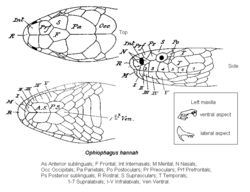
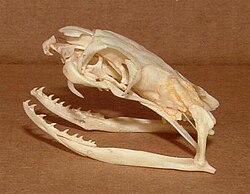
The king cobra's skin is olive green with black and white bands on the trunk that converge to the head. The head is covered by 15 drab-coloured and black-edged shields (large scales consistently present between individuals). The muzzle is rounded, and the tongue black. It has two fangs and 3–5 maxillary teeth in the upper jaw, and two rows of teeth in the lower jaw. The nostrils are between two shields. The large eyes have a golden iris and round pupils. Its hood is oval shaped and covered with olive green smooth scales and two black spots between the two lowest scales. Its cylindrical tail is yellowish green above and marked with black.[4] It has a pair of large occipital scales on top of the head, 17 to 19 rows of smooth oblique scales on the neck, and 15 rows on the body. Juveniles are black with chevron shaped white, yellow or buff bars that point towards the head.[17] Adult king cobras are 3.18 to 4 m (10.4 to 13.1 ft) long. The longest known individual measured 5.85 m (19.2 ft).[2][18] Ventral scales are uniformly oval shaped. Dorsal scales are placed in an oblique arrangement.[19]
The king cobra is sexually dimorphic, with males being larger and paler in particular during the breeding season. Males captured in Kerala measured up to 3.75 m (12.3 ft) and weighed up to 10 kg (22 lb). Females captured had a maximum length of 2.75 m (9 ft 0 in) and a weight of 5 kg (11 lb).[20] The largest known king cobra was 5.59 m (18 ft 4 in) long and captured in Thailand.[21] It differs from other cobra species by size and hood. It is larger, has a narrower and longer stripe on the neck.[22]
Distribution and habitat
The king cobra has a wide distribution throughout tropical Asia. It occurs in elevations of 2,000 m (6,600 ft) from the Terai in India and southern Nepal to the Brahmaputra River basin in Bhutan and northeast India, down to Bangladesh, Myanmar, southern China, Cambodia, Thailand, Laos, Vietnam; to the maritime Southeast Asian countries of Malaysia, Singapore, Indonesia and the Philippines.[1]
In northern India, it has been recorded in Garhwal and Kumaon, and in the Sivalik hills and terai regions of Uttarakhand and Uttar Pradesh.[23][24][25] In northeast India, the king cobra has been recorded in northern West Bengal, Sikkim, Assam, Meghalaya, Arunachal Pradesh, Nagaland, Manipur and Mizoram.[26][27] In the Eastern Ghats, it occurs from Tamil Nadu and Andhra Pradesh to coastal Odisha, and also in Bihar and southern West Bengal, especially the Sundarbans.[4][26][28] In the Western Ghats, it was recorded in Kerala, Karnataka and Maharashtra, and also in Gujarat.[26][29][20][30] It also occurs on Baratang Island in the Great Andaman chain.[31] It may have reached the furthest west of its distributional range in extreme western India and eastern Pakistan, in the vicinity of Lahore and Palanpur. These populations have sometimes been thought to be the result of introduction by snake charmers or transport along rivers, but are now more likely considered natural populations. However, it remains uncertain if any populations continue to persist there.[5]
Behaviour and ecology
Like other snakes, a king cobra receives chemical information via its forked tongue, which picks up scent particles and transfers them to a sensory receptor (Jacobson's organ) located in the roof of its mouth.[2] Following envenomation, it swallows its prey whole. Because of its flexible jaws, it can swallow prey much larger than its head. It is considered diurnal because it hunts during the day, but has also been seen at night, albeit rarely.[2]
Diet

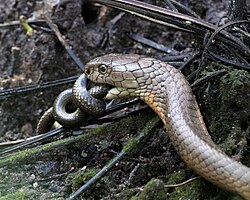
The king cobra is an apex predator and dominant over all other snakes except large pythons.[32] Its diet consists primarily of other snakes and lizards, including varanids, Indian cobra, banded krait, Oriental rat snake, reticulated pythons, green whip snake, Himalayan keelback, banded wolf snake and Blyth's reticulated snake.[33] It also hunts Malabar pit viper and hump-nosed pit viper by following their odour trails.[34] In Singapore, one was observed swallowing a clouded monitor.[35] When food is scarce, it also feeds on other small vertebrates, such as birds, and lizards. In some cases, the cobra constricts its prey using its muscular body, though this is uncommon. After a large meal, it may go for many months without another one because of its slow metabolic rate.[2][36]
Antipredator behavior


The king cobra is not considered aggressive.[37] It usually avoids humans and slinks off when disturbed, but is known to aggressively defend incubating eggs and attack intruders rapidly. When alarmed, it raises the front part of its body, extends the hood, shows the fangs and hisses loudly.[33][38] Wild king cobras encountered in Singapore appeared to be placid, but reared up and struck in self defense when cornered.[39]
The king cobra can be easily irritated by closely approaching objects or sudden movements. When raising its body, the king cobra can still move forward to strike with a long distance, and people may misjudge the safe zone. It can deliver multiple bites in a single attack.[40]
The hiss of the king cobra is a much lower pitch than many other snakes and many people thus liken its call to a "growl" rather than a hiss. While the hisses of most snakes are of a broad-frequency span ranging from roughly 3,000 to 13,000 Hz with a dominant frequency near 7,500 Hz, king cobra growls consist solely of frequencies below 2,500 Hz, with a dominant frequency near 600 Hz, a much lower-pitched frequency closer to that of a human voice. Comparative anatomical morphometric analysis has led to a discovery of tracheal diverticula that function as low-frequency resonating chambers in king cobra and its prey, the rat snake, both of which can make similar growls.[41]
Reproduction

The female is gravid for 50 to 59 days.[18] The king cobra is the only snake that builds a nest using dry leaf litter, starting from late March to late May.[42] Most nests are located at the base of trees, are up to 55 cm (22 in) high in the centre and 140 cm (55 in) wide at the base. They consist of several layers and have mostly one chamber, into which the female lays eggs.[43] Clutch size ranges from 7 to 43 eggs, with 6 to 38 eggs hatching after incubation periods of 66 to 105 days. Temperature inside nests is not steady but varies depending on elevation from 13.5 to 37.4 °C (56.3 to 99.3 °F). Females stay by their nests between two and 77 days. Hatchlings are between 37.5 and 58.5 cm (14.8 and 23.0 in) long and weigh 9 to 38 g (0.32 to 1.34 oz).[42]
The king cobra was shown to be capable of facultative parthenogenesis.[44] The parthenogenetic mechanism appears to be a variation of meiosis referred to as terminal fusion automixis in which there is fusion of the meiotic products formed at the anaphase II stage of meiosis.[44]
The venom of hatchlings is as potent as that of the adults. They may be brightly marked, but these colours often fade as they mature. They are alert and nervous, being highly aggressive if disturbed.[22]
The average lifespan of a wild king cobra is about 20 years.[45]
Venom

Composition
Venom of the king cobra, produced by the postorbital venom glands, consists primarily of three-finger toxins (3FTx) and snake venom metalloproteinases (SVMPs).[46][47]
Of all the 3FTx, alpha-neurotoxins are the predominant and most lethal components when cytotoxins and beta-cardiotoxins also exhibit toxicological activities.[48][49][50] It is reported that cytotoxicity of its venom varies significantly, depending upon the age and locality of an individual.[51] Clinical cardiotoxicity is not widely observed, nor is nephrotoxicity present among patients bitten by this species, presumably due to the low abundance of the toxins.[40]
SVMPs are the second-most protein family isolated from the king cobra's venom, accounting from 11.9% to 24.4% of total venom proteins.[52][53][54] The abundance is much higher than that of most cobras which is usually less than 1%.[55] This protein family includes principal toxins responsible for vasculature damage and interference with haemostasis, contributing to bleeding and coagulopathy caused by envenomation of vipers. While there are such haemorrhagins isolated from the king cobra's venom, they only induce species-sensitive haemorrhagic and lethal activities on rabbits and hares, but with minimal effects on mice.[56] Clinical pathophysiology of the king cobra's SVMPs has yet to be well studied, although its substantial quantity suggests involvement in tissue damage and necrosis as a result of inflammatory and proteolytic activities, which are instrumental for foraging and digestive purposes.[56][40]
Ohanin, a minor vespryn protein component specific to this species, causes hypolocomotion and hyperalgesia in experimental mice. It is believed that it contributes to neurotoxicity on the central nervous system of the victim.[57]
Clinical management
A king cobra's bite, and subsequent envenomation, is an immediate medical emergency in humans or domesticated animals, as, if not treated as soon as possible, death can occur in as little as 30 minutes.[40][58] Local symptoms include dusky discolouration of skin, edema and pain; in severe cases, swelling extends proximally, with necrosis and tissue sloughing that may require amputation.[40] Onset of general symptoms follows while the venom is targeting the victim's central nervous system, resulting in blurred vision, vertigo, drowsiness, and eventual paralysis. If not treated promptly, it may progress to cardiovascular collapse and, subsequently, coma. Death soon follows due to respiratory failure, among other simultaneous and varied system and organ failures.[40]
Polyvalent antivenom of equine origin is produced by Haffkine Institute and King Institute of Preventive Medicine and Research in India.[59] A polyvalent antivenom produced by the Thai Red Cross Society can effectively neutralise venom of the king cobra.[60] Proper and immediate treatments are critical to avoid death. Successful precedents include a client who recovered and was discharged in 10 days after being treated by accurate antivenom and inpatient care.[58]
It can deliver up to 420 mg venom in dry weight (400–600 mg overall) per bite,[61] with a Template:LD50 toxicity in mice of 1.28 mg/kg through intravenous injection,[62] 1.5 to 1.7 mg/kg through subcutaneous injection,[63] and 1.644 mg/kg through intraperitoneal injection.[61][64][65] For research purposes, up to 1 g of venom was obtained through milking.[52]
In India and Thailand, a concoction (or liquid blend) of turmeric (Curcuma longa) and other herbs may be used in folk medicine against king cobra bites, but there is currently no clinical evidence that this is effective in the treatment or prevention of envenomation.[66][67]
Relationship with humans
Conservation
In Southeast Asia, the king cobra is threatened foremost by habitat destruction owing to deforestation and expansion of agricultural land. It is also threatened by wildlife smuggling, as well as by poaching, then sold as bushmeat or turned into snake leather, and for use in traditional Chinese medicine.[1]
The king cobra is listed in CITES Appendix II. It is protected in China and Vietnam.[1] In India, it is placed under Schedule II of Wildlife Protection Act, 1972. Killing a king cobra is punished with imprisonment of up to six years.[68] In the Philippines, king cobras (locally known as banakon) are included under the list of threatened species in the country. It is protected under the Wildlife Resources Conservation and Protection Act (Republic Act No. 9147), which criminalises the killing, trade, and consumption of threatened species with certain exceptions (like indigenous subsistence hunting or immediate threats to human life), with a maximum penalty of two years imprisonment and a fine of ₱20,000.[69][70][71]
Cultural significance
The king cobra has an eminent position in the mythology and folklore of India, Bangladesh, Sri Lanka and Myanmar.[72] A ritual in Myanmar involves a king cobra and a female snake charmer. The charmer is a priestess who is usually tattooed with three pictograms and kisses the snake on the top of its head at the end of the ritual.[73] Members of the Pakokku clan tattoo themselves with ink mixed with cobra venom on their upper bodies in a weekly inoculation that they believe would protect them from the snake, though no scientific evidence supports this.[36][74] It is regarded as the national reptile of India.[75] In India, the king cobra is believed to possess exceptional memory; according to a myth, the killer of a king cobra stays in the eyes of the snake as an image, which is later picked up by the snake's partner and used to hunt down the killer for revenge. Because of this myth, whenever a cobra is killed, especially in India, the head, if not the entire body, is either crushed or burned to destroy the eyes completely.[76] In Bangkok's Bang Khun Thian district is a shrine to the king cobra by the Rama II Road that was built after the nest and young of a large king cobra was destroyed during the construction of the road; the overgrown area behind the shrine is still thought to harbour several large king cobras.[77]
References
- ↑ 1.0 1.1 1.2 1.3 1.4 Stuart, B.; Wogan, G.; Grismer, L.; Auliya, M.; Inger, R.F.; Lilley, R.; Chan-Ard, T.; Thy, N.; Nguyen, T.Q.; Srinivasulu, C.; Jelić, D. (2012). "Ophiophagus hannah". IUCN Red List of Threatened Species. 2012 e.T177540A1491874. doi:10.2305/IUCN.UK.2012-1.RLTS.T177540A1491874.en. Retrieved 20 November 2021.
- ↑ 2.0 2.1 2.2 2.3 2.4 Mehrtens, J. (1987). "King Cobra, Hamadryad (Ophiophagus hannah)". Living Snakes of the World. New York: Sterling. p. 263–. ISBN 0-8069-6461-8.
- ↑ Lillywhite, Harvey B. (2014). How Snakes Work: Structure, Function and Behavior of the World's Snakes. New York: Oxford University Press. p. 241. ISBN 978-0-19-538037-8.
- ↑ 4.0 4.1 4.2 Cantor, T. E. (1836). "Sketch of an undescribed hooded serpent, with fangs and maxillar teeth". Asiatic Researches. 19: 87–93.
- ↑ 5.0 5.1 5.2 5.3 5.4 Das, I.; Shankar, P. G.; Swamy, P.; Williams, R. C.; Lalremsanga, H. T.; Prashanth, P.; Sahoo, G.; Vijayakumar, S. P.; Höglund, J.; Shanker, K.; Dutta, S. K.; Ganesh, S. R.; Wüster, W. (2024). "Taxonomic revision of the king cobra Ophiophagus hannah (Cantor, 1836) species complex (Reptilia: Serpentes: Elapidae), with the description of two new species". European Journal of Taxonomy (961): 1–51. Bibcode:2024EJTax.961.2681D. doi:10.5852/ejt.2024.961.2681.
- ↑ Günther, A. C. L. G. (1864). "Ophiophagus, Gthr.". The Reptiles of British India. London: Ray Society. pp. 340–342.
- ↑ O'Shea, M. (2005). Venomous Snakes of the World. New Jersey, USA: Princeton University Press. pp. 96–97. ISBN 978-0-691-12436-0.
- ↑ Bogert, C. M. (1945). "Hamadryas Preoccupied for the King Cobra". Copeia. 1945 (1): 47. doi:10.2307/1438180. JSTOR 1438180.
- ↑ Cantor, T. E. (1838). "A notice of the Hamadryas, a genus of hooded serpent with poisonous fangs and maxillary teeth". Proceedings of the Zoological Society of London. 6: 72–75. Archived from the original on 14 October 2019. Retrieved 14 October 2019.
- ↑ Elliot, W. (1840). "Description of a New Species of Naga, or Cobra de Capello". Madras Journal of Literature and Science. 11: 39–41.
- ↑ Günther, A. (1858). Catalogue of colubrine snakes in the collection of the British Museum. London: Printed by order of the Trustees. p. 219.
- ↑ Van Hasselt, A. W. M. (1882). "Eene Monster-Naja". Verslagen en Mededeelingen der Koninklijke Akademie van Wetenschappen. 2 (in German). 17: 140–143.
{{cite journal}}: CS1 maint: unrecognized language (link) - ↑ Schlegel, H. (1837). "Le Naja Bongare. N. bungarus". Essai sur la physionomie des serpens [Essay on the physiognomy of snakes] (in French). Amsterdam: Schonekat. p. 476.
{{cite book}}: CS1 maint: unrecognized language (link) - ↑ Slowinski, J. B.; Keogh, J. S. (2000). "Phylogenetic Relationships of Elapid Snakes Based on Cytochrome b mtDNA Sequences" (PDF). Molecular Phylogenetics and Evolution. 15 (1): 157–164. Bibcode:2000MolPE..15..157S. doi:10.1006/mpev.1999.0725. PMID 10764543. Archived (PDF) from the original on 14 March 2019. Retrieved 14 October 2019.
- ↑ Figueroa, A.; McKelvy, A. D.; Grismer, L. L.; Bell, C. D.; Lailvaux, S. P. (2016). "A species-level phylogeny of extant snakes with description of a new colubrid subfamily and genus". PLOS ONE. 11 (9) e0161070. Bibcode:2016PLoSO..1161070F. doi:10.1371/journal.pone.0161070. PMC 5014348. PMID 27603205.
- ↑ Suntrarachun, S.; Chanhome, L.; Sumontha, M. (2014). "Phylogenetic analysis of the king cobra, Ophiophagus hannah in Thailand based on mitochondrial DNA sequences". Asian Biomedicine. 8 (2): 269–274. doi:10.5372/1905-7415.0802.289.
- ↑ Smith, M. A. (1943). "Naja hannah. Hamadryad, King Cobra". The Fauna of British India, Ceylon and Burma, including the whole of the Indo-Chinese Subregion. Vol. Reptilia and Amphibia. III. – Serpentes. London: Taylor and Francis. pp. 436–438.
- ↑ 18.0 18.1 Chanhome, L.; Cox, M. J.; Vasaruchapong, T.; Chaiyabutr, N.; Sitprija, V. (2011). "Characterization of venomous snakes of Thailand". Asian Biomedicine. 5 (3): 311–328. doi:10.5372/1905-7415.0503.043 ( (inactive $1) 12 July 2025).
{{cite journal}}: CS1 maint: DOI inactive as of July 2025 (link) - ↑ Martin, D. L. (2012). "Identification of Reptile Skin Products Using Scale Morphology". In J. E. Huffman, J. R. Wallace (ed.). Wildlife Forensics: Methods and Applications. Oxford: Wiley. pp. 161–199. ISBN 978-1-119-95429-3. Archived from the original on 10 February 2023. Retrieved 4 October 2020.
- ↑ 20.0 20.1 Shankar, P. G.; Ganesh, S. R.; Whitaker, R.; Prashanth, P. (2013). "King Cobra Ophiophagus hannah (Cantor, 1836) encounters in human-modified rainforests of the Western Ghats, India". Hamadryad (36): 62–68.
- ↑ Burton, R. W. (1950). "The record hamadryad or king cobra [Naja hannah (Cantor)] and lengths and weights of large specimens". The Journal of the Bombay Natural History Society. 49: 561–562.
- ↑ 22.0 22.1 O'Shea, M. (2008). Venomous snakes of the world. London, Cape Town, Sydney, Auckland: Bloomsbury. ISBN 978-1-84773-086-2.
- ↑ Singh, A.; Joshi, R. (2016). "A first record of the King Cobra Ophiophagus hannah (Reptilia: Squamata: Elapidae) nest from Garhwal Himalaya, northern India". Zoo's Print. 31: 9–11.
- ↑ Dolia, J. (2018). "Notes on the distribution and natural history of the King Cobra (Ophiophagus hannah Cantor, 1836) from the Kumaon Hills of Uttarakhand, India". Herpetology Notes. 11: 217–222. Archived from the original on 16 October 2019. Retrieved 16 October 2019.
- ↑ Kanaujia, A.; Kumar, A.; Kumar, A. (2017). "Herpetofauna of Uttar Pradesh, India". Biological Forum. 9 (1): 118–130.
- ↑ 26.0 26.1 26.2 Wallach, V.; Williams, K.L.; Boundy, J. (2014). Snakes of the world: A catalogue of living and extinct species. Florida: CRC Press, Taylor and Francis Group. pp. 507–508. ISBN 978-1-4822-0848-1.
- ↑ Bashir, T.; Poudyal, K.; Bhattacharya, T.; Sathyakumar, S.; Subba, J. B. (2010). "Sighting of King Cobra Ophiophagus hannah in Sikkim, India: a new altitude record for the northeast". Journal of Threatened Taxa. 2 (6): 990–991. doi:10.11609/JoTT.o2438.990-1.
- ↑ Murthy, K.L.N.; Murthy, K.V.R. (2012). "Sightings of King Cobra Ophiophagus hannah in northern coastal Andhra Pradesh". Reptile Rap. 14: 29–32.
- ↑ Yadav, O. V.; Yankanchi, S. R. (2015). "[[:Template:As written]] of Ophiophagus hannah Cantor, 1836 (Squamata, Elapidae) in Tillari, Maharashtra, India". Herpetology Notes. 8: 493–494. Archived from the original on 10 February 2023. Retrieved 22 April 2022.
{{cite journal}}: URL–wikilink conflict (help) - ↑ Palot, M. J. (2015). "A checklist of reptiles of Kerala, India". Journal of Threatened Taxa. 7 (13): 8010–8022. doi:10.11609/jott.2002.7.13.8010-8022.
- ↑ Manchi, S.; Sankaran, R. (2009). "Predators of swiftlets and their nests in the Andaman and Nicobar Islands". Indian Birds. 5 (4): 118–120.
- ↑ Marshall, B.M.; Strine, C.T.; Jones, M.D.; Theodorou, A.; Amber, E.; Waengsothorn, S.; Suwanwaree, P.; Goode, M. (2018). "Hits close to home: repeated persecution of King Cobras (Ophiophagus hannah) in northeastern Thailand". Tropical Conservation Science. 11 1940082918818401: 1–14. doi:10.1177/1940082918818401. hdl:10150/632917.
- ↑ 33.0 33.1 Wall, F. (1924). "The Hamadryad or King Cobra Naja hannah (Cantor)". The Journal of the Bombay Natural History Society. 30 (1): 189–195.
- ↑ Bhaisare, D.; Ramanuj, V.; Shankar, P. G.; Vittala, M.; Goode, M.; Whitaker, R. (2010). "Observations on a wild King Cobra (Ophiophagus hannah), with emphasis on foraging and diet". IRCF Reptiles & Amphibians. 17 (2): 95–102. doi:10.17161/randa.v17i2.16088. S2CID 257621424.
- ↑ Kurniawan, A.; Lee, G.; bin Tohed, N.; Low, M.-R. (2018). "King cobra feeding on a monitor lizard at night" (PDF). Singapore Biodiversity Records. 2018: 63. Archived (PDF) from the original on 16 October 2019. Retrieved 16 October 2019.
- ↑ 36.0 36.1 Coborn, J. (1991). The Atlas of Snakes of the World. TFH Publications. pp. 30, 452. ISBN 978-0-86622-749-0.
- ↑ Tweedie, M. W. F. (1983). The Snakes of Malaya. Singapore National Printers. p. 142. OCLC 686366097.
- ↑ Greene, H. W. (1997). "Antipredator tactics of snakes". Snakes: The Evolution of Mystery in Nature. California, USA: University of California Press. pp. 103–111. ISBN 0-520-22487-6. Archived from the original on 10 February 2023. Retrieved 4 October 2020.
- ↑ Lim, K. K. P.; Leong, T. M.; Lim, L. K. (2011). "The king cobra, Ophiophagus hannah (Cantor) in Singapore (Reptilia: Squamata: Elapidae)" (PDF). Nature in Singapore. 4: 143–156. Archived (PDF) from the original on 16 October 2019. Retrieved 16 October 2019.
- ↑ 40.0 40.1 40.2 40.3 40.4 40.5 Davidson, T. "Immediate First Aid". University of California, San Diego. Archived from the original on 30 June 2010. Retrieved 24 September 2011.
- ↑ Young, B. A. (1991). "Morphological basis of "growling" in the king cobra, Ophiophagus hannah". Journal of Experimental Zoology. 260 (3): 275–287. Bibcode:1991JEZ...260..275Y. doi:10.1002/jez.1402600302. PMID 1744612.
- ↑ 42.0 42.1 Whitaker, N.; Shankar, P. G.; Whitaker, R. (2013). "Nesting ecology of the King Cobra (Ophiophagus hannah) in India" (PDF). Hamadryad. 36 (2): 101–107.[dead link]
- ↑ Hrima, V. L.; Sailo, V. H.; Fanai, Z.; Lalronunga, S.; Lalrinchhana, C. (2014). "Nesting ecology of the King Cobra, Ophiophagus hannah, (Reptilia: Squamata: Elapidae) in Aizawl District, Mizoram, India". In Lalnuntluanga; Zothanzama, J.; Lalramliana; Lalduhthlana; Lalremsanga, H. T. (eds.). Issues and Trends of Wildlife Conservation in Northeast India. Aizawl: Mizo Academy of Sciences. pp. 268–274. ISBN 978-81-924321-7-5.
- ↑ 44.0 44.1 Card DC, Vonk FJ, Smalbrugge S, Casewell NR, Wüster W, Castoe TA, Schuett GW, Booth W (2021). "Genome-wide data implicate terminal fusion automixis in king cobra facultative parthenogenesis". Sci Rep. 11 (1) 7271. doi:10.1038/s41598-021-86373-1. PMC 8012631. PMID 33790309.
- ↑ "King Cobra". National Geographic Society. 2010. Archived from the original on 22 February 2022. Retrieved 30 October 2022.
- ↑ Li, J.; Zhang, H.; Liu, J.; Xu, K. (2006). "Novel genes encoding six kinds of three-finger toxins in Ophiophagus hannah (king cobra) and function characterization of two recombinant long-chain neurotoxins". Biochemical Journal. 398 (2): 233–342. doi:10.1042/BJ20060004. PMC 1550305. PMID 16689684.
- ↑ Roy, A.; Zhou, X.; Chong, M. Z.; d'Hoedt, D.; Foo, C. S.; Rajagopalan, N.; Nirthanan, S.; Bertrand, D.; Sivaraman, J.; Kini, R. M. (2010). "Structural and Functional Characterization of a Novel Homodimeric Three-finger Neurotoxin from the Venom of Ophiophagus hannah (King Cobra)". The Journal of Biological Chemistry. 285 (11): 8302–8315. doi:10.1074/jbc.M109.074161. PMC 2832981. PMID 20071329.
- ↑ Chang, L.-S.; Liou, J.-C.; Lin, S.-R.; Huang, H.-B. (2002). "Purification and characterization of a neurotoxin from the venom of Ophiophagus hannah (king cobra)". Biochemical and Biophysical Research Communications. 294 (3): 574–578. Bibcode:2002BBRC..294..574C. doi:10.1016/S0006-291X(02)00518-1. PMID 12056805.
- ↑ He, Y. Y.; Lee, W. H.; Zhang, Y. (2004). "Cloning and purification of alpha-neurotoxins from king cobra (Ophiophagus hannah)". Toxicon. 44 (3): 295–303. Bibcode:2004Txcn...44..295H. doi:10.1016/j.toxicon.2004.06.003. PMID 15302536.
- ↑ Rajagopalan, N.; Pung, Y. F.; Zhu, Y. Z.; Wong, P. T. H.; Kumar, P. P.; Kini, R. M. (2007). "β-Cardiotoxin: A new three-finger toxin from Ophiophagus hannah (King Cobra) venom with beta-blocker activity". The FASEB Journal. 21 (13): 3685–3695. doi:10.1096/fj.07-8658com. PMID 17616557. S2CID 21235585.
- ↑ Bianca Op den Brouw; Manuel Fernandez-Rojo; Tom Charlton; Bryan G. Fry; Maria P. Ikonomopoulou (2023). "Malaysian and Chinese King Cobra Venom Cytotoxicity in Melanoma and Neonatal Foreskin Fibroblasts Is Mediated by Age and Geography". Toxins. 15 (9): 574–578. doi:10.3390/toxins15090549. PMC 10534572. PMID 37755975.
- ↑ 52.0 52.1 Tan, C. H.; Tan, K. Y.; Fung, S. Y.; Tan, N. H. (2015). "Venom-gland transcriptome and venom proteome of the Malaysian king cobra (Ophiophagus hannah)". BMC Genomics. 16 (1): 687. doi:10.1186/s12864-015-1828-2. PMC 4566206. PMID 26358635.
- ↑ Petras, D.; Heiss, P.; Süssmuth, R. D.; Calvete, J. J. (2015). "Venom proteomics of Indonesian King Cobra, Ophiophagus hannah: Integrating top-down and bottom-up approaches". Journal of Proteome Research. 14 (6): 2539–2556. doi:10.1021/acs.jproteome.5b00305. PMID 25896403.
- ↑ Liu, C.-C.; You, C.-H.; Wang, P.-J.; Yu, J.-S.; Huang, G.-J.; Liu, C.-H.; Hsieh, W.-C.; Lin, C.-C. (2017). "Analysis of the efficacy of Taiwanese freeze-dried neurotoxic antivenom against Naja kaouthia, Naja siamensis and Ophiophagus hannah through proteomics and animal model approaches". PLOS Neglected Tropical Diseases. 11 (12) e0006138. doi:10.1371/journal.pntd.0006138. PMC 5747474. PMID 29244815.
- ↑ Vonk, F. J.; Casewell, N. R.; Henkel, C. V.; Heimberg, A. M.; Jansen, H. J.; McCleary, Ryan J. R.; Kerkkamp, Harald M. E.; Vos, Rutger A.; Guerreiro, I.; Calvete, J. J.; Wüster, W. (2013). "The king cobra genome reveals dynamic gene evolution and adaptation in the snake venom system". Proceedings of the National Academy of Sciences. 110 (51): 20651–20656. Bibcode:2013PNAS..11020651V. doi:10.1073/pnas.1314702110. PMC 3870661. PMID 24297900.
- ↑ 56.0 56.1 Tan, N.H.; Saifuddin, M.N. (1990). "solation and characterization of a hemorrhagin from the venom of Ophiophagus hannah (king cobra)". Toxicon. 28 (4): 385–392. Bibcode:1990Txcn...28..385T. doi:10.1016/0041-0101(90)90076-j. PMID 2190359.
- ↑ Pung, Y. F.; Kumar, S. V.; Rajagopalan, N.; Fry, B. G.; Kumar, P. P.; Kini, R. M. (2006). "Ohanin, a novel protein from king cobra venom: Its cDNA and genomic organization". Gene. 371 (2): 246–256. doi:10.1016/j.gene.2005.12.002. PMID 16472942.
- ↑ 58.0 58.1 Tin-Myint; Rai-Mra; Maung-Chit; Tun-Pe; Warrell, D. (1991). "Bites by the king cobra (Ophiophagus hannah) in Myanmar: Successful treatment of severe neurotoxic envenoming". The Quarterly Journal of Medicine. 80 (293): 751–762. doi:10.1093/oxfordjournals.qjmed.a068624. PMID 1754675.
- ↑ Whitaker, R.; Whitaker, S. (2012). "Venom, antivenom production and the medically important snakes of India" (PDF). Current Science. 103 (6): 635–643. Archived (PDF) from the original on 16 October 2019. Retrieved 16 October 2019.
- ↑ Leong, P. K.; Sim, S. M.; Fung, S. Y.; Sumana, K.; Sitprija, V.; Tan, N. H. (2012). "Cross Neutralization of Afro-Asian Cobra and Asian Krait Venoms by a Thai Polyvalent Snake Antivenom (Neuro Polyvalent Snake Antivenom)". PLOS Neglected Tropical Diseases. 6 (6) e1672. doi:10.1371/journal.pntd.0001672. PMC 3367981. PMID 22679522.
- ↑ 61.0 61.1 Thomas, S.; Griessel, E. (1999). "LD50 (Archived)". Archived from the original on 1 February 2012.
- ↑ Ganthavorn, S. (1969). "Toxicities of Thailand snake venoms and neutralization capacity of antivenin". Toxicon. 7 (3): 239–241. Bibcode:1969Txcn....7..239G. doi:10.1016/0041-0101(69)90012-9. PMID 5358069.
- ↑ Broad, A. J.; Sutherland, S. K.; Coulter, A. R. (1979). "The lethality in mice of dangerous Australian and other snake venom" (PDF). Toxicon. 17 (6): 661–664. Bibcode:1979Txcn...17..661B. doi:10.1016/0041-0101(79)90245-9. PMID 524395. Archived (PDF) from the original on 31 March 2022. Retrieved 14 October 2019.
- ↑ Engelmann, W.-E. (1981). Snakes: Biology, Behavior, and Relationship to Man. Leipzig; English version NY, USA: Leipzig Publishing; English version published by Exeter Books (1982). p. 222. ISBN 0-89673-110-3.
- ↑ Handbook of clinical toxicology of animal venoms and poisons. Vol. 236. USA: CRC Press. 1995. ISBN 0-8493-4489-1.
- ↑ Ernst, C. H.; Evelyn, M. (2011). "Treatment of envenomation by reptiles". Venomous Reptiles of the United States, Canada, and Northern Mexico. Vol. 1: Heloderma, Micruroides, Micrurus, Pelamis, Agkistrodon, Sistrurus. Baltimore: Johns Hopkins University Press. pp. 33–46. ISBN 978-0-8018-9875-4.
- ↑ Salama, R.; Sattayasai, J.; Gande, A. K.; Sattayasai, N.; Davis, M.; Lattmann, E. (2012). "Identification and evaluation of agents isolated from traditionally used herbs against Ophiophagus hannah venom". Drug Discoveries & Therapeutics. 6 (1): 18–23. PMID 22460424.
- ↑ Sivakumar, B. (2012). "King cobra under threat, put on red list". The Times of India. Archived from the original on 1 February 2013.
- ↑ "Republic Act No. 9147". Official Gazette. Republic of the Philippines. Archived from the original on 27 September 2023. Retrieved 26 March 2023.
- ↑ "How venomous is a king cobra and what should you do if you see one? Kuya Kim answers". GMA News Online. 26 March 2023. Retrieved 26 March 2023.
- ↑ Garcia, Danilo (23 December 2021). "5 King Cobra nakumpiska sa NBI entrapment". Pilipino Star Ngayon. Retrieved 26 March 2023.
- ↑ Minton, S.A. Jr.; Minton, M.R. (1980). Venomous reptiles. New York: Charles Scribner's Sons. ISBN 978-0-684-16626-1.
- ↑ Platt, S.G.; Ko, W.K.; Rainwater, T.R. (2012). "On the Cobra Cults of Myanmar (Burma)". Chicago Herpetological Society. 47 (2): 17–20.
- ↑ Murphy, J. C. (2010). Secrets of the Snake Charmer: Snakes in the 21st Century. iUniverse. ISBN 978-1-4502-2127-6.
- ↑ "King Cobra – National Reptile of India". indiamapped. Archived from the original on 17 January 2018. Retrieved 17 January 2018.
- ↑ "King Cobra The King of Venomous Snakes". aboutanimals.com. aboutanimals. 31 December 2015. Retrieved 5 November 2024.
- ↑ "ศาลเจ้าแม่จงอางและลูก อาถรรพณ์! ถนนพระราม 2" [Shrine of the mother king cobra and her child, haunted! Rama II Road]. Thairath (in Thai). 2025. Retrieved 23 March 2025.
{{cite web}}: CS1 maint: unrecognized language (link)
External links
| Constitutional | (Flag) (National Emblem) (Motto) (National Anthem) (National Song) |   |
|---|---|---|
| Flora and Fauna | (Animal) (Bird) (Flower) (Tree) (Fruit) (Heritage animal) (Aquatic animal) (Reptile) (River) | |
| Days | ||
| Others | ||

- Pages using the JsonConfig extension
- IUCN Red List vulnerable species
- Apex predators
- Elapidae
- Reptiles of Borneo
- National symbols of India
- Reptiles described in 1836
- Reptiles of Bangladesh
- Reptiles of Bhutan
- Reptiles of Brunei
- Reptiles of Cambodia
- Reptiles of Hong Kong
- Snakes of India
- Reptiles of Laos
- Reptiles of Nepal
- Reptiles of the Philippines
- Snakes of China
- Snakes of Indonesia
- Snakes of Malaysia
- Snakes of Myanmar
- Snakes of Singapore
- Snakes of Thailand
- Snakes of Vietnam
- Taxa named by Theodore Edward Cantor