


m Removing protection template from an unprotected page |
Shahidkumar (talk | contribs) m slightly rework layout for accuracy additionally based on references |
||
| Line 1: | Line 1: | ||
{{Short description|Evil supernatural being}} | {{Short description|Evil supernatural being}} | ||
{{ | {{hatnote group|{{For|the concept in ancient Greek religion|Daimon}}{{Other uses}} | ||
{{Redirect|Evil spirit|the | }} | ||
{{Pp-move}} | |||
{{Redirect-multi|2|Evil spirit|Evil spirits|the film|Evil Spirit (film){{!}}''Evil Spirit'' (film)|the album|Evil Spirits (album){{!}}''Evil Spirits'' (album)}} | |||
<!-- | <!-- | ||
IMPORTANT: | IMPORTANT: Bharatpedia is an encyclopedia, not a fan site. Demons are common in fiction, and there could be a countless number of demons. Only add demons that are most notable. For more information see: WP:NOTABILITY | ||
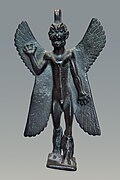
--> | -->[[File:PazuzuDemonAssyria1stMillenniumBCE no CGI dropshadow - gradient based on.jpg|thumb|Bronze statue of the [[Assyro-Babylonian]] demon king [[Pazuzu]], {{Circa|800–700 BCE}}, [[Louvre]]]] | ||
[[File: | A '''demon''' is an evil or malevolent [[supernatural]] entity.<ref>Martin, Dale Basil. "When Did Angels Become Demons?" ''Journal of Biblical Literature'', vol. 129, no. 4, 2010, pp. 657–58. {{doi|10.2307/25765960}}. Accessed 5 January 2025.</ref> Historically, belief in demons, or stories about demons, occurs in [[folklore]], [[mythology]], [[religion]], [[occultism]], and [[literature]]; these beliefs are reflected in [[Media (communication)|media]] including | ||
[[ | [[fiction]], [[comics]], [[film]], [[television series|television]], and [[video games]]. Belief in demons probably goes back to the [[Paleolithic|Paleolithic age]], stemming from humanity's fear of the unknown, the strange and the horrific.<ref name="dictionary">{{harvnb|Brandon|1970}}.</ref> In [[Religions of the ancient Near East|ancient Near Eastern religions]] and in the [[Abrahamic religions]], including [[History of Judaism|early Judaism]]{{sfn|Angelini|2021}} and ancient-medieval [[Christian demonology]], a demon is considered a harmful spiritual entity that may cause [[Spirit possession|demonic possession]], calling for an [[exorcism]]. Large portions of [[Jewish demonology]], a key influence on [[Christianity]] and [[Islam]], originated from a later form of [[Zoroastrianism]], and was transferred to Judaism during the [[Achaemenid Empire|Persian era]].{{sfnm|1a1=Boyce |1y=1987 |2a1=Duchesne-Guillemin |2y=1988}} | ||
Demons may or may not be considered to be devils: minions of [[Devil|the Devil]].<ref name="dictionary" /> In many traditions, demons are independent operators, with different demons causing different types of evils (destructive natural phenomena, specific diseases, etc.) in general, while devils appear more often as demons within a [[Theology|theological framework]]; demons opposing the [[Divine]] principle.<ref>Erdağı, D.; Evil in Turkish Muslim horror film: the demonic in “Semum”. SN Soc Sci 4, 27 (2024). https://doi.org/10.1007/s43545-024-00832-w</ref> As lesser [[Spirit (supernatural entity)|spirits]] doing the Devil's work, they have additional duties— causing humans to have [[sin]]ful thoughts and tempting humans to commit sinful actions.{{sfn|Nixey|2018|loc=Chapter 2, "The Battleground of Demons"}} | |||
The original [[Ancient Greek language|Ancient Greek]] word ''{{Lang|grc-latn|[[daimōn]]}}'' ({{lang|grc|δαίμων}}) did not carry negative connotations, as it denotes a spirit or divine power.<ref name="Liddell & Scott">{{harvnb|Liddell|Scott|n.d.}}</ref> The Greek conception of a ''{{Lang|grc-latn|daimōn}}'' notably appears in the philosophical works of [[Plato]], where it describes the divine inspiration of [[Socrates]]. In Christianity, morally ambivalent ''{{Lang|grc-latn|daimōn}}'' were replaced by demons, forces of evil only striving for corruption.{{sfn|Rees|2012|p=[https://books.google.com/books?id=w-eKDwAAQBAJ&pg=PA81 81]}} Such demons are not the Greek intermediary spirits, but hostile entities, already known in Iranian beliefs.{{sfn|Brown|1970|p=28}} In [[Western esotericism]] and [[Renaissance magic]], which grew out of an amalgamation of [[Greco-Roman magic]], Jewish [[Aggadah]], and Christian demonology, a demon is believed to be a spiritual entity that may be [[Conjuration (summoning)|conjured]] and controlled. | |||
Belief in demons remains an important part of many modern religions and [[occult]] traditions. Demons are still feared largely due to their alleged power to possess living creatures.<ref>{{cite book |first= Hans| last= Van Eyghen| title= The Epistemology of Spirit Beliefs | publisher= Routledge | date= 14 April 2023| isbn= 9781003281139 | url = https://www.taylorfrancis.com/books/oa-mono/10.4324/9781003281139/epistemology-spirit-beliefs-hans-van-eyghen | series = Routledge Studies in the Philosophy of Religion | doi= 10.4324/9781003281139}}</ref> In contemporary [[Western esotericism|Western esoteric]] traditions, demons may be used as metaphors for inner psychological processes ("inner demons"). | |||
== Etymology == | == Etymology == | ||
{{Further|Daemon (classical mythology)|Agathodaemon|Cacodemon|Daimonic|Eudaimonia}} | {{Further|Daemon (classical mythology)|Agathodaemon|Cacodemon|Daimonic|Eudaimonia}} | ||
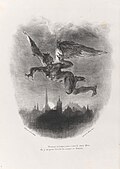
[[File:Mephistopheles2.jpg|thumb|upright|[[Mephistopheles]] (a [[Middle Ages|medieval]] demon from [[German folklore]]) flying over [[Wittenberg]], in a [[lithograph]] by [[Eugène Delacroix]].]] | |||
The [[Ancient Greek language|Ancient Greek]] word {{lang|grc|δαίμων}} (''{{Lang|grc-latn|[[daimōn]]}}'') denotes a spirit or divine power, much like the [[Latin]] ''{{Lang|la|[[Genius (mythology)|genius]]}}'' or ''{{Lang|la|[[numen]]}}''. {{Lang|grc-latn|Daimōn}} most likely came from the Greek verb ''{{Lang|el-latn|daiesthai}}'' ({{Gloss|to divide}} or {{Gloss|distribute}}).<ref name="merriam-webster">{{cite web |title=Demon |url=http://www.merriam-webster.com/dictionary/demon |work=Merriam-Webster Dictionary |access-date=12 April 2012 |archive-date=7 May 2012 |archive-url=https://web.archive.org/web/20120507222928/http://www.merriam-webster.com/dictionary/demon |url-status=live}}</ref> The Greek conception of a {{Lang|grc-latn|daimōn}} notably appears in the philosophical works of [[Plato]], where it describes the divine inspiration of [[Socrates]]. The original Greek word ''{{Lang|grc-latn|daimōn}}'' does not carry the negative connotation initially understood by implementation of the [[Koine Greek|Koine]] {{lang|grc|δαιμόνιον}} (''[[Daimonion (Socrates)|daimonion]]''),<ref name="Liddell & Scott" /> and later ascribed to any cognate words sharing the root. | |||
The | The Greek terms do not have any connotations of evil or malevolence. By the early centuries of the [[Roman Empire]], [[Cult image|cult statues]] were seen, by [[Paganism|Pagans]] and their Christian neighbors alike, as inhabited by the numinous presence of the [[Hellenistic religion|Greco-Roman gods]]: "Like pagans, Christians still sensed and saw the gods and their power, and as something, they had to assume, lay behind it, by an easy traditional shift of opinion they turned these pagan ''daimones'' into malevolent 'demons', the troupe of [[Satan]]. Far into the [[Byzantine Empire|Byzantine period]], Christians eyed their cities' old pagan statuary as a seat of the demons' presence. It was no longer beautiful, it was "infested."{{sfn|Lane Fox|1988|p=137}} The term had first acquired its negative connotations in the [[Septuagint]] translation of the [[Hebrew Bible]] into Greek, which drew on the mythology of [[ancient Semitic religions]]. This was then inherited by the Koine text of the [[New Testament]]. | ||
The English use of ''demon'' as synonym for devils goes back at least as far as about 825. The German word (''{{Lang|de|Dämon}}''), however, is different from devil (''{{Lang|de|Teufel}}'') and demons as evil spirits, and akin to the original meaning of ''{{Lang|grc-latn|daimōn}}''.{{sfn|Russell|1986|p=37}} The Western [[Modern era]] conception of demons, as in the ''[[Ars Goetia]]'', derives seamlessly from the ambient [[popular culture]] of [[Late Antiquity]]. | |||
== History == | |||
From an [[Anthropology|anthropological]] perspective, demons result from human fear of the unknown.<ref name="auto">Hutter, M., Görg, M., Kollmann, B., Haustein, J., Koch, G., Streib, H., Veltri, G., Dan, J., & Krawietz, B. (2011). Demons and Spirits. In Religion Past and Present Online. Brill. https://doi.org/10.1163/1877-5888_rpp_COM_03364</ref> Forces of nature and foreigners may be portrayed as demons if they are perceived as hostile or dangerous; an evil demon might be considered as a [[Psychological projection|projection]] onto unknown entities which are perceived as potentially dangerous.<ref name="auto"/> Thus, unknown causes of death or illness are [[Anthropomorphization|anthropomorphized]] into rational agents with evil intentions and then giving raise to the notion of a demon.<ref name="auto"/> | |||
Likewise, people outside one's own social group may be blamed for accidents and unexplained causes of harm, leading to a demonization of said people.<ref name="auto" /> Then, the imagined cause of said evil is integrated into one's prevailing belief-system.<ref name="auto" /> This may also include persons who are considered to be banished from the social group. Transgressions of social norms may result in expulsion from the community and or being killed.<ref name=":3">{{Cite journal |last=Alles |first=Gregory D. |date=February 1990 |title=New Growths in German Woods''Religion und Religionen: Systematische Einführung in die Religionsgeschichte''. Jacques Waardenburg''Grundzüge der Religionswissenschaft''. Fritz Stolz''Religionswissenschaft: Eine Einführung''. Hartmut Zinser |url=https://doi.org/10.1086/463199 |journal=History of Religions |volume=29 |issue=3 |pages=294–297 |doi=10.1086/463199 |issn=0018-2710|url-access=subscription }}</ref> From a psychological perspective there is no difference between expulsion and death as both leave a gap in the community.<ref name=":3" /> This gap is then filled with a ghost (in case of death) or demon (in case of expulsion), perceived as a disruptive factor in the life of the community.<ref name=":3" /> | |||
== Mesopotamia == | === Ancient Egypt === | ||
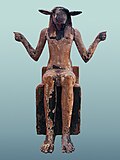
[[File:Ram-headed demon gradient background.jpg|thumb|Ram-headed demon. The hands probably outstretch to hold two snakes. From a royal tomb in the Valley of the Kings, Thebes, Egypt. End of the 18th Dynasty, around 1325 BCE]] | |||
The Ancient [[Egyptian language]] lacks a term for the modern English ''demon'',{{sfn|Lucarelli|2010|p=2}}<ref name="BhayroRider2017">{{harvnb|Bhayro|Rider|2017|p=[https://books.google.com/books?id=Xq28DgAAQBAJ&pg=PA53 53]}}.</ref> since both deities and lesser spirits can act as intermediaries to deliver messages to humans {{sfn|Lucarelli|2010|p=3}} By that, both share some resemblance to the Greek {{Lang|grc-latn|daimon}}. However, magical writings indicate that ancient Egyptians acknowledged the existence of malevolent demons by highlighting the demon names with red ink.<ref name="BhayroRider2017" /> Demons in this culture appeared to be subordinative and related to a specific deity, yet they may have occasionally acted independently of the divine will. The existence of demons can be related to the realm of chaos, beyond the created world.{{sfn|Lucarelli|2010|p=2}} The role of demons in relation to the human world remains ambivalent and largely depends on context. | |||
Ancient Egyptian demons can be divided into two classes: "guardians" and "wanderers".{{sfn|Lucarelli|2010|p=3}}{{sfn|Bhayro|Rider |2017|p=55}} "Guardians" are tied to a specific place; their demonic activity is topographically defined and their function can be benevolent towards those who have the secret knowledge to face them.{{sfn|Lucarelli|2010|p=4}} Demons protecting the underworld may prevent human souls from entering paradise. Only by knowing the right charms is the deceased able to enter the ''Halls of Osiris''.{{sfn|Greenbaum|2015|p=120}} Here, the aggressive nature of the guardian demons is motivated by the need to protect their abodes and not by their evil essence. Accordingly, demons guarded sacred places or the gates to the netherworld. During the [[Ptolemaic Kingdom|Ptolemaic]] and [[Roman period]], the guardians shifted towards the role of [[genius loci]] and they were the focus of local and private cults. | |||
The "wanderers" are associated with possession, mental illness, death and plagues. Many of them serve as executioners for the major deities, such as [[Ra]] or [[Osiris]], when ordered to punish humans on earth or in the netherworld.{{sfn|Lucarelli|2010|p=4}} Wanderers can also be agents of chaos, arising from the world beyond creation to bring about misfortune and suffering without any divine instructions, led only by evil motivations. The influences of the wanderers can be warded off and kept at the borders of the human world by the use of magic, but they can never be destroyed. A sub-category of "wanderers" are nightmare demons, which were believed to cause nightmares by entering a human body.{{sfn|Lucarelli|2010|p=2}} | |||
=== Mesopotamia === | |||
{{Further|Ancient Mesopotamian underworld#Demons}} | {{Further|Ancient Mesopotamian underworld#Demons}} | ||
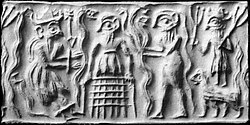
[[File:Dumuzi aux enfers.jpg|thumb|left|Ancient Sumerian [[cylinder seal]] impression showing the god [[Dumuzid the Shepherd|Dumuzid]] being tortured in the [[Kur|Underworld]] by ''[[gallu|galla]]'' demons]] | [[File:Dumuzi aux enfers.jpg|thumb|left|Ancient Sumerian [[cylinder seal]] impression showing the god [[Dumuzid the Shepherd|Dumuzid]] being tortured in the [[Kur|Underworld]] by ''[[gallu|galla]]'' demons]] | ||
[[Mesopotamia]]n demonology had a strong influence on later [[Judaism|Hebrew]] and [[Christianity|Christian]] concepts of demons,<ref name="Russell, Jeffrey Burton 1987. p. 92">Russell, Jeffrey Burton. The devil: Perceptions of evil from antiquity to primitive Christianity. Cornell University Press, 1987. p. 92</ref> with ''[[shedu]]'' from [[Chaldea]]n mythology being an example.<ref name="JE-shedim">{{harvnb|Hirsch|Gottheil|Kohler|Broydé|1906}}.</ref> The demons of Mesopotamia were generally hostile spirits of lesser power than a deity.<ref name="Russell, Jeffrey Burton 1987. p. 92"/> Since both nature and culture were in constant change, neither were considered part of a divine cosmos.<ref name="Russell, Jeffrey Burton 1987. p. 88">Russell, Jeffrey Burton. The devil: Perceptions of evil from antiquity to primitive Christianity. Cornell University Press, 1987. p. 88</ref> According to the Babylonian creation epic ''[[Enūma Eliš]]'', both gods and demons are the children of [[Tiamat]], the goddess of [[Chaos (cosmogony)|primordial chaos]].<ref>Russell, Jeffrey Burton. The devil: Perceptions of evil from antiquity to primitive Christianity. Cornell University Press, 1987. p. 88-89</ref> The demons were engendered by Tiamat as an act of revenge in reaction to the gods slaying her primordial partner [[Abzu]].<ref name="Russell, Jeffrey Burton 1987. p. 88"/> In the Babylonian tale of the Great Flood, since the gods promised to never flood humanity again, the demoness Lamaštu was installed instead and given the task of killing humans in order to avoid excessive multiplication.<ref name="Maul, S. 2006">Maul, S. (., Jansen-Winkeln, K. (., Niehr, H. (., Macuch, M. (., & Johnston, S. I. (. (2006). Demons. In Brill's New Pauly Online. Brill. https://doi.org/10.1163/1574-9347_bnp_e309270</ref> | |||
Some demons were the evil spirits of those who died in misery, while other demons were nature demons causing harm by carrying plagues and nightmares, and causing headaches and storms.<ref name="Maul, S. 2006"/><ref name="Russell, Jeffrey Burton 1987. p. 92"/> People could protect themselves from demons by wearing amulets, using magic, or seeking refuge amongst another demon or deity.<ref name="Russell, Jeffrey Burton 1987. p. 92"/><ref name="Maul, S. 2006"/> On an ontological level, in early Semitic history, deities and demons often shed into another, as the distinction was of no importance for the believer.<ref>Introduction: | |||
Angels and Their Religious and | |||
Cosmological Contexts p. 17</ref> | |||
[[ | The [[Kur|underworld]] was home to many demonic beings,{{sfn|Black|Green|1992|page=180}} sometimes referred to as the "offspring of ''arali''".{{sfn|Black|Green|1992|page=180}} These demons ascend from the underworld and terrorize mortals.{{sfn|Black|Green|1992|page=180}} One class of demons that were believed to reside in the underworld were known as ''[[Gallu|galla]]'';{{sfn|Black|Green|1992|page=85}} their primary purpose appears to have been to drag unfortunate mortals back to Kur.{{sfn|Black|Green|1992|page=85}} They are frequently referenced in magical texts,{{sfn|Black|Green|1992|pages=85–86}} and some texts describe them as being seven in number.{{sfn|Black|Green|1992|pages=85–86}} Several extant poems describe the ''galla'' dragging the god [[Dumuzid]] into the underworld.{{sfn|Black|Green|1992|page=86}} Like many other Mesopotamian demons ''galla'' could also fulfill a protective role.{{sfn|Black|Green|1992|page=86}} In a hymn from King [[Gudea]] of [[Lagash]] ({{circa}} 2144 – 2124 BCE), a minor god named Ig-alima is described as "the great ''galla'' of [[Girsu]]".{{sfn|Black|Green|1992|page=86}} | ||
[[ | === Zoroastrianism === | ||
{{Main|Daeva}} | |||
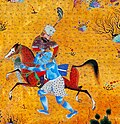
[[File:Tehran, Tehran Museum of Contemporary Art Ms Shah Tahmasp Shahnameh fol. 122v crop Rostam Slays Arzhang Div.jpg|thumb|[[Rostam]] kills [[Arzhang Div]] (The Shahnameh of Shah Tahmasp). The demon is inspired by ancient Persian beliefs.<ref>Doostkhah, Jalil. "Az and Niyaz, Two Powerful and Haughty Demons in Persian Mythology and Epics." Sydney Studies in Religion (1998).</ref>]] | |||
The [[Zorastrianism|Zoroastrian]] concept of demons (''[[Daeva]]'', later ''{{Lang|pal-latn|dīv}}'')<ref>Eduljee, K. E. "Zoroastrian Heritage." On-line at: http://www.heritageinstitute.com/zoroastrianism (2014).</ref> had strong influence on the [[Abrahamic religion]]s, especially [[Christianity]] and [[Islam]]. By elevating [[Ahura Mazda]] to the one supreme God, the founder [[Zoroaster]] relegated the daevas to demons.<ref name="Russell, Jeffrey Burton 1987. p. 104">Russell, Jeffrey Burton. The devil: Perceptions of evil from antiquity to primitive Christianity. Cornell University Press, 1987. p. 104</ref> Emphasizing [[free will]], Zoroaster taught that demons became evil by their own volition in rejecting truth over falsehood.<ref name="Russell, Jeffrey Burton 1987. p. 104"/> At a later stage, [[Mazdaism]] makes [[Ahriman]], the principle of Evil (i.e. the Devil), the creator of demons and leader of daevas.<ref>Russell, Jeffrey Burton. The devil: Perceptions of evil from antiquity to primitive Christianity. Cornell University Press, 1987. p. 105</ref> | |||
The battle between the hosts of deities against evil demons ({{Lang|pal-latn|dīv}} and {{Lang|pal-latn|druz}}) are described in the [[Bundahishn]].<ref>Shaked, Shaul. The Bundahisn: The Zoroastrian Book of Creation. Oxford University Press, 2020. p. xviii</ref> Humankind lives in a world between the good powers of God (Ahura Mazda) and the Devil (Ahriman) and suffers corruption through defection of humankind. Therefore, Zorastrianism proposes a threefold nature for humans: divine, animalistic, and demonic.<ref name="Russell, Jeffrey Burton 1987. p. 115">Russell, Jeffrey Burton. The devil: Perceptions of evil from antiquity to primitive Christianity. Cornell University Press, 1987. p. 115</ref> As such, humans are obligated to keep fighting the demonic traits.<ref name="Russell, Jeffrey Burton 1987. p. 115"/> After death, people must cross the [[Chinvat Bridge]] to enter paradise. However, those who have chosen evil in their life will fall into the pit of hell. In hell, the damned are tormented by the demons.<ref>Russell, Jeffrey Burton. The devil: Perceptions of evil from antiquity to primitive Christianity. Cornell University Press, 1987. p. 119</ref><ref>{{Cite book |last=Nigosian |first=Solomon Alexander |url=https://books.google.com/books?id=Uspf6eDDvjAC |title=The Zoroastrian Faith: Tradition and Modern Research |date=1993 |publisher=McGill-Queen's Press - MQUP |isbn=978-0-7735-1144-6}}</ref> | |||
In the [[Avesta|Younger Avesta]], demons (daēuua) cause diseases and death.<ref name="Maul, S. 2006"/> By abiding to ritual purification and recitation of sacred prayers, demons can be warded off and kept at bay.<ref name="Maul, S. 2006"/> | |||
=== Apocalyptic period and early Christianity === | |||
The concept of demons as servants of the Devil entered the [[Christianity|Christian tradition]] via [[Post-exilic|Post-exilic Judaism]].<ref>Van der Toorn, Karel, Bob Becking, and Pieter Willem van der Horst, eds. Dictionary of Deities and Demons in the Bible. Wm. B. Eerdmans Publishing, 1999. p. 236</ref> Inspired by Zoroastrian dualistic cosmology,<ref>Van der Toorn, Karel, Bob Becking, and Pieter Willem van der Horst, eds. Dictionary of Deities and Demons in the Bible. Wm. B. Eerdmans Publishing, 1999.p. 238</ref> the non-Jewish deities were demonized, as evident from [[Intertestamental period|intertestamental writings]]. The [[apocalyptic literature]] then builds the foundation for the authors of the Gospels in first-century Judea.<ref>Wright, A. T. (2016). The Demonology of 1 Enoch and the New Testament Gospels. Enoch and the Synoptic Gospels: Reminiscences, Allusions, Intertextuality, 216.</ref> | |||
In antiquity, belief in demonic agents of misfortune were widespread.<ref>Brown, Peter. Sorcery, Demons, and the Rise of Christianity from Late Antiquity into the Middle Ages. New York, NY, 1970. p. 28</ref> The early Christian community took it for granted that people outside the Judeo-Christian community were worshipping demons.<ref name="Brown, Peter 1970. p. 24">Brown, Peter. Sorcery, Demons, and the Rise of Christianity from Late Antiquity into the Middle Ages. New York, NY, 1970. p. 24</ref> [[Conversion to Christianity]] meant renunciation of the demons by the bearers of the [[Holy Spirit]].<ref>Brown, Peter. Sorcery, Demons, and the Rise of Christianity from Late Antiquity into the Middle Ages. New York, NY, 1970. p. 31-32</ref> | |||
By the end of the sixth century, the [[Mediterranean|Mediterranean Christian society]] widely considered themselves to be unequivocally Christian, with an exception to Jews, the last record of worshipping another pre-Christian deity being in 570s.<ref>Brown, Peter. Sorcery, Demons, and the Rise of Christianity from Late Antiquity into the Middle Ages. New York, NY, 1970. p. 35</ref> | |||
=== Medieval Christian Europe === | |||
Magical rites, charms, and beliefs in spiritual entities were prominent in pre-Christian Europe.<ref>Scribner, Robert W. "The Reformation, popular magic, and the" Disenchantment of the World"." The Journal of Interdisciplinary History 23.3 (1993): 480-481.</ref> While the Church officially declared such beliefs as ''false'',<ref name="Scribner, Robert W 1993">Scribner, Robert W. "The Reformation, popular magic, and the" Disenchantment of the World"." The Journal of Interdisciplinary History 23.3 (1993): 481.</ref> the persistence of such beliefs among the wider populations led Christian monks to assimilate Christian with non-Christian rites.<ref name="Scribner, Robert W 1993"/> In order to do so, non-Christian symbols and pagan deities have been substituted with [[Jesus Christ]].<ref name="Scribner, Robert W 1993"/><ref>Cameron, Malcolm L. "Anglo-Saxon medicine and magic." Anglo-Saxon England 17 (1988): 214.</ref> To sanction the invocation of non-Christian supernatural powers, Christian missionaries, such as [[John Cassian]] in the fifth century,<ref name="Scribner, Robert W 1993"/> declared the pagan gods to be demons, servants of [[Lucifer]], who bring disorder to the world.<ref name="Brown, Peter 1970. p. 24"/> Many pagan nature spirits like [[Dwarf (folklore)|dwarfs]] and [[Elf|elves]] thus became seen as demons, servants of the supreme Devil. A difference was made between [[monster]]s and demons. The monsters, regarded as distorted humans, probably without souls, were created so that people might be grateful to God that they did not suffer in such a state; they ranked above demons in existence and still claimed a small degree of beauty and goodness as they had not turned away from God.{{sfn|Russell|1986|p=79}} | |||
In Medieval Christianity, demons and spirits were generally considered to be fallen angels. Morally ambivalent nature spirits, such as [[fairy|fairies]] from Irish and Scandinavian [[folklore|folktales]] were often explained as angels who remained neutral during the [[War in Heaven|war of heaven]].<ref>Mack, C. K., Mack, D. (1998). A Field Guide to Demons, Fairies, Fallen Angels, and Other Subversive Spirits. USA: Arcade Pub. p. xxiii</ref><ref name="Wilde, J. F. E. 1888 p. 89">Wilde, J. F. E. (1888). Ancient Legends, mystic Charms, and Superstitions of Ireland: With Sketches of the Irish Past. To which is Appended a Chaper on "The Ancient Race of Ireland". USA: Ticknor and Company. p. 89</ref> They became spirits of the place they fell into when banished to earth.<ref name="Wilde, J. F. E. 1888 p. 89"/> Although considered neutral spirits earlier, later [[Protestantism|Protestant thinkers]] increasingly associated them with Satan and considered them to be demons.<ref>Oldridge, Darren. "Fairies and the Devil in early modern England." The Seventeenth Century 31.1 (2016): 1-15.</ref> | |||
=== Islamic culture in the Middle Ages === | |||
{{See also|Div (mythology)|Marid|Ifrit}} | |||
[[File:Imam Ali and the Jinn.jpg|thumb|[[Imam Ali|Ali]] slaying demons with his sword [[Zulfiqar]] in a Persian manuscript. As evident from the poetry of Sanā'ī Ghaznavī, the sword is believed to be made from fire (آتش), able to kill not only a body but also a soul.<ref>Bakr, Sarmad Mohammad. "The Structural Level in the Sufi Poetry."</ref>]] | |||
In Islamic culture, [[Div (demon)|demons]] ({{Lang|pes-latn|dīv}}) share many anthropomorphic attributes with the Arabian [[jinn]].<ref>Weinstock, Jeffrey Andrew. The Ashgate encyclopedia of literary and cinematic monsters. Routledge, 2016. chapter: Div</ref><ref name=Abedinifard-etal-2021>{{cite book |title=Persian Literature as World Literature |series=Literatures as World Literature |place=USA |editor1=Abedinifard, Mostafa |editor2=Azadibougar, Omid |editor3=Vafa, Amirhossein |publisher=Bloomsbury Publishing |year=2021 |isbn=978-1501354205 |pages=40–43 |postscript=,}} {{isbn|9781501354205}}</ref>{{rp|style=ama|page= 37}} Like the jinn from Islamic traditions, they can enter sexual relationships with humans and sire offspring.<ref name="The Good p. 24"/> Nonetheless, demons differ from jinn as they are perceived as malign creatures.<ref name="The Good p. 24">The Good, the Bad and the Beautiful: The Survival of Ancient Iranian Ethical Concepts in Persian Popular Narratives of the Islamic Period p. 24</ref> Within context of the [[Islam]]ic belief system, demons are considered to be yet another creature of [[God in Islam|God]], rather than independent parts of the world,<ref>Friedl, E. (2020). Religion and Daily Life in the Mountains of Iran: Theology, Saints, People. Vereinigtes Königreich: Bloomsbury Publishing. p. 86</ref><ref name="Sinai, Nicolai 2023">Sinai, Nicolai. "Key terms of the Qur'an: a critical dictionary." (2023): 1-840.</ref>{{rp|style=ama|p=452}} as evident from [[Abu Ali Bal'ami]]'s interpretation of [[Tarikh al-Tabari]]<ref name=Abedinifard-etal-2021/>{{rp|style=ama|page=40}} and the [[Süleymanname]] (written at the time of [[Suleiman the Magnificent]]).<ref>ÇAKIN, Mehmet Burak. "SÜLEYMÂN-NÂME'DE MİTOLOJİK BİR UNSUR OLARAK DÎVLER." Turkish Studies-Language and Literature 14.3 (2019): 1137-1158.</ref> | |||
The idea of demons is not limited to Islam alone, but appear in various belief-systems along the [[Silk Road]]. An [[Uyghur language|Uighur]] [[Manichaeism|Manichaean]] text fragment, narrates a story about a prince and three demons. The demons quarrel over three magical items: a cap which turns people invisible, sandals which can bring people to any place they wish, and staff which belongs to the sandals. The demons request the prince to distribute the magical items among the demons. Therefore, he shoots three arrows into three different directions and claims that the demon who brings back an arrow first will receive the cap, the second one the staff, and the third will receive the sandals. Once the demons start chasing the arrows, the prince puts on the cap on his head and vanishes with the power of the sandals and the staff.<ref>Laut, Jens Peter. "Vielfalt türkischer Religionen." (1996) Spirita. p. 28</ref> | |||
''Dīv'' also appear in [[Manichaeism|Manichaeistic writings]] as the original inhabitants of the world of darkness.<ref name="iranicaonline1">{{Cite encyclopedia|url=http://www.iranicaonline.org/articles/manicheism-pandaemonium|title=Welcome to Encyclopaedia Iranica|encyclopedia=Encyclopaedia Iranica |access-date=2019-04-27|archive-date=2019-04-27|archive-url=https://web.archive.org/web/20190427124415/http://www.iranicaonline.org/articles/manicheism-pandaemonium|url-status=live}}</ref> Before the demons attacked the realm of light, they have been in constant battle and sexual intercourse against each other.<ref name="iranicaonline1"/> It is only in the realm of darkness demons are described in their physical form. After their assault on the world above, they have been overcome by the Living Spirit, and imprisoned in the structure of the world.<ref name="iranicaonline1"/> From that point onwards, they impact human's ethical life, and appear as personified ethical qualities, mostly greed, envy, grief, and wrath (desire for destruction).<ref name="iranicaonline1"/> [[Ibn al-Jawzi]], describes these demons (''[[ifrit|ʿafārīt]]''), in his {{Lang|ar-latn|Talbīs Iblīs}} ({{Gloss|devils' delusion}}), as components of the Devil (or ''Darkness'') waging war against God (or ''Light''), composed of angels.<ref>David S. Margoliouth;''The Devil's Delusion by Ibn al-Jawzi'', 1935, Bd. 1, chapter: Account of the way wherein he deludes the Dualists.</ref> Such demons also frequently appear throughout Islamic literature as personification of human vices. The protagonist of these stories must overcome the demons, as a symbol for their own animalistic nature, in order to heed his rational inclination and achieve salvation in paradisical bliss.<ref name="Barry, M. A. 1535 p. 361-363">Barry, M. A. (2004). Figurative art in medieval Islam and the riddle of Bihzad of Herat (1465-1535). Flammarion. 361-363</ref><ref>Davaran, Fereshteh. Continuity in Iranian identity: Resilience of a cultural heritage. Routledge, 2010. pp. 207-208</ref> | |||
Demons are believed to be vanquished by sacred symbols. The content of the symbol depends on the prevailing religion of the culture. Among Turks, the ''[[basmalah]]'' ("invocation of the name of Allah") is used to ward off demons,<ref>Zhanar, Abdibek, et al. "The Problems of the Mythological Personages in the Ancient Turkic Literature." Asian Social Science 11.7 (2015): 341.</ref> while among Armenians, the symbol of the cross is utilized.<ref name="Armenian"/> Common features of these Middle Eastern demons are their immortality and pernicious nature, they can turn invisible, and can be enslaved when pierced by a silver needle.<ref name="Armenian">{{cite journal |title=Armenian Demonology: A Critical Overview |author=Asatrian, Garnik |journal=Iran and the Caucasus |volume=17 |number=1 |pages=9–25 |year=2013 |publisher=Brill|doi=10.1163/1573384X-20130103 | issn = 1573-384X}}</ref> Demons are believed to be mostly active at night and a bad smell in the air or sudden change in temperature would announce their presence.<ref>{{cite encyclopedia | url=https://www.iranicaonline.org/articles/div | title=Welcome to Encyclopaedia Iranica| encyclopedia=Encyclopaedia Iranica}}</ref> It is generally accepted that demons can be subjugated as they are said to be enslaved by legendary heroes ([[Solomon in Islam|Solomon]] in the Quran and [[Jamshid]] in Persian legends).<ref>{{cite book |first1=Eva |last1=Orthmann |first2=Anna |last2=Kollatz |title=The Ceremonial of Audience: Transcultural approaches |publisher=Vandenhoeck & Ruprecht |date=2019-11-11 |isbn=978-3-847-00887-3 |page=155}}</ref> Due to their reluctant nature, even enslaved, they do always the opposite of what has been commanded.<ref name="The Good p. 24"/> In some tales, supernatural powers are attributed to them, such as causing sickness, mental illnesses, or even turn humans to stone.<ref>Pedram Khosronejad The People of the Air Healing and Spirit Possession in South of Iran in: Shamanism and Healing Rituals in Contemporary Islam and Sufism, T.Zarcone (ed.) 2011, I.B.Tauris</ref> | |||
=== European occultism and Renaissance magic === | |||
Under influence of [[Islamic philosophy]], [[occultism|Medieval occult traditions]] and [[Renaissance magic]], European Renaissance demons are often seen as beneficial and useful, lacking an inherent negative connotation.<ref name="Saif, Liana 2015">{{Cite book |last=Saif |first=Liana |title=The Arabic influences on early modern occult philosophy |date=2015 |publisher=Palgrave Macmillan |location=Basingstoke}}</ref> In fifteenth- and sixteenth-century Renaissance magic, the terms ''demon'' and ''devil'' have two different, although not exclusive, meanings.<ref name="Maggi, A. 2001 p. 14-15">Maggi, A. (2001). Satan's Rhetoric: A Study of Renaissance Demonology. Chicago: University of Chicago Press. p. 14-15</ref> The term ''demons'' refers to a cluster of supernatural beings, such as daimons, spirits, and devils, affecting the mind.<ref name="Maggi, A. 2001 p. 14-15"/> While some people fear demons, or attempt to exorcise them, others willfully attempt to summon them for knowledge, assistance, or power. [[William of Conches]] ({{circa|1090/1091|1155/1170s}}) understands ''demon'' closer to the Greek ''{{Lang|grc-latn|daimōn}}'', reserving the concept of the devil only for the "demons of the lower regions":<blockquote>You think, as I infer from your words, that a demon is the same as a devil, which is not the case. For a demon is said to be any invisible being using reason, as if knowing. Of these the two high orders are called calodemons, that is, 'good knowing ones', the lower order is called cacodemon, that is, 'evil knowing one', for calos means 'good', cacos 'bad'.<ref name="Saif, Liana 2015"/></blockquote> | |||
In the sixteenth century, among proponents of demons as ambivalent spirits, [[Paracelsus]] was the most vocal.<ref name="Goodare, Julian 2018">Goodare, Julian. "Between humans and angels: Scientific uses for fairies in early modern Scotland." Fairies, Demons, and Nature Spirits: 'Small Gods' at the Margins of Christendom (2018): 175.</ref> He asserted that these beings are spirit-like and thus not human, but they have bodies and flesh and are thus, not angels.<ref name="Goodare, Julian 2018"/> [[Robert Kirk (folklorist)|Robert Kirk]] (1644–1692) integrated [[Fairy|fairies]] into his theories of intermediary spirits.<ref>Goodare, Julian. "Between humans and angels: Scientific uses for fairies in early modern Scotland." Fairies, Demons, and Nature Spirits: 'Small Gods' at the Margins of Christendom (2018): 180.</ref> He suggested that these beings are structured similar to human societies, intelligent beings who eat and drink yet invisible to most humans.<ref>Goodare, Julian. "Between humans and angels: Scientific uses for fairies in early modern Scotland." Fairies, Demons, and Nature Spirits: 'Small Gods' at the Margins of Christendom (2018): 181.</ref> Their views were rejected by demonologists and religious orthodoxy and labelled as "atheistic". They denied that spirits could have an autonomeous existence and that they are demons with the sole purpose of deceiving and harming people.<ref>Goodare, Julian. "Between humans and angels: Scientific uses for fairies in early modern Scotland." Fairies, Demons, and Nature Spirits: 'Small Gods' at the Margins of Christendom (2018): 186-187.</ref> | |||
A variety of spirits or the assumption that demons might be morally ambivalent is encouraged by [[necromancy]].<ref>Goodare, Julian. "Between humans and angels: Scientific uses for fairies in early modern Scotland." Fairies, Demons, and Nature Spirits: 'Small Gods' at the Margins of Christendom (2018): 174.</ref> Here, a necromancer supposedly converses with the spirits of the dead. A ceremonial magician usually consults a [[grimoire]], which gives the names and abilities of demons as well as detailed instructions for conjuring and controlling them. Grimoires are not limited to demons – some give instructions for the invocation of deity, a process called [[theurgy]]. The use of ceremonial magic to call demons is also known as ''[[goetia]]'', a word derived from the Greek word {{Lang|grc-latn|goes}}, which originally denoted [[Divination|diviners]], [[Magic (supernatural)#Magicians|magicians]], healers, and [[Oracle|seer]]s.{{sfnp|Drury|Hume|2013|p=[https://books.google.com/books?id=oV4BjGoOZvoC&pg=PA124 124]}} | |||
=== Age of Enlightenment === | |||
In the 16th to early 17th centuries, the idea – inherited from Renaissance magic and occultism – that demonic forces could be conjured and controlled may have paved the way for the development of modern sciences.<ref>Mebane, John S. Renaissance magic and the return of the Golden Age: the occult tradition and Marlowe, Jonson, and Shakespeare. U of Nebraska Press, 1992. p. 2</ref> In Hermetic- and Kabbalist philosophy, demons could be subjugated. This shaped the idea that humans can control their social environment and their surrounding natural forces.<ref>Mebane, John S. Renaissance magic and the return of the Golden Age: the occult tradition and Marlowe, Jonson, and Shakespeare. U of Nebraska Press, 1992. p. 3</ref> | |||
The [[Age of Enlightenment]] conceptualizes humans as [[Free will|autonomous individuals]], mostly independent from external invisible forces, such as demons or gods ruling over human fate.<ref name="Rehmann">{{cite book |first=Luzia Sutter |last=Rehmann |title=Dämonen und unreine Geister: Die Evangelien, gelesen auf dem Hintergrund von Krieg, Vertreibung und Trauma |publisher=Gütersloher Verlagshaus |year=2023 |isbn=978-3641292973 |language=de}}</ref> While in the pre-modern period, spirits and demons were assigned to various natural phenomena, the [[Rationalism|rationalistic school of thought]], increasingly rejected the attribution of demons to unknown causes.<ref name="Mircea Eliade 1986 p. 287">Mircea Eliade ''Encyclopedia of Religion'' Macmillan Publishing (1986) p. 287</ref><ref name="Rehmann"/> | |||
The rejection of demons as a form of superstition was also welcomed by religious perspective, considered to be a "removal" of remaining pagan beliefs. According to [[Wouter Hanegraaff]], demons are ''pagan'' beliefs, removed by the Age of Enlightenment.<ref>Josephson-Storm, Jason Ānanda. "The superstition, secularism, and religion trinary: Or re-theorizing secularism." Method & Theory in the Study of Religion 30.1 (2018): 13.</ref> | |||
Many considered demons to be non-existent and alleged visions of demons and ghosts were explained as results of superstition. By that local religious customs were also oppressed in favor of nationwide (religious) ideas or deities.<ref>{{cite journal |last=Josephson-Storm |first=Jason Ānanda |title=The superstition, secularism, and religion trinary: Or re-theorizing secularism |journal=Method & Theory in the Study of Religion |volume=30 |number=1 |year=2018 |pages=1–20|doi=10.1163/15700682-12341409}}</ref> Wilkinson Duran states that people who believe in demons are often marginalized in the United States.<ref name="Rehmann"/> | |||
The rejection of demons as the cause of natural events also contributed to the association of demons with delusions and merely mental phenomena. For example, the notion that demons could possess an individual, stripped the individual away from their [[personhood]] and was at odds with modern Western philosophy. The most prominent ones, such as the [[American Dream]] and [[capitalism]], imply the belief that everyone is responsible for their own fate and not at the mercy of external forces, thus has no room left for demons or demonic possessions.<ref name="Rehmann"/> The concept of demons has nevertheless not disappeared from the public, permeating media, arts, and psychology.<ref name="Mircea Eliade 1986 p. 287"/> | |||
== Judaism == | == Judaism == | ||
{{See also|Dybbuk|Samael}} | {{See also|Dybbuk|Samael}} | ||
There are differing opinions in Judaism about the existence or non-existence of demons (''[[shedim]]'' or ''[[se'irim]]'').<ref name="JE-shedim"/> Some Rabbinic scholars assert that demons have existed in Talmudic times, but do not exist regularly in present. When prophecy, [[Shekhinah|divine presence]], and [[divine inspiration]] gradually decreased, the demonic powers of impurity have become correspondingly weak, too.{{sfn|Taylor|2020|pp=190–191}} | |||
There are differing opinions in Judaism about the existence or non-existence of demons (''[[shedim]]'' or ''[[se'irim]]'').<ref name="JE-shedim"/> | |||
=== Hebrew Bible === | === Hebrew Bible === | ||
The [[Hebrew Bible]] mentions two classes of demonic spirits, the | The [[Hebrew Bible]] mentions two classes of demonic spirits, the {{Lang|hbo-latn|se'irim}} and the {{Lang|hbo-latn|shedim}}. The word ''{{Lang|hbo-latn|shedim}}'' (singular {{Lang|hbo-latn|shed}} or {{Lang|hbo-latn|sheyd}}) appears in two places in the Hebrew Bible.<ref>{{bibleverse||Psalm|106:37}}, {{bibleverse||Deuteronomy|32:17}}</ref> The ''{{Lang|hbo-latn|se'irim}}'' (singular {{Lang|hbo-latn|sa'ir}}, {{Gloss|male goat}}) are mentioned once in [[Leviticus 17]]:7,<ref name="JE-shedim"/> probably a recollection of [[Assyria]]n demons in the shape of goats.{{sfn|McCraw|Arp|2017|p=9}} They might be a metaphorical symbol for life-threatening animals, such as [[hyena]]s, [[ostrich]]s, and [[jackals]].{{sfn|Hutter|2011}} The ''{{Lang|hbo-latn|shedim}}'', however, are not pagan demigods or demons per se, but the foreign gods themselves. They are evil insofar that they are not affiliated with the Jewish deity.<ref>Jackson, D. R. (2004). Enochic Judaism: Three Defining Paradigm Exemplars (Vol. 49). A&C Black. p. 34</ref> These entities appear in a scriptural context of [[Animal sacrifice|animal]] or [[child sacrifice]] to non-existent [[false god]]s.<ref name="JE-shedim" /> | ||
Various diseases and ailments were ascribed to demons, particularly those affecting the brain and those of internal nature. Examples include [[catalepsy]], headache, [[epilepsy]] and nightmares. There also existed a demon of blindness, Shabriri ({{Lit|dazzling glare}}), who rested on uncovered water at night and blinded those who drank from it.{{sfn|Isaacs|1998|p=[https://books.google.com/books?id=4iLqceVe7S0C&pg=PA96 96]}} | |||
Demons supposedly entered the body and caused the disease while overwhelming or "seizing" the victim. To cure such diseases, it was necessary to draw out the evil demons by certain incantations and talismanic performances, at which the [[Essenes]] excelled.<ref name="JE-shedim"/> [[Josephus]], who spoke of demons as "spirits of the wicked which enter into men that are alive and kill them", but which could be driven out by a certain [[Rootwork|root]],<ref>''Bellum Judaeorum'' vii. 6, § 3</ref> witnessed such a performance in the presence of the Emperor [[Vespasian]]<ref>"Antiquities" viii. 2, § 5</ref> and ascribed its origin to [[King Solomon]]. In mythology, there were few defences against [[Babylonian religion|Babylonian demons]]. The mythical [[Mace (bludgeon)|mace]] [[Sharur (mythological weapon)|Sharur]] had the power to slay demons such as [[Asag]], a legendary ''[[gallu]]'' or ''[[edimmu]]'' of hideous strength. | Demons supposedly entered the body and caused the disease while overwhelming or "seizing" the victim. To cure such diseases, it was necessary to draw out the evil demons by certain incantations and talismanic performances, at which the [[Essenes]] excelled.<ref name="JE-shedim"/> [[Josephus]], who spoke of demons as "spirits of the wicked which enter into men that are alive and kill them", but which could be driven out by a certain [[Rootwork|root]],<ref>''Bellum Judaeorum'' vii. 6, § 3</ref> witnessed such a performance in the presence of the Emperor [[Vespasian]]<ref>"Antiquities" viii. 2, § 5</ref> and ascribed its origin to [[King Solomon]]. In mythology, there were few defences against [[Babylonian religion|Babylonian demons]]. The mythical [[Mace (bludgeon)|mace]] [[Sharur (mythological weapon)|Sharur]] had the power to slay demons such as [[Asag]], a legendary ''[[gallu]]'' or ''[[edimmu]]'' of hideous strength. | ||
=== Talmudic tradition and Midrashim === | === Talmudic tradition and Midrashim === | ||
{{ | {{Further|Midrash}} | ||
In the [[Jerusalem Talmud]], notions of ''shedim'' ( | In the [[Jerusalem Talmud]], notions of ''{{Lang|hbo-latn|shedim}}'' ({{Gloss|demons}} or {{Gloss|spirits}}) are almost unknown or occur only very rarely, whereas in the [[Babylonian Talmud]] there are many references to ''{{Lang|hbo-latn|shedim}}'' and magical incantations. The existence of ''{{Lang|hbo-latn|shedim}}'' in general was not questioned by most of the Babylonian [[Talmudist]]s. As a consequence of the rise of influence of the Babylonian Talmud over that of the Jerusalem Talmud, late rabbis, in general, took as fact the existence of ''{{Lang|hbo-latn|shedim}}'', nor did most of the medieval thinkers question their reality.{{sfn|Kohler|2020|p=123}} However, rationalists like [[Maimonides]] and [[Saadia Gaon]] and others explicitly denied their existence, and completely rejected concepts of demons, evil spirits, negative spiritual influences, attaching and possessing spirits. They thought the essential teaching about ''shedim'' and similar spirits is, that they should not be an object of worship, not a reality to be acknowledged or feared.{{sfn|Kohler|2020|p=124}} Their point of view eventually became mainstream Jewish understanding.<ref name="JE-shedim" /> | ||
The opinion of some authors is not clear. [[Abraham ibn Ezra]] states that insane people can see the image of ''{{Lang|hbo-latn|se'irim}}'', when they go astray and ascribe to them powers independent from God. It is not clear from his work, if he considered these images of ''{{Lang|hbo-latn|se'irim}}'' as manifestations of actual spirits or merely delusions.{{citation needed|date=December 2023}} Despite academic consensus, [[Rabbi]]s disputed that Maimonides denied the existence of demons entirely. He would only dispute the existence of demons in his own life time, but not that demons had existed once.{{sfn|Taylor|2020|pp=185–188}} [[Samuel ibn Seneh Zarza|Ibn Zarza]] likewise argues that demons (''se'irim'') are a manifestation of insanity. He asserts that a weak intellect could not discern reality from imagination and hence errorneously believes in the reality of demons and satans.<ref name="Schwartz, D. 2021 p. 116">Schwartz, D. (2021). Studies on Astral Magic in Medieval Jewish Thought. Niederlande: Brill. p. 116</ref> | |||
Occasionally an [[Angels in Judaism|angel]] is called ''[[satan]]'' in the Babylon Talmud. But ''satans'' do not refer to demons as they remain at the service of God: "Stand not in the way of an ox when coming from the pasture, for Satan dances between his horns".<ref>Pes. 112b; compare B. Ḳ. 21a</ref> | Occasionally an [[Angels in Judaism|angel]] is called ''[[satan]]'' in the Babylon Talmud. But ''satans'' do not refer to demons as they remain at the service of God: "Stand not in the way of an ox when coming from the pasture, for Satan dances between his horns".<ref>Pes. 112b; compare B. Ḳ. 21a</ref> Ibn Zarza, however, argues that satan belongs to the demons (''se'irim''): <blockquote>Demons are called goats, as it says, "And they shall no more offer their sacrifices to the se'irim" [satyrs] (Leviticus 17:7), since they saw fit to compare demons to them more than to other animals. The nature of the goat is to cause blight and vast damage, so great that they called the goat the angel of death, and the angel of death is Satan, as it is said "Reksh Lakish said: Satan, the angel of death, and the evil instinct are all one," hence it is proper to call them se'irim."<ref name="Schwartz, D. 2021 p. 116"/></blockquote> | ||
[[Aggadah|Aggadic]] tales from the Persian tradition describe the ''shedim'', the'' [[Mazzikin|mazziḳim]]'' ("harmers"), and the'' ruḥin'' ("spirits"). There were also ''[[lilin]]'' ("night spirits"), ''ṭelane'' ("shade", or "evening spirits"), ''ṭiharire'' ("midday spirits"), and'' ẓafrire'' ("morning spirits"), as well as the "demons that bring famine" and "such as cause storm and earthquake".<ref>(Targ. Yer. to Deuteronomy xxxii. 24 and Numbers vi. 24; Targ. to Cant. iii. 8, iv. 6; Eccl. ii. 5; Ps. xci. 5, 6.)</ref><ref name="JE-shedim"/> According to some [[Aggadah|aggadic]] stories, demons were under the dominion of a king or chief, usually [[Asmodai]].<ref>Targ. to Eccl. i. 13; Pes. 110a; Yer. Shek. 49b</ref> | [[Aggadah|Aggadic]] tales from the Persian tradition describe the ''{{Lang|hbo-latn|shedim}}'', the'' [[Mazzikin|mazziḳim]]'' ("harmers"), and the'' ruḥin'' ("spirits"). There were also ''[[lilin]]'' ("night spirits"), ''ṭelane'' ("shade", or "evening spirits"), ''ṭiharire'' ("midday spirits"), and'' ẓafrire'' ("morning spirits"), as well as the "demons that bring famine" and "such as cause storm and earthquake".<ref>(Targ. Yer. to Deuteronomy xxxii. 24 and Numbers vi. 24; Targ. to Cant. iii. 8, iv. 6; Eccl. ii. 5; Ps. xci. 5, 6.)</ref><ref name="JE-shedim"/> According to some [[Aggadah|aggadic]] stories, demons were under the dominion of a king or chief, usually ''[[Asmodai]]''.<ref>Targ. to Eccl. i. 13; Pes. 110a; Yer. Shek. 49b</ref> | ||
=== Kabbalah === | === Kabbalah === | ||
In [[Kabbalah]], demons are regarded as a necessary part of the divine emanation in the material world and a byproduct of human sin ([[Qlippoth]]).{{sfn|Dennis|2016|p={{page needed|date=December 2023}}}} After they are created, they assume an existence on their own. Demons would attach themselves to the sinner and start to multiply as an act of self-preservation.{{sfn|Taylor|2020|p=185}} Medieval Kabbalists characterize such demons as [[Destroying angel (Bible)|punishing angels of destruction]]. They are subject to the divine will, and do not act independently.{{sfn|Taylor|2020|p=182}} | |||
In [[Kabbalah]], demons are regarded a necessary part of the divine emanation in the material world and a byproduct of human sin ([[ | |||
Other demonic entities, such as the ''{{Lang|hbo-latn|shedim}}'', might be considered benevolent. The [[Zohar]] classifies them as those who are like humans and submit to the Torah, and those who have no fear of God and are like animals.{{sfn|Taylor|2020|p=184}} | |||
=== Second Temple Judaism === | === Second Temple Judaism === | ||
{{See also|Apotropaic magic}} | {{See also|Apotropaic magic}} | ||
The sources of demonic influence were thought to originate from the [[Watcher (angel)|Watchers]] or [[Nephilim]], who are first mentioned in [[Genesis 6]] and are the focus of [[1 Enoch]] Chapters 1–16, and also in [[Book of Jubilees|Jubilees]] 10. The Nephilim were seen as the source of the sin and evil on Earth because they are referenced in Genesis 6:4 before the story of the [[Genesis flood narrative|Flood]]. | The sources of demonic influence were thought to originate from the [[Watcher (angel)|Watchers]] or [[Nephilim]], who are first mentioned in [[Genesis 6]] and are the focus of [[1 Enoch]] Chapters 1–16, and also in [[Book of Jubilees|Jubilees]] 10. The Nephilim were seen as the source of the sin and evil on Earth because they are referenced in Genesis 6:4 before the story of the [[Genesis flood narrative|Flood]].{{sfn|Hanneken Henoch|2006|pp=11–25}} In Genesis 6:5, God sees evil in the hearts of men. [[Book of Enoch|Ethiopic Enoch]] refers to Genesis 6:4–5, and provides further description of the story connecting the Nephilim to the corruption of humans. According to the [[Book of Enoch]], sin originates when angels descend from heaven and fornicate with women, birthing giants. The Book of Enoch shows that these [[fallen angel]]s can lead humans to sin through direct interaction or through providing forbidden knowledge. Most scholars understand the text to mean that demons originate from the evil spirits of the deceased giants, cursed by God to wander the Earth. [[Dale Martin (scholar)|Dale Martin]] disagrees with this interpretation, arguing that the ghosts of the Nephilim are distinct. The evil spirits would make the people sacrifice to the demons, but they were not demons themselves.{{sfn|Martin|2010}} The spirits are stated in Enoch to "corrupt, fall, be excited, and fall upon the earth, and cause sorrow".<ref>Enoch 15:11</ref>{{sfn|VanderKam|1999}} | ||
== Christianity == | |||
[[Christianity]] conceptualizes demons as occasionally visible, evil beings sowing destruction in the world and disguising themselves as pagan gods.<ref>Anderson, S. (2018). Demonology/Demons. In Brill Encyclopedia of Early Christianity Online. Brill. https://doi.org/10.1163/2589-7993_EECO_SIM_00000897</ref> According to Christian theology, demons are fallen angels.<ref name="M657">Martin, Dale Basil. "When Did Angels Become Demons?" ''Journal of Biblical Literature'', vol. 129, no. 4, 2010, pp. 657. {{doi|10.2307/25765960}}. Accessed 5 Jan 2025.</ref><ref name="ReferenceE">Joad Raymond ''Milton's Angels: The Early-Modern Imagination'' OUP Oxford 2010 {{ISBN|978-0-19-956050-9}} p. 77</ref> They are believed to have been created as [[angel|good angels]] who then turned evil by joining [[Lucifer]] in his rebellion against [[God in Christianity|God]].<ref name="Heinz Schreckenberg 1992">Heinz Schreckenberg, Kurt Schubert, ''Jewish Historiography and Iconography in Early and Medieval Christianity'' (Van Gorcum, 1992, {{ISBN|978-90-232-2653-6}}), p. 253</ref><ref name="ReferenceD">David L Bradnick ''Evil, Spirits, and Possession: An Emergentist Theology of the Demonic'' Brill 2017 {{ISBN|978-90-04-35061-8}} p. 42</ref> This is not shared by [[Judaism]].<ref name="M657"/> The theology of fallen angels is a result of interpretation of different Biblical passages (See [[Revelation]] chapter 12, [[Epistle of Jude|Jude]] 9) in the second and third century.<ref>Martin, Dale Basil. "When Did Angels Become Demons?" ''Journal of Biblical Literature'', vol. 129, no. 4, 2010, pp. 657–77. JSTOR, https://doi.org/10.2307/25765960. Accessed 5 Jan. 2025.</ref> [[Augustine of Hippo]] (5th century) established the position, that demons are spirits (angels) who turn away from God, for [[Christian demonology|Western demonology]] and for the [[Catholic Church]].<ref name="ReferenceC">David L Bradnick ''Evil, Spirits, and Possession: An Emergentist Theology of the Demonic'' Brill 2017 {{ISBN|978-90-04-35061-8}} p. 39</ref> | |||
=== Old Testament === | |||
The existence of demons as inherently malicious spirits within Old Testamental texts is absent.{{sfn|Greenbaum|2015|p=127}}<ref name="Kitz 2016">Anne Marie Kitz. "Demons in the Hebrew Bible and the Ancient Near East". ''Journal of Biblical Literature'', vol. 135, no. 3, 2016, pp. 447–464. {{JSTOR|10.15699/jbl.1353.2016.3074}}. Accessed 16 May 2021.</ref>{{rp|447}} Though there are evil spirits sent by [[God in Christianity|YHWH]], they can hardly be called ''demons'', since they serve and do not oppose the governing deity.<ref name="Kitz 2016"/>{{rp|448}} First then the [[Septuaginta|Hebrew Bible was translated into Greek]], the "gods of other nations" were merged into a single category of demons ({{Lang|grc-latn|daimones}}) with implied negativity.{{sfn|Greenbaum|2015|p=129}} | |||
The Greek Daimons were associated with demi-divine entities, deities, illnesses and [[fortune-telling]]. The Jewish translators rendered them all as demons, depicting their power as nullified comparable to the description of ''{{Lang|hbo-latn|shedim}}'' in the [[Tanakh]]. Although all these supernatural powers were translated, none were angels, despite sharing a similar function to that of the Greek Daimon. This established a dualism between the angels on God's side and negatively evaluated demons of pagan origin.{{sfn|Martin|2010|p=664}} Their relationship to the God-head became the main difference between angels and demons, not their degree of benevolence. Both angels and demons might be fierce and terrifying. However, the angels act always at service of the high god of the Israelites, differing from the pagan demons, who represent the powers of foreign deities.{{sfn|Martin|2010|p=666}} The Septuagint refers to evil spirits as demons (daimon).{{citation needed|date=January 2024}} | |||
{{ | |||
{{ | === New Testament === | ||
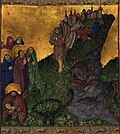
{{ | [[File:Ottheinrich Folio051r Mc5A.jpg|thumb|upright|[[Medieval illumination]] from the Ottheinrich Folio depicting the [[exorcism of the Gerasene demoniac]] by Jesus]] | ||
[[ | Through the New Testament, demons appear 55 times, and 46 times in reference to [[demonic possession]] or [[exorcisms]].<ref name="Dorian Gieseler Greenbaum 2015. pp. 136-138">{{harvnb|Greenbaum|2015|pp=136–138}}.</ref> Some old English Bible translations such as [[King James Version]] do not have the word ''demon'' in their vocabulary and translate it as 'devil'. As adversaries of [[Jesus]], demons are not morally ambivalent spirits, but evil; causes of misery, suffering, and death.<ref name="Dorian Gieseler Greenbaum 2015. pp. 136-138"/> They are not tempters, but the cause of pain, suffering, and maladies, both physical and mental. Temptation is reserved for the devil only.<ref>H. A. Kelly (30 January 2004). ''The Devil, Demonology, and Witchcraft: Christian Beliefs in Evil Spirits''. Wipf and Stock Publishers. {{ISBN|9781592445318}}. p. 104</ref> Unlike spirits in pagan beliefs, demons are not intermediary spirits who must be sacrificed for the appeasement of a deity. Possession also shows no trace of positivity, contrary to some pagan depictions of [[spirit possession]]. They are explicitly said to be ruled by the Devil or [[Beelzebub]].<ref>''Demons and the Devil in Ancient and Medieval Christianity''. 2011. Netherlands: Brill. p. 104</ref> Their origin is unclear, the texts take the existence of demons for granted. Many early Christians, like [[Irenaeus]], [[Justin Martyr]], [[Clement of Alexandria]], and [[Lactantius]] assumed demons were ghosts of the Nephilim, known from Intertestamental writings.<ref>Annette Yoshiko Reed (2005). ''Fallen Angels and the History of Judaism and Christianity: The Reception of Enochic Literature''. Cambridge University Press. {{ISBN|978-0521853781}}. p. 149</ref> Because of references to Satan as the lord of demons and evil angels of Satan throughout the New Testament, other scholars identified fallen angels with demons.{{sfn|Martin|2010|p=670}} Demons as entirely evil entities, who have been born evil, may not fit the proposed origin of evil in free will, taught in alternate or opposing theologies.<ref>James W. Boyd (1975). ''Satan and Māra: Christian and Buddhist Symbols of Evil''. Brill Archive. {{ISBN|9789004041738}}. p. 47</ref> | ||
=== | === Pseudepigrapha and deuterocanonical books === | ||
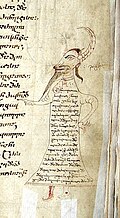
[[File:Demon. A miniature from the Georgian manuscript of the 12th century.jpg|thumb|upright|A demon from ''[[The Ladder of Divine Ascent]]'', written in Georgian by [[Nikrai]].]] | |||
[[File: | {{Main|Pseudepigrapha|Deuterocanonical books}} | ||
In | {{See also|Book of Tobit|Book of Enoch|Book of Jubilees}} | ||
Demons are included in biblical interpretation. In the story of Passover, the Bible tells the story as "the Lord struck down all the firstborn in Egypt" ({{Bibleverse|Exodus|12:21–29}}). In the [[Book of Jubilees]], which is considered canonical only by the [[Ethiopian Orthodox Church]],<ref name="Harris">[[Stephen L Harris|Harris, Stephen L.]], ''Understanding the Bible''. Palo Alto: Mayfield. 1985. It is considered one of the [[pseudepigrapha]] by [[Protestant]], [[Roman Catholic]], and [[Eastern Orthodox]] Churches</ref> this same event is told slightly differently: "All the powers of [the demon] Mastema had been let loose to slay all the first-born in the land of Egypt. And the powers of the Lord did everything according as the Lord commanded them." (Jubilees 49:2–4) | |||
In the [[Genesis flood narrative]], the author explains how God was noticing "how corrupt the earth had become, for all the people on earth had corrupted their ways" ({{Bibleverse|Genesis|6:12}}). In Jubilees, the sins of man are attributed to "the unclean demons [who] began to lead astray the children of the sons of Noah, and to make to err and destroy them" (Jubilees 10:1). In Jubilees, Mastema questions the loyalty of Abraham and tells God to "bid him offer him as a burnt offering on the altar, and Thou wilt see if he will do this command" (Jubilees 17:16). The discrepancy between the story in Jubilees and the story in Genesis 22 exists with the presence of [[Mastema]]. In Genesis, God tests the will of Abraham merely to determine whether he is a true follower, however; in Jubilees, Mastema has an agenda behind promoting the sacrifice of Abraham's son, "an even more demonic act than that of Satan in Job".<ref>Moshe Berstein (2000). "Angels at the Aqedah: A Study in the Development of a Midrashic Motif". ''Dead Sea Discoveries'' 7, p. 267.</ref> In Jubilees, where Mastema, an angel tasked with tempting mortals into sin and iniquity, requests that God give him a tenth of the spirits of the children of the watchers, demons, in order to aid the process (Jubilees 10:7–9). These demons are passed into Mastema's authority, where once again, an angel is in charge of demonic spirits. | |||
In the [[Testament of Solomon]], written sometime in the first three centuries C.E., the demon [[Asmodeus]] explains that he is the son of an angel and a human mother. Another demon describes himself as having died in the "massacre in the age of giants". ''Beelzebub'', one of the princes of demons, appears as a fallen angel, not as a demon, but makes people worship demons as their gods.{{sfn|Martin|2010|p=670}} | |||
[[ | |||
=== Christian demonology === | |||
{{Main|Christian demonology|Exorcism in Christianity|Exorcism in the Catholic Church|Demonic possession#Christianity}} | |||
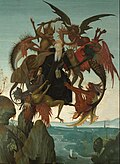
[[File:Michelangelo Buonarroti - The Torment of Saint Anthony - Google Art Project.jpg|thumb|''The Torment of Saint Anthony'' (1488) by [[Michelangelo]], depicting [[Anthony the Great|Saint Anthony]] being assailed by demons]] | |||
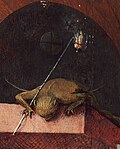
[[File:Jheronimus Bosch 050 detail 01.jpg|thumb|upright|''[[Death and the Miser]]'' (detail), a [[Hieronymus Bosch]] painting, [[National Gallery of Art]], [[Washington, D.C.]]]] | |||
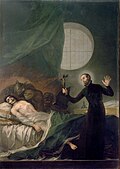
[[File:St._Francis_Borgia_Helping_a_Dying_Impenitent_by_Goya.jpg|thumb|Painting of [[Francis Borgia, 4th Duke of Gandía|Saint Francis Borgia]] performing an [[exorcism]], as depicted by [[Francisco Goya|Goya]]]] | |||
Since [[Early Christianity]], demonology has developed from a simple acceptance of demons to a complex study that has grown from the original ideas taken from Jewish demonology and Christian scriptures.<ref>{{cite book|last1=Orlov|first1=Andrei A.|title=Divine Scapegoats: Demonic Mimesis in Early Jewish Mysticism|date=2015|publisher=SUNY Press|location=New York|isbn=9781438455846|page=4}}</ref> Christian demonology is studied in depth within the [[Roman Catholic Church]],<ref>[http://www.sanctamissa.org/EN/resources/books-1962/rituale-romanum/57-exorcism-introduction.html "Exorcism"] {{Webarchive|url=https://web.archive.org/web/20190325121444/http://www.sanctamissa.org/EN/resources/books-1962/rituale-romanum/57-exorcism-introduction.html |date=2019-03-25}}. ''Sancta Missa – Rituale Romanum''. 1962. Canons Regular of St. John Cantius</ref> although many other Christian churches affirm and discuss the existence of demons.<ref>Hansen, Chadwick (1970), ''Witchcraft at Salem'', p. 132, Signet Classics, Library of Congress Catalog Card Number: 69-15825</ref><ref>Modica, Terry Ann (1996), ''Overcoming The Power of The Occult'', p. 31, Faith Publishing Company, {{ISBN|1-880033-24-0}}</ref> | |||
Building upon the few references to {{Lang|grc-latn|daimon}} in the New Testament, especially the poetry of the Book of Revelation, Christian writers of [[apocrypha]] from the second century onwards created a more complicated tapestry of beliefs about "demons" that was largely independent of Christian scripture. | |||
While daimons were considered as both potentially benevolent or malevolent, [[Origen]] argued against [[Celsus]] that daimons are exclusively evil entities, supporting the later idea of (evil) demons. According to Origen's cosmology, increasing corruption and evil within the soul, the more estranged the soul gets from God. Therefore, Origen opined that the most evil demons are located underground. Besides the fallen angels known from Christian scriptures, Origen talks about Greek daemons, like nature spirits and giants. These creatures were thought to inhabit nature or air and nourish from pagan sacrifices roaming the earth. However, there is no functional difference between the spirits of the underworld and of earth, since both have fallen from perfection into the material world. Origen sums them up as [[fallen angel]]s and thus equal to demons.<ref>Jeffrey Burton Russell (1987). ''Satan: The Early Christian Tradition''. Ithaca: Cornell University Press. {{ISBN|9780801494130}}. p. 132.</ref> | |||
< | Many [[ascetic]]s, like Origen and [[Anthony the Great]], described demons as psychological powers, tempting to evil,<ref>David L Bradnick (2017). ''Evil, Spirits, and Possession: An Emergentist Theology of the Demonic''. Brill. {{ISBN|978-9-004-35061-8}}. p. 30</ref> in contrast to benevolent angels advising good. According to ''Life of Anthony'', written in Greek around 360 by [[Athanasius of Alexandria]], most of the time, the demons were expressed as an internal struggle, inclinations, and temptations. But after Anthony successfully resisted the demons, they would appear in human form to tempt and threaten him even more intensely.<ref>Brakke, D. (2009). ''Demons and the Making of the Monk: Spiritual Combat in Early Christianity''. Harvard University Press. p. 157</ref> | ||
[[Pseudo-Dionysius the Areopagite]] described ''evil'' as "defiancy" and does not give ''evil'' an ontological existence. He explains demons are deficient creatures, who willingly turn themselves towards the unreal and non-existence. Their dangerous nature results not from the power of their nature, but from their tendency to drag others into the "[[Kenoma|void]]" and the unreal, away from God.{{sfn|Russell|1986|p=37}} | |||
[[Michael Psellos]] proposed the existence of several types of demons, deeply influenced by the material nature of the regions they dwell. The highest and most powerful demons attack the mind of people using their "imaginative action" ({{Lang|grc-latn|phantastikos}}) to produce illusions in the mind. The lowest demons, on the other hand, are almost mindless, gross, and grunting spirits, which try to possess people instinctively, simply attracted by the warmth and life of humans. These cause diseases, fatal accidents and animalistic behavior in their victims. They are unable to speak, while other lower types of demons might give out false oracles. The demons are divided into: | |||
* ''Leliouria'': The highest demons who inhabit the ether, beyond the moon | |||
* ''Aeria'': Demons of the air below the moon | |||
* ''Chthonia'': Inhabiting the land | |||
* ''Hyraia/Enalia'': Dwelling in the water | |||
* ''Bypochtbonia'': They live beneath the earth | |||
* ''Misophaes'': The lowest type of demon, blind and almost senseless in the lowest hell | |||
Invocation of Saints, holy men and women, especially ascetics, reading the Gospel, holy oil or water is said to drive them out. However, Psellos' schemes have been too inconsistent to answer questions about the hierarchy of fallen angels. The devil's position is impossible to assign in this scheme and it does not respond to living perceptions of felt experience and was considered rather impractical to have a lasting effect or impact on Christian demonology.{{sfn|Russell|1986|p={{page needed|date=December 2023}}}} | |||
The contemporary Roman Catholic Church unequivocally teaches that angels and demons are real beings rather than just symbolic devices. The Catholic Church has a cadre of officially sanctioned exorcists which perform many [[exorcism]]s each year. The exorcists of the Catholic Church teach that demons attack humans continually but that afflicted persons can be effectively healed and protected either by the formal rite of exorcism, authorized to be performed only by bishops and those they designate, or by prayers of deliverance, which any Christian can offer for themselves or others.<ref>{{cite web |url=http://www.fathercorapi.com/articledet.asp?articleID=1928275639 |url-status=dead |archive-url=https://web.archive.org/web/20040405135007/http://www.fathercorapi.com/articledet.asp?articleID=1928275639 |archive-date=2004-04-05 |title=Angels and Demons – Facts not Fiction |website=fathercorapi.com |first=John |last=Corapi |date=February 9, 2004}}</ref> | |||
At various times in Christian history, attempts have been made to classify demons according to various proposed [[demonic hierarchy|demonic hierarchies]]. | |||
In recent times, scholars doubted that independent demons exist, and rather considers them, aking to Jewish ''satan'', to be servants of God. According to S. N. Chiu, God is shown sending a demon against Saul in 1 Samuel 16 and 18 in order to punish him for the failure to follow God's instructions, showing God as having the power to use demons for his own purposes, putting the demon under his divine authority.<ref>{{cite journal |first=S. N. |last=Chiu |title=Historical, Religious, and Medical Perspectives of Possession Phenomenon |journal=Hong Kong Journal of Psychiatry |year=2000 |volume=10 |issue=1}}</ref> According to the ''Britannica Concise Encyclopedia'', demons, despite being typically associated with evil, are often shown to be under divine control, and not acting of their own devices.<ref>"Demon" in Britannica Concise Encyclopedia,</ref> | |||
In | |||
== Islam == | |||
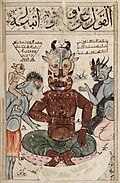
[[File:Kitab al-Bulhan --- demons.jpg|thumb|Zawba'a or Zoba'ah, the demon-king of Friday depicted in the ''Book of Wonders''.]] | |||
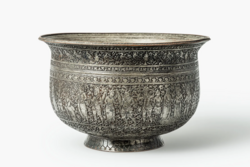
[[File:Islamic Bowl with humans, angels, and demons (div).png|thumb|Bowl with humans, angels, and divs (demons). Iran [[Qajar dynasty]], 1215-1221 A.H. (1800-1805). [[Museum für Kunst und Gewerbe Hamburg]], [[Germany]]. This bowl depicts humans, angels, and horned creatures called divs - demons of ancient Iranian origin. Divs embody evil, disrupt order and represent vices such as pride and anger. They still appear in literature and art today as symbols of chaos and inner conflict.]] | |||
In [[Islam]]ic beliefs, demons are roughly of two types:<ref name="doi.org">Erdağı, D. Evil in Turkish Muslim horror film: the demonic in "Semum". SN Soc Sci 4, 27 (2024). https://doi.org/10.1007/s43545-024-00832-w</ref> [[Jinn]] and [[Shayatin|devils]] ({{langx|ar|شَيَاطِين|''šayāṭīn''}} or {{langx|fa|دیو|''dīv''}}).<ref>Charles Mathewes ''Understanding Religious Ethics'' John Wiley & Sons {{ISBN|978-1-405-13351-7}}. p. 249</ref><ref>Reynolds, Gabriel Said, "Angels", in: Encyclopaedia of Islam, THREE, Edited by: Kate Fleet, Gudrun Krämer, Denis Matringe, John Nawas, Everett Rowson. Consulted online on 17 August 2021. {{doi|10.1163/1573-3912_ei3_COM_23204}}. First published online: 2009. First print edition: 9789004181304, 2009, 2009-3</ref> The jinn derive from [[Religion in pre-Islamic Arabia|pre-Islamic Arabian beliefs]], although their exact origin is unclear. The presence of jinn in [[Religion in pre-Islamic Arabia|pre-Islamic Arabian beliefs]] is not only testified by the Quran, but also by pre-Islamic literature in the seventh century.<ref name="HistMuh-2016">{{cite book |last=Zeitlin |first=I. M. |author-link= |title=The Historical Muhammad |date=2007 |publisher=Wiley |isbn=978-0-745-63998-7 |location=United Kingdom |page=}}</ref>{{rp|p=54}} The {{Lang|ar-latn|šayāṭīn}} (devils or satans) on the other hand, appear in stories bearing similarities with [[Judeo-Christian]] or [[Iranian religions|Persian]] tradition. | |||
According to Islam, all beings, including humans, jinn, and fiends (''dīv'') are created and thus rewarded or punished by God.<ref>{{Citation |title=Dīw |url=https://referenceworks.brill.com/doi/10.1163/1573-3912_islam_SIM_1879 |access-date=2026-02-08 |language=en |doi=10.1163/1573-3912_islam_SIM_1879|url-access=subscription }}</ref> The latter category are closer to the Christian understanding of demons as inherently evil beings. However, if they use their evil nature in accordance to God's will, such as punishing the transgessors among humans and jinn, they also might be considered [[Muslims|''muslim'']] and ultimately be rewarded.<ref>{{Cite book |last=Nünlist |first=Tobias |title=Dämonenglaube im Islam: eine Untersuchung unter besonderer Berücksichtigung schriftlicher Quellen aus der vormodernen Zeit (600-1500) |date=2018 |publisher=De Gruyter |isbn=978-3-11-060945-5 |series=Studies in the history and culture of the Middle East |location=Berlin; Boston}}</ref> | |||
Although often used synonymously, some Muslim scholars additionally distinguish between two types of devils; satans and fiends. According to [[Al-Ghazali|Al-Ghazali's]] [[The Alchemy of Happiness]], the satans abide in [[Barzakh|''barzakh'']], where human mental processing is happening, while the fiends operate on the sensual realm. As such, satans and fiends form a symbiosis; whereas the fiends encourage sensual desires, the satans to diverge the mind, whenever it attempts to reach the heavenly planes, back to the earth in the grasp of demons. The satans to so, following their father [[Iblis]] (Satan), out of disdain for [[Adam in Islam|Adam]], while it is the nature of the fiends to encourage sensual temptation.<ref>Al-Ghazali "Alchemie of Eternal Bliss" Translated by Muhammad Asim Bilal</ref> | |||
[[Tafsir|Muslim exegetical literature]] as well as Muslim poetry dedicated [[Qisas al-Anbiya|lenghty stories]] and [[Allegory|allegeories]] in order to explain the interplay between fiends, satans, and human sin. The [[Solomon in Islam|prophet Solomon]], who according to the [[Quran|Qur'an]], lost his kingdom to a fiend known as ''[[Asmodeus|Sakhr]].''<ref>{{Cite journal |last=Brend |first=Barbara |date=January 2007 |title=Figurative Art in Medieval Islam and the Riddle of Bihzād of Herāt (1465–1535). By Michael Barry. pp. 408. Paris, Flammarion, 2004 |url=https://doi.org/10.1017/s1356186306256840 |journal=Journal of the Royal Asiatic Society of Great Britain & Ireland |volume=17 |issue=1 |pages=64–68 |doi=10.1017/s1356186306256840 |issn=0035-869X|url-access=subscription }}</ref> The writings of [[al-Farabi]] had lasting influence on Islamic thought, identfying the concept of a kingdom with the human body.<ref>Elias, J. J. (2014). Key Themes for the Study of Islam. Vereinigtes Königreich: Oneworld Publications.</ref> The fiend taking over Solomon's kingdom was thus seen as a fiend seizing control of Solomon himself. Each individual human being is in danger to lose their self-control to such demonic beings. Muslim poetry is likewise influenced by the [[Islamic philosophy|philosophical thought]] of the [[Islamic Golden Age]].<ref name=":4">Johnson, Kathryn V. "A Mystic's Response to the Claims of Philosophy: Abū'l Majd Majdūd Sanā'ī's Sayr Al-'Ibād Ilā'l-Ma'ād." ''Islamic studies'' 34.3 (1995): 253-295.</ref> While for philosophers, such as al-Farabi and [[Avicenna]], the material world is described only in technical terms, [[Sanai]] explicitly identifies sensual passion with the fiends from Muslim literature.<ref name=":4" /> | |||
Besides fiends causing some sort of demonic possession through passion, both folklore and orthodox Islam generally assumes that creatures with foreign bodies, known as jinn, can possess a person and cause sickness.<ref>{{cite book |last=Rassool |first=G. Hussein |title=Islamic Counselling: An Introduction to theory and practice |date=2015-07-16 |publisher=Routledge |isbn=978-1-31744-125-0 |page=58}}</ref> In the tradition of [[Ash'ari]], it has been considered to be part of the doctrines ({{Lang|ar-latn|aqidah}}) of the "[[Sunnism|people of the Sunnah]]" ({{Lang|ar-latn|ahl as-sunnah wal-jammah'a}}).<ref name="Böttcher–2021">Islam, Migration and Jinn: Spiritual Medicine in Muslim Health Management. (2021). Deutschland: Springer International Publishing.</ref> For most theologians, (Ashʿaris as well as Muʿtazilis), and in contrast to philosophers, both demons (jinn and devils) and angels are considered to be material.<ref>St Andrews Encyclopaedia of Theology | |||
Angels (malāʾika) | |||
Stephen Burgep. 18</ref> All sentient beings are said to be created out from a physical substance: angels from light, jinn from fire and air, devils from fire, and humans from earth.<ref>St Andrews Encyclopaedia of Theology | |||
Angels (malāʾika) | |||
Stephen Burgep. 14-15</ref> | |||
The | The Quran emphasizes similarities between humans and jinn. The Quranic phrase {{Lang|ar-latn|al-ins wa al-jinn}} ({{Lang|ar|الإِنسِ وَالْجِنِّ|rtl=yes}}) puts the jinn to the same position as humans and whereby also rejecting kinship with God.<ref name="Sinai, Nicolai 2023" />{{rp|style=ama|p=181}} In contrast to demons from the [[Bible|biblical tradition]], the jinn are not a source of evil.<ref name="Sinai, Nicolai 2023" />{{rp|style=ama|p=181, 185}} In the majority of Muslim writings, the jinn are ephemeral and shadowy creatures and primarily linked to magical practices (both white and black magic), though sometimes to disastrous effects.<ref name="Mircea Eliade 1986 p. 286-287">Mircea Eliade ''Encyclopedia of Religion'' Macmillan Publishing (1986) p. 286-287</ref> | ||
== | While the jinn are morally ambivalent, the ''{{Lang|ar-latn|šayāṭīn}}'' represent malevolent forces akin to the devils of the [[Judeo-Christian|Judeo-Christian tradition]],<ref name="Nünlist-2015" />{{rp|p=286}} and are actively obstructing the execution of God's will.<ref name="Mircea Eliade 1986 p. 286-287" /> Because of that, they bear less resemblance to humans than the jinn.<ref name="Sinai, Nicolai 2023" /><ref name="doi.org" /> The latter share attributes with humans, such as mortality, whereas the ''{{Lang|ar-latn|šayāṭīn}}'' do not.<ref>Egdunas Racius ISLAMIC EXEGESIS ON THE JINN: THEIR ORIGIN, KINDS AND SUBSTANCE AND THEIR RELATION TO OTHER BEINGS pp. 132–135</ref><ref name="Principle">{{cite journal |last1=YOUNG |first1=M. J. L. |date=1966 |title=THE TREATMENT OF THE PRINCIPLE OF EVIL IN THE QUR'ĀN |url=http://www.jstor.org/stable/20832847. |journal=Islamic Studies |volume=5 |issue=3 |pages=275–281 |doi= |jstor=20832847 |access-date=November 7, 2021}}</ref>{{rp|style=ama|p=278}}<ref name="Sinai, Nicolai 2023" />{{rp|style=ama|p=452}} In Muslim culture, the ''{{Lang|ar-latn|šayāṭīn}}'' are used synonymously with Persian term {{Lang|ar-latn|Dīv}} ({{Lang|ar|دیو|rtl=yes}}).<ref>Huart, Cl.; Massé, H. (2012) [1960-2007]. "Dīw". In Bearman, P.; Bianquis, Th.; Bosworth, C.E.; van Donzel, E.; Heinrichs, W.P. (eds.). Encyclopaedia of Islam (2nd ed.)</ref><ref>{{Citation |title=Angels |url=https://referenceworks.brill.com/doi/10.1163/1573-3912_ei3_COM_23204 |access-date=2025-11-17 |language=en |doi=10.1163/1573-3912_ei3_COM_23204|url-access=subscription }}</ref> | ||
Muslim writers on astrology identified the planetary spirits known from ancient Greek cosmology, with seven demon-kings, often invoked for the preparation of [[Magic square#Magic squares in occultism|Magic squares]].<ref>Mommersteeg, Geert. "'He Has Smitten Her to the Heart with Love' The Fabrication of an Islamic Love-Amulet in West Africa." Anthropos, vol. 83, no. 4/6, 1988, pp. 501–510. JSTOR, http://www.jstor.org/stable/40463380. Accessed 13 June 2020.</ref> According to the [[Book of Wonders]] each day of the week is assigned to one of the {{Lang|ar-latn|rūḥāiya ulia}} (higher spirits) and {{Lang|ar-latn|rūḥāiya sufula}} (lower spirits).<ref name="Carboni-2013">{{cite journal |last=Carboni |first=Stefano |date=2013 |title=The ''Book of Surprises'' (''Kitab al-Buhlan'') of the Bodleian Library |journal=The La Trobe Journal |volume=91 |pages=27–28}}</ref> | |||
== | == Dharmic religions == | ||
=== | === Hinduism === | ||
The | {{See also|Surapadman|Narakasura}} | ||
[[File:The Army of Super Creatures.jpg|thumb|The Army of Super Creatures – from The ''Saugandhika Parinaya'' Manuscript (1821 CE)]] | |||
Hinduism advocates the reincarnation and transmigration of souls according to one's [[karma]]. Souls ([[Atman (Hinduism)|Atman]]) of the dead are adjudged by the [[Yama]] and are accorded various purging punishments before being reborn. According to Hindu cosmology, nothing is either purely evil or good, and even demonic beings could eventually abandon their demonic nature. Humans that have committed extraordinary wrongs are condemned to roam as lonely, often mischief monsters, spirits for a length of time before being reborn. Many kinds of such spirits ([[Vetala]]s and [[Pishacha]]s) are recognized in the later Hindu texts. Even celestial beings are subject to change. | |||
The | The identification of {{Lang|sa-latn|asura}} with ''demons'' stems from the description of {{Lang|sa-latn|asura}} as "formerly gods" ({{Lang|sa-latn|pūrvadeva}}). The deva [[Śakra (Buddhism)|Śakra]] tricked the asuras to drink from liquor and hurled them down to the steps of [[Mount Meru]], claiming heaven solely for the devas.(287) | ||
== | In the [[Veda]], gods (''[[Deva (Hinduism)|deva]]'') and demons or titans (''[[asura]]'') are not yet differentiated beings and both share the upper world.<ref name="auto1">Rodrigues, H. (2018). Asuras, Daityas, Dānavas, Rākṣasas, Piśācas, Bhūtas, Pretas, and so forth.. In K. A. Jacobsen (ed.), Brill's Encyclopedia of Hinduism Online. Brill. https://doi.org/10.1163/2212-5019_BEH_COM_1030340</ref> Rather than denoting a separate class of being, the asuras are characterized by being great leaders, often warriors.<ref name="auto1" /> {{Lang|sa-latn|Asura}}, in the earliest hymns of the [[Rigveda]], originally meant any supernatural spirit, either good or bad. Since the {{IPA|/s/}} of the Indic linguistic branch is cognate with the {{IPA|/h/}} of the Early Iranian languages, the word ''{{Lang|sa-latn|asura}}'', representing a category of celestial beings, is a cognate with Old Persian ''Ahura''. Ancient Hinduism tells that [[Deva (Hinduism)|Devas]] (also called ''suras'') and [[Asura (Hinduism)|Asuras]] are half-brothers, sons of the same father [[Kashyapa]]; although some of the Devas, such as [[Varuna]], are also called Asuras. Later, during [[Puranic]] age, [[Asura (Hinduism)|Asura]] and [[Rakshasa]] came to exclusively mean any of a race of anthropomorphic, powerful, possibly evil beings. [[Daitya]] (lit. sons of the mother [[Diti]]), [[Danava (Hinduism)|Danava]] (lit. sons of the mother "[[Danu (Hinduism)|Danu]]"), [[Mayasura|Maya Danava]], Rakshasa (lit. from "harm to be guarded against"), and {{Lang|sa-latn|asura}} are sometimes translated into English as {{Gloss|demon}}.<ref>Asian Mythologies. (1993). Vereinigtes Königreich: University of Chicago Press. p. 52</ref> | ||
[[ | |||
At the time of the [[Brahmana]]s that the asuras are said to inhabit the underworld and are progressively, despite originally distinct beings, assimilated to the rakshasas.<ref name="auto1" /> During the Vedic period, gods aid humans against demons. By that, gods secure their own place in heaven, using humans as tools to defeat their cosmic enemies.<ref name="O'Flaherty Doniger 1988 p65-95">O'Flaherty, W. D., Doniger, W. (1988). The Origins of Evil in Hindu Mythology. Indien: Motilal Banarsidass. p. 65-95</ref> The rakshasas are often portrayed as vile creatures associated with greed and magical abilities, unleashed through rites considered inappropriate by the Brahmins.<ref name="auto1" /> However, the asuras retain some of their previous features, and function often as individual leaders of the rakshasas.<ref name="auto1" /> The asuras also mostly dwell in the heavenly worlds, while the Earth is plagued by lower demonic beings such as rakshasas, bhutas, pretas, and pishachas.<ref name="auto1" /> The pretas are ghosts, who could not go to the afterlife yet.<ref name="auto1" /> The Pishachas, likewise, are spirits of the dead, but associated with eating human-flesh.<ref name="auto1" /> | |||
= | With increase in [[Sannyasa|asceticism]] during the post-Vedic period, withdrawal of sacrificial rituals was considered a threat to the gods.<ref name="O'Flaherty Doniger 1988 p65-95"/> Ascetic humans or ascetic demons were supposed to be more powerful than gods. Pious, highly enlightened {{Lang|sa-latn|asura}}s and {{Lang|sa-latn|Rakshasa}}s, such as [[Prahlada]] and [[Vibhishana]], are not uncommon. The {{Lang|sa-latn|asura}} are not fundamentally against the gods, nor do they tempt humans to fall. Many people metaphorically interpret the Asura as manifestations of the ignoble passions in the human mind and as symbolic devices. There were also cases of power-hungry asuras challenging various aspects of the gods, but only to be defeated eventually and seek forgiveness. | ||
{{ | |||
{{ | |||
Despite the impermanence of beings, demonic entities share characteristics impeding the chance of liberation through the realization of the ''Ātman'', such as greed, pride, or improper rituals.<ref name="auto1"/> However, all demonic appearances are only temporary. | |||
=== Buddhism === | |||
{{further|Mara (demon)}} | |||
[[File:Scenes_of_Paradise_and_Hell.jpg|thumb|250x250px|Hanging Scroll, [[Edo period|late Edo Period]], Tokyo National Museum]] | |||
[[Buddhism]] classifies sentient beings into six types: [[Deva (Buddhism)|Devas]] (gods and celestial beings), [[Asura (Buddhism)|asuras]] (titans or demi-gods), humans, animals, ''[[Hungry Ghost|''preta'']]'' (ghost), [[Naraka (Buddhism)|''nāraki'']] (hell-being).<ref>{{cite journal |last1=Sinclair |first1=Scott |title=The Heart of Paul's Spirituality and the Implications for the Church [Lecture Notes]: Becoming Centered in God through Christ Six Conferences for the New Camaldoli Hermitage |journal=Dominican University of California |date=2021 |doi=10.33015/dominican.edu/2021.sinclair.02 |location=United States |language=en |doi-access=free}}</ref> As in Hinduism, all these beings are part of the ''[[Saṃsāra]]''.<ref name="dictionary" /> Since Buddhism rejects the [[Anattā|existence of a permanent self]] (''anātman''), ghosts and evil spirits, such as ''[[Bhoota (ghost)|bhūta]]'', ''[[rākṣasa]],'' ''pretas'' and ''[[Pishacha|piśāca]]'', are not inherently evil, but reborn in states of misery as the result of bad [[Karma in Buddhism|karma]].<ref name=":2">{{Cite book |last=Boyd |url=https://doi.org/10.1163/9789004378452 |title=Satan and Mara |date=1975-01-01 |publisher=BRILL |isbn=978-90-04-37845-2 |pages=75 |doi=10.1163/9789004378452 }}</ref> They may have good and evil characteristics, just as any other being in ''saṃsāra'', but suffer more than beings of better rebirth. Only beings born in hell may be considered demonic in the sense of an intrinsic evil creature, however, they cannot leave their infernal place and harm none but each other.<ref>{{Cite journal |last=Chitgopekar |first=Nilima M. |date=2000 |title=Book Reviews : N.N. BHATTACHARYYA, Indian Demonology: The Inverted Pantheon, Delhi, Manohar Publishers, 2000, pp. 234, Rs 400 |url=https://doi.org/10.1177/025764300101700205 |journal=Studies in History |volume=17 |issue=2 |pages=275–278 |doi=10.1177/025764300101700205 |issn=0257-6430|url-access=subscription }}</ref> Once their evil karma is extinguished, they are reborn in upper realms.<ref>{{Cite journal |last=Dongchung |first=Tenzin Yewong |date=2021-02-22 |title=An 18th Century Textual Labyrinth: The Nature of Tibetan Buddhist Printing Network in Qing Inner Asia during the Kangxi Period |journal=Waxing Moon |volume=1 |pages=112 |doi=10.52214/waxingmoon.v1i.7075 |issn=2694-6149|doi-access=free }}</ref> | |||
Asuras belong to one of the four unhappy (or evil) rebirths, along with animals, ghosts, and hell-beings.<ref name=":1">{{Cite journal |last=Ch'en |first=Kenneth |date=1962 |title=Buddhism. Edited by Richard A. Gard. Great Religions of Modern Man. New York: George Braziller, 1961. 256. Index. $4.00 - Encyclopedia of Buddhism. Edited by G. P. Malalasekera. Fascicule: A-Aca. Ceylon: Government Press, 1961. xv, 125. |url=https://doi.org/10.2307/2050683 |journal=The Journal of Asian Studies |volume=2 |issue=3 |pages=286–290 |doi=10.2307/2050683 |jstor=2050683 |issn=0021-9118|url-access=subscription }}</ref> They are characterized by anger, jealousy (of the gods), and pride. Despite appearing as the enemies of the gods, asuras are not evil, but have both good and bad karma. However, since their lives are pervaded by unwholesome states, rebirth as an asura is considered to be undesirable. Many texts mention anger, conceit, and doubt, as causes for birth as an asura.<ref name=":1" /> The early Buddhist Sutras mention „speaking evil“, „thinking evil in the mind“, and „arising of thoughts of superiority“, combined with „good deeds“ lead to rebirth as an asura.<ref name=":1" /> Therefore, rebirth as an asura is ambiguous: Beings from the realm of ghosts and hells ascend in the karmic hierarchy by becoming an asura on accord of the good action, whereas beings of the celestial worlds descend through the malicious actions by rebirth as an asura.<ref name=":1" /> | |||
= | When Buddhism spread, indigenous ideas about ghosts and demons were integrated into Buddhist teachings.<ref name="dictionary" /> For example, in [[Chinese culture|Chinese cultural tradition]], people offer food in order to appease the suffering of the ''pretas'' (hungry ghosts) during the [[Zhongyuan Festival]]. Since such beings are not evil per se, they are not precisely demons, so the closest equivalent in English language may be the term ''[[jinn]]'' adopted from Islamic beliefs.<ref name=":2" /> Even though Buddhism does not deny the existence of ghosts and evil spirits, they play no important role in search for [[Nirvana|liberation]] from the circle of life.<ref name="dictionary" /> | ||
''Nārakis'' are born in hell as result of intense negative karma, wherein they suffer in a state of continuous torment until their bad karma is extinguished and they cannot accumulate further bad karma.<ref name=":0" /> Their actions are confined to the bad karmic actions they previously committed but are turned into an agonizing experience.<ref name=":0">{{Cite journal |last=Langenberg |first=Amy Paris |date=2019-10-02 |title=Reading against the grain: female sexuality in classical South Asian Buddhism |url=https://doi.org/10.1080/0048721x.2019.1663620 |journal=Religion |volume=49 |issue=4 |pages=728–734 |doi=10.1080/0048721x.2019.1663620 |issn=0048-721X|url-access=subscription }}</ref> | |||
In hell, demons or [[Hell Wardens|hell wardens]] (''nirayapāla'') appear in order to ensure that beings born therein are continuously tortured. [[Vasubandhu]] argues that every being in hell must be, by definition, suffering and since demons do not suffer in hell, they are not real but only illusions.<ref name=":0" /> It is because of the result of their bad karma, the inhabitants of hell perceive demonic hell-wardens and thus, the latter are merely a projection of the former.<ref name=":0" /> | |||
Demons may thus be understood as personifications of correlative mental states projected onto the external cosmos.<ref name="Religion Macmillan Publishing 1986 p. 284">Mircea Eliade Encyclopedia of Religion Macmillan Publishing (1986) p. 284</ref> The [[Pali Sutras]] represent the unenlightened people as "possessed" by the demons of "desire" and "craving".<ref name="Religion Macmillan Publishing 1986 p. 284" /> These two self-destructive feelings then cause the images of horrifying demons.<ref name="Religion Macmillan Publishing 1986 p. 284" /> In a state of enlightenment, the [[Buddha]] has overcome such passions and by that, conquered the demons.<ref name="Religion Macmillan Publishing 1986 p. 284" /> | |||
[[ | == Ethnic and folkloric == | ||
=== Aboriginal Australian cultures === | |||
[[File:Bunyip 1890.jpg|thumb|upright|A depiction of a [[Bunyip]].]] | |||
[[Aboriginal Australian]] cultures have various beings translated into English as "demons" or "devils". The most notable is the [[Bunyip]], which was originally a term applied to malevolent spirits in general.<ref>See for example, "[[Oodgeroo Noonuccal]]", Kath Walker's story collected in ''Stradbroke Dreamtime''. [http://www.nla.gov.au/exhibitions/bunyips/html-site/abor-stories/biami.html] {{Webarchive|url=https://web.archive.org/web/20120206012750/http://www.nla.gov.au/exhibitions/bunyips/html-site/abor-stories/biami.html|date=6 February 2012}}</ref> [[Aboriginal Tasmanians|Tasmanian]] mythology in particular has many beings translated as "devils"; these include malicious spirits like ''Rageowrapper''<ref>Plomley, N. J. B. (1991). The Westlake papers: records of interviews in Tasmania by Ernest Westlake. Queen Victoria Museum & Art Gallery.</ref> as well as spirits summoned in magic. Tasmanian Aboriginal people would describe these entities as "devils" and related that these spiritual beings as walking alongside Aboriginal people "carrying a torch but could not be seen".<ref>Plomley, N. J. B., ed. (2008) [First published 1966]. Friendly Mission: The Tasmanian Journals and Papers of George Augustus Robinson (2nd ed.). Hobart, Tasmania and Launceston, Tasmania: Quintus and Queen Victoria Museum and Art Gallery. ISBN 978-0-977-55722-6.</ref> | |||
=== Chinese folklore === | |||
{{Main|Mara (demon)|Yaoguai|Zhiguai xiaoshuo}} | |||
{{See also|List of supernatural beings in Chinese folklore|Spiritual warfare in China}} | |||
[[File:夜叉鬼.JPG|thumb|Carving of a [[yaksha]] ({{Lang|zh|夜叉}})]] | |||
Chinese folktale, legend and literature are replete with malevolent supernatural creatures who are often rendered "demons" in English translations. These include categories of beings such as the ''[[Yaoguai|yao]]'' {{Lang|zh|妖}} – shapeshifters with the power to cause insanity, to inflict poison, and to bring about disease, and the mo {{Lang|zh|魔}} – derived from Indian mythology and entering through the influence of Buddhism. In folk belief, these beings are responsible for misfortune, insanity, and illness, and any number of strange phenomena that could not easily be accounted for. Epilepsy and stroke, which led to either temporary or permanent contortions, were generally seen as the results of demonic possession and attacks ({{Lang|zh|中邪}}). | |||
== | Belief in wilderness demons<ref>{{Cite book |last=Strassberg |first=Richard E. |title=A Chinese Bestiary: Strange Creatures in the Guideway through the Mountains and Seas |pages=42}}</ref> haunted China from the very earliest periods and persisted throughout the late imperial era. In the Xia dynasty, nine bronze cauldrons with their forms were cast to help the common people to identify and to avoid them.<ref>{{Cite book |last=Strassberg |first=Richard E. |title=A Chinese Bestiary: Strange Creatures from the Guideways through the Mountains and Seas |pages=201}}</ref> Classical texts in the Zhou and Warring-States period distinguish between the demons of mountains and forests (the seductive [[Chi (mythology)|Chimei]] {{Lang|zh|魑魅}}),<ref name="De Groot-1907">{{Cite book |last=De Groot |title=Religious System of China, Volume 5 |year=1907 |pages=495–496 |chapter=2, On Spectres of Mounts and Forests}}</ref> demons of trees and rocks (a necrophagous fever-demon, the [[Wangliang]] {{Lang|zh|魍魎}}),<ref name="De Groot-1907" /> subterranean demons of the earth and of decay (the goat-like and necrophagous Fenyang {{Lang|zh|墳羊}} ({{Lit|grave-goat}}),<ref>{{Cite book |last=De Groot |title=Religious System of China, Volume 5 |year=1907 |pages=535–536 |chapter=4, On Ground-Demons}}</ref> who caused disease and miscarriage) and fever demons born from water (Wangxiang {{Lang|zh|罔象}}, a child-like being with red eyes).<ref>{{Cite book |last=De Groot |title=Religious System of China, Volume 5 |year=1907 |pages=521–522 |chapter=3, On Water-Demons}}</ref> These demons were said to be born of aberrant [[qi]] (breath or energy), known to accost and kill travellers, and held responsible for sickness. People also feared the Muling {{Lang|zh|木灵}} {{Lit|tree spirit}} (also muzhong {{Lang|zh|木肿}} {{Lit|tree swelling}}) – demons forming over time in trees of immense age, capable of inflicting disease and killing human passers-by and birds flying overhead. Examples include the [[penghou]] {{Lang|zh|彭侯}} ({{Lit|drumbeat marquis}}), a demon associated with camphor trees in mountain forests, and which takes the form of a human-headed dog, and in the southern provinces, the banana-leaf spirits. | ||
{{ | |||
From the Tang dynasty onwards, belief in shapeshifting foxes, tigers and wolves, amongst other creatures, also featured in Chinese folk belief, partly due to the existence of outlawed fox-spirit cults. Fox demons ({{Lang|zh|狐妖}})<ref>{{Cite book |last=De Groot |title=Religious System of China, Volume 5 |year=1907 |pages=576–599 |chapter=5, on Animal-Demons}}</ref> are described as cunning and lustful, capable of clairvoyance, and of inflicting disease and poisoning at will. They are sometimes seen as beings requiring worship to be appeased or placated. Tiger demons ({{Lang|zh|虎妖}})<ref>{{Cite book |last=De Groot |title=Religious System of China, Volume 5 |year=1907 |pages=544 |chapter=5, on Animal-Demons}}</ref> and wolf demons ({{Lang|zh|狼妖}})<ref>{{Cite book |last=De Groot |title=Religious System of China, Volume 5 |year=1907 |pages=563–565 |chapter=5, on Animal Demons}}</ref> are ravening beings roaming large territories for prey, taking the form of humans to conveniently insert themselves into communities and settlements. Tiger demons are described as being enslaved souls of humans they have killed, turning them into minions. In the superstitious climate of the previous centuries, people mistaken as tigers and wolves in human disguise were often put to death or starved in their cells by magistrates. | |||
Fish ({{Lang|zh|鱼妖}}) and snake demons ({{Lang|zh|蛇妖}})<ref>{{Cite book |last=De Groot |title=Religious System of China, Volume 5 |publication-date=1907 |pages=626–633 |chapter=5, on Animal Demons}}</ref> are said to have attempted to assault Confucius. Even insects are capable of being demonic. In one tale, the sighting of a centipede demon ({{Lang|zh|蜈蚣妖}}) in the form of an old woman without eyes is said to have led to the sickness and death of an entire household. | |||
{{ | |||
| | |||
| | |||
| | |||
| | |||
< | |||
| | |||
| | |||
| | |||
| | |||
| | |||
One notable demon not in the above categories includes the Heisheng or Heiqi {{Lang|zh|黑气}} ({{Gloss|Black Calamity}} or {{Gloss|Black Air}}), a kind of roving vapour demon that inflicts damage to persons and property wherever it roams, sometimes killing where it goes. Another are undefined Poltergeists, sometimes afflicting monasteries, causing serious nuisances, and unable to be exorcised. | |||
==== Disambiguation ==== | |||
The terms Yao ({{Lang|zh|妖}}), Mo ({{Lang|zh|魔}}), Gui ({{Lang|zh|鬼}}), Guai ({{Lang|zh|怪}}) and Xie ({{Lang|zh|邪}}) are their various two-character combinations often used to refer to these creatures, but of these terms, only Mo ({{Lang|zh|魔}}) denotes demons in the religious sense. | |||
China has two classes of beings that might be regarded as demons, and which are generally translated as such: | |||
* [[Yaoguai|Yao]] ({{Lang|zh|妖}})<ref>{{Cite book |last=De Groot |title=The Religious System of China: Volume 5 |pages=469}}</ref><ref>{{Cite book |last=De Groot |title=The Religious System of China, Volume 5 |page=814}}</ref><ref name="De Groot">{{Cite book |last=De Groot |title=The Religious System of China, Volume 5 |pages=466}}</ref><ref>{{Cite book |last=Dore |first=Henry SJ |title=Researches into Chinese Superstitions |pages=241, 277}}</ref> – a kind of uncanny supernatural creature, usually with the power to shapeshift, to poison or to cause disease, and to bewilder or enthrall. They are associated with sorcery or sorcery-like powers. They are not always evil in the sense that Western demons or the Chinese {{Lang|zh-latn|mo}} ({{Lang|zh|魔}}) are but are represented as having malevolent tendencies and as creatures of ill-omen. They are often invoked as an explanation for strange events, bizarre occurrences, mysterious diseases and horrible accidents. They resemble the ''unseelie fae'' of Celtic legend and folklore in their powers and predisposition - and are sometimes translated as {{Gloss|faeries}} or {{Gloss|daemons}} rather than {{Gloss|demons}}. | |||
* Mo ({{Lang|zh|魔}})<ref name="De Groot" /> – derived from the "Mara" of Buddhism and are almost always evil. This kind of being is morally corrupted and rebels against the moral law and heavenly principle. Taoist cultivators, fallen Buddhist monks, gods and mortals who have succumbed to an evil inclination are said to have become demonic or become diabolical – {{Lang|zh-latn|ru mo}}. ({{Lang|zh|入魔}}). As such it is often a condition and a state, rather than always being directly the result of a certain innate heritage. Furthermore, certain beings derived directly from Indian mythology, such as the {{Lang|zh-latn|luocha}} ({{Lang|zh|罗刹}} or {{Lang|zh-latn|raksasha}}) and {{Lang|zh-latn|yecha}} ({{Lang|zh|夜叉}} or {{Lang|zh|yaksha}}), however are classed as being innately demonic ({{Lang|zh|魔}}) types by heritage but are nevertheless represented as being capable of repentance or turning to good. | |||
== | === Native North America === | ||
{{Main|Wendigo|Wechuge}} | |||
The [[Algonquian peoples|Algonquian]] people traditionally believe in a spirit called a [[wendigo]]. The spirit is believed to possess people who then become [[Human cannibalism|cannibals]]. In [[Athabaskan]] folklore, there is a belief in [[wechuge]], a similar cannibal spirit.<ref>{{Cite journal |last=Ridington |first=Robin |date=1976 |title=Wechuge and Windigo: A Comparison of Cannibal Belief Among Boreal Forest Athapaskans and Algonkians |url=http://www.barbau.ca/content/wechuge-and-windigo-comparison-cannibal-belief-among-boreal-forest-athapaskans-and-algonkian |journal=Canadian Anthropology Society |volume=18 |issue=2 |pages=107–129 |via=JSTOR}}</ref> | |||
== | == Psychological interpretations == | ||
=== Islamic world === | |||
A minority of Muslim scholars in the Medieval Age, often associated with the [[Muʿtazila]] and the [[Jahmi|Jahmītes]], denied that demons (jinn, devils, divs etc.) have physicality and asserted, they could only affect the mind by ''[[Waswas|waswās]]'' ({{langx|ar|وَسْوَاس}}, 'demonic whisperings in the mind').<ref name="Böttcher–2021"/>{{rp|style=ama|p= 73}}<ref>Dein, Simon, and Abdool Samad Illaiee. "Jinn and mental health: looking at jinn possession in modern psychiatric practice." The Psychiatrist 37.9 (2013): 290-293.</ref> Some scholars, like [[ibn Sina]],<ref>Rosen, L. (2008). Varieties of Muslim Experience: Encounters with Arab Political and Cultural Life. Ukraine: University of Chicago Press.</ref>{{rp|style=ama|p= 89}} rejected the reality of jinn altogether. [[Jahiz|Al-Jāḥiẓ]] and [[Mas'udi|al-Masʿūdī]], explained jinn and demons as merely psychological phenomena. | |||
== | In his ''[[Kitāb al-Hayawān]]'', al-Jāḥiẓ states that jinn and demons are the product of loneliness. Such a state induces people to mind-games, causing {{Lang|ar-latn|waswās}}.<ref name="Nünlist-2015">{{cite book |last=Nünlist |first=Tobias |year=2015 |title=Dämonenglaube im Islam |trans-title=Demonic Belief in Islam |publisher=Walter de Gruyter GmbH & Co KG |isbn=978-3-110-33168-4 |language=de}}</ref>{{rp|style=ama|p=36}} Al-Masʿūdī is similarly critical regarding the reality of demons. He states that alleged demonic encounters are the result of fear and "wrong thinking". Alleged encounters are then told to other generations in bedtime stories and poems. When they grow up, they remember such stories in a state of fear or loneliness. This encourages their imaginations, resulting in another alleged demonic encounter.<ref name="Nünlist-2015"/>{{rp|style=ama|p=37}} | ||
=== Western world === | |||
Psychologist [[Wilhelm Wundt]] remarked that "among the activities attributed by myths all over the world to demons, the harmful predominate, so that in popular belief bad demons are clearly older than good ones."<ref>{{harvp|Freud|1950|p=65}}, quoting Wundt (1906, 129).</ref> [[Sigmund Freud]] developed this idea and claimed that the concept of demons was derived from the important relation of the living to the dead: "The fact that demons are always regarded as the spirits of those who have died ''recently'' shows better than anything the influence of mourning on the origin of the belief in demons."<ref>{{harvtxt|Freud|1950}}</ref> | Psychologist [[Wilhelm Wundt]] remarked that "among the activities attributed by myths all over the world to demons, the harmful predominate, so that in popular belief bad demons are clearly older than good ones."<ref>{{harvp|Freud|1950|p=65}}, quoting Wundt (1906, 129).</ref> [[Sigmund Freud]] developed this idea and claimed that the concept of demons was derived from the important relation of the living to the dead: "The fact that demons are always regarded as the spirits of those who have died ''recently'' shows better than anything the influence of mourning on the origin of the belief in demons."<ref>{{harvtxt|Freud|1950}}</ref> | ||
[[M. Scott Peck]], an American psychiatrist, wrote two books on the subject, ''People of the Lie: The Hope For Healing Human Evil''<ref>{{cite book |last=Peck |first=M. S. |author-link=M. Scott Peck |year=1983 |title=People of the Lie: The Hope For Healing Human Evil|isbn=9780671454920 |url=https://archive.org/details/peopleofliehopef00peck |url-access=registration }}</ref> and ''Glimpses of the Devil: A Psychiatrist's Personal Accounts of Possession, Exorcism, and Redemption''.<ref>{{cite book |last=Peck |first=M. S. |author-link=M. Scott Peck |year=2005 |title=Glimpses of the Devil: A Psychiatrist's Personal Accounts of Possession, Exorcism, and Redemption|isbn=9780743254670 |url=https://archive.org/details/glimpsesofdevila00peck |url-access=registration }}</ref> Peck describes in some detail several cases involving his patients. In ''People of the Lie'' he provides identifying characteristics of an evil person, whom he classified as having a character disorder. In ''Glimpses of the Devil'' Peck goes into significant detail describing how he became interested in [[exorcism]] in order to debunk the ''myth'' of [[Demonic possession|possession]] by evil spirits – only to be convinced otherwise after encountering two cases which did not fit into any category known to [[psychology]] or [[psychiatry]]. Peck came to the conclusion that possession was a rare phenomenon related to evil and that possessed people are not actually evil; rather, they are doing battle with the forces of evil.<ref>[http://www.salon.com/2005/01/18/peck_5/ The exorcist | [[M. Scott Peck]], an American psychiatrist, wrote two books on the subject, ''People of the Lie: The Hope For Healing Human Evil''<ref>{{cite book |last=Peck |first=M. S. |author-link=M. Scott Peck |year=1983 |title=People of the Lie: The Hope For Healing Human Evil|publisher=Simon and Schuster |isbn=9780671454920 |url=https://archive.org/details/peopleofliehopef00peck |url-access=registration}}</ref> and ''Glimpses of the Devil: A Psychiatrist's Personal Accounts of Possession, Exorcism, and Redemption''.<ref>{{cite book |last=Peck |first=M. S. |author-link=M. Scott Peck |year=2005 |title=Glimpses of the Devil: A Psychiatrist's Personal Accounts of Possession, Exorcism, and Redemption|publisher=Free Press |isbn=9780743254670 |url=https://archive.org/details/glimpsesofdevila00peck |url-access=registration}}</ref> Peck describes in some detail several cases involving his patients. In ''People of the Lie'' he provides identifying characteristics of an evil person, whom he classified as having a character disorder. In ''Glimpses of the Devil'' Peck goes into significant detail describing how he became interested in [[exorcism]] in order to debunk the ''myth'' of [[Demonic possession|possession]] by evil spirits – only to be convinced otherwise after encountering two cases which did not fit into any category known to [[psychology]] or [[psychiatry]]. Peck came to the conclusion that possession was a rare phenomenon related to evil and that possessed people are not actually evil; rather, they are doing battle with the forces of evil.<ref>[http://www.salon.com/2005/01/18/peck_5/ The exorcist] {{Webarchive|url=https://web.archive.org/web/20170420045711/http://www.salon.com/2005/01/18/peck_5/ |date=2017-04-20}}, an interview with M. Scott Peck by Rebecca Traister published in [http://www.salon.com/index.html Salon] {{webarchive|url=https://web.archive.org/web/20051219102002/http://www.salon.com/news/col/horo/1999/12/13/betty/index.html |date=2005-12-19}}</ref> | ||
Although Peck's earlier work was met with widespread popular acceptance, his work on the topics of evil and possession has generated significant debate and derision. Much was made of his association with (and admiration for) the controversial [[Malachi Martin]], a [[Roman Catholic]] priest and a former [[Jesuit]], despite the fact that Peck consistently called Martin a liar and a manipulator.<ref>[http://www.beliefnet.com/story/159/story_15928.html The Patient Is the Exorcist] {{Webarchive|url=https://web.archive.org/web/20081005151954/http://www.beliefnet.com/story/159/story_15928.html |date=2008-10-05}}, an interview with M. Scott Peck by Laura Sheahen</ref> | |||
== See also == | == See also == | ||
* [[Classification of demons]] | |||
* [[List of fictional demons]] | |||
* [[List of theological demons]] | |||
* [[List of occult terms]] | |||
* [[Acheri]] | * [[Acheri]] | ||
* [[Empusa]] | * [[Empusa]] | ||
* [[Erinyes]] | * [[Erinyes]] | ||
* [[Prayer to Saint Michael]] | |||
* [[Fairy]] | |||
* [[Folk devil]] | * [[Folk devil]] | ||
* [[Goblin]] | * [[Goblin]] | ||
* {{ | * {{section link|Holy water#Protection against evil}} | ||
* [[Spiritual warfare]] | * [[Spiritual warfare]] | ||
* [[ | * [[Troll]] | ||
* [[ | * [[Unclean spirit]] | ||
{{ | == References == | ||
{{citation style|date=December 2023}} | |||
== Citations == | === Citations === | ||
{{Reflist}} | {{Reflist|23em}} | ||
== | === Works cited === | ||
* {{cite book |last=Freud |first=Sigmund |author-link=Sigmund Freud |translator=Strachey |title=[[Totem and Taboo:Some Points of Agreement between the Mental Lives of Savages and Neurotics]] |year=1950 |publisher=W. W. Norton & Company |location=New York |isbn=978-0-393-00143-3 }} | {{refbegin|30em}} | ||
* {{cite book |last=Angelini |first=Anna |year=2021 |chapter=Les dieux des autres: entre «démons» et «idoles» |title=L'imaginaire du démoniaque dans la Septante: Une analyse comparée de la notion de "démon" dans la Septante et dans la Bible Hébraïque |location=[[Leiden]] and [[Boston]] |publisher=[[Brill Publishers]] |language=fr |series=Supplements to the Journal for the Study of Judaism |volume=197 |pages=184–224 |doi=10.1163/9789004468474_008 |doi-access=free |isbn=978-90-04-46847-4}} | |||
<!--B--> | |||
* {{cite book |first1=Siam |last1=Bhayro |first2=Catherine |last2=Rider |title=Demons and Illness from Antiquity to the Early-Modern Period |publisher=Brill |year=2017 |isbn=978-9-004-33854-8}} | |||
* {{cite book |last1=Black |first1=Jeremy |first2=Anthony |last2=Green |title=Gods, Demons and Symbols of Ancient Mesopotamia: An Illustrated Dictionary |location=Austin |publisher=University of Texas Press |year=1992 |isbn=0714117056}} | |||
* {{cite book |last=Boyce |first=Mary |title=Zoroastrianism: A Shadowy but Powerful Presence in the Judaeo-Christian World |location=London |publisher=William's Trust |year=1987}} | |||
* {{cite book |title=A Dictionary of Comparative Religion |editor-first=S. G. F. |editor-last=Brandon |year=1970 |publisher=Charles Scribner's Sons |isbn=978-0297000440}} | |||
* {{cite book |first=Peter |last=Brown |chapter=Sorcery, Demons, and the Rise of Christianity from Late Antiquity into the Middle Age |editor-last=Douglas |editor-first=Mary |title=Witchcraft Confessions and Accusations |year=1970 |publisher=Tavistock Publications |isbn=978-0422732000}} | |||
<!--D--> | |||
* {{cite book |first=Geoffrey W. |last=Dennis |title=The Encyclopedia of Jewish Myth, Magic and Mysticism |edition=2nd |publisher=Llewellyn Worldwide |year=2016 |isbn=978-0-738-74814-6}} | |||
* {{cite book |last1=Drury |first1=Neville |last2=Hume |first2=Lynne |year=2013 |title=The Varieties of Magical Experience: Indigenous, Medieval, and Modern Magic |publisher=Bloomsbury Academic |isbn=978-1440804182}} | |||
* {{cite encyclopedia |last=Duchesne-Guillemin |first=Jacques |title=Zoroastrianism |encyclopedia=Encyclopedia Americana |location=Danbury |publisher=Grolier |year=1988 |volume=29 |pages=813–815}} | |||
<!--F--> | |||
* {{cite book |last=Freud |first=Sigmund |author-link=Sigmund Freud |translator=Strachey |title=[[Totem and Taboo:Some Points of Agreement between the Mental Lives of Savages and Neurotics]] |year=1950 |publisher=W. W. Norton & Company |location=New York |isbn=978-0-393-00143-3}} | |||
<!--G--> | |||
* {{cite book |first=Dorian Gieseler |last=Greenbaum |title=The Daimon in Hellenistic Astrology: Origins and Influence |publisher=Brill |year=2015 |isbn=978-9004306219}} | |||
<!--H--> | |||
* {{cite book |last=Hanneken Henoch |first=T. R. |title=Angels and Demons in the Book of Jubilees and Contemporary Apocalypses |year=2006}}{{full citation needed|date=January 2024}} | |||
* {{cite book |chapter-url=http://jewishencyclopedia.com/articles/5085-demonology |chapter=Demonology |title=Jewish Encyclopedia |year=1906 |first1=Emil G. |last1=Hirsch |first2=Richard |last2=Gottheil |first3=Kaufmann |last3=Kohler |first4=Isaac |last4=Broydé |access-date=2014-10-29 |archive-date=2014-11-07 |archive-url=https://web.archive.org/web/20141107172159/http://jewishencyclopedia.com/articles/5085-demonology |url-status=live}} | |||
* {{cite journal |last1=Hutter |first1=Manfred |display-authors=etal |title=Demons and Spirits |journal=Religion Past and Present |doi=10.1163/1877-5888_rpp_COM_03364 |date=2011}} | |||
<!--I--> | |||
* {{cite book |last1=Isaacs |first1=Ronald H. |title=Ascending Jacob's Ladder: Jewish Views of Angels, Demons, and Evil Spirits |date=1998 |publisher=Jason Aronson |isbn=978-0-7657-5965-8}} | |||
<!--K--> | |||
* {{cite book |last=Kohler |first=K. |year=2020 |title=Jewish Theology |publisher=Outlook Verlag |isbn=978-3752378504}} | |||
<!--L--> | |||
* {{cite book |last=Lane Fox |first=Robin |year=1988 |title=Pagans and Christians |place=San Francisco |publisher=Harper & Row |isbn=978-0060628529}} | |||
* {{cite book |chapter-url=https://www.perseus.tufts.edu/hopper/text?doc=Perseus%3Atext%3A1999.04.0057%3Aentry%3Ddaimo%2Fnion |chapter=δαιμόνιον |last1=Liddell |first1=Henry George |author-link1=Henry Liddell |last2=Scott |first2=Robert |author-link2=Robert Scott (philologist) |date=n.d. |title=[[A Greek–English Lexicon]] |publisher=Perseus |access-date=2021-02-20 |archive-date=2020-11-13 |archive-url=https://web.archive.org/web/20201113045816/http://www.perseus.tufts.edu/hopper/text?doc=Perseus%3Atext%3A1999.04.0057%3Aentry%3Ddaimo%2Fnion |url-status=live}} | |||
* {{cite encyclopedia |first=Rita |last=Lucarelli |title=Demons (benevolent and malevolent) |encyclopedia=UCLA Encyclopedia of Egyptology |year=2010 |url=https://escholarship.org/uc/item/1r72q9vv}} | |||
<!--M--> | |||
* {{cite journal |last=Martin |first=Dale Basil |title=When Did Angels Become Demons? |journal=Journal of Biblical Literature |volume=129 |number=4 |year=2010 |pages=657–677 |doi=10.2307/25765960 |jstor=25765960}} | |||
* {{cite book |first1=Benjamin W. |last1=McCraw |first2=Robert |last2=Arp |title=Philosophical Approaches to Demonology |publisher=Routledge |year=2017 |isbn=978-1-315-46675-0}} | |||
<!--N--> | |||
* {{cite book |title=The Darkening Age: The Christian Destruction of the Classical World |first=Catherine |last=Nixey |year=2018 |publisher=Houghton Mifflin Harcourt |isbn=978-0544800939}} | |||
<!--R--> | |||
* {{cite book |first=Valery |last=Rees |title=From Gabriel to Lucifer: A Cultural History of Angels |publisher=Bloomsbury Publishing |year=2012 |isbn=978-0-857-72162-4}} | |||
* {{cite book |first=Jeffrey Burton |last=Russell |url=https://archive.org/details/luciferdevilinmi0000russ |url-access=registration |title=Lucifer: The Devil in the Middle Ages |publisher=Cornell University Press |year=1986 |isbn=978-0801494291 |oclc=557921104}} | |||
<!--T--> | |||
* {{cite book |last=Taylor |first=Pinchas |year=2020 |title=A Jewish Guide to the Mysterious |publisher=Torah Lab Publishers |isbn=978-1946351890}} | |||
<!--V--> | |||
* {{cite book |last=VanderKam |first=James C. |chapter=The Angel Story in The Book Of Jubilees |editor1-first=Esther G. |editor1-last=Chazon |editor2-first=Michael E. |editor2-last=Stone |title=Pseudepigraphic Perspectives: The Apocrypha And Pseudepigrapha In Light Of The Dead Sea Scrolls |place=Leiden |publisher=Brill |year=1999 |pages=151–170}} | |||
<!--W--> | |||
* [[Wilhelm Maximilian Wundt|Wundt, W.]] (1906). ''Mythus und Religion'', Teil II (''Völkerpsychologie'', Band II). Leipzig. | * [[Wilhelm Maximilian Wundt|Wundt, W.]] (1906). ''Mythus und Religion'', Teil II (''Völkerpsychologie'', Band II). Leipzig. | ||
{{refend}} | |||
== Further reading == | == Further reading == | ||
* {{cite book |last= | {{refbegin}} | ||
* | * {{cite book |last=Baglio |first=Matt |title=The Rite: The Making of a Modern Exorcist |year=2009 |publisher=Doubleday Religion |isbn=978-0-385-52270-0 |url=https://archive.org/details/ritemakingof000bagl |url-access=registration |ref=none}} | ||
* {{cite web |last=Chattopadhyay |first=Subhasis |year=2022 |url=https://www.esamskriti.com/e/Spirituality/Philosophy/Of-Demons-And-Exorcism-In-Sanatana-Dharma-----------1.aspx |title=Of Demons and Exorcism in Sanatana Dharma |website=eSamskriti |access-date=2023-12-24 |ref=none}} | |||
* {{cite book |last=García Martínez |first=Florentino |year=1994 |title=The Dead Sea Scrolls Translated: The Qumran Texts in English |place=Leiden |publisher=E. J. Brill |isbn=978-90-04-10088-6 |ref=none}} | |||
* {{cite book|last= | * {{cite book |last=García Martínez |first=Florentino |chapter=Magic in the Dead Sea Scrolls |editor1-first=Jan N. |editor1-last=Bremmer |editor2-first=Jan R. |editor2-last=Veenstra |title=The Metamorphosis of Magic from Late Antiquity to the Early Modern Period |year=2002 |place=Leuven |publisher=Peeters |isbn=978-90-429-1227-4 |ref=none}} | ||
* {{cite book|last= | * {{cite book |last=George |first=Andrew |date=1999 |chapter=Glossary of Proper Nouns |title=The Epic of Gilgamesh: The Babylonian Epic Poem and Other Texts in Akkadian and Sumerian |chapter-url=https://books.google.com/books?id=eCZRK_61adMC&pg=PA225 |location=London, New York City, Melbourne, Toronto, New Delhi, Auckland, and Rosebank, South Africa |publisher=Penguin Books |isbn=978-0-14-044919-8 |ref=none}} | ||
* {{cite book |last=Oppenheimer |first=Paul |title=Evil and the Demonic: A New Theory of Monstrous Behavior |year=1996 |publisher=New York University Press |location=New York |isbn=978-0-8147-6193-9 |url-access=registration |url=https://archive.org/details/evildemonicnewth0000oppe |ref=none}} | |||
* {{cite book |first=W. Gunther |last=Plaut |title=The Torah: A Modern Commentary |publisher=Union for Reform Judaism |year=2005 |ref=none}} | |||
* {{cite book |last=Vermes |first=Geza |title=The complete Dead Sea scrolls in English |year=2011 |publisher=Penguin |location=London |ref=none}}{{missing ISBN}} | |||
* {{cite book |last1=Walton |first1=John H. |first2=J. Harvey |last2=Walton |year=2019 |title=Demons and Spirits in Biblical Theology: Reading the Biblical Text in its Cultural and Literary Context |publisher=Cascade Books |isbn=978-1625648259 |ref=none}} | |||
{{refend}} | |||
== External links == | == External links == | ||
{{Wikiquote}} | {{Wikiquote}} | ||
{{Wiktionary|δαίμων|demon}} | * {{Wiktionary inline|δαίμων|demon}} | ||
{{Commons category|Demons}} | * {{Commons category-inline|Demons}} | ||
* [https://www.vatican.va/archive/ccc_css/archive/catechism/index/d.htm#Demon ''Catechism of the Catholic Church'':] Hyperlinked references to demons in the online Catechism of the Catholic Church | * [https://www.vatican.va/archive/ccc_css/archive/catechism/index/d.htm#Demon ''Catechism of the Catholic Church'':] Hyperlinked references to demons in the online Catechism of the Catholic Church | ||
* [https://web.archive.org/web/20050330091329/http://etext.lib.virginia.edu/cgi-local/DHI/dhi.cgi?id=dv1-79 ''Dictionary of the History of Ideas'':] Demonology | * [https://web.archive.org/web/20050330091329/http://etext.lib.virginia.edu/cgi-local/DHI/dhi.cgi?id=dv1-79 ''Dictionary of the History of Ideas'':] Demonology | ||
{{Witchcraft|state=collapsed}} | {{Witchcraft|state=collapsed}} | ||
{{Horror fiction}} | {{Horror fiction}} | ||
{{Fantasy fiction}} | |||
{{Authority control}} | {{Authority control}} | ||
Latest revision as of 20:56, 21 March 2026

A demon is an evil or malevolent supernatural entity.[1] Historically, belief in demons, or stories about demons, occurs in folklore, mythology, religion, occultism, and literature; these beliefs are reflected in media including fiction, comics, film, television, and video games. Belief in demons probably goes back to the Paleolithic age, stemming from humanity's fear of the unknown, the strange and the horrific.[2] In ancient Near Eastern religions and in the Abrahamic religions, including early Judaism[3] and ancient-medieval Christian demonology, a demon is considered a harmful spiritual entity that may cause demonic possession, calling for an exorcism. Large portions of Jewish demonology, a key influence on Christianity and Islam, originated from a later form of Zoroastrianism, and was transferred to Judaism during the Persian era.[4]
Demons may or may not be considered to be devils: minions of the Devil.[2] In many traditions, demons are independent operators, with different demons causing different types of evils (destructive natural phenomena, specific diseases, etc.) in general, while devils appear more often as demons within a theological framework; demons opposing the Divine principle.[5] As lesser spirits doing the Devil's work, they have additional duties— causing humans to have sinful thoughts and tempting humans to commit sinful actions.[6]
The original Ancient Greek word daimōn (δαίμων) did not carry negative connotations, as it denotes a spirit or divine power.[7] The Greek conception of a daimōn notably appears in the philosophical works of Plato, where it describes the divine inspiration of Socrates. In Christianity, morally ambivalent daimōn were replaced by demons, forces of evil only striving for corruption.[8] Such demons are not the Greek intermediary spirits, but hostile entities, already known in Iranian beliefs.[9] In Western esotericism and Renaissance magic, which grew out of an amalgamation of Greco-Roman magic, Jewish Aggadah, and Christian demonology, a demon is believed to be a spiritual entity that may be conjured and controlled.
Belief in demons remains an important part of many modern religions and occult traditions. Demons are still feared largely due to their alleged power to possess living creatures.[10] In contemporary Western esoteric traditions, demons may be used as metaphors for inner psychological processes ("inner demons").
Etymology[edit | edit source]

The Ancient Greek word δαίμων (daimōn) denotes a spirit or divine power, much like the Latin genius or numen. Daimōn most likely came from the Greek verb daiesthai (Template:Gloss or Template:Gloss).[11] The Greek conception of a daimōn notably appears in the philosophical works of Plato, where it describes the divine inspiration of Socrates. The original Greek word daimōn does not carry the negative connotation initially understood by implementation of the Koine δαιμόνιον (daimonion),[7] and later ascribed to any cognate words sharing the root.
The Greek terms do not have any connotations of evil or malevolence. By the early centuries of the Roman Empire, cult statues were seen, by Pagans and their Christian neighbors alike, as inhabited by the numinous presence of the Greco-Roman gods: "Like pagans, Christians still sensed and saw the gods and their power, and as something, they had to assume, lay behind it, by an easy traditional shift of opinion they turned these pagan daimones into malevolent 'demons', the troupe of Satan. Far into the Byzantine period, Christians eyed their cities' old pagan statuary as a seat of the demons' presence. It was no longer beautiful, it was "infested."[12] The term had first acquired its negative connotations in the Septuagint translation of the Hebrew Bible into Greek, which drew on the mythology of ancient Semitic religions. This was then inherited by the Koine text of the New Testament.
The English use of demon as synonym for devils goes back at least as far as about 825. The German word (Dämon), however, is different from devil (Teufel) and demons as evil spirits, and akin to the original meaning of daimōn.[13] The Western Modern era conception of demons, as in the Ars Goetia, derives seamlessly from the ambient popular culture of Late Antiquity.
History[edit | edit source]
From an anthropological perspective, demons result from human fear of the unknown.[14] Forces of nature and foreigners may be portrayed as demons if they are perceived as hostile or dangerous; an evil demon might be considered as a projection onto unknown entities which are perceived as potentially dangerous.[14] Thus, unknown causes of death or illness are anthropomorphized into rational agents with evil intentions and then giving raise to the notion of a demon.[14]
Likewise, people outside one's own social group may be blamed for accidents and unexplained causes of harm, leading to a demonization of said people.[14] Then, the imagined cause of said evil is integrated into one's prevailing belief-system.[14] This may also include persons who are considered to be banished from the social group. Transgressions of social norms may result in expulsion from the community and or being killed.[15] From a psychological perspective there is no difference between expulsion and death as both leave a gap in the community.[15] This gap is then filled with a ghost (in case of death) or demon (in case of expulsion), perceived as a disruptive factor in the life of the community.[15]
Ancient Egypt[edit | edit source]

The Ancient Egyptian language lacks a term for the modern English demon,[16][17] since both deities and lesser spirits can act as intermediaries to deliver messages to humans [18] By that, both share some resemblance to the Greek daimon. However, magical writings indicate that ancient Egyptians acknowledged the existence of malevolent demons by highlighting the demon names with red ink.[17] Demons in this culture appeared to be subordinative and related to a specific deity, yet they may have occasionally acted independently of the divine will. The existence of demons can be related to the realm of chaos, beyond the created world.[16] The role of demons in relation to the human world remains ambivalent and largely depends on context.
Ancient Egyptian demons can be divided into two classes: "guardians" and "wanderers".[18][19] "Guardians" are tied to a specific place; their demonic activity is topographically defined and their function can be benevolent towards those who have the secret knowledge to face them.[20] Demons protecting the underworld may prevent human souls from entering paradise. Only by knowing the right charms is the deceased able to enter the Halls of Osiris.[21] Here, the aggressive nature of the guardian demons is motivated by the need to protect their abodes and not by their evil essence. Accordingly, demons guarded sacred places or the gates to the netherworld. During the Ptolemaic and Roman period, the guardians shifted towards the role of genius loci and they were the focus of local and private cults.
The "wanderers" are associated with possession, mental illness, death and plagues. Many of them serve as executioners for the major deities, such as Ra or Osiris, when ordered to punish humans on earth or in the netherworld.[20] Wanderers can also be agents of chaos, arising from the world beyond creation to bring about misfortune and suffering without any divine instructions, led only by evil motivations. The influences of the wanderers can be warded off and kept at the borders of the human world by the use of magic, but they can never be destroyed. A sub-category of "wanderers" are nightmare demons, which were believed to cause nightmares by entering a human body.[16]
Mesopotamia[edit | edit source]

Mesopotamian demonology had a strong influence on later Hebrew and Christian concepts of demons,[22] with shedu from Chaldean mythology being an example.[23] The demons of Mesopotamia were generally hostile spirits of lesser power than a deity.[22] Since both nature and culture were in constant change, neither were considered part of a divine cosmos.[24] According to the Babylonian creation epic Enūma Eliš, both gods and demons are the children of Tiamat, the goddess of primordial chaos.[25] The demons were engendered by Tiamat as an act of revenge in reaction to the gods slaying her primordial partner Abzu.[24] In the Babylonian tale of the Great Flood, since the gods promised to never flood humanity again, the demoness Lamaštu was installed instead and given the task of killing humans in order to avoid excessive multiplication.[26]
Some demons were the evil spirits of those who died in misery, while other demons were nature demons causing harm by carrying plagues and nightmares, and causing headaches and storms.[26][22] People could protect themselves from demons by wearing amulets, using magic, or seeking refuge amongst another demon or deity.[22][26] On an ontological level, in early Semitic history, deities and demons often shed into another, as the distinction was of no importance for the believer.[27]
The underworld was home to many demonic beings,[28] sometimes referred to as the "offspring of arali".[28] These demons ascend from the underworld and terrorize mortals.[28] One class of demons that were believed to reside in the underworld were known as galla;[29] their primary purpose appears to have been to drag unfortunate mortals back to Kur.[29] They are frequently referenced in magical texts,[30] and some texts describe them as being seven in number.[30] Several extant poems describe the galla dragging the god Dumuzid into the underworld.[31] Like many other Mesopotamian demons galla could also fulfill a protective role.[31] In a hymn from King Gudea of Lagash (c. 2144 – 2124 BCE), a minor god named Ig-alima is described as "the great galla of Girsu".[31]
Zoroastrianism[edit | edit source]

The Zoroastrian concept of demons (Daeva, later dīv)[33] had strong influence on the Abrahamic religions, especially Christianity and Islam. By elevating Ahura Mazda to the one supreme God, the founder Zoroaster relegated the daevas to demons.[34] Emphasizing free will, Zoroaster taught that demons became evil by their own volition in rejecting truth over falsehood.[34] At a later stage, Mazdaism makes Ahriman, the principle of Evil (i.e. the Devil), the creator of demons and leader of daevas.[35]
The battle between the hosts of deities against evil demons (dīv and druz) are described in the Bundahishn.[36] Humankind lives in a world between the good powers of God (Ahura Mazda) and the Devil (Ahriman) and suffers corruption through defection of humankind. Therefore, Zorastrianism proposes a threefold nature for humans: divine, animalistic, and demonic.[37] As such, humans are obligated to keep fighting the demonic traits.[37] After death, people must cross the Chinvat Bridge to enter paradise. However, those who have chosen evil in their life will fall into the pit of hell. In hell, the damned are tormented by the demons.[38][39]
In the Younger Avesta, demons (daēuua) cause diseases and death.[26] By abiding to ritual purification and recitation of sacred prayers, demons can be warded off and kept at bay.[26]
Apocalyptic period and early Christianity[edit | edit source]
The concept of demons as servants of the Devil entered the Christian tradition via Post-exilic Judaism.[40] Inspired by Zoroastrian dualistic cosmology,[41] the non-Jewish deities were demonized, as evident from intertestamental writings. The apocalyptic literature then builds the foundation for the authors of the Gospels in first-century Judea.[42]
In antiquity, belief in demonic agents of misfortune were widespread.[43] The early Christian community took it for granted that people outside the Judeo-Christian community were worshipping demons.[44] Conversion to Christianity meant renunciation of the demons by the bearers of the Holy Spirit.[45]
By the end of the sixth century, the Mediterranean Christian society widely considered themselves to be unequivocally Christian, with an exception to Jews, the last record of worshipping another pre-Christian deity being in 570s.[46]
Medieval Christian Europe[edit | edit source]
Magical rites, charms, and beliefs in spiritual entities were prominent in pre-Christian Europe.[47] While the Church officially declared such beliefs as false,[48] the persistence of such beliefs among the wider populations led Christian monks to assimilate Christian with non-Christian rites.[48] In order to do so, non-Christian symbols and pagan deities have been substituted with Jesus Christ.[48][49] To sanction the invocation of non-Christian supernatural powers, Christian missionaries, such as John Cassian in the fifth century,[48] declared the pagan gods to be demons, servants of Lucifer, who bring disorder to the world.[44] Many pagan nature spirits like dwarfs and elves thus became seen as demons, servants of the supreme Devil. A difference was made between monsters and demons. The monsters, regarded as distorted humans, probably without souls, were created so that people might be grateful to God that they did not suffer in such a state; they ranked above demons in existence and still claimed a small degree of beauty and goodness as they had not turned away from God.[50]
In Medieval Christianity, demons and spirits were generally considered to be fallen angels. Morally ambivalent nature spirits, such as fairies from Irish and Scandinavian folktales were often explained as angels who remained neutral during the war of heaven.[51][52] They became spirits of the place they fell into when banished to earth.[52] Although considered neutral spirits earlier, later Protestant thinkers increasingly associated them with Satan and considered them to be demons.[53]
Islamic culture in the Middle Ages[edit | edit source]

In Islamic culture, demons (dīv) share many anthropomorphic attributes with the Arabian jinn.[55][56](p 37) Like the jinn from Islamic traditions, they can enter sexual relationships with humans and sire offspring.[57] Nonetheless, demons differ from jinn as they are perceived as malign creatures.[57] Within context of the Islamic belief system, demons are considered to be yet another creature of God, rather than independent parts of the world,[58][59]: as evident from Abu Ali Bal'ami's interpretation of Tarikh al-Tabari[56](p40) and the Süleymanname (written at the time of Suleiman the Magnificent).[60]
The idea of demons is not limited to Islam alone, but appear in various belief-systems along the Silk Road. An Uighur Manichaean text fragment, narrates a story about a prince and three demons. The demons quarrel over three magical items: a cap which turns people invisible, sandals which can bring people to any place they wish, and staff which belongs to the sandals. The demons request the prince to distribute the magical items among the demons. Therefore, he shoots three arrows into three different directions and claims that the demon who brings back an arrow first will receive the cap, the second one the staff, and the third will receive the sandals. Once the demons start chasing the arrows, the prince puts on the cap on his head and vanishes with the power of the sandals and the staff.[61]
Dīv also appear in Manichaeistic writings as the original inhabitants of the world of darkness.[62] Before the demons attacked the realm of light, they have been in constant battle and sexual intercourse against each other.[62] It is only in the realm of darkness demons are described in their physical form. After their assault on the world above, they have been overcome by the Living Spirit, and imprisoned in the structure of the world.[62] From that point onwards, they impact human's ethical life, and appear as personified ethical qualities, mostly greed, envy, grief, and wrath (desire for destruction).[62] Ibn al-Jawzi, describes these demons (ʿafārīt), in his Talbīs Iblīs (Template:Gloss), as components of the Devil (or Darkness) waging war against God (or Light), composed of angels.[63] Such demons also frequently appear throughout Islamic literature as personification of human vices. The protagonist of these stories must overcome the demons, as a symbol for their own animalistic nature, in order to heed his rational inclination and achieve salvation in paradisical bliss.[64][65]
Demons are believed to be vanquished by sacred symbols. The content of the symbol depends on the prevailing religion of the culture. Among Turks, the basmalah ("invocation of the name of Allah") is used to ward off demons,[66] while among Armenians, the symbol of the cross is utilized.[67] Common features of these Middle Eastern demons are their immortality and pernicious nature, they can turn invisible, and can be enslaved when pierced by a silver needle.[67] Demons are believed to be mostly active at night and a bad smell in the air or sudden change in temperature would announce their presence.[68] It is generally accepted that demons can be subjugated as they are said to be enslaved by legendary heroes (Solomon in the Quran and Jamshid in Persian legends).[69] Due to their reluctant nature, even enslaved, they do always the opposite of what has been commanded.[57] In some tales, supernatural powers are attributed to them, such as causing sickness, mental illnesses, or even turn humans to stone.[70]
European occultism and Renaissance magic[edit | edit source]
Under influence of Islamic philosophy, Medieval occult traditions and Renaissance magic, European Renaissance demons are often seen as beneficial and useful, lacking an inherent negative connotation.[71] In fifteenth- and sixteenth-century Renaissance magic, the terms demon and devil have two different, although not exclusive, meanings.[72] The term demons refers to a cluster of supernatural beings, such as daimons, spirits, and devils, affecting the mind.[72] While some people fear demons, or attempt to exorcise them, others willfully attempt to summon them for knowledge, assistance, or power. William of Conches (c. 1090/1091 – c. 1155/1170s) understands demon closer to the Greek daimōn, reserving the concept of the devil only for the "demons of the lower regions":
You think, as I infer from your words, that a demon is the same as a devil, which is not the case. For a demon is said to be any invisible being using reason, as if knowing. Of these the two high orders are called calodemons, that is, 'good knowing ones', the lower order is called cacodemon, that is, 'evil knowing one', for calos means 'good', cacos 'bad'.[71]
In the sixteenth century, among proponents of demons as ambivalent spirits, Paracelsus was the most vocal.[73] He asserted that these beings are spirit-like and thus not human, but they have bodies and flesh and are thus, not angels.[73] Robert Kirk (1644–1692) integrated fairies into his theories of intermediary spirits.[74] He suggested that these beings are structured similar to human societies, intelligent beings who eat and drink yet invisible to most humans.[75] Their views were rejected by demonologists and religious orthodoxy and labelled as "atheistic". They denied that spirits could have an autonomeous existence and that they are demons with the sole purpose of deceiving and harming people.[76]
A variety of spirits or the assumption that demons might be morally ambivalent is encouraged by necromancy.[77] Here, a necromancer supposedly converses with the spirits of the dead. A ceremonial magician usually consults a grimoire, which gives the names and abilities of demons as well as detailed instructions for conjuring and controlling them. Grimoires are not limited to demons – some give instructions for the invocation of deity, a process called theurgy. The use of ceremonial magic to call demons is also known as goetia, a word derived from the Greek word goes, which originally denoted diviners, magicians, healers, and seers.[78]
Age of Enlightenment[edit | edit source]
In the 16th to early 17th centuries, the idea – inherited from Renaissance magic and occultism – that demonic forces could be conjured and controlled may have paved the way for the development of modern sciences.[79] In Hermetic- and Kabbalist philosophy, demons could be subjugated. This shaped the idea that humans can control their social environment and their surrounding natural forces.[80]
The Age of Enlightenment conceptualizes humans as autonomous individuals, mostly independent from external invisible forces, such as demons or gods ruling over human fate.[81] While in the pre-modern period, spirits and demons were assigned to various natural phenomena, the rationalistic school of thought, increasingly rejected the attribution of demons to unknown causes.[82][81]
The rejection of demons as a form of superstition was also welcomed by religious perspective, considered to be a "removal" of remaining pagan beliefs. According to Wouter Hanegraaff, demons are pagan beliefs, removed by the Age of Enlightenment.[83]
Many considered demons to be non-existent and alleged visions of demons and ghosts were explained as results of superstition. By that local religious customs were also oppressed in favor of nationwide (religious) ideas or deities.[84] Wilkinson Duran states that people who believe in demons are often marginalized in the United States.[81]
The rejection of demons as the cause of natural events also contributed to the association of demons with delusions and merely mental phenomena. For example, the notion that demons could possess an individual, stripped the individual away from their personhood and was at odds with modern Western philosophy. The most prominent ones, such as the American Dream and capitalism, imply the belief that everyone is responsible for their own fate and not at the mercy of external forces, thus has no room left for demons or demonic possessions.[81] The concept of demons has nevertheless not disappeared from the public, permeating media, arts, and psychology.[82]
Judaism[edit | edit source]
There are differing opinions in Judaism about the existence or non-existence of demons (shedim or se'irim).[23] Some Rabbinic scholars assert that demons have existed in Talmudic times, but do not exist regularly in present. When prophecy, divine presence, and divine inspiration gradually decreased, the demonic powers of impurity have become correspondingly weak, too.[85]
Hebrew Bible[edit | edit source]
The Hebrew Bible mentions two classes of demonic spirits, the se'irim and the shedim. The word shedim (singular shed or sheyd) appears in two places in the Hebrew Bible.[86] The se'irim (singular sa'ir, Template:Gloss) are mentioned once in Leviticus 17:7,[23] probably a recollection of Assyrian demons in the shape of goats.[87] They might be a metaphorical symbol for life-threatening animals, such as hyenas, ostrichs, and jackals.[88] The shedim, however, are not pagan demigods or demons per se, but the foreign gods themselves. They are evil insofar that they are not affiliated with the Jewish deity.[89] These entities appear in a scriptural context of animal or child sacrifice to non-existent false gods.[23]
Various diseases and ailments were ascribed to demons, particularly those affecting the brain and those of internal nature. Examples include catalepsy, headache, epilepsy and nightmares. There also existed a demon of blindness, Shabriri (lit. 'dazzling glare'), who rested on uncovered water at night and blinded those who drank from it.[90]
Demons supposedly entered the body and caused the disease while overwhelming or "seizing" the victim. To cure such diseases, it was necessary to draw out the evil demons by certain incantations and talismanic performances, at which the Essenes excelled.[23] Josephus, who spoke of demons as "spirits of the wicked which enter into men that are alive and kill them", but which could be driven out by a certain root,[91] witnessed such a performance in the presence of the Emperor Vespasian[92] and ascribed its origin to King Solomon. In mythology, there were few defences against Babylonian demons. The mythical mace Sharur had the power to slay demons such as Asag, a legendary gallu or edimmu of hideous strength.
Talmudic tradition and Midrashim[edit | edit source]
In the Jerusalem Talmud, notions of shedim (Template:Gloss or Template:Gloss) are almost unknown or occur only very rarely, whereas in the Babylonian Talmud there are many references to shedim and magical incantations. The existence of shedim in general was not questioned by most of the Babylonian Talmudists. As a consequence of the rise of influence of the Babylonian Talmud over that of the Jerusalem Talmud, late rabbis, in general, took as fact the existence of shedim, nor did most of the medieval thinkers question their reality.[93] However, rationalists like Maimonides and Saadia Gaon and others explicitly denied their existence, and completely rejected concepts of demons, evil spirits, negative spiritual influences, attaching and possessing spirits. They thought the essential teaching about shedim and similar spirits is, that they should not be an object of worship, not a reality to be acknowledged or feared.[94] Their point of view eventually became mainstream Jewish understanding.[23]
The opinion of some authors is not clear. Abraham ibn Ezra states that insane people can see the image of se'irim, when they go astray and ascribe to them powers independent from God. It is not clear from his work, if he considered these images of se'irim as manifestations of actual spirits or merely delusions.[citation needed] Despite academic consensus, Rabbis disputed that Maimonides denied the existence of demons entirely. He would only dispute the existence of demons in his own life time, but not that demons had existed once.[95] Ibn Zarza likewise argues that demons (se'irim) are a manifestation of insanity. He asserts that a weak intellect could not discern reality from imagination and hence errorneously believes in the reality of demons and satans.[96]
Occasionally an angel is called satan in the Babylon Talmud. But satans do not refer to demons as they remain at the service of God: "Stand not in the way of an ox when coming from the pasture, for Satan dances between his horns".[97] Ibn Zarza, however, argues that satan belongs to the demons (se'irim):
Demons are called goats, as it says, "And they shall no more offer their sacrifices to the se'irim" [satyrs] (Leviticus 17:7), since they saw fit to compare demons to them more than to other animals. The nature of the goat is to cause blight and vast damage, so great that they called the goat the angel of death, and the angel of death is Satan, as it is said "Reksh Lakish said: Satan, the angel of death, and the evil instinct are all one," hence it is proper to call them se'irim."[96]
Aggadic tales from the Persian tradition describe the shedim, the mazziḳim ("harmers"), and the ruḥin ("spirits"). There were also lilin ("night spirits"), ṭelane ("shade", or "evening spirits"), ṭiharire ("midday spirits"), and ẓafrire ("morning spirits"), as well as the "demons that bring famine" and "such as cause storm and earthquake".[98][23] According to some aggadic stories, demons were under the dominion of a king or chief, usually Asmodai.[99]
Kabbalah[edit | edit source]
In Kabbalah, demons are regarded as a necessary part of the divine emanation in the material world and a byproduct of human sin (Qlippoth).[100] After they are created, they assume an existence on their own. Demons would attach themselves to the sinner and start to multiply as an act of self-preservation.[101] Medieval Kabbalists characterize such demons as punishing angels of destruction. They are subject to the divine will, and do not act independently.[102]
Other demonic entities, such as the shedim, might be considered benevolent. The Zohar classifies them as those who are like humans and submit to the Torah, and those who have no fear of God and are like animals.[103]
Second Temple Judaism[edit | edit source]
The sources of demonic influence were thought to originate from the Watchers or Nephilim, who are first mentioned in Genesis 6 and are the focus of 1 Enoch Chapters 1–16, and also in Jubilees 10. The Nephilim were seen as the source of the sin and evil on Earth because they are referenced in Genesis 6:4 before the story of the Flood.[104] In Genesis 6:5, God sees evil in the hearts of men. Ethiopic Enoch refers to Genesis 6:4–5, and provides further description of the story connecting the Nephilim to the corruption of humans. According to the Book of Enoch, sin originates when angels descend from heaven and fornicate with women, birthing giants. The Book of Enoch shows that these fallen angels can lead humans to sin through direct interaction or through providing forbidden knowledge. Most scholars understand the text to mean that demons originate from the evil spirits of the deceased giants, cursed by God to wander the Earth. Dale Martin disagrees with this interpretation, arguing that the ghosts of the Nephilim are distinct. The evil spirits would make the people sacrifice to the demons, but they were not demons themselves.[105] The spirits are stated in Enoch to "corrupt, fall, be excited, and fall upon the earth, and cause sorrow".[106][107]
Christianity[edit | edit source]
Christianity conceptualizes demons as occasionally visible, evil beings sowing destruction in the world and disguising themselves as pagan gods.[108] According to Christian theology, demons are fallen angels.[109][110] They are believed to have been created as good angels who then turned evil by joining Lucifer in his rebellion against God.[111][112] This is not shared by Judaism.[109] The theology of fallen angels is a result of interpretation of different Biblical passages (See Revelation chapter 12, Jude 9) in the second and third century.[113] Augustine of Hippo (5th century) established the position, that demons are spirits (angels) who turn away from God, for Western demonology and for the Catholic Church.[114]
Old Testament[edit | edit source]
The existence of demons as inherently malicious spirits within Old Testamental texts is absent.[115][116]:447 Though there are evil spirits sent by YHWH, they can hardly be called demons, since they serve and do not oppose the governing deity.[116]:448 First then the Hebrew Bible was translated into Greek, the "gods of other nations" were merged into a single category of demons (daimones) with implied negativity.[117]
The Greek Daimons were associated with demi-divine entities, deities, illnesses and fortune-telling. The Jewish translators rendered them all as demons, depicting their power as nullified comparable to the description of shedim in the Tanakh. Although all these supernatural powers were translated, none were angels, despite sharing a similar function to that of the Greek Daimon. This established a dualism between the angels on God's side and negatively evaluated demons of pagan origin.[118] Their relationship to the God-head became the main difference between angels and demons, not their degree of benevolence. Both angels and demons might be fierce and terrifying. However, the angels act always at service of the high god of the Israelites, differing from the pagan demons, who represent the powers of foreign deities.[119] The Septuagint refers to evil spirits as demons (daimon).[citation needed]
New Testament[edit | edit source]

Through the New Testament, demons appear 55 times, and 46 times in reference to demonic possession or exorcisms.[120] Some old English Bible translations such as King James Version do not have the word demon in their vocabulary and translate it as 'devil'. As adversaries of Jesus, demons are not morally ambivalent spirits, but evil; causes of misery, suffering, and death.[120] They are not tempters, but the cause of pain, suffering, and maladies, both physical and mental. Temptation is reserved for the devil only.[121] Unlike spirits in pagan beliefs, demons are not intermediary spirits who must be sacrificed for the appeasement of a deity. Possession also shows no trace of positivity, contrary to some pagan depictions of spirit possession. They are explicitly said to be ruled by the Devil or Beelzebub.[122] Their origin is unclear, the texts take the existence of demons for granted. Many early Christians, like Irenaeus, Justin Martyr, Clement of Alexandria, and Lactantius assumed demons were ghosts of the Nephilim, known from Intertestamental writings.[123] Because of references to Satan as the lord of demons and evil angels of Satan throughout the New Testament, other scholars identified fallen angels with demons.[124] Demons as entirely evil entities, who have been born evil, may not fit the proposed origin of evil in free will, taught in alternate or opposing theologies.[125]
Pseudepigrapha and deuterocanonical books[edit | edit source]

Demons are included in biblical interpretation. In the story of Passover, the Bible tells the story as "the Lord struck down all the firstborn in Egypt" (Exodus 12:21–29). In the Book of Jubilees, which is considered canonical only by the Ethiopian Orthodox Church,[126] this same event is told slightly differently: "All the powers of [the demon] Mastema had been let loose to slay all the first-born in the land of Egypt. And the powers of the Lord did everything according as the Lord commanded them." (Jubilees 49:2–4)
In the Genesis flood narrative, the author explains how God was noticing "how corrupt the earth had become, for all the people on earth had corrupted their ways" (Genesis 6:12). In Jubilees, the sins of man are attributed to "the unclean demons [who] began to lead astray the children of the sons of Noah, and to make to err and destroy them" (Jubilees 10:1). In Jubilees, Mastema questions the loyalty of Abraham and tells God to "bid him offer him as a burnt offering on the altar, and Thou wilt see if he will do this command" (Jubilees 17:16). The discrepancy between the story in Jubilees and the story in Genesis 22 exists with the presence of Mastema. In Genesis, God tests the will of Abraham merely to determine whether he is a true follower, however; in Jubilees, Mastema has an agenda behind promoting the sacrifice of Abraham's son, "an even more demonic act than that of Satan in Job".[127] In Jubilees, where Mastema, an angel tasked with tempting mortals into sin and iniquity, requests that God give him a tenth of the spirits of the children of the watchers, demons, in order to aid the process (Jubilees 10:7–9). These demons are passed into Mastema's authority, where once again, an angel is in charge of demonic spirits.
In the Testament of Solomon, written sometime in the first three centuries C.E., the demon Asmodeus explains that he is the son of an angel and a human mother. Another demon describes himself as having died in the "massacre in the age of giants". Beelzebub, one of the princes of demons, appears as a fallen angel, not as a demon, but makes people worship demons as their gods.[124]
Christian demonology[edit | edit source]


Since Early Christianity, demonology has developed from a simple acceptance of demons to a complex study that has grown from the original ideas taken from Jewish demonology and Christian scriptures.[128] Christian demonology is studied in depth within the Roman Catholic Church,[129] although many other Christian churches affirm and discuss the existence of demons.[130][131]
Building upon the few references to daimon in the New Testament, especially the poetry of the Book of Revelation, Christian writers of apocrypha from the second century onwards created a more complicated tapestry of beliefs about "demons" that was largely independent of Christian scripture.
While daimons were considered as both potentially benevolent or malevolent, Origen argued against Celsus that daimons are exclusively evil entities, supporting the later idea of (evil) demons. According to Origen's cosmology, increasing corruption and evil within the soul, the more estranged the soul gets from God. Therefore, Origen opined that the most evil demons are located underground. Besides the fallen angels known from Christian scriptures, Origen talks about Greek daemons, like nature spirits and giants. These creatures were thought to inhabit nature or air and nourish from pagan sacrifices roaming the earth. However, there is no functional difference between the spirits of the underworld and of earth, since both have fallen from perfection into the material world. Origen sums them up as fallen angels and thus equal to demons.[132]
Many ascetics, like Origen and Anthony the Great, described demons as psychological powers, tempting to evil,[133] in contrast to benevolent angels advising good. According to Life of Anthony, written in Greek around 360 by Athanasius of Alexandria, most of the time, the demons were expressed as an internal struggle, inclinations, and temptations. But after Anthony successfully resisted the demons, they would appear in human form to tempt and threaten him even more intensely.[134]
Pseudo-Dionysius the Areopagite described evil as "defiancy" and does not give evil an ontological existence. He explains demons are deficient creatures, who willingly turn themselves towards the unreal and non-existence. Their dangerous nature results not from the power of their nature, but from their tendency to drag others into the "void" and the unreal, away from God.[13]
Michael Psellos proposed the existence of several types of demons, deeply influenced by the material nature of the regions they dwell. The highest and most powerful demons attack the mind of people using their "imaginative action" (phantastikos) to produce illusions in the mind. The lowest demons, on the other hand, are almost mindless, gross, and grunting spirits, which try to possess people instinctively, simply attracted by the warmth and life of humans. These cause diseases, fatal accidents and animalistic behavior in their victims. They are unable to speak, while other lower types of demons might give out false oracles. The demons are divided into:
- Leliouria: The highest demons who inhabit the ether, beyond the moon
- Aeria: Demons of the air below the moon
- Chthonia: Inhabiting the land
- Hyraia/Enalia: Dwelling in the water
- Bypochtbonia: They live beneath the earth
- Misophaes: The lowest type of demon, blind and almost senseless in the lowest hell
Invocation of Saints, holy men and women, especially ascetics, reading the Gospel, holy oil or water is said to drive them out. However, Psellos' schemes have been too inconsistent to answer questions about the hierarchy of fallen angels. The devil's position is impossible to assign in this scheme and it does not respond to living perceptions of felt experience and was considered rather impractical to have a lasting effect or impact on Christian demonology.[135]
The contemporary Roman Catholic Church unequivocally teaches that angels and demons are real beings rather than just symbolic devices. The Catholic Church has a cadre of officially sanctioned exorcists which perform many exorcisms each year. The exorcists of the Catholic Church teach that demons attack humans continually but that afflicted persons can be effectively healed and protected either by the formal rite of exorcism, authorized to be performed only by bishops and those they designate, or by prayers of deliverance, which any Christian can offer for themselves or others.[136]
At various times in Christian history, attempts have been made to classify demons according to various proposed demonic hierarchies.
In recent times, scholars doubted that independent demons exist, and rather considers them, aking to Jewish satan, to be servants of God. According to S. N. Chiu, God is shown sending a demon against Saul in 1 Samuel 16 and 18 in order to punish him for the failure to follow God's instructions, showing God as having the power to use demons for his own purposes, putting the demon under his divine authority.[137] According to the Britannica Concise Encyclopedia, demons, despite being typically associated with evil, are often shown to be under divine control, and not acting of their own devices.[138]
Islam[edit | edit source]

.png)
In Islamic beliefs, demons are roughly of two types:[139] Jinn and devils (Arabic: شَيَاطِين, romanized: šayāṭīn or Persian: دیو, romanized: dīv).[140][141] The jinn derive from pre-Islamic Arabian beliefs, although their exact origin is unclear. The presence of jinn in pre-Islamic Arabian beliefs is not only testified by the Quran, but also by pre-Islamic literature in the seventh century.[142]: The šayāṭīn (devils or satans) on the other hand, appear in stories bearing similarities with Judeo-Christian or Persian tradition.
According to Islam, all beings, including humans, jinn, and fiends (dīv) are created and thus rewarded or punished by God.[143] The latter category are closer to the Christian understanding of demons as inherently evil beings. However, if they use their evil nature in accordance to God's will, such as punishing the transgessors among humans and jinn, they also might be considered muslim and ultimately be rewarded.[144]
Although often used synonymously, some Muslim scholars additionally distinguish between two types of devils; satans and fiends. According to Al-Ghazali's The Alchemy of Happiness, the satans abide in barzakh, where human mental processing is happening, while the fiends operate on the sensual realm. As such, satans and fiends form a symbiosis; whereas the fiends encourage sensual desires, the satans to diverge the mind, whenever it attempts to reach the heavenly planes, back to the earth in the grasp of demons. The satans to so, following their father Iblis (Satan), out of disdain for Adam, while it is the nature of the fiends to encourage sensual temptation.[145]
Muslim exegetical literature as well as Muslim poetry dedicated lenghty stories and allegeories in order to explain the interplay between fiends, satans, and human sin. The prophet Solomon, who according to the Qur'an, lost his kingdom to a fiend known as Sakhr.[146] The writings of al-Farabi had lasting influence on Islamic thought, identfying the concept of a kingdom with the human body.[147] The fiend taking over Solomon's kingdom was thus seen as a fiend seizing control of Solomon himself. Each individual human being is in danger to lose their self-control to such demonic beings. Muslim poetry is likewise influenced by the philosophical thought of the Islamic Golden Age.[148] While for philosophers, such as al-Farabi and Avicenna, the material world is described only in technical terms, Sanai explicitly identifies sensual passion with the fiends from Muslim literature.[148]
Besides fiends causing some sort of demonic possession through passion, both folklore and orthodox Islam generally assumes that creatures with foreign bodies, known as jinn, can possess a person and cause sickness.[149] In the tradition of Ash'ari, it has been considered to be part of the doctrines (aqidah) of the "people of the Sunnah" (ahl as-sunnah wal-jammah'a).[150] For most theologians, (Ashʿaris as well as Muʿtazilis), and in contrast to philosophers, both demons (jinn and devils) and angels are considered to be material.[151] All sentient beings are said to be created out from a physical substance: angels from light, jinn from fire and air, devils from fire, and humans from earth.[152]
The Quran emphasizes similarities between humans and jinn. The Quranic phrase al-ins wa al-jinn (الإِنسِ وَالْجِنِّ) puts the jinn to the same position as humans and whereby also rejecting kinship with God.[59]: In contrast to demons from the biblical tradition, the jinn are not a source of evil.[59]: In the majority of Muslim writings, the jinn are ephemeral and shadowy creatures and primarily linked to magical practices (both white and black magic), though sometimes to disastrous effects.[153]
While the jinn are morally ambivalent, the šayāṭīn represent malevolent forces akin to the devils of the Judeo-Christian tradition,[154]: and are actively obstructing the execution of God's will.[153] Because of that, they bear less resemblance to humans than the jinn.[59][139] The latter share attributes with humans, such as mortality, whereas the šayāṭīn do not.[155][156]:[59]: In Muslim culture, the šayāṭīn are used synonymously with Persian term Dīv (دیو).[157][158]
Muslim writers on astrology identified the planetary spirits known from ancient Greek cosmology, with seven demon-kings, often invoked for the preparation of Magic squares.[159] According to the Book of Wonders each day of the week is assigned to one of the rūḥāiya ulia (higher spirits) and rūḥāiya sufula (lower spirits).[160]
Dharmic religions[edit | edit source]
Hinduism[edit | edit source]

Hinduism advocates the reincarnation and transmigration of souls according to one's karma. Souls (Atman) of the dead are adjudged by the Yama and are accorded various purging punishments before being reborn. According to Hindu cosmology, nothing is either purely evil or good, and even demonic beings could eventually abandon their demonic nature. Humans that have committed extraordinary wrongs are condemned to roam as lonely, often mischief monsters, spirits for a length of time before being reborn. Many kinds of such spirits (Vetalas and Pishachas) are recognized in the later Hindu texts. Even celestial beings are subject to change.
The identification of asura with demons stems from the description of asura as "formerly gods" (pūrvadeva). The deva Śakra tricked the asuras to drink from liquor and hurled them down to the steps of Mount Meru, claiming heaven solely for the devas.(287)
In the Veda, gods (deva) and demons or titans (asura) are not yet differentiated beings and both share the upper world.[161] Rather than denoting a separate class of being, the asuras are characterized by being great leaders, often warriors.[161] Asura, in the earliest hymns of the Rigveda, originally meant any supernatural spirit, either good or bad. Since the /s/ of the Indic linguistic branch is cognate with the /h/ of the Early Iranian languages, the word asura, representing a category of celestial beings, is a cognate with Old Persian Ahura. Ancient Hinduism tells that Devas (also called suras) and Asuras are half-brothers, sons of the same father Kashyapa; although some of the Devas, such as Varuna, are also called Asuras. Later, during Puranic age, Asura and Rakshasa came to exclusively mean any of a race of anthropomorphic, powerful, possibly evil beings. Daitya (lit. sons of the mother Diti), Danava (lit. sons of the mother "Danu"), Maya Danava, Rakshasa (lit. from "harm to be guarded against"), and asura are sometimes translated into English as Template:Gloss.[162]
At the time of the Brahmanas that the asuras are said to inhabit the underworld and are progressively, despite originally distinct beings, assimilated to the rakshasas.[161] During the Vedic period, gods aid humans against demons. By that, gods secure their own place in heaven, using humans as tools to defeat their cosmic enemies.[163] The rakshasas are often portrayed as vile creatures associated with greed and magical abilities, unleashed through rites considered inappropriate by the Brahmins.[161] However, the asuras retain some of their previous features, and function often as individual leaders of the rakshasas.[161] The asuras also mostly dwell in the heavenly worlds, while the Earth is plagued by lower demonic beings such as rakshasas, bhutas, pretas, and pishachas.[161] The pretas are ghosts, who could not go to the afterlife yet.[161] The Pishachas, likewise, are spirits of the dead, but associated with eating human-flesh.[161]
With increase in asceticism during the post-Vedic period, withdrawal of sacrificial rituals was considered a threat to the gods.[163] Ascetic humans or ascetic demons were supposed to be more powerful than gods. Pious, highly enlightened asuras and Rakshasas, such as Prahlada and Vibhishana, are not uncommon. The asura are not fundamentally against the gods, nor do they tempt humans to fall. Many people metaphorically interpret the Asura as manifestations of the ignoble passions in the human mind and as symbolic devices. There were also cases of power-hungry asuras challenging various aspects of the gods, but only to be defeated eventually and seek forgiveness.
Despite the impermanence of beings, demonic entities share characteristics impeding the chance of liberation through the realization of the Ātman, such as greed, pride, or improper rituals.[161] However, all demonic appearances are only temporary.
Buddhism[edit | edit source]

Buddhism classifies sentient beings into six types: Devas (gods and celestial beings), asuras (titans or demi-gods), humans, animals, preta (ghost), nāraki (hell-being).[164] As in Hinduism, all these beings are part of the Saṃsāra.[2] Since Buddhism rejects the existence of a permanent self (anātman), ghosts and evil spirits, such as bhūta, rākṣasa, pretas and piśāca, are not inherently evil, but reborn in states of misery as the result of bad karma.[165] They may have good and evil characteristics, just as any other being in saṃsāra, but suffer more than beings of better rebirth. Only beings born in hell may be considered demonic in the sense of an intrinsic evil creature, however, they cannot leave their infernal place and harm none but each other.[166] Once their evil karma is extinguished, they are reborn in upper realms.[167]
Asuras belong to one of the four unhappy (or evil) rebirths, along with animals, ghosts, and hell-beings.[168] They are characterized by anger, jealousy (of the gods), and pride. Despite appearing as the enemies of the gods, asuras are not evil, but have both good and bad karma. However, since their lives are pervaded by unwholesome states, rebirth as an asura is considered to be undesirable. Many texts mention anger, conceit, and doubt, as causes for birth as an asura.[168] The early Buddhist Sutras mention „speaking evil“, „thinking evil in the mind“, and „arising of thoughts of superiority“, combined with „good deeds“ lead to rebirth as an asura.[168] Therefore, rebirth as an asura is ambiguous: Beings from the realm of ghosts and hells ascend in the karmic hierarchy by becoming an asura on accord of the good action, whereas beings of the celestial worlds descend through the malicious actions by rebirth as an asura.[168]
When Buddhism spread, indigenous ideas about ghosts and demons were integrated into Buddhist teachings.[2] For example, in Chinese cultural tradition, people offer food in order to appease the suffering of the pretas (hungry ghosts) during the Zhongyuan Festival. Since such beings are not evil per se, they are not precisely demons, so the closest equivalent in English language may be the term jinn adopted from Islamic beliefs.[165] Even though Buddhism does not deny the existence of ghosts and evil spirits, they play no important role in search for liberation from the circle of life.[2]
Nārakis are born in hell as result of intense negative karma, wherein they suffer in a state of continuous torment until their bad karma is extinguished and they cannot accumulate further bad karma.[169] Their actions are confined to the bad karmic actions they previously committed but are turned into an agonizing experience.[169]
In hell, demons or hell wardens (nirayapāla) appear in order to ensure that beings born therein are continuously tortured. Vasubandhu argues that every being in hell must be, by definition, suffering and since demons do not suffer in hell, they are not real but only illusions.[169] It is because of the result of their bad karma, the inhabitants of hell perceive demonic hell-wardens and thus, the latter are merely a projection of the former.[169]
Demons may thus be understood as personifications of correlative mental states projected onto the external cosmos.[170] The Pali Sutras represent the unenlightened people as "possessed" by the demons of "desire" and "craving".[170] These two self-destructive feelings then cause the images of horrifying demons.[170] In a state of enlightenment, the Buddha has overcome such passions and by that, conquered the demons.[170]
Ethnic and folkloric[edit | edit source]
Aboriginal Australian cultures[edit | edit source]

Aboriginal Australian cultures have various beings translated into English as "demons" or "devils". The most notable is the Bunyip, which was originally a term applied to malevolent spirits in general.[171] Tasmanian mythology in particular has many beings translated as "devils"; these include malicious spirits like Rageowrapper[172] as well as spirits summoned in magic. Tasmanian Aboriginal people would describe these entities as "devils" and related that these spiritual beings as walking alongside Aboriginal people "carrying a torch but could not be seen".[173]
Chinese folklore[edit | edit source]

Chinese folktale, legend and literature are replete with malevolent supernatural creatures who are often rendered "demons" in English translations. These include categories of beings such as the yao 妖 – shapeshifters with the power to cause insanity, to inflict poison, and to bring about disease, and the mo 魔 – derived from Indian mythology and entering through the influence of Buddhism. In folk belief, these beings are responsible for misfortune, insanity, and illness, and any number of strange phenomena that could not easily be accounted for. Epilepsy and stroke, which led to either temporary or permanent contortions, were generally seen as the results of demonic possession and attacks (中邪).
Belief in wilderness demons[174] haunted China from the very earliest periods and persisted throughout the late imperial era. In the Xia dynasty, nine bronze cauldrons with their forms were cast to help the common people to identify and to avoid them.[175] Classical texts in the Zhou and Warring-States period distinguish between the demons of mountains and forests (the seductive Chimei 魑魅),[176] demons of trees and rocks (a necrophagous fever-demon, the Wangliang 魍魎),[176] subterranean demons of the earth and of decay (the goat-like and necrophagous Fenyang 墳羊 (lit. 'grave-goat'),[177] who caused disease and miscarriage) and fever demons born from water (Wangxiang 罔象, a child-like being with red eyes).[178] These demons were said to be born of aberrant qi (breath or energy), known to accost and kill travellers, and held responsible for sickness. People also feared the Muling 木灵 lit. 'tree spirit' (also muzhong 木肿 lit. 'tree swelling') – demons forming over time in trees of immense age, capable of inflicting disease and killing human passers-by and birds flying overhead. Examples include the penghou 彭侯 (lit. 'drumbeat marquis'), a demon associated with camphor trees in mountain forests, and which takes the form of a human-headed dog, and in the southern provinces, the banana-leaf spirits.
From the Tang dynasty onwards, belief in shapeshifting foxes, tigers and wolves, amongst other creatures, also featured in Chinese folk belief, partly due to the existence of outlawed fox-spirit cults. Fox demons (狐妖)[179] are described as cunning and lustful, capable of clairvoyance, and of inflicting disease and poisoning at will. They are sometimes seen as beings requiring worship to be appeased or placated. Tiger demons (虎妖)[180] and wolf demons (狼妖)[181] are ravening beings roaming large territories for prey, taking the form of humans to conveniently insert themselves into communities and settlements. Tiger demons are described as being enslaved souls of humans they have killed, turning them into minions. In the superstitious climate of the previous centuries, people mistaken as tigers and wolves in human disguise were often put to death or starved in their cells by magistrates.
Fish (鱼妖) and snake demons (蛇妖)[182] are said to have attempted to assault Confucius. Even insects are capable of being demonic. In one tale, the sighting of a centipede demon (蜈蚣妖) in the form of an old woman without eyes is said to have led to the sickness and death of an entire household.
One notable demon not in the above categories includes the Heisheng or Heiqi 黑气 (Template:Gloss or Template:Gloss), a kind of roving vapour demon that inflicts damage to persons and property wherever it roams, sometimes killing where it goes. Another are undefined Poltergeists, sometimes afflicting monasteries, causing serious nuisances, and unable to be exorcised.
Disambiguation[edit | edit source]
The terms Yao (妖), Mo (魔), Gui (鬼), Guai (怪) and Xie (邪) are their various two-character combinations often used to refer to these creatures, but of these terms, only Mo (魔) denotes demons in the religious sense.
China has two classes of beings that might be regarded as demons, and which are generally translated as such:
- Yao (妖)[183][184][185][186] – a kind of uncanny supernatural creature, usually with the power to shapeshift, to poison or to cause disease, and to bewilder or enthrall. They are associated with sorcery or sorcery-like powers. They are not always evil in the sense that Western demons or the Chinese mo (魔) are but are represented as having malevolent tendencies and as creatures of ill-omen. They are often invoked as an explanation for strange events, bizarre occurrences, mysterious diseases and horrible accidents. They resemble the unseelie fae of Celtic legend and folklore in their powers and predisposition - and are sometimes translated as Template:Gloss or Template:Gloss rather than Template:Gloss.
- Mo (魔)[185] – derived from the "Mara" of Buddhism and are almost always evil. This kind of being is morally corrupted and rebels against the moral law and heavenly principle. Taoist cultivators, fallen Buddhist monks, gods and mortals who have succumbed to an evil inclination are said to have become demonic or become diabolical – ru mo. (入魔). As such it is often a condition and a state, rather than always being directly the result of a certain innate heritage. Furthermore, certain beings derived directly from Indian mythology, such as the luocha (罗刹 or raksasha) and yecha (夜叉 or yaksha), however are classed as being innately demonic (魔) types by heritage but are nevertheless represented as being capable of repentance or turning to good.
Native North America[edit | edit source]
The Algonquian people traditionally believe in a spirit called a wendigo. The spirit is believed to possess people who then become cannibals. In Athabaskan folklore, there is a belief in wechuge, a similar cannibal spirit.[187]
Psychological interpretations[edit | edit source]
Islamic world[edit | edit source]
A minority of Muslim scholars in the Medieval Age, often associated with the Muʿtazila and the Jahmītes, denied that demons (jinn, devils, divs etc.) have physicality and asserted, they could only affect the mind by waswās (Arabic: وَسْوَاس, 'demonic whisperings in the mind').[150]:[188] Some scholars, like ibn Sina,[189]: rejected the reality of jinn altogether. Al-Jāḥiẓ and al-Masʿūdī, explained jinn and demons as merely psychological phenomena.
In his Kitāb al-Hayawān, al-Jāḥiẓ states that jinn and demons are the product of loneliness. Such a state induces people to mind-games, causing waswās.[154]: Al-Masʿūdī is similarly critical regarding the reality of demons. He states that alleged demonic encounters are the result of fear and "wrong thinking". Alleged encounters are then told to other generations in bedtime stories and poems. When they grow up, they remember such stories in a state of fear or loneliness. This encourages their imaginations, resulting in another alleged demonic encounter.[154]:
Western world[edit | edit source]
Psychologist Wilhelm Wundt remarked that "among the activities attributed by myths all over the world to demons, the harmful predominate, so that in popular belief bad demons are clearly older than good ones."[190] Sigmund Freud developed this idea and claimed that the concept of demons was derived from the important relation of the living to the dead: "The fact that demons are always regarded as the spirits of those who have died recently shows better than anything the influence of mourning on the origin of the belief in demons."[191]
M. Scott Peck, an American psychiatrist, wrote two books on the subject, People of the Lie: The Hope For Healing Human Evil[192] and Glimpses of the Devil: A Psychiatrist's Personal Accounts of Possession, Exorcism, and Redemption.[193] Peck describes in some detail several cases involving his patients. In People of the Lie he provides identifying characteristics of an evil person, whom he classified as having a character disorder. In Glimpses of the Devil Peck goes into significant detail describing how he became interested in exorcism in order to debunk the myth of possession by evil spirits – only to be convinced otherwise after encountering two cases which did not fit into any category known to psychology or psychiatry. Peck came to the conclusion that possession was a rare phenomenon related to evil and that possessed people are not actually evil; rather, they are doing battle with the forces of evil.[194]
Although Peck's earlier work was met with widespread popular acceptance, his work on the topics of evil and possession has generated significant debate and derision. Much was made of his association with (and admiration for) the controversial Malachi Martin, a Roman Catholic priest and a former Jesuit, despite the fact that Peck consistently called Martin a liar and a manipulator.[195]
See also[edit | edit source]
- Classification of demons
- List of fictional demons
- List of theological demons
- List of occult terms
- Acheri
- Empusa
- Erinyes
- Prayer to Saint Michael
- Fairy
- Folk devil
- Goblin
- Holy water § Protection against evil
- Spiritual warfare
- Troll
- Unclean spirit
References[edit | edit source]
 | This article has an unclear citation style. |
Citations[edit | edit source]
- ↑ Martin, Dale Basil. "When Did Angels Become Demons?" Journal of Biblical Literature, vol. 129, no. 4, 2010, pp. 657–58. doi:10.2307/25765960. Accessed 5 January 2025.
- ↑ 2.0 2.1 2.2 2.3 2.4 Brandon 1970.
- ↑ Angelini 2021.
- ↑ Boyce 1987; Duchesne-Guillemin 1988.
- ↑ Erdağı, D.; Evil in Turkish Muslim horror film: the demonic in “Semum”. SN Soc Sci 4, 27 (2024). https://doi.org/10.1007/s43545-024-00832-w
- ↑ Nixey 2018, Chapter 2, "The Battleground of Demons".
- ↑ 7.0 7.1 Liddell & Scott n.d.
- ↑ Rees 2012, p. 81.
- ↑ Brown 1970, p. 28.
- ↑ Van Eyghen, Hans (14 April 2023). The Epistemology of Spirit Beliefs. Routledge Studies in the Philosophy of Religion. Routledge. doi:10.4324/9781003281139. ISBN 9781003281139.
- ↑ "Demon". Merriam-Webster Dictionary. Archived from the original on 7 May 2012. Retrieved 12 April 2012.
- ↑ Lane Fox 1988, p. 137.
- ↑ 13.0 13.1 Russell 1986, p. 37.
- ↑ 14.0 14.1 14.2 14.3 14.4 Hutter, M., Görg, M., Kollmann, B., Haustein, J., Koch, G., Streib, H., Veltri, G., Dan, J., & Krawietz, B. (2011). Demons and Spirits. In Religion Past and Present Online. Brill. https://doi.org/10.1163/1877-5888_rpp_COM_03364
- ↑ 15.0 15.1 15.2 Alles, Gregory D. (February 1990). "New Growths in German WoodsReligion und Religionen: Systematische Einführung in die Religionsgeschichte. Jacques WaardenburgGrundzüge der Religionswissenschaft. Fritz StolzReligionswissenschaft: Eine Einführung. Hartmut Zinser". History of Religions. 29 (3): 294–297. doi:10.1086/463199. ISSN 0018-2710.
- ↑ 16.0 16.1 16.2 Lucarelli 2010, p. 2.
- ↑ 17.0 17.1 Bhayro & Rider 2017, p. 53.
- ↑ 18.0 18.1 Lucarelli 2010, p. 3.
- ↑ Bhayro & Rider 2017, p. 55.
- ↑ 20.0 20.1 Lucarelli 2010, p. 4.
- ↑ Greenbaum 2015, p. 120.
- ↑ 22.0 22.1 22.2 22.3 Russell, Jeffrey Burton. The devil: Perceptions of evil from antiquity to primitive Christianity. Cornell University Press, 1987. p. 92
- ↑ 23.0 23.1 23.2 23.3 23.4 23.5 23.6 Hirsch et al. 1906.
- ↑ 24.0 24.1 Russell, Jeffrey Burton. The devil: Perceptions of evil from antiquity to primitive Christianity. Cornell University Press, 1987. p. 88
- ↑ Russell, Jeffrey Burton. The devil: Perceptions of evil from antiquity to primitive Christianity. Cornell University Press, 1987. p. 88-89
- ↑ 26.0 26.1 26.2 26.3 26.4 Maul, S. (., Jansen-Winkeln, K. (., Niehr, H. (., Macuch, M. (., & Johnston, S. I. (. (2006). Demons. In Brill's New Pauly Online. Brill. https://doi.org/10.1163/1574-9347_bnp_e309270
- ↑ Introduction: Angels and Their Religious and Cosmological Contexts p. 17
- ↑ 28.0 28.1 28.2 Black & Green 1992, p. 180.
- ↑ 29.0 29.1 Black & Green 1992, p. 85.
- ↑ 30.0 30.1 Black & Green 1992, pp. 85–86.
- ↑ 31.0 31.1 31.2 Black & Green 1992, p. 86.
- ↑ Doostkhah, Jalil. "Az and Niyaz, Two Powerful and Haughty Demons in Persian Mythology and Epics." Sydney Studies in Religion (1998).
- ↑ Eduljee, K. E. "Zoroastrian Heritage." On-line at: http://www.heritageinstitute.com/zoroastrianism (2014).
- ↑ 34.0 34.1 Russell, Jeffrey Burton. The devil: Perceptions of evil from antiquity to primitive Christianity. Cornell University Press, 1987. p. 104
- ↑ Russell, Jeffrey Burton. The devil: Perceptions of evil from antiquity to primitive Christianity. Cornell University Press, 1987. p. 105
- ↑ Shaked, Shaul. The Bundahisn: The Zoroastrian Book of Creation. Oxford University Press, 2020. p. xviii
- ↑ 37.0 37.1 Russell, Jeffrey Burton. The devil: Perceptions of evil from antiquity to primitive Christianity. Cornell University Press, 1987. p. 115
- ↑ Russell, Jeffrey Burton. The devil: Perceptions of evil from antiquity to primitive Christianity. Cornell University Press, 1987. p. 119
- ↑ Nigosian, Solomon Alexander (1993). The Zoroastrian Faith: Tradition and Modern Research. McGill-Queen's Press - MQUP. ISBN 978-0-7735-1144-6.
- ↑ Van der Toorn, Karel, Bob Becking, and Pieter Willem van der Horst, eds. Dictionary of Deities and Demons in the Bible. Wm. B. Eerdmans Publishing, 1999. p. 236
- ↑ Van der Toorn, Karel, Bob Becking, and Pieter Willem van der Horst, eds. Dictionary of Deities and Demons in the Bible. Wm. B. Eerdmans Publishing, 1999.p. 238
- ↑ Wright, A. T. (2016). The Demonology of 1 Enoch and the New Testament Gospels. Enoch and the Synoptic Gospels: Reminiscences, Allusions, Intertextuality, 216.
- ↑ Brown, Peter. Sorcery, Demons, and the Rise of Christianity from Late Antiquity into the Middle Ages. New York, NY, 1970. p. 28
- ↑ 44.0 44.1 Brown, Peter. Sorcery, Demons, and the Rise of Christianity from Late Antiquity into the Middle Ages. New York, NY, 1970. p. 24
- ↑ Brown, Peter. Sorcery, Demons, and the Rise of Christianity from Late Antiquity into the Middle Ages. New York, NY, 1970. p. 31-32
- ↑ Brown, Peter. Sorcery, Demons, and the Rise of Christianity from Late Antiquity into the Middle Ages. New York, NY, 1970. p. 35
- ↑ Scribner, Robert W. "The Reformation, popular magic, and the" Disenchantment of the World"." The Journal of Interdisciplinary History 23.3 (1993): 480-481.
- ↑ 48.0 48.1 48.2 48.3 Scribner, Robert W. "The Reformation, popular magic, and the" Disenchantment of the World"." The Journal of Interdisciplinary History 23.3 (1993): 481.
- ↑ Cameron, Malcolm L. "Anglo-Saxon medicine and magic." Anglo-Saxon England 17 (1988): 214.
- ↑ Russell 1986, p. 79.
- ↑ Mack, C. K., Mack, D. (1998). A Field Guide to Demons, Fairies, Fallen Angels, and Other Subversive Spirits. USA: Arcade Pub. p. xxiii
- ↑ 52.0 52.1 Wilde, J. F. E. (1888). Ancient Legends, mystic Charms, and Superstitions of Ireland: With Sketches of the Irish Past. To which is Appended a Chaper on "The Ancient Race of Ireland". USA: Ticknor and Company. p. 89
- ↑ Oldridge, Darren. "Fairies and the Devil in early modern England." The Seventeenth Century 31.1 (2016): 1-15.
- ↑ Bakr, Sarmad Mohammad. "The Structural Level in the Sufi Poetry."
- ↑ Weinstock, Jeffrey Andrew. The Ashgate encyclopedia of literary and cinematic monsters. Routledge, 2016. chapter: Div
- ↑ 56.0 56.1 Abedinifard, Mostafa; Azadibougar, Omid; Vafa, Amirhossein, eds. (2021). Persian Literature as World Literature. Literatures as World Literature. USA: Bloomsbury Publishing. pp. 40–43. ISBN 978-1501354205, ISBN 9781501354205
- ↑ 57.0 57.1 57.2 The Good, the Bad and the Beautiful: The Survival of Ancient Iranian Ethical Concepts in Persian Popular Narratives of the Islamic Period p. 24
- ↑ Friedl, E. (2020). Religion and Daily Life in the Mountains of Iran: Theology, Saints, People. Vereinigtes Königreich: Bloomsbury Publishing. p. 86
- ↑ 59.0 59.1 59.2 59.3 59.4 Sinai, Nicolai. "Key terms of the Qur'an: a critical dictionary." (2023): 1-840.
- ↑ ÇAKIN, Mehmet Burak. "SÜLEYMÂN-NÂME'DE MİTOLOJİK BİR UNSUR OLARAK DÎVLER." Turkish Studies-Language and Literature 14.3 (2019): 1137-1158.
- ↑ Laut, Jens Peter. "Vielfalt türkischer Religionen." (1996) Spirita. p. 28
- ↑ 62.0 62.1 62.2 62.3 "Welcome to Encyclopaedia Iranica". Encyclopaedia Iranica. Archived from the original on 2019-04-27. Retrieved 2019-04-27.
- ↑ David S. Margoliouth;The Devil's Delusion by Ibn al-Jawzi, 1935, Bd. 1, chapter: Account of the way wherein he deludes the Dualists.
- ↑ Barry, M. A. (2004). Figurative art in medieval Islam and the riddle of Bihzad of Herat (1465-1535). Flammarion. 361-363
- ↑ Davaran, Fereshteh. Continuity in Iranian identity: Resilience of a cultural heritage. Routledge, 2010. pp. 207-208
- ↑ Zhanar, Abdibek, et al. "The Problems of the Mythological Personages in the Ancient Turkic Literature." Asian Social Science 11.7 (2015): 341.
- ↑ 67.0 67.1 Asatrian, Garnik (2013). "Armenian Demonology: A Critical Overview". Iran and the Caucasus. 17 (1). Brill: 9–25. doi:10.1163/1573384X-20130103. ISSN 1573-384X.
- ↑ "Welcome to Encyclopaedia Iranica". Encyclopaedia Iranica.
- ↑ Orthmann, Eva; Kollatz, Anna (2019-11-11). The Ceremonial of Audience: Transcultural approaches. Vandenhoeck & Ruprecht. p. 155. ISBN 978-3-847-00887-3.
- ↑ Pedram Khosronejad The People of the Air Healing and Spirit Possession in South of Iran in: Shamanism and Healing Rituals in Contemporary Islam and Sufism, T.Zarcone (ed.) 2011, I.B.Tauris
- ↑ 71.0 71.1 Saif, Liana (2015). The Arabic influences on early modern occult philosophy. Basingstoke: Palgrave Macmillan.
- ↑ 72.0 72.1 Maggi, A. (2001). Satan's Rhetoric: A Study of Renaissance Demonology. Chicago: University of Chicago Press. p. 14-15
- ↑ 73.0 73.1 Goodare, Julian. "Between humans and angels: Scientific uses for fairies in early modern Scotland." Fairies, Demons, and Nature Spirits: 'Small Gods' at the Margins of Christendom (2018): 175.
- ↑ Goodare, Julian. "Between humans and angels: Scientific uses for fairies in early modern Scotland." Fairies, Demons, and Nature Spirits: 'Small Gods' at the Margins of Christendom (2018): 180.
- ↑ Goodare, Julian. "Between humans and angels: Scientific uses for fairies in early modern Scotland." Fairies, Demons, and Nature Spirits: 'Small Gods' at the Margins of Christendom (2018): 181.
- ↑ Goodare, Julian. "Between humans and angels: Scientific uses for fairies in early modern Scotland." Fairies, Demons, and Nature Spirits: 'Small Gods' at the Margins of Christendom (2018): 186-187.
- ↑ Goodare, Julian. "Between humans and angels: Scientific uses for fairies in early modern Scotland." Fairies, Demons, and Nature Spirits: 'Small Gods' at the Margins of Christendom (2018): 174.
- ↑ Drury & Hume (2013), p. 124.
- ↑ Mebane, John S. Renaissance magic and the return of the Golden Age: the occult tradition and Marlowe, Jonson, and Shakespeare. U of Nebraska Press, 1992. p. 2
- ↑ Mebane, John S. Renaissance magic and the return of the Golden Age: the occult tradition and Marlowe, Jonson, and Shakespeare. U of Nebraska Press, 1992. p. 3
- ↑ 81.0 81.1 81.2 81.3 Rehmann, Luzia Sutter (2023). Dämonen und unreine Geister: Die Evangelien, gelesen auf dem Hintergrund von Krieg, Vertreibung und Trauma (in Deutsch). Gütersloher Verlagshaus. ISBN 978-3641292973.
- ↑ 82.0 82.1 Mircea Eliade Encyclopedia of Religion Macmillan Publishing (1986) p. 287
- ↑ Josephson-Storm, Jason Ānanda. "The superstition, secularism, and religion trinary: Or re-theorizing secularism." Method & Theory in the Study of Religion 30.1 (2018): 13.
- ↑ Josephson-Storm, Jason Ānanda (2018). "The superstition, secularism, and religion trinary: Or re-theorizing secularism". Method & Theory in the Study of Religion. 30 (1): 1–20. doi:10.1163/15700682-12341409.
- ↑ Taylor 2020, pp. 190–191.
- ↑ Psalm 106:37, Deuteronomy 32:17
- ↑ McCraw & Arp 2017, p. 9.
- ↑ Hutter 2011.
- ↑ Jackson, D. R. (2004). Enochic Judaism: Three Defining Paradigm Exemplars (Vol. 49). A&C Black. p. 34
- ↑ Isaacs 1998, p. 96.
- ↑ Bellum Judaeorum vii. 6, § 3
- ↑ "Antiquities" viii. 2, § 5
- ↑ Kohler 2020, p. 123.
- ↑ Kohler 2020, p. 124.
- ↑ Taylor 2020, pp. 185–188.
- ↑ 96.0 96.1 Schwartz, D. (2021). Studies on Astral Magic in Medieval Jewish Thought. Niederlande: Brill. p. 116
- ↑ Pes. 112b; compare B. Ḳ. 21a
- ↑ (Targ. Yer. to Deuteronomy xxxii. 24 and Numbers vi. 24; Targ. to Cant. iii. 8, iv. 6; Eccl. ii. 5; Ps. xci. 5, 6.)
- ↑ Targ. to Eccl. i. 13; Pes. 110a; Yer. Shek. 49b
- ↑ Dennis 2016, p. [page needed].
- ↑ Taylor 2020, p. 185.
- ↑ Taylor 2020, p. 182.
- ↑ Taylor 2020, p. 184.
- ↑ Hanneken Henoch 2006, pp. 11–25.
- ↑ Martin 2010.
- ↑ Enoch 15:11
- ↑ VanderKam 1999.
- ↑ Anderson, S. (2018). Demonology/Demons. In Brill Encyclopedia of Early Christianity Online. Brill. https://doi.org/10.1163/2589-7993_EECO_SIM_00000897
- ↑ 109.0 109.1 Martin, Dale Basil. "When Did Angels Become Demons?" Journal of Biblical Literature, vol. 129, no. 4, 2010, pp. 657. doi:10.2307/25765960. Accessed 5 Jan 2025.
- ↑ Joad Raymond Milton's Angels: The Early-Modern Imagination OUP Oxford 2010 ISBN 978-0-19-956050-9 p. 77
- ↑ Heinz Schreckenberg, Kurt Schubert, Jewish Historiography and Iconography in Early and Medieval Christianity (Van Gorcum, 1992, ISBN 978-90-232-2653-6), p. 253
- ↑ David L Bradnick Evil, Spirits, and Possession: An Emergentist Theology of the Demonic Brill 2017 ISBN 978-90-04-35061-8 p. 42
- ↑ Martin, Dale Basil. "When Did Angels Become Demons?" Journal of Biblical Literature, vol. 129, no. 4, 2010, pp. 657–77. JSTOR, https://doi.org/10.2307/25765960. Accessed 5 Jan. 2025.
- ↑ David L Bradnick Evil, Spirits, and Possession: An Emergentist Theology of the Demonic Brill 2017 ISBN 978-90-04-35061-8 p. 39
- ↑ Greenbaum 2015, p. 127.
- ↑ 116.0 116.1 Anne Marie Kitz. "Demons in the Hebrew Bible and the Ancient Near East". Journal of Biblical Literature, vol. 135, no. 3, 2016, pp. 447–464. JSTOR 10.15699/jbl.1353.2016.3074. Accessed 16 May 2021.
- ↑ Greenbaum 2015, p. 129.
- ↑ Martin 2010, p. 664.
- ↑ Martin 2010, p. 666.
- ↑ 120.0 120.1 Greenbaum 2015, pp. 136–138.
- ↑ H. A. Kelly (30 January 2004). The Devil, Demonology, and Witchcraft: Christian Beliefs in Evil Spirits. Wipf and Stock Publishers. ISBN 9781592445318. p. 104
- ↑ Demons and the Devil in Ancient and Medieval Christianity. 2011. Netherlands: Brill. p. 104
- ↑ Annette Yoshiko Reed (2005). Fallen Angels and the History of Judaism and Christianity: The Reception of Enochic Literature. Cambridge University Press. ISBN 978-0521853781. p. 149
- ↑ 124.0 124.1 Martin 2010, p. 670.
- ↑ James W. Boyd (1975). Satan and Māra: Christian and Buddhist Symbols of Evil. Brill Archive. ISBN 9789004041738. p. 47
- ↑ Harris, Stephen L., Understanding the Bible. Palo Alto: Mayfield. 1985. It is considered one of the pseudepigrapha by Protestant, Roman Catholic, and Eastern Orthodox Churches
- ↑ Moshe Berstein (2000). "Angels at the Aqedah: A Study in the Development of a Midrashic Motif". Dead Sea Discoveries 7, p. 267.
- ↑ Orlov, Andrei A. (2015). Divine Scapegoats: Demonic Mimesis in Early Jewish Mysticism. New York: SUNY Press. p. 4. ISBN 9781438455846.
- ↑ "Exorcism" Archived 2019-03-25 at the Wayback Machine. Sancta Missa – Rituale Romanum. 1962. Canons Regular of St. John Cantius
- ↑ Hansen, Chadwick (1970), Witchcraft at Salem, p. 132, Signet Classics, Library of Congress Catalog Card Number: 69-15825
- ↑ Modica, Terry Ann (1996), Overcoming The Power of The Occult, p. 31, Faith Publishing Company, ISBN 1-880033-24-0
- ↑ Jeffrey Burton Russell (1987). Satan: The Early Christian Tradition. Ithaca: Cornell University Press. ISBN 9780801494130. p. 132.
- ↑ David L Bradnick (2017). Evil, Spirits, and Possession: An Emergentist Theology of the Demonic. Brill. ISBN 978-9-004-35061-8. p. 30
- ↑ Brakke, D. (2009). Demons and the Making of the Monk: Spiritual Combat in Early Christianity. Harvard University Press. p. 157
- ↑ Russell 1986, p. [page needed].
- ↑ Corapi, John (February 9, 2004). "Angels and Demons – Facts not Fiction". fathercorapi.com. Archived from the original on 2004-04-05.
- ↑ Chiu, S. N. (2000). "Historical, Religious, and Medical Perspectives of Possession Phenomenon". Hong Kong Journal of Psychiatry. 10 (1).
- ↑ "Demon" in Britannica Concise Encyclopedia,
- ↑ 139.0 139.1 Erdağı, D. Evil in Turkish Muslim horror film: the demonic in "Semum". SN Soc Sci 4, 27 (2024). https://doi.org/10.1007/s43545-024-00832-w
- ↑ Charles Mathewes Understanding Religious Ethics John Wiley & Sons ISBN 978-1-405-13351-7. p. 249
- ↑ Reynolds, Gabriel Said, "Angels", in: Encyclopaedia of Islam, THREE, Edited by: Kate Fleet, Gudrun Krämer, Denis Matringe, John Nawas, Everett Rowson. Consulted online on 17 August 2021. doi:10.1163/1573-3912_ei3_COM_23204. First published online: 2009. First print edition: 9789004181304, 2009, 2009-3
- ↑ Zeitlin, I. M. (2007). The Historical Muhammad. United Kingdom: Wiley. ISBN 978-0-745-63998-7.
- ↑ Dīw, doi:10.1163/1573-3912_islam_SIM_1879, retrieved 2026-02-08
- ↑ Nünlist, Tobias (2018). Dämonenglaube im Islam: eine Untersuchung unter besonderer Berücksichtigung schriftlicher Quellen aus der vormodernen Zeit (600-1500). Studies in the history and culture of the Middle East. Berlin; Boston: De Gruyter. ISBN 978-3-11-060945-5.
- ↑ Al-Ghazali "Alchemie of Eternal Bliss" Translated by Muhammad Asim Bilal
- ↑ Brend, Barbara (January 2007). "Figurative Art in Medieval Islam and the Riddle of Bihzād of Herāt (1465–1535). By Michael Barry. pp. 408. Paris, Flammarion, 2004". Journal of the Royal Asiatic Society of Great Britain & Ireland. 17 (1): 64–68. doi:10.1017/s1356186306256840. ISSN 0035-869X.
- ↑ Elias, J. J. (2014). Key Themes for the Study of Islam. Vereinigtes Königreich: Oneworld Publications.
- ↑ 148.0 148.1 Johnson, Kathryn V. "A Mystic's Response to the Claims of Philosophy: Abū'l Majd Majdūd Sanā'ī's Sayr Al-'Ibād Ilā'l-Ma'ād." Islamic studies 34.3 (1995): 253-295.
- ↑ Rassool, G. Hussein (2015-07-16). Islamic Counselling: An Introduction to theory and practice. Routledge. p. 58. ISBN 978-1-31744-125-0.
- ↑ 150.0 150.1 Islam, Migration and Jinn: Spiritual Medicine in Muslim Health Management. (2021). Deutschland: Springer International Publishing.
- ↑ St Andrews Encyclopaedia of Theology Angels (malāʾika) Stephen Burgep. 18
- ↑ St Andrews Encyclopaedia of Theology Angels (malāʾika) Stephen Burgep. 14-15
- ↑ 153.0 153.1 Mircea Eliade Encyclopedia of Religion Macmillan Publishing (1986) p. 286-287
- ↑ 154.0 154.1 154.2 Nünlist, Tobias (2015). Dämonenglaube im Islam [Demonic Belief in Islam] (in Deutsch). Walter de Gruyter GmbH & Co KG. ISBN 978-3-110-33168-4.
- ↑ Egdunas Racius ISLAMIC EXEGESIS ON THE JINN: THEIR ORIGIN, KINDS AND SUBSTANCE AND THEIR RELATION TO OTHER BEINGS pp. 132–135
- ↑ YOUNG, M. J. L. (1966). "THE TREATMENT OF THE PRINCIPLE OF EVIL IN THE QUR'ĀN". Islamic Studies. 5 (3): 275–281. JSTOR 20832847. Retrieved November 7, 2021.
- ↑ Huart, Cl.; Massé, H. (2012) [1960-2007]. "Dīw". In Bearman, P.; Bianquis, Th.; Bosworth, C.E.; van Donzel, E.; Heinrichs, W.P. (eds.). Encyclopaedia of Islam (2nd ed.)
- ↑ Angels, doi:10.1163/1573-3912_ei3_COM_23204, retrieved 2025-11-17
- ↑ Mommersteeg, Geert. "'He Has Smitten Her to the Heart with Love' The Fabrication of an Islamic Love-Amulet in West Africa." Anthropos, vol. 83, no. 4/6, 1988, pp. 501–510. JSTOR, http://www.jstor.org/stable/40463380. Accessed 13 June 2020.
- ↑ Carboni, Stefano (2013). "The Book of Surprises (Kitab al-Buhlan) of the Bodleian Library". The La Trobe Journal. 91: 27–28.
- ↑ 161.0 161.1 161.2 161.3 161.4 161.5 161.6 161.7 161.8 Rodrigues, H. (2018). Asuras, Daityas, Dānavas, Rākṣasas, Piśācas, Bhūtas, Pretas, and so forth.. In K. A. Jacobsen (ed.), Brill's Encyclopedia of Hinduism Online. Brill. https://doi.org/10.1163/2212-5019_BEH_COM_1030340
- ↑ Asian Mythologies. (1993). Vereinigtes Königreich: University of Chicago Press. p. 52
- ↑ 163.0 163.1 O'Flaherty, W. D., Doniger, W. (1988). The Origins of Evil in Hindu Mythology. Indien: Motilal Banarsidass. p. 65-95
- ↑ Sinclair, Scott (2021). "The Heart of Paul's Spirituality and the Implications for the Church [Lecture Notes]: Becoming Centered in God through Christ Six Conferences for the New Camaldoli Hermitage". Dominican University of California. United States. doi:10.33015/dominican.edu/2021.sinclair.02.
- ↑ 165.0 165.1 Boyd (1975-01-01). Satan and Mara. BRILL. p. 75. doi:10.1163/9789004378452. ISBN 978-90-04-37845-2.
- ↑ Chitgopekar, Nilima M. (2000). "Book Reviews : N.N. BHATTACHARYYA, Indian Demonology: The Inverted Pantheon, Delhi, Manohar Publishers, 2000, pp. 234, Rs 400". Studies in History. 17 (2): 275–278. doi:10.1177/025764300101700205. ISSN 0257-6430.
- ↑ Dongchung, Tenzin Yewong (2021-02-22). "An 18th Century Textual Labyrinth: The Nature of Tibetan Buddhist Printing Network in Qing Inner Asia during the Kangxi Period". Waxing Moon. 1: 112. doi:10.52214/waxingmoon.v1i.7075. ISSN 2694-6149.
- ↑ 168.0 168.1 168.2 168.3 Ch'en, Kenneth (1962). "Buddhism. Edited by Richard A. Gard. Great Religions of Modern Man. New York: George Braziller, 1961. 256. Index. $4.00 - Encyclopedia of Buddhism. Edited by G. P. Malalasekera. Fascicule: A-Aca. Ceylon: Government Press, 1961. xv, 125". The Journal of Asian Studies. 2 (3): 286–290. doi:10.2307/2050683. ISSN 0021-9118. JSTOR 2050683.
- ↑ 169.0 169.1 169.2 169.3 Langenberg, Amy Paris (2019-10-02). "Reading against the grain: female sexuality in classical South Asian Buddhism". Religion. 49 (4): 728–734. doi:10.1080/0048721x.2019.1663620. ISSN 0048-721X.
- ↑ 170.0 170.1 170.2 170.3 Mircea Eliade Encyclopedia of Religion Macmillan Publishing (1986) p. 284
- ↑ See for example, "Oodgeroo Noonuccal", Kath Walker's story collected in Stradbroke Dreamtime. [1] Archived 6 February 2012 at the Wayback Machine
- ↑ Plomley, N. J. B. (1991). The Westlake papers: records of interviews in Tasmania by Ernest Westlake. Queen Victoria Museum & Art Gallery.
- ↑ Plomley, N. J. B., ed. (2008) [First published 1966]. Friendly Mission: The Tasmanian Journals and Papers of George Augustus Robinson (2nd ed.). Hobart, Tasmania and Launceston, Tasmania: Quintus and Queen Victoria Museum and Art Gallery. ISBN 978-0-977-55722-6.
- ↑ Strassberg, Richard E. A Chinese Bestiary: Strange Creatures in the Guideway through the Mountains and Seas. p. 42.
- ↑ Strassberg, Richard E. A Chinese Bestiary: Strange Creatures from the Guideways through the Mountains and Seas. p. 201.
- ↑ 176.0 176.1 De Groot (1907). "2, On Spectres of Mounts and Forests". Religious System of China, Volume 5. pp. 495–496.
- ↑ De Groot (1907). "4, On Ground-Demons". Religious System of China, Volume 5. pp. 535–536.
- ↑ De Groot (1907). "3, On Water-Demons". Religious System of China, Volume 5. pp. 521–522.
- ↑ De Groot (1907). "5, on Animal-Demons". Religious System of China, Volume 5. pp. 576–599.
- ↑ De Groot (1907). "5, on Animal-Demons". Religious System of China, Volume 5. p. 544.
- ↑ De Groot (1907). "5, on Animal Demons". Religious System of China, Volume 5. pp. 563–565.
- ↑ De Groot (1907). "5, on Animal Demons". Religious System of China, Volume 5. pp. 626–633.
- ↑ De Groot. The Religious System of China: Volume 5. p. 469.
- ↑ De Groot. The Religious System of China, Volume 5. p. 814.
- ↑ 185.0 185.1 De Groot. The Religious System of China, Volume 5. p. 466.
- ↑ Dore, Henry SJ. Researches into Chinese Superstitions. pp. 241, 277.
- ↑ Ridington, Robin (1976). "Wechuge and Windigo: A Comparison of Cannibal Belief Among Boreal Forest Athapaskans and Algonkians". Canadian Anthropology Society. 18 (2): 107–129 – via JSTOR.
- ↑ Dein, Simon, and Abdool Samad Illaiee. "Jinn and mental health: looking at jinn possession in modern psychiatric practice." The Psychiatrist 37.9 (2013): 290-293.
- ↑ Rosen, L. (2008). Varieties of Muslim Experience: Encounters with Arab Political and Cultural Life. Ukraine: University of Chicago Press.
- ↑ Freud (1950), p. 65, quoting Wundt (1906, 129).
- ↑ Freud (1950)
- ↑ Peck, M. S. (1983). People of the Lie: The Hope For Healing Human Evil. Simon and Schuster. ISBN 9780671454920.
- ↑ Peck, M. S. (2005). Glimpses of the Devil: A Psychiatrist's Personal Accounts of Possession, Exorcism, and Redemption. Free Press. ISBN 9780743254670.
- ↑ The exorcist Archived 2017-04-20 at the Wayback Machine, an interview with M. Scott Peck by Rebecca Traister published in Salon Archived 2005-12-19 at the Wayback Machine
- ↑ The Patient Is the Exorcist Archived 2008-10-05 at the Wayback Machine, an interview with M. Scott Peck by Laura Sheahen
Works cited[edit | edit source]
- Angelini, Anna (2021). "Les dieux des autres: entre «démons» et «idoles»". L'imaginaire du démoniaque dans la Septante: Une analyse comparée de la notion de "démon" dans la Septante et dans la Bible Hébraïque. Supplements to the Journal for the Study of Judaism (in français). Vol. 197. Leiden and Boston: Brill Publishers. pp. 184–224. doi:10.1163/9789004468474_008. ISBN 978-90-04-46847-4.
- Bhayro, Siam; Rider, Catherine (2017). Demons and Illness from Antiquity to the Early-Modern Period. Brill. ISBN 978-9-004-33854-8.
- Black, Jeremy; Green, Anthony (1992). Gods, Demons and Symbols of Ancient Mesopotamia: An Illustrated Dictionary. Austin: University of Texas Press. ISBN 0714117056.
- Boyce, Mary (1987). Zoroastrianism: A Shadowy but Powerful Presence in the Judaeo-Christian World. London: William's Trust.
- Brandon, S. G. F., ed. (1970). A Dictionary of Comparative Religion. Charles Scribner's Sons. ISBN 978-0297000440.
- Brown, Peter (1970). "Sorcery, Demons, and the Rise of Christianity from Late Antiquity into the Middle Age". In Douglas, Mary (ed.). Witchcraft Confessions and Accusations. Tavistock Publications. ISBN 978-0422732000.
- Dennis, Geoffrey W. (2016). The Encyclopedia of Jewish Myth, Magic and Mysticism (2nd ed.). Llewellyn Worldwide. ISBN 978-0-738-74814-6.
- Drury, Neville; Hume, Lynne (2013). The Varieties of Magical Experience: Indigenous, Medieval, and Modern Magic. Bloomsbury Academic. ISBN 978-1440804182.
- Duchesne-Guillemin, Jacques (1988). "Zoroastrianism". Encyclopedia Americana. Vol. 29. Danbury: Grolier. pp. 813–815.
- Freud, Sigmund (1950). Totem and Taboo:Some Points of Agreement between the Mental Lives of Savages and Neurotics. Translated by Strachey. New York: W. W. Norton & Company. ISBN 978-0-393-00143-3.
- Greenbaum, Dorian Gieseler (2015). The Daimon in Hellenistic Astrology: Origins and Influence. Brill. ISBN 978-9004306219.
- Hanneken Henoch, T. R. (2006). Angels and Demons in the Book of Jubilees and Contemporary Apocalypses.[full citation needed]
- Hirsch, Emil G.; Gottheil, Richard; Kohler, Kaufmann; Broydé, Isaac (1906). "Demonology". Jewish Encyclopedia. Archived from the original on 2014-11-07. Retrieved 2014-10-29.
- Hutter, Manfred; et al. (2011). "Demons and Spirits". Religion Past and Present. doi:10.1163/1877-5888_rpp_COM_03364.
- Isaacs, Ronald H. (1998). Ascending Jacob's Ladder: Jewish Views of Angels, Demons, and Evil Spirits. Jason Aronson. ISBN 978-0-7657-5965-8.
- Kohler, K. (2020). Jewish Theology. Outlook Verlag. ISBN 978-3752378504.
- Lane Fox, Robin (1988). Pagans and Christians. San Francisco: Harper & Row. ISBN 978-0060628529.
- Liddell, Henry George; Scott, Robert (n.d.). "δαιμόνιον". A Greek–English Lexicon. Perseus. Archived from the original on 2020-11-13. Retrieved 2021-02-20.
- Lucarelli, Rita (2010). "Demons (benevolent and malevolent)". UCLA Encyclopedia of Egyptology.
- Martin, Dale Basil (2010). "When Did Angels Become Demons?". Journal of Biblical Literature. 129 (4): 657–677. doi:10.2307/25765960. JSTOR 25765960.
- McCraw, Benjamin W.; Arp, Robert (2017). Philosophical Approaches to Demonology. Routledge. ISBN 978-1-315-46675-0.
- Nixey, Catherine (2018). The Darkening Age: The Christian Destruction of the Classical World. Houghton Mifflin Harcourt. ISBN 978-0544800939.
- Rees, Valery (2012). From Gabriel to Lucifer: A Cultural History of Angels. Bloomsbury Publishing. ISBN 978-0-857-72162-4.
- Russell, Jeffrey Burton (1986). Lucifer: The Devil in the Middle Ages. Cornell University Press. ISBN 978-0801494291. OCLC 557921104.
- Taylor, Pinchas (2020). A Jewish Guide to the Mysterious. Torah Lab Publishers. ISBN 978-1946351890.
- VanderKam, James C. (1999). "The Angel Story in The Book Of Jubilees". In Chazon, Esther G.; Stone, Michael E. (eds.). Pseudepigraphic Perspectives: The Apocrypha And Pseudepigrapha In Light Of The Dead Sea Scrolls. Leiden: Brill. pp. 151–170.
- Wundt, W. (1906). Mythus und Religion, Teil II (Völkerpsychologie, Band II). Leipzig.
Further reading[edit | edit source]
- Baglio, Matt (2009). The Rite: The Making of a Modern Exorcist. Doubleday Religion. ISBN 978-0-385-52270-0.
- Chattopadhyay, Subhasis (2022). "Of Demons and Exorcism in Sanatana Dharma". eSamskriti. Retrieved 2023-12-24.
- García Martínez, Florentino (1994). The Dead Sea Scrolls Translated: The Qumran Texts in English. Leiden: E. J. Brill. ISBN 978-90-04-10088-6.
- García Martínez, Florentino (2002). "Magic in the Dead Sea Scrolls". In Bremmer, Jan N.; Veenstra, Jan R. (eds.). The Metamorphosis of Magic from Late Antiquity to the Early Modern Period. Leuven: Peeters. ISBN 978-90-429-1227-4.
- George, Andrew (1999). "Glossary of Proper Nouns". The Epic of Gilgamesh: The Babylonian Epic Poem and Other Texts in Akkadian and Sumerian. London, New York City, Melbourne, Toronto, New Delhi, Auckland, and Rosebank, South Africa: Penguin Books. ISBN 978-0-14-044919-8.
- Oppenheimer, Paul (1996). Evil and the Demonic: A New Theory of Monstrous Behavior. New York: New York University Press. ISBN 978-0-8147-6193-9.
- Plaut, W. Gunther (2005). The Torah: A Modern Commentary. Union for Reform Judaism.
- Vermes, Geza (2011). The complete Dead Sea scrolls in English. London: Penguin.Template:Missing ISBN
- Walton, John H.; Walton, J. Harvey (2019). Demons and Spirits in Biblical Theology: Reading the Biblical Text in its Cultural and Literary Context. Cascade Books. ISBN 978-1625648259.
External links[edit | edit source]
- Template:Wiktionary inline
- Catechism of the Catholic Church: Hyperlinked references to demons in the online Catechism of the Catholic Church
- Dictionary of the History of Ideas: Demonology
Template:Witchcraft Template:Horror fiction Template:Fantasy fiction