

m Removing protection template from an unprotected page |
reworked references for consistency and fixed typos |
||
| Line 1: | Line 1: | ||
{{pp-semi|small=yes}} | |||
{{Short description|Sikh martyr (1682–1757)}} | {{Short description|Sikh martyr (1682–1757)}} | ||
{{Use dmy dates|date=April 2018}} | {{Use dmy dates|date=April 2018}} | ||
{{Use Indian English|date=April 2018}} | {{Use Indian English|date=April 2018}} | ||
{{Infobox | {{Infobox officeholder | ||
| image | | image = Baba Deep Singh fresco from Gurdwara Baba Atal, Amritsar.jpg | ||
| caption | | caption = 19th century fresco painting of Baba Deep Singh from Gurdwara Baba Atal, Amritsar | ||
| name | | name = Baba Deep Singh | ||
| birth_date | | birth_date = {{Birth date|1682|01|26|df=yes}} | ||
| birth_place | | birth_place = Pahuwind, [[Tarn Taran Sahib|Tarn Taran]], [[Punjab]], [[Mughal Empire]] | ||
| death_date | | death_date = {{death date and age|1757|11|13|1682|01|26|df=yes}} | ||
| death_place | | death_cause = [[Killed in Action]] | ||
| known_for | | death_place = [[Golden Temple, Amritsar]] | ||
| known_for = {{Ubl | |||
| First Head of [[Shaheedan Misl]] | | First Head of [[Shaheedan Misl]] | ||
| First Head of [[Damdami Taksal]] | | First Head of [[Damdami Taksal]] | ||
| Fighting alongside most of battles of Banda Singh Bahadur like Battle of Chapar Chiri, Sadhaura and capture of Sirhind | |||
| Freed the captives during the fourth raid of [[Ahmad Shah Durrani]] in 1757 | | Freed the captives during the fourth raid of [[Ahmad Shah Durrani]] in 1757 | ||
| [[Battle of Amritsar (1757)]]<ref name="sarsa">{{cite book|url=http://m.friendfeed-media.com/6e9ec7f58014456d2d5fd015cc8af9d2974509c0|title=Dictionary of Battles and Sieges|page=400|author=Jacques, Tony|year=2006|publisher=Greenwood Press|isbn=978-0-313-33536-5|access-date=15 September 2017|archive-url=https://web.archive.org/web/20150626120848/http://m.friendfeed-media.com/6e9ec7f58014456d2d5fd015cc8af9d2974509c0|archive-date=26 June 2015|url-status=dead}}</ref> | | [[Battle of Amritsar (1757)]]<ref name="sarsa">{{cite book|url=http://m.friendfeed-media.com/6e9ec7f58014456d2d5fd015cc8af9d2974509c0|title=Dictionary of Battles and Sieges|page=400|author=Jacques, Tony|year=2006|publisher=Greenwood Press|isbn=978-0-313-33536-5|access-date=15 September 2017|archive-url=https://web.archive.org/web/20150626120848/http://m.friendfeed-media.com/6e9ec7f58014456d2d5fd015cc8af9d2974509c0|archive-date=26 June 2015|url-status=dead}}</ref> | ||
}} | }} | ||
| office1 = [[Jathedar]] of [[Takht Sri Damdama Sahib]] | |||
| successor1 = Sudh Singh | |||
| termstart1 = 1706 | |||
| termend1 = 1757 | |||
| office2 = [[Damdami Taksal|Jathedar of Damdami Taksal]] | |||
| termstart2 = 1708 | |||
| termend2 = 1757 | |||
| successor2 = [[Baba Gurbaksh Singh]] | |||
| predecessor2 = ''Position Established'' | |||
| military_blank1 = Commander | |||
| military_data1 = [[File:Sikh Akali flag.svg|30 px]] [[Dal Khalsa (Sikh army)|Dal Khalsa]] | |||
| predecessor1 = ''Position Established'' | |||
}} | }} | ||
{{Sikhism sidebar}} | {{Sikhism sidebar}} | ||
'''Baba Deep Singh''' (26 January 1682 – 13 November 1757) is revered among [[Sikh]]s as one of the most hallowed [[martyr]]s in [[Sikhism]]. He is remembered for his [[sacrifice]] and devotion to the teachings of the [[Sikh Gurus]]. Baba Deep Singh was the first head of [[Shaheedan Misl|Misl Shaheedan Tarna Dal]] – an order of the Khalsa military established by [[Nawab Kapur Singh]], the then head of Sharomani Panth Akali Buddha Dal. The [[Damdami Taksal]] also state that he was the first head of their order.<ref name="Daily Excelsior.com">[https://web.archive.org/web/20040721100805/http://www.dailyexcelsior.com/01dec19/state.htm#2 Damdami Taksal opens shop to provide religious literature]. Daily Excelsior.com</ref> | '''Baba Deep Singh''' (26 January 1682 – 13 November 1757) is revered among [[Sikh]]s as one of the most hallowed [[Martyrdom in Sikhism|martyr]]s in [[Sikhism]]. He is remembered for his [[sacrifice]] and devotion to the teachings of the [[Sikh Gurus]]. Baba Deep Singh was the first head of [[Shaheedan Misl|Misl Shaheedan Tarna Dal]] – an order of the Khalsa military established by [[Nawab Kapur Singh]], the then head of Sharomani Panth Akali Buddha Dal. The [[Damdami Taksal]] also state that he was the first head of their order.<ref name="Daily Excelsior.com">[https://web.archive.org/web/20040721100805/http://www.dailyexcelsior.com/01dec19/state.htm#2 Damdami Taksal opens shop to provide religious literature]. Daily Excelsior.com</ref> He is remembered by Sikhs as one of their notable martyrs of the 18th century.<ref>{{Cite book |last=Oberoi |first=Harjot Singh |title=The Construction of Religious Boundaries: Culture, Identity, and Diversity in the Sikh Tradition |publisher=University of Chicago Press |date=Dec 15, 1994 |isbn=9780226615929 |pages=330}}</ref> | ||
== Early life == | == Early life == | ||
Baba Deep Singh | Baba Deep Singh was born in a Sandhu [[Jat Sikh]] family on 26 January 1682. His father Bhagta was a Farmer, and his mother was Jioni. He lived in the Pahuwind village of [[Amritsar district]].<ref name="Bhagata">{{cite book |last=Singh |first=Bhagat |title=A History of the Sikh Misals |year=1993 |publisher=[[Punjabi University]] |pages=241 |url=https://books.google.com/books?id=BihuAAAAMAAJ |chapter=The Shahid or Nihang Misal |oclc=622730722 |quote=Deep Singh Shahid, a Sandhu Jat and resident of the village of Pohuwind of the ''pargana'' of Amritsar, ...}}</ref> | ||
He went to [[Anandpur Sahib]] on the day of [[Vaisakhi]] in 1700, where he was baptised into [[Khalsa]] by Guru Gobind Singh, through the ''Khande di Pahul'' or [[Amrit Sanchar]] (ceremonial initiation into Khalsa). As a youth, he spent considerable time in close companionship of Guru Gobind Singh, learning weaponry, riding and other martial skills. From [[Bhai Mani Singh]], he learnt reading and writing [[Gurmukhi]] and the interpretation of the Gurus' words. After spending two years at Anandpur, he returned to his village in 1702, before he was summoned by Guru Gobind Singh at [[Talwandi Sabo]] in 1705, where he helped [[Bhai Mani Singh]] in making copies of the scripture [[Guru Granth Sahib]].<ref>{{usurped|1=[https://web.archive.org/web/20150618195754/http://www.sikhismguide.org/babadeepsingh.aspx Shaheed Baba Deep Singh Ji]}}. SikhismGuide. Retrieved on 2017-07-09.</ref> | |||
== Military career == | |||
{{See also|Dal Khalsa (Sikh Army)|Shaheedan Misl}} | |||
In 1709, Baba Deep Singh joined [[Banda Singh Bahadur]] during the [[Battle of Sadhaura]] and the [[Battle of Chappar Chiri]]. In 1733, [[Nawab Kapur Singh]] appointed him a leader of an armed squad (''[[jatha]]''). On the Vaisakhi of 1748, at the meeting of the [[Sarbat Khalsa]] in [[Amritsar]], the 65 ''jathas'' of the [[Dal Khalsa (Sikh Empire)|Dal Khalsa]] were reorganized into twelve [[Misl]]s. Baba Deep Singh was entrusted with the leadership of the [[Shaheedan Misl|Shaheed Misl]]. | |||
== | With the [[Nader Shah's invasion of India|invasion of India]] by [[Nader Shah|Nadir Shah]] between January–May 1739 and the t[[Decline of the Mughal Empire|otal destruction of the Mughal administration]] in the Punjab as a result, the Sikhs saw an opportunity for themselves and pillaged and sought revenge on their enemies.<ref name=":2">{{Cite book |last=Gupta |first=Hari Ram |title=History of the Sikhs: The Sikh Comrnonwealth or Rise and FalI of Sikh Misls |publisher=Munshiram Manoharlal Publishers |year=2007 |isbn=978-8121501651 |volume=IV |pages=71–77}}</ref> According to the contemporary writer Harcharan Das in his ''Chahár Gulzár Shujá'í'', in 1740, one year after the attack of Nader Shah, a large force of Sikhs and [[Jat Rebellion (1667–1723)|Jats]], including local Muslims, seized the Sirhind ''sarkar'' of the [[Doaba|Jullunder Doab]], establishing a short-lived polity with a person named Daranat Shah as its head.<ref name=":6">{{Cite book |last=Gupta |first=Hari Ram |title=History of the Sikhs |publisher=Munshiram Manoharlal |year=2007 |volume=2: Evolution of Sikh Confederacies (1707-69) |pages=57}}</ref><ref>{{Cite book |last=Malik |first=Arjan Dass |title=An Indian Guerilla War: The Sikh Peoples War, 1699-1768 |publisher=Wiley |year=1975 |isbn=9780470565766 |pages=44}}</ref><ref name=":7">{{Cite book |title=History of the Sikhs: The Sikh Commonwealth or Rise and Fall of Sikh Misls |isbn=9788121501651 |edition=3rd |volume=IV |pages=13, 73, 121}}</ref><ref name=":18">{{Citation |title=Chahár Gulzár Shujá'í, of Harí Charan Dás |date=2013 |work=The History of India, as Told by its Own Historians: The Muhammadan Period |volume=8 |pages=204–231 |editor-last=Elliot |editor-first=Henry Miers |url=https://www.cambridge.org/core/books/abs/history-of-india-as-told-by-its-own-historians/chahar-gulzar-shujai-of-hari-charan-das/59871F04147D5E4D2362BE2A22BFE32C |access-date=2024-09-14 |series=Cambridge Library Collection - Perspectives from the Royal Asiatic Society |place=Cambridge |publisher=Cambridge University Press |doi=10.1017/CBO9781139507219.035 |isbn=978-1-108-05590-1 |editor2-last=Dowson |editor2-first=John|url-access=subscription }}</ref> The rebellion was eventually crushed by a Mughal force in 1741 under Azimullah Khan and the Sikhs retreated to the [[Lakhi Jungle (jungle)|Lakhi Jungle]].<ref name=":6" /><ref name=":7" /><ref>{{Cite book |title=Proceedings - Punjab History Conference |publisher=Department of Punjab Historical Studies, Punjabi University |year=1986 |volume=20 |pages=114}}</ref> According to [[Hari Ram Gupta]], Daranat Shah was Baba Deep Singh.<ref name=":7" /> | ||
=== | === Demolition of the Harmandir Sahib === | ||
{{Main articles|Indian campaign of Ahmad Shah Durrani}} | |||
In April 1757, [[Ahmad Shah Durrani]] raided [[Northern India]] for the fourth time. While he was on his way back to [[Kabul]] from [[Delhi]] with young men and women as captives, the [[Sikhs]] made a plan to relieve him of the valuables and free the captives. The squad of ''Baba'' Deep Singh was deployed near [[Kurukshetra]]. His squad freed a large number of prisoners and raided Durrani's considerable treasury. On his arrival in [[Lahore]], Durrani, embittered by his loss, ordered the demolition of the [[Harmandir Sahib]] (the "Golden Gurudwara"). The shrine was blown up and the sacred pool filled with the entrails of slaughtered animals. Durrani assigned the [[Punjab region]] to his son, [[Timur Shah Durrani|Prince Timur Shah]], and left him a force of ten thousand men under General Jahan Khan. | |||
In April 1757, [[Ahmad Shah Durrani]] raided [[Northern India]] for the fourth time. While he was on his way back to [[Kabul]] from Delhi with young men and women as captives, the [[Sikhs]] made a plan to relieve him of the valuables and free the captives. The squad of ''Baba'' Deep Singh was deployed near [[Kurukshetra]]. His squad freed a large number of prisoners and raided Durrani's considerable treasury. On his arrival in [[Lahore]], Durrani, embittered by his loss, ordered the demolition of the [[Harmandir Sahib]] (the "Golden Gurudwara"). The shrine was blown up and the sacred pool filled with the entrails of slaughtered animals. Durrani assigned the [[Punjab region]] to his son, [[Timur Shah Durrani|Prince Timur Shah]], and left him a force of ten thousand men under General Jahan Khan. | |||
Baba Deep Singh, 75 years old, felt that it was up to him to atone for the sin of having let the [[Demographics of Afghanistan|Afghan]]s desecrate the shrine. He emerged from scholastic retirement and declared to a congregation at Damdama Sahib that he intended to rebuild the temple. Five hundred men came forward to go with him. Baba Deep Singh offered prayers before starting for Amritsar: "May my head fall at the Darbar Sahib." As he went from hamlet to hamlet, many villagers joined him. By the time ''baba'' Deep Singh reached [[Tarn Taran Sahib]], ten miles from Amritsar, over five thousand Sikhs armed with hatchets, swords, and spears accompanied him. | Baba Deep Singh, 75 years old, felt that it was up to him to atone for the sin of having let the [[Demographics of Afghanistan|Afghan]]s desecrate the shrine. He emerged from scholastic retirement and declared to a congregation at Damdama Sahib that he intended to rebuild the temple. Five hundred men came forward to go with him. Baba Deep Singh offered prayers before starting for Amritsar: "May my head fall at the Darbar Sahib." As he went from hamlet to hamlet, many villagers joined him. By the time ''baba'' Deep Singh reached [[Tarn Taran Sahib]], ten miles from Amritsar, over five thousand Sikhs armed with hatchets, swords, and spears accompanied him. | ||
== Death == | == Death == | ||
Baba Deep Singh had vowed to avenge the desecration of the [[Harmandir Sahib|Golden Temple]] by the [[military of Afghanistan|Afghan army]]. In 1757, he led an army to defend the Golden Temple. The Sikhs and the Afghans clashed in the [[Battle of Amritsar (1757)|Battle of Amritsar]] on 13 November 1757,<ref>''History of the Sikhs, Volume I'' by [[Khushwant Singh]].</ref> and in the ensuing conflict Baba Deep Singh was decapitated.<ref name=deol>{{cite book| last = Deol| first = Harnik| title = Religion and Nationalism in India| publisher = Routledge| year = 2000| location = London and New York| isbn = 9780415201087| no-pp = true| page = The case of Punjab; 189 }}</ref> | Baba Deep Singh had vowed to avenge the desecration of the [[Harmandir Sahib|Golden Temple]] by the [[military of Afghanistan|Afghan army]]. In 1757, he led an army to defend the Golden Temple. The Sikhs and the Afghans clashed in the [[Battle of Amritsar (1757)|Battle of Amritsar]] on 13 November 1757,<ref>''History of the Sikhs, Volume I'' by [[Khushwant Singh]].</ref> and in the ensuing conflict Baba Deep Singh was decapitated.<ref name=deol>{{cite book| last = Deol| first = Harnik| title = Religion and Nationalism in India| publisher = Routledge| year = 2000| location = London and New York| isbn = 9780415201087| no-pp = true| page = The case of Punjab; 189 }}</ref> | ||
| Line 45: | Line 62: | ||
The Sikhs recovered their prestige by defeating the Afghan army and the latter were forced to flee.<ref>{{cite book |last= Mahajan|first= Vidya Dhar |author-link=Vidya Dhar Mahajan |title= Muslim Rule in India |publisher= S.Chand |year= 1970 |location= New Delhi |no-pp= true|page= Rise and Growth of Sikh Power;240}}</ref> | The Sikhs recovered their prestige by defeating the Afghan army and the latter were forced to flee.<ref>{{cite book |last= Mahajan|first= Vidya Dhar |author-link=Vidya Dhar Mahajan |title= Muslim Rule in India |publisher= S.Chand |year= 1970 |location= New Delhi |no-pp= true|page= Rise and Growth of Sikh Power;240}}</ref> | ||
== Legacy == | |||
[[File:Photograph of Gurdwara Sri Baba Deep Singh Shaheed within the Golden Temple complex, Amritsar, Punjab, India, April 2023.jpg|thumb|Photograph of Gurdwara Sri Baba Deep Singh Shaheed within the Golden Temple complex, Amritsar, Punjab, India, April 2023]] | |||
The spot where Baba Deep Singh's head fell is marked in the [[Harmandir Sahib|Golden Temple]] complex, and Sikhs from around the world pay their respects there. Baba Deep Singh's [[Khanda (sword)|Khanda]] (double-edged sword), which he used in his final battle, is still preserved at [[Akal Takht]], first of the five centers of temporal Sikh authority. | The spot where Baba Deep Singh's head fell is marked in the [[Harmandir Sahib|Golden Temple]] complex, and Sikhs from around the world pay their respects there. Baba Deep Singh's [[Khanda (sword)|Khanda]] (double-edged sword), which he used in his final battle, is still preserved at [[Akal Takht]], first of the five centers of temporal Sikh authority. | ||
== Battles fought by Baba Deep Singh == | |||
* [[Battle of Sadhaura|Battle of Sadhaura (1710)]] | |||
* [[Battle of Chappar Chiri|Battle of Chappar Chiri (1710)]] | |||
* [[Siege of Sirhind|Siege of Sirhind (1710)]] | |||
* [[Battle of Amritsar (1757)]] | |||
== In popular culture == | == In popular culture == | ||
''Anokhe Amar Shaheed Baba Deep Singh Ji'', an Indian historical biographical film by Jaswinder Chahal was released in 2006.<ref>{{cite web |title=Anokhe Shahhed Baba Deep Singh|url=https://www.mxplayer.in/movie/watch-anokhe-shahhed-baba-deep-singh-movie-online-59c26c491462d094dc2d85e22ba067f8 |website=[[MX Player]] |language=en}}</ref> | ''Anokhe Amar Shaheed Baba Deep Singh Ji'', an Indian historical biographical film by Jaswinder Chahal was released in 2006.<ref>{{cite web |title=Anokhe Shahhed Baba Deep Singh|url=https://www.mxplayer.in/movie/watch-anokhe-shahhed-baba-deep-singh-movie-online-59c26c491462d094dc2d85e22ba067f8 |website=[[MX Player]] |language=en}}</ref> | ||
== Gallery == | |||
<gallery> | |||
File:A watercolour painting depicting a headless Baba Deep Singh and fellow Sikh warriors shown fighting the hostile Afghan forces at the Battle of Amritsar (1757), circa 1880's.jpg|A watercolour painting depicting a headless Baba Deep Singh and fellow Sikh warriors shown fighting the hostile Afghan forces at the [[Battle of Amritsar (1757)]], circa 1880's | |||
File:Fresco of Deep Singh from Gurdwara Baba Atal.jpg|Fresco of Deep Singh from Gurdwara Baba Atal | |||
File:Akali Deep Singh.jpg|Akali Baba Deep Singh leading his men against the Afghans. Early 20th century Sikh painting | |||
File:Opening folio of a Guru Granth Sahib manuscript authored by Baba Deep Singh, currently located in Patna Sahib.png|Opening folio of a Guru Granth Sahib manuscript authored by Baba Deep Singh, currently located in Patna Sahib | |||
File:Opening folio of a Dasam Granth manuscript authored by Baba Deep Singh.jpg|Opening folio of a Dasam Granth manuscript authored by Baba Deep Singh | |||
</gallery> | |||
== See also == | |||
* [[Martyrdom in Sikhism]] | |||
==References== | ==References== | ||
| Line 63: | Line 102: | ||
==External links== | ==External links== | ||
{{Commons category|Baba Deep Singh}} | {{Commons category|Baba Deep Singh}} | ||
{{Khalsa Panth Jathedars}} | |||
{{Sikhism}} | {{Sikhism}} | ||
| Line 69: | Line 110: | ||
{{DEFAULTSORT:Singh, Deep}} | {{DEFAULTSORT:Singh, Deep}} | ||
[[Category:Sikh warriors killed in action]] | |||
[[Category:Sikh warriors]] | |||
[[Category:Military personnel from Amritsar]] | [[Category:Military personnel from Amritsar]] | ||
[[Category:1757 deaths]] | [[Category:1757 deaths]] | ||
[[Category:1682 births]] | [[Category:1682 births]] | ||
[[Category:Misl leaders]] | |||
[[Category:18th-century Indian people]] | |||
[[Category:Sikh martyrs]] | |||
Revision as of 16:03, 11 November 2025
Baba Deep Singh | |
|---|---|
 19th century fresco painting of Baba Deep Singh from Gurdwara Baba Atal, Amritsar | |
| Jathedar of Takht Sri Damdama Sahib | |
| In office 1706–1757 | |
| Preceded by | Position Established |
| Succeeded by | Sudh Singh |
| Jathedar of Damdami Taksal | |
| In office 1708–1757 | |
| Preceded by | Position Established |
| Succeeded by | Baba Gurbaksh Singh |
| Personal details | |
| Born | 26 January 1682 Pahuwind, Tarn Taran, Punjab, Mughal Empire |
| Died | 13 November 1757 (aged 75) Golden Temple, Amritsar |
| Cause of death | Killed in Action |
| Known for |
|
| Military service | |
| Commander |  Dal Khalsa Dal Khalsa |
| Part of a series on |
| Sikhism |
|---|
 |
Baba Deep Singh (26 January 1682 – 13 November 1757) is revered among Sikhs as one of the most hallowed martyrs in Sikhism. He is remembered for his sacrifice and devotion to the teachings of the Sikh Gurus. Baba Deep Singh was the first head of Misl Shaheedan Tarna Dal – an order of the Khalsa military established by Nawab Kapur Singh, the then head of Sharomani Panth Akali Buddha Dal. The Damdami Taksal also state that he was the first head of their order.[2] He is remembered by Sikhs as one of their notable martyrs of the 18th century.[3]
Early life
Baba Deep Singh was born in a Sandhu Jat Sikh family on 26 January 1682. His father Bhagta was a Farmer, and his mother was Jioni. He lived in the Pahuwind village of Amritsar district.[4]
He went to Anandpur Sahib on the day of Vaisakhi in 1700, where he was baptised into Khalsa by Guru Gobind Singh, through the Khande di Pahul or Amrit Sanchar (ceremonial initiation into Khalsa). As a youth, he spent considerable time in close companionship of Guru Gobind Singh, learning weaponry, riding and other martial skills. From Bhai Mani Singh, he learnt reading and writing Gurmukhi and the interpretation of the Gurus' words. After spending two years at Anandpur, he returned to his village in 1702, before he was summoned by Guru Gobind Singh at Talwandi Sabo in 1705, where he helped Bhai Mani Singh in making copies of the scripture Guru Granth Sahib.[5]
Military career
In 1709, Baba Deep Singh joined Banda Singh Bahadur during the Battle of Sadhaura and the Battle of Chappar Chiri. In 1733, Nawab Kapur Singh appointed him a leader of an armed squad (jatha). On the Vaisakhi of 1748, at the meeting of the Sarbat Khalsa in Amritsar, the 65 jathas of the Dal Khalsa were reorganized into twelve Misls. Baba Deep Singh was entrusted with the leadership of the Shaheed Misl.
With the invasion of India by Nadir Shah between January–May 1739 and the total destruction of the Mughal administration in the Punjab as a result, the Sikhs saw an opportunity for themselves and pillaged and sought revenge on their enemies.[6] According to the contemporary writer Harcharan Das in his Chahár Gulzár Shujá'í, in 1740, one year after the attack of Nader Shah, a large force of Sikhs and Jats, including local Muslims, seized the Sirhind sarkar of the Jullunder Doab, establishing a short-lived polity with a person named Daranat Shah as its head.[7][8][9][10] The rebellion was eventually crushed by a Mughal force in 1741 under Azimullah Khan and the Sikhs retreated to the Lakhi Jungle.[7][9][11] According to Hari Ram Gupta, Daranat Shah was Baba Deep Singh.[9]
Demolition of the Harmandir Sahib
In April 1757, Ahmad Shah Durrani raided Northern India for the fourth time. While he was on his way back to Kabul from Delhi with young men and women as captives, the Sikhs made a plan to relieve him of the valuables and free the captives. The squad of Baba Deep Singh was deployed near Kurukshetra. His squad freed a large number of prisoners and raided Durrani's considerable treasury. On his arrival in Lahore, Durrani, embittered by his loss, ordered the demolition of the Harmandir Sahib (the "Golden Gurudwara"). The shrine was blown up and the sacred pool filled with the entrails of slaughtered animals. Durrani assigned the Punjab region to his son, Prince Timur Shah, and left him a force of ten thousand men under General Jahan Khan.
Baba Deep Singh, 75 years old, felt that it was up to him to atone for the sin of having let the Afghans desecrate the shrine. He emerged from scholastic retirement and declared to a congregation at Damdama Sahib that he intended to rebuild the temple. Five hundred men came forward to go with him. Baba Deep Singh offered prayers before starting for Amritsar: "May my head fall at the Darbar Sahib." As he went from hamlet to hamlet, many villagers joined him. By the time baba Deep Singh reached Tarn Taran Sahib, ten miles from Amritsar, over five thousand Sikhs armed with hatchets, swords, and spears accompanied him.
Death
Baba Deep Singh had vowed to avenge the desecration of the Golden Temple by the Afghan army. In 1757, he led an army to defend the Golden Temple. The Sikhs and the Afghans clashed in the Battle of Amritsar on 13 November 1757,[12] and in the ensuing conflict Baba Deep Singh was decapitated.[13]
There are two accounts of Baba Deep Singh's death. According to one popular version, Baba Deep Singh continued to fight after having been completely decapitated, slaying his enemies with his head in one hand and his sword in the other.[13] In this version, only upon reaching the sacred city of Amritsar did he stop and finally die.[14] According to the second version, he was mortally wounded with a blow to the neck, but not completely decapitated. After receiving this blow, a Sikh reminded Baba Deep Singh, "You had resolved to reach the periphery of the pool." On hearing the talk of the Sikh, he held his head with his left hand and removing the enemies from his way with the strokes of his 15 kg (33 lb)[citation needed] Khanda "with his right hand, reached the periphery of Harmandir Sahib where he breathed his last. The Singhs celebrated the Bandhi-Sor Divas of 1757 A.D. in Harmandir Sahib".[15]
The Sikhs recovered their prestige by defeating the Afghan army and the latter were forced to flee.[16]
Legacy

The spot where Baba Deep Singh's head fell is marked in the Golden Temple complex, and Sikhs from around the world pay their respects there. Baba Deep Singh's Khanda (double-edged sword), which he used in his final battle, is still preserved at Akal Takht, first of the five centers of temporal Sikh authority.
Battles fought by Baba Deep Singh
- Battle of Sadhaura (1710)
- Battle of Chappar Chiri (1710)
- Siege of Sirhind (1710)
- Battle of Amritsar (1757)
In popular culture
Anokhe Amar Shaheed Baba Deep Singh Ji, an Indian historical biographical film by Jaswinder Chahal was released in 2006.[17]
Gallery
-
 A watercolour painting depicting a headless Baba Deep Singh and fellow Sikh warriors shown fighting the hostile Afghan forces at the Battle of Amritsar (1757), circa 1880's
 -
 Fresco of Deep Singh from Gurdwara Baba Atal
 -
 Akali Baba Deep Singh leading his men against the Afghans. Early 20th century Sikh painting
 -
 Opening folio of a Guru Granth Sahib manuscript authored by Baba Deep Singh, currently located in Patna Sahib
 -
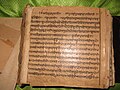 Opening folio of a Dasam Granth manuscript authored by Baba Deep Singh
,_circa_1880%27s.jpg)


See also
References
- ↑ Jacques, Tony (2006). Dictionary of Battles and Sieges. Greenwood Press. p. 400. ISBN 978-0-313-33536-5. Archived from the original on 26 June 2015. Retrieved 15 September 2017.
- ↑ Damdami Taksal opens shop to provide religious literature. Daily Excelsior.com
- ↑ Oberoi, Harjot Singh (15 December 1994). The Construction of Religious Boundaries: Culture, Identity, and Diversity in the Sikh Tradition. University of Chicago Press. p. 330. ISBN 9780226615929.
- ↑ Singh, Bhagat (1993). "The Shahid or Nihang Misal". A History of the Sikh Misals. Punjabi University. p. 241. OCLC 622730722.
Deep Singh Shahid, a Sandhu Jat and resident of the village of Pohuwind of the pargana of Amritsar, ...
- ↑ Shaheed Baba Deep Singh Ji[usurped]. SikhismGuide. Retrieved on 2017-07-09.
- ↑ Gupta, Hari Ram (2007). History of the Sikhs: The Sikh Comrnonwealth or Rise and FalI of Sikh Misls. Vol. IV. Munshiram Manoharlal Publishers. pp. 71–77. ISBN 978-8121501651.
- ↑ 7.0 7.1 Gupta, Hari Ram (2007). History of the Sikhs. Vol. 2: Evolution of Sikh Confederacies (1707-69). Munshiram Manoharlal. p. 57.
- ↑ Malik, Arjan Dass (1975). An Indian Guerilla War: The Sikh Peoples War, 1699-1768. Wiley. p. 44. ISBN 9780470565766.
- ↑ 9.0 9.1 9.2 History of the Sikhs: The Sikh Commonwealth or Rise and Fall of Sikh Misls. Vol. IV (3rd ed.). pp. 13, 73, 121. ISBN 9788121501651.
- ↑ Elliot, Henry Miers; Dowson, John, eds. (2013), "Chahár Gulzár Shujá'í, of Harí Charan Dás", The History of India, as Told by its Own Historians: The Muhammadan Period, Cambridge Library Collection - Perspectives from the Royal Asiatic Society, vol. 8, Cambridge: Cambridge University Press, pp. 204–231, doi:10.1017/CBO9781139507219.035, ISBN 978-1-108-05590-1, retrieved 14 September 2024
{{citation}}: CS1 maint: work parameter with ISBN (link) - ↑ Proceedings - Punjab History Conference. Vol. 20. Department of Punjab Historical Studies, Punjabi University. 1986. p. 114.
- ↑ History of the Sikhs, Volume I by Khushwant Singh.
- ↑ 13.0 13.1 Deol, Harnik (2000). Religion and Nationalism in India. London and New York: Routledge. The case of Punjab; 189. ISBN 9780415201087.
- ↑ Brosius, Christiane. Empowering Visions: The Politics of Representation in Hindu Nationalism. 2005, page 40.
- ↑ "Shaheed Baba Deep Singh". Santokh Singh Jagdev – Bed Time Stories-7. Archived from the original on 2 June 2009. Retrieved 16 June 2009.
- ↑ Mahajan, Vidya Dhar (1970). Muslim Rule in India. New Delhi: S.Chand. Rise and Growth of Sikh Power;240.
- ↑ "Anokhe Shahhed Baba Deep Singh". MX Player.
Further reading
- McLeod, W. H. (1991). Popular Sikh Art. Oxford University Press. pp. 38–39, 78. ISBN 978-0-19-562791-6.
- Thāpar, K.S. (2002). "DĪP SIṄGH SHAHĪD, BĀBĀ (1682-1757)". In Singh, Harbans (ed.). The Encyclopaedia of Sikhism: A–D. Vol. 1 (4th ed.). Punjabi University. pp. 587–588. ISBN 978-81-7380-100-6.
- Gupta, Hari Ram (2001) [1982]. History of the Sikhs. Vol. IV: The Sikh Commonwealth or Rise and Fall of Sikh Misls. Munshiram Manoharlal. pp. 121–124. ISBN 978-81-215-0165-1.
- Fenech, Louis E. (2000). Martyrdom in the Sikh Tradition: Playing the "game of Love" (1st ed.). Oxford University Press. pp. 35, 39, 42, 44, 95–9, 100, 168, 169, 197–8, 233, 264, 272. ISBN 978-0-19-564947-5.
- Fenech, Louis E.; Singh, Pashaura (2006). "Vows in the Sikh Tradition". In Raj, Selva J.; Harman, William P. (eds.). Dealing with Deities: The Ritual Vow in South Asia. State University of New York Press. pp. 210–211. ISBN 978-0-7914-6707-7.
- Chopra, Radhika (2018). Amritsar 1984: A City Remembers. Lexington Books. pp. 7–8, 55, 68–69. ISBN 978-1-4985-7105-0.