
robot: Create/upgrade articles. If there is a mistake please report on my talk page. |
small edit |
||
| Line 1: | Line 1: | ||
{{ | {{More citations needed|date=February 2024}} | ||
{{Infobox weapon | {{Infobox weapon | ||
| name = Aruval | | name = Aruval | ||
| Line 5: | Line 5: | ||
| caption = A typical aruval from Tamil Nadu. | | caption = A typical aruval from Tamil Nadu. | ||
| origin = [[Tamil Nadu, India]] | | origin = [[Tamil Nadu, India]] | ||
| type = Billhook | | type = Billhook machete | ||
<!-- Type selection --> | <!-- Type selection -->| is_ranged = no | ||
| is_ranged = no | |||
| is_bladed = yes | | is_bladed = yes | ||
| is_explosive = no | | is_explosive = no | ||
| Line 13: | Line 12: | ||
| is_vehicle = no | | is_vehicle = no | ||
| is_missile = no | | is_missile = no | ||
| is_UK = | | is_UK = <!-- Service history --> | ||
<!-- Service history --> | |||
| service = | | service = | ||
| used_by = | | used_by = | ||
| wars = | | wars = <!-- Production history --> | ||
<!-- Production history --> | |||
| designer = | | designer = | ||
| design_date = | | design_date = | ||
| Line 25: | Line 22: | ||
| production_date = | | production_date = | ||
| number = | | number = | ||
| variants = | | variants = <!-- General specifications --> | ||
<!-- General specifications --> | |||
| spec_label = | | spec_label = | ||
| weight = | | weight = | ||
| Line 34: | Line 30: | ||
| height = | | height = | ||
| diameter = | | diameter = | ||
| crew = | | crew = <!-- Ranged weapon specifications --> | ||
<!-- Ranged weapon specifications --> | |||
| cartridge = | | cartridge = | ||
| cartridge_weight = | | cartridge_weight = | ||
| Line 46: | Line 41: | ||
| max_range = | | max_range = | ||
| feed = | | feed = | ||
| sights = | | sights = <!-- Artillery specifications --> | ||
<!-- Artillery specifications --> | |||
| breech = | | breech = | ||
| recoil = | | recoil = | ||
| carriage = | | carriage = | ||
| elevation = | | elevation = | ||
| traverse = | | traverse = <!-- Bladed weapon specifications --> | ||
<!-- Bladed weapon specifications --> | |||
| blade_type = | | blade_type = | ||
| hilt_type = | | hilt_type = | ||
| sheath_type = | | sheath_type = | ||
| head_type = | | head_type = | ||
| haft_type = | | haft_type = <!-- Explosive specifications --> | ||
<!-- Explosive specifications --> | |||
| filling = | | filling = | ||
| filling_weight = | | filling_weight = | ||
| detonation = | | detonation = | ||
| yield = | | yield = <!-- Vehicle/missile specifications --> | ||
<!-- Vehicle/missile specifications --> | |||
| armour = | | armour = | ||
| primary_armament = | | primary_armament = | ||
| Line 79: | Line 70: | ||
| speed = | | speed = | ||
| guidance = | | guidance = | ||
| steering = | | steering = <!-- Missiles only --> | ||
<!-- Missiles only --> | |||
| wingspan = | | wingspan = | ||
| propellant = | | propellant = | ||
| Line 89: | Line 79: | ||
| accuracy = | | accuracy = | ||
| launch_platform = | | launch_platform = | ||
| transport = | | transport = | ||
}} | }} | ||
The '''aruval''' ( | The '''aruval''' ([[ISO 15919|ISO]]: {{Transliteration|ta|ISO|arivāḷ}}) is a type of [[billhook]] [[machete]] from [[southern India]], particularly common in the [[Tamil Nadu]] and [[Kerala]].<ref name="mint"/><ref name="deccan"/><ref name="toi"/> It is also known as the '''koḍuvāḷ''', the '''kodavali''', the '''machchu longu''' or the '''koita'''. It is a type of long [[sickle]] with a [[knife]]-like [[scythe]]-handle, and is used both as a tool and a weapon. Tamils revere the weapon as a symbol of [[Karuppu Sami|Karupannar]]. In popular culture, it is sometimes associated with gangsters, especially in the [[Rayalaseema]] region. In Kerala, its primary use is for agriculture, mainly in coconut cutting, clearing pathways, cutting wood and other uses. | ||
==Introduction== | ==Introduction== | ||
An aruval usually measures | An aruval usually measures {{convert|3-6|ft|abbr=on}} in length (hand sickle measures {{convert|1.5|ft|abbr=on}}). The blade of this weapon originates at the grip and extends to the main part of the blade. It can be described as a sickle with an extension. It can also be thought of as a [[sword]] with a reverse curve. The shorter versions were handy for breaking apart [[coconut]]s, and the longer versions were more like battle weapons. The shorter version is usually seen in small villages. [[Blade]]s are mostly straight with a curve towards the end, allowing it to function as a grabbing tool. The straight portion of the blade is also used for cutting, like a standard knife. | ||
==Variants and usage== | ==Variants and usage== | ||
While farmers typically employ the standard billhook machete ''kathir aruvāl'' ''[[koyttharivaal]]'' for harvesting crops, a longer variation called the ''veecharuvāl'' is used for clearing through wooded areas. In Kerala, Malayalam language references the semi-circular knife for paddy, called "koduval" and the regular sized billhook machete is known as "vaakathi" (coconut cutting); while the veecharuval is known simply as aruval. The veecharuval was also used as a weapon and is still used as such for self-defence in rural areas or gang warfare in cities. When not in use, the weaponised aruval was worn on the back, with the blade pointing downwards and the handle just behind the user's head. Some aruvals, such as those used | While farmers typically employ the standard billhook machete ''kathir aruvāl'' ''[[koyttharivaal]]'' for harvesting crops, a longer variation called the ''veecharuvāl'' is used for clearing through wooded areas. In Kerala, Malayalam language references the semi-circular knife for paddy, called "koduval" and the regular sized billhook machete is known as "vaakathi" (coconut cutting); while the veecharuval is known simply as aruval. The veecharuval was also used as a weapon and is still used as such for self-defence in rural areas or gang warfare in cities. When not in use, the weaponised aruval was worn on the back, with the blade pointing downwards and the handle just behind the user's head. Some aruvals, such as those used for [[Village deities of Tamil Nadu|Khaval Dheivam]], are {{convert|3.5|ft|abbr=on}} in length. | ||
{| | The aruval is often used for worshipping Hindu deities, such as [[Karuppu Sami]] and [[Aiyanar]].<ref name="mint"/> Craftsmen have made large, decorative aruval which are kept in temples, such as those in [[Sivagangai]] and [[Thiruppachethi]]. In 2017, an aruval measuring {{convert|27|ft}} was forged in [[Thirupuvanam, Sivaganga|Thirupuvanam]].<ref name="toi"/><ref name="deccan"/> | ||
|[[Image:Thirupatchi+copy.jpg| | |||
|[[ | <gallery> | ||
Image:Thirupatchi+copy.jpg | Veecharuval | |||
Image:aruval.jpg | Kathir aruval | |||
</gallery> | |||
== In culture == | |||
The aruval is a common fixture in many [[Cinema of South India|South Indian films]], in which it is often used as a weapon.<ref name="mint"/> The hero or villain often has the aruval in a sleeve sewn into the inside back of his shirt, and will pull it out by reaching behind his neck.{{citation needed|date=March 2024}} The film historian [[S. Theodore Baskaran]] has stated that using aruval as a weapon is largely a narrative cliche, and non-fictional murders using it occur relatively rarely.<ref name="mint"/> Nevertheless, the government prohibits aruvals over {{convert|2|ft}} for general purchase, as well as the veecharuvāl.<ref name="mint"/><ref name="toi" /> | |||
In Maharashtra, particularly Pune, Koita gangs are famous. | |||
A veecharuval was among the weapons used by [[Kraven the Hunter|the title character]] of ''[[Kraven the Hunter (film)|Kraven the Hunter]]''. | |||
In ''[[Mercy for None]]'', a [[Korean drama]], one of the foreign assassin use this as a weapon. | |||
==See also== | ==See also== | ||
*[[ | * [[Aiyanar]] | ||
* [[ | * [[Billhook]] | ||
* [[Karuppu Sami]] | |||
*[[Karuppu Sami | |||
* [[Machete]] | * [[Machete]] | ||
* [[ | * [[Madurai Veeran]] | ||
*[[ | * [[Village deities of South India]] | ||
*[[ | * [[Kraven the Hunter]] | ||
== References == | |||
<references> | |||
<ref name="toi">{{cite news |title=27-ft aruval to be unveiled today at Thirupuvanam |url=https://timesofindia.indiatimes.com/city/madurai/27-ft-aruval-to-be-unveiled-today-at-thirupuvanam/articleshow/57320085.cms |access-date=3 February 2024 |work=[[The Times of India]] |date=24 February 2017}}</ref> | |||
<ref name="deccan">{{cite news |last1=Thirunavukarasu |first1=S |title=Sivagangai: 18-foot aruval to adorn hand of village deity |url=https://www.deccanchronicle.com/nation/in-other-news/160716/sivagangai-18-foot-aruval-to-adorn-hand-of-village-deity.html |access-date=3 February 2024 |work=[[Deccan Chronicle]] |date=16 July 2016 |language=en}}</ref> | |||
<ref name="mint">{{cite web |title=Did Tamil films give the aruval a bad name? |url=https://lifestyle.livemint.com/news/big-story/is-the-thiruppachethi-aruval-a-tool-or-a-weapon-111633679832798.html |website=[[Mint (newspaper)|Mintlounge]] |access-date=3 February 2024 |language=en |date=12 October 2021}}</ref> | |||
</references> | |||
[[Category: | [[Category:Edged and bladed weapons]] | ||
[[Category:Machetes]] | |||
[[Category:Weapons of India]] | [[Category:Weapons of India]] | ||
[[Category:Indian | [[Category:Indian martial arts]] | ||
Latest revision as of 02:22, 8 February 2026
 | This article needs additional citations for verification. (February 2024) |
| Aruval | |
|---|---|
 A typical aruval from Tamil Nadu. | |
| Type | Billhook machete |
| Place of origin | Tamil Nadu, India |
| Specifications | |
| Length | 3 to 6 feet (0.91 to 1.83 m) |
The aruval (ISO: arivāḷ) is a type of billhook machete from southern India, particularly common in the Tamil Nadu and Kerala.[1][2][3] It is also known as the koḍuvāḷ, the kodavali, the machchu longu or the koita. It is a type of long sickle with a knife-like scythe-handle, and is used both as a tool and a weapon. Tamils revere the weapon as a symbol of Karupannar. In popular culture, it is sometimes associated with gangsters, especially in the Rayalaseema region. In Kerala, its primary use is for agriculture, mainly in coconut cutting, clearing pathways, cutting wood and other uses.
Introduction[edit | edit source]
An aruval usually measures 3–6 ft (0.91–1.83 m) in length (hand sickle measures 1.5 ft (0.46 m)). The blade of this weapon originates at the grip and extends to the main part of the blade. It can be described as a sickle with an extension. It can also be thought of as a sword with a reverse curve. The shorter versions were handy for breaking apart coconuts, and the longer versions were more like battle weapons. The shorter version is usually seen in small villages. Blades are mostly straight with a curve towards the end, allowing it to function as a grabbing tool. The straight portion of the blade is also used for cutting, like a standard knife.
Variants and usage[edit | edit source]
While farmers typically employ the standard billhook machete kathir aruvāl koyttharivaal for harvesting crops, a longer variation called the veecharuvāl is used for clearing through wooded areas. In Kerala, Malayalam language references the semi-circular knife for paddy, called "koduval" and the regular sized billhook machete is known as "vaakathi" (coconut cutting); while the veecharuval is known simply as aruval. The veecharuval was also used as a weapon and is still used as such for self-defence in rural areas or gang warfare in cities. When not in use, the weaponised aruval was worn on the back, with the blade pointing downwards and the handle just behind the user's head. Some aruvals, such as those used for Khaval Dheivam, are 3.5 ft (1.1 m) in length.
The aruval is often used for worshipping Hindu deities, such as Karuppu Sami and Aiyanar.[1] Craftsmen have made large, decorative aruval which are kept in temples, such as those in Sivagangai and Thiruppachethi. In 2017, an aruval measuring 27 feet (8.2 m) was forged in Thirupuvanam.[3][2]
-
 Veecharuval
 -
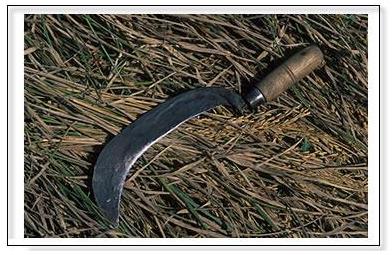 Kathir aruval


In culture[edit | edit source]
The aruval is a common fixture in many South Indian films, in which it is often used as a weapon.[1] The hero or villain often has the aruval in a sleeve sewn into the inside back of his shirt, and will pull it out by reaching behind his neck.[citation needed] The film historian S. Theodore Baskaran has stated that using aruval as a weapon is largely a narrative cliche, and non-fictional murders using it occur relatively rarely.[1] Nevertheless, the government prohibits aruvals over 2 feet (0.61 m) for general purchase, as well as the veecharuvāl.[1][3]
In Maharashtra, particularly Pune, Koita gangs are famous.
A veecharuval was among the weapons used by the title character of Kraven the Hunter.
In Mercy for None, a Korean drama, one of the foreign assassin use this as a weapon.
See also[edit | edit source]
- Aiyanar
- Billhook
- Karuppu Sami
- Machete
- Madurai Veeran
- Village deities of South India
- Kraven the Hunter
References[edit | edit source]
- ↑ 1.0 1.1 1.2 1.3 1.4 "Did Tamil films give the aruval a bad name?". Mintlounge. 12 October 2021. Retrieved 3 February 2024.
- ↑ 2.0 2.1 Thirunavukarasu, S (16 July 2016). "Sivagangai: 18-foot aruval to adorn hand of village deity". Deccan Chronicle. Retrieved 3 February 2024.
- ↑ 3.0 3.1 3.2 "27-ft aruval to be unveiled today at Thirupuvanam". The Times of India. 24 February 2017. Retrieved 3 February 2024.