
No edit summary |
|||
| Line 1: | Line 1: | ||
{{Short description|Species of tree}} | {{Short description|Species of tree}} | ||
{{Distinguish|Ziziphus jujuba|Paliurus spina-christi}} | {{Distinguish|Ziziphus jujuba|Paliurus spina-christi|Ziziphus nummularia}} | ||
{{Speciesbox | {{Speciesbox | ||
|image = Ziziphus-areva-israel.jpg | |image = Ziziphus-areva-israel.jpg | ||
|status = LC | |||
|status_system = IUCN3.1 | |||
|status_ref = <ref name=IUCN>{{cite iucn |last1=Diop |first1=F.N. |year=2020 |title=''Ziziphus spina-christi'' |volume=2020 |article-number=e.T19180920A136676175 |doi=10.2305/IUCN.UK.2020-3.RLTS.T19180920A136676175.en |access-date=4 June 2024}}</ref> | |||
|genus = Ziziphus | |genus = Ziziphus | ||
|species = spina-christi | |species = spina-christi | ||
|authority = ([[Carl Linnaeus|L.]])[[René Louiche Desfontaines|Desf.]] | |authority = ([[Carl Linnaeus|L.]]) [[René Louiche Desfontaines|Desf.]] | ||
|synonyms = | |synonyms =*''Rhamnus spina-christi'' <small>L.</small> | ||
*''Rhamnus spina-christi'' <small>L.</small> | |||
|synonyms_ref = <ref>{{citation | |synonyms_ref = <ref>{{citation | ||
|url=http://www.theplantlist.org/tpl1.1/record/tro-27501041 | |url=http://www.theplantlist.org/tpl1.1/record/tro-27501041 | ||
| Line 16: | Line 16: | ||
}} | }} | ||
'''''Ziziphus spina-christi''''', known as the '''Christ's thorn jujube''', is | '''''Ziziphus spina-christi''''', known as the '''Christ's thorn jujube''', is a thorny<ref>[[American University of Beirut]]. [https://landscapeplants.aub.edu.lb/Plants/GetPDF/ca295a0a-a2a7-48f9-b7be-1f9dae986bd4 Zizyphus spina christi (Christ's Thorn Jujube)]. Retrieved on 27 May, 2025</ref> and [[evergreen]] tree or plant. | ||
== Distribution and habitat == | |||
It is native to the [[Levant]], [[East Africa]], and [[Mesopotamia]].<ref>{{cite web|title=''Zizyphus spina-Christi''|work=5Agroforestry Database 4.0|last=Orwa|display-authors=etal|date=2009|url= http://www.worldagroforestry.org/treedb/AFTPDFS/Zizyphus_spina-christi.PDF|archive-url=https://web.archive.org/web/20150212174420/http://www.worldagroforestry.org/treedb/AFTPDFS/Zizyphus_spina-christi.PDF|archive-date=2015-02-12}}</ref> | |||
==Ecology== | ==Ecology== | ||
In the Levant, it grows in valleys up to an elevation of 500 | In the Levant, it grows in valleys up to an elevation of {{Convert|500|m}},<ref>{{cite book|author=Zohary M.|title=Flora Palaestina. II.|location=Jerusalem|publisher=The Israel Academy of Science and Humanities|year=1972|pages=307–308}} Cited in {{cite journal|title=The ethnobotany of Christ's Thorn Jujube (''Ziziphus spina-christi'') in Israel|author1=Amots Dafni|author2=Shay Levy|author3=Efraim Lev|author3-link=Efraim Lev|name-list-style=amp|pmc=1277088|pmid=16270941|doi=10.1186/1746-4269-1-8|volume=1|year=2005|journal=J Ethnobiol Ethnomed|article-number=8 |doi-access=free }}</ref> and is drought tolerant and heat-resistant.<ref>[[World Agroforestry Centre]]. [https://apps.worldagroforestry.org/treedb/AFTPDFS/Zizyphus_spina-christi.PDF Zizyphus spina-christi]. Retrieved on 31 May, 2023</ref> The seed, contained within a small, oblong woody pit, is opened and eaten by local fauna, including the [[rock hyrax]]. | ||
== | ==Uses== | ||
The ripe fruits are edible.<ref>{{cite web |author=Reinhard Fichtl |title=Christ's Thorn - Ziziphus spina-Christi |url=http://www.beesfordevelopment.org/info/info/flora/christs-thorn-ziziphus-sp.shtml |archive-url=https://web.archive.org/web/20100424201940/http://www.beesfordevelopment.org/info/info/flora/christs-thorn-ziziphus-sp.shtml |archive-date=April 24, 2010 |website=Bees for Development}}</ref> | |||
Historically, it was utilized in ancient Egyptian medicine for its supposed anti-inflammatory properties, specifically in treating pain, swelling, and heat. An ''[[in vitro]]'' study has suggested that the plant might have anti-inflammatory properties, identifying active compounds such as epigallocatechin and gallocatechin that inhibit inflammatory pathways like NF-κB.<ref>{{cite journal |last1=Kadioglu |first1=Onat |last2=Jacob |first2=Stefan |last3=Bohnert |first3=Stefan |last4=Naß |first4=Janine |last5=Saeed |first5=Mohamed E M |last6=Khalid |first6=Hassan |last7=Merfort |first7=Irmgard |last8=Thines |first8=Eckhard |last9=Pommerening |first9=Tanja |last10=Efferth |first10=Thomas |title=Evaluating ancient Egyptian prescriptions today: Anti-inflammatory activity of Ziziphus spina-christi |journal=Phytomedicine |volume=23 |issue=4 |pages=361–369 |date=April 2016 |doi=10.1016/j.phymed.2016.01.004 |pmid=26969383}}</ref> | |||
== | == In culture == | ||
In the Levant and wider [[Middle East]], it is called ''[[Sidrat al-Muntaha|sidr]]'' (associated with the lote tree of the [[Quran]]),{{fact|date=July 2025}} and is common in the [[Jordan Valley]] and around [[Jerusalem]],{{sfnp|Easton|1893|p=688|ps=, "It overruns a great part of the Jordan valley."}} as well as in the [[Hajar Mountains]] of the [[United Arab Emirates]].<ref>{{Cite book |last=Lancaster |first=William |title=Honour is in contentment: life before oil in Ras al-Khaimah (UAE) and some neighbouring regions |date=2011 |publisher=De Gruyter |others=Lancaster, Fidelity. |isbn=978-3-11-022340-8 |location=Berlin |page=137 |oclc=763160662}}</ref> By some traditions, it was the tree from which the [[crown of thorns]] of [[Jesus]] was made.<ref>{{cite web |title=''Ziziphus spina-christi'' |url=http://www.flowersinisrael.com/Ziziphusspina-christi_page.htm |access-date=2015-03-09 |publisher=Flowersinisrael.com}}</ref> [[Matthew George Easton]] argues that ''Z. spina-christi'' is too brittle to be bent into a crown, and suggests another local plant, ''[[Ziziphus lotus]]''.{{sfnp|Easton|1893|p=174}} | |||
The oldest known ''Z. spina-christi'' is located in [[Ir Ovot]] southern [[Israel]].<ref>{{cite news |last1=Bar-am |first1=Aviva |last2=Bar-am |first2=Shmuel |date=15 November 2014 |title=Rooted in Israel's history, five remarkable trees |url=https://www.timesofisrael.com/rooted-in-israels-history-five-remarkable-trees/ |work=[[Times of Israel]]}}</ref> It is estimated to be between 1500 and 2000 years old.<ref>{{cite web |title=The "old man" of Hatzeva – the jujube tree at Hatzeva Spring |url=https://www.moag.gov.il/en/Subjects/hugging_a_tree/Hiking_routes_and_tales_of_trees/Ancient_Trees/old_man/Pages/default.aspx |website=www.moag.gov.il |publisher=Ministry of Agriculture & Rural Development |language=en}}</ref><ref>{{cite news |last1=Grossman |first1=Michelle Malka |date=24 January 2016 |title=Israeli trees get IDs with interactive heritage project |url=https://www.jpost.com/Business-and-Innovation/Environment/Israeli-trees-get-IDs-with-interactive-heritage-project-442639 |access-date=27 October 2019 |work=[[The Jerusalem Post]]}}</ref> It is believed locally to be the very tree from which Jesus' crown of thorns was made.<ref>{{cite news |last1=Sutton |first1=Candace |date=20 April 2019 |title=The real story of Jesus Christ's crown of thorns |url=https://www.news.com.au/lifestyle/real-life/news-life/the-real-story-of-jesus-christs-crown-of-thorns/news-story/ec56fd4a5016c533aabcc08e8bcdd72d |access-date=27 October 2019 |work=[[news.com.au]]}}</ref> It is the national tree of [[Qatar]] and the symbol of [[Arabah]].{{fact|date=June 2025}} | |||
File:درخت کنار خودرو، بهبهان.jpg|alt=Wild Ziziphus Tree, Behbahan|Wild | |||
File:میوه درخت کنار، بهبهان.jpg|alt=Behbahan| | In the Philippines, the [[Blaan people]] called it ''dadiangas''. This was the former name of the city of [[General Santos]].{{cn|date=June 2025}} | ||
== Gallery == | |||
<gallery mode=packed heights="160px"> | |||
File:درخت کنار خودرو، بهبهان.jpg|alt=Wild Ziziphus Tree, Behbahan|Wild tree in Iran | |||
File:Ziziphus spina-christi - Jujubier de Palestine.jpg|Thorns, [[Jardin des plantes]], France | |||
File:شکوفه درخت کنار، بهبهان.jpg|alt=Ziziphus Spina-Christi Blossom|Blossom, [[Behbahan]], Iran | |||
File:Zizyphus spina-christi.jpg|Fruit, in Israel | |||
File:میوه درخت کنار، بهبهان.jpg|alt=Behbahan|Fruit, Behbahan, Iran | |||
</gallery> | </gallery> | ||
==References== | ==References== | ||
{{Reflist|40em}} | {{Reflist|40em}} | ||
==Bibliography== | |||
* {{cite book|title=Illustrated Bible Dictionary and Treasury of Biblical History, Biography, Geography, Doctrine, and Literature: With Numerous Illustrations and Important Chronological Tables and Maps|last=Easton|first=M.G.|author-link=Matthew George Easton|year=1893|location=London, Edinburgh and New York|publisher=T. Nelson and Sons}} | * {{cite book|title=Illustrated Bible Dictionary and Treasury of Biblical History, Biography, Geography, Doctrine, and Literature: With Numerous Illustrations and Important Chronological Tables and Maps|last=Easton|first=M.G.|author-link=Matthew George Easton|year=1893|location=London, Edinburgh and New York|publisher=T. Nelson and Sons}} | ||
{{WestAfricanPlants|Ziziphus spina-christi}} | {{WestAfricanPlants|Ziziphus spina-christi}} | ||
==External links== | ==External links== | ||
{{Commons | {{Commons}} | ||
* [http://www.desertoverde.ch/album/ziziphus-spina-christi/ziziphus-spina-christi-spine-jpg/ Thorns of Ziziphus spina-christi] | * [http://www.desertoverde.ch/album/ziziphus-spina-christi/ziziphus-spina-christi-spine-jpg/ Thorns of Ziziphus spina-christi] {{Webarchive|url=https://web.archive.org/web/20160314151803/http://www.desertoverde.ch/album/ziziphus-spina-christi/ziziphus-spina-christi-spine-jpg/ |date=2016-03-14 }} | ||
* [http://www.flowersinisrael.com/ziziphusspina-christi_page.htm Flowers in Israel - Ziziphus spina-christi] | * [http://www.flowersinisrael.com/ziziphusspina-christi_page.htm Flowers in Israel - Ziziphus spina-christi] | ||
| Line 53: | Line 66: | ||
[[Category:Flora of Northeast Tropical Africa]] | [[Category:Flora of Northeast Tropical Africa]] | ||
[[Category:Flora of Western Asia]] | [[Category:Flora of Western Asia]] | ||
[[Category:Trees in religion]] | [[Category:Trees in religion]] | ||
[[Category:Ziziphus|spina-christi]] | [[Category:Ziziphus|spina-christi]] | ||
[[Category:Crown of thorns]] | |||
[[Category:Botanical taxa named by Carl Linnaeus]] | |||
[[Category:Plants described in 1753]] | |||
[[Category:Plants with thorns]] | |||
Latest revision as of 10:38, 8 March 2026
| Ziziphus spina-christi | |
|---|---|

| |
Scientific classification 
| |
| : | [[Template:Taxonomy/Ziziphus]] |
| Species: | Template:Taxonomy/ZiziphusZ. spina-christi
|
| Binomial name | |
| Template:Taxonomy/ZiziphusZiziphus spina-christi | |
| Synonyms[2] | |
| |
Ziziphus spina-christi, known as the Christ's thorn jujube, is a thorny[3] and evergreen tree or plant.
Distribution and habitat[edit | edit source]
It is native to the Levant, East Africa, and Mesopotamia.[4]
Ecology[edit | edit source]
In the Levant, it grows in valleys up to an elevation of 500 metres (1,600 ft),[5] and is drought tolerant and heat-resistant.[6] The seed, contained within a small, oblong woody pit, is opened and eaten by local fauna, including the rock hyrax.
Uses[edit | edit source]
The ripe fruits are edible.[7]
Historically, it was utilized in ancient Egyptian medicine for its supposed anti-inflammatory properties, specifically in treating pain, swelling, and heat. An in vitro study has suggested that the plant might have anti-inflammatory properties, identifying active compounds such as epigallocatechin and gallocatechin that inhibit inflammatory pathways like NF-κB.[8]
In culture[edit | edit source]
In the Levant and wider Middle East, it is called sidr (associated with the lote tree of the Quran),[citation needed] and is common in the Jordan Valley and around Jerusalem,[9] as well as in the Hajar Mountains of the United Arab Emirates.[10] By some traditions, it was the tree from which the crown of thorns of Jesus was made.[11] Matthew George Easton argues that Z. spina-christi is too brittle to be bent into a crown, and suggests another local plant, Ziziphus lotus.[12]
The oldest known Z. spina-christi is located in Ir Ovot southern Israel.[13] It is estimated to be between 1500 and 2000 years old.[14][15] It is believed locally to be the very tree from which Jesus' crown of thorns was made.[16] It is the national tree of Qatar and the symbol of Arabah.[citation needed]
In the Philippines, the Blaan people called it dadiangas. This was the former name of the city of General Santos.[citation needed]
Gallery[edit | edit source]
-
 Wild tree in Iran
 -
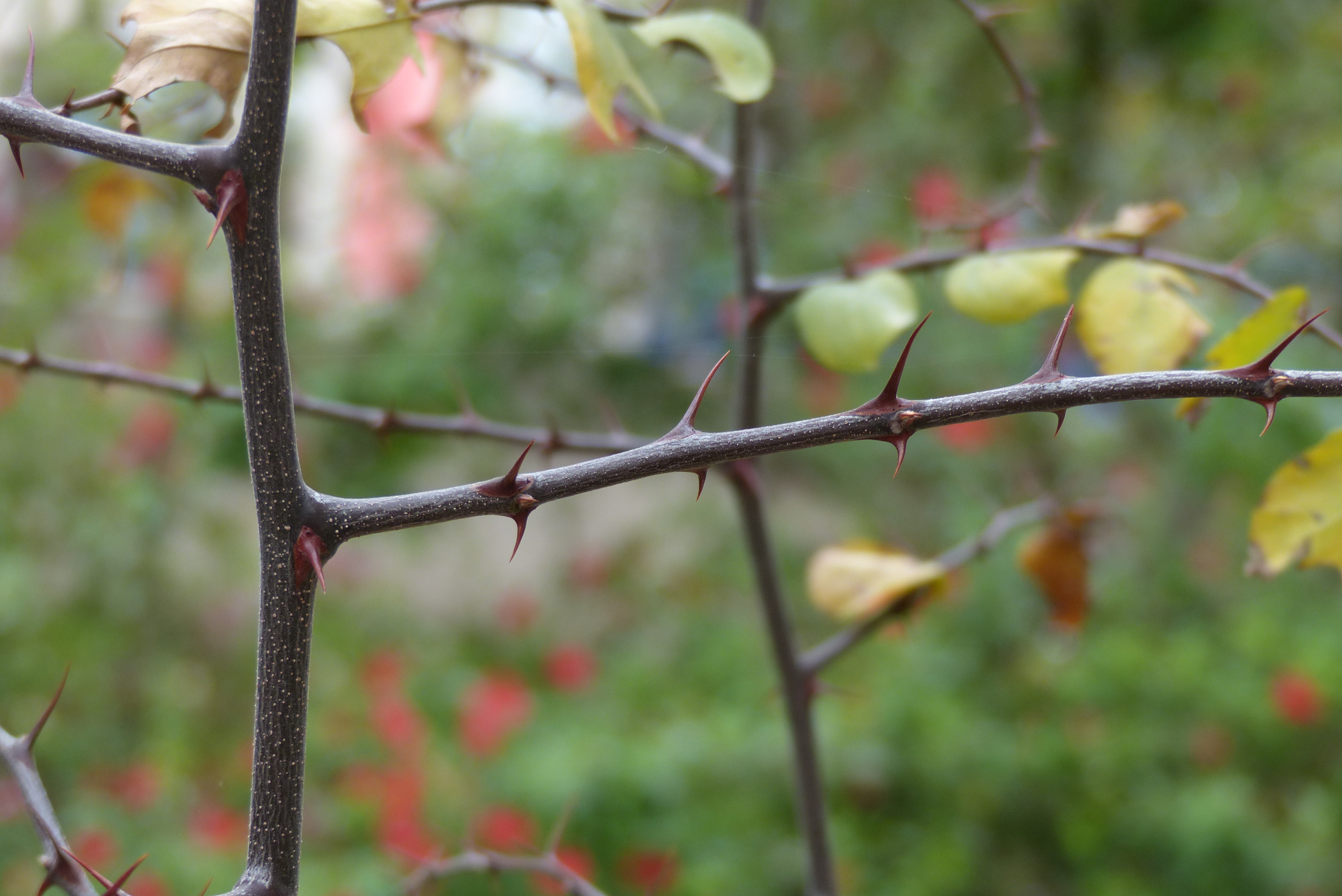 Thorns, Jardin des plantes, France
 -
 Blossom, Behbahan, Iran
 -
 Fruit, in Israel
 -
 Fruit, Behbahan, Iran


References[edit | edit source]
- ↑ Diop, F.N. (2020). "Ziziphus spina-christi". IUCN Red List of Threatened Species. 2020 e.T19180920A136676175. doi:10.2305/IUCN.UK.2020-3.RLTS.T19180920A136676175.en. Retrieved 4 June 2024.
- ↑ The Plant List: A Working List of All Plant Species, retrieved 30 January 2016
- ↑ American University of Beirut. Zizyphus spina christi (Christ's Thorn Jujube). Retrieved on 27 May, 2025
- ↑ Orwa; et al. (2009). "Zizyphus spina-Christi" (PDF). 5Agroforestry Database 4.0. Archived from the original (PDF) on 2015-02-12.
- ↑ Zohary M. (1972). Flora Palaestina. II. Jerusalem: The Israel Academy of Science and Humanities. pp. 307–308. Cited in Amots Dafni; Shay Levy & Efraim Lev (2005). "The ethnobotany of Christ's Thorn Jujube (Ziziphus spina-christi) in Israel". J Ethnobiol Ethnomed. 1 8. doi:10.1186/1746-4269-1-8. PMC 1277088. PMID 16270941.
- ↑ World Agroforestry Centre. Zizyphus spina-christi. Retrieved on 31 May, 2023
- ↑ Reinhard Fichtl. "Christ's Thorn - Ziziphus spina-Christi". Bees for Development. Archived from the original on April 24, 2010.
- ↑ Kadioglu, Onat; Jacob, Stefan; Bohnert, Stefan; Naß, Janine; Saeed, Mohamed E M; Khalid, Hassan; Merfort, Irmgard; Thines, Eckhard; Pommerening, Tanja; Efferth, Thomas (April 2016). "Evaluating ancient Egyptian prescriptions today: Anti-inflammatory activity of Ziziphus spina-christi". Phytomedicine. 23 (4): 361–369. doi:10.1016/j.phymed.2016.01.004. PMID 26969383.
- ↑ Easton (1893), p. 688, "It overruns a great part of the Jordan valley."
- ↑ Lancaster, William (2011). Honour is in contentment: life before oil in Ras al-Khaimah (UAE) and some neighbouring regions. Lancaster, Fidelity. Berlin: De Gruyter. p. 137. ISBN 978-3-11-022340-8. OCLC 763160662.
- ↑ "Ziziphus spina-christi". Flowersinisrael.com. Retrieved 2015-03-09.
- ↑ Easton (1893), p. 174.
- ↑ Bar-am, Aviva; Bar-am, Shmuel (15 November 2014). "Rooted in Israel's history, five remarkable trees". Times of Israel.
- ↑ "The "old man" of Hatzeva – the jujube tree at Hatzeva Spring". www.moag.gov.il. Ministry of Agriculture & Rural Development.
- ↑ Grossman, Michelle Malka (24 January 2016). "Israeli trees get IDs with interactive heritage project". The Jerusalem Post. Retrieved 27 October 2019.
- ↑ Sutton, Candace (20 April 2019). "The real story of Jesus Christ's crown of thorns". news.com.au. Retrieved 27 October 2019.
Bibliography[edit | edit source]
- Easton, M.G. (1893). Illustrated Bible Dictionary and Treasury of Biblical History, Biography, Geography, Doctrine, and Literature: With Numerous Illustrations and Important Chronological Tables and Maps. London, Edinburgh and New York: T. Nelson and Sons.
- Ziziphus spina-christi in West African plants – A Photo Guide.