

Ndizzy4glo (talk | contribs) m adjusted structure after review for clarity |
|||
| Line 1: | Line 1: | ||
{{Short description|Species of conifer}} | {{Short description|Species of conifer}} | ||
{{ | {{Speciesbox | ||
| image = Pinus kesiya | | image = Pine trees along Staunton Road (Sagada, Mountain Province; 12-02-2022).jpg | ||
|image2=Pinus kesiya | |image_caption=''Pinus kesiya'' forest in [[Sagada]], Luzon, Philippines | ||
|image2_caption= | |image2=Pericrocotus ethologus in Pinus kesiya, Doi Pha Hom Pok NP, Thailand 104701641.jpg | ||
|image2_caption=Foliage and cones (with two [[long-tailed minivet]]s), [[Doi Pha Hom Pok National Park]], Thailand | |||
| status = LC | | status = LC | ||
| status_system = IUCN3.1 | | status_system = IUCN3.1 | ||
| status_ref = <ref name="iucn status 19 November 2021">{{cite iucn |author=Farjon, A. |date=2013 |title=''Pinus kesiya'' |volume=2013 | | | status_ref = <ref name="iucn status 19 November 2021">{{cite iucn |author=Farjon, A. |date=2013 |title=''Pinus kesiya'' |volume=2013 |article-number=e.T42372A2975925 |doi=10.2305/IUCN.UK.2013-1.RLTS.T42372A2975925.en |access-date=19 November 2021}}</ref> | ||
| display_parents = 3 | | display_parents = 3 | ||
| genus = Pinus | | genus = Pinus | ||
| parent = Pinus subsect. Pinus | | parent = Pinus subsect. Pinus | ||
| species = kesiya | | species = kesiya | ||
| authority = [[John Forbes Royle|Royle]] ex [[George Gordon (botanist)|Gordon]] | | authority = [[John Forbes Royle|Royle]] ex [[George Gordon (botanist)|Gordon]] (1840) | ||
| subdivision_ranks = Varieties | |||
| subdivision = See text | |||
| subdivision_ref = <ref name = powo>[https://powo.science.kew.org/taxon/urn:lsid:ipni.org:names:677057-1 ''Pinus kesiya'' Royle ex Gordon]. ''[[Plants of the World Online]]''. Retrieved 12 August 2024.</ref> | |||
}} | }} | ||
'''''Pinus kesiya''''' ('''Khasi pine''' | '''''Pinus kesiya''''' ('''Khasi pine''' or '''Benguet pine''') is one of the most widely distributed [[pine]]s in southeast Asia. Its range extends south and east from the [[Khasi Hills]] in the northeast [[India]]n state of [[Meghalaya]], to [[Burma]], northern [[Thailand]], [[Cambodia]], [[Laos]], southernmost [[China]], [[Vietnam]], and the [[Philippines]]. It is an important plantation species elsewhere in the world, including in southern [[Africa]] and [[South America]].<ref name=vietnam>{{Cite book | ||
|isbn = 1-872291-64-3 | |isbn = 1-872291-64-3 | ||
|last = Luu | |last = Luu | ||
| Line 23: | Line 27: | ||
|url = http://www.ceh.ac.uk/sections/bm/conifer_manual.html | |url = http://www.ceh.ac.uk/sections/bm/conifer_manual.html | ||
|pages = 42–43 | |pages = 42–43 | ||
| | |publisher = Nhà xuất bản Thế giới | ||
| | |archive-url = https://web.archive.org/web/20070519165835/http://www.ceh.ac.uk/sections/bm/conifer_manual.html | ||
| | |archive-date = 2007-05-19 | ||
}}</ref><ref name=icnaf>{{cite web| url=http://www.worldagroforestrycentre.org/sea/Products/AFDbases/af/asp/SpeciesInfo.asp?SpID=18165 |title=''Pinus kesiya'' |work=AgroForestryTree Database |publisher=International Centre for Research in Agroforestry| | }}</ref><ref name=icnaf>{{cite web |url=http://www.worldagroforestrycentre.org/sea/Products/AFDbases/af/asp/SpeciesInfo.asp?SpID=18165 |title=''Pinus kesiya'' |work=AgroForestryTree Database |publisher=International Centre for Research in Agroforestry |access-date=17 April 2012 |archive-date=6 April 2012 |archive-url=https://web.archive.org/web/20120406080116/http://www.worldagroforestrycentre.org/sea/Products/AFDbases/af/asp/SpeciesInfo.asp?SpID=18165 }}</ref> | ||
The common name "Khasi pine" is from the Khasi hills in India, and "Benguet pine" is from the landlocked province of [[Benguet]] in [[Luzon]], Philippines, where it is the dominant species of the [[Luzon tropical pine forests]]. The Benguet pine is sometimes treated as a separate species, '''''Pinus insularis'''''; however, the current opinion is to treat | The common name "Khasi pine" is from the Khasi hills in India, and "Benguet pine" is from the landlocked province of [[Benguet]] in [[Luzon]], Philippines, where it is the dominant species of the [[Luzon tropical pine forests]] (known as ''saleng'' in [[Ilocano language|Ilocano]]<ref>{{cite journal |last1=Li |first1=Paul Jen-kuei |title=Some notes on animals and plants for Proto-Austronesian speakers |journal=Language and Linguistics. 語言暨語言學 |date=July 2022 |page=266 |doi=10.1075/lali.18.2.04li|doi-access=free }}</ref>). The Benguet pine is sometimes treated as a separate species, '''''Pinus insularis'''''; however, the current opinion is to treat this as conspecific with ''P. kesiya'' var. ''langbianensis''.<ref name = powo/> The city of [[Baguio]] is nicknamed "The City of Pines", as it is noted for large stands of this tree. | ||
==Description== | ==Description== | ||
[[File:Bark of Benguet Pine.JPG|thumb|upright|left| | [[File:Bark of Benguet Pine.JPG|thumb|upright|left|''Pinus kesiya'' bark]] | ||
''Pinus kesiya'' is a [[tree]] reaching up to {{Convert|30–35|m|abbr=off}} tall with a straight, cylindrical trunk. The [[Bark (botany)|bark]] is thick | ''Pinus kesiya'' is a [[tree]] reaching up to {{Convert|30–35|m|abbr=off}} tall with a straight, cylindrical trunk. The [[Bark (botany)|bark]] is thick, dark brown, and scaly with deep longitudinal fissures. The branches are robust, red brown from the second year, the branchlets horizontal to upcurved. The [[leaves]] are needle-like, dark green, usually three per [[Fascicle (botany)|fascicle]], {{Convert|12–20|cm|abbr=off|frac=2}} long, the fascicle sheath {{Convert|1–2|cm|abbr=on|frac=4}} long and persistent. The [[Conifer cone|cones]] are ovoid, {{Convert|5–9|cm|abbr=on|frac=4}} long, often curved downwards, sometimes slightly oblique; the scales of second-year cones are dense, the [[Pinus|umbo]] a little convex, with a small prickle. The scales have transverse and longitudinal ridges across the middle of the scale surface. The [[seed]]s are winged, {{Convert|6–7|mm|frac=32}} long with a 1.5–2.5 cm wing. Pollination occurs in mid-spring, with the cones maturing 18–24 months after.<ref name="GD">{{cite web | title=''Pinus kesiya'' description | website=The Gymnosperm Database | date=2025-11-11 | url=https://www.conifers.org/pi/Pinus_kesiya.php | access-date=2025-11-15}}</ref> | ||
Khasi pine usually grows in pure stands or mixed with broad-leaved trees | Khasi pine usually grows in pure stands or mixed with broad-leaved trees.<ref name="GD"/> | ||
{{ | ==Taxonomy== | ||
''Pinus kesiya'' is a member of the largely Eurasian nominate group ''Pinus'' subgenus ''Pinus'', section ''Pinus'', distinguished by the cone umbo having an offset prickle on the umbo.<ref>{{cite journal | last=Klaus | first=Wilhelm | title=Neue Beobachtungen zur Morphologie des Zapfens von ''Pinus'' und ihre Bedeutung für die Systematik, Fossilbestimmung, Arealgestaltung und Evolution der Gattung / New Observations on the Morphology of ''Pinus''-Cones and Their Bearing on Taxonomy, Fossil Determination, Distribution, and Evolution of the Genus | journal=Plant Systematics and Evolution | publisher=Springer | volume=134 | issue=3/4 | year=1980 | issn=03782697 | jstor=23642506 | pages=137–171 | url=http://www.jstor.org/stable/23642506 | access-date=2025-11-01}}</ref> | |||
Two [[variety (botany)|varieties]] are accepted by the [[Plants of the World Online]] database:<ref name = powo/> | |||
*''Pinus kesiya'' var. ''kesiya'' | |||
*''Pinus kesiya'' var. ''langbianensis'' {{small|(A.Chev.) Gaussen ex Bui}} | |||
They are only minimally distinct, with var. ''langbianensis'' cited as having on average shorter needles 12–16 cm long as opposed to 12–20 cm in var. ''kesiya'';<ref name="GD"/> not all authors consider them distinct, treating the species as monotypic.<ref name="Businský2008">{{cite book | last=Businský | first=Roman | title=The genus ''Pinus'' L., pines : contribution to knowledge | date=2008 | isbn=978-80-85116-60-1 | language=cs }}</ref> | |||
==Uses== | ==Uses== | ||
The soft and light [[timber]] of ''Pinus kesiya'' can be used for a wide range of applications, including boxes, paper pulp, and temporary electric poles. It is intensely used for timber, both sourced in natural forests and plantations.<ref name=vietnam/><ref name=icnaf/> | The soft and light [[timber]] of ''Pinus kesiya'' can be used for a wide range of applications, including boxes, paper pulp, and temporary electric poles. It is intensely used for timber, both sourced in natural forests and plantations.<ref name=vietnam/><ref name=icnaf/> | ||
The good-quality [[resin]] is not abundant and has not been much used except during the Spanish colonial period in the Philippines for the production of [[turpentine]].{{ | The good-quality [[resin]] is not abundant and has not been much used except during the Spanish colonial period in the Philippines for the production of [[turpentine]].<ref>{{cite web|publisher=[[The Field Museum]]|url=http://archive.fieldmuseum.org/vanishing_treasures/V_Pines.htm|website=Vanishing Treasures|first1=Lawrence R.|last1=Heaney|first2=Jacinto C., Jr.|last2=Regaldo |title=Philippine Pines|date=2007}}</ref> | ||
{{Clear left}} | |||
== | |||
==References== | ==References== | ||
| Line 57: | Line 65: | ||
{{Taxonbar|from=Q1939271}} | {{Taxonbar|from=Q1939271}} | ||
{{Authority control}} | |||
[[Category:Pinus|Kesiya]] | [[Category:Pinus|Kesiya]] | ||
[[Category:Trees of China]] | [[Category:Trees of China]] | ||
[[Category:Flora of Assam (region)]] | [[Category:Flora of Assam (region)]] | ||
[[Category:Flora of Bangladesh]] | [[Category:Flora of Bangladesh]] | ||
[[Category:Trees of Indo-China]] | [[Category:Trees of Indo-China]] | ||
[[Category:Trees of the Philippines]] | [[Category:Trees of the Philippines]] | ||
[[Category:Plants described in 1840]] | |||
Latest revision as of 05:23, 16 November 2025
| Pinus kesiya | |
|---|---|
.jpg)
| |
| Pinus kesiya forest in Sagada, Luzon, Philippines | |

| |
| Foliage and cones (with two long-tailed minivets), Doi Pha Hom Pok National Park, Thailand | |
Scientific classification 
| |
| : | [[Template:Taxonomy/Pinus subsect. Pinus]] |
| Species: | Template:Taxonomy/PinusP. kesiya
|
| Binomial name | |
| Template:Taxonomy/PinusPinus kesiya | |
| Varieties[2] | |
|
See text | |
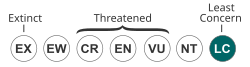
Pinus kesiya (Khasi pine or Benguet pine) is one of the most widely distributed pines in southeast Asia. Its range extends south and east from the Khasi Hills in the northeast Indian state of Meghalaya, to Burma, northern Thailand, Cambodia, Laos, southernmost China, Vietnam, and the Philippines. It is an important plantation species elsewhere in the world, including in southern Africa and South America.[3][4]
The common name "Khasi pine" is from the Khasi hills in India, and "Benguet pine" is from the landlocked province of Benguet in Luzon, Philippines, where it is the dominant species of the Luzon tropical pine forests (known as saleng in Ilocano[5]). The Benguet pine is sometimes treated as a separate species, Pinus insularis; however, the current opinion is to treat this as conspecific with P. kesiya var. langbianensis.[2] The city of Baguio is nicknamed "The City of Pines", as it is noted for large stands of this tree.
Description[edit | edit source]

Pinus kesiya is a tree reaching up to 30–35 metres (98–115 feet) tall with a straight, cylindrical trunk. The bark is thick, dark brown, and scaly with deep longitudinal fissures. The branches are robust, red brown from the second year, the branchlets horizontal to upcurved. The leaves are needle-like, dark green, usually three per fascicle, 12–20 centimetres (4+1⁄2–8 inches) long, the fascicle sheath 1–2 cm (1⁄2–3⁄4 in) long and persistent. The cones are ovoid, 5–9 cm (2–3+1⁄2 in) long, often curved downwards, sometimes slightly oblique; the scales of second-year cones are dense, the umbo a little convex, with a small prickle. The scales have transverse and longitudinal ridges across the middle of the scale surface. The seeds are winged, 6–7 millimetres (1⁄4–9⁄32 in) long with a 1.5–2.5 cm wing. Pollination occurs in mid-spring, with the cones maturing 18–24 months after.[6]
Khasi pine usually grows in pure stands or mixed with broad-leaved trees.[6]
Taxonomy[edit | edit source]
Pinus kesiya is a member of the largely Eurasian nominate group Pinus subgenus Pinus, section Pinus, distinguished by the cone umbo having an offset prickle on the umbo.[7]
Two varieties are accepted by the Plants of the World Online database:[2]
- Pinus kesiya var. kesiya
- Pinus kesiya var. langbianensis
(A.Chev.) Gaussen ex Bui They are only minimally distinct, with var. langbianensis cited as having on average shorter needles 12–16 cm long as opposed to 12–20 cm in var. kesiya;[6] not all authors consider them distinct, treating the species as monotypic.[8]
Uses[edit | edit source]
The soft and light timber of Pinus kesiya can be used for a wide range of applications, including boxes, paper pulp, and temporary electric poles. It is intensely used for timber, both sourced in natural forests and plantations.[3][4]
The good-quality resin is not abundant and has not been much used except during the Spanish colonial period in the Philippines for the production of turpentine.[9]
References[edit | edit source]
- ↑ Farjon, A. (2013). "Pinus kesiya". IUCN Red List of Threatened Species. 2013 e.T42372A2975925. doi:10.2305/IUCN.UK.2013-1.RLTS.T42372A2975925.en. Retrieved 19 November 2021.
- ↑ 2.0 2.1 2.2 Pinus kesiya Royle ex Gordon. Plants of the World Online. Retrieved 12 August 2024.
- ↑ 3.0 3.1 Luu, Nguyen Duc To; Philip Ian Thomas (2004). Conifers of Vietnam. Nhà xuất bản Thế giới. pp. 42–43. ISBN 1-872291-64-3. Archived from the original on 2007-05-19.
- ↑ 4.0 4.1 "Pinus kesiya". AgroForestryTree Database. International Centre for Research in Agroforestry. Archived from the original on 6 April 2012. Retrieved 17 April 2012.
- ↑ Li, Paul Jen-kuei (July 2022). "Some notes on animals and plants for Proto-Austronesian speakers". Language and Linguistics. 語言暨語言學: 266. doi:10.1075/lali.18.2.04li.
- ↑ 6.0 6.1 6.2 "Pinus kesiya description". The Gymnosperm Database. 2025-11-11. Retrieved 2025-11-15.
- ↑ Klaus, Wilhelm (1980). "Neue Beobachtungen zur Morphologie des Zapfens von Pinus und ihre Bedeutung für die Systematik, Fossilbestimmung, Arealgestaltung und Evolution der Gattung / New Observations on the Morphology of Pinus-Cones and Their Bearing on Taxonomy, Fossil Determination, Distribution, and Evolution of the Genus". Plant Systematics and Evolution. 134 (3/4). Springer: 137–171. ISSN 0378-2697. JSTOR 23642506. Retrieved 2025-11-01.
- ↑ Businský, Roman (2008). The genus Pinus L., pines : contribution to knowledge (in čeština). ISBN 978-80-85116-60-1.
- ↑ Heaney, Lawrence R.; Regaldo, Jacinto C., Jr. (2007). "Philippine Pines". Vanishing Treasures. The Field Museum.
{{cite web}}: CS1 maint: multiple names: authors list (link)
External links[edit | edit source]
- Gymnosperm Database: Pinus kesiya
- Suitability of Pinus kesiya for tree-ring analyses
- "Luzon Tropical Forests". Terrestrial Ecoregions. World Wildlife Fund.