

m Refined content and updated sections |
|||
| Line 1: | Line 1: | ||
{{ | {{Short description|Species of bird}} | ||
{{Use dmy dates|date= | {{Use dmy dates|date=May 2023}} | ||
{{Speciesbox | {{Speciesbox | ||
| name = Green peafowl | | name = Green peafowl | ||
| Line 9: | Line 9: | ||
| status = EN | | status = EN | ||
| status_system = IUCN3.1 | | status_system = IUCN3.1 | ||
| status_ref = <ref name=iucn>{{cite iucn |title=''Pavo muticus'' |author=BirdLife International |date=2018 | | | status_ref = <ref name=iucn>{{cite iucn |title=''Pavo muticus'' |author=BirdLife International |date=2018 |article-number=e.T22679440A131749282 |doi=10.2305/IUCN.UK.2018-2.RLTS.T22679440A131749282.en |access-date=27 January 2022}}</ref> | ||
| status2 = CITES_A2 | | status2 = CITES_A2 | ||
| status2_system = CITES | | status2_system = CITES | ||
| Line 25: | Line 25: | ||
}} | }} | ||
The '''green peafowl''' | The '''green peafowl''' ('''''Pavo muticus''''') is a [[peafowl]] [[species]] native to the tropical forests of [[Southeast Asia]] and Southern [[China]]. It is the national bird of [[Myanmar]]. Formerly common throughout Southeast Asia, only a few isolated populations survive in [[Cambodia]] and adjacent areas of [[Vietnam]]. It has been listed as [[endangered]] on the [[IUCN Red List]] since 2009. This is primarily due to widespread deforestation, agriculture and loss of suitable habitat, severely fragmenting populations and contributing to an overall decline in numbers. The green peafowl is in demand for private and home [[aviculture]] and threatened by the pet trade, feather collectors and hunters for meat and targeted. | ||
==Description== | ==Description== | ||
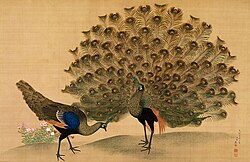
[[File:Pavo muticus3.jpg|thumb | [[File:Okyo Peacock and Peahen.jpg|thumb|1781 painting by [[Maruyama Okyo]]]] | ||
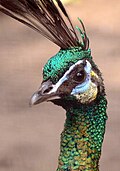
[[File:Green Peafowl | [[File:Pavo muticus3.jpg|thumb|upright|Adult female head and upper neck]] | ||
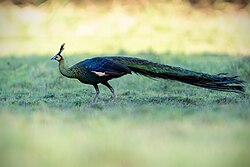
[[File:Green Peafowl 0A2A0093.jpg|thumb|Male profile]] | |||
The green peafowl is a large bird in terms of overall size. The male is {{cvt|1.8|-|3|m}} in total length, including its train, which measures {{cvt|1.4|-|1.6|m}}; the adult female is around half the total length of the breeding male at {{cvt|1|-|1.1|m}} in length. It has a relatively large wingspan that averages around {{cvt|1.2|m}} and can reach {{cvt|1.6|m}} in big males. The green peafowl is capable of sustained (albeit energy-intensive) [[bird flight|flight]] and is often observed on the wing.<ref name=Biddle2002/> | |||
Green peafowl males [[Bird vocalization|vocalize]] at their roost sites at dawn and dusk with a loud often repeated ''ki-wao''. The female vocalizes with an equally loud "''AOw-aa''" call, with an emphasis on the first syllable. The males may also make a similar sound to the females.<ref name=birdlife/> | |||
{{Refimprove section|date=June 2024}} | |||
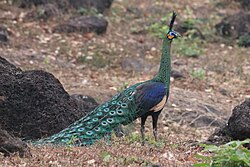
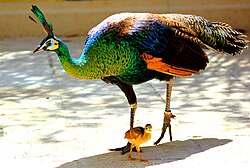
The green peafowl has long upper-tail [[Covert feather#Tail coverts|covert feathers]]. In the male, this extends up to {{Cvt|2|m}} and is adorned with [[Eyespot (mimicry)#In birds|eyespots]]; in the female, the coverts are green and much shorter, just covering the tail. Outside of the [[breeding season]], however, the male's tail coverts (or '''''train''''') is [[moulted]]; distinguishing the sexes during this period can be difficult unless they are observed quite up close. The neck and breast feathers (of both sexes) are highly [[Iridescence|iridescent]] green and resemble [[Chinese dragon]] scales. In the male, the scapular, median, and greater [[wing]] coverts are blue; the lesser coverts are green and form a triangle of scaly shoulder feathers (when the wing is closed). The secondaries are black and, in some subspecies, the tertials are brown and/or barred with a faint pattern. The female has blue lesser coverts, and lacks the triangle at the wing-shoulder. Females also have neck scales fringed with [[Copper (color)|copper]], as well as more barring on the back, the primaries and [[alula]]. Both sexes have [[Crest (feathers)|crest feather]]s, are long-legged, [[wing loading|heavy-winged]], and long-tailed in silhouette. The crest of the female has slightly wider plumes, while those of the male are thinner but taller. The facial skin is double-striped with a whitish-blue; beside the ear is a [[yellow-orange]] crescent. The dark triangle below the eye (towards the eyebrow) is bluish-green in the male, and brown in the female. Seen from a distance, they are generally dark-coloured birds with pale [[vermilion]]- or [[Buff (colour)|buff]]-coloured [[Flight feather#Primaries|primaries]], which are quite visible in their peculiar flight; this action has been described as a true "flapping" flight, lacking the gliding that one associates with many birds. | |||
==Distribution and habitat== | |||
The green peafowl was widely distributed in [[Southeast Asia]] in the past from southern [[China]] especially [[Yunnan]], eastern and north-eastern [[India]], southeastern [[Bangladesh]], northern [[Myanmar]], extending through [[Laos]], and [[Thailand]] into [[Vietnam]], [[Cambodia]], [[Peninsular Malaysia]], and the island of [[Java]] in [[Indonesia]], but in [[Java]] they are only found in protected areas such as [[Ujung Kulon National Park]] and [[Baluran National Park]]. Records from northeastern India have been questioned and old records are possibly of [[introduced species|feral bird]]s.<ref name=pcr/> | |||
In Cambodia, [[Keo Seima Wildlife Sanctuary]] was shown to hold a significant and increasing population of around 745 individuals in 2020.<ref>{{Cite journal |last1=Nuttall |first1=M. |last2=Nut|first2=M. |last3=Ung |first3=V. |last4=O'kelly |first4=H. |date=2017 |title=Abundance estimates for the endangered Green Peafowl ''Pavo muticus'' in Cambodia: identification of a globally important site for conservation |journal=Bird Conservation International |volume=27|issue=1|pages=127–139 |s2cid=89013924 |doi=10.1017/S0959270916000083 |doi-access=free}}</ref><ref>{{Cite journal|last1=Nuttall|first1=M. N. |last2=Griffin |first2=O. |last3=Fewster |first3=R. M. |last4=McGowan|first4=P. J. K. |last5=Abernethy |first5=K. |last6=O'Kelly |first6=H. |last7=Nut |first7=M. |last8=Sot|first8=V. |last9=Bunnefeld |first9=N. |title=Long-term monitoring of wildlife populations for protected area management in Southeast Asia |journal=Conservation Science and Practice |year=2021 |volume=4 |issue=2 |article-number=e614 |doi=10.1111/csp2.614 |s2cid=245405123 |doi-access=free |hdl=1893/33780 |hdl-access=free}}</ref> | |||
Green peafowl are found in a wide range of habitats, including [[Primary forest|primary]] and [[secondary forest]], both [[tropical]] and [[subtropical]], as well as [[Evergreen forest|evergreen]] and deciduous. They may also be found amongst [[bamboo]], on grasslands, [[savanna]]s, scrub, and farmland edge. In Vietnam, the preferred habitat was found to be dry, deciduous forest close to water and away from human disturbance.<ref name=Brickle2002/> Proximity to water appears to be an important factor.<ref name=viet/> | Green peafowl are found in a wide range of habitats, including [[Primary forest|primary]] and [[secondary forest]], both [[tropical]] and [[subtropical]], as well as [[Evergreen forest|evergreen]] and deciduous. They may also be found amongst [[bamboo]], on grasslands, [[savanna]]s, [[Shrubland|scrub]], and [[farmland]] edge. In Vietnam, the preferred habitat was found to be dry, [[deciduous forest]] close to water and away from human disturbance. In [[Java]] they are only found in [[savanna]].<ref name=Brickle2002/> Proximity to water appears to be an important factor.<ref name=viet/> | ||
==Taxonomy== | ==Taxonomy== | ||
The species was first classified as ''Pavo muticus'' by [[Carl Linnaeus]], although it was previously described in Europe by [[Ulisse Aldrovandi]] as "Pavo Iaponensis" based on a Japanese painting given to the pope by the emperor of [[Japan]]. These birds were depicted as having no spurs; Linnaeus followed Aldrovandi's description. The Japanese had imported green peafowl from Southeast Asia for hundreds of years, and the birds were frequently depicted in Japanese paintings. As a result, the [[type locality (biology)|type locality]] described by Linnaeus was "Habitat in [[Japan|Japonia]]", though the species is not native to Japan (they were kept by the emperor and no longer occur). [[François Levaillant]] was one of the first Western ornithologists to see a live bird, imported from [[Macau]] to an animal collection in [[Cape of Good Hope]]. From an Indian painting, [[George Shaw (biologist)|George Shaw]] described a peafowl native to India with a "blue head" and an "upright lanceolate crest", which he named ''Pavo spicifer'', the spike-crested peacock. A third form of green peafowl was described in 1949 by [[Jean Delacour]], as ''P. imperator'', found in Indochina. From the advice of a bird dealer in Hong Kong, Delacour concluded there were three [[Subspecies|races]] of green peafowl, lumping ''P. spicifer'' into the species, as well. Today, most authorities recognise these three:<ref name=zma/><ref name=Clements2007/><ref name=Dickinson2003/> | The species was first classified as ''Pavo muticus'' by [[Carl Linnaeus]], although it was previously described in Europe by [[Ulisse Aldrovandi]] as "Pavo Iaponensis" based on a Japanese painting given to the pope by the emperor of [[Japan]]. These birds were depicted as having no spurs; Linnaeus followed Aldrovandi's description. The Japanese had imported green peafowl from Southeast Asia for hundreds of years, and the birds were frequently depicted in Japanese paintings. As a result, the [[type locality (biology)|type locality]] described by Linnaeus was "Habitat in [[Japan|Japonia]]", though the species is not native to Japan (they were kept by the emperor and no longer occur). [[François Levaillant]] was one of the first Western ornithologists to see a live bird, imported from [[Macau]] to an animal collection in [[Cape of Good Hope]]. From an Indian painting, [[George Shaw (biologist)|George Shaw]] described a peafowl native to India with a "blue head" and an "upright lanceolate crest", which he named ''Pavo spicifer'', the spike-crested peacock. A third form of green peafowl was described in 1949 by [[Jean Delacour]], as ''P. imperator'', found in Indochina. From the advice of a bird dealer in Hong Kong, Delacour concluded there were three [[Subspecies|races]] of green peafowl, lumping ''P. spicifer'' into the species, as well. Today, most authorities recognise these three:<ref name=zma/><ref name=Clements2007/><ref name=Dickinson2003/> | ||
{| class="wikitable" | |||
|- | |||
! Image !! Subspecies!! Description !! Distribution | |||
|- | |||
|[[File:Merak Jawa.jpg|180px]]|| ''Pavo muticus muticus'', the '''Java peafowl''' ([[Nominate subspecies|nominate]])||Often described as the most colourful of the three subspecies, the neck and breast is a metallic golden-green with cerulean blue wing coverts. Females have prominent barring on the back and tertials. ||Extant population endemic to the east and western ends of Java, Indonesia. Extinct populations from the [[Malay Peninsula]] from the [[Kra Isthmus]] extending south to [[Kedah]] have also been described as being synonymous with the Javanese population, but no published studies have confirmed this assumption. | |||
|- | |||
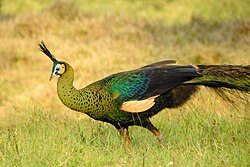
|[[File:Pavo muticus 71308373.jpg|180px]]|| ''P. m. imperator'', the '''Indo-Chinese peafowl'''||''Imperator'' is intermediate in colouration between the other two forms. ||From east Myanmar to Thailand, [[Yunnan]] province in China and [[Indochina]], this subspecies is the most common and has the widest distribution. In Thailand, it is currently confined to the [[Nan River|Nan]], [[Yom River|Yom]], [[Eng River|Eng]] and [[Ping River|Ping]] river basins in northern Thailand and the [[Huai Kha Khaeng]] and [[Mae Klong]] basins in western Thailand. In Vietnam, it has become extinct in the northern part of the country, its last large population being confined to the southeast in [[Yok Đôn National Park|Yok Đôn]] and [[Cát Tiên National Park]]. | |||
|- | |||
| || ''P. m. spicifer'', the '''Burmese peafowl'''||Delacour considered the west and east sides of the [[Irrawaddy River|Irrawaddy river]] to be the dividing line between ''spicifer'' and ''imperator'' respectively. Sometimes described as "duller" than the other forms, it has a matte gun metal-blue to olive-green neck and breast, and more black on the wing-coverts and outer web of secondaries. The crown of the male is violet-blue which often extends further down the nape than other subspecies, demarcating the colours of the crown and neck.|| Found in Bangladesh towards southwestern Thailand, formerly also in northern Malaysia. Birds in Northeast India are sometimes considered extinct but are still occasionally sighted. However, sightings have sometimes been questioned as feral or escaped birds. A population of ''spicifer'' was reintroduced to [[Hlawga National Park]] east of the Irrawaddy river. | |||
|- | |||
|} | |||
Delacour dismissed several aberrant specimens to be individual variations (including the [[type specimen]]s for ''imperator'' originating from the [[Bolaven Plateau]] in Laos), and stated more subspecies may be recognised with further studies. However, few studies have been conducted to substantiate Delacour's classification, even though it is accepted by nearly all authorities. Some authors have suggested that the population found in Yunnan, which are traditionally classified as ''imperator'', may be another race.<ref name=Madge2002/> Using the [[cytochrome b]] [[mitochondrial DNA]] gene, Ouyang et al. estimated the divergence period between green and Indian peafowl to be 3 million years. In the same study, they also noted there appeared to be two different forms of green peafowl in Yunnan which should be classified as distinct subspecies.<ref name=Ouyang2008/> A 2005 article from ''[[The Star (Malaysia)|The Star]]'' newspaper of Malaysia stated that research indicated the Malaysian form to be identical to the Javanese form, but the study was not published and some authors dispute the result. Due to the large range of ''imperator'' in Indochina, other subspecies within its range have also been proposed, notably ''annamensis'' of Southeast Asia and ''yunnanensis'' of [[Yunnan]].<ref name="lastchance">{{cite web|url=http://www.aviculture-europe.nl/nummers/06E02A10.pdf|title=The Last Chance for the Green Peafowl (''Pavo muticus'')?|last=Mennig|first=Wolfgang|publisher=WPA Germany|access-date=23 March 2012}}</ref> | Delacour dismissed several aberrant specimens to be individual variations (including the [[type specimen]]s for ''imperator'' originating from the [[Bolaven Plateau]] in Laos), and stated more subspecies may be recognised with further studies. However, few studies have been conducted to substantiate Delacour's classification, even though it is accepted by nearly all authorities. Some authors have suggested that the population found in Yunnan, which are traditionally classified as ''imperator'', may be another race.<ref name=Madge2002/> Using the [[cytochrome b]] [[mitochondrial DNA]] gene, Ouyang et al. estimated the divergence period between green and Indian peafowl to be 3 million years. In the same study, they also noted there appeared to be two different forms of green peafowl in Yunnan which should be classified as distinct subspecies.<ref name=Ouyang2008/> A 2005 article from ''[[The Star (Malaysia)|The Star]]'' newspaper of Malaysia stated that research indicated the Malaysian form to be identical to the Javanese form, but the study was not published and some authors dispute the result. Due to the large range of ''imperator'' in Indochina, other subspecies within its range have also been proposed, notably ''annamensis'' of Southeast Asia and ''yunnanensis'' of [[Yunnan]].<ref name="lastchance">{{cite web|url=http://www.aviculture-europe.nl/nummers/06E02A10.pdf|title=The Last Chance for the Green Peafowl (''Pavo muticus'')?|last=Mennig|first=Wolfgang|publisher=WPA Germany|access-date=23 March 2012}}</ref> | ||
| Line 55: | Line 64: | ||
[[File:Peacocks 777.jpg|thumb|Female (peahen) with one chick]] | [[File:Peacocks 777.jpg|thumb|Female (peahen) with one chick]] | ||
[[File:Merak tarung.jpg|thumb|Fighting peacocks in [[Baluran National Park]], Indonesia]] | [[File:Merak tarung.jpg|thumb|Fighting peacocks in [[Baluran National Park]], Indonesia]] | ||
The green peafowl is a forest bird which nests on the ground laying | The green peafowl is a [[forest]] bird which [[Bird nest|nests]] on the ground laying an [[egg clutch]] with three to six eggs.<ref name=Grimmett1999/> | ||
It has been widely | It has been widely stated that the green peafowl is [[Polygyny in animals|polygynous]], but males are [[solitary animal|solitary]] and do not display in [[lek (biology)|lek]]s. Instead the solitary males are highly [[Territory (animal)|territorial]] and form [[harem (zoology)|harem]]s with no [[pair bond]]s. However, the theory that the male is polygynous also conflicts with observations in captivity; pairs left alone with no human interaction have been observed to be strongly [[Monogamy in animals|monogamous]]. The close similarity between both sexes also suggests a different [[courtship display]] in contrast to that of the Indian peafowl. Thus, some authors have suggested that the harems seen in the field are juvenile birds and that males are not promiscuous.<ref name=birdlife/> | ||
They usually spend time on or near the ground in [[Poaceae|tall grass]]es and [[sedge]]s. Family units [[roosting|roost]] in trees at a height of {{Cvt|10|-|15|m}}.<ref name=birdlife/> | |||
==Threats == | |||
Due to hunting, especially [[poaching]], and a reduction in extent and quality of habitat, the green peafowl is evaluated as [[endangered species|endangered]] on the [[IUCN Red List of Threatened Species]]. The world population has declined rapidly, and the species no longer occurs in many areas of its past distribution. The population in the wild was estimated to be about 5,000 to 10,000 individuals around 1995.<ref name=iucn/> | |||
[[ | Although there is no natural range overlap with the Indian peafowl, [[Hybrid (biology)|hybridisation]] is still a threat where the Indian peafowl is [[Introduced species|introduced]] as they produce fertile hybrids. In captivity hybrids are called "Spalding" peafowl and are used by breeders to create different [[breed]]s. Through [[backcrossing]] some hybrids become almost indistinguishable from pure green peafowl.<ref name=Hybrid/> | ||
== | == Conservation == | ||
The green peafowl is listed on Appendix II of [[CITES]].<ref name=iucn/> The last strongholds are in protected areas such as [[Huai Kha Khaeng Wildlife Sanctuary]] in Thailand, [[Cat Tien National Park]] in Vietnam and [[Baluran National Park]], [[Ujung Kulon National Park]] in Java, Indonesia.<ref name=iucn/> | |||
In 2005, the World Pheasant Association reportedly conducted reintroductions in Malaysia.<ref name=Star2005/> Genetic research allegedly proved that the Javan and Malay peafowl are genetically identical, and the subspecies ''muticus'' was introduced based on scientific community consensus. However, the assumption that the Malaysian and Javanese ''muticus'' birds are the same subspecies remains controversial, so it is uncertain which subspecies was introduced.<ref name=lastchance/> | |||
In | In China, the Yunnan Green Peafowl case was a landmark 2020 environmental lawsuit in which the courts ordered the suspension of a hydropower project on the Jiasa River after discovery of green peafowls living in areas potentially affected. It marked China’s first preventive public‑interest litigation for wildlife conservation and established a precedent for proactive biodiversity protection.<ref>{{cite news |last=Cao |first=Yin |title=Biodiversity ruling to block dam project first of its kind in China |work=China Daily |date=2022 |url=https://www.chinadaily.com.cn/a/202202/21/WS62133309a310cdd39bc87ef5.html |access-date=9 January 2026}}</ref><ref>{{cite news |title=Yunnan protects its wild side |work=China Daily |date=2022 |url=https://www.chinadaily.com.cn/a/202212/24/WS63a65868a31057c47eba5f87_2.html |access-date=9 January 2026}}</ref> | ||
==Cultural significance== | ==Cultural significance== | ||
[[File:WikiProject Myanmar peacock.svg|thumb|The green peacock was a royal symbol of Burma's monarchs]] | [[File:WikiProject Myanmar peacock.svg|thumb|The green peacock was a royal symbol of Burma's monarchs]] | ||
In Myanmar, the green peafowl was the [[coat of arms]] of the [[Konbaung dynasty]], the country's last dynasty.<ref name="crwflags" /><ref name=Easey2016>{{Cite magazine |author=Easey, R. |date=2016 |title=Myanmar's peacock: A national symbol dying off in the wild |magazine=Frontier Myanmar |volume=2 |issue= |url=https://www.frontiermyanmar.net/en/myanmars-peacock-a-national-symbol-dying-off-in-the-wild-2/ |access-date=2025-05-20}}</ref> The insignia was stitched onto royal costumes, and was the primary motif of the Peacock Throne, one of eight royal [[Palin (throne)|palin thrones]].<ref name=Easey2016/> In 1865, [[Mindon Min]] began minting coins bearing the peacock insignia.<ref>{{Cite book |last=Ferguson |first=J. M. |title=Silver Screens and Golden Dreams: A Social History of Burmese Cinema |date=2024 |publisher=University of Hawaii Press |isbn=978-0-8248-9726-0 |url=}}</ref> The peacock symbolised the [[Sun]], from which the Burmese monarchs claimed their descent.<ref name=Easey2016/> | |||
[[File:Flag of National League for Democracy.svg|thumb|right|The flag of the [[National League for Democracy]] party features a stylised fighting peacock next to a star.]] | |||
During [[British rule in Burma]], the peacock was featured on the flag of the governor and the naval ensign. The fighting stance of the peacock was adopted by anti-colonial activists, and again by the [[National League for Democracy]] after the [[8888 Uprising]].<ref name=Easey2016/> | |||
In ancient China, where peacocks were once more widespread, the peacock was known as a bird of "Jiude", the nine virtues. According to the [[Book of Zhou]], these nine virtues are loyalty, trustworthiness, respectfulness, firmness, gentleness, harmony, steadfastness, integrity, and filiality. Beginning in the [[Ming Dynasty]], 3rd ranked civil servants wore [[mandarin square|buzi]], an embroidered patch on the front of one's uniform, featuring a peacock to symbolizing their virtues. In the [[Qing Dynasty]], peacock feathers called Huayi (花翎) decorated the hats of officials, with sanyan huayi or three peacock feathers reserved for the highest rank.<ref>{{Cite web | |||
|title=“文禽”孔雀有“九德” | |||
|url=https://www.people.com.cn/24hour/n/2013/1020/c25408-23262074.html | |||
|publisher=Guangzhou Daily 广州日报 | |||
|date=2013-10-20 | |||
|access-date=2025-01-09 | |||
|language=zh-CN | |||
|author=Zhong Kui 钟葵 | |||
}}</ref> | |||
==References== | ==References== | ||
{{Reflist|2|refs= | {{Reflist|2|refs= | ||
<ref name=Biddle2002>{{cite book|last=Biddle|first=Tami Davis|title=Pheasants, Partridges, and Grouse : A Guide to the Pheasants, Partridges, Quails, Grouse, Guineafowl, Buttonquails, and Sandgrouse of the World|series=Princeton Field Guides|publisher=Princeton University Press|year=2002|isbn=978-0-691-08908-9}}</ref> | <ref name=Biddle2002>{{cite book|last=Biddle|first=Tami Davis|title=Pheasants, Partridges, and Grouse: A Guide to the Pheasants, Partridges, Quails, Grouse, Guineafowl, Buttonquails, and Sandgrouse of the World|series=Princeton Field Guides|publisher=Princeton University Press|year=2002|isbn=978-0-691-08908-9}}</ref> | ||
<ref name=birdlife>{{cite report|publisher=BirdLife International|year=2006|work=Threatened birds of Asia: the BirdLife International Red Data Book|location=Cambridge, UK|pages=1052–1087|title=Pavo muticus|url=http://birdbase.hokkaido-ies.go.jp/rdb/rdb_en/pavomuti.pdf}}</ref> | <ref name=birdlife>{{cite report|publisher=BirdLife International|year=2006|work=Threatened birds of Asia: the BirdLife International Red Data Book|location=Cambridge, UK|pages=1052–1087|title=Pavo muticus|url=http://birdbase.hokkaido-ies.go.jp/rdb/rdb_en/pavomuti.pdf|access-date=20 April 2008|archive-date=22 July 2011|archive-url=https://web.archive.org/web/20110722105337/http://birdbase.hokkaido-ies.go.jp/rdb/rdb_en/pavomuti.pdf}}</ref> | ||
<ref name=Brickle2002>{{cite journal|last=Brickle|first=Nick W.|journal=Biological Conservation|year=2002|volume=105|issue=2|title=Habitat use, predicted distribution and conservation of green peafowl (''Pavo muticus'') in Dak Lak Province, Vietnam|pages=189–197|doi=10.1016/S0006-3207(01)00182-3}}</ref> | <ref name=Brickle2002>{{cite journal|last=Brickle|first=Nick W.|journal=Biological Conservation|year=2002|volume=105|issue=2|title=Habitat use, predicted distribution and conservation of green peafowl (''Pavo muticus'') in Dak Lak Province, Vietnam|pages=189–197|doi=10.1016/S0006-3207(01)00182-3|bibcode=2002BCons.105..189B }}</ref> | ||
<ref name=Clements2007>{{cite book|last=Clements|first=James F.|title=The Clements Checklist of the Birds of the World|edition=6th|year=2007|isbn=978-0-7136-8695-1|publisher=Christopher Helm|location=London}}</ref> | <ref name=Clements2007>{{cite book|last=Clements|first=James F.|title=The Clements Checklist of the Birds of the World|edition=6th|year=2007|isbn=978-0-7136-8695-1|publisher=Christopher Helm|location=London}}</ref> | ||
| Line 93: | Line 110: | ||
<ref name=crwflags>{{cite web|url=http://www.crwflags.com/fotw/flags/mm-hist.html|title=Burma: historical flags|website=crwflags.com}}</ref> | <ref name=crwflags>{{cite web|url=http://www.crwflags.com/fotw/flags/mm-hist.html|title=Burma: historical flags|website=crwflags.com}}</ref> | ||
<ref name=Dickinson2003>{{cite book|editor-last=Dickinson|editor-first=Edward C.|title=The Howard and Moore Complete Checklist of the Birds of the World|edition=3rd|year=2003|isbn=0-7136-6536-X}}.</ref> | <ref name=Dickinson2003>{{cite book|editor-last=Dickinson|editor-first=Edward C.|title=The Howard and Moore Complete Checklist of the Birds of the World|edition=3rd|year=2003|publisher=Christopher Helm |isbn=0-7136-6536-X}}.</ref> | ||
<ref name=Grimmett1999>{{cite book|last1=Grimmett|first1=R.|last2=Inskipp|first2=C.|last3=Inskipp|first3=T.|title=Birds of India: Pakistan, Nepal, Bangladesh, Bhutan, Sri Lanka, and the Maldives|publisher=[[Princeton University Press]]|url=http://www.pupress.princeton.edu/titles/6808.html|year=1999|isbn=0-691-04910-6 | <ref name=Grimmett1999>{{cite book|last1=Grimmett|first1=R.|last2=Inskipp|first2=C.|last3=Inskipp|first3=T.|title=Birds of India: Pakistan, Nepal, Bangladesh, Bhutan, Sri Lanka, and the Maldives|publisher=[[Princeton University Press]]|url=http://www.pupress.princeton.edu/titles/6808.html|year=1999|isbn=0-691-04910-6|archive-url=https://web.archive.org/web/20060909173547/http://www.pupress.princeton.edu/titles/6808.html|archive-date=9 September 2006}}</ref> | ||
<ref name=Hybrid>{{cite web|last=Mennig|first=Wolfgang|title=Green Peafowl and Hybrids Tips and Tricks to identify unpure birds|url=http://wpa.tecker.info/hybrid.pdf|publisher=World Pheasant Association|access-date=22 February 2012|archive-url=https://web.archive.org/web/20140102191921/http://wpa.tecker.info/hybrid.pdf|archive-date=2 January 2014 | <ref name=Hybrid>{{cite web|last=Mennig|first=Wolfgang|title=Green Peafowl and Hybrids Tips and Tricks to identify unpure birds|url=http://wpa.tecker.info/hybrid.pdf|publisher=World Pheasant Association|access-date=22 February 2012|archive-url=https://web.archive.org/web/20140102191921/http://wpa.tecker.info/hybrid.pdf|archive-date=2 January 2014}}</ref> | ||
<!-- <ref name=Johnsgard1999>{{cite book|title=The Pheasants of the World: Biology and Natural History|last=Johnsgard|first=P.A.|year=1999 |publisher=Smithsonian Institution Press|location=Washington, DC|isbn=1-56098-839-8|page=374}}</ref>--> | <!-- <ref name=Johnsgard1999>{{cite book|title=The Pheasants of the World: Biology and Natural History|last=Johnsgard|first=P.A.|year=1999 |publisher=Smithsonian Institution Press|location=Washington, DC|isbn=1-56098-839-8|page=374}}</ref>--> | ||
| Line 103: | Line 120: | ||
<ref name=Madge2002>{{cite book|last1=Madge|first1=Steve|first2=Phil|last2=McGowan|year=2002|title=Pheasants, Partridges, and Grouse: A Guide to the Pheasants, Partridges, Quails, Grouse, Guineafowl, Buttonquails, and Sandgrouse of the World|publisher=Princeton University Press|location=Princeton, NJ|isbn=0-7136-3966-0}}</ref> | <ref name=Madge2002>{{cite book|last1=Madge|first1=Steve|first2=Phil|last2=McGowan|year=2002|title=Pheasants, Partridges, and Grouse: A Guide to the Pheasants, Partridges, Quails, Grouse, Guineafowl, Buttonquails, and Sandgrouse of the World|publisher=Princeton University Press|location=Princeton, NJ|isbn=0-7136-3966-0}}</ref> | ||
<ref name=Ouyang2008>{{cite web|last=Ouyang|first=Yi Na|title=Genetic Divergence between Pavo muticus and Pavo cristatus by Cyt b Gene|url=http://en.cnki.com.cn/Article_en/CJFDTOTAL-YNDX200902014.htm|year=2008|publisher=Journal of Yunnan Agricultural University}}</ref> | <ref name=Ouyang2008>{{cite web|last=Ouyang|first=Yi Na|title=Genetic Divergence between Pavo muticus and Pavo cristatus by Cyt b Gene|url=http://en.cnki.com.cn/Article_en/CJFDTOTAL-YNDX200902014.htm|year=2008|publisher=Journal of Yunnan Agricultural University|access-date=7 May 2011|archive-date=30 December 2021|archive-url=https://web.archive.org/web/20211230023044/http://en.cnki.com.cn/Article_en/CJFDTOTAL-YNDX200902014.htm}}</ref> | ||
<ref name=pcr>{{cite book|last1=Rasmussen|first1=P.C.|first2=J.C.|last2=Anderton|year=2005|title=The Birds of South Asia |publisher=Smithsonian Institution & Lynx Edicions|isbn=978-84-96553-85-9}}</ref> | <ref name=pcr>{{cite book|last1=Rasmussen|first1=P.C.|first2=J.C.|last2=Anderton|year=2005|title=The Birds of South Asia |publisher=Smithsonian Institution & Lynx Edicions|isbn=978-84-96553-85-9}}</ref> | ||
<ref name=Star2005>{{cite news|last=Chiew|first=Hilary|newspaper=The Star, Malaysia|title=The return of the Green peafowl|date=11 January 2005|url=http://www.ecologyasia.com/news-archives/2005/jan-05/star_050111_1.htm|archive-url=https://web.archive.org/web/20120205055846/http://www.ecologyasia.com/news-archives/2005/jan-05/star_050111_1.htm|archive-date=5 February 2012 | <ref name=Star2005>{{cite news|last=Chiew|first=Hilary|newspaper=The Star, Malaysia|title=The return of the Green peafowl|date=11 January 2005|url=http://www.ecologyasia.com/news-archives/2005/jan-05/star_050111_1.htm|archive-url=https://web.archive.org/web/20120205055846/http://www.ecologyasia.com/news-archives/2005/jan-05/star_050111_1.htm|archive-date=5 February 2012}}</ref> | ||
<ref name=viet>{{cite report|last1=Brickle|first1=N.W.|first2=Nguyen|last2=Cu|first3=Ha Quy|last3=Quynh|first4=Nguyen Thai Tu |last4=Cuong|first5=Hoang Van|last5=San|year=1998|title=The Status and Distribution of Green Peafowl ''Pavo muticus'' in Dak Lak Province, Vietnam |publisher=BirdLife International | <ref name=viet>{{cite report|last1=Brickle|first1=N.W.|first2=Nguyen|last2=Cu|first3=Ha Quy|last3=Quynh|first4=Nguyen Thai Tu |last4=Cuong|first5=Hoang Van|last5=San|year=1998|title=The Status and Distribution of Green Peafowl ''Pavo muticus'' in Dak Lak Province, Vietnam |publisher=BirdLife International – Vietnam Programme|location=Hanoi, Vietnam |url=http://thiennhienviet.org.vn/sourcebook/report_pdf/report1.pdf|doi=10.1016/S0006-3207(01)00182-3}}</ref> | ||
<ref name=zma>{{cite web|url=http://nlbif.eti.uva.nl/zma3d/detail.php?id=143&type=family&sort=taxon|title=Zoological Museum Amsterdam|access-date=20 April 2008|archive-url=https://web.archive.org/web/20090813082548/http://nlbif.eti.uva.nl/zma3d/detail.php?id=143&type=family&sort=taxon|archive-date=13 August 2009}}</ref> | |||
}} | }} | ||
| Line 119: | Line 135: | ||
{{Wikispecies|Pavo muticus}} | {{Wikispecies|Pavo muticus}} | ||
*[https://web.archive.org/web/20060629031146/http://www.arkive.org/species/GES/birds/Pavo_muticus/ Arkive images and movies of the green peafowl (''Pavo muticus'')] | *[https://web.archive.org/web/20060629031146/http://www.arkive.org/species/GES/birds/Pavo_muticus/ Arkive images and movies of the green peafowl (''Pavo muticus'')] | ||
*[http://www.pavo-muticus.com The Green Peafowl of Thailand] | *[http://www.pavo-muticus.com The Green Peafowl of Thailand] {{Webarchive|url=https://web.archive.org/web/20220524121706/https://www.pavo-muticus.com/ |date=24 May 2022 }} | ||
*{{Xeno-canto species|Pavo|muticus|Green peafowl}} | *{{Xeno-canto species|Pavo|muticus|Green peafowl}} | ||
*{{BirdLife|22679440|Pavo muticus}} | *{{BirdLife|22679440|Pavo muticus}} | ||
| Line 126: | Line 142: | ||
*{{InternetBirdCollection|green-peafowl-pavo-muticus|Green peafowl}} | *{{InternetBirdCollection|green-peafowl-pavo-muticus|Green peafowl}} | ||
*{{VIREO|Green+peafowl}} | *{{VIREO|Green+peafowl}} | ||
*{{IUCN_Map|22679440|Pavo muticus}} | *{{IUCN_Map|22679440/131749282|Pavo muticus}} | ||
{{Taxonbar |from=Q254636}} | {{Taxonbar |from=Q254636}} | ||
{{Authority control}} | |||
[[Category:Articles containing video clips]] | [[Category:Articles containing video clips]] | ||
| Line 137: | Line 154: | ||
[[Category:Endangered animals]] | [[Category:Endangered animals]] | ||
[[Category:Endangered biota of Asia]] | [[Category:Endangered biota of Asia]] | ||
[[Category: | [[Category:Animal taxa named by Carl Linnaeus|green peafowl]] | ||
[[Category: | [[Category:Birds of Myanmar]] | ||
[[Category:National symbols of Myanmar]] | [[Category:National symbols of Myanmar]] | ||
Latest revision as of 05:00, 15 February 2026
| Green peafowl | |
|---|---|

| |
| Male in display | |

| |
| Female | |
Scientific classification 
| |
| : | [[Template:Taxonomy/Pavo]] |
| Species: | Template:Taxonomy/PavoP. muticus
|
| Binomial name | |
| Template:Taxonomy/PavoPavo muticus Linnaeus, 1766
| |
| Subspecies | |
Linnaeus, 1766
Shaw, 1804
Delacour, 1949 | |

| |
| Range of the green peafowl | |
The green peafowl (Pavo muticus) is a peafowl species native to the tropical forests of Southeast Asia and Southern China. It is the national bird of Myanmar. Formerly common throughout Southeast Asia, only a few isolated populations survive in Cambodia and adjacent areas of Vietnam. It has been listed as endangered on the IUCN Red List since 2009. This is primarily due to widespread deforestation, agriculture and loss of suitable habitat, severely fragmenting populations and contributing to an overall decline in numbers. The green peafowl is in demand for private and home aviculture and threatened by the pet trade, feather collectors and hunters for meat and targeted.
Description[edit | edit source]


The green peafowl is a large bird in terms of overall size. The male is 1.8–3 m (5 ft 11 in – 9 ft 10 in) in total length, including its train, which measures 1.4–1.6 m (4 ft 7 in – 5 ft 3 in); the adult female is around half the total length of the breeding male at 1–1.1 m (3 ft 3 in – 3 ft 7 in) in length. It has a relatively large wingspan that averages around 1.2 m (3 ft 11 in) and can reach 1.6 m (5 ft 3 in) in big males. The green peafowl is capable of sustained (albeit energy-intensive) flight and is often observed on the wing.[2]
Green peafowl males vocalize at their roost sites at dawn and dusk with a loud often repeated ki-wao. The female vocalizes with an equally loud "AOw-aa" call, with an emphasis on the first syllable. The males may also make a similar sound to the females.[3]
 | This section needs more citations. (June 2024) |
The green peafowl has long upper-tail covert feathers. In the male, this extends up to 2 m (6 ft 7 in) and is adorned with eyespots; in the female, the coverts are green and much shorter, just covering the tail. Outside of the breeding season, however, the male's tail coverts (or train) is moulted; distinguishing the sexes during this period can be difficult unless they are observed quite up close. The neck and breast feathers (of both sexes) are highly iridescent green and resemble Chinese dragon scales. In the male, the scapular, median, and greater wing coverts are blue; the lesser coverts are green and form a triangle of scaly shoulder feathers (when the wing is closed). The secondaries are black and, in some subspecies, the tertials are brown and/or barred with a faint pattern. The female has blue lesser coverts, and lacks the triangle at the wing-shoulder. Females also have neck scales fringed with copper, as well as more barring on the back, the primaries and alula. Both sexes have crest feathers, are long-legged, heavy-winged, and long-tailed in silhouette. The crest of the female has slightly wider plumes, while those of the male are thinner but taller. The facial skin is double-striped with a whitish-blue; beside the ear is a yellow-orange crescent. The dark triangle below the eye (towards the eyebrow) is bluish-green in the male, and brown in the female. Seen from a distance, they are generally dark-coloured birds with pale vermilion- or buff-coloured primaries, which are quite visible in their peculiar flight; this action has been described as a true "flapping" flight, lacking the gliding that one associates with many birds.
Distribution and habitat[edit | edit source]
The green peafowl was widely distributed in Southeast Asia in the past from southern China especially Yunnan, eastern and north-eastern India, southeastern Bangladesh, northern Myanmar, extending through Laos, and Thailand into Vietnam, Cambodia, Peninsular Malaysia, and the island of Java in Indonesia, but in Java they are only found in protected areas such as Ujung Kulon National Park and Baluran National Park. Records from northeastern India have been questioned and old records are possibly of feral birds.[4]
In Cambodia, Keo Seima Wildlife Sanctuary was shown to hold a significant and increasing population of around 745 individuals in 2020.[5][6]
Green peafowl are found in a wide range of habitats, including primary and secondary forest, both tropical and subtropical, as well as evergreen and deciduous. They may also be found amongst bamboo, on grasslands, savannas, scrub, and farmland edge. In Vietnam, the preferred habitat was found to be dry, deciduous forest close to water and away from human disturbance. In Java they are only found in savanna.[7] Proximity to water appears to be an important factor.[8]
Taxonomy[edit | edit source]
The species was first classified as Pavo muticus by Carl Linnaeus, although it was previously described in Europe by Ulisse Aldrovandi as "Pavo Iaponensis" based on a Japanese painting given to the pope by the emperor of Japan. These birds were depicted as having no spurs; Linnaeus followed Aldrovandi's description. The Japanese had imported green peafowl from Southeast Asia for hundreds of years, and the birds were frequently depicted in Japanese paintings. As a result, the type locality described by Linnaeus was "Habitat in Japonia", though the species is not native to Japan (they were kept by the emperor and no longer occur). François Levaillant was one of the first Western ornithologists to see a live bird, imported from Macau to an animal collection in Cape of Good Hope. From an Indian painting, George Shaw described a peafowl native to India with a "blue head" and an "upright lanceolate crest", which he named Pavo spicifer, the spike-crested peacock. A third form of green peafowl was described in 1949 by Jean Delacour, as P. imperator, found in Indochina. From the advice of a bird dealer in Hong Kong, Delacour concluded there were three races of green peafowl, lumping P. spicifer into the species, as well. Today, most authorities recognise these three:[9][10][11]
| Image | Subspecies | Description | Distribution |
|---|---|---|---|
 |
Pavo muticus muticus, the Java peafowl (nominate) | Often described as the most colourful of the three subspecies, the neck and breast is a metallic golden-green with cerulean blue wing coverts. Females have prominent barring on the back and tertials. | Extant population endemic to the east and western ends of Java, Indonesia. Extinct populations from the Malay Peninsula from the Kra Isthmus extending south to Kedah have also been described as being synonymous with the Javanese population, but no published studies have confirmed this assumption. |
 |
P. m. imperator, the Indo-Chinese peafowl | Imperator is intermediate in colouration between the other two forms. | From east Myanmar to Thailand, Yunnan province in China and Indochina, this subspecies is the most common and has the widest distribution. In Thailand, it is currently confined to the Nan, Yom, Eng and Ping river basins in northern Thailand and the Huai Kha Khaeng and Mae Klong basins in western Thailand. In Vietnam, it has become extinct in the northern part of the country, its last large population being confined to the southeast in Yok Đôn and Cát Tiên National Park. |
| P. m. spicifer, the Burmese peafowl | Delacour considered the west and east sides of the Irrawaddy river to be the dividing line between spicifer and imperator respectively. Sometimes described as "duller" than the other forms, it has a matte gun metal-blue to olive-green neck and breast, and more black on the wing-coverts and outer web of secondaries. The crown of the male is violet-blue which often extends further down the nape than other subspecies, demarcating the colours of the crown and neck. | Found in Bangladesh towards southwestern Thailand, formerly also in northern Malaysia. Birds in Northeast India are sometimes considered extinct but are still occasionally sighted. However, sightings have sometimes been questioned as feral or escaped birds. A population of spicifer was reintroduced to Hlawga National Park east of the Irrawaddy river. |
Delacour dismissed several aberrant specimens to be individual variations (including the type specimens for imperator originating from the Bolaven Plateau in Laos), and stated more subspecies may be recognised with further studies. However, few studies have been conducted to substantiate Delacour's classification, even though it is accepted by nearly all authorities. Some authors have suggested that the population found in Yunnan, which are traditionally classified as imperator, may be another race.[12] Using the cytochrome b mitochondrial DNA gene, Ouyang et al. estimated the divergence period between green and Indian peafowl to be 3 million years. In the same study, they also noted there appeared to be two different forms of green peafowl in Yunnan which should be classified as distinct subspecies.[13] A 2005 article from The Star newspaper of Malaysia stated that research indicated the Malaysian form to be identical to the Javanese form, but the study was not published and some authors dispute the result. Due to the large range of imperator in Indochina, other subspecies within its range have also been proposed, notably annamensis of Southeast Asia and yunnanensis of Yunnan.[14]
Behaviour and ecology[edit | edit source]


The green peafowl is a forest bird which nests on the ground laying an egg clutch with three to six eggs.[15]
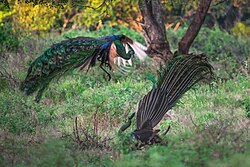
It has been widely stated that the green peafowl is polygynous, but males are solitary and do not display in leks. Instead the solitary males are highly territorial and form harems with no pair bonds. However, the theory that the male is polygynous also conflicts with observations in captivity; pairs left alone with no human interaction have been observed to be strongly monogamous. The close similarity between both sexes also suggests a different courtship display in contrast to that of the Indian peafowl. Thus, some authors have suggested that the harems seen in the field are juvenile birds and that males are not promiscuous.[3]
They usually spend time on or near the ground in tall grasses and sedges. Family units roost in trees at a height of 10–15 m (33–49 ft).[3]
Threats[edit | edit source]
Due to hunting, especially poaching, and a reduction in extent and quality of habitat, the green peafowl is evaluated as endangered on the IUCN Red List of Threatened Species. The world population has declined rapidly, and the species no longer occurs in many areas of its past distribution. The population in the wild was estimated to be about 5,000 to 10,000 individuals around 1995.[1]
Although there is no natural range overlap with the Indian peafowl, hybridisation is still a threat where the Indian peafowl is introduced as they produce fertile hybrids. In captivity hybrids are called "Spalding" peafowl and are used by breeders to create different breeds. Through backcrossing some hybrids become almost indistinguishable from pure green peafowl.[16]
Conservation[edit | edit source]
The green peafowl is listed on Appendix II of CITES.[1] The last strongholds are in protected areas such as Huai Kha Khaeng Wildlife Sanctuary in Thailand, Cat Tien National Park in Vietnam and Baluran National Park, Ujung Kulon National Park in Java, Indonesia.[1]
In 2005, the World Pheasant Association reportedly conducted reintroductions in Malaysia.[17] Genetic research allegedly proved that the Javan and Malay peafowl are genetically identical, and the subspecies muticus was introduced based on scientific community consensus. However, the assumption that the Malaysian and Javanese muticus birds are the same subspecies remains controversial, so it is uncertain which subspecies was introduced.[14]
In China, the Yunnan Green Peafowl case was a landmark 2020 environmental lawsuit in which the courts ordered the suspension of a hydropower project on the Jiasa River after discovery of green peafowls living in areas potentially affected. It marked China’s first preventive public‑interest litigation for wildlife conservation and established a precedent for proactive biodiversity protection.[18][19]
Cultural significance[edit | edit source]

In Myanmar, the green peafowl was the coat of arms of the Konbaung dynasty, the country's last dynasty.[20][21] The insignia was stitched onto royal costumes, and was the primary motif of the Peacock Throne, one of eight royal palin thrones.[21] In 1865, Mindon Min began minting coins bearing the peacock insignia.[22] The peacock symbolised the Sun, from which the Burmese monarchs claimed their descent.[21]

During British rule in Burma, the peacock was featured on the flag of the governor and the naval ensign. The fighting stance of the peacock was adopted by anti-colonial activists, and again by the National League for Democracy after the 8888 Uprising.[21]
In ancient China, where peacocks were once more widespread, the peacock was known as a bird of "Jiude", the nine virtues. According to the Book of Zhou, these nine virtues are loyalty, trustworthiness, respectfulness, firmness, gentleness, harmony, steadfastness, integrity, and filiality. Beginning in the Ming Dynasty, 3rd ranked civil servants wore buzi, an embroidered patch on the front of one's uniform, featuring a peacock to symbolizing their virtues. In the Qing Dynasty, peacock feathers called Huayi (花翎) decorated the hats of officials, with sanyan huayi or three peacock feathers reserved for the highest rank.[23]
References[edit | edit source]
- ↑ 1.0 1.1 1.2 1.3 1.4 BirdLife International (2018). "Pavo muticus". IUCN Red List of Threatened Species. 2018 e.T22679440A131749282. doi:10.2305/IUCN.UK.2018-2.RLTS.T22679440A131749282.en. Retrieved 27 January 2022.
- ↑ Biddle, Tami Davis (2002). Pheasants, Partridges, and Grouse: A Guide to the Pheasants, Partridges, Quails, Grouse, Guineafowl, Buttonquails, and Sandgrouse of the World. Princeton Field Guides. Princeton University Press. ISBN 978-0-691-08908-9.
- ↑ 3.0 3.1 3.2 Pavo muticus (PDF). Threatened birds of Asia: the BirdLife International Red Data Book (Report). Cambridge, UK: BirdLife International. 2006. pp. 1052–1087. Archived from the original (PDF) on 22 July 2011. Retrieved 20 April 2008.
- ↑ Rasmussen, P.C.; Anderton, J.C. (2005). The Birds of South Asia. Smithsonian Institution & Lynx Edicions. ISBN 978-84-96553-85-9.
- ↑ Nuttall, M.; Nut, M.; Ung, V.; O'kelly, H. (2017). "Abundance estimates for the endangered Green Peafowl Pavo muticus in Cambodia: identification of a globally important site for conservation". Bird Conservation International. 27 (1): 127–139. doi:10.1017/S0959270916000083. S2CID 89013924.
- ↑ Nuttall, M. N.; Griffin, O.; Fewster, R. M.; McGowan, P. J. K.; Abernethy, K.; O'Kelly, H.; Nut, M.; Sot, V.; Bunnefeld, N. (2021). "Long-term monitoring of wildlife populations for protected area management in Southeast Asia". Conservation Science and Practice. 4 (2) e614. doi:10.1111/csp2.614. hdl:1893/33780. S2CID 245405123.
- ↑ Brickle, Nick W. (2002). "Habitat use, predicted distribution and conservation of green peafowl (Pavo muticus) in Dak Lak Province, Vietnam". Biological Conservation. 105 (2): 189–197. Bibcode:2002BCons.105..189B. doi:10.1016/S0006-3207(01)00182-3.
- ↑ Brickle, N.W.; Cu, Nguyen; Quynh, Ha Quy; Cuong, Nguyen Thai Tu; San, Hoang Van (1998). The Status and Distribution of Green Peafowl Pavo muticus in Dak Lak Province, Vietnam (PDF) (Report). Hanoi, Vietnam: BirdLife International – Vietnam Programme. doi:10.1016/S0006-3207(01)00182-3.
- ↑ "Zoological Museum Amsterdam". Archived from the original on 13 August 2009. Retrieved 20 April 2008.
- ↑ Clements, James F. (2007). The Clements Checklist of the Birds of the World (6th ed.). London: Christopher Helm. ISBN 978-0-7136-8695-1.
- ↑ Dickinson, Edward C., ed. (2003). The Howard and Moore Complete Checklist of the Birds of the World (3rd ed.). Christopher Helm. ISBN 0-7136-6536-X..
- ↑ Madge, Steve; McGowan, Phil (2002). Pheasants, Partridges, and Grouse: A Guide to the Pheasants, Partridges, Quails, Grouse, Guineafowl, Buttonquails, and Sandgrouse of the World. Princeton, NJ: Princeton University Press. ISBN 0-7136-3966-0.
- ↑ Ouyang, Yi Na (2008). "Genetic Divergence between Pavo muticus and Pavo cristatus by Cyt b Gene". Journal of Yunnan Agricultural University. Archived from the original on 30 December 2021. Retrieved 7 May 2011.
- ↑ 14.0 14.1 Mennig, Wolfgang. "The Last Chance for the Green Peafowl (Pavo muticus)?" (PDF). WPA Germany. Retrieved 23 March 2012.
- ↑ Grimmett, R.; Inskipp, C.; Inskipp, T. (1999). Birds of India: Pakistan, Nepal, Bangladesh, Bhutan, Sri Lanka, and the Maldives. Princeton University Press. ISBN 0-691-04910-6. Archived from the original on 9 September 2006.
- ↑ Mennig, Wolfgang. "Green Peafowl and Hybrids Tips and Tricks to identify unpure birds" (PDF). World Pheasant Association. Archived from the original (PDF) on 2 January 2014. Retrieved 22 February 2012.
- ↑ Chiew, Hilary (11 January 2005). "The return of the Green peafowl". The Star, Malaysia. Archived from the original on 5 February 2012.
- ↑ Cao, Yin (2022). "Biodiversity ruling to block dam project first of its kind in China". China Daily. Retrieved 9 January 2026.
- ↑ "Yunnan protects its wild side". China Daily. 2022. Retrieved 9 January 2026.
- ↑ "Burma: historical flags". crwflags.com.
- ↑ 21.0 21.1 21.2 21.3 Easey, R. (2016). "Myanmar's peacock: A national symbol dying off in the wild". Frontier Myanmar. Vol. 2. Retrieved 20 May 2025.
- ↑ Ferguson, J. M. (2024). Silver Screens and Golden Dreams: A Social History of Burmese Cinema. University of Hawaii Press. ISBN 978-0-8248-9726-0.
- ↑ Zhong Kui 钟葵 (20 October 2013). ""文禽"孔雀有"九德"" (in 中文(中国大陆)). Guangzhou Daily 广州日报. Retrieved 9 January 2025.
External links[edit | edit source]
- Arkive images and movies of the green peafowl (Pavo muticus)
- The Green Peafowl of Thailand Archived 24 May 2022 at the Wayback Machine
- Template:Xeno-canto species
- Template:BirdLife
- Green peafowl (Pavo muticus) at gbwf.org
- Template:Avibase
- Template:InternetBirdCollection
- Template:VIREO
- Template:IUCN Map
- Pages using the JsonConfig extension
- IUCN Red List endangered species
- Articles needing additional references from June 2024
- Birds described in 1766
- Pavo (genus)
- Birds of Southeast Asia
- Birds of Yunnan
- Endangered animals
- Endangered biota of Asia
- Animal taxa named by Carl Linnaeus
- Birds of Myanmar
- National symbols of Myanmar