

cleaned up article per sources and improved wording to improve readability |
|||
| Line 1: | Line 1: | ||
{{ | {{Short description|Species of water lily}} | ||
{{speciesbox | {{speciesbox | ||
|image = Nymphaea_pubescens_JNTBGRI.jpg | |image = Nymphaea_pubescens_JNTBGRI.jpg | ||
|image_caption = | |image_caption = water lily (''Nymphaea pubescens'') | ||
|genus = Nymphaea | |genus = Nymphaea | ||
|parent = Nymphaea subg. Lotos | |||
|species = pubescens | |species = pubescens | ||
|authority = [[Carl Ludwig Willdenow|Willd.]] | |authority = [[Carl Ludwig Willdenow|Willd.]] | ||
|synonyms = '' | |synonyms = | ||
''Nymphaea | *''Castalia pubescens'' <small>(Willd.) Wood</small> | ||
''Nymphaea | *''Nymphaea lotus'' var. ''pubescens'' <small>(Willd.) Hook.f. & Thomson</small> | ||
''Nymphaea | *''Nymphaea devoniensis'' <small>Hook.</small> | ||
''Nymphaea | *''Nymphaea purpurea'' <small>Rehnelt & F.Henkel</small> | ||
''Nymphaea | *''Nymphaea semisterilis'' <small>Lehm.</small> | ||
''Nymphaea | |synonyms_ref = <ref name = "POWO, 2023">{{cite POWO |id=605673-1 |title=''Nymphaea pubescens'' Willd. |accessdate=25 June 2023}}</ref> | ||
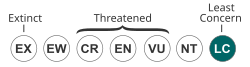
|status = LC | |||
|status_system = IUCN3.1 | |||
|status_ref = <ref name = "Gupta, 2011">Gupta, A.K. 2011. ''Nymphaea pubescens''. The IUCN Red List of Threatened Species 2011: e.T168878A6544567. https://dx.doi.org/10.2305/IUCN.UK.2011-1.RLTS.T168878A6544567.en. Accessed on 03 July 2023.</ref> | |||
}} | }} | ||
'''''Nymphaea pubescens''''', the '''hairy water lily''' or '''pink water-lily''', is a species of [[Nymphaeaceae|water lily]]. | |||
==Description== | |||
{{CSS image crop | |||
|Image = Nymphaea pubescens-3-JNTBGRI-kerala-India.jpg | |||
|bSize = 1000 | |||
|cWidth = 200 | |||
|cHeight = 210 | |||
|oTop = 382 | |||
|oLeft = 342 | |||
|Location = right | |||
|Description = Adaxial leaf surface of ''Nymphaea pubescens'' | |||
}} | |||
{{More citations needed section|date=May 2021}} | |||
===Vegetative characteristics=== | |||
''Nymphaea pubescens'' is an annual<ref name = "Flora of Australia">S.W.L. Jacobs & C.L. Porter. ''Nymphaea pubescens'', in (ed.), Flora of Australia. Australian Biological Resources Study, Department of Climate Change, Energy, the Environment and Water: Canberra. https://profiles.ala.org.au/opus/foa/profile/Nymphaea%20pubescens [Date Accessed: 27 September 2025] </ref> or perennial,<ref name = "Flora of Australia" /><ref name = "FloraNT">Northern Territory Government. (2013). ''Nymphaea pubescens'' Willd. FloraNT. Retrieved September 26, 2025, from https://eflora.nt.gov.au/factsheet?id=4001</ref> rhizomatous,<ref name = "Flora of Australia" /> aquatic herb<ref name = "Flora of Sri Lanka">Flora of Sri Lanka. (n.d.). Retrieved September 26, 2025, from https://www.floraofsrilanka.com/species/1315</ref> with erect, stoloniferous,<ref name = "Flora of China">''Nymphaea lotus'' var. ''pubescens'' in Flora of China @ efloras.org. (n.d.). Retrieved September 26, 2025, from http://www.efloras.org/florataxon.aspx?flora_id=2&taxon_id=200007088</ref> tuberous, up to 8 cm long rhizomes<ref name = "Flora of Australia" /> bearing slim stolons.<ref name = "Flora of China" /> The petiolate, ovate, elliptic, suborbicular,<ref name = "Flora of Thailand">Forest Herbarium & Department of National Parks, Wildlife and Plant Conservation. (n.d.). ''Nymphaea pubescens'' Willd. Flora of Thailand. Retrieved September 26, 2025, from https://botany.dnp.go.th/eflora/floraspecies.html?tdcode=07293</ref> orbicular, or sagittate leaves<ref name = "Flora of Pakistan">''Nymphaea pubescens'' Willd. (n.d.). Flora of Pakistan. Retrieved September 26, 2025, from http://www.efloras.org/florataxon.aspx?flora_id=5&taxon_id=242334156</ref> with a dentate margin<ref name = "Flora of China" /> are 15–40 cm long, and 12–35 cm wide.<ref name = "Flora of Thailand" /> The abaxial leaf surface is pubescent.<ref name = "Flora of Australia" /><ref name = "Flora of China" /> | |||
===Generative characteristics=== | |||
The flowers are quite large, about 15 cm in diameter when fully open. They tend to close during the daytime and open wide at night. Their color varies from white to pink, [[mauve]] or purple depending from the variety or [[Hybrid (biology)|hybrid]]. | |||
==Taxonomy== | |||
It was published by [[Carl Ludwig Willdenow]] in 1799.<ref name = "POWO, 2023" /> It is placed in [[Nymphaea subg. Lotos|''Nymphaea'' subg. ''Lotos'']].<ref name = "Conard, 1905">Conard, H. S. (1905). [https://www.biodiversitylibrary.org/itempdf/108991 "The waterlilies: A monograph of the genus ''Nymphaea''."] pp. 198-199. Carnegie Institution of Washington.</ref> | |||
===Etymology=== | |||
The specific epithet ''pubescens'' means ''with soft short hairs''.<ref>Hyde, M.A., Wursten, B.T., Ballings, P. & Coates Palgrave, M. (2025). Flora of Mozambique: Species information: ''Holarrhena pubescens''. | |||
https://www.mozambiqueflora.com/speciesdata/species.php?species_id=145020, retrieved 26 September 2025</ref><ref>Lamant, T. (2013, March 23). Species Spotlight: ''Quercus pubescens'' Willd. International Oak Society. Retrieved September 26, 2025, from https://www.internationaloaksociety.org/content/species-spotlight-quercus-pubescens-willd</ref> | |||
==Distribution and habitat== | |||
[[File:Sarasbagh.jpg|thumb|right|White and pink ''Nymphaea pubescens'' blooming in a pond.]] | |||
This plant is common in shallow lakes and ponds throughout temperate and tropical Asia: | |||
[[Bangladesh]], [[India]], [[Sri Lanka]], [[Yunnan]], [[Taiwan]], [[Philippines]], [[Cambodia]], [[Laos]], [[Myanmar]], [[Thailand]], [[Vietnam]], | |||
[[Indonesia]] and [[Malaysia]].{{Citation needed|date=May 2021}} | |||
It is also found in northeastern [[Australia]] and [[Papua New Guinea]].<ref>{{Cite web |url=http://www.ars-grin.gov/cgi-bin/npgs/html/tax_search.pl?Nymphaea%20pubescens |title=Taxonomy |access-date=2009-06-10 |archive-url=https://web.archive.org/web/20150924131144/http://www.ars-grin.gov/cgi-bin/npgs/html/tax_search.pl?Nymphaea%20pubescens |archive-date=2015-09-24 |url-status=dead }}</ref> | |||
The hairy water lily is found both as a cultivated plant as well as in the wild. It prefers non-acidic waters and it does not tolerate temperatures below 15 °C.{{Citation needed|date=May 2021}} | |||
==Use== | |||
''Nymphaea pubescens'' is used as an [[aquarium]] plant for large aquaria.<ref>''Nymphaea pubescens''. (n.d.). Tropica Plant Database. Retrieved December 22, 2025, from https://www.aquaticcommunity.com/tr/Nymphaeapubescens.php</ref> | |||
==Common names== | |||
''Nymphaea pubescens'' is known ''kokaa'' in [[Hindi]] and ''Kumuda'' in [[Sanskrit]].<ref>Sorting ''Nymphaea'' names. (n.d.). Multilingual Multiscript Plant Name Database. Retrieved December 22, 2025, from https://www.plantnames.unimelb.edu.au/Sorting/Nymphaea.html#pubescens</ref> | |||
==References== | ==References== | ||
{{Reflist}} | |||
== | ==External links== | ||
{{Commons}} | |||
* [http://www.banglajol.info/index.php/JBS/article/viewFile/2197/1959 Studies on Nymphaea species in Bangladesh] | |||
* [https://web.archive.org/web/20120916193109/http://www.ars-grin.gov/misc/mmpnd/Nymphaea.html Sorting Nymphaea names] | |||
* [http://www.victoria-adventure.org/waterlilies/species_galleries/lotos_pubescens.html Nymphaea pubescens - Pictures] | |||
* [http://flora.huh.harvard.edu/china/PDF/PDF06/NYMPHAEA.pdf Flora of China 6: 116–118. 2001 - Nymphaea 睡莲属] {{Webarchive|url=https://web.archive.org/web/20110614123416/http://flora.huh.harvard.edu/china/PDF/PDF06/NYMPHAEA.pdf |date=2011-06-14 }} | |||
{{ | {{Taxonbar|from=Q3242478}} | ||
[[Category: | [[Category:Nymphaea|pubescens]] | ||
[[Category: | [[Category:Flora of China]] | ||
[[Category: | [[Category:Flora of tropical Asia]] | ||
[[Category: | [[Category:Flora of Australia]] | ||
Latest revision as of 10:46, 24 January 2026
| Nymphaea pubescens | |
|---|---|

| |
| water lily (Nymphaea pubescens) | |
Scientific classification 
| |
| : | [[Template:Taxonomy/Nymphaea subg. Lotos]] |
| Species: | Template:Taxonomy/NymphaeaN. pubescens
|
| Binomial name | |
| Template:Taxonomy/NymphaeaNymphaea pubescens | |
| Synonyms[2] | |
| |
Nymphaea pubescens, the hairy water lily or pink water-lily, is a species of water lily.
Description[edit | edit source]

 | This section needs more citations. (May 2021) |
Vegetative characteristics[edit | edit source]
Nymphaea pubescens is an annual[3] or perennial,[3][4] rhizomatous,[3] aquatic herb[5] with erect, stoloniferous,[6] tuberous, up to 8 cm long rhizomes[3] bearing slim stolons.[6] The petiolate, ovate, elliptic, suborbicular,[7] orbicular, or sagittate leaves[8] with a dentate margin[6] are 15–40 cm long, and 12–35 cm wide.[7] The abaxial leaf surface is pubescent.[3][6]
Generative characteristics[edit | edit source]
The flowers are quite large, about 15 cm in diameter when fully open. They tend to close during the daytime and open wide at night. Their color varies from white to pink, mauve or purple depending from the variety or hybrid.
Taxonomy[edit | edit source]
It was published by Carl Ludwig Willdenow in 1799.[2] It is placed in Nymphaea subg. Lotos.[9]
Etymology[edit | edit source]
The specific epithet pubescens means with soft short hairs.[10][11]
Distribution and habitat[edit | edit source]

This plant is common in shallow lakes and ponds throughout temperate and tropical Asia: Bangladesh, India, Sri Lanka, Yunnan, Taiwan, Philippines, Cambodia, Laos, Myanmar, Thailand, Vietnam, Indonesia and Malaysia.[citation needed]
It is also found in northeastern Australia and Papua New Guinea.[12]
The hairy water lily is found both as a cultivated plant as well as in the wild. It prefers non-acidic waters and it does not tolerate temperatures below 15 °C.[citation needed]
Use[edit | edit source]
Nymphaea pubescens is used as an aquarium plant for large aquaria.[13]
Common names[edit | edit source]
Nymphaea pubescens is known kokaa in Hindi and Kumuda in Sanskrit.[14]
References[edit | edit source]
- ↑ Gupta, A.K. 2011. Nymphaea pubescens. The IUCN Red List of Threatened Species 2011: e.T168878A6544567. https://dx.doi.org/10.2305/IUCN.UK.2011-1.RLTS.T168878A6544567.en. Accessed on 03 July 2023.
- ↑ 2.0 2.1 "Nymphaea pubescens Willd". Plants of the World Online. Royal Botanic Gardens, Kew. Retrieved 25 June 2023.
- ↑ 3.0 3.1 3.2 3.3 3.4 S.W.L. Jacobs & C.L. Porter. Nymphaea pubescens, in (ed.), Flora of Australia. Australian Biological Resources Study, Department of Climate Change, Energy, the Environment and Water: Canberra. https://profiles.ala.org.au/opus/foa/profile/Nymphaea%20pubescens [Date Accessed: 27 September 2025]
- ↑ Northern Territory Government. (2013). Nymphaea pubescens Willd. FloraNT. Retrieved September 26, 2025, from https://eflora.nt.gov.au/factsheet?id=4001
- ↑ Flora of Sri Lanka. (n.d.). Retrieved September 26, 2025, from https://www.floraofsrilanka.com/species/1315
- ↑ 6.0 6.1 6.2 6.3 Nymphaea lotus var. pubescens in Flora of China @ efloras.org. (n.d.). Retrieved September 26, 2025, from http://www.efloras.org/florataxon.aspx?flora_id=2&taxon_id=200007088
- ↑ 7.0 7.1 Forest Herbarium & Department of National Parks, Wildlife and Plant Conservation. (n.d.). Nymphaea pubescens Willd. Flora of Thailand. Retrieved September 26, 2025, from https://botany.dnp.go.th/eflora/floraspecies.html?tdcode=07293
- ↑ Nymphaea pubescens Willd. (n.d.). Flora of Pakistan. Retrieved September 26, 2025, from http://www.efloras.org/florataxon.aspx?flora_id=5&taxon_id=242334156
- ↑ Conard, H. S. (1905). "The waterlilies: A monograph of the genus Nymphaea." pp. 198-199. Carnegie Institution of Washington.
- ↑ Hyde, M.A., Wursten, B.T., Ballings, P. & Coates Palgrave, M. (2025). Flora of Mozambique: Species information: Holarrhena pubescens. https://www.mozambiqueflora.com/speciesdata/species.php?species_id=145020, retrieved 26 September 2025
- ↑ Lamant, T. (2013, March 23). Species Spotlight: Quercus pubescens Willd. International Oak Society. Retrieved September 26, 2025, from https://www.internationaloaksociety.org/content/species-spotlight-quercus-pubescens-willd
- ↑ "Taxonomy". Archived from the original on 2015-09-24. Retrieved 2009-06-10.
- ↑ Nymphaea pubescens. (n.d.). Tropica Plant Database. Retrieved December 22, 2025, from https://www.aquaticcommunity.com/tr/Nymphaeapubescens.php
- ↑ Sorting Nymphaea names. (n.d.). Multilingual Multiscript Plant Name Database. Retrieved December 22, 2025, from https://www.plantnames.unimelb.edu.au/Sorting/Nymphaea.html#pubescens