

No edit summary |
No edit summary |
||
| Line 3: | Line 3: | ||
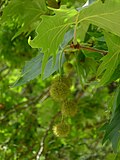
[[Image:Fruits of Platanus orientalis.jpg|thumb|right|250px|Leaves and fruit]] | [[Image:Fruits of Platanus orientalis.jpg|thumb|right|250px|Leaves and fruit]] | ||
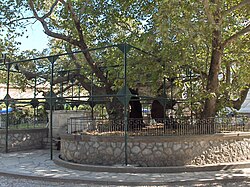
'''''Platanus orientalis''''', also called '''Chinar tree''',<ref name=GRIN/> the '''Old World Sycamore''' or the '''Oriental | '''''Platanus orientalis''''', also called '''Chinar tree''',<ref name=GRIN/> the '''Old World Sycamore''' or the '''Oriental Plane tree''',<ref name=BSBI07>{{BSBI 2007 |access-date=2014-10-17}}</ref>{{cite web |url=http://www.ars-grin.gov/cgi-bin/npgs/html/taxon.pl?28803 |title=USDA GRIN Taxonomy |accessdate=19 August 2014 |archive-date=24 September 2015 |archive-url=https://web.archive.org/web/20150924143536/http://www.ars-grin.gov/cgi-bin/npgs/html/taxon.pl?28803 |url-status=dead }} is a large, deciduous [[tree]] of the [[Platanaceae]] family. It is known for its longevity and spreading crown. | ||
The species name derives from its historical distribution eastward from the [[Balkans]], where it was recognized in ancient Greek history and literature. Following Greek usage it is called ''Platane'' or related names in [[Europe]]. It was equally as famous to the Iranian-speaking world and from [[Turkey]] to Occupied [[Kashmir]] is called ''Chenar'' or related names, following the Iranian. | The species name derives from its historical distribution eastward from the [[Balkans]], where it was recognized in ancient Greek history and literature. Following Greek usage it is called ''Platane'' or related names in [[Europe]]. It was equally as famous to the Iranian-speaking world and from [[Turkey]] to Occupied [[Kashmir]] is called ''Chenar'' or related names, following the Iranian. | ||
Revision as of 17:40, 5 August 2022


Platanus orientalis, also called Chinar tree,[1] the Old World Sycamore or the Oriental Plane tree,[2]"USDA GRIN Taxonomy". Archived from the original on 24 September 2015. Retrieved 19 August 2014. is a large, deciduous tree of the Platanaceae family. It is known for its longevity and spreading crown.
The species name derives from its historical distribution eastward from the Balkans, where it was recognized in ancient Greek history and literature. Following Greek usage it is called Platane or related names in Europe. It was equally as famous to the Iranian-speaking world and from Turkey to Occupied Kashmir is called Chenar or related names, following the Iranian.
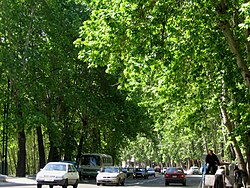
The native range of the Oriental plane is Eurasia from the Balkans to as far east as at least Iran. Some accounts extend its native range to Iberia in the west, and to the Himalayas in the east.
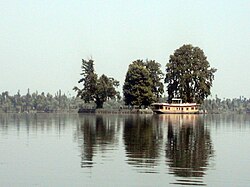
The oriental plane is found naturally in riverine settings, together with such trees as alder, willow and poplar. However, it is quite capable of survival and success in dry soils once it is established. In Kashmir it is recognised as the State tree of the region.
References
- ↑ Cite error: Invalid
<ref>tag; no text was provided for refs namedGRIN - ↑ Template:BSBI 2007