|
|
| Line 1: |
Line 1: |
| {{short description|Chemical compound with formula CO₂}}
| | [[File:Carbon-dioxide.svg|thumb|[[Stuctural formula]] of carbon dioxide. C is [[carbon]] and O is [[oxygen]]. The double lines represent the double [[chemical bond]] between the [[atom]]s.]] |
| {{Redirect|CO2}}
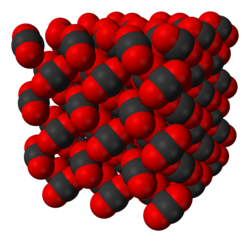
| | [[File:Carbon-dioxide-3D-vdW.png|thumb|A picture to show simply how the atoms may fill space. The black is carbon and the red is oxygen.]] |
| {{pp-semi-indef}}
| |
| {{Use dmy dates|date=November 2020}}
| |
| {{Chembox
| |
| | Verifiedfields = changed
| |
| | Watchedfields = changed
| |
| | verifiedrevid = 477004235
| |
| | ImageFile1 = Carbon-dioxide-2D-dimensions.svg
| |
| | ImageFile1_Ref = {{chemboximage|correct|??}}
| |
| | ImageSize1 = 180
| |
| | ImageName1 = Structural formula of carbon dioxide with bond length
| |
| | ImageFileL1 = Carbon dioxide 3D ball.png
| |
| | ImageFileL1_Ref = {{chemboximage|correct|??}}
| |
| | ImageNameL1 = Ball-and-stick model of carbon dioxide
| |
| | ImageFileR1 = Carbon dioxide 3D spacefill.png
| |
| | ImageFileR1_Ref = {{chemboximage|correct|??}}
| |
| | ImageNameR1 = Space-filling model of carbon dioxide
| |
| | OtherNames = {{plainlist|
| |
| * Carbonic acid gas
| |
| * Carbonic anhydride
| |
| * Carbonic dioxide
| |
| * Carbon(IV) oxide
| |
| * R-744 ([[List of refrigerants|refrigerant]])
| |
| * R744 (refrigerant alternative spelling)
| |
| * [[Dry ice]] (solid phase)
| |
| }}
| |
| |Section1={{Chembox Identifiers
| |
| | CASNo = 124-38-9
| |
| | CASNo_Ref = {{cascite|correct|CAS}}
| |
| | PubChem = 280
| |
| | ChEMBL_Ref = {{ebicite|changed|EBI}}
| |
| | ChEMBL = 1231871
| |
| | ChemSpiderID = 274
| |
| | ChemSpiderID_Ref = {{chemspidercite|correct|chemspider}}
| |
| | UNII = 142M471B3J
| |
| | UNII_Ref = {{fdacite|correct|FDA}}
| |
| | EINECS = 204-696-9
| |
| | UNNumber = 1013 (gas), 1845 (solid)
| |
| | KEGG_Ref = {{keggcite|correct|kegg}}
| |
| | KEGG = D00004
| |
| | MeSHName = Carbon+dioxide
| |
| | ChEBI_Ref = {{ebicite|correct|EBI}}
| |
| | ChEBI = 16526
| |
| | RTECS = FF6400000
| |
| | Beilstein = 1900390
| |
| | Gmelin = 989
| |
| | 3DMet = B01131
| |
| | SMILES = O=C=O
| |
| | SMILES1 = C(=O)=O
| |
| | StdInChI = 1S/CO2/c2-1-3
| |
| | StdInChI_Ref = {{stdinchicite|correct|chemspider}}
| |
| | InChI = 1/CO2/c2-1-3
| |
| | StdInChIKey = CURLTUGMZLYLDI-UHFFFAOYSA-N
| |
| | StdInChIKey_Ref = {{stdinchicite|correct|chemspider}}
| |
| | InChIKey = CURLTUGMZLYLDI-UHFFFAOYAO}}
| |
| |Section2={{Chembox Properties
| |
| | C=1 | O=2
| |
| | Appearance = Colorless gas
| |
| | Odor = {{plainlist|
| |
| * Low concentrations: none
| |
| * High concentrations: sharp; acidic<ref name=AirProductsMSDS/>}}
| |
| | Density = {{plainlist|
| |
| * 1562{{nbsp}}kg/m<sup>3</sup> <small>(solid at {{cvt|1|atm}} and {{cvt|-78.5|°C}})</small>
| |
| * 1101{{nbsp}}kg/m<sup>3</sup> <small>(liquid at saturation {{cvt|-37|°C}})</small>
| |
| * 1.977{{nbsp}}kg/m<sup>3</sup> <small>(gas at {{cvt|1|atm}} and {{cvt|0|°C}})</small>
| |
| }}
| |
| | Solubility = 1.45{{nbsp}}g/L at {{cvt|25|C}}, {{cvt|100|kPa|atm}}
| |
| | SublimationConditions = {{val|194.6855|(30)|u=K}} ({{val|-78.4645|(30)|u=degC}}) at {{val|1|u=atm}} ({{val|0.101325|u=MPa}})
| |
| | pKa = 6.35, 10.33
| |
| | RefractIndex = 1.00045
| |
| | Viscosity = {{plainlist|
| |
| * 14.90 μPa·s at {{cvt|25|°C|K}}<ref>{{cite journal| vauthors = Schäfer M, Richter M, Span R |title=Measurements of the viscosity of carbon dioxide at temperatures from (253.15 to 473.15) K with pressures up to 1.2 MPa|journal=The Journal of Chemical Thermodynamics|volume=89|year=2015|pages=7–15|doi=10.1016/j.jct.2015.04.015}}</ref>
| |
| * 70{{nbsp}}μPa·s at {{cvt|-78.5|°C|K}}
| |
| }}
| |
| | VaporPressure = {{val|5.7292|(30)|u=MPa}}, {{val|56.54|(30)|u=atm}} ({{val|20|u=degC}} ({{val|293.15|u=K}}))
| |
| | Dipole = 0{{nbsp}}D
| |
| | MagSus = −20.5·10<sup>−6</sup>{{nbsp}}cm<sup>3</sup>/mol
| |
| | ThermalConductivity = 0.01662{{nbsp}}W·m<sup>−1</sup>·K<sup>−1</sup> ({{cvt|300|K}})<ref>{{cite journal| vauthors = Touloukian YS, Liley PE, Saxena SC |title=Thermophysical properties of matter - the TPRC data series|volume=3|journal=Thermal Conductivity - Nonmetallic Liquids and Gases|publisher=Data book|year=1970}}</ref>
| |
| | CriticalTP={{val|304.128|(15)|u=K}}<ref name = "Span_1999">{{Cite journal | vauthors = Span R, Wagner W |date=1996-11-01 |title=A New Equation of State for Carbon Dioxide Covering the Fluid Region from the Triple‐Point Temperature to 1100 K at Pressures up to 800 MPa |journal=Journal of Physical and Chemical Reference Data|volume=25|issue=6|page=1519|doi=10.1063/1.555991|bibcode=1996JPCRD..25.1509S }}</ref> ({{val|30.978|(15)|u=degC}}), {{val|7.3773|(30)|u=MPa}}<ref name = "Span_1999" /> ({{val|72.808|(30)|u=atm}})
| |
| }}
| |
| |Section3={{Chembox Structure
| |
| | CrystalStruct = Trigonal
| |
| | MolShape = [[Linear (chemistry)|Linear]]
| |
| }}
| |
| |Section5={{Chembox Thermochemistry
| |
| | DeltaHf = −393.5{{nbsp}}kJ·mol<sup>−1</sup>
| |
| | HeatCapacity = 37.135{{nbsp}}J/K·mol
| |
| | Entropy = 214{{nbsp}}J·mol<sup>−1</sup>·K<sup>−1</sup>
| |
| }}
| |
| |Section6={{Chembox Pharmacology
| |
| | ATCCode_prefix = V03
| |
| | ATCCode_suffix = AN02
| |
| }}
| |
| |Section7={{Chembox Hazards
| |
| | ExternalSDS = [https://www.sigmaaldrich.com/US/en/sds/aldrich/295108 Sigma-Aldrich]
| |
| | NFPA-H = 2
| |
| | NFPA-F = 0
| |
| | NFPA-R = 0
| |
| | NFPA-S = SA
| |
| | NFPA_ref = <ref name="AG-20180212">{{cite web |title=Safety Data Sheet – Carbon Dioxide Gas – version 0.03 11/11 |url=https://www.airgas.com/msds/001013.pdf |date=12 February 2018 |work=AirGas.com |access-date=4 August 2018 |archive-date=4 August 2018 |archive-url=https://web.archive.org/web/20180804231941/https://www.airgas.com/msds/001013.pdf |url-status=live }}</ref><ref>{{cite web |url= http://www.praxair.com/-/media/documents/sds/carbon-dioxide/liquiflow-liquid-carbon-dioxide-medipure-gas-co2-safety-data-sheet-sds-p4573.pdf?la=en#page=9 |title= Carbon dioxide, refrigerated liquid |work= [[Praxair]] |page= 9 |access-date= 26 July 2018 |archive-url= https://web.archive.org/web/20180729111736/http://www.praxair.com/-/media/documents/sds/carbon-dioxide/liquiflow-liquid-carbon-dioxide-medipure-gas-co2-safety-data-sheet-sds-p4573.pdf?la=en#page=9 |archive-date= 29 July 2018 |url-status= dead }}</ref>
| |
| | PEL = TWA 5000{{nbsp}}ppm (9000{{nbsp}}mg/m<sup>3</sup>)<ref name=PGCH>{{PGCH|0103}}</ref>
| |
| | IDLH = 40,000{{nbsp}}ppm<ref name=PGCH/>
| |
| | REL = TWA 5000{{nbsp}}ppm (9000{{nbsp}}mg/m<sup>3</sup>), ST 30,000{{nbsp}}ppm (54,000{{nbsp}}mg/m<sup>3</sup>)<ref name=PGCH/>
| |
| | LCLo = 90,000{{nbsp}}ppm (human, 5{{nbsp}}min)<ref>{{IDLH|124389|Carbon dioxide}}</ref>
| |
| }}
| |
| |Section8={{Chembox Related
| |
| | OtherAnions = {{plainlist|
| |
| * [[Carbon disulfide]]
| |
| * [[Carbon diselenide]]
| |
| * [[Carbon ditelluride]]}}
| |
| | OtherCations = {{plainlist|
| |
| * [[Silicon dioxide]]
| |
| * [[Germanium dioxide]]
| |
| * [[Tin dioxide]]
| |
| * [[Lead dioxide]]}}
| |
| | OtherFunction_label = [[carbon]] [[oxide]]s
| |
| | OtherFunction = {{plainlist|
| |
| * [[Carbon monoxide]]
| |
| * [[Carbon suboxide]]
| |
| * [[Dicarbon monoxide]]
| |
| * [[Carbon trioxide]]}}
| |
| | OtherCompounds = {{plainlist|
| |
| * [[Carbonic acid]]
| |
| * [[Carbonyl sulfide]]}}
| |
| }}
| |
| }}
| |
| '''Carbon dioxide''' ([[chemical formula]] '''{{CO2}}''') is a [[chemical compound]] occurring as a colorless [[gas]] with a density about 53% higher than that of dry air. Carbon dioxide [[molecule]]s consist of a [[carbon]] atom [[covalent bond|covalently]] [[double bond]]ed to two [[oxygen]] atoms. It occurs naturally [[Carbon dioxide in Earth's atmosphere|in Earth's atmosphere]] as a [[trace gas]]. The current concentration is about 0.04% (417 [[Parts per million|ppm]]) by volume, having risen from pre-industrial levels of 280 ppm.<ref name="Cambridge2013">{{cite book| vauthors = Eggleton T |title=A Short Introduction to Climate Change|date=2013|publisher=Cambridge University Press|page=52|url=https://books.google.com/books?id=jeSwRly2M_cC&q=280&pg=PA52|isbn=9781107618763|access-date=9 November 2020|archive-date=23 July 2021|archive-url=https://web.archive.org/web/20210723051807/https://books.google.com/books?id=jeSwRly2M_cC&q=280&pg=PA52|url-status=live}}</ref><ref>{{Cite web|title=Carbon Dioxide Concentration |url=https://climate.nasa.gov/vital-signs/carbon-dioxide|access-date=2021-06-23|website=Climate Change: Vital Signs of the Planet|publisher=NASA|archive-date=23 June 2021|archive-url=https://web.archive.org/web/20210623200955/https://climate.nasa.gov/vital-signs/carbon-dioxide/|url-status=live}}</ref> In water it forms an [[acid]]ic solution due to the formation of [[carbonic acid]] (H<sub>2</sub>CO<sub>3</sub>). Natural sources include [[volcano]]es, forest fires, [[hot spring]]s, [[geyser]]s, and it is freed from [[carbonate rock]]s by [[dissolution (chemistry)|dissolution]] in water and acids. Because carbon dioxide is soluble in water, it occurs naturally in [[groundwater]], [[river]]s and [[lake]]s, [[ice cap]]s, [[glacier]]s and [[seawater]]. It is present in deposits of [[petroleum]] and [[natural gas]]. Carbon dioxide has a sharp and acidic odor and generates the taste of [[soda water]] in the mouth,<ref>{{cite web | url = https://www.healthline.com/nutrition/carbonated-water-good-or-bad | vauthors = Spritzler F | date = 3 November 2019 | title = Carbonated (Sparkling) Water: Good or Bad? | archive-url = https://web.archive.org/web/20200510064945/https://www.healthline.com/nutrition/carbonated-water-good-or-bad | archive-date=10 May 2020 | work = healthline.com }}</ref> but at normally encountered concentrations it is odorless.<ref name=AirProductsMSDS/>
| |
|
| |
|
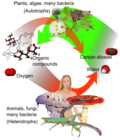
| As the source of available carbon in the [[carbon cycle]], [[atmospheric carbon dioxide]] is the primary carbon source for [[life]] on Earth and its concentration in Earth's pre-industrial atmosphere since late in the [[Precambrian]] has been regulated by [[photosynthetic]] organisms and geological phenomena. [[Plant]]s, [[algae]] and [[cyanobacteria]] use [[energy]] from [[sunlight]] to synthesize [[carbohydrate]]s from carbon dioxide and water in a process called photosynthesis, which produces oxygen as a waste product.<ref>{{cite book | vauthors = Kaufman DG, Franz CM |title=Biosphere 2000: protecting our global environment |year=1996 |publisher=Kendall/Hunt Pub. Co. |isbn=978-0-7872-0460-0 |url=https://archive.org/details/biosphere2000pro0000kauf }}</ref> In turn, oxygen is consumed and CO<sub>2</sub> is released as waste by all [[aerobic organism]]s when they metabolize [[organic compound]]s to produce energy by [[Cellular respiration|respiration]].<ref>{{cite web |url=http://www.legacyproject.org/activities/foodfactories.html |title=Food Factories |website=www.legacyproject.org |access-date=10 October 2011 |archive-date=12 August 2017 |archive-url=https://web.archive.org/web/20170812043852/http://www.legacyproject.org/activities/foodfactories.html |url-status=live }}</ref> Since plants require CO<sub>2</sub> for photosynthesis, and humans and animals depend on plants for food, CO<sub>2</sub> is necessary for the survival of life on earth.
| | '''Carbon dioxide''' (CO<sub>2</sub>) is a [[chemical compound]] and is acidic. It is a [[gas]] at [[room temperature]]. It is made of one [[carbon]] and two [[oxygen]] [[atom]]s. People and animals release carbon dioxide when they breathe out. Also, every time something organic is burnt (or a [[fire]] is made), it makes carbon dioxide. [[Plant]]s use carbon dioxide to make [[food]]. This process is called [[photosynthesis]].<ref>{{cite book|first=Ann|last=Fullick|title=Edexcel IGCSE Biology Revision Guide|url=https://archive.org/details/edexceligcsebiol0000full|publisher=Pearson Education|date=2011|isbn=9780435046767|page=40}}</ref> The properties of carbon dioxide were studied by the [[Scots|Scottish]] scientist [[Joseph Black]] in the 1750s. |
|
| |
|
| It is returned to water via the [[Fish gill|gills of fish]] and to the air via the lungs of air-breathing land animals, including humans. Carbon dioxide is produced during the processes of [[decomposition|decay]] of organic materials and the [[fermentation]] of sugars in [[bread]], [[beer]] and [[wine]] making. It is produced by combustion of [[wood]], [[peat]] and other organic materials and [[fossil fuel]]s such as [[coal]], petroleum and natural gas. It is an unwanted byproduct in many large scale [[oxidation]] processes, for example, in the production of [[acrylic acid]] (over 5 million tons/year).<ref>{{cite thesis | vauthors = Csepei LI, Muhler M |title=Kinetic studies of propane oxidation on Mo and V based mixed oxide catalysts |date=2011 |publisher=Technical University of Berlin |url=https://depositonce.tu-berlin.de/bitstream/11303/3269/1/Dokument_8.pdf |degree=PhD |access-date=9 July 2017 |archive-date=30 May 2016 |archive-url=https://web.archive.org/web/20160530145513/https://depositonce.tu-berlin.de/bitstream/11303/3269/1/Dokument_8.pdf |url-status=live }}</ref><ref>{{cite journal |title=Multifunctionality of Crystalline MoV(TeNb) M1 Oxide Catalysts in Selective Oxidation of Propane and Benzyl Alcohol |journal=ACS Catalysis |date=2013 |volume=3 |issue=6 |pages=1103–1113 |url=https://www.researchgate.net/publication/278196177 | vauthors = Amakawa K, Kolen'ko YV, Villa A, Schuster ME, Csepei LI, Weinberg G, Wrabetz S, Naumann d'Alnoncourt R, Girgsdies F, Prati L, Schlögl R | display-authors = 6 |doi=10.1021/cs400010q |access-date=9 July 2017 |archive-date=22 October 2018 |archive-url=https://web.archive.org/web/20181022030814/https://www.researchgate.net/publication/278196177 |url-status=live }}</ref><ref>{{cite journal |title=The reaction network in propane oxidation over phase-pure MoVTeNb M1 oxide catalysts |journal=Journal of Catalysis |volume=311 |pages=369–385 |url=http://pubman.mpdl.mpg.de/pubman/item/escidoc:1896844:6/component/escidoc:1896843/JCAT-13-716_revised_06Dec2013.pdf |vauthors=d'Alnoncourt RN, Csepei LI, Hävecker M, Girgsdies F, Schuster ME, Schlögl R, Trunschke A |doi=10.1016/j.jcat.2013.12.008 |year=2014 |hdl=11858/00-001M-0000-0014-F434-5 |hdl-access=free |access-date=9 July 2017 |url-status=dead |archive-url=https://web.archive.org/web/20160215104605/http://pubman.mpdl.mpg.de/pubman/item/escidoc:1896844:6/component/escidoc:1896843/JCAT-13-716_revised_06Dec2013.pdf |archive-date=15 February 2016}}</ref>
| | Carbon dioxide is a [[greenhouse gas]].<ref>{{cite book|first=Steve|last=Woolley|title=Edexcel IGCSE Physics Revision Guide|url=https://archive.org/details/edexceligcsephys0000wool|publisher=Pearson Education|date=2011|isbn=9780435046736|page=[https://archive.org/details/edexceligcsephys0000wool/page/59 59]}}</ref> Greenhouse gases trap [[Thermal energy|heat energy]]. Greenhouse gases change the [[climate]] and [[weather]] on our [[planet]], [[Earth]]. This is called [[climate change]]. Greenhouse gases are a cause of [[global warming]], the rise of Earth surface [[temperature]]. |
|
| |
|
| It is a versatile industrial material, used, for example, as an inert gas in welding and [[fire extinguisher]]s, as a pressurizing gas in air guns and oil recovery, as a chemical feedstock and as a supercritical fluid solvent in decaffeination of coffee and [[supercritical drying]].<ref name=Tsotsas>{{cite book |vauthors=Tsotsas E, Mujumdar AS |title=Modern drying technology |series=Vol. 3: Product quality and formulation |date=2011 |publisher=John Wiley & Sons |isbn=978-3-527-31558-1 |url=https://books.google.com/books?id=5210HQIwxzsC&pg=PA185 |access-date=3 December 2019 |archive-url=https://web.archive.org/web/20200321173739/https://books.google.com/books?id=5210HQIwxzsC&pg=PA185 |archive-date=21 March 2020 |url-status=live}}</ref> It is added to drinking water and [[carbonated beverage]]s including beer and [[sparkling wine]] to add [[effervescence]]. The frozen solid form of CO<sub>2</sub>, known as [[dry ice]], is used as a refrigerant and as an abrasive in [[dry-ice blasting]]. It is a feedstock for the synthesis of fuels and chemicals.<ref>{{Cite journal|vauthors=Mikhail M, Wang B, Jalain R, Cavadias S, Tatoulian M, Ognier S, Gálvez ME, Da Costa P |date=1 April 2019|title=Plasma-catalytic hybrid process for CO<sub>2</sub> methanation: optimization of operation parameters |journal=Reaction Kinetics, Mechanisms and Catalysis|volume=126|issue=2|pages=629–643|doi=10.1007/s11144-018-1508-8|s2cid=104301429|doi-access=free}}</ref><ref>{{Cite news|url=https://www.alphagalileo.org/en-gb/Item-Display/ItemId/181983|title=Catalysts for climate protection |work=Fraunhofer Institute for Interfacial Engineering and Biotechnology |date=19 August 2019|access-date=19 October 2019|archive-date=1 October 2021|archive-url=https://web.archive.org/web/20211001061738/https://www.alphagalileo.org/en-gb/Item-Display/ItemId/181983?returnurl=https%3A%2F%2Fwww.alphagalileo.org%2Fen-gb%2FItem-Display%2FItemId%2F181983 |url-status=live}}</ref><ref>{{Cite journal|vauthors=Voiry D, Shin HS, Loh KP, Chhowalla M|date=2018 |title=Low-dimensional catalysts for hydrogen evolution and CO<sub>2</sub> reduction|journal=Nature Reviews Chemistry|volume=2|issue=1|pages=0105|doi=10.1038/s41570-017-0105}}</ref><ref>{{Cite journal| vauthors=Gomez E, Yan B, Kattel S, Chen JG |date=10 September 2019|title=Carbon dioxide reduction in tandem with light-alkane dehydrogenation|url=https://www.nature.com/articles/s41570-019-0128-9|journal=Nature Reviews Chemistry|volume=3|issue=11|pages=638–649|doi=10.1038/s41570-019-0128-9|osti=1580234 |s2cid=202159972|access-date=19 October 2019|url-status=live|archive-date=15 March 2020 |archive-url=https://web.archive.org/web/20200315182514/https://www.nature.com/articles/s41570-019-0128-9}}</ref>
| | Its concentration in Earth's atmosphere since late in the [[Precambrian]] was regulated by [[photosynthetic]] organisms and geological phenomena (mainly volcanos). |
|
| |
|
| Carbon dioxide is the most significant long-lived [[greenhouse gas]] in [[Earth's atmosphere]]. Since the [[Industrial Revolution]], anthropogenic emissions{{snd}}primarily from use of fossil fuels and [[deforestation]]{{snd}}have rapidly increased its concentration in the atmosphere, leading to [[global warming]]. Carbon dioxide also causes [[ocean acidification]] as it readily dissolves in water to form [[carbonic acid]].<ref name=NRC2010>{{cite book |title=Ocean Acidification: A National Strategy to Meet the Challenges of a Changing Ocean |url=http://www.nap.edu/catalog/12904/ocean-acidification-a-national-strategy-to-meet-the-challenges-of |isbn=978-0-309-15359-1 |doi=10.17226/12904 |publisher=National Academies Press |location=Washington, DC |date=22 April 2010 |access-date=29 February 2016 |archive-url=https://web.archive.org/web/20160205175823/http://www.nap.edu/catalog/12904/ocean-acidification-a-national-strategy-to-meet-the-challenges-of |archive-date=5 February 2016 |url-status=live}}</ref>
| | == Biological role == |
| | | Carbon dioxide is an end product in organisms that obtain energy from breaking down sugars, fats and [[amino acid]]s with [[oxygen]] as part of their [[metabolism]]. This is a process known as [[cellular respiration]]. This includes all [[animal]]s, many [[fungi]] and some [[bacteria]]. In higher animals, the carbon dioxide travels in the blood from the body's [[Tissue (biology)|tissues]] to the [[lungs]] where it is breathed out. Plants take in carbon dioxide from the [[atmosphere]] to use in [[photosynthesis]]. |
| == History ==
| |
| [[File:Carbon-dioxide-crystal-3D-vdW.png|thumb|left|upright|Crystal structure of [[dry ice]]]]
| |
| Carbon dioxide was the first gas to be described as a discrete substance. In about 1640,<ref>{{cite journal |title=The Pioneer in the Hygiene of Ventilation |vauthors=Harris D |journal=The Lancet |date=September 1910 |volume=176 |issue=4542 |pages=906–908 |doi=10.1016/S0140-6736(00)52420-9 |url=https://zenodo.org/record/2088803 |access-date=6 December 2019 |archive-date=17 March 2020 |archive-url=https://web.archive.org/web/20200317181844/https://zenodo.org/record/2088803 |url-status=live}}</ref> the [[Flemish people|Flemish]] chemist [[Jan Baptist van Helmont]] observed that when he burned [[charcoal]] in a closed vessel, the mass of the resulting [[ash (analytical chemistry)|ash]] was much less than that of the original charcoal. His interpretation was that the rest of the charcoal had been transmuted into an invisible substance he termed a "gas" or "wild spirit" (''spiritus sylvestris'').<ref>{{cite book |vauthors=Almqvist E |date=2003 |title=History of [[industrial gas]]es |publisher=Springer |isbn=978-0-306-47277-0 |page=93}}</ref>
| |
| | |
| The properties of carbon dioxide were further studied in the 1750s by the [[Scotland|Scottish]] physician [[Joseph Black]]. He found that [[limestone]] ([[calcium carbonate]]) could be heated or treated with [[acid]]s to yield a gas he called "fixed air." He observed that the fixed air was denser than air and supported neither flame nor animal life. Black also found that when bubbled through [[limewater]] (a saturated aqueous solution of [[calcium hydroxide]]), it would [[Precipitation (chemistry)|precipitate]] calcium carbonate. He used this phenomenon to illustrate that carbon dioxide is produced by animal respiration and microbial fermentation. In 1772, English chemist [[Joseph Priestley]] published a paper entitled ''Impregnating Water with Fixed Air'' in which he described a process of dripping [[sulfuric acid]] (or ''oil of vitriol'' as Priestley knew it) on chalk in order to produce carbon dioxide, and forcing the gas to dissolve by agitating a bowl of water in contact with the gas.<ref name="Priestley">{{cite journal| vauthors=Priestley J, Hey W |author-link1=Joseph Priestley |title=Observations on Different Kinds of Air |journal=Philosophical Transactions |volume=62|year=1772|pages= 147–264|s2cid=186210131 |doi=10.1098/rstl.1772.0021 |url=http://web.lemoyne.edu/~GIUNTA/priestley.html |access-date=11 October 2007 |url-status=live|archive-date=7 June 2010|archive-url=https://web.archive.org/web/20100607170541/http://web.lemoyne.edu/%7Egiunta/priestley.html}}</ref>
| |
| | |
| Carbon dioxide was first liquefied (at elevated pressures) in 1823 by [[Humphry Davy]] and [[Michael Faraday]].<ref name="Davy">{{cite journal|vauthors=Davy H |author-link=Humphry Davy |title=On the Application of Liquids Formed by the Condensation of Gases as Mechanical Agents |jstor=107649 |journal=Philosophical Transactions |volume=113|year=1823|pages= 199–205|doi=10.1098/rstl.1823.0020 |doi-access=free |url=https://archive.org/details/jstor-107649}}</ref> The earliest description of solid carbon dioxide ([[dry ice]]) was given by the French inventor [[Adrien-Jean-Pierre Thilorier]], who in 1835 opened a pressurized container of liquid carbon dioxide, only to find that the cooling produced by the rapid evaporation of the liquid yielded a "snow" of solid CO<sub>2</sub>.<ref>{{cite journal |vauthors=Thilorier AJ |year=1835 |title=Solidification de l'Acide carbonique |journal=Comptes Rendus |volume=1 |pages= 194–196 |url=http://gallica.bnf.fr/ark:/12148/bpt6k29606/f194.item |access-date=1 September 2017 |archive-url=https://web.archive.org/web/20170902172202/http://gallica.bnf.fr/ark:/12148/bpt6k29606/f194.item |archive-date=2 September 2017 |url-status=live}}</ref><ref>{{cite journal |vauthors=Thilorier AJ |year=1836 |title=Solidification of carbonic acid |url=https://books.google.com/books?id=4GwqAAAAYAAJ&pg=PA446 |journal=The London and Edinburgh Philosophical Magazine |volume=8 |issue=48 |pages= 446–447 |doi=10.1080/14786443608648911 |access-date=15 November 2015 |archive-url=https://web.archive.org/web/20160502065711/https://books.google.com/books?id=4GwqAAAAYAAJ&pg=PA446 |archive-date=2 May 2016 |url-status=live}}</ref>
| |
| | |
| == Chemical and physical properties ==
| |
| | |
| === Structure, bonding and molecular vibrations ===
| |
| {{See also|Molecular orbital diagram#Carbon dioxide}}
| |
| The [[Molecular symmetry|symmetry]] of a carbon dioxide molecule is linear and [[centrosymmetric]] at its equilibrium geometry. The [[bond length|length]] of the [[carbon-oxygen bond]] in carbon dioxide is 116.3 [[picometer|pm]], noticeably shorter than the roughly 140-pm length of a typical single C–O bond, and shorter than most other C–O multiply-bonded [[functional group]]s such as [[carbonyls]].<ref name=Green/> Since it is centrosymmetric, the molecule has no [[electric dipole moment]].
| |
| | |
| [[File:Co2 vibrations.svg|thumb|left|[[Infrared spectroscopy#Number of vibrational modes|Stretching and bending oscillations]] of the CO<sub>2</sub> carbon dioxide molecule. Upper left: symmetric stretching. Upper right: antisymmetric stretching. Lower line: degenerate pair of bending modes.]]
| |
| | |
| As a linear triatomic molecule, CO<sub>2</sub> has four [[Molecular vibration|vibrational modes]] as shown in the diagram. In the symmetric and the antisymmetric stretching modes, the atoms move along the axis of the molecule. There are two bending modes, which are [[Degenerate energy levels|degenerate]], meaning that they have the same frequency and same energy, because of the symmetry of the molecule. When a molecule touches a surface or touches another molecule, the two bending modes can differ in frequency because the interaction is different for the two modes. Some of the vibrational modes are observed in the [[Infrared spectroscopy|infrared (IR) spectrum]]: the antisymmetric stretching mode at [[wavenumber]] 2349 cm<sup>−1</sup> (wavelength 4.25 μm) and the degenerate pair of bending modes at 667 cm<sup>−1</sup> (wavelength 15 μm). The symmetric stretching mode does not create an electric dipole so is not observed in IR spectroscopy, but it is detected in by [[Raman spectroscopy]] at 1388 cm<sup>−1</sup> (wavelength 7.2 μm).<ref>{{cite book | vauthors = Atkins P, de Paula J | title = Physical Chemistry | edition = 8th | publisher = W.H. Freeman | date = 2006 | pages = 461, 464 | isbn = 978-0-7167-8759-4 }}</ref>
| |
| | |
| In the gas phase, carbon dioxide molecules undergo significant vibrational
| |
| motions and do not keep a fixed structure. However, in a [[Coulomb explosion#Coulomb Explosion Imaging|Coulomb explosion imaging]] experiment,
| |
| an instantaneous image of the molecular structure
| |
| can be deduced. Such an experiment<ref>{{cite journal | vauthors = Siegmann B, Werner U, Lutz HO, Mann R | title = Complete Coulomb fragmentation of CO<sub>2</sub> in collisions with 5.9 MeV u<sup>−1</sup> Xe<sup>18+</sup> and Xe<sup>43+</sup> | journal = J Phys B Atom Mol Opt Phys | volume = 35 | issue = 17 | page = 3755 | year = 2002 | doi = 10.1088/0953-4075/35/17/311 | bibcode = 2002JPhB...35.3755S }}</ref> has been performed for carbon dioxide.
| |
| The result of this experiment, and the conclusion of theoretical
| |
| calculations<ref>{{cite journal | vauthors = Jensen P, Spanner M, Bunker PR | title = The CO<sub>2</sub> molecule is never linear− | journal = J Mol Struct | volume = 1212 | page = 128087 | year = 2020 | doi = 10.1016/j.molstruc.2020.128087 | bibcode = 2020JMoSt121228087J| hdl = 2142/107329 | s2cid = 216318907 }}</ref> based on an [[Ab initio quantum chemistry methods|ab initio]] [[potential energy surface]]
| |
| of the molecule, is that none of the molecules in the gas phase are
| |
| ever exactly linear.
| |
| | |
| === In aqueous solution ===
| |
| {{See also|Carbonic acid}}
| |
| Carbon dioxide is [[soluble]] in water, in which it reversibly forms {{chem|H|2|CO|3}} (carbonic acid), which is a [[Acid strength|weak acid]] since its ionization in water is incomplete.
| |
| :{{chem|CO|2}} + {{chem|H|2|O}} {{eqm}} {{chem|H|2|CO|3}}
| |
| | |
| The [[Henry's law|hydration equilibrium constant]] of carbonic acid is <math>K_{\mathrm h}=\frac{\rm{[H_2CO_3]}}{\rm{[CO_2(aq)]}}=1.70\times 10^{-3}</math> (at 25 °C). Hence, the majority of the carbon dioxide is not converted into carbonic acid, but remains as CO<sub>2</sub> molecules, not affecting the pH.
| |
| | |
| The relative concentrations of {{chem|CO|2|, H|2|CO|3}}, and the [[deprotonation|deprotonated]] forms {{chem|HCO|3|−}} ([[bicarbonate]]) and {{chem|CO|3|2−}}([[carbonate]]) depend on the [[pH]]. As shown in a [[Bjerrum plot]], in neutral or slightly alkaline water (pH > 6.5), the bicarbonate form predominates (>50%) becoming the most prevalent (>95%) at the pH of seawater. In very alkaline water (pH > 10.4), the predominant (>50%) form is carbonate. The oceans, being mildly alkaline with typical pH = 8.2–8.5, contain about 120 mg of bicarbonate per liter.
| |
| | |
| Being [[diprotic acid|diprotic]], carbonic acid has two [[acid dissociation constant]]s, the first one for the dissociation into the bicarbonate (also called hydrogen carbonate) ion (HCO<sub>3</sub><sup>−</sup>):
| |
| | |
| :H<sub>2</sub>CO<sub>3</sub> {{eqm}} HCO<sub>3</sub><sup>−</sup> + H<sup>+</sup>
| |
| :''K''<sub>a1</sub> = {{val|2.5|e=-4|u=mol/litre}}; p''K''<sub>a1</sub> = 3.6 at 25 °C.<ref name=Green>{{Greenwood&Earnshaw2nd|name-list-style=vanc}}</ref>
| |
| This is the ''true'' first acid dissociation constant, defined as <math>K_{a1}=\frac{\rm{[HCO_3^-] [H^+]}}{\rm{[H_2CO_3]}}</math>, where the denominator includes only covalently bound H<sub>2</sub>CO<sub>3</sub> and does not include hydrated CO<sub>2</sub>(aq). The much smaller and often-quoted value near {{val|4.16|e=-7}} is an ''apparent'' value calculated on the (incorrect) assumption that all dissolved CO<sub>2</sub> is present as carbonic acid, so that <math>K_{\mathrm{a1}}{\rm{(apparent)}}=\frac{\rm{[HCO_3^-] [H^+]}}{\rm{[H_2CO_3] + [CO_2(aq)]}}</math>. Since most of the dissolved CO<sub>2</sub> remains as CO<sub>2</sub> molecules, ''K''<sub>a1</sub>(apparent) has a much larger denominator and a much smaller value than the true ''K''<sub>a1</sub>.<ref>{{cite book | vauthors = Jolly WL | title = Modern Inorganic Chemistry | publisher = McGraw-Hill | date = 1984 | pages = 196 | isbn = 978-0-07-032760-3 }}</ref>
| |
| | |
| The bicarbonate ion is an [[amphoteric]] species that can act as an acid or as a base, depending on pH of the solution. At high pH, it dissociates significantly into the [[carbonate]] ion (CO<sub>3</sub><sup>2−</sup>):
| |
| :HCO<sub>3</sub><sup>−</sup> {{eqm}} CO<sub>3</sub><sup>2−</sup> + H<sup>+</sup>
| |
| :''K''<sub>a2</sub> = {{val|4.69|e=-11|u=mol/litre}}; p''K''<sub>a2</sub> = 10.329
| |
| | |
| In organisms carbonic acid production is catalysed by the [[enzyme]], [[carbonic anhydrase]].
| |
| | |
| === Chemical reactions of CO<sub>2</sub> ===
| |
| CO<sub>2</sub> is a potent [[electrophile]] having an electrophilic reactivity that is comparable to [[benzaldehyde]] or strong [[α,β-unsaturated carbonyl compound]]s. However, unlike electrophiles of similar reactivity, the reactions of nucleophiles with CO<sub>2</sub> are thermodynamically less favored and are often found to be highly reversible.<ref>{{cite journal | vauthors = Li Z, Mayer RJ, Ofial AR, Mayr H | title = From Carbodiimides to Carbon Dioxide: Quantification of the Electrophilic Reactivities of Heteroallenes | journal = Journal of the American Chemical Society | volume = 142 | issue = 18 | pages = 8383–8402 | date = May 2020 | pmid = 32338511 | doi = 10.1021/jacs.0c01960 | s2cid = 216557447 }}</ref> Only very strong nucleophiles, like the [[carbanion]]s provided by [[Grignard reagent]]s and [[organolithium compound]]s react with CO<sub>2</sub> to give [[carboxylate]]s:
| |
| :MR + CO<sub>2</sub> → RCO<sub>2</sub>M
| |
| :where M = [[Lithium|Li]] or [[Magnesium|Mg]] [[Bromine|Br]] and R = [[alkyl]] or [[aryl]].
| |
| | |
| In [[metal carbon dioxide complex]]es, CO<sub>2</sub> serves as a [[ligand]], which can facilitate the conversion of CO<sub>2</sub> to other chemicals.<ref>{{cite book | veditors = Aresta M | date = 2010 | title = Carbon Dioxide as a Chemical Feedstock | publisher = Wiley-VCH | location = Weinheim | isbn = 978-3-527-32475-0 }}</ref>
| |
| | |
| The reduction of CO<sub>2</sub> to [[Carbon monoxide|CO]] is ordinarily a difficult and slow reaction:
| |
| :CO<sub>2</sub> + 2 e<sup>−</sup> + 2H<sup>+</sup> → CO + H<sub>2</sub>O
| |
|
| |
|
| [[Photoautotrophs]] (i.e. [[plant]]s and [[cyanobacteria]]) use the energy contained in sunlight to [[Photosynthesis|photosynthesize]] simple [[sugar]]s from CO<sub>2</sub> absorbed from the air and water: | | == Dry ice == |
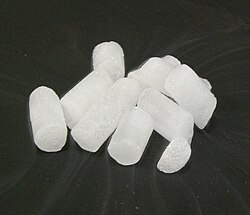
| : ''n'' CO<sub>2</sub> + ''n'' {{chem|H|2|O}} → {{chem|(CH|2|O)|''n''}} + ''n'' {{chem|O|2}} | | '''Dry ice''', or [[solid]] carbon dioxide, is the [[solid|solid state]] of CO<sub>2</sub> gas below -109.3 °F (-78.5[[°C]]). Dry ice does not occur naturally on earth but is man made. It is [[colorless]]. People use dry ice to make things cold, and to make drinks fizzy, kill [[Pocket gopher|gophers]], and freeze [[wart]]s. The [[vapor]] of dry ice causes [[suffocation]] and eventually, death. Caution and professional assistance is recommended whenever dry ice is in use. |
| | [[File:Dry ice in water.JPG|thumb|left|Dry ice when put in water]] |
| | At usual pressure it will not [[melt]] from a solid to a [[liquid]] but instead changes directly from a solid to a gas. This is called [[sublimation]]. It will change directly from a solid to a gas at any temperature higher than extremely cold temperatures. Dry ice sublimates at normal air temperature. Dry ice exposed to normal air gives off carbon dioxide gas that has no color. Carbon dioxide can be liquified at pressure above 5.1 [[Atmosphere (unit)|atmospheres]]. |
|
| |
|
| The [[redox potential]] for this reaction near pH 7 is about −0.53 V ''versus'' the [[standard hydrogen electrode]]. The nickel-containing enzyme [[carbon monoxide dehydrogenase]] catalyses this process.<ref>{{cite journal | vauthors = Finn C, Schnittger S, Yellowlees LJ, Love JB | title = Molecular approaches to the electrochemical reduction of carbon dioxide | journal = Chemical Communications | volume = 48 | issue = 10 | pages = 1392–1399 | date = February 2012 | pmid = 22116300 | doi = 10.1039/c1cc15393e | url = https://www.pure.ed.ac.uk/ws/files/10852481/Molecular_approaches_to_the_electrochemical_reduction_of_carbon_dioxide.pdf | access-date = 6 December 2019 | url-status = live | hdl-access = free | archive-date = 19 April 2021 | archive-url = https://web.archive.org/web/20210419185431/https://www.pure.ed.ac.uk/ws/files/10852481/Molecular_approaches_to_the_electrochemical_reduction_of_carbon_dioxide.pdf | hdl = 20.500.11820/b530915d-451c-493c-8251-da2ea2f50912 | s2cid = 14356014 }}</ref>
| | Carbon dioxide gas that comes off of dry ice is so cold that when it mixes with air it cools the water vapour in the air to fog, which looks like a thick white smoke. It is often used in the theater to create the appearance of [[fog]] or [[smoke]]. |
| === Physical properties ===
| |
| {{details|Carbon dioxide data}}
| |
| [[File:Dry Ice Pellets Subliming.jpg|right|thumb|Pellets of "dry ice", a common form of solid carbon dioxide]]
| |
| Carbon dioxide is colorless. At low concentrations the gas is odorless; however, at sufficiently high concentrations, it has a sharp, acidic odor.<ref name=AirProductsMSDS>{{cite web |title=Carbon Dioxide |website=Air Products |url=http://www.airproducts.com/~/media/Files/PDF/company/product-summary-carbon-dioxide.pdf?la=en |access-date=28 April 2017 |archive-date=29 July 2020 |archive-url=https://web.archive.org/web/20200729131131/http://www.airproducts.com/~/media/Files/PDF/company/product-summary-carbon-dioxide.pdf?la=en |url-status=dead }}</ref> At [[Standard conditions for temperature and pressure|standard temperature and pressure]], the density of carbon dioxide is around 1.98 kg/m<sup>3</sup>, about 1.53 times that of [[Earth's atmosphere|air]].<ref>{{cite web |url=https://www.engineeringtoolbox.com/gas-density-d_158.html |title=Gases – Densities |publisher=Engineering Toolbox |access-date=21 November 2020 |archive-date=2 March 2006 |archive-url=https://web.archive.org/web/20060302054722/https://www.engineeringtoolbox.com/gas-density-d_158.html |url-status=live}}</ref>
| |
| | |
| Carbon dioxide has no liquid state at pressures below {{val|0.51795|(10)|u=MPa}}<ref name = "Span_1999" /> ({{val|5.11177|(99)|u=atm}}). At a pressure of 1 [[Standard atmosphere (unit)|atm]] ({{val|0.101325|u=MPa}}), the gas [[deposition (physics)|deposits]] directly to a solid at temperatures below {{val|194.6855|(30)|u=K}}<ref name = "Span_1999" /> ({{val|-78.4645|(30)|u=degC}}) and the solid [[sublimation (chemistry)|sublimes]] directly to a gas above this temperature. In its solid state, carbon dioxide is commonly called [[dry ice]].
| |
| | |
| [[File:Carbon dioxide pressure-temperature phase diagram.svg|right|thumb|upright=1.15|Pressure–temperature [[phase diagram]] of carbon dioxide. Note that it is a log-lin chart.]]
| |
| | |
| [[Liquid carbon dioxide]] forms only at [[pressure]]s above {{val|0.51795|(10)|u=MPa}}<ref name = "Span_1999" /> ({{val|5.11177|(99)|u=atm}}); the [[triple point]] of carbon dioxide is {{val|216.592|(3)|u=K}}<ref name = "Span_1999" /> ({{val|-56.558|(3)|u=degC}}) at {{val|0.51795|(10)|u=MPa}}<ref name = "Span_1999" /> ({{val|5.11177|(99)|u=atm}}) (see phase diagram). The [[Critical point (thermodynamics)|critical point]] is {{val|304.128|(15)|u=K}}<ref name = "Span_1999" /> ({{val|30.978|(15)|u=degC}}) at {{val|7.3773|(30)|u=MPa}}<ref name = "Span_1999" /> ({{val|72.808|(30)|u=atm}}). Another form of solid carbon dioxide observed at high pressure is an [[amorphous]] glass-like solid.<ref>{{cite journal | vauthors = Santoro M, Gorelli FA, Bini R, Ruocco G, Scandolo S, Crichton WA | title = Amorphous silica-like carbon dioxide | journal = Nature | volume = 441 | issue = 7095 | pages = 857–860 | date = June 2006 | pmid = 16778885 | doi = 10.1038/nature04879 | s2cid = 4363092 | bibcode = 2006Natur.441..857S }}</ref> This form of glass, called ''[[amorphous carbonia|carbonia]]'', is produced by [[supercooling]] heated CO<sub>2</sub> at extreme pressures (40–48 [[GPa]], or about 400,000 atmospheres) in a [[diamond anvil]]. This discovery confirmed the theory that carbon dioxide could exist in a glass state similar to other members of its elemental family, like [[silicon dioxide]] (silica glass) and [[germanium dioxide]]. Unlike silica and germania glasses, however, carbonia glass is not stable at normal pressures and reverts to gas when pressure is released.
| |
| | |
| At temperatures and pressures above the critical point, carbon dioxide behaves as a [[supercritical fluid]] known as [[supercritical carbon dioxide]].
| |
|
| |
|
| == Isolation and production == | | == Isolation and production == |
| {{anchor|CO2 production}}
| | Chemists can get carbon dioxide from cooling air. They call this air [[distillation]]. This method is inefficient because a large amount of air must be refrigerated to extract a small amount of CO2. Chemists can also use several different [[chemical reaction]]s to separate carbon dioxide. Carbon dioxide is made in the reactions between most [[acid]]s and most [[metal]] carbonates. For example, the reaction between [[hydrochloric acid]] and calcium carbonate (limestone or chalk) makes carbon dioxide: |
| Carbon dioxide can be obtained by [[distillation]] from air, but the method is inefficient. Industrially, carbon dioxide is predominantly an unrecovered waste product, produced by several methods which may be practiced at various scales.<ref name="kirk">{{cite encyclopedia| vauthors = Pierantozzi R |encyclopedia = Kirk-Othmer Encyclopedia of Chemical Technology|publisher = Wiley|year = 2001|doi = 10.1002/0471238961.0301180216090518.a01.pub2|chapter = Carbon Dioxide|isbn =978-0-471-23896-6}}</ref>
| |
|
| |
|
| The [[combustion]] of all [[carbon-based fuel]]s, such as [[methane]] ([[natural gas]]), petroleum distillates ([[gasoline]], [[Diesel fuel|diesel]], [[kerosene]], [[propane]]), coal, wood and generic organic matter produces carbon dioxide and, except in the case of pure carbon, water. As an example, the chemical reaction between methane and [[oxygen]]:
| | : <math>\mathrm{2 \ HCl + CaCO_3 \longrightarrow CaCl_2 + H_2CO_3}</math> |
| : {{chem|C|H|4}} + 2 {{chem|O|2}} → {{chem|CO|2}} + 2 {{chem|H|2|O}} | |
|
| |
|
| [[Iron]] is reduced from its oxides with [[coke (fuel)|coke]] in a [[blast furnace]], producing [[pig iron]] and carbon dioxide:<ref> | | The [[carbonic acid]] (H<sub>2</sub>CO<sub>3</sub>) then [[wikt:decomposes|decomposes]] to water and CO<sub>2</sub>. Such reactions cause foaming or bubbling, or both. In industry, such reactions are used many times to neutralize waste acid streams. |
| {{Cite book | vauthors = Strassburger J | title = Blast Furnace Theory and Practice | publisher = American Institute of Mining, Metallurgical, and Petroleum Engineers | place = New York | year = 1969 | isbn = 978-0-677-10420-1 }}</ref>
| |
|
| |
|
| Carbon dioxide is a byproduct of the industrial production of hydrogen by [[steam reforming]] and the [[water gas shift reaction]] in [[ammonia production]]. These processes begin with the reaction of water and natural gas (mainly methane).<ref>{{cite book |doi=10.1002/14356007.a05_165|chapter=Carbon Dioxide|title=Ullmann's Encyclopedia of Industrial Chemistry|year=2000| vauthors = Topham S |isbn=3527306730}}</ref> This is a major source of food-grade carbon dioxide for use in carbonation of [[beer]] and [[soft drink]]s, and is also used for stunning animals such as [[poultry]]. In the summer of 2018 a shortage of carbon dioxide for these purposes arose in Europe due to the temporary shut-down of several ammonia plants for maintenance.<ref>{{cite news |title=CO<sub>2</sub> shortage: Food industry calls for government action |url=https://www.bbc.com/news/business-44559669 |agency=BBC |date=21 June 2018 |access-date=24 June 2018 |archive-date=23 May 2021 |archive-url=https://web.archive.org/web/20210523150103/https://www.bbc.com/news/business-44559669 |url-status=live }}</ref>
| | [[Quicklime]] (CaO), a chemical that has widespread use, can be made heating limestone to about 850 °C. This reaction also makes CO<sub>2</sub>: |
|
| |
|
| === Carbonates ===
| | : <math>\mathrm{CaCO_3 \longrightarrow CaO + CO_2}</math> |
| It is produced by thermal decomposition of limestone, {{chem|CaCO|3}} by heating ([[calcining]]) at about {{convert|850|C}}, in the manufacture of [[Calcium oxide|quicklime]] ([[calcium oxide]], {{chem|CaO}}), a compound that has many industrial uses:
| |
| : {{chem|Ca|C|O|3}} → {{chem|Ca|O}} + {{chem|C|O|2}}
| |
|
| |
|
| Acids liberate CO<sub>2</sub> from most metal carbonates. Consequently, it may be obtained directly from natural carbon dioxide [[spring (hydrosphere)|springs]], where it is produced by the action of acidified water on [[limestone]] or [[Dolomite (mineral)|dolomite]]. The reaction between [[hydrochloric acid]] and calcium carbonate (limestone or chalk) is shown below:
| | Carbon dioxide is also made in the [[combustion]] of all carbon-containing [[fuel]]s, such as [[methane]] ([[natural gas]]), petroleum distillates ([[gasoline]], [[Diesel fuel|diesel]], [[kerosene]], [[propane]]), coal or wood. In most cases, water is also released. As an example the chemical reaction between methane and oxygen is: |
| :{{chem|Ca|C|O|3}} + 2 {{chem|H|Cl}} → {{chem|Ca|Cl|2}} + {{chem|H|2|C|O|3}}
| |
|
| |
|
| The [[carbonic acid]] ({{chem|H|2|CO|3}}) then decomposes to water and CO<sub>2</sub>:
| | : <math>\mathrm{CH_4 + 2 \ O_2 \longrightarrow CO_2 + 2 \ H_2O}</math> |
| :{{chem|H|2|C|O|3}} → {{chem|C|O|2}} + {{chem|H|2|O}}
| |
|
| |
|
| Such reactions are accompanied by foaming or bubbling, or both, as the gas is released. They have widespread uses in industry because they can be used to neutralize waste acid streams.
| | Carbon dioxide is made in [[steel mill]]s. [[Iron]] is reduced from its oxides with [[coke (fuel)|coke]] in a [[blast furnace]], producing [[pig iron]] and carbon dioxide:<ref> |
| | | {{Cite book |
| === Fermentation ===
| | | last = Strassburger |
| Carbon dioxide is a by-product of the [[Fermentation (biochemistry)|fermentation]] of sugar in the [[brewing]] of [[beer]], [[whisky]] and other [[alcoholic beverage]]s and in the production of [[bioethanol]]. [[Yeast]] metabolizes sugar to produce CO<sub>2</sub> and [[ethanol]], also known as alcohol, as follows: | | | first = Julius H. |
| : {{chem|C|6|H|12|O|6}} → 2 {{chem|C|O|2}} + 2 {{chem|C|2|H|5|O|H}}
| | | title = Blast Furnace: Theory and Practice |
| | | | publisher = American Institute of Mining, Metallurgical, and Petroleum Engineers |
| All [[cellular respiration|aerobic]] organisms produce CO<sub>2</sub> when they oxidize [[carbohydrate]]s, [[fatty acid]]s, and [[protein]]s. The large number of reactions involved are exceedingly complex and not described easily. Refer to ([[cellular respiration]], [[anaerobic respiration]] and [[photosynthesis]]). The equation for the respiration of glucose and other [[monosaccharide]]s is:
| | | place = New York |
| : {{chem|C|6|H|12|O|6}} + 6 {{chem|O|2}} → 6 {{chem|CO|2}} + 6 {{chem|H|2|O}}
| | | year = 1969 |
| | | | isbn = 9780677104201 |
| [[Anaerobic organisms]] decompose organic material producing methane and carbon dioxide together with traces of other compounds.<ref>{{cite web |title= Collecting and using biogas from landfills |publisher= U.S. Energy Information Administration |url= http://www.eia.gov/Energyexplained/?page=biomass_biogas |date= 11 January 2017 |access-date= 22 November 2015 |archive-date= 11 July 2018 |archive-url= https://web.archive.org/web/20180711073415/https://www.eia.gov/Energyexplained/?page=biomass_biogas |url-status= live }}</ref> Regardless of the type of organic material, the production of gases follows well defined [[chemical kinetics|kinetic pattern]]. Carbon dioxide comprises about 40–45% of the gas that emanates from decomposition in landfills (termed "[[landfill gas]]"). Most of the remaining 50–55% is methane.<ref>{{cite web |title=Facts About Landfill Gas |publisher=U.S. Environmental Protection Agency |url=http://www.dem.ri.gov/programs/benviron/waste/central/lfgfact.pdf |date=January 2000 |access-date=4 September 2015 |archive-date=23 September 2015 |archive-url=https://web.archive.org/web/20150923213448/http://www.dem.ri.gov/programs/benviron/waste/central/lfgfact.pdf |url-status=live }}</ref>
| | }} |
| | | </ref> |
| == Applications ==
| |
| Carbon dioxide is used by the food industry, the oil industry, and the chemical industry.<ref name="kirk" />
| |
| The compound has varied commercial uses but one of its greatest uses as a chemical is in the production of carbonated beverages; it provides the sparkle in carbonated beverages such as soda water, beer and sparkling wine.
| |
| | |
| === Precursor to chemicals ===
| |
| {{expand section|date=July 2014}}
| |
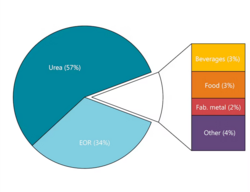
| In the chemical industry, carbon dioxide is mainly consumed as an ingredient in the production of [[urea]], with a smaller fraction being used to produce [[methanol]] and a range of other products.<ref>{{cite web|url=https://www.ipcc.ch/pdf/special-reports/srccs/srccs_chapter7.pdf|title=IPCC Special Report on Carbon dioxide Capture and Storage|publisher=The Intergovernmental Panel on Climate Change|access-date=4 September 2015|archive-url=https://web.archive.org/web/20150924115331/http://www.ipcc.ch/pdf/special-reports/srccs/srccs_chapter7.pdf|archive-date=24 September 2015|url-status=dead}}</ref> Some carboxylic acid derivatives such as [[sodium salicylate]] are prepared using CO<sub>2</sub> by the [[Kolbe-Schmitt reaction]].<ref>{{cite book | vauthors = Morrison RT, Boyd RN |title= Organic Chemistry |edition=4th |publisher=Allyn and Bacon |year=1983 |isbn=978-0-205-05838-9 |pages=[https://archive.org/details/organicchemistry04morr/page/976 976–977] |url=https://archive.org/details/organicchemistry04morr/page/976 }}</ref>
| |
| | |
| In addition to conventional processes using CO<sub>2</sub> for chemical production, electrochemical methods are also being explored at a research level. In particular, the use of renewable energy for production of fuels from CO<sub>2</sub> (such as methanol) is attractive as this could result in fuels that could be easily transported and used within conventional combustion technologies but have no net CO<sub>2</sub> emissions.<ref>{{cite journal | vauthors = Badwal SP, Giddey SS, Munnings C, Bhatt AI, Hollenkamp AF | title = Emerging electrochemical energy conversion and storage technologies | journal = Frontiers in Chemistry | volume = 2 | pages = 79 | date = 24 September 2014 | pmid = 25309898 | pmc = 4174133 | doi = 10.3389/fchem.2014.00079 | bibcode = 2014FrCh....2...79B | doi-access = free }}</ref>
| |
| | |
| === Agriculture ===
| |
| Plants require carbon dioxide to conduct photosynthesis. The atmospheres of greenhouses may (if of large size, must) be enriched with additional CO<sub>2</sub> to sustain and increase the rate of plant growth.<ref>{{cite web |url=http://www.ext.colostate.edu/mg/gardennotes/141.html |title=Plant Growth Factors: Photosynthesis, Respiration, and Transpiration |website=CMG GardenNotes | vauthors = Whiting D, Roll M, Vickerman L |publisher=Colorado Master Gardener Program |date=August 2010 |access-date=10 October 2011 |archive-url=https://web.archive.org/web/20140902192633/http://www.ext.colostate.edu/mg/gardennotes/141.html |archive-date=2 September 2014}}</ref><ref>{{cite book |chapter-url=http://www-formal.stanford.edu/jmc/nature/node21.html |chapter=Carbon dioxide |url=http://www-formal.stanford.edu/jmc/nature/nature.html |title=How Much Land Can Ten Billion People Spare for Nature? | vauthors = Waggoner PE |date=February 1994 |access-date=10 October 2011 |archive-date=12 October 2011 |archive-url=https://web.archive.org/web/20111012165809/http://www-formal.stanford.edu/jmc/nature/nature.html |url-status=live }}</ref> At very high concentrations (100 times atmospheric concentration, or greater), carbon dioxide can be toxic to animal life, so raising the concentration to 10,000 ppm (1%) or higher for several hours will eliminate pests such as [[whiteflies]] and [[spider mite]]s in a greenhouse.<ref>{{cite journal | vauthors = Stafford N | title = Future crops: the other greenhouse effect | journal = Nature | volume = 448 | issue = 7153 | pages = 526–528 | date = August 2007 | pmid = 17671477 | doi = 10.1038/448526a | bibcode = 2007Natur.448..526S | s2cid = 9845813 }}</ref>
| |
| | |
| === Foods ===
| |
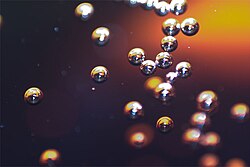
| [[File:Soda bubbles macro.jpg|thumb|Carbon dioxide bubbles in a soft drink]] | |
| | |
| Carbon dioxide is a [[food additive]] used as a propellant and acidity regulator in the food industry. It is approved for usage in the EU<ref>UK Food Standards Agency: {{cite web |url=http://www.food.gov.uk/safereating/chemsafe/additivesbranch/enumberlist |title=Current EU approved additives and their E Numbers |access-date=27 October 2011 |archive-date=7 October 2010 |archive-url=https://web.archive.org/web/20101007124435/http://www.food.gov.uk/safereating/chemsafe/additivesbranch/enumberlist |url-status=live }}</ref> (listed as [[E number]] E290), US<ref>US Food and Drug Administration: {{cite web |url=https://www.fda.gov/food/ingredientspackaginglabeling/foodadditivesingredients/ucm091048.htm |title=Food Additive Status List |website=[[Food and Drug Administration]] |access-date=13 June 2015 |archive-date=4 November 2017 |archive-url=https://web.archive.org/web/20171104061606/https://www.fda.gov/Food/IngredientsPackagingLabeling/FoodAdditivesIngredients/ucm091048.htm |url-status=live }}</ref> and Australia and New Zealand<ref>Australia New Zealand Food Standards Code{{cite web |url=http://www.comlaw.gov.au/Details/F2011C00827 |title=Standard 1.2.4 – Labelling of ingredients |access-date=27 October 2011 |archive-date=19 January 2012 |archive-url=https://web.archive.org/web/20120119082034/http://www.comlaw.gov.au/Details/F2011C00827 |url-status=live }}</ref> (listed by its [[INS number]] 290).
| |
| | |
| A candy called [[Pop Rocks]] is pressurized with carbon dioxide gas<ref>{{Cite book |url=https://books.google.com/books?id=0XeSJLflq90C&q=Pop+Rocks+is+pressurized+with+carbon+dioxide+gas&pg=PA7-IA3 |title=Futurific Leading Indicators Magazine |volume=1 |publisher=CRAES LLC |isbn=978-0-9847670-1-4 |access-date=9 November 2020 |archive-date=15 August 2021 |archive-url=https://web.archive.org/web/20210815224429/https://books.google.com/books?id=0XeSJLflq90C&q=Pop+Rocks+is+pressurized+with+carbon+dioxide+gas&pg=PA7-IA3 |url-status=live}}</ref> at about {{convert|4000|kPa|bar psi|abbr=on|lk=on}}. When placed in the mouth, it dissolves (just like other hard candy) and releases the gas bubbles with an audible pop.
| |
| | |
| [[Leavening agent]]s cause dough to rise by producing carbon dioxide.<ref>{{Cite book |url=https://books.google.com/books?id=2bmaCgAAQBAJ&q=Leavening+agents+cause+dough+to+rise+by+producing+carbon+dioxide&pg=PT29 |title=Indian Breads: A Comprehensive Guide to Traditional and Innovative Indian Breads | vauthors = Vijay GP |date=25 September 2015 |publisher=Westland |isbn=978-93-85724-46-6}}</ref> [[Baker's yeast]] produces carbon dioxide by fermentation of sugars within the dough, while chemical leaveners such as [[baking powder]] and [[baking soda]] release carbon dioxide when heated or if exposed to [[acid]]s.
| |
| | |
| ==== Beverages ====
| |
| Carbon dioxide is used to produce [[carbonation|carbonated]] [[soft drink]]s and [[soda water]]. Traditionally, the carbonation of beer and sparkling wine came about through natural fermentation, but many manufacturers carbonate these drinks with carbon dioxide recovered from the fermentation process. In the case of bottled and kegged beer, the most common method used is carbonation with recycled carbon dioxide. With the exception of British [[cask ale#Real ale|real ale]], draught beer is usually transferred from kegs in a cold room or cellar to dispensing taps on the bar using pressurized carbon dioxide, sometimes mixed with nitrogen.
| |
| | |
| The taste of soda water (and related taste sensations in other carbonated beverages) is an effect of the dissolved carbon dioxide rather than the bursting bubbles of the gas. [[Carbonic anhydrase 4]] converts to [[carbonic acid]] leading to a [[sour]] taste, and also the dissolved carbon dioxide induces a [[somatosensory]] response.<ref>{{cite web |url= https://www.sciencedaily.com/releases/2009/10/091015141510.htm |title= Scientists Discover Protein Receptor For Carbonation Taste |website= [[ScienceDaily]] |date= 16 October 2009 |access-date= 29 March 2020 |archive-date= 29 March 2020 |archive-url= https://web.archive.org/web/20200329042900/https://www.sciencedaily.com/releases/2009/10/091015141510.htm |url-status= live }}</ref>
| |
| | |
| ==== Winemaking ====
| |
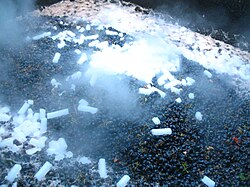
| [[File:Dry ice used to preserve grapes after harvest.jpg|thumb|Dry ice used to preserve grapes after harvest]]
| |
| Carbon dioxide in the form of [[dry ice]] is often used during the [[cold soak]] phase in [[winemaking]] to cool clusters of [[grape]]s quickly after picking to help prevent spontaneous [[Fermentation (wine)|fermentation]] by wild [[yeast (wine)|yeast]]. The main advantage of using dry ice over water ice is that it cools the grapes without adding any additional water that might decrease the sugar concentration in the [[grape must]], and thus the [[ethanol|alcohol]] concentration in the finished wine. Carbon dioxide is also used to create a hypoxic environment for [[carbonic maceration]], the process used to produce [[Beaujolais]] wine.
| |
| | |
| Carbon dioxide is sometimes used to top up wine bottles or other [[storage (wine)|storage]] vessels such as barrels to prevent oxidation, though it has the problem that it can dissolve into the wine, making a previously still wine slightly fizzy. For this reason, other gases such as [[nitrogen]] or [[argon]] are preferred for this process by professional wine makers.
| |
| | |
| ====Stunning animals====
| |
| Carbon dioxide is often used to "stun" animals before slaughter.<ref>{{cite journal | vauthors = Coghlan A |title=A more humane way of slaughtering chickens might get EU approval |journal=New Scientist |date=3 February 2018 |url=https://www.newscientist.com/article/2159895-a-more-humane-way-of-slaughtering-chickens-might-get-eu-approval |access-date=24 June 2018 |archive-date=24 June 2018 |archive-url=https://web.archive.org/web/20180624204842/https://www.newscientist.com/article/2159895-a-more-humane-way-of-slaughtering-chickens-might-get-eu-approval/ |url-status=live }}</ref> "Stunning" may be a misnomer, as the animals are not knocked out immediately and may suffer distress.<ref>{{cite web |url=http://kb.rspca.org.au/What-is-CO2-stunning_118.html |archive-url=https://web.archive.org/web/20140409003755/http://kb.rspca.org.au/What-is-CO2-stunning_118.html |url-status=dead |archive-date=9 April 2014 |title=What is CO<sub>2</sub> stunning? |publisher=RSPCA}}</ref><ref name=Campbell>{{cite journal | vauthors = Campbell A |title=Humane execution and the fear of the tumbril |journal=New Scientist |date=10 March 2018 |url=https://www.newscientist.com/letter/mg23731680-900-humane-execution-and-the-fear-of-the-tumbril-3 |access-date=24 June 2018 |archive-date=24 June 2018 |archive-url=https://web.archive.org/web/20180624204708/https://www.newscientist.com/letter/mg23731680-900-humane-execution-and-the-fear-of-the-tumbril-3/ |url-status=live }}</ref>
| |
| | |
| === Inert gas ===
| |
| Carbon dioxide is one of the most commonly used compressed gases for pneumatic (pressurized gas) systems in portable pressure tools. Carbon dioxide is also used as an atmosphere for [[welding]], although in the welding arc, it reacts to [[oxidation|oxidize]] most metals. Use in the automotive industry is common despite significant evidence that welds made in carbon dioxide are more [[brittle]] than those made in more inert atmospheres.{{citation needed|date=July 2019}} When used for [[MIG welding]], CO<sub>2</sub> use is sometimes referred to as MAG welding, for Metal Active Gas, as CO<sub>2</sub> can react at these high temperatures. It tends to produce a hotter puddle than truly inert atmospheres, improving the flow characteristics. Although, this may be due to atmospheric reactions occurring at the puddle site. This is usually the opposite of the desired effect when welding, as it tends to embrittle the site, but may not be a problem for general mild steel welding, where ultimate ductility is not a major concern.
| |
| | |
| Carbon dioxide is used in many consumer products that require pressurized gas because it is inexpensive and nonflammable, and because it undergoes a phase transition from gas to liquid at room temperature at an attainable pressure of approximately {{convert|60|bar|psi atm|abbr=on|lk=on}}, allowing far more carbon dioxide to fit in a given container than otherwise would. Life jackets often contain canisters of pressured carbon dioxide for quick inflation. [[Aluminium]] capsules of CO<sub>2</sub> are also sold as supplies of compressed gas for [[air gun]]s, [[paintball]] markers/guns, inflating bicycle tires, and for making [[carbonated water]]. High concentrations of carbon dioxide can also be used to kill pests. Liquid carbon dioxide is used in [[supercritical drying]] of some food products and technological materials, in the preparation of specimens for [[scanning electron microscopy]]<ref name=Nordestgaard>{{cite journal | vauthors = Nordestgaard BG, Rostgaard J | title = Critical-point drying versus freeze drying for scanning electron microscopy: a quantitative and qualitative study on isolated hepatocytes | journal = Journal of Microscopy | volume = 137 | issue = Pt 2 | pages = 189–207 | date = February 1985 | pmid = 3989858 | doi = 10.1111/j.1365-2818.1985.tb02577.x | s2cid = 32065173 }}</ref> and in the [[decaffeination]] of [[coffee bean]]s.
| |
| | |
| === Fire extinguisher ===
| |
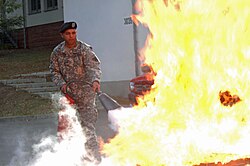
| [[File:US Army 53023 Fire Prevention Week.jpg|thumb|Use of a CO<sub>2</sub> fire extinguisher]]
| |
| Carbon dioxide can be used to extinguish flames by flooding the environment around the flame with the gas. It does not itself react to extinguish the flame, but starves the flame of oxygen by displacing it. Some [[Fire extinguisher#Halons, Halon-replacement clean agents and carbon dioxide|fire extinguishers]], especially those designed for [[electrical fire]]s, contain liquid carbon dioxide under pressure. Carbon dioxide extinguishers work well on small flammable liquid and electrical fires, but not on ordinary combustible fires, because they do not cool the burning substances significantly, and when the carbon dioxide disperses, they can catch fire upon exposure to [[atmospheric oxygen]]. They are mainly used in server rooms.<ref>{{Cite web |title=Types of Fire Extinguishers |url=https://www.firesafe.org.uk/types-use-and-colours-of-portable-fire-extinguishers/ |url-status=live |access-date=2021-06-28 |website=The Fire Safety Advice Centre |archive-date=28 June 2021 |archive-url=https://web.archive.org/web/20210628185630/https://www.firesafe.org.uk/types-use-and-colours-of-portable-fire-extinguishers/}}</ref>
| |
| | |
| Carbon dioxide has also been widely used as an extinguishing agent in fixed fire-protection systems for local application of specific hazards and total flooding of a protected space.<ref>National Fire Protection Association Code 12.</ref> [[International Maritime Organization]] standards recognize carbon-dioxide systems for fire protection of ship holds and engine rooms. Carbon-dioxide-based fire-protection systems have been linked to several deaths, because it can cause suffocation in sufficiently high concentrations. A review of CO<sub>2</sub> systems identified 51 incidents between 1975 and the date of the report (2000), causing 72 deaths and 145 injuries.<ref>Carbon Dioxide as a Fire Suppressant: Examining the Risks, US EPA. 2000.</ref>
| |
| | |
| === Supercritical CO<sub>2</sub> as solvent ===
| |
| {{See also|Supercritical carbon dioxide|Green chemistry}}
| |
| | |
| Liquid carbon dioxide is a good [[solvent]] for many [[lipophilic]] [[organic compound]]s and is used to remove [[caffeine]] from [[coffee]].<ref name="Tsotsas" /> Carbon dioxide has attracted attention in the [[pharmaceutical]] and other chemical processing industries as a less toxic alternative to more traditional solvents such as [[organochloride]]s. It is also used by some [[dry cleaners]] for this reason. It is used in the preparation of some [[Aerogel#Production|aerogels]] because of the properties of supercritical carbon dioxide.
| |
| | |
| === Medical and pharmacological uses ===
| |
| In medicine, up to 5% carbon dioxide (130 times atmospheric concentration) is added to oxygen for stimulation of breathing after [[apnea]] and to stabilize the {{chem|O|2|/CO|2}} balance in blood.
| |
| | |
| Carbon dioxide can be mixed with up to 50% oxygen, forming an inhalable gas; this is known as [[Carbogen]] and has a variety of medical and research uses.
| |
| | |
| Another medical use are the [[Mofetta|mofette]], dry spas that use carbon dioxide from post-volcanic discharge for therapeutic purposes.
| |
| | |
| === Energy ===
| |
| | |
| Supercritical CO<sub>2</sub> is used as the working fluid in the [[Allam power cycle]] engine.
| |
| | |
| ==== Fossil fuel recovery ====
| |
| Carbon dioxide is used in [[enhanced oil recovery]] where it is injected into or adjacent to producing oil wells, usually under [[Supercritical fluid|supercritical]] conditions, when it becomes [[miscibility|miscible]] with the oil. This approach can increase original oil recovery by reducing residual oil saturation by between 7% to 23% additional to [[Extraction of petroleum#Primary recovery|primary extraction]].<ref>{{cite book |date=20 December 2011 |url=http://www.globalccsinstitute.com/publications/accelerating-uptake-ccs-industrial-use-captured-carbon-dioxide |chapter-url=http://hub.globalccsinstitute.com/publications/accelerating-uptake-ccs-industrial-use-captured-carbon-dioxide/appendix-co2-use |title=Accelerating the uptake of CCS: industrial use of captured carbon dioxide |chapter=Appendix A: CO<sub>2</sub> for use in enhanced oil recovery (EOR) |website=Global CCS Institute |access-date=2 January 2017 |archive-date=28 April 2017 |archive-url=https://web.archive.org/web/20170428013833/http://www.globalccsinstitute.com/publications/accelerating-uptake-ccs-industrial-use-captured-carbon-dioxide |url-status=live }}</ref> It acts as both a pressurizing agent and, when dissolved into the underground [[crude oil]], significantly reduces its viscosity, and changing surface chemistry enabling the oil to flow more rapidly through the reservoir to the removal well.<ref>{{cite journal | vauthors = Austell JM |year=2005 |title=CO<sub>2</sub> for Enhanced Oil Recovery Needs – Enhanced Fiscal Incentives |journal=Exploration & Production: The Oil & Gas Review |url=http://www.touchoilandgas.com/enhanced-recovery-needs-enhanced-a423-1.html |archive-url=https://web.archive.org/web/20120207071349/http://www.touchoilandgas.com/enhanced-recovery-needs-enhanced-a423-1.html |archive-date=7 February 2012 |access-date= 28 September 2007}}</ref> In mature oil fields, extensive pipe networks are used to carry the carbon dioxide to the injection points.
| |
| | |
| In [[enhanced coal bed methane recovery]], carbon dioxide would be pumped into the coal seam to displace methane, as opposed to current methods which primarily rely on the removal of water (to reduce pressure) to make the coal seam release its trapped methane.<ref>{{cite web|url=http://www.ipe.ethz.ch/laboratories/spl/research/adsorption/project03|title=Enhanced coal bed methane recovery|date=31 August 2006|publisher=ETH Zurich|url-status=dead|archive-url=https://web.archive.org/web/20110706232006/http://www.ipe.ethz.ch/laboratories/spl/research/adsorption/project03|archive-date=6 July 2011}}</ref>
| |
| | |
| ==== Bio transformation into fuel ====
| |
| {{main|Carbon capture and utilization}}
| |
| | |
| It has been proposed that CO<sub>2</sub> from power generation be bubbled into ponds to stimulate growth of [[algae]] that could then be converted into [[biodiesel]] fuel.<ref name="csmon">{{cite news| vauthors = Clayton M |url=http://www.csmonitor.com/2006/0111/p01s03-sten.html|title=Algae – like a breath mint for smokestacks|date=11 January 2006|work=[[The Christian Science Monitor]]|access-date=11 October 2007|archive-date=14 September 2008|archive-url=https://web.archive.org/web/20080914134926/http://www.csmonitor.com/2006/0111/p01s03-sten.html|url-status=live}}</ref> A strain of the [[cyanobacterium]] ''[[Synechococcus elongatus]]'' has been genetically engineered to produce the fuels [[isobutyraldehyde]] and [[isobutanol]] from CO<sub>2</sub> using photosynthesis.<ref>{{cite journal | vauthors = Atsumi S, Higashide W, Liao JC | title = Direct photosynthetic recycling of carbon dioxide to isobutyraldehyde | journal = Nature Biotechnology | volume = 27 | issue = 12 | pages = 1177–1180 | date = December 2009 | pmid = 19915552 | doi = 10.1038/nbt.1586 | s2cid = 1492698 }}</ref>
| |
| | |
| Researchers have developed a process called electrolysis, using enzymes isolated from bacteria to power the chemical reactions which convert CO<sub>2</sub> into fuels.<ref>{{Cite journal | vauthors = Cobb S, Badiani V, Dharani A, Wagner A, Zacarias S, Oliveira AR, Pereira I, Reisner E | display-authors = 6 |date=2022-02-28 |title=Fast CO2 hydration kinetics impair heterogeneous but improve enzymatic CO2 reduction catalysis |url=https://www.nature.com/articles/s41557-021-00880-2 |journal=Nature Chemistry | volume = 14 | issue = 4 |language=en |pages=417–424 |doi=10.1038/s41557-021-00880-2 | pmid = 35228690 | pmc = 7612589 | bibcode = 2022NatCh..14..417C | s2cid = 247160910 |issn=1755-4349| pmc-embargo-date = August 28, 2022 }}</ref><ref>{{cite journal | vauthors = Edwardes Moore E, Cobb SJ, Coito AM, Oliveira AR, Pereira IA, Reisner E | title = Understanding the local chemical environment of bioelectrocatalysis | journal = Proceedings of the National Academy of Sciences of the United States of America | volume = 119 | issue = 4 | pages = e2114097119 | date = January 2022 | pmid = 35058361 | pmc = 8795565 | doi = 10.1073/pnas.2114097119 | bibcode = 2022PNAS..11914097E | pmc-embargo-date = July 20, 2022 }}</ref><ref>{{Cite web |date=2022-03-01 |title=Clean Way To Turn CO2 Into Fuel Inspired by Nature |url=http://www.technologynetworks.com/applied-sciences/news/clean-way-to-turn-co2-into-fuel-inspired-by-nature-359088 |access-date=2022-03-02 |website=Applied Sciences from Technology Networks |language=en}}</ref>
| |
| | |
| ===== Refrigerant =====
| |
| {{see also|Refrigerant|Sustainable automotive air conditioning}}
| |
| [[File:Comparison carbon dioxide water phase diagrams.svg|thumb|upright=2|Comparison of the pressure–temperature phase diagrams of carbon dioxide (red) and water (blue) as a log-lin chart with phase transitions points at 1 atmosphere]]
| |
| | |
| Liquid and solid carbon dioxide are important [[refrigerant]]s, especially in the food industry, where they are employed during the transportation and storage of ice cream and other frozen foods. Solid carbon dioxide is called "dry ice" and is used for small shipments where refrigeration equipment is not practical. Solid carbon dioxide is always below {{convert|-78.5|C|F}} at regular atmospheric pressure, regardless of the air temperature.
| |
| | |
| {{anchor|R744}} Liquid carbon dioxide (industry nomenclature R744 or R-744) was used as a refrigerant prior to the use{{Citation needed|date=April 2021}}<!-- This strange statement is not certain because [[liquid ammonia]] was used for refrigeration before CFCs and HFCs due to the fact that it can be handled much more easily at a lower pressure. Please verify this unproven statement and give a reliable source --> of [[dichlorodifluoromethane]] (R12, a [[chlorofluorocarbon]] (CFC) compound). {{CO2}} might enjoy a renaissance because one of the main substitutes to CFCs, [[1,1,1,2-tetrafluoroethane]] ([[R134a]], a [[hydrofluorocarbon]] (HFC) compound) contributes to [[climate change]] more than {{CO2}} does. {{CO2}} physical properties are highly favorable for cooling, refrigeration, and heating purposes, having a high volumetric cooling capacity. Due to the need to operate at pressures of up to {{convert|130|bar|psi kPa}}, {{CO2}} systems require highly mechanically resistant reservoirs and components that have already been developed for mass production in many sectors. In automobile air conditioning, in more than 90% of all driving conditions for latitudes higher than 50°, {{CO2}} (R744) operates more efficiently than systems using HFCs (e.g., R134a). Its environmental advantages ([[Global warming potential|GWP]] of 1, non-ozone depleting, non-toxic, non-flammable) could make it the future working fluid to replace current HFCs in cars, supermarkets, and heat pump water heaters, among others. [[Coca-Cola]] has fielded {{CO2}}-based beverage coolers and the [[United States Army|U.S. Army]] is interested in {{CO2}} refrigeration and heating technology.<ref name="ccref1">{{cite web |url=http://www.coca-colacompany.com/cooling-equipment-pushing-forward-with-hfc-free |title=The Coca-Cola Company Announces Adoption of HFC-Free Insulation in Refrigeration Units to Combat Global Warming |access-date=11 October 2007 |date=5 June 2006 |publisher=The Coca-Cola Company |archive-date=1 November 2013 |archive-url=https://web.archive.org/web/20131101195654/http://www.coca-colacompany.com/cooling-equipment-pushing-forward-with-hfc-free |url-status=live }}</ref><ref name="usforces">{{cite news|title = Modine reinforces its CO<sub>2</sub> research efforts|url = http://www.r744.com/news/news_ida145.php|archive-url = https://web.archive.org/web/20080210194203/http://www.r744.com/news/news_ida145.php|url-status = dead|archive-date = 10 February 2008|date = 28 June 2007|publisher = R744.com}}</ref>
| |
| | |
| === Minor uses ===
| |
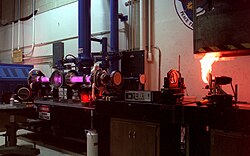
| [[File:Carbon Dioxide Laser At The Laser Effects Test Facility.jpg|thumb|right|upright=1.35|A [[carbon-dioxide laser]]]]
| |
| Carbon dioxide is the [[active laser medium|lasing medium]] in a [[carbon-dioxide laser]], which is one of the earliest type of lasers.
| |
| | |
| Carbon dioxide can be used as a means of controlling the [[pH]] of swimming pools,<ref>{{Cite book |url=https://books.google.com/books?id=IWpWAAAAMAAJ&q=%C2%A0%C2%A0Carbon+dioxide+can+be+used+as+a+means+of+controlling+the+pH+of+swimming+pool |title=TCE, the Chemical Engineer |date=1990 |publisher=Institution of Chemical Engineers |access-date=2 June 2020 |archive-date=17 August 2021 |archive-url=https://web.archive.org/web/20210817030754/https://books.google.com/books?id=IWpWAAAAMAAJ&q=%C2%A0%C2%A0Carbon+dioxide+can+be+used+as+a+means+of+controlling+the+pH+of+swimming+pool |url-status=live}}</ref> by continuously adding gas to the water, thus keeping the pH from rising. Among the advantages of this is the avoidance of handling (more hazardous) acids. Similarly, it is also used in the maintaining [[Reef aquarium|reef aquaria]], where it is commonly used in [[calcium reactor]]s to temporarily lower the pH of water being passed over [[calcium carbonate]] in order to allow the calcium carbonate to dissolve into the water more freely, where it is used by some [[coral]]s to build their skeleton.
| |
| | |
| Used as the primary coolant in the British [[advanced gas-cooled reactor]] for nuclear power generation.
| |
| | |
| Carbon dioxide induction is commonly used for the euthanasia of laboratory research animals. Methods to administer CO<sub>2</sub> include placing animals directly into a closed, prefilled chamber containing CO<sub>2</sub>, or exposure to a gradually increasing concentration of CO<sub>2</sub>. The [[American Veterinary Medical Association]]'s 2020 guidelines for carbon dioxide induction state that a displacement rate of 30% to 70% of the chamber or cage volume per minute is optimal for the humane euthanasia of small rodents.<ref name=avma>{{cite web |url=https://www.avma.org/kb/policies/documents/euthanasia.pdf |title=AVMA guidelines for the euthanasia of animals: 2020 Edition |date=2020 |publisher=[[American Veterinary Medical Association]] |access-date=August 13, 2021 |archive-date=1 February 2014 |archive-url=https://web.archive.org/web/20140201174132/https://www.avma.org/KB/Policies/Documents/euthanasia.pdf |url-status=live}}</ref>{{Rp|5, 31}} Percentages of CO<sub>2</sub> vary for different species, based on identified optimal percentages to minimize distress.<ref name=avma />{{Rp|22}}
| |
| | |
| Carbon dioxide is also used in several related [[carbon dioxide cleaning|cleaning and surface-preparation]] techniques.
| |
| | |
| == In Earth's atmosphere ==
| |
| {{Main|Carbon dioxide in Earth's atmosphere|Carbon cycle}}
| |
| [[File:Mauna Loa CO2 monthly mean concentration.svg|thumb|right|[[Keeling curve]] of the atmospheric CO<sub>2</sub> concentration<ref>{{cite web |url=https://www.esrl.noaa.gov/gmd/ccgg/trends/ |title=Monthly Average Mauna Loa CO<sub>2</sub> |publisher=[[National Oceanic and Atmospheric Administration]] Earth System Research Laboratory, Global Monitoring Division |access-date=19 December 2020 |archive-date=16 March 2007 |archive-url=https://web.archive.org/web/20070316011636/https://www.esrl.noaa.gov/gmd/ccgg/trends/ |url-status=live }}</ref>]]
| |
| [[File:CO2 increase rate.png|thumb|right|Atmospheric CO<sub>2</sub> annual growth rose 300% since the 1960s.<ref>{{cite web | vauthors = Tans P | date = 6 May 2019 | url = https://datahub.io/core/co2-ppm | title = Annual CO<sub>2</sub> mole fraction increase (ppm) for 1959–2018] | work = [[National Oceanic and Atmospheric Administration]] Earth System Research Laboratory, Global Monitoring Division|via=datahub.io}}</ref><ref>{{cite web | url = http://www.esrl.noaa.gov/gmd/ccgg/trends/ | title = additional details |archive-url=https://web.archive.org/web/20180205231729/https://esrl.noaa.gov/gmd/ccgg/trends/ | archive-date=5 February 2018}}</ref>]]
| |
| | |
| Carbon dioxide in [[Earth's atmosphere]] is a [[trace gas]], having a global average concentration of 415 parts per million by volume (or 630 parts per million by mass)<!-- To convert from the usual ppmv units to ppm mass, multiply by the ratio of the molar weight of CO2 to that of air, i.e., 44.01/28.96=1.520) --> as of the end of year 2020.<ref name=NOAA>[ftp://aftp.cmdl.noaa.gov/products/trends/co2/co2_mm_gl.txt National Oceanic & Atmospheric Administration (NOAA) – Earth System Research Laboratory (ESRL), Trends in Carbon Dioxide: Globally averaged marine surface monthly mean data]. {{Webarchive |url=https://web.archive.org/web/20211001061717/ftp://aftp.cmdl.noaa.gov/products/trends/co2/co2_mm_gl.txt |date=1 October 2021 }} Values given are dry air [[mole fraction]]s expressed in parts per million ([[Parts per million|ppm]]). For an [[ideal gas]] mixture this is equivalent to parts per million by volume (ppmv).</ref><ref name="theguardian_mar_2016">{{Cite news |title=CO<sub>2</sub> levels make largest recorded annual leap, Noaa data shows |newspaper=The Guardian |date=10 March 2016 |url=https://www.theguardian.com/environment/2016/mar/10/co2-levels-make-largest-recorded-annual-leap-noaa-data-shows |access-date=14 March 2016 |vauthors=Pashley A |archive-date=14 March 2016 |archive-url=https://web.archive.org/web/20160314021259/http://www.theguardian.com/environment/2016/mar/10/co2-levels-make-largest-recorded-annual-leap-noaa-data-shows |url-status=live}}</ref> Atmospheric {{CO2}} concentrations fluctuate slightly with the seasons, falling during the [[Northern Hemisphere]] spring and summer as plants consume the gas and rising during northern autumn and winter as plants go dormant or die and decay. Concentrations also vary on a regional basis, most strongly [[planetary boundary layer|near the ground]] with much smaller variations aloft. In urban areas concentrations are generally higher<ref>{{Cite journal| title=Elevated atmospheric CO<sub>2</sub> concentration and temperature across an urban–rural transect| journal=Atmospheric Environment| volume=41| issue=35| pages=7654–7665| year=2007| vauthors=George K, Ziska LH, Bunce JA, Quebedeaux B| doi=10.1016/j.atmosenv.2007.08.018| bibcode=2007AtmEn..41.7654G| url=https://zenodo.org/record/1258774| access-date=12 September 2019| url-status=live| archive-date=15 October 2019| archive-url=https://web.archive.org/web/20191015185617/https://zenodo.org/record/1258774}}</ref> and indoors they can reach 10 times background levels. {{CO2}} emissions have also lead to the stratosphere contracting by 400 meters since 1980, which could affect satellite operations, GPS systems and radio communications.<ref>{{cite journal |last1=Pisoft |first1=Petr |title=Stratospheric contraction caused by increasing greenhouse gases |journal=Environmental Research Letters |date=May 25, 2021 |volume=16 |issue=6 |page=064038 |doi=10.1088/1748-9326/abfe2b |bibcode=2021ERL....16f4038P |doi-access=free }}</ref>
| |
| | |
| The concentration of carbon dioxide has risen due to human activities.<ref>{{cite journal |title=Hopes of Limiting Global Warming? |year=2016 | vauthors = Li AH |journal=China Perspectives |volume=2016 |pages=49–54 |doi=10.4000/chinaperspectives.6924 |url=http://journals.openedition.org/chinaperspectives/6924 |access-date=5 May 2021 |archive-date=12 May 2021 |archive-url=https://web.archive.org/web/20210512192355/https://journals.openedition.org/chinaperspectives/6924 |url-status=live}}</ref> The extraction and burning of [[fossil fuel]]s, using carbon that has been sequestered for many millions of years in the [[lithosphere]], has caused the atmospheric concentration of {{CO2}} to increase by about 50% since the beginning of the [[Industrial Revolution|age of industrialization]] up to year 2020.<ref name="nonanews">{{Cite web |url=https://www.esrl.noaa.gov/gmd/aggi/ |title=The NOAA Annual Greenhouse Gas Index (AGGI) – An Introduction |publisher=[[NOAA]] Global Monitoring Laboratory/Earth System Research Laboratories |access-date=2020-12-18 |archive-date=27 November 2020 |archive-url=https://web.archive.org/web/20201127013113/https://www.esrl.noaa.gov/gmd/aggi/ |url-status=live }}</ref><ref name="gcb19">{{cite journal |doi=10.5194/essd-11-1783-2019 |title=Global Carbon Budget 2019 |year=2019 | vauthors = Friedlingstein P, Jones MW, O'sullivan M, Andrew RM, Hauck J, Peters GP, Peters W, Pongratz J, Sitch S, Le Quéré C, Bakker DC, Canadell JG, Ciais P, Jackson RB, Anthoni P, Barbero L, Bastos A, Bastrikov V, Becker M, Bopp L, Buitenhuis E, Chandra N, Chevallier F, Chini LP, Currie KI, Feely RA, Gehlen M, Gilfillan D, Gkritzalis T, Goll DS | display-authors = 6 |journal=Earth System Science Data |volume=11 |issue=4 |pages=1783–1838 |bibcode=2019ESSD...11.1783F |doi-access=free}}.</ref> Most {{CO2}} from human activities is released from burning coal, petroleum, and natural gas. Other large anthropogenic sources include cement production, [[deforestation]], and biomass burning. Human activities emit over 30 billion tons of {{CO2}} (9 billion tons of fossil carbon) per year, while volcanoes emit only between 0.2 and 0.3 billion tons of {{CO2}}.<ref name="climate.gov">{{cite web|url= https://www.climate.gov/news-features/understanding-climate/global-warming-frequently-asked-questions |title=Global Warming Frequently Asked Questions |publisher=NOAA |website=Climate.gov |url-status=live |archive-date=11 January 2017 |archive-url=https://web.archive.org/web/20170111214451/https://www.climate.gov/news-features/understanding-climate/global-warming-frequently-asked-questions <!--from Gerlach DOI: 1029/2011EO240001 -->}}</ref><ref>{{cite journal | vauthors = Gerlach TM |title=Present-day CO<sub>2</sub> emissions from volcanoes |journal=[[Eos (journal)|Eos, Transactions, American Geophysical Union]] |volume=72 |issue=23 |pages=249, 254–255 |date=4 June 1991 |doi=10.1029/90EO10192 |bibcode=1991EOSTr..72..249.}}</ref> Human activities have caused CO<sub>2</sub> to increase above levels not seen in hundreds of thousands of years. Currently, about half of the carbon dioxide released from the [[Global warming|burning of fossil fuels]] remains in the [[atmosphere]] and is not absorbed by vegetation and the oceans.<ref name="NASA-20151112-ab">{{cite web | vauthors = Buis A, Ramsayer K, Rasmussen C |title=A breathing planet, off balance |date=12 November 2015 |work=NASA |url=http://www.jpl.nasa.gov/news/news.php?feature=4769 |access-date=13 November 2015 |archive-url=https://web.archive.org/web/20151114055636/http://www.jpl.nasa.gov/news/news.php?feature=4769 |archive-date=14 November 2015 |url-status=live}}</ref><ref name="NASA-20151112b">{{cite web |title=Audio (66:01) – NASA News Conference – Carbon & Climate Telecon |url=http://www.ustream.tv/recorded/77531778 |date=12 November 2015 |work=NASA |access-date=12 November 2015 |archive-date=1 April 2019 |archive-url=https://web.archive.org/web/20190401174925/http://www.ustream.tv/recorded/77531778 |url-status=live }}</ref><ref name="NYT-20151110">{{cite news | vauthors = St Fleur N |title=Atmospheric Greenhouse Gas Levels Hit Record, Report Says |url=https://www.nytimes.com/2015/11/11/science/atmospheric-greenhouse-gas-levels-hit-record-report-says.html |date=10 November 2015 |work=The New York Times |access-date=11 November 2015 |archive-date=11 November 2015 |archive-url=https://web.archive.org/web/20151111074131/http://www.nytimes.com/2015/11/11/science/atmospheric-greenhouse-gas-levels-hit-record-report-says.html |url-status=live }}</ref><ref name="AP-20151109">{{cite news | vauthors = Ritter K |title=UK: In 1st, global temps average could be 1 degree C higher |url=http://apnews.excite.com/article/20151109/climate_countdown-greenhouse_gases-d8a21f0397.html |date=9 November 2015 |agency=Associated Press |access-date=11 November 2015 |archive-date=17 November 2015 |archive-url=https://web.archive.org/web/20151117021206/http://apnews.excite.com/article/20151109/climate_countdown-greenhouse_gases-d8a21f0397.html |url-status=live }}</ref>
| |
| | |
| While transparent to [[visible light]], carbon dioxide is a [[greenhouse gas]], absorbing and emitting infrared radiation at its two infrared-active vibrational frequencies (see the section "[[Carbon dioxide#Structure, bonding and molecular vibrations|Structure and bonding]]" above). Light emission from the Earth's surface is most intense in the infrared region between 200 and 2500 cm<sup>−1</sup>,<ref>{{cite book | vauthors = Atkins P, de Paula J |edition=8th |date=2006 |title=Atkins' Physical Chemistry |publisher=W. H. Freeman |page=[https://archive.org/details/atkinsphysicalch00pwat/page/462 462] |isbn=978-0-7167-8759-4 |author-link=Peter Atkins |url=https://archive.org/details/atkinsphysicalch00pwat/page/462 }}</ref> as opposed to light emission from the much hotter Sun which is most intense in the visible region. Absorption of infrared light at the vibrational frequencies of atmospheric {{CO2}} traps energy near the surface, warming the surface and the lower atmosphere. Less energy reaches the upper atmosphere, which is therefore cooler because of this absorption.<ref name="ucar_co2_absorb_IR">{{cite web | url=https://scied.ucar.edu/carbon-dioxide-absorbs-and-re-emits-infrared-radiation | title=Carbon Dioxide Absorbs and Re-emits Infrared Radiation | publisher=UCAR Center for Science Education | date=2012 | access-date=9 September 2017 | archive-date=21 September 2017 | archive-url=https://web.archive.org/web/20170921012448/https://scied.ucar.edu/carbon-dioxide-absorbs-and-re-emits-infrared-radiation | url-status=live }}</ref>
| |
| | |
| [[File:Global carbon budget components.png|thumb|left|upright=1.35|Annual {{CO2}} flows from anthropogenic sources (left) into Earth's atmosphere, land, and ocean sinks (right) since the 1960s. Units in equivalent gigatonnes carbon per year.<ref name="gcb19" />]]Increases in atmospheric concentrations of {{CO2}} and other long-lived greenhouse gases such as methane, nitrous oxide and ozone have strengthened their absorption and emission of infrared radiation, causing the rise in average global temperature since the mid-20th century. Carbon dioxide is of greatest concern because it exerts a larger overall warming influence than all of these other gases combined.<ref name="nonanews" /> It furthermore has an [[Greenhouse gas#Atmospheric lifetime|atmospheric lifetime]] that increases with the cumulative amount of fossil carbon extracted and burned, due to the imbalance that this activity has imposed on Earth's [[fast carbon cycle]].<ref>{{cite web |url= http://www.realclimate.org/index.php/archives/2005/03/how-long-will-global-warming-last |title= How long will global warming last? |publisher= RealClimate |date= 2005-03-15 | vauthors = Archer D |access-date= 2021-03-05 |archive-date= 4 March 2021 |archive-url= https://web.archive.org/web/20210304213944/http://www.realclimate.org/index.php/archives/2005/03/how-long-will-global-warming-last/ |url-status= live }}</ref> This means that some fraction (a projected 20-35%) of the fossil carbon transferred thus far will persist in the atmosphere as elevated {{CO2}} levels for many thousands of years after these carbon transfer activities begin to subside.<ref>{{cite journal | vauthors = Archer D |title= Atmospheric lifetime of fossil fuel carbon dioxide |journal= Annual Review of Earth and Planetary Sciences |volume= 37 |pages= 117–34 |year= 2009 |issue= 1 |doi= 10.1146/annurev.earth.031208.100206 |bibcode= 2009AREPS..37..117A |hdl= 2268/12933 |url= https://orbi.uliege.be/handle/2268/12933 |access-date= 7 March 2021 |archive-date= 24 February 2021 |archive-url= https://web.archive.org/web/20210224064427/https://orbi.uliege.be/handle/2268/12933 |url-status= live }}</ref><ref>{{Cite journal |url=https://www.atmos-chem-phys.net/13/2793/2013/ | vauthors = Joos F, Roth R, Fuglestvedt JS, Peters GP, Enting IG, Von Bloh W, Brovkin V, Burke EJ, Eby M, Edwards NR, Friedrich T |display-authors=6 |year=2013 |title=Carbon dioxide and climate impulse response functions for the computation of greenhouse gas metrics: A multi-model analysis |journal=Atmospheric Chemistry and Physics |volume=13 |issue=5 |pages=2793–2825 |doi=10.5194/acpd-12-19799-2012 |doi-access=free |access-date=7 March 2021 |archive-date=22 July 2020 |archive-url=https://web.archive.org/web/20200722130540/https://www.atmos-chem-phys.net/13/2793/2013/ |url-status=live }}</ref><ref>{{cite book |title=Intergovernmental Panel on Climate Change Fifth Assessment Report |chapter-url=https://www.ipcc.ch/site/assets/uploads/2018/07/WGI_AR5.Chap_.8_SM.pdf |chapter=Figure 8.SM.4 |page=8SM-16 |access-date=7 March 2021 |archive-date=24 March 2021 |archive-url=https://web.archive.org/web/20210324002049/https://www.ipcc.ch/site/assets/uploads/2018/07/WGI_AR5.Chap_.8_SM.pdf |url-status=live }}</ref>
| |
| Not only do increasing {{CO2}} concentrations lead to increases in global surface temperature, but increasing global temperatures also cause increasing concentrations of carbon dioxide. This produces a [[positive feedback]] for changes induced by other processes such as [[Milankovitch cycles|orbital cycles]].<ref>{{Cite journal| vauthors = Genthon G, Barnola JM, Raynaud D, Lorius C, Jouzel J, Barkov NI, Korotkevich YS, Kotlyakov VM | display-authors = 6 | pages = 414–418| volume = 329| journal = Nature | first8 = V. M.| doi = 10.1038/329414a0 | year = 1987| title = Vostok ice core: climatic response to CO<sub>2</sub> and orbital forcing changes over the last climatic cycle | issue = 6138|bibcode = 1987Natur.329..414G | s2cid = 4333499 }}</ref> Five hundred million years ago the {{CO2}} concentration was 20 times greater than today, decreasing to 4–5 times during the [[Jurassic]] period and then slowly declining with [[Azolla Event|a particularly swift reduction]] occurring 49 million years ago.<ref>{{cite web |title = Climate and CO<sub>2</sub> in the Atmosphere |url = http://earthguide.ucsd.edu/virtualmuseum/climatechange2/07_1.shtml |access-date = 10 October 2007 |archive-date = 6 October 2018 |archive-url = https://web.archive.org/web/20181006151450/http://earthguide.ucsd.edu/virtualmuseum/climatechange2/07_1.shtml |url-status = live}}</ref><ref>{{Cite journal | vauthors = Berner RA, Kothavala Z |title=GEOCARB III: A revised model of atmospheric CO<sub>2</sub> over Phanerozoic Time |url=http://www.geocraft.com/WVFossils/Reference_Docs/Geocarb_III-Berner.pdf |journal=[[American Journal of Science]] |volume=301 |year=2001 |issue=2 |pages=182–204 |bibcode=2001AmJS..301..182B |doi=10.2475/ajs.301.2.182 |access-date=15 February 2008 |citeseerx=10.1.1.393.582 |archive-date=4 September 2011 |archive-url=https://web.archive.org/web/20110904210634/http://www.geocraft.com/WVFossils/Reference_Docs/Geocarb_III-Berner.pdf |url-status=live }}</ref>
| |
| | |
| Local concentrations of carbon dioxide can reach high values near strong sources, especially those that are isolated by surrounding terrain. At the Bossoleto hot spring near [[Rapolano Terme]] in [[Tuscany]], [[Italy]], situated in a bowl-shaped depression about {{cvt|100|m}} in diameter, concentrations of CO<sub>2</sub> rise to above 75% overnight, sufficient to kill insects and small animals. After sunrise the gas is dispersed by convection.<ref>{{Cite book | vauthors = van Gardingen PR, Grace J, Jeffree CE, Byari SH, Miglietta F, Raschi A, Bettarini I |chapter=Long-term effects of enhanced CO<sub>2</sub> concentrations on leaf gas exchange: research opportunities using CO<sub>2</sub> springs |title=Plant responses to elevated CO<sub>2</sub>: Evidence from natural springs | veditors = Raschi A, Miglietta F, Tognetti R, van Gardingen PR |year=1997 |publisher=Cambridge University Press |location=Cambridge |isbn=978-0-521-58203-2 |pages=69–86}}</ref> High concentrations of CO<sub>2</sub> produced by disturbance of deep lake water saturated with CO<sub>2</sub> are thought to have caused 37 fatalities at [[Lake Monoun]], [[Cameroon]] in 1984 and 1700 casualties at [[Lake Nyos]], Cameroon in 1986.<ref>{{Cite book | vauthors = Martini M |chapter=CO<sub>2</sub> emissions in volcanic areas: case histories and hazards |title=Plant responses to elevated CO<sub>2</sub>: Evidence from natural springs | veditors = Raschi A, Miglietta F, Tognetti R, van Gardingen PR |year=1997 |publisher=Cambridge University Press |location=Cambridge |isbn=978-0-521-58203-2 |pages=69–86}}</ref>
| |
| | |
| == In the oceans ==
| |
| {{Main|Carbon cycle}}
| |
| [[File:Pterapod shell dissolved in seawater adjusted to an ocean chemistry projected for the year 2100.jpg|thumb|left|upright=1.35|Pterapod shell dissolved in seawater adjusted to an [[ocean chemistry]] projected for the year 2100.]]
| |
| | |
| Carbon dioxide dissolves in the ocean to form carbonic acid (H<sub>2</sub>CO<sub>3</sub>), bicarbonate (HCO<sub>3</sub><sup>−</sup>) and carbonate (CO<sub>3</sub><sup>2−</sup>). There is about fifty times as much carbon dioxide dissolved in the oceans as exists in the atmosphere. The oceans act as an enormous [[carbon sink]], and have taken up about a third of CO<sub>2</sub> emitted by human activity.<ref>{{cite web | vauthors = Doney SC, Levine NM |title=How Long Can the Ocean Slow Global Warming? |publisher=Oceanus |date=29 November 2006 |url=http://www.whoi.edu/oceanus/viewArticle.do?id=17726 |access-date=21 November 2007 |archive-date=4 January 2008 |archive-url=https://web.archive.org/web/20080104004633/http://www.whoi.edu/oceanus/viewArticle.do?id=17726 |url-status=live }}</ref>
| |
| | |
| As the concentration of carbon dioxide increases in the atmosphere, the increased uptake of carbon dioxide into the oceans is causing a measurable decrease in the pH of the oceans, which is referred to as [[ocean acidification]]. This reduction in pH affects biological systems in the oceans, primarily oceanic [[calcification|calcifying]] organisms. These effects span the [[food chain]] from [[autotroph]]s to [[heterotroph]]s and include organisms such as [[coccolithophore]]s, [[coral]]s, [[foraminifera]], [[echinoderm]]s, [[crustacea]]ns and [[mollusks]]. Under normal conditions, calcium carbonate is stable in surface waters since the carbonate ion is at [[supersaturation|supersaturating]] concentrations. However, as ocean pH falls, so does the concentration of this ion, and when carbonate becomes undersaturated, structures made of calcium carbonate are vulnerable to dissolution.<ref>{{cite journal |vauthors=Nienhuis S, Palmer AR, Harley CD |title=Elevated CO2 affects shell dissolution rate but not calcification rate in a marine snail |journal=Proceedings. Biological Sciences |volume=277 |issue=1693 |pages=2553–2558 |date=August 2010 |pmid=20392726 |pmc=2894921 |doi=10.1098/rspb.2010.0206}}</ref> Corals,<ref name=gatt98>{{Cite journal |vauthors=Gattuso JP, Frankignoulle M, Bourge I, Romaine S, Buddemeier RW |year=1998 |title=Effect of calcium carbonate saturation of seawater on coral calcification |journal=[[Global and Planetary Change]] |volume=18 |issue=1–2 |pages=37–46 |doi=10.1016/S0921-8181(98)00035-6 |bibcode=1998GPC....18...37G}}</ref><ref name=gatt99>{{Cite journal |vauthors=Gattuso JP, Allemand D, Frankignoulle M |year=1999 |title=Photosynthesis and calcification at cellular, organismal and community levels in coral reefs: a review on interactions and control by carbonate chemistry |journal=[[American Zoologist]] |volume=39 |pages=160–183 |doi=10.1093/icb/39.1.160 |doi-access=free}}</ref><ref name=lan05>
| |
| {{Cite journal |vauthors=Langdon C, Atkinson MJ |year=2005 |title=Effect of elevated pCO<sub>2</sub> on photosynthesis and calcification of corals and interactions with seasonal change in temperature/irradiance and nutrient enrichment |journal=[[Journal of Geophysical Research]] |volume=110 |issue=C09S07 |doi=10.1029/2004JC002576 |pages=C09S07 |bibcode=2005JGRC..110.9S07L |doi-access=free}}</ref> coccolithophore algae,<ref name=rieb00>{{cite journal |vauthors=Riebesell U, Zondervan I, Rost B, Tortell PD, Zeebe RE, Morel FM |title=Reduced calcification of marine plankton in response to increased atmospheric CO2 |journal=Nature |volume=407 |issue=6802 |pages=364–367 |date=September 2000 |pmid=11014189 |doi=10.1038/35030078 |url=https://epic.awi.de/id/eprint/3784/1/Rie2000a.pdf |access-date=24 August 2020 |url-status=live |bibcode=2000Natur.407..364R |s2cid=4426501 |archive-date=25 August 2020 |archive-url=https://web.archive.org/web/20200825233008/https://epic.awi.de/id/eprint/3784/1/Rie2000a.pdf}}</ref><ref name=zond01>{{Cite journal |vauthors=Zondervan I, Zeebe RE, Rost B, Rieblesell U |year=2001 |title=Decreasing marine biogenic calcification: a negative feedback on rising atmospheric CO<sub>2</sub> |journal=[[Global Biogeochemical Cycles]] |volume=15 |issue=2 |pages=507–516 |doi=10.1029/2000GB001321 |doi-access=free |bibcode=2001GBioC..15..507Z |url=http://oceanrep.geomar.de/1545/1/Zondervan.pdf |access-date=15 October 2019 |url-status=live |archive-date=21 July 2018 |archive-url=https://web.archive.org/web/20180721010621/http://oceanrep.geomar.de/1545/1/Zondervan.pdf}}</ref><ref name=zond02>{{Cite journal |vauthors=Zondervan I, Rost B, Rieblesell U |year=2002 |title=Effect of CO<sub>2</sub> concentration on the PIC/POC ratio in the coccolithophore ''Emiliania huxleyi'' grown under light limiting conditions and different day lengths |journal=[[Journal of Experimental Marine Biology and Ecology]] |volume=272 |issue=1 |pages=55–70 |doi=10.1016/S0022-0981(02)00037-0 |url=http://epic.awi.de/4613/1/Zon2001a.pdf |access-date=7 November 2018 |url-status=live |archive-date=19 July 2018 |archive-url=https://web.archive.org/web/20180719095342/http://epic.awi.de/4613/1/Zon2001a.pdf}}</ref><ref name=delille05>{{Cite journal |vauthors=Delille B, Harlay J, Zondervan I, Jacquet S, Chou L, Wollast R, Bellerby RG, Frankignoulle M, Borges AV, Riebesell U, Gattuso JP |display-authors=6 |year=2005 |title=Response of primary production and calcification to changes of pCO<sub>2</sub> during experimental blooms of the coccolithophorid ''Emiliania huxleyi'' |journal=[[Global Biogeochemical Cycles]] |volume=19 |doi=10.1029/2004GB002318 |pages=GB2023 |bibcode=2005GBioC..19.2023D |issue=2 |doi-access=free}}</ref> coralline algae,<ref name=kuffner>{{Cite journal |vauthors=Kuffner IB, Andersson AJ, Jokiel PL, Rodgers KU, Mackenzie FT |year=2007 |title=Decreased abundance of crustose coralline algae due to ocean acidification |journal=[[Nature Geoscience]] |volume=1 |issue=2 |pages=114–117 |doi=10.1038/ngeo100 |bibcode=2008NatGe...1..114K}}</ref> foraminifera,<ref>{{Cite news |vauthors=Phillips G, Branagan C |title=Ocean Acidification – The BIG global warming story |date=13 September 2007 |work=ABC TV Science: Catalyst |publisher=Australian Broadcasting Corporation |url=http://www.abc.net.au/catalyst/stories/s2029333.htm |access-date=18 September 2007 |archive-url=https://web.archive.org/web/20071011142357/http://abc.net.au/catalyst/stories/s2029333.htm |archive-date=11 October 2007 |url-status=live}}</ref> [[shellfish]]<ref name=gaz07>{{Cite journal| vauthors=Gazeau F, Quiblier C, Jansen JM, Gattuso JP, Middelburg JJ, Heip CH |year=2007|title=Impact of elevated {{chem|CO|2}} on shellfish calcification|journal=[[Geophysical Research Letters]]|volume=34|issue=7 |pages=L07603|doi=10.1029/2006GL028554 |bibcode=2007GeoRL..34.7603G|citeseerx=10.1.1.326.1630 |hdl=20.500.11755/a8941c6a-6d0b-43d5-ba0d-157a7aa05668|s2cid=130190489 }}</ref> and [[pteropod]]s<ref name=comeau09>{{Cite journal| vauthors=Comeau S, Gorsky G, Jeffree R, Teyssié JL, Gattuso JP |journal=[[Biogeosciences]] |year=2009 |volume=6 |issue=9 |pages=1877–1882 |title=Impact of ocean acidification on a key Arctic pelagic mollusc (''Limacina helicina'') |doi=10.5194/bg-6-1877-2009 |doi-access=free |bibcode=2009BGeo....6.1877C}}</ref> experience reduced calcification or enhanced dissolution when exposed to elevated {{chem|CO|2}}.
| |
| | |
| Gas solubility decreases as the temperature of water increases (except when both pressure exceeds 300 bar and temperature exceeds 393 K, only found near deep geothermal vents)<ref>{{cite journal | vauthors = Duana Z, Sun R |year=2003 |title=An improved model calculating CO<sub>2</sub> solubility in pure water and aqueous NaCl solutions from 273 to 533 K and from 0 to 2000 bar |journal=Chemical Geology |volume=193 |issue=3–4 |pages=257–271 |bibcode=2003ChGeo.193..257D |doi=10.1016/S0009-2541(02)00263-2}}</ref> and therefore the rate of uptake from the atmosphere decreases as ocean temperatures rise.
| |
|
| |
|
| Most of the CO<sub>2</sub> taken up by the ocean, which is about 30% of the total released into the atmosphere,<ref>{{cite journal | vauthors = Cai WJ, Chen L, Chen B, Gao Z, Lee SH, Chen J, Pierrot D, Sullivan K, Wang Y, Hu X, Huang WJ, Zhang Y, Xu S, Murata A, Grebmeier JM, Jones EP, Zhang H | display-authors = 6 | title = Decrease in the CO2 uptake capacity in an ice-free Arctic Ocean basin | journal = Science | volume = 329 | issue = 5991 | pages = 556–559 | date = July 2010 | pmid = 20651119 | doi = 10.1126/science.1189338 | s2cid = 206526452 | bibcode = 2010Sci...329..556C }}</ref> forms carbonic acid in equilibrium with bicarbonate. Some of these chemical species are consumed by photosynthetic organisms that remove carbon from the cycle. Increased CO<sub>2</sub> in the atmosphere has led to decreasing [[alkalinity]] of seawater, and there is concern that this may adversely affect organisms living in the water. In particular, with decreasing alkalinity, the availability of carbonates for forming shells decreases,<ref>{{cite book |title= Oceanography: An Invitation to Marine Science | vauthors = Garrison T |year= 2004 |publisher= [[The Thomson Corporation|Thomson Brooks]] |isbn= 978-0-534-40887-9 |page= 125}}</ref> although there's evidence of increased shell production by certain species under increased CO<sub>2</sub> content.<ref>{{cite journal |doi= 10.1130/G30210A.1 |title= Marine calcifiers exhibit mixed responses to CO<sub>2</sub>-induced ocean acidification |journal= Geology |volume= 37|issue= 12|pages= 1131–1134|year= 2009| vauthors = Ries JB, Cohen AL, McCorkle DC |bibcode= 2009Geo....37.1131R}}</ref>
| | : <math>\mathrm{Fe_2O_3 + 3 \ CO \longrightarrow 2 \ Fe + 3 \ CO_2}</math> |
|
| |
|
| The U.S. [[National Oceanic and Atmospheric Administration]] (NOAA) states in their May 2008 "State of the science fact sheet for [[ocean acidification]]"<ref>{{cite web |url=http://www.pmel.noaa.gov/co2/files/noaa_oa_factsheet.pdf |title=State of the Science FACT SHEET: Ocean Acidification |publisher=National Oceanic and Atmospheric Administration |date=May 2008 |access-date=2 October 2021}}</ref> that:
| | [[Yeast]] metabolizes [[sugar]] to produce carbon dioxide and [[ethanol]], also known as [[alcohol]], in the production of [[wine]]s, [[beer]]s and other [[Liquor|spirits]], but also in the production of bioethanol: |
|
| |
|
| {{blockquote|The oceans have absorbed about 50% of the carbon dioxide (CO<sub>2</sub>) released from the burning of fossil fuels, resulting in chemical reactions that lower ocean pH. This has caused an increase in hydrogen ion (acidity) of about 30% since the start of the industrial age through a process known as "ocean acidification". A growing number of studies have demonstrated adverse impacts on marine organisms, including: | | : <math>\mathrm{C_6H_{12} O_6 \longrightarrow 2 \ CO_2 + 2 \ C_2H_5OH}</math> |
| * The rate at which reef-building corals produce their skeletons decreases, while production of numerous varieties of jellyfish increases.
| |
| * The ability of marine algae and free-swimming zooplankton to maintain protective shells is reduced.
| |
| * The survival of larval marine species, including commercial fish and shellfish, is reduced.}}
| |
|
| |
|
| Also, the Intergovernmental Panel on Climate Change (IPCC) writes in their Climate Change 2007: Synthesis Report:<ref>{{cite web | veditors = Pachauri RK, Reisinger A | collaboration = Working Groups I, II and III to the Fourth Assessment Report of the Intergovernmental Panel on Climate Change | url = http://www.ipcc.ch/publications_and_data/publications_ipcc_fourth_assessment_report_synthesis_report.htm | title = Climate Change 2007: Synthesis Report | archive-url = https://web.archive.org/web/20181102182617/http://www.ipcc.ch/publications_and_data/publications_ipcc_fourth_assessment_report_synthesis_report.htm | archive-date=2 November 2018 | location = Geneva, Switzerland | work = Intergovernmental Panel on Climate Change (IPCC) }}</ref>
| | All [[cellular respiration|aerobic]] organisms produce {{chem|CO|2}} when they oxidize [[carbohydrate]]s, [[fatty acid]]s, and proteins in the mitochondria of cells. The large number of reactions involved are exceedingly complex and not described easily. (They include [[cellular respiration]], [[anaerobic respiration]] and [[photosynthesis]]). Photoautotrophs (i.e. plants, [[cyanobacteria]]) use another reaction: Plants absorb {{chem|CO|2}} from the air, and, together with water, react it to form carbohydrates: |
|
| |
|
| {{blockquote|The uptake of anthropogenic carbon since 1750 has led to the ocean becoming more acidic with an average decrease in pH of 0.1 units. Increasing atmospheric CO<sub>2</sub> concentrations lead to further acidification ... While the effects of observed ocean acidification on the marine biosphere are as yet undocumented, the progressive acidification of oceans is expected to have negative impacts on marine shell-forming organisms (e.g. corals) and their dependent species.}}
| | : <math>\mathrm{nCO_2 + nH_2O \longrightarrow (CH_2O)n + nO_2}</math> |
|
| |
|
| Some marine calcifying organisms (including coral reefs) have been singled out by major research agencies, including NOAA, the [[OSPAR Commission]], the [[Integrated Ocean Observing System|Northwest Association of Networked Ocean Observing Systems]], and the IPCC, because their most current research shows that ocean acidification should be expected to impact them negatively.<ref>{{cite web |title=PMEL Ocean Acidification Home Page |url=http://www.pmel.noaa.gov/co2/story/Ocean+Acidification |publisher=National Oceanic and Atmospheric Administration |access-date=14 January 2014 |archive-date=9 December 2013 |archive-url=https://web.archive.org/web/20131209085447/http://www.pmel.noaa.gov/co2/story/Ocean+Acidification |url-status=live}}</ref>
| | Carbon dioxide is [[soluble]] in water, in which it spontaneously interconverts between CO<sub>2</sub> and {{chem|H|2|CO|3}} ([[carbonic acid]]). The relative concentrations of {{chem|CO|2|, H|2|CO|3}}, and the deprotonated forms {{chem|HCO|3|−}} ([[bicarbonate]]) and {{chem|CO|3|2−}}([[carbonate]]) depend on the acidity ([[pH]]). In neutral or slightly alkaline water (pH > 6.5), the bicarbonate form predominates (>50%) becoming the most prevalent (>95%) at the pH of [[seawater]], while in very [[alkaline]] water (pH > 10.4) the predominant (>50%) form is carbonate. The bicarbonate and carbonate forms are very soluble. So, air-equilibrated [[ocean]] water (mildly alkaline with typical pH = 8.2–8.5) contains about 120 mg of bicarbonate per liter. |
|
| |
|
| Carbon dioxide is also introduced into the oceans through hydrothermal vents. The ''Champagne'' hydrothermal vent, found at the Northwest Eifuku volcano in the [[Mariana Trench]], produces almost pure liquid carbon dioxide, one of only two known sites in the world as of 2004, the other being in the [[Okinawa Trough]].<ref>{{cite journal |vauthors=Lupton J, Lilley M, Butterfield D, Evans L, Embley R, Olson E, Proskurowski G, Resing J, Roe K, Greene R, Lebon G |display-authors=6 |title=Liquid Carbon Dioxide Venting at the Champagne Hydrothermal Site, NW Eifuku Volcano, Mariana Arc |journal=American Geophysical Union |issue=Fall Meeting |at=V43F–08 |year=2004 |volume=2004 |bibcode=2004AGUFM.V43F..08L}}</ref> The finding of a submarine lake of liquid carbon dioxide in the Okinawa Trough was reported in 2006.<ref>{{cite journal |vauthors=Inagaki F, Kuypers MM, Tsunogai U, Ishibashi J, Nakamura K, Treude T, Ohkubo S, Nakaseama M, Gena K, Chiba H, Hirayama H, Nunoura T, Takai K, Jørgensen BB, Horikoshi K, Boetius A |display-authors=6 |title=Microbial community in a sediment-hosted CO2 lake of the southern Okinawa Trough hydrothermal system |journal=Proceedings of the National Academy of Sciences of the United States of America |volume=103 |issue=38 |pages=14164–14169 |date=September 2006 |pmid=16959888 |pmc=1599929 |doi=10.1073/pnas.0606083103 |bibcode=2006PNAS..10314164I |doi-access=free}} Videos can be downloaded at {{cite web |url=http://www.pnas.org/content/103/38/14164.full?tab=ds |title=Supporting Information |archive-url=https://web.archive.org/web/20181019001732/http://www.pnas.org/content/103/38/14164.full?tab=ds |archive-date=19 October 2018}}</ref>
| | === Industrial production === |
| | Industrial carbon dioxide is produced mainly from six [[process]]es:<ref name="kirk">{{cite encyclopedia|title=Carbon Dioxide|first=Ronald|last = Pierantozzi|encyclopedia=Kirk-Othmer Encyclopedia of Chemical Technology|publisher=John Wiley & Sons, Inc.|year=2001|doi =10.1002/0471238961.0301180216090518.a01.pub2|isbn=0471238961 }}</ref> |
| | * By [[wikt:capturing|capturing]] natural carbon dioxide [[spring (hydrosphere)|springs]] where it is produced by the action of acidified water on [[limestone]] or [[dolomite]]. |
| | * As a by-product of [[hydrogen]] production plants, where [[methane]] is converted to CO<sub>2</sub>; |
| | * From combustion of [[fossil fuel]]s or [[wood]]; |
| | * As a by-product of [[fermentation]] of [[sugar]] in the [[brewing]] of [[beer]], [[whisky]] and other [[alcohol]]ic [[beverage]]s; |
| | * From thermal decomposition of limestone, {{chem|CaCO|3}}, in the making of lime ([[Calcium oxide]], {{chem|CaO}}); |
|
| |
|
| == Biological role == | | == Chemical reaction == |
| Carbon dioxide is an end product of [[cellular respiration]] in organisms that obtain energy by breaking down sugars, fats and [[amino acid]]s with oxygen as part of their [[metabolism]]. This includes all plants, algae and animals and [[aerobic respiration|aerobic]] fungi and bacteria. In [[vertebrate]]s, the carbon dioxide travels in the blood from the body's tissues to the skin (e.g., [[amphibian]]s) or the gills (e.g., [[fish]]), from where it dissolves in the water, or to the lungs from where it is exhaled. During active photosynthesis, [[compensation point|plants can absorb more carbon dioxide from the atmosphere than they release]] in respiration.
| | Carbon dioxide can be created with a simple [[chemical reaction]]: |
| | | : <math>\mathrm{C + O_2 \longrightarrow CO_2}</math> |
| === Photosynthesis and carbon fixation === | | : <small>[[carbon]] + [[oxygen]] → carbon dioxide </small> |
| [[File:Calvin-cycle4.svg|thumb|left|upright=1|Overview of the [[Calvin cycle]] and carbon fixation]]
| |
| [[Carbon fixation]] is a biochemical process by which atmospheric carbon dioxide is incorporated by plants, algae and (cyanobacteria) into [[fuel|energy-rich]] organic molecules such as [[glucose]], thus creating their own food by photosynthesis. Photosynthesis uses carbon dioxide and [[water]] to produce sugars from which other [[organic compound]]s can be constructed, and [[oxygen]] is produced as a by-product.
| |
| | |
| [[RuBisCO|Ribulose-1,5-bisphosphate carboxylase oxygenase]], commonly abbreviated to RuBisCO, is the [[enzyme]] involved in the first major step of carbon fixation, the production of two molecules of [[3-phosphoglycerate]] from CO<sub>2</sub> and [[ribulose bisphosphate]], as shown in the diagram at left. | |
| | |
| RuBisCO is thought to be the single most abundant protein on Earth.<ref>{{cite journal | vauthors = Dhingra A, Portis AR, Daniell H | title = Enhanced translation of a chloroplast-expressed RbcS gene restores small subunit levels and photosynthesis in nuclear RbcS antisense plants | journal = Proceedings of the National Academy of Sciences of the United States of America | volume = 101 | issue = 16 | pages = 6315–6320 | date = April 2004 | pmid = 15067115 | pmc = 395966 | doi = 10.1073/pnas.0400981101 | quote = (Rubisco) is the most prevalent enzyme on this planet, accounting for 30–50% of total soluble protein in the chloroplast | doi-access = free | bibcode = 2004PNAS..101.6315D }}</ref>
| |
| | |
| [[Phototroph]]s use the products of their photosynthesis as internal food sources and as raw material for the [[biosynthesis]] of more complex organic molecules, such as [[polysaccharide]]s, [[nucleic acid]]s and proteins. These are used for their own growth, and also as the basis of the [[food chain]]s and webs that feed other organisms, including animals such as ourselves. Some important phototrophs, the [[coccolithophore]]s synthesise hard [[calcium carbonate]] scales.<ref>{{Cite book|title=Evolution of primary producers in the sea| vauthors = Falkowski P, Knoll AH |date=1 January 2007|publisher=Elsevier, Academic Press|isbn=978-0-12-370518-1|oclc=845654016}}</ref> A globally significant species of coccolithophore is ''[[Emiliania huxleyi]]'' whose [[calcite]] scales have formed the basis of many [[sedimentary rock]]s such as [[limestone]], where what was previously atmospheric carbon can remain fixed for geological timescales.[[File:Auto-and heterotrophs.png|thumb|Overview of photosynthesis and respiration. Carbon dioxide (at right), together with water, form oxygen and organic compounds (at left) by [[photosynthesis|<span style="color:green;">photosynthesis</span>]], which can be [[cellular respiration|<span style="color:red;">respired</span>]] to water and (CO<sub>2</sub>).]]
| |
| | |
| Plants can grow as much as 50 percent faster in concentrations of 1,000 ppm CO<sub>2</sub> when compared with ambient conditions, though this assumes no change in climate and no limitation on other nutrients.<ref>{{cite web |title=Carbon Dioxide In Greenhouses |vauthors=Blom TJ, Straver WA, Ingratta FJ, Khosla S, Brown W |url=http://www.omafra.gov.on.ca/english/crops/facts/00-077.htm |date=December 2002 |access-date=12 June 2007 |url-status=live |archive-date=29 April 2019 |archive-url=https://web.archive.org/web/20190429202513/http://www.omafra.gov.on.ca/english/crops/facts/00-077.htm}}</ref> Elevated CO<sub>2</sub> levels cause increased growth reflected in the harvestable yield of crops, with wheat, rice and soybean all showing increases in yield of 12–14% under elevated CO<sub>2</sub> in FACE experiments.<ref>{{cite journal |vauthors=Ainsworth EA |bibcode=2008GCBio..14.1642A |doi=10.1111/j.1365-2486.2008.01594.x |title=Rice production in a changing climate: a meta-analysis of responses to elevated carbon dioxide and elevated ozone concentration |year=2008 |pages=1642–1650 |issue=7 |volume=14 |url=http://www.plant-biotech.dk/Meetings/PBD_Symposium_Plant%20Stress_litterature/LisaAinsworth_pdf2.pdf |journal=Global Change Biology |s2cid=19200429 |archive-url=https://web.archive.org/web/20110719130608/http://www.plant-biotech.dk/Meetings/PBD_Symposium_Plant%20Stress_litterature/LisaAinsworth_pdf2.pdf |archive-date=19 July 2011}}</ref><ref>{{cite journal |vauthors=Long SP, Ainsworth EA, Leakey AD, Nösberger J, Ort DR |title=Food for thought: lower-than-expected crop yield stimulation with rising CO2 concentrations |journal=Science |volume=312 |issue=5782 |pages=1918–1921 |date=June 2006 |pmid=16809532 |doi=10.1126/science.1114722 |s2cid=2232629 |citeseerx=10.1.1.542.5784 |bibcode=2006Sci...312.1918L |url=http://www.as.wvu.edu/biology/bio463/Long%20et%20al%202006%20Lower%20yield%20than%20expected%20under%20increased%20CO2.pdf |access-date=27 October 2017 |url-status=live |archive-url=https://web.archive.org/web/20161020165354/http://www.as.wvu.edu/biology/bio463/Long%20et%20al%202006%20Lower%20yield%20than%20expected%20under%20increased%20CO2.pdf |archive-date=20 October 2016}}</ref>
| |
| | |
| Increased atmospheric CO<sub>2</sub> concentrations result in fewer stomata developing on plants<ref>{{cite journal|vauthors=Woodward F, Kelly C |journal=New Phytologist|year=1995 |volume=131|issue=3|pages=311–327 |title=The influence of CO<sub>2</sub> concentration on stomatal density|doi=10.1111/j.1469-8137.1995.tb03067.x|doi-access=free}}</ref> which leads to reduced water usage and increased [[water-use efficiency]].<ref>{{cite journal |vauthors=Drake BG, Gonzalez-Meler MA, Long SP |title=MORE EFFICIENT PLANTS: A Consequence of Rising Atmospheric CO2? |journal=Annual Review of Plant Physiology and Plant Molecular Biology |volume=48 |issue=1 |pages= 609–639 |date=June 1997 |pmid=15012276 |s2cid=33415877 |doi=10.1146/annurev.arplant.48.1.609}}</ref> Studies using [[Free-Air Concentration Enrichment|FACE]] have shown that CO<sub>2</sub> enrichment leads to decreased concentrations of micronutrients in crop plants.<ref>{{cite journal |doi=10.1016/S0169-5347(02)02587-9 |title=Rising atmospheric CO<sub>2</sub> and human nutrition: toward globally imbalanced plant stoichiometry? |year=2002 |vauthors=Loladze I |journal=Trends in Ecology & Evolution |volume=17 |issue=10 |pages=457–461|s2cid=16074723 }}</ref> This may have knock-on effects on other parts of [[ecosystem]]s as herbivores will need to eat more food to gain the same amount of protein.<ref>{{cite journal |jstor=2641685 |vauthors=Coviella CE, Trumble JT |s2cid=52262618 |journal=Conservation Biology |volume=13 |issue=4 |year=1999 |pages=700–712 |title=Effects of Elevated Atmospheric Carbon Dioxide on Insect-Plant Interactions |doi=10.1046/j.1523-1739.1999.98267.x}}</ref>
| |
| | |
| The concentration of secondary [[metabolites]] such as phenylpropanoids and flavonoids
| |
| can also be altered in plants exposed to high concentrations of CO<sub>2</sub>.<ref>{{Cite journal | vauthors = Davey MP, Harmens H, Ashenden TW, Edwards R, Baxter R | title = Species-specific effects of elevated CO<sub>2</sub> on resource allocation in ''Plantago maritima'' and ''Armeria maritima'' | doi = 10.1016/j.bse.2006.09.004 | journal = Biochemical Systematics and Ecology | volume = 35 | issue = 3 | pages = 121–129 | year = 2007 }}</ref><ref>{{cite journal | vauthors = Davey MP, Bryant DN, Cummins I, Ashenden TW, Gates P, Baxter R, Edwards R | title = Effects of elevated CO2 on the vasculature and phenolic secondary metabolism of Plantago maritima | journal = Phytochemistry | volume = 65 | issue = 15 | pages = 2197–2204 | date = August 2004 | pmid = 15587703 | doi = 10.1016/j.phytochem.2004.06.016 }}</ref>
| |
| | |
| Plants also emit CO<sub>2</sub> during respiration, and so the majority of plants and algae, which use [[C3 photosynthesis]], are only net absorbers during the day. Though a growing forest will absorb many tons of CO<sub>2</sub> each year, a mature forest will produce as much CO<sub>2</sub> from respiration and decomposition of dead specimens (e.g., fallen branches) as is used in photosynthesis in growing plants.<ref>{{cite web |url=http://www-wds.worldbank.org/external/default/WDSContentServer/WDSP/IB/2002/09/07/000094946_02081604154234/Rendered/INDEX/multi0page.txt |archive-url=https://web.archive.org/web/20160603011630/http://www-wds.worldbank.org/external/default/WDSContentServer/WDSP/IB/2002/09/07/000094946_02081604154234/Rendered/INDEX/multi0page.txt |url-status=dead |archive-date=3 June 2016 |title=Global Environment Division Greenhouse Gas Assessment Handbook – A Practical Guidance Document for the Assessment of Project-level Greenhouse Gas Emissions |access-date=10 November 2007 |publisher=[[World Bank]]}}</ref> Contrary to the long-standing view that they are carbon neutral, mature forests can continue to accumulate carbon<ref>{{cite journal | vauthors = Luyssaert S, Schulze ED, Börner A, Knohl A, Hessenmöller D, Law BE, Ciais P, Grace J | display-authors = 6 | title = Old-growth forests as global carbon sinks | journal = Nature | volume = 455 | issue = 7210 | pages = 213–215 | date = September 2008 | pmid = 18784722 | doi = 10.1038/nature07276 | s2cid = 4424430 | bibcode = 2008Natur.455..213L }}</ref> and remain valuable [[carbon sink]]s, helping to maintain the carbon balance of Earth's atmosphere. Additionally, and crucially to life on earth, photosynthesis by phytoplankton consumes dissolved CO<sub>2</sub> in the upper ocean and thereby promotes the absorption of CO<sub>2</sub> from the atmosphere.<ref>{{cite journal | vauthors = Falkowski P, Scholes RJ, Boyle E, Canadell J, Canfield D, Elser J, Gruber N, Hibbard K, Högberg P, Linder S, Mackenzie FT, Moore B, Pedersen T, Rosenthal Y, Seitzinger S, Smetacek V, Steffen W | display-authors = 6 | title = The global carbon cycle: a test of our knowledge of earth as a system | journal = Science | volume = 290 | issue = 5490 | pages = 291–296 | date = October 2000 | pmid = 11030643 | doi = 10.1126/science.290.5490.291 | s2cid = 1779934 | bibcode = 2000Sci...290..291F }}</ref>
| |
| | |
| === Toxicity ===
| |
| {{See also|Carbon dioxide poisoning}}
| |
| [[File:Main symptoms of carbon dioxide toxicity.svg|thumb|upright=1.15|left|Symptoms of carbon dioxide toxicity, by increasing [[volume percent]] in air.<ref name=friedman>{{cite web | vauthors = Friedman D | url = http://www.inspect-ny.com/hazmat/CO2gashaz.htm | title = Toxicity of Carbon Dioxide Gas Exposure, CO<sub>2</sub> Poisoning Symptoms, Carbon Dioxide Exposure Limits, and Links to Toxic Gas Testing Procedures | archive-url = https://web.archive.org/web/20090928073740/http://www.inspect-ny.com/hazmat/CO2gashaz.htm | archive-date=28 September 2009 | work = InspectAPedia }}</ref>]]
| |
| | |
| Carbon dioxide content in fresh air (averaged between sea-level and 10 kPa level, i.e., about {{cvt|30|km}} altitude) varies between 0.036% (360 ppm) and 0.041% (412 ppm), depending on the location.<ref>{{cite web |url=http://www.esrl.noaa.gov/gmd/ccgg/carbontracker/ |title=CarbonTracker CT2011_oi (Graphical map of CO<sub>2</sub>) |work=esrl.noaa.gov |access-date=20 April 2007 |archive-date=13 February 2021 |archive-url=https://web.archive.org/web/20210213080315/https://www.esrl.noaa.gov/gmd/ccgg/carbontracker/ |url-status=live }}</ref>{{clarify|reason=what date/year are these figures for?|date=June 2014}}
| |
| | |
| CO<sub>2</sub> is an [[asphyxiant gas]] and not classified as toxic or harmful in accordance with [[Globally Harmonized System of Classification and Labelling of Chemicals|Globally Harmonized System of Classification and Labelling of Chemicals standards]] of [[United Nations Economic Commission for Europe]] by using the [[OECD Guidelines for the Testing of Chemicals]]. In concentrations up to 1% (10,000 ppm), it will make some people feel drowsy and give the lungs a stuffy feeling.<ref name=friedman/> Concentrations of 7% to 10% (70,000 to 100,000 ppm) may cause suffocation, even in the presence of sufficient oxygen, manifesting as dizziness, headache, visual and hearing dysfunction, and unconsciousness within a few minutes to an hour.<ref>{{cite news|publisher=U.S. Environmental Protection Agency |url=http://www.epa.gov/ozone/snap/fire/co2/co2report.html |title=Carbon Dioxide as a Fire Suppressant: Examining the Risks |archive-url=https://web.archive.org/web/20151002093443/http://www.epa.gov/ozone/snap/fire/co2/co2report.html |archive-date=2 October 2015}}</ref> The physiological effects of acute carbon dioxide exposure are grouped together under the term [[hypercapnia]], a subset of [[Asphyxiant gas|asphyxiation]].
| |
| | |
| Because it is heavier than air, in locations where the gas seeps from the ground (due to sub-surface volcanic or geothermal activity) in relatively high concentrations, without the dispersing effects of wind, it can collect in sheltered/pocketed locations below average ground level, causing animals located therein to be suffocated. Carrion feeders attracted to the carcasses are then also killed. Children have been killed in the same way near the city of [[Goma]] by CO<sub>2</sub> emissions from the nearby volcano [[Mount Nyiragongo]].<ref>{{cite web | url = https://www.pbs.org/wgbh/nova/transcripts/3215_volcanoc.html | title = Volcano Under the City | archive-url = https://web.archive.org/web/20110405155241/http://www.pbs.org/wgbh/nova/transcripts/3215_volcanoc.html | archive-date=5 April 2011 | work = A NOVA Production by Bonne Pioche and Greenspace for WGBH/Boston | publisher = Public Broadcasting System | date = 1 November 2005 }}. </ref> The [[Swahili language|Swahili]] term for this phenomenon is '[[mazuku]]'.
| |
| | |
| [[File:Apollo13 apparatus.jpg|thumb|Rising levels of CO<sub>2</sub> threatened the [[Apollo 13]] astronauts who had to adapt cartridges from the command module to supply the [[carbon dioxide scrubber]] in the [[Apollo Lunar Module|Lunar Module]], which they used as a lifeboat.]]
| |
| Adaptation to increased concentrations of CO<sub>2</sub> occurs in humans, including [[Respiratory adaptation|modified breathing]] and kidney bicarbonate production, in order to balance the effects of blood acidification ([[acidosis]]). Several studies suggested that 2.0 percent inspired concentrations could be used for closed air spaces (e.g. a [[submarine]]) since the adaptation is physiological and reversible, as deterioration in performance or in normal physical activity does not happen at this level of exposure for five days.<ref>{{cite report |title=Carbon Dioxide Tolerance Studies |vauthors=Glatte Jr HA, Motsay GJ, Welch BE |year=1967 |id=SAM-TR-67-77 |series=Brooks AFB, TX School of Aerospace Medicine Technical Report |url=http://archive.rubicon-foundation.org/6045 |access-date=2 May 2008 |archive-date=9 May 2008 |archive-url=https://web.archive.org/web/20080509072828/http://archive.rubicon-foundation.org/6045 |url-status=dead}}</ref><ref>{{cite report |title=Carbon Dioxide Tolerance and Toxicity |vauthors=Lambertsen CJ |year=1971 |publisher=Environmental Biomedical Stress Data Center, Institute for Environmental Medicine, University of Pennsylvania Medical Center |id=No. 2-71 |series=IFEM Report |url=http://archive.rubicon-foundation.org/3861 |access-date=2 May 2008 |archive-url=https://web.archive.org/web/20110724044527/http://archive.rubicon-foundation.org/3861 |archive-date=24 July 2011 |url-status=dead }}</ref> Yet, other studies show a decrease in cognitive function even at much lower levels.<ref name="pollutant2012" /><ref name="scores2016" /> Also, with ongoing respiratory acidosis, adaptation or [[acidosis|compensatory mechanisms will be unable to reverse such condition]].
| |
| | |
| ==== Below 1% ====
| |
| There are few studies of the health effects of long-term continuous CO<sub>2</sub> exposure on humans and animals at levels below 1%. Occupational CO<sub>2</sub> exposure limits have been set in the United States at 0.5% (5000 ppm) for an eight-hour period.<ref>{{cite web |title=Exposure Limits for Carbon Dioxide Gas – CO<sub>2</sub> Limits |url=http://www.inspectapedia.com/hazmat/CO2_Exposure_Limits.htm |publisher=InspectAPedia.com |access-date=19 October 2014 |archive-date=16 September 2018 |archive-url=https://web.archive.org/web/20180916235612/https://inspectapedia.com/hazmat/CO2_Exposure_Limits.htm |url-status=live }}</ref> At this CO<sub>2</sub> concentration, [[International Space Station]] crew experienced headaches, lethargy, mental slowness, emotional irritation, and sleep disruption.<ref>{{cite report |title=In-Flight Carbon Dioxide Exposures and Related Symptoms: Associations, Susceptibility and Operational Implications |vauthors=Law J, Watkins S, Alexander D |year=2010 |id=TP–2010–216126 |series=NASA Technical Report |url=http://ston.jsc.nasa.gov/collections/trs/_techrep/TP-2010-216126.pdf |access-date=26 August 2014 |url-status=dead |archive-date=27 June 2011 |archive-url=https://web.archive.org/web/20110627061502/http://ston.jsc.nasa.gov/collections/TRS/_techrep/TP-2010-216126.pdf}}</ref> Studies in animals at 0.5% CO<sub>2</sub> have demonstrated kidney calcification and bone loss after eight weeks of exposure.<ref>{{cite journal |vauthors=Schaefer KE, Douglas WH, Messier AA, Shea ML, Gohman PA |title=Effect of prolonged exposure to 0.5% CO2 on kidney calcification and ultrastructure of lungs |journal=Undersea Biomedical Research |volume=6 |issue=Suppl |pages=S155–S161 |year=1979 |pmid=505623 |url=http://handle.dtic.mil/100.2/ADA075625 |archive-url=https://web.archive.org/web/20141019131035/http://handle.dtic.mil/100.2/ADA075625 |url-status=dead |archive-date=19 October 2014 |access-date=19 October 2014}}</ref> A study of humans exposed in 2.5 hour sessions demonstrated significant negative effects on cognitive abilities at concentrations as low as 0.1% (1000{{nbsp}}ppm) CO<sub>2</sub> likely due to CO<sub>2</sub> induced increases in cerebral blood flow.<ref name="pollutant2012">{{cite journal |vauthors=Satish U, Mendell MJ, Shekhar K, Hotchi T, Sullivan D, Streufert S, Fisk WJ |title=Is CO2 an indoor pollutant? Direct effects of low-to-moderate CO2 concentrations on human decision-making performance |journal=Environmental Health Perspectives |volume=120 |issue=12 |pages=1671–1677 |date=December 2012 |pmid=23008272 |pmc=3548274 |doi=10.1289/ehp.1104789 |url=http://ehp.niehs.nih.gov/wp-content/uploads/2012/09/ehp.1104789.pdf |access-date=11 December 2014 |url-status=dead |archive-url=https://web.archive.org/web/20160305212909/http://ehp.niehs.nih.gov/wp-content/uploads/2012/09/ehp.1104789.pdf |archive-date=5 March 2016}}</ref> Another study observed a decline in basic activity level and information usage at 1000 ppm, when compared to 500 ppm.<ref name="scores2016">{{cite journal |vauthors=Allen JG, MacNaughton P, Satish U, Santanam S, Vallarino J, Spengler JD |title=Associations of Cognitive Function Scores with Carbon Dioxide, Ventilation, and Volatile Organic Compound Exposures in Office Workers: A Controlled Exposure Study of Green and Conventional Office Environments |journal=Environmental Health Perspectives |volume=124 |issue=6 |pages=805–812 |date=June 2016 |pmid=26502459 |pmc=4892924 |doi=10.1289/ehp.1510037 |author-link=Joseph G. Allen}}</ref> However a review of the literature found that most studies on the phenomenon of carbon dioxide induced cognitive impairment to have a small effect on high-level decision making and most of the studies were confounded by inadequate study designs, environmental comfort, uncertainties in exposure doses and differing cognitive assessments used.<ref>{{cite journal |vauthors=Du B, Tandoc MC, Mack ML, Siegel JA |title=Indoor CO<sub>2</sub> concentrations and cognitive function: A critical review |journal=Indoor Air |volume=30 |issue=6 |pages=1067–1082 |date=November 2020 |pmid=32557862 |doi=10.1111/ina.12706 |s2cid=219915861}}</ref> Similarly a study on the effects of the concentration of CO<sub>2</sub> in motorcycle helmets has been criticized for having dubious methodology in not noting the self-reports of motorcycle riders and taking measurements using mannequins. Further when normal motorcycle conditions were achieved (such as highway or city speeds) or the visor was raised the concentration of CO<sub>2</sub> declined to safe levels (0.2%).<ref>{{Cite web |vauthors=Kaplan L |date=4 June 2019 |title=Ask the doc: Does my helmet make me stupid? - RevZilla |url=https://www.revzilla.com/common-tread/ask-the-doc-does-my-helmet-make-me-stupid |access-date=2021-05-22 |website=www.revzilla.com |url-status=live |archive-date=22 May 2021 |archive-url=https://web.archive.org/web/20210522081133/https://www.revzilla.com/common-tread/ask-the-doc-does-my-helmet-make-me-stupid}}</ref><ref>{{cite journal |vauthors=Brühwiler PA, Stämpfli R, Huber R, Camenzind M |title=CO2 and O2 concentrations in integral motorcycle helmets |journal=Applied Ergonomics |volume=36 |issue=5 |pages= 625–633 |date=September 2005 |pmid=15893291 |doi=10.1016/j.apergo.2005.01.018}}</ref>
| |
| | |
| ==== Ventilation ====
| |
| [[File:CO2Mini monitor TFA Dostmann.jpg|thumb|[[Carbon dioxide sensor|CO<sub>2</sub> concentration meter]] using a [[nondispersive infrared sensor]]]]
| |
| Poor ventilation is one of the main causes of excessive CO<sub>2</sub> concentrations in closed spaces. Carbon dioxide differential above outdoor concentrations at steady state conditions (when the occupancy and ventilation system operation are sufficiently long that CO<sub>2</sub> concentration has stabilized) are sometimes used to estimate ventilation rates per person.{{citation needed|date=June 2014}} Higher CO<sub>2</sub> concentrations are associated with occupant health, comfort and performance degradation.<ref>{{cite journal | vauthors = Allen JG, MacNaughton P, Satish U, Santanam S, Vallarino J, Spengler JD | title = Associations of Cognitive Function Scores with Carbon Dioxide, Ventilation, and Volatile Organic Compound Exposures in Office Workers: A Controlled Exposure Study of Green and Conventional Office Environments | journal = Environmental Health Perspectives | volume = 124 | issue = 6 | pages = 805–812 | date = June 2016 | pmid = 26502459 | pmc = 4892924 | doi = 10.1289/ehp.1510037 }}</ref><ref>{{Cite web|url=https://thinkprogress.org/exclusive-elevated-co2-levels-directly-affect-human-cognition-new-harvard-study-shows-2748e7378941/|title=Exclusive: Elevated CO<sub>2</sub> Levels Directly Affect Human Cognition, New Harvard Study Shows| vauthors = Romm J |date=26 October 2015|website=ThinkProgress|access-date=14 October 2019|archive-date=9 October 2019|archive-url=https://web.archive.org/web/20191009092140/https://thinkprogress.org/exclusive-elevated-co2-levels-directly-affect-human-cognition-new-harvard-study-shows-2748e7378941/|url-status=live}}</ref> [[ASHRAE]] Standard 62.1–2007 ventilation rates may result in indoor concentrations up to 2,100 ppm above ambient outdoor conditions. Thus if the outdoor concentration is 400 ppm, indoor concentrations may reach 2,500 ppm with ventilation rates that meet this industry consensus standard. Concentrations in poorly ventilated spaces can be found even higher than this (range of 3,000 or 4,000 ppm).
| |
| | |
| Miners, who are particularly vulnerable to gas exposure due to insufficient ventilation, referred to mixtures of carbon dioxide and nitrogen as "[[blackdamp]]," "choke damp" or "stythe." Before more effective technologies were developed, [[miners]] would frequently monitor for dangerous levels of blackdamp and other gases in mine shafts by bringing a caged [[Domestic Canary|canary]] with them as they worked. The canary is more sensitive to asphyxiant gases than humans, and as it became unconscious would stop singing and fall off its perch. The [[Davy lamp]] could also detect high levels of blackdamp (which sinks, and collects near the floor) by burning less brightly, while [[methane]], another suffocating gas and explosion risk, would make the lamp burn more brightly.
| |
| | |
| In February 2020, three people died from suffocation at a party in Moscow when dry ice (frozen CO<sub>2</sub>) was added to a swimming pool to cool it down.<ref>{{cite web | quote = The victims were connected to Instagram influencer Yekaterina Didenko. | date = 29 February 2020 | url = https://www.bbc.co.uk/news/world-europe-51680049 | title = Three die in dry-ice incident at Moscow pool party | archive-url = https://web.archive.org/web/20200229151448/https://www.bbc.co.uk/news/world-europe-51680049 | archive-date=29 February 2020 | work = BBC News }}</ref> A similar accident occurred in 2018 when a woman died from CO<sub>2</sub> fumes emanating from the large amount of dry ice she was transporting in her car.<ref>{{Cite web| vauthors = Rettner R |title=A Woman Died from Dry Ice Fumes. Here's How It Can Happen|url=https://www.livescience.com/63241-dry-ice-death.html|access-date=2021-05-22|website=livescience.com|date=2 August 2018|language=en|archive-date=22 May 2021|archive-url=https://web.archive.org/web/20210522082215/https://www.livescience.com/63241-dry-ice-death.html|url-status=live}}</ref>
| |
| {{clear}}
| |
| | |
| === Human physiology ===
| |
| | |
| ==== Content ====
| |
| {|class="wikitable floatright" style="text-align: center;"
| |
| |+[[Reference range]]s or averages for [[partial pressure of carbon dioxide|partial pressures of carbon dioxide]] (abbreviated pCO<sub>2</sub>)
| |
| |-
| |
| ! Blood compartment !! ([[kilopascal|kPa]]) !! ([[mm Hg]])
| |
| |-
| |
| ! scope="row" | [[vein|Venous]] blood carbon dioxide
| |
| | {{convert|41–51|mmHg|kPa|order=flip|disp=tablecen}}<ref name=brookside>{{cite web |title=ABG (Arterial Blood Gas) |website=Brookside Associates |url=http://www.brooksidepress.org/Products/OperationalMedicine/DATA/operationalmed/Lab/ABG_ArterialBloodGas.htm |access-date=2 January 2017 |archive-date=12 August 2017 |archive-url=https://web.archive.org/web/20170812201558/http://www.brooksidepress.org/Products/OperationalMedicine/DATA/operationalmed/Lab/ABG_ArterialBloodGas.htm |url-status=live }}</ref>
| |
| |-
| |
| ! scope="row" | Alveolar [[pulmonary gas pressures|pulmonary<br>gas pressures]]
| |
| | {{convert|36|mmHg|kPa|order=flip|disp=tablecen}}
| |
| |-
| |
| ! scope="row" | [[Arterial blood gas#carbon dioxide|Arterial blood carbon dioxide]]
| |
| | {{convert|35–45|mmHg|kPa|order=flip|disp=tablecen}}<ref name=brookside/>
| |
| |}
| |
| | |
| The body produces approximately {{convert|2.3|lb|kg}} of carbon dioxide per day per person,<ref>{{cite web |url=http://www.epa.gov/climatechange/fq/emissions.html |title=How much carbon dioxide do humans contribute through breathing? |access-date=30 April 2009 |archive-url=https://web.archive.org/web/20110202140715/http://www.epa.gov/climatechange/fq/emissions.html |work=EPA.gov |archive-date=2 February 2011}}</ref> containing {{convert|0.63|lb|g}} of carbon. {{anchor|partial pressure}} In humans, this carbon dioxide is carried through the [[venous system]] and is breathed out through the lungs, resulting in lower concentrations in the [[arteries]]. The carbon dioxide content of the blood is often given as the [[partial pressure]], which is the pressure which carbon dioxide would have had if it alone occupied the volume.<ref>{{cite book | vauthors = Henrickson C |title=Chemistry |publisher=Cliffs Notes |year=2005 |isbn=978-0-7645-7419-1 |url=https://archive.org/details/chemistry00henr }}</ref> In humans, the blood carbon dioxide contents is shown in the adjacent table.
| |
| | |
| ==== Transport in the blood ====
| |
| CO<sub>2</sub> is carried in blood in three different ways. (The exact percentages vary depending whether it is arterial or venous blood).
| |
| * Most of it (about 70% to 80%) is converted to [[bicarbonate]] ions {{chem|HCO|3|−}} by the enzyme [[carbonic anhydrase]] in the red blood cells,<ref name="solarnav">{{cite web |url=http://www.solarnavigator.net/solar_cola/carbon_dioxide.htm |title=Carbon dioxide |access-date=12 October 2007 |publisher=solarnavigator.net |archive-url=https://web.archive.org/web/20080914125551/http://www.solarnavigator.net/solar_cola/carbon_dioxide.htm |archive-date=14 September 2008 |url-status=dead }}</ref> by the reaction CO<sub>2</sub> + {{chem|H|2|O}} → {{chem|H|2|CO|3}} → {{chem|H|+}} + {{chem|HCO|3|−}}.
| |
| * 5–10% is dissolved in the [[Blood plasma|plasma]]<ref name="solarnav"/>
| |
| * 5–10% is bound to [[hemoglobin]] as [[carbamino]] compounds<ref name="solarnav"/>
| |
| | |
| [[Hemoglobin]], the main oxygen-carrying molecule in [[red blood cell]]s, carries both oxygen and carbon dioxide. However, the CO<sub>2</sub> bound to hemoglobin does not bind to the same site as oxygen. Instead, it combines with the N-terminal groups on the four globin chains. However, because of [[allosteric regulation|allosteric]] effects on the hemoglobin molecule, the binding of CO<sub>2</sub> decreases the amount of oxygen that is bound for a given partial pressure of oxygen. This is known as the [[Haldane Effect]], and is important in the transport of carbon dioxide from the tissues to the lungs. Conversely, a rise in the partial pressure of CO<sub>2</sub> or a lower pH will cause offloading of oxygen from hemoglobin, which is known as the [[Bohr effect]].
| |
| | |
| ==== Regulation of respiration ====
| |
| {{more citations needed section|date=June 2014}}
| |
| Carbon dioxide is one of the mediators of local [[autoregulation]] of blood supply. If its concentration is high, the [[capillaries]] expand to allow a greater blood flow to that tissue.
| |
| | |
| Bicarbonate ions are crucial for regulating blood pH. A person's breathing rate influences the level of CO<sub>2</sub> in their blood. Breathing that is too slow or shallow causes [[respiratory acidosis]], while breathing that is too rapid leads to [[hyperventilation]], which can cause [[alkalosis|respiratory alkalosis]].
| |
| | |
| Although the body requires oxygen for metabolism, low oxygen levels normally do not stimulate breathing. Rather, breathing is stimulated by higher carbon dioxide levels. As a result, breathing low-pressure air or a gas mixture with no oxygen at all (such as pure nitrogen) can lead to loss of consciousness without ever experiencing [[air hunger]]. This is especially perilous for high-altitude fighter pilots. It is also why flight attendants instruct passengers, in case of loss of cabin pressure, to apply the [[oxygen mask]] to themselves first before helping others; otherwise, one risks losing consciousness.<ref name="solarnav"/>
| |
| | |
| The respiratory centers try to maintain an arterial CO<sub>2</sub> pressure of 40 mm Hg. With intentional hyperventilation, the CO<sub>2</sub> content of arterial blood may be lowered to 10–20 mm Hg (the oxygen content of the blood is little affected), and the respiratory drive is diminished. This is why one can hold one's breath longer after hyperventilating than without hyperventilating. This carries the risk that unconsciousness may result before the need to breathe becomes overwhelming, which is why hyperventilation is particularly dangerous before free diving.
| |
| | |
| == See also ==
| |
| {{Portal|Chemistry}}
| |
| {{div col}}
| |
| * {{annotated link|Arterial blood gas}}
| |
| * {{annotated link|Azolla event}}, 49 M yrs ago
| |
| * {{annotated link|Bosch reaction}}
| |
| * {{annotated link|Bottled gas}}
| |
| * {{annotated link|Carbon dioxide removal}} (from the atmosphere)
| |
| * {{annotated link|Carbon dioxide sensor}}
| |
| * {{annotated link|Carbon sequestration}}
| |
| * {{annotated link|Cave of Dogs}}
| |
| * {{annotated link|Emission standard}}s
| |
| * {{annotated link|Indoor air quality#Carbon dioxide|Indoor air quality}}
| |
| * {{annotated link|Kaya identity}}
| |
| * {{annotated link|Lake Kivu}}
| |
| * [[List of least carbon efficient power stations]]
| |
| * [[List of countries by carbon dioxide emissions]]
| |
| * {{annotated link|Meromictic lake}}
| |
| * {{annotated link|pCO2}}
| |
| * {{annotated link|Gilbert Plass}} (early work on CO<sub>2</sub> and climate change)
| |
| * {{annotated link|Sabatier reaction}}
| |
| * NASA's {{annotated link|Orbiting Carbon Observatory 2}}
| |
| * {{annotated link|Greenhouse Gases Observing Satellite}}
| |
| * {{annotated link|Soil gas}}
| |
| {{div col end}}
| |
|
| |
|
| == References == | | == References == |
| | {{commons category|Carbon dioxide}} |
| {{reflist}} | | {{reflist}} |
|
| |
|
| == Further reading ==
| | [[Category:Carbon compounds]] |
| {{refbegin}}
| | [[Category:Biochemistry]] |
| * {{cite journal | vauthors = Seppänen OA, Fisk WJ, Mendell MJ | title = Association of ventilation rates and CO2 concentrations with health and other responses in commercial and institutional buildings | journal = Indoor Air | volume = 9 | issue = 4 | pages = 226–252 | date = December 1999 | pmid = 10649857 | doi = 10.1111/j.1600-0668.1999.00003.x | url = https://indoor.lbl.gov/sites/all/files/43334.pdf | url-status = dead | archive-url = https://web.archive.org/web/20161227032839/https://indoor.lbl.gov/sites/all/files/43334.pdf | archive-date = 27 December 2016 }}
| |
| * {{cite journal | vauthors = Shendell DG, Prill R, Fisk WJ, Apte MG, Blake D, Faulkner D | title = Associations between classroom CO2 concentrations and student attendance in Washington and Idaho | journal = Indoor Air | volume = 14 | issue = 5 | pages = 333–341 | date = October 2004 | pmid = 15330793 | doi = 10.1111/j.1600-0668.2004.00251.x | url = https://indoor.lbl.gov/sites/all/files/lbnl-54413.pdf | url-status = dead | hdl = 2376/5954 | archive-url = https://web.archive.org/web/20161227030811/https://indoor.lbl.gov/sites/all/files/lbnl-54413.pdf | archive-date = 27 December 2016 }}
| |
| * {{cite journal | vauthors = Soentgen J |title=Hot air: The science and politics of CO<sub>2</sub> |journal=Global Environment |volume=7 |issue=1 |pages=134–171 |date=February 2014 |doi=10.3197/197337314X13927191904925 |url=https://nbn-resolving.org/urn:nbn:de:bvb:384-opus4-528540 |access-date=5 May 2021 |archive-date=1 October 2021 |archive-url=https://web.archive.org/web/20211001061726/https://opus.bibliothek.uni-augsburg.de/opus4/frontdoor/index/index/docId/52854 |url-status=live }}
| |
| * {{cite book |title=Good plant design and operation for onshore carbon capture installations and onshore pipelines: a recommended practice guidance document |url=https://hub.globalccsinstitute.com/publications/good-plant-design-and-operation-onshore-carbon-capture-installations-and-onshore-pipelines-recommended-practice-guidance-document |publisher=Energy Institute and Global Carbon Capture and Storage Institute |date=1 September 2010 |website=Global CCS Institute |quote=This new title is an essential guide for engineers, managers, procurement specialists and designers working on global carbon capture and storage projects. |access-date=2 January 2018 |archive-url=https://web.archive.org/web/20181107001428/https://hub.globalccsinstitute.com/publications/good-plant-design-and-operation-onshore-carbon-capture-installations-and-onshore-pipelines-recommended-practice-guidance-document |archive-date=7 November 2018 |url-status=dead }}
| |
| {{refend}}
| |
| | |
| == External links ==
| |
| {{Commons category}}
| |
| {{Library resources box |lcheading=Carbon dioxide}}
| |
| * {{ICSC|0021}}<!-- in general: {{ICSC|AllDigits|TwoDigits}} -->
| |
| * [https://earth.nullschool.net/#current/chem/surface/level/overlay=co2sc/winkel3 Current global map of carbon dioxide concentration]
| |
| * [https://www.cdc.gov/niosh/npg/npgd0103.html CDC – NIOSH Pocket Guide to Chemical Hazards – Carbon Dioxide]
| |
| * [http://www.uigi.com/carbondioxide.html CO<sub>2</sub> Carbon Dioxide Properties, Uses, Applications]
| |
| * [http://www.dryiceinfo.com/science.htm Dry Ice information]
| |
| * [https://web.archive.org/web/20070225181531/http://www.cmdl.noaa.gov/ccgg/trends/ Trends in Atmospheric Carbon Dioxide] (NOAA)
| |
| * [https://books.google.com/books?id=RicDAAAAMBAJ&pg=PA53 "A War Gas That Saves Lives"]. ''[[Popular Science]]'', June 1942, pp. 53–57.
| |
| * [http://www.chemistry-reference.com/q_compounds.asp?CAS=124-38-9 Reactions, Thermochemistry, Uses, and Function of Carbon Dioxide]
| |
| * [http://www.periodicvideos.com/videos/mv_carbon_dioxide_one.htm Carbon Dioxide – Part One] and [http://www.periodicvideos.com/videos/mv_carbon_dioxide_two.htm Carbon Dioxide – Part Two] at ''[[The Periodic Table of Videos]]'' (University of Nottingham)
| |
| | |
| {{Oxides}}
| |
| {{Oxides of carbon}}
| |
| {{Inorganic compounds of carbon}}
| |
| {{Global Warming|state=collapsed}}
| |
| {{Molecules detected in outer space}}
| |
| {{Authority control}}
| |
| {{oxygen compounds}}
| |
| | |
| {{DEFAULTSORT:Carbon Dioxide}}
| |
| [[Category:Carbon dioxide| ]]
| |
| [[Category:Acid anhydrides]]
| |
| [[Category:Acidic oxides]]
| |
| [[Category:Coolants]]
| |
| [[Category:Fire suppression agents]] | |
| [[Category:Greenhouse gases]] | | [[Category:Greenhouse gases]] |
| [[Category:Household chemicals]] | | [[Category:Oxides]] |
| [[Category:Inorganic solvents]]
| |
| [[Category:Laser gain media]]
| |
| [[Category:Nuclear reactor coolants]]
| |
| [[Category:Oxocarbons]]
| |
| [[Category:Propellants]]
| |
| [[Category:Refrigerants]]
| |
| [[Category:Gaseous signaling molecules]]
| |
| [[Category:E-number additives]]
| |