



No edit summary |
Improved wording and formatting |
||
| Line 11: | Line 11: | ||
| total_deaths = 5.6–9.6 million | | total_deaths = 5.6–9.6 million | ||
| death_rate = | | death_rate = | ||
| theory = [[Commodification|Grain commodification]], [[Cash crop|Cash Crops]] | | theory = [[Commodification|Grain commodification]], [[Cash crop|Cash Crops]] | ||
| preceded = [[Bihar famine of 1873–1874]] | | preceded = [[Bihar famine of 1873–1874]] | ||
| succeeded = [[Indian famine of 1896–1897]] | | succeeded = [[Indian famine of 1896–1897]] | ||
}} | |causes= [[Colonialism]], [[Genocide]], [[Drought]], [[El Niño-Southern Oscillation]]}} | ||
The '''Great Famine of 1876–1878''' was a [[famine]] in [[British Raj|India under Crown rule]]. It began in 1876 after an intense drought resulted in crop failure in the [[Deccan Plateau]].<ref name="Roy 2006 361">{{Harvnb|Roy|2006|p=361}}</ref> It affected [[South India|south]] and [[West India|Southwestern India]]—the British-administered presidencies of [[Madras Presidency|Madras]] and [[Bombay Presidency|Bombay]], and the [[princely state]]s of [[Kingdom of Mysore|Mysore]] and [[Hyderabad State|Hyderabad]]—for a period of two years. In 1877, famine came to affect regions northward, including parts of the [[Central Provinces]] and the [[North-Western Provinces]], and a small area in | The '''Great Famine of 1876–1878''' was a [[famine]] in [[British Raj|India under British Crown rule]]. It began in 1876 after an intense drought resulted in crop failure in the [[Deccan Plateau]].<ref name="Roy 2006 361">{{Harvnb|Roy|2006|p=361}}</ref> Although the region still produced foodstuffs sufficient to avoid famine, colonial grain exports swelled to record numbers, ensuring widespread devastation. It affected [[South India|south]] and [[West India|Southwestern India]]—the British-administered presidencies of [[Madras Presidency|Madras]] and [[Bombay Presidency|Bombay]], and the [[princely state]]s of [[Kingdom of Mysore|Mysore]] and [[Hyderabad State|Hyderabad]]—for a period of two years. In 1877, famine came to affect regions northward, including parts of the [[Central Provinces]] and the [[North-Western Provinces]], and a small area in [[Punjab region|Punjab]].<ref name=igi-III-488>{{Harvnb|Imperial Gazetteer of India vol. III|1907|p=488}}</ref> The famine ultimately affected an area of {{convert|257000|sqmi|km2|order=flip}} and caused distress to a population totalling 58,500,000.<ref name=igi-III-488/> The [[excess mortality]] in the famine has been estimated in a range whose low end is 5.6 million human fatalities, high end 9.6 million fatalities, and a careful modern demographic estimate 8.2 million fatalities.<ref name=fieldhouse1996/><ref name="Dyson2018"/> The famine is also known as the '''Southern India famine of 1876–1878''' and the '''Madras famine of 1877'''. | ||
==Preceding events== | ==Preceding events== | ||
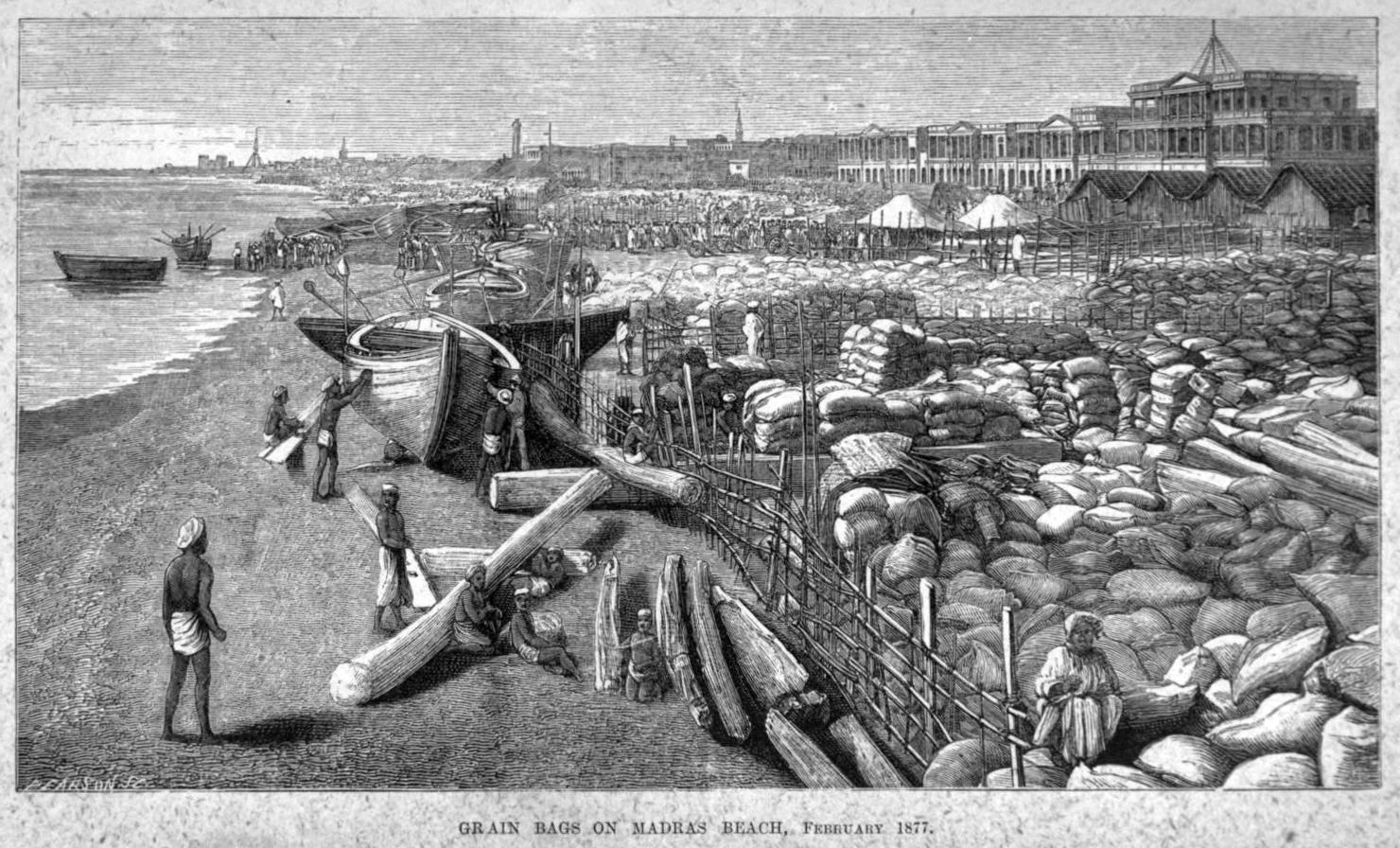
[[File:GrainFamineMadras.jpg|thumb|right|Grain destined for export stacked on Madras beaches (February 1877).]] | [[File:GrainFamineMadras.jpg|thumb|right|Grain destined for export stacked on [[Madras]] beaches (February 1877).]] | ||
The ''Great Famine'' | The ''Great Famine'' was precipitated by an intense drought resulting in crop failure in the [[Deccan Plateau]].<ref name="Roy 2006 361"/> This was part of a larger pattern of drought and crop failure across India, China, South America and parts of Africa caused by an interplay between a strong [[El Niño]] and an active [[Indian Ocean Dipole]] that led to between 19 and 50 million deaths.<ref>{{cite web |last1=Marshall |first1=Michael |title=A freak 1870s climate event caused drought across three continents |url=https://www.newscientist.com/article/2183901-a-freak-1870s-climate-event-caused-drought-across-three-continents/ |website=New Scientist}}</ref> | ||
The regular export of grain by the colonial government continued; during the famine, the viceroy, [[Robert Bulwer-Lytton, 1st Earl of Lytton|Lord | The regular export of grain by the colonial government continued; during the famine, the viceroy, [[Robert Bulwer-Lytton, 1st Earl of Lytton|Lord Lytton]], oversaw the export to England of a record 6.4 million hundredweight (320,000 tons) of wheat, which made the region more vulnerable. The cultivation of alternate [[cash crop]]s, in addition to the [[commodification]] of grain, played a significant role in the events.<ref>S. Guha, Environment and Ethnicity in India, 1200-1991 | ||
2006. p.116</ref><ref>Mike Davis, 2001. Late Victorian Holocausts: El Nino Famines and the Making of the Third World. Verso, London.</ref> | 2006. p.116</ref><ref>Mike Davis, 2001. Late Victorian Holocausts: El Nino Famines and the Making of the Third World. Verso, London.</ref> | ||
The famine occurred at a time when the colonial government was attempting to reduce expenses on welfare. Earlier, in the [[Bihar famine of 1873–74]], severe mortality had been avoided by importing rice from Burma. The Government of [[Bengal Presidency|Bengal]] and its Lieutenant-Governor, [[Sir Richard Temple, 1st Baronet|Sir Richard Temple]], were criticised for excessive expenditure on charitable relief.<ref>{{Harvnb|Imperial Gazetteer of India vol. III|1907|p=488}}, {{Harvnb|Hall-Matthews|1996|pp=217–219}}</ref> Sensitive to any renewed accusations of excess in 1876, Temple, who was now Famine Commissioner for the Government of India,<ref name=igi-III-488/> insisted not only on a policy of ''[[laissez faire]]'' with respect to the trade in grain,<ref>{{Harvnb|Hall-Matthews|1996|p=217}}</ref> but also on stricter standards of qualification for relief and on more meagre relief rations.<ref name=igi-III-488/> Two kinds of relief were offered: "relief works" for able-bodied men, women, and working children, and gratuitous (or charitable) relief for small children, the [[elderly]], and the [[indigent]].<ref>{{Harvnb|Imperial Gazetteer of India vol. III|1907|pp=477–483}}</ref> | The famine occurred at a time when the colonial government was attempting to reduce expenses on welfare. Earlier, in the [[Bihar famine of 1873–74]], severe mortality had been avoided by importing rice from Burma. The Government of [[Bengal Presidency|Bengal]] and its Lieutenant-Governor, [[Sir Richard Temple, 1st Baronet|Sir Richard Temple]], were criticised for excessive expenditure on charitable relief.<ref>{{Harvnb|Imperial Gazetteer of India vol. III|1907|p=488}}, {{Harvnb|Hall-Matthews|1996|pp=217–219}}</ref> Sensitive to any renewed accusations of excess in 1876, Temple, who was now Famine Commissioner for the Government of India,<ref name=igi-III-488/> insisted not only on a policy of ''[[laissez faire]]'' with respect to the trade in grain,<ref>{{Harvnb|Hall-Matthews|1996|p=217}}</ref> but also on stricter standards of qualification for relief and on more meagre relief rations.<ref name=igi-III-488/> Two kinds of relief were offered: "relief works" for able-bodied men, women, and working children, and gratuitous (or charitable) relief for small children, the [[elderly]], and the [[indigent]].<ref>{{Harvnb|Imperial Gazetteer of India vol. III|1907|pp=477–483}}</ref> | ||
== | ===Relief=== | ||
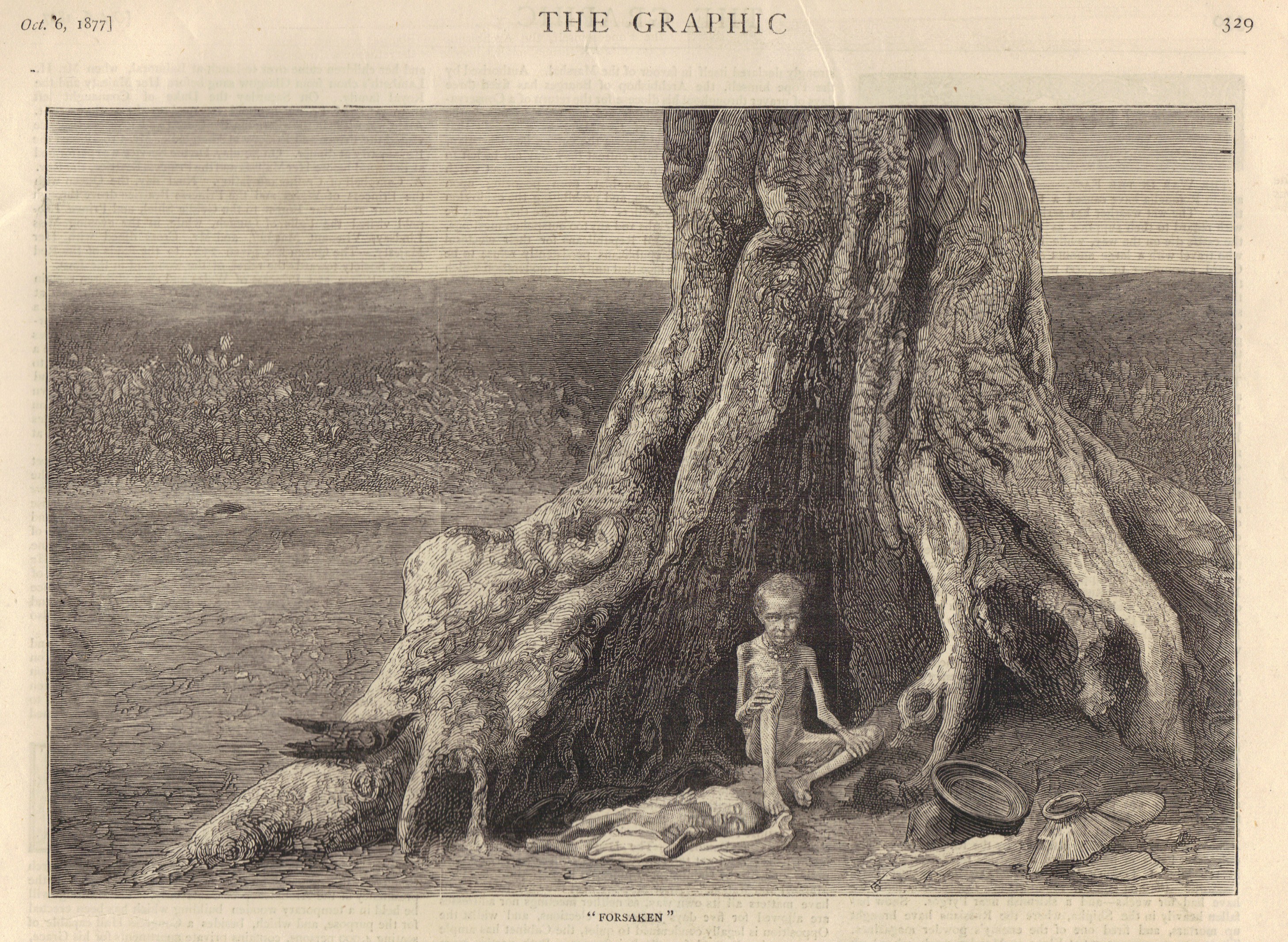
[[File:Graphic1-1877.JPG|thumb|right|Engraving from ''[[The Graphic]]'', October 1877, showing two forsaken children in the [[Bellary district]] of the [[Madras Presidency]].]] | [[File:Graphic1-1877.JPG|thumb|right|Engraving from ''[[The Graphic]]'', October 1877, showing two forsaken children in the [[Bellary district]] of the [[Madras Presidency]].]] | ||
[[File:Bellary Zilla,Great Famine of 1876–78..jpg|thumb|right|Engraving from ''The Graphic'', October 1877, showing the plight of animals as well as humans in Bellary district.]] | [[File:Bellary Zilla,Great Famine of 1876–78..jpg|thumb|right|Engraving from ''The Graphic'', October 1877, showing the plight of animals as well as humans in Bellary district.]] | ||
[[File:Famine in India Natives Waiting for Relief in Bangalore.jpg|thumb|right|People waiting for famine relief in [[Bangalore]]. From the'' [[Illustrated London News]]'' (20 October 1877).]] | [[File:Famine in India Natives Waiting for Relief in Bangalore.jpg|thumb|right|People waiting for famine relief in [[Bangalore]]. From the'' [[Illustrated London News]]'' (20 October 1877).]] | ||
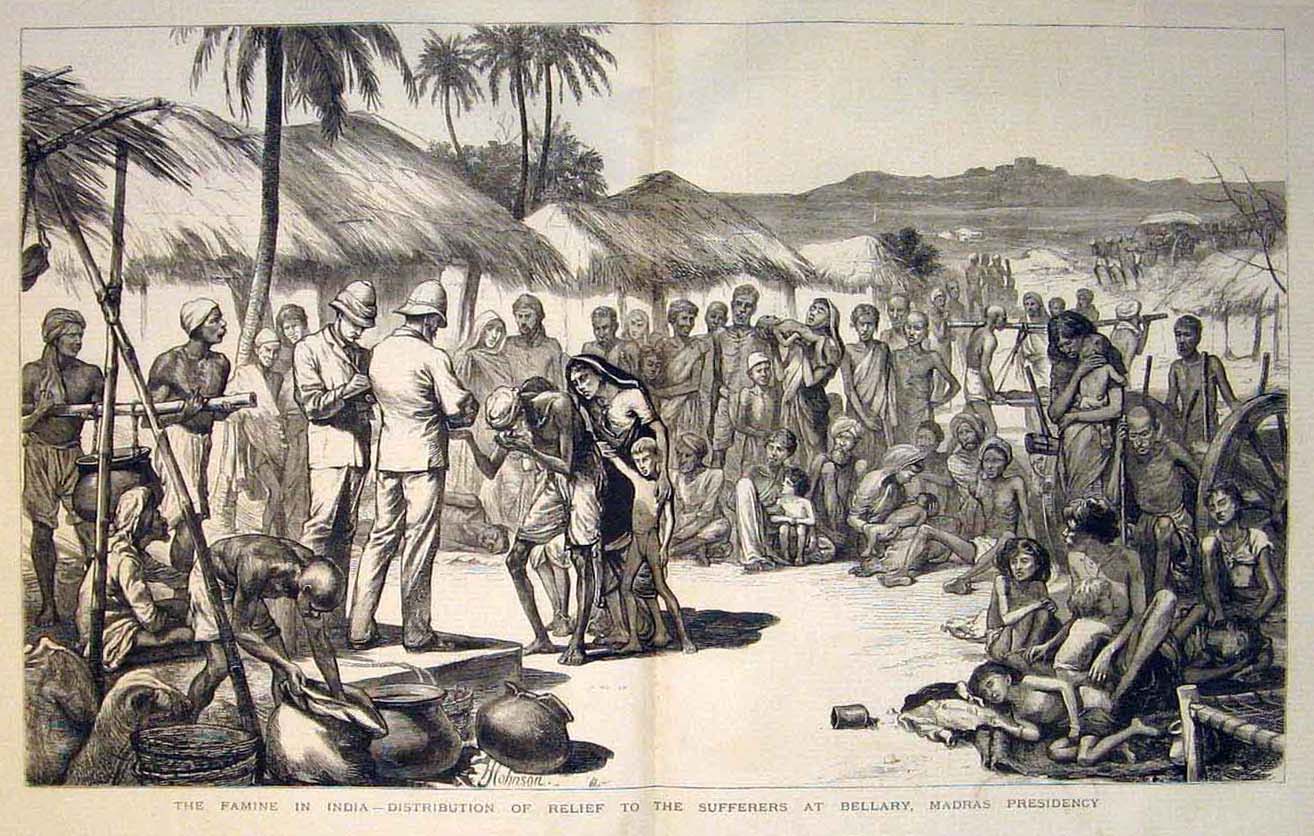
[[File:Madras famine 1877.jpg|thumb|right|A contemporary print showing the distribution of relief in [[Bellary]], [[Madras Presidency]]. From the ''[[Illustrated London News]]'' (1877).]] | [[File:Madras famine 1877.jpg|thumb|right|A contemporary print showing the distribution of relief in [[Bellary]], [[Madras Presidency]]. From the ''[[Illustrated London News]]'' (1877).]] | ||
[[File:WWHooperFamine1876-78GroupOfEmaciaedMenandOneWoman.jpg|thumb|right|Famine stricken people during the famine of | [[File:WWHooperFamine1876-78GroupOfEmaciaedMenandOneWoman.jpg|thumb|right|Famine stricken people during the famine of 1876–78 in Bangalore.]] | ||
The insistence on more rigorous tests for qualification, however, led to strikes by "relief workers" in the [[Bombay Presidency|Bombay presidency]].<ref name=igi-III-488/> | The insistence on more rigorous tests for qualification, however, led to strikes by "relief workers" in the [[Bombay Presidency|Bombay presidency]].<ref name=igi-III-488/> | ||
In January 1877, Temple reduced the wage for a day's hard work in the relief camps in [[Madras Presidency|Madras]] and Bombay<ref name=hall-mathews2008-5>{{Harvnb|Hall-Matthews|2008|p=5}}</ref>—this 'Temple wage' consisted of {{convert|1|lb|g|sigfig=2|order=flip}} of grain plus one [[ | In January 1877, Temple reduced the wage for a day's hard work in the relief camps in [[Madras Presidency|Madras]] and Bombay<ref name=hall-mathews2008-5>{{Harvnb|Hall-Matthews|2008|p=5}}</ref>—this 'Temple wage' consisted of {{convert|1|lb|g|sigfig=2|order=flip}} of grain plus one [[Anna (monetary subunit)|anna]] for a man, and a slightly reduced amount for a woman or working child,<ref>{{Harvnb|Washbrook|1994|p=145}}, {{Harvnb|Imperial Gazetteer of India vol. III|1907|p=489}}</ref> for a "long day of hard labour without shade or rest."<ref name = hall-matthews-1996-219>{{Harvnb|Hall-Matthews|1996|p=219}}</ref> The rationale behind the reduced wage, which was in keeping with a prevailing belief of the time, was that any excessive payment might create '[[Dependent personality disorder|dependency]]' (or "demoralisation" in contemporaneous usage) among the famine-afflicted population.<ref name=hall-mathews2008-5/> | ||
Temple's recommendations were opposed by some officials, including William Digby and the physician [[W. R. Cornish]], Sanitary Commissioner for the [[Madras Presidency]].<ref name=arnold-1994-7-8>{{Harvnb|Arnold|1994|pp=7–8}}</ref> Cornish argued for a minimum of {{convert|1.5|lb|g|sigfig=2|order=flip}} of grain and, in addition, supplements of vegetables and protein, especially if the individuals were performing strenuous labour in the relief works.<ref name=arnold-1994-7-8/> However, Lytton supported Temple, who argued that "everything must be subordinated to the financial consideration of disbursing the smallest sum of money."<ref name=davis>Mike Davis, ''Late Victorian Holocausts, El Niño Famines and the Making of the Third World'', Verso, 2001; calories for Buchenwald diet: 1750; Temple wage: 1627. Both involved hard labour (p.39); Temple's remark on financial considerations p.40</ref> | Temple's recommendations were opposed by some officials, including [[William Digby (writer)|William Digby]] and the physician [[W. R. Cornish]], Sanitary Commissioner for the [[Madras Presidency]].<ref name=arnold-1994-7-8>{{Harvnb|Arnold|1994|pp=7–8}}</ref> Cornish argued for a minimum of {{convert|1.5|lb|g|sigfig=2|order=flip}} of grain and, in addition, supplements of vegetables and protein, especially if the individuals were performing strenuous labour in the relief works.<ref name=arnold-1994-7-8/> However, Lytton supported Temple, who argued that "everything must be subordinated to the financial consideration of disbursing the smallest sum of money."<ref name=davis>Mike Davis, ''Late Victorian Holocausts, El Niño Famines and the Making of the Third World'', Verso, 2001; calories for Buchenwald diet: 1750; Temple wage: 1627. Both involved hard labour (p.39); Temple's remark on financial considerations p.40</ref> | ||
In March 1877, the provincial government of Madras increased the ration halfway towards Cornish's recommendations, to {{convert|1.25|lb|g|sigfig=2|order=flip}} of grain and {{convert|1.5|oz|g|0|order=flip}} of protein in the form of ''[[dal|daal]]'' ([[pulse (legume)|pulse]]s).<ref name=arnold-1994-7-8/> Meanwhile, many more people had succumbed to the famine.<ref name=igi-III-489/> In other parts of India, such as the [[United Provinces of Agra and Oudh|United Provinces]], where relief was meagre, the resulting mortality was high.<ref name=igi-III-489>{{Harvnb|Imperial Gazetteer of India vol. III|1907|p=489}}</ref> In the second half of 1878, an epidemic of [[malaria]] killed many more who were already weakened by malnutrition.<ref name=igi-III-489/> | In March 1877, the provincial government of Madras increased the ration halfway towards Cornish's recommendations, to {{convert|1.25|lb|g|sigfig=2|order=flip}} of grain and {{convert|1.5|oz|g|0|order=flip}} of protein in the form of ''[[dal|daal]]'' ([[pulse (legume)|pulse]]s).<ref name=arnold-1994-7-8/> Meanwhile, many more people had succumbed to the famine.<ref name=igi-III-489/> In other parts of India, such as the [[United Provinces of Agra and Oudh|United Provinces]], where relief was meagre, the resulting mortality was high.<ref name=igi-III-489>{{Harvnb|Imperial Gazetteer of India vol. III|1907|p=489}}</ref> In the second half of 1878, an epidemic of [[malaria]] killed many more who were already weakened by malnutrition.<ref name=igi-III-489/> | ||
| Line 45: | Line 44: | ||
===Famine in Mysore State=== | ===Famine in Mysore State=== | ||
Two years before the famine of 1876, heavy rain destroyed [[Eleusine coracana|ragi]] crops (a type of [[millet]]) in [[Kolar]] and [[Bangalore]]. Scant rainfall the following year resulted in drying up of lakes, affecting food stock. As a result of the famine, the population of the state decreased by 874,000 (in comparison with the 1871 census). | Two years before the famine of 1876, heavy rain destroyed [[Eleusine coracana|ragi]] crops (a type of [[millet]]) in [[Kolar, Karnataka|Kolar]] and [[Bangalore]]. Scant rainfall the following year resulted in drying up of lakes, affecting food stock. As a result of the famine, the population of the state decreased by 874,000 (in comparison with the 1871 census). | ||
Sir Richard Temple was sent by the [[British Raj|British India Government]] as Special Famine Commissioner to oversee the relief works of the Mysore government. To deal with the famine, the [[Kingdom of Mysore|government of Mysore]] started relief kitchens. A large number of people journeyed to Bangalore when relief was available. These people had to work on the Bangalore–Mysore railway line in exchange for food and grains. The Mysore government imported large quantities of grain from the neighbouring British ruled [[Madras Presidency]]. Grazing in forests was allowed temporarily, and new tanks were constructed and old tanks repaired. The [[Dewan]] of Mysore State, [[C. V. Rungacharlu]], in his [[Mysore Dasara|Dasara]] speech estimated the cost to the state at 160 [[lakh]]s, with the state incurring a debt of 80 lakhs.<ref name=Prasad>{{cite news|last1=Prasad|first1=S Narendra|title=A devastating famine |url=http://www.deccanherald.com/content/423536/a-devastating-famine.html|access-date=19 January 2015|issue=Bangalore|publisher=Deccan Herald|date=5 August 2014}}</ref> | Sir Richard Temple was sent by the [[British Raj|British India Government]] as Special Famine Commissioner to oversee the relief works of the Mysore government. To deal with the famine, the [[Kingdom of Mysore|government of Mysore]] started relief kitchens. A large number of people journeyed to Bangalore when relief was available. These people had to work on the Bangalore–Mysore railway line in exchange for food and grains. The Mysore government imported large quantities of grain from the neighbouring British ruled [[Madras Presidency]]. Grazing in forests was allowed temporarily, and new tanks were constructed and old tanks repaired. The [[Dewan]] of Mysore State, [[C. V. Rungacharlu]], in his [[Mysore Dasara|Dasara]] speech estimated the cost to the state at 160 [[lakh]]s, with the state incurring a debt of 80 lakhs.<ref name=Prasad>{{cite news|last1=Prasad|first1=S Narendra|title=A devastating famine |url=http://www.deccanherald.com/content/423536/a-devastating-famine.html|access-date=19 January 2015|issue=Bangalore|publisher=Deccan Herald|date=5 August 2014}}</ref> | ||
==Aftermath== | ==Aftermath== | ||
The [[Mortality displacement|excess mortality]] in the famine has been estimated to lie in a range whose low end is approximately 5. | The [[Mortality displacement|excess mortality]] in the famine has been estimated to lie in a range whose low end is approximately 5.6 million human deaths, the high end approximately is 9.6 million deaths and a careful modern demographic estimate of which is 8.2 million deaths.<ref name=fieldhouse1996>{{Harvnb|Fieldhouse|1996|p=132}} Quote: "In the later nineteenth century, there was a series of disastrous crop failures in India leading not only to starvation but to epidemics. Most were regional, but the death toll could be huge. Thus, to take only some of the worst famines for which the death rate is known, some 800,000 died in the North West Provinces, Punjab, and Rajasthan in 1837–38; perhaps 2 million in the same region in 1860–61; nearly a million in different areas in 1866–67; 4.3 million in widely spread areas in 1876–78, an additional 1.2 million in the North West Provinces and Kashmir in 1877–78; and, worst of all, over 5 million in a famine that affected a large population of India in 1896–97. In 1899–1900 more than a million were thought to have died, conditions being worse because of the shortage of food following the famines only two years earlier. Thereafter the only major loss of life through famine was in 1943 under exceptional wartime conditions.(p. 132)"</ref><ref name="Dyson2018">{{cite book|last=Dyson|first=Tim|title=A Population History of India: From the First Modern People to the Present Day|url=https://books.google.com/books?id=3TRtDwAAQBAJ&pg=PA137|year=2018|publisher=Oxford University Press|isbn=978-0-19-882905-8|pages=137–}} Quote: "Estimating the number of people who died as a result of a famine is not straightforward. Assumptions are required, and often they are not specified in detail and can be influenced by political considerations. However, for the 1876‒78 famine, towards the low end of the range Visaria and Visaria mention official estimates for British administered provinces which suggest that there were about 5.6 million ‘excess’ deaths. Towards the high end of the range, the campaigner William Digby—who witnessed the crisis in Madras Presidency—put the figure at 9.4 million for India. Between these numbers, a careful estimate by Arup Maharatna is that there were around 8.2 million deaths. (p. 137)"</ref> | ||
The excessive mortality and the renewed questions of "relief and protection" asked in its wake | The excessive mortality and the renewed questions of "relief and protection" asked in its wake led directly to the formation of the Famine Commission of 1880, and to the eventual adoption of the [[Indian Famine Codes]].<ref name=igi-III-489/> After the famine, a large number of agricultural labourers and [[handloom weaver]]s in [[South India]] emigrated to British tropical colonies to work as [[Indentured servant|indentured labourers]] in plantations.<ref>{{Harvnb|Roy|2006|p=362}}</ref> The excessive mortality in the famine also neutralized the natural population growth in the Bombay and Madras presidencies during the decade between the first and second censuses of British India in 1871 and 1881 respectively.<ref>{{Harvnb|Roy|2006|p=363}}</ref> The famine lives on in the Tamil and other literary traditions.<ref name="Zvelebil1974">.....panchalakshna tirumugavilasam, a satire published in 1899, composed by Villiappa Pillai, one of the court poets of Sivagangai. This narrative piece full of humour and biting irony deals in ca.4500 lines with the conditions of the people suffering in the great famine of 1876... God Sunderesvara of [[Madurai]] pleads his helplessness in solving the problems of inhabitants hit by the famine..{{cite book|author=Kamil Zvelebil|author-link=Kamil Zvelebil|title=Tamil Literature|url=https://books.google.com/books?id=OQ33i496MsIC&pg=PA218|access-date=1 January 2013|year=1974|publisher=Otto Harrassowitz Verlag|isbn=978-3-447-01582-0|pages=218–}}</ref> A large number of ''[[Kummi]]'' folk songs describing this famine have been documented.<ref>{{cite news|title= இந்தவாரம் கலாரசிகன் |url=http://www.dinamani.com/edition/story.aspx?SectionName=Tamil%20Mani&artid=259447&SectionID=179&MainSectionID=179&SEO=&Title=%E0%AE%87%E0%AE%A8%E0%AF%8D%E0%AE%A4%E0%AE%B5%E0%AE%BE%E0%AE%B0%E0%AE%AE%E0%AF%8D%20%E0%AE%95%E0%AE%B2%E0%AE%BE%E0%AE%B0%E0%AE%9A%E0%AE%BF%E0%AE%95%E0%AE%A9%E0%AF%8D|access-date=17 August 2010|newspaper=[[Dina Mani]]|date=20 June 2010|language=ta}}</ref> | ||
The Great Famine had a lasting political impact on events in India. Among the British administrators in India who were unsettled by the official reactions to the famine and, in particular by the stifling of the official debate about the best form of famine relief, were [[William Wedderburn]] and [[A. O. Hume]].<ref name=hall-matthews-2008-24>{{Harvnb|Hall-Matthews|2008|p=24}}</ref> Less than a decade later, they would found the [[Indian National Congress]] and, in turn, influence a generation of [[Indian nationalist]]s. Among the latter were [[Dadabhai Naoroji]] and [[Romesh Chunder Dutt]] for whom the ''Great Famine'' would become a cornerstone of the economic critique of the [[British Raj]].<ref name=hall-matthews-2008-24/> | The Great Famine had a lasting political impact on events in India. Among the British administrators in India who were unsettled by the official reactions to the famine and, in particular by the stifling of the official debate about the best form of famine relief, were [[William Wedderburn]] and [[A. O. Hume]].<ref name=hall-matthews-2008-24>{{Harvnb|Hall-Matthews|2008|p=24}}</ref> Less than a decade later, they would found the [[Indian National Congress]] and, in turn, influence a generation of [[Indian nationalist]]s. Among the latter were [[Dadabhai Naoroji]] and [[Romesh Chunder Dutt]] for whom the ''Great Famine'' would become a cornerstone of the economic critique of the [[British Raj]].<ref name=hall-matthews-2008-24/> | ||
==See also== | ==See also== | ||
*[[Tamil Nadu famine (1891)]] | |||
*[[Indian famine of 1896–1897]] | *[[Indian famine of 1896–1897]] | ||
*[[Indian famine of 1899–1900]] | *[[Indian famine of 1899–1900]] | ||
| Line 66: | Line 66: | ||
*[[Bengal famine of 1943]] | *[[Bengal famine of 1943]] | ||
*[[El Niño–Southern Oscillation]] | *[[El Niño–Southern Oscillation]] | ||
*[[Late Victorian Holocausts]] | *[[Late Victorian Holocausts]] | ||
*[[Northern Chinese Famine of 1876–1879]] | *[[Northern Chinese Famine of 1876–1879]] | ||
*[[Grande Seca]] | |||
*[[Great Eastern Crisis]] | *[[Great Eastern Crisis]] | ||
| Line 79: | Line 79: | ||
*{{Citation | last = Davis| first = Mike | title = Late Victorian Holocausts|author-link=Mike Davis (scholar) | year = 2001|publisher=Verso Books. Pp. 400| isbn = 978-1-85984-739-8|url = https://books.google.com/books?id=3IrKEzgkQkMC&pg=PA7}} | *{{Citation | last = Davis| first = Mike | title = Late Victorian Holocausts|author-link=Mike Davis (scholar) | year = 2001|publisher=Verso Books. Pp. 400| isbn = 978-1-85984-739-8|url = https://books.google.com/books?id=3IrKEzgkQkMC&pg=PA7}} | ||
*{{Citation| last = Fieldhouse | first = David | chapter = For Richer, for Poorer? |editor-last = Marshall |editor-first = P. J. | title = The Cambridge Illustrated History of the British Empire|pages = 108–146|publisher=Cambridge: Cambridge University Press. Pp. 400| year = 1996| isbn = 0-521-00254-0|chapter-url = https://books.google.com/books?id=S2EXN8JTwAEC&q=famine+british+empire+india&pg=PA132}} | *{{Citation| last = Fieldhouse | first = David | chapter = For Richer, for Poorer? |editor-last = Marshall |editor-first = P. J. | title = The Cambridge Illustrated History of the British Empire|pages = 108–146|publisher=Cambridge: Cambridge University Press. Pp. 400| year = 1996| isbn = 0-521-00254-0|chapter-url = https://books.google.com/books?id=S2EXN8JTwAEC&q=famine+british+empire+india&pg=PA132}} | ||
*{{Citation | last = Hall-Matthews | first = David | title = Historical Roots of Famine Relief Paradigms: Ideas on Dependency and Free Trade in India in the 1870s | journal = Disasters | year = 1996 | volume = 20 | issue = 3 | pages = 216–230 | doi = 10.1111/j.1467-7717.1996.tb01035.x| pmid = 8854458 }} | *{{Citation | last = Hall-Matthews | first = David | title = Historical Roots of Famine Relief Paradigms: Ideas on Dependency and Free Trade in India in the 1870s | journal = Disasters | year = 1996 | volume = 20 | issue = 3 | pages = 216–230 | doi = 10.1111/j.1467-7717.1996.tb01035.x| pmid = 8854458 | bibcode = 1996Disas..20..216H }} | ||
*{{Citation | last = Hall-Matthews | first = David | title = Inaccurate Conceptions: Disputed Measures of Nutritional Needs and Famine Deaths in Colonial India | journal = Modern Asian Studies | year = 2008 | volume = 42 | issue = 1 | pages = 1–24 | doi = 10.1017/S0026749X07002892}} | *{{Citation | last = Hall-Matthews | first = David | title = Inaccurate Conceptions: Disputed Measures of Nutritional Needs and Famine Deaths in Colonial India | journal = Modern Asian Studies | year = 2008 | volume = 42 | issue = 1 | pages = 1–24 | doi = 10.1017/S0026749X07002892}} | ||
*{{Citation | last = Imperial Gazetteer of India vol. III | title = The Indian Empire, Economic (Chapter X: Famine, pp. 475–502 | publisher = Published under the authority of His Majesty's Secretary of State for India in Council, Oxford at the Clarendon Press. Pp. xxx, 1 map, 552. | year = 1907}} | *{{Citation | last = Imperial Gazetteer of India vol. III | title = The Indian Empire, Economic (Chapter X: Famine, pp. 475–502 | publisher = Published under the authority of His Majesty's Secretary of State for India in Council, Oxford at the Clarendon Press. Pp. xxx, 1 map, 552. | year = 1907}} | ||
| Line 91: | Line 91: | ||
*{{Citation | last = Bhatia | first = B. M. | title = Famines in India: A Study in Some Aspects of the Economic History of India With Special Reference to Food Problem, 1860–1990 | year = 1991 | publisher = Stosius Inc/Advent Books Division. Pp. 383 | isbn = 81-220-0211-0}} | *{{Citation | last = Bhatia | first = B. M. | title = Famines in India: A Study in Some Aspects of the Economic History of India With Special Reference to Food Problem, 1860–1990 | year = 1991 | publisher = Stosius Inc/Advent Books Division. Pp. 383 | isbn = 81-220-0211-0}} | ||
*{{Citation | last = Davis| first = Mike|author-link=Mike Davis (scholar)| title = [[Late Victorian Holocausts]]: El Niño Famines and the Making of the Third World | year = 2001 | publisher = Verso. Pp. 464 | isbn = 1-85984-739-0}} | *{{Citation | last = Davis| first = Mike|author-link=Mike Davis (scholar)| title = [[Late Victorian Holocausts]]: El Niño Famines and the Making of the Third World | year = 2001 | publisher = Verso. Pp. 464 | isbn = 1-85984-739-0}} | ||
*{{Citation | last = Digby| first = William | author-link = William Digby (writer)| year = 1878 | title = The Famine Campaign in Southern India: Madras and Bombay Presidencies and province of Mysore, | *{{Citation | last = Digby| first = William | author-link = William Digby (writer)| year = 1878 | title = The Famine Campaign in Southern India: Madras and Bombay Presidencies and province of Mysore, 1876–1878, Volume 1 | publisher = London: Longmans, Green and Co | url = https://archive.org/details/faminecampaignin01digbuoft}} | ||
*{{Citation | last = Digby| first = William | author-link = William Digby (writer)| year = 1878 | title = The Famine Campaign in Southern India: Madras and Bombay Presidencies and province of Mysore, | *{{Citation | last = Digby| first = William | author-link = William Digby (writer)| year = 1878 | title = The Famine Campaign in Southern India: Madras and Bombay Presidencies and province of Mysore, 1876–1878, Volume 2 | publisher = London: Longmans, Green and Co | url = https://archive.org/details/faminecampaigni00digbgoog}} | ||
*{{Citation | last = Dutt | first = Romesh Chunder | title = Open Letters to Lord Curzon on Famines and Land Assessments in India | orig-year = 1900| year = 2005 | publisher = London: Kegan Paul, Trench, Trubner & Co. Ltd (reprinted by Adamant Media Corporation) | isbn = 1-4021-5115-2}} | *{{Citation | last = Dutt | first = Romesh Chunder | title = Open Letters to Lord Curzon on Famines and Land Assessments in India | orig-year = 1900| year = 2005 | publisher = London: Kegan Paul, Trench, Trubner & Co. Ltd (reprinted by Adamant Media Corporation) | isbn = 1-4021-5115-2}} | ||
*{{Citation | last = Dyson | first = Tim | year = 1991 | title = On the Demography of South Asian Famines: Part I | journal = Population Studies | volume = 45 | issue = 1 | pages = 5–25 | jstor = 2174991 | doi=10.1080/0032472031000145056 | *{{Citation | last = Dyson | first = Tim | year = 1991 | title = On the Demography of South Asian Famines: Part I | journal = Population Studies | volume = 45 | issue = 1 | pages = 5–25 | jstor = 2174991 | doi=10.1080/0032472031000145056 | ||
}} | |||
*{{Citation | last = Dyson | first = Tim | year = 1991 | title = On the Demography of South Asian Famines: Part II | journal = Population Studies | volume = 45 | issue = 2 | pages = 279–297 | jstor = 2174784 | doi=10.1080/0032472031000145446 | pmid = 11622922 | *{{Citation | last = Dyson | first = Tim | year = 1991 | title = On the Demography of South Asian Famines: Part II | journal = Population Studies | volume = 45 | issue = 2 | pages = 279–297 | jstor = 2174784 | doi=10.1080/0032472031000145446 | pmid = 11622922 | ||
}} | }} | ||
| Line 101: | Line 101: | ||
*{{Citation | last = Ghose | first = Ajit Kumar | title = Food Supply and Starvation: A Study of Famines with Reference to the Indian Subcontinent | year = 1982 | journal = Oxford Economic Papers |series=New Series | volume = 34 | issue = 2 | pages = 368–389| doi = 10.1093/oxfordjournals.oep.a041557 | pmid = 11620403 }} | *{{Citation | last = Ghose | first = Ajit Kumar | title = Food Supply and Starvation: A Study of Famines with Reference to the Indian Subcontinent | year = 1982 | journal = Oxford Economic Papers |series=New Series | volume = 34 | issue = 2 | pages = 368–389| doi = 10.1093/oxfordjournals.oep.a041557 | pmid = 11620403 }} | ||
*{{Citation | last = Government of India | year = 1867 | title = Report of the Commissioners Appointed to Enquire into the Famine in Bengal and Orissa in 1866, Volumes I, II | publisher = Calcutta}} | *{{Citation | last = Government of India | year = 1867 | title = Report of the Commissioners Appointed to Enquire into the Famine in Bengal and Orissa in 1866, Volumes I, II | publisher = Calcutta}} | ||
*{{Citation | last = Hardiman | first = David | title = Usuary, Dearth and Famine in Western India | year = 1996 | journal = Past and Present | | *{{Citation | last = Hardiman | first = David | title = Usuary, Dearth and Famine in Western India | year = 1996 | journal = Past and Present | issue = 152 | pages = 113–156 | doi=10.1093/past/152.1.113}} | ||
*{{Citation | last = Hill | first = Christopher V. | title = Philosophy and Reality in Riparian South Asia: British Famine Policy and Migration in Colonial North India | journal = Modern Asian Studies | volume = 25 | issue = 2 | year = 1991 | pages = 263–279 | doi=10.1017/s0026749x00010672}} | *{{Citation | last = Hill | first = Christopher V. | title = Philosophy and Reality in Riparian South Asia: British Famine Policy and Migration in Colonial North India | journal = Modern Asian Studies | volume = 25 | issue = 2 | year = 1991 | pages = 263–279 | doi=10.1017/s0026749x00010672}} | ||
*{{Citation | last = Klein | first = Ira | title = Death in India, 1871-1921 | journal = The Journal of Asian Studies | volume = 32 | issue = 4 | year = 1973 | pages = 639–659 | doi=10.2307/2052814| jstor = 2052814 | pmid = 11614702 }} | *{{Citation | last = Klein | first = Ira | title = Death in India, 1871-1921 | journal = The Journal of Asian Studies | volume = 32 | issue = 4 | year = 1973 | pages = 639–659 | doi=10.2307/2052814| jstor = 2052814 | pmid = 11614702 }} | ||
*{{Citation | last = McAlpin | first = Michelle B. | title = Famines, Epidemics, and Population Growth: The Case of India | year = 1983 | journal = Journal of Interdisciplinary History | volume = 14 | issue = 2 | pages = 351–366 | doi=10.2307/203709| jstor = 203709 }} | *{{Citation | last = McAlpin | first = Michelle B. | title = Famines, Epidemics, and Population Growth: The Case of India | year = 1983 | journal = Journal of Interdisciplinary History | volume = 14 | issue = 2 | pages = 351–366 | doi=10.2307/203709| jstor = 203709 }} | ||
*{{Citation | last = McAlpin | first = Michelle B. | title = Dearth, Famine, and Risk: The Changing Impact of Crop Failures in Western India, 1870–1920 | year = 1979 | journal = The Journal of Economic History | volume = 39 | issue = 1 | pages = 143–157 | doi=10.1017/S0022050700096352}} | *{{Citation | last = McAlpin | first = Michelle B. | title = Dearth, Famine, and Risk: The Changing Impact of Crop Failures in Western India, 1870–1920 | year = 1979 | journal = The Journal of Economic History | volume = 39 | issue = 1 | pages = 143–157 | doi=10.1017/S0022050700096352}} | ||
*{{Citation | last = Singh | first = Deepti | title = Climate and the Global Famine of 1876–78 | year = 2018 | journal = Journal of Climate | volume = 31 | number = 23 | pages = 9445–9467 | doi=10.1175/JCLI-D-18-0159.1| bibcode = 2018JCli...31.9445S }} | *{{Citation | last = Singh | first = Deepti | title = Climate and the Global Famine of 1876–78 | year = 2018 | journal = Journal of Climate | volume = 31 | number = 23 | pages = 9445–9467 | doi=10.1175/JCLI-D-18-0159.1| bibcode = 2018JCli...31.9445S | doi-access = free }} | ||
*{{Citation | last = Temple | first = Sir Richard | author-link = Sir Richard Temple, 1st Baronet| year = 1882 | title = Men and events of my time in India | publisher = London: John Murray. Pp. xvii, 526 | url = https://books.google.com/books?id=cHsBAAAAQAAJ}} | *{{Citation | last = Temple | first = Sir Richard | author-link = Sir Richard Temple, 1st Baronet| year = 1882 | title = Men and events of my time in India | publisher = London: John Murray. Pp. xvii, 526 | url = https://books.google.com/books?id=cHsBAAAAQAAJ}} | ||
{{Refend}} | {{Refend}} | ||
| Line 113: | Line 113: | ||
{{DEFAULTSORT:Great Famine of 1876-1878}} | {{DEFAULTSORT:Great Famine of 1876-1878}} | ||
[[Category: | [[Category:1876 in British India]] | ||
[[Category: | [[Category:1877 in British India]] | ||
[[Category:1878 in British India]] | |||
[[Category:1878 in India | |||
[[Category:1876 natural disasters]] | [[Category:1876 natural disasters]] | ||
[[Category:1877 natural disasters]] | [[Category:1877 natural disasters]] | ||
[[Category:1878 natural disasters]] | [[Category:1878 natural disasters]] | ||
[[Category:History of | [[Category:1870s famines]] | ||
[[Category:19th-century disasters in India]] | |||
[[Category:19th-century droughts]] | |||
[[Category:History of Chennai]] | |||
[[Category:Disasters in Andhra Pradesh]] | [[Category:Disasters in Andhra Pradesh]] | ||
[[Category: | [[Category:Economic history of Karnataka]] | ||
[[Category:Disasters in Tamil Nadu]] | [[Category:Disasters in Tamil Nadu]] | ||
[[Category:Natural disasters in Maharashtra]] | [[Category:Natural disasters in Maharashtra]] | ||
[[Category: | [[Category:El Niño–Southern Oscillation events]] | ||
[[Category:Famines in British India]] | |||
[[Category:Disasters in Karnataka]] | |||
Latest revision as of 21:50, 20 March 2026
| Great Indian famine of 1876–1878 | |
|---|---|
 Map of the British Indian Empire (1885), showing the regions affected by various famines of the 19th century, including the Great Famine of 1876–1878. | |
| Country | British India |
| Location | Madras, Bombay, Mysore, Hyderabad |
| Period | 1876–1878 |
| Total deaths | 5.6–9.6 million |
| Theory | Grain commodification, Cash Crops |
| Preceded by | Bihar famine of 1873–1874 |
| Succeeded by | Indian famine of 1896–1897 |
The Great Famine of 1876–1878 was a famine in India under British Crown rule. It began in 1876 after an intense drought resulted in crop failure in the Deccan Plateau.[1] Although the region still produced foodstuffs sufficient to avoid famine, colonial grain exports swelled to record numbers, ensuring widespread devastation. It affected south and Southwestern India—the British-administered presidencies of Madras and Bombay, and the princely states of Mysore and Hyderabad—for a period of two years. In 1877, famine came to affect regions northward, including parts of the Central Provinces and the North-Western Provinces, and a small area in Punjab.[2] The famine ultimately affected an area of 670,000 square kilometres (257,000 sq mi) and caused distress to a population totalling 58,500,000.[2] The excess mortality in the famine has been estimated in a range whose low end is 5.6 million human fatalities, high end 9.6 million fatalities, and a careful modern demographic estimate 8.2 million fatalities.[3][4] The famine is also known as the Southern India famine of 1876–1878 and the Madras famine of 1877.
Preceding events[edit | edit source]

The Great Famine was precipitated by an intense drought resulting in crop failure in the Deccan Plateau.[1] This was part of a larger pattern of drought and crop failure across India, China, South America and parts of Africa caused by an interplay between a strong El Niño and an active Indian Ocean Dipole that led to between 19 and 50 million deaths.[5]
The regular export of grain by the colonial government continued; during the famine, the viceroy, Lord Lytton, oversaw the export to England of a record 6.4 million hundredweight (320,000 tons) of wheat, which made the region more vulnerable. The cultivation of alternate cash crops, in addition to the commodification of grain, played a significant role in the events.[6][7]
The famine occurred at a time when the colonial government was attempting to reduce expenses on welfare. Earlier, in the Bihar famine of 1873–74, severe mortality had been avoided by importing rice from Burma. The Government of Bengal and its Lieutenant-Governor, Sir Richard Temple, were criticised for excessive expenditure on charitable relief.[8] Sensitive to any renewed accusations of excess in 1876, Temple, who was now Famine Commissioner for the Government of India,[2] insisted not only on a policy of laissez faire with respect to the trade in grain,[9] but also on stricter standards of qualification for relief and on more meagre relief rations.[2] Two kinds of relief were offered: "relief works" for able-bodied men, women, and working children, and gratuitous (or charitable) relief for small children, the elderly, and the indigent.[10]
Relief[edit | edit source]


The insistence on more rigorous tests for qualification, however, led to strikes by "relief workers" in the Bombay presidency.[2] In January 1877, Temple reduced the wage for a day's hard work in the relief camps in Madras and Bombay[11]—this 'Temple wage' consisted of 450 grams (1 lb) of grain plus one anna for a man, and a slightly reduced amount for a woman or working child,[12] for a "long day of hard labour without shade or rest."[13] The rationale behind the reduced wage, which was in keeping with a prevailing belief of the time, was that any excessive payment might create 'dependency' (or "demoralisation" in contemporaneous usage) among the famine-afflicted population.[11]
Temple's recommendations were opposed by some officials, including William Digby and the physician W. R. Cornish, Sanitary Commissioner for the Madras Presidency.[14] Cornish argued for a minimum of 680 grams (1.5 lb) of grain and, in addition, supplements of vegetables and protein, especially if the individuals were performing strenuous labour in the relief works.[14] However, Lytton supported Temple, who argued that "everything must be subordinated to the financial consideration of disbursing the smallest sum of money."[15]
In March 1877, the provincial government of Madras increased the ration halfway towards Cornish's recommendations, to 570 grams (1.25 lb) of grain and 43 grams (1.5 oz) of protein in the form of daal (pulses).[14] Meanwhile, many more people had succumbed to the famine.[16] In other parts of India, such as the United Provinces, where relief was meagre, the resulting mortality was high.[16] In the second half of 1878, an epidemic of malaria killed many more who were already weakened by malnutrition.[16]
By early 1877, Temple proclaimed that he had put "the famine under control". Digby noted that "a famine can scarcely be said to be adequately controlled which leaves one-fourth of the people dead."[15]
All in all, the Government of India spent Rs. 30 million in relieving 700 million units (1 unit = relief for 1 person for 1 day) in British India and, in addition, another Rs. 7.2 million in relieving 72 million units in the princely states of Mysore and Hyderabad.[16] Revenue (tax) payments to the amount of Rs. 6 million were either not enforced or postponed until the following year, and charitable donations from Great Britain and the colonies totaled Rs. 8.4 million.[16] However, this cost was minuscule per capita; for example, the expenditure incurred in the Bombay Presidency was less than one-fifth of that in the Bihar famine of 1873–74, which affected a smaller area and did not last as long.[13]
Famine in Mysore State[edit | edit source]
Two years before the famine of 1876, heavy rain destroyed ragi crops (a type of millet) in Kolar and Bangalore. Scant rainfall the following year resulted in drying up of lakes, affecting food stock. As a result of the famine, the population of the state decreased by 874,000 (in comparison with the 1871 census).
Sir Richard Temple was sent by the British India Government as Special Famine Commissioner to oversee the relief works of the Mysore government. To deal with the famine, the government of Mysore started relief kitchens. A large number of people journeyed to Bangalore when relief was available. These people had to work on the Bangalore–Mysore railway line in exchange for food and grains. The Mysore government imported large quantities of grain from the neighbouring British ruled Madras Presidency. Grazing in forests was allowed temporarily, and new tanks were constructed and old tanks repaired. The Dewan of Mysore State, C. V. Rungacharlu, in his Dasara speech estimated the cost to the state at 160 lakhs, with the state incurring a debt of 80 lakhs.[17]
Aftermath[edit | edit source]
The excess mortality in the famine has been estimated to lie in a range whose low end is approximately 5.6 million human deaths, the high end approximately is 9.6 million deaths and a careful modern demographic estimate of which is 8.2 million deaths.[3][4]
The excessive mortality and the renewed questions of "relief and protection" asked in its wake led directly to the formation of the Famine Commission of 1880, and to the eventual adoption of the Indian Famine Codes.[16] After the famine, a large number of agricultural labourers and handloom weavers in South India emigrated to British tropical colonies to work as indentured labourers in plantations.[18] The excessive mortality in the famine also neutralized the natural population growth in the Bombay and Madras presidencies during the decade between the first and second censuses of British India in 1871 and 1881 respectively.[19] The famine lives on in the Tamil and other literary traditions.[20] A large number of Kummi folk songs describing this famine have been documented.[21]
The Great Famine had a lasting political impact on events in India. Among the British administrators in India who were unsettled by the official reactions to the famine and, in particular by the stifling of the official debate about the best form of famine relief, were William Wedderburn and A. O. Hume.[22] Less than a decade later, they would found the Indian National Congress and, in turn, influence a generation of Indian nationalists. Among the latter were Dadabhai Naoroji and Romesh Chunder Dutt for whom the Great Famine would become a cornerstone of the economic critique of the British Raj.[22]
See also[edit | edit source]
- Tamil Nadu famine (1891)
- Indian famine of 1896–1897
- Indian famine of 1899–1900
- Timeline of major famines in India during British rule
- Company rule in India
- Famine in India
- Drought in India
- Great Famine (Ireland)
- Bengal famine of 1943
- El Niño–Southern Oscillation
- Late Victorian Holocausts
- Northern Chinese Famine of 1876–1879
- Grande Seca
- Great Eastern Crisis
Notes[edit | edit source]
- ↑ 1.0 1.1 Roy 2006, p. 361
- ↑ 2.0 2.1 2.2 2.3 2.4 Imperial Gazetteer of India vol. III 1907, p. 488
- ↑ 3.0 3.1 Fieldhouse 1996, p. 132 Quote: "In the later nineteenth century, there was a series of disastrous crop failures in India leading not only to starvation but to epidemics. Most were regional, but the death toll could be huge. Thus, to take only some of the worst famines for which the death rate is known, some 800,000 died in the North West Provinces, Punjab, and Rajasthan in 1837–38; perhaps 2 million in the same region in 1860–61; nearly a million in different areas in 1866–67; 4.3 million in widely spread areas in 1876–78, an additional 1.2 million in the North West Provinces and Kashmir in 1877–78; and, worst of all, over 5 million in a famine that affected a large population of India in 1896–97. In 1899–1900 more than a million were thought to have died, conditions being worse because of the shortage of food following the famines only two years earlier. Thereafter the only major loss of life through famine was in 1943 under exceptional wartime conditions.(p. 132)"
- ↑ 4.0 4.1 Dyson, Tim (2018). A Population History of India: From the First Modern People to the Present Day. Oxford University Press. pp. 137–. ISBN 978-0-19-882905-8. Quote: "Estimating the number of people who died as a result of a famine is not straightforward. Assumptions are required, and often they are not specified in detail and can be influenced by political considerations. However, for the 1876‒78 famine, towards the low end of the range Visaria and Visaria mention official estimates for British administered provinces which suggest that there were about 5.6 million ‘excess’ deaths. Towards the high end of the range, the campaigner William Digby—who witnessed the crisis in Madras Presidency—put the figure at 9.4 million for India. Between these numbers, a careful estimate by Arup Maharatna is that there were around 8.2 million deaths. (p. 137)"
- ↑ Marshall, Michael. "A freak 1870s climate event caused drought across three continents". New Scientist.
- ↑ S. Guha, Environment and Ethnicity in India, 1200-1991 2006. p.116
- ↑ Mike Davis, 2001. Late Victorian Holocausts: El Nino Famines and the Making of the Third World. Verso, London.
- ↑ Imperial Gazetteer of India vol. III 1907, p. 488, Hall-Matthews 1996, pp. 217–219
- ↑ Hall-Matthews 1996, p. 217
- ↑ Imperial Gazetteer of India vol. III 1907, pp. 477–483
- ↑ 11.0 11.1 Hall-Matthews 2008, p. 5
- ↑ Washbrook 1994, p. 145, Imperial Gazetteer of India vol. III 1907, p. 489
- ↑ 13.0 13.1 Hall-Matthews 1996, p. 219
- ↑ 14.0 14.1 14.2 Arnold 1994, pp. 7–8
- ↑ 15.0 15.1 Mike Davis, Late Victorian Holocausts, El Niño Famines and the Making of the Third World, Verso, 2001; calories for Buchenwald diet: 1750; Temple wage: 1627. Both involved hard labour (p.39); Temple's remark on financial considerations p.40
- ↑ 16.0 16.1 16.2 16.3 16.4 16.5 Imperial Gazetteer of India vol. III 1907, p. 489
- ↑ Prasad, S Narendra (5 August 2014). "A devastating famine". No. Bangalore. Deccan Herald. Retrieved 19 January 2015.
- ↑ Roy 2006, p. 362
- ↑ Roy 2006, p. 363
- ↑ .....panchalakshna tirumugavilasam, a satire published in 1899, composed by Villiappa Pillai, one of the court poets of Sivagangai. This narrative piece full of humour and biting irony deals in ca.4500 lines with the conditions of the people suffering in the great famine of 1876... God Sunderesvara of Madurai pleads his helplessness in solving the problems of inhabitants hit by the famine..Kamil Zvelebil (1974). Tamil Literature. Otto Harrassowitz Verlag. pp. 218–. ISBN 978-3-447-01582-0. Retrieved 1 January 2013.
- ↑ "இந்தவாரம் கலாரசிகன்". Dina Mani (in தமிழ்). 20 June 2010. Retrieved 17 August 2010.
- ↑ 22.0 22.1 Hall-Matthews 2008, p. 24
References[edit | edit source]
- Arnold, David (1994), "The 'discovery' of malnutrition and diet in colonial India", Indian Economic and Social History Review, 31 (1): 1–26, doi:10.1177/001946469403100101, S2CID 145445984
- Davis, Mike (2001), Late Victorian Holocausts, Verso Books. Pp. 400, ISBN 978-1-85984-739-8
- Fieldhouse, David (1996), "For Richer, for Poorer?", in Marshall, P. J. (ed.), The Cambridge Illustrated History of the British Empire, Cambridge: Cambridge University Press. Pp. 400, pp. 108–146, ISBN 0-521-00254-0
- Hall-Matthews, David (1996), "Historical Roots of Famine Relief Paradigms: Ideas on Dependency and Free Trade in India in the 1870s", Disasters, 20 (3): 216–230, Bibcode:1996Disas..20..216H, doi:10.1111/j.1467-7717.1996.tb01035.x, PMID 8854458
- Hall-Matthews, David (2008), "Inaccurate Conceptions: Disputed Measures of Nutritional Needs and Famine Deaths in Colonial India", Modern Asian Studies, 42 (1): 1–24, doi:10.1017/S0026749X07002892
- Imperial Gazetteer of India vol. III (1907), The Indian Empire, Economic (Chapter X: Famine, pp. 475–502, Published under the authority of His Majesty's Secretary of State for India in Council, Oxford at the Clarendon Press. Pp. xxx, 1 map, 552.
- Roy, Tirthankar (2006), The Economic History of India, 1857–1947, 2nd edition, New Delhi: Oxford University Press. Pp. xvi, 385, ISBN 0-19-568430-3
- Washbrook, David (1994), "The Commercialization of Agriculture in Colonial India: Production, Subsistence and Reproduction in the 'Dry South', c. 1870–1930", Modern Asian Studies, 28 (1): 129–164, doi:10.1017/s0026749x00011720, JSTOR 312924
Further reading[edit | edit source]
- FAHEEM, S. (1976), "Malthusian Population Theory and Indian Famine Policy in the Nineteenth Century", Population Studies, 30 (1): 5–14, doi:10.2307/2173660, JSTOR 2173660, PMID 11630514
- Bhatia, B. M. (1991), Famines in India: A Study in Some Aspects of the Economic History of India With Special Reference to Food Problem, 1860–1990, Stosius Inc/Advent Books Division. Pp. 383, ISBN 81-220-0211-0
- Davis, Mike (2001), Late Victorian Holocausts: El Niño Famines and the Making of the Third World, Verso. Pp. 464, ISBN 1-85984-739-0
- Digby, William (1878), The Famine Campaign in Southern India: Madras and Bombay Presidencies and province of Mysore, 1876–1878, Volume 1, London: Longmans, Green and Co
- Digby, William (1878), The Famine Campaign in Southern India: Madras and Bombay Presidencies and province of Mysore, 1876–1878, Volume 2, London: Longmans, Green and Co
- Dutt, Romesh Chunder (2005) [1900], Open Letters to Lord Curzon on Famines and Land Assessments in India, London: Kegan Paul, Trench, Trubner & Co. Ltd (reprinted by Adamant Media Corporation), ISBN 1-4021-5115-2
- Dyson, Tim (1991), "On the Demography of South Asian Famines: Part I", Population Studies, 45 (1): 5–25, doi:10.1080/0032472031000145056, JSTOR 2174991
- Dyson, Tim (1991), "On the Demography of South Asian Famines: Part II", Population Studies, 45 (2): 279–297, doi:10.1080/0032472031000145446, JSTOR 2174784, PMID 11622922
- Famine Commission (1880), Report of the Indian Famine Commission, Part I, Calcutta
- Ghose, Ajit Kumar (1982), "Food Supply and Starvation: A Study of Famines with Reference to the Indian Subcontinent", Oxford Economic Papers, New Series, 34 (2): 368–389, doi:10.1093/oxfordjournals.oep.a041557, PMID 11620403
- Government of India (1867), Report of the Commissioners Appointed to Enquire into the Famine in Bengal and Orissa in 1866, Volumes I, II, Calcutta
- Hardiman, David (1996), "Usuary, Dearth and Famine in Western India", Past and Present (152): 113–156, doi:10.1093/past/152.1.113
- Hill, Christopher V. (1991), "Philosophy and Reality in Riparian South Asia: British Famine Policy and Migration in Colonial North India", Modern Asian Studies, 25 (2): 263–279, doi:10.1017/s0026749x00010672
- Klein, Ira (1973), "Death in India, 1871-1921", The Journal of Asian Studies, 32 (4): 639–659, doi:10.2307/2052814, JSTOR 2052814, PMID 11614702
- McAlpin, Michelle B. (1983), "Famines, Epidemics, and Population Growth: The Case of India", Journal of Interdisciplinary History, 14 (2): 351–366, doi:10.2307/203709, JSTOR 203709
- McAlpin, Michelle B. (1979), "Dearth, Famine, and Risk: The Changing Impact of Crop Failures in Western India, 1870–1920", The Journal of Economic History, 39 (1): 143–157, doi:10.1017/S0022050700096352
- Singh, Deepti (2018), "Climate and the Global Famine of 1876–78", Journal of Climate, 31 (23): 9445–9467, Bibcode:2018JCli...31.9445S, doi:10.1175/JCLI-D-18-0159.1
- Temple, Sir Richard (1882), Men and events of my time in India, London: John Murray. Pp. xvii, 526