




m robot: Update article (please report if you notice any mistake or error in this edit) |
m robot: Create/upgrade articles. If there is a mistake please report on my talk page. |
||
| Line 1: | Line 1: | ||
{{Short description|Former Pakistan Air Force Chief}} | {{Short description|Former Pakistan Air Force Chief}} | ||
{{EngvarB|date=November | {{Cleanup bare URLs|date=September 2022}} | ||
{{Use dmy dates|date=November | {{Overly detailed|date=September 2022}} | ||
{{EngvarB|date=November 2022}} | |||
{{Use dmy dates|date=November 2022}} | |||
{{Infobox officeholder | {{Infobox officeholder | ||
| honorific-prefix = Air Marshal | | honorific-prefix = [[Air Marshal]] | ||
| name = Malik Nur Khan Awan | | name = Malik Nur Khan Awan | ||
| native_name = <!--The person's name in their own language, if different.--> | | native_name = <!--The person's name in their own language, if different.--> | ||
| native_name_lang = <!--ISO 639-1 code, e.g., "fr" for French. If more than one, use {{lang}} in |native_name= instead.--> | | native_name_lang = <!--ISO 639-1 code, e.g., "fr" for French. If more than one, use {{lang}} in |native_name= instead.--> | ||
| honorific-suffix = | | honorific-suffix = [[File:Hilal-e-Jurat Medal.png|30px]] <br /> '''[[Hilal-e-Jurat]]'''<br />{{small|[[Hilal-e-Jurat|HJ]] [[Sitara-e-Pakistan|SPk]] [[Civil decorations of Pakistan|HS HQA]] [[Order of Independence (Jordan)|OI(J)]] [[National Order of the Cedar|NOC]]}} | ||
| image = Noor khan.jpg | | image = Noor khan.jpg | ||
| image_size = 190px | | image_size = 190px | ||
| Line 102: | Line 104: | ||
| committees = | | committees = | ||
| portfolio = | | portfolio = | ||
| awards = [[File:Hilal-e-Shujaat.png|50px]] | | awards = <b><i>[[File:Hilal-e-Shujaat.png|50px]][[Civil decorations of Pakistan|Sitara-e-Shujaat]] | ||
| blank1 = | | blank1 = | ||
| blank2 = | | blank2 = | ||
| Line 123: | Line 125: | ||
* [[Indo-Pakistani Air War of 1965|Air operations]] | * [[Indo-Pakistani Air War of 1965|Air operations]] | ||
[[Six-Day War]] | [[Six-Day War]] | ||
| mawards = [[File:Hilal-e-Jurat.png|50px]]{{small|[[Hilal-e-Jurat]]}}<br />[[File:Hilal-e-Quaid-e-Azam (1957-76).png|50px]]{{small|[[Civil decorations of Pakistan|Hilal-e-Quaid-e-Azam]]}}<br />[[File:Sitara-e-Pakistan (SPk) (1957-86).png|50px]]{{small|[[Sitara-e-Pakistan]]}}<br />[[File:Order of Independence - Grand Officer (Jordan).png|50px]]{{small|[[Order of Independence]]}}<br />[[File:Order of Orange-Nassau - Grand Officer.png|50px]]{{small|[[Order of Orange-Nassau]]}}<br />[[File:National Order of the Cedar - Grand Officer (Lebanon).png|50px]]{{small|[[National Order of the Cedar|Order of the Cedar]]}} | | mawards = <i>[[File:Hilal-e-Jurat.png|50px]]{{small|[[Hilal-e-Jurat]]}}<br />[[File:Hilal-e-Quaid-e-Azam (1957-76).png|50px]]{{small|[[Civil decorations of Pakistan|Hilal-e-Quaid-e-Azam]]}}<br />[[File:Sitara-e-Pakistan (SPk) (1957-86).png|50px]]{{small|[[Sitara-e-Pakistan]]}}<br />[[File:Order of Independence - Grand Officer (Jordan).png|50px]]{{small|[[Order of Independence (Jordan)|Order of Independence]]}}<br />[[File:Order of Orange-Nassau - Grand Officer.png|50px]]{{small|[[Order of Orange-Nassau]]}}<br />[[File:National Order of the Cedar - Grand Officer (Lebanon).png|50px]]{{small|[[National Order of the Cedar|Order of the Cedar]]}} | ||
| military_data3 = | | military_data3 = | ||
| military_data4 = | | military_data4 = | ||
| Line 135: | Line 137: | ||
}} | }} | ||
Air Marshal''' Malik Nur Khan Awan''' {{small|[[Hilal-e-Jurat|HJ]] [[Sitara-e-Pakistan|SPk]] [[Civil decorations of Pakistan|HS HQA]] [[Order of Independence (Jordan)|OI(J)]] [[National Order of the Cedar|NOC]]}} ({{lang-ur|{{Nastaliq| ملک نور خان }}}} ; 22 February 1923 – 15 December 2011) commonly known as '''Nur Khan''', was a three-star [[air officer]], politician, sports administrator, and the Commander-in-Chief of the [[Pakistan Air Force]], serving under President [[Ayub Khan (President of Pakistan)|Ayub Khan]] from 1965 until 1969.<ref name="thenews.com.pk">[http://www.thenews.com.pk/TodaysPrintDetail.aspx?ID=11029&Cat=13 Obituary], daily The News</ref> | |||
Born into Punjabi [[Awan (tribe)|Awan]] tribe in [[Attock District|Attock]], he gained | Born into Punjabi [[Awan (tribe)|Awan]] tribe in [[Attock District|Attock]], he gained commissioned in the [[Royal Indian Air Force]] after graduating from [[Rashtriya Indian Military College]] in Dehra Dun in 1941.<ref name="Khan, R. 1999, p.265">Khan, R., 1999, ''The American Papers: Secret and Confidential India-Pakistan-Bangladesh Documents, 1965–1973'', Oxford University Press, p.265.</ref> He participated in World War II on the side of the United Kingdom and opted for Pakistan as an aftermath of the [[Partition of India|partition]] of British India in 1947. He gained nationwide famed and public notability when he commanded and led Pakistan Air Force in the second war with India in 1965 as well as noted for his aerial skills when he participated on [[Six-Day War]] on behalf of Arab countries fighting against Israel. After retiring in 1969, he started his career in national politics and served as [[Governor of West Pakistan]] under President [[Yahya Khan]] as well as serving cabinet minister in Yahya administration from 1969 till 1970 when resigning over mutual disagreements.<ref name="tribune.com.pk"/> | ||
During his career in the | During his career in the Air Force and the politics, he took charge of country's sportsmanship when he served as president/chairman of cricket, hockey, and squash where he introduced sport tactics and ideas that helped sporting performances and gained attention at the international venues.<ref name="nation.com.pk"/><ref name="dawn.com">[http://www.dawn.com/2011/12/17/glowing-tributes-paid-to-legendary-nur-khan.html A tribute to Nur Khan], ''The Dawn''.</ref> In addition, he also lobbied and pushed for the establishment of the [[Asian Cricket Council]].<ref name="A&C Black">{{cite book|last1=Publishing|first1=Bloomsbury|title=The Shorter Wisden India Almanack 2013|date=28 February 2013|publisher=A&C Black|isbn=9789382951018|url=https://books.google.com/books?id=UA241eeJFnwC&q=malik+nur+khan+born&pg=PP164|access-date=21 October 2016|language=en}}</ref> Nur Khan, however, is regarded for his sharp intelligence and outstanding management skills that largely benefited the [[Pakistan Armed Forces|Pakistan's military]] and the organizations that he presided over.<ref name="tribune.com.pk">[http://tribune.com.pk/story/307432/obituary-national-icon-air-marshal-m-nur-khan-flies-no-more/ Obituary], ''The Tribune''.</ref> | ||
==Biography== | ==Biography== | ||
===Background, early life and World War II=== | ===Background, early life and World War II=== | ||
Malik Nur Khan was born in the [[Tamman|Tamman town]] located in the vicinity of [[Talagang Tehsil]], [[Attock District|Chakwal District]] in [[Punjab Province (British India)|Punjab Province]], | Malik Nur Khan was born in the [[Tamman|Tamman town]] located in the vicinity of [[Talagang Tehsil]], [[Attock District|Chakwal District]] in [[Punjab Province (British India)|Punjab Province]], British India on 22 February 1923.<ref name="tribune.com.pk"/><ref name="Air Force ISPR">{{cite web|title=PAKISTAN AIR FORCE – Official website |url=http://www.paf.gov.pk/AM_Nur_Khan_Documentary.html|website=www.paf.gov.pk|publisher=Air Force ISPR|access-date=21 October 2022}}</ref> He belonged to an [[Awan (tribe)|Awan]] family which had a notable military tradition. The family carried the title of "Malik" (''lit.'' Ruler), a title which is mostly used by Awan families.<ref name="Air Force ISPR"/> | ||
His father, Subedar-Major and honorary | His father, Subedar-Major and honorary army captain Malik Mihr Khan, {{postnominals|country=GBR|size=100%|sep=,|OBI|IOM|IDSM}} had been in the [[British Indian Army]] and had served with the [[15th Lancers]], later [[20th Lancers (British Indian Army)|20th Lancers]]. He had been directly commissioned a Viceroy's Commissioned Officer in the rank of Jemedar 1 April 1911 into the 15th Lancers.<ref>Indian Army List January 1915</ref> He served in France and Belgium with the 15th Lancers from 23 September 1914 to January 1916 (during which time he was awarded the [[Indian Order of Merit]], 2nd class) when the regiment was transferred to Mesopotamia. It later served in [[Persia]] on the East Persia Cordon, where he was promoted Ressidar and awarded the [[Indian Distinguished Service Medal]]. He was promoted Risaldar 3 September 1918 and remained in the army when on the 21 September 1920 the 14th Murray's Jat Lancers and the 15th Lancers amalgamated to form the 20th Lancers.<ref>Supplement to the Indian Army List January 1930</ref> He was promoted Risaldar-Major of the 20th Lancers on 27 May 1927, an appointment he was to hold until 1 May 1928 when he was appointed ADC to the General Officer Commanding, Eastern Command in India.<ref>Indian Army List January 1931</ref> He held this appointment until he retired on the 28 January 1936. He was admitted to the [[Order of British India]] 4 June 1935.<ref>Indian Army List Supplement January 1939</ref> He had been appointed Honorary Lieutenant 1 August 1931 and the Honorary Captain 1 August 1935.<ref>London Gazette 2 October 1931 and 25 October 1935</ref> | ||
His family roots traces back to the family of [[Nawab of Kalabagh]] [[Amir Mohammad Khan]].<ref name="Air Force ISPR"/> | His family roots traces back to the family of [[Nawab of Kalabagh]] [[Amir Mohammad Khan]].<ref name="Air Force ISPR"/> | ||
Completing his education from the famed [[Aitchison College]], he was accepted to join the [[Rashtriya Indian Military College]] (RIMC) at | Completing his education from the famed [[Aitchison College]], he was accepted to join the [[Rashtriya Indian Military College]] (RIMC) at Dehra Dun where he secured his graduation. He perform exceptionally well in RIMC where his British principal once noted as: | ||
<blockquote>An excellent military family from a very military center. The boy has been well educated and is more advanced than many Awans of his age. He is physically fit and should make an officer anyhow, he is the right type.<ref name="Air Force ISPR"/></blockquote> | <blockquote>An excellent military family from a very military center. The boy has been well educated and is more advanced than many Awans of his age. He is physically fit and should make an officer anyhow, he is the right type.<ref name="Air Force ISPR"/></blockquote> | ||
Upon graduation, the family paid for his flying lesson to learn to fly the [[de Havilland Tiger Moth]] and got qualified as a | Upon graduation, the family paid for his flying lesson to learn to fly the [[de Havilland Tiger Moth]] and got qualified as a pilot from the Northern India Flying Club Based at Lahore. In 1940, he was in the [[Royal Indian Air Force]] reserve and trained as an air crew from the United Kingdom.<ref name="Air Force ISPR"/> Nur Khan never attended the university nor he received university education instead of gaining commissioned as a Pilot officer in the [[No. 1 Squadron IAF|No. 1 Squadron]] of the RIAF on 6 January 1941.<ref name="Air Force ISPR"/><ref name="paffalcons.com">[http://www.paffalcons.com/cas/nur-khan.php PAF's Chief of the Air Staffs] {{webarchive|url=https://web.archive.org/web/20101128103247/http://paffalcons.com/cas/nur-khan.php |date=28 November 2010 }}, a thumbnail sketch, PAF Falcons website</ref> In the United Kingdom, his additional training took place as a gunnery and bomber pilot with the [[Royal Air Force|RAF]].<ref name="Air Force ISPR"/> Upon returning in 1942–43, he was sent to participate in the [[Burma Campaign 1942–1943|Burma campaign]] with the RIAF on the side of the United Kingdom, and served against the [[Imperial Japan]] in 1945.<ref name="Air Force ISPR"/> | ||
In 1946, Nur Khan was made | In 1946, Nur Khan was made commanding officer of the [[No. 4 Squadron IAF|No. 4 Squadron]] of the RIAF which he commanded until 1947.<ref name="tribune.com.pk"/> After the [[Partition of India|partition]] of British India which resulted in the [[Independence of Pakistan|establishment]] of Pakistan, Nur Khan [[Pakistani citizenship|opted]] for Pakistan and joined the newly formed [[Pakistan Air Force]] (PAF) where he was the base commander of the [[PAF Base Lahore]].<ref name="tribune.com.pk"/> | ||
===Commander-in-Chief and between wars=== | ===Commander-in-Chief and between wars=== | ||
In 1948, he was elevated as | In 1948, he was elevated as base commander of the [[PAF Base Chaklala]] but later posted as air attaché at the [[High Commission of Pakistan, London|High Commission of Pakistan]] in the United Kingdom.<ref name="tribune.com.pk"/> However, this position was short-lived when he was asked to return to Pakistan to be posted as commandant of [[Pakistan Air Force Academy]] (then PAF college) | ||
in [[Risalpur]], Punjab, also the same year.<ref name="Air Force ISPR"/> | in [[Risalpur]], Punjab, also the same year.<ref name="Air Force ISPR"/> | ||
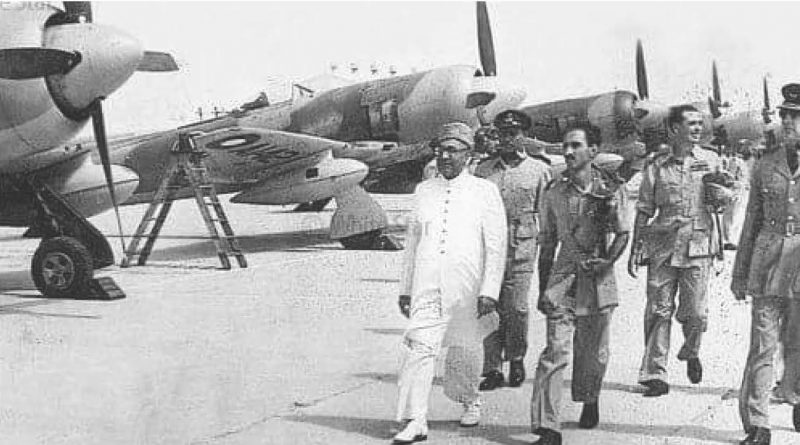
His career in the | His career in the Air Force progressed well as he was posted at the [[AHQ (Pakistan Air Force)|AHQ]] in [[Rawalpindi]] as the Director of Organizations, which he remained till 1951. He served as a [[North American F-86 Sabre|F-86 Sabre]] program director where he oversaw the induction of the jet fighter as he played an influential role in the opposition against acquiring the [[Republic F-84 Thunderjet|F-84 Thunderjet]].<ref name="Air Force ISPR" /> From 1955 to 1956, he was promoted as [[Group Captain]] and served base commander of the [[PAF Base Peshawar]], followed by commanding the [[PAF Base Mauripur]] and PAF Base Chaklala until 1957.<ref name="paffalcons.com"/> Before posting at the AHQ in Rawalpindi as the Deputy Commander-in-Chief (Air Operations) in 1957, his last field assignment included his role AOC of [[List of Pakistan Air Force Bases|No. 1 Group]] stationed in [[PAF Base Peshawar]] as an Air Commodore.<ref name="Air Force ISPR" /> | ||
From 1958 to 1965, he served on the deputation as chairman of civilian organizations and his appointment to three-star appointment was approved by | From 1958 to 1965, he served on the deputation as chairman of civilian organizations and his appointment to three-star appointment was approved by President Ayub Khan in 1965.<ref name="Air Force ISPR" /> Air Marshal [[Asghar Khan]] resigned from the command of the Air Force as its chief when he cemented conflict of interests issues with President Ayub Khan.<ref name="Air Force ISPR" /> Air Vice Marshal Nur Khan was a populist military figure in the country due to his involvement in sports management and managing-director of civilian [[Pakistan International Airlines]], and his name was included in the nomination papers for the command of the Air Force.<ref name="Air Force ISPR" /> On contrary, Nur Khan was never achieved to the four-star rank of Air Chief Marshal but appointed to serve as an air force commander under President President Ayub.<ref name="Air Force ISPR" /> In 1965, Nur Khan was appointed as [[Commander in Chief (Pakistan Air Force)|Commander in Chief]] and promoted as [[Air Marshal]].<ref name="Air Force ISPR" /> | ||
During 1964–65, the [[Air Headquarters (Pakistan Air Force)|Air Staff]] had been fighting with the [[Cabinet of Pakistan|Cabinet]] over the rearmament and contingency plans with the [[Ministry of Defence (Pakistan)|Ministry of Defence]] (MoD) and [[Ministry of Foreign Affairs (Pakistan)|Ministry of Foreign Affairs]] (MoFA) as the Air Staff wanted coordinated efforts if there was a retaliation.{{rp|125–127}}<ref name="Sang-e-Meel Publications">{{cite book|last1=Hussain|first1=Syed Shabbir|title=Ayub, Bhutto, and Zia: How They Fell Victim to Their Own Plans|year=2000|publisher=Sang-e-Meel Publications|isbn=9789693510805|url=https://books.google.com/books?id=J9Q-AQAAIAAJ&q=nur+khan+1965+Bhutto|access-date=31 October 2016|language=en}}</ref>{{better source needed|date=August | During 1964–65, the [[Air Headquarters (Pakistan Air Force)|Air Staff]] had been fighting with the [[Cabinet of Pakistan|Cabinet]] over the rearmament and contingency plans with the [[Ministry of Defence (Pakistan)|Ministry of Defence]] (MoD) and [[Ministry of Foreign Affairs (Pakistan)|Ministry of Foreign Affairs]] (MoFA) as the Air Staff wanted coordinated efforts if there was a retaliation.{{rp|125–127}}<ref name="Sang-e-Meel Publications">{{cite book|last1=Hussain|first1=Syed Shabbir|title=Ayub, Bhutto, and Zia: How They Fell Victim to Their Own Plans|year=2000|publisher=Sang-e-Meel Publications|isbn=9789693510805|url=https://books.google.com/books?id=J9Q-AQAAIAAJ&q=nur+khan+1965+Bhutto|access-date=31 October 2016|language=en}}</ref>{{better source needed|date=August 2022}} The outgoing Air Marshal Asghar Khan handed over the ceremonial baton to Air Marshal Nur Khan and did not brief him about the [[Operation Gibraltar|impending operations]] in [[Indian administered Kashmir]] since the latter was not aware of it himself.{{clarify|date=August 2022}}<ref name="Dawn newspapers, Editorial">{{cite news|last1=Editorial publication|title=Nur Khan reminisces '65 war|url=http://www.dawn.com/news/155474/nur-khan-reminisces|access-date=31 October 2016|work=DAWN.COM|publisher=Dawn newspapers, Editorial|date=6 September 2022}}</ref> However, there were suspicions regarding the secret operations undertaken by the army in the [[AHQ (Pakistan Air Force)|Air AHQ]] due to subsequent skirmishes in the [[Indo-Pakistani border|eastern border]].<ref name="Dawn newspapers, Editorial"/> Therefore, Nur Khan called then-Army Commander in Chief General [[Musa Khan (general)|Musa Khan]] who admitted that "something was afoot." However, General Musa Khan assured Air Marshal Nur Khan of Indian not retaliating despite Nur Khan's strong reaction.<ref name="Dawn newspapers, Editorial"/> Very few details of plan were emerged to both Nur Khan and [[Commander in Chief (Pakistan Navy)|Navy Commander in Chief]] Vice Admiral [[Afzal Rahman Khan]] and briefly wrote: "''Rumours about an impending operation were rife but the army had not shared the plans with other forces.''"<ref name="Dawn newspapers, Editorial"/> | ||
During the [[Indo-Pakistani war of 1965|war]] with | During the [[Indo-Pakistani war of 1965|war]] with India in 1965, Nur Khan became a national fame and hero when he maintained an aerial supremacy against Indian IAF despite its shortcomings.<ref name="Bloomsbury Publishing, Bloomsbury">{{cite book|last1=Publishing|first1=Bloomsbury|title=The Shorter Wisden 2011 – 2015|date=6 August 2015|publisher=Bloomsbury Publishing, Bloomsbury|isbn=9781472927330|url=https://books.google.com/books?id=v7NRCgAAQBAJ&q=nur+khan+1965+war&pg=PT906|access-date=31 October 2016|language=en}}</ref> He led the bombing missions during the war using the [[C-130 Hercules]] for that purpose in support to the army advances.<ref name="Samaa TV">{{cite news|title=PAF entire C-130 fleet used as bomber aircraft in 1965 war {{!}} SAMAA TV|url=http://www.samaa.tv/pakistan/2015/09/paf-entire-c-130-fleet-used-as-bomber-aircraft-in-1965-war/|access-date=1 November 2016|work=Samaa TV|publisher=Samaa TV}}</ref> His actions of valor and efforts won him the praise in all over the country after the war; he was credited with turning the tide of the war in his country's favor that gained air superiority in the first 24 hours.<ref name="The Friday Times, S.S. Haider">{{cite news|last1=Haider, PAF|first1=Air Commodore (retd) S. Sajjad|title=Man of Steel|url=http://www.thefridaytimes.com/beta3/tft/article.php?issue=20111223&page=20|access-date=1 November 2016|work=Air Commodore (Retired) Syed Sajad Haider pays tribute to the blunt and brilliant Air Marshal Nur Khan, who passed away last week|agency=The Friday Times|issue=Vol. XXIII, No. 45|publisher=The Friday Times, S.S. Haider|date=December 29, 2022}}</ref><ref name="WHITEnGREEN.com">{{cite web|last1=WHITEnGREEN.com|title=Indo-Pak War of 1965 Late Air Marshal Malik Nur Khan – Unequalled|url=http://whitengreen.com/indopak-war-of-1965-late-air-marshal-malik-nur-khan--unequal-1285-video|website=WHITEnGREEN.com|publisher=WHITEnGREEN.com|access-date=1 November 2022}}</ref> | ||
After the war, he was publicly honored and was famed figure in the country. In 1967, Nur Khan volunteered to serve in the allegiance of | After the war, he was publicly honored and was famed figure in the country. In 1967, Nur Khan volunteered to serve in the allegiance of Arab countries' [[Military of the Arab League|Air Forces]] against Israel during the [[Six-Day War]].<ref name="ReferenceA"/> He served in many aerial missions and witnessed the dogfight with [[Israeli Air Force|Israeli IAF]] whose pilots noted his aerial skills during the conflict.<ref name="ReferenceA"/> In fact, the Israeli IAF's fighter pilot, Major-General [[Ezer Weizman]], the former Israeli President (1993–2000) and [[Ministry of Defense (Israel)|Defence Minister]] (1977–80), wrote in his autobiography that: "He was a formidable fellow and I was glad that he was Pakistani and not an Egyptian".<ref name="ReferenceA">[[Ezer Weizman]], ''On Eagles' Wings: The Personal Story of the Leading Commander of the Israeli Air Force''. New York: Macmillan Publishing Co., Inc., 1977 (Weizman was former Air Force chief and President of Israel.)</ref><ref name="pakistantoday.com.pk">[http://www.pakistantoday.com.pk/2011/12/1965-war-hero-air-marshal-nur-khan-passes-away/ Obituary], daily the Pakistan Today</ref> | ||
After the | After the Six-Day conflict, Nur Khan returned to Pakistan to complete his tenure as Commander-in-Chief of Pakistan Air Force under President Ayub Khan and retired in 1969.<ref name="tribune.com.pk"/><ref name="pakistantoday.com.pk"/> | ||
== Civilian and sports management == | == Civilian and sports management == | ||
{{more citations needed|date=March | {{more citations needed|date=March 2022}} | ||
Nur Khan was gifted with administration skills. After the halcyon days of management at [[Pakistan International Airlines]] (PIA), he made a show of his talents in sports administration. Nur Khan, who at one time headed national sports bodies of | Nur Khan was gifted with administration skills. After the halcyon days of management at [[Pakistan International Airlines]] (PIA), he made a show of his talents in sports administration. Nur Khan, who at one time headed national sports bodies of hockey, cricket, and squash, enabled Pakistan to reach the top in all these games. | ||
=== Pakistan International Airlines === | === Pakistan International Airlines === | ||
He was also known to turn around Pakistan International Airlines into a profitable and recognised entity<ref>{{cite web| url = http://www.dawn.com/news/691974/lifting-pia-the-nur-khan-way| title = Lifting PIA: the Nur Khan way - Newspaper - DAWN.COM| date = 31 January | He was also known to turn around Pakistan International Airlines into a profitable and recognised entity<ref>{{cite web| url = http://www.dawn.com/news/691974/lifting-pia-the-nur-khan-way| title = Lifting PIA: the Nur Khan way - Newspaper - DAWN.COM| date = 31 January 2022}}</ref><ref>{{cite web| url = http://www.dawn.com/news/1095492/herald-exclusive-plane-truths| title = Herald Exclusive: Plane truths - Pakistan - DAWN.COM| date = 26 March 2022}}</ref> In 1960, PIA's very first jetliner (a [[Boeing 707]]-321 leased from [[Pan Am]]) took a gentle turn under the command of Malik Nur Khan. Nur Khan was PIA's chairman from 1959 to 1965.<ref name="tribune.com.pk"/> His success in establishing PIA on a firm and profitable financial basis in six years is now a fact of airline history. Under his charismatic and inspirational leadership, PIA became one of the leading and respected airlines of the world. During his tenure, PIA became the third Asian airline to operate jet aircraft after India and Japan. The airline inducted modern [[Boeing 720]] B jet in its fleet. PIA started flying to China and flights to Europe via Moscow were also launched during this period. In 1973, Nur Khan was specially requested by the government of Pakistan to resume control of PIA. During his second term as airline's head, PIA became operator of wide-body DC-10s and Boeing 747s. Popular Green & Gold aircraft livery was introduced, plus many more achievements were made by the airline under Nur Khan's leadership. He kept PIA out of Pakistan's turbulent political arena and returned it to a sound commercial basis. Nur Khan was a dynamic leader and believed in innovation and new ideas. He served as minister of Communications, Health, Labour and Science and Technology in Yahya Khan's cabinet.<ref>{{Cite web|url=https://www.pakistantoday.com.pk/2011/12/16/1965-war-hero-air-marshal-nur-khan-passes-away/|title=1965 war hero Air Marshal Nur Khan passes away | Pakistan Today}}</ref> | ||
On 20 January 1978, a PIA plane (while at Karachi) carrying 22 passengers was hijacked by a gunman and asked to be flown to India. The then chairman of PIA, Air Marshal (Retd) Nur Khan boarded the plane to negotiate with the hijacker. He was hit by a bullet while trying to disarm the hijacker but still managed to overpower him. | On 20 January 1978, a PIA plane (while at Karachi) carrying 22 passengers was hijacked by a gunman and asked to be flown to India. The then chairman of PIA, Air Marshal (Retd) Nur Khan boarded the plane to negotiate with the hijacker. He was hit by a bullet while trying to disarm the hijacker but still managed to overpower him. | ||
| Line 191: | Line 193: | ||
Being President Pakistan Hockey Federation, he donated World Cup Trophy and Champions Trophy to the International Hockey Federation. During his tenure Pakistan hockey team performed a grand-slam. The World Cup and Champions Trophy are the toughest events in Hockey.<ref name="hockeygods.com"/> | Being President Pakistan Hockey Federation, he donated World Cup Trophy and Champions Trophy to the International Hockey Federation. During his tenure Pakistan hockey team performed a grand-slam. The World Cup and Champions Trophy are the toughest events in Hockey.<ref name="hockeygods.com"/> | ||
He made valuable and tremendous contributions in Hockey in Pakistan. During his first tenure (1967–1969) that Pakistan hockey team won the Mexico Olympics and in second tenure (1976–1986) Pakistani team won Los Angeles Olympics.<ref>{{cite web |url=http://weeklypulse.org/details.aspx?contentID=1658&storylist=8 |title= | He made valuable and tremendous contributions in Hockey in Pakistan. During his first tenure (1967–1969) that Pakistan hockey team won the Mexico Olympics and in second tenure (1976–1986) Pakistani team won Los Angeles Olympics.<ref>{{cite web |url=http://weeklypulse.org/details.aspx?contentID=1658&storylist=8 |title=Great Nur Khan Country's best sports administrator passed away |access-date=2014-08-31 |url-status=dead |archive-url=https://web.archive.org/web/20140903110355/http://weeklypulse.org/details.aspx?contentID=1658&storylist=8 |archive-date=3 September 2014 |df=dmy-all }}</ref> | ||
=== Cricket === | === Cricket === | ||
| Line 201: | Line 203: | ||
From 1951 to 1963, Pakistanis achieved remarkable success in Squash winning the most coveted title, the British Open, all those thirteen years. Thereafter, it was a barren period. Any Pakistani failed to land the title over the next decade except one Aftab Javaid who managed to reach the final. Nur Khan took over the charge of Pakistan International Airlines for the second time in 1973. He immediately took revolutionary steps. He initiated the PIA Colts scheme. Young promising boys were spotted and given a monthly stipend. They were coached and sent to participate in international tournaments with PIA bearing the travel expenses. Whosoever performed well on the international circuit was given permanent employment in PIA. The incentives didn't end there. If any of the players achieved some major success in prime events, he was rewarded with a departmental promotion. All this led to a surfeit of world class Pakistani players in the 70s: [[Qamar Zaman]], Gogi Allauddin, Hiddy Jahan, [[Mohibullah "Mo" Khan|Mo Khan]] Junior and others. There used to be six to seven Pakistanis among the top 10 in the world rankings.<ref>{{Cite web|url=http://jang.com.pk/thenews/dec2011-weekly/nos-25-12-2011/spo.htm#1|title=Sports, NOS, the News International}}</ref> | From 1951 to 1963, Pakistanis achieved remarkable success in Squash winning the most coveted title, the British Open, all those thirteen years. Thereafter, it was a barren period. Any Pakistani failed to land the title over the next decade except one Aftab Javaid who managed to reach the final. Nur Khan took over the charge of Pakistan International Airlines for the second time in 1973. He immediately took revolutionary steps. He initiated the PIA Colts scheme. Young promising boys were spotted and given a monthly stipend. They were coached and sent to participate in international tournaments with PIA bearing the travel expenses. Whosoever performed well on the international circuit was given permanent employment in PIA. The incentives didn't end there. If any of the players achieved some major success in prime events, he was rewarded with a departmental promotion. All this led to a surfeit of world class Pakistani players in the 70s: [[Qamar Zaman]], Gogi Allauddin, Hiddy Jahan, [[Mohibullah "Mo" Khan|Mo Khan]] Junior and others. There used to be six to seven Pakistanis among the top 10 in the world rankings.<ref>{{Cite web|url=http://jang.com.pk/thenews/dec2011-weekly/nos-25-12-2011/spo.htm#1|title=Sports, NOS, the News International}}</ref> | ||
In 1975, on Nur Khan's request, legendary [[Azam Khan (squash player)|Azam Khan]], four-time winner of British Open (1959–62), who was running a squash club in England, prepared Qamar Zaman and Mohibullah Junior for the British Open. | In 1975, on Nur Khan's request, legendary [[Azam Khan (squash player)|Azam Khan]], four-time winner of British Open (1959–62), who was running a squash club in England, prepared Qamar Zaman and Mohibullah Junior for the British Open. Qamar Zaman brought back the title to Pakistan after 12 years. He gave the Squash World [[Jahangir Khan]], a pure PIA colts product who became the greatest squash player of all time. Pakistan Open initiated in 1980 became a prestigious tournament and the country also hosted World Open.<ref>{{Cite web|url=http://www.squashplayer.co.uk/features/azam_khan_part_one.htm|title = Azam Khan, the Greatest?}}</ref><ref name="the-south-asian.com">http://www.the-south-asian.com/Nov2001/Pakistan%20squash%204.htm</ref> | ||
== Politics and governorship == | == Politics and governorship == | ||
In 1969, Nur Khan retired from his military service and his prestige led him to secure an appointment in Cabinet led by | In 1969, Nur Khan retired from his military service and his prestige led him to secure an appointment in Cabinet led by President Yahya Khan; but it was short-lived due to his demands for reforms.{{rp|49–50}}<ref name="Springer, Burki">{{cite book|last1=Burki|first1=Shahid Javed|title=Pakistan Under Bhutto, 1971–1977|date=1990s|publisher=Springer, Burki|isbn=9781349195299|url=https://books.google.com/books?id=LX6xCwAAQBAJ&q=nur+khan+governor&pg=PA49|access-date=1 November 2016|language=en}}</ref> His tenure was renewed and his retirement was overturned by President Yahya who appointed him as Deputy [[Chief Martial Law Administrator|CMLA]] under his administration.<ref>{{cite book |last=Khan |first=Gul Hassan |date=2005 |orig-year=First published 1993 |chapter=§ The Final Hope for United Pakistan |title=Memoirs of Lt. Gen. Gul Hassan Khan |location=Karachi |publisher=Oxford University Press |isbn=0-19-547329-9}}</ref> | ||
In [[Yahya Khan|Yahya administration]], he was inducted as | In [[Yahya Khan|Yahya administration]], he was inducted as cabinet minister of communications, health, labour, and science in August 1969.<ref name="Dr. GN. Kazi">{{cite web|last=Dr. GN. Kazi|title=Pakistan's Smallest Cabinet|date=21 May 2008|url=https://www.flickr.com/photos/pimu/2510812824/?rb=1smal|publisher=Dr. GN. Kazi|access-date=17 April 2022}}</ref> | ||
Nur Khan, however, was appointed as | Nur Khan, however, was appointed as Governor of West Pakistan on 1 September 1969 who made radical reforms in country's political and educational structure.<ref name="Khan, R. 1999, p.265"/>{{rp|106}}<ref name="Harvard University Press, Shah">{{cite book|last1=Shah|first1=Aqil|title=The Army and Democracy|date=21 April 2014|publisher=Harvard University Press, Shah|isbn=9780674419773|url=https://books.google.com/books?id=ShihAwAAQBAJ&q=nur+khan+governor&pg=PA107|access-date=1 November 2016|language=en}}</ref> | ||
He supported the | He supported the devolution of controversial [[One Unit]] program and oversaw its termination in 1970.{{rp|51–52}}<ref name="Springer, Burki"/> He also announced new labour and educational policy to limit the role of politics in the universities.{{rp|122–123}}<ref name="Springer, Burki"/><ref name="Springer, Rizvi">{{cite book|last1=Rizvi|first1=H.|title=Military, State and Society in Pakistan|date=15 May 2000|publisher=Springer, Rizvi|isbn=9780230599048|url=https://books.google.com/books?id=ZwGIDAAAQBAJ&q=nur+khan+westpakistan&pg=PA123|access-date=1 November 2016|language=en}}</ref> Nur Khan was later unexpectedly replaced with Lieutenant-General on 1 July 1970 after witnessing the termination of One Unit program and tendering resignation from his renewed term in 1970 over mutual disagreement with President Yahya.{{rp|83}}<ref name="Springer, Burki"/> | ||
In 1985, he decided to enter in [[Politics of Pakistan|national politics]] as a | In 1985, he decided to enter in [[Politics of Pakistan|national politics]] as a nonpartisan after successfully participating in the [[1985 Pakistani general election|general elections]] to be elected as a member of [[National Assembly (Pakistan)|National Assembly]].<ref name="tribune.com.pk"/> In 1987, he joined the [[Pakistan Peoples Party]] (PPP) and contested for the [[Constituency NA-44]] on a PPP's platform in the [[1985 Pakistani general election|general elections]] held in 1988.<ref name="tribune.com.pk"/> He conceded his defeat and eventually retired from the politics in 1988.<ref name="tribune.com.pk"/> | ||
=== Legacy and Commemoration === | === Legacy and Commemoration === | ||
In commemoration of his services rendered to | In commemoration of his services rendered to Pakistan Air Force, PAF Base Chaklala was renamed as PAF Base Nur Khan in 2012. Considered the hero of the 1965 air war - the man who led the Pakistan air force achieve parity over the three times larger Indian air force on the very first day of the 1965 war - a man widely respected not only for his integrity but also for his sharp intelligence and outstanding management abilities. | ||
== Awards and | == Awards and decorations == | ||
{| style="margin:1em auto; text-align:center;" | {| style="margin:1em auto; text-align:center;" | ||
|- | |- | ||
| Line 229: | Line 231: | ||
|- | |- | ||
|{{Ribbon devices|number=0|type=award-star|ribbon=Sitara-e-Harb 1965 War Ribbon.png|width=130}} | |{{Ribbon devices|number=0|type=award-star|ribbon=Sitara-e-Harb 1965 War Ribbon.png|width=130}} | ||
|{{Ribbon devices|number=0|type=award-star|ribbon=Tamgha-e-Jang | |{{Ribbon devices|number=0|type=award-star|ribbon=War Medal 1965(Tamgha-e-Jang, A.H.1385).png|width=130}} | ||
|{{Ribbon devices|number=0|type=award‐star|ribbon=Pakistan Independence Medal 1947.png|width=130}} | |{{Ribbon devices|number=0|type=award‐star|ribbon=Pakistan Independence Medal 1947.png|width=130}} | ||
|{{Ribbon devices|number=0|type=award-star|ribbon=Republic Medal 1956 (Pakistan).png|width=130}} | |{{Ribbon devices|number=0|type=award-star|ribbon=Republic Medal 1956 (Pakistan).png|width=130}} | ||
|- | |- | ||
|{{Ribbon devices|number=0|type=award-star|ribbon=1939–1945 Star.png|width=130}} | |{{Ribbon devices|number=0|type=award-star|ribbon=1939–1945 Star.png|width=130}} | ||
|{{Ribbon devices|number=0|type=award-star|ribbon=Burma Star | |{{Ribbon devices|number=0|type=award-star|ribbon=Burma Star BAR.svg|width=130}} | ||
|{{Ribbon devices|number=0|type=award-star|ribbon=Defence Medal 1945.png|width=130}} | |{{Ribbon devices|number=0|type=award-star|ribbon=Defence Medal 1945.png|width=130}} | ||
|{{Ribbon devices|number=0|type=award-star|ribbon=Ribbon - War Medal.png|width=130}} | |{{Ribbon devices|number=0|type=award-star|ribbon=Ribbon - War Medal.png|width=130}} | ||
| Line 245: | Line 247: | ||
|} | |} | ||
{| class="wikitable" style="margin:1em auto; text-align:center;" | {| class="wikitable" style="margin:1em auto; text-align:center;" | ||
| colspan=" | | | ||
( | | colspan="2" |[[Hilal-i-Jurat|Hilal-e-Jurat]] | ||
''(Crescent of Courage)'' | |||
[[Indo-Pakistani War of 1965|1965 War]] | |||
| | |||
|- | |- | ||
| | |[[Civil decorations of Pakistan|Hilal-e-Quaid-e-Azam]] | ||
''(HQA)'' | ''(HQA)'' | ||
| | |[[Civil decorations of Pakistan|Sitara-e-Pakistan]] | ||
''(SPk)'' | ''(SPk)'' | ||
| | |[[Civil decorations of Pakistan|Sitara-e-Khidmat]] | ||
''(SK)'' | ''(SK)'' | ||
| | |[[Awards and decorations of the Pakistan Armed Forces#Campaign / war medals|Tamgha-e-Diffa]] | ||
''(General Service Medal'' | ''(General Service Medal)'' | ||
[[Indo-Pakistani War of 1965|1965 War]] Clasp | |||
|- | |- | ||
| | |[[Awards and decorations of the Pakistan Armed Forces#Campaign / war medals|Sitara-e-Harb 1965 War]] | ||
( | ''(War Star 1965)'' | ||
| | |[[Awards and decorations of the Pakistan Armed Forces#Campaign / war medals|Tamgha-e-Jang 1965 War]] | ||
( | ''(War Medal 1965)'' | ||
| | |[[Pakistan Medal|Pakistan Tamgha]] | ||
( | ''([[Pakistan Medal]])'' | ||
1947 | |||
| | |[[Awards and decorations of the Pakistan Armed Forces#Commemorative medals|Tamgha-e-Jamhuria]] | ||
( | ''(Republic Commemoration Medal)'' | ||
1956 | |||
|- | |- | ||
| | |[[1939-1945 Star]] | ||
| | |[[Burma Star]] | ||
| | |[[Defence Medal (United Kingdom)|Defence Medal]] | ||
| | |[[War Medal 1939-1945]] | ||
|- | |- | ||
| | |[[Queen Elizabeth II Coronation Medal]] | ||
(1953) | |||
|[[Order of Independence (Jordan)|Order of Independence]] | |||
|[[Order of Orange-Nassau]] | |||
|[[National Order of the Cedar]] | |||
|} | |} | ||
=== Foreign | === Foreign decorations === | ||
{| class="wikitable" | {| class="wikitable" | ||
! colspan="3" style="background:#006400; color:#FFFFFF; text-align:center" | | ! colspan="3" style="background:#006400; color:#FFFFFF; text-align:center" |Foreign Awards | ||
|- | |- | ||
! | ! rowspan="5" |{{flag|UK}} | ||
| | |[[1939-1945 Star]] | ||
|{{Ribbon devices|number=0|type=award-star|ribbon=1939–1945 Star.png|width=130}} | |{{Ribbon devices|number=0|type=award-star|ribbon=1939–1945 Star.png|width=130}} | ||
|- | |- | ||
|[[Burma Star]] | |||
| | |{{Ribbon devices|number=0|type=award-star|ribbon=Burma Star BAR.svg|width=130}} | ||
|{{Ribbon devices|number=0|type=award-star|ribbon=Burma Star | |||
|- | |- | ||
|[[Defence Medal (United Kingdom)|Defence Medal]] | |||
|{{Ribbon devices|number=0|type=award-star|ribbon=Defence Medal 1945.png|width=130}} | |{{Ribbon devices|number=0|type=award-star|ribbon=Defence Medal 1945.png|width=130}} | ||
|- | |- | ||
|[[War Medal 1939-1945]] | |||
|{{Ribbon devices|number=0|type=award-star|ribbon=Ribbon - War Medal.png|width=130}} | |{{Ribbon devices|number=0|type=award-star|ribbon=Ribbon - War Medal.png|width=130}} | ||
|- | |- | ||
|[[Queen Elizabeth II Coronation Medal]] | |||
|{{Ribbon devices|number=0|type=award-star|ribbon=QE II Coronation Medal 1953.png|width=130}} | |{{Ribbon devices|number=0|type=award-star|ribbon=QE II Coronation Medal 1953.png|width=130}} | ||
|- | |- | ||
! | !{{flag|Jordan}} | ||
| | |[[Order of Independence (Jordan)|Order of Independence]] | ||
|{{Ribbon devices|number=0|type=award-star|ribbon=Order of Independence - Grand Officer (Jordan).png|width=130}} | |{{Ribbon devices|number=0|type=award-star|ribbon=Order of Independence - Grand Officer (Jordan).png|width=130}} | ||
|- | |- | ||
! | !{{flag|Netherlands}} | ||
| | |[[Order of Orange-Nassau]] | ||
|{{Ribbon devices|number=0|type=award-star|ribbon=Order of Orange-Nassau - Grand Officer.png|width=130}} | |{{Ribbon devices|number=0|type=award-star|ribbon=Order of Orange-Nassau - Grand Officer.png|width=130}} | ||
|- | |- | ||
! | !{{flag|Lebanon}} | ||
| | |[[National Order of the Cedar]] | ||
|{{Ribbon devices|number=0|type=award-star|ribbon=National Order of the Cedar - Commander (Lebanon).png|width=130}} | |{{Ribbon devices|number=0|type=award-star|ribbon=National Order of the Cedar - Commander (Lebanon).png|width=130}} | ||
|} | |} | ||
| Line 378: | Line 374: | ||
[[Category:Pakistan Hockey Federation presidents]] | [[Category:Pakistan Hockey Federation presidents]] | ||
[[Category:Pakistan Cricket Board Presidents and Chairmen]] | [[Category:Pakistan Cricket Board Presidents and Chairmen]] | ||
[[Category:Pakistan | [[Category:Pakistan People's Party politicians]] | ||
[[Category:Pakistan International Airlines people]] | [[Category:Pakistan International Airlines people]] | ||
[[Category:Recipients of Hilal-i-Jur'at]] | [[Category:Recipients of Hilal-i-Jur'at]] | ||
Revision as of 11:40, 5 November 2022
 |
 | This article may contain an excessive amount of intricate detail that may interest only a particular audience. (September 2022) |





.png)
Air Marshal Malik Nur Khan Awan HJ SPk HS HQA OI(J) NOC (Urdu: ملک نور خان ; 22 February 1923 – 15 December 2011) commonly known as Nur Khan, was a three-star air officer, politician, sports administrator, and the Commander-in-Chief of the Pakistan Air Force, serving under President Ayub Khan from 1965 until 1969.[4]
Born into Punjabi Awan tribe in Attock, he gained commissioned in the Royal Indian Air Force after graduating from Rashtriya Indian Military College in Dehra Dun in 1941.[5] He participated in World War II on the side of the United Kingdom and opted for Pakistan as an aftermath of the partition of British India in 1947. He gained nationwide famed and public notability when he commanded and led Pakistan Air Force in the second war with India in 1965 as well as noted for his aerial skills when he participated on Six-Day War on behalf of Arab countries fighting against Israel. After retiring in 1969, he started his career in national politics and served as Governor of West Pakistan under President Yahya Khan as well as serving cabinet minister in Yahya administration from 1969 till 1970 when resigning over mutual disagreements.[2]
During his career in the Air Force and the politics, he took charge of country's sportsmanship when he served as president/chairman of cricket, hockey, and squash where he introduced sport tactics and ideas that helped sporting performances and gained attention at the international venues.[1][6] In addition, he also lobbied and pushed for the establishment of the Asian Cricket Council.[7] Nur Khan, however, is regarded for his sharp intelligence and outstanding management skills that largely benefited the Pakistan's military and the organizations that he presided over.[2]
Biography
Background, early life and World War II
Malik Nur Khan was born in the Tamman town located in the vicinity of Talagang Tehsil, Chakwal District in Punjab Province, British India on 22 February 1923.[2][8] He belonged to an Awan family which had a notable military tradition. The family carried the title of "Malik" (lit. Ruler), a title which is mostly used by Awan families.[8]
His father, Subedar-Major and honorary army captain Malik Mihr Khan, OBI, IOM, IDSM had been in the British Indian Army and had served with the 15th Lancers, later 20th Lancers. He had been directly commissioned a Viceroy's Commissioned Officer in the rank of Jemedar 1 April 1911 into the 15th Lancers.[9] He served in France and Belgium with the 15th Lancers from 23 September 1914 to January 1916 (during which time he was awarded the Indian Order of Merit, 2nd class) when the regiment was transferred to Mesopotamia. It later served in Persia on the East Persia Cordon, where he was promoted Ressidar and awarded the Indian Distinguished Service Medal. He was promoted Risaldar 3 September 1918 and remained in the army when on the 21 September 1920 the 14th Murray's Jat Lancers and the 15th Lancers amalgamated to form the 20th Lancers.[10] He was promoted Risaldar-Major of the 20th Lancers on 27 May 1927, an appointment he was to hold until 1 May 1928 when he was appointed ADC to the General Officer Commanding, Eastern Command in India.[11] He held this appointment until he retired on the 28 January 1936. He was admitted to the Order of British India 4 June 1935.[12] He had been appointed Honorary Lieutenant 1 August 1931 and the Honorary Captain 1 August 1935.[13]
His family roots traces back to the family of Nawab of Kalabagh Amir Mohammad Khan.[8]
Completing his education from the famed Aitchison College, he was accepted to join the Rashtriya Indian Military College (RIMC) at Dehra Dun where he secured his graduation. He perform exceptionally well in RIMC where his British principal once noted as:
An excellent military family from a very military center. The boy has been well educated and is more advanced than many Awans of his age. He is physically fit and should make an officer anyhow, he is the right type.[8]
Upon graduation, the family paid for his flying lesson to learn to fly the de Havilland Tiger Moth and got qualified as a pilot from the Northern India Flying Club Based at Lahore. In 1940, he was in the Royal Indian Air Force reserve and trained as an air crew from the United Kingdom.[8] Nur Khan never attended the university nor he received university education instead of gaining commissioned as a Pilot officer in the No. 1 Squadron of the RIAF on 6 January 1941.[8][14] In the United Kingdom, his additional training took place as a gunnery and bomber pilot with the RAF.[8] Upon returning in 1942–43, he was sent to participate in the Burma campaign with the RIAF on the side of the United Kingdom, and served against the Imperial Japan in 1945.[8]
In 1946, Nur Khan was made commanding officer of the No. 4 Squadron of the RIAF which he commanded until 1947.[2] After the partition of British India which resulted in the establishment of Pakistan, Nur Khan opted for Pakistan and joined the newly formed Pakistan Air Force (PAF) where he was the base commander of the PAF Base Lahore.[2]
Commander-in-Chief and between wars
In 1948, he was elevated as base commander of the PAF Base Chaklala but later posted as air attaché at the High Commission of Pakistan in the United Kingdom.[2] However, this position was short-lived when he was asked to return to Pakistan to be posted as commandant of Pakistan Air Force Academy (then PAF college) in Risalpur, Punjab, also the same year.[8]
His career in the Air Force progressed well as he was posted at the AHQ in Rawalpindi as the Director of Organizations, which he remained till 1951. He served as a F-86 Sabre program director where he oversaw the induction of the jet fighter as he played an influential role in the opposition against acquiring the F-84 Thunderjet.[8] From 1955 to 1956, he was promoted as Group Captain and served base commander of the PAF Base Peshawar, followed by commanding the PAF Base Mauripur and PAF Base Chaklala until 1957.[14] Before posting at the AHQ in Rawalpindi as the Deputy Commander-in-Chief (Air Operations) in 1957, his last field assignment included his role AOC of No. 1 Group stationed in PAF Base Peshawar as an Air Commodore.[8]
From 1958 to 1965, he served on the deputation as chairman of civilian organizations and his appointment to three-star appointment was approved by President Ayub Khan in 1965.[8] Air Marshal Asghar Khan resigned from the command of the Air Force as its chief when he cemented conflict of interests issues with President Ayub Khan.[8] Air Vice Marshal Nur Khan was a populist military figure in the country due to his involvement in sports management and managing-director of civilian Pakistan International Airlines, and his name was included in the nomination papers for the command of the Air Force.[8] On contrary, Nur Khan was never achieved to the four-star rank of Air Chief Marshal but appointed to serve as an air force commander under President President Ayub.[8] In 1965, Nur Khan was appointed as Commander in Chief and promoted as Air Marshal.[8]
During 1964–65, the Air Staff had been fighting with the Cabinet over the rearmament and contingency plans with the Ministry of Defence (MoD) and Ministry of Foreign Affairs (MoFA) as the Air Staff wanted coordinated efforts if there was a retaliation.:125–127[15][better source needed] The outgoing Air Marshal Asghar Khan handed over the ceremonial baton to Air Marshal Nur Khan and did not brief him about the impending operations in Indian administered Kashmir since the latter was not aware of it himself.[clarification needed][16] However, there were suspicions regarding the secret operations undertaken by the army in the Air AHQ due to subsequent skirmishes in the eastern border.[16] Therefore, Nur Khan called then-Army Commander in Chief General Musa Khan who admitted that "something was afoot." However, General Musa Khan assured Air Marshal Nur Khan of Indian not retaliating despite Nur Khan's strong reaction.[16] Very few details of plan were emerged to both Nur Khan and Navy Commander in Chief Vice Admiral Afzal Rahman Khan and briefly wrote: "Rumours about an impending operation were rife but the army had not shared the plans with other forces."[16] During the war with India in 1965, Nur Khan became a national fame and hero when he maintained an aerial supremacy against Indian IAF despite its shortcomings.[17] He led the bombing missions during the war using the C-130 Hercules for that purpose in support to the army advances.[18] His actions of valor and efforts won him the praise in all over the country after the war; he was credited with turning the tide of the war in his country's favor that gained air superiority in the first 24 hours.[3][19]
After the war, he was publicly honored and was famed figure in the country. In 1967, Nur Khan volunteered to serve in the allegiance of Arab countries' Air Forces against Israel during the Six-Day War.[20] He served in many aerial missions and witnessed the dogfight with Israeli IAF whose pilots noted his aerial skills during the conflict.[20] In fact, the Israeli IAF's fighter pilot, Major-General Ezer Weizman, the former Israeli President (1993–2000) and Defence Minister (1977–80), wrote in his autobiography that: "He was a formidable fellow and I was glad that he was Pakistani and not an Egyptian".[20][21]
After the Six-Day conflict, Nur Khan returned to Pakistan to complete his tenure as Commander-in-Chief of Pakistan Air Force under President Ayub Khan and retired in 1969.[2][21]
Civilian and sports management
 | This article needs additional citations for verification. (March 2022) |
Nur Khan was gifted with administration skills. After the halcyon days of management at Pakistan International Airlines (PIA), he made a show of his talents in sports administration. Nur Khan, who at one time headed national sports bodies of hockey, cricket, and squash, enabled Pakistan to reach the top in all these games.
Pakistan International Airlines
He was also known to turn around Pakistan International Airlines into a profitable and recognised entity[22][23] In 1960, PIA's very first jetliner (a Boeing 707-321 leased from Pan Am) took a gentle turn under the command of Malik Nur Khan. Nur Khan was PIA's chairman from 1959 to 1965.[2] His success in establishing PIA on a firm and profitable financial basis in six years is now a fact of airline history. Under his charismatic and inspirational leadership, PIA became one of the leading and respected airlines of the world. During his tenure, PIA became the third Asian airline to operate jet aircraft after India and Japan. The airline inducted modern Boeing 720 B jet in its fleet. PIA started flying to China and flights to Europe via Moscow were also launched during this period. In 1973, Nur Khan was specially requested by the government of Pakistan to resume control of PIA. During his second term as airline's head, PIA became operator of wide-body DC-10s and Boeing 747s. Popular Green & Gold aircraft livery was introduced, plus many more achievements were made by the airline under Nur Khan's leadership. He kept PIA out of Pakistan's turbulent political arena and returned it to a sound commercial basis. Nur Khan was a dynamic leader and believed in innovation and new ideas. He served as minister of Communications, Health, Labour and Science and Technology in Yahya Khan's cabinet.[24]
On 20 January 1978, a PIA plane (while at Karachi) carrying 22 passengers was hijacked by a gunman and asked to be flown to India. The then chairman of PIA, Air Marshal (Retd) Nur Khan boarded the plane to negotiate with the hijacker. He was hit by a bullet while trying to disarm the hijacker but still managed to overpower him. [25]
Hockey
Nur Khan was handed the reins of Pakistan Hockey Federation as its president in 1976[26] and was President of the Pakistan Hockey Federation during 1967 – 1969, and 1976 – 1984. During his presidency, The Pakistan Hockey Federation won 2 Olympic Gold Medals (1968 Mexico & 1984 Los Angeles), 2 Hockey World Cups (1978 & 1982) and 2 Hockey Champions Trophy (1978 & 1980).[27] Being a sports enthusiast, he not only ably facilitated the game at home for eight years. but also played an iconic role in international hockey arena. Conception of Champions Trophy, an annual hockey tournament, was his brain child that was realised in 1978 by his endeavours.
On his personal initiative, the FIH introduced the World Cup Tournament and the Champions Trophy Tournament, which are now rated amongst the major international tournaments, alongside the Olympics.
Being President Pakistan Hockey Federation, he donated World Cup Trophy and Champions Trophy to the International Hockey Federation. During his tenure Pakistan hockey team performed a grand-slam. The World Cup and Champions Trophy are the toughest events in Hockey.[27]
He made valuable and tremendous contributions in Hockey in Pakistan. During his first tenure (1967–1969) that Pakistan hockey team won the Mexico Olympics and in second tenure (1976–1986) Pakistani team won Los Angeles Olympics.[28]
Cricket
In 1980, he was also brought in as President of Board of Control for Cricket in Pakistan (BCCP; currently known as Pakistan Cricket Board) to manage the disarrayed cricket affairs. He served as president from 1980 to 1984. In this capacity, he helped win the hosting rights for the 1987 Cricket World Cup with India. He was also part of the organising committee of the 1987 World Cup and was credited with bringing some of the World Cup matches to Pakistan.[29]
Omar Noman, in his history of cricket in Pakistan, said: "Nur Khan was an exceptional administrator. He did not know much about cricket, but his efficiency and vision had a positive effect on the development of hockey, squash, and cricket."[30]
Squash
From 1951 to 1963, Pakistanis achieved remarkable success in Squash winning the most coveted title, the British Open, all those thirteen years. Thereafter, it was a barren period. Any Pakistani failed to land the title over the next decade except one Aftab Javaid who managed to reach the final. Nur Khan took over the charge of Pakistan International Airlines for the second time in 1973. He immediately took revolutionary steps. He initiated the PIA Colts scheme. Young promising boys were spotted and given a monthly stipend. They were coached and sent to participate in international tournaments with PIA bearing the travel expenses. Whosoever performed well on the international circuit was given permanent employment in PIA. The incentives didn't end there. If any of the players achieved some major success in prime events, he was rewarded with a departmental promotion. All this led to a surfeit of world class Pakistani players in the 70s: Qamar Zaman, Gogi Allauddin, Hiddy Jahan, Mo Khan Junior and others. There used to be six to seven Pakistanis among the top 10 in the world rankings.[31]
In 1975, on Nur Khan's request, legendary Azam Khan, four-time winner of British Open (1959–62), who was running a squash club in England, prepared Qamar Zaman and Mohibullah Junior for the British Open. Qamar Zaman brought back the title to Pakistan after 12 years. He gave the Squash World Jahangir Khan, a pure PIA colts product who became the greatest squash player of all time. Pakistan Open initiated in 1980 became a prestigious tournament and the country also hosted World Open.[32][33]
Politics and governorship
In 1969, Nur Khan retired from his military service and his prestige led him to secure an appointment in Cabinet led by President Yahya Khan; but it was short-lived due to his demands for reforms.:49–50[34] His tenure was renewed and his retirement was overturned by President Yahya who appointed him as Deputy CMLA under his administration.[35]
In Yahya administration, he was inducted as cabinet minister of communications, health, labour, and science in August 1969.[36]
Nur Khan, however, was appointed as Governor of West Pakistan on 1 September 1969 who made radical reforms in country's political and educational structure.[5]:106[37]
He supported the devolution of controversial One Unit program and oversaw its termination in 1970.:51–52[34] He also announced new labour and educational policy to limit the role of politics in the universities.:122–123[34][38] Nur Khan was later unexpectedly replaced with Lieutenant-General on 1 July 1970 after witnessing the termination of One Unit program and tendering resignation from his renewed term in 1970 over mutual disagreement with President Yahya.:83[34]
In 1985, he decided to enter in national politics as a nonpartisan after successfully participating in the general elections to be elected as a member of National Assembly.[2] In 1987, he joined the Pakistan Peoples Party (PPP) and contested for the Constituency NA-44 on a PPP's platform in the general elections held in 1988.[2] He conceded his defeat and eventually retired from the politics in 1988.[2]
Legacy and Commemoration
In commemoration of his services rendered to Pakistan Air Force, PAF Base Chaklala was renamed as PAF Base Nur Khan in 2012. Considered the hero of the 1965 air war - the man who led the Pakistan air force achieve parity over the three times larger Indian air force on the very first day of the 1965 war - a man widely respected not only for his integrity but also for his sharp intelligence and outstanding management abilities.
Awards and decorations

| |||
.png)
|
_(1957-86).png)
|
_(1957-86).png)
|

|

|
.png)
|

|
.png)
|

|

|

|

|

|
.png)
|

|
.png)
|
| Hilal-e-Jurat
(Crescent of Courage) |
|||
| Hilal-e-Quaid-e-Azam
(HQA) |
Sitara-e-Pakistan
(SPk) |
Sitara-e-Khidmat
(SK) |
Tamgha-e-Diffa
(General Service Medal) 1965 War Clasp |
| Sitara-e-Harb 1965 War
(War Star 1965) |
Tamgha-e-Jang 1965 War
(War Medal 1965) |
Pakistan Tamgha
1947 |
Tamgha-e-Jamhuria
(Republic Commemoration Medal) 1956 |
| 1939-1945 Star | Burma Star | Defence Medal | War Medal 1939-1945 |
| Queen Elizabeth II Coronation Medal
(1953) |
Order of Independence | Order of Orange-Nassau | National Order of the Cedar |
Foreign decorations



References
- ↑ 1.0 1.1 Obituary, daily The Nation
- ↑ 2.00 2.01 2.02 2.03 2.04 2.05 2.06 2.07 2.08 2.09 2.10 2.11 Obituary, The Tribune.
- ↑ 3.0 3.1 Haider, PAF, Air Commodore (retd) S. Sajjad (29 December 2022). "Man of Steel". Air Commodore (Retired) Syed Sajad Haider pays tribute to the blunt and brilliant Air Marshal Nur Khan, who passed away last week. No. Vol. XXIII, No. 45. The Friday Times, S.S. Haider. The Friday Times. Retrieved 1 November 2016.
{{cite news}}:|issue=has extra text (help) - ↑ Obituary, daily The News
- ↑ 5.0 5.1 Khan, R., 1999, The American Papers: Secret and Confidential India-Pakistan-Bangladesh Documents, 1965–1973, Oxford University Press, p.265.
- ↑ A tribute to Nur Khan, The Dawn.
- ↑ Publishing, Bloomsbury (28 February 2013). The Shorter Wisden India Almanack 2013. A&C Black. ISBN 9789382951018. Retrieved 21 October 2016.
- ↑ 8.00 8.01 8.02 8.03 8.04 8.05 8.06 8.07 8.08 8.09 8.10 8.11 8.12 8.13 8.14 8.15 "PAKISTAN AIR FORCE – Official website". www.paf.gov.pk. Air Force ISPR. Retrieved 21 October 2022.
- ↑ Indian Army List January 1915
- ↑ Supplement to the Indian Army List January 1930
- ↑ Indian Army List January 1931
- ↑ Indian Army List Supplement January 1939
- ↑ London Gazette 2 October 1931 and 25 October 1935
- ↑ 14.0 14.1 PAF's Chief of the Air Staffs Archived 28 November 2010 at the Wayback Machine, a thumbnail sketch, PAF Falcons website
- ↑ Hussain, Syed Shabbir (2000). Ayub, Bhutto, and Zia: How They Fell Victim to Their Own Plans. Sang-e-Meel Publications. ISBN 9789693510805. Retrieved 31 October 2016.
- ↑ 16.0 16.1 16.2 16.3 Editorial publication (6 September 2022). "Nur Khan reminisces '65 war". DAWN.COM. Dawn newspapers, Editorial. Retrieved 31 October 2016.
- ↑ Publishing, Bloomsbury (6 August 2015). The Shorter Wisden 2011 – 2015. Bloomsbury Publishing, Bloomsbury. ISBN 9781472927330. Retrieved 31 October 2016.
- ↑ "PAF entire C-130 fleet used as bomber aircraft in 1965 war | SAMAA TV". Samaa TV. Samaa TV. Retrieved 1 November 2016.
- ↑ WHITEnGREEN.com. "Indo-Pak War of 1965 Late Air Marshal Malik Nur Khan – Unequalled". WHITEnGREEN.com. WHITEnGREEN.com. Retrieved 1 November 2022.
- ↑ 20.0 20.1 20.2 Ezer Weizman, On Eagles' Wings: The Personal Story of the Leading Commander of the Israeli Air Force. New York: Macmillan Publishing Co., Inc., 1977 (Weizman was former Air Force chief and President of Israel.)
- ↑ 21.0 21.1 Obituary, daily the Pakistan Today
- ↑ "Lifting PIA: the Nur Khan way - Newspaper - DAWN.COM". 31 January 2022.
- ↑ "Herald Exclusive: Plane truths - Pakistan - DAWN.COM". 26 March 2022.
- ↑ "1965 war hero Air Marshal Nur Khan passes away | Pakistan Today".
- ↑ https://www.facebook.com/AWAN.Hashmi/videos/837309449748904/ Template:User-generated source
- ↑ Presidents of Pakistan Hockey Federation Archived 3 September 2012 at the Wayback Machine PHF official website
- ↑ 27.0 27.1 "Field Hockey Visionary, Air Marshal M. Nur Khan Leaves Legacy | HockeyGods".
- ↑ "Great Nur Khan Country's best sports administrator passed away". Archived from the original on 3 September 2014. Retrieved 31 August 2014.
- ↑ "Former Pakistan board president Air Marshal Nur Khan dies aged 88".
- ↑ Omar Noman, Pride and Passion: An Exhilarating Half Century of Cricket in Pakistan, OUP, Karachi, 1998, p. 59.
- ↑ "Sports, NOS, the News International".
- ↑ "Azam Khan, the Greatest?".
- ↑ http://www.the-south-asian.com/Nov2001/Pakistan%20squash%204.htm
- ↑ 34.0 34.1 34.2 34.3 Burki, Shahid Javed (1990s). Pakistan Under Bhutto, 1971–1977. Springer, Burki. ISBN 9781349195299. Retrieved 1 November 2016.
- ↑ Khan, Gul Hassan (2005) [First published 1993]. "§ The Final Hope for United Pakistan". Memoirs of Lt. Gen. Gul Hassan Khan. Karachi: Oxford University Press. ISBN 0-19-547329-9.
- ↑ Dr. GN. Kazi (21 May 2008). "Pakistan's Smallest Cabinet". Dr. GN. Kazi. Retrieved 17 April 2022.
- ↑ Shah, Aqil (21 April 2014). The Army and Democracy. Harvard University Press, Shah. ISBN 9780674419773. Retrieved 1 November 2016.
- ↑ Rizvi, H. (15 May 2000). Military, State and Society in Pakistan. Springer, Rizvi. ISBN 9780230599048. Retrieved 1 November 2016.
External links
- Thumbnail sketch Blog by Najam Khan at PAF Wallpapers
- Nur Khan in front of a T-37 (A picture at www.Flickr.com)
- Nur Khan in an F-86 cockpit (A picture at www.Flickr.com)
- Nur Khan in an F-104 cockpit (A picture at www.Flickr.com)
- Obituary, ESPNcricinfo
- Obituary, Siasat.pk website (www.siasat.pk)
- Obituary, NewsPakistan.Pk (islamabad.newspakistan.pk)
- Air Marshal Nur Khan | Ghazi of 1965 War
| Military offices | ||
|---|---|---|
| Preceded by Asghar Khan |
Commander-in-Chief, Pakistan Air Force 1965–1969 |
Succeeded by Abdul Rahim Khan |
| Political offices | ||
| Preceded by Tikka Khan |
Governor of West Pakistan 1969–1970 |
Succeeded by Attiqur Rahman |
Template:Military of Pakistan Template:Chairman of PCB Template:Pakistan International Airlines