

No edit summary |
m further adjusted content for clarity and fixed typos per standard format |
||
| Line 3: | Line 3: | ||
{{Use Indian English|date=January 2018}} | {{Use Indian English|date=January 2018}} | ||
{{Misls}} | {{Misls}} | ||
The '''Shaheedan''' | The '''Shaheedan Misl''',<ref>{{cite book|last=Bhagata|first=Siṅgha|title=A History of the Sikh Misals|publisher=Publication Bureau, Punjabi University|year=1993|page= 241|url=https://books.google.com/books?id=BihuAAAAMAAJ&q=sandhu+jat|quote=Deep Singh Shahid, a Sandhu Jat and resident of the village of Pohuwind of the ''pargana'' of Amritsar, was the founder of this Misal.}}</ref> also known as the '''Shahid Misl<ref name=":0">{{Cite book |last=Singha |first=H.S. |title=The Encyclopedia of Sikhism (over 1000 Entries) |publisher=Hemkunt Press |year=2000 |isbn=9788170103011 |pages=150 |quote=NAINA SINGH: Naina Singh was the chief of the Shahid misl in the later part of the eighteenth century. His real name was Narain Singh. He is credited with the introduction of the Nihang type turban for his followers. He groomed the famous Sikh hero Akali Phula Singh and handed over the command of the Shahid misl to him.}}</ref>''' or '''Nihang Misl<ref name="Dhavan">{{cite book |last=Dhavan |first=Purnima |url=https://books.google.com/books?id=-7HJ5idB8_QC&pg=PA61 |title=When Sparrows Became Hawks: The Making of the Sikh Warrior Tradition, 1699-1799 |publisher=Oxford University Press |year=2011 |isbn=978-0-19-975655-1 |page= |pages=60–61}}</ref>''', was one of twelve [[Sikh Confederacy|Sikh Misls]] that later became the [[Sikh Empire]]. It held a small amount of territory in the [[Malwa (Punjab)]] area around the [[Takht Sri Damdama Sahib|Damdama Sahib]]<ref name="McLeod 2005 186">{{cite book |title=Historical dictionary of Sikhism |last=McLeod |first=W.H. |author-link=W.H. McLeod |year=2005 |publisher=The Scarecrow Press |isbn=978-0-8108-5088-0 |page=186 |url=https://books.google.com/books?id=ma3G-hjh6SwC&dq=shaheed+misl&pg=PA186 }}</ref> before being incorporated into the [[Sikh Empire]] of the [[Sukerchakia Misl]] by [[Ranjit Singh]]. | ||
[[Baba Deep Singh|Deep Singh]] (later [[Baba Deep Singh]]), son of Bhagta, of village Pahuwind (now district | [[Baba Deep Singh|Deep Singh]] (later [[Baba Deep Singh]]), son of Bhagta, of village Pahuwind (now district Amritsar) was the founder of this Misl. Earlier this Misl was known as Deep Singh’s Misl but after the martyrdom of Deep Singh in 1757 and another [[Sikhs|Sikh]] general [[Baba Gurbaksh Singh|Gurbakhsh Singh]] (of Leel village) in 1764, this Misl came to be known as Shaheedan Misl. | ||
== | The Shaheedan Misl was more akin to a religious-order rather than resembling a large, family clan like most of the other misls of the Sikh Confederacy.''<ref name=":02">{{Cite book |last=Herrli |first=Hans |title=The Coins of the Sikhs |publisher=Munshiram Manoharlal |year=2004 |isbn=9788121511322 |edition=2nd |pages=11–13 |chapter=The Sikh Misls}}</ref>'' | ||
In 1748, [[Baba Deep Singh]] was appointed the leader of the Shaheedan Misl and the [[Mahant]] of the [[Takht Sri Damdama Sahib]]. In 1757, [[Ahmad Shah Abdali]] invaded India{{cn|date=August 2021}} and sent an army to the [[Harmindar Sahib]] to block [[Sikhs]] from entering the [[Gurdwara]]. Baba Deep Singh and a company of men who rode with him to free the gurdwara were killed in the [[Battle of Amritsar (1757)]]<ref name="sarsa">{{cite book|url=http://m.friendfeed-media.com/6e9ec7f58014456d2d5fd015cc8af9d2974509c0|title=Dictionary of Battles and Sieges|page=400|author=Jacques, Tony|year=2006|publisher=Greenwood Press|isbn=978-0-313-33536-5|url-status=dead|archive-url=https://web.archive.org/web/20150626120848/http://m.friendfeed-media.com/6e9ec7f58014456d2d5fd015cc8af9d2974509c0|archive-date=26 June 2015|df=dmy-all}}</ref> against the [[ | |||
==History== | |||
The misl was established by Jats.'''<ref name="Dhavan" />''' In 1748, [[Baba Deep Singh]] was appointed the leader of the Shaheedan Misl and the [[Mahant]] of the [[Takht Sri Damdama Sahib]]. In 1757, [[Ahmad Shah Abdali]] invaded India{{cn|date=August 2021}} and sent an army to the [[Harmindar Sahib]] to block [[Sikhs]] from entering the [[Gurdwara]]. Baba Deep Singh and a company of men who rode with him to free the gurdwara were killed in the [[Battle of Amritsar (1757)]]<ref name="sarsa">{{cite book|url=http://m.friendfeed-media.com/6e9ec7f58014456d2d5fd015cc8af9d2974509c0|title=Dictionary of Battles and Sieges|page=400|author=Jacques, Tony|year=2006|publisher=Greenwood Press|isbn=978-0-313-33536-5|url-status=dead|archive-url=https://web.archive.org/web/20150626120848/http://m.friendfeed-media.com/6e9ec7f58014456d2d5fd015cc8af9d2974509c0|archive-date=26 June 2015|df=dmy-all}}</ref> against the [[Military history of Afghanistan|Durrani Army]]. His successor, Suddha Singh, later led the misl into a skirmish against the [[Durrani Empire|Afghan]] government of [[Jalandhar]] City. The first two leaders of the misl were considered [[Shahid|Shaheeds]], or martyrs, by their contemporaries so the misl became known as, Shaheedan Misl, or the misl of the martyrs. The misl was annexed by the [[Sikh Empire]] at some point in the early 19th century and became a part of the [[Sikh Empire]]. The [[Nihang]] order of [[Sikhs]] maintains the traditions of this [[misl]].<ref name="McLeod 2005 186"/> | |||
== Territory == | |||
The misl originated from Pohuwind near Amritsar and Marana near Lahore.<ref name="Dhavan2">{{cite book |last=Dhavan |first=Purnima |url=https://books.google.com/books?id=-7HJ5idB8_QC&pg=PA61 |title=When Sparrows Became Hawks: The Making of the Sikh Warrior Tradition, 1699-1799 |publisher=Oxford University Press |year=2011 |isbn=978-0-19-975655-1 |page= |pages=60–61}}</ref> The Shaheedans held territory in eastern Malwa.<ref name="Dhavan2" /> The Shaheedan Misl jointly controlled parts of the Punjab Plains southward of the Sutlej river, between Karnal and Ferozepore, alongside other misls.''<ref name=":03">{{Cite book |last=Herrli |first=Hans |title=The Coins of the Sikhs |publisher=Munshiram Manoharlal |year=2004 |isbn=9788121511322 |edition=2nd |pages=11–13 |chapter=The Sikh Misls}}</ref>'' | |||
== List of leaders == | |||
Prominent leaders of the misl were:'''<ref name="Dhavan" />''' | |||
* [[Baba Deep Singh]] | |||
* Sudh Singh | |||
* Karam Singh | |||
* Gulab Singh | |||
* [[Akali Naina Singh]]<ref name=":0">{{Cite book |last=Singha |first=H.S. |title=The Encyclopedia of Sikhism (over 1000 Entries) |publisher=Hemkunt Press |year=2000 |isbn=9788170103011 |pages=150 |quote=NAINA SINGH: Naina Singh was the chief of the Shahid misl in the later part of the eighteenth century. His real name was Narain Singh. He is credited with the introduction of the Nihang type turban for his followers. He groomed the famous Sikh hero Akali Phula Singh and handed over the command of the Shahid misl to him.}}</ref> | |||
* [[Akali Phula Singh]]<ref name=":0" /> | |||
== Gallery == | |||
<gallery> | |||
File:Fresco of Shaheed Baba Deep Singh from Gurdwara Baba Atal, Amritsar.jpg|Fresco of ''[[shaheed]]'' Baba Deep Singh from [[Gurdwara Baba Atal]], Amritsar | |||
File:Fresco of Bijla Singh from Gurdwara Baba Atal.jpg|Fresco of Bijla Singh from [[Gurdwara Baba Atal]]. He was a warrior of the Shaheedan Misl and contemporary of Baba Deep Singh | |||
File:Detail of Karam Singh Sidhu of the Shaheedan Misl from a painting three seated Sikh sardars, circa late 18th century.jpg|Detail of Karam Singh Sidhu of the Shaheedan Misl from a painting three seated Sikh sardars, circa late 18th century | |||
File:Photograph of the Bunga Amar Shaheed Baba Deep Singh, it has since been demolished.jpg|Photograph of the Bunga Amar Shaheed Baba Deep Singh at the Golden Temple complex in Amritsar, it has since been demolished | |||
</gallery> | |||
== References == | == References == | ||
| Line 15: | Line 37: | ||
{{Sikhism}} | {{Sikhism}} | ||
[[Category: | [[Category:Sikh Confederacy]] | ||
{{Sikhism-stub}} | {{Sikhism-stub}} | ||
Latest revision as of 04:36, 31 December 2025
| Misls of the Sikh Confederacy |
|---|
 |
|
Phulkian Misl · Ahluwalia Misl · Bhangi Misl · Kanhaiya Misl · Ramgarhia Misl · Singhpuria Misl · Panjgarhia Misl · Nishanwalia Misl · Sukerchakia Misl · Dallewalia Misl · Nakai Misl · Shaheedan Misl |
The Shaheedan Misl,[1] also known as the Shahid Misl[2] or Nihang Misl[3], was one of twelve Sikh Misls that later became the Sikh Empire. It held a small amount of territory in the Malwa (Punjab) area around the Damdama Sahib[4] before being incorporated into the Sikh Empire of the Sukerchakia Misl by Ranjit Singh.
Deep Singh (later Baba Deep Singh), son of Bhagta, of village Pahuwind (now district Amritsar) was the founder of this Misl. Earlier this Misl was known as Deep Singh’s Misl but after the martyrdom of Deep Singh in 1757 and another Sikh general Gurbakhsh Singh (of Leel village) in 1764, this Misl came to be known as Shaheedan Misl.
The Shaheedan Misl was more akin to a religious-order rather than resembling a large, family clan like most of the other misls of the Sikh Confederacy.[5]
History[edit | edit source]
The misl was established by Jats.[3] In 1748, Baba Deep Singh was appointed the leader of the Shaheedan Misl and the Mahant of the Takht Sri Damdama Sahib. In 1757, Ahmad Shah Abdali invaded India[citation needed] and sent an army to the Harmindar Sahib to block Sikhs from entering the Gurdwara. Baba Deep Singh and a company of men who rode with him to free the gurdwara were killed in the Battle of Amritsar (1757)[6] against the Durrani Army. His successor, Suddha Singh, later led the misl into a skirmish against the Afghan government of Jalandhar City. The first two leaders of the misl were considered Shaheeds, or martyrs, by their contemporaries so the misl became known as, Shaheedan Misl, or the misl of the martyrs. The misl was annexed by the Sikh Empire at some point in the early 19th century and became a part of the Sikh Empire. The Nihang order of Sikhs maintains the traditions of this misl.[4]
Territory[edit | edit source]
The misl originated from Pohuwind near Amritsar and Marana near Lahore.[7] The Shaheedans held territory in eastern Malwa.[7] The Shaheedan Misl jointly controlled parts of the Punjab Plains southward of the Sutlej river, between Karnal and Ferozepore, alongside other misls.[8]
List of leaders[edit | edit source]
Prominent leaders of the misl were:[3]
- Baba Deep Singh
- Sudh Singh
- Karam Singh
- Gulab Singh
- Akali Naina Singh[2]
- Akali Phula Singh[2]
Gallery[edit | edit source]
-
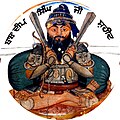 Fresco of shaheed Baba Deep Singh from Gurdwara Baba Atal, Amritsar
 -
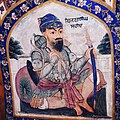 Fresco of Bijla Singh from Gurdwara Baba Atal. He was a warrior of the Shaheedan Misl and contemporary of Baba Deep Singh
 -
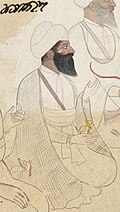 Detail of Karam Singh Sidhu of the Shaheedan Misl from a painting three seated Sikh sardars, circa late 18th century
 -
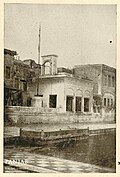 Photograph of the Bunga Amar Shaheed Baba Deep Singh at the Golden Temple complex in Amritsar, it has since been demolished


References[edit | edit source]
- ↑ Bhagata, Siṅgha (1993). A History of the Sikh Misals. Publication Bureau, Punjabi University. p. 241.
Deep Singh Shahid, a Sandhu Jat and resident of the village of Pohuwind of the pargana of Amritsar, was the founder of this Misal.
- ↑ 2.0 2.1 2.2 Singha, H.S. (2000). The Encyclopedia of Sikhism (over 1000 Entries). Hemkunt Press. p. 150. ISBN 9788170103011.
NAINA SINGH: Naina Singh was the chief of the Shahid misl in the later part of the eighteenth century. His real name was Narain Singh. He is credited with the introduction of the Nihang type turban for his followers. He groomed the famous Sikh hero Akali Phula Singh and handed over the command of the Shahid misl to him.
- ↑ 3.0 3.1 3.2 Dhavan, Purnima (2011). When Sparrows Became Hawks: The Making of the Sikh Warrior Tradition, 1699-1799. Oxford University Press. pp. 60–61. ISBN 978-0-19-975655-1.
- ↑ 4.0 4.1 McLeod, W.H. (2005). Historical dictionary of Sikhism. The Scarecrow Press. p. 186. ISBN 978-0-8108-5088-0.
- ↑ Herrli, Hans (2004). "The Sikh Misls". The Coins of the Sikhs (2nd ed.). Munshiram Manoharlal. pp. 11–13. ISBN 9788121511322.
- ↑ Jacques, Tony (2006). Dictionary of Battles and Sieges. Greenwood Press. p. 400. ISBN 978-0-313-33536-5. Archived from the original on 26 June 2015.
- ↑ 7.0 7.1 Dhavan, Purnima (2011). When Sparrows Became Hawks: The Making of the Sikh Warrior Tradition, 1699-1799. Oxford University Press. pp. 60–61. ISBN 978-0-19-975655-1.
- ↑ Herrli, Hans (2004). "The Sikh Misls". The Coins of the Sikhs (2nd ed.). Munshiram Manoharlal. pp. 11–13. ISBN 9788121511322.
 | This Sikhism-related article is a stub. You can help Bharatpedia by expanding it. |