


->Ganesha811 add image |
Shikha Jha (talk | contribs) m refined section to improve readability |
||
| Line 1: | Line 1: | ||
{{Short description|Fabricated structure}} | |||
A | A '''pandal''' is a fabricated structure, either temporary or permanent, that is used at many places such as either outside a building or in an open area such as along a public road<ref>{{Cite book|last=Palanithurai|first=Ganapathy|title=A Handbook for Panchayati Raj Administration (Tamil Nadu)|date=2007|publisher=Concept Publishing Company|isbn=978-81-8069-340-3|pages=229}}</ref> or in front of a house in [[India]] and other neighbouring countries.<ref>{{Cite book|last=Rao|first=N. Sudhakar|title=Ethnography of a Nomadic Tribe: A Study of Yanadi|publisher=Concept Publishing Company|year=2002|isbn=978-81-7022-931-5|pages=106}}</ref><ref>{{Cite book|last=Saccidānandan|url=https://books.google.com/books?id=PGWa7v08JikC&dq=pandal+open+area&pg=PA151|title=Authors Speak|date=2006|publisher=Sahitya Akademi|isbn=978-81-260-1945-8|pages=151}}</ref> This canopy or big tent is often used in a religious or other events that gathers people together, such as a [[wedding]], [[fair]], [[exhibition]] or [[festival]]. | ||
[[File:Panthal.jpg|thumb|250px]] | |||
==In Hinduism== | ==In Hinduism== | ||
[[File:Thatching - Jheel Meel - Kolkata 2011-12-22 7659.JPG|left|thumb|Temporary pandals being thatched in [[Kolkata]]]] | [[File:Thatching - Jheel Meel - Kolkata 2011-12-22 7659.JPG|left|thumb|Temporary pandals being thatched in [[Kolkata]]]] | ||
In [[Hinduism]], a ''pandal'' is a temporary structure set up to usually venerate the [[Hindu deities|god and goddess]] such as [[Ganesha]] during [[Ganesh Chaturthi]], [[Krishna]] during [[Krishna Janmashtami|Krishna Janmasthami]] or the Goddess [[Durga]] during [[Durga Puja]], known as ''[[Puja (Hinduism)|puja]] pandal''.{{clarify |post-text = these are only 2 examples|date=July 2016}} Pandals are also used for nonreligious activities. For instance, these [[Tent|tents]] are put up during cultural programs.<ref>{{Cite book|last=Kachru|first=Upendra|title=India Land of a Billion Entrepreneurs|publisher=Pearson Education India|year=2011|isbn=978-81-317-5861-8|pages=165}}</ref> | In [[Hinduism]], a ''pandal'' is a temporary structure set up to usually venerate the [[Hindu deities|god and goddess]] such as [[Ganesha]] during [[Ganesh Chaturthi]], [[Krishna]] during [[Krishna Janmashtami|Krishna Janmasthami]] or the Goddess [[Durga]] during [[Durga Puja]], known as ''[[Puja (Hinduism)|puja]] pandal''.{{clarify |post-text = these are only 2 examples|date=July 2016}} Pandals are also used for nonreligious activities. For instance, these [[Tent|tents]] are put up during cultural programs.<ref>{{Cite book|last=Kachru|first=Upendra|title=India Land of a Billion Entrepreneurs|publisher=Pearson Education India|year=2011|isbn=978-81-317-5861-8|pages=165}}</ref> | ||
Pandals may be modelled after the structure of temples, huts, or skyscrapers.<ref>{{Cite book |last=McDaniel |first=June |url=https://www.google.com/books/edition/Offering_Flowers_Feeding_Skulls/caeJpIj9SdkC?hl=en&gbpv=0 |title=Offering Flowers, Feeding Skulls: Popular Goddess Worship in West Bengal |date=2004-08-05 |publisher=Oxford University Press |isbn=978-0-19-534713-5 |pages=223 |language=en}}</ref> | |||
[[File:Durga Puja, Matri Mandir, Safdarjung Enclave, Delhi, 2014.JPG|thumb|''Durga Puja Pandal'' with theatre performances, [[Matri Mandir]], [[Safdarjung Enclave]], [[Delhi]], 2014]] | |||
==In Buddhism in Sri Lanka== | ==In Buddhism in Sri Lanka== | ||
In a ritual unique to [[Sri Lanka]], ''Vesak thorana'' pandals are set up during the [[Vesak]] festival,<ref>{{Cite book|title=Sri Lanka News, Volume 11|publisher=Embassy of Sri Lanka|year=2001|location=Washington, D.C.|pages=7|language=en}}</ref> with illuminated panels illustrated with episodes from the life of the [[Gautama Buddha]] and [[Jataka tales|Jathaka Katha]] or stories based on [[Buddhist culture]]. | In a ritual unique to [[Sri Lanka]], ''Vesak thorana'' pandals are set up during the [[Vesak]] festival,<ref>{{Cite book|title=Sri Lanka News, Volume 11|publisher=Embassy of Sri Lanka|year=2001|location=Washington, D.C.|pages=7|language=en}}</ref> with illuminated panels illustrated with episodes from the life of the [[Gautama Buddha]] and [[Jataka tales|Jathaka Katha]] or stories based on [[Buddhist culture]]. | ||
The fundamental concept of a Vesak Pandal is a creatively made, massive structure, decorated with a large number of lights and paintings mounted on a huge supporting structure. This supporting structure is traditionally built with ''Puwak Gasa'' ([[ | The fundamental concept of a Vesak Pandal is a creatively made, massive structure, decorated with a large number of lights and paintings mounted on a huge supporting structure. This supporting structure is traditionally built with ''Puwak Gasa'' ([[Areca nut]] trees). Creating the structure requires creativity, inventiveness and the high-level expertise of a number of artists and light-system electricians, not to mention funding and planning in advance. The goal is to create a very beautiful and colorful experience. Many different and dedicated groups of experts participating often pass down this work from generation to generation or master to student. With change of time, nowadays Pandols are constructed using [[Scaffolding]], which doesn't require cutting down of "Puwak" Trees as a result. | ||
The most significant part of this display uses simple techniques in an intelligent way to create lighting on the front of the pandal. Most of the time this is a 2D structure. | The most significant part of this display uses simple techniques in an intelligent way to create lighting on the front of the pandal. Most of the time this is a 2D structure. | ||
[[File:Grandpass Vesak Thorana.jpg|thumb|Vesak Thorana (Pandol) in Colombo, Sri Lanka]] | |||
==Other types of pandals== | ==Other types of pandals== | ||
| Line 22: | Line 28: | ||
A city in the Nilgiris district of the state of [[Tamil Nadu]] is named [[Pandalur]].{{clarify |post-text = Is this city name's origin connected with pandals or is it only spelled similarly?|date=July 2016}} | A city in the Nilgiris district of the state of [[Tamil Nadu]] is named [[Pandalur]].{{clarify |post-text = Is this city name's origin connected with pandals or is it only spelled similarly?|date=July 2016}} | ||
In [[Bangladesh]], Pandals, traditionally known as [[Shamiana]], are used in open field, outside mosques or [[Eidgah]]s for [[Eid prayer]], [[mehfil]]s for [[Islamic holidays|Religious]] and [[Culture of Bengal|Cultural]] [[List of festivals in Bangladesh|occasions]] such as Milad, [[Mezban]] and [[Bengali Muslim wedding|weddings]]. Each year the national eidgah's entrance gets decorated in a new theme.<ref>{{cite web | url=https://www.businessinsiderbd.com/photo-feature/news/21562/in-photos-national-eidgah-ready-to-hold-eid-jamaat | title=In Photos: National Eidgah ready to hold Eid jamaat }}</ref> | |||
==References== | ==References== | ||
| Line 30: | Line 38: | ||
[[Category:Objects used in Hindu worship]] | [[Category:Objects used in Hindu worship]] | ||
[[Category:Buddhist practices]] | [[Category:Buddhist practices]] | ||
[[Category:Architecture | [[Category:Architecture in India]] | ||
Latest revision as of 23:44, 30 November 2025
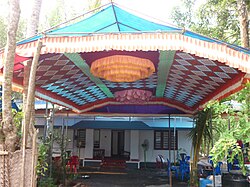
A pandal is a fabricated structure, either temporary or permanent, that is used at many places such as either outside a building or in an open area such as along a public road[1] or in front of a house in India and other neighbouring countries.[2][3] This canopy or big tent is often used in a religious or other events that gathers people together, such as a wedding, fair, exhibition or festival.

In Hinduism[edit | edit source]

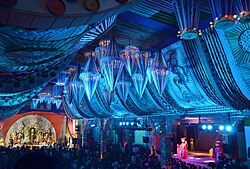
In Hinduism, a pandal is a temporary structure set up to usually venerate the god and goddess such as Ganesha during Ganesh Chaturthi, Krishna during Krishna Janmasthami or the Goddess Durga during Durga Puja, known as puja pandal.[clarification needed these are only 2 examples] Pandals are also used for nonreligious activities. For instance, these tents are put up during cultural programs.[4]
Pandals may be modelled after the structure of temples, huts, or skyscrapers.[5]

In Buddhism in Sri Lanka[edit | edit source]
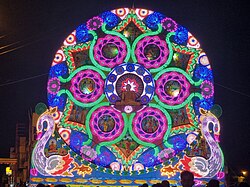
In a ritual unique to Sri Lanka, Vesak thorana pandals are set up during the Vesak festival,[6] with illuminated panels illustrated with episodes from the life of the Gautama Buddha and Jathaka Katha or stories based on Buddhist culture.
The fundamental concept of a Vesak Pandal is a creatively made, massive structure, decorated with a large number of lights and paintings mounted on a huge supporting structure. This supporting structure is traditionally built with Puwak Gasa (Areca nut trees). Creating the structure requires creativity, inventiveness and the high-level expertise of a number of artists and light-system electricians, not to mention funding and planning in advance. The goal is to create a very beautiful and colorful experience. Many different and dedicated groups of experts participating often pass down this work from generation to generation or master to student. With change of time, nowadays Pandols are constructed using Scaffolding, which doesn't require cutting down of "Puwak" Trees as a result.
The most significant part of this display uses simple techniques in an intelligent way to create lighting on the front of the pandal. Most of the time this is a 2D structure.

Other types of pandals[edit | edit source]
Pandals are also set up during Gammaduwa (village rebirth) festivals, honouring the goddess Pattini.[clarification needed Is this also only in Sri Lanka, only elsewhere, or both?]
Pandal also refers to platforms from which people splash water during the new year celebrations of the Thingyan festival.[7]
A pandal can also be a ceremonial gate, built to welcome visitors.
A city in the Nilgiris district of the state of Tamil Nadu is named Pandalur.[clarification needed Is this city name's origin connected with pandals or is it only spelled similarly?]
In Bangladesh, Pandals, traditionally known as Shamiana, are used in open field, outside mosques or Eidgahs for Eid prayer, mehfils for Religious and Cultural occasions such as Milad, Mezban and weddings. Each year the national eidgah's entrance gets decorated in a new theme.[8]
References[edit | edit source]
- ↑ Palanithurai, Ganapathy (2007). A Handbook for Panchayati Raj Administration (Tamil Nadu). Concept Publishing Company. p. 229. ISBN 978-81-8069-340-3.
- ↑ Rao, N. Sudhakar (2002). Ethnography of a Nomadic Tribe: A Study of Yanadi. Concept Publishing Company. p. 106. ISBN 978-81-7022-931-5.
- ↑ Saccidānandan (2006). Authors Speak. Sahitya Akademi. p. 151. ISBN 978-81-260-1945-8.
- ↑ Kachru, Upendra (2011). India Land of a Billion Entrepreneurs. Pearson Education India. p. 165. ISBN 978-81-317-5861-8.
- ↑ McDaniel, June (2004-08-05). Offering Flowers, Feeding Skulls: Popular Goddess Worship in West Bengal. Oxford University Press. p. 223. ISBN 978-0-19-534713-5.
- ↑ Sri Lanka News, Volume 11. Washington, D.C.: Embassy of Sri Lanka. 2001. p. 7.
- ↑ Kyaw Zin Htun; Yadana Htun (24 March 2008). "Constructing a pandal for festival fun". Myanmar Times. Archived from the original on 9 April 2008. Retrieved 13 May 2012.
- ↑ "In Photos: National Eidgah ready to hold Eid jamaat".
_name_of_the_God_as_per_the_Vedas.svg)
 | This Buddhism-related article is a stub. You can help Bharatpedia by expanding it. |
 | This Sri Lanka-related article is a stub. You can help Bharatpedia by expanding it. |
 | This architecture-related article is a stub. You can help Bharatpedia by expanding it. |