|
|
| Line 200: |
Line 200: |
| <!--Do NOT remove Traditional. Simplified is the official script in China but Traditional is found in [[Xiandai Hanyu Cidian]], | | <!--Do NOT remove Traditional. Simplified is the official script in China but Traditional is found in [[Xiandai Hanyu Cidian]], |
| [[Table of General Standard Chinese Characters]], and other important CCP documents, as well as being the official script in Hong Kong, Macao and today's Republic of China (Taiwan). Traditional characters are an important though secondary part of mainland China's script system.-->|labels=no}}) from ''{{transl|zh|zhōng}}'' ("central") and ''{{transl|zh|guó}}'' ("state"),{{efn|Although this is the present meaning of ''{{transl|zh|guó}}'', in [[Old Chinese]] (when its pronunciation was something like {{nowrap|/*qʷˤək/}})<ref name=bs>[[Reconstructions of Old Chinese|Baxter-Sagart]].</ref> it meant the walled city of the Chinese and the areas they could control from them.<ref name=wilx/>}} a term which developed under the [[Western Zhou]] dynasty in reference to its [[demesne|royal demesne]].{{efn|Its use is attested from the 6th-century BC [[Classic of History]], which states "[[Tian (god)|Huangtian]] bestowed the lands and the peoples of the central state to the ancestors" ({{lang|zh|皇天既付中國民越厥疆土于先王}}).<ref>{{lang|zh|[[:s:zh:尚書|《尚書》]], [[:s:zh:尚書/梓材|梓材]].}} {{in lang|zh}}</ref>}} It was then applied to the area around [[Luoyi]] (present-day Luoyang) during the [[Eastern Zhou]] and then to China's [[Central Plain (China)|Central Plain]] before being used as an occasional synonym for the state under the [[Qing dynasty|Qing]].<ref name=wilx>{{citation |last=Wilkinson |first=Endymion |title=Chinese History: A Manual |url=https://books.google.com/books?id=ERnrQq0bsPYC&pg=PA132|date=2000 |location=[[Cambridge, Mass.|Cambridge]] |publisher=Harvard University Asia Center |series=Harvard-Yenching Institute Monograph No. 52 |page=132|isbn=978-0-674-00249-4}}</ref> It was often used as a cultural concept to distinguish the [[Huaxia]] people from [[Hua-Yi distinction|perceived "barbarians"]].<ref name=wilx/> The name ''Zhongguo'' is also translated as {{nowrap|"Middle Kingdom"}} in English.<ref>{{cite book|url=https://books.google.com/books?id=4n8u0HG-iYEC&pg=PA52|title=Greater China in an Era of Globalization|last1=Tang|first1=Xiaoyang|last2=Guo|first2=Sujian|last3=Guo|first3=Baogang|publisher=Rowman & Littlefield Publishers|year=2010|isbn=978-0-7391-3534-1|location=Lanham, MD|pages=52–53}}</ref> China (PRC) is sometimes referred to as [[Mainland China|the Mainland]] when distinguishing the [[Republic of China|ROC]] from the PRC.<ref name=":6">{{cite news|title=Two "Chinese" flags in Chinatown 美國唐人街兩面「中國」國旗之爭|publisher=BBC|url=https://www.bbc.com/zhongwen/simp/world-49585512}}</ref><ref>{{cite news|title=Chou Hsi-wei on Conflict Zone|publisher=Deutsche Welle|url=https://www.dw.com/en/chou-hsi-wei-on-conflict-zone/av-49624866|quote=So-called 'China', we call it 'Mainland', we are 'Taiwan'. Together we are 'China'.}}</ref><ref name=":8">{{cite web|title=China-Taiwan Relations|url=https://www.cfr.org/backgrounder/china-taiwan-relations|publisher=Council on Foreign Relations}}</ref><ref name=":7">{{cite news|title=What's behind the China-Taiwan divide?|publisher=BBC|url=https://www.bbc.com/news/world-asia-34729538}}</ref> | | [[Table of General Standard Chinese Characters]], and other important CCP documents, as well as being the official script in Hong Kong, Macao and today's Republic of China (Taiwan). Traditional characters are an important though secondary part of mainland China's script system.-->|labels=no}}) from ''{{transl|zh|zhōng}}'' ("central") and ''{{transl|zh|guó}}'' ("state"),{{efn|Although this is the present meaning of ''{{transl|zh|guó}}'', in [[Old Chinese]] (when its pronunciation was something like {{nowrap|/*qʷˤək/}})<ref name=bs>[[Reconstructions of Old Chinese|Baxter-Sagart]].</ref> it meant the walled city of the Chinese and the areas they could control from them.<ref name=wilx/>}} a term which developed under the [[Western Zhou]] dynasty in reference to its [[demesne|royal demesne]].{{efn|Its use is attested from the 6th-century BC [[Classic of History]], which states "[[Tian (god)|Huangtian]] bestowed the lands and the peoples of the central state to the ancestors" ({{lang|zh|皇天既付中國民越厥疆土于先王}}).<ref>{{lang|zh|[[:s:zh:尚書|《尚書》]], [[:s:zh:尚書/梓材|梓材]].}} {{in lang|zh}}</ref>}} It was then applied to the area around [[Luoyi]] (present-day Luoyang) during the [[Eastern Zhou]] and then to China's [[Central Plain (China)|Central Plain]] before being used as an occasional synonym for the state under the [[Qing dynasty|Qing]].<ref name=wilx>{{citation |last=Wilkinson |first=Endymion |title=Chinese History: A Manual |url=https://books.google.com/books?id=ERnrQq0bsPYC&pg=PA132|date=2000 |location=[[Cambridge, Mass.|Cambridge]] |publisher=Harvard University Asia Center |series=Harvard-Yenching Institute Monograph No. 52 |page=132|isbn=978-0-674-00249-4}}</ref> It was often used as a cultural concept to distinguish the [[Huaxia]] people from [[Hua-Yi distinction|perceived "barbarians"]].<ref name=wilx/> The name ''Zhongguo'' is also translated as {{nowrap|"Middle Kingdom"}} in English.<ref>{{cite book|url=https://books.google.com/books?id=4n8u0HG-iYEC&pg=PA52|title=Greater China in an Era of Globalization|last1=Tang|first1=Xiaoyang|last2=Guo|first2=Sujian|last3=Guo|first3=Baogang|publisher=Rowman & Littlefield Publishers|year=2010|isbn=978-0-7391-3534-1|location=Lanham, MD|pages=52–53}}</ref> China (PRC) is sometimes referred to as [[Mainland China|the Mainland]] when distinguishing the [[Republic of China|ROC]] from the PRC.<ref name=":6">{{cite news|title=Two "Chinese" flags in Chinatown 美國唐人街兩面「中國」國旗之爭|publisher=BBC|url=https://www.bbc.com/zhongwen/simp/world-49585512}}</ref><ref>{{cite news|title=Chou Hsi-wei on Conflict Zone|publisher=Deutsche Welle|url=https://www.dw.com/en/chou-hsi-wei-on-conflict-zone/av-49624866|quote=So-called 'China', we call it 'Mainland', we are 'Taiwan'. Together we are 'China'.}}</ref><ref name=":8">{{cite web|title=China-Taiwan Relations|url=https://www.cfr.org/backgrounder/china-taiwan-relations|publisher=Council on Foreign Relations}}</ref><ref name=":7">{{cite news|title=What's behind the China-Taiwan divide?|publisher=BBC|url=https://www.bbc.com/news/world-asia-34729538}}</ref> |
|
| |
| ==History==
| |
| {{Main|History of China|Timeline of Chinese history}}
| |
|
| |
| ===Prehistory===
| |
| [[File:National Museum of China 2014.02.01 14-43-38.jpg|thumb|10,000 years old pottery, [[Xianren Cave]] culture (18000–7000 BCE)]]
| |
| Archaeological evidence suggests that early [[Hominidae|hominids]] inhabited China 2.25 million years ago.<ref>{{Cite web|url=https://archive.archaeology.org/0001/newsbriefs/china.html|title=Early Homo erectus Tools in China|last1=Ciochon|first1=Russell|last2=Larick|first2=Roy|date=1 January 2000|website=[[Archaeology (magazine)|Archeology]]|access-date=30 November 2012}}</ref> The hominid fossils of [[Peking Man]], a ''[[Homo erectus]]'' who [[Control of fire by early humans|used fire]],<ref>{{cite web|url=http://www.unesco.org/ext/field/beijing/whc/pkm-site.htm|title=The Peking Man World Heritage Site at Zhoukoudian|website=[[UNESCO]]|url-status=live|archive-url=https://web.archive.org/web/20160623160018/http://www.unesco.org/ext/field/beijing/whc/pkm-site.htm|archive-date=23 June 2016|access-date=6 March 2013}}</ref> were discovered in a cave at [[Zhoukoudian]] near [[Beijing]]; they have been dated to between 680,000 and 780,000 [[Before Present|years ago]].<ref name="autogenerated198">{{cite journal |doi = 10.1038/nature07741 |date=Mar 2009 |author1=Shen, G. |author2=Gao, X. |author3=Gao, B. |author4=Granger, De |title = Age of Zhoukoudian Homo erectus determined with (26)Al/(10)Be burial dating |volume = 458 |issue = 7235 |pages = 198–200 |issn = 0028-0836 |pmid = 19279636 |journal = Nature |bibcode = 2009Natur.458..198S |s2cid=19264385 |url = https://www.semanticscholar.org/paper/d502c36487e27d90c7962fc60d28c48ab16c8f0e }}</ref> The fossilized teeth of ''Homo sapiens'' (dated to 125,000–80,000 [[Before Present|years ago]]) have been discovered in [[Fuyan Cave]] in [[Dao County]], [[Hunan]].<ref>{{cite news |url = https://www.bbc.com/news/science-environment-34531861 |title = Fossil teeth place humans in Asia '20,000 years early' |last=Rincon |first=Paul |date=14 October 2015 |work=[[BBC News]] |access-date=14 October 2015}}</ref> Chinese [[proto-writing]] existed in [[Jiahu]] around 7000 BCE,<ref name="earliest writing">{{cite news|url=http://news.bbc.co.uk/2/hi/science/nature/2956925.stm|title='Earliest writing' found in China|last=Rincon|first=Paul|date=17 April 2003|work=[[BBC News]]|access-date=14 January 2020}}</ref> at [[Damaidi]] around 6000 BCE,<ref>[[Qiu Xigui]] (2000). ''Chinese Writing''. English translation of {{lang|zh-Hant|文字學概論}} by Gilbert L. Mattos and [[Jerry Norman (sinologist)|Jerry Norman]]. Early China Special Monograph Series No. 4. Berkeley: The Society for the Study of Early China and the Institute of East Asian Studies, University of California, Berkeley. {{ISBN|978-1-55729-071-7}}.</ref> [[Dadiwan culture|Dadiwan]] from 5800 to 5400 BCE, and [[Banpo]] dating from the 5th millennium BCE. Some scholars have suggested that the [[Jiahu symbols]] (7th millennium BCE) constituted the earliest Chinese writing system.<ref name="earliest writing"/>
| |
|
| |
| ===Early dynastic rule===
| |
| {{Further|Dynasties in Chinese history}}
| |
|
| |
| [[File:甲骨文发现地 - panoramio.jpg|thumb|[[Yinxu]], the ruins of the capital of the late [[Shang dynasty]] (14th century BCE)]]
| |
|
| |
| According to Chinese tradition, the [[list of Chinese dynasties|first dynasty]] was the [[Xia dynasty|Xia]], which emerged around 2100 BCE.<ref>{{cite book |last=Tanner |first=Harold M. |title = China: A History |year=2009 |publisher=Hackett Publishing |pages=35–36 |url = https://books.google.com/books?id=VIWC9wCX2c8C&pg=PA35 |isbn=978-0-87220-915-2 }}</ref> The Xia dynasty marked the beginning of China's political system based on hereditary monarchies, or [[Dynasties in Chinese history|dynasties]], which lasted for a millennium.<ref>[[Xia–Shang–Zhou Chronology Project]] by People's Republic of China</ref> The dynasty was considered [[Chinese mythology|mythical]] by historians until scientific excavations found early [[Bronze Age]] sites at [[Erlitou culture|Erlitou]], Henan in 1959.<ref>{{cite web|url=http://www.nga.gov/exhibitions/chbro_bron.shtm|title=Bronze Age China|website=[[National Gallery of Art]]|url-status=live|archive-url=https://web.archive.org/web/20130725062916/http://www.nga.gov/exhibitions/chbro_bron.shtm|archive-date=25 July 2013|access-date=11 July 2013}}</ref> It remains unclear whether these sites are the remains of the Xia dynasty or of another culture from the same period.<ref>{{cite book|title=China: Five Thousand Years of History and Civilization|year=2007|publisher=City University of HK Press|page=25|url=https://books.google.com/books?id=z-fAxn_9f8wC&pg=PA25 |isbn=978-962-937-140-1}}</ref> The succeeding [[Shang dynasty]] is the earliest to be confirmed by contemporary records.<ref>{{cite book |last=Pletcher|first=Kenneth |title=The History of China |year=2011 |publisher=Britannica Educational Publishing |page=35|url= https://books.google.com/books?id=A1nwvKNPMWkC&pg=PA35 |isbn=978-1-61530-181-2 }}</ref> The Shang ruled the plain of the [[Yellow River]] in eastern China from the 17th to the 11th century BCE.<ref>{{cite book |last1=Fowler |first1=Jeaneane D. |first2=Merv |last2=Fowler |title=Chinese Religions: Beliefs and Practices |year=2008 |publisher=Sussex Academic Press |page=17 |url = https://books.google.com/books?id=rpJNfIAZltoC&pg=PA17 |isbn=978-1-84519-172-6 }}</ref> Their [[oracle bone script]] (from {{c.|lk=no|1500}} BCE)<ref>William G. Boltz, Early Chinese Writing, World Archaeology, Vol. 17, No. 3, Early Writing Systems. (Feb. 1986), pp. 420–436 (436).</ref><ref>David N. Keightley, "Art, Ancestors, and the Origins of Writing in China", ''Representations'', No. 56, Special Issue: The New Erudition. (Autumn, 1996), pp.68–95 [68].</ref> represents the oldest form of Chinese writing yet found<ref>{{cite encyclopedia| url=https://books.google.com/books?id=vWLRxJEU49EC&pg=PA904 | page=904 | first=Pam |last=Hollister |title=Zhengzhou | encyclopedia=International Dictionary of Historic Places: Asia and Oceania |editor1-first=Paul E. |editor1-last=Schellinger |editor2-first=Robert M. |editor2-last= Salkin |publisher= Fitzroy Dearborn Publishers |year=1996| isbn=978-1-884964-04-6}}</ref> and is a direct ancestor of modern [[Chinese characters]].<ref>{{cite book|url=https://books.google.com/books?id=BzfRFmlN2ZAC&pg=PA4|title=The Oxford Handbook of the History of Linguistics|last=Allan|first=Keith|publisher=[[Oxford University Press]]|year=2013|isbn=978-0-19-958584-7|page=4}}</ref>
| |
|
| |
| The Shang was conquered by the [[Zhou dynasty|Zhou]], who ruled between the 11th and 5th centuries BCE, though centralized authority was slowly eroded by feudal warlords. Some principalities eventually emerged from the weakened Zhou, no longer fully obeyed the Zhou king, and continually waged war with each other in the 300-year [[Spring and Autumn period]]. By the time of the [[Warring States period]] of the 5th–3rd centuries BCE, there were only seven powerful states left.<ref>{{cite web |title=Warring States |url=https://www.britannica.com/event/Warring-States |publisher=Encyclopædia Britannica}}</ref>
| |
|
| |
| ===Imperial China===
| |
| [[File:Badaling China Great-Wall-of-China-01.jpg|thumb|China's first emperor, [[Qin Shi Huang]], is famed for having united the [[Warring States]]' walls to form the [[Great Wall of China]]. Most of the present structure, however, dates to the [[Ming dynasty]].]]
| |
|
| |
| The [[Warring States period]] ended in 221 BCE after the [[Qin (state)|state of Qin]] conquered the other six kingdoms, reunited China and established the dominant order of [[autocracy]]. [[King Zheng of Qin]] proclaimed himself the [[First Emperor]] of the [[Qin dynasty]]. He enacted Qin's [[Legalism (Chinese philosophy)|legalist]] reforms throughout China, notably the forced standardization of [[Chinese characters]], [[Chinese units|measurements]], road widths (i.e., cart axles' length), and [[history of Chinese currency|currency]]. His dynasty also [[Qin's campaign against the Yue tribes|conquered the Yue tribes]] in [[Guangxi]], [[Guangdong]], and [[Vietnam]].<ref>Sima Qian, Translated by Burton Watson. ''Records of the Grand Historian: Han Dynasty I'', pp. 11–12. {{ISBN|0-231-08165-0}}.</ref> The Qin dynasty lasted only fifteen years, falling soon after the First Emperor's death, as his harsh authoritarian policies led to widespread rebellion.<ref name="Bodde1986">Bodde, Derk. (1986). "The State and Empire of Ch'in", in ''The Cambridge History of China: Volume I: the Ch'in and Han Empires, 221 B.C. – A.D. 220''. Edited by Denis Twitchett and Michael Loewe. Cambridge: Cambridge University Press. {{ISBN|0-521-24327-0}}.</ref><ref name="Lewis2007">{{cite book|title=The Early Chinese Empires: Qin and Han|first=Mark Edward|last=Lewis|publisher=Belknap Press|location=London|year=2007|isbn=978-0-674-02477-9|url=https://archive.org/details/historyofimperia00broo}}</ref>
| |
|
| |
| Following a [[Chu–Han Contention|widespread civil war]] during which the imperial library at [[Xianyang]] [[List of destroyed libraries#Human action|was burned]],{{efn|Owing to Qin Shi Huang's earlier policy involving the "[[burning of books and burying of scholars]]", the destruction of the confiscated copies at Xianyang was an event similar to the [[destruction of the Library of Alexandria|destructions]] of the [[Library of Alexandria]] in the west. Even those texts that did survive had to be painstakingly reconstructed from memory, luck, or forgery.<ref>{{citation |last=Cotterell |first=Arthur |title=The Imperial Capitals of China |pages=[https://books.google.com/books?id=bZI764AEfcsC&pg=PA35 35–36] |publisher=Pimlico |date=2011 }}</ref> The [[Old Texts]] of the [[Five Classics]] were said to have been found hidden in a wall at the Kong residence in [[Qufu]]. [[Mei Ze]]'s "rediscovered" edition of the [[Book of Documents]] was [[Yan Ruoqu|only shown to be a forgery in the Qing dynasty]].}} the [[Han dynasty]] emerged to rule China between 206 BCE and CE 220, creating a cultural identity among its populace still remembered in the ethnonym of the [[Han Chinese]].<ref name="Bodde1986"/><ref name="Lewis2007"/> The Han [[History of the Han dynasty|expanded the empire's territory considerably]], with military campaigns reaching [[Han–Xiongnu War|Central Asia, Mongolia]], [[Gojoseon–Han War|South Korea]], and [[Han campaigns against Dian|Yunnan]], and the [[Southward expansion of the Han dynasty|recovery of Guangdong and northern Vietnam]] from [[Nanyue]]. Han involvement in Central Asia and [[Sogdia]] helped establish the land route of the [[Silk Road]], replacing the earlier path over the [[Himalayas]] to India. Han China gradually became the largest economy of the ancient world.<ref>{{cite web|url=http://www.eric.ed.gov/ERICWebPortal/custom/portlets/recordDetails/detailmini.jsp?_nfpb=true&_&ERICExtSearch_SearchValue_0=ED460052&ERICExtSearch_SearchType_0=no&accno=ED460052 |title=Dahlman, Carl J; Aubert, Jean-Eric. ''China and the Knowledge Economy: Seizing the 21st century''|publisher=World Bank Publications via Eric.ed.gov|access-date=22 October 2012}}</ref> Despite the Han's initial decentralization and the official abandonment of the Qin philosophy of [[Legalism (Chinese philosophy)|Legalism]] in favor of [[Confucianism]], Qin's legalist institutions and policies continued to be employed by the Han government and its successors.<ref>{{cite book|first1=Candice |last1=Goucher |first2= Linda |last2=Walton|title=World History: Journeys from Past to Present – Volume 1: From Human Origins to 1500 CE|year=2013|publisher=Routledge|page=108|url=https://books.google.com/books?id=zdwpAAAAQBAJ&pg=PA108 |isbn=978-1-135-08822-4}}</ref>
| |
| [[File:Han Expansion.png|thumb|Map showing the expansion of [[Han dynasty]] in the 2nd century BC]]
| |
| After the [[end of the Han dynasty]], a period of strife known as [[Three Kingdoms]] followed,<ref>Whiting, Marvin C. (2002). ''Imperial Chinese Military History''. iUniverse. p. 214</ref> whose central figures were later immortalized in [[Romance of the Three Kingdoms|one]] of the [[Four Classics]] of [[Chinese literature]]. At its end, [[Cao Wei|Wei]] was swiftly overthrown by the [[Jin dynasty (265–420)|Jin dynasty]]. The Jin fell to [[War of the Eight Princes|civil war]] upon the ascension of a [[Emperor Hui of Jin|developmentally disabled emperor]]; the [[Five Barbarians]] then [[uprising of the Five Barbarians|invaded]] and ruled northern China as the [[Sixteen Kingdoms|Sixteen States]]. The [[Xianbei]] unified them as the [[Northern Wei]], whose [[Emperor Xiaowen of Northern Wei|Emperor Xiaowen]] reversed his predecessors' apartheid policies and [[Northern and Southern dynasties#Northern dynasties|enforced a drastic sinification on his subjects]], largely integrating them into Chinese culture. In the south, the general [[Emperor Wu of Liu Song|Liu Yu]] secured the abdication of the Jin in favor of the [[Liu Song]]. The various successors of these states became known as the [[Northern and Southern dynasties]], with the two areas finally reunited by the [[Sui dynasty|Sui]] in 581. The Sui restored the Han to power through China, reformed its agriculture, economy and [[imperial examination]] system, constructed the [[Grand Canal of China|Grand Canal]], and patronized [[Buddhism in China|Buddhism]]. However, they fell quickly when their conscription for public works and a [[Goguryeo–Sui War|failed war]] in [[Goguryeo|northern Korea]] provoked widespread unrest.<ref>Ki-Baik Lee (1984). ''A new history of Korea.'' Harvard University Press. {{ISBN|978-0-674-61576-2}}. p.47.</ref><ref>David Andrew Graff (2002). ''Medieval Chinese warfare, 300–900.'' Routledge. {{ISBN|0-415-23955-9}}. p.13.</ref>
| |
|
| |
| Under the succeeding [[Tang dynasty|Tang]] and [[Song dynasty|Song]] dynasties, Chinese economy, technology, and culture entered a golden age.<ref>Adshead, S. A. M. (2004). ''T'ang China: The Rise of the East in World History''. New York: Palgrave Macmillan. p. 54</ref> The Tang Empire retained control of the [[Western Regions]] and the Silk Road,<ref>{{citation|last=Nishijima|first=Sadao|editor1-last=Twitchett|editor1-first=Denis|editor2-last=Loewe|editor2-first=Michael|chapter=The Economic and Social History of Former Han|title=Cambridge History of China: Volume I: the Ch'in and Han Empires, 221 B.C. – A.D. 220|year=1986|publisher=Cambridge University Press|location=Cambridge|isbn=978-0-521-24327-8|pages=545–607}}</ref> which brought traders to as far as [[Mesopotamia]] and the [[Horn of Africa]],<ref>{{cite book|url=https://archive.org/details/columbiachronolo00john|title=Columbia Chronologies of Asian History and Culture|last=Bowman|first=John S.|publisher=Columbia University Press|year=2000|location=New York|pages=[https://archive.org/details/columbiachronolo00john/page/104 104–105]|url-access=registration}}</ref> and made the capital [[Chang'an]] a cosmopolitan urban center. However, it was devastated and weakened by the [[An Lushan Rebellion]] in the 8th century.<ref>City University of HK Press (2007). ''China: Five Thousand Years of History and Civilization''. {{ISBN|962-937-140-5}}. p.71</ref> In 907, the Tang disintegrated completely when the local military governors became ungovernable. The Song dynasty ended the [[Five Dynasties and Ten Kingdoms period|separatist situation]] in 960, leading to a balance of power between the Song and [[Khitan Liao]]. The Song was the first government in world history to issue paper money and the first Chinese [[polity]] to establish a permanent standing navy which was supported by the developed shipbuilding industry along with the sea trade.<ref>Paludan, Ann (1998). ''Chronicle of the Chinese Emperors''. London: Thames & Hudson. {{ISBN|0-500-05090-2}}. p. 136.</ref>
| |
| [[File:Along the River During the Qingming Festival (detail of original).jpg|thumb|left|A detail from ''[[Along the River During the Qingming Festival]]'', a 12th-century painting showing everyday life in the [[Song dynasty]]'s capital, [[Bianjing]] (present-day [[Kaifeng]])|199x199px]]
| |
| Between the 10th and 11th centuries, the population of China doubled in size to around 100 million people, mostly because of the expansion of rice cultivation in central and southern China, and the production of abundant food surpluses. The Song dynasty also saw a [[Neo-Confucianism|revival of Confucianism]], in response to the growth of Buddhism during the Tang,<ref>{{cite book|title=Essentials of Neo-Confucianism: Eight Major Philosophers of the Song and Ming Periods|year=1999|publisher=Greenwood Publishing Group|page=3|url=https://books.google.com/books?id=sjzPPg8eK7sC&pg=PA3|isbn=978-0-313-26449-8}}</ref> and a flourishing of philosophy and the arts, as [[landscape art]] and [[porcelain]] were brought to new levels of maturity and complexity.<ref>{{cite web|title=Northern Song dynasty (960–1127)|url=http://www.metmuseum.org/toah/hd/nsong/hd_nsong.htm|publisher=Metropolitan Museum of Art|access-date=27 November 2013}}</ref><ref>{{cite web |url=http://d.wanfangdata.com.cn/Thesis_Y1795153.aspx |script-title=zh:从汝窑、修内司窑和郊坛窑的技术传承看宋代瓷业的发展 |website=wanfangdata.com.cn |date=15 February 2011 |access-date=15 August 2015}}</ref> However, the military weakness of the Song army was observed by the [[Jurchen people|Jurchen]] [[Jin dynasty (1115–1234)|Jin dynasty]]. In 1127, [[Emperor Huizong of Song]] and the capital [[Bianjing]] were captured during the [[Jin–Song Wars]]. The remnants of the Song retreated to [[Northern and southern China|southern China]].<ref>{{cite book|title=Daily Life in China on the Eve of the Mongol Invasion, 1250–1276|year=1962|publisher=Stanford University Press|page=[https://archive.org/details/dailylifeinchina00gern/page/22 22]|url=https://archive.org/details/dailylifeinchina00gern/page/22|isbn=978-0-8047-0720-6}}</ref>
| |
|
| |
| The 13th century brought the [[Mongol conquest of China]]. In 1271, the [[Mongols|Mongol]] leader [[Kublai Khan]] established the [[Yuan dynasty]]; the Yuan conquered the last remnant of the Song dynasty in 1279. Before the Mongol invasion, the population of Song China was 120 million citizens; this was reduced to 60 million by the time of the census in 1300.<ref>Ping-ti Ho. "An Estimate of the Total Population of Sung-Chin China", in ''Études Song'', Series 1, No 1, (1970). pp. 33–53.</ref> A peasant named Zhu Yuanzhang overthrew the Yuan in 1368 and founded the [[Ming dynasty]] as the [[Hongwu Emperor]]. Under the Ming dynasty, China enjoyed another golden age, developing one of the strongest navies in the world and a rich and prosperous economy amid a flourishing of art and culture. It was during this period that admiral [[Zheng He]] led the [[Ming treasure voyages]] throughout the [[Indian Ocean]], reaching as far as [[East Africa]].<ref>{{cite news |url = https://www.theguardian.com/world/2010/jul/25/kenya-china |title=Chinese archaeologists' African quest for sunken ship of Ming admiral |last=Rice|first=Xan|date=25 July 2010 |newspaper=[[The Guardian]]|access-date=16 January 2020}}</ref>
| |
| [[File:Qing Empire circa 1820 EN.svg|thumb|The [[Qing conquest of the Ming]] and expansion of the empire]]
| |
| In the early years of the Ming dynasty, China's capital was moved from [[Nanjing]] to Beijing. With the budding of capitalism, philosophers such as [[Wang Yangming]] further critiqued and expanded Neo-Confucianism with concepts of [[individualism]] and equality of [[four occupations]].<ref>{{cite encyclopedia |title=Wang Yangming (1472—1529) |url = https://www.iep.utm.edu/wangyang/ |encyclopedia=Internet Encyclopedia of Philosophy|access-date=9 December 2013|url-status=dead |archive-url=https://web.archive.org/web/20131109100108/http://www.iep.utm.edu/wangyang/ |archive-date=9 November 2013}}</ref> The [[scholar-official]] stratum became a supporting force of industry and commerce in the tax boycott movements, which, together with the famines and defense against [[Japanese invasions of Korea (1592–1598)]] and [[Qing conquest of the Ming|Manchu invasions]] led to an exhausted treasury.<ref>{{cite book |url=http://www.docin.com/p-378667223.html |script-title=zh:论明末士人阶层与资本主义萌芽的关系 |website=docin.com |date=8 April 2012 |access-date=2 September 2015 }}</ref>
| |
|
| |
| In 1644, Beijing was captured by a coalition of peasant rebel forces led by [[Li Zicheng]]. The [[Chongzhen Emperor]] committed suicide when the city fell. The Manchu [[Qing dynasty]], then allied with Ming dynasty general [[Wu Sangui]], overthrew Li's short-lived [[Shun dynasty]] and subsequently seized control of Beijing, which became the new capital of the Qing dynasty.{{Citation needed|date=July 2020}}
| |
|
| |
| ===Late imperial===
| |
| [[File:Regaining the Provincial Capital of Ruizhou.jpg|thumb|left|upright=0.9|A 19th-century depiction of the [[Taiping Rebellion]] (1850–1864)]]
| |
|
| |
| The [[Qing dynasty]], which lasted from 1644 until 1912, was the last imperial dynasty of China. Its [[Transition from Ming to Qing|conquest of the Ming]] (1618–1683) cost 25 million lives and the [[Economic history of China before 1912#Qing dynasty (1644–1912)|economy of China shrank drastically]].<ref>John M. Roberts (1997). ''[https://books.google.com/books?id=3QZXvUhGwhAC A Short History of the World]''. Oxford University Press. p. 272. {{ISBN|0-19-511504-X}}.</ref> After the [[Southern Ming]] ended, the further conquest of the [[Dzungar Khanate]] added Mongolia, Tibet and Xinjiang to the empire.<ref>The Cambridge History of China: Volume 10, Part 1, by John K. Fairbank, p37</ref> The centralized autocracy was strengthened to crack down on [[anti-Qing sentiment]] with the policy of valuing agriculture and restraining commerce, the ''[[Haijin]]'' ("sea ban"), and ideological control as represented by the [[literary inquisition]], causing social and technological stagnation.<ref>{{cite book |script-title=zh:中国通史·明清史 |year=2010|publisher=九州出版社|pages=104–112|isbn=978-7-5108-0062-7}}</ref><ref>{{cite book |script-title=zh:中华通史·第十卷 |year=1996 |publisher=花城出版社|page=71 |isbn=978-7-5360-2320-8 }}</ref> In the mid-19th century, the dynasty experienced Western imperialism in the [[Opium Wars]] with Britain and [[France]]. China was forced to pay compensation, open treaty ports, allow [[extraterritoriality]] for foreign nationals, and cede [[Hong Kong]] to the British<ref>[[Ainslie Thomas Embree]], [[Carol Gluck]] (1997). ''[https://books.google.com/books?id=Xn-6yMhAungC Asia in Western and World History: A Guide for Teaching]''. M.E. Sharpe. p.597. {{ISBN|1-56324-265-6}}.</ref> under the 1842 [[Treaty of Nanking]], the first of the [[Unequal Treaties]]. The [[First Sino-Japanese War]] (1894–95) resulted in Qing China's loss of influence in the [[Korean Peninsula]], as well as the cession of Taiwan to [[Japan Empire|Japan]].<ref>{{cite encyclopedia|url=http://www.britannica.com/EBchecked/topic/546176/Sino-Japanese-War|title=Sino-Japanese War (1894–95)|encyclopedia=[[Encyclopædia Britannica]]|access-date=12 November 2012}}</ref>
| |
|
| |
| [[File:EightNationsCrime02.jpg|thumb|The [[Eight-Nation Alliance]] invaded China to defeat the anti-foreign [[Boxer Rebellion|Boxers]] and their Qing backers. The image shows a celebration ceremony inside the Chinese imperial palace, the [[Forbidden City]] after the signing of the [[Boxer Protocol]] in 1901.]]
| |
| The Qing dynasty also began experiencing [[Timeline of late anti-Qing rebellions|internal unrest]] in which tens of millions of people died, especially in the [[White Lotus Rebellion]], the failed [[Taiping Rebellion]] that ravaged southern China in the 1850s and 1860s and the [[Dungan Revolt (1862–77)|Dungan Revolt]] (1862–77) in the northwest. The initial success of the [[Self-Strengthening Movement]] of the 1860s was frustrated by a series of military defeats in the 1880s and 1890s.{{Citation needed|date=July 2020}}
| |
|
| |
| In the 19th century, the great [[Chinese emigration|Chinese diaspora]] began. Losses due to emigration were added to by conflicts and catastrophes such as the [[Northern Chinese Famine of 1876–79]], in which between 9 and 13 million people died.<ref>{{cite web|url=http://www.fao.org/3/U8480E/U8480E05.htm|title=Dimensions of need – People and populations at risk|year=1995|website=Food and Agriculture Organization of the United Nations (FAO)|access-date=3 July 2013}}</ref> The [[Guangxu Emperor]] drafted a [[Hundred Days' Reform|reform plan]] in 1898 to establish a modern [[constitutional monarchy]], but these plans were thwarted by the [[Empress Dowager Cixi]]. The ill-fated anti-foreign [[Boxer Rebellion]] of 1899–1901 further weakened the dynasty. Although Cixi sponsored a program of reforms, the [[Xinhai Revolution]] of 1911–12 brought an end to the Qing dynasty and established the [[Republic of China (1912–49)|Republic of China]].{{Citation needed|date=July 2020}} [[Puyi]], the last Emperor of China, abdicated in 1912.{{citation needed|date=November 2020}}
| |
|
| |
| ===Republic (1912–1949)===
| |
| {{Main|Republic of China (1912–1949)}}
| |
| [[File:Republic of China proclaimtion.png|thumb|left|Sun Yat-sen proclaiming the establishment of the ROC in 1912]]
| |
| On 1 January 1912, the Republic of China was established, and [[Sun Yat-sen]] of the [[Kuomintang]] (the KMT or Nationalist Party) was proclaimed provisional president.<ref>Eileen Tamura (1997). ''China: Understanding Its Past.'' Volume 1. University of Hawaii Press. {{ISBN|0-8248-1923-3}}. p.146.</ref> However, the presidency was later given to [[Yuan Shikai]], a former Qing general who in 1915 proclaimed himself [[Empire of China (1915–1916)|Emperor of China]]. In the face of popular condemnation and opposition from his own [[Beiyang Army]], he was forced to abdicate and re-establish the republic.<ref>[[Stephen G. Haw|Stephen Haw]], (2006). Beijing: A Concise History. Taylor & Francis, {{ISBN|0-415-39906-8}}. p.143.</ref>
| |
|
| |
| After Yuan Shikai's death in 1916, China was politically fragmented. Its Beijing-based government was internationally recognized but virtually powerless; regional warlords controlled most of its territory.<ref>Bruce Elleman (2001). ''Modern Chinese Warfare''. Routledge. {{ISBN|0-415-21474-2}}. p.149.</ref><ref>Graham Hutchings (2003). ''Modern China: A Guide to a Century of Change''. Harvard University Press. {{ISBN|0-674-01240-2}}. p.459.</ref> In the late 1920s, the Kuomintang, under [[Chiang Kai-shek]], the then Principal of the [[Republic of China Military Academy]], was able to reunify the country under its own control with a series of deft military and political manoeuvrings, known collectively as the [[Northern Expedition]].<ref>Peter Zarrow (2005). ''China in War and Revolution, 1895–1949''. Routledge. {{ISBN|0-415-36447-7}}. p.230.</ref><ref>M. Leutner (2002). ''The Chinese Revolution in the 1920s: Between Triumph and Disaster''. Routledge. {{ISBN|0-7007-1690-4}}. p.129.</ref> The Kuomintang moved the nation's capital to [[Nanjing]] and implemented "political tutelage", an intermediate stage of political development outlined in Sun Yat-sen's [[San-min Doctrine|San-min]] program for transforming China into a modern democratic state.<ref>Hung-Mao Tien (1972). ''Government and Politics in Kuomintang China, 1927–1937 (Volume 53)''. Stanford University Press. {{ISBN|0-8047-0812-6}}. pp. 60–72.</ref><ref>[[Suisheng Zhao]] (2000). ''China and Democracy: Reconsidering the Prospects for a Democratic China''. Routledge. {{ISBN|0-415-92694-7}}. p.43.</ref> The [[List of warlords and military cliques in the Warlord Era|political division]] in China made it difficult for Chiang to battle the [[Chinese Communists|communist]] [[People's Liberation Army]] (PLA), against whom the Kuomintang had been warring since 1927 in the [[Chinese Civil War]]. This war continued successfully for the Kuomintang, especially after the PLA retreated in the [[Long March]], until Japanese aggression and the 1936 [[Xi'an Incident]] forced Chiang to confront [[Imperial Japan]].<ref>David Ernest Apter, Tony Saich (1994). ''Revolutionary Discourse in Mao's Republic''. Harvard University Press. {{ISBN|0-674-76780-2}}. p.198.</ref>
| |
|
| |
| [[File:1945 Mao and Chiang.jpg|thumb|[[Chiang Kai-shek]] and [[Mao Zedong]] toasting together in 1946 following the [[End of World War II in Asia|end of World War II]]]]
| |
| The [[Second Sino-Japanese War]] (1937–1945), a [[Theater (warfare)|theater]] of [[World War II]], forced an uneasy alliance between the Kuomintang and the PLA. Japanese forces committed numerous [[Japanese war crimes|war atrocities]] against the civilian population; in all, as many as 20 million Chinese civilians died.<ref>[https://www.bbc.co.uk/history/worldwars/wwtwo/nuclear_01.shtml "Nuclear Power: The End of the War Against Japan"]. BBC — History. Retrieved 14 July 2013.</ref> An estimated 40,000 to 300,000 Chinese [[Nanking Massacre|were massacred]] in the city of Nanjing alone during the Japanese occupation.<ref>[http://www.ibiblio.org/hyperwar/PTO/IMTFE/IMTFE-8.html "Judgement: International Military Tribunal for the Far East"]. ''Chapter VIII: Conventional War Crimes (Atrocities).'' November 1948. Retrieved 4 February 2013.</ref> During the war, China, along with the UK, the US, and the [[Soviet Union]], were referred to as "trusteeship of the powerful"<ref name = Justus>{{cite book |last1=Doenecke |first1=Justus D. |last2=Stoler |first2=Mark A. |title=Debating Franklin D. Roosevelt's Foreign Policies, 1933–1945|url=https://books.google.com/books?id=xdMF9rX6mX8C&pg=PA62 |year=2005 |publisher=Rowman & Littlefield |isbn=978-0-8476-9416-7}}</ref> and were recognized as the Allied "[[Four Policemen|Big Four]]" in the [[Declaration by United Nations]].<ref>{{cite book|title=Yearbook of the United Nations 1946–1947|date=1947|publisher=United Nations|location=Lake Success, NY|oclc=243471225|page=3|chapter-url=http://www.unmultimedia.org/searchers/yearbook/page.jsp?volume=1946-47&page=38|access-date=25 April 2015|chapter=The Moscow Declaration on general security}}</ref><ref>{{cite web|url=https://www.un.org/en/sections/history-united-nations-charter/1942-declaration-united-nations/|title=Declaration by United Nations|publisher=United Nations|access-date=20 June 2015}}</ref> Along with the other three great powers, China was one of the four major [[Allies of World War II]], and was later considered one of the primary victors in the war.<ref>Hoopes, Townsend, and Douglas Brinkley. ''FDR and the Creation of the U.N.'' (Yale University Press, 1997)</ref><ref>{{cite book|first=John Lewis|last=Gaddis|title=The United States and the Origins of the Cold War, 1941–1947|url=https://archive.org/details/unitedstatesorig0000gadd|url-access=registration|year=1972|publisher=Columbia University Press|isbn=978-0-231-12239-9|pages=[https://archive.org/details/unitedstatesorig0000gadd/page/24 24]–25}}</ref> After the [[surrender of Japan]] in 1945, Taiwan, including the [[Pescadores]], was [[Retrocession Day|returned to Chinese control]]. China emerged victorious but war-ravaged and financially drained. The continued distrust between the Kuomintang and the Communists led to the resumption of civil war. Constitutional rule was established in 1947, but because of the ongoing unrest, many provisions of the [[Constitution of the Republic of China|ROC constitution]] were never implemented in mainland China.<ref>{{cite book|title=Constitutional Reform and the Future of the Republic of China|chapter=The Constitutional Conundrum and the Need for Reform|year=1991|publisher=M.E. Sharpe|page=3|chapter-url=https://books.google.com/books?id=xCxMn-2msr8C&pg=PA3 |first=Hung-mao |last=Tien |editor-first= Harvey |editor-last=Feldman|isbn=978-0-87332-880-7}}</ref>
| |
|
| |
| ===People's Republic (1949–present)===
| |
| {{Main|History of the People's Republic of China}}
| |
| [[File:Mao proclaiming the establishment of the PRC in 1949.jpg|thumb|[[Mao Zedong]] proclaiming the establishment of the PRC in 1949]]
| |
| Major combat in the [[Chinese Civil War]] ended in 1949 with the Communist Party in control of most of [[mainland China]], and the [[Republic of China retreat to Taiwan|Kuomintang retreating offshore]], reducing its territory to only [[Taiwan (island)|Taiwan]], [[Hainan]], and their surrounding islands. On 21 September 1949, [[Chairman of the Chinese Communist Party|Communist Party Chairman]] [[Mao Zedong]] [[Proclamation of the People's Republic of China|proclaimed]] the establishment of the People's Republic of China with a speech at the First Plenary Session of the Chinese People's Political Consultative Conference<ref name=prcfounding>{{cite web|url=http://www.isop.ucla.edu/eas/documents/mao490921.htm|title=The Chinese people have stood up|publisher=UCLA Center for East Asian Studies|access-date= 16 April 2006|archive-url=https://web.archive.org/web/20090218071231/http://www.international.ucla.edu/eas/documents/mao490921.htm|archive-date=18 February 2009}}</ref><ref name=prcf2>{{citation |last=Peaslee |first=Amos J. |contribution=Data Regarding the 'People's Republic of China'|page=533|url=https://books.google.com/books?id=9ATxCAAAQBAJ&pg=PA533|title=Constitutions of Nations, ''Vol. I, 2nd ed.'' |date=1956 |publisher=Springer |location=Dordrecht |isbn=978-94-017-7125-2}}</ref><ref name=prcf3>{{citation |last=Chaurasia |first=Radhey Shyam |page=[https://books.google.com/books?id=D2auy-nwS5IC&pg=PA1 1] |title=History of Modern China |url=https://books.google.com/books?id=D2auy-nwS5IC |publisher=Atlantic |location=New Delhi |date=2004 |isbn=978-81-269-0315-3 }}</ref> followed by a public proclamation and celebration in [[Tiananmen Square]].<ref>{{cite news |url=https://www.cnn.com/2019/09/29/asia/china-beijing-mao-october-1-70-intl-hnk/index.html |work=CNN |title=They were born at the start of Communist China. 70 years later, their country is unrecognizable |author1=Ben Westcott |author2=Lily Lee |date=30 September 2019}}</ref> In 1950, the People's Liberation Army [[Landing Operation on Hainan Island|captured Hainan]] from the ROC<ref>{{cite news|url=https://news.google.com/newspapers?nid=1817&dat=19500509&id=FUw_AAAAIBAJ&pg=3627,3301880|title=Red Capture of Hainan Island|newspaper=The Tuscaloosa News|date=9 May 1950|access-date=20 July 2013}}</ref> and [[Incorporation of Tibet into the People's Republic of China|incorporated Tibet]].<ref>{{cite web|url=http://www.usc.edu/dept/LAS/ir/cews/database/Tibet/tibet.pdf |title=The Tibetans |publisher=University of Southern California |access-date=20 July 2013 |url-status=dead |archive-url=https://web.archive.org/web/20131016102314/http://www.usc.edu/dept/LAS/ir/cews/database/Tibet/tibet.pdf |archive-date=16 October 2013}}</ref> However, remaining Kuomintang forces continued to wage [[Kuomintang Islamic insurgency in China (1950–58)|an insurgency in western China]] throughout the 1950s.<ref>{{cite book|url=https://books.google.com/books?id=ZNCghCIbyVAC&q=C.I.A%20%20Ma%20bufang&pg=PA169|title=The Sino-American alliance: Nationalist China and American Cold War strategy in Asia|author=John W. Garver|year=1997|publisher=M.E. Sharpe|isbn=978-0-7656-0025-7|page=169|access-date=20 July 2013}}</ref>
| |
|
| |
| [[File:Deng_Xiaoping_and_Jimmy_Carter_at_the_arrival_ceremony_for_the_Vice_Premier_of_China._-_NARA_-_183157-restored.jpg|alt=|left|thumb|[[Deng Xiaoping]] with U.S. President [[Jimmy Carter]] in 1979]]
| |
|
| |
| The regime consolidated its popularity among the peasants through land reform, which included the [[Mass killings of landlords under Mao Zedong|execution of between 1 and 2 million landlords]].<ref>Busky, Donald F. (2002). ''[https://books.google.com/books?id=Q6b0j1VINWgC Communism in History and Theory]''. Greenwood Publishing Group. p.11.</ref> China developed an independent industrial system and [[China and weapons of mass destruction|its own nuclear weapons]].<ref>{{cite web|title= A Country Study: China |url=https://www.loc.gov/item/87600493/|website=www.loc.gov|access-date=3 October 2017}}</ref> The Chinese population increased from 550 million in 1950 to 900 million in 1974.<ref>{{Cite book|author=Madelyn Holmes |url=https://books.google.com/books?id=lJK-GRriJAoC |title=Students and teachers of the new China: thirteen interviews |publisher=McFarland |access-date=7 November 2011 | year=2008 |page=185 |isbn= 978-0-7864-3288-2}}</ref> However, the [[Great Leap Forward]], an idealistic massive reform project, resulted in [[Great Chinese Famine|an estimated 15 to 35 million deaths]] between 1958 and 1961, mostly from starvation.<ref name=hunger>[http://en.chinaelections.org/newsinfo.asp?newsid=18328 "A hunger for the truth: A new book, banned on the mainland, is becoming the definitive account of the Great Famine."], chinaelections.org, 7 July 2008 {{webarchive |url=https://web.archive.org/web/20120210190821/http://en.chinaelections.org/newsinfo.asp?newsid=18328 |date=10 February 2012 }}</ref><ref name="nyt">{{cite news|url=https://www.nytimes.com/2012/12/09/books/review/tombstone-the-great-chinese-famine-1958-1962-by-yang-jisheng.html?nl=books&emc=edit_bk_20121207|title=Unnatural Disaster|last=Mirsky|first=Jonathan|date=9 December 2012|newspaper=[[The New York Times]]|access-date=7 December 2012}}</ref><ref>Holmes, Leslie. ''Communism: A Very Short Introduction'' ([[Oxford University Press]] 2009). {{ISBN|978-0-19-955154-5}}. p. 32 "Most estimates of the number of Chinese dead are in the range of 15 to 30 million."</ref> In 1966, Mao and his allies launched the [[Cultural Revolution]], sparking a decade of political recrimination and social upheaval that lasted until Mao's death in 1976. In October 1971, the PRC [[United Nations General Assembly Resolution 2758|replaced the Republic]] in the United Nations, and took its seat as a permanent member of the Security Council.<ref>Michael Y.M. Kao. "Taiwan's and Beijing's Campaigns for Unification" in Harvey Feldman and Michael Y. M. Kao (eds., 1988): ''Taiwan in a Time of Transition''. New York: Paragon House. p.188.</ref>
| |
|
| |
| After Mao's death, the [[Gang of Four]] was quickly arrested by [[Hua Guofeng]] and held responsible for the excesses of the Cultural Revolution. [[Eight Elders|Elder]] [[Deng Xiaoping]] took power in 1978, and instituted significant [[Chinese economic reform|economic reforms]]. The Party loosened governmental control over citizens' personal lives, and the [[People's commune|communes]] were gradually disbanded in favor of working contracted to households. This marked China's transition from a planned economy to a mixed economy with an [[Socialist market economy|increasingly open-market environment]].<ref name="Ref_e">Hart-Landsberg, Martin; and Burkett, Paul. [http://www.monthlyreview.org/chinaandsocialism.htm "China and Socialism: Market Reforms and Class Struggle"]. Monthly Review. Retrieved 30 October 2008.</ref> China adopted its current [[constitution of the People's Republic of China|constitution]] on 4 December 1982. In 1989, the [[People's Liberation Army at Tiananmen Square protests of 1989|suppression]] of [[Tiananmen Square protests of 1989|student protests in Tiananmen Square]] brought condemnations and sanctions against the Chinese government from various foreign countries.<ref>{{cite web|url=http://www.nbr.org/publications/element.aspx?id=73|title=The Impact of Tiananmen on China's Foreign Policy|last=Harding|first=Harry|date=December 1990|website=[[National Bureau of Asian Research]]|url-status=dead|archive-url=https://web.archive.org/web/20140404193656/http://www.nbr.org/publications/element.aspx?id=73|archive-date=4 April 2014|access-date=28 November 2013}}</ref>
| |
|
| |
| [[Jiang Zemin]], [[Li Peng]] and [[Zhu Rongji]] led the nation in the 1990s. Under their administration, China's economic performance pulled an estimated 150 million peasants out of poverty and sustained an average annual gross domestic product growth rate of 11.2%.<ref>{{Cite news|url=http://www.chinadaily.com.cn/en/doc/2003-07/11/content_244499.htm|title=Nation bucks trend of global poverty|date=11 July 2003|work=[[China Daily]]|access-date=10 July 2013|url-status=live|archive-url=https://web.archive.org/web/20110814035102/http://www.chinadaily.com.cn/en/doc/2003-07/11/content_244499.htm|archive-date=14 August 2011}}</ref>{{better source needed|date=November 2020}}<ref>{{Cite news|url=http://en.people.cn/english/200003/01/eng20000301X115.html|title=China's Average Economic Growth in 90s Ranked 1st in World|date=1 March 2000|work=[[People's Daily]]|access-date=10 July 2013}}</ref>{{better source needed|date=November 2020}} The country joined the [[World Trade Organization]] in 2001, and maintained its high rate of economic growth under [[Hu Jintao]] and [[Wen Jiabao]]'s leadership in the 2000s. However, the growth also severely impacted the country's resources and environment,<ref>{{cite news|url=https://www.nytimes.com/interactive/2007/08/26/world/asia/20070826_CHINA_GRAPHIC.html|title=China's Environmental Crisis|last1=Carter|first1=Shan|date=26 August 2007|work=The New York Times|access-date=16 May 2012|last2=Cox|first2=Amanda|last3=Burgess|first3=Joe|last4=Aigner|first4=Erin}}</ref><ref>{{Cite news|url=http://news.bbc.co.uk/2/hi/asia-pacific/4913622.stm|title=China worried over pace of growth|last=Griffiths|first=Daniel|date=16 April 2004|work=[[BBC News]]|access-date=16 April 2006|language=en-GB}}</ref> and caused [[Protest and dissent in the People's Republic of China|major social displacement]].<ref name="Ref_k">[https://migration.ucdavis.edu/mn/more.php?id=3166 ''China: Migrants, Students, Taiwan'']. Migration News. January 2006.</ref><ref>{{Cite news|url=http://www.washingtonpost.com/wp-dyn/content/article/2006/01/27/AR2006012701588.html|title=In Face of Rural Unrest, China Rolls Out Reforms|last=Cody|first=Edward|date=28 January 2006|work=[[The Washington Post]]|access-date=18 January 2020|language=en-US|issn=0190-8286}}</ref>
| |
|
| |
| [[Chinese Communist Party]] [[General Secretary of the Chinese Communist Party|general secretary]] [[Xi Jinping]] has ruled since 2012 and has pursued large-scale efforts to reform China's economy <ref name="BBC19July2013a">{{cite news|date=19 July 2013|title=China frees up bank lending rates|work=[[BBC News]]|url=https://www.bbc.co.uk/news/business-23377060|access-date=19 July 2013}}</ref><ref>{{cite news|last=Evans-Pritchard|first=Ambrose|date=23 July 2013|title=China eyes fresh stimulus as economy stalls, sets 7pc growth floor|work=[[The Daily Telegraph]]|url=https://www.telegraph.co.uk/finance/china-business/10198410/China-eyes-fresh-stimulus-as-economy-stalls-sets-7pc-growth-floor.html|access-date=25 July 2013}}</ref> (which has suffered from structural instabilities and slowing growth),<ref>{{Cite news|last=Davies|first=Gavyn|date=25 November 2012|title=The decade of Xi Jinping|work=[[Financial Times]]|url=https://www.ft.com/content/62182957-eeb3-31d9-ba3a-b776877ab5b1|access-date=27 November 2012}}</ref><ref>{{cite news|date=29 July 2013|title=China orders government debt audit|work=[[BBC News]]|url=https://www.bbc.co.uk/news/business-23486466|access-date=29 July 2013}}</ref><ref>{{cite web|last1=Joong|first1=Shik Kang|last2=Wei|first2=Liao|date=May 2016|title=Chinese Imports: What's Behind the Slowdown?|url=https://www.imf.org/external/pubs/ft/wp/2016/wp16106.pdf|access-date=28 May 2018|website=[[International Monetary Fund]]}}</ref> and has also reformed the [[one-child policy]] and prison system,<ref name="SlateChina2013">{{cite web|last=Yglesias|first=Matthew|date=15 November 2013|title=China ends one child policy|url=http://www.slate.com/blogs/moneybox/2013/11/15/china_reforms_one_child_policy_little_siblings_coming.html|url-status=dead|archive-url=https://web.archive.org/web/20131116010541/http://www.slate.com/blogs/moneybox/2013/11/15/china_reforms_one_child_policy_little_siblings_coming.html|archive-date=16 November 2013|access-date=16 November 2013|work=[[Slate (magazine)|Slate]]}}</ref> as well as instituting a vast [[Anti-corruption campaign under Xi Jinping|anti corruption crackdown]].<ref>{{Cite web|url=https://www.nbcnews.com/news/china/china-s-president-xi-beefs-his-anti-corruption-crackdown-n851491|title=China's president boosts anti-corruption crackdown after nabbing 1.5M|website=NBC News}}</ref> In 2013, China initiated the [[Belt and Road Initiative]], a global infrastructure investment project.<ref>{{cite web|url=http://www.worldbank.org/en/topic/regional-integration/brief/belt-and-road-initiative|title=Belt and Road Initiative|publisher=World Bank|access-date=10 March 2019|archive-url=https://web.archive.org/web/20190219015644/http://www.worldbank.org/en/topic/regional-integration/brief/belt-and-road-initiative|archive-date=19 February 2019|url-status=live}}</ref> The [[COVID-19 pandemic]] broke out in Wuhan, Hubei in 2019.<ref>{{cite web |title=The Coronavirus: What Scientists Have Learned So Far |url=https://www.nytimes.com/article/what-is-coronavirus.html |work=New York Times |access-date=14 March 2020}}</ref><ref>{{cite web |title=Coronavirus Disease (COVID-19) – Research and Statistics |url=https://ourworldindata.org/coronavirus |website=Our World in Data |publisher=Oxford University |access-date=14 March 2020}}</ref>
| |
|
| |
| ==Geography==
| |
| {{Main|Geography of China}}
| |
| [[File:Koppen-Geiger Map CHN present.svg|upright=1.4|thumb|[[Köppen climate classification|Köppen-Geiger climate classification]] map for mainland China.<ref>{{cite journal |last1=Beck |first1=Hylke E. |last2=Zimmermann |first2=Niklaus E. |last3=McVicar |first3=Tim R. |last4=Vergopolan |first4=Noemi |last5=Berg |first5=Alexis |last6=Wood |first6=Eric F. |title=Present and future Köppen-Geiger climate classification maps at 1-km resolution |journal=Scientific Data |date=30 October 2018 |volume=5 |pages=180214 |doi=10.1038/sdata.2018.214|pmid=30375988 |pmc=6207062 |bibcode=2018NatSD...580214B }}</ref>]]
| |
| China's landscape is vast and diverse, ranging from the [[Gobi Desert|Gobi]] and [[Taklamakan Desert]]s in the arid north to the [[subtropical]] forests in the wetter south. The [[Himalaya]], [[Karakoram]], [[Pamir Mountains|Pamir]] and [[Tian Shan]] mountain ranges separate China from much of [[South Asia|South]] and [[Central Asia]]. The [[Yangtze River|Yangtze]] and [[Yellow River]]s, the third- and sixth-longest in the world, respectively, run from the [[Tibetan Plateau]] to the densely populated eastern seaboard. China's coastline along the Pacific Ocean is {{convert|14500|km|mi|sp=us}} long and is bounded by the [[Bohai Sea|Bohai]], [[Yellow Sea|Yellow]], [[East China Sea|East China]] and [[South China Sea|South China]] seas. China connects through the Kazakh border to the [[Eurasian Steppe]] which has been an artery of communication between East and West since the Neolithic through the [[Steppe Route|Steppe route]] – the ancestor of the terrestrial [[Silk Road UNESCO World Heritage Sites|Silk Road]](s).{{Citation needed|date=July 2020}}
| |
|
| |
| ===Landscape and climate===
| |
|
| |
| The territory of China lies between [[latitude]]s [[18th parallel north|18°]] and [[54th parallel north|54° N]], and [[longitude]]s [[73rd meridian east|73°]] and [[135th meridian east|135° E]]. The [[geographical center]] of China is marked by the Center of the Country Monument at {{coord|35|50|40.9|N|103|27|7.5|E|region:CN-62_type:landmark|name=Geographical center of China}}. China's landscapes vary significantly across its vast territory. In the east, along the shores of the [[Yellow Sea]] and the [[East China Sea]], there are extensive and densely populated [[alluvium|alluvial plains]], while on the edges of the Inner Mongolian plateau in the north, broad [[grassland]]s predominate. Southern China is dominated by hills and low mountain ranges, while the central-east hosts the [[river delta|deltas]] of China's two major rivers, the [[Yellow River]] and the [[Yangtze River]]. Other major rivers include the [[Xi River|Xi]], [[Mekong]], [[Brahmaputra River|Brahmaputra]] and [[Amur River|Amur]]. To the west sit major mountain ranges, most notably the Himalayas. High [[plateau]]s feature among the more arid landscapes of the north, such as the [[Taklamakan Desert|Taklamakan]] and the [[Gobi Desert]]. The world's highest point, [[Mount Everest]] (8,848 m), lies on the Sino-Nepalese border.<ref>{{cite news|url=http://news.bbc.co.uk/2/hi/south_asia/8608913.stm|title=Nepal and China agree on Mount Everest's height|date=8 April 2010|newspaper=[[BBC News]]|access-date=18 January 2020}}</ref> The country's lowest point, and the world's third-lowest, is the dried lake bed of [[Ayding Lake]] (−154 m) in the [[Turpan Depression]].<ref>{{cite web|url=http://www.nps.gov/deva/naturescience/lowest-places-on-earth.htm|title=Lowest Places on Earth|date=28 February 2015|website=[[National Park Service]]|access-date=2 December 2013}}</ref>
| |
| [[File:1 li jiang guilin yangshuo 2011.jpg|thumb|left|[[Li River]] near [[Guilin]], [[Guangxi]]]]
| |
|
| |
| China's climate is mainly dominated by [[dry season]]s and wet [[monsoons]], which lead to pronounced temperature differences between winter and summer. In the winter, northern winds coming from high-latitude areas are cold and dry; in summer, southern winds from coastal areas at lower latitudes are warm and moist.<ref>{{cite book|title=Regional Climate Studies of China|year=2008|publisher=Springer|page=1|url=https://books.google.com/books?id=SEO_RyNDJ0gC&pg=PA1|isbn=978-3-540-79242-0|bibcode=2008rcsc.book.....F}}</ref>
| |
|
| |
| A major environmental issue in China is the continued [[desertification|expansion of its deserts]], particularly the Gobi Desert.<ref>{{cite news|url=https://www.forbes.com/sites/terrywaghorn/2011/03/07/fighting-desertification/|title=Fighting Desertification|last=Waghorn|first=Terry|date=7 March 2011|newspaper=[[Forbes]]|access-date=21 January 2020}}</ref><ref>{{Cite news|url=http://news.bbc.co.uk/2/hi/asia-pacific/4915690.stm|title=Beijing hit by eighth sandstorm|date=17 April 2006|work=[[BBC News]]|access-date=21 January 2020}}</ref> Although barrier tree lines planted since the 1970s have reduced the frequency of [[sandstorms]], prolonged drought and poor agricultural practices have resulted in [[Asian dust|dust storms]] plaguing northern China each spring, which then spread to other parts of East Asia, including Japan and Korea. China's environmental watchdog, [[Ministry of Environmental Protection of the People's Republic of China|SEPA]], stated in 2007 that China is losing {{convert|4000|km2|abbr=on}} per year to desertification.<ref>{{Cite news|url=http://www.independent.co.uk/news/world/asia/the-gathering-sandstorm-encroaching-desert-missing-water-399653.html|title=The gathering sandstorm: Encroaching desert, missing water|last=Coonan|first=Clifford|date=9 November 2007|work=[[The Independent]]|access-date=23 July 2014|url-status=dead|archive-url=https://web.archive.org/web/20080424052106/http://www.independent.co.uk/news/world/asia/the-gathering-sandstorm-encroaching-desert-missing-water-399653.html|archive-date=24 April 2008}}</ref> Water quality, [[erosion]], and [[Pollution in China|pollution control]] have become important issues in China's relations with other countries. Melting [[glaciers]] in the Himalayas could potentially lead to [[water shortage]]s for hundreds of millions of people.<ref name="msnbc">{{cite news|url=http://www.nbcnews.com/id/27894721|title=Himalaya glaciers melting much faster|last=Reilly|first=Michael|date=24 November 2008|work=[[NBC News]]|access-date=21 September 2011}}</ref> According to academics, in order to limit [[climate change in China]] to {{Convert|1.5|C-change}} electricity generation from [[coal in China]] without [[carbon capture]] must be phased out by 2045.<ref>{{Cite report|date=December 2020|title=China's New Growth Pathway: From the 14th Five-Year Plan to Carbon Neutrality|url=https://www.efchina.org/Attachments/Report/report-lceg-20201210/Full-Report_Synthesis-Report-2020-on-Chinas-Carbon-Neutrality_EN.pdf|page=24|publisher=Energy Foundation China}}</ref>
| |
| Official government statistics about Chinese agricultural productivity are considered unreliable, due to exaggeration of production at subsidiary government levels.<ref>Chow, Gregory. (2006). Are Chinese Official Statistics Reliable?. CESifo Economic Studies. 52. 396-414. 10.1093/cesifo/ifl003. </ref><ref>{{cite journal |vauthors=Liu G, Wang X, Baiocchi G, Casazza M, Meng F, Cai Y, Hao Y, Wu F, Yang Z |title=On the accuracy of official Chinese crop production data: Evidence from biophysical indexes of net primary production |journal=Proc Natl Acad Sci U S A |volume=117 |issue=41 |pages=25434–25444 |date=October 2020 |pmid=32978301 |doi=10.1073/pnas.1919850117 |pmc=7568317 |url=|pmc-embargo-date=March 25, 2021 }}</ref> Much of China has a climate very suitable for agriculture and the country has been the world's largest producer of rice, wheat, tomatoes, eggplant, grapes, watermelon, spinach, and many other crops.<ref>{{cite web|url=http://www.fao.org/faostat/en/#rankings/countries_by_commodity|title=Countries by commodity|website=[[FAOSTAT]]|access-date=16 January 2020}}</ref>{{-}}
| |
|
| |
| ===Biodiversity===
| |
| {{Main|Wildlife of China}}
| |
| [[File:Giant Panda Eating.jpg|thumb|upright=0.9|A [[giant panda]], China's most famous [[List of endangered and protected species of China|endangered]] and [[endemic]] species, at the [[Chengdu Research Base of Giant Panda Breeding]] in [[Sichuan]]|alt=|left]]
| |
| China is one of 17 [[megadiverse countries]],<ref name="Ref_2009a">{{cite web|url=http://www.environment.gov.au/soe/2001/publications/theme-reports/biodiversity/biodiversity01-3.html|title=Biodiversity Theme Report|last=Williams|first=Jann|date=10 December 2009|website=Environment.gov.au|url-status=live|archive-url=https://web.archive.org/web/20110811045957/http://www.environment.gov.au/soe/2001/publications/theme-reports/biodiversity/biodiversity01-3.html|archive-date=11 August 2011|access-date=27 April 2010}}</ref> lying in two of the world's major [[biogeographic realm]]s: the [[Palearctic realm|Palearctic]] and the [[Indomalayan realm|Indomalayan]]. By one measure, China has over 34,687 species of animals and vascular plants, making it the third-most biodiverse country in the world, after [[Brazil]] and [[Colombia]].<ref>[http://rainforests.mongabay.com/03highest_biodiversity.htm Countries with the Highest Biological Diversity] {{webarchive|url=https://web.archive.org/web/20130326060253/http://rainforests.mongabay.com/03highest_biodiversity.htm |date=26 March 2013 }}. Mongabay.com. 2004 data. Retrieved 24 April 2013.</ref> The country signed the [[Rio de Janeiro]] [[Convention on Biological Diversity]] on 11 June 1992, and became a party to the convention on 5 January 1993.<ref>{{cite web|url=https://www.cbd.int/countries/?country=cn|title=Country Profiles – China|website=[[Convention on Biological Diversity]]|access-date=9 December 2012}}</ref> It later produced a [[Biodiversity action plan|National Biodiversity Strategy and Action Plan]], with one revision that was received by the convention on 21 September 2010.<ref>{{cite web|url=http://www.cbd.int/doc/world/cn/cn-nbsap-v2-zh.pdf|title=[English translation: China Biodiversity Conservation Strategy and Action Plan. Years 2011–2030]|website=[[Convention on Biological Diversity]]|access-date=9 December 2012}}</ref>
| |
|
| |
| China is home to at least 551 species of [[List of mammals of China|mammals]] (the third-highest such number in the world),<ref>[http://www.iucnredlist.org/initiatives/mammals/analysis/geographic-patterns IUCN Initiatives – Mammals – Analysis of Data – Geographic Patterns 2012] {{webarchive|url=https://web.archive.org/web/20130512150801/http://www.iucnredlist.org/initiatives/mammals/analysis/geographic-patterns |date=12 May 2013 }}. IUCN. Retrieved 24 April 2013. Data does not include species in Taiwan.</ref> 1,221 species of birds (eighth),<ref>[http://rainforests.mongabay.com/03birds.htm Countries with the most bird species] {{webarchive|url=https://web.archive.org/web/20130216152146/http://rainforests.mongabay.com/03birds.htm |date=16 February 2013 }}. Mongabay.com. 2004 data. Retrieved 24 April 2013.</ref> 424 species of reptiles (seventh)<ref>[http://rainforests.mongabay.com/03reptiles.htm Countries with the most reptile species]. Mongabay.com. 2004 data. Retrieved 24 April 2013.</ref> and 333 species of amphibians (seventh).<ref>[http://www.iucnredlist.org/initiatives/amphibians/analysis/geographic-patterns#diversity IUCN Initiatives – Amphibians – Analysis of Data – Geographic Patterns 2012] {{webarchive|url=https://web.archive.org/web/20130512145131/http://www.iucnredlist.org/initiatives/amphibians/analysis/geographic-patterns |date=12 May 2013 }}. IUCN. Retrieved 24 April 2013. Data does not include species in Taiwan.</ref> Wildlife in China share habitat with and bear acute pressure from the world's largest population of ''[[Homo sapiens]]''. At least 840 [[List of endangered and protected species of China|animal species are threatened, vulnerable or in danger of local extinction]] in China, due mainly to human activity such as habitat destruction, pollution and poaching for food, fur and ingredients for [[traditional Chinese medicine]].<ref>[http://www.mnn.com/earth-matters/animals/stories/infographic-top-20-countries-with-most-endangered-species Top 20 countries with most endangered species IUCN Red List] {{webarchive|url=https://web.archive.org/web/20130424182826/http://www.mnn.com/earth-matters/animals/stories/infographic-top-20-countries-with-most-endangered-species |date=24 April 2013 }}. 5 March 2010. Retrieved 24 April 2013.</ref> Endangered wildlife is protected by law, and {{As of|2005|lc=y}}, the country has over 2,349 [[Protected areas of China|nature reserves]], covering a total area of 149.95 million hectares, 15 percent of China's total land area.<ref>{{cite web|url=http://www.china.org.cn/english/features/Brief/193257.htm|title=Nature Reserves|website=[[China Internet Information Center]]|url-status=live|archive-url=https://web.archive.org/web/20101115063105/http://www.china.org.cn/english/features/Brief/193257.htm|archive-date=15 November 2010|access-date=2 December 2013}}</ref>{{Better source needed|date=January 2021}} The [[Baiji]] was confirmed extinct on 12 December 2006.<ref>{{Cite web|url=http://www.nationalgeographic.org/thisday/dec12/chinese-river-dolphin-declared-extinct/|title=Chinese River Dolphin Declared Extinct|date=17 December 2013|website=National Geographic Society|language=en|access-date=17 October 2019}}</ref>
| |
|
| |
| China has over 32,000 species of vascular plants,<ref>[http://rainforests.mongabay.com/03plants.htm Countries with the most vascular plant species] {{webarchive|url=https://web.archive.org/web/20140112001508/http://rainforests.mongabay.com/03plants.htm |date=12 January 2014 }}. Mongabay.com. 2004 data. Retrieved 24 April 2013.</ref> and is home to a variety of forest types. Cold [[coniferous]] forests predominate in the north of the country, supporting animal species such as [[moose]] and [[Asian black bear]], along with over 120 bird species.<ref name="rough guide"/> The [[understory]] of moist [[conifer]] forests may contain thickets of [[bamboo]]. In higher [[Montane ecosystems|montane]] stands of [[juniper]] and [[taxus|yew]], the bamboo is replaced by [[rhododendron]]s. [[Subtropical]] forests, which are predominate in central and southern China, support a high density of plant species including numerous rare endemics. Tropical and seasonal [[rainforest]]s, though confined to [[Yunnan]] and [[Hainan Island]], contain a quarter of all the animal and plant species found in China.<ref name="rough guide">{{cite book|title=China|year=2003|publisher=Rough Guides|page=1213|url=https://books.google.com/books?id=dA_QbQiZkB4C&pg=PA1213|edition=3|isbn=978-1-84353-019-0}}</ref> China has over 10,000 recorded species of [[fungi]],<ref>{{cite book|title=Conservation Biology: Voices from the Tropics|year=2013|publisher=John Wiley & Sons|page=208|url=https://books.google.com/books?id=OeqjKhDml6wC&pg=PA208|isbn=978-1-118-67981-4}}</ref> and of them, nearly 6,000 are [[higher fungi]].<ref>{{cite journal|last=Liu |first=Ji-Kai |title=Secondary metabolites from higher fungi in China and their biological activity |journal=Drug Discoveries & Therapeutics |year=2007 |volume=1 |issue=2 |page=94 |url=http://www.ddtjournal.com/action/downloaddoc.php?docid=57 |url-status=dead |archive-url=https://web.archive.org/web/20131207114833/http://www.ddtjournal.com/action/downloaddoc.php?docid=57 |archive-date=7 December 2013}}</ref>
| |
|
| |
| ===Environment===
| |
| {{Main|Environment of China|Environmental issues in China}}
| |
| {{See also|Water resources of China|Energy policy of China|Climate change in China}}
| |
| [[File:ThreeGorgesDam-China2009.jpg|thumb|The [[Three Gorges Dam]] is the largest hydroelectric dam in the world.]]
| |
| In recent decades, China has suffered from [[environmental issues in China|severe environmental deterioration and pollution]].<ref name="Ma2002">{{Cite book |author=Ma, Xiaoying |author2=Ortalano, Leonard |title=Environmental Regulation in China |year=2000 |publisher=Rowman & Littlefield Publishers |url=https://books.google.com/books?id=eQTbZRWgC74C&pg=PA1|page=1|isbn=978-0-8476-9399-3}}</ref><ref>{{cite news|url=https://www.bbc.co.uk/news/world-asia-china-21545868|title=China acknowledges 'cancer villages'|date=22 February 2013|work=[[BBC News]]|access-date=23 February 2013}}</ref> While regulations such as the 1979 Environmental Protection Law are fairly stringent, they are poorly enforced, as they are frequently disregarded by local communities and government officials in favor of rapid economic development.<ref>{{cite news|url=https://www.bbc.co.uk/news/world-asia-china-20114306|title=Riot police and protesters clash over China chemical plant|last=Soekov|first=Kimberley|date=28 October 2012|work=[[BBC News]]|access-date=18 January 2020}}</ref> China is the country with the second highest death toll because of air pollution, after [[Environmental issues in India|India]]. There are approximately 1 million deaths caused by exposure to ambient air pollution.<ref>{{Cite web|url=https://chinapower.csis.org/air-quality/|title=Is air quality in China a social problem?|date=15 February 2016|website=ChinaPower Project|language=en-US|access-date=26 March 2020}}</ref><ref>{{cite web|url=https://www.who.int/phe/publications/air-pollution-global-assessment/en/|title=Ambient air pollution: A global assessment of exposure and burden of disease|website=[[World Health Organization]]|access-date=28 April 2018}}</ref> China is the [[List of countries by carbon dioxide emissions|world's largest carbon dioxide emitter]],<ref>{{cite news|url=https://www.reuters.com/article/2013/06/10/us-iea-emissions-idUSBRE95908S20130610|title=Global carbon emissions hit record high in 2012|last=Chestney|first=Nina|date=10 June 2013|work=[[Reuters]]|access-date=3 November 2013}}</ref> and has been ranked as the 13th largest in [[List of countries by carbon dioxide emissions per capita|emissions per capita]].<ref name=":3">{{Cite web|date=August 2020|title=Each Country's Share of CO2 Emissions {{!}} Union of Concerned Scientists|url=https://www.ucsusa.org/resources/each-countrys-share-co2-emissions|access-date=30 October 2020|website=[[Union of Concerned Scientists]]|language=en}}</ref> The country also has significant [[water pollution]] problems: 8.2% of China's rivers had been polluted by industrial and agricultural waste in 2019, and were unfit for use.<ref>{{Cite web|url=https://www.scmp.com/news/china/policies-politics/article/2148779/china-says-progress-made-water-pollution-battle-remains|title=China says progress made on water pollution, but battle remains|date=1 June 2018|website=South China Morning Post|language=en|access-date=26 March 2020}}</ref><ref>[http://blogs.ei.columbia.edu/2011/10/24/chinas-decade-plan-for-water/ "China's decade plan for water"] {{webarchive|url=https://web.archive.org/web/20111030005341/http://blogs.ei.columbia.edu/2011/10/24/chinas-decade-plan-for-water/ |date=30 October 2011 }}. The Earth Institute. [[Columbia University]]. 24 October 2011. Retrieved 23 November 2011.</ref> China had a 2018 [[Forest Landscape Integrity Index]] mean score of 7.14/10, ranking it 53rd globally out of 172 countries.<ref name="FLII-Supplementary">{{cite journal|last1=Grantham|first1=H. S.|last2=Duncan|first2=A.|last3=Evans|first3=T. D.|last4=Jones|first4=K. R.|last5=Beyer|first5=H. L.|last6=Schuster|first6=R.|last7=Walston|first7=J.|last8=Ray|first8=J. C.|last9=Robinson|first9=J. G.|last10=Callow|first10=M.|last11=Clements|first11=T.|last12=Costa|first12=H. M.|last13=DeGemmis|first13=A.|last14=Elsen|first14=P. R.|last15=Ervin|first15=J.|last16=Franco|first16=P.|last17=Goldman|first17=E.|last18=Goetz|first18=S.|last19=Hansen|first19=A.|last20=Hofsvang|first20=E.|last21=Jantz|first21=P.|last22=Jupiter|first22=S.|last23=Kang|first23=A.|last24=Langhammer|first24=P.|last25=Laurance|first25=W. F.|last26=Lieberman|first26=S.|last27=Linkie|first27=M.|last28=Malhi|first28=Y.|last29=Maxwell|first29=S.|last30=Mendez|first30=M.|last31=Mittermeier|first31=R.|last32=Murray|first32=N. J.|last33=Possingham|first33=H.|last34=Radachowsky|first34=J.|last35=Saatchi|first35=S.|last36=Samper|first36=C.|last37=Silverman|first37=J.|last38=Shapiro|first38=A.|last39=Strassburg|first39=B.|last40=Stevens|first40=T.|last41=Stokes|first41=E.|last42=Taylor|first42=R.|last43=Tear|first43=T.|last44=Tizard|first44=R.|last45=Venter|first45=O.|last46=Visconti|first46=P.|last47=Wang|first47=S.|last48=Watson|first48=J. E. M.|title=Anthropogenic modification of forests means only 40% of remaining forests have high ecosystem integrity - Supplementary Material|journal=Nature Communications|volume=11|issue=1|year=2020|page=5978|issn=2041-1723|doi=10.1038/s41467-020-19493-3|pmid=33293507|pmc=7723057}}</ref>
| |
|
| |
| However, China is the world's leading investor in [[renewable energy]] and [[Renewable energy commercialization|its commercialization]], with [[US$|$]]52 billion invested in 2011 alone;<ref name="By2010">{{Cite news|url=https://www.nytimes.com/cwire/2010/03/25/25climatewire-china-leads-major-countries-with-346-billion-15729.html|title=China Leads Major Countries With $34.6 Billion Invested in Clean Technology|last=Friedman|first=Lisa|date=25 March 2010|work=The New York Times|access-date=27 April 2010}}</ref><ref name="Black2010">{{cite news|url=http://news.bbc.co.uk/2/hi/science/nature/8587319.stm|title=China steams ahead on clean energy|last=Black|first=Richard|date=26 March 2010|work=[[BBC News]]|access-date=27 April 2010}}</ref><ref name="ChinaLeadingEnergy">{{cite news|url=https://www.forbes.com/sites/jackperkowski/2012/07/27/china-leads-the-world-in-renewable-energy-investment/|title=China Leads The World in Renewable Energy Investment|work=Forbes|date=27 July 2012|access-date=5 December 2012|first=Jack|last=Perkowski}}</ref> it is a major manufacturer of renewable energy technologies and invests heavily in local-scale renewable energy projects.<ref name="bradsher">{{cite news|last=Bradsher|first=Keith|date=30 January 2010|url=https://www.nytimes.com/2010/01/31/business/energy-environment/31renew.html|title=China leads global race to make clean energy|newspaper=The New York Times}}</ref><ref>[http://www.scientificamerican.com/article.cfm?id=chinas-big-push-for-renewable-energy "China's big push for renewable energy"]. ''[[Scientific American]]''. 4 August 2008. Retrieved 24 September 2011.</ref><ref>{{cite web|title=China to plow $361 billion into renewable fuel by 2020|url=https://www.reuters.com/article/us-china-energy-renewables/china-to-plow-361-billion-into-renewable-fuel-by-2020-idUSKBN14P06P|website=Reuters|access-date=28 May 2018}}</ref> By 2015, over 24% of China's energy was derived from renewable sources, while most notably from [[hydroelectric power]]: a total installed capacity of 197 [[Gigawatt|GW]] makes China the [[Hydroelectricity#World hydroelectric capacity|largest hydroelectric power producer]] in the world.<ref>{{Cite news|url=https://www.ecosensorium.org/2010/11/china-tops-world-in-clean-energy.html|title=China tops the world in clean energy production|last=Mishra|first=D. P.|date=1 November 2010|work=Ecosensorium|access-date=24 September 2011}}</ref><ref name="IEA2015">{{cite web |url=https://www.iea.org/publications/freepublications/publication/KeyWorld_Statistics_2015.pdf |title=2015 Key World Energy Statistics |access-date=1 June 2016 |work=report |publisher=International Energy Agency (IEA) }}</ref> China also has the largest power capacity of [[Solar power by country|installed solar photovoltaics system]] and [[Wind power by country|wind power system]] in the world.<ref name="IEA-PVPS-2016">[http://www.iea-pvps.org/fileadmin/dam/public/report/statistics/IEA-PVPS_-_A_Snapshot_of_Global_PV_-_1992-2016__1_.pdf 2016 Snapshot of Global Photovoltaic Markets], p.7, International Energy Agency, 2017</ref><ref name="aweaQ4_2016">
| |
| {{cite web|title=AWEA 2016 Fourth Quarter Market Report|url=http://www.awea.org/MediaCenter/pressreleasev2.aspx?ItemNumber=9812|website=AWEA|publisher=American Wind Energy Association|access-date=9 February 2017|archive-url=https://web.archive.org/web/20170211080812/http://www.awea.org/MediaCenter/pressreleasev2.aspx?ItemNumber=9812|archive-date=11 February 2017|url-status=dead}}
| |
| </ref> [[Greenhouse gas emissions by China]] are the [[List of countries by greenhouse gas emissions|world's largest]],<ref name=":3" /> as is [[renewable energy in China]].<ref>{{Cite web|title=Renewable Energy Statistics 2019|url=https://www.irena.org/-/media/Files/IRENA/Agency/Publication/2019/Jul/IRENA_Renewable_energy_statistics_2019.pdf|access-date=30 October 2020|website=International Renewable Energy Agency}}</ref>
| |
|
| |
| ===Political geography===
| |
| {{Main|Borders of China|Territorial changes of the People's Republic of China}}
| |
| [[File:China administrative.svg|200px|thumb|left|Map showing the territorial claims of the PRC.]]
| |
| The People's Republic of China is the [[List of countries and dependencies by area|second-largest]] country in the world by land area<ref>{{cite book|url=https://books.google.com/books?id=Sz12DTzuhk0C&pg=PA4|title=China-India Economics: Challenges, Competition and Collaboration|last=Amitendu|first=Palit|publisher=[[Routledge]]|year=2012|isbn=978-1-136-62162-8|page=4}}</ref> after [[Russia]], and is the third largest by total area, after Russia and Canada.{{efn|According to the ''Encyclopædia Britannica'', the total area of the United States, at {{convert|9522055|km2|sqmi|abbr=on|sp=us}}, is slightly smaller than that of China. Meanwhile, the CIA World Factbook states that China's total area was greater than that of the United States until the coastal waters of the [[Great Lakes]] was added to the United States' total area in 1996. From 1989 through 1996, the total area of US was listed as {{convert|9372610|km2|sqmi|abbr=on|sp=us}} (land area plus inland water only). The listed total area changed to {{convert|9629091|km2|sqmi|abbr=on|sp=us}} in 1997 (with the Great Lakes areas and the coastal waters added), to {{convert|9631418|km2|sqmi|abbr=on|sp=us}} in 2004, to {{convert|9631420|km2|sqmi|abbr=on|sp=us}} in 2006, and to {{convert|9826630|km2|sqmi|abbr=on|sp=us}} in 2007 (territorial waters added).}} China's total area is generally stated as being approximately {{convert|9600000|km2|sqmi|abbr=on|sp=us}}.<ref>{{cite web|url=http://www.china.org.cn/english/travel/229567.htm|title=Geography|website=[[China Internet Information Center]]|url-status=dead|archive-url=https://web.archive.org/web/20150913000139/http://www.china.org.cn/english/travel/229567.htm|archive-date=13 September 2015|access-date=31 May 2015}}</ref>{{Better source needed|date=January 2021}} Specific area figures range from {{convert|9572900|km2|sqmi|abbr=on|sp=us}} according to the ''[[Encyclopædia Britannica]]'',<ref>{{Cite web|url=https://www.britannica.com/place/United-States|title=United States|website=[[Encyclopædia Britannica]]|language=en|access-date=25 March 2008}}</ref> to {{convert|9596961|km2|sqmi|abbr=on|sp=us}} according to the UN Demographic Yearbook,<ref name="UN Stat"/> and the [[CIA World Factbook]].<ref name="CIA">{{cite web|url=https://www.cia.gov/the-world-factbook/countries/china/|title=China|website=[[CIA World Factbook]]|access-date=23 November 2013}}</ref>
| |
|
| |
| China has the [[List of land border lengths|longest combined land border in the world]], measuring {{convert|22117|km|mi|abbr=on|sp=us}} from the mouth of the [[Yalu River]] (Amnok River) to the [[Gulf of Tonkin]].<ref name="CIA"/> China [[Borders of China|borders 14 nations]], [[List of countries by number of neighbouring countries|more than any other country]] except Russia, which also borders 14.<ref>{{cite web|url=http://geography.about.com/library/faq/blqzmostneighbors.htm|title=Which country borders the most other countries?|last=Rosenberg|first=Matt|website=About.com|url-status=dead|archive-url=https://web.archive.org/web/20131019064146/http://geography.about.com/library/faq/blqzmostneighbors.htm|archive-date=19 October 2013|access-date=5 December 2013}}</ref> China extends across much of East Asia, bordering [[Vietnam]], [[Laos]], and [[Myanmar|Myanmar (Burma)]] in Southeast Asia; [[India]], [[Bhutan]], [[Nepal]], [[Afghanistan]], and [[Pakistan]]{{efn|China's border with Pakistan and part of its border with India falls in the disputed region of [[Kashmir]]. The area under Pakistani administration is claimed by India, while the area under Indian administration is claimed by Pakistan.}} in South Asia; [[Tajikistan]], [[Kyrgyzstan]] and [[Kazakhstan]] in Central Asia; and [[Russia]], [[Mongolia]], and [[North Korea]] in [[Inner Asia]] and [[Northeast Asia]]. Additionally, China shares maritime boundaries with [[South Korea]], [[Japan]], [[Vietnam]], and the [[Philippines]].{{Citation needed|date=July 2020}}
| |
|
| |
| ==Politics==
| |
| {{Main|Politics of China}}{{See also|List of current Chinese provincial leaders}}<!-- Please add new information to relevant articles of the series -->
| |
| {{multiple image
| |
| | align = right
| |
| | direction = vertical
| |
| | caption_align = center
| |
| | image1 = China Senate House.jpg
| |
| | caption1 = The [[Great Hall of the People]]<br />where the [[National People's Congress]] convenes
| |
| | image2 = Xinhuamen Gate of Zhongnanhai across Changan Street.JPG
| |
| | caption2 = The [[Zhongnanhai]], a headquarter of the [[State Council of the People's Republic of China|Chinese government]] and [[Chinese Communist Party]].
| |
| }}
| |
| [[Constitution of the People's Republic of China|The Chinese constitution]] states that The People's Republic of China "is a socialist state governed by a people’s democratic dictatorship that is led by the working class and based on an alliance of workers and peasants," and that the state institutions "shall practice the principle of democratic centralism."<ref name="Constitution">{{cite web |title=Constitution of the People's Republic of China |url=http://www.npc.gov.cn/englishnpc/constitution2019/201911/1f65146fb6104dd3a2793875d19b5b29.shtml |website=The National People's Congress of the People's Republic of China |access-date=20 March 2021 |date=20 November 2019}}</ref> The PRC is one of the world's only [[socialist state]]s [[Ideology of the Communist Party of China|explicitly aiming to build communism]]. The Chinese government has been variously described as communist and socialist, but also as [[Authoritarianism|authoritarian]]<ref>{{Cite web|title=CCP's use of courts to silence peaceful dissent is hallmark of authoritarian regimes: US|url=https://www.aninews.in/news/world/us/ccps-use-of-courts-to-silence-peaceful-dissent-is-hallmark-of-authoritarian-regimes-us20201204083331/|access-date=9 December 2020|website=ANI News|language=en}}</ref> and [[Corporatism|corporatist]],<ref>{{cite journal|title=China, Corporatism, and the East Asian Model |first1=Jonathan |last1=Unger |first2= Anita |last2=Chan |journal= The Australian Journal of Chinese Affairs |volume=33 |issue= 33 |date=January 1995 |pages= 29–53|doi=10.2307/2950087|jstor=2950087 |s2cid=151206422 }}</ref> with heavy restrictions in many areas, most notably against [[Internet censorship in China|free access to the Internet]], [[freedom of the press]], [[freedom of assembly]], [[reproductive rights|the right to have children]], [[NGO|free formation of social organizations]] and [[freedom of religion]].<ref name="freedomhouse">{{cite web|url=https://www.refworld.org/docid/4f6b2106c.html|title=Freedom in the World 2011: China|year=2011|website=[[Freedom House]]|access-date=19 June 2013}}</ref> Its current political, ideological and economic system has been termed by its leaders as a "[[Socialist consultative democracy|consultative democracy]]" "[[people's democratic dictatorship]]", "[[socialism with Chinese characteristics]]" (which is [[Marxism]] adapted to Chinese circumstances) and the "[[socialist market economy]]" respectively.<ref name="CDPD">{{Cite web|url=http://www.chinatoday.com.cn/ctenglish/2018/zdtj/201803/t20180301_800118954.html|title=Consultative Democracy, People's Democracy|website=www.chinatoday.com.cn|access-date=26 March 2020}}</ref><ref>{{cite news|url=http://news.xinhuanet.com/english/china/2013-01/05/c_132082389.htm|title=Xi reiterates adherence to socialism with Chinese characteristics|date=5 January 2013|newspaper=[[Xinhua News Agency]]|access-date=14 January 2020|url-status=live|archive-url=https://web.archive.org/web/20160201174945/http://news.xinhuanet.com/english/china/2013-01/05/c_132082389.htm|archive-date=1 February 2016}}</ref>
| |
|
| |
| ===Communist Party===
| |
| {{Main|Chinese Communist Party}}
| |
| {{See also|United Front (China)}}
| |
| [[File:18th National Congress of the Communist Party of China.jpg|thumb|[[Communist Party of China]] is the founding and ruling political party of China.|alt=|left]]
| |
| Since 2018, the main body of the [[Constitution of the People's Republic of China|Chinese constitution]] declares that "the defining feature of [[socialism with Chinese characteristics]] is the leadership of the [[Chinese Communist Party]] (CCP)."<ref name="2018-amendments-translated">{{Cite web|url=https://npcobserver.com/2018/03/11/translation-2018-amendment-to-the-p-r-c-constitution/|title=Annotated Translation: 2018 Amendment to the P.R.C. Constitution (Version 2.0)|last=Wei|first=Changhao|date=11 March 2018|website=NPC Observer|language=en|access-date=22 August 2019}}</ref> The 2018 amendments constitutionalized the ''de facto'' [[one-party state]] status of China,<ref name="2018-amendments-translated"/> wherein the [[General Secretary of the Chinese Communist Party|General Secretary]] ([[Leader of the Chinese Communist Party|party leader]]) holds ultimate power and authority over state and government and serves as the [[Paramount leader (China)|paramount leader of China]].<ref>{{Cite news|url=https://www.nytimes.com/2017/10/25/world/asia/china-xi-jinping-titles-chairman.html|title=China's 'Chairman of Everything': Behind Xi Jinping's Many Titles|last=Hernández|first=Javier C.|date=25 October 2017|work=The New York Times|access-date=14 January 2020|language=en-US|issn=0362-4331|quote=Mr. Xi's most important title is general secretary, the most powerful position in the Communist Party. In China's one-party system, this ranking gives him virtually unchecked authority over the government.}}</ref> The current General Secretary is [[Xi Jinping]], who took office on 15 November 2012 and was re-elected on 25 October 2017.<ref>{{Cite news|url=https://www.theguardian.com/world/2017/oct/24/xi-jinping-mao-thought-on-socialism-china-constitution|title=Xi Jinping becomes most powerful leader since Mao with China's change to constitution|last=Phillips|first=Tom|date=24 October 2017|work=The Guardian|access-date=24 October 2017|language=en-GB|issn=0261-3077|archive-url=https://web.archive.org/web/20171024053607/https://www.theguardian.com/world/2017/oct/24/xi-jinping-mao-thought-on-socialism-china-constitution|archive-date=24 October 2017|url-status=live}}</ref> The [[elections in the People's Republic of China|electoral system]] is pyramidal. Local People's Congresses are [[direct election|directly elected]], and higher levels of People's Congresses up to the [[National People's Congress]] (NPC) are [[indirect election|indirectly elected]] by the People's Congress of the level immediately below.<ref name="Constitution" />{{Primary sources|section|date=November 2020}} [[List of political parties in China|Another eight political parties]], have representatives in the NPC and the [[Chinese People's Political Consultative Conference]] (CPPCC).<ref>{{cite web|url=http://english.people.com.cn/data/China_in_brief/Political_Parties/Democratic%20Parties.html|title=Democratic Parties|work=[[People's Daily]]|access-date=8 December 2013}}</ref>{{better source needed|date=November 2020}} China supports the Leninist principle of "[[democratic centralism]]",<ref name="Constitution" /> but critics describe the elected National People's Congress as a "[[rubber stamp (politics)|rubber stamp]]" body.<ref>{{cite news|url=http://news.bbc.co.uk/2/shared/spl/hi/in_depth/china_politics/government/html/7.stm|title=How China is Ruled: National People's Congress|work=[[BBC News]]|access-date=14 July 2009}}</ref>
| |
|
| |
| ===Government===
| |
| {{Main|Government of China}}
| |
| {{See also|List of national leaders of the People's Republic of China}}
| |
| {{multiple image
| |
| | align = right
| |
| | direction = horizontal
| |
| | caption_align = center
| |
| | image1 = Xi Jinping 2019.jpg
| |
| | caption1 = [[Xi Jinping]]<br /><small>[[General Secretary of the Chinese Communist Party|CCP General Secretary]]
| |
| and [[President of the People's Republic of China|President]]</small>
| |
| | width1 = 115
| |
| | image2 = Dmitry Medvedev and Li Keqiang 20191101 (cropped).jpg
| |
| | caption2 = [[Li Keqiang]]<br /><small>[[Premier of the People's Republic of China|Premier]]</small>
| |
| | width2 = 120
| |
| | image3 = Li Zhanshu in 2016.jpg
| |
| | caption3 = [[Li Zhanshu]]<br /><small>[[Chairman of the Standing Committee of the National People's Congress|Congress Chairman]]</small>
| |
| | width3 = 116
| |
| | total_width =
| |
| }}
| |
| China was a [[one-party state]] led by the [[Chinese Communist Party]] (CCP). The National People's Congress in 2018 altered the country's constitution to remove the two-term limit on holding the Presidency of China, permitting the current leader, [[Xi Jinping]], to remain president of China (and General Secretary of the [[Chinese Communist Party]]) for an unlimited time, governing as a [[dictator]].<ref name="BaturoElgie2019">{{cite book|author1=Alexander Baturo|author2=Robert Elgie|title=The Politics of Presidential Term Limits|url=https://books.google.com/books?id=ncSbDwAAQBAJ&pg=PA263|year=2019|publisher=Oxford University Press|isbn=978-0-19-883740-4|page=263}}</ref><ref name="Kroenig2020">{{cite book|author=Matthew Kroenig|title=The Return of Great Power Rivalry: Democracy Versus Autocracy from the Ancient World to the U. S. and China|url=https://books.google.com/books?id=dXLKDwAAQBAJ&pg=PA176|year=2020|publisher=Oxford University Press|isbn=978-0-19-008024-2|pages=176–177}}</ref> The [[President of the People's Republic of China|President]] is the titular [[head of state]], elected by the [[National People's Congress]]. The [[Premier of the People's Republic of China|Premier]] is the [[head of government]], presiding over the [[State Council of the People's Republic of China|State Council]] composed of four vice premiers and the heads of ministries and commissions. The incumbent president is [[Xi Jinping]], who is also the [[General Secretary of the Chinese Communist Party]] and the [[Chairman of the Central Military Commission (China)|Chairman of the Central Military Commission]], making him China's [[Paramount leader (China)|paramount leader]]. The incumbent premier is [[Li Keqiang]], who is also a senior member of the [[CPC Politburo Standing Committee]], China's ''de facto'' top decision-making body.<ref>{{cite news|first = Susan| last = Shirk|title=China's Next Leaders: A Guide to What's at Stake|url=http://www.chinafile.com/chinas-next-leaders-guide-whats-stake|access-date=31 May 2015|newspaper=China File|date=13 November 2012}}</ref><ref name="XiJinpingLiKeqiang">{{cite news|last=Moore|first=Malcolm|date=15 November 2012|title=Xi Jinping crowned new leader of China Communist Party|work=The Daily Telegraph|url=https://www.telegraph.co.uk/news/worldnews/asia/china/9679477/Xi-Jinping-crowned-new-leader-of-China-Communist-Party.html|access-date=15 November 2012}}</ref>
| |
|
| |
| In 2017, Xi called on the communist party to further tighten its grip on the country, to uphold the unity of the party leadership, and achieve the "Chinese Dream of national rejuvenation".<ref name="CDPD" /><ref>{{Cite news|url=https://www.washingtonpost.com/world/asia_pacific/confidence-control-paranoia-mark-xi-jinpings-speech-at-china-party-congress/2017/10/18/6e618694-b373-11e7-9b93-b97043e57a22_story.html|title=Xi Jinping at China congress calls on party to tighten its grip on the country|date=18 October 2017|work=The Washington Post|access-date=3 March 2020}}</ref> Political concerns in China include the growing gap between rich and poor and government corruption.<ref>{{Cite news|url=http://www.highbeam.com/doc/1P1-52919430.html|title=China sounds alarm over fast growing gap between rich and poor|date=11 May 2002|agency=[[Associated Press]]|access-date=1 February 2013|url-status=dead|archive-url=https://web.archive.org/web/20140610060248/http://www.highbeam.com/doc/1P1-52919430.html|archive-date=10 June 2014}}</ref> Nonetheless, the level of public support for the government and its management of the nation is high, with 80–95% of Chinese citizens expressing satisfaction with the central government, according to a 2011 survey.<ref>{{cite news|url=https://www.bbc.co.uk/news/magazine-20178655|title=A Point of View: Is China more legitimate than the West?|date=2 November 2012|newspaper=[[BBC News]]|access-date=14 January 2020}}</ref>
| |
|
| |
| ===Administrative divisions===
| |
| {{Main|Administrative divisions of China|Districts of Hong Kong|Municipalities of Macau}}
| |
| The People's Republic of China is divided into 22 [[Provinces of China|provinces]], five [[Autonomous regions of China|autonomous regions]] (each with a designated minority group), and four [[Direct-controlled municipality of China|municipalities]]—collectively referred to as "[[mainland China]]"—as well as the [[special administrative region]]s (SARs) of [[Hong Kong]] and [[Macau]]. Geographically, all 31 provincial divisions of mainland China can be grouped into six regions: [[North China]], [[Northeast China]], [[East China]], [[South Central China]], [[Southwest China]], and [[Northwest China]].<ref name="Brown2013">{{cite book|author=Kerry Brown|title=Contemporary China|url=https://books.google.com/books?id=BywdBQAAQBAJ&pg=PA7|year=2013|publisher=Macmillan International Higher Education - University of Sydney|isbn=978-1-137-28159-3|page=7}}</ref>
| |
|
| |
| China considers [[Taiwan]] to be [[Taiwan Province, People's Republic of China|its 23rd province]], although Taiwan is governed by the [[Republic of China]] (ROC), which rejects the PRC's claim. Conversely, the ROC claims sovereignty over all divisions governed by the PRC.{{Citation needed|date=November 2020}}
| |
|
| |
| {{PRC provinces big imagemap alt}}
| |
| {{PRC provinces small imagemap/province list}}{{-}}
| |
|
| |
| ===Foreign relations===
| |
| {{Main|Foreign relations of China}}
| |
| [[File:Diplomatic relations of the People's Republic of China.svg|upright=1.4|thumb|left|Diplomatic relations of China]]
| |
| The PRC has [[List of diplomatic missions in China|diplomatic relations]] with 175 countries and maintains [[List of diplomatic missions of the People's Republic of China|embassies in 162]]. In 2019, China had the largest diplomatic network in the world.<ref>{{Cite web|title=Global Diplomacy Index – Country Rank|url=https://globaldiplomacyindex.lowyinstitute.org/country_rank.html|access-date=13 October 2020|website=Lowy Institute|language=en}}</ref><ref name=":2">{{Cite news|date=27 November 2019|title=China now has more diplomatic posts than any other country|language=en-GB|work=BBC News|url=https://www.bbc.com/news/world-asia-china-50569237|access-date=21 October 2020}}</ref> Its [[legitimacy (political)|legitimacy]] is disputed by the Republic of China and a few other countries; it is thus the largest and most populous [[List of states with limited recognition|state with limited recognition]]. In 1971, the PRC replaced the Republic of China as the sole representative of China in the United Nations and as one of the five permanent members of the [[United Nations Security Council]].<ref name="Ref_r">Chang, Eddy (22 August 2004). [http://www.taipeitimes.com/News/editorials/archives/2004/08/22/2003199768 ''Perseverance will pay off at the UN''] {{webarchive|url=https://web.archive.org/web/20070806100002/http://www.taipeitimes.com/News/editorials/archives/2004/08/22/2003199768 |date=6 August 2007 }}, ''The Taipei Times''.</ref> China was also a former member and leader of the [[Non-Aligned Movement]], and still considers itself an advocate for [[developing countries]].<ref name="Ref_2009">{{Cite news|url=http://english.peopledaily.com.cn/90001/90776/90883/6847341.html|title=China says communication with other developing countries at Copenhagen summit transparent|date=21 December 2009|work=[[People's Daily]]|access-date=31 January 2019}}</ref>{{better source needed|date=November 2020}} Along with Brazil, Russia, India and South Africa, China is a member of the [[BRICS]] group of emerging major economies and hosted the group's [[2011 BRICS summit|third official summit]] at [[Sanya]], [[Hainan]] in April 2011.<ref>{{Cite news|url=https://www.bbc.co.uk/news/world-asia-pacific-13076229|title=Bric summit ends in China with plea for more influence|date=14 April 2011|work=[[BBC News]]|access-date=24 October 2011}}</ref>
| |
|
| |
| Under its interpretation of the [[One-China policy]], Beijing has made it a precondition to establishing diplomatic relations that the other country acknowledges its claim to Taiwan and severs official ties with the government of the Republic of China.{{Citation needed|date=November 2020}} Chinese officials have protested on numerous occasions when foreign countries have made diplomatic overtures to Taiwan,<ref>{{Cite news|url=http://www.mysinchew.com/node/33834|title=Taiwan's Ma to stopover in US: report|date=12 January 2010|work=[[Agence France-Presse]]|url-status=dead|archive-url=https://web.archive.org/web/20150909170723/http://www.mysinchew.com/node/33834|archive-date=9 September 2015}}</ref> especially in the matter of armament sales.<ref>{{Cite news|url=https://www.thetimes.co.uk/article/china-says-us-arms-sales-to-taiwan-could-threaten-wider-relations-pl2j2pdn667|title=China says US arms sales to Taiwan could threaten wider relations|last=Macartney|first=Jane|date=1 February 2010|work=[[The Times]]|access-date=18 January 2020}}</ref>
| |
|
| |
| Much of current Chinese foreign policy is reportedly based on Premier [[Zhou Enlai]]'s [[Five Principles of Peaceful Coexistence]], and is also driven by the concept of "harmony without uniformity", which encourages diplomatic relations between states despite ideological differences.<ref name="Keith">{{Cite book|last=Keith|first=Ronald C.|title=China from the inside out – fitting the People's republic into the world|publisher=PlutoPress |pages=135–136}}</ref> This policy may have led China to support states that are [[rogue state|regarded as dangerous]] or repressive by Western nations, such as [[China–Zimbabwe relations|Zimbabwe]], [[China–North Korea relations|North Korea]] and [[China–Iran relations|Iran]].<ref>{{cite news|title=An Authoritarian Axis Rising? |url=https://thediplomat.com/2012/06/an-authoritarian-axis-rising/ |newspaper=The Diplomat |date=29 June 2012 |url-status=dead |archive-url=https://web.archive.org/web/20131216045110/https://thediplomat.com/2012/06/an-authoritarian-axis-rising/ |archive-date=16 December 2013}}</ref> China has a [[Sino-Russian relations since 1991|close economic and military relationship]] with Russia,<ref>{{Cite news|url=https://www.dw.com/en/china-russia-launch-largest-ever-joint-military-exercise/a-16931106|title=China, Russia launch largest ever joint military exercise|date=5 July 2013|work=[[Deutsche Welle]]|access-date=5 July 2013}}</ref> and the two states often vote in unison in the UN Security Council.<ref>{{cite news|url=https://www.bbc.co.uk/news/world-asia-china-18327632|title=Energy to dominate Russia President Putin's China visit|date=5 June 2012|work=[[BBC News]]|access-date=16 January 2020}}</ref><ref>{{cite news|url=https://www.nytimes.com/2012/07/20/world/middleeast/russia-and-china-veto-un-sanctions-against-syria.html|title=Friction at the U.N. as Russia and China Veto Another Resolution on Syria Sanctions|last=Gladstone|first=Rick|date=19 July 2012|work=The New York Times|access-date=15 November 2012|issn=0362-4331}}</ref><ref>{{cite news|url=https://www.bbc.co.uk/news/world-asia-china-21911842|title=Xi Jinping: Russia-China ties 'guarantee world peace'|date=23 March 2013|work=[[BBC News]]|access-date=23 March 2013}}</ref>
| |
|
| |
| ====Trade relations====
| |
| [[File:Russia and China sign major gas deal.jpeg|thumb|230px|On 21 May 2014, China and [[Russia]] signed a $400 billion [[Natural gas in Russia|gas deal]]. Currently, Russia is supplying [[List of countries by natural gas exports|natural gas]] to China.]]
| |
| China became the world's largest trading nation in 2013, as measured by the sum of imports and exports.<ref>{{Cite news|url=https://www.theguardian.com/business/2014/jan/10/china-surpasses-us-world-largest-trading-nation|title=China surpasses US as world's largest trading nation|last=Monaghan|first=Angela|date=10 January 2014|work=The Guardian|access-date=4 December 2019|language=en-GB|issn=0261-3077}}</ref>
| |
| By 2016, China was the largest trading partner of 124 other countries.<ref>{{Cite web|url=https://www.visualcapitalist.com/four-maps-showing-chinas-rising-dominance-trade/|title=Four Maps Showing China's Rising Dominance in Trade|last=Desjardins|first=Jeff|date=27 April 2016|website=Visual Capitalist|language=en-US|access-date=4 December 2019}}</ref> China is the largest trading partner for the [[ASEAN]] nations, with a total trade value of $345.8 billion in 2015 accounting for 15.2% of ASEAN's total trade. <ref>{{Cite web|url=https://asean.org/wp-content/uploads/2016/11/Table24_as-of-6-dec-2016.pdf|title=ASEAN Trade by Partner Countries/Regions, 2015|date=November 2016|work=ASEAN|language=en-US|access-date=8 March 2021}}</ref> ASEAN is also China's largest trading partner. <ref>{{cite news|url=https://asia.nikkei.com/Politics/International-relations/ASEAN-becomes-China-s-top-trade-partner-as-supply-chain-evolves|title=ASEAN becomes China's top trade partner as supply chain evolves|last=Harada|first=Issaku|date=15 July 2020|work=Nikkei Asia|access-date=18 March 2021|url-status=live}}</ref> In 2020, China became the largest trading partner of the [[European Union]] for goods, with the total value of goods trade reaching nearly $700 billion. <ref name=qz_EU_trade>{{cite news|url=https://qz.com/1973067/china-dethroned-the-us-as-europes-top-trade-partner-in-2020/|title=China dethroned the US as Europe's top trade partner in 2020|last=Timsit|first=Annabelle|date=15 February 2021|work=Quartz|access-date=18 March 2021|url-status=live}}</ref> China, along with ASEAN, Japan, South Korea, Australia and New Zealand, is a member of the [[Regional Comprehensive Economic Partnership]], the world's largest free-trade area covering 30% of the world's population and economic output. <ref>{{cite web|url=https://www.brookings.edu/blog/order-from-chaos/2020/11/16/rcep-a-new-trade-agreement-that-will-shape-global-economics-and-politics/|title=RCEP: A new trade agreement that will shape global economics and politics|date=16 November 2020|work=Brookings|access-date=18 March 2021}}</ref> China became a member of the [[World Trade Organization]] (WTO) in 2001. In 2004, it proposed an entirely new [[East Asia Summit]] (EAS) framework as a forum for regional security issues.<ref name="Ref_s">Dillon, Dana; and Tkacik, John, Jr.; [https://web.archive.org/web/20060210135228/http://www.policyreview.org/134/dillon.html ''China's Quest for Asia'']. ''Policy Review''. December 2005 and January 2006. Issue No. 134. Retrieved 22 April 2006.</ref> The EAS, which includes [[ASEAN Plus Three]], India, Australia and New Zealand, held its inaugural summit in 2005. <ref>{{cite news|url=https://www.reuters.com/article/us-asia-summit-east-qa/qa-what-is-the-east-asia-summit-all-about-idUSTRE59N0I020091024|title=Q+A - What is the East Asia Summit all about?|last=Ruwitch|first=John|date=23 October 2009|work=Reuters|access-date=18 March 2021|url-status=live}}</ref>
| |
|
| |
| China has had a long and complex trade relationship with the United States. In 2000, the [[United States Congress]] approved "permanent normal trade relations" (PNTR) with China, allowing Chinese exports in at the same low tariffs as goods from most other countries.<ref>{{cite news|url=http://transcripts.cnn.com/2000/ALLPOLITICS/stories/10/10/clinton.pntr/|title=Clinton signs China trade bill|last=Smith|first=Matt|date=10 October 2000|work=[[CNN]]|access-date=16 January 2020|url-status=live|archive-url=https://web.archive.org/web/20090505165947/http://transcripts.cnn.com/2000/ALLPOLITICS/stories/10/10/clinton.pntr/|archive-date=5 May 2009}}</ref> China has a significant [[trade surplus]] with the United States, its most important export market.<ref>{{Cite news|url=https://www.bbc.com/news/business-11544677|title=US trade gap up on China imports|date=14 October 2010|work=[[BBC News]]|access-date=18 January 2020|language=en-GB}}</ref> In the early 2010s, US politicians argued that the [[Chinese yuan]] was significantly undervalued, giving China an unfair trade advantage.<ref>{{Cite news|url=http://news.bbc.co.uk/2/hi/business/8617189.stm|title=China resists Obama yuan overture|date=13 April 2010|work=[[BBC News]]|access-date=16 January 2020|language=en-GB}}</ref><ref name="CurrencyManipulator">{{cite news|url=https://www.reuters.com/article/2012/09/24/us-usa-campaign-romney-china-idUSBRE88N12M20120924|title=Obama should call China a currency manipulator: Romney aide|last=Palmer|first=Doug|date=24 September 2012|work=[[Reuters]]|access-date=6 October 2012}}</ref><ref>{{cite news|url=https://www.bbc.co.uk/news/business-20518490|title=US says China not a currency manipulator|date=27 November 2012|work=[[BBC News]]|access-date=28 November 2012}}</ref>{{Update inline|date=June 2020}}
| |
|
| |
| Since the turn of the century, China has followed a policy of [[Involvement of the People's Republic of China in Africa|engaging with African nations]] for trade and bilateral co-operation;<ref>{{Cite news|url=https://www.csmonitor.com/2005/0330/p01s01-woaf.html|title=A rising China counters US clout in Africa|last=McLaughlin|first=Abraham|date=30 March 2005|work=[[The Christian Science Monitor]]|access-date=18 January 2020|url-status=live|archive-url=https://web.archive.org/web/20070816123236/http://www.csmonitor.com/2005/0330/p01s01-woaf.html|archive-date=16 August 2007|issn=0882-7729}}</ref><ref>{{Cite web|url=http://www.cfr.org/publication/8436/|title=China's Rising Role in Africa|last=Lyman|first=Princeton|date=21 July 2005|website=[[Council on Foreign Relations]]|url-status=dead|archive-url=https://web.archive.org/web/20070715183929/http://www.cfr.org/publication/8436/|archive-date=15 July 2007|access-date=26 June 2007}}</ref><ref>{{Cite web|url=https://www.migrationpolicy.org/article/china-and-africa-stronger-economic-ties-mean-more-migration|title=China and Africa: Stronger Economic Ties Mean More Migration|last=Politzer|first=Malia|date=6 August 2008|website=[[Migration Policy Institute]]|access-date=26 January 2013}}</ref> in 2019, Sino-African trade totalled $208 billion, having grown 20 times over two decades.<ref>{{cite news|url=https://www.scmp.com/news/china/diplomacy/article/3046621/chinas-trade-africa-grows-22-cent-2019-us208-billion|title=China’s trade with Africa grows 2.2 per cent in 2019 to US$208 billion|last=Nyabiage|first=Jevans|date=18 January 2020|work=South China Morning Post|access-date=28 March 2021}}</ref> According to Madison Condon "China finances more infrastructure projects in Africa than the World Bank and provides billions of dollars in low-interest loans to the continent’s emerging economies."<ref>{{Cite journal|last=Condon|first=Madison|date=1 January 2012|title=China in Africa: What the Policy of Nonintervention Adds to the Western Development Dilemma|url=https://scholarship.law.bu.edu/faculty_scholarship/990|journal=PRAXIS: The Fletcher Journal of Human Security|volume=27|pages=5}}</ref> China maintains extensive and highly diversified trade links with the European Union.<ref name=qz_EU_trade/> China has furthermore strengthened its trade ties with major South American economies, <ref>{{Cite news|url=https://time.com/5936037/us-china-latin-america-influence|title=The U.S. and China Are Battling for Influence in Latin America, and the Pandemic Has Raised the Stakes|date=4 February 2021|work=Time|access-date=28 March 2021}}</ref> and is the largest trading partner of Brazil, Chile, Peru, Uruguay, Argentina, and several others. <ref>{{Cite news|url=https://www.reuters.com/article/us-latam-usa-china-insight/in-latin-america-a-biden-white-house-faces-a-rising-china-idUSKBN28O18R|title=In Latin America, a Biden White House faces a rising China|date=14 December 2020|work=Reuters|access-date=28 March 2021}}</ref>
| |
| [[File:SZ 深圳城市規劃展覽館 Shenzhen City Planning Exhibition Hall world map one belt band one road Jan 2017 Lnv2.jpg|thumb|Plan of the [[Silk Road]]]]
| |
| China's [[Belt and Road Initiative]] has expanded significantly over the last six years and, as of April 2020, includes 138 countries and 30 international organizations. In addition to intensifying foreign policy relations, the focus here is particularly on building efficient transport routes. The focus is particularly on the [[21st Century Maritime Silk Road|maritime Silk Road]] with its connections to East Africa and Europe and there are Chinese investments or related declarations of intent at numerous ports such as [[Gwadar]], [[Kuantan]], [[Hambantota]], [[Piraeus]] and [[Trieste]]. However many of these loans made under the Belt and Road program are unsustainable and China has faced a number of calls for [[debt relief]] from debtor nations.<ref>{{cite news |title=China faces wave of calls for debt relief on 'Belt and Road' projects |url=https://www.ft.com/content/5a3192be-27c6-4fe7-87e7-78d4158bd39b |work=Financial Times |date=30 April 2020}}</ref><ref>Harry G. Broadman "Afrika´s Silk Road" (2007); Wolf D. Hartmann, Wolfgang Maennig, Run Wang: Chinas neue Seidenstraße. Frankfurt am Main 2017, pp 59; Marcus Hernig: Die Renaissance der Seidenstraße (2018), p 112; Harry de Wilt: Is One Belt, One Road a China crisis for North Sea main ports? in World Cargo News, 17. December 2019; Guido Santevecchi: Di Maio e la Via della Seta: «Faremo i conti nel 2020», siglato accordo su Trieste in Corriere della Sera: 5. November 2019.</ref>
| |
|
| |
| ====Territorial disputes====
| |
| {{Main|Foreign relations of China#International territorial disputes}}
| |
| {{See also|List of wars involving the People's Republic of China|Cross-Strait relations}}
| |
|
| |
| ===== Taiwan =====
| |
| [[File:China administrative.png|thumb|upright=0.9|Map depicting territorial disputes between the PRC and neighbouring states. For a larger map, [[Template:PRC provinces big imagemap|see here]].]]
| |
| Ever since its establishment after the [[Chinese Civil War]], the PRC has claimed [[Free area of the Republic of China|the territories]] governed by the [[Republic of China]] (ROC), a separate political entity today commonly known as Taiwan, as a part of its territory. It regards the [[island of Taiwan]] as its [[Taiwan Province, People's Republic of China|Taiwan Province]], [[Kinmen]] and [[Matsu Islands|Matsu]] as a part of [[Fujian Province]] and islands the ROC controls in the [[South China Sea]] as a part of [[Hainan Province]] and [[Guangdong Province]]. These claims are controversial because of the complicated [[Cross-Strait relations]], with the PRC treating the [[One-China policy]] as one of its most important diplomatic principles.<ref>{{cite web|url=http://history.cultural-china.com/en/34History7320.html|archive-url=https://web.archive.org/web/20130912132339/http://history.cultural-china.com/en/34History7320.html|archive-date=12 September 2013|title=Chinese Civil War|publisher=Cultural-China.com|quote=To this day, since no armistice or peace treaty has ever been signed, there is controversy as to whether the Civil War has legally ended.|access-date=16 June 2013}}</ref>{{Better source needed|date=November 2020}}
| |
|
| |
| ===== Land border disputes =====
| |
| China has resolved its land borders with 12 out of 14 neighboring countries, having pursued substantial compromises in most of them.<ref>{{Cite web|title=Groundless to view China as expansionist, says Beijing after PM Modi's Ladakh visit|url=https://www.indiatoday.in/world/story/groundless-to-view-china-as-expansionist-says-beijing-after-pm-modi-s-ladakh-visit-1696727-2020-07-03|access-date=13 August 2020|website=India Today|language=en}}</ref><ref>{{Cite journal|last=Fravel|first=M. Taylor|date=1 October 2005|title=Regime Insecurity and International Cooperation: Explaining China's Compromises in Territorial Disputes|journal=International Security|volume=30|issue=2|pages=46–83|doi=10.1162/016228805775124534|s2cid=56347789|issn=0162-2889}}</ref><ref>{{Cite book|last=Fravel|first=M. Taylor|title=Strong Borders, Secure Nation: Cooperation and Conflict in China's Territorial Disputes|publisher=Princeton University Press|year=2008|isbn=9780691136097}}</ref> As of 2020, China currently has a disputed land border with only [[Sino-Indian border dispute|India]] and [[Bhutan]].{{Citation needed|date=November 2020}}
| |
|
| |
| ===== Maritime border disputes =====
| |
| China is additionally involved in maritime disputes with multiple countries over the ownership of several small islands in the East and South China Seas, such as the [[Senkaku Islands dispute|Senkaku Islands]] and the [[Scarborough Shoal standoff|Scarborough Shoal]].<ref>{{Cite news|url=https://www.bbc.com/news/world-asia-18045383|title=China denies preparing war over South China Sea shoal|date=12 May 2012|work=[[BBC News]]|access-date=16 January 2020|language=en-GB}}</ref><ref>{{cite news|url=https://www.bbc.co.uk/news/world-asia-pacific-11341139|title=How uninhabited islands soured China-Japan ties|date=27 November 2013|work=[[BBC News]]|access-date=16 January 2020}}</ref>
| |
|
| |
| ===Sociopolitical issues and human rights===
| |
| {{See also|Human rights in China|Hukou system|Social welfare in China|Elections in China|Censorship in China|Uyghur genocide|Sex trafficking in China}}
| |
| [[File:港人燭光遊行至中聯辦悼念劉曉波 12.jpg|thumb|March in memory of Chinese [[2010 Nobel Peace Prize|Nobel Peace Prize]] laureate [[Liu Xiaobo]] who died of organ failure while in government custody in 2017]]
| |
| China uses a massive espionage network of cameras, facial recognition software, sensors, surveillance of personal technology, and a social credit system as a means of social control of persons living in China.<ref>{{Cite web|last=Diamond|first=Anna Mitchell, Larry|date=2018-02-02|title=China's Surveillance State Should Scare Everyone|url=https://www.theatlantic.com/international/archive/2018/02/china-surveillance/552203/|access-date=2021-03-26|website=The Atlantic|language=en}}</ref> The [[Chinese democracy movement]], social activists, and some members of the Chinese Communist Party believe in the need for social and political reform. While economic and social controls have been significantly relaxed in China since the 1970s, [[political freedom]] is still tightly restricted. The [[Constitution of the People's Republic of China]] states that the "fundamental rights" of citizens include [[freedom of speech]], [[freedom of the press]], the [[right to a fair trial]], [[freedom of religion]], [[universal suffrage]], and [[property|property rights]]. However, in practice, these provisions do not afford significant protection against criminal prosecution by the state.<ref name="books.google">{{cite book|first=Guy |last=Sorman |year= 2008 |title= Empire of Lies: The Truth About China in the Twenty-First Century |pages=46, 152 |url= https://books.google.com/books?id=aRaLevXMZf4C&pg=PA46|isbn=978-1-59403-284-4}}</ref><ref name="hrw">{{cite web|url=https://www.hrw.org/en/world-report-2009/china|title=World Report 2009: China|website=[[Human Rights Watch]]|access-date=14 July 2009}}</ref> Although some criticisms of government policies and the ruling [[Chinese Communist Party|Communist Party]] are tolerated, censorship of political speech and information, most notably on the Internet,<ref>[http://apnews.myway.com//article/20121228/DA3EQG1G1.html "China Requires Internet Users to Register Names"]. AP via My Way News. 28 December 2012. Retrieved 29 December 2012.</ref><ref name="AnonymousNoMore">{{cite news|url=https://www.nytimes.com/2012/12/29/world/asia/china-toughens-restrictions-on-internet-use.html|title=China Toughens Its Restrictions on Use of the Internet|last=Bradsher|first=Keith|date=28 December 2012|work=The New York Times|access-date=25 January 2020|issn=0362-4331}}</ref> are routinely used to prevent collective action.<ref>{{cite journal |author1=King, Gary |author2=Pan, Jennifer |author3=Roberts, Margaret E.|url=http://gking.harvard.edu/files/gking/files/censored.pdf|title=How Censorship in China Allows Government Criticism but Silences Collective Expression|journal=American Political Science Review|date=May 2013|doi=10.1017/S0003055413000014|access-date=6 March 2015|quote=Our central theoretical finding is that, contrary to much research and commentary, the purpose of the censorship program is not to suppress criticism of the state or the Communist Party. |volume=107 |issue=2 |pages=326–343}}</ref> By 2020, China plans to give all its citizens a personal "Social Credit" score based on how they behave.<ref>{{cite news|url=https://www.thenation.com/article/china-social-credit-system/|title=Discipline and Punish: The Birth of China's Social-Credit System|last1=Raphael|first1=René|date=23 January 2019|work=[[The Nation]]|access-date=14 January 2020|last2=Ling|first2=Xi}}</ref>{{Update inline|date=February 2021}} The [[Social Credit System]], now being piloted in a number of Chinese cities,{{Update inline|date=February 2021}} is considered a form of [[Mass surveillance in China|mass surveillance]] which uses [[big data analysis]] technology.<ref>{{cite news|url=https://www.cbsnews.com/news/china-social-credit-system-surveillance-cameras/|title=China's behavior monitoring system bars some from travel, purchasing property|date=24 April 2018|work=[[CBS News]]|access-date=25 January 2020}}</ref><ref>{{cite news|url=https://www.wired.co.uk/article/china-social-credit-system-explained|title=The complicated truth about China's social credit system|last=Kobie|first=Nicole|date=21 January 2019|work=[[Wired (magazine)|Wired]]|access-date=7 June 2019}}</ref>
| |
|
| |
| A number of foreign governments, foreign press agencies, and [[NGO]]s have criticized [[Human rights in China|China's human rights record]], alleging widespread [[civil rights]] violations such as detention without trial, [[forced abortions]],<ref>{{cite news|url=http://apnews.myway.com//article/20140109/DAB75AAG2.html|title=Forced abortion highlights abuses in China policy|last=Tang|first=Didi|date=9 January 2014|agency=[[Associated Press]]|access-date=16 January 2020|url-status=live|archive-url=https://web.archive.org/web/20141107035605/http://apnews.myway.com//article/20140109/DAB75AAG2.html|archive-date=7 November 2014}}</ref> forced confessions, [[torture]], restrictions of fundamental rights,<ref name="freedomhouse"/><ref name="XinBan2012"/> and [[Capital punishment in the People's Republic of China|excessive use of the death penalty]].<ref name="wp">{{cite news|url=https://www.washingtonpost.com/wp-dyn/content/article/2008/12/23/AR2008122302795.html|title=China's Capital Cases Still Secret, Arbitrary|last1=Fan|first1=Maureen|date=24 December 2008|work=The Washington Post|access-date=16 August 2010|last2=Cha|first2=Ariana Eunjung|issn=0190-8286}}</ref><ref>{{cite news|url=https://ph.news.yahoo.com/amnesty-sees-hope-china-death-penalty-011032864.html|title=Amnesty sees hope in China on death penalty|last=Millard|first=Robin|date=27 March 2012|work=[[Agence France-Presse]]|access-date=31 May 2015}}</ref> The government suppresses popular protests and demonstrations that it considers a potential threat to "social stability", as was the case with the [[Tiananmen Square protests of 1989]].<ref>Christian Göbel and Lynette H. Ong, [https://www.chathamhouse.org/sites/default/files/public/Research/Asia/1012ecran_gobelong.pdf "Social unrest in China." ''Long Briefing, Europe China Research and Academic Network (ECRAN)'' (2012) p 18].</ref>
| |
|
| |
| The Chinese state is regularly accused of large-scale repression and human rights abuses in [[Human rights in Tibet|Tibet]]<ref>{{Cite web|url=https://www.bbc.com/news/world-asia-15617026|title=Dalai Lama hits out over burnings|date=7 November 2011|via=www.bbc.com}}</ref> and [[Uyghur genocide|Xinjiang]],<ref>{{Cite web|url=https://foreignpolicy.com/2020/07/15/uighur-genocide-xinjiang-china-surveillance-sterilization/|title=The World's Most Technologically Sophisticated Genocide Is Happening in Xinjiang|first=Rayhan Asat, Yonah|last=Diamond}}</ref> including violent police crackdowns and [[religious suppression]] throughout the Chinese nation.<ref>{{cite news|url=https://www.bbc.co.uk/news/world-asia-china-23081653|title=China 'moves two million Tibetans'|last=Hatton|first=Celia|date=27 June 2013|work=[[BBC News]]|access-date=27 June 2013}}</ref><ref>{{cite news|url=https://www.bbc.co.uk/news/world-asia-china-23112177|title=Fresh unrest hits China's Xinjiang|date=29 June 2013|work=[[BBC News]]|access-date=29 June 2013}}</ref> At least one million members of [[Islam in China|China's Muslim]] [[Uyghurs|Uyghur]] minority have been detained in [[Xinjiang re-education camps|mass detention camps]], termed "Vocational Education and Training Centers", aimed at changing the political thinking of detainees, their identities, and their religious beliefs.<ref>{{Cite news|url=https://www.theguardian.com/world/2019/nov/24/china-cables-leak-no-escapes-reality-china-uighur-prison-camp|title='Allow no escapes': leak exposes reality of China's vast prison camp network|last1=Graham-Harrison|first1=Emma|date=24 November 2019|work=The Guardian|access-date=18 January 2020|last2=Garside|first2=Juliette|language=en-GB|issn=0261-3077}}</ref> According to the [[United States Department of State|U.S. Department of State]], actions including political [[indoctrination]], [[torture]], [[Physical abuse|physical]] and [[Psychological abuse|psychological]] abuse, [[Compulsory sterilization|forced sterilization]], [[sexual abuse]], and [[Unfree labour|forced labor]] are common in these facilities.<ref>{{Cite web|date=2019|title=2019 Report on International Religious Freedom: China - Xinjiang|url=https://www.state.gov/reports/2019-report-on-international-religious-freedom/china/xinjiang/|url-status=live|archive-url=https://web.archive.org/web/20200816035752/https://www.state.gov/reports/2019-report-on-international-religious-freedom/china/xinjiang/|archive-date=16 August 2020}}</ref> The state has also sought to control offshore reporting of tensions in Xinjiang, intimidating foreign-based reporters by detaining their family members.<ref>{{cite news|url=https://www.washingtonpost.com/world/china-detains-relatives-of-us-reporters-in-apparent-punishment-for-xinjiang-coverage/2018/02/27/4e8d84ae-1b8c-11e8-8a2c-1a6665f59e95_story.html|title=China detains relatives of U.S. reporters in apparent punishment for Xinjiang coverage|last=Denyer|first=Simon|date=28 February 2018|newspaper=The Washington Post|access-date=4 March 2018}}</ref> According to a 2020 report, China's treatment of Uyghurs meets UN definition of genocide,<ref>{{cite news |date=4 July 2020 |title=China Suppression Of Uighur Minorities Meets U.N. Definition Of Genocide, Report Says |url=https://www.npr.org/2020/07/04/887239225/china-suppression-of-uighur-minorities-meets-u-n-definition-of-genocide-report-s |access-date=28 September 2020}}</ref> and several groups called for a UN investigation.<ref>{{cite news |last=Nebehay |first=Stephanie |date=15 September 2020 |title=Activists decry 'genocide' of China's Uighur minority: letter |url=https://www.reuters.com/article/us-china-xinjiang-uighurs/activists-decry-genocide-of-chinas-uighur-minority-letter-idUSKBN26613M |access-date=28 September 2020}}</ref> On 19 January 2021, the [[United States Secretary of State]], [[Mike Pompeo]], announced that the [[United States Department of State]] had determined that "genocide and crimes against humanity" had been perpetrated by China against the Uyghurs.<ref name="wsj._U.S._says">{{Cite web |title=U.S. Says China Is Committing 'Genocide' Against Uighur Muslims |last=Gordon |first=Michael R. |newspaper=[[The Wall Street Journal]] |date=19 January 2021 |access-date=19 January 2021 |url= https://www.wsj.com/articles/u-s-declares-chinas-treatment-of-uighur-muslims-to-be-genocide-11611081555}}</ref>
| |
|
| |
| [[File:Hong Kong anti-extradition bill protest (48108594957).jpg|thumb|[[2019–20 Hong Kong protests]]]]
| |
| Global studies from [[Pew Research Center]] in 2014 and 2017 ranked the Chinese government's restrictions on religion as among the highest in the world, despite low to moderate rankings for religious-related social hostilities in the country.<ref>{{Cite web|date=23 June 2016|title=Middle East-North Africa was region with highest restrictions and hostilities in 2014|url=https://www.pewforum.org/2016/06/23/middle-east-north-africa-was-region-with-highest-restrictions-and-hostilities-in-2014/|access-date=30 October 2020|website=Pew Research Center's Religion & Public Life Project|language=en-US}}</ref><ref>{{Cite web|date=15 July 2019|title=Middle East still home to highest levels of restrictions on religion|url=https://www.pewforum.org/2019/07/15/middle-east-still-home-to-highest-levels-of-restrictions-on-religion-although-levels-have-declined-since-2016/|access-date=30 October 2020|website=Pew Research Center's Religion & Public Life Project|language=en-US}}</ref> The [[Global Slavery Index]] estimated that in 2016 more than 3.8 million people were living in "conditions of modern [[Slavery in China|slavery]]", or 0.25% of the population, including victims of human trafficking, forced labor, forced marriage, child labor, and state-imposed forced labor. The state-imposed forced system was formally abolished in 2013 but it is not clear the extent to which its various practices have stopped.<ref>{{cite web|url=https://www.globalslaveryindex.org/country/china/|title=China|date=2016|website=[[Global Slavery Index]]|url-status=dead|archive-url=https://web.archive.org/web/20160706152456/https://www.globalslaveryindex.org/country/china/|archive-date=6 July 2016|access-date=13 March 2018}}</ref> The Chinese penal system includes labor prison factories, detention centers, and re-education camps, which fall under the heading [[Laogai]] ("reform through labor"). The Laogai Research Foundation in the United States estimated that there were over a thousand slave labour prisons and camps, known collectively as the Laogai.<ref>{{cite web|url=http://www.wcl.american.edu/pub/humright/brief/v7i2/laogai.htm|title=Laogai: "Reform Through Labor" in China|last1=Pejan|first1=Ramin|website=[[Washington College of Law]]|url-status=dead|archive-url=https://web.archive.org/web/20020625003524/http://www.wcl.american.edu/pub/humright/brief/v7i2/laogai.htm|archive-date=25 June 2002|access-date=19 January 2020}}</ref>
| |
|
| |
| In 2019 a study called for the mass retraction of more than 400 scientific papers on [[Organ transplantation in China|organ transplantation]], because of fears the organs were obtained unethically from Chinese prisoners. While the government says 10,000 transplants occur each year, hospital data shows between 60,000 and 100,000 organs are transplanted each year. The report provided evidence that this gap is being made up by executed [[prisoners of conscience]].<ref>{{Cite news|url=https://www.theguardian.com/science/2019/feb/06/call-for-retraction-of-400-scientific-papers-amid-fears-organs-came-from-chinese-prisoners|title=Call for retraction of 400 scientific papers amid fears organs came from Chinese prisoners|last=Davey|first=Melissa|date=5 February 2019|work=The Guardian|access-date=16 October 2019|language=en-GB|issn=0261-3077}}</ref>
| |
|
| |
| ==Military==
| |
| {{Main|People's Liberation Army}}
| |
| [[File:Vostok-2018 military manoeuvres (2018-09-13) 51.jpg|thumb|Chinese, Russian and Mongolian national flags set on armored vehicles during the large-scale military exercise [[Vostok 2018]] in Eastern Siberia]]
| |
| With 2.3 million active troops, the [[People's Liberation Army]] (PLA) is the largest standing military force in the world, commanded by the [[Central Military Commission (People's Republic of China)|Central Military Commission]] (CMC).<ref name="Ref_abcdep">{{cite news|url=https://www.bbc.co.uk/news/world-asia-china-20318047|title=The new generals in charge of China's guns|date=14 November 2012|work=[[BBC News]]|access-date=10 December 2012}}</ref> China has the second-biggest military reserve force, only behind [[North Korea]]. The PLA consists of the [[People's Liberation Army Ground Force|Ground Force]] (PLAGF), the [[People's Liberation Army Navy|Navy]] (PLAN), the [[People's Liberation Army Air Force|Air Force]] (PLAAF), and the [[People's Liberation Army Rocket Force]] (PLARF).{{Citation needed|date=November 2020}} According to the Chinese government, China's military budget for 2017 totalled US$151.5 billion, constituting the [[List of countries by military expenditures|world's second-largest military budget]], although the [[List of countries by military expenditure share of GDP|military expenditures-GDP ratio]] with 1.3% of GDP is below world average.<ref name=SIPRI2014/> However, many authorities – including [[SIPRI]] and the U.S. [[Office of the Secretary of Defense]] – argue that China does not report its real level of military spending, which is allegedly much higher than the official budget.<ref name="SIPRI2014">{{cite web|url=http://www.sipri.org/media/newsletter/essay/perlo-freeman-mar-2013|title=Mar. 2014: Deciphering China's latest defence budget figures|last=Perlo-Freeman|first=Sam|date=March 2014|website=[[SIPRI]]|url-status=dead|archive-url=https://web.archive.org/web/20150209162900/http://www.sipri.org/media/newsletter/essay/perlo-freeman-mar-2013|archive-date=9 February 2015|access-date=9 February 2015}}</ref><ref name="Ref_abcdeq">[http://www.defense.gov/Portals/1/Documents/pubs/China_Military_Power_Report_2009.pdf Annual Report To Congress – Military Power of the People's Republic of China 2009 (PDF)]. Defenselink.mil. Retrieved 27 November 2011.</ref>
| |
|
| |
| ==Economy==
| |
| {{Main|Economy of China|Agriculture in China|List of Chinese administrative divisions by GDP}}
| |
| [[File:Graph of Major Developing Economies by Real GDP per capita at PPP 1990-2013.png|thumb|China and other major developing economies by [[List of countries by GDP (PPP) per capita|GDP per capita at purchasing-power parity]], 1990–2013. The rapid economic growth of China (blue) is readily apparent.<ref>{{cite web|title=World Bank World Development Indicators|url=http://data.worldbank.org/data-catalog/world-development-indicators|publisher=World Bank|access-date=8 December 2014}}</ref>]]
| |
|
| |
| Since 2010, China had [[List of countries by GDP (nominal)|the world's second-largest economy]] in terms of nominal GDP,<ref>{{Cite news|last=Kollewe|first=Justin McCurry Julia|url=https://www.theguardian.com/business/2011/feb/14/china-second-largest-economy|title=China overtakes Japan as world's second-largest economy|date=14 February 2011|work=The Guardian|access-date=8 July 2019|language=en-GB|issn=0261-3077}}</ref> totaling approximately US$13.5 trillion (90 trillion Yuan) as of 2018.<ref>{{Cite web|url=http://chinaplus.cri.cn/news/business/12/20190121/238654.html|title=China's economy grew 6.6 percent in 2018, officials say|website=chinaplus.cri.cn|access-date=18 February 2019}}</ref> In terms of [[purchasing power parity]] (PPP GDP), China's economy has been the largest in the world since 2014, according to the World Bank.<ref>{{cite web|url=https://data.worldbank.org/indicator/NY.GDP.MKTP.PP.CD?locations=CN-US&start=2000&year_high_desc=true|title=GDP PPP (World Bank)|date=2018|website=[[World Bank]]|access-date=18 February 2019}}</ref> According to the World Bank, China's GDP grew from $150 billion in 1978 to $13.6 trillion by 2018.<ref>{{Cite web|url=https://data.worldbank.org/indicator/NY.GDP.MKTP.CD?locations=CN|title=GDP (current US$) – China|website=[[World Bank]]|access-date=18 February 2019}}</ref> China's economic growth has been consistently above 6 percent since the introduction of [[Chinese economic reform|economic reforms in 1978]].<ref>{{cite web|url=https://data.worldbank.org/indicator/NY.GDP.MKTP.KD.ZG?end=2016&locations=CN&start=1961&year_high_desc=true|title=GDP growth (annual %) – China|website=[[World Bank]]|access-date=25 May 2018}}</ref> China is also the world's [[List of countries by exports|largest exporter]] and [[List of countries by imports|second-largest importer]] of goods.<ref name="ChinaBiggestTrader">{{cite news|url=https://www.telegraph.co.uk/finance/economics/9860518/China-trade-now-bigger-than-US.html|title=China trade now bigger than US|last=White|first=Garry|date=10 February 2013|work=The Daily Telegraph|access-date=15 February 2013}}</ref> Between 2010 and 2019, China's contribution to global GDP growth has been 25% to 39%.<ref>{{Cite web|url=https://www.weforum.org/agenda/2016/09/why-china-is-central-to-global-growth/|title=Why China is central to global growth|last=Roach|first=Stephen S.|date=2 September 2016|website=[[World Economic Forum]]|access-date=28 November 2019}}</ref><ref>{{Cite web|url=https://www.visualcapitalist.com/economies-global-growth-2019/|title=The Economies Adding the Most to Global Growth in 2019|last=Desjardins|first=Jeff|date=15 March 2019|website=Visual Capitalist|language=en-US|access-date=28 November 2019}}</ref>
| |
|
| |
| China had the [[Economic history of China before 1912|largest economy in the world]] for most of the [[Pax Sinica|past two thousand years]], during which it has seen cycles of prosperity and decline.<ref>{{cite web|url=http://www.eric.ed.gov/ERICWebPortal/custom/portlets/recordDetails/detailmini.jsp?_nfpb=true&_&ERICExtSearch_SearchValue_0=ED460052&ERICExtSearch_SearchType_0=no&accno=ED460052|title=China and the Knowledge Economy: Seizing the 21st Century. WBI Development Studies. World Bank Publications.|last1=Dahlman|first1=Carl J|last2=Aubert|first2=Jean-Eric|publisher=Institute of Education Sciences|access-date=26 July 2014}}</ref><ref>{{cite web|url=http://piketty.pse.ens.fr/files/Maddison98.pdf|title=Angus Maddison. Chinese Economic Performance in the Long Run. Development Centre Studies. Accessed 2007. p.29|access-date=15 September 2017}}</ref> Since economic reforms began in 1978, China has developed into a highly diversified economy and one of the most consequential players in international trade. Major sectors of competitive strength include manufacturing, retail, mining, steel, textiles, automobiles, energy generation, green energy, banking, electronics, telecommunications, real estate, e-commerce, and tourism. China has three out of the ten largest stock exchanges in the world<ref>{{Cite web|date=19 February 2019|title=Top 10 Largest Stock Exchanges in the World By Market Capitalization|url=https://www.valuewalk.com/2019/02/top-10-largest-stock-exchanges/|access-date=28 November 2019|website=ValueWalk|language=en-US}}</ref>—[[Shanghai Stock Exchange|Shanghai]], [[Hong Kong Stock Exchange|Hong Kong]] and [[Shenzhen Stock Exchange|Shenzhen]]—that together have a market capitalization of over $15.9 trillion, as of October 2020.<ref>{{Cite news|date=13 October 2020|title=China's Stock Market Tops $10 Trillion First Time Since 2015|language=en|work=Bloomberg.com|url=https://www.bloomberg.com/news/articles/2020-10-13/china-s-stock-market-tops-10-trillion-for-first-time-since-2015|access-date=28 October 2020}}</ref> China has four ([[Shanghai]], [[Hong Kong]], [[Beijing]], and [[Shenzhen]]) out of the world's top ten most competitive financial centers, which is more than any country in the 2020 [[Global Financial Centres Index]].<ref name="GFCI2">{{cite web|date=September 2020|title=The Global Financial Centres Index 28|url=https://www.longfinance.net/media/documents/GFCI_28_Full_Report_2020.09.25_v1.1.pdf|access-date=26 September 2020|publisher=Long Finance}}</ref> By 2035, China's four cities (Shanghai, Beijing, [[Guangzhou]] and Shenzhen) are projected to be among the global top ten largest cities by [[nominal GDP]] according to a report by Oxford Economics.<ref>{{Cite web|title=These will be the most important cities by 2035|url=https://www.weforum.org/agenda/2019/10/cities-in-2035/|access-date=2 November 2020|website=World Economic Forum|language=en}}</ref>
| |
|
| |
| China has been the world's No. 1 manufacturer since 2010, after overtaking the US, which had been No. 1 for the previous hundred years.<ref>{{Cite news|url=https://www.ft.com/content/002fd8f0-4d96-11e0-85e4-00144feab49a|title=China noses ahead as top goods producer|last=Marsh|first=Peter|date=13 March 2011|work=[[Financial Times]]|access-date=18 January 2020}}</ref><ref>{{Cite web|url=https://fas.org/sgp/crs/misc/R42135.pdf|title=U.S. Manufacturing in International Perspective|last=Levinson|first=Marc|date=21 February 2018|website=Federation of American Scientists}}</ref> China has also been No. 2 in high-tech manufacturing since 2012, according to US [[National Science Foundation]].<ref>{{Cite web|url=https://www.nsf.gov/statistics/2018/nsb20181/report/sections/industry-technology-and-the-global-marketplace/patterns-and-trends-of-knowledge--and-technology-intensive-industries#medium-high-technology-industries-in-china|title=Report – S&E Indicators 2018 {{!}} NSF – National Science Foundation|website=www.nsf.gov|access-date=8 July 2019}}</ref> China is the second largest retail market in the world, next to the United States.<ref>{{Cite web|url=https://www.cnn.com/2019/01/23/business/china-retail-sales-us/index.html|title=China will overtake the US as the world's biggest retail market this year|last=Shane|first=Daniel|date=23 January 2019|website=[[CNN]]|access-date=18 February 2019}}</ref> China leads the world in e-commerce, accounting for 40% of the global market share in 2016<ref>{{Cite web|url=https://www.weforum.org/agenda/2018/09/five-trends-shaping-the-future-of-e-commerce-in-china/|title=Five trends shaping the future of e-commerce in China|last1=Fan|first1=Ziyang|last2=Backaler|first2=Joel|date=17 September 2018|website=[[World Economic Forum]]|access-date=18 February 2019}}</ref> and more than 50% of the global market share in 2019.<ref>{{Cite web|url=https://www.emarketer.com/content/global-ecommerce-2019|title=Global Ecommerce 2019|last=Lipsman|first=Andrew|date=27 June 2019|website=[[eMarketer]]|access-date=28 November 2019}}</ref> China is the world's leader in electric vehicles, manufacturing and buying half of all the plug-in electric cars (BEV and PHEV) in the world in 2018.<ref>{{Cite web|url=https://qz.com/1552991/china-buys-one-out-of-every-two-electric-vehicles-sold-globally/|title=China buys one out of every two electric vehicles sold globally|last1=Huang|first1=Echo|website=Quartz|language=en|access-date=18 February 2019}}</ref> China is also the leading producer of batteries for electric vehicles as well as several key raw materials for batteries. <ref>{{Cite web|url=https://www.instituteforenergyresearch.org/renewable/china-dominates-the-global-lithium-battery-market/|title=China Dominates the Global Lithium Battery Market|date=9 September 2020|website=Institute for Energy Research|access-date=28 March 2021}}</ref> China had 174 GW of installed solar capacity by the end of 2018, which amounts to more than 40% of the global solar capacity.<ref>{{Cite web|url=https://cleantechnica.com/2019/01/23/china-installs-44-3-gigawatts-of-solar-in-2018/|title=China Installs 44.3 Gigawatts Of Solar In 2018|date=23 January 2019|website=CleanTechnica|language=en-US|access-date=18 February 2019}}</ref><ref>{{Cite web|url=https://www.power-technology.com/comment/global-pv-capacity-expected-reach-969gw-2025/|title=Global PV capacity is expected to reach 969GW by 2025|date=21 December 2017|website=Power Technology {{!}} Energy News and Market Analysis|language=en-GB|access-date=18 February 2019}}</ref>
| |
|
| |
| Foreign and Chinese sources have claimed that official Chinese government statistics overstate China's economic growth.<ref>{{Cite news|date=2020-10-15|title=Can China’s reported growth be trusted?|work=The Economist|url=https://www.economist.com/finance-and-economics/2020/10/15/can-chinas-reported-growth-be-trusted|access-date=2021-03-26|issn=0013-0613}}</ref><ref name="Plekhanov2017">{{cite journal|last1=Plekhanov|first1=Dmitriy|title=Quality of China's Official Statistics: A Brief Review of Academic Perspectives|journal=The Copenhagen Journal of Asian Studies|volume=35|issue=1|year=2017|page=76|issn=1395-4199|doi=10.22439/cjas.v35i1.5400}}</ref><ref name="ChenChenHsiehSong2019">{{cite book|last1=Chen|first1=Wei|last2=Chen|first2=Xilu|last3=Hsieh|first3=Chang-Tai|last4=Song|first4=Zheng|title=A Forensic Examination of China's National Accounts|url=https://www.brookings.edu/wp-content/uploads/2019/03/BPEA-2019-Forensic-Analysis-China.pdf|year=2019|publisher=Brooking Papers on Economic Activity}}</ref><ref>{{cite news |last1=Wallace |first1=Jeremy |title=Here's why it matters that China is admitting that its statistics are 'unreliable' |url=https://www.washingtonpost.com/news/monkey-cage/wp/2015/12/28/heres-why-it-matters-that-china-is-admitting-that-its-statistics-are-unreliable/ |access-date=7 March 2021 |work=Washington Post |date=28 December 2015}}</ref> However, several Western academics and institutions have stated that China's economic growth is higher than indicated by official figures.<ref name=":12">{{Cite journal|last1=Clark|first1=Hunter|last2=Pinkovskiy|first2=Maxim|last3=Sala-i-Martin|first3=Xavier|date=2020-08-01|title=China's GDP growth may be understated|url=http://www.sciencedirect.com/science/article/pii/S1043951X18301470|journal=China Economic Review|language=en|volume=62|pages=101243|doi=10.1016/j.chieco.2018.10.010|s2cid=157898394|issn=1043-951X}}</ref><ref name=":52">{{Cite book|last1=Daniel|first1=Rosen|title=Broken Abacus? A More Accurate Gauge of China's Economy|last2=Beibei|first2=Bao|publisher=Center for Strategic and International Studies|year=2015|isbn=978-1442240841|pages=X-XV|quote=China is bigger, not smaller: Our reassessment suggests that China's 2008 GDP was most likely 13.1 to 16.3 percent larger than official figures indicated at the time"}}</ref><ref>{{Cite web|date=April 2017|title=China's GDP Growth May Be Understated|url=https://www.nber.org/system/files/working_papers/w23323/w23323.pdf|url-status=live|access-date=2021-03-15|website=National Bureau of Economic Research}}</ref><ref>{{Cite web|last=Chandran|first=Nyshka|date=2015-10-16|title=These guys think China's economy is much larger|url=https://www.cnbc.com/2015/10/15/chinas-economy-is-likely-larger-than-you-think.html|access-date=2021-03-15|website=CNBC|language=en}}</ref><ref>{{Cite web|date=2011-01-13|title=Is China Already Number One? New GDP Estimates|url=https://www.piie.com/blogs/realtime-economic-issues-watch/china-already-number-one-new-gdp-estimates|access-date=2021-03-28|work=[[Peterson Institute for International Economics]]|language=en}}</ref><ref>{{Cite journal|last1=Fernald|first1=John G.|last2=Malkin|first2=Israel|last3=Spiegel|first3=Mark M.|date=2013|title=On the reliability of Chinese output figures|url=https://ideas.repec.org/a/fip/fedfel/y2013imar25n2013-08.html|journal=[[Federal Reserve Bank of San Francisco|FRBSF]] Economic Letter|language=en}}</ref>
| |
|
| |
| China has a large [[Informal economy of China|informal economy]], which arose as a result of the country's economic opening. The informal economy is a source of employment and income for workers, but it is unrecognized and suffers from lower productivity. <ref>{{Cite web|url=https://www.ilo.org/beijing/areas-of-work/informal-economy/lang--en/index.htm|title=Informal economy in China and Mongolia|website=International Labour Organization|language=en-GB|access-date=14 March 2021}}</ref> In 2020, hundreds of individual Chinese drug vendors illegally manufactured synthetic drugs such as fentanyl for export.<ref>{{cite news |last1=Donahue |first1=Matt |title='We Are Shipping To The U.S.': Inside China's Online Synthetic Drug Networks |url=https://www.npr.org/2020/11/17/916890880/we-are-shipping-to-the-u-s-china-s-fentanyl-sellers-find-new-routes-to-drug-user |access-date=14 March 2021 |language=en}}</ref>
| |
|
| |
| === Wealth in China ===
| |
| [[File:Shanghai skyscrapers 5166285.jpg|thumb|left|[[Shanghai World Financial Center]], [[Jin Mao Tower]] and [[Shanghai Tower|Shanghai Tower, Lujiazui]]]]
| |
|
| |
| As of 2018, China was first in the world in total number of billionaires and second in millionaires—there were 658 Chinese billionaires<ref>{{Cite news|last=Kurtenbach|first=Elaine|url=https://apnews.com/4e744eb004bd486cbd440bc71bf4b985|title=Billionaire list shows $1T hit from '18 market meltdown|date=27 February 2019|work=[[AP News]]|access-date=17 February 2020}}</ref> and 3.5 million millionaires.<ref>{{Cite web|url=https://www.bloomberg.com/news/articles/2018-10-18/u-s-to-remain-hub-of-world-s-richest-even-as-china-closes-gap|title=China Is Set to Keep Minting New Millionaires Faster Than U.S.|website=www.bloomberg.com|access-date=19 February 2019}}</ref> In 2019, China overtook the US as the home to the highest number of rich people in the world, according to the global wealth report by [[Credit Suisse]].<ref>{{Cite web|last=Khan|first=Yusuf|date=22 October 2019|title=China has overtaken the US to have the most wealthy people in the world {{!}} Markets Insider|url=http://markets.businessinsider.com/news/stocks/china-has-overtaken-the-us-to-have-the-most-wealthy-people-in-the-world-1028618107|access-date=12 November 2019|website=[[Business Insider]]}}</ref><ref>{{Cite web|date=23 October 2019|title=China is now home to more wealthy people than the US|url=https://www.scmp.com/magazines/style/luxury/article/3034161/china-now-home-more-wealthy-people-us-first-time-ever|access-date=21 November 2019|website=[[South China Morning Post]]|language=en}}</ref> In other words, as of 2019, 100 million Chinese are in the top 10% of the wealthiest individuals in the world—those who have a net personal wealth of at least $110,000.<ref>{{Cite web|last=Dawkins|first=David|date=21 October 2019|title=China Overtakes U.S. In Global Household Wealth Rankings 'Despite' Trade Tensions – Report|url=https://www.forbes.com/sites/daviddawkins/2019/10/21/china-overtakes-us-in-global-household-wealth-rankings-despite-trade-tensionsreport/|access-date=12 November 2019|website=Forbes|language=en}}</ref> As of October 2020, China has the world's highest number of billionaires with nearly 878, increasing at the rate of roughly five per week.<ref name=":5">{{Cite web|last=Frank|first=Robert|date=20 October 2020|title=China's billionaires see biggest gains ever, adding more than $1.5 trillion to their fortunes|url=https://www.cnbc.com/2020/10/20/chinas-billionaires-see-biggest-gains-ever-fueled-by-ipos.html|access-date=6 November 2020|website=CNBC|language=en}}</ref><ref name=":4">{{Cite web|title=Jack Ma Is Still China's Richest Person as Five New Billionaires Minted a Week|url=https://www.yicaiglobal.com/news/zhong-shanshan-springs-into-third-place-on-hurun-china-rich-list-jack-ma-keeps-top-spot|access-date=6 November 2020|website=www.yicaiglobal.com|language=en}}</ref> According to the [[Hurun]] Global Rich List 2020, China is home to five of the world's top ten cities ([[Beijing]], [[Shanghai]], [[Hong Kong]], [[Shenzhen]], and [[Guangzhou]] in the 1st, 3rd, 4th, 5th, and 10th spots, respectively) by the highest number of billionaires, which is more than any other country.<ref name=":17">{{cite web|date=26 February 2020|title=Shimao Shenkong International Center·Hurun Global Rich List 2020|url=https://hurun.net/EN/Article/Details?num=775CEFAE8BF8|website=Hurun Report|access-date=6 February 2021|archive-date=21 December 2020|archive-url=https://web.archive.org/web/20201221124815/https://www.hurun.net/EN/Article/Details?num=775CEFAE8BF8|url-status=dead}}</ref><ref>{{cite web |title = China produces 182 new billionaires, triple the new faces in the US, while Shanghai overtakes Hong Kong for the first time: Hurun Report |url = https://www.msn.com/en-sg/money/topstories/china-produces-182-new-billionaires-triple-the-new-faces-in-the-us-while-shanghai-overtakes-hong-kong-for-the-first-time-hurun-report/ar-BB10qkQs|access-date=6 November 2020|website=www.msn.com}}</ref> China had 85 female billionaires as of January 2021, two-thirds of the global total, and minted 24 new female billionaires in 2020. <ref>{{cite news|url=https://www.scmp.com/news/people-culture/article/3127254/china-now-home-two-thirds-worlds-top-women-billionaires-four|title=China is now home to two-thirds of the world’s top women billionaires, four times more than the US, Hurun research institute reveals|last=Chen|first=Qin|date=27 March 2021|work=South China Morning Post|access-date=28 March 2021}}</ref>
| |
|
| |
| However, it ranks behind over 60 countries (out of around 180) in per capita economic output, making it an upper-middle income country.<ref>{{cite web |url = https://data.worldbank.org/indicator/NY.GDP.PCAP.PP.CD?locations=CN-US&start=2000&year_high_desc=true |title=GDP PPP (World Bank) |year=2018 |website=worldbank.org |publisher=World Bank |access-date=18 February 2019 }}</ref> Additionally, its development is highly uneven. Its major cities and coastal areas are far more prosperous compared to rural and interior regions.<ref>{{cite news |last = King |first=Stephen |title = China's path to tackling regional inequality |url = https://www.ft.com/content/9c6203d8-e1d9-3ca3-818a-e55b409ece94 |newspaper = Financial Times |date=2 February 2016 }}</ref> China brought more people out of extreme poverty than any other country in history<ref>{{cite news |url = https://www.business-standard.com/article/international/china-lifting-800-million-people-out-of-poverty-is-historic-world-bank-117101300027_1.html |title = China lifting 800 million people out of poverty is historic: World Bank |agency=Press Trust of India |date=13 October 2017|work=Business Standard India |access-date=22 February 2019 }}</ref>—between 1978 and 2018, China reduced extreme poverty by 800 million. China reduced the extreme poverty rate—per international standard, it refers to an income of less than $1.90/day—from 88% in 1981 to 1.85% by 2013.<ref name=":1">{{cite web |url = https://www.un.org/development/desa/dspd/wp-content/uploads/sites/22/2018/05/31.pdf |title=China's Approach to Reduce Poverty: Taking Targeted Measures to Lift People out of Poverty |website=United Nations|access-date=21 February 2019}}</ref> According to the World Bank, the number of Chinese in extreme poverty fell from 756 million to 25 million between 1990 and 2013.<ref>{{cite web |url = http://datatopics.worldbank.org/sdgatlas/archive/2017/SDG-01-no-poverty.html |title=Data {{!}} The World Bank |website=datatopics.worldbank.org |access-date=22 February 2019}}</ref> The portion of people in China living below the international poverty line of $1.90 per day (2011 [[Purchasing_power_parity|PPP]]) fell to 0.3% in 2018 from 66.3% in 1990. Using the lower-middle income poverty line of $3.20 per day, the portion fell to 2.9% in 2018 from 90.0% in 1990. Using the upper-middle income poverty line of $5.50 per day, the portion fell to 17.0% from 98.3% in 1990. <ref>{{cite web |url = https://chinapower.csis.org/poverty/|title=Is China Succeeding at Eradicating Poverty?|work=Center for Strategic and International Studies|access-date=28 March 2021}}</ref>
| |
|
| |
| === Economic growth ===
| |
| {{For|Economic history of China|Economic history of China before 1912|Economic history of China (1912–1949)|Economic history of China (1949–present)}}
| |
|
| |
| [[File:Prc1952-2005gdp.gif|thumb|China's nominal [[Gross Domestic Product|GDP]] trend from 1952 to 2015]]
| |
|
| |
| From its founding in 1949 until late 1978, the People's Republic of China was a Soviet-style centrally [[planned economy]]. Following Mao's death in 1976 and the consequent end of the [[Cultural Revolution]], [[Deng Xiaoping]] and the new Chinese leadership began to [[Economic reform in the People's Republic of China|reform the economy]] and move towards a more market-oriented [[mixed economy]] under one-party rule. [[Collective farming|Agricultural collectivization]] was dismantled and farmlands privatized, while foreign trade became a major new focus, leading to the creation of [[Special Economic Zone]]s (SEZs). Inefficient [[Government-owned corporation|state-owned enterprises]] (SOEs) were restructured and unprofitable ones were closed outright, resulting in massive job losses.{{Citation needed|date=November 2020}} Modern-day China is mainly characterized as having a market economy based on private property ownership,<ref name="english.eastday">{{cite web|url=http://english.eastday.com/e/ICS/u1a4035916.html |archive-url=https://web.archive.org/web/20090909205947/http://english.eastday.com/e/ICS/u1a4035916.html |url-status=dead |archive-date= 9 September 2009 |title=China is already a market economy—Long Yongtu, Secretary General of Boao Forum for Asia |publisher=EastDay.com |year=2008 |access-date=14 July 2009}}</ref> and is one of the leading examples of [[state capitalism]].<ref>[https://blogs.forbes.com/greatspeculations/2010/03/22/communism-is-dead-but-state-capitalism-thrives/ "Communism Is Dead, But State Capitalism Thrives"]. Vahan Janjigian. ''Forbes''. 22 March 2010. Retrieved 11 July 2013.</ref><ref>[https://blogs.forbes.com/gadyepstein/2010/08/31/the-winners-and-losers-in-chinese-capitalism/ "The Winners And Losers In Chinese Capitalism"]. Gady Epstein. ''Forbes''. 31 August 2010. Retrieved 11 July 2013.</ref> The state still dominates in strategic "pillar" sectors such as energy production and [[heavy industry|heavy industries]], but private enterprise has expanded enormously, with around 30 million private businesses recorded in 2008.<ref name="Ref_abf">John Lee. [https://web.archive.org/web/20080726102845/http://www.cis.org.au/issue_analysis/IA95/ia95.html "Putting Democracy in China on Hold"]. The Center for Independent Studies. 26 July 2008. Retrieved 16 July 2013.</ref><ref name="Englishpeopledailycomcn2005">{{cite web|url=http://english.people.com.cn/200507/13/eng20050713_195876.html|title=China has socialist market economy in place|date=13 July 2005|work=[[People's Daily]]|access-date=27 April 2010}}</ref>{{better source needed|date=November 2020}}<ref name="Ref_2005a">{{cite web|url=http://www.businessweek.com/magazine/content/05_34/b3948478.htm|title=China Is a Private-Sector Economy|date=22 August 2005|work=[[Bloomberg Businessweek]]|url-status=dead|archive-url=https://web.archive.org/web/20080213222740/http://www.businessweek.com/magazine/content/05_34/b3948478.htm|archive-date=13 February 2008|access-date=27 April 2010}}</ref><ref name="Ref_abg">{{cite web|url=http://www.oecd.org/dataoecd/16/3/36174313.pdf |title=Microsoft Word – China2bandes.doc |publisher=OECD|access-date=27 April 2010|archive-url=https://web.archive.org/web/20081010154017/http://www.oecd.org/dataoecd/16/3/36174313.pdf |archive-date=2015}}</ref> In 2018, private enterprises in China accounted for 60% of GDP, 80% of urban employment and 90% of new jobs.<ref>{{Cite web|url=http://www.ecns.cn/news/2018-11-05/detail-ifyzmsck5342618.shtml|title=Data shows strength of China's private enterprises|website=www.ecns.cn|access-date=19 February 2019}}</ref>
| |
|
| |
| In the early 2010s, China's economic growth rate began to slow amid domestic credit troubles, weakening international demand for Chinese exports and fragility in the global economy.<ref>{{cite news|url=https://www.bbc.co.uk/news/business-19975112|title=China's economy slows but data hints at rebound|date=18 October 2012|work=[[BBC News]]|access-date=20 January 2020}}</ref><ref>{{cite news|url=https://www.bloomberg.com/view/articles/2013-06-24/china-loses-control-of-its-frankenstein-economy|title=China Loses Control of Its Frankenstein Economy|publisher=[[Bloomberg L.P.]]|date=24 June 2013|access-date=25 June 2013}}</ref><ref>{{cite web|url=http://fortune.com/2013/07/15/the-lowdown-on-chinas-slowdown-its-not-all-bad/|title=The lowdown on China's slowdown: It's not all bad|last=Foley|first=John|date=15 July 2013|website=[[Fortune (magazine)|Fortune]]|access-date=16 July 2013}}</ref> China's GDP was slightly larger than Germany's in 2007; however, by 2017, China's $12.2 trillion-economy became larger than those of Germany, UK, France and Italy combined.<ref>{{cite web |url = https://data.worldbank.org/indicator/NY.GDP.MKTP.CD?end=2017&locations=CN-DE-GB-FR-IT&start=2006&year_high_desc=true |title=GDP (current US$) – China, Germany, United Kingdom, France, Italy|website=[[World Bank]]|access-date=18 February 2019}}</ref> In 2018, the IMF reiterated its forecast that China will overtake the US in terms of nominal GDP by the year 2030.<ref>{{Cite web|url=https://www.imf.org/en/News/Articles/2018/07/25/na072618-chinas-economic-outlook-in-six-charts|title=China's Economic Outlook in Six Charts|date=26 July 2018|website=[[International Monetary Fund]]|language=en|access-date=19 February 2019}}</ref> Economists also expect China's middle class to expand to 600 million people by 2025.<ref>{{cite web |url = https://www.afr.com/personal-finance/superannuation-and-smsfs/chinese-middle-class-offers-generational-investment-opportunity-20190218-h1beg1 |title = China's middle class doubling to 600 million is a key investment opportunity |last=Draper|first=Mark|date=18 February 2019|website=[[Australian Financial Review]] |language=en-AU |access-date=19 February 2019 }}</ref>
| |
|
| |
| === China in the global economy ===
| |
| {| class="wikitable" style="float: left; margin-right: 10px;"
| |
| ! style="text-align:center; background:#cfb;" colspan="2" |Share of world GDP (PPP)<ref>{{cite web |url = https://www.imf.org/external/pubs/ft/weo/2018/02/weodata/weorept.aspx?pr.x=36&pr.y=5&sy=1980&ey=2020&scsm=1&ssd=1&sort=country&ds=.&br=1&c=924&s=PPPSH&grp=0&a= |title = Report for Selected Countries and Subjects |website=www.imf.org|language=en-US|access-date=19 September 2018}}</ref>
| |
| |-
| |
| ! style="background:#cfb;"|Year
| |
| ! style="background:#cfb;"|Share
| |
| |-
| |
| |style="text-align:left;"|1980 || style="text-align:right;" |2.32%
| |
| |-
| |
| |style="text-align:left;"|1990 || style="text-align:right;" |4.11%
| |
| |-
| |
| |2000
| |
| | style="text-align:right;"|7.40%
| |
| |-
| |
| |2010
| |
| | style="text-align:right;"|13.89%
| |
| |-
| |
| | style="text-align:left;" |2018 || style="text-align:right;" |18.72%
| |
| |}
| |
| China is a member of the [[World Trade Organization|WTO]] and is the world's largest trading power, with a total international trade value of US$4.62 trillion in 2018.<ref>{{cite web|url=https://www.wto.org/english/news_e/pres19_e/pr837_e.htm|title=Global trade growth loses momentum as trade tensions persist|date=2 April 2019|website=[[World Trade Organization]]|language=en|access-date=22 June 2019}}</ref> [[Foreign exchange reserves of the People's Republic of China|Its foreign exchange reserves]] reached US$3.1 trillion as of 2019,<ref>{{Cite news|url=https://www.reuters.com/article/china-economy-forex-reserves-idUSL4N23A2O2|title=UPDATE 1-China's May forex reserves rise unexpectedly to $3.1 trillion|date=10 June 2019|work=[[Reuters]]|access-date=22 June 2019|language=en}}</ref> making its reserves by far the world's largest.<ref name="Ref_2009b">{{Cite news|url=https://www.bloomberg.com/apps/news?pid=20601087&sid=alZgI4B1lt3s |title=China's Foreign-Exchange Reserves Surge, Exceeding $2 Trillion |date=15 July 2009 |work=[[Bloomberg L.P.]] |access-date=19 July 2010 |url-status=dead |archive-url=https://web.archive.org/web/20100613163056/http://www.bloomberg.com/apps/news?pid=20601087 |archive-date=13 June 2010}}</ref><ref>{{cite web|url=http://smetimes.tradeindia.com/smetimes/news/global-business/2011/Jan/11/china-s-forex-reserves-reach-usd-2.85-trillion624606.html |title=China's forex reserves reach USD 2.85 trillion |website=Smetimes.tradeindia.com |access-date=1 November 2011}}</ref> In 2012, China was the world's largest recipient of inward [[foreign direct investment]] (FDI), attracting $253 billion.<ref name="FDI">{{cite web|title=FDI in Figures|url=http://www.oecd.org/daf/inv/FDI%20in%20figures.pdf|publisher=OECD|access-date=28 November 2013}}</ref> In 2014, China's foreign exchange remittances were $US64 billion making it the second largest recipient of remittances in the world.<ref>{{cite web|url=http://www.dawn.com/news/1176411|title=Pakistan's remittances|author=Sakib Sherani|work=dawn.com|access-date=17 December 2015}}</ref> China also invests abroad, with a total outward FDI of $62.4 billion in 2012,<ref name="FDI"/> and a number of major takeovers of foreign firms by Chinese companies.<ref>{{cite news|title=Being eaten by the dragon|url=http://www.economist.com/node/17460954|newspaper=The Economist|date=11 November 2010}}</ref> China is a major owner of [[US public debt]], holding trillions of dollars worth of U.S. [[Treasury bond]]s.<ref name="Ref_abe">[https://money.cnn.com/2009/07/29/news/economy/china_america_lender_respect.fortune/index.htm "Washington learns to treat China with care"]. CNNMoney.com. 29 July 2009.</ref><ref name="Hornby2009">{{cite news|url=https://www.reuters.com/article/newsOne/idUSTRE58M25U20090923|title=Factbox: US-China Interdependence Outweighs Trade Spat|work=Reuters|date=23 September 2009|access-date=25 September 2009 |first=Lucy |last=Hornby}}</ref> China's undervalued exchange rate has caused friction with other major economies,<ref name="CurrencyManipulator"/><ref name="Ref_2008">{{cite news |url = http://www.chinadaily.com.cn/china/2008-01/11/content_6387775.htm |title=2007 trade surplus hits new record – $262.2B |date=11 January 2008 |newspaper=China Daily |access-date=19 July 2010}}</ref>{{Better source needed|date=November 2020}}<ref name="Ref_2005">{{cite news |url = http://www.china-embassy.org/eng/gyzg/t213645.htm|title=China widens yuan, non-dollar trading range to 3% |date=23 September 2005|access-date=19 July 2010}}</ref> and it has also been widely criticized for manufacturing large quantities of [[counterfeit]] goods.<ref>[http://www.asiabusinesscouncil.org/docs/IntellectualPropertyRights.pdf Intellectual Property Rights]. Asia Business Council. September 2005. Retrieved 13 January 2012.</ref><ref>{{cite web |url = http://web.mit.edu/cis/fpi_china.html |archive-url = https://web.archive.org/web/20070214212158/http://web.mit.edu/CIS/fpi_china.html |url-status=dead |archive-date=14 February 2007 |title = MIT CIS: Publications: Foreign Policy Index |access-date=15 May 2010}}</ref>
| |
|
| |
| <div class="floatright">
| |
| {| border="0" cellpadding="2" cellspacing="0" style="float:right;"
| |
| |-
| |
| |<timeline>
| |
| ImageSize = width:auto height:250 barincrement:50
| |
| PlotArea = left:50 bottom:15 top:10 right:20
| |
| AlignBars = justify
| |
| TimeAxis = orientation:vertical
| |
| DateFormat = x.y
| |
| Period = from:0.0 till:21
| |
| ScaleMajor = unit:day start:0.0 increment:2
| |
|
| |
| PlotData =
| |
| color:blue width:25
| |
| bar:US from:start till:20.513
| |
| bar:China from:start till:13.457
| |
| bar:Japan from:start till:5.071
| |
| bar:Germany from:start till:4.029
| |
| bar:UK from:start till:2.809
| |
|
| |
| TextData =
| |
| pos:(0,0) text:US$ Tn
| |
| </timeline>
| |
| |-
| |
| | style="text-align:center; font-size:100%;"|Largest economies by nominal GDP in 2018<ref>{{Cite web|url=https://www.imf.org/external/pubs/ft/weo/2018/02/weodata/weorept.aspx?pr.x=104&pr.y=16&sy=2018&ey=2018&scsm=1&ssd=1&sort=country&ds=.&br=1&c=924,132,134,534,158,112,111&s=NGDPD&grp=0&a=|title=Report for Selected Countries and Subjects|date=October 2018|website=International Momentary Fund|access-date=16 October 2019}}</ref>
| |
| |}
| |
| </div>
| |
|
| |
| Following the 2007–08 financial crisis, Chinese authorities sought to actively wean off of its dependence on the U.S. dollar as a result of perceived weaknesses of the international monetary system.<ref>{{Cite journal|url = http://object.cato.org/sites/cato.org/files/serials/files/cato-journal/2013/9/cjv33n3-18.pdf|title = Does Internationalizing the RMB Make Sense for China?|last = Huang|first = Yukon|date =Fall 2013|journal = Cato Journal|access-date = 28 July 2014}}</ref> To achieve those ends, China took a series of actions to further the [[internationalization of the Renminbi]]. In 2008, China established [[dim sum bond]] market and expanded the Cross-Border Trade RMB Settlement Pilot Project, which helps establish pools of offshore RMB liquidity.<ref>{{cite web|url = http://www.hkma.gov.hk/eng/key-information/insight/20140218.shtml|title = Hong Kong as Offshore Renminbi Centre – Past and Prospects|date = 18 February 2014|access-date = 24 July 2014|publisher = HKMA|last = Chan|first = Norman T.L.}}</ref><ref>"RMB Settlement", Kasikorn Research Center, Bangkok, 8 February 2011</ref> This was followed with bilateral agreements to settle trades directly in renminbi with Russia,<ref>{{cite news|title=Sidestepping the U.S. Dollar, a Russian Exchange Will Swap Rubles and Renminbi|url=https://www.nytimes.com/2010/12/15/business/global/15iht-ruble15.html|work=The New York Times|access-date=10 October 2013|first=Andrew E.|last=Kramer|date=14 December 2010}}</ref> [[Japan]],<ref>{{cite web|url=http://www.atimes.com/atimes/Japan/NF02Dh01.html|title=Japan, China bypass US in currency trade|last=Takahashi|first=Kosuke|date=2 June 2012|website=[[Asia Times Online]]|url-status=unfit|archive-url=https://web.archive.org/web/20130321032934/https://www.atimes.com/atimes/Japan/NF02Dh01.html|archive-date=21 March 2013|access-date=16 October 2013}}</ref> [[Australia]],<ref>{{cite web|title=China and Australia Announce Direct Currency Trading|url=http://ministers.treasury.gov.au/DisplayDocs.aspx?doc=pressreleases/2013/044.htm&pageID=&min=wms&Year=&DocType=0|quote=Direct trading between the two currencies will commence on the China Foreign Exchange Trade System (CFETS) and the Australian foreign exchange market on 10 April 2013.|publisher=[[Department of the Treasury (Australia)]]|access-date=22 October 2013|archive-url=https://web.archive.org/web/20171010151157/http://ministers.treasury.gov.au/DisplayDocs.aspx?doc=pressreleases%2F2013%2F044.htm&pageID=&min=wms&Year=&DocType=0|archive-date=10 October 2017|url-status=dead}}</ref> [[Singapore]],<ref name="massg">{{cite web|title=New Initiatives to Strengthen China-Singapore Financial Cooperation|url=http://www.mas.gov.sg/news-and-publications/media-releases/2013/new-initiatives-to-strengthen-china-singapore-financial-cooperation.aspx|publisher=[[Monetary Authority of Singapore]]|access-date=22 October 2013|archive-url=https://web.archive.org/web/20150909143221/http://www.mas.gov.sg/news-and-publications/media-releases/2013/new-initiatives-to-strengthen-china-singapore-financial-cooperation.aspx|archive-date=9 September 2015|url-status=dead}}</ref> the United Kingdom,<ref>{{cite news|title=Chancellor George Osborne cements London as renminbi hub|url=http://www.ft.com/intl/cms/s/0/9579f608-356e-11e3-b539-00144feab7de.html|newspaper=[[Financial Times]]|quote= The two countries agreed to allow direct renminbi-sterling trading in Shanghai and offshore, making the pound the fourth currency to trade directly against the renminbi, while Chinese banks will be permitted to set up branches in London.}}</ref> and Canada.<ref>{{cite web|title=Bank of Canada announces signing of reciprocal 3-year Canadian dollar/renminbi bilateral swap arrangement|url=http://bankofcanada.ca/2014/11/bofc-announces-signing-reciprocal-bilateral-swap|quote=As part of the initiative announced today by the Government of Canada to promote increased trade and investment between Canada and China, as well as to support domestic financial stability should market conditions warrant, Governor Stephen S. Poloz and Governor Zhou Xiaochuan of the People's Bank of China have signed an agreement establishing a reciprocal 3-year, Canadian dollar (Can$)/renminbi (RMB) currency swap line.|publisher=[[Bank of Canada]]|access-date=11 November 2014}}</ref> As a result of the rapid internationalization of the renminbi, it became the eighth-most-traded currency in the world, an emerging international [[reserve currency]],<ref name="igtop10">{{cite news |title=The top 10 most traded currencies in the world |url=https://www.ig.com/au/trading-strategies/the-top-ten-most-traded-currencies-in-the-world-180904 |work=IG |date=4 September 2018}}</ref> and a component of the IMF's [[special drawing rights]]; however, partly due to capital controls that make the renminbi fall short of being a fully convertible currency, it remains far behind the Euro, Dollar and Japanese Yen in international trade volumes.<ref>{{cite web|title=RMB now 8th most widely traded currency in the world|url=http://www.swift.com/about_swift/shownews?param_dcr=news.data/en/swift_com/2013/PR_RMB_september.xml|publisher=[[Society for Worldwide Interbank Financial Telecommunication]]|access-date=10 October 2013}}</ref>
| |
|
| |
| ===Class and income inequality===
| |
| {{See also|Income inequality in China}}
| |
| China has had the world's largest middle class population since 2015,<ref>{{Cite news|url=https://qz.com/523626/chinas-middle-class-has-overtaken-the-uss-to-become-the-worlds-largest/|title=China's middle class has overtaken the US's to become the world's largest|last=Zheping|first=Huang|date=14 October 2015|work=[[Quartz (publication)|Quartz]]|access-date=22 June 2019}}</ref> and the middle class grew to a size of 400 million by 2018.<ref>{{Cite web|url=https://www.seattletimes.com/opinion/400-million-strong-and-growing-chinas-massive-middle-class-is-its-secret-weapon/|title=400 million strong and growing: China's massive middle class is its secret weapon|last=Rubin|first=Trudy|date=16 November 2018|website=[[The Seattle Times]]|language=en-US|access-date=22 June 2019}}</ref> In 2020, a study by the [[Brookings Institution]] forecast that China's middle-class will reach 1.2 billion by 2027 (almost 4 times the entire U.S. population today), making up one fourth of the world total.<ref>{{Cite book|last1=HOMI|first1=KHARAS|url=https://www.brookings.edu/wp-content/uploads/2020/10/FP_20201012_china_middle_class_kharas_dooley.pdf|title=CHINA'S INFLUENCE ON THE GLOBAL MIDDLE CLASS|last2=MEAGAN|first2=DOOLEY|publisher=Brookings Institution|year=2020|pages=1}}</ref> Wages in China have grown a lot in the last 40 years—real (inflation-adjusted) wages grew seven-fold from 1978 to 2007.<ref>{{Cite web|url=https://www.iza.org/publications/dp/5008/rising-wages-has-china-lost-its-global-labor-advantage|title=Rising Wages: Has China Lost Its Global Labor Advantage?|website=www.iza.org|language=en|access-date=21 February 2019}}</ref> By 2018, median wages in Chinese cities such as Shanghai were about the same as or higher than the wages in Eastern European countries.<ref>{{Cite web|url=https://www.forbes.com/sites/kenrapoza/2017/08/16/china-wage-levels-equal-to-or-surpass-parts-of-europe/|title=China Wage Levels Equal To Or Surpass Parts of Europe|last=Rapoza|first=Kenneth|date=16 August 2017|website=Forbes|language=en|access-date=21 February 2019}}</ref> China has the world's highest number of billionaires, with nearly 878 as of October 2020, increasing at the rate of roughly five per week.<ref name=":5" /><ref name=":4" /><ref>{{Cite news|url=https://www.telegraph.co.uk/news/worldnews/asia/china/8746445/Chinas-billionaires-double-in-number.html|title=China's billionaires double in number|last=Moore|first=Malcolm|date=7 September 2011|work=The Daily Telegraph|access-date=7 September 2011}}</ref> China has a high level of economic inequality,<ref>{{cite news|url=http://www.aljazeera.com/indepth/features/2012/12/2012122311167503363.html|title=Income inequality on the rise in China|last=Duggan|first=Jennifer|date=12 January 2013|newspaper=[[Al Jazeera]]|access-date=14 January 2020}}</ref> which has increased in the past few decades.<ref>{{cite news|url=https://www.bbc.co.uk/news/business-13945072|title=Inequality in China: Rural poverty persists as urban wealth balloons|last=Tobin|first=Damian|date=29 June 2011|newspaper=[[BBC News]]|access-date=14 January 2020}}</ref> In 2018 China's GINI index was 0.467, according to the World Bank.<ref name="GINI"/>
| |
|
| |
| ==Science and technology==
| |
| {{Main|Science and technology in China|Chinese space program|List of Chinese discoveries|List of Chinese inventions|History of science and technology in China}}
| |
|
| |
| ===Historical===
| |
| [[File:Chinese Gunpowder Formula.JPG|thumb|Earliest known written formula for gunpowder, from the ''[[Wujing Zongyao]]'' of 1044 CE]]
| |
| China was once a world leader in science and technology up until the [[Ming dynasty]].<ref>Tom (1989), 99; Day & McNeil (1996), 122; Needham (1986e), 1–2, 40–41, 122–123, 228.</ref> Ancient [[List of Chinese discoveries|Chinese discoveries]] and [[List of Chinese inventions|inventions]], such as [[papermaking]], [[History of typography in East Asia|printing]], the [[compass]], and [[gunpowder]] (the [[Four Great Inventions]]), became widespread across East Asia, the Middle East and later to Europe. Chinese mathematicians were the first to use [[negative numbers#History|negative numbers]].<ref>{{cite web|url=https://www.bbc.co.uk/programmes/p003hyd9|title=In Our Time: Negative Numbers|date=9 March 2006|website=[[BBC News]]|access-date=19 June 2013}}</ref><ref>Struik, Dirk J. (1987). ''A Concise History of Mathematics''. New York: Dover Publications. pp. 32–33. "''In these matrices we find negative numbers, which appear here for the first time in history.''"</ref> By the 17th century, Europe and the Western world surpassed China in scientific and technological advancement.<ref>{{cite book|title=Chinese Studies in the History and Philosophy of Science and Technology |volume=179 |year=1996|publisher=Kluwer Academic Publishers|pages=137–138 |url=https://books.google.com/books?id=jaQH6_8Ju-MC&pg=PA137|isbn=978-0-7923-3463-7}}</ref> The causes of this early modern [[Great Divergence]] continue to be debated by scholars to this day.<ref>{{cite journal |last=Frank |first=Andre |author-link=Andre Gunder Frank |title=Review of ''The Great Divergence'' |journal=Journal of Asian Studies |volume=60 |issue=1 |year=2001 |pages=180–182 |doi=10.2307/2659525 |url=http://www.rrojasdatabank.info/agfrank/pomeranz.html|jstor=2659525 }}</ref>
| |
|
| |
| After repeated [[Eight-Nation Alliance|military defeats]] by the European colonial powers and [[First Sino-Japanese war|Japan]] in the 19th century, Chinese reformers began promoting modern science and technology as part of the [[Self-Strengthening Movement]]. After the Communists came to power in 1949, efforts were made to organize science and technology based on the model of the [[Soviet Union]], in which scientific research was part of central planning.<ref>{{cite book|last=Yu|first=Q. Y.|title=The Implementation of China's Science and Technology Policy|year=1999|publisher=Greenwood Publishing Group|page=2|url=https://books.google.com/books?id=IluWYKmTCN0C&pg=PA2|isbn=978-1-56720-332-5}}</ref> After Mao's death in 1976, science and technology was established as one of the [[Four Modernizations]],<ref>{{cite book|last=Vogel|first=Ezra F.|title=[[Deng Xiaoping and the Transformation of China]]|year=2011|publisher=[[Harvard University Press]]|page=[https://books.google.com/?id=3IaR-FxlA6AC&pg=PA129 129]|isbn=978-0-674-05544-5}}</ref> and the Soviet-inspired academic system was gradually reformed.<ref>{{cite book|last=DeGlopper|first=Donald D.| chapter=Soviet Influence in the 1950s|chapter-url=http://lcweb2.loc.gov/frd/cs/cntoc.html|publisher=Library of Congress |title=China: a country study |year=1987}}</ref>
| |
|
| |
| ===Modern era===
| |
| [[File:Huawei 1.JPG|thumb|left|[[Huawei]] headquarters in [[Shenzhen]]. Huawei is the world's largest telecoms-equipment-maker and the second-largest manufacturer of [[smartphone]]s in the world.<ref>{{cite news |last=Gibbs |first=Samuel |title=Huawei beats Apple to become second-largest smartphone maker |url = https://www.theguardian.com/technology/2018/aug/01/huawei-beats-apple-smartphone-manufacturer-samsung-iphone |newspaper=The Guardian |date=1 August 2018 |access-date=1 August 2018 |archive-url=https://web.archive.org/web/20180801143248/https://www.theguardian.com/technology/2018/aug/01/huawei-beats-apple-smartphone-manufacturer-samsung-iphone |archive-date=1 August 2018 |url-status=live }}</ref>]]
| |
| Since the end of the Cultural Revolution,{{Citation needed|date=November 2020}} China has made significant investments in scientific research<ref name="CWRD">{{cite web|url=http://www.rsc.org/chemistryworld/2014/09/research-development-rd-share-basic-research-china-dwindles|title=R&D share for basic research in China dwindles|last=Jia|first=Hepeng|date=9 September 2014|website=[[Chemistry World]]|url-status=dead|archive-url=https://web.archive.org/web/20150219044130/http://www.rsc.org/chemistryworld/2014/09/research-development-rd-share-basic-research-china-dwindles|archive-date=19 February 2015|access-date=21 January 2020}}</ref> and is quickly catching up with the US in R&D spending.<ref>{{Cite web|url=https://www.sciencemag.org/news/2018/10/surging-rd-spending-china-narrows-gap-united-states|title=Surging R&D spending in China narrows gap with United States|last=Normile|first=Dennis|date=10 October 2018|website=[[Science (journal)|Science]]|language=en|access-date=20 February 2019}}</ref><ref>{{Cite web|title=China Has Surpassed the U.S. in R&D Spending, According to New National Academy of Arts and Sciences Report - ASME|url=https://www.asme.org/government-relations/capitol-update/china-has-surpassed-the-u-s-in-r-d-spending,-according-to-new-national-academy-of-arts-and-sciences-report|access-date=26 October 2020|website=www.asme.org|language=en}}</ref> In 2017, China spent $279 billion on scientific research and development.<ref>{{Cite web|url=https://www.cnbc.com/2018/02/26/china-spent-an-estimated-279-billion-on-rd-last-year.html|title=China spent an estimated $279 billion on R&D last year|date=26 February 2018|website=[[CNBC]]|access-date=20 February 2019}}</ref> According to the [[OECD]], China spent 2.11% of its GDP on research and development (R&D) in 2016.<ref>{{Cite web|url=http://data.oecd.org/rd/gross-domestic-spending-on-r-d.htm|title=Gross domestic spending on R&D|website=[[OECD]]|language=en|access-date=20 February 2019}}</ref> Science and technology are seen as vital for achieving China's economic and political goals, and are held as a source of national pride to a degree sometimes described as "techno-nationalism".<ref name="TeNat">{{cite journal|last1=Kang|first1=David|last2=Segal|first2=Adam|date=March 2006|title=The Siren Song of Technonationalism|url=http://www.feer.com/articles1/2006/0603/free/p005.html|url-status=dead|journal=[[Far Eastern Economic Review]]|archive-url=https://web.archive.org/web/20130310055617/http://www.feer.com/articles1/2006/0603/free/p005.html|archive-date=10 March 2013|access-date=18 April 2013}}</ref> According to the [[World Intellectual Property Indicators]], China received 1.54 million patent applications in 2018, representing nearly half of patent applications worldwide, more than double the US.<ref>{{Cite web|title=World Intellectual Property Indicators: Filings for Patents, Trademarks, Industrial Designs Reach Record Heights in 2018|url=https://www.wipo.int/pressroom/en/articles/2019/article_0012.html|access-date=10 May 2020|website=www.wipo.int|language=en}}</ref><ref>{{Cite web|last=张洁|title=China's patent applications hit record 1.54 million in 2018 - Chinadaily.com.cn|url=https://www.chinadaily.com.cn/a/201910/16/WS5da6b0a9a310cf3e35570d07.html|access-date=10 May 2020|website=www.chinadaily.com.cn}}</ref> In 2019, China was No. 1 in international patents application.<ref>{{Cite web|title=China Becomes Top Filer of International Patents in 2019|url=https://www.wipo.int/pressroom/en/articles/2020/article_0005.html|access-date=26 October 2020|website=www.wipo.int|language=en}}</ref> Chinese tech companies [[Huawei]] and [[ZTE]] were the top 2 filers of international patents in 2017.<ref>{{Cite web|url=http://www.xinhuanet.com/english/2018-06/05/c_137232362.htm|title=WIPO experts call China's IP system role model|date=5 June 2018|website=[[Xinhua News Agency]]|access-date=20 February 2019}}</ref><ref>{{Cite web|url=https://www.zdnet.com/article/huawei-the-biggest-filer-of-patents-with-the-epo-in-2017/|title=Huawei the biggest filer of patents with the EPO in 2017|last=Chadwick|first=Jonathan|date=9 March 2018|website=[[ZDNet]]|language=en|access-date=20 February 2019}}</ref> Chinese-born scientists have won the [[Nobel Prize in Physics]] four times, the [[Nobel Prize in Chemistry]] and [[Nobel Prize in Physiology or Medicine|Physiology or Medicine]] once respectively, though most of these scientists conducted their Nobel-winning research in western nations.{{efn|[[Tsung-Dao Lee]],<ref name="Nobel Physics 1957">{{cite web|url=http://nobelprize.org/nobel_prizes/physics/laureates/1957/ |title=The Nobel Prize in Physics 1957 |publisher=Nobel Media AB |access-date=26 July 2014}}</ref> [[Chen Ning Yang]],<ref name="Nobel Physics 1957"/> [[Daniel C. Tsui]],<ref>{{cite web|title=The Nobel Prize in Physics 1998|url=https://www.nobelprize.org/nobel_prizes/physics/laureates/1998/|access-date=6 December 2013}}</ref> [[Charles K. Kao]],<ref>{{cite web|title=The Nobel Prize in Physics 2009|url=http://nobelprize.org/nobel_prizes/physics/laureates/2009/|access-date=6 December 2013}}</ref> [[Yuan T. Lee]],<ref>{{cite web|url=http://nobelprize.org/nobel_prizes/chemistry/laureates/1986/lee-bio.html |title=Yuan T. Lee – Biographical |access-date=6 December 2013 |url-status=dead |archive-url=https://web.archive.org/web/20131109222305/http://www.nobelprize.org/nobel_prizes/chemistry/laureates/1986/lee-bio.html |archive-date=9 November 2013}}</ref> [[Tu Youyou]]<ref>{{cite web |title = Nobel Prize announcement |url = https://www.nobelprize.org/nobel_prizes/medicine/laureates/2015/press.pdf |publisher = [[Nobel Assembly at Karolinska Institutet]] |website = NobelPrize.org |access-date = 5 October 2015}}</ref>}}{{Synthesis inline|date=July 2020}}
| |
|
| |
| [[File:Long March 2D launching off pad with VRSS-1.jpg|thumb|[[Jiuquan Satellite Launch Center]], one of the first Chinese spaceports]]
| |
|
| |
| China is developing its [[Education in China|education system]] with an emphasis on [[STEM fields|science, technology, engineering and mathematics (STEM)]]; in 2009, China graduated over 10,000 PhD engineers, and as many as 500,000 [[BSc]] graduates, more than any other country.<ref>{{Cite news|url=https://money.cnn.com/2010/07/29/news/international/china_engineering_grads.fortune/index.htm|title=Desperately seeking math and science majors|last=Colvin|first=Geoff|date=29 July 2010|work=[[CNN]]|access-date=9 April 2012|url-status=dead|archive-url=https://web.archive.org/web/20101017232727/https://money.cnn.com/2010/07/29/news/international/china_engineering_grads.fortune/index.htm|archive-date=17 October 2010}}</ref> China also became the world's largest publisher of [[Academic publishing in China|scientific papers]] in 2016.<ref>{{Cite news|url=https://www.bloomberg.com/amp/opinion/articles/2018-09-12/chinese-researchers-are-outperforming-americans-in-science|title=China is Overtaking the U.S. in Scientific Research|last=Orszag|first=Peter R.|date=12 September 2018|work=[[Bloomberg News]]|access-date=19 February 2019|url-status=dead|archive-url=https://web.archive.org/web/20190220183147/https://www.bloomberg.com/amp/opinion/articles/2018-09-12/chinese-researchers-are-outperforming-americans-in-science|archive-date=20 February 2019}}</ref> Chinese technology companies such as [[Huawei]] and [[Lenovo]] have become world leaders in telecommunications and personal computing,<ref>{{cite news|url=http://www.economist.com/node/21559922|title= Who's afraid of Huawei?|work=[[The Economist]]|date=4 August 2012|access-date=11 August 2012}}</ref><ref>{{cite web|url=http://www.nst.com.my/latest/shares-in-china-s-lenovo-rise-on-profit-surge-1.126374#|archive-url=https://web.archive.org/web/20120817214737/http://www.nst.com.my/latest/shares-in-china-s-lenovo-rise-on-profit-surge-1.126374|url-status=dead|archive-date=17 August 2012|title=Shares in China's Lenovo rise on profit surge|work=[[New Straits Times]]|date=17 August 2012}}</ref><ref>{{cite news|url=https://www.bbc.co.uk/news/business-19906119|title=Lenovo ousts HP as world's top PC maker, says Gartner|date=11 October 2012|work=[[BBC News]]|access-date=21 January 2020}}</ref> and Chinese [[supercomputer]]s are consistently ranked among the [[TOP500|world's most powerful]].<ref>{{cite news|url=https://www.bbc.co.uk/news/technology-22936989|title=China retakes supercomputer crown|date=17 June 2013|work=[[BBC News]]|access-date=18 June 2013}}</ref><ref>{{cite news|url=https://www.telegraph.co.uk/technology/news/9672501/Titan-supercomputer-is-worlds-most-powerful.html|title='Titan' supercomputer is world's most powerful|work=The Daily Telegraph|date=12 November 2012|access-date=13 November 2012|location=London|first=Christopher|last=Williams}}</ref> China has been the world's largest market for industrial robots since 2013 and will account for 45% of newly installed robots from 2019 to 2021.<ref>{{Cite web|url=https://www.bloomberg.com/graphics/2019-china-factory-future-automation/|title=China Sets the Pace in Race to Build the Factory of the Future|last=Tartar|first=Andre|date=12 June 2019|website=[[Bloomberg News]]|access-date=28 November 2019}}</ref> China ranks 14th on the [[Global Innovation Index]] and is the only middle-income economy, the only [[Emerging market|emerging country]], and the only [[newly industrialized country]] in the top 30. China ranks first globally in the important indicators, including patents, utility models, trademarks, industrial designs, and creative goods exports and also has 2 ([[Guangdong-Hong Kong-Macau Greater Bay Area|Shenzhen-Hong Kong-Guangzhou]] and [[Beijing]] in the 2nd and 4th spots respectively) of the global top 5 science and technology clusters, which is more than any country.<ref>{{Cite web|title=World Intellectual Property Organization Releases Global Innovation Index 2020 Ranking China 14|url=https://www.natlawreview.com/article/world-intellectual-property-organization-releases-global-innovation-index-2020|access-date=17 September 2020|website=The National Law Review|language=en}}</ref>
| |
|
| |
| The [[Chinese space program]] is one of the world's most active. In 1970, China launched its first satellite, [[Dong Fang Hong I]], becoming the fifth country to do so independently.<ref>{{cite web|url=http://www.spacedaily.com/news/china-00u.html |archive-url=http://arquivo.pt/wayback/20160515110247/http%3A//www.spacedaily.com/news/china%2D00u.html |url-status=dead |archive-date=15 May 2016 |title=China Celebrates 30th Anniversary of First Satellite Launch |last=Long |first=Wei |publisher=Space daily |date=25 April 2000 }}</ref> In 2003, China became the third country to independently send humans into space, with [[Yang Liwei]]'s spaceflight aboard [[Shenzhou 5]]; {{As of|2015|lc=y}}, [[List of Chinese astronauts|ten Chinese nationals]] have journeyed into space, including two women. In 2011, China's first space station module, [[Tiangong-1]], was launched, marking the first step in a project to assemble [[Chinese space station|a large crewed station]] by the early 2020s.<ref>{{cite news|url=https://www.bbc.co.uk/news/science-environment-15112760|title=Rocket launches Chinese space lab|last=Amos|first=Jonathan|date=29 September 2011|work=[[BBC News]]|access-date=20 May 2012}}</ref> In 2013, China successfully landed the [[Chang'e 3]] lander and [[Yutu (rover)|Yutu]] rover onto the lunar surface.<ref>{{cite news|url=https://www.bbc.com/news/science-environment-25356603|title=China lands Jade Rabbit robot rover on Moon|last=Rincon|first=Paul|date=14 December 2013|work=[[BBC News]]|access-date=26 July 2014}}</ref> In 2019, China became the first country to land a probe—[[Chang'e 4]]—on the far side of the moon.<ref>{{cite news |last=Lyons |first=Kate |title=Chang'e 4 landing: China probe makes historic touchdown on far side of the moon |url=https://www.theguardian.com/science/2019/jan/03/china-probe-change-4-land-far-side-moon-basin-crater |access-date=3 January 2019 |work=[[The Guardian]] |archive-url=https://web.archive.org/web/20190103043232/https://www.theguardian.com/science/2019/jan/03/china-probe-change-4-land-far-side-moon-basin-crater |archive-date=3 January 2019 |url-status=live }}</ref> In 2020, [[Chang'e 5]] successfully returned moon samples to the Earth, making China the third country to do so independently after the United States and the Soviet Union.<ref>{{Cite news|date=2020-12-17|title=Moon rock samples brought to Earth for first time in 44 years|work=Christian Science Monitor|url=https://www.csmonitor.com/Science/Spacebound/2020/1217/Moon-rock-samples-brought-to-Earth-for-first-time-in-44-years|access-date=2021-02-23|issn=0882-7729}}</ref>
| |
|
| |
| ==Infrastructure==
| |
| After a decades-long infrastructural boom,<ref>{{Cite web|url=https://www.gbm.hsbc.com/insights/global-research/china-infrastructure-builds-foundation-for-growth|title=China's infrastructure builds foundation for growth|last=Qu|first=Hongbin|website=HSBC|access-date=1 December 2020}}</ref> China has produced numerous world-leading infrastructural projects: China has the [[High-speed rail by country|world's largest bullet train network]],<ref>{{Cite news|title=China has built the world's largest bullet-train network|work=The Economist|url=https://www.economist.com/china/2017/01/13/china-has-built-the-worlds-largest-bullet-train-network|access-date=13 September 2020|issn=0013-0613}}</ref> the [[List of supertall skyscrapers|most supertall skyscrapers]] in the world,<ref>{{Cite web|url=https://www.skyscrapercenter.com/countries|title=Countries or Jurisdictions Ranked by Number of 150m+ Completed Buildings|website=The Skyscraper Center|access-date=30 November 2020}}</ref> the world's largest power plant (the [[Three Gorges Dam]]),<ref>{{Cite web|url=https://www.usgs.gov/special-topic/water-science-school/science/three-gorges-dam-worlds-largest-hydroelectric-plant?qt-science_center_objects=0#qt-science_center_objects|title=Three Gorges Dam: The World's Largest Hydroelectric Plant|website=United States Geological Survey|access-date=1 December 2020}}</ref> the largest energy generation capacity in the world,<ref>{{Cite web|url=https://www.forbes.com/sites/thebakersinstitute/2020/06/19/todays-quiz-who-is-the-worlds-largest-energy-producer/?sh=6246820f7c13|title=Shock Finding? China Is The World's Biggest Energy Producer|website=Forbes|access-date=1 December 2020}}</ref> a [[BeiDou|global satellite navigation system]] with the largest number of satellites in the world,<ref>{{Cite web|url=https://www.reuters.com/article/us-space-exploration-china-satellite-idUSKBN23J0I9|title=China set to complete Beidou network rivalling GPS in global navigation|website=Reuters|access-date=1 December 2020}}</ref> and has initiated the [[Belt and Road Initiative]], a large global infrastructure building initiative with funding on the order of $50–100 billion per year.<ref>{{Cite web|url=https://www.brookings.edu/blog/order-from-chaos/2020/10/01/seven-years-into-chinas-belt-and-road/|title=Seven years into China's Belt and Road|last=Dollar|first=David|website=Brookings|access-date=1 December 2020}}</ref> The Belt and Road Initiative could be one of the largest development plans in modern history.<ref>{{Cite web|url=https://www.lowyinstitute.org/publications/understanding-belt-and-road-initiative|title=Understanding China's Belt and Road Initiative|last=Cai|first=Peter|website=Lowy Institute|access-date=30 November 2020}}</ref>
| |
|
| |
| ===Telecommunications===
| |
| {{Main|Telecommunications in China}}
| |
| [[File:P1994-2011.gif|thumb|280px|Internet penetration rates in China in the context of [[East Asia]] and [[Southeast Asia]], 1995–2012]]
| |
| China is the largest telecom market in the world and currently has the [[List of countries by number of mobile phones in use|largest number of active cellphones]] of any country in the world, with over 1.5 billion subscribers, as of 2018.<ref>{{Cite web|url=https://www.statista.com/statistics/278204/china-mobile-users-by-month/|title=China: mobile users 2018|website=Statista|language=en|access-date=23 February 2019}}</ref> It also has the world's largest number of [[List of countries by number of Internet users|internet]] and [[List of countries by number of broadband Internet users|broadband users]], with over 800 million Internet users {{As of|2018||df=|lc=y|since=}}—equivalent to around 60% of its population—and almost all of them being mobile as well.<ref>{{Cite web|url=https://www.forbes.com/sites/niallmccarthy/2018/08/23/china-now-boasts-more-than-800-million-internet-users-and-98-of-them-are-mobile-infographic/|title=China Now Boasts More Than 800 Million Internet Users And 98% Of Them Are Mobile [Infographic]|last=McCarthy|first=Niall|website=Forbes|language=en|access-date=21 February 2019}}</ref> By 2018, China had more than 1 billion 4G users, accounting for 40% of world's total.<ref>{{Cite web|url=https://www.mobileworldlive.com/featured-content/home-banner/china-breaks-1b-4g-subscriber-mark/|title=China breaks 1B 4G subscriber mark|date=22 January 2018|website=Mobile World Live|language=en-GB|access-date=23 February 2019}}</ref><ref>{{Cite web|url=https://www.chinadaily.com.cn/a/201805/22/WS5b03b4a2a3103f6866ee9df5.html|title=Chinese 4G users surpass 1 billion: ministry – Chinadaily.com.cn|last=金丹|website=www.chinadaily.com.cn|access-date=23 February 2019}}</ref>{{better source needed|date=November 2020}} China is making rapid advances in [[5G]]—by late 2018, China had started large-scale and commercial 5G trials.<ref>{{Cite web|url=https://www.technologyreview.com/s/612617/china-is-racing-ahead-in-5g-heres-what-it-means/|title=China is racing ahead in 5G. Here's what that means.|last=Woyke|first=Elizabeth|website=MIT Technology Review|language=en|access-date=21 February 2019}}</ref>
| |
|
| |
| [[China Mobile]], [[China Unicom]] and [[China Telecom]], are the three large providers of mobile and internet in China. China Telecom alone served more than 145 million broadband subscribers and 300 million mobile users; China Unicom had about 300 million subscribers; and China Mobile, the biggest of them all, had 925 million users, as of 2018.<ref>{{Cite web|url=https://www.statista.com/statistics/276648/broadband-customers-of-china-telecom/|title=China: China Telecom broadband customers 2017 {{!}} Statistic|website=Statista|language=en|access-date=22 February 2019}}</ref><ref>{{Cite web|url=https://www.investopedia.com/articles/markets/030216/worlds-top-10-telecommunications-companies.asp|title=The World's Top 10 Telecommunications Companies|last=Parietti|first=Melissa|website=Investopedia|access-date=22 February 2019}}</ref><ref>{{Cite web|url=https://www.mobileworldlive.com/blog/blog-china-operator-h1-2018-scorecard/|title=Blog: China operator H1 2018 scorecard|date=21 August 2018|website=Mobile World Live|language=en-GB|access-date=23 February 2019}}</ref> Combined, the three operators had over 3.4 million 4G base-stations in China.<ref name=":0">{{Cite web|date=8 November 2018|title=China ranked in top 5 for 4G penetration · TechNode|url=https://technode.com/2018/11/08/china-ranked-in-top-5-for-4g-penetration/|access-date=23 February 2019|website=TechNode|language=en-US}}</ref> Several Chinese telecommunications companies, most notably [[Huawei]] and [[ZTE]], have been accused of spying for the Chinese military.<ref>{{cite news|url=https://www.bloomberg.com/news/2012-10-07/huawei-zte-provide-opening-for-china-spying-report-says.html|title=Huawei, ZTE Provide Opening for China Spying, Report Says|last=Engleman|first=Eric|date=8 October 2012|work=[[Bloomberg News]]|access-date=26 October 2012}}</ref>
| |
|
| |
| China has developed its own [[satellite navigation]] system, dubbed [[BeiDou Navigation Satellite System|Beidou]], which began offering commercial navigation services across Asia in 2012<ref name="CustomersDec2012">{{cite news|url=https://www.bbc.co.uk/news/technology-20852150|title=China's Beidou GPS-substitute opens to public in Asia|date=27 December 2012|work=[[BBC News]]|access-date=27 December 2012}}</ref> as well as global services by the end of 2018.<ref>{{Cite web|url=http://www.xinhuanet.com/english/2018-12/27/c_137702956.htm|title=China's BeiDou officially goes global – Xinhua {{!}} English.news.cn|website=www.xinhuanet.com|access-date=22 February 2019}}</ref><ref>{{Cite news|url=https://www.bloomberg.com/news/articles/2018-11-25/china-s-big-dipper-satellites-challenge-the-dominance-of-gps|title=China Is Building a $9 Billion Rival to the American-Run GPS|work=Bloomberg|access-date=21 February 2019}}</ref> The 35th and final satellite of Beidou constellation was launched into orbit on 23 June 2020, thus becoming the 3rd completed global navigation satellite system in service after [[Global Positioning System|GPS]] and [[GLONASS]].<ref>{{Cite web|date=3 August 2020|title=China promises state support to keep BeiDou system at cutting edge|url=https://www.scmp.com/news/china/science/article/3095794/china-promises-state-support-keep-beidou-satellite-system|access-date=22 August 2020|website=South China Morning Post|language=en}}</ref>
| |
|
| |
| ===Transport===
| |
| {{Main|Transport in China}}
| |
| [[File:Duge Bridge.jpg|thumb|upright=0.9|The [[Duge Bridge]] is the [[List of highest bridges|highest bridge in the world]].]]
| |
|
| |
| Since the late 1990s, China's national road network has been significantly expanded through the creation of a network of [[China National Highways|national highways]] and [[Expressways of China|expressways]]. In 2018, [[Expressways of China|China's highways]] had reached a total length of {{convert|142500|km|mi|abbr=on|sp=us}}, making it the [[List of countries by road network size|longest highway system in the world]].<ref>{{Cite web|url=https://www.statista.com/statistics/276050/total-length-of-chinas-freeways/|title=China: total highway length 2017 {{!}} Statistic|website=Statista|language=en|access-date=21 February 2019}}</ref> China has the world's largest market for automobiles, having surpassed the United States in both auto sales and [[List of countries by motor vehicle production|production]]. A side-effect of the rapid growth of China's road network has been a significant rise in traffic accidents,<ref>{{cite web|title=Road Traffic Accidents Increase Dramatically Worldwide|url=http://www.prb.org/Publications/Articles/2006/RoadTrafficAccidentsIncreaseDramaticallyWorldwide.aspx|publisher=Population Reference Bureau|access-date=16 November 2013}}</ref> though the number of fatalities in traffic accidents fell by 20% from 2007 to 2017.<ref>{{Cite web|url=https://www.statista.com/statistics/276260/number-of-fatalities-in-traffic-accidents-in-china/|title=China: number of fatalities in traffic accidents 2017 {{!}} Statistic|website=Statista|language=en|access-date=23 June 2019}}</ref> In urban areas, bicycles remain a common mode of transport, despite the increasing prevalence of automobiles – {{As of|2012|lc=y}}, there are approximately 470 million bicycles in China.<ref name="470MBikes" />
| |
| [[File:BCIA Aerial.jpg|thumb|upright=0.9|left|Terminal 3 of [[Beijing Capital International Airport]] is the 2nd-largest airport terminal in the world.]]
| |
| [[Rail transport in China|China's railways]], which are [[China Railway Corporation|state-owned]], are among [[Rail usage statistics by country|the busiest in the world]], handling a quarter of the world's rail traffic volume on only 6 percent of the world's tracks in 2006.<ref>[http://www.china.org.cn/english/travel/214698.htm "Chinese Railways Carry Record Passengers, Freight" Xinhua] 21 June 2007</ref>{{Better source needed|date=January 2021}} As of 2017, the country had {{convert|127000|km|mi|0|abbr=on|sp=us}} of railways, the [[List of countries by rail transport network size|second longest network in the world]].<ref name="2013 stats">{{cite web |url=http://www.nra.gov.cn/fwyd/zlzx/hytj/201404/t20140410_5830.htm |archive-url=https://web.archive.org/web/20140413142552/http://www.nra.gov.cn/fwyd/zlzx/hytj/201404/t20140410_5830.htm |url-status=dead |archive-date=13 April 2014 |publisher=[[National Railway Administration of the People's Republic of China]] |script-title=zh:2013年铁道统计公报 |date=10 April 2014 |language=zh-hans}}</ref><ref>{{Cite web|url=https://www.chinadaily.com.cn/a/201801/03/WS5a4bfb27a31008cf16da4b5c.html|title=Rail system to grow by 4,000 km in 2018 – Chinadaily.com.cn|last=伍妍|website=www.chinadaily.com.cn|access-date=21 February 2019}}</ref> The railways strain to meet enormous demand particularly during the [[Chinese New Year]] holiday, when the [[Chunyun|world's largest annual human migration]] takes place.<ref name="overcrowding">{{cite news|date=22 January 2009|title=China's trains desperately overcrowded for Lunar New Year|newspaper=Seattle Times|url=http://seattletimes.com/html/travel/2008659473_webchinatrains22.html}}</ref>
| |
|
| |
| China's [[High-speed rail in China|high-speed rail (HSR) system]] started construction in the early 2000s. By the end of 2019, [[High-speed rail in China|high speed rail in China]] had over {{convert|35000|km|mi|0|abbr=off|sp=us}} of dedicated lines alone, making it the [[High-speed rail by country|longest HSR network in the world]].<ref>{{Cite web|url=https://www.scmp.com/economy/china-economy/article/3046870/chinas-high-speed-railway-network-advances-full-steam-ahead|title=Full steam ahead for China's rail network, despite debt concerns|date=21 January 2020|website=South China Morning Post|language=en|access-date=5 April 2020}}</ref><ref>{{Cite web|url=https://www.worldatlas.com/articles/countries-with-the-most-high-speed-rail.html|title=Countries With the Most High Speed Rail|website=WorldAtlas|language=en|access-date=20 February 2019}}</ref> Services on the [[Beijing–Shanghai high-speed railway|Beijing–Shanghai]], [[Beijing–Tianjin intercity railway|Beijing–Tianjin]], and [[Chengdu–Chongqing intercity railway|Chengdu–Chongqing]] Lines reach up to {{convert|350|km/h|0|abbr=on|sp=us}}, making them the fastest conventional high speed railway services in the world. With an annual ridership of over 2.29 billion passengers in 2019 it is the world's busiest.<ref>{{Cite web|last=陈子琰|title=China's railways report 3.57b passenger trips in 2019|url=http://global.chinadaily.com.cn/a/202001/03/WS5e0eada7a310cf3e355824c4.html|access-date=2021-03-10|website=global.chinadaily.com.cn}}</ref> The network includes the [[Beijing–Guangzhou–Shenzhen–Hong Kong High-Speed Railway|Beijing–Guangzhou–Shenzhen High-Speed Railway]], the single longest HSR line in the world, and the [[Beijing–Shanghai High-Speed Railway]], which has [[List of longest bridges in the world|three of longest railroad bridges in the world]].<ref>{{cite news|url=https://www.bbc.co.uk/news/world-asia-china-20842836|title=China opens world's longest high-speed rail route|publisher=BBC|date=26 December 2012|access-date=26 December 2012}}</ref> The [[Shanghai Maglev Train]], which reaches {{convert|431|km/h|0|abbr=on|sp=us}}, is the fastest commercial train service in the world.<ref>[http://www.railway-technology.com/features/feature-top-ten-fastest-trains-in-the-world/ "Top ten fastest trains in the world" railway-technology.com] 29 August 2013</ref>
| |
| [[File:Yangshan Port 20170923-3.jpg|thumb|The [[Port of Shanghai]]'s deep water harbor on [[Yangshan Port|Yangshan Island]] in the [[Hangzhou Bay]] is from 2010 the [[List of world's busiest container ports|world's busiest container port]]]]
| |
| Since 2000, the growth of rapid transit systems in Chinese cities has accelerated.<ref>{{cite news|date=10 November 2013|title=China's Building Push Goes Underground|newspaper=The Wall Street Journal|url=https://www.wsj.com/news/articles/SB10001424052702303482504579177830819719254|access-date=16 November 2013}}</ref> {{As of|2021|January}}, 44 Chinese cities have [[Urban rail transit in China|urban mass transit systems]] in operation<ref>{{Cite web|title=China builds more urban rail transit lines in 2020--China Economic Net|url=http://en.ce.cn/main/latest/202101/10/t20210110_36207420.shtml|access-date=2021-03-10|website=en.ce.cn}}</ref> and 39 more have metro systems approved.<ref>{{Cite news|url=https://www.reuters.com/article/us-china-transport-investment-idUSKCN0Y70I1|title=China to let more cities build metro systems – Economic Information Daily|last=Goh|first=Brenda|date=16 May 2016|newspaper=[[Reuters]]|access-date=24 October 2016}}</ref> As of 2020, China boasts the five longest [[List of metro systems|metro systems in the world]] with the networks in [[Shanghai Metro|Shanghai]], [[Beijing Subway|Beijing]], [[Guangzhou Metro|Guangzhou]], [[Chengdu Metro|Chengdu]] and [[Shenzhen Metro|Shenzhen]] being the largest.
| |
|
| |
| There were [[List of airports in China|approximately 229 airports in 2017]], with around 240 planned by 2020. China has over 2,000 [[List of ports in China|river and seaports]], about 130 of which are open to foreign shipping.{{Citation needed|date=November 2020}} In 2017, the Ports of [[Port of Shanghai|Shanghai]], [[Port of Hong Kong|Hong Kong]], [[Port of Shenzhen|Shenzhen]], [[Port of Ningbo-Zhoushan|Ningbo-Zhoushan]], [[Port of Guangzhou|Guangzhou]], [[Port of Qingdao|Qingdao]] and [[Port of Tianjin|Tianjin]] ranked in the Top 10 in the world [[List of world's busiest container ports|in container traffic]] and [[List of world's busiest container ports|cargo tonnage]].<ref>[http://www.worldshipping.org/about-the-industry/global-trade/top-50-world-container-ports "Top 50 World Container Ports" World Shipping Council] {{webarchive|url=https://wayback.archive-it.org/all/20130827191609/http://www.worldshipping.org/about-the-industry/global-trade/top-50-world-container-ports |date=27 August 2013 }} Accessed 2 June 2014</ref>
| |
|
| |
| ===Water supply and sanitation===
| |
| {{Main|Water supply and sanitation in China}}
| |
|
| |
| Water supply and sanitation infrastructure in China is facing challenges such as rapid urbanization, as well as [[Water resources of China|water scarcity, contamination, and pollution]].<ref name="Water Scarcity in China">{{cite news|url=http://www.ft.com/intl/cms/s/0/7d6f69ea-bc73-11e2-b344-00144feab7de.html|title=China: High and dry: Water shortages put a brake on economic growth|author=Hook, Leslie|date=14 May 2013|newspaper=[[Financial Times]]|access-date=15 May 2013}}</ref> According to data presented by the [[Joint Monitoring Programme for Water Supply and Sanitation|Joint Monitoring Program for Water Supply and Sanitation]] of [[WHO]] and [[UNICEF]] in 2015, about 36% of the rural population in China still did not have access to [[improved sanitation]].<ref>{{cite web|url = http://www.wssinfo.org/fileadmin/user_upload/resources/JMP-Update-report-2015_English.pdf|title = Website of the Joint Monitoring Program for Water Supply and Sanitation|access-date = 14 February 2016|publisher = JMP (WHO and UNICEF)|url-status=dead|archive-url = https://web.archive.org/web/20160304112745/http://www.wssinfo.org/fileadmin/user_upload/resources/JMP-Update-report-2015_English.pdf|archive-date = 4 March 2016|df = dmy-all}}</ref> The ongoing [[South–North Water Transfer Project]] intends to abate water shortage in the north.<ref name="forbes">{{cite news|url=https://www.forbes.com/sites/ywang/2014/02/20/chinese-minister-speaks-out-against-south-north-water-diversion-project/|title=Chinese Minister Speaks Out Against South-North Water Diversion Project|last=Wang|first=Yue|date=20 February 2014|newspaper=Forbes|access-date=9 March 2014}}</ref>
| |
|
| |
| ==Demographics==
| |
| {{Main|Demographics of China}}
| |
| [[File:PRC Population Density.svg|thumb|left|A 2009 population density map of the People's Republic of China and Taiwan. The eastern coastal provinces are much more densely populated than the western interior.]]
| |
|
| |
| The [[Sixth National Population Census of the People's Republic of China|national census of 2010]] recorded the [[population]] of the People's Republic of China as approximately 1,370,536,875. About 16.60% of the population were 14 years old or younger, 70.14% were between 15 and 59 years old, and 13.26% were over 60 years old.<ref>{{cite web|title=Communiqué of the National Bureau of Statistics of People's Republic of China on Major Figures of the 2010 Population Census[1] (No. 1)|url=http://www.stats.gov.cn/english/NewsEvents/201104/t20110428_26449.html|publisher=National Bureau of Statistics of China|access-date=31 May 2015}}</ref> The population growth rate for 2013 is estimated to be 0.46%.<ref>{{cite web|title=Population Growth Rate |url=https://www.cia.gov/library/publications/the-world-factbook/fields/2002.html|publisher=CIA|access-date=29 September 2013}}</ref> China used to make up much of the world's poor; now it makes up much of the world's middle class.<ref>{{Cite news|url=https://www.nytimes.com/interactive/2018/11/18/world/asia/china-social-mobility.html,%20https://www.nytimes.com/interactive/2018/11/18/world/asia/china-social-mobility.html|title=The American Dream Is Alive. In China.|date=18 November 2018|work=The New York Times|access-date=23 February 2019|language=en-US|issn=0362-4331}}</ref> Although a middle-income country by Western standards, China's rapid growth has [[Poverty in China|pulled hundreds of millions]]—800 million, to be more precise<ref>{{Cite web|url=https://qz.com/1082231/chinas-path-out-of-poverty-can-never-be-repeated-at-scale-by-any-other-country/|title=China's path out of poverty can never be repeated at scale by any other country|last1=Lahiri|first1=Zheping Huang, Tripti|last2=Lahiri|first2=Zheping Huang, Tripti|website=Quartz|language=en|access-date=23 February 2019}}</ref>—of its people out of poverty since 1978. By 2013, less than 2% of the Chinese population lived below the international poverty line of US$1.9 per day, down from 88% in 1981.<ref name=":1" /> China's own standards for poverty are higher and still the country is on its way to eradicate national poverty completely by 2019.<ref>{{Cite web|url=https://www.straitstimes.com/asia/east-asia/after-40-years-china-aims-to-close-chapter-on-poverty|title=After 40 years, China aims to close chapter on poverty|last=hermesauto|date=7 December 2018|website=The Straits Times|language=en|access-date=23 February 2019}}</ref> From 2009 to 2018, the unemployment rate in China has averaged about 4%.<ref>{{Cite web|url=https://www.ceicdata.com/en/indicator/china/unemployment-rate|title=China Unemployment Rate [1999 – 2019] [Data & Charts]|website=www.ceicdata.com|access-date=23 February 2019}}</ref>
| |
|
| |
| Given concerns about population growth, China implemented a two-child limit during the 1970s, and, in 1979, began to advocate for an even stricter limit of one child per family. Beginning in the mid 1980s, however, given the unpopularity of the strict limits, China began to allow some major exemptions, particularly in rural areas, resulting in what was actually a "1.5"-child policy from the mid-1980s to 2015 (ethnic minorities were also exempt from one child limits). The next major loosening of the policy was enacted in December 2013, allowing families to have two children if one parent is an only child.<ref>{{cite news|title=China formalizes easing of one-child policy|url=https://www.usatoday.com/story/news/world/2013/12/28/china-one-child-policy/4230785/|newspaper=USA Today|date=28 December 2013}}</ref> In 2016, the one-child policy was replaced in favor of a [[two-child policy]].<ref>{{cite web|url=http://news.xinhuanet.com/english/2015-12/27/c_134955448.htm|title=Top legislature amends law to allow all couples to have two children|publisher=[[Xinhua News Agency]]| date=27 December 2015}}</ref> Data from the 2010 census implies that the [[total fertility rate]] may be around 1.4, although due to under-reporting of births it may be closer to 1.5–1.6.<ref>{{cite news|url=http://www.economist.com/node/18651512 |title=The most surprising demographic crisis |work=The Economist |date=5 May 2011 |access-date=1 November 2011}}</ref>
| |
|
| |
| According to one group of scholars, one-child limits had little effect on population growth<ref name="Wang Judge">{{cite journal |first1= Wang |last1= Feng |last2= Yong |first2= Cai |first3= Baochang |last3= Gu |url= http://dragonreport.com/Dragon_Report/Challenges_files/Wang_pp115-129.pdf |title= Population, Policy, and Politics: How Will History Judge China's One-Child Policy? |journal= Population and Development Review |volume= 38 |date= 2012 |pages= 115–29 |doi= 10.1111/j.1728-4457.2013.00555.x |access-date= 16 May 2018 |archive-date= 6 June 2019 |archive-url= https://web.archive.org/web/20190606203524/http://dragonreport.com/Dragon_Report/Challenges_files/Wang_pp115-129.pdf |url-status= dead }}</ref> or the size of the total population.<ref name=Whyte>{{cite journal
| |
| | last1 = Whyte
| |
| | first1 = Martin K.
| |
| | last2 = Wang
| |
| | first2 = Feng
| |
| | last3 = Cai
| |
| | first3 = Yong
| |
| | date = 2015
| |
| | title = Challenging Myths about China's One-Child Policy
| |
| | url = http://scholar.harvard.edu/files/martinwhyte/files/challenging_myths_published_version.pdf
| |
| | journal = The China Journal
| |
| | volume = 74
| |
| | pages = 144–159
| |
| | doi = 10.1086/681664
| |
| | pmid = 31431804
| |
| | pmc = 6701844
| |
| }}</ref> However, these scholars have been challenged. Their own counterfactual model of fertility decline without such restrictions implies that China averted more than 500 million births between 1970 and 2015, a number which may reach one billion by 2060 given all the lost descendants of births averted during the era of fertility restrictions, with one-child restrictions accounting for the great bulk of that reduction.<ref>{{cite journal |last1=Goodkind |first1=Daniel |title=The Astonishing Population Averted by China's Birth Restrictions: Estimates, Nightmares, and Reprogrammed Ambitions |journal=Demography |date=2017 |volume=54 |issue=4 |pages=1375–1400 |doi=10.1007/s13524-017-0595-x |pmid=28762036 |s2cid=13656899 |url=https://www.semanticscholar.org/paper/7dcb4537e267aa61f75f87bc82062644d9965652 }}</ref>
| |
|
| |
| The policy, along with traditional preference for boys, may have contributed to an imbalance in the [[human sex ratio|sex ratio]] at birth.<ref>{{cite news|url=https://www.telegraph.co.uk/news/worldnews/asia/china/1480778/Shortage-of-girls-forces-China-to-criminalise-selective-abortion.html|title=Shortage of girls forces China to criminalize selective abortion|work=The Daily Telegraph|date=9 January 2005|access-date=22 October 2012|location=London|first=Simon|last=Parry}}</ref><ref name="Ref_2007a">{{cite news|url=http://news.bbc.co.uk/2/hi/asia-pacific/6254763.stm|title=Chinese facing shortage of wives|date=12 January 2007|work=BBC News|access-date=23 March 2009}}</ref> According to the 2010 census, the sex ratio at birth was 118.06 boys for every 100 girls,<ref name="genderratio">[http://news.xinhuanet.com/english2010/china/2011-04/28/c_13850191.htm "Chinese mainland gender ratios most balanced since 1950s: census data"]. [[Xinhua]]. 28 April 2011. Retrieved 20 October 2011.</ref> which is beyond the normal range of around 105 boys for every 100 girls.<ref>{{cite web|title=The odds that you will give birth to a boy or girl depend on where in the world you live|url=http://www.pewresearch.org/fact-tank/2013/09/24/the-odds-that-you-will-give-birth-to-a-boy-or-girl-depend-on-where-in-the-world-you-live/|publisher=Pew Research Center|date=24 September 2013}}</ref> The 2010 census found that males accounted for 51.27 percent of the total population.<ref name="genderratio"/> However, China's sex ratio is more balanced than it was in 1953, when males accounted for 51.82 percent of the total population.<ref name="genderratio"/>
| |
|
| |
| ===Ethnic groups===
| |
| {{Main|List of ethnic groups in China|Ethnic minorities in China|Ethnic groups in Chinese history}}
| |
| [[File:China ethnolinguistic 1967.jpg|thumb|Ethnolinguistic map of China]]
| |
| China legally recognizes 56 distinct ethnic groups, who altogether comprise the ''[[Zhonghua Minzu]]''. The largest of these nationalities are the ethnic Chinese or "Han", who constitute more than 90% of the total
| |
| population.<ref name="groups">{{cite web|url=http://www.stats.gov.cn/english/newsandcomingevents/t20110428_402722244.htm|title=Communiqué of the National Bureau of Statistics of People's Republic of China on Major Figures of the 2010 Population Census (No. 1)|publisher= National Bureau of Statistics of China|date=28 April 2011|access-date=14 June 2013|archive-url=https://web.archive.org/web/20130115173048/http://www.stats.gov.cn/english/newsandcomingevents/t20110428_402722244.htm|archive-date=15 January 2013}}</ref> The Han Chinese – the world's largest single ethnic group<ref>{{cite news|url=https://articles.washingtonpost.com/2009-07-07/world/36836997_1_muslim-uighurs-chinese-government-xinjiang-province|title=A Guide to China's Ethnic Groups|author=Lilly, Amanda|date=7 July 2009|newspaper=The Washington Post|url-status=dead|archive-url=https://web.archive.org/web/20131209112957/http://articles.washingtonpost.com/2009-07-07/world/36836997_1_muslim-uighurs-chinese-government-xinjiang-province|archive-date=9 December 2013}}</ref> – outnumber other ethnic groups in every provincial-level division except [[Tibet Autonomous Region|Tibet]] and [[Xinjiang]].<ref>{{cite book|title=China's Geography: Globalization and the Dynamics of Political, Economic, and Social Change|year=2011|publisher=Rowman & Littlefield Publishers|page=[https://archive.org/details/chinasgeographyg0000unse/page/102 102]|url=https://archive.org/details/chinasgeographyg0000unse|url-access=registration|isbn=978-0-7425-6784-9}}</ref> Ethnic minorities account for less than 10% of the population of China, according to the 2010 census.<ref name="groups"/> Compared with the 2000 population census, the Han population increased by 66,537,177 persons, or 5.74%, while the population of the 55 national minorities combined increased by 7,362,627 persons, or 6.92%.<ref name="groups"/> The 2010 census recorded a total of 593,832 foreign nationals living in China. The largest such groups were from South Korea (120,750), the
| |
| United States (71,493) and Japan (66,159).<ref>[http://www.stats.gov.cn/english/NewsEvents/201104/t20110429_26451.html "Major Figures on Residents from Hong Kong, Macao and Taiwan and Foreigners Covered by 2010 Population Census"]. National Bureau of Statistics of China. 29 April 2011. Retrieved 31 May 2015.</ref>
| |
|
| |
| ===Languages===
| |
| {{Main|Languages of China|List of endangered languages in China}}
| |
| [[File:China Post logo with (New) Tai Lü script in Mohan, Yunnan.jpg|thumb|A trilingual sign in [[Xishuangbanna Dai Autonomous Prefecture|Sibsongbanna]], with [[Tai Lü language]] on the top]]
| |
| <!--[[File:China linguistic map.jpg|thumb|left|upright=0.9|1990 map of Chinese ethnolinguistic groups]]-->
| |
| There are as many as 292 [[living language]]s in China.<ref>[http://www.ethnologue.com/show_country.asp?name=CN Languages of China] – from Lewis, M. Paul (ed.), 2009. Ethnologue: Languages of the World, Sixteenth edition. Dallas, Tex.: SIL International.</ref> The languages most commonly spoken belong to the [[Sinitic languages|Sinitic branch]] of the [[Sino-Tibetan language]] family, which contains [[Mandarin Chinese|Mandarin]] (spoken by 70% of the population),<ref>{{cite book|title=Language Planning and Policy in Asia: Japan, Nepal, Taiwan and Chinese characters|url=https://archive.org/details/languageplanning00kapl_687|url-access=limited|author1=Kaplan, Robert B. |author2=Richard B. Baldauf|publisher=Multilingual Matters|year=2008|isbn=978-1-84769-095-1|page=[https://archive.org/details/languageplanning00kapl_687/page/n48 42]}}</ref> and [[Varieties of Chinese|other varieties]] of [[Chinese language]]: [[Yue Chinese|Yue]] (including [[Cantonese]] and [[Taishanese]]), [[Wu Chinese|Wu]] (including [[Shanghainese]] and [[Suzhounese]]), [[Min Chinese|Min]] (including [[Fuzhounese]], [[Hokkien]] and [[Teochew dialect|Teochew]]), [[Xiang Chinese|Xiang]], [[Gan Chinese|Gan]] and [[Hakka language|Hakka]]. Languages of the [[Tibeto-Burman languages|Tibeto-Burman branch]], including [[Standard Tibetan|Tibetan]], [[Qiang language|Qiang]], [[Naxi language|Naxi]] and [[Yi language|Yi]], are spoken across the [[Tibetan Plateau|Tibetan]] and [[Yunnan–Guizhou Plateau]]. Other ethnic minority languages in [[southwest China]] include [[Zhuang language|Zhuang]], [[Thai language|Thai]], [[Dong language (China)|Dong]] and [[Sui language|Sui]] of the [[Tai–Kadai languages|Tai-Kadai family]], [[Hmongic language|Miao]] and [[Mienic languages|Yao]] of the [[Hmong–Mien languages|Hmong–Mien family]], and [[Wa language|Wa]] of the [[Austroasiatic Languages|Austroasiatic family]]. Across [[Northeastern China|northeastern]] and [[northwestern China]], local ethnic groups speak [[Altaic languages]] including [[Manchu language|Manchu]], [[Mongolian language|Mongolian]] and several [[Turkic languages]]: [[Uyghur language|Uyghur]], [[Kazakh language|Kazakh]], [[Kyrgyz language|Kyrgyz]], [[Salar language|Salar]] and [[Western Yugur language|Western Yugur]]. [[Korean language|Korean]] is spoken natively along the border with [[North Korea]]. [[Sarikoli language|Sarikoli]], the language of [[Tajiks of Xinjiang|Tajiks in western Xinjiang]], is an [[Indo-European language]]. [[Taiwanese aborigines]], including a small population on the mainland, speak [[Austronesian languages]].<ref name="language">[https://web.archive.org/web/20130725061022/http://english.gov.cn/2005-08/16/content_23691.htm "Languages"]. 2005. Gov.cn. Retrieved 31 May 2015.</ref>
| |
|
| |
| [[Standard Mandarin]], a variety of Mandarin based on the [[Beijing dialect]], is the official national language of China and is used as a [[lingua franca]] in the country between people of different linguistic backgrounds.<ref name="langlaw">{{cite web |url=http://www.gov.cn/english/laws/2005-09/19/content_64906.htm |title=Law of the People's Republic of China on the Standard Spoken and Written Chinese Language (Order of the President No.37) |publisher=Chinese Government|date=31 October 2000|access-date=21 June 2013 |quote=For purposes of this Law, the standard spoken and written Chinese language means Putonghua (a common speech with pronunciation based on the Beijing dialect) and the standardized Chinese characters.}}</ref><ref>{{cite book|title=Rough Guide Phrasebook: Mandarin Chinese|year=2011|publisher=Rough Guides|page=19|url=https://books.google.com/books?id=jlM3TMYg8HQC&pg=PA19|isbn=978-1-4053-8884-9}}</ref> Mongolian, Uyghur, Tibetan, Zhuang and various other languages are also regionally recognized throughout the country.<ref>{{Citation|url=http://www.chinatoday.com/general/a.htm#LANGU|title=General Information of the People's Republic of China (PRC): Languages|publisher=chinatoday.com|access-date=17 April 2008}}</ref>
| |
|
| |
| [[Chinese characters]] have been used as the [[writing system|written script]] for the Sinitic languages for thousands of years. They allow speakers of mutually unintelligible Chinese varieties to communicate with each other through writing. In 1956, the government introduced [[Simplified Chinese characters|simplified characters]], which have supplanted the older [[Traditional Chinese characters|traditional characters]] in mainland China. Chinese characters are [[Romanization|romanized]] using the [[Pinyin|Pinyin system]]. Tibetan uses an [[Tibetan alphabet|alphabet]] based on an [[Brahmic scripts|Indic script]]. Uyghur is most commonly written in [[Persian alphabet]]-based [[Uyghur Arabic alphabet]]. The [[Mongolian script|Mongolian script used in China]] and the [[Manchu alphabet|Manchu script]] are both derived from the [[Old Uyghur alphabet]]. [[Zhuang languages|Zhuang]] uses both an official [[Standard Zhuang|Latin alphabet script]] and a traditional [[Sawndip|Chinese character script]].{{citation needed|date=July 2020}}
| |
|
| |
| ===Urbanization===
| |
| {{See also|List of cities in China|List of cities in China by population|Megalopolises in China}}
| |
| [[File:China Top 10 Biggest Cities.png|thumb|upright=0.9|Map of the ten [[List of cities in China by population|largest cities]] in China (2010)]]
| |
| China has [[urbanisation|urbanized]] significantly in recent decades. The percent of the country's population living in urban areas increased from 20% in 1980 to over 60% in 2019.<ref>{{cite web|url=https://data.worldbank.org/indicator/SP.URB.TOTL.IN.ZS?locations=CN|title=Urban population (% of total)|website=[[World Bank]]|access-date=28 May 2018}}</ref><ref name="McKinseyUrbanBillion">{{cite web |url=http://www.mckinsey.com/~/media/McKinsey/dotcom/Insights%20and%20pubs/MGI/Research/Urbanization/Preparing%20for%20Chinas%20urban%20billion/MGI_Preparing_for_Chinas_Urban_Billion_full_report.ashx |title=Preparing for China's urban billion|publisher=McKinsey Global Institute|date=February 2009| pages=6, 52|access-date=18 February 2015}}</ref><ref name="ChinasUrbanFuture">{{cite news|url=https://www.economist.com/news/leaders/21601027-worlds-sake-and-its-own-china-needs-change-way-it-builds-and-runs-its|title=Urbanisation: Where China's future will happen|date=19 April 2014|work=The Economist|access-date=18 February 2015}}</ref> It is estimated that China's urban population will reach one billion by 2030, potentially equivalent to one-eighth of the world population.<ref name="McKinseyUrbanBillion" /><ref name=ChinasUrbanFuture/>
| |
|
| |
| China has over 160 cities with a population of over one million,<ref>{{cite news|url=http://www.cnn.com/2012/01/20/world/asia/china-florcruz-urban-growth/index.html|title=China's urban explosion: A 21st century challenge|last=FlorCruz|first=Jaime A.|date=20 January 2012|work=[[CNN]]|access-date=18 February 2015}}</ref> including the 10 [[Megacity|megacities]]<ref>{{Cite web|author=Maggie Hiufu Wong|title=Megacities and more: A guide to China's most impressive urban centers|url=https://www.cnn.com/travel/article/china-top-megacities/index.html|access-date=26 October 2020|website=CNN|language=en}}</ref>(cities with a population of over 10 million) of [[Chongqing]], [[Shanghai]], [[Beijing]], [[Chengdu]], [[Harbin]], [[Guangzhou]], [[Tianjin]], [[Shenzhen]], [[Wuhan]], [[Shijiazhuang]] and [[Suzhou]].<ref>{{cite news|title=China's mega city: the country's existing mega cities|url=https://www.telegraph.co.uk/news/worldnews/asia/china/8278325/Chinas-mega-city-the-countrys-existing-mega-cities.html|newspaper=The Daily Telegraph|date=24 January 2011|location=London}}</ref><ref>{{cite web|title=Overview|url=http://english.sz.gov.cn/gi/|publisher=Shenzhen Municipal E-government Resources Center|access-date=17 October 2013|url-status=dead|archive-url=https://web.archive.org/web/20170525115028/http://english.sz.gov.cn/gi/|archive-date=25 May 2017}}</ref><ref>{{cite news|url=https://www.npr.org/2012/08/07/158352562/wu-where-opportunities-shift-to-chinas-new-cities|title=Wu-Where? Opportunity Now in China's Inland Cities|last=Langfitt|first=Frank|date=7 August 2012|work=[[NPR]]|access-date=16 January 2020}}</ref> Shanghai is China's [[List of cities in China by population|most populous urban area]]<ref name=Demographia2013>{{cite book|author1=Demographia|title=Demographia World Urban Areas|date=March 2013|edition=9th|url=http://www.demographia.com/db-worldua.pdf| archive-url=https://web.archive.org/web/20130501024602/http://demographia.com/db-worldua.pdf |archive-date=1 May 2013}}</ref><ref name="oecd">{{cite book |url=http://www.keepeek.com/Digital-Asset-Management/oecd/urban-rural-and-regional-development/oecd-urban-policy-reviews-china-2015_9789264230040-en#page39 |doi=10.1787/9789264230040-en |title=OECD Urban Policy Reviews: China 2015 |publisher=[[Organisation for Economic Co-operation and Development|OECD]] |page=37 |date=18 April 2015 |isbn=9789264230033 |series=OECD Urban Policy Reviews }}</ref> while Chongqing is its [[List of cities proper by population|largest city proper]].<ref name="renamed_from_2015_on_20160214005959">{{cite web
| |
| |url = http://cq.cqnews.net/html/2016-01/28/content_36292655.htm
| |
| |script-title = zh:2015年重庆常住人口3016.55万人 继续保持增长态势
| |
| |publisher = Chongqing News
| |
| |language = zh
| |
| |date = 28 January 2016
| |
| |access-date = 13 February 2016
| |
| |url-status = dead
| |
| |archive-url = https://web.archive.org/web/20160129083111/http://cq.cqnews.net/html/2016-01/28/content_36292655.htm
| |
| |archive-date = 29 January 2016
| |
| |df = dmy-all
| |
| }}</ref> By 2025, it is estimated that the country will be home to 221 cities with over a million inhabitants.<ref name="McKinseyUrbanBillion"/> The figures in the table below are from the 2017 census,<ref name="census">{{cite web|title=Tabulation of the China Urban Construction Statistical Yearbook 2017|url=http://cdi.cnki.net/Titles/SingleNJ?NJCode=N2019060082|publisher=China Statistics Press}}</ref> and are only estimates of the urban populations within administrative city limits; a different ranking exists when considering the total municipal populations (which includes suburban and rural populations). The large "[[floating population]]s" of migrant workers make conducting censuses in urban areas difficult;<ref name="Ref_abce">Francesco Sisci. "China's floating population a headache for census". ''The Straits Times''. 22 September 2000.</ref> the figures below include only long-term residents.{{citation needed|date=July 2020}}
| |
|
| |
| {{Most populous cities in the People's Republic of China}}
| |
|
| |
| ===Education===
| |
| {{Main|Education in China|Higher education in China|List of universities in China}}
| |
| [[File:13 Peking University.jpg|alt=|thumb|Beijing's [[Peking University]], one of the [[Rankings of universities in China|top-ranked universities in China]]<ref>{{Cite web|date=18 September 2020|title=Peking University|url=https://www.timeshighereducation.com/world-university-rankings/peking-university|access-date=9 December 2020|website=Times Higher Education (THE)|language=en}}</ref><ref>{{Cite web|title=Overall Ranking, Best Chinese Universities Rankings - 2019|url=http://www.shanghairanking.com/Chinese_Universities_Rankings/Overall-Ranking-2019.html|access-date=9 December 2020|website=www.shanghairanking.com}}</ref>]]
| |
| Since 1986, compulsory education in China comprises [[primary school|primary]] and [[middle school|junior secondary school]], which together last for nine years.<ref>{{cite web|title=9-year Compulsory Education|url=http://www.china.org.cn/english/education/184879.htm|publisher=China.org.cn|access-date=11 December 2013}}</ref>{{Better source needed|date=January 2021}} In 2010, about 82.5 percent of students continued their education at a three-year senior secondary school.<ref>{{cite news|url=http://www.chinadaily.com.cn/china/2011-08/08/content_13072098.htm|title=China eyes high school enrollment rate of 90%|date=8 August 2011|newspaper=[[China Daily]]|access-date=16 January 2020}}</ref> The [[Gaokao]], China's national university entrance exam, is a prerequisite for entrance into most higher education institutions. In 2010, 27 percent of secondary school graduates are enrolled in higher education.<ref>{{cite news|url=http://english.peopledaily.com.cn/90001/98649/7315789.html|title=China's higher education students exceed 30 million|date=11 March 2011|newspaper=People's Daily|access-date=16 January 2020}}</ref>{{better source needed|date=November 2020}} This number increased significantly over the last years, reaching a tertiary school enrolment of 50 percent in 2018.<ref>{{cite web|url=https://data.worldbank.org/indicator/SE.TER.ENRR?locations=CN|title=School enrollment, tertiary (% gross) – China|website=[[World Bank]]|access-date=28 May 2018}}</ref> Vocational education is available to students at the secondary and [[tertiary education|tertiary]] level.<ref>{{cite web|title=Vocational Education in China|url=http://www.china.org.cn/english/LivinginChina/185280.htm|publisher=China.org.cn|access-date=11 December 2013}}</ref>{{Better source needed|date=January 2021}}
| |
|
| |
| In February 2006, the government pledged to provide completely free nine-year education, including textbooks and fees.<ref name="Ref_abch">[http://en.ce.cn/National/Rural/200602/21/t20060221_6154334.shtml "China pledges free 9-year education in rural west"]. China Economic Net. 21 February 2006. Retrieved 18 February 2013.</ref> Annual education investment went from less than US$50 billion in 2003 to more than US$250 billion in 2011.<ref>{{cite news|title=In Education, China Takes the Lead|url=https://www.nytimes.com/interactive/2013/01/16/business/In-Education-China-Takes-the-Lead.html|newspaper=The New York Times|date=16 January 2013}}</ref> However, there remains an inequality in education spending. In 2010, the annual education expenditure per secondary school student in Beijing totalled ¥20,023, while in [[Guizhou]], one of the [[List of Chinese administrative divisions by GDP per capita|poorest provinces in China]], only totalled ¥3,204.<ref>{{cite news|title=Chinese Education: The Truth Behind the Boasts|url=http://www.businessweek.com/articles/2013-04-04/chinese-education-the-truth-behind-the-boasts|newspaper=Bloomberg Businessweek|date=4 April 2013}}</ref> Free compulsory education in China consists of primary school and junior secondary school between the ages of 6 and 15. In 2011, around 81.4% of Chinese have received secondary education.<ref>{{cite web|url=https://data.worldbank.org/indicator/SE.SEC.ENRR?locations=CN|title=School enrollment, secondary (% gross) – China|website=[[World Bank]]|access-date=18 October 2013}}</ref>
| |
|
| |
| {{As of|2018||df=}}, 96% of the population over age 15 are literate.<ref>{{cite web|url=https://data.worldbank.org/indicator/SE.ADT.LITR.ZS?locations=CN|title=Literacy rate, adult total (% of people ages 15 and above) – China|website=[[World Bank]]|access-date=9 July 2013}}</ref> In 1949, only 20% of the population could read, compared to 65.5% thirty years later.<ref>{{cite book |last1= Galtung|first1=Marte Kjær|last2= Stenslie|first2=Stig|date=2014 |title=49 Myths about China |url=https://books.google.com/books?id=qqqDBQAAQBAJ&pg=PA189|publisher=[[Rowman & Littlefield]]|page=189 |isbn=978-1-4422-3622-6}}</ref> In 2009, Chinese students from [[Shanghai]] achieved the world's best results in mathematics, science and literacy, as tested by the [[Programme for International Student Assessment]] (PISA), a worldwide evaluation of 15-year-old school pupils' scholastic performance.<ref>{{Cite news|url=http://content.time.com/time/world/article/0,8599,2035586,00.html|title=China Beats Out Finland for Top Marks in Education|last=Gumbel|first=Peter|date=18 February 2013|work=[[Time (magazine)|Time]]|access-date=14 January 2020|language=en-US|issn=0040-781X}}</ref> Despite the high results, Chinese education has also faced [[Criticism of education in China|both native and international criticism]] for its emphasis on rote memorization and its gap in quality from rural to urban areas.<ref>{{Cite news|url=https://www.bloomberg.com/view/articles/2017-11-19/china-s-top-economic-risk-education|title=China's Top Economic Risk? Education.|last=Balding|first=Christopher|date=20 November 2017|work=[[Bloomberg News]]|access-date=26 September 2018}}</ref>
| |
|
| |
| As of 2020, China had the world's second-highest [[Rankings of universities in China|number of top universities]].<ref>{{Cite web|title=ShanghaiRanking's Academic Ranking of World Universities 2020 Press Release|url=http://www.shanghairanking.com/Academic-Ranking-of-World-Universities-2020-Press-Release.html|access-date=22 November 2020|website=www.shanghairanking.com}}</ref><ref>{{cite web|date=20 October 2020|title=U.S. News Unveils 2021 Best Global Universities Rankings|url=https://www.usnews.com/info/blogs/press-room/articles/2020-10-20/us-news-unveils-2021-best-global-universities-rankings|access-date=20 October 2020|work=US News and World Report}}</ref><ref>{{Cite web|title=Media {{!}} CWUR {{!}} Center for World University Rankings|url=https://cwur.org/media.php|access-date=18 December 2020|website=cwur.org}}</ref> Currently, China trails only the United States in terms of representation on lists of top 200 universities according to the [[Academic Ranking of World Universities]] (ARWU).<ref>{{Cite web|title=Statistics of Academic Ranking of World Universities - 2020|url=http://www.shanghairanking.com/ARWU-Statistics-2020.html|access-date=22 November 2020|website=www.shanghairanking.com}}</ref> China is home to the two best universities ([[Tsinghua University]] and [[Peking University]]) in the whole [[Asia]]-[[Oceania]] region and [[emerging countries]] according to the [[Times Higher Education World University Rankings]].<ref>{{Cite web|date=25 August 2020|title=World University Rankings 2021|url=https://www.timeshighereducation.com/world-university-rankings/2021/world-ranking|access-date=4 December 2020|website=Times Higher Education (THE)|language=en}}</ref><ref>{{Cite web|date=28 May 2020|title=Asia University Rankings|url=https://www.timeshighereducation.com/world-university-rankings/2020/regional-ranking|access-date=4 December 2020|website=Times Higher Education (THE)|language=en}}</ref><ref>{{Cite web|date=22 January 2020|title=Emerging Economies|url=https://www.timeshighereducation.com/world-university-rankings/2020/emerging-economies-university-rankings|access-date=4 December 2020|website=Times Higher Education (THE)|language=en}}</ref> Both are members of the [[C9 League]], an alliance of elite [[Chinese universities]] offering comprehensive and leading education.<ref>{{Cite web|date=17 February 2011|title=Eastern stars: Universities of China's C9 League excel in select fields|url=https://www.timeshighereducation.com/news/eastern-stars-universities-of-chinas-c9-league-excel-in-select-fields/415193.article|website=Times Higher Education (THE)|language=en}}</ref>
| |
|
| |
| ===Health===
| |
| {{Main|Health in China}}
| |
| {{See also|Pharmaceutical industry in China|COVID-19 pandemic in mainland China|Statistics of the COVID-19 pandemic in mainland China}}
| |
| [[File:China Human Dev SVG.svg|thumb|upright=0.9|Chart showing the rise of China's [[Human Development Index]] from 1970 to 2010]]
| |
| The [[National Health and Family Planning Commission]], together with its counterparts in the local commissions, oversees the health needs of the Chinese population.<ref>{{cite web|title=Ministry National Health and Family Planning Commission |url=http://en.nhfpc.gov.cn/2014-05/07/content_17491484.htm |archive-url=https://web.archive.org/web/20140928220552/http://en.nhfpc.gov.cn/2014-05/07/content_17491484.htm |url-status=dead |archive-date=28 September 2014 |publisher=nhfpc.gov.cn |access-date=6 September 2015}}</ref> An emphasis on public health and preventive medicine has characterized Chinese health policy since the early 1950s. At that time, the Communist Party started the [[Patriotic Health Campaign]], which was aimed at improving sanitation and hygiene, as well as treating and preventing several diseases. Diseases such as [[cholera]], [[typhoid]] and [[scarlet fever]], which were previously rife in China, were nearly eradicated by the campaign.{{citation needed|date=June 2020}} After [[Deng Xiaoping]] began instituting [[Chinese economic reform|economic reforms]] in 1978, the health of the Chinese public improved rapidly because of better nutrition, although many of the free public health services provided in the countryside disappeared along with the People's Communes. Healthcare in China became mostly privatized, and experienced a significant rise in quality. In 2009, the government began a 3-year large-scale healthcare provision initiative worth US$124 billion.<ref>{{cite news|url=https://www.bloomberg.com/apps/news?pid=newsarchive&sid=aXFagkr3Dr6s|title=China's $124 Billion Health-Care Plan Aims to Boost Consumption|last1=Lawrence|first1=Dune|date=22 January 2009|newspaper=[[Bloomberg News]]|access-date=16 January 2020|url-status=dead|archive-url=https://web.archive.org/web/20131029211403/http://www.bloomberg.com/apps/news?pid=newsarchive&sid=aXFagkr3Dr6s|archive-date=29 October 2013|last2=Liu|first2=John}}</ref> By 2011, the campaign resulted in 95% of China's population having basic health insurance coverage.<ref>{{cite news|title=Great Progress, but More Is Needed|url=https://www.nytimes.com/roomfordebate/2011/11/01/is-china-facing-a-health-care-crisis/chinas-health-care-reform-far-from-sufficient|newspaper=The New York Times|date=1 November 2011}}</ref> In 2011, China was estimated to be the world's third-largest supplier of [[pharmaceuticals]], but its population has suffered from the development and distribution of [[counterfeit medications]].<ref>{{Cite news|url=https://www.nytimes.com/2012/08/06/world/asia/2000-arrested-in-china-in-crackdown-on-counterfeit-drugs.html|title=2,000 Arrested in China in Counterfeit Drug Crackdown|last=Barboza|first=David|date=5 August 2012|work=The New York Times|access-date=23 March 2013|language=en-US|issn=0362-4331}}</ref>
| |
|
| |
| {{As of|2017||df=}}, the average life expectancy at birth in China is 76 years,<ref>{{cite web|url=https://data.worldbank.org/indicator/SP.DYN.LE00.IN?locations=CN|title=Life expectancy at birth, total (years) – China|website=[[World Bank]]|access-date=28 October 2013}}</ref> and the [[infant mortality]] rate is 7 per thousand.<ref>{{cite web|url=https://data.worldbank.org/indicator/SP.DYN.IMRT.IN?locations=CN|title=Mortality rate, infant (per 1,000 live births) – China|website=[[World Bank]]|access-date=28 October 2013}}</ref> Both have improved significantly since the 1950s.{{efn|The national life expectancy at birth rose from about 31 years in 1949 to 75 years in 2008,<ref>{{cite news | url=http://english.people.com.cn/90001/90776/90882/6776688.html | title=Life expectancy increases by 44 years from 1949 in China's economic powerhouse Guangdong | work=People's Daily | date=4 October 2009}}</ref>{{better source needed|date=November 2020}} and infant mortality decreased from 300 per thousand in the 1950s to around 33 per thousand in 2001.<ref name="Ref_abcu">[http://www.china.org.cn/english/19012.htm "China's Infant Mortality Rate Down"]. 11 September 2001. China.org.cn. Retrieved 3 May 2006.</ref>}}{{Better source needed|date=January 2021}} Rates of [[Stunted growth|stunting]], a condition caused by [[malnutrition]], have declined from 33.1% in 1990 to 9.9% in 2010.<ref>{{Cite journal | last1 = Stone | first1 = R. | title = Despite Gains, Malnutrition Among China's Rural Poor Sparks Concern | doi = 10.1126/science.336.6080.402 | journal = Science | volume = 336 | issue = 6080 | page = 402 | year = 2012 | pmid = 22539691| bibcode = 2012Sci...336..402S }}</ref> Despite significant improvements in health and the construction of advanced medical facilities, China has several emerging public health problems, such as respiratory illnesses caused by [[Air pollution in China|widespread air pollution]],<ref name="FT-china-pollution">{{cite web|url=http://www.ft.com/cms/s/8f40e248-28c7-11dc-af78-000b5df10621.html|title=750,000 a year killed by Chinese pollution|last=McGregor|first=Richard|date=2 July 2007|work=[[Financial Times]]|access-date=22 July 2007}}</ref> hundreds of millions of [[tobacco smoking|cigarette smokers]],<ref>{{Cite news|url=https://www.nytimes.com/2010/06/11/world/asia/11iht-letter.html|title=China's Tobacco Industry Wields Huge Power|last=Tatlow|first=Didi Kirsten|date=10 June 2010|work=The New York Times|access-date=16 January 2020|language=en-US|issn=0362-4331}}</ref> and an increase in [[obesity]] among urban youths.<ref name="Ref_abcy">[http://www.cnn.com/SPECIALS/1999/china.50/dispatches/09.23.health/ "Serving the people?"]. 1999. Bruce Kennedy. CNN. Retrieved 17 April 2006.</ref><ref name="Ref_abcz">[http://english.people.com.cn/english/200008/04/eng20000804_47271.html "Obesity Sickening China's Young Hearts"]. 4 August 2000. ''People's Daily''. Retrieved 17 April 2006.</ref>{{better source needed|date=November 2020}} China's large population and densely populated cities have led to serious disease outbreaks in recent years, such as the 2003 outbreak of [[Severe acute respiratory syndrome|SARS]], although this has since been largely contained.<ref name="Ref_abcda">[https://www.who.int/csr/don/2004_05_18a/en/index.html "China's latest SARS outbreak has been contained, but biosafety concerns remain"]. 18 May 2004. [[World Health Organization]]. Retrieved 17 April 2006.</ref> In 2010, air pollution caused 1.2 million premature deaths in China.<ref>{{cite news|url=https://www.nytimes.com/2013/04/02/world/asia/air-pollution-linked-to-1-2-million-deaths-in-china.html|title=Air Pollution Linked to 1.2 Million Premature Deaths in China|last=Wong|first=Edward|date=1 April 2013|newspaper=The New York Times|access-date=14 January 2020|issn=0362-4331}}</ref>
| |
|
| |
| The [[COVID-19 pandemic]] was first identified in [[Wuhan]] in December 2019.<ref name="auto12">{{Cite journal|date=20 February 2020|title=The Epidemiological Characteristics of an Outbreak of 2019 Novel Coronavirus Diseases (COVID-19) - China, 2020|archive-url=https://web.archive.org/web/20200222141550/http://www.ne.jp/asahi/kishimoto/clinic/cash/COVID-19.pdf |journal=China CDC Weekly|volume=2|pages=1–10|url=http://www.ne.jp/asahi/kishimoto/clinic/cash/COVID-19.pdf |archive-date=22 February 2020|via=Chinese Center for Disease Control and Prevention |url-status=live}}</ref><ref>{{Cite journal|author1=Novel Coronavirus Pneumonia Emergency Response Epidemiology Team|date=17 February 2020|title=[The Epidemiological Characteristics of an Outbreak of 2019 Novel Coronavirus Diseases (COVID-19) in China] |journal=Zhonghua Liu Xing Bing Xue Za Zhi = Zhonghua Liuxingbingxue Zazhi|script-journal=zh:中华流行病学杂志 |volume=41|issue=2|pages=145–151|doi=10.3760/cma.j.issn.0254-6450.2020.02.003|pmid=32064853|s2cid=211133882|language=zh}}</ref> Despite this, there is no convincing scientific evidence on the virus's origin, and further studies are being carried out around the world on a possible origin for the virus.<ref>{{Cite journal|last=Mallapaty|first=Smriti|date=2 December 2020|title=Meet the scientists investigating the origins of the COVID pandemic|url=https://www.nature.com/articles/d41586-020-03402-1|journal=Nature|volume=588|issue=7837|page=208|language=en|doi=10.1038/d41586-020-03402-1|pmid=33262500|bibcode=2020Natur.588..208M|s2cid=227253792}}</ref><ref>{{Cite journal|last=Mallapaty|first=Smriti|date=11 November 2020|title=Where did COVID come from? WHO investigation begins but faces challenges|url=https://www.nature.com/articles/d41586-020-03165-9|journal=Nature|language=en|volume=587|issue=7834|pages=341–342|doi=10.1038/d41586-020-03165-9|pmid=33177687|bibcode=2020Natur.587..341M|s2cid=226311682}}</ref> The Chinese government has been criticized for its handling of the epidemic and accused of concealing the extent of the outbreak before it became an international pandemic.<ref>{{Cite web|url=https://www.bloomberg.com/news/articles/2020-04-01/china-concealed-extent-of-virus-outbreak-u-s-intelligence-says|title=China Concealed Extent of Virus Outbreak, U.S. Intelligence Says|last1=Wadhams|first1=Nick|last2=Jacobs|first2=Jennifer|date=1 April 2020|website=Bloomberg|access-date=17 April 2020}}</ref>
| |
|
| |
| ===Religion===
| |
| {{Main|Religion in China}}
| |
| [[File:Distribution of religions in China.png|thumb|300px|<small>Geographic distribution of religions in China.</small><ref name=map1>{{cite map|map=Religions en Chine|map-url=http://img.webme.com/pic/g/geographie-ville-en-guerre/religions-chine.jpg|last=Dumortier|first=Brigitte|title=Atlas des religions. Croyances, pratiques et territoires|year=2002|series=Atlas/Monde|publisher=Autrement|location=Paris, France|language=fr|isbn=2746702649|archive-url=https://web.archive.org/web/20170427135523/http://img.webme.com/pic/g/geographie-ville-en-guerre/religions-chine.jpg|archive-date=27 April 2017}} p. 34.</ref><ref name=map2>{{cite map|map=Religions in China|map-url=http://cybergeo.revues.org/docannexe/image/23808/img-3.jpg|title=Narody Vostochnoi Asii|trans-title=Ethnic Groups of East Asia|year=1965|archive-url=https://web.archive.org/web/20170427135600/http://cybergeo.revues.org/docannexe/image/23808/img-3.jpg|archive-date=27 April 2017}} ''Zhongguo Minsu Dili'' [Folklore Geography of China], 1999; ''Zhongguo Dili'' [Geography of China], 2002.</ref><ref name=map3>{{cite map|map=Religions in China|map-url=http://refbook.img.cnki.net/CRFDPIC/r200608092/r200608092.006.76507a.jpg|editor-last=Gao 高|editor-first=Wende 文德|script-title=zh:中国少数民族史大辞典|trans-title=Chinese Dictionary of Minorities' History|year=1995|publisher=Jilin Education Press (吉林教育出版社)|location=Changchun|language=zh|archive-url=https://web.archive.org/web/20170427135641/http://refbook.img.cnki.net/CRFDPIC/r200608092/r200608092.006.76507a.jpg|archive-date=27 April 2017}}</ref><ref name=map4>{{cite map|map=Religions in China|map-url=http://refbook.img.cnki.net/CRFDPIC/r200606014/r200606014.0652.288333.jpg|editor-last1=Yin 殷|editor-first1=Haishan 海山|editor-last2=Li 李|editor-first2=Yaozong 耀宗|editor-last3=Guo 郭|editor-first3=Jie 洁|script-title=zh:中国少数民族艺术词典|trans-title=Chinese Minorities' Arts Dictionary|year=1991|publisher=National Publishing House (民族出版社)|location=Beijing|language=zh|archive-url=https://web.archive.org/web/20170427135713/http://refbook.img.cnki.net/CRFDPIC/r200606014/r200606014.0652.288333.jpg|archive-date=27 April 2017}}</ref><br />{{colorbull|#C00000}} <small>[[Chinese folk religion]] (and [[Confucianism]], [[Taoism]], and groups of [[Chinese Buddhism]])</small><br />{{colorbull|#FFFF00}} <small>[[Buddhism]] ''tout court''</small><br />{{colorbull|#008000}} <small>[[Islam in China|Islam]]</small><br />{{colorbull|#FF00FF}} <small>[[Religion in China#Ethnic minorities' indigenous religions|Ethnic minorities' indigenous religions]]</small><br />{{colorbull|#00CCFF}} <small>[[Mongolian folk religion]]</small><br />{{colorbull|#00FF00}} <small>[[Northeast China folk religion]] influenced by Tungus and [[Manchu shamanism]], widespread [[Shanrendao]]</small>]]
| |
| The government of the People's Republic of China officially espouses [[State atheism#China|state atheism]],<ref>{{cite book |last1=Dillon |first1=Michael |title=Religious Minorities and China |date=2001 |publisher=Minority Rights Group International |language=en}}</ref> and has conducted [[Antireligious campaigns in China|antireligious campaigns]] to this end.<ref name="BuangChew2014">{{cite book|last1=Buang|first1=Sa'eda|last2=Chew|first2=Phyllis Ghim-Lian|title=Muslim Education in the 21st Century: Asian Perspectives|date=9 May 2014|publisher=Routledge|language=en|isbn=978-1-317-81500-6 |page=75|quote=Subsequently, a new China was found on the basis of Communist ideology, i.e. atheism. Within the framework of this ideology, religion was treated as a 'contorted' world-view and people believed that religion would necessarily disappear at the end, along with the development of human society. A series of anti-religious campaigns was implemented by the Chinese Communist Party from the early 1950s to the late 1970s. As a result, in nearly 30 years between the beginning of the 1950s and the end of the 1970s, mosques (as well as churches and Chinese temples) were shut down and Imams involved in forced 're-education'.}}</ref> Religious affairs and issues in the country are overseen by the [[State Administration for Religious Affairs]].<ref>{{cite web |url=http://www.sara.gov.cn/jqgk/zs/index.htm |archive-url=https://web.archive.org/web/20150812102019/http://www.sara.gov.cn/jqgk/zs/index.htm |url-status=dead |archive-date=12 August 2015 |script-title=zh:国家宗教事务局 |publisher=National Religious Affairs Administration |access-date=30 August 2015}}</ref> [[Freedom of religion]] is guaranteed by China's constitution, although religious organizations that lack official approval can be subject to state persecution.<ref name="XinBan2012">[http://www.ft.com/cms/s/0/602b650e-dc69-11e1-a304-00144feab49a.html#axzz24qLQjsqF "China bans religious activities in Xinjiang"]. ''[[Financial Times]]''. 2 August 2012. Retrieved 28 August 2012.</ref><ref>''Constitution of the People's Republic of China''. Chapter 2, Article 36.</ref>
| |
|
| |
| Over the millennia, Chinese civilization has been influenced by various religious movements. The "[[three teachings]]", including [[Confucianism]], [[Taoism]], and [[Buddhism]] ([[Chinese Buddhism]]), historically have a significant role in shaping Chinese culture,<ref name="Yao2011">{{cite book|last1=Yao|first1=Xinzhong|author-link1=Yao Xinzhong|year=2010|title=Chinese Religion: A Contextual Approach|publisher=A&C Black|location=London|isbn=978-1-84706-475-2}} pp. 9–11.</ref><ref>{{cite book|last=Miller|first=James|title=Chinese Religions in Contemporary Societies|year=2006|publisher=ABC-CLIO|isbn=978-1-85109-626-8}} [https://books.google.com/books?id=S4vg8BQrqA4C&pg=PA57 p. 57].</ref> enriching a [[Chinese theology|theological and spiritual framework]] which harks back to the early [[Shang dynasty|Shang]] and [[Zhou dynasty]]. Chinese popular or folk religion, which is framed by the three teachings and other traditions,<ref>Tam Wai Lun, "Local Religion in Contemporary China", in {{cite book|last=Xie|first=Zhibin|year=2006|title=Religious Diversity and Public Religion in China|publisher=Ashgate Publishing|isbn=978-0-7546-5648-7}} [https://books.google.com/books?id=peah4XTpqnkC&pg=PA73 p. 73].</ref> consists in allegiance to the ''[[shen (Chinese religion)|shen]]'' ({{lang|zh|{{linktext|神}}}}), a character that signifies the "[[Chinese gods and immortals|energies of generation]]", who can be [[deity|deities]] of the environment or [[progenitor|ancestral principles]] of human groups, concepts of civility, [[culture hero]]es, many of whom feature in [[Chinese mythology]] and history.<ref>{{citation|first=Stephen F.|last=Teiser|chapter=The Spirits of Chinese Religion|chapter-url=http://afe.easia.columbia.edu/cosmos/main/spirits_of_chinese_religion.pdf|title=Religions of China in Practice|editor=Donald S. Lopez Jr.|location=Princeton, NJ|publisher=Princeton University Press|year=1996}}. Extracts in ''[http://afe.easia.columbia.edu/cosmos/bgov/cosmos.htm The Chinese Cosmos: Basic Concepts]''.</ref> Among the most popular [[cult (religious practice)|cults]] are those of [[Mazu (goddess)|Mazu]] (goddess of the seas),<ref name="Laliberte2011">{{cite journal|last=Laliberté|first=André|title=Religion and the State in China: The Limits of Institutionalization|journal=Journal of Current Chinese Affairs|volume=40|issue=2|pages=3–15|date=2011|url=http://journals.sub.uni-hamburg.de/giga/jcca/article/view/415/413|doi=10.1177/186810261104000201|s2cid=30608910}} {{ISSN|1868-4874}} (online), {{ISSN|1868-1026}} (print). p. 7: "[...] while provincial leaders in Fujian nod to Taoism with their sponsorship of the Mazu Pilgrimage in Southern China, the leaders of Shanxi have gone further with their promotion of worship of the Yellow Emperor ({{zh|labels=no |t=黃帝 |p=Huáng Dì}})".</ref> [[Yellow Emperor|Huangdi]] (one of the two [[Yan Huang Zisun|divine patriarchs]] of the Chinese race),<ref name="Laliberte2011"/><ref>{{citation|last=Sautman|first=Barry|author-link=Barry Sautman|chapter=Myths of Descent, Racial Nationalism and Ethnic Minorities in the People's Republic of China|pages=75–95|title=The Construction of Racial Identities in China and Japan: Historical and Contemporary Perspectives|editor1-last=Dikötter|editor1-first=Frank|location=Honolulu|publisher=University of Hawaii Press|year=1997|isbn=978-962-209-443-7}} pp. 80–81.</ref> [[Guandi]] (god of war and business), [[Caishen]] (god of prosperity and richness), [[Pangu]] and many others. China is home to many of the [[list of statues by height|world's tallest religious statues]], including the tallest of all, the [[Spring Temple Buddha]] in [[Henan]].{{citation needed|date=July 2020}}
| |
|
| |
| Clear data on religious affiliation in China is difficult to gather due to varying definitions of "religion" and the unorganized, diffusive nature of Chinese religious traditions. Scholars note that in China there is no clear boundary between [[three teachings]] religions and local folk religious practice.<ref name="Yao2011"/> A 2015 poll conducted by [[WIN/GIA|Gallup International]] found that 61% of Chinese people self-identified as "convinced atheist",<ref name="GallupInternational">{{cite web|url=https://www.washingtonpost.com/blogs/worldviews/files/2015/04/WIN.GALLUP-INTERNATIONAL-RELIGIOUSITY-INDEX.pdf|title=Gallup International Religiosity Index|date=April 2015|work=The Washington Post|publisher=WIN-Gallup International|access-date=18 January 2020}}</ref> though it is worthwhile to note that Chinese religions or some of their strands are definable as [[nontheism|non-theistic]] and [[humanistic]] religions, since they do not believe that divine creativity is completely transcendent, but it is inherent in the world and in particular in the human being.<ref>{{cite conference|first=Joseph A.|last=Adler|title=The Heritage of Non-Theistic Belief in China|conference=(Conference paper) Toward a Reasonable World: The Heritage of Western Humanism, Skepticism, and Freethought|location=San Diego, CA|date=2011|url=http://www2.kenyon.edu/Depts/Religion/Fac/Adler/Writings/Non-theistic.pdf}}</ref> According to a 2014 study, approximately 74% are either non-religious or practise Chinese folk belief, 16% are Buddhists, 2% are Christians, 1% are Muslims, and 8% adhere to other religions including [[Taoists]] and [[Chinese salvationist religions|folk salvationism]].<ref name="CFPS2014">[[China Family Panel Studies]] 2014 survey. See [http://ww4.sinaimg.cn/orj360/b8bd941fjw1fau6hf2hv4j20jg09rwff.jpg release #1] ([https://web.archive.org/web/20170225053713/http://image101.360doc.com/DownloadImg/2016/12/0603/86161911_1 archived]) and [http://www.isss.edu.cn/cfps/EN/enNews/CFPSNews/2016news/2016-12-30/307.html release #2] ([https://web.archive.org/web/20170225211353/http://www.isss.edu.cn/cfps/EN/enNews/CFPSNews/2016news/2016-12-30/307.html archived]). The tables also contain the results of CFPS 2012 and Chinese General Social Survey (CGSS) results for 2006, 2008 and 2010.</ref><ref name="CZ20172">{{cite journal|last=Wenzel-Teuber|first=Katharina|title=Statistics on Religions and Churches in the People's Republic of China – Update for the Year 2016|journal=Religions & Christianity in Today's China|volume=VII|number=2|pages=26–53|url=http://www.china-zentrum.de/fileadmin/downloads/rctc/2017-2/RCTC_2017-2.26-53_Wenzel-Teuber__Statistics_on_Religions_and_Churches_in_the_PRC_%E2%80%93_Update_for_the_Year_2016.pdf|archive-url=https://web.archive.org/web/20170722112103/http://www.china-zentrum.de/fileadmin/downloads/rctc/2017-2/RCTC_2017-2.26-53_Wenzel-Teuber__Statistics_on_Religions_and_Churches_in_the_PRC_%E2%80%93_Update_for_the_Year_2016.pdf|archive-date=22 July 2017|url-status=dead}}</ref> In addition to Han people's local religious practices, there are also various [[ethnic minorities in China|ethnic minority groups in China]] who maintain their [[religion in China#Ethnic minorities' indigenous religions|traditional autochthone religions]]. The various folk religions today comprise 2–3% of the population, while Confucianism as a religious self-identification is common within the intellectual class. Significant faiths specifically connected to certain ethnic groups include [[Tibetan Buddhism]] and the [[Islam in China|Islamic religion]] of the [[Hui people|Hui]], [[Uyghur people|Uyghur]], [[Kazakhs in China|Kazakh]], [[Kyrgyz in China|Kyrgyz]] and other peoples in Northwest China.{{citation needed|date=July 2020}}
| |
|
| |
| == Culture ==
| |
| {{Main|Chinese culture|Culture of the People's Republic of China}}
| |
|
| |
| {{wide image|Temple of Heaven, Beijing, China - 010 edit.jpg|1000px|The [[Temple of Heaven]], a center of [[heaven worship]] and an UNESCO World Heritage site, symbolizes the [[Interactions Between Heaven and Mankind]].<ref>{{cite web |title = Temple of Heaven: an Imperial Sacrificial Altar in Beijing |url = https://whc.unesco.org/pg.cfm?CID=31&ID_SITE=881&l=EN |publisher=[[UNESCO]] |access-date = 17 July 2015 }}</ref>}}
| |
| [[File:Fenghuang old town.JPG|thumb|[[Fenghuang County]], an ancient town that harbors many architectural remains of Ming and Qing styles.]]
| |
|
| |
| Since [[Ancient China|ancient times]], Chinese culture has been heavily influenced by [[Confucianism]]. For much of the country's dynastic era, opportunities for social advancement could be provided by high performance in the prestigious [[imperial examination]]s, which have their origins in the [[Han dynasty]].<ref>{{cite book|title=China: Understanding Its Past|publisher=[[University of Hawaii Press]]|year=1997|page=29}}</ref> The [[Chinese literature|literary emphasis]] of the exams affected the general perception of cultural refinement in China, such as the belief that [[Chinese calligraphy|calligraphy]], [[Classical Chinese poetry|poetry]] and [[Chinese painting|painting]] were higher forms of art than dancing or drama. Chinese culture has long emphasized a sense of deep history and a largely inward-looking national perspective.<ref name="ChinaFuture">{{cite news |last=Jacques |first=Martin |date=19 October 2012 |title = A Point of View: What kind of superpower could China be? |work=[[BBC News]] |url = https://www.bbc.co.uk/news/magazine-19995218 |access-date=21 October 2012 }}</ref> Examinations and a [[meritocracy|culture of merit]] remain greatly valued in China today.<ref>{{cite journal |title = Historical and Contemporary Exam-driven Education Fever in China |journal=KEDI Journal of Educational Policy |year=2005 |volume=2 |issue=1 |pages=17–33 |url= http://suen.educ.psu.edu/~hsuen/pubs/KEDI%20Yu.pdf |url-status=dead |archive-url= https://web.archive.org/web/20150301123007/http://suen.educ.psu.edu/~hsuen/pubs/KEDI%20Yu.pdf |archive-date=1 March 2015 }}</ref>
| |
|
| |
| [[File:Yellow Register Archives of the Ming Dynasty, Nanjing (flickr 1559896574).jpg|thumb|left|A [[Moon gate]] in a Chinese garden.]]
| |
|
| |
| The first leaders of the People's Republic of China were born into the traditional imperial order, but were influenced by the [[May Fourth Movement]] and reformist ideals. They sought to change some traditional aspects of Chinese culture, such as rural land tenure, [[sexism]], and the Confucian system of education, while preserving others, such as the family structure and culture of obedience to the state. Some observers see the period following the establishment of the PRC in 1949 as a continuation of traditional Chinese dynastic history, while others claim that the Communist Party's rule has damaged the foundations of Chinese culture, especially through political movements such as the [[Cultural Revolution]] of the 1960s, where many aspects of traditional culture were destroyed, having been denounced as "regressive and harmful" or "vestiges of [[feudalism]]". Many important aspects of traditional Chinese morals and culture, such as Confucianism, art, literature, and performing arts like [[Peking opera]],<ref name="Ref_abcded">{{cite web|url=http://en.cnta.gov.cn|title=Tour Guidebook: Beijing|website=[[China National Tourism Administration]]|url-status=dead|archive-url=https://web.archive.org/web/20130709051241/http://en.cnta.gov.cn/|archive-date=9 July 2013|access-date=14 July 2013}}</ref> were altered to conform to government policies and propaganda at the time. Access to foreign media remains heavily restricted.<ref>{{cite news|url=http://qz.com/62717/why-china-is-letting-django-unchained-slip-through-its-censorship-regime/|title=Why China is letting 'Django Unchained' slip through its censorship regime|last=Kuo|first=Lily|date=13 March 2013|work=[[Quartz (publication)|Quartz]]|access-date=12 July 2013|url-status=dead|archive-url=https://web.archive.org/web/20130514072402/http://qz.com/62717/why-china-is-letting-django-unchained-slip-through-its-censorship-regime/ |archive-date=14 May 2013}}</ref>
| |
|
| |
| Today, the Chinese government has accepted numerous elements of traditional Chinese culture as being integral to Chinese society. With the rise of [[Chinese nationalism]] and the end of the Cultural Revolution, various forms of traditional Chinese art, literature, music, film, fashion and architecture have seen a vigorous revival,<ref name="Ref_abcdef">{{cite web |url = http://lcweb2.loc.gov/cgi-bin/query/r?frd/cstdy:@field(DOCID+cn0133) |title="China: Traditional arts". Library of Congress – Country Studies|date=July 1987|website=[[Library of Congress Country Studies]]|url-status=dead|archive-url = https://web.archive.org/web/20050226150229/http://lcweb2.loc.gov/cgi-bin/query/r?frd%2Fcstdy%3A%40field%28DOCID+cn0133%29 |archive-date=26 February 2005|access-date=1 November 2011 }}</ref><ref name="Ref_abcdeg">{{cite encyclopedia |url = http://www.britannica.com/eb/article-258942/China |title=China: Cultural life: The arts|access-date=1 November 2011|encyclopedia=[[Encyclopædia Britannica]]}}</ref> and folk and variety art in particular have sparked interest nationally and even worldwide.<ref name="Ref_abcdeh">{{cite web |url = http://lcweb2.loc.gov/cgi-bin/query/r?frd/cstdy:@field(DOCID+cn0138) |title="China: Folk and Variety Arts". Library of Congress – Country Studies |date=July 1987|website=[[Library of Congress Country Studies]]|url-status=live|archive-url = https://web.archive.org/web/20041114173430/http://lcweb2.loc.gov/cgi-bin/query/r?frd%2Fcstdy%3A%40field%28DOCID+cn0138%29 |archive-date=14 November 2004 |access-date=1 November 2011 }}</ref>
| |
|
| |
| === Tourism in China ===
| |
| {{Main|Tourism in China|3 = List of World Heritage Sites in China}}
| |
|
| |
| China received 55.7 million inbound international visitors in 2010,<ref name="Ref_abd">{{cite web|url=http://www.unwto.org/facts/eng/pdf/barometer/UNWTO_Barom10_update_april_en_excerpt.pdf |title=Microsoft Word – UNWTO Barom07 2 en.doc |publisher=UNWTO|year=2010|archive-url=https://web.archive.org/web/20101015152815/http://www.unwto.org/facts/eng/pdf/barometer/UNWTO_Barom10_update_april_en_excerpt.pdf|archive-date=15 October 2010|url-status=dead |access-date=14 May 2010}}</ref> and in 2012 was the third-most-visited country in the world.<ref>{{cite news|url=https://www.bbc.co.uk/news/magazine-23433149|title=What is the world's favourite holiday destination?|last=Carter|first=Ben|date=4 August 2013|work=[[BBC News]]|access-date=5 August 2013}}</ref> It also experiences an enormous volume of [[domestic tourism]]; an estimated 740 million Chinese holidaymakers travelled within the country in October 2012.<ref name="740MillionTourists">{{cite magazine |url = http://world.time.com/2012/10/17/chinas-economy-what-the-tourist-boom-tells-us/ |title = China's Economy: What the Tourist Boom Tells Us |last=Jiang |first=Chengcheng |date=17 October 2012 |magazine=[[Time (magazine)|Time]]|access-date=18 October 2012 |url-status=dead |archive-url = https://web.archive.org/web/20121018095733/http://world.time.com/2012/10/17/chinas-economy-what-the-tourist-boom-tells-us/ |archive-date=18 October 2012 }}</ref> China hosts the world's [[World Heritage Sites by country#Countries with major concentrations of World Heritage Sites|largest number]] of [[World Heritage Site]]s ([[List of World Heritage Sites in China|55]]), and is one of the [[World Tourism rankings|most popular tourist destinations]] in the world ([[World Tourism rankings#Asia-Pacific|first in the Asia-Pacific]]). It is forecast by [[Euromonitor International]] that China will become the world's most popular destination for tourists by 2030.<ref>{{cite web |title = Why China will soon be the world's top destination for tourists |url = https://www.weforum.org/agenda/2018/11/china-will-be-the-world-s-top-tourist-destination-by-2030/ |access-date=31 October 2020 |website=World Economic Forum |language=en }}</ref>
| |
|
| |
| === Literature ===
| |
| {{Main|Chinese literature}}
| |
|
| |
| [[File:Pekin przedstawienie tradycjnego teatru chinskiego 7.JPG|upright=0.9|thumb|The stories in ''[[Journey to the West]]'' are common themes in [[Peking opera]].]]
| |
|
| |
| Chinese literature is based on the literature of the [[Zhou dynasty]].<ref>{{cite web |url = http://cai.jstvu.edu.cn/cai/daxueyuwen/2/two/xxck.htm |script-title=zh:中国文学史概述 |website=jstvu.edu.cn |access-date=18 July 2015 |archive-url=https://web.archive.org/web/20150722034509/http://cai.jstvu.edu.cn/cai/daxueyuwen/2/two/xxck.htm |archive-date=22 July 2015 |url-status=dead }}</ref> Concepts covered within the [[Chinese classic texts]] present a wide range of [[Hundred Schools of Thought|thoughts]] and subjects including [[Chinese calendar|calendar]], [[List of Chinese military texts|military]], [[Chinese astrology|astrology]], [[Chinese herbology|herbology]], [[Chinese geography|geography]] and many others.<ref>{{cite web |url = http://weber.ucsd.edu/~dkjordan/chin/hbcanonru-u.html |title = The Canonical Books of Confucianism – Canon of the Literati |date= 14 November 2013 |access-date= 14 January 2014 }}</ref> Some of the most important early texts include the ''[[I Ching]]'' and the ''[[Classic of History|Shujing]]'' within the [[Four Books and Five Classics]] which served as the Confucian authoritative books for the state-sponsored curriculum in dynastic era.<ref>{{cite web |script-title=zh:什么是四书五经 |url= http://www.360doc.com/content/14/0606/15/1804492_384303704.shtml |website= 360doc.com |date= 6 June 2014|access-date= 15 July 2015|url-status=dead |archive-url= https://web.archive.org/web/20150722022543/http://www.360doc.com/content/14/0606/15/1804492_384303704.shtml |archive-date= 22 July 2015 |df= dmy-all }}</ref> Inherited from the ''[[Classic of Poetry]]'', [[classical Chinese poetry]] developed to its [[floruit]] during the Tang dynasty. [[Li Bai]] and [[Du Fu]] opened the forking ways for the poetic circles through romanticism and realism respectively.<ref>{{cite web |url=http://www.360doc.com/content/11/0418/13/2206147_110492609.shtml |script-title=zh:李白杜甫优劣论 |website=360doc.com |date=18 April 2011 |access-date=21 July 2015 }}</ref> [[Chinese historiography]] began with the ''[[Shiji]]'', the overall scope of the historiographical tradition in China is termed the [[Twenty-Four Histories]], which set a vast stage for Chinese fictions along with [[Chinese mythology]] and [[Chinese folklore|folklore]].<ref>{{cite journal |last=Guo |first=Dan |url = http://www.cnki.com.cn/Article/CJFDTotal-MQXS199704006.htm |script-title=zh:史传文学与中国古代小说 |journal=明清小说研究 |issue=April 1997 |access-date=18 July 2015 }}{{better source needed|date=November 2019}}</ref> Pushed by a burgeoning citizen class in the [[Ming dynasty]], Chinese classical fiction rose to a boom of the historical, town and [[gods and demons fiction]]s as represented by the [[Four Great Classical Novels]] which include ''[[Water Margin]]'', ''[[Romance of the Three Kingdoms]]'', ''[[Journey to the West]]'' and ''[[Dream of the Red Chamber]]''.<ref>{{cite web |url = http://iclass.nbtvu.net.cn/kecheng/072157/3title4200499122140/z3.htm |script-title=zh:第一章 中国古典小说的发展和明清小说的繁荣 |website=nbtvu.net.cn |access-date=18 July 2015 |archive-url = https://web.archive.org/web/20151015200539/http://iclass.nbtvu.net.cn/kecheng/072157/3title4200499122140/z3.htm |archive-date=15 October 2015 |url-status=dead }}</ref> Along with the [[wuxia]] fictions of [[Jin Yong]] and [[Liang Yusheng]],<ref>{{cite web |url = http://www.baotounews.com.cn/epaper/btrb/html/2014-03/12/content_286579.htm |script-title=zh:金庸作品从流行穿越至经典 |website=Baotou News |date=12 March 2014 |access-date=18 July 2015 |archive-url = https://web.archive.org/web/20150722071612/http://www.baotounews.com.cn/epaper/btrb/html/2014-03/12/content_286579.htm |archive-date=22 July 2015 |url-status=dead }}</ref> it remains an enduring source of popular culture in the [[East Asian cultural sphere]].<ref>{{cite journal |url=http://d.wanfangdata.com.cn/Periodical_dbsdxb-zxsh201006025.aspx |script-title=zh:四大名著在日、韩的传播与跨文化重构 |journal=Journal of Northeast Normal University (Philosophy and Social Sciences) |issue=June 2010 |access-date=18 July 2015 }}</ref>
| |
|
| |
| In the wake of the [[New Culture Movement]] after the end of the Qing dynasty, Chinese literature embarked on a new era with [[written vernacular Chinese]] for ordinary citizens. [[Hu Shih]] and [[Lu Xun]] were pioneers in modern literature.<ref>{{cite web |url = http://www.cnki.com.cn/Article/CJFDTotal-HZSW200004009.htm |script-title=zh:新文化运动中的胡适与鲁迅 |publisher=CCP Hangzhou Party School Paper (中共杭州市委党校学报) |language=zh-CN |date=April 2000 |access-date=18 July 2015}}</ref> Various literary genres, such as [[misty poetry]], [[scar literature]], [[young adult fiction]] and the [[xungen movement|xungen literature]], which is influenced by [[magic realism]],<ref>{{cite web |url = http://www.literature.org.cn/article.aspx?id=25449 |script-title=zh:魔幻现实主义文学与"寻根"小说" |website=literature.org.cn |language=zh-CN |date=February 2006 |access-date=18 July 2015 |archive-date=23 July 2015 |archive-url = https://web.archive.org/web/20150723065447/http://www.literature.org.cn/article.aspx?id=25449 |url-status=dead }}</ref> emerged following the Cultural Revolution. [[Mo Yan]], a xungen literature author, was awarded the Nobel Prize in Literature in 2012.<ref>{{cite web |url = http://e.hznews.com/paper/djsb/20121012/A0607/1/ |script-title=zh:"莫言:寻根文学作家" |publisher=Dongjiang Times (东江时报) |language=zh-CN |date=12 October 2012 |access-date=18 July 2015 |archive-date=22 July 2015 |archive-url=https://web.archive.org/web/20150722034627/http://e.hznews.com/paper/djsb/20121012/A0607/1/ |url-status=dead }}</ref>
| |
|
| |
| ===Cuisine===
| |
| {{Main|Chinese cuisine}}
| |
| [[File:Chinese foods from different regional cuisines.jpg|upright=0.9|thumb|Foods from different regional cuisines: [[laziji]] from Sichuan cuisine; [[xiaolongbao]] from Jiangsu cuisine; [[rice noodle roll]] from Cantonese cuisine; and [[Peking duck]] from Shandong cuisine<ref>{{cite web |script-title=zh:鲁菜泰斗颜景祥|url=http://sd.ifeng.com/food/lucaimingchu/detail_2013_09/16/1230666_0.shtml|website=凤凰网山东|date=16 September 2013|access-date=17 July 2015}}</ref>]]
| |
| Chinese cuisine is highly diverse, drawing on several millennia of culinary history and geographical variety, in which the most influential are known as the "Eight Major Cuisines", including [[Sichuan cuisine|Sichuan]], [[Cantonese cuisine|Cantonese]], [[Jiangsu cuisine|Jiangsu]], [[Shandong cuisine|Shandong]], [[Fujian cuisine|Fujian]], [[Hunan cuisine|Hunan]], [[Anhui cuisine|Anhui]], and [[Zhejiang cuisine|Zhejiang]] cuisines.<ref>{{cite web|title=Eight Major Cuisines|url=http://www.chinesecio.com/cms/en/culture/eight-major-cuisines-ba-da-cai-xi|website=chinese.cn|date=2 June 2011|access-date=17 July 2015|url-status=dead|archive-url=https://web.archive.org/web/20150912222348/http://www.chinesecio.com/cms/en/culture/eight-major-cuisines-ba-da-cai-xi|archive-date=12 September 2015}}</ref> All of them are featured by the precise skills of shaping, heating, and flavoring.<ref>{{cite web |script-title=zh:【外国人最惊叫的烹饪技法】食材、刀工、火候、调料。|url=http://www.360doc.com/content/14/1115/14/16273306_425299445.shtml|website=360doc.com|date=15 November 2014|access-date=17 July 2015}}</ref>{{Better source needed|date=July 2020}} Chinese cuisine is also known for its width of [[Chinese cooking techniques|cooking methods]] and ingredients,<ref>{{cite web|url=http://news.xinhuanet.com/photo/2013-09/23/c_125426786.htm|date=23 September 2013|website=[[Xinhua News Agency]]|script-title=zh:中国美食成外国网友"噩梦" 鸡爪内脏鱼头不敢吃|access-date=17 July 2015}}</ref> as well as [[Chinese food therapy|food therapy]] that is emphasized by [[traditional Chinese medicine]].<ref>{{cite web |script-title=zh:中医强调"药疗不如食疗" 食疗有三大优势|url=http://www.antpedia.com/news/36/n-135136.html|website=antpedia.com|date=1 April 2011|access-date=17 July 2015}}</ref>{{Better source needed|date=July 2020}} Generally, China's staple food is rice in the south, wheat-based breads and noodles in the north. The diet of the common people in pre-modern times was largely grain and simple vegetables, with meat reserved for special occasions. And the bean products, such as [[tofu]] and [[soy milk]], remain as a popular source of protein.<ref>{{cite journal |url=http://wenku.baidu.com/view/fca14f07866fb84ae45c8de0.html |script-title=zh:中国居民豆类及豆制品的消费现状 |journal=Food and Nutrition in China |issue=January 2008 |access-date=17 July 2015}}</ref> Pork is now the most popular meat in China, accounting for about three-fourths of the country's total meat consumption.<ref>{{cite news|url=https://www.forbes.com/sites/greatspeculations/2013/06/19/chinas-hunger-for-pork-will-impact-the-u-s-meat-industry/|title=China's Hunger For Pork Will Impact The U.S. Meat Industry|date=19 June 2013|newspaper=Forbes|access-date=18 January 2020}}</ref> While pork dominates the meat market, there is also the vegetarian [[Buddhist cuisine]] and the pork-free [[Chinese Islamic cuisine]]. Southern cuisine, due to the area's proximity to the ocean and milder climate, has a wide variety of seafood and vegetables; it differs in many respects from the wheat-based diets across dry northern China. Numerous offshoots of Chinese food, such as [[Cuisine of Hong Kong#Eastern Styles|Hong Kong cuisine]] and [[American Chinese food]], have emerged in the nations that play host to the [[Chinese diaspora]].{{citation needed|date=July 2020}}
| |
|
| |
| === Music ===
| |
| {{Main|Music of China|C-pop|Chinese opera}}
| |
|
| |
| Chinese music covers a highly diverse range of music from the traditional music to the modern music. Chinese music dates back before the pre-imperial times. [[Traditional Chinese musical instruments]] were traditionally grouped into eight categories known as ''bayin'' (八音). Traditional Chinese opera is a form of musical theatre in China originating thousands of years and has regional style forms such as [[Peking opera|Beijing opera]] and [[Cantonese opera]].<ref>{{cite web |title = A Brief History of Chinese Opera |url = https://www.thoughtco.com/history-of-chinese-opera-195127 |access-date=14 September 2020 |website=ThoughtCo |language=en }}</ref> Chinese pop (C-Pop) includes [[mandopop]] and [[cantopop]]. [[Chinese rap]], [[Chinese hip hop]] and [[Hong Kong hip hop]] have become popular in contemporary times.{{citation needed|date=September 2020}}
| |
|
| |
| === Cinema ===
| |
| {{Main|Cinema of China}}
| |
|
| |
| Cinema was first introduced to China in 1896 and the first Chinese film, ''[[Dingjun Mountain (film)|Dingjun Mountain]],'' was released in 1905.<ref>{{cite web |last=Hays |first=Jeffrey |title = EARLY HISTORY OF CHINESE FILM {{!}} Facts and Details |url = http://factsanddetails.com/china/cat7/sub42/item1630.html |access-date=14 September 2020 |website=factsanddetails.com |language=en }}</ref> China has the largest number of movie screens in the world since 2016,<ref name="hr">{{cite web |last=Brzeski|first=Patrick|date=20 December 2016 |title=China Says It Has Passed U.S. as Country With Most Movie Screens |url = https://www.hollywoodreporter.com/news/china-says-has-passed-us-as-country-movie-screens-957849 |access-date=21 December 2016 |work=[[The Hollywood Reporter]]}}</ref> China became the largest cinema market in the world in 2020.<ref>{{cite web|last=Tartaglione|first=Nancy|date=15 November 2016|title=China Will Overtake U.S. In Number Of Movie Screens This Week: Analyst|url=https://deadline.com/2016/11/china-cinema-screens-overtake-us-box-office-2019-1201852359/ |access-date=15 November 2016|work=[[Deadline Hollywood]]}}</ref><ref>{{cite web|last=PricewaterhouseCoopers|title=Strong revenue growth continues in China's cinema market |url = https://www.pwccn.com/en/press-room/press-releases/pr-170619.html|access-date=14 September 2020|website=PwC|language=en }}</ref> The top 3 [[List of highest-grossing films in China|highest-grossing films in China]] currently are ''[[Wolf Warrior 2]]'' (2017)'', [[Ne Zha (2019 film)|Ne Zha]]'' (2019), and ''[[The Wandering Earth]]'' (2019).<ref>{{Cite web|script-title=zh:艺恩-文娱大数据服务商_艺恩数据|url=https://www.endata.com.cn/BoxOffice/BO/History/Movie/Alltimedomestic.html|access-date=14 September 2020|website=www.endata.com.cn}}</ref>
| |
|
| |
| === Fashion ===
| |
| {{Main|Fashion in China|Hanfu}}
| |
|
| |
| [[Hanfu]] is the historical clothing of the Han people in China. The [[Cheongsam|qipao]] or cheongsam is a popular Chinese female dress.<ref>{{Cite web|title=Qipao {{!}} dress|url=https://www.britannica.com/topic/qipao|access-date=14 September 2020|website=Encyclopedia Britannica|language=en}}</ref> The [[hanfu movement]] has been popular in contemporary times and seeks to revitalize Hanfu clothing.<ref>{{cite web |title=Current and Former EXO Members Are Some of China's Most Expensive Singers |url = https://www.jaynestars.com/news/current-and-former-exo-members-are-some-of-chinas-most-expensive-singers/ |access-date=14 September 2020 |website=JayneStars.com |language=en }}</ref>
| |
|
| |
| === Sports ===
| |
| {{Main|Sport in China|China at the Olympics}}
| |
|
| |
| China has one of the [[Sport in the People's Republic of China|oldest sporting cultures]] in the world. There is evidence that [[archery]] (''shèjiàn'') was practiced during the [[Western Zhou dynasty]]. Swordplay (''jiànshù'') and [[cuju]], a sport loosely related to [[association football]]<ref>{{cite book |title=Historical Dictionary of Soccer |year=2011 |publisher=Scarecrow Press |page=2 |url = https://books.google.com/books?id=9j1wbp2t1usC&pg=PA2 |isbn=978-0-8108-7188-5 }}</ref> date back to China's early dynasties as well.<ref>{{cite web |url = http://www.theworldofchinese.com/2013/08/sport-in-ancient-china/ |title = Sport in Ancient China |publisher=JUE LIU (刘珏) (The World of Chinese) |date=31 August 2013 |access-date=28 June 2014 }}</ref>
| |
|
| |
| [[File:FloorGoban.JPG|thumb|upright=0.9|[[Go (game)|Go]] is an abstract strategy board game for two players, in which the aim is to surround more territory than the opponent and was invented in China more than 2,500 years ago.]]
| |
|
| |
| [[Physical fitness]] is widely emphasized in Chinese culture, with morning exercises such as [[qigong]] and [[t'ai chi ch'uan]] widely practiced,<ref>{{Cite journal | last1 = Thornton | first1 = E. W. | last2 = Sykes | first2 = K. S. | last3 = Tang | first3 = W. K. | doi = 10.1093/heapro/dah105 | title = Health benefits of Tai Chi exercise: Improved balance and blood pressure in middle-aged women | journal = Health Promotion International | volume = 19 | issue = 1 | pages = 33–38 | year = 2004 | pmid = 14976170 }}</ref> and commercial [[gym]]s and private fitness clubs are gaining popularity across the country.<ref>{{cite web |url = http://chinasportsbiz.com/2011/07/01/huge-potential-of-fitness-market-in-china/ |title=China health club market – Huge potential & challenges |website=China Sports Business |date=1 July 2011 |access-date=31 July 2012 }}</ref> Basketball is currently the most popular spectator sport in China.<ref>{{cite web |url = http://www.wenzhou.gov.cn/art/2014/8/7/art_9113_318011.html |archive-url=https://web.archive.org/web/20151109001344/http://www.wenzhou.gov.cn/art/2014/8/7/art_9113_318011.html |url-status=dead |archive-date=9 November 2015 |script-title=zh:2014年6岁至69岁人群体育健身活动和体质状况抽测结果发布 |website=Wenzhou People's Government |date=7 August 2014 |access-date=23 November 2015}}</ref> The [[Chinese Basketball Association]] and the American [[National Basketball Association]] have a huge following among the people, with native or ethnic Chinese players such as [[Yao Ming]] and [[Yi Jianlian]] held in high esteem.<ref name="Beech2003">{{cite magazine |url = http://www.time.com/time/asia/2003/heroes/yao_ming.html |title=Yao Ming |access-date=30 March 2007 |last=Beech |first=Hannah |magazine=Time Magazine |date=28 April 2003 |archive-url = https://web.archive.org/web/20110705191234/http://www.time.com/time/asia/2003/heroes/yao_ming.html |archive-date=5 July 2011 }}</ref> China's professional football league, now known as [[Chinese Super League]], was established in 1994, it is the largest football market in Asia.<ref>{{cite web |url = http://sports.sohu.com/20130714/n381558488.shtml |script-title=zh:足球不给劲观众却不少 中超球市世界第9亚洲第1 |website=[[Sohu]] Sports |date=14 July 2013 |access-date=17 July 2015}}</ref> Other popular sports in the country include [[Chinese martial arts|martial arts]], [[table tennis]], [[badminton]], [[swimming (sport)|swimming]] and [[snooker]]. [[Board game]]s such as [[Go (board game)|go]] (known as ''wéiqí'' in Chinese), [[xiangqi]], [[mahjong]], and more recently [[chess]], are also played at a professional level.<ref>[https://web.archive.org/web/20120512103553/http://thestar.com.my/lifestyle/story.asp?file=%2F2011%2F9%2F2%2Flifeliving%2F9398979&sec=lifeliving "Chinese players dominate at Malaysia open chess championship"]. TheStar.com. 2 September 2011. Retrieved 24 September 2011.</ref> In addition, China is home to a huge number of [[cycling|cyclists]], with an estimated 470 million bicycles {{As of|2012|lc=y}}.<ref name="470MBikes">{{cite news|url=https://www.bloomberg.com/news/2012-08-16/bicycle-maker-giant-says-fitness-lifestyle-boosting-china-sales.html|title=Bike-Maker Giant Says Fitness Lifestyle Boosting China Sales|date=17 August 2012|agency=[[Bloomberg News]]|access-date=8 September 2012}}</ref> Many more traditional sports, such as [[dragon boat]] racing, [[Mongolian wrestling|Mongolian-style wrestling]] and [[horse racing]] are also popular.<ref name="Ref_abcden">Qinfa, Ye. [http://chineseculture.about.com/library/weekly/aa032301a.htm "Sports History of China"]. About.com. Retrieved 21 April 2006.</ref>
| |
|
| |
| China has [[China at the Olympics|participated in the Olympic Games]] since 1932, although it has only participated as the PRC [[China at the 1952 Summer Olympics|since 1952]]. China hosted the [[2008 Summer Olympics]] in Beijing, where its athletes received 51 gold medals – [[2008 Summer Olympics medal table|the highest number of gold medals]] of any participating nation that year.<ref name="Ref_abcdeo">{{cite news |url = http://news.bbc.co.uk/sport1/hi/olympics/7583735.stm |title=China targets more golds in 2012|work=BBC Sport|date=27 August 2008 |access-date= 27 November 2011 }}</ref> China also won the most medals of any nation at the [[2012 Summer Paralympics]], with 231 overall, including 95 gold medals.<ref>{{cite web |url = http://www.london2012.com/paralympics/medals/medal-count/ |title=Medal Count |website=London2012.com |access-date=9 September 2012 |url-status=dead |archive-url = https://web.archive.org/web/20120830230101/http://www.london2012.com/paralympics/medals/medal-count/ |archive-date=30 August 2012 }}</ref><ref>{{cite news |url = https://www.usatoday.com/sports/olympics/story/2012/09/9/china-dominates-medals-us-falls-short-at-paralympics/57719222/1 |title=China dominates medals; U.S. falls short at Paralympics |newspaper=[[USA Today]]|date=9 September 2012|access-date=19 June 2013}}</ref> In 2011, [[Shenzhen]] in Guangdong, China hosted the [[2011 Summer Universiade]]. China hosted the [[2013 East Asian Games]] in Tianjin and the [[2014 Summer Youth Olympics]] in [[Nanjing]]; the first country to host both regular and Youth Olympics. Beijing and its nearby city [[Zhangjiakou]] of [[Hebei province]] will also collaboratively host the [[2022 Olympic Winter Games]], which will make Beijing the first city in the world to hold both the Summer Olympics and the Winter Olympics.<ref>{{cite web |url = https://www.olympic.org/beijing-2022 |title = Beijing 2022 Winter Games Olympics – results & video highlights |date= 23 February 2018 |publisher=International Olympic Committee |access-date= 23 February 2018 |language=en }}</ref>
| |
|
| |
| == See also ==
| |
| {{Portal|China|Asia}}
| |
| * [[Outline of China]]
| |
| * [[Public holidays in China]]{{-}}
| |
|
| |
| == Notes == | | == Notes == |
| {{Notelist|1}} | | {{Notelist|1}} |
| Line 760: |
Line 250: |
| * {{Curlie|Regional/Asia/China}} | | * {{Curlie|Regional/Asia/China}} |
| * [http://www.britannica.com/EBchecked/topic/111803/China China]'s ''[[Encyclopædia Britannica]]'' entry | | * [http://www.britannica.com/EBchecked/topic/111803/China China]'s ''[[Encyclopædia Britannica]]'' entry |
|
| |
| === Maps ===
| |
| * [https://maps.google.com/maps?q=China&ll=30.600094,103.710938&spn=64.10009,177.1875&om=1 Google Maps—China]
| |
| * {{Wikiatlas|the People's Republic of China}}
| |
| * {{OSM relation|270056}}
| |
|
| |
| {{-}}
| |
| {{China topics}}
| |
| {{Navboxes
| |
| |title = Articles related to China
| |
| |list =
| |
| {{Countries of Asia}}
| |
| {{East Asian topics}}
| |
| {{Trilateral meeting leaders}}
| |
| {{G8 nations}}
| |
| {{G20}}
| |
| {{BRICS}}
| |
| {{East Asia Summit (EAS)}}
| |
| {{Socialism by state}}
| |
| {{UN Security Council}}
| |
| {{World Trade Organization}}
| |
| {{Asia-Pacific Economic Cooperation}}
| |
| {{Shanghai Cooperation Organisation}}
| |
| {{States with limited recognition}}
| |
| {{Province-level divisions of China}}
| |
| }}
| |
|
| |
|
| {{Coord|35|N|103|E|type:country|display=title}} | | {{Coord|35|N|103|E|type:country|display=title}} |


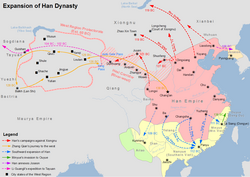
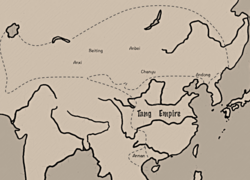
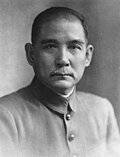
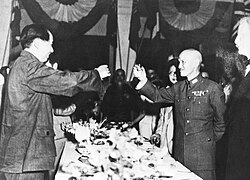
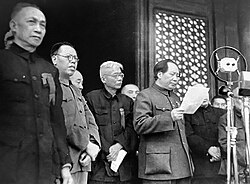


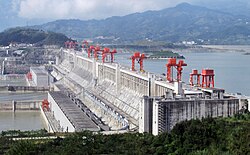



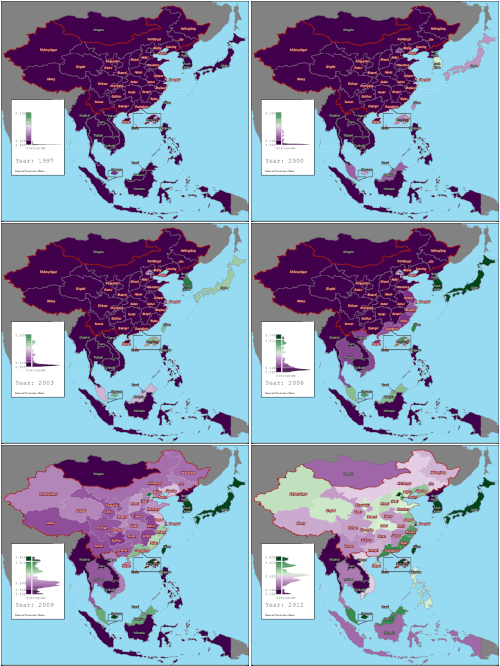

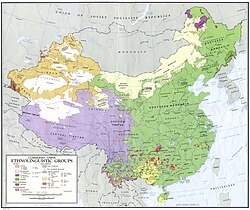


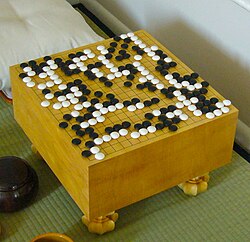


 1,400,050,000[8] (1st)
 46.7[11]
