


>Gpkp Added {{More citations needed}} tag |
m minor rework structure for clarity and added references |
||
| Line 1: | Line 1: | ||
{{More citations needed|date= | {{Short description|Raja of Bharatpur from 1722 to 1755}} | ||
{{More citations needed|date=May 2022}} | |||
{{Use dmy dates|date=November 2018}} | {{Use dmy dates|date=November 2018}} | ||
{{Use Indian English|date=November 2018}} | {{Use Indian English|date=November 2018}} | ||
{{Infobox | {{Infobox royalty | ||
| name | | name = Badan Singh | ||
| title | | title = [[Raja]] | ||
| image= | | image = Detail of Raja Badan Singh from a painting from an illustrated 'Sujan Charitra' series, by Ramji, Jaipur School, circa mid-to-late 18th century (cropped).jpg | ||
| caption | | caption = Portrait of Raja Badan Singh | ||
| reign | | succession = [[Bharatpur State|Raja of Bharatpur]] | ||
| coronation | | reign = 18 November 1722 – 21 May 1755 | ||
| predecessor | | coronation = | ||
| successor | | predecessor = [[Muhkam Singh]] | ||
| spouse | | successor = [[Maharaja Suraj Mal]] | ||
| issue | | spouse = | ||
| royal house | | issue = | ||
| father | | royal house = [[Sinsinwar|Sinsinwar Dynasty]] | ||
| mother | | father = Roop Singh | ||
| birth_date | | mother = | ||
| birth_place = | | birth_date = | ||
| death_date | | birth_place = | ||
| death_place =Deeg | | death_date = 21 May 1755 | ||
| | | death_place = [[Deeg]] | ||
| religion= | | burial_place = | ||
| religion = [[Hinduism]] | |||
}} | }} | ||
== | '''Maharaja Badan Singh''' (reigned 18 November 1722 – 21 May 1755) was the formal founder and first [[Maharaja]] of the [[Bharatpur State|Bharatpur state]] from 1722 to 1755. He was a nephew of [[Churaman]] Singh. After Churaman's death on 20 September 1721 there were family disputes between Badan Singh and Churaman's son [[Muhkam Singh]]. Badan Singh aligned with [[Jai Singh II]] of [[Jaipur]] to avoid the wrath of Muhkam Singh. In this family feud, Jai Singh supported Badan Singh. | ||
== Early life == | |||
Badan Singh was born to a [[Hindu Jat]] family to Roop Singh who was the jagirdar of [[Deeg]], Rajasthan. He was the nephew of [[Churaman|Rao Churaman Singh]], then the chief of Thun stronghold.<ref>{{Cite book |last=Bhanu |first=Dharma |url=https://books.google.com/books?id=CctFMm9HSH8C&q=nephew+Churaman+badan+singh |title=The Province of Agra: Its History and Administration |date=1979 |publisher=Concept Publishing Company |language=en}}</ref> | |||
== Ancestors == | |||
The Hindu Jat rulers of Bharatpur kingdom and Braj claim descent from Lord Shri Krishna. One of their ancestor was Shobha Singh who held his sway over Bayana, he attacked the modern-day Sinsini region and defeated the native tribe of Kalal Chandars.<ref>{{Cite book |last1=Dwivedi |first1=Girish Chandra |url=https://books.google.com/books?id=AR5uAAAAMAAJ |title=The Jats, Their Role in the Mughal Empire |last2=Prasad |first2=Ishwari |date=1989 |publisher=Arnold Publishers |isbn=978-81-7031-150-8 |language=en}}</ref> | |||
==Architecture== | |||
G.C. Dwivedi writes: | |||
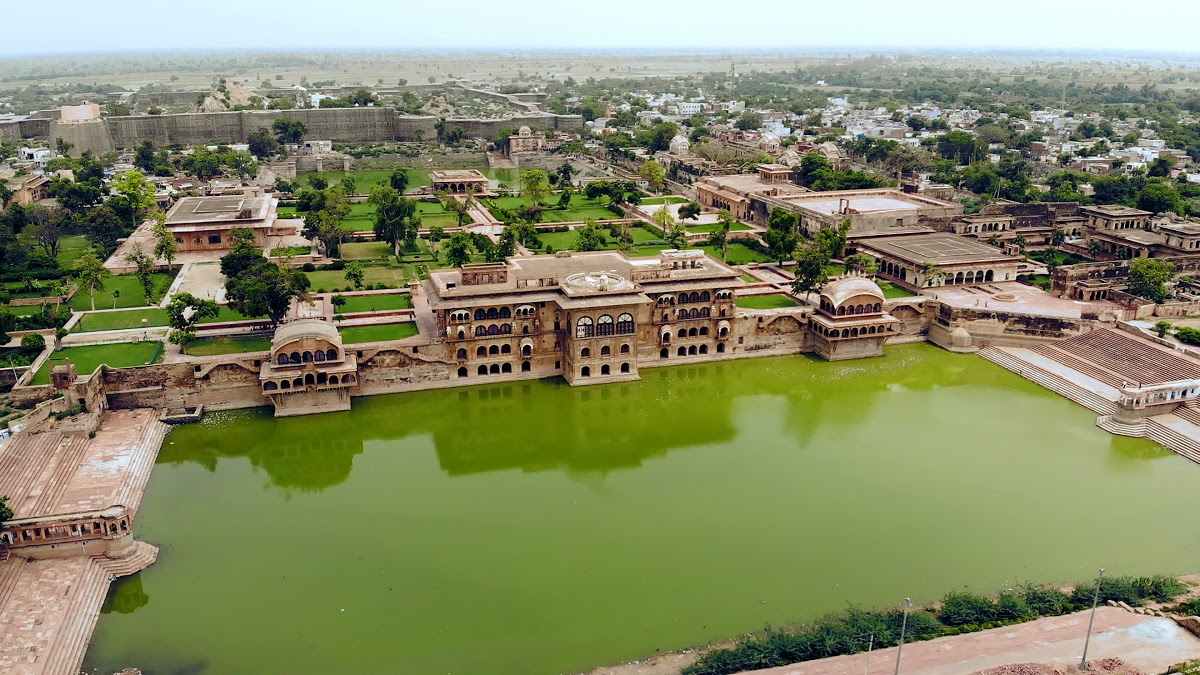
Badan Singh [[Jats|Jat]] had some aesthetic sense and a taste for architecture too, which is testified by the remains of his numerous buildings and garden-palaces. He beautified the fort of [[Deeg]] with handsome palaces, which are known as the Purana Mahal. | |||
At [[Weir, Rajasthan|Weir]] in the [[Bayana]] district, he planted within the fort a large garden with a beautiful house and reservoirs in the centre, now called Phul-bari. | |||
He also built palaces at Kamar as well as at Sahar, which are now in ruin, and dedicated a temple at [[Brindaban]], known by the poetic name of Dhir Samir. | |||
Badan Singh lived to a ripe old age, which he spent in happy retirement at Sahar, leaving the management of his State to his most capable son [[Suraj Mal]]. He died on 21 May 1755 with the usual suspicion of him being poisoned, though there were no imaginable grounds for this.{{citation needed|date=June 2022}} | |||
[[File:Deeg_palace_1.jpg|thumb|Gopal Bhawan palace, Deeg fort built by Raja Badan Singh]] | |||
[[File:Deeg_Palace_-_Gopal_Bhawan.jpg|thumb|Inside view of Deeg fort]] | |||
[[File:Drone_shot_of_deeg_palace.jpg|thumb|Deeg fort]] | |||
==Raja Muhkam Singh's downfall== | |||
After the death of Rao Churaman Singh, his successor Raja Muhkam Singh became unpopular among the Sinsinwar clan. In 1722, he was challenged by Badan Singh(cousin), the chief of Deeg. A joint military campaign led by Jai Singh II of Jaipur and Badan Singh forced Muhkam Singh to abandon the fort of Thun in November 1722. Muhkam fled to Jodhpur, where he secured the protection of the Maharaja of Jodhpur by paying for his defense. Although the Mughals sent a force to capture him, the Maharaja of Jodhpur intervened and safeguarded Muhkam. Following this, Jai Singh II formally recognized Badan Singh as the 'Thakur of Bharatpur'. | |||
— Jadunath Sarkar and Raghubir Sinh, A History of Jaipur: c. 1503–1938, Orient Longman, 1984, pp. 170–171. | |||
==Military career== | |||
Battle of Mandu (1729) | |||
Raja Badan Singh was an ally of Jai Singh II of Jaipur. Jai Singh was given the Subedari of Malwa in October 1729, then he attacked Marathas at Mandu. Jai Singh asked for Raja Badan Singh's help and the Jat army proceeded towards Mandu town under the leadership of prince Sujan Singh (later known as Maharaja Surajmal) and helped the Jaipur forces to capture Mandu.<ref>{{cite web | title=Maharaja Surajmal Jaat | date=1986 | url=https://archive.org/details/in.ernet.dli.2015.443996 }}</ref> | |||
Battle of Bhopal (1737) | |||
Jai Singh II sent his army against Peshwa Bajirao and Raja Badan Singh also sent an army for Jai Singh's help under his son and the Raja of [[Wair, Bharatpur district|Weir]]- Pratap Singh.<ref>{{Cite book |last=Sharma |first=upendar Nath |url=https://archive.org/details/in.ernet.dli.2015.443996 |title=Maharaja Surajmal Jaat |date=1986}}</ref> In an engagement Jat army of Raja Pratap Singh defeated [[Bajirao I|Bajirao]], mentioned by contemporary poet Sudan<ref>{{Cite book |last=Sharma |first=upendar Nath |url=https://archive.org/details/in.ernet.dli.2015.443996 |title=Maharaja Surajmal Jaat |date=1986}}</ref> | |||
Battle of Gangwana (1741) | |||
Jat forces under the leadership of Raja Badan Singh defeated Rajputs under Bakht Singh Rathore of Jodhpur with Jai Singh II.<ref>{{Cite book |last=Sahai |first=Jwala |url=https://books.google.com/books?id=H19OAQAAMAAJ&q=gangwana+surajmal |title=History of Bhurtpore |date=1898 |publisher=Patrika Press |language=en}}</ref> | |||
==References== | ==References== | ||
{{reflist}} | {{reflist}} | ||
{{DEFAULTSORT:Singh, Badan}} | {{DEFAULTSORT:Singh, Badan}} | ||
[[Category:Rulers of Bharatpur | [[Category:Rulers of Bharatpur State]] | ||
[[Category: | [[Category:Year of birth missing]] | ||
[[Category:1755 deaths]] | [[Category:1755 deaths]] | ||
[[Category:18th-century Indian monarchs]] | [[Category:18th-century Indian monarchs]] | ||
Latest revision as of 13:26, 16 March 2026
 | This article needs additional citations for verification. (May 2022) |
| Badan Singh | |
|---|---|
| Raja | |
.jpg) Portrait of Raja Badan Singh | |
| Raja of Bharatpur | |
| Reign | 18 November 1722 – 21 May 1755 |
| Predecessor | Muhkam Singh |
| Successor | Maharaja Suraj Mal |
| Died | 21 May 1755 Deeg |
| House | Sinsinwar Dynasty |
| Father | Roop Singh |
| Religion | Hinduism |
Maharaja Badan Singh (reigned 18 November 1722 – 21 May 1755) was the formal founder and first Maharaja of the Bharatpur state from 1722 to 1755. He was a nephew of Churaman Singh. After Churaman's death on 20 September 1721 there were family disputes between Badan Singh and Churaman's son Muhkam Singh. Badan Singh aligned with Jai Singh II of Jaipur to avoid the wrath of Muhkam Singh. In this family feud, Jai Singh supported Badan Singh.
Early life[edit | edit source]
Badan Singh was born to a Hindu Jat family to Roop Singh who was the jagirdar of Deeg, Rajasthan. He was the nephew of Rao Churaman Singh, then the chief of Thun stronghold.[1]
Ancestors[edit | edit source]
The Hindu Jat rulers of Bharatpur kingdom and Braj claim descent from Lord Shri Krishna. One of their ancestor was Shobha Singh who held his sway over Bayana, he attacked the modern-day Sinsini region and defeated the native tribe of Kalal Chandars.[2]
Architecture[edit | edit source]
G.C. Dwivedi writes: Badan Singh Jat had some aesthetic sense and a taste for architecture too, which is testified by the remains of his numerous buildings and garden-palaces. He beautified the fort of Deeg with handsome palaces, which are known as the Purana Mahal.
At Weir in the Bayana district, he planted within the fort a large garden with a beautiful house and reservoirs in the centre, now called Phul-bari.
He also built palaces at Kamar as well as at Sahar, which are now in ruin, and dedicated a temple at Brindaban, known by the poetic name of Dhir Samir.
Badan Singh lived to a ripe old age, which he spent in happy retirement at Sahar, leaving the management of his State to his most capable son Suraj Mal. He died on 21 May 1755 with the usual suspicion of him being poisoned, though there were no imaginable grounds for this.[citation needed]


Raja Muhkam Singh's downfall[edit | edit source]
After the death of Rao Churaman Singh, his successor Raja Muhkam Singh became unpopular among the Sinsinwar clan. In 1722, he was challenged by Badan Singh(cousin), the chief of Deeg. A joint military campaign led by Jai Singh II of Jaipur and Badan Singh forced Muhkam Singh to abandon the fort of Thun in November 1722. Muhkam fled to Jodhpur, where he secured the protection of the Maharaja of Jodhpur by paying for his defense. Although the Mughals sent a force to capture him, the Maharaja of Jodhpur intervened and safeguarded Muhkam. Following this, Jai Singh II formally recognized Badan Singh as the 'Thakur of Bharatpur'.
— Jadunath Sarkar and Raghubir Sinh, A History of Jaipur: c. 1503–1938, Orient Longman, 1984, pp. 170–171.
Military career[edit | edit source]
Battle of Mandu (1729)
Raja Badan Singh was an ally of Jai Singh II of Jaipur. Jai Singh was given the Subedari of Malwa in October 1729, then he attacked Marathas at Mandu. Jai Singh asked for Raja Badan Singh's help and the Jat army proceeded towards Mandu town under the leadership of prince Sujan Singh (later known as Maharaja Surajmal) and helped the Jaipur forces to capture Mandu.[3]
Battle of Bhopal (1737)
Jai Singh II sent his army against Peshwa Bajirao and Raja Badan Singh also sent an army for Jai Singh's help under his son and the Raja of Weir- Pratap Singh.[4] In an engagement Jat army of Raja Pratap Singh defeated Bajirao, mentioned by contemporary poet Sudan[5]
Battle of Gangwana (1741)
Jat forces under the leadership of Raja Badan Singh defeated Rajputs under Bakht Singh Rathore of Jodhpur with Jai Singh II.[6]
References[edit | edit source]
- ↑ Bhanu, Dharma (1979). The Province of Agra: Its History and Administration. Concept Publishing Company.
- ↑ Dwivedi, Girish Chandra; Prasad, Ishwari (1989). The Jats, Their Role in the Mughal Empire. Arnold Publishers. ISBN 978-81-7031-150-8.
- ↑ "Maharaja Surajmal Jaat". 1986.
- ↑ Sharma, upendar Nath (1986). Maharaja Surajmal Jaat.
- ↑ Sharma, upendar Nath (1986). Maharaja Surajmal Jaat.
- ↑ Sahai, Jwala (1898). History of Bhurtpore. Patrika Press.