








→Thailand: Added old Thai name of samlaw. |
slightly expand information per standard format also and improved wording |
||
| Line 1: | Line 1: | ||
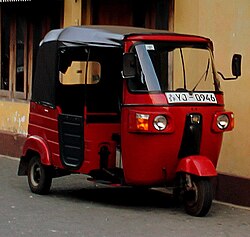
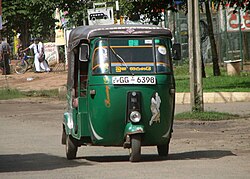
{{ | {{Short description|Motorized version of a rickshaw}}{{Redirect|Tuk tuk|the film|Tuk Tuk (film){{!}}''Tuk Tuk'' (film)}}[[File:Bajaj auto-rickshaw in Sri Lanka.jpg|thumb|A typical auto rickshaw in Sri Lanka]] | ||
[[File:Bajaj auto-rickshaw in Sri Lanka.jpg|thumb| | |||
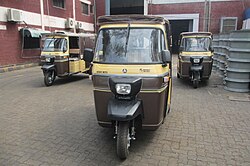
An '''auto rickshaw''' is a motorized version of the [[pulled rickshaw]] or [[cycle rickshaw]].<ref>{{cite web|url=https://www.merriam-webster.com/dictionary/auto-rickshaw|title=Auto rickshaw|work=[[Merriam Webster]]|access-date=1 June 2025}}</ref> Often called a '''tuk tuk''', it is usually a three-wheeled vehicle, powered by an engine.<ref>{{cite web|url=https://www.collinsdictionary.com/dictionary/english/autorickshaw|title=Auto rickshaw|work=[[Collins dictionary]]|access-date=1 June 2025}}</ref> They use a variety of fuels, with the most common being [[petrol]], [[compressed natural gas]], [[liquefied petroleum gas]], and [[electricity]]. They are known by various other names and across various different countries. | |||
The auto rickshaw is a common form of transport around the world (especially in South Asian countries like Bangladesh, India and Pakistan) both as a [[vehicle for hire]] and private use. They are especially common in countries with [[tropical climate|tropical]] or subtropical climate since they are usually not fully enclosed, and in many [[developing countries]] because they are relatively inexpensive to own and operate. | |||
There are different auto rickshaw designs. The most common type used for passenger transport is characterized by a sheet-metal body resting on three wheels with a canvas roof and drop-down side curtains. The driver is seated in a small cabin at the front and operates [[motorcycle handlebar|handlebar]] controls with a space for carrying up to three passengers in the back.<ref>{{cite web |title=Auto rickshaw |url=https://dictionary.cambridge.org/dictionary/english/autorickshaw |access-date=1 June 2025 |work=[[Cambridge Advanced Learner's Dictionary|Cambridge Dictionary]]}}</ref> The cargo versions might have an open space at the rear. A simpler version might have an expanded sidecar mounted on a three wheeled motorcycle. | |||
{{As of|2023}}, India is the largest market for electric auto rickshaws, bypassing China.<ref>{{cite web|url=https://www.autocarpro.in/analysis-report/india-is-worlds-largest-electric-3w-market-for-second-year-in-a-row-126488|title=India beats China again to be world's largest electric 3W market|work=Autocar Professional|access-date=1 June 2025}}</ref> {{As of|2024}}, [[Bajaj Auto]] of India is the world's largest auto rickshaw manufacturer.<ref>{{cite web|url=https://www.cmv360.com/articles/best-auto-rickshaw-manufacturers-india|title=Best Auto Rickshaw Manufacturers in India|work=Cmv360|access-date=1 June 2025}}</ref> | |||
In | == Origin == | ||
[[File:Lambretta FD (2017-06-25 Sp).jpg|thumb|A 1952 Lambretta FD sold as open top model]] | |||
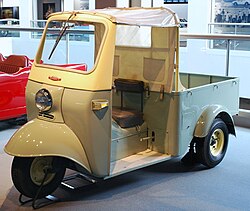
[[File:1957 Daihatsu Midget 01.jpg|thumb|[[Daihatsu Midget]] Model DKA]] | |||
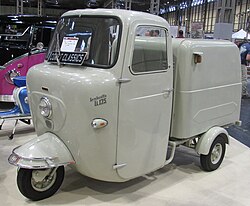
[[File:1960 Lambretta Li 175 Series 2.jpg|thumb|1960 Lambretta Li 175 Series 2]] | |||
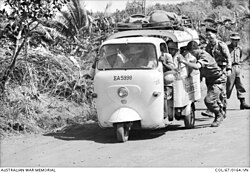
[[File:RAR soldier helps push-start a Lambretta at Nui Dat.jpg|thumb|RAR soldier helps push-start a Lambretta at Nui Dat]] | |||
In the 1930s Japan, which was the most industrialized country in Asia at the time, encouraged the development of motorized vehicles including less expensive three-wheeled vehicles based on motorcycles. The [[Mazda-Go]], a 3-wheel open "truck" released in 1931,<ref name=MZhist>{{cite web |url=https://www.mazda.com/en/innovation/stories/greatcar/mazda-go/ |title=Great Cars of Mazda: Mazda-Go 3-wheeled Trucks (1931〜) |publisher=Mazda Motor Corporation |archive-date=2019-02-09 |archive-url=https://web.archive.org/web/20190209124028/https://www.mazda.com/en/innovation/stories/greatcar/mazda-go/}}</ref> is often considered the first of what became auto rickshaws. Later that decade the Japanese [[Ministry of Posts and Telecommunications (Japan)|Ministry of Posts and Telecommunications of Japan]] distributed about 20,000 used three-wheelers to Southeast Asia as part of efforts to expand its influence in the region.<ref>[http://www.takaharabooks.com/item/0000810000000037.asp ミゼット物語 木村信之 著 高原書店](Nobuyuki Kimura "Story of Midget", Published on 10 November 1998)</ref><ref>Daihatsu Motor Co., Ltd. public relations section</ref><ref>{{cite news |date=2007-11-19 |script-title=ja:NPOみらいネットワーク寄附講座、ホテル観光学科の学生に日タイ関係をピーアール 日本での就職機会に関心 |url=http://www.bangkokshuho.com/archive/2007/weekly/07archives/keizai1297.htm#11 |newspaper=Bangkok Shuho |language=ja |archive-url=https://web.archive.org/web/20090430140101/http://www.bangkokshuho.com/archive/2007/weekly/07archives/keizai1297.htm#11 |archive-date=2009-04-30}}</ref><ref>[https://web.archive.org/web/20230803040455/https://site.thaiembassy.jp/ /index.php?option=com_content&view=article&id=321:2009-11-30-05-34-59&catid=54:2009-09-09-07-52-31&Itemid=232 Royal Thai Embassy Tokyo, Japan] 日本生まれのタイのトゥクトゥク (Tuk-Tuk of Thailand was born in Japan.)</ref> They became popular in some areas, especially Thailand, which developed local manufacturing and design after the Japanese government abolished the three-wheeler license in Japan in 1965.<ref>{{cite web |url=https://www.desiam.com/blogs/post/Tuk-Tuk |title=Tuk-Tuk, Thailand's most notorious mode of transport - deSIAM |website=www.desiam.com |access-date=2020-03-26 |archive-date=2020-09-23 |archive-url=https://web.archive.org/web/20200923223106/https://www.desiam.com/blogs/post/Tuk-Tuk |url-status=dead}}</ref> | |||
Production in Southeast Asia started from the [[knock-down kit|knockdown]] production of the [[Daihatsu Midget]], which was introduced in 1959.<ref>{{cite web |url=http://route0030.blog.fc2.com/blog-entry-147.html |title=【ダイハツ ミゼット DKA / DSA型】 幌付3輪スクーター型トラック 旧式商用車図鑑 |website=route0030.blog.fc2.com}}</ref> An exception is the indigenously modified Philippine tricycle, which originates from the [[Rikuo Motorcycle|Rikuo]] [[Type 97 motorcycle]] with a sidecar, introduced to the islands in 1941 by the [[Imperial Japanese Army]] during World War II.<ref name="brits"/> | |||
In Asia, [[Corradino D'Ascanio]], aircraft designer at [[Piaggio]] and inventor of the [[Piaggio Vespa|Vespa]], came up with the idea of building a light three-wheeled commercial vehicle to power Italy's post-war [[economic reconstruction]]. The [[Piaggio Ape]] followed suit in 1947. [[Innocenti]], another leading Scooter manufacturer, also came up with their [[Lambretta]] line of three wheelers in a cargo version, later adopted as a passenger version by its Indian colloborator [[Automobile Products of India]]. | |||
== Regional variations == | == Regional variations == | ||
=== Africa and the Middle East === | === Africa and the Middle East === | ||
==== Algeria ==== | |||
{{Expand section|date=April 2025}} | |||
==== Egypt ==== | ==== Egypt ==== | ||
Locally named the " | Locally named the "tuktuk", the rickshaw is used as a means of transportation in most parts of Egypt. It is generally rare to find in some affluent and newer parts of cities such as [[New Cairo]] and [[Heliopolis, Cairo|Heliopolis]]; and on highways due to police control and enforcement. | ||
==== Gaza ==== | ==== Gaza ==== | ||
Together with the [[Economy of Gaza#Recreation industry|recent boom of recreational facilities in Gaza]] for the local residents, donkey carts have all but been displaced by tuk-tuks in 2010. Due to the ban by [[Egypt]] and Israel on the import of most motorised vehicles, the tuk-tuks have had to be smuggled in parts through the [[Gaza Strip smuggling tunnels|tunnel network]] connecting Gaza with [[Egypt]].<ref>{{cite web |url=http://www.maannews.net/eng/ViewDetails.aspx?ID=314523 | title=Tuk Tuks replace mules on Gaza streets | access-date=2011-03-22 | date=12 September 2010 | publisher=Maan News Agency}}</ref> | Together with the [[Economy of Gaza#Recreation industry|recent boom of recreational facilities in Gaza]] for the local residents, donkey carts have all but been displaced by tuk-tuks in 2010. Due to the ban by [[Egypt]] and Israel on the import of most motorised vehicles, the tuk-tuks have had to be smuggled in parts through the [[Gaza Strip smuggling tunnels|tunnel network]] connecting Gaza with [[Egypt]].<ref>{{cite web |url=http://www.maannews.net/eng/ViewDetails.aspx?ID=314523 | title=Tuk Tuks replace mules on Gaza streets | access-date=2011-03-22 | date=12 September 2010 | publisher=Maan News Agency}}</ref> | ||
====Iraq==== | |||
Due to extreme congestion in [[Baghdad]] and other Iraqi cities combined with the insensible cost of vehicles in relation to frequent violence, rickshaws have been imported from India in large numbers to provide taxi service and other purposes, in stark contrast to previous attitudes of the [[2003 invasion of Iraq|pre-U.S. 2003 invasion]] eras with rickshaws being disdained and sedans being held in high regard as a status symbol. Rickshaws have been noted for being instrumental in political protest revolts.<ref>{{cite news |url=https://www.deccanherald.com/world/mundane-autos-in-india-hero-tuk-tuks-in-iraq-779539.html |title=Mundane autos in India, hero tuk-tuks in Iraq |work=[[Deccan Herald]] |date=25 November 2019 |access-date=31 January 2024}}</ref><ref>{{cite news |url=https://theprint.in/global-pulse/how-indian-manufactured-auto-rickshaws-became-a-symbol-of-iraqi-protests/326463/ |title=How Indian manufactured auto-rickshaws became a symbol of Iraqi protests |work=[[ThePrint]] |last=Shukla |first=Srijan |date=26 November 2019 |access-date=31 January 2024}}</ref><ref>{{cite news |url=https://www.aa.com.tr/en/middle-east/in-congested-baghdad-iraqis-turn-to-3-wheel-tuk-tuks-/1286855 |title=In congested Baghdad, Iraqis turn to 3-wheel 'tuk-tuks' |work=[[Anadolu Agency]] |last=Alhas |first=Ali Murat}}</ref><ref>{{cite news |url=https://www.nbcnews.com/news/world/how-tuk-tuk-drivers-became-unlikely-heroes-iraq-s-popular-n1082021 |title=How tuk-tuk drivers became the unlikely heroes of Iraq's popular revolt |work=[[NBC News]] |last=Vitalone |first=Vivi |date=14 November 2024 |access-date=31 January 2024}}</ref><ref>{{cite news |url=https://www.washingtonpost.com/world/2019/11/01/why-humble-tuk-tuk-has-become-symbol-iraqs-uprising/ |title=The humble three-wheeled tuk-tuk has become the symbol of Iraq's uprising |newspaper=[[The Washington Post]] |date=1 November 2024 |access-date=31 January 2024 |last1=Salim |first1=Mustafa |last2=Berger |first2=Miriam}}</ref> | |||
====Kenya==== | |||
[[File:Lisa Anne, nr Mzizima Road, Mombasa, 2025 (01).jpg|thumb|Tuk tuk in Mombasa, Kenya]] | |||
Locally named 'Tuktuk', the rickshaw is used as a means of transportation in some parts of Kenya. | |||
==== Madagascar ==== | ==== Madagascar ==== | ||
In Madagascar, man-powered rickshaws are a common form of transportation in a number of cities, especially [[Antsirabe]]. They are known as "posy" from ''pousse-pousse'', meaning ''push-push''. Cycle rickshaws took off since 2006 in a number of flat cities like [[Toamasina]] and replaced the major part of the posy, and are now threatened by the auto rickshaws, introduced in 2009. Provincial capitals like Toamasina, Mahajanga, Toliara, and Antsiranana are taking to them rapidly.{{Citation needed|date=April 2016}} They are known as "bajaji" in the north and "tuk-tuk" or "tik-tik" in the east, and are now licensed to operate as taxis.{{Citation needed|date=April 2016}} They are not yet allowed an operating licence in the congested, and more polluted national capital, Antananarivo.{{Citation needed|date=April 2016}}<ref>{{cite book | title=Madagascar, Volume 15 of Cultures of the World Cultures of the World{{Snd}} Group 15 | publisher=Marshall Cavendish |author1=Jay Heale |author2=Zawiah Abdul Latif | year=2008 | pages=75–76 | isbn=978-0761430360 | edition=2}}</ref><ref>{{cite book |url=https://books.google.com/books?id=yNax15GoPIkC&q=pousse-pousse&pg=PT59 | title=Madagascar Travel Guide | publisher=Lonely Planet | access-date=2013-04-13 | year=2012 | edition=7 | isbn=978-1743213018 }}</ref><ref>{{cite news |date=2014-05-30 |title='Bajaj' à Mahajanga : Entre 70 et 100 clients par jour |url=http://www.midi-madagasikara.mg/societe/2014/05/30/bajaj-mahajanga-70-100-clients-jour/ |work=Midi Madagasikara |language=fr}}</ref> | In Madagascar, man-powered rickshaws are a common form of transportation in a number of cities, especially [[Antsirabe]]. They are known as "posy" from ''pousse-pousse'', meaning ''push-push''. Cycle rickshaws took off since 2006 in a number of flat cities like [[Toamasina]] and replaced the major part of the posy, and are now threatened by the auto rickshaws, introduced in 2009. Provincial capitals like Toamasina, [[Mahajanga]], [[Toliara]], and [[Antsiranana]] are taking to them rapidly.{{Citation needed|date=April 2016}} They are known as "bajaji" in the north and "tuk-tuk" or "tik-tik" in the east, and are now licensed to operate as taxis.{{Citation needed|date=April 2016}} They are not yet allowed an operating licence in the congested, and more polluted national capital, [[Antananarivo]].{{Citation needed|date=April 2016}}<ref>{{cite book | title=Madagascar, Volume 15 of Cultures of the World Cultures of the World{{Snd}} Group 15 | publisher=Marshall Cavendish |author1=Jay Heale |author2=Zawiah Abdul Latif | year=2008 | pages=75–76 | isbn=978-0761430360 | edition=2}}</ref><ref>{{cite book |url=https://books.google.com/books?id=yNax15GoPIkC&q=pousse-pousse&pg=PT59 | title=Madagascar Travel Guide | publisher=Lonely Planet | access-date=2013-04-13 | year=2012 | edition=7 | isbn=978-1743213018 }}</ref><ref>{{cite news |date=2014-05-30 |title='Bajaj' à Mahajanga : Entre 70 et 100 clients par jour |url=http://www.midi-madagasikara.mg/societe/2014/05/30/bajaj-mahajanga-70-100-clients-jour/ |work=Midi Madagasikara |language=fr}}</ref> | ||
==== Morocco ==== | |||
In Morocco, there are Auto-rickshaws in Rabat, Casablanca and Marrakesh. | |||
==== Nigeria ==== | ==== Nigeria ==== | ||
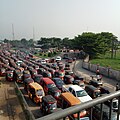
[[File:Congestion in uyo.jpg|thumb|right|Aerial view of autorickshaw congestion from a pedestrian bridge in Uyo, Southeast Nigeria]] | [[File:Congestion in uyo.jpg|thumb|right|Aerial view of autorickshaw congestion from a pedestrian bridge in Uyo, Southeast Nigeria]] | ||
The auto rickshaw is used to provide transportation in cities all over Nigeria. Popularity and use varies across the country | |||
The auto rickshaw is used to provide transportation in cities all over Nigeria. Popularity and use varies across the country. In [[Lagos]], for example, the "keke" ([[Yoruba language|Yoruba]] for bicycle) is regulated and transportation around the state's highways is prohibited while in [[Kano (city)|Kano]] it's popularly known as "Adaidaita Sahu".<ref>{{cite news |url=http://dailypost.ng/2017/11/16/lagos-bans-okada-keke-520-roads-areas-full-list/ |location=Lagos, Nigeria|title=Lagos bans okada, keke from 520 roads, areas [Full list] |first=Wale |last=Odunsi|date=16 November 2017 |newspaper=[[Daily Post (Nigeria)|Daily Post]]}}</ref> | |||
{{clear}} | {{clear}} | ||
==== South Africa ==== | ==== South Africa ==== | ||
[[File:Tuk-Tuk in Hermanus, South Africa (2014).jpg|thumb|Tuk-Tuk in [[Hermanus]], | [[File:Tuk-Tuk in Hermanus, South Africa (2014).jpg|thumb|Tuk-Tuk in [[Hermanus]], South Africa (2014)]] | ||
Tuk-tuks, introduced in [[Durban]]<ref>{{cite web |url=http://zululandtourism.co.za/Durban.html |title=Durban offers beaches and | |||
Tuk-tuks, introduced in [[Durban]]<ref>{{cite web |url=http://zululandtourism.co.za/Durban.html |title=Durban offers beaches and cultural diversity |publisher=Zululand Tourism |access-date=22 September 2015 |quote=Tuk Tuks: Mororised, covered tricycles which carry up to six passengers. Ideal for short 'hops' between the beachfront and city centre. |archive-date=22 May 2022 |archive-url=https://web.archive.org/web/20220522232700/http://zululandtourism.co.za/Durban.html |url-status=dead }}</ref> in the late 1980s, have enjoyed growing popularity in recent years, particularly in [[Gauteng]].<ref>{{cite web |url=http://mg.co.za/article/2013-01-18-cheap-cheap-tuk-tuk-taxis-take-off |title=Cheap-cheap tuk-tuk taxis take over Jozi |last1=Steyn |first1=Lisa |date=18 January 2013 |access-date=22 September 2015 |quote=Tuk-tuks, also known as auto rickshaws, are becoming an increasingly common sight on South Africa's roads because people are trying to travel short distances at lower costs than driving and at less risk than walking.}}</ref> In [[Cape Town]] they are used to deliver groceries and, more recently, transport tourists.<ref>{{cite web |url=http://insideguide.co.za/tuk-tuks-cape-town/ |title=Tuk-tuks are coming to Cape Town |last=Ryan |first=Tamlyn |date=September 2016 |publisher=Inside Guide |access-date=2017-03-18 |archive-date=2017-08-14 |archive-url=https://web.archive.org/web/20170814155835/http://insideguide.co.za/tuk-tuks-cape-town/ |url-status=dead }}</ref><ref>{{Cite news |url=http://www.timeslive.co.za/local/2017/01/25/Buddibox-grocery-delivery-programme-set-to-create-10000-young-entrepreneurs-in-Gauteng1 |title=Buddibox grocery delivery programme set to create 10,000 young entrepreneurs in Gauteng |last=Govender |first=Suthentira |date=2017-01-25 |work=TimesLIVE}}</ref> | |||
{{clear}} | {{clear}} | ||
[[File:Seen at Hamad Elnil.jpg|thumb|upright|Rickshaw in [[Omdurman]] | [[File:Seen at Hamad Elnil.jpg|thumb|upright|Rickshaw in [[Omdurman]], Sudan]] | ||
==== Sudan ==== | ==== Sudan ==== | ||
Rickshaws, known as "Raksha" in Sudan, | Rickshaws, known as "Raksha" in Sudan, are the most common means of transportation, followed by the bus, in the capital [[Khartoum]]. | ||
==== Tanzania ==== | ==== Tanzania ==== | ||
Locally known as "bajaji", they are a common mode of transportation in [[Dar es Salaam]], and many other cities and villages.<ref>{{cite web |url=http://allafrica.com/stories/201203070675.html |title=Tanzania: Bajaji, Dar es Salaam's Indispensable Taxi |last=Kalagho |first=Kenan |date=13 February 2012 |website=AllAfrica |access-date=22 September 2015 |quote=Until the year 2010 Dar es Salaam had no room for the Indian Bajaji and or a tricycle to be used as a means of transporting passengers. Today it is a common feature around Dar es Salaam.}}</ref> | |||
==== Tunisia ==== | |||
{{Expand section|date=April 2025}} | |||
====Uganda ==== | ====Uganda==== | ||
A local delivery company called as Sokowatch in 2020 began a pilot project using electric tuk-tuks, to cut pollution. <ref> | A local delivery company called as Sokowatch in 2020 began a pilot project using electric tuk-tuks, to cut pollution.<ref>{{Cite web |url=https://cleantechnica.com/2020/12/04/gayam-motor-works-sokowatch-launch-east-africas-first-commercial-electric-tuk-tuks/ |title=Gayam Motor Works & Sokowatch Launch East Africa's First Commercial Electric Tuk-Tuks |first=Remeredzai Joseph |last=Kuhudzai |date=4 December 2020 |website=CleanTechnica}}</ref> | ||
==== Zimbabwe ==== | ==== Zimbabwe ==== | ||
[[File:Hende front.jpg|thumb|left| Hende Moto electric 3 | [[File:Hende front.jpg|thumb|left| Hende Moto electric 3-wheeler, Zimbabwe]] | ||
Hende Moto Taxi were first introduced in Zimbabwe as the first | |||
Hende Moto EV & Taxi company was founded in 2019 by Devine Mafa, an American-Zimbabwean businessman. Hende Moto taxis were first introduced in Zimbabwe as the first vehicle manufactured by Zimbabwean three-wheeler manufacturing company Hende Moto Pvt Ltd. The first Hende Moto Taxi was introduced in [[Kwekwe]] in August 2019, and thereafter in Victoria Falls City and then Harare in 2019. Hende Moto is also the manufacturer of the first Zimbabwean-made electric passenger three-wheeled vehicle. It operates on a [[lithium-ion battery]] that has a range of 70 miles on a 6-hour charge.{{cn|date=February 2026}} | |||
=== South Asia === | === South Asia === | ||
====Afghanistan==== | ====Afghanistan==== | ||
[[File:Tuk-Tuk - Herat, Afghanistan.jpg|thumb|A tuk-tuk in [[Herat]]]] | [[File:Tuk-Tuk - Herat, Afghanistan.jpg|thumb|A tuk-tuk in [[Herat]], Afghanistan]] | ||
Auto rickshaws are very common in the eastern Afghan city of [[Jalalabad]], where they are popularly decorated in art and colors.<ref>{{Cite | |||
Auto rickshaws are very common in the eastern Afghan city of [[Jalalabad]], where they are popularly decorated in art and colors.<ref>{{Cite news |url=https://www.irishtimes.com/news/world/asia-pacific/in-taliban-country-inside-the-city-of-jalalabad-1.1674001|title=In Taliban country: inside the city of Jalalabad|first=John D.|last=McHugh|newspaper=The Irish Times}}</ref> They are also popular in the northern city of [[Kunduz]].<ref>{{Cite news|url=https://www.pajhwok.com/en/2012/05/23/auto-rickshaws-clogging-kunduz-arteries|title=Auto-rickshaws clogging Kunduz arteries|website=www.pajhwok.com|date=23 May 2012}}</ref> | |||
==== Bangladesh ==== | ==== Bangladesh ==== | ||
[[File:Cngs dhaka.jpg|thumb | {{See also|Rickshaw art in Bangladesh}} | ||
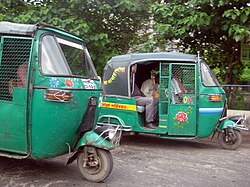
[[File:Cngs dhaka.jpg|thumb|"CNGs" in [[Dhaka]], Bangladesh]] | |||
Two-stroke engines had been identified as one of the leading sources of air pollution in [[Dhaka]]. Thus, since January 2003, traditional auto rickshaws were banned from the capital; only the new natural gas-powered models (CNG) were permitted to operate within the city limits. All CNGs are painted green to signify that the vehicles are [[eco-friendly]] and that each one has a meter built-in.<ref>{{cite news |url= | Auto rickshaws (locally called "baby taxis", "Bangla [[Tesla, Inc.|Teslas]]" for electric ones<ref name="auto1">{{Cite news |title="Bangla Teslas" give Musk a run for his money |url=https://www.economist.com/asia/2025/07/24/bangla-teslas-give-musk-a-run-for-his-money |access-date=2025-07-27 |newspaper=The Economist |issn=0013-0613}}</ref> or "CNGs" for those running on [[compressed natural gas]]) are one of the more popular modes of transport in Bangladesh mainly due to their size and speed. They are best suited to narrow, crowded streets, and are thus the principal means of covering longer distances within urban areas.<ref>{{cite web|last1=Lane|first1=Jo|title=Asia's love affair with the rickshaw|url=http://asiancorrespondent.com/132251/asias-love-affair-with-the-rickshaw/|website=asiancorrespondent.com|access-date=2015-07-30|archive-date=2015-07-13|archive-url=https://web.archive.org/web/20150713152500/http://asiancorrespondent.com/132251/asias-love-affair-with-the-rickshaw/|url-status=dead}}</ref> | ||
Two-stroke engines had been identified as one of the leading sources of [[air pollution]] in [[Dhaka]]. Thus, since January 2003, traditional auto rickshaws were banned from the capital; only the new natural gas-powered models (CNG) were permitted to operate within the city limits. All CNGs are painted green to signify that the vehicles are [[eco-friendly]] and that each one has a meter built-in.<ref>{{cite news |url=https://news.bbc.co.uk/2/hi/business/2594725.stm |title=Police purge for Dhaka rickshaws |work=[[BBC News]]|date=20 December 2002 |access-date=2011-03-22}}</ref> | |||
As of 2025, auto rickshaws in Bangladesh are predominantly electric. There were around 4 million unregistered electric auto rickshaws circulating in Bangladesh by 2025, up from 200,000 in 2016. They constitute "perhaps the world’s biggest informal [[Electric vehicle|EV]] fleet."<ref name="auto1"/> | |||
{{clear}} | {{clear}} | ||
==== India ==== | ==== India ==== | ||
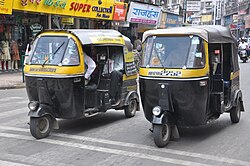
[[File:Vishram Vada 5.JPG|thumb|Auto rickshaws in [[Pune]], India]] | |||
[[File:API 175 Lambretta Auto (1).JPG|thumb|API 175 Lambretta Auto sold from 50's till the late 90's]] | |||
Most cities offer auto rickshaw services, although [[cycle rickshaw]]s and hand-[[pulled rickshaw]]s are also available but rarely in certain remote areas, as all other cities began using auto rickshaws. | |||
<ref name="FrommersIndia-2010">{{cite book |title=Frommer's India |publisher=John Wiley and Sons |author1=Pippa de Bruyn |author2=Keith Bain |author3=David Allardice |author4=Shonar Joshi |year=2010 |isbn=978-0470645802 |edition=Fourth}}</ref>{{Rp|15,57,156}} Many state governments have launched an initiative of women-friendly rickshaw service called the [[Pink Rickshaw]]s driven by women.<ref>{{cite web |url=https://www.odishapolice.gov.in/sites/default/files/PDF/27.06.2015%20Pink%20Auto%20Rickshaw%20Project.pdf |title=Pink Auto Rickshaw Project |date=17 July 2019 |website=odishapolice.gov.in}}</ref> The drivers are known as the "Rickshaw-wallah", ''auto-[[wallah]]'', ''tuktuk-wallah'' or ''auto-kaaran'' in places like Tamil Nadu/Kerala . Auto-rickshaws are also known as tempos in some parts of India.<ref>{{Cite web |last=Mishra |first=Animesh |title=LMC drafts by-laws for tempos, e-rickshaws in Lucknow |url=https://www.hindustantimes.com/cities/lucknow-news/lmc-drafts-by-laws-for-tempos-e-rickshaws-in-lucknow-101729189329020.html |work=Hindustan Times |date=18 October 2024}}</ref> | |||
Auto rickshaws are used in cities and towns for short distances; they are less suited to long distances because they are slow and the carriages are open to air pollution.<ref name="FrommersIndia-2010" />{{Rp|57,58,110}} Auto rickshaws (often called "autos") provide cheap and efficient transportation. Modern auto rickshaws run on electricity as the government pushes for e-mobility through its FAME-II scheme, [[compressed natural gas]] (CNG) and [[Liquefied petroleum gas|liquified petroleum gas]] (LPG) due to [[Indian government|government]] regulations and are environmentally friendly compared to full-sized cars.{{citation needed|date=April 2013}}{{refn|Typical [[Fuel economy in automobiles|fuel economy]] for an Indian-made auto rickshaw is around {{convert|35|km/L}} of [[gasoline|petrol]].{{citation needed|date=April 2013}}|group="nb"}} | |||
To augment the speedy movement of traffic, auto rickshaws are not allowed in the southern part of the [[Mumbai City district|Mumbai]].<ref>{{cite book |title=Frommer's India |url=https://archive.org/details/frommersindiafro00bruy_530 |url-access=limited |publisher=John Wiley and Sons |author1=Pippa de Bruyn |author2=Keith Bain |author3=David Allardice |author4=Shonar Joshi |date=2010 |page=[https://archive.org/details/frommersindiafro00bruy_530/page/n121 110] |isbn=978-0470645802 |edition=Fourth}}</ref> | |||
India is the location of the annual [[Rickshaw Run]]. | |||
India is the | There are two types of auto rickshaws in India. In older versions the engines were below the driver's seat, while in newer versions engines are in the rear. They normally run on petrol, CNG, or [[Diesel fuel|diesel]]. The [[seating capacity]] of a normal rickshaw is four, including the driver's seat. Six-seater rickshaws exist in different parts of the country, but the model was officially banned in the city of [[Pune]] on 10 January 2003 by the [[Regional Transport Office|Regional Transport Authority]] (RTA).<ref>{{cite news |title=Six seater rickshaws banned in city |url=http://timesofindia.indiatimes.com/city/pune/Six-seater-rickshaws-banned-in-city/articleshow/202027.cms? |newspaper=Times of India |date=25 September 2003 |access-date=2014-01-11}}</ref> | ||
Apart from this, modern electric auto rickshaws, which operate on electric motors and offer high torque and loading capacity with better speed, are also gaining popularity in India. Many auto drivers have switched to electric three-wheelers due to the high prices of CNG and diesel, making traditional auto rickshaws much more expensive compared to their electric counterparts. The government is also taking steps to convert existing CNG and diesel rickshaws to electric models.<ref>{{Cite web |date=29 March 2022 |title=Patna: Transport department to ban all diesel-run buses, auto-rickshaws from April 1 |url=https://www.indiatoday.in/cities/patna/story/transport-department-to-ban-all-diesel-run-buses-auto-rickshaws-from-april-1-1931009-2022-03-29 |access-date=2022-03-29 |website=India Today |language=en}}</ref> | |||
CNG autos in many cities (e.g. Delhi, Agra) are distinguishable from the earlier petrol-powered autos by a green and yellow livery, as opposed to the earlier black and yellow appearance. In other cities (such as Mumbai) the only distinguishing feature is the 'CNG' print found on the back or side of the auto. Some local governments are considering [[four-stroke engine]]s instead of two-stroke versions.{{citation needed|date=April 2013}} | CNG autos in many cities (e.g. Delhi, Agra) are distinguishable from the earlier petrol-powered autos by a green and yellow livery, as opposed to the earlier black and yellow appearance. In other cities (such as Mumbai) the only distinguishing feature is the 'CNG' print found on the back or side of the auto. Some local governments are considering [[four-stroke engine]]s instead of two-stroke versions.{{citation needed|date=April 2013}} | ||
Notable auto rickshaw manufacturers in India include [[Bajaj Auto]], [[Mahindra & Mahindra]], [[Piaggio Ape]], [[Atul Auto]], [[Kerala Automobiles Limited]], [[TVS Motors]] and [[Force Motors]]. | |||
In Delhi there also used to be a variant powered by a [[Harley-Davidson]] engine called the ''phat-phati'', because of the sound it made. The story goes that shortly after [[Independence | In Delhi there also used to be a variant powered by a [[Harley-Davidson]] engine called the ''phat-phati'', because of the sound it made. The story goes that shortly after the [[Independence of India]], a stock of Harley-Davidson motorbikes that had been used by British troops during [[World War II]] were found to be left behind in a military storage house in Delhi. Drivers purchased these bikes, added on a gear box (probably from a [[Willys MB|Willys jeep]]), welded on a passenger compartment that was good for four to six passengers, and put the unconventional vehicles onto the roads. A 1998 ruling of the [[Supreme Court of India|Supreme Court]] against the use of polluting vehicles finally signed the death warrant of Delhi's phat-phatis.<ref>{{Cite news |url=https://timesofindia.indiatimes.com/india/Remembering-Delhis-phat-phatis/articleshow/652374319.cms|title=Remembering Delhi's phat-phatis {{pipe}} India News |work=The Times of India}}</ref><ref>{{cite web|url=http://olddelhiheritage.in/modes-of-transport-through-the-ages-in-shahjahanabad/|title=Transportation through the ages in Shahjahanabad|website=olddelhiheritage.in|date=18 September 2022 |archive-url=https://web.archive.org/web/20160614191659/http://olddelhiheritage.in/modes-of-transport-through-the-ages-in-shahjahanabad/ |archive-date=14 June 2016 |url-status=usurped}}</ref> | ||
{{ | {{As of|2022}}, India has about 2.4 million battery-powered, three-wheeled rickshaws on its roads. Some 11,000 new ones hit the streets each month, creating a US$3.1 billion market. Manufacturers include Mahindra & Mahindra Ltd. and [[Kinetic Engineering Limited|Kinetic Engineering]]. A prerequisite for the adoption to electric vehicles is the availability of charging stations; as of early 2024, India had 12,146 public EV charging stations operational across the country.<ref>{{Cite web |title=12,146 public EV charging stations operational across the country |url=https://pib.gov.in/PressReleaseIframePage.aspx?PRID=2003003 |access-date=2024-04-16 |website=pib.gov.in}}</ref> | ||
<gallery class="center" mode="packed"> | <gallery class="center" mode="packed"> | ||
File:Autorickshaw on Raj Path New Delhi.JPG|CNG green auto rickshaw in Delhi | File:Autorickshaw on Raj Path New Delhi.JPG|CNG green auto rickshaw in New Delhi | ||
File: | File:BangaloreRickshaw.jpg|A Bajaj Auto rickshaw in [[Bangalore]] | ||
File: | File:Piaggio Ape is king all over Kerala (28455330172).jpg|A Piaggio Ape auto rickshaw in [[Kerala]] | ||
File: | File:TVS tuktuk in Chennai.jpg|A TVS auto rickshaw in [[Chennai]] | ||
File: | File:SUN Mobility Swap Point.png|An electric rickshaw at a [[battery swapping]] point | ||
File: | File:Three wheeler cargotruck often used in India.jpg|Three wheeler cargo auto-rickshaw used in India | ||
File:India auto-rickshaw tuk tuk adapted for logistics July 2007.jpg|Indian auto-rickshaw adapted with [[trailer (vehicle)|trailer]] | |||
File:Erisha E Mobility Electric Autorickshaws.jpg|Erisha electric passenger and cargo Auto rickshaws in India | |||
</gallery> | </gallery> | ||
Generally, rickshaw fares are controlled by the government,<ref>{{cite news |url=http://www.newkerala.com/news/story/12553/maharashtra-govt-refuses-to-increase-autorickshaw-taxi-fares.html |title=Maharashtra Govt refuses to increase autorickshaw, taxi fares |work=newKerala.com |agency=UNI |archive-url=https://web.archive.org/web/20130518132558/http://www.newkerala.com/news/story/12553/maharashtra-govt-refuses-to-increase-autorickshaw-taxi-fares.html#.Vb29wfnjI78 |archive-date=2013-05-18}}</ref> however auto (and taxi) driver unions frequently go on strike demanding fare hikes. They have also gone on strike multiple times in Delhi to protest against the government and [[Delhi High Court|High Court]]'s 2012 order to install [[Global Positioning System|GPS]] systems, and even though GPS installation in public transport was made mandatory in 2015, as of 2017 compliance remains very low.<ref>{{cite news |title=Autos, taxis in Delhi to go on strike today demanding fare hike |url=https://www.indiatoday.in/india/north/story/autos-taxis-in-delhi-to-go-on-strike-118760-2012-10-14 |newspaper=India Today |date=15 October 2012 |access-date=2017-02-19}}</ref><ref>{{cite news |title=Delhi High Court Directs City Auto-Rickshaws To Install GPS |url=http://www.medianama.com/2012/09/223-delhi-high-court-directs-city-auto-rickshaws-to-install-gps/ |newspaper=Medianama |date=28 September 2012 |access-date=2017-02-19}}</ref><ref>{{cite news |title=GPS installation in public transport becomes mandatory |url=http://timesofindia.indiatimes.com/city/delhi/GPS-installation-in-public-transport-becomes-mandatory/articleshow/47506948.cms |newspaper=Times of India |date=2 June 2015 |access-date=2017-02-19}}</ref> | |||
Generally rickshaw fares are controlled by the government,<ref>{{cite news |url=http://www.newkerala.com/news/story/12553/maharashtra-govt-refuses-to-increase-autorickshaw-taxi-fares.html |title=Maharashtra Govt refuses to increase autorickshaw, taxi fares |work=newKerala.com |agency=UNI |archive-url=https://web.archive.org/web/20130518132558/http://www.newkerala.com/news/story/12553/maharashtra-govt-refuses-to-increase-autorickshaw-taxi-fares.html#.Vb29wfnjI78 |archive-date=2013-05-18}}</ref> however auto (and taxi) driver unions frequently go on strike demanding fare hikes. They have also gone on strike multiple times in Delhi to protest against the government and [[Delhi High Court|High Court]]'s 2012 order to install [[Global Positioning System|GPS]] systems, and even though GPS installation in public transport was made mandatory in 2015, as of 2017 compliance remains very low.<ref>{{cite news |title=Autos, taxis in Delhi to go on strike today demanding fare hike |url= | |||
The 200 cc variant of the [[Bajaj Auto]] auto rickshaw was used in the 2022 [[Rickshaw Run]] to set the record for the world's highest auto rickshaw, over the [[Umling La]] Pass, at {{convert|5798|m|ft|abbr=off|sp=us}}<ref>{{cite web |url=https://www.news18.com/news/buzz/auto-rickshaws-set-highest-altitude-drive-record-at-19024-feet-on-umling-la-pass-6257215.html |title=Auto Rickshaws Set Highest Altitude Drive Record at 19,024 Feet on Umling La Pass |date=22 October 2022 |website=news18.com}}</ref><ref>{{cite web |url=https://www.msn.com/en-in/lifestyle/travel/auto-rickshaws-drive-on-umling-la-pass-the-highest-motorable-road-to-set-world-record-at-19024-feet/ar-AA13qxBT |title=Auto rickshaws drive on Umling La Pass, the highest motorable road, to set world record at 19,024 feet |website=[[MSN]] |date=27 October 2022}}</ref> | |||
==== Nepal ==== | ==== Nepal ==== | ||
Auto rickshaws were a popular mode of transport in Nepal during the 1980s and 1990s, until the government banned the movement of 600 such vehicles in the early 2000s.<ref>{{cite news |url= | Auto rickshaws were a popular mode of transport in Nepal during the 1980s and 1990s, until the government banned the movement of 600 such vehicles in the early 2000s.<ref>{{cite news |url=https://news.bbc.co.uk/1/hi/world/south_asia/406035.stm |title=Nepal Government decides to ban 3 wheeler auto rickshaws from Nepal's road |publisher=BBC |date=28 July 1999 |access-date=2011-12-06}}</ref> The earliest auto rickshaws running in Kathmandu were manufactured by Bajaj Auto.{{citation needed|date=April 2013}} | ||
Nepal has been a popular destination for the [[Rickshaw Run]]. The 2009 Fall Run took place in [[Goa]], India and ended in [[Pokhara]], Nepal.<ref>{{cite news |url= | Nepal has been a popular destination for the [[Rickshaw Run]]. The 2009 Fall Run took place in [[Goa]], India and ended in [[Pokhara]], Nepal.<ref>{{cite news |url=https://www.thenationalnews.com/uae/rickshaw-run-2-000km-of-adventure-from-india-to-nepal-1.542923/ |title=Rickshaw Run on 3 Wheelers from Goa, India to Pokhara, Nepal |publisher=The National |date=29 August 2009 |access-date=2011-12-06}}</ref> | ||
==== Pakistan ==== | ==== Pakistan ==== | ||
Auto rickshaws are a popular mode of transport in Pakistani towns<ref name="ABC News Promote Peace">{{cite news |url=https://abcnews.go.com/m/story?id=18436950 | title=Eye-Catching Rickshaws Promote Peace in Pakistan | work=ABC News | author=Sebastian Abbot, Associated Press | date=8 February 2013 | access-date=2013-04-13 }}</ref> and are mainly used for travelling short distances within cities. One of the major manufacturers of auto rickshaws is [[Piaggio]]. The government is taking measures to convert all gasoline powered auto rickshaws to cleaner CNG rickshaws by 2015 | Auto rickshaws are a popular mode of transport in Pakistani towns<ref name="ABC News Promote Peace">{{cite news |url=https://abcnews.go.com/m/story?id=18436950 |title=Eye-Catching Rickshaws Promote Peace in Pakistan |work=ABC News |author=Sebastian Abbot, Associated Press |date=8 February 2013 |access-date=2013-04-13}}</ref> and are mainly used for travelling short distances within cities. One of the major manufacturers of auto rickshaws is [[Piaggio]]. The government is taking measures to convert all gasoline powered auto rickshaws to cleaner CNG rickshaws by 2015. In relation to that, [[Environment Canada]] is implementing pilot projects in [[Lahore]], [[Karachi]], and [[Quetta]] with engine technology developed in [[Mississauga]], Ontario, Canada that uses CNG instead of gasoline in two-stroke engines, in an effort to combat [[environmental pollution]] and noise levels.{{Citation needed|date=March 2009}} However, as CNG rickshaws became less popular, more expensive and inefficient, the government started promoting [[Electric rickshaw|electric rickshaws]] instead by issuing easy loans through commercial banks in all the major cities of Pakistan. | ||
In many cities in Pakistan, there are also motorcycle rickshaws, usually called "chand gari" (moon car) or "chingchi", after the Chinese company [[Jinan Qingqi|Jinan Qingqi Motorcycle Co. Ltd]] who first introduced these to the market.{{citation needed|date=April 2013}} | In many cities in Pakistan, there are also motorcycle rickshaws, usually called "chand gari" (moon car) or "chingchi", after the Chinese company [[Jinan Qingqi|Jinan Qingqi Motorcycle Co. Ltd]] who first introduced these to the market.{{citation needed|date=April 2013}} | ||
| Line 117: | Line 152: | ||
==== Sri Lanka ==== | ==== Sri Lanka ==== | ||
[[File:Tuk-Tuk Sri Lanka.jpg|thumb|Trishaw in [[Polonnaruwa]], Sri Lanka]] | [[File:Tuk-Tuk Sri Lanka.jpg|thumb|Trishaw in [[Polonnaruwa]], Sri Lanka]] | ||
Auto rickshaws, commonly known as | |||
Auto rickshaws, commonly known as three-wheelers, tuk-tuks ({{langx|si|ටුක් ටුක්, {{IPA|si|ṭuk ṭuk|pron}}}}), autos, or trishaws can be found on all roads in [[Sri Lanka]] transporting people or freight. Sri Lankan three-wheelers are of the style of the light Phnom Penh-type. Most of the three-wheelers in Sri Lanka are a slightly modified Indian [[Bajaj Auto|Bajaj]] model, imported from India. Although there are a few models which are manufactured locally, imports from other countries in the region including other brands of three-wheelers, such as the [[Piaggio Ape]], are increasing. Three-wheelers were introduced to Sri Lanka for the first time around 1979 by [[Richard Pieris & Company]]. {{As of|2018|alt=As of mid-2018,}} a new gasoline powered tuk-tuk typically costs around {{US$|4,300}}, while a newly introduced Chinese electric model cost around {{US$|5,900}}.<ref name=":0">{{Cite news|url=https://www.ozy.com/rising-stars/can-he-convince-sri-lankan-tuk-tuk-owners-to-go-green/88863|title=Can He Convince Sri Lankan Tuk-Tuk Owners to Go Green?|last=Ranasinghe|first=A.K.|date=3 September 2018|work=OZY|access-date=3 September 2018|quote=Tuk-tuks play a vital role in urban Sri Lanka's passenger transport system, providing what traffic experts call "last mile" service. Police and government workers rely on them too to navigate congested streets. In rural Sri Lanka, they are everything from taxi to ambulance.|archive-date=3 September 2018|archive-url=https://web.archive.org/web/20180903193552/https://www.ozy.com/rising-stars/can-he-convince-sri-lankan-tuk-tuk-owners-to-go-green/88863|url-status=dead}}</ref> Since 2008, the Sri Lankan government has banned the import of all 2-stroke gasoline engines due to environmental concerns.<ref name=":0" /> Models imported to the island are now four-stroke engines. | |||
Most three-wheelers are available as hired vehicles, with some being used for hauling goods, as advertising vehicles, or for private company usage. Bajaj enjoys a virtual monopoly in the island, with its agent being David Pieries Motor Co, Ltd.<ref>{{cite web |url=http://www.indiacar.net/news/n49068.htm |archive-url=https://web.archive.org/web/20090627084927/http://www.indiacar.net/news/n49068.htm |url-status=dead |archive-date=2009-06-27 |title=Bajaj ready with 4-stroke autos for SL |publisher=Indiacar.net |access-date=2010-04-03 }}</ref> A few three-wheelers in Sri Lanka have [[Taximeter|distance meters]], with it becoming more and more common in the [[Sri Jayawardenepura Kotte|capital city]]. However, the vast majority of fares are negotiated between the passenger and driver. There are 1.2 million trishaws in Sri Lanka and most are on financial loans. The selling of bakery items from tuk-tuks announcing their presence with mobile phone ringtones played over loudspeakers is known as ''[[choon paan]]'' in Sri Lanka. | |||
=== Southeast Asia === | === Southeast Asia === | ||
| Line 123: | Line 161: | ||
File:PalmyraPalm & [email protected]|Tuktuks and [[Borassus|palmyra palms]] on the Mekong bank in Thakhek, Laos | File:PalmyraPalm & [email protected]|Tuktuks and [[Borassus|palmyra palms]] on the Mekong bank in Thakhek, Laos | ||
File:Tuk-tuk taxi sidecar in Laos.jpg|Tuk-tuk taxi sidecar in Laos | File:Tuk-tuk taxi sidecar in Laos.jpg|Tuk-tuk taxi sidecar in Laos | ||
File:Phnom Pen - Tuk Tuk (1).JPG|Tuk-tuk, [[Phnom Penh]], Cambodia | File:Phnom Pen - Tuk Tuk (1).JPG|Tuk-tuk, [[Phnom Penh]], Cambodia | ||
</gallery> | </gallery> | ||
==== Cambodia ==== | ==== Cambodia ==== | ||
In [[Cambodia]], a passenger-carrying three-wheeled vehicle is known as {{lang|km|រ៉ឺម៉ក}} {{Transliteration|km|rœmâk}} from the French ''remorque''. It is a widely used form of transportation in the capital city of [[Phnom Penh]] and for visitors touring the [[Angkor]] temples in [[Siem Reap]]. Some have four wheels and is composed of a motorcycle (which leans) and trailer (which does not). Cambodian cities have a much lower volume of automobile traffic than Thai cities, and tuk-tuks are still the most common form of urban transport. There are more than 6,000 tuk-tuks in Phnom Penh, according to the Independent Democracy of Informal Economy Association (IDEA), a union that represents tuk-tuk drivers among other members.<ref name="WILKINS">{{Cite news|url = https://www.cambodiadaily.com/archives/new-futuristic-tuk-tuks-arrive-on-the-streets-of-phnom-penh-52616/|title = New Futuristic Tuk-Tuks Arrive on the Streets of Phnom Penh|last = Wilkins|first = Emily|date = 19 February 2014|work = The Cambodia Daily|access-date = 30 January 2015|archive-date = 30 January 2015|archive-url = https://web.archive.org/web/20150130162440/https://www.cambodiadaily.com/archives/new-futuristic-tuk-tuks-arrive-on-the-streets-of-phnom-penh-52616/|url-status = dead}}</ref>{{Clear}} | |||
In [[Cambodia]], | |||
<gallery class="center" heights="120px" mode="packed"> | <gallery class="center" heights="120px" mode="packed"> | ||
File:2016 Phnom Penh, Kambodżański tuk-tuk (02).jpg| | File:2016 Phnom Penh, Kambodżański tuk-tuk (02).jpg| | ||
File:Tuk tuks at Kratie - panoramio.jpg| | File:Tuk tuks at Kratie - panoramio.jpg| | ||
| Line 140: | Line 176: | ||
==== Indonesia ==== | ==== Indonesia ==== | ||
In [[Indonesia]], auto rickshaws are popular in [[Jakarta]] | In [[Indonesia]], auto rickshaws are popular in many areas such as in [[Jakarta]], [[Java]], [[Medan]], [[Gorontalo]], some parts of [[Sulawesi]], and other places in the country. Auto rickshaws are known as ''Bentor'' in regions such as Java, Medan and Gorontalo while in Jakarta, they are known as ''Bajay.'' The term ''Bajay'' or ''Bajaj'' stems from their manufacturer, Bajaj Auto, which came from India.<ref>{{Cite web |last=Damarjati |first=Danu |title=Laju Bajaj Roda Tiga, dari Hindustan hingga Menjadi Ikon Jakarta |url=https://news.detik.com/berita/d-3546643/laju-bajaj-roda-tiga-dari-hindustan-hingga-menjadi-ikon-jakarta |access-date=2026-03-06 |website=detiknews |language=id-ID}}</ref>They are available in blue (for the ones which use [[compressed natural gas]]) and orange (for normal gasoline fuel).<ref name="Republika">{{cite news |title=Bajaj Oranye Menunggu Giliran Dimusnahkan |url=http://www.republika.co.id/berita/koran/urbana/16/01/07/o0kug62-bajaj-oranye-menunggu-giliran-dimusnahkan |access-date=26 May 2018 |work=Republika Online |date=7 January 2016 |language=id}}</ref> The blue ones are imported from India with the brand of [[Bajaj Auto|Bajaj]] and [[TVS Motor|TVS]] and the orange ones are the old design from 1977. The orange ones uses two-stroke engines as their prime mover, while the blue ones use four stroke engines. | ||
The orange ''bajaj'' has been banned since 2017 due to emission regulations.<ref>{{Cite web |last=Damarjati |first=Danu |url=https://news.detik.com/berita/d-3547071/dishub-dki-bulan-ini-bajaj-merah-harus-segera-jadi-biru |title=Dishub DKI: Bulan Ini, Bajaj Merah Harus Segera Jadi Biru |date=4 July 2017 |access-date=28 December 2022 |language=Indonesian |trans-title=Jakarta DOT: Red Bajajs must turn Blue this month}}</ref><ref name="Republika"/> The ''Bajaj'' is one of the most popular modes of transportation in the city. Outside of Jakarta, the ''bentor''-style auto rickshaw is ubiquitous, with the passenger cabin mounted as a sidecar (like in Medan) or in-front (like the ones in some parts of Sulawesi) to a motorcycle. | |||
<gallery class="center" mode="packed"> | <gallery class="center" mode="packed"> | ||
File:Bentor 120919-28792 tbg.JPG|Bentor in North Sumatra | File:Bentor 120919-28792 tbg.JPG|Bentor in North Sumatra | ||
File:Bentor.JPG|Bentor in [[Tana Toraja]], South Sulawesi | File:Bentor.JPG|Bentor in [[Tana Toraja]], South Sulawesi | ||
File:Bajaj Jakarta.jpg| | File:Bajaj Jakarta Panning.jpg|4-stroke Bajaj in [[Jakarta]] | ||
File: | File:Jakarta bajaj.jpg|Former 2-stroke orange Bajaj in Jakarta (discontinued in 2015) | ||
</gallery> | </gallery> | ||
==== Philippines ==== | ==== Philippines ==== | ||
{{Main|Motorized tricycle (Philippines)}} | {{Main|Motorized tricycle (Philippines)}} | ||
{{See also|Cycle rickshaw#Philippines}} | {{See also|Cycle rickshaw#Philippines}} | ||
In the [[Philippines]], a similar mode of [[transportation in the Philippines|public transport]] is the "[[Motorized tricycle (Philippines)|tricycle]]" ([[Filipino language|Filipino]]: ''traysikel''; [[Cebuano language|Cebuano]]: ''traysikol'').<ref name="PItrykes">{{cite web |url=http://www.philippines.hvu.nl/transport3.htm | title=Motorcycles and tricycles | access-date=2009-03-14 | publisher=Utrecht Faculty of Education | archive-url=https://web.archive.org/web/20090307210244/http://www.philippines.hvu.nl/transport3.htm | archive-date=7 March 2009 | url-status=dead }}</ref> Unlike auto rickshaws, however, it has a [[sidecar|motorcycle with a sidecar]] configuration and a different origin. The exact date of its appearance in the Philippines is unknown, but it started appearing after World War 2, roughly at the same time as the appearance of the [[jeepney]]. It is most likely derived from the [[Rikuo Motorcycle|Rikuo]] [[Type 97 motorcycle|Type 97]] military motorcycle used by the [[Imperial Japanese Army]] in the Philippines starting at 1941. The motorcycle was essentially a licensed copy of a [[Harley-Davidson]] with a sidecar.<ref name="brits">{{cite web |title=The History of the Philippines Tricycle |url=https://tuktukph.top/the-history-of-the-philippines-tricycle/ |website=Tuk Tuk 3 Wheelers |access-date=25 March 2020}}</ref> However, there is also another hypothesis which places the origin of the tricycle to the similarly built "[[ | In the [[Philippines]], a similar mode of [[transportation in the Philippines|public transport]] is the "[[Motorized tricycle (Philippines)|tricycle]]" ([[Filipino language|Filipino]]: ''traysikel''; [[Cebuano language|Cebuano]]: ''traysikol'').<ref name="PItrykes">{{cite web |url=http://www.philippines.hvu.nl/transport3.htm | title=Motorcycles and tricycles | access-date=2009-03-14 | publisher=Utrecht Faculty of Education | archive-url=https://web.archive.org/web/20090307210244/http://www.philippines.hvu.nl/transport3.htm | archive-date=7 March 2009 | url-status=dead }}</ref> Unlike auto rickshaws, however, it has a [[sidecar|motorcycle with a sidecar]] configuration and a different origin. The exact date of its appearance in the Philippines is unknown, but it started appearing after World War 2, roughly at the same time as the appearance of the [[jeepney]]. It is most likely derived from the [[Rikuo Motorcycle|Rikuo]] [[Type 97 motorcycle|Type 97]] military motorcycle used by the [[Imperial Japanese Army]] in the Philippines starting at 1941. The motorcycle was essentially a licensed copy of a [[Harley-Davidson]] with a sidecar.<ref name="brits">{{cite web |title=The History of the Philippines Tricycle |url=https://tuktukph.top/the-history-of-the-philippines-tricycle/ |website=Tuk Tuk 3 Wheelers |date=22 November 2018 |access-date=25 March 2020}}</ref> However, there is also another hypothesis which places the origin of the tricycle to the similarly built "[[trisikad]]", a human-powered [[cycle rickshaw]] built in the same configuration as the tricycle. However, the provenance of the trisikad is also unknown. Prior to the tricycles and trisikad, the most common means of mass public transport in the Philippines is a carriage pulled by horses or [[carabao]]s known as the [[kalesa]] (''calesa'' or ''carromata'' in [[Philippine Spanish]]).<ref name="ffe">{{cite web |date=29 December 2016|title=Filipino Icon: Tricycle and Pedicab |url=http://ffemagazine.com/filipino-icon-tricycle-pedicab/ |website=FFE Magazine |access-date=25 March 2020}}</ref> The [[pulled rickshaw]] never gained acceptance in the Philippines. Americans tried to introduce it in the early 20th century, but it was strongly opposed by local Filipinos who viewed it as an undignified mode of transport that turned humans into "beasts".<ref name="Pante">{{cite journal |last1=Pante |first1=Michael D. |title=Rickshaws and Filipinos: Transnational Meanings of Technology and Labor in American-Occupied Manila |journal=International Review of Social History |date=14 August 2014 |volume=59 |issue=S22 |pages=133–159 |doi=10.1017/S0020859014000315 |doi-access=free }}</ref> | ||
The design and configuration of [[tricycles]] vary widely from place to place, but tends towards rough standardization within each municipality. The usual design is a passenger or cargo [[sidecar]] fitted to a motorbike, usually on the right of the motorbike. It is rare to find one with a left sidecar. A larger variant of the tricycle with the motorcycle in the center enclosed by a passenger cab with two side benches is known as a "motorela. | The design and configuration of [[tricycles]] vary widely from place to place, but tends towards rough standardization within each municipality. The usual design is a passenger or cargo [[sidecar]] fitted to a motorbike, usually on the right of the motorbike. It is rare to find one with a left sidecar. A larger variant of the tricycle with the motorcycle in the center enclosed by a passenger cab with two side benches is known as a "motorela". It is found on the islands of [[Mindanao]], [[Camiguin]], and [[Bohol]].<ref name="sg">{{cite web |title=Tricycle, Motorela & Habal-Habal |url=https://www.silent-gardens.com/tricycle.php |website=Silent Gardens |access-date=25 March 2020}}</ref> Another notable variant is the tricycles of the [[Batanes Islands]] which have cabs made from wood and roofed with thatched [[cogon grass]].<ref name="Corsino">{{cite web |last1=Corsino |first1=Nikka |title=A day on Sabtang Island in Batanes |url=https://www.gmanetwork.com/news/lifestyle/travel/332326/a-day-on-sabtang-island-in-batanes/story/ |website=GMA News Online |access-date=25 March 2020|date=24 October 2013}}</ref> In [[Pagadian City]], tricycles are also uniquely built with the passenger cab slanting upwards, due to the city's streets that run along steep hills.<ref name="pagadian">{{cite news |title=WATCH: What makes Pagadian tricycles unique |url=https://www.rappler.com/move-ph/159226-inclined-tricycles-pagadian-city |access-date=25 March 2020 |work=Rappler |date=23 January 2017}}</ref> | ||
Tricycles can carry three passengers or more in the sidecar, one or two [[pillion]] passengers behind the driver, and even a few on the roof of the sidecar. Tricycles are one of the main contributors to air pollution in the Philippines,<ref name=cleanair>{{cite web |url=http://cleanairasia.org/node8236/|title=Tricycles in the Philippines|publisher=cleanairasia.org|access-date=7 January 2019}}</ref><ref name=cnnphil>{{cite news |url=http://cnnphilippines.com/news/2015/03/16/tricycles-as-iconic-as-jeepneys.html|title=Tricycles: As iconic as jeepneys and just as problematic|last=Taruc|first=Paolo|date=25 March 2015|publisher=[[CNN Philippines]]|access-date=7 January 2019}}</ref> which account for 45% of all [[volatile organic compound]] | Tricycles can carry three passengers or more in the sidecar, one or two [[pillion]] passengers behind the driver, and even a few on the roof of the sidecar. Tricycles are one of the main contributors to air pollution in the Philippines,<ref name=cleanair>{{cite web|url=http://cleanairasia.org/node8236/|title=Tricycles in the Philippines|publisher=cleanairasia.org|access-date=7 January 2019|archive-date=10 June 2018|archive-url=https://web.archive.org/web/20180610083809/http://cleanairasia.org/node8236/|url-status=dead}}</ref><ref name=cnnphil>{{cite news|url=http://cnnphilippines.com/news/2015/03/16/tricycles-as-iconic-as-jeepneys.html|title=Tricycles: As iconic as jeepneys and just as problematic|last=Taruc|first=Paolo|date=25 March 2015|publisher=[[CNN Philippines]]|access-date=7 January 2019|archive-date=7 January 2019|archive-url=https://web.archive.org/web/20190107232940/http://cnnphilippines.com/news/2015/03/16/tricycles-as-iconic-as-jeepneys.html|url-status=dead}}</ref> which account for 45% of all [[volatile organic compound]] emissions<ref name=gulfnews>{{cite news |url=https://gulfnews.com/world/asia/philippines/philippines-tricycles-and-motorcycles-responsible-for-45-per-cent-of-harmful-emissions-1.1624254|title=Philippines: Tricycles and motorcycles responsible for 45 per cent of harmful emissions|last=Felongco|first=Gilbert P.|date=22 November 2015|publisher=[[Gulf News]]|access-date=7 January 2019}}</ref> since majority of them employ two-stroke engines. However, some local governments are working towards phasing out two-stroke tricycles for ones with cleaner four-stroke engines.<ref name=cleanair/><ref name=cleanairmanda>{{cite web|url=http://cleanairasia.org/node757/|title=Mandaluyong City 2-Stroke Replacement Project|publisher=cleanairasia.org|access-date=7 January 2019|archive-date=1 October 2020|archive-url=https://web.archive.org/web/20201001051802/https://cleanairasia.org/node757/|url-status=dead}}</ref> | ||
Tuk-Tuks have now been accepted as Three-Wheeled Vehicles by the [[Land Transportation Office (Philippines)]] as distinct from tricycles and are now seen in Philippine streets. Electric versions are | Tuk-Tuks have now been accepted as Three-Wheeled Vehicles by the [[Land Transportation Office (Philippines)]] as distinct from tricycles and are now seen in Philippine streets. On 1 January 2026, It is issued that e-trikes are prohibited on major roads of Manila.<ref>{{Cite web |last=Cabato |first=Luisa |date=January 1, 2026 |title=E-trikes banned on major Metro Manila roads starting Jan. 2 |url=https://newsinfo.inquirer.net/2161932/lto-on-e-trike |access-date=2026-01-02 |language=en-US}}</ref> Electric versions are seen in the city where it is called an e-trike,<ref>{{cite web |url=http://www.bemac-philippines.com/en/updates/news-from-the-web/66-e-r-a-p-manila-electric-tricycle-project-second-batch-of-beneficiaries-ready|title=E.R.A.P. Manila electric tricycle project{{Snd}} Second batch of beneficiaries ready|website=www.bemac-philippines.com}}</ref> while called as a ''Bukyo'' notably on Batangas and Cavite''.''<ref>{{Cite web |date=October 8, 2019 |title=Introducing the Bajaj RE: The Only Three-Wheeler You Will Ever Need |url=https://centaurmarketing.co/media-room/introducing-the-bajaj-re-the-only-three-wheeler-you-will-ever-need-2/#:~:text=The%20Bajaj%20RE%20has%20become,passengers%20in%20a%20single%20trip. |website=[[www.centaurmarketing.co]]}}</ref> Combustion engine tuktuks are locally distributed by [[TVS Motors]] and [[Bajaj Auto]] through dealerships<ref>{{cite news |url=https://tuktukph.top/tvs-king-deluxe-three-wheeler-vs-tricycle-part-i/|title=TVS King Deluxe Three Wheeler Vs Tricycle|date=20 October 2019|website=Tuk Tuk 3-Wheelers}}</ref> | ||
<gallery class="center" mode="packed"> | <gallery class="center" mode="packed"> | ||
File:Tricycle-Philippines-Dumaguete.JPG|Motorized tricycle, [[Dumaguete | File:Tricycle-Philippines-Dumaguete.JPG|Motorized tricycle, [[Dumaguete]] | ||
File:Kalibo trike.JPG|7-passenger tricycle with large sidecar, | File:Kalibo trike.JPG|7-passenger tricycle with large sidecar, province of [[Aklan province|Aklan]] | ||
File:Banaue Philippines Local-Taxi-01.jpg|Tricycle stand, Banaue Municipal Town | File:Banaue Philippines Local-Taxi-01.jpg|Tricycle stand, Banaue Municipal Town | ||
</gallery> | </gallery> | ||
==== Thailand ==== | ==== Thailand ==== | ||
The auto rickshaw, called tuk | The auto rickshaw, called tuk tuk ({{langx|th|ตุ๊ก ๆ}}, {{IPA|th|túk túk|pron}}) in Thailand, is a widely used form of urban transport in [[Bangkok]] and other Thai cities. The name is [[onomatopoeic]], mimicking the sound of a small (often two-cycle) engine. It is particularly popular where [[traffic congestion]] is a major problem, such as in Bangkok and [[Nakhon Ratchasima]]. In Bangkok in the 1960s, these were called ''samlo'' (สามล้อ, {{lit|three-wheeler}}), and they are still popularly called that today. | ||
Tuk | Bangkok and other cities in Thailand have many tuk-tuks which are a more open variation on the Indian auto rickshaw. About 20,000 tuk-tuks were registered as taxis in Thailand in 2017.<ref>{{cite news|last1=Wattanasukchai|first1=Sirinya|title=With our tuk tuks, let's copy the Dutch |url=http://www.bangkokpost.com/opinion/opinion/1191193/with-our-tuk-tuks-lets-copy-the-dutch|access-date=2 February 2017|work=Bangkok Post|date=2 February 2017}}</ref> Bangkok alone is reported to have 9,000 tuk-tuks.<ref>{{cite news|title=Thailand government says Bangkok has too many 'tuk-tuks'|url=https://asiancorrespondent.com/2016/04/thailand-government-says-bangkok-has-too-many-tuk-tuks/|access-date=2016-04-15|work=Asian Correspondent|date=2016-04-15|archive-date=2016-04-26|archive-url=https://web.archive.org/web/20160426023304/https://asiancorrespondent.com/2016/04/thailand-government-says-bangkok-has-too-many-tuk-tuks/|url-status=dead}}</ref> | ||
Tuk tuk hua kob (ตุ๊ก ๆ หัวกบ, {{IPA|th|túk túk hua̯ kop̚|pron}}, {{lit|frog-headed tuk tuk}}) is a unique tuk tuk with a cab looking like a frog's head. Only [[Phra Nakhon Si Ayutthaya District|Phra Nakhon Si Ayutthaya]] and [[Mueang Trang District|Trang]] have vehicles like this.<ref>{{cite web|url=https://go.ayutthaya.go.th/en/publicize/scoops/frog-headed-tuk-tuk-symbol-of-aytthaya/|title=Frog-headed Tuk Tuk, Symbol of Aytthaya|access-date=2019-05-30|work=Go Ayutthaya}}</ref><ref>{{cite news |url=https://www.bangkokpost.com/news/politics/336676/trang-tuk-tuk-risk-disappearing|work=Bangkok Post|date=2013-02-19|access-date=2019-05-30|first=Methee|last= Muangkaew|title=Tuk-tuk 'endangered species' in Trang}}</ref> | |||
in 2018, [[MuvMi]], an electric tuk-tuk [[Ridesharing company|ride hailing]] service launched in Bangkok.<ref>{{Cite web |date=2022-02-15 |title=MuvMi |url=https://www.thailandmagazine.com/muvmi/?lang=en |access-date=2022-06-18 |website=ThailandMagazine.com |language=en-US}}</ref> | |||
<gallery class="center" mode="packed"> | <gallery class="center" mode="packed"> | ||
File:TH Tuk Tuk 1.jpg|Tuk-tuk in Bangkok | File:TH Tuk Tuk 1.jpg|Tuk-tuk in Bangkok | ||
File:Traffic police tuk tuk Chiang Mai.jpg|Police tuk-tuk, [[Chiang Mai]] | File:Traffic police tuk tuk Chiang Mai.jpg|Police tuk-tuk, [[Chiang Mai]] | ||
File:E-Tuktuk in Chiang Mai at Tha Phae Gate IMG 20230124 101128 - kopie.jpg|[[Electric vehicle|Electric]] tuk-tuk in [[Chiang Mai]] | |||
File:Udon-style tuk-tuk.jpg|Thai northeast ([[Isan]])-style half tuk-tuk/half [[songthaew]], Udon Thani (it known as "''skylab''") | File:Udon-style tuk-tuk.jpg|Thai northeast ([[Isan]])-style half tuk-tuk/half [[songthaew]], Udon Thani (it known as "''skylab''") | ||
File:Taxi-tuk tuk- ayutthaya - panoramio.jpg|Tuk-tuk hua kob, Phra Nakhon Si Ayutthaya | File:Taxi-tuk tuk- ayutthaya - panoramio.jpg|Tuk-tuk hua kob, Phra Nakhon Si Ayutthaya | ||
File:MuvMi Purple TukTuk.jpg|alt=|[[Electric vehicle|Electric]] [[MuvMi]] tuk-tuk in [[Bangkok]] | |||
File:Model Auto Rickshaw.jpg|Model Tuk-tuk at Hua Hin | |||
</gallery> | </gallery> | ||
| Line 183: | Line 226: | ||
==== China ==== | ==== China ==== | ||
[[File:Auto-rickshaw in Haikou - 02.jpg|thumb|Auto rickshaw Haikou]] | [[File:Auto-rickshaw in Haikou - 02.jpg|thumb|Auto rickshaw Haikou]] | ||
Various types of auto rickshaw are used around China, where they are called sān lún chē (三轮车) and sometimes sān bèng zǐ (三蹦子), meaning three wheeler or tricycle. They may be used to transport cargo or passengers in the more rural areas. However, in many urban areas the auto rickshaws for passengers are often operated illegally as they are considered unsafe and an eyesore.<ref>{{cite web |url=http://zh.cnr.cn/xwzx/zhxw/200911/t20091103_505572023.html |title=明珠路上规模浩大的等客车队 危险逆行载客 |date=3 November 2009 |work=珠江晚报 |url-status=dead |archive-url=https://web.archive.org/web/20150404124105/http://zh.cnr.cn/xwzx/zhxw/200911/t20091103_505572023.html |archive-date=2015-04-04 }}</ref><ref>{{cite news |url=http://tianjin.auto.sohu.com/20130722/n382251477.shtml |title=[天津]面对"三蹦子" 请您大声说"不" |work=auto sohu }}</ref> They are permitted in some towns and cities, however. The Southeast Asian word tuk tuk is transliterated as dū dū chē (嘟嘟车, or beep beep car) in Chinese.<ref>{{cite web |url=http://zh.globalvoicesonline.org/hant/2012/03/25/12861/ |title=東南亞的三輪車 |date=25 March 2012 |work=Global Voices}}</ref>{{Clear}} | |||
Various types of auto rickshaw are used around China, where they are called sān lún chē (三轮车) and sometimes sān bèng zǐ (三蹦子), meaning three wheeler or tricycle. They may be used to transport cargo or passengers in the more rural areas. However, in many urban areas the auto rickshaws for passengers are often operated illegally as they are considered unsafe and an eyesore.<ref>{{cite web |url=http://zh.cnr.cn/xwzx/zhxw/200911/t20091103_505572023.html |title=明珠路上规模浩大的等客车队 危险逆行载客 |date=3 November 2009 |work=珠江晚报 |url-status=dead |archive-url=https://web.archive.org/web/20150404124105/http://zh.cnr.cn/xwzx/zhxw/200911/t20091103_505572023.html |archive-date=2015-04-04 }}</ref><ref>{{cite news |url=http://tianjin.auto.sohu.com/20130722/n382251477.shtml |title=[天津]面对"三蹦子" 请您大声说"不" |work=auto sohu |archive-date=2023-11-18 |access-date=2015-03-29 |archive-url=https://web.archive.org/web/20231118190415/http://tianjin.auto.sohu.com/20130722/n382251477.shtml |url-status=dead }}</ref> They are permitted in some towns and cities, however. The Southeast Asian word tuk tuk is transliterated as dū dū chē (嘟嘟车, or beep beep car) in Chinese.<ref>{{cite web |url=http://zh.globalvoicesonline.org/hant/2012/03/25/12861/ |title=東南亞的三輪車 |date=25 March 2012 |work=Global Voices}}</ref>{{Clear}} | |||
=== Europe === | === Europe === | ||
| Line 191: | Line 235: | ||
==== Italy ==== | ==== Italy ==== | ||
[[File:Piaggio Ape C.jpg|thumb|An Ape C (1956–1967)]] Auto rickshaws have been commonly used in Italy since the late 1940s, providing a low-cost means of transportation in the post–World War II years when the country was short of economic resources. The [[Piaggio Ape]] (Tukxi), designed by [[Vespa]] creator [[Corradino D'Ascanio]] and first manufactured in 1948 by the Italian company [[Piaggio]], though primarily designed for carrying freight has also been widely used as an auto rickshaw. It is still extremely popular throughout the country, being particularly useful in the narrow streets found in the center of many little towns in central and southern Italy. Though it no longer has a key role in transportation, Piaggio Ape is still used as a minitaxi in some areas such as the islands of [[Ischia]] and [[Stromboli]] (on Stromboli no cars are allowed). It has recently been re-launched as a trendy-ecological means of transportation, or, relying on the role the Ape played in the history of Italian design, as a promotional tool. | [[File:Piaggio Ape C.jpg|thumb|An Ape C (1956–1967)]] | ||
Auto rickshaws have been commonly used in Italy since the late 1940s, providing a low-cost means of transportation in the post–World War II years when the country was short of economic resources. The [[Piaggio Ape]] (Tukxi), designed by [[Vespa]] creator [[Corradino D'Ascanio]] and first manufactured in 1948 by the Italian company [[Piaggio]], though primarily designed for carrying freight has also been widely used as an auto rickshaw. It is still extremely popular throughout the country, being particularly useful in the narrow streets found in the center of many little towns in central and southern Italy. Though it no longer has a key role in transportation, Piaggio Ape is still used as a minitaxi in some areas such as the islands of [[Ischia]] and [[Stromboli]] (on Stromboli no cars are allowed). It has recently been re-launched as a trendy-ecological means of transportation, or, relying on the role the Ape played in the history of Italian design, as a promotional tool. | |||
====Portugal==== | ====Portugal==== | ||
[[File:Tuk Tuk in Albufeira Portugal.jpg|thumb | [[File:Tuk Tuk in Albufeira Portugal.jpg|thumb|Tuk Tuk Taxi in Albufeira Portugal]] | ||
Tuk Tuks are used in the main touristic cities and regions of the country, specially in [[Lisbon]] and the sunny region of [[Algarve]], as a novel form of transport for visitors during the tourist season. | |||
====Spain==== | |||
Tuk Tuks have become a popular mode of transport in Spain’s main tourist destinations, particularly in [[Barcelona]] and the coastal areas of [[Valencia]],<ref>{{cite news |url=https://walktuk.com/en/what-to-visit-in-valencia-tour-in-tuk-tuk/ |title=What to visit in Valencia: Tour in Tuk Tuk |date=1 April 2025 |access-date=1 April 2025}}</ref> as well as [[Mallorca]]<ref>{{cite news |url=https://walktuk.com/en/what-to-visit-in-palma-de-mallorca-tuk-tuk-tour/ |title=What to visit in Palma de Mallorca: tuk tuk tour |date=1 April 2025 |access-date=1 April 2025}}</ref> and [[Málaga]]<ref>{{cite news |url=https://walktuk.com/malaga |title=DISCOVER MÁLAGA ABOARD OUR ELECTRIC TUK TUKS |date=21 June 2025 |access-date=21 June 2025}}</ref> | |||
==== United Kingdom ==== | ==== United Kingdom ==== | ||
In 2006 a British travel writer{{Snd}} [[Antonia Bolingbroke-Kent]]{{Snd}} and her friend Jo Huxster travelled {{convert|12,561|mi|km}} with an auto rickshaw from [[Bangkok]] to [[Brighton]]. With this 98 days' | |||
trip they set a [[Guinness World Record]] for the longest journey ever with an auto rickshaw.{{Citation needed|date=July 2019}} | |||
In October 2022, [[Gwent Police|Gwent]] police spent £40,000 on four tuk tuk vehicles in order to help fight crime.<ref>{{cite news |url=https://news.sky.com/story/gwent-police-spend-40-000-on-crime-fighting-tuk-tuks-12731513 |title=Gwent Police spend £40,000 on crime-fighting tuk-tuks |date=27 October 2022 |access-date=21 November 2022}}</ref> | |||
==== Montenegro ==== | |||
Tuk Tuk Montenegro has implemented tours with [[Electric rickshaw|electric tuk-tuks]] in [[Kotor]], [[Montenegro]] in 2018.<ref>{{cite web |title=A little bit about us |url=https://tuktukmontenegro.com/about/ |access-date=2022-01-12 |website=Tuk Tuk Montenegro |language=en-US}}</ref> | |||
=== Central America === | === Central and North America === | ||
[[File:ES Mototaxi 06 2011 1973.JPG|thumb|[[Bajaj Auto|Bajaj]] mototaxis in El Salvador]] | [[File:ES Mototaxi 06 2011 1973.JPG|thumb|[[Bajaj Auto|Bajaj]] mototaxis in El Salvador]] | ||
==== El Salvador ==== | ==== El Salvador ==== | ||
The ''mototaxi'' or ''moto'' is the El Salvadoran version of the auto rickshaw. | The ''mototaxi'' or ''moto'' is the El Salvadoran version of the auto rickshaw. These are most commonly made from the front end and engine of a motorcycle attached to a two-wheeled passenger area in back. Commercially produced models, such as the Indian [[Bajaj Auto|Bajaj]] brand, are also employed.{{citation needed|date=April 2013}} | ||
==== Guatemala ==== | ==== Guatemala ==== | ||
In Guatemala tuk-tuks operate, both as taxis and private vehicles, in [[Guatemala City]], around the island town of [[Flores]], [[Petén (department)|Peten]], in the mountain city of [[Antigua Guatemala]], and in many small towns in the mountains. | In Guatemala tuk-tuks operate, both as taxis and private vehicles, in [[Guatemala City]], around the island town of [[Flores]], [[Petén (department)|Peten]], in the mountain city of [[Antigua Guatemala]], and in many small towns in the mountains. From 2005 to present the tuk-tuks have been prevalent in [[Lago de Atitlán]] towns such as [[Panajachel]] and [[Santiago Atitlán]]. While tuk-tuks continue to serve as a prevalent form of transportation in Antigua and Lake Atitlan their use throughout the country as a whole has declined. | ||
==== United States ==== | |||
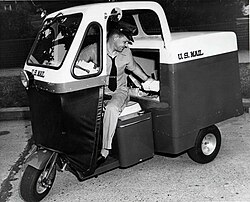
In the 1950s and 1960s, the [[United States Post Office Department|United States Post Office]] (replaced in 1971 by the [[United States Postal Service]]) used the [[Westcoaster Mailster|WestCoaster Mailster]], a close relative of the tuk-tuk.<ref>{{cite web |url=http://www.postalmuseum.si.edu/exhibits/2c3a_mailsters.html|archive-url=https://web.archive.org/web/20090825043821/http://www.postalmuseum.si.edu/exhibits/2c3a_mailsters.html|url-status=dead|archive-date=25 August 2009|title=National Postal Museum|date=25 August 2009 }}</ref> Similar vehicles remain in limited use for parking enforcement, mall security, and other niche applications. After a short time on the market (Mid-2000s to 2008) in the United States,<ref>{{Cite web|url=https://www.autoblog.com/2009/04/15/tuk-tuk-usa-gets-dot-and-epa-approval/|title=Tuk Tuk USA gets DOT and EPA approval|website=Autoblog|date=15 April 2009 }}</ref> the vehicles failed to gain popularity in the United States, and as a result, are no longer available. The Manufacturer [[Bajaj Auto|Bajaj]] cited the manual transmissions aboard the three-wheelers as the reason for poor sales. As a result of modifications that made the machines [[United States Environmental Protection Agency|EPA]] and [[Department of Transportation (U.S.)|DOT]] compliant, the vehicles that were sold are still street-legal.<ref>{{Cite web|url=https://www.autoblog.com/2008/05/02/bajaj-3-wheeler-is-now-off-the-u-s-market/|title=Bajaj 3-Wheeler is now off the U.S. market|website=Autoblog|date=2 May 2008 }}</ref> | |||
[[File:Cushman Mailster, 1955.jpg|thumb|center|Westcoaster Mailster]] | |||
[[File: | |||
==== | Auto rickshaws are rarely seen in the United States, However there are companies that operate them as taxis, affordable transportation services, or rentals, usually in urban areas like Tuk Tuk Chicago in [[Chicago]], Capital Tuk-Tuk in [[Sacramento]], eTuk Ride Denver in [[Denver]], the Boston rickshaw company in [[Boston]] and several more.<ref>{{Cite web|url=https://tuktuk-chicago.com/|title=Tuk Tuk Chicago – Do You Tuk Tuk?}}</ref><ref>{{Cite web|url=https://capitaltuktuk.com/|title=Eco-Friendly Tour - Capital Tuk Tuk | Sacramento, CA|website=Capital Tuk Tuk}}</ref><ref>{{Cite web|url=https://etukride.com/|title=eTuk Locations - Electric Tuk Tuk City Tours & Brewery Crawls - eTuk Ride|website=eTuk}}</ref><ref>{{cite web | url=https://bostonrickshaw.com/about-us/ | title=About Us | date=4 February 2020 }}</ref><ref>{{Cite web|url=https://www.ragstorickshaws.com/|title=Rickshaw Rental Service for Events|website=Rags to Rickshaws}}</ref><ref>{{Cite web|url=https://texas-tuktuks.com/|title=Texas Tuk tuks|first=Texas Tuk|last=tuks|website=Texas Tuk tuks}}</ref><ref>{{Cite web|url=https://gotukn.com/|title=Things to do in Jacksonville | Jacksonville Tours & Transportation|website=Go Tuk'n}}</ref><ref>{{Cite web|url=https://rvatuktuk.com/|title=Home - RVATukTuk The fun, unique way to experience Richmond Book your adventure.}}</ref><ref>{{Cite web|url=https://bostonrickshaw.com/|title=Boston Rickshaw Company|website=Boston Rickshaw Company}}</ref><ref>{{Cite web|url=https://www.travelagewest.com/Travel/USA-Canada/Been-There-Do-This-eTuk-Ride-Portland-in-Oregon|title=Been There, Do This: eTuk Ride Portland in Oregon|first=Emma |last=Weissmann|date=November 13, 2019|website=TravelAge West}}</ref><ref>{{Cite web|url=https://www.cyclepub.com/|title=Home|website=Cycle Pub}}</ref><ref>{{Cite web|url=https://lucky-tuk-tuk.com/|title=Lucky Tuk Tuk Private Tours – Private Small Group Sightseeing Tours in San Francisco}}</ref> | ||
The [[New York Police Department]] (NYPD) operates auto rickshaws that they call “three-wheel patrol scooters”. The patrol scooters are used for parking and traffic enforcement on city streets and to patrol places that most cars can't – like the narrow paths in [[Central Park]]. The NYPD patrol scooters started being replaced in 2016 with [[Smart Fortwo]]s. The NYPD believes that the Smart Fourtwos are safer, more comfortable, and more affordable, than the three-wheel patrol scooters due to the Smart Fourtwos coming with features that the patrol scooters lack like air conditioning, and airbags, while also costing about $6,000 less. The Smart Fortwos can also be driven on highways if needed. The Smart Fortwos are also said to be more “approachable” and “friendlier looking” which helps with [[public relations]].<ref>{{Cite web|url=https://www.cbsnews.com/news/nypd-smart-cars-cruisers-approachable-attention/|title=NYPD's "kissable and huggable" Smart cars receive flood of attention|website=www.cbsnews.com|date=27 June 2017}}</ref> | |||
====Cuba==== | ==== Cuba ==== | ||
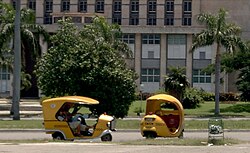
In Cuba, the autorickshaws are small and look like a coconut, hence the name [[Cocotaxi]]. [[File:Cocotaxis.jpg|thumb|Cocotaxis in Havana, Cuba]] | In Cuba, the autorickshaws are small and look like a coconut, hence the name [[Cocotaxi]]. [[File:Cocotaxis.jpg|thumb|Cocotaxis in Havana, Cuba]] | ||
==== Mexico ==== | |||
Some auto rickshaws have been and are still used in Mexico, Such as in [[Mexico City|Rickshaws in Mexico City]].<ref>{{Cite web|url=https://www.shoreexcursionsgroup.com/tour/ensenada-tuk-tuk-beach-and-bar/mxentukbch#:~:text=Experience+Ensenada's+must-see+sights,Price:+$105.00|title=Ensenada Tuk Tuk, Beach and Bar | Ensenada Shore Excursion | Mexican Riviera Cruise Tours|website=Shore Excursions Group}}</ref><ref>{{Cite web |title=gpsKevin Adventure Rides - Tuk Tuk Oaxaca |url=https://www.gpskevinadventurerides.com/upcoming-rides/tuk-tuk-oaxaca |access-date=2025-01-15 |website=www.gpskevinadventurerides.com |language=en-US}}</ref><ref>{{Cite web |last=Hilden |first=Nick |date=2024-05-06 |title=Everything I Learned on Mexico's New Highway Connecting Oaxaca City to the Coast |url=https://www.thrillist.com/travel/nation/mexico-new-highway-oaxaca-city-puerto-escondido |access-date=2025-01-15 |website=Thrillist |language=en}}</ref> | |||
=== South America === | === South America === | ||
==== Peru ==== | |||
In Peru, a version of this vehicle is called a motocar<ref>{{cite web |url=http://www.peru-motor.com/motocar/ |title=Motocar |website=Perú Motor |archive-url=https://web.archive.org/web/20181003154015/http://www.peru-motor.com/motocar |archive-date=3 October 2018}}</ref> or mototaxi.<ref>{{cite web |url=https://www.tripsavvy.com/mototaxis-in-peru-1619752 |title=A Traveler's Guide to Mototaxis in Peru |author=Tony Dunnell |date=28 July 2017 |publisher=tripsavvy |access-date=27 November 2017}}</ref> | |||
==== Bolivia ==== | |||
Auto Rickshaws are seen in Bolivia.<ref>{{Cite web|url=https://www.smh.com.au/national/australian-man-s-seven-year-tuk-tuk-journey-from-argentina-to-alaska-20230407-p5cyx9.html?js-chunk-not-found-refresh=true|title=Australian man's seven-year tuk-tuk journey from Argentina to Alaska|first=Amber|last=Schultz|date=April 15, 2023|website=The Sydney Morning Herald}}</ref><ref>https://www.couriermail.com.au/news/queensland/trouble-strikes-ryan-magee-aussieespanol-on-his-tuk-tuk-travels/news-story/de5faae1816a5b51c9f7626624a7e4f1?amp&nk=11387282b59daa33d2f6f4a6926d7d47-1740345984</ref> | |||
==== Brazil ==== | |||
[[Uber]] allows auto rickshaws to be used by drivers.<ref>{{Cite web|url=https://www.riotimesonline.com/brazil-news/miscellaneous/uber-launches-tuk-tuk-in-brazil/|title=Uber Launches "Tuk-tuk" in Brazil|first=Lachlan|last=Williams|date=January 29, 2020}}</ref><ref>{{Cite web|url=https://3wheeledcheese.wordpress.com/2012/06/21/the-tuk-tuk-is-here-to-stay-in-sao-paulo/|title=THE TUK TUK IS HERE TO STAY IN BRAZIL|date=June 21, 2012}}</ref><ref>{{Cite web|url=https://www.news18.com/auto/bajaj-auto-confirms-production-unit-in-brazil-expands-global-production-to-100-countries-8946418.html|title=Bajaj Auto Confirms Production Unit In Brazil; Expands Global Production To 100 Countries|website=News18}}</ref> | |||
==== Colombia ==== | |||
Tuk tuks or moto-taxis are used in some towns and cities in Colombia such as [[Jardín]], [[Guatapé]], or [[San Rafael, Antioquia|San Rafael]] in [[Antioquia Department|Antioquia]]. | |||
<ref>{{Cite web|url=https://www.elcarrocolombiano.com/transporte/colombia-10-de-las-personas-que-se-movilizan-lo-hacen-en-tuk-tuks/|title=En Colombia, 10% de las personas que se movilizan lo hacen en "Tuk Tuks"|first=Jessica Paola Vera|last=García|date=August 28, 2023|website=El Carro Colombiano}}</ref> | |||
=== Australia and Oceania === | |||
==== Australia ==== | |||
[[Ikea]] did a trial run using Electric Auto Rickshaws in [[Sydney|Sydney, Australia]] to deliver packages to customers from May to August 2023.<ref>{{Cite web |last=Hart |first=Amalyah |date=2023-05-16 |title=Electric tuk tuks to make deliveries for Ikea customers in Sydney |url=https://thedriven.io/2023/05/17/electric-tuk-tuks-to-make-deliveries-for-ikea-customers-in-sydney/ |access-date=2025-01-15 |website=The Driven |language=en-AU}}</ref> | |||
A company called Just Tuk'n Around using both pedal powered rickshaws and electric auto rickshaws carries tourists around in Airlie Beach.<ref>{{Cite web |title=Tuk Tuk Tours |url=https://www.justtuknaround.com.au/ |access-date=2025-01-15 |website=Just Tuk'n Around |language=en}}</ref> | |||
==== New Zealand ==== | |||
Mount Cook Alpine Salmon uses Auto rickshaws on its farms to move equipment and people around.<ref>{{Cite web |date=2024-04-19 |title=Tuk-tuk trial on Canterbury salmon farm |url=https://www.odt.co.nz/star-news/star-districts/tuk-tuk-trial-canterbury-salmon-farm |access-date=2025-01-15 |website=[[Otago Daily Times]] |language=en}}</ref> | |||
A company using auto rickshaws called Tuk Tuk Taxi operates in [[Wānaka]] in the South Island.<ref>{{Cite web |title=Wanaka taxi Services by Tuk Tuk Taxi {{!}} Call now-0800885800 |url=https://tuktuktaxi.co.nz/ |access-date=2025-01-15 |language=en-US}}</ref> | |||
A company using auto rickshaws called Tuk Tuk NZ used to operate in Wellington.<ref name="auto">{{Cite web |date=2016-08-17 |title=Tuk tuk start up hits red tape speed bump |url=https://www.nzherald.co.nz/business/small-business/tuk-tuk-start-up-hits-red-tape-speed-bump/M6YOGNDVAVNANST5CUI3WYHCBY/ |access-date=2025-01-15 |website=[[The New Zealand Herald]] |language=en-NZ}}</ref><ref>{{Cite web |title=Engineer penalised for signing off on Auckland tuk-tuk safety despite having never viewed them |url=https://www.1news.co.nz/2020/01/14/engineer-penalised-for-signing-off-on-auckland-tuk-tuk-safety-despite-having-never-viewed-them/ |access-date=2025-01-15 |website=[[1News]] |language=en}}</ref> | |||
A company using auto rickshaws called Kiwi Tuk Tuk used to operate in Auckland.<ref>{{Cite web |title=Kiwi Tuk Tuk Limited {{!}} GetYourGuide Supplier |url=https://www.getyourguide.com/kiwi-tuk-tuk-limited-s230548/ |access-date=2025-01-15 |website=[[GetYourGuide]] |language=en-US}}</ref><ref name="auto"/> | |||
== Fuel efficiency and pollution == | == Fuel efficiency and pollution == | ||
In July 1998, the [[Supreme Court of India]] ordered the government of Delhi to implement [[Compressed natural gas|CNG]] or [[Liquefied petroleum gas|LPG]] ([[Autogas]]) [[fuel]] for all autos and for the entire bus fleet in and around the city. Delhi's air quality has improved with the switch to CNG. Initially, auto rickshaw drivers in Delhi had to wait in long queues for CNG refueling, but the situation improved following an increase in the number of CNG stations. Gradually, many state governments passed similar laws, thus shifting to CNG or LPG vehicles in most large cities to improve air quality and reduce pollution. Certain local governments are pushing for [[four-stroke engine]]s instead of two-stroke ones. Typical [[fuel economy in automobiles|mileage]] for an Indian-made auto rickshaw is around {{convert|35|km/L}} of petrol. Pakistan has passed a similar law prohibiting auto rickshaws in certain areas. CNG auto rickshaws have started to appear in huge numbers in many Pakistani cities.{{citation needed|date=April 2013}} | |||
In July 1998, the [[Supreme Court of India]] ordered the | |||
In January 2007 the Sri Lankan government also banned two-stroke trishaws to reduce air pollution. In the Philippines<ref>{{cite web |url=http://www.engr.colostate.edu/news/print/index.cfm?id=402 | title=Envirofit's Tricycle Retrofit Program Funded | access-date=2011-03-22 | date=19 May 2006 | publisher=Colorado State University | url-status=dead | archive-url=https://web.archive.org/web/20110929002935/http://www.engr.colostate.edu/news/print/index.cfm?id=402 | archive-date=29 September 2011}}</ref> there are projects to convert | In January 2007 the Sri Lankan government also banned two-stroke trishaws to reduce air pollution. In the Philippines<ref>{{cite web |url=http://www.engr.colostate.edu/news/print/index.cfm?id=402 | title=Envirofit's Tricycle Retrofit Program Funded | access-date=2011-03-22 | date=19 May 2006 | publisher=Colorado State University | url-status=dead | archive-url=https://web.archive.org/web/20110929002935/http://www.engr.colostate.edu/news/print/index.cfm?id=402 | archive-date=29 September 2011}}</ref> there are projects to convert carbureted two-stroke engines to direct-injected via [[Envirofit International#Two-stroke engine direct injection retrofit|Envirofit]] technology. Research has shown LPG or CNG gas direct-injection can be retrofitted to existing engines, in similar fashion to the Envirofit system.<ref>{{cite web |url=http://www.skyshorz.com/university/publications/Gitano_SAESETC2007_LPG2T.pdf |title=Microsoft Word{{Snd}} SETC_LPG2T.doc |access-date=2010-04-03}}</ref> In [[Vigan City]] majority of tricycles-for-hire as of 2008 are powered by motorcycles with four-stroke engines, as tricycles with two-stroke motorcycles are prevented from receiving operating permits. Direct injection is standard equipment on new machines in India.<ref>{{cite news |date=2007-12-09 |title=Bajaj rolls out low-emission fuel-efficient autorickshaw |url=http://www.thehindubusinessline.com/todays-paper/tp-corporate/article1676981.ece |newspaper=Business Line |publisher=The Hindu |access-date=2010-04-03}}</ref><ref>{{cite web |url=http://www.greencarcongress.com/2007/05/bajaj_begins_pr.html |title=Bajaj Begins Production of 2-Stroke Direct-Injection Auto Rickshaw |publisher=Green Car Congress |date=2007-05-18 |access-date=2010-04-03}}</ref> | ||
In March 2009 an international consortium coordinated by the [[International Centre for Hydrogen Energy Technologies]] initiated a two-year public-private partnership of local and international stakeholders aiming at operating a fleet of 15 hydrogen-fueled three-wheeled vehicles in New Delhi's [[Pragati Maidan]] complex.<ref>{{cite web |url=http://www.unido-ichet.org/index.php?lang=en&option=com_content&Itemid=&view=article&id=363%3Aa-fleet-of-hydrogen-rickshaws-to-circulate-in-new-delhi-by-2010 |title=A fleet of hydrogen rickshaws to circulate in New Delhi by 2010 |access-date=2011-03-22 |publisher=International Centre for Hydrogen Energy Technologies |url-status=dead |archive-url=https://web.archive.org/web/20110728144846/http://www.unido-ichet.org/index.php?lang=en&option=com_content&Itemid=&view=article&id=363%3Aa-fleet-of-hydrogen-rickshaws-to-circulate-in-new-delhi-by-2010 |archive-date=2011-07-28 }}</ref> As of January 2011, the project was nearing completion.{{citation needed|date=April 2013}} | In March 2009 an international consortium coordinated by the [[International Centre for Hydrogen Energy Technologies]] initiated a two-year public-private partnership of local and international stakeholders aiming at operating a fleet of 15 hydrogen-fueled three-wheeled vehicles in New Delhi's [[Pragati Maidan]] complex.<ref>{{cite web |url=http://www.unido-ichet.org/index.php?lang=en&option=com_content&Itemid=&view=article&id=363%3Aa-fleet-of-hydrogen-rickshaws-to-circulate-in-new-delhi-by-2010 |title=A fleet of hydrogen rickshaws to circulate in New Delhi by 2010 |access-date=2011-03-22 |publisher=International Centre for Hydrogen Energy Technologies |url-status=dead |archive-url=https://web.archive.org/web/20110728144846/http://www.unido-ichet.org/index.php?lang=en&option=com_content&Itemid=&view=article&id=363%3Aa-fleet-of-hydrogen-rickshaws-to-circulate-in-new-delhi-by-2010 |archive-date=2011-07-28 }}</ref> As of January 2011, the project was nearing completion.{{citation needed|date=April 2013}} | ||
[[Hydrogen internal combustion engine|Hydrogen internal combustion]] (HICV) use in three-wheelers has only recently | [[Hydrogen internal combustion engine|Hydrogen internal combustion]] (HICV) use in three-wheelers has only recently begun to be looked into, mainly by developing countries, to decrease local pollution at an affordable cost.<ref>{{Cite web|url=https://biblio.ugent.be/publication/818298/file/818329|title=Hydrogen-Fueled Internal Combustion Engines, see page 7}}</ref><ref>{{Cite web|url=https://www.fischer-tropsch.org/DOE/DOE_reports/42060/42060-FNL.pdf|title=Clean Hydrogen Technology for 3-Wheel Transportation in India}}</ref> At some point, [[Bajaj Auto]] made a HICV auto rickshaw together with the company "[[Energy Conversion Devices]]".<ref name="thecityfix.com">{{cite web |url=https://thecityfix.com/blog/india-showcases-hydrogen-fuel-auto-rickshaws/ |title=India Showcases Hydrogen Fuel Auto-Rickshaws {{pipe}} |date=21 February 2012}}</ref> They made a report on it called "Clean Hydrogen Technology for 3-Wheel Transportation in India" and it stated that the performance was comparable with CNG autos. In 2012, Mahindra & Mahindra showcased their first HICV auto rickshaw, called the Mahindra HyAlfa.<ref name="thecityfix.com"/> The development of the hydrogen-powered rickshaw happened with support from the [[International Centre for Hydrogen Energy Technologies]]. | ||
In 2012, Mahindra & Mahindra showcased their first HICV auto rickshaw, called the | |||
== World records == | |||
On 16 September 2022, at 11:04 a.m. (Indian Standard Time), a Canadian team (Greg Harris and Priya Singh) and a Swiss team (Michele Daryanani and Nevena Lazarevic) set the world record for the highest altitude at which an auto rickshaw has ever been driven. The world record was officially recognized and certified by Guinness World Records on October 10, 2024.<ref>{{cite web | url=https://www.guinnessworldrecords.com/world-records/746257-highest-altitude-achieved-in-an-auto-rickshaw | title=Highest altitude achieved in an auto rickshaw }}</ref> The two teams set the record by driving to the summit of [[Umling La]] Pass at an altitude of {{convert|5798|m|ft|abbr=off|sp=us}}.<ref>{{Cite web|url=https://www.upi.com/Odd_News/2022/10/25/india-Richshaw-Run-world-record-altitude/7301666713774/|title=Look: Auto rickshaws take world's highest road to set world record - UPI.com|website=UPI}}</ref> | |||
The two teams were participating in the [[Rickshaw Run]] (Himalayan Edition), an event promoted by The Adventurists, where teams drive auto rickshaws from the [[Thar Desert|Thar desert]] town of [[Jaisalmer]] in Rajasthan to the [[Himalayas|Himalayan]] town of [[Leh]] in [[Ladakh]]. Rickshaw Run teams are given the start and finish lines, but are otherwise unsupported and left to their own navigational choices in completing the approximately 2,300 km journey. | |||
The road at Umling La Pass was constructed by India's Border Roads Organization and completed in 2017. Guinness World Records certified the road as the highest motorable road in the world.<ref>{{Cite web|url=https://www.guinnessworldrecords.com/world-records/62927-highest-road|title=Highest altitude road|website=Guinness World Records}}</ref> | |||
== See also == | == See also == | ||
* [[Electric rickshaw]] | |||
* [[Fuel gas-powered scooter]] | * [[Fuel gas-powered scooter]] | ||
* [[Formic acid vehicle]]: a type of hydrogen-based vehicle | * [[Formic acid vehicle]]: a type of hydrogen-based vehicle | ||
| Line 243: | Line 333: | ||
* [[Rickshaw (disambiguation)]] | * [[Rickshaw (disambiguation)]] | ||
== | == Explanatory notes == | ||
{{Reflist|group="nb"}} | {{Reflist|group="nb"}} | ||
| Line 251: | Line 341: | ||
== External links == | == External links == | ||
{{Commons category|Auto-rickshaws}} | {{Commons category|Auto-rickshaws}} | ||
* [https://www.wired.com/wired/archive/15.01/posts.html?pg=5 The India 1000]{{Snd}} an article in [[Wired (magazine)|Wired]] about auto rickshaw racing | * [https://www.wired.com/wired/archive/15.01/posts.html?pg=5 The India 1000]{{Snd}} an article in [[Wired (magazine)|''Wired'']] about auto rickshaw racing | ||
{{ | {{Public transport}} | ||
[[Category:Rickshaws]] | [[Category:Rickshaws]] | ||
[[Category:Public transport in India]] | [[Category:Public transport in India]] | ||
[[Category:Public transport in Nigeria]] | |||
[[Category:Public transport in Southeast Asia]] | |||
[[Category:Public transport in Thailand]] | [[Category:Public transport in Thailand]] | ||
[[Category:Public transportation in the Philippines]] | |||
[[Category:Road transport in Egypt]] | [[Category:Road transport in Egypt]] | ||
[[Category:Road transport in Pakistan]] | [[Category:Road transport in Pakistan]] | ||
[[Category: | [[Category:Three-wheeled motor vehicles| ]] | ||
[[Category: | [[Category:Vehicles for hire]] | ||
Latest revision as of 10:02, 5 May 2026

An auto rickshaw is a motorized version of the pulled rickshaw or cycle rickshaw.[1] Often called a tuk tuk, it is usually a three-wheeled vehicle, powered by an engine.[2] They use a variety of fuels, with the most common being petrol, compressed natural gas, liquefied petroleum gas, and electricity. They are known by various other names and across various different countries.
The auto rickshaw is a common form of transport around the world (especially in South Asian countries like Bangladesh, India and Pakistan) both as a vehicle for hire and private use. They are especially common in countries with tropical or subtropical climate since they are usually not fully enclosed, and in many developing countries because they are relatively inexpensive to own and operate.
There are different auto rickshaw designs. The most common type used for passenger transport is characterized by a sheet-metal body resting on three wheels with a canvas roof and drop-down side curtains. The driver is seated in a small cabin at the front and operates handlebar controls with a space for carrying up to three passengers in the back.[3] The cargo versions might have an open space at the rear. A simpler version might have an expanded sidecar mounted on a three wheeled motorcycle.
As of 2023[update], India is the largest market for electric auto rickshaws, bypassing China.[4] As of 2024[update], Bajaj Auto of India is the world's largest auto rickshaw manufacturer.[5]
Origin[edit | edit source]
.jpg)


In the 1930s Japan, which was the most industrialized country in Asia at the time, encouraged the development of motorized vehicles including less expensive three-wheeled vehicles based on motorcycles. The Mazda-Go, a 3-wheel open "truck" released in 1931,[6] is often considered the first of what became auto rickshaws. Later that decade the Japanese Ministry of Posts and Telecommunications of Japan distributed about 20,000 used three-wheelers to Southeast Asia as part of efforts to expand its influence in the region.[7][8][9][10] They became popular in some areas, especially Thailand, which developed local manufacturing and design after the Japanese government abolished the three-wheeler license in Japan in 1965.[11]
Production in Southeast Asia started from the knockdown production of the Daihatsu Midget, which was introduced in 1959.[12] An exception is the indigenously modified Philippine tricycle, which originates from the Rikuo Type 97 motorcycle with a sidecar, introduced to the islands in 1941 by the Imperial Japanese Army during World War II.[13]
In Asia, Corradino D'Ascanio, aircraft designer at Piaggio and inventor of the Vespa, came up with the idea of building a light three-wheeled commercial vehicle to power Italy's post-war economic reconstruction. The Piaggio Ape followed suit in 1947. Innocenti, another leading Scooter manufacturer, also came up with their Lambretta line of three wheelers in a cargo version, later adopted as a passenger version by its Indian colloborator Automobile Products of India.
Regional variations[edit | edit source]
Africa and the Middle East[edit | edit source]
Algeria[edit | edit source]
![[icon]](/wiki/File:Wiki_letter_w_cropped.svg) | This section needs expansion. You can help by adding to it. (April 2025) |
Egypt[edit | edit source]
Locally named the "tuktuk", the rickshaw is used as a means of transportation in most parts of Egypt. It is generally rare to find in some affluent and newer parts of cities such as New Cairo and Heliopolis; and on highways due to police control and enforcement.
Gaza[edit | edit source]
Together with the recent boom of recreational facilities in Gaza for the local residents, donkey carts have all but been displaced by tuk-tuks in 2010. Due to the ban by Egypt and Israel on the import of most motorised vehicles, the tuk-tuks have had to be smuggled in parts through the tunnel network connecting Gaza with Egypt.[14]
Iraq[edit | edit source]
Due to extreme congestion in Baghdad and other Iraqi cities combined with the insensible cost of vehicles in relation to frequent violence, rickshaws have been imported from India in large numbers to provide taxi service and other purposes, in stark contrast to previous attitudes of the pre-U.S. 2003 invasion eras with rickshaws being disdained and sedans being held in high regard as a status symbol. Rickshaws have been noted for being instrumental in political protest revolts.[15][16][17][18][19]
Kenya[edit | edit source]
.jpg)
Locally named 'Tuktuk', the rickshaw is used as a means of transportation in some parts of Kenya.
Madagascar[edit | edit source]
In Madagascar, man-powered rickshaws are a common form of transportation in a number of cities, especially Antsirabe. They are known as "posy" from pousse-pousse, meaning push-push. Cycle rickshaws took off since 2006 in a number of flat cities like Toamasina and replaced the major part of the posy, and are now threatened by the auto rickshaws, introduced in 2009. Provincial capitals like Toamasina, Mahajanga, Toliara, and Antsiranana are taking to them rapidly.[citation needed] They are known as "bajaji" in the north and "tuk-tuk" or "tik-tik" in the east, and are now licensed to operate as taxis.[citation needed] They are not yet allowed an operating licence in the congested, and more polluted national capital, Antananarivo.[citation needed][20][21][22]
Morocco[edit | edit source]
In Morocco, there are Auto-rickshaws in Rabat, Casablanca and Marrakesh.
Nigeria[edit | edit source]

The auto rickshaw is used to provide transportation in cities all over Nigeria. Popularity and use varies across the country. In Lagos, for example, the "keke" (Yoruba for bicycle) is regulated and transportation around the state's highways is prohibited while in Kano it's popularly known as "Adaidaita Sahu".[23]
South Africa[edit | edit source]
.jpg)
Tuk-tuks, introduced in Durban[24] in the late 1980s, have enjoyed growing popularity in recent years, particularly in Gauteng.[25] In Cape Town they are used to deliver groceries and, more recently, transport tourists.[26][27]

Sudan[edit | edit source]
Rickshaws, known as "Raksha" in Sudan, are the most common means of transportation, followed by the bus, in the capital Khartoum.
Tanzania[edit | edit source]
Locally known as "bajaji", they are a common mode of transportation in Dar es Salaam, and many other cities and villages.[28]
Tunisia[edit | edit source]
| This section needs expansion. You can help by adding to it. (April 2025) |
Uganda[edit | edit source]
A local delivery company called as Sokowatch in 2020 began a pilot project using electric tuk-tuks, to cut pollution.[29]
Zimbabwe[edit | edit source]

Hende Moto EV & Taxi company was founded in 2019 by Devine Mafa, an American-Zimbabwean businessman. Hende Moto taxis were first introduced in Zimbabwe as the first vehicle manufactured by Zimbabwean three-wheeler manufacturing company Hende Moto Pvt Ltd. The first Hende Moto Taxi was introduced in Kwekwe in August 2019, and thereafter in Victoria Falls City and then Harare in 2019. Hende Moto is also the manufacturer of the first Zimbabwean-made electric passenger three-wheeled vehicle. It operates on a lithium-ion battery that has a range of 70 miles on a 6-hour charge.[citation needed]
South Asia[edit | edit source]
Afghanistan[edit | edit source]

Auto rickshaws are very common in the eastern Afghan city of Jalalabad, where they are popularly decorated in art and colors.[30] They are also popular in the northern city of Kunduz.[31]
Bangladesh[edit | edit source]

Auto rickshaws (locally called "baby taxis", "Bangla Teslas" for electric ones[32] or "CNGs" for those running on compressed natural gas) are one of the more popular modes of transport in Bangladesh mainly due to their size and speed. They are best suited to narrow, crowded streets, and are thus the principal means of covering longer distances within urban areas.[33]
Two-stroke engines had been identified as one of the leading sources of air pollution in Dhaka. Thus, since January 2003, traditional auto rickshaws were banned from the capital; only the new natural gas-powered models (CNG) were permitted to operate within the city limits. All CNGs are painted green to signify that the vehicles are eco-friendly and that each one has a meter built-in.[34]
As of 2025, auto rickshaws in Bangladesh are predominantly electric. There were around 4 million unregistered electric auto rickshaws circulating in Bangladesh by 2025, up from 200,000 in 2016. They constitute "perhaps the world’s biggest informal EV fleet."[32]
India[edit | edit source]

.JPG)
Most cities offer auto rickshaw services, although cycle rickshaws and hand-pulled rickshaws are also available but rarely in certain remote areas, as all other cities began using auto rickshaws. [35]:15,57,156 Many state governments have launched an initiative of women-friendly rickshaw service called the Pink Rickshaws driven by women.[36] The drivers are known as the "Rickshaw-wallah", auto-wallah, tuktuk-wallah or auto-kaaran in places like Tamil Nadu/Kerala . Auto-rickshaws are also known as tempos in some parts of India.[37]
Auto rickshaws are used in cities and towns for short distances; they are less suited to long distances because they are slow and the carriages are open to air pollution.[35]:57,58,110 Auto rickshaws (often called "autos") provide cheap and efficient transportation. Modern auto rickshaws run on electricity as the government pushes for e-mobility through its FAME-II scheme, compressed natural gas (CNG) and liquified petroleum gas (LPG) due to government regulations and are environmentally friendly compared to full-sized cars.[citation needed][nb 1]
To augment the speedy movement of traffic, auto rickshaws are not allowed in the southern part of the Mumbai.[38]
India is the location of the annual Rickshaw Run.
There are two types of auto rickshaws in India. In older versions the engines were below the driver's seat, while in newer versions engines are in the rear. They normally run on petrol, CNG, or diesel. The seating capacity of a normal rickshaw is four, including the driver's seat. Six-seater rickshaws exist in different parts of the country, but the model was officially banned in the city of Pune on 10 January 2003 by the Regional Transport Authority (RTA).[39]
Apart from this, modern electric auto rickshaws, which operate on electric motors and offer high torque and loading capacity with better speed, are also gaining popularity in India. Many auto drivers have switched to electric three-wheelers due to the high prices of CNG and diesel, making traditional auto rickshaws much more expensive compared to their electric counterparts. The government is also taking steps to convert existing CNG and diesel rickshaws to electric models.[40]
CNG autos in many cities (e.g. Delhi, Agra) are distinguishable from the earlier petrol-powered autos by a green and yellow livery, as opposed to the earlier black and yellow appearance. In other cities (such as Mumbai) the only distinguishing feature is the 'CNG' print found on the back or side of the auto. Some local governments are considering four-stroke engines instead of two-stroke versions.[citation needed]
Notable auto rickshaw manufacturers in India include Bajaj Auto, Mahindra & Mahindra, Piaggio Ape, Atul Auto, Kerala Automobiles Limited, TVS Motors and Force Motors.
In Delhi there also used to be a variant powered by a Harley-Davidson engine called the phat-phati, because of the sound it made. The story goes that shortly after the Independence of India, a stock of Harley-Davidson motorbikes that had been used by British troops during World War II were found to be left behind in a military storage house in Delhi. Drivers purchased these bikes, added on a gear box (probably from a Willys jeep), welded on a passenger compartment that was good for four to six passengers, and put the unconventional vehicles onto the roads. A 1998 ruling of the Supreme Court against the use of polluting vehicles finally signed the death warrant of Delhi's phat-phatis.[41][42]
As of 2022[update], India has about 2.4 million battery-powered, three-wheeled rickshaws on its roads. Some 11,000 new ones hit the streets each month, creating a US$3.1 billion market. Manufacturers include Mahindra & Mahindra Ltd. and Kinetic Engineering. A prerequisite for the adoption to electric vehicles is the availability of charging stations; as of early 2024, India had 12,146 public EV charging stations operational across the country.[43]
-
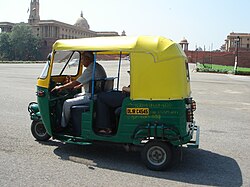 CNG green auto rickshaw in New Delhi
 -
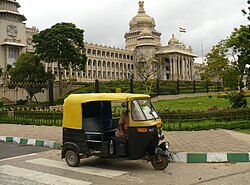 A Bajaj Auto rickshaw in Bangalore
 -
 A Piaggio Ape auto rickshaw in Kerala
 -
 A TVS auto rickshaw in Chennai
 -
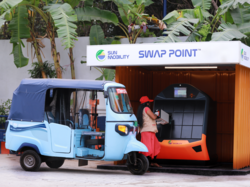 An electric rickshaw at a battery swapping point
 -
 Three wheeler cargo auto-rickshaw used in India
 -
 Indian auto-rickshaw adapted with trailer
 -
 Erisha electric passenger and cargo Auto rickshaws in India


.jpg)


Generally, rickshaw fares are controlled by the government,[44] however auto (and taxi) driver unions frequently go on strike demanding fare hikes. They have also gone on strike multiple times in Delhi to protest against the government and High Court's 2012 order to install GPS systems, and even though GPS installation in public transport was made mandatory in 2015, as of 2017 compliance remains very low.[45][46][47]
The 200 cc variant of the Bajaj Auto auto rickshaw was used in the 2022 Rickshaw Run to set the record for the world's highest auto rickshaw, over the Umling La Pass, at 5,798 meters (19,022 feet)[48][49]
Nepal[edit | edit source]
Auto rickshaws were a popular mode of transport in Nepal during the 1980s and 1990s, until the government banned the movement of 600 such vehicles in the early 2000s.[50] The earliest auto rickshaws running in Kathmandu were manufactured by Bajaj Auto.[citation needed]
Nepal has been a popular destination for the Rickshaw Run. The 2009 Fall Run took place in Goa, India and ended in Pokhara, Nepal.[51]
Pakistan[edit | edit source]
Auto rickshaws are a popular mode of transport in Pakistani towns[52] and are mainly used for travelling short distances within cities. One of the major manufacturers of auto rickshaws is Piaggio. The government is taking measures to convert all gasoline powered auto rickshaws to cleaner CNG rickshaws by 2015. In relation to that, Environment Canada is implementing pilot projects in Lahore, Karachi, and Quetta with engine technology developed in Mississauga, Ontario, Canada that uses CNG instead of gasoline in two-stroke engines, in an effort to combat environmental pollution and noise levels.[citation needed] However, as CNG rickshaws became less popular, more expensive and inefficient, the government started promoting electric rickshaws instead by issuing easy loans through commercial banks in all the major cities of Pakistan.
In many cities in Pakistan, there are also motorcycle rickshaws, usually called "chand gari" (moon car) or "chingchi", after the Chinese company Jinan Qingqi Motorcycle Co. Ltd who first introduced these to the market.[citation needed]
There are many rickshaw manufacturers in Pakistan. Lahore is the hub of CNG auto rickshaw manufacturing. Manufacturers include: New Asia automobile Pvt, Ltd; AECO Export Company; STAHLCO Motors; Global Sources; Parhiyar Automobiles; Global Ledsys Technologies; Siwa Industries; Prime Punjab Automobiles; Murshid Farm Industries; Sazgar Automobiles; NTN Enterprises; and Imperial Engineering Company.


Sri Lanka[edit | edit source]

Auto rickshaws, commonly known as three-wheelers, tuk-tuks (Sinhala: ටුක් ටුක්, pronounced [ṭuk ṭuk]), autos, or trishaws can be found on all roads in Sri Lanka transporting people or freight. Sri Lankan three-wheelers are of the style of the light Phnom Penh-type. Most of the three-wheelers in Sri Lanka are a slightly modified Indian Bajaj model, imported from India. Although there are a few models which are manufactured locally, imports from other countries in the region including other brands of three-wheelers, such as the Piaggio Ape, are increasing. Three-wheelers were introduced to Sri Lanka for the first time around 1979 by Richard Pieris & Company. As of mid-2018,[update] a new gasoline powered tuk-tuk typically costs around US$4,300, while a newly introduced Chinese electric model cost around US$5,900.[53] Since 2008, the Sri Lankan government has banned the import of all 2-stroke gasoline engines due to environmental concerns.[53] Models imported to the island are now four-stroke engines.
Most three-wheelers are available as hired vehicles, with some being used for hauling goods, as advertising vehicles, or for private company usage. Bajaj enjoys a virtual monopoly in the island, with its agent being David Pieries Motor Co, Ltd.[54] A few three-wheelers in Sri Lanka have distance meters, with it becoming more and more common in the capital city. However, the vast majority of fares are negotiated between the passenger and driver. There are 1.2 million trishaws in Sri Lanka and most are on financial loans. The selling of bakery items from tuk-tuks announcing their presence with mobile phone ringtones played over loudspeakers is known as choon paan in Sri Lanka.
Southeast Asia[edit | edit source]
-
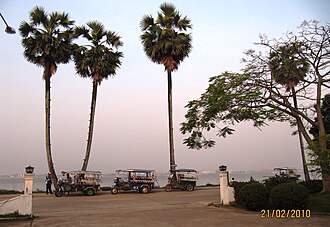 Tuktuks and palmyra palms on the Mekong bank in Thakhek, Laos
 -
 Tuk-tuk taxi sidecar in Laos
 -
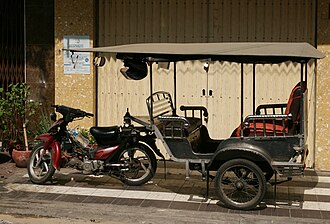 Tuk-tuk, Phnom Penh, Cambodia


.JPG)
Cambodia[edit | edit source]
In Cambodia, a passenger-carrying three-wheeled vehicle is known as រ៉ឺម៉ក rœmâk from the French remorque. It is a widely used form of transportation in the capital city of Phnom Penh and for visitors touring the Angkor temples in Siem Reap. Some have four wheels and is composed of a motorcycle (which leans) and trailer (which does not). Cambodian cities have a much lower volume of automobile traffic than Thai cities, and tuk-tuks are still the most common form of urban transport. There are more than 6,000 tuk-tuks in Phnom Penh, according to the Independent Democracy of Informal Economy Association (IDEA), a union that represents tuk-tuk drivers among other members.[55]
.jpg)


Indonesia[edit | edit source]
In Indonesia, auto rickshaws are popular in many areas such as in Jakarta, Java, Medan, Gorontalo, some parts of Sulawesi, and other places in the country. Auto rickshaws are known as Bentor in regions such as Java, Medan and Gorontalo while in Jakarta, they are known as Bajay. The term Bajay or Bajaj stems from their manufacturer, Bajaj Auto, which came from India.[56]They are available in blue (for the ones which use compressed natural gas) and orange (for normal gasoline fuel).[57] The blue ones are imported from India with the brand of Bajaj and TVS and the orange ones are the old design from 1977. The orange ones uses two-stroke engines as their prime mover, while the blue ones use four stroke engines. The orange bajaj has been banned since 2017 due to emission regulations.[58][57] The Bajaj is one of the most popular modes of transportation in the city. Outside of Jakarta, the bentor-style auto rickshaw is ubiquitous, with the passenger cabin mounted as a sidecar (like in Medan) or in-front (like the ones in some parts of Sulawesi) to a motorcycle.
-
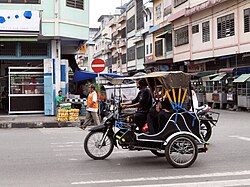 Bentor in North Sumatra
 -
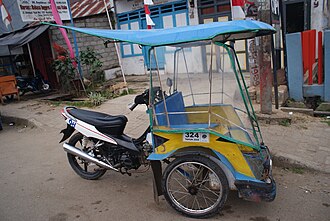 Bentor in Tana Toraja, South Sulawesi
 -
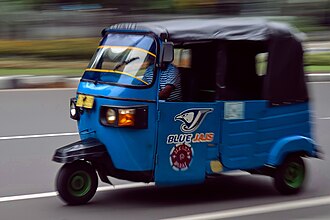 4-stroke Bajaj in Jakarta
 -
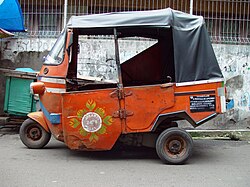 Former 2-stroke orange Bajaj in Jakarta (discontinued in 2015)


Philippines[edit | edit source]
In the Philippines, a similar mode of public transport is the "tricycle" (Filipino: traysikel; Cebuano: traysikol).[59] Unlike auto rickshaws, however, it has a motorcycle with a sidecar configuration and a different origin. The exact date of its appearance in the Philippines is unknown, but it started appearing after World War 2, roughly at the same time as the appearance of the jeepney. It is most likely derived from the Rikuo Type 97 military motorcycle used by the Imperial Japanese Army in the Philippines starting at 1941. The motorcycle was essentially a licensed copy of a Harley-Davidson with a sidecar.[13] However, there is also another hypothesis which places the origin of the tricycle to the similarly built "trisikad", a human-powered cycle rickshaw built in the same configuration as the tricycle. However, the provenance of the trisikad is also unknown. Prior to the tricycles and trisikad, the most common means of mass public transport in the Philippines is a carriage pulled by horses or carabaos known as the kalesa (calesa or carromata in Philippine Spanish).[60] The pulled rickshaw never gained acceptance in the Philippines. Americans tried to introduce it in the early 20th century, but it was strongly opposed by local Filipinos who viewed it as an undignified mode of transport that turned humans into "beasts".[61]
The design and configuration of tricycles vary widely from place to place, but tends towards rough standardization within each municipality. The usual design is a passenger or cargo sidecar fitted to a motorbike, usually on the right of the motorbike. It is rare to find one with a left sidecar. A larger variant of the tricycle with the motorcycle in the center enclosed by a passenger cab with two side benches is known as a "motorela". It is found on the islands of Mindanao, Camiguin, and Bohol.[62] Another notable variant is the tricycles of the Batanes Islands which have cabs made from wood and roofed with thatched cogon grass.[63] In Pagadian City, tricycles are also uniquely built with the passenger cab slanting upwards, due to the city's streets that run along steep hills.[64]
Tricycles can carry three passengers or more in the sidecar, one or two pillion passengers behind the driver, and even a few on the roof of the sidecar. Tricycles are one of the main contributors to air pollution in the Philippines,[65][66] which account for 45% of all volatile organic compound emissions[67] since majority of them employ two-stroke engines. However, some local governments are working towards phasing out two-stroke tricycles for ones with cleaner four-stroke engines.[65][68]
Tuk-Tuks have now been accepted as Three-Wheeled Vehicles by the Land Transportation Office (Philippines) as distinct from tricycles and are now seen in Philippine streets. On 1 January 2026, It is issued that e-trikes are prohibited on major roads of Manila.[69] Electric versions are seen in the city where it is called an e-trike,[70] while called as a Bukyo notably on Batangas and Cavite.[71] Combustion engine tuktuks are locally distributed by TVS Motors and Bajaj Auto through dealerships[72]
-
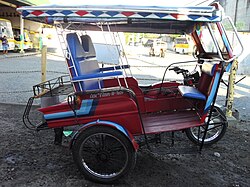 Motorized tricycle, Dumaguete
 -
 7-passenger tricycle with large sidecar, province of Aklan
 -
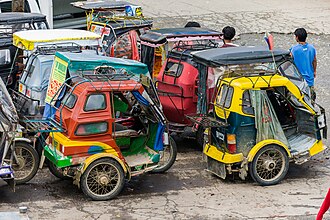 Tricycle stand, Banaue Municipal Town


Thailand[edit | edit source]
The auto rickshaw, called tuk tuk (Thai: ตุ๊ก ๆ, pronounced [túk túk]) in Thailand, is a widely used form of urban transport in Bangkok and other Thai cities. The name is onomatopoeic, mimicking the sound of a small (often two-cycle) engine. It is particularly popular where traffic congestion is a major problem, such as in Bangkok and Nakhon Ratchasima. In Bangkok in the 1960s, these were called samlo (สามล้อ, lit. 'three-wheeler'), and they are still popularly called that today.
Bangkok and other cities in Thailand have many tuk-tuks which are a more open variation on the Indian auto rickshaw. About 20,000 tuk-tuks were registered as taxis in Thailand in 2017.[73] Bangkok alone is reported to have 9,000 tuk-tuks.[74]
Tuk tuk hua kob (ตุ๊ก ๆ หัวกบ, pronounced [túk túk hua̯ kop̚], lit. 'frog-headed tuk tuk') is a unique tuk tuk with a cab looking like a frog's head. Only Phra Nakhon Si Ayutthaya and Trang have vehicles like this.[75][76]
in 2018, MuvMi, an electric tuk-tuk ride hailing service launched in Bangkok.[77]
-
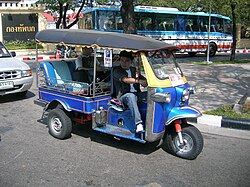 Tuk-tuk in Bangkok
 -
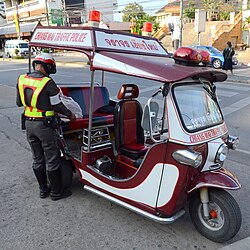 Police tuk-tuk, Chiang Mai
 -
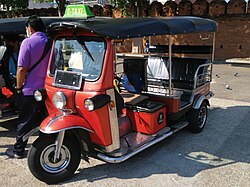 Electric tuk-tuk in Chiang Mai
 -
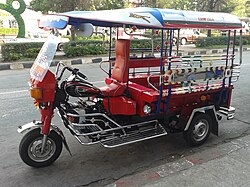
-
 Tuk-tuk hua kob, Phra Nakhon Si Ayutthaya
 -
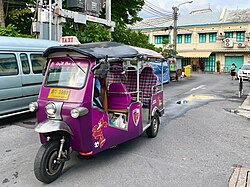
-
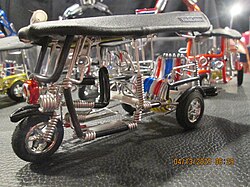 Model Tuk-tuk at Hua Hin


East Asia[edit | edit source]
China[edit | edit source]

Various types of auto rickshaw are used around China, where they are called sān lún chē (三轮车) and sometimes sān bèng zǐ (三蹦子), meaning three wheeler or tricycle. They may be used to transport cargo or passengers in the more rural areas. However, in many urban areas the auto rickshaws for passengers are often operated illegally as they are considered unsafe and an eyesore.[78][79] They are permitted in some towns and cities, however. The Southeast Asian word tuk tuk is transliterated as dū dū chē (嘟嘟车, or beep beep car) in Chinese.[80]
Europe[edit | edit source]
France[edit | edit source]
A number of tuk-tuks (250 in 2013 according to the Paris Prefecture) are used as an alternative tourist transport system in Paris, some of them being pedal-operated with electric motor assist. They are not yet fully licensed to operate and await customers on the streets. Vélotaxis were common during the Occupation years in Paris due to fuel restrictions.[81]
Italy[edit | edit source]

Auto rickshaws have been commonly used in Italy since the late 1940s, providing a low-cost means of transportation in the post–World War II years when the country was short of economic resources. The Piaggio Ape (Tukxi), designed by Vespa creator Corradino D'Ascanio and first manufactured in 1948 by the Italian company Piaggio, though primarily designed for carrying freight has also been widely used as an auto rickshaw. It is still extremely popular throughout the country, being particularly useful in the narrow streets found in the center of many little towns in central and southern Italy. Though it no longer has a key role in transportation, Piaggio Ape is still used as a minitaxi in some areas such as the islands of Ischia and Stromboli (on Stromboli no cars are allowed). It has recently been re-launched as a trendy-ecological means of transportation, or, relying on the role the Ape played in the history of Italian design, as a promotional tool.
Portugal[edit | edit source]

Tuk Tuks are used in the main touristic cities and regions of the country, specially in Lisbon and the sunny region of Algarve, as a novel form of transport for visitors during the tourist season.
Spain[edit | edit source]
Tuk Tuks have become a popular mode of transport in Spain’s main tourist destinations, particularly in Barcelona and the coastal areas of Valencia,[82] as well as Mallorca[83] and Málaga[84]
United Kingdom[edit | edit source]
In 2006 a British travel writer – Antonia Bolingbroke-Kent – and her friend Jo Huxster travelled 12,561 miles (20,215 km) with an auto rickshaw from Bangkok to Brighton. With this 98 days' trip they set a Guinness World Record for the longest journey ever with an auto rickshaw.[citation needed] In October 2022, Gwent police spent £40,000 on four tuk tuk vehicles in order to help fight crime.[85]
Montenegro[edit | edit source]
Tuk Tuk Montenegro has implemented tours with electric tuk-tuks in Kotor, Montenegro in 2018.[86]
Central and North America[edit | edit source]

El Salvador[edit | edit source]
The mototaxi or moto is the El Salvadoran version of the auto rickshaw. These are most commonly made from the front end and engine of a motorcycle attached to a two-wheeled passenger area in back. Commercially produced models, such as the Indian Bajaj brand, are also employed.[citation needed]
Guatemala[edit | edit source]
In Guatemala tuk-tuks operate, both as taxis and private vehicles, in Guatemala City, around the island town of Flores, Peten, in the mountain city of Antigua Guatemala, and in many small towns in the mountains. From 2005 to present the tuk-tuks have been prevalent in Lago de Atitlán towns such as Panajachel and Santiago Atitlán. While tuk-tuks continue to serve as a prevalent form of transportation in Antigua and Lake Atitlan their use throughout the country as a whole has declined.
United States[edit | edit source]
In the 1950s and 1960s, the United States Post Office (replaced in 1971 by the United States Postal Service) used the WestCoaster Mailster, a close relative of the tuk-tuk.[87] Similar vehicles remain in limited use for parking enforcement, mall security, and other niche applications. After a short time on the market (Mid-2000s to 2008) in the United States,[88] the vehicles failed to gain popularity in the United States, and as a result, are no longer available. The Manufacturer Bajaj cited the manual transmissions aboard the three-wheelers as the reason for poor sales. As a result of modifications that made the machines EPA and DOT compliant, the vehicles that were sold are still street-legal.[89]

Auto rickshaws are rarely seen in the United States, However there are companies that operate them as taxis, affordable transportation services, or rentals, usually in urban areas like Tuk Tuk Chicago in Chicago, Capital Tuk-Tuk in Sacramento, eTuk Ride Denver in Denver, the Boston rickshaw company in Boston and several more.[90][91][92][93][94][95][96][97][98][99][100][101]
The New York Police Department (NYPD) operates auto rickshaws that they call “three-wheel patrol scooters”. The patrol scooters are used for parking and traffic enforcement on city streets and to patrol places that most cars can't – like the narrow paths in Central Park. The NYPD patrol scooters started being replaced in 2016 with Smart Fortwos. The NYPD believes that the Smart Fourtwos are safer, more comfortable, and more affordable, than the three-wheel patrol scooters due to the Smart Fourtwos coming with features that the patrol scooters lack like air conditioning, and airbags, while also costing about $6,000 less. The Smart Fortwos can also be driven on highways if needed. The Smart Fortwos are also said to be more “approachable” and “friendlier looking” which helps with public relations.[102]
Cuba[edit | edit source]
In Cuba, the autorickshaws are small and look like a coconut, hence the name Cocotaxi.

Mexico[edit | edit source]
Some auto rickshaws have been and are still used in Mexico, Such as in Rickshaws in Mexico City.[103][104][105]
South America[edit | edit source]
Peru[edit | edit source]
In Peru, a version of this vehicle is called a motocar[106] or mototaxi.[107]
Bolivia[edit | edit source]
Auto Rickshaws are seen in Bolivia.[108][109]
Brazil[edit | edit source]
Uber allows auto rickshaws to be used by drivers.[110][111][112]
Colombia[edit | edit source]
Tuk tuks or moto-taxis are used in some towns and cities in Colombia such as Jardín, Guatapé, or San Rafael in Antioquia. [113]
Australia and Oceania[edit | edit source]
Australia[edit | edit source]
Ikea did a trial run using Electric Auto Rickshaws in Sydney, Australia to deliver packages to customers from May to August 2023.[114]
A company called Just Tuk'n Around using both pedal powered rickshaws and electric auto rickshaws carries tourists around in Airlie Beach.[115]
New Zealand[edit | edit source]
Mount Cook Alpine Salmon uses Auto rickshaws on its farms to move equipment and people around.[116]
A company using auto rickshaws called Tuk Tuk Taxi operates in Wānaka in the South Island.[117]
A company using auto rickshaws called Tuk Tuk NZ used to operate in Wellington.[118][119]
A company using auto rickshaws called Kiwi Tuk Tuk used to operate in Auckland.[120][118]
Fuel efficiency and pollution[edit | edit source]
In July 1998, the Supreme Court of India ordered the government of Delhi to implement CNG or LPG (Autogas) fuel for all autos and for the entire bus fleet in and around the city. Delhi's air quality has improved with the switch to CNG. Initially, auto rickshaw drivers in Delhi had to wait in long queues for CNG refueling, but the situation improved following an increase in the number of CNG stations. Gradually, many state governments passed similar laws, thus shifting to CNG or LPG vehicles in most large cities to improve air quality and reduce pollution. Certain local governments are pushing for four-stroke engines instead of two-stroke ones. Typical mileage for an Indian-made auto rickshaw is around 35 kilometres per litre (99 mpg‑imp; 82 mpg‑US) of petrol. Pakistan has passed a similar law prohibiting auto rickshaws in certain areas. CNG auto rickshaws have started to appear in huge numbers in many Pakistani cities.[citation needed]
In January 2007 the Sri Lankan government also banned two-stroke trishaws to reduce air pollution. In the Philippines[121] there are projects to convert carbureted two-stroke engines to direct-injected via Envirofit technology. Research has shown LPG or CNG gas direct-injection can be retrofitted to existing engines, in similar fashion to the Envirofit system.[122] In Vigan City majority of tricycles-for-hire as of 2008 are powered by motorcycles with four-stroke engines, as tricycles with two-stroke motorcycles are prevented from receiving operating permits. Direct injection is standard equipment on new machines in India.[123][124]
In March 2009 an international consortium coordinated by the International Centre for Hydrogen Energy Technologies initiated a two-year public-private partnership of local and international stakeholders aiming at operating a fleet of 15 hydrogen-fueled three-wheeled vehicles in New Delhi's Pragati Maidan complex.[125] As of January 2011, the project was nearing completion.[citation needed]
Hydrogen internal combustion (HICV) use in three-wheelers has only recently begun to be looked into, mainly by developing countries, to decrease local pollution at an affordable cost.[126][127] At some point, Bajaj Auto made a HICV auto rickshaw together with the company "Energy Conversion Devices".[128] They made a report on it called "Clean Hydrogen Technology for 3-Wheel Transportation in India" and it stated that the performance was comparable with CNG autos. In 2012, Mahindra & Mahindra showcased their first HICV auto rickshaw, called the Mahindra HyAlfa.[128] The development of the hydrogen-powered rickshaw happened with support from the International Centre for Hydrogen Energy Technologies.
World records[edit | edit source]
On 16 September 2022, at 11:04 a.m. (Indian Standard Time), a Canadian team (Greg Harris and Priya Singh) and a Swiss team (Michele Daryanani and Nevena Lazarevic) set the world record for the highest altitude at which an auto rickshaw has ever been driven. The world record was officially recognized and certified by Guinness World Records on October 10, 2024.[129] The two teams set the record by driving to the summit of Umling La Pass at an altitude of 5,798 meters (19,022 feet).[130]
The two teams were participating in the Rickshaw Run (Himalayan Edition), an event promoted by The Adventurists, where teams drive auto rickshaws from the Thar desert town of Jaisalmer in Rajasthan to the Himalayan town of Leh in Ladakh. Rickshaw Run teams are given the start and finish lines, but are otherwise unsupported and left to their own navigational choices in completing the approximately 2,300 km journey.
The road at Umling La Pass was constructed by India's Border Roads Organization and completed in 2017. Guinness World Records certified the road as the highest motorable road in the world.[131]
See also[edit | edit source]
- Electric rickshaw
- Fuel gas-powered scooter
- Formic acid vehicle: a type of hydrogen-based vehicle
- Jeepney
- Rickshaw (disambiguation)
Explanatory notes[edit | edit source]
- ↑ Typical fuel economy for an Indian-made auto rickshaw is around 35 kilometres per litre (99 mpg‑imp; 82 mpg‑US) of petrol.[citation needed]
References[edit | edit source]
- ↑ "Auto rickshaw". Merriam Webster. Retrieved 1 June 2025.
- ↑ "Auto rickshaw". Collins dictionary. Retrieved 1 June 2025.
- ↑ "Auto rickshaw". Cambridge Dictionary. Retrieved 1 June 2025.
- ↑ "India beats China again to be world's largest electric 3W market". Autocar Professional. Retrieved 1 June 2025.
- ↑ "Best Auto Rickshaw Manufacturers in India". Cmv360. Retrieved 1 June 2025.
- ↑ "Great Cars of Mazda: Mazda-Go 3-wheeled Trucks (1931〜)". Mazda Motor Corporation. Archived from the original on 2019-02-09.
- ↑ ミゼット物語 木村信之 著 高原書店(Nobuyuki Kimura "Story of Midget", Published on 10 November 1998)
- ↑ Daihatsu Motor Co., Ltd. public relations section
- ↑ NPOみらいネットワーク寄附講座、ホテル観光学科の学生に日タイ関係をピーアール 日本での就職機会に関心. Bangkok Shuho (in 日本語). 2007-11-19. Archived from the original on 2009-04-30.
- ↑ /index.php?option=com_content&view=article&id=321:2009-11-30-05-34-59&catid=54:2009-09-09-07-52-31&Itemid=232 Royal Thai Embassy Tokyo, Japan 日本生まれのタイのトゥクトゥク (Tuk-Tuk of Thailand was born in Japan.)
- ↑ "Tuk-Tuk, Thailand's most notorious mode of transport - deSIAM". www.desiam.com. Archived from the original on 2020-09-23. Retrieved 2020-03-26.
- ↑ "【ダイハツ ミゼット DKA / DSA型】 幌付3輪スクーター型トラック 旧式商用車図鑑". route0030.blog.fc2.com.
- ↑ 13.0 13.1 "The History of the Philippines Tricycle". Tuk Tuk 3 Wheelers. 22 November 2018. Retrieved 25 March 2020.
- ↑ "Tuk Tuks replace mules on Gaza streets". Maan News Agency. 12 September 2010. Retrieved 2011-03-22.
- ↑ "Mundane autos in India, hero tuk-tuks in Iraq". Deccan Herald. 25 November 2019. Retrieved 31 January 2024.
- ↑ Shukla, Srijan (26 November 2019). "How Indian manufactured auto-rickshaws became a symbol of Iraqi protests". ThePrint. Retrieved 31 January 2024.
- ↑ Alhas, Ali Murat. "In congested Baghdad, Iraqis turn to 3-wheel 'tuk-tuks'". Anadolu Agency.
- ↑ Vitalone, Vivi (14 November 2024). "How tuk-tuk drivers became the unlikely heroes of Iraq's popular revolt". NBC News. Retrieved 31 January 2024.
- ↑ Salim, Mustafa; Berger, Miriam (1 November 2024). "The humble three-wheeled tuk-tuk has become the symbol of Iraq's uprising". The Washington Post. Retrieved 31 January 2024.
- ↑ Jay Heale; Zawiah Abdul Latif (2008). Madagascar, Volume 15 of Cultures of the World Cultures of the World – Group 15 (2 ed.). Marshall Cavendish. pp. 75–76. ISBN 978-0761430360.
- ↑ Madagascar Travel Guide (7 ed.). Lonely Planet. 2012. ISBN 978-1743213018. Retrieved 2013-04-13.
- ↑ "'Bajaj' à Mahajanga : Entre 70 et 100 clients par jour". Midi Madagasikara (in français). 2014-05-30.
- ↑ Odunsi, Wale (16 November 2017). "Lagos bans okada, keke from 520 roads, areas [Full list]". Daily Post. Lagos, Nigeria.
- ↑ "Durban offers beaches and cultural diversity". Zululand Tourism. Archived from the original on 22 May 2022. Retrieved 22 September 2015.
Tuk Tuks: Mororised, covered tricycles which carry up to six passengers. Ideal for short 'hops' between the beachfront and city centre.
- ↑ Steyn, Lisa (18 January 2013). "Cheap-cheap tuk-tuk taxis take over Jozi". Retrieved 22 September 2015.
Tuk-tuks, also known as auto rickshaws, are becoming an increasingly common sight on South Africa's roads because people are trying to travel short distances at lower costs than driving and at less risk than walking.
- ↑ Ryan, Tamlyn (September 2016). "Tuk-tuks are coming to Cape Town". Inside Guide. Archived from the original on 2017-08-14. Retrieved 2017-03-18.
- ↑ Govender, Suthentira (2017-01-25). "Buddibox grocery delivery programme set to create 10,000 young entrepreneurs in Gauteng". TimesLIVE.
- ↑ Kalagho, Kenan (13 February 2012). "Tanzania: Bajaji, Dar es Salaam's Indispensable Taxi". AllAfrica. Retrieved 22 September 2015.
Until the year 2010 Dar es Salaam had no room for the Indian Bajaji and or a tricycle to be used as a means of transporting passengers. Today it is a common feature around Dar es Salaam.
- ↑ Kuhudzai, Remeredzai Joseph (4 December 2020). "Gayam Motor Works & Sokowatch Launch East Africa's First Commercial Electric Tuk-Tuks". CleanTechnica.
- ↑ McHugh, John D. "In Taliban country: inside the city of Jalalabad". The Irish Times.
- ↑ "Auto-rickshaws clogging Kunduz arteries". www.pajhwok.com. 23 May 2012.
- ↑ 32.0 32.1 ""Bangla Teslas" give Musk a run for his money". The Economist. ISSN 0013-0613. Retrieved 2025-07-27.
- ↑ Lane, Jo. "Asia's love affair with the rickshaw". asiancorrespondent.com. Archived from the original on 2015-07-13. Retrieved 2015-07-30.
- ↑ "Police purge for Dhaka rickshaws". BBC News. 20 December 2002. Retrieved 2011-03-22.
- ↑ 35.0 35.1 Pippa de Bruyn; Keith Bain; David Allardice; Shonar Joshi (2010). Frommer's India (Fourth ed.). John Wiley and Sons. ISBN 978-0470645802.
- ↑ "Pink Auto Rickshaw Project" (PDF). odishapolice.gov.in. 17 July 2019.
- ↑ Mishra, Animesh (18 October 2024). "LMC drafts by-laws for tempos, e-rickshaws in Lucknow". Hindustan Times.
- ↑ Pippa de Bruyn; Keith Bain; David Allardice; Shonar Joshi (2010). Frommer's India (Fourth ed.). John Wiley and Sons. p. 110. ISBN 978-0470645802.
- ↑ "Six seater rickshaws banned in city". Times of India. 25 September 2003. Retrieved 2014-01-11.
- ↑ "Patna: Transport department to ban all diesel-run buses, auto-rickshaws from April 1". India Today. 29 March 2022. Retrieved 2022-03-29.
- ↑ "Remembering Delhi's phat-phatis | India News". The Times of India.
- ↑ "Transportation through the ages in Shahjahanabad". olddelhiheritage.in. 18 September 2022. Archived from the original on 14 June 2016.
- ↑ "12,146 public EV charging stations operational across the country". pib.gov.in. Retrieved 2024-04-16.
- ↑ "Maharashtra Govt refuses to increase autorickshaw, taxi fares". newKerala.com. UNI. Archived from the original on 2013-05-18.
- ↑ "Autos, taxis in Delhi to go on strike today demanding fare hike". India Today. 15 October 2012. Retrieved 2017-02-19.
- ↑ "Delhi High Court Directs City Auto-Rickshaws To Install GPS". Medianama. 28 September 2012. Retrieved 2017-02-19.
- ↑ "GPS installation in public transport becomes mandatory". Times of India. 2 June 2015. Retrieved 2017-02-19.
- ↑ "Auto Rickshaws Set Highest Altitude Drive Record at 19,024 Feet on Umling La Pass". news18.com. 22 October 2022.
- ↑ "Auto rickshaws drive on Umling La Pass, the highest motorable road, to set world record at 19,024 feet". MSN. 27 October 2022.
- ↑ "Nepal Government decides to ban 3 wheeler auto rickshaws from Nepal's road". BBC. 28 July 1999. Retrieved 2011-12-06.
- ↑ "Rickshaw Run on 3 Wheelers from Goa, India to Pokhara, Nepal". The National. 29 August 2009. Retrieved 2011-12-06.
- ↑ Sebastian Abbot, Associated Press (8 February 2013). "Eye-Catching Rickshaws Promote Peace in Pakistan". ABC News. Retrieved 2013-04-13.
- ↑ 53.0 53.1 Ranasinghe, A.K. (3 September 2018). "Can He Convince Sri Lankan Tuk-Tuk Owners to Go Green?". OZY. Archived from the original on 3 September 2018. Retrieved 3 September 2018.
Tuk-tuks play a vital role in urban Sri Lanka's passenger transport system, providing what traffic experts call "last mile" service. Police and government workers rely on them too to navigate congested streets. In rural Sri Lanka, they are everything from taxi to ambulance.
- ↑ "Bajaj ready with 4-stroke autos for SL". Indiacar.net. Archived from the original on 2009-06-27. Retrieved 2010-04-03.
- ↑ Wilkins, Emily (19 February 2014). "New Futuristic Tuk-Tuks Arrive on the Streets of Phnom Penh". The Cambodia Daily. Archived from the original on 30 January 2015. Retrieved 30 January 2015.
- ↑ Damarjati, Danu. "Laju Bajaj Roda Tiga, dari Hindustan hingga Menjadi Ikon Jakarta". detiknews (in Bahasa Indonesia). Retrieved 2026-03-06.
- ↑ 57.0 57.1 "Bajaj Oranye Menunggu Giliran Dimusnahkan". Republika Online (in Bahasa Indonesia). 7 January 2016. Retrieved 26 May 2018.
- ↑ Damarjati, Danu (4 July 2017). "Dishub DKI: Bulan Ini, Bajaj Merah Harus Segera Jadi Biru" [Jakarta DOT: Red Bajajs must turn Blue this month] (in Indonesian). Retrieved 28 December 2022.
{{cite web}}: CS1 maint: unrecognized language (link) - ↑ "Motorcycles and tricycles". Utrecht Faculty of Education. Archived from the original on 7 March 2009. Retrieved 2009-03-14.
- ↑ "Filipino Icon: Tricycle and Pedicab". FFE Magazine. 29 December 2016. Retrieved 25 March 2020.
- ↑ Pante, Michael D. (14 August 2014). "Rickshaws and Filipinos: Transnational Meanings of Technology and Labor in American-Occupied Manila". International Review of Social History. 59 (S22): 133–159. doi:10.1017/S0020859014000315.
- ↑ "Tricycle, Motorela & Habal-Habal". Silent Gardens. Retrieved 25 March 2020.
- ↑ Corsino, Nikka (24 October 2013). "A day on Sabtang Island in Batanes". GMA News Online. Retrieved 25 March 2020.
- ↑ "WATCH: What makes Pagadian tricycles unique". Rappler. 23 January 2017. Retrieved 25 March 2020.
- ↑ 65.0 65.1 "Tricycles in the Philippines". cleanairasia.org. Archived from the original on 10 June 2018. Retrieved 7 January 2019.
- ↑ Taruc, Paolo (25 March 2015). "Tricycles: As iconic as jeepneys and just as problematic". CNN Philippines. Archived from the original on 7 January 2019. Retrieved 7 January 2019.
- ↑ Felongco, Gilbert P. (22 November 2015). "Philippines: Tricycles and motorcycles responsible for 45 per cent of harmful emissions". Gulf News. Retrieved 7 January 2019.
- ↑ "Mandaluyong City 2-Stroke Replacement Project". cleanairasia.org. Archived from the original on 1 October 2020. Retrieved 7 January 2019.
- ↑ Cabato, Luisa (January 1, 2026). "E-trikes banned on major Metro Manila roads starting Jan. 2". Retrieved 2026-01-02.
- ↑ "E.R.A.P. Manila electric tricycle project – Second batch of beneficiaries ready". www.bemac-philippines.com.
- ↑ "Introducing the Bajaj RE: The Only Three-Wheeler You Will Ever Need". www.centaurmarketing.co. October 8, 2019.
- ↑ "TVS King Deluxe Three Wheeler Vs Tricycle". Tuk Tuk 3-Wheelers. 20 October 2019.
- ↑ Wattanasukchai, Sirinya (2 February 2017). "With our tuk tuks, let's copy the Dutch". Bangkok Post. Retrieved 2 February 2017.
- ↑ "Thailand government says Bangkok has too many 'tuk-tuks'". Asian Correspondent. 2016-04-15. Archived from the original on 2016-04-26. Retrieved 2016-04-15.
- ↑ "Frog-headed Tuk Tuk, Symbol of Aytthaya". Go Ayutthaya. Retrieved 2019-05-30.
- ↑ Muangkaew, Methee (2013-02-19). "Tuk-tuk 'endangered species' in Trang". Bangkok Post. Retrieved 2019-05-30.
- ↑ "MuvMi". ThailandMagazine.com. 2022-02-15. Retrieved 2022-06-18.
- ↑ "明珠路上规模浩大的等客车队 危险逆行载客". 珠江晚报. 3 November 2009. Archived from the original on 2015-04-04.
- ↑ "[天津]面对"三蹦子" 请您大声说"不"". auto sohu. Archived from the original on 2023-11-18. Retrieved 2015-03-29.
- ↑ "東南亞的三輪車". Global Voices. 25 March 2012.
- ↑ "A Paris, les tuk-tuks fleurissent... tout comme les PV". La Dépêche (in français). Toulouse. AFP. 2013-08-20.
- ↑ "What to visit in Valencia: Tour in Tuk Tuk". 1 April 2025. Retrieved 1 April 2025.
- ↑ "What to visit in Palma de Mallorca: tuk tuk tour". 1 April 2025. Retrieved 1 April 2025.
- ↑ "DISCOVER MÁLAGA ABOARD OUR ELECTRIC TUK TUKS". 21 June 2025. Retrieved 21 June 2025.
- ↑ "Gwent Police spend £40,000 on crime-fighting tuk-tuks". 27 October 2022. Retrieved 21 November 2022.
- ↑ "A little bit about us". Tuk Tuk Montenegro. Retrieved 2022-01-12.
- ↑ "National Postal Museum". 25 August 2009. Archived from the original on 25 August 2009.
- ↑ "Tuk Tuk USA gets DOT and EPA approval". Autoblog. 15 April 2009.
- ↑ "Bajaj 3-Wheeler is now off the U.S. market". Autoblog. 2 May 2008.
- ↑ "Tuk Tuk Chicago – Do You Tuk Tuk?".
- ↑ "Eco-Friendly Tour - Capital Tuk Tuk | Sacramento, CA". Capital Tuk Tuk.
- ↑ "eTuk Locations - Electric Tuk Tuk City Tours & Brewery Crawls - eTuk Ride". eTuk.
- ↑ "About Us". 4 February 2020.
- ↑ "Rickshaw Rental Service for Events". Rags to Rickshaws.
- ↑ tuks, Texas Tuk. "Texas Tuk tuks". Texas Tuk tuks.
- ↑ "Things to do in Jacksonville | Jacksonville Tours & Transportation". Go Tuk'n.
- ↑ "Home - RVATukTuk The fun, unique way to experience Richmond Book your adventure".
- ↑ "Boston Rickshaw Company". Boston Rickshaw Company.
- ↑ Weissmann, Emma (November 13, 2019). "Been There, Do This: eTuk Ride Portland in Oregon". TravelAge West.
- ↑ "Home". Cycle Pub.
- ↑ "Lucky Tuk Tuk Private Tours – Private Small Group Sightseeing Tours in San Francisco".
- ↑ "NYPD's "kissable and huggable" Smart cars receive flood of attention". www.cbsnews.com. 27 June 2017.
- ↑ "Ensenada Tuk Tuk, Beach and Bar | Ensenada Shore Excursion | Mexican Riviera Cruise Tours". Shore Excursions Group.
- ↑ "gpsKevin Adventure Rides - Tuk Tuk Oaxaca". www.gpskevinadventurerides.com. Retrieved 2025-01-15.
- ↑ Hilden, Nick (2024-05-06). "Everything I Learned on Mexico's New Highway Connecting Oaxaca City to the Coast". Thrillist. Retrieved 2025-01-15.
- ↑ "Motocar". Perú Motor. Archived from the original on 3 October 2018.
- ↑ Tony Dunnell (28 July 2017). "A Traveler's Guide to Mototaxis in Peru". tripsavvy. Retrieved 27 November 2017.
- ↑ Schultz, Amber (April 15, 2023). "Australian man's seven-year tuk-tuk journey from Argentina to Alaska". The Sydney Morning Herald.
- ↑ https://www.couriermail.com.au/news/queensland/trouble-strikes-ryan-magee-aussieespanol-on-his-tuk-tuk-travels/news-story/de5faae1816a5b51c9f7626624a7e4f1?amp&nk=11387282b59daa33d2f6f4a6926d7d47-1740345984
- ↑ Williams, Lachlan (January 29, 2020). "Uber Launches "Tuk-tuk" in Brazil".
- ↑ "THE TUK TUK IS HERE TO STAY IN BRAZIL". June 21, 2012.
- ↑ "Bajaj Auto Confirms Production Unit In Brazil; Expands Global Production To 100 Countries". News18.
- ↑ García, Jessica Paola Vera (August 28, 2023). "En Colombia, 10% de las personas que se movilizan lo hacen en "Tuk Tuks"". El Carro Colombiano.
- ↑ Hart, Amalyah (2023-05-16). "Electric tuk tuks to make deliveries for Ikea customers in Sydney". The Driven. Retrieved 2025-01-15.
- ↑ "Tuk Tuk Tours". Just Tuk'n Around. Retrieved 2025-01-15.
- ↑ "Tuk-tuk trial on Canterbury salmon farm". Otago Daily Times. 2024-04-19. Retrieved 2025-01-15.
- ↑ "Wanaka taxi Services by Tuk Tuk Taxi | Call now-0800885800". Retrieved 2025-01-15.
- ↑ 118.0 118.1 "Tuk tuk start up hits red tape speed bump". The New Zealand Herald. 2016-08-17. Retrieved 2025-01-15.
- ↑ "Engineer penalised for signing off on Auckland tuk-tuk safety despite having never viewed them". 1News. Retrieved 2025-01-15.
- ↑ "Kiwi Tuk Tuk Limited | GetYourGuide Supplier". GetYourGuide. Retrieved 2025-01-15.
- ↑ "Envirofit's Tricycle Retrofit Program Funded". Colorado State University. 19 May 2006. Archived from the original on 29 September 2011. Retrieved 2011-03-22.
- ↑ "Microsoft Word – SETC_LPG2T.doc" (PDF). Retrieved 2010-04-03.
- ↑ "Bajaj rolls out low-emission fuel-efficient autorickshaw". Business Line. The Hindu. 2007-12-09. Retrieved 2010-04-03.
- ↑ "Bajaj Begins Production of 2-Stroke Direct-Injection Auto Rickshaw". Green Car Congress. 2007-05-18. Retrieved 2010-04-03.
- ↑ "A fleet of hydrogen rickshaws to circulate in New Delhi by 2010". International Centre for Hydrogen Energy Technologies. Archived from the original on 2011-07-28. Retrieved 2011-03-22.
- ↑ "Hydrogen-Fueled Internal Combustion Engines, see page 7".
- ↑ "Clean Hydrogen Technology for 3-Wheel Transportation in India" (PDF).
- ↑ 128.0 128.1 "India Showcases Hydrogen Fuel Auto-Rickshaws |". 21 February 2012.
- ↑ "Highest altitude achieved in an auto rickshaw".
- ↑ "Look: Auto rickshaws take world's highest road to set world record - UPI.com". UPI.
- ↑ "Highest altitude road". Guinness World Records.
External links[edit | edit source]
- The India 1000 – an article in Wired about auto rickshaw racing