

Gomateshwari (talk | contribs) Tags: Mobile edit Mobile web edit |
improved article |
||
| (10 intermediate revisions by 3 users not shown) | |||
| Line 1: | Line 1: | ||
{{ | {{Short description|Shunga Emperor from 185 to 149 BCE}} | ||
{{for|the 5th century CE tribe|Pushyamitras}} | {{for|the 5th century CE tribe|Pushyamitras}} | ||
{{Use dmy dates|date=December 2015}} | {{Use dmy dates|date=December 2015}} | ||
{{Use Indian English|date=December 2015}} | {{Use Indian English|date=December 2015}} | ||
{{Infobox royalty | {{Infobox royalty | ||
| succession | | succession = [[List of monarchs of Magadha#House of Shunga|Emperor of Magadha]] | ||
| image | | name = Pushyamitra Shunga | ||
| caption | | image = Bharhut Sunga individual.jpg | ||
| reign | | caption = Sunga period masculine figurine, 2nd-1st century BCE, [[Guimet Museum]] | ||
| religion | | reign = {{circa|185|149 BCE}} | ||
| predecessor | | religion = [[Hinduism]] | ||
| successor | | succession1 = [[Senapati|General]] of [[Mauryan Empire|Magadha]] | ||
| | | predecessor = [[Brihadratha Maurya]] (as [[List of Mauryan emperors|Mauryan emperor]]) | ||
| | | successor = [[Agnimitra]] | ||
| dynasty | | birth_date = {{circa|late 3rd century BCE}} | ||
| father | | birth_place = [[Magadha (Mahajanapada)|Magadha]], [[Maurya Empire]] (present-day [[Bihar]], [[India]]) | ||
| mother | | death_date = {{Circa|149 BCE}} | ||
| death_place = [[Pataliputra]], [[Shunga Empire]](present-day [[Bihar]], [[India]]) | |||
| dynasty = [[Shunga Empire|Shunga]] | |||
| father = | |||
| mother = | |||
}} | }} | ||
'''Pushyamitra Shunga''' ([[IAST]]: {{IAST|Puṣyamitra Śuṅga}} | '''Pushyamitra Shunga''' ([[IAST]]: {{IAST|Puṣyamitra Śuṅga}}; reigned {{circa|185|149 BCE}}), also known as '''Pushpamitra Shunga''' ([[International Alphabet of Sanskrit Transliteration|IAST]]: {{IAST|Puṣpamitra Śuṅga}}) was the founder and the first ruler of the [[Shunga Empire]] which he established to succeed the [[Maurya Empire]].<ref>{{Cite book |last=Mitchiner |first=John E. |title=The Yuga Purāṇa |publisher=The Asiatic Society |year=1986 |isbn=978-93-81574-56-0 |edition=1st |location=Kolkata |pages=71 |language=en}}</ref> | ||
Pushyamitra is recorded to have performed the [[Ashvamedha]] ritual to legitimize his right to rule.<ref>{{cite book |author=Dineshchandra Sircar |author-link=Dineshchandra Sircar |title=Studies in the Religious Life of Ancient and Medieval India |url=https://books.google.com/books?id=mh1y1eMgGBMC&pg=PA175 |year=1971 |publisher=Motilal Banarsidass |isbn=978-81-208-2790-5 |page=175}}</ref> Inscriptions of the Shungas have been found as far as the [[Ayodhya]] (the [[Ayodhya Inscription of Dhana|Dhanadeva–Ayodhya inscription]]), and the ''[[Divyavadana]]'' mentions that his empire stretched as far as [[Sagala|Sakala]] (now [[Sialkot]]) in [[Punjab]] region, now in Pakistan. | |||
Pushyamitra | Though Buddhist texts claim that Pushyamitra persecuted Buddhists, past and contemporary scholars have rejected these claims.<ref>{{Cite journal|last=Mishra|first=Ram Kumar|title=Pushyamitra Sunga and the Buddhists |date=2012|url=https://www.jstor.org/stable/44156189|journal=Proceedings of the Indian History Congress|volume=73|pages=50–57|jstor=44156189 |issn=2249-1937}}</ref><ref name=thapar /> | ||
Pushyamitra | ==Name== | ||
According to John E Mitchiner, Pushyamitra original name was Puṣpaka or Puṣpamitra and the confusion between Puṣyamitra and Puṣpamitra arose because of the erroneous readings of 'p' and 'y' in the manuscripts. His interpretation is largely inspired by the ''Yuga Purāṇa''.<ref>{{Cite book |last=Mitchiner |first=John E. |title=The Yuga Purāṇa |publisher=The Asiatic Society |year=1986 |isbn=978-93-81574-56-0 |edition=1st |location=Kolkata |pages=71–72 |language=en}}</ref> | |||
==Foundation of the Shunga Empire== | |||
Pushyamitra Shunga founded the [[Shunga Empire]] after assassinating the last Mauryan emperor [[Brihadratha Maurya]]. Subsequently, he drove out the Greeks with the [[Shunga–Greek War]] and ruled for 36 years.<ref name="s590">{{cite book | last=Roxburgh | first=E. | title=The Mauryan Empire of India | publisher=Cavendish Square Publishing | series=Great Empires | year=2015 | isbn=978-1-5026-0640-2 | url=https://books.google.com/books?id=XpFmDwAAQBAJ&pg=PA42| page=42}}</ref><ref name="v667">{{cite book | last=Tarn | first=W.W. | title=The Greeks in Bactria and India | publisher=Cambridge University Press | series=Cambridge Library Collection - Classics | year=2010 | isbn=978-1-108-00941-6 | url=https://books.google.com/books?id=-HeJS3nE9cAC&pg=PA175 | page=175}}</ref><ref name="v298">{{cite book | last=Kulke | first=H. | last2=Rothermund | first2=D. | title=A History of India | publisher=Routledge | series=Asian history | year=1998 | isbn=978-0-415-15482-6 | url=https://books.google.com/books?id=V0GEtXp-GsUC&pg=PA71 | page=71}}</ref> | |||
The Buddhist text ''[[Ashokavadana]]'' names Pushyamitra as the last Mauryan emperor.{{sfn|Lahiri|1974|p=29}} {{quote|[[Samprati|Sampadin's]] son was Bṛhaspati who, in turn, had a son named Vṛṣasena, and Vṛṣasena had a son named Puṣyadharman, and Pusyadharman begot [[Pushyamitra|Pusyamitra]]...... With the death of Pusyamitra, the Mauryan lineage came to an end.<br>--Aśokāvadāna{{sfn|Strong|1989|pp=292, 294}} }} This text appears to have confused Brihadratha with Pushyamitra.{{sfn|Lahiri|1974|p=30}} | |||
[[ | |||
H. C. Raychaudhuri theorized that the name "Shunga" is derived from the Sanskrit word for the fig tree.<ref>''Raychaudhari Hemchandra, "Tha Audvijja Senani of the Harivansa?", Indian culture, Vol. IV, 1938, P. 360-365''</ref> | H. C. Raychaudhuri theorized that the name "Shunga" is derived from the Sanskrit word for the fig tree.<ref>''Raychaudhari Hemchandra, "Tha Audvijja Senani of the Harivansa?", Indian culture, Vol. IV, 1938, P. 360-365''</ref> | ||
== | == Alleged persecution of Buddhists == | ||
=== Buddhist accounts === | === Buddhist accounts === | ||
Buddhist texts claim that Pushyamitra cruelly persecuted the Buddhists. The earliest source to mention this is the 4-5th Century CE text ''[[Ashokavadana]]'' (a part of ''[[Divyavadana]]''). According to this account, Pushyamitra (described as the last Mauryan emperor) wanted to be famous. His ministers advised him that as long as Buddhism remained the dominant faith, he would never be as famous as his ancestor [[Ashoka]], who had commissioned 84,000 [[stupa]]s. One advisor told him that he could become famous by destroying Buddhism. Pushyamitra then tried to destroy the [[Kukkutarama]] monastery, but it was saved by chance. He then proceeded to [[Sagala|Shakala]] in the north-west, where he offered a prize of one hundred [[Denarius|Roman ''denarii'']] (coins) for every head of a Buddhist monk brought to him. Next, he proceeded to the Koshthaka kingdom, where a Buddhist [[yaksha]] named Damshtranivasin killed him and his army with help of another yaksha named Krimisha.{{sfn|Simmons|Sarao|2010|pp=95-96}}{{sfn|Lahiri|1974|p=33}} | |||
Buddhist texts | |||
{{quote|... Pushyamitra equipped a fourfold army, and intending to destroy the Buddhist religion, he went to the [[Kukkutarama]] (in [[Pataliputra]]). ... Pushyamitra therefore destroyed the [[sangharama]], killed the monks there, and departed. ... After some time, he arrived in [[Sagala|Sakala]], and proclaimed that he would give a ... reward to whoever brought him the head of a Buddhist monk.{{sf|Strong|1989|p=293}}}} | {{quote|... Pushyamitra equipped a fourfold army, and intending to destroy the Buddhist religion, he went to the [[Kukkutarama]] (in [[Pataliputra]]). ... Pushyamitra therefore destroyed the [[sangharama]], killed the monks there, and departed. ... After some time, he arrived in [[Sagala|Sakala]], and proclaimed that he would give a ... reward to whoever brought him the head of a Buddhist monk.{{sf|Strong|1989|p=293}}}} | ||
Like other portions of the text, these accounts are regarded by many historians as being exaggerated.<ref name="Jayantanuja2007">{{cite book | author=Jayantanuja Bandyopadhyaya | title=Class and Religion in Ancient India | url=https://books.google.com/books?id=gwUF11NRyT4C&pg=PA209 | access-date=29 November 2012 | year=2007 | publisher=Anthem Press | isbn=978-1-84331-727-2 | page=209}}</ref> | |||
''Vibhasa'', another 2nd century text, states that Pushyamitra burned Buddhist scriptures, killed Buddhist monks, and destroyed 500 monasteries in and around [[Kashmir]]. In this campaign, he was supported by yakshas, ''kumbhanda''s, and other demons. However, when he reached the [[Bodhi tree]], the deity of that tree took the form of a beautiful woman and killed him.{{sfn|Simmons|Sarao|2010|p=96}} ''Shariputrapariprichha'', translated into Chinese between 317 and 420 CE also mentions this legend, but this particular version is more detailed, and describes eastern India (not Kashmir) as the center of Pushyamitra's anti-Buddhist campaign.{{sfn|Simmons|Sarao|2010|p=96}} | ''Vibhasa'', another 2nd century text, states that Pushyamitra burned Buddhist scriptures, killed Buddhist monks, and destroyed 500 monasteries in and around [[Kashmir]]. In this campaign, he was supported by yakshas, ''kumbhanda''s, and other demons. However, when he reached the [[Bodhi tree]], the deity of that tree took the form of a beautiful woman and killed him.{{sfn|Simmons|Sarao|2010|p=96}} ''Shariputrapariprichha'', translated into Chinese between 317 and 420 CE also mentions this legend, but this particular version is more detailed, and describes eastern India (not Kashmir) as the center of Pushyamitra's anti-Buddhist campaign.{{sfn|Simmons|Sarao|2010|p=96}} | ||
The medieval-era ''Arya-Manjushri-Mula-Kalpa'' mentions a wicked and foolish king named Gomimukhya ("cattle-faced"), or Gomishanda ("Gomin, the bull"), who seized the territory from the east to Kashmir, destroying monasteries and killing monks. Ultimately, he and his officers were killed in the north by falling mountain rocks.{{sfn|Simmons|Sarao|2010|p=96}}{{sfn|Lahiri|1974|p=33-34}} This king is identified with Pushyamitra by | The medieval-era ''[[Manjushri-mula-kalpa|Arya-Manjushri-Mula-Kalpa]]'' mentions a wicked and foolish king named Gomimukhya ("cattle-faced"), or Gomishanda ("Gomin, the bull"), who seized the territory from the east to Kashmir, destroying monasteries and killing monks. Ultimately, he and his officers were killed in the north by falling mountain rocks.{{sfn|Simmons|Sarao|2010|p=96}}{{sfn|Lahiri|1974|p=33-34}} This king is identified with Pushyamitra by [[Jayantanuja Bandyopadhyaya]].<ref>{{cite book |first=Jayantanuja |last=Bandyopadhyaya |title=Class and Religion in Ancient India |url=https://books.google.com/books?id=gwUF11NRyT4C&pg=PA209 |year=2007 |publisher=Anthem |isbn=978-1-84331-332-8 |page=209 }}</ref> | ||
The 16th-century Tibetan Buddhist historian [[Taranatha]] also states that Pushyamitra and his allies killed Buddhist monks and destroyed monasteries from ''madhyadesha'' (midland) to [[Jalandhar]]a. These activities wiped out the Buddhist doctrine from the north, within five years.{{sfn|Simmons|Sarao|2010|p=96}} | The 16th-century Tibetan Buddhist historian [[Taranatha]] also states that Pushyamitra and his allies killed Buddhist monks and destroyed monasteries from ''madhyadesha'' (midland) to [[Jalandhar]]a. These activities wiped out the Buddhist doctrine from the north, within five years.{{sfn|Simmons|Sarao|2010|p=96}} | ||
=== Authenticity of Buddhist claims === | === Authenticity of Buddhist claims === | ||
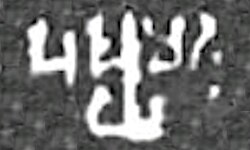
[[File: | [[File:Pushyamitra epigraph.jpg|thumb|The name "Pushyamitra" ([[Brahmi script]]: 𑀧𑀼𑀰𑁆𑀬𑀫𑀺𑀢𑁆𑀭) in the [[Ayodhya Inscription of Dhana]].]] | ||
Based on Buddhist tradition, some scholars believe that Pushyamitra was indeed a persecutor of the Buddhist faith. However, others believe that Buddhist scholars were biased against Pushyamitra, because he did not patronize them.{{sfn|Lahiri|1974|pp=34-35}} | Based on Buddhist tradition, some scholars believe that Pushyamitra was indeed a persecutor of the Buddhist faith. However, others believe that Buddhist scholars were biased against Pushyamitra, because he did not patronize them.{{sfn|Lahiri|1974|pp=34-35}} | ||
According to archaeologist [[John Marshall (archaeologist)|John Marshall]], there is evidence of some damage to Buddhist establishments at [[Takshashila]] around the time of Shunga rule. He also theorized that the [[Sanchi Stupa|Sanchi stupa]] was vandalized in 2nd century BCE (that is, during Pushyamitra's reign), before being rebuilt on a larger scale.{{sfn|Simmons|Sarao|2010|pp=96-97}} G. R. Sharma, who excavated the Buddhist ruins at [[Kosambi|Kaushambi]], suggested that the destruction of the local monastery might have happened during the reign of Pushyamitra Shunga. P. K. Mishra believes that the damage to the [[Deur Kothar]] stupa is also datable to Pushyamitra's period.{{sfn|Simmons|Sarao|2010|p=97}} H. C. Raychaudhari pointed out that Buddhist monuments were constructed at [[Bharhut]] during the Shunga rule.{{sfn|Lahiri|1974|p=34}} However, according to N. N. Ghosh, these were constructed during the reign of later Shunga rulers, not Pushyamitra's period.{{sfn|Simmons|Sarao|2010|p=97}} | |||
H. Bhattacharya theorized that Pushyamitra might have persecuted Buddhists for political, rather than religious, reasons: the politically active Buddhists probably supported the [[Indo-Greek Kingdom|Indo-Greek]] rivals of Pushyamitra, which might have prompted him to persecute them.{{sfn|Simmons|Sarao|2010|p=100}} The ''Ashokavadana'' states that Pushyamitra declared a reward for killing Buddhist monks in [[Sagala|Shakala]] (present-day Sialkot), which was located near the Indo-Greek frontiers. According to K. P. Jayaswal, this further highlights a political motivation behind his alleged persecution of Buddhists.{{sfn|Simmons|Sarao|2010|pp=99-100}} | |||
[[ | Others have expressed skepticism about the Buddhist claims of persecution by Pushyamitra. [[Étienne Lamotte]] points out that the Buddhist legends are not consistent about the location of Pushyamitra's anti-Buddhist campaign and his death.{{sfn|Simmons|Sarao|2010|p=98}} The ''[[Ashokavadana]]'' claims that Pushyamitra offered Roman ''dinara''s as a reward for killing Buddhist monks, but the ''dinara'' did not come into general circulation in India before the 1st century BCE.<ref>{{Cite web|last=Ganguly|first=Kanchan|title=Roman Coins in India and their impact.pdf|url=https://www.academia.edu/34202941}}</ref> ''Ashokavadana'' also claims that Ashoka persecuted ''Nirgrantha''s ([[Ajivika]]s), which some assert is a fabrication, considering that Ashoka's edicts express tolerance towards all religious sects.{{sfn|Simmons|Sarao|2010|p=99}} The Sri Lankan Buddhist text ''[[Mahavamsa]]'' suggests that several monasteries existed in present-day Bihar, Awadh and Malwa at the time Pushyamitra's contemporary [[Dutthagamani]] ruled in Lanka. This suggests that these monasteries survived Pushyamitra Shunga's reign.{{sfn|Simmons|Sarao|2010|p=100}} | ||
H. | H. C. Raychaudhury argued that Pushyamitra's overthrow of the Mauryans cannot be considered as a Brahmin uprising against Buddhist rule, as Brahmins did not suffer during the Mauryan rule: Ashoka's edicts mention the Brahmins before [[Shramana]]s, and the appointment of a Brahmin general (Pushyamitra) shows that the Brahmins were honoured at the Mauryan court.{{sfn|Lahiri|1974|p=34}} The fact that the ''Ashokavadana'' mentions Pushyamitra as a Mauryan further erodes its historical credibility, and weakens the hypothesis that he persecuted Buddhists because he was a Brahmin.{{sfn|Simmons|Sarao|2010|p=99}} Raychaudhury also argued that according to ''[[Malavikagnimitra]]'', a Buddhist nun named Bhagavati Kaushiki attended Pushyamitra's court, which indicates that they did not persecute Buddhists. However, Shankar Goyal states that there is no evidence of Kaushiki being a Buddhist nun.<ref>{{cite book |url=https://books.google.com/books?id=rxpuAAAAMAAJ |title=Aspects of ancient Indian history and historiography |author=Shankar Goyal |publisher=Harman |year=1993 |isbn=9788185151694 |page=30 }}</ref> | ||
Historian Eric Seldeslachts states that there is "no proof whatsoever that Pushyamitra actually persecuted the Buddhists" though he may not have actively supported the Buddhists, invoking the Buddhist wrath.<ref>{{Cite book |last1=Heirman |first1=Ann |url=https://books.google.com/books?id=kr_M1e7yImoC |title=The Spread of Buddhism |last2=Bumbacher |first2=Stephan Peter |date=2007-05-11 |publisher=BRILL |isbn=978-90-04-15830-6 |pages=141 |language=en}}</ref> | |||
[[Romila Thapar]] writes that the lack of concrete archaeological evidence casts doubt on the claims of Buddhist persecution by Pushyamitra.<ref name="thapar">Aśoka and the Decline of the Mauryas by Romila Thapar, Oxford University Press, 1960 P200</ref> | |||
It is possible that the Buddhist influence at the Mauryan court declined during Pushyamitra's reign, and the Buddhist monasteries and other institutions stopped receiving royal patronage. This change might have led to discontent among the Buddhists, resulting in exaggerated accounts of persecution.{{sfn|Simmons|Sarao|2010|pp=99-100}} | It is possible that the Buddhist influence at the Mauryan court declined during Pushyamitra's reign, and the Buddhist monasteries and other institutions stopped receiving royal patronage. This change might have led to discontent among the Buddhists, resulting in exaggerated accounts of persecution.{{sfn|Simmons|Sarao|2010|pp=99-100}} | ||
[[Michael Witzel]] states that ''[[Manu Smriti | [[Michael Witzel]] states that ''[[Manu Smriti]]'', which emphasizes the role of orthodox faith in state-craft and society, was first compiled under Pushyamitra's rule. According to Kaushik Roy, it was a Brahmanical reaction to the rise of Buddhism and Jainism.<ref name="roy">Roy, Kaushik (2012). Hinduism and the Ethics of Warfare in South Asia: From Antiquity to the Present, p.109-118. Cambridge University Press. {{ISBN|9781107017368}}</ref> | ||
===Accounts against persecution=== | |||
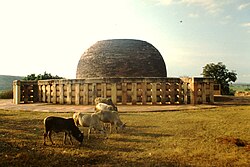
[[File:Sanchi Stupa Nr. 2 (1999).JPG|thumb|Shunga period [[stupa]] No. 2 at [[Sanchi]].]] | |||
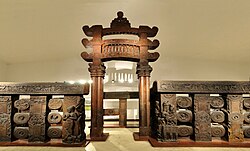
[[File:East Gateway and Railings Bharhut Stupa.jpg|thumb|East Gateway and Railings, Red Sandstone, [[Bharhut]] Stupa, 2nd century BCE. [[Indian Museum]], [[Kolkata]].]] | |||
Shunga emperors were seen as amenable to Buddhism and as having contributed to the building of the stupa at [[Bharhut]].<ref>Akira Hirakawa, Paul Groner, "A History of Indian Buddhism: From Sakyamuni to Early Mahayana", Motilal Banarsidass Publ., 1996, {{ISBN|81-208-0955-6}} pg 223</ref> During his reign the Buddhist monuments of Bharhut and [[Sanchi]] were renovated and further improved. There is enough evidence to show that [[Pushyamitra]] patronised buddhist art.<ref>Sir john Marshall, "[https://archive.org/details/in.ernet.dli.2015.278482 A Guide to Sanchi]", 1918</ref> | |||
== Succession of the throne == | == Succession of the throne == | ||
Pushyamitra Shunga was succeeded in 148 BCE by his son [[Agnimitra]].<ref>{{cite book |title=Ancient Indian History and Civilization |first=Sailendra Nath |last=Sen |publisher=New Age International, 1999 |year=1999 |isbn=978-8-12241-198-0 |page=170 |url=https://books.google.com/books?id=Wk4_ICH_g1EC&pg=PA170}}</ref> | Pushyamitra Shunga was succeeded in 148 BCE by his son [[Agnimitra]].<ref>{{cite book |title=Ancient Indian History and Civilization |first=Sailendra Nath |last=Sen |publisher=New Age International, 1999 |year=1999 |isbn=978-8-12241-198-0 |page=170 |url=https://books.google.com/books?id=Wk4_ICH_g1EC&pg=PA170}}</ref> | ||
== In literature == | == In literature == | ||
| Line 108: | Line 103: | ||
| title = [[Shunga Empire|King of Shunga Dynasty]] | | title = [[Shunga Empire|King of Shunga Dynasty]] | ||
| years = 185–149 BCE | | years = 185–149 BCE | ||
| before = [[Mauryan Dynasty]]''<br /> '''[[Brihadratha Maurya]]'' | | before = [[Mauryan Dynasty]]''<br /> '''[[Brihadratha Maurya]]''''' | ||
| after = [[Agnimitra]] | | after = [[Agnimitra]] | ||
}} | }} | ||
| Line 118: | Line 113: | ||
[[Category:140s BC deaths]] | [[Category:140s BC deaths]] | ||
[[Category:Persecution of Buddhists]] | [[Category:Persecution of Buddhists]] | ||
[[Category:Founding monarchs in Asia]] | |||
[[Category:Shunga dynasty]] | |||
[[Category:People from the Maurya Empire]] | |||
[[Category:Indian generals]] | |||
[[Category:Emperors of Magadha]] | |||
Latest revision as of 00:07, 15 March 2026
| Pushyamitra Shunga | |
|---|---|
 Sunga period masculine figurine, 2nd-1st century BCE, Guimet Museum | |
| Emperor of Magadha | |
| Reign | c. 185 – c. 149 BCE |
| Predecessor | Brihadratha Maurya (as Mauryan emperor) |
| Successor | Agnimitra |
| General of Magadha | |
| Born | c. late 3rd century BCE Magadha, Maurya Empire (present-day Bihar, India) |
| Died | c. 149 BCE Pataliputra, Shunga Empire(present-day Bihar, India) |
| Dynasty | Shunga |
| Religion | Hinduism |
Pushyamitra Shunga (IAST: Puṣyamitra Śuṅga; reigned c. 185 – c. 149 BCE), also known as Pushpamitra Shunga (IAST: Puṣpamitra Śuṅga) was the founder and the first ruler of the Shunga Empire which he established to succeed the Maurya Empire.[1] Pushyamitra is recorded to have performed the Ashvamedha ritual to legitimize his right to rule.[2] Inscriptions of the Shungas have been found as far as the Ayodhya (the Dhanadeva–Ayodhya inscription), and the Divyavadana mentions that his empire stretched as far as Sakala (now Sialkot) in Punjab region, now in Pakistan.
Though Buddhist texts claim that Pushyamitra persecuted Buddhists, past and contemporary scholars have rejected these claims.[3][4]
Name[edit | edit source]
According to John E Mitchiner, Pushyamitra original name was Puṣpaka or Puṣpamitra and the confusion between Puṣyamitra and Puṣpamitra arose because of the erroneous readings of 'p' and 'y' in the manuscripts. His interpretation is largely inspired by the Yuga Purāṇa.[5]
Foundation of the Shunga Empire[edit | edit source]
Pushyamitra Shunga founded the Shunga Empire after assassinating the last Mauryan emperor Brihadratha Maurya. Subsequently, he drove out the Greeks with the Shunga–Greek War and ruled for 36 years.[6][7][8]
The Buddhist text Ashokavadana names Pushyamitra as the last Mauryan emperor.[9]
Sampadin's son was Bṛhaspati who, in turn, had a son named Vṛṣasena, and Vṛṣasena had a son named Puṣyadharman, and Pusyadharman begot Pusyamitra...... With the death of Pusyamitra, the Mauryan lineage came to an end.
--Aśokāvadāna[10]
This text appears to have confused Brihadratha with Pushyamitra.[11]
H. C. Raychaudhuri theorized that the name "Shunga" is derived from the Sanskrit word for the fig tree.[12]
Alleged persecution of Buddhists[edit | edit source]
Buddhist accounts[edit | edit source]
Buddhist texts claim that Pushyamitra cruelly persecuted the Buddhists. The earliest source to mention this is the 4-5th Century CE text Ashokavadana (a part of Divyavadana). According to this account, Pushyamitra (described as the last Mauryan emperor) wanted to be famous. His ministers advised him that as long as Buddhism remained the dominant faith, he would never be as famous as his ancestor Ashoka, who had commissioned 84,000 stupas. One advisor told him that he could become famous by destroying Buddhism. Pushyamitra then tried to destroy the Kukkutarama monastery, but it was saved by chance. He then proceeded to Shakala in the north-west, where he offered a prize of one hundred Roman denarii (coins) for every head of a Buddhist monk brought to him. Next, he proceeded to the Koshthaka kingdom, where a Buddhist yaksha named Damshtranivasin killed him and his army with help of another yaksha named Krimisha.[13][14]
... Pushyamitra equipped a fourfold army, and intending to destroy the Buddhist religion, he went to the Kukkutarama (in Pataliputra). ... Pushyamitra therefore destroyed the sangharama, killed the monks there, and departed. ... After some time, he arrived in Sakala, and proclaimed that he would give a ... reward to whoever brought him the head of a Buddhist monk.Template:Sf
Like other portions of the text, these accounts are regarded by many historians as being exaggerated.[15]
Vibhasa, another 2nd century text, states that Pushyamitra burned Buddhist scriptures, killed Buddhist monks, and destroyed 500 monasteries in and around Kashmir. In this campaign, he was supported by yakshas, kumbhandas, and other demons. However, when he reached the Bodhi tree, the deity of that tree took the form of a beautiful woman and killed him.[16] Shariputrapariprichha, translated into Chinese between 317 and 420 CE also mentions this legend, but this particular version is more detailed, and describes eastern India (not Kashmir) as the center of Pushyamitra's anti-Buddhist campaign.[16]
The medieval-era Arya-Manjushri-Mula-Kalpa mentions a wicked and foolish king named Gomimukhya ("cattle-faced"), or Gomishanda ("Gomin, the bull"), who seized the territory from the east to Kashmir, destroying monasteries and killing monks. Ultimately, he and his officers were killed in the north by falling mountain rocks.[16][17] This king is identified with Pushyamitra by Jayantanuja Bandyopadhyaya.[18]
The 16th-century Tibetan Buddhist historian Taranatha also states that Pushyamitra and his allies killed Buddhist monks and destroyed monasteries from madhyadesha (midland) to Jalandhara. These activities wiped out the Buddhist doctrine from the north, within five years.[16]
Authenticity of Buddhist claims[edit | edit source]

Based on Buddhist tradition, some scholars believe that Pushyamitra was indeed a persecutor of the Buddhist faith. However, others believe that Buddhist scholars were biased against Pushyamitra, because he did not patronize them.[19] According to archaeologist John Marshall, there is evidence of some damage to Buddhist establishments at Takshashila around the time of Shunga rule. He also theorized that the Sanchi stupa was vandalized in 2nd century BCE (that is, during Pushyamitra's reign), before being rebuilt on a larger scale.[20] G. R. Sharma, who excavated the Buddhist ruins at Kaushambi, suggested that the destruction of the local monastery might have happened during the reign of Pushyamitra Shunga. P. K. Mishra believes that the damage to the Deur Kothar stupa is also datable to Pushyamitra's period.[21] H. C. Raychaudhari pointed out that Buddhist monuments were constructed at Bharhut during the Shunga rule.[22] However, according to N. N. Ghosh, these were constructed during the reign of later Shunga rulers, not Pushyamitra's period.[21]
H. Bhattacharya theorized that Pushyamitra might have persecuted Buddhists for political, rather than religious, reasons: the politically active Buddhists probably supported the Indo-Greek rivals of Pushyamitra, which might have prompted him to persecute them.[23] The Ashokavadana states that Pushyamitra declared a reward for killing Buddhist monks in Shakala (present-day Sialkot), which was located near the Indo-Greek frontiers. According to K. P. Jayaswal, this further highlights a political motivation behind his alleged persecution of Buddhists.[24]
Others have expressed skepticism about the Buddhist claims of persecution by Pushyamitra. Étienne Lamotte points out that the Buddhist legends are not consistent about the location of Pushyamitra's anti-Buddhist campaign and his death.[25] The Ashokavadana claims that Pushyamitra offered Roman dinaras as a reward for killing Buddhist monks, but the dinara did not come into general circulation in India before the 1st century BCE.[26] Ashokavadana also claims that Ashoka persecuted Nirgranthas (Ajivikas), which some assert is a fabrication, considering that Ashoka's edicts express tolerance towards all religious sects.[27] The Sri Lankan Buddhist text Mahavamsa suggests that several monasteries existed in present-day Bihar, Awadh and Malwa at the time Pushyamitra's contemporary Dutthagamani ruled in Lanka. This suggests that these monasteries survived Pushyamitra Shunga's reign.[23]
H. C. Raychaudhury argued that Pushyamitra's overthrow of the Mauryans cannot be considered as a Brahmin uprising against Buddhist rule, as Brahmins did not suffer during the Mauryan rule: Ashoka's edicts mention the Brahmins before Shramanas, and the appointment of a Brahmin general (Pushyamitra) shows that the Brahmins were honoured at the Mauryan court.[22] The fact that the Ashokavadana mentions Pushyamitra as a Mauryan further erodes its historical credibility, and weakens the hypothesis that he persecuted Buddhists because he was a Brahmin.[27] Raychaudhury also argued that according to Malavikagnimitra, a Buddhist nun named Bhagavati Kaushiki attended Pushyamitra's court, which indicates that they did not persecute Buddhists. However, Shankar Goyal states that there is no evidence of Kaushiki being a Buddhist nun.[28]
Historian Eric Seldeslachts states that there is "no proof whatsoever that Pushyamitra actually persecuted the Buddhists" though he may not have actively supported the Buddhists, invoking the Buddhist wrath.[29]
Romila Thapar writes that the lack of concrete archaeological evidence casts doubt on the claims of Buddhist persecution by Pushyamitra.[4]
It is possible that the Buddhist influence at the Mauryan court declined during Pushyamitra's reign, and the Buddhist monasteries and other institutions stopped receiving royal patronage. This change might have led to discontent among the Buddhists, resulting in exaggerated accounts of persecution.[24]
Michael Witzel states that Manu Smriti, which emphasizes the role of orthodox faith in state-craft and society, was first compiled under Pushyamitra's rule. According to Kaushik Roy, it was a Brahmanical reaction to the rise of Buddhism and Jainism.[30]
Accounts against persecution[edit | edit source]
.JPG)

Shunga emperors were seen as amenable to Buddhism and as having contributed to the building of the stupa at Bharhut.[31] During his reign the Buddhist monuments of Bharhut and Sanchi were renovated and further improved. There is enough evidence to show that Pushyamitra patronised buddhist art.[32]
Succession of the throne[edit | edit source]
Pushyamitra Shunga was succeeded in 148 BCE by his son Agnimitra.[33]
In literature[edit | edit source]
Pushyamitra Shunga's history is recorded in the Harshacharita authored by Bāṇabhaṭṭa.
According to Vicarasreni of Merutunga, Pushyamitra or Pushpamitra got his throne in 204 BC.[34]
See also[edit | edit source]
References[edit | edit source]
Citations[edit | edit source]
- ↑ Mitchiner, John E. (1986). The Yuga Purāṇa (1st ed.). Kolkata: The Asiatic Society. p. 71. ISBN 978-93-81574-56-0.
- ↑ Dineshchandra Sircar (1971). Studies in the Religious Life of Ancient and Medieval India. Motilal Banarsidass. p. 175. ISBN 978-81-208-2790-5.
- ↑ Mishra, Ram Kumar (2012). "Pushyamitra Sunga and the Buddhists". Proceedings of the Indian History Congress. 73: 50–57. ISSN 2249-1937. JSTOR 44156189.
- ↑ 4.0 4.1 Aśoka and the Decline of the Mauryas by Romila Thapar, Oxford University Press, 1960 P200
- ↑ Mitchiner, John E. (1986). The Yuga Purāṇa (1st ed.). Kolkata: The Asiatic Society. pp. 71–72. ISBN 978-93-81574-56-0.
- ↑ Roxburgh, E. (2015). The Mauryan Empire of India. Great Empires. Cavendish Square Publishing. p. 42. ISBN 978-1-5026-0640-2.
- ↑ Tarn, W.W. (2010). The Greeks in Bactria and India. Cambridge Library Collection - Classics. Cambridge University Press. p. 175. ISBN 978-1-108-00941-6.
- ↑ Kulke, H.; Rothermund, D. (1998). A History of India. Asian history. Routledge. p. 71. ISBN 978-0-415-15482-6.
- ↑ Lahiri 1974, p. 29.
- ↑ Strong 1989, pp. 292, 294.
- ↑ Lahiri 1974, p. 30.
- ↑ Raychaudhari Hemchandra, "Tha Audvijja Senani of the Harivansa?", Indian culture, Vol. IV, 1938, P. 360-365
- ↑ Simmons & Sarao 2010, pp. 95-96.
- ↑ Lahiri 1974, p. 33.
- ↑ Jayantanuja Bandyopadhyaya (2007). Class and Religion in Ancient India. Anthem Press. p. 209. ISBN 978-1-84331-727-2. Retrieved 29 November 2012.
- ↑ 16.0 16.1 16.2 16.3 Simmons & Sarao 2010, p. 96.
- ↑ Lahiri 1974, p. 33-34.
- ↑ Bandyopadhyaya, Jayantanuja (2007). Class and Religion in Ancient India. Anthem. p. 209. ISBN 978-1-84331-332-8.
- ↑ Lahiri 1974, pp. 34-35.
- ↑ Simmons & Sarao 2010, pp. 96-97.
- ↑ 21.0 21.1 Simmons & Sarao 2010, p. 97.
- ↑ 22.0 22.1 Lahiri 1974, p. 34.
- ↑ 23.0 23.1 Simmons & Sarao 2010, p. 100.
- ↑ 24.0 24.1 Simmons & Sarao 2010, pp. 99-100.
- ↑ Simmons & Sarao 2010, p. 98.
- ↑ Ganguly, Kanchan. "Roman Coins in India and their impact.pdf".
- ↑ 27.0 27.1 Simmons & Sarao 2010, p. 99.
- ↑ Shankar Goyal (1993). Aspects of ancient Indian history and historiography. Harman. p. 30. ISBN 9788185151694.
- ↑ Heirman, Ann; Bumbacher, Stephan Peter (11 May 2007). The Spread of Buddhism. BRILL. p. 141. ISBN 978-90-04-15830-6.
- ↑ Roy, Kaushik (2012). Hinduism and the Ethics of Warfare in South Asia: From Antiquity to the Present, p.109-118. Cambridge University Press. ISBN 9781107017368
- ↑ Akira Hirakawa, Paul Groner, "A History of Indian Buddhism: From Sakyamuni to Early Mahayana", Motilal Banarsidass Publ., 1996, ISBN 81-208-0955-6 pg 223
- ↑ Sir john Marshall, "A Guide to Sanchi", 1918
- ↑ Sen, Sailendra Nath (1999). Ancient Indian History and Civilization. New Age International, 1999. p. 170. ISBN 978-8-12241-198-0.
- ↑ Jain 1991, p. 85.
Sources[edit | edit source]
- Jain, Kailash Chand (1991). Lord Mahāvīra and His Times. Motilal Banarsidass. ISBN 978-81-208-0805-8.
- Simmons, Caleb; Sarao, K. T. S. (2010). Danver, Steven L. (ed.). Popular Controversies in World History. ABC-CLIO. ISBN 978-1-59884-078-0.
- Lahiri, Bela (1974). Indigenous states of northern India, circa 200 B.C. to 320 A.D. University of Calcutta. p. 31.
- Strong, John S. (1989). The Legend of King Aśoka : a study and translation of the Aśokāvadāna. Princeton: Princeton University Press. ISBN 0-691-01459-0.
- Thapar, Romila (2013), The Past Before Us, Harvard University Press, ISBN 978-0-674-72651-2
| Preceded by Mauryan Dynasty Brihadratha Maurya |
King of Shunga Dynasty 185–149 BCE |
Succeeded by Agnimitra |