






Dhaneesh Ram (talk | contribs) Tags: Mobile edit Mobile web edit Advanced mobile edit |
improve section further and fixed typos |
||
| (One intermediate revision by one other user not shown) | |||
| Line 1: | Line 1: | ||
{{Short description|Large | {{Short description|Large city or conurbation}} | ||
{{Use mdy dates|date=March 2021}} | {{Use mdy dates|date=March 2021}} | ||
{{ | {{other uses}} | ||
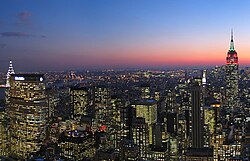
[[File:View of Empire State Building from Rockefeller Center New York City dllu (cropped).jpg|thumb|upright=1.35|[[New York City|New York]] has garnered the [[List of nicknames of New York City|nickname]] ''[[Metropolis (comics)|Metropolis]]'' to describe the city in the daytime in popular culture, contrasting with ''[[Gotham City|Gotham]]'', sometimes used to describe New York at night.<ref name="NYCDailyNewsNicknames">{{cite news|url=http://www.nydailynews.com/news/national/gotham-metropolis-nyc-best-nicknames-article-1.2556511|title=From Gotham to Metropolis: A look at NYC's best nicknames|author=Keri Blakinger|author-link=Keri Blakinger|newspaper=Daily News|location=New York|date=March 8, 2016|access-date=August 6, 2017|archive-date=November 5, 2022|archive-url=https://web.archive.org/web/20221105170635/https://www.nydailynews.com/news/national/gotham-metropolis-nyc-best-nicknames-article-1.2556511|url-status=live}}</ref>]] | |||
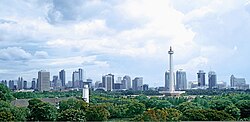
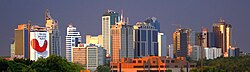
[[File:Jakarta Panorama.jpg|thumb|upright=1.35|Skyline of [[Jakarta]], the world's most populous metropolis]] | |||
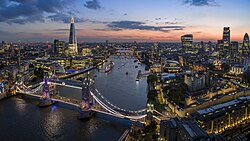
[[File:London Skyline (125508655).jpeg|thumb|upright=1.35|Skyline of [[London]], which was once the [[metropole]] of the [[British Empire]]]] | |||
{{World city population tables}} | |||
}} | |||
A '''metropolis''' ({{IPAc-en|m|ᵻ|ˈ|t|r|ɒ|p|əl|ɪ|s}} | A '''metropolis'''{{efn|Pronounced {{IPAc-en|us|m|ə|ˈ|t|r|ɑː|p|ə|l|ɪ|s}} or {{IPAc-en|uk|m|ə|ˈ|t|r|ɒ|p|ə|l|ɪ|s}};<ref>{{cite encyclopedia |author=<!-- not stated --> |title=metropolis (English pronunciation) |url=https://dictionary.cambridge.org/pronunciation/english/metropolis |encyclopedia=[[Cambridge Advanced Learner's Dictionary|Cambridge Dictionary]] |location=[[Cambridge]] |publisher=[[Cambridge University Press]] |access-date=2025-06-27 |archive-url=https://archive.today/20250627141145/https://dictionary.cambridge.org/pronunciation/english/metropolis |archive-date=2025-06-27 |url-status=live}}</ref> {{IPAc-en|usalso|m|ᵻ|ˈ|t|r|ɒ|p|əl|ɪ|s|audio=En-us-metropolis.ogg}}<ref name="oxforddictionarymetropolis">{{cite web |url=http://www.oxforddictionaries.com/definition/english/metropolis?q=Metropolis |archive-url=https://web.archive.org/web/20160307093630/http://www.oxforddictionaries.com/definition/english/metropolis?q=Metropolis |url-status=dead |archive-date=March 7, 2016 |title=Definition of Metropolis |publisher=Oxford Dictionaries |access-date=March 2, 2016}}</ref>}} is a large [[city]] or [[conurbation]] which is a significant economic, political, and cultural area for a country or region, and an important hub for regional or international connections, commerce, and communications. | ||
A big city belonging to a larger urban agglomeration, but which is not the core of that agglomeration, is not generally considered a metropolis but a part of it. The plural of the word is ''metropolises'',<ref>{{cite dictionary|url=http://www.collinsdictionary.com/dictionary/english/metropolis |title=Definition of metropolis |dictionary=Collins English Dictionary |access-date=October 23, 2012}}</ref> although the Latin plural is | A big city belonging to a larger [[urban area|urban agglomeration]], but which is not the core of that agglomeration, is not generally considered a metropolis but a part of it. The plural of the word is ''metropolises'',<ref>{{cite dictionary |url=http://www.collinsdictionary.com/dictionary/english/metropolis |title=Definition of metropolis |dictionary=Collins English Dictionary |access-date=October 23, 2012 |archive-date=February 3, 2013 |archive-url=https://web.archive.org/web/20130203025906/http://www.collinsdictionary.com/dictionary/english/metropolis? |url-status=live }}</ref> although the Latin plural is {{lang|la|metropoles}}, from the Greek {{lang|grc-latn|metropoleis}} ({{lang|grc|μητρoπόλεις}}).<!--no modern dictionaries I've seen, including OED, mention an English plural in -poles--> | ||
For urban | For urban areas outside metropolitan areas that generate a similar attraction on a smaller scale for their region, the concept of the [[regiopolis]] ("regio" for short) was introduced by urban and regional planning researchers in Germany in 2006.<ref>Iris Reuther (FG Stadt- und Regionalplanung, Universität Kassel): Presentation "Regiopole Rostock". December 11, 2008. Retrieved June 13, 2009 (pdf).</ref> | ||
==Etymology== | ==Etymology== | ||
Metropolis (μητρόπολις) is a [[Greek language|Greek]] word, coming from μήτηρ, | {{lang|grc-latn|Metropolis}} ({{lang|grc-Grek|μητρόπολις|italic=no}}) is a [[Greek language|Greek]] word, (plural: {{lang|grc-latn|metropoleis}}) coming from {{lang|grc-Grek|μήτηρ|italic=no}}, {{lang|grc-latn|mḗtēr}} meaning "mother" and {{lang|grc-Grek|πόλις|italic=no}}, {{lang|grc-latn|pólis}} meaning "city" or "town", which is how the [[Greek colonisation|Greek colonies]] of antiquity referred to their original cities, with whom they retained cultic and political-cultural connections. The word was used in post-classical Latin for the chief city of a province, the seat of the government and, in particular, [[Metropolis (religious jurisdiction)|ecclesiastically for the seat or see]] of a [[metropolitan bishop]] to whom [[suffragan bishop]]s were responsible.<ref>Louis Boisgibault, Fahad Al Kabbani (2020): [http://www.iste.co.uk/book.php?id=1591 ''Energy Transition in Metropolises, Rural Areas and Deserts''] {{Webarchive|url=https://web.archive.org/web/20200121141134/http://iste.co.uk/book.php?id=1591 |date=January 21, 2020 }}. Wiley - ISTE. (Energy series) {{ISBN|9781786304995}}.</ref> This usage equates the province with the [[diocese]] or [[episcopal see]].<ref>"metropolis, n." ''OED Online'', Oxford University Press, June 2017, www.oed.com/view/Entry/117704. Retrieved December 19, 2017; "polis, n.2." ''OED Online'', Oxford University Press, June 2017, www.oed.com/view/Entry/146859. Retrieved December 19, 2017.</ref> | ||
In a colonial context, it is the "mother city" of a [[colony]], that is, the city which sent out settlers. The word has distant roots in the [[Greek colonisation|colonial past of Ancient Greece]] with first usage in [[Middle English]] around the 14th century.<ref> | In a colonial context, it is the "mother city" of a [[colony]], that is, the city which sent out settlers. The word has distant roots in the [[Greek colonisation|colonial past of Ancient Greece]] with first usage in [[Middle English]] around the 14th century.<ref>{{Cite web |date=August 1, 2023 |title=Definition of METROPOLIS |url=https://www.merriam-webster.com/dictionary/metropolis |website=Merriam-Webster |access-date=November 7, 2021 |archive-date=November 7, 2021 |archive-url=https://web.archive.org/web/20211107224021/https://www.merriam-webster.com/dictionary/metropolis |url-status=live }}</ref> This was later generalized to a city regarded as a center of a specified activity, or any large, important city in a nation.{{citation needed|date=November 2021}} | ||
== | ==Concept== | ||
The concept of a "metropolis" as a "mother city" dates back to at least sixth-century [[Canterbury]], where the term was used in a religious context, but the term began to be used to describe a large secular city starting with 16th-century London.<ref>{{cite journal|title=The Significance of the Metropolis|first=Richard|last=Rodger|date=2012|journal=Thick Space: Approaches to Metropolitanism|page=2}}</ref> London's cultural influence meant that until the 19th century, concepts of the "metropolis" were rarely used to describe other cities, though Edinburgh was also described as a "metropolis."<ref>{{cite journal|title=The Significance of the Metropolis|first=Richard|last=Rodger|date=2012|journal=Thick Space: Approaches to Metropolitanism|page=4}}</ref> While metropolis can often mean any large city, the metropolis is generally understood as a city which serves as a particular function as opposed to simply being large.<ref>{{cite journal|last=Rykiel|first=Zbigniew|date=2012|page=24|title=Concepts of the metropolis as a form of the city and region: inspirations for sociology|journal=Przestrzeń Społeczna|volume=3}}</ref> | |||
Modern ideas of a metropolis have changed as modern city growth has created "polycentric" urban regions, where one city does not necessarily dominate its surroundings but instead is central to an economic region. Instead of a single "metropolis" fulfilling an economic role, large urban areas such as the Tokyo–Osaka corridor or the southern California built up area have been considered as a modern "metropolis" even though the region encompasses multiple cities.<ref>{{cite book|chapter=Regional urbanization and the end of the metropolis era|first=Edward W.|last=Soja|title=Cities in the 21st Century|page=686|year=2016|publisher=Routledge}}</ref> | |||
In France, Portugal, Spain, and the Netherlands, the word ''metropolis'' (''métropole'' ( | == Usage as a mainland area == | ||
In France, Portugal, Spain, and the Netherlands, the word ''metropolis'' (''métropole'' (French) / ''metrópole'' (Portuguese) / ''metrópoli'' (Spanish) / ''metropool'' (Dutch)) designates the mainland part of a country situated on or close to the European mainland; in the case of France, this means France without its [[overseas departments and regions of France|overseas departments]]. For Portugal and Spain during the [[Spanish Empire]] and [[Portuguese Empire]] period, the term was used to designate Portugal or Spain minus its colonies (the ''Ultramar''). In France ''métropole'' can also be used to refer to a large [[urban area|urban agglomeration]]; for example, "La Métropole de Lyon" (the [[Lyon Metropolis]]). | |||
== By country == | |||
The following countries either have a specific legal definition of "metropolis" or have a history of usage of the term (or a similar term). | |||
=== Americas === | |||
==== Brazil ==== | |||
The term used in [[Brazilian Portuguese]] for a metropolitan area is ''Região Metropolitana''. In Brazil, the [[Greater São Paulo]] is the principal metropolis with over 21 million inhabitants. In the larger cities, such as [[São Paulo]] and [[Rio de Janeiro]] (population 12 million), [[favelas]] (slums) grew up over decades as people migrated from rural areas in order to find work. Other metropolises in Brazil with more than one million inhabitants include: [[Belém]], [[Belo Horizonte]], [[Brasília]], [[Campinas]], [[Curitiba]], [[Fortaleza]], [[Goiânia]], [[Maceió]], [[Manaus]], [[Porto Alegre]], [[Recife]], [[Salvador, Bahia|Salvador]] and [[São Luís, Maranhão|São Luís]]. | |||
==== Canada ==== | |||
{{See also|List of census metropolitan areas and agglomerations in Canada}} | |||
[[Statistics Canada]] defines a [[census metropolitan area]] as one or more adjacent municipalities situated around a major urban core where the urban core has a population of at least 100,000.<ref>{{cite web |url=http://www12.statcan.ca/english/census01/products/reference/dict/geo009.htm |title=census metropolitan area (cma) and census agglomeration (ca), 2001 census |publisher=2.statcan.ca |access-date=October 29, 2012 |archive-date=September 30, 2020 |archive-url=https://web.archive.org/web/20200930150918/http://www12.statcan.ca/english/census01/products/reference/dict/geo009.htm |url-status=dead }}</ref> Canada's six largest metropolises are [[Toronto]], [[Montreal]], [[Vancouver]], [[Ottawa]], [[Calgary]], and [[Edmonton]]. | |||
==== Mexico ==== | |||
{{See also|Metropolitan areas of Mexico}} | |||
In Mexico, a metropolis is an urban area with a high concentration of population and activities, interacting with nearby municipalities.<ref>{{cite web|url=http://www.conapo.gob.mx/work/models/CONAPO/zonas_metropolitanas2000/completo.pdf|title=Delimitación de las zonas metropolitanas de México|website=Consejo Nacional de Población|access-date=2025-06-08}}</ref> The Consejo Nacional de Población (CONAPO) last reviewed the criteria in 2018, and from that date, a metropolitan area in Mexico is defined as: a set of two or more municipalities where a city with a population of at least 100,000 is located, and whose urban area, functions and activities exceed the limits of the municipality, incorporating within its area of direct influence the predominantly urban neighboring municipalities, maintaining a high degree of socioeconomic integration. Also included are those municipalities that, due to their particular characteristics, are relevant to urban planning and policy for each metropolitan area.<ref name="conapo2015">{{cite web |url=https://www.gob.mx/conapo/documentos/delimitacion-de-las-zonas-metropolitanas-de-mexico-2015 |title=Delimitation of Mexico's Metropolitan Areas 2015 |publisher=CONAPO |language=es |access-date=2020-12-29}}</ref> The six largest metropolitan areas are the [[Mexico City]], [[Monterrey]], [[Guadalajara]], [[Puebla (city)|Puebla]], [[Toluca]] and [[Tijuana]]. | |||
==== United States ==== | |||
{{See also|List of Metropolitan Statistical Areas}} | |||
[[File:Top of Rock Cropped.jpg|thumb|[[New York City|New York]] is the largest city in the [[United States|U.S.]]]] | |||
In the United States, an [[Incorporation (municipal government)|incorporated]] area or group of areas having a population more than 50,000 is required to have a [[metropolitan planning organization]] in order to facilitate major infrastructure projects and to ensure financial solvency. Thus, a population of 50,000 or greater has been used as a de facto standard to define a ''metropolis'' in the United States. A similar definition is used by the [[United States Census Bureau]]. The bureau defines a [[Metropolitan Statistical Area]] as "at least one urbanized area of 50,000 or more inhabitants." The six largest metropolitan areas in the United States are [[New York City|New York]], [[Los Angeles]], [[Chicago]], [[Dallas]], [[Houston]], and [[Washington, D.C.]], with New York being the largest. | |||
=== Asia === | |||
==== China ==== | |||
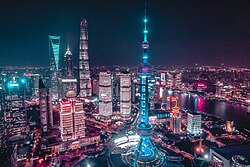
[[File:Shanghai skyline 2018(cropped).jpg|thumb|[[Shanghai]], the most populous urban city in [[China]]]] | |||
China has 60 megacities. The most populous megacities include [[Shenyang]], [[Dalian]], [[Changchun]] and [[Harbin]] in Northeast China; [[Beijing]] and [[Tianjin]] in North China; [[Xi'an]] in Northwest China; [[Chongqing]] and [[Chengdu]] in Southwest China; [[Wuhan]] in Central China, [[Shanghai]], [[Nanjing]], [[Suzhou]], [[Hangzhou]], [[Jinan]], [[Qingdao]] in East China, and [[Guangzhou]], [[Shenzhen]], [[Sanya]], [[Hong Kong]], [[Macau]] in Southern China. Beijing, Tianjin, Shanghai, and Chongqing are municipalities directly under the central government. | |||
==== India ==== | |||
{{See also|List of metropolitan areas in India}} | |||
The 74th Amendment to the [[Constitution of India|Indian Constitution]] defines a [[metropolitan area]] as an area having a population of 10 Lakh (1 Million) or more, comprised in one or more districts and consisting of two or more Municipalities or Panchayats or other contiguous areas, specified by the Governor by public notification to be a Metropolitan area. As of [[2011 Census of India]], [[India]] has [[List of cities in India by population|46 other cities]] with populations greater than one million.<ref name="auto">{{cite web|title=Provisional Population Totals Urban Agglomerations and Cities|url=http://censusindia.gov.in/2011-prov-results/paper2/data_files/India2/1.%20Data%20Highlight.pdf|website=Census of India 2011|access-date=30 January 2016|archive-date=April 3, 2016|archive-url=https://web.archive.org/web/20160403173544/http://www.censusindia.gov.in/2011-prov-results/paper2/data_files/India2/1.%20Data%20Highlight.pdf|url-status=live}}</ref> [[National Capital Region (India)|Delhi]], [[Mumbai Metropolitan Region|Mumbai]], [[Kolkata metropolitan area|Kolkata]], [[Chennai metropolitan area|Chennai]], [[Bangalore]], [[Hyderabad Metropolitan Region|Hyderabad]], [[Pune Metropolitan Region|Pune]], [[Ahmedabad]], [[Kochi metropolitan area|Kochi]], are among the largest of [[List of metropolitan areas in India|23 metropolitan cities in India]]. | |||
==== Japan ==== | |||
[[File:Blue Hour over Tokyo (11753289395).jpg|thumb|[[Tokyo]], the capital and largest city of [[Japan]]]] | |||
The Japanese legal term ''to'' (都) is by designation to be translated as "metropolis".<ref>{{cite web | |||
|url=http://www.jlgc.org/en/pdf/localg2006.PDF | |||
|title=Local Government in Japan | |||
|access-date=October 16, 2007 | |||
|publisher=Council of Local Authorities for International Relations | |||
|pages=41 | |||
|url-status=dead | |||
|archive-url=https://web.archive.org/web/20071025030339/http://www.jlgc.org/en/pdf/localg2006.PDF | |||
|archive-date=October 25, 2007 | |||
}}</ref> However, existing translations predate the designation.{{clarify|date=June 2024}} Structured like a [[prefectures of Japan|prefecture]] instead of a normal city, there is only one ''to'' in Japan, namely Tokyo. {{As of|2020}}, Japan has [[list of cities in Japan|12 other cities]] with populations greater than one million. The same [[Kanji]] character in Chinese, or in generic Japanese (traditional or non-specific), translates variously—city, municipality, special municipality—all qualify. | |||
==== Philippines ==== | |||
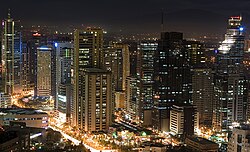
[[File:Ortigas Tonight.jpg|thumb|[[Metro Manila]], the most populous metropolitan area in the [[Philippines]]]] | |||
The Philippines has three metropolises as defined by the [[National Economic and Development Authority]]. They are [[Metro Manila|Manila]], [[Cebu City|Cebu]], and [[Davao City|Davao]].<ref name="neda">{{Cite web |url=http://pdp.neda.gov.ph/wp-content/uploads/2017/01/Chapter-03.pdf |title=Philippine Development Plan 2017–2022, Chapter 3: An overlay of economic growth, demographic trends and physical characteristics |year=2017 |website=[[National Economic and Development Authority]] |access-date=April 21, 2018 |archive-date=July 25, 2020 |archive-url=https://web.archive.org/web/20200725173756/http://pdp.neda.gov.ph/wp-content/uploads/2017/01/Chapter-03.pdf |url-status=live }}</ref> | |||
[[Greater Manila Area]] is the contiguous urbanization region or Extended Metropolitan Manila surrounding Metro Manila. This built-up zone includes [[Metro Manila]] and the neighboring provinces of [[Bulacan]] to the north, [[Cavite]] and [[Laguna, Philippines|Laguna]] to the south, and [[Rizal, Philippines|Rizal]] to the east. Though sprawl continues to absorb new zones, some urban zones are independent clusters of settlements surrounded by non-urban areas. | |||
==== South Korea ==== | |||
In the South Korea, there are seven special and metropolitan cities at autonomous administrative levels. These are the most populous metropolitan areas in the country. In decreasing order of the population of 2015 census, they are [[Seoul]], [[Busan]], [[Incheon]], [[Daegu]], [[Daejeon]], [[Gwangju]] and [[Ulsan]]. | |||
According to the census of 2015, cities of [[Changwon]] and [[Suwon]] also qualify for being elevated to the level of metropolitan cities (having population over 1 million), but any future plans to promote them into metropolitan city are unlikely to be accepted because of political concerns about the [[Administrative divisions of South Korea|structure of administrative divisions]]. There are also some county-level cities with increasing population near 1 million, namely [[Goyang]], [[Yongin]], and [[Seongnam]], but they are also unlikely to be promoted into metropolitan city because they are all [[Satellite town|satellite cities]] of [[Seoul]]. | |||
=== Europe === | |||
[[File:Eiffel Tower and La Défense from Tour Montparnasse.jpg|thumb|upright=1.35|Skyline of [[Paris]], which is the [[List of urban areas in Europe|most populated urban area]] in the [[European Union]] and [[France]]]] | |||
==== France ==== | |||
{{Main|Métropole}} | |||
A 2014 law allowed any group of [[Communes of France|communes]] to cooperate in a larger administrative division called a ''[[métropole]]''. One métropole, [[Lyon Metropolis|Lyon]], also has status as a [[Departments of France|department]]. | |||
France's national statistics institute, [[Insee]], designates 12 of the country's [[Urban area (France)|urban areas]] as ''metropolitan areas''. [[Paris]], [[Lyon]] and [[Marseille]] are the biggest, the other nine being [[Toulouse]], [[Lille]], [[Bordeaux]], [[Nice]], [[Nantes]], [[Strasbourg]], [[Rennes]], [[Grenoble]] and [[Montpellier]].<ref>{{cite web |url=https://www.insee.fr/fr/statistiques/1280952 |title=Un maillage du territoire français |trans-title=A network of French territory |language=fr |first=Chantal |last=Brutel |publisher={{Lang|fr|[[Institut national de la statistique et des études économiques]]|italic=no}} |date=January 18, 2011 |access-date=October 4, 2017 |archive-date=April 24, 2017 |archive-url=https://web.archive.org/web/20170424060312/http://www.insee.fr/fr/statistiques/1280952 |url-status=live }}</ref> | |||
==== Germany ==== | |||
{{Main|Metropolitan regions in Germany}} | |||
The largest German city by administrative borders is [[Berlin]], while [[Rhine-Ruhr]] is the largest metropolitan area (with more than 10 million people). The importance of a city is measured with three groups of indicators, also called metropolitan functions: The decision making and control function, the innovation and competition function, and the gateway function. These functions are seen as key domains for metropolitan regions in developing their performance. | |||
In spatial planning, a metropolis is usually observed within its regional context, thus the focus is mainly set on the metropolitan regions. These regions can be mono central or multi central. Eleven metropolitan regions have been defined due to these indicators: [[Berlin Metropolitan Region|Berlin-Brandenburg]], [[Bremen/Oldenburg Metropolitan Region|Bremen-Oldenburg]], [[Central German Metropolitan Region|Dresden-Halle-Leipzig]], [[Frankfurt/Rhine-Main Metropolitan Region|Frankfurt-Rhine-Main]], [[Hamburg Metropolitan Region|Hamburg]], [[Hannover-Braunschweig-Göttingen-Wolfsburg Metropolitan Region|Hannover-Braunschweig-Göttingen-Wolfsburg]], [[Munich]], [[Nuremberg Metropolitan Region|Nuremberg]], [[Rhine-Neckar]], [[Rhine-Ruhr Metropolitan Region|Rhine-Ruhr]] (with [[Cologne/Bonn Region|Cologne/Bonn]]), and [[Stuttgart Metropolitan Region|Stuttgart]].<ref>{{cite web |url=http://www.deutsche-metropolregionen.org/ |title=Initiativkreise Europäische Metropolregion in Deutschland: IKM |publisher=Deutsche-metropolregionen.org |access-date=October 29, 2012 |archive-date=May 17, 2020 |archive-url=https://web.archive.org/web/20200517180006/http://www.deutsche-metropolregionen.org/ |url-status=live }}</ref> | |||
==== Italy ==== | |||
{{Main|Metropolitan cities of Italy}} | |||
As of January 1, 2015, there are 14 "metropolitan cities" in Italy. [[Rome]], [[Milan]], [[Naples]] and other big cores have taken in urban zones from their surrounding areas and merged them into the new entities, which have been home for one out of three Italians. The [[Italian Provinces|provinces]] remained in the parts of the country not belonging to any Metropolitan City.<ref>{{cite web|url=http://www.citylab.com/politics/2014/12/how-italy-put-cities-in-charge/383719|title=How Italy puts cities in charge|date=August 2, 2023|access-date=December 16, 2014|archive-date=February 3, 2017|archive-url=https://web.archive.org/web/20170203135408/http://www.citylab.com/politics/2014/12/how-italy-put-cities-in-charge/383719/|url-status=live}}</ref> | |||
==== Poland ==== | |||
{{Main|Metropolitan areas in Poland}} | |||
[[File:Warsaw skyline Świętokrzyski Bridge.jpg|thumb|[[Warsaw]], the capital and largest city of [[Poland]]]] | |||
The ''Union of Polish metropolises'' ({{langx|pl|[[:pl:Unia Metropolii Polskich|Unia Metropolii Polskich]]}}), established in 1990, is an organization of the largest cities in the country. Currently twelve cities are members of the organization, of which 11 have more than a quarter-million inhabitants. The largest metropolitan area in Poland, if ranked solely by the number of inhabitants, is the [[Katowice metropolitan area]] with around 3 million inhabitants (5 million inhabitants in the [[Katowice–Ostrava metropolitan area]]). The [[Metropolis GZM]] is an initiative of recent years attempting to unite [[Katowice urban area|the conurbation]] into one official urban unit. It is followed by [[Warsaw]], with around 1.7 million inhabitants in the city proper and 3.1 million in the [[Warsaw metropolitan area]]. Other Polish metropolises are [[Kraków metropolitan area|Kraków]], [[Łódź metropolitan area|Łódź]], [[Wrocław metropolitan area|Wrocław]], [[Poznań metropolitan area|Poznań]], [[Tricity, Poland|Tricity]], [[Szczecin metropolitan area|Szczecin]] and [[Bydgoszcz–Toruń metropolitan area|Bydgoszcz–Toruń]]. | |||
==== Turkey ==== | |||
{{Main|Metropolitan municipalities in Turkey}} | |||
[[File:Maslak kerembarut.jpg|thumb|[[Istanbul]] is the largest city in [[Turkey]]]] | |||
In Turkey, the metropolitan cities are described as "büyükşehir". There are 30 metropolitan municipalities in Turkey now and metropolitan municipality borders would overlap with provincial borders. The largest by far is [[Istanbul]], followed by [[Ankara]], [[İzmir]] and [[Bursa]]. [[Istanbul]], the largest city in Europe in terms of population, has a population of over 15 million. The city has surpassed [[London]] and [[Dubai]] to become the [[List of cities by international visitors|most visited city]] in the world, with more than {{nowrap|20 million}} foreign visitors in 2023. This city, which played an important role in the spread of Christianity, is an important heritage for European culture. | |||
==== United Kingdom ==== | |||
{{See also|List of urban areas in the United Kingdom}} | |||
[[File:City of London skyline from London City Hall - Oct 2008.jpg|thumb|London is the largest city in the [[United Kingdom]]]] | |||
In the United Kingdom, the term ''the Metropolis'' was historically used to exclusively refer to the cities of London and Westminster, at the heart of what later became the [[Greater London Built-up Area]]. The term is retained by the Greater London police force, the [[Metropolitan Police]] (the "Met"), formed in 1829. The chief officer of the Metropolitan Police is formally known as the [[Commissioner of Police of the Metropolis]]. | |||
The [[Metropolis Management Act 1855]] created the [[Metropolitan Board of Works]], covering an area now known as [[Inner London]], and in 1889 this became the elected [[London County Council]]. | |||
Since 1974, six [[conurbation]]s in England (outside London) have been known as [[metropolitan counties]], each divided into [[metropolitan districts]]. These counties are [[South Yorkshire]] (centred on the city of [[Sheffield]]), the [[West Midlands conurbation|West Midlands]] (including [[Birmingham]]), [[West Yorkshire]] (including [[Leeds]]), [[Merseyside]] (including [[Liverpool]]), [[Greater Manchester]] and [[Tyne & Wear]] (including [[Newcastle-upon-Tyne]]). [[Greater Glasgow]], [[South Hampshire]], [[Nottingham Urban Area]], [[Greater Bristol]], [[Belfast metropolitan area]], and [[Leicester urban area]] are also large conurbations with more than half a million citizens. | |||
==== Sweden ==== | |||
{{See also|List of metropolitan areas in Sweden}} | |||
In Sweden, the term ''metropolis'' has been used to exclusively refer to Stockholm or [[Greater Stockholm]].{{citation needed|date=January 2025}} | |||
=== Oceania === | |||
==== Australia ==== | |||
{{See also|List of cities in Australia by population}} | |||
The [[Australian Bureau of Statistics]] defines a metropolitan area as any statistical division or district with a population of more than 100,000.<ref>{{Cite web |publisher=Australian Bureau of Statistics |title=1217.0.55.001 – Glossary of Statistical Geography Terminology, 2003 |date=October 29, 2013 |url=http://www.abs.gov.au/Ausstats/[email protected]/7d12b0f6763c78caca257061001cc588/32eb1b908521ad75ca2571220079feee!OpenDocument#M |access-date=June 24, 2012 |archive-date=March 10, 2020 |archive-url=https://web.archive.org/web/20200310030745/https://www.abs.gov.au/Ausstats/[email protected]/7d12b0f6763c78caca257061001cc588/32eb1b908521ad75ca2571220079feee!OpenDocument#M |url-status=live }}</ref> According to this definition, there are currently 19 metropolitan areas in Australia, including every state capital. By population, the largest metropolitan area is [[Sydney]] (urban area population at 2020 Census of 5,367,206) and the smallest is [[Bendigo]] (urban area population at 2020 Census of 100,632). Rapid urban growth in Victoria has seen the 'Manhattanization' of [[Melbourne]], with high-rise clusters in South Yarra, Box Hill, Moonee Ponds and Footscray. The regional city of [[Geelong]] which is approximately 40 miles south west of Melbourne, has seen the emergence of high-rise office and apartment buildings in recent years. Geelong is the fastest growing regional city in Australia, and its growth will transform the Port Phillip region in a similar manner to San Francisco's Bay Area. (urban area population at 2020 Census of 160,991).<ref>{{Cite web|url=http://www.abs.gov.au/ausstats/[email protected]/Latestproducts/3218.0Media%20Release12016?opendocument&tabname=Summary&prodno=3218.0&issue=2016&num=&view=|title=Media Release – Ten years of growth: Australia's population hotspots (Media Release)|last=Statistics|first=c=AU; o=Commonwealth of Australia; ou=Australian Bureau of|website=abs.gov.au|access-date=January 20, 2018|archive-url=https://web.archive.org/web/20170930073403/http://www.abs.gov.au/ausstats/[email protected]/Latestproducts/3218.0Media%20Release12016?opendocument&tabname=Summary&prodno=3218.0&issue=2016&num=&view=|archive-date=September 30, 2017|url-status=dead}}</ref> | |||
== See also == | == See also == | ||
{{Div col}} | |||
* [[Megalopolis]] | * [[Megalopolis]] | ||
* [[Metropole]] | |||
* [[Metropolitan area]] | * [[Metropolitan area]] | ||
| Line 60: | Line 159: | ||
* [[Settlement hierarchy]] | * [[Settlement hierarchy]] | ||
* [[Sustainable city]] | * [[Sustainable city]] | ||
{{Div col end}} | |||
== Notes == | |||
{{notelist}} | |||
== References == | == References == | ||
{{ | {{reflist}} | ||
== Further reading == | |||
{{Wikisource1911Enc|Metropolis}} | |||
* [https://www.census.gov/population/www/estimates/aboutmetro.html Census.gov], [[United States Census Bureau|U.S. Census Bureau]], ''About Metropolitan and Micropolitan Statistics'' | |||
* [http://www.metroforum.com/ MetroForum.com], forum dedicated to discussions on metropolis | |||
* [https://archive.today/20121210191822/http://www.blog.ar2com.de/megalopolis/ Blog.ar2com.de], a podcast with a worldwide analysis of megacities (focus Latin America) | |||
* {{webarchive |url=http://webarchive.loc.gov/all/20091027184144/http%3A//www.e%2Dgeopolis.eu/ |title=E-geopolis.eu |date=October 27, 2009}}: research group, university of Paris-Diderot, France | |||
* See [[Ronald Daus]]´s bibliography, researcher at the [[Free University of Berlin]] | |||
{{Cities}} | |||
{{Authority control}} | |||
[[Category:Urban geography]] | |||
[[Category:Demography]] | |||
[[Category:Lists of cities]] | |||
[[Category:Greek colonization]] | |||
[[Category:Urban areas]] | |||
[[Category:Settlement geography]] | |||
[[Category:Types of cities]] | |||
Latest revision as of 19:05, 17 March 2026
.jpg)

.jpeg)
Template:World city population tables
A metropolis[lower-alpha 1] is a large city or conurbation which is a significant economic, political, and cultural area for a country or region, and an important hub for regional or international connections, commerce, and communications.
A big city belonging to a larger urban agglomeration, but which is not the core of that agglomeration, is not generally considered a metropolis but a part of it. The plural of the word is metropolises,[4] although the Latin plural is metropoles, from the Greek metropoleis (μητρoπόλεις).
For urban areas outside metropolitan areas that generate a similar attraction on a smaller scale for their region, the concept of the regiopolis ("regio" for short) was introduced by urban and regional planning researchers in Germany in 2006.[5]
Etymology[edit | edit source]
Metropolis (μητρόπολις) is a Greek word, (plural: metropoleis) coming from μήτηρ, mḗtēr meaning "mother" and πόλις, pólis meaning "city" or "town", which is how the Greek colonies of antiquity referred to their original cities, with whom they retained cultic and political-cultural connections. The word was used in post-classical Latin for the chief city of a province, the seat of the government and, in particular, ecclesiastically for the seat or see of a metropolitan bishop to whom suffragan bishops were responsible.[6] This usage equates the province with the diocese or episcopal see.[7]
In a colonial context, it is the "mother city" of a colony, that is, the city which sent out settlers. The word has distant roots in the colonial past of Ancient Greece with first usage in Middle English around the 14th century.[8] This was later generalized to a city regarded as a center of a specified activity, or any large, important city in a nation.[citation needed]
Concept[edit | edit source]
The concept of a "metropolis" as a "mother city" dates back to at least sixth-century Canterbury, where the term was used in a religious context, but the term began to be used to describe a large secular city starting with 16th-century London.[9] London's cultural influence meant that until the 19th century, concepts of the "metropolis" were rarely used to describe other cities, though Edinburgh was also described as a "metropolis."[10] While metropolis can often mean any large city, the metropolis is generally understood as a city which serves as a particular function as opposed to simply being large.[11]
Modern ideas of a metropolis have changed as modern city growth has created "polycentric" urban regions, where one city does not necessarily dominate its surroundings but instead is central to an economic region. Instead of a single "metropolis" fulfilling an economic role, large urban areas such as the Tokyo–Osaka corridor or the southern California built up area have been considered as a modern "metropolis" even though the region encompasses multiple cities.[12]
Usage as a mainland area[edit | edit source]
In France, Portugal, Spain, and the Netherlands, the word metropolis (métropole (French) / metrópole (Portuguese) / metrópoli (Spanish) / metropool (Dutch)) designates the mainland part of a country situated on or close to the European mainland; in the case of France, this means France without its overseas departments. For Portugal and Spain during the Spanish Empire and Portuguese Empire period, the term was used to designate Portugal or Spain minus its colonies (the Ultramar). In France métropole can also be used to refer to a large urban agglomeration; for example, "La Métropole de Lyon" (the Lyon Metropolis).
By country[edit | edit source]
The following countries either have a specific legal definition of "metropolis" or have a history of usage of the term (or a similar term).
Americas[edit | edit source]
Brazil[edit | edit source]
The term used in Brazilian Portuguese for a metropolitan area is Região Metropolitana. In Brazil, the Greater São Paulo is the principal metropolis with over 21 million inhabitants. In the larger cities, such as São Paulo and Rio de Janeiro (population 12 million), favelas (slums) grew up over decades as people migrated from rural areas in order to find work. Other metropolises in Brazil with more than one million inhabitants include: Belém, Belo Horizonte, Brasília, Campinas, Curitiba, Fortaleza, Goiânia, Maceió, Manaus, Porto Alegre, Recife, Salvador and São Luís.
Canada[edit | edit source]
Statistics Canada defines a census metropolitan area as one or more adjacent municipalities situated around a major urban core where the urban core has a population of at least 100,000.[13] Canada's six largest metropolises are Toronto, Montreal, Vancouver, Ottawa, Calgary, and Edmonton.
Mexico[edit | edit source]
In Mexico, a metropolis is an urban area with a high concentration of population and activities, interacting with nearby municipalities.[14] The Consejo Nacional de Población (CONAPO) last reviewed the criteria in 2018, and from that date, a metropolitan area in Mexico is defined as: a set of two or more municipalities where a city with a population of at least 100,000 is located, and whose urban area, functions and activities exceed the limits of the municipality, incorporating within its area of direct influence the predominantly urban neighboring municipalities, maintaining a high degree of socioeconomic integration. Also included are those municipalities that, due to their particular characteristics, are relevant to urban planning and policy for each metropolitan area.[15] The six largest metropolitan areas are the Mexico City, Monterrey, Guadalajara, Puebla, Toluca and Tijuana.
United States[edit | edit source]

In the United States, an incorporated area or group of areas having a population more than 50,000 is required to have a metropolitan planning organization in order to facilitate major infrastructure projects and to ensure financial solvency. Thus, a population of 50,000 or greater has been used as a de facto standard to define a metropolis in the United States. A similar definition is used by the United States Census Bureau. The bureau defines a Metropolitan Statistical Area as "at least one urbanized area of 50,000 or more inhabitants." The six largest metropolitan areas in the United States are New York, Los Angeles, Chicago, Dallas, Houston, and Washington, D.C., with New York being the largest.
Asia[edit | edit source]
China[edit | edit source]
.jpg)
China has 60 megacities. The most populous megacities include Shenyang, Dalian, Changchun and Harbin in Northeast China; Beijing and Tianjin in North China; Xi'an in Northwest China; Chongqing and Chengdu in Southwest China; Wuhan in Central China, Shanghai, Nanjing, Suzhou, Hangzhou, Jinan, Qingdao in East China, and Guangzhou, Shenzhen, Sanya, Hong Kong, Macau in Southern China. Beijing, Tianjin, Shanghai, and Chongqing are municipalities directly under the central government.
India[edit | edit source]
The 74th Amendment to the Indian Constitution defines a metropolitan area as an area having a population of 10 Lakh (1 Million) or more, comprised in one or more districts and consisting of two or more Municipalities or Panchayats or other contiguous areas, specified by the Governor by public notification to be a Metropolitan area. As of 2011 Census of India, India has 46 other cities with populations greater than one million.[16] Delhi, Mumbai, Kolkata, Chennai, Bangalore, Hyderabad, Pune, Ahmedabad, Kochi, are among the largest of 23 metropolitan cities in India.
Japan[edit | edit source]
.jpg)
The Japanese legal term to (都) is by designation to be translated as "metropolis".[17] However, existing translations predate the designation.[clarification needed] Structured like a prefecture instead of a normal city, there is only one to in Japan, namely Tokyo. As of 2020[update], Japan has 12 other cities with populations greater than one million. The same Kanji character in Chinese, or in generic Japanese (traditional or non-specific), translates variously—city, municipality, special municipality—all qualify.
Philippines[edit | edit source]

The Philippines has three metropolises as defined by the National Economic and Development Authority. They are Manila, Cebu, and Davao.[18]
Greater Manila Area is the contiguous urbanization region or Extended Metropolitan Manila surrounding Metro Manila. This built-up zone includes Metro Manila and the neighboring provinces of Bulacan to the north, Cavite and Laguna to the south, and Rizal to the east. Though sprawl continues to absorb new zones, some urban zones are independent clusters of settlements surrounded by non-urban areas.
South Korea[edit | edit source]
In the South Korea, there are seven special and metropolitan cities at autonomous administrative levels. These are the most populous metropolitan areas in the country. In decreasing order of the population of 2015 census, they are Seoul, Busan, Incheon, Daegu, Daejeon, Gwangju and Ulsan.
According to the census of 2015, cities of Changwon and Suwon also qualify for being elevated to the level of metropolitan cities (having population over 1 million), but any future plans to promote them into metropolitan city are unlikely to be accepted because of political concerns about the structure of administrative divisions. There are also some county-level cities with increasing population near 1 million, namely Goyang, Yongin, and Seongnam, but they are also unlikely to be promoted into metropolitan city because they are all satellite cities of Seoul.
Europe[edit | edit source]

France[edit | edit source]
A 2014 law allowed any group of communes to cooperate in a larger administrative division called a métropole. One métropole, Lyon, also has status as a department.
France's national statistics institute, Insee, designates 12 of the country's urban areas as metropolitan areas. Paris, Lyon and Marseille are the biggest, the other nine being Toulouse, Lille, Bordeaux, Nice, Nantes, Strasbourg, Rennes, Grenoble and Montpellier.[19]
Germany[edit | edit source]
The largest German city by administrative borders is Berlin, while Rhine-Ruhr is the largest metropolitan area (with more than 10 million people). The importance of a city is measured with three groups of indicators, also called metropolitan functions: The decision making and control function, the innovation and competition function, and the gateway function. These functions are seen as key domains for metropolitan regions in developing their performance.
In spatial planning, a metropolis is usually observed within its regional context, thus the focus is mainly set on the metropolitan regions. These regions can be mono central or multi central. Eleven metropolitan regions have been defined due to these indicators: Berlin-Brandenburg, Bremen-Oldenburg, Dresden-Halle-Leipzig, Frankfurt-Rhine-Main, Hamburg, Hannover-Braunschweig-Göttingen-Wolfsburg, Munich, Nuremberg, Rhine-Neckar, Rhine-Ruhr (with Cologne/Bonn), and Stuttgart.[20]
Italy[edit | edit source]
As of January 1, 2015, there are 14 "metropolitan cities" in Italy. Rome, Milan, Naples and other big cores have taken in urban zones from their surrounding areas and merged them into the new entities, which have been home for one out of three Italians. The provinces remained in the parts of the country not belonging to any Metropolitan City.[21]
Poland[edit | edit source]

The Union of Polish metropolises (Polish: Unia Metropolii Polskich), established in 1990, is an organization of the largest cities in the country. Currently twelve cities are members of the organization, of which 11 have more than a quarter-million inhabitants. The largest metropolitan area in Poland, if ranked solely by the number of inhabitants, is the Katowice metropolitan area with around 3 million inhabitants (5 million inhabitants in the Katowice–Ostrava metropolitan area). The Metropolis GZM is an initiative of recent years attempting to unite the conurbation into one official urban unit. It is followed by Warsaw, with around 1.7 million inhabitants in the city proper and 3.1 million in the Warsaw metropolitan area. Other Polish metropolises are Kraków, Łódź, Wrocław, Poznań, Tricity, Szczecin and Bydgoszcz–Toruń.
Turkey[edit | edit source]

In Turkey, the metropolitan cities are described as "büyükşehir". There are 30 metropolitan municipalities in Turkey now and metropolitan municipality borders would overlap with provincial borders. The largest by far is Istanbul, followed by Ankara, İzmir and Bursa. Istanbul, the largest city in Europe in terms of population, has a population of over 15 million. The city has surpassed London and Dubai to become the most visited city in the world, with more than 20 million foreign visitors in 2023. This city, which played an important role in the spread of Christianity, is an important heritage for European culture.
United Kingdom[edit | edit source]

In the United Kingdom, the term the Metropolis was historically used to exclusively refer to the cities of London and Westminster, at the heart of what later became the Greater London Built-up Area. The term is retained by the Greater London police force, the Metropolitan Police (the "Met"), formed in 1829. The chief officer of the Metropolitan Police is formally known as the Commissioner of Police of the Metropolis.
The Metropolis Management Act 1855 created the Metropolitan Board of Works, covering an area now known as Inner London, and in 1889 this became the elected London County Council.
Since 1974, six conurbations in England (outside London) have been known as metropolitan counties, each divided into metropolitan districts. These counties are South Yorkshire (centred on the city of Sheffield), the West Midlands (including Birmingham), West Yorkshire (including Leeds), Merseyside (including Liverpool), Greater Manchester and Tyne & Wear (including Newcastle-upon-Tyne). Greater Glasgow, South Hampshire, Nottingham Urban Area, Greater Bristol, Belfast metropolitan area, and Leicester urban area are also large conurbations with more than half a million citizens.
Sweden[edit | edit source]
In Sweden, the term metropolis has been used to exclusively refer to Stockholm or Greater Stockholm.[citation needed]
Oceania[edit | edit source]
Australia[edit | edit source]
The Australian Bureau of Statistics defines a metropolitan area as any statistical division or district with a population of more than 100,000.[22] According to this definition, there are currently 19 metropolitan areas in Australia, including every state capital. By population, the largest metropolitan area is Sydney (urban area population at 2020 Census of 5,367,206) and the smallest is Bendigo (urban area population at 2020 Census of 100,632). Rapid urban growth in Victoria has seen the 'Manhattanization' of Melbourne, with high-rise clusters in South Yarra, Box Hill, Moonee Ponds and Footscray. The regional city of Geelong which is approximately 40 miles south west of Melbourne, has seen the emergence of high-rise office and apartment buildings in recent years. Geelong is the fastest growing regional city in Australia, and its growth will transform the Port Phillip region in a similar manner to San Francisco's Bay Area. (urban area population at 2020 Census of 160,991).[23]
See also[edit | edit source]
Other city types[edit | edit source]
Lists[edit | edit source]
Planning theories[edit | edit source]
Others[edit | edit source]
Notes[edit | edit source]
- ↑ Pronounced US: /məˈtrɑːpəlɪs/ or UK: /məˈtrɒpəlɪs/;[2] US also /mɪˈtrɒpəlɪs/ (
 listen)[3]
References[edit | edit source]
- ↑ Keri Blakinger (March 8, 2016). "From Gotham to Metropolis: A look at NYC's best nicknames". Daily News. New York. Archived from the original on November 5, 2022. Retrieved August 6, 2017.
- ↑ "metropolis (English pronunciation)". Cambridge Dictionary. Cambridge: Cambridge University Press. Retrieved June 27, 2025.
{{cite encyclopedia}}: CS1 maint: deprecated archival service (link) - ↑ "Definition of Metropolis". Oxford Dictionaries. Archived from the original on March 7, 2016. Retrieved March 2, 2016.
- ↑ "Definition of metropolis". Collins English Dictionary. Archived from the original on February 3, 2013. Retrieved October 23, 2012.
- ↑ Iris Reuther (FG Stadt- und Regionalplanung, Universität Kassel): Presentation "Regiopole Rostock". December 11, 2008. Retrieved June 13, 2009 (pdf).
- ↑ Louis Boisgibault, Fahad Al Kabbani (2020): Energy Transition in Metropolises, Rural Areas and Deserts Archived January 21, 2020, at the Wayback Machine. Wiley - ISTE. (Energy series) ISBN 9781786304995.
- ↑ "metropolis, n." OED Online, Oxford University Press, June 2017, www.oed.com/view/Entry/117704. Retrieved December 19, 2017; "polis, n.2." OED Online, Oxford University Press, June 2017, www.oed.com/view/Entry/146859. Retrieved December 19, 2017.
- ↑ "Definition of METROPOLIS". Merriam-Webster. August 1, 2023. Archived from the original on November 7, 2021. Retrieved November 7, 2021.
- ↑ Rodger, Richard (2012). "The Significance of the Metropolis". Thick Space: Approaches to Metropolitanism: 2.
- ↑ Rodger, Richard (2012). "The Significance of the Metropolis". Thick Space: Approaches to Metropolitanism: 4.
- ↑ Rykiel, Zbigniew (2012). "Concepts of the metropolis as a form of the city and region: inspirations for sociology". Przestrzeń Społeczna. 3: 24.
- ↑ Soja, Edward W. (2016). "Regional urbanization and the end of the metropolis era". Cities in the 21st Century. Routledge. p. 686.
- ↑ "census metropolitan area (cma) and census agglomeration (ca), 2001 census". 2.statcan.ca. Archived from the original on September 30, 2020. Retrieved October 29, 2012.
- ↑ "Delimitación de las zonas metropolitanas de México" (PDF). Consejo Nacional de Población. Retrieved June 8, 2025.
- ↑ "Delimitation of Mexico's Metropolitan Areas 2015" (in español). CONAPO. Retrieved December 29, 2020.
- ↑ "Provisional Population Totals Urban Agglomerations and Cities" (PDF). Census of India 2011. Archived (PDF) from the original on April 3, 2016. Retrieved January 30, 2016.
- ↑ "Local Government in Japan" (PDF). Council of Local Authorities for International Relations. p. 41. Archived from the original (PDF) on October 25, 2007. Retrieved October 16, 2007.
- ↑ "Philippine Development Plan 2017–2022, Chapter 3: An overlay of economic growth, demographic trends and physical characteristics" (PDF). National Economic and Development Authority. 2017. Archived (PDF) from the original on July 25, 2020. Retrieved April 21, 2018.
- ↑ Brutel, Chantal (January 18, 2011). "Un maillage du territoire français" [A network of French territory] (in français). Institut national de la statistique et des études économiques. Archived from the original on April 24, 2017. Retrieved October 4, 2017.
- ↑ "Initiativkreise Europäische Metropolregion in Deutschland: IKM". Deutsche-metropolregionen.org. Archived from the original on May 17, 2020. Retrieved October 29, 2012.
- ↑ "How Italy puts cities in charge". August 2, 2023. Archived from the original on February 3, 2017. Retrieved December 16, 2014.
- ↑ "1217.0.55.001 – Glossary of Statistical Geography Terminology, 2003". Australian Bureau of Statistics. October 29, 2013. Archived from the original on March 10, 2020. Retrieved June 24, 2012.
- ↑ Statistics, c=AU; o=Commonwealth of Australia; ou=Australian Bureau of. "Media Release – Ten years of growth: Australia's population hotspots (Media Release)". abs.gov.au. Archived from the original on September 30, 2017. Retrieved January 20, 2018.
{{cite web}}: CS1 maint: multiple names: authors list (link)
Further reading[edit | edit source]
- Census.gov, U.S. Census Bureau, About Metropolitan and Micropolitan Statistics
- MetroForum.com, forum dedicated to discussions on metropolis
- Blog.ar2com.de, a podcast with a worldwide analysis of megacities (focus Latin America)
- E-geopolis.eu at the Library of Congress Web Archives (archived October 27, 2009): research group, university of Paris-Diderot, France
- See Ronald Daus´s bibliography, researcher at the Free University of Berlin