



>Yobot m →top: FIx REFPUNCT + other minor fixes |
Legalwiki68 (talk | contribs) enhance details further and cleaned formatting |
||
| Line 1: | Line 1: | ||
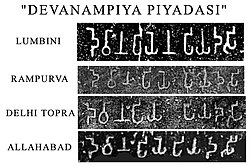
[[File:Devanampiya Piyadasi inscriptions.jpg|thumb|300px|Various "Devanampiya Piyadasi" inscriptions on the [[Pillars of Ashoka]] | {{Short description|Pali honorific epithet}} | ||
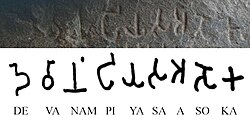
[[File:Devanampriyasa Asoka.jpg|thumb|300px|"Devānaṃpiyasa Asoka", honorific Devanampiya ([[Brahmi script]]: 𑀤𑁂𑀯𑀸𑀦𑀁𑀧𑀺𑀬𑀲𑀅𑀲𑁄𑀓, "Beloved of the God", in the adjectival form -sa) and name of [[Ashoka]], in [[Brahmi script]], in the [[Maski]] [[Edict of Ashoka]].]] | {{Use dmy dates|date=August 2024}} | ||
[[File:Devanampiyena in the Lumbini Edict of Ashoka.jpg|thumb|300px|"Devānampiyena" (𑀤𑁂𑀯𑀸𑀦𑀁𑀧𑀺𑀬𑁂𑀦:"Of Devanampiya") in the [[Lumbini]] [[Minor Pillar Edict]] of Ashoka. [[Brahmi script]] | {{Use Indian English|date=August 2024}} | ||
'''Devanampriya''', also '''Devanampiya''' ([[Brahmi script]]: 𑀤𑁂𑀯𑀸𑀦𑀁𑀧𑀺𑀬, ''Devānaṃpiya''), was a [[Pali]] honorific epithet used by a few Indian monarchs, but most particularly the | [[File:Devanampiya Piyadasi inscriptions.jpg|thumb|300px|Various "Devanampiya Piyadasi" inscriptions on the [[Pillars of Ashoka]]]] | ||
[[File:Devanampriyasa Asoka.jpg|thumb|300px|"Devānaṃpiyasa Asoka", honorific Devanampiya ([[Brahmi script]]: 𑀤𑁂𑀯𑀸𑀦𑀁𑀧𑀺𑀬𑀲𑀅𑀲𑁄𑀓, "Beloved of the God", in the adjectival form -sa) and name of [[Ashoka]], in [[Brahmi script]], in the [[Maski]] [[Edict of Ashoka]]]] | |||
[[File:Gujarra Devanampiyasa Piyadasino Asokaraja.jpg|thumb|upright=1.5|The full title ''Devanampiyasa [[Priyadasi|Piyadasino]] Asoka[[raja]]'' ({{Script|Brah|𑀤𑁂𑀯𑀸𑀦𑀁𑀧𑀺𑀬𑀲 𑀧𑀺𑀬𑀤𑀲𑀺𑀦𑁄 𑀅𑀲𑁄𑀓𑀭𑀸𑀚}}) in the [[:Commons:Category:Ashoka Minor Rock Edict, Gujarra|Gujarra inscription]].<ref>{{cite book |last1=Sircar |first1=D. C. |title=Asokan studies |date=1979 |url=https://archive.org/stream/in.gov.ignca.67068/67068#page/n103/mode/2up}}</ref>]] | |||
[[File:Devanampiyena in the Lumbini Edict of Ashoka.jpg|thumb|300px|"Devānampiyena" (𑀤𑁂𑀯𑀸𑀦𑀁𑀧𑀺𑀬𑁂𑀦:"Of Devanampiya") in the [[Lumbini]] [[Minor Pillar Edict]] of Ashoka. [[Brahmi script]]]] | |||
'''Devanampriya''' ([[Devanagari]]: देवानंप्रिय or देवानम्प्रिय), also called '''Devanampiya''' ([[Brahmi script]]: 𑀤𑁂𑀯𑀸𑀦𑀁𑀧𑀺𑀬, ''Devānaṃpiya''), was a [[Pali]] honorific epithet used by a few Indian monarchs, but most particularly the 3rd Mauryan Emperor [[Ashoka The Great]] (r.269-233 BCE) in his inscriptions (the [[Edicts of Ashoka]]).<ref name=CSH/> "Devanampriya" means "Beloved of the Gods". It is often used by Ashoka in conjunction with the title ''[[Priyadasi]]'', which means "He who regards others with kindness", "Humane".<ref name=CSH/> | |||
However, this title was used by a number of Ceylonese kings from [[Uttiya of Anuradhapura|Uttiya]] to Yasalalakatissa from the 2nd century BC to the 1st century CE.<ref>Nicholas, C.W (1949). The titles of Sinhalese kings. ''University of Ceylon Review''. Pages 235-248' http://dlib.pdn.ac.lk/bitstream/123456789/947/1/Mr.Nicholas%2CC.W.pdf</ref> | |||
The Kalsi version of the [[Major Rock Edicts|Major Rock Edict No.8]] also uses the title "Devampriyas" to describe previous kings (whereas the other versions use the term "Kings"), suggesting that the title "Denampriya" had a rather wide usage and might just have meant "King".<ref>{{cite book |last1=Beckwith |first1=Christopher I. |title=Greek Buddha: Pyrrho's Encounter with Early Buddhism in Central Asia |date=2015 |publisher=Princeton University Press |isbn=9781400866328 |pages=235–236 |url=https://books.google.com/books?id=RlCUBgAAQBAJ&pg=PA236 |language=en}}</ref><ref>{{cite book |title=Inscriptions of Asoka. New Edition by E. Hultzsch |date=1925 |page=37 Note 3 |url=https://archive.org/stream/InscriptionsOfAsoka.NewEditionByE.Hultzsch/HultzschCorpusAsokaSearchable#page/n173/mode/2up |language=Sanskrit}}</ref> | The Kalsi version of the [[Major Rock Edicts|Major Rock Edict No.8]] also uses the title "Devampriyas" to describe previous kings (whereas the other versions use the term "Kings"), suggesting that the title "Denampriya" had a rather wide usage and might just have meant "King".<ref>{{cite book |last1=Beckwith |first1=Christopher I. |title=Greek Buddha: Pyrrho's Encounter with Early Buddhism in Central Asia |date=2015 |publisher=Princeton University Press |isbn=9781400866328 |pages=235–236 |url=https://books.google.com/books?id=RlCUBgAAQBAJ&pg=PA236 |language=en}}</ref><ref>{{cite book |title=Inscriptions of Asoka. New Edition by E. Hultzsch |date=1925 |page=37 Note 3 |url=https://archive.org/stream/InscriptionsOfAsoka.NewEditionByE.Hultzsch/HultzschCorpusAsokaSearchable#page/n173/mode/2up |language=Sanskrit}}</ref> | ||
[[James Prinsep|Prinsep]] in his study and decipherment of the [[Edicts of Ashoka]] had originally identified Devanampriya Priyadasi with the King of Ceylon [[Devanampiya Tissa of Anuradhapura]]. However, in 1837, [[George Turnour]] discovered Sri Lankan manuscripts ([[Dipavamsa]], or "Island Chronicle" ) associating Piyadasi with Ashoka: | [[James Prinsep|Prinsep]] in his study and decipherment of the [[Edicts of Ashoka]] had originally identified Devanampriya Priyadasi with the King of Ceylon [[Devanampiya Tissa of Anuradhapura]]. However, in 1837, [[George Turnour]] discovered Sri Lankan manuscripts ([[Dipavamsa]], or "Island Chronicle" ) associating Piyadasi with Ashoka: | ||
{{ | {{blockquote|"Two hundred and eighteen years after the beatitude of the [[Buddha]], was the inauguration of Piyadassi, .... who, the grandson of Chandragupta, and the son of Bindusara, and was at the time Governor of [[Ujain|Ujjayani]]."|[[Dipavamsa]].<ref>{{cite book |last1=Allen |first1=Charles |title=Ashoka: The Search for India's Lost Emperor |date=2012 |publisher=Little, Brown Book Group |isbn=9781408703885 |page=79 |url=https://books.google.com/books?id=K4vHjbUtf_4C&pg=PT79 |language=en}}</ref>}} | ||
Since then, the association of "Devanampriya Priyadarsin" with Ashoka was reinforced through various inscriptions, and especially confirmed in the [[Minor Rock Edict]] inscription discovered in [[Maski]], associating Ashoka with Devanampriya:<ref name=CSH>{{cite book |title=The Cambridge Shorter History of India |publisher=CUP Archive |page=42 |url=https://books.google.com/books?id=9_48AAAAIAAJ&pg=PA42 |language=en}}</ref><ref>{{cite book |last1=Gupta |first1=Subhadra Sen |title=Ashoka |date=2009 |publisher=Penguin UK |isbn=9788184758078 |page=13 |url=https://books.google.com/books?id=L5ru08et_ZAC&pg=PT13 |language=en}}</ref> | Since then, the association of "Devanampriya Priyadarsin" with Ashoka was reinforced through various inscriptions, and especially confirmed in the [[Minor Rock Edict]] inscription discovered in [[Maski]], associating Ashoka with Devanampriya:<ref name=CSH>{{cite book |title=The Cambridge Shorter History of India |publisher=CUP Archive |page=42 |url=https://books.google.com/books?id=9_48AAAAIAAJ&pg=PA42 |language=en}}</ref><ref>{{cite book |last1=Gupta |first1=Subhadra Sen |title=Ashoka |date=2009 |publisher=Penguin UK |isbn=9788184758078 |page=13 |url=https://books.google.com/books?id=L5ru08et_ZAC&pg=PT13 |language=en}}</ref> | ||
{{ | {{blockquote| | ||
[A proclamation] of '''''Devanampriya Asoka'''''.<br> | [A proclamation] of '''''Devanampriya Asoka'''''.<br> | ||
Two and a half years [and somewhat more] (have passed) since I am a Buddha-Sakya.<br> | Two and a half years [and somewhat more] (have passed) since I am a Buddha-Sakya.<br> | ||
| Line 18: | Line 24: | ||
This object can be reached even by a lowly (person) who is devoted to morality.<br> | This object can be reached even by a lowly (person) who is devoted to morality.<br> | ||
One must not think thus, — (viz.) that only an exalted (person) may reach this.<br> | One must not think thus, — (viz.) that only an exalted (person) may reach this.<br> | ||
Both the lowly and the exalted must be told : "If you act thus, this matter (will be) prosperous and of long duration, and will thus progress to one and a half. | Both the lowly and the exalted must be told : "If you act thus, this matter (will be) prosperous and of long duration, and will thus progress to one and a half." | ||
|Maski inscription of Ashoka.<ref>{{cite book |title=Inscriptions of Asoka. New Edition by E. Hultzsch |date=1925 |pages=174–175 |url=https://archive.org/stream/InscriptionsOfAsoka.NewEditionByE.Hultzsch/HultzschCorpusAsokaSearchable#page/n353/mode/2up |language=Sanskrit}}</ref>}} | |Maski inscription of Ashoka.<ref>{{cite book |title=Inscriptions of Asoka. New Edition by E. Hultzsch |date=1925 |pages=174–175 |url=https://archive.org/stream/InscriptionsOfAsoka.NewEditionByE.Hultzsch/HultzschCorpusAsokaSearchable#page/n353/mode/2up |language=Sanskrit}}</ref>}} | ||
| Line 26: | Line 32: | ||
*[[Devanampiya Tissa of Anuradhapura]] (died 267 BCE), ruler of Sri Lanka based at the ancient capital of Anuradhapura from 307 to 267 BC | *[[Devanampiya Tissa of Anuradhapura]] (died 267 BCE), ruler of Sri Lanka based at the ancient capital of Anuradhapura from 307 to 267 BC | ||
*[[Ashoka]] (ca. 304–232 BCE), Indian emperor of the Maurya Dynasty | *[[Ashoka]] (ca. 304–232 BCE), Indian emperor of the Maurya Dynasty | ||
*[[Dasharatha Maurya]] (ca. 232 to 224 BCE), grandson of Ashoka, in his [[Barabar caves]] inscriptions, in the form "Devanampiya Dasaratha" | *[[Dasharatha Maurya]] (ca. 232 to 224 BCE), grandson of Ashoka, in his [[Barabar caves]] inscriptions, in the form "Devanampiya Dasaratha" | ||
==References== | ==References== | ||
| Line 33: | Line 38: | ||
[[Category:Edicts of Ashoka]] | [[Category:Edicts of Ashoka]] | ||
[[Category:Titles in India]] | |||
[[Category:Titles in Sri Lanka]] | |||
Latest revision as of 17:28, 21 January 2026


Devanampriya (Devanagari: देवानंप्रिय or देवानम्प्रिय), also called Devanampiya (Brahmi script: 𑀤𑁂𑀯𑀸𑀦𑀁𑀧𑀺𑀬, Devānaṃpiya), was a Pali honorific epithet used by a few Indian monarchs, but most particularly the 3rd Mauryan Emperor Ashoka The Great (r.269-233 BCE) in his inscriptions (the Edicts of Ashoka).[2] "Devanampriya" means "Beloved of the Gods". It is often used by Ashoka in conjunction with the title Priyadasi, which means "He who regards others with kindness", "Humane".[2]
However, this title was used by a number of Ceylonese kings from Uttiya to Yasalalakatissa from the 2nd century BC to the 1st century CE.[3]
The Kalsi version of the Major Rock Edict No.8 also uses the title "Devampriyas" to describe previous kings (whereas the other versions use the term "Kings"), suggesting that the title "Denampriya" had a rather wide usage and might just have meant "King".[4][5]
Prinsep in his study and decipherment of the Edicts of Ashoka had originally identified Devanampriya Priyadasi with the King of Ceylon Devanampiya Tissa of Anuradhapura. However, in 1837, George Turnour discovered Sri Lankan manuscripts (Dipavamsa, or "Island Chronicle" ) associating Piyadasi with Ashoka:
"Two hundred and eighteen years after the beatitude of the Buddha, was the inauguration of Piyadassi, .... who, the grandson of Chandragupta, and the son of Bindusara, and was at the time Governor of Ujjayani."
Since then, the association of "Devanampriya Priyadarsin" with Ashoka was reinforced through various inscriptions, and especially confirmed in the Minor Rock Edict inscription discovered in Maski, associating Ashoka with Devanampriya:[2][7]
[A proclamation] of Devanampriya Asoka.
Two and a half years [and somewhat more] (have passed) since I am a Buddha-Sakya.
[A year and] somewhat more (has passed) [since] I have visited the Samgha and have shown zeal.
Those gods who formerly had been unmingled (with men) in Jambudvipa, have how become mingled (with them).
This object can be reached even by a lowly (person) who is devoted to morality.
One must not think thus, — (viz.) that only an exalted (person) may reach this.
Both the lowly and the exalted must be told : "If you act thus, this matter (will be) prosperous and of long duration, and will thus progress to one and a half."— Maski inscription of Ashoka.[8]
- Historical Usage
Devānaṃpiya may refer to:
- Devanampiya Tissa of Anuradhapura (died 267 BCE), ruler of Sri Lanka based at the ancient capital of Anuradhapura from 307 to 267 BC
- Ashoka (ca. 304–232 BCE), Indian emperor of the Maurya Dynasty
- Dasharatha Maurya (ca. 232 to 224 BCE), grandson of Ashoka, in his Barabar caves inscriptions, in the form "Devanampiya Dasaratha"
References[edit | edit source]
- ↑ Sircar, D. C. (1979). Asokan studies.
- ↑ 2.0 2.1 2.2 The Cambridge Shorter History of India. CUP Archive. p. 42.
- ↑ Nicholas, C.W (1949). The titles of Sinhalese kings. University of Ceylon Review. Pages 235-248' http://dlib.pdn.ac.lk/bitstream/123456789/947/1/Mr.Nicholas%2CC.W.pdf
- ↑ Beckwith, Christopher I. (2015). Greek Buddha: Pyrrho's Encounter with Early Buddhism in Central Asia. Princeton University Press. pp. 235–236. ISBN 9781400866328.
- ↑ Inscriptions of Asoka. New Edition by E. Hultzsch (in Sanskrit). 1925. p. 37 Note 3.
{{cite book}}: CS1 maint: unrecognized language (link) - ↑ Allen, Charles (2012). Ashoka: The Search for India's Lost Emperor. Little, Brown Book Group. p. 79. ISBN 9781408703885.
- ↑ Gupta, Subhadra Sen (2009). Ashoka. Penguin UK. p. 13. ISBN 9788184758078.
- ↑ Inscriptions of Asoka. New Edition by E. Hultzsch (in Sanskrit). 1925. pp. 174–175.
{{cite book}}: CS1 maint: unrecognized language (link)