




→Sankissa at the time of Ramayana: Used a better word. |
basic cleaned up structure for accuracy and updated info |
||
| (One intermediate revision by one other user not shown) | |||
| Line 1: | Line 1: | ||
{{short description|Historical city in India}} | |||
{{Use dmy dates|date=February 2019}} | {{Use dmy dates|date=February 2019}} | ||
{{Use Indian English|date=February 2019}} | {{Use Indian English|date=February 2019}} | ||
{{Infobox ancient site | {{Infobox ancient site | ||
| name = Sankissa | | name = Sankissa | ||
| native_name = | | native_name =Uttar Pradesh, India | ||
| alternate_name = | | alternate_name = | ||
| image = [[File:Elephant capital Sankasya.jpg|270px]]<br>Elephant capital at Sankissa, one of the [[Pillars of Ashoka]], 3rd century BCE<br>[[File:Sankissa elephant abacus detail.jpg|270px]] | | image = [[File:Elephant capital Sankasya.jpg|270px]]<br>Elephant capital at Sankissa, one of the [[Pillars of Ashoka]], 3rd century BCE<br>[[File:Sankissa elephant abacus detail.jpg|270px]] | ||
| Line 13: | Line 14: | ||
| relief = yes | | relief = yes | ||
| coordinates = {{coord|27|20|02|N|79|16|16|E|display=inline,title}} | | coordinates = {{coord|27|20|02|N|79|16|16|E|display=inline,title}} | ||
| location = [[Farrukhabad district]], | | location = [[Farrukhabad district]], Uttar Pradesh, India. | ||
| region = | | region = | ||
| type = Settlement | | type = Settlement | ||
| Line 49: | Line 50: | ||
}} | }} | ||
{{BuddhasHolySites}} | {{BuddhasHolySites}} | ||
'''Sankissa''' (also | '''Sankissa''' (also ''Sankasia'', ''Sankassa'' and ''Sankasya'') is an ancient city in India renown for the descent of [[Gautama Buddha]] from the [[Tushita]] heavens where he taught his mother before landing at Sankissa. Considered among the eight great pilgrimage sites, it was thirty leagues from [[Sravasti]].<ref name="DhA_224">''Dhammapadatthakathā'', iii, 224</ref> Around 300 years after the Gautama Buddha's [[Mahaparinirvana]], king [[Ashoka]] visited and built a [[Pillars of Ashoka|Pillar of Ashoka]] of which the elephant capital survives. He also built a [[stupa]] and a temple commemorating the Buddha's descent from the heavens. The ruins of the stupa are still present, as is a temple of Vishari Devi and an ancient staircase.<ref>Akashdeep Asok, "2600-year-old Stairwcase to Heaven", ''Times of India'', 25 December 2023</ref> | ||
[[File:Descent of the Buddha from the Trayastrimsa Heaven Sanchi Stupa 1 Northern Gateway.jpg|thumb|left|Descent of the Buddha from the [[Trayastrimsa]] Heaven at Sankissa.<ref>Marshall [https://archive.org/stream/in.ernet.dli.2015.459148 p.56]</ref>]] | [[File:Descent of the Buddha from the Trayastrimsa Heaven Sanchi Stupa 1 Northern Gateway.jpg|thumb|left|Descent of the Buddha from the [[Trayastrimsa]] Heaven at Sankissa.<ref>Marshall [https://archive.org/stream/in.ernet.dli.2015.459148 p.56]</ref>]] | ||
Sankissa has ruins of ancient Buddhist monasteries, and other monuments from Buddhist and Hindu traditions. The Briton Alexander Cunningham explored the site in 1842. | |||
Sankissa is now identified with Sankisa Basantapura on the north bank of the [[Ikkhumati]] river (Kalinadi), between [[Kampil]] and [[Kannauj]] | Sankissa is now identified with Sankisa Basantapura on the north bank of the [[Ikkhumati]] river (Kalinadi), between [[Kampil]] and [[Kannauj]]. It is twenty-three miles west of [[Fatehgarh]], twenty-five south of [[Kaimganj]] and forty-five north of [[Kannauj]], in the [[Farrukhabad district]] of the [[Uttar Pradesh]] state of India. | ||
==Sankissa | ==The Buddha's return at Sankissa== | ||
<!--"Maudgalyayana#Popular accounts" links here --> | |||
Events at Sankissa are recorded in the [[Tipitaka]]. It was at Sankissa that the [[Gautama Buddha|Buddha]] returned to earth, after preaching the [[Abhidhamma Pitaka]] in [[Tavatimsa]] heaven to his mother and to the gods, following his performance of the [[Twin miracle]] at [[Sravasti]]. As the time approached for the Buddha to leave Távatimsa after his three month stay, his disciple [[Maudgalyayana|Moggallana]] ([[Anuruddha]], according to Sutta Nipāta Commentary ii 570<ref>cf. ''Visuddhi magga'', p. 391</ref>) announced his coming return to the multitude who had been waiting at Sravasti. They had been fed by Culla Anathapindika as Moggallana taught the [[Dhamma]]. They all then made their way to Sankissa to meet the Buddha at his return. | |||
Sankissa | |||
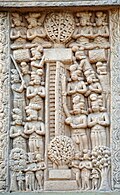
The descent of the Buddha took place on the day of the Mahapavarana festival. The king of the gods [[Indra]] built three ladders for the Buddha's descent from [[Mount Meru]] to the earth with his retinue: On the right was a ladder of gold for the gods; on the left a silver ladder for [[Maha Brahma]] and his retinue; and in the middle a ladder of jewels for the Buddha. The assembled people covered the earth for thirty leagues round. At the top of the ladder, there was a clear view of the nine Brahma worlds above and of the [[Avici]] [[hell]] below. The Buddha was accompanied by many beings including Pañcasikha, Mátali, Mahá Brahmá and Suyáma. His disciple [[Sariputta]] was the first to welcome him, followed by [[Uppalavanna]].<ref name="SNC_570">''Sutta Nipāta Commentary'', ii, 570</ref> | |||
On this occasion | On this occasion the ''Parosahassa Jataka'' was taught to proclaim to the multitude the unparalleled wisdom of Sariputta.<ref name="DhA_224"/><ref name="SNC_570"/> It is also written that the Buddha's descent at Sankissa had provided opportunities for Moggallana to show his eminence in [[iddhi]] (supranormal knowledge), [[Anuruddha]] in dibbacakkhu (ability to see far), and [[Punna]] in his skills in [[teaching]], while the Buddha wished to give [[Sariputta]] a chance of showing his profound wisdom.<ref name="DhA_224"/><ref name="SNC_570"/><ref>''Jātaka'', ed. Fausboll, iv, 266</ref><ref>see also Jhánasodhana, Sarabhamiga, and Candábha Játakas</ref> | ||
The | The location of the city gate of Sankissa is said to be at one of the "unchangeable" spots of the world, or ''avijahitatthanam'', where all of the Buddhas descend to the human world after preaching the [[Abhidhamma]] to their mothers in the Heavens.<ref>Buddhavamsa Commentary 106, 247</ref><ref>Papañca Sūdanī, Majjhima Commentary i 371</ref> From Sankissa, the Buddha went to [[Jetavana]] grove.<ref>''Jātaka'', ed. Fausboll, i, 193</ref> | ||
<gallery> | <gallery> | ||
File:Bharhut Ajatasattu Pillar - Descent From Tavatimsa.jpg|Descent to Sankissa in [[Bharhut]]. | File:Bharhut Ajatasattu Pillar - Descent From Tavatimsa.jpg|Descent to Sankissa in [[Bharhut]]. | ||
File:Buddha Panel from Afghanistan.jpg|Descent to Sankissa, in the [[Greco-Buddhist art]] of [[Gandhara]]. | File:Buddha Panel from Afghanistan.jpg|Descent to Sankissa, in the [[Greco-Buddhist art]] of [[Gandhara]]. | ||
File:Life Scenes of Buddha - Birth-Enlightenment-Descent from Heaven-First Sermon-Passing Away - Circa 2nd Century CE - Rajghat - ACCN 00-H-1 - Government Museum - Mathura 2013-02-23 5843.JPG|Descent from Heaven, 2nd century CE, Mathura. | File:Life Scenes of Buddha - Birth-Enlightenment-Descent from Heaven-First Sermon-Passing Away - Circa 2nd Century CE - Rajghat - ACCN 00-H-1 - Government Museum - Mathura 2013-02-23 5843.JPG|Descent from Heaven, 2nd century CE, Mathura. | ||
File:Thai - Buddha Preaching in Sankassa - Walters 20101231.jpg|The Buddha Preaching in Sankissa | File:Thai - Buddha Preaching in Sankassa - Walters 20101231.jpg|The Buddha Preaching in Sankissa, Thailand | ||
</gallery> | </gallery> | ||
| Line 88: | Line 87: | ||
File:Geographical spread of known Ashoka Capitals in India.jpg|Geographical spread of known [[capital (architecture)|capitals]] of the [[pillars of Ashoka]]. | File:Geographical spread of known Ashoka Capitals in India.jpg|Geographical spread of known [[capital (architecture)|capitals]] of the [[pillars of Ashoka]]. | ||
File:Sankissa elephant drawing.jpg|Sankissa elephant (drawing). | File:Sankissa elephant drawing.jpg|Sankissa elephant (drawing). | ||
File:Sankissa_elephant_abacus_detail.jpg|[[Abacus (architecture)|Abacus]] in hellenistico-persian style.<ref name="JI"> | File:Sankissa_elephant_abacus_detail.jpg|[[Abacus (architecture)|Abacus]] in hellenistico-persian style.<ref name="JI">{{Cite web |url=https://www.scribd.com/document/136703111/Chronology-of-Asokan-Pillars |title=John Irwin, The true chronology of Ashokan Pillars |access-date=23 June 2018 |archive-date=30 April 2018 |archive-url=https://web.archive.org/web/20180430182342/https://www.scribd.com/document/136703111/Chronology-of-Asokan-Pillars |url-status=dead }}</ref> | ||
</gallery> | </gallery> | ||
| Line 109: | Line 108: | ||
[[Category:Ancient Indian cities]] | [[Category:Ancient Indian cities]] | ||
[[Category:Buddhist pilgrimage sites in India]] | [[Category:Buddhist pilgrimage sites in India]] | ||
[[Category:Places in the Ramayana]] | [[Category:Places in the Ramayana]] | ||
[[Category:Buddhist sites in Uttar Pradesh]] | [[Category:Buddhist sites in Uttar Pradesh]] | ||
[[Category:Farrukhabad district]] | [[Category:Farrukhabad district]] | ||
Latest revision as of 12:10, 7 March 2026
Uttar Pradesh, India | |
 Elephant capital at Sankissa, one of the Pillars of Ashoka, 3rd century BCE  Detail of the abacus. | |
  Shown within India Sankissa (Uttar Pradesh) | |
| Location | Farrukhabad district, Uttar Pradesh, India. |
|---|---|
| Coordinates | 27°20′02″N 79°16′16″E / 27.33389°N 79.27111°E |
| Type | Settlement |
| Pilgrimage to |
| Buddha's Holy Sites |
|---|
 |
| The Four Main Sites |
| Four Additional Sites |
| Other Sites |
| Later Sites |
Sankissa (also Sankasia, Sankassa and Sankasya) is an ancient city in India renown for the descent of Gautama Buddha from the Tushita heavens where he taught his mother before landing at Sankissa. Considered among the eight great pilgrimage sites, it was thirty leagues from Sravasti.[1] Around 300 years after the Gautama Buddha's Mahaparinirvana, king Ashoka visited and built a Pillar of Ashoka of which the elephant capital survives. He also built a stupa and a temple commemorating the Buddha's descent from the heavens. The ruins of the stupa are still present, as is a temple of Vishari Devi and an ancient staircase.[2]

Sankissa has ruins of ancient Buddhist monasteries, and other monuments from Buddhist and Hindu traditions. The Briton Alexander Cunningham explored the site in 1842.
Sankissa is now identified with Sankisa Basantapura on the north bank of the Ikkhumati river (Kalinadi), between Kampil and Kannauj. It is twenty-three miles west of Fatehgarh, twenty-five south of Kaimganj and forty-five north of Kannauj, in the Farrukhabad district of the Uttar Pradesh state of India.
The Buddha's return at Sankissa[edit | edit source]
Events at Sankissa are recorded in the Tipitaka. It was at Sankissa that the Buddha returned to earth, after preaching the Abhidhamma Pitaka in Tavatimsa heaven to his mother and to the gods, following his performance of the Twin miracle at Sravasti. As the time approached for the Buddha to leave Távatimsa after his three month stay, his disciple Moggallana (Anuruddha, according to Sutta Nipāta Commentary ii 570[4]) announced his coming return to the multitude who had been waiting at Sravasti. They had been fed by Culla Anathapindika as Moggallana taught the Dhamma. They all then made their way to Sankissa to meet the Buddha at his return.
The descent of the Buddha took place on the day of the Mahapavarana festival. The king of the gods Indra built three ladders for the Buddha's descent from Mount Meru to the earth with his retinue: On the right was a ladder of gold for the gods; on the left a silver ladder for Maha Brahma and his retinue; and in the middle a ladder of jewels for the Buddha. The assembled people covered the earth for thirty leagues round. At the top of the ladder, there was a clear view of the nine Brahma worlds above and of the Avici hell below. The Buddha was accompanied by many beings including Pañcasikha, Mátali, Mahá Brahmá and Suyáma. His disciple Sariputta was the first to welcome him, followed by Uppalavanna.[5]
On this occasion the Parosahassa Jataka was taught to proclaim to the multitude the unparalleled wisdom of Sariputta.[1][5] It is also written that the Buddha's descent at Sankissa had provided opportunities for Moggallana to show his eminence in iddhi (supranormal knowledge), Anuruddha in dibbacakkhu (ability to see far), and Punna in his skills in teaching, while the Buddha wished to give Sariputta a chance of showing his profound wisdom.[1][5][6][7]
The location of the city gate of Sankissa is said to be at one of the "unchangeable" spots of the world, or avijahitatthanam, where all of the Buddhas descend to the human world after preaching the Abhidhamma to their mothers in the Heavens.[8][9] From Sankissa, the Buddha went to Jetavana grove.[10]
-
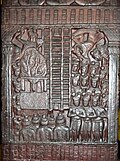 Descent to Sankissa in Bharhut.
 -
 Descent to Sankissa, in the Greco-Buddhist art of Gandhara.
 -
 Descent from Heaven, 2nd century CE, Mathura.
 -
 The Buddha Preaching in Sankissa, Thailand


Architecture[edit | edit source]


A shrine was erected on the spot where the Buddha's right foot first touched the ground at Sankissa.[11] When the Chinese pilgrims, Xuanzang and Faxian, visited the place, they found three ladders, which had been built of brick and stone by the ancients, to commemorate the Buddha's descent, but the ladders were nearly sunk in the earth.[12][13]
There was, in the Buddha's time, a deer park at Sankissa where Suhemanta Thera heard the Buddha preach.[14] During the Vajjiputta controversy, Revata Thera, on his way from Soreyya to Sahajati, went through Sankissa. The road he took passed through Sankissa, Kannakujja, Udumbara and Aggalapura.[15] The excavations carried out in the place did not reveal any artifacts of importance.
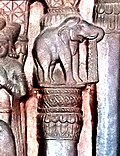
An elephant capital from the period of the Mauryas was found at the site.[16]
-
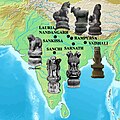 Geographical spread of known capitals of the pillars of Ashoka.
 -
 Sankissa elephant (drawing).
 -
![Abacus in hellenistico-persian style.[17]](/w/images/smartcommons/thumbs/commons/5/56/Sankissa_elephant_abacus_detail.jpg/120px-Sankissa_elephant_abacus_detail.jpg)


Location[edit | edit source]

Sankissa is about 250 km and is a 4 hours 30 minutes' drive from Kanpur Airport.
References[edit | edit source]
- ↑ 1.0 1.1 1.2 Dhammapadatthakathā, iii, 224
- ↑ Akashdeep Asok, "2600-year-old Stairwcase to Heaven", Times of India, 25 December 2023
- ↑ Marshall p.56
- ↑ cf. Visuddhi magga, p. 391
- ↑ 5.0 5.1 5.2 Sutta Nipāta Commentary, ii, 570
- ↑ Jātaka, ed. Fausboll, iv, 266
- ↑ see also Jhánasodhana, Sarabhamiga, and Candábha Játakas
- ↑ Buddhavamsa Commentary 106, 247
- ↑ Papañca Sūdanī, Majjhima Commentary i 371
- ↑ Jātaka, ed. Fausboll, i, 193
- ↑ Dhammapadatthakathā, iii, 227
- ↑ Samuel Beal, Romantic Legend of the Buddha, i, 203
- ↑ Fa Hien, p. 24
- ↑ Theragāthā Commentary, i, 212
- ↑ Vinaya Pitaka, ed. Oldenberg, ii, 299f
- ↑ Sen, Dr. A. C. (2008). Buddhist shrines in India. Kolkota: Maha Bodhi Book Agency. p. 63. ISBN 978-81-87032-78-6.
- ↑ "John Irwin, The true chronology of Ashokan Pillars". Archived from the original on 30 April 2018. Retrieved 23 June 2018.
External links[edit | edit source]
- Template:Ppn
- Template:RBK
- Sankassa Video Documentary (in Sinhalese) Ancient Buddhist events at Sankissa
- http://www.palikanon.com/english/pali_names/sa/sankassa.htm
- maps.google The place where Lord Buddha show Twin Miracle (Pali:Yamaka Patihara). - Sravasti
- maps.google The place where Lord Buddha came down from Daowadung. - Sankisa


