robot: Create/update articles. If there is a mistake please report on my talk page. |
expanded content |
||
| Line 1: | Line 1: | ||
{{ | {{Short description|Historical fort in Rajasthan, India}} | ||
{{Use dmy dates|date=November | {{Use dmy dates|date=November 2025}} | ||
{{IPA|}} | {{IPA|}} | ||
{{Infobox military installation | {{Infobox military installation | ||
|native_name | | native_name = | ||
|location | | location = [[Rajasthan]], India | ||
|image | | image = Bhangarh Fort - Royal Palace Bhangarh (July 2022) - img 16.jpg | ||
|caption | | caption = Fortification gate looking towards the royal palace of Bhangarh | ||
|pushpin_map | | pushpin_map = Rajasthan | ||
|pushpin_map_caption = Bhangarh Fort in Rajasthan | | pushpin_map_caption = Bhangarh Fort in Rajasthan | ||
|type | | type = [[Fort]] | ||
|coordinates | | coordinates = {{coord|27|5|45|N|76|17|15|E|type:landmark_region:IN|display=inline,title}} | ||
|code | | code = | ||
|built | | built = {{start date and age|1573}} | ||
|builder | | builder = [[Bhagwant Das]] | ||
|materials | | materials = Stone and brick | ||
|height | | height = | ||
|used | | used = | ||
|demolished | | demolished = | ||
|condition | | condition = Vacant; tourist attraction | ||
|ownership | | ownership = | ||
* Mihir Nagar (prior) | * Mihir Nagar (prior) | ||
* [[Government of India]] (current) | * [[Government of India]] (current) | ||
|open_to_public | | open_to_public = Yes | ||
|controlledby | | controlledby = | ||
|garrison | | garrison = | ||
|current_commander | | current_commander = | ||
|commanders | | commanders = | ||
|occupants | | occupants = | ||
|battles | | battles = | ||
|events | | events = | ||
}} | }} | ||
| Line 35: | Line 35: | ||
==Geography== | ==Geography== | ||
Bhangarh Fort is located on the border of the [[Sariska Tiger Reserve|Sariska Reserve]] in the [[Aravali range]] of hills in the [[Alwar district]] of Rajasthan.<ref name="Place">{{Cite news |last=Safvi |first=Rana |date=11 November 2017 |title=Bhangarh: the most haunted fort in India |url=https://www.thehindu.com/opinion/columns/the-most-haunted-fort-in-india/article20231373.ece |url-access=limited |archive-url=https://web.archive.org/web/20251004175709/https://www.thehindu.com/opinion/columns/the-most-haunted-fort-in-india/article20231373.ece |archive-date=4 October 2025 |access-date=3 August 2019 |work=[[The Hindu]] |issn=0971-751X}}</ref> The nearest village is Gola ka Baas.{{Sfn|Singh|2010|p=188}}The fort is situated at the foot of the hills on sloping terrain. The ruins of the king's palace are located on the lower slope of the hills; trees surround the pond area and a natural stream falls into the pond within the premises of the palace.{{Sfn|Rajputana|1880|pp=289-90}} | |||
The fort is located {{Convert|235|km}} from [[Delhi]] and the approach to the entrance gate of the fort in the last {{Convert|2|km}} stretch of the road is unpaved.<ref name=Place/> The fort is {{Convert|20|mi}} from Thana Ghazi.{{Sfn|Rajputana|1880|pp=289-90}} The nearest airport is Jaipur International Airport, which is 88.2 km from the fort. | The fort is located {{Convert|235|km}} from [[Delhi]] and the approach to the entrance gate of the fort in the last {{Convert|2|km}} stretch of the road is unpaved.<ref name=Place/> The fort is {{Convert|20|mi}} from Thana Ghazi.{{Sfn|Rajputana|1880|pp=289-90}} The nearest airport is Jaipur International Airport, which is 88.2 km from the fort. | ||
==Legends== | ==Legends== | ||
According to legend, a [[sadhu]] lived within the fort area, and | According to legend, a [[sadhu]] lived within the fort area, and according to his injunction, any house built in the precinct of the fort should not be taller than his own, and if the shadow of any such house fell on his house, it would result in destruction of the fort town. When columns were added to the fort that cast a shadow on the sadhu's house, the result was destruction of the fort and surrounding towns. According to another tale, a priest who was a practitioner of [[black magic]] fell in love with a beautiful Bhangarh princess with many suitors. One day, the priest followed the princess to the marketplace and offered her a [[love potion]]. However, she refused it, throwing it onto a large rock that consequently rolled onto the priest and crushed him to death. Before he died, the priest cursed the entire village, condemning it to destruction and desolation.<ref name="Stern2011">{{cite book|author=Steven L. Stern|title=Cursed Grounds|url=https://books.google.com/books?id=je1xnGxMcLgC&pg=PA7|date=1 January 2011|publisher=Bearport Publishing|isbn=978-1-61772-147-2|pages=7–}}</ref><ref name="Place" /><ref name="Souls">{{Cite news|url=https://hindi.oneindia.com/news/2011/07/26/bhangarh-most-haunted-place-india-aid0154.html|title=किला जहां सूरज ढलते ही जाग जाती हैं आत्माएं Ravi|language=hi|date=11 May 2013|access-date=21 July 2013|publisher=Greynium Information Technologies Pvt. Ltd; Oneindia.in|archive-date=16 January 2014|archive-url=https://web.archive.org/web/20140116132038/http://hindi.oneindia.in/news/2011/07/26/bhangarh-most-haunted-place-india-aid0154.html|url-status=live}}</ref> | ||
==Layout and design== | ==Layout and design== | ||
Entering through the main gate of the completely ruined fort city, one can find temples, palaces, and [[haveli]]s. In addition, there are four more points of entry to the fort: the ''Lahori Gate'', the ''Ajmeri Gate'', the ''Phulbari Gate'', and the ''Delhi Gate''. At the entrance of the main gate are many [[Hindu temple]]s, such as ''Hanuman Temple'', ''Gopinath Temple'', ''Someshwar Temple'', ''Keshav Rai Temple'', ''Mangla Devi Temple'', ''Ganesh Temple'', and ''Navin Temple''.<ref name=Place/> The Gopinath Temple is built above a 14 ft raised plinth, and yellow stones are used for the carvings of the temple.<ref name=Temple>{{Cite web|url=http://www.templenet.com/encwest1.html|title=The Templenet Encyclopedia – Temples of Western India|work=Gopinath Temple|access-date=21 July 2013|publisher=Temple Net.com}}</ref> The residence of the priest, called the ''Purohitji Ki Haveli'', is located in the precincts of the temple complex. Next in order is the ''Nachan Ki Haveli'' (dancer's palace) and ''Jauhari Bazar'' (market place), followed by the Gopinath Temple. The Royal Palace is located at the extreme end of the fort's limits.<ref name=Place/> | Entering through the main gate of the completely ruined fort city, one can find temples, palaces, and [[haveli]]s. In addition, there are four more points of entry to the fort: the ''Lahori Gate'', the ''Ajmeri Gate'', the ''Phulbari Gate'', and the ''Delhi Gate''. At the entrance of the main gate are many [[Hindu temple]]s, such as ''Hanuman Temple'', ''Gopinath Temple'', ''Someshwar Temple'', ''Keshav Rai Temple'', ''Mangla Devi Temple'', ''Ganesh Temple'', and ''Navin Temple''.<ref name=Place/> The Gopinath Temple is built above a 14 ft raised plinth, and yellow stones are used for the carvings of the temple.<ref name=Temple>{{Cite web|url=http://www.templenet.com/encwest1.html|title=The Templenet Encyclopedia – Temples of Western India|work=Gopinath Temple|access-date=21 July 2013|publisher=Temple Net.com}}</ref> The residence of the priest, called the ''Purohitji Ki Haveli'', is located in the precincts of the temple complex. Next in order is the ''Nachan Ki Haveli'' (dancer's palace) and ''Jauhari Bazar'' (market place), followed by the Gopinath Temple. The Royal Palace is located at the extreme end of the fort's limits.<ref name=Place/> | ||
The temples dedicated to [[Hanuman]] and [[Shiva|Shiv Mahadev]] are built in the style of [[cenotaphs]] rather than temples. Jhiri marble has been used in their construction. A Muslim tomb found outside the gate of the fort is reported to be that of one of the sons of King | The temples dedicated to [[Hanuman]] and [[Shiva|Shiv Mahadev]] are built in the style of [[cenotaphs]] rather than temples. Jhiri marble has been used in their construction. A Muslim tomb found outside the gate of the fort is reported to be that of one of the sons of King Hari Singh.{{Sfn|Rajputana|1880|pp=289-90}} | ||
==Gallery== | ==Gallery== | ||
<gallery> | <gallery> | ||
Bhangarh Fort - Royal Palace Bhangarh (July 2022) - img 22.jpg|View of the inner fortified city, as seen from the royal palace | |||
Bazaar ki Bhangarh Durg - Market street, Bhangarh (July 2021) - img 08.jpg|Ruins of the bazaar | Bazaar ki Bhangarh Durg - Market street, Bhangarh (July 2021) - img 08.jpg|Ruins of the bazaar | ||
Bazaar ki Bhangarh Durg - Market street, Bhangarh (July 2021) - img 05.jpg|Bazaar street | Bazaar ki Bhangarh Durg - Market street, Bhangarh (July 2021) - img 05.jpg|Bazaar street | ||
| Line 58: | Line 57: | ||
Bhangarh Gopinath Mandir (July 2022) - img 04.jpg|Gopinath Temple | Bhangarh Gopinath Mandir (July 2022) - img 04.jpg|Gopinath Temple | ||
PurohitJi Ki Haveli, Bhangarh.JPG|[[Haveli]] of the [[purohit]] | PurohitJi Ki Haveli, Bhangarh.JPG|[[Haveli]] of the [[purohit]] | ||
Kesav Rai Temple, Bhangarh.JPG|Kesav Rai Temple | Kesav Rai Temple, Bhangarh.JPG|Kesav Rai Temple | ||
Mangla Devi Temple, Bhangarh.JPG|Mangla Devi Temple | Mangla Devi Temple, Bhangarh.JPG|Mangla Devi Temple | ||
Latest revision as of 13:07, 11 February 2026
| Bhangarh Fort | |
|---|---|
| Rajasthan, India | |
_-_img_16.jpg) Fortification gate looking towards the royal palace of Bhangarh | |
  Bhangarh Fort Bhangarh Fort in Rajasthan | |
| Coordinates | 27°5′45″N 76°17′15″E / 27.09583°N 76.28750°E |
| Type | Fort |
| Site information | |
| Owner |
|
| Open to the public | Yes |
| Condition | Vacant; tourist attraction |
| Site history | |
| Built | 1573 |
| Built by | Bhagwant Das |
| Materials | Stone and brick |
The Bhangarh Fort is a 16th-century fort built in the Rajasthan state of India.[1] The town was established during the rule of Bhagwant Das as the residence of his second son, Madho Singh.[2] The fort and its precincts are well preserved.[3][4]
Geography[edit | edit source]
Bhangarh Fort is located on the border of the Sariska Reserve in the Aravali range of hills in the Alwar district of Rajasthan.[5] The nearest village is Gola ka Baas.[3]The fort is situated at the foot of the hills on sloping terrain. The ruins of the king's palace are located on the lower slope of the hills; trees surround the pond area and a natural stream falls into the pond within the premises of the palace.[6]
The fort is located 235 kilometres (146 mi) from Delhi and the approach to the entrance gate of the fort in the last 2 kilometres (1.2 mi) stretch of the road is unpaved.[5] The fort is 20 miles (32 km) from Thana Ghazi.[6] The nearest airport is Jaipur International Airport, which is 88.2 km from the fort.
Legends[edit | edit source]
According to legend, a sadhu lived within the fort area, and according to his injunction, any house built in the precinct of the fort should not be taller than his own, and if the shadow of any such house fell on his house, it would result in destruction of the fort town. When columns were added to the fort that cast a shadow on the sadhu's house, the result was destruction of the fort and surrounding towns. According to another tale, a priest who was a practitioner of black magic fell in love with a beautiful Bhangarh princess with many suitors. One day, the priest followed the princess to the marketplace and offered her a love potion. However, she refused it, throwing it onto a large rock that consequently rolled onto the priest and crushed him to death. Before he died, the priest cursed the entire village, condemning it to destruction and desolation.[7][5][8]
Layout and design[edit | edit source]
Entering through the main gate of the completely ruined fort city, one can find temples, palaces, and havelis. In addition, there are four more points of entry to the fort: the Lahori Gate, the Ajmeri Gate, the Phulbari Gate, and the Delhi Gate. At the entrance of the main gate are many Hindu temples, such as Hanuman Temple, Gopinath Temple, Someshwar Temple, Keshav Rai Temple, Mangla Devi Temple, Ganesh Temple, and Navin Temple.[5] The Gopinath Temple is built above a 14 ft raised plinth, and yellow stones are used for the carvings of the temple.[9] The residence of the priest, called the Purohitji Ki Haveli, is located in the precincts of the temple complex. Next in order is the Nachan Ki Haveli (dancer's palace) and Jauhari Bazar (market place), followed by the Gopinath Temple. The Royal Palace is located at the extreme end of the fort's limits.[5]
The temples dedicated to Hanuman and Shiv Mahadev are built in the style of cenotaphs rather than temples. Jhiri marble has been used in their construction. A Muslim tomb found outside the gate of the fort is reported to be that of one of the sons of King Hari Singh.[6]
Gallery[edit | edit source]
-
 View of the inner fortified city, as seen from the royal palace
 -
 Ruins of the bazaar
 -
 Bazaar street
 -
 An entrance to the royal palace
 -
 A view from the top of the royal palace
 -
 Ruins and discarded stones at the royal palace
 -
 Gopinath Temple
 -

-
 Kesav Rai Temple
 -
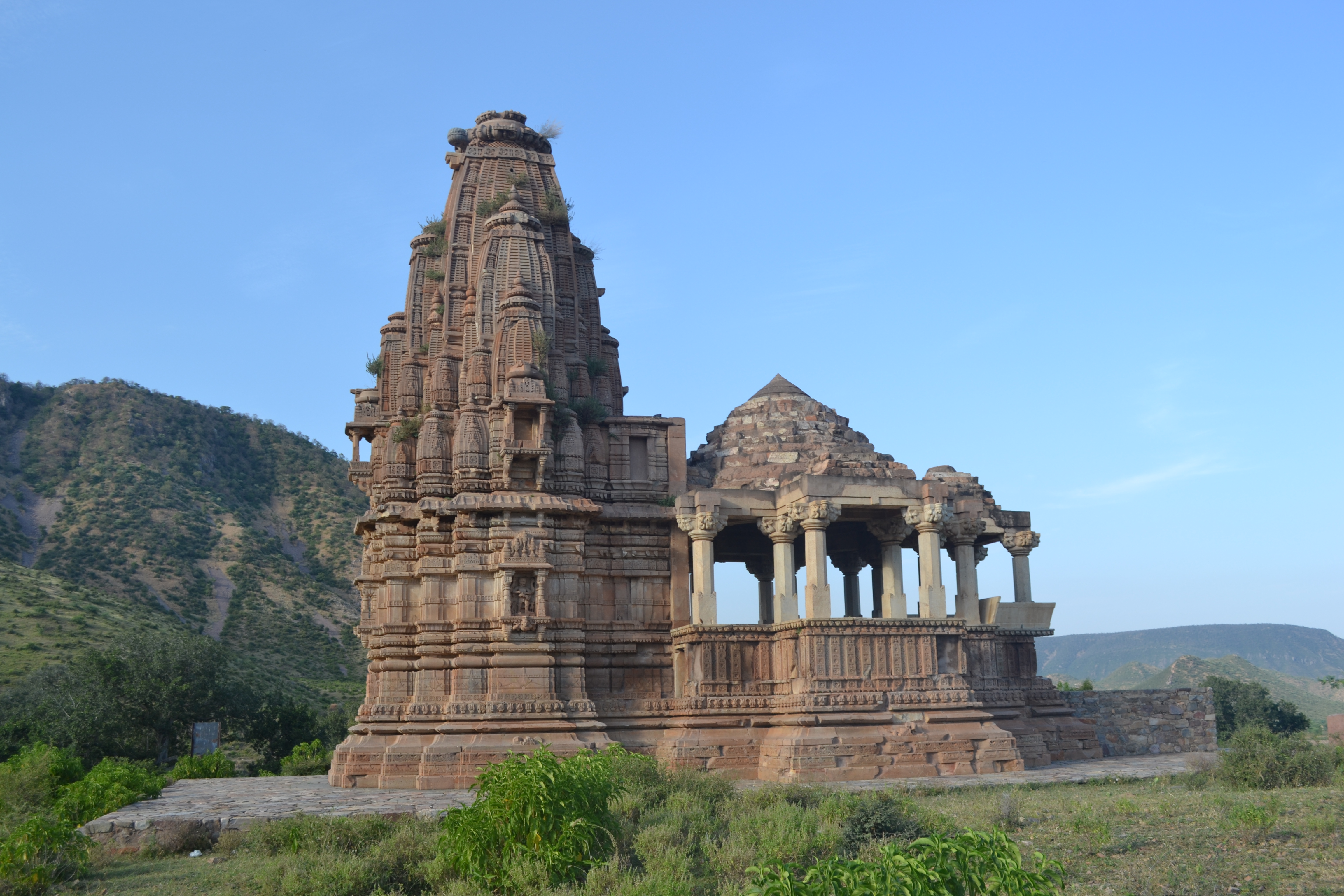 Mangla Devi Temple
_-_img_22.jpg)
_-_img_08.jpg)
_-_img_05.jpg)

_-_img_02.jpg)
_-_img_21.jpg)
_-_img_04.jpg)


See also[edit | edit source]
References[edit | edit source]
- ↑ "Bhangarh Fort, Rajasthan". Zee News. Retrieved 21 July 2013.
- ↑ Parveen, Wajeda; Sharma, Anrukati (2014). "Bangharh Fort: a case study of dark tourism". Dynamics of Commerce and Management. Archers & Elevators Publishing House. p. 62. ISBN 9789383241439.
- ↑ 3.0 3.1 Singh 2010, p. 188.
- ↑ "View Population". Office of the Registrar General & Census Commissioner, India. Retrieved 21 July 2013.
- ↑ 5.0 5.1 5.2 5.3 5.4 Safvi, Rana (11 November 2017). "Bhangarh: the most haunted fort in India". The Hindu. ISSN 0971-751X. Archived from the original on 4 October 2025. Retrieved 3 August 2019.
- ↑ 6.0 6.1 6.2 Rajputana 1880, pp. 289-90.
- ↑ Steven L. Stern (1 January 2011). Cursed Grounds. Bearport Publishing. pp. 7–. ISBN 978-1-61772-147-2.
- ↑ "किला जहां सूरज ढलते ही जाग जाती हैं आत्माएं Ravi" (in हिन्दी). Greynium Information Technologies Pvt. Ltd; Oneindia.in. 11 May 2013. Archived from the original on 16 January 2014. Retrieved 21 July 2013.
- ↑ "The Templenet Encyclopedia – Temples of Western India". Gopinath Temple. Temple Net.com. Retrieved 21 July 2013.
Bibliography[edit | edit source]
- Gaurav Madan (2017). Braving The Bhangarh - A Journey to Asia's most haunted ruins. Amazon Digital Serv. ASIN B071H9MJSG.
- Outlook (2006). 64 Wildlife Holidays in India. Outlook Pub. (India). ISBN 978-81-89449-02-5.
- Rajputana (1880). The Rajputana gazetteers.
- Singh, Sarina (15 September 2010). Lonely Planet India. Lonely Planet. ISBN 978-1-74220-347-8.
- Steven L. Stern (1 January 2011). Cursed Grounds. Bearport Publishing. ISBN 978-1-61772-147-2.