

Created page with "thumb| The '''Kharsu Oak''', or '''Ban Oak''', the '''Himalayan brown oak''' ''(Quercus semecarpifolia)'' is an Asian species of trees in the beech family. It is native to the Himalayas and nearby mountains in Tibet, Afghanistan, Republic of India, Nepal, Kashmir, and Pakistan.<ref name=kelly>{{eFloras|2|210001864|Quercus semecarpifolia |first1=Chengjiu |last1=Huang |first2=Yongtian |last2=Zhang |first3=Bruce |last3=Bartholo..." |
Nobranding1 (talk | contribs) m small rework layout per sources and cleaned formatting as per guidelines |
||
| (4 intermediate revisions by 4 users not shown) | |||
| Line 1: | Line 1: | ||
{{Short description|Species of oak tree}} | |||
{{Use dmy dates|date=February 2025}} | |||
{{speciesbox | |||
| image = Quercus semecarpifolia kz04.jpg | |||
| genus = Quercus | |||
| display_parents = 2 | |||
| parent = Quercus sect. Ilex | |||
| species = semecarpifolia | |||
| authority = [[Sm.]] | |||
| synonyms_ref = <ref>{{ThePlantList |id=kew-175022 |taxon=Quercus semecarpifolia |authority=Sm.}}</ref> | |||
| synonyms = * ''Quercus cassura'' <small>Buch.-Ham. ex D.Don</small> | |||
* ''Quercus obtusifolia'' <small>D.Don</small> | |||
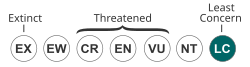
| status = LC | |||
| status_system = IUCN3.1 | |||
| status_ref = <ref name="iucn status">{{cite iucn |author=Qin, H. |date=2020 |title=''Quercus semecarpifolia'' |volume=2020 |url=https://www.iucnredlist.org/species/194230/147633899 |access-date=10 March 2023}}</ref> | |||
}} | |||
'''''Quercus semecarpifolia''''' is an Asian species of [[oak]]. It is native to the Himalayas and nearby mountains in [[Tibet]], Afghanistan, India, Nepal, and Pakistan,<ref name=kelly>{{eFloras|2|210001864|Quercus semecarpifolia |first1=Chengjiu |last1=Huang |first2=Yongtian |last2=Zhang |first3=Bruce |last3=Bartholomew |volume=4}}</ref> where it is referred to as '''kharsu'''.<ref name=":0">{{Cite journal |last1=Rawat |first1=Balwant |last2=Rawat |first2=Janhvi M. |last3=Purohit |first3=Sumit |last4=Singh |first4=Gajendra |last5=Sharma |first5=Pradeep Kumar |last6=Chandra |first6=Anup |last7=Shabaaz Begum |first7=J. P. |last8=Venugopal |first8=Divya |last9=Jaremko |first9=Mariusz |last10=Qureshi |first10=Kamal A. |date=2022 |title=A comprehensive review of Quercus semecarpifolia Sm.: An ecologically and commercially important Himalayan tree |journal=Frontiers in Ecology and Evolution |volume=10 |doi=10.3389/fevo.2022.961345 |issn=2296-701X |doi-access=free |bibcode=2022FrEEv..1061345R |hdl=10754/681751 |hdl-access=free}}</ref> It is classified in subgenus ''Cerris'', [[Quercus sect. Ilex|section ''Ilex'']].<ref>{{Cite journal |last1=Denk |first1=Thomas |last2=Grimm |first2=Guido W. |last3=Manos |first3=Paul S. |last4=Deng |first4=Min |last5=Hipp |first5=Andrew L. |date=2017 |title=Appendix 2.1: An updated infrageneric classification of the oaks |website=figshare |doi=10.6084/m9.figshare.5547622.v1 |url=https://figshare.com/articles/dataset/Appendix_2_1_________An_updated_infrageneric_classification_of_the_oaks/5547622/1 |access-date=18 February 2023 |format=xls |name-list-style=amp}}</ref><ref>{{Citation |last1=Denk |first1=Thomas |last2=Grimm |first2=Guido W. |last3=Manos |first3=Paul S. |last4=Deng |first4=Min |last5=Hipp |first5=Andrew L. |title=Oaks Physiological Ecology. Exploring the Functional Diversity of Genus Quercus L |series=Tree Physiology |date=2017 |volume=7 |editor1-last=Gil-Pelegrín |editor1-first=Eustaquio |editor2-last=Peguero-Pina |editor2-first=José Javier |editor3-last=Sancho-Knapik |editor3-first=Domingo |contribution=An Updated Infrageneric Classification of the Oaks: Review of Previous Taxonomic Schemes and Synthesis of Evolutionary Patterns |pages=13–38 |publication-place=Cham. |publisher=Springer International Publishing |doi=10.1007/978-3-319-69099-5_2 |isbn=978-3-319-69099-5 |contribution-url=https://doi.org/10.1007/978-3-319-69099-5_2 |name-list-style=amp}}</ref> | |||
''Quercus semecarpifolia'' is an [[evergreen]] tree up to {{Convert|30|m|abbr=off}} tall. The leaves are up to {{Convert|12|cm|abbr=off|frac=4}} long, with a few teeth along the sides but rounded at the tip.<ref name=kelly/><ref name=heleen>[https://www.biodiversitylibrary.org/item/119403#page/259/mode/1up Smith, James Edward in Rees. 1814 The cyclopædia; or, Universal dictionary of arts, sciences, and literature. volume 29, pages not numbered, ''Quercus'' number 20]</ref> | ''Quercus semecarpifolia'' is an [[evergreen]] tree up to {{Convert|30|m|abbr=off}} tall. The leaves are up to {{Convert|12|cm|abbr=off|frac=4}} long, with a few teeth along the sides but rounded at the tip.<ref name=kelly/><ref name=heleen>[https://www.biodiversitylibrary.org/item/119403#page/259/mode/1up Smith, James Edward in Rees. 1814 The cyclopædia; or, Universal dictionary of arts, sciences, and literature. volume 29, pages not numbered, ''Quercus'' number 20]</ref> | ||
It has been grown in middle Europe, Western Germany, winter-hardiness zone 7, withstanding -14 °C, without any damages. It gives a good, showy bush to small tree with lush green leaves. | It has been grown in middle Europe, Western Germany, winter-hardiness zone 7, withstanding -14 °C, without any damages. It gives a good, showy bush to small tree with lush green leaves. | ||
The epithet ''semecarpifolia'' refers to a resemblance between the leaves of this species and those of ''[[Semecarpus anacardium]].''<ref name=heleen/> | The epithet ''semecarpifolia'' refers to a resemblance between the leaves of this species and those of ''[[Semecarpus anacardium]].''<ref name=heleen/> | ||
In its native range, it serves as a [[keystone species]], exhibiting up to 80% [[Dominance (ecology)|dominance]] at elevations between 2700 and 3300 meters.<ref name=":0" /> In areas where less [[Environmental degradation|degradation]] has occurred, ''Q. semecarpifolia'' reduces light at the forest floor, encouraging the growth of [[Shade tolerance|shade tolerant]] [[Herbaceous plant|herbaceous]] species.<ref name=":0" /> Local people make use of kharsu more frequently than other native oaks for food, animal fodder, fuel, and timber.<ref>{{Cite journal |last1=Singh |first1=Amit |last2=Samant |first2=S. S. |last3=Naithani |first3=Suneet |date=1 September 2021 |title=Population ecology and habitat suitability modelling of Quercus semecarpifolia Sm. in the sub-alpine ecosystem of Great Himalayan National Park, north-western Himalaya, India |journal=South African Journal of Botany |language=en |volume=141 |pages=158–170 |doi=10.1016/j.sajb.2021.04.022 |issn=0254-6299 |doi-access=free|bibcode=2021SAJB..141..158S }}</ref> Its leaves are also known to support ''[[Antheraea roylei|Antheraea proylei]]'' silk worms, goats,<ref>{{Cite journal |last1=Raju |first1=J. |last2=Sahoo |first2=B. |last3=Chandrakar |first3=A. |last4=Sankar |first4=M. |last5=Garg |first5=A. K. |last6=Sharma |first6=A. K. |last7=Pandey |first7=A. B. |date=1 April 2015 |title=Effect of feeding oak leaves (Quercus semecarpifolia vs Quercus leucotricophora) on nutrient utilization, growth performance and gastrointestinal nematodes of goats in temperate sub Himalayas |journal=Small Ruminant Research |language=en |volume=125 |pages=1–9 |doi=10.1016/j.smallrumres.2014.12.013 |issn=0921-4488 |doi-access=free}}</ref> and prevent slug infestations.<ref name=":0" /> | |||
==Fossil record== | ==Fossil record== | ||
| Line 18: | Line 36: | ||
[[Category:Quercus|semecarpifolia]] | [[Category:Quercus|semecarpifolia]] | ||
[[Category:Trees of | [[Category:Trees of Afghanistan]] | ||
[[Category:Trees of | [[Category:Trees of the Indian subcontinent]] | ||
[[Category:Trees of Tibet]] | [[Category:Trees of Tibet]] | ||
[[Category:Plants described in 1814]] | [[Category:Plants described in 1814]] | ||
[[Category:Taxa named by James Edward Smith]] | [[Category:Taxa named by James Edward Smith (botanist)]] | ||
{{Quercus-stub}} | {{Quercus-stub}} | ||
Latest revision as of 03:23, 12 November 2025
| Quercus semecarpifolia | |
|---|---|

| |
Scientific classification 
| |
| : | [[Template:Taxonomy/Quercus sect. Ilex]] |
| Species: | Template:Taxonomy/QuercusQ. semecarpifolia
|
| Binomial name | |
| Template:Taxonomy/QuercusQuercus semecarpifolia | |
| Synonyms[2] | |
| |

Quercus semecarpifolia is an Asian species of oak. It is native to the Himalayas and nearby mountains in Tibet, Afghanistan, India, Nepal, and Pakistan,[3] where it is referred to as kharsu.[4] It is classified in subgenus Cerris, section Ilex.[5][6]
Quercus semecarpifolia is an evergreen tree up to 30 metres (98 feet) tall. The leaves are up to 12 centimetres (4+3⁄4 inches) long, with a few teeth along the sides but rounded at the tip.[3][7] It has been grown in middle Europe, Western Germany, winter-hardiness zone 7, withstanding -14 °C, without any damages. It gives a good, showy bush to small tree with lush green leaves. The epithet semecarpifolia refers to a resemblance between the leaves of this species and those of Semecarpus anacardium.[7]
In its native range, it serves as a keystone species, exhibiting up to 80% dominance at elevations between 2700 and 3300 meters.[4] In areas where less degradation has occurred, Q. semecarpifolia reduces light at the forest floor, encouraging the growth of shade tolerant herbaceous species.[4] Local people make use of kharsu more frequently than other native oaks for food, animal fodder, fuel, and timber.[8] Its leaves are also known to support Antheraea proylei silk worms, goats,[9] and prevent slug infestations.[4]
Fossil record[edit | edit source]
Fossils of Quercus semecarpifolia have been described from the fossil flora of Kızılcahamam district in Turkey, which is of early Pliocene age.[10]
References[edit | edit source]
- ↑ Qin, H. (2020). "Quercus semecarpifolia". IUCN Red List of Threatened Species. 2020. Retrieved 10 March 2023.
- ↑ Template:ThePlantList
- ↑ 3.0 3.1 Template:EFloras
- ↑ 4.0 4.1 4.2 4.3 Rawat, Balwant; Rawat, Janhvi M.; Purohit, Sumit; Singh, Gajendra; Sharma, Pradeep Kumar; Chandra, Anup; Shabaaz Begum, J. P.; Venugopal, Divya; Jaremko, Mariusz; Qureshi, Kamal A. (2022). "A comprehensive review of Quercus semecarpifolia Sm.: An ecologically and commercially important Himalayan tree". Frontiers in Ecology and Evolution. 10. Bibcode:2022FrEEv..1061345R. doi:10.3389/fevo.2022.961345. hdl:10754/681751. ISSN 2296-701X.
- ↑ Denk, Thomas; Grimm, Guido W.; Manos, Paul S.; Deng, Min & Hipp, Andrew L. (2017). "Appendix 2.1: An updated infrageneric classification of the oaks" (xls). figshare. doi:10.6084/m9.figshare.5547622.v1. Retrieved 18 February 2023.
- ↑ Denk, Thomas; Grimm, Guido W.; Manos, Paul S.; Deng, Min & Hipp, Andrew L. (2017), "An Updated Infrageneric Classification of the Oaks: Review of Previous Taxonomic Schemes and Synthesis of Evolutionary Patterns", in Gil-Pelegrín, Eustaquio; Peguero-Pina, José Javier & Sancho-Knapik, Domingo (eds.), Oaks Physiological Ecology. Exploring the Functional Diversity of Genus Quercus L, Tree Physiology, vol. 7, Cham.: Springer International Publishing, pp. 13–38, doi:10.1007/978-3-319-69099-5_2, ISBN 978-3-319-69099-5
- ↑ 7.0 7.1 Smith, James Edward in Rees. 1814 The cyclopædia; or, Universal dictionary of arts, sciences, and literature. volume 29, pages not numbered, Quercus number 20
- ↑ Singh, Amit; Samant, S. S.; Naithani, Suneet (1 September 2021). "Population ecology and habitat suitability modelling of Quercus semecarpifolia Sm. in the sub-alpine ecosystem of Great Himalayan National Park, north-western Himalaya, India". South African Journal of Botany. 141: 158–170. Bibcode:2021SAJB..141..158S. doi:10.1016/j.sajb.2021.04.022. ISSN 0254-6299.
- ↑ Raju, J.; Sahoo, B.; Chandrakar, A.; Sankar, M.; Garg, A. K.; Sharma, A. K.; Pandey, A. B. (1 April 2015). "Effect of feeding oak leaves (Quercus semecarpifolia vs Quercus leucotricophora) on nutrient utilization, growth performance and gastrointestinal nematodes of goats in temperate sub Himalayas". Small Ruminant Research. 125: 1–9. doi:10.1016/j.smallrumres.2014.12.013. ISSN 0921-4488.
- ↑ Kasaplıgil, Baki (1977). "Ankara, Kızılcahamam yakınındaki Güvem köyü civarında bulunan son tersiyer kozalaklı-yeşil yapraklı ormanı" [A Late-Tertiary Conifer-Hardwood Forest From the Vicinity of Güvem Village, Near Kızılcahamam, Ankara] (PDF). Bulletin of the Mineral Research and Exploration (in Türkçe and English). 88. Ankara: General Directorate of Mineral Research and Exploration: 94-102.
External links[edit | edit source]
 | This article about plants in the genus Quercus is a stub. You can help Bharatpedia by expanding it. |