


robot: Create/update articles. If there is a mistake please report on my talk page. |
DonteOnslow6 (talk | contribs) mNo edit summary |
||
| Line 2: | Line 2: | ||
{{Other people}} | {{Other people}} | ||
{{Use dmy dates|date=May 2021}} | {{Use dmy dates|date=May 2021}} | ||
{{Infobox person | {{Infobox military person | ||
| honorific_prefix = | | honorific_prefix = [[Major general (United Kingdom)|Major-General]] | ||
| name = Alexander Cunningham | | name = Sir Alexander Cunningham | ||
| honorific_suffix = | | honorific_suffix = {{post-nominals|country=GBR|size=100%|KCIE|CSI}} | ||
| image = Alexander Cunningham of the ASI 02.jpg | | image = Alexander Cunningham of the ASI 02.jpg | ||
| caption = | | caption = | ||
| Line 14: | Line 14: | ||
| death_place = [[London]], United Kingdom | | death_place = [[London]], United Kingdom | ||
| death_cause = | | death_cause = | ||
| spouse = {{marriage|Alicia Maria Whish|1840|1870}} (her death)<ref name="dnb" /> | |||
| spouse = {{marriage|Alicia Maria Whish|1840}}<ref name="dnb" /> | |||
| partner = | | partner = | ||
| children = {{ubl|[[Allan Joseph Champneys Cunningham|Allan J. C. Cunningham]]|Sir Alexander F. D. Cunningham<ref name="dnb" />}} | | children = {{ubl|[[Allan Joseph Champneys Cunningham|Allan J. C. Cunningham]]|Sir Alexander F. D. Cunningham<ref name="dnb" />}} | ||
| | | signature = A.Cunningham signature.jpg | ||
}} | }} | ||
[[Major-General]] '''Sir Alexander Cunningham''' {{post-nominals|country=GBR|size=100%|KCIE|CSI}} (23 January 1814 – 28 November 1893) was a [[British Army]] engineer with the [[Bengal Sappers]] who later took an interest in the history and archaeology of India. In 1861, he was appointed to the newly created position of archaeological surveyor to the [[British Raj|government of India]]; and he founded and organised what later became the [[Archaeological Survey of India]]. | |||
[[Major General]] '''Sir Alexander Cunningham''' {{post-nominals|country=GBR|KCIE|CSI}} (23 January 1814 – 28 November 1893) was a British Army engineer with the [[Bengal | |||
He wrote numerous books and monographs and made extensive collections of artefacts. Some of his collections were lost, but most of the gold and silver coins and a fine group of [[Buddhist sculpture]]s and jewellery were bought by the [[British Museum]] in 1894. He was also the father of mathematician [[Allan J. C. Cunningham|Allan Cunningham]]. | He wrote numerous books and monographs and made extensive collections of artefacts. Some of his collections were lost, but most of the gold and silver coins and a fine group of [[Buddhist sculpture]]s and jewellery were bought by the [[British Museum]] in 1894. He was also the father of mathematician [[Allan J. C. Cunningham|Allan Cunningham]]. | ||
==Early life and career== | ==Early life and career== | ||
[[File:Alexander Cunningham of the ASI 01.jpg|thumb|Cunningham (fourth from the right) | {{more citations needed section|date=May 2025}} | ||
Cunningham was born in London | [[File:Alexander Cunningham of the ASI 01.jpg|thumb|Cunningham (fourth from the right)]] | ||
Cunningham was born in London on 23 January 1814 to the [[Scotland|Scottish]] poet [[Allan Cunningham (author)|Allan Cunningham]] (1784–1842) and his wife Jean née Walker (1791–1864).<ref name=":0">{{Cite web |title=Father of Indian Archaeology |url=https://testbook.com/articles/father-of-indian-archaeology}}</ref> Along with his older brother, [[Joseph Davey Cunningham|Joseph]], he received his early education at [[Christ's Hospital]], London.{{sfn|Buckland|1906|p=106}} Through the influence of Sir [[Walter Scott]], both Joseph and Alexander obtained cadetships at the [[East India Company]]'s [[Addiscombe Military Seminary|Addiscombe Seminary]] (1829–31), followed by technical training at the Royal Engineers Estate at [[Chatham, Kent|Chatham]]. | |||
From 1836 to 1840 he was [[Aide-de-camp|ADC]] to [[Lord Auckland]], the [[Governor-General]] of India. During this period he visited [[Kashmir]], which was then not well explored. He finds mention by initials in ''Up the Country'' by [[Emily Eden]].<ref name="dnb">{{cite ODNB|last1=Cotton |first1=J. S. |first2=James (revised) |last2=Lunt |title=Cunningham, Sir Alexander (1814–1893) |year=2004 |id=6916}}</ref>{{sfn|Vibart|1894|pp=455-59}} | Alexander joined the [[Bengal Engineers]] at the age of 19 as a Second Lieutenant and he spent the next 28 years in the service of [[British Raj|British Government of India]]. He demonstrated his abilities as an official by surveying flood-prone areas in and around Delhi. Cunningham's interest in the history and architecture of ancient India developed during his service. Soon after arriving in [[India]] on 9 June 1833, he met [[James Prinsep]]. He was in daily communication with Prinsep during 1837 and 1838 and became his intimate friend, confidant and pupil.{{sfn|Kejariwal|1999|p=200}} Prinsep passed on to him his lifelong interest in Indian archaeology and antiquity. | ||
From 1836 to 1840, he was [[Aide-de-camp|ADC]] to [[Lord Auckland]], the [[Governor-General]] of India. During this period he visited [[Kashmir]], which was then not well explored. He finds mention by initials in ''Up the Country'' by [[Emily Eden]].<ref name="dnb">{{cite ODNB|last1=Cotton |first1=J. S. |first2=James (revised) |last2=Lunt |title=Cunningham, Sir Alexander (1814–1893) |year=2004 |id=6916}}</ref>{{sfn|Vibart|1894|pp=455-59}} | |||
==Military life== | ==Military life== | ||
[[File:The Palace at Leh, 1847.jpg|thumb|[[Leh Palace]], [[Ladakh]]. Illustration from ''Ladak: Physical, Statistical, and Historical'']] | [[File:The Palace at Leh, 1847.jpg|thumb|[[Leh Palace]], [[Ladakh]]. Illustration from ''Ladak: Physical, Statistical, and Historical'']] | ||
In 1841 Cunningham was made executive engineer to the [[Nawab of Awadh|king of Oudh]]. In 1842 he was called to serve the army in thwarting an uprising in [[Bundelkhand]] by the [[Maharaja of Jaipur|ruler of Jaipur]]. He was then posted at Nowgong in central India before he saw action at the [[Battle of Punniar]] in December 1843. He became engineer at [[Gwalior]] and was responsible for constructing an arched stone bridge over the Morar River in 1844–45. In 1845–46 he was called to serve in [[Punjab]] and helped construct two bridges of boats across the [[Beas | In 1841 Cunningham was made executive engineer to the [[Nawab of Awadh|king of Oudh]]. In 1842 he was called to serve the army in thwarting an uprising in [[Bundelkhand]] by the [[Maharaja of Jaipur|ruler of Jaipur]]. He was then posted at Nowgong in central India before he saw action at the [[Battle of Punniar]] in December 1843. He became engineer at [[Gwalior]] and was responsible for constructing an arched stone bridge over the Morar River in 1844–45. In 1845–46 he was called to serve in [[Punjab]] and helped construct two bridges of boats across the [[Beas River]] prior to the [[Battle of Sobraon]]. | ||
In 1846, he was made commissioner along with [[P. A. Vans Agnew]] to demarcate boundaries. Letters were written to the Chinese and Tibetan officials by Lord Hardinge, but no officials joined. A second commission was set up in 1847 which was led by Cunningham to establish the [[Ladakh]]-[[Tibet]] boundary, which also included [[Henry Strachey (explorer)|Henry Strachey]] and [[Thomas Thomson (botanist)|Thomas Thomson]]. Henry and his brother [[Richard Strachey]] had trespassed into [[Lake Manasarovar|Lake Mansarovar]] and Rakas Tal in 1846 and his brother Richard revisited in 1848 with botanist J. E. Winterbottom.{{sfn|Waller|2004|p=13}}{{sfn|Strachey|1854|p=3}} The commission was set up to delimit the northern boundaries of the Empire after the [[First Anglo-Sikh War]] concluded with the [[Treaty of Amritsar, 1846|Treaty of Amritsar]], which ceded [[Kashmir]] as war [[indemnity]] expenses to the British.{{sfn|Cunningham|1854b|p=?}} His early work ''Essay on the Aryan Order of Architecture'' (1848) arose from his visits to the temples in Kashmir and his travels in Ladakh during his tenure with the commission. He was also present at the battles of [[Battle of Chillianwala|Chillianwala]] and [[Battle of Gujrat|Gujrat]] in 1848–49. In 1851, he explored the [[Buddhism|Buddhist]] monuments of [[Central India]] along with Lieutenant Maisey and wrote an account of these.{{sfn|Cunningham|1854a|p=?}} | In 1846, he was made commissioner along with [[P. A. Vans Agnew]] to demarcate boundaries. Letters were written to the Chinese and Tibetan officials by [[Charles Hardinge, 1st Baron Hardinge of Penshurst|Lord Hardinge]], but no officials joined. A second commission was set up in 1847 which was led by Cunningham to establish the [[Ladakh]]-[[Tibet]] boundary, which also included [[Henry Strachey (explorer)|Henry Strachey]] and [[Thomas Thomson (botanist)|Thomas Thomson]]. Henry and his brother [[Richard Strachey]] had trespassed into [[Lake Manasarovar|Lake Mansarovar]] and Rakas Tal in 1846 and his brother Richard revisited in 1848 with botanist J. E. Winterbottom.{{sfn|Waller|2004|p=13}}{{sfn|Strachey|1854|p=3}} The commission was set up to delimit the northern boundaries of the Empire after the [[First Anglo-Sikh War]] concluded with the [[Treaty of Amritsar, 1846|Treaty of Amritsar]], which ceded [[Kashmir]] as war [[indemnity]] expenses to the British.{{sfn|Cunningham|1854b|p=?}} His early work ''Essay on the Aryan Order of Architecture'' (1848) arose from his visits to the temples in Kashmir and his travels in Ladakh during his tenure with the commission. He was also present at the battles of [[Battle of Chillianwala|Chillianwala]] and [[Battle of Gujrat|Gujrat]] in 1848–49. In 1851, he explored the [[Buddhism|Buddhist]] monuments of [[Central India]] along with Lieutenant Maisey and wrote an account of these.{{sfn|Cunningham|1854a|p=?}} | ||
In 1856 he was appointed chief engineer of [[Burma]], which had just been annexed by Britain, for two years; and from 1858 served for three years in the same post in the [[North-Western Provinces]]. In both regions, he established public works departments. He was therefore absent from India during the [[Indian Rebellion of 1857|Rebellion of 1857]]. He was appointed Colonel of the [[Royal Engineers]] in 1860. He retired on 30 June 1861, having attained the rank of [[Major General]].<ref name="dnb" /> | In 1856 he was appointed chief engineer of [[Burma]], which had just been annexed by Britain, for two years; and from 1858 served for three years in the same post in the [[North-Western Provinces]]. In both regions, he established public works departments. He was therefore absent from India during the [[Indian Rebellion of 1857|Rebellion of 1857]]. He was appointed Colonel of the [[Royal Engineers]] in 1860. He retired on 30 June 1861, having attained the rank of [[Major General]].<ref name="dnb" /> | ||
==Archaeology== | ==Archaeology== | ||
Cunningham had taken a keen interest in antiquities from early on in his career. Following the activities of [[Jean-Baptiste Ventura]] (general of [[Ranjit Singh]])—who, inspired by the French explorers in Egypt, had excavated the bases of pillars to discover large stashes of Bactrian and Roman coins—excavations became a regular activity among British antiquarians.<ref name="imam63">{{cite journal|title=Sir Alexander Cunningham (1814–1893): | Cunningham had taken a keen interest in antiquities from early on in his career. Following the activities of [[Jean-Baptiste Ventura]] (general of [[Ranjit Singh]])—who, inspired by the French explorers in Egypt, had excavated the bases of pillars to discover large stashes of Bactrian and Roman coins—excavations became a regular activity among British antiquarians.<ref name="imam63">{{cite journal |last1=Imam |first1=Abu |title=Sir Alexander Cunningham (1814–1893): The First Phase of Indian Archaeology |journal=Journal of the Royal Asiatic Society |date=October 1963 |volume=95 |issue=3–4 |pages=194–207 |jstor=25202645 |doi=10.1017/S0035869X00121926 |s2cid=163154105 }}</ref> | ||
In 1834 he submitted to the ''[[Journal of the Asiatic Society of Bengal]],'' an appendix to [[James Prinsep]]'s article, on the relics in the [[Mankiala stupa]]. He had conducted excavations at [[Sarnath]] in 1837 along with [[ | In 1834 he submitted to the ''[[Journal of the Asiatic Society of Bengal]],'' an appendix to [[James Prinsep]]'s article, on the relics in the [[Mankiala stupa]]. He had conducted excavations at [[Sarnath]] in 1837 along with [[Frederick Charles Maisey]] and made careful drawings of the sculptures. In 1842 he excavated at [[Sankassa]] and at [[Sanchi]] in 1851. In 1854, he published ''The Bhilsa Topes'', a piece of work which attempted to establish the [[history of Buddhism]] based on architectural evidence. | ||
By 1851, he also began to communicate with [[William Henry Sykes]] and the [[East India Company]] on the value of an archaeological survey. He provided a rationale for providing the necessary funding, arguing that the venture<ref name="imam63" /> | By 1851, he also began to communicate with [[William Henry Sykes]] and the [[East India Company]] on the value of an archaeological survey. He provided a rationale for providing the necessary funding, arguing that the venture<ref name="imam63" /> | ||
| Line 64: | Line 49: | ||
[[File:Alexander Cunningham of the ASI 03.jpg|thumb|Letter dated 31 January 1862, appointing Cunningham as Surveyor General]] | [[File:Alexander Cunningham of the ASI 03.jpg|thumb|Letter dated 31 January 1862, appointing Cunningham as Surveyor General]] | ||
Following his retirement from the Royal Engineers in 1861, [[Charles | Following his retirement from the Royal Engineers in 1861, [[Charles Canning, 1st Earl Canning|Lord Canning]], then [[Viceroy of India]], appointed Cunningham as an archaeological surveyor to the [[British Raj|Government of India]].{{sfn|Cunningham|1871c|pp=1–3}} He held this position from 1861 to 1865, but it was then terminated through lack of funds.<ref name="dnb" /> | ||
Most antiquarians of the 19th century who took interest in identifying the major cities | Most antiquarians of the 19th century who took interest in identifying the major cities mentioned in ancient Indian texts, did so by putting together clues found in classical Graeco-Roman chronicles and the travelogues of travellers to India such as [[Xuanzang]] and [[Faxian]]. Cunningham was able to identify some of the places mentioned by Xuanzang,{{sfn|Cunningham|1848|pp=13–60}} and counted among his major achievements the identification of [[Aornos]], [[Ahichchhatra]], [[Bairat]], [[Kosambi]], [[Nalanda]], [[Padmavati Pawaya|Padmavati]], [[Sangala]], [[Sankassa|Sankisa]], [[Shravasti]], [[Srughna]], [[Taxila]], and [[Vaishali (ancient city)|Vaishali]]. Unlike his contemporaries, Cunningham would also routinely confirm his identifications through field surveys. The identification of Taxila, in particular, was made difficult partly due to errors in the distances recorded by [[Pliny the Elder|Pliny]] in his {{Lang|la|[[Naturalis Historia]]}} which pointed to a location somewhere on the [[Haro River]], a two-day march from the [[Indus River|Indus]]. Cunningham noticed that this position did not tally with the itineraries of Chinese pilgrims and in particular, the descriptions provided by Xuanzang. Unlike Pliny, these sources noted that the journey to [[Taxila]] from the Indus took three days and not two and therefore, suggested a different location for the city. Cunningham's subsequent explorations in 1863–64 of a site at [[Shah Dheri|Shah-dheri]] convinced him that his hypothesis was correct.{{sfn|Singh|2008|p=265}} | ||
{{blockquote|Now as Hwen Thsang, on his return to China, was accompanied by laden elephants, his three days' journey from {{sic|''Takhshasila''}} to the Indus at ''Utakhanda'', or Ohind, must necessarily have been of the same length as those of modern days, and, consequently, the site of the city must be looked for somewhere in the neighbourhood of ''Kâla-ka-sarâi''. This site is found near ''Shah-dheri'', just one mile to the north-east of ''Kâla-ka-sarâi'', in the extensive ruins of a fortified city, around which I was able to trace no less than 55 stupas, of which two are as large as the great [[Manikyala]] tope, twenty-eight monasteries, and nine temples.|author=Alexander Cunningham|source={{sfn|Cunningham|1871c|p=105}}}} | {{blockquote|Now as Hwen Thsang, on his return to China, was accompanied by laden elephants, his three days' journey from {{sic|''Takhshasila''}} to the Indus at ''Utakhanda'', or Ohind, must necessarily have been of the same length as those of modern days, and, consequently, the site of the city must be looked for somewhere in the neighbourhood of ''Kâla-ka-sarâi''. This site is found near ''Shah-dheri'', just one mile to the north-east of ''Kâla-ka-sarâi'', in the extensive ruins of a fortified city, around which I was able to trace no less than 55 stupas, of which two are as large as the great [[Manikyala]] tope, twenty-eight monasteries, and nine temples.|author=Alexander Cunningham|source={{sfn|Cunningham|1871c|p=105}}}} | ||
After his department was abolished in 1865, Cunningham returned to England and wrote the first part of his ''Ancient Geography of India'' (1871), covering the Buddhist period; but failed to complete the second part, covering the Muslim period.{{sfn|Cunningham|1871c|p=?}} During this period in London he worked as director of the [[Delhi and London Bank]].{{sfn|Iman|1966|p=191}} In 1870, [[Lord Mayo]] re-established the [[Archaeological Survey of India]], with Cunningham as its director-general from 1 January 1871. Cunningham returned to India and made field explorations each winter, conducting excavations and surveys from Taxila to Gaur. He produced twenty-four reports, thirteen as author and the rest under his supervision by others such as J. D. Beglar. Other major works included the first volume of ''[[Corpus Inscriptionum Indicarum]]'' (1877) which included copies of the edicts of [[Ashoka]], ''The Stupa of [[Bharhut]]'' (1879) and the ''Book of Indian Eras'' (1883) which allowed the dating of Indian antiquities. He retired from the Archaeological Survey on 30 September 1885 and returned to London to continue his research and writing.<ref name="dnb" /> | After his department was abolished in 1865, Cunningham returned to England and wrote the first part of his ''Ancient Geography of India'' (1871), covering the Buddhist period; but failed to complete the second part, covering the Muslim period.{{sfn|Cunningham|1871c|p=?}} During this period in London he worked as director of the [[Delhi and London Bank]].{{sfn|Iman|1966|p=191}} In 1870, [[Lord Mayo]] re-established the [[Archaeological Survey of India]], with Cunningham as its director-general from 1 January 1871. Cunningham returned to India and made field explorations each winter, conducting excavations and surveys from Taxila to Gaur. He produced twenty-four reports, thirteen as author and the rest under his supervision by others such as J. D. Beglar. Other major works included the first volume of ''[[Corpus Inscriptionum Indicarum]]'' (1877) which included copies of the edicts of [[Ashoka]], ''The Stupa of [[Bharhut]]'' (1879) and the ''Book of Indian Eras'' (1883) which allowed the dating of Indian antiquities. He retired from the Archaeological Survey on 30 September 1885 and returned to London to continue his research and writing.<ref name="dnb" /> | ||
== Father of Indian Archaeology == | |||
Cunningham provided the Archaeological Survey of India with much-needed organization and expertise after he left the Army in 1861.<ref name=":0" /> In his capacity as the first Director General, he carried out excavations in significant ancient towns, issued thirty volumes of archaeological papers, and assessed over 725 sites. He is regarded as the founder of archaeology in India because: | |||
* He is regarded as the father of Indian archaeology since he was the first to use archaeological data to reconstruct [[Ancient history india|ancient Indian history]] in a methodical manner. | |||
* His thorough excavations at locations like Sanchi, Sarnath, and Bharhut produced priceless artifacts and inscriptions that expanded our understanding of the dissemination of Buddhism. | |||
* Many others were motivated to pursue a career in archaeology by his authoritative references found in the Reports of the ASI. The pioneer of Indian prehistoric archaeology, | |||
* Cunningham established techniques for documenting, mapping, photography, and conservation that are still in use today. | |||
* For the first time, Indians were involved in archaeology thanks to his training of indigenous assistants that he hired for digs. | |||
* Cunningham made sure archaeology got financing and formal recognition, which helped to establish the field's legitimacy in India. | |||
==Numismatic interests== | ==Numismatic interests== | ||
| Line 76: | Line 71: | ||
==Family and personal life== | ==Family and personal life== | ||
Two of Cunningham's brothers, [[Francis Cunningham (Indian Army officer)|Francis]] and [[Joseph Davey Cunningham|Joseph]], became well known for their work in [[British India]]; while another, [[Peter Cunningham (writer, born 1816)|Peter]], became famous for his ''Handbook of London'' (1849).{{sfn|Cunningham|1853|pp=12-14}} | Two of Cunningham's brothers, [[Francis Cunningham (Indian Army officer)|Francis]] and [[Joseph Davey Cunningham|Joseph]], became well known for their work in [[British India]]; while another, [[Peter Cunningham (writer, born 1816)|Peter]], became famous for his ''Handbook of London'' (1849).{{sfn|Cunningham|1853|pp=12-14}} Cunningham married Alicia Maria Whish, daughter of Martin Whish, B.C.S., on 30 March 1840. The couple had two sons, Lieutenant-Colonel [[Allan Joseph Champneys Cunningham|Allan J. C. Cunningham]] (1842–1928) of the Bengal and Royal Engineers, and Sir Alexander F. D. Cunningham (1852–1935) of the Indian Civil Service.<ref name="dnb" /> Cunningham died on 28 November 1893, at his home in [[South Kensington]] and was buried at [[Kensal Green Cemetery]], London. His wife predeceased him, in 1870. He was survived by his two sons.<ref name="dnb" /> | ||
Cunningham married Alicia Maria Whish, daughter of Martin Whish, B.C.S., on 30 March 1840. The couple had two sons, Lieutenant-Colonel [[Allan Joseph Champneys Cunningham|Allan J. C. Cunningham]] (1842–1928) of the Bengal and Royal Engineers, and Sir Alexander F. D. Cunningham (1852–1935) of the Indian Civil Service.<ref name="dnb" /> | |||
Cunningham died on 28 November 1893 at his home in [[South Kensington]] and was buried at [[Kensal Green Cemetery]], London. His wife | |||
==Awards and memorials== | ==Awards and memorials== | ||
[[File:RAS 089.003 - Sir Alexander Cunningham (cropped).jpg|thumb|Portrait of Cunningham by C. W. Walton, showing him wearing the badge of a KCIE, with other decorations.]] | |||
Cunningham was awarded the [[Order of the Star of India|CSI]] on 20 May 1870 and [[Order of the Indian Empire|CIE]] in 1878. In 1887, he was made a [[Order of the Indian Empire|Knight Commander of the Order of the Indian Empire]].{{sfn|Cunningham|1871c|p=?}} | Cunningham was awarded the [[Order of the Star of India|CSI]] on 20 May 1870 and [[Order of the Indian Empire|CIE]] in 1878. In 1887, he was made a [[Order of the Indian Empire|Knight Commander of the Order of the Indian Empire]].{{sfn|Cunningham|1871c|p=?}} | ||
| Line 103: | Line 95: | ||
Additional works: | Additional works: | ||
* ''The World of India’s First Archaeologist: Letters from Alexander Cunningham to J.D.M. Beglar''; Oxford University Press: Upinder Singh. | * ''The World of India’s First Archaeologist: Letters from Alexander Cunningham to J.D.M. Beglar''; Oxford University Press: Upinder Singh. | ||
* | * {{cite thesis |last1=Imam |first1=Abu |title=Sir Alexander Cunningham and the Beginnings of Indian Archeology |date=1963 |doi=10.25501/SOAS.00033626 |oclc=966141480 }} | ||
== See also == | |||
* [[Joseph David Beglar]] | |||
* [[Edward Clive Bayley|Sir Edward Clive Bayley]] | |||
* [[John Marshall (archaeologist)|Sir John Hubert Marshall]] | |||
==Citations== | |||
{{reflist}} | {{reflist}} | ||
==References== | ==References== | ||
* {{cite book |last1=Buckland |first1=Charles Edward |title=Dictionary of Indian Biography |url=https://archive.org/details/in.ernet.dli.2015.501620 |date=1906 |publisher=Swan Sonnenschein & Co. |location=London}} | * {{cite book |last1=Buckland |first1=Charles Edward |title=Dictionary of Indian Biography |url=https://archive.org/details/in.ernet.dli.2015.501620 |date=1906 |publisher=Swan Sonnenschein & Co. |location=London}} | ||
* {{cite journal | | * {{cite journal |last1=Cunningham |first1=Alex |title=An Account of the Discovery of the Ruins of the Buddhist City of Samkassa |journal=Journal of the Royal Asiatic Society |date=July 1843 |volume=7 |issue=14 |pages=241–249 |jstor=25207592 |doi=10.1017/S0035869X0015590X |s2cid=162756981 |url=https://zenodo.org/record/1935442 }} | ||
* {{cite journal |last1=Cunningham |first1=Alexander |title=Verification of the Itinerary of the Chinese Pilgrim, Hwan Thsang, through Afghanistan and India during the First Half of the Seventh Century of the Christian Era| journal=Journal of the Royal Asiatic Society of Bengal |volume=17 |year=1848 |issue=2 |url=https://www.biodiversitylibrary.org/page/40132302}} | * {{cite journal |last1=Cunningham |first1=Alexander |title=Verification of the Itinerary of the Chinese Pilgrim, Hwan Thsang, through Afghanistan and India during the First Half of the Seventh Century of the Christian Era| journal=Journal of the Royal Asiatic Society of Bengal |volume=17 |year=1848 |issue=2 |url=https://www.biodiversitylibrary.org/page/40132302}} | ||
* {{cite book |last1=Cunningham |first1=Joseph Davey |url=https://archive.org/stream/cunninghamshisto00cunnuoft#page/n13/mode/2up |title=Cunningham's History of the Sikhs |date=1853 |work=History of the Sikhs |publisher=John Murray |editor-last1=Garrett |editor-first1=Herbert Leonard Offley |edition=2 |orig-year=1849}} | * {{cite book |last1=Cunningham |first1=Joseph Davey |url=https://archive.org/stream/cunninghamshisto00cunnuoft#page/n13/mode/2up |title=Cunningham's History of the Sikhs |date=1853 |work=History of the Sikhs |publisher=John Murray |editor-last1=Garrett |editor-first1=Herbert Leonard Offley |edition=2 |orig-year=1849}} | ||
| Line 137: | Line 134: | ||
[[Category:1893 deaths]] | [[Category:1893 deaths]] | ||
[[Category:Companions of the Order of the Star of India]] | [[Category:Companions of the Order of the Star of India]] | ||
[[Category:Knights Commander of the Order of the Indian Empire]] | [[Category:Knights Commander of the Order of the Indian Empire]] | ||
[[Category:Explorers of Central Asia]] | [[Category:Explorers of Central Asia]] | ||
[[Category:Bengal Engineers officers]] | [[Category:Bengal Engineers officers]] | ||
[[Category:British people in | [[Category:British people in British India]] | ||
[[Category:British Army major generals]] | [[Category:British Army major generals]] | ||
[[Category:British military personnel of the Gwalior Campaign]] | [[Category:British military personnel of the Gwalior Campaign]] | ||
[[Category: | [[Category:Graduates of Addiscombe Military Seminary]] | ||
[[Category:People educated at Christ's Hospital]] | [[Category:People educated at Christ's Hospital]] | ||
[[Category:19th-century archaeologists]] | [[Category:19th-century British archaeologists]] | ||
[[Category:Directors | [[Category:Directors general of the Archaeological Survey of India]] | ||
[[Category:Archaeologists of South Asia]] | |||
[[Category:Himalayan studies]] | |||
Latest revision as of 20:16, 5 March 2026
Sir Alexander Cunningham | |
|---|---|
 | |
| Born | 23 January 1814 London, United Kingdom |
| Died | 28 November 1893 (aged 79) London, United Kingdom |
| Spouse(s) | Alicia Maria Whish ( m. 1840–1870) |
| Children |
|
| Signature |  |
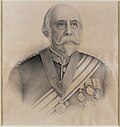
Major-General Sir Alexander Cunningham KCIE CSI (23 January 1814 – 28 November 1893) was a British Army engineer with the Bengal Sappers who later took an interest in the history and archaeology of India. In 1861, he was appointed to the newly created position of archaeological surveyor to the government of India; and he founded and organised what later became the Archaeological Survey of India.
He wrote numerous books and monographs and made extensive collections of artefacts. Some of his collections were lost, but most of the gold and silver coins and a fine group of Buddhist sculptures and jewellery were bought by the British Museum in 1894. He was also the father of mathematician Allan Cunningham.
Early life and career[edit | edit source]
 | This section needs more citations. (May 2025) |

Cunningham was born in London on 23 January 1814 to the Scottish poet Allan Cunningham (1784–1842) and his wife Jean née Walker (1791–1864).[2] Along with his older brother, Joseph, he received his early education at Christ's Hospital, London.[3] Through the influence of Sir Walter Scott, both Joseph and Alexander obtained cadetships at the East India Company's Addiscombe Seminary (1829–31), followed by technical training at the Royal Engineers Estate at Chatham.
Alexander joined the Bengal Engineers at the age of 19 as a Second Lieutenant and he spent the next 28 years in the service of British Government of India. He demonstrated his abilities as an official by surveying flood-prone areas in and around Delhi. Cunningham's interest in the history and architecture of ancient India developed during his service. Soon after arriving in India on 9 June 1833, he met James Prinsep. He was in daily communication with Prinsep during 1837 and 1838 and became his intimate friend, confidant and pupil.[4] Prinsep passed on to him his lifelong interest in Indian archaeology and antiquity.
From 1836 to 1840, he was ADC to Lord Auckland, the Governor-General of India. During this period he visited Kashmir, which was then not well explored. He finds mention by initials in Up the Country by Emily Eden.[1][5]
Military life[edit | edit source]

In 1841 Cunningham was made executive engineer to the king of Oudh. In 1842 he was called to serve the army in thwarting an uprising in Bundelkhand by the ruler of Jaipur. He was then posted at Nowgong in central India before he saw action at the Battle of Punniar in December 1843. He became engineer at Gwalior and was responsible for constructing an arched stone bridge over the Morar River in 1844–45. In 1845–46 he was called to serve in Punjab and helped construct two bridges of boats across the Beas River prior to the Battle of Sobraon.
In 1846, he was made commissioner along with P. A. Vans Agnew to demarcate boundaries. Letters were written to the Chinese and Tibetan officials by Lord Hardinge, but no officials joined. A second commission was set up in 1847 which was led by Cunningham to establish the Ladakh-Tibet boundary, which also included Henry Strachey and Thomas Thomson. Henry and his brother Richard Strachey had trespassed into Lake Mansarovar and Rakas Tal in 1846 and his brother Richard revisited in 1848 with botanist J. E. Winterbottom.[6][7] The commission was set up to delimit the northern boundaries of the Empire after the First Anglo-Sikh War concluded with the Treaty of Amritsar, which ceded Kashmir as war indemnity expenses to the British.[8] His early work Essay on the Aryan Order of Architecture (1848) arose from his visits to the temples in Kashmir and his travels in Ladakh during his tenure with the commission. He was also present at the battles of Chillianwala and Gujrat in 1848–49. In 1851, he explored the Buddhist monuments of Central India along with Lieutenant Maisey and wrote an account of these.[9]
In 1856 he was appointed chief engineer of Burma, which had just been annexed by Britain, for two years; and from 1858 served for three years in the same post in the North-Western Provinces. In both regions, he established public works departments. He was therefore absent from India during the Rebellion of 1857. He was appointed Colonel of the Royal Engineers in 1860. He retired on 30 June 1861, having attained the rank of Major General.[1]
Archaeology[edit | edit source]
Cunningham had taken a keen interest in antiquities from early on in his career. Following the activities of Jean-Baptiste Ventura (general of Ranjit Singh)—who, inspired by the French explorers in Egypt, had excavated the bases of pillars to discover large stashes of Bactrian and Roman coins—excavations became a regular activity among British antiquarians.[10]
In 1834 he submitted to the Journal of the Asiatic Society of Bengal, an appendix to James Prinsep's article, on the relics in the Mankiala stupa. He had conducted excavations at Sarnath in 1837 along with Frederick Charles Maisey and made careful drawings of the sculptures. In 1842 he excavated at Sankassa and at Sanchi in 1851. In 1854, he published The Bhilsa Topes, a piece of work which attempted to establish the history of Buddhism based on architectural evidence.
By 1851, he also began to communicate with William Henry Sykes and the East India Company on the value of an archaeological survey. He provided a rationale for providing the necessary funding, arguing that the venture[10]
... would be an undertaking of vast importance to the Indian Government politically, and to the British public religiously. To the first body it would show that India had generally been divided into numerous petty chiefships, which had invariably been the case upon every successful invasion; while, whenever she had been under one ruler, she had always repelled foreign conquest with determined resolution. To the other body it would show that Brahmanism, instead of being an unchanged and unchangeable religion which had subsisted for ages, was of comparatively modern origin, and had been constantly receiving additions and alterations; facts which prove that the establishment of the Christian religion in India must ultimately succeed.[11]

Following his retirement from the Royal Engineers in 1861, Lord Canning, then Viceroy of India, appointed Cunningham as an archaeological surveyor to the Government of India.[12] He held this position from 1861 to 1865, but it was then terminated through lack of funds.[1]
Most antiquarians of the 19th century who took interest in identifying the major cities mentioned in ancient Indian texts, did so by putting together clues found in classical Graeco-Roman chronicles and the travelogues of travellers to India such as Xuanzang and Faxian. Cunningham was able to identify some of the places mentioned by Xuanzang,[13] and counted among his major achievements the identification of Aornos, Ahichchhatra, Bairat, Kosambi, Nalanda, Padmavati, Sangala, Sankisa, Shravasti, Srughna, Taxila, and Vaishali. Unlike his contemporaries, Cunningham would also routinely confirm his identifications through field surveys. The identification of Taxila, in particular, was made difficult partly due to errors in the distances recorded by Pliny in his Naturalis Historia which pointed to a location somewhere on the Haro River, a two-day march from the Indus. Cunningham noticed that this position did not tally with the itineraries of Chinese pilgrims and in particular, the descriptions provided by Xuanzang. Unlike Pliny, these sources noted that the journey to Taxila from the Indus took three days and not two and therefore, suggested a different location for the city. Cunningham's subsequent explorations in 1863–64 of a site at Shah-dheri convinced him that his hypothesis was correct.[14]
Now as Hwen Thsang, on his return to China, was accompanied by laden elephants, his three days' journey from Takhshasila [sic] to the Indus at Utakhanda, or Ohind, must necessarily have been of the same length as those of modern days, and, consequently, the site of the city must be looked for somewhere in the neighbourhood of Kâla-ka-sarâi. This site is found near Shah-dheri, just one mile to the north-east of Kâla-ka-sarâi, in the extensive ruins of a fortified city, around which I was able to trace no less than 55 stupas, of which two are as large as the great Manikyala tope, twenty-eight monasteries, and nine temples.
— Alexander Cunningham, [15]
After his department was abolished in 1865, Cunningham returned to England and wrote the first part of his Ancient Geography of India (1871), covering the Buddhist period; but failed to complete the second part, covering the Muslim period.[16] During this period in London he worked as director of the Delhi and London Bank.[17] In 1870, Lord Mayo re-established the Archaeological Survey of India, with Cunningham as its director-general from 1 January 1871. Cunningham returned to India and made field explorations each winter, conducting excavations and surveys from Taxila to Gaur. He produced twenty-four reports, thirteen as author and the rest under his supervision by others such as J. D. Beglar. Other major works included the first volume of Corpus Inscriptionum Indicarum (1877) which included copies of the edicts of Ashoka, The Stupa of Bharhut (1879) and the Book of Indian Eras (1883) which allowed the dating of Indian antiquities. He retired from the Archaeological Survey on 30 September 1885 and returned to London to continue his research and writing.[1]
Father of Indian Archaeology[edit | edit source]
Cunningham provided the Archaeological Survey of India with much-needed organization and expertise after he left the Army in 1861.[2] In his capacity as the first Director General, he carried out excavations in significant ancient towns, issued thirty volumes of archaeological papers, and assessed over 725 sites. He is regarded as the founder of archaeology in India because:
- He is regarded as the father of Indian archaeology since he was the first to use archaeological data to reconstruct ancient Indian history in a methodical manner.
- His thorough excavations at locations like Sanchi, Sarnath, and Bharhut produced priceless artifacts and inscriptions that expanded our understanding of the dissemination of Buddhism.
- Many others were motivated to pursue a career in archaeology by his authoritative references found in the Reports of the ASI. The pioneer of Indian prehistoric archaeology,
- Cunningham established techniques for documenting, mapping, photography, and conservation that are still in use today.
- For the first time, Indians were involved in archaeology thanks to his training of indigenous assistants that he hired for digs.
- Cunningham made sure archaeology got financing and formal recognition, which helped to establish the field's legitimacy in India.
Numismatic interests[edit | edit source]
Cunningham assembled a large numismatic collection, but much of this was lost when the steamship he was travelling in, the Indus, was wrecked off the coast of Ceylon in November 1884. The British Museum, however, obtained most of the gold and silver coins. He had suggested to the Museum that they should use the arch from the Sanchi Stupa to mark the entrance of a new section on Indian history. He also published numerous papers in the Journal of the Asiatic Society and the Numismatic Chronicle.[18]
Family and personal life[edit | edit source]
Two of Cunningham's brothers, Francis and Joseph, became well known for their work in British India; while another, Peter, became famous for his Handbook of London (1849).[19] Cunningham married Alicia Maria Whish, daughter of Martin Whish, B.C.S., on 30 March 1840. The couple had two sons, Lieutenant-Colonel Allan J. C. Cunningham (1842–1928) of the Bengal and Royal Engineers, and Sir Alexander F. D. Cunningham (1852–1935) of the Indian Civil Service.[1] Cunningham died on 28 November 1893, at his home in South Kensington and was buried at Kensal Green Cemetery, London. His wife predeceased him, in 1870. He was survived by his two sons.[1]
Awards and memorials[edit | edit source]
.jpg)
Cunningham was awarded the CSI on 20 May 1870 and CIE in 1878. In 1887, he was made a Knight Commander of the Order of the Indian Empire.[16]
Publications[edit | edit source]
Books written by Cunningham include:
- LADĀK: Physical, Statistical, and Historical with Notices of the Surrounding Countries (1854).
- Bhilsa Topes (1854), a history of Buddhism
- The Ancient Geography of India (1871)
- Archaeological Survey Of India Vol. 1 (1871) Four Reports Made During the Years, 1862-63-64-65, Volume 1 (1871)
- Archaeological Survey Of India Vol. 2
- Archaeological Survey Of India Vol. 3 (1873)
- Corpus Inscriptionum Indicarum. Volume 1. (1877)
- The Stupa of Bharhut: A Buddhist Monument Ornamented with Numerous Sculptures Illustrative of Buddhist Legend and History in the Third Century B.C. (1879)
- The Book of Indian Eras (1883)
- Coins of Ancient India (1891)
- Mahâbodhi, or the great Buddhist temple under the Bodhi tree at Buddha-Gaya (1892)
- Coins of Medieval India (1894)
- Report of Tour in Eastern Rajputana
Additional works:
- The World of India’s First Archaeologist: Letters from Alexander Cunningham to J.D.M. Beglar; Oxford University Press: Upinder Singh.
- Imam, Abu (1963). Sir Alexander Cunningham and the Beginnings of Indian Archeology (Thesis). doi:10.25501/SOAS.00033626. OCLC 966141480.
See also[edit | edit source]
Citations[edit | edit source]
- ↑ 1.0 1.1 1.2 1.3 1.4 1.5 1.6 1.7 Cotton, J. S.; Lunt, James (revised) (2004). "Cunningham, Sir Alexander (1814–1893)". Oxford Dictionary of National Biography (online ed.). Oxford University Press. doi:10.1093/ref:odnb/6916. Template:ODNBsub
- ↑ 2.0 2.1 "Father of Indian Archaeology".
- ↑ Buckland 1906, p. 106.
- ↑ Kejariwal 1999, p. 200.
- ↑ Vibart 1894, pp. 455-59.
- ↑ Waller 2004, p. 13.
- ↑ Strachey 1854, p. 3.
- ↑ Cunningham 1854b, p. ?.
- ↑ Cunningham 1854a, p. ?.
- ↑ 10.0 10.1 Imam, Abu (October 1963). "Sir Alexander Cunningham (1814–1893): The First Phase of Indian Archaeology". Journal of the Royal Asiatic Society. 95 (3–4): 194–207. doi:10.1017/S0035869X00121926. JSTOR 25202645. S2CID 163154105.
- ↑ Cunningham 1843, pp. 241–47.
- ↑ Cunningham 1871c, pp. 1–3.
- ↑ Cunningham 1848, pp. 13–60.
- ↑ Singh 2008, p. 265.
- ↑ Cunningham 1871c, p. 105.
- ↑ 16.0 16.1 Cunningham 1871c, p. ?.
- ↑ Iman 1966, p. 191.
- ↑ Mathur 2007, p. 146.
- ↑ Cunningham 1853, pp. 12-14.
References[edit | edit source]
- Buckland, Charles Edward (1906). Dictionary of Indian Biography. London: Swan Sonnenschein & Co.
- Cunningham, Alex (July 1843). "An Account of the Discovery of the Ruins of the Buddhist City of Samkassa". Journal of the Royal Asiatic Society. 7 (14): 241–249. doi:10.1017/S0035869X0015590X. JSTOR 25207592. S2CID 162756981.
- Cunningham, Alexander (1848). "Verification of the Itinerary of the Chinese Pilgrim, Hwan Thsang, through Afghanistan and India during the First Half of the Seventh Century of the Christian Era". Journal of the Royal Asiatic Society of Bengal. 17 (2).
- Cunningham, Joseph Davey (1853) [1849]. Garrett, Herbert Leonard Offley (ed.). Cunningham's History of the Sikhs (2 ed.). John Murray.
{{cite book}}:|work=ignored (help) - Cunningham, Alexander (1871). Archaeological Survey of India: four reports made during the years 1862–63–64–65. Shimla: Government Central Press.
- Cunningham, Alexander (1871). Four Reports Made During the Years, 1862-63-64-65. Vol. I. Shimla: Government Central Press.
- Cunningham, Alexander (1871). The Ancient Geography of India. Vol. 1. London: Trübner and Co.
- Cunningham, Alexander (1854). The Bhilsa Topes, Or, Buddhist Monuments of Central India: Comprising a Brief Historical Sketch of the Rise, Progress and Decline of Buddhism. London: Smith, Elder & Co.
- Cunningham, Alexander (1854). Ladak, physical, statistical and historical. London: W. H. Allen.
- Cunningham, Alexander (1871). The Ancient Geography of India: The Buddhist Period, Including the Campaigns of Alexander, and the Travels of Hwen-Thsang. Cambridge, NY: Cambridge University Press. ISBN 9781108056458.
- Iman, Abu (1966). Sir Alexander Cunningham and the beginnings of Indian archaeology. Dacca: Asiatic Society of Pakistan.
- Kejariwal, O. P. (1999). The Asiatic Society of Bengal and the Discovery of India's Past 1784–1838 (1988 ed.). Oxford University Press. ISBN 0-19565089-1.
- Mathur, Saloni (2007). India by Design: Colonial History and Cultural Display. University of California Press.
- Singh, Upinder (2008). A history of ancient and early medieval India : from the Stone Age to the 12th century. New Delhi: Pearson Education. ISBN 9788131711200.
- Strachey, Henry (1854). Physical Geography of Western Tibet. London: William Clowes and sons.
- Vibart, H. M. (1894). Addiscombe: its heroes and men of note. Westminster: Archibald Constable.
- Waller, Derek J. (2004). The Pundits: British Exploration of Tibet and Central Asia. University Press of Kentucky.
- Pages using the JsonConfig extension
- Articles needing additional references from May 2025
- 1814 births
- 1893 deaths
- Companions of the Order of the Star of India
- Knights Commander of the Order of the Indian Empire
- Explorers of Central Asia
- Bengal Engineers officers
- British people in British India
- British Army major generals
- British military personnel of the Gwalior Campaign
- Graduates of Addiscombe Military Seminary
- People educated at Christ's Hospital
- 19th-century British archaeologists
- Directors general of the Archaeological Survey of India
- Archaeologists of South Asia
- Himalayan studies