




No edit summary |
quick update |
||
| Line 1: | Line 1: | ||
{{short description|Ancient Indian legendary heroes}} | {{short description|Ancient Indian legendary heroes}} | ||
{{Use dmy dates|date=May 2021}} | {{Use dmy dates|date=May 2021}} | ||
{{multiple image|perrow=1|total_width=350 | {{multiple image|perrow=1|total_width=350 | ||
| align = right | | align = right | ||
| caption_align = center | |||
| direction =vertical | | direction =vertical | ||
| header=Vrishni heroes | | header=Vrishni heroes | ||
| image1=Coin_of_the_Bactrian_King_Agathokles.jpg | | image1=Coin_of_the_Bactrian_King_Agathokles.jpg | ||
| caption1= | | caption1=Vrishni heroes on the coinage of [[Agathocles of Bactria]], circa 190-180 BCE: [[Samkarshana]], with [[Gada (mace)|Gada]] mace and [[plow]], and [[Vāsudeva]], with [[Shankha]] (a pear-shaped case or conch) and [[Sudarshana Chakra|Chakra]] wheel.<ref name="US437">{{cite book |last1=Singh |first1=Upinder |title=A History of Ancient and Early Medieval India: From the Stone Age to the 12th Century |date=2008 |publisher=Pearson Education India |isbn=978-81-317-1120-0 |pages=436–438 |url=https://books.google.com/books?id=H3lUIIYxWkEC&pg=PA437 |language=en}}</ref><ref name="Early Vaiṣṇava Imagery: Caturvyūha">{{cite journal |last1=Srinivasan |first1=Doris |title=Early Vaiṣṇava Imagery: Caturvyūha and Variant Forms |journal=Archives of Asian Art |date=1979 |volume=32 |page=50 |jstor=20111096 |issn=0066-6637}}</ref><ref name="Iconography of Balarāma">{{cite book |last1=Joshi |first1=Nilakanth Purushottam |title=Iconography of Balarāma |date=1979 |publisher=Abhinav Publications |isbn=978-81-7017-107-2 |page=22 |url=https://books.google.com/books?id=5vd-lKzyFg0C&pg=PA22 |language=en}}</ref> This is "the earliest unambiguous image" of the two deities.<ref name="DS215"/> Another variation [https://books.google.com/books?id=Vt7FDwAAQBAJ&pg=PT44].<ref>{{cite book |title=Art and History: Texts, Contexts and Visual Representations in Ancient and Early Medieval India |date=2019 |publisher=Bloomsbury Publishing |isbn=978-93-88414-31-9 |page=44 |url=https://books.google.com/books?id=Vt7FDwAAQBAJ&pg=PT44 |language=en}}</ref> | ||
| image2=Kondamotu_Vrishni_relief,_4th_century_CE,_Hyderabad_State_Museum.jpg | | image2=Kondamotu_Vrishni_relief,_4th_century_CE,_Hyderabad_State_Museum.jpg | ||
| caption2= | | caption2=The five Vrishni heroes [[Saṃkarṣaṇa]], [[Vāsudeva]], [[Pradyumna]], | ||
[[Samba]], [[Aniruddha]] standing around enthroned [[Narasimha]]. Kondamotu Vrishni heroes relief, 4th century CE, [[Hyderabad State Museum]]. The Vrishni heroes remained major divinities until the 5th century CE, when they lost preeminence to [[Vishnu]].<ref name="IH224">{{cite book |title=Indian History |date=1988 |publisher=Allied Publishers |isbn=978-81-8424-568-4 |page=A-224 |url=https://books.google.com/books?id=MazdaWXQFuQC&pg=SL1-PA224 |language=en}}</ref><ref name="CRA27">{{cite book |last1=Austin |first1=Christopher R. |title=Pradyumna: Lover, Magician, and Son of the Avatara |date=2019 |publisher=Oxford University Press |isbn=978-0-19-005411-3 |page=27 |url=https://books.google.com/books?id=4jCoDwAAQBAJ&pg=PA27 |language=en}}</ref | [[Samba (Krishna's son)|Samba]], [[Aniruddha]] standing around enthroned [[Narasimha]]. Kondamotu Vrishni heroes relief, 4th century CE, [[Hyderabad State Museum]]. The Vrishni heroes remained major divinities until the 5th century CE, when they lost preeminence to [[Vishnu]].<ref name="IH224">{{cite book |title=Indian History |date=1988 |publisher=Allied Publishers |isbn=978-81-8424-568-4 |page=A-224 |url=https://books.google.com/books?id=MazdaWXQFuQC&pg=SL1-PA224 |language=en}}</ref><ref name="CRA27">{{cite book |last1=Austin |first1=Christopher R. |title=Pradyumna: Lover, Magician, and Son of the Avatara |date=2019 |publisher=Oxford University Press |isbn=978-0-19-005411-3 |page=27 |url=https://books.google.com/books?id=4jCoDwAAQBAJ&pg=PA27 |language=en}}</ref> | ||
| footer = | | footer = | ||
}} | }} | ||
The '''Vrishni heroes''' ([[IAST]]: [[Vrishni|Vṛṣṇi]] | The '''Vrishni heroes''' ([[IAST]]: ''[[Vrishni|Vṛṣṇi]] vīras''), also referred to as '''''Pancha-viras''''' ([[IAST]]: ''Pañca vīras''; 'the five heroes'), are a group of five legendary, potentially semi-historical deified heroes who are found in the literature and archaeological sites of [[ancient India]].<ref name="Srinivasan1997p211a">{{cite book|author=Doris Srinivasan|title=Many Heads, Arms, and Eyes: Origin, Meaning, and Form of Multiplicity in Indian Art |url=https://books.google.com/books?id=vZheP9dIX9wC&pg=PA211 |year=1997|publisher=BRILL Academic|isbn=90-04-10758-4 |pages=211–220, 236}}</ref><ref name="Murthy1990"/> Their earliest worship is attestable in the clan of the [[Vrishni]]s near [[Mathura]] by 4th-century BCE.<ref name="Srinivasan1997p211a"/><ref name="Flood1996p119">{{cite book|author=Gavin D. Flood|title=An Introduction to Hinduism |url=https://archive.org/details/introductiontohi0000floo |url-access=registration|year=1996|publisher=Cambridge University Press|isbn=978-0-521-43878-0|pages=[https://archive.org/details/introductiontohi0000floo/page/119 119]–120}}</ref><ref name="DimitrovaOranskaia2018p30">{{cite book|author=Christopher Austin|editor=Diana Dimitrova and Tatiana Oranskaia|title=Divinizing in South Asian Traditions|url=https://books.google.com/books?id=p2JgDwAAQBAJ&pg=PT30 |year=2018|publisher=Taylor & Francis|isbn=978-1-351-12360-0|pages=30–35}}</ref> Legends are associated with these deified heroes, some of which may be based on real, historical heroes of the Vrishni clan.<ref name="US437"/><ref name="ReferenceA">{{cite journal |last1=Srinivasan |first1=Doris |title=Early Vaiṣṇava Imagery: Caturvyūha and Variant Forms |journal=Archives of Asian Art |date=1979 |volume=32 |pages=49–50 |jstor=20111096 |issn=0066-6637}}</ref> Their early worship has been variously described as cross-sectarian, much like the cult of the [[Yaksha]]s, related to the early [[Bhagavata]] tradition of [[Hinduism]], and with possible links to [[Jainism]] as well.<ref name="SRQ211"/> They and their legends – particularly of [[Krishna]] and [[Balarama]] – have been an important part of the [[Vaishnava|Vaishnava tradition]] of Hinduism.<ref name="Srinivasan1997p211a"/><ref>{{cite book|author=Lavanya Vemsani |title=Krishna in History, Thought, and Culture: An Encyclopedia of the Hindu Lord of Many Names |url=https://books.google.com/books?id=4fw2DAAAQBAJ |year=2016|publisher=ABC-CLIO|isbn=978-1-61069-211-3|pages=23–25, 239}};<br>For their regional significance in contemporary Hinduism, see: [a] {{cite journal | last1=Couture | first1=André | last2=Schmid | first2=Charlotte | last3=Couture | first3=Andre | title=The Harivaṃśa, the Goddess Ekānaṃśā, and the Iconography of the Vṛṣṇi Triads | journal=Journal of the American Oriental Society | volume=121 | issue=2 | year=2001 | doi=10.2307/606559 | pages=173–192| jstor=606559 }}; [b] {{cite journal|title= Early Vaiṣṇava Imagery: Caturvyūha and Variant Forms| author = Doris Srinivasan|journal = Archives of Asian Art| volume=32| year=1979| pages = 39–54|jstor= 20111096}}</ref><ref name="Murthy1990">{{cite book|author=R Champakalakshmi|editor=H. V. Sreenivasa Murthy|title=Essays on Indian History and Culture |url=https://books.google.com/books?id=2jMg8K5dPZUC&pg=PA52|year=1990|publisher=Mittal Publications|isbn=978-81-7099-211-0|pages=52–60}}</ref> | ||
The Vrishnis were already known in the late [[Vedas|Vedic]] literature. They are also mentioned by [[Pāṇini]] in ''Astadhyayi'' verse 6.2.34, while Krishna is referred to as Krishna ''Varshneya'' ("the Vrishni") in verse 3.187.51 of the ''Mahabharata''.<ref name="jgw127">{{cite book|author=Joanna Gottfried Williams|title=Kalādarśana: American Studies in the Art of India|url=https://books.google.com/books?id=-qoeAAAAIAAJ |year=1981|publisher=BRILL|isbn=90-04-06498-2|pages=127–131}}</ref> Beyond texts, their importance in ancient India is attested by the ancient inscriptions found near Mathura and coins discovered in the ruins of [[Ai-Khanoum]] (Afghanistan), bearing images of the two main Vrishni heroes, with Greek and [[Brahmi]] legends.<ref name="Srinivasan1997p211a"/> | The Vrishnis were already known in the late [[Vedas|Vedic]] literature. They are also mentioned by [[Pāṇini]] in ''Astadhyayi'' verse 6.2.34, while Krishna is referred to as Krishna ''Varshneya'' ("the Vrishni") in verse 3.187.51 of the ''Mahabharata''.<ref name="jgw127">{{cite book|author=Joanna Gottfried Williams|title=Kalādarśana: American Studies in the Art of India|url=https://books.google.com/books?id=-qoeAAAAIAAJ |year=1981|publisher=BRILL|isbn=90-04-06498-2|pages=127–131}}</ref> Beyond texts, their importance in ancient India is attested by the ancient inscriptions found near Mathura and coins discovered in the ruins of [[Ai-Khanoum]] (Afghanistan), bearing images of the two main Vrishni heroes, with Greek and [[Brahmi]] legends.<ref name="Srinivasan1997p211a"/> | ||
The cult of the Vrishni heroes existed as an independent cult in [[Mathura]], as suggested by the [[Mora Well Inscription]], and was then amalgamated | The cult of the Vrishni heroes existed as an independent cult in [[Mathura]], as suggested by the [[Mora Well Inscription]], and was then later gradually amalgamated into [[Vaishnavism]].<ref>"The absorption of the Vrishni heroes into the Vaishnava mainstream is very gradual. The amalgamation process was preceded and concurrent with a cult of the several Vrishni heroes. Inscriptional evidence indicates the existence of such cult in Mathura." in {{cite book |last1=Srinivasan |first1=Doris |title=Kalādarśana: American Studies in the Art of India |date=1981 |publisher=BRILL |isbn=978-90-04-06498-0 |url=https://books.google.com/books?id=-qoeAAAAIAAJ&pg=PA129 |language=en}}</ref> The deification of the Vrishni heroes centered around the cult of [[Vasudeva-Krishna]], known as [[Bhagavatism]].<ref>{{cite book |last1=Srinivasan |first1=Doris |title=Kalādarśana: American Studies in the Art of India |date=1981 |publisher=BRILL |isbn=978-90-04-06498-0 |url=https://books.google.com/books?id=-qoeAAAAIAAJ&pg=PA129 |language=en}}</ref> Epigraphical evidence suggests that their legends and worship swiftly expanded to other parts of India by the start of the common era.<ref name="DimitrovaOranskaia2018p30"/><ref name="US436">{{cite book |last1=Singh |first1=Upinder |title=A History of Ancient and Early Medieval India: From the Stone Age to the 12th Century |date=2008 |publisher=Pearson Education India |isbn=978-81-317-1120-0 |pages=436–440 |url=https://books.google.com/books?id=H3lUIIYxWkEC&pg=PA436 |language=en}}</ref><ref>{{cite book |last1=Williams |first1=Joanna Gottfried |title=Kalādarśana: American Studies in the Art of India |date=1981 |publisher=BRILL |isbn=978-90-04-06498-0 |page=129 |url=https://books.google.com/books?id=-qoeAAAAIAAJ&pg=PA129 |language=en}}</ref> | ||
The Vrishni heroes are generally identified as [[Samkarshana]] ([[Balarama]]-Samkarshana, son of [[Vasudeva Anakadundubhi]] and [[Devaki]]),<ref name="US437" /><ref name="jgw127" /> [[Vāsudeva]] ([[Vāsudeva-Krishna]], another son of Vasudeva Anakadundubhi and [[Devaki]]),<ref name="US437" /><ref name="jgw127" /> [[Pradyumna]] (son of [[Vāsudeva-Krishna]] and [[Rukmini]]),<ref name="US437" /> [[Samba (Krishna's son)|Samba]] (son of [[Vāsudeva-Krishna]] and [[Jambavati]]),<ref name="US437" /> and [[Aniruddha]] (son of Pradyumna).<ref name="US436" /> | |||
Probably as late as the 1st century CE, the cult of the Vrishni heroes (''Vīravāda'') retained more importance than the [[Chatur-vyūha|Vyuha doctrine]] (''Vyūhavāda''), the subsequent cult of emanations that evolved from the Vrishni hero cult.<ref>{{cite book |title=Indian History |date=1988 |publisher=Allied Publishers |isbn=978-81-8424-568-4 |page=A222 |url=https://books.google.com/books?id=MazdaWXQFuQC&pg=SL1-PA222 |language=en}}</ref> Still later, it evolved into the ''Avatāravāda'' system of incarnations of [[Vishnu]].<ref name="JS73">{{cite book |last1=Shaw |first1=Julia |title=Buddhist Landscapes in Central India: Sanchi Hill and Archaeologies of Religious and Social Change, c. Third Century BC to Fifth Century AD |date=2016 |publisher=Routledge |isbn=978-1-315-43263-2 |pages=73–74 |url=https://books.google.com/books?id=IUbUDAAAQBAJ&pg=PR73 |language=en}}</ref> Overall, according to [[Doris Srinivasan]], "the absorption of the Vrishni hero into the Vaishnava worship is very gradual. The amalgamation process was preceded and concurrent with a cult of several Vrishni heroes".<ref>{{cite book |last1=Srinivasan |first1=Doris |title=Kalādarśana: American Studies in the Art of India |date=1981 |publisher=BRILL |isbn=978-90-04-06498-0 |page=129 |url=https://books.google.com/books?id=-qoeAAAAIAAJ&pg=PA129 |language=en}}</ref> | Probably as late as the 1st century CE, the cult of the Vrishni heroes (''Vīravāda'') retained more importance than the [[Chatur-vyūha|Vyuha doctrine]] (''Vyūhavāda''), the subsequent cult of emanations that evolved from the Vrishni hero cult.<ref>{{cite book |title=Indian History |date=1988 |publisher=Allied Publishers |isbn=978-81-8424-568-4 |page=A222 |url=https://books.google.com/books?id=MazdaWXQFuQC&pg=SL1-PA222 |language=en}}</ref> Still later, it evolved into the ''Avatāravāda'' system of incarnations of [[Vishnu]].<ref name="JS73">{{cite book |last1=Shaw |first1=Julia |title=Buddhist Landscapes in Central India: Sanchi Hill and Archaeologies of Religious and Social Change, c. Third Century BC to Fifth Century AD |date=2016 |publisher=Routledge |isbn=978-1-315-43263-2 |pages=73–74 |url=https://books.google.com/books?id=IUbUDAAAQBAJ&pg=PR73 |language=en}}</ref> Overall, according to [[Doris Srinivasan]], "the absorption of the Vrishni hero into the Vaishnava worship is very gradual. The amalgamation process was preceded and concurrent with a cult of several Vrishni heroes".<ref>{{cite book |last1=Srinivasan |first1=Doris |title=Kalādarśana: American Studies in the Art of India |date=1981 |publisher=BRILL |isbn=978-90-04-06498-0 |page=129 |url=https://books.google.com/books?id=-qoeAAAAIAAJ&pg=PA129 |language=en}}</ref> | ||
The Vrishni heroes also have distinct individual qualities: [[Vāsudeva]] is also associated with gentleness and strength, [[Samkarsana]] with knowledge, [[Pradyumna]] with female power, and [[Aniruddha]] with ferociousness and sovereignty.<ref name="VIA">"Gentleness and strength are associated with Vasudeva, knowledge with Samkarsana, (Narasimha) female power with Pradyumna (Varaha) and ferociousness and sovereignty with Aniruddha (Kapila)." {{cite book |last1=Kamalakar |first1=G. |last2=Veerender |first2=M. |title=Vishnu in Art, Thought & Literature |date=1993 |publisher=Birla Archeological & Cultural Research Institute |page=92 |url=https://books.google.com/books?id=MMcYAAAAYAAJ |language=en}}</ref> | The Vrishni heroes also have distinct individual qualities: [[Vāsudeva]] is also associated with gentleness and strength, [[Samkarsana]] with knowledge, [[Pradyumna]] with female power, Samba with male power and [[Aniruddha]] with ferociousness and sovereignty.<ref name="VIA">"Gentleness and strength are associated with Vasudeva, knowledge with Samkarsana, (Narasimha) female power with Pradyumna (Varaha) and ferociousness and sovereignty with Aniruddha (Kapila)." {{cite book |last1=Kamalakar |first1=G. |last2=Veerender |first2=M. |title=Vishnu in Art, Thought & Literature |date=1993 |publisher=Birla Archeological & Cultural Research Institute |page=92 |url=https://books.google.com/books?id=MMcYAAAAYAAJ |language=en}}</ref> | ||
==Identity== | ==Identity== | ||
[[File:Vrishni triad shown in a rock painting at Tikla, M.P. 3rd-2nd century BCE.jpg|thumb|290px|Vrishni triad shown in a rock painting at [[Tikla]], [[Madhya Pradesh]], 3rd-2nd century BCE. These would be [[Saṃkarṣaṇa]] (with plough and mace), [[Vāsudeva]] (with mace and wheel) and a female deity, probably [[Ekanamsha]].<ref>{{cite | [[File:Vrishni triad shown in a rock painting at Tikla, M.P. 3rd-2nd century BCE.jpg|thumb|290px|Vrishni triad shown in a rock painting at [[Tikla]], [[Madhya Pradesh]], 3rd-2nd century BCE. These would be [[Saṃkarṣaṇa]] (with plough and mace), [[Vāsudeva]] (with mace and wheel) and a female deity, probably [[Ekanamsha]].<ref>{{cite journal |last1=Gupta |first1=Vinay K. |title=Vrishnis in Ancient Literature and Art |journal=Indology's Pulse Arts in Context, Doris Meth Srinivasan Festschrift Volume, Eds. Corinna Wessels Mevissen and Gerd Mevissen with Assistance of Vinay Kumar Gupta |date=January 2019 |page=71 |url=https://www.academia.edu/40656540 |language=en}}</ref>]] | ||
[[File:Rama Krishna at Chilas.jpg|thumb|290px|(Bala)rama and Krishna at [[Chilas]]. The [[Kharoshthi]] inscription nearby reads ''Rama [kri]ṣa''. 1st century CE.<ref | [[File:Rama Krishna at Chilas.jpg|thumb|290px|(Bala)rama and Krishna at [[Chilas]]. The [[Kharoshthi]] inscription nearby reads ''Rama [kri]ṣa''. 1st century CE.<ref name="DS215"/>]] | ||
The historical roots and the identity of the Vrishni heroes | The historical roots and the identity of the Vrishni heroes are unclear. Several interpretations have been proposed. | ||
===Local heroes turned deities=== | ===Local heroes turned deities=== | ||
According to Rosenfield, the five heroes of the Vrishnis may have been ancient historical rulers in the region of Mathura, and Vāsudeva and Krishna "may well have been kings of this dynasty as well".<ref name="JMR151"/> According to the [[Vayu Purana]] (97.1-2), the five Vrishni heroes were originally human, and their names were Samkarshana, Vāsudeva, Pradyumna, Samba, and Aniruddha.<ref | According to Rosenfield, the five heroes of the Vrishnis may have been ancient historical rulers in the region of Mathura, and Vāsudeva and Krishna "may well have been kings of this dynasty as well".<ref name="JMR151"/> According to the [[Vayu Purana]] (97.1-2), the five Vrishni heroes were originally human, and their names were Samkarshana, Vāsudeva, Pradyumna, Samba, and Aniruddha.<ref name="ReferenceA"/> | ||
The heroes would then have evolved into Vaishnavite deities through a step-by-step process: 1) deification of the Vrishni heroes 2) association with the God [[Narayana]]-[[Vishnu]] 3) incorporation into the [[Vyuha]] concept of successive emanations of the God.<ref>{{cite journal |last1=Srinivasan |first1=Doris |title=Early Vaiṣṇava Imagery: Caturvyūha and Variant Forms |journal=Archives of Asian Art |date=1979 |volume=32 |page=50 |jstor=20111096 }}</ref> Epigraphically, the deified status of Vāsudeva in particular is confirmed by his appearance on the coinage of [[Agathocles of Bactria]] (190-180 BCE) and by the devotional character of the [[Heliodorus pillar]] inscription (circa 110 BCE).<ref name="DS51"/> Later, the association with [[Narayana]] ([[Vishnu]]) is suggested by the [[Hathibada Ghosundi Inscriptions]] of the 1st century BCE.<ref name="DS51">{{cite journal |last1=Srinivasan |first1=Doris |title=Early Vaiṣṇava Imagery: Caturvyūha and Variant Forms |journal=Archives of Asian Art |date=1979 |volume=32 |page=51 |jstor=20111096 |issn=0066-6637}}</ref> It is generally thought that "by the beginning of the Christian era, the cult of Vasudeva, Vishnu and Narayana amalgamated".<ref>{{cite book |last1=Subburaj |first1=V.V.K. |title=Basic Facts of General Knowledge |date=2004 |publisher=Sura Books |isbn=978-81-7254-234-4 |page=68 |url=https://books.google.com/books?id=Z0mjae1kdYUC&pg=PA68 |language=en}}</ref> By the 2nd century CE, the "''avatara'' concept was in its infancy", and the depiction of Vishnu with his four emanations (the ''[[Chatur-vyūha]]''), consisting | The heroes would then have evolved into Vaishnavite deities through a step-by-step process: 1) deification of the Vrishni heroes 2) association with the God [[Narayana]]-[[Vishnu]] 3) incorporation into the [[Vyuha]] concept of successive emanations of the God.<ref>{{cite journal |last1=Srinivasan |first1=Doris |title=Early Vaiṣṇava Imagery: Caturvyūha and Variant Forms |journal=Archives of Asian Art |date=1979 |volume=32 |page=50 |jstor=20111096 }}</ref> Epigraphically, the deified status of Vāsudeva in particular is confirmed by his appearance on the coinage of [[Agathocles of Bactria]] (190-180 BCE) and by the devotional character of the [[Heliodorus pillar]] inscription (circa 110 BCE).<ref name="DS51"/> Later, the association with [[Narayana]] ([[Vishnu]]) is suggested by the [[Hathibada Ghosundi Inscriptions]] of the 1st century BCE.<ref name="DS51">{{cite journal |last1=Srinivasan |first1=Doris |title=Early Vaiṣṇava Imagery: Caturvyūha and Variant Forms |journal=Archives of Asian Art |date=1979 |volume=32 |page=51 |jstor=20111096 |issn=0066-6637}}</ref> It is generally thought that "by the beginning of the Christian era, the cult of Vasudeva, Vishnu and Narayana amalgamated".<ref>{{cite book |last1=Subburaj |first1=V.V.K. |title=Basic Facts of General Knowledge |date=2004 |publisher=Sura Books |isbn=978-81-7254-234-4 |page=68 |url=https://books.google.com/books?id=Z0mjae1kdYUC&pg=PA68 |language=en}}</ref> By the 2nd century CE, the "''avatara'' concept was in its infancy", and the depiction of Vishnu with his four emanations (the ''[[Chatur-vyūha]]''), consisting of the Vrishni heroes minus Samba, starts to become visible in art at the end of the [[Kushan Empire|Kushan]] period.<ref>{{cite book |last1=Singh |first1=Upinder |title=A History of Ancient and Early Medieval India: From the Stone Age to the 12th Century |date=2008 |publisher=Pearson Education India |isbn=978-81-317-1677-9 |page=439 |url=https://books.google.com/books?id=Pq2iCwAAQBAJ&pg=PA439 |language=en}}</ref> | ||
Banerjee too considered that they may have been semi-deified legendary kings who came to be considered as Vishnu's [[avatar]]s.<ref name="JMR151"/> This would lead to an early form of Vaishnavism, currently described as the [[Pancaratra]] system.<ref name="JMR151"/> Also according to Gavin Flood – an Indologist and scholar of Hinduism, Vāsudeva may have originated in a real Vrishni hero or king, but the lineage is difficult to establish.<ref name="Flood1996p119"/> This Vasudeva became deified in the Vrishni clan, its worship being traceable to the 4th century text of [[Pāṇini]], which mentions ''Vāsudevaka'' or a "devotee of Vāsudeva".<ref name="Flood1996p119"/> Vāsudeva then fused with Krishna of the Yadavas clan.<ref name="Flood1996p119"/> Over time, Vāsudeva was identified with Krishna and Vishnu.<ref name="Flood1996p119"/> | Banerjee too considered that they may have been semi-deified legendary kings who came to be considered as Vishnu's [[avatar]]s.<ref name="JMR151"/> This would lead to an early form of Vaishnavism, currently described as the [[Pancaratra]] system.<ref name="JMR151"/> Also according to Gavin Flood – an Indologist and scholar of Hinduism, Vāsudeva may have originated in a real Vrishni hero or king, but the lineage is difficult to establish.<ref name="Flood1996p119"/> This Vasudeva became deified in the Vrishni clan, its worship being traceable to the 4th century text of [[Pāṇini]], which mentions ''Vāsudevaka'' or a "devotee of Vāsudeva".<ref name="Flood1996p119"/> Vāsudeva then fused with Krishna of the Yadavas clan.<ref name="Flood1996p119"/> Over time, Vāsudeva was identified with Krishna and Vishnu.<ref name="Flood1996p119"/> | ||
According to Christopher Austin, the Vrishni heroes are characters linked to the end of ''Mahabharata'', reflecting the three generations of Vrishnis of Krishna from the [[Bhagavad Gita]] fame, his son, his grandson along with the Balarama (Samkarshana). This view is supported by Srinivasan and Banerjee based on evidence in two Puranic passages and the Mora well inscription.<ref name="DimitrovaOranskaia2018p30"/> In early [[Hinduism]], the five Vrishni heroes have been identified as [[Vāsudeva-Krishna]], [[Samkarsana]]-[[Balarama]], [[Pradyumna]], [[Aniruddha]] and [[Samba (Krishna's son)|Samba]] as known from the Medieval [[Vayu Purana]].<ref name=" | According to Christopher Austin, the Vrishni heroes are characters linked to the end of the ''Mahabharata'', reflecting the three generations of Vrishnis of Krishna from the [[Bhagavad Gita]] fame, his son, his grandson along with the Balarama (Samkarshana). This view is supported by Srinivasan and Banerjee based on evidence in two Puranic passages and the Mora well inscription.<ref name="DimitrovaOranskaia2018p30"/> In early [[Hinduism]], the five Vrishni heroes have been identified as [[Vāsudeva-Krishna]], [[Samkarsana]]-[[Balarama]], [[Pradyumna]], [[Aniruddha]] and [[Samba (Krishna's son)|Samba]] as known from the Medieval [[Vayu Purana]].<ref name="SRQ211"/><ref name="VSA253"/> | ||
===Early coinage (3rd-2nd century BCE)=== | ===Early coinage (3rd-2nd century BCE)=== | ||
The Vrishni heroes appear on the coinage of [[Agathocles of Bactria]], circa 190-180 BCE: [[Samkarshana]], with [[Gada (mace)|Gada]] mace and [[plow]], and [[Vāsudeva]], with [[Shankha]] (a pear-shaped case or conch) and [[Sudarshana Chakra|Chakra]] wheel.<ref name="US437"/><ref>{{cite journal |last1=Srinivasan |first1=Doris |title=Early Vaiṣṇava Imagery: Caturvyūha and Variant Forms |journal=Archives of Asian Art |date=1979 |volume=32 |page=50 |jstor=20111096 |issn=0066-6637}}</ref><ref>{{cite book |last1=Joshi |first1=Nilakanth Purushottam |title=Iconography of Balarāma |date=1979 |publisher=Abhinav Publications |isbn=978-81-7017-107-2 |page=22 |url=https://books.google.com/books?id=5vd-lKzyFg0C&pg=PA22 |language=en}}</ref> This is "the earliest unambiguous image" of the two deities.<ref | The Vrishni heroes appear on the coinage of [[Agathocles of Bactria]], circa 190-180 BCE: [[Samkarshana]], with [[Gada (mace)|Gada]] mace and [[plow]], and [[Vāsudeva]], with [[Shankha]] (a pear-shaped case or conch) and [[Sudarshana Chakra|Chakra]] wheel.<ref name="US437"/><ref name="Early Vaiṣṇava Imagery: Caturvyūha">{{cite journal |last1=Srinivasan |first1=Doris |title=Early Vaiṣṇava Imagery: Caturvyūha and Variant Forms |journal=Archives of Asian Art |date=1979 |volume=32 |page=50 |jstor=20111096 |issn=0066-6637}}</ref><ref name="Iconography of Balarāma">{{cite book |last1=Joshi |first1=Nilakanth Purushottam |title=Iconography of Balarāma |date=1979 |publisher=Abhinav Publications |isbn=978-81-7017-107-2 |page=22 |url=https://books.google.com/books?id=5vd-lKzyFg0C&pg=PA22 |language=en}}</ref> This is "the earliest unambiguous image" of the two deities.<ref name="DS215"/> | ||
On some of the Indian punch-marked coins, three individuals appear without attributes, possibly deities [[Saṃkarṣaṇa]], [[Vāsudeva]] and [[Ekanamsha]] in the late 4th-2nd century BCE.<ref>Described and illustrated in {{cite journal |last1=Paul |first1=Pran Gopal |last2=Paul |first2=Debjani |title=Brahmanical Imagery in the Kuṣāṇa Art of Mathurā: Tradition and Innovations |journal=East and West |date=1989 |volume=39 |issue=1/4 |pages=116–117 |jstor=29756891 |issn=0012-8376}}</ref> The same type of coins was excavated in [[Besnagar]].<ref>{{cite book |title=Indian Archaeology 1978-79 A review |publisher=Archaeological Survey of India |page=90 Plate LI |url=http://nmma.nic.in/nmma/nmma_doc/Indian%20Archaeology%20Review/Indian%20Archaeology%201978-79%20A%20Review.pdf}}</ref> | On some of the Indian punch-marked coins, three individuals appear without attributes, possibly deities [[Saṃkarṣaṇa]], [[Vāsudeva]] and [[Ekanamsha]] in the late 4th-2nd century BCE.<ref>Described and illustrated in {{cite journal |last1=Paul |first1=Pran Gopal |last2=Paul |first2=Debjani |title=Brahmanical Imagery in the Kuṣāṇa Art of Mathurā: Tradition and Innovations |journal=East and West |date=1989 |volume=39 |issue=1/4 |pages=116–117 |jstor=29756891 |issn=0012-8376}}</ref> The same type of coins was excavated in [[Besnagar]].<ref>{{cite book |title=Indian Archaeology 1978-79 A review |publisher=Archaeological Survey of India |page=90 Plate LI |url=http://nmma.nic.in/nmma/nmma_doc/Indian%20Archaeology%20Review/Indian%20Archaeology%201978-79%20A%20Review.pdf}}</ref> | ||
On some post-Mauryan punch-marked coins, possible depictions of Saṃkarṣaṇa-Balarama appear.<ref name="MHA"/><ref>{{cite book |last1=Mishra |first1=Susan Verma |last2=Ray |first2=Himanshu Prabha |title=The Archaeology of Sacred Spaces: The temple in western India, 2nd century BCE–8th century CE |date=2016 |publisher=Routledge |isbn=978-1-317-19374-6 |page=6 |url=https://books.google.com/books?id=CtDLDAAAQBAJ&pg=PA6 |language=en}}</ref> He is shown wielding a mace and a plough.<ref>{{cite book |last1=Bopearachchi |first1=Osmund |title=Emergence of Viṣṇu and Śiva Images in India: Numismatic and Sculptural Evidence |url=https://www.academia.edu/25807197 |language=en}}</ref><ref name="MHA">"Post-Mauryan punch-marked coin" {{cite book |last1=Srinivasan |first1=Doris |title=Many Heads, Arms, and Eyes: Origin, Meaning, and Form of Multiplicity in Indian Art |date=1997 |publisher=BRILL |isbn=978-90-04-10758-8 |page=215 |url=https://books.google.com/books?id=vZheP9dIX9wC&pg=PA215 |language=en}}</ref> These punch-marked | On some post-Mauryan punch-marked coins, possible depictions of Saṃkarṣaṇa-Balarama appear.<ref name="MHA"/><ref>{{cite book |last1=Mishra |first1=Susan Verma |last2=Ray |first2=Himanshu Prabha |title=The Archaeology of Sacred Spaces: The temple in western India, 2nd century BCE–8th century CE |date=2016 |publisher=Routledge |isbn=978-1-317-19374-6 |page=6 |url=https://books.google.com/books?id=CtDLDAAAQBAJ&pg=PA6 |language=en}}</ref> He is shown wielding a mace and a plough.<ref>{{cite book |last1=Bopearachchi |first1=Osmund |title=Emergence of Viṣṇu and Śiva Images in India: Numismatic and Sculptural Evidence |url=https://www.academia.edu/25807197 |language=en}}</ref><ref name="MHA">"Post-Mauryan punch-marked coin" {{cite book |last1=Srinivasan |first1=Doris |title=Many Heads, Arms, and Eyes: Origin, Meaning, and Form of Multiplicity in Indian Art |date=1997 |publisher=BRILL |isbn=978-90-04-10758-8 |page=215 |url=https://books.google.com/books?id=vZheP9dIX9wC&pg=PA215 |language=en}}</ref> These punch-marked coins are dated to the 2nd century BCE, and may be associated with Mathura.<ref name="DS215"/> | ||
<gallery widths="150px" heights="100px"> | <gallery widths="150px" heights="100px"> | ||
| Line 53: | Line 56: | ||
===Jainism=== | ===Jainism=== | ||
Another theory has been proposed by Heinrich Luders. Based on analysis of 10th to 12th century Jaina texts, Luders proposed that Vrishnis may have roots in Jainism, noting the co-existence of the Jain and Vrishni-related archaeological findings in Mathura, and the strength of Jainism at that time in Mathura.<ref name="SRQ211"/> He names the Vrishni heroes as Baladeva, Akrura, Anadhrsti, Sarana and Viduratha – all Jain heroes and with Akrura as the commander.<ref name="SRQ211"/> | Another theory has been proposed by Heinrich Luders. Based on an analysis of 10th to 12th century Jaina texts, Luders proposed that Vrishnis may have roots in Jainism, noting the co-existence of the Jain and Vrishni-related archaeological findings in Mathura, and the strength of Jainism at that time in Mathura.<ref name="SRQ211"/> He names the Vrishni heroes as Baladeva, Akrura, Anadhrsti, Sarana and Viduratha – all Jain heroes and with Akrura as the commander.<ref name="SRQ211"/> | ||
===Cross-sectarian deities=== | ===Cross-sectarian deities=== | ||
| Line 62: | Line 65: | ||
[[File:Elliptic_plan_of_the_Temple_next_to_the_Heliodorus_pillar,_Besnagar.jpg|thumb|upright|Excavation of the Vrishni Temple, with elliptic plan. The Heliodorus pillar appears in the immediate background.]] | [[File:Elliptic_plan_of_the_Temple_next_to_the_Heliodorus_pillar,_Besnagar.jpg|thumb|upright|Excavation of the Vrishni Temple, with elliptic plan. The Heliodorus pillar appears in the immediate background.]] | ||
{{main|Heliodorus pillar}} | {{main|Heliodorus pillar}} | ||
Several pillar capitals with symbolic statuary associated | Several pillar capitals with symbolic statuary associated with the Vhrishni heroes have been found in [[Besnagar]] around the site of the [[Heliodorus pillar]], dated to about 115 BCE.<ref>{{cite book |last1=Austin |first1=Christopher R. |title=Pradyumna: Lover, Magician, and Scion of the Avatara |date=2019 |publisher=Oxford University Press |isbn=978-0-19-005412-0 |pages=23–24 |url=https://books.google.com/books?id=GvarDwAAQBAJ&pg=PA24 |language=en}}</ref> | ||
The [[Heliodorus pillar]] inscription explains that the pillar erected to honour [[Vāsudeva]] is a [[Garuda]]-vajra, although the Garuda statue has not been found.<ref name="MD">{{cite journal |last1=Dass |first1=Meera I |title=Helliodorus Pillar from Besnagar: ITS Capital and Worship |journal=Proceedings of the Indian History Congress |date=2001 |volume=62 |pages=1136–1137 |jstor=44155935 |issn=2249-1937}}</ref><ref>"Heliodorus Pillar from Besnagar: Its Capital and Worship." Journal of the Asiatic Society of Mumbai 77-78: 32-41, 2002-2003</ref> According to Susan L. Huntington, the Garuda capital on the Heliodorus pillar was probably similar to [[:File:Indian Museum Sculpture - Male Figure on Horseback (9220433942).jpg|a portable Garuda standard illustrated]] on one of the nearly contemporary reliefs at [[Bharhut]].<ref name="SLH66"/> In Bharhut, a man riding a horse is seen holding a portable pillar-standard, crowned by a bird-man creature similar to a [[Kinnara]].<ref name="SLH66"/> The same concept of Garuda pillar may have been adopted for the Heliodorus pillar.<ref name="SLH66">"The rider of the horse holds a portable pillar-standard (dhvaja stambha) related to the stationary type seen since Maurya and pre-Maurya times, here probably intended as a royal insignia. It is interesting to note resemblance between this standard with its square abacus, lotus capital, and bird-man creature called a kinnara and what was probably the original concept of the Heliodorus Garuda pillar at Vidisa. Since this particular sculpture of the Bharhut vedika was dedicated by an individual from [[Vidisa]], as indicated by an inscription, this resemblance is even more remarkable and may indicate that the Bharhut form was based specifically on the Vedika pillar, or a common prototype." in {{cite book |last1=Huntington |first1=Susan L. |title=The Art of Ancient India: Buddhist, Hindu, Jain |date=1985 |publisher=Weatherhill |isbn=978-0-8348-0183-7 |page=66 |url=https://books.google.com/books?id=ag_qAAAAMAAJ |language=en}}</ref> | The [[Heliodorus pillar]] inscription explains that the pillar erected to honour [[Vāsudeva]] is a [[Garuda]]-vajra, although the Garuda statue has not been found.<ref name="MD">{{cite journal |last1=Dass |first1=Meera I |title=Helliodorus Pillar from Besnagar: ITS Capital and Worship |journal=Proceedings of the Indian History Congress |date=2001 |volume=62 |pages=1136–1137 |jstor=44155935 |issn=2249-1937}}</ref><ref>"Heliodorus Pillar from Besnagar: Its Capital and Worship." Journal of the Asiatic Society of Mumbai 77-78: 32-41, 2002-2003</ref> According to Susan L. Huntington, the Garuda capital on the Heliodorus pillar was probably similar to [[:File:Indian Museum Sculpture - Male Figure on Horseback (9220433942).jpg|a portable Garuda standard illustrated]] on one of the nearly contemporary reliefs at [[Bharhut]].<ref name="SLH66"/> In Bharhut, a man riding a horse is seen holding a portable pillar-standard, crowned by a bird-man creature similar to a [[Kinnara]].<ref name="SLH66"/> The same concept of Garuda pillar may have been adopted for the Heliodorus pillar.<ref name="SLH66">"The rider of the horse holds a portable pillar-standard (dhvaja stambha) related to the stationary type seen since Maurya and pre-Maurya times, here probably intended as a royal insignia. It is interesting to note resemblance between this standard with its square abacus, lotus capital, and bird-man creature called a kinnara and what was probably the original concept of the Heliodorus Garuda pillar at Vidisa. Since this particular sculpture of the Bharhut vedika was dedicated by an individual from [[Vidisa]], as indicated by an inscription, this resemblance is even more remarkable and may indicate that the Bharhut form was based specifically on the Vedika pillar, or a common prototype." in {{cite book |last1=Huntington |first1=Susan L. |title=The Art of Ancient India: Buddhist, Hindu, Jain |date=1985 |publisher=Weatherhill |isbn=978-0-8348-0183-7 |page=66 |url=https://books.google.com/books?id=ag_qAAAAMAAJ |language=en}}</ref> | ||
Other sculptures and pillar capitals were found near the Heliodorus pillar, and it is thought they were dedicated to Vāsudeva's kinsmen, otherwise known as the Vrishni heroes and objects of the [[Bhagavata]] cult.<ref name="IH222">{{cite book |title=Indian History |date=1988 |publisher=Allied Publishers |isbn=978-81-8424-568-4 |page=A-222 |url=https://books.google.com/books?id=MazdaWXQFuQC&pg=SL1-PA222 |language=en}}</ref> These are a ''tala'' (fan-palm capital), a ''makara'' (crocodile) capital, a banyan-tree capital, and a possible statue of the goddess Lakshmi, also associated with the Bhagavat cult.<ref name="IH224"/> Just as Garuda is associated with Vāsudesa, the fan-palm capital is generally associated with [[Saṃkarṣaṇa]], and the ''makara'' is associated with [[Pradyumna]].<ref name="VVG81">{{cite journal |last1=Gupta |first1=Vinay K. |title=Vrishnis in Ancient Literature and Art |journal=Indology's Pulse Arts in Context, Doris Meth Srinivasan Festschrift Volume, Eds. Corinna Wessels Mevissen and Gerd Mevissen with Assistance of Vinay Kumar Gupta |page=81 |url=https://www.academia.edu/40656540 |language=en}}</ref><ref name="CRA24">{{cite book |last1=Austin |first1=Christopher R. |title=Pradyumna: Lover, Magician, and Scion of the Avatara |date=2019 |publisher=Oxford University Press |isbn=978-0-19-005412-0 |page=24 |url=https://books.google.com/books?id=GvarDwAAQBAJ&pg=PA24 |language=en}}</ref> The banyan-tree capital with ''ashtanidhis'' is associated with Lakshmi.<ref name="IH224">{{cite book |title=Indian History |date=1988 |publisher=Allied Publishers |isbn=978-81-8424-568-4 |page=A-224 |url=https://books.google.com/books?id=MazdaWXQFuQC&pg=SL1-PA224 |language=en}}</ref> In effect, the findings surrounding the Heliodorus pillar suggest the cult of a trio of the Vrishni heroes in this time and area, composed of the three deities Vāsudesa, [[Saṃkarṣaṇa]] and [[Pradyumna]].<ref>{{cite book |last1=Austin |first1=Christopher R. |title=Pradyumna: Lover, Magician, and Scion of the Avatara |date=2019 |publisher=Oxford University Press |isbn=978-0-19-005412-0 |page=28 |url=https://books.google.com/books?id=GvarDwAAQBAJ&pg=PA28 |language=en}}</ref> | Other sculptures and pillar capitals were found near the Heliodorus pillar, and it is thought they were dedicated to Vāsudeva's kinsmen, otherwise known as the Vrishni heroes and objects of the [[Bhagavata]] cult.<ref name="IH222">{{cite book |title=Indian History |date=1988 |publisher=Allied Publishers |isbn=978-81-8424-568-4 |page=A-222 |url=https://books.google.com/books?id=MazdaWXQFuQC&pg=SL1-PA222 |language=en}}</ref> These are a ''tala'' (fan-palm capital), a ''makara'' (crocodile) capital, a banyan-tree capital, and a possible statue of the goddess Lakshmi, also associated with the Bhagavat cult.<ref name="IH224"/> Just as Garuda is associated with Vāsudesa, the fan-palm capital is generally associated with [[Saṃkarṣaṇa]], and the ''makara'' is associated with [[Pradyumna]].<ref name="VVG81">{{cite journal |last1=Gupta |first1=Vinay K. |title=Vrishnis in Ancient Literature and Art |journal=Indology's Pulse Arts in Context, Doris Meth Srinivasan Festschrift Volume, Eds. Corinna Wessels Mevissen and Gerd Mevissen with Assistance of Vinay Kumar Gupta |date=January 2019 |page=81 |url=https://www.academia.edu/40656540 |language=en}}</ref><ref name="CRA24">{{cite book |last1=Austin |first1=Christopher R. |title=Pradyumna: Lover, Magician, and Scion of the Avatara |date=2019 |publisher=Oxford University Press |isbn=978-0-19-005412-0 |page=24 |url=https://books.google.com/books?id=GvarDwAAQBAJ&pg=PA24 |language=en}}</ref> The banyan-tree capital with ''ashtanidhis'' is associated with Lakshmi.<ref name="IH224">{{cite book |title=Indian History |date=1988 |publisher=Allied Publishers |isbn=978-81-8424-568-4 |page=A-224 |url=https://books.google.com/books?id=MazdaWXQFuQC&pg=SL1-PA224 |language=en}}</ref> In effect, the findings surrounding the Heliodorus pillar suggest the cult of a trio of the Vrishni heroes in this time and area, composed of the three deities Vāsudesa, [[Saṃkarṣaṇa]] and [[Pradyumna]].<ref>{{cite book |last1=Austin |first1=Christopher R. |title=Pradyumna: Lover, Magician, and Scion of the Avatara |date=2019 |publisher=Oxford University Press |isbn=978-0-19-005412-0 |page=28 |url=https://books.google.com/books?id=GvarDwAAQBAJ&pg=PA28 |language=en}}</ref> | ||
===Vrishni Temple structure=== | ===Vrishni Temple structure=== | ||
Excavations suggests that these various pillars with their symbolic capitals were standing in line at the site, and that the Heliodorus pillar was just one of them, standing at the end of the line.<ref>{{cite book |last1=Shaw |first1=Julia |title=Buddhist Landscapes in Central India: Sanchi Hill and Archaeologies of Religious and Social Change, c. Third Century BC to Fifth Century AD |date=2016 |publisher=Routledge |isbn=978-1-315-43263-2 | | Excavations suggests that these various pillars with their symbolic capitals were standing in line at the site, and that the Heliodorus pillar was just one of them, standing at the end of the line.<ref>{{cite book |last1=Shaw |first1=Julia |title=Buddhist Landscapes in Central India: Sanchi Hill and Archaeologies of Religious and Social Change, c. Third Century BC to Fifth Century AD |date=2016 |publisher=Routledge |isbn=978-1-315-43263-2 |pages=73–74 |url=https://books.google.com/books?id=IUbUDAAAQBAJ&pg=PR74 |language=en}}</ref> Although the pillars are [[aniconic]], it is probable that now lost sculptures representing the deities, broadly similar to the depictions on [[Vāsudeva]] and [[Samkarshana]] on the coins of [[Agathocles of Bactria]] (190-180 BCE), were located in adjoining shrines.<ref>{{cite book |last1=Shaw |first1=Julia |title=Buddhist Landscapes in Central India: Sanchi Hill and Archaeologies of Religious and Social Change, c. Third Century BC to Fifth Century AD |date=2016 |publisher=Routledge |isbn=978-1-315-43263-2 |page=75 |url=https://books.google.com/books?id=IUbUDAAAQBAJ&pg=PR75 |language=en}}</ref> | ||
The 1963–65 excavations at the site suggest that the site had an elliptical shrine – possibly dating to the 4th to 3rd-century BCE – with a brick foundation and likely a wooden superstructure.{{sfn|John Irwin|1974|pp=166-170}}{{sfn|M D Khare|1967}}<ref>{{Cite book|url=http://archive.org/details/in.ernet.dli.2015.108207|title=Gupta Art Vol.ii|last=Agrawala|first=Vasudeva S.|date=1977}}</ref> This was destroyed by a flood around 200 BCE. New soil was then added and the ground level raised to build a new second temple to Vāsudeva, with a wooden pillar (Garuda dhvaja) in front of the east-facing elliptical shrine.{{sfn|John Irwin|1974|pp=166-170}}{{sfn|M D Khare|1967}} This too was destroyed by floods sometime in the 2nd-century BCE.{{sfn|John Irwin|1974|pp=166-170}} In late 2nd-century BCE, after some ground preparation, yet another Vāsudeva temple was rebuilt, this time with eight stone pillars aligned in the north-south cardinal axis. Only one of these eight pillars have survived: the Heliodorus pillar.{{sfn|John Irwin|1974|pp=166-170}}{{sfn|M D Khare|1967}} | The 1963–65 excavations at the site suggest that the site had an elliptical shrine – possibly dating to the 4th to 3rd-century BCE – with a brick foundation and likely a wooden superstructure.{{sfn|John Irwin|1974|pp=166-170}}{{sfn|M D Khare|1967}}<ref>{{Cite book|url=http://archive.org/details/in.ernet.dli.2015.108207|title=Gupta Art Vol.ii|last=Agrawala|first=Vasudeva S.|date=1977}}</ref> This was destroyed by a flood around 200 BCE. New soil was then added and the ground level raised to build a new second temple to Vāsudeva, with a wooden pillar (Garuda dhvaja) in front of the east-facing elliptical shrine.{{sfn|John Irwin|1974|pp=166-170}}{{sfn|M D Khare|1967}} This too was destroyed by floods sometime in the 2nd-century BCE.{{sfn|John Irwin|1974|pp=166-170}} In late 2nd-century BCE, after some ground preparation, yet another Vāsudeva temple was rebuilt, this time with eight stone pillars aligned in the north-south cardinal axis. Only one of these eight pillars have survived: the Heliodorus pillar.{{sfn|John Irwin|1974|pp=166-170}}{{sfn|M D Khare|1967}} | ||
| Line 99: | Line 102: | ||
==Mora Vrishni heroes (circa 15 CE)== | ==Mora Vrishni heroes (circa 15 CE)== | ||
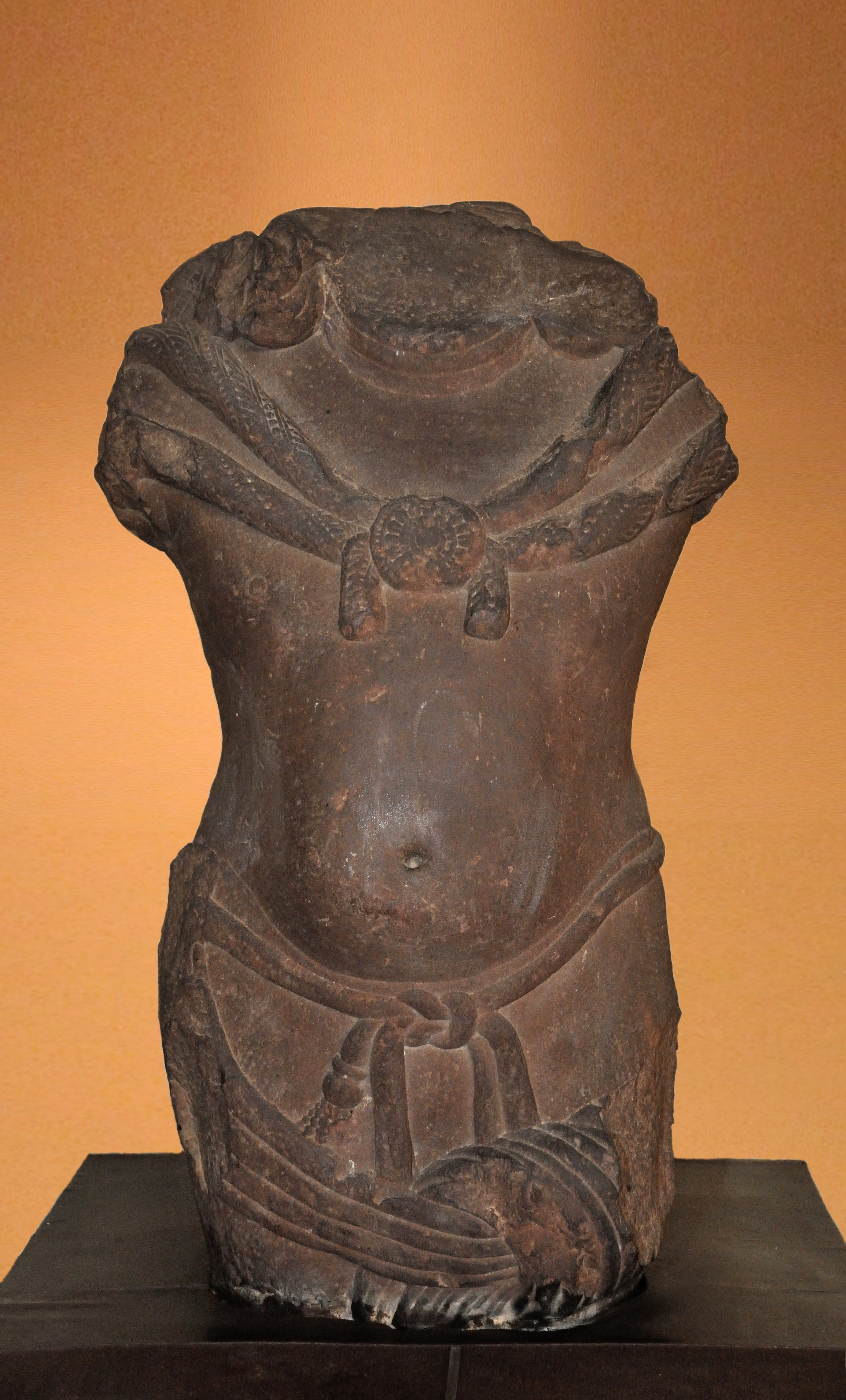
[[File:Mora Vrishni Mathura circa 15 CE.jpg|thumb|Torso said to be from one of the five Vrishni Heroes, Mora, circa 15 CE, [[Mathura Museum]].<ref name="VSA253">"We have actually discovered in the excavations at the Mora shrine stone torsos representing the Vrishni Heroes (...) Their style closely follows that of the free-standing Yakshas in that they are carved in the round. They are dressed in a ''dhoti'' and ''uttaraya'' and some types of ornaments as found on the Yaksha figures, their right hand is held in ''ahbayamudra''..." in "{{cite book |last1=Agrawala |first1=Vasudeva Sharana |title=Indian Art: A history of Indian art from the earliest times up to the third century A.D |date=1965 |publisher=Prithivi Prakashan |page=253 |url=https://books.google.com/books?id=nJo0AQAAIAAJ |language=en}}</ref><ref>This statue appears in Fig.51 as one of the statues excavated in the Mora mound, in {{cite book |last1=Rosenfield |first1=John M. |title=The Dynastic Arts of the Kushans |date=1967 |publisher=University of California Press | | [[File:Mora Vrishni Mathura circa 15 CE.jpg|thumb|Torso said to be from one of the five Vrishni Heroes, Mora, circa 15 CE, [[Mathura Museum]].<ref name="VSA253">"We have actually discovered in the excavations at the Mora shrine stone torsos representing the Vrishni Heroes (...) Their style closely follows that of the free-standing Yakshas in that they are carved in the round. They are dressed in a ''dhoti'' and ''uttaraya'' and some types of ornaments as found on the Yaksha figures, their right hand is held in ''ahbayamudra''..." in "{{cite book |last1=Agrawala |first1=Vasudeva Sharana |title=Indian Art: A history of Indian art from the earliest times up to the third century A.D |date=1965 |publisher=Prithivi Prakashan |page=253 |url=https://books.google.com/books?id=nJo0AQAAIAAJ |language=en}}</ref><ref>This statue appears in Fig.51 as one of the statues excavated in the Mora mound, in {{cite book |last1=Rosenfield |first1=John M. |title=The Dynastic Arts of the Kushans |date=1967 |publisher=University of California Press |pages=151–152 and Fig.51 |url=https://books.google.com/books?id=udnBkQhzHH4C&pg=PA151 |language=en}}</ref><ref name="SRQ211"/>]] | ||
{{main|Mora Well Inscription}} | {{main|Mora Well Inscription}} | ||
The Vrishni heroes are mentioned in the [[Mora Well Inscription]] in Mathura, dated to the time of the [[Northern Satraps]] [[Sodasa]], in which they are called ''[[Bhagavata | The Vrishni heroes are mentioned in the [[Mora Well Inscription]] in Mathura, dated to the time of the [[Northern Satraps]] [[Sodasa]], in which they are called ''[[Bhagavata]]m''.<ref name="Srinivasan1997p211">{{cite book|author=Doris Srinivasan|title=Many Heads, Arms, and Eyes: Origin, Meaning, and Form of Multiplicity in Indian Art|url=https://books.google.com/books?id=vZheP9dIX9wC&pg=PA211 |year=1997|publisher=BRILL Academic|isbn=90-04-10758-4|pages=211–214, 308–311 with footnotes}}</ref><ref name="Quintanilla2007p260">{{cite book|author=Sonya Rhie Quintanilla|title=History of Early Stone Sculpture at Mathura: Ca. 150 BCE - 100 CE|url=https://books.google.com/books?id=X7Cb8IkZVSMC |year=2007|publisher=BRILL Academic|isbn=978-90-04-15537-4|page=260}}</ref><ref name=Vemsani203>{{cite book|author=Lavanya Vemsani |title=Krishna in History, Thought, and Culture |url=https://books.google.com/books?id=4fw2DAAAQBAJ&pg=PA202 |year=2016|publisher=ABC-CLIO|isbn=978-1-61069-211-3|pages=202–203}}</ref> Statue fragments were found in Mora, which are thought to represent some of the Vrishni heroes.<ref name="VSA253"/><ref name="JMR151">{{cite book |last1=Rosenfield |first1=John M. |title=The Dynastic Arts of the Kushans |date=1967 |publisher=University of California Press |pages=151–152 and Fig.51 |url=https://books.google.com/books?id=udnBkQhzHH4C&pg=PA151 |language=en}}</ref> Two uninscribed male torsos were discovered in the mound, both of high craftsmanship and in Indian style and costume.<ref name="JMR151"/> They are similar with minor variations, suggesting they may have been part of a series.<ref>{{cite book |last1=Lüders |first1=H. |title=Epigraphia Indica Vol.24 |date=1937 |pages=[https://archive.org/details/in.ernet.dli.2015.56526/page/n247 199]-200 |url=https://archive.org/details/in.ernet.dli.2015.56526}}</ref> They share some sculptural characteristics with the [[Yaksha]] statues found in Mathura, such as the sculpting in the round, or the clothing style.<ref name="VSA253"/> Sonya Rhie Quintanilla also supports an attribution of the torso to the five Vrishnis, and dates them to around the time of [[Sodasa]] (circa 15 CE), which is confirmed on artistic grounds.<ref name="SRQ211"/> | ||
==Vrishni Temples (circa 15 CE)== | ==Vrishni Temples (circa 15 CE)== | ||
Mention of Vrishni Temples appears in the [[Mora Well Inscription]], which describes a pratima (murti, images), a stone shrine (temple) and calls the [[five Vrishnis]] as ''bhagavatam''.<ref name="Srinivasan1997p211"/><ref name="Quintanilla2007p260"/><ref name=Vemsani203 | Mention of Vrishni Temples appears in the [[Mora Well Inscription]], which describes a pratima (murti, images), a stone shrine (temple) and calls the [[five Vrishnis]] as ''bhagavatam''.<ref name="Srinivasan1997p211"/><ref name="Quintanilla2007p260"/><ref name=Vemsani203/> The inscription is dated to the early decades of the 1st century CE during the reign of [[Sodasa]], probably circa 15 CE.<ref name="Srinivasan1997p211"/> | ||
A decorated doorjamb, also probably belonging to a Temple, on which is inscribed the [[Vasu Doorjamb Inscription]], is dedicated to deity [[Vāsudeva]], and mentions the rule of the [[Northern Satrap]] [[Sodasa]], and has similar carving to the Mora doorjamb. The decoration of these and many similar doorjambs from Mathura consists in [[Scroll (art)|scrolls of grapevines]]. They are all dated to the reign of Sodasa, circa 15 CE and constitute a secure dated artistic reference for the evaluation of datation of other Mathura sculptures.<ref name="SRQ171">{{cite book |last1=Quintanilla |first1=Sonya Rhie |title=History of Early Stone Sculpture at Mathura: Ca. 150 BCE - 100 CE |date=2007 |publisher=BRILL |isbn=9789004155374 |page=171 |url=https://books.google.com/books?id=X7Cb8IkZVSMC&pg=PA171 |language=en}}</ref> It has been suggested that the grapevine design had been [[:File:Gandhara floral scrolls.jpg|introduced from the Gandhara area]] in the northwest, and maybe associated with the northern taste of the [[Northern Satraps|Satrap]] rulers.<ref name="RB142">{{cite book |last1=Bracey |first1=Robert |title=Problems of Chronology in Gandhāran Art: Proceedings of the First International Workshop of the Gandhāra Connections Project, University of Oxford, 23rd-24th March, 2017 |date=2018 |publisher=The Classical Art Research Centre. Archaeopress. University of Oxford |pages=[https://archive.org/details/ProblemsOfChronologyInGandharanArt/page/n149 142]–143 |url=https://archive.org/details/ProblemsOfChronologyInGandharanArt}}</ref> These designs may also be the result of the work of northern artists in Mathura.<ref name="RB142"/> The grapevine designs of Gandhara are generally considered as originating from [[Hellenistic art]].<ref>"Honeysuckle, grapevine, triton and acanthus mouldings are some of the Hellenistic features." in {{cite book |last1=Sharma |first1=Ramesh Chandra |last2=Ghosal |first2=Pranati |title=Buddhism and Gandhāra Art |date=2004 |publisher=Indian Institute of Advanced Study |isbn=978-81-7305-264-4 |page=148 |url=https://books.google.com/books?id=CMufAAAAMAAJ |language=en}}</ref> | A decorated doorjamb, also probably belonging to a Temple, on which is inscribed the [[Vasu Doorjamb Inscription]], is dedicated to deity [[Vāsudeva]], and mentions the rule of the [[Northern Satrap]] [[Sodasa]], and has similar carving to the Mora doorjamb. The decoration of these and many similar doorjambs from Mathura consists in [[Scroll (art)|scrolls of grapevines]]. They are all dated to the reign of Sodasa, circa 15 CE and constitute a secure dated artistic reference for the evaluation of datation of other Mathura sculptures.<ref name="SRQ171">{{cite book |last1=Quintanilla |first1=Sonya Rhie |title=History of Early Stone Sculpture at Mathura: Ca. 150 BCE - 100 CE |date=2007 |publisher=BRILL |isbn=9789004155374 |page=171 |url=https://books.google.com/books?id=X7Cb8IkZVSMC&pg=PA171 |language=en}}</ref> It has been suggested that the grapevine design had been [[:File:Gandhara floral scrolls.jpg|introduced from the Gandhara area]] in the northwest, and maybe associated with the northern taste of the [[Northern Satraps|Satrap]] rulers.<ref name="RB142">{{cite book |last1=Bracey |first1=Robert |title=Problems of Chronology in Gandhāran Art: Proceedings of the First International Workshop of the Gandhāra Connections Project, University of Oxford, 23rd-24th March, 2017 |date=2018 |publisher=The Classical Art Research Centre. Archaeopress. University of Oxford |pages=[https://archive.org/details/ProblemsOfChronologyInGandharanArt/page/n149 142]–143 |url=https://archive.org/details/ProblemsOfChronologyInGandharanArt}}</ref> These designs may also be the result of the work of northern artists in Mathura.<ref name="RB142"/> The grapevine designs of Gandhara are generally considered as originating from [[Hellenistic art]].<ref>"Honeysuckle, grapevine, triton and acanthus mouldings are some of the Hellenistic features." in {{cite book |last1=Sharma |first1=Ramesh Chandra |last2=Ghosal |first2=Pranati |title=Buddhism and Gandhāra Art |date=2004 |publisher=Indian Institute of Advanced Study |isbn=978-81-7305-264-4 |page=148 |url=https://books.google.com/books?id=CMufAAAAMAAJ |language=en}}</ref> | ||
| Line 116: | Line 119: | ||
==Chamunda Tila Vrishni symbols (1st century CE)== | ==Chamunda Tila Vrishni symbols (1st century CE)== | ||
[[File:Chamunda Tila pillar capital, Mathura (background).jpg|thumb|Chamunda Tila pillar capital.]] | [[File:Chamunda Tila pillar capital, Mathura (background).jpg|thumb|Chamunda Tila pillar capital.]] | ||
The ''Chamunda Tila'' pillar capital, also found in Mathura, may be another example of the Vrishni cult in the area of Mathura, this time using the Vrishni ''lanchana'' symbols around a central figure.<ref name="VKG80">{{cite book |last1=Gupta |first1=Vinay K. |title=Vrishnis in Ancient Literature and Art |pages=80–81 |url=https://www.academia.edu/40656540 |language=en}}</ref> | The ''Chamunda Tila'' pillar capital, also found in Mathura, may be another example of the Vrishni cult in the area of Mathura, this time using the Vrishni ''lanchana'' symbols around a central figure.<ref name="VKG80">{{cite book |last1=Gupta |first1=Vinay K. |title=Vrishnis in Ancient Literature and Art |work=Indology's Pulse Arts in Context, Doris Meth Srinivasan festschrift volume, Eds. Corinna Wessels Mevissen and Gerd Mevissen with assistance of Vinay Kumar Gupta |date=January 2019 |pages=80–81 |url=https://www.academia.edu/40656540 |language=en}}</ref> | ||
This pillar capital uses five symbols on both sides: a lion, a palm leaf, a [[makara]], an adorned woman, and Yaksha in central position, with a probable top symbol missing.<ref name="VKG80"/> The ''Tāladdhvaja'' (palm leaf column) is known to symbolize [[Samkarsana]], the ''Garuḍadhvaja'' ([[garuda]] column) symbolizes [[Vāsudeva]], the ''Makaradhvaja'' ([[makara]] crocodile column) symbolizes [[Pradyumna]], and the ''Ṛṣyadhvaja'' (white antilope column) corresponds to [[Aniruddha]].<ref>"A shrine of Aniruddha, the fourth of the 'vyuhas', which had within its precincts a 'rsyadhvaja', i. e. a column bearing on its top the figure of a 'rsya' or a white antelope which was his characteristic 'lanchana'." in {{cite book |title=Journal of the Indian Society of Oriental Art |date=1937 |publisher=Indian Society of Oriental Art |page=16 |url=https://books.google.com/books?id=F1zrAAAAMAAJ |language=en}}</ref><ref name="VKG80"/> The lion | This pillar capital uses five symbols on both sides: a lion, a palm leaf, a [[makara]], an adorned woman, and Yaksha in central position, with a probable top symbol missing.<ref name="VKG80"/> The ''Tāladdhvaja'' (palm leaf column) is known to symbolize [[Samkarsana]], the ''Garuḍadhvaja'' ([[garuda]] column) symbolizes [[Vāsudeva]], the ''Makaradhvaja'' ([[makara]] crocodile column) symbolizes [[Pradyumna]], and the ''Ṛṣyadhvaja'' (white antilope column) corresponds to [[Aniruddha]].<ref>"A shrine of Aniruddha, the fourth of the 'vyuhas', which had within its precincts a 'rsyadhvaja', i. e. a column bearing on its top the figure of a 'rsya' or a white antelope which was his characteristic 'lanchana'." in {{cite book |title=Journal of the Indian Society of Oriental Art |date=1937 |publisher=Indian Society of Oriental Art |page=16 |url=https://books.google.com/books?id=F1zrAAAAMAAJ |language=en}}</ref><ref name="VKG80"/> The lion pillar capital corresponds to Samba.<ref name="VKG80"/> The function of the adorned woman is Shri Rukmani.<ref name="VKG80"/> | ||
The central figure uses the iconography of a Yaksha, pointing to the association of Vrishni iconography with Yasha iconography, as seen in the [[:File:Mora_Vrishni_Mathura_circa_15_CE.jpg|Mora statue]] found with the [[Mora Well Inscription]].<ref name="VKG80"/> | The central figure uses the iconography of a Yaksha, pointing to the association of Vrishni iconography with Yasha iconography, as seen in the [[:File:Mora_Vrishni_Mathura_circa_15_CE.jpg|Mora statue]] found with the [[Mora Well Inscription]].<ref name="VKG80"/> | ||
| Line 139: | Line 142: | ||
==Cult images of Vāsudeva (2nd-3rd century CE)== | ==Cult images of Vāsudeva (2nd-3rd century CE)== | ||
[[File:Vishnu_statuette,_3rd-4th_century_CE,_Udayagiri,_Vidisha_District.jpg|thumb|upright=0.8|{{center|Vasudeva-Krishna with his three attributes (a mace, a wheel and a conch) and an ''Abhaya mudra'' hand gesture, but without an aureole, terracotta.<ref name="CS">For English summary, see page 80 {{cite | [[File:Vishnu_statuette,_3rd-4th_century_CE,_Udayagiri,_Vidisha_District.jpg|thumb|upright=0.8|{{center|Vasudeva-Krishna with his three attributes (a mace, a wheel and a conch) and an ''Abhaya mudra'' hand gesture, but without an aureole, terracotta.<ref name="CS">For English summary, see page 80 {{cite journal |last1=Schmid |first1=Charlotte |title=Les Vaikuṇṭha gupta de Mathura : Viṣṇu ou Kṛṣṇa? |journal=Arts Asiatiques |date=1997 |volume=52 |pages=60–88 |doi=10.3406/arasi.1997.1401 |url=https://www.persee.fr/doc/arasi_0004-3958_1997_num_52_1_1401}}</ref>}}]] | ||
Cult images of [[Vāsudeva]] continued to be produced until the 4th century CE, the worship of this Mathuran deity being much more important than that of [[Vishnu]] during that period.<ref name="CS"/> Statues dating to the 2nd and 3rd century show a possibly four-armed Vāsudeva standing with his attributes: the wheel, the mace and the conch, his right hand saluting in ''[[Abhaya mudra]]''.<ref>Fig.1 Fig.2 Fig.3 in {{cite | Cult images of [[Vāsudeva]] continued to be produced until the 4th century CE, the worship of this Mathuran deity being much more important than that of [[Vishnu]] during that period.<ref name="CS"/> Statues dating to the 2nd and 3rd century show a possibly four-armed Vāsudeva standing with his attributes: the wheel, the mace and the conch, his right hand saluting in ''[[Abhaya mudra]]''.<ref>Fig.1 Fig.2 Fig.3 in {{cite journal |last1=Schmid |first1=Charlotte |title=Les Vaikuṇṭha gupta de Mathura : Viṣṇu ou Kṛṣṇa? |journal=Arts Asiatiques |date=1997 |volume=52 |page=60 |doi=10.3406/arasi.1997.1401 |url=https://www.persee.fr/doc/arasi_0004-3958_1997_num_52_1_1401}}{{free access}}</ref> Only with the Gupta period, did statues focusing on the worship of [[Vishnu]] himself start to appear, using the same iconography as the statues of Vāsudeva, but with the addition of an [[aureole]] starting at the shoulders.<ref name="CS">For English summary, see page 80 {{cite journal |last1=Schmid |first1=Charlotte |title=Les Vaikuṇṭha gupta de Mathura : Viṣṇu ou Kṛṣṇa? |journal=Arts Asiatiques |date=1997 |volume=52 |pages=60–88 |doi=10.3406/arasi.1997.1401 |url=https://www.persee.fr/doc/arasi_0004-3958_1997_num_52_1_1401}}</ref> | ||
From the 4th century CE, independent devotional statues of Vāsudeva-Krishna become very rare, and are replaced by statues of Vishnu with the addition of an aureole.<ref name="CS80">{{cite journal |last1=Schmid |first1=Charlotte |title=Les Vaikuṇṭha gupta de Mathura : Viṣṇu ou Kṛṣṇa? |journal=Arts Asiatiques |date=1997 |volume=52 |pages=60–88, English summary p.80 |doi=10.3406/arasi.1997.1401 |url=https://www.persee.fr/docAsPDF/arasi_0004-3958_1997_num_52_1_1401.pdf}}</ref> This suggests with a high probability that the human face in the statues of Vishnu, including those known as ''[[Vaikuntha Chaturmurti]]'', is actually the face of his human emanation, Vāsudeva-Krishna.<ref name="CS80"/> | From the 4th century CE, independent devotional statues of Vāsudeva-Krishna become very rare, and are replaced by statues of Vishnu with the addition of an aureole.<ref name="CS80">{{cite journal |last1=Schmid |first1=Charlotte |title=Les Vaikuṇṭha gupta de Mathura : Viṣṇu ou Kṛṣṇa? |journal=Arts Asiatiques |date=1997 |volume=52 |pages=60–88, English summary p.80 |doi=10.3406/arasi.1997.1401 |url=https://www.persee.fr/docAsPDF/arasi_0004-3958_1997_num_52_1_1401.pdf |url-status=dead }}</ref> This suggests with a high probability that the human face in the statues of Vishnu, including those known as ''[[Vaikuntha Chaturmurti]]'', is actually the face of his human emanation, Vāsudeva-Krishna.<ref name="CS80"/> | ||
==Kondamotu Vrishni heroes (4th century CE)== | ==Kondamotu Vrishni heroes (4th century CE)== | ||
A relief from Kondamotu, [[Guntur district]] in [[Andhra Pradesh]], dates to the 4th century CE, and shows the Vrishni heroes standing in genealogical order around [[Narasimha]].<ref name="CRA27"/><ref name="VVG74">{{cite journal |last1=Gupta |first1=Vinay K. |title=Vrishnis in Ancient Literature and Art |journal=Indology's Pulse Arts in Context, Doris Meth Srinivasan Festschrift Volume, Eds. Corinna Wessels Mevissen and Gerd Mevissen with Assistance of Vinay Kumar Gupta |pages=74–75 |url=https://www.academia.edu/40656540 |language=en}}</ref> From left to right, they are: [[Saṃkarṣaṇa]], holding a mace and a ploughshare topped by the depiction of a lion, [[Vāsudeva]], with a hand in ''abhaya mudra'' and the other hand on the hip holding a conch shell.<ref name="VVG74"/> Vāsudeva also has a crown, which distinguishes him from the others.<ref>{{cite book |last1=Srinivasan |first1=Doris |title=Many Heads, Arms, and Eyes: Origin, Meaning, and Form of Multiplicity in Indian Art |date=1997 |publisher=BRILL |isbn=978-90-04-10758-8 |page=217 |url=https://books.google.com/books?id=vZheP9dIX9wC&pg=PA217 |language=en}}</ref> Then follow [[Pradyumna]], holding a bow and an arrow, [[Samba (Krishna's son)|Samba]], holding a wine goblet, and [[Aniruddha]], holding a sword and a shield.<ref name="VVG74"/> The fact that they stand around Narasimha suggests a fusion of the Satvata cult with the Vrishni cult.<ref name="VVG74"/> | A relief from Kondamotu, [[Guntur district]] in [[Andhra Pradesh]], dates to the 4th century CE, and shows the Vrishni heroes standing in genealogical order around [[Narasimha]].<ref name="CRA27"/><ref name="VVG74">{{cite journal |last1=Gupta |first1=Vinay K. |title=Vrishnis in Ancient Literature and Art |journal=Indology's Pulse Arts in Context, Doris Meth Srinivasan Festschrift Volume, Eds. Corinna Wessels Mevissen and Gerd Mevissen with Assistance of Vinay Kumar Gupta |date=January 2019 |pages=74–75 |url=https://www.academia.edu/40656540 |language=en}}</ref> From left to right, they are: [[Saṃkarṣaṇa]], holding a mace and a ploughshare topped by the depiction of a lion, [[Vāsudeva]], with a hand in ''abhaya mudra'' and the other hand on the hip holding a conch shell.<ref name="VVG74"/> Vāsudeva also has a crown, which distinguishes him from the others.<ref>{{cite book |last1=Srinivasan |first1=Doris |title=Many Heads, Arms, and Eyes: Origin, Meaning, and Form of Multiplicity in Indian Art |date=1997 |publisher=BRILL |isbn=978-90-04-10758-8 |page=217 |url=https://books.google.com/books?id=vZheP9dIX9wC&pg=PA217 |language=en}}</ref> Then follow [[Pradyumna]], holding a bow and an arrow, [[Samba (Krishna's son)|Samba]], holding a wine goblet, and [[Aniruddha]], holding a sword and a shield.<ref name="VVG74"/> The fact that they stand around Narasimha suggests a fusion of the Satvata cult with the Vrishni cult.<ref name="VVG74"/> | ||
[[File:Kondamotu Vrishni relief, 4th century CE, Hyderabad State Museum.jpg|center|thumb|upright=2.5|The five Vrishni heroes [[Saṃkarṣaṇa]], [[Vāsudeva]], [[Pradyumna]], [[Samba (Krishna's son)|Samba]], and [[Aniruddha]] standing around enthroned [[Narasimha]]. Kondamotu Vrishni heroes relief, 4th century CE, [[Hyderabad State Museum]].<ref name="CRA27"/>]] | [[File:Kondamotu Vrishni relief, 4th century CE, Hyderabad State Museum.jpg|center|thumb|upright=2.5|The five Vrishni heroes [[Saṃkarṣaṇa]], [[Vāsudeva]], [[Pradyumna]], [[Samba (Krishna's son)|Samba]], and [[Aniruddha]] standing around enthroned [[Narasimha]]. Kondamotu Vrishni heroes relief, 4th century CE, [[Hyderabad State Museum]].<ref name="CRA27"/>]] | ||
==Evolution as avatars of Vishnu (4th century CE-)== | ==Evolution as avatars of Vishnu (4th century CE-)== | ||
[[File:The God Vishnu in Three Incarnations. Northern India (Mathura), Gupta period, mid-5th century AD. Boston Museum.jpg|thumb|upright|Saṃkarṣaṇa appears as a lion, while [[Aniruddha]] appears as a boar in this [[Vaikuntha Chaturmurti]] statue, showing Vishnu in his three main emanations, mid-5th century. [[Museum of Fine Arts, Boston|Boston Museum]].<ref name="DS39"/><ref name="CS">For English summary, see page 80 {{cite | [[File:The God Vishnu in Three Incarnations. Northern India (Mathura), Gupta period, mid-5th century AD. Boston Museum.jpg|thumb|upright|Saṃkarṣaṇa appears as a lion, while [[Aniruddha]] appears as a boar in this [[Vaikuntha Chaturmurti]] statue, showing Vishnu in his three main emanations, mid-5th century. [[Museum of Fine Arts, Boston|Boston Museum]].<ref name="DS39"/><ref name="CS">For English summary, see page 80 {{cite journal |last1=Schmid |first1=Charlotte |title=Les Vaikuṇṭha gupta de Mathura : Viṣṇu ou Kṛṣṇa? |journal=Arts Asiatiques |date=1997 |volume=52 |pages=60–88 |doi=10.3406/arasi.1997.1401 |url=https://www.persee.fr/doc/arasi_0004-3958_1997_num_52_1_1401}}</ref>]] | ||
The Vrishni heroes for the most part became avatars of [[Vishnu]], and | The Vrishni heroes for the most part became avatars of [[Vishnu]], and were incorporated in the [[Vaishnavite]] system from the 4th century CE.<ref name="CS80"/><ref>"The absorption of the Vrishni hero into the Vaishnava worship is very gradual. The amalgamation process was preceded and concurrent with a cult of several Vrishni heroes". {{cite book |last1=Srinivasan |first1=Doris |title=Kalādarśana: American Studies in the Art of India |date=1981 |publisher=BRILL |isbn=978-90-04-06498-0 |page=129 |url=https://books.google.com/books?id=-qoeAAAAIAAJ&pg=PA129 |language=en}}</ref> The avatars were combined in the Vishnu statuary from this time, in statues known as ''[[Vaikuntha Chaturmurti]]''.<ref name="CS80"/> | ||
Saṃkarṣaṇa came to be associated with the lion, which is his [[theriomorphic]] aspect.<ref>"Samkarsana is represented by his theriomorphic form, the lion..." in {{cite book |last1=Srinivasan |first1=Doris |title=Many Heads, Arms, and Eyes: Origin, Meaning, and Form of Multiplicity in Indian Art |date=1997 |publisher=BRILL |isbn=978-90-04-10758-8 | | Saṃkarṣaṇa came to be associated with the lion, which is his [[theriomorphic]] aspect.<ref>"Samkarsana is represented by his theriomorphic form, the lion..." in {{cite book |last1=Srinivasan |first1=Doris |title=Many Heads, Arms, and Eyes: Origin, Meaning, and Form of Multiplicity in Indian Art |date=1997 |publisher=BRILL |isbn=978-90-04-10758-8 |pages=253–254 |url=https://books.google.com/books?id=vZheP9dIX9wC&pg=PA253 |language=en}}</ref><ref name="DS39">{{cite journal |last1=Srinivasan |first1=Doris |title=Early Vaiṣṇava Imagery: Caturvyūha and Variant Forms |journal=Archives of Asian Art |date=1979 |volume=32 |pages=39–54 |jstor=20111096 |issn=0066-6637}}</ref> He can be identified as [[Narasimha]].<ref>{{cite book |last1=Srinivasan |first1=Doris |title=Many Heads, Arms, and Eyes: Origin, Meaning, and Form of Multiplicity in Indian Art |date=1997 |publisher=BRILL |isbn=978-90-04-10758-8 |page=241 Note 9 |url=https://books.google.com/books?id=vZheP9dIX9wC&pg=PA241 |language=en}}</ref><ref name="VIA"/> Saṃkarṣaṇa appears as a lion in some of the [[Caturvyūha]] statues (the Bhita statue), where he is an assistant to [[Vāsudeva]], and in the ''[[Vaikuntha Chaturmurti]]'' when his lion's head protrudes from the side of [[Vishnu]]'s head.<ref name="DS39"/> | ||
[[Aniruddha]] came to be associated with the boar, which is his [[theriomorphic]] aspect, also known as [[Varaha]].<ref>"The glorious Aniruddha should be Varaha who rescued the Earth" in {{cite book |last1=Rangarajan |first1=Haripriya |title=Varāha Images in Madhya Pradesh: An Iconographic Study |date=1997 |publisher=Somaiya Publications |isbn=978-81-7039-214-9 |page=38 |url=https://books.google.com/books?id=FJTpAAAAMAAJ |language=en}}</ref><ref>"Aniruddha (is represented) by his theriomorphic form, the boar" in {{cite book |last1=Srinivasan |first1=Doris |title=Many Heads, Arms, and Eyes: Origin, Meaning, and Form of Multiplicity in Indian Art |date=1997 |publisher=BRILL |isbn=978-90-04-10758-8 |page=254 |url=https://books.google.com/books?id=vZheP9dIX9wC&pg=PA254 |language=en}}</ref><ref name="DS39" | [[Aniruddha]] came to be associated with the boar, which is his [[theriomorphic]] aspect, also known as [[Varaha]].<ref>"The glorious Aniruddha should be Varaha who rescued the Earth" in {{cite book |last1=Rangarajan |first1=Haripriya |title=Varāha Images in Madhya Pradesh: An Iconographic Study |date=1997 |publisher=Somaiya Publications |isbn=978-81-7039-214-9 |page=38 |url=https://books.google.com/books?id=FJTpAAAAMAAJ |language=en}}</ref><ref>"Aniruddha (is represented) by his theriomorphic form, the boar" in {{cite book |last1=Srinivasan |first1=Doris |title=Many Heads, Arms, and Eyes: Origin, Meaning, and Form of Multiplicity in Indian Art |date=1997 |publisher=BRILL |isbn=978-90-04-10758-8 |page=254 |url=https://books.google.com/books?id=vZheP9dIX9wC&pg=PA254 |language=en}}</ref><ref name="DS39"/> Aniruddha appears as a boar in some of the [[Caturvyūha]] statues, where he is an assistant to [[Vāsudeva]], and in the ''[[Vaikuntha Chaturmurti]]'' when his boar's head protrudes from the side of [[Vishnu]]'s head.<ref name="DS39"/> | ||
In the ''Vaikuntha Chaturmurti'', especially in the statues from [[ | In the ''Vaikuntha Chaturmurti'', especially in the statues from [[Kashmir region|Kashmir]], [[Pradyumna]] also appears sometimes in the back of the head of the central Vishnu, as a fearsome deity, also known as Kapila.<ref>"The Vishnudharmmottara (78.1.1) sometimes directly identifies Pradyumna with Kapila" {{cite book |last1=Ohri |first1=Vishwa Chander |last2=Khanna |first2=Amar Nath |last3=Culture |first3=Himachal Pradesh (India) Dept of Languages & |title=History and culture of the Chamba State, a western Himalayan kingdom: collected papers of the seminar held at Chamba in 1983 |date=1989 |publisher=Books & Books |page=117 |isbn=9788585016258 |url=https://books.google.com/books?id=vyduAAAAMAAJ |language=en}}</ref> | ||
===Symbolic system=== | ===Symbolic system=== | ||
| Line 188: | Line 191: | ||
{{Vrishni heroes}} | {{Vrishni heroes}} | ||
* {{cite journal |last1=Srinivasan |first1=Doris |title=Early Vaiṣṇava Imagery: Caturvyūha and Variant Forms |journal=Archives of Asian Art |date=1979 |volume=32 |pages=39–54 |jstor=20111096 |issn=0066-6637}} | * {{cite journal |last1=Srinivasan |first1=Doris |title=Early Vaiṣṇava Imagery: Caturvyūha and Variant Forms |journal=Archives of Asian Art |date=1979 |volume=32 |pages=39–54 |jstor=20111096 |issn=0066-6637}} | ||
*{{cite journal|author = John Irwin|title= The Heliodorus Pillar at Besanagar|journal= | *{{cite journal|author = John Irwin|title= The Heliodorus Pillar at Besanagar|journal=Purātattva |volume=8 |publisher=Archaeological Society of India (co-published Art and Archaeology Research Papers, USA)|year=1974|pages =166–176}} | ||
*{{cite journal| author= M D Khare|title= Discovery of a Vishnu temple near the Heliodorus pillar, Besnagar, Dist. Vidisha (MP)| year=1967 |volume=13 | journal=Lalit Kala | jstor=44138838| pages=21–27}} | *{{cite journal| author= M D Khare|title= Discovery of a Vishnu temple near the Heliodorus pillar, Besnagar, Dist. Vidisha (MP)| year=1967 |volume=13 | journal=Lalit Kala | jstor=44138838| pages=21–27}} | ||
*{{cite journal| author= M D Khare|title= The Heliodorus Pillar – A Fresh Appraisal: A Rejoinder| year=1975 |volume=36 | journal=Proceedings of the Indian History Congress | jstor=44138838| pages=92–97}} | *{{cite journal| author= M D Khare|title= The Heliodorus Pillar – A Fresh Appraisal: A Rejoinder| year=1975 |volume=36 | journal=Proceedings of the Indian History Congress | jstor=44138838| pages=92–97}} | ||
{{Mathura Museum}} | {{Mathura Museum}} | ||
[[Category:Mathura art]] | [[Category:Mathura art]] | ||
[[Category:Deified men]] | |||
Latest revision as of 05:42, 17 March 2026

The Vrishni heroes (IAST: Vṛṣṇi vīras), also referred to as Pancha-viras (IAST: Pañca vīras; 'the five heroes'), are a group of five legendary, potentially semi-historical deified heroes who are found in the literature and archaeological sites of ancient India.[8][9] Their earliest worship is attestable in the clan of the Vrishnis near Mathura by 4th-century BCE.[8][10][11] Legends are associated with these deified heroes, some of which may be based on real, historical heroes of the Vrishni clan.[1][12] Their early worship has been variously described as cross-sectarian, much like the cult of the Yakshas, related to the early Bhagavata tradition of Hinduism, and with possible links to Jainism as well.[13] They and their legends – particularly of Krishna and Balarama – have been an important part of the Vaishnava tradition of Hinduism.[8][14][9]
The Vrishnis were already known in the late Vedic literature. They are also mentioned by Pāṇini in Astadhyayi verse 6.2.34, while Krishna is referred to as Krishna Varshneya ("the Vrishni") in verse 3.187.51 of the Mahabharata.[15] Beyond texts, their importance in ancient India is attested by the ancient inscriptions found near Mathura and coins discovered in the ruins of Ai-Khanoum (Afghanistan), bearing images of the two main Vrishni heroes, with Greek and Brahmi legends.[8]
The cult of the Vrishni heroes existed as an independent cult in Mathura, as suggested by the Mora Well Inscription, and was then later gradually amalgamated into Vaishnavism.[16] The deification of the Vrishni heroes centered around the cult of Vasudeva-Krishna, known as Bhagavatism.[17] Epigraphical evidence suggests that their legends and worship swiftly expanded to other parts of India by the start of the common era.[11][18][19]
The Vrishni heroes are generally identified as Samkarshana (Balarama-Samkarshana, son of Vasudeva Anakadundubhi and Devaki),[1][15] Vāsudeva (Vāsudeva-Krishna, another son of Vasudeva Anakadundubhi and Devaki),[1][15] Pradyumna (son of Vāsudeva-Krishna and Rukmini),[1] Samba (son of Vāsudeva-Krishna and Jambavati),[1] and Aniruddha (son of Pradyumna).[18]
Probably as late as the 1st century CE, the cult of the Vrishni heroes (Vīravāda) retained more importance than the Vyuha doctrine (Vyūhavāda), the subsequent cult of emanations that evolved from the Vrishni hero cult.[20] Still later, it evolved into the Avatāravāda system of incarnations of Vishnu.[21] Overall, according to Doris Srinivasan, "the absorption of the Vrishni hero into the Vaishnava worship is very gradual. The amalgamation process was preceded and concurrent with a cult of several Vrishni heroes".[22]
The Vrishni heroes also have distinct individual qualities: Vāsudeva is also associated with gentleness and strength, Samkarsana with knowledge, Pradyumna with female power, Samba with male power and Aniruddha with ferociousness and sovereignty.[23]
Identity[edit | edit source]


The historical roots and the identity of the Vrishni heroes are unclear. Several interpretations have been proposed.
Local heroes turned deities[edit | edit source]
According to Rosenfield, the five heroes of the Vrishnis may have been ancient historical rulers in the region of Mathura, and Vāsudeva and Krishna "may well have been kings of this dynasty as well".[25] According to the Vayu Purana (97.1-2), the five Vrishni heroes were originally human, and their names were Samkarshana, Vāsudeva, Pradyumna, Samba, and Aniruddha.[12]
The heroes would then have evolved into Vaishnavite deities through a step-by-step process: 1) deification of the Vrishni heroes 2) association with the God Narayana-Vishnu 3) incorporation into the Vyuha concept of successive emanations of the God.[26] Epigraphically, the deified status of Vāsudeva in particular is confirmed by his appearance on the coinage of Agathocles of Bactria (190-180 BCE) and by the devotional character of the Heliodorus pillar inscription (circa 110 BCE).[27] Later, the association with Narayana (Vishnu) is suggested by the Hathibada Ghosundi Inscriptions of the 1st century BCE.[27] It is generally thought that "by the beginning of the Christian era, the cult of Vasudeva, Vishnu and Narayana amalgamated".[28] By the 2nd century CE, the "avatara concept was in its infancy", and the depiction of Vishnu with his four emanations (the Chatur-vyūha), consisting of the Vrishni heroes minus Samba, starts to become visible in art at the end of the Kushan period.[29]
Banerjee too considered that they may have been semi-deified legendary kings who came to be considered as Vishnu's avatars.[25] This would lead to an early form of Vaishnavism, currently described as the Pancaratra system.[25] Also according to Gavin Flood – an Indologist and scholar of Hinduism, Vāsudeva may have originated in a real Vrishni hero or king, but the lineage is difficult to establish.[10] This Vasudeva became deified in the Vrishni clan, its worship being traceable to the 4th century text of Pāṇini, which mentions Vāsudevaka or a "devotee of Vāsudeva".[10] Vāsudeva then fused with Krishna of the Yadavas clan.[10] Over time, Vāsudeva was identified with Krishna and Vishnu.[10]
According to Christopher Austin, the Vrishni heroes are characters linked to the end of the Mahabharata, reflecting the three generations of Vrishnis of Krishna from the Bhagavad Gita fame, his son, his grandson along with the Balarama (Samkarshana). This view is supported by Srinivasan and Banerjee based on evidence in two Puranic passages and the Mora well inscription.[11] In early Hinduism, the five Vrishni heroes have been identified as Vāsudeva-Krishna, Samkarsana-Balarama, Pradyumna, Aniruddha and Samba as known from the Medieval Vayu Purana.[13][30]
Early coinage (3rd-2nd century BCE)[edit | edit source]
The Vrishni heroes appear on the coinage of Agathocles of Bactria, circa 190-180 BCE: Samkarshana, with Gada mace and plow, and Vāsudeva, with Shankha (a pear-shaped case or conch) and Chakra wheel.[1][2][3] This is "the earliest unambiguous image" of the two deities.[4]
On some of the Indian punch-marked coins, three individuals appear without attributes, possibly deities Saṃkarṣaṇa, Vāsudeva and Ekanamsha in the late 4th-2nd century BCE.[31] The same type of coins was excavated in Besnagar.[32]
On some post-Mauryan punch-marked coins, possible depictions of Saṃkarṣaṇa-Balarama appear.[33][34] He is shown wielding a mace and a plough.[35][33] These punch-marked coins are dated to the 2nd century BCE, and may be associated with Mathura.[4]
-
![Coin of Agathocles of Bactria (190-180 BCE)[1]](https://upload.wikimedia.org/wikipedia/commons/c/cd/Coin_of_the_Bactrian_King_Agathokles.jpg) Coin of Agathocles of Bactria (190-180 BCE)[1]
Coin of Agathocles of Bactria (190-180 BCE)[1] -
 Mauryan Empire. Late 4th-2nd century BC
 -
 Mauryan punch-marked coin with three deities 4th-2nd century BCE
 -
 Punch-marked coins excavated in Besnagar
 -
![Post-Mauryan punch-marked coin with possible Balarama (detail)[36]](https://upload.wikimedia.org/wikipedia/commons/4/49/Mauryan_Balarama_Coin_3rd-2nd_Century_CE_%28detail%29.jpg) Post-Mauryan punch-marked coin with possible Balarama (detail)[36]
Post-Mauryan punch-marked coin with possible Balarama (detail)[36]


.jpg)
![Post-Mauryan punch-marked coin with possible Balarama (detail)[36]](/wiki/File:Mauryan_Balarama_Coin_3rd-2nd_Century_CE_(detail).jpg)
Jainism[edit | edit source]
Another theory has been proposed by Heinrich Luders. Based on an analysis of 10th to 12th century Jaina texts, Luders proposed that Vrishnis may have roots in Jainism, noting the co-existence of the Jain and Vrishni-related archaeological findings in Mathura, and the strength of Jainism at that time in Mathura.[13] He names the Vrishni heroes as Baladeva, Akrura, Anadhrsti, Sarana and Viduratha – all Jain heroes and with Akrura as the commander.[13]
Cross-sectarian deities[edit | edit source]
According to Quintanilla, the cult of the Vrishnis may have been cross-sectarian, much like the cult of the Yakshas, and "may not necessarily represent the roots of Vaiṣṇava theology at Mathura".[13]
Devotional structures and symbolism (circa 115 BCE)[edit | edit source]
.jpg)

Several pillar capitals with symbolic statuary associated with the Vhrishni heroes have been found in Besnagar around the site of the Heliodorus pillar, dated to about 115 BCE.[37]
The Heliodorus pillar inscription explains that the pillar erected to honour Vāsudeva is a Garuda-vajra, although the Garuda statue has not been found.[38][39] According to Susan L. Huntington, the Garuda capital on the Heliodorus pillar was probably similar to a portable Garuda standard illustrated on one of the nearly contemporary reliefs at Bharhut.[40] In Bharhut, a man riding a horse is seen holding a portable pillar-standard, crowned by a bird-man creature similar to a Kinnara.[40] The same concept of Garuda pillar may have been adopted for the Heliodorus pillar.[40]
Other sculptures and pillar capitals were found near the Heliodorus pillar, and it is thought they were dedicated to Vāsudeva's kinsmen, otherwise known as the Vrishni heroes and objects of the Bhagavata cult.[41] These are a tala (fan-palm capital), a makara (crocodile) capital, a banyan-tree capital, and a possible statue of the goddess Lakshmi, also associated with the Bhagavat cult.[6] Just as Garuda is associated with Vāsudesa, the fan-palm capital is generally associated with Saṃkarṣaṇa, and the makara is associated with Pradyumna.[42][43] The banyan-tree capital with ashtanidhis is associated with Lakshmi.[6] In effect, the findings surrounding the Heliodorus pillar suggest the cult of a trio of the Vrishni heroes in this time and area, composed of the three deities Vāsudesa, Saṃkarṣaṇa and Pradyumna.[44]
Vrishni Temple structure[edit | edit source]
Excavations suggests that these various pillars with their symbolic capitals were standing in line at the site, and that the Heliodorus pillar was just one of them, standing at the end of the line.[45] Although the pillars are aniconic, it is probable that now lost sculptures representing the deities, broadly similar to the depictions on Vāsudeva and Samkarshana on the coins of Agathocles of Bactria (190-180 BCE), were located in adjoining shrines.[46]
The 1963–65 excavations at the site suggest that the site had an elliptical shrine – possibly dating to the 4th to 3rd-century BCE – with a brick foundation and likely a wooden superstructure.[47][48][49] This was destroyed by a flood around 200 BCE. New soil was then added and the ground level raised to build a new second temple to Vāsudeva, with a wooden pillar (Garuda dhvaja) in front of the east-facing elliptical shrine.[47][48] This too was destroyed by floods sometime in the 2nd-century BCE.[47] In late 2nd-century BCE, after some ground preparation, yet another Vāsudeva temple was rebuilt, this time with eight stone pillars aligned in the north-south cardinal axis. Only one of these eight pillars have survived: the Heliodorus pillar.[47][48]
-
 Depiction of Vasudeva circa 190-180 BCE.
 -
![The Garuda, symbol of Vāsudeva, was probably similar to this design from Bharhut, circa 100 BCE.[40]](https://upload.wikimedia.org/wikipedia/commons/c/cc/Garuda_pillar_from_Bharhut_relief.jpg)
-
![The fan-palm capital, found next to the Heliodorus pillar, is associated with Saṃkarṣaṇa.[42][43]](https://upload.wikimedia.org/wikipedia/commons/e/e1/Besnagar_fan-palm_capital.jpg)
-
![The Makara capital, found at the site of the Heliodorus pillar, is associated with Pradyumna.[41][50][42][43] 2nd century BCE.[51] Gwalior Museum](https://upload.wikimedia.org/wikipedia/commons/4/4f/Besnagar_Makara_pillar_capital.jpg)
-
![A pillar capital shaped as a Kalpadruma tree, also found nearby at Besnagar, probably associated with Lakshmi.[41][42]](https://upload.wikimedia.org/wikipedia/commons/4/4e/Kalpadruma.jpg) A pillar capital shaped as a Kalpadruma tree, also found nearby at Besnagar, probably associated with Lakshmi.[41][42]
A pillar capital shaped as a Kalpadruma tree, also found nearby at Besnagar, probably associated with Lakshmi.[41][42]

![The Garuda, symbol of Vāsudeva, was probably similar to this design from Bharhut, circa 100 BCE.[40]](/wiki/File:Garuda_pillar_from_Bharhut_relief.jpg)
![The fan-palm capital, found next to the Heliodorus pillar, is associated with Saṃkarṣaṇa.[42][43]](/wiki/File:Besnagar_fan-palm_capital.jpg)
![The Makara capital, found at the site of the Heliodorus pillar, is associated with Pradyumna.[41][50][42][43] 2nd century BCE.[51] Gwalior Museum](/wiki/File:Besnagar_Makara_pillar_capital.jpg)
![A pillar capital shaped as a Kalpadruma tree, also found nearby at Besnagar, probably associated with Lakshmi.[41][42]](/wiki/File:Kalpadruma.jpg)
Saṃkarṣaṇa in Indo-Scythian coinage (1st century BCE)[edit | edit source]

Saṃkarṣaṇa, the Vrishni elder and the leading divinity until the rise to precedence of Vāsudeva, is known to appear on the coinage of the Indo-Scythian rulers Maues and Azes I during the 1st century BCE.[4][52] These coins show him holding a mace and a plough.[4][52][53]
-
![Samkarsana-Balarama on a coin of Maues (90-80 BCE)[53]](https://upload.wikimedia.org/wikipedia/commons/2/22/Maues_coinage_with_Balarama.jpg)
-
![Samkarsana-Balarama on a coin of Maues (90-80 BCE)[53]](https://upload.wikimedia.org/wikipedia/commons/3/35/Samkarsana_on_the_coinage_of_Maues.jpg)
-
![Samkarsana-Balarama on a coin of Maues (90-80 BCE)[53]](https://storage.googleapis.com/smartcommons/commons/c/cf/BalaramaMauesCoin1stCenturyBCE.jpg)
-
 Samkarsana-Balarama on a coin of Azes (58-12 BCE)
![Samkarsana-Balarama on a coin of Maues (90-80 BCE)[53]](/wiki/File:Maues_coinage_with_Balarama.jpg)
![Samkarsana-Balarama on a coin of Maues (90-80 BCE)[53]](/wiki/File:Samkarsana_on_the_coinage_of_Maues.jpg)
![Samkarsana-Balarama on a coin of Maues (90-80 BCE)[53]](/wiki/File:BalaramaMauesCoin1stCenturyBCE.jpg)

Ghosundi Inscriptions (1st century BCE)[edit | edit source]

The two major Vrishni heroes Saṃkarṣaṇa and Vāsudeva, still in their proper seniority order, are again mentioned in the Hathibada Ghosundi Inscriptions, dated to the 1st century BCE. For the first time they seem to be associated to a higher divinity, as the inscription mention that their cult is made on a precinct of Narayana.
Mora Vrishni heroes (circa 15 CE)[edit | edit source]

The Vrishni heroes are mentioned in the Mora Well Inscription in Mathura, dated to the time of the Northern Satraps Sodasa, in which they are called Bhagavatam.[55][56][57] Statue fragments were found in Mora, which are thought to represent some of the Vrishni heroes.[30][25] Two uninscribed male torsos were discovered in the mound, both of high craftsmanship and in Indian style and costume.[25] They are similar with minor variations, suggesting they may have been part of a series.[58] They share some sculptural characteristics with the Yaksha statues found in Mathura, such as the sculpting in the round, or the clothing style.[30] Sonya Rhie Quintanilla also supports an attribution of the torso to the five Vrishnis, and dates them to around the time of Sodasa (circa 15 CE), which is confirmed on artistic grounds.[13]
Vrishni Temples (circa 15 CE)[edit | edit source]
Mention of Vrishni Temples appears in the Mora Well Inscription, which describes a pratima (murti, images), a stone shrine (temple) and calls the five Vrishnis as bhagavatam.[55][56][57] The inscription is dated to the early decades of the 1st century CE during the reign of Sodasa, probably circa 15 CE.[55]
A decorated doorjamb, also probably belonging to a Temple, on which is inscribed the Vasu Doorjamb Inscription, is dedicated to deity Vāsudeva, and mentions the rule of the Northern Satrap Sodasa, and has similar carving to the Mora doorjamb. The decoration of these and many similar doorjambs from Mathura consists in scrolls of grapevines. They are all dated to the reign of Sodasa, circa 15 CE and constitute a secure dated artistic reference for the evaluation of datation of other Mathura sculptures.[59] It has been suggested that the grapevine design had been introduced from the Gandhara area in the northwest, and maybe associated with the northern taste of the Satrap rulers.[60] These designs may also be the result of the work of northern artists in Mathura.[60] The grapevine designs of Gandhara are generally considered as originating from Hellenistic art.[61]
-
![The Vasu doorjamb, dedicated to Vāsudeva "in the reign of Sodasa", Mathura, circa 15 CE. Mathura Museum, GMM 13.367[59]](https://storage.googleapis.com/smartcommons/commons/6/69/Vasu_doorjamb_horizontal.jpg) The Vasu doorjamb, dedicated to Vāsudeva "in the reign of Sodasa", Mathura, circa 15 CE. Mathura Museum, GMM 13.367[59]
The Vasu doorjamb, dedicated to Vāsudeva "in the reign of Sodasa", Mathura, circa 15 CE. Mathura Museum, GMM 13.367[59] -
![Mora doorjamb with grapevine design, probably belonging to a Vrishni Temple at Mora, near Mathura, circa 15 CE. State Museum Lucknow, SML J.526.[59]](https://upload.wikimedia.org/wikipedia/commons/c/c5/Mora_doorjamb_designs_Mathura%2C_1st_century_CE.jpg) Mora doorjamb with grapevine design, probably belonging to a Vrishni Temple at Mora, near Mathura, circa 15 CE. State Museum Lucknow, SML J.526.[59]
Mora doorjamb with grapevine design, probably belonging to a Vrishni Temple at Mora, near Mathura, circa 15 CE. State Museum Lucknow, SML J.526.[59]
![The Vasu doorjamb, dedicated to Vāsudeva "in the reign of Sodasa", Mathura, circa 15 CE. Mathura Museum, GMM 13.367[59]](/wiki/File:Vasu_doorjamb_horizontal.jpg)
![Mora doorjamb with grapevine design, probably belonging to a Vrishni Temple at Mora, near Mathura, circa 15 CE. State Museum Lucknow, SML J.526.[59]](/wiki/File:Mora_doorjamb_designs_Mathura,_1st_century_CE.jpg)
Chamunda Tila Vrishni symbols (1st century CE)[edit | edit source]
.jpg)
The Chamunda Tila pillar capital, also found in Mathura, may be another example of the Vrishni cult in the area of Mathura, this time using the Vrishni lanchana symbols around a central figure.[62]
This pillar capital uses five symbols on both sides: a lion, a palm leaf, a makara, an adorned woman, and Yaksha in central position, with a probable top symbol missing.[62] The Tāladdhvaja (palm leaf column) is known to symbolize Samkarsana, the Garuḍadhvaja (garuda column) symbolizes Vāsudeva, the Makaradhvaja (makara crocodile column) symbolizes Pradyumna, and the Ṛṣyadhvaja (white antilope column) corresponds to Aniruddha.[63][62] The lion pillar capital corresponds to Samba.[62] The function of the adorned woman is Shri Rukmani.[62]
The central figure uses the iconography of a Yaksha, pointing to the association of Vrishni iconography with Yasha iconography, as seen in the Mora statue found with the Mora Well Inscription.[62]
Triads (1st-2nd century CE)[edit | edit source]
A few triads are known from Mathura, dated to the 1st-2nd century CE, showing Vāsudeva and Saṃkarṣaṇa with their attributes, together with a female standing in the middle, thought to be Ekanamsha.[64][65] In these triads, the kinship of the warrior heroes is still emphasized, with the depiction focusing on the elder brother, the younger brother and the sister, with a prominence still given to the elder brother Samkarsana.[66] They are still presented as warrior "kshatriya" heroes who are not yet fully deified or considered as royals, and are only the object of Bhakti devotional worship towards ancestral heroes, focusing on their enshrined icons.[66]
Caturvyūha (2nd century CE)[edit | edit source]

The famous "Chatur-vyūha" statue in Mathura Museum is an attempt to show in one composition Vāsudeva together with the other members of the Vrishni clan of the Pancharatra system: Samkarsana, Pradyumna and Aniruddha, with Samba missing, Vāsudeva being the central deity from whom the others emanate.[67] The back of the relief is carved with the branches of a Kadamba tree, symbolically showing the relationship being the different deities.[67]
Vāsudeva is fittingly in the center with ornate crown and flower necklace, making the Abhaya Mudra and holding his decorated heavy mace on the side, his elder brother Balarama to his right under a serpent hood, his son Pradyumna to his left (lost), and his grandson Aniruddha on top.[67]
-
 Tree and branches sculpted in the back, showing their genealogical relationship.
 -
 Samkarsana-Balarama under his snake hood holding a cup
 -
 Vasudeva's ornate mace held by one of his supplementary hands


Cult images of Vāsudeva (2nd-3rd century CE)[edit | edit source]

Cult images of Vāsudeva continued to be produced until the 4th century CE, the worship of this Mathuran deity being much more important than that of Vishnu during that period.[68] Statues dating to the 2nd and 3rd century show a possibly four-armed Vāsudeva standing with his attributes: the wheel, the mace and the conch, his right hand saluting in Abhaya mudra.[69] Only with the Gupta period, did statues focusing on the worship of Vishnu himself start to appear, using the same iconography as the statues of Vāsudeva, but with the addition of an aureole starting at the shoulders.[68]
From the 4th century CE, independent devotional statues of Vāsudeva-Krishna become very rare, and are replaced by statues of Vishnu with the addition of an aureole.[70] This suggests with a high probability that the human face in the statues of Vishnu, including those known as Vaikuntha Chaturmurti, is actually the face of his human emanation, Vāsudeva-Krishna.[70]
Kondamotu Vrishni heroes (4th century CE)[edit | edit source]
A relief from Kondamotu, Guntur district in Andhra Pradesh, dates to the 4th century CE, and shows the Vrishni heroes standing in genealogical order around Narasimha.[7][71] From left to right, they are: Saṃkarṣaṇa, holding a mace and a ploughshare topped by the depiction of a lion, Vāsudeva, with a hand in abhaya mudra and the other hand on the hip holding a conch shell.[71] Vāsudeva also has a crown, which distinguishes him from the others.[72] Then follow Pradyumna, holding a bow and an arrow, Samba, holding a wine goblet, and Aniruddha, holding a sword and a shield.[71] The fact that they stand around Narasimha suggests a fusion of the Satvata cult with the Vrishni cult.[71]

Evolution as avatars of Vishnu (4th century CE-)[edit | edit source]
,_Gupta_period,_mid-5th_century_AD._Boston_Museum.jpg)
The Vrishni heroes for the most part became avatars of Vishnu, and were incorporated in the Vaishnavite system from the 4th century CE.[70][74] The avatars were combined in the Vishnu statuary from this time, in statues known as Vaikuntha Chaturmurti.[70]
Saṃkarṣaṇa came to be associated with the lion, which is his theriomorphic aspect.[75][73] He can be identified as Narasimha.[76][23] Saṃkarṣaṇa appears as a lion in some of the Caturvyūha statues (the Bhita statue), where he is an assistant to Vāsudeva, and in the Vaikuntha Chaturmurti when his lion's head protrudes from the side of Vishnu's head.[73]
Aniruddha came to be associated with the boar, which is his theriomorphic aspect, also known as Varaha.[77][78][73] Aniruddha appears as a boar in some of the Caturvyūha statues, where he is an assistant to Vāsudeva, and in the Vaikuntha Chaturmurti when his boar's head protrudes from the side of Vishnu's head.[73]
In the Vaikuntha Chaturmurti, especially in the statues from Kashmir, Pradyumna also appears sometimes in the back of the head of the central Vishnu, as a fearsome deity, also known as Kapila.[79]
Symbolic system[edit | edit source]
The caturvyuha, this Gupta period polycephalic aspect of Vishnu formed by the four Vrishni heroes as his emanations (a Saumya benevolent face to the east, a Simha lion face to the south, a Varaha boar face to the north, a Raudra terrible human face to the west) is described in detail in the Vishnudharmottara Purana (compiled between the 4th and the 7th century CE).[80][81] This is to be understood in conjunction with the description of the four Vyūhas Saṃkarṣaṇa, Vāsudeva, Pradyumna, and Aniruddha, also presented as emanations of Vishnu, as known from the Pancaratra doctrine.[82][83] This establishes multiple correspondences between the deities and their symbols:[84][85][83]
Dashavatara Temple, Deogarh (6th century CE)[edit | edit source]

The Dashavatara Temple in Deogarh is closely related to the iconic architectural temple structure described in the Viṣṇudharmottara purāṇa, and can be interpreted as an architectural representation of the Caturvyuha concept and the Pancaratra doctrine, centering on the depictions of the four main emanations of Vishnu: Vāsudeva, Samkarshana, Pradyumna and Aniruddha.[86] According to Lubotsky, it is likely that the entrance is dedicated to the Vāsudeva aspect of Vishnu; the Anantashayana side is his role as the creator (Aniruddha); the sage form of Nara-Narayana side symbolizes his preservation and maintainer role in cosmic existence (Pradyumna); and the Gajendramoksha side represents his role as the destroyer (Samkarsana).[86]
Later depictions of the Vrishni heroes[edit | edit source]
The Vrishni heroes – particularly Krishna and Balarama – are still found in some Vaishnava Hindu temples.
-
 11th century Balarama, Lakshmi (or perhaps, Subhadra), Vasudeva (Krishna, Jagannath)
 -
 The five Vrishni heroes standing in the Parthasarathy Temple, Eastern Torana Entrance. From left to right: Balarama, Rukmini, Vasudeva-Krishna (center), Pradyumna, Aniruddha and Satyaki
,_Vasudeva_(Krishna,_Jagannath).jpg)
.jpg)
.jpg)

See also[edit | edit source]
References[edit | edit source]
- ↑ 1.0 1.1 1.2 1.3 1.4 1.5 1.6 1.7 Singh, Upinder (2008). A History of Ancient and Early Medieval India: From the Stone Age to the 12th Century. Pearson Education India. pp. 436–438. ISBN 978-81-317-1120-0.
- ↑ 2.0 2.1 Srinivasan, Doris (1979). "Early Vaiṣṇava Imagery: Caturvyūha and Variant Forms". Archives of Asian Art. 32: 50. ISSN 0066-6637. JSTOR 20111096.
- ↑ 3.0 3.1 Joshi, Nilakanth Purushottam (1979). Iconography of Balarāma. Abhinav Publications. p. 22. ISBN 978-81-7017-107-2.
- ↑ 4.0 4.1 4.2 4.3 4.4 4.5 Srinivasan, Doris (1997). Many Heads, Arms, and Eyes: Origin, Meaning, and Form of Multiplicity in Indian Art. BRILL. p. 215. ISBN 978-90-04-10758-8.
- ↑ Art and History: Texts, Contexts and Visual Representations in Ancient and Early Medieval India. Bloomsbury Publishing. 2019. p. 44. ISBN 978-93-88414-31-9.
- ↑ 6.0 6.1 6.2 Indian History. Allied Publishers. 1988. p. A-224. ISBN 978-81-8424-568-4.
- ↑ 7.0 7.1 7.2 Austin, Christopher R. (2019). Pradyumna: Lover, Magician, and Son of the Avatara. Oxford University Press. p. 27. ISBN 978-0-19-005411-3.
- ↑ 8.0 8.1 8.2 8.3 Doris Srinivasan (1997). Many Heads, Arms, and Eyes: Origin, Meaning, and Form of Multiplicity in Indian Art. BRILL Academic. pp. 211–220, 236. ISBN 90-04-10758-4.
- ↑ 9.0 9.1 R Champakalakshmi (1990). H. V. Sreenivasa Murthy (ed.). Essays on Indian History and Culture. Mittal Publications. pp. 52–60. ISBN 978-81-7099-211-0.
- ↑ 10.0 10.1 10.2 10.3 10.4 Gavin D. Flood (1996). An Introduction to Hinduism. Cambridge University Press. pp. 119–120. ISBN 978-0-521-43878-0.
- ↑ 11.0 11.1 11.2 Christopher Austin (2018). Diana Dimitrova and Tatiana Oranskaia (ed.). Divinizing in South Asian Traditions. Taylor & Francis. pp. 30–35. ISBN 978-1-351-12360-0.
- ↑ 12.0 12.1 Srinivasan, Doris (1979). "Early Vaiṣṇava Imagery: Caturvyūha and Variant Forms". Archives of Asian Art. 32: 49–50. ISSN 0066-6637. JSTOR 20111096.
- ↑ 13.0 13.1 13.2 13.3 13.4 13.5 13.6 Quintanilla, Sonya Rhie (2007). History of Early Stone Sculpture at Mathura: Ca. 150 BCE - 100 CE. BRILL. pp. 211–213. ISBN 978-90-04-15537-4.
- ↑ Lavanya Vemsani (2016). Krishna in History, Thought, and Culture: An Encyclopedia of the Hindu Lord of Many Names. ABC-CLIO. pp. 23–25, 239. ISBN 978-1-61069-211-3.;
For their regional significance in contemporary Hinduism, see: [a] Couture, André; Schmid, Charlotte; Couture, Andre (2001). "The Harivaṃśa, the Goddess Ekānaṃśā, and the Iconography of the Vṛṣṇi Triads". Journal of the American Oriental Society. 121 (2): 173–192. doi:10.2307/606559. JSTOR 606559.; [b] Doris Srinivasan (1979). "Early Vaiṣṇava Imagery: Caturvyūha and Variant Forms". Archives of Asian Art. 32: 39–54. JSTOR 20111096. - ↑ 15.0 15.1 15.2 Joanna Gottfried Williams (1981). Kalādarśana: American Studies in the Art of India. BRILL. pp. 127–131. ISBN 90-04-06498-2.
- ↑ "The absorption of the Vrishni heroes into the Vaishnava mainstream is very gradual. The amalgamation process was preceded and concurrent with a cult of the several Vrishni heroes. Inscriptional evidence indicates the existence of such cult in Mathura." in Srinivasan, Doris (1981). Kalādarśana: American Studies in the Art of India. BRILL. ISBN 978-90-04-06498-0.
- ↑ Srinivasan, Doris (1981). Kalādarśana: American Studies in the Art of India. BRILL. ISBN 978-90-04-06498-0.
- ↑ 18.0 18.1 Singh, Upinder (2008). A History of Ancient and Early Medieval India: From the Stone Age to the 12th Century. Pearson Education India. pp. 436–440. ISBN 978-81-317-1120-0.
- ↑ Williams, Joanna Gottfried (1981). Kalādarśana: American Studies in the Art of India. BRILL. p. 129. ISBN 978-90-04-06498-0.
- ↑ Indian History. Allied Publishers. 1988. p. A222. ISBN 978-81-8424-568-4.
- ↑ Shaw, Julia (2016). Buddhist Landscapes in Central India: Sanchi Hill and Archaeologies of Religious and Social Change, c. Third Century BC to Fifth Century AD. Routledge. pp. 73–74. ISBN 978-1-315-43263-2.
- ↑ Srinivasan, Doris (1981). Kalādarśana: American Studies in the Art of India. BRILL. p. 129. ISBN 978-90-04-06498-0.
- ↑ 23.0 23.1 "Gentleness and strength are associated with Vasudeva, knowledge with Samkarsana, (Narasimha) female power with Pradyumna (Varaha) and ferociousness and sovereignty with Aniruddha (Kapila)." Kamalakar, G.; Veerender, M. (1993). Vishnu in Art, Thought & Literature. Birla Archeological & Cultural Research Institute. p. 92.
- ↑ Gupta, Vinay K. (January 2019). "Vrishnis in Ancient Literature and Art". Indology's Pulse Arts in Context, Doris Meth Srinivasan Festschrift Volume, Eds. Corinna Wessels Mevissen and Gerd Mevissen with Assistance of Vinay Kumar Gupta: 71.
- ↑ 25.0 25.1 25.2 25.3 25.4 Rosenfield, John M. (1967). The Dynastic Arts of the Kushans. University of California Press. pp. 151–152 and Fig.51.
- ↑ Srinivasan, Doris (1979). "Early Vaiṣṇava Imagery: Caturvyūha and Variant Forms". Archives of Asian Art. 32: 50. JSTOR 20111096.
- ↑ 27.0 27.1 Srinivasan, Doris (1979). "Early Vaiṣṇava Imagery: Caturvyūha and Variant Forms". Archives of Asian Art. 32: 51. ISSN 0066-6637. JSTOR 20111096.
- ↑ Subburaj, V.V.K. (2004). Basic Facts of General Knowledge. Sura Books. p. 68. ISBN 978-81-7254-234-4.
- ↑ Singh, Upinder (2008). A History of Ancient and Early Medieval India: From the Stone Age to the 12th Century. Pearson Education India. p. 439. ISBN 978-81-317-1677-9.
- ↑ 30.0 30.1 30.2 30.3 "We have actually discovered in the excavations at the Mora shrine stone torsos representing the Vrishni Heroes (...) Their style closely follows that of the free-standing Yakshas in that they are carved in the round. They are dressed in a dhoti and uttaraya and some types of ornaments as found on the Yaksha figures, their right hand is held in ahbayamudra..." in "Agrawala, Vasudeva Sharana (1965). Indian Art: A history of Indian art from the earliest times up to the third century A.D. Prithivi Prakashan. p. 253.
- ↑ Described and illustrated in Paul, Pran Gopal; Paul, Debjani (1989). "Brahmanical Imagery in the Kuṣāṇa Art of Mathurā: Tradition and Innovations". East and West. 39 (1/4): 116–117. ISSN 0012-8376. JSTOR 29756891.
- ↑ Indian Archaeology 1978-79 A review (PDF). Archaeological Survey of India. p. 90 Plate LI.
- ↑ 33.0 33.1 "Post-Mauryan punch-marked coin" Srinivasan, Doris (1997). Many Heads, Arms, and Eyes: Origin, Meaning, and Form of Multiplicity in Indian Art. BRILL. p. 215. ISBN 978-90-04-10758-8.
- ↑ Mishra, Susan Verma; Ray, Himanshu Prabha (2016). The Archaeology of Sacred Spaces: The temple in western India, 2nd century BCE–8th century CE. Routledge. p. 6. ISBN 978-1-317-19374-6.
- ↑ Bopearachchi, Osmund. Emergence of Viṣṇu and Śiva Images in India: Numismatic and Sculptural Evidence.
- ↑ Srinivasan, Doris (1997). Many Heads, Arms, and Eyes: Origin, Meaning, and Form of Multiplicity in Indian Art. BRILL. p. 215. ISBN 978-90-04-10758-8.
- ↑ Austin, Christopher R. (2019). Pradyumna: Lover, Magician, and Scion of the Avatara. Oxford University Press. pp. 23–24. ISBN 978-0-19-005412-0.
- ↑ Dass, Meera I (2001). "Helliodorus Pillar from Besnagar: ITS Capital and Worship". Proceedings of the Indian History Congress. 62: 1136–1137. ISSN 2249-1937. JSTOR 44155935.
- ↑ "Heliodorus Pillar from Besnagar: Its Capital and Worship." Journal of the Asiatic Society of Mumbai 77-78: 32-41, 2002-2003
- ↑ 40.0 40.1 40.2 40.3 "The rider of the horse holds a portable pillar-standard (dhvaja stambha) related to the stationary type seen since Maurya and pre-Maurya times, here probably intended as a royal insignia. It is interesting to note resemblance between this standard with its square abacus, lotus capital, and bird-man creature called a kinnara and what was probably the original concept of the Heliodorus Garuda pillar at Vidisa. Since this particular sculpture of the Bharhut vedika was dedicated by an individual from Vidisa, as indicated by an inscription, this resemblance is even more remarkable and may indicate that the Bharhut form was based specifically on the Vedika pillar, or a common prototype." in Huntington, Susan L. (1985). The Art of Ancient India: Buddhist, Hindu, Jain. Weatherhill. p. 66. ISBN 978-0-8348-0183-7.
- ↑ 41.0 41.1 41.2 Indian History. Allied Publishers. 1988. p. A-222. ISBN 978-81-8424-568-4.
- ↑ 42.0 42.1 42.2 42.3 Gupta, Vinay K. (January 2019). "Vrishnis in Ancient Literature and Art". Indology's Pulse Arts in Context, Doris Meth Srinivasan Festschrift Volume, Eds. Corinna Wessels Mevissen and Gerd Mevissen with Assistance of Vinay Kumar Gupta: 81.
- ↑ 43.0 43.1 43.2 Austin, Christopher R. (2019). Pradyumna: Lover, Magician, and Scion of the Avatara. Oxford University Press. p. 24. ISBN 978-0-19-005412-0.
- ↑ Austin, Christopher R. (2019). Pradyumna: Lover, Magician, and Scion of the Avatara. Oxford University Press. p. 28. ISBN 978-0-19-005412-0.
- ↑ Shaw, Julia (2016). Buddhist Landscapes in Central India: Sanchi Hill and Archaeologies of Religious and Social Change, c. Third Century BC to Fifth Century AD. Routledge. pp. 73–74. ISBN 978-1-315-43263-2.
- ↑ Shaw, Julia (2016). Buddhist Landscapes in Central India: Sanchi Hill and Archaeologies of Religious and Social Change, c. Third Century BC to Fifth Century AD. Routledge. p. 75. ISBN 978-1-315-43263-2.
- ↑ 47.0 47.1 47.2 47.3 John Irwin 1974, pp. 166-170.
- ↑ 48.0 48.1 48.2 M D Khare 1967.
- ↑ Agrawala, Vasudeva S. (1977). Gupta Art Vol.ii.
- ↑ Ayyar, Sulochana (1987). Costumes and Ornaments as Depicted in the Sculptures of Gwalior Museum. Mittal Publications. p. 13. ISBN 978-81-7099-002-4.
- ↑ VIENNOT, Odette (1958). "Le Makara dans la Décoration des Monuments de l'Inde Ancienne : Positions et Fonctions". Arts Asiatiques. 5 (3): 184. JSTOR 43484068.
- ↑ 52.0 52.1 Srinivasan, Doris (2007). On the Cusp of an Era: Art in the Pre-Kuṣāṇa World. BRILL. p. 22. ISBN 978-90-474-2049-1.
- ↑ 53.0 53.1 53.2 53.3 Errington, Elizabeth; Trust, Ancient India and Iran; Museum, Fitzwilliam (1992). The Crossroads of Asia: transformation in image and symbol in the art of ancient Afghanistan and Pakistan. Ancient India and Iran Trust. p. 80 with image and description of the same coin type: "Indian God Balarama walking to left, holding club and plough". ISBN 978-0-9518399-1-1.
- ↑ This statue appears in Fig.51 as one of the statues excavated in the Mora mound, in Rosenfield, John M. (1967). The Dynastic Arts of the Kushans. University of California Press. pp. 151–152 and Fig.51.
- ↑ 55.0 55.1 55.2 Doris Srinivasan (1997). Many Heads, Arms, and Eyes: Origin, Meaning, and Form of Multiplicity in Indian Art. BRILL Academic. pp. 211–214, 308–311 with footnotes. ISBN 90-04-10758-4.
- ↑ 56.0 56.1 Sonya Rhie Quintanilla (2007). History of Early Stone Sculpture at Mathura: Ca. 150 BCE - 100 CE. BRILL Academic. p. 260. ISBN 978-90-04-15537-4.
- ↑ 57.0 57.1 Lavanya Vemsani (2016). Krishna in History, Thought, and Culture. ABC-CLIO. pp. 202–203. ISBN 978-1-61069-211-3.
- ↑ Lüders, H. (1937). Epigraphia Indica Vol.24. pp. 199-200.
- ↑ 59.0 59.1 59.2 Quintanilla, Sonya Rhie (2007). History of Early Stone Sculpture at Mathura: Ca. 150 BCE - 100 CE. BRILL. p. 171. ISBN 9789004155374.
- ↑ 60.0 60.1 Bracey, Robert (2018). Problems of Chronology in Gandhāran Art: Proceedings of the First International Workshop of the Gandhāra Connections Project, University of Oxford, 23rd-24th March, 2017. The Classical Art Research Centre. Archaeopress. University of Oxford. pp. 142–143.
- ↑ "Honeysuckle, grapevine, triton and acanthus mouldings are some of the Hellenistic features." in Sharma, Ramesh Chandra; Ghosal, Pranati (2004). Buddhism and Gandhāra Art. Indian Institute of Advanced Study. p. 148. ISBN 978-81-7305-264-4.
- ↑ 62.0 62.1 62.2 62.3 62.4 62.5 Gupta, Vinay K. (January 2019). Vrishnis in Ancient Literature and Art. pp. 80–81.
{{cite book}}:|work=ignored (help) - ↑ "A shrine of Aniruddha, the fourth of the 'vyuhas', which had within its precincts a 'rsyadhvaja', i. e. a column bearing on its top the figure of a 'rsya' or a white antelope which was his characteristic 'lanchana'." in Journal of the Indian Society of Oriental Art. Indian Society of Oriental Art. 1937. p. 16.
- ↑ Couture, André; Schmid, Charlotte (2001). "The Harivaṃśa, the Goddess Ekānaṃśā, and the Iconography of the Vṛṣṇi Triads". Journal of the American Oriental Society. 121 (2): 181, image of the trio in Figure 1. doi:10.2307/606559. ISSN 0003-0279. JSTOR 606559.
- ↑ Srinivasan, Doris (1981). Kalādarśana: American Studies in the Art of India. BRILL. p. 130. ISBN 978-90-04-06498-0.
- ↑ 66.0 66.1 Srinivasan, Doris (1981). Kalādarśana: American Studies in the Art of India. BRILL. p. 131. ISBN 978-90-04-06498-0.
- ↑ 67.0 67.1 67.2 Paul, Pran Gopal; Paul, Debjani (1989). "Brahmanical Imagery in the Kuṣāṇa Art of Mathurā: Tradition and Innovations". East and West. 39 (1/4): 132–136, for the photograph p.138. ISSN 0012-8376. JSTOR 29756891.
- ↑ 68.0 68.1 68.2 68.3 For English summary, see page 80 Schmid, Charlotte (1997). "Les Vaikuṇṭha gupta de Mathura : Viṣṇu ou Kṛṣṇa?". Arts Asiatiques. 52: 60–88. doi:10.3406/arasi.1997.1401.
- ↑ Fig.1 Fig.2 Fig.3 in Schmid, Charlotte (1997). "Les Vaikuṇṭha gupta de Mathura : Viṣṇu ou Kṛṣṇa?". Arts Asiatiques. 52: 60. doi:10.3406/arasi.1997.1401.Template:Free access
- ↑ 70.0 70.1 70.2 70.3 Schmid, Charlotte (1997). "Les Vaikuṇṭha gupta de Mathura : Viṣṇu ou Kṛṣṇa?" (PDF). Arts Asiatiques. 52: 60–88, English summary p.80. doi:10.3406/arasi.1997.1401.
{{cite journal}}: CS1 maint: url-status (link) - ↑ 71.0 71.1 71.2 71.3 Gupta, Vinay K. (January 2019). "Vrishnis in Ancient Literature and Art". Indology's Pulse Arts in Context, Doris Meth Srinivasan Festschrift Volume, Eds. Corinna Wessels Mevissen and Gerd Mevissen with Assistance of Vinay Kumar Gupta: 74–75.
- ↑ Srinivasan, Doris (1997). Many Heads, Arms, and Eyes: Origin, Meaning, and Form of Multiplicity in Indian Art. BRILL. p. 217. ISBN 978-90-04-10758-8.
- ↑ 73.0 73.1 73.2 73.3 73.4 Srinivasan, Doris (1979). "Early Vaiṣṇava Imagery: Caturvyūha and Variant Forms". Archives of Asian Art. 32: 39–54. ISSN 0066-6637. JSTOR 20111096.
- ↑ "The absorption of the Vrishni hero into the Vaishnava worship is very gradual. The amalgamation process was preceded and concurrent with a cult of several Vrishni heroes". Srinivasan, Doris (1981). Kalādarśana: American Studies in the Art of India. BRILL. p. 129. ISBN 978-90-04-06498-0.
- ↑ "Samkarsana is represented by his theriomorphic form, the lion..." in Srinivasan, Doris (1997). Many Heads, Arms, and Eyes: Origin, Meaning, and Form of Multiplicity in Indian Art. BRILL. pp. 253–254. ISBN 978-90-04-10758-8.
- ↑ Srinivasan, Doris (1997). Many Heads, Arms, and Eyes: Origin, Meaning, and Form of Multiplicity in Indian Art. BRILL. p. 241 Note 9. ISBN 978-90-04-10758-8.
- ↑ "The glorious Aniruddha should be Varaha who rescued the Earth" in Rangarajan, Haripriya (1997). Varāha Images in Madhya Pradesh: An Iconographic Study. Somaiya Publications. p. 38. ISBN 978-81-7039-214-9.
- ↑ "Aniruddha (is represented) by his theriomorphic form, the boar" in Srinivasan, Doris (1997). Many Heads, Arms, and Eyes: Origin, Meaning, and Form of Multiplicity in Indian Art. BRILL. p. 254. ISBN 978-90-04-10758-8.
- ↑ "The Vishnudharmmottara (78.1.1) sometimes directly identifies Pradyumna with Kapila" Ohri, Vishwa Chander; Khanna, Amar Nath; Culture, Himachal Pradesh (India) Dept of Languages & (1989). History and culture of the Chamba State, a western Himalayan kingdom: collected papers of the seminar held at Chamba in 1983. Books & Books. p. 117. ISBN 9788585016258.
- ↑ Lubotsky, Alexander (1996). "The Iconography of the Viṣṇu Temple at Deogarh and the Viṣṇudharmottarapurāṇa". Ars Orientalis. 26: 67. ISSN 0571-1371. JSTOR 4629500.
- ↑ Kramrisch, Stella. The Vishnudharmottara Part III: A Treatise On Indian Painting And Image-Making. Second Revised and Enlarged Edition, Calcutta: Calcutta University Press, 1928, p.5.
- ↑ Vishnudharmottara Purana Book III, Chapter 47 (p.69-70) and Book III, Chapter 85 (p.113-114)
- ↑ 83.0 83.1 Parlier-Renault, Edith (2007). Temples de l'Inde méridionale: VIe-VIIIe siècles. La mise en scène des mythes. Presses Paris Sorbonne. pp. 38–42. ISBN 978-2-84050-464-1.
- ↑ Atherton, Cynthia Packert (1997). The Sculpture of Early Medieval Rajasthan. BRILL. p. 78. ISBN 978-90-04-10789-2.
- ↑ A Comprehensive History of India: pt. 1-2. A.D. 300-985. Orient Longmans. 1982. p. 866.
- ↑ 86.0 86.1 86.2 Lubotsky, Alexander (1996). "The Iconography of the Viṣṇu Temple at Deogarh and the Viṣṇudharmottarapurāṇa". Ars Orientalis. 26: 65–80. ISSN 0571-1371. JSTOR 4629500.
Sources[edit | edit source]
- Srinivasan, Doris (1979). "Early Vaiṣṇava Imagery: Caturvyūha and Variant Forms". Archives of Asian Art. 32: 39–54. ISSN 0066-6637. JSTOR 20111096.
- John Irwin (1974). "The Heliodorus Pillar at Besanagar". Purātattva. 8. Archaeological Society of India (co-published Art and Archaeology Research Papers, USA): 166–176.
- M D Khare (1967). "Discovery of a Vishnu temple near the Heliodorus pillar, Besnagar, Dist. Vidisha (MP)". Lalit Kala. 13: 21–27. JSTOR 44138838.
- M D Khare (1975). "The Heliodorus Pillar – A Fresh Appraisal: A Rejoinder". Proceedings of the Indian History Congress. 36: 92–97. JSTOR 44138838.