
No edit summary |
No edit summary |
||
| Line 1: | Line 1: | ||
{{Short description|Indian poet}} | |||
{{Multiple issues| | {{Multiple issues| | ||
{{more citations needed||date=September 2019}} | {{more citations needed||date=September 2019}} | ||
{{More footnotes|date=September 2019}} | {{More footnotes|date=September 2019}} | ||
}} | }} | ||
{{Use dmy dates|date=March 2017}} | {{Use dmy dates|date=March 2017}} | ||
{{Use Indian English|date=March 2017}} | {{Use Indian English|date=March 2017}} | ||
[[File:Bazrupmati.jpg|alt=Roopmati|200px|thumb|right|Roopmati with [[Baz Bahadur]], Sultan of Malwa.]] | [[File:Bazrupmati.jpg|alt=Roopmati|200px|thumb|right|Roopmati with [[Baz Bahadur]], Sultan of Malwa.]] | ||
'''Rani Roopmati''' was a poet and the consort of the [[Sultan of Malwa]], [[Baz Bahadur]]. Roopmati features prominently in the folklores of Malwa, which | '''Rani Roopmati''' (died 1561), also known as '''Kavi Roopmati''', was a poet queen of [[Mandu, Madhya Pradesh|Mandu]] and the consort of the [[Sultan of Malwa]], [[Baz Bahadur]].<ref>{{Cite news |last=Safvi |first=Rana |date=2017-10-14 |title=For the queen of Malwa, with love |language=en-IN |work=The Hindu |url=https://www.thehindu.com/opinion/columns/for-the-queen-of-malwa-with-love/article19862603.ece |access-date=2023-03-18 |issn=0971-751X}}</ref><ref>{{Cite journal |last=Jayamanne |first=Laleen |date=March 2013 |title=To sing and to dance, to think and to fight: an actor's second nervous system |url=http://www.tandfonline.com/doi/abs/10.1080/14649373.2013.745970 |journal=Inter-Asia Cultural Studies |language=en |volume=14 |issue=1 |pages=26–43 |doi=10.1080/14649373.2013.745970 |s2cid=143526197 |issn=1464-9373|url-access=subscription }}</ref><ref>{{Cite book |last=Gupta |first=Subhadra Sen |url=https://books.google.com/books?id=loKuDwAAQBAJ&dq=Roopmati+adham&pg=PT4 |title=MAHAL: Power and Pageantry in the Mughal Harem |date=2019-10-20 |publisher=Hachette India |isbn=978-93-88322-55-3 |language=en}}</ref> Roopmati features prominently in the folklores of [[Malwa]], which often describe the romance of the Sultan and his consort.<ref>{{Cite journal |last=Schofield |first=Katherine Butler |date=April 2012 |title=The Courtesan Tale: Female Musicians and Dancers in Mughal Historical Chronicles, c .1556–1748 |url=https://onlinelibrary.wiley.com/doi/10.1111/j.1468-0424.2011.01673.x |journal=Gender & History |language=en |volume=24 |issue=1 |pages=150–171 |doi=10.1111/j.1468-0424.2011.01673.x |s2cid=161453756 |issn=0953-5233|url-access=subscription }}</ref><ref>{{Cite book |last=Gupta |first=Archana Garodia |url=https://books.google.com/books?id=9MWMDwAAQBAJ&dq=Roopmati+invade&pg=PT66 |title=The Women Who Ruled India: Leaders. Warriors. Icons. |date=2019-04-20 |publisher=Hachette India |isbn=978-93-5195-153-7 |language=en}}</ref> She is said to have poisoned herself out of loyalty to her husband when Mandu fell to [[Adham Khan]]. | ||
== | ==Legend== | ||
[[File:The Defeat of Baz Bahadur of Malwa by the Mughal Troops, 1561, Akbarnama.jpg|thumb|200px| | [[File:The Defeat of Baz Bahadur of Malwa by the Mughal Troops, 1561, Akbarnama.jpg|thumb|200px|right|The defeat of Baz Bahadur by [[Mughal Empire|Mughal]] troops, in 1561; Rani Roopmati and her companions view the scene from the terrace of the fort. Depicted in the ''[[Akbarnama]]''.]] | ||
Baz Bahadur, | According to folk legend, Baz Bahadur, the last independent ruler of Mandu, met the shepherdess Roopmati while he was out hunting, and she was singing with her friends. He asked her to accompany him to Mandu, and she agreed on the condition that she would live in a palace within sight of the [[Narmada River|Narmada]]. Baz Bahadur thus built the [[Rewa Kund]] at Mandu. | ||
Mughal Akbar decided to conquer Mandu | The Mughal emperor [[Akbar]] decided to conquer Mandu, and sent [[Adham Khan]] to capture the city. Adham Khan was prompted to conquer Mandu partly due to Roopmati's beauty.<ref>{{Cite journal |last=Talbot |first=Cynthia |date=July 2018 |title=A Poetic Record of the Rajput Rebellion, c. 1680 |url=https://www.cambridge.org/core/journals/journal-of-the-royal-asiatic-society/article/abs/poetic-record-of-the-rajput-rebellion-c-1680/36EE4BDBCF53E09D5E5D75D18EE98BB8 |journal=Journal of the Royal Asiatic Society |language=en |volume=28 |issue=3 |pages=461–483 |doi=10.1017/S135618631800007X |s2cid=165460715 |issn=1356-1863|url-access=subscription }}</ref> | ||
Baz Bahadur fled | In 1561, [[Akbar]]'s army led by Adham Khan and Pir Muhammad Khan attacked [[Malwa]], and easily defeated Baz Bahadur's weaker forces in the battle of [[Sarangpur, Madhya Pradesh|Sarangpur]] on 29 March 1561. Bahadur fled to seek help,<ref name=VAS>{{cite book |title=Akbar the Great Mogul, 1542-1605 |last=Smith |first=Vincent, Arthur |year= 1919|url= https://books.google.com/books?id=y_BBAAAAIAAJ&q=%22Baz+Bahadur}}</ref>{{better source needed|date=November 2019}} after which Roopmati, believing he was dead, and unwilling to submit to Adham Khan, poisoned herself.<ref>{{Cite book |last=Mayer |first=Adrian C. |url=https://books.google.com/books?id=-T8nbM4LIb4C&dq=Roopmati+conquer&pg=PR13 |title=Caste and Kinship in Central India |date=1960 |publisher=Univ of California Press |isbn=978-0-520-00835-9 |language=en}}</ref><ref>{{Cite book |last=Podder |first=Tanushree |url=https://books.google.com/books?id=Z7xlAAAAMAAJ&q=Roopmati+beauty+conquer |title=Nur Jahan's Daughter |date=2005 |publisher=Rupa & Company |isbn=978-81-291-0722-0 |language=en}}</ref><ref>{{Cite book |last=Keene |first=Henry George |url=https://books.google.com/books?id=PYcfAAAAYAAJ&dq=Roopmati+beauty+conquer&pg=PA93 |title=A Sketch of the History of Hindustán from the First Muslim Conquest to the Fall of the Mughol Empire |date=1885 |publisher=W.H. Allen & Company |language=en}}</ref><ref name=rewa>{{Cite web |url=http://www.indiasite.com/madhyapradesh/mandu/rewakund.html |title=Rewa kund |access-date=20 June 2006 |archive-url=https://web.archive.org/web/20060314173016/http://www.indiasite.com/madhyapradesh/mandu/rewakund.html |archive-date=14 March 2006 |url-status=dead }}</ref> | ||
==Poems by | ==Poems by Roopmati== | ||
In 1599, Ahmad-ul-Umri Turkoman, who was in the service of Sharaf-ud-Din Mirza wrote the story of Rani Roopmati in Persian. He collected 26 poems of her and included them in his work. The original manuscript passed to his grandson Fulad Khan and his friend Mir Jafar Ali made a copy of the manuscript in 1653. Mir Jafar Ali's copy ultimately passed to Mehbub Ali of Delhi and after his death in 1831 passed to a lady of Delhi. Jemadar Inayat Ali of Bhopal brought this manuscript from her to Agra. This manuscript later reached C.E. Luard and translated into English by L.M. Crump under the title, ''The Lady of the Lotus: Rupmati, Queen of Mandu: A Strange Tale of Faithfulness'' in 1926. This manuscript has a collection of twelve ''doha''s, ten ''kavita''s and three ''sawaiya''s of Rupmati.<ref>Khare, M.D. (ed.) (1981). ''Malwa through the Ages'', Bhopal: Directorate of Archaeology and Museums, Government of M.P., pp.365-7</ref> | In 1599, [[Ahmad-ul-Umri Turkoman]], who was in the service of [[Sharaf-ud-Din Mirza]], wrote the story of Rani Roopmati in Persian. He collected 26 poems of her and included them in his work. The original manuscript passed to his grandson Fulad Khan and his friend Mir Jafar Ali made a copy of the manuscript in 1653. Mir Jafar Ali's copy ultimately passed to Mehbub Ali of Delhi and after his death in 1831 passed to a lady of Delhi. Jemadar Inayat Ali of Bhopal brought this manuscript from her to Agra. This manuscript later reached C.E. Luard and was translated into English by L.M. Crump under the title, ''The Lady of the Lotus: Rupmati, Queen of Mandu: A Strange Tale of Faithfulness'' in 1926. This manuscript has a collection of twelve ''doha''s, ten ''kavita''s and three ''sawaiya''s of Rupmati.<ref>Khare, M.D. (ed.) (1981). ''Malwa through the Ages'', Bhopal: Directorate of Archaeology and Museums, Government of M.P., pp.365-7</ref> | ||
==Rewa Kund and Rani Roopmati pavilion== | ==Rewa Kund and Rani Roopmati pavilion== | ||
The Rewa Kund is a reservoir built by Baz Bahadur | The Rewa Kund is a reservoir built by Baz Bahadur in Mandu, equipped with an aqueduct to supply Roopmati's palace with water. Today, the site is revered as a holy place. Baz Bahadur's palace was constructed in the early 16th century, and is notable for its spacious courtyard fringed with halls, and high terraces. Rani Roopmati's Pavilion was built as an army observation post, and served a more romantic purpose as Roopmati's retreat. From this hilltop pavilion, the queen could see Baz Bahadur's palace, and also the River Narmada below. Rani Roopmati's double pavilion perched on the southern embattlements had a view of the Narmada valley. | ||
<gallery mode="packed"> | <gallery mode="packed"> | ||
| Line 29: | Line 27: | ||
File:Baz Bahadur's Palace 12.jpg|Baz Bahadur's palace | File:Baz Bahadur's Palace 12.jpg|Baz Bahadur's palace | ||
File:Rewa Kund, Mandu.jpg|Rewa Kund | File:Rewa Kund, Mandu.jpg|Rewa Kund | ||
File:A MESMERISING SUNSET @ RANI RUPMATI PAVILION.jpg| | File:A MESMERISING SUNSET @ RANI RUPMATI PAVILION.jpg|Sunset at Rani Roopmati Pavilion | ||
</gallery> | </gallery> | ||
== In popular culture == | == In popular culture == | ||
The story of Queen Roopmati has been adapted into several films in India, including: ''Rani Rupmati'' (1931) by [[Bhalji Pendharkar]] and ''Rani Rupmati'' (1959) by [[S. N. Tripathi|S.N. Tripathi]] starring [[Nirupa Roy]] in the titular role.<ref name="RajadhyakshaWillemen1999">{{cite book|last1=Rajadhyaksha|first1=Ashish|url=https://archive.org/details/encyclopaediaofi0000raja|title=Encyclopaedia of Indian cinema|last2=Willemen|first2=Paul|publisher=British Film Institute|year=1999|access-date=12 August 2012|url-access=registration}}</ref> [[Kuldip Kaur]] played the role of the queen, portrayed as a dacoit, in the 1952 Indian film [[Baiju Bawra (film)|''Baiju Bawra'']] about the [[Baiju Bawra|titular poet]] during the Mughal period.<ref name="Open2">{{cite web|last1=Ayaz|first1=Shaikh|title=Sixty Years of Baiju Bawra|url=http://www.openthemagazine.com/article/cinema/sixty-years-of-baiju-bawra|access-date=16 September 2015|website=openthemagazine.com|publisher=Open Media Network Pvt. Ltd}}</ref> | The story of Queen Roopmati has been adapted into several films in India, including: ''Rani Rupmati'' (1931) by [[Bhalji Pendharkar]] and ''Rani Rupmati'' (1959) by [[S. N. Tripathi|S.N. Tripathi]] starring [[Nirupa Roy]] in the titular role.<ref name="RajadhyakshaWillemen1999">{{cite book|last1=Rajadhyaksha|first1=Ashish|url=https://archive.org/details/encyclopaediaofi0000raja|title=Encyclopaedia of Indian cinema|last2=Willemen|first2=Paul|publisher=British Film Institute|year=1999|isbn=9780851706696 |access-date=12 August 2012|url-access=registration}}</ref> [[Kuldip Kaur]] played the role of the queen, portrayed as a dacoit, in the 1952 Indian film [[Baiju Bawra (film)|''Baiju Bawra'']] about the [[Baiju Bawra|titular poet]] during the Mughal period.<ref name="Open2">{{cite web|last1=Ayaz|first1=Shaikh|title=Sixty Years of Baiju Bawra|url=http://www.openthemagazine.com/article/cinema/sixty-years-of-baiju-bawra|access-date=16 September 2015|website=openthemagazine.com|date=18 April 2012 |publisher=Open Media Network Pvt. Ltd}}</ref> | ||
==References== | ==References== | ||
| Line 53: | Line 51: | ||
{{authority control}} | {{authority control}} | ||
[[Category:Year of birth unknown]] | |||
[[Category:1561 deaths]] | |||
[[Category:History of Malwa]] | [[Category:History of Malwa]] | ||
[[Category:16th-century Indian women singers]] | [[Category:16th-century Indian women singers]] | ||
| Line 60: | Line 59: | ||
[[Category:Women musicians from Madhya Pradesh]] | [[Category:Women musicians from Madhya Pradesh]] | ||
[[Category:16th-century Indian royalty]] | [[Category:16th-century Indian royalty]] | ||
[[Category:16th-century Indian poets]] | |||
[[Category:Indian female royalty]] | [[Category:Indian female royalty]] | ||
Latest revision as of 11:54, 13 March 2026
 | This article has multiple issues. Please help improve it or discuss these issues on the talk page. (Learn how and when to remove these template messages)
|


Rani Roopmati (died 1561), also known as Kavi Roopmati, was a poet queen of Mandu and the consort of the Sultan of Malwa, Baz Bahadur.[1][2][3] Roopmati features prominently in the folklores of Malwa, which often describe the romance of the Sultan and his consort.[4][5] She is said to have poisoned herself out of loyalty to her husband when Mandu fell to Adham Khan.
Legend[edit | edit source]

According to folk legend, Baz Bahadur, the last independent ruler of Mandu, met the shepherdess Roopmati while he was out hunting, and she was singing with her friends. He asked her to accompany him to Mandu, and she agreed on the condition that she would live in a palace within sight of the Narmada. Baz Bahadur thus built the Rewa Kund at Mandu.
The Mughal emperor Akbar decided to conquer Mandu, and sent Adham Khan to capture the city. Adham Khan was prompted to conquer Mandu partly due to Roopmati's beauty.[6]
In 1561, Akbar's army led by Adham Khan and Pir Muhammad Khan attacked Malwa, and easily defeated Baz Bahadur's weaker forces in the battle of Sarangpur on 29 March 1561. Bahadur fled to seek help,[7][better source needed] after which Roopmati, believing he was dead, and unwilling to submit to Adham Khan, poisoned herself.[8][9][10][11]
Poems by Roopmati[edit | edit source]
In 1599, Ahmad-ul-Umri Turkoman, who was in the service of Sharaf-ud-Din Mirza, wrote the story of Rani Roopmati in Persian. He collected 26 poems of her and included them in his work. The original manuscript passed to his grandson Fulad Khan and his friend Mir Jafar Ali made a copy of the manuscript in 1653. Mir Jafar Ali's copy ultimately passed to Mehbub Ali of Delhi and after his death in 1831 passed to a lady of Delhi. Jemadar Inayat Ali of Bhopal brought this manuscript from her to Agra. This manuscript later reached C.E. Luard and was translated into English by L.M. Crump under the title, The Lady of the Lotus: Rupmati, Queen of Mandu: A Strange Tale of Faithfulness in 1926. This manuscript has a collection of twelve dohas, ten kavitas and three sawaiyas of Rupmati.[12]
Rewa Kund and Rani Roopmati pavilion[edit | edit source]
The Rewa Kund is a reservoir built by Baz Bahadur in Mandu, equipped with an aqueduct to supply Roopmati's palace with water. Today, the site is revered as a holy place. Baz Bahadur's palace was constructed in the early 16th century, and is notable for its spacious courtyard fringed with halls, and high terraces. Rani Roopmati's Pavilion was built as an army observation post, and served a more romantic purpose as Roopmati's retreat. From this hilltop pavilion, the queen could see Baz Bahadur's palace, and also the River Narmada below. Rani Roopmati's double pavilion perched on the southern embattlements had a view of the Narmada valley.
-
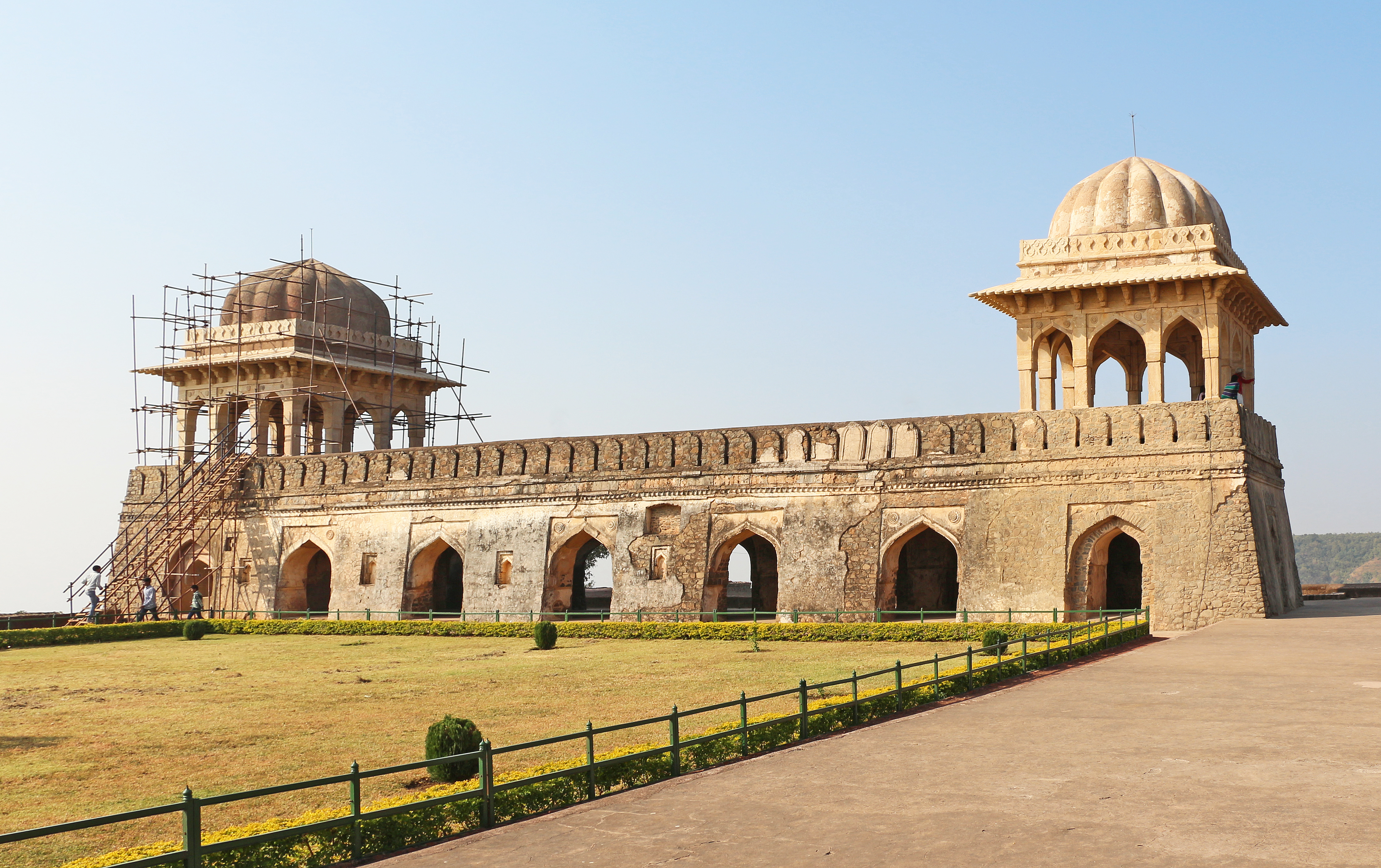 Rani Roopmati pavilion
 -
 Baz Bahadur's palace
 -
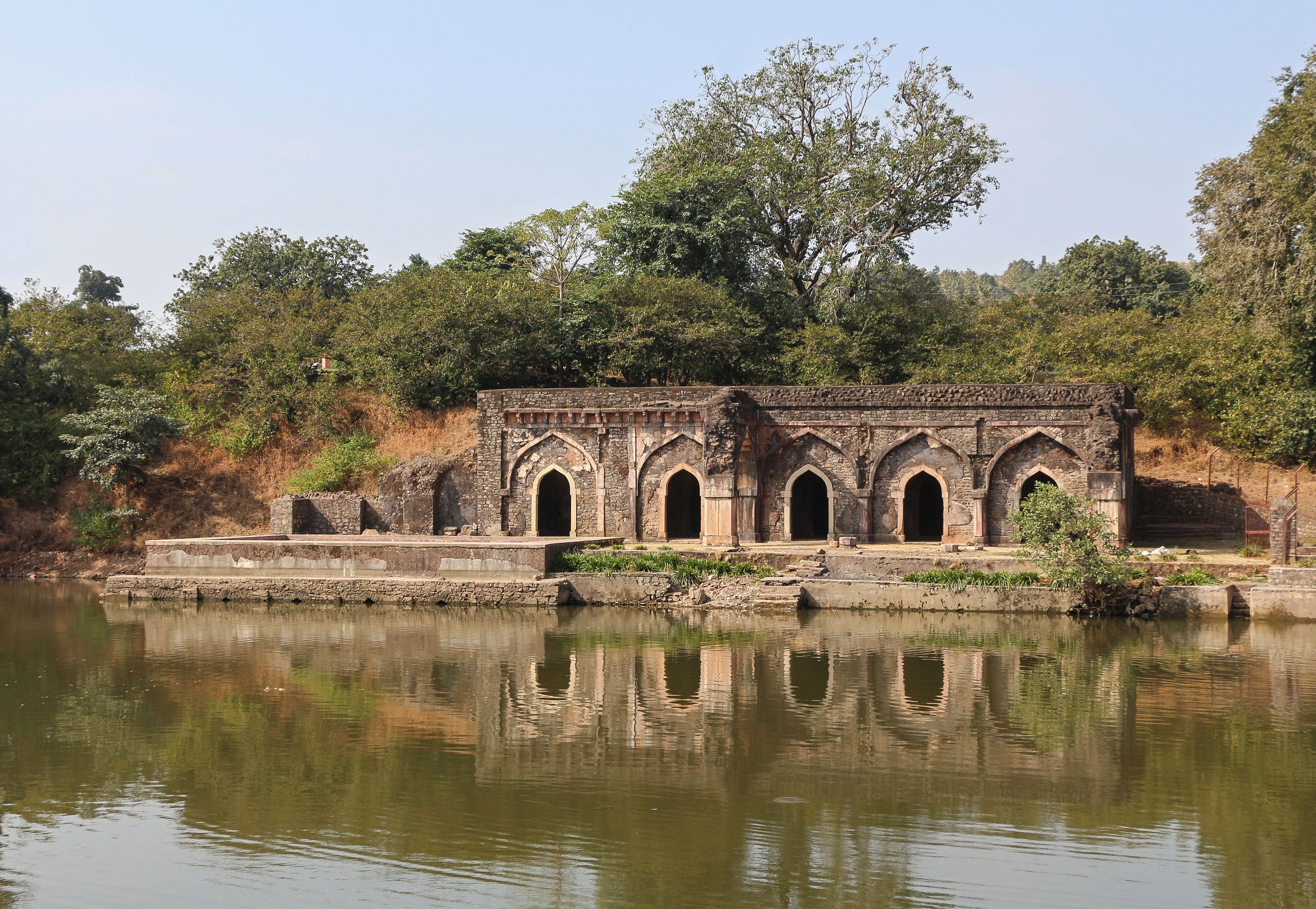 Rewa Kund
 -
 Sunset at Rani Roopmati Pavilion


In popular culture[edit | edit source]
The story of Queen Roopmati has been adapted into several films in India, including: Rani Rupmati (1931) by Bhalji Pendharkar and Rani Rupmati (1959) by S.N. Tripathi starring Nirupa Roy in the titular role.[13] Kuldip Kaur played the role of the queen, portrayed as a dacoit, in the 1952 Indian film Baiju Bawra about the titular poet during the Mughal period.[14]
References[edit | edit source]
Notes[edit | edit source]
- ↑ Safvi, Rana (14 October 2017). "For the queen of Malwa, with love". The Hindu. ISSN 0971-751X. Retrieved 18 March 2023.
- ↑ Jayamanne, Laleen (March 2013). "To sing and to dance, to think and to fight: an actor's second nervous system". Inter-Asia Cultural Studies. 14 (1): 26–43. doi:10.1080/14649373.2013.745970. ISSN 1464-9373. S2CID 143526197.
- ↑ Gupta, Subhadra Sen (20 October 2019). MAHAL: Power and Pageantry in the Mughal Harem. Hachette India. ISBN 978-93-88322-55-3.
- ↑ Schofield, Katherine Butler (April 2012). "The Courtesan Tale: Female Musicians and Dancers in Mughal Historical Chronicles, c .1556–1748". Gender & History. 24 (1): 150–171. doi:10.1111/j.1468-0424.2011.01673.x. ISSN 0953-5233. S2CID 161453756.
- ↑ Gupta, Archana Garodia (20 April 2019). The Women Who Ruled India: Leaders. Warriors. Icons. Hachette India. ISBN 978-93-5195-153-7.
- ↑ Talbot, Cynthia (July 2018). "A Poetic Record of the Rajput Rebellion, c. 1680". Journal of the Royal Asiatic Society. 28 (3): 461–483. doi:10.1017/S135618631800007X. ISSN 1356-1863. S2CID 165460715.
- ↑ Smith, Vincent, Arthur (1919). Akbar the Great Mogul, 1542-1605.
{{cite book}}: CS1 maint: multiple names: authors list (link) - ↑ Mayer, Adrian C. (1960). Caste and Kinship in Central India. Univ of California Press. ISBN 978-0-520-00835-9.
- ↑ Podder, Tanushree (2005). Nur Jahan's Daughter. Rupa & Company. ISBN 978-81-291-0722-0.
- ↑ Keene, Henry George (1885). A Sketch of the History of Hindustán from the First Muslim Conquest to the Fall of the Mughol Empire. W.H. Allen & Company.
- ↑ "Rewa kund". Archived from the original on 14 March 2006. Retrieved 20 June 2006.
- ↑ Khare, M.D. (ed.) (1981). Malwa through the Ages, Bhopal: Directorate of Archaeology and Museums, Government of M.P., pp.365-7
- ↑ Rajadhyaksha, Ashish; Willemen, Paul (1999). Encyclopaedia of Indian cinema. British Film Institute. ISBN 9780851706696. Retrieved 12 August 2012.
- ↑ Ayaz, Shaikh (18 April 2012). "Sixty Years of Baiju Bawra". openthemagazine.com. Open Media Network Pvt. Ltd. Retrieved 16 September 2015.
Bibliography[edit | edit source]
- Explore India: The Official Newsletter of the Ministry of Tourism. Durga Das Publications Pvt. Limited. 2001.
- Amiteshwar Ratra (2006). Marriage and Family: In Diverse and Changing Scenario. Deep & Deep Publications. ISBN 978-81-7629-758-5.
- M. D. Khare (1981). Malwa Through the Ages: Papers of the Seminar Held at Indore Museum on 7, 8, and 9 February, 1981. Directorate of Archaeology & Museums, Government of M.P.
- Seema Suneel (1995). Man-woman relationship in Indian fiction: with a focus on Shashi Deshpande, Rajendra Awasthy, and Syed Abdul Malik. Prestige Books. ISBN 9788185218984.
- Sir Thomas Herbert; John Anthony Butler (2012). Sir Thomas Herbert, Bart: Travels in Africa, Persia, and Asia the Great : Some Years Travels Into Africa and Asia the Great, Especially Describing the Famous Empires of Persia and Hindustan, as Also Divers Other Kingdoms in the Oriental Indies, 1627-30, the 1677 Version. ACMRS (Arizona Center for Medieval and Renaissance Studies). ISBN 978-0-86698-475-1.
- Tiwari, Chandra Kant (1977). "Rupmati 'The Melody Queen of Malwa'". Proceedings of the Indian History Congress. 38: 244–249. JSTOR 44139077.
- "Afghan architecture in sandstone". The Hindu. 11 May 2018. Retrieved 18 September 2019.
- Chand, Sharmila (7 September 2018). "Monsoon in Mandu". India Today. Retrieved 18 September 2019.
- "Mandu in Madhya Pradesh is a romantic treasure waiting to be explored". Times Travel. 18 September 2019. Retrieved 18 September 2019.