




Ajay Kumar (talk | contribs) Created a new article |
typo fix |
||
| Line 1: | Line 1: | ||
{{Short description|Weapons intended to start fires}} | {{Short description|Weapons intended to start fires}} | ||
{{Use dmy dates|date=May 2014}} | {{Use dmy dates|date=May 2014}} | ||
[[File:Mark 77 bomb loaded on FA-18.jpg|thumb|[[Mark 77 bomb|Mark 77]] napalm bomb | [[File:Mark 77 bomb loaded on FA-18.jpg|thumb|Loading a [[Mark 77 bomb|Mark 77]] napalm bomb onto a [[United States Marine Corps|US Marine]] Strike Fighter Squadron [[McDonnell Douglas F/A-18 Hornet|F/A-18A Hornet aircraft]] during a June 1993 training exercise]] | ||
[[File:Fire-ball Veste-Coburg.jpg|thumb|A 17th century fire or light ball from [[Veste Coburg]], Germany]]'''Incendiary weapons''', '''incendiary devices''', '''incendiary munitions''', or '''incendiary bombs''' are weapons designed to start fires or | [[File:Fire-ball Veste-Coburg.jpg|thumb|A 17th century fire or light ball from [[Veste Coburg]], Germany]] | ||
'''Incendiary weapons''', '''incendiary devices''', '''incendiary munitions''', or '''incendiary bombs''' are weapons designed to start fires. They may destroy structures or sensitive equipment using fire, and sometimes operate as [[anti-personnel weapon|anti-personnel weaponry]]. Incendiaries utilize materials such as [[napalm]], [[thermite]], [[magnesium|magnesium powder]], [[chlorine trifluoride]], or [[white phosphorus munitions|white phosphorus]].<ref name="ghouta">{{cite book |title= Breaking Ghouta |date= 2018 |publisher= Atlantic Council |url= https://www.jstor.org/stable/resrep30699.9 |chapter= Incendiary Weapons|last1= Andriukaitis |first1= Lukas |last2= Beals |first2= Emma |last3= Brookie |first3= Graham |last4= Higgins |first4= Eliot |last5= Itani |first5= Faysal |last6= Nimmo |first6= Ben |last7= Sheldon |first7= Michael |last8= Tsurkov |first8= Elizabeth |last9= Waters |first9= Nick |pages= 36–43 }}</ref> Though colloquially often called "[[bomb]]s", they are not [[explosives]] but in fact operate to slow the process of chemical reactions and use [[Combustion|ignition]] rather than [[detonation]] to start or maintain the reaction. [[Napalm]], for example, is petroleum especially thickened with certain chemicals into a gel to slow, but not stop, combustion, releasing energy over a longer time than an explosive device. In the case of napalm, the gel adheres to surfaces and resists suppression. | |||
==Pre-modern history== | ==Pre-modern history== | ||
| Line 12: | Line 14: | ||
==Development and use in World War I== | ==Development and use in World War I== | ||
[[File:Southend ww1 incendiary bomb.JPG|thumb|right|An incendiary bomb dropped on Southend-on-Sea in 1916]] | [[File:Southend ww1 incendiary bomb.JPG|thumb|right|An incendiary bomb dropped on Southend-on-Sea in 1916]] | ||
The first incendiary devices to be dropped during World War I fell on coastal towns in | [[File:Germany thermite incendiary bomb, dropped on London during zeppelin attack - National World War I Museum - Kansas City, MO - DSC07594.JPG|thumb|right|Remains of a metal canister from a thermite incendiary bomb dropped by a Zeppelin on London during World War I]] | ||
The first incendiary devices to be dropped during [[World War I]] fell on coastal towns in [[Norfolk]], England, on the night of 19–20 January 1915, during a raid by the [[Imperial German Navy]] [[Zeppelin]]s [[Zeppelin LZ 24|L 3]] and [[L 4]].<ref name="WFA1">{{cite web|title=Zeppelins Over Norfolk|url=https://www.westernfrontassociation.com/world-war-i-articles/zeppelins-over-norfolk/|website=The Western Front Association|author=David Tattersfield|publisher=Western Front Association|access-date=3 October 2025}}</ref><ref name="THP1">{{cite web |last=Smith |first=Steve |title=Zeppelins on the East Coast |url=https://thehistorypress.co.uk/article/zeppelins-on-the-east-coast/ |website=The History Press |publisher=The History Press |date=18 January 2017 |access-date=3 October 2025}}</ref> These German firebombs were smooth metal canisters packed with [[kerosene]]- or [[Benzene|benzol]]-soaked rope, sealed in resin to form a hardened incendiary core. Dropped from Zeppelin [[airships]] during raids between 1915 and 1917, these devices were designed to ignite fires upon impact. While some later designs featured stabilizing fins, many incendiaries used in early attacks had smooth exteriors, with the rope wrapping giving them a ridged appearance. | |||
The incendiary bomb's construction began with a hanger at the top, fitted with a cloth streamer to stabilize its descent. Beneath this was a metal cone supporting tightly wound coils of rope, reinforced with wire. A resinous material was poured over the rope and cone, forming a hardened outer casing once solidified. Inside, a central cylinder contained [[thermite]]—a pyrotechnic composition capable of reaching temperatures up to {{convert|5000|F|C}}. The base of the bomb was a strong, saucer-shaped metal plate, pierced with air holes and designed to accommodate the lower end of the thermite cylinder.<ref>{{cite web|url=https://www.alamy.com/stock-photo-zeppelin-incendiary-bomb-designed-to-start-fires-napalm-thermite-chlorine-43842275.html|title=Diagram: Zeppelin Incendiary Bomb designed to start fires|publisher=shutterstock|date=2011|accessdate=3 October 2025}}</ref> | |||
One notable variant was the Goldschmidt Incendiary Bomb, named after [[Hans Goldschmidt]], the inventor of thermite. This design measured approximately 50 cm in height and 18 cm in diameter, with a total weight of around 10 kg. It featured an inner metal cylinder filled with thermite, surrounded by a thin sheet metal container holding 3.5 litres of benzol. The outer shell was wrapped in [[tar|tarred]] rope, which helped retain the benzol within the container and added to the bomb's flammability. This configuration enhanced the incendiary effect upon impact and was typical of the more destructive devices used in later Zeppelin raids.<ref>{{cite web|url=https://www.iwm.org.uk/collections/item/object/30020760|title=Weapons and ammunition: (Zeppelin) Goldschmidt Incendiary Bomb | |||
|publisher=Imperial War Museums|location=London|accessdate=6 October 2025}}</ref> | |||
On 8 September 1915, Zeppelin L 13 dropped a large number of firebombs during a raid on London. Although the devices were generally ineffective in terms of widespread destruction, the attack resulted in civilian casualties and had a significant psychological effect across England.<ref>[[Wilbur Cross (author)|Wilbur Cross]], "Zeppelins of World War I" page 35, published 1991 Paragon House ISBN I-56619-390-7</ref> | |||
Following experiments with 5-litre barrels of benzol, the B-1E [[Elektron (alloy)|Elektron]] fire bomb (German: ''Elektronbrandbombe'') was developed in 1918 by scientists and engineers at the [[Griesheim (Frankfurt am Main)|Griesheim]]-Elektron chemical works. The bomb was ignited by a thermite charge, but the main incendiary effect was from the [[magnesium]] and aluminium alloy casing, which ignited at {{convert|650|C|F}}, sustained combustion at {{convert|1100|C|F}}, and released vapour that burned at temperatures reaching {{convert|1800|C|F}}. A further advantage of the alloy casing was its lightness—being a quarter of the density of steel—which enabled each bomber to carry a considerable number of bombs.<ref>Hanson, Neil (2009), [https://books.google.com/books?id=hbm-iibF6k0C&dq=William+Robertson++%22commander+in+chief+home+forces%22&pg=PA405 ''First Blitz''], Corgi Books, {{ISBN|978-0552155489}} (pp. 406–408)</ref> | |||
In the summer of 1918, the [[Oberste Heeresleitung|German High Command]] devised an operation called "The Fire Plan" (German: ''Der Feuerplan''). It involved deploying the entire German heavy bomber fleet in successive waves over London and Paris, dropping as many incendiary bombs as possible until either the fleet was destroyed or the crews became too exhausted to continue flying. The objective was to engulf both capitals in an inextinguishable blaze, compelling the Allies to sue for peace.<ref>Hanson, pp. 413–414</ref> Thousands of Elektron bombs were stockpiled at forward bomber bases and the operation was scheduled for August and again in early September 1918. On both occasions, however, the order to take off was countermanded at the last moment, possibly due to fears of Allied reprisals against German cities.<ref>Hanson, pp. 437–438</ref> | |||
Separately, a plan to firebomb New York with new long-range Zeppelins of the L 70 class was proposed by the naval airship fleet commander [[Peter Strasser]] in July 1918, but the proposal was vetoed by Admiral [[Reinhard Scheer]], possibly due to concerns over strategic escalation or feasibility.<ref>Hanson, p. 412</ref> | |||
In contrast to German plans, the [[Royal Air Force]] had already deployed its own "Baby" Incendiary Bomb (BIB), which also contained a thermite charge.<ref>{{cite web |url=http://www.raf.mod.uk/rafcms/mediafiles/F1792791_5056_A318_A8F14492D41C7406.pdf |title=ROYAL AIR FORCE HISTORICAL SOCIETY JOURNAL 45 – RFC BOMBS & BOMBING 1912–1918 (pp. 12–13) |last1=Dye |first1=Peter |year=2009 |website=www.raf.mod.uk |publisher=Royal Air Force Historical Society |access-date=1 May 2014 |archive-url=https://web.archive.org/web/20140502002700/http://www.raf.mod.uk/rafcms/mediafiles/F1792791_5056_A318_A8F14492D41C7406.pdf |archive-date=2 May 2014 |url-status=dead }}</ref> | |||
==Development and use in World War II== | ==Development and use in World War II== | ||
[[Image:Luftwaffe 1kg Incendiary Bomb.jpg|thumb|right|A German [[World War II]] 1 kg incendiary bomb]] | [[Image:Luftwaffe 1kg Incendiary Bomb.jpg|thumb|right|A German [[World War II]] 1 kg [[Elektron (alloy)|Elektron]] incendiary bomb]] | ||
Incendiary bombs were used extensively in [[World War II]] as an effective bombing weapon, often in a conjunction with high-explosive bombs.<ref> | Incendiary bombs were used extensively in [[World War II]] as an effective bombing weapon, often in a conjunction with high-explosive bombs.<ref>{{cite web |url=http://www.ww2guide.com/bombs.shtml#burn |work=World War II Guide |title=Bombs |archive-url=https://web.archive.org/web/20050830214546/http://www.ww2guide.com/bombs.shtml |archive-date=30 August 2005 |url-status=dead }}</ref> Probably the most famous incendiary attacks are the [[bombing of Dresden]] and the [[Bombing of Tokyo (10 March 1945)|bombing of Tokyo on 10 March 1945]]. Many different configurations of incendiary bombs and a wide range of filling materials such as isobutyl methacrylate (IM) polymer, [[napalm]], and similar jellied-petroleum formulas were used, many of them developed by the US [[Chemical Warfare Service]]. Different methods of delivery, e.g. small bombs, bomblet clusters and large bombs, were tested and implemented.<ref>{{cite news |newspaper=[[Popular Science]] |date=May 1945 |url=https://books.google.com/books?id=ACEDAAAAMBAJ&q=an-m76+first+%2Bbomb&pg=PA100 |title=How we fight Japan with fire |access-date=9 December 2015}}</ref> For example, a large bomb casing was filled with small sticks of incendiary ([[bomblet]]s); the casing was designed to open at altitude, scattering the bomblets in order to cover a wide area. An explosive charge would then ignite the incendiary material, often starting a raging fire. The fire would burn at extreme temperatures that could destroy most buildings made of wood or other combustible materials (buildings constructed of stone tend to resist incendiary destruction unless they are first blown open by high explosives). | ||
[[File: Ballroom Castle Warsaw September 17 1939.jpg|thumb|upright|left|Burning ballroom at the [[Royal Castle, Warsaw]], as a result of incendiary bombing by the German [[Luftwaffe]]]] | [[File: Ballroom Castle Warsaw September 17 1939.jpg|thumb|upright|left|Burning ballroom at the [[Royal Castle, Warsaw]], as a result of incendiary bombing by the German [[Luftwaffe]]]] | ||
The German ''[[Luftwaffe]]'' started the war using the 1918-designed one-kilogram magnesium alloy B-1E ''Elektronbrandbombe''; later modifications included the addition of a small explosive charge intended to penetrate the roof of any building which it landed on. Racks holding 36 of these bombs were developed, four of which could, in turn, be fitted to an electrically triggered dispenser so that a single [[He 111]] bomber could carry 1,152 incendiary bombs, or more usually a mixed load. Less successful was the ''Flammenbombe'', a 250 kg or 500 kg high explosive bomb case filled with an inflammable oil mixture, which often failed to detonate and was withdrawn in January 1941.<ref>{{cite web |url=http://www.mcjazz.f2s.com/BlitzBombs.htm |title=German Ordnance |publisher=The Doric Columns |access-date=1 May 2014}}</ref> | The German ''[[Luftwaffe]]'' started the war using the 1918-designed one-kilogram magnesium alloy B-1E ''Elektronbrandbombe''; later modifications included the addition of a small explosive charge intended to penetrate the roof of any building which it landed on. Racks holding 36 of these bombs were developed, four of which could, in turn, be fitted to an electrically triggered dispenser so that a single [[Heinkel He 111|He 111]] bomber could carry 1,152 incendiary bombs, or more usually a mixed load. Less successful was the ''Flammenbombe'', a 250 kg or 500 kg high explosive bomb case filled with an inflammable oil mixture, which often failed to detonate and was withdrawn in January 1941.<ref>{{cite web |url=http://www.mcjazz.f2s.com/BlitzBombs.htm |title=German Ordnance |publisher=The Doric Columns |access-date=1 May 2014 |archive-date=2 May 2014 |archive-url=https://web.archive.org/web/20140502002002/http://www.mcjazz.f2s.com/BlitzBombs.htm |url-status=dead }}</ref> | ||
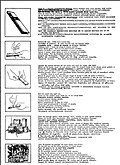
In World War II, incendiaries were principally developed in order to destroy the many small, decentralised war industries located (often intentionally) throughout vast tracts of city land in an effort to escape destruction by conventionally aimed high-explosive bombs. Nevertheless, the civilian destruction caused by such weapons quickly earned them a reputation as terror weapons with the targeted populations. | [[File:Braddock instruction leaflet.jpg|thumb|right|[[Operation Braddock]] time delay incendiary device manual.]] | ||
In World War II, incendiaries were principally developed in order to destroy the many small, decentralised war industries located (often intentionally) throughout vast tracts of city land in an effort to escape destruction by conventionally aimed high-explosive bombs. Nevertheless, the civilian destruction caused by such weapons quickly earned them a reputation as terror weapons with the targeted populations. [[Nazi Germany]] began the campaign of [[firebombing|incendiary bombings]] at the start of World War II with the [[bombing of Warsaw in World War II|bombing of Warsaw]], and continued with the [[London Blitz]] and the bombing of Moscow, among other cities. Later, an extensive [[reprisal]] was enacted by the [[Allies of World War II|Allies]] in the [[Strategic bombing during World War II|strategic bombing campaign]] that led to the near-annihilation of many German cities. In the [[Pacific War]], during the last seven months of strategic bombing by [[B-29 Superfortress]]es in [[air raids on Japan|the air war against Japan]], a change to firebombing tactics resulted in the death of 500,000 Japanese and the homelessness of five million more. Sixty-seven Japanese cities lost significant areas to incendiary attacks. The most deadly single bombing raid in history was [[Bombing of Tokyo in World War II|Operation Meetinghouse]], an incendiary attack that killed some 100,000 Tokyo residents in one night. | |||
[[Image:stabbrandbombe inc 4 lb.jpg|thumb|British ''I.B. 4-lb. Mk IV'' <ref name="Hussey">{{cite web |first1=G.F. Jr. |last1=Hussey | [[Image:stabbrandbombe inc 4 lb.jpg|thumb|British ''I.B. 4-lb. Mk IV'' <ref name="Hussey">{{cite web |first1=G.F. Jr. |last1=Hussey |url=http://www.lexpev.nl/downloads/britishexplosiveordnance1946.pdf |date=4 January 1970 |orig-year=6 October 1946 |publisher=Command Naval Ordnance Systems |title=British English Ordnance |access-date=8 December 2015 |url-status=dead |archive-url=https://web.archive.org/web/20160304185457/http://www.lexpev.nl/downloads/britishexplosiveordnance1946.pdf |archive-date=4 March 2016 |df=dmy-all }}</ref> type incendiary bomb. Top: complete device, nose is red. Middle: dud found without the tin plate tail. Bottom: the remains after burning. [[RAF Bomber Command]] dropped 80 million of these 4 lb incendiary bombs during World War II. The 4 lb bomb was also used by the US as the "AN-M50".]] | ||
The {{convert|4|lb|abbr=on}} incendiary bomb, developed by [[Imperial Chemical Industries|ICI]], was the standard light incendiary bomb used by [[RAF Bomber Command]] in very large numbers, declining slightly in 1944 to 35.8 million bombs produced (the decline being due to more bombs arriving from the United States). It was the weapon of choice for the [[ | The {{convert|4|lb|abbr=on}} incendiary bomb, developed by [[Imperial Chemical Industries|ICI]], was the standard light incendiary bomb used by [[RAF Bomber Command]] in very large numbers, declining slightly in 1944 to 35.8 million bombs produced (the decline being due to more bombs arriving from the United States). It was the weapon of choice for the [[Dehousing|British "dehousing" plan]]. The bomb consisted of a hollow body made from aluminium-[[magnesium]] [[alloy]] with a cast iron/steel nose, and filled with [[thermite]] incendiary pellets. It was capable of burning for up to ten minutes. There was also a high explosive version and delayed high explosive versions (2–4 minutes) which were designed to kill rescuers and firefighters. It was normal for a proportion of high explosive bombs to be dropped during incendiary attacks in order to expose combustible material and to fill the streets with craters and rubble, hindering rescue services. | ||
[[File: | [[File: Royal Air Force Bomber Command, 1942-1945. CH18371.jpg|thumb|left|[[Avro Lancaster]] bomb bay showing later mix of [[Blockbuster bomb#4000 lb HC bomb|4,000-pound "Cookie" blast bomb]] and 12 small bomb containers each containing 236 4 lb incendiaries.]] | ||
Towards the end of World War Two, the British introduced a much improved {{convert|30|lb|abbr=on}} incendiary bomb, whose fall was retarded by a small parachute and on impact sent out an extremely hot flame for {{convert|15|ft|abbr=on}}; This, the | Towards the end of World War Two, the British introduced a much improved {{convert|30|lb|abbr=on}} incendiary bomb, whose fall was retarded by a small parachute and on impact sent out an extremely hot flame for {{convert|15|ft|abbr=on}}; This, the "Incendiary Bomb, 30-lb., Type J, Mk I",<ref name="Hussey"/> burned for approximately two minutes. Articles in late 1944 claimed that the flame was so hot it could crumble a brick wall. For propaganda purposes the RAF dubbed the new incendiary bomb the "Superflamer".<ref>[https://books.google.com/books?id=gN8DAAAAMBAJ&dq=Popular+Mechanics+Science+installing+linoleum&pg=PA13 "SUPERFLAMER Dropped by Chute Throws Fire 15 Feet."] ''Popular Mechanics'', December 1944, p. 13. Article bottom of page.</ref> | ||
Around fifty-five million incendiary bombs were dropped on Germany by [[Avro Lancaster]]s alone. | Around fifty-five million incendiary bombs were dropped on Germany by [[Avro Lancaster]]s alone. | ||
Many incendiary weapons developed and deployed during World War II were in the form of bombs and shells whose main incendiary component is [[White phosphorus (weapon)|white phosphorus]] (WP), and can be used in an offensive anti-personnel role against enemy troop concentrations, but WP is also used for signalling, [[smoke screen]]s, and target-marking purposes. The U.S. Army and | Many incendiary weapons developed and deployed during World War II were in the form of bombs and shells whose main incendiary component is [[White phosphorus (weapon)|white phosphorus]] (WP), and can be used in an offensive anti-personnel role against enemy troop concentrations, but WP is also used for signalling, [[smoke screen]]s, and target-marking purposes. The U.S. Army and marines used WP extensively in World War II and [[Korean War|Korea]] for all three purposes, frequently using WP shells in large 4.2-inch chemical mortars. WP was widely credited by many Allied soldiers for breaking up numerous German infantry attacks and creating havoc among enemy troop concentrations during the latter part of World War II. In both World War II and Korea, WP was found particularly useful in overcoming enemy [[human wave attack]]s. | ||
== | ==Incendiary weapons after World War II== | ||
Napalm | Napalm was widely used by the US during the [[Korean War]].<ref name="GS Napalm">{{cite web |last=Pike |first=John |title=Napalm |url=http://www.globalsecurity.org/military/systems/munitions/napalm.htm}}</ref> [[Eighth Army (United States)|Eighth Army]] chemical officer Donald Bode reported that on an "average good day” [[United Nations Command|United Nations]] pilots used {{convert|70,000|USgal|L}} of napalm, with approximately {{convert|60,000|USgal|L}} of this thrown by US forces.<ref>{{cite book|last1=Neer|first1=Robert|title=Napalm: An American Biography|url=https://archive.org/details/napalmamericanbi00neer|url-access=limited|date=2013|publisher=Harvard University Press|page=[https://archive.org/details/napalmamericanbi00neer/page/n129 99]|isbn=9780674075450}}</ref> British prime minister [[Winston Churchill]] privately criticized the use of napalm in Korea, writing that it was "very cruel," as US and UN forces, he wrote, were "splashing it all over the civilian population," "tortur[ing] great masses of people." He conveyed these sentiments to US Chairman of the Joint Chiefs of Staff [[Omar Bradley]], who "never published the statement." Publicly, Churchill allowed Bradley "to issue a statement that confirmed U.K. support for U.S. napalm attacks."<ref>{{cite book|last1=Neer|first1=Robert M.|title=Napalm: An American Biography|url=https://archive.org/details/napalmamericanbi00neer|url-access=limited|date=2013|publisher=Harvard University Press|pages=[https://archive.org/details/napalmamericanbi00neer/page/n132 102]–3|isbn=9780674075450}}</ref> | ||
During the [[Vietnam War]], the | During the [[Vietnam War]], the US developed the [[CBU-55]], a [[cluster bomb]] incendiary fueled by [[propane]], a weapon that was used only once in warfare.<ref>Alan Dawson, ''55 Days: The Fall of South Vietnam'' (Prentice-Hall 1977).</ref> Napalm however, became an intrinsic element of US military action during the Vietnam War as forces made increasing use of it for its tactical and psychological effects. Reportedly about 388,000 tons of US napalm bombs were dropped in the region between 1963 and 1973, compared to 32,357 tons used over three years in the Korean War, and 16,500 tons dropped on Japan in 1945.<ref name="neer1">{{cite journal |doi=10.1038/496029a |title=Books in brief. Napalm: An American Biography Robert M. Neer Harvard University Press 352 pp. |journal=Nature |volume=496 |issue=7443 |pages=29 |year=2013 |doi-access=free }}</ref><ref>{{cite web|title=Liquid Fire – How Napalm Was Used In The Vietnam War|url=https://www.warhistoryonline.com/vietnam-war/history-napalm-vietnam-war.html/2|website=www.warhistoryonline.com|date=June 2016 |publisher=Nikola Budanovic|access-date=8 November 2017|ref=Napalm became a psychological weapon, as the enemy was terrified of the hell on earth caused by its use.}}</ref> | ||
Incendiary bombs used in the late 20th century sometimes contained [[thermite]], made from aluminium and [[Iron(III) oxide|ferric oxide]]. It takes very high temperatures to ignite, but when alight, it can burn through solid steel. In World War II, such devices were employed in incendiary grenades to burn through heavy [[armour]] plate, or as a quick [[welding]] mechanism to destroy [[artillery]] and other complex machined weapons. | Incendiary bombs used in the late 20th century sometimes contained [[thermite]], made from aluminium and [[Iron(III) oxide|ferric oxide]]. It takes very high temperatures to ignite, but when alight, it can burn through solid steel. In World War II, such devices were employed in incendiary grenades to burn through heavy [[armour]] plate, or as a quick [[welding]] mechanism to destroy [[artillery]] and other complex machined weapons. | ||
| Line 45: | Line 62: | ||
A variety of [[pyrophoric]] materials can also be used: selected [[organometallic]] compounds, most often [[triethylaluminium]], [[trimethylaluminium]], and some other [[alkyl]] and [[aryl]] derivatives of aluminium, [[magnesium]], [[boron]], [[zinc]], [[sodium]], and [[lithium]], can be used. Thickened triethylaluminium, a napalm-like substance that ignites in contact with air, is known as [[thickened pyrophoric agent]], or TPA. | A variety of [[pyrophoric]] materials can also be used: selected [[organometallic]] compounds, most often [[triethylaluminium]], [[trimethylaluminium]], and some other [[alkyl]] and [[aryl]] derivatives of aluminium, [[magnesium]], [[boron]], [[zinc]], [[sodium]], and [[lithium]], can be used. Thickened triethylaluminium, a napalm-like substance that ignites in contact with air, is known as [[thickened pyrophoric agent]], or TPA. | ||
Napalm proper is no longer used by the United States, although the [[kerosene]]-fuelled [[Mark 77 bomb|Mark 77 MOD 5 | Napalm proper is no longer used by the United States, although the [[kerosene]]-fuelled [[Mark 77 bomb|Mark 77 MOD 5 firebomb]] is currently in use. The United States has confirmed the use of Mark 77s in [[invasion of Iraq]] in 2003. | ||
==Incendiary weapons and laws of warfare== | ==Incendiary weapons and laws of warfare== | ||
| Line 68: | Line 85: | ||
*[[Fire balloon]] | *[[Fire balloon]] | ||
*[[Firestorm]] | *[[Firestorm]] | ||
*[[Fire bombing]] | |||
*[[Flame fougasse]] | *[[Flame fougasse]] | ||
*[[Flamethrower]] | *[[Flamethrower]] | ||
| Line 85: | Line 103: | ||
==External links== | ==External links== | ||
{{Commons category|Incendiary weapons}} | {{Commons category|Incendiary weapons}} | ||
*[ | *[https://treaties.unoda.org/t/ccw_p3 Protocol III to the Convention on Prohibitions or Restrictions on the Use of Certain Conventional Weapons which may be deemed to be Excessively Injurious or to have Indiscriminate Effects] | ||
*[http://www.anesi.com/ussbs01.htm | *[http://www.anesi.com/ussbs01.htm United States Strategic Bombing Survey (Pacific War) 1946] | ||
*[https://books.google.com/books?id=PN8DAAAAMBAJ&dq=popular+science+antitank+1941&pg=PA40 ''Fire From The Sky''] 1944 article on the production of incendiary bombs | *[https://books.google.com/books?id=PN8DAAAAMBAJ&dq=popular+science+antitank+1941&pg=PA40 ''Fire From The Sky''] 1944 article on the production of incendiary bombs | ||
* [http://wtw.marjorie-wiki.de/wiki/AN-M50 AN-M50-series incendiary bombs] {{Webarchive|url=https://web.archive.org/web/20150409183820/http://wtw.marjorie-wiki.de/wiki/AN-M50 |date=9 April 2015 }} (German) | * [http://wtw.marjorie-wiki.de/wiki/AN-M50 AN-M50-series incendiary bombs] {{Webarchive|url=https://web.archive.org/web/20150409183820/http://wtw.marjorie-wiki.de/wiki/AN-M50 |date=9 April 2015 }} (German) | ||
{{Weapons}} | {{Weapons}} | ||
{{Ancient seafaring}} | |||
{{Authority control}} | {{Authority control}} | ||
Latest revision as of 05:07, 11 November 2025


Incendiary weapons, incendiary devices, incendiary munitions, or incendiary bombs are weapons designed to start fires. They may destroy structures or sensitive equipment using fire, and sometimes operate as anti-personnel weaponry. Incendiaries utilize materials such as napalm, thermite, magnesium powder, chlorine trifluoride, or white phosphorus.[1] Though colloquially often called "bombs", they are not explosives but in fact operate to slow the process of chemical reactions and use ignition rather than detonation to start or maintain the reaction. Napalm, for example, is petroleum especially thickened with certain chemicals into a gel to slow, but not stop, combustion, releasing energy over a longer time than an explosive device. In the case of napalm, the gel adheres to surfaces and resists suppression.
Pre-modern history[edit | edit source]
A range of early thermal weapons were utilized by ancient, medieval/post-classical and early modern armies, including hot pitch, oil, resin, animal fat and other similar compounds. Substances such as quicklime and sulfur could be toxic and blinding. Incendiary mixtures, such as the petroleum-based Greek fire, were launched by throwing machines or administered through a siphon. Sulfur- and oil-soaked materials were sometimes ignited and thrown at the enemy, or attached to spears, arrows or bolts, and fired by hand or machine. Some siege techniques—such as mining and boring—relied on combustibles and fire to complete the collapse of walls and structures.
Towards the latter part of the period, gunpowder was invented, which increased the sophistication of the weapons, starting with fire lances.
Development and use in World War I[edit | edit source]


The first incendiary devices to be dropped during World War I fell on coastal towns in Norfolk, England, on the night of 19–20 January 1915, during a raid by the Imperial German Navy Zeppelins L 3 and L 4.[2][3] These German firebombs were smooth metal canisters packed with kerosene- or benzol-soaked rope, sealed in resin to form a hardened incendiary core. Dropped from Zeppelin airships during raids between 1915 and 1917, these devices were designed to ignite fires upon impact. While some later designs featured stabilizing fins, many incendiaries used in early attacks had smooth exteriors, with the rope wrapping giving them a ridged appearance.
The incendiary bomb's construction began with a hanger at the top, fitted with a cloth streamer to stabilize its descent. Beneath this was a metal cone supporting tightly wound coils of rope, reinforced with wire. A resinous material was poured over the rope and cone, forming a hardened outer casing once solidified. Inside, a central cylinder contained thermite—a pyrotechnic composition capable of reaching temperatures up to 5,000 °F (2,760 °C). The base of the bomb was a strong, saucer-shaped metal plate, pierced with air holes and designed to accommodate the lower end of the thermite cylinder.[4]
One notable variant was the Goldschmidt Incendiary Bomb, named after Hans Goldschmidt, the inventor of thermite. This design measured approximately 50 cm in height and 18 cm in diameter, with a total weight of around 10 kg. It featured an inner metal cylinder filled with thermite, surrounded by a thin sheet metal container holding 3.5 litres of benzol. The outer shell was wrapped in tarred rope, which helped retain the benzol within the container and added to the bomb's flammability. This configuration enhanced the incendiary effect upon impact and was typical of the more destructive devices used in later Zeppelin raids.[5]
On 8 September 1915, Zeppelin L 13 dropped a large number of firebombs during a raid on London. Although the devices were generally ineffective in terms of widespread destruction, the attack resulted in civilian casualties and had a significant psychological effect across England.[6]
Following experiments with 5-litre barrels of benzol, the B-1E Elektron fire bomb (German: Elektronbrandbombe) was developed in 1918 by scientists and engineers at the Griesheim-Elektron chemical works. The bomb was ignited by a thermite charge, but the main incendiary effect was from the magnesium and aluminium alloy casing, which ignited at 650 °C (1,202 °F), sustained combustion at 1,100 °C (2,010 °F), and released vapour that burned at temperatures reaching 1,800 °C (3,270 °F). A further advantage of the alloy casing was its lightness—being a quarter of the density of steel—which enabled each bomber to carry a considerable number of bombs.[7]
In the summer of 1918, the German High Command devised an operation called "The Fire Plan" (German: Der Feuerplan). It involved deploying the entire German heavy bomber fleet in successive waves over London and Paris, dropping as many incendiary bombs as possible until either the fleet was destroyed or the crews became too exhausted to continue flying. The objective was to engulf both capitals in an inextinguishable blaze, compelling the Allies to sue for peace.[8] Thousands of Elektron bombs were stockpiled at forward bomber bases and the operation was scheduled for August and again in early September 1918. On both occasions, however, the order to take off was countermanded at the last moment, possibly due to fears of Allied reprisals against German cities.[9]
Separately, a plan to firebomb New York with new long-range Zeppelins of the L 70 class was proposed by the naval airship fleet commander Peter Strasser in July 1918, but the proposal was vetoed by Admiral Reinhard Scheer, possibly due to concerns over strategic escalation or feasibility.[10]
In contrast to German plans, the Royal Air Force had already deployed its own "Baby" Incendiary Bomb (BIB), which also contained a thermite charge.[11]
Development and use in World War II[edit | edit source]

Incendiary bombs were used extensively in World War II as an effective bombing weapon, often in a conjunction with high-explosive bombs.[12] Probably the most famous incendiary attacks are the bombing of Dresden and the bombing of Tokyo on 10 March 1945. Many different configurations of incendiary bombs and a wide range of filling materials such as isobutyl methacrylate (IM) polymer, napalm, and similar jellied-petroleum formulas were used, many of them developed by the US Chemical Warfare Service. Different methods of delivery, e.g. small bombs, bomblet clusters and large bombs, were tested and implemented.[13] For example, a large bomb casing was filled with small sticks of incendiary (bomblets); the casing was designed to open at altitude, scattering the bomblets in order to cover a wide area. An explosive charge would then ignite the incendiary material, often starting a raging fire. The fire would burn at extreme temperatures that could destroy most buildings made of wood or other combustible materials (buildings constructed of stone tend to resist incendiary destruction unless they are first blown open by high explosives).

The German Luftwaffe started the war using the 1918-designed one-kilogram magnesium alloy B-1E Elektronbrandbombe; later modifications included the addition of a small explosive charge intended to penetrate the roof of any building which it landed on. Racks holding 36 of these bombs were developed, four of which could, in turn, be fitted to an electrically triggered dispenser so that a single He 111 bomber could carry 1,152 incendiary bombs, or more usually a mixed load. Less successful was the Flammenbombe, a 250 kg or 500 kg high explosive bomb case filled with an inflammable oil mixture, which often failed to detonate and was withdrawn in January 1941.[14]

In World War II, incendiaries were principally developed in order to destroy the many small, decentralised war industries located (often intentionally) throughout vast tracts of city land in an effort to escape destruction by conventionally aimed high-explosive bombs. Nevertheless, the civilian destruction caused by such weapons quickly earned them a reputation as terror weapons with the targeted populations. Nazi Germany began the campaign of incendiary bombings at the start of World War II with the bombing of Warsaw, and continued with the London Blitz and the bombing of Moscow, among other cities. Later, an extensive reprisal was enacted by the Allies in the strategic bombing campaign that led to the near-annihilation of many German cities. In the Pacific War, during the last seven months of strategic bombing by B-29 Superfortresses in the air war against Japan, a change to firebombing tactics resulted in the death of 500,000 Japanese and the homelessness of five million more. Sixty-seven Japanese cities lost significant areas to incendiary attacks. The most deadly single bombing raid in history was Operation Meetinghouse, an incendiary attack that killed some 100,000 Tokyo residents in one night.

The 4 lb (1.8 kg) incendiary bomb, developed by ICI, was the standard light incendiary bomb used by RAF Bomber Command in very large numbers, declining slightly in 1944 to 35.8 million bombs produced (the decline being due to more bombs arriving from the United States). It was the weapon of choice for the British "dehousing" plan. The bomb consisted of a hollow body made from aluminium-magnesium alloy with a cast iron/steel nose, and filled with thermite incendiary pellets. It was capable of burning for up to ten minutes. There was also a high explosive version and delayed high explosive versions (2–4 minutes) which were designed to kill rescuers and firefighters. It was normal for a proportion of high explosive bombs to be dropped during incendiary attacks in order to expose combustible material and to fill the streets with craters and rubble, hindering rescue services.

Towards the end of World War Two, the British introduced a much improved 30 lb (14 kg) incendiary bomb, whose fall was retarded by a small parachute and on impact sent out an extremely hot flame for 15 ft (4.6 m); This, the "Incendiary Bomb, 30-lb., Type J, Mk I",[15] burned for approximately two minutes. Articles in late 1944 claimed that the flame was so hot it could crumble a brick wall. For propaganda purposes the RAF dubbed the new incendiary bomb the "Superflamer".[16] Around fifty-five million incendiary bombs were dropped on Germany by Avro Lancasters alone.
Many incendiary weapons developed and deployed during World War II were in the form of bombs and shells whose main incendiary component is white phosphorus (WP), and can be used in an offensive anti-personnel role against enemy troop concentrations, but WP is also used for signalling, smoke screens, and target-marking purposes. The U.S. Army and marines used WP extensively in World War II and Korea for all three purposes, frequently using WP shells in large 4.2-inch chemical mortars. WP was widely credited by many Allied soldiers for breaking up numerous German infantry attacks and creating havoc among enemy troop concentrations during the latter part of World War II. In both World War II and Korea, WP was found particularly useful in overcoming enemy human wave attacks.
Incendiary weapons after World War II[edit | edit source]
Napalm was widely used by the US during the Korean War.[17] Eighth Army chemical officer Donald Bode reported that on an "average good day” United Nations pilots used 70,000 US gallons (260,000 L) of napalm, with approximately 60,000 US gallons (230,000 L) of this thrown by US forces.[18] British prime minister Winston Churchill privately criticized the use of napalm in Korea, writing that it was "very cruel," as US and UN forces, he wrote, were "splashing it all over the civilian population," "tortur[ing] great masses of people." He conveyed these sentiments to US Chairman of the Joint Chiefs of Staff Omar Bradley, who "never published the statement." Publicly, Churchill allowed Bradley "to issue a statement that confirmed U.K. support for U.S. napalm attacks."[19]
During the Vietnam War, the US developed the CBU-55, a cluster bomb incendiary fueled by propane, a weapon that was used only once in warfare.[20] Napalm however, became an intrinsic element of US military action during the Vietnam War as forces made increasing use of it for its tactical and psychological effects. Reportedly about 388,000 tons of US napalm bombs were dropped in the region between 1963 and 1973, compared to 32,357 tons used over three years in the Korean War, and 16,500 tons dropped on Japan in 1945.[21][22]
Incendiary bombs used in the late 20th century sometimes contained thermite, made from aluminium and ferric oxide. It takes very high temperatures to ignite, but when alight, it can burn through solid steel. In World War II, such devices were employed in incendiary grenades to burn through heavy armour plate, or as a quick welding mechanism to destroy artillery and other complex machined weapons.
A variety of pyrophoric materials can also be used: selected organometallic compounds, most often triethylaluminium, trimethylaluminium, and some other alkyl and aryl derivatives of aluminium, magnesium, boron, zinc, sodium, and lithium, can be used. Thickened triethylaluminium, a napalm-like substance that ignites in contact with air, is known as thickened pyrophoric agent, or TPA.
Napalm proper is no longer used by the United States, although the kerosene-fuelled Mark 77 MOD 5 firebomb is currently in use. The United States has confirmed the use of Mark 77s in invasion of Iraq in 2003.
Incendiary weapons and laws of warfare[edit | edit source]
Signatory states are bound by Protocol III of the UN Convention on Conventional Weapons which governs the use of incendiary weapons:
- prohibits the use of incendiary weapons against civilians (effectively a reaffirmation of the general prohibition on attacks against civilians in Additional Protocol I to the Geneva Conventions)
- prohibits the use of air-delivered incendiary weapons against military targets located within concentrations of civilians and loosely regulates the use of other types of incendiary weapons in such circumstances.[23]
Protocol III states though that incendiary weapons do not include:
- Munitions which may have incidental incendiary effects, such as illuminates, tracers, smoke or signaling systems;
- Munitions designed to combine penetration, blast or fragmentation effects with an additional incendiary effect, such as armor-piercing projectiles, fragmentation shells, explosive bombs and similar combined-effects munitions in which the incendiary effect is not specifically designed to cause burn injury to persons, but to be used against military objectives, such as armoured vehicles, aircraft and installations or facilities.
See also[edit | edit source]
- Arson
- Bat bomb
- Driptorch
- Early thermal weapons
- Fire accelerant
- Fire balloon
- Firestorm
- Fire bombing
- Flame fougasse
- Flamethrower
- Greek fire (Historic Byzantine incendiary weapon)
- High explosive incendiary (HEI)
- Incendiary ammunition
- Meng Huo You (Historic Chinese incendiary weapon)
- Molotov cocktail
- Napalm
- Pen Huo Qi (Historic Chinese flamethrower)
- Stinkpot (Historic Chinese incendiary weapon)
References[edit | edit source]
- ↑ Andriukaitis, Lukas; Beals, Emma; Brookie, Graham; Higgins, Eliot; Itani, Faysal; Nimmo, Ben; Sheldon, Michael; Tsurkov, Elizabeth; Waters, Nick (2018). "Incendiary Weapons". Breaking Ghouta. Atlantic Council. pp. 36–43.
- ↑ David Tattersfield. "Zeppelins Over Norfolk". The Western Front Association. Western Front Association. Retrieved 3 October 2025.
- ↑ Smith, Steve (18 January 2017). "Zeppelins on the East Coast". The History Press. The History Press. Retrieved 3 October 2025.
- ↑ "Diagram: Zeppelin Incendiary Bomb designed to start fires". shutterstock. 2011. Retrieved 3 October 2025.
- ↑ "Weapons and ammunition: (Zeppelin) Goldschmidt Incendiary Bomb". London: Imperial War Museums. Retrieved 6 October 2025.
- ↑ Wilbur Cross, "Zeppelins of World War I" page 35, published 1991 Paragon House ISBN I-56619-390-7
- ↑ Hanson, Neil (2009), First Blitz, Corgi Books, ISBN 978-0552155489 (pp. 406–408)
- ↑ Hanson, pp. 413–414
- ↑ Hanson, pp. 437–438
- ↑ Hanson, p. 412
- ↑ Dye, Peter (2009). "ROYAL AIR FORCE HISTORICAL SOCIETY JOURNAL 45 – RFC BOMBS & BOMBING 1912–1918 (pp. 12–13)" (PDF). www.raf.mod.uk. Royal Air Force Historical Society. Archived from the original (PDF) on 2 May 2014. Retrieved 1 May 2014.
- ↑ "Bombs". World War II Guide. Archived from the original on 30 August 2005.
- ↑ "How we fight Japan with fire". Popular Science. May 1945. Retrieved 9 December 2015.
- ↑ "German Ordnance". The Doric Columns. Archived from the original on 2 May 2014. Retrieved 1 May 2014.
- ↑ 15.0 15.1 Hussey, G.F. Jr. (4 January 1970) [6 October 1946]. "British English Ordnance" (PDF). Command Naval Ordnance Systems. Archived from the original (PDF) on 4 March 2016. Retrieved 8 December 2015.
- ↑ "SUPERFLAMER Dropped by Chute Throws Fire 15 Feet." Popular Mechanics, December 1944, p. 13. Article bottom of page.
- ↑ Pike, John. "Napalm".
- ↑ Neer, Robert (2013). Napalm: An American Biography. Harvard University Press. p. 99. ISBN 9780674075450.
- ↑ Neer, Robert M. (2013). Napalm: An American Biography. Harvard University Press. pp. 102–3. ISBN 9780674075450.
- ↑ Alan Dawson, 55 Days: The Fall of South Vietnam (Prentice-Hall 1977).
- ↑ "Books in brief. Napalm: An American Biography Robert M. Neer Harvard University Press 352 pp". Nature. 496 (7443): 29. 2013. doi:10.1038/496029a.
- ↑ "Liquid Fire – How Napalm Was Used In The Vietnam War". www.warhistoryonline.com. Nikola Budanovic. June 2016. Retrieved 8 November 2017.
- ↑ although the 4th Geneva Convention, Part 3, Article 1, Section 28 states "The presence of a protected person(s) may not be used to render certain points or areas immune from military operations."
External links[edit | edit source]
- Protocol III to the Convention on Prohibitions or Restrictions on the Use of Certain Conventional Weapons which may be deemed to be Excessively Injurious or to have Indiscriminate Effects
- United States Strategic Bombing Survey (Pacific War) 1946
- Fire From The Sky 1944 article on the production of incendiary bombs
- AN-M50-series incendiary bombs Archived 9 April 2015 at the Wayback Machine (German)