

>Jethwarp copy edits |
mNo edit summary |
||
| Line 1: | Line 1: | ||
{{Refimprove|date=September 2014}} | {{Refimprove|date=September 2014}} | ||
[[File: | [[File:Chabutro Sinugra.jpg|thumb|A breeding chabutro at [[Sinugra]], in the style typical for [[Kutch]]. It is more than 100 years old and is a relatively large example built by [[Seth Khora Ramji]] built in 1910.]] | ||
'''Chabutro''' | A '''Chabutro''' (also spelt '''Chabutaro'''; [[Gujarati language|Gujarati]]) or '''Chabutra''' ([[Hindi]]) is a tower-like structure found in India that provides nesting sites for birds, especially [[pigeon]]s.<ref>{{cite news |last1=Rahman |first1=Azera Parveen |title=Where the pigeons are home: The chabutros of Ahmedabad |url=https://www.thehindu.com/society/where-the-pigeons-home-the-chabutros-of-ahmedabad/article30584871.ece |access-date=13 July 2021 |work=The Hindu |date=18 January 2020 |language=en-IN}}</ref> People, particularly [[Hindu]] consider it auspicious to feed pigeons and in morning women, men and even children come to feed pigeons at such Chabutras and as such you can see Chabutra outside villages, where Hindu population is more and also can find Chabutra inside Hindu Temples.<ref name=k/> | ||
The base of the structure typically has a sitting platform and serves as a social gathering place. Both names for this structure derive from ''kabutar'' and ''kubatar'', the respective Gujarati and Hindi words for 'pigeon', and they are both occasionally used in a broader sense to indicate any sitting platform, usually under a tree or beside any body of water, especially in northern India.<ref>{{cite news |title=पेड़ों के चबूतरे बन रहे जल संचय में बाधक |url=https://www.jagran.com/uttar-pradesh/ballia-treesobstructing-water-accumulation-17986931.html |access-date=14 July 2021 |work=Dainik Jagran |language=hi}}</ref> | |||
== Varieties == | |||
Chabutros typically have pentagonal or octagonal enclosures at the top with holes where birds can make their nests. In Gujarat, chubatros are constructed at the entrances or centres of villages. In the [[Kutch]] district of Gujarat, chabutros can be found in almost all villages among the [[Kutch Gurjar Kshatriya|Mistris]] clan, who were master craftsmen and specialised in chabutro construction. Small chabutros are also found within the temples of their villages.<ref name=k>Kutch Gurjar Kshatriyas : A brief History & Glory : by Raja Pawan Jethwa. (2007) Calcutta. Section:(I) KGK and Architect built by them mainly in Princely State of Cutch.</ref> Another type of chabutro, found in Gujarat and [[Rajasthan]], have a different design and are built only to feed and let birds rest, but not intended for breeding purposes. The upper enclosure of such chabutras are artistically carved and designed like a window found on domes, called [[chhatri]]. In Rajasthan and [[Madhya Pradesh]], chabutras are normally found within palaces or temples. | |||
A famous example of | A famous example of a chabutro found outside Gujarat is just outside [[Raigarh]] Railway Station in [[Chhattisgarh]]. It is large and white. It was erected in 1947 by Shyamji Gangji Sawaria & sons, a noted railway contractor and entrepreneur of Raigarh, founder of Shyam Talkies, from the Kutch Mistri clan of [[Kumbharia, Kutch District, Gujarat|Kumbharia]].<ref name=k/> | ||
<gallery> | |||
File:Pakshi Ghar.jpg|In breeding chabutro in Dethali Village, [[Banaskantha]], Gujarat | |||
File:Chabutaro at Sanskar Kendra.jpg|A typical feeding and resting chabutro on display in [[Sanskar Kendra]] museum, in [[Ahmedabad]], Gujarat. It is 120 years old and was originally in Kshetrapal ni Pol. | |||
File:A bird on Chabutra at Law Garden, Ahmedabad.JPG|A simple feeding and resting chabutro in Ahmedabad | |||
</gallery> | |||
== See also == | |||
* [[Dovecote]] | |||
== References == | |||
==References== | |||
{{Reflist}} | {{Reflist}} | ||
==External links== | == External links == | ||
*[http://images.google.co.in/imgres?imgurl=http://4.bp.blogspot.com/_iLYApekpvYU/SCrZG36MQiI/AAAAAAAABRQ/ZKiLuR8a70M/s320/027.JPG&imgrefurl=http://indiahistoryspeaks.blogspot.com/2008/05/chabutra-of-ahmedabad.html&usg=__6U8VKDYG9QWoSMGwqWRWA-gmZ88=&h=320&w=240&sz=13&hl=en&start=18&um=1&tbnid=DFG_o3VuuA1_kM:&tbnh=118&tbnw=89&prev=/images%3Fq%3DCHABUTRA%26hl%3Den%26rlz%3D1T4ADBS_enIN274IN277%26sa%3DX%26um%3D1 Chabutro - Ahmedabad] | * {{Commons category-inline|Chabutra}} | ||
* [http://images.google.co.in/imgres?imgurl=http://4.bp.blogspot.com/_iLYApekpvYU/SCrZG36MQiI/AAAAAAAABRQ/ZKiLuR8a70M/s320/027.JPG&imgrefurl=http://indiahistoryspeaks.blogspot.com/2008/05/chabutra-of-ahmedabad.html&usg=__6U8VKDYG9QWoSMGwqWRWA-gmZ88=&h=320&w=240&sz=13&hl=en&start=18&um=1&tbnid=DFG_o3VuuA1_kM:&tbnh=118&tbnw=89&prev=/images%3Fq%3DCHABUTRA%26hl%3Den%26rlz%3D1T4ADBS_enIN274IN277%26sa%3DX%26um%3D1 Chabutro - Ahmedabad] | |||
[[Category:Buildings and structures in Gujarat]] | [[Category:Buildings and structures in Gujarat]] | ||
[[Category:Architecture | [[Category:Architecture in India]] | ||
[[Category:Architectural elements]] | [[Category:Architectural elements]] | ||
Latest revision as of 09:06, 1 January 2025
 | This article needs more citations. (September 2014) |

A Chabutro (also spelt Chabutaro; Gujarati) or Chabutra (Hindi) is a tower-like structure found in India that provides nesting sites for birds, especially pigeons.[1] People, particularly Hindu consider it auspicious to feed pigeons and in morning women, men and even children come to feed pigeons at such Chabutras and as such you can see Chabutra outside villages, where Hindu population is more and also can find Chabutra inside Hindu Temples.[2]
The base of the structure typically has a sitting platform and serves as a social gathering place. Both names for this structure derive from kabutar and kubatar, the respective Gujarati and Hindi words for 'pigeon', and they are both occasionally used in a broader sense to indicate any sitting platform, usually under a tree or beside any body of water, especially in northern India.[3]
Varieties[edit | edit source]
Chabutros typically have pentagonal or octagonal enclosures at the top with holes where birds can make their nests. In Gujarat, chubatros are constructed at the entrances or centres of villages. In the Kutch district of Gujarat, chabutros can be found in almost all villages among the Mistris clan, who were master craftsmen and specialised in chabutro construction. Small chabutros are also found within the temples of their villages.[2] Another type of chabutro, found in Gujarat and Rajasthan, have a different design and are built only to feed and let birds rest, but not intended for breeding purposes. The upper enclosure of such chabutras are artistically carved and designed like a window found on domes, called chhatri. In Rajasthan and Madhya Pradesh, chabutras are normally found within palaces or temples.
A famous example of a chabutro found outside Gujarat is just outside Raigarh Railway Station in Chhattisgarh. It is large and white. It was erected in 1947 by Shyamji Gangji Sawaria & sons, a noted railway contractor and entrepreneur of Raigarh, founder of Shyam Talkies, from the Kutch Mistri clan of Kumbharia.[2]
-
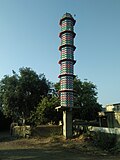 In breeding chabutro in Dethali Village, Banaskantha, Gujarat
 -
 A typical feeding and resting chabutro on display in Sanskar Kendra museum, in Ahmedabad, Gujarat. It is 120 years old and was originally in Kshetrapal ni Pol.
 -
 A simple feeding and resting chabutro in Ahmedabad


See also[edit | edit source]
References[edit | edit source]
- ↑ Rahman, Azera Parveen (18 January 2020). "Where the pigeons are home: The chabutros of Ahmedabad". The Hindu. Retrieved 13 July 2021.
- ↑ 2.0 2.1 2.2 Kutch Gurjar Kshatriyas : A brief History & Glory : by Raja Pawan Jethwa. (2007) Calcutta. Section:(I) KGK and Architect built by them mainly in Princely State of Cutch.
- ↑ "पेड़ों के चबूतरे बन रहे जल संचय में बाधक". Dainik Jagran (in हिन्दी). Retrieved 14 July 2021.
