

ImportMaster (talk | contribs) robot: import pages using Special:Import |
Refined content and updated sections |
||
| Line 1: | Line 1: | ||
{{Use dmy dates|date= | {{Short description|Buddhist Monastery in Ladakh, India}} | ||
{{Use dmy dates|date=February 2026}} | |||
{{Use Indian English|date=March 2018}} | {{Use Indian English|date=March 2018}} | ||
{{refimprove|date=April 2025}} | |||
{{Infobox Tibetan Buddhist monastery | {{Infobox Tibetan Buddhist monastery | ||
|name = Phuktal Monastery | |name = Phuktal Monastery | ||
|image = | |image =Cave Buildings Phuktal Gompa Oct22 A7C 04465.jpg | ||
|alt = | |alt = | ||
|caption = | |caption = | ||
|map_type = India Ladakh | |map_type = India Ladakh | ||
|coordinates = {{coord|33|16||N|77| | |coordinates = {{coord|33|16|6.1097|N|77|10|46.3508|E|type:landmark_region:IN-LA|display=inline,title}} | ||
|map_caption = Location within the UT of Ladakh, India | |map_caption = Location within the UT of Ladakh, India | ||
|location=[[Zanskar]], [[Kargil district]], [[Ladakh]], [[India]] | |location=[[Zanskar]], [[Kargil district]], [[Ladakh]], [[India]] | ||
|founded_by = Jangsem Sherap Zangpo | |founded_by = Jangsem Sherap Zangpo | ||
|sect = [[Gelugpa]] | |sect = [[Gelugpa]] | ||
|dedicated_to = | |dedicated_to = | ||
|head_lama = | |head_lama = | ||
|architecture = | |architecture = | ||
|festivals= | |festivals= | ||
|footnotes = | |footnotes = | ||
}} | }} | ||
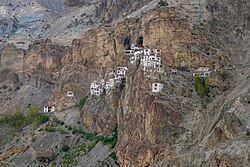
'''Phuktal Monastery''' or '''Phuktal Gompa''' (often transliterated as '''Phugtal''') is a [[Buddhism|Buddhist]] [[monastery]] located in the remote Lungnak Valley in south-eastern [[Zanskar]], in the [[Himalaya]]n region of [[Ladakh]], in [[Northern India]]. It is | '''Phuktal Monastery''' or '''Phuktal Gompa''' (often transliterated as '''Phugtal''') is a [[Buddhism|Buddhist]] [[monastery]] located in the remote Lungnak Valley in south-eastern [[Zanskar]], in the [[Himalaya]]n region of [[Ladakh]], in [[Northern India]]. It is 52 km southeast of [[Padum]] on [[Nimmu–Padum–Darcha road]] (NPD). [[Solar power]] was installed at the Phugtal monastery in 2016.<ref name=sol1>{{Cite news |url= https://special.ndtv.com/lighting-the-himalayas-21/album-detail/lighting-the-himalayas-team-powers-up-phugtal-monastery-22574 |title=Lighting The Himalayas Team Powers Up Phugtal Monastery |work=[[NDTV]] |access-date=10 November 2019}}</ref> | ||
Until 2023 before [[Nimmu–Padum–Darcha road]] was built, it was one of the few Buddhist monasteries in Ladakh that could still be reached only by foot. Supplies to the monastery were brought on horses, donkeys, and mules in the warmer months, and in the frozen winters, they were transported through the frozen [[Zanskar River]]. Before the road was built, it was a day's walk from Village [[Chah, Zanskar|Chah]] or Village Khangsaar, the end of the road leading from [[Padum]].<ref name=sol1/> | |||
==Etymology== | ==Etymology== | ||
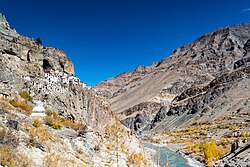
[[File:SE Facade Phuktal Zanskar Ladakh Jun24 A7CR 00617.jpg|thumb|left|The monastery consists of several buildings built in and around a cave on a cliff rising above the Tsarap river.]] | |||
The Phuktal Gompa owes its legacy to powerful and renowned scholars and teachers who resided in the cave, around which the monastery has been built, and has for long been a place for retreat, meditation, learning, and teaching. This is reflected in its name Phuktal, which is derived from ''Phukthal'', made up of ''Phuk'' ཕུག meaning 'cave', and ''Tal'' དལ་ or ''Thal'' meaning 'at leisure' in the endangered [[Zangskari dialect]] of the [[Tibetic languages]]. An alternate spelling of Phuktal is ''Phukthar'', where ''Thar'' ཐར means 'liberation'. Hence, the name Phuktal means 'the cave of leisure' or 'the cave of liberation'. | The Phuktal Gompa owes its legacy to powerful and renowned scholars and teachers who resided in the cave, around which the monastery has been built, and has for long been a place for retreat, meditation, learning, and teaching. This is reflected in its name Phuktal, which is derived from ''Phukthal'', made up of ''Phuk'' ཕུག meaning 'cave', and ''Tal'' དལ་ or ''Thal'' meaning 'at leisure' in the endangered [[Zangskari dialect]] of the [[Tibetic languages]]. An alternate spelling of Phuktal is ''Phukthar'', where ''Thar'' ཐར means 'liberation'. Hence, the name Phuktal means 'the cave of leisure' or 'the cave of liberation'. | ||
==History== | ==History== | ||
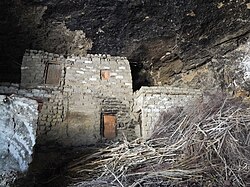
[[File:Cave Old Buildings Phuktal Oct22 A7C 04487.jpg|thumb|left|Old rooms inside the cave]] | |||
The Phuktal Monastery is built around a natural cave, which is believed to have been visited by numerous sages, scholars, translators, and monks around 2,550 years ago. The remote location of the monastery was ideal for monks looking for peace and solitude to meditate. The present Phuktal Gompa, of the [[Gelug]] school of [[Tibetan Buddhism]], was established in the early 15th century by [[Jangsem Sherap Zangpo]], a disciple of Je Tsongkhapa. Tsongkhapa was the founder of Gelug, which is one of the newest schools of Tibetan Buddhism. | The Phuktal Monastery is built around a natural cave, which is believed to have been visited by numerous sages, scholars, translators, and monks around 2,550 years ago. The remote location of the monastery was ideal for monks looking for peace and solitude to meditate. The present Phuktal Gompa, of the [[Gelug]] school of [[Tibetan Buddhism]], was established in the early 15th century by [[Jangsem Sherap Zangpo]], a disciple of Je Tsongkhapa. Tsongkhapa was the founder of Gelug, which is one of the newest schools of Tibetan Buddhism. | ||
Believed to be one of the earliest residents of the cave are the [[Sixteen Arhats|16 Arhats]], or the legendary followers of [[Buddha]]. The images of these 16 [[Arhats]] appear on the cave walls. The great scholars and translators [[Padmasambhava]] and Phakspa Nestan Dusdan are believed to have lived in the cave, and so is the great leader and translator [[Marpa Lotsawa|Lama Marpa Lotsawa]]. In the 12th century, the Tibetan translator Zanskar Lotsawa Phagpa Sherab also lived and worked from Phuktal. The eminent scholars and brothers Dangsong, Pun, and Sum, who were believed to have the supernatural power of flight gave teachings on [[Dharma]] at Phuktal. When Jangsem Sherap Zangpo arrived at Phuktal, the three brothers bequeathed the holy site to him and departed. According to legend, the spiritually gifted Zangpo caused a spring to appear and run from the cave, a tree to grow on top of the cave and for the cave itself to grow larger in size. Then, under his guidance, the present structure of the monastery was built around the cave. It is built in the cliffside, like a honeycomb. The cliff is part of a lateral gorge of a major tributary of the Lungnak River (Lingti-[[Tsarap River|Tsarap]] River). The monastery today houses a main temple, prayer rooms, a library with rare sacred texts, apartments and living quarters, teaching facilities, a kitchen, and of course, the original cave and the sacred spring, which is protected. It is home to about 70 monks. | [[File:Phuktal Gompa Tsarap Zanskar Oct22 A7C 04463.jpg|thumb|left|Looking up from the valley]] | ||
Believed to be one of the earliest residents of the cave are the [[Sixteen Arhats|16 Arhats]], or the legendary followers of [[Buddha]]. The images of these 16 [[Arhats]] appear on the cave walls. The great scholars and translators [[Padmasambhava]] and Phakspa Nestan Dusdan are believed to have lived in the cave, and so is the great leader and translator [[Marpa Lotsawa|Lama Marpa Lotsawa]]. In the 12th century, the Tibetan translator Zanskar Lotsawa Phagpa Sherab also lived and worked from Phuktal. The eminent scholars and brothers Dangsong, Pun, and Sum, who were believed to have the supernatural power of flight gave teachings on [[Dharma]] at Phuktal. When Jangsem Sherap Zangpo arrived at Phuktal, the three brothers bequeathed the holy site to him and departed. According to legend, the spiritually gifted Zangpo caused a spring to appear and run from the cave, a tree to grow on top of the cave and for the cave itself to grow larger in size. Then, under his guidance, the present structure of the monastery was built around the cave. It is built in the cliffside, like a honeycomb. The cliff is part of a lateral gorge of a major tributary of the Lungnak River (Lingti-[[Tsarap River|Tsarap]] River). The monastery today houses a main temple, prayer rooms, a library with rare sacred texts, apartments and living quarters, teaching facilities, a kitchen, and of course, the original cave and the sacred spring, which is protected. It is home to about 70 monks.<ref>{{cite web |title=Phuktal Monastery, Ladakh |url=https://www.lehladakhtourism.com/monasteries-in-ladakh/phuktal-monastery.html |publisher=Leh Ladakh Tourism |access-date=10 February 2026}}</ref> | |||
There is a stone tablet which serves as a reminder of the stay of [[Sándor Kőrösi Csoma|Alexander Csoma de Kőrös]] at Phuktal, while he worked on the first English-Tibetan dictionary between 1826 and 1827, when he explored Ladakh. | There is a stone tablet which serves as a reminder of the stay of [[Sándor Kőrösi Csoma|Alexander Csoma de Kőrös]] at Phuktal, while he worked on the first English-Tibetan dictionary between 1826 and 1827, when he explored Ladakh.<ref>{{cite book |url=https://books.google.com/books?id=pl5qHu_K45kC&pg=PA14 |page=14 |title=Across Peaks & Passes in Ladakh, Zanskar & East Karakoram |author=Harish Kapadia |publisher=Indus Publishing |year=1999 |isbn=978-81-7387-100-9 }}</ref> | ||
==Clinic and | ==Clinic and village life== | ||
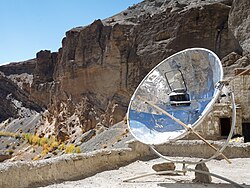
[[File:Solar Cooker Phuktar Gompa Zanskar Oct22 A7C 04476.jpg|thumb|Solar cooker, October 2022]] | |||
The Phuktal Gompa maintains a [[Traditional Tibetan medicine|Traditional Tibetan medical]] clinic, catering to the local community. There is an on-site ''Amchi'', a traditional Tibetan physician who provides natural [[Traditional Tibetan medicine|Sowa-Rigpa medicine]], many of which have been prepared at the monastery itself. The village life in the Lungnak Valley revolves around the monastery. Monks from the monastery attend local village events of significance, such as birth, deaths and weddings, performing traditional prayer ceremonies. The villagers visit the monastery to offer prayers, consult the ''Amchi'' and to attend festivals and special events at the monastery. | The Phuktal Gompa maintains a [[Traditional Tibetan medicine|Traditional Tibetan medical]] clinic, catering to the local community. There is an on-site ''Amchi'', a traditional Tibetan physician who provides natural [[Traditional Tibetan medicine|Sowa-Rigpa medicine]], many of which have been prepared at the monastery itself. The village life in the Lungnak Valley revolves around the monastery. Monks from the monastery attend local village events of significance, such as birth, deaths and weddings, performing traditional prayer ceremonies. The villagers visit the monastery to offer prayers, consult the ''Amchi'' and to attend festivals and special events at the monastery. | ||
The village and the monastery has remained | The village and the monastery has remained largely untouched by modern development. The Monastery was electrified by Global Himalayan Expedition in July 2016 through setting up of solar micro-grids.<ref>{{Citation|last1=Kanie|first1=Norichika|title=Introduction: Global Governance through Goal Setting|date=5 May 2017|work=Governing through Goals|publisher=The MIT Press|isbn=9780262035620|last2=Bernstein|first2=Steven|last3=Biermann|first3=Frank|last4=Haas|first4=Peter M.|doi=10.7551/mitpress/9780262035620.003.0001}}</ref> | ||
==Festivals== | ==Festivals== | ||
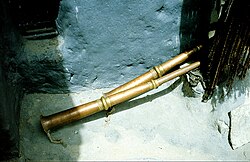
Festivals are an important | [[File:Zanskar Phuktal 04.jpg|thumb|Trumpets used to announce services]] | ||
Festivals are an important feature of the Phuktal Gompa. These are occasions for the monks to interact with the villagers and for the villagers to visit the monastery. Festivals help to preserve the centuries-old traditions and to spread ''dharma''. They also enable the monks to accumulate good [[karma]] for the next life through offerings, worship, prayers and service. The festivals celebrated at Phuktal Monastery, starting around the end of February, are mentioned below. The [[Tibetan calendar]] is a [[lunisolar calendar]], hence the dates for these festivals differ each year as compared to the [[Gregorian calendar]]. | |||
# '''Smonlam Chenmo:''' The '''Smonlam Chenmo''', also known as '''[[Monlam Prayer Festival|Monlam Chenmo]]''' (Tibetan for 'great prayer') is the most important Tibetan Buddhist celebration of the year, and signifies the start of the New Year. Special ceremonies are held for world peace and the wellbeing of all people. It falls towards the end of February or the beginning of March.[http://www.britannica.com/topic/Smon-lam-chen-mo] | # '''Smonlam Chenmo:''' The '''Smonlam Chenmo''', also known as '''[[Monlam Prayer Festival|Monlam Chenmo]]''' (Tibetan for 'great prayer') is the most important Tibetan Buddhist celebration of the year, and signifies the start of the New Year. Special ceremonies are held for world peace and the wellbeing of all people. It falls towards the end of February or the beginning of March.[http://www.britannica.com/topic/Smon-lam-chen-mo] | ||
#'''Chudsum Chodpa:''' This festival is held right after the ''Smonlam Chenmo''. It is held to worship thirteen special deities. | #'''Chudsum Chodpa:''' This festival is held right after the ''Smonlam Chenmo''. It is held to worship thirteen special deities. | ||
| Line 55: | Line 60: | ||
==Phuktal Monastic School== | ==Phuktal Monastic School== | ||
{{Main|Phuktal Monastic School}} | {{Main|Phuktal Monastic School}} | ||
Phuktal Gompa has set up the Phuktal Monastic School that caters to the students of the local Lungnak Valley of | Phuktal Gompa has set up the Phuktal Monastic School that caters to the students of the local Lungnak Valley of Zanskar. The school was set up in 1993, at the behest of Geshe Lharampa Nagri Choszed. Complete education is provided, which involves a mix of traditional learning and modern curriculum. No fees are charged from the students, and the monastery bears the cost for the room, board and study materials of the students, with help from sponsors. Many students are children from the local farming families in the Lungnak Valley, which are extremely poor and uneducated. | ||
==Phuktal | ==Tsarap River blockade near Phuktal== | ||
On 31 December 2014, a landslide occurred between the Shun and Phuktal villages. This caused the formation of a [[landslide|landslide dam]] on the | {{Main article|Tsarap River#Landslide Dam}} | ||
On 31 December 2014, a landslide occurred between the Shun and Phuktal villages. This caused the formation of a [[landslide|landslide dam]] on the Tsarap River. It was first noticed due to the recession in the water level of the [[Nimoo Bazgo Hydroelectric Plant]] down the river. The lake formed behind the dam increased in length and height as compared to the height of the blockade. In May 2015, the Phuktal River flooded and washed away the entire school campus. The building, equipment, materials, and stores were all destroyed. The monastery has applied to the [[Government of Jammu and Kashmir|Jammu and Kashmir State Government]] and the [[Government of India|Central Government]] for grants and financial aid to help rebuild the school and monastery and undo the damage of the flood. | |||
{{Clear}} | {{Clear}} | ||
==Gallery== | ==Gallery== | ||
<gallery> | <gallery mode="packed"> | ||
File:Zanskar | File:Entrance Phuktal Gompa Zanskar Oct22 A7C 04450.jpg|Entrance arch, 2022 | ||
File:Zanskar Phuktal 02.jpg| | File:Zanskar Phuktal 02.jpg|Building and chorten at the cave entrance, 1991 | ||
File:Zanskar Phuktal | File:Stupa Cave Phuktal Gompa Oct22 A7C 04479.jpg|Chorten in the cave, 2022 | ||
File:Cliff Dwellings Phuktal Zanskar Oct22 A7C 04499.jpg|Cliff dwellings below the cave | |||
File:Guest House Phuktal Zanskar Jun24 A7CR 00533.jpg|Guest house, view from across the Tsarap | |||
File:Phuktal Bridge Downstream Tsarap Oct22 A7C 04443.jpg|Footbridge over the Tsarap, trail from Purney | |||
</gallery> | </gallery> | ||
==See also== | |||
* [[All Ladakh Gonpa Association#List|List of buddhist monasteries in Ladakh]] | |||
* [[Geography of Ladakh]] | |||
* [[Tourism in Ladakh]] | |||
==References== | ==References== | ||
| Line 74: | Line 89: | ||
==External links== | ==External links== | ||
{{commonscat}} | {{commonscat}} | ||
*[http://treasuryoflives.org/biographies/view/Jangsem-Sherab-Zangpo/13078 Jangsem Sherab Zangpo] | *[http://treasuryoflives.org/biographies/view/Jangsem-Sherab-Zangpo/13078 Jangsem Sherab Zangpo] | ||
*[ | *[https://web.archive.org/web/20150130064139/http://www.nrsc.gov.in/Phutkal.html National Remote Sensing Centre: Phuktal Blockade, 30 January 2015] | ||
{{Buddhist monasteries in Ladakh}} | {{Buddhist monasteries in Ladakh}} | ||
| Line 85: | Line 96: | ||
[[Category:Buddhist monasteries in Ladakh]] | [[Category:Buddhist monasteries in Ladakh]] | ||
[[Category: | [[Category:Tibetan Buddhist monasteries and temples in India]] | ||
Latest revision as of 01:08, 11 February 2026
 | This article needs more citations. (April 2025) |
| Phuktal Monastery | |
|---|---|
| Religion | |
| Affiliation | Tibetan Buddhism |
| Sect | Gelugpa |
| Location | |
| Location | Zanskar, Kargil district, Ladakh, India |
  Location within the UT of Ladakh, India | |
| Coordinates | 33°16′6.1097″N 77°10′46.3508″E / 33.268363806°N 77.179541889°E |
| Architecture | |
| Founder | Jangsem Sherap Zangpo |
Phuktal Monastery or Phuktal Gompa (often transliterated as Phugtal) is a Buddhist monastery located in the remote Lungnak Valley in south-eastern Zanskar, in the Himalayan region of Ladakh, in Northern India. It is 52 km southeast of Padum on Nimmu–Padum–Darcha road (NPD). Solar power was installed at the Phugtal monastery in 2016.[1]
Until 2023 before Nimmu–Padum–Darcha road was built, it was one of the few Buddhist monasteries in Ladakh that could still be reached only by foot. Supplies to the monastery were brought on horses, donkeys, and mules in the warmer months, and in the frozen winters, they were transported through the frozen Zanskar River. Before the road was built, it was a day's walk from Village Chah or Village Khangsaar, the end of the road leading from Padum.[1]
Etymology[edit | edit source]

The Phuktal Gompa owes its legacy to powerful and renowned scholars and teachers who resided in the cave, around which the monastery has been built, and has for long been a place for retreat, meditation, learning, and teaching. This is reflected in its name Phuktal, which is derived from Phukthal, made up of Phuk ཕུག meaning 'cave', and Tal དལ་ or Thal meaning 'at leisure' in the endangered Zangskari dialect of the Tibetic languages. An alternate spelling of Phuktal is Phukthar, where Thar ཐར means 'liberation'. Hence, the name Phuktal means 'the cave of leisure' or 'the cave of liberation'.
History[edit | edit source]

The Phuktal Monastery is built around a natural cave, which is believed to have been visited by numerous sages, scholars, translators, and monks around 2,550 years ago. The remote location of the monastery was ideal for monks looking for peace and solitude to meditate. The present Phuktal Gompa, of the Gelug school of Tibetan Buddhism, was established in the early 15th century by Jangsem Sherap Zangpo, a disciple of Je Tsongkhapa. Tsongkhapa was the founder of Gelug, which is one of the newest schools of Tibetan Buddhism.

Believed to be one of the earliest residents of the cave are the 16 Arhats, or the legendary followers of Buddha. The images of these 16 Arhats appear on the cave walls. The great scholars and translators Padmasambhava and Phakspa Nestan Dusdan are believed to have lived in the cave, and so is the great leader and translator Lama Marpa Lotsawa. In the 12th century, the Tibetan translator Zanskar Lotsawa Phagpa Sherab also lived and worked from Phuktal. The eminent scholars and brothers Dangsong, Pun, and Sum, who were believed to have the supernatural power of flight gave teachings on Dharma at Phuktal. When Jangsem Sherap Zangpo arrived at Phuktal, the three brothers bequeathed the holy site to him and departed. According to legend, the spiritually gifted Zangpo caused a spring to appear and run from the cave, a tree to grow on top of the cave and for the cave itself to grow larger in size. Then, under his guidance, the present structure of the monastery was built around the cave. It is built in the cliffside, like a honeycomb. The cliff is part of a lateral gorge of a major tributary of the Lungnak River (Lingti-Tsarap River). The monastery today houses a main temple, prayer rooms, a library with rare sacred texts, apartments and living quarters, teaching facilities, a kitchen, and of course, the original cave and the sacred spring, which is protected. It is home to about 70 monks.[2]
There is a stone tablet which serves as a reminder of the stay of Alexander Csoma de Kőrös at Phuktal, while he worked on the first English-Tibetan dictionary between 1826 and 1827, when he explored Ladakh.[3]
Clinic and village life[edit | edit source]

The Phuktal Gompa maintains a Traditional Tibetan medical clinic, catering to the local community. There is an on-site Amchi, a traditional Tibetan physician who provides natural Sowa-Rigpa medicine, many of which have been prepared at the monastery itself. The village life in the Lungnak Valley revolves around the monastery. Monks from the monastery attend local village events of significance, such as birth, deaths and weddings, performing traditional prayer ceremonies. The villagers visit the monastery to offer prayers, consult the Amchi and to attend festivals and special events at the monastery.
The village and the monastery has remained largely untouched by modern development. The Monastery was electrified by Global Himalayan Expedition in July 2016 through setting up of solar micro-grids.[4]
Festivals[edit | edit source]

Festivals are an important feature of the Phuktal Gompa. These are occasions for the monks to interact with the villagers and for the villagers to visit the monastery. Festivals help to preserve the centuries-old traditions and to spread dharma. They also enable the monks to accumulate good karma for the next life through offerings, worship, prayers and service. The festivals celebrated at Phuktal Monastery, starting around the end of February, are mentioned below. The Tibetan calendar is a lunisolar calendar, hence the dates for these festivals differ each year as compared to the Gregorian calendar.
- Smonlam Chenmo: The Smonlam Chenmo, also known as Monlam Chenmo (Tibetan for 'great prayer') is the most important Tibetan Buddhist celebration of the year, and signifies the start of the New Year. Special ceremonies are held for world peace and the wellbeing of all people. It falls towards the end of February or the beginning of March.[1]
- Chudsum Chodpa: This festival is held right after the Smonlam Chenmo. It is held to worship thirteen special deities.
- Chonga Chodpa: This is celebrated immediately after the Chudsum Chodpa and is a harvest ceremony. For this festival, monks create a special torma, which is a statue made of barley flour and butter, and is worshipped by villagers.
- Gyalwe Jabstan: Held after the Chonga Chodpa, this festival involves a puja for the long life of the 14th Dalai Lama.
- Jigched Lhachusum Ceremony: This ceremony is held between the end of March and the end of May or the beginning of June.
- Initiation of Vajrabhairava: This festival is for the worship of Vajrabhairava, the most wrathful form of Manjushri. It is celebrated towards the end of May or the beginning of June.
- Syungnas: The festival of Syungnas is a fasting ceremony to purge oneself of all sin and to accumulate good karma. It is celebrated after mid-June.
- Yarnas: This is also known as the Varshavas Ceremony. For this ceremony, monks remain confined within the monastery and some limited outlying areas and perform special daily pujas to avoid and make good the negative karma accumulated from treading upon plants, insects and microorganisms. It is held between the end of July to mid September, and visitors need to obtain special permission from the head Lama of the monastery to attend a short portion of the Yarnas.
- Gadam Nagchod: The Gadam Nagchod or the Lightning Ceremony is held sometime during the beginning of December to mark the death anniversary of Je Tsongkhapa, the founder of the Gelug branch of Tibetan Buddhism.
- Phukta Gutor: Held towards the end of February, and before the Smonlam Chenmo, this festival is one of the most important festivals at Phuktal Gompa. It signals the end of the Tibetan year, and is held for world peace and harmony. It is attended by many Zanskaris and Ladakhis.
Phuktal Monastic School[edit | edit source]
Phuktal Gompa has set up the Phuktal Monastic School that caters to the students of the local Lungnak Valley of Zanskar. The school was set up in 1993, at the behest of Geshe Lharampa Nagri Choszed. Complete education is provided, which involves a mix of traditional learning and modern curriculum. No fees are charged from the students, and the monastery bears the cost for the room, board and study materials of the students, with help from sponsors. Many students are children from the local farming families in the Lungnak Valley, which are extremely poor and uneducated.
Tsarap River blockade near Phuktal[edit | edit source]
On 31 December 2014, a landslide occurred between the Shun and Phuktal villages. This caused the formation of a landslide dam on the Tsarap River. It was first noticed due to the recession in the water level of the Nimoo Bazgo Hydroelectric Plant down the river. The lake formed behind the dam increased in length and height as compared to the height of the blockade. In May 2015, the Phuktal River flooded and washed away the entire school campus. The building, equipment, materials, and stores were all destroyed. The monastery has applied to the Jammu and Kashmir State Government and the Central Government for grants and financial aid to help rebuild the school and monastery and undo the damage of the flood.
Gallery[edit | edit source]
-
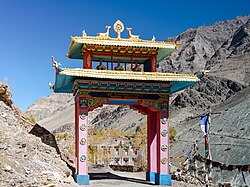 Entrance arch, 2022
 -
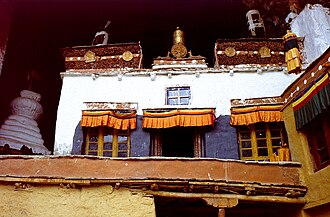 Building and chorten at the cave entrance, 1991
 -
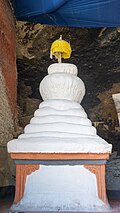 Chorten in the cave, 2022
 -
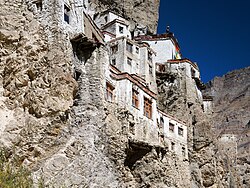 Cliff dwellings below the cave
 -
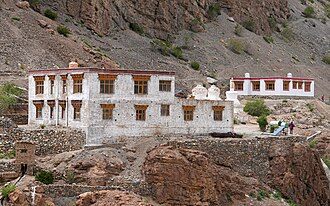 Guest house, view from across the Tsarap
 -
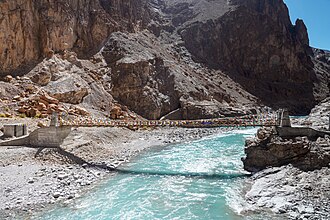 Footbridge over the Tsarap, trail from Purney


See also[edit | edit source]
References[edit | edit source]
- ↑ 1.0 1.1 "Lighting The Himalayas Team Powers Up Phugtal Monastery". NDTV. Retrieved 10 November 2019.
- ↑ "Phuktal Monastery, Ladakh". Leh Ladakh Tourism. Retrieved 10 February 2026.
- ↑ Harish Kapadia (1999). Across Peaks & Passes in Ladakh, Zanskar & East Karakoram. Indus Publishing. p. 14. ISBN 978-81-7387-100-9.
- ↑ Kanie, Norichika; Bernstein, Steven; Biermann, Frank; Haas, Peter M. (5 May 2017), "Introduction: Global Governance through Goal Setting", Governing through Goals, The MIT Press, doi:10.7551/mitpress/9780262035620.003.0001, ISBN 9780262035620
{{citation}}: CS1 maint: work parameter with ISBN (link)
