
No edit summary |
CleanupBot (talk | contribs) m Robot: Replacing encoded entity with character |
||
| (One intermediate revision by one other user not shown) | |||
| Line 1: | Line 1: | ||
{{ | {{short description|Military field formation of the Indian Army}} | ||
{{More citations needed|date=January 2026}} | |||
{{Infobox military unit | {{Infobox military unit | ||
| unit_name = III Corps | | unit_name = III Corps | ||
| image = | | image = File:III Corps, Indian Army.svg | ||
| caption = | | caption = Indian Army III Corps Formation Sign | ||
| dates = 1915–1919<br>1941–1942<br>1985–present | | dates = 1915–1919<br>1941–1942<br>1985&ndash;present | ||
| country = {{flag|India}} | | country = {{flag|India}} | ||
| allegiance = | | allegiance = | ||
| branch = {{army|India}} | | branch = {{army|India}} | ||
| type = | | type = | ||
| role = | | role = Mountain (Holding) [[Corps]] | ||
| size = [[Corps]] | | size = [[Corps]] | ||
| command_structure = [[Eastern Command (India)|Eastern Command]] | | command_structure = [[File:Eastern Command, Indian Army.png|22px]] [[Eastern Command (India)|Eastern Command]] | ||
| garrison = [[Dimapur]] | | garrison = [[Dimapur]] | ||
| nickname = ''Spear Corps'' | | nickname = ''Spear Corps'' | ||
| Line 26: | Line 27: | ||
| identification_symbol = | | identification_symbol = | ||
| identification_symbol_2 = <!-- Culture and history --> | | identification_symbol_2 = <!-- Culture and history --> | ||
| current_commander = Lt | | current_commander = [[Lieutenant general (India)|Lt Gen]] Abhijit S Pendharkar, {{postnominals|country=IND|size=75%|UYSM|AVSM|YSM}} | ||
| ceremonial_chief = | | ceremonial_chief = | ||
| colonel_of_the_regiment = | | colonel_of_the_regiment = | ||
| notable_commanders = [[General (India)|General]] [[Dalbir Singh Suhag]]<br>[[General (India)|General]] [[Bipin | | notable_commanders = [[Lieutenant general (India)|Lt Gen]] [[Johnson P Mathew]]<br/>[[Lieutenant general (India)|Lt Gen]] [[Ram Chander Tiwari]]<br/> [[Rana Pratap Kalita|Lt Gen Rana Pratap Kalita]]<br> [[General (India)|General]] [[Anil Chauhan]]<br>[[Abhay Krishna|Lt Gen Abhay Krishna]]<br> [[General (India)|General]] [[Bipin Rawat]]<br>[[General (India)|General]] [[Dalbir Singh Suhag]]<br> [[Zameer Uddin Shah|Lt Gen Zameer Uddin Shah]]<br> [[General (India)|General]] [[Bipin Chandra Joshi]]<br>[[Raj Mohan Vohra|Lt Gen Raj Mohan Vohra]] <br>[[Joginder Singh Bakshi|Lt Gen Joginder Singh Bakshi]] | ||
}} | }} | ||
{{Indian Army Corps | {{Military unit sidebar|title=Indian Army Corps (1915 - Present)|previous=[[II Corps (India)|II Corps]]|next=[[IV Corps (India)|IV Corps]]}} | ||
|previous= | The '''III Corps''' is a formation of the [[Indian Army]] that was formed during [[World War I]] in [[Mesopotamia]] during its [[Mesopotamian campaign|respective campaign]]. Prior to the reorganization of the British and Indian forces in [[Mesopotamia]], it was designated as the '''Tigris Corps'''. | ||
|next=[[ | |||
}} | |||
The '''III Corps''' is a formation of the [[Indian Army]] that was formed during [[World War I]] in [[Mesopotamia]] during its [[Mesopotamian campaign|respective campaign]]. Prior to the reorganization of the British and Indian forces in Mesopotamia, it was designated as the '''Tigris Corps'''. | |||
A new III Corps was formed by the [[Indian Army during World War II]] for service in [[Southeast Asia]]. The corps fought in the [[Battle of Singapore]] where it surrendered in February 1942.<ref>Ramakrishna</ref> | A new III Corps was formed by the [[Indian Army during World War II]] for service in [[Southeast Asia]]. The corps fought in the [[Battle of Singapore]] where it surrendered in February 1942.<ref>Ramakrishna</ref> | ||
It is | It is headquartered in the state of [[Nagaland]] of India in the city of [[Dimapur]], at Rangapahar Military Station. | ||
== History == | == History == | ||
3 Corps was raised during World War I by Lt Gen Ahlmer and soon thereafter, the command was changed to Lt Gen [[Frederick Stanley Maude|Frederick Stanley Maud]], who was appointed as the Corps Commander on 09 Dec 1915. 3 Corps was allotted the [[6th (Poona) Division]] and [[12th Indian Division]] along with a Cavalry Brigade and tasked with the defence of the Tigris Line. The Corps thereby earned the sobriquet of "The Tigris Corps". 3 Corps played a major role in the Mesopotamian front, which was a campaign in the middle eastern theatre of World War I, fought between the Allies represented by the British Empire, troops from Britain, Australia and vast majority of British Raj, against the central powers, mostly the Ottoman Empire. The Theatre was vast and consisted of hot, inhospitable desert terrain. Tank warfare had still not achieved its primacy and deserts remained primarily a no man’s land. The fight was concentrated along the course of Tigris and the Euphrates rivers where Ottomans had a head start. The British had realised that they needed to secure and control the delta of Tigris at Shatt-El-Arab and Basra to deny the Ottomans access to Abadan Refinery and the oil rich delta. It also provided the British with a bridgehead for the induction of troops through the sea route and to maintain their forces logistically during future operations in the north. Keeping this as the broad objective, the British dispatched the 6th Indian Division as the Indian Expeditionary Force to Basra in 1915. | |||
The Corps was later split into two separate formations, namely 1 and 3 Corps. [[I Corps (British India)|I Corps]] moved northwards towards [[Mosul]], while 3 Corps led a renewed offensive towards [[Baghdad]], which finally fell to 3 Corps in 1916. The composition of 3 Corps was largely Indian troops and the credit for the swift capture of Baghdad was attributed to them. The Allied forces controlled a major part of Mesopotamia because of the fall of [[Baghdad]], and most importantly, had direct access to the sea and the oldest refinery of Asia at Abadan. In view of the strategic objective of bringing [[Mesopotamia]] under British control and liberation of [[Kuwait]] from Ottoman control being achieved, an armistice was signed between the British and the Ottoman Empire. | |||
The military phase of the operations in the [[Middle East]] was over, paving the way for political and diplomatic overtures. 3 Corps which had played a great role in achievement perhaps did not get its due compared to similar forces fighting in the European Theatre. The Corps was finally demobilized in 1919, only to be resurrected in 1941 during World War II. | |||
=== World War II === | |||
HQ 3 Corps was raised on 27 Apr 1941 with headquarters at [[Kuala Lumpur]]. Lt Gen Percy Heath was placed in Command of the Corps. It had two Divisions, namely the 9th and [[11th_Infantry_Division_(India)|11th Indian Division]]s under command. | |||
[[11th Indian Division]] which was tasked to defend [[Kuala Lumpur]] and withdraw towards [[Thailand]] was outflanked by the Japanese. The Division fought major battles at [[Jitra]] from 08-12 Dec 1941, Kampar from 30 Dec 1941 to 02 Jan 1942, [[Slim River]] from 06 Jan to 08 Jan 1942, Gemas and Muar River from 14 Jan to 02 Jan 1942 and gave a good account of themselves, despite debilitating logistic shortcoming and virtually no air support. [[9th Indian Division|9th]] and [[11th_Infantry_Division_(India)|11th Indian Division]] suffered significant casualties without any significant reinforcements. | |||
During the [[Malayan campaign]], 3 Corps had borne the brunt of War, and men suffered from inclement weather and tropical diseases apart from enemy action. Jungle terrain coupled with intolerable tropical weather and humidity made the conditions insuperable. Fighting here required the very best of human endurance, both mental and physical. 3 Corps had fought most of its battles in these virtually inhuman conditions, but there was little coverage of the same. While the trenches of Ypres, Somme, Alsace and Lorraine and those who fought in them were widely covered, the contributions of the anonymous Indians who died in Malaya remain un-recounted. 3 Corps virtually ceased to exist post Feb 1942. | |||
=== III Corps: The Third Reincarnation === | |||
The Naga insurgency, over a period, gained inroads into the Hill districts of Manipur, Tirap and Changlang district of Arunachal Pradesh bordering Nagaland. 8 Mountain Division was re-raised in 1962 located at Zakhama. | |||
Spear Corps participated in the 1962 Indo – China war. The famous '''Battle of Walong''' was in the then NEFA (Arunachal Pradesh). In autumn of 1962, during the Sino-Indian War, Walong was the scene of the Battle of Walong, where the Indian Army 11th Infantry Brigade battled the Chinese advances.[7] The killed and wounded numbered 642 Indians and 752 Chinese.[8] Indians were defeated at Walong, however the Chinese withdrawal allowed India to regain the territory.[6] A canopied memorial to the Indian war dead of 1962 was erected next to the airstrip with the following verses composed by a Walong veteran inscribed on it:[6] | |||
''The sentinel hills that round us stand'' | |||
''bear witness that we loved our land.'' | |||
''Amidst shattered rocks and flaming pine'' | |||
''we fought and died on Namti Plain'' | |||
''.'' | |||
''O Lohit gently by us glide'' | |||
''pale stars above us softly shine'' | |||
''as we sleep here in sun and rain.'' | |||
Spear Corps was the formation directly under Headquarters Eastern Command to conduct operations against Naga insurgents. The spread of insurgency into new areas of Mizoram and Tripura necessitated the induction of additional troops. With the raising of 57 Mountain Division in 1969 at Masimpur, 8 Mountain Division was entrusted with Counter Insurgency Operations in Nagaland and Manipur, while 57 Mountain Division was responsible for conduct of operations in Mizoram and Tripura. Assam Rifles units were also involved in counter insurgency operations under respective brigade sized sector headquarters. There was a need to adopt a common cause and manifest a common effort. It was this requirement which precipitated the thought process for establishing a new headquarters as an umbrella organisation to counter the eco system of insurgency and eradicate it in a comprehensive manner. The seed for raising of a new Corps headquarter was sown in response and the idea of 3 Corps sprouted. | |||
In 1984, Lt Gen Chiman Singh, the then General Officer Commanding-in Chief, Eastern Command deliberated upon the command, control and coordination of operations of the two Divisions fighting insurgency in the North East and decided to coordinate and streamline functioning of both these Formations under a Corps Headquarter. Headquarters 3 Corps was raised on 04 Feb 1985, by Lt Gen Joginder Singh Bakshi, MVC, at Rangapahar Military Station (RMS) in Dimapur (Nagaland) for coordination and conduct of Counter Insurgency Operations in Nagaland, Manipur, Mizoram, Tripura, Meghalaya, South Assam (including Dhubri Districts) and Arunachal Pradesh (Tirap and Changlang districts). 3 Corps replaced 8 Mountain Division as the highest Formation responsible for coordinating Counter Insurgency Operations in Nagaland and the adjoining Naga inhabited areas of other states. | |||
The | === Formation Sign : Spears Corps === | ||
The formation sign is inspired by the primary role of Infantry. Fittingly, the formation signs of the two formations under Head Quarters 3 Corps, the Bayonet of 8 Mountain Division and Crossed Spears of 57 Mountain Division, were superimposed to make the 3 Corps formation sign. | |||
At the time of its formation, 3 Corps consisted of 8 Mountain Division and 57 Mountain Division, under its command. Additionally, Headquarters Inspector General Assam Rifles (North) (IGAR(N) was raised at Jorhat on 15 May 1985 and placed under operational control of 3 Corps. Post raising, the Headquarters IGAR(N) moved to Imphal and took over the operational responsibility of Manipur from 8 Mountain Division on 12 Nov 1986. 8 Mountain Division took over the responsibility of Tirap Sector. | |||
3 Corps was actively involved in counter-insurgency operations in Manipur, Tripura and North Cachar Hills district of Assam. Besides, 3 Corps was also aiding the civil administration and paramilitary forces in maintaining peace in Nagaland and Mizoram. At the time, 3 Corps seemed likely to be replaced by the Directorate-General of Assam Rifles based in [[Shillong]]. The 57 Mountain Division based at [[Leimakhong]] in [[Manipur]] had already been shifted to Meerut in Uttar Pradesh. | |||
Defending the LAC became an additional responsibility, apart from countering insurgency. With this additional responsibility to fulfil, two more Divisions were placed under command of HQ 3 Corps. With the raising of the Division Headquarters, its formations and units commenced its operations on 7 September 2009 under Major General Raj Nandan Singh. It took over the operations and entire responsibility of Western [[Arunachal Pradesh]] on 01 Jun 2010. | |||
== | == Order of battle == | ||
[[Jane's Information Group|Jane's]] estimates that it consists of:<ref>Jane's World Armies, Issue 19, 2006</ref> | [[Jane's Information Group|Jane's]] estimates that it consists of:<ref>Jane's World Armies, Issue 19, 2006</ref> | ||
*[[2nd Infantry Division (India)|2 Mountain Division]] (Dao Division) - The division joined III Corps in late 2000s and is headquartered at [[Dinjan]], [[Dibrugarh district]], [[Assam]].<ref>{{Cite web|url=http://www.globalsecurity.org/military/world/india/2-div.htm|title=2 Mountain Division|last=Pike|first=John|website=www.globalsecurity.org|access-date=2017-05-14}}</ref><ref>{{cite web|url=https://zeenews.india.com/news/north-east/third-battalion-of-naga-regiment-be-raised-soon_571317.html|title=Third battalion of Naga regiment be raised soon|date=2009-10-16|access-date=2021-07-11}}</ref> | *[[2nd Infantry Division (India)|2 Mountain Division]] (Dao Division) - The division joined III Corps in late 2000s and is headquartered at [[Dinjan]], [[Dibrugarh district]], [[Assam]].<ref>{{Cite web|url=http://www.globalsecurity.org/military/world/india/2-div.htm|title=2 Mountain Division|last=Pike|first=John|website=www.globalsecurity.org|access-date=2017-05-14}}</ref><ref>{{cite web|url=https://zeenews.india.com/news/north-east/third-battalion-of-naga-regiment-be-raised-soon_571317.html|title=Third battalion of Naga regiment be raised soon|date=2009-10-16|access-date=2021-07-11}}</ref> | ||
** 5 Mountain Brigade at [[Aalo]] (Along)<ref>{{cite web |date=2011-12-11 |title=Army steps in to help school |url=https://www.arunachaltimes.in/archives/dec11%2012.html |access-date=2021-11-12}}</ref> - the oldest infantry brigade in the Indian Army.<ref name="StepsUp">[http://www.telegraphindia.com/1071220/asp/guwahati/story_8690054.asp Paranoia after Ulfa threat; Army steps up vigilance in upper Assam] {{Webarchive|url=https://web.archive.org/web/20121024111143/http://www.telegraphindia.com/1071220/asp/guwahati/story_8690054.asp|date=2012-10-24}}, The Telegraph, Calcutta, India, Thursday, December 20, 2007</ref> | |||
*[[56th Mountain Division (India)|56 | ** 82 Mountain Brigade at [[Tezu]] in [[Lohit district]]<ref>{{cite web |date=2019-10-07 |title=Indian Army to begin deploying light howitzers in eastern sector |url=https://www.hindustantimes.com/india-news/indian-army-to-begin-deploying-light-howitzers-in-eastern-sector/story-WB8HnZqhEIlzpXUv2360DK.html |access-date=2021-11-12}}</ref> | ||
** 181 Mountain Brigade at Laipuli, [[Tinsukia]]<ref>{{cite web |date=2017-01-23 |title=Ambush raises questions about security lapses |url=https://timesofindia.indiatimes.com/city/guwahati/ambush-raises-questions-about-security-lapses/articleshow/56726800.cms |access-date=2021-11-12 |website=[[The Times of India]]}}</ref> | |||
*[[57th Mountain Division (India)|57 Mountain Division]] (Red Shield Division) - headquartered at [[Leimakhong]].<ref>{{Cite web|url=http://www.globalsecurity.org/military/world/india/57-div.htm|title=57 Mountain Division / Red Shield Division|last=Pike|first=John|website=www.globalsecurity.org|access-date=2017-05-14}}</ref> Raised in 1966 for counterinsurgency operations in [[Mizoram]]. Until 1990, headquartered at [[Aizawl]] with III Corps.<ref name=Conboy8>Conboy, Elite Forces of India and Pakistan, p.8</ref> Globalsecurity.org reports the 57 Mountain Division headquarters are at | ** 2 Mountain Artillery Brigade at [[Dinjan]] | ||
*[[56th Mountain Division (India)|56 Infantry Division]] - was raised at [[Zakhama]], [[Nagaland]] and presently located at [[Likabali]], North of the [[Brahmaputra River|Brahmaputra]],<ref>{{Cite news|url=http://www.chindits.co.in/2009/11/armys-first-mountain-division-for-china.html|title=Army's first mountain division for China in northeast kicks off !!|date=11 November 2009|publisher=Chindits|language=en|access-date=12 October 2018|archive-date=13 October 2018|archive-url=https://web.archive.org/web/20181013014722/http://www.chindits.co.in/2009/11/armys-first-mountain-division-for-china.html|url-status=dead}}</ref><ref>{{cite web|url=https://www.vifindia.org/article/2013/october/7/why-mountain-strike-corps-along-the-india-china-border-is-important|title=Why mountain strike corps along the India-China border is important|date=2013-10-07|access-date=2021-07-11}}</ref> Responsible for guarding of northern borders, internal security situation and disaster management in selected districts of Arunachal Pradesh and Assam. | |||
*[[57th Mountain Division (India)|57 Mountain Division]] (Red Shield Division) - headquartered at [[Leimakhong]].<ref>{{Cite web|url=http://www.globalsecurity.org/military/world/india/57-div.htm|title=57 Mountain Division / Red Shield Division|last=Pike|first=John|website=www.globalsecurity.org|access-date=2017-05-14}}</ref> Raised in 1966 for counterinsurgency operations in [[Mizoram]]. Until 1990, headquartered at [[Aizawl]] with III Corps.<ref name=Conboy8>Conboy, Elite Forces of India and Pakistan, p.8</ref> Globalsecurity.org reports the 57 Mountain Division headquarters are at Manipur near Silchar.<ref>Globalsecurity.org, 17 July 2010</ref> The formation and units of 57 Mountain Division are deployed in some of the remotest corner of Manipur and Indo-Burmese border.<ref>{{cite web|author=John Pike |url=http://www.globalsecurity.org/military/world/india/57-div.htm |title=57 Mountain Division / Red Shield Division |publisher=Globalsecurity.org |access-date=2017-01-17}}</ref> 57th Mountain Division took part in the [[Indo-Pakistani War of 1971]] as part of [[IV Corps (India)|IV Corps]]. It also successfully conducted [[Operation Golden Bird]] in 1995 to eliminate rebels in Northeast India.<ref>{{cite book|url=https://books.google.com/books?id=h9KGAwAAQBAJ&q=Wyakaung+beach&pg=PA185|title=Troubled Periphery: The Crisis of India's North East By Subir Bhaumik|isbn=9788132104797|last1=Bhaumik|first1=Subir|date=10 December 2009}}</ref> | |||
*One [[Indian Army#Bhairav Light Commando Battalions|Bhairav Light Commando Battalion]]<ref>{{Cite news |date=2025-10-23 |title=Army transforming its 382 infantry battalions with new weapons & drone platoons |url=https://timesofindia.indiatimes.com/india/army-transforming-its-382-infantry-battalions-with-new-weapons-drone-platoons/articleshow/124745155.cms |access-date=2025-10-24 |work=The Times of India |issn=0971-8257}}</ref> | |||
== Commanders == | == Commanders == | ||
{{Incomplete list|date=June 2021}} | {{Incomplete list|date=June 2021}} | ||
{| class="wikitable" | {| class="wikitable" | ||
!Rank | |||
!Name | !Name | ||
!Appointment Date | !Appointment Date | ||
!Left | !Left office | ||
!Unit of Commission | !Unit of Commission | ||
!References | !References | ||
|- | |- | ||
|rowspan="45" |[[Lieutenant General]] | |rowspan="45" |[[Lieutenant general (India)|Lieutenant General]] | ||
|[[Joginder Singh Bakshi]] | |[[Joginder Singh Bakshi]] | ||
|5 March 1985 | |5 March 1985 | ||
| Line 140: | Line 167: | ||
|19 June 2000 | |19 June 2000 | ||
|[[8th Gorkha Rifles]] | |[[8th Gorkha Rifles]] | ||
|<ref>{{cite web|url=https://archive.claws.in/images/journals_doc/1394685847Gautam%20Sen%20CJ%20Summer%202013.pdf|title=Reviewing Internal Armed Conflict in India-Forging a Joint Civil - Military Approach|date=|access-date=2021-07-11}}</ref> | |<ref>{{cite web|url=https://archive.claws.in/images/journals_doc/1394685847Gautam%20Sen%20CJ%20Summer%202013.pdf|title=Reviewing Internal Armed Conflict in India-Forging a Joint Civil - Military Approach|date=|access-date=2021-07-11|archive-date=2021-09-14|archive-url=https://web.archive.org/web/20210914220501/https://archive.claws.in/images/journals_doc/1394685847Gautam%20Sen%20CJ%20Summer%202013.pdf|url-status=dead}}</ref> | ||
|- | |- | ||
|T S Shergill | |T S Shergill | ||
| Line 182: | Line 209: | ||
|August 2009 | |August 2009 | ||
|[[1st Horse (Skinner's Horse)]] | |[[1st Horse (Skinner's Horse)]] | ||
|<ref>{{Cite news | |<ref>{{Cite news|date=2009-08-31|title=Lt. Gen. Loomba new Military Intelligence chief|language=en-IN|work=The Hindu|url=https://www.thehindu.com/news/national/Lt.-Gen.-Loomba-new-Military-Intelligence-chief/article16878218.ece|access-date=2020-11-06|issn=0971-751X}}</ref> | ||
|- | |- | ||
|Nand Kishore Singh | |Nand Kishore Singh | ||
| Line 193: | Line 220: | ||
|March 2011 | |March 2011 | ||
|19 June 2012 | |19 June 2012 | ||
|[[ | |[[5th Gorkha Rifles (Frontier Force)]] | ||
|<ref>{{cite web|url=https://www.firstpost.com/india/defence-ministry-seeks-report-on-notice-to-lt-gen-suhag-321683.html|title=Defence ministry seeks report on notice to Lt Gen Suhag|date=2012-05-25|access-date=2021-07-11}}</ref> | |<ref>{{cite web|url=https://www.firstpost.com/india/defence-ministry-seeks-report-on-notice-to-lt-gen-suhag-321683.html|title=Defence ministry seeks report on notice to Lt Gen Suhag|date=2012-05-25|access-date=2021-07-11}}</ref> | ||
|- | |- | ||
| Line 211: | Line 238: | ||
|1 September 2014 | |1 September 2014 | ||
|22 November 2015 | |22 November 2015 | ||
|[[ | |[[11th Gorkha Rifles]] | ||
|<ref>{{cite web|url=https://www.dnaindia.com/india/report-nagaland-governor-asks-security-forces-to-be-careful-in-view-of-naga-accord-2119482|title=Nagaland governor asks security forces to be careful in view of Naga accord|date=2015-08-28|access-date=2021-07-11}}</ref> | |<ref>{{cite web|url=https://www.dnaindia.com/india/report-nagaland-governor-asks-security-forces-to-be-careful-in-view-of-naga-accord-2119482|title=Nagaland governor asks security forces to be careful in view of Naga accord|date=2015-08-28|access-date=2021-07-11}}</ref> | ||
|- | |- | ||
| Line 223: | Line 250: | ||
|1 January 2017 | |1 January 2017 | ||
|8 January 2018 | |8 January 2018 | ||
|[[11th | |[[11th Gorkha Rifles]] | ||
|<ref>{{cite web|url=https://arunachal24.in/goc-3-corps-anil-chauhan-meets-arunachal-governor-s-v-shanmuganathan/|title=GOC 3 Corps Anil Chauhan Meets Arunachal Governor SV Shanmuganathan|date=2017-01-04|access-date=2021-07-11}}</ref> | |<ref>{{cite web|url=https://arunachal24.in/goc-3-corps-anil-chauhan-meets-arunachal-governor-s-v-shanmuganathan/|title=GOC 3 Corps Anil Chauhan Meets Arunachal Governor SV Shanmuganathan|date=2017-01-04|access-date=2021-07-11}}</ref> | ||
|- | |- | ||
| Line 230: | Line 257: | ||
|10 January 2019 | |10 January 2019 | ||
|[[8th Gorkha Rifles]] | |[[8th Gorkha Rifles]] | ||
|<ref name="Lt. Gen Sirohi">{{Cite news|url=http://www.nagalandpost.com/lt-gen-sirohi-takes-over-as-goc-3-corps/188339.html|title=Lt. Gen Sirohi takes over as GOC 3 Corps|work=Nagaland Post|access-date=23 July 2020}}</ref> | |<ref name="Lt. Gen Sirohi">{{Cite news|url=http://www.nagalandpost.com/lt-gen-sirohi-takes-over-as-goc-3-corps/188339.html|title=Lt. Gen Sirohi takes over as GOC 3 Corps|work=Nagaland Post|access-date=23 July 2020|archive-date=16 February 2020|archive-url=https://web.archive.org/web/20200216170838/http://www.nagalandpost.com/lt-gen-sirohi-takes-over-as-goc-3-corps/188339.html|url-status=dead}}</ref> | ||
|- | |- | ||
|Rajeev Sirohi | |Rajeev Sirohi | ||
| Line 241: | Line 268: | ||
|11 January 2020 | |11 January 2020 | ||
|10 February 2021 | |10 February 2021 | ||
| | |[[Kumaon Regiment]] | ||
|<ref>{{Cite news|url=https://www.thedispatch.in/lt-gen-rana-pratap-kalita-appointed-as-goc-3-corps-first-assamese-to-don-corps-commanders-mantle/|title=lt-gen-rana-pratap-kalita-appointed-as-goc-3-corps-first-assamese-to-don-corps-commanders-mantle|date=2020-02-10|access-date=2020-02-14}}</ref> | |<ref>{{Cite news|url=https://www.thedispatch.in/lt-gen-rana-pratap-kalita-appointed-as-goc-3-corps-first-assamese-to-don-corps-commanders-mantle/|title=lt-gen-rana-pratap-kalita-appointed-as-goc-3-corps-first-assamese-to-don-corps-commanders-mantle|date=2020-02-10|access-date=2020-02-14|archive-date=2020-02-13|archive-url=https://web.archive.org/web/20200213231714/https://www.thedispatch.in/lt-gen-rana-pratap-kalita-appointed-as-goc-3-corps-first-assamese-to-don-corps-commanders-mantle/|url-status=dead}}</ref> | ||
|- | |- | ||
|Johnson P Mathew | |[[Johnson P Mathew]] | ||
|10 February 2021 | |10 February 2021 | ||
|1 March 2022 | |1 March 2022 | ||
|[[Punjab Regiment (India)|Punjab Regiment]] | |[[Punjab Regiment (India)|Punjab Regiment]] | ||
|<ref>{{cite web |last1=Mathew |first1=JP |title=JP Mathew Spear Corps Commander |url=http://www.nagalandpost.com/lt-gen-jp-mathew-next-goc-3-corps/228430.html}}</ref> | |<ref>{{cite web |last1=Mathew |first1=JP |title=JP Mathew Spear Corps Commander |url=http://www.nagalandpost.com/lt-gen-jp-mathew-next-goc-3-corps/228430.html |access-date=2021-02-10 |archive-date=2021-06-12 |archive-url=https://web.archive.org/web/20210612114044/https://www.nagalandpost.com/lt-gen-jp-mathew-next-goc-3-corps/228430.html |url-status=dead }}</ref> | ||
|- | |- | ||
|Ram Chander Tiwari | |[[Ram Chander Tiwari|Ram Chander Tewari]] | ||
|1 March 2022 | |1 March 2022 | ||
| | |6 March 2023 | ||
|[[Kumaon Regiment]] | |[[Kumaon Regiment]] | ||
|<ref>{{cite web|url=https://economictimes.indiatimes.com/news/defence/lt-gen-rc-tiwari-takes-over-as-general-officer-commanding-of-spear-corps/articleshow/89952827.cms|title=Lt Gen RC Tiwari takes over as General Officer Commanding of Spear Corps|date=2022-03-03|access-date=2022-03-03}}</ref> | |<ref>{{cite web|url=https://economictimes.indiatimes.com/news/defence/lt-gen-rc-tiwari-takes-over-as-general-officer-commanding-of-spear-corps/articleshow/89952827.cms|title=Lt Gen RC Tiwari takes over as General Officer Commanding of Spear Corps|date=2022-03-03|access-date=2022-03-03}}</ref> | ||
|- | |||
|Harjeet Singh Sahi | |||
|6 March 2023 | |||
|10 Aug 2024 | |||
|[[Rajput Regiment]] | |||
|<ref>{{cite web |title=Lt Gen Sahi next GOC of 3 Corps {{!}} Nagaland Post |url=https://nagalandpost.com/index.php/lt-gen-sahi-next-goc-of-3-corps/ |access-date=6 March 2023}}</ref><br> | |||
|- | |||
|Abhijit S Pendharkar | |||
|10 Aug 2024 | |||
|''Incumbent'' | |||
|[[Assam Regiment]] | |||
|<ref>{{Cite web |date=2024-08-10 |title=Lt Gen Abhijit S Pendharkar took over command of the Spear corps from Lt Gen HS Sahi. |url=https://x.com/adgpi/status/1822216964820873641 |website=X (formerly twitter)|language=en}}</ref><ref>{{Cite web |title=Lt Gen Pendharkar takes charge as GOC 3 Corps |url=https://nagalandpost.com/index.php/2024/08/11/lt-gen-pendharkar-takes-charge-as-goc-3-corps/ |access-date=2024-08-12 |website=nagalandpost.com}}</ref> | |||
|} | |} | ||
| Line 262: | Line 301: | ||
==External links== | ==External links== | ||
* [http://www.awm.gov.au/atwar/remembering1942/singapore/transcript.htm Australian War Memorial: Remembering 1942 The fall of Singapore, 15 February 1942] {{Webarchive|url=https://web.archive.org/web/20080820045754/http://www.awm.gov.au/atwar/remembering1942/singapore/transcript.htm |date=20 August 2008 }} | * [http://www.awm.gov.au/atwar/remembering1942/singapore/transcript.htm Australian War Memorial: Remembering 1942 The fall of Singapore, 15 February 1942] {{Webarchive|url=https://web.archive.org/web/20080820045754/http://www.awm.gov.au/atwar/remembering1942/singapore/transcript.htm |date=20 August 2008 }} | ||
* [http://www.britishmilitaryhistory.co.uk/documents.php?aid=103&nid=14&start=0 III Indian Corps History & Personnel] {{Webarchive|url=https://web.archive.org/web/20160304025851/http://www.britishmilitaryhistory.co.uk/documents.php?aid=103&nid=14&start=0 |date=2016-03-04 }} | * [http://www.britishmilitaryhistory.co.uk/documents.php?aid=103&nid=14&start=0 III Indian Corps History & Personnel] {{Webarchive|url=https://web.archive.org/web/20160304025851/http://www.britishmilitaryhistory.co.uk/documents.php?aid=103&nid=14&start=0 |date=2016-03-04 }} | ||
*http://www.orbat.com (History; Niehorster) | *http://www.orbat.com {{Webarchive|url=https://web.archive.org/web/20181116132914/http://www.orbat.com/ |date=2018-11-16 }} (History; Niehorster) | ||
{{Indian Army}} | {{Indian Army}} | ||
| Line 270: | Line 309: | ||
{{DEFAULTSORT:03 Corps}} | {{DEFAULTSORT:03 Corps}} | ||
[[Category:Corps of India|003]] | [[Category:Corps of India|003]] | ||
[[Category:Corps of British India]] | |||
[[Category:Corps of India in World War II]] | [[Category:Corps of India in World War II]] | ||
[[Category:Corps of India in World War I]] | [[Category:Corps of India in World War I]] | ||
[[Category:Military units and formations in British Malaya in World War II| ]] | [[Category:Military units and formations in British Malaya in World War II| ]] | ||
[[Category:Military units and formations established in 1915]] | [[Category:Military units and formations established in 1915]] | ||
| Line 279: | Line 318: | ||
[[Category:Military units and formations disestablished in 1942]] | [[Category:Military units and formations disestablished in 1942]] | ||
[[Category:Military units and formations established in 1980]] | [[Category:Military units and formations established in 1980]] | ||
Latest revision as of 12:33, 22 March 2026
 | This article needs additional citations for verification. (January 2026) |
| III Corps | |
|---|---|
 Indian Army III Corps Formation Sign | |
| Active | 1915–1919 1941–1942 1985–present |
| Country |  India India |
| Branch | 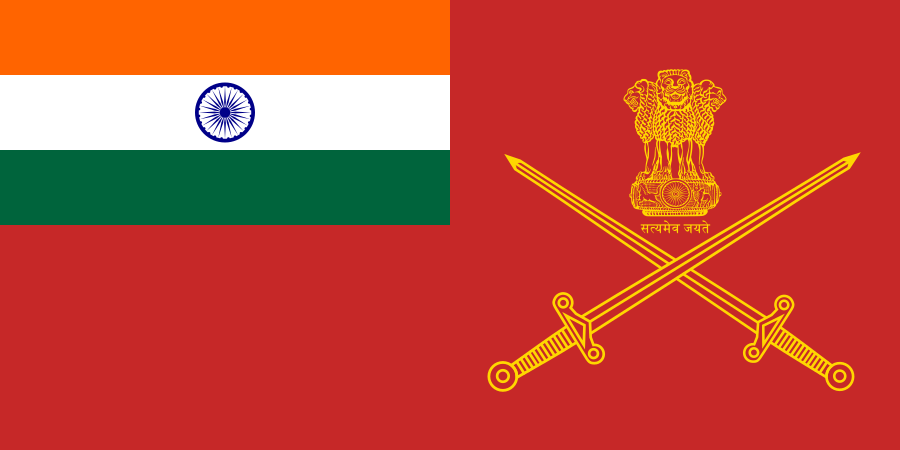 Indian Army Indian Army |
| Role | Mountain (Holding) Corps |
| Size | Corps |
| Part of |  Eastern Command Eastern Command |
| Garrison/HQ | Dimapur |
| Nickname(s) | Spear Corps |
| Commanders | |
| Current commander | Lt Gen Abhijit S Pendharkar, UYSM AVSM YSM |
| Notable commanders | Lt Gen Johnson P Mathew Lt Gen Ram Chander Tiwari Lt Gen Rana Pratap Kalita General Anil Chauhan Lt Gen Abhay Krishna General Bipin Rawat General Dalbir Singh Suhag Lt Gen Zameer Uddin Shah General Bipin Chandra Joshi Lt Gen Raj Mohan Vohra Lt Gen Joginder Singh Bakshi |
Template:Military unit sidebar The III Corps is a formation of the Indian Army that was formed during World War I in Mesopotamia during its respective campaign. Prior to the reorganization of the British and Indian forces in Mesopotamia, it was designated as the Tigris Corps.
A new III Corps was formed by the Indian Army during World War II for service in Southeast Asia. The corps fought in the Battle of Singapore where it surrendered in February 1942.[1]
It is headquartered in the state of Nagaland of India in the city of Dimapur, at Rangapahar Military Station.
History[edit | edit source]
3 Corps was raised during World War I by Lt Gen Ahlmer and soon thereafter, the command was changed to Lt Gen Frederick Stanley Maud, who was appointed as the Corps Commander on 09 Dec 1915. 3 Corps was allotted the 6th (Poona) Division and 12th Indian Division along with a Cavalry Brigade and tasked with the defence of the Tigris Line. The Corps thereby earned the sobriquet of "The Tigris Corps". 3 Corps played a major role in the Mesopotamian front, which was a campaign in the middle eastern theatre of World War I, fought between the Allies represented by the British Empire, troops from Britain, Australia and vast majority of British Raj, against the central powers, mostly the Ottoman Empire. The Theatre was vast and consisted of hot, inhospitable desert terrain. Tank warfare had still not achieved its primacy and deserts remained primarily a no man’s land. The fight was concentrated along the course of Tigris and the Euphrates rivers where Ottomans had a head start. The British had realised that they needed to secure and control the delta of Tigris at Shatt-El-Arab and Basra to deny the Ottomans access to Abadan Refinery and the oil rich delta. It also provided the British with a bridgehead for the induction of troops through the sea route and to maintain their forces logistically during future operations in the north. Keeping this as the broad objective, the British dispatched the 6th Indian Division as the Indian Expeditionary Force to Basra in 1915.
The Corps was later split into two separate formations, namely 1 and 3 Corps. I Corps moved northwards towards Mosul, while 3 Corps led a renewed offensive towards Baghdad, which finally fell to 3 Corps in 1916. The composition of 3 Corps was largely Indian troops and the credit for the swift capture of Baghdad was attributed to them. The Allied forces controlled a major part of Mesopotamia because of the fall of Baghdad, and most importantly, had direct access to the sea and the oldest refinery of Asia at Abadan. In view of the strategic objective of bringing Mesopotamia under British control and liberation of Kuwait from Ottoman control being achieved, an armistice was signed between the British and the Ottoman Empire.
The military phase of the operations in the Middle East was over, paving the way for political and diplomatic overtures. 3 Corps which had played a great role in achievement perhaps did not get its due compared to similar forces fighting in the European Theatre. The Corps was finally demobilized in 1919, only to be resurrected in 1941 during World War II.
World War II[edit | edit source]
HQ 3 Corps was raised on 27 Apr 1941 with headquarters at Kuala Lumpur. Lt Gen Percy Heath was placed in Command of the Corps. It had two Divisions, namely the 9th and 11th Indian Divisions under command.
11th Indian Division which was tasked to defend Kuala Lumpur and withdraw towards Thailand was outflanked by the Japanese. The Division fought major battles at Jitra from 08-12 Dec 1941, Kampar from 30 Dec 1941 to 02 Jan 1942, Slim River from 06 Jan to 08 Jan 1942, Gemas and Muar River from 14 Jan to 02 Jan 1942 and gave a good account of themselves, despite debilitating logistic shortcoming and virtually no air support. 9th and 11th Indian Division suffered significant casualties without any significant reinforcements.
During the Malayan campaign, 3 Corps had borne the brunt of War, and men suffered from inclement weather and tropical diseases apart from enemy action. Jungle terrain coupled with intolerable tropical weather and humidity made the conditions insuperable. Fighting here required the very best of human endurance, both mental and physical. 3 Corps had fought most of its battles in these virtually inhuman conditions, but there was little coverage of the same. While the trenches of Ypres, Somme, Alsace and Lorraine and those who fought in them were widely covered, the contributions of the anonymous Indians who died in Malaya remain un-recounted. 3 Corps virtually ceased to exist post Feb 1942.
III Corps: The Third Reincarnation[edit | edit source]
The Naga insurgency, over a period, gained inroads into the Hill districts of Manipur, Tirap and Changlang district of Arunachal Pradesh bordering Nagaland. 8 Mountain Division was re-raised in 1962 located at Zakhama.
Spear Corps participated in the 1962 Indo – China war. The famous Battle of Walong was in the then NEFA (Arunachal Pradesh). In autumn of 1962, during the Sino-Indian War, Walong was the scene of the Battle of Walong, where the Indian Army 11th Infantry Brigade battled the Chinese advances.[7] The killed and wounded numbered 642 Indians and 752 Chinese.[8] Indians were defeated at Walong, however the Chinese withdrawal allowed India to regain the territory.[6] A canopied memorial to the Indian war dead of 1962 was erected next to the airstrip with the following verses composed by a Walong veteran inscribed on it:[6]
The sentinel hills that round us stand
bear witness that we loved our land.
Amidst shattered rocks and flaming pine
we fought and died on Namti Plain
.
O Lohit gently by us glide
pale stars above us softly shine
as we sleep here in sun and rain.
Spear Corps was the formation directly under Headquarters Eastern Command to conduct operations against Naga insurgents. The spread of insurgency into new areas of Mizoram and Tripura necessitated the induction of additional troops. With the raising of 57 Mountain Division in 1969 at Masimpur, 8 Mountain Division was entrusted with Counter Insurgency Operations in Nagaland and Manipur, while 57 Mountain Division was responsible for conduct of operations in Mizoram and Tripura. Assam Rifles units were also involved in counter insurgency operations under respective brigade sized sector headquarters. There was a need to adopt a common cause and manifest a common effort. It was this requirement which precipitated the thought process for establishing a new headquarters as an umbrella organisation to counter the eco system of insurgency and eradicate it in a comprehensive manner. The seed for raising of a new Corps headquarter was sown in response and the idea of 3 Corps sprouted.
In 1984, Lt Gen Chiman Singh, the then General Officer Commanding-in Chief, Eastern Command deliberated upon the command, control and coordination of operations of the two Divisions fighting insurgency in the North East and decided to coordinate and streamline functioning of both these Formations under a Corps Headquarter. Headquarters 3 Corps was raised on 04 Feb 1985, by Lt Gen Joginder Singh Bakshi, MVC, at Rangapahar Military Station (RMS) in Dimapur (Nagaland) for coordination and conduct of Counter Insurgency Operations in Nagaland, Manipur, Mizoram, Tripura, Meghalaya, South Assam (including Dhubri Districts) and Arunachal Pradesh (Tirap and Changlang districts). 3 Corps replaced 8 Mountain Division as the highest Formation responsible for coordinating Counter Insurgency Operations in Nagaland and the adjoining Naga inhabited areas of other states.
Formation Sign : Spears Corps[edit | edit source]
The formation sign is inspired by the primary role of Infantry. Fittingly, the formation signs of the two formations under Head Quarters 3 Corps, the Bayonet of 8 Mountain Division and Crossed Spears of 57 Mountain Division, were superimposed to make the 3 Corps formation sign.
At the time of its formation, 3 Corps consisted of 8 Mountain Division and 57 Mountain Division, under its command. Additionally, Headquarters Inspector General Assam Rifles (North) (IGAR(N) was raised at Jorhat on 15 May 1985 and placed under operational control of 3 Corps. Post raising, the Headquarters IGAR(N) moved to Imphal and took over the operational responsibility of Manipur from 8 Mountain Division on 12 Nov 1986. 8 Mountain Division took over the responsibility of Tirap Sector.
3 Corps was actively involved in counter-insurgency operations in Manipur, Tripura and North Cachar Hills district of Assam. Besides, 3 Corps was also aiding the civil administration and paramilitary forces in maintaining peace in Nagaland and Mizoram. At the time, 3 Corps seemed likely to be replaced by the Directorate-General of Assam Rifles based in Shillong. The 57 Mountain Division based at Leimakhong in Manipur had already been shifted to Meerut in Uttar Pradesh.
Defending the LAC became an additional responsibility, apart from countering insurgency. With this additional responsibility to fulfil, two more Divisions were placed under command of HQ 3 Corps. With the raising of the Division Headquarters, its formations and units commenced its operations on 7 September 2009 under Major General Raj Nandan Singh. It took over the operations and entire responsibility of Western Arunachal Pradesh on 01 Jun 2010.
Order of battle[edit | edit source]
Jane's estimates that it consists of:[2]
- 2 Mountain Division (Dao Division) - The division joined III Corps in late 2000s and is headquartered at Dinjan, Dibrugarh district, Assam.[3][4]
- 56 Infantry Division - was raised at Zakhama, Nagaland and presently located at Likabali, North of the Brahmaputra,[9][10] Responsible for guarding of northern borders, internal security situation and disaster management in selected districts of Arunachal Pradesh and Assam.
- 57 Mountain Division (Red Shield Division) - headquartered at Leimakhong.[11] Raised in 1966 for counterinsurgency operations in Mizoram. Until 1990, headquartered at Aizawl with III Corps.[12] Globalsecurity.org reports the 57 Mountain Division headquarters are at Manipur near Silchar.[13] The formation and units of 57 Mountain Division are deployed in some of the remotest corner of Manipur and Indo-Burmese border.[14] 57th Mountain Division took part in the Indo-Pakistani War of 1971 as part of IV Corps. It also successfully conducted Operation Golden Bird in 1995 to eliminate rebels in Northeast India.[15]
- One Bhairav Light Commando Battalion[16]
Commanders[edit | edit source]
| Rank | Name | Appointment Date | Left office | Unit of Commission | References |
|---|---|---|---|---|---|
| Lieutenant General | Joginder Singh Bakshi | 5 March 1985 | 30 March 1986 | Jat Regiment | [17] |
| Raj Mohan Vohra | 31 March 1986 | 20 September 1987 | 4th Horse (Hodson's Horse) | [17] | |
| Vijay Madan | 21 September 1987 | 6 May 1989 | 4th Gorkha Rifles | [17] | |
| Bipin Chandra Joshi | 7 May 1989 | 17 May 1990 | 2nd Lancers (Gardner's Horse) | [17] | |
| B S Nalwa | 18 May 1990 | 13 May 1991 | Regiment of Artillery | [17] | |
| H K Kapoor | 14 May 1991 | 15 December 1992 | Corps of Engineers | [17] | |
| N S Malik | 16 December 1992 | 29 October 1994 | 4th Horse (Hodson's Horse) | [17] | |
| Krishna Mohan Seth | 30 October 1994 | 22 October 1995 | Regiment of Artillery | [17] | |
| S S Grewal | 23 October 1995 | 9 September 1997 | Jammu and Kashmir Rifles | [18] | |
| Rustom Kaikhusro Nanavatty | 10 September 1997 | 19 June 2000 | 8th Gorkha Rifles | [19] | |
| T S Shergill | 20 June 2000 | 4 October 2001 | 9th Deccan Horse | [20] | |
| V K Jetley | 5 October 2001 | 2 January 2003 | Dogra Regiment | [17][21] | |
| Rajinder Singh | 3 January 2003 | 31 December 2003 | Regiment of Artillery | [17][22] | |
| Daljeet Singh | 1 January 2004 | 22 September 2005 | 8th Light Cavalry | [23] | |
| Zameer Uddin Shah | September 2005 | September 2006 | Regiment of Artillery | [24] | |
| Manbir Singh Dadwal | September 2006 | 30 July 2008 | Dogra Regiment | [24][25] | |
| Rakesh Kumar Loomba | 31 July 2008 | August 2009 | 1st Horse (Skinner's Horse) | [26] | |
| Nand Kishore Singh | August 2009 | March 2011 | 3rd Gorkha Rifles | [27] | |
| Dalbir Singh Suhag | March 2011 | 19 June 2012 | 5th Gorkha Rifles (Frontier Force) | [28] | |
| Arun Kumar Sahni | 20 June 2012 | August 2013 | Regiment of Artillery | [29] | |
| Srinivasan Lakshmi Narasimhan | August 2013 | 31 August 2014 | Madras Regiment | [30] | |
| Bipin Rawat | 1 September 2014 | 22 November 2015 | 11th Gorkha Rifles | [31] | |
| Abhay Krishna | 23 November 2015 | 31 December 2016 | Rajputana Rifles | [32] | |
| Anil Chauhan | 1 January 2017 | 8 January 2018 | 11th Gorkha Rifles | [33] | |
| Gopal R | 9 January 2018 | 10 January 2019 | 8th Gorkha Rifles | [34] | |
| Rajeev Sirohi | 10 January 2019 | 10 January 2020 | The Grenadiers | [34] | |
| Rana Pratap Kalita | 11 January 2020 | 10 February 2021 | Kumaon Regiment | [35] | |
| Johnson P Mathew | 10 February 2021 | 1 March 2022 | Punjab Regiment | [36] | |
| Ram Chander Tewari | 1 March 2022 | 6 March 2023 | Kumaon Regiment | [37] | |
| Harjeet Singh Sahi | 6 March 2023 | 10 Aug 2024 | Rajput Regiment | [38] | |
| Abhijit S Pendharkar | 10 Aug 2024 | Incumbent | Assam Regiment | [39][40] |
Reference list[edit | edit source]
- ↑ Ramakrishna
- ↑ Jane's World Armies, Issue 19, 2006
- ↑ Pike, John. "2 Mountain Division". www.globalsecurity.org. Retrieved 2017-05-14.
- ↑ "Third battalion of Naga regiment be raised soon". 2009-10-16. Retrieved 2021-07-11.
- ↑ "Army steps in to help school". 2011-12-11. Retrieved 2021-11-12.
- ↑ Paranoia after Ulfa threat; Army steps up vigilance in upper Assam Archived 2012-10-24 at the Wayback Machine, The Telegraph, Calcutta, India, Thursday, December 20, 2007
- ↑ "Indian Army to begin deploying light howitzers in eastern sector". 2019-10-07. Retrieved 2021-11-12.
- ↑ "Ambush raises questions about security lapses". The Times of India. 2017-01-23. Retrieved 2021-11-12.
- ↑ "Army's first mountain division for China in northeast kicks off !!". Chindits. 11 November 2009. Archived from the original on 13 October 2018. Retrieved 12 October 2018.
- ↑ "Why mountain strike corps along the India-China border is important". 2013-10-07. Retrieved 2021-07-11.
- ↑ Pike, John. "57 Mountain Division / Red Shield Division". www.globalsecurity.org. Retrieved 2017-05-14.
- ↑ Conboy, Elite Forces of India and Pakistan, p.8
- ↑ Globalsecurity.org, 17 July 2010
- ↑ John Pike. "57 Mountain Division / Red Shield Division". Globalsecurity.org. Retrieved 2017-01-17.
- ↑ Bhaumik, Subir (10 December 2009). Troubled Periphery: The Crisis of India's North East By Subir Bhaumik. ISBN 9788132104797.
- ↑ "Army transforming its 382 infantry battalions with new weapons & drone platoons". The Times of India. 2025-10-23. ISSN 0971-8257. Retrieved 2025-10-24.
- ↑ 17.00 17.01 17.02 17.03 17.04 17.05 17.06 17.07 17.08 17.09 "New #DGMO Lt Gen Anil Chauhan (R) handing over charge of all imp 3 Corps in Dimapur to Lt Gen Gopal R." 2018-01-09. Retrieved 2021-07-11.
- ↑ "LT GENERAL SS GREWAL RETIRES". 2002-04-30. Retrieved 2021-07-11.
- ↑ "Reviewing Internal Armed Conflict in India-Forging a Joint Civil - Military Approach" (PDF). Archived from the original (PDF) on 2021-09-14. Retrieved 2021-07-11.
- ↑ "Army Top Brass Changed in N-E". 2000-06-11. Retrieved 2021-07-11.
- ↑ "Lt Gen V K Jetley takes over as Master General Ordinance". 2003-01-31. Retrieved 2021-07-11.
- ↑ "JS Verma visits Manipur". 2003-01-08. Retrieved 2021-07-11.
- ↑ "Annual Report, 2005 – 2006" (PDF). Retrieved 2021-07-11.
- ↑ 24.0 24.1 "Lt Gen Manbir assumes charge as GOC 3 Corps". 2006-09-20. Retrieved 2021-07-11.
- ↑ "Army Commander visits Manipur". 2008-05-15. Retrieved 2021-07-11.
- ↑ "Lt. Gen. Loomba new Military Intelligence chief". The Hindu. 2009-08-31. ISSN 0971-751X. Retrieved 2020-11-06.
- ↑ "Defence Minister Visits North-East". 2011-03-11. Retrieved 2021-07-11.
- ↑ "Defence ministry seeks report on notice to Lt Gen Suhag". 2012-05-25. Retrieved 2021-07-11.
- ↑ "GOC 3 Corps extends Vijay Diwas greetings". 2010-09-15. Retrieved 2021-07-11.
- ↑ "Lieutenant General Lt Gen Bipin Rawat takes over command of Spear Corps". 2014-08-31. Retrieved 2021-07-11.
- ↑ "Nagaland governor asks security forces to be careful in view of Naga accord". 2015-08-28. Retrieved 2021-07-11.
- ↑ "Lt Gen Abhay Krishna takes over as GOC Spear Corps". 2015-11-23. Retrieved 2021-07-11.
- ↑ "GOC 3 Corps Anil Chauhan Meets Arunachal Governor SV Shanmuganathan". 2017-01-04. Retrieved 2021-07-11.
- ↑ 34.0 34.1 "Lt. Gen Sirohi takes over as GOC 3 Corps". Nagaland Post. Archived from the original on 16 February 2020. Retrieved 23 July 2020.
- ↑ "lt-gen-rana-pratap-kalita-appointed-as-goc-3-corps-first-assamese-to-don-corps-commanders-mantle". 2020-02-10. Archived from the original on 2020-02-13. Retrieved 2020-02-14.
- ↑ Mathew, JP. "JP Mathew Spear Corps Commander". Archived from the original on 2021-06-12. Retrieved 2021-02-10.
- ↑ "Lt Gen RC Tiwari takes over as General Officer Commanding of Spear Corps". 2022-03-03. Retrieved 2022-03-03.
- ↑ "Lt Gen Sahi next GOC of 3 Corps | Nagaland Post". Retrieved 6 March 2023.
- ↑ "Lt Gen Abhijit S Pendharkar took over command of the Spear corps from Lt Gen HS Sahi". X (formerly twitter). 2024-08-10.
- ↑ "Lt Gen Pendharkar takes charge as GOC 3 Corps". nagalandpost.com. Retrieved 2024-08-12.
External links[edit | edit source]
- Australian War Memorial: Remembering 1942 The fall of Singapore, 15 February 1942 Archived 20 August 2008 at the Wayback Machine
- III Indian Corps History & Personnel Archived 2016-03-04 at the Wayback Machine
- http://www.orbat.com Archived 2018-11-16 at the Wayback Machine (History; Niehorster)
| Leadership | |||||||||||
|---|---|---|---|---|---|---|---|---|---|---|---|
| Components and Commands |
| ||||||||||
| Arms & Services |
| ||||||||||
| Military Academies |
| ||||||||||
| Other topics | |||||||||||

| By commands |
|  | ||||||||||||
|---|---|---|---|---|---|---|---|---|---|---|---|---|---|---|
| By number | ||||||||||||||
(*Currently assigned to South Western Command) | ||||||||||||||