




->BrownHairedGirl m some ref cleanup tags should be AFTER </ref>, replaced: {{Failed verification|date=December 2011}}</ref> → </ref>{{Failed verification|date=December 2011}} |
cleanup |
||
| (One intermediate revision by one other user not shown) | |||
| Line 1: | Line 1: | ||
{{Short description| | {{Use dmy dates|date=August 2024}} | ||
{{Short description|Maxim of see no evil, hear no evil, speak no evil}} | |||
{{Redirect|Sanzaru|the game company|Sanzaru Games}} | {{Redirect|Sanzaru|the game company|Sanzaru Games|the 2020 film| Sanzaru (film)}} | ||
{{Redirect|See no evil hear no evil|the 1989 comedy film|See No Evil, Hear No Evil}} | {{Redirect|See no evil hear no evil|the 1989 comedy film|See No Evil, Hear No Evil (film){{!}}''See No Evil, Hear No Evil '' (film)}} | ||
[[File:Toshogu Three Monkeys Restored 2024 Crop.jpg|thumb|The three wise monkeys at the [[Nikkō Tōshō-gū|Tōshō-gū]] shrine in [[Nikkō]], Japan]] | |||
[[File: | The {{nihongo|'''three wise monkeys'''|三猿|San'en|{{ipa|ja|saɰ̃.eɴ|}},<ref name=daijirin>{{cite book|script-title=ja:[[Daijirin|大辞林]]|publisher=[[Sanseidō]]|editor-last=Matsumura|editor-first=Akira|edition=4th|date=5 September 2019|lang=ja}}</ref> {{lit|three monkeys}}}} are a Japanese pictorial [[Maxim (philosophy)|maxim]], embodying the [[proverb]]ial principle "'''see no evil, hear no evil, speak no evil'''".<ref>[[Wolfgang Mieder]]. 1981. "The Proverbial Three Wise Monkeys," ''Midwestern Journal of Language and Folklore'', 7: 5- | ||
38.</ref> The three monkeys are | 38.</ref> The three monkeys are | ||
* '''Mizaru''' | * {{nihongo|'''Mizaru'''|見猿}}, covering his eyes and {{nihongo|"not seeing"|見ざる|mizaru}}, | ||
* '''Kikazaru''' | * {{nihongo3|'''Kikazaru'''|聞か猿}}, covering his ears and {{nihongo|"not hearing"|聞かざる|kikazaru}}, | ||
* '''Iwazaru''' | * {{nihongo3|'''Iwazaru'''|言わ猿}}, covering his mouth and {{nihongo|"not speaking"|言わざる|iwazaru}}.<ref name=daijirin /><ref>{{cite book |last= Japan Society of London |title= Transactions and proceedings of the Japan Society, London, Volume 1 |url= https://books.google.com/books?id=X-oVAAAAYAAJ&q=Mizaru+Kikazaru+Iwazaru |year= 1893 |publisher= Kegan Paul, Trench, Trübner and Co. |page= 98 }} Oldest reference to the correct monkey names in English.</ref> | ||
[[Lafcadio Hearn]] refers to them as the '''three mystic apes'''.<ref>[[Hearn, Lafcadio|Lafcadio Hearn]] (1894). ''Glimpses of unfamiliar Japan'', volume 2, p. 127.</ref> | [[Lafcadio Hearn]] refers to them as the '''three mystic apes'''.<ref>[[Hearn, Lafcadio|Lafcadio Hearn]] (1894). ''Glimpses of unfamiliar Japan'', volume 2, p. 127.</ref> | ||
There are | There are at least two divergent interpretations of the maxim: in Buddhist tradition, it is about avoiding evil thoughts and deeds. In the West, however, it is often interpreted as dealing with impropriety by [[turning a blind eye]].<ref name=searching>{{cite web|title=Searching for the fourth monkey in a corrupted world|url=http://www.nationmultimedia.com/home/2011/04/21/opinion/Searching-for-the-fourth-monkey-in-a-corrupted-wor-30153534.html|website=The Nation|access-date=19 June 2017|author=Pornpimol Kanchanalak|location=Thailand|date=21 April 2011|url-status=dead|archive-url=https://web.archive.org/web/20150828032149/http://www.nationmultimedia.com/home/2011/04/21/opinion/Searching-for-the-fourth-monkey-in-a-corrupted-wor-30153534.html|archive-date=28 August 2015}}</ref> | ||
Outside Japan the monkeys' names are sometimes given as ''Mizaru'', ''Mikazaru'' | Outside [[Japan]] the monkeys' names are sometimes given as ''Mizaru'', ''Mikazaru''{{Citation needed|date=March 2025}} and ''Mazaru'',<ref>{{cite book |last= Anderson |first= Isabel |title= The spell of Japan |url= https://books.google.com/books?id=B4JCAAAAIAAJ&q=Mazaru |year= 1920 |publisher= The Page Company |page= 379 }} Oldest reference of the incorrect ''Mazaru'' in Google Books. | ||
</ref> as the last two names were corrupted from the Japanese originals.<ref>{{cite book |last=Worth |first=Fred L. |title= The Trivia Encyclopedia |year= 1974 |publisher= Brooke House |isbn= 978-0-912588-12-4 |page=[https://archive.org/details/triviaencycloped00wort/page/262 262]|title-link=The Trivia Encyclopedia }}</ref><ref>{{cite book |last= Shipley |first= Joseph Twadell |title= The Origins of English Words: A Discursive Dictionary of Indo-European Roots |url= https://archive.org/details/originsofenglish00jose/page/249 |year= 2001 |publisher= [[Johns Hopkins University]] Press |isbn= 978-0-8018-6784-2 |page= [https://archive.org/details/originsofenglish00jose/page/249 249] }}</ref> The monkeys are [[Japanese macaque]]s, a common species in Japan. | </ref> as the last two names were corrupted from the Japanese originals.<ref>{{cite book |last=Worth |first=Fred L. |title= The Trivia Encyclopedia |year= 1974 |publisher= Brooke House |isbn= 978-0-912588-12-4 |page=[https://archive.org/details/triviaencycloped00wort/page/262 262]|title-link=The Trivia Encyclopedia }}</ref><ref>{{cite book |last= Shipley |first= Joseph Twadell |title= The Origins of English Words: A Discursive Dictionary of Indo-European Roots |url= https://archive.org/details/originsofenglish00jose/page/249 |year= 2001 |publisher= [[Johns Hopkins University]] Press |isbn= 978-0-8018-6784-2 |page= [https://archive.org/details/originsofenglish00jose/page/249 249] }}</ref> The monkeys are [[Japanese macaque]]s, a common species in Japan. | ||
==Origin== | ==Origin== | ||
[[File: | [[File:Nikkō Tōshō-gū 20170325-3.jpg|thumb|left|Tōshō-gū shrine stable. The “Wise monkeys” panel is the second from left.]] | ||
The source that popularized this pictorial [[Maxim (philosophy)|maxim]] is a 17th-century carving over a door of a stable of the [[Nikkō Tōshō-gū|Tōshō-gū]] shrine in [[Nikkō]], Japan. The carvings at Tōshō-gū Shrine were carved by [[Hidari Jingoro]], and are believed to have incorporated [[Confucius]]’s Code of Conduct, using the monkey as a way to depict man’s life cycle. There are a total of eight panels, and the iconic three wise monkeys picture comes from panel 2. The philosophy, however, probably originally came to Japan with a [[Tendai]]-[[Buddhist]] legend, from China in the 8th century ([[Nara Period]]). It has been suggested that the figures represent the three dogmas of the so-called middle school of the sect. | |||
The source that popularized this pictorial [[Maxim (philosophy)|maxim]] is a 17th-century carving over a door of the | |||
In [[Chinese language|Chinese]], | In [[Chinese language|Chinese]], two similar phrases exist: one is in the late ''[[Analects of Confucius]]'' (from 4th to 2nd century BCE), that reads: "Look not at what is contrary to propriety; listen not to what is contrary to propriety; speak not what is contrary to propriety; make no movement which is contrary to propriety" ({{lang|zh-hant|非禮勿視,非禮勿聽,非禮勿言,非禮勿動}});<ref>Original text: [[s:zh:論語#顏淵第十二|論語]] {{in lang|zh}}, [[s:The Analects#Part 12|Analects]] {{in lang|en}}</ref> the other is in the book ''[[Xunzi (book)|Xunzi]]'' (from the 3rd century BCE), which reads: "[The [[junzi|gentleman]]] makes his eyes not want to see what is not right, makes his ears not want to hear what is not right, makes his mouth not want to speak what is not right, and makes his heart not want to deliberate over what is not right" ({{lang|zh-hant|使目非是無欲見也,使耳非是無欲聞也,使口非是無欲言也,使心非是無欲慮也}}).<ref>Original text in ''[http://www.chinaknowledge.de/Literature/Poetry/sibucongkan.html Sibu Congkan]'', "Vol. 312". pages [https://ctext.org/library.pl?if=en&file=77669&page=32#%E4%BD%BF%E7%9B%AE%E9%9D%9E%E6%98%AF%E7%84%A1%E6%AC%B2%E8%A6%8B%E4%B9%9F%E4%BD%BF%E8%80%B3 32]-[https://ctext.org/library.pl?if=en&file=77669&page=33#%E9%9D%9E%E6%98%AF%E7%84%A1%E6%AC%B2%E8%81%9E%E4%B9%9F%E4%BD%BF%E5%8F%A3%E9%9D%9E%E6%98%AF%E7%84%A1%E6%AC%B2%E8%A8%80%E4%B9%9F%E4%BD%BF%E5%BF%83%E9%9D%9E%E6%98%AF%E7%84%A1%E6%AC%B2%E6%85%AE%E4%B9%9F 33] of 156</ref><ref>{{cite book|title=Xunzi - The Complete Text|author=Xun Kuang|author-link=Xun Kuang|translator=Eric L. Hutton|year=2014|location=Princeton|publisher=Princeton University Press|page= 8}}</ref> Those may be the inspiration for the pictorial maxim after Chinese works were brought into Japan. | ||
It is through the [[Kōshin]] rite of [[folk religion]] that the most significant examples are presented. | [[File:koshinscroll.jpg|thumb|upright|Kōshin scroll with the three monkeys|right]] | ||
It is through the [[Kōshin]] rite of [[folk religion]] that the most significant examples are presented. The Kōshin belief or practice is a Japanese folk religion with Chinese [[Taoism]] origins and ancient [[Shinto]] influence. It was founded by Tendai Buddhist monks in the late 10th century. A considerable number of stone monuments can be found all over the eastern part of Japan around [[Tokyo]]. During the later part of the [[Muromachi period]], it was customary to display stone pillars depicting the three monkeys during the observance of Kōshin.{{fact|date=August 2024}} | |||
Though the teaching had nothing to do with monkeys, the concept of the three monkeys originated from a simple play on words. The saying in Japanese is {{nihongo|''mizaru, kikazaru, iwazaru''|見ざる, 聞かざる, 言わざる|extra2="see not, hear not, speak not"}}, where | Though the teaching had nothing to do with monkeys, the concept of the three monkeys originated from a simple play on words. The saying in Japanese is {{nihongo|''mizaru, kikazaru, iwazaru''|見ざる, 聞かざる, 言わざる|extra2="see not, hear not, speak not"}},<ref name=daijirin/> where ''-zaru'' is a negative auxiliary suffix meaning "not" and happens to sound like a different ''-zaru'', the [[Rendaku|voiced]] form of {{nihongo||猿|saru|{{xlat|monkey}}}} used in compounds. | ||
The shrine at Nikko is a Shinto shrine, and the monkey is an extremely important being in the [[Shinto]] religion. The monkey is believed to be the messenger of the Hie Shinto shrines, which also have connections with Tendai Buddhism. There are | The shrine at Nikko is a Shinto shrine, and the monkey is an extremely important being in the [[Shinto]] religion. The monkey is believed to be the messenger of the Hie Shinto shrines, which also have connections with Tendai Buddhism. There are important festivals that are celebrated during the [[Monkey (zodiac)|year of the Monkey]] (occurring every twelve years) and a special festival is celebrated every sixteenth year of the [[Kōshin]].{{fact|date=August 2024}} | ||
"The Three Mystic Apes" (Sambiki Saru) were described as "the attendants of Saruta Hito no Mikoto or Kōshin, the God of the Roads".<ref>{{cite web|last=Joly|first=Henri L.|title=Legend in Japanese Art|url=https://archive.org/stream/legendinjapanese00jolyuoft/legendinjapanese00jolyuoft_djvu.txt|publisher=J. Lane|access-date=13 December 2011|location=London, New York|page=10|year=1908}}</ref> The Kōshin festival was held on the 60th day of the calendar. It has been suggested that during the Kōshin festival, according to old beliefs, one's bad deeds might be reported to heaven "unless avoidance actions were taken…". It has been theorized that the three Mystic Apes, Not Seeing, Hearing, or Speaking, may have been the "things that one has done wrong in the last 59 days". | "The Three Mystic Apes" (Sambiki Saru) were described as "the attendants of Saruta Hito no Mikoto or Kōshin, the God of the Roads".<ref>{{cite web|last=Joly|first=Henri L.|title=Legend in Japanese Art|url=https://archive.org/stream/legendinjapanese00jolyuoft/legendinjapanese00jolyuoft_djvu.txt|publisher=J. Lane|access-date=13 December 2011|location=London, New York|page=10|year=1908}}</ref> The Kōshin festival was held on the 60th day of the calendar. It has been suggested that during the Kōshin festival, according to old beliefs, one's bad deeds might be reported to heaven "unless avoidance actions were taken…". It has been theorized that the three Mystic Apes, Not Seeing, Hearing, or Speaking, may have been the "things that one has done wrong in the last 59 days".{{fact|date=August 2024}} | ||
According to other accounts, the monkeys caused the ''Sanshi'' and ''Ten-Tei'' not to see, say or hear the bad deeds of a person. The {{nihongo|''Sanshi''|三尸}} are the [[Three Corpses]] living in everyone's body. The Sanshi keep track of the good deeds and particularly the bad deeds of the person they inhabit. Every 60 days, on the night called {{nihongo|''Kōshin-Machi''|庚申待}}, if the person sleeps, the Sanshi will leave the body and go to {{nihongo|''Ten-Tei''|天帝}}, the Heavenly God, to report about the deeds of that person. Ten-Tei will then decide to punish bad people, making them ill, shortening their time alive, and in extreme cases putting an end to their lives. Those believers of Kōshin who have reason to fear will try to stay awake during Kōshin nights. This is the only way to prevent the Sanshi from leaving their body and reporting to Ten-Tei. | According to other accounts, the monkeys caused the ''Sanshi'' and ''Ten-Tei'' not to see, say or hear the bad deeds of a person. The {{nihongo|''Sanshi''|三尸}} are the [[Three Corpses]] living in everyone's body. The Sanshi keep track of the good deeds and particularly the bad deeds of the person they inhabit. Every 60 days, on the night called {{nihongo|''Kōshin-Machi''|庚申待}}, if the person sleeps, the Sanshi will leave the body and go to {{nihongo|''Ten-Tei''|天帝}}, the Heavenly God, to report about the deeds of that person. Ten-Tei will then decide to punish bad people, making them ill, shortening their time alive, and in extreme cases putting an end to their lives. Those believers of Kōshin who have reason to fear will try to stay awake during Kōshin nights. This is the only way to prevent the Sanshi from leaving their body and reporting to Ten-Tei. | ||
==Meaning of the proverb== | ==Meaning of the proverb== | ||
Just as there is disagreement about the origin of the phrase, there are differing explanations of the meaning of "see no evil, hear no evil, speak no evil". | Just as there is disagreement about the origin of the phrase, there are differing explanations of the meaning of "see no evil, hear no evil, speak no evil". | ||
* In Buddhist tradition, the tenets of the proverb are about not dwelling on evil thoughts. | * In Buddhist tradition, the tenets of the proverb are about not dwelling on evil thoughts. | ||
* The proverb and the image are often used to refer to a lack of moral responsibility on the part of people who refuse to acknowledge impropriety, [[turning a blind eye|looking the other way]] or feigning ignorance.<ref name="Olesen">{{cite news|title=How about monkey see, monkey DON'T do next time?|url=http://www.winnipegfreepress.com/opinion/columnists/how-about-monkey-see-monkey-dont-do-next-time-132842328.html|access-date=25 July 2012|newspaper=Winnipeg Free Press|date=29 October 2011|author=Tom Oleson}}</ref> | * The proverb and the image are often used to refer to a lack of moral responsibility on the part of people who refuse to acknowledge impropriety, [[turning a blind eye|looking the other way]] or feigning ignorance.<ref name="Olesen">{{cite news|title=How about monkey see, monkey DON'T do next time?|url=http://www.winnipegfreepress.com/opinion/columnists/how-about-monkey-see-monkey-dont-do-next-time-132842328.html|access-date=25 July 2012|newspaper=Winnipeg Free Press|date=29 October 2011|author=Tom Oleson}}</ref> | ||
==Variations== | ==Variations== | ||
[[File:Four wise monkeys.jpg|thumb|Sculpture of four monkeys, the fourth monkey is covering its genitals]] | [[File:Four wise monkeys.jpg|thumb|Sculpture of four monkeys, the fourth monkey is covering its genitals]] | ||
Sometimes there is a fourth monkey depicted, '''Sezaru''', also known as '''Shizaru''', who symbolizes the principle of "do no evil", which fits with the full quote from [[Analects of Confucius]].{{cn|date=December 2025}} The monkey may be shown crossing its arms or covering its genitals. Yet another variation has the fourth monkey hold its nose to avoid a stench and has been dubbed "smell no evil" accordingly.<ref name=searching/> | |||
The opposite version of the three wise monkeys can also be found. In this case, one monkey holds its hands to its eyes to focus vision, the second | [[File:Three wise monkeys crafted in Japan.jpg|thumb|Three wise monkeys variation : "Hear, speak, see only good"]] | ||
The opposite version of the three wise monkeys can also be found. In this case, one monkey holds its hands to its eyes to focus vision, the second monkey holds its hands to its mouth like a bullhorn, and the third monkey cups its hands around its ears to improve hearing. | |||
==Cultural influences== | ==Cultural influences== | ||
{{more citations needed section|date=November 2012}} | {{more citations needed section|date=November 2012}} | ||
[[File:Oak Ridge Wise Monkeys.jpg|thumb|A World War II poster directed at participants in the [[Manhattan Project]]]] | |||
[[File: | |||
The three wise monkeys, and the associated proverb, are known throughout Asia and outside Asia. They have been a motif in pictures, such as the [[ukiyo-e]] (Japanese woodblock printings) by [[Keisai Eisen]], and are frequently represented in modern culture. | The three wise monkeys, and the associated proverb, are known throughout Asia and outside Asia. They have been a motif in pictures, such as the [[ukiyo-e]] (Japanese woodblock printings) by [[Keisai Eisen]], and are frequently represented in modern culture. | ||
[[Mahatma Gandhi]]'s | [[File:Gandhiji's Three Monkeys.JPG|thumb|Representation of [[Mahatma Gandhi]]'s smaller statue of the three monkeys Bapu (Mizaru), Ketan (Kikazaru) and Bandar (Iwazaru), at the [[Sabarmati Ashram]] in [[Ahmedabad, Gujarat]], India]] | ||
[[Mahatma Gandhi]]'s main exception to his lifestyle of non-possession was a small statue of the three monkeys – Bapu, Ketan and Bandar – which was gifted to him by [[Nichidatsu Fujii]].<ref>{{Cite web |last=NATARAJAN |first=NARGIS |date=2023-04-02 |title=Bapu, Ketan, Bandar — And Then There Is The Fourth Monkey |url=https://www.thecitizen.in/opinion/bapu-ketan-bandar-and-then-there-is-the-fourth-monkey-896844 |access-date=2023-09-21 |website=www.thecitizen.in |language=en}}</ref> Today, a larger representation of the three monkeys is prominently displayed at the [[Sabarmati Ashram]] in [[Ahmedabad]], [[Gujarat]], where Gandhi lived from 1915 to 1930 and from where he departed on his famous [[Salt Satyagraha|salt march]]. Gandhi's statue also inspired a 2008 artwork by Subodh Gupta, ''[[Gandhi's Three Monkeys]]''.<ref>{{cite news|url=http://www.qatar-tribune.com/data/20120528/content.asp?section=nation1_5|title=QMA unveils Gandhi's 'Three Monkeys' at Katara|work=[[Qatar Tribune]]|date=28 May 2012|access-date=21 June 2012|url-status=dead|archive-url=https://web.archive.org/web/20120606062409/http://www.qatar-tribune.com/data/20120528/content.asp?section=nation1_5|archive-date=6 June 2012}}</ref> | |||
The three monkeys are depicted in the trial scene in the 1968 film ''[[Planet of the Apes]]''. In an example of [[semiotics]], the judges mimic the "see no evil, hear no evil, speak no evil" monkeys.<ref>{{cite | The three monkeys are depicted in the trial scene in the 1968 film ''[[Planet of the Apes (1968 film)|Planet of the Apes]]''. In an example of [[semiotics]], the judges mimic the "see no evil, hear no evil, speak no evil" monkeys.<ref name="revisited">{{cite book |last1=Russo |first1=Joe |last2=Landsman |first2=Larry |last3=Gross |first3=Edward |title=Planet of the Apes Revisited: The Behind-The Scenes Story of the Classic Science Fiction Saga |date=2001 |publisher=Thomas Dunne Books/St. Martin's Griffin |location=New York |isbn=0312252390 |edition=1st |url-access=registration |url=https://archive.org/details/isbn_9780312252397 |page=71}}</ref> | ||
In a spoof of this saying, [[Bob Dole]] quipped about a meeting of former US Presidents: "[[Jimmy Carter|Carter]], [[Gerald Ford|Ford]] and [[Richard Nixon|Nixon]]: see no evil, hear no evil and evil."<ref>{{cite news|url=https://www.nytimes.com/1996/03/07/opinion/liberties-let-dole-be-dole.html|title=Liberties;Let Dole Be Dole|work=[[New York Times]]|date=7 March 1996|access-date=9 March 2019}}</ref> | In a spoof of this saying, [[Bob Dole]] quipped about a meeting of former US Presidents: "[[Jimmy Carter|Carter]], [[Gerald Ford|Ford]] and [[Richard Nixon|Nixon]]: see no evil, hear no evil and evil."<ref>{{cite news|url=https://www.nytimes.com/1996/03/07/opinion/liberties-let-dole-be-dole.html|title=Liberties;Let Dole Be Dole|work=[[New York Times]]|date=7 March 1996|access-date=9 March 2019}}</ref> | ||
The maxim inspired an award-winning 2008 Turkish film by director [[Nuri Bilge Ceylan]] called ''[[Three Monkeys]]'' (''Üç Maymun''). | The maxim inspired an award-winning 2008 Turkish film by director [[Nuri Bilge Ceylan]] called ''[[Three Monkeys (film)|Three Monkeys]]'' (''Üç Maymun''). | ||
<!-- Many album covers and other media refer to the monkeys or the proverb—too many to mention. Please don't add these here. See talk page section "Trivia section of epic proportions". --> | <!-- Many album covers and other media refer to the monkeys or the proverb—too many to mention. Please don't add these here. See talk page section "Trivia section of epic proportions". --> | ||
==Unicode characters== | ==Unicode characters== | ||
[[Unicode]] provides [[emoji]] representations of the monkeys in the [[Emoticons (Unicode block)|Emoticons block]] as follows:<ref>[https://www.unicode.org/versions/Unicode6.0.0/ Unicode 6.0.0] characters in [[Emoticons#Unicode|Emoticons block]]: [https://www.fileformat.info/info/unicode/char/1f648/index.htm SEE-NO-EVIL MONKEY ‹🙈›], [https://www.fileformat.info/info/unicode/char/1f649/index.htm HEAR-NO-EVIL MONKEY ‹🙉›] and [https://www.fileformat.info/info/unicode/char/1f64a/index.htm SPEAK-NO-EVIL MONKEY ‹🙊›].</ref> | [[Unicode]] provides [[emoji]] representations of the monkeys in the [[Emoticons (Unicode block)|Emoticons block]] as follows:<ref>[https://www.unicode.org/versions/Unicode6.0.0/ Unicode 6.0.0] characters in [[Emoticons#Unicode|Emoticons block]]: [https://www.fileformat.info/info/unicode/char/1f648/index.htm SEE-NO-EVIL MONKEY ‹🙈›], [https://www.fileformat.info/info/unicode/char/1f649/index.htm HEAR-NO-EVIL MONKEY ‹🙉›] and [https://www.fileformat.info/info/unicode/char/1f64a/index.htm SPEAK-NO-EVIL MONKEY ‹🙊›].</ref> | ||
* | * {{unichar|1F648}} | ||
* | * {{unichar|1F649}} | ||
* | * {{unichar|1F64A}} | ||
==See also== | ==See also== | ||
{{Portal|Japan|Society|Animals}} | {{Portal|Japan|Society|Animals}} | ||
* {{anl|Civil inattention}} | |||
* {{anl|Conspiracy of silence (expression)}} | |||
* Buddhist [[Noble Eightfold Path]]: Right speech and right action | * Buddhist [[Noble Eightfold Path]]: Right speech and right action | ||
* Humata, Hukhta, Hvarshta, "good thoughts, good words, good deeds" in [[Zoroastrianism#Principal beliefs|Zoroastrianism]] | * Humata, Hukhta, Hvarshta, "good thoughts, good words, good deeds" in [[Zoroastrianism#Principal beliefs|Zoroastrianism]] | ||
| Line 97: | Line 77: | ||
* [[Plausible deniability]], being able to convincingly claim ignorance of something incriminating | * [[Plausible deniability]], being able to convincingly claim ignorance of something incriminating | ||
* [[Trikaya]], a formulation in Buddhism referring to body, speech and mind | * [[Trikaya]], a formulation in Buddhism referring to body, speech and mind | ||
* [[Willful | * {{anl|Turning a blind eye}} | ||
* [[Willful ignorance]], knowingly refraining from pursuing available information or knowingly sheltering oneself from information | |||
==Notes== | ==Notes== | ||
| Line 104: | Line 85: | ||
==References== | ==References== | ||
* {{cite book |last=Titelman|first=Gregory Y. |title=Random House Dictionary of America's Popular Proverbs and Sayings |edition=second |year=2000 |publisher=[[Random House]] |location=New York |isbn=978-0-375-70584-7}} | * {{cite book |last=Titelman|first=Gregory Y. |title=Random House Dictionary of America's Popular Proverbs and Sayings |edition=second |year=2000 |publisher=[[Random House]] |location=New York |isbn=978-0-375-70584-7}} | ||
* Archer Taylor, | * Archer Taylor, "Audi, Vidi, Tace" and the three monkeys | ||
* A. W. Smith, Folklore, Vol. 104, No. ½ pp. 144–150 "On the Ambiguity of the Three Wise Monkeys" | * A. W. Smith, Folklore, Vol. 104, No. ½ pp. 144–150 "On the Ambiguity of the Three Wise Monkeys" | ||
| Line 114: | Line 95: | ||
* [http://www.three-monkeys.info Information compiled by collectors] | * [http://www.three-monkeys.info Information compiled by collectors] | ||
* [http://www.onmarkproductions.com/html/monkey-saru-koushin.html Monkey(saru)-Kōshin] on onmarkproductions.com | * [http://www.onmarkproductions.com/html/monkey-saru-koushin.html Monkey(saru)-Kōshin] on onmarkproductions.com | ||
* [http://thethreemonkeys.com More Information compiled by Collectors] | * [http://thethreemonkeys.com More Information compiled by Collectors] {{Webarchive|url=https://web.archive.org/web/20100824172219/http://thethreemonkeys.com/ |date=24 August 2010 }} | ||
{{ | |||
{{Authority control}} | {{Authority control}} | ||
| Line 123: | Line 102: | ||
[[Category:Metaphors referring to monkeys]] | [[Category:Metaphors referring to monkeys]] | ||
[[Category:Trios]] | [[Category:Trios]] | ||
[[Category: | [[Category:Primates in Buddhism]] | ||
[[Category:Mammals in religion]] | [[Category:Mammals in religion]] | ||
[[Category:Mahatma Gandhi]] | [[Category:Mahatma Gandhi]] | ||
| Line 129: | Line 108: | ||
[[Category:Good and evil]] | [[Category:Good and evil]] | ||
[[Category:Mythological monkeys]] | [[Category:Mythological monkeys]] | ||
[[Category:Kōshin]] | |||
Latest revision as of 15:25, 10 March 2026

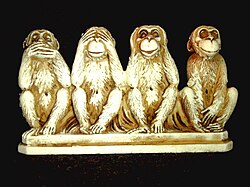
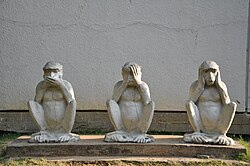
The Lua error in Module:Nihongo at line 206: attempt to call field '_transl' (a nil value). are a Japanese pictorial maxim, embodying the proverbial principle "see no evil, hear no evil, speak no evil".[2] The three monkeys are
- Mizaru (見猿), covering his eyes and Lua error in Module:Nihongo at line 206: attempt to call field '_transl' (a nil value).,
- Template:Nihongo3, covering his ears and Lua error in Module:Nihongo at line 206: attempt to call field '_transl' (a nil value).,
- Template:Nihongo3, covering his mouth and Lua error in Module:Nihongo at line 206: attempt to call field '_transl' (a nil value)..[1][3]
Lafcadio Hearn refers to them as the three mystic apes.[4]
There are at least two divergent interpretations of the maxim: in Buddhist tradition, it is about avoiding evil thoughts and deeds. In the West, however, it is often interpreted as dealing with impropriety by turning a blind eye.[5]
Outside Japan the monkeys' names are sometimes given as Mizaru, Mikazaru[citation needed] and Mazaru,[6] as the last two names were corrupted from the Japanese originals.[7][8] The monkeys are Japanese macaques, a common species in Japan.
Origin[edit | edit source]

The source that popularized this pictorial maxim is a 17th-century carving over a door of a stable of the Tōshō-gū shrine in Nikkō, Japan. The carvings at Tōshō-gū Shrine were carved by Hidari Jingoro, and are believed to have incorporated Confucius’s Code of Conduct, using the monkey as a way to depict man’s life cycle. There are a total of eight panels, and the iconic three wise monkeys picture comes from panel 2. The philosophy, however, probably originally came to Japan with a Tendai-Buddhist legend, from China in the 8th century (Nara Period). It has been suggested that the figures represent the three dogmas of the so-called middle school of the sect.
In Chinese, two similar phrases exist: one is in the late Analects of Confucius (from 4th to 2nd century BCE), that reads: "Look not at what is contrary to propriety; listen not to what is contrary to propriety; speak not what is contrary to propriety; make no movement which is contrary to propriety" (非禮勿視,非禮勿聽,非禮勿言,非禮勿動);[9] the other is in the book Xunzi (from the 3rd century BCE), which reads: "[The gentleman] makes his eyes not want to see what is not right, makes his ears not want to hear what is not right, makes his mouth not want to speak what is not right, and makes his heart not want to deliberate over what is not right" (使目非是無欲見也,使耳非是無欲聞也,使口非是無欲言也,使心非是無欲慮也).[10][11] Those may be the inspiration for the pictorial maxim after Chinese works were brought into Japan.

It is through the Kōshin rite of folk religion that the most significant examples are presented. The Kōshin belief or practice is a Japanese folk religion with Chinese Taoism origins and ancient Shinto influence. It was founded by Tendai Buddhist monks in the late 10th century. A considerable number of stone monuments can be found all over the eastern part of Japan around Tokyo. During the later part of the Muromachi period, it was customary to display stone pillars depicting the three monkeys during the observance of Kōshin.[citation needed]
Though the teaching had nothing to do with monkeys, the concept of the three monkeys originated from a simple play on words. The saying in Japanese is mizaru, kikazaru, iwazaru (見ざる, 聞かざる, 言わざる) "see not, hear not, speak not",[1] where -zaru is a negative auxiliary suffix meaning "not" and happens to sound like a different -zaru, the voiced form of Lua error in Module:Nihongo at line 206: attempt to call field '_transl' (a nil value). used in compounds.
The shrine at Nikko is a Shinto shrine, and the monkey is an extremely important being in the Shinto religion. The monkey is believed to be the messenger of the Hie Shinto shrines, which also have connections with Tendai Buddhism. There are important festivals that are celebrated during the year of the Monkey (occurring every twelve years) and a special festival is celebrated every sixteenth year of the Kōshin.[citation needed]
"The Three Mystic Apes" (Sambiki Saru) were described as "the attendants of Saruta Hito no Mikoto or Kōshin, the God of the Roads".[12] The Kōshin festival was held on the 60th day of the calendar. It has been suggested that during the Kōshin festival, according to old beliefs, one's bad deeds might be reported to heaven "unless avoidance actions were taken…". It has been theorized that the three Mystic Apes, Not Seeing, Hearing, or Speaking, may have been the "things that one has done wrong in the last 59 days".[citation needed]
According to other accounts, the monkeys caused the Sanshi and Ten-Tei not to see, say or hear the bad deeds of a person. The Sanshi (三尸) are the Three Corpses living in everyone's body. The Sanshi keep track of the good deeds and particularly the bad deeds of the person they inhabit. Every 60 days, on the night called Kōshin-Machi (庚申待), if the person sleeps, the Sanshi will leave the body and go to Ten-Tei (天帝), the Heavenly God, to report about the deeds of that person. Ten-Tei will then decide to punish bad people, making them ill, shortening their time alive, and in extreme cases putting an end to their lives. Those believers of Kōshin who have reason to fear will try to stay awake during Kōshin nights. This is the only way to prevent the Sanshi from leaving their body and reporting to Ten-Tei.
Meaning of the proverb[edit | edit source]
Just as there is disagreement about the origin of the phrase, there are differing explanations of the meaning of "see no evil, hear no evil, speak no evil".
- In Buddhist tradition, the tenets of the proverb are about not dwelling on evil thoughts.
- The proverb and the image are often used to refer to a lack of moral responsibility on the part of people who refuse to acknowledge impropriety, looking the other way or feigning ignorance.[13]
Variations[edit | edit source]

Sometimes there is a fourth monkey depicted, Sezaru, also known as Shizaru, who symbolizes the principle of "do no evil", which fits with the full quote from Analects of Confucius.[citation needed] The monkey may be shown crossing its arms or covering its genitals. Yet another variation has the fourth monkey hold its nose to avoid a stench and has been dubbed "smell no evil" accordingly.[5]

The opposite version of the three wise monkeys can also be found. In this case, one monkey holds its hands to its eyes to focus vision, the second monkey holds its hands to its mouth like a bullhorn, and the third monkey cups its hands around its ears to improve hearing.
Cultural influences[edit | edit source]
 | This section needs more citations. (November 2012) |

The three wise monkeys, and the associated proverb, are known throughout Asia and outside Asia. They have been a motif in pictures, such as the ukiyo-e (Japanese woodblock printings) by Keisai Eisen, and are frequently represented in modern culture.

Mahatma Gandhi's main exception to his lifestyle of non-possession was a small statue of the three monkeys – Bapu, Ketan and Bandar – which was gifted to him by Nichidatsu Fujii.[14] Today, a larger representation of the three monkeys is prominently displayed at the Sabarmati Ashram in Ahmedabad, Gujarat, where Gandhi lived from 1915 to 1930 and from where he departed on his famous salt march. Gandhi's statue also inspired a 2008 artwork by Subodh Gupta, Gandhi's Three Monkeys.[15]
The three monkeys are depicted in the trial scene in the 1968 film Planet of the Apes. In an example of semiotics, the judges mimic the "see no evil, hear no evil, speak no evil" monkeys.[16]
In a spoof of this saying, Bob Dole quipped about a meeting of former US Presidents: "Carter, Ford and Nixon: see no evil, hear no evil and evil."[17]
The maxim inspired an award-winning 2008 Turkish film by director Nuri Bilge Ceylan called Three Monkeys (Üç Maymun).
Unicode characters[edit | edit source]
Unicode provides emoji representations of the monkeys in the Emoticons block as follows:[18]
- U+1F648 🙈
- U+1F649 🙉
- U+1F64A 🙊
See also[edit | edit source]
- Civil inattention
- Conspiracy of silence (expression)
- Buddhist Noble Eightfold Path: Right speech and right action
- Humata, Hukhta, Hvarshta, "good thoughts, good words, good deeds" in Zoroastrianism
- Lashon hara, prohibition of gossip in Judaism
- Manasa, vacha, karmana, three Sanskrit words referring to mind, speech and actions
- Plausible deniability, being able to convincingly claim ignorance of something incriminating
- Trikaya, a formulation in Buddhism referring to body, speech and mind
- Turning a blind eye
- Willful ignorance, knowingly refraining from pursuing available information or knowingly sheltering oneself from information
Notes[edit | edit source]
- ↑ 1.0 1.1 1.2 Matsumura, Akira, ed. (5 September 2019). 大辞林 (in 日本語) (4th ed.). Sanseidō.
- ↑ Wolfgang Mieder. 1981. "The Proverbial Three Wise Monkeys," Midwestern Journal of Language and Folklore, 7: 5- 38.
- ↑ Japan Society of London (1893). Transactions and proceedings of the Japan Society, London, Volume 1. Kegan Paul, Trench, Trübner and Co. p. 98. Oldest reference to the correct monkey names in English.
- ↑ Lafcadio Hearn (1894). Glimpses of unfamiliar Japan, volume 2, p. 127.
- ↑ 5.0 5.1 Pornpimol Kanchanalak (21 April 2011). "Searching for the fourth monkey in a corrupted world". The Nation. Thailand. Archived from the original on 28 August 2015. Retrieved 19 June 2017.
- ↑ Anderson, Isabel (1920). The spell of Japan. The Page Company. p. 379. Oldest reference of the incorrect Mazaru in Google Books.
- ↑ Worth, Fred L. (1974). The Trivia Encyclopedia. Brooke House. p. 262. ISBN 978-0-912588-12-4.
- ↑ Shipley, Joseph Twadell (2001). The Origins of English Words: A Discursive Dictionary of Indo-European Roots. Johns Hopkins University Press. p. 249. ISBN 978-0-8018-6784-2.
- ↑ Original text: 論語 (in Chinese), Analects (in English)
- ↑ Original text in Sibu Congkan, "Vol. 312". pages 32-33 of 156
- ↑ Xun Kuang (2014). Xunzi - The Complete Text. Translated by Eric L. Hutton. Princeton: Princeton University Press. p. 8.
- ↑ Joly, Henri L. (1908). "Legend in Japanese Art". London, New York: J. Lane. p. 10. Retrieved 13 December 2011.
- ↑ Tom Oleson (29 October 2011). "How about monkey see, monkey DON'T do next time?". Winnipeg Free Press. Retrieved 25 July 2012.
- ↑ NATARAJAN, NARGIS (2 April 2023). "Bapu, Ketan, Bandar — And Then There Is The Fourth Monkey". www.thecitizen.in. Retrieved 21 September 2023.
- ↑ "QMA unveils Gandhi's 'Three Monkeys' at Katara". Qatar Tribune. 28 May 2012. Archived from the original on 6 June 2012. Retrieved 21 June 2012.
- ↑ Russo, Joe; Landsman, Larry; Gross, Edward (2001). Planet of the Apes Revisited: The Behind-The Scenes Story of the Classic Science Fiction Saga (1st ed.). New York: Thomas Dunne Books/St. Martin's Griffin. p. 71. ISBN 0312252390.
- ↑ "Liberties;Let Dole Be Dole". New York Times. 7 March 1996. Retrieved 9 March 2019.
- ↑ Unicode 6.0.0 characters in Emoticons block: SEE-NO-EVIL MONKEY ‹🙈›, HEAR-NO-EVIL MONKEY ‹🙉› and SPEAK-NO-EVIL MONKEY ‹🙊›.
References[edit | edit source]
- Titelman, Gregory Y. (2000). Random House Dictionary of America's Popular Proverbs and Sayings (second ed.). New York: Random House. ISBN 978-0-375-70584-7.
- Archer Taylor, "Audi, Vidi, Tace" and the three monkeys
- A. W. Smith, Folklore, Vol. 104, No. ½ pp. 144–150 "On the Ambiguity of the Three Wise Monkeys"
External links[edit | edit source]
- Collector's picture gallery
- Information compiled by collectors
- Monkey(saru)-Kōshin on onmarkproductions.com
- More Information compiled by Collectors Archived 24 August 2010 at the Wayback Machine