


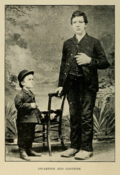



4ft. 5in |
Swebsexilm (talk | contribs) m minor update |
||
| Line 1: | Line 1: | ||
{{short description|Small size of an organism, caused by growth deficiency or genetic mutations}} | {{short description|Small size of an organism, caused by growth deficiency or genetic mutations}} | ||
{{About|the medical condition|the legendary creature|Dwarf (folklore)|other uses|Dwarf (disambiguation)}} | {{About|the medical condition|the legendary creature|Dwarf (folklore)|other uses|Dwarf (disambiguation)}} | ||
{{pp-vandalism|small=yes}} | |||
{{Infobox medical condition | <!-- Definition and symptoms --> | ||
| name | {{Infobox medical condition | ||
| image | | name = Dwarfism | ||
| caption | | image = Ethan Crough, male dwarf.jpg | ||
| field | | caption = A man in [[Columbus, Indiana]], with [[achondroplasia|achondroplasic]] dwarfism | ||
| pronounce | | field = [[Endocrinology]], [[medical genetics]] | ||
| symptoms | | pronounce = {{IPAc-en|ˈ|d|w|ɔːr|f|ɪ|z|əm|audio=LL-Q1860 (eng)-Flame, not lame-Dwarfism.wav}} | ||
| symptoms = | |||
| complications = | | complications = | ||
| onset | | onset = | ||
| duration | | duration = | ||
| types | | types = | ||
| causes | | causes = Hyposecretion of [[growth hormone]] from [[pituitary gland]] ([[growth hormone deficiency]]), [[genetic disorders]] | ||
| risks | | risks = | ||
| diagnosis | | diagnosis = | ||
| differential | | differential = | ||
| prevention | | prevention = | ||
| treatment | | treatment = | ||
| medication | | medication = | ||
| prognosis | | prognosis = | ||
| frequency | | frequency = | ||
| deaths | | deaths = | ||
| image_size | | image_size = 250 | ||
}} | }} | ||
'''Dwarfism''' is a condition of people and animals marked by unusually small size or short stature.<ref>{{cite web|url=https://www.merriam-webster.com/dictionary/dwarfism|title=Definition of DWARFISM|website=Merriam-webster.com|language=en|access-date=2017-05-04}}</ref> In humans, it is sometimes defined as an adult height of less than {{convert|4|ft|10|in|cm|order=flip}}, regardless of sex; the average adult height among people with dwarfism is {{convert|4|ft|cm|order=flip}}.<ref name="NLM2008">{{cite web|url=https://www.medlineplus.gov/dwarfism.html |title=MedlinePlus: Dwarfism |date=2008-08-04|publisher=National Institute of Health|work=MedlinePlus |access-date=2008-10-03}}</ref><ref name="lpaonline">{{cite web|url=http://www.lpaonline.org/faq-#Definition|title=FAQ|website=Lpaonline.org|language=en-us|access-date=2017-05-04}}</ref><ref name="mayo-symptoms" /> ''Disproportionate dwarfism'' is characterized by either [[Rhizomelia|short limbs]] or a short torso. In cases of ''proportionate dwarfism'', both the limbs and torso are unusually small. Intelligence is usually normal, and most people with it have a nearly normal life expectancy.<ref>{{cite web|url=http://www.nhs.uk/conditions/restricted-growth/Pages/Introduction.aspx|title=Restricted growth (dwarfism) – NHS Choices|website=Nhs.uk|language=en|access-date=2017-05-04}}</ref><ref name="Pau2012">{{cite journal |last1=Pauli |first1=RM |last2=Adam |first2=MP |last3=Ardinger |first3=HH |last4=Pagon |first4=RA |last5=Wallace |first5=SE |last6=Bean |first6=LJH |last7=Mefford |first7=HC |last8=Stephens |first8=K |last9=Amemiya |first9=A |last10=Ledbetter |first10=N |date=2012 |title=Achondroplasia |journal=GeneReviews |pmid=20301331}}</ref> People with dwarfism can usually bear children, although there are additional [[Pregnancy risks|risks to the mother and child]] depending upon the underlying condition. | |||
'''Dwarfism''' is a condition | |||
<!-- Causes and treatment --> | <!-- Causes and treatment --> | ||
The most common and | The most common and recognizable form of dwarfism in humans (comprising 70% of cases) is [[achondroplasia]], a [[genetic disorder]] whereby the limbs are diminutive.<ref name="Çevik-2010"/> [[Growth hormone deficiency]] is responsible for most other cases.<ref name="urlDwarfism"/> There are many other less common causes. Treatment of the condition depends on the underlying cause. Those with genetic disorders such as [[osteochondrodysplasia]] can sometimes be treated with surgery or physical therapy. [[Hormone disorders]] can also be treated with [[growth hormone therapy]] before the child's [[growth plate]]s fuse. Individual accommodations, such as specialized furniture, are often used by people with dwarfism.<ref name="pmid14671400">{{cite journal |vauthors=Hagenäs L, Hertel T |title=Skeletal dysplasia, growth hormone treatment and body proportion: comparison with other syndromic and non-syndromic short children |journal=Horm. Res. |volume=60 Suppl 3 |issue= 3|pages=65–70 |year=2003 |pmid=14671400 |doi=10.1159/000074504 |s2cid=29174195 |url=http://content.karger.com/produktedb/produkte.asp?typ=fulltext&file=HRE2003060S03065 |access-date=2008-11-17|url-access=subscription }}</ref> Many [[support groups]] provide services to aid individuals and the [[discrimination]] they may face.<ref name="mayo-treatment">{{cite web |url=http://www.mayoclinic.com/health/dwarfism/DS01012/DSECTION=treatments-and-drugs |title=Dwarfism: Treatment and drugs |access-date=2008-11-18 |date=2007-09-27 |publisher=Mayo Foundation for Medical Education and Research }}</ref> | ||
<!-- History, society, and culture --> | <!-- History, society, and culture --> | ||
In addition to the medical aspect of the condition | In addition to the medical aspect of the condition there are social aspects. For a person with dwarfism, [[height discrimination]] can lead to ridicule in childhood and discrimination in adulthood.<ref name="UPenn">{{Cite web |url=http://www.ssc.upenn.edu/~persico/research/Papers/short.pdf|archiveurl=https://web.archive.org/web/20070710052009/http://www.ssc.upenn.edu/~persico/research/Papers/short.pdf |url-status=dead |title=University of Pennsylvania, Arts and Sciences: 'The Effect of Adolescent Experience on Labor Market Outcomes: The Case of Height'|archive-date=10 July 2007|access-date=2 March 2022}}</ref> In the United Kingdom, United States, [[Canada]], [[Australia]], and other English-speaking countries, labels that some people with dwarfism accept include ''dwarf'' (plural: ''dwarfs''), ''little person'' (LP), or ''person of short stature'' (see [[#Terminology|terminology]]).<ref name="LPA">{{cite web |title=Dwarfism Resources: Frequently Asked Questions |publisher=Little People of America |date=2006-07-09 |url=http://www.lpaonline.org/resources_faq.html |archive-url=https://web.archive.org/web/20060516011550/http://www.lpaonline.org/resources_faq.html |archive-date=2006-05-16 |access-date=2006-11-14}}</ref><ref>{{cite web |title=LittlePeople UK |url=http://www.littlepeopleuk.org/ |access-date=3 October 2013}}</ref> Historically, the term ''[[midget]]'' was used to describe dwarfs (primarily proportionate); however, some now consider this term offensive.<ref>{{cite web |url=http://www.merriam-webster.com/dictionary/midget |title=midget |website=Merriam-Webster.com Dictionary}}</ref> | ||
==Signs and symptoms== | ==Signs and symptoms== | ||
[[File:Dackelpferd.jpg|thumb|upright=1.3|Dwarfism occurs in animals as well as humans; horses can have [[achondroplastic]] symptoms, as shown here next to a person with dwarfism. All small dog breeds exhibit dwarfism (the standard size of dogs, without interference from humans, is the same as that of the wolves).]] | [[File:Dackelpferd.jpg|thumb|upright=1.3|Dwarfism occurs in animals as well as humans; horses can have [[achondroplastic]] symptoms, as shown here next to a person with dwarfism. All small dog breeds exhibit dwarfism (the standard size of dogs, without [[Dog breeding|interference from humans]], is the same as that of the wolves).]] | ||
Dwarfism has been defined as having an adult height of less than {{convert|4|ft|10|in|cm|order=flip}},<ref name=NLM2008/><ref name="lpaonline"/><ref name="mayo-symptoms"/> or alternatively, having a height of at least two [[standard deviation]]s less than the mean of an individual's population, considering age, sex, and ancestry.<ref>{{cite journal |last1=Jain |first1=Megha |last2=Saber |first2=Ahmed Y. |date=2023-06-24 |title=Dwarfism |url=https://www.ncbi.nlm.nih.gov/books/NBK563282/ |journal= StatPearls [Internet] | publisher = StatPearls Publishing |access-date=23 March 2025 }}</ref><ref>{{cite journal |last1=Grunauer |first1=Michelle |last2=Jorge |first2=Alexander A L |date=Feb 2018 |title=Genetic short stature |journal= Growth Horm IGF Res. |volume=38 |issue=Epub 2017 Dec 6|pages=29–33 |doi=10.1016/j.ghir.2017.12.003 |pmid=29249624 }}</ref><ref>{{Cite web|url=https://www.cdc.gov/growthcharts/clinical_charts.htm|title=Growth Charts – Clinical Growth Charts|date=11 January 2019|website=Cdc.gov|access-date=2 March 2022}}</ref> There is a wide range of physical characteristics. Variations in individuals are identified by diagnosing and monitoring the underlying disorders. There may not be any complications outside adapting to their size. [[Short stature]] is a common replacement of the term 'dwarfism', especially in a medical context. However, those with mild [[Osteochondrodysplasia|skeletal dysplasias]] may not be affected by dwarfism. In some cases of untreated [[hypochondroplasia]], males grow up to {{convert|5|ft|5|in|cm|abbr=in|order=flip}}. Though that is short in a relative context, it does not fall into the extreme ranges of the growth charts. | |||
[[ | Disproportionate dwarfism is characterized by shortened limbs or a shortened torso. In [[achondroplasia]] one has an average-sized trunk with short limbs and a larger forehead.<ref name="dwarfism-pbshome" /> Facial features are often affected and individual body parts may have problems associated with them. [[Spinal stenosis]], [[ear infection]], and [[hydrocephalus]] are common. In case of spinal [[dysostosis]], one has a small trunk, with average-sized limbs. Proportionate dwarfism is marked by a short torso with short limbs,<ref name="mayo-symptoms">{{cite web|url=http://www.mayoclinic.com/health/dwarfism/DS01012/DSECTION=symptoms |title=Dwarfism: Symptoms |access-date=2009-01-29 |work=MayoClinic.com |publisher=Mayo Foundation for Medical Education and Research }}</ref> thus leading to a height that is significantly below average. There may be long periods without any significant growth. [[Sexual development]] is often delayed or impaired into adulthood. This dwarfism type is caused by an [[endocrine disorder]] and not a skeletal dysplasia. | ||
Physical effects of malformed bones vary according to the specific disease. Many involve joint pain caused by abnormal bone alignment, or from [[nerve]] compression.<ref name="LPA" /> Early degenerative joint disease, exaggerated [[lordosis]] or [[scoliosis]], and constriction of [[spinal cord]] or nerve roots can cause pain and disability.<ref name="seattle-dysplasia">{{cite web |url=http://orthopedics.seattlechildrens.org/conditions_treated/dwarfism_and_bone_dysplasias.asp |title=Dwarfism and Bone Dysplasias |access-date=2008-11-18 |publisher=Seattle Children's Hospital, Research & Foundation |url-status=dead |archive-url=https://web.archive.org/web/20070504091309/http://orthopedics.seattlechildrens.org/conditions_treated/dwarfism_and_bone_dysplasias.asp |archive-date=2007-05-04 }}</ref> Reduced [[thorax|thoracic]] size can restrict lung growth and reduce pulmonary function. Some forms of dwarfism are associated with disordered function of other organs, such as the [[brain]] or [[liver]], sometimes severely enough to be more of an impairment than the unusual bone growth.<ref name="mayo-complications">{{cite web|url=http://www.mayoclinic.com/health/dwarfism/DS01012/DSECTION=complications |title=Dwarfism: Complications |access-date=2008-11-18 |work=MayoClinic.com |publisher=Mayo Foundation for Medical Education and Research }}</ref><ref name="pmid5946547">{{cite journal |vauthors=Escamilla RF, Hutchings JJ, Li CH, Forsham P |title=Achondroplastic dwarfism. Effects of treatment with human growth hormone |journal=Calif Med |volume=105 |issue=2 |pages=104–10 |date=August 1966 |pmid=5946547 |pmc=1516352 }}</ref> Mental effects also vary according to the specific underlying syndrome. In most cases of skeletal dysplasia, such as achondroplasia, mental function is not impaired.<ref name="mayo-symptoms" /> However, there are syndromes which can affect the cranial structure and growth of the brain, severely impairing mental capacity. Unless the brain is directly affected by the underlying disorder, there is little to no chance of mental impairment that can be attributed to dwarfism.<ref>{{cite web |url=http://www.hormone.org/Growth/overview.cfm |title=The Pituitary Gland & Growth Disorders: An Overview |access-date=2009-02-22 |archive-url=https://web.archive.org/web/20130210025422/http://www.hormone.org/Growth/overview.cfm |archive-date=2013-02-10 |url-status=dead }}</ref> | |||
Physical effects of malformed bones vary according to the specific disease. Many involve joint pain caused by abnormal bone alignment, or from [[nerve]] compression.<ref name="LPA"/> Early degenerative joint disease, exaggerated [[lordosis]] or [[scoliosis]], and constriction of [[spinal cord]] or nerve roots can cause pain and disability.<ref name="seattle-dysplasia">{{cite web |url=http://orthopedics.seattlechildrens.org/conditions_treated/dwarfism_and_bone_dysplasias.asp |title=Dwarfism and Bone Dysplasias |access-date=2008-11-18 |publisher=Seattle Children's Hospital, Research & Foundation |url-status=dead |archive-url=https://web.archive.org/web/20070504091309/http://orthopedics.seattlechildrens.org/conditions_treated/dwarfism_and_bone_dysplasias.asp |archive-date=2007-05-04 }}</ref> Reduced [[thorax|thoracic]] size can restrict lung growth and reduce pulmonary function. Some forms of dwarfism are associated with disordered function of other organs, such as the [[brain]] or [[liver]], sometimes severely enough to be more of an impairment than the unusual bone growth.<ref name="mayo-complications">{{cite web|url=http://www.mayoclinic.com/health/dwarfism/DS01012/DSECTION=complications |title=Dwarfism: Complications |access-date=2008-11-18 |work=MayoClinic.com |publisher=Mayo Foundation for Medical Education and Research }}</ref><ref name="pmid5946547">{{cite journal |vauthors=Escamilla RF, Hutchings JJ, Li CH, Forsham P |title=Achondroplastic dwarfism. Effects of treatment with human growth hormone |journal=Calif Med |volume=105 |issue=2 |pages=104–10 |date=August 1966 |pmid=5946547 |pmc=1516352 }}</ref> | |||
Mental effects also vary according to the specific underlying syndrome. In most cases of skeletal dysplasia, such as achondroplasia, mental function is not impaired.<ref name="mayo-symptoms"/> However, there are syndromes which can affect the cranial structure and growth of the brain, severely impairing mental capacity. Unless the brain is directly affected by the underlying disorder, there is little to no chance of mental impairment that can be attributed to dwarfism.<ref | |||
The psycho-social limitations of society may be more disabling than the physical symptoms, especially in childhood and adolescence, but people with dwarfism vary greatly in the degree to which social participation and emotional health are affected. | The psycho-social limitations of society may be more disabling than the physical symptoms, especially in childhood and adolescence, but people with dwarfism vary greatly in the degree to which social participation and emotional health are affected. | ||
* Social prejudice against extreme shortness may reduce social and marital opportunities.<ref name="{{ISBN|0-8018-8121-8}}">{{cite book |author1=Hall, Judith A. |author2=Adelson, Betty M. |title=Dwarfism: medical and psychosocial aspects of profound short stature |publisher=Johns Hopkins University Press |location=Baltimore |year=2005 |isbn=0-8018-8121-8 }}</ref><ref name="pmid12884421">{{cite journal |vauthors=Gollust SE, Thompson RE, Gooding HC, Biesecker BB |date=August 2003 |title=Living with achondroplasia in an average-sized world: an assessment of quality of life |url=https://onlinelibrary.wiley.com/doi/10.1002/ajmg.a.20127 |journal=American Journal of Medical Genetics Part A |volume=120A |issue=4 |pages=447–58 |doi=10.1002/ajmg.a.20127 |pmid=12884421 |s2cid=38614817}}</ref> | * Social prejudice against extreme shortness may reduce social and marital opportunities.<ref name="{{ISBN|0-8018-8121-8}}">{{cite book |author1=Hall, Judith A. |author2=Adelson, Betty M. |title=Dwarfism: medical and psychosocial aspects of profound short stature |publisher=Johns Hopkins University Press |location=Baltimore |year=2005 |isbn=0-8018-8121-8 }}</ref><ref name="pmid12884421">{{cite journal |vauthors=Gollust SE, Thompson RE, Gooding HC, Biesecker BB |date=August 2003 |title=Living with achondroplasia in an average-sized world: an assessment of quality of life |url=https://onlinelibrary.wiley.com/doi/10.1002/ajmg.a.20127 |journal=American Journal of Medical Genetics Part A |volume=120A |issue=4 |pages=447–58 |doi=10.1002/ajmg.a.20127 |pmid=12884421 |s2cid=38614817|url-access=subscription }}</ref> | ||
* Numerous studies have demonstrated reduced employment opportunities. Severe shortness is associated with lower income.<ref name="pmid12884421"/> | * Numerous studies have demonstrated reduced employment opportunities. Severe shortness is associated with lower income.<ref name="pmid12884421"/> | ||
* [[Self-esteem]] may decline and family relationships may be affected. | * [[Self-esteem]] may decline and family relationships may be affected. | ||
| Line 62: | Line 56: | ||
===Achondroplasia=== | ===Achondroplasia=== | ||
{{further|Achondroplasia}} | {{further|Achondroplasia}} | ||
The most recognizable and most common form of dwarfism in humans is achondroplasia, which accounts for 70% of dwarfism cases, and occurs in 4 to 15 out of 100,000 live births.<ref name=" | The most recognizable and most common form of dwarfism in humans is achondroplasia, which accounts for 70% of dwarfism cases, and occurs in 4 to 15 out of 100,000 live births.<ref name="Çevik-2010">{{Cite journal|last1=Çevik|first1=Banu|last2=Çolakoğlu|first2=Serhan|url=http://www.meja.aub.edu.lb/downloads/20_6/907.pdf|title=Anesthetic management of achondroplastic dwarf undergoing cesarean section|journal=M.E.J. Anesth.|volume=20|issue=6|year=2010|archive-url=https://web.archive.org/web/20180713022612/http://www.meja.aub.edu.lb/downloads/20_6/907.pdf|url-status=dead|archive-date=July 13, 2018}}</ref> | ||
It produces [[Rhizomelia|rhizomelic]] short limbs, increased spinal curvature, and distortion of skull growth. In achondroplasia the body's limbs are proportionately shorter than the trunk (abdominal area), with a larger head than average and characteristic facial features. Achondroplasia is an [[autosomal dominant]] disorder caused by the presence of an altered [[allele]] in the genome. If a pair of achondroplasia alleles are present, the result is fatal. Achondroplasia is a mutation in the [[fibroblast growth factor receptor 3]].<ref>{{Gene|FGFR3}}</ref> In the context of achondroplasia, this mutation causes FGFR3 to become constitutively active, inhibiting bone growth.<ref | It produces [[Rhizomelia|rhizomelic]] short limbs, increased spinal curvature, and distortion of skull growth. In achondroplasia the body's limbs are proportionately shorter than the trunk (abdominal area), with a larger head than average and characteristic facial features. Achondroplasia is an [[autosomal dominant]] disorder caused by the presence of an altered [[allele]] in the genome. If a pair of achondroplasia alleles are present, the result is fatal, usually perinatally. Achondroplasia is a mutation in the [[fibroblast growth factor receptor 3]].<ref>{{Gene|FGFR3}}</ref> In the context of achondroplasia, this mutation causes FGFR3 to become constitutively active, inhibiting bone growth.<ref>{{cite web |url=http://ghr.nlm.nih.gov/condition=achondroplasia |archive-url=https://web.archive.org/web/20030607165211/http://ghr.nlm.nih.gov/condition=achondroplasia |url-status=dead |archive-date=June 7, 2003 |title=Achondroplasia – Genetics Home Reference |date=2008-09-26|work=Genetics Home Reference|publisher=National Institute of Health |access-date=2008-10-01}}</ref> | ||
===Growth hormone deficiency=== | ===Growth hormone deficiency=== | ||
| Line 71: | Line 65: | ||
===Metatropic dysplasia=== | ===Metatropic dysplasia=== | ||
Metatropic means "changing form" and refers to this form of skeletal dysplasia as there is an abnormality in the growth plates.<ref>{{cite web |url=https://www.hopkinsmedicine.org/health/conditions-and-diseases/metatropic-dysplasia#:~:text=What%20is%20metatropic%20dysplasia%3F,flattening%20of%20the%20vertebral%20bodies |title=Metatropic Dysplasia | |publisher=Johns Hopkins Medicine |date=2022-02-03 |access-date=2022-03-02}}</ref> Skeletal changes continue over time and may need surgical intervention to help protect the lungs.<ref name=" | Metatropic means "changing form" and refers to this form of skeletal dysplasia as there is an abnormality in the growth plates.<ref>{{cite web |url=https://www.hopkinsmedicine.org/health/conditions-and-diseases/metatropic-dysplasia#:~:text=What%20is%20metatropic%20dysplasia%3F,flattening%20of%20the%20vertebral%20bodies |title=Metatropic Dysplasia | |publisher=Johns Hopkins Medicine |date=2022-02-03 |access-date=2022-03-02}}</ref> Skeletal changes continue over time and may need surgical intervention to help protect the lungs.<ref name="NIH Rared Dseases">{{cite web|url=https://rarediseases.info.nih.gov/diseases/3571/metatropic-dysplasia |title=Metatropic dysplasia | Genetic and Rare Diseases Information Center (GARD) – an NCATS Program |website=Rarediseases.info.nih.gov |date= |access-date=2022-03-02}}</ref> Symptoms starting at birth may be mild or can be fatal.<ref name="Medlineplus.gov">{{Cite web|url=https://medlineplus.gov/genetics/condition/metatropic-dysplasia/|title=Metatropic dysplasia: MedlinePlus Genetics|website=Medlineplus.gov|access-date=2 March 2022}}</ref> There are recognizable features in individuals with this genetic disorder. Some are short stature, narrow chest, "facial features such as a prominent forehead, underdevelopment of the upper jaw, cheekbones and eye sockets (midface hypoplasia), and a squared-off jaw."<ref name="NIH Rared Dseases"/> It is considered a more severe skeletal dysplasia, but is very rare, with the exact number of those affected unknown.<ref name="Medlineplus.gov"/> Prognosis is largely on a case-by-case basis depending on the severity, and life expectancy may not be impacted unless there are respiratory complications.<ref>{{cite web|url=https://www.orpha.net/consor/cgi-bin/OC_Exp.php?lng=en&Expert=2635 |title=Orphanet: Metatropic dysplasia |website=Orpha.net |date=2017-05-17 |access-date=2022-03-02}}</ref> | ||
===Other=== | ===Other=== | ||
Other causes of dwarfism are [[spondyloepiphyseal dysplasia congenita]], [[diastrophic dysplasia]], [[pseudoachondroplasia]], [[hypochondroplasia]], [[Noonan syndrome]], [[primordial dwarfism]], [[Cockayne syndrome]], [[Kniest dysplasia]], [[Turner syndrome]], [[osteogenesis imperfecta]] (OI), and [[hypothyroidism]]. Severe shortness with skeletal distortion also occurs in several of the [[Mucopolysaccharidosis|mucopolysaccharidoses]] and other [[lysosomal storage disease|storage disorders]]. | Other causes of dwarfism are [[spondyloepiphyseal dysplasia congenita]], [[diastrophic dysplasia]], [[pseudoachondroplasia]], [[hypochondroplasia]], [[Noonan syndrome]], [[primordial dwarfism]], [[Cockayne syndrome]], [[Kniest dysplasia]], [[Turner syndrome]], [[osteogenesis imperfecta]] (OI), and [[hypothyroidism]]. Severe shortness with skeletal distortion also occurs in several of the [[Mucopolysaccharidosis|mucopolysaccharidoses]] and other [[lysosomal storage disease|storage disorders]]. [[Hypogonadotropic hypogonadism]] may cause proportionate, yet temporary, dwarfism. [[NPR2]] disproportionate dwarfism was discovered recently and is caused by a mutant gene.<ref>{{cite web|title=A Loss-of-Function Mutation in Natriuretic Peptide Receptor 2 (Npr2) Gene Is Responsible for Disproportionate Dwarfism in cn/cn Mouse|url=https://www.jbc.org/article/S0021-9258(19)60512-0/pdf|format=PDF|website=Jbc.org}}</ref> | ||
==Diagnosis== | ==Diagnosis== | ||
Dwarfism is often diagnosed in childhood on the basis of visible symptoms. A physical examination can usually suffice to diagnose certain types of dwarfism, but [[genetic testing]] and diagnostic imaging may be used to determine the exact condition. | Dwarfism is often diagnosed in childhood on the basis of visible symptoms. A physical examination can usually suffice to diagnose certain types of dwarfism, but [[genetic testing]] and diagnostic imaging may be used to determine the exact condition. In a person's youth, growth charts that track height can be used to diagnose subtle forms of dwarfism that have no other striking physical characteristics.<ref name="urlDwarfism"/> | ||
Short stature or stunted growth during youth is usually what brings the condition to medical attention. Skeletal [[dysplasia]] is usually suspected because of obvious physical features (e.g., unusual configuration of face or shape of skull), because of an obviously affected parent, or because body measurements (arm span, upper to lower segment ratio) indicate disproportion. | Short stature or stunted growth during youth is usually what brings the condition to medical attention. Skeletal [[dysplasia]] is usually suspected because of obvious physical features (e.g., unusual configuration of face or shape of skull), because of an obviously affected parent, or because body measurements (arm span, upper to lower segment ratio) indicate disproportion. Bone X-rays are often key to diagnosing a specific skeletal dysplasia, but are not the sole diagnostic tool. Most children with suspected skeletal dysplasias are referred to a genetics clinic for diagnostic confirmation and [[genetic counseling]]. Since about the year 2000, genetic tests for some of the specific disorders have become available.<ref name="mayo-diagnosis">{{cite web|url=http://www.mayoclinic.com/health/dwarfism/DS01012/DSECTION=tests-and-diagnosis |title=Dwarfism: Tests and diagnosis |access-date=2008-11-18 |date=2007-08-27 |work=Mayo Clinic |publisher=Mayo Foundation for Medical Education and Research }}</ref> | ||
During an initial medical evaluation of shortness, the absence of disproportion and other clues listed above usually indicates causes other than bone dysplasias. | During an initial medical evaluation of shortness, the absence of disproportion and other clues listed above usually indicates causes other than bone dysplasias. | ||
| Line 105: | Line 97: | ||
==Prevention== | ==Prevention== | ||
Many types of dwarfism are currently impossible to prevent because they are genetically caused. Genetic conditions that cause dwarfism may be identified with [[genetic testing]], by screening for the specific variations that result in the condition. However, due to the number of causes of dwarfism, it may be impossible to determine definitively if a child will be born with dwarfism. | Many types of dwarfism are currently impossible to prevent because they are genetically caused. Genetic conditions that cause dwarfism may be identified with [[genetic testing]], by screening for the specific variations that result in the condition. However, due to the number of causes of dwarfism, it may be impossible to determine definitively if a child will be born with dwarfism. Dwarfism resulting from malnutrition or a hormonal abnormality may be treated with an appropriate diet or hormonal therapy. Growth hormone deficiency may be remedied via [[Growth hormone therapy|injections of human growth hormone]] during childhood.<ref>{{Citation |last1=Jørgensen |first1=Jens O.L. |title=Clinical Aspects of Growth Hormone Deficiency in Adults |date=2005 |url=https://www.karger.com/Article/Abstract/88338 |work=Growth Hormone Deficiency in Adults |volume=33 |pages=1–20 |publisher=KARGER |doi=10.1159/000088338 |isbn=3-8055-7992-6 |pmid=16166752 |last2=Christiansen |first2=Jens S.|url-access=subscription }}</ref> | ||
Dwarfism resulting from malnutrition or a hormonal abnormality may be treated with an appropriate diet or hormonal therapy. Growth hormone deficiency may be remedied via [[Growth hormone therapy|injections of human growth hormone | |||
==Management== | ==Management== | ||
Genetic mutations of most forms of dwarfism caused by bone dysplasia cannot be altered yet, so therapeutic interventions are typically aimed at preventing or reducing pain or physical disability, increasing adult height, or mitigating psychosocial stresses and enhancing social adaptation.<ref name="mayo-treatment"/> | Genetic mutations of most forms of dwarfism caused by bone dysplasia cannot be altered yet, so therapeutic interventions are typically aimed at preventing or reducing pain or physical disability, increasing adult height, or mitigating psychosocial stresses and enhancing social adaptation.<ref name="mayo-treatment"/> Forms of dwarfism associated with the endocrine system may be treated using [[hormonal therapy]]. If the cause is prepubescent hyposecretion of growth hormone, supplemental growth hormone may correct the abnormality. If the receptor for growth hormone is itself affected, the condition may prove harder to treat. [[Hypothyroidism]] is another possible cause of dwarfism that can be treated through hormonal therapy. Injections of thyroid hormone can mitigate the effects of the condition, but lack of proportion may be permanent. | ||
Forms of dwarfism associated with the endocrine system may be treated using [[hormonal therapy]]. If the cause is prepubescent hyposecretion of growth hormone, supplemental growth hormone may correct the abnormality. If the receptor for growth hormone is itself affected, the condition may prove harder to treat. [[Hypothyroidism]] is another possible cause of dwarfism that can be treated through hormonal therapy. Injections of thyroid hormone can mitigate the effects of the condition, but lack of proportion may be permanent. | |||
Pain and disability may be ameliorated by physical therapy, braces or other orthotic devices, or by surgical procedures.<ref name="mayo-treatment"/> The only simple interventions that increase perceived adult height are dress enhancements, such as shoe lifts or hairstyle. Growth hormone is rarely used for shortness caused by bone dysplasias, since the height benefit is typically small (less than {{cvt|5|cm|round=0.5|disp=sqbr}}) and the cost high.<ref name="pmid14671400"/> The most effective means of increasing adult height by several inches is [[distraction osteogenesis]], though availability is limited and the cost is high in terms of money, discomfort, and disruption of life. Most people with dwarfism do not choose this option, and it remains controversial.<ref name="LPA"/> For other types of dwarfism, surgical treatment is not possible. | Pain and disability may be ameliorated by physical therapy, braces or other orthotic devices, or by surgical procedures.<ref name="mayo-treatment"/> The only simple interventions that increase perceived adult height are dress enhancements, such as shoe lifts or hairstyle. Growth hormone is rarely used for shortness caused by bone dysplasias, since the height benefit is typically small (less than {{cvt|5|cm|round=0.5|disp=sqbr}}) and the cost high.<ref name="pmid14671400"/> The most effective means of increasing adult height by several inches is [[distraction osteogenesis]], though availability is limited and the cost is high in terms of money, discomfort, and disruption of life. Most people with dwarfism do not choose this option, and it remains controversial.<ref name="LPA"/> For other types of dwarfism, surgical treatment is not possible. | ||
| Line 119: | Line 107: | ||
===Terminology=== | ===Terminology=== | ||
[[File:Dwarfism and Gigantism.png|thumb|Comparative illustration from Talbot's 1889 medical treatise named ''[[Degeneration theory|Degeneracy]]: its causes, signs and results'']] | |||
[[File:Two Völuspá Dwarves by Frølich.jpg|thumb|Two [[Norse mythology|Norse]] [[Dwarf (mythology)|dwarfs]] as depicted in a 19th-century edition of the ''[[Poetic Edda]]'' poem ''[[Völuspá]]'' (1895) by [[Lorenz Frølich]]]] | [[File:Two Völuspá Dwarves by Frølich.jpg|thumb|Two [[Norse mythology|Norse]] [[Dwarf (mythology)|dwarfs]] as depicted in a 19th-century edition of the ''[[Poetic Edda]]'' poem ''[[Völuspá]]'' (1895) by [[Lorenz Frølich]]]] | ||
The appropriate term for describing a person of particularly short stature (or with the genetic condition [[achondroplasia]]) has developed euphemistically. | The appropriate term for describing a person of particularly short stature (or with the genetic condition [[achondroplasia]]) has developed euphemistically. | ||
The noun ''dwarf'' stems from | The noun ''dwarf'' stems from {{langx|ang|dweorg}}, originally referring to a being from [[Germanic mythology]]—a [[dwarf (Germanic mythology)|dwarf]]—that dwells in mountains and in the earth, and is associated with wisdom, smithing, mining, and crafting. The [[etymology]] of the word ''dwarf'' is contested, and scholars have proposed varying theories about the origins of the being, including that dwarfs may have originated as nature spirits or as beings associated with death, or as a mixture of concepts. Competing etymologies include a basis in the [[Proto-Indo-European root|Indo-European]] root {{lang|ine-x-proto|dheur-}} (meaning {{gloss|damage}}), the Indo-European root {{lang|ine-x-proto|dhreugh}} (whence modern Dutch {{lang|nl|droom}} {{gloss|dream}} and {{lang|nl|bedrog}} {{gloss|deception}}), and comparisons have been made with the Old Indian ''dhvaras'' (a type of demonic being). The being may not have gained associations with small stature until a later period.<ref name="SIMEK67-68">[[Rudolf Simek|Simek, Rudolf]] (2007) translated by Angela Hall. ''[https://books.google.com/books?id=Zni8GwAACAAJ Dictionary of Northern Mythology]'', pp. 67–68. [[Boydell & Brewer|D.S. Brewer]] {{ISBN|0-85991-513-1}}</ref> | ||
The terms "little person", "LP" and "person of short stature" are the preferred terms of those with this disorder, and while | The terms "little person", "LP" and "person of short stature" are the preferred terms of many of those with this disorder, and while some are uncomfortable with "dwarf" it remains a common term in some areas.<ref>{{Citation |url=https://www.washington.edu/doit/how-are-terms-dwarf-little-person-and-person-short-stature-commonly-used|title=How are the terms "dwarf," "little person," and "person of short stature" commonly used?}}</ref><ref>{{Citation |url=https://littlepeopleofontario.com/index.php?rt=product/category&path=64_79|title=Preferred Terms}}</ref><ref name="dwarfism-pbshome"/> However, the plural "dwarfs" as opposed to "dwarves" is generally preferred in the medical context, possibly because the plural "dwarves" was popularized by author [[J. R. R. Tolkien]], describing a race of characters in his ''[[The Lord of the Rings]]'' books resembling [[Dwarf (folklore)#Eddic sources|Norse dwarfs]].<ref>{{cite book|last=Tolkien|first=John Ronald Reuel|title=The Return of the King|year=1955|publisher=George Allen & Unwin|pages=Appendix F|url=http://valarguild.org/varda/Tolkien/encyc/articles/d/dwarves/dwarfpluralof.htm}}</ref> "[[Midget]]", whose etymology indicates a "tiny biting insect",<ref name="midget-def">{{cite web|url=http://dictionary.reference.com/browse/midget |title=midget |access-date=2008-11-18 |work=Online Etymology Dictionary |publisher=Dictionary.com }}</ref> came into prominence in the mid-19th century after [[Harriet Beecher Stowe]] used it in her novels ''Sunny Memories of Foreign Lands'' and ''[[Oldtown Folks]]'' where she described children and an extremely short man, respectively.<ref name="dwarfism-pbshome" /> Later some people of short stature considered the word to be offensive because it was the descriptive term applied to [[P. T. Barnum]]'s dwarfs used for public amusement during the [[freak show]] era.<ref name="LPA" /><ref name="Adelson2005">{{cite book|last=Adelson|first=Betty M.|title=The Lives Of Dwarfs: Their Journey From Public Curiosity Toward Social Liberation|url=https://books.google.com/books?id=Ym5x3mq2p7EC&pg=PA295|access-date=8 December 2012|year=2005|publisher=Rutgers University Press|isbn=9780813535487|page=295}}</ref> It is also not considered accurate as it is not a medical term or diagnosis, though it is sometimes used as a slang term to describe those who are particularly short, whether or not they have dwarfism.<ref name="midget-med">{{cite web |url=http://www.medterms.com/script/main/art.asp?articlekey=22596 |title=Midget definition |access-date=2008-11-18 |date=9 March 2003 |work=MedicineNet |publisher=MedicineNet, Inc. |archive-date=2011-06-23 |archive-url=https://web.archive.org/web/20110623204524/http://www.medterms.com/script/main/art.asp?articlekey=22596 |url-status=dead }}</ref> | ||
=== Participation === | |||
Individuals with dwarfism are capable of actively participating in various aspects of society. They have access to education and sports, and can pursue careers, engaging in a wide range of professions.<ref>{{Cite web |url=https://www.lpaonline.org/assets/documents/Occupations%20and%20Professions.pdf |title=OCCUPATIONS AND AVOCATIONS |author=Fred Short |date=2008 |accessdate=2023-11-18 |work=Little People of America |publisher=lpaonline.org |language=en}}</ref> | |||
=== | === Acceptance === | ||
Individuals with dwarfism often face prejudice and stereotypes. Research by Klein (2019) has demonstrated that awareness of the stigmatization of this group can promote full participation in society.<ref>{{Cite journal |last=Klein |first=A. |title=Stigmatization and Little People. |volume=75 |issue=4 |pages=1133–1150 |year=2019 |journal=Journal of Social Issues |language=en}}</ref> The research by Green and Pinter (2018) in the field of humor and social psychology can provide insights to reduce stereotypes and promote a more objective perception.<ref>{{Cite journal |last=Green; Pinter |first=C.M.; K |title=Humor, comedy, and consumer behavior: A social psychological perspective. |volume=48 |journal=Journal of Applied Social Psychology |year=2018 |number=12 |pages=677–692 |language=en}}</ref> | |||
=== Accommodation === | |||
[[File:Pedal extenders for short statured individuals (skeletal dysplasia).jpg|thumb|right|Pedal extenders for short statured individuals (skeletal dysplasia)]] | |||
In daily life, little people face numerous obstacles because the environment is tailored to average-sized individuals. Some little people can only use ATMs, kitchens, toilets, and sinks with aids. Low stools and step stools play a special role, as they can be used in various ways to bridge the height difference. | |||
Stools are also useful as footrests while sitting, as the legs of short people dangle in the air when sitting on an average chair, which can be painful and uncomfortable in the long run and may hinder fine motor skills during work. | |||
To be mobile, some individuals use customized scooters or bicycles, as it can be problematic, depending on the type of short stature, to walk longer distances. With specially adapted vehicles, most individuals of short stature can drive without further hindrances. Generally, pedal extensions and an individually adjusted seat at the correct height are required. Some little people are tall enough to drive without pedal extensions. Usually, patients with skeletal dysplasia with limited mobility can receive allowances or grants for vehicle assistance through [[Government Aid|governmental help]] or rehabilitation providers. | |||
===Dwarf sports=== | |||
Dwarfs have support and compete in sport by a number of [[List of dwarfism organizations|organizations]] nationally and internationally. They are included in some events in the [[athletics at the Summer Paralympics]]. | |||
For instance, swimming and bicycling are often recommended for people with skeletal dysplasias, since those activities put minimal pressure on the spine.<ref>{{cite web|url=http://www.chop.edu/conditions-diseases/skeletal-dysplasias|title=Skeletal Dysplasias|first=The Children's Hospital of|last=Philadelphia|date=25 March 2014|website=Chop.edu}}</ref> | The [[Dwarf Athletic Association of America]] and the [[Dwarf Sports Association UK]] provide opportunities for dwarfs to compete nationally and internationally in the Americas and Europe, respectively. The [[World Dwarf Games]] (WDG) are a multi-sport event for athletes of short stature. The WDG have been held every four years since 1993 and are the world's largest sporting event exclusively for athletes with dwarfism. The Dwarf Sports Association UK organizes between 5 and 20 events per month for athletes with restricted growth conditions in the UK.<ref>{{cite web| url = https://www.dsauk.org/events/?daterange=2®ion_ID=0| title = DSAuk Events| website =Dsauk.org| access-date = 2016-02-27}}</ref> For instance, swimming and bicycling are often recommended for people with skeletal dysplasias, since those activities put minimal pressure on the spine.<ref>{{cite web|url=http://www.chop.edu/conditions-diseases/skeletal-dysplasias|title=Skeletal Dysplasias|first=The Children's Hospital of|last=Philadelphia|date=25 March 2014|website=Chop.edu}}</ref> | ||
Since its early days, [[professional wrestling]] has had the involvement of dwarf athletes. "[[Midget wrestling]]" had its heyday in the 1950s–'70s, when wrestlers such as [[Little Beaver (wrestler)|Little Beaver]], [[Lord Littlebrook]], and [[Fuzzy Cupid]] toured North America, and [[Sky Low Low]] was the first holder of the [[National Wrestling Alliance]]'s [[NWA World Midget's Championship|World Midget Championship]]. In the | Since its early days, [[professional wrestling]] has had the involvement of dwarf athletes. "[[Midget wrestling]]" had its heyday in the 1950s–'70s, when wrestlers such as [[Little Beaver (wrestler)|Little Beaver]], [[Lord Littlebrook]], and [[Fuzzy Cupid]] toured North America, and [[Sky Low Low]] was the first holder of the [[National Wrestling Alliance]]'s [[NWA World Midget's Championship|World Midget Championship]]. In the next couple of decades, more wrestlers became prominent in North America including foreign wrestlers like [[Japan]]'s [[Little Tokyo (wrestler)|Little Tokyo]]. Although the term is seen by some as pejorative, many past and current midget wrestlers including [[Hornswoggle]] said they take pride in the term due to its history in the industry and its marketability.{{citation needed|date=June 2020}} | ||
===Art and media depictions=== | ===Art and media depictions=== | ||
{{See also|Cultural depictions of dwarfism|List of people with dwarfism|Dwarfs and pygmies in Ancient Egypt}} | {{See also|Cultural depictions of dwarfism|List of people with dwarfism|Dwarfs and pygmies in Ancient Egypt}} | ||
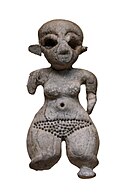
[[File:Ivory statuette of a woman with dwarfism-IMG 4539-white.jpg|thumb|upright|Ivory statuette of a woman with dwarfism, [[Gerzeh culture]] (Naqada II), [[Prehistoric Egypt]]]] | [[File:Ivory statuette of a woman with dwarfism-IMG 4539-white.jpg|thumb|upright|Ivory statuette of a woman with dwarfism, [[Gerzeh culture]] (Naqada II), in the [[Prehistoric Egypt]] era]] | ||
In art, literature, and movies, dwarfs are rarely depicted as ordinary people who are very short but rather as a species apart. [[Novelist]]s, [[artist]]s, and [[filmmaking|moviemakers]] may attach special moral or aesthetic significance to their "apartness" or misshapenness. | In art, literature, and movies, dwarfs are rarely depicted as ordinary people who are very short but rather as a species apart. [[Novelist]]s, [[artist]]s, and [[filmmaking|moviemakers]] may attach special moral or aesthetic significance to their "apartness" or misshapenness. | ||
Artistic representations of dwarfism | Artistic representations of dwarfism are found on [[ancient Greece|Greek]] vases and other ancient artifacts, including [[ancient Egypt]]ian art in which dwarfs are likely to have been seen as a divine manifestation, with records indicating that they were able to reach high positions in society at the time.<ref name="nunn">''Ancient Egyptian Medicine'', John F. Nunn, University of Oklahoma Press, 2002, pp. 78–79, {{ISBN|0-8061-3504-2}}</ref><ref>{{cite web|url=https://www.sciencedaily.com/releases/2005/12/051227102614.htm|title=Dwarfs Commanded Respect In Ancient Egypt|website=Sciencedaily.com}}</ref> | ||
The ancient [[Hindu]] text ''[[Bhagavata Purana]]'' devotes nine chapters to the legend of [[Vamana]], the dwarf [[avatar]] of [[Vishnu]]. | |||
[[File:Diego Velázquez – El bufón el Primo (Museo del Prado, 1644).jpg|upright|left|thumb|''[[Portrait of Sebastián de Morra|The Dwarf Don Sebastián de Morra]]'', c. 1644 by [[Diego Velázquez|Velázquez]]]] | |||
Depictions of dwarfism are also found in European paintings and many illustrations. Many European paintings (especially [[Spain|Spanish]]) of the 16th–19th centuries depict dwarfs by themselves or with others. In the [[Talmud]], it is said that the second born son of the [[Egypt]]ian [[Pharaoh]] of the [[Bible]] was a dwarf.<ref>[http://www.sacred-texts.com/jud/pol/pol09.htm The Talmud – Chapter VI. Death Of Jacob And His Sons – Moses – The Deliverance From Egypt.] URL accessed April 23, 2007.</ref> Recent scholarship has suggested that ancient Egyptians held dwarfs in high esteem.<ref name="dwarfism-egypt">{{cite journal|title=Dwarfs in ancient Egypt|journal=American Journal of Medical Genetics|date=2005-12-27|first=Chahira|last=Kozma|volume=140A|issue=4|pages=303–11|doi= 10.1002/ajmg.a.31068|url=http://www3.interscience.wiley.com/journal/112222883/abstract|archive-url=https://archive.today/20130105124935/http://www3.interscience.wiley.com/journal/112222883/abstract|url-status=dead|archive-date=2013-01-05|access-date=2008-11-12|pmid=16380966|s2cid=797288|url-access=subscription}}</ref> Several important mythological figures of the North American [[Wyandot people|Wyandot]] nation are portrayed as dwarfs.<ref>Trigger, Bruce G., ''The Children of Aataentsic: A History of the Huron People to 1660'' McGill-Queen's University Press, 1987 {{ISBN|0-7735-0627-6}}, p. 529.</ref> | |||
As popular media has become more widespread, the number of works depicting dwarfs have increased dramatically. Dwarfism is depicted in many books, films, and television series such as ''[[Willow (1988 film)|Willow]]'', ''[[The Wild Wild West]]'', ''[[The Man with the Golden Gun (film)|The Man with the Golden Gun]]'' (and later parodied in'' [[Austin Powers (film series)|Austin Powers]]''), ''[[Gulliver's Travels]]'' by [[Jonathan Swift]],<ref>''Gulliver's Travels: Complete, Authoritative Text with Biographical and Historical Contexts'', Palgrave Macmillan 1995 (p. 21). The quote has been misattributed to [[Alexander Pope]], who wrote to Swift in praise of the book just a day earlier.</ref> ''[[The Wonderful Wizard of Oz|The Wizard of Oz]]'', ''[[Willy Wonka & the Chocolate Factory]]'', ''[[Bad Santa]]'', ''[[A Son of the Circus]]'', ''[[Little People, Big World]]'', ''[[The Little Couple]]'', ''[[A Song of Ice and Fire]]'' (and its television adaptation ''[[Game of Thrones]]''), ''[[Seinfeld]]'', ''[[The Orator (film)|The Orator]]'', ''[[In Bruges]]'', ''[[The Tin Drum]]'' by [[Günter Grass]], the short-lived reality show ''[[The Littlest Groom]]'', and the films ''[[The Station Agent]]'' and ''[[Zero (2018 film)|Zero]]''. | |||
A number of reality television series on [[Lifetime (TV network)|Lifetime]], beginning with ''[[Little Women: LA]]'' in 2014, focused on showing the lives of women living with dwarfism in various cities around the United States. | The [[Animal Planet]] television series ''[[Pit Boss (TV series)|Pit Boss]]'' features dwarf actor [[Shorty Rossi]] and his talent agency, "Shortywood Productions", which Rossi uses to provide funding for his pit bull rescue operation, "Shorty's Rescue". Rossi's three full-time employees, featured in the series, are little people and aspiring actors. In September 2014, Creative Business House along with Donnons Leur Une Chance, created the [[International Dwarf Fashion Show]] to raise awareness and boost self-confidence of people living with dwarfism. A number of reality television series on [[Lifetime (TV network)|Lifetime]], beginning with ''[[Little Women: LA]]'' in 2014, focused on showing the lives of women living with dwarfism in various cities around the United States. | ||
==See also== | ==See also== | ||
{{div col|colwidth=30em}} | {{div col|colwidth=30em}} | ||
* [[Dwarfs and pygmies in Ancient Egypt]] | * [[Dwarfs and pygmies in Ancient Egypt]] | ||
* [[Dwarfism Awareness Month]] | |||
* [[Dwarf-tossing]] | * [[Dwarf-tossing]] | ||
* [[Ellis–Van Creveld syndrome]] | * [[Ellis–Van Creveld syndrome]] | ||
* [[Gigantism]] | * [[Gigantism]] | ||
* [[ | * [[Itabaianinha]], a city in Brazil historically noted for its dwarf population | ||
* [[Laron syndrome]] | * [[Laron syndrome]] | ||
* [[List of people with dwarfism]] | * [[List of people with dwarfism]] | ||
| Line 175: | Line 165: | ||
* [[Midget]] | * [[Midget]] | ||
* [[Mulibrey nanism]] | * [[Mulibrey nanism]] | ||
* [[Pygmy peoples]] | * [[Pygmy peoples]] | ||
* [[Dwarf rabbit]] | * [[Dwarf rabbit]] | ||
{{div col end}} | {{div col end}} | ||
{{ | {{Clear}} | ||
==References== | ==References== | ||
| Line 187: | Line 174: | ||
==External links== | ==External links== | ||
{{sister project links||d=Q194101|c=Category:Dwarfism|n=no|q=no|b=no|v=no|voy=no|m=no|mw=no|s=no|wikt=dwarf|species=no}} | |||
* [https://www.littlepeopleoftheworld.org/ Little People of the World Organization] {{Webarchive|url=https://web.archive.org/web/20210510232841/https://www.littlepeopleoftheworld.org/ |date=2021-05-10 }} [Hub for all International Organizations; services/advocacy/know your rights/support] | * [https://www.littlepeopleoftheworld.org/ Little People of the World Organization] {{Webarchive|url=https://web.archive.org/web/20210510232841/https://www.littlepeopleoftheworld.org/ |date=2021-05-10 }} [Hub for all International Organizations; services/advocacy/know your rights/support] | ||
* [http://www.lpaonline.org/ Little People of America] (Includes a list of International support groups) | * [http://www.lpaonline.org/ Little People of America] (Includes a list of International support groups) | ||
| Line 205: | Line 193: | ||
| MeshID = D004392 | | MeshID = D004392 | ||
}} | }} | ||
{{Authority control}} | |||
[[Category:Dwarfism| ]] | [[Category:Dwarfism| ]] | ||
[[Category:Growth disorders]] | [[Category:Growth disorders]] | ||
[[Category:Human height]] | [[Category:Human height]] | ||
Latest revision as of 06:23, 29 January 2026
| Dwarfism | |
|---|---|
 | |
| A man in Columbus, Indiana, with achondroplasic dwarfism | |
| Pronunciation | |
| Specialty | Endocrinology, medical genetics |
| Causes | Hyposecretion of growth hormone from pituitary gland (growth hormone deficiency), genetic disorders |

Dwarfism is a condition of people and animals marked by unusually small size or short stature.[1] In humans, it is sometimes defined as an adult height of less than 147 centimetres (4 ft 10 in), regardless of sex; the average adult height among people with dwarfism is 120 centimetres (4 ft).[2][3][4] Disproportionate dwarfism is characterized by either short limbs or a short torso. In cases of proportionate dwarfism, both the limbs and torso are unusually small. Intelligence is usually normal, and most people with it have a nearly normal life expectancy.[5][6] People with dwarfism can usually bear children, although there are additional risks to the mother and child depending upon the underlying condition.
The most common and recognizable form of dwarfism in humans (comprising 70% of cases) is achondroplasia, a genetic disorder whereby the limbs are diminutive.[7] Growth hormone deficiency is responsible for most other cases.[8] There are many other less common causes. Treatment of the condition depends on the underlying cause. Those with genetic disorders such as osteochondrodysplasia can sometimes be treated with surgery or physical therapy. Hormone disorders can also be treated with growth hormone therapy before the child's growth plates fuse. Individual accommodations, such as specialized furniture, are often used by people with dwarfism.[9] Many support groups provide services to aid individuals and the discrimination they may face.[10]
In addition to the medical aspect of the condition there are social aspects. For a person with dwarfism, height discrimination can lead to ridicule in childhood and discrimination in adulthood.[11] In the United Kingdom, United States, Canada, Australia, and other English-speaking countries, labels that some people with dwarfism accept include dwarf (plural: dwarfs), little person (LP), or person of short stature (see terminology).[12][13] Historically, the term midget was used to describe dwarfs (primarily proportionate); however, some now consider this term offensive.[14]
Signs and symptoms[edit | edit source]

Dwarfism has been defined as having an adult height of less than 147 centimetres (4 ft 10 in),[2][3][4] or alternatively, having a height of at least two standard deviations less than the mean of an individual's population, considering age, sex, and ancestry.[15][16][17] There is a wide range of physical characteristics. Variations in individuals are identified by diagnosing and monitoring the underlying disorders. There may not be any complications outside adapting to their size. Short stature is a common replacement of the term 'dwarfism', especially in a medical context. However, those with mild skeletal dysplasias may not be affected by dwarfism. In some cases of untreated hypochondroplasia, males grow up to 165 cm (5 feet 5 inches). Though that is short in a relative context, it does not fall into the extreme ranges of the growth charts.
Disproportionate dwarfism is characterized by shortened limbs or a shortened torso. In achondroplasia one has an average-sized trunk with short limbs and a larger forehead.[18] Facial features are often affected and individual body parts may have problems associated with them. Spinal stenosis, ear infection, and hydrocephalus are common. In case of spinal dysostosis, one has a small trunk, with average-sized limbs. Proportionate dwarfism is marked by a short torso with short limbs,[4] thus leading to a height that is significantly below average. There may be long periods without any significant growth. Sexual development is often delayed or impaired into adulthood. This dwarfism type is caused by an endocrine disorder and not a skeletal dysplasia.
Physical effects of malformed bones vary according to the specific disease. Many involve joint pain caused by abnormal bone alignment, or from nerve compression.[12] Early degenerative joint disease, exaggerated lordosis or scoliosis, and constriction of spinal cord or nerve roots can cause pain and disability.[19] Reduced thoracic size can restrict lung growth and reduce pulmonary function. Some forms of dwarfism are associated with disordered function of other organs, such as the brain or liver, sometimes severely enough to be more of an impairment than the unusual bone growth.[20][21] Mental effects also vary according to the specific underlying syndrome. In most cases of skeletal dysplasia, such as achondroplasia, mental function is not impaired.[4] However, there are syndromes which can affect the cranial structure and growth of the brain, severely impairing mental capacity. Unless the brain is directly affected by the underlying disorder, there is little to no chance of mental impairment that can be attributed to dwarfism.[22]
The psycho-social limitations of society may be more disabling than the physical symptoms, especially in childhood and adolescence, but people with dwarfism vary greatly in the degree to which social participation and emotional health are affected.
- Social prejudice against extreme shortness may reduce social and marital opportunities.[23][24]
- Numerous studies have demonstrated reduced employment opportunities. Severe shortness is associated with lower income.[24]
- Self-esteem may decline and family relationships may be affected.
- Extreme shortness (in the 60–90 cm or 2–3 feet range) can, if not accommodated for, interfere with activities of daily living, like driving or using countertops built for taller people. Other common attributes of dwarfism such as bowed knees and unusually short fingers can lead to back problems and difficulty in walking and handling objects.
- Children with dwarfism are particularly vulnerable to teasing and ridicule from classmates. Because dwarfism is relatively uncommon, children may feel isolated from their peers.[20]
Causes[edit | edit source]

Dwarfism can result from many medical conditions, each with its own separate symptoms and causes. Extreme shortness in humans with proportional body parts usually has a hormonal cause, such as growth hormone deficiency, once called pituitary dwarfism.[12][18] Achondroplasia is responsible for the majority of human dwarfism cases, followed by spondyloepiphyseal dysplasia and diastrophic dysplasia.[8]
Achondroplasia[edit | edit source]
The most recognizable and most common form of dwarfism in humans is achondroplasia, which accounts for 70% of dwarfism cases, and occurs in 4 to 15 out of 100,000 live births.[7]
It produces rhizomelic short limbs, increased spinal curvature, and distortion of skull growth. In achondroplasia the body's limbs are proportionately shorter than the trunk (abdominal area), with a larger head than average and characteristic facial features. Achondroplasia is an autosomal dominant disorder caused by the presence of an altered allele in the genome. If a pair of achondroplasia alleles are present, the result is fatal, usually perinatally. Achondroplasia is a mutation in the fibroblast growth factor receptor 3.[26] In the context of achondroplasia, this mutation causes FGFR3 to become constitutively active, inhibiting bone growth.[27]
Growth hormone deficiency[edit | edit source]
Growth hormone deficiency (GHD) is a medical condition in which the body produces insufficient growth hormone. Growth hormone, also called somatotropin, is a polypeptide hormone which stimulates growth and cell reproduction. If this hormone is lacking, stunted or even halted growth may become apparent. Children with this disorder may grow slowly and puberty may be delayed by several years or indefinitely. Growth hormone deficiency has no single definite cause. It can be caused by mutations of specific genes, damage to the pituitary gland, Turner's syndrome, poor nutrition,[28] or even stress (leading to psychogenic dwarfism). Laron syndrome (growth hormone insensitivity) is another cause. Those with growth hormone issues tend to be proportionate.
Metatropic dysplasia[edit | edit source]
Metatropic means "changing form" and refers to this form of skeletal dysplasia as there is an abnormality in the growth plates.[29] Skeletal changes continue over time and may need surgical intervention to help protect the lungs.[30] Symptoms starting at birth may be mild or can be fatal.[31] There are recognizable features in individuals with this genetic disorder. Some are short stature, narrow chest, "facial features such as a prominent forehead, underdevelopment of the upper jaw, cheekbones and eye sockets (midface hypoplasia), and a squared-off jaw."[30] It is considered a more severe skeletal dysplasia, but is very rare, with the exact number of those affected unknown.[31] Prognosis is largely on a case-by-case basis depending on the severity, and life expectancy may not be impacted unless there are respiratory complications.[32]
Other[edit | edit source]
Other causes of dwarfism are spondyloepiphyseal dysplasia congenita, diastrophic dysplasia, pseudoachondroplasia, hypochondroplasia, Noonan syndrome, primordial dwarfism, Cockayne syndrome, Kniest dysplasia, Turner syndrome, osteogenesis imperfecta (OI), and hypothyroidism. Severe shortness with skeletal distortion also occurs in several of the mucopolysaccharidoses and other storage disorders. Hypogonadotropic hypogonadism may cause proportionate, yet temporary, dwarfism. NPR2 disproportionate dwarfism was discovered recently and is caused by a mutant gene.[33]
Diagnosis[edit | edit source]
Dwarfism is often diagnosed in childhood on the basis of visible symptoms. A physical examination can usually suffice to diagnose certain types of dwarfism, but genetic testing and diagnostic imaging may be used to determine the exact condition. In a person's youth, growth charts that track height can be used to diagnose subtle forms of dwarfism that have no other striking physical characteristics.[8]
Short stature or stunted growth during youth is usually what brings the condition to medical attention. Skeletal dysplasia is usually suspected because of obvious physical features (e.g., unusual configuration of face or shape of skull), because of an obviously affected parent, or because body measurements (arm span, upper to lower segment ratio) indicate disproportion. Bone X-rays are often key to diagnosing a specific skeletal dysplasia, but are not the sole diagnostic tool. Most children with suspected skeletal dysplasias are referred to a genetics clinic for diagnostic confirmation and genetic counseling. Since about the year 2000, genetic tests for some of the specific disorders have become available.[34]
During an initial medical evaluation of shortness, the absence of disproportion and other clues listed above usually indicates causes other than bone dysplasias.
Classification[edit | edit source]

In men and women, the sole requirement for being considered a dwarf is having an adult height under 147 cm (4 ft 10 in) and it is almost always sub-classified with respect to the underlying condition that is the cause of the short stature. Dwarfism is usually caused by a genetic variant; achondroplasia is caused by a mutation on chromosome 4. If dwarfism is caused by a medical disorder, the person is referred to by the underlying diagnosed disorder. Disorders causing dwarfism are often classified by proportionality. Disproportionate dwarfism describes disorders that cause unusual proportions of the body parts, while proportionate dwarfism results in a generally uniform stunting of the body.
Disorders that cause dwarfism may be classified according to one of hundreds of names, which are usually permutations of the following roots:
- location
- rhizomelic = root, i.e., bones of the upper arm or thigh
- mesomelic = middle, i.e., bones of the forearm or lower leg
- acromelic = end, i.e., bones of hands and feet.
- micromelic = entire limbs are shortened
- source
- chondro = of cartilage
- osteo = of bone
- spondylo = of the vertebrae
- plasia = form
- trophy = growth
Examples include achondroplasia and chondrodystrophy.
Prevention[edit | edit source]
Many types of dwarfism are currently impossible to prevent because they are genetically caused. Genetic conditions that cause dwarfism may be identified with genetic testing, by screening for the specific variations that result in the condition. However, due to the number of causes of dwarfism, it may be impossible to determine definitively if a child will be born with dwarfism. Dwarfism resulting from malnutrition or a hormonal abnormality may be treated with an appropriate diet or hormonal therapy. Growth hormone deficiency may be remedied via injections of human growth hormone during childhood.[35]
Management[edit | edit source]
Genetic mutations of most forms of dwarfism caused by bone dysplasia cannot be altered yet, so therapeutic interventions are typically aimed at preventing or reducing pain or physical disability, increasing adult height, or mitigating psychosocial stresses and enhancing social adaptation.[10] Forms of dwarfism associated with the endocrine system may be treated using hormonal therapy. If the cause is prepubescent hyposecretion of growth hormone, supplemental growth hormone may correct the abnormality. If the receptor for growth hormone is itself affected, the condition may prove harder to treat. Hypothyroidism is another possible cause of dwarfism that can be treated through hormonal therapy. Injections of thyroid hormone can mitigate the effects of the condition, but lack of proportion may be permanent.
Pain and disability may be ameliorated by physical therapy, braces or other orthotic devices, or by surgical procedures.[10] The only simple interventions that increase perceived adult height are dress enhancements, such as shoe lifts or hairstyle. Growth hormone is rarely used for shortness caused by bone dysplasias, since the height benefit is typically small (less than 5 cm [2 in]) and the cost high.[9] The most effective means of increasing adult height by several inches is distraction osteogenesis, though availability is limited and the cost is high in terms of money, discomfort, and disruption of life. Most people with dwarfism do not choose this option, and it remains controversial.[12] For other types of dwarfism, surgical treatment is not possible.
Society and culture[edit | edit source]
Terminology[edit | edit source]


The appropriate term for describing a person of particularly short stature (or with the genetic condition achondroplasia) has developed euphemistically.
The noun dwarf stems from Old English: dweorg, originally referring to a being from Germanic mythology—a dwarf—that dwells in mountains and in the earth, and is associated with wisdom, smithing, mining, and crafting. The etymology of the word dwarf is contested, and scholars have proposed varying theories about the origins of the being, including that dwarfs may have originated as nature spirits or as beings associated with death, or as a mixture of concepts. Competing etymologies include a basis in the Indo-European root *dheur- (meaning Template:Gloss), the Indo-European root *dhreugh (whence modern Dutch droom Template:Gloss and bedrog Template:Gloss), and comparisons have been made with the Old Indian dhvaras (a type of demonic being). The being may not have gained associations with small stature until a later period.[36]
The terms "little person", "LP" and "person of short stature" are the preferred terms of many of those with this disorder, and while some are uncomfortable with "dwarf" it remains a common term in some areas.[37][38][18] However, the plural "dwarfs" as opposed to "dwarves" is generally preferred in the medical context, possibly because the plural "dwarves" was popularized by author J. R. R. Tolkien, describing a race of characters in his The Lord of the Rings books resembling Norse dwarfs.[39] "Midget", whose etymology indicates a "tiny biting insect",[40] came into prominence in the mid-19th century after Harriet Beecher Stowe used it in her novels Sunny Memories of Foreign Lands and Oldtown Folks where she described children and an extremely short man, respectively.[18] Later some people of short stature considered the word to be offensive because it was the descriptive term applied to P. T. Barnum's dwarfs used for public amusement during the freak show era.[12][41] It is also not considered accurate as it is not a medical term or diagnosis, though it is sometimes used as a slang term to describe those who are particularly short, whether or not they have dwarfism.[42]
Participation[edit | edit source]
Individuals with dwarfism are capable of actively participating in various aspects of society. They have access to education and sports, and can pursue careers, engaging in a wide range of professions.[43]
Acceptance[edit | edit source]
Individuals with dwarfism often face prejudice and stereotypes. Research by Klein (2019) has demonstrated that awareness of the stigmatization of this group can promote full participation in society.[44] The research by Green and Pinter (2018) in the field of humor and social psychology can provide insights to reduce stereotypes and promote a more objective perception.[45]
Accommodation[edit | edit source]
.jpg)
In daily life, little people face numerous obstacles because the environment is tailored to average-sized individuals. Some little people can only use ATMs, kitchens, toilets, and sinks with aids. Low stools and step stools play a special role, as they can be used in various ways to bridge the height difference. Stools are also useful as footrests while sitting, as the legs of short people dangle in the air when sitting on an average chair, which can be painful and uncomfortable in the long run and may hinder fine motor skills during work.
To be mobile, some individuals use customized scooters or bicycles, as it can be problematic, depending on the type of short stature, to walk longer distances. With specially adapted vehicles, most individuals of short stature can drive without further hindrances. Generally, pedal extensions and an individually adjusted seat at the correct height are required. Some little people are tall enough to drive without pedal extensions. Usually, patients with skeletal dysplasia with limited mobility can receive allowances or grants for vehicle assistance through governmental help or rehabilitation providers.
Dwarf sports[edit | edit source]
Dwarfs have support and compete in sport by a number of organizations nationally and internationally. They are included in some events in the athletics at the Summer Paralympics.
The Dwarf Athletic Association of America and the Dwarf Sports Association UK provide opportunities for dwarfs to compete nationally and internationally in the Americas and Europe, respectively. The World Dwarf Games (WDG) are a multi-sport event for athletes of short stature. The WDG have been held every four years since 1993 and are the world's largest sporting event exclusively for athletes with dwarfism. The Dwarf Sports Association UK organizes between 5 and 20 events per month for athletes with restricted growth conditions in the UK.[46] For instance, swimming and bicycling are often recommended for people with skeletal dysplasias, since those activities put minimal pressure on the spine.[47]
Since its early days, professional wrestling has had the involvement of dwarf athletes. "Midget wrestling" had its heyday in the 1950s–'70s, when wrestlers such as Little Beaver, Lord Littlebrook, and Fuzzy Cupid toured North America, and Sky Low Low was the first holder of the National Wrestling Alliance's World Midget Championship. In the next couple of decades, more wrestlers became prominent in North America including foreign wrestlers like Japan's Little Tokyo. Although the term is seen by some as pejorative, many past and current midget wrestlers including Hornswoggle said they take pride in the term due to its history in the industry and its marketability.[citation needed]
Art and media depictions[edit | edit source]

In art, literature, and movies, dwarfs are rarely depicted as ordinary people who are very short but rather as a species apart. Novelists, artists, and moviemakers may attach special moral or aesthetic significance to their "apartness" or misshapenness.
Artistic representations of dwarfism are found on Greek vases and other ancient artifacts, including ancient Egyptian art in which dwarfs are likely to have been seen as a divine manifestation, with records indicating that they were able to reach high positions in society at the time.[48][49]
The ancient Hindu text Bhagavata Purana devotes nine chapters to the legend of Vamana, the dwarf avatar of Vishnu.
.jpg)
Depictions of dwarfism are also found in European paintings and many illustrations. Many European paintings (especially Spanish) of the 16th–19th centuries depict dwarfs by themselves or with others. In the Talmud, it is said that the second born son of the Egyptian Pharaoh of the Bible was a dwarf.[50] Recent scholarship has suggested that ancient Egyptians held dwarfs in high esteem.[51] Several important mythological figures of the North American Wyandot nation are portrayed as dwarfs.[52]
As popular media has become more widespread, the number of works depicting dwarfs have increased dramatically. Dwarfism is depicted in many books, films, and television series such as Willow, The Wild Wild West, The Man with the Golden Gun (and later parodied in Austin Powers), Gulliver's Travels by Jonathan Swift,[53] The Wizard of Oz, Willy Wonka & the Chocolate Factory, Bad Santa, A Son of the Circus, Little People, Big World, The Little Couple, A Song of Ice and Fire (and its television adaptation Game of Thrones), Seinfeld, The Orator, In Bruges, The Tin Drum by Günter Grass, the short-lived reality show The Littlest Groom, and the films The Station Agent and Zero.
The Animal Planet television series Pit Boss features dwarf actor Shorty Rossi and his talent agency, "Shortywood Productions", which Rossi uses to provide funding for his pit bull rescue operation, "Shorty's Rescue". Rossi's three full-time employees, featured in the series, are little people and aspiring actors. In September 2014, Creative Business House along with Donnons Leur Une Chance, created the International Dwarf Fashion Show to raise awareness and boost self-confidence of people living with dwarfism. A number of reality television series on Lifetime, beginning with Little Women: LA in 2014, focused on showing the lives of women living with dwarfism in various cities around the United States.
See also[edit | edit source]
- Dwarfs and pygmies in Ancient Egypt
- Dwarfism Awareness Month
- Dwarf-tossing
- Ellis–Van Creveld syndrome
- Gigantism
- Itabaianinha, a city in Brazil historically noted for its dwarf population
- Laron syndrome
- List of people with dwarfism
- List of dwarfism organisations
- List of the verified shortest people
- Midget
- Mulibrey nanism
- Pygmy peoples
- Dwarf rabbit
References[edit | edit source]
- ↑ "Definition of DWARFISM". Merriam-webster.com. Retrieved 2017-05-04.
- ↑ 2.0 2.1 "MedlinePlus: Dwarfism". MedlinePlus. National Institute of Health. 2008-08-04. Retrieved 2008-10-03.
- ↑ 3.0 3.1 "FAQ". Lpaonline.org. Retrieved 2017-05-04.
- ↑ 4.0 4.1 4.2 4.3 "Dwarfism: Symptoms". MayoClinic.com. Mayo Foundation for Medical Education and Research. Retrieved 2009-01-29.
- ↑ "Restricted growth (dwarfism) – NHS Choices". Nhs.uk. Retrieved 2017-05-04.
- ↑ Pauli, RM; Adam, MP; Ardinger, HH; Pagon, RA; Wallace, SE; Bean, LJH; Mefford, HC; Stephens, K; Amemiya, A; Ledbetter, N (2012). "Achondroplasia". GeneReviews. PMID 20301331.
- ↑ 7.0 7.1 Çevik, Banu; Çolakoğlu, Serhan (2010). "Anesthetic management of achondroplastic dwarf undergoing cesarean section" (PDF). M.E.J. Anesth. 20 (6). Archived from the original (PDF) on July 13, 2018.
- ↑ 8.0 8.1 8.2 "Dwarfism". KidsHealth. Retrieved 2015-06-30.
- ↑ 9.0 9.1 Hagenäs L, Hertel T (2003). "Skeletal dysplasia, growth hormone treatment and body proportion: comparison with other syndromic and non-syndromic short children". Horm. Res. 60 Suppl 3 (3): 65–70. doi:10.1159/000074504. PMID 14671400. S2CID 29174195. Retrieved 2008-11-17.
- ↑ 10.0 10.1 10.2 "Dwarfism: Treatment and drugs". Mayo Foundation for Medical Education and Research. 2007-09-27. Retrieved 2008-11-18.
- ↑ "University of Pennsylvania, Arts and Sciences: 'The Effect of Adolescent Experience on Labor Market Outcomes: The Case of Height'" (PDF). Archived from the original (PDF) on 10 July 2007. Retrieved 2 March 2022.
- ↑ 12.0 12.1 12.2 12.3 12.4 "Dwarfism Resources: Frequently Asked Questions". Little People of America. 2006-07-09. Archived from the original on 2006-05-16. Retrieved 2006-11-14.
- ↑ "LittlePeople UK". Retrieved 3 October 2013.
- ↑ "midget". Merriam-Webster.com Dictionary.
- ↑ Jain, Megha; Saber, Ahmed Y. (2023-06-24). "Dwarfism". StatPearls [Internet]. StatPearls Publishing. Retrieved 23 March 2025.
- ↑ Grunauer, Michelle; Jorge, Alexander A L (Feb 2018). "Genetic short stature". Growth Horm IGF Res. 38 (Epub 2017 Dec 6): 29–33. doi:10.1016/j.ghir.2017.12.003. PMID 29249624.
- ↑ "Growth Charts – Clinical Growth Charts". Cdc.gov. 11 January 2019. Retrieved 2 March 2022.
- ↑ 18.0 18.1 18.2 18.3 Kennedy, Dan (2006-08-08). "Big Enough. What is Dwarfism?". POV (TV series). PBS (Public Broadcasting Service). Archived from the original on 2009-03-13. Retrieved 2008-11-18.
- ↑ "Dwarfism and Bone Dysplasias". Seattle Children's Hospital, Research & Foundation. Archived from the original on 2007-05-04. Retrieved 2008-11-18.
- ↑ 20.0 20.1 "Dwarfism: Complications". MayoClinic.com. Mayo Foundation for Medical Education and Research. Retrieved 2008-11-18.
- ↑ Escamilla RF, Hutchings JJ, Li CH, Forsham P (August 1966). "Achondroplastic dwarfism. Effects of treatment with human growth hormone". Calif Med. 105 (2): 104–10. PMC 1516352. PMID 5946547.
- ↑ "The Pituitary Gland & Growth Disorders: An Overview". Archived from the original on 2013-02-10. Retrieved 2009-02-22.
- ↑ Hall, Judith A.; Adelson, Betty M. (2005). Dwarfism: medical and psychosocial aspects of profound short stature. Baltimore: Johns Hopkins University Press. ISBN 0-8018-8121-8.
- ↑ 24.0 24.1 Gollust SE, Thompson RE, Gooding HC, Biesecker BB (August 2003). "Living with achondroplasia in an average-sized world: an assessment of quality of life". American Journal of Medical Genetics Part A. 120A (4): 447–58. doi:10.1002/ajmg.a.20127. PMID 12884421. S2CID 38614817.
- ↑ Ancient Egypt: Kingdom of the Pharaohs, R. Hamilton, p. 47, Paragon, 2006, ISBN 1-4054-8288-5
- ↑ Template:Gene
- ↑ "Achondroplasia – Genetics Home Reference". Genetics Home Reference. National Institute of Health. 2008-09-26. Archived from the original on June 7, 2003. Retrieved 2008-10-01.
- ↑ "Growth Hormone Deficiency". UK Child Growth Foundation. Archived from the original on 2009-01-16. Retrieved 2009-01-16.
- ↑ "Metatropic Dysplasia |". Johns Hopkins Medicine. 2022-02-03. Retrieved 2022-03-02.
- ↑ 30.0 30.1 "Metatropic dysplasia | Genetic and Rare Diseases Information Center (GARD) – an NCATS Program". Rarediseases.info.nih.gov. Retrieved 2022-03-02.
- ↑ 31.0 31.1 "Metatropic dysplasia: MedlinePlus Genetics". Medlineplus.gov. Retrieved 2 March 2022.
- ↑ "Orphanet: Metatropic dysplasia". Orpha.net. 2017-05-17. Retrieved 2022-03-02.
- ↑ "A Loss-of-Function Mutation in Natriuretic Peptide Receptor 2 (Npr2) Gene Is Responsible for Disproportionate Dwarfism in cn/cn Mouse" (PDF). Jbc.org.
- ↑ "Dwarfism: Tests and diagnosis". Mayo Clinic. Mayo Foundation for Medical Education and Research. 2007-08-27. Retrieved 2008-11-18.
- ↑ Jørgensen, Jens O.L.; Christiansen, Jens S. (2005), "Clinical Aspects of Growth Hormone Deficiency in Adults", Growth Hormone Deficiency in Adults, vol. 33, KARGER, pp. 1–20, doi:10.1159/000088338, ISBN 3-8055-7992-6, PMID 16166752
{{citation}}: CS1 maint: work parameter with ISBN (link) - ↑ Simek, Rudolf (2007) translated by Angela Hall. Dictionary of Northern Mythology, pp. 67–68. D.S. Brewer ISBN 0-85991-513-1
- ↑ How are the terms "dwarf," "little person," and "person of short stature" commonly used?
- ↑ Preferred Terms
- ↑ Tolkien, John Ronald Reuel (1955). The Return of the King. George Allen & Unwin. pp. Appendix F.
- ↑ "midget". Online Etymology Dictionary. Dictionary.com. Retrieved 2008-11-18.
- ↑ Adelson, Betty M. (2005). The Lives Of Dwarfs: Their Journey From Public Curiosity Toward Social Liberation. Rutgers University Press. p. 295. ISBN 9780813535487. Retrieved 8 December 2012.
- ↑ "Midget definition". MedicineNet. MedicineNet, Inc. 9 March 2003. Archived from the original on 2011-06-23. Retrieved 2008-11-18.
- ↑ Fred Short (2008). "OCCUPATIONS AND AVOCATIONS" (PDF). Little People of America. lpaonline.org. Retrieved 2023-11-18.
- ↑ Klein, A. (2019). "Stigmatization and Little People". Journal of Social Issues. 75 (4): 1133–1150.
- ↑ Green; Pinter, C.M.; K (2018). "Humor, comedy, and consumer behavior: A social psychological perspective". Journal of Applied Social Psychology. 48 (12): 677–692.
{{cite journal}}: CS1 maint: multiple names: authors list (link) - ↑ "DSAuk Events". Dsauk.org. Retrieved 2016-02-27.
- ↑ Philadelphia, The Children's Hospital of (25 March 2014). "Skeletal Dysplasias". Chop.edu.
- ↑ Ancient Egyptian Medicine, John F. Nunn, University of Oklahoma Press, 2002, pp. 78–79, ISBN 0-8061-3504-2
- ↑ "Dwarfs Commanded Respect In Ancient Egypt". Sciencedaily.com.
- ↑ The Talmud – Chapter VI. Death Of Jacob And His Sons – Moses – The Deliverance From Egypt. URL accessed April 23, 2007.
- ↑ Kozma, Chahira (2005-12-27). "Dwarfs in ancient Egypt". American Journal of Medical Genetics. 140A (4): 303–11. doi:10.1002/ajmg.a.31068. PMID 16380966. S2CID 797288. Retrieved 2008-11-12.
{{cite journal}}: CS1 maint: deprecated archival service (link) - ↑ Trigger, Bruce G., The Children of Aataentsic: A History of the Huron People to 1660 McGill-Queen's University Press, 1987 ISBN 0-7735-0627-6, p. 529.
- ↑ Gulliver's Travels: Complete, Authoritative Text with Biographical and Historical Contexts, Palgrave Macmillan 1995 (p. 21). The quote has been misattributed to Alexander Pope, who wrote to Swift in praise of the book just a day earlier.
External links[edit | edit source]
- Little People of the World Organization Archived 2021-05-10 at the Wayback Machine [Hub for all International Organizations; services/advocacy/know your rights/support]
- Little People of America (Includes a list of International support groups)
- Little People of Canada (Includes a list of Canadian Provincial support groups)
- Little People UK
- Dwarf Sports Association UK
- Restricted Growth Association UK
| Classification | [[d:Lua error in Module:WikidataIB at line 2612: attempt to index field 'wikibase' (a nil value). |D]] |
|---|---|
| External resources |